WO2015137253A1 - 非水電解液及び非水電解液二次電池 - Google Patents
非水電解液及び非水電解液二次電池 Download PDFInfo
- Publication number
- WO2015137253A1 WO2015137253A1 PCT/JP2015/056679 JP2015056679W WO2015137253A1 WO 2015137253 A1 WO2015137253 A1 WO 2015137253A1 JP 2015056679 W JP2015056679 W JP 2015056679W WO 2015137253 A1 WO2015137253 A1 WO 2015137253A1
- Authority
- WO
- WIPO (PCT)
- Prior art keywords
- group
- aqueous electrolyte
- lithium
- secondary battery
- carbon atoms
- Prior art date
- Legal status (The legal status is an assumption and is not a legal conclusion. Google has not performed a legal analysis and makes no representation as to the accuracy of the status listed.)
- Ceased
Links
Images


Classifications
-
- H—ELECTRICITY
- H01—ELECTRIC ELEMENTS
- H01M—PROCESSES OR MEANS, e.g. BATTERIES, FOR THE DIRECT CONVERSION OF CHEMICAL ENERGY INTO ELECTRICAL ENERGY
- H01M10/00—Secondary cells; Manufacture thereof
- H01M10/05—Accumulators with non-aqueous electrolyte
- H01M10/056—Accumulators with non-aqueous electrolyte characterised by the materials used as electrolytes, e.g. mixed inorganic/organic electrolytes
- H01M10/0564—Accumulators with non-aqueous electrolyte characterised by the materials used as electrolytes, e.g. mixed inorganic/organic electrolytes the electrolyte being constituted of organic materials only
- H01M10/0566—Liquid materials
- H01M10/0567—Liquid materials characterised by the additives
-
- H—ELECTRICITY
- H01—ELECTRIC ELEMENTS
- H01M—PROCESSES OR MEANS, e.g. BATTERIES, FOR THE DIRECT CONVERSION OF CHEMICAL ENERGY INTO ELECTRICAL ENERGY
- H01M10/00—Secondary cells; Manufacture thereof
- H01M10/05—Accumulators with non-aqueous electrolyte
- H01M10/052—Li-accumulators
- H01M10/0525—Rocking-chair batteries, i.e. batteries with lithium insertion or intercalation in both electrodes; Lithium-ion batteries
-
- H—ELECTRICITY
- H01—ELECTRIC ELEMENTS
- H01M—PROCESSES OR MEANS, e.g. BATTERIES, FOR THE DIRECT CONVERSION OF CHEMICAL ENERGY INTO ELECTRICAL ENERGY
- H01M2300/00—Electrolytes
- H01M2300/0017—Non-aqueous electrolytes
- H01M2300/0025—Organic electrolyte
-
- Y—GENERAL TAGGING OF NEW TECHNOLOGICAL DEVELOPMENTS; GENERAL TAGGING OF CROSS-SECTIONAL TECHNOLOGIES SPANNING OVER SEVERAL SECTIONS OF THE IPC; TECHNICAL SUBJECTS COVERED BY FORMER USPC CROSS-REFERENCE ART COLLECTIONS [XRACs] AND DIGESTS
- Y02—TECHNOLOGIES OR APPLICATIONS FOR MITIGATION OR ADAPTATION AGAINST CLIMATE CHANGE
- Y02E—REDUCTION OF GREENHOUSE GAS [GHG] EMISSIONS, RELATED TO ENERGY GENERATION, TRANSMISSION OR DISTRIBUTION
- Y02E60/00—Enabling technologies; Technologies with a potential or indirect contribution to GHG emissions mitigation
- Y02E60/10—Energy storage using batteries
Definitions
- the present invention relates to a non-aqueous electrolyte secondary battery, and relates to a non-aqueous electrolyte secondary battery having a non-aqueous electrolyte containing a specific compound.
- non-aqueous electrolyte secondary batteries having high voltage and high energy density have been widely used as power sources. Also, from the viewpoint of environmental problems, battery cars and hybrid cars using electric power as a part of power have been put into practical use.
- additives for non-aqueous electrolyte solutions have been proposed in order to improve the stability and electrical characteristics of non-aqueous electrolyte secondary batteries.
- additives include 1,3-propane sultone (for example, see Patent Document 1), vinyl ethylene carbonate (for example, see Patent Document 2), vinylene carbonate (for example, see Patent Document 3), 1, 3-Propane sultone, butane sultone (for example, see Patent Document 4), vinylene carbonate (for example, see Patent Document 5), vinyl ethylene carbonate (for example, see Patent Document 6), and the like have been proposed. Carbonate is widely used because of its great effect.
- SEI Solid Electrolyte Interface
- a non-aqueous electrolyte secondary battery When a non-aqueous electrolyte secondary battery is supplied with an excessive current due to erroneous operation or the like, it may be charged beyond a predetermined voltage, and this phenomenon is called overcharging. Since the overcharged state may significantly reduce the safety of the nonaqueous electrolyte secondary battery, a mechanism for cutting off the charging current when a predetermined voltage is exceeded is provided.
- an object of the present invention is to provide a non-aqueous electrolyte that is excellent in overcharge prevention capability and can maintain a small internal resistance and high electric capacity even after charging and discharging, and a non-aqueous electrolyte secondary battery using the same. Is.
- the present inventors have found that the above object can be achieved by using a nonaqueous electrolytic solution containing a compound having a specific structure, and have completed the present invention.
- the present invention relates to a nonaqueous electrolytic solution in which a lithium salt is dissolved in an organic solvent.
- the present invention provides a non-aqueous electrolyte characterized by containing at least one compound represented by the following general formula (1).
- R 1 , R 2 , R 3 , R 4 and R 5 are each independently a substituted or unsubstituted aliphatic hydrocarbon group having 1 to 20 carbon atoms, halogen, Represents an atom, a nitrile group, a nitro group, an amino group, a carboxyl group, a hydroxyl group, a thiol group, a formyl group, a sulfone group, —SiR 9 R 10 R 11 or a phosphate group, and an aliphatic hydrocarbon having 1 to 20 carbon atoms
- alkylene in the group (including a site bonded to a benzene ring) is substituted with —O—, —CO—, —OCO—, —COO—, —O—CO—O—, —NR—, —S—.
- —SO—, —SO 2 —, —NR—CO—, —CO—NR— may be interrupted 1 to 3 times under the condition that R 1 , R 2 , R 3 , R 4 are not adjacent to each other. and at least one of the at least one substituted carbon atom number of 1 to 20 by a halogen atom aliphatic coal
- R 6 , R 7 , R 9 , R 10 and R 11 each independently have a substituent or an unsubstituted aliphatic hydrocarbon group having 1 to 20 carbon atoms or a substituent.
- n represents an integer of 1 to 3.
- the present invention relates to a nonaqueous electrolyte secondary battery having an anode from which lithium can be inserted and removed, a cathode containing a transition metal and lithium, and a nonaqueous electrolyte in which a lithium salt is dissolved in an organic solvent.
- a nonaqueous electrolyte solution as described above, and provides a nonaqueous electrolyte secondary battery.
- a non-aqueous electrolyte solution that is excellent in overcharge prevention capability by using a non-aqueous electrolyte solution containing a compound having a specific structure and that can maintain a small internal resistance and high electric capacity even after charging and discharging.
- a secondary battery can be provided.
- FIG. 1 is a longitudinal sectional view schematically showing an example of the structure of a coin-type battery of the nonaqueous electrolyte secondary battery of the present invention.
- FIG. 2 is a schematic diagram showing a basic configuration of a cylindrical battery of the nonaqueous electrolyte secondary battery of the present invention.
- FIG. 3 is a perspective view showing the internal structure of the cylindrical battery of the nonaqueous electrolyte secondary battery of the present invention as a cross section.
- Non-aqueous electrolyte and the non-aqueous electrolyte secondary battery of the present invention will be described in detail based on preferred embodiments.
- a nonaqueous electrolytic solution of the present invention A nonaqueous electrolytic solution in which a lithium salt used in the present invention is dissolved in an organic solvent (hereinafter also referred to as a nonaqueous electrolytic solution of the present invention) will be described.
- the nonaqueous electrolytic solution of the present invention contains a compound represented by the above general formula (1). Hereinafter, this compound will be described.
- the unsubstituted aliphatic hydrocarbon group having 1 to 20 carbon atoms represented by R 1 , R 2 , R 3 , R 4 and R 5 in the general formula (1) is a saturated aliphatic carbon group having 1 to 20 carbon atoms.
- a hydrogen group or an unsaturated aliphatic hydrocarbon group examples include methyl, ethyl, propyl, 2-propynyl, butyl, isobutyl, s-butyl, t-butyl, pentyl, isopentyl, hexyl, heptyl, octyl, decyl, Examples include dodecyl and octadecyl.
- the aliphatic hydrocarbon group includes an alkylene (including a site bonded to a benzene ring) in which —O—, —CO—, —OCO—, —COO—, —O—CO—O—, —NR It may be interrupted 1 to 3 times under the condition that —, —S—, —SO—, —SO 2 —, —NR—CO—, —CO or —NR— are not adjacent to each other. However, when the interrupting group includes a carbon atom, the number of carbon atoms including the number of carbon atoms of the interrupting group is 1 to 20.
- the C—C single bond of the group described as the saturated aliphatic hydrocarbon group having 1 to 20 carbon atoms is a C ⁇ C double bond or C It is a ⁇ C triple bond.
- Specific groups containing a C ⁇ C double bond include vinyl, allyl, 3-butenyl, isobutenyl, 4-pentenyl, 5-hexenyl, 2- (3-cyclohexenyl) ethyl and the like.
- Specific groups containing a C ⁇ C triple bond include ethynyl, propargyl, 3-butenyl and the like.
- the group replacing the saturated aliphatic hydrocarbon group having 1 to 20 carbon atoms is a halogen atom, nitrile group, nitro group, amino group, carboxyl group, hydroxyl group, thiol group, formyl group, sulfone group, —SiR 6 R 7 R 8 or a phosphate group.
- the group to be substituted is a group containing a carbon atom
- the number of carbon atoms including the number of carbon atoms of the group to be substituted is 1 to 20.
- the group represented by R is a methyl group, an ethyl group, or a propyl group.
- halogen atom represented by R 1 , R 2 , R 3 , R 4 and R 5 in the general formula (1) examples include a fluorine atom, a chlorine atom, a bromine atom and an iodine atom.
- all the halogen atoms in this specification are the same as this.
- At least one of R 1 , R 2 , R 3 , R 4 and R 5 is an aliphatic hydrocarbon group having 1 to 20 carbon atoms substituted with at least one halogen atom.
- the number and position of substitution of the halogen atom are not particularly limited, but preferred are aliphatic hydrocarbon groups substituted with at least one halogen atom.
- perfluoroalkyls such as trifluoromethyl, pentafluoroethyl, heptafluoropropyl, heptadecafluorooctyl; difluoromethane, monofluoromethane, 1,1-difluoroethyl and the like.
- preferred substituents other than the aliphatic hydrocarbon group having 1 to 20 carbon atoms substituted with at least one halogen atom include methyl, ethyl Halogen atoms, nitriles, alkoxy having 1 to 10 carbon atoms (methyloxy, ethyloxy, propyloxy, isopropyloxy, butyloxy, sec-butyloxy, tert-butyloxy, isobutyloxy) and the like.
- the group represented by R 8 in the general formula (1) represents an n-valent group.
- n 1, it represents the same group as R 7 described below.
- alkylene having 1 to 10 carbon atoms examples include methane-1,1-diyl, ethane-1,2-diyl, ethane-1,1-diyl, propane-1,3-diyl, and propane-1,2-diyl. , Butane-1,4-diyl, 2-methylpropane-1,3-diyl, pentane-1,5-diyl, hexane-1,6-diyl, heptane-1,7-diyl, octane-1,8- And diyl, nonane-1,9-diyl, cyclohexane-1,4-diyl and the like.
- the aliphatic hydrocarbon group having 1 to 20 carbon atoms represented by R 6 , R 7 , R 9 , R 10 and R 11 is a saturated aliphatic hydrocarbon group or unsaturated aliphatic hydrocarbon having 1 to 20 carbon atoms. It is a group. Examples of the saturated aliphatic hydrocarbon group having 1 to 20 carbon atoms and the unsaturated aliphatic hydrocarbon group having 1 to 20 carbon atoms include the groups described for R 1 .
- Examples of the aromatic hydrocarbon group having 6 to 20 carbon atoms represented by R 6 , R 7 , R 9 , R 10 and R 11 include phenyl, naphthyl, cyclohexylphenyl, biphenyl, terphenyl, fluoryl, thiophenylphenyl, fura Nylphenyl, 2′-phenyl-propylphenyl, benzyl, naphthylmethyl and the like.
- Examples of the group for substituting the aliphatic hydrocarbon group having 1 to 20 carbon atoms or the aromatic hydrocarbon group having 6 to 20 carbon atoms represented by R 6 , R 7 , R 9 , R 10 and R 11 include halogen An atom, nitrile group, nitro group, amino group, carboxyl group, hydroxyl group, thiol group, formyl group, sulfone group or phosphoric acid group.
- preferred compounds include those in which R 1 , R 2 , R 3 , R 4 and R 5 in the general formula (1) are in the above ranges (R 1 , R 2 , at least one of R 3 , R 4 and R 5 is a perfluoroalkyl such as trifluoromethyl, pentafluoroethyl, heptafluoropropyl, heptadecafluorooctyl; difluoromethane, monofluoromethane, 1,1-difluoro
- the compound represented by the general formula (1) may be used alone or in combination of two or more. Further, in the nonaqueous electrolytic solution of the present invention, when the content of the compound represented by the general formula (1) is too small, a sufficient effect cannot be exhibited, and when the content is too large, the compounding amount is met.
- the content of the compound represented by the general formula (1) is 0.001 in the non-aqueous electrolyte because not only the increase effect is obtained but also the characteristics of the non-aqueous electrolyte may be adversely affected. Is preferably 10 to 10% by mass, more preferably 0.01 to 8% by mass, and most preferably 0.1 to 5% by mass.
- organic solvent used in the non-aqueous electrolyte of the present invention those usually used for non-aqueous electrolytes can be used alone or in combination of two or more. Specific examples include saturated cyclic carbonate compounds, saturated cyclic ester compounds, sulfoxide compounds, sulfone compounds, amide compounds, saturated chain carbonate compounds, chain ether compounds, cyclic ether compounds, and saturated chain ester compounds.
- saturated cyclic carbonate compounds saturated cyclic ester compounds, sulfoxide compounds, sulfone compounds and amide compounds have a high relative dielectric constant, and thus serve to increase the dielectric constant of non-aqueous electrolytes.
- Compounds are preferred.
- saturated cyclic carbonate compounds include ethylene carbonate, 1-fluoroethylene carbonate, 1,2-propylene carbonate, 1,3-propylene carbonate, 1,2-butylene carbonate, 1,3-butylene carbonate, 1, Examples thereof include 1, -dimethylethylene carbonate.
- saturated cyclic ester compound examples include ⁇ -butyrolactone, ⁇ -valerolactone, ⁇ -caprolactone, ⁇ -hexanolactone, and ⁇ -octanolactone.
- sulfoxide compound examples include dimethyl sulfoxide, diethyl sulfoxide, dipropyl sulfoxide, diphenyl sulfoxide, thiophene, and the like.
- sulfone compounds include dimethylsulfone, diethylsulfone, dipropylsulfone, diphenylsulfone, sulfolane (also referred to as tetramethylenesulfone), 3-methylsulfolane, 3,4-dimethylsulfolane, 3,4-diphenimethylsulfolane, sulfolene. , 3-methylsulfolene, 3-ethylsulfolene, 3-bromomethylsulfolene and the like, and sulfolane and tetramethylsulfolane are preferable.
- amide compound examples include N-methylpyrrolidone, dimethylformamide, dimethylacetamide and the like.
- saturated chain carbonate compounds, chain ether compounds, cyclic ether compounds and saturated chain ester compounds can lower the viscosity of the non-aqueous electrolyte and increase the mobility of electrolyte ions. Battery characteristics such as output density can be made excellent. Moreover, since it is low-viscosity, the performance of the non-aqueous electrolyte at a low temperature can be enhanced, and among them, a saturated chain carbonate compound is preferable.
- saturated chain carbonate compounds include dimethyl carbonate (DMC), ethyl methyl carbonate (EMC), diethyl carbonate (DEC), ethyl butyl carbonate, methyl-t-butyl carbonate, diisopropyl carbonate, and t-butyl propyl carbonate. Etc.
- Examples of the chain ether compound or cyclic ether compound include dimethoxyethane (DME), ethoxymethoxyethane, diethoxyethane, tetrahydrofuran, dioxolane, dioxane, 1,2-bis (methoxycarbonyloxy) ethane, 1,2 -Bis (ethoxycarbonyloxy) ethane, 1,2-bis (ethoxycarbonyloxy) propane, ethylene glycol bis (trifluoroethyl) ether, propylene glycol bis (trifluoroethyl) ether, ethylene glycol bis (trifluoromethyl) ether And diethylene glycol bis (trifluoroethyl) ether.
- DME dimethoxyethane
- ethoxymethoxyethane diethoxyethane
- tetrahydrofuran dioxolane
- dioxane 1,2-bis (methoxycarbonyloxy) ethane
- dioxolane is preferred.
- monoester compounds and diester compounds having a total number of carbon atoms in the molecule of 2 to 8 are preferable.
- Specific compounds include methyl formate, ethyl formate, methyl acetate, ethyl acetate, Propyl acetate, isobutyl acetate, butyl acetate, methyl propionate, ethyl propionate, methyl butyrate, methyl isobutyrate, methyl trimethyl acetate, ethyl trimethyl acetate, methyl malonate, ethyl malonate, methyl succinate, ethyl succinate, 3- Methyl methoxypropionate, ethyl 3-methoxypropionate, ethylene glycol diacetyl, propylene glycol diacetyl, and the like, such as methyl formate, ethyl formate, methyl acetate, ethy
- acetonitrile acetonitrile, propionitrile, nitromethane and their derivatives can be used as the organic solvent.
- the lithium salt can be dissolved in the organic solvent so that the concentration in the non-aqueous electrolyte of the present invention is 0.1 to 3.0 mol / L, particularly 0.5 to 2.0 mol / L. preferable. If the concentration of the lithium salt is less than 0.1 mol / L, a sufficient current density may not be obtained, and if it is more than 3.0 mol / L, the stability of the nonaqueous electrolyte may be impaired.
- the lithium salt may be used in combination of two or more lithium salts.
- an overcharge preventing effect can be mentioned, but another overcharge preventing agent can be further added to the nonaqueous electrolytic solution of the present invention.
- aromatic compounds such as biphenyl, alkylbiphenyl, terphenyl, partially hydrogenated terphenyl, cyclohexylbenzene, t-butylbenzene, t-amylbenzene, diphenyl ether, dibenzofuran; 2-fluorobiphenyl, partially fluorinated products of the above aromatic compounds such as o-cyclohexylfluorobenzene and p-cyclohexylfluorobenzene; Examples thereof include fluorine-containing anisole compounds such as 2,4-difluoroanisole, 2,5-difluoroanisole, 2,6-difluoroanisole, and 3,5-difluoroanisole.
- aromatic compounds such as biphenyl, alkylbiphenyl, terphenyl, terphenyl partially hydrogenated compounds, cyclohexylbenzene, t-butylbenzene, t-amylbenzene, diphenyl ether, and dibenzofuran are preferable.
- the addition amount is not particularly limited, but is preferably 1 to 500 parts by mass with respect to 100 parts by mass of the compound represented by the general formula (1).
- halogen-based, phosphorus-based, and other flame retardants can be appropriately added to the non-aqueous electrolyte of the present invention to impart flame retardancy. If the amount of flame retardant added is too small, sufficient flame retarding effect cannot be exerted.If it is too large, not only an increase effect corresponding to the blending amount can be obtained, but on the other hand, the characteristics of the non-aqueous electrolyte Since it may have an adverse effect, the content is preferably 1 to 50% by mass, more preferably 3 to 10% by mass with respect to the organic solvent constituting the nonaqueous electrolytic solution of the present invention.
- the non-aqueous electrolyte of the present invention can be used as a non-aqueous electrolyte of either a primary battery or a secondary battery.
- a non-aqueous electrolyte secondary battery such as the present invention, particularly a lithium ion secondary battery, is used. By using it as a non-aqueous electrolyte to constitute, the above effects are exhibited.
- a non-aqueous electrolyte secondary battery includes an anode from which lithium can be inserted and removed, a cathode containing a transition metal and lithium, and a non-aqueous electrolyte in which a lithium salt is dissolved in an organic solvent.
- the nonaqueous electrolytic solution of the present invention is used as the nonaqueous electrolytic solution.
- the anode from which lithium can be inserted / removed is not particularly limited as long as lithium can be inserted / removed, but is preferably as follows. That is, as the anode of the non-aqueous electrolyte secondary battery of the present invention, a slurry obtained by slurrying an anode active material and a binder with an organic solvent or water was applied to a current collector and dried to form a sheet. A thing is used and a electrically conductive material is mix
- anode active material natural graphite, artificial graphite, non-graphitizable carbon, graphitizable carbon, lithium, lithium alloy, tin alloy, silicon alloy, silicon oxide, titanium oxide, and the like are used, but not limited thereto.
- binder for the anode include, but are not limited to, polyvinylidene fluoride, polytetrafluoroethylene, EPDM, SBR, NBR, fluororubber, and polyacrylic acid.
- the amount of the anode binder used is preferably 0.001 to 5 parts by mass, more preferably 0.05 to 3 parts by mass, and most preferably 0.01 to 2 parts by mass with respect to 100 parts by mass of the anode active material. .
- Examples of the slurry for the anode slurry include N-methylpyrrolidone, dimethylformamide, dimethylacetamide, methyl ethyl ketone, cyclohexanone, methyl acetate, methyl acrylate, diethyltriamine, N, N-dimethylaminopropylamine, polyethylene oxide, tetrahydrofuran and the like.
- the amount of the solvent used is preferably 30 to 300 parts by mass, more preferably 50 to 200 parts by mass, with respect to 100 parts by mass of the anode active material.
- copper, nickel, stainless steel, nickel-plated steel or the like is used for the current collector of the anode.
- the conductive material blended as necessary graphene, fine particles of graphite, carbon black such as acetylene black and ketjen black, fine particles of amorphous carbon such as needle coke, carbon nanofiber, etc. are used. However, it is not limited to these.
- the cathode containing a transition metal and lithium used in the present invention is a current collector obtained by slurrying a cathode active material, a binder, a conductive material, etc. with an organic solvent or water, as in a normal secondary battery. It is used after being applied to and dried to form a sheet.
- the cathode active material contains a transition metal and lithium, and a material containing one kind of transition metal and lithium is preferable. Examples thereof include a lithium transition metal composite oxide and a lithium-containing transition metal phosphate compound. These may be used in combination.
- the transition metal of the lithium transition metal composite oxide vanadium, titanium, chromium, manganese, iron, cobalt, nickel, copper and the like are preferable.
- the lithium transition metal composite oxide include lithium cobalt composite oxide such as LiCoO 2 , lithium nickel composite oxide such as LiNiO 2 , and lithium manganese composite oxide such as LiMnO 2 , LiMn 2 O 4 , and Li 2 MnO 3.
- Some of the transition metal atoms that are the main components of these lithium transition metal composite oxides are aluminum, titanium, vanadium, chromium, manganese, iron, cobalt, lithium, nickel, copper, zinc, magnesium, gallium, zirconium, etc. The thing substituted with the other metal etc. are mentioned.
- substituted ones include, for example, LiNi 0.5 Mn 0.5 O 2 , LiNi 0.80 Co 0.17 Al 0.03 O 2 , LiNi 1/3 Co 1/3 Mn 1/3 O 2 , LiMn 1.8 Al 0.2 O 4 , LiMn 1.5 Ni 0.5 O 4 or the like.
- transition metal of the lithium-containing transition metal phosphate compound vanadium, titanium, manganese, iron, cobalt, nickel and the like are preferable.
- iron phosphates such as LiFePO 4 and phosphorus such as LiCoPO 4.
- Cobalt acids some of the transition metal atoms that are the main components of these lithium transition metal phosphate compounds are aluminum, titanium, vanadium, chromium, manganese, iron, cobalt, lithium, nickel, copper, zinc, magnesium, gallium, zirconium And those substituted with other metals such as niobium.
- the cathode active material used for the cathode of the non-aqueous electrolyte secondary battery of the present invention it is easy to add the compound represented by the above general formula (1) contained in the non-aqueous electrolyte, Lithium-containing metal oxides containing manganese are preferred.
- Li 1.1 Mn 1.8 Mg 0.1 O 4 , Li 1.1 Mn 1.85 Al 0.05 O 4 , LiNi 1/3 Co 1/3 Mn 1 / 3 O 2 and LiNi 0.5 Co 0.2 Mn 0.3 O 2 are preferred.
- the cathode binder and slurry solvent are the same as those used in the anode.
- the amount of the binder used for the cathode is preferably 0.001 to 20 parts by mass, more preferably 0.01 to 10 parts by mass, and most preferably 0.02 to 8 parts by mass with respect to 100 parts by mass of the cathode active material.
- the amount of the cathode solvent used is preferably from 30 to 300 parts by weight, more preferably from 50 to 200 parts by weight, based on 100 parts by weight of the cathode active material.
- Examples of the conductive material for the cathode include graphene, graphite fine particles, carbon black such as acetylene black and ketjen black, amorphous carbon fine particles such as needle coke, and carbon nanofibers, but are not limited thereto.
- the amount of the conductive material used for the cathode is preferably 0.01 to 20 parts by mass, more preferably 0.1 to 10 parts by mass with respect to 100 parts by mass of the cathode active material.
- As the cathode current collector aluminum, stainless steel, nickel-plated steel or the like is usually used.
- a separator between the cathode and the anode it is preferable to use a separator between the cathode and the anode, and as the separator, a commonly used polymer microporous film can be used without any particular limitation.
- the film include polyethylene, polypropylene, polyvinylidene fluoride, polyvinylidene chloride, polyacrylonitrile, polyacrylamide, polytetrafluoroethylene, polysulfone, polyethersulfone, polycarbonate, polyamide, polyimide, polyethylene oxide and polypropylene oxide.
- the microporosity method includes a phase separation method in which a polymer compound and a solvent solution are formed into a film while microphase separation is performed, and the solvent is extracted and removed to make it porous.
- the film is extruded and then heat treated, the crystals are arranged in one direction, and a “stretching method” or the like is performed by forming a gap between the crystals by stretching, and is appropriately selected depending on the film used.
- the cathode material, the non-aqueous electrolyte, and the separator include a phenol-based antioxidant, a phosphorus-based antioxidant, and a thioether-based antioxidant for the purpose of improving safety.
- a hindered amine compound or the like may be added.
- the shape of the nonaqueous electrolyte secondary battery of the present invention having the above configuration is not particularly limited, and can be various shapes such as a coin shape, a cylindrical shape, and a square shape.
- FIG. 1 shows an example of a coin-type battery of the nonaqueous electrolyte secondary battery of the present invention
- FIGS. 2 and 3 show examples of a cylindrical battery.
- 1 is a cathode capable of releasing lithium ions
- 1a is a cathode current collector
- 2 is a carbonaceous material capable of occluding and releasing lithium ions released from the cathode.
- An anode current collector, 2a is an anode current collector
- 3 is a non-aqueous electrolyte of the present invention
- 4 is a cathode case made of stainless steel
- 5 is an anode case made of stainless steel
- 6 is a gasket made of polypropylene
- 7 is a separator made of polyethylene. It is.
- 11 is an anode
- 12 is an anode current collector
- 13 is a cathode
- 14 is a cathode current collector
- 15 is the present invention.
- Nonaqueous electrolyte, 16 is a separator
- 17 is a cathode terminal
- 18 is an anode terminal
- 19 is an anode plate
- 20 is an anode lead
- 21 is a cathode plate
- 22 is a cathode lead
- 23 is a case
- 24 is an insulating plate
- 25 is A gasket
- 26 is a safety valve
- 27 is a PTC element.
- Synthesis Examples 1 to 9 below are synthesis examples of the compound represented by the general formula (1).
- the following Examples 1 to 10 and Comparative Examples 1 to 3 are examples of the nonaqueous electrolyte secondary battery of the present invention and comparative examples thereof.
- Example 1 to 10 and Comparative Examples 1 to 3 Production and Evaluation of Nonaqueous Electrolyte Secondary Batteries
- the nonaqueous electrolyte secondary batteries (lithium secondary batteries) were prepared as follows. It was made according to.
- LiPF 6 was dissolved at a concentration of 1 mol / L in a mixed solvent consisting of 30% by volume of ethylene carbonate, 40% by volume of ethyl methyl carbonate, and 30% by volume of dimethyl carbonate to prepare an electrolyte solution.
- non-aqueous electrolyte As an electrolytic solution additive, the compounds according to the present invention obtained in Synthesis Examples 1 to 9 or the comparative compounds 1 and 2 shown below are dissolved in the electrolytic solution in the ratios shown in [Table 1], and the nonaqueous electrolysis of the present invention is performed. And comparative non-aqueous electrolytes were prepared.
- the numbers in parentheses in [Table 1] and [Table 2] represent the concentration (mass%) in the non-aqueous electrolyte.
- ⁇ Discharge capacity ratio test method The lithium secondary battery was placed in a constant temperature bath at 20 ° C., charged at a constant current and a constant voltage up to 4.2 V with a charging current of 0.3 mA / cm 2 (current value corresponding to 0.2 C), and a discharge current of 0.3 mA / The operation of discharging a constant current to 3.0 V at cm 2 (current value corresponding to 0.2 C) was performed 5 times. Thereafter, the battery was charged at a constant current and a constant voltage up to 4.2 V at a charging current of 0.3 mA / cm 2 and discharged at a constant current of 3.0 mA at a discharge current of 0.3 mA / cm 2 .
- the discharge capacity measured at the sixth time is defined as the initial discharge capacity of the battery.
- the compound represented by the general formula (1) used in the non-aqueous electrolyte of the present invention can suppress an increase in voltage during overcharging without deteriorating battery characteristics (discharge capacity). is there.
Landscapes
- Chemical & Material Sciences (AREA)
- Engineering & Computer Science (AREA)
- Manufacturing & Machinery (AREA)
- Chemical Kinetics & Catalysis (AREA)
- Electrochemistry (AREA)
- General Chemical & Material Sciences (AREA)
- Physics & Mathematics (AREA)
- Condensed Matter Physics & Semiconductors (AREA)
- General Physics & Mathematics (AREA)
- Inorganic Chemistry (AREA)
- Materials Engineering (AREA)
- Secondary Cells (AREA)
Abstract
Description
下記一般式(1)で表される化合物を少なくとも1種含有することを特徴とする非水電解液を提供するものである。
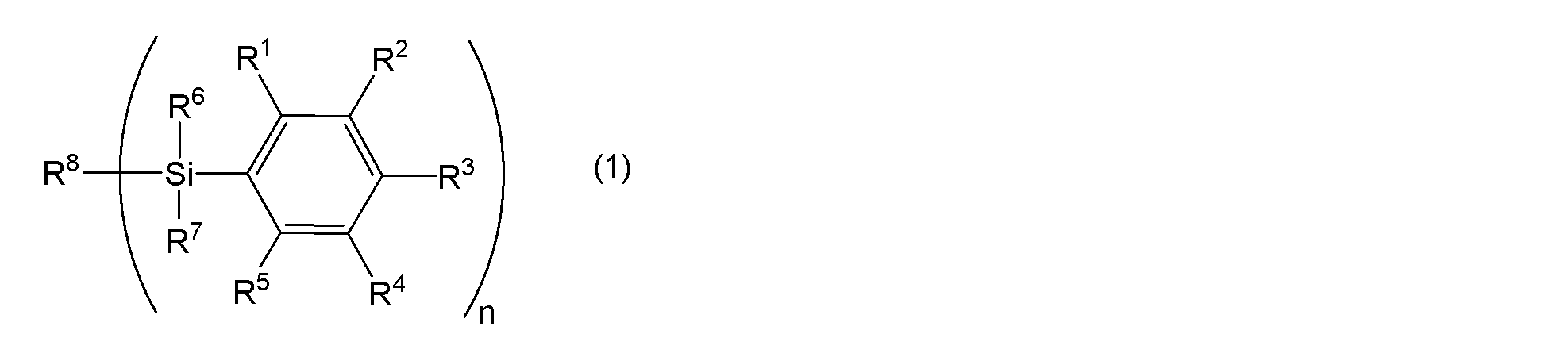
R8は、n価の基を表し、
R6、R7、R9、R10及びR11は、それぞれ独立して、置換基を有している若しくは無置換の炭素原子数1~20の脂肪族炭化水素基又は置換基を有している若しくは無置換の炭素原子数6~20の芳香族炭化水素基を表し、
nは、1~3の整数を表す。)
<非水電解液>
本発明で用いられるリチウム塩を有機溶媒に溶解させた非水電解液(以下、本発明の非水電解液ともいう)について説明する。本発明の非水電解液は、上記一般式(1)で表される化合物を含有する。以下、この化合物について説明する。
一般式(1)におけるR1、R2、R3、R4及びR5が表す無置換の炭素原子数1~20の脂肪族炭化水素基は、炭素原子数1~20の飽和脂肪族炭化水素基又は不飽和脂肪族炭化水素基である。炭素原子数1~20の飽和脂肪族炭化水素基としては、メチル、エチル、プロピル、2-プロピニル、ブチル、イソブチル、s-ブチル、t-ブチル、ペンチル、イソペンチル、ヘキシル、ヘプチル、オクチル、デシル、ドデシル、オクタデシル等が挙げられる。該脂肪族炭化水素基は、基中のアルキレン(ベンゼン環と結合する部位も含む)が、-O-、-CO-、-OCO-、-COO-、-O-CO-O-、-NR-、-S-、-SO-、-SO2-、-NR-CO-、-CO又は-NR-が隣り合わない条件で、1~3回中断していてもよい。但し、中断する基が炭素原子を含む場合、中断する基の炭素原子数を含めた炭素原子数が1~20となる。
炭素原子数1~20の不飽和脂肪族炭化水素基としては、炭素原子数1~20の飽和脂肪族炭化水素基として説明した基のC-C単結合が、C=C二重結合又はC≡C三重結合となっているものである。
C=C二重結合を含む具体的な基としては、ビニル、アリル、3-ブテニル、イソブテニル、4-ペンテニル、5-ヘキセニル、2-(3-シクロヘキセニル)エチル等が挙げられる。
C≡C三重結合を含む具体的な基としては、エチニル、プロパルギル、3-ブテニル等が挙げられる。
炭素原子数1~20の飽和脂肪族炭化水素基を置換する基は、ハロゲン原子、ニトリル基、ニトロ基、アミノ基、カルボキシル基、水酸基、チオール基、ホルミル基、スルホン基、-SiR6R7R8又はリン酸基である。尚、置換する基が炭素原子を含む基である場
合、置換する基の炭素原子数を含めた炭素原子数が1~20となる。
Rが表す基としては、メチル基、エチル基、プロピル基である。
一般式(1)におけるR1、R2、R3、R4及びR5が表すハロゲン原子としては、フッ素原子、塩素原子、臭素原子、ヨウ素原子等が挙げられる。尚、本明細書中におけるハロゲン原子は、全てこれと同様である。
ハロゲン原子により少なくとも一つ置換された脂肪族炭化水素基において、ハロゲン原子の置換数及び置換位置は、特に制限されないが、ハロゲン原子により少なくとも一つ置換された脂肪族炭化水素基として好ましいものを挙げると、トリフルオロメチル、ペンタフルオロエチル、ヘプタフルオロプロピル、ヘプタデカフルオロオクチル等のパーフルオロアルキル類;ジフルオロメタン、モノフルオロメタン、1,1-ジフルオロエチル等となる。
また、R1、R2、R3、R4及びR5において、ハロゲン原子により少なくとも一つ置換された炭素原子数1~20の脂肪族炭化水素基以外の好ましい置換基としては、メチル、エチル、ハロゲン原子、ニトリル、炭素原子数1~10のアルコキシ(メチルオキシ、エチルオキシ、プロピルオキシ、イソプロピルオキシ、ブチルオキシ、第二ブチルオキシ、第三ブチルオキシ、イソブチルオキシ)等が挙げられる。
炭素原子数1~10のアルキレンとしては、メタン-1,1-ジイル、エタン-1,2-ジイル、エタン-1,1-ジイル、プロパン-1,3-ジイル、プロパン-1,2-ジイル、ブタン-1,4-ジイル、2-メチルプロパン-1,3-ジイル、ペンタン-1,5-ジイル、ヘキサン-1,6-ジイル、ヘプタン-1,7-ジイル、オクタン-1,8-ジイル、ノナン-1,9-ジイル、シクロヘキサン-1,4-ジイル等が挙げられる。
n=2の場合の具体的な基としては、以下の基が挙げられる、
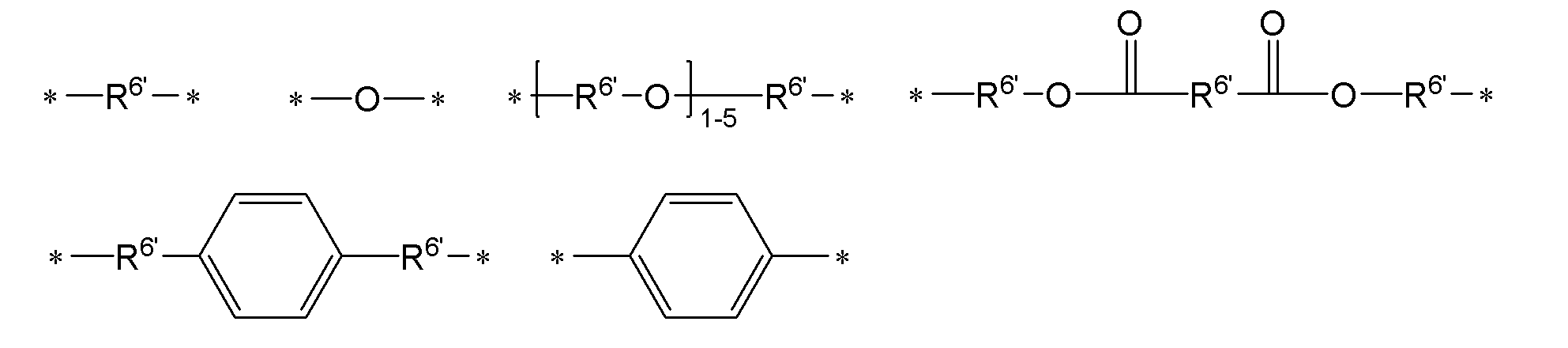
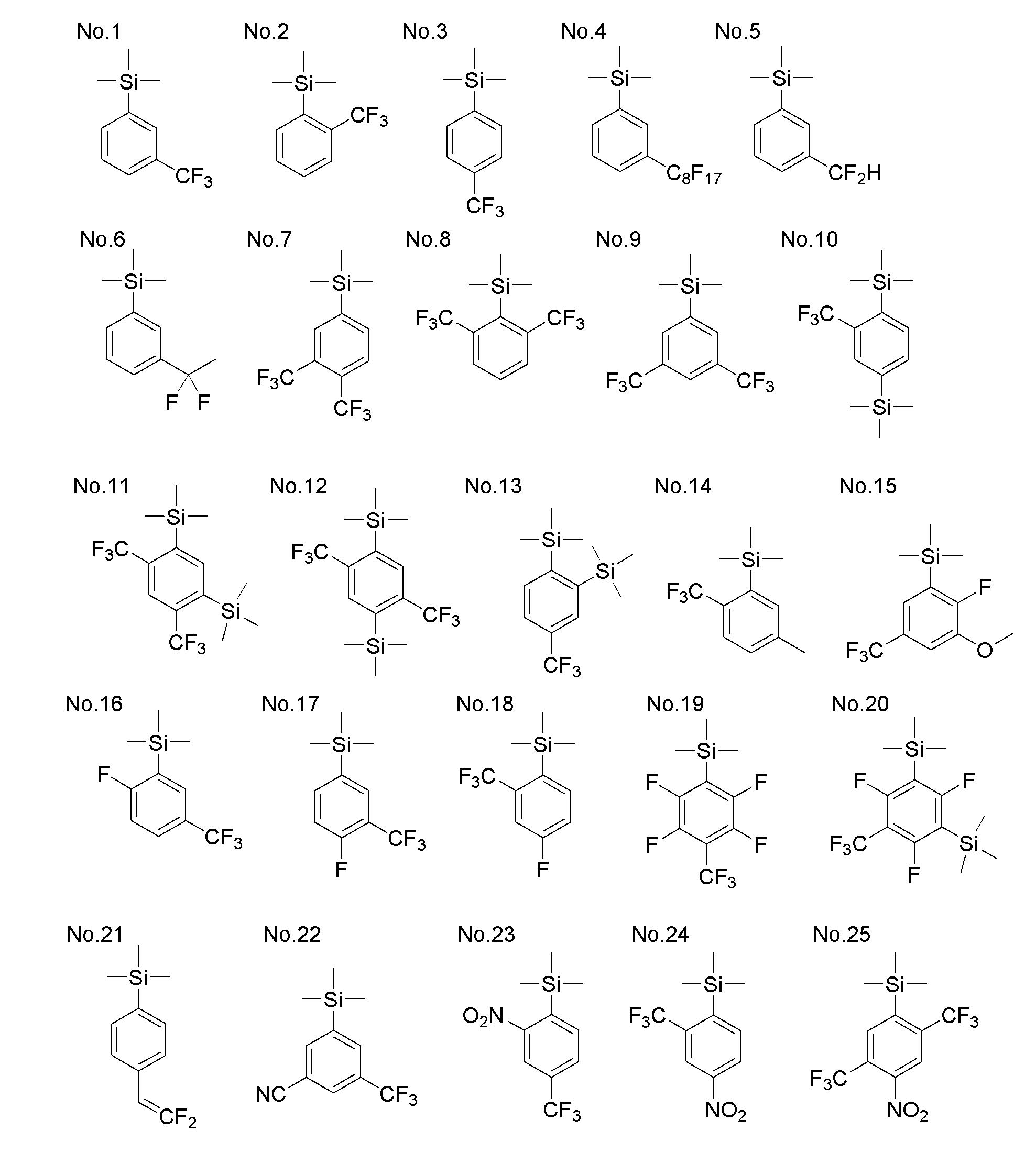
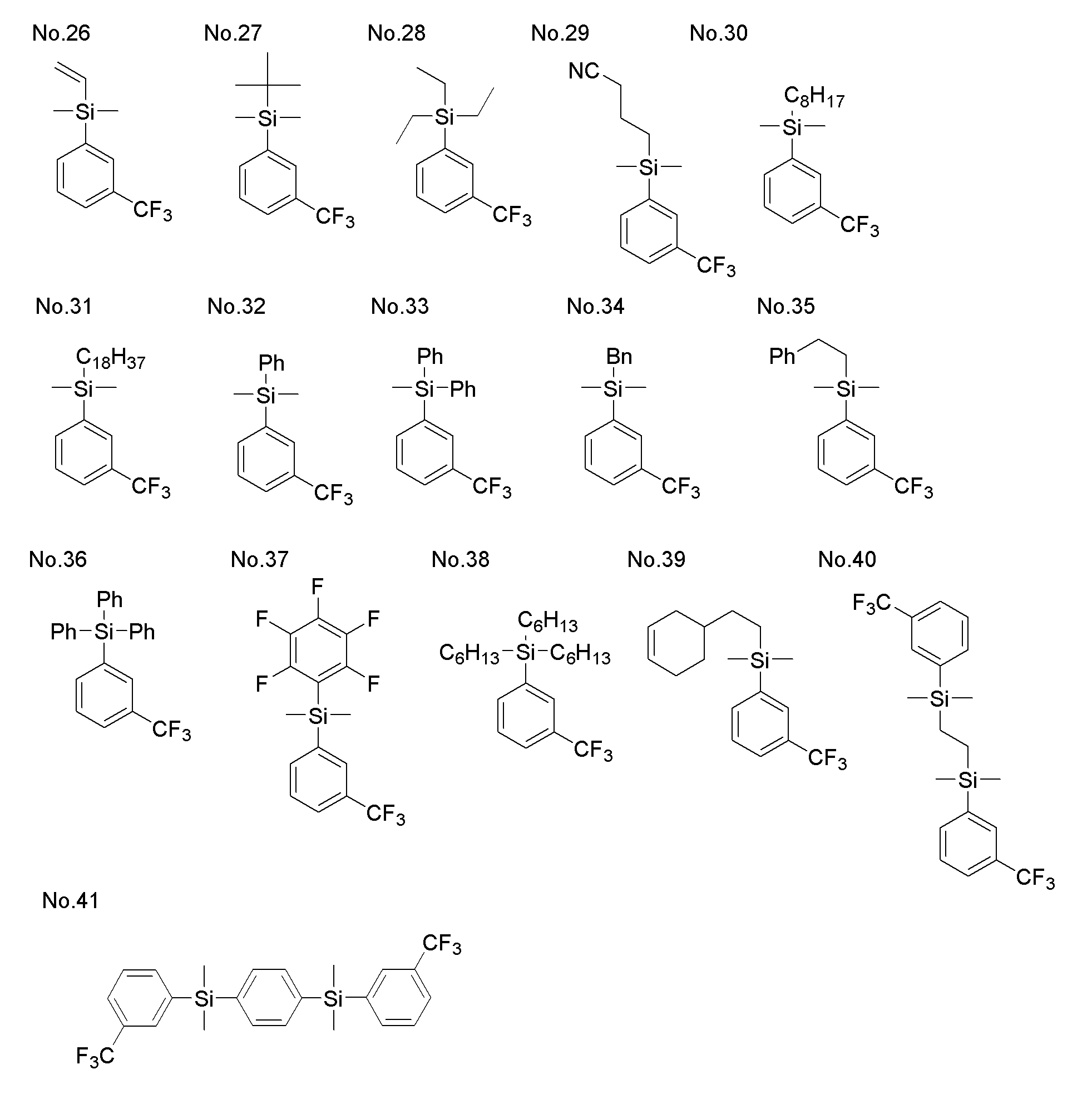
n=3の場合の具体的な基としては、以下の基が挙げられる。


また、本発明の非水電解液において、上記一般式(1)で表わされる化合物の含有量が、あまりに少ない場合には十分な効果を発揮できず、またあまりに多い場合には、配合量に見合う増量効果は得られないばかりか、却って非水電解液の特性に悪影響を及ぼすことがあることから、一般式(1)で表される化合物の含有量は、非水電解液中、0.001~10質量%が好ましく、0.01~8質量%が更に好ましく、0.1~5質量%が最も好ましい。
上記有機溶媒のうち、飽和鎖状カーボネート化合物、鎖状エーテル化合物、環状エーテル化合物及び飽和鎖状エステル化合物は、非水電解液の粘度を低くすることができ、電解質イオンの移動性を高くすることができる等、出力密度等の電池特性を優れたものにすることができる。また、低粘度であるため、低温での非水電解液の性能を高くすることができ、中でも、飽和鎖状カーボネート化合物が好ましい。斯かる飽和鎖状カーボネート化合物としては、例えば、ジメチルカーボネート(DMC)、エチルメチルカーボネート(EMC)、ジエチルカーボネート(DEC)、エチルブチルカーボネート、メチル-t-ブチルカーボネート、ジイソプロピルカーボネート、t-ブチルプロピルカーボネート等が挙げられる。上記の鎖状エーテル化合物又は環状エーテル化合物としては、例えば、ジメトキシエタン(DME)、エトキシメトキシエタン、ジエトキシエタン、テトラヒドロフラン、ジオキソラン、ジオキサン、1,2-ビス(メトキシカルボニルオキシ)エタン、1,2-ビス(エトキシカルボニルオキシ)エタン、1,2-ビス(エトキシカルボニルオキシ)プロパン、エチレングリコールビス(トリフルオロエチル)エーテル、プロピレングリコールビス(トリフルオロエチル)エーテル、エチレングリコールビス(トリフルオロメチル)エーテル、ジエチレングリコールビス(トリフルオロエチル)エーテル等が挙げられ、これらの中でも、ジオキソランが好ましい。
上記飽和鎖状エステル化合物としては、分子中の炭素数の合計が2~8であるモノエステル化合物及びジエステル化合物が好ましく、具体的な化合物としては、ギ酸メチル、ギ酸エチル、酢酸メチル、酢酸エチル、酢酸プロピル、酢酸イソブチル、酢酸ブチル、プロピオン酸メチル、プロピオン酸エチル、酪酸メチル、イソ酪酸メチル、トリメチル酢酸メチル、トリメチル酢酸エチル、マロン酸メチル、マロン酸エチル、コハク酸メチル、コハク酸エチル、3-メトキシプロピオン酸メチル、3-メトキシプロピオン酸エチル、エチレングリコールジアセチル、プロピレングリコールジアセチル等が挙げられ、ギ酸メチル、ギ酸エチル、酢酸メチル、酢酸エチル、酢酸プロピル、酢酸イソブチル、酢酸ブチル、プロピオン酸メチル、及びプロピオン酸エチルが好ましい。
2,4-ジフルオロアニソール、2,5-ジフルオロアニソール、2,6-ジフルオロアニソール、3,5-ジフルオロアニソール等の含フッ素アニソール化合物等が挙げられる。中でも、 ビフェニル、アルキルビフェニル、ターフェニル、ターフェニルの部分水素化体、シクロヘキシルベンゼン、t-ブチルベンゼン、t-アミルベンゼン、ジフェニルエーテル、ジベンゾフラン等の芳香族化合物が好ましい。
その他の過充電防止剤を添加する場合、その添加量は、特に制限されないが、上記一般式(1)で表される化合物100質量部に対して、好ましくは1~500質量部とする。
本発明の非水電解液二次電池は、リチウムが脱挿入可能なアノード、遷移金属とリチウムを含有するカソード、及びリチウム塩を有機溶媒に溶解させた非水電解液を有する非水電解液二次電池において、非水電解液として、本発明の非水電解液を用いたものである。
本発明で用いられるリチウムが脱挿入可能なアノードは、リチウムが脱挿入可能であれば特に限定されないが、好ましくは次の通りである。すなわち、本発明の非水電解液二次電池のアノードとしては、アノード活物質と結着剤とを有機溶媒又は水でスラリー化したものを集電体に塗布し、乾燥してシート状にしたものが使用され、必要に応じて導電材が配合される。
アノードの結着剤としては、例えば、ポリフッ化ビニリデン、ポリテトラフルオロエチレン、EPDM、SBR、NBR、フッ素ゴム、ポリアクリル酸等が挙げられるが、これらに限定されない。アノードの結着剤の使用量は、アノード活物質100質量部に対し、0.001~5質量部が好ましく、0.05~3質量部が更に好ましく、0.01~2質量部が最も好ましい。
アノードのスラリー化する溶媒としては、例えば、N-メチルピロリドン、ジメチルホルムアミド、ジメチルアセトアミド、メチルエチルケトン、シクロヘキサノン、酢酸メチル、アクリル酸メチル、ジエチルトリアミン、N,N-ジメチルアミノプロピルアミン、ポリエチレンオキシド、テトラヒドロフラン等が挙げられるが、これに限定されない。溶媒の使用量は、アノード活物質100質量部に対し、30~300質量部が好ましく、50~200質量部が更に好ましい。
アノードの集電体には、通常、銅、ニッケル、ステンレス鋼、ニッケルメッキ鋼等が使用される。
また、必要に応じて配合される導電材としては、グラフェン、グラファイトの微粒子、アセチレンブラック、ケッチェンブラック等のカーボンブラック、ニードルコークス等の無定形炭素の微粒子等、カーボンナノファイバー等が使用されるが、これらに限定されない。
本発明で用いられる遷移金属とリチウムを含有するカソードとしては、通常の二次電池と同様に、カソード活物質、結着剤、導電材等を有機溶媒又は水でスラリー化したものを集電体に塗布し、乾燥してシート状にしたものが使用される。カソード活物質は、遷移金属とリチウムを含有するものであり、1種の遷移金属とリチウムを含有する物質が好ましく、例えば、リチウム遷移金属複合酸化物、リチウム含有遷移金属リン酸化合物等が挙げられ、これらを混合して用いてもよい。上記リチウム遷移金属複合酸化物の遷移金属としてはバナジウム、チタン、クロム、マンガン、鉄、コバルト、ニッケル、銅等が好ましい。リチウム遷移金属複合酸化物の具体例としては、LiCoO2等のリチウムコバルト複合酸化物、LiNiO2等のリチウムニッケル複合酸化物、LiMnO2、LiMn2O4、Li2MnO3等のリチウムマンガン複合酸化物、これらのリチウム遷移金属複合酸化物の主体となる遷移金属原子の一部をアルミニウム、チタン、バナジウム、クロム、マンガン、鉄、コバルト、リチウム、ニッケル、銅、亜鉛、マグネシウム、ガリウム、ジルコニウム等の他の金属で置換したもの等が挙げられる。置換されたものの具体例としては、例えば、LiNi0.5Mn0.5O2、LiNi0.80Co0.17Al0.03O2、LiNi1/3Co1/3Mn1/3O2、LiMn1.8Al0.2O4、LiMn1.5Ni0.5O4等が挙げられる。上記リチウム含有遷移金属リン酸化合物の遷移金属としては、バナジウム、チタン、マンガン、鉄、コバルト、ニッケル等が好ましく、具体例としては、例えば、LiFePO4等のリン酸鉄類、LiCoPO4等のリン酸コバルト類、これらのリチウム遷移金属リン酸化合物の主体となる遷移金属原子の一部をアルミニウム、チタン、バナジウム、クロム、マンガン、鉄、コバルト、リチウム、ニッケル、銅、亜鉛、マグネシウム、ガリウム、ジルコニウム、ニオブ等の他の金属で置換したもの等が挙げられる。
本発明の非水電解液二次電池のカソードに用いられるカソード活物質としては、上述の非水電解液が含有する上記一般式(1)で表される化合物の添加効果が出やすいことから、マンガンを含有するリチウム含有金属酸化物が好ましい。マンガンを含有するリチウム含有化合物の中では、カソード活物質としての性能に優れることから、Li1.1Mn1.8Mg0.1O4、Li1.1Mn1.85Al0.05O4、LiNi1/3Co1/3Mn1/3O2、及びLiNi0.5Co0.2Mn0.3O2が好ましい。
カソードの導電材としては、グラフェン、グラファイトの微粒子、アセチレンブラック、ケッチェンブラック等のカーボンブラック、ニードルコークス等の無定形炭素の微粒子等、カーボンナノファイバー等が使用されるが、これらに限定されない。カソードの導電材の使用量は、カソード活物質100質量部に対し、0.01~20質量部が好ましく、0.1~10質量部が更に好ましい。
カソードの集電体としては、通常、アルミニウム、ステンレス鋼、ニッケルメッキ鋼等が使用される。
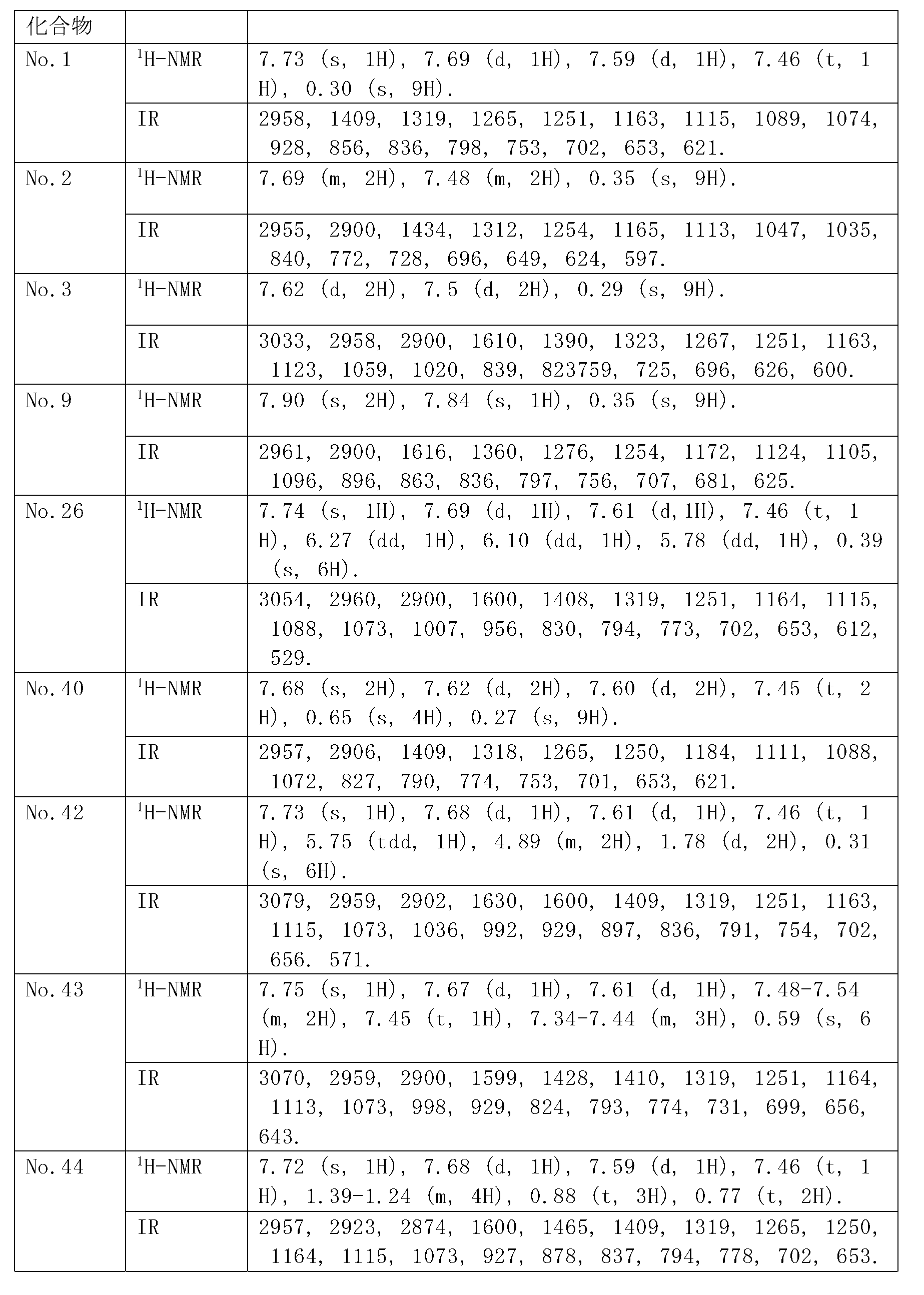
フラスコにマグネシウム(6.32g、0.26mmоl)を加え、減圧乾燥後、アルゴン置換した。テトラヒドロフランを100mL加え、氷冷下で1-ブロモ-3-トリフロロメチルベンゼンを数滴加えた。テトラヒドロフランをさらに100mL加えた後に、残りの1-ブロモ-3-トリフロロメチルベンゼン(計45.0g、0.20mmоl)をゆっくり滴下した。室温で1時間撹拌した後に、氷冷下でクロロトリメチルシラン(50.5mL、0.40mmоl)を滴下し、室温で終15時間撹拌した。塩化アンモニウム水溶液を200mL、酢酸エチル300mLを加え、油水分離した。得られた有機層に無水硫酸ナトリウムを加え、濾過した後にエバポレートした。粗生成物を蒸留(10mmHg、オイルバス110-115℃、気体90-95℃)して無色液体の目的物を28.4g(収率64%)得た。得られた液体が、化合物No.1であることを1H-NMR及びIRを用いて確認した。データを[表1]に示す。
アルゴン置換したフラスコに1-ブロモ-2-トリフロロメチルベンゼン(3.12mL、0.0230mоl)及びテトラヒドロフランを30.0mL加え、-75℃でn-ブチルリチウム(1.60Mヘキサン溶液)(14.4mL)をゆっくり滴下した。次に、氷冷下でクロロトリメチルシラン(1.98mL、0.0253mоl)を滴下し、室温で30分間撹拌した。水を50.0mL、及び酢酸エチル50.0mLを加え、油水分離した。得られた有機層に無水硫酸ナトリウムを加え、濾過した後にエバポレ-トした。粗生成物を蒸留(5.00mmHg、オイルバス80℃、気体70℃)して無色液体の目的物を0.768g(収率15.3%)得た。得られた液体が、化合物No.2であることを1H-NMR及びIRを用いて確認した。デ-タを[表1]に示す。
フラスコにマグネシウム(3.23g、0.133mоl)を加え、減圧乾燥後、アルゴン置換した。テトラヒドロフランを120mL加え、氷冷下で1-ブロモ-4-トリフロロメチルベンゼン(15.3mL、0.111mоl)をゆっくり滴下した。室温で1時間撹拌した後に、氷冷下でクロロトリメチルシラン(21.0mL、0.167mmоl)を滴下し、室温で15時間撹拌した。塩化アンモニウム水溶液を200mL、酢酸エチル250mLを加え、油水分離した。得られた有機層に無水硫酸ナトリウムを加え、濾過した後にエバポレ-トした。粗生成物を蒸留(60mmHg、オイルバス110℃、気体90℃)して無色液体の目的物を13.1g(収54.2%)得た。得られた液体が、化合物No.3であることを1H-NMR及びIRを用いて確認した。デ-タを[表1]に示す。
フラスコにマグネシウム(0.990g、0.0410mоl)を加え、減圧乾燥後、アルゴン置換した。テトラヒドロフランを35.0mL加え、氷冷下で1-ブロモ-3,5-ビス(トリフルオロメチル)ベンゼン(5.40mL、0.0320mоl)をゆっくり滴下した。室温で1時間撹拌した後に、氷冷下でクロロトリメチルシラン(6.44mL、0.0510mоl)を滴下し、60℃で6時間撹拌した。塩化アンモニウム水溶液を200mL、酢酸エチル300mLを加え、油水分離した。得られた有機層に無水硫酸ナトリウムを加え、濾過した後にエバポレ-トした。粗生成物を中圧カラム(展開溶媒:ヘキサン)により単離し、無色液体の目的物を1.89g(収率21.0%)得た。得られた液体が、化合物No.9であることを1H-NMR及びIRを用いて確認した。デ-タを[表1]に示す。
フラスコにマグネシウム(3.60g、0.140mоl)を加え、減圧乾燥後、アルゴン置換した。テトラヒドロフランを100mL加え、氷冷下で1-ブロモ-3-トリフロロメチルベンゼン(17.0mL、0.123mоl)をゆっくり滴下した。室温で1時間撹拌した後に、氷冷下でクロロジメチルビニルシラン(25.0mL、0.184mоl)を滴下し、50℃で2時間撹拌した。塩化アンモニウム水溶液を200mL、酢酸エチル200mLを加え、油水分離した。得られた有機層に無水硫酸ナトリウムを加え、濾過した後にエバポレ-トした。粗生成物を蒸留(10mmHg、オイルバス80℃、気体68℃)して無色液体の目的物を19.5g(収率68.9%)得た。得られた液体が、化合物No.26であることを1H-NMR及びIRを用いて確認した。デ-タを[表1]に示す。
フラスコにマグネシウム(5.83 g、0.24mmоl) を加え、減圧乾燥後、アルゴン置換した。テトラヒドロフランを150mL加え、氷冷下で1-ブロモ-3-トリフロロメチルベンゼン(45.0g、0.20mmоl)をゆっくり滴下した。室温で1時間撹拌した後に、氷冷下で1,2-ビス(クロロジメチルシリル)エタン(21.5g、0.10mmоl)を滴下し、室温で終15時間撹拌した。塩化アンモニウム水溶液を200mL、酢酸エチル300mLを加え、油水分離した。得られた有機層に無水硫酸ナトリウムを加え、濾過した後にエバポレートした。粗生成物を蒸留(3mmHg、オイルバス180-190℃、気体145-155℃)して無色液体の目的物を18.2g(収率42%)得た。得られた液体が、化合物No.40であることを1H-NMR及びIRを用いて確認した。データを[表1]に示す。
フラスコにマグネシウム(2.91g、0.120mоl)を加え、減圧乾燥後、アルゴン置換した。テトラヒドロフランを50mL加え、氷冷下で1-ブロモ-3-トリフロロメチルベンゼン(13.8mL、0.100mоl)をゆっくり滴下した。室温で1時間撹拌した後に、氷冷下でクロロジメチルアリルシラン(7.57mL、0.0500mmоl)を滴下し、50℃で2時間撹拌した。塩化アンモニウム水溶液を100mL、酢酸エチル100mLを加え、油水分離した。得られた有機層に無水硫酸ナトリウムを加え、濾過した後にエバポレ-トした。粗生成物を蒸留(20mmHg、オイルバス85℃、気体63℃)して無色液体の目的物を7.10g(収58.1%)得た。得られた液体が、化合物No.42であることを1H-NMR及びIRを用いて確認した。デ-タを[表1]に示す。
フラスコにマグネシウム(4.38g、0.180mоl)を加え、減圧乾燥後、アルゴン置換した。テトラヒドロフランを150mL加え、氷冷下で1-ブロモ-3-トリフロロメチルベンゼン(20.7mL、0.150mоl)をゆっくり滴下した。室温で1時間撹拌した後に、氷冷下でクロロジメチルフェニルシラン(12.4mL、0.0750mоl)を滴下し、60℃で2時間撹拌した。塩化アンモニウム水溶液を200mL、酢酸エチル300mLを加え、油水分離した。得られた有機層に無水硫酸ナトリウムを加え、濾過した後にエバポレ-トした。粗生成物を蒸留(0.50mmHg、オイルバス115℃、気体91℃)して無色液体の目的物を17.2g(収率81.8%)得た。得られた液体が、化合物No.43であることを1H-NMR及びIRを用いて確認した。デ-タを[表1]に示す。
フラスコにマグネシウム(4.48g、0.0184mоl)を加え、減圧乾燥後、アルゴン置換した。テトラヒドロフランを100mL加え、氷冷下で1-ブロモ-3-トリフロロメチルベンゼン(20.7mL、0.150mоl)をゆっくり滴下した。室温で1時間撹拌した後に、氷冷下でブチルジメチルクロロシラン(6.62mL、0.0384mоl)を滴下し、50℃で2時間撹拌した。塩化アンモニウム水溶液を200mL、酢酸エチル300mLを加え、油水分離した。得られた有機層に無水硫酸ナトリウムを加え、濾過した後にエバポレートした。粗生成物を蒸留(4.00mmHg、オイルバス120℃、気体95℃)して無色液体の目的物を2.03g(収率20.3%)得た。得られた液体が、化合物No.44であることを1H-NMR及びIRを用いて確認した。データを[表1]に示す。
実施例及び比較例において、非水電解液二次電池(リチウム二次電池)は、以下の作製手順に従って作製された。
〔カソードの作製〕
活物質としてLiMn2O490質量部、導電材としてアセチレンブラック5質量部、及びバインダーとしてポリフッ化ビニリデン(PVDF)5質量部を混合した後、N-メチル-2-ピロリドン(NMP)140質量部に分散させてスラリー状とした。このスラリーをアルミニウム製の集電体に塗布し、乾燥後、プレス成型した。その後、このカソードを所定の大きさにカットして円盤状カソードを作製した。
活物質として人造黒鉛97.0質量部、及びバインダーとしてスチレンブタジエンゴム1.5質量部、増粘剤としてカルボキシメチルセルロース 1.5質量部を混合し、水120質量部に分散させてスラリー状とした。このスラリーを銅製の負極集電体に塗布し、乾燥後、プレス成型した。その後、このアノードを所定の大きさにカットし、円盤状アノードを作製した。
エチレンカーボネート30体積%、エチルメチルカーボネート40体積%、ジメチルカーボネート30体積%からなる混合溶媒に、LiPF6を1mol/Lの濃度で溶解し電解質溶液を調製した。
電解液添加剤として、合成例1~9で得られた本発明に係る化合物又は下記に示す比較化合物1~2を〔表1〕に示す割合で電解質溶液に溶解し、本発明の非水電解液及び比較の非水電解液を調製した。尚、〔表1〕及び〔表2〕中の( )内の数字は、非水電解液における濃度(質量%)を表す。
シクロヘキシルベンゼン
〔比較化合物2〕
トリメチルシリルベンゼン
得られた円盤状カソードと円盤状アノードを、厚さ25μmのポリエチレン製の微多孔フィルムをはさんでケース内に保持した。その後、本発明の非水電解液又は比較の非水電解液と正極との組合せが〔表1〕となるように、それぞれの非水電解液をケース内に注入し、ケースを密閉、封止して、実施例1~10及び比較例1~3のリチウム二次電池(φ20mm、厚さ3.2mmのコイン型)を製作した。
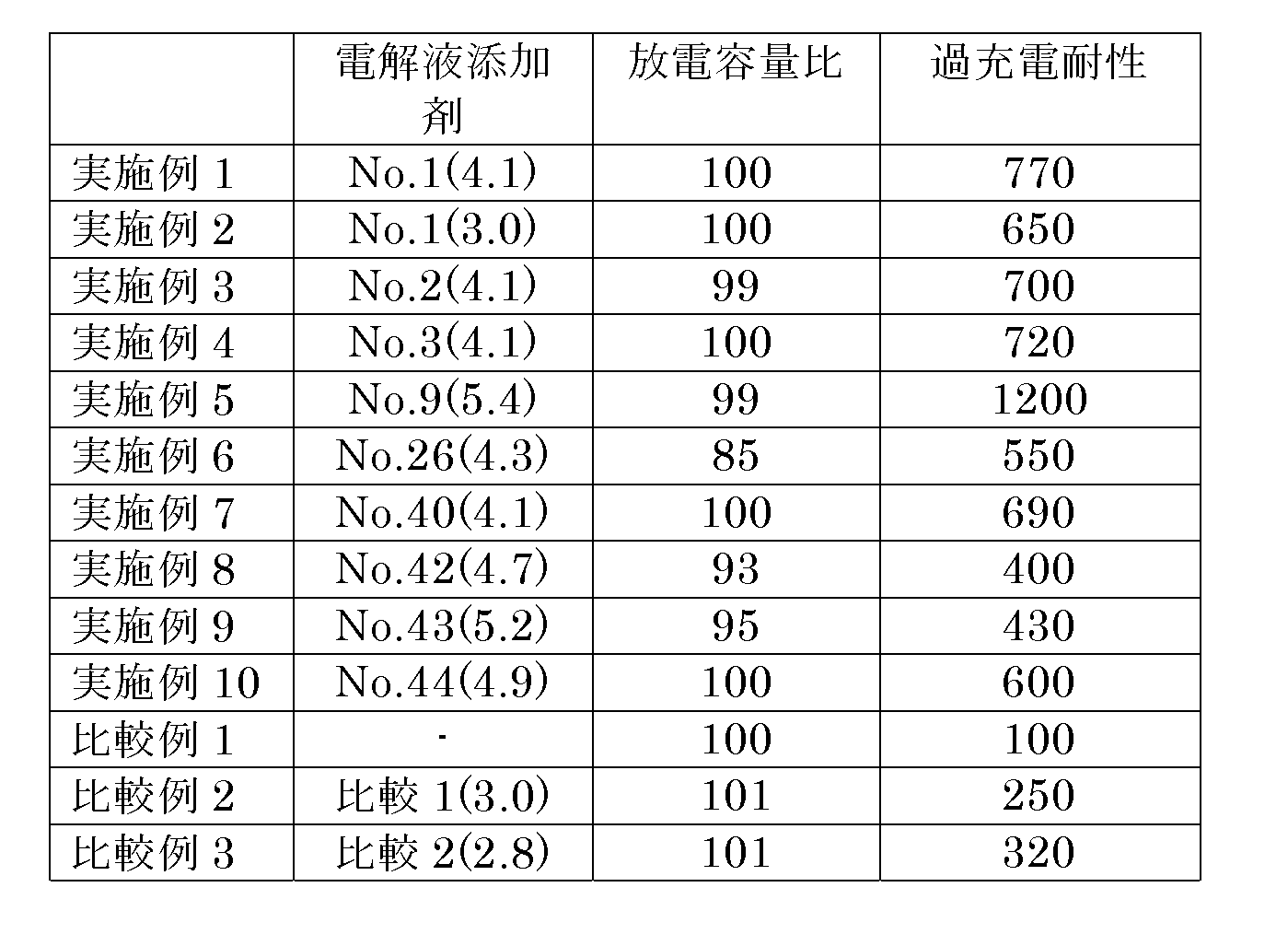
リチウム二次電池を、20℃の恒温槽内に入れ、充電電流0.3mA/cm2(0.2C相当の電流値)で4.2Vまで定電流定電圧充電し、放電電流0.3mA/cm2(0.2C相当の電流値)で3.0Vまで定電流放電する操作を5回行った。その後、充電電流0.3mA/cm2で4.2Vまで定電流定電圧充電し、放電電流0.3mA/cm2で3.0Vまで定電流放電した。この6回目に測定した放電容量を、電池の初期放電容量とし、下記式に示すように、放電容量比(%)を、比較例1(電解液添加剤無添加)の初期放電容量を100として算出した。
放電容量比(%)=[(初期放電容量)/(比較例1における初期放電容量)]×100
リチウム二次電池を、20℃の恒温槽内に入れ、充電電流0.3mA/cm2(0.2C相当の電流値)で過充電状態(5.5V)まで定電流定電圧充電したときの、容量(mAh/g)を測定した。比較例1(電解液添加剤無添加)の容量を100として算出した。
1a カソード集電体
2 アノード
2a アノード集電体
3 電解液
4 カソードケース
5 アノードケース
6 ガスケット
7 セパレータ
10 コイン型の非水電解液二次電池
10' 円筒型の非水電解液二次電池
11 アノード
12 アノード集電体
13 カソード
14 カソード集電体
15 電解液
16 セパレータ
17 カソード端子
18 アノード端子
19 アノード板
20 アノードリード
21 カソード
22 カソードリード
23 ケース
24 絶縁板
25 ガスケット
26 安全弁
27 PTC素子
Claims (2)
- リチウム塩を有機溶媒に溶解させた非水電解液において、
下記一般式(1)で表される化合物を少なくとも1種含有することを特徴とする非水電解液。
(式中、R1、R2、R3、R4及びR5は、それぞれ独立して、置換基を有している若しくは無置換の炭素原子数1~20の脂肪族炭化水素基、ハロゲン原子、ニトリル基、ニトロ基、アミノ基、カルボキシル基、水酸基、チオール基、ホルミル基、スルホン基、-SiR9R10R11又はリン酸基を表し、炭素原子数1~20の脂肪族炭化水素基は、基中のアルキレン(ベンゼン環と結合する部位も含む)が、-O-、-CO-、-OCO-、-COO-、-O-CO-O-、-NR-、-S-、-SO-、-SO2-、-NR-CO-、-CO-NR-が隣り合わない条件で、1~3回中断していてもよく、R1、R2、R3、R4及びR5の少なくとも一つがハロゲン原子により少なくとも一つ置換された炭素原子数1~20の脂肪族炭化水素基であり、
R8は、n価の基を表し、
R6、R7、R9、R10及びR11は、それぞれ独立して、置換基を有している若しくは無置換の炭素原子数1~20の脂肪族炭化水素基又は置換基を有している若しくは無置換の炭素原子数6~20の芳香族炭化水素基を表し、
nは、1~3の整数を表す。) - リチウムが脱挿入可能なアノード、遷移金属とリチウムを含有するカソード、及びリチウム塩を有機溶媒に溶解させた非水電解液を有する非水電解液二次電池において、
非水電解液が請求項1に記載の非水電解液であることを特徴とする非水電解液二次電池。
Priority Applications (5)
| Application Number | Priority Date | Filing Date | Title |
|---|---|---|---|
| CN201580004478.4A CN105917516B (zh) | 2014-03-14 | 2015-03-06 | 非水电解液及非水电解液二次电池 |
| EP15760934.8A EP3118924B1 (en) | 2014-03-14 | 2015-03-06 | Non-aqueous electrolyte and non-aqueous electrolyte secondary battery |
| KR1020167018827A KR20160133410A (ko) | 2014-03-14 | 2015-03-06 | 비수전해액 및 비수전해액 이차전지 |
| JP2016507496A JP6714506B2 (ja) | 2014-03-14 | 2015-03-06 | 非水電解液及び非水電解液二次電池 |
| US15/109,902 US10096858B2 (en) | 2014-03-14 | 2015-03-06 | Nonaqueous electrolyte and nonaqueous secondary battery |
Applications Claiming Priority (2)
| Application Number | Priority Date | Filing Date | Title |
|---|---|---|---|
| JP2014-052568 | 2014-03-14 | ||
| JP2014052568 | 2014-03-14 |
Publications (1)
| Publication Number | Publication Date |
|---|---|
| WO2015137253A1 true WO2015137253A1 (ja) | 2015-09-17 |
Family
ID=54071699
Family Applications (1)
| Application Number | Title | Priority Date | Filing Date |
|---|---|---|---|
| PCT/JP2015/056679 Ceased WO2015137253A1 (ja) | 2014-03-14 | 2015-03-06 | 非水電解液及び非水電解液二次電池 |
Country Status (7)
| Country | Link |
|---|---|
| US (1) | US10096858B2 (ja) |
| EP (1) | EP3118924B1 (ja) |
| JP (1) | JP6714506B2 (ja) |
| KR (1) | KR20160133410A (ja) |
| CN (1) | CN105917516B (ja) |
| TW (1) | TWI660537B (ja) |
| WO (1) | WO2015137253A1 (ja) |
Cited By (4)
| Publication number | Priority date | Publication date | Assignee | Title |
|---|---|---|---|---|
| JP2018206641A (ja) * | 2017-06-06 | 2018-12-27 | リチウム エナジー アンド パワー ゲゼルシャフト ミット ベシュレンクテル ハフッング ウント コンパニー コマンディトゲゼルシャフトLithium Energy and Power GmbH & Co. KG | 非水電解質蓄電素子 |
| WO2019176618A1 (ja) * | 2018-03-13 | 2019-09-19 | 株式会社Adeka | 非水電解質二次電池 |
| WO2023026849A1 (ja) * | 2021-08-24 | 2023-03-02 | 信越化学工業株式会社 | 非水系電解質及び非水電解質二次電池 |
| JP2023143694A (ja) * | 2022-03-25 | 2023-10-06 | チューハイ コスミクス バッテリー カンパニー,リミテッド | 正極材料、電池及び電子機器 |
Families Citing this family (6)
| Publication number | Priority date | Publication date | Assignee | Title |
|---|---|---|---|---|
| CN109065943B (zh) * | 2018-08-17 | 2024-04-02 | 深圳赛骄阳能源科技股份有限公司 | 一种防爆锂离子电池 |
| JPWO2020116578A1 (ja) * | 2018-12-05 | 2021-10-21 | 昭和電工マテリアルズ株式会社 | 電解液及び電気化学デバイス |
| US11075371B2 (en) * | 2018-12-21 | 2021-07-27 | GM Global Technology Operations LLC | Negative electrode for secondary lithium metal battery and method of making |
| US11515538B2 (en) * | 2019-10-11 | 2022-11-29 | GM Global Technology Operations LLC | In-situ polymerization to protect lithium metal electrodes |
| JP7171683B2 (ja) | 2020-12-01 | 2022-11-15 | プライムプラネットエナジー&ソリューションズ株式会社 | リチウムイオン二次電池の非水電解液およびリチウムイオン二次電池 |
| JP7566702B2 (ja) * | 2021-08-24 | 2024-10-15 | 信越化学工業株式会社 | 非水系電解質及び非水電解質二次電池 |
Citations (3)
| Publication number | Priority date | Publication date | Assignee | Title |
|---|---|---|---|---|
| JP2002134169A (ja) * | 2000-10-30 | 2002-05-10 | Denso Corp | 非水電解液及び該電解液を用いた非水電解液二次電池 |
| JP2002343423A (ja) * | 2001-05-15 | 2002-11-29 | Hitachi Ltd | リチウム二次電池 |
| JP2004519829A (ja) * | 2000-12-18 | 2004-07-02 | イー・アイ・デュポン・ドウ・ヌムール・アンド・カンパニー | リチウムイオンバッテリー用添加剤 |
Family Cites Families (9)
| Publication number | Priority date | Publication date | Assignee | Title |
|---|---|---|---|---|
| JP2597091B2 (ja) | 1986-10-16 | 1997-04-02 | 日立マクセル株式会社 | リチウム二次電池 |
| JP2962782B2 (ja) | 1990-07-26 | 1999-10-12 | 三洋電機株式会社 | 非水系電解液電池 |
| JP3066126B2 (ja) | 1991-09-10 | 2000-07-17 | 三洋電機株式会社 | 非水系電解液電池 |
| FR2719161B1 (fr) | 1994-04-22 | 1996-08-02 | Accumulateurs Fixes | Générateur électrochimique rechargeable au lithium à anode de carbone. |
| JP3669024B2 (ja) * | 1995-05-26 | 2005-07-06 | ソニー株式会社 | 非水電解液二次電池 |
| JP3669064B2 (ja) | 1996-08-01 | 2005-07-06 | ソニー株式会社 | 非水電解質二次電池 |
| JP2001006729A (ja) | 1999-06-18 | 2001-01-12 | Mitsubishi Chemicals Corp | 非水系電解液二次電池 |
| EP1202373B1 (en) | 2000-10-30 | 2012-01-18 | Denso Corporation | Nonaqueous electrolytic solution and nonaqueous secondary battery |
| KR100462784B1 (ko) * | 2002-08-12 | 2004-12-29 | 삼성에스디아이 주식회사 | 안전성이 개선된 비수계 전해액 및 이를 채용한 리튬 전지 |
-
2015
- 2015-03-06 WO PCT/JP2015/056679 patent/WO2015137253A1/ja not_active Ceased
- 2015-03-06 JP JP2016507496A patent/JP6714506B2/ja not_active Expired - Fee Related
- 2015-03-06 US US15/109,902 patent/US10096858B2/en not_active Expired - Fee Related
- 2015-03-06 EP EP15760934.8A patent/EP3118924B1/en not_active Not-in-force
- 2015-03-06 CN CN201580004478.4A patent/CN105917516B/zh not_active Expired - Fee Related
- 2015-03-06 KR KR1020167018827A patent/KR20160133410A/ko not_active Withdrawn
- 2015-03-11 TW TW104107793A patent/TWI660537B/zh not_active IP Right Cessation
Patent Citations (3)
| Publication number | Priority date | Publication date | Assignee | Title |
|---|---|---|---|---|
| JP2002134169A (ja) * | 2000-10-30 | 2002-05-10 | Denso Corp | 非水電解液及び該電解液を用いた非水電解液二次電池 |
| JP2004519829A (ja) * | 2000-12-18 | 2004-07-02 | イー・アイ・デュポン・ドウ・ヌムール・アンド・カンパニー | リチウムイオンバッテリー用添加剤 |
| JP2002343423A (ja) * | 2001-05-15 | 2002-11-29 | Hitachi Ltd | リチウム二次電池 |
Cited By (9)
| Publication number | Priority date | Publication date | Assignee | Title |
|---|---|---|---|---|
| JP2018206641A (ja) * | 2017-06-06 | 2018-12-27 | リチウム エナジー アンド パワー ゲゼルシャフト ミット ベシュレンクテル ハフッング ウント コンパニー コマンディトゲゼルシャフトLithium Energy and Power GmbH & Co. KG | 非水電解質蓄電素子 |
| WO2019176618A1 (ja) * | 2018-03-13 | 2019-09-19 | 株式会社Adeka | 非水電解質二次電池 |
| JPWO2019176618A1 (ja) * | 2018-03-13 | 2021-03-11 | 株式会社Adeka | 非水電解質二次電池 |
| JP7216073B2 (ja) | 2018-03-13 | 2023-01-31 | 株式会社Adeka | 非水電解質二次電池 |
| WO2023026849A1 (ja) * | 2021-08-24 | 2023-03-02 | 信越化学工業株式会社 | 非水系電解質及び非水電解質二次電池 |
| JP2023030979A (ja) * | 2021-08-24 | 2023-03-08 | 信越化学工業株式会社 | 非水系電解質及び非水電解質二次電池 |
| JP7690353B2 (ja) | 2021-08-24 | 2025-06-10 | 信越化学工業株式会社 | 非水系電解質及び非水電解質二次電池 |
| JP2023143694A (ja) * | 2022-03-25 | 2023-10-06 | チューハイ コスミクス バッテリー カンパニー,リミテッド | 正極材料、電池及び電子機器 |
| JP7808063B2 (ja) | 2022-03-25 | 2026-01-28 | チューハイ コスミクス バッテリー カンパニー,リミテッド | 正極材料、電池及び電子機器 |
Also Published As
| Publication number | Publication date |
|---|---|
| CN105917516A (zh) | 2016-08-31 |
| TW201539832A (zh) | 2015-10-16 |
| KR20160133410A (ko) | 2016-11-22 |
| TWI660537B (zh) | 2019-05-21 |
| JPWO2015137253A1 (ja) | 2017-04-06 |
| JP6714506B2 (ja) | 2020-06-24 |
| EP3118924A1 (en) | 2017-01-18 |
| EP3118924B1 (en) | 2018-10-17 |
| CN105917516B (zh) | 2019-12-06 |
| EP3118924A4 (en) | 2017-12-13 |
| US20160336621A1 (en) | 2016-11-17 |
| US10096858B2 (en) | 2018-10-09 |
Similar Documents
| Publication | Publication Date | Title |
|---|---|---|
| JP6714506B2 (ja) | 非水電解液及び非水電解液二次電池 | |
| JP5955629B2 (ja) | 非水電解液二次電池 | |
| JP6713452B2 (ja) | 非水電解液及び非水電解液二次電池 | |
| JP6738815B2 (ja) | 非水電解液及び非水電解液二次電池 | |
| WO2015045989A1 (ja) | 電池用非水電解液、及びリチウム二次電池 | |
| WO2016013480A1 (ja) | 非水電解液二次電池、非水電解液及び化合物 | |
| CN105103361A (zh) | 电池用非水电解液、新的化合物、高分子电解质和锂二次电池 | |
| JP2013145702A (ja) | 非水電解液二次電池及び二次電池用非水電解液 | |
| JP5897869B2 (ja) | 新規フルオロシラン化合物 | |
| JP6103134B2 (ja) | 電解液、電気化学デバイス、リチウムイオン二次電池、及び、モジュール | |
| JP6760843B2 (ja) | 非水電解液及び非水電解液二次電池 | |
| JP6524084B2 (ja) | 非水電解液二次電池及び非水電解液 |
Legal Events
| Date | Code | Title | Description |
|---|---|---|---|
| 121 | Ep: the epo has been informed by wipo that ep was designated in this application |
Ref document number: 15760934 Country of ref document: EP Kind code of ref document: A1 |
|
| DPE1 | Request for preliminary examination filed after expiration of 19th month from priority date (pct application filed from 20040101) | ||
| ENP | Entry into the national phase |
Ref document number: 2016507496 Country of ref document: JP Kind code of ref document: A |
|
| WWE | Wipo information: entry into national phase |
Ref document number: 15109902 Country of ref document: US |
|
| REEP | Request for entry into the european phase |
Ref document number: 2015760934 Country of ref document: EP |
|
| WWE | Wipo information: entry into national phase |
Ref document number: 2015760934 Country of ref document: EP |
|
| ENP | Entry into the national phase |
Ref document number: 20167018827 Country of ref document: KR Kind code of ref document: A |
|
| NENP | Non-entry into the national phase |
Ref country code: DE |