WO2015137407A1 - Procédé de fabrication de dérivé d'ester d'acide hétéroarylcarboxylique, intermédiaire de fabrication de celui-ci, et cristal - Google Patents
Procédé de fabrication de dérivé d'ester d'acide hétéroarylcarboxylique, intermédiaire de fabrication de celui-ci, et cristal Download PDFInfo
- Publication number
- WO2015137407A1 WO2015137407A1 PCT/JP2015/057177 JP2015057177W WO2015137407A1 WO 2015137407 A1 WO2015137407 A1 WO 2015137407A1 JP 2015057177 W JP2015057177 W JP 2015057177W WO 2015137407 A1 WO2015137407 A1 WO 2015137407A1
- Authority
- WO
- WIPO (PCT)
- Prior art keywords
- group
- formula
- substituent
- acid
- hydrogen atom
- Prior art date
- Legal status (The legal status is an assumption and is not a legal conclusion. Google has not performed a legal analysis and makes no representation as to the accuracy of the status listed.)
- Ceased
Links
Images
Classifications
-
- C—CHEMISTRY; METALLURGY
- C07—ORGANIC CHEMISTRY
- C07D—HETEROCYCLIC COMPOUNDS
- C07D333/00—Heterocyclic compounds containing five-membered rings having one sulfur atom as the only ring hetero atom
- C07D333/02—Heterocyclic compounds containing five-membered rings having one sulfur atom as the only ring hetero atom not condensed with other rings
- C07D333/04—Heterocyclic compounds containing five-membered rings having one sulfur atom as the only ring hetero atom not condensed with other rings not substituted on the ring sulphur atom
- C07D333/26—Heterocyclic compounds containing five-membered rings having one sulfur atom as the only ring hetero atom not condensed with other rings not substituted on the ring sulphur atom with hetero atoms or with carbon atoms having three bonds to hetero atoms with at the most one bond to halogen, e.g. ester or nitrile radicals, directly attached to ring carbon atoms
- C07D333/38—Carbon atoms having three bonds to hetero atoms with at the most one bond to halogen, e.g. ester or nitrile radicals
- C07D333/40—Thiophene-2-carboxylic acid
Definitions
- the present invention relates to a novel method for producing a heteroarylcarboxylic ester derivative, a production intermediate thereof, and a crystal. More specifically, the present invention relates to an efficient method for producing a heteroarylcarboxylic ester derivative as a therapeutic agent for diabetes or a production intermediate thereof, and a production intermediate useful for such a production method. The present invention also relates to crystals of a heteroarylcarboxylic acid ester derivative useful as a therapeutic agent for diabetes.
- Patent Document 1 and Patent Document 2 disclose heteroarylcarboxylic acid ester derivatives included in the following formula (I), and representative compounds thereof are It has been reported to show an excellent effect of suppressing blood sugar elevation in a diabetic animal model.
- Patent Document 1 a method shown in the following scheme is shown as a general method for synthesizing a heteroarylcarboxylic acid ester derivative included in General Formula (I) (see Patent Document 1 for symbols in the formula). ).
- heteroarylcarboxylic acid ester derivative (F) in which X in the general formula (I) is a lower alkylene group or a lower alkenylene group, A is —OR 5, and R 5 is a lower alkyl group should be prepared as follows: Can do.
- the target heteroarylcarboxylic acid ester derivative (F) in which X represents a lower alkenylene group can be produced.
- X is performed by treating with a catalyst such as 10% palladium / carbon in a hydrogen atmosphere in a solvent that does not adversely affect the reaction, such as methanol, ethanol, or ethyl acetate.
- a catalyst such as 10% palladium / carbon in a hydrogen atmosphere in a solvent that does not adversely affect the reaction, such as methanol, ethanol, or ethyl acetate.
- a heteroarylcarboxylic acid ester derivative (F) in which can represent a lower alkylene group can be produced.
- a known method can be applied to the esterification reaction, and examples thereof include (1) a method using an acid halide and (2) a method using a condensing agent.
- the method using an acid halide is, for example, in a solvent such as dichloromethane that does not adversely affect the reaction or in the absence of a solvent, for example, in the presence or absence of a catalyst such as N, N-dimethylformamide.
- a solvent such as dichloromethane that does not adversely affect the reaction or in the absence of a solvent, for example, in the presence or absence of a catalyst such as N, N-dimethylformamide.
- the acid chloride obtained by reacting with thionyl chloride or oxalyl chloride is reacted with an alcohol in the presence of a base such as pyridine or triethylamine in a solvent that does not adversely affect the reaction such as dichloromethane or tetrahydrofuran. Is done.
- the method using a condensing agent is carried out in the presence of a base such as pyridine or triethylamine in a solvent that does not adversely affect the reaction such as tetrahydrofuran, N, N-dimethylformamide, or dichloromethane.
- a base such as pyridine or triethylamine
- a solvent that does not adversely affect the reaction such as tetrahydrofuran, N, N-dimethylformamide, or dichloromethane.
- the reaction is carried out using a condensing agent such as 1-ethyl-3- (3′-dimethylaminopropyl) carbodiimide (WSC) or 1,3-dicyclohexylcarbodiimide.
- WSC 1-ethyl-3- (3′-dimethylaminopropyl) carbodiimide
- 1,3-dicyclohexylcarbodiimide 1,3-dicyclohexylcarbodiimide
- the heteroarylcarboxylic acid ester derivative (i) in which A is —OR 5 and R 5 is a hydrogen atom in the general formula (I) is obtained by using Wittig reagent (G) (wherein E 2 is methyl) instead of Wittig reagent (B).
- Patent Document 2 there is a similar description as a general synthesis method of the heteroarylcarboxylic acid ester derivative contained in the general formula (I).
- the present invention provides a production method suitable for industrialization of a heteroarylcarboxylic acid ester derivative represented by the following formula (VI) and an intermediate useful for the production thereof.
- Patent Document 2 describes 3- [5- (4-carbamimidoyl-2-fluorophenoxy) carbonyl-2-thienyl] -2,2-dimethylpropanoic acid trifluoroacetate.
- the trifluoroacetate salt is produced by purifying the residue obtained from the reaction mixture by high performance liquid chromatography.
- the inventors have succeeded in producing crystals of 3- [5- (4-carbamimidoyl-2-fluorophenoxy) carbonyl-2-thienyl] -2,2-dimethylpropanoic acid succinate, It was found that this crystal was excellent in storage stability.
- R1 and R2 are the same or different and each independently represents a hydrogen atom or a lower alkyl group which may have a substituent
- R3 and R4 are the same or different and each independently represents a hydrogen atom or a lower alkyl group which may have a substituent (except when R3 and R4 are ethyl groups), or R3 and R4 together with the carbon atom to which they are attached form a C 3-8 cycloalkane ring
- R6, R7, R8 and R9 are the same or different and each independently represents a hydrogen atom or a halogen atom.
- R5 represents an aralkyl group which may have a substituent, an aralkyloxymethyl group which may have a substituent, or a heteroarylalkyl group which may have a substituent;
- X represents a halogen atom, Other symbols are as defined above.
- R1 and R2 are the same or different and each independently represents a hydrogen atom or a lower alkyl group which may have a substituent
- R3 and R4 are the same or different and each independently represents a hydrogen atom or a lower alkyl group which may have a substituent (except when R3 and R4 are ethyl groups), or R3 and R4 together with the carbon atom to which they are attached form a C 3-8 cycloalkane ring
- R6, R7, R8 and R9 are the same or different and each independently represents a hydrogen atom or a halogen atom.
- R5 represents an aralkyl group which may have a substituent, The production method according to [1] or [2].
- R1 and R2 represent a hydrogen atom; R5 represents an aralkyl group which may have a substituent, The production method according to [1] or [2].
- R3 and R4 represent a methyl group; R5 represents an aralkyl group which may have a substituent, The production method according to [1] or [2].
- R1 and R2 represent a hydrogen atom
- R3 and R4 represent a methyl group
- R5 represents an aralkyl group which may have a substituent
- R1 and R2 represent a hydrogen atom
- R3 and R4 represent a methyl group
- R5 represents a benzyl group
- R8 represents a fluorine atom
- R6, R7 and R9 represent a hydrogen atom, The production method according to [1] or [2].
- R1 and R2 are the same or different and each independently represents a hydrogen atom or a lower alkyl group which may have a substituent
- R3 and R4 are the same or different and each independently represents a hydrogen atom or a lower alkyl group which may have a substituent (except when R3 and R4 are ethyl groups), or R3 and R4 together with the carbon atom to which they are attached form a C 3-8 cycloalkane ring
- R5 represents an aralkyl group which may have a substituent, an aralkyloxymethyl group which may have a substituent, or a heteroarylalkyl group which may have a substituent.
- R1 and R2 represent a hydrogen atom
- R3 and R4 are the same or different and each independently represent a methyl group, an ethyl group or a propyl group (except when R3 and R4 are ethyl groups), or R3 and R4 are bonded to each other Forming a cyclopropane ring, a cyclobutane ring or a cyclopentane ring with the carbon atoms
- R3 and R4 represent a methyl group, The compound of the above-mentioned [9] or [10], or a chemically acceptable salt thereof.
- R1 and R2 are the same or different and each independently represents a hydrogen atom or a lower alkyl group which may have a substituent
- R3 and R4 are the same or different and each independently represents a hydrogen atom or a lower alkyl group which may have a substituent (except when R3 and R4 are ethyl groups), or R3 and R4 together with the carbon atom to which they are attached form a C 3-8 cycloalkane ring
- R5 represents an aralkyl group which may have a substituent, an aralkyloxymethyl group which may have a substituent, or a heteroarylalkyl group which may have a substituent
- R6, R7, R8 and R9 are the same or different and each independently represents a hydrogen atom or a halogen atom.
- R1 and R2 represent a hydrogen atom
- R3 and R4 are the same or different and each independently represent a methyl group, an ethyl group or a propyl group (except when R3 and R4 are ethyl groups), or R3 and R4 are bonded to each other Forming a cyclopropane ring, a cyclobutane ring or a cyclopentane ring with the carbon atoms
- R3 and R4 represent a methyl group, The compound of the above [13] or [14], or a chemically acceptable salt thereof.
- the present invention provides a production method suitable for mass synthesis of heteroaryl carboxylic acid ester derivatives and a novel intermediate.
- R5 is an aralkyl group which may have a substituent, an aralkyloxymethyl group which may have a substituent, or a heteroarylalkyl group which may have a substituent.
- the crystals of the 3- [5- (4-carbamimidoyl-2-fluorophenoxy) carbonyl-2-thienyl] -2,2-dimethylpropanoic acid succinate salt of the present invention can be used instead of purification by liquid chromatography. It can be purified by crystallization.
- the crystal of the present invention is useful as a crystal form of an active pharmaceutical ingredient because it has excellent storage stability.
- substituent means “substituted or unsubstituted”.
- position and number of substituents are arbitrary and are not particularly limited.
- the number of substituents is preferably 1 to 5, more preferably 1 to 3. When substituted with two or more substituents, these substituents may be the same or different.
- substituents examples include oxo group, halogen atom, cyano group, formyl group, phenyl group, lower acyl group, lower alkoxyl group, lower alkylthio group, lower acyloxy group, lower acylamino group, lower alkoxycarbonyl group, carbamoyl group, A lower alkyl carbamoyl group, a lower alkyl sulfonylamino group, a sulfamoyl group, etc. are mentioned.
- the “lower alkyl group” refers to a linear, branched or cyclic alkyl group having 1 to 6 carbon atoms.
- aryl group means a monocyclic to tricyclic aryl group having 6 to 14 carbon atoms, and specifically includes a phenyl group, a naphthyl group, an anthryl group, a phenanthryl group, a biphenyl group, and the like.
- the “aralkyl group” is an aryl group substituted on the above-mentioned lower alkyl group, and the lower alkyl group and the aryl group may form a ring together, specifically, a benzyl group, Examples include a diphenylmethyl group, a trityl group, a phenethyl group, a 3-phenylpropyl group, a 2-phenylpropyl group, a 4-phenylbutyl group, a biphenylmethyl group, and a naphthylmethyl group. Benzocyclobutenyl group, indanyl group and the like.
- the “aralkyl group” is preferably a C 6-14 aryl-C 1-6 alkyl group, more preferably a phenyl-C 1-6 alkyl group, and still more preferably a benzyl group.
- heteroaryl group refers to a 5- to 14-membered monocyclic to tricyclic heterocyclic group containing 1 to 4 heteroatoms selected from an oxygen atom, a sulfur atom and a nitrogen atom as ring atoms. . Any carbon atom which is a ring atom may be substituted with an oxo group, and a sulfur atom or a nitrogen atom may be oxidized to form an oxide. Further, it may be condensed with a benzene ring.
- heteroarylalkyl group is a group in which the above-mentioned lower aryl group is substituted with the above-mentioned heteroaryl group, and examples thereof include a picolyl group (pyridylmethyl group).
- aralkyloxymethyl group refers to a group in which an oxygen atom is bonded to the lower alkyl group portion of the above-mentioned “aralkyl group” and a methylene group is further bonded to the oxygen atom.
- An example is benzyloxymethyl group.
- halogen atom examples include a fluorine atom, a chlorine atom, a bromine atom and an iodine atom.
- C 3-8 cycloalkane ring refers to a cycloalkane ring having 3 to 8 carbon atoms. Examples thereof include a cyclopropane ring, a cyclobutane ring, a cyclopentane ring, a cyclohexane ring, a cycloheptane ring, and a cyclooctane ring.
- the “lower acyl group” refers to an acyl group having a linear, branched or cyclic alkyl group or alkenyl group having 1 to 6 carbon atoms.
- the “lower alkoxyl group” refers to an alkoxyl group having a linear, branched or cyclic alkyl group having 1 to 6 carbon atoms.
- methoxy group, ethoxy group, n-propoxy group, n-butoxy group, n-pentyloxy group, n-hexyloxy group isopropoxy group, isobutoxy group, sec-butoxy group, tert-butoxy group, cyclopropyloxy Group, cyclobutyloxy group, cyclopentyloxy group and cyclohexyloxy group.
- the “lower alkylthio group” refers to an alkylthio group having a linear, branched or cyclic alkyl group having 1 to 6 carbon atoms.
- lower acyloxy group refers to a group in which an oxygen atom is bonded to carbon of the carbonyl moiety of the aforementioned “lower acyl group”.
- the “lower acylamino group” refers to a group in which a nitrogen atom is bonded to carbon of the carbonyl moiety of the aforementioned “lower acyl group”.
- Examples include a crotonoylamino group.
- “Lower alkoxycarbonyl group” refers to a carbonyl group having the above-mentioned “lower alkoxyl group”. Examples include a methoxycarbonyl group, an ethoxycarbonyl group, a propoxycarbonyl group, an isopropoxycarbonyl group, an n-butoxycarbonyl group, an isobutoxycarbonyl group, a sec-butoxycarbonyl group, and a tert-butoxycarbonyl group.
- the “lower alkylcarbamoyl group” refers to a group in which the nitrogen atom of the “lower alkylamino group” or “cyclic amino group” and the carbon atom of the carbonyl group are bonded. Examples thereof include an N-methylcarbamoyl group, an N-ethylcarbamoyl group, an N, N-dimethylcarbamoyl group, a 1-pyrrolidinylcarbonyl group, a 1-piperidinylcarbonyl group, and a 4-morpholinylcarbonyl group.
- lower alkylamino group refers to an amino group that is mono- or di-substituted with the aforementioned “lower alkyl group”. Examples thereof include a methylamino group, an ethylamino group, a propylamino group, an isopropylamino group, a dimethylamino group, a diethylamino group, a dipropylamino group, a diisopropylamino group, and an ethylmethylamino group.
- Cyclic amino group refers to a saturated or unsaturated cyclic amino group having 2 to 7 carbon atoms, and may contain one or more heteroatoms such as oxygen atom and sulfur atom in the ring. Good.
- 1-pyrrolidinyl group, 1-piperidinyl group, 4-morpholinyl group and the like can be mentioned.
- the “lower alkylsulfonylamino group” refers to a group in which a nitrogen atom is bonded to a sulfonyl group in which the aforementioned “lower alkyl group” is bonded to a sulfur atom.
- Examples thereof include a methylsulfonylamino group, an ethylsulfonylamino group, a propylsulfonylamino group, an isopropylsulfonylamino group, an n-butylsulfonylamino group, and an isobutylsulfonylamino group.
- R1 and R2 are the same or different and each independently represent a hydrogen atom or a lower alkyl group which may have a substituent.
- R1 and R2 represent a hydrogen atom.
- R3 and R4 are the same or different and each independently represents a hydrogen atom or a lower alkyl group which may have a substituent (except when R3 and R4 are ethyl groups), or R3 and R4 together with the carbon atom to which they are attached form a C3-8 cycloalkane ring.
- R3 and R4 are the same or different and each independently represents a methyl group, an ethyl group or a propyl group (except when R3 and R4 are ethyl groups), or R3 and R4 are A cyclopropane ring, a cyclobutane ring or a cyclopentane ring is formed with the carbon atom to which they are bonded. More preferably, R3 and R4 represent a methyl group.
- R5 represents an aralkyl group which may have a substituent, an aralkyloxymethyl group which may have a substituent, or a heteroarylalkyl group which may have a substituent.
- R5 represents a benzyl group or a benzyloxymethyl group. More preferably, R5 represents a benzyl group.
- R6, R7, R8 and R9 are the same or different and each independently represents a hydrogen atom or a halogen atom.
- R8 represents a fluorine atom and R6, R7 and R9 represent a hydrogen atom.
- X represents a halogen atom.
- X represents a chlorine atom.
- a pharmaceutically acceptable salt is preferred.
- pharmaceutically acceptable salts include ammonium salts, salts with alkali metals such as sodium and potassium, and alkaline earth metals such as calcium for compounds having an acidic group such as a carboxyl group.
- Salts with, organic salts such as magnesium salts, aluminum salts, zinc salts, triethylamine, ethanolamine, morpholine, pyrrolidine, piperidine, piperazine, dicyclohexylamine, and salts with basic amino acids such as arginine and lysine be able to.
- salts with inorganic acids such as hydrochloric acid, sulfuric acid, phosphoric acid, nitric acid, hydrobromic acid, acetic acid, citric acid, benzoic acid, maleic acid, fumaric acid, tartaric acid, succinic acid , Salts with organic carboxylic acids such as trifluoroacetic acid, tannic acid, butyric acid, hibenzic acid, pamoic acid, enanthic acid, decanoic acid, teocric acid, salicylic acid, lactic acid, oxalic acid, mandelic acid, malic acid, methanesulfonic acid, Mention may be made of salts with organic sulfonic acids such as benzenesulfonic acid and p-toluenesulfonic acid.
- organic carboxylic acids such as trifluoroacetic acid, tannic acid, butyric acid, hibenzic acid, pamoic acid, enanthic acid, decanoic
- Examples of the salt used in the present invention include chemically acceptable salts in addition to those listed above as pharmaceutically acceptable salts, and chemically acceptable salts with chemically acceptable acids. Salts with acceptable bases are included.
- Examples of the salt with a chemically acceptable acid used in the present invention include inorganic acids (for example, hydrochloric acid, sulfuric acid, phosphoric acid, nitric acid, hydrobromic acid, etc.), organic carboxylic acids (for example, carbonic acid, acetic acid, Citric acid, benzoic acid, maleic acid, fumaric acid, tartaric acid, succinic acid, trifluoroacetic acid, tannic acid, butyric acid, decanoic acid, salicylic acid, lactic acid, oxalic acid, mandelic acid, malic acid, etc.), organic sulfonic acid (for example, And salts with methanesulfonic acid, p-toluenesulfonic acid, benzenesulfonic acid and the like.
- inorganic acids for example, hydrochloric acid, sulfuric acid, phosphoric acid, nitric acid, hydrobromic acid, etc.
- organic carboxylic acids for example, carbonic acid
- Salts with chemically acceptable bases include alkali metal salts (eg, sodium salts, potassium salts, lithium salts, etc.), alkaline earth metal salts (eg, calcium salts, barium salts, etc.), metal salts (eg, , Magnesium salts, aluminum salts, etc.).
- alkali metal salts eg, sodium salts, potassium salts, lithium salts, etc.
- alkaline earth metal salts eg, calcium salts, barium salts, etc.
- metal salts eg, , Magnesium salts, aluminum salts, etc.
- the compounds of the present invention also include solvates thereof such as hydrates and alcohol adducts.
- solvates thereof such as hydrates and alcohol adducts.
- examples of the alcohol adduct include methanol solvate, ethanol solvate, and isopropyl alcohol solvate.
- the present invention is a method for producing a compound represented by the formula (VI) or a salt thereof, comprising the following steps (a) to (c).
- Step (a) Examples of the reaction solvent for acid halogenation include dichloromethane, N-methylpyrrolidone, acetonitrile and the like, and acetonitrile is preferred.
- the acid halogenating agent thionyl chloride or oxalyl chloride is preferable.
- the amount of the reaction solvent used is not particularly limited, but is preferably about 3 ml to about 5 ml with respect to 1 g of the compound of formula (II).
- the amount of the acid halogenating agent to be used is generally about 1 mol to about 1.5 mol, preferably about 1.3 mol, per 1 mol of the compound of formula (II).
- the reaction temperature is between 0 ° C. and 45 ° C., preferably 10 ° C. to 30 ° C.
- the reaction time is usually about 3 to about 4 hours.
- Step (b) The diester derivative represented by the formula (V) is obtained by reacting the acid halide (III) obtained in the step (a) with the amidinophenol derivative (IV), preferably in the presence of a base.
- the order of adding the raw materials and reagents is not particularly limited, but it is preferable from the viewpoint of operability to add the acid halide of the formula (III) to the mixed solution of the amidinophenol derivative of the formula (IV) and the base.
- the reaction mixture obtained in step (a) can be added to the mixture of the amidinophenol derivative of formula (IV) and the base. preferable.
- the base examples include organic bases such as pyridine, triethylamine, diisopropylethylamine, and lutidine.
- pyridine is preferred.
- the amount of the base to be used is generally about 2 mol to about 6 mol, preferably about 3 mol, per 1 mol of acid halide (III).
- the amount of amidinophenol derivative (IV) to be used is generally about 1 mol to about 1.5 mol, preferably about 1.1 mol, per 1 mol of acid halide (III).
- the reaction temperature is between ⁇ 60 ° C. and 30 ° C., preferably ⁇ 25 ° C. to 0 ° C.
- the reaction time is usually about 1 hour.
- TFA trifluoroacetic acid
- the amount of TFA to be used is generally about 2 mol to about 6 mol, preferably about 3 mol, per 1 mol of acid halide (III).
- the temperature of dropping and crystallization is between 0 ° C. and 20 ° C., preferably 10 ° C. or less.
- the crystallization time is usually about 1 hour.
- the precipitated diester derivative (V) or a salt thereof can be easily isolated and purified by filtration separation.
- Step (c) The diaryl derivative (V) obtained in step (b) is subjected to a reductive deprotection reaction (hydrogenolysis), preferably in the presence of a metal catalyst, to thereby produce a heteroarylcarboxylic acid ester represented by the formula (VI) A derivative is obtained.
- a metal catalyst eg, palladium carbon, palladium hydroxide carbon, palladium oxide
- platinum catalyst eg, platinum carbon, platinum oxide
- rhodium catalyst eg, rhodium carbon
- ruthenium catalyst eg, ruthenium carbon
- a palladium catalyst is preferable, and a palladium hydroxide catalyst (eg, palladium hydroxide carbon) is more preferable.
- the amount of the metal catalyst to be used is generally about 0.2 mol to about 0.5 mol, preferably about 0.3 mol to about 0.35 mol, per 1 mol of the diester derivative (V).
- the reaction solvent include a mixed solvent of alcohol and water such as methanol, ethanol and isopropyl alcohol, and a mixed solvent of isopropyl alcohol and water is preferable.
- the amount of the reaction solvent used is not particularly limited, but is preferably about 5 ml to about 20 ml, particularly preferably about 9 ml to about 11 ml, with respect to 1 g of the diester derivative (V).
- the reaction temperature is between room temperature and 70 ° C, preferably 15 ° C to 35 ° C. Crystallizing (crystallizing) the heteroarylcarboxylic acid ester derivative (VI) or its salt from the reaction system by filtering off the catalyst and adjusting the pH of the resulting filtrate with an aqueous alkali solution such as sodium hydroxide. And can be isolated and purified by filtration separation. The pH of the filtrate is adjusted to 6 to 9, preferably 7 to 7.5.
- the crystallization temperature is between 0 ° C. and 20 ° C., preferably 10 ° C.
- the time for crystallization is usually from about 1 to about 16 hours.
- reaction system means a reaction mixture in which a reaction has been performed, or a reaction liquid obtained by filtering insoluble matters (for example, a catalyst) from the reaction mixture.
- the compound represented by the formula (II) can be produced from the compound represented by the formula (XIII) by the following method.
- X1 represents a halogen atom such as a chlorine atom or a bromine atom, and other symbols are as defined above.
- a compound represented by the formula (XIV) can be produced by subjecting the compound represented by the formula (XIII) to a deprotection reaction with a base such as sodium hydroxide.
- a base such as sodium hydroxide.
- the amount of the base to be used is generally about 1 mol to about 2 mol, preferably about 1.6 mol, per 1 mol of compound (XIII).
- the reaction solvent a mixed solvent of isopropyl alcohol and water is preferable.
- the reaction temperature is between 10 ° C and 40 ° C, preferably 25 ° C.
- the reaction time is usually about 16 hours.
- the compound represented by the formula (XVI) can be produced by reacting the compound represented by the formula (XIV) with a compound represented by the formula (XV) in the presence of a base such as potassium carbonate.
- a base such as potassium carbonate.
- the amount of compound (XV) to be used is generally about 1 mol to about 2 mol, preferably about 1.1 mol, per 1 mol of compound (XIV).
- the amount of the base to be used is generally about 1 mol to about 2 mol, preferably about 1.1 mol, per 1 mol of compound (XIV).
- As the reaction solvent N, N-dimethylformamide is preferred.
- the reaction temperature is between 50 ° C and 70 ° C, preferably 60 ° C.
- the reaction time is usually about 2 hours.
- the compound represented by the formula (II) can be produced by subjecting the compound represented by the formula (XVI) to a deprotection reaction with an acid such as methanesulfonic acid.
- the amount of the acid to be used is generally about 1 mol to about 3 mol, preferably about 2 mol, per 1 mol of compound (XVI).
- As the reaction solvent ethyl acetate is preferred.
- the reaction temperature is between 50 ° C and 70 ° C, preferably 60 ° C.
- the reaction time is usually about 1 hour.
- the compound represented by the formula (XIII) can be produced by the method described in WO2013 / 187533.
- the crystal of 3- [5- (4-carbamimidoyl-2-fluorophenoxy) carbonyl-2-thienyl] -2,2-dimethylpropanoic acid succinate of the present invention has a peak in the powder X-ray diffraction pattern diagram. Including at least 19.6 °, 23.1 °, 24.0 ° and 24.2 ° (2 ⁇ ), preferably at least 15.6 °, 19.6 °, 23.1 °, 24.0 °, Includes 24.2 °, 24.7 ° and 26.2 ° (2 ⁇ ).
- the crystal of the present invention can be produced by the method described below.
- 3- [5- (4-carbamimidoyl-2-fluorophenoxy) carbonyl-2-thienyl] -2,2-dimethylpropanoic acid is a compound represented by the following formula (X) (hereinafter referred to as compound (X ))).
- the crystal of the present invention can be produced by crystallizing the hydrochloride of compound (X) in a solvent.
- crystallization is performed after conversion to hydrochloride.
- Compound (X) or a salt thereof can be produced according to the production method of the compound of formula (VI) of the present invention.
- Compound (X) or a salt thereof includes a solvate thereof, for example, a hydrate, an alcohol adduct and the like.
- the alcohol adduct include methanol solvate, ethanol solvate, and isopropyl alcohol solvate.
- Examples of the salt of compound (X) include inorganic acids (for example, hydrochloric acid, sulfuric acid, phosphoric acid, nitric acid, hydrobromic acid, etc.), organic carboxylic acids (for example, carbonic acid, acetic acid, citric acid, benzoic acid, maleic acid, Fumaric acid, tartaric acid, succinic acid, trifluoroacetic acid, tannic acid, butyric acid, decanoic acid, salicylic acid, lactic acid, oxalic acid, mandelic acid, malic acid, etc.), organic sulfonic acid (for example, methanesulfonic acid, p-toluenesulfonic acid) And salts with benzenesulfonic acid and the like.
- inorganic acids for example, hydrochloric acid, sulfuric acid, phosphoric acid, nitric acid, hydrobromic acid, etc.
- organic carboxylic acids for example, carbonic acid, acetic acid, cit
- Compound (X) or an alcohol adduct of compound (X) is dissolved or suspended in a solvent, and this solution or suspension is mixed with a solution of hydrochloric acid or hydrogen chloride to convert it to the hydrochloride of compound (X).
- the solvent include a mixed solvent of alcohol such as methanol, ethanol, isopropyl alcohol and water, and a mixed solvent of isopropyl alcohol and water is preferable.
- the amount of the solvent to be used is preferably about 4 ml to about 30 ml, particularly preferably about 12 ml to about 21 ml, per 1 g of compound (X) or a salt thereof.
- the amount of hydrochloric acid or hydrogen chloride to be used is generally about 1 mol to about 10 mol, preferably about 1 mol to about 6 mol, per 1 mol of compound (X) or a salt thereof.
- the step of converting to the hydrochloride is preferably performed at a temperature of 0 ° C. to 60 ° C.
- the crystal of the present invention can be produced by crystallizing the hydrochloride of compound (X) in a solvent.
- the crystallization solvent include a mixed solvent of an alcohol such as methanol, ethanol and isopropyl alcohol and a solvent such as ethyl acetate and water, and a mixed solvent of methanol and ethyl acetate is preferable.
- the amount of the crystallization solvent used is preferably from about 5 ml to about 25 ml, particularly preferably from about 10 ml to about 20 ml, per 1 g of the hydrochloride of compound (X).
- a trace amount of water and methanol is added to dissolve the hydrochloride of compound (X).
- a solvent having a low solubility of the hydrochloride of the compound (X) is added to increase the ratio of the solvent, and the hydrochloric acid of the compound (X)
- the salt can be crystallized.
- a preferred example of such a solvent is ethyl acetate.
- the amount of the solvent used is preferably from about 15 ml to about 35 ml, particularly preferably from about 20 ml to about 30 ml, per 1 g of the hydrochloride of compound (X).
- the hydrochloride of compound (X) can be crystallized by cooling the temperature of the resulting mixture to room temperature or from 0 ° C. to room temperature or lower. By isolating the precipitated crystals as described above, a hydrochloride salt of the compound (X) of the present invention can be obtained. In addition, the said crystallization can also be performed in the same reaction liquid as the process of converting into hydrochloride.
- the obtained organic layer was concentrated to some extent, seed crystals were added, the solvent was replaced with heptane, and the mixture was aged at 10 ° C. overnight.
- the obtained suspension was filtered, and the collected solid was washed with heptane (32 mL) and then dried under reduced pressure at 40 ° C. to obtain a crude product (13.6 ⁇ g) of the title compound (content 84.2). wt%, yield 75.1%).
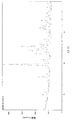
- Example 7 For the crystals of 3- [5- (4-carbamimidoyl-2-fluorophenoxy) carbonyl-2-thienyl] -2,2-dimethylpropanoic acid hydrochloride obtained by the method of Example 3, powder X-ray The diffraction pattern was measured. The measurement conditions of the powder X-ray diffraction pattern are as follows.
- Powder X-ray diffractometer X'Pert (Panalytical) Target: Cu fully automatic monochromator Voltage: 40 kV Current: 30 mA (Stability evaluation: 55 mA)
- Slit Divergence 1/2 ° Scattering 1/2 ° Received 0.15 mm
- Scan Speed 2 ° / min, 2 ⁇ range: 3-40 °
- a powder X-ray diffraction pattern is shown in FIG.
- Example 8 The crystals of 3- [5- (4-carbamimidoyl-2-fluorophenoxy) carbonyl-2-thienyl] -2,2-dimethylpropanoic acid hydrochloride obtained by the method of Example 3 were obtained at 40 ° C./75 Stored for 6 months under% RH conditions. As a result, there was no change over time in moisture and content (in terms of dehydrated matter), and it was stable for 6 months at 40 ° C./75% RH. For this reason, this crystal form is useful as a crystal form of an active pharmaceutical ingredient.
- the water content was measured by the Karl Fischer method, and the content was measured by the HPLC method using a column packed with octadecylsilylated silica gel for liquid chromatography.
- heteroarylcarboxylic acid ester derivative that is a target compound with high yield and high purity.
- the compound of the formula (II), the compound of the formula (VII), the compound of the formula (V) and the compound of the formula (VIII) are useful as intermediates for producing the heteroaryl carboxylic acid ester derivative (VI).
- crystals of heteroaryl carboxylic acid ester derivatives that are useful as antidiabetic agents are useful as crystal forms of active pharmaceutical ingredients because they have excellent storage stability.
Landscapes
- Chemical & Material Sciences (AREA)
- Organic Chemistry (AREA)
- Pharmaceuticals Containing Other Organic And Inorganic Compounds (AREA)
- Plural Heterocyclic Compounds (AREA)
- Heterocyclic Compounds Containing Sulfur Atoms (AREA)
- Organic Low-Molecular-Weight Compounds And Preparation Thereof (AREA)
Abstract
Priority Applications (7)
| Application Number | Priority Date | Filing Date | Title |
|---|---|---|---|
| CN201580013097.2A CN106660984A (zh) | 2014-03-11 | 2015-03-11 | 杂芳基羧酸酯衍生物的制造方法、其制造中间体及晶体 |
| JP2016507798A JPWO2015137407A1 (ja) | 2014-03-11 | 2015-03-11 | ヘテロアリールカルボン酸エステル誘導体の製造方法、その製造中間体及び結晶 |
| SG11201607555SA SG11201607555SA (en) | 2014-03-11 | 2015-03-11 | Production method for heteroarylcarboxylic acid ester derivative, production intermediate thereof, and crystal |
| EP15761578.2A EP3118197A4 (fr) | 2014-03-11 | 2015-03-11 | Procédé de fabrication de dérivé d'ester d'acide hétéroarylcarboxylique, intermédiaire de fabrication de celui-ci, et cristal |
| IL247685A IL247685A0 (en) | 2014-03-11 | 2016-09-07 | A method for the production of a derivative of a heteroarylcarboxylic acid ester, the production of its intermediates and a crystal |
| US15/260,730 US20160376249A1 (en) | 2014-03-11 | 2016-09-09 | Production method for heteroarylcarboxylic acid ester derivative, production intermediate thereof, and crystal |
| US15/953,787 US20180230122A1 (en) | 2014-03-11 | 2018-04-16 | Production method for heteroarylcarboxylic acid ester derivative, production intermediate thereof, and crystal |
Applications Claiming Priority (2)
| Application Number | Priority Date | Filing Date | Title |
|---|---|---|---|
| JP2014-048019 | 2014-03-11 | ||
| JP2014048019 | 2014-03-11 |
Related Child Applications (1)
| Application Number | Title | Priority Date | Filing Date |
|---|---|---|---|
| US15/260,730 Continuation US20160376249A1 (en) | 2014-03-11 | 2016-09-09 | Production method for heteroarylcarboxylic acid ester derivative, production intermediate thereof, and crystal |
Publications (1)
| Publication Number | Publication Date |
|---|---|
| WO2015137407A1 true WO2015137407A1 (fr) | 2015-09-17 |
Family
ID=54071848
Family Applications (1)
| Application Number | Title | Priority Date | Filing Date |
|---|---|---|---|
| PCT/JP2015/057177 Ceased WO2015137407A1 (fr) | 2014-03-11 | 2015-03-11 | Procédé de fabrication de dérivé d'ester d'acide hétéroarylcarboxylique, intermédiaire de fabrication de celui-ci, et cristal |
Country Status (7)
| Country | Link |
|---|---|
| US (2) | US20160376249A1 (fr) |
| EP (1) | EP3118197A4 (fr) |
| JP (1) | JPWO2015137407A1 (fr) |
| CN (1) | CN106660984A (fr) |
| IL (1) | IL247685A0 (fr) |
| SG (1) | SG11201607555SA (fr) |
| WO (1) | WO2015137407A1 (fr) |
Cited By (2)
| Publication number | Priority date | Publication date | Assignee | Title |
|---|---|---|---|---|
| WO2022039178A1 (fr) | 2020-08-19 | 2022-02-24 | Eaファーマ株式会社 | Agent thérapeutique pour la stéatose hépatique non alcoolique |
| WO2025075132A1 (fr) * | 2023-10-05 | 2025-04-10 | Eaファーマ株式会社 | Procédé de production d'un composé |
Families Citing this family (1)
| Publication number | Priority date | Publication date | Assignee | Title |
|---|---|---|---|---|
| CN110615757B (zh) * | 2019-09-19 | 2021-05-11 | 上海应用技术大学 | 一种二氢吡啶类化合物的制备方法 |
Citations (3)
| Publication number | Priority date | Publication date | Assignee | Title |
|---|---|---|---|---|
| WO2011071048A1 (fr) * | 2009-12-07 | 2011-06-16 | 味の素株式会社 | Dérivé d'ester d'acide hétéroarylcarboxylique |
| WO2012169579A1 (fr) * | 2011-06-07 | 2012-12-13 | 味の素株式会社 | Dérivé d'ester d'acide carboxylique hétérocyclique |
| WO2013187533A1 (fr) * | 2012-06-14 | 2013-12-19 | Ajinomoto Co., Inc. | Dérivé d'ester d'acide hétéroarylcarboxylique |
-
2015
- 2015-03-11 SG SG11201607555SA patent/SG11201607555SA/en unknown
- 2015-03-11 WO PCT/JP2015/057177 patent/WO2015137407A1/fr not_active Ceased
- 2015-03-11 CN CN201580013097.2A patent/CN106660984A/zh active Pending
- 2015-03-11 JP JP2016507798A patent/JPWO2015137407A1/ja not_active Withdrawn
- 2015-03-11 EP EP15761578.2A patent/EP3118197A4/fr not_active Withdrawn
-
2016
- 2016-09-07 IL IL247685A patent/IL247685A0/en unknown
- 2016-09-09 US US15/260,730 patent/US20160376249A1/en not_active Abandoned
-
2018
- 2018-04-16 US US15/953,787 patent/US20180230122A1/en not_active Abandoned
Patent Citations (3)
| Publication number | Priority date | Publication date | Assignee | Title |
|---|---|---|---|---|
| WO2011071048A1 (fr) * | 2009-12-07 | 2011-06-16 | 味の素株式会社 | Dérivé d'ester d'acide hétéroarylcarboxylique |
| WO2012169579A1 (fr) * | 2011-06-07 | 2012-12-13 | 味の素株式会社 | Dérivé d'ester d'acide carboxylique hétérocyclique |
| WO2013187533A1 (fr) * | 2012-06-14 | 2013-12-19 | Ajinomoto Co., Inc. | Dérivé d'ester d'acide hétéroarylcarboxylique |
Non-Patent Citations (2)
| Title |
|---|
| GREENE T.W. ET AL., PROTECTING GROUPS IN ORGANIC SYNTHESIS, 1999, pages 404 - 8 , 415-9 * |
| See also references of EP3118197A4 * |
Cited By (3)
| Publication number | Priority date | Publication date | Assignee | Title |
|---|---|---|---|---|
| WO2022039178A1 (fr) | 2020-08-19 | 2022-02-24 | Eaファーマ株式会社 | Agent thérapeutique pour la stéatose hépatique non alcoolique |
| US12023320B2 (en) | 2020-08-19 | 2024-07-02 | Ea Pharma Co., Ltd. | Therapeutic agent for fatty liver disease |
| WO2025075132A1 (fr) * | 2023-10-05 | 2025-04-10 | Eaファーマ株式会社 | Procédé de production d'un composé |
Also Published As
| Publication number | Publication date |
|---|---|
| CN106660984A (zh) | 2017-05-10 |
| SG11201607555SA (en) | 2016-10-28 |
| IL247685A0 (en) | 2016-11-30 |
| US20160376249A1 (en) | 2016-12-29 |
| US20180230122A1 (en) | 2018-08-16 |
| JPWO2015137407A1 (ja) | 2017-04-06 |
| EP3118197A4 (fr) | 2017-08-09 |
| EP3118197A1 (fr) | 2017-01-18 |
Similar Documents
| Publication | Publication Date | Title |
|---|---|---|
| JP5780657B2 (ja) | 光学活性ジアミン誘導体の塩の製造方法 | |
| JP6832946B2 (ja) | キナーゼ阻害剤およびその中間体の調製方法 | |
| JP7097467B2 (ja) | ブリバラセタム中間体、その製造方法及びブリバラセタムの製造方法 | |
| TW201311629A (zh) | 用於製備前列腺素醯胺之新穎方法 | |
| KR20140009125A (ko) | 당뇨병 및 이상지질혈증 치료 방법 및 조성물 | |
| US20180230122A1 (en) | Production method for heteroarylcarboxylic acid ester derivative, production intermediate thereof, and crystal | |
| JP2019147763A (ja) | プロリンアミド化合物の製造方法 | |
| JP6235560B2 (ja) | (3,4−ジクロロ−フェニル)−((s)−3−プロピル−ピロリジン−3−イル)−メタノン塩酸塩及び製造方法 | |
| CN114127085A (zh) | 一种肽酰胺盐及其制备方法和在医药上的用途 | |
| RU2761213C2 (ru) | Соль и полиморф фенил-пиримидонового соединения, их фармацевтическая композиция и применение | |
| JPWO1992019604A1 (ja) | 新規イソオキサゾール誘導体及びその塩 | |
| EP2623492A1 (fr) | Composé dérivé de cyclohexane | |
| BR112015015880B1 (pt) | Processos de produção de um composto e compostos | |
| EP3118196A1 (fr) | Procédé de production de dérivé d'ester d'acide hétéroarylcarboxylique, et son intermédiaire de production | |
| JP7279134B2 (ja) | プロリンアミド化合物の製造方法 | |
| JP7693921B2 (ja) | プロリンアミド化合物の製造方法 | |
| RU2741389C1 (ru) | Способ получения промежуточного соединения для синтеза лекарственного средства | |
| FR2555580A1 (fr) | Nouveaux composes azabicycliques, procede pour les preparer et medicaments les contenant | |
| CN110551170B (zh) | 一种c-19位单酰基化雷公藤内酯醇衍生物的合成方法 | |
| CN119118851A (zh) | 一种盐酸美贝维林的合成方法 | |
| JPS59501589A (ja) | 3−アミノ−5−ヒドロオキシ安息香酸及びその誘導体ならびに類似体の合成方法 | |
| WO2019098551A1 (fr) | Procédé de préparation de composé intermédiaire d'une synthèse pharmaceutique | |
| HK1200818B (en) | (3,4-dichloro-phenyl)-((s)-3-propyl-pyrrolidin-3-yl)-methanone hydrochloride and manufacturing processes | |
| FR2531703A1 (fr) | 2-aza-5-thiahexan-1-ones 1,6-disubstituees, leurs sels, procede pour leur preparation et compositions pharmaceutiques les renfermant | |
| CN107032992A (zh) | 一种(r)‑4‑(叔丁氧基)‑2‑(环戊基甲基)‑4‑氧代丁酸的合成方法 |
Legal Events
| Date | Code | Title | Description |
|---|---|---|---|
| 121 | Ep: the epo has been informed by wipo that ep was designated in this application |
Ref document number: 15761578 Country of ref document: EP Kind code of ref document: A1 |
|
| ENP | Entry into the national phase |
Ref document number: 2016507798 Country of ref document: JP Kind code of ref document: A |
|
| WWE | Wipo information: entry into national phase |
Ref document number: 247685 Country of ref document: IL |
|
| NENP | Non-entry into the national phase |
Ref country code: DE |
|
| REEP | Request for entry into the european phase |
Ref document number: 2015761578 Country of ref document: EP |
|
| WWE | Wipo information: entry into national phase |
Ref document number: 2015761578 Country of ref document: EP |