WO2015146331A1 - Acier pour boulons à haute résistance ayant une excellente résistance à rupture différée et boulon à haute résistance - Google Patents
Acier pour boulons à haute résistance ayant une excellente résistance à rupture différée et boulon à haute résistance Download PDFInfo
- Publication number
- WO2015146331A1 WO2015146331A1 PCT/JP2015/053763 JP2015053763W WO2015146331A1 WO 2015146331 A1 WO2015146331 A1 WO 2015146331A1 JP 2015053763 W JP2015053763 W JP 2015053763W WO 2015146331 A1 WO2015146331 A1 WO 2015146331A1
- Authority
- WO
- WIPO (PCT)
- Prior art keywords
- less
- steel
- delayed fracture
- fracture resistance
- strength
- Prior art date
- Legal status (The legal status is an assumption and is not a legal conclusion. Google has not performed a legal analysis and makes no representation as to the accuracy of the status listed.)
- Ceased
Links
Images

Classifications
-
- C—CHEMISTRY; METALLURGY
- C22—METALLURGY; FERROUS OR NON-FERROUS ALLOYS; TREATMENT OF ALLOYS OR NON-FERROUS METALS
- C22C—ALLOYS
- C22C38/00—Ferrous alloys, e.g. steel alloys
-
- C—CHEMISTRY; METALLURGY
- C21—METALLURGY OF IRON
- C21D—MODIFYING THE PHYSICAL STRUCTURE OF FERROUS METALS; GENERAL DEVICES FOR HEAT TREATMENT OF FERROUS OR NON-FERROUS METALS OR ALLOYS; MAKING METAL MALLEABLE, e.g. BY DECARBURISATION OR TEMPERING
- C21D9/00—Heat treatment, e.g. annealing, hardening, quenching or tempering, adapted for particular articles; Furnaces therefor
- C21D9/0093—Heat treatment, e.g. annealing, hardening, quenching or tempering, adapted for particular articles; Furnaces therefor for screws; for bolts
-
- C—CHEMISTRY; METALLURGY
- C22—METALLURGY; FERROUS OR NON-FERROUS ALLOYS; TREATMENT OF ALLOYS OR NON-FERROUS METALS
- C22C—ALLOYS
- C22C38/00—Ferrous alloys, e.g. steel alloys
- C22C38/001—Ferrous alloys, e.g. steel alloys containing N
-
- C—CHEMISTRY; METALLURGY
- C22—METALLURGY; FERROUS OR NON-FERROUS ALLOYS; TREATMENT OF ALLOYS OR NON-FERROUS METALS
- C22C—ALLOYS
- C22C38/00—Ferrous alloys, e.g. steel alloys
- C22C38/02—Ferrous alloys, e.g. steel alloys containing silicon
-
- C—CHEMISTRY; METALLURGY
- C22—METALLURGY; FERROUS OR NON-FERROUS ALLOYS; TREATMENT OF ALLOYS OR NON-FERROUS METALS
- C22C—ALLOYS
- C22C38/00—Ferrous alloys, e.g. steel alloys
- C22C38/04—Ferrous alloys, e.g. steel alloys containing manganese
-
- C—CHEMISTRY; METALLURGY
- C22—METALLURGY; FERROUS OR NON-FERROUS ALLOYS; TREATMENT OF ALLOYS OR NON-FERROUS METALS
- C22C—ALLOYS
- C22C38/00—Ferrous alloys, e.g. steel alloys
- C22C38/06—Ferrous alloys, e.g. steel alloys containing aluminium
-
- C—CHEMISTRY; METALLURGY
- C22—METALLURGY; FERROUS OR NON-FERROUS ALLOYS; TREATMENT OF ALLOYS OR NON-FERROUS METALS
- C22C—ALLOYS
- C22C38/00—Ferrous alloys, e.g. steel alloys
- C22C38/18—Ferrous alloys, e.g. steel alloys containing chromium
- C22C38/22—Ferrous alloys, e.g. steel alloys containing chromium with molybdenum or tungsten
-
- C—CHEMISTRY; METALLURGY
- C22—METALLURGY; FERROUS OR NON-FERROUS ALLOYS; TREATMENT OF ALLOYS OR NON-FERROUS METALS
- C22C—ALLOYS
- C22C38/00—Ferrous alloys, e.g. steel alloys
- C22C38/18—Ferrous alloys, e.g. steel alloys containing chromium
- C22C38/28—Ferrous alloys, e.g. steel alloys containing chromium with titanium or zirconium
-
- C—CHEMISTRY; METALLURGY
- C22—METALLURGY; FERROUS OR NON-FERROUS ALLOYS; TREATMENT OF ALLOYS OR NON-FERROUS METALS
- C22C—ALLOYS
- C22C38/00—Ferrous alloys, e.g. steel alloys
- C22C38/18—Ferrous alloys, e.g. steel alloys containing chromium
- C22C38/32—Ferrous alloys, e.g. steel alloys containing chromium with boron
-
- F—MECHANICAL ENGINEERING; LIGHTING; HEATING; WEAPONS; BLASTING
- F16—ENGINEERING ELEMENTS AND UNITS; GENERAL MEASURES FOR PRODUCING AND MAINTAINING EFFECTIVE FUNCTIONING OF MACHINES OR INSTALLATIONS; THERMAL INSULATION IN GENERAL
- F16B—DEVICES FOR FASTENING OR SECURING CONSTRUCTIONAL ELEMENTS OR MACHINE PARTS TOGETHER, e.g. NAILS, BOLTS, CIRCLIPS, CLAMPS, CLIPS OR WEDGES; JOINTS OR JOINTING
- F16B31/00—Screwed connections specially modified in view of tensile load; Break-bolts
- F16B31/06—Screwed connections specially modified in view of tensile load; Break-bolts having regard to possibility of fatigue rupture
-
- C—CHEMISTRY; METALLURGY
- C21—METALLURGY OF IRON
- C21D—MODIFYING THE PHYSICAL STRUCTURE OF FERROUS METALS; GENERAL DEVICES FOR HEAT TREATMENT OF FERROUS OR NON-FERROUS METALS OR ALLOYS; MAKING METAL MALLEABLE, e.g. BY DECARBURISATION OR TEMPERING
- C21D2211/00—Microstructure comprising significant phases
- C21D2211/008—Martensite
Definitions
- the present invention relates to a bolt steel used for automobiles, various industrial machines, and the like, and a bolt obtained using the bolt steel, and exhibits excellent delayed fracture resistance even when the tensile strength is 1100 MPa or more.
- the present invention relates to steel for high strength bolts and high strength bolts.
- Standard steels such as SCM435 are frequently used for high-strength bolts with a tensile strength of 1100 MPa or more. Since standard steels such as SCM435 are added with a large amount of alloy elements such as Mo, the cost of steel materials increases. With the request of steel material cost reduction, the request for SCM alternative steel which omitted Mo is increasing. However, simply reducing the alloy elements reduces the hardenability and makes it difficult to ensure strength.
- Patent Document 1 discloses a technique for improving corrosion resistance of steel by adding a predetermined amount of Cu to boron-containing steel, suppressing intrusion of diffusible hydrogen into the steel, and improving delayed fracture resistance. Proposed. However, it is insufficient to ensure delayed fracture resistance only by adding Cu.
- Patent Document 2 proposes a technique of adding V in order to improve delayed fracture resistance of boron-containing steel.
- V is an expensive rare metal like Mo
- the boron-containing steel to which V is added has a small cost reduction effect as an SCM alternative steel.
- Patent Document 3 boron that exhibits excellent delayed fracture resistance even in harsh environments by controlling the ratio of the content of Si and C in the chemical composition within an appropriate range.
- a steel for added high strength bolts was proposed.
- this boron-added high-strength bolt steel contains V as an essential element, as in Patent Document 2, the cost reduction effect as an SCM alternative steel is small.
- the present invention has been made in view of such circumstances, and the object thereof is to add resistance to high tensile strength of 1100 MPa or more without adding expensive alloy elements such as Mo and V.
- An object of the present invention is to provide a steel for high-strength bolts excellent in delayed fracture resistance and a high-strength bolt excellent in delayed fracture resistance made of this steel.
- the present inventors have intensively studied to provide a steel for high-strength bolts excellent in delayed fracture resistance and a high-strength bolt excellent in delayed fracture resistance made of this steel.
- the C and Mn content satisfies the relationship of the formula (1) described later, it exhibits excellent delayed fracture resistance even in a harsh environment.
- the present invention has been completed by finding that the strength can be increased if the contents of Si, Mn, and Cr satisfy the relationship of the formula (2) described later.
- the steel for high-strength bolts with excellent delayed fracture resistance according to the present invention that has been able to solve the above-mentioned problems is, by mass%, C: 0.20 to 0.35%, Si: 0.3 to 1.0%, Mn: more than 0% to 0.6% or less, P: more than 0% to 0.02% or less, S: more than 0% to 0.02% or less, Cr: 0.3 to 1.5%, Al : 0.01 to 0.1%, Ti: 0.05 to 0.1%, B: 0.0003 to 0.005%, and N: more than 0% and 0.01% or less, (1) and formula (2) are satisfied, and the balance is made of iron and inevitable impurities, and has a gist in that it is a mixed structure of ferrite and pearlite.
- [] means the content (% by mass) of each element. 1 / ([C] ⁇ [Mn]) ⁇ 5.5 (1) [C] + [Si] / 2 + [Mn] / 2 + [Cr] /3 ⁇ 0.82 (2)
- the present invention also includes a bolt obtained using the steel for high-strength bolts, wherein the metal structure is a tempered martensite structure and the tensile strength is 1100 MPa or more and the high-strength bolt excellent in delayed fracture resistance. Is done.
- the tensile strength is controlled by appropriately controlling the chemical component composition and strictly controlling the relationship between the contents of C and Mn and the contents of C, Si, Mn, and Cr. Even if it is 1100 MPa or more, a steel for high-strength bolts excellent in delayed fracture resistance can be realized. If this steel is used, a high-strength bolt excellent in delayed fracture resistance can be provided.
- FIG. 1A is a schematic diagram showing the shape of a notched test piece
- FIG. 1B is a schematic diagram showing the shape of a notch
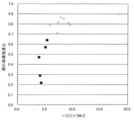
- FIG. 2 is a graph showing the relationship between the value of 1 / ([C] ⁇ [Mn]) and the delayed fracture strength ratio.
- the present inventors have repeatedly studied to provide a bolt exhibiting excellent delayed fracture resistance even at a high strength of 1100 MPa or more without adding an expensive alloy element such as Mo or V. .
- an expensive alloy element such as Mo or V.
- C is an element useful for ensuring the strength of the steel.
- increasing its content deteriorates the toughness and corrosion resistance of the steel and tends to cause delayed fracture.
- the X value when the value on the left side of the above formula (1) is the X value, the X value is set to 5.5 or more.
- the X value is preferably 6.5 or more, more preferably 7.0 or more.
- the upper limit of the X value is naturally set from the amount of C and the amount of Mn described later, but even if the X value is excessively increased, the effect on delayed fracture resistance is saturated, so the upper limit is, for example, about 30 Preferably there is.
- the X value is more preferably 20 or less, and still more preferably 15 or less.
- the coefficient of each element in the above formula (2) indicates the degree of contribution to strength improvement.
- this Y value is set to 0.82 or more.
- the Y value is preferably 0.90 or more, more preferably 1.00 or more.
- the upper limit of the Y value is not particularly limited, but if the Y value becomes excessively large, the strength of the base material becomes too high and the cold forgeability when forming into a bolt shape deteriorates, so the upper limit is about 1.30. It is preferable that The Y value is more preferably 1.20 or less, and still more preferably 1.15 or less.
- the steel for high-strength bolts of the present invention satisfies the above-mentioned formulas (1) and (2).
- C 0.20 to 0.35%
- Si 0.3 To 1.0%
- Mn more than 0% to 0.6% or less
- P more than 0% to 0.02% or less
- S more than 0% to 0.02% or less
- Cr 0.3 to 1.5%
- Al 0.01 to 0.1%
- Ti 0.05 to 0.1%
- B 0.0003 to 0.005%
- N more than 0% and 0.01% or less It is.
- C is an element for securing the strength and ductility of steel in a well-balanced manner, and is an indispensable element for securing the tensile strength necessary as a high-strength bolt. In order to exert such an effect, C needs to be contained by 0.20% or more.
- the amount of C is preferably 0.23% or more, more preferably 0.25% or more.
- the C amount is set to 0.35% or less.
- the amount of C is preferably 0.32% or less, more preferably 0.30% or less.
- the Si is an element used as a deoxidizer at the time of melting, has an effect of increasing temper softening resistance, and is an element necessary for increasing strength. Therefore, in the present invention, the Si amount is set to 0.3% or more.
- the amount of Si is preferably 0.4% or more, more preferably 0.47% or more.
- the Si amount is 1.0% or less.
- the amount of Si is preferably 0.60% or less, more preferably 0.55% or less.
- the amount of Mn needs to be 0.6% or less.
- the amount of Mn is preferably 0.55% or less, more preferably 0.5% or less.
- Mn is an element that acts effectively as a deoxidizer during melting and has the effect of increasing the hardenability of the steel and increasing the strength. In order to exhibit such an effect effectively, it is preferable to make it contain 0.1% or more.
- the amount of Mn is more preferably 0.2% or more, and still more preferably 0.30% or more.
- the P amount is 0.02% or less.
- the amount of P is preferably 0.015% or less, more preferably 0.01% or less.
- the amount of P is preferably reduced as much as possible. However, in order to reduce the amount of P to less than 0.001%, the cost is high, so the lower limit may be 0.001%.
- the S amount is 0.02% or less.
- the amount of S is preferably 0.015% or less, more preferably 0.01% or less.
- the amount of S is preferably reduced as much as possible. However, since the cost is increased to make the amount of S less than 0.001%, the lower limit may be 0.001%.
- Cr is an element that acts to increase hardenability and strength. It also has the effect of increasing temper softening resistance and improving strength. Further, Cr is an element that contributes to enhancing the corrosion resistance of steel and improving delayed fracture resistance. Therefore, in the present invention, Cr is 0.3% or more.
- the amount of Cr is preferably 0.5% or more, more preferably 0.75% or more. However, even if an excessive amount of Cr is added, the effect is saturated and the manufacturing cost is increased. Therefore, in the present invention, the Cr content is 1.5% or less.
- the amount of Cr is preferably 1.4% or less, more preferably 1.3% or less.
- Al is an element that can be added as a deoxidizer and can prevent austenite grains from coarsening by forming AlN, thereby improving delayed fracture resistance.
- the Al content is 0.01% or more.
- the amount of Al is preferably 0.04% or more, more preferably 0.05% or more.
- the Al content is 0.1% or less.
- the amount of Al is preferably 0.08% or less, more preferably 0.07% or less.
- Ti is an element that combines with N and C in steel to precipitate TiN and TiC.
- TiN and TiC act as hydrogen trap sites and contribute to improving delayed fracture resistance.
- TiN and TiC effectively act on the refinement of crystal grains and contribute to the further improvement of delayed fracture resistance.
- it is necessary to contain Ti 0.05% or more.
- the amount of Ti is preferably 0.051% or more, more preferably 0.052% or more. However, when the amount of Ti is excessive, cold forgeability is reduced. Therefore, in the present invention, the Ti amount is 0.1% or less.
- the amount of Ti is preferably 0.09% or less, more preferably 0.08% or less.
- the B is an element that acts to increase the hardenability and strength of steel. Therefore, in the present invention, the B amount is 0.0003% or more.
- the amount of B is preferably 0.0005% or more, more preferably 0.0010% or more. However, even if B is contained excessively, the effect is saturated and the toughness is decreased. Therefore, in the present invention, the B amount is 0.005% or less.
- the B amount is preferably 0.004% or less, more preferably 0.003% or less.
- N is an element that contributes to refinement of crystal grains by forming TiN by combining with Ti in the solidification stage after melting. Delayed fracture resistance is improved by making the crystal grains finer.
- N is preferably contained in an amount of 0.001% or more, more preferably 0.002% or more, and further preferably 0.003% or more.
- the N content is 0.01% or less.
- the N amount is preferably 0.008% or less, more preferably 0.006% or less.
- the component composition of the steel for high-strength bolts according to the present invention is as described above, and the balance is iron and inevitable impurities.
- the inevitable impurities mixing of elements brought in depending on the situation of raw materials, materials, manufacturing facilities, etc. is allowed.
- the metal structure after rolling is a mixed structure of ferrite and pearlite.
- This mixed structure may partially include a bainite structure.
- the bainite structure is preferably 5 area% or less with respect to the entire metal structure.
- the steel for high-strength bolts according to the present invention is obtained by melting and casting a steel that satisfies the above component composition, and then heating it to, for example, 950 ° C. or higher to form a wire or bar shape in a temperature range of 800 to 1000 ° C. Then, after hot rolling or hot forging, it can be produced by gradually cooling to a temperature of 600 ° C. or less at an average cooling rate of more than 0 ° C./second and 3 ° C./second or less.
- Ti carbides, nitrides, and carbonitrides effective for refining crystal grains can be dissolved in austenite. If the temperature is less than 950 ° C., the amount of carbide, nitride, and carbonitride is reduced, and fine Ti, V carbide, nitride, and carbonitride are less likely to be formed by subsequent hot rolling. Therefore, the effect of crystal grain refinement during quenching is reduced.
- This temperature is more preferably 1000 ° C. or higher.
- the upper limit of heating temperature is not specifically limited, For example, what is necessary is just to be about 1350 degreeC.
- the finish rolling temperature or hot forging temperature is preferably set to 1000 ° C. or lower.
- the finish rolling temperature or the hot forging temperature is higher than 1000 ° C., Ti, V carbide, nitride, and carbonitride are difficult to precipitate, so that the effect of grain refinement during quenching is reduced.
- the finish rolling temperature or the hot forging temperature becomes too low, there is an increase in rolling load and an increase in the occurrence of surface flaws, which becomes unrealistic, so the lower limit is preferably set to 800 ° C. or higher.
- the finish rolling temperature is the average surface temperature that can be measured with a radiation thermometer before the final rolling pass or before the rolling roll group.
- the average cooling rate after the forging is preferably 3 ° C./second or less.
- the average cooling rate is more preferably 2 ° C./second or less.
- the steel for high-strength bolts obtained by cooling is formed into a bolt shape according to a conventional method, and then subjected to quenching and tempering to make the metal structure tempered martensite.
- a high-strength bolt excellent in destructibility can be obtained.
- the conditions for quenching and tempering are not particularly limited, and may be performed according to a conventional method.
- the quenching treatment is preferably performed by heating to 850 to 960 ° C., for example.
- austenite can be stably formed.
- the heating temperature is more preferably 880 ° C. or higher, and still more preferably 900 ° C. or higher.
- the heating temperature is preferably 960 ° C. or lower.
- the heating temperature is more preferably 950 ° C. or lower, and further preferably 940 ° C. or lower.
- As-quenched bolts have low toughness and ductility and do not become bolt products as they are. Therefore, after quenching, tempering is performed.
- the tempering treatment is preferably performed by heating to 300 to 500 ° C., for example.
- the temperature during the tempering treatment is preferably 300 ° C. or higher, more preferably 330 ° C. or higher, still more preferably 350 ° C. or higher.
- tempering at a temperature of 500 ° C. or lower is preferable.
- the tempering temperature is more preferably 480 ° C. or less, still more preferably 450 ° C. or less.
- the heating and holding time in the tempering process is not particularly limited, and is, for example, about 20 to 60 minutes.
- the steel for high-strength bolts may be spheroidized prior to forming into a bolt shape.
- the spheroidizing treatment conditions are not particularly limited, and known conditions can be adopted.
- the heating temperature for the spheroidizing treatment may be 700 to 800 ° C., for example.
- carbides in the pearlite structure can be dissolved in the steel.
- the heating temperature is preferably 710 ° C or higher, more preferably 720 ° C or higher.
- the heating temperature is preferably 800 ° C. or less, more preferably 790 ° C. or less, and further preferably 780 ° C. or less.
- the average cooling rate is more preferably 18 ° C./hour or less, and further preferably 16 ° C./hour or less.
- the shaft portion of the high-strength bolt obtained by quenching and tempering the steel for high-strength bolts specified in the present invention has a metal structure of tempered martensite from the surface layer to the central portion, and can secure a strength of 1100 MPa or more. . What is necessary is just to measure the intensity
- the high-strength bolt preferably has a grain size number of prior austenite at the shaft portion of 8 or more. This is because the delayed fracture resistance improves as the crystal grains of the prior austenite become finer.
- the grain size number is more preferably 8.5 or more, and even more preferably 9.0 or more.
- the upper limit of the grain size number is not particularly limited, but may be, for example, 12 or less.
- the crystal grain size number may be measured based on JIS G0551 (2013).
- Table 1 below shows the value of 1 / ([C] ⁇ [Mn]) obtained from the left side of the above formula (1) based on the amount of C and Mn contained in the steel, the amount of C contained in the steel, Si
- the value of [C] + [Si] / 2 + [Mn] / 2 + [Cr] / 3 obtained from the left side of the above formula (2) based on the amount, the amount of Mn, and the amount of Cr is shown.
- the value of 1 / ([C] ⁇ [Mn]) is expressed as an X value
- the value of [C] + [Si] / 2 + [Mn] / 2 + [Cr] / 3 is a Y value. Indicated.
- the metal structure of the obtained wire was observed.
- the metallographic structure was obtained by observing an arbitrary region at the D / 4 position with an optical microscope after the wire was cut in a cross section and etched with a nital etchant. D shows the diameter of a wire. The observation magnification was 400 times. As a result, the structure of the wire was a mixed structure of ferrite and pearlite.
- the metal structure of the obtained specimen was observed in the same procedure as the above wire. As a result, the metal structure was a tempered martensite structure.
- the grain size number can be obtained in an arbitrary region at the D / 4 position in the longitudinal section of the test material by causing the grain boundary to appear in accordance with the quenching and tempering method defined in JIS G0551 (2013). It was measured. D indicates the diameter of the test material.
- Delayed fracture resistance was evaluated by cutting out a notched test piece shown in FIG. 1A from the above specimen and conducting a tensile test and a delayed fracture resistance test.
- FIG. 1B shows the shape of the notch.
- the reason why the notched specimen is used is to simulate the stress concentration in the threaded portion. That is, a tensile test was performed according to JIS Z2241 (2011) using the above-mentioned notched test piece, and the maximum stress was measured.
- Kt shown to FIG. 1B has shown the stress concentration factor.
- the notched test piece was immersed in a 15% HCl aqueous solution for 30 minutes, washed with water and dried, then loaded with a constant load, and a maximum load that did not break for more than 100 hours (hereinafter, 100 hours holding stress)).
- the value obtained by dividing the 100-hour holding stress by the maximum stress that is, the value of 100-hour holding stress / maximum stress is defined as the delayed fracture strength ratio, and this value is shown in Table 2 below.
- the case where the delayed fracture strength ratio was 0.70 or more was regarded as acceptable, and it was evaluated that the delayed fracture resistance was excellent.
- FIG. 2 shows the relationship between the above 1 / ([C] ⁇ [Mn]) value and the delayed fracture strength ratio.
- No. 1 as a comparative example.
- No. An X value of 20 is outside the requirement defined in the present invention. Since 20 is a reference example containing Mo, it was not plotted in FIG.
- No. Examples 10 to 19 are examples that do not satisfy any of the requirements defined in the present invention.
- No. 10 is an example in which the Y value was less than 0.82 because the amount of C was too small, and a strength of 1100 MPa or more could not be secured.
- No. No. 11 is an example in which the amount of C is excessive, and it is considered that delayed fracture resistance cannot be improved because toughness and ductility are reduced.
- No. Nos. 12 to 14 are examples in which the amount of Mn was excessive and the X value was less than 5.5. It is considered that the grain boundary strength was lowered by segregation and delayed fracture resistance could not be improved.
- No. No. 17 is an example that does not contain Ti, and it is considered that delayed fracture resistance could not be improved because TiC serving as a hydrogen trap site did not precipitate.
- No. 18 is an example in which the X value was less than 5.5, and the delayed fracture resistance could not be improved.
- No. No. 19 was an example in which the amount of Ti was too small and the X value was less than 5.5, and the delayed fracture resistance could not be improved.
- Reference numeral 20 is a reference example simulating the JIS standard SCM435. No. No. 20 has a strength of 1100 MPa or more and can improve delayed fracture resistance. However, since it contains Mo, the cost is high.
Landscapes
- Chemical & Material Sciences (AREA)
- Engineering & Computer Science (AREA)
- Mechanical Engineering (AREA)
- Materials Engineering (AREA)
- Metallurgy (AREA)
- Organic Chemistry (AREA)
- General Engineering & Computer Science (AREA)
- Physics & Mathematics (AREA)
- Thermal Sciences (AREA)
- Crystallography & Structural Chemistry (AREA)
- Heat Treatment Of Articles (AREA)
- Heat Treatment Of Steel (AREA)
Abstract
L'invention concerne : un acier pour boulons à haute résistance, qui présente une excellente résistance à la rupture différée sans ajout d'un élément d'alliage onéreux tel que Mo ou V, même si l'acier a une haute résistance, c'est-à-dire une résistance à la traction supérieure ou égale à 1100 MPa ; et un boulon à haute résistance qui est constitué de cet acier et a une excellente résistance à la rupture différée. L'acier pour boulons à haute résistance a une excellente résistance à la rupture différée et contient, en % en masse, 0,20 à 0,35 % de C, 0,3 à 1,0 % de Si, une quantité supérieure à 0 % mais inférieure ou égale à 0,6 % de Mn, une quantité supérieure à 0 % mais inférieure ou égale à 0,02 % de P, une quantité supérieure à 0 % mais inférieure ou égale à 0,02 % de S, 0,3 à 1,5 % de Cr, 0,01 à 0,1 % d'Al, 0,05 à 0,1 % de Ti, 0,0003 à 0,005 % de B et une quantité supérieure à 0 % mais inférieure ou égale à 0,01 % de N, le reste étant constitué de fer et d'impuretés inévitables, tout en satisfaisant à la formule (1) et à la formule (2). Cet acier pour boulons à haute résistance a une structure mixte de ferrite et de perlite. Dans la formule (1) et la formule (2), [ ] désigne la teneur (% en masse) de chaque élément. 1/ ([C] × [Mn]) ≥ 5,5 (1) [C] + [Si]/2 + [Mn]/2 + [Cr]/3 ≥ 0,82 (2)
Applications Claiming Priority (2)
| Application Number | Priority Date | Filing Date | Title |
|---|---|---|---|
| JP2014-062656 | 2014-03-25 | ||
| JP2014062656A JP6190298B2 (ja) | 2014-03-25 | 2014-03-25 | 耐遅れ破壊性に優れた高強度ボルト用鋼および高強度ボルト |
Publications (1)
| Publication Number | Publication Date |
|---|---|
| WO2015146331A1 true WO2015146331A1 (fr) | 2015-10-01 |
Family
ID=54194869
Family Applications (1)
| Application Number | Title | Priority Date | Filing Date |
|---|---|---|---|
| PCT/JP2015/053763 Ceased WO2015146331A1 (fr) | 2014-03-25 | 2015-02-12 | Acier pour boulons à haute résistance ayant une excellente résistance à rupture différée et boulon à haute résistance |
Country Status (3)
| Country | Link |
|---|---|
| JP (1) | JP6190298B2 (fr) |
| TW (1) | TWI535862B (fr) |
| WO (1) | WO2015146331A1 (fr) |
Cited By (2)
| Publication number | Priority date | Publication date | Assignee | Title |
|---|---|---|---|---|
| CN113106343A (zh) * | 2021-04-02 | 2021-07-13 | 大冶特殊钢有限公司 | 一种海洋平台用螺栓钢及其制造方法 |
| CN113383094A (zh) * | 2019-02-08 | 2021-09-10 | 日本制铁株式会社 | 螺栓以及螺栓用钢材 |
Families Citing this family (4)
| Publication number | Priority date | Publication date | Assignee | Title |
|---|---|---|---|---|
| JP6819198B2 (ja) * | 2016-02-08 | 2021-01-27 | 日本製鉄株式会社 | 冷間鍛造調質品用圧延棒線 |
| JP7155644B2 (ja) * | 2018-06-18 | 2022-10-19 | 日本製鉄株式会社 | ボルト |
| KR102256373B1 (ko) * | 2019-12-20 | 2021-05-27 | 주식회사 포스코 | 고온연화저항성이 우수한 강재 및 그 제조방법 |
| CN114657468B (zh) * | 2022-03-23 | 2022-11-11 | 承德建龙特殊钢有限公司 | 一种风电紧固件用钢及其制备方法 |
Citations (5)
| Publication number | Priority date | Publication date | Assignee | Title |
|---|---|---|---|---|
| JP2011001599A (ja) * | 2009-06-18 | 2011-01-06 | Kobe Steel Ltd | 摩擦圧接に適した機械構造用鋼材およびその製造方法、摩擦圧接部品 |
| JP2012041587A (ja) * | 2010-08-17 | 2012-03-01 | Nippon Steel Corp | 高強度かつ耐水素脆化特性に優れた機械部品用線材、鋼線、および機械部品とその製造方法 |
| JP2012162798A (ja) * | 2011-01-18 | 2012-08-30 | Kobe Steel Ltd | 耐遅れ破壊性に優れたボロン添加高強度ボルト用鋼および高強度ボルト |
| JP2013082963A (ja) * | 2011-10-07 | 2013-05-09 | Kobe Steel Ltd | ボルト用鋼線及びボルト、並びにその製造方法 |
| JP2014015664A (ja) * | 2012-07-09 | 2014-01-30 | Kobe Steel Ltd | 耐遅れ破壊性に優れたボロン添加高強度ボルト用鋼および高強度ボルト |
-
2014
- 2014-03-25 JP JP2014062656A patent/JP6190298B2/ja not_active Expired - Fee Related
-
2015
- 2015-02-12 WO PCT/JP2015/053763 patent/WO2015146331A1/fr not_active Ceased
- 2015-03-03 TW TW104106669A patent/TWI535862B/zh not_active IP Right Cessation
Patent Citations (5)
| Publication number | Priority date | Publication date | Assignee | Title |
|---|---|---|---|---|
| JP2011001599A (ja) * | 2009-06-18 | 2011-01-06 | Kobe Steel Ltd | 摩擦圧接に適した機械構造用鋼材およびその製造方法、摩擦圧接部品 |
| JP2012041587A (ja) * | 2010-08-17 | 2012-03-01 | Nippon Steel Corp | 高強度かつ耐水素脆化特性に優れた機械部品用線材、鋼線、および機械部品とその製造方法 |
| JP2012162798A (ja) * | 2011-01-18 | 2012-08-30 | Kobe Steel Ltd | 耐遅れ破壊性に優れたボロン添加高強度ボルト用鋼および高強度ボルト |
| JP2013082963A (ja) * | 2011-10-07 | 2013-05-09 | Kobe Steel Ltd | ボルト用鋼線及びボルト、並びにその製造方法 |
| JP2014015664A (ja) * | 2012-07-09 | 2014-01-30 | Kobe Steel Ltd | 耐遅れ破壊性に優れたボロン添加高強度ボルト用鋼および高強度ボルト |
Cited By (3)
| Publication number | Priority date | Publication date | Assignee | Title |
|---|---|---|---|---|
| CN113383094A (zh) * | 2019-02-08 | 2021-09-10 | 日本制铁株式会社 | 螺栓以及螺栓用钢材 |
| CN113383094B (zh) * | 2019-02-08 | 2023-08-15 | 日本制铁株式会社 | 螺栓以及螺栓用钢材 |
| CN113106343A (zh) * | 2021-04-02 | 2021-07-13 | 大冶特殊钢有限公司 | 一种海洋平台用螺栓钢及其制造方法 |
Also Published As
| Publication number | Publication date |
|---|---|
| JP6190298B2 (ja) | 2017-08-30 |
| TW201544609A (zh) | 2015-12-01 |
| JP2015183266A (ja) | 2015-10-22 |
| TWI535862B (zh) | 2016-06-01 |
Similar Documents
| Publication | Publication Date | Title |
|---|---|---|
| JP6034632B2 (ja) | 耐遅れ破壊性に優れたボロン添加高強度ボルト用鋼および高強度ボルト | |
| JP6107437B2 (ja) | 耐硫化物応力腐食割れ性に優れた油井用低合金高強度継目無鋼管の製造方法 | |
| AU2014294080B2 (en) | High-strength steel material for oil well and oil well pipes | |
| JP5608145B2 (ja) | 耐遅れ破壊性に優れたボロン添加高強度ボルト用鋼および高強度ボルト | |
| JP2015105428A (ja) | 耐遅れ破壊性に優れたボルト用鋼線および高強度ボルト並びにそれらの製造方法 | |
| JP6226085B2 (ja) | 冷間鍛造部品用圧延棒鋼または圧延線材 | |
| JP6267618B2 (ja) | ボルト用鋼およびボルト | |
| JP6190298B2 (ja) | 耐遅れ破壊性に優れた高強度ボルト用鋼および高強度ボルト | |
| KR101894426B1 (ko) | 고강도이며 내식성이 우수한 스태빌라이저용 강과, 그것을 이용한 차량용 스태빌라이저 및 그의 제조방법 | |
| CN105849297A (zh) | 高强度弹簧用轧制材和使用了它的高强度弹簧用丝材 | |
| WO2015146173A1 (fr) | Tôle d'acier laminée à chaud à haute teneur en carbone et son procédé de production | |
| CN108315637B (zh) | 高碳热轧钢板及其制造方法 | |
| WO2015146174A1 (fr) | Tôle d'acier laminée à chaud à haute teneur en carbone et son procédé de production | |
| JP6034605B2 (ja) | 耐遅れ破壊性に優れたボロン添加高強度ボルト用鋼および高強度ボルト | |
| JP6159209B2 (ja) | 耐遅れ破壊性とボルト成形性に優れた高強度ボルト用鋼およびボルトの製造方法 | |
| CN109790602B (zh) | 钢 | |
| WO2017131077A1 (fr) | Acier à ressorts | |
| WO2019180499A1 (fr) | Composition d'acier selon la spécification api 5l psl-2 pour qualité x-65 à résistance améliorée à la fissuration induite par l'hydrogène (hic) et procédé de fabrication de son acier | |
| WO2015159650A1 (fr) | Fil laminé à chaud | |
| JPWO2016186033A1 (ja) | ばね鋼 | |
| JP6390685B2 (ja) | 非調質鋼およびその製造方法 | |
| JP7273295B2 (ja) | ボルト用鋼、ボルト、及びボルトの製造方法 | |
| JP4430559B2 (ja) | 耐遅れ破壊性に優れた高強度ボルト用鋼及び高強度ボルト | |
| JP2008156678A (ja) | 耐遅れ破壊特性および耐腐食性に優れた高強度ボルト | |
| CN104040003A (zh) | 高碳热轧钢板及其制造方法 |
Legal Events
| Date | Code | Title | Description |
|---|---|---|---|
| 121 | Ep: the epo has been informed by wipo that ep was designated in this application |
Ref document number: 15770122 Country of ref document: EP Kind code of ref document: A1 |
|
| NENP | Non-entry into the national phase |
Ref country code: DE |
|
| 122 | Ep: pct application non-entry in european phase |
Ref document number: 15770122 Country of ref document: EP Kind code of ref document: A1 |