WO2015146459A1 - Charbon actif, procédé de production de charbon actif et procédé de traitement de charbon actif - Google Patents
Charbon actif, procédé de production de charbon actif et procédé de traitement de charbon actif Download PDFInfo
- Publication number
- WO2015146459A1 WO2015146459A1 PCT/JP2015/055656 JP2015055656W WO2015146459A1 WO 2015146459 A1 WO2015146459 A1 WO 2015146459A1 JP 2015055656 W JP2015055656 W JP 2015055656W WO 2015146459 A1 WO2015146459 A1 WO 2015146459A1
- Authority
- WO
- WIPO (PCT)
- Prior art keywords
- activated carbon
- average particle
- activated
- carbon
- activation
- Prior art date
- Legal status (The legal status is an assumption and is not a legal conclusion. Google has not performed a legal analysis and makes no representation as to the accuracy of the status listed.)
- Ceased
Links
Images

Classifications
-
- H—ELECTRICITY
- H01—ELECTRIC ELEMENTS
- H01G—CAPACITORS; CAPACITORS, RECTIFIERS, DETECTORS, SWITCHING DEVICES, LIGHT-SENSITIVE OR TEMPERATURE-SENSITIVE DEVICES OF THE ELECTROLYTIC TYPE
- H01G11/00—Hybrid capacitors, i.e. capacitors having different positive and negative electrodes; Electric double-layer [EDL] capacitors; Processes for the manufacture thereof or of parts thereof
- H01G11/22—Electrodes
- H01G11/24—Electrodes characterised by structural features of the materials making up or comprised in the electrodes, e.g. form, surface area or porosity; characterised by the structural features of powders or particles used therefor
-
- C—CHEMISTRY; METALLURGY
- C01—INORGANIC CHEMISTRY
- C01B—NON-METALLIC ELEMENTS; COMPOUNDS THEREOF; METALLOIDS OR COMPOUNDS THEREOF NOT COVERED BY SUBCLASS C01C
- C01B32/00—Carbon; Compounds thereof
- C01B32/30—Active carbon
- C01B32/312—Preparation
- C01B32/342—Preparation characterised by non-gaseous activating agents
-
- H—ELECTRICITY
- H01—ELECTRIC ELEMENTS
- H01G—CAPACITORS; CAPACITORS, RECTIFIERS, DETECTORS, SWITCHING DEVICES, LIGHT-SENSITIVE OR TEMPERATURE-SENSITIVE DEVICES OF THE ELECTROLYTIC TYPE
- H01G11/00—Hybrid capacitors, i.e. capacitors having different positive and negative electrodes; Electric double-layer [EDL] capacitors; Processes for the manufacture thereof or of parts thereof
- H01G11/22—Electrodes
- H01G11/30—Electrodes characterised by their material
- H01G11/32—Carbon-based
- H01G11/34—Carbon-based characterised by carbonisation or activation of carbon
-
- C—CHEMISTRY; METALLURGY
- C01—INORGANIC CHEMISTRY
- C01P—INDEXING SCHEME RELATING TO STRUCTURAL AND PHYSICAL ASPECTS OF SOLID INORGANIC COMPOUNDS
- C01P2004/00—Particle morphology
- C01P2004/60—Particles characterised by their size
- C01P2004/61—Micrometer sized, i.e. from 1-100 micrometer
-
- C—CHEMISTRY; METALLURGY
- C01—INORGANIC CHEMISTRY
- C01P—INDEXING SCHEME RELATING TO STRUCTURAL AND PHYSICAL ASPECTS OF SOLID INORGANIC COMPOUNDS
- C01P2006/00—Physical properties of inorganic compounds
- C01P2006/12—Surface area
-
- C—CHEMISTRY; METALLURGY
- C01—INORGANIC CHEMISTRY
- C01P—INDEXING SCHEME RELATING TO STRUCTURAL AND PHYSICAL ASPECTS OF SOLID INORGANIC COMPOUNDS
- C01P2006/00—Physical properties of inorganic compounds
- C01P2006/14—Pore volume
-
- C—CHEMISTRY; METALLURGY
- C01—INORGANIC CHEMISTRY
- C01P—INDEXING SCHEME RELATING TO STRUCTURAL AND PHYSICAL ASPECTS OF SOLID INORGANIC COMPOUNDS
- C01P2006/00—Physical properties of inorganic compounds
- C01P2006/16—Pore diameter
-
- Y—GENERAL TAGGING OF NEW TECHNOLOGICAL DEVELOPMENTS; GENERAL TAGGING OF CROSS-SECTIONAL TECHNOLOGIES SPANNING OVER SEVERAL SECTIONS OF THE IPC; TECHNICAL SUBJECTS COVERED BY FORMER USPC CROSS-REFERENCE ART COLLECTIONS [XRACs] AND DIGESTS
- Y02—TECHNOLOGIES OR APPLICATIONS FOR MITIGATION OR ADAPTATION AGAINST CLIMATE CHANGE
- Y02E—REDUCTION OF GREENHOUSE GAS [GHG] EMISSIONS, RELATED TO ENERGY GENERATION, TRANSMISSION OR DISTRIBUTION
- Y02E60/00—Enabling technologies; Technologies with a potential or indirect contribution to GHG emissions mitigation
- Y02E60/13—Energy storage using capacitors
Definitions
- the present invention relates to activated carbon, particularly activated carbon that is optimal for use in electric double layer capacitors and lithium ion capacitors.
- Electric double layer capacitors EDLCs
- LICs lithium ion capacitors
- activated carbon for electrodes is required to improve performance.
- the conventional activated carbon produced by using soft carbon as a raw material and activated using an alkali activator exhibits a high capacitance when used in an electric double layer capacitor or a lithium ion capacitor.
- this activated carbon is inferior to the output and durability of an electric double layer capacitor and a lithium ion capacitor compared to activated carbon obtained by using hard carbon such as coconut shell as a raw material and performing activation treatment using water vapor.
- activated carbon is manufactured, and an electric double layer capacitor is manufactured.
- the surface of the carbonized material is nitrogenated and then activated.
- This method has a problem that nitride remains in the activated carbon after the activation treatment.
- Patent Document 2 commercially available activated carbon is pulverized and used for an electric double layer capacitor.
- the pores may be significantly damaged, or oxidation may occur due to friction during the pulverization and the surface functional groups may increase. As a result, a problem occurs in the durability performance of the activated carbon.
- Patent Document 3 describes activated carbon having an average particle size of 5 ⁇ m or less. This activated carbon has extremely excellent electrical characteristics, but it is intended to directly obtain activated carbon having a small particle size, and a further excellent activated carbon has been demanded.
- An object of the present invention is to provide activated carbon excellent in power output and durability, activated carbon production method, and activated carbon treatment method while maintaining high capacitance when used in electric double layer capacitors and lithium ion capacitors. .
- the activated carbon according to the present invention has a specific surface area by the BET method of 1500 m 2 / g to 2500 m 2 / g, an average particle diameter (D 50 ) of 0.5 ⁇ m to 5 ⁇ m, and a wide-angle X-ray diffraction apparatus. It is activated carbon in which a gentle peak derived from d002 measured by use can be observed, and the surface functional group is 0.5 meq / g or less.
- Another aspect of the present invention is a method for producing activated carbon, which includes a carbonization step for carbonizing soft carbon, and a soft carbon having an average particle diameter (D 50 ) of 0.5 ⁇ m to 10 ⁇ m after the carbonization step.
- the activated product after the wet pulverization step is dry pulverized so that the average particle size (D 50 ) of the activated product is 0.5 ⁇ m to 5 ⁇ m, and the activated product after the dry pulverization step is not treated.
- This is a method for producing activated carbon including at least a heat treatment step in which heat treatment is performed at a temperature of 400 ° C. to 700 ° C. under an atmosphere in which 10% by volume or less of hydrogen is added to an active gas or under reduced pressure.
- the present invention is a method for treating activated carbon, wherein the treatment method has an average particle diameter (D 50 ) of 5 ⁇ m to 10 ⁇ m, and a specific surface area by a nitrogen gas adsorption method of 1500 m 2 / g to 2500 m 2 / g.
- D 50 average particle diameter
- Activated carbon having an average pore diameter of 1.7 nm to 3.0 nm, a total pore volume of 0.5 ml / g to 2 ml / g, and an alkali metal content of 1000 mass ppm or less is dry-pulverized to obtain an average particle diameter
- the activated carbon having a predetermined particle diameter obtained by activating soft carbon with an alkali activator was pulverized and heat-treated, the specific surface area was hardly reduced. And it was possible to obtain activated carbon having a smaller particle diameter and fewer surface functional groups than activated carbon obtained by activating soft carbon with an alkali activator by a conventional method.
- the obtained activated carbon has a small particle size, a large surface area, and a small number of functional groups on the surface. Therefore, when used for an electric double layer capacitor or a lithium ion capacitor, the durability of these capacitors can be improved.
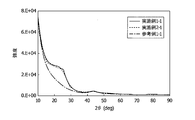
- Example 1-1 Wide-angle X-ray diffraction spectra of activated carbons of Example 1-2, Example 2-1, and Reference Example 1-1. It is a perspective view explaining the structure of a laminate cell.
- the activated carbon of the present invention has a specific surface area according to the BET method of 1500 m 2 / g to 2500 m 2 / g, an average particle diameter (D 50 ) of 0.5 ⁇ m to 5 ⁇ m, and is measured using a wide-angle X-ray diffraction apparatus. A gentle peak derived from d002 can be observed, and the surface functional group is 0.5 meq / g or less.
- Activated carbon having a specific surface area of less than 1500 m 2 / g and activated carbon having a specific surface area of greater than 2500 m 2 / g are inferior in nitrogen gas adsorption characteristics. Therefore, even if such activated carbon is used, the rate characteristics and float characteristics of the electric double layer capacitor electrode and the lithium ion capacitor electrode cannot be satisfied.
- the specific surface area is 1500 m 2 / g to 2500 m 2 / g, the adsorption property of nitrogen gas is excellent. As a result, the rate characteristics and float characteristics of the electric double layer capacitor electrode and the lithium ion capacitor electrode can be satisfied.
- the average particle diameter (D 50 ) of the activated carbon is 0.5 ⁇ m to 5 ⁇ m, the output and durability of the electric double layer capacitor electrode and the lithium ion capacitor electrode can be improved.
- the average particle diameter is less than 0.5 ⁇ m or more than 5 ⁇ m, the output and durability of the capacitor electrode cannot be improved.
- a gentle peak derived from d002 measured using a wide-angle X-ray diffraction apparatus is a characteristic indicating that it originates from soft carbon (graphitizable carbon).
- soft carbon graphitizable carbon
- a gentle peak can be observed in the early stage when the amorphous carbon starts to have crystallinity. This peak is a measure of the occurrence of microcrystals due to the beginning of three-dimensional stacking regularity.
- the surface functional group of the activated carbon is 0.5 meq / g or less, preferably 0.05 to 0.5 meq / g, more preferably 0.1 to 0.45 meq / g, an electric double layer capacitor electrode or lithium ion
- the output and durability of the capacitor electrode can be improved.
- the surface functional group is larger than 0.5 meq / g, the output and durability of the capacitor electrode cannot be improved.
- activated carbon satisfying the above-mentioned specific surface area conditions is used for electric double layer capacitors and lithium ion capacitors, the output and durability of the power source can be improved while maintaining the high capacitance of these capacitors.
- the method for producing activated carbon includes at least a carbonization step, an activation treatment step, a cleaning step, a wet pulverization step, a dry pulverization step, and a heat treatment step.
- the carbonization step in the method for producing activated carbon is a step of carbonizing soft carbon. Carbonization of soft carbon is due to a decrease in volatile matter. When the volatile matter is removed, the subsequent process of pulverization becomes easy. Moreover, it becomes easy to activate with an alkali activator.
- the carbonization condition of the soft carbon is such that the firing temperature is preferably 500 ° C. to 700 ° C., and the carbonization time is about 10 minutes to 2 hours as the holding time after reaching the target temperature.
- the firing temperature is more preferably 520 ° C. to 680 ° C. If it is this temperature range, activation by an alkali activator will become easy by carbonizing. However, when it exceeds around 700 ° C., it becomes difficult to activate. The cause is thought to be the start of the development of the graphite structure.
- Soft carbon used as a starting material that is, graphitizable carbon materials include carbonized petroleum coke and coal coke, etc., and mesophase pitch and mesophase pitch fiber spun from it, infusible and carbonized, etc. be able to.
- petroleum coke is preferred, and petroleum coke that is still taken out of the coker with this petroleum coke is particularly preferred.
- Petroleum raw coke preferably used as a starting material in the present invention is a laminated assembly of polycyclic aromatic compounds having an alkyl side chain, and is a heat-infusible solid.
- Petroleum coke is a product mainly composed of solid carbon obtained by coking, which decomposes a heavy fraction of petroleum at a high temperature of about 500 ° C, and is clearly distinguished from ordinary coal-based coke. Called coke.
- the volatile content of raw coke produced by the delayed coking method is usually 6 to 13% by mass.
- the volatile content of raw coke produced by the fluid coking method is usually 4 to 7% by mass.
- raw coke produced by any method can be used.
- the use of the delayed coking method is particularly preferable because production of raw coke is easy and the quality is stable.
- the heavy fraction of petroleum is not particularly limited, but heavy oil obtained as residual oil when petroleum is distilled under reduced pressure, heavy oil obtained by fluid catalytic cracking of petroleum, and petroleum Heavy oil obtained by hydrodesulfurization, and mixtures thereof.
- the activation treatment step in the method for producing activated carbon is a step in which, after the carbonization step, the soft carbon carbide having an average particle size (D 50 ) of 0.5 ⁇ m to 10 ⁇ m is mixed with an alkali activator and activated. After carbonizing soft carbon, activation treatment is performed using an alkali metal hydroxide.
- the reaction conditions for the activation treatment in the activation treatment step are not particularly limited as long as the activation treatment reaction can sufficiently proceed.
- the activation reaction can be performed under the same reaction conditions as those of a known activation treatment performed in normal production of activated carbon.
- the activation reaction in the activation treatment step can be carried out by mixing an alkali metal hydroxide, which is usually produced in activated carbon, with the soft carbon carbide and heating.
- the temperature condition during heating is preferably 400 ° C. or higher, more preferably 600 ° C. or higher, and still more preferably 700 ° C. or higher. This is because the activation process is sufficiently performed under such temperature conditions.
- the upper limit of the temperature at the time of a heating will not be specifically limited if it is the temperature which an activation reaction advances without trouble. Usually, it is preferably 900 ° C. or lower.
- alkali metal hydroxide used for the activation reaction in the activation treatment step examples include KOH, NaOH, LiOH, RbOH, and CsOH. Among these, KOH and NaOH are preferably used from the viewpoint of the activation effect. These alkali metal hydroxides can be used singly or in combination.
- the alkali activation reaction is performed by mixing an activator such as an alkali metal hydroxide and a soft carbon carbide and heating the mixture.
- the mixing ratio of the carbide and the activator is not particularly limited. However, considering the cost and activation of the activator, the mass ratio of the carbide to the activator is preferably in the range of 1: 0.5 to 1: 5, and more preferably in the range of 1: 1 to 1: 3.
- the soft carbon carbide used for the activation treatment has an average particle diameter (D 50 ) of 0.5 ⁇ m to 10 ⁇ m.
- D 50 average particle diameter
- the soft carbon carbide used for the activation treatment is performed without any problem.
- the average particle diameter of the carbide is less than 0.5 ⁇ m, it is not preferable because the particle diameter increases due to fusion of the carbide particles.
- carbonized_material is larger than 10 micrometers, since the particle diameter of activated carbon becomes larger than the target particle diameter, it is unpreferable.
- the average particle diameter of the carbide to 1 ⁇ m to 8 ⁇ m, the two problems of “the fusion of the particles of the carbide” and “the particle diameter of the activated carbon becomes larger” can be more reliably eliminated. Is more preferable.
- the soft carbon carbide may be one having an average particle diameter (D 50 ) of 0.5 ⁇ m to 10 ⁇ m, and may include an adjusting step of preparing the carbide so as to have an average particle diameter in this range.
- the method for adjusting the average particle size is not particularly limited, but usually, a method of pulverizing with a pulverizing means such as a jet mill can be employed.
- the pulverization can be performed on the soft carbon carbide after the carbonization step, and may be performed on the soft carbon before the carbonization step.
- the washing step in the method for producing activated carbon is a step of washing the activation product obtained by the activation treatment step. If the alkali metal remains in the activation material, there is a possibility of adverse effects when the electric double layer capacitor is formed. Therefore, the alkali metal is removed by a cleaning process. If the amount of alkali metal in the activated material is 1000 ppm by mass or less by this washing step, the performance of the electric double layer capacitor is not affected. For example, if the activation material is washed until the pH of the washing waste water reaches about 7 to 8, the alkali metal content can be sufficiently removed.
- a method of cleaning the activated material a method of washing the activated material with a cleaning liquid and performing solid-liquid separation can be employed. For example, the activator may be immersed in a cleaning solution, stirred and heated as necessary, mixed with the cleaning solution, and then removed.
- washing with water and washing with an acid aqueous solution can be appropriately combined, such as washing with water, followed by washing with an acid aqueous solution, and further washing with water.
- hydrohalic acid such as hydrochloric acid, hydroiodic acid and hydrobromic acid
- inorganic acid such as sulfuric acid and carbonic acid
- acid aqueous solution for example, an acid aqueous solution having a concentration of 0.01 to 3N can be used. Cleaning with these cleaning liquids can be repeated a plurality of times as necessary.
- the wet pulverization step in the method for producing activated carbon is a step of wet pulverizing the activated product after the washing step.
- the wet pulverization step is a step for adjusting the average particle diameter of the activated material to 5 ⁇ m to 10 ⁇ m in advance in order to facilitate the pulverization in the dry pulverization step.
- Examples of the wet pulverization step include a step of slurrying the activated material and pulverizing it with a ball mill or the like.
- the slurry concentration when the activator is slurried is preferably in the range of 2% by mass to 40% by mass.
- the slurry concentration is more preferably in the range of 5% by mass to 20% by mass.
- the efficiency of pulverization is deteriorated.
- the slurry concentration exceeds 40% by mass, the fluidity of the slurry is impaired, so that the impact force by the ball or the like is reduced and the slurry becomes difficult to be crushed.
- a pulverizer can be used for wet pulverization.
- the crusher is not particularly limited. Examples thereof include a ball mill, an attritor, a sand mill, and a bead mill. In wet grinding, it is preferable to use a ball mill.
- wet pulverization using a ball mill is shown below.
- the balls used for wet pulverization include alumina balls, zirconia balls, stainless steel balls, silicon nitride balls, tungsten carbide balls, and the like.
- the diameter of the large ball is preferably 1 mm to 30 mm, more preferably 5 mm to 20 mm.
- the diameter of the small ball is preferably in the range of 1/10 to 1/2 of the diameter of the large ball.
- the ratio of the total weight of the large balls to the total weight of the small balls is preferably in the range of 1/10 to 10/1, more preferably in the range of 2/8 to 8/2.
- the pulverization time is preferably 30 minutes to 5 hours, more preferably 60 minutes to 3 hours.
- the number of rotations is preferably 10 rpm to 100 rpm, more preferably 30 rpm to 60 rpm.
- the wet pulverization step can be performed before or after the cleaning step.
- activated material can be obtained by throwing the activated material into water to form an alkali slurry, washing the alkali slurry, wet pulverizing, and then carrying out the washing step.
- the activated carbon can be made into a water slurry and wet pulverized.
- the dry pulverization step in the method for producing activated carbon is a step of dry pulverizing the activated product after the wet pulverization step so that the average particle diameter (D 50 ) of the activated product is 0.5 ⁇ m to 5 ⁇ m.
- the first activated carbon is further dry-pulverized.
- the particles of the activated material can be pulverized by using, for example, a jet mill.
- the activated material can be pulverized in an atmosphere in which hydrogen gas is added to an inert gas such as nitrogen or argon at 10 volume% or less, preferably 0.5 to 8 volume%.
- an inert gas such as nitrogen or argon at 10 volume% or less, preferably 0.5 to 8 volume%.
- hydrogen gas By adding hydrogen gas, surface oxides can be reduced. Particularly in dry pulverization, the effect of reducing oxides is extremely large.
- the drying process which dries the said activation material can be provided between the said wet grinding process and the said dry grinding process. As the said drying process, what is necessary is just a process which can dry an activation thing, and it can be set as the process using well-known methods, such as hot air drying and natural drying.
- the activated product after the dry pulverization step is heat-treated at a temperature of 400 ° C. to 700 ° C. in an atmosphere in which 10% by volume or less of hydrogen is added to an inert gas or under reduced pressure. It is a process to do.
- the activated product can be pulverized in the dry pulverization step so that the average particle diameter (D 50 ) of the activated product during the heat treatment is 5 ⁇ m or less.
- a plurality of peaks may exist as the particle size distribution of the activation product. Moreover, a plurality of peaks may not exist, that is, a monomodal particle size distribution may be used.
- heating is performed in an atmosphere in which hydrogen gas is added to an inert gas such as nitrogen or argon at 10 volume% or less, preferably 0.5 to 8 volume%, or under reduced pressure.
- an inert gas such as nitrogen or argon at 10 volume% or less, preferably 0.5 to 8 volume%, or under reduced pressure.
- the heating temperature is 400 ° C to 700 ° C. If the temperature is lower than 400 ° C., there is no effect, and if it is 700 ° C. or higher, the pores of the activated carbon may be destroyed.
- the activated carbon treatment method includes at least a dry pulverization step and a heat treatment step.
- the dry pulverization step and the heat treatment step are as described in the method for producing activated carbon.
- the activated carbon to be subjected to the dry pulverization step and the heat treatment step has an average particle size (D 50 ) of 5 ⁇ m to 10 ⁇ m, a specific surface area by nitrogen gas adsorption method of 1500 m 2 / g to 2500 m 2 / g, and an average pore diameter of 1 Activated carbon having a thickness of 0.7 nm to 3.0 nm, a total pore volume of 0.5 ml / g to 2 ml / g, and an alkali metal content of 1000 mass ppm or less.
- the activated carbon can be obtained, for example, by performing the carbonization step, the activation treatment step, the washing step, and the wet pulverization step that have appeared in the method for producing activated carbon, followed by drying.
- the average particle diameter can be adjusted by a wet grinding process.
- the amount of alkali metal can be adjusted in the cleaning process.
- the specific surface area, average pore diameter, and total pore volume can be adjusted by the carbonization temperature and the activation conditions such as the activation temperature and the alkali ratio.
- the activated carbon described above can be used for electric double layer capacitors and lithium ion capacitors.
- the electric double layer capacitor includes an electrode including activated carbon.
- the electrode is configured by adding, for example, activated carbon and a binder, and more preferably a conductive agent. Moreover, the said electrode can be made into the electrode further integrated with the electrical power collector.
- the activated carbon the activated carbon of the present invention can be used.
- binder As the binder used here, known ones can be used. For example, polyolefins such as polyethylene and polypropylene, fluorinated polymers such as polytetrafluoroethylene, polyvinylidene fluoride, fluoroolefin / vinyl ether copolymer cross-linked polymers, celluloses such as carboxymethyl cellulose, vinyl polymers such as polyvinyl pyrrolidone and polyvinyl alcohol And polyacrylic acid.
- the content of the binder in the electrode is not particularly limited.
- the binder can be contained in the range of usually about 0.1 to 30% by mass with respect to the total amount of the activated carbon and the binder.
- the conductive agent powders of carbon black, powdered graphite, titanium oxide, ruthenium oxide and the like can be used.
- the blending amount of the conductive agent in the electrode can be appropriately selected according to the blending purpose.
- the activated carbon of the present invention it contains a conductive agent in the range of usually 1 to 50% by mass, preferably about 2 to 30% by mass, with respect to the total amount of the activated carbon, binder and conductive agent. Can do.
- a known method can be used as a method of mixing the activated carbon, the binder, and the conductive agent. For example, there is a method in which activated carbon, a binder, and a conductive agent are added to a solvent having a property of dissolving a binder to form a slurry, which is uniformly applied on a current collector. In addition, there is a method in which the activated carbon, the binder, and the conductive agent are kneaded without adding a solvent, and then pressure-molded at room temperature or under heating.
- a current collector of a known material and shape can be used.
- a current collector made of a metal such as aluminum, titanium, tantalum, or nickel, or an alloy such as stainless steel in a predetermined shape can be used.
- a unit cell of an electric double layer capacitor can be generally formed by using a pair of the above electrodes as a positive electrode and a negative electrode, facing each other through a separator, and immersing in an electrolytic solution.
- a separator a polypropylene fiber nonwoven fabric, a glass fiber nonwoven fabric, a synthetic cellulose paper, etc. can be used.
- electrolytic solution a known aqueous electrolytic solution or organic electrolytic solution can be used.
- organic electrolyte those used as solvents for electrochemical electrolytes can be used.
- these electrolyte solutions can be mixed and used.
- the supporting electrolyte in the organic electrolytic solution is not particularly limited, and various electrolytes such as salts, acids, alkalis and the like that are usually used in the field of electrochemistry or the field of batteries can be used.
- examples thereof include inorganic ion salts such as alkali metal salts and alkaline earth metal salts, quaternary ammonium salts, cyclic quaternary ammonium salts, and quaternary phosphonium salts.
- (C 2 H 5 ) 4 NBF 4 , (C 2 H 5 ) 3 (CH 3 ) NBF 4 , (C 2 H 5 ) 4 PBF 4 , and (C 2 H 5 ) 3 (CH 3 ) PBF 4 Etc. are mentioned as preferable.
- the concentration of these salts in the electrolytic solution can be generally in the range of about 0.1 to 5 mol / l, preferably about 0.5 to 3 mol / l.
- a more specific configuration of the electric double layer capacitor is not particularly limited.
- a pair of electrodes consisting of a thin sheet or disk-like positive electrode and negative electrode having a thickness of 10 to 500 ⁇ m
- a coin type accommodated in a metal case via a separator and the pair of electrodes are interposed via a separator.
- the winding type include a rotating type, and a laminated type in which a large number of electrode groups are stacked via a separator.
- Activated carbon was produced using petroleum raw coke as soft carbon. Petroleum raw coke was adjusted to a particle size of 3 mm or less so as to be easily pulverized, and carbonized for 1 hour at 550 ° C. in a nitrogen atmosphere using a rotary kiln (carbonization step). After carbonization, the carbonized product was pulverized with a jet mill so that the average particle size (D 50 ) was 7.0 ⁇ m, and the average particle size was adjusted (adjustment step). After the adjusting step, 200 parts by mass of potassium hydroxide was added to 100 parts by mass of petroleum raw coke and mixed with a ball mill to obtain a mixture.
- the obtained mixture was placed in a ceramic electric tubular furnace, sealed, and the tubular furnace was placed in a nitrogen gas atmosphere, and then the temperature of the mixture rose from room temperature to 750 ° C. under a temperature rising condition of 20 ° C./min.
- the mixture was heated by a tubular furnace heater. When the temperature of the mixture reached 750 ° C., the temperature was maintained for 30 minutes, and activation treatment was performed (activation treatment step). After the activation treatment, mixing of water vapor and heating by the heater were stopped, and the mixture was naturally cooled to room temperature in a nitrogen gas atmosphere.
- first activated carbon The specific surface area by the BET method of the activated carbon obtained through the above steps (hereinafter sometimes referred to as “first activated carbon”) was 2100 m 2 / g.
- the first activated carbon was pulverized with a jet mill under a nitrogen atmosphere, and the average particle size (D 50 ) was adjusted to 4.0 ⁇ m (dry pulverization step). After the dry pulverization, the first activated carbon was heat-treated at 600 ° C. for 2 hours in a nitrogen atmosphere (heat treatment step).
- the activated carbon of Example 1-1 was obtained through the above steps.
- the obtained first activated carbon had an average particle diameter of 7.0 ⁇ m, a specific surface area of 2100 m 2 / g, an average pore diameter of 2.1 nm, a total pore volume of 1.1 ml / g, and an alkali metal amount of 120.
- the mass was ppm.
- the average particle size was measured by a laser scattering particle size distribution measurement method.
- the specific surface area, average pore diameter and total pore volume were measured by a nitrogen gas adsorption method.
- the amount of alkali metal was measured by fluorescent X-ray analysis.
- Example 2-1 A first activated carbon was obtained by the same process as in Example 1-1.
- the first activated carbon was pulverized with a jet mill under a nitrogen atmosphere, and the average particle size (D 50 ) was adjusted to 3.7 ⁇ m. Thereafter, the first activated carbon was heat-treated at 650 ° C. for 1 hour in a nitrogen atmosphere containing 5% by volume of hydrogen. Through the above steps, the activated carbon of Example 2-1 was obtained.
- the average particle diameter (D 50 ) of the obtained first activated carbon was 8.0 ⁇ m
- the specific surface area by BET method was 2510 m 2 / g
- the average pore diameter was 2.2 nm
- the total pore volume was 1.4 ml / g
- the amount of alkali metal was 80 mass ppm.
- Example 3-1 A first activated carbon was obtained by the same process as in Example 1-1 except that the ratio of the carbon material to potassium hydroxide was 1: 1.8.
- the first activated carbon was pulverized with a jet mill under a nitrogen atmosphere, and the average particle size (D 50 ) was adjusted to 3.3 ⁇ m. Thereafter, the first activated carbon was heat-treated at 600 ° C. for 2 hours in a nitrogen atmosphere containing 3% by volume of hydrogen.
- the activated carbon of Example 3-1 was obtained through the above steps.
- the obtained first activated carbon had an average particle size of 9.8 ⁇ m, a specific surface area of 1620 m 2 / g, an average pore diameter of 1.9 nm, a total pore volume of 0.8 ml / g, and an alkali metal content of 150.
- the mass was ppm.
- Example 1-1 A first activated carbon was obtained by the same process as in Example 1-1.
- the first activated carbon was heat-treated at 600 ° C. for 1 hour in a nitrogen atmosphere without performing the dry pulverization step.
- the activated carbon of Comparative Example 1-1 was obtained.
- the obtained first activated carbon had an average particle diameter of 7.0 ⁇ m, a specific surface area of 2100 m 2 / g, an average pore diameter of 2.1 nm, a total pore volume of 1.1 ml / g, and an alkali metal amount of 120.
- the mass was ppm.
- Example 2-1 A first activated carbon was obtained by the same process as in Example 1-1 except that the activation temperature was set to 700 ° C. The first activated carbon was heat-treated at 600 ° C. for 1 hour in a nitrogen atmosphere without performing the dry pulverization step. Through the above steps, the activated carbon of Comparative Example 2-1 was obtained. The obtained first activated carbon had an average particle size of 4.0 ⁇ m, a specific surface area of 1800 m 2 / g, an average pore diameter of 1.9 nm, a total pore volume of 0.9 ml / g, and an alkali metal content of 100. The mass was ppm.
- Activated carbon was produced using phenol charcoal as hard carbon (non-graphitizable carbon).
- Commercial activated carbon made from phenolic charcoal (specific surface area by BET method is 2200 m 2 / g, average particle size (D 50 ) is 8.2 ⁇ m) is pulverized with a jet mill in a nitrogen atmosphere to obtain an average particle size (D 50 ) Was adjusted to 4.5 ⁇ m. Thereafter, heat treatment was performed at 600 ° C. for 2 hours in a nitrogen atmosphere. Through the above steps, the activated carbon of Reference Example 1-1 was obtained.
- Activated carbon was produced using petroleum coke as a starting material. Petroleum coke was pulverized with a jet mill so that the average particle size (D 50 ) was 3.0 ⁇ m, and the average particle size was adjusted. After the adjustment process, the activation process was performed by the same process as the activation process described in Example 1-1. The activated carbon after the activation treatment had a specific surface area by BET method of 1603 m 2 / g and an average particle size (D 50 ) of 7.0 ⁇ m. However, the obtained activated carbon was fused to increase the particle size.
- a laminate cell was prepared using the activated carbon prepared in Examples 1-1 to 3-1, Comparative Examples 1-1, 2-1 and Reference Example 1-1.
- Carbon black (ECP600JD manufactured by Lion Co., Ltd.) 0.13 g as a conductive agent and 0.11 g of granular polytetrafluoroethylene (PTFE) as a binder are mixed with 1.5 g of activated carbon, and a roll press machine is used. The mixture was pressed into a sheet to prepare a carbon electrode sheet having a thickness of 150 to 200 ⁇ m. From this carbon electrode sheet, an electrode having a length of 1.4 cm and a width of 2.0 cm was cut out to obtain a positive electrode and a negative electrode.
- the current collector 4 was attached to the positive electrode 2 and the negative electrode 3, the separator 5 was sandwiched between the positive electrode 2 and the negative electrode 3, and the outside was covered with the laminate film 6, thereby producing a laminate cell 1.
- the positive electrode and the negative electrode are the same material and have the same shape.
- a propylene carbonate (PC) solution of 1.5M triethylmethylammonium tetrafluoroborate (TEMA ⁇ BF 4 ) was used as an electrolytic solution, and the capacitance retention was evaluated in order to evaluate the capacitor performance of the laminate cell.
- the electrode density was determined by measuring the sheet weight and the vertical and horizontal dimensions ⁇ thickness.
- the capacitance (C) was obtained by measuring the total amount of discharge energy (U) stored in the capacitor and calculating the value by the energy conversion method.
- the internal resistance (R) was calculated from the IR drop immediately after the start of discharge. Formulas (1) and (2) are shown below as calculation formulas for capacitance and internal resistance.
- the capacitance retention rate is the ratio of the capacitance (B) when discharging at 50 mA to the capacitance (A) when discharging at 1 mA in a charge / discharge test at ⁇ 30 ° C. (100 ⁇ B / A) was calculated as the capacitance retention. Also, the ratio of the capacitance (D) when 100 mA is discharged at 20 ° C. after applying 2.8 V at 60 ° C. for 1000 hours to the capacitance (C) when 100 mA is discharged at 20 ° C. (100 ⁇ D / C) was calculated as the capacitance retention. The results are shown in Table 1.
- the capacitance decreases as the discharge current increases.
- a charge / discharge test is performed at ⁇ 30 ° C.
- the value of the capacitance retention rate when the capacitance retention rate at 50 mA discharge to the capacitance at 1 mA discharge is evaluated as the capacitance retention rate.
- the fact that a large current can flow means that the output is high.
- a deterioration test is performed by continuously applying 2.8 V at 60 ° C. for 1000 hours, and the capacitance before and after the deterioration test is compared with the same discharge current of 100 mA discharge at 20 ° C., The higher the capacity retention rate, the better the durability.
- Example 1-2 to Example 3-2 were higher than those of Comparative Example 1-2, Comparative Example 2-2, and Reference Example 1-1.
- the capacitance retention was shown. That is, the laminate cell of the example was able to output higher than the laminate cell of the comparative example and the reference example.
- the laminated cells of Examples 1-2 to 3-2 were Comparative Example 1-2 and Comparative Example 2-2.
- the capacitance retention was higher than that of Reference Example 1-1. That is, the laminate cell of the example could exhibit higher durability than the laminate cell of the comparative example and the reference example.
- an electric double layer capacitor and a lithium ion capacitor excellent in output and durability can be provided while maintaining a high capacitance, it is industrially useful.
Landscapes
- Engineering & Computer Science (AREA)
- Chemical & Material Sciences (AREA)
- Power Engineering (AREA)
- Materials Engineering (AREA)
- Microelectronics & Electronic Packaging (AREA)
- Organic Chemistry (AREA)
- Inorganic Chemistry (AREA)
- Electric Double-Layer Capacitors Or The Like (AREA)
- Carbon And Carbon Compounds (AREA)
Abstract
L'invention concerne : un charbon actif qui peut garder une capacité électrostatique élevée et présenter d'excellentes caractéristiques de sortie et une durabilité élevée lorsqu'il est utilisé dans un condensateur à double couche électrique ou un condensateur au lithium-ion ; et un procédé de production du charbon actif. Le charbon actif a une surface spécifique mesurée par le procédé BET de 1 500 à 2 500 m2/g et un diamètre particulaire moyen (D50) de 0,5 à 5 µm, présente un léger pic attribuable à d002 lorsqu'elle est mesurée à l'aide d'un diffractomètre grand angle à rayons X, et porte pas plus de 0,5 méq/g d'un groupe fonctionnel de surface.
Applications Claiming Priority (2)
| Application Number | Priority Date | Filing Date | Title |
|---|---|---|---|
| JP2014066914 | 2014-03-27 | ||
| JP2014-066914 | 2014-03-27 |
Publications (1)
| Publication Number | Publication Date |
|---|---|
| WO2015146459A1 true WO2015146459A1 (fr) | 2015-10-01 |
Family
ID=54194990
Family Applications (1)
| Application Number | Title | Priority Date | Filing Date |
|---|---|---|---|
| PCT/JP2015/055656 Ceased WO2015146459A1 (fr) | 2014-03-27 | 2015-02-26 | Charbon actif, procédé de production de charbon actif et procédé de traitement de charbon actif |
Country Status (1)
| Country | Link |
|---|---|
| WO (1) | WO2015146459A1 (fr) |
Cited By (7)
| Publication number | Priority date | Publication date | Assignee | Title |
|---|---|---|---|---|
| JP2018014466A (ja) * | 2016-07-22 | 2018-01-25 | 株式会社巴川製紙所 | 分極性電極および電気二重層キャパシタ |
| JP2018014467A (ja) * | 2016-07-22 | 2018-01-25 | 株式会社巴川製紙所 | 分極性電極および電気二重層キャパシタ |
| EP3544038A4 (fr) * | 2016-11-15 | 2020-07-08 | Kuraray Co., Ltd. | Matériau carboné pour électrode de condensateurs à double couche électriques et son procédé de production |
| KR20210032319A (ko) * | 2018-07-20 | 2021-03-24 | 주식회사 쿠라레 | 탄소질 재료, 그 제조 방법, 전기 화학 디바이스용 전극 활물질, 전기 화학 디바이스용 전극 및 전기 화학 디바이스 |
| CN112551503A (zh) * | 2019-09-25 | 2021-03-26 | 宁波杉杉新材料科技有限公司 | 改性软炭负极材料、锂离子电池及负极材料及其制备方法 |
| CN116870862A (zh) * | 2023-07-12 | 2023-10-13 | 西安热工研究院有限公司 | 一种增强不定型活性焦孔隙的方法 |
| WO2024257756A1 (fr) | 2023-06-15 | 2024-12-19 | 株式会社クラレ | Charbon actif |
Citations (11)
| Publication number | Priority date | Publication date | Assignee | Title |
|---|---|---|---|---|
| JPS60189162A (ja) * | 1984-03-07 | 1985-09-26 | Matsushita Electric Ind Co Ltd | 分極性電極の製造法 |
| JP2001284188A (ja) * | 2000-04-03 | 2001-10-12 | Asahi Glass Co Ltd | 電気二重層キャパシタ電極用炭素材料の製造方法及びこの炭素材料を用いた電気二重層キャパシタの製造方法 |
| JP2002025867A (ja) * | 2000-07-04 | 2002-01-25 | Jeol Ltd | 電気二重層キャパシタおよび電気二重層キャパシタ用炭素材料 |
| JP2004149363A (ja) * | 2002-10-31 | 2004-05-27 | Honda Motor Co Ltd | 活性炭の製造方法 |
| JP2008007387A (ja) * | 2006-06-30 | 2008-01-17 | Kansai Coke & Chem Co Ltd | 活性炭の高純度化方法、および活性炭用高純度化装置 |
| JP2008181949A (ja) * | 2007-01-23 | 2008-08-07 | Hitachi Chem Co Ltd | 電気二重層キャパシタ用電極材及び電気二重層キャパシタ |
| JP2009013012A (ja) * | 2007-07-04 | 2009-01-22 | Nippon Oil Corp | 電気二重層キャパシタ電極用活性炭の製造方法 |
| JP2010070393A (ja) * | 2008-09-16 | 2010-04-02 | Nippon Oil Corp | 電気二重層キャパシタ用炭素材およびその製造方法 |
| WO2010044447A1 (fr) * | 2008-10-15 | 2010-04-22 | 株式会社 キャタラー | Matériau carboné et élément de stockage |
| JP2011011935A (ja) * | 2009-06-30 | 2011-01-20 | Kansai Coke & Chem Co Ltd | 活性炭の製造方法、および該製造方法により得られた活性炭を用いた電気二重層キャパシタ |
| WO2012074054A1 (fr) * | 2010-12-03 | 2012-06-07 | 南開工業株式会社 | Poudre de charbon actif et son procédé de fabrication et condensateur à double couche électrique |
-
2015
- 2015-02-26 WO PCT/JP2015/055656 patent/WO2015146459A1/fr not_active Ceased
Patent Citations (11)
| Publication number | Priority date | Publication date | Assignee | Title |
|---|---|---|---|---|
| JPS60189162A (ja) * | 1984-03-07 | 1985-09-26 | Matsushita Electric Ind Co Ltd | 分極性電極の製造法 |
| JP2001284188A (ja) * | 2000-04-03 | 2001-10-12 | Asahi Glass Co Ltd | 電気二重層キャパシタ電極用炭素材料の製造方法及びこの炭素材料を用いた電気二重層キャパシタの製造方法 |
| JP2002025867A (ja) * | 2000-07-04 | 2002-01-25 | Jeol Ltd | 電気二重層キャパシタおよび電気二重層キャパシタ用炭素材料 |
| JP2004149363A (ja) * | 2002-10-31 | 2004-05-27 | Honda Motor Co Ltd | 活性炭の製造方法 |
| JP2008007387A (ja) * | 2006-06-30 | 2008-01-17 | Kansai Coke & Chem Co Ltd | 活性炭の高純度化方法、および活性炭用高純度化装置 |
| JP2008181949A (ja) * | 2007-01-23 | 2008-08-07 | Hitachi Chem Co Ltd | 電気二重層キャパシタ用電極材及び電気二重層キャパシタ |
| JP2009013012A (ja) * | 2007-07-04 | 2009-01-22 | Nippon Oil Corp | 電気二重層キャパシタ電極用活性炭の製造方法 |
| JP2010070393A (ja) * | 2008-09-16 | 2010-04-02 | Nippon Oil Corp | 電気二重層キャパシタ用炭素材およびその製造方法 |
| WO2010044447A1 (fr) * | 2008-10-15 | 2010-04-22 | 株式会社 キャタラー | Matériau carboné et élément de stockage |
| JP2011011935A (ja) * | 2009-06-30 | 2011-01-20 | Kansai Coke & Chem Co Ltd | 活性炭の製造方法、および該製造方法により得られた活性炭を用いた電気二重層キャパシタ |
| WO2012074054A1 (fr) * | 2010-12-03 | 2012-06-07 | 南開工業株式会社 | Poudre de charbon actif et son procédé de fabrication et condensateur à double couche électrique |
Cited By (11)
| Publication number | Priority date | Publication date | Assignee | Title |
|---|---|---|---|---|
| JP2018014466A (ja) * | 2016-07-22 | 2018-01-25 | 株式会社巴川製紙所 | 分極性電極および電気二重層キャパシタ |
| JP2018014467A (ja) * | 2016-07-22 | 2018-01-25 | 株式会社巴川製紙所 | 分極性電極および電気二重層キャパシタ |
| EP3544038A4 (fr) * | 2016-11-15 | 2020-07-08 | Kuraray Co., Ltd. | Matériau carboné pour électrode de condensateurs à double couche électriques et son procédé de production |
| US10879014B2 (en) | 2016-11-15 | 2020-12-29 | Kuraray Co., Ltd. | Carbonaceous material for electric double layer capacitors and method for producing same |
| US11823837B2 (en) | 2016-11-15 | 2023-11-21 | Kuraray Co., Ltd. | Carbonaceous material for electric double layer capacitors and method for producing same |
| KR20210032319A (ko) * | 2018-07-20 | 2021-03-24 | 주식회사 쿠라레 | 탄소질 재료, 그 제조 방법, 전기 화학 디바이스용 전극 활물질, 전기 화학 디바이스용 전극 및 전기 화학 디바이스 |
| KR102639869B1 (ko) | 2018-07-20 | 2024-02-22 | 주식회사 쿠라레 | 탄소질 재료, 그 제조 방법, 전기 화학 디바이스용 전극 활물질, 전기 화학 디바이스용 전극 및 전기 화학 디바이스 |
| CN112551503A (zh) * | 2019-09-25 | 2021-03-26 | 宁波杉杉新材料科技有限公司 | 改性软炭负极材料、锂离子电池及负极材料及其制备方法 |
| WO2024257756A1 (fr) | 2023-06-15 | 2024-12-19 | 株式会社クラレ | Charbon actif |
| KR20250168308A (ko) | 2023-06-15 | 2025-12-02 | 주식회사 쿠라레 | 활성탄 |
| CN116870862A (zh) * | 2023-07-12 | 2023-10-13 | 西安热工研究院有限公司 | 一种增强不定型活性焦孔隙的方法 |
Similar Documents
| Publication | Publication Date | Title |
|---|---|---|
| KR101470050B1 (ko) | 전기 이중층 커패시터 전극용 활성탄의 제조방법 | |
| JP5473282B2 (ja) | 電気二重層キャパシタ用炭素材およびその製造方法 | |
| JP5344972B2 (ja) | 電気二重層キャパシタ電極用炭素材およびその製造方法 | |
| JP6380993B2 (ja) | 電気二重層キャパシタ電極用活性炭およびその製造方法 | |
| KR101553716B1 (ko) | 전기 이중층 커패시터 전극용 활성탄 및 그 제조방법 | |
| US8858654B2 (en) | Activated carbon for electric double layer capacitor electrode and method for producing the activated carbon | |
| JP5242090B2 (ja) | 電気二重層キャパシタ電極用活性炭の製造方法 | |
| CN102186771B (zh) | 碳材料及蓄电元件 | |
| KR102086589B1 (ko) | 전극 재료, 이를 포함하는 전기 화학 소자 및 그 제조방법 | |
| JP2017135154A (ja) | 活性炭およびその製造方法 | |
| JP4092344B2 (ja) | 電気二重層キャパシタ電極用炭素材の原料油組成物 | |
| JP2017108022A (ja) | 導電性補助剤、電極及び蓄電素子 | |
| JPWO2007037523A1 (ja) | 電気二重層キャパシタ用炭素材料および電気二重層キャパシタ | |
| JP2008010559A (ja) | 電気二重層キャパシタ電極用活性炭 |
Legal Events
| Date | Code | Title | Description |
|---|---|---|---|
| 121 | Ep: the epo has been informed by wipo that ep was designated in this application |
Ref document number: 15770062 Country of ref document: EP Kind code of ref document: A1 |
|
| NENP | Non-entry into the national phase |
Ref country code: DE |
|
| 32PN | Ep: public notification in the ep bulletin as address of the adressee cannot be established |
Free format text: NOTING OF LOSS OF RIGHTS PURSUANT TO RULE 112(1) EPC ( EPO FORM 1205A DATED 20-01-2017 ) |
|
| NENP | Non-entry into the national phase |
Ref country code: JP |
|
| 122 | Ep: pct application non-entry in european phase |
Ref document number: 15770062 Country of ref document: EP Kind code of ref document: A1 |