WO2015146647A1 - Dispositif d'émission, procédé d'émission, dispositif de réception, procédé de réception et programme - Google Patents
Dispositif d'émission, procédé d'émission, dispositif de réception, procédé de réception et programme Download PDFInfo
- Publication number
- WO2015146647A1 WO2015146647A1 PCT/JP2015/057533 JP2015057533W WO2015146647A1 WO 2015146647 A1 WO2015146647 A1 WO 2015146647A1 JP 2015057533 W JP2015057533 W JP 2015057533W WO 2015146647 A1 WO2015146647 A1 WO 2015146647A1
- Authority
- WO
- WIPO (PCT)
- Prior art keywords
- fragment
- sample
- moof
- header
- lct
- Prior art date
- Legal status (The legal status is an assumption and is not a legal conclusion. Google has not performed a legal analysis and makes no representation as to the accuracy of the status listed.)
- Ceased
Links
Images









Classifications
-
- H—ELECTRICITY
- H04—ELECTRIC COMMUNICATION TECHNIQUE
- H04N—PICTORIAL COMMUNICATION, e.g. TELEVISION
- H04N21/00—Selective content distribution, e.g. interactive television or video on demand [VOD]
- H04N21/20—Servers specifically adapted for the distribution of content, e.g. VOD servers; Operations thereof
- H04N21/23—Processing of content or additional data; Elementary server operations; Server middleware
- H04N21/236—Assembling of a multiplex stream, e.g. transport stream, by combining a video stream with other content or additional data, e.g. inserting a URL [Uniform Resource Locator] into a video stream, multiplexing software data into a video stream; Remultiplexing of multiplex streams; Insertion of stuffing bits into the multiplex stream, e.g. to obtain a constant bit-rate; Assembling of a packetised elementary stream
- H04N21/23605—Creation or processing of packetized elementary streams [PES]
-
- H—ELECTRICITY
- H04—ELECTRIC COMMUNICATION TECHNIQUE
- H04N—PICTORIAL COMMUNICATION, e.g. TELEVISION
- H04N21/00—Selective content distribution, e.g. interactive television or video on demand [VOD]
- H04N21/20—Servers specifically adapted for the distribution of content, e.g. VOD servers; Operations thereof
- H04N21/23—Processing of content or additional data; Elementary server operations; Server middleware
- H04N21/234—Processing of video elementary streams, e.g. splicing of video streams or manipulating encoded video stream scene graphs
-
- H—ELECTRICITY
- H04—ELECTRIC COMMUNICATION TECHNIQUE
- H04N—PICTORIAL COMMUNICATION, e.g. TELEVISION
- H04N21/00—Selective content distribution, e.g. interactive television or video on demand [VOD]
- H04N21/20—Servers specifically adapted for the distribution of content, e.g. VOD servers; Operations thereof
- H04N21/23—Processing of content or additional data; Elementary server operations; Server middleware
- H04N21/235—Processing of additional data, e.g. scrambling of additional data or processing content descriptors
- H04N21/2353—Processing of additional data, e.g. scrambling of additional data or processing content descriptors specifically adapted to content descriptors, e.g. coding, compressing or processing of metadata
-
- H—ELECTRICITY
- H04—ELECTRIC COMMUNICATION TECHNIQUE
- H04N—PICTORIAL COMMUNICATION, e.g. TELEVISION
- H04N21/00—Selective content distribution, e.g. interactive television or video on demand [VOD]
- H04N21/20—Servers specifically adapted for the distribution of content, e.g. VOD servers; Operations thereof
- H04N21/23—Processing of content or additional data; Elementary server operations; Server middleware
- H04N21/236—Assembling of a multiplex stream, e.g. transport stream, by combining a video stream with other content or additional data, e.g. inserting a URL [Uniform Resource Locator] into a video stream, multiplexing software data into a video stream; Remultiplexing of multiplex streams; Insertion of stuffing bits into the multiplex stream, e.g. to obtain a constant bit-rate; Assembling of a packetised elementary stream
- H04N21/2362—Generation or processing of Service Information [SI]
-
- H—ELECTRICITY
- H04—ELECTRIC COMMUNICATION TECHNIQUE
- H04N—PICTORIAL COMMUNICATION, e.g. TELEVISION
- H04N21/00—Selective content distribution, e.g. interactive television or video on demand [VOD]
- H04N21/20—Servers specifically adapted for the distribution of content, e.g. VOD servers; Operations thereof
- H04N21/23—Processing of content or additional data; Elementary server operations; Server middleware
- H04N21/242—Synchronisation processes, e.g. processing of PCR [Programme Clock References]
-
- H—ELECTRICITY
- H04—ELECTRIC COMMUNICATION TECHNIQUE
- H04N—PICTORIAL COMMUNICATION, e.g. TELEVISION
- H04N21/00—Selective content distribution, e.g. interactive television or video on demand [VOD]
- H04N21/40—Client devices specifically adapted for the reception of or interaction with content, e.g. set-top-box [STB]; Operations thereof
- H04N21/43—Processing of content or additional data, e.g. demultiplexing additional data from a digital video stream; Elementary client operations, e.g. monitoring of home network or synchronising decoder's clock; Client middleware
- H04N21/4302—Content synchronisation processes, e.g. decoder synchronisation
- H04N21/4305—Synchronising client clock from received content stream, e.g. locking decoder clock with encoder clock, extraction of the PCR packets
-
- H—ELECTRICITY
- H04—ELECTRIC COMMUNICATION TECHNIQUE
- H04N—PICTORIAL COMMUNICATION, e.g. TELEVISION
- H04N21/00—Selective content distribution, e.g. interactive television or video on demand [VOD]
- H04N21/60—Network structure or processes for video distribution between server and client or between remote clients; Control signalling between clients, server and network components; Transmission of management data between server and client, e.g. sending from server to client commands for recording incoming content stream; Communication details between server and client
- H04N21/63—Control signaling related to video distribution between client, server and network components; Network processes for video distribution between server and clients or between remote clients, e.g. transmitting basic layer and enhancement layers over different transmission paths, setting up a peer-to-peer communication via Internet between remote STB's; Communication protocols; Addressing
- H04N21/643—Communication protocols
Definitions
- the present technology relates to a transmission device, a transmission method, a reception device, a reception method, and a program, and in particular, for example, a transmission device, a transmission method, a reception device, a reception method, and the like that can quickly distribute data. And related to the program.
- OTT-V Over The Top Video
- MPEG-DASH Moving Picture Experts Group-Dynamic Adaptive Streaming over HTTP (Hypertext Transfer Protocol)
- DASH Dynamic Adaptive Streaming over HTTP
- a server that delivers a stream notifies the client that receives the stream MPD (Media Description Description) as metadata that includes attribute information for optimally selecting streams with different characteristics from the same source.
- MPD Media Description Description
- network environment adaptive streaming is realized by using the MPD (see, for example, Non-Patent Document 1).
- the server prepares a plurality of streams having different image quality, image size, etc. according to the communication environment of the distribution path, the capability of the client, the state, etc. as the same content.
- the client adaptively selects a stream that can be received by the client from the multiple streams prepared by the server and that is suitable for the client's capabilities (decoding capability, etc.), and receives the stream. And play it.
- Metadata used for content playback control is distributed from the server to the client so that the client can adaptively select and receive the stream.
- a URL Uniform Resource Locator
- the client sends an http request to the (web) server, which is the content distribution source, based on the URL described in the MPD, etc., and receives and plays back the segment unicasted by the server in response to this http request .
- DASH is based on a streaming protocol that uses http, but for content that many users view simultaneously, for example, multicast and broadcast such as RTP (Real-time Transport Protocol) and FLUTE (File Delivery Over Unidirectional Transport) (MC / BC) It is desirable to perform simultaneous broadcast distribution and reduce network resource load by using bearers together.
- RTP Real-time Transport Protocol
- FLUTE File Delivery Over Unidirectional Transport
- a segment (file) obtained by dividing a content stream is used as a file distribution unit (control target) in DASH, and the file is distributed in the segment unit.
- This technology has been made in view of such a situation, and enables data such as contents to be quickly distributed.
- the transmission apparatus or the first program of the present technology includes a distribution unit that distributes an LCT packet including a portion that is data including a part of a fragment and an LCT (Layerd Coding Transport) header, and the fragment includes: moof (movie fragment) and mdat (media data) header and mdat having one or more sample groups, the moof includes BaseMediaDecodeTime representing the presentation time of the first sample of the mdat, and the LCT header Is a sequence number representing the order of the fragments, a version representing a part of the fragments, a version representing the order in the fragments, an NTP (Network Time Protocol) time corresponding to the BaseMediaDecodeTime, and a head of a part of the fragments.
- LCT Layerd Coding Transport
- Sample count start information indicating the order of the sample from the first sample of the fragment, and the m
- a transmission device including a moof subset which is at least a part of oof, or a program for causing a computer to function as such a transmission device.
- the transmission method of the present technology includes a step of delivering an LCT packet including a portion which is data including a part of a fragment and an LCT (Layerd Coding Transport) header, and the fragment includes moof (movie fragment) and mdat.
- LCT Layerd Coding Transport
- the moof includes BaseMediaDecodeTime representing the presentation time of the first sample of the mdat, and the LCT header includes a sequence number representing the order of the fragments; A version of a part of the fragment representing the order in the fragment, an NTP (Network Time Protocol) time corresponding to the BaseMediaDecodeTime, and an order of the first sample of a part of the fragment from the first sample of the fragment Sample count start information representing the moof sub, which is at least part of the moof A transmission method including a set.
- NTP Network Time Protocol
- an LCT packet including a portion that is data including a part of a fragment and an LCT (Layered Coding Transport) header is distributed.
- the fragment has a moof (movie fragment) and an mdat having a mdat (media data) header and a sample group, and the moof includes a BaseMediaDecodeTime representing the presentation time of the first sample of the mdat, and the LCT header Is a sequence number representing the order of the fragments, a version representing a part of the fragments, a version representing the order in the fragments, an NTP (Network Time Protocol) time corresponding to the BaseMediaDecodeTime, and a head of a part of the fragments. It includes sample count start information indicating the order of samples from the first sample of the fragment, and a moof subset that is at least a part of the moof.
- the receiving apparatus or the second program of the present technology includes a receiving unit that receives an LCT packet including a portion that is data including a part of a fragment and an LCT (Layerd Coding Transport) header, and the fragment includes: moof (movie fragment), mdat (mediaatdata) header and mdat having a sample group, the moof includes BaseMediaDecodeTime representing the presentation time of the first sample of the mdat, and the LCT header includes the fragment A sequence number representing the order of the fragment, a version representing a part of the fragment, a version representing the order in the fragment, an NTP (Network Time Protocol) time corresponding to the BaseMediaDecodeTime, and the first sample of a part of the fragment. Sample count start information indicating the order from the first sample of the fragment, and a small amount of moof And also receiving apparatus including a moof subset is a part, or, as such receiving apparatus, a program for causing a computer to function.
- LCT Layerd Coding Transport
- the reception method of the present technology includes a step of receiving an LCT packet including a portion that is data including a part of a fragment and an LCT (Layerd Coding Transport) header, and the fragment includes moof (movie fragment) and mdat.
- LCT Layerd Coding Transport
- the moof includes BaseMediaDecodeTime representing the presentation time of the first sample of the mdat, and the LCT header includes a sequence number representing the order of the fragments; A version of a part of the fragment representing the order in the fragment, an NTP (Network Time Protocol) time corresponding to the BaseMediaDecodeTime, and an order of the first sample of a part of the fragment from the first sample of the fragment Sample count start information representing the moof sub, which is at least part of the moof A receiving method including a set.
- NTP Network Time Protocol
- an LCT packet including a portion that is data including a part of a fragment and an LCT (Layered Coding Transport) header is received.
- the fragment has a moof (movie fragment) and an mdat having a mdat (media data) header and a sample group, and the moof includes a BaseMediaDecodeTime representing the presentation time of the first sample of the mdat, and the LCT header Is a sequence number representing the order of the fragments, a version representing a part of the fragments, a version representing the order in the fragments, an NTP (Network Time Protocol) time corresponding to the BaseMediaDecodeTime, and a head of a part of the fragments. It includes sample count start information indicating the order of samples from the first sample of the fragment, and a moof subset that is at least a part of the moof.
- the transmitting device and the receiving device may be independent devices or may be internal blocks constituting one device.
- FIG. 3 is a block diagram illustrating a configuration example of a distribution server 11.
- FIG. 3 is a block diagram illustrating a configuration example of a client 12.
- FIG. It is a figure explaining the example of the process of content provision by a content provision system.
- 2 is a diagram illustrating an example of data distributed via a network 10 in a content providing system.
- FIG. It is a figure explaining MPD, SDP, USD, and OMA-ESG. It is a figure explaining the structure of the segment which is a file delivery unit of DASH. It is a figure which shows the structural example of the segment which has one fragment, and the segment which has several fragments.
- FIG. It is a figure which shows the example of the delivery of the content which uses a segment as a file delivery unit in DASH. It is a figure explaining the outline
- FIG. It is a flowchart explaining the example of the process of the delivery of the content in a portion unit. It is a flowchart explaining the example of the process of reception of the content in a portion unit.
- FIG. 18 is a block diagram illustrating a configuration example of an embodiment of a computer to which the present technology is applied.
- FIG. 1 is a block diagram illustrating a configuration example of an embodiment of a content providing system to which the present technology is applied.
- the content providing system includes one or more distribution servers 11, one or more clients 12, and an NTP (Network Time Protocol) server 13 connected to a network 10.
- NTP Network Time Protocol
- content is provided from the distribution server 11 to the client 12 via the network 10 using DASH.
- OTT / CDN Over The Top / Contents Delivery World
- multicast distribution is performed on a multicast network (eMBMS or the like) capable of broadcasting simultaneously on a mobile network with guaranteed quality.
- the network 10 includes a bidirectional network such as the Internet capable of unicasting and multicasting, and a broadcasting network capable of broadcasting and multicasting.
- a bidirectional network such as the Internet capable of unicasting and multicasting
- a broadcasting network capable of broadcasting and multicasting.
- 3GPP (3rd Generation Partnership Project) MBMS Multimedia Broadcast Multicast Service
- eMBMS Evolved MBMS
- the distribution server 11 corresponds to a broadcast station, for example, as a program of a channel (service) of the broadcast station, a plurality of streams having the same content and having different bit rates, image sizes, etc. To deliver through.
- the client 12 receives and reproduces the content (stream) distributed by the distribution server 11 via the network 10.
- the NTP server 13 provides NTP time, which is time information in accordance with UTC (Coordinated Universal Time) time format, via the network 10.
- UTC Coordinated Universal Time
- the distribution server 11 and the client 12 can operate in synchronization with the NTP time provided from the NTP server 13.
- the program distributed by the distribution server 11 may be a real-time program (live broadcast program) or a recorded program.
- FIG. 2 is a block diagram illustrating a configuration example of the distribution server 11 of FIG.
- the distribution server 11 includes a channel streamer 21, a segmenter 22, a metadata generator 23, a FLUTE (File Delivery over Unidirectional Transport) streamer 24, a multicast server 25, and a web server 26.
- a channel streamer 21 includes a segmenter 22, a metadata generator 23, a FLUTE (File Delivery over Unidirectional Transport) streamer 24, a multicast server 25, and a web server 26.
- FLUTE File Delivery over Unidirectional Transport
- the channel streamer 21 or the web server 26 can be arranged in one place on the network 10 or can be arranged on the network 10 in a distributed manner.
- communication between them can be performed via the dedicated line or any other communication line besides the network 10.
- the channel streamer 21 manages video, audio, subtitles, and the like as content source data to be distributed as a channel program of the distribution server 11, and has a plurality of different bit rates from the video as content source data. Streaming data is generated and supplied to the segmenter 22.
- the segmenter 22 generates a segment file obtained by dividing each streaming data from the channel streamer 21 in the time direction, and supplies the file to the FLUTE streamer 24 and the web server 26.
- the segmenter 22 divides the streaming data, for example, generates fragmentedMP4 fragments (moof and mdat), collects one or more of the fragments, and generates a segment file.
- the segmenter 22 also includes a segment URL (URL of a server that provides the segment (for example, the distribution server 11)), a range of the segment (information representing a range in content such as video included in the segment), and the like.
- the related information related to the segment necessary for generating the MPD is supplied to the metadata generator 23.
- the segmenter 22 generates a later-described portion composed of a part of the fragment during the generation of the fragment, not the segment in which the fragments are collected, and supplies the portion to the FLUTE streamer 24 instead of the segment. be able to.
- the metadata generator 23 uses, for example, the MBMS USD (User ⁇ Service Description), DASH, and the like as content metadata necessary for receiving the segment at the client 12 using the segment relation information supplied from the segmenter 22.
- MPD and IETF Internet Engineering Task Task Force
- SDP Session Description Protocol
- file file
- OMA-ESG Open Mobile Mobile Alliance Service Electronic Guide
- the metadata generator 23 uses the segment relation information supplied from the segmenter 22 to generate an MPD in which the URL of the segment is described so that the client 12 receives the segment and performs playback control. To do.
- the metadata generator 23 generates USD and SDP, or USD, SDP, and OMA-ESG as announcement information for announcing that the content is to be distributed via multicast (including broadcast distribution).
- the metadata generator 23 supplies metadata to the FLUTE streamer 24 and the web server 26.
- the FLUTE streamer 24 represents the content (segment or portion) supplied from the segmenter 22 as a FLUTE packet, that is, an LCT (Layered Coding Transport) packet (in this embodiment, a packet having an LCT header, and ALC ( Asynchronous (Layered) Coding) packet) and is supplied to the multicast server 25.
- LCT Lane Coding Transport
- ALC Asynchronous (Layered) Coding
- the FLUTE streamer 24 stores the metadata supplied from the metadata generator 23 in the LCT packet and supplies it to the multicast server 25.
- the multicast server 25 multicasts the LCT packet from the FLUTE streamer 24 via the network 10 (FLUTE).
- the multicast server 25 multicasts the content and metadata. Will be.
- the web server 26 In response to a request (http request) from the client 12, the web server 26 sends the metadata from the metadata generator 23 and the content (segment) from the segmenter 22 to the client 12 via the network 10 ( http) Unicast delivery.
- the multicast server 25 and the web server 26 function as a distribution unit that distributes content and metadata.
- the web server 26 unicasts the content segment, but the web server 26 unicasts the portion, not the content segment, as in the multicast server 25. Can do.
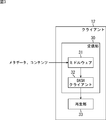
- FIG. 3 is a block diagram illustrating a configuration example of the client 12 of FIG.
- the client 12 includes a receiving unit 30 and a reproducing unit 33.
- the receiving unit 30 functions as a receiving unit that receives content and metadata distributed from the distribution server 11 in accordance with, for example, operation of the client 12 by the user.
- the receiving unit 30 receives metadata distributed from the distribution server 11. Furthermore, the receiving unit 30 receives content (segments or portions thereof) distributed from the distribution server 11 based on the metadata received from the distribution server 11 in accordance with, for example, the operation of the client 12 by the user.
- the receiving unit 30 supplies the content received from the distribution server 11 to the reproduction unit 33, and controls the reproduction of the content in the reproduction unit 33 based on the metadata received from the distribution server 11.
- the reproduction unit 33 reproduces video, audio, subtitles, and the like as content supplied from the reception unit 30 under the control of the reception unit 30.
- the receiving unit 30 includes a middleware 31 and a DASH client 32.
- the DASH client 32 outputs, to the middleware 31, an http request for requesting an MPD and an http request for requesting a content segment as necessary.
- the middleware 31 receives contents (segments and portions) and metadata distributed from the distribution server 11 as needed, and when requested, when the DASH client 32 outputs an http request, it is requested by the http request. It is determined based on the metadata whether or not the MPD or segment that is being distributed is multicast.
- the middleware 31 sets the MPD or segment (or a portion including a part of the segment) to be distributed by multicast. ) And supplied to the DASH client 32.
- the middleware 31 supplies the received MPD or segment to the DASH client 32 when the MPD or segment requested by the http request output from the DASH client 32 has already been received.
- the middleware 31 uses the http request output from the DASH client 32 as it is as the distribution server 11 of the network 10. ). Then, in response to the http request, the middleware 31 receives the MPD or segment that is unicast distributed (from the distribution server 11) and supplies it to the DASH client 32.
- the DASH client 32 outputs an http request for requesting a necessary MPD or segment, and receives the MPD or segment supplied from the middleware 31 in response to the http request in the same manner as a general DASH client. Process.
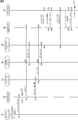
- FIG. 4 is a diagram for explaining an example of content provision processing by the content provision system of FIG.
- step S11 the channel streamer 21 (FIG. 2) generates a plurality of pieces of streaming data having different bit rates from video or the like as content source data to be distributed as a channel program of the distribution server 11.
- the channel streamer 21 supplies a plurality of streaming data with different bit rates to the segmenter 22 in step S12.
- the segmenter 22 receives the content (a plurality of streaming data) supplied from the channel streamer 21 in step S21.
- the segmenter 22 generates a segment as a DASH file delivery unit from the content from the channel streamer 21 in step S22, and supplies the segment to the FLUTE streamer 24 and the web server 26 in step S23.
- segmenter 22 generates segment relationship information and supplies it to the metadata generator 23 in step S24.
- step S31 the metadata generator 23 (FIG. 2) receives the segment relationship information supplied from the segmenter 22 in step S24.
- step S 32 the metadata generator 23 generates content metadata using the relationship information from the segmenter 22 and supplies it to the FLUTE streamer 24 and the web server 26.
- the FLUTE streamer 24 receives the content (segment) supplied from the segmenter 22 in step S23 in step S41, generates an LCT packet including the content in step S42, and sends it to the multicast server 25. Supply.
- the FLUTE streamer 24 receives the metadata supplied in step S32 from the metadata generator 23 in step S43, generates an LCT packet including the metadata in step S44, and supplies it to the multicast server 25. .
- step S51 the multicast server 25 (FIG. 2) receives the LCT packet including the content supplied from the FLUTE streamer 24 in step S42, and receives the LCT packet including the metadata in step S52.
- the multicast server 25 multicasts the LCT packet including the metadata from the FLUTE streamer 24 in step S53, and multicasts the LCT packet including the content from the FLUTE streamer 24 in step S54.
- step S61 the web server 26 (FIG. 2) receives the content (segment) supplied from the segmenter 22 in step S23, and in step S62 receives the metadata supplied in step S32 from the metadata generator 23. To do.
- step S63 when an http request for requesting metadata is transmitted from the client 12, the web server 26 receives the http request.
- step S64 the web server 26 unicasts the metadata requested by the http request from the client 12 to the client 12.
- step S65 when an http request for requesting content (segment) is transmitted from the client 12, the web server 26 receives the http request.
- step S 66 the web server 26 unicasts the content (segment) requested by the http request from the client 12 to the client 12.
- step S71 the receiving unit 30 receives the metadata (the LCT packet) that the multicast server 25 multicasts in step S53.
- the receiving unit 30 transmits an http request for requesting metadata in step S72.
- the web server 26 receives the http request transmitted from the client 12 in step S72 in step S63.
- the metadata requested by the http request is unicasted to the client 12. To do.
- step S73 the receiving unit 30 of the client 12 receives the metadata that is unicasted as described above.
- step S74 the receiving unit 30 of the client 12 receives the content (the LCT packet) that the multicast server 25 performs multicast distribution in step S54 based on the metadata received in step S71 or S73.
- the receiving unit 30 transmits an http request for requesting content in step S75 based on the metadata received in step S71 or S73.
- the web server 26 receives the http request transmitted by the client 12 in step S75 in step S65.
- the content requested by the http request is unicasted to the client 12. .
- step S76 the receiving unit 30 of the client 12 receives the content that is unicasted as described above.
- step S77 the reproduction unit 33 of the client 12 reproduces the content received by the reception unit 30 in step S74 or S76 based on the metadata (MPD).
- FIG. 5 is a diagram showing an example of data distributed via the network 10 in the content providing system of FIG.
- Metadata such as MPD, SDP, USD, OMA-ESG, and content (segments or portions thereof) are distributed to the client 12.
- Metadata and content can be distributed by multicast or unicast.
- Metadata a combination of MPD, SDP, and USD, or a combination of them plus OMA-ESG is used.
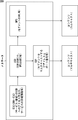
- FIG. 6 is a diagram for explaining MPD, SDP, USD, and OMA-ESG.
- the OMA-ESG of the program of interest describes detailed information of the program of interest, how to access the USD of the program of interest, and the like.
- the client 12 acquires the OMA-ESG of the program of interest
- the USD of the program of interest can be acquired by referring to the access method to the USD described in the OMA-ESG.
- ⁇ Noted program's USD contains the SDP URI (Uniform Resource Identifier) of the program of interest, the MPD URI of the program of interest, etc.
- SDP URI Uniform Resource Identifier
- the SDP or MPD of the program of interest can be acquired by referring to the URI of the SDP or MPD described in the USD.
- the SDP of the program of interest describes the IP address and the port attribute for transporting the content of the program of interest in multicast.
- the client 12 recognizes that the content is multicast and is distributed by multicast. Content can be received.
- the MPD of the program of interest describes the URL of the segment of the program of interest and information necessary for playback control of that segment.
- the segment of the program of interest can be received by unicast based on the URL described in the MPD. Further, based on the MPD of the program of interest, the segment of the program of interest can be reproduced.
- the MPD since the MPD includes information necessary for segment playback control, the MPD is necessary for receiving a segment by unicast and also for segment playback.
- FIG. 7 is a diagram for explaining the configuration of a segment, which is a DASH file distribution unit.
- the format of content distributed by DASH is not particularly limited, but in this embodiment, for example, fragmentedMP4 (file) is adopted as the format of content distributed by DASH.
- Segment (Media Segment) has styp (segment type) (box), necessary sidx (segment index) (box), and one or more fragments (MP4 fragment).
- 'msdh' and 'msix' are set in styp.
- the segment does not include sidx
- sidx when styp is 'msdh', the segment includes sidx.
- description of sidx is omitted as appropriate.
- the fragment has moof (movie fragment) (box) and mdat (media data) (box).
- Mdat has an mdat header and one or more samples.
- a sample is a minimum access unit when accessing media data (data such as video) in an MP4 file. Therefore, the media data in the MP4 file cannot be accessed in units smaller than the sample.
- the moof has mfhd (movie fragment header) (box) and traf (track fragment) (box).
- sequence_number The sequence number (sequence_number) is stored in mfhd.
- sequence_number represents the order of fragments having the sequence_number.
- Traf has tfhd (track fragment header) (box), tfdt (track fragment decoding time) (box), trun (track fragment fragment) (box), sdtp (independent samples) (box), and the like.
- BaseMediaDecodeTime is stored in tfdt.
- BaseMediaDecodeTime represents the presentation time of the first sample among the samples included in the fragment having the BaseMediaDecodeTime.
- FIG. 8 is a diagram illustrating a configuration example of a segment having one fragment and a segment having a plurality of fragments.
- FIG. 8A shows a configuration example of a segment having one fragment.
- each of three consecutive segments # 1, # 2, and # 3 has one fragment.
- sequence_number sequence number (sequence_number) (hereinafter also referred to as sqn) of one fragment included in the first segment # 1
- sqn sequence number of one fragment included in the second segment # 2
- FIG. 8B shows a configuration example of a segment having a plurality of fragments.
- segment # 1 has three fragments.
- the segment has one fragment as shown in A of FIG.
- FIG. 9 is a diagram showing an example of content distribution using a segment as a file distribution unit in DASH.
- a plurality of, for example, three sample groups # 1, # 2, and # 3 are sequentially generated as sample groups constituting a fragment. Then, in the segmenter 22 of the distribution server 11 (FIG. 2), after the generation of the last sample group # 3 of the fragment is completed, the mdat in which the sample groups # 1 to # 3 are arranged, and the sample groups # 1 to # 3 And a segment including the fragment is generated. Then, the FLUTE streamer 24 and the multicast server 25 distribute the segment.
- sample groups # 1, # 2, and # 3 are each composed of one or more samples. Further, the moof of the sample groups # 1 to # 3 is performed in parallel with the generation of the sample groups # 1 to # 3, for example.
- example groups # 1 to # 3 arranged as fragment mdat for example, the range of GOP (Group Of Picture) that is the smallest unit that can be randomly accessed may be adopted. it can.
- GOP Group Of Picture
- the content range as a fragment is not limited to the GOP range.
- the GOP time for example, about 0.5 to 2 seconds is often adopted. Therefore, when the GOP range is adopted as the content range to be fragmented, the moof and thus the segment is generated after waiting for at least the GOP time of about 0.5 to 2 seconds. That is, it takes at least GOP time to generate a segment.
- the data volume of the segment will be enormous.
- the network bandwidth may be compressed and shaping may be necessary.
- the distribution server 11 quickly distributes the content (data) by multicasting the portion of the data (hereinafter also referred to as a portion) that is smaller than the segment and including a part of the fragment as a file distribution unit. Distribution, thereby suppressing delays in the reception of content at the client and the start of buffering.
- FIG. 10 is a diagram for explaining an outline of content distribution in the distribution server 11 using a portion as a file distribution unit.
- sample groups # 1, # 2, and # 3 are sequentially generated as sample groups constituting the fragment.
- the sampler 22 of the distribution server 11 does not wait for the generation of the last sample group # 3 of the fragment and waits until the sample group # 1 is generated.
- a portion as a file distribution unit including the group # 1 is generated, and multicast distribution is performed in the FLUTE streamer 24 and the multicast server 25.
- the portion is multicast-distributed.
- the content can be quickly distributed, and the delay that occurs when the client receives the content and starts buffering can be suppressed.
- the sample group # 1 corresponds to, for example, I picture data encoded first in the GOP.
- the sample group # 2 corresponds to data of one or more P pictures and B pictures encoded after the I picture of the GOP, and the sample group # 3 includes data of the remaining P pictures and B pictures of the GOP. It corresponds to.
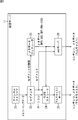
- FIG. 11 is a diagram showing an example of the relationship between segments and potions.
- 11A shows an example of a segment.
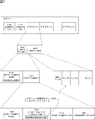
- the segment 50 has a styp 51 and a (one) fragment 52.
- the fragment 52 is composed of a moof 53 and an mdat 54.
- the moof 53 includes BaseMediaDecodeTime (which represents the presentation time of the sequence number sqn of the fragment 52 and the first sample of the mdat 54 of the fragment 52 (the first sample of the sample group 56 in FIG. 11A). (Hereinafter also referred to as bmdt) is stored at least.
- 1 is set as the sequence number sqn of the fragment 52.
- the mdat 54 stores an mdat header 55 and three sample groups 56, 57, and 58 in that order.
- the sample groups 56 to 58 correspond to, for example, the sample groups # 1 to # 3 in FIG.
- the head sample of the second sample group 57 is the n1th sample from the head of the first sample group 56.
- the top sample of the third sample group 58 is the n2 (> n1) sample from the top of the first sample group 56.
- the number of the sample stored in the mdat from the first sample of the mdat is also referred to as a sample number.
- the sample number of the first sample of the sample group 57 is n1
- the sample number of the first sample of the sample group 58 is n2.
- FIG. 11B, FIG. 11C, and FIG. 11D show examples of portions including a part of the fragment 52 included in the segment 50 when the segment 50 of FIG. 11A is generated. ing.
- B in FIG. 11 shows an example of a portion including the sample group 56 as a part of the fragment 52.
- 11C shows an example of a portion including a sample group 57 as another part of the fragment 52, and
- FIG. 11D shows a sample group 58 as another part of the fragment 52.
- potions to include.
- a portion 60 is an http response including the first sample group 56 of the fragment 52.
- the portion 60 includes an http header 61, MS / BR 62, styp 51, moof subset 64, MS / BR 65, and mdat header. 55, MS / BR66, sample group 56, and MS67 are arranged in that order. MS / BR62 to MS67 constitute a message body.
- the http header 61 is an http header that indicates that the message body is a multipart message body, and the http header 61 includes a sequence number sqn, a version v, and an NTP time nt.
- the sequence number sqn of the http header 61 is set to 1 which is the same as the sequence number sqn stored in the moof 53 of the fragment 52 including the sample group 56 (as part of the fragment 52) included in the portion 60.
- the version v represents the order of the sample group as a part of the fragment included in the portion including the version v in the fragment.
- the version v is an integer that is incremented by 1 for the same sequence number sqn (with the sqn scope), for example, with an initial value of 1.
- a part of the fragment 52 included in the portion 60 including the version v of the http header 61 is a sample group 56. Since the order of the sample group 56 in the fragment 52 is first, the version v of the http header 61 Is set to 1.
- v becomes (1,1), (1,2), (2,1), (2,2), (3,1), (3,2), respectively.
- the NTP time nt of the http header 61 is bmdt (BaseMediaDecodeTime) stored in the moof 53 of the fragment 52 whose portion (sample group 56) is included in the portion 60 including the NTP time nt, that is, the first sample of the fragment 52 ( This represents an NTP time NT corresponding to bmdt representing the presentation time of the first sample of the sample group 56).
- MS / BR62 represents a multipart-separater and a byte range of styp51 arranged immediately after that.
- MS / BR63 represents the byte range of the multipart separator and the moof subset 64 arranged immediately after that.
- the moof subset 64 is a subset of the moof 53 that can be generated before the first (first) sample group 56 arranged in the portion 60 among the three sample groups 56 to 58 of the fragment 52 is generated. Yes, and includes sequence numbers sqn and bmdt stored in moof 53.
- the sample group 56 can be reproduced.
- MS / BR65 represents the byte range of the multipart separator and the mdat header 55 arranged immediately after that.
- MS / BR66 represents the multipart separator and the byte range of the sample group 56 arranged immediately after that.
- MS67 represents a multi-part separator.
- styp 51 is included in the portion 60 including the first sample group 56 of the fragment 52, but styp 51 (and sidx (not shown)) is a different http from the portion 60. It can be delivered in the response.
- the portion 70 is an http response including the second sample group 57 of the fragment 52.
- the portion 70 includes an http header 71, MS / BR 72, moof subset 73, MS / BR 74, and sample group 57. , And MS75 are arranged in that order.
- MS / BR 72 to MS 75 constitute a message body.
- the http header 71 is an http header that indicates that the message body is a multi-part message body.
- the http header 71 includes a sequence number sqn, a version v, an NTP time nt, a sample count start scs (SampleCountStart), and Is included.
- the sequence number sqn of the http header 71 is set to 1 which is the same as the sequence number sqn stored in the moof 53 of the fragment 52 including the sample group 57 (as part of the fragment 52) included in the portion 70.
- 2 is set in the version v of the http header 71. That is, since the portion 70 includes the second sample group 57 of the sample groups 56 to 58 of the fragment 52, 2 is set in the version v of the http header 71.
- the sample count start scs represents the order of the first sample of the sample group included in the portion including the sample count start scs from the first sample of the fragment.
- the sample count start scs of the http header 71 is set. Is set to n1.
- MS / BR72 represents the byte range of the multipart separator and the moof subset 73 arranged immediately after that.
- the moof subset 73 is a subset of the moof53 that can be generated before the generation of the second sample group 57 arranged in the portion 70 among the three sample groups 56 to 58 of the fragment 52. Contains the sequence numbers sqn and bmdt.
- the moof subset 73 that is a subset of the moof 53 that can be generated until the sample group 57 is generated, information necessary for the reproduction of the sample group 57 is stored in the moof subset 64 that is generated before the sample group 56 is generated. Therefore, according to the moof subset 73, the sample group 57 and the sample group 56 generated before the sample group 57 is generated can be reproduced.
- MS / BR74 represents the multipart separator and the byte range of the sample group 57 arranged immediately after that.
- MS75 represents a multipart separator.
- the portion 80 is an http response including the third sample group 58 of the fragment 52.
- the portion 80 includes an http header 81, MS / BR 82, moof subset 83, MS / BR 84, and sample group 58. , And MS85 are arranged in that order.
- MS / BR82 to MS85 constitute a message body.
- the http header 81 is an http header that indicates that the message body is a multi-part message body.
- the http header 81 includes a sequence number sqn, a version v, an NTP time nt, and a sample count start scs. .
- the sequence number sqn of the http header 81 is set to 1 which is the same as the sequence number sqn stored in the moof 53 of the fragment 52 including the sample group 58 (as part of the fragment 52) included in the portion 80.
- 3 is set in the version v of the http header 81. That is, since the portion 80 includes the third sample group 58 of the sample groups 56 to 58 of the fragment 52, 3 is set in the version v of the http header 81.
- the version v of the http header 81 includes “-End” is set as information indicating that the sample group 58 is the last sample group of the fragment, together with 3 which is the order in the fragment 52.
- the version v causes the order of the sample groups (as part of the fragment) included in the portion and whether the sample group is the last sample group of the fragment. Can be recognized.
- the NTP time nt of the http header 81 represents the NTP time corresponding to bmdt stored in the moof 53 of the fragment 52 whose part (sample group 58) is included in the portion 80 including the NTP time nt.
- the sample count start scs represents the order of the first sample of the sample group included in the portion including the sample count start scs from the first sample of the fragment.
- n2 is set in the sample count start scs of the http header 81. That is, since the first sample of the sample group 58 included in the portion 80 is the n2th sample from the beginning of the first sample group 56 as described in FIG. 11A, the sample count start of the http header 81 is started. sc2 is set to n2.
- MS / BR82 represents the byte range of the multipart separator and the moof subset 83 arranged immediately after that.
- the moof subset 83 is a subset of the moof53 that can be generated before the generation of the third sample group 58 arranged in the portion 80 among the three sample groups 56 to 58 of the fragment 52. Contains the sequence numbers sqn and bmdt.
- the moof subset 83 is a subset of the moof 53 that can be generated before generating the third sample group 58 arranged in the portion 80, that is, the last sample group 58 of the fragment 52. be equivalent to.
- the moof subset 83 that is a subset of the moof 53 that can be generated until the sample group 58 is generated is equal to the moof 53. Therefore, according to the moof subset 83, the sample group 58, and further the sample group Sample groups 56 and 57 that are generated before 58 is generated can be reproduced.
- MS / BR84 represents the multipart separator and the byte range of the sample group 58 arranged immediately after that.
- MS85 represents a multi-part separator.
- the portion that is an http response includes the sequence number sqn and the version v in the http header. Therefore, in the client 12 (other device) that has received the portion, the sequence number sqn and the version v are changed. Based on this, it is possible to recognize and reproduce the order of the sample group included in the portion in the segment, and to configure and reproduce the segment as necessary.
- the client 12 receives all the potions (sample groups) constituting the segment before receiving it.
- the sample group included in the single portion is a sample group that can be reproduced independently (for example, a sample group of an I picture), or a sample that has already been received.
- the sample group is reproducible using the group, the reproduction of the sample group included in one received portion can be started.
- the version v can be included in the moof subset together with the sequence number sqn. However, when the version v is included in the moof subset together with the sequence number sqn, it is necessary to extend the definition of the existing moof so that the version v is included in the moof. On the other hand, if the version v is included in the http header, it is not necessary to extend the existing moof definition.
- the http headers 71 and 81 of the portions 70 and 80 including the second and subsequent sample groups 57 and 58 of the fragment 52 include the sample count start scs, and the first sample group 56 of the fragment 52.
- the sample header start scs is not included in the http header 61 of the portion 60 including the sample count, but the sample count start scs can also be included in the http header 61 of the portion 60 including the first sample group 56 of the fragment 52. .
- the order of the first sample of the first sample group of the fragment from the first sample of the fragment is always 1 and is a fixed value, so the http header (version version) of the portion containing the first sample group of the fragment
- the sample count start scs can be omitted, as shown in FIG. 11B, thereby reducing the size of the http header.
- the NTP time nt corresponding to bmdt (bmdt representing the presentation time of the first sample of the fragment) stored in the moof of the fragment can be included in the http header.
- the sample group included in the portion can be reproduced without the corresponding MPD.
- the content includes content that needs to be controlled on the time axis of the absolute time represented by NTP time, such as a live broadcast program, for example. It is necessary to calculate the NTP time as the absolute time at which the sample is mapped (displayed).
- the presentation time (PresentatioTime (CompositionTime) entof Nth Sample) of the Nth sample of the fragment can be calculated according to the following formula.
- Sum of SampleDuration of (N-1) Samples and CompositionTimeOffset of Nth Sample can be obtained from the information stored in the fragment's moof (sampleCount, SampleDuration, CompositionTimeOffset), and BaseMediaDecodeTime is set to boft Stored.
- the absolute time of a sample can be obtained if the NTP time corresponding to BaseMediaDecodeTime used for calculating the presentation time of the sample is known.
- the NTP time nt corresponding to bmdt (bmdt representing the presentation time of the first sample of the fragment) stored in the fragment moof in the http header
- the NTP time is calculated as the absolute time of each sample of the sample group included in the portion, and the sample is calculated according to the NTP time. Can be played.
- the http header can include a sample count start scs that represents the order of the first sample of the sample group included in the portion from the first sample of the fragment. Even if some of the potions (multiple potions containing each of the sample groups included in the segment) are missing, the potions following the missing potions (sample groups included in) are played. be able to.
- each sample of each portion starts from the first sample of the fragment without the sample count start scs. It is possible to recognize the sample number of the sample number, and based on the sample number, information necessary for reproducing the sample can be acquired from the moof subset, and the sample can be reproduced.
- the sample number is recognized if there is no sample count start scs for the samples contained in the potions that follow the missing potions. Cannot be played, making playback difficult.
- the sample count start scs By including the sample count start scs in the http header of the potion, even if some of the potions that make up the segment are missing, the sample included in the potion that follows the missing potion The sample number can be recognized and reproduced by the sample count start scs.
- the client 12 that has received the portion does not wait for the subsequent portion.
- the reproduction of the sample group included in the received portion can be started based on the moof subset included in the portion.
- the http header of the portion can include, for example, various attribute information FDT (File Delivery Table) distributed by FLUTE that multicasts the portion.
- FDT Fra Delivery Table
- the client 12 can use the FDT included in the http header of the portion for reception of data distributed by FLUTE multicast.
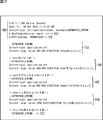
- FIG. 12 is a diagram illustrating an example of a description of an http response as the portion 60 in FIG.
- the description 100 is an http header 61.
- “X-MoofSeqNumVersion” in the description 101 of the http header 61 and “X-NTPTimeStamp” in the description 102 are newly defined headers.
- “X-MoofSeqNumVersion” in the description 101 is a header representing a sequence number sqn and a version v, and has a variable sqn representing a sequence number and a variable v representing a version.
- the variable sqn is set to 1 which is the sequence number sqn of the fragment 52
- the variable v is set to 1 which is the order in the fragment 52 of the sample group 56 included in the portion 60.
- X-NTPTimeStamp in the description 102 is a header representing the NTP time nt (corresponding to BaseMediaDecodeTime).
- “X-NTPTimeStamp” includes the first sample of the fragment 52 (the first sample of the sample group 56).
- 2890844526 is set as the NTP time NT corresponding to bmdt representing the presentation time.
- Description 103 is MS / BR62, and “SEPARATER_STRING” in description 103 represents a multipart separator. Further, “Content-range: bytes 492-499 / 124567654” in the description 103 represents the byte range of styp 51 immediately after.
- the byte range “Content-range: bytes 492-499 / 124567654” in the description 103 is that the fragment size is 124567654 bytes, and the immediately following styp51 is 492-499 bytes of the 124567654 bytes. Represents.
- the description 103 is followed by a byte sequence of styp51.
- the description 104 after the byte sequence of styp51 is MS / BR63, and “Content-range: bytes 500-991 / 124567654” in the description 104 represents the byte range of the moof subset 64 immediately after.
- the byte range of the fragment's moof (moof53 in FIG. 11) is predicted when the portion including the first group of fragments (portion 60 in FIG. 11) is generated.
- the predicted value of the byte range of moof is adopted as the byte range of the moof subset of each portion (portions 60, 70, and 80 in FIG. 11) including the fragment sample group. Therefore, the byte ranges of the moof subset 64 of the portion 60, the moof subset 73 of the portion 70, and the moof subset 83 of the portion 80 are the same value (predicted value of the byte range of moof 53).
- the description 104 is followed by a byte sequence of the moof subset 64.
- the description 105 after the byte sequence of the moof subset 64 is MS / BR65, and “Content-range: bytes992-999 / 124567654” in the description 105 represents the byte range of the immediately following mdat header 55.
- the byte sequence of the mdat header 55 follows the description 105.
- the description 106 after the byte sequence of the mdat header 55 is MS / BR66, and “Content-range: bytes” 1000-4999 / 124567654 ”in the description 106 represents the byte range of the immediately following sample group 56.
- the byte sequence of the sample group 56 follows the description 106.
- the description 107 after the byte string of the sample group 56 is MS67.
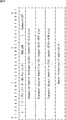
- FIG. 13 is a diagram illustrating an example of a description of an http response as the portion 70 in FIG.
- the description 120 is an http header 71. “X-MoofSeqNumVersion” in the description 121 of the http header 71, “X-NTPTimeStamp” in the description 122, and “X-SampleCountStart” in the description 123 are newly defined. It is a header.
- “X-MoofSeqNumVersion” in the description 121 is a header representing the sequence number sqn and version v, as described in FIG.
- the variable sqn representing the sequence number is set to 1 which is the sequence number sqn of the fragment 52
- the variable v representing the version is set to 2 which is the order of the sample group 57 included in the portion 70 in the fragment 52.
- X-NTPTimeStamp in the description 122 is a header representing the NTP time nt, and the NTP time NT corresponding to bmdt representing the presentation time of the first sample of the fragment 52 is shown in FIG. The same 2890844526 is set.
- “X-SampleCountStart” in the description 123 is a header representing the sample count start scs.
- the sample number n1 of the first sample of the sample group 57 included in the fragment 70 is set in “X-SampleCountStart”. ing.
- Description 124 is MS / BR72, and "Content-range: bytes 500-991 / 124567654" in the description 124 represents the byte range of the immediately following moof subset 73, and the byte range of the moof subset 64 in the description 105 of FIG. (It is a predicted value of the byte range of moof53).
- the description 124 is followed by a byte sequence of the moof subset 73.
- the description 125 after the byte sequence of the moof subset 73 is MS / BR 74, and “Content-range: bytes 5000-7999 / 124567654” in the description 125 represents the byte range of the sample group 57 immediately after.
- the description 126 after the byte string of the sample group 57 is MS75.
- the portion 80 in FIG. 11 is configured in the same manner as the portion 70 in FIG. 11
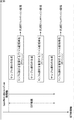
- FIG. 14 is a flowchart illustrating an example of content distribution processing in units of portions.
- step S101 the segmenter 22 of the distribution server 11 (FIG. 2) uses the fragment (for example, the fragment 52 of FIG. 11) for which a sample group is to be generated as the target fragment, and the mdat header of the target fragment and the first sample. A group is generated, and the process proceeds to step S102.
- the fragment for example, the fragment 52 of FIG. 11
- step S102 the segmenter 22 generates an http header for the first sample group (for example, the http header 61 in FIG. 11), and the process proceeds to step S103.
- the segmenter 22 is stored in the same sequence number sqn as the sequence number stored in the moof of the target fragment, the version v which is 1 indicating the order in the target fragment of the first sample group, and the moof of the target fragment.
- An http header including the NTP time nt corresponding to bmdt is generated as the http header for the first sample group.
- step S103 the segmenter 22 obtains a part of the moof that has been generated for the fragment of interest until the first sample group is generated (the part of the moof necessary for reproduction of the first sample group) as the first sample. Obtained as a moof subset for the group, the process proceeds to step S104.
- step S104 the segmenter 22 uses the styp (and required sidx) of the segment including the fragment of interest, the moof subset for the first sample group, the mdat header of the fragment of interest, and the first sample group for the first sample group.
- the http header By adding the http header, an http response as a portion is generated and supplied to the FLUTE streamer 24, and the process proceeds to step S105.
- the http response as the portion generated in step S104 includes styp (and The required sidx) is not included.
- step S105 the FLUTE streamer 24 packetizes the http response as a portion from the segmenter 22 into an LCT packet, the multicast server 25 multicasts the LCT packet, and the process proceeds to step S106.
- step S106 the segmenter 22 generates the next sample group as the target sample group for the target fragment, and the process proceeds to step S107.
- step S107 the segmenter 22 generates an http header for the sample group of interest (for example, http headers 71 and 81 in FIG. 11), and the process proceeds to step S108.
- an http header for the sample group of interest for example, http headers 71 and 81 in FIG. 11
- the segmenter 22 has the same sequence number sqn as the sequence number stored in the moof of the target fragment, the version v indicating the order of the target sample group in the target fragment, and the NTP corresponding to bmdt stored in the moof of the target fragment.
- An http header including the time nt and the sample count start scs representing the sample number of the first sample of the sample group of interest is generated as an http header for the sample group of interest.
- step S108 the segmenter 22 can generate the target sample group for the target fragment until the target sample group is generated (and the sample group generated before generating the target sample group of the target fragment). A part of the moof necessary for reproduction is acquired as a moof subset for the sample group of interest, and the process proceeds to step S109.
- step S ⁇ b> 109 the segmenter 22 generates an http response as a portion by adding an http header for the target sample group to the moof subset for the target sample group and the target sample group, and supplies the HTTP response to the FLUTE streamer 24. Then, the process proceeds to step S110.
- step S110 as in step S105, the FLUTE streamer 24 packetizes the http response as a portion from the segmenter 22 into an LCT packet, the multicast server 25 multicasts the LCT packet, and the processing Proceed to S111.
- step S111 the segmenter 22 determines whether the sample group of interest is the last sample group of the fragment of interest.
- step S111 If it is determined in step S111 that the sample group of interest is not the last sample group of the fragment of interest, that is, if there is a sample group next to the sample group of interest in the fragment of interest, the process returns to step S106 and attention is paid. The same processing is repeated with the sample group next to the sample group as a new target sample group.
- step S111 If it is determined in step S111 that the sample group of interest is the last sample group of the fragment of interest, the process returns to step S101, and for example, the next fragment of the fragment of interest is set as a new fragment of interest. Thereafter, the same processing is repeated.
- FIG. 15 is a flowchart for explaining an example of content reception processing in units of portions.
- step S121 the receiving unit 31 of the client 12 (FIG. 3) waits for the http response as the portion to be distributed by multicast, receives the http response as the portion, and the process proceeds to step S122.
- step S122 the reproduction unit 33 reproduces the sample group included in the http response as the portion received by the reception unit 31, and the moof subset included in the http response and the sequence included in the http header of the http response.
- the number sqn, version v, NTP time nt, and sample count start scs are used as necessary.
- the distribution server 11 does not wait for a segment to be generated, and when a sample group that is a part of a fragment included in the segment is generated, http as a portion including the sample group Since the response is distributed, the content can be quickly distributed.
- FIG. 16 is a diagram for explaining multicast distribution of portions (and segments) using LCT packets.
- FLUTE streamer 24 portions (and segments) are packetized into LCT packets, and multicast server 25 multicasts the LCT packets.
- the portion of the FLUTE streamer 24 is packetized into LCT packets.
- the portion is divided into one or more pieces of a predetermined size, and each piece is stored in the LCT packet. It is done by doing.
- FIG. 17 is a diagram showing the format of the LCT packet.
- the LCT packet is composed of an LCT header (LCT header), an FEC payload ID (FEC Payload ID), and an encoding symbol (Encoding Symbol (s)) arranged in that order.
- the portion (small piece) is stored in the LCT packet as an encoding symbol.
- FIG. 18 is a diagram showing the format of the LCT header.
- the LCT header includes TSI (Transport Session Identifier), TOI (Transport Object Identifier), and necessary extension headers (Header Extensions).
- TSI Transport Session Identifier
- TOI Transport Object Identifier
- necessary extension headers Header Extensions
- TSI is an identifier that identifies the session of the LCT packet.
- the TSI of the LCT packet in which each of the portions 60, 70, and 80 including the sample groups 56, 57, and 58 to be delivered in one segment 50 (FIG. 11) is packetized is the same. Set to a value.
- the TOI is an identifier that identifies the object whose data is stored in the encoding symbol of the LCT packet. For example, the TOIs of the LCT packets in which the pieces obtained by dividing the portion 60 are stored in the encoding symbol are set to the same value.
- the client 12 can receive the LCT packet with the same TOI, collect pieces of the portion stored in the LCT packet, and reconfigure the original portion.
- FIG. 19 is a diagram showing an example of content distribution in units of portions.
- a fragment has sample groups # 1, # 2, # 3,.
- the sample group # 1 is, for example, a video of a base view (base layer view) that does not refer to other views, and the sample group # 2, # 3,. It is a non-base view (enhanced layer view) video that may reference other views.
- the client 12 receives the LCT packet, and the TOI of the received LCT packet is the same. By collecting the pieces of portion #i stored in the LCT packet, the original portion #i can be reconstructed.
- sample group # 1 included in portion # 1 is a base view video, and sample groups # 2, # 3,. It is a video.
- the sample group included in the portion is data (processing unit) that can be classified according to some criteria, such as base-view video or non-base-view video, Packet filtering for selecting LCT packets in units of included sample groups) can be performed.
- LCT packets that have the minimum or high priority of processing in routers on the LCT packet distribution route (for example, routers for FLUTE multicast) and client 12 network stacks (blocks that process LCT packets). Can be selected for processing (transfer, stack, etc.).
- the sample group included in the portion in the http header as a portion is, for example, a base view video or a non-base view video.
- sample group attribute information eg, FDT
- FDT sample group attribute information
- the distribution server 11 generates an LCT packet having an LCT header including a priority parameter indicating the priority of processing of the LCT packet in the FLUTE streamer 24, and the multicast server 25 generates an LCT including such a priority parameter.
- An LCT packet having a header can be distributed by multicast. In this case, efficient packet filtering can be performed, and necessary LCT packets can be quickly distributed and processed.
- the priority parameter is included in the LCT header by extending the LCT header so that the priority parameter can be stored in the extension header of the LCT header.
- FIG. 20 is a diagram showing the format of the extension header (Header Extensions) of the LCT header in FIG.
- ⁇ HET Header Extension Type
- type of extension header (the type of actual data stored as HEC in the extension header) is stored in the first 8 bits of the extension header.
- 8-bit HET When 8-bit HET is 127 or less, 8-bit HEL (Header Extension Length) is stored following HET.
- HEL a value N representing the extension header length of 32 ⁇ N bits is set.
- variable length (variable length) HEC (Header Extension Content) is stored.
- HEC is actual data of the extension header.
- a new extension header for storing the priority parameter is defined by adopting a value not yet defined for HET. To do.
- FIG. 21 is a diagram showing an example of the definition of a new extension header that stores priority parameters.
- the new extension header consists of 8-bit HET, 8-bit HEL, 8-bit Filtering SchemeURI, 8-bit Filtering Parameter Length, and 8xFPLN-bit Filtering Parameter arranged in that order.
- 120 is set in the HET of the new extension header as a value indicating that the priority parameter is stored in the extension header.
- HET since HET is 127 or less, HEL is arranged after HET as shown in FIG.
- HEL is set to an integer value HELN ranging from 0 to 255.
- HELN a value in which 32 ⁇ HELN is the length of the extension header is adopted.
- Filtering Scheme URI is a scheme identifier (SchemeURI) that defines FilteringFilterParameter.
- Integer value FPLN in the range of 0 to 255 is set in Filtering Parameter Length.
- FPLN a value in which 32 ⁇ FPLN is the length of FilteringFilterParameter is adopted.
- FilterFiltering ⁇ Parameter is a priority parameter and its definition (structure) is specified by Filtering Scheme URI.
- FIG. 22 is a diagram showing an example of the definition of the priority parameter (Filtering Parameter).
- the priority parameter is 64 bits, 8-bit Track Reference Index, 8-bit Priority, 8-bit Dependency Counter, 8-bit MVC Filter Length, and 32-bit MVC Filter. Are arranged in that order.
- a sample group as a part of the fragment stored in the LCT packet among the integer values in the range of 0 to 255 sample group included in the portion in which the small piece is stored in the LCT packet
- a value for identifying the track (track of the MP4 file) to which the file belongs is set.
- Track Reference Index as a priority parameter, for example, packet filtering can be performed in which an LCT packet in which a small piece of a portion including a sample group belonging to a predetermined track is stored is selected and processed.
- Priority is set for each LCT packet with the same TOI.
- an index indicating the priority of processing of the LCT packet of each value of TOI is set.
- the index set in Priority is an integer value ranging from 0 to 255 that ranks the processing priority of LCT packets. For example, the higher the value, the lower the priority.
- Priority for example, packet filtering for preferentially selecting and processing a TOI LCT packet in which a Priority of a predetermined value or less is set can be performed.
- Dependency Counter the number K of subsequent LCT packets affected by the LCT packet including the Dependency Counter is set.
- Dependency Counter as a priority parameter, for example, packet filtering is performed to preferentially select and process LCT packets whose Dependency Counter is 1 or more, that is, LCT packets that affect one or more subsequent LCT packets. be able to.
- MVC Filter Length takes a Boolean value. When True, it indicates that there is a subsequent MVC Filter.
- the MVC Filter is information for performing filtering for selecting MVC data when the sample group included in the portion in which the fragment is stored in the LCT packet is MVC (Multiview Video Coding) data.
- MVC Filter for example, one or more of PRID (priority_id), TID (tempral_id), and VID (View_id) defined as the header of the MVC NAL (Network Abstraction Layer) unit stored in the RTP packet is adopted. can do.
- PRID priority_id
- TID tempral_id
- VID View_id
- FIG. 23 is a diagram showing an example of the definition of MVC Filter.
- the 32-bit MVC Filter is configured by arranging 6-bit priority_id (PRID), 3-bit temporal_id (TID), 10-bit view_id (VID), and 13-bit Reserved in that order.
- PRID priority_id
- TID 3-bit temporal_id
- VID 10-bit view_id
- 13-bit Reserved 13-bit Reserved
- PRID 6 bits priority_id.This flag specifies a priority identifier for the NAL unit.A lower value of PRID indicates a higher priority.
- TID 3 bits This component specifies the temporal layer (or frame rate) hierarchy.Informally put, a temporal layer consisting of view component with a less temporal_id corresponds to a lower frame rate. A given temporal layer typically depends on the lower temporal layers (ie the temporal layers with less temporal_id values) but never depends on any higher temporal layer (ie a temporal layers with higher temporal_id value).
- VID 10 bits view_id.This component specifies the view identifier of the view the NAL unit belongs to. Reserved: 13bits (Reservation bit for future expansion)
- the PID represents the priority of the NAL unit (the NAL unit when the sample group included in the portion in which the small piece is stored in the LCT packet is the NAL unit). The smaller the PID, the higher the priority of the NAL unit.
- TID represents a temporal layer (or frame rate) of a video (a video in a case where a sample group included in a portion in which small pieces are stored in an LCT packet is video (data)).
- the lower the TID the lower the frame rate.
- a certain layer may depend on a lower layer having a smaller TID than the layer, but does not depend on an upper layer having a larger TID.
- VID represents the view to which the NAL unit belongs.
- an LCT packet including a NAL unit having a high priority is preferentially selected based on the PID. Packet filtering can be performed.
- a video whose temporal layer is a predetermined layer or less (NAL unit thereof), that is, an LCT packet including a video whose frame rate as a temporal resolution is a predetermined value or less is preferentially selected. Packet filtering can be performed.
- an LCT packet includes a video or a still image
- information indicating that the video is a moving image or a still image is used as a priority parameter.
- packet filtering that preferentially selects and processes an LCT packet including a moving image or a still image video can be performed.
- the LCT packet when the LCT packet includes a video of any one of a base layer that does not refer to other layers and one or more non-base layers that may refer to other layers, the video The information representing the layer can be adopted as the priority parameter.
- packet filtering for preferentially selecting and processing an LCT packet including base layer video can be performed.
- the LCT packet when the LCT packet includes a video of any one of a plurality of views, information representing the video view can be adopted as the priority parameter.
- a video of a view desired by the user for example, a video of a plurality of views taken from a plurality of positions such as the first base side, the third base side, and the back side in a baseball broadcast
- Packet filtering that preferentially selects and processes LCT packets that contain a video of a view taken from the back side).
- the LCT packet when the LCT packet includes a video of any resolution among a plurality of resolutions, information indicating the resolution can be adopted as the priority parameter.
- packet filtering for preferentially selecting and processing an LCT packet including a video with a predetermined resolution (hereinafter) can be performed.
- information indicating the resolution as the priority parameter information on one or both of the temporal resolution and the spatial resolution can be adopted.
- packet filtering can be performed based on a plurality of types of priority parameters, as well as based on one type of priority parameter.
- the video has a predetermined view and includes a video having a predetermined resolution.
- LCT packets can be preferentially selected and processed.
- FIG. 24 is a flowchart for explaining an example of processing for distributing an LCT packet having a priority parameter.
- step S201 the FLUTE streamer 24 (FIG. 2) of the distribution server 11 performs data stored in the encoding symbol (FIG. 17) of the LCT packet (portion piece supplied from the segmenter 22), and the operation of the operator of the distribution server 11 Based on the above, a priority parameter is set, and the process proceeds to step S202.
- step S202 the FLUTE streamer 24 generates an extension header (FIG. 21) (FIG. 22) including the priority parameter set in step S201, and the process proceeds to step S203.
- the FLUTE streamer 24 has an LCT header (FIG. 18) including the extension header generated in step S202, and an LCT packet (FIG. 17) in which a portion fragment supplied from the segmenter 22 is arranged in an encoding symbol. Is supplied to the multicast server 25, and the process proceeds to step S204.
- step S204 the multicast server 25 multicasts the LCT packet from the FLUTE streamer 24, the process returns to step S201, and the same process is repeated thereafter.
- FIG. 25 is a flowchart for explaining an example of packet filtering processing performed by the client 12 (other device such as a router that receives an LCT packet distributed by multicast).
- step S211 the receiving unit 30 (FIG. 3) of the client 12 sets priority as a threshold when processing the LCT packet based on the network environment, the device (client 12) resource, the user operation, the user preference, and the like.
- Degree hereinafter also referred to as threshold priority
- step S212 the process proceeds to step S212.
- step S212 the receiving unit 30 waits for the LCT packet to be distributed by multicast, receives the LCT packet, and the process proceeds to step S213.
- step S213 the reception unit 30 determines whether to process the LCT packet based on the priority parameter included in the LCT header of the LCT packet received in step S212 and the threshold priority set in step S211. The process proceeds to step S214.
- step S214 the receiving unit 30 selects the LCT packet according to the determination result of the availability determination in step S213, stops the process for the LCT packet having a priority parameter whose priority is lower than the threshold priority, Processing is continued for an LCT packet having a priority parameter with a priority equal to or higher than the threshold priority. And a process returns to step S211 from step S214, and the same process is repeated hereafter.
- FIG. 26 is a diagram showing an example of the definition of a new extension header of the LCT header that stores decoding related information.
- decoding including rendering (display)
- decoding time included in moof and Information such as composition time (display time), sequence number sqn, version v, NTP time nt, and sample count start scs included in the http header is required.
- decoding related information for example, decodingdetime, composition time, sequence number sqn, version v, NTP time nt, sample count start scs, etc. is also referred to as decoding related information. .
- the decoding related information can be used for packet filtering of LCT packets, for example, in the same manner as the above-described priority parameter.
- the decoding related information may be used for preprocessing of so-called decoding of a sample group such as determination of a processing order for processing a sample group included in an http response as a portion stored in an encoding symbol of an LCT packet. it can.
- decoding related information such as the moof subset including decoding ⁇ ⁇ time and composition ⁇ time, sequence number sqn, version v, NTP time nt, and sample count start scs is stored in the encoding symbol of the LCT packet. Included in the http response as a potion.
- LCT packets are analyzed and decoded from http responses as portions stored in the encoding symbols of the LCT packets. It is necessary to extract the relationship information.
- the distribution server 11 generates an LCT packet having an LCT header including decoding related information in the FLUTE streamer 24, and multicasts the LCT packet having an LCT header including such decoding related information in the multicast server 25. This enables efficient packet filtering and quick processing of required LCT packets.
- a value not yet defined in HET is generated as in the case of generating an LCT packet having an LCT header including a priority parameter described above. Is used to define a new extension header for storing decoding related information.
- a new extension header for storing decoding-related information is, for example, as shown in FIG. 26, 8-bit HET, 8-bit HEL, 64-bit NTPTimeStamp, 16-bit MoofSequenceNumber, 16-bit MoofVersion, 16-bit SampleCountStart, 8-bit Partial moof Length, and 8 ⁇ FPLN-bit Partial Moof are arranged in that order.
- HET of the new extension header for example, 101 is set as a value indicating that decoding related information is stored in the extension header.
- HET since HET is 127 or less, HEL is arranged after HET as shown in FIG.
- HEL is set to an integer value HELN ranging from 0 to 255.
- HELN a value in which 32 ⁇ HELN is the length of the extension header is adopted.
- NTPTimeStamp In NTPTimeStamp, MoofSequenceNumber, MoofVersion, and SampleCountStart, the NTP time nt, sequence number sqn, version v, and sample count start scs stored in the http header of the http response as a portion stored in the LCT packet are respectively Is set.
- Integer value PMLN in the range of 0 to 255 is set in Partial moof Length.
- the integer value PMLN a value in which 32 ⁇ PMLN is the length of Partial moof is adopted.
- Partial moof the (binary) moof subset stored in the message body of the http response as a portion stored in the LCT packet is set.
- the extension header of each LCT packet in which the pieces divided from one portion are stored is, for example, the same Is stored.
- FIG. 27 is a diagram illustrating a first example of an LCT packet in which decoding related information is stored in an extension header.
- an LCT packet in which each of the http responses 400, 420, and 440 is stored in an encoding symbol is generated from the http responses 400, 420, and 440.
- the http response 400 as the first portion of the three portions generated from one fragment is the same as the http response as the portion 60 including the first (first) sample group 56 in B of FIG. Configured.
- the http response 400 has an http header 401 and a message body 402.
- the http header 401 has a sequence number sqn, a version v, and an NTP time nt, similarly to the http header 61 of the http response as the portion 60 in FIG.
- the message body 402 is an MS / BR, styp, moof subset, MS / BR, MS / BR, similar to the message body of the http response as the portion 60 of FIG. 11B (the part after the http header 61 of FIG. 11B).
- the mdat header, MS / BR, sample group # 1 corresponding to the first sample group 56, and MS are arranged in that order.
- the FLUTE streamer 24 (FIG. 2) refers to the http response 400 as a portion supplied from the segmenter 22, so that the sequence number sqn, the version v, the NTP time nt included in the http header 401, and the message body 402 Are stored in an extension header (Header Extensions) of the LCT header 411.
- the FLUTE streamer 24 stores the http response 400 as a portion in the encoding symbol (Encoding Symbol (s)) 412, and adds the encoding symbol 412 to the LCT header 411, thereby generating the LCT packet 410.
- the http response 420 as the second portion of the three portions generated from one fragment is configured in the same manner as the http response as the portion 70 including the second sample group 57 of C in FIG.
- the http response 420 has an http header 421 and a message body 422.
- the http header 421 has a sequence number sqn, a version v, an NTP time nt, and a sample count start scs, similarly to the http header 71 of the http response as the portion 70 in FIG.
- the message body 422 is MS / BR, moof subset, MS / BR, second, similarly to the message body of the http response as the portion 70 of FIG. 11C (the part after the http header 71 of FIG. 11C).
- the sample group # 2 corresponding to the sample group 57 and the MS are arranged in that order.
- the FLUTE streamer 24 (FIG. 2) refers to the http response 420 as a portion supplied from the segmenter 22, so that the sequence number sqn, version v, NTP time nt, and sample count start scs included in the http header 421 are obtained. And the moof subset included in the message body 422 are recognized and stored in the extension header of the LCT header 431.
- the FLUTE streamer 24 stores the http response 420 as a portion in the encoding symbol 432, and adds the encoding symbol 432 to the LCT header 431, thereby generating the LCT packet 430.
- the http response 440 as the third portion of the three portions generated from one fragment is the same as the http response as the portion 80 including the third (last) sample group 58 of D in FIG. Configured.
- the http response 440 has an http header 441 and a message body 442.
- the http header 441 includes a sequence number sqn, a version v, an NTP time nt, and a sample count start scs, similarly to the http header 81 of the http response as the portion 80 in FIG.
- the message body 442 is similar to the message body of the http response as the portion 80 of D of FIG. 11 (the part after the http header 81 of FIG. 11D), MS / BR, moof subset, MS / BR, third The sample group # 3 corresponding to the sample group 58 and the MS are arranged in that order.
- the moof subset included in the message body 442 is the source from which the third sample group # 3 included in the message body 442, that is, the http responses 400, 420, and 440 as three portions are generated. Since it is a subset of the moof that can be generated until the last sample group # 3 in one fragment is generated, it is equal to the entire moof of the sample groups # 1 to # 3 included in the original fragment.
- the FLUTE streamer 24 (FIG. 2) refers to the http response 440 as a portion supplied from the segmenter 22, and thereby the sequence number sqn, version v, NTP time nt, and sample count start scs included in the http header 441 And the moof subset included in the message body 442 are recognized and stored in the extension header of the LCT header 451.
- the FLUTE streamer 24 stores the http response 440 as a portion in the encoding symbol 452, and adds the encoding symbol 452 to the LCT header 451, thereby generating the LCT packet 450.
- the content is distributed in units of portions. Therefore, the content can be quickly distributed.
- the LCT header (extended header) stores the moof subset, sequence number sqn, version v, NTP time nt, and sample count start scs, which are decoding related information, for decoding the sample group.
- the required time can be calculated efficiently using the decoding related information stored together in the LCT header.
- the decoding-related information moof subset, sequence number sqn, version v, NTP time nt, and sample count start scs are placed (stored) (set) in the binary extension header of the LCT header at a predetermined position.
- the LCT packet portion stored in the encoding symbol
- the sequence number sqn, version v, bmdt BaseMediaDecodeTime
- FIG. 28 is a flowchart for explaining an example of the distribution process when content is distributed in units of portions using the LCT packet of the first example of FIG.
- step S401 to S404 the distribution server 11 performs the same processing as that in steps S101 to S104 in FIG. 14, whereby the segmenter 22 (FIG. 2) serves as a portion including the first sample group of the fragment of interest.
- An http response is generated and supplied to the FLUTE streamer 24, and the process proceeds to step S405.
- step S405 the FLUTE streamer 24 recognizes decoding related information (moof subset, sequence number sqn, version v, and NTP time nt) from the http response as a portion from the segmenter 22, and stores the decoding related information. Generated LCT header.
- step S405 the FLUTE streamer 24 generates an LCT packet by adding an http response as a portion from the segmenter 22 to the LCT header storing the decoding related information as an encoding symbol, and sends it to the multicast server 25. Then, the process proceeds to step S406.
- step S406 the multicast server 25 multicasts the LCT packet from the FLUTE streamer 24, and the process proceeds to step S407.
- step S407 through S410 the distribution server 11 performs the same processing as in steps S106 through S109 in FIG. 14, whereby the segmenter 22 uses the next sample group of the target fragment as the target sample group, and the target sample.
- An http response as a portion including a group is generated and supplied to the FLUTE streamer 24, and the process proceeds to step S411.
- step S411 the FLUTE streamer 24 recognizes the decoding related information (moof subset, sequence number sqn, version v, NTP time nt, and sample count start scs) from the http response as a portion from the segmenter 22, An LCT header that stores decoding related information is generated.
- decoding related information moof subset, sequence number sqn, version v, NTP time nt, and sample count start scs
- step S411 the FLUTE streamer 24 generates an LCT packet by adding an http response as a portion from the segmenter 22 to the LCT header storing the decoding related information as an encoding symbol, and sends it to the multicast server 25. Then, the process proceeds to step S412.
- step S412 the multicast server 25 multicasts the LCT packet from the FLUTE streamer 24, and the process proceeds to step S413.
- step S413 the segmenter 22 determines whether the sample group of interest is the last sample group of the fragment of interest.
- step S413 If it is determined in step S413 that the sample group of interest is not the last sample group of the fragment of interest, that is, if there is a sample group next to the sample group of interest in the fragment of interest, the process returns to step S407, The same processing is repeated with the sample group next to the sample group as a new target sample group.
- step S413 If it is determined in step S413 that the sample group of interest is the last sample group of the fragment of interest, the process returns to step S401. For example, the next fragment of the fragment of interest is set as a new fragment of interest. Thereafter, the same processing is repeated.
- FIG. 29 is a flowchart for explaining an example of processing for receiving content distributed in units of portions using the LCT packet of the first example of FIG.
- step S431 the receiving unit 30 (FIG. 3) of the client 12 waits for the LCT packet to be distributed by multicast, receives the LCT packet, and the process proceeds to step S432.
- step S432 the receiving unit 30 decodes information related to the LCT header of the LCT packet received in step S431 (such as moof subset (including bmdt), sequence number sqn, version v, NTP time nt, sample count Based on the start scs), packet filtering for selecting the LCT packet is performed, and the process proceeds to step S433.
- information related to the LCT header of the LCT packet received in step S431 such as moof subset (including bmdt), sequence number sqn, version v, NTP time nt, sample count Based on the start scs
- step S433 the receiving unit 30 uses the decoding related information included in the LCT header of the LCT packet remaining as a result of the packet filtering as necessary, and performs processing such as decoding of the sample group stored in the LCT packet. And a process returns from step S433 to step S431, and the same process is repeated hereafter.
- FIG. 30 is a diagram illustrating a second example of the LCT packet in which the decoding related information is stored in the extension header.
- the FLUTE streamer 24 generates an LCT packet in which only the sample group # 1 included in the http response 400 is stored in the encoding symbol as the LCT packet 410 instead of the http response 400.
- the FLUTE streamer 24 generates, as the LCT packet 430, an LCT packet in which only the sample group # 2 included in the http response 420 is stored in the encoding symbol instead of the http response 420. Furthermore, similarly, the FLUTE streamer 24 generates an LCT packet in which only the sample group # 3 included in the http response 440 is stored in the encoding symbol as the LCT packet 450 instead of the http response 440.
- the http header, the moof subset, and the like are not stored in the encoding symbol. Therefore, compared to the LCT packet of the first example, the overhead of transfer, reception, and stack processing Can be reduced.
- the LCT packet compared with the http message as the portion is illustrated as the portion of the http message.
- the LCT packet of the second example in FIG. The included (partial) sample group, moof and mdat headers, and the like can be generated as they are as portions.
- one segment is composed of, for example, styp (and necessary sidx) and one fragment as shown in FIG. 11A, and the one fragment includes a moof, mdat header, Also, it is assumed that three sample groups # 1 to # 3 are included.
- the segmenter 22 (FIG. 2) supplies the sample groups # 1 to # 3 as a part of one fragment to the FLUTE streamer 24 as portions, and the FLUTE streamer 22 LCT packets 410, 430, and 450 in which sample groups # 1 to # 3 as portions are stored in encoding symbols 412, 432, and 452, respectively, are generated.
- the segmenter 22 generates all the sample groups # 1 to # 3 to be included in one fragment, and when the moof of the sample groups # 1 to # 3 is generated, finally, for each fragment,
- the mdat header and moof as a part of the one fragment and the styp (and necessary sidx) of the segment including the one fragment are supplied to the FLUTE streamer 24 as a portion.
- the FLUTE streamer 22 generates an LCT packet 460 in which the mdat header, moof, and styp (and necessary sidx) as portions from the segmenter 22 are stored in the encoding symbol 462.
- the moof of the sample groups # 1 to # 3 can be stored not only in the encoding symbol 462 of the LCT packet 460 but also in the LCT header 461 of the LCT packet 460 (partial moof in the extension header (FIG. 26)).
- the moof of the sample groups # 1 to # 3 can be stored only in the LCT header 461 instead of the encoding symbol 462.
- FIG. 31 is a flowchart for explaining an example of distribution processing when content is distributed in units of portions using the LCT packet of the second example of FIG.
- step S451 the segmenter 22 of the distribution server 11 (FIG. 2) generates the mdat header of the fragment of interest by using the fragment (for example, the fragment 52 of FIG. 11) for which the sample group is to be generated as the fragment of interest. To the FLUTE streamer 24.
- step S451 the segmenter 22 generates the first sample group of the fragment of interest and supplies it as a portion to the FLUTE streamer 24, and the process proceeds to step S452.
- step S452 the segmenter 22 decodes information related to the first sample group as a portion, that is, the same sequence number sqn as the sequence number stored in the moof of the target fragment, and the order of the first sample group in the target fragment.
- NTP time nt corresponding to the version v which is 1 and bmdt stored in the moof of the fragment of interest is generated and supplied to the FLUTE streamer 24.
- step S452 the segmenter 22 uses a part of the moof necessary for reproduction of the first sample group, which has been generated until the first sample group is generated for the fragment of interest, for the first sample group. Obtained as a moof subset of the current stream and supplied to the FLUTE streamer 24, and the process proceeds to step S453.
- step S453 the FLUTE streamer 24 generates an LCT header storing the decoding related information from the segmenter 22, that is, the moof subset, the sequence number sqn, the version v, and the NTP time nt.
- step S453 the FLUTE streamer 24 adds the first sample group as a portion from the segmenter 22 to the LCT header storing the decoding related information as an encoding symbol, thereby generating an LCT packet (the LCT packet in FIG. 30).
- LCT packet corresponding to 410) is generated and supplied to the multicast server 25, and the process proceeds to step S454.
- step S454 the multicast server 25 multicasts the LCT packet from the FLUTE streamer 24, and the process proceeds to step S455.
- step S455 the segmenter 22 generates the next sample group as the target sample group for the target fragment, supplies it to the FLUTE streamer 24 as a portion, and the process proceeds to step S456.
- the segmenter 22 represents the decoding related information about the target sample group as a portion, that is, the sequence number sqn that is the same as the sequence number stored in the moof of the target fragment, and the order of the target sample group in the target fragment.
- the version v, the NTP time nt corresponding to bmdt stored in the moof of the target fragment, and the sample count start scs representing the sample number of the first sample of the target sample group are generated and supplied to the FLUTE streamer 24.
- step S456 the segmenter 22 was generated before generating the target sample group (and the target sample group of the target fragment) that could be generated until the target sample group was generated for the target fragment.
- a part of the moof necessary for reproducing the sample group) is acquired as a moof subset for the sample group of interest and supplied to the FLUTE streamer 24, and the process proceeds to step S457.
- step S457 the FLUTE streamer 24 generates an LCT header storing the decoding related information from the segmenter 22, that is, the moof subset, the sequence number sqn, the version v, the NTP time nt, and the sample count start scs.
- step S457 the FLUTE streamer 24 adds the target sample group as a portion from the segmenter 22 to the LCT header storing the decoding related information as an encoding symbol, thereby generating an LCT packet (the LCT packet 430 in FIG. 39). Or an LCT packet corresponding to 450) is generated and supplied to the multicast server 25, and the process proceeds to step S458.
- step S458 the multicast server 25 multicasts the LCT packet from the FLUTE streamer 24, and the process proceeds to step S459.
- step S459 the segmenter 22 determines whether the sample group of interest is the last sample group of the fragment of interest.
- step S459 If it is determined in step S459 that the sample group of interest is not the last sample group of the fragment of interest, that is, if there is a sample group next to the sample group of interest in the fragment of interest, the process returns to step S455, The same processing is repeated with the sample group next to the sample group as a new target sample group.
- step S459 If it is determined in step S459 that the sample group of interest is the last sample group of the fragment of interest, the process proceeds to step S460, and the FLUTE streamer 24 selects the styp (and necessary) of the segment having the fragment of interest. Sidx) is obtained from the segmenter 22.
- the FLUTE streamer 24 includes the mdat header supplied from the segmenter 22, the moof subset generated up to the generation of the last sample group of the fragment of interest, that is, the moof for all sample groups of the fragment of interest, and Then, an LCT packet (an LCT packet corresponding to the LCT packet 460 in FIG. 30) in which the styp (and necessary sidx) acquired from the segmenter 22 is stored in the encoding symbol is generated and supplied to the multicast server 25. The process proceeds to step S461.
- step S461 the multicast server 25 multicasts the LCT packet from the FLUTE streamer 24.
- step S461 the processing returns from step S461 to S451, and the same processing is repeated thereafter, for example, with the next fragment of the target fragment as a new target fragment.
- the content reception process using the LCT packet of the second example in FIG. 30 is the same as the content reception process using the LCT packet of the first example described in FIG. Is omitted.
- FIG. 32 shows a configuration example of an embodiment of a computer in which a program for executing the series of processes described above is installed.
- the program can be recorded in advance in a hard disk 305 or ROM 303 as a recording medium built in the computer.
- the program can be stored (recorded) in the removable recording medium 311.
- a removable recording medium 311 can be provided as so-called package software.
- examples of the removable recording medium 311 include a flexible disk, a CD-ROM (Compact Disc Read Only Memory), a MO (Magneto Optical) disc, a DVD (Digital Versatile Disc), a magnetic disc, a semiconductor memory, and the like.
- the program can be installed in the computer from the removable recording medium 311 as described above, or can be downloaded to the computer via the communication network or the broadcast network and installed in the built-in hard disk 305. That is, the program is transferred from a download site to a computer wirelessly via a digital satellite broadcasting artificial satellite, or wired to a computer via a network such as a LAN (Local Area Network) or the Internet. be able to.
- a network such as a LAN (Local Area Network) or the Internet.
- the computer includes a CPU (Central Processing Unit) 302, and an input / output interface 310 is connected to the CPU 302 via the bus 301.
- a CPU Central Processing Unit
- an input / output interface 310 is connected to the CPU 302 via the bus 301.
- the CPU 302 executes a program stored in a ROM (Read Only Memory) 303 accordingly. .
- the CPU 302 loads a program stored in the hard disk 305 to a RAM (Random Access Memory) 304 and executes it.
- the CPU 302 performs processing according to the flowchart described above or processing performed by the configuration of the block diagram described above. Then, the CPU 302 causes the processing result to be output from the output unit 306 or transmitted from the communication unit 308 via the input / output interface 310, or recorded on the hard disk 305, for example, as necessary.
- the input unit 307 includes a keyboard, a mouse, a microphone, and the like.
- the output unit 306 includes an LCD (Liquid Crystal Display), a speaker, and the like.
- the processing performed by the computer according to the program does not necessarily have to be performed in chronological order in the order described as the flowchart. That is, the processing performed by the computer according to the program includes processing executed in parallel or individually (for example, parallel processing or object processing).
- the program may be processed by one computer (processor), or may be distributedly processed by a plurality of computers. Furthermore, the program may be transferred to a remote computer and executed.
- the system means a set of a plurality of components (devices, modules (parts), etc.), and it does not matter whether all the components are in the same housing. Accordingly, a plurality of devices housed in separate housings and connected via a network and a single device housing a plurality of modules in one housing are all systems. .
- the present technology can take a cloud computing configuration in which one function is shared by a plurality of devices via a network and is jointly processed.
- each step described in the above flowchart can be executed by one device or can be shared by a plurality of devices.
- the plurality of processes included in the one step can be executed by being shared by a plurality of apparatuses in addition to being executed by one apparatus.
- a fragment (part of data) of an arbitrary data format can be adopted in addition to a fragmented MP4 (ISO / IEC14496-14) fragment.
- a fragment to generate a portion for example, ISO base media file format (ISO / IEC 14496-12), ISO / IEC 14496-15 format, QuickTime format, and other so-called box
- ISO base media file format ISO / IEC 14496-12
- ISO / IEC 14496-15 format ISO / IEC 14496-15 format
- QuickTime format QuickTime format
- box A fragment of a data format having a structure, and a fragment obtained by fragmenting data of a data format not having a box structure for example, TS (Transport Stream)
- MPEG TS Transport Stream
- webM webM
- any other moving image format fragment can be used as a target fragment for generating a portion.
- this technology can be applied to distribution of arbitrary data other than content.
- this technique can take the following structures.
- a distribution unit that distributes an LCT packet including a portion that is data including a part of a fragment and an LCT (Layered Coding Transport) header,
- the fragment is moof (movie fragment) mdat having a mdat (media data) header and one or more sample groups, and
- the moof includes BaseMediaDecodeTime representing the presentation time of the first sample of the mdat,
- the LCT header is A sequence number representing the order of the fragments; A version of a portion of the fragment representing the order in the fragment; NTP (Network Time Protocol) time corresponding to the BaseMediaDecodeTime, Sample count start information indicating the order of the first sample of a part of the fragment from the first sample of the fragment; And a moof subset that is at least a part of the moof.
- the transmission device according to ⁇ 1>, wherein the fragment is a fragmented fragment of MP4.
- the potion is A group of samples as part of the fragment, Alternatively, the transmission apparatus according to ⁇ 2>, wherein the moof and the mdat header are part of the fragment.
- the portion is an http (Hypertext Transfer Protocol) response, The http response is A sample body as part of the fragment and the moof subset in a message body;
- the transmission device according to ⁇ 2>, wherein the sequence number, the version, the NTP time, and the sample count start information are included in an http header.
- ⁇ 5> The transmission device according to any one of ⁇ 1> to ⁇ 4>, wherein the moof subset is a portion of moof generated until a sample group as a part of the fragment is generated.
- ⁇ 6> Delivering a LCT packet containing a portion that is part of the fragment data and an LCT (Layered Coding Transport) header;
- the fragment is moof (movie fragment) mdat with mdat (media data) header and sample group, and
- the moof includes BaseMediaDecodeTime representing the presentation time of the first sample of the mdat,
- the LCT header is A sequence number representing the order of the fragments; A version of a portion of the fragment representing the order in the fragment; NTP (Network Time Protocol) time corresponding to the BaseMediaDecodeTime, Sample count start information indicating the order of the first sample of a part of the fragment from the first sample of the fragment;
- a moof subset that is at least a part of the moof.
- the fragment is moof (movie fragment) mdat with mdat (media data) header and sample group, and
- the moof includes BaseMediaDecodeTime representing the presentation time of the first sample of the mdat,
- the LCT header is A sequence number representing the order of the fragments; A version of a portion of the fragment representing the order in the fragment; NTP (Network Time Protocol) time corresponding to the BaseMediaDecodeTime, Sample count start information indicating the order of the first sample of a part of the fragment from the first sample of the fragment; And a moof subset that is at least part of the moof.
- a reception unit that receives an LCT packet including a portion that is a data including a part of a fragment and an LCT (Layered Coding Transport) header,
- the fragment is moof (movie fragment) mdat with mdat (media data) header and sample group, and
- the moof includes BaseMediaDecodeTime representing the presentation time of the first sample of the mdat,
- the LCT header is A sequence number representing the order of the fragments; A version of a portion of the fragment representing the order in the fragment; NTP (Network Time Protocol) time corresponding to the BaseMediaDecodeTime, Sample count start information indicating the order of the first sample of a part of the fragment from the first sample of the fragment; And a moof subset that is at least a part of the moof.
- the receiving device wherein the fragment is a fragmented fragment of MP4.
- the potion is A group of samples as part of the fragment, Alternatively, the receiving device according to ⁇ 9>, wherein the moof and the mdat header are part of the fragment.
- the portion is an http (Hypertext Transfer Protocol) response, The http response is A sample body as part of the fragment and the moof subset in a message body;
- the receiving device according to ⁇ 9>, wherein the sequence number, the version, the NTP time, and the sample count start information are included in an http header.
- ⁇ 12> The receiving device according to any one of ⁇ 8> to ⁇ 11>, wherein the moof subset is a portion of a moof generated until a sample group as a part of the fragment is generated.
- the fragment is moof (movie fragment) mdat with mdat (media data) header and sample group, and
- the moof includes BaseMediaDecodeTime representing the presentation time of the first sample of the mdat,
- the LCT header is A sequence number representing the order of the fragments; A version of a portion of the fragment representing the order in the fragment; NTP (Network Time Protocol) time corresponding to the BaseMediaDecodeTime, Sample count start information indicating the order of the first sample of a part of the fragment from the first sample of the fragment;
- a receiving method comprising: a moof subset that is at least part of the moof.
- the fragment is moof (movie fragment) mdat with mdat (media data) header and sample group, and
- the moof includes BaseMediaDecodeTime representing the presentation time of the first sample of the mdat,
- the LCT header is A sequence number representing the order of the fragments; A version of a portion of the fragment representing the order in the fragment; NTP (Network Time Protocol) time corresponding to the BaseMediaDecodeTime, Sample count start information indicating the order of the first sample of a part of the fragment from the first sample of the fragment; And a moof subset that is at least part of the moof.
Landscapes
- Engineering & Computer Science (AREA)
- Multimedia (AREA)
- Signal Processing (AREA)
- Library & Information Science (AREA)
- Two-Way Televisions, Distribution Of Moving Picture Or The Like (AREA)
- Information Transfer Between Computers (AREA)
- Data Exchanges In Wide-Area Networks (AREA)
Abstract
Priority Applications (6)
| Application Number | Priority Date | Filing Date | Title |
|---|---|---|---|
| EP15770090.7A EP3125563A4 (fr) | 2014-03-28 | 2015-03-13 | Dispositif d'émission, procédé d'émission, dispositif de réception, procédé de réception et programme |
| KR1020167025213A KR102137858B1 (ko) | 2014-03-28 | 2015-03-13 | 송신 장치, 송신 방법, 수신 장치, 수신 방법 및 프로그램 |
| MX2016012218A MX362219B (es) | 2014-03-28 | 2015-03-13 | Aparato de transmision, metodo de transmision, aparato de recepcion, metodo de recepcion, y programa. |
| CA2941367A CA2941367A1 (fr) | 2014-03-28 | 2015-03-13 | Appareillage de transmission, methode de transmission, appareillage de reception, methode de reception, et programme |
| CN201580015015.8A CN106105239B (zh) | 2014-03-28 | 2015-03-13 | 发送设备、发送方法、接收设备、接收方法和程序 |
| US15/127,462 US10432989B2 (en) | 2014-03-28 | 2015-03-13 | Transmission apparatus, transmission method, reception apparatus, receiving method, and program |
Applications Claiming Priority (2)
| Application Number | Priority Date | Filing Date | Title |
|---|---|---|---|
| JP2014-069940 | 2014-03-28 | ||
| JP2014069940A JP2015192407A (ja) | 2014-03-28 | 2014-03-28 | 送信装置、送信方法、受信装置、受信方法、及び、プログラム |
Publications (1)
| Publication Number | Publication Date |
|---|---|
| WO2015146647A1 true WO2015146647A1 (fr) | 2015-10-01 |
Family
ID=54195170
Family Applications (1)
| Application Number | Title | Priority Date | Filing Date |
|---|---|---|---|
| PCT/JP2015/057533 Ceased WO2015146647A1 (fr) | 2014-03-28 | 2015-03-13 | Dispositif d'émission, procédé d'émission, dispositif de réception, procédé de réception et programme |
Country Status (8)
| Country | Link |
|---|---|
| US (1) | US10432989B2 (fr) |
| EP (1) | EP3125563A4 (fr) |
| JP (1) | JP2015192407A (fr) |
| KR (1) | KR102137858B1 (fr) |
| CN (1) | CN106105239B (fr) |
| CA (1) | CA2941367A1 (fr) |
| MX (1) | MX362219B (fr) |
| WO (1) | WO2015146647A1 (fr) |
Families Citing this family (5)
| Publication number | Priority date | Publication date | Assignee | Title |
|---|---|---|---|---|
| WO2015064383A1 (fr) * | 2013-10-30 | 2015-05-07 | ソニー株式会社 | Dispositif et procédé de transmission, dispositif et procédé de réception |
| WO2015093011A1 (fr) * | 2013-12-16 | 2015-06-25 | パナソニック インテレクチュアル プロパティ コーポレーション オブ アメリカ | Procédé de transmission, procédé de réception, dispositif de transmission, et dispositif de réception |
| KR102421791B1 (ko) * | 2016-05-26 | 2022-07-15 | 삼성전자주식회사 | Mmt 네트워크 시스템에서 미디어 시간 정보를 전송 하는 방법 및 장치 |
| JP7061121B2 (ja) | 2016-11-10 | 2022-04-27 | テレフオンアクチーボラゲット エルエム エリクソン(パブル) | 配信性能を改善するためのリソースセグメント化 |
| CN109391551B (zh) * | 2017-08-14 | 2021-10-12 | 中兴通讯股份有限公司 | 一种多端口组播方法、设备及计算机可读存储介质 |
Citations (2)
| Publication number | Priority date | Publication date | Assignee | Title |
|---|---|---|---|---|
| WO2013107502A1 (fr) * | 2012-01-17 | 2013-07-25 | Telefonaktiebolaget L M Ericsson (Publ) | Procédé pour envoyer, respectivement recevoir, un flux de média |
| WO2015064384A1 (fr) * | 2013-10-30 | 2015-05-07 | ソニー株式会社 | Appareil et procédé de transmission et appareil et procédé de réception |
Family Cites Families (9)
| Publication number | Priority date | Publication date | Assignee | Title |
|---|---|---|---|---|
| US9209934B2 (en) * | 2006-06-09 | 2015-12-08 | Qualcomm Incorporated | Enhanced block-request streaming using cooperative parallel HTTP and forward error correction |
| TW200943975A (en) * | 2008-01-09 | 2009-10-16 | Nokia Corp | Systems and methods for media container file generation |
| CN103283251A (zh) * | 2010-12-26 | 2013-09-04 | Lg电子株式会社 | 广播服务发送方法、广播服务接收方法和广播服务接收设备 |
| US9026671B2 (en) | 2011-04-05 | 2015-05-05 | Qualcomm Incorporated | IP broadcast streaming services distribution using file delivery methods |
| CA2859008C (fr) | 2012-01-24 | 2022-04-26 | Sony Corporation | Dispositif recepteur, procede de reception, programme, et systeme de traitement d'informations |
| US9843845B2 (en) * | 2012-11-28 | 2017-12-12 | Sinclair Broadcast Group, Inc. | Terrestrial broadcast market exchange network platform and broadcast augmentation channels for hybrid broadcasting in the internet age |
| US9426196B2 (en) * | 2013-01-04 | 2016-08-23 | Qualcomm Incorporated | Live timing for dynamic adaptive streaming over HTTP (DASH) |
| WO2015064383A1 (fr) | 2013-10-30 | 2015-05-07 | ソニー株式会社 | Dispositif et procédé de transmission, dispositif et procédé de réception |
| CA2922174C (fr) * | 2013-11-01 | 2017-09-19 | Lg Electronics Inc. | Appareil d'emission de signaux de diffusion, appareil de reception de signaux de diffusion, procede d'emission de signaux de diffusion et procede de reception de signaux de diffus ion |
-
2014
- 2014-03-28 JP JP2014069940A patent/JP2015192407A/ja active Pending
-
2015
- 2015-03-13 MX MX2016012218A patent/MX362219B/es active IP Right Grant
- 2015-03-13 WO PCT/JP2015/057533 patent/WO2015146647A1/fr not_active Ceased
- 2015-03-13 US US15/127,462 patent/US10432989B2/en active Active
- 2015-03-13 CA CA2941367A patent/CA2941367A1/fr active Pending
- 2015-03-13 CN CN201580015015.8A patent/CN106105239B/zh active Active
- 2015-03-13 EP EP15770090.7A patent/EP3125563A4/fr not_active Ceased
- 2015-03-13 KR KR1020167025213A patent/KR102137858B1/ko active Active
Patent Citations (2)
| Publication number | Priority date | Publication date | Assignee | Title |
|---|---|---|---|---|
| WO2013107502A1 (fr) * | 2012-01-17 | 2013-07-25 | Telefonaktiebolaget L M Ericsson (Publ) | Procédé pour envoyer, respectivement recevoir, un flux de média |
| WO2015064384A1 (fr) * | 2013-10-30 | 2015-05-07 | ソニー株式会社 | Appareil et procédé de transmission et appareil et procédé de réception |
Non-Patent Citations (2)
| Title |
|---|
| "Details of the New Transport Protocol", 14 December 2013 (2013-12-14), XP050766726, Retrieved from the Internet <URL:http://www. 3gpp.org/ftp/tsg_sa/WG4_CODEC/Ad-hoc_MBS/Docs_ AHI/S4-AHI428.zip(S4-AHI428-Details.doc> [retrieved on 20150525] * |
| See also references of EP3125563A4 * |
Also Published As
| Publication number | Publication date |
|---|---|
| US10432989B2 (en) | 2019-10-01 |
| CN106105239B (zh) | 2019-09-10 |
| EP3125563A4 (fr) | 2017-09-06 |
| US20170134773A1 (en) | 2017-05-11 |
| CN106105239A (zh) | 2016-11-09 |
| MX2016012218A (es) | 2017-01-05 |
| KR102137858B1 (ko) | 2020-07-24 |
| EP3125563A1 (fr) | 2017-02-01 |
| JP2015192407A (ja) | 2015-11-02 |
| CA2941367A1 (fr) | 2015-10-01 |
| MX362219B (es) | 2019-01-09 |
| KR20160138401A (ko) | 2016-12-05 |
Similar Documents
| Publication | Publication Date | Title |
|---|---|---|
| JP6329964B2 (ja) | 送信装置、送信方法、受信装置、及び、受信方法 | |
| JP6845223B2 (ja) | コーディングされたオーディオデータのトランスポート | |
| JP6348251B2 (ja) | 端末装置、受信方法、およびプログラム | |
| CN110213666B (zh) | 一种接收装置、接收方法及存储介质 | |
| CN105765984B (zh) | 发射设备、发射方法、接收设备和接收方法 | |
| CN105325005B (zh) | 内容供应装置、内容供应方法、存储介质、终端装置以及内容供应系统 | |
| WO2016084591A1 (fr) | Dispositif d'émission, procédé d'émission, dispositif de réception et procédé de réception | |
| KR20120114016A (ko) | 사용자 컨텐츠를 외부 단말기에서 네트워크 적응적으로 스트리밍하는 방법 및 장치 | |
| CN105706453B (zh) | 发送装置、发送方法、接收装置和接收方法 | |
| KR102137858B1 (ko) | 송신 장치, 송신 방법, 수신 장치, 수신 방법 및 프로그램 | |
| JP6492006B2 (ja) | コンテンツ供給装置、コンテンツ供給方法、プログラム、および、コンテンツ供給システム | |
| JP2015061307A (ja) | コンテンツ供給装置、コンテンツ供給方法、プログラム、端末装置、およびコンテンツ供給システム | |
| WO2015064384A1 (fr) | Appareil et procédé de transmission et appareil et procédé de réception | |
| EP3041242B1 (fr) | Dispositif de fourniture de contenu, procédé, programme et dispositif terminal de fourniture de contenu, et système de fourniture de contenu | |
| WO2015045917A1 (fr) | Dispositif de fourniture de contenu, procédé de fourniture de contenu, programme, dispositif terminal, et système de fourniture de contenu | |
| WO2015012140A1 (fr) | Dispositif de fourniture de contenu, procédé de fourniture de contenu, programme, dispositif de terminal et système de fourniture de contenu |
Legal Events
| Date | Code | Title | Description |
|---|---|---|---|
| 121 | Ep: the epo has been informed by wipo that ep was designated in this application |
Ref document number: 15770090 Country of ref document: EP Kind code of ref document: A1 |
|
| ENP | Entry into the national phase |
Ref document number: 2941367 Country of ref document: CA |
|
| ENP | Entry into the national phase |
Ref document number: 20167025213 Country of ref document: KR Kind code of ref document: A |
|
| WWE | Wipo information: entry into national phase |
Ref document number: 15127462 Country of ref document: US |
|
| REEP | Request for entry into the european phase |
Ref document number: 2015770090 Country of ref document: EP |
|
| WWE | Wipo information: entry into national phase |
Ref document number: MX/A/2016/012218 Country of ref document: MX Ref document number: 2015770090 Country of ref document: EP |
|
| NENP | Non-entry into the national phase |
Ref country code: DE |