WO2015146716A1 - Procédé d'impression lithographique - Google Patents
Procédé d'impression lithographique Download PDFInfo
- Publication number
- WO2015146716A1 WO2015146716A1 PCT/JP2015/057890 JP2015057890W WO2015146716A1 WO 2015146716 A1 WO2015146716 A1 WO 2015146716A1 JP 2015057890 W JP2015057890 W JP 2015057890W WO 2015146716 A1 WO2015146716 A1 WO 2015146716A1
- Authority
- WO
- WIPO (PCT)
- Prior art keywords
- lithographic printing
- group
- compound
- acid
- recording layer
- Prior art date
- Legal status (The legal status is an assumption and is not a legal conclusion. Google has not performed a legal analysis and makes no representation as to the accuracy of the status listed.)
- Ceased
Links
Images


Classifications
-
- B—PERFORMING OPERATIONS; TRANSPORTING
- B41—PRINTING; LINING MACHINES; TYPEWRITERS; STAMPS
- B41F—PRINTING MACHINES OR PRESSES
- B41F7/00—Rotary lithographic machines
- B41F7/20—Details
- B41F7/24—Damping devices
- B41F7/26—Damping devices using transfer rollers
-
- B—PERFORMING OPERATIONS; TRANSPORTING
- B41—PRINTING; LINING MACHINES; TYPEWRITERS; STAMPS
- B41F—PRINTING MACHINES OR PRESSES
- B41F31/00—Inking arrangements or devices
-
- B—PERFORMING OPERATIONS; TRANSPORTING
- B41—PRINTING; LINING MACHINES; TYPEWRITERS; STAMPS
- B41N—PRINTING PLATES OR FOILS; MATERIALS FOR SURFACES USED IN PRINTING MACHINES FOR PRINTING, INKING, DAMPING, OR THE LIKE; PREPARING SUCH SURFACES FOR USE AND CONSERVING THEM
- B41N3/00—Preparing for use and conserving printing surfaces
- B41N3/08—Damping; Neutralising or similar differentiation treatments for lithographic printing formes; Gumming or finishing solutions, fountain solutions, correction or deletion fluids, or on-press development
-
- B—PERFORMING OPERATIONS; TRANSPORTING
- B41—PRINTING; LINING MACHINES; TYPEWRITERS; STAMPS
- B41M—PRINTING, DUPLICATING, MARKING, OR COPYING PROCESSES; COLOUR PRINTING
- B41M1/00—Inking and printing with a printer's forme
- B41M1/06—Lithographic printing
Definitions
- the present invention relates to a lithographic printing method, and more particularly to a lithographic printing method for preventing stains generated when printing is performed by operating a slip mechanism of a water supply device in a lithographic printing machine.
- a slip mechanism has been added to a water supply device of a lithographic printing machine as an object.
- a method of giving a slip mechanism to the swim roller is mentioned.
- the slipping mechanism of the swim roller is a mechanism that allows the swim roller to rotate at a different surface speed than the plate cylinder. When this mechanism is operated, the swim roller and the plate cylinder rotate at different surface speeds, so that slip occurs temporarily between them.
- Lithographic printing presses equipped with such a slip mechanism are commercially available from, for example, Heidelberg, Mitsubishi Heavy Industries, Ltd., Komori Corporation and the like.
- Patent Document 1 discloses a planographic printing method including a step of performing development processing by rotating a swim roller and a plate cylinder at different surface speeds.
- Patent Document 2 discloses a fountain solution composition for lithographic printing containing a compound obtained by adding ethylene oxide and propylene oxide to ethylenediamine, a specific water-soluble polymer compound, and a specific ethylene glycol or monoalkyl ether of propylene glycol. ing.
- An object of the present invention is to prevent non-image area stains of printed matter and stains of a blanket cylinder or impression cylinder of a printing press that occur when lithographic printing is performed by operating a slip mechanism of a water supply device in a lithographic printing press. It is to provide a lithographic printing method.
- the object of the present invention is achieved by the following method.
- a lithographic printing method in which a dampening solution is supplied from a dampening roller to a lithographic printing plate having an image recording layer on a support, which is fixed on a plate cylinder, and printing is performed.
- the lithographic printing method according to (1) or (2), wherein the compound obtained by adding ethylene oxide and propylene oxide to the ethylenediamine is a compound represented by the following general formula (X).
- a and B each independently represent —CH 2 CH 2 O— or —CH 2 CH (CH 3 ) O—, and A and B are groups different from each other.
- a to h each represents an integer of 1 or more, and a to h are values such that the mass average molecular weight of the whole compound is 500 to 15000.
- (4) The lithographic printing method according to (3), wherein the content of the compound represented by the general formula (X) in the aqueous solution is 0.01 to 10% by mass.
- (5) The lithographic printing method according to any one of (1) to (4), wherein the image recording layer of the lithographic printing plate contains an infrared absorber, a polymerization initiator, a polymerizable compound, and a binder polymer.
- contamination of the blanket cylinder and impression cylinder of a printing machine can be prevented.
- a lithographic printing method can be provided.
- the lithographic printing method according to the present invention is a lithographic printing method in which dampening water is supplied from a dampening roller to a lithographic printing plate fixed on a plate cylinder and having an image recording layer on a support.
- the “lithographic printing plate having an image recording layer on a support” used in the lithographic printing method according to the present invention is an image exposure of a lithographic printing plate precursor having an image recording layer on a support, and then using a developer.
- lithographic printing plate produced by the development treatment, but also the lithographic printing plate produced by treating the lithographic printing plate precursor having an image recording layer on the support after image exposure with a gum solution, and An on-press development type lithographic printing plate precursor in which a lithographic printing plate precursor having an image recording layer on a support is developed with dampening water and / or ink on a printing machine after image exposure is also included.
- the lithographic printing plate and the on-press development type lithographic printing plate precursor may be collectively referred to as “plate material”.
- the lithographic printing method according to the present invention will be described in detail below.
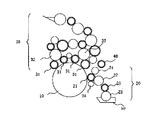
- FIG. 1 to 3 are conceptual diagrams showing examples of water supply devices that can be used in the implementation of the planographic printing method of the present invention.
- the water supply device shown in FIG. 1 is an Epic Delta water supply device
- the water supply device shown in FIG. 2 is an Alcalar water supply device
- the water supply device shown in FIG. 3 is a Comormatic water supply device.
- a swimsuit roller 21 in contact with the plate cylinder 10
- a roller 22 that is in contact with this and supplying dampening water from the water boat 50 to the swimsuit roller 21, and water containing dampening water.
- the water source roller 23 is immersed in the boat 50.
- the roller 24 may be called a distribution roller or a rider roller depending on the water supply method.
- Some water supply systems further include a roller row 25 between the roller 22 and the water source roller 23.
- the dampening water is supplied by the direct water supply method without the bridge roller 40 being in contact with at least one of the water supply roller 20 and the ink roller 30.
- a plate material is first mounted on the plate cylinder 10 of a printing press having such a water supply device.
- a lithographic printing plate precursor that has been image-exposed in advance may be mounted, or when the printing machine is equipped with an exposure device, after the lithographic printing plate precursor is mounted. Image exposure may be performed on the plate cylinder 10.
- the dampening water is supplied in order from the water boat 50 to the water source roller 23, in some cases, the roller 25, the roller 22, and the swim roller 21. The dampening water is supplied to the plate material by contacting the material.
- the non-image portion of the image recording layer is removed by dissolving and / or dispersing action by the fountain solution itself, rubbing action by the roller, and / or peeling action. Then, on-press development proceeds.
- ink is supplied from the ink form roller 31 to the plate material, and further, the ink on the plate material is transferred to the blanket by further impression, and is further transferred to a printing medium such as printing paper for printing.
- a printing process can be performed in which ink is supplied from the ink form roller 31 to the plate material and further subjected to impression. That is, at the same time as the on-press development process, the inking roller and the plate cylinder, the blanket cylinder and the plate cylinder may be brought into contact with each other, and the printing process may be continued through the printing paper.
- the swim roller 21 is rotated at a surface speed different from the surface speed of the plate cylinder 10.
- the difference between the surface speed of the plate cylinder and the speed of the swim roller is divided by the surface speed of the plate cylinder.
- the so-called slip ratio is positive when the swim roller is faster and negative when it is slower.
- a range of +1 to + 50% or -1 to -50% is preferable.
- a range of +2 to + 30% or ⁇ 2 to ⁇ 30% is more preferable from the viewpoint of removing dust such as paper dust caused by printing paper, and +3 to + 20% from the viewpoint of promoting uniform rising of dampening water.
- the range of -3 to -20% is particularly preferable.
- the plate material is an on-press development type lithographic printing plate precursor
- the plate material is an on-press development type lithographic printing plate precursor
- at least one of the rollers in contact with the swim roller that is, the roller 22 or the roller 24 in FIGS. 1 to 3 can be rotated while being swung in the axial direction of the roller.
- Oscillation amplitude (oscillation magnitude)
- the amplitude is preferably in the range of 1 mm to 100 mm, more preferably in the range of 5 mm to 50 mm, and the oscillation cycle is preferably 0.1 second to 10 seconds, preferably 0.5 seconds to 5 seconds is more preferable.
- At least one of the rollers in contact with the swim roller 21 can be rotated at a surface speed different from the surface speed of the swim roller 21.
- the value obtained by dividing the difference between the surface speed of the swim roller and the surface speed of the roller in contact with the swim roller 21 by the surface speed of the swim roller is positive when the swim roller is faster and negative when it is slower.
- + 0.01% to + 50% or ⁇ 0.01% to ⁇ 50% is preferable, and + 0.1% to + 20% or ⁇ 0.1% to ⁇ 20% is more preferable.
- image exposure of the plate material can be performed by a conventional method.
- a laser is preferred as the exposure light source.
- the laser used in the present invention is appropriately selected according to the photosensitive wavelength of the plate material to be used, and is preferably a solid laser or semiconductor laser that emits infrared light with a wavelength of 760 to 1200 nm, a semiconductor laser that emits light with 250 to 420 nm, or the like. Is mentioned.
- the output is preferably 100 mW or more
- the exposure time per pixel is preferably within 20 ⁇ s
- the irradiation energy amount is preferably 10 to 300 mJ / cm 2 .
- the output is preferably 0.1 mW or more.
- the plate material is an on-press development type lithographic printing plate precursor
- on-press development and printing are performed on the printing press.
- a development processing step such as a wet development processing step or a gumming process using a gum solution is performed.
- the image recording layer cured by exposure forms a printing ink receiving portion having an oleophilic surface in the exposed portion of the image recording layer.
- the uncured image recording layer is removed by dissolution or dispersion by the supplied dampening water and / or printing ink, and a hydrophilic surface is exposed in that area.
- the fountain solution adheres to the exposed hydrophilic surface, the printing ink is deposited on the image recording layer in the exposed area, and printing is started.
- the lithographic printing plate precursor is on-press developed on a lithographic printing machine and used as it is for printing a large number of sheets.
- the fountain solution used in the lithographic printing method according to the present invention is an aqueous solution containing a compound obtained by adding ethylene oxide and propylene oxide to ethylenediamine.
- an aqueous solution containing a compound in which ethylene oxide and propylene oxide are added to ethylenediamine as the fountain solution, the non-image area stains and printing that occur when lithographic printing is performed by operating the slip mechanism of the swim roller.
- the fountain solution used in the lithographic printing method according to the present invention has the effect of improving the hydrophilicity of the non-image area of the lithographic printing plate.
- the fountain solution used in the lithographic printing method according to the present invention has a greater antifouling effect on a lithographic printing plate to be used after being subjected to a gumming process without undergoing a development process with a developer, and is an on-machine development type. This shows a greater antifouling effect than the planographic printing plate precursor.
- the compound obtained by adding ethylene oxide and propylene oxide to ethylenediamine used in the present invention preferably has a mass average molecular weight of 500 to 15,000. If it is less than 500, the effect of suppressing stains on the non-image area of the printed matter is small, and if it is greater than 15000, the effect of preventing the stain on the blanket cylinder or impression cylinder of the printing press is small. From the viewpoint of the effect of suppressing non-image area stains on the printed matter and stains on the blanket cylinder and impression cylinder of the printing press, those of 800 to 10,000 are more preferred.
- the one having a mass average molecular weight of 1000 to 5000 is optimal.
- the compound having such a molecular weight does not damage the image area even when water droplets remaining on the plate when the printing machine is stopped evaporate by standing and remain after being concentrated.
- the ratio of added moles of ethylene oxide to propylene oxide is 5:95 to 50:50 from the viewpoint of the effect of suppressing non-image area stains on printed matter and stains on the blanket cylinder and impression cylinder of the printing press.
- a range of 20:80 to 35:65 is more preferable from the viewpoint of suppressing excessive emulsification of the ink when printing a large number.
- a compound obtained by adding ethylene oxide and propylene oxide to ethylenediamine can be produced according to a conventional method.
- it can be produced by reacting ethylenediamine and / or propylene oxide with ethylenediamine in the presence of a catalyst.
- the compound obtained by adding ethylene oxide and propylene oxide to ethylenediamine used in the present invention includes a compound represented by the following general formula (X).
- a and B each independently represent —CH 2 CH 2 O— or —CH 2 CH (CH 3 ) O—, and A and B are groups different from each other.
- a to h each represents an integer of 1 or more, and a to h are values such that the mass average molecular weight of the whole compound is 500 to 15000.
- Each ethylene oxide and propylene oxide copolymer chain may have a block structure or a random structure.
- the mass average molecular weight of the compound and the ratio of ethylene oxide and propylene oxide can be determined by, for example, measurement of hydroxyl value and amine value, NMR measurement, and the like.
- the content of the compound obtained by adding ethylene oxide and propylene oxide to ethylenediamine in the aqueous solution is 0.01 to 10% by mass, preferably 0.05 to 5.0% by mass.
- the slip mechanism of the swim roller is operated to perform planographic printing.
- the desired effect of the present invention can be achieved in that the non-image area stain of the printed matter and the blanket cylinder or impression cylinder of the printing press when a large number of copies are printed can be prevented.
- the aqueous solution bag according to the invention (hereinafter also referred to as dampening water) further contains a water-soluble polymer compound, a monoalkyl ether of ethylene glycol or propylene glycol, a saccharide, a solubilizing auxiliary solvent, and other additives as necessary. May be.
- the fountain solution can further contain a water-soluble polymer compound selected from the group consisting of the following (I) to (III).
- a water-soluble polymer compound selected from the group consisting of the following (I) to (III).
- specific examples of the alkyl group include a methyl group, an ethyl group, and a propyl group. Examples thereof include starch-based water-soluble polymer compounds modified with at least one selected from alkyl groups.
- water-soluble polymer compound (I) examples include methyl starch, ethyl starch, hydroxyethyl starch, hydroxypropyl starch, carboxyethyl starch, hydroxypropylated enzymatically degraded dextrin, and octenyl succinated starch.
- starch-based water-soluble polymer compounds modified with a methyl group or a propyl group are preferable, and examples thereof include hydroxypropyl starch and hydroxypropylated enzyme-degraded dextrin.
- cellulose-based water-soluble polymer compound modified with the alkyl group of (II) above specific examples include a methyl group, an ethyl group, and a propyl group, and at least one selected from these alkyl groups. Examples thereof include cellulose-based water-soluble polymer compounds modified by the above. Specific examples of the water-soluble polymer compound (II) include methyl cellulose, ethyl cellulose, hydroxyethyl cellulose, hydroxypropyl cellulose, hydroxypropyl methyl cellulose, hydroxyethyl cellulose, and carboxyethyl cellulose. Among these, a cellulose-based water-soluble polymer compound modified with a methyl group or a propyl group is preferable, and examples thereof include hydroxypropylcellulose and hydroxypropylmethylcellulose.
- the water-soluble polymer compound derived from vinyl polymerization of the unsaturated monomer containing a vinyl group (III) may be a homopolymer or copolymer of an unsaturated monomer containing a vinyl group, Furthermore, what gave the neutralization process etc. may be used.
- Specific examples of the water-soluble polymer compound (III) include polyvinyl alcohol, polyvinyl alkyl ether, polyvinyl acetate, polyvinyl pyrrolidone, polyacrylic acid, sodium polyacrylate, polyacrylamide, polyacrylate ester, and polymethacrylate ester.
- Carboxyvinyl polymer, acrylamide / acrylate copolymer, alkylate polyvinyl pyrrolidone, and polyvinyl pyrrolidone / vinyl acetate copolymer are particularly preferably used.
- the water-soluble polymer compound contained in the fountain solution may be used singly or in combination of two or more.
- the water-soluble polymer compound preferably has a relatively low viscosity, and its 0.1% aqueous solution is suitably 100 cps or less, more preferably 1% aqueous solution is 100 cps or less.
- the content of the water-soluble polymer in the fountain solution is suitably 0.001 to 0.3% by mass, preferably 0.005 to 0.2% by mass, from the viewpoint of suppressing the excessive emulsification of the ink.
- Water-soluble polymer compounds are generally available on the market, and commercially available products can also be used in the present invention.
- Examples of commercially available products include Metroze manufactured by Shin-Etsu Chemical Co., Ltd., and SM types of methyl cellulose include SM-4, SM-15, SM-25, SM-100, etc., and SH type of hydroxypropyl methyl cellulose. 60SH-3, 60SH-6, 60SH-15, 60SH-50, 65SH-50 and the like.
- the fountain solution can contain a monoalkyl ether of ethylene glycol or propylene glycol as represented by the following general formula (1).
- R 1 O— (CH 2 CHR 2 O) n—H
- R 1 represents an alkyl group having 1 to 15 carbon atoms
- R 2 represents hydrogen, an alkyl group having 1 to 15 carbon atoms, an aryl group having 6 to 12 carbon atoms, or 1 to 5 carbon atoms.
- n is an integer of 1 to 5.
- R 1 is suitably an n-butyl group, an isobutyl group or a t-butyl group.
- the compound of the general formula (1) includes ethylene glycol-n-butyl ether, ethylene glycol isobutyl ether, ethylene glycol-t-butyl ether, propylene glycol-n-butyl ether, propylene glycol isobutyl ether, and propylene glycol-t- Butyl ether. From the viewpoint of occupational safety, a propylene glycol compound in which R 2 is a methyl group is desirable.
- the content of the compound represented by the general formula (1) in the fountain solution is suitably 0.001 to 1% by mass, preferably 0.1 to 0.5% by mass.
- the dampening water can contain saccharides.
- the saccharide can be selected from monosaccharides, disaccharides, oligosaccharides, and the like, and includes sugar alcohols obtained by hydrogenation. Specific examples include D-erythrose, D-throse, D-arabinose, D-ribose, D-xylose, D-erythro-pentulose, D-allulose, D-galactose, D-glucose, D-mannose, D-talose, ⁇ -D-fructose, ⁇ -L-sorbose, 6-deoxy-D-glucose, D-glycero-D-galactose, ⁇ -D-allo-heptulose, ⁇ -D-alto-3-heptulose, saccharose, lactose, D -Maltose, Isomaltose, Inurobiose, Maltotriose, D, L-Arabit, Re
- Saccharides may be used alone or in combination of two or more. By including saccharides in the fountain solution, overemulsification of the ink can be further suppressed.
- the saccharide content in the fountain solution is suitably from 0.01 to 1% by mass, preferably from 0.05 to 0.5% by mass.
- the fountain solution is supplied as a concentrate, and it is often used after diluting it.
- a monoalkyl ether of ethylene glycol or propylene glycol represented by the general formula (1) when preparing a fountain solution that is a concentrated liquid, the liquid stability is kept good, It is desirable to use a solubilizing auxiliary solvent in combination.
- solubilizing auxiliary solvents include ethanol, propanol, butanol, isobutanol, t-butanol, ethylene glycol methyl ether, ethylene glycol ethyl ether, ethylene glycol propyl ether, ethylene glycol isopropyl ether, propylene glycol methyl ether, propylene glycol ethyl ether , Propylene glycol propyl ether, propylene glycol isopropyl ether, propylene glycol, dipropylene glycol, tripropylene glycol, 3-methoxy-3-methyl-1-butanol and the like. Of these, 3-methoxy-3-methyl-1-butanol is preferably used.
- the solubilizing auxiliary solvent is generally added in an amount of 3 to 30% by mass, preferably 5 to 20% by mass, in the fountain solution that is the concentrate.
- the solubilizing auxiliary solvent is generally contained in the dampening water at the time of use in an amount of about 0.1 to 1% by mass.
- the fountain solution can be used in the acidic, neutral and alkaline regions according to the purpose and purpose.
- the effect of the present invention can be obtained in any pH range.
- the pH is preferably in the range of 3 to 6. If the pH is less than 3, the etching effect on the support becomes strong and the printing durability may be lowered.
- an organic acid and / or an inorganic acid or a salt thereof may be added.
- Preferred organic acids include, for example, citric acid, ascorbic acid, malic acid, tartaric acid, lactic acid, acetic acid, glycolic acid, gluconic acid, hydroxyacetic acid, succinic acid, malonic acid, levulinic acid, sulfanilic acid, p-toluenesulfonic acid, phytic acid And organic phosphonic acid.
- the inorganic acid include phosphoric acid, nitric acid, sulfuric acid, and polyphosphoric acid.
- alkali metal salts, alkaline earth metal salts or ammonium salts of these organic acids and / or inorganic acids, and organic amine salts are also preferably used.
- the organic acid, inorganic acid and / or salt thereof may be used alone or as a mixture of two or more.
- the addition amount is generally 0.001 to 5% by mass in dampening water.
- the fountain solution can contain an alkali metal hydroxide, an alkali metal phosphate, an alkali metal carbonate, a silicate, or the like.
- a chelate compound can be added to the fountain solution.
- tap water or well water which is a concentrate, and using it as dampening water, calcium ions, etc. contained in the tap water and well water used for dilution affect printing and stain the printed matter. It may be a cause to make it easier.
- the above problem can be solved by adding a chelate compound.
- Preferred chelate compounds include, for example, ethylenediaminetetraacetic acid, potassium salt thereof, sodium salt thereof; diethylenetriaminepentaacetic acid, potassium salt thereof, sodium salt thereof; triethylenetetraminehexaacetic acid, potassium salt thereof, sodium salt thereof; hydroxyethylethylenediaminetriacetic acid Nitrilotriacetic acid, its potassium salt, its sodium salt; 1,2-diaminocyclohexanetetraacetic acid, its potassium salt, its sodium salt; 1,3-diamino-2-propanoltetraacetic acid, its Aminopolycarboxylic acids such as potassium salt and sodium salt thereof, 2-phosphonobutanetricarboxylic acid-1,2,4, potassium salt and sodium salt thereof; 2-phosphonobutanetricarboxylic acid- , 3,4, its potassium salt, its sodium salt; 1-phosphonoethanetricarboxylic acid-1,2,2, its potassium salt, its sodium salt; 1-hydroxyethane-1,1-
- An organic amine salt is also effective in place of the sodium salt or potassium salt of the chelating agent.
- a chelating agent is selected that is stably present in the fountain solution and does not impair the printability.
- the addition amount is suitably 0.001 to 3% by mass, preferably 0.01 to 1% by mass in dampening water.
- the fountain solution may further contain a colorant, a rust inhibitor, an antifoaming agent, and the like.
- Food coloring agents and the like can be preferably used as the colorant.
- CINo. 19140, 15985 and CI No. 16185, 45430, 16255, 45380, 45100, and purple pigments such as CI No. 42640, as a blue pigment, CI No. 42090 and 73015, CINo. 42095, and the like.
- the rust inhibitor include benzotriazole, 5-methylbenzotriazole, thiosalicylic acid, benzimidazole and derivatives thereof.
- As the antifoaming agent a silicon antifoaming agent is preferable, and any of an emulsified dispersion type and a solubilized type can be used.
- the fountain solution includes corrosion inhibitors such as magnesium nitrate, zinc nitrate, calcium nitrate, sodium nitrate, potassium nitrate, lithium nitrate and ammonium nitrate, hardeners such as chromium compounds and aluminum compounds, and cyclic ethers (for example, 4- An organic solvent such as butyrolactone) and a water-soluble surface-active organometallic compound described in JP-A No. 61-193893 can be added in the range of 0.0001 to 1% by mass of dampening water.
- corrosion inhibitors such as magnesium nitrate, zinc nitrate, calcium nitrate, sodium nitrate, potassium nitrate, lithium nitrate and ammonium nitrate
- hardeners such as chromium compounds and aluminum compounds
- cyclic ethers for example, 4- An organic solvent such as butyrolactone
- a water-soluble surface-active organometallic compound described in JP-A No. 61-193893 can
- anionic surfactants include fatty acid salts, abietic acid salts, hydroxyalkanesulfonic acid salts, alkanesulfonic acid salts, dialkylsulfosuccinic acid salts, linear alkylbenzenesulfonic acid salts, branched alkylbenzenesulfonic acid salts, alkylnaphthalene.
- Nonionic surfactants include polyoxyalkyl ethers, polyoxyethylene alkylphenyl ethers, polyoxyethylene polystyryl phenyl ether, polyoxyethylene polyoxypropylene alkyl ether, glycerin fatty acid partial esters, sorbitan fatty acid moieties.
- Esters pentaerythritol fatty acid partial esters, propylene glycol mono fatty acid partial esters, sucrose fatty acid partial esters, polyoxyethylene sorbitan fatty acid partial esters, polyoxyethylene sorbitol fatty acid partial esters, polyglycerin fatty acid partial esters, poly Oxyethylenated castor oils, polyoxyethylene glycerin fatty acid partial esters, fatty acid diethanolamides, N, N-bis-2-hydro Shi alkylamines, polyoxyethylene alkylamines, triethanolamine fatty acid esters, such as trialkylamine oxides.
- polyoxyethylene alkylphenyl ethers, polyoxyethylene-polyoxypropylene block polymers and the like are preferably used.
- cationic surfactant examples include alkylamine salts, quaternary ammonium salts, polyoxyethylene alkylamine salts, polyethylene polyamine derivatives, and the like.
- amphoteric surfactants include alkyl imidazolines.
- fluorine-type surfactant is mentioned, for example, as fluorine-type anionic surfactant, perfluoroalkyl sulfonate, perfluoroalkyl carboxylate, perfluoroalkyl phosphate ester, fluorine-type nonionic surfactant, etc.
- perfluoroalkylethylene oxide adduct examples include perfluoroalkylpropylene oxide adduct, and fluorine-based cationic surfactant.
- perfluoroalkyltrimethylammonium salts examples include perfluoroalkyltrimethylammonium salts.
- the surfactant content is suitably 10% by mass or less in dampening water, and preferably 0.01 to 3.0% by mass.
- the dampening water can contain glycols and / or alcohols as a wetting agent.
- wetting agents include diethylene glycol monomethyl ether, triethylene glycol monomethyl ether, tetraethylene glycol monomethyl ether, diethylene glycol monoethyl ether, triethylene glycol monoethyl ether, tetraethylene glycol monoethyl ether, diethylene glycol monopropyl ether, triethylene glycol monopropyl ether.
- Tetrapropylene glycol and pentapropylene glycol ethylene glycol, diethylene glycol, triethylene glycol, polyethylene glycol, butylene glycol, hexylene glycol, benzyl alcohol, ethylene glycol monophenyl ether, 2-ethyl-1,3-hexanediol, 1-butoxy -2-propanol, glycerin, diglycerin, polyglycerin, trimethylolpropane, pentaerythritol, methoxyethanol, ethoxyethanol, butoxyethanol, 3-methoxybutanol and the like.
- the wetting agent may be used alone or in combination of two or more, and may be contained in an amount of about 0.01 to 1% by mass in fountain solution.
- the balance of the dampening water component of the present invention is water.
- various components are dissolved at an appropriate concentration using water, preferably demineralized water or pure water, Water can be prepared.
- Such a concentrated solution is diluted about 20 to 200 times with normal tap water, well water or the like at the time of use to obtain a dampening water at the time of use.
- isopropyl alcohol conventionally used in dampening water can be added in addition to the glycols and / or alcohols.
- the addition amount of isopropyl alcohol is preferably in the range of 0.1 to 15% by mass in dampening water.
- the lithographic printing plate precursor used in the lithographic printing method according to the present invention has an image recording layer on a support.
- the lithographic printing plate precursor has an undercoat layer (sometimes referred to as an intermediate layer) between the support and the image recording layer, and a protective layer (sometimes referred to as an overcoat layer) on the image recording layer, if necessary. May be.
- the lithographic printing plate precursor examples include various lithographic printing plates.
- a photosensitive lithographic printing plate called a PS plate having an aluminum plate as a support and an image recording layer thereon can be suitably used.
- an image recording layer comprising a mixture of a diazo resin (a salt of a condensate of p-diazodiphenylamine and paraformaldehyde) and a shellac as described in British Patent 1,350,521 is placed on an aluminum plate.
- the main repeating unit is a diazo resin and hydroxyethyl methacrylate units or hydroxyethyl acrylate units as described in the specifications of British Patents 1,460,978 and 1,505,739.
- a photosensitive polymer system containing a dimethylmaleimide group described in JP-A-2-236552 and JP-A-4-274429 is provided on an aluminum plate.
- Negative type PS plates such as those provided in JP-A-50-125806 and JP-A-50-125806
- An image recording layer comprising a mixture of O- Kinonjiado photosensitive material and a novolac-type phenolic resins as described in distribution include positive PS plate provided on the aluminum plate.
- an alkali-soluble resin other than the alkali-soluble novolak resin can be blended as necessary.
- alkali-soluble resins include styrene-acrylic acid copolymers, methyl methacrylate-methacrylic acid copolymers, alkali-soluble polyurethane resins, alkali-soluble vinyl resins and alkali-soluble polybutyral resins described in JP-B-52-28401. it can.
- Specific examples include photopolymer type digital plates (for example, Brillia HD PRO-V manufactured by FUJIFILM Corporation), thermal positive type digital plates (for example, XP-F manufactured by FUJIFILM Corporation), and thermal negative type digital plates (for example, Examples include Brillia HD LH-NI3 manufactured by FUJIFILM Corporation, and XZ-R manufactured by FUJIFILM Corporation.
- photopolymer type digital plates for example, Brillia HD PRO-V manufactured by FUJIFILM Corporation
- thermal positive type digital plates for example, XP-F manufactured by FUJIFILM Corporation
- thermal negative type digital plates for example, Examples include Brillia HD LH-NI3 manufactured by FUJIFILM Corporation, and XZ-R manufactured by FUJIFILM Corporation.
- the image recording layer is not particularly limited as long as it is an image recording layer of a lithographic printing plate precursor.
- the image recording layer usually contains a polymerization initiator, a polymerizable compound, a sensitizing dye, a binder polymer, a thermoplastic fine particle polymer, and the like.
- the image recording layer contains an infrared absorber, a polymerization initiator, a polymerizable compound, and a binder polymer.
- the image recording layer contains an infrared absorber and a thermoplastic fine particle polymer.
- the image recording layer of the present invention contains a polymerization initiator (hereinafter also referred to as an initiator compound).
- a radical polymerization initiator is preferably used.
- the polymerization initiator those known to those skilled in the art can be used without limitation, and specifically include, for example, trihalomethyl compounds, carbonyl compounds, organic peroxides, azo compounds, azide compounds, metallocene compounds, hexaarylbiphenyls. Examples include imidazole compounds, organic boron compounds, disulfone compounds, oxime ester compounds, onium salt compounds, and iron arene complexes.
- At least one selected from hexaarylbiimidazole compounds, onium salts, trihalomethyl compounds, and metallocene compounds is preferable.
- a hexaarylbiimidazole compound or an onium salt is preferable.
- hexaarylbiimidazole compound examples include lophine dimers described in the specifications of European Patent No. 24629, European Patent No. 107792 and US Pat. No. 4,410,621, such as 2,2′-bis (o-chlorophenyl) -4,4 ′.
- the onium salt a sulfonium salt, an iodonium salt, or a diazonium salt is preferably used.
- diaryliodonium salts and triarylsulfonium salts are preferably used.
- the onium salt is particularly preferably used in combination with an infrared absorber having a maximum absorption at 750 to 1400 nm.
- the polymerization initiators described in JP-A-2007-206217, paragraph numbers [0071] to [0129] can be preferably used.
- the polymerization initiator is preferably used alone or in combination of two or more.
- the amount of the polymerization initiator used in the image recording layer is preferably 0.01 to 20% by mass, more preferably 0.1 to 15% by mass, still more preferably 1.0% by mass, based on the total solid content of the image recording layer. ⁇ 10% by mass.
- the polymerizable compound used in the image recording layer is an addition polymerizable compound having at least one ethylenically unsaturated double bond, and is selected from compounds having at least one terminal ethylenically unsaturated bond, preferably two or more. . These have chemical forms such as monomers, prepolymers, ie dimers, trimers and oligomers, or mixtures thereof. Examples of monomers include unsaturated carboxylic acids (for example, acrylic acid, methacrylic acid, itaconic acid, crotonic acid, isocrotonic acid, maleic acid, etc.), esters and amides thereof, preferably unsaturated carboxylic acids.
- unsaturated carboxylic acids for example, acrylic acid, methacrylic acid, itaconic acid, crotonic acid, isocrotonic acid, maleic acid, etc.
- esters and amides thereof preferably unsaturated carboxylic acids.
- Esters of an acid and a polyhydric alcohol compound and amides of an unsaturated carboxylic acid and a polyamine compound are used.
- an addition reaction product of an unsaturated carboxylic acid ester or amide having a nucleophilic substituent such as a hydroxy group, an amino group or a mercapto group with a monofunctional or polyfunctional isocyanate or epoxy, and a monofunctional or polyfunctional is also preferably used.
- unsaturated carboxylic acid esters or amides having an electrophilic substituent such as an isocyanate group or an epoxy group
- addition products of monofunctional or polyfunctional alcohols, amines, thiols, halogen groups A substitution reaction product of an unsaturated carboxylic acid ester or amide having a leaving substituent such as a tosyloxy group and a monofunctional or polyfunctional alcohol, amine or thiol is also suitable.
- JP-T-2006-508380 JP-A-2002-287344, JP-A-2008-256850, JP-A-2001-342222, JP-A-9-179296, JP-A-9-179297.
- JP-A-9-179298 JP-A-2004-294935, JP-A-2006-243493, JP-A-2002-275129, JP-A-2003-64130, JP-A-2003-280187, This is described in, for example, Kaihei 10-333321.
- monomers of esters of polyhydric alcohol compounds and unsaturated carboxylic acids include acrylic acid esters such as ethylene glycol diacrylate, 1,3-butanediol diacrylate, tetramethylene glycol diacrylate, propylene glycol diacrylate, Examples include trimethylolpropane triacrylate, hexanediol diacrylate, tetraethylene glycol diacrylate, pentaerythritol tetraacrylate, sorbitol triacrylate, isocyanuric acid ethylene oxide (EO) -modified triacrylate, and polyester acrylate oligomer.
- acrylic acid esters such as ethylene glycol diacrylate, 1,3-butanediol diacrylate, tetramethylene glycol diacrylate, propylene glycol diacrylate
- Examples include trimethylolpropane triacrylate, hexanediol diacrylate, tetraethylene glycol diacrylate, pentaery
- Methacrylic acid esters include tetramethylene glycol dimethacrylate, neopentyl glycol dimethacrylate, trimethylolpropane trimethacrylate, ethylene glycol dimethacrylate, pentaerythritol trimethacrylate, bis [p- (3-methacryloxy-2-hydroxypropoxy) phenyl ] Dimethylmethane, bis- [p- (methacryloxyethoxy) phenyl] dimethylmethane, and the like.
- amide monomers of polyvalent amine compounds and unsaturated carboxylic acids include methylene bis-acrylamide, methylene bis-methacrylamide, 1,6-hexamethylene bis-acrylamide, 1,6-hexamethylene bis-methacrylic.
- examples include amide, diethylenetriamine trisacrylamide, xylylene bisacrylamide, and xylylene bismethacrylamide.
- urethane-based addition polymerizable compounds produced by the addition reaction of isocyanate and hydroxy groups.
- Specific examples include, for example, two per molecule described in JP-B-48-41708.
- a vinyl urethane compound containing two or more polymerizable vinyl groups in one molecule obtained by adding a vinyl monomer containing a hydroxyl group represented by the following general formula (A) to the above polyisocyanate compound having an isocyanate group.
- a vinyl urethane compound containing two or more polymerizable vinyl groups in one molecule obtained by adding a vinyl monomer containing a hydroxyl group represented by the following general formula (A) to the above polyisocyanate compound having an isocyanate group.
- A vinyl monomer containing a hydroxyl group represented by the following general formula (A)
- urethanes as described in JP-A-51-37193, JP-B-2-32293, JP-B-2-16765, JP-A-2003-344997, JP-A-2006-65210 are disclosed.
- Urethane compounds having an ethylene oxide skeleton as described in US Pat. No. 7,153,632, JP-T 8-505958, JP-A 2007-293221, and JP-A 2007-293223.
- urethane compounds having.
- the details of the method of use such as the structure of these polymerizable compounds, whether they are used alone or in combination, and the amount added can be arbitrarily set in accordance with the performance design of the final planographic printing plate precursor.
- the polymerizable compound is preferably used in the range of 5 to 75% by mass, more preferably 25 to 70% by mass, and particularly preferably 30 to 60% by mass with respect to the total solid content of the image recording layer.
- the sensitizing dye contained in the image recording layer absorbs light at the time of image exposure and becomes an excited state, and supplies energy to the polymerization initiator by electron transfer, energy transfer or heat generation, and improves the polymerization start function. If it can be used, there is no particular limitation. In particular, a sensitizing dye having a maximum absorption at 300 to 450 nm or 750 to 1400 nm is preferably used.
- Examples of the sensitizing dye having maximum absorption in the wavelength range of 300 to 450 nm include merocyanine dyes, benzopyrans, coumarins, aromatic ketones, anthracenes, styryls, oxazoles and the like.
- a preferable dye from the viewpoint of high sensitivity is a dye represented by the following general formula (2).
- A represents an aryl group or a heteroaryl group which may have a substituent
- X represents an oxygen atom, a sulfur atom or N- (R 3 ).
- R 1 , R 2 and R 3 each independently represent a monovalent nonmetallic atomic group, and A and R 1 or R 2 and R 3 are bonded to each other to form an aliphatic or aromatic ring. May be formed.
- R 1 , R 2 and R 3 are each independently a monovalent nonmetallic atomic group, preferably a hydrogen atom, a substituted or unsubstituted alkyl group, a substituted or unsubstituted group.
- An alkenyl group, a substituted or unsubstituted aryl group, a substituted or unsubstituted heteroaryl residue, a substituted or unsubstituted alkoxy group, a substituted or unsubstituted alkylthio group, a hydroxyl group, or a halogen atom is represented.
- sensitizing dyes include paragraph numbers [0047] to [0053] in JP-A-2007-58170, paragraph numbers [0036] to [0037] in JP-A-2007-93866, and JP-A-2007.
- Preferred examples include the compounds described in paragraphs [0042] to [0047] of JP-A-72816.
- the sensitizing dyes described in JP-A-2007-328243 are also preferably used. Only one type of sensitizing dye may be used, or two or more types may be used in combination.
- a sensitizing dye having a maximum absorption at 750 to 1400 nm (hereinafter sometimes referred to as “infrared absorber”) will be described in detail.
- infrared absorber a dye or a pigment is preferably used.
- dyes such as azo dyes, metal complex azo dyes, pyrazolone azo dyes, naphthoquinone dyes, anthraquinone dyes, phthalocyanine dyes, carbonium dyes, quinoneimine dyes, methine dyes, cyanine dyes, squarylium dyes, pyrylium salts, metal thiolate complexes Is mentioned.
- cyanine dyes preferred are cyanine dyes, squarylium dyes, pyrylium salts, nickel thiolate complexes, and indolenine cyanine dyes. More preferred are cyanine dyes and indolenine cyanine dyes, and particularly preferred examples include cyanine dyes represented by the following general formula (a).
- X 1 represents a hydrogen atom, a halogen atom, —N (R 9 ) (R 10 ), —X 2 -L 1 or a group shown below.
- R 9 and R 10 may be the same or different, and may have a substituent, an aromatic hydrocarbon group having 6 to 10 carbon atoms, or an alkyl group having 1 to 8 carbon atoms.
- X 2 represents an oxygen atom or a sulfur atom
- L 1 represents a hydrocarbon group having 1 to 12 carbon atoms, an aromatic ring having a hetero atom, or a hydrocarbon group having 1 to 12 carbon atoms including a hetero atom.
- the hetero atom represents N, S, O, a halogen atom, or Se.
- Xa - has Za described later - is synonymous with, R a represents a hydrogen atom or an alkyl group, an aryl group, a substituted or unsubstituted amino group, a substituent selected from halogen atoms.
- R 1 and R 2 each independently represents a hydrocarbon group having 1 to 12 carbon atoms.
- R 1 and R 2 are preferably hydrocarbon groups having 2 or more carbon atoms.
- R 1 and R 2 may be connected to each other to form a ring, and in the case of forming a ring, it is particularly preferable to form a 5-membered ring or a 6-membered ring.
- Ar 1 and Ar 2 may be the same or different and each represents an aryl group which may have a substituent.
- Preferred aryl groups include a benzene ring and a naphthalene ring.
- a C12 or less hydrocarbon group, a halogen atom, and a C12 or less alkoxy group are mentioned.
- Y 1 and Y 2 may be the same or different and each represents a sulfur atom or a dialkylmethylene group having 12 or less carbon atoms.
- R 3 and R 4 may be the same or different and each represents a hydrocarbon group having 20 or less carbon atoms which may have a substituent.
- Preferred substituents include alkoxy groups having 12 or less carbon atoms, carboxylic acid groups, and sulfonic acid groups.
- R 5 , R 6 , R 7 and R 8 may be the same or different and each represents a hydrogen atom or a hydrocarbon group having 12 or less carbon atoms. From the availability of raw materials, a hydrogen atom is preferred.
- Za ⁇ represents a counter anion. However, Za ⁇ is not necessary when the cyanine dye represented by the general formula (a) has an anionic substituent in its structure and neutralization of charge is not necessary.
- Preferred Za ⁇ is a halide ion, a perchlorate ion, a tetrafluoroborate ion, a hexafluorophosphate ion, and a sulfonate ion, particularly preferably a perchlorate ion, in view of the storage stability of the image recording layer coating solution.
- Hexafluorophosphate ions, and aryl sulfonate ions are examples of the storage stability of the image recording layer coating solution.
- infrared absorbing dye Only one type of infrared absorbing dye may be used, or two or more types of infrared absorbing dyes may be used in combination, or an infrared absorbing agent other than an infrared absorbing dye such as a pigment may be used in combination.
- an infrared absorbing agent other than an infrared absorbing dye such as a pigment may be used in combination.
- the pigment compounds described in paragraph numbers [0072] to [0076] of JP-A-2008-195018 are preferable.
- the addition amount of the sensitizing dye is preferably 0.05 to 30% by mass, more preferably 0.1 to 20% by mass, and still more preferably 0.2 to 10% by mass with respect to the total solid content of the image recording layer. It is.
- a binder polymer can be used for the image recording layer in order to improve the film strength of the image recording layer.
- the binder polymer that can be used in the present invention conventionally known binder polymers can be used without limitation, and polymers having film properties are preferred. Of these, acrylic resins, polyvinyl acetal resins, and polyurethane resins are preferable.
- the image recording layer in particular, the image recording layer of the on-press development type lithographic printing plate precursor has a polymer chain in which a polyfunctional thiol having 3 to 10 functional groups is used as a binder polymer and is bonded to this nucleus by a sulfide bond. It is preferable that the polymer chain contains a polymer compound having a polymerizable group (hereinafter also referred to as “star-shaped polymer compound” or “star-shaped polymer compound”). As the polyfunctional thiol, a polyfunctional thiol having 4 to 10 functional groups is preferable.
- Any polyfunctional thiol having 3 or more and 10 or less functional groups used as a nucleus in a star polymer compound should be suitably used as long as it has 3 or more and 10 or less thiol groups in one molecule.
- Examples of such polyfunctional thiol compounds include compounds A, B, C, D, E, and F described in paragraph numbers [0021] to [0040] of JP2012-148555A.
- compounds A to E are preferable from the viewpoint of printing durability and developability, compounds A, B, D, and E are more preferable, and compounds A, B, and D are more preferable.
- Compound B is particularly preferred.
- particularly preferred compound B will be described in detail.
- Compound B is a compound obtained by a dehydration condensation reaction between an alcohol and a carboxylic acid having a thiol group.
- a compound obtained by a condensation reaction between a polyfunctional alcohol having 3 to 10 functional groups and a carboxylic acid having one thiol group is preferable.
- a method of deprotecting a polyfunctional alcohol and a carboxylic acid having a protected thiol group after dehydration condensation can also be used.
- Specific examples of the polyfunctional alcohol include pentaerythritol, dipentaerythritol, tripentaerythritol, sorbitol, mannitol, iditol, dulcitol, and inositol.
- Pentaerythritol, dipentaerythritol, tripentaerythritol, and sorbitol are preferable, pentaerythritol. Dipentaerythritol and tripentaerythritol are particularly preferred.
- Specific examples of the carboxylic acid having a thiol group include mercaptoacetic acid, 3-mercaptopropionic acid, 2-mercaptopropionic acid, N-acetylcysteine, N- (2-mercaptopropionyl) glycine, thiosalicylic acid, and mercaptoacetic acid.
- 3-mercaptopropionic acid, 2-mercaptopropionic acid, N-acetylcysteine, N- (2-mercaptopropionyl) glycine are preferred, mercaptoacetic acid, 3-mercaptopropionic acid, 2-mercaptopropionic acid, N-acetylcysteine, N- (2-mercaptopropionyl) glycine is more preferable, and mercaptoacetic acid, 3-mercaptopropionic acid, N-acetylcysteine, and N- (2-mercaptopropionyl) glycine are particularly preferable.
- compound B include the compounds shown in the table below. The present invention is not limited to these.
- SB-1 to SB-23, SB-25 to SB-29, SB-31 to SB-35, SB-37 to SB-41, and SB-43 to SB-48 are preferable. More preferred are SB-2 to SB-5, SB-8 to SB-11, SB-14 to SB-17, and SB-43 to SB-48, and particularly preferred are SB-2 and SB-4. , SB-5, SB-8, SB-10, SB-11, and SB-43. Since the polyfunctional thiol synthesized by these compounds has a long distance between thiol groups and a small steric hindrance, it can form a desired star structure.
- a star polymer compound is a polymer compound having a polyfunctional thiol as a nucleus, a polymer chain bonded to the nucleus by a sulfide bond, and the polymer chain having a polymerizable group.
- a known vinyl polymer, (meth) acrylic acid polymer, styrene which can be produced from a vinyl monomer, a (meth) acrylic acid monomer, and a styrene monomer by radical polymerization, respectively.
- (meth) acrylic acid polymers are particularly preferable.
- the star polymer compound has a polymerizable group such as an ethylenically unsaturated bond for improving the film strength of the image portion as described in JP-A-2008-195018, having a main chain or a side chain, preferably a side chain. What has in a chain
- strand is mentioned. Crosslinking is formed between the polymer molecules by the polymerizable group, and curing is accelerated.
- an ethylenically unsaturated group such as a (meth) acryl group, a vinyl group, an allyl group, or a styryl group, or an epoxy group is preferable, and a (meth) acryl group, a vinyl group, or a styryl group is polymerizable. More preferable from the viewpoint, and a (meth) acryl group is particularly preferable.
- These groups can be introduced into the polymer by polymer reaction or copolymerization.
- a reaction between a polymer having a carboxy group in the side chain and glycidyl methacrylate, or a reaction between a polymer having an epoxy group and an ethylenically unsaturated group-containing carboxylic acid such as methacrylic acid can be used. These groups may be used in combination.
- the content of the crosslinkable group in the star polymer compound is preferably 0.1 to 10.0 mmol, more preferably 0.25 to 7.0 mmol, most preferably 0.5, per 1 g of the star polymer compound. ⁇ 5.5 mmol.
- the star polymer compound preferably further has a hydrophilic group.
- the hydrophilic group contributes to imparting on-press developability to the image recording layer.
- the coexistence of a polymerizable group and a hydrophilic group makes it possible to achieve both printing durability and developability.
- hydrophilic group examples include —SO 3 M 1 , —OH, —CONR 1 R 2 (M 1 represents hydrogen, metal ion, ammonium ion, phosphonium ion, and R 1 and R 2 each independently represents a hydrogen atom.
- M 1 represents hydrogen, metal ion, ammonium ion, phosphonium ion
- R 1 and R 2 each independently represents a hydrogen atom.
- —N + R 3 R 4 R 5 X — R 3 to R 5 are each independently represent an alkyl group having 1 to 8 carbon atoms, X -. is representative of the counter anion)
- a group represented by the group and the formula represented by the following formula (1-1) (1-2) Can be mentioned.
- n and m each independently represent an integer of 1 to 100, and R each independently represents a hydrogen atom or an alkyl group having 1 to 18 carbon atoms.
- hydrophilic groups —CONR 1 R 2 , a group represented by Formula (1-1), and a group represented by Formula (1-2) are preferable, and —CONR 1 R 2 and Formula (1-1) are preferable.
- n is more preferably 1 to 10, and particularly preferably 1 to 4.
- R is more preferably a hydrogen atom or an alkyl group having 1 to 4 carbon atoms, particularly preferably a hydrogen atom or a methyl group. Two or more of these hydrophilic groups may be used in combination.
- the star polymer compound preferably has substantially no carboxylic acid group, phosphoric acid group or phosphonic acid group. Specifically, it is preferably less than 0.1 mmol / g, more preferably less than 0.05 mmol / g, and particularly preferably 0.03 mmol / g or less. When these acid groups are less than 0.1 mmol / g, developability is further improved.
- lipophilic groups such as an alkyl group, an aryl group, an aralkyl group, and an alkenyl group can be introduced in order to control the inking property.
- a lipophilic group-containing monomer such as an alkyl methacrylate may be copolymerized.
- star polymer compound examples include the compounds described in paragraph numbers [0053] to [0057] of JP2012-148555A, but the present invention is not limited thereto.
- the star polymer compound can be synthesized by a known method such as radical polymerization of the monomer constituting the polymer chain in the presence of the polyfunctional thiol compound.
- the weight average molecular weight (Mw) of the star polymer compound is preferably 5,000 to 500,000, more preferably 10,000 to 250,000, and particularly preferably 20,000 to 150,000. Within this range, developability and printing durability are improved.
- One star polymer compound may be used alone, or two or more star polymer compounds may be mixed and used. Moreover, you may use together with another binder polymer.
- the content of the binder polymer in the image recording layer is preferably 5 to 95% by mass, more preferably 10 to 90% by mass, and particularly preferably 15 to 85% by mass with respect to the total solid content of the image recording layer.
- the thermoplastic fine particle polymer contained in the image recording layer preferably has a glass transition temperature (Tg) of 60 to 250 ° C, more preferably 70 to 140 ° C, and still more preferably 80 to 120 ° C.
- Tg glass transition temperature
- Examples of the thermoplastic fine particle polymer having a Tg of 60 ° C. or higher include Research Disclosure No. 1 of January 1992. 33303, JP-A-9-123387, JP-A-9-131850, JP-A-9-171249, JP-A-9-171250, and EP931647, and the like. it can.
- homopolymers or copolymers composed of monomers such as ethylene, styrene, vinyl chloride, methyl acrylate, ethyl acrylate, methyl methacrylate, ethyl methacrylate, vinylidene chloride, acrylonitrile, vinyl carbazole, or mixtures thereof Etc. can be illustrated.
- Preferred examples include polystyrene and polymethyl methacrylate.
- the average particle size of the thermoplastic fine particle polymer is preferably 0.005 to 2.0 ⁇ m. If the average particle size is too large, the resolution may be deteriorated, and if it is too small, the temporal stability may be deteriorated. This value is also applied as an average particle diameter when two or more thermoplastic fine particle polymers are mixed.
- the average particle diameter is more preferably 0.01 to 1.5 ⁇ m, particularly preferably 0.05 ⁇ m to 1.0 ⁇ m.
- the polydispersity when two or more thermoplastic fine particle polymers are mixed is preferably 0.2 or more. The average particle size and polydispersity are calculated by laser light scattering.
- thermoplastic fine particle polymers Two or more kinds may be mixed and used. Specifically, at least two kinds of uses having different particle sizes or at least two kinds of uses having different Tg may be mentioned. By using two or more types in combination, the film curability of the image area is further improved, and the printing durability is further improved when a lithographic printing plate is used. For example, when thermoplastic particles having the same particle size are used as the thermoplastic fine particle polymer, there will be a certain amount of voids between the thermoplastic fine particle polymers, and even if the thermoplastic fine particle polymer is melted and solidified by image exposure, Curability may not be as desired.
- thermoplastic fine particle polymer having a different particle size when used, the porosity between the thermoplastic fine particle polymers can be lowered, and as a result, the film curability of the image area after image exposure can be reduced. Can be improved.
- thermoplastic fine particle polymer when the same Tg is used as the thermoplastic fine particle polymer, when the temperature rise of the image recording layer due to image exposure is insufficient, the thermoplastic fine particle polymer is not sufficiently melted and solidified, and the curability of the film is desired. It may not be a thing. In contrast, when a thermoplastic fine particle polymer having a different Tg is used, the film curability of the image area can be improved even when the temperature rise of the image recording layer due to image exposure is insufficient.
- thermoplastic fine particle polymer having different Tg is preferably 60 ° C. or higher.
- the difference of Tg is 10 degreeC or more, More preferably, it is 20 degreeC or more.
- the thermoplastic fine particle polymer having a Tg of 60 ° C. or higher is contained in an amount of 70% by mass or more based on the total thermoplastic fine particle polymer.
- the thermoplastic fine particle polymer may have a crosslinkable group.
- the crosslinkable group is thermally reacted by the heat generated in the image exposed area to form a crosslink between the polymers, and the film strength of the image area is increased and the printing durability is increased. Will be better.
- the crosslinkable group may be any functional group capable of performing any reaction as long as a chemical bond is formed.
- an ethylenically unsaturated group that performs a polymerization reaction for example, acryloyl group, methacryloyl group, vinyl group, allyl group, etc.
- An isocyanate group that performs an addition reaction, or a block thereof and a group having an active hydrogen atom that is a reaction partner for example, an amino group, a hydroxy group, a carboxyl group, etc.
- an epoxy group that also performs an addition reaction, and a reaction partner thereof
- examples thereof include an amino group, a carboxyl group or a hydroxy group, a carboxyl group and a hydroxy group or an amino group that perform a condensation reaction, an acid anhydride that performs a ring-opening addition reaction, an amino group or a hydroxy group, and the like.
- thermoplastic fine particle polymer having a crosslinkable group examples include acryloyl group, methacryloyl group, vinyl group, allyl group, epoxy group, amino group, hydroxy group, carboxyl group, isocyanate group, acid anhydride and the like.
- examples thereof include those having a crosslinkable group such as a group in which the above is protected.
- the introduction of these crosslinkable groups into the polymer may be performed during the polymerization of the fine particle polymer, or may be performed using a polymer reaction after the polymerization of the fine particle polymer.
- a crosslinkable group is introduced during the polymerization of the fine particle polymer, it is preferable to carry out emulsion polymerization or suspension polymerization of the monomer having a crosslinkable group.
- the monomer having a crosslinkable group include allyl methacrylate, allyl acrylate, vinyl methacrylate, vinyl acrylate, glycidyl methacrylate, glycidyl acrylate, 2-isocyanate ethyl methacrylate, or a block isocyanate based on alcohol thereof, 2-isocyanate ethyl acrylate or the like.
- Examples of the polymer reaction used when the crosslinkable group is introduced after the polymerization of the fine particle polymer include the polymer reaction described in WO96 / 34316.
- the thermoplastic fine particle polymer may react with each other through a crosslinkable group, or may react with a high molecular compound or a low molecular compound added to the image recording layer.
- the content of the thermoplastic fine particle polymer is preferably 40 to 95% by mass, more preferably 50 to 90% by mass, and particularly preferably 60 to 85% by mass based on the solid content of the image recording layer.
- the image recording layer can further contain various additives as required.
- Additives include surfactants for enhancing developability and improving the surface of the coating, microcapsules for achieving both developability and printing durability, and improving the developability and dispersion stability of microcapsules.
- a co-sensitizer and a chain transfer agent for improving the plasticity, a plasticizer for improving plasticity, a sensitizer for improving the inking property, and the like can be added. Any known compounds can be used.
- paragraph numbers [0161] to [0215] of JP-A-2007-206217, paragraph number [0067] of JP-T-2005-509192, JP-A-2004 The compounds described in Paragraph Nos. [0023] to [0026] and [0059] to [0066] of Japanese Patent No. 310000 can be used.
- the image recording layer preferably contains a chain transfer agent.
- the chain transfer agent is defined, for example, in Polymer Dictionary 3rd Edition (edited by the Polymer Society, 2005) pages 683-684.
- As the chain transfer agent for example, a compound having SH, PH, SiH, or GeH in the molecule is used. These compounds generate a radical by donating hydrogen to a low-activity radical species or by deprotonation after being oxidized.
- thiol compounds for example, 2-mercaptobenzimidazoles, 2-mercaptobenzthiazoles, 2-mercaptobenzoxazoles, 3-mercaptotriazoles, 5-mercaptotetrazoles, etc.
- the addition amount of the chain transfer agent is preferably 0.01 to 20% by mass, more preferably 1 to 10% by mass, and particularly preferably 1 to 5% by mass with respect to the total solid content of the image recording layer.
- a sensitizing agent such as a phosphonium compound, a nitrogen-containing low molecular weight compound, or an ammonium group-containing polymer can be used in order to improve the inking property.
- these compounds function as a surface coating agent for the inorganic layered compound, and have an effect of preventing a decrease in the inking property during printing by the inorganic layered compound.
- Suitable compounds include phosphonium compounds, amine salts, quaternary ammonium salts, imidazolinium salts, benzimidazolinium salts, pyridinium salts described in JP-A-2006-297907 and JP-A-2007-50660, Examples include quinolinium salts and ammonium group-containing polymers described in JP-A-2009-208458.
- the content of the sensitizer is preferably 0.01 to 30.0% by mass, more preferably 0.1 to 15.0% by mass, and more preferably 1 to 10% by mass with respect to the total solid content of the image recording layer. Further preferred.
- the image recording layer is formed by preparing or applying a coating solution by dispersing or dissolving the necessary components described above in a solvent.
- the solvent used include methyl ethyl ketone, ethylene glycol monomethyl ether, 1-methoxy-2-propanol, 2-methoxyethyl acetate, 1-methoxy-2-propyl acetate, and ⁇ -butyllactone. It is not limited.
- a solvent is used individually or in mixture.
- the solid content concentration in the coating solution is preferably 1 to 50% by mass.
- the coating amount (solid content) of the image recording layer is preferably from 0.3 to 3.0 g / m 2 .
- Various methods can be used for application. Examples thereof include bar coater coating, spin coating, spray coating, curtain coating, dip coating, air knife coating, blade coating, and roll coating.
- a protective layer is preferably provided on the image recording layer in order to block diffusion and penetration of oxygen that hinders the polymerization reaction during exposure.
- a water-soluble polymer or a water-insoluble polymer can be appropriately selected and used, and two or more types can be mixed and used as necessary.
- Specific examples include polyvinyl alcohol, modified polyvinyl alcohol, polyvinyl pyrrolidone, water-soluble cellulose derivatives, poly (meth) acrylonitrile, and the like.
- the use of polyvinyl alcohol as a main component is based on basic characteristics such as oxygen barrier properties and development removability. Give particularly good results.
- the polyvinyl alcohol used for the protective layer may be partially substituted with an ester, an ether, and an acetal as long as it contains an unsubstituted vinyl alcohol unit necessary to have oxygen barrier properties and water solubility. Moreover, one part may have another copolymerization component.
- Polyvinyl alcohol is obtained by hydrolyzing polyvinyl acetate. Specific examples of polyvinyl alcohol include those having a hydrolysis degree of 69.0 to 100 mol% and polymerization repeating units of 300 to 2400. Specifically, Kuraray Co., Ltd.
- Polyvinyl alcohol can be used alone or in combination.
- the content of polyvinyl alcohol in the protective layer is preferably 20 to 95% by mass, more preferably 30 to 90% by mass.
- modified polyvinyl alcohol can also be used preferably.
- acid-modified polyvinyl alcohol having a carboxylic acid group or a sulfonic acid group is preferably used.
- polyvinyl alcohols described in JP-A-2005-250216 and JP-A-2006-259137 are preferable.
- modified polyvinyl alcohol, polyvinyl pyrrolidone or a modified product thereof is preferable from the viewpoint of oxygen barrier property, development removability, and the content in the protective layer is Usually, it is 3.5 to 80% by mass, preferably 10 to 60% by mass, more preferably 15 to 30% by mass.
- the protective layer can be provided with flexibility by adding glycerin, dipropylene glycol or the like in an amount corresponding to several mass% with respect to the binder.
- binders include anionic surfactants such as sodium alkyl sulfate and sodium alkyl sulfonate, amphoteric surfactants such as alkylaminocarboxylate and alkylaminodicarboxylate, and nonionic surfactants such as polyoxyethylene alkylphenyl ether. It is possible to add several mass% with respect to.
- the protective layer preferably contains an inorganic layered compound for the purpose of improving oxygen barrier properties and image recording layer surface protection.
- inorganic layered compounds fluorine-based swellable synthetic mica, which is a synthetic inorganic layered compound, is particularly useful.
- inorganic layered compounds described in JP-A-2005-119273 are preferably used.
- the coating amount of the protective layer is preferably 0.05 to 10 g / m 2 in terms of the coating amount after drying, and more preferably 0.1 to 5 g / m 2 when the inorganic layered compound is contained. When no layered compound is contained, 0.5 to 5 g / m 2 is more preferable.
- the support used for the lithographic printing plate precursor is not particularly limited as long as it is a dimensionally stable plate-like hydrophilic support.
- an aluminum plate is preferable.
- surface treatment such as roughening treatment or anodizing treatment.
- the roughening treatment of the aluminum plate surface is performed by various methods. For example, mechanical roughening treatment, electrochemical roughening treatment (roughening treatment that dissolves the surface electrochemically), chemical roughening treatment (roughening treatment that selectively dissolves the surface chemically) ).
- methods described in paragraph numbers [0241] to [0245] of JP-A-2007-206217 can be preferably used.
- the support preferably has a center line average roughness of 0.10 to 1.2 ⁇ m. Within this range, good adhesion with the image recording layer, good printing durability and good stain resistance can be obtained.
- the color density of the support is preferably from 0.15 to 0.65 as the reflection density value. Within this range, good image formability by preventing halation during image exposure and good plate inspection after development can be obtained.
- the thickness of the support is preferably from 0.1 to 0.6 mm, more preferably from 0.15 to 0.4 mm, still more preferably from 0.2 to 0.3 mm.
- the support surface is subjected to a hydrophilic treatment after the anodizing treatment, or the support and the image recording layer are It is preferable to provide an undercoat layer therebetween.
- the hydrophilization treatment of the support surface include alkali metal silicate treatment in which the support is immersed in an aqueous solution such as sodium silicate or electrolytic treatment, a method of treatment with potassium zirconate fluoride, a method of treatment with polyvinylphosphonic acid, and the like. Can be mentioned. A method of immersing in an aqueous polyvinylphosphonic acid solution is preferably used.
- an undercoat layer having a compound having an acid group such as phosphonic acid, phosphoric acid or sulfonic acid is preferably used. These compounds preferably further contain a polymerizable group in order to improve the adhesion to the image recording layer.
- a polymerizable group an ethylenically unsaturated bond group is preferable.
- compounds having a hydrophilicity-imparting group such as an ethyleneoxy group can also be mentioned as suitable compounds. These compounds may be low molecular compounds or high molecular compounds. Moreover, you may use these compounds in mixture of 2 or more types as needed.
- Preferred examples include phosphorus compounds.
- An undercoat layer containing a low molecular or high molecular compound having a functional group interacting with the surface and a hydrophilic group is also preferably used.
- the undercoat layer is applied by a known method.
- the coating amount (solid content) of the undercoat layer is preferably 0.1 ⁇ 100mg / m 2, and more preferably 1 ⁇ 30mg / m 2.
- a back coat After the surface treatment is performed on the support or after the undercoat layer is formed, a back coat can be provided on the back surface of the support, if necessary.
- the back coat include hydrolysis and polycondensation of organic polymer compounds described in JP-A-5-45885, organometallic compounds or inorganic metal compounds described in JP-A-6-35174.
- a coating layer made of a metal oxide obtained in this manner is preferred. Among them, it is inexpensive to use a silicon alkoxy compound such as Si (OCH 3 ) 4 , Si (OC 2 H 5 ) 4 , Si (OC 3 H 7 ) 4 , Si (OC 4 H 9 ) 4. It is preferable in terms of easy availability.
- Parts and % represent parts by mass and mass%, respectively, unless otherwise specified.
- the molecular weight is a mass average molecular weight (Mw)
- the ratio of repeating units is a mole percentage.
- This plate was etched by being immersed in a 25 mass% sodium hydroxide aqueous solution at 45 ° C for 9 seconds, washed with water, further immersed in 20 mass% nitric acid at 60 ° C for 20 seconds, and washed with water. At this time, the etching amount of the grained surface was about 3 g / m 2 .
- an electrochemical roughening treatment was performed continuously using an alternating voltage of 60 Hz.
- the electrolytic solution at this time was a 1% by mass nitric acid aqueous solution (containing 0.5% by mass of aluminum ions) and a liquid temperature of 50 ° C.
- the AC power source waveform is electrochemical roughening treatment using a trapezoidal rectangular wave alternating current with a time ratio TP of 0.8 msec until the current value reaches a peak from zero, a duty ratio of 1: 1, and a trapezoidal rectangular wave alternating current. Went. Ferrite was used for the auxiliary anode.
- the current density was 30 A / dm 2 at the peak current value, and 5% of the current flowing from the power source was shunted to the auxiliary anode.
- the amount of electricity in nitric acid electrolysis was 175 C / dm 2 when the aluminum plate was the anode. Then, water washing by spraying was performed.
- nitric acid electrolysis was performed with an aqueous solution of 0.5% by mass of hydrochloric acid (containing 0.5% by mass of aluminum ions) and an electrolytic solution having a liquid temperature of 50 ° C. under the condition of an electric quantity of 50 C / dm 2 when the aluminum plate was the anode.
- an electrochemical surface roughening treatment was performed, followed by washing with water by spraying.
- a 2.5 g / m 2 direct current anodic oxide film having a current density of 15 A / dm 2 was provided on the plate as a 15% by weight sulfuric acid aqueous solution (containing 0.5% by weight of aluminum ions) as an electrolyte, followed by washing with water. And dried to prepare a support (1).
- the support (1) was subjected to a silicate treatment at 60 ° C. for 10 seconds using an aqueous 2.5 mass% No. 3 sodium silicate solution, and then washed with water for support.
- Body (2) was obtained.
- the adhesion amount of Si was 10 mg / m 2 .
- the center line average roughness (Ra) of the support (2) was measured using a needle having a diameter of 2 ⁇ m and found to be 0.51 ⁇ m.
- undercoat layer coating solution (1) having the following composition was applied so that the dry coating amount was 20 mg / m 2 , and a support having an undercoat layer was obtained.
- the image recording layer coating solution (1) having the following composition was bar-coated on the undercoat layer formed as described above, and then oven-dried at 100 ° C for 60 seconds to obtain a dry coating amount. An image recording layer of 1.0 g / m 2 was formed.
- the image recording layer coating solution (1) was prepared by mixing and stirring the following photosensitive solution (1) and microgel solution (1) immediately before coating.
- the structures of the infrared absorbing dye (1), radical generator (1), phosphonium compound (1), low molecular weight hydrophilic compound (1), ammonium group-containing polymer, and fluorosurfactant (1) are as follows: Show.
- microgel (1) As an oil phase component, trimethylolpropane and xylene diisocyanate adduct (Mitsui Chemical Polyurethane Co., Ltd., Takenate D-110N) 10 g, pentaerythritol triacrylate (Nippon Kayaku Co., Ltd., SR444) 3.15 g, And 0.1 g of Pionein A-41C (manufactured by Takemoto Yushi Co., Ltd.) was dissolved in 17 g of ethyl acetate. As an aqueous phase component, 40 g of a 4 mass% aqueous solution of PVA-205 (manufactured by Kuraray Co., Ltd.) was prepared.
- the oil phase component and the aqueous phase component were mixed and emulsified for 10 minutes at 12,000 rpm using a homogenizer.
- the obtained emulsion was added to 25 g of distilled water, stirred at room temperature for 30 minutes, and then stirred at 50 ° C. for 3 hours.
- a microgel (1) was prepared by diluting the solid content concentration of the microgel solution thus obtained with distilled water to 15% by mass. The average particle size of the microgel was measured by a light scattering method and found to be 0.2 ⁇ m.
- protective layer coating solution (1) having the following composition was bar-coated on the image recording layer, followed by oven drying at 125 ° C. for 75 seconds to form a protective layer having a dry coating amount of 0.15 g / m 2 and lithographic printing.
- a plate precursor (3) was prepared.
- Coating liquid for protective layer (1) ⁇ Polyvinyl alcohol (PVA-405, manufactured by Kuraray Co., Ltd.) 0.16 g (Saponification degree 81.5 mol%, polymerization degree 500) ⁇ Terminal sulfonic acid-modified polyvinyl alcohol CKS-50 0.49 g (Nippon Synthetic Chemical Industry Co., Ltd.) ⁇ EMALEX 710 (manufactured by Nippon Emulsion Co., Ltd., surfactant) 0.13g ⁇ Inorganic layered compound dispersion (1) 22.28 g ⁇ Colloidal silica MP1040 0.30g (Manufactured by NISSAN CHEMICAL INDUSTRIES / average particle size 0.1 ⁇ m / 40 mass% aqueous solution) ⁇ Ion-exchanged water 52g
- inorganic layered compound dispersion (1) 6.4 g of synthetic mica Somasif ME-100 (manufactured by Coop Chemical Co., Ltd.) is added to 193.6 g of ion-exchanged water, and dispersed using an homogenizer until the average particle size (laser scattering method) becomes 3 ⁇ m. Compound dispersion (1) was prepared. The aspect ratio of the obtained dispersed particles was 100 or more.
- the concentrated fountain solutions (1) to (11) are each diluted 40-fold with pseudo-hard water having a hardness of 400 ppm, and NaOH or phosphoric acid (85%) so that the pH is around 4.8 to 5.3. ) To prepare a fountain solution used for printing.
- lithographic printing plate precursor (1) Fujifilm's thermal positive CTP-PS plate XP-F (hereinafter referred to as lithographic printing plate precursor (1)), Fujifilm's thermal negative CTP-PS plate Brillia HD LH-NI3 (hereinafter referred to as lithographic printing plate precursor (2)), thermal negative lithographic printing plate precursor (3) capable of printing without development and gumming treatment, and manufactured by Japan Agfa Gebalt Co., Ltd.
- lithographic printing plate precursor (4) thermal negative type CTP-PS plate Azura TS (hereinafter referred to as a lithographic printing plate precursor (4)) that can be printed by only a gumming process without a development process.
- Image exposure was performed under conditions of a resolution of 2400 dpi using a Quantum manufactured by CREO with a water-cooled 40 W infrared semiconductor laser.
- the lithographic printing plate precursor (1) was developed with a developer DT-2 manufactured by Fuji Film Co., Ltd., and a gumming process was performed with a finisher solution FG-5 manufactured by Fuji Film Co., Ltd.
- the planographic printing plate precursor (2) was developed with a developer DT-2W manufactured by Fuji Film Co., Ltd., and was gummed with a finisher solution FG-5 manufactured by Fuji Film Co., Ltd.
- the lithographic printing plate precursor (3) was not subjected to development treatment or gumming treatment.
- the planographic printing plate precursor (4) was gummed with Azura TS Gum manufactured by Agfa Gebalto, Japan.
- the lithographic printing plate or lithographic printing plate precursor obtained as described above was attached to a plate cylinder of a printing press having a water supply device described in Table 2 below.
- the fountain solution and the sheet-fed ink of DIC Graphic Co., Ltd. as the ink and the process red ink S type of Fusion G were prepared.
- Matt C2S manufactured by Whale King Company was used for printing paper.
- the printing press was operated at 3000 revolutions per hour at the slip rate shown in Table 2, ten times of wet application to the plate surface by the water application roller (number of rotations of the plate cylinder), and 3 rotations of ink application to the plate surface by the ink application roller. (Same as above) After impression, printing was started, printing speed was increased, and printing was performed up to the number of sheets shown in Table 2. For printing, the amount of dampening water (minimum water lifting amount) that does not cause stain and does not cause water loss was determined, and printing was performed with this minimum water lifting amount.
- water supply devices 1, 2 and 3 represent an Epic Delta water supply device, an Al-color water supply device and a Comorimatic water supply device, respectively. Further, the fountain solution Equality-2 used in Comparative Example 2 does not contain a compound obtained by adding ethylene oxide and propylene oxide to ethylenediamine.
- contamination of the blanket cylinder and impression cylinder of a printing machine can be prevented.
- a lithographic printing method can be provided.
Landscapes
- Engineering & Computer Science (AREA)
- Mechanical Engineering (AREA)
- Printing Plates And Materials Therefor (AREA)
Abstract
La présente invention concerne un procédé d'impression lithographique consistant à réaliser une impression tout en fournissant l'eau de mouillage provenant d'un rouleau de mouillage à une plaque d'impression lithographique qui est fixée sur un cylindre porte-plaque et comporte une couche d'enregistrement d'image disposée sur un support, l'impression étant réalisée tout en tournant le rouleau de mouillage à une vitesse de surface différente de la vitesse de surface du cylindre porte-plaque et utilisant, tel que l'eau de mouillage, une solution aqueuse contenant un composé comprenant de l'éthylène diamine et de l'oxyde d'éthylène et de l'oxyde de propylène y ajoutée. Selon ce procédé d'impression lithographique, des taches dans des zones sans image d'une impression et des taches dans un cylindre porte-blanchet et un cylindre d'impression d'une machine d'impression lithographique peuvent être empêchées, lesdites taches se produisant fréquemment en impression lithographique avec le fonctionnement d'un mécanisme de glissement d'un dispositif d'alimentation en eau de la machine d'impression.
Applications Claiming Priority (2)
| Application Number | Priority Date | Filing Date | Title |
|---|---|---|---|
| JP2014-070302 | 2014-03-28 | ||
| JP2014070302 | 2014-03-28 |
Publications (1)
| Publication Number | Publication Date |
|---|---|
| WO2015146716A1 true WO2015146716A1 (fr) | 2015-10-01 |
Family
ID=54195239
Family Applications (1)
| Application Number | Title | Priority Date | Filing Date |
|---|---|---|---|
| PCT/JP2015/057890 Ceased WO2015146716A1 (fr) | 2014-03-28 | 2015-03-17 | Procédé d'impression lithographique |
Country Status (1)
| Country | Link |
|---|---|
| WO (1) | WO2015146716A1 (fr) |
Cited By (1)
| Publication number | Priority date | Publication date | Assignee | Title |
|---|---|---|---|---|
| EP3156232A1 (fr) * | 2015-10-14 | 2017-04-19 | Yunnan Joy Printing Technology Co., Ltd. | Système d'impression offset zéro alcool |
Citations (3)
| Publication number | Priority date | Publication date | Assignee | Title |
|---|---|---|---|---|
| JP2004284223A (ja) * | 2003-03-24 | 2004-10-14 | Fuji Photo Film Co Ltd | 平版印刷方法および印刷装置 |
| JP2008062613A (ja) * | 2006-09-11 | 2008-03-21 | Fujifilm Corp | 平版印刷用湿し水組成物及び平版印刷法 |
| JP2008246951A (ja) * | 2007-03-30 | 2008-10-16 | Fujifilm Corp | 平版印刷用湿し水組成物及び平版印刷法 |
-
2015
- 2015-03-17 WO PCT/JP2015/057890 patent/WO2015146716A1/fr not_active Ceased
Patent Citations (3)
| Publication number | Priority date | Publication date | Assignee | Title |
|---|---|---|---|---|
| JP2004284223A (ja) * | 2003-03-24 | 2004-10-14 | Fuji Photo Film Co Ltd | 平版印刷方法および印刷装置 |
| JP2008062613A (ja) * | 2006-09-11 | 2008-03-21 | Fujifilm Corp | 平版印刷用湿し水組成物及び平版印刷法 |
| JP2008246951A (ja) * | 2007-03-30 | 2008-10-16 | Fujifilm Corp | 平版印刷用湿し水組成物及び平版印刷法 |
Cited By (1)
| Publication number | Priority date | Publication date | Assignee | Title |
|---|---|---|---|---|
| EP3156232A1 (fr) * | 2015-10-14 | 2017-04-19 | Yunnan Joy Printing Technology Co., Ltd. | Système d'impression offset zéro alcool |
Similar Documents
| Publication | Publication Date | Title |
|---|---|---|
| JP5894905B2 (ja) | 新聞印刷用平版印刷版原版及びその製造方法、並びに平版印刷版の製版方法 | |
| JP5715936B2 (ja) | 平版印刷版原版及び平版印刷方法 | |
| EP2339401B1 (fr) | Procédé de préparation de plaque d'impression lithographique | |
| US9144964B2 (en) | Process for making lithographic printing plate | |
| JP5711168B2 (ja) | 平版印刷版原版および平版印刷版の作製方法 | |
| EP2168765B1 (fr) | Précurseur de plaque d'impression lithographique et procédé de production de plaque d'impression lithographique | |
| EP2275258B1 (fr) | Procédé pour la préparation d'une plaque d'impression lithographique | |
| JP5593262B2 (ja) | 平版印刷版原版及びその製造方法 | |
| JP2017132227A (ja) | ネガ型平版印刷版原版、及び平版印刷版の作製方法 | |
| EP2762326B1 (fr) | Procédé d'impression utilisant un précurseur de plaque d'impression lithographique à développement sur presse | |
| JP5525873B2 (ja) | 平版印刷版の作製方法 | |
| JP6133261B2 (ja) | 平版印刷版原版及び平版印刷版の製版方法 | |
| JP5205483B2 (ja) | 平版印刷版原版及び製版方法 | |
| CN102548770A (zh) | 用于制备平版印刷版原版的方法 | |
| JP5541913B2 (ja) | 平版印刷版の作製方法 | |
| WO2015146716A1 (fr) | Procédé d'impression lithographique | |
| JP5433605B2 (ja) | 平版印刷版原版及びその製版方法 | |
| EP2302461B1 (fr) | Procédé de préparation d'une plaque d'impression lithographique | |
| JP5175763B2 (ja) | 平版印刷版現像用処理液及び平版印刷版の作製方法 | |
| EP2275257A2 (fr) | Précurseur de plaque d'impression lithographique et procédé pour la préparation d'une plaque d'impression lithographique | |
| EP2302463A1 (fr) | Procédé de préparation d'une plaque d'impression lithographique |
Legal Events
| Date | Code | Title | Description |
|---|---|---|---|
| 121 | Ep: the epo has been informed by wipo that ep was designated in this application |
Ref document number: 15768928 Country of ref document: EP Kind code of ref document: A1 |
|
| NENP | Non-entry into the national phase |
Ref country code: DE |
|
| NENP | Non-entry into the national phase |
Ref country code: JP |
|
| 122 | Ep: pct application non-entry in european phase |
Ref document number: 15768928 Country of ref document: EP Kind code of ref document: A1 |