WO2015146983A1 - アルカリ電池用セパレータおよびこれを用いたアルカリ電池 - Google Patents
アルカリ電池用セパレータおよびこれを用いたアルカリ電池 Download PDFInfo
- Publication number
- WO2015146983A1 WO2015146983A1 PCT/JP2015/058925 JP2015058925W WO2015146983A1 WO 2015146983 A1 WO2015146983 A1 WO 2015146983A1 JP 2015058925 W JP2015058925 W JP 2015058925W WO 2015146983 A1 WO2015146983 A1 WO 2015146983A1
- Authority
- WO
- WIPO (PCT)
- Prior art keywords
- fiber
- separator
- chelate
- fibers
- forming
- Prior art date
- Legal status (The legal status is an assumption and is not a legal conclusion. Google has not performed a legal analysis and makes no representation as to the accuracy of the status listed.)
- Ceased
Links
Classifications
-
- H—ELECTRICITY
- H01—ELECTRIC ELEMENTS
- H01M—PROCESSES OR MEANS, e.g. BATTERIES, FOR THE DIRECT CONVERSION OF CHEMICAL ENERGY INTO ELECTRICAL ENERGY
- H01M50/00—Constructional details or processes of manufacture of the non-active parts of electrochemical cells other than fuel cells, e.g. hybrid cells
- H01M50/40—Separators; Membranes; Diaphragms; Spacing elements inside cells
- H01M50/409—Separators, membranes or diaphragms characterised by the material
- H01M50/411—Organic material
- H01M50/414—Synthetic resins, e.g. thermoplastics or thermosetting resins
- H01M50/417—Polyolefins
-
- H—ELECTRICITY
- H01—ELECTRIC ELEMENTS
- H01M—PROCESSES OR MEANS, e.g. BATTERIES, FOR THE DIRECT CONVERSION OF CHEMICAL ENERGY INTO ELECTRICAL ENERGY
- H01M50/00—Constructional details or processes of manufacture of the non-active parts of electrochemical cells other than fuel cells, e.g. hybrid cells
- H01M50/40—Separators; Membranes; Diaphragms; Spacing elements inside cells
- H01M50/409—Separators, membranes or diaphragms characterised by the material
- H01M50/411—Organic material
- H01M50/414—Synthetic resins, e.g. thermoplastics or thermosetting resins
- H01M50/423—Polyamide resins
-
- H—ELECTRICITY
- H01—ELECTRIC ELEMENTS
- H01M—PROCESSES OR MEANS, e.g. BATTERIES, FOR THE DIRECT CONVERSION OF CHEMICAL ENERGY INTO ELECTRICAL ENERGY
- H01M50/00—Constructional details or processes of manufacture of the non-active parts of electrochemical cells other than fuel cells, e.g. hybrid cells
- H01M50/40—Separators; Membranes; Diaphragms; Spacing elements inside cells
- H01M50/409—Separators, membranes or diaphragms characterised by the material
- H01M50/411—Organic material
- H01M50/429—Natural polymers
-
- H—ELECTRICITY
- H01—ELECTRIC ELEMENTS
- H01M—PROCESSES OR MEANS, e.g. BATTERIES, FOR THE DIRECT CONVERSION OF CHEMICAL ENERGY INTO ELECTRICAL ENERGY
- H01M50/00—Constructional details or processes of manufacture of the non-active parts of electrochemical cells other than fuel cells, e.g. hybrid cells
- H01M50/40—Separators; Membranes; Diaphragms; Spacing elements inside cells
- H01M50/409—Separators, membranes or diaphragms characterised by the material
- H01M50/411—Organic material
- H01M50/429—Natural polymers
- H01M50/4295—Natural cotton, cellulose or wood
-
- H—ELECTRICITY
- H01—ELECTRIC ELEMENTS
- H01M—PROCESSES OR MEANS, e.g. BATTERIES, FOR THE DIRECT CONVERSION OF CHEMICAL ENERGY INTO ELECTRICAL ENERGY
- H01M50/00—Constructional details or processes of manufacture of the non-active parts of electrochemical cells other than fuel cells, e.g. hybrid cells
- H01M50/40—Separators; Membranes; Diaphragms; Spacing elements inside cells
- H01M50/409—Separators, membranes or diaphragms characterised by the material
- H01M50/44—Fibrous material
-
- H—ELECTRICITY
- H01—ELECTRIC ELEMENTS
- H01M—PROCESSES OR MEANS, e.g. BATTERIES, FOR THE DIRECT CONVERSION OF CHEMICAL ENERGY INTO ELECTRICAL ENERGY
- H01M50/00—Constructional details or processes of manufacture of the non-active parts of electrochemical cells other than fuel cells, e.g. hybrid cells
- H01M50/40—Separators; Membranes; Diaphragms; Spacing elements inside cells
- H01M50/489—Separators, membranes, diaphragms or spacing elements inside the cells, characterised by their physical properties, e.g. swelling degree, hydrophilicity or shut down properties
- H01M50/491—Porosity
-
- H—ELECTRICITY
- H01—ELECTRIC ELEMENTS
- H01M—PROCESSES OR MEANS, e.g. BATTERIES, FOR THE DIRECT CONVERSION OF CHEMICAL ENERGY INTO ELECTRICAL ENERGY
- H01M50/00—Constructional details or processes of manufacture of the non-active parts of electrochemical cells other than fuel cells, e.g. hybrid cells
- H01M50/40—Separators; Membranes; Diaphragms; Spacing elements inside cells
- H01M50/489—Separators, membranes, diaphragms or spacing elements inside the cells, characterised by their physical properties, e.g. swelling degree, hydrophilicity or shut down properties
- H01M50/494—Tensile strength
-
- H—ELECTRICITY
- H01—ELECTRIC ELEMENTS
- H01M—PROCESSES OR MEANS, e.g. BATTERIES, FOR THE DIRECT CONVERSION OF CHEMICAL ENERGY INTO ELECTRICAL ENERGY
- H01M6/00—Primary cells; Manufacture thereof
- H01M6/04—Cells with aqueous electrolyte
- H01M6/045—Cells with aqueous electrolyte characterised by aqueous electrolyte
Definitions
- the present invention relates to an alkaline battery separator that can be suitably used for an alkaline battery that is a primary battery, and an alkaline battery using the separator.
- An alkaline battery uses an alkaline aqueous solution such as an aqueous potassium hydroxide solution as an electrolytic solution, and a positive electrode and a negative electrode are electrically separated from each other by a separator.
- a negative electrode active material such as zinc is used.
- This negative electrode active material is oxidized by an oxidation reaction and generates electrons
- a positive electrode active material such as manganese dioxide is used. The reaction absorbs electrons. Thereby, in an alkaline battery, the chemical energy generated with the oxidation-reduction reaction is taken out as electric energy.
- Such alkaline battery separators include: 1. Preventing an internal short circuit between the positive electrode and the negative electrode, 2. It has a high electrolyte solution absorbency in order to generate a sufficient electromotive reaction, has good ionic conductivity and low electrical resistance, 3. It has a small occupancy when incorporated inside the battery, and can increase the amount of positive electrode active material, negative electrode active material, etc. (can extend the battery operating time), 4). When assembled inside the battery, the separator itself will not buckle due to the impact of vibration or dropping when transporting or carrying the battery, and it will not cause an internal short circuit. Various performances are required.
- the thickness of the separator is reduced and the amount of the active material is increased, the discharge characteristics of the battery can be improved. In that case, a metal crystal may penetrate the thinned separator to cause a short circuit.
- the amount of impurity metals mixed in the active material may increase due to an increase in the amount of the active material.
- a positive electrode active material or a metal such as copper contained in impurities in the positive electrode active material may be ionized and deposited on the negative electrode side, causing a short circuit.
- Patent Document 1 Japanese Patent Publication No. 2007-507850 discloses a battery including a separator having a trap layer, and a trapping component that can trap metal ions as the trap layer ( Solvent- and ion-permeable gel matrices containing (eg metals) are described. According to the present invention, even when the cathode active material (for example, copper material) is dissolved in the electrolytic solution and Cu (OH) 4 2 ⁇ ions are generated, the ions can be reduced and / or absorbed by the trap layer. It is possible to prevent ions from diffusing into the anode and consuming zinc as the anode active material to become metallic copper.
- the cathode active material for example, copper material
- Patent Document 2 Japanese Patent Laid-Open No. 2008-214973 proposes an alkaline battery in which a chelating agent such as EDTA is blended with a positive electrode mixture of an alkaline battery. According to this invention, by adding a chelating agent to the positive electrode mixture, even if copper, which is a heavy metal impurity, is ionized from manganese dioxide in the positive electrode mixture, copper ions can be complexed. it can.
- Patent Document 1 since a gel matrix is used, a metal as a trapping component existing in the matrix moves to the electrode through the electrolytic solution, and traps ions of the ionized active material itself. There is a risk of doing.
- Patent Document 2 does not describe any details of the separator.
- the chelating agent may diffuse through the electrolytic solution, and the ionized active material may be captured by chelate formation. In that case, since the capacity of the active material is reduced, the discharge capacity is reduced in any document.
- an object of the present invention is to provide an alkaline battery separator that can prevent an internal short circuit between a positive electrode and a negative electrode caused by impurities even when an active material mixed with metal impurities is used. .
- Another object of the present invention is to provide an alkaline battery separator capable of trapping impurities without suppressing the discharge performance of the battery in addition to the above properties.
- Still another object of the present invention is to provide an alkaline battery separator capable of suppressing changes in shape such as expansion of the separator itself even when a separator having chelate-forming ability is used.
- Another object of the present invention is to provide an alkaline battery comprising such an alkaline battery separator.
- the inventors of the present invention as a result of intensive studies to achieve the above object, (1) When the separator is composed of a nonwoven fabric and at least a part of the main fibers constituting the nonwoven fabric is a chelate-forming fiber, (2) The main fiber itself in the non-woven fabric can exhibit chelate forming ability, and even when metal impurities in the active material are ionized, the ionized product can be efficiently captured in the separator. 3) Since the main fiber that performs chelate formation can be fixed in the separator without moving, it has been found that the adverse effect on the active material is suppressed, and the present invention has been completed.
- the first aspect of the present invention is a separator including a nonwoven fabric
- the alkaline battery separator includes a chelate-forming fiber in which a functional group having a chelate-forming ability with respect to a metal ion is introduced into at least a part of main fibers constituting the nonwoven fabric.
- the functional group having chelate forming ability may be an aminopolycarboxylic acid group.
- the chelate-forming fiber may be a fiber in which a chelate-forming functional group is introduced to the cellulosic fiber.
- the main fiber may be composed of a chelate-forming fiber and a fiber other than the chelate-forming fiber. In that case, the ratio of the chelate-forming fibers in the nonwoven fabric may be, for example, 1 to 30% by mass.
- the main fiber of the nonwoven fabric may further contain alkali-resistant fibrillated fiber.
- the alkali-resistant fibrillated fiber may be composed of a cellulosic fibrillated fiber.
- the main fiber of the nonwoven fabric may further include a shape-retaining fiber.
- the shape retention fiber may be composed of a polyvinyl alcohol fiber.
- the impurity metal adsorption rate per 1 g of the separator may be 0.5 mg or more.
- the air permeability may be 1 to 500 cc / cm 2 / sec.
- the thickness may be 50 to 300 ⁇ m.
- a second aspect of the present invention is an alkaline battery including at least a positive electrode, a negative electrode, a separator disposed therebetween, and an electrolytic solution, wherein the separator is the separator.
- the fiber having alkali resistance refers to a fiber that can be used in an alkaline battery and does not excessively dissolve or shrink in an alkaline electrolyte.
- a fiber is made by adding 90% by weight of a fiber to 10% by weight of polyvinyl alcohol fiber as a binder, making a sheet, forming a sheet, and then immersing in a 40% KOH aqueous solution at a temperature of 60 ° C. for 24 hours.
- a certain amount of fibers may be used with an area shrinkage of 15% or less.
- the separator is composed of a nonwoven fabric containing a chelate-forming fiber as a main fiber, so that even when an active material mixed with metal impurities is used, the ionized product of metal impurities is captured by the separator. In addition to suppressing the ionized product from reacting with the active material, an internal short circuit between the positive electrode and the negative electrode can be prevented.
- the separator structure can be densified, but also the chelate-forming fibers can be firmly held in the separator.
- the separator is prevented from excessively expanding and the active material filling property is maintained or improved. Further, it is possible to suppress the separator from being compressed at the end of discharge.
- An alkaline battery including such a separator can suppress an internal short circuit of the battery and improve battery life even when metal impurities are mixed in the active material. Moreover, it can suppress that discharge capacity reduces by a metal impurity reacting with an active material.
- the first embodiment of the present invention is an alkaline battery separator.
- the separator can electrically separate the positive electrode and the negative electrode in an alkaline battery and can hold an electrolytic solution.
- the separator for alkaline batteries is a separator including a nonwoven fabric, and includes a chelate-forming fiber in which a functional group having a chelate-forming ability for metal ions is introduced into at least a part of the main fibers constituting the nonwoven fabric.
- the shape of the non-woven fabric is not particularly limited as long as it can contain a chelate-forming fiber as at least a part of the main fiber. , Hydroentangled nonwoven fabrics, etc.), airlaid nonwoven fabrics, spunbonded nonwoven fabrics, melt blown nonwoven fabrics and the like. You may use these nonwoven fabrics individually or in combination of 2 or more types. Of these, wet nonwoven fabrics are preferred from the viewpoint of being uniform and capable of reducing the thickness.
- the chelate-forming fiber is used as a main fiber constituting the nonwoven fabric in the separator. All of the main fibers may be composed of chelate-forming fibers, or the chelate-forming fibers may be fibers that form part of the main fibers.
- the chelate-forming fiber is a fiber having a trapping ability for impurities of impurities metals (for example, copper, nickel, cobalt, lead) contained in an active material (for example, manganese dioxide), particularly copper ions, A chelating group is introduced into the fiber molecule to be formed.
- the chelate-forming functional group (hereinafter sometimes referred to as chelate-forming functional group) is not particularly limited as long as it has a trapping ability for impurity metal ions (particularly copper ions).
- a polyamine group ethylenediamine group, Diethylenetriamine group, hexamethylenetriamine group, polyethyleneimine group, polyallylamine group, etc.
- aminocarboxylic acid group iminoacetic acid group, aminoacetic acid group, etc.
- aminopolycarboxylic acid group iminodiacetic acid group, nitrilotriacetic acid group, ethylenediamine
- Triacetic acid group ethylenediaminetetraacetic acid group, diethylenetriaminepentaacetic acid group, triethylenetetraminehexaacetic acid group, glutamic acid diacetic acid group, ethylenediamine disuccinic acid group), polycarboxylic acid group (citric acid group, tartaric acid group, acrylic acid group, maleic group) Acid groups), hydroxyl Min group (oxime group, amidoxime group, glucamine group, ethanolamine group, hydroxamic acid group), sulfur atom-containing group (dithiocarbamic acid group,
- aminocarboxylic acid group aminopolycarboxylic acid group (for example, iminodiacetic acid group, nitrilotriacetic acid group, ethylenediaminetriacetic acid group, ethylenediaminetetraacetic acid group, diethylenetriaminepentaacetic acid group, triethylenetetraminehexaacetic acid group, glutamic acid Diacetic acid groups, ethylenediamine disuccinic acid groups) are preferred.
- the chelate-forming functional group is introduced into the fiber base material by reacting (I) the fiber base material with a compound that exhibits chelate-forming ability after bonding (for example, ethylenediaminetetraacetic acid dianhydride). (II) After reacting the fiber substrate with a compound having a reactive group that can be converted into a chelate-forming functional group, the reactive group and the chelate-forming compound are further reacted. May be introduced.
- a cross-linking reactive compound having a fiber substrate and a plurality of cross-linking reactive groups in the molecule for example, a crosslinkable reactive compound containing a vinyl group, preferably a crosslinkable reactive compound having both a reactive double bond and a glycidyl group in a molecule such as glycidyl acrylate, glycidyl methacrylate, and allyl glycidyl ether).
- a cross-linking reactive compound is introduced into the fiber molecule, and (ii) a chelate-forming compound (compound having the chelate-forming functional group described above, for example, imino, for the glycidyl group derived from the cross-linking reactive compound) Diacetic acid, ethylenediaminediacetic acid, ethylenediaminetriacetic acid, ethylenediaminetetraacetic acid, diethylenetriaminepentaacetic acid, gluta Phosphate diacetate, ethylenediamine disuccinate, by reacting phosphoric acid), to the fiber molecule in the fiber base material, it is possible to introduce the chelate-forming functional group.
- a chelate-forming compound compound having the chelate-forming functional group described above, for example, imino, for the glycidyl group derived from the cross-linking reactive compound
- Diacetic acid ethylenediaminediacetic acid, ethylenediaminetriacetic acid, ethylenediaminet
- the amount of the chelate-forming functional group introduced into the nonwoven fabric can be appropriately selected within a range in which the impurity metal can be captured.
- the introduction rate calculated by the following formula can be used in the nonwoven fabric, for example, 0.1 It may be at least mass%, preferably at least 0.5 mass%, more preferably at least 1 mass%.
- the upper limit of the amount of chelate-forming functional group introduced is not particularly limited as long as it can be used as a separator, but may be about 20% by mass from the viewpoint of controlling the swelling property of the separator.
- Introduction rate (mass%) [(fiber mass after introduction of functional group ⁇ fiber mass before introduction of functional group) / fiber mass before introduction of functional group] ⁇ 100 (The functional group in the above formula means all functional groups introduced from the crosslinking reactive compound and the chelate-forming compound).
- the fiber substrate is not particularly limited as long as it is a fiber that has alkali resistance and can introduce a chelate-forming functional group.
- Preferred fiber base materials include cellulose fibers, polyvinyl alcohol fibers, ethylene-vinyl alcohol copolymer fibers, polyolefin fibers (eg, polypropylene fibers, polyethylene fibers, polypropylene-polyethylene composite fibers), polyamide fibers, polyamides. -Modified polyamide composite fibers. These fibers may be used alone or in combination of two or more.
- These fiber base materials themselves may not substantially exhibit chelate-forming properties, but by introducing a specific chelate-forming group, the introduced chelate-forming groups are utilized while taking advantage of the properties of the fiber base material itself. Thus, it is possible to capture the target impurity metal.
- cellulosic fibers are preferable.
- the cellulosic fibers include various vegetable fibers such as cotton, hemp, and wood; regenerated cellulose fibers such as viscose rayon, polynosic rayon, and copper ammonia rayon; Mercerized pulp; and organic solvent-based cellulose fibers such as Tencel. These cellulosic fibers may be used alone or in combination of two or more.
- the shape of the fiber substrate is not particularly limited as long as the chelate-forming group can be introduced, and may be a fiber such as continuous fiber or short fiber, or may be a nonwoven fabric. Further, the fiber base material may be a fibrillated product obtained by fibrillating a fiber or a nonwoven fabric as necessary.
- the average fiber diameter of the chelate-forming fiber is not particularly limited as long as a separator can be formed. It can be selected from a wide range of ⁇ 1000 ⁇ m, preferably 5 to 500 ⁇ m, more preferably 10 to 300 ⁇ m, and even more preferably 10 to 150 ⁇ m.
- the fiber diameter can be evaluated as the fiber diameter when the cross-sectional area of the fiber is measured and converted to a perfect circle. Moreover, an average fiber diameter can be calculated
- the fiber length may be, for example, from 0.01 to 10 mm, and preferably from the viewpoint of achieving both handleability and dispersibility in the nonwoven fabric. It may be 03 to 5 mm, more preferably 0.05 to 1 mm, and still more preferably 0.1 to 0.8 mm.
- the chelate-forming fiber is preferably a short fiber.
- chelate-forming short fibers based on cellulosic fibers, Kirest Co., Ltd., “Kyrest Fiber (registered trademark) IRY”, “Kyrest Fiber (registered trademark) IRY-L”, “Kyrest” “Fiber (registered trademark) IRY-LW”, “Chillest fiber (registered trademark) IRY-HW”, “Chirest fiber (registered trademark) IRY-SW”, “Chillest fiber (registered trademark) ICP”, etc. are on the market.
- the separator of the present invention is a nonwoven fabric using chelate-forming fibers in the main fibers, chelate-forming ability can be exhibited only in the separator. Thereby, chelate formation with respect to the active material can be suppressed. For example, by increasing the ratio of chelate-forming fibers in the nonwoven fabric, it is possible to improve the trapping ability of impurities.
- the non-woven fabric may contain chelate-forming fibers and fibers (other fibers) other than the chelate-forming fibers as main fibers.
- the ratio of the chelate-forming fibers in the nonwoven fabric can be appropriately set according to the shape of the chelate-forming fibers.
- the ratio of the chelate-forming fiber in the nonwoven fabric may be, for example, 1 to 30% by mass, preferably 2 to 25% by mass. %.
- the nonwoven fabric used by this invention may contain the alkali-resistant fibrillated fiber as main fiber as needed.
- alkali-resistant fibrillated fibers When alkali-resistant fibrillated fibers are included, it is possible to give a dense structure to the nonwoven fabric and exert a swelling suppression effect, and the fibrillated structure can more strongly fix the chelating fibers in the nonwoven fabric. it can.
- the alkali-resistant fibrillated fiber may be obtained by beating a non-fibrillated fiber with a beater or a refiner. Moreover, you may obtain a fibrillation thing by performing a hydroentanglement process etc. with respect to the nonwoven fabric once formed.
- the freeness value (CSF: Canadian standard freeness) of the alkali-resistant fibrillated fiber may be, for example, 0 to 550 ml (preferably about 0 to 450 ml), preferably about 50 to 400 ml.
- the alkali-resistant fibrillated fiber may be fibrillated as a whole fiber.
- the alkali-resistant fibrillated fiber has a plurality of types (for example, 2 to 4 types, preferably 2 to 3 types) having different freeness. , More preferably two types) of fibers may be combined to show the above-mentioned predetermined freeness as a whole.
- the alkali-resistant fibrillated fiber includes, for example, a high CSF fiber (for example, a fiber having a CSF of about 500 to 800 ml, preferably about 550 to 750 ml) and a low CSF fiber having a CSF lower than the high CSF fiber (for example, And a fiber having a CSF that is about 300 to 700 ml, preferably about 330 to 680 ml, more preferably about 350 to 650 ml lower than the CSF of the high CSF fiber.
- a high CSF fiber for example, a fiber having a CSF of about 500 to 800 ml, preferably about 550 to 750 ml
- a low CSF fiber having a CSF lower than the high CSF fiber for example,
- a fiber having a CSF that is about 300 to 700 ml, preferably about 330 to 680 ml, more preferably about 350 to 650 ml lower than the CSF of the high CSF fiber for example, a fiber having
- alkali-resistant fibrillated fibers include wholly aromatic polyamide-based fibrillated fibers and cellulose-based fibrillated fibers. These alkali-resistant fibrillated fibers may be used alone or in combination of two or more. Among these, it is preferable to use cellulosic fibrillated fibers because of excellent fixing power of the chelate-forming fibers in the nonwoven fabric.
- cellulosic fiber for forming the cellulosic fibrillated fiber examples include regenerated cellulose fiber, mercerized pulp, and organic solvent-based cellulose fiber. These may be used alone or in combination of two or more. Also good.
- examples of the regenerated cellulose fiber include viscose rayon, polynosic rayon, copper ammonia rayon, and the like.
- mercerized pulp is obtained by subjecting various pulps to mercerization.
- pulps include hardwood wood pulp, conifer wood pulp, eucalyptus pulp, esparto pulp, pineapple pulp, manila hemp pulp, sisal hemp pulp And cotton linter pulp. These pulps may be used alone or in combination of two or more.
- the organic solvent-based cellulose fiber refers to a regenerated fiber spun from a spinning stock solution in which wood pulp is used as a raw material and cellulose in the pulp is directly dissolved in an organic solvent (such as amine oxide).
- Organic solvent-based cellulose fibers differ from regenerated cellulose fibers that once pass through a cellulose derivative in that they directly dissolve the cellulose in the pulp.
- Organic solvent-based cellulose fibers are prepared, for example, by dissolving cellulose in amine oxide to prepare a spinning stock solution, and spinning and spinning the spinning stock solution to precipitate cellulose to obtain a raw yarn, and then drawing the raw yarn Can be manufactured.
- a typical example of such a fiber is lyocell, which is sold under the trade name “Tencel” (registered trademark) by the Austrian Lenzing company.
- the nonwoven fabric used in the present invention may contain shape-retaining fibers as main fibers as necessary.
- the shape-retaining fiber has a higher rigidity than the chelate-forming fiber in the alkaline electrolyte, thereby suppressing the nonwoven fabric from expanding due to the swelling of the chelate-forming fiber, and having the role of increasing the separator shape retainability. Can do.
- Shape retaining fibers include polyvinyl alcohol fibers, ethylene-vinyl alcohol copolymer fibers, polyolefin fibers (eg, polypropylene fibers, polyethylene fibers, polypropylene-polyethylene composite fibers), polyamide fibers (eg, aliphatic polyamide fibers). Fiber, wholly aromatic polyamide fiber), polyamide-modified polyamide composite fiber, and the like. These shape-retaining fibers may be used alone or in combination of two or more. Of these, polyvinyl alcohol fibers are preferred because they have good chemical resistance and good wettability to the electrolyte solution and are excellent in shape retention.
- the polyvinyl alcohol fiber preferably has a dissolution temperature in water of 90 ° C. or higher (for example, about 90 to 200 ° C.), particularly 100 ° C. or higher (for example, about 100 to 150 ° C.).
- a polyvinyl alcohol fiber is marketed as a vinylon-based fiber from Kuraray Co., Ltd., for example.
- the process of acetalization etc. may be given to the polyvinyl alcohol-type fiber.
- the polyvinyl alcohol fiber may be composed of a vinyl alcohol polymer alone, or may be a composite spun fiber, a mixed spun fiber (sea island fiber) or the like containing another polymer.
- the single fiber fineness of the shape-retaining fiber may be, for example, about 0.05 to 1 dtex, preferably about 0.1 to 0.8 dtex, more preferably, from the viewpoint of suppressing swelling of the chelate-forming fiber. May be about 0.15 to 0.6 dtex.
- the fiber length may be, for example, about 0.3 to 10 mm, preferably about 0.5 to 5 mm, more preferably about 1 to 4 mm from the viewpoint of making uniform paper. Good.
- Alkali resistant binder fiber Since it is important that the alkali-resistant binder fiber covers the surface of the chelate fiber in the wet nonwoven fabric so that the chelate performance is not hindered, a small amount (for example, about 5 to 20% by mass in the nonwoven fabric in terms of solid content) Those exhibiting binder performance at preferably 8 to 18% by mass are suitably used.
- the alkali-resistant binder fiber include a polyvinyl alcohol binder fiber and an ethylene-vinyl alcohol binder fiber. These binder fibers may be used alone or in combination of two or more.
- the single fiber fineness of the alkali-resistant binder fiber may be, for example, about 0.5 to 3 dtex, preferably about 0.7 to 2 dtex, from the viewpoint of good adhesion with a small amount of fine fiber. Good.
- the fiber length may be, for example, about 0.3 to 10 mm, preferably about 0.5 to 5 mm, more preferably about 1 to 4 mm from the viewpoint of making uniform paper. Good.
- the polyvinyl alcohol-based binder fiber preferably has a dissolution temperature in water of 85 ° C. or lower (for example, about 30 to 85 ° C.), particularly 80 ° C. or lower (for example, about 40 to 80 ° C.).
- a dissolution temperature in water 85 ° C. or lower (for example, about 30 to 85 ° C.), particularly 80 ° C. or lower (for example, about 40 to 80 ° C.).
- Such polyvinyl alcohol-based binder fibers are commercially available as vinylon binder fibers from Kuraray Co., Ltd., for example.
- the polyvinyl alcohol-type binder fiber may be comprised only with a vinyl alcohol-type polymer, and may contain the other polymer.
- the separator for alkaline batteries of the present invention can be produced by a known or conventional method according to the shape of the nonwoven fabric.
- a chelate-forming fiber in at least a part of the main fibers constituting the nonwoven fabric, after the nonwoven fabric is once formed, the obtained nonwoven fabric is used as a fiber base material, and the fiber molecules in the fiber base material by the above-described method.
- a chelate-forming functional group for example, an aminopolycarboxylic acid group
- a chelate-forming fiber may be prepared in the fiber preparation stage, and the nonwoven fabric may be obtained by dry or wet papermaking using the fiber as at least a part of the constituent material of the main fiber.
- the manufacturing method includes a step of preparing a slurry in which main fibers and the like are dispersed in water, and a papermaking step of papermaking the slurry. It may be.
- the main fibers are composed of chelate-forming fibers, alkali-resistant fibrillated fibers and / or shape-retaining fibers, and the main fibers, binder fibers, etc. are dispersed in water.
- a manufacturing method comprising a step of preparing the slurry and a paper making step of papermaking the slurry is preferable.
- Examples of papermaking nets used in paper machines include circular nets, short nets, and long nets.
- the wet nonwoven fabric may have a multilayer structure. In the case of multilayer papermaking, different types of slurry may be used, and these nets may be used alone or in combination of two or more.
- the paper separator paper may be subjected to a hydrophilic treatment with a surfactant from the viewpoint of improving the electrolyte solution absorbability.
- the separator for alkaline batteries of the present invention is a separator that is composed of at least a non-woven fabric and contains chelate-forming fibers in at least a part of the main fibers constituting the non-woven fabric.
- the separator of the present invention may include a base material layer other than the nonwoven fabric as necessary.
- the base material layer may be a film or a sheet, and may be a non-woven fabric or the like that does not include a chelate-forming fiber.
- Nonwoven fabrics include wet nonwoven fabrics, dry nonwoven fabrics (for example, needle punched nonwoven fabrics, thermal bond nonwoven fabrics, chemical bond nonwoven fabrics, stitch bond nonwoven fabrics, hydroentangled nonwoven fabrics), airlaid nonwoven fabrics, spunbond nonwoven fabrics, meltblown nonwoven fabrics, and electrospun nonwoven fabrics. Can be mentioned.
- the separator for alkaline batteries of the present invention may have the following characteristics, for example.
- the basis weight / thickness of the separator can be set as appropriate according to the type of the battery. From the viewpoint of thinning the separator, the basis weight of the separator may be, for example, about 15 to 50 g / m 2. Preferably, it may be about 20 to 45 g / m 2 .
- the thickness of the separator may be, for example, about 50 to 300 ⁇ m, preferably about 70 to 200 ⁇ m, more preferably about 80 to 150 ⁇ m.
- the air permeability of the separator may be, for example, about 1 to 500 cc / cm 2 / sec, preferably about 3 to 450 cc / cm 2 / sec, more preferably 4 to 430 cc. It may be about / cm 2 / sec, more preferably about 5 to 400 cc / cm 2 / sec.
- the air permeability is a value measured by the method described in Examples described later.
- the adsorption rate of the impurity metal to be adsorbed may be, for example, 0.5 mg or more per 1 g of separator, preferably 1 mg or more, more preferably 3 mg or more. Although the upper limit of an adsorption rate is not specifically limited, For example, about 80 mg may be sufficient.
- the amount of impurity metal adsorbed can be evaluated by the following method. First, 1 liter of metal aqueous solution (concentration 5 mmol / L) in which the target metal is liberated as ions is prepared.
- the liquid absorption amount of the separator may be, for example, 4 g / g or more, preferably 5 g / g or more, and more preferably 5.5 g / g or more.
- the upper limit is not particularly defined, but usually the amount of liquid absorbed by the separator is often 20 g / g or less.
- the amount of liquid absorption is, for example, a liquid retained by measuring the weight of a sample after immersing a 50 mm ⁇ 50 mm sample in 34% KOH solution for 30 minutes at a bath ratio of 1/100 and removing natural liquid for 30 seconds. Can be evaluated by calculating the liquid absorption by dividing the weight of the sample by the weight of the sample before immersion.
- the separator may have a tensile strength and a tensile elongation corresponding to the material and thickness as long as it does not hinder the workability when manufacturing the alkaline battery.
- the tensile strength of the separator may be, for example, 1.5 kg / 15 mm or more (for example, 1.8 to 7 kg / 15 mm), and preferably 2 kg / 15 mm or more (for example, 2 to 6 kg / 15 mm).
- the tensile elongation of the separator may be, for example, 3 to 15%, preferably 4 to 10%.
- the tensile strength and the tensile elongation are values measured by the methods described in Examples described later.
- the separator preferably has a ring crush strength of 200 g or more, more preferably 210 g or more, from the viewpoint of providing sufficient impact resistance against impacts such as dropping. From the viewpoint of impact resistance, the upper limit is not particularly defined, but is usually 400 g or less.
- the ring crush strength referred to in the present invention is an index of so-called “koshi strength” in a battery separator. For example, the ring crush strength is a value measured by the method described in Examples described later.
- the second embodiment of the present invention is an alkaline battery including the separator.
- the alkaline battery of the present invention (for example, a primary battery such as an alkaline manganese battery) includes at least a positive electrode, a negative electrode, a separator disposed therebetween, and an electrolytic solution.
- the positive electrode may include, for example, manganese dioxide as a positive electrode active material
- the negative electrode may include, for example, zinc, zinc oxide, or the like as a negative electrode active material.
- the alkaline battery may include a negative electrode including a negative electrode active material, a negative electrode current collector inserted in the negative electrode, and a positive electrode disposed on the outer periphery of the negative electrode via a separator. Good.
- the alkaline battery including the separator of the present invention even when an impurity metal (eg, copper) is mixed in the active material, the impurity is captured without adversely affecting the active material, thereby improving the discharge performance of the battery. In addition, the battery life can be extended by preventing short circuit.
- an impurity metal eg, copper
- the alkaline battery of the present invention includes the separator described above, it can be manufactured by various known or conventional manufacturing methods.
- Examples of the shape of the separator in the alkaline battery include a cross-trip (cross-structured bottom). Cylindrical separator), round strip (cylindrical cylindrical separator), spiral (spiral separator).
- the thickness was measured with PEACOCK Dial-Thickness Gauge H Type ( ⁇ 10 mm ⁇ 180 g / cm 2 ) after leaving the five places of the obtained separator in a standard environment (20 ° C. ⁇ 65% RH) for 4 hours or more. .
- the density is calculated by dividing the basis weight by the thickness.
- a crest fiber IRY-HW having an iminodiacetic acid group as a functional group
- the separator is a round strip (cylindrical cylindrical separator) type
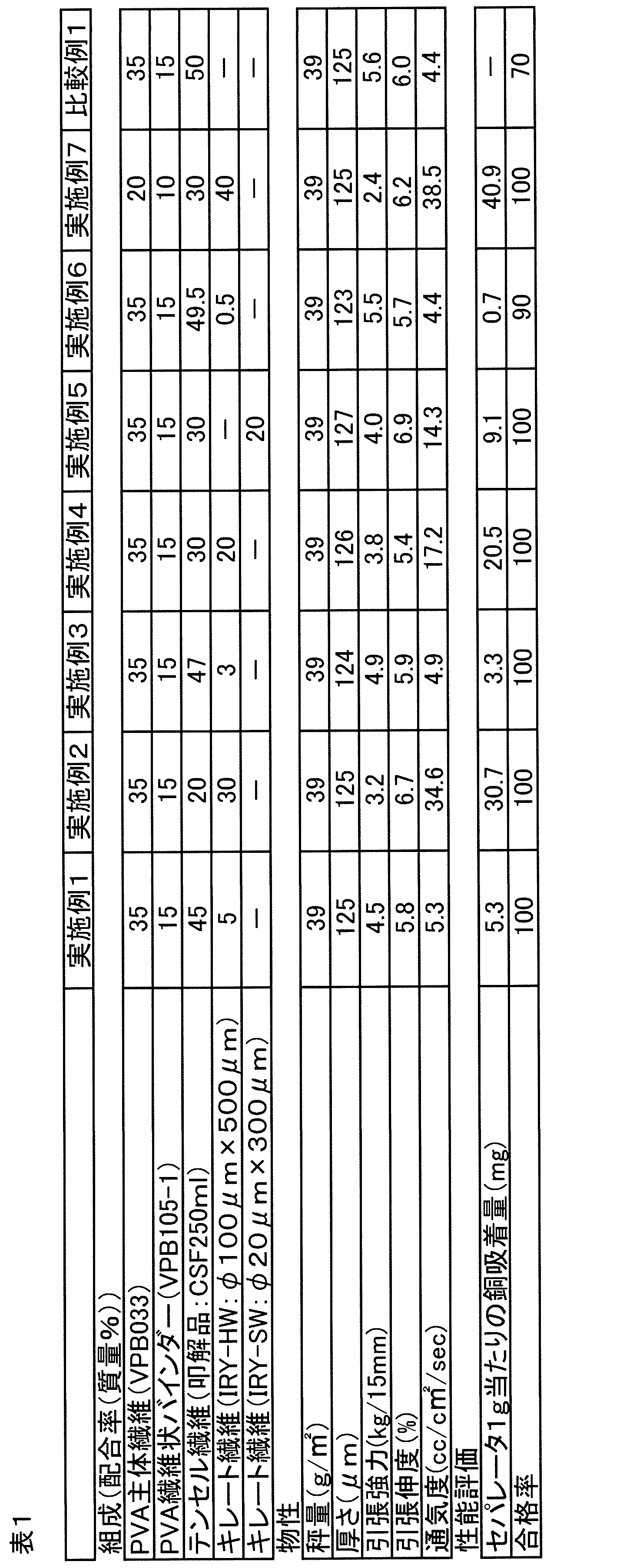
- the battery was assembled so as to have a structure, and the battery performance was evaluated. The results are shown in Table 1.
- the separator containing the chelate-forming fibers obtained in Examples 1 to 5 has a pass rate in battery evaluation even when copper is mixed in the positive electrode mixture as an impurity. 100%.
- the fibers used since the fibers used have alkali resistance, it is possible to evaluate battery performance without excessive dissolution or shrinkage even in an alkaline electrolyte.
- Comparative Example 1 since the chelate-forming fiber is not included, when copper is mixed as an impurity in the positive electrode mixture, the pass rate in the battery evaluation is reduced to 85%.
- Example 6 the amount of chelate-forming fibers is small compared to other examples, or the amount of copper adsorbed per 1 g of separator is small, and the pass rate in battery evaluation is lower than in other examples. However, it still has a higher pass rate than Comparative Example 1.
- Example 7 although the ring crush strength lower than that in Example 1 is exhibited, the amount of copper adsorbed per 1 g of the separator can be increased.
- the alkaline battery separator of the present invention can capture metal impurities by chelate formation even when metal impurities such as copper are mixed in the active material. And the alkaline battery provided with such a separator can suppress an internal short circuit caused by precipitation of metal impurities and can achieve good discharge characteristics.
Landscapes
- Chemical & Material Sciences (AREA)
- Chemical Kinetics & Catalysis (AREA)
- Electrochemistry (AREA)
- General Chemical & Material Sciences (AREA)
- Engineering & Computer Science (AREA)
- Manufacturing & Machinery (AREA)
- Life Sciences & Earth Sciences (AREA)
- Wood Science & Technology (AREA)
- Cell Separators (AREA)
Abstract
Description
負極では亜鉛などの負極活物質が用いられ、この負極活物質は、酸化反応により酸化されるとともに電子を生成し、正極では二酸化マンガンなどの正極活物質が用いられ、この正極活物質は、還元反応により電子を吸収する。
これにより、アルカリ電池では、酸化還元反応に伴って発生する化学エネルギーが、電気エネルギーとして取り出される。
1.前記正極と負極との内部短絡を防止すること、
2.十分な起電反応を生じさせるために高い電解液吸液性を有し、イオン伝導性が良好で電気抵抗が低いこと、
3.電池内部に組込まれた際の占有率が小さく、正極活物質・負極活物質等の量を増やせる(電池使用可能時間を長くできる)こと、
4.電池内部に組み込まれた際、電池の搬送や携帯時に振動・落下による衝撃によってセパレータ自体が座屈せず、内部短絡を引き起こさないこと、
などの様々な性能が要求される。
本発明の別の目的は、上記の性質に加え、電池の放電性能を抑制することなく、不純物を捕捉することができるアルカリ電池用セパレータを提供することにある。
本発明のさらに別の目的は、キレート形成能を有するセパレータを用いる場合でも、セパレータ自体が膨張等の形状が変化するのを抑制することができるアルカリ電池用セパレータを提供することにある。
本発明の他の目的は、このようなアルカリ電池用セパレータを備えるアルカリ電池を提供することにある。
前記不織布を構成する主体繊維の少なくとも一部に、繊維基材に対して金属イオンに対するキレート形成能を有する官能基が導入されたキレート形成性繊維を含む、アルカリ電池用セパレータである。
本発明の第1の実施態様は、アルカリ電池用セパレータである。セパレータはアルカリ電池において正極と負極とを電気的に分離するとともに、電解液を保持することができる。アルカリ電池用セパレータは、不織布を含むセパレータであり、前記不織布を構成する主体繊維の少なくとも一部に、金属イオンに対するキレート形成能を有する官能基が導入されたキレート形成性繊維を含んでいる。
キレート形成性繊維は、セパレータ中の不織布を構成する主体繊維として用いられる。主体繊維の全てをキレート形成性繊維で構成してもよいし、または、キレート形成性繊維は、主体繊維中の一部を形成する繊維であってもよい。
導入率(質量%)=[(官能基導入後の繊維質量-官能基導入前の繊維質量)/官能基導入前の繊維質量]×100
(上記式において官能基とは、架橋反応性化合物とキレート形成性化合物に由来して導入された全官能基を意味する)。
導入率(質量%)=(A/100)×B
本発明で用いられる不織布は、必要に応じて主体繊維として耐アルカリ性フィブリル化繊維を含んでいてもよい。耐アルカリ性フィブリル化繊維を含む場合、不織布に対して緻密な構造を与え、膨潤抑制効果を発揮することが可能であるとともに、フィブリル化構造によりキレート形成性繊維を不織布中により強力に固定することができる。
また、耐アルカリ性フィブリル化繊維は、繊維全体としてフィブリル化されていればよく、例えば、耐アルカリ性フィブリル化繊維は、濾水度が異なる複数種(例えば、2~4種類、好ましくは2~3種類、より好ましくは2種類)の繊維を組み合わせ、全体として上述の所定の濾水度を示すようにしてもよい。
本発明で用いられる不織布は、必要に応じて主体繊維として形状保持繊維を含んでいてもよい。形状保持繊維は、アルカリ性電解液中で、キレート形成性繊維より高い剛性を有することにより、キレート形成性繊維の膨潤により不織布が膨張するのを抑制し、セパレータ形状の保持性を高める役割を有することができる。
耐アルカリ性バインダー繊維は、湿式不織布において、キレート繊維の表面をバインダー成分が覆いキレート性能が阻害されないことが重要なため、少量の添加量(例えば、固形分換算で不織布中5~20質量%程度、好ましくは8~18質量%程度)でバインダー性能が発現するものが好適に用いられる。耐アルカリ性バインダー繊維としては、例えば、ポリビニルアルコール系バインダー繊維、エチレン-ビニルアルコール系バインダー繊維などが例示できる。これらのバインダー繊維は、単独で、または二種以上を組み合わせて用いてもよい。
本発明のアルカリ電池用セパレータは、不織布の形状に応じて、公知又は慣用の方法により製造することができる。
不織布を構成する主体繊維の少なくとも一部にキレート形成性繊維を含ませるためには、一旦不織布を形成した後、得られた不織布を繊維基材として、上述の方法により繊維基材中の繊維分子に対して、キレート形成性官能基(例えば、アミノポリカルボン酸基など)を導入してもよい。
または、繊維準備段階においてキレート形成性繊維を準備し、その繊維を主体繊維の構成材料の少なくとも一部として用いて乾式または湿式抄造により不織布を得てもよい。
例えば、不織布が湿式不織布である場合、製造方法の一実施態様では、例えば、製造方法は、主体繊維などが水に分散したスラリーを準備する工程と、前記スラリーを抄紙する抄紙化工程とを備えていてもよい。
これらのうち、効率よくセパレータを製造する観点から、主体繊維が、キレート形成性繊維と、耐アルカリ性フィブリル化繊維および/または形状保持繊維とで構成され、前記主体繊維、バインダー繊維などが水に分散したスラリーを準備する工程と、前記スラリーを抄紙する抄紙化工程とを備える製造方法が好ましい。
本発明のアルカリ電池用セパレータは、少なくとも不織布で構成され、不織布を構成する主体繊維の少なくとも一部にキレート形成性繊維を含むセパレータである。
本発明のセパレータは、必要に応じて、前記不織布以外の基材層などを含んでいてもよい。例えば、基材層は、膜またはシート状物であってもよく、キレート形成性繊維を含まない不織布等であってもよい。不織布としては、湿式不織布、乾式不織布(例えば、ニードルパンチ不織布、サーマルボンド不織布、ケミカルボンド不織布、ステッチボンド不織布、水流交絡不織布など)、エアレイド不織布、スパンボンド不織布、メルトブローン不織布、静電紡糸不織布などが挙げられる。
セパレータの坪量・厚さは、電池の種類などに応じて適宜設定することができるが、セパレータを薄くする観点から、セパレータの坪量は、例えば、15~50g/m2程度であってもよく、好ましくは20~45g/m2程度であってもよい。また、セパレータの厚さは、例えば、50~300μm程度であってもよく、好ましくは70~200μm程度、より好ましくは80~150μm程度であってもよい。
電池の内部抵抗を低くする観点から、セパレータの通気度は、例えば1~500cc/cm2/sec程度であってもよく、好ましくは3~450cc/cm2/sec程度、より好ましくは4~430cc/cm2/sec程度、さらに好ましくは5~400cc/cm2/sec程度であってもよい。ここで、通気度とは、後述する実施例に記載した方法により測定される値である。
吸着対象とする不純物金属の吸着率は、例えば、セパレータ1g当たり、0.5mg以上であってもよく、好ましくは1mg以上、より好ましくは3mg以上であってもよい。吸着率の上限は、特に限定されないが、例えば、80mg程度であってもよい。
不純物金属の吸着量は、以下の方法により評価することができる。まず、対象とする金属がイオンとして遊離する金属水溶液(濃度5mmol/L)1リットルを作製する。次いで、セパレータから切り出した試料1gを前記水溶液中に添加して、20℃で20時間撹拌した後、溶液中に残存する金属イオンを定量することによって、セパレータ1gによる不純物吸着量(mg)を不純物金属吸着率として評価することができる。
セパレータの吸液量は、例えば、4g/g以上であってもよく、好ましくは5g/g以上であってもよく、より好ましくは5.5g/g以上であってもよい。その上限は特に定められないが、通常、セパレータの吸液量は、20g/g以下であることが多い。吸液量は、例えば、50mm×50mmの試料を34%KOH液に浴比1/100の条件で30分浸漬し、30秒間自然液切りした後の試料重量を測定し、保液された液体の重量を浸漬前の試料重量で除することによって吸液量を算出することにより評価可能である。
セパレータは、アルカリ電池を製造する際の作業性を阻害しない程度であれば、その材質や厚さに応じた引張強力および引張伸度を有していればよい。セパレータの引張強力は、例えば、1.5kg/15mm以上(例えば1.8~7kg/15mm)であってもよく、好ましくは2kg/15mm以上(例えば2~6kg/15mm)であってもよい。また、セパレータの引張伸度は、例えば、3~15%であってもよく、好ましくは4~10%であってもよい。ここで、引張強力および引張伸度とは、それぞれ後述する実施例に記載した方法により測定される値である。
セパレータは、落下などの衝撃に対して十分な耐衝撃性を備える観点から、リングクラッシュ強力を200g以上とすることが好ましく、より好ましくは、210g以上であってもよい。また、耐衝撃性の観点から、その上限は特に定められないが、通常400g以下である。本発明にいうリングクラッシュ強力は、電池用セパレータにおけるいわゆる「コシ強力」の指標となるものである。例えば、リングクラッシュ強力は、後述する実施例に記載した方法により測定される値である。
本発明の第2の実施形態は、前記セパレータを含むアルカリ電池である。
本発明のアルカリ電池(例えば、アルカリマンガン電池などの一次電池)は、正極と、負極と、これらの間に配設されたセパレータと、電解液とを少なくとも備えている。正極には、正極活物質として例えば二酸化マンガンが含まれていてもよく、負極には、負極活物質として例えば、亜鉛、酸化亜鉛などが含まれていてもよい。
より詳細には、アルカリ電池は、負極活物質を備える負極と、負極の内部に挿入されている負極集電体と、負極の外周にセパレータを介して配設された正極とを備えていてもよい。
JIS P 8121「パルプの濾水度試験方法」に準じてカナダ標準濾水度を測定した。
厚さは、得られたセパレータの5箇所を標準環境下(20℃×65%RH)に4時間以上放置した後、PEACOCK Dial-Thickness Gauge H Type(φ10mm×180g/cm2)にて測定した。密度は坪量を厚さで除して算出する。
JIS P 8124「紙のメートル坪量測定方法」に準じて測定した。
JIS P 8113「紙及び板紙の引張強さ試験方法」に準じて測定した。引張強力は、縦方向における引張強さであり、引張伸度は、縦方向における引張破断伸びを測定した値である。
JIS L 1096 6.27「一般織物試験方法 通気性」に準じ、フラジール形試験機にて測定した。
セパレータから切り出した試料1gを、硫酸銅水溶液(濃度5mmol/L)1リットルに添加し、20℃で20時間攪拌した。その後、溶液中に残存する銅イオンを定量することによって、セパレータ1gによる銅吸着量(mg)を評価した。
50mm×50mmの試料を34%KOH液に浴比1/100の条件で30分浸漬し、30秒間自然液切りした後の試料重量を測定し、保液された液体の重量を浸漬前の試料重量で除することによって吸液量を算出した。
試料(45mm×50mm)を筒状に2重捲きにし、セパレータの横方向を内径8mmφ×長さ40mmのPP製の筒の中に縦方向になるように挿入する。その後34%KOH液を添加し、筒状に入れたセパレータの上部先端(高さ45mm)まで濡れるようにする。その後、カトーテック(株)製ハンディー圧縮試験機(KES-G5)を使用し、加圧板(2cm2)を圧縮速度1mm/secにて降下させ、筒から出た試料5mmの圧縮強力を測定した。
電池性能評価方法として、単3(LR6)サイズのアルカリ乾電池を各20本作成し放電性能を比較した。放電性能は環境温度20℃において、3.9Ω負荷で1日5分間ずつの間欠放電したときの終止電圧0.9Vに至るまでの放電時間を測定した。評価としては正極へ銅パウダー未添加のものの放電時間平均値を100とし、短絡もしくは容量低下で95未満となっているものを不合格として20本で合格率を数値化して判断した。
合格率(%)=20本中の合格本数(放電時間指数で95以上)÷20×100
(1)スラリーの作製
ポリビニルアルコール主体繊維(クラレ社製、ビニロン:VPB033;0.3dtex,3mm)35重量%、ポリビニルアルコールバインダー繊維(クラレ社製、ビニロンバインダー:VPB105-1;1.1dtex,3mm)15重量%、叩解処理した溶剤系セルロース繊維(レンチング社製、「テンセル」;1.7dtex,2mmの叩解物:CSF=250ml)45重量%、およびキレート繊維(キレスト社製、再生セルロース繊維を繊維基材とし、イミノ二酢酸基を官能基として有するキレストファイバーIRY-HW;繊維径100μm,0.5mm)5重量%となるように、これらの繊維を水に分散させてスラリーを調製した。
調整したスラリーを、2層漉き可能な円網-円網抄紙機により、2層で漉き合わせ抄紙を行い、得られた原紙をヤンキー型乾燥機で乾燥し、坪量39g/m2、厚さ125μmのアルカリ電池用セパレータを得た。得られたセパレータの吸液量は、5.98g/gであり、リングクラッシュ強力は300gであった。その他の物性の評価結果を表1に示す。
二酸化マンガン94.3質量%、黒鉛粉末4.8質量%、および電解液である40質量%のKOH水溶液0.9質量%からなる正極合剤をミキサーで均一に混合し調整した。今回の試験ではさらに銅パウダーを0.003質量%添加し上記の調整を行った。
続いて調整された正極合剤を短筒状のペレットに圧縮成型した。
一方、負極合剤としては、ゲル化剤であるポリアクリル酸ナトリウム1質量%、40質量%濃度のKOH水溶液33質量%、亜鉛合金粉末66質量%のゲル状の負極合剤を用いた。得られた正極合剤ペレット、ゲル状負極合剤、及び得られたセパレータと底紙(ビニロン不織布/セロハン/ビニロン不織布の複合体)を用いて、セパレータがラウンドストリップ(筒捲円筒状セパレータ)型構造となるように電池を組立て、電池性能評価を行った。その結果を表1に示す。
スラリーの作製において、ポリビニルアルコール主体繊維(クラレ社製、ビニロン:VPB033;0.3dtex,3mm)35重量%、ポリビニルアルコールバインダー繊維(クラレ社製、ビニロンバインダー:VPB105-1;1.1dtex,3mm)15重量%、叩解処理した溶剤系セルロース繊維(レンチング社製、「テンセル」;1.7dtex,2mmの叩解物:CSF=250ml)20重量%、およびキレート繊維(キレスト社製、再生セルロース繊維を繊維基材とし、イミノ二酢酸基を官能基として有するキレストファイバーIRY-HW;繊維径100μm,0.5mm)30重量%となるように、これらの繊維を水に分散させてスラリーを調製すること以外は実施例1と同様にして、セパレータおよび電池を作製した。その結果を表1に示す。
スラリーの作製において、ポリビニルアルコール主体繊維(クラレ社製、ビニロン:VPB033;0.3dtex,3mm)35重量%、ポリビニルアルコールバインダー繊維(クラレ社製、ビニロンバインダー:VPB105-1;1.1dtex,3mm)15重量%、叩解処理した溶剤系セルロース繊維(レンチング社製、「テンセル」;1.7dtex,2mmの叩解物:CSF=250ml)47重量%、およびキレート繊維(キレスト社製、再生セルロース繊維を繊維基材とし、イミノ二酢酸基を官能基として有するキレストファイバーIRY-HW;繊維径100μm,0.5mm)3重量%となるように、これらの繊維を水に分散させてスラリーを調製すること以外は実施例1と同様にして、セパレータおよび電池を作製した。その結果を表1に示す。
スラリーの作製において、ポリビニルアルコール主体繊維(クラレ社製、ビニロン:VPB033;0.3dtex,3mm)35重量%、ポリビニルアルコールバインダー繊維(クラレ社製、ビニロンバインダー:VPB105-1;1.1dtex,3mm)15重量%、叩解処理した溶剤系セルロース繊維(レンチング社製、「テンセル」;1.7dtex,2mmの叩解物:CSF=250ml)30重量%、およびキレート繊維(キレスト社製、再生セルロース繊維を繊維基材とし、イミノ二酢酸基を官能基として有するキレストファイバーIRY-HW;繊維径100μm,0.5mm)20重量%となるように、これらの繊維を水に分散させてスラリーを調製すること以外は実施例1と同様にして、セパレータおよび電池を作製した。その結果を表1に示す。
スラリーの作製において、ポリビニルアルコール主体繊維(クラレ社製、ビニロン:VPB033;0.3dtex,3mm)35重量%、ポリビニルアルコールバインダー繊維(クラレ社製、ビニロンバインダー:VPB105-1;1.1dtex,3mm)15重量%、叩解処理した溶剤系セルロース繊維(レンチング社製、「テンセル」;1.7dtex,2mmの叩解物:CSF=250ml)30重量%、およびキレート繊維(キレスト社製、再生セルロース繊維を繊維基材とし、イミノ二酢酸基を官能基として有するキレストファイバーIRY-SW;繊維径20μm,0.3mm)20重量%となるように、これらの繊維を水に分散させてスラリーを調製すること以外は実施例1と同様にして、セパレータおよび電池を作製した。その結果を表1に示す。
スラリーの作製において、ポリビニルアルコール主体繊維(クラレ社製、ビニロン:VPB033;0.3dtex,3mm)35重量%、ポリビニルアルコールバインダー繊維(クラレ社製、ビニロンバインダー:VPB105-1;1.1dtex,3mm)15重量%、叩解処理した溶剤系セルロース繊維(レンチング社製、「テンセル」;1.7dtex,2mmの叩解物:CSF=250ml)49.5重量%、およびキレート繊維(キレスト社製、再生セルロース繊維を繊維基材とし、イミノ二酢酸基を官能基として有するキレストファイバーIRY-HW;繊維径100μm,0.5mm)0.5重量%となるように、これらの繊維を水に分散させてスラリーを調製すること以外は実施例1と同様にして、セパレータおよび電池を作製した。その結果を表1に示す。
スラリーの作製において、ポリビニルアルコール主体繊維(クラレ社製、ビニロン:VPB033;0.3dtex,3mm)20重量%、ポリビニルアルコールバインダー繊維(クラレ社製、ビニロンバインダー:VPB105-1;1.1dtex,3mm)10重量%、叩解処理した溶剤系セルロース繊維(レンチング社製、「テンセル」;1.7dtex,2mmの叩解物:CSF=250ml)30重量%、およびキレート繊維(キレスト社製、再生セルロース繊維を繊維基材とし、イミノ二酢酸基を官能基として有するキレストファイバーIRY-HW;繊維径100μm,0.5mm)40重量%となるように、これらの繊維を水に分散させてスラリーを調製すること以外は実施例1と同様にして、セパレータを作製した。得られたセパレータのリングクラッシュ強力は230gであった。その他の物性の評価結果を表1に示す。
スラリーの作製において、ポリビニルアルコール主体繊維(クラレ社製、ビニロン:VPB033;0.3dtex,3mm)35重量%、ポリビニルアルコールバインダー繊維(クラレ社製、ビニロンバインダー:VPB105-1;1.1dtex,3mm)15重量%、叩解処理した溶剤系セルロース繊維(レンチング社製、「テンセル」1.7dtex,2mmの叩解物:CSF=250ml)50重量%となるように、これらの繊維を水に分散させてスラリーを調製すること以外は実施例1と同様にして、セパレータおよび電池を作製した。その結果を表1に示す。
Claims (15)
- 不織布を含むセパレータであって、
前記不織布を構成する主体繊維の少なくとも一部に、繊維基材に対して金属イオンに対するキレート形成能を有する官能基が導入されたキレート形成性繊維を含む、アルカリ電池用セパレータ。 - 請求項1のセパレータにおいて、キレート形成能を有する官能基が、アミノポリカルボン酸基である、アルカリ電池用セパレータ。
- 請求項1または2のセパレータにおいて、キレート形成性繊維が、セルロース系繊維に対して、キレート形成性の官能基が導入されている繊維である、アルカリ電池用セパレータ。
- 請求項1~3のいずれか一項のセパレータにおいて、主体繊維が、キレート形成性繊維と、キレート形成性繊維以外の他の繊維とで構成されている、アルカリ電池用セパレータ。
- 請求項1~4のいずれか一項のセパレータにおいて、不織布中のキレート形成性繊維の割合が1~30質量%である、アルカリ電池用セパレータ。
- 請求項1~5のいずれか一項のセパレータにおいて、不織布の主体繊維が、さらに耐アルカリ性フィブリル化繊維を含む、アルカリ電池用セパレータ。
- 請求項6のセパレータにおいて、耐アルカリ性フィブリル化繊維が、セルロース系フィブリル化繊維で構成される、アルカリ電池用セパレータ。
- 請求項6または7のセパレータにおいて、キレート形成性繊維と耐アルカリ性フィブリル化繊維との質量比が、キレート形成性繊維/耐アルカリ性フィブリル化繊維=2/98~60/40である、アルカリ電池用セパレータ。
- 請求項1~8のいずれか一項のセパレータにおいて、不織布の主体繊維が、さらに形状保持繊維を含む、アルカリ電池用セパレータ。
- 請求項9のセパレータにおいて、形状保持繊維が、ポリビニルアルコール系繊維で構成される、アルカリ電池用セパレータ。
- 請求項9または10のセパレータにおいて、キレート形成性繊維と形状保持繊維との質量比が、キレート形成性繊維/形状保持繊維=2/98~70/30である、アルカリ電池用セパレータ。
- 請求項1~11のいずれか一項のセパレータにおいて、セパレータ1g当たりの不純物金属吸着率が0.5mg以上である、アルカリ電池用セパレータ。
- 請求項1~12のいずれか一項のセパレータにおいて、通気度が1~500cc/cm2/secである、アルカリ電池用セパレータ。
- 請求項1~13のいずれか一項のセパレータにおいて、厚さが50~300μmである、アルカリ電池用セパレータ。
- 正極と、負極と、これらの間に配設されたセパレータと、電解液とを少なくとも含むアルカリ電池であって、セパレータが請求項1~14のいずれか一項に記載のセパレータであるアルカリ電池。
Priority Applications (5)
| Application Number | Priority Date | Filing Date | Title |
|---|---|---|---|
| JP2016510385A JP6576909B2 (ja) | 2014-03-25 | 2015-03-24 | アルカリ電池用セパレータおよびこれを用いたアルカリ電池 |
| CN201580015849.9A CN106133946B (zh) | 2014-03-25 | 2015-03-24 | 碱性电池用隔板及使用其的碱性电池 |
| EP15767746.9A EP3125335B1 (en) | 2014-03-25 | 2015-03-24 | Separator for alkaline batteries, and alkaline battery using same |
| ES15767746T ES2704736T3 (es) | 2014-03-25 | 2015-03-24 | Separador para pilas alcalinas y pila alcalina que usa el mismo |
| US15/267,604 US10461294B2 (en) | 2014-03-25 | 2016-09-16 | Separator for alkaline batteries, and alkaline battery using same |
Applications Claiming Priority (2)
| Application Number | Priority Date | Filing Date | Title |
|---|---|---|---|
| JP2014-061244 | 2014-03-25 | ||
| JP2014061244 | 2014-03-25 |
Related Child Applications (1)
| Application Number | Title | Priority Date | Filing Date |
|---|---|---|---|
| US15/267,604 Continuation US10461294B2 (en) | 2014-03-25 | 2016-09-16 | Separator for alkaline batteries, and alkaline battery using same |
Publications (1)
| Publication Number | Publication Date |
|---|---|
| WO2015146983A1 true WO2015146983A1 (ja) | 2015-10-01 |
Family
ID=54195495
Family Applications (1)
| Application Number | Title | Priority Date | Filing Date |
|---|---|---|---|
| PCT/JP2015/058925 Ceased WO2015146983A1 (ja) | 2014-03-25 | 2015-03-24 | アルカリ電池用セパレータおよびこれを用いたアルカリ電池 |
Country Status (6)
| Country | Link |
|---|---|
| US (1) | US10461294B2 (ja) |
| EP (1) | EP3125335B1 (ja) |
| JP (1) | JP6576909B2 (ja) |
| CN (1) | CN106133946B (ja) |
| ES (1) | ES2704736T3 (ja) |
| WO (1) | WO2015146983A1 (ja) |
Cited By (1)
| Publication number | Priority date | Publication date | Assignee | Title |
|---|---|---|---|---|
| CN109328408A (zh) * | 2016-06-27 | 2019-02-12 | 日本高度纸工业株式会社 | 电化学元件用分隔件和电化学元件、汽车、电子设备 |
Families Citing this family (8)
| Publication number | Priority date | Publication date | Assignee | Title |
|---|---|---|---|---|
| JP6649022B2 (ja) * | 2015-09-28 | 2020-02-19 | ニッポン高度紙工業株式会社 | 電気化学素子用セパレータ及び電気化学素子 |
| KR20170095020A (ko) * | 2016-02-12 | 2017-08-22 | 주식회사 이엠따블유에너지 | 공기-아연 이차전지 |
| CN109768221A (zh) * | 2017-11-09 | 2019-05-17 | 江苏金阳光新能源科技有限公司 | 一种高性能的锰系材料正极浆料及其制备方法 |
| US20190379010A1 (en) * | 2018-06-08 | 2019-12-12 | Cyberx Engineering Inc. | Flexible batteries |
| CN109208369A (zh) * | 2018-09-10 | 2019-01-15 | 浙江凯恩特种纸业有限公司 | 一种低损耗电解电容器纸及其制备方法 |
| AU2021273919A1 (en) | 2020-05-22 | 2022-10-06 | Duracell U.S. Operations, Inc. | Seal assembly for a battery cell |
| CN113300047B (zh) * | 2021-05-24 | 2022-04-19 | 万邦特种材料股份有限公司 | 一种碱性电池专用高性能复合隔膜材料的制备方法 |
| US20250108365A1 (en) | 2023-07-22 | 2025-04-03 | GM Global Technology Operations LLC | Functionalized polymer separator membrane for mitigating transition metal dissolution and trapping acidic species |
Citations (5)
| Publication number | Priority date | Publication date | Assignee | Title |
|---|---|---|---|---|
| JPH06223800A (ja) * | 1993-01-26 | 1994-08-12 | Japan Vilene Co Ltd | アルカリ電池用セパレータ、この製造方法及びこれを用いたアルカリ電池 |
| JPH09199100A (ja) * | 1996-01-23 | 1997-07-31 | Mitsui Petrochem Ind Ltd | アルカリ電池用セパレーター及びその製法 |
| JPH10144282A (ja) * | 1996-07-04 | 1998-05-29 | Mitsubishi Paper Mills Ltd | アルカリ二次電池用セパレータ |
| JP2004253196A (ja) * | 2003-02-19 | 2004-09-09 | Sanyo Electric Co Ltd | アルカリ蓄電池 |
| JP2008021497A (ja) * | 2006-07-12 | 2008-01-31 | Fdk Energy Co Ltd | アルカリ電池 |
Family Cites Families (9)
| Publication number | Priority date | Publication date | Assignee | Title |
|---|---|---|---|---|
| EP0563773B1 (en) | 1992-03-26 | 1996-06-12 | Japan Vilene Company, Ltd. | A battery separator and a battery |
| JP3482606B2 (ja) * | 1994-08-11 | 2003-12-22 | 日本電池株式会社 | 密閉形アルカリ蓄電池 |
| JP3940236B2 (ja) | 1999-02-26 | 2007-07-04 | キレスト株式会社 | 金属キレート形成性繊維及びその製法、並びに該繊維を用いた金属イオン捕捉法及び金属キレート繊維 |
| JP4162455B2 (ja) | 2002-09-11 | 2008-10-08 | 株式会社クラレ | アルカリ電池用セパレーターおよびそれを用いてなる電池 |
| US7914920B2 (en) | 2003-10-09 | 2011-03-29 | The Gillette Company | Battery separator |
| WO2006035614A1 (ja) * | 2004-09-27 | 2006-04-06 | Kuraray Co., Ltd. | バインダー繊維およびこれを用いたアルカリ電池用セパレータ |
| JP5032748B2 (ja) * | 2005-02-25 | 2012-09-26 | 株式会社クラレ | アルカリ電池用セパレータ及びアルカリ一次電池 |
| US20070024241A1 (en) * | 2005-07-26 | 2007-02-01 | Bean Heather N | Battery monitoring circuit and method |
| US7532455B2 (en) * | 2006-04-14 | 2009-05-12 | Maxwell Technologies, Inc. | Energy storage device having a separator blocking parasitic ions |
-
2015
- 2015-03-24 WO PCT/JP2015/058925 patent/WO2015146983A1/ja not_active Ceased
- 2015-03-24 EP EP15767746.9A patent/EP3125335B1/en active Active
- 2015-03-24 CN CN201580015849.9A patent/CN106133946B/zh active Active
- 2015-03-24 ES ES15767746T patent/ES2704736T3/es active Active
- 2015-03-24 JP JP2016510385A patent/JP6576909B2/ja active Active
-
2016
- 2016-09-16 US US15/267,604 patent/US10461294B2/en active Active
Patent Citations (5)
| Publication number | Priority date | Publication date | Assignee | Title |
|---|---|---|---|---|
| JPH06223800A (ja) * | 1993-01-26 | 1994-08-12 | Japan Vilene Co Ltd | アルカリ電池用セパレータ、この製造方法及びこれを用いたアルカリ電池 |
| JPH09199100A (ja) * | 1996-01-23 | 1997-07-31 | Mitsui Petrochem Ind Ltd | アルカリ電池用セパレーター及びその製法 |
| JPH10144282A (ja) * | 1996-07-04 | 1998-05-29 | Mitsubishi Paper Mills Ltd | アルカリ二次電池用セパレータ |
| JP2004253196A (ja) * | 2003-02-19 | 2004-09-09 | Sanyo Electric Co Ltd | アルカリ蓄電池 |
| JP2008021497A (ja) * | 2006-07-12 | 2008-01-31 | Fdk Energy Co Ltd | アルカリ電池 |
Non-Patent Citations (1)
| Title |
|---|
| See also references of EP3125335A4 * |
Cited By (4)
| Publication number | Priority date | Publication date | Assignee | Title |
|---|---|---|---|---|
| CN109328408A (zh) * | 2016-06-27 | 2019-02-12 | 日本高度纸工业株式会社 | 电化学元件用分隔件和电化学元件、汽车、电子设备 |
| EP3477742A4 (en) * | 2016-06-27 | 2020-03-25 | Nippon Kodoshi Corporation | SEPARATOR FOR ELECTROCHEMICAL ELEMENT, ELECTROCHEMICAL ELEMENT, MOTOR VEHICLE AND ELECTRONIC DEVICE |
| US10892456B2 (en) | 2016-06-27 | 2021-01-12 | Nippon Kodoshi Corporation | Separator for electrochemical element, electrochemical element, automobile, and electronic device |
| CN109328408B (zh) * | 2016-06-27 | 2021-06-29 | 日本高度纸工业株式会社 | 电化学元件用分隔件和电化学元件、汽车、电子设备 |
Also Published As
| Publication number | Publication date |
|---|---|
| EP3125335A1 (en) | 2017-02-01 |
| CN106133946B (zh) | 2019-05-21 |
| US10461294B2 (en) | 2019-10-29 |
| EP3125335B1 (en) | 2018-10-17 |
| EP3125335A4 (en) | 2017-09-06 |
| JPWO2015146983A1 (ja) | 2017-04-13 |
| ES2704736T3 (es) | 2019-03-19 |
| JP6576909B2 (ja) | 2019-09-18 |
| CN106133946A (zh) | 2016-11-16 |
| US20170005311A1 (en) | 2017-01-05 |
Similar Documents
| Publication | Publication Date | Title |
|---|---|---|
| JP6576909B2 (ja) | アルカリ電池用セパレータおよびこれを用いたアルカリ電池 | |
| JP5032748B2 (ja) | アルカリ電池用セパレータ及びアルカリ一次電池 | |
| JP5756808B2 (ja) | アルカリ電池用セパレータおよびこれを用いたアルカリ電池 | |
| JP6872493B2 (ja) | アルカリ電池用セパレータ及びアルカリ電池 | |
| EP3425698B9 (en) | Alkaline battery separator and alkaline battery | |
| JP2014123443A (ja) | アルカリ電池用セパレータ及びアルカリ電池 | |
| CN113597697A (zh) | 碱性电池用分隔件和碱性电池 | |
| JP2012109268A (ja) | アルカリ電池用セパレータ及びアルカリ一次電池 | |
| WO2019131588A1 (ja) | セパレータおよび該セパレータからなるアルカリマンガン乾電池用セパレータ | |
| JPH0572063B2 (ja) | ||
| JP6739946B2 (ja) | アルカリ電池用セパレータ及びアルカリ電池 | |
| KR101915941B1 (ko) | 알칼리 전지용 세퍼레이터 | |
| JP2017157349A (ja) | アルカリ電池用セパレータ及びアルカリ電池 | |
| JP2021158273A (ja) | 電気化学素子用セパレータ | |
| CN114902364B (zh) | 电化学元件用隔板 | |
| JP2002198026A (ja) | 電池用セパレータ及びその製造方法 | |
| CN119686165A (zh) | 一种隔膜纸及其制备方法和在碱性电池中的应用 | |
| JP2002279957A (ja) | アルカリ電池用セパレータ紙 | |
| JPH07122258A (ja) | アルカリ電池セパレ−タ用不織布及びその製造方法 |
Legal Events
| Date | Code | Title | Description |
|---|---|---|---|
| 121 | Ep: the epo has been informed by wipo that ep was designated in this application |
Ref document number: 15767746 Country of ref document: EP Kind code of ref document: A1 |
|
| ENP | Entry into the national phase |
Ref document number: 2016510385 Country of ref document: JP Kind code of ref document: A |
|
| REEP | Request for entry into the european phase |
Ref document number: 2015767746 Country of ref document: EP |
|
| WWE | Wipo information: entry into national phase |
Ref document number: 2015767746 Country of ref document: EP |
|
| NENP | Non-entry into the national phase |
Ref country code: DE |