WO2015151346A1 - ポリオルガノシロキサン、ポリカーボネート-ポリオルガノシロキサン共重合体及びその製造方法 - Google Patents
ポリオルガノシロキサン、ポリカーボネート-ポリオルガノシロキサン共重合体及びその製造方法 Download PDFInfo
- Publication number
- WO2015151346A1 WO2015151346A1 PCT/JP2014/083055 JP2014083055W WO2015151346A1 WO 2015151346 A1 WO2015151346 A1 WO 2015151346A1 JP 2014083055 W JP2014083055 W JP 2014083055W WO 2015151346 A1 WO2015151346 A1 WO 2015151346A1
- Authority
- WO
- WIPO (PCT)
- Prior art keywords
- group
- polyorganosiloxane
- carbon atoms
- log
- molecular weight
- Prior art date
- Legal status (The legal status is an assumption and is not a legal conclusion. Google has not performed a legal analysis and makes no representation as to the accuracy of the status listed.)
- Ceased
Links
Images

Classifications
-
- C—CHEMISTRY; METALLURGY
- C08—ORGANIC MACROMOLECULAR COMPOUNDS; THEIR PREPARATION OR CHEMICAL WORKING-UP; COMPOSITIONS BASED THEREON
- C08G—MACROMOLECULAR COMPOUNDS OBTAINED OTHERWISE THAN BY REACTIONS ONLY INVOLVING UNSATURATED CARBON-TO-CARBON BONDS
- C08G77/00—Macromolecular compounds obtained by reactions forming a linkage containing silicon with or without sulfur, nitrogen, oxygen or carbon in the main chain of the macromolecule
- C08G77/42—Block-or graft-polymers containing polysiloxane sequences
- C08G77/448—Block-or graft-polymers containing polysiloxane sequences containing polycarbonate sequences
-
- C—CHEMISTRY; METALLURGY
- C08—ORGANIC MACROMOLECULAR COMPOUNDS; THEIR PREPARATION OR CHEMICAL WORKING-UP; COMPOSITIONS BASED THEREON
- C08G—MACROMOLECULAR COMPOUNDS OBTAINED OTHERWISE THAN BY REACTIONS ONLY INVOLVING UNSATURATED CARBON-TO-CARBON BONDS
- C08G64/00—Macromolecular compounds obtained by reactions forming a carbonic ester link in the main chain of the macromolecule
- C08G64/18—Block or graft polymers
- C08G64/186—Block or graft polymers containing polysiloxane sequences
-
- C—CHEMISTRY; METALLURGY
- C08—ORGANIC MACROMOLECULAR COMPOUNDS; THEIR PREPARATION OR CHEMICAL WORKING-UP; COMPOSITIONS BASED THEREON
- C08G—MACROMOLECULAR COMPOUNDS OBTAINED OTHERWISE THAN BY REACTIONS ONLY INVOLVING UNSATURATED CARBON-TO-CARBON BONDS
- C08G77/00—Macromolecular compounds obtained by reactions forming a linkage containing silicon with or without sulfur, nitrogen, oxygen or carbon in the main chain of the macromolecule
- C08G77/04—Polysiloxanes
- C08G77/22—Polysiloxanes containing silicon bound to organic groups containing atoms other than carbon, hydrogen and oxygen
- C08G77/24—Polysiloxanes containing silicon bound to organic groups containing atoms other than carbon, hydrogen and oxygen halogen-containing groups
-
- C—CHEMISTRY; METALLURGY
- C08—ORGANIC MACROMOLECULAR COMPOUNDS; THEIR PREPARATION OR CHEMICAL WORKING-UP; COMPOSITIONS BASED THEREON
- C08G—MACROMOLECULAR COMPOUNDS OBTAINED OTHERWISE THAN BY REACTIONS ONLY INVOLVING UNSATURATED CARBON-TO-CARBON BONDS
- C08G77/00—Macromolecular compounds obtained by reactions forming a linkage containing silicon with or without sulfur, nitrogen, oxygen or carbon in the main chain of the macromolecule
- C08G77/04—Polysiloxanes
- C08G77/22—Polysiloxanes containing silicon bound to organic groups containing atoms other than carbon, hydrogen and oxygen
- C08G77/26—Polysiloxanes containing silicon bound to organic groups containing atoms other than carbon, hydrogen and oxygen nitrogen-containing groups
-
- C—CHEMISTRY; METALLURGY
- C08—ORGANIC MACROMOLECULAR COMPOUNDS; THEIR PREPARATION OR CHEMICAL WORKING-UP; COMPOSITIONS BASED THEREON
- C08G—MACROMOLECULAR COMPOUNDS OBTAINED OTHERWISE THAN BY REACTIONS ONLY INVOLVING UNSATURATED CARBON-TO-CARBON BONDS
- C08G77/00—Macromolecular compounds obtained by reactions forming a linkage containing silicon with or without sulfur, nitrogen, oxygen or carbon in the main chain of the macromolecule
- C08G77/04—Polysiloxanes
- C08G77/38—Polysiloxanes modified by chemical after-treatment
-
- C—CHEMISTRY; METALLURGY
- C08—ORGANIC MACROMOLECULAR COMPOUNDS; THEIR PREPARATION OR CHEMICAL WORKING-UP; COMPOSITIONS BASED THEREON
- C08L—COMPOSITIONS OF MACROMOLECULAR COMPOUNDS
- C08L83/00—Compositions of macromolecular compounds obtained by reactions forming in the main chain of the macromolecule a linkage containing silicon with or without sulfur, nitrogen, oxygen or carbon only; Compositions of derivatives of such polymers
- C08L83/10—Block- or graft-copolymers containing polysiloxane sequences
-
- C—CHEMISTRY; METALLURGY
- C08—ORGANIC MACROMOLECULAR COMPOUNDS; THEIR PREPARATION OR CHEMICAL WORKING-UP; COMPOSITIONS BASED THEREON
- C08G—MACROMOLECULAR COMPOUNDS OBTAINED OTHERWISE THAN BY REACTIONS ONLY INVOLVING UNSATURATED CARBON-TO-CARBON BONDS
- C08G2115/00—Oligomerisation
-
- C—CHEMISTRY; METALLURGY
- C08—ORGANIC MACROMOLECULAR COMPOUNDS; THEIR PREPARATION OR CHEMICAL WORKING-UP; COMPOSITIONS BASED THEREON
- C08G—MACROMOLECULAR COMPOUNDS OBTAINED OTHERWISE THAN BY REACTIONS ONLY INVOLVING UNSATURATED CARBON-TO-CARBON BONDS
- C08G77/00—Macromolecular compounds obtained by reactions forming a linkage containing silicon with or without sulfur, nitrogen, oxygen or carbon in the main chain of the macromolecule
- C08G77/04—Polysiloxanes
- C08G77/20—Polysiloxanes containing silicon bound to unsaturated aliphatic groups
Definitions
- the present invention relates to a polyorganosiloxane, a polycarbonate-polyorganosiloxane copolymer capable of obtaining a polycarbonate molded product with less yellowness without impairing transparency and low-temperature impact resistance, and a method for producing the same.
- PC-POS Polycarbonate-polyorganosiloxane copolymers
- properties such as high impact resistance, chemical resistance, and flame retardancy. It is expected to be widely used in various fields such as equipment field and automobile field. Especially for mobile phones, smartphones, mobile PCs, tablets, portable terminals, etc., lighting covers, building materials, digital cameras, video cameras, etc. that require visibility, police shields, helmet visors, sports Use for other daily necessities such as protective equipment is spreading. In addition to normal conditions, such as room temperature, these are assumed to be used under low temperature, such as a cold region, or outdoors.
- a homopolycarbonate using 2,2-bis (4-hydroxyphenyl) propane [common name: bisphenol A] as a dihydric phenol as a raw material is generally used.
- a polycarbonate-polyorganosiloxane copolymer using polyorganosiloxane as a copolymerization monomer is known. It is known that a polycarbonate-polyorganosiloxane copolymer is superior in flame retardancy and impact resistance compared to a homopolycarbonate such as bisphenol A (Patent Document 1).
- Patent Document 2 discloses a polycarbonate-polyorganosiloxane copolymer with improved transparency, and evaluates the total light transmittance, haze value, and the like.
- Patent Document 3 discloses a polycarbonate-polyorganosiloxane copolymer with improved color tone. Patent Document 3 teaches that by reducing the content of a specific component in a polycarbonate-polyorganosiloxane copolymer, the difference in color tone due to residence time during injection molding is small as well as excellent thermal stability. ing.
- An object of the present invention is to provide a polycarbonate-polyorganosiloxane copolymer which is excellent in transparency and has little yellowness without deteriorating mechanical properties.
- the present inventors have found that the above problem can be achieved by controlling the molecular weight distribution of the polyorganosiloxane used in the polycarbonate-polyorganosiloxane copolymer. That is, the present invention relates to the following 1 to 11. 1. Obtained from measurement by gel permeation chromatography using polystyrene as a conversion standard, the horizontal axis is a logarithmic value log (M) of molecular weight M, and the vertical axis is a derivative of concentration fraction w by logarithmic value log (M) of molecular weight.
- the integrated value of dw / dlog (M) in the range of 2.5 ⁇ log (M) ⁇ 3.1 is the entire range of log (M) Polyorganosiloxane having a dw / dlog (M) value of 0 to 10% based on the integrated value.
- 3. The polyorganosiloxane according to 1 or 2, having an average chain length of 20 to 50. 4). 4.
- R 1 to R 4 each independently represents a hydrogen atom, a halogen atom, an alkyl group having 1 to 6 carbon atoms, an alkoxy group having 1 to 6 carbon atoms, or an aryl group having 6 to 12 carbon atoms.
- Y is, -R 5 O -, - R 5 COO -, - R 5 NH -, - R 5 NR 6 -, - COO -, - S -, - R 5 COO-R 7 -O-, or -R 5 O—R 8 —O—, wherein R 5 represents a single bond, a linear, branched or cyclic alkylene group, an aryl-substituted alkylene group, an arylene group, or a diarylene group.
- R 6 represents an alkyl group, an alkenyl group, an aryl group, or an aralkyl group.
- R 7 represents a diarylene group.
- R 8 represents a linear, branched or cyclic alkylene group, or a diarylene group.
- Z represents a hydrogen atom or a halogen atom.
- ⁇ represents a divalent group derived from a diisocyanate compound or a divalent group derived from dicarboxylic acid or a halide of dicarboxylic acid.
- the sum of p and q is n, and n represents an average number of repetitions of 20-50. ] 5.
- Polycarbonate-polyorganosiloxane copolymer comprising a polycarbonate block (A) comprising a repeating unit represented by the following general formula (I) and a polyorganosiloxane block (B) comprising a repeating unit represented by the following general formula (II) Coalesce,
- the horizontal axis is the logarithmic value log (M) of the molecular weight M
- the vertical axis is the concentration fraction w obtained from the measurement by gel permeation chromatography using the polystyrene of the polyorganosiloxane block (B) as a conversion standard.
- X is a single bond, an alkylene group having 1 to 8 carbon atoms, an alkylidene group having 2 to 8 carbon atoms, a cycloalkylene group having 5 to 15 carbon atoms, a cycloalkylidene group having 5 to 15 carbon atoms, a fluorenediyl group, a carbon
- R 1 and R 2 each independently represents a hydrogen atom, a halogen atom, an alkyl group having 1 to 6 carbon atoms, an alkoxy group having 1 to 6 carbon atoms or an aryl group having 6 to 12 carbon atoms.
- the average repeating number n of 20 to 50 indicates the total number of siloxane repeating units in the polyorganosiloxane block. ] 7).
- the polycarbonate-polyorganosiloxane copolymer having excellent transparency and low yellowness is obtained without reducing the mechanical strength. Combines can be obtained.
- the polyorganosiloxane of the present invention is obtained by measurement by gel permeation chromatography using polystyrene as a conversion standard, the horizontal axis is a logarithmic value log (M) of molecular weight M, and the vertical axis is concentration fraction w of molecular weight.
- M logarithmic value log
- concentration fraction w concentration fraction w of molecular weight.
- the differential molecular weight distribution curve which is dw / dlog (M) differentiated by logarithmic value log (M)
- the value obtained by integrating dw / dlog (M) value in the range of 2.5 ⁇ log (M) ⁇ 3.1 is , Log (M) over the entire range, dw / dlog (M) value is 0 to 10% of the integrated value.
- a value obtained by integrating dw / dlog (M) values in the range of 2.5 ⁇ log (M) ⁇ 3.1 is dw / M in the entire range of log (M). It is 0 to 10%, preferably 0 to 9%, with respect to the value obtained by integrating the dlog (M) value.
- the said ratio exceeds 10%, it exists in the tendency for the yellowishness of the copolymer of polyorganosiloxane and a polycarbonate to increase.
- the ratio with respect to the molecular weight distribution of polyorganosiloxane indicates the ratio of components having a log (M) of 2.5 to 3.1 to the whole polyorganosiloxane.
- the GPC apparatus for obtaining the molecular weight / molecular weight distribution measurement value of polyorganosiloxane is not particularly limited, and is generally a commercially available high-temperature GPC apparatus such as a high-temperature GPC with a built-in differential refractometer (RI) manufactured by Tosoh Corporation It is possible to use a measuring instrument, “HLC-8200”. Specifically, as a GPC column, a column obtained by connecting “TSK-GEL G4000HXL” and “TSK-GEL G2000HXL” manufactured by Tosoh Corporation is used.
- the column temperature is set to 40 ° C., tetrahydrofuran (THF) is used as the eluent, and measurement is performed at a flow rate of 1.0 ml / min. Standard polystyrene made by Tosoh Corporation is used for preparing the calibration curve.
- the logarithmic value of the molecular weight thus obtained is referred to as logarithmic molecular weight (log (M)).
- a time curve (generally referred to as an elution curve) of an intensity distribution detected by a differential refraction (RI) detector of a GPC apparatus is converted into a molecular weight using a calibration curve obtained from a substance having a known molecular weight.
- RI detection intensity is proportional to the component concentration
- the integrated molecular weight distribution curve can be obtained by sequentially integrating the concentration fractions and plotting the logarithmic value of the molecular weight (log (M)) on the horizontal axis and the integrated value of the concentration fraction (w) on the vertical axis.
- the differential value of the curve in the logarithmic value of each molecular weight (that is, the slope of the integral molecular weight curve) is obtained, the logarithmic value of the molecular weight (log (M)) is plotted on the horizontal axis, and the differential value (dw / dlog ( M)) can be plotted to obtain a differential molecular weight distribution curve. Therefore, the differential molecular weight distribution means a value obtained by differentiating the concentration fraction (w) by the logarithmic value of the molecular weight (log (M)), that is, “dw / dlog (M)”.
- the differential molecular weight distribution dw / dlog (M) at a specific log (M) can be read.
- a differential molecular weight distribution curve can be obtained with the same method.
- the polyorganosiloxane may have a maximum value in the range of dw / dlog (M) of 3.3 ⁇ log (M) ⁇ 3.9.
- the maximum value of the differential molecular weight distribution dw / dlog (M) refers to the peak top in the differential molecular weight distribution curve. If the log (M) when the value of dw / dlog (M) takes the maximum value in the differential molecular weight distribution curve is less than 3.3, the low-temperature impact resistance of the copolymer of polyorganosiloxane and polycarbonate is inferior. As a result, when it exceeds 3.9, the transparency of the copolymer tends to decrease.
- the average chain length of the polyorganosiloxane is preferably 20 to 50, more preferably 30 to 45, and still more preferably 35 to 45.
- the average chain length is calculated by nuclear magnetic resonance (NMR) measurement. If the average chain length is 20 or more, the impact resistance at low temperature of the copolymer of polyorganosiloxane and polycarbonate can be sufficiently obtained. If the average chain length is 50 or less, the copolymer of polyorganosiloxane and polycarbonate is excellent in transparency.
- Examples of the polyorganosiloxane having the above characteristics include those represented by the following general formulas (1) and (2).
- R 1 to R 4 each independently represents a hydrogen atom, a halogen atom, an alkyl group having 1 to 6 carbon atoms, an alkoxy group having 1 to 6 carbon atoms, or an aryl group having 6 to 12 carbon atoms.
- Y is, -R 5 O -, - R 5 COO -, - R 5 NH -, - R 5 NR 6 -, - COO -, - S -, - R 5 COO-R 7 -O-, or -R 5 O—R 8 —O— is shown.
- R 5 represents a single bond, a linear, branched or cyclic alkylene group, an aryl-substituted alkylene group, an arylene group, or a diarylene group.
- R 6 represents an alkyl group, an alkenyl group, an aryl group, or an aralkyl group.
- R 7 represents a diarylene group.
- R 8 represents a linear, branched or cyclic alkylene group, or a diarylene group.
- Z represents a hydrogen atom or a halogen atom.
- ⁇ represents a divalent group derived from a diisocyanate compound or a divalent group derived from dicarboxylic acid or a halide of dicarboxylic acid.
- the sum of p and q is n, and n represents an average number of repetitions of 20-50. ]
- Examples of the halogen atom independently represented by R 1 to R 4 include a fluorine atom, a chlorine atom, a bromine atom, and an iodine atom.
- Examples of the alkyl group independently represented by R 1 to R 4 include a methyl group, an ethyl group, an n-propyl group, an isopropyl group, and various butyl groups (“various” means linear and all branched ones) And the same applies hereinafter), various pentyl groups, and various hexyl groups.
- Examples of the alkoxy group independently represented by R 1 to R 4 include a case where the alkyl group moiety is the alkyl group.
- Examples of the aryl group independently represented by R 1 to R 4 include a phenyl group and a naphthyl group.
- R 1 to R 4 are each preferably a hydrogen atom, an alkyl group having 1 to 6 carbon atoms, an alkoxy group having 1 to 6 carbon atoms, or an aryl group having 6 to 12 carbon atoms.
- the polyorganosiloxanes represented by the general formulas (1) and (2) are preferably those in which R 1 to R 4 are all methyl groups.
- R 5 O—R 8 —O— examples include an alkylene group having 1 to 8 carbon atoms, preferably 1 to 5 carbon atoms. Examples thereof include a cycloalkylene group having 5 to 15 carbon atoms, preferably 5 to 10 carbon atoms.
- the aryl-substituted alkylene group represented by R 5 may have a substituent such as an alkoxy group or an alkyl group on the aromatic ring.
- a substituent such as an alkoxy group or an alkyl group on the aromatic ring.
- Specific examples of the structure include, for example, the following general formula (3) or ( The structure of 4) can be shown.
- the alkylene group is couple
- the diarylene group represented by R 5 , R 7 and R 8 is a group in which two arylene groups are linked directly or via a divalent organic group.
- Ar 1 and Ar 2 represent an arylene group
- W is a single bond, an alkylene group having 1 to 8 carbon atoms, an alkylidene group having 2 to 8 carbon atoms, a cycloalkylene group having 5 to 15 carbon atoms, a carbon atom A cycloalkylidene group having 5 to 15 carbon atoms, a fluorenediyl group, an arylalkylene group having 7 to 15 carbon atoms, an arylalkylidene group having 7 to 15 carbon atoms, -S-, -SO-, -SO 2- , -O- Or -CO-.
- Examples of the alkylene group represented by W include a methylene group, an ethylene group, a trimethylene group, a tetramethylene group, a hexamethylene group, and the like, and an alkylene group having 1 to 5 carbon atoms is preferable.
- Examples of the alkylidene group represented by W include an ethylidene group and an isopropylidene group.
- Examples of the cycloalkylene group represented by W include a cyclopentanediyl group, a cyclohexanediyl group, and a cyclooctanediyl group, and a cycloalkylene group having 5 to 10 carbon atoms is preferable.
- Examples of the cycloalkylidene group represented by W include a cyclohexylidene group, a 3,5,5-trimethylcyclohexylidene group, a 2-adamantylidene group and the like, and a cycloalkylidene group having 5 to 10 carbon atoms is preferable. A cycloalkylidene group having 5 to 8 carbon atoms is more preferred.
- Examples of the aryl moiety of the arylalkylene group represented by W include aryl groups having 6 to 14 ring carbon atoms such as a phenyl group, a naphthyl group, a biphenyl group, and an anthryl group.
- Examples of the aryl moiety of the arylalkylidene group represented by W include aryl groups having 6 to 14 ring carbon atoms such as a phenyl group, a naphthyl group, a biphenyl group, and an anthryl group.
- Examples of the arylene group represented by R 5 , Ar 1 and Ar 2 include arylene groups having 6 to 14 ring carbon atoms such as phenylene group, naphthylene group, biphenylene group and anthrylene group. These arylene groups may have an arbitrary substituent such as an alkoxy group or an alkyl group.
- the alkyl group represented by R 6 is linear or branched having 1 to 8, preferably 1 to 5 carbon atoms.
- Examples of the alkenyl group include straight or branched chain groups having 2 to 8 carbon atoms, preferably 2 to 5 carbon atoms.
- Examples of the aryl group include a phenyl group and a naphthyl group.
- Examples of the aralkyl group include a phenylmethyl group and a phenylethyl group.
- Linear chain R 8 represents, branched or cyclic alkylene group are the same as R 5.
- Y is preferably —R 5 O—
- R 5 is an aryl-substituted alkylene group, particularly a residue of a phenol compound having an alkyl group, and is derived from an organic residue derived from allylphenol or eugenol. The organic residue is more preferable.
- Z is a hydrogen atom.
- ⁇ represents a divalent group derived from a diisocyanate compound or a divalent group derived from dicarboxylic acid or a halide of dicarboxylic acid.
- ⁇ is represented by the following general formulas (5-1) to (5-5): And a divalent group represented.
- Examples of the polyorganosiloxane represented by the general formula (1) include compounds represented by the following general formulas (1-1) to (1-11).
- R 1 to R 4 , n, R 6 and R 8 are as defined above, and preferred ones are also the same.
- c represents a positive integer and is usually an integer of 1 to 6.
- the phenol-modified polyorganosiloxane represented by the general formula (1-1) is preferable from the viewpoint of ease of polymerization.
- ⁇ , ⁇ -bis [3- (o-hydroxyphenyl) propyl] polydimethylsiloxane which is one of the compounds represented by the general formula (1-2), ⁇ , ⁇ -bis [3- (4-hydroxy-3-methoxyphenyl) propyl] polydimethylsiloxane which is one of the compounds represented by the general formula (1-3) is preferable.
- the method for producing the crude polyorganosiloxane used in the present invention is not particularly limited.
- cyclotrisiloxane and disiloxane are reacted in the presence of an acidic catalyst to synthesize ⁇ , ⁇ -dihydrogenorganopentasiloxane, Phenol compounds having an unsaturated group in the ⁇ , ⁇ -dihydrogenorganopentasiloxane in the presence of a hydrosilylation catalyst (eg 2-allylphenol, 4-allylphenol, eugenol, 2-propenylphenol, etc.), etc.
- a crude polyorganosiloxane can be obtained by addition reaction.
- octamethylcyclotetrasiloxane and tetramethyldisiloxane are reacted in the presence of sulfuric acid (acidic catalyst), and the resulting ⁇ , ⁇ -dihydrogenorgano is obtained.
- a crude polyorganosiloxane can be obtained by subjecting polysiloxane to an addition reaction with a phenol compound having an unsaturated group in the presence of a hydrosilylation reaction catalyst.
- the ⁇ , ⁇ -dihydrogenorganopolysiloxane can be used by appropriately adjusting the chain length n depending on the polymerization conditions, or a commercially available ⁇ , ⁇ -dihydrogenorganopolysiloxane may be used. .
- a transition metal catalyst may be mentioned, and among them, a platinum catalyst is preferably used from the viewpoint of reaction rate and selectivity.
- a platinum catalyst is preferably used from the viewpoint of reaction rate and selectivity.
- Specific examples of the platinum-based catalyst include chloroplatinic acid, an alcohol solution of chloroplatinic acid, an olefin complex of platinum, a complex of platinum and a vinyl group-containing siloxane, platinum-supported silica, platinum-supported activated carbon, and the like.
- the transition metal derived from the transition metal catalyst used as the hydrosilylation reaction catalyst contained in the crude polyorganosiloxane is adsorbed on the adsorbent and removed. It is preferable to do.
- the adsorbent for example, one having an average pore diameter of 1000 mm or less can be used. If the average pore diameter is 1000 mm or less, the transition metal in the crude polyorganosiloxane can be efficiently removed. From such a viewpoint, the average pore diameter of the adsorbent is preferably 500 mm or less, more preferably 200 mm or less, still more preferably 150 mm or less, and still more preferably 100 mm or less. From the same viewpoint, the adsorbent is preferably a porous adsorbent.
- the adsorbent is not particularly limited as long as it has the above average pore diameter.
- Cellulose and the like can be used, and at least one selected from the group consisting of activated clay, acidic clay, activated carbon, synthetic zeolite, natural zeolite, activated alumina, silica and silica-magnesia-based adsorbent is preferable.
- the adsorbent can be separated from the polyorganosiloxane by any separation means.
- means for separating the adsorbent from the polyorganosiloxane include a filter and centrifugal separation.
- a filter such as a membrane filter, a sintered metal filter, or a glass fiber filter can be used, but it is particularly preferable to use a membrane filter.
- the average particle diameter of the adsorbent is usually 1 ⁇ m to 4 mm, preferably 1 to 100 ⁇ m.
- the amount used is not particularly limited.
- An amount of the porous adsorbent in the range of preferably 1 to 30 parts by mass, more preferably 2 to 20 parts by mass with respect to 100 parts by mass of the crude polyorganosiloxane can be used.
- the crude polyorganosiloxane to be treated is not in a liquid state due to its high molecular weight, it may be heated to a temperature at which the polyorganosiloxane is in a liquid state when adsorbing with the adsorbent and separating the adsorbent. Good. Alternatively, it may be carried out by dissolving in a solvent such as methylene chloride or hexane.
- a polyorganosiloxane having a desired molecular weight distribution can be obtained, for example, by adjusting the molecular weight distribution by blending a plurality of polyorganosiloxanes. After blending a plurality of ⁇ , ⁇ -dihydrogenorganopolysiloxanes, a crude polyorganosiloxane having a desired molecular weight distribution is obtained by addition reaction of a phenol compound having an unsaturated group in the presence of a hydrosilylation reaction catalyst. You can also get Further, after blending a plurality of crude polyorganosiloxanes, purification such as removal of the hydrosilylation reaction catalyst may be performed. You may mix
- a method for producing a polycarbonate-polyorganosiloxane (hereinafter sometimes abbreviated as PC-POS) copolymer comprises using the above-mentioned polyorganosiloxane as a raw material. It is used as.
- a known production method such as an interfacial polymerization method (phosgene method), a pyridine method, or a transesterification method can be used.
- interfacial polymerization the separation process between the organic phase containing the PC-POS copolymer and the aqueous phase containing unreacted substances, catalyst residues, etc. becomes easy, and each washing by alkali washing, acid washing, and pure water washing Separation of the organic phase containing the PC-POS copolymer and the aqueous phase in the process is facilitated, and the PC-POS copolymer can be obtained efficiently.
- the method for producing the PC-POS copolymer there is no particular limitation on the method for producing the PC-POS copolymer, and it can be produced by referring to a known method for producing a PC-POS copolymer, for example, the method described in JP 2010-241943 A. . Specifically, an aromatic polycarbonate oligomer produced in advance and the above polyorganosiloxane are dissolved in a water-insoluble organic solvent (such as methylene chloride), and an aqueous alkaline compound solution of dihydric phenol (such as bisphenol A) (water).
- a water-insoluble organic solvent such as methylene chloride
- an aqueous alkaline compound solution of dihydric phenol such as bisphenol A
- the PC-POS copolymer can also be produced by copolymerizing polyorganosiloxane, dihydric phenol, phosgene, carbonate ester or chloroformate.
- the raw material polyorganosiloxane is obtained by measurement by gel permeation chromatography using polystyrene as a conversion standard.
- the horizontal axis is a logarithmic value log (M) of molecular weight M, and the vertical axis is a concentration fraction w.
- the dw / dlog (M) value is integrated in the range of 2.5 ⁇ log (M) ⁇ 3.1.
- a polyorganosiloxane having a value of 0 to 10% based on the integrated value of dw / dlog (M) over the entire range of log (M) is used. Further, the raw material polyorganosiloxane can take the maximum value in the range of dw / dlog (M) 3.3 ⁇ log (M) ⁇ 3.9, the average chain length, and the specific polyorganosiloxane.
- the general formulas, specific examples and production methods are as described above.
- the polycarbonate oligomer can be produced by reacting a dihydric phenol with a carbonate precursor such as phosgene or triphosgene in an organic solvent such as methylene chloride, chlorobenzene, or chloroform.
- a carbonate precursor such as phosgene or triphosgene
- organic solvent such as methylene chloride, chlorobenzene, or chloroform.
- carbonate precursor like dihydric phenol and diphenyl carbonate.
- dihydric phenol it is preferable to use a dihydric phenol represented by the following general formula (a).
- R 9 and R 10 each independently represent a halogen atom, an alkyl group having 1 to 6 carbon atoms, or an alkoxy group having 1 to 6 carbon atoms.
- X is a single bond, an alkylene group having 1 to 8 carbon atoms, an alkylidene group having 2 to 8 carbon atoms, a cycloalkylene group having 5 to 15 carbon atoms, a cycloalkylidene group having 5 to 15 carbon atoms, a fluorenediyl group, a carbon
- examples of the halogen atom independently represented by R 9 and R 10 include a fluorine atom, a chlorine atom, a bromine atom, and an iodine atom.
- examples of the alkyl group independently represented by R 9 and R 10 include a methyl group, an ethyl group, an n-propyl group, an isopropyl group, various butyl groups, various pentyl groups, and various hexyl groups.
- examples of the alkoxy group independently represented by R 9 and R 10 include a case where the alkyl group moiety is the alkyl group.
- Examples of the alkylene group represented by X include a methylene group, an ethylene group, a trimethylene group, a tetramethylene group, a hexamethylene group, and the like, and an alkylene group having 1 to 6 carbon atoms is preferable.
- Examples of the alkylidene group represented by X include an ethylidene group and an isopropylidene group.
- Examples of the cycloalkylene group represented by X include a cyclopentanediyl group, a cyclohexanediyl group, and a cyclooctanediyl group, and a cycloalkylene group having 5 to 10 carbon atoms is preferable.
- Examples of the cycloalkylidene group represented by X include a cyclohexylidene group, a 3,5,5-trimethylcyclohexylidene group, a 2-adamantylidene group and the like, and a cycloalkylidene group having 5 to 10 carbon atoms is preferable. A cycloalkylidene group having 5 to 8 carbon atoms is more preferred.
- Examples of the aryl moiety of the arylalkylene group represented by X include aryl groups having 6 to 14 ring carbon atoms such as a phenyl group, a naphthyl group, a biphenyl group, and an anthryl group.
- Examples of the aryl moiety of the arylalkylidene group represented by X include aryl groups having 6 to 14 ring carbon atoms such as a phenyl group, a naphthyl group, a biphenyl group, and an anthryl group.
- a and b each independently represent an integer of 0 to 4, preferably 0 to 2, more preferably 0 or 1.
- a and b are 0 and X is a single bond or an alkylene group having 1 to 8 carbon atoms, or a and b are 0 and X is an alkylene group having 3 carbon atoms, particularly an isopropylidene group.
- Examples of the dihydric phenol represented by the general formula (a) include 2,2-bis (4-hydroxyphenyl) propane [bisphenol A], bis (4-hydroxyphenyl) methane, 1,1-bis ( Bis (hydroxyphenyl) alkanes such as 4-hydroxyphenyl) ethane and 2,2-bis (4-hydroxy-3,5-dimethylphenyl) propane, 4,4′-dihydroxydiphenyl, bis (4-hydroxyphenyl) And cycloalkane, bis (4-hydroxyphenyl) oxide, bis (4-hydroxyphenyl) sulfide, bis (4-hydroxyphenyl) sulfone, bis (4-hydroxyphenyl) sulfoxide, and bis (4-hydroxyphenyl) ketone. It is done.
- dihydric phenols may be used individually by 1 type, and 2 or more types may be mixed and used for them. Among these, bis (hydroxyphenyl) alkane dihydric phenol is preferable, and bisphenol A is more preferable.
- dihydric phenols other than bisphenol A include bis (hydroxyaryl) alkanes, bis (hydroxyaryl) cycloalkanes, dihydroxyaryl ethers, dihydroxydiaryl sulfides, dihydroxydiaryl sulfoxides, dihydroxydiaryl sulfones, and dihydroxy. Examples include diphenyls, dihydroxydiarylfluorenes, dihydroxydiaryladamantanes and the like. These dihydric phenols may be used individually by 1 type, and 2 or more types may be mixed and used for them.
- bis (hydroxyaryl) alkanes examples include bis (4-hydroxyphenyl) methane, 1,1-bis (4-hydroxyphenyl) ethane, 2,2-bis (4-hydroxyphenyl) butane, 2,2- Bis (4-hydroxyphenyl) octane, bis (4-hydroxyphenyl) phenylmethane, bis (4-hydroxyphenyl) diphenylmethane, 2,2-bis (4-hydroxy-3-methylphenyl) propane, bis (4-hydroxy Phenyl) naphthylmethane, 1,1-bis (4-hydroxy-3-tert-butylphenyl) propane, 2,2-bis (4-hydroxy-3-bromophenyl) propane, 2,2-bis (4-hydroxy) -3,5-dimethylphenyl) propane, 2,2-bis (4-hydroxy-3-chlorofe) Le) propane, 2,2-bis (4-hydroxy-3,5-dichlorophenyl) propane, 2,2-bis (4-hydroxy-3,5-dibromophenyl) propane.
- Examples of bis (hydroxyaryl) cycloalkanes include 1,1-bis (4-hydroxyphenyl) cyclopentane, 1,1-bis (4-hydroxyphenyl) cyclohexane, 1,1-bis (4-hydroxyphenyl) -3,5,5-trimethylcyclohexane, 2,2-bis (4-hydroxyphenyl) norbornane, 1,1-bis (4-hydroxyphenyl) cyclododecane and the like.
- Examples of dihydroxyaryl ethers include 4,4'-dihydroxydiphenyl ether and 4,4'-dihydroxy-3,3'-dimethylphenyl ether.
- dihydroxydiaryl sulfides examples include 4,4'-dihydroxydiphenyl sulfide, 4,4'-dihydroxy-3,3'-dimethyldiphenyl sulfide, and the like.
- dihydroxydiaryl sulfoxides examples include 4,4'-dihydroxydiphenyl sulfoxide, 4,4'-dihydroxy-3,3'-dimethyldiphenyl sulfoxide, and the like.
- dihydroxydiaryl sulfones examples include 4,4'-dihydroxydiphenyl sulfone and 4,4'-dihydroxy-3,3'-dimethyldiphenyl sulfone.
- dihydroxydiphenyls examples include 4,4'-dihydroxydiphenyl.
- dihydroxydiarylfluorenes include 9,9-bis (4-hydroxyphenyl) fluorene and 9,9-bis (4-hydroxy-3-methylphenyl) fluorene.
- dihydroxydiaryladamantanes examples include 1,3-bis (4-hydroxyphenyl) adamantane, 2,2-bis (4-hydroxyphenyl) adamantane, 1,3-bis (4-hydroxyphenyl) -5,7- Examples thereof include dimethyladamantane.
- dihydric phenols for example, 4,4 ′-[1,3-phenylenebis (1-methylethylidene)] bisphenol, 10,10-bis (4-hydroxyphenyl) -9-anthrone, 1,5 -Bis (4-hydroxyphenylthio) -2,3-dioxapentane and the like.
- a molecular weight regulator (terminal stopper) can be used to adjust the molecular weight of the obtained PC-POS copolymer.
- the molecular weight regulator include phenol, p-cresol, p-tert-butylphenol, p-tert-octylphenol, p-cumylphenol, p-nonylphenol, m-pentadecylphenol and p-tert-amylphenol. Mention may be made of monohydric phenols. These monohydric phenols may be used individually by 1 type, and may be used in combination of 2 or more type. By using the above-mentioned molecular weight modifier or the like, it can be produced so that the viscosity average molecular weight of PC-POS is appropriately set to the target molecular weight depending on the application and product used.
- the mixture is allowed to stand to separate into an aqueous phase and an organic solvent phase [separation step], and the organic solvent phase is washed (preferably washed in the order of basic aqueous solution, acidic aqueous solution, and water) Step], the obtained organic phase is concentrated [concentration step], and dried [drying step] to obtain a PC-POS copolymer.
- the present invention relates to a polycarbonate-polycarbonate containing a polycarbonate block (A) comprising a repeating unit represented by the following general formula (I) and a polyorganosiloxane block (B) comprising a repeating unit represented by the following general formula (II).
- An organosiloxane copolymer The horizontal axis is the logarithmic value log (M) of the molecular weight M, and the vertical axis is the concentration fraction w obtained from the measurement by gel permeation chromatography using the polystyrene of the polyorganosiloxane block (B) as a conversion standard.
- R 9 , R 10 , X, a and b are as described above, and preferred ranges are also the same.
- R 1 and R 2 in the general formula (II) are also as described above, and preferred ranges are also the same.
- the polyorganosiloxane block in the PC-POS copolymer of the present invention has a value obtained by integrating the dw / dlog (M) value in the range of 2.5 ⁇ log (M) ⁇ 3.1 in the differential molecular weight distribution curve. , Log (M), 0 to 10%, preferably 0 to 9%, of the integrated value of dw / dlog (M) over the entire range. If the ratio exceeds 10%, the yellowness of the polyorganosiloxane tends to increase, and as a whole, the yellowness of the PC-POS copolymer also tends to increase.
- the differential molecular weight distribution curve of the polyorganosiloxane block in the PC-POS copolymer is obtained by decomposing the PC-POS copolymer by using a strong alkaline aqueous solution such as a methanol solution of sodium hydroxide. After extracting the organosiloxane, it can be confirmed by the above-described measurement by gel permeation chromatography using polystyrene as a conversion standard.
- the GPC apparatus for obtaining the molecular weight / molecular weight distribution measurement value of the polyorganosiloxane the above-described apparatus can be used.
- the polyorganosiloxane block in the PC-POS copolymer of the present invention can have a maximum value when the value of dw / dlog (M) is in the range of 3.3 ⁇ log (M) ⁇ 3.9. If the log (M) when the value of dw / dlog (M) takes the maximum value in the differential molecular weight distribution curve is less than 3.3, the PC-POS copolymer is inferior in low-temperature impact resistance. If it exceeds 9, the transparency of the PC-POS copolymer tends to decrease.
- the average chain length n of the polyorganosiloxane block (II) in the PC-POS copolymer of the present invention is preferably 20 to 50, more preferably 30 to 45, and still more preferably 35 to 45.
- the average chain length is calculated by nuclear magnetic resonance (NMR) measurement. If the average chain length n is 20 or more, sufficient impact resistance at low temperatures can be obtained. Moreover, if average chain length n is 50 or less, the copolymer excellent in transparency can be obtained.
- the content of the polyorganosiloxane block (B) represented by the general formula (II) in the PC-POS copolymer is preferably 0.5 to 20% by mass, more preferably 0.5 to 10% by mass.
- the content of the polyorganosiloxane block (B) in the PC-POS copolymer is a value calculated by nuclear magnetic resonance (NMR) measurement.
- NMR nuclear magnetic resonance
- the viscosity average molecular weight of the PC-POS copolymer of the present invention is usually in the range of about 12,000 to 40,000, preferably about 13,000 to 30,000. When the viscosity average molecular weight is less than 12,000, the strength of the molded product produced using the PC-POS copolymer of the present invention is not sufficient. On the other hand, if the viscosity average molecular weight exceeds 40,000, the viscosity of the copolymer increases, so that it is necessary to increase the temperature during injection molding or extrusion molding, and the transparency tends to decrease due to thermal degradation.
- various known additives can be blended in the polycarbonate resin composition as desired. These include reinforcing materials, stabilizers, antioxidants, ultraviolet absorption. Agents, antistatic agents, lubricants, mold release agents, dyes, pigments, and other flame retardants.
- PC-POS copolymer of the present invention may be added to the PC-POS copolymer of the present invention and kneaded to obtain a PC resin composition.
- the above blending and kneading are usually performed using a method such as a ribbon blender, a Henschel mixer, a Banbury mixer, a drum tumbler, a single screw extruder, a twin screw extruder, a kneader, or a multi screw extruder. It can be done by a method.
- the heating temperature at the time of kneading is usually selected in the range of 250 to 320 ° C.
- the present invention also relates to a molded article obtained by molding the above-described PC-POS copolymer.
- various conventionally known molding methods such as injection molding, injection compression molding, extrusion molding, blow molding, press molding, vacuum molding, foam molding, etc.
- injection molding at a mold temperature of 60 ° C. or higher, preferably 80 to 120 ° C.
- the resin temperature in the injection molding is usually about 280 to 360 ° C., preferably 280 to 330 ° C.
- the molded body of the present invention includes a mobile phone, a smartphone, a mobile personal computer, a tablet, a portable terminal and other casings, a lighting cover, a building material, a digital camera, a video camera and other electronic equipment casings that require visibility, and a police shield, It can be used in other daily necessities such as helmet visors and sports equipment.
- PC-PDMS polycarbonate-polydimethylsiloxane
- the differential molecular weight distribution curve can be obtained by the following method. First, a time curve (elution curve) of the intensity distribution detected by the RI detector was used as a molecular weight distribution curve with respect to a logarithmic value of the molecular weight (log (M)) using a calibration curve. Next, after obtaining an integral molecular weight distribution curve with respect to log (M) when the total area of the distribution curve is 100%, the integral molecular weight distribution curve is differentiated with log (M) to obtain log (M). A differential molecular weight distribution curve can be obtained. In addition, a series of operations until obtaining the differential molecular weight distribution curve can be usually performed using analysis software built in the GPC measurement apparatus.
- Polycarbonate oligomer> As the polycarbonate oligomer, the concentration was 318 g / L, the chloroformate group concentration was 0.75 mol / L, the weight average molecular weight (Mw) was 3,100, and the end group molar fraction determined by NMR was pt-butylphenol (PTBP): A methylene chloride solution of a polycarbonate oligomer of OH: chloroformate (CF) 3.3: 7.7: 89.0 was used as a raw material.
- PTBP pt-butylphenol
- the weight average molecular weight (Mw) was determined using GPC [column: TOSOH TSK-GEL MULTIPORE HXL-M (2) + Shodex KF801 (1)], temperature 40 ° C., flow rate 1.0 ml / min. , Detector: RI], and measured as a standard polystyrene equivalent molecular weight (weight average molecular weight: Mw).
- (M) may be referred to as a ratio of 2.5 to 3.1) 7.6%; allylphenol terminal-modified poly having a log (M) of 3.6] with a maximum value of dw / dlog (M)
- PDMS dimethylsiloxane
- M allylphenol terminal-modified poly having a log (M) of 3.6] with a maximum value of dw / dlog (M)
- PDMS dimethylsiloxane
- triethylamine add 1496 g of a 6.4% by mass aqueous sodium hydroxide solution with stirring, and add polycarbonate oligomer and allylphenol for 10 minutes.
- the reaction was conducted in Le terminal-modified PDMS.
- a methylene chloride solution of pt-butylphenol (PTBP) 70 g of PTBP dissolved in 2.0 L of methylene chloride
- a sodium hydroxide aqueous solution of BPA 648 g of NaOH and 2.0 g of sodium dithionite
- a solution prepared by dissolving 1099 g of BPA in an aqueous solution dissolved in 9.5 L of water) was added, and the polymerization reaction was carried out for 50 minutes.
- 10 L of methylene chloride was added and stirred for 10 minutes, and then the organic phase was separated into an organic phase containing polycarbonate and an aqueous phase containing excess BPA and NaOH, and the organic phase was isolated.
- the methylene chloride solution of PC-PDMS thus obtained was washed successively with 15% by volume of 0.03 mol / L NaOH aqueous solution and 0.2N hydrochloric acid, and then the electric conductivity in the aqueous phase after washing. Washing with pure water was repeated until the value became 1 mS / m or less.
- the methylene chloride solution of polycarbonate obtained by washing was concentrated and pulverized, and the obtained flakes were dried at 120 ° C. under reduced pressure.
- test pieces were prepared in the same manner as in Example 1, and measurements in (1) to (5) were performed in the same manner as in Example 1. The results are shown together in Table 1. Also, test pieces were prepared in the same manner as in Example 1 using the PC-PDMS copolymer flakes obtained in Comparative Example 2 described later, and measurements on (1) to (5) were performed. The results are shown together in Table 1.
- Example 1 is a graph showing differential distribution curves obtained in Example 1 and Comparative Example 1, and is a value obtained by integrating dw / dlog (M) values in a range of 2.5 ⁇ log (M) ⁇ 3.1. Is in the range of 2.5 ⁇ log (M) ⁇ 3.1 in Example 1 where dw / dlog (M) value is 0 or more and 10% or less with respect to the integrated value of dw / dlog (M) in the entire range of log (M) The curve rises sharply, whereas the integrated value of dw / dlog (M) in the range of 2.5 ⁇ log (M) ⁇ 3.1 is dw / d in the entire range of log (M). In Comparative Example 1, which exceeds 10% of the value obtained by integrating the dlog (M) value, it can be seen that the rise of the curve in the range of 2.5 ⁇ log (M) ⁇ 3.1 is gradual.
- the molecular weight distribution of the polyorganosiloxane in the polycarbonate-polyorganosiloxane copolymer is controlled, and the chain length distribution is controlled.
- a polycarbonate-polyorganosiloxane copolymer with less taste can be obtained.
Landscapes
- Chemical & Material Sciences (AREA)
- Health & Medical Sciences (AREA)
- Chemical Kinetics & Catalysis (AREA)
- Medicinal Chemistry (AREA)
- Polymers & Plastics (AREA)
- Organic Chemistry (AREA)
- General Chemical & Material Sciences (AREA)
- Polyesters Or Polycarbonates (AREA)
- Silicon Polymers (AREA)
Abstract
Description
通常、代表的なポリカーボネートとしては、原料の二価フェノールとして、2,2-ビス(4-ヒドロキシフェニル)プロパン[通称:ビスフェノールA]を用いたホモポリカーボネートが一般的に使用されている。このホモポリカーボネートの難燃性や耐衝撃性等の物性を改良するために、ポリオルガノシロキサンを共重合モノマーとして用いたポリカーボネート-ポリオルガノシロキサン共重合体が知られている。ポリカーボネート-ポリオルガノシロキサン共重合体は、ビスフェノールA等のホモポリカーボネートと比較して、難燃性や耐衝撃性に優れることが知られている(特許文献1)。
特許文献2には、透明性が改善されたポリカーボネート-ポリオルガノシロキサン共重合体が開示されていて、全光線透過率やヘイズ値等の評価を行っている。
特許文献3には、色調が改善されたポリカーボネート-ポリオルガノシロキサン共重合体が開示されている。特許文献3においては、ポリカーボネート-ポリオルガノシロキサン共重合体中の特定成分の含有量を低減させることにより、優れた熱安定性と共に、射出成形時の滞留時間による色調の差が小さいことを教示している。
本発明は、機械特性を低下させることなく、透明性に優れ且つ黄色味の少ないポリカーボネート-ポリオルガノシロキサン共重合体を提供することを目的とする。
すなわち本発明は、下記1~11に関する。
1.ポリスチレンを換算基準としたゲル浸透クロマトグラフ法による測定から得られる、横軸が分子量Mの対数値log(M)であり、縦軸が濃度分率wを分子量の対数値log(M)で微分したdw/dlog(M)である微分分子量分布曲線において、2.5≦log(M)≦3.1の範囲でdw/dlog(M)値を積分した値が、log(M)の全範囲でdw/dlog(M)値を積分した値に対して0~10%である、ポリオルガノシロキサン。
2.前記微分分子量分布曲線において、dw/dlog(M)の値が、3.3≦log(M)≦3.9の範囲で最大となる、1に記載のポリオルガノシロキサン。
3.平均鎖長が20~50である、1または2に記載のポリオルガノシロキサン。
4.前記ポリオルガノシロキサンが下記一般式(1)又は(2)で表されるポリオルガノシロキサンである、1~3のいずれかに記載のポリオルガノシロキサン。

[式中、R1~R4は、それぞれ独立に、水素原子、ハロゲン原子、炭素数1~6のアルキル基、炭素数1~6のアルコキシ基又は炭素数6~12のアリール基を示す。Yは、-R5O-、-R5COO-、-R5NH-、-R5NR6-、-COO-、-S-、-R5COO-R7-O-、または-R5O-R8-O-を示し、前記R5は、単結合、直鎖、分岐鎖若しくは環状アルキレン基、アリール置換アルキレン基、アリーレン基、またはジアリーレン基を示す。R6は、アルキル基、アルケニル基、アリール基、またはアラルキル基を示す。R7は、ジアリーレン基を示す。R8は、直鎖、分岐鎖もしくは環状アルキレン基、又はジアリーレン基を示す。Zは、水素原子又はハロゲン原子を示す。βは、ジイソシアネート化合物由来の2価の基、又はジカルボン酸若しくはジカルボン酸のハロゲン化物由来の2価の基を示す。pとqの和はnであり、nは20~50の平均繰り返し数を示す。]
5.1~4のいずれかに記載のポリオルガノシロキサンを原料として用いる、ポリカーボネート-ポリオルガノシロキサン共重合体の製造方法。
6.下記一般式(I)で表される繰り返し単位からなるポリカーボネートブロック(A)及び下記一般式(II)で表される繰り返し単位を含むポリオルガノシロキサンブロック(B)を含むポリカーボネート-ポリオルガノシロキサン共重合体であって、
前記ポリオルガノシロキサンブロック(B)のポリスチレンを換算基準としたゲル浸透クロマトグラフ法による測定から得られる、横軸が分子量Mの対数値log(M)であり、縦軸が濃度分率wを分子量の対数値log(M)で微分したdw/dlog(M)である微分分子量分布曲線において、2.5≦log(M)≦3.1の範囲でdw/dlog(M)値を積分した値が、log(M)の全範囲でdw/dlog(M)値を積分した値に対して0~10%である、ポリカーボネート-ポリオルガノシロキサン共重合体。

[式中、R9及びR10は、それぞれ独立に、ハロゲン原子、炭素数1~6のアルキル基又は炭素数1~6のアルコキシ基を示す。Xは、単結合、炭素数1~8のアルキレン基、炭素数2~8のアルキリデン基、炭素数5~15のシクロアルキレン基、炭素数5~15のシクロアルキリデン基、フルオレンジイル基、炭素数7~15のアリールアルキレン基、炭素数7~15のアリールアルキリデン基、-S-、-SO-、-SO2-、-O-又は-CO-を示す。a及びbは、それぞれ独立に、0~4の整数を示す。
R1及びR2は、それぞれ独立に、水素原子、ハロゲン原子、炭素数1~6のアルキル基、炭素数1~6のアルコキシ基又は炭素数6~12のアリール基を示す。20~50の平均繰り返し数nは、ポリオルガノシロキサンブロック中のシロキサン繰り返し単位の合計数を示す。]
7.前記ポリオルガノシロキサンブロック(B)の微分分子量分布曲線において、dw/dlog(M)の値が、3.3≦log(M)≦3.9の範囲で最大となる、6に記載のポリカーボネート-ポリオルガノシロキサン共重合体。
8.前記ポリオルガノシロキサンブロック(B)の平均鎖長が20~50である、6または7に記載のポリカーボネート-ポリオルガノシロキサン共重合体。
9.前記ポリカーボネート-ポリオルガノシロキサン共重合体中におけるポリオルガノシロキサンブロック(B)の含有量が0.5~20質量%である、6~8のいずれかに記載のポリカーボネート-ポリオルガノシロキサン共重合体。
10.粘度平均分子量が12,000~40,000である、6~9のいずれかに記載のポリカーボネート-ポリオルガノシロキサン共重合体。
11.6~10のいずれかに記載のポリカーボネート-ポリオルガノシロキサン共重合体を成形してなる成形体。
続いて、各分子量の対数値における曲線の微分値(すなわち、積分分子量曲線の傾き)を求め、横軸に分子量の対数値(log(M))、縦軸に上記微分値(dw/dlog(M))をプロットして微分分子量分布曲線を得ることができる。従って、微分分子量分布とは、濃度分率(w)を分子量の対数値(log(M))で微分した値、すなわち「dw/dlog(M)」を意味する。この微分分子量分布曲線から、特定のlog(M)における微分分子量分布dw/dlog(M)を読み取ることができる。なお、複数のポリオルガノシロキサンを配合したポリオルガノシロキサン配合物についても、ポリオルガノシロキサン配合物をGPC法により測定した後、同じ手法により微分分子量分布曲線を得ることができる。
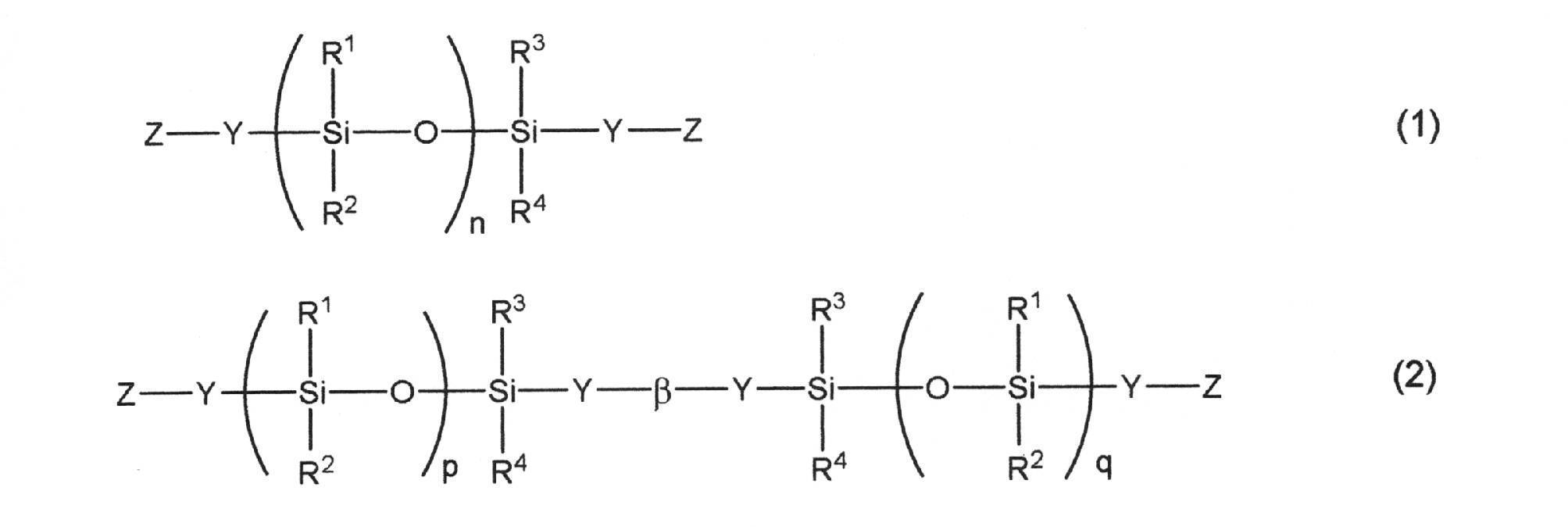
[式中、R1~R4は、それぞれ独立に、水素原子、ハロゲン原子、炭素数1~6のアルキル基、炭素数1~6のアルコキシ基又は炭素数6~12のアリール基を示す。Yは、-R5O-、-R5COO-、-R5NH-、-R5NR6-、-COO-、-S-、-R5COO-R7-O-、または-R5O-R8-O-を示す。前記R5は、単結合、直鎖、分岐鎖若しくは環状アルキレン基、アリール置換アルキレン基、アリーレン基、またはジアリーレン基を示す。R6は、アルキル基、アルケニル基、アリール基、またはアラルキル基を示す。R7は、ジアリーレン基を示す。R8は、直鎖、分岐鎖もしくは環状アルキレン基、又はジアリーレン基を示す。Zは、水素原子又はハロゲン原子を示す。βは、ジイソシアネート化合物由来の2価の基、又はジカルボン酸若しくはジカルボン酸のハロゲン化物由来の2価の基を示す。pとqの和はnであり、nは20~50の平均繰り返し数を示す。]
R1~R4としては、いずれも、好ましくは、水素原子、炭素数1~6のアルキル基、炭素数1~6のアルコキシ基又は炭素数6~12のアリール基である。
一般式(1)及び(2)で表されるポリオルガノシロキサンとしては、R1~R4がいずれもメチル基であるものが好ましい。

(cは正の整数を示し、通常1~6の整数である)
Wが表すアルキレン基としては、例えば、メチレン基、エチレン基、トリメチレン基、テトラメチレン基、ヘキサメチレン基等が挙げられ、炭素数1~5のアルキレン基が好ましい。Wが表すアルキリデン基としては、エチリデン基、イソプロピリデン基等が挙げられる。Wが表すシクロアルキレン基としては、シクロペンタンジイル基やシクロヘキサンジイル基、シクロオクタンジイル基等が挙げられ、炭素数5~10のシクロアルキレン基が好ましい。Wが表すシクロアルキリデン基としては、例えば、シクロヘキシリデン基、3,5,5-トリメチルシクロヘキシリデン基、2-アダマンチリデン基等が挙げられ、炭素数5~10のシクロアルキリデン基が好ましく、炭素数5~8のシクロアルキリデン基がより好ましい。Wが表すアリールアルキレン基のアリール部位としては、フェニル基、ナフチル基、ビフェニル基、アントリル基などの環形成炭素数6~14のアリール基が挙げられる。Wが表すアリールアルキリデン基のアリール部位としては、フェニル基、ナフチル基、ビフェニル基、アントリル基などの環形成炭素数6~14のアリール基が挙げられる。
R5、Ar1及びAr2が表すアリーレン基としては、フェニレン基、ナフチレン基、ビフェニレン基、アントリレン基などの環形成炭素数6~14のアリーレン基が挙げられる。これらアリーレン基は、アルコキシ基、アルキル基等の任意の置換基を有していてもよい。
R8が示す直鎖、分岐鎖もしくは環状アルキレン基は、R5と同様である。
Yとしては、好ましくは-R5O-であって、R5が、アリール置換アルキレン基であって、特にアルキル基を有するフェノール化合物の残基であり、アリルフェノール由来の有機残基やオイゲノール由来の有機残基がより好ましい。この際、Zが水素原子であることが好ましい。
なお、一般式(2)中のp及びqについては、p=q、すなわち、p=n/2、q=n/2であることが好ましい。
また、βは、ジイソシアネート化合物由来の2価の基、又はジカルボン酸若しくはジカルボン酸のハロゲン化物由来の2価の基を示し、例えば、以下の一般式(5-1)~(5-5)で表される2価の基が挙げられる。
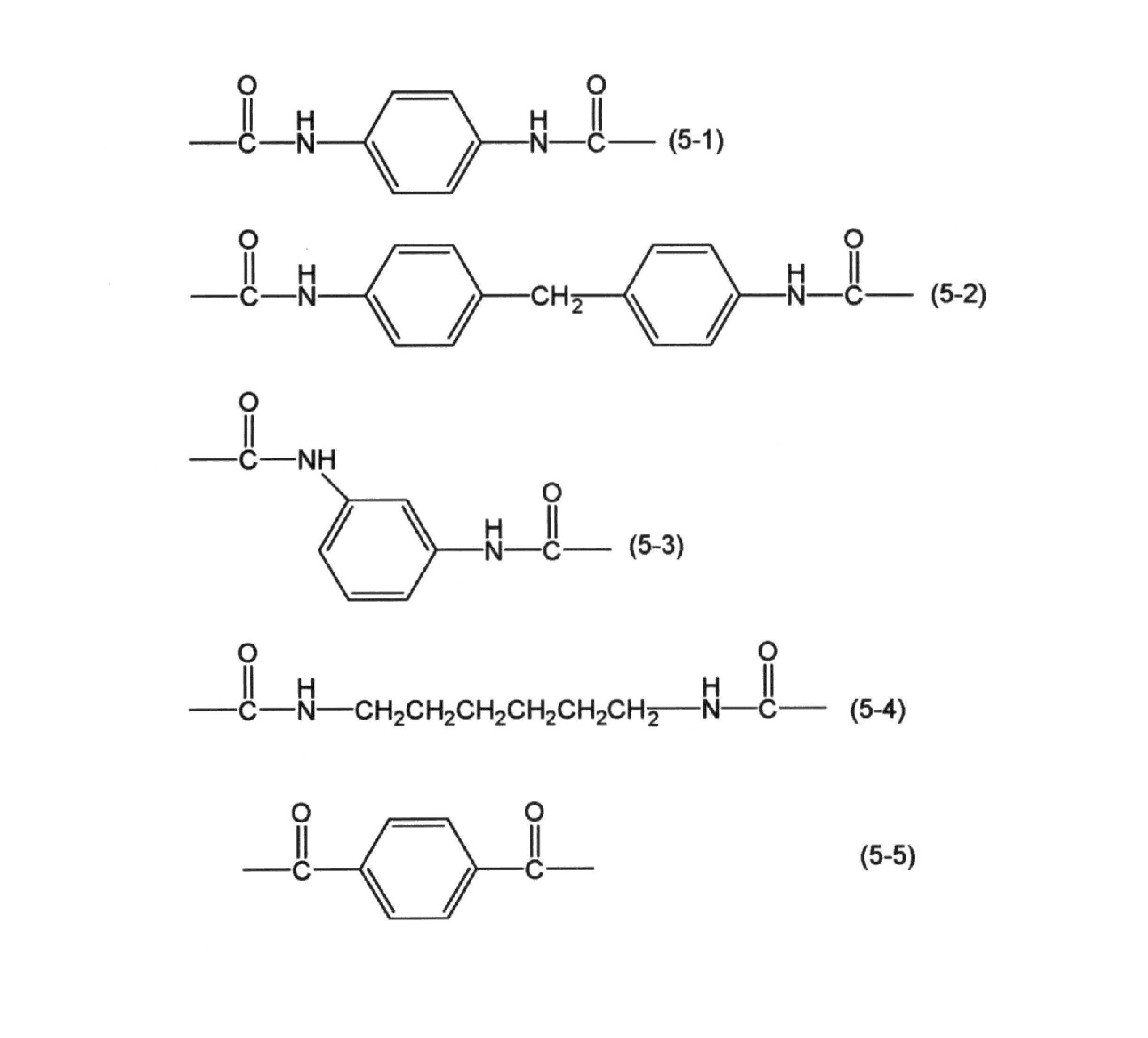

これらの中でも、重合の容易さの観点においては、上記一般式(1-1)で表されるフェノール変性ポリオルガノシロキサンが好ましい。また、入手の容易さの観点においては、上記一般式(1-2)で表される化合物中の一種であるα,ω-ビス[3-(o-ヒドロキシフェニル)プロピル]ポリジメチルシロキサン、上記一般式(1-3)で表される化合物中の一種であるα,ω-ビス[3-(4-ヒドロキシ-3-メトキシフェニル)プロピル]ポリジメチルシロキサンが好ましい。
吸着剤としては、例えば、1000Å以下の平均細孔直径を有するものを用いることができる。平均細孔直径が1000Å以下であれば、粗ポリオルガノシロキサン中の遷移金属を効率的に除去することができる。このような観点から、吸着剤の平均細孔直径は、好ましくは500Å以下、より好ましくは200Å以下、更に好ましくは150Å以下、より更に好ましくは100Å以下である。また同様の観点から、吸着剤は多孔性吸着剤であることが好ましい。
遷移金属の吸着後に吸着剤をポリオルガノシロキサンから分離する観点から、吸着剤の平均粒子径は、通常1μm~4mm、好ましくは1~100μmである。
具体的には、予め製造された芳香族ポリカーボネートオリゴマーと、上記ポリオルガノシロキサンとを、非水溶性有機溶媒(塩化メチレン等)に溶解させ、二価フェノール(ビスフェノールA等)のアルカリ性化合物水溶液(水酸化ナトリウム水溶液等)を加え、重合触媒として第三級アミン(トリエチルアミン等)や第四級アンモニウム塩(トリメチルベンジルアンモニウムクロライド等)を用い、末端停止剤(p-t-ブチルフェノール等の1価フェノール)の存在下、界面重縮合反応させることにより製造できる。また、PC-POS共重合体は、ポリオルガノシロキサンと、二価フェノールと、ホスゲン、炭酸エステル又はクロロホーメートとを共重合させることによっても製造できる。
また、上記原料ポリオルガノシロキサンが上記dw/dlog(M)の値が3.3≦log(M)≦3.9の範囲で最大値をとり得ること、平均鎖長、ポリオルガノシロキサンの具体的な一般式、具体例及び製法は上記した通りである。
二価フェノールとしては、下記一般式(a)で表される二価フェノールを用いることが好ましい。

[式中、R9及びR10は、それぞれ独立に、ハロゲン原子、炭素数1~6のアルキル基又は炭素数1~6のアルコキシ基を示す。Xは、単結合、炭素数1~8のアルキレン基、炭素数2~8のアルキリデン基、炭素数5~15のシクロアルキレン基、炭素数5~15のシクロアルキリデン基、フルオレンジイル基、炭素数7~15のアリールアルキレン基、炭素数7~15のアリールアルキリデン基、-S-、-SO-、-SO2-、-O-又は-CO-を示す。a及びbは、それぞれ独立に、0~4の整数を示す。]
R9及びR10がそれぞれ独立して示すアルキル基としては、メチル基、エチル基、n-プロピル基、イソプロピル基、各種ブチル基、各種ペンチル基、及び各種ヘキシル基が挙げられる。R9及びR10がそれぞれ独立して示すアルコキシ基としては、アルキル基部位が前記アルキル基である場合が挙げられる。
Xが表すアルキレン基としては、例えば、メチレン基、エチレン基、トリメチレン基、テトラメチレン基、ヘキサメチレン基等が挙げられ、炭素数1~6のアルキレン基が好ましい。Xが表すアルキリデン基としては、エチリデン基、イソプロピリデン基等が挙げられる。Xが表すシクロアルキレン基としては、シクロペンタンジイル基やシクロヘキサンジイル基、シクロオクタンジイル基等が挙げられ、炭素数5~10のシクロアルキレン基が好ましい。Xが表すシクロアルキリデン基としては、例えば、シクロヘキシリデン基、3,5,5-トリメチルシクロヘキシリデン基、2-アダマンチリデン基等が挙げられ、炭素数5~10のシクロアルキリデン基が好ましく、炭素数5~8のシクロアルキリデン基がより好ましい。Xが表すアリールアルキレン基のアリール部位としては、フェニル基、ナフチル基、ビフェニル基、アントリル基などの環形成炭素数6~14のアリール基が挙げられる。Xが表すアリールアルキリデン基のアリール部位としては、フェニル基、ナフチル基、ビフェニル基、アントリル基などの環形成炭素数6~14のアリール基が挙げられる。
中でも、aおよびbが0であり、Xが単結合または炭素数1~8のアルキレン基であるもの、またはaおよびbが0であり、Xが炭素数3のアルキレン基、特にイソプロピリデン基であるものが好適である。
これらの中でも、ビス(ヒドロキシフェニル)アルカン系二価フェノールが好ましく、ビスフェノールAがより好ましい。二価フェノールとしてビスフェノールAを用いた場合、上記一般式(a)において、Xがイソプロピリデン基であり、且つa=b=0のPC-POS共重合体となる。
上記分子量調整剤等を用いることにより、PC-POSの粘度平均分子量が、使用される用途や製品により、適宜、目的の分子量となるように製造することができる。
前記ポリオルガノシロキサンブロック(B)のポリスチレンを換算基準としたゲル浸透クロマトグラフ法による測定から得られる、横軸が分子量Mの対数値log(M)であり、縦軸が濃度分率wを分子量の対数値log(M)で微分したdw/dlog(M)である微分分子量分布曲線において、2.5≦log(M)≦3.1の範囲でdw/dlog(M)値を積分した値が、log(M)の全範囲でdw/dlog(M)値を積分した値に対して0~10%である、ポリカーボネート-ポリオルガノシロキサン共重合体に関する。
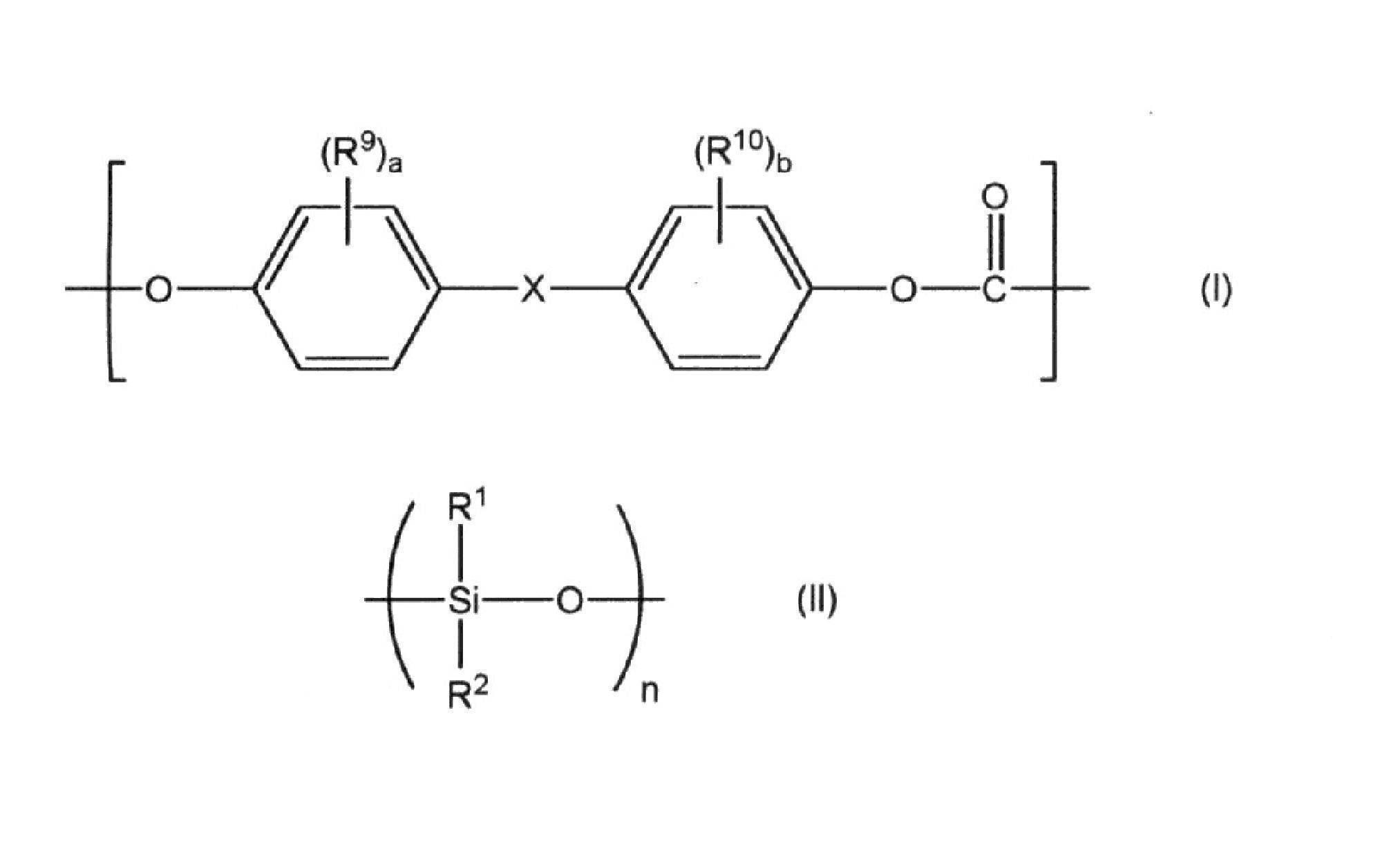
ポリオルガノシロキサンブロック(B)の含有量が0.5質量%未満であると、低温時(-20℃程度)での耐衝撃性が低下するとともに、アイゾット衝撃強度が低下する傾向にあるので好ましくない。また、ポリオルガノシロキサンブロック(B)の含有量が20質量%を超えると、常温時(23℃程度)の耐衝撃性が低下する。
成形温度を上げることによりPC-POS共重合体の粘度を下げることも可能であるが、その場合、成形サイクルが長くなり経済性に劣るほか、温度を上げすぎるとPC-POS共重合体の熱劣化により透明性が低下する傾向がある。
なお、粘度平均分子量(Mv)は、20℃における塩化メチレン溶液の極限粘度〔η〕を測定し、Schnellの式(〔η〕=1.23×10⁻⁵×Mv0.83)より算出した値である。
上記配合、混練は、通常、用いられている方法、例えば、リボンブレンダー、ヘンシェルミキサー、バンバリーミキサー、ドラムタンブラー、単軸スクリュー押出機、二軸スクリュー押出機、コニーダ、多軸スクリュー押出機等を用いる方法により行うことができる。
なお、混練に際しての加熱温度は、通常、250~320℃の範囲で選ばれる。
得られたPC樹脂組成物の成形には、従来公知の各種成形方法、例えば、射出成形法、射出圧縮成形法、押出成形法、ブロー成形法、プレス成形法、真空成形法及び発泡成形法などを用いることができるが、金型温度60℃以上、好ましくは80~120℃で射出成形することが好ましい。
この際、射出成形における樹脂温度は、通常、280~360℃程度、好ましくは280~330℃である。
本発明の成形体は、携帯電話、スマートフォン、モバイルパソコン、タブレット、携帯用端末等の筐体、照明カバー、建材、デジタルカメラ、ビデオカメラ等の視認性を要する電子機器筐体、及び警察盾、ヘルメットバイザー、スポーツ用保護具等のその他の日用品等の用途において用いることができる。
ポリオルガノシロキサンのGPC測定は以下の条件で行った。
試験機器:TOSOH HLC 8220
測定条件:TOSOH TSK-GEL GHXL-L,G4000HXL,G2000HXL
溶媒:テトラヒドロフラン(THF)
カラム温度:40℃
流速:1.0ml/分
検出器:RI
注入濃度:0.2w/v%
注入量:0.1ml
検量線の作製には、東ソー株式会社製の標準ポリスチレンを用いた。
なお、ポリカーボネート-ポリジメチルシロキサン(PC-PDMS)中のポリオルガノシロキサンの分子量分布測定は以下の通りに行った。得られたPC-PDMS共重合体のフレーク3.9gをメチレンクロライドに10質量%溶液となるように加え、フレークを完全に溶解した。マグネチックスターラーで撹拌しながら、48質量%の水酸化ナトリウム水溶液とメタノールの1:9(体積比)の混合水溶液30mlを加え、3時間撹拌した。その後、メチレンクロライドを30ml追加したのち、析出した結晶(主成分:ビスフェノールA)をひだ折りろ紙にてろ過し、結晶をメチレンクロライドで洗浄した。ろ液のメチレンクロライド溶液を15容積%の0.03mol/LのNaOH水溶液で二度洗浄した後、15容積%の0.2NのHClで洗浄後、15容積%の純水で洗浄した。得られたメチレンクロライド溶液を乾燥機にて乾燥し、得られた粘調な液体(主成分:PDMS)をGPCにて測定し、用いたポリオルガノシロキサンと同様の分子量分布であることを確認した。
NMR測定によって、ポリジメチルシロキサンのメチル基の積分値比により算出した。
粘度平均分子量(Mv)は、ウベローデ型粘度計を用いて、20℃における塩化メチレン溶液の粘度を測定し、これより極限粘度[η]を求め、次式(Schnell式)にて算出した。
[η]=1.23×10⁻⁵×Mv0.83
ポリカーボネートオリゴマーとして、濃度318g/L、クロロホーメート基濃度0.75mol/L、重量平均分子量(Mw)=3,100、NMRより求めた末端基モル分率がp-t-ブチルフェノール(PTBP):OH:クロロホーメート(CF)=3.3:7.7:89.0のポリカーボネートオリゴマーの塩化メチレン溶液を原料に使用した。
なお、重量平均分子量(Mw)は、展開溶媒としてテトラヒドロフランを用い、GPC[カラム:TOSOH TSK-GEL MULTIPORE HXL-M(2本)+Shodex KF801(1本)、温度40℃、流速1.0ml/分、検出器:RI]にて、標準ポリスチレン換算分子量(重量平均分子量:Mw)として測定した。
邪魔板、パドル型攪拌翼及び冷却用ジャケットを備えた50L槽型反応器に上記の原料のポリカーボネートオリゴマー溶液15L、塩化メチレン8.3L、[平均鎖長n=36;log(M)2.5~3.1の範囲でdw/dlog(M)値を積分した値が、log(M)の全範囲でdw/dlog(M)値を積分した値に対して(以下、実施例においてはlog(M)2.5~3.1の割合と呼ぶことがある)7.6%;dw/dlog(M)が最大値となるlog(M)が3.6]であるアリルフェノール末端変性ポリジメチルシロキサン(PDMS)393g、及びトリエチルアミン5.8mLを仕込み、攪拌下でここに6.4質量%の水酸化ナトリウム水溶液1496gを加え、10分間ポリカーボネートオリゴマーとアリルフェノール末端変性PDMSの反応を行った。
この重合液に、p-t-ブチルフェノール(PTBP)の塩化メチレン溶液(PTBP70gを塩化メチレン2.0Lに溶解したもの)、BPAの水酸化ナトリウム水溶液(NaOH648gと亜二チオン酸ナトリウム2.0gとを水9.5Lに溶解した水溶液にBPA1099gを溶解させたもの)を添加し50分間重合反応を実施した。
希釈のため塩化メチレン10Lを加え10分間攪拌した後、ポリカーボネートを含む有機相と過剰のBPA及びNaOHを含む水相に分離し、有機相を単離した。
こうして得られたPC-PDMSの塩化メチレン溶液を、その溶液に対して、15容積%の0.03mol/LNaOH水溶液、0.2N塩酸で順次洗浄し、次いで洗浄後の水相中の電気伝導度が1mS/m以下になるまで純水で洗浄を繰り返した。
洗浄により得られたポリカーボネートの塩化メチレン溶液を濃縮・粉砕し、得られたフレークを減圧下120℃で乾燥した。PDMS量は6.0質量%、ISO1628-4(1999)に準拠して測定した粘度数は46.9、粘度平均分子量Mv=17400であった。
得られたPC-PDMS共重合体のフレーク100質量部、酸化防止剤としてIRGAFOS168(商品名:BASF社製)を0.1質量部混合し、ベント式単軸押出成形機に供給し、樹脂温度280℃にて溶融混練し、評価用ペレットサンプルを得た。この評価用ペレットサンプルを120℃で8時間乾燥させた後、射出成形機を用いて、成形樹脂温度280℃、金型温度80℃にて、射出成形して各試験を行うための試験片を作成し、以下の試験を行った。
また、PC-PDMS中のPDMSのGPC測定により、用いたPDMSと同様の分子量分布であることを確認した。
実施例1で得られた肉厚3.2mmの試験片を用いて、ASTM D638に準拠して、50mm/分の条件で破断強度及び破断伸びを測定した。数値が大きいほど、引張特性が良好であることを示す。
(2)曲げ特性:曲げ強さ、曲げ弾性率
実施例1で得られた肉厚4.0mmの試験片を用いて、ISO178に準拠して、2mm/分の条件で曲げ強さ及び曲げ弾性率を測定した。数値が大きいほど、曲げ特性が良好であることを示す。
(3)荷重たわみ温度(HDT)
実施例1で得られた肉厚3.2mmの試験片を用いて、ASTM D648に準拠して、1.83MPaの荷重で測定した。
(4)全光線透過率及びヘーズ値
厚み2mmの試験片について、全光線透過率についてはISO13468に基づいて3回測定し、ヘーズ値についてはISO14782に基づいて3回測定し、それぞれその平均を求めた。結果を表1に示す。
(5)YI値の測定
厚み2mmの試験片について、分光光度計「U-4100」(日立ハイテクノロジーズ(株)製)を用い、C光源、2度視野の条件でYI値を測定した。
(6)アイゾット衝撃強度
射出成形機で作製した厚さ3.2mm(約1/8インチ)の試験片を用いて、ASTM規格D-256に準拠して、測定温度23℃および-20℃におけるノッチ付きアイゾット衝撃強度を測定した。結果を表1に示す。
また、後述する実施例2~3についても各実施例で得られたPC-PDMS共重合体のフレークを用いて同様に試験片を作成し、上記(1)~(5)について測定した。結果を表1に共に示す。
実施例1において用いたアリルフェノール末端変性PDMSを、[平均鎖長n=40;log(M)2.5~3.1の割合が7.2%;dw/dlog(M)が最大値となるときのlog(M)が3.6]のアリルフェノール末端変性PDMSに変えた以外は実施例1と同様に行った。得られたフレークのPDMS量は6.0質量%、ISO1628-4(1999)に準拠して測定した粘度数は46.2、粘度平均分子量Mv=17100であった。結果を表1に示す。
実施例1において用いたアリルフェノール末端変性PDMSを、平均鎖長n=37,log(M)2.5~3.1の割合が14.8%,dw/dlog(M)が最大値を取るときのlog(M)が3.6のアリルフェノール末端変性PDMSに変えた以外は実施例1と同様に行った。得られたフレークのPDMS量は6.0質量%、ISO1628-4(1999)に準拠して測定した粘度数は47.4、粘度平均分子量は17700であった。また、得られたPC-PDMS共重合体のフレークを用いて、実施例1と同様に試験片を作成し、実施例1と同様に(1)~(5)についての測定を行った。結果を表1に共に示す。また、後述する比較例2についても得られたPC-PDMS共重合体のフレークを用いて実施例1と同様に試験片を作成し、(1)~(5)についての測定を行った。結果を表1に共に示す。
比較例1において用いたアリルフェノール末端変性PDMSを、平均鎖長n=40,log(M)2.5~3.1の割合が14.6%,dw/dlog(M)が最大値を取るときのlog(M)が3.7のアリルフェノール末端変性PDMSに変えた以外は比較例1と同様に行った。得られたフレークのPDMS量は6.0質量%、ISO1628-4(1999)に準拠して測定した粘度数は47.3、粘度平均分子量は17600であった。
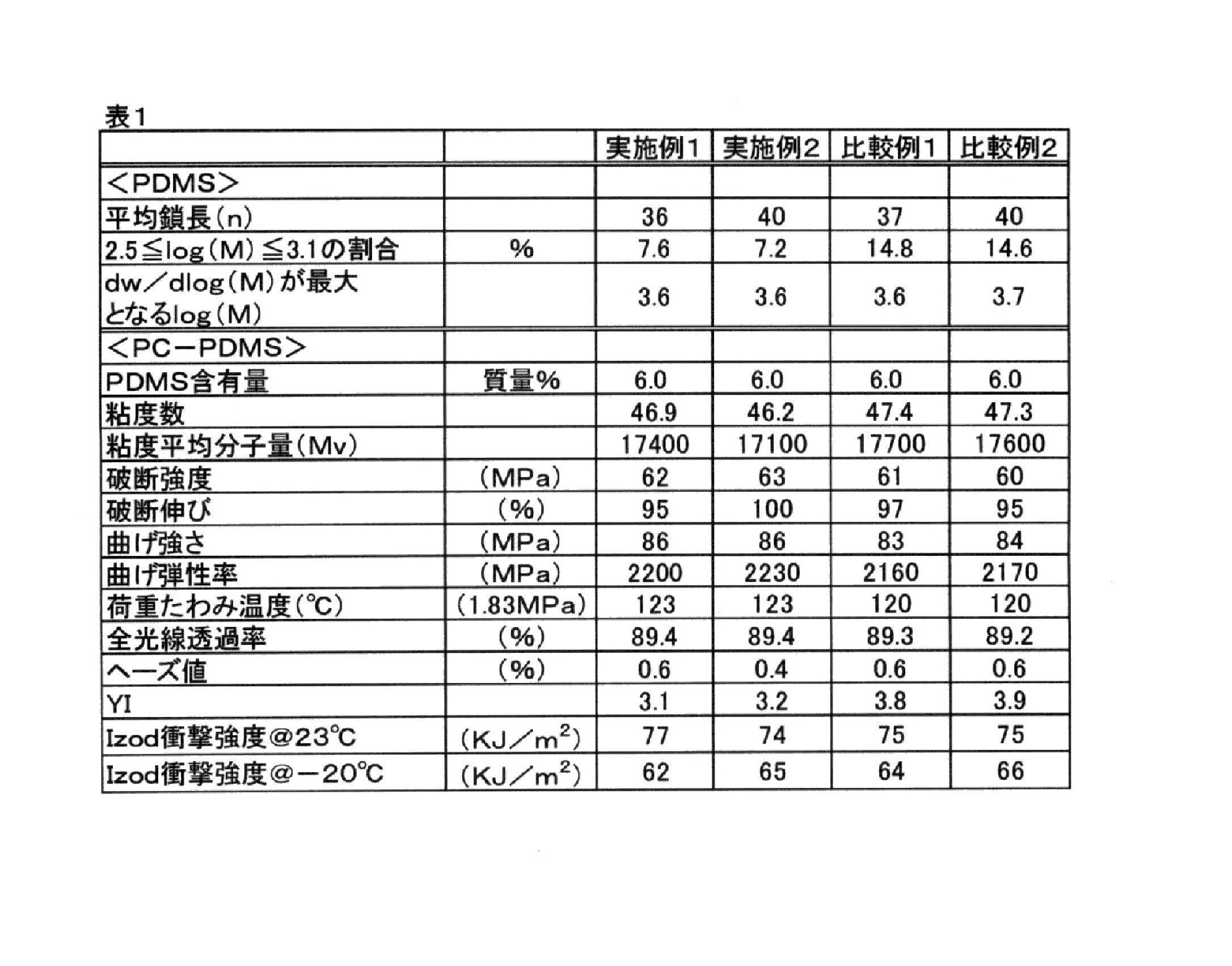
図1は、実施例1及び比較例1にて得られる微分分布曲線を示すグラフであり、2.5≦log(M)≦3.1の範囲でdw/dlog(M)値を積分した値が、log(M)の全範囲でdw/dlog(M)値を積分した値に対して0以上10%以下である実施例1においては2.5≦log(M)≦3.1の範囲の曲線の立ち上がりがシャープであるのに対し、2.5≦log(M)≦3.1の範囲でdw/dlog(M)値を積分した値が、log(M)の全範囲でdw/dlog(M)値を積分した値に対して10%を超える比較例1においては、2.5≦log(M)≦3.1の範囲の曲線の立ち上がりがゆるやかであることが分かる。
Claims (11)
- ポリスチレンを換算基準としたゲル浸透クロマトグラフ法による測定から得られる、横軸が分子量Mの対数値log(M)であり、縦軸が濃度分率wを分子量の対数値log(M)で微分したdw/dlog(M)である微分分子量分布曲線において、2.5≦log(M)≦3.1の範囲でdw/dlog(M)値を積分した値が、log(M)の全範囲でdw/dlog(M)値を積分した値に対して0~10%である、ポリオルガノシロキサン。
- 前記微分分子量分布曲線において、dw/dlog(M)の値が、3.3≦log(M)≦3.9の範囲で最大となる、請求項1に記載のポリオルガノシロキサン。
- 平均鎖長が20~50である、請求項1または2に記載のポリオルガノシロキサン。
- 前記ポリオルガノシロキサンが下記一般式(1)又は(2)で表されるポリオルガノシロキサンである、請求項1~3のいずれかに記載のポリオルガノシロキサン。

[式中、R1~R4は、それぞれ独立に、水素原子、ハロゲン原子、炭素数1~6のアルキル基、炭素数1~6のアルコキシ基又は炭素数6~12のアリール基を示す。Yは、-R5O-、-R5COO-、-R5NH-、-R5NR6-、-COO-、-S-、-R5COO-R7-O-、または-R5O-R8-O-を示し、前記R5は、単結合、直鎖、分岐鎖若しくは環状アルキレン基、アリール置換アルキレン基、アリーレン基、またはジアリーレン基を示す。R6は、アルキル基、アルケニル基、アリール基、またはアラルキル基を示す。R7は、ジアリーレン基を示す。R8は、直鎖、分岐鎖もしくは環状アルキレン基、又はジアリーレン基を示す。Zは、水素原子又はハロゲン原子を示す。βは、ジイソシアネート化合物由来の2価の基、又はジカルボン酸若しくはジカルボン酸のハロゲン化物由来の2価の基を示す。pとqの和はnであり、nは20~50の平均繰り返し数を示す。] - 請求項1~4のいずれかに記載のポリオルガノシロキサンを原料として用いる、ポリカーボネート-ポリオルガノシロキサン共重合体の製造方法。
- 下記一般式(I)で表される繰り返し単位からなるポリカーボネートブロック(A)及び下記一般式(II)で表される繰り返し単位を含むポリオルガノシロキサンブロック(B)を含むポリカーボネート-ポリオルガノシロキサン共重合体であって、
前記ポリオルガノシロキサンブロック(B)のポリスチレンを換算基準としたゲル浸透クロマトグラフ法による測定から得られる、横軸が分子量Mの対数値log(M)であり、縦軸が濃度分率wを分子量の対数値log(M)で微分したdw/dlog(M)である微分分子量分布曲線において、2.5≦log(M)≦3.1の範囲でdw/dlog(M)値を積分した値が、log(M)の全範囲でdw/dlog(M)値を積分した値に対して0~10%である、ポリカーボネート-ポリオルガノシロキサン共重合体。

[式中、R9及びR10は、それぞれ独立に、ハロゲン原子、炭素数1~6のアルキル基又は炭素数1~6のアルコキシ基を示す。Xは、単結合、炭素数1~8のアルキレン基、炭素数2~8のアルキリデン基、炭素数5~15のシクロアルキレン基、炭素数5~15のシクロアルキリデン基、フルオレンジイル基、炭素数7~15のアリールアルキレン基、炭素数7~15のアリールアルキリデン基、-S-、-SO-、-SO2-、-O-又は-CO-を示す。a及びbは、それぞれ独立に、0~4の整数を示す。
R1及びR2は、それぞれ独立に、水素原子、ハロゲン原子、炭素数1~6のアルキル基、炭素数1~6のアルコキシ基又は炭素数6~12のアリール基を示す。20~50の平均繰り返し数nは、ポリオルガノシロキサンブロック中のシロキサン繰り返し単位の合計数を示す。] - 前記ポリオルガノシロキサンブロック(B)の微分分子量分布曲線において、dw/dlog(M)の値が、3.3≦log(M)≦3.9の範囲で最大となる、請求項6に記載のポリカーボネート-ポリオルガノシロキサン共重合体。
- 前記ポリオルガノシロキサンブロック(B)の平均鎖長が20~50である、請求項6または請求項7に記載のポリカーボネート-ポリオルガノシロキサン共重合体。
- 前記ポリカーボネート-ポリオルガノシロキサン共重合体中におけるポリオルガノシロキサンブロック(B)の含有量が0.5~20質量%である、請求項6~8のいずれかに記載のポリカーボネート-ポリオルガノシロキサン共重合体。
- 粘度平均分子量が12000~40000である、請求項6~9のいずれかに記載のポリカーボネート-ポリオルガノシロキサン共重合体。
- 請求項6~10のいずれかに記載のポリカーボネート-ポリオルガノシロキサン共重合体を成形してなる成形体。
Priority Applications (5)
| Application Number | Priority Date | Filing Date | Title |
|---|---|---|---|
| EP14888450.5A EP3127940B1 (en) | 2014-03-31 | 2014-12-12 | Polyorganosiloxane, polycarbonate-polyorganosiloxane copolymer, and production method therefor |
| CN201480077736.7A CN106133026B (zh) | 2014-03-31 | 2014-12-12 | 聚有机硅氧烷、聚碳酸酯-聚有机硅氧烷共聚物及其制造方法 |
| US15/300,694 US10189942B2 (en) | 2014-03-31 | 2014-12-12 | Polyorganosiloxane, polycarbonate-polyorganosiloxane copolymer, and production method therefor |
| KR1020167027137A KR102289540B1 (ko) | 2014-03-31 | 2014-12-12 | 폴리오르가노실록산, 폴리카보네이트-폴리오르가노실록산 공중합체 및 그 제조 방법 |
| US16/182,049 US10934392B2 (en) | 2014-03-31 | 2018-11-06 | Polyorganosiloxane, polycarbonate-polyorganosiloxane copolymer, and production method therefor |
Applications Claiming Priority (2)
| Application Number | Priority Date | Filing Date | Title |
|---|---|---|---|
| JP2014-073411 | 2014-03-31 | ||
| JP2014073411A JP6355951B2 (ja) | 2014-03-31 | 2014-03-31 | ポリオルガノシロキサン、ポリカーボネート−ポリオルガノシロキサン共重合体及びその製造方法 |
Related Child Applications (2)
| Application Number | Title | Priority Date | Filing Date |
|---|---|---|---|
| US15/300,694 A-371-Of-International US10189942B2 (en) | 2014-03-31 | 2014-12-12 | Polyorganosiloxane, polycarbonate-polyorganosiloxane copolymer, and production method therefor |
| US16/182,049 Continuation US10934392B2 (en) | 2014-03-31 | 2018-11-06 | Polyorganosiloxane, polycarbonate-polyorganosiloxane copolymer, and production method therefor |
Publications (1)
| Publication Number | Publication Date |
|---|---|
| WO2015151346A1 true WO2015151346A1 (ja) | 2015-10-08 |
Family
ID=54239703
Family Applications (1)
| Application Number | Title | Priority Date | Filing Date |
|---|---|---|---|
| PCT/JP2014/083055 Ceased WO2015151346A1 (ja) | 2014-03-31 | 2014-12-12 | ポリオルガノシロキサン、ポリカーボネート-ポリオルガノシロキサン共重合体及びその製造方法 |
Country Status (7)
| Country | Link |
|---|---|
| US (2) | US10189942B2 (ja) |
| EP (1) | EP3127940B1 (ja) |
| JP (1) | JP6355951B2 (ja) |
| KR (1) | KR102289540B1 (ja) |
| CN (1) | CN106133026B (ja) |
| TW (1) | TWI664210B (ja) |
| WO (1) | WO2015151346A1 (ja) |
Cited By (5)
| Publication number | Priority date | Publication date | Assignee | Title |
|---|---|---|---|---|
| WO2016143895A1 (ja) * | 2015-03-12 | 2016-09-15 | 出光興産株式会社 | ポリカーボネート系樹脂組成物及びその成形品 |
| WO2018159788A1 (ja) * | 2017-03-01 | 2018-09-07 | 出光興産株式会社 | ポリカーボネート-ポリオルガノシロキサン共重合体、それを含む難燃性ポリカーボネート系樹脂組成物及びその成形品 |
| WO2018159790A1 (ja) * | 2017-03-01 | 2018-09-07 | 出光興産株式会社 | ポリカーボネート-ポリオルガノシロキサン共重合体、それを含むポリカーボネート系樹脂組成物及びその成形品 |
| WO2018159786A1 (ja) * | 2017-03-01 | 2018-09-07 | 出光興産株式会社 | ポリカーボネート-ポリオルガノシロキサン共重合体、それを含むポリカーボネート系樹脂組成物及びその成形品 |
| WO2018159789A1 (ja) * | 2017-03-01 | 2018-09-07 | 出光興産株式会社 | ポリカーボネート-ポリオルガノシロキサン共重合体、それを含むポリカーボネート系樹脂組成物及びその成形品 |
Families Citing this family (11)
| Publication number | Priority date | Publication date | Assignee | Title |
|---|---|---|---|---|
| JP6355951B2 (ja) * | 2014-03-31 | 2018-07-11 | 出光興産株式会社 | ポリオルガノシロキサン、ポリカーボネート−ポリオルガノシロキサン共重合体及びその製造方法 |
| WO2016203916A1 (ja) * | 2015-06-17 | 2016-12-22 | 出光興産株式会社 | ポリカーボネート系樹脂組成物の製造方法 |
| EP3312241B1 (en) | 2015-06-17 | 2020-12-23 | Idemitsu Kosan Co.,Ltd. | Polycarbonate resin composition and molded product thereof |
| KR102631534B1 (ko) * | 2017-06-28 | 2024-01-30 | 이데미쓰 고산 가부시키가이샤 | 폴리카보네이트계 수지 조성물 및 그의 성형품 |
| EP3733736A4 (en) * | 2017-12-28 | 2021-09-22 | Idemitsu Kosan Co.,Ltd. | POLYCARBONATE-POLYDIORGANOSILOXANE COPOLYMER |
| JPWO2019131969A1 (ja) * | 2017-12-28 | 2020-12-10 | 出光興産株式会社 | ポリカーボネート−ポリオルガノシロキサン共重合体を含む成形体 |
| KR102554769B1 (ko) * | 2019-06-20 | 2023-07-12 | 주식회사 엘지화학 | 코폴리카보네이트의 분석 방법 |
| JP2021109966A (ja) * | 2020-01-10 | 2021-08-02 | 住友化学株式会社 | 硬化型組成物 |
| CN111560117B (zh) * | 2020-06-08 | 2022-08-05 | 万华化学集团股份有限公司 | 一种硅氧烷共聚碳酸酯的制备方法 |
| CN114989407B (zh) * | 2022-06-10 | 2024-05-03 | 万华化学集团股份有限公司 | 聚碳酸酯-聚硅氧烷共聚物、制造方法及含其的聚碳酸酯树脂组合物 |
| CN116375999B (zh) * | 2023-01-03 | 2025-07-15 | 万华化学集团股份有限公司 | 热塑性树脂组合物、其制造方法及光学透镜 |
Citations (6)
| Publication number | Priority date | Publication date | Assignee | Title |
|---|---|---|---|---|
| JP2001072846A (ja) * | 1999-07-06 | 2001-03-21 | Idemitsu Petrochem Co Ltd | ポリカーボネート樹脂組成物 |
| JP2002146194A (ja) * | 2000-11-16 | 2002-05-22 | Idemitsu Petrochem Co Ltd | ポリカーボネート樹脂組成物 |
| JP2007510795A (ja) * | 2003-11-12 | 2007-04-26 | ゼネラル・エレクトリック・カンパニイ | 透明ポリカーボネート−ポリシロキサンコポリマーブレンド、その製造方法及び物品 |
| JP2011021127A (ja) * | 2009-07-16 | 2011-02-03 | Idemitsu Kosan Co Ltd | 携帯型電子機器筐体 |
| JP2011046913A (ja) * | 2009-07-29 | 2011-03-10 | Teijin Chem Ltd | ポリカーボネート−ポリジオルガノシロキサン共重合体 |
| JP2011122048A (ja) * | 2009-12-10 | 2011-06-23 | Idemitsu Kosan Co Ltd | ポリカーボネート−ポリオルガノシロキサン共重合体、その製造方法及び該共重合体を含むポリカーボネート樹脂 |
Family Cites Families (14)
| Publication number | Priority date | Publication date | Assignee | Title |
|---|---|---|---|---|
| JPH03292361A (ja) | 1990-04-11 | 1991-12-24 | Mitsubishi Gas Chem Co Inc | コーポリカーボネート樹脂組成物 |
| JPH0543699A (ja) | 1991-08-15 | 1993-02-23 | Chlorine Eng Corp Ltd | シリコーンオイルの精製方法 |
| JPH06145045A (ja) * | 1992-11-05 | 1994-05-24 | Koken Co Ltd | 網膜剥離治療用シリコ−ンオイル及びその製造方法 |
| JPH11143277A (ja) * | 1997-11-07 | 1999-05-28 | Canon Inc | カラー定着装置 |
| TW570954B (en) | 1999-06-23 | 2004-01-11 | Idemitsu Petrochemical Co | Polycarbonate resin composition |
| US20030027928A1 (en) | 1999-06-23 | 2003-02-06 | Masaya Okamoto | Polycarbonate resin composition |
| EP1331246A4 (en) | 2000-11-01 | 2005-07-13 | Idemitsu Kosan Co | Polycarbonate resin compositions |
| US7638091B2 (en) | 2004-07-02 | 2009-12-29 | Sabic Innovative Plastics Ip B. V. | Methods of sterilizing polycarbonate articles and methods of manufacture |
| US20110032433A1 (en) * | 2008-03-13 | 2011-02-10 | Pioneer Corporation | Connection state display controller, content processor, content processing system, connection state display control method, its program and recording medium recording the program |
| WO2011013846A1 (ja) * | 2009-07-29 | 2011-02-03 | 帝人化成株式会社 | ポリカーボネート−ポリジオルガノシロキサン共重合体 |
| JP2011032433A (ja) * | 2009-08-05 | 2011-02-17 | Teijin Chem Ltd | ポリカーボネート−ポリジオルガノシロキサン共重合体の製造方法 |
| JP5684588B2 (ja) * | 2011-01-27 | 2015-03-11 | 帝人株式会社 | ポリカーボネート樹脂組成物および成形品 |
| JP5852797B2 (ja) | 2011-05-30 | 2016-02-03 | 出光興産株式会社 | 電池パック用ポリカーボネート樹脂組成物及び電池パック |
| JP6355951B2 (ja) * | 2014-03-31 | 2018-07-11 | 出光興産株式会社 | ポリオルガノシロキサン、ポリカーボネート−ポリオルガノシロキサン共重合体及びその製造方法 |
-
2014
- 2014-03-31 JP JP2014073411A patent/JP6355951B2/ja active Active
- 2014-12-12 CN CN201480077736.7A patent/CN106133026B/zh active Active
- 2014-12-12 EP EP14888450.5A patent/EP3127940B1/en active Active
- 2014-12-12 KR KR1020167027137A patent/KR102289540B1/ko active Active
- 2014-12-12 US US15/300,694 patent/US10189942B2/en active Active
- 2014-12-12 WO PCT/JP2014/083055 patent/WO2015151346A1/ja not_active Ceased
-
2015
- 2015-01-05 TW TW104100091A patent/TWI664210B/zh active
-
2018
- 2018-11-06 US US16/182,049 patent/US10934392B2/en active Active
Patent Citations (6)
| Publication number | Priority date | Publication date | Assignee | Title |
|---|---|---|---|---|
| JP2001072846A (ja) * | 1999-07-06 | 2001-03-21 | Idemitsu Petrochem Co Ltd | ポリカーボネート樹脂組成物 |
| JP2002146194A (ja) * | 2000-11-16 | 2002-05-22 | Idemitsu Petrochem Co Ltd | ポリカーボネート樹脂組成物 |
| JP2007510795A (ja) * | 2003-11-12 | 2007-04-26 | ゼネラル・エレクトリック・カンパニイ | 透明ポリカーボネート−ポリシロキサンコポリマーブレンド、その製造方法及び物品 |
| JP2011021127A (ja) * | 2009-07-16 | 2011-02-03 | Idemitsu Kosan Co Ltd | 携帯型電子機器筐体 |
| JP2011046913A (ja) * | 2009-07-29 | 2011-03-10 | Teijin Chem Ltd | ポリカーボネート−ポリジオルガノシロキサン共重合体 |
| JP2011122048A (ja) * | 2009-12-10 | 2011-06-23 | Idemitsu Kosan Co Ltd | ポリカーボネート−ポリオルガノシロキサン共重合体、その製造方法及び該共重合体を含むポリカーボネート樹脂 |
Cited By (21)
| Publication number | Priority date | Publication date | Assignee | Title |
|---|---|---|---|---|
| WO2016143895A1 (ja) * | 2015-03-12 | 2016-09-15 | 出光興産株式会社 | ポリカーボネート系樹脂組成物及びその成形品 |
| US10717845B2 (en) | 2015-03-12 | 2020-07-21 | Idemitsu Kosan Co., Ltd. | Polycarbonate-based resin composition and molded article thereof |
| JPWO2018159789A1 (ja) * | 2017-03-01 | 2019-12-26 | 出光興産株式会社 | ポリカーボネート−ポリオルガノシロキサン共重合体、それを含むポリカーボネート系樹脂組成物及びその成形品 |
| WO2018159788A1 (ja) * | 2017-03-01 | 2018-09-07 | 出光興産株式会社 | ポリカーボネート-ポリオルガノシロキサン共重合体、それを含む難燃性ポリカーボネート系樹脂組成物及びその成形品 |
| WO2018159789A1 (ja) * | 2017-03-01 | 2018-09-07 | 出光興産株式会社 | ポリカーボネート-ポリオルガノシロキサン共重合体、それを含むポリカーボネート系樹脂組成物及びその成形品 |
| CN110366573A (zh) * | 2017-03-01 | 2019-10-22 | 出光兴产株式会社 | 聚碳酸酯-聚有机硅氧烷共聚物、包含其的聚碳酸酯系树脂组合物及其成形品 |
| CN110382593A (zh) * | 2017-03-01 | 2019-10-25 | 出光兴产株式会社 | 聚碳酸酯-聚有机硅氧烷共聚物、包含其的聚碳酸酯系树脂组合物及其成形品 |
| JPWO2018159786A1 (ja) * | 2017-03-01 | 2019-12-26 | 出光興産株式会社 | ポリカーボネート−ポリオルガノシロキサン共重合体、それを含むポリカーボネート系樹脂組成物及びその成形品 |
| JPWO2018159790A1 (ja) * | 2017-03-01 | 2019-12-26 | 出光興産株式会社 | ポリカーボネート−ポリオルガノシロキサン共重合体、それを含むポリカーボネート系樹脂組成物及びその成形品 |
| JPWO2018159788A1 (ja) * | 2017-03-01 | 2019-12-26 | 出光興産株式会社 | ポリカーボネート−ポリオルガノシロキサン共重合体、それを含む難燃性ポリカーボネート系樹脂組成物及びその成形品 |
| WO2018159790A1 (ja) * | 2017-03-01 | 2018-09-07 | 出光興産株式会社 | ポリカーボネート-ポリオルガノシロキサン共重合体、それを含むポリカーボネート系樹脂組成物及びその成形品 |
| WO2018159786A1 (ja) * | 2017-03-01 | 2018-09-07 | 出光興産株式会社 | ポリカーボネート-ポリオルガノシロキサン共重合体、それを含むポリカーボネート系樹脂組成物及びその成形品 |
| US11111386B2 (en) | 2017-03-01 | 2021-09-07 | Idemitsu Kosan Co., Ltd. | Polycarbonate-polyorganosiloxane copolymer, polycarbonate resin composition including same, and molded product thereof |
| US11155712B2 (en) | 2017-03-01 | 2021-10-26 | Idemitsu Kosan Co., Ltd. | Polycarbonate-polyorganosiloxane copolymer, flame-retardant polycarbonate resin composition including same, and molded product thereof |
| CN110382593B (zh) * | 2017-03-01 | 2022-01-11 | 出光兴产株式会社 | 聚碳酸酯-聚有机硅氧烷共聚物、包含其的聚碳酸酯系树脂组合物及其成形品 |
| CN110366573B (zh) * | 2017-03-01 | 2022-04-26 | 出光兴产株式会社 | 聚碳酸酯-聚有机硅氧烷共聚物、包含其的聚碳酸酯系树脂组合物及其成形品 |
| JP7129134B2 (ja) | 2017-03-01 | 2022-09-01 | 出光興産株式会社 | ポリカーボネート系樹脂組成物及びその成形品 |
| JP7129132B2 (ja) | 2017-03-01 | 2022-09-01 | 出光興産株式会社 | ポリカーボネート系樹脂組成物及びその成形品 |
| JP7129135B2 (ja) | 2017-03-01 | 2022-09-01 | 出光興産株式会社 | ポリカーボネート系樹脂組成物及びその成形品 |
| JP7129133B2 (ja) | 2017-03-01 | 2022-09-01 | 出光興産株式会社 | ポリカーボネート-ポリオルガノシロキサン共重合体、それを含む難燃性ポリカーボネート系樹脂組成物及びその成形品 |
| US11697708B2 (en) | 2017-03-01 | 2023-07-11 | Idemitsu Kosan Co., Ltd. | Polycarbonate-polyorganosiloxane copolymer, polycarbonate resin composition including same, and molded product thereof |
Also Published As
| Publication number | Publication date |
|---|---|
| US10934392B2 (en) | 2021-03-02 |
| KR20160142300A (ko) | 2016-12-12 |
| JP2015193771A (ja) | 2015-11-05 |
| US20170114184A1 (en) | 2017-04-27 |
| KR102289540B1 (ko) | 2021-08-12 |
| JP6355951B2 (ja) | 2018-07-11 |
| EP3127940A1 (en) | 2017-02-08 |
| EP3127940B1 (en) | 2021-02-03 |
| CN106133026B (zh) | 2021-08-24 |
| CN106133026A (zh) | 2016-11-16 |
| TW201536837A (zh) | 2015-10-01 |
| US20190071539A1 (en) | 2019-03-07 |
| TWI664210B (zh) | 2019-07-01 |
| EP3127940A4 (en) | 2017-08-30 |
| US10189942B2 (en) | 2019-01-29 |
Similar Documents
| Publication | Publication Date | Title |
|---|---|---|
| JP6355951B2 (ja) | ポリオルガノシロキサン、ポリカーボネート−ポリオルガノシロキサン共重合体及びその製造方法 | |
| JP6457384B2 (ja) | ポリカーボネート−ポリオルガノシロキサン共重合体及びその製造方法 | |
| JP7081883B2 (ja) | ポリカーボネート系樹脂組成物及びその成形体 | |
| JP6699860B2 (ja) | ポリカーボネート系樹脂組成物及びその成形体 | |
| JP6589248B2 (ja) | ポリオルガノシロキサン、ポリカーボネート−ポリオルガノシロキサン共重合体及びその製造方法 | |
| JP6913028B2 (ja) | ポリカーボネート系樹脂組成物 | |
| JP6699859B2 (ja) | ポリカーボネート系樹脂組成物及びその成形体 | |
| WO2018159790A1 (ja) | ポリカーボネート-ポリオルガノシロキサン共重合体、それを含むポリカーボネート系樹脂組成物及びその成形品 | |
| CN107429049B (zh) | 聚碳酸酯系树脂组合物及其成形品 |
Legal Events
| Date | Code | Title | Description |
|---|---|---|---|
| 121 | Ep: the epo has been informed by wipo that ep was designated in this application |
Ref document number: 14888450 Country of ref document: EP Kind code of ref document: A1 |
|
| ENP | Entry into the national phase |
Ref document number: 20167027137 Country of ref document: KR Kind code of ref document: A |
|
| REEP | Request for entry into the european phase |
Ref document number: 2014888450 Country of ref document: EP |
|
| WWE | Wipo information: entry into national phase |
Ref document number: 15300694 Country of ref document: US Ref document number: 2014888450 Country of ref document: EP |
|
| NENP | Non-entry into the national phase |
Ref country code: DE |