WO2015151952A1 - ナノ粒子の製造方法 - Google Patents
ナノ粒子の製造方法 Download PDFInfo
- Publication number
- WO2015151952A1 WO2015151952A1 PCT/JP2015/059077 JP2015059077W WO2015151952A1 WO 2015151952 A1 WO2015151952 A1 WO 2015151952A1 JP 2015059077 W JP2015059077 W JP 2015059077W WO 2015151952 A1 WO2015151952 A1 WO 2015151952A1
- Authority
- WO
- WIPO (PCT)
- Prior art keywords
- nanoparticles
- polymer solution
- nanoparticle
- supply amount
- aqueous liquid
- Prior art date
- Legal status (The legal status is an assumption and is not a legal conclusion. Google has not performed a legal analysis and makes no representation as to the accuracy of the status listed.)
- Ceased
Links
Images

Classifications
-
- A—HUMAN NECESSITIES
- A61—MEDICAL OR VETERINARY SCIENCE; HYGIENE
- A61K—PREPARATIONS FOR MEDICAL, DENTAL OR TOILETRY PURPOSES
- A61K9/00—Medicinal preparations characterised by special physical form
- A61K9/48—Preparations in capsules, e.g. of gelatin, of chocolate
- A61K9/50—Microcapsules having a gas, liquid or semi-solid filling; Solid microparticles or pellets surrounded by a distinct coating layer, e.g. coated microspheres, coated drug crystals
- A61K9/51—Nanocapsules; Nanoparticles
- A61K9/5192—Processes
-
- A—HUMAN NECESSITIES
- A61—MEDICAL OR VETERINARY SCIENCE; HYGIENE
- A61K—PREPARATIONS FOR MEDICAL, DENTAL OR TOILETRY PURPOSES
- A61K9/00—Medicinal preparations characterised by special physical form
- A61K9/48—Preparations in capsules, e.g. of gelatin, of chocolate
- A61K9/50—Microcapsules having a gas, liquid or semi-solid filling; Solid microparticles or pellets surrounded by a distinct coating layer, e.g. coated microspheres, coated drug crystals
- A61K9/51—Nanocapsules; Nanoparticles
- A61K9/5107—Excipients; Inactive ingredients
- A61K9/513—Organic macromolecular compounds; Dendrimers
- A61K9/5146—Organic macromolecular compounds; Dendrimers obtained otherwise than by reactions only involving carbon-to-carbon unsaturated bonds, e.g. polyethylene glycol, polyamines, polyanhydrides
- A61K9/5153—Polyesters, e.g. poly(lactide-co-glycolide)
-
- A—HUMAN NECESSITIES
- A61—MEDICAL OR VETERINARY SCIENCE; HYGIENE
- A61K—PREPARATIONS FOR MEDICAL, DENTAL OR TOILETRY PURPOSES
- A61K49/00—Preparations for testing in vivo
- A61K49/06—Nuclear magnetic resonance [NMR] contrast preparations; Magnetic resonance imaging [MRI] contrast preparations
- A61K49/08—Nuclear magnetic resonance [NMR] contrast preparations; Magnetic resonance imaging [MRI] contrast preparations characterised by the carrier
- A61K49/10—Organic compounds
- A61K49/12—Macromolecular compounds
- A61K49/126—Linear polymers, e.g. dextran, inulin, PEG
-
- A—HUMAN NECESSITIES
- A61—MEDICAL OR VETERINARY SCIENCE; HYGIENE
- A61K—PREPARATIONS FOR MEDICAL, DENTAL OR TOILETRY PURPOSES
- A61K49/00—Preparations for testing in vivo
- A61K49/06—Nuclear magnetic resonance [NMR] contrast preparations; Magnetic resonance imaging [MRI] contrast preparations
- A61K49/18—Nuclear magnetic resonance [NMR] contrast preparations; Magnetic resonance imaging [MRI] contrast preparations characterised by a special physical form, e.g. emulsions, microcapsules, liposomes
- A61K49/1818—Nuclear magnetic resonance [NMR] contrast preparations; Magnetic resonance imaging [MRI] contrast preparations characterised by a special physical form, e.g. emulsions, microcapsules, liposomes particles, e.g. uncoated or non-functionalised microparticles or nanoparticles
- A61K49/1821—Nuclear magnetic resonance [NMR] contrast preparations; Magnetic resonance imaging [MRI] contrast preparations characterised by a special physical form, e.g. emulsions, microcapsules, liposomes particles, e.g. uncoated or non-functionalised microparticles or nanoparticles coated or functionalised microparticles or nanoparticles
- A61K49/1824—Nuclear magnetic resonance [NMR] contrast preparations; Magnetic resonance imaging [MRI] contrast preparations characterised by a special physical form, e.g. emulsions, microcapsules, liposomes particles, e.g. uncoated or non-functionalised microparticles or nanoparticles coated or functionalised microparticles or nanoparticles coated or functionalised nanoparticles
-
- A—HUMAN NECESSITIES
- A61—MEDICAL OR VETERINARY SCIENCE; HYGIENE
- A61K—PREPARATIONS FOR MEDICAL, DENTAL OR TOILETRY PURPOSES
- A61K51/00—Preparations containing radioactive substances for use in therapy or testing in vivo
- A61K51/02—Preparations containing radioactive substances for use in therapy or testing in vivo characterised by the carrier, i.e. characterised by the agent or material covalently linked or complexing the radioactive nucleus
- A61K51/04—Organic compounds
- A61K51/06—Macromolecular compounds, carriers being organic macromolecular compounds, i.e. organic oligomeric, polymeric, dendrimeric molecules
-
- A—HUMAN NECESSITIES
- A61—MEDICAL OR VETERINARY SCIENCE; HYGIENE
- A61K—PREPARATIONS FOR MEDICAL, DENTAL OR TOILETRY PURPOSES
- A61K51/00—Preparations containing radioactive substances for use in therapy or testing in vivo
- A61K51/12—Preparations containing radioactive substances for use in therapy or testing in vivo characterised by a special physical form, e.g. emulsion, microcapsules, liposomes, characterized by a special physical form, e.g. emulsions, dispersions, microcapsules
- A61K51/1262—Capsules
-
- B—PERFORMING OPERATIONS; TRANSPORTING
- B01—PHYSICAL OR CHEMICAL PROCESSES OR APPARATUS IN GENERAL
- B01J—CHEMICAL OR PHYSICAL PROCESSES, e.g. CATALYSIS OR COLLOID CHEMISTRY; THEIR RELEVANT APPARATUS
- B01J19/00—Chemical, physical or physico-chemical processes in general; Their relevant apparatus
- B01J19/0093—Microreactors, e.g. miniaturised or microfabricated reactors
-
- C—CHEMISTRY; METALLURGY
- C08—ORGANIC MACROMOLECULAR COMPOUNDS; THEIR PREPARATION OR CHEMICAL WORKING-UP; COMPOSITIONS BASED THEREON
- C08G—MACROMOLECULAR COMPOUNDS OBTAINED OTHERWISE THAN BY REACTIONS ONLY INVOLVING UNSATURATED CARBON-TO-CARBON BONDS
- C08G69/00—Macromolecular compounds obtained by reactions forming a carboxylic amide link in the main chain of the macromolecule
- C08G69/44—Polyester-amides
-
- C—CHEMISTRY; METALLURGY
- C08—ORGANIC MACROMOLECULAR COMPOUNDS; THEIR PREPARATION OR CHEMICAL WORKING-UP; COMPOSITIONS BASED THEREON
- C08J—WORKING-UP; GENERAL PROCESSES OF COMPOUNDING; AFTER-TREATMENT NOT COVERED BY SUBCLASSES C08B, C08C, C08F, C08G or C08H
- C08J3/00—Processes of treating or compounding macromolecular substances
- C08J3/02—Making solutions, dispersions, lattices or gels by other methods than by solution, emulsion or suspension polymerisation techniques
- C08J3/03—Making solutions, dispersions, lattices or gels by other methods than by solution, emulsion or suspension polymerisation techniques in aqueous media
- C08J3/07—Making solutions, dispersions, lattices or gels by other methods than by solution, emulsion or suspension polymerisation techniques in aqueous media from polymer solutions
-
- C—CHEMISTRY; METALLURGY
- C08—ORGANIC MACROMOLECULAR COMPOUNDS; THEIR PREPARATION OR CHEMICAL WORKING-UP; COMPOSITIONS BASED THEREON
- C08J—WORKING-UP; GENERAL PROCESSES OF COMPOUNDING; AFTER-TREATMENT NOT COVERED BY SUBCLASSES C08B, C08C, C08F, C08G or C08H
- C08J3/00—Processes of treating or compounding macromolecular substances
- C08J3/12—Powdering or granulating
-
- B—PERFORMING OPERATIONS; TRANSPORTING
- B01—PHYSICAL OR CHEMICAL PROCESSES OR APPARATUS IN GENERAL
- B01J—CHEMICAL OR PHYSICAL PROCESSES, e.g. CATALYSIS OR COLLOID CHEMISTRY; THEIR RELEVANT APPARATUS
- B01J2219/00—Chemical, physical or physico-chemical processes in general; Their relevant apparatus
- B01J2219/00781—Aspects relating to microreactors
- B01J2219/00783—Laminate assemblies, i.e. the reactor comprising a stack of plates
-
- B—PERFORMING OPERATIONS; TRANSPORTING
- B01—PHYSICAL OR CHEMICAL PROCESSES OR APPARATUS IN GENERAL
- B01J—CHEMICAL OR PHYSICAL PROCESSES, e.g. CATALYSIS OR COLLOID CHEMISTRY; THEIR RELEVANT APPARATUS
- B01J2219/00—Chemical, physical or physico-chemical processes in general; Their relevant apparatus
- B01J2219/00781—Aspects relating to microreactors
- B01J2219/00873—Heat exchange
-
- B—PERFORMING OPERATIONS; TRANSPORTING
- B01—PHYSICAL OR CHEMICAL PROCESSES OR APPARATUS IN GENERAL
- B01J—CHEMICAL OR PHYSICAL PROCESSES, e.g. CATALYSIS OR COLLOID CHEMISTRY; THEIR RELEVANT APPARATUS
- B01J2219/00—Chemical, physical or physico-chemical processes in general; Their relevant apparatus
- B01J2219/00781—Aspects relating to microreactors
- B01J2219/00889—Mixing
-
- B—PERFORMING OPERATIONS; TRANSPORTING
- B01—PHYSICAL OR CHEMICAL PROCESSES OR APPARATUS IN GENERAL
- B01J—CHEMICAL OR PHYSICAL PROCESSES, e.g. CATALYSIS OR COLLOID CHEMISTRY; THEIR RELEVANT APPARATUS
- B01J2219/00—Chemical, physical or physico-chemical processes in general; Their relevant apparatus
- B01J2219/00781—Aspects relating to microreactors
- B01J2219/00891—Feeding or evacuation
- B01J2219/00894—More than two inlets
-
- B—PERFORMING OPERATIONS; TRANSPORTING
- B01—PHYSICAL OR CHEMICAL PROCESSES OR APPARATUS IN GENERAL
- B01J—CHEMICAL OR PHYSICAL PROCESSES, e.g. CATALYSIS OR COLLOID CHEMISTRY; THEIR RELEVANT APPARATUS
- B01J2219/00—Chemical, physical or physico-chemical processes in general; Their relevant apparatus
- B01J2219/00781—Aspects relating to microreactors
- B01J2219/00891—Feeding or evacuation
- B01J2219/00903—Segmented flow
-
- B—PERFORMING OPERATIONS; TRANSPORTING
- B01—PHYSICAL OR CHEMICAL PROCESSES OR APPARATUS IN GENERAL
- B01J—CHEMICAL OR PHYSICAL PROCESSES, e.g. CATALYSIS OR COLLOID CHEMISTRY; THEIR RELEVANT APPARATUS
- B01J2219/00—Chemical, physical or physico-chemical processes in general; Their relevant apparatus
- B01J2219/00781—Aspects relating to microreactors
- B01J2219/0095—Control aspects
- B01J2219/00952—Sensing operations
- B01J2219/00954—Measured properties
-
- B—PERFORMING OPERATIONS; TRANSPORTING
- B01—PHYSICAL OR CHEMICAL PROCESSES OR APPARATUS IN GENERAL
- B01J—CHEMICAL OR PHYSICAL PROCESSES, e.g. CATALYSIS OR COLLOID CHEMISTRY; THEIR RELEVANT APPARATUS
- B01J2219/00—Chemical, physical or physico-chemical processes in general; Their relevant apparatus
- B01J2219/00781—Aspects relating to microreactors
- B01J2219/0095—Control aspects
- B01J2219/00952—Sensing operations
- B01J2219/00954—Measured properties
- B01J2219/00961—Temperature
-
- B—PERFORMING OPERATIONS; TRANSPORTING
- B01—PHYSICAL OR CHEMICAL PROCESSES OR APPARATUS IN GENERAL
- B01J—CHEMICAL OR PHYSICAL PROCESSES, e.g. CATALYSIS OR COLLOID CHEMISTRY; THEIR RELEVANT APPARATUS
- B01J2219/00—Chemical, physical or physico-chemical processes in general; Their relevant apparatus
- B01J2219/00781—Aspects relating to microreactors
- B01J2219/0095—Control aspects
- B01J2219/00952—Sensing operations
- B01J2219/00968—Type of sensors
- B01J2219/0097—Optical sensors
-
- B—PERFORMING OPERATIONS; TRANSPORTING
- B01—PHYSICAL OR CHEMICAL PROCESSES OR APPARATUS IN GENERAL
- B01J—CHEMICAL OR PHYSICAL PROCESSES, e.g. CATALYSIS OR COLLOID CHEMISTRY; THEIR RELEVANT APPARATUS
- B01J2219/00—Chemical, physical or physico-chemical processes in general; Their relevant apparatus
- B01J2219/00781—Aspects relating to microreactors
- B01J2219/0095—Control aspects
- B01J2219/00986—Microprocessor
-
- B—PERFORMING OPERATIONS; TRANSPORTING
- B82—NANOTECHNOLOGY
- B82Y—SPECIFIC USES OR APPLICATIONS OF NANOSTRUCTURES; MEASUREMENT OR ANALYSIS OF NANOSTRUCTURES; MANUFACTURE OR TREATMENT OF NANOSTRUCTURES
- B82Y40/00—Manufacture or treatment of nanostructures
-
- B—PERFORMING OPERATIONS; TRANSPORTING
- B82—NANOTECHNOLOGY
- B82Y—SPECIFIC USES OR APPLICATIONS OF NANOSTRUCTURES; MEASUREMENT OR ANALYSIS OF NANOSTRUCTURES; MANUFACTURE OR TREATMENT OF NANOSTRUCTURES
- B82Y5/00—Nanobiotechnology or nanomedicine, e.g. protein engineering or drug delivery
-
- C—CHEMISTRY; METALLURGY
- C08—ORGANIC MACROMOLECULAR COMPOUNDS; THEIR PREPARATION OR CHEMICAL WORKING-UP; COMPOSITIONS BASED THEREON
- C08J—WORKING-UP; GENERAL PROCESSES OF COMPOUNDING; AFTER-TREATMENT NOT COVERED BY SUBCLASSES C08B, C08C, C08F, C08G or C08H
- C08J2353/00—Characterised by the use of block copolymers containing at least one sequence of a polymer obtained by reactions only involving carbon-to-carbon unsaturated bonds; Derivatives of such polymers
-
- C—CHEMISTRY; METALLURGY
- C08—ORGANIC MACROMOLECULAR COMPOUNDS; THEIR PREPARATION OR CHEMICAL WORKING-UP; COMPOSITIONS BASED THEREON
- C08J—WORKING-UP; GENERAL PROCESSES OF COMPOUNDING; AFTER-TREATMENT NOT COVERED BY SUBCLASSES C08B, C08C, C08F, C08G or C08H
- C08J2377/00—Characterised by the use of polyamides obtained by reactions forming a carboxylic amide link in the main chain; Derivatives of such polymers
- C08J2377/12—Polyester-amides
Definitions
- the present invention belongs to the fields of supramolecular chemistry, medical and pharmaceutical collaboration, and nanomedicine.
- the present invention relates to a method for producing fine particles having a small particle diameter, such as nanoparticles having a nano-level particle diameter, used for pharmaceuticals, agricultural chemicals, cosmetics, foods, electronics (battery materials, etc.), and the like.
- the nanoparticles produced in the present invention can be used as nanocarriers for transporting various substances.
- the present invention relates to a method for producing nanoparticles composed of an amphiphilic block polymer, and relates to a continuous method for producing nanoparticles having a controlled particle size according to the use and purpose of the nanoparticles.
- Molecular imaging technology has been developed to diagnose tumors and other diseases.
- Examples of molecular imaging techniques include positron tomography PET (Positron Emission Tomography), single photon emission tomography SPECT (Single Photon Emission Computed Tomography), magnetic resonance imaging MRI (Magnetic Resonance Imaging), and fluorescence imaging. .
- positron tomography PET PET
- SPECT Single photon emission tomography
- SPECT Single Photon emission tomography
- magnetic resonance imaging MRI Magnetic Resonance Imaging
- fluorescence imaging Fluorescence imaging.
- DDS drug delivery systems
- the EPR effect is a fast-growing tumor in which nanoparticles with a particle size of several tens to several hundreds of nm (for example, about 20 to 200 nm) administered into blood leak from the capillary system with abnormally enhanced permeability. It is a phenomenon in which lymphatic vessels are still underdeveloped in the interstitial space of tissues, helping to accumulate.
- JP-A-11-335267, JP-A-2003-26812, and JP-A-2001-226294 disclose methods for producing polymer micelles containing a poorly water-soluble drug.
- an organic solution is obtained by dissolving a poorly water-soluble drug and a block copolymer comprising a hydrophilic segment and a hydrophobic segment in a water-immiscible organic solvent.
- the obtained organic solution is mixed with an aqueous medium to form an oil-in-water (O / W) type emulsion, and the organic solvent is evaporated from the obtained emulsion to form a polymer micelle solution encapsulating the drug.
- O / W oil-in-water
- a method for producing a polymer micelle in which a poorly water-soluble drug is encapsulated by sonication and ultrafiltration treatment of the obtained polymer micelle solution is disclosed.
- the organic solvent is removed by dialysis, and then the particles are refined by performing ultrasonic treatment (so-called top-down method), and the process is complicated.
- ultrasonic treatment so-called top-down method
- the particles once produced by ultrasonic treatment are destroyed and the drug contained in the particles may leak, it is difficult to control the amount of the drug contained.
- Japanese Patent Application Laid-Open No. 2012-213747 discloses a flow path member having a micro flow path having a diameter of 50 to 300 ⁇ m, and a pressurizing section that pressurizes a raw material liquid in which particles are dispersed or dissolved and pressurizes the raw material liquid.
- a fine particle manufacturing apparatus including a vacuum drying chamber for introducing and drying the raw material liquid that has passed through the flow path member is disclosed.
- the fine particle production apparatus disclosed in the publication discloses a method of so-called top-down method in which particles that have already been formed are pumped and refined.
- JP-A-2005-246227 discloses a method for producing a bubble-containing leuco dye-encapsulated microcapsule that can be broken by ultrasonic waves or pressure.
- the particle size of the produced microcapsule is as large as a micrometer size (for example, 4 ⁇ m [0021] in the first embodiment and 6 ⁇ m [0033] in the third embodiment). Since a homogenizer is used to refine a large particle size to a micrometer size (so-called top-down method), it is difficult to control the amount of leuco dye contained in the microcapsule.
- JP 2009-256324 A a volatile organic acid aqueous solution containing a physiologically active substance or a volatile organic acid solution of a physiologically active substance is mixed with a volatile organic solvent containing a biodegradable polymer to produce an emulsion.
- a method for producing bioactive substance-containing microparticles comprising a step of mixing the obtained emulsion with an aqueous solution of a negatively charged polymer. There is no description regarding the particle size of the fine particles.
- JP 2012-170861 A discloses at least two inlets I1 to In (n ⁇ 2), at least one outlet O, inlet channels C1 to Cn connected to the inlets I1 to In, respectively,
- the hydrogel raw material and A gelling agent solution G is continuously introduced from the inlet I2 to form a fiber in which the sol solution Z is at least partially gelled in the flow path portion J;
- the non-spherical hydrogen To prepare particles, a process for the synthesis of a non-spherical hydrogel particles is disclosed.
- the sol solution Z is continuously introduced together with the gelling agent solution G to form a fiber in which the sol solution Z is gelled in the flow path portion J after the merge.
- the fiber formed by the gelation is confined in the droplet to cut the fiber to produce non-spherical hydrogel particles.
- the publication does not disclose an amphiphilic block polymer, and the produced hydrogel particles have a very large diameter of about several ⁇ m to several cm ([0021]).
- JDS drug delivery system
- JPEG drug delivery system
- the hydrophilic block is a hydrophilic polypeptide chain having 10 or more sarcosine units
- the hydrophobic block includes a unit selected from the group consisting of an amino acid unit and a hydroxyl acid unit as an essential constituent unit.
- amphiphilic block polymer which is a hydrophobic molecular chain having 5 or more essential structural units is disclosed, and a molecular assembly having a particle size of 10 to 500 nm composed of the amphiphilic block polymer is disclosed.
- This lactosome is targeted for cancer imaging by utilizing the property (EPR effect) that nanoparticles with a particle size of several tens to several hundreds of nanometers staying in blood tend to accumulate in cancer.
- it can be applied as a nanocarrier for drug delivery.
- nanoparticles are produced from an amphiphilic block polymer by a film method.
- the film method includes the following steps. That is, a step of preparing a solution containing an amphiphilic block polymer in an organic solvent in a container (for example, a glass container), removing the organic solvent from the solution, and containing the amphiphilic block polymer on the inner wall of the container A step of obtaining a film, and a step of adding water or an aqueous solution to the container and performing ultrasonic treatment to convert the film-like substance into a particle-like molecular aggregate to obtain a dispersion liquid of the molecular aggregate.
- the film method may include a step of subjecting the dispersion of the molecular assembly to a lyophilization treatment.
- the film method is a batch method, which is not preferable from the viewpoint of productivity, and is not suitable for controlling the particle size between batches.
- the injection method includes the following steps. That is, a step of preparing a solution containing an amphiphilic block polymer in an organic solvent in a container (for example, a test tube), a step of dispersing the solution in water or an aqueous solution, and a step of removing the organic solvent Done. Further, in the injection method, a purification treatment step may be appropriately performed before the step of removing the organic solvent.
- the disclosed injection method is a batch type, is not preferable from the viewpoint of productivity, and is not suitable for controlling the particle size between batches.
- nanoparticles having a uniform particle size in the range of, for example, about 20 to 200 nm. Furthermore, production of nanoparticles having a uniform particle size is also desired in fields other than the nanomedicine field.
- An object of the present invention is to provide a method for producing nanoparticles comprising an amphiphilic block polymer having a uniform particle size.
- the inventors of the present invention formed a laminar flow of an amphiphilic block polymer solution having a hydrophilic block and a hydrophobic block and a laminar flow of an aqueous liquid, and the laminar flow of the polymer solution. And the laminar flow of the aqueous liquid are combined to form nanoparticles, the particle size of the formed nanoparticles is measured in real time, and the measured particle size is fed back to the conditions of the nanoparticle formation step The inventors have found that nanoparticles composed of an amphiphilic block polymer having a uniform particle size in the range of about 20 to 200 nm can be continuously formed, and have completed the present invention.
- the present invention includes the following inventions.
- a method for producing nanoparticles comprising an amphiphilic block polymer having a hydrophilic block and a hydrophobic block, A polymer solution supply channel; An aqueous liquid supply channel; A merge part where the polymer solution supply channel and the aqueous liquid supply channel merge; A nanoparticle formation channel located downstream of the confluence, and A nanoparticle-containing liquid outlet at the downstream end of the nanoparticle formation channel;
- Using a nanoparticle production apparatus having Supplying the amphiphilic block polymer solution to the merging portion via the polymer solution supply channel, and supplying the aqueous liquid to the merging portion via the aqueous liquid supply channel; While the laminar flow of the polymer solution and the laminar flow of the aqueous liquid are brought into contact with each other toward the downstream side of the nanoparticle formation flow path from the confluence, nanoparticles formed of an amphiphilic block polymer are formed, Obtaining a liquid containing the formed nanop
- the control of at least one of the supply amount of the polymer solution and the supply amount of the aqueous liquid to the junction is to change the ratio between the supply amount of the polymer solution and the supply amount of the aqueous liquid, and / or It means that the total flow rate of the supply amount of the polymer solution and the supply amount of the aqueous liquid is changed.
- the amphiphilic block polymer is changed under the conditions of the supply amount of the polymer solution and the supply amount of the aqueous solution by changing at least one of the supply amount of the polymer solution and the supply amount of the aqueous solution to the junction.
- Forming nanoparticles consisting of Measure the statistic of the particle size of the formed nanoparticles, Obtaining the relationship between the supply amount of the polymer solution and the supply amount of the aqueous liquid, and the statistic of the particle diameter of the nanoparticles, In the above (1), based on the relationship, at least one of the supply amount of the polymer solution and the supply amount of the aqueous liquid is determined and controlled, thereby controlling the particle diameter of the nanoparticles.
- the manufacturing method of the nanoparticle of description is described.
- the amphiphilic block polymer has any one of the above (1) to (4), which has a hydrophilic block having an alkylene oxide unit and / or a sarcosine unit and a hydrophobic block having a hydroxy acid unit.
- amphiphilic block polymer has a hydrophilic block having a sarcosine unit and a hydrophobic block having a lactic acid unit.
- An apparatus for producing nanoparticles comprising an amphiphilic block polymer having a hydrophilic block and a hydrophobic block, A polymer solution supply channel; An aqueous liquid supply channel; A merge part where the polymer solution supply channel and the aqueous liquid supply channel merge; A nanoparticle formation channel located downstream of the confluence, and A nanoparticle-containing liquid outlet at the downstream end of the nanoparticle formation channel; A particle size measuring device for measuring in real time a statistic of the particle size of the nanoparticles in the nanoparticle-containing liquid discharged from the nanoparticle-containing liquid outlet; A control unit that automatically controls at least one of the supply amount of the polymer solution and the supply amount of the aqueous liquid based on the measured statistic of the particle diameter; Nanoparticle production apparatus having
- the amphiphilic block polymer is changed under the conditions of the supply amount of the polymer solution and the supply amount of the aqueous solution by changing at least one of the supply amount of the polymer solution and the supply amount of the aqueous solution to the junction.
- Forming nanoparticles consisting of Measure the statistic of the particle size of the formed nanoparticles, Obtaining the relationship between the supply amount of the polymer solution and the supply amount of the aqueous liquid, and the statistic of the particle diameter of the nanoparticles, Based on the relationship, at least one of the supply amount of the polymer solution and the supply amount of the aqueous liquid to the joining portion is determined and controlled, thereby controlling the particle diameter of the nanoparticles, Particle diameter control method.
- a laminar flow of an amphiphilic block polymer solution having a hydrophilic block and a hydrophobic block and a laminar flow of an aqueous liquid are formed, and the laminar flow of the polymer solution and the laminar flow of the aqueous liquid are The particles are merged to form nanoparticles, the particle size of the formed nanoparticles is measured in real time, and the measured particle size is fed back to the conditions of the nanoparticle formation process, so that the particle size of the nanoparticles is reproducible.
- nanoparticles composed of an amphiphilic block polymer having a uniform particle diameter can be stably and continuously produced.
- the nanoparticles made of the amphiphilic block polymer produced in the present invention have a uniform particle size in the range of about 20 to 200 nm (that is, the particle size distribution is unimodal), so that a desired EPR effect can be obtained. . Therefore, when the nanoparticle contains a labeling agent, it becomes a useful molecular probe in a molecular imaging system. Furthermore, when a drug is contained in the nanoparticles, it becomes a useful carrier in a drug delivery system (DDS).
- DDS drug delivery system
- FIG. 1 is a schematic configuration diagram illustrating an example of a nanoparticle production apparatus according to the present invention.
- FIG. 2 shows changes in the average particle diameter [nm] (left vertical axis) and PdI [ ⁇ ] with respect to the total flow rate [ ⁇ L / min] (horizontal axis) of the supply amount of the polymer solution and the supply amount of the aqueous solution. It is a graph which shows the change (right vertical axis).
- amphiphilic block polymer has a hydrophilic block and a hydrophobic block, and is particularly capable of forming nanoparticles by self-organization by contact with an aqueous liquid (water or aqueous solution). It can be used without limitation.
- a nanoparticle is a particle having a nano-order size, and includes molecular aggregates such as micelles and vesicles.
- an amphiphilic block polymer having a hydrophilic block having an alkylene oxide unit and / or a sarcosine unit and a hydrophobic block having a hydroxy acid unit can be used.
- the alkylene oxide unit include an ethylene oxide unit and a propylene oxide unit.
- the hydrophilic block will contain PEG chains.
- the hydroxy acid unit include glycolic acid, lactic acid, and hydroxybutyric acid.
- amphiphilic block polymer having a hydrophilic block having a sarcosine unit and a hydrophobic block having a lactic acid unit will be described as an example of the amphiphilic block polymer.
- the amphiphilic block polymer may be either linear or branched.
- the hydrophilic block and the hydrophobic block are bonded via a linker portion.
- the specific level of the physical property “hydrophilic” possessed by the hydrophilic block of the amphiphilic block polymer is not particularly limited, but at least the entire hydrophilic block is hydrophobic as described below.
- the hydrophilicity is such that the amphiphilic block polymer can self-assemble in a solvent to form a self-assembly, particularly a particulate self-assembly.
- the amphiphilic block polymer may have a linear structure or a branched structure in the hydrophilic block.
- each branch of the hydrophilic block contains sarcosine.
- the types and ratios of the structural units are appropriately determined by those skilled in the art so that the entire block is hydrophilic as described above.
- the total number of sarcosine units contained in the hydrophilic block is 2 to 300.
- the total number of sarcosine units can be, for example, about 10 to 300, 20 to 200, or about 20 to 100.
- the number of structural units exceeds the above range, when the molecular assembly is formed, the formed molecular assembly tends to lack stability. Below the above range, an amphiphilic block polymer is not formed, or formation of a molecular assembly tends to be difficult.
- the total number of sarcosine units contained in all branches can be, for example, 2 to 200, 2 to 100, or 2 to 10.
- the total number of sarcosine units contained in all of the plurality of hydrophilic blocks can be, for example, 30 to 200, or 50 to 100.
- the average number of sarcosine units per branch can be, for example, 1-60, 1-30, 1-10, or 1-6. That is, each hydrophilic block can be configured to include a sarcosine or polysarcosine chain.
- the number of branches in the hydrophilic block may be 2 or more, but is preferably 3 or more from the viewpoint of efficiently obtaining particle-shaped micelles when forming a molecular assembly.
- the upper limit of the number of branches in the hydrophilic block is not particularly limited, but is 27, for example.
- the number of branches of the hydrophilic block is preferably 3.
- the branch structure can be appropriately designed by those skilled in the art.
- Sarcosine ie, N-methylglycine
- sarcosine has an N-substituted amide
- cis-trans isomerization is possible compared to a normal amide group, and Since there is little steric hindrance, it has high flexibility.
- the use of such a structure as a building block is very useful in that the block has basic characteristics with high hydrophilicity or basic characteristics having both high hydrophilicity and high flexibility.
- the hydrophilic block has a hydrophilic group (for example, represented by a hydroxyl group) at the terminal (that is, the terminal opposite to the linker part).
- a hydrophilic group for example, represented by a hydroxyl group
- all sarcosine units may be continuous or non-consecutive, but the molecular design was made so as not to impair the basic characteristics of the polypeptide chain as a whole. It is preferable.
- the specific degree of the physical property of “hydrophobic” possessed by the hydrophobic block is not particularly limited, but at least the hydrophobic block is relative to the entire hydrophilic block. In other words, it is a region having a strong hydrophobicity, and it is sufficient if the copolymer molecule is formed so as to be amphiphilic as a whole by forming a copolymer with the hydrophilic block. Alternatively, it is sufficient that the amphiphilic block polymer is hydrophobic enough to allow self-assembly in a solvent to form a self-assembly, preferably a particulate self-assembly.
- the hydrophobic block present in one amphiphilic block polymer may not be branched or may be branched. However, when the hydrophobic block is not branched, the density of the hydrophilic branched shell portion increases with respect to the hydrophobic core portion, so that a stable core / shell molecular assembly having a smaller particle size is formed. It is thought that it is easy to do.
- the hydrophobic block contains a polylactic acid chain (PLA).
- PLA polylactic acid chain
- the types and ratios of the structural units in the hydrophobic block are appropriately determined by those skilled in the art so that the entire block is hydrophobic as described above.
- the hydrophobic block contains 5 to 400 lactic acid units.
- the number of lactic acid units may be, for example, 5 to 100, 15 to 60, or 25 to 45.
- the total number of lactic acid units contained in all branches may be, for example, 10 to 400, preferably 20 to 200.
- the average number of lactic acid units per branch is, for example, 5 to 100, preferably 10 to 100.
- the number of branches is not particularly limited, but from the viewpoint of efficiently obtaining particle-shaped micelles when forming a molecular assembly, for example, the number of branches in the hydrophilic block may be less than or equal to it can.
- Polylactic acid has the following basic characteristics. Polylactic acid has excellent biocompatibility and stability. For this reason, a molecular assembly obtained from an amphiphilic substance having polylactic acid as a building block is very useful in terms of applicability to a living body, particularly a human body. In addition, polylactic acid has an excellent biodegradability, so it is rapidly metabolized and has low accumulation in tissues other than cancer tissues in vivo. For this reason, a molecular assembly obtained from an amphiphilic substance having polylactic acid as a building block is very useful in terms of specific accumulation in cancer tissue.
- polylactic acid is excellent in solubility in a low-boiling solvent
- a harmful high-boiling solvent is used. It is possible to avoid use. For this reason, such a molecular assembly is very useful in terms of safety to living bodies.
- all lactic acid units may be continuous or discontinuous.
- the hydrophobic block as a whole has the above basic characteristics. It is preferable that the molecule is designed so as not to be damaged.
- the polylactic acid chain (PLA) constituting the hydrophobic block is a poly L-lactic acid chain (PLLA) composed of L-lactic acid units, or a poly D-lactic acid chain composed of D-lactic acid units (PLA) (PDLA). Further, it may be composed of both L-lactic acid units and D-lactic acid units. In this case, the L-lactic acid unit and the D-lactic acid unit may be an alternating arrangement, a block arrangement, or a random arrangement.
- N S the number of sarcosine units contained in the hydrophilic block, or the total number of sarcosine units contained in all branches when the hydrophilic block is branched
- polylactic acid units that is, the number of lactic acid units contained in the hydrophobic block or the total number of lactic acid units contained in all branches when the hydrophobic block is branched
- N L The ratio N S / N L can then be, for example, 0.05-5 or 0.05-4. More preferably, N S / N L is 0.05 or more and less than 1.8, for example 0.05 to 1.7, 0.05 or 1.67 or less, 0.1 to 1.7, or 0 1 or more and 1.67 or less.
- linker moiety that connects the hydrophilic block and the hydrophobic block is not particularly limited as long as it is a chemically acceptable structure. Those skilled in the art can appropriately design the molecule.
- branched structure for example, when the number of branches on the hydrophilic block side is 2, two molecules containing a polysarcosine chain from one N atom at the linker site of the molecular chain containing a polylactic acid chain Chains can be branched.
- the N atom directly or indirectly bound to the polylactic acid chain can be directly or indirectly bound to the two polysarcosine chains.
- the number of branches on the hydrophilic block side is 3, three molecular chains including a polysarcosine chain are branched from one C atom in the linker site of the molecular chain including a polylactic acid chain. sell.
- the C atom directly or indirectly bonded to the polylactic acid chain can be directly or indirectly bonded to the three polysarcosine chains.
- one P atom or Si atom in the linker site is branched, or when the entire amphiphilic block polymer molecule forms a quaternary ammonium molecule.
- the molecule can be designed so that the branches have a further branched structure.
- the molecule can be designed from the same viewpoint as described above.
- the following formula (I) shows a preferred structure of the branched amphiphilic block polymer when the number of branches on the hydrophilic block side is 3 and there is no branch on the hydrophobic block side.
- n1, n2 and n3 are numbers that add up to 3 to 200, m represents a number of 5 to 100, and R represents a hydrogen atom or an organic group.
- the organic group may have 1 to 20 carbon atoms. Specific examples include an alkyl group and an alkylcarbonyl group.
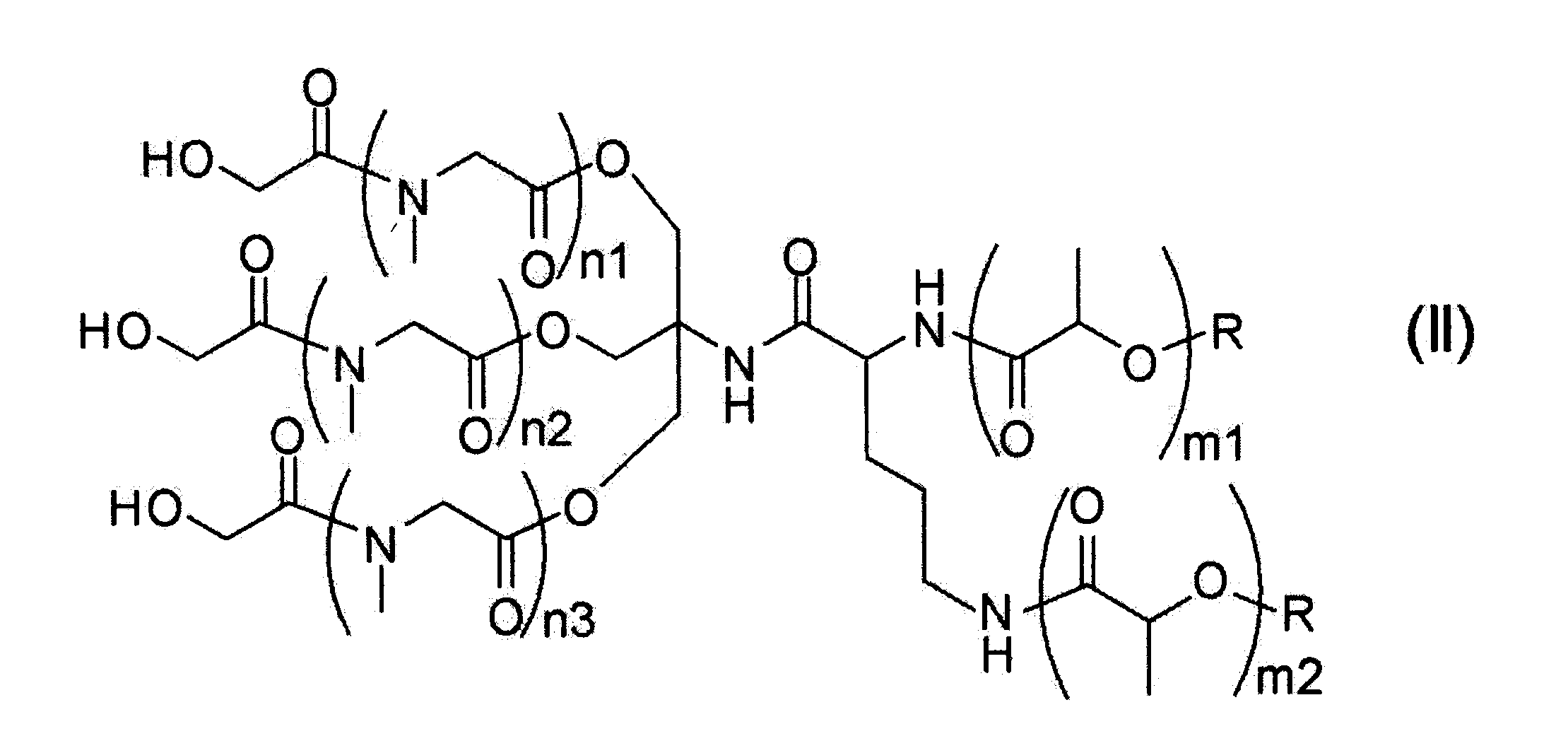
- the following formula (II) shows a preferred structure of the branched amphiphilic block polymer when the number of branches on the hydrophilic block side is 3 and the number of branches on the hydrophobic block side is 2.
- n1, n2, n3, and R are the same as in the formula (I).
- m1 and m2 represent numbers that add up to 10 to 400.
- [1-5. Synthesis method of amphiphilic block polymer] A person skilled in the art can appropriately synthesize a linear amphiphilic block polymer. For example, a hydrophobic block part (polylactic acid part) is synthesized and a functional group (for example, an amino group) that can serve as a linker for connecting a hydrophilic block part (polysarcosine part) is introduced to one end of a polylactic acid chain. . Next, polysarcosine may be introduced into this amino group.
- a linker reagent for linking a sarcosine or polysarcosine chain and a polylactic acid chain is synthesized, and is used as an initiator to extend by addition of a sarcosine moiety or by a polymerization reaction of a polysarcosine moiety and a polymerization reaction of a polylactic acid moiety.
- a branched amphiphilic block polymer can be synthesized.
- the polylactic acid chain is elongated to thereby extend branched parents.
- a solvable block polymer can be synthesized.
- both polysarcosine or both polysarcosine chain and polylactic acid chain are prepared in advance as a hydrophilic block and a hydrophobic block, respectively, and these blocks are linked using a separately synthesized linker reagent, thereby branching type.
- Amphiphilic block polymers can be synthesized.
- the linker reagent has one functional group (for example, a hydroxyl group, an amino group, etc.) that can bind to a lactic acid monomer (lactic acid or lactide) or a polylactic acid chain, or a number corresponding to the desired number of branches on the hydrophobic block side.
- a functional group for example, an amino group
- a sarcosine monomer for example, sarcosine or N-carboxysarcosine anhydride
- polysarcosine can be provided in a number corresponding to the desired number of branching on the side of the hydrophilic block.
- molecular design is appropriately performed by those skilled in the art so that each functional group capable of binding to the sarcosine monomer or polysarcosine has the same reactivity as much as possible.
- the functional group capable of binding to the lactic acid monomer or polylactic acid chain and the functional group capable of binding to the sarcosine monomer or polysarcosine can be protected by a protecting group, respectively.
- a protecting group those capable of being selectively removed as necessary are appropriately selected by those skilled in the art.
- a linker reagent for synthesizing a branched amphiphilic block polymer having 3 hydrophilic branch side branching numbers can be prepared based on, for example, a trishydroxymethylaminomethane (Tris) structure.
- the hydrophobic block side when the hydrophobic block side is branched, for example, it can be prepared based on a structure in which branch points are further increased to the above-described trishydroxymethylaminomethane structure.
- the structure with an increased branching point is all of trishydroxymethylaminomethane, amino acids having amino groups in the side chain as specific functional groups capable of binding to polylactic acid chains (specific examples include lysine and ornithine).
- a branch point can be increased by adding a similar amino acid derivative to the amino group which has been deprotected and freed.
- a method for synthesizing the polysarcosine chain and the polylactic acid chain can be appropriately determined by those skilled in the art depending on the functional group in the linker reagent, and may be selected from known peptide synthesis methods and polyester synthesis methods.
- Peptide synthesis is preferably performed, for example, by ring-opening polymerization of N-carboxysarcosine anhydride (sarcosine NCA) using a basic group such as an amino group in a linker reagent as an initiator.
- the polyester synthesis is preferably performed, for example, by ring-opening polymerization of lactide using a basic group such as an amino group in a linker reagent as an initiator.
- the chain lengths of the polysarcosine chain and the polylactic acid chain can be adjusted by adjusting the charge ratio between the initiator and the monomer in the polymerization reaction.
- the chain length can be confirmed by, for example, 1 HNMR.
- molecular aggregates such as micelles, multiple micelles, and vesicles having a size of nano order by aggregation of amphiphilic block polymers having hydrophilic blocks and hydrophobic blocks or by self-assembled orientation (nano Particles) are formed.
- amphiphilic block polymer having a hydrophilic block having a sarcosine unit and a hydrophobic block having a lactic acid unit is used as an example of the amphiphilic block polymer will be described.
- a molecular assembly is a structure formed by aggregation of the above-mentioned linear or branched amphiphilic polymer or by self-assembled orientation.
- the present invention is preferably a micelle-shaped molecular assembly configured such that the inner side (core portion) is a hydrophobic block and the outer side (shell portion) is a hydrophilic block.
- the molecular assembly of the present invention becomes a useful structure as a probe in molecular imaging or as a preparation in a drug delivery system.
- the branched amphiphilic block polymer has a larger molecular cross-sectional area at the hydrophilic portion than the straight chain amphiphilic block polymer due to the presence of a plurality of polysarcosine chains as branched chains. For this reason, the molecular assembly formed from the branched amphiphilic block polymer is excellent in stability as a particle. Furthermore, the particles can have a large curvature. For this reason, the molecular assembly composed of the branched block polymer has the basic feature that the size of the particles can be reduced.
- molecular aggregates composed of branched amphiphilic block polymers have a higher density of hydrophilic groups on the surface compared to linear lactosomes due to the presence of multiple polysarcosine chains as branched chains. It has the basic feature that sexual sites are less exposed.
- the organic solvent for dissolving the amphiphilic block polymer for example, trifluoroethanol, ethanol, hexafluoroisopropanol, dimethyl sulfoxide, dimethylformamide and the like are used.
- the aqueous liquid means water or an aqueous solution. Distilled water, distilled water for injection, physiological saline, buffer solution and the like are used.
- FIG. 1 is a schematic configuration diagram illustrating an example of a nanoparticle production apparatus according to the present invention.
- the apparatus for producing nanoparticles is A polymer solution supply channel Cp; Aqueous liquid supply channels Cw1, Cw2, A junction J where the polymer solution supply channel Cp and the aqueous liquid supply channel Cw1, Cw2 merge; A nanoparticle formation channel Cn located on the downstream side of the junction J, A nanoparticle-containing liquid outlet On at the downstream end of the nanoparticle formation channel Cn; A particle size measuring device 31 for measuring in real time a particle size statistic of nanoparticles in the nanoparticle-containing liquid discharged from the nanoparticle-containing liquid outlet On; A control unit U that automatically controls at least one of the supply amount of the polymer solution and the supply amount of the aqueous liquid based on the measured statistic of the particle diameter; Have
- the manufacturing apparatus includes a polymer solution tank 11, a three-way valve 14 that includes a syringe pump 13 and is connected to the tank 11 by a pipe 12, and extends from the three-way valve 14 for supplying a polymer solution. And a conduit 15 connected to the polymer solution inlet Ip of the microflow cell 1.
- the manufacturing apparatus also includes an aqueous liquid tank 21, a three-way valve 24 that includes a syringe pump 23 and is connected to the tank 21 via a pipe line 22, and a pipe line that extends from the three-way valve 24 for supplying an aqueous liquid.
- aqueous liquid tank 21 a three-way valve 24 that includes a syringe pump 23 and is connected to the tank 21 via a pipe line 22, and a pipe line that extends from the three-way valve 24 for supplying an aqueous liquid.
- 25, and pipes 26 and 27 that branch from the pipe 25 into two and extend to the aqueous liquid inlets Iw1 and Iw2 of the microflow cell 1, respectively.
- the particle diameter measuring device 31 is connected to a pipe line 30 extending from the nanoparticle-containing liquid outlet On.
- the particle size measuring device 31 may be a device based on a static light scattering method, a dynamic light scattering method, or a multi-angle laser light scattering method, but usually has a measurement flow cell and contains nanoparticles. While the liquid passes through the measurement flow cell, the particle size of the nanoparticles is measured in real time.
- the manufacturing apparatus includes a tank 33 that collects the nanoparticle-containing liquid output from the particle diameter measuring apparatus 31 via a pipe line 32.
- the control unit U receives the particle size data measured by the particle size measuring device 31, and inputs the polymer solution supply amount, the aqueous solution supply amount, and the nanoparticle obtained in advance.
- a computer PC for determining and controlling the supply amount of the polymer solution and the supply amount of the aqueous liquid to the joining portion J so that the measured particle size becomes a target value based on the relationship with the particle size; Based on the control signal 52 output from the computer PC, the temperature adjustment 56, 2 of the microflow cell 1 is performed, and the supply amount P2, 54 of the polymer solution and the supply amount of the aqueous liquid to the junction J And a controller 53 for controlling P1 and 55.
- the supply amount of the polymer solution is adjusted by the syringe pump 13 and the three-way valve 14.
- the supply amount of the aqueous liquid is adjusted by the syringe pump 23 and the three-way valve 24.
- the supply amount of the aqueous liquid is distributed to the two aqueous liquid supply channels Cw1 and Cw2.
- the supply amount of the polymer solution and the supply amount of the aqueous liquid that is, the ratio of the supply amount of the polymer solution and the supply amount of the aqueous solution, and / or the polymer
- the relationship between the supply amount of the solution and the total flow rate of the supply amount of the aqueous liquid) and the particle diameter of the nanoparticles is obtained in advance.
- the amphiphilic block polymer solution having a predetermined concentration is prepared, and the supply amount of the polymer solution is changed by changing the supply amount of the polymer solution and the supply amount of the aqueous liquid to the junction J at a predetermined temperature.
- Nanoparticles composed of the amphiphilic block polymer are formed under the conditions of the amount and the supply amount of the aqueous liquid. Then, the particle diameters of the formed nanoparticles are measured. The measurement of the particle size at this time is not necessarily performed in real time. From the obtained data, the relationship between the supply amount of the polymer solution and the supply amount of the aqueous liquid and the particle diameter of the nanoparticles can be obtained.
- the concentration of the amphiphilic block polymer solution is changed, the supply amount of the polymer solution, the supply amount of the aqueous liquid, and the particle diameter of the nanoparticles at different concentrations of the amphiphilic block polymer solution A relationship can be sought. Furthermore, when the nanoparticle formation temperature is changed, the relationship between the supply amount of the polymer solution and the supply amount of the aqueous liquid and the particle diameter of the nanoparticles at different temperatures can be obtained.
- the relationship between the obtained supply amount of the polymer solution and the supply amount of the aqueous liquid and the particle diameter of the nanoparticles is input to the computer PC.
- the computer PC sets the supply amount of the polymer solution and the supply amount of the aqueous liquid to the junction J so that the measured particle diameter becomes a target value.
- Determine and control The desired monodispersed (small PdI value) nanoparticles of uniform particle size are continuously produced.
- PdI is a polydispersity index, and the smaller the PdI value, the smaller the particle size distribution width.
- molecular aggregates having a uniform particle diameter in the range of, for example, 10 to 200 nm can be produced.
- the “particle diameter” means a particle diameter having the highest frequency of appearance in the particle distribution, that is, a central particle diameter. However, since it is monodisperse, it may be expressed by an average particle size.
- the method for measuring the size of the nanoparticles of the present invention is not particularly limited, and is appropriately selected by those skilled in the art. For example, transmission electron microscope (TEM) or atomic force microscope (AFM) observation method, static light scattering method, dynamic light scattering (DLS) method, etc. Can be mentioned. In the DLS method, the migration diffusion coefficient of particles that are in Brownian motion in a solution is measured. In the embodiment of the present specification, the dynamic light scattering method is used.
- the particle diameter of the nanoparticles is at least one of the supply amount of the polymer solution and the supply amount of the aqueous liquid (that is, the ratio between the supply amount of the polymer solution and the supply amount of the aqueous solution, and / or the polymer solution). And the total flow rate of the aqueous liquid supply amount) can be controlled. As shown in Examples, by increasing the total flow rate of the supply amount of the polymer solution and the supply amount of the aqueous liquid, the particle diameter of the nanoparticles is reduced and the PdI value is also reduced.
- the particle diameter of the nanoparticles is decreased and the PdI value is decreased by increasing the ratio of the supply amount of the aqueous liquid.
- the particle diameter of the particles composed thereof is smaller than that of the linear type.
- the particle size of the linear polymer particles can be about 20 to 200 nm, preferably about 25 to 40 nm, whereas the particle size of the branched polymer particles is 10 to 200 nm. It can take about 30 nm.
- the particle diameter can be further controlled by using a linear polymer and a branched polymer in combination and changing the ratio. The smaller the particle diameter (for example, 50 nm or less), the easier it is to obtain the EPR effect when administered in vivo.
- the post-treatment of the collected nanoparticle-containing liquid 33 may be appropriately performed.
- a step of removing the organic solvent is performed.
- purification process process suitably before the process of removing an organic solvent.
- treatment for example, treatment such as gel filtration chromatography, filtering, and ultracentrifugation can be performed. In this way, a nanoparticle solution or dispersion can be obtained.
- the obtained nanoparticle solution or dispersion may be freeze-dried.
- a known method can be used as the freeze-drying method without any particular limitation.
- the nanoparticle solution or dispersion obtained as described above can be frozen with liquid nitrogen and sublimated under reduced pressure. Thereby, a freeze-dried product of the molecular assembly is obtained. That is, the molecular assembly can be stored as a lyophilized product.
- the molecular aggregate can be used for use by adding water or an aqueous solution to the lyophilized product to obtain a dispersion of the molecular aggregate.
- the water or aqueous solution is not particularly limited, and those skilled in the art may appropriately select a biochemically and pharmaceutically acceptable one. Examples thereof include distilled water for injection, physiological saline, and buffer solution.
- the polymer solution when producing nanoparticles, can contain a drug and / or labeling agent to obtain nanoparticles containing the drug and / or labeling agent.
- the drug and / or labeling agent is soluble in the organic solvent.
- medical agent and / or a labeling agent can be contained in the said aqueous liquid, and the nanoparticle containing a chemical
- the drug and / or labeling agent is soluble in water.
- the drug and / or labeling agent may be appropriately selected by those skilled in the art according to the purpose.
- the drug delivery system and molecular imaging include administering the above-described molecular assembly into a living body.
- the living body to which the molecular assembly is administered is not particularly limited, and may be a human or non-human animal.
- Non-human animals are not particularly limited, but mammals other than humans, more specifically, primates, rodents (mouse, rats, etc.), rabbits, dogs, cats, pigs, cows, sheep, horses, etc. Can be mentioned.
- the molecular assembly used in the method of the present invention is excellent in specific accumulation at a vascular lesion site (for example, a malignant tumor site, an inflammatory site, an arteriosclerosis site, an angiogenesis site, etc.). Since the molecular assembly of the present invention accumulates in tissues at these sites due to the EPR (enhanced permeability and retention) effect, the accumulation does not depend on the type of tissue at the vascular lesion site.
- the administration target of the fluorescent probe of the present invention is preferably a cancer. There are a wide variety of cancers that can be the target of administration. For example, liver cancer, pancreatic cancer, lung cancer, cervical cancer, breast cancer, colon cancer and the like can be mentioned.
- the method of administration into the living body is not particularly limited, and can be appropriately determined by those skilled in the art. Therefore, the administration method may be systemic administration or local administration. That is, the molecular probe can be administered by any of injection (needle-type, needle-free), internal use, and external use.
- molecular imaging includes a step of detecting a signal derived from an administered molecular assembly.
- the state of the administration target (particularly the position and size of the tissue such as cancer) can be observed from outside the body.
- any means capable of visualizing the administered molecular assembly can be used.
- the detection means can be appropriately determined by those skilled in the art according to the type of labeling agent possessed by the molecular assembly.
- the time from administration to the start of detection can be appropriately determined by those skilled in the art. For example, it can be 1 to 24 hours after administration.
- the amount of lactosome accumulated in the tumor part and other than the tumor part and the temporal change of the accumulation amount are examined by the detection means.
- the detection of the molecular assembly is preferably performed by measurement from a plurality of directions, not from one direction of the living body, from the viewpoint of accuracy. Specifically, it is preferable to perform measurement from at least three directions, more preferably from at least five directions. When performing measurement from five directions, for example, measurement can be performed from the left and right abdominal sides, from both the left and right bodies, and from the back side.
- the synthesis of the polymer was performed by referring to the methods described in WO2009 / 148121 and WO2012 / 17685, from sarcosine-NCA (Sar-NCA) and aminated poly-L-lactic acid (a-PLLA), glycolic acid, O- (benzotriazol-1-yl) -N, N, N ′, N′-tetramethyluronium hexafluorophosphate (HATU) and N, N-diisopropylethylamine (DIEA) were used.
- Sar-NCA sarcosine-NCA
- a-PLLA aminated poly-L-lactic acid
- HATU N, N ′, N′-tetramethyluronium hexafluorophosphate
- DIEA N-diisopropylethylamine
- nanoparticles were produced from a linear amphiphilic block polymer (PLLA 30 -PSar 65 ) as follows, and the particle size was controlled.
- PLLA 30 -PSar 65 linear amphiphilic block polymer
- a chip mixer (Micromixer Chip Part No. 3000144, manufactured by Doromite, UK) was used as the micro flow cell 1.
- the particle size measuring device Malvern Zetasizer nano using a dynamic light scattering method was used.
- Milli-Q was used.
- an amphiphilic block polymer (PLLA 30 -PSar 65 ) was dissolved in N, N-dimethylformamide (DMF) at a concentration of 10 mg / mL, stirred at 60 ° C. for 30 min in an oil bath, and brought to room temperature. What used the temperature was used.
- a signal 52 is sent from the computer PC to the controller 53, and the controller 53 adjusts the three-way valves 14, 24, the syringe pumps 13, 23, and the heater 2 based on the signal 52, and feeds water 21 and the polymer solution 11.
- the controller 53 adjusts the three-way valves 14, 24, the syringe pumps 13, 23, and the heater 2 based on the signal 52, and feeds water 21 and the polymer solution 11.
- the temperature of the junction J of the polymer solution supply channel Cp and the aqueous liquid supply channels Cw1, Cw2 in the microflow cell 1 and the nanoparticle formation channel Cn were set.
- the water 21 and the polymer solution 11 were mixed in the joining part J under the set conditions, and nanoparticles were formed while passing from the joining part J through the nanoparticle formation channel Cn.
- the nanoparticle-containing liquid that has exited from the outlet On is sent to the measurement flow cell of the particle diameter measuring device 31 via the pipe line 30 to measure the particle diameter of the nanoparticles, and then the nanoparticle-containing liquid is sent via the pipe line 32. Collected in the tank 33.
- the particle size measurement result was stored in a computer PC.
- the flow rate and temperature conditions different from those described above were reset, and the same operation as described above was performed.
- nanoparticle formation and particle size measurement were performed under a plurality of different flow rates and temperature conditions, respectively, and information on particle size changes for each set flow rate and set temperature was accumulated in the computer PC. From these obtained data, the particle size dependence on water 21 and polymer solution 11 flow rate and temperature was formulated (functioned), and the function was introduced into the computer PC in advance.
- the target particle size is input to the computer PC.
- the computer PC calculates the optimum liquid feeding flow rate and temperature conditions for the water 21 and the polymer solution 11 from the function, and the particle size measuring device 31 measures the particle size in real time, and the measured particle size is calculated by the computer.
- the particle diameter of the nanoparticles can be automatically controlled to be uniform. In this manner, the series of treatments enables efficient and highly reproducible particle size control in continuous production of nanoparticles.
- the result of controlling the average particle diameter (nm) by controlling the total total flow rate F (water + raw material polymer flow rate) of the water 21 and the polymer solution 11 is shown in FIG.
- the conditions under which the nanoparticles were produced are as follows.
- Raw material polymer PLLA 30 -PSar 65
- Solvent DMF (N, N-dimethylformamide)
- Polymer concentration 10 mg / mL
- Total flow rate F: 1,000 ⁇ L / min to 4,000 ⁇ L / min
- Inclusion in nanoparticles None Temperature: 293K
- Particle size measurement method Dynamic light scattering method (DLS: Malvern Zetasizer-nano)
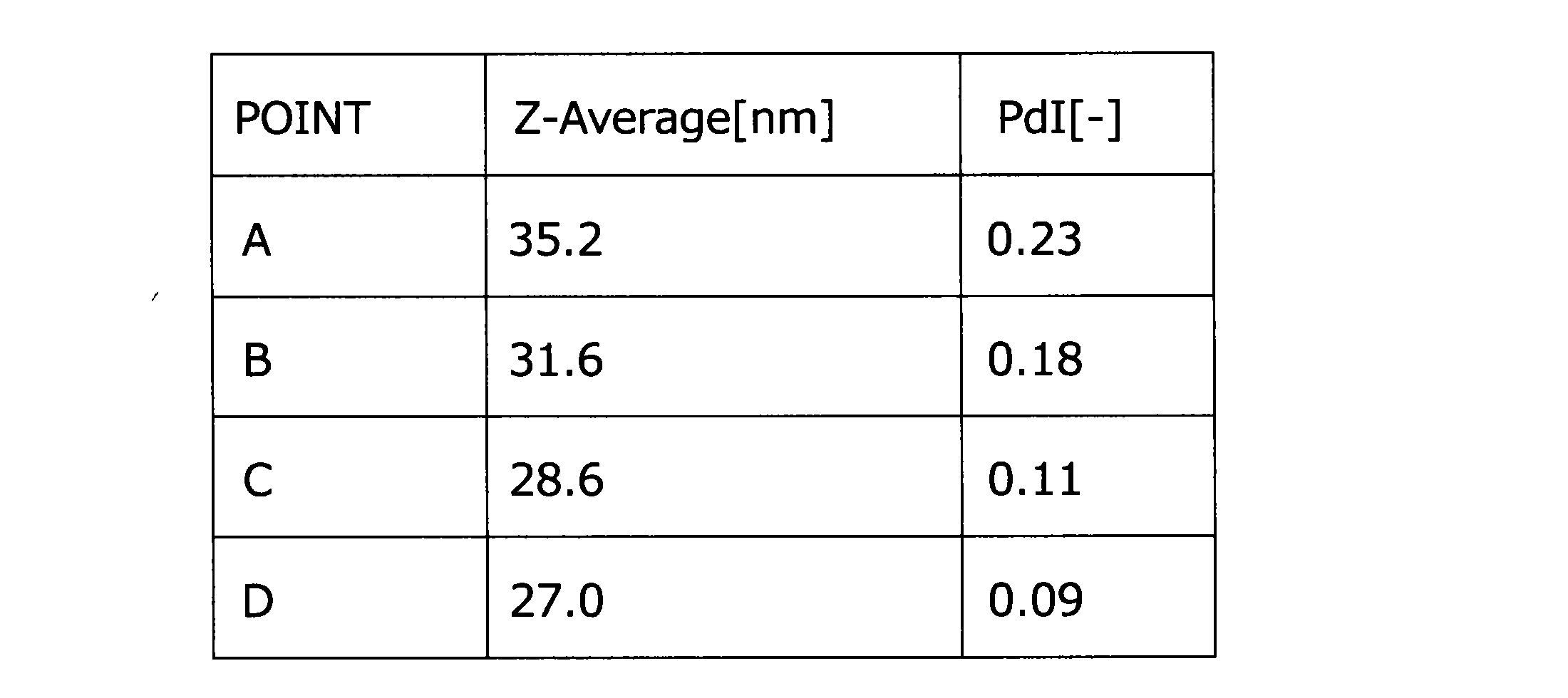
- FIG. 2 shows changes in the average particle diameter [nm] of nanoparticles (left vertical axis) and PdI [ ⁇ ] with respect to the total flow rate F [ ⁇ L / min] (horizontal axis) of the supply amount of the polymer solution and the supply amount of the aqueous solution. ] Is a graph showing a change (right vertical axis).
- the average particle diameter y 1 [nm] of the nanoparticles is a function of the total flow rate x [ ⁇ L / min].
- y 1 5E-07x 2 -0.0052x + 39.932 Represented as
- the average particle diameter and the PdI value of the nanoparticles vary depending on the total flow rate F, and the relationship with the flow rate F (x) is described by the second-order and third-order approximation equations, respectively. I understand. Thus, by obtaining the average particle size obtained as a function of the total flow rate F, the total flow rate to be set can be automatically calculated from the target average particle size, and particle size control can be performed. Is possible.
- the average particle diameter measured by DLS was used as a statistic of the particle diameter, but it is not necessarily the average particle diameter, even if it is the particle diameter of a single particle measured at a certain moment. It may be the peak particle size when the particle size of a plurality of particles is represented by a histogram. In addition, as long as the statistic reflects the physical size of the produced particles, the statistic of the particle diameter can be variously changed.
Landscapes
- Health & Medical Sciences (AREA)
- Chemical & Material Sciences (AREA)
- Medicinal Chemistry (AREA)
- Engineering & Computer Science (AREA)
- Life Sciences & Earth Sciences (AREA)
- Epidemiology (AREA)
- Veterinary Medicine (AREA)
- Public Health (AREA)
- General Health & Medical Sciences (AREA)
- Animal Behavior & Ethology (AREA)
- Nanotechnology (AREA)
- Bioinformatics & Cheminformatics (AREA)
- Organic Chemistry (AREA)
- Chemical Kinetics & Catalysis (AREA)
- Optics & Photonics (AREA)
- Physics & Mathematics (AREA)
- Pharmacology & Pharmacy (AREA)
- Polymers & Plastics (AREA)
- Biomedical Technology (AREA)
- Dispersion Chemistry (AREA)
- Nuclear Medicine, Radiotherapy & Molecular Imaging (AREA)
- Radiology & Medical Imaging (AREA)
- Proteomics, Peptides & Aminoacids (AREA)
- Medicinal Preparation (AREA)
- Processes Of Treating Macromolecular Substances (AREA)
Abstract
Description
(1) 親水性ブロックと疎水性ブロックとを有する両親媒性ブロックポリマーから構成されるナノ粒子の製造方法であって、
ポリマー溶液供給流路と、
水系液供給流路と、
前記ポリマー溶液供給流路と前記水系液供給流路とが合流する合流部と、
前記合流部の下流側に位置するナノ粒子形成流路と、
前記ナノ粒子形成流路の下流端のナノ粒子含有液出口と、
を有するナノ粒子の製造装置を用いて、
前記両親媒性ブロックポリマー溶液を前記ポリマー溶液供給流路を介して前記合流部に供給すると共に、前記水系液を前記水系液供給流路を介して前記合流部に供給し、
前記合流部から前記ナノ粒子形成流路の下流側に向かって前記ポリマー溶液の層流と前記水系液の層流とを互いに接触させながら、両親媒性ブロックポリマーからなるナノ粒子を形成し、
前記ナノ粒子含有液出口から前記形成されたナノ粒子を含有する液を得る、
ことを含み、且つ、
前記形成されたナノ粒子の粒子径の統計量をリアルタイムで測定すると共に、当該統計量が目的とする値となるように、前記合流部への前記ポリマー溶液の供給量及び前記水系液の供給量の少なくとも一方を制御して、それによりナノ粒子の粒子径を制御することを含む、ナノ粒子の製造方法。
所定濃度の前記両親媒性ブロックポリマー溶液を調製し、
前記ナノ粒子の製造装置を用いて、
前記合流部への前記ポリマー溶液の供給量及び前記水系液の供給量の少なくとも一方を変化させて、それぞれの前記ポリマー溶液の供給量及び前記水系液の供給量条件下において前記両親媒性ブロックポリマーからなるナノ粒子を形成し、
前記形成されたナノ粒子の粒子径の統計量をそれぞれ測定し、
前記ポリマー溶液の供給量及び前記水系液の供給量と、前記ナノ粒子の粒子径の統計量との関係を求めておき、
その関係に基づいて、前記合流部への前記ポリマー溶液の供給量及び前記水系液の供給量の少なくとも一方を決定及び制御して、それによりナノ粒子の粒子径を制御する、上記(1)に記載のナノ粒子の製造方法。
ポリマー溶液供給流路と、
水系液供給流路と、
前記ポリマー溶液供給流路と前記水系液供給流路とが合流する合流部と、
前記合流部の下流側に位置するナノ粒子形成流路と、
前記ナノ粒子形成流路の下流端のナノ粒子含有液出口と、
前記ナノ粒子含有液出口から排出されるナノ粒子含有液中のナノ粒子の粒子径の統計量をリアルタイムで測定する粒子径測定装置と、
測定された粒子径の統計量に基づいて、前記ポリマー溶液の供給量及び前記水系液の供給量の少なくとも一方を自動的に制御する制御ユニットと、
を有するナノ粒子の製造装置。
ポリマー溶液供給流路と、
水系液供給流路と、
前記ポリマー溶液供給流路と前記水系液供給流路とが合流する合流部と、
前記合流部の下流側に位置するナノ粒子形成流路と、
前記ナノ粒子形成流路の下流端のナノ粒子含有液出口と、
を有するナノ粒子の製造装置を用いて、
前記両親媒性ブロックポリマー溶液を前記ポリマー溶液供給流路を介して前記合流部に供給すると共に、前記水系液を前記水系液供給流路を介して前記合流部に供給し、
前記合流部から前記ナノ粒子形成流路の下流側に向かって前記ポリマー溶液の層流と前記水系液の層流とを互いに接触させながら、両親媒性ブロックポリマーからなるナノ粒子を形成し、
前記ナノ粒子含有液出口から前記形成されたナノ粒子を含有する液を得る、
ことを含み、且つ、
前記形成されたナノ粒子の粒子径の統計量をリアルタイムで測定すると共に、当該統計量が目的とする値となるように、前記合流部への前記ポリマー溶液の供給量及び前記水系液の供給量の少なくとも一方を制御して、それによりナノ粒子の粒子径を制御することを含む、ナノ粒子の粒径制御方法。
所定濃度の前記両親媒性ブロックポリマー溶液を調製し、
前記ナノ粒子の製造装置を用いて、
前記合流部への前記ポリマー溶液の供給量及び前記水系液の供給量の少なくとも一方を変化させて、それぞれの前記ポリマー溶液の供給量及び前記水系液の供給量条件下において前記両親媒性ブロックポリマーからなるナノ粒子を形成し、
前記形成されたナノ粒子の粒子径の統計量をそれぞれ測定し、
前記ポリマー溶液の供給量及び前記水系液の供給量と、前記ナノ粒子の粒子径の統計量との関係を求めておき、
その関係に基づいて、前記合流部への前記ポリマー溶液の供給量及び前記水系液の供給量の少なくとも一方を決定及び制御して、それによりナノ粒子の粒子径を制御する、上記に記載のナノ粒子の粒径制御方法。
本発明において、両親媒性ブロックポリマーは、親水性ブロックと疎水性ブロックとを有し、水系液(水又は水溶液)との接触により自己組織化してナノ粒子を形成し得るものであれば、特に限定されることなく用いることができる。ナノ粒子とは、サイズがナノオーダーの粒子であり、ミセル、ベシクル等の分子集合体が含まれる。
本発明において、両親媒性ブロックポリマーの親水性ブロックが有する「親水性」という物性の具体的な程度としては、特に限定されるものではないが、少なくとも、親水性ブロックの全体が、後述の疎水性ブロックとしてのポリ乳酸鎖に対して相対的に親水性が強い性質をいう。或いは、親水性ブロックが疎水性ブロックとコポリマーを形成することによって、コポリマー分子全体として両親媒性を実現することが可能となる程度の親水性をいう。さらに或いは、両親媒性ブロックポリマーが溶媒中で自己組織化して、自己集合体、特に粒子状の自己集合体を形成することが可能となる程度の親水性をいう。
本発明において、疎水性ブロックが有する「疎水性」という物性の具体的な程度としては、特に限定されるものではないが、少なくとも、疎水性ブロックが、上記の親水性ブロックの全体に対して相対的に疎水性が強い領域であり、当該親水性ブロックとコポリマーを形成することによって、コポリマー分子全体として両親媒性を実現することが可能となる程度の疎水性を有していれば良い。或いは、当該両親媒性ブロックポリマーが溶媒中で自己組織化して、自己集合体、好ましくは粒子状の自己集合体を形成することが可能となる程度の疎水性を有していれば良い。
ポリ乳酸は、優れた生体適合性及び安定性を有するものである。このため、このようなポリ乳酸を構成ブロックとした両親媒性物質から得られる分子集合体は、生体、特に人体への応用性という点で非常に有用である。
また、ポリ乳酸は、優れた生分解性を有することから代謝が早く、生体内においてがん組織以外への組織への集積性が低い。このため、このようなポリ乳酸を構成ブロックとした両親媒性物質から得られる分子集合体は、がん組織への特異的な集積性という点で非常に有用である。
そして、ポリ乳酸は、低沸点溶媒への溶解性に優れるものであることから、このようなポリ乳酸を構成ブロックとした両親媒性物質から分子集合体を得る際に、有害な高沸点溶媒の使用を回避することが可能である。このため、このような分子集合体は、生体への安全性という点で非常に有用である。
両親媒性ブロックポリマーにおいて、サルコシン単位数(すなわち、親水性ブロックに含まれるサルコシン単位の数、又は、親水性ブロックが分岐している場合には分岐全てに含まれるサルコシン単位の数の合計)をNSとし、ポリ乳酸単位数(すなわち、疎水性ブロックに含まれる乳酸単位の数、又は、疎水性ブロックが分岐している場合には分岐全てに含まれる乳酸単位数の合計)をNLとすると、それらの比NS/NLは、例えば0.05~5又は0.05~4でありうる。さらに好ましくは、NS/NLは、0.05以上1.8未満、例えば0.05以上1.7以下、0.05以上1.67以下、0.1以上1.7以下、又は0.1以上1.67以下であってよい。
親水性ブロックと疎水性ブロックとを連結するリンカー部位の構造は、化学的に許容可能な構造であれば特に限定されるものではない。当業者が適宜分子設計できる。

直鎖型両親媒性ブロックポリマーの合成は、当業者が適宜行うことができる。例えば、疎水性ブロック部(ポリ乳酸部)の合成を行うと共に、ポリ乳酸鎖の一端に、親水性ブロック部(ポリサルコシン部)を連結するリンカーとなり得る官能基(例えば、アミノ基)を導入する。次に、このアミノ基にポリサルコシンを導入するとよい。
ペプチド合成は、例えば、リンカー試薬におけるアミノ基などの塩基性基を開始剤として、N-カルボキシサルコシン無水物(サルコシンNCA)を開環重合することなどによって行うことが好ましい。
ポリエステル合成は、例えば、リンカー試薬におけるアミノ基などの塩基性基を開始剤として、ラクチドを開環重合することなどによって行うことが好ましい。
本発明において、親水性ブロックと疎水性ブロックとを有する両親媒性ブロックポリマーの凝集により、或いは自己集合的な配向により、サイズがナノオーダーであるミセル、多重ミセル、ベシクル等の分子集合体(ナノ粒子)が形成される。
親水性ブロックと疎水性ブロックとを有する両親媒性ブロックポリマーから構成される分子集合体(ナノ粒子)の製造について図面を参照して説明する。
ポリマー溶液供給流路Cpと、
水系液供給流路Cw1,Cw2と、
前記ポリマー溶液供給流路Cpと前記水系液供給流路Cw1,Cw2とが合流する合流部Jと、
前記合流部Jの下流側に位置するナノ粒子形成流路Cnと、
前記ナノ粒子形成流路Cnの下流端のナノ粒子含有液出口Onと、
前記ナノ粒子含有液出口Onから排出されるナノ粒子含有液中のナノ粒子の粒子径の統計量をリアルタイムで測定する粒子径測定装置31と、
測定された粒子径の統計量に基づいて、前記ポリマー溶液の供給量及び前記水系液の供給量の少なくとも一方を自動的に制御する制御ユニットUと、
を有する。
ポリマー溶液入口Ipと、前記ポリマー溶液入口Ipに接続したポリマー溶液供給流路Cpと、
水系液入口Iw1,Iw2と、前記水系液入口Iw1,Iw2にそれぞれ接続した水系液供給流路Cw1,Cw2と、
前記ポリマー溶液供給流路Cpと前記水系液供給流路Cw1,Cw2とが合流する合流部Jと、
前記合流部Jの下流側に位置するナノ粒子形成流路Cnと、
前記ナノ粒子形成流路Cnの下流端のナノ粒子含有液出口Onと、
を有するマイクロフローセル1を用いるとよい。マイクロフローセル1は、ヒーター2及び熱電対を具備して、温度調節が可能となされている。マイクロフローセル1としては、種々のものが入手可能である。
本発明において、ナノ粒子を作製するに際して、前記ポリマー溶液中に薬剤及び/又は標識剤を含有させて、薬剤及び/又は標識剤を含有するナノ粒子を得ることができる。この場合、薬剤及び/又は標識剤は、有機溶剤に対して溶解性を有するものである。また、ナノ粒子を作製するに際して、前記水系液中に、薬剤及び/又は標識剤を含有させて、薬剤及び/又は標識剤を含有するナノ粒子を得ることができる。この場合、薬剤及び/又は標識剤は、水に対して溶解性を有するものである。薬剤及び/又は標識剤については、当業者が、目的に応じて適宜選択するとよい。
本発明において、薬剤搬送システム及び分子イメージングは、上記の分子集合体を生体内に投与することを含む。分子集合体を投与される生体としては特に限定されないが、ヒト又は非ヒト動物でありうる。非ヒト動物としては特に限定されないが、ヒト以外の哺乳類、より具体的には、霊長類、齧歯類(マウス、ラットなど)、ウサギ、イヌ、ネコ、ブタ、ウシ、ヒツジ、及びウマなどが挙げられる。
生体内への投与の方法としては特に限定されず、当業者が適宜決定することができる。従って、投与の方法としては、全身投与及び局所投与とを問わない。すなわち、分子プローブの投与は、注射(針有型、針無型)、内服、外用のいずれの方法によっても行うことができる。
本発明において、分子イメージングにおいては、投与された分子集合体に由来するシグナルを検出する工程を含む。投与された分子集合体を検出することによって、体外から投与ターゲットの様子(特にがんなどの組織の位置・大きさ)を観測することができる。検出方法としては、投与された分子集合体を可視化させることができるあらゆる手段を用いることができる。検出手段としては、分子集合体が有する標識剤の種類に応じて、当業者が適宜決定することができる。
実施例において、サルコシン単位65個からなる親水性ブロックとL-乳酸単位30個からなる疎水性ブロックとを有する直鎖型両親媒性ブロックポリマー(PLLA30-PSar65)を用いた。ポリマーの合成は、WO2009/148121号公報、WO2012/176885公報に記載の方法を参照して、サルコシン-NCA(Sar-NCA)とアミノ化ポリL-乳酸(a-PLLA)とから、グリコール酸、O-(ベンゾトリアゾル-1-イル)-N,N,N’,N’-テトラメチルウロニウムヘキサフルオロリン酸塩(HATU)及びN,N-ジイソプロピルエチルアミン(DIEA)を用いて行った。

図1に示した装置を用いて、直鎖型両親媒性ブロックポリマー(PLLA30-PSar65)から次のようにしてナノ粒子を作製し、粒子径制御を行った。
溶媒:DMF(N,N-ジメチルホルムアミド)
ポリマー濃度:10mg/mL
混合比:蒸留水/原料ポリマー溶液=9/1(FRP=9/1)
トータル流量F:1,000μL/min~4,000μL/min
ナノ粒子への内包物:なし
温度:293K
粒子径測定法:動的光散乱法(DLS:Malvern Zetasizer-nano)
y1 =5E-07x2 -0.0052x+39.932
として表された。
y2 =1E-11x3 -8E-08x2+0.0001x+0.1854
として表された。
2:ヒーター
J:合流部
Cp:ポリマー溶液供給流路
Cw1,Cw2:水系液供給流路
Cn:ナノ粒子形成流路
On:ナノ粒子含有液出口
11:ポリマー溶液タンク
13:シリンジポンプ
14:三方弁
21:水系液タンク
23:シリンジポンプ
24:三方弁
31:粒子径測定装置
U:制御ユニット
PC:コンピュータ
53:コントローラ
Claims (13)
- 親水性ブロックと疎水性ブロックとを有する両親媒性ブロックポリマーから構成されるナノ粒子の製造方法であって、
ポリマー溶液供給流路と、
水系液供給流路と、
前記ポリマー溶液供給流路と前記水系液供給流路とが合流する合流部と、
前記合流部の下流側に位置するナノ粒子形成流路と、
前記ナノ粒子形成流路の下流端のナノ粒子含有液出口と、
を有するナノ粒子の製造装置を用いて、
前記両親媒性ブロックポリマー溶液を前記ポリマー溶液供給流路を介して前記合流部に供給すると共に、前記水系液を前記水系液供給流路を介して前記合流部に供給し、
前記合流部から前記ナノ粒子形成流路の下流側に向かって前記ポリマー溶液の層流と前記水系液の層流とを互いに接触させながら、両親媒性ブロックポリマーからなるナノ粒子を形成し、
前記ナノ粒子含有液出口から前記形成されたナノ粒子を含有する液を得る、
ことを含み、且つ、
前記形成されたナノ粒子の粒子径の統計量をリアルタイムで測定すると共に、当該統計量が目的とする値となるように、前記合流部への前記ポリマー溶液の供給量及び前記水系液の供給量の少なくとも一方を制御して、それによりナノ粒子の粒子径を制御することを含む、ナノ粒子の製造方法。 - 予め、
所定濃度の前記両親媒性ブロックポリマー溶液を調製し、
前記ナノ粒子の製造装置を用いて、
前記合流部への前記ポリマー溶液の供給量及び前記水系液の供給量の少なくとも一方を変化させて、それぞれの前記ポリマー溶液の供給量及び前記水系液の供給量条件下において前記両親媒性ブロックポリマーからなるナノ粒子を形成し、
前記形成されたナノ粒子の粒子径の統計量をそれぞれ測定し、
前記ポリマー溶液の供給量及び前記水系液の供給量と、前記ナノ粒子の粒子径の統計量との関係を求めておき、
その関係に基づいて、前記合流部への前記ポリマー溶液の供給量及び前記水系液の供給量の少なくとも一方を決定及び制御して、それによりナノ粒子の粒子径を制御する、請求項1に記載のナノ粒子の製造方法。 - 前記両親媒性ブロックポリマー溶液の濃度を変化させて、前記ポリマー溶液の供給量及び前記水系液の供給量と、前記ナノ粒子の粒子径の統計量との関係を予め求めておく、請求項2に記載のナノ粒子の製造方法。
- 粒子径の測定を、静的光散乱法、動的光散乱法、又は多角度レーザー光散乱法により行う、請求項1~3のいずれかに記載のナノ粒子の製造方法。
- 前記両親媒性ブロックポリマーは、アルキレンオキシド単位及び/又はサルコシン単位を有する親水性ブロックと、ヒドロキシ酸単位を有する疎水性ブロックとを有する、請求項1~4のいずれかに記載のナノ粒子の製造方法。
- 前記両親媒性ブロックポリマーは、サルコシン単位を有する親水性ブロックと、乳酸単位を有する疎水性ブロックとを有する、請求項1~5のいずれかに記載のナノ粒子の製造方法。
- 前記親水性ブロックに含まれるサルコシン単位の合計は2~300個である、請求項6に記載のナノ粒子の製造方法。
- 前記疎水性ブロックに含まれる乳酸単位は5~400個である、請求項6又は7に記載のナノ粒子の製造方法。
- 形成されるナノ粒子の粒子径が10~200nmである、請求項1~8のいずれかに記載のナノ粒子の製造方法。
- 形成されるナノ粒子の粒度分布は単峰性を示す、請求項1~9のいずれかに記載のナノ粒子の製造方法。
- 前記ポリマー溶液中に薬剤及び/又は標識剤を含有させて、薬剤及び/又は標識剤を含有するナノ粒子を得る、請求項1~10のいずれかに記載のナノ粒子の製造方法。
- 前記水系液中に、薬剤及び/又は標識剤を含有させて、薬剤及び/又は標識剤を含有するナノ粒子を得る、請求項1~11のいずれかに記載のナノ粒子の製造方法。
- 親水性ブロックと疎水性ブロックとを有する両親媒性ブロックポリマーから構成されるナノ粒子の製造装置であって、
ポリマー溶液供給流路と、
水系液供給流路と、
前記ポリマー溶液供給流路と前記水系液供給流路とが合流する合流部と、
前記合流部の下流側に位置するナノ粒子形成流路と、
前記ナノ粒子形成流路の下流端のナノ粒子含有液出口と、
前記ナノ粒子含有液出口から排出されるナノ粒子含有液中のナノ粒子の粒子径の統計量をリアルタイムで測定する粒子径測定装置と、
測定された粒子径の統計量に基づいて、前記ポリマー溶液の供給量及び前記水系液の供給量の少なくとも一方を自動的に制御する制御ユニットと、
を有するナノ粒子の製造装置。
Priority Applications (3)
| Application Number | Priority Date | Filing Date | Title |
|---|---|---|---|
| JP2016511578A JP6292294B2 (ja) | 2014-03-31 | 2015-03-25 | ナノ粒子の製造方法 |
| EP15773129.0A EP3127943A4 (en) | 2014-03-31 | 2015-03-25 | Process for producing nanoparticles |
| US15/300,492 US20170181979A1 (en) | 2014-03-31 | 2015-03-25 | Process for producing nanoparticles |
Applications Claiming Priority (2)
| Application Number | Priority Date | Filing Date | Title |
|---|---|---|---|
| JP2014-073069 | 2014-03-31 | ||
| JP2014073069 | 2014-03-31 |
Publications (1)
| Publication Number | Publication Date |
|---|---|
| WO2015151952A1 true WO2015151952A1 (ja) | 2015-10-08 |
Family
ID=54240279
Family Applications (1)
| Application Number | Title | Priority Date | Filing Date |
|---|---|---|---|
| PCT/JP2015/059077 Ceased WO2015151952A1 (ja) | 2014-03-31 | 2015-03-25 | ナノ粒子の製造方法 |
Country Status (4)
| Country | Link |
|---|---|
| US (1) | US20170181979A1 (ja) |
| EP (1) | EP3127943A4 (ja) |
| JP (1) | JP6292294B2 (ja) |
| WO (1) | WO2015151952A1 (ja) |
Families Citing this family (5)
| Publication number | Priority date | Publication date | Assignee | Title |
|---|---|---|---|---|
| WO2019212536A1 (en) * | 2018-05-01 | 2019-11-07 | Hewlett-Packard Development Company, L.P. | Sequential encapsulation of reagents |
| CN114913884B (zh) * | 2022-04-18 | 2026-02-24 | 苏州大学 | 一种用于超高密度数据存储的纳米存储器及其制备方法 |
| EP4282900A1 (en) * | 2022-05-23 | 2023-11-29 | Nanothera Biosciences, Inc. | Amphiphilic poly(amino acid) block copolymers and nanoparticles thereof for drug delivery applications |
| JP2025522307A (ja) * | 2022-05-23 | 2025-07-15 | ナノセラ、バイオサイエンシズ、インコーポレイテッド | 薬物送達用途のための両親媒性ポリ(アミノ酸)直鎖状ブロックコポリマーおよびそのナノ粒子 |
| CN118406356A (zh) * | 2024-02-18 | 2024-07-30 | 苏州盛虹纤维有限公司 | 一种可降解的聚乳酸基复合材料的制备方法及其制成材料的应用 |
Citations (3)
| Publication number | Priority date | Publication date | Assignee | Title |
|---|---|---|---|---|
| JP2008239902A (ja) * | 2007-03-28 | 2008-10-09 | Fujifilm Corp | ポリマー微粒子及びその製造方法 |
| WO2012176885A1 (ja) * | 2011-06-23 | 2012-12-27 | 株式会社 島津製作所 | 分岐型両親媒性ブロックポリマー、それを用いた分子集合体及び薬剤搬送システム |
| JP2014156555A (ja) * | 2013-02-17 | 2014-08-28 | Shimadzu Corp | ナノ粒子の製造方法 |
Family Cites Families (14)
| Publication number | Priority date | Publication date | Assignee | Title |
|---|---|---|---|---|
| US7595195B2 (en) * | 2003-02-11 | 2009-09-29 | The Regents Of The University Of California | Microfluidic devices for controlled viscous shearing and formation of amphiphilic vesicles |
| KR20050064075A (ko) * | 2003-12-23 | 2005-06-29 | 주식회사 삼양사 | 이트라코나졸을 유효성분으로 하는 약학적 조성물 |
| JP4551840B2 (ja) * | 2004-09-10 | 2010-09-29 | キヤノン株式会社 | 色材物質分散物の製造方法 |
| EP1693423B1 (en) * | 2005-01-14 | 2012-12-05 | FUJIFILM Corporation | Organic pigment fine-particle, and method of producing the same |
| US9381477B2 (en) * | 2006-06-23 | 2016-07-05 | Massachusetts Institute Of Technology | Microfluidic synthesis of organic nanoparticles |
| JP4936312B2 (ja) * | 2006-07-20 | 2012-05-23 | 株式会社島津製作所 | 新規な両親媒性物質、それを用いた薬剤搬送システム及び分子イメージングシステム |
| JP2008183554A (ja) * | 2007-01-05 | 2008-08-14 | Fujifilm Corp | 有機微粒子分散液の製造方法、およびそれにより得られる有機微粒子 |
| JP4509167B2 (ja) * | 2007-11-05 | 2010-07-21 | ソニー株式会社 | 流路構造、これを備えた流路基板及び流体制御方法 |
| JP2009242680A (ja) * | 2008-03-31 | 2009-10-22 | Fujifilm Corp | ポリマー処理有機微粒子分散物の製造方法 |
| JP5322476B2 (ja) * | 2008-03-31 | 2013-10-23 | テルモ株式会社 | リポソームの製造装置およびリポソームの製造方法 |
| HU230862B1 (hu) * | 2008-04-28 | 2018-10-29 | DARHOLDING Vagyonkezelő Kft | Berendezés és eljárás nanorészecskék folyamatos üzemű előállítására |
| JP5531332B2 (ja) * | 2008-06-05 | 2014-06-25 | 株式会社島津製作所 | 新規な分子集合体、それを用いた分子イメージング用分子プローブ及び薬剤搬送システム用分子プローブ、並びに分子イメージングシステム及び薬剤搬送システム |
| US10076496B2 (en) * | 2011-11-11 | 2018-09-18 | The Chinese University Of Hong Kong | Engineering of polymer-stabilized nanoparticles for drugs with Log P values below 6 by controlled antisolvent precipitation |
| JP5518110B2 (ja) * | 2012-02-16 | 2014-06-11 | 株式会社堀場製作所 | 粒径分布測定装置 |
-
2015
- 2015-03-25 WO PCT/JP2015/059077 patent/WO2015151952A1/ja not_active Ceased
- 2015-03-25 US US15/300,492 patent/US20170181979A1/en not_active Abandoned
- 2015-03-25 EP EP15773129.0A patent/EP3127943A4/en not_active Withdrawn
- 2015-03-25 JP JP2016511578A patent/JP6292294B2/ja not_active Expired - Fee Related
Patent Citations (3)
| Publication number | Priority date | Publication date | Assignee | Title |
|---|---|---|---|---|
| JP2008239902A (ja) * | 2007-03-28 | 2008-10-09 | Fujifilm Corp | ポリマー微粒子及びその製造方法 |
| WO2012176885A1 (ja) * | 2011-06-23 | 2012-12-27 | 株式会社 島津製作所 | 分岐型両親媒性ブロックポリマー、それを用いた分子集合体及び薬剤搬送システム |
| JP2014156555A (ja) * | 2013-02-17 | 2014-08-28 | Shimadzu Corp | ナノ粒子の製造方法 |
Non-Patent Citations (1)
| Title |
|---|
| See also references of EP3127943A4 * |
Also Published As
| Publication number | Publication date |
|---|---|
| EP3127943A4 (en) | 2017-09-27 |
| EP3127943A1 (en) | 2017-02-08 |
| JP6292294B2 (ja) | 2018-03-14 |
| JPWO2015151952A1 (ja) | 2017-04-13 |
| US20170181979A1 (en) | 2017-06-29 |
Similar Documents
| Publication | Publication Date | Title |
|---|---|---|
| Asadian-Birjand et al. | Functional nanogels for biomedical applications | |
| Sun et al. | Temperature-sensitive gold nanoparticle-coated pluronic-PLL nanoparticles for drug delivery and chemo-photothermal therapy | |
| US8609115B2 (en) | High shear application in drug delivery | |
| Janrao et al. | Recent advances of polymer based nanosystems in cancer management | |
| JP6292294B2 (ja) | ナノ粒子の製造方法 | |
| Bian et al. | One-pot synthesis of redox-labile polymer capsules via emulsion droplet-mediated precipitation polymerization | |
| JP6160693B2 (ja) | 両親媒性ブロックポリマーを用いた分子集合体、及びそれを用いた物質搬送用キャリア | |
| JP6036377B2 (ja) | ナノ粒子の製造方法 | |
| Tariq et al. | Design, optimization & characterization of niosomal & polymeric nanoparticles | |
| Rajabi et al. | Polymeric nanocarriers in drug delivery, bioimaging, and biosensing: advances and perspectives on nanomicelles, nanogels, and dendrimers | |
| Chinnagounder Periyasamy et al. | Nanomaterials for the local and targeted delivery of osteoarthritis drugs | |
| TWI735621B (zh) | 使用兩親性嵌段高分子的藥劑內包分子集合體及其製備方法 | |
| Mahapatra et al. | Tiny technology proves big: a challenge at engineering, medicine and pharmaceutical sciences interface | |
| Liu et al. | Nanoscale functional biomaterials for cancer theranostics | |
| Sirisha | A review on delivery of anti-cancer drugs by smart nanocarriers: Data obtained from past one decade | |
| Shah et al. | Nanopharmaceuticals: challenges and regulatory perspective | |
| JP6519659B2 (ja) | ナノ粒子の製造方法 | |
| Kumari et al. | PLGA-based nanoparticles for enhanced diagnosis and cancer therapy | |
| Hussein et al. | Highlights on polymeric micelles as versatile nanocarriers for drug transporting | |
| JP6418088B2 (ja) | ナノ粒子の製造方法 | |
| Barbosa et al. | Nanotechnology applied in drug delivery | |
| JP2015231960A (ja) | 粒子作製方法 | |
| Mandal et al. | Role of nanoparticles in chemotherapy in cancer and drug delivery: current scenario and future challenges | |
| US10035887B2 (en) | Manufacturing method for nanoparticle | |
| Fergusson | Small Solutions to Big Problems: Design and Synthesis of Nanoparticles for Biomedical Applications |
Legal Events
| Date | Code | Title | Description |
|---|---|---|---|
| 121 | Ep: the epo has been informed by wipo that ep was designated in this application |
Ref document number: 15773129 Country of ref document: EP Kind code of ref document: A1 |
|
| ENP | Entry into the national phase |
Ref document number: 2016511578 Country of ref document: JP Kind code of ref document: A |
|
| WWE | Wipo information: entry into national phase |
Ref document number: 15300492 Country of ref document: US |
|
| NENP | Non-entry into the national phase |
Ref country code: DE |
|
| REEP | Request for entry into the european phase |
Ref document number: 2015773129 Country of ref document: EP |
|
| WWE | Wipo information: entry into national phase |
Ref document number: 2015773129 Country of ref document: EP |