WO2015152168A1 - Base d'onguent et onguent - Google Patents
Base d'onguent et onguent Download PDFInfo
- Publication number
- WO2015152168A1 WO2015152168A1 PCT/JP2015/059974 JP2015059974W WO2015152168A1 WO 2015152168 A1 WO2015152168 A1 WO 2015152168A1 JP 2015059974 W JP2015059974 W JP 2015059974W WO 2015152168 A1 WO2015152168 A1 WO 2015152168A1
- Authority
- WO
- WIPO (PCT)
- Prior art keywords
- weight
- fatty acid
- ointment
- parts
- dextrin
- Prior art date
- Legal status (The legal status is an assumption and is not a legal conclusion. Google has not performed a legal analysis and makes no representation as to the accuracy of the status listed.)
- Ceased
Links
Images

Classifications
-
- A—HUMAN NECESSITIES
- A61—MEDICAL OR VETERINARY SCIENCE; HYGIENE
- A61K—PREPARATIONS FOR MEDICAL, DENTAL OR TOILETRY PURPOSES
- A61K9/00—Medicinal preparations characterised by special physical form
- A61K9/06—Ointments; Bases therefor; Other semi-solid forms, e.g. creams, sticks, gels
-
- A—HUMAN NECESSITIES
- A61—MEDICAL OR VETERINARY SCIENCE; HYGIENE
- A61K—PREPARATIONS FOR MEDICAL, DENTAL OR TOILETRY PURPOSES
- A61K47/00—Medicinal preparations characterised by the non-active ingredients used, e.g. carriers or inert additives; Targeting or modifying agents chemically bound to the active ingredient
- A61K47/44—Oils, fats or waxes according to two or more groups of A61K47/02-A61K47/42; Natural or modified natural oils, fats or waxes, e.g. castor oil, polyethoxylated castor oil, montan wax, lignite, shellac, rosin, beeswax or lanolin
-
- A—HUMAN NECESSITIES
- A61—MEDICAL OR VETERINARY SCIENCE; HYGIENE
- A61K—PREPARATIONS FOR MEDICAL, DENTAL OR TOILETRY PURPOSES
- A61K9/00—Medicinal preparations characterised by special physical form
- A61K9/0012—Galenical forms characterised by the site of application
- A61K9/0014—Skin, i.e. galenical aspects of topical compositions
Definitions
- the present invention relates to an ointment base and an ointment excellent in formulation stability. More specifically, the present invention relates to an ointment base having an appropriate consistency and physical stability that is easy to apply and an ointment comprising the ointment base.
- Vaseline is a semi-solid substance composed of liquid hydrocarbons and solid hydrocarbons, stable in the air, and does not deteriorate or rot due to light or humidity, making it safe for the skin. It has properties such as high (no irritation) and extremely low reactivity with other components. Therefore, petrolatum is widely used as a base for external preparations such as ointments. However, petrolatum is inferior to the gelled hydrocarbon, which is also widely used as a base for external preparations, and has a poor feeling when applied to the skin, and bleeding may occur with separation of liquid and solid components over time. Are known.
- Patent Document 1 or Patent Document 2 discloses a semi-solid preparation or an oily external preparation containing a fatty acid dextrin and excellent in stability and use feeling.
- the addition of a small amount of fatty acid dextrin causes a problem in the stability of the resulting preparation at high temperatures.
- the preparation hardens and solidifies, so that an ointment with a good feeling of use can be obtained. There was a problem that it was not possible.
- An object of the present invention is to provide an ointment base and an ointment that solve the above-mentioned problems in the prior art, have an appropriate consistency that is easy to apply, and have high physical stability.
- the present inventor has added a fatty acid dextrin and solid oil (hydrophobic substance that is solid at room temperature) at a specific ratio to petrolatum, thereby having an appropriate consistency and physical stability. Succeeded in obtaining a high ointment base. Furthermore, the ointment prepared by mixing the ointment base with a solubilizing agent (such as fats and oils and polyhydric alcohols used to dissolve the active ingredient) was confirmed to have good usability and high stability. did.
- a solubilizing agent such as fats and oils and polyhydric alcohols used to dissolve the active ingredient
- the ointment base according to the present invention comprises petrolatum, fatty acid dextrin and solid oil, and 2 to 10 parts by weight of fatty acid dextrin and 3 to 34 parts by weight total of fatty acid dextrin and solid oil with respect to 100 parts by weight of petrolatum. It is characterized by including.
- an ointment base containing 1 part by weight or more of solid oil and 4 to 27 parts by weight in total of fatty acid dextrin and solid oil is more preferable with respect to 100 parts by weight of petrolatum.
- An ointment base comprising 1 part by weight or more of solid oil and 7 to 27 parts by weight of the total amount of fatty acid dextrin and solid oil with respect to 100 parts by weight of petroleum jelly is particularly preferred, and 2 to 6 of fatty acid dextrin with respect to 100 parts by weight of petroleum jelly.
- An ointment base containing 5 to 21 parts by weight of solid oil is more preferable.
- Preferred examples of the fatty acid dextrin include dextrin palmitate.
- solid oil examples include hydrocarbons (excluding petroleum jelly), wax, hydrogenated oil, fatty acids having 10 or more carbon atoms, higher alcohols having 12 or more carbon atoms, polyethylene glycols and fatty acid esters having a number average molecular weight of 1500 to 20000 Is mentioned.
- preferred solid oils are selected from hydrocarbons selected from ceresin and paraffin, wax beeswax, carnauba wax and microcrystalline wax, capric acid, myristic acid, palmitic acid, stearic acid and behenic acid Saturated higher alcohol selected from saturated fatty acids, lauryl alcohol, myristyl alcohol, cetanol, stearyl alcohol and behenyl alcohol, Macrogol 4000, Macrogol 6000 and Macro of the standards prescribed in “Japanese Pharmacopoeia” or “Pharmaceutical Additives Standard” Polyethylene glycol selected from Goal 20000, POE (80-100) hydrogenated castor oil, sorbitan monostearate, sorbitan tristearate, glyceryl monomyristate, glyceryl monostearate Penta stearic acid polyglyceryl-10, glycol monostearate, monostearate PEG-25 monostearate PEG-40, fatty acid ester selected from monostearate
- a particularly preferred ointment base according to the present invention contains dextrin palmitate as the fatty acid dextrin, and white beeswax and / or stearic acid as the solid oil.
- the ointment containing 65% by weight or more of the ointment base according to the present invention is excellent in physical stability and feeling of use like the ointment base according to the present invention.
- the ointment base according to the present invention and the ointment according to the present invention have excellent physical stability and feeling of use.
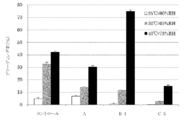
- FIG. 1 is a graph showing the results of bleeding corn evaluation of each ointment base (stored at 25 ° C./60% RH, 30 ° C./65% RH and 40 ° C./75% RH for 4 weeks).
- FIG. 2 is a graph showing the results of evaluation of bleeding corn for each ointment (stored at 30 ° C./65% RH for 4 weeks).
- the petrolatum used in the present invention is a semi-solid substance obtained by refining a mixture of hydrocarbons obtained from petroleum, and is also called petrolatum.
- the petrolatum of the present invention is preferably a highly purified one such as white petrolatum.
- the fatty acid dextrin used in the present invention is preferably a fatty acid dextrin obtained by esterifying a dextrin with a saturated fatty acid having 14 to 18 carbon atoms.
- fatty acid dextrin examples include dextrin palmitate, dextrin myristate, and dextrin stearate.
- a particularly preferred fatty acid dextrin is dextrin palmitate.
- the solid oil used in the present invention is a hydrophobic substance that is solid (including paste and semi-solid) at room temperature (20 ° C) and has a melting point of 23 ° C or higher (more preferably 40 ° C or higher). Is preferred.
- the melting point can be measured by the 16th revised Japanese Pharmacopoeia, General Test Method 2.60 Melting Point Measurement Method Second Method.
- the solid oil include hydrocarbons (excluding petrolatum), wax, hardened oil, fatty acids (preferably saturated fatty acids) having 10 or more carbon atoms (preferably 10 to 30 carbon atoms, more preferably 12 to 22 carbon atoms).
- Higher alcohols preferably saturated higher alcohols having 12 or more carbon atoms (preferably 12 to 30 carbon atoms, more preferably 12 to 22 carbon atoms), polyethylene glycol having a number average molecular weight of 1500 to 20000 (or “Japanese Pharmacy” Or “Golol 1540 to Macrogol 20000) and fatty acid esters.
- hydrocarbon examples include ceresin, lanolin and paraffin.
- wax examples include white beeswax, beeswax, carnauba wax, microcrystalline wax, molasses and whale wax.
- a preferred example of the hydrogenated oil is POE (40-100) hydrogenated castor oil (more preferably POE (80-100) hydrogenated castor oil).
- POE 40-100 hydrogenated castor oil
- fatty acid, the higher alcohol, and the polyethylene glycol are as described above.
- fatty acid esters include monostearic acid POE (20) sorbitan (polysorbate 60), monostearic acid POE (6) sorbitan (polysorbate 61), tristearic acid POE (20) sorbitan (polysorbate 65), tetrastearate Solveste stearate-60, sorbitan monopalmitate, sorbitan monostearate, sorbitan sesquistearate, sorbitan tristearate, propylene glycol monostearate, glyceryl monomyristate, glyceryl monostearate, glyceryl monooleate, glyceryl distearate , Polyglyceryl monostearate-2, polyglyceryl monostearate-4, polyglyceryl monostearate-6, polyglyceryl monostearate-10, polyglyceryl monooleate-2, pentastearic acid Polyglyceryl-4, polyglyceryl pentastearate-6,
- Particularly preferred solid oils are hydrocarbons selected from ceresin (melting point 61-95 ° C) and paraffin (melting point 50-75 ° C), beeswax (melting point 60-67 ° C), carnauba wax (melting point 80-86 ° C) and micro.
- Wax selected from crystallin wax (melting point 58-98 ° C), capric acid (melting point 28-34 ° C), myristic acid (melting point 45-56 ° C), palmitic acid (melting point 50-63 ° C), stearic acid (melting point 56 Saturated fatty acid selected from behenic acid (melting point 69-80 ° C), lauryl alcohol (melting point 23-31 ° C), myristyl alcohol (melting point 33-45 ° C), cetanol (melting point 47-53 ° C), Saturated higher alcohols selected from stearyl alcohol (melting point 56-62 ° C) and behenyl alcohol (melting point 65-73 ° C), Macrogol 4000 (melting point 53 ⁇ 57 °C), Macrogol 6000 ( Point 56-61 ° C) and Macrogol 20000 (melting point 56-64 ° C) polyethylene glycol, POE (80-100) hydrogenated castor oil (mel
- the ointment base according to the present invention consists essentially of the petrolatum, the fatty acid dextrin, and the solid oil.
- the ointment base according to the present invention is prepared using the above three components as raw materials. However, when impurities are present in the raw materials or impurities may be mixed in the manufacturing process, the ointment base according to the present invention is Such inevitable impurities (usually 5% by weight or less, more preferably 3% by weight or less, particularly preferably 1% by weight or less) may be contained.
- the ointment base according to the present invention contains 2 to 10 parts by weight of fatty acid dextrin and 3 to 34 parts by weight (more preferably 7 to 34 parts by weight) of fatty acid dextrin and solid oil based on 100 parts by weight of petrolatum. .
- the amount of the fatty acid dextrin is less than 2 parts by weight, the stability at high temperature is poor, and when it exceeds 10 parts by weight, the feeling of use becomes worse.
- solid oil is not added, there is a problem that stability at high temperature is reduced, and when the total of fatty acid dextrin and solid oil exceeds 34 parts by weight, the feeling of use at the time of applying an ointment is impaired. Occurs.
- the amount of fatty acid dextrin (preferably dextrin palmitate) added to 100 parts by weight of petroleum jelly is more preferably 2 to 6 parts by weight, and particularly preferably 2 to 4 parts by weight.
- the amount of solid oil (preferably honey beeswax or stearic acid, particularly preferably honey beeswax) added to 100 parts by weight of petrolatum is preferably 1 part by weight or more, based on 100 parts by weight of petrolatum, and 1.5 parts by weight or more. More preferably, it is more preferably 3 parts by weight or more, and particularly preferably 5 parts by weight or more.
- the ointment base according to the present invention comprises 2 to 10 parts by weight of fatty acid dextrin and 1 part by weight or more of solid oil with respect to 100 parts by weight of petroleum jelly, and 7 to 27 weights in total of fatty acid dextrin and solid oil.
- An ointment base containing 2 to 6 parts by weight of a fatty acid dextrin and 5 to 21 parts by weight of solid oil per 100 parts by weight of petrolatum is particularly preferred.
- the weight of the solid oil exceeds 0.5 (particularly 1) with respect to the weight 1 of the fatty acid dextrin.
- the weight ratio of fatty acid dextrin to solid oil is 1: 0.5 to 10 (particularly 1.5 to 10), particularly preferably 1: 2 to 9, more preferably 1: 2 to 4. is there.
- the ointment according to the present invention contains 65% by weight or more (preferably 70% by weight or more, more preferably 75% by weight or more, particularly preferably 80% by weight or more, and further preferably 85% by weight or more) of the ointment base.
- the ointment according to the present invention usually contains an active ingredient and a substance (dissolving agent) for dissolving the active ingredient in addition to the ointment base.
- the ointment which concerns on this invention can contain the additive generally used for the external preparation for skin.
- antioxidants such as ascorbic acid, dibutylhydroxytoluene, tocophenol acetate
- stabilizers such as sodium edetate
- preservatives such as paraoxybenzoic acid esters
- colorants oxidizing. Titanium, etc.
- perfume l-menthol etc.
- the active ingredient contained in the ointment according to the present invention may be hydrophilic or oleophilic.
- a solubilizer for dissolving the active ingredient a substance that is liquid at normal temperature (20 ° C.) can be used.
- the solubilizer may be a substance having a high polarity or a substance having a low polarity.
- the solubilizer dissolves in the ointment base, and when a substance with high polarity is used as a solubilizer
- the dissolving agent is dispersed in the form of fine droplets in the ointment base. Whether it is a dissolution type or a dispersion type can be identified by microscopic observation.
- Low polarity solubilizers include 1,2,6-hexanetriol, crotamiton, squalane, silicone oil, isostearyl palmitate, cetyl 2-ethylhexanoate, polypropylene glycol 2000, tri (capryl / capric acid) glycerin, isostearic acid -2-Hexadecyl, liquid paraffin, isopropyl myristate, octyldodecanol, isostearyl alcohol, medium chain triglyceride, oleyl alcohol, hexyldecanol, glycerin triisooctanoate, diisopropyl sebacate, lauryl alcohol, castor oil, isostearic acid, sebacic acid Examples include diethyl, diisopropyl adipate, etc., and high-polarity solubilizers include water (preferably purified water), benzyl alcohol, triacetin, propy
- Examples include rubitan, 2-ethyl-1,3-hexanediol, ethylene glycol salicylate, dipropylene glycol, ethanol, macrogol 400, 1,3-butylene glycol, propylene glycol, lactic acid, D-sorbitol, and glycerin.
- the greater the difference between the polar values of the ointment base and the solubilizer the more likely phase separation will occur.However, the ointment base (low polarity) according to the present invention, even when used in combination with a highly polar solubilizer, Separation hardly occurs.
- the smaller the difference between the polar values of the ointment base and the dissolving agent the more easily bleeding occurs.
- the ointment base according to the present invention is less likely to cause bleeding even when used in combination with a dissolving agent with low polarity. . Therefore, the ointment base according to the present invention is very versatile.
- the ointment base according to the present invention can provide a highly stable ointment even when used in combination with a highly polar solubilizer and a less polar solubilizer.
- the present invention includes ointment bases and ointments obtained by arbitrarily combining them. It is. Also included in the present invention are ointment bases and ointments obtained by arbitrarily combining the weight parts and concentration ranges described for the essential and optional components. When a plurality of numerical ranges are described, the upper limit value or the lower limit value of each numerical range can be arbitrarily combined.
- Example 1 The ointment base shown in Table 1 was prepared.
- the preparation method of each base is as follows.
- [Base A] White petrolatum and white beeswax were dissolved at 90 ° C. to obtain a uniform oil phase, and then gradually cooled with stirring.
- the shear viscosity in 30 degreeC and 40 degreeC was measured.
- the measuring method is as follows.
- the shear viscosity at 30 ° C. correlates with the feeling of use at the time of applying the ointment (the lower the value, the better the feeling of use), and 20 Pa ⁇ s or less is preferable.
- the shear viscosity at 40 ° C. correlates with the stability at a high temperature (40 ° C.) (the higher the value, the more stable), and 0.8 Pa ⁇ s or more is preferable.
- Table 1 the base A to which only solid oil was added tended to have a higher shear viscosity (increased base consistency) at 30 ° C. than the control (only white petrolatum). There was a tendency that the shear rate at °C also increased (heat stability increased).
- Base B series containing only fatty acid dextrin has lower shear viscosity at 30 ° C and 40 ° C when the amount of fatty acid dextrin added is small, and shearing increases as the amount of fatty acid dextrin increases.
- Base B-7 the addition amount was increased to 6 parts by weight
- the thermal stability was inferior to petrolatum.
- the shear viscosity at 40 ° C exceeded 0.8 Pa ⁇ s and the thermal stability increased, but the shear viscosity at 30 ° C increased. The feeling of use was impaired because it exceeded 20 Pa ⁇ s.
- the amount of the fatty acid dextrin added was suitably 10 parts by weight or less.
- Example 2 The ointment base prepared in Example 1 was evaluated for bleeding.
- the bleeding evaluation method is as follows. ⁇ Bleeding evaluation> About 10 g of an ointment base (sample) was filled in a bleed evaluation cone, and this was placed in an empty glass beaker having a capacity of 30 ml previously measured. After storage for 4 weeks, the weight of the glass beaker in which the separated liquid component was collected was measured, and the weight of the empty glass beaker was subtracted from the weight to determine the weight of the separated liquid component.
- the bleeding rate was calculated from the following formula (the smaller the bleeding rate, the less likely bleeding occurs and the higher the physical stability).
- Measurement conditions were 25 ° C./60% RH, 30 ° C./65% RH, and 40 ° C./75% RH, and the number of tests was three.
- Table 2 and FIG. 1 show the bleeding rate (average value and standard deviation).
- Example 3 A sensory test was conducted on the ointment base prepared in Example 1. There were three panelists, and each panelist evaluated each of “hardness”, “nobi”, “stickiness”, and “tekari” based on the following criteria.
- Hardness> Compared to white petrolatum when extruding and applying a sample from a tube, “1 point: hard, 2 points: slightly hard, 3 points: equivalent, 4 points: slightly soft, 5 points: soft ”Was evaluated.
- ⁇ Nob> Compared with white petrolatum at the time of sample application, "1 point: poor spread, 2 points: slightly spread, 3 points: equivalent, 4 points: slightly spread, 5 points: spread Evaluation was made on a five-point scale.
- the base A consisting only of petrolatum and solid oil tended to be slightly harder than white petrolatum.
- Base B-4 consisting only of petroleum jelly and fatty acid dextrin, had a better feeling than white petrolatum in terms of hardness, spread and stickiness, but there was a tendency to slightly increase the amount of light.
- Base C-5 containing petrolatum, fatty acid dextrin and solid oil resulted in the same hardness, stretch, and lightness as petrolatum and less stickiness. From this, it was found that the ointment base according to the present invention has the same or better feeling of use than white petrolatum.
- Example 4 Ointments were prepared by mixing the ointment base according to the present invention with various solubilizers. For comparison, an ointment was prepared using only petrolatum as an ointment base. As petrolatum, fatty acid dextrin and solid oil, white petrolatum, dextrin palmitate and beeswax wax were used as in Example 1. Table 4 shows the composition of the ointment base and the type of solubilizer according to the present invention. All the used solubilizers are liquid at normal temperature (20 ° C.).
- Ointments according to the present invention (ointment numbers 1 to 7) and comparative ointments (ointment numbers 8 to 9) were prepared by the following method.
- ⁇ Preparation method of ointment numbers 1-7> First, an ointment base was prepared by dissolving white petrolatum, dextrin palmitate and beeswax at 90 ° C. to obtain a uniform oil phase. Thereafter, the dissolving agent heated to 75 ° C. was put into the ointment base and gradually cooled with stirring to prepare an ointment.
- solubilizer When a medium-chain fatty acid triglyceride, diethyl sebacate, or crotamiton, which is a low polarity ( ⁇ value 15-39) solubilizer, is used as a solubilizer, the solubilizer dissolves in the ointment base to form a soluble ointment. It was. When a high-polarity ( ⁇ value 48-73) propylene carbonate, ethylene glycol salicylate, 1,3-butylene glycol, or propylene glycol is used as a solubilizer, the solubilizer is fine in the ointment base. Dispersed into droplets to form a dispersion-type ointment.
- ⁇ value 15-39 low polarity solubilizer
- ointment numbers 8 and 9 An ointment was prepared by charging a white petrolatum (ointment base) dissolved at 90 ° C with a dissolving agent heated to 90 ° C and gradually cooling it with stirring.
- a white petrolatum oil dissolved at 90 ° C
- a dissolving agent heated to 90 ° C and gradually cooling it with stirring.
- diethyl sebacate with low polarity was used as a solubilizer, it became a dissolution type ointment, and when 1,3-butylene glycol with high polarity was used as a solubilizer, it became a dispersion type ointment.
- phase separation evaluation was performed by the following methods.
- bleeding separation of liquid components from the ointment
- the bleeding evaluation method was as described in Example 2 (the number of tests for ointment numbers 1 to 8 was 3 and the number of tests for ointment number 9 was 1).
- ⁇ Property evaluation> The color (observed on a white background) and shape were evaluated visually.
- ⁇ Evaluation of phase separation> After filling 5 g of ointment into a glass vial and centrifuging (3000 rpm, 10 minutes), the presence or absence of phase separation was visually evaluated.
- FIG. 2 shows the bleeding rate when ointments of ointment numbers 1 to 7 were stored at 30 ° C./65% RH for 4 weeks.
- the ointment base according to the present invention is mixed with a low polarity solubilizer (a soluble ointment is obtained) or mixed with a high polarity solubilizer (dispersed ointment).
- the obtained ointment maintained the ointment properties, hardly caused phase separation, and did not easily cause bleeding.
- ointment No. 8 dissolved ointment was prone to bleeding, and the bleeding rate was only stored for one day at 30 ° C / 65% RH. Exceeded 10%, and the bleeding rate after 2 weeks exceeded 30%.
- the ointment base of the present invention did not cause phase separation even when mixed with a high-polarity solubilizer (ointment number 4 to 7) and stored at 30 ° C./65% RH for 9 months. . From this, it was found that the ointment base according to the present invention can be used in combination with various solubilizers and is very versatile.
- Example 5 About the ointment which concerns on this invention, the shear viscosity in 30 degreeC and 40 degreeC was measured.
- the method for measuring the shear viscosity is the same as in Example 1.
- white petrolatum was used as petrolatum
- palmitic acid dextrin was used as fatty acid dextrin
- white beeswax was used as solid oil.
- the method for preparing the ointment is as described in Example 4.
- composition of the ointment base used is shown in Table 7, and the composition of the ointment and the measurement results of shear viscosity are shown in Table 8.
- “%” represents “% by weight” based on the total amount of the ointment.
- the ointment produced using the ointment base according to the present invention has good usability because the shear viscosity at 30 ° C. is less than 20 Pa ⁇ s regardless of the polarity of the dissolving agent. Since the shear viscosity at is 0.8 Pa ⁇ s or more, the thermal stability was excellent.
- an ointment using an ointment base (C-8 and C-9) in which the sum of fatty acid dextrin and solid oil is 27 parts by weight or less has a shear viscosity at 30 ° C. of less than 10 Pa ⁇ s, and is excellent in use feeling. It was.
- Example 6 An ointment base (C-11) shown in Table 9 was prepared. As petrolatum and fatty acid dextrin, white petrolatum and dextrin palmitate were used in the same manner as in Example 1, and stearic acid (trade name: purified stearic acid 750V sales company: Kao Corporation) was used as the solid oil. Also, the ointment base is mixed with water (purified water), which is a highly polar solubilizer, and oleyl alcohol (trade name: NOVOL-LQ-JP, sales company: Croda Japan Co., Ltd.), which is a solubilizing agent with low polarity. An ointment was prepared. The ⁇ values for water and oleyl alcohol are 90 and 15, respectively.
- ⁇ Preparation method of ointment number 12> white petrolatum and stearic acid were heated at 55 ° C., then dextrin palmitate was added and stirred until evenly dispersed. After confirming the dispersion, an ointment base was prepared by dissolving at 90 ° C. to obtain a uniform oil phase. Thereafter, the mixture was cooled with stirring until the ointment base reached 75 ° C., oleyl alcohol and purified water were added, and then gradually cooled with stirring to prepare an ointment.
- the ointment shown in Table 9 was confirmed to be stable with no phase separation even when stored at 30 ° C./65% RH for 4 weeks. From this, it was found that the ointment base according to the present invention exhibits excellent stability even when used in combination with a high-polarity dissolution agent and a low-polarity dissolution agent.
- an ointment base 2 to 10 parts by weight of fatty acid dextrin and 1 part by weight or more of solid oil are added to 100 parts by weight of petroleum jelly, and It is considered preferable to adjust the addition amount of dextrin and solid oil so that the total amount of dextrin and solid oil is in the range of 3 to 34 parts by weight.
- an ointment base containing 2 to 10 parts by weight of fatty acid dextrin and 1 part by weight or more of solid oil and 100 to 7 parts by weight of fatty acid dextrin and solid oil in total for 100 parts by weight of petroleum jelly has a feeling of use and heat Excellent stability and difficult to cause bleeding.
- the ointment base can maintain its excellent characteristics even when used in combination with various solubilizers, so that it is possible to obtain an ointment that is excellent in feeling of use and thermal stability and hardly causes bleeding and phase separation. It was.
Landscapes
- Health & Medical Sciences (AREA)
- Chemical & Material Sciences (AREA)
- Medicinal Chemistry (AREA)
- Pharmacology & Pharmacy (AREA)
- Epidemiology (AREA)
- Life Sciences & Earth Sciences (AREA)
- Animal Behavior & Ethology (AREA)
- General Health & Medical Sciences (AREA)
- Public Health (AREA)
- Veterinary Medicine (AREA)
- Dermatology (AREA)
- Oil, Petroleum & Natural Gas (AREA)
- Medicinal Preparation (AREA)
Abstract
La présente invention concerne : une base d'onguent qui a une consistance adéquate rendant l'application facile et qui présente une stabilité physique élevée ; et un onguent. Cette base d'onguent est caractérisée par le fait qu'elle comprend de la vaseline, un acide gras/une dextrine, et un corps gras solide, la proportion de l'acide gras/dextrine étant de 2 à 10 parts en masse et la proportion totale de l'acide gras/dextrine et du corps gras solide étant de 3 à 34 parts en masse pour 100 parts en masse de la vaseline. Il est spécialement préféré que la base d'onguent contienne 1 part en masse ou plus du corps gras solide et contienne l'acide gras/dextrine et le corps gras solide dans une proportion totale de 4 à 27 parts en masse, pour 100 parts en masse de la vaseline.
Priority Applications (1)
| Application Number | Priority Date | Filing Date | Title |
|---|---|---|---|
| JP2016511890A JP6566574B2 (ja) | 2014-03-31 | 2015-03-30 | 軟膏基剤および軟膏 |
Applications Claiming Priority (2)
| Application Number | Priority Date | Filing Date | Title |
|---|---|---|---|
| JP2014074662 | 2014-03-31 | ||
| JP2014-074662 | 2014-03-31 |
Publications (1)
| Publication Number | Publication Date |
|---|---|
| WO2015152168A1 true WO2015152168A1 (fr) | 2015-10-08 |
Family
ID=54240490
Family Applications (1)
| Application Number | Title | Priority Date | Filing Date |
|---|---|---|---|
| PCT/JP2015/059974 Ceased WO2015152168A1 (fr) | 2014-03-31 | 2015-03-30 | Base d'onguent et onguent |
Country Status (2)
| Country | Link |
|---|---|
| JP (1) | JP6566574B2 (fr) |
| WO (1) | WO2015152168A1 (fr) |
Citations (5)
| Publication number | Priority date | Publication date | Assignee | Title |
|---|---|---|---|---|
| JPS5441322A (en) * | 1977-09-06 | 1979-04-02 | Showa Yakuhin Kakou Kk | Ointment base |
| JPS63159489A (ja) * | 1986-12-23 | 1988-07-02 | Shin Etsu Chem Co Ltd | ゲル状組成物 |
| JP2003128533A (ja) * | 2001-10-17 | 2003-05-08 | Rohto Pharmaceut Co Ltd | 半固形製剤 |
| JP2003128521A (ja) * | 2001-10-16 | 2003-05-08 | Rohto Pharmaceut Co Ltd | 外用製剤 |
| JP2010111638A (ja) * | 2008-11-07 | 2010-05-20 | Earth Chem Corp Ltd | 鼻腔内塗布製剤 |
Family Cites Families (1)
| Publication number | Priority date | Publication date | Assignee | Title |
|---|---|---|---|---|
| JP5944707B2 (ja) * | 2012-03-21 | 2016-07-05 | 御木本製薬株式会社 | 油中水または油中水中油型乳化物 |
-
2015
- 2015-03-30 WO PCT/JP2015/059974 patent/WO2015152168A1/fr not_active Ceased
- 2015-03-30 JP JP2016511890A patent/JP6566574B2/ja active Active
Patent Citations (5)
| Publication number | Priority date | Publication date | Assignee | Title |
|---|---|---|---|---|
| JPS5441322A (en) * | 1977-09-06 | 1979-04-02 | Showa Yakuhin Kakou Kk | Ointment base |
| JPS63159489A (ja) * | 1986-12-23 | 1988-07-02 | Shin Etsu Chem Co Ltd | ゲル状組成物 |
| JP2003128521A (ja) * | 2001-10-16 | 2003-05-08 | Rohto Pharmaceut Co Ltd | 外用製剤 |
| JP2003128533A (ja) * | 2001-10-17 | 2003-05-08 | Rohto Pharmaceut Co Ltd | 半固形製剤 |
| JP2010111638A (ja) * | 2008-11-07 | 2010-05-20 | Earth Chem Corp Ltd | 鼻腔内塗布製剤 |
Also Published As
| Publication number | Publication date |
|---|---|
| JPWO2015152168A1 (ja) | 2017-04-13 |
| JP6566574B2 (ja) | 2019-08-28 |
Similar Documents
| Publication | Publication Date | Title |
|---|---|---|
| CN103764114A (zh) | 使用了油性凝胶状组合物的发油 | |
| JP5079689B2 (ja) | 油性軟膏と可溶化された形態のビタミンdまたはその誘導体とを含む薬剤組成物 | |
| JP2018095588A (ja) | W/o型乳液状組成物 | |
| JP5965187B2 (ja) | 油性軟膏剤 | |
| JP5944707B2 (ja) | 油中水または油中水中油型乳化物 | |
| JP6566574B2 (ja) | 軟膏基剤および軟膏 | |
| BRPI1010907B1 (pt) | emulsão de óleo-em-água de mometasona e propileno-glicol | |
| TW201509441A (zh) | 乳化組成物 | |
| US20220331238A1 (en) | Oil-in-water emulsion of mometasone | |
| JP6503627B2 (ja) | 医薬液体組成物 | |
| JP5722364B2 (ja) | 医薬組成物 | |
| JP5662495B2 (ja) | 可溶化剤形の医薬組成物 | |
| JP7642361B2 (ja) | 外用医薬組成物 | |
| US7888392B2 (en) | Ointment | |
| JP2009149623A (ja) | 皮膚用乳化化粧料 | |
| JP7646342B2 (ja) | 外用医薬組成物 | |
| JP2022178154A (ja) | 外用組成物 | |
| JP7733994B2 (ja) | 外用組成物 | |
| JP7712737B1 (ja) | オキサゾール化合物含有組成物 | |
| JP7706235B2 (ja) | 外用医薬組成物 | |
| JP6077081B2 (ja) | 医薬組成物 | |
| JP5422956B2 (ja) | 皮膚外用クリーム剤 | |
| TW202612685A (zh) | 包含唑化合物之組合物 | |
| JP5730340B2 (ja) | 貯留型医薬組成物 | |
| JP6110839B2 (ja) | 可溶化剤形の医薬組成物 |
Legal Events
| Date | Code | Title | Description |
|---|---|---|---|
| 121 | Ep: the epo has been informed by wipo that ep was designated in this application |
Ref document number: 15772569 Country of ref document: EP Kind code of ref document: A1 |
|
| ENP | Entry into the national phase |
Ref document number: 2016511890 Country of ref document: JP Kind code of ref document: A |
|
| NENP | Non-entry into the national phase | ||
| 122 | Ep: pct application non-entry in european phase |
Ref document number: 15772569 Country of ref document: EP Kind code of ref document: A1 |