WO2015152301A1 - 合わせガラス用中間膜及び合わせガラス - Google Patents
合わせガラス用中間膜及び合わせガラス Download PDFInfo
- Publication number
- WO2015152301A1 WO2015152301A1 PCT/JP2015/060268 JP2015060268W WO2015152301A1 WO 2015152301 A1 WO2015152301 A1 WO 2015152301A1 JP 2015060268 W JP2015060268 W JP 2015060268W WO 2015152301 A1 WO2015152301 A1 WO 2015152301A1
- Authority
- WO
- WIPO (PCT)
- Prior art keywords
- resin layer
- laminated glass
- layer
- laminated
- plastic layer
- Prior art date
- Legal status (The legal status is an assumption and is not a legal conclusion. Google has not performed a legal analysis and makes no representation as to the accuracy of the status listed.)
- Ceased
Links
Images

Classifications
-
- B—PERFORMING OPERATIONS; TRANSPORTING
- B32—LAYERED PRODUCTS
- B32B—LAYERED PRODUCTS, i.e. PRODUCTS BUILT-UP OF STRATA OF FLAT OR NON-FLAT, e.g. CELLULAR OR HONEYCOMB, FORM
- B32B17/00—Layered products essentially comprising sheet glass, or glass, slag, or like fibres
- B32B17/06—Layered products essentially comprising sheet glass, or glass, slag, or like fibres comprising glass as the main or only constituent of a layer, next to another layer of a specific material
- B32B17/10—Layered products essentially comprising sheet glass, or glass, slag, or like fibres comprising glass as the main or only constituent of a layer, next to another layer of a specific material of synthetic resin
- B32B17/10005—Layered products essentially comprising sheet glass, or glass, slag, or like fibres comprising glass as the main or only constituent of a layer, next to another layer of a specific material of synthetic resin laminated safety glass or glazing
- B32B17/10009—Layered products essentially comprising sheet glass, or glass, slag, or like fibres comprising glass as the main or only constituent of a layer, next to another layer of a specific material of synthetic resin laminated safety glass or glazing characterized by the number, the constitution or treatment of glass sheets
- B32B17/10036—Layered products essentially comprising sheet glass, or glass, slag, or like fibres comprising glass as the main or only constituent of a layer, next to another layer of a specific material of synthetic resin laminated safety glass or glazing characterized by the number, the constitution or treatment of glass sheets comprising two outer glass sheets
-
- C—CHEMISTRY; METALLURGY
- C03—GLASS; MINERAL OR SLAG WOOL
- C03C—CHEMICAL COMPOSITION OF GLASSES, GLAZES OR VITREOUS ENAMELS; SURFACE TREATMENT OF GLASS; SURFACE TREATMENT OF FIBRES OR FILAMENTS MADE FROM GLASS, MINERALS OR SLAGS; JOINING GLASS TO GLASS OR OTHER MATERIALS
- C03C27/00—Joining pieces of glass to pieces of other inorganic material; Joining glass to glass other than by fusing
- C03C27/06—Joining glass to glass by processes other than fusing
- C03C27/10—Joining glass to glass by processes other than fusing with the aid of adhesive specially adapted for that purpose
-
- B—PERFORMING OPERATIONS; TRANSPORTING
- B32—LAYERED PRODUCTS
- B32B—LAYERED PRODUCTS, i.e. PRODUCTS BUILT-UP OF STRATA OF FLAT OR NON-FLAT, e.g. CELLULAR OR HONEYCOMB, FORM
- B32B17/00—Layered products essentially comprising sheet glass, or glass, slag, or like fibres
- B32B17/06—Layered products essentially comprising sheet glass, or glass, slag, or like fibres comprising glass as the main or only constituent of a layer, next to another layer of a specific material
- B32B17/10—Layered products essentially comprising sheet glass, or glass, slag, or like fibres comprising glass as the main or only constituent of a layer, next to another layer of a specific material of synthetic resin
- B32B17/10005—Layered products essentially comprising sheet glass, or glass, slag, or like fibres comprising glass as the main or only constituent of a layer, next to another layer of a specific material of synthetic resin laminated safety glass or glazing
- B32B17/1055—Layered products essentially comprising sheet glass, or glass, slag, or like fibres comprising glass as the main or only constituent of a layer, next to another layer of a specific material of synthetic resin laminated safety glass or glazing characterized by the resin layer, i.e. interlayer
- B32B17/10678—Layered products essentially comprising sheet glass, or glass, slag, or like fibres comprising glass as the main or only constituent of a layer, next to another layer of a specific material of synthetic resin laminated safety glass or glazing characterized by the resin layer, i.e. interlayer comprising UV absorbers or stabilizers, e.g. antioxidants
-
- B—PERFORMING OPERATIONS; TRANSPORTING
- B32—LAYERED PRODUCTS
- B32B—LAYERED PRODUCTS, i.e. PRODUCTS BUILT-UP OF STRATA OF FLAT OR NON-FLAT, e.g. CELLULAR OR HONEYCOMB, FORM
- B32B17/00—Layered products essentially comprising sheet glass, or glass, slag, or like fibres
- B32B17/06—Layered products essentially comprising sheet glass, or glass, slag, or like fibres comprising glass as the main or only constituent of a layer, next to another layer of a specific material
- B32B17/10—Layered products essentially comprising sheet glass, or glass, slag, or like fibres comprising glass as the main or only constituent of a layer, next to another layer of a specific material of synthetic resin
- B32B17/10005—Layered products essentially comprising sheet glass, or glass, slag, or like fibres comprising glass as the main or only constituent of a layer, next to another layer of a specific material of synthetic resin laminated safety glass or glazing
- B32B17/1055—Layered products essentially comprising sheet glass, or glass, slag, or like fibres comprising glass as the main or only constituent of a layer, next to another layer of a specific material of synthetic resin laminated safety glass or glazing characterized by the resin layer, i.e. interlayer
- B32B17/10761—Layered products essentially comprising sheet glass, or glass, slag, or like fibres comprising glass as the main or only constituent of a layer, next to another layer of a specific material of synthetic resin laminated safety glass or glazing characterized by the resin layer, i.e. interlayer containing vinyl acetal
-
- B—PERFORMING OPERATIONS; TRANSPORTING
- B32—LAYERED PRODUCTS
- B32B—LAYERED PRODUCTS, i.e. PRODUCTS BUILT-UP OF STRATA OF FLAT OR NON-FLAT, e.g. CELLULAR OR HONEYCOMB, FORM
- B32B27/00—Layered products comprising a layer of synthetic resin
- B32B27/06—Layered products comprising a layer of synthetic resin as the main or only constituent of a layer, which is next to another layer of the same or of a different material
- B32B27/08—Layered products comprising a layer of synthetic resin as the main or only constituent of a layer, which is next to another layer of the same or of a different material of synthetic resin
-
- B—PERFORMING OPERATIONS; TRANSPORTING
- B32—LAYERED PRODUCTS
- B32B—LAYERED PRODUCTS, i.e. PRODUCTS BUILT-UP OF STRATA OF FLAT OR NON-FLAT, e.g. CELLULAR OR HONEYCOMB, FORM
- B32B27/00—Layered products comprising a layer of synthetic resin
- B32B27/18—Layered products comprising a layer of synthetic resin characterised by the use of special additives
- B32B27/20—Layered products comprising a layer of synthetic resin characterised by the use of special additives using fillers, pigments, thixotroping agents
-
- B—PERFORMING OPERATIONS; TRANSPORTING
- B32—LAYERED PRODUCTS
- B32B—LAYERED PRODUCTS, i.e. PRODUCTS BUILT-UP OF STRATA OF FLAT OR NON-FLAT, e.g. CELLULAR OR HONEYCOMB, FORM
- B32B27/00—Layered products comprising a layer of synthetic resin
- B32B27/18—Layered products comprising a layer of synthetic resin characterised by the use of special additives
- B32B27/22—Layered products comprising a layer of synthetic resin characterised by the use of special additives using plasticisers
-
- B—PERFORMING OPERATIONS; TRANSPORTING
- B32—LAYERED PRODUCTS
- B32B—LAYERED PRODUCTS, i.e. PRODUCTS BUILT-UP OF STRATA OF FLAT OR NON-FLAT, e.g. CELLULAR OR HONEYCOMB, FORM
- B32B27/00—Layered products comprising a layer of synthetic resin
- B32B27/42—Layered products comprising a layer of synthetic resin comprising condensation resins of aldehydes, e.g. with phenols, ureas or melamines
-
- B—PERFORMING OPERATIONS; TRANSPORTING
- B32—LAYERED PRODUCTS
- B32B—LAYERED PRODUCTS, i.e. PRODUCTS BUILT-UP OF STRATA OF FLAT OR NON-FLAT, e.g. CELLULAR OR HONEYCOMB, FORM
- B32B37/00—Methods or apparatus for laminating, e.g. by curing or by ultrasonic bonding
- B32B37/10—Methods or apparatus for laminating, e.g. by curing or by ultrasonic bonding characterised by the pressing technique, e.g. using action of vacuum or fluid pressure
-
- B—PERFORMING OPERATIONS; TRANSPORTING
- B32—LAYERED PRODUCTS
- B32B—LAYERED PRODUCTS, i.e. PRODUCTS BUILT-UP OF STRATA OF FLAT OR NON-FLAT, e.g. CELLULAR OR HONEYCOMB, FORM
- B32B2250/00—Layers arrangement
- B32B2250/03—3 layers
-
- B—PERFORMING OPERATIONS; TRANSPORTING
- B32—LAYERED PRODUCTS
- B32B—LAYERED PRODUCTS, i.e. PRODUCTS BUILT-UP OF STRATA OF FLAT OR NON-FLAT, e.g. CELLULAR OR HONEYCOMB, FORM
- B32B2307/00—Properties of the layers or laminate
- B32B2307/30—Properties of the layers or laminate having particular thermal properties
- B32B2307/304—Insulating
-
- B—PERFORMING OPERATIONS; TRANSPORTING
- B32—LAYERED PRODUCTS
- B32B—LAYERED PRODUCTS, i.e. PRODUCTS BUILT-UP OF STRATA OF FLAT OR NON-FLAT, e.g. CELLULAR OR HONEYCOMB, FORM
- B32B2307/00—Properties of the layers or laminate
- B32B2307/50—Properties of the layers or laminate having particular mechanical properties
- B32B2307/54—Yield strength; Tensile strength
-
- B—PERFORMING OPERATIONS; TRANSPORTING
- B32—LAYERED PRODUCTS
- B32B—LAYERED PRODUCTS, i.e. PRODUCTS BUILT-UP OF STRATA OF FLAT OR NON-FLAT, e.g. CELLULAR OR HONEYCOMB, FORM
- B32B2307/00—Properties of the layers or laminate
- B32B2307/50—Properties of the layers or laminate having particular mechanical properties
- B32B2307/558—Impact strength, toughness
-
- B—PERFORMING OPERATIONS; TRANSPORTING
- B32—LAYERED PRODUCTS
- B32B—LAYERED PRODUCTS, i.e. PRODUCTS BUILT-UP OF STRATA OF FLAT OR NON-FLAT, e.g. CELLULAR OR HONEYCOMB, FORM
- B32B2307/00—Properties of the layers or laminate
- B32B2307/70—Other properties
- B32B2307/71—Resistive to light or to UV
-
- B—PERFORMING OPERATIONS; TRANSPORTING
- B32—LAYERED PRODUCTS
- B32B—LAYERED PRODUCTS, i.e. PRODUCTS BUILT-UP OF STRATA OF FLAT OR NON-FLAT, e.g. CELLULAR OR HONEYCOMB, FORM
- B32B2605/00—Vehicles
- B32B2605/006—Transparent parts other than made from inorganic glass, e.g. polycarbonate glazings
Definitions
- the present invention relates to an interlayer film for laminated glass used for laminated glass. Moreover, this invention relates to the laminated glass using the said intermediate film for laminated glasses.
- Laminated glass is superior in safety even if it is damaged by an external impact and the amount of glass fragments scattered is small. For this reason, the said laminated glass is widely used for a motor vehicle, a rail vehicle, an aircraft, a ship, a building, etc.
- the laminated glass is manufactured by sandwiching an interlayer film for laminated glass between a pair of glass plates. Laminated glass is required to have high penetration resistance because it is not easily damaged even when subjected to an external impact.
- Patent Document 1 As an example of the interlayer film for laminated glass, the following Patent Document 1 includes two resin layers (A) containing a transparent adhesive resin, and polyethylene terephthalate disposed between the two resin layers (A). An interlayer film including a resin layer (B) is disclosed.
- Patent Document 2 there is an intermediate film that is a laminate formed of a plasticized polyvinyl acetal resin film or a laminate formed of a plasticized polyvinyl acetal resin film and a polyester film. It is disclosed.
- Patent Document 3 discloses an intermediate film in which two or more layers having different Young's moduli are laminated. Examples 1 and 2 of Patent Document 3 describe an intermediate film in which two layers A and B are stacked in a stacked structure of A / B / A.
- the conventional intermediate films as described in Patent Documents 1 to 3 have a problem that workability is low during the production of laminated glass. For example, misalignment between the intermediate film and the glass plate may occur.
- the adhesive force between the plastic layer and the resin layer may be low. Furthermore, there is a problem that the plastic layer and the resin layer are easily peeled off and the handling property of the intermediate film is low.
- An object of the present invention is to provide an interlayer film for laminated glass that can enhance the adhesion between the plastic layer and the resin layer and can enhance the handleability of the laminated glass. Moreover, the objective of this invention is providing the laminated glass using said intermediate film for laminated glasses.
- the length of the surface of the plastic layer at the first laminated interface is 100%.
- An interlayer film for laminated glass is provided in which the ratio of the length of the surface of the plastic layer at the first laminated interface where the first resin layer is not in contact is 75% or less.
- the interlayer film for laminated glass when the Young's modulus of the plastic layer is higher than the Young's modulus of the first resin layer, and the interlayer film includes the second resin layer, The Young's modulus of the plastic layer is higher than the Young's modulus of the second resin layer.
- the intermediate film for laminated glass when the intermediate film includes the second resin layer, the plastic layer and the second resin layer in the cross section in the thickness direction of the intermediate film, when the second laminated interface is observed, the second resin on the surface of the plastic layer at the second laminated interface occupies 100% of the length of the surface of the plastic layer at the second laminated interface.
- the ratio of the length of the part where the layers are not in contact is 75% or less.
- the first resin layer preferably contains a polyvinyl acetal resin and a plasticizer.
- the second resin layer preferably contains a polyvinyl acetal resin and a plasticizer.
- the first resin layer and the plastic layer are heated at a temperature of 65 ° C. or higher and 150 ° C. or lower and a pressure of 0 at the time of pressure bonding by a roll-to-roll method. It is thermocompression bonded under conditions of 1 kN or more and 5 kN or less and a tension of 100 N or less during conveyance.
- the interlayer film for laminated glass includes the second resin layer.
- the first resin layer preferably contains an ultraviolet shielding agent.
- the second resin layer preferably contains an ultraviolet shielding agent.
- the first resin layer preferably contains an antioxidant.
- the second resin layer preferably contains an antioxidant.
- the laminated glass member includes a first laminated glass member, a second laminated glass member, and the interlayer film for laminated glass described above, and the interlayer film for laminated glass is the first laminated glass.
- a laminated glass is provided that is disposed between a member and the second laminated glass member.
- An interlayer film for laminated glass according to the present invention includes a plastic layer having a Young's modulus of 1 GPa or more, and a first resin layer laminated on a first surface of the plastic layer, and the first layer of the plastic layer. A second resin layer laminated on a second surface opposite to the first surface, or a second resin layer on the second surface opposite to the first surface of the plastic layer.
- the first laminated interface between the plastic layer and the first resin layer is observed in the cross section in the thickness direction of the intermediate film, the length of the surface of the plastic layer at the first laminated interface is observed. Since the ratio of the length of the portion of the surface of the plastic layer that is not in contact with the first resin layer at the first laminated interface that occupies 100% is 75% or less, Resin layer It is possible to enhance the adhesive, and combined can be enhanced handling of the glass.
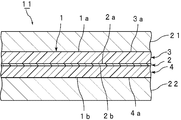
- FIG. 1 is a cross-sectional view showing an interlayer film for laminated glass according to an embodiment of the present invention.
- FIG. 2 is a cross-sectional view showing a laminated glass using an interlayer film for laminated glass according to an embodiment of the present invention.
- the interlayer film for laminated glass according to the present invention includes a plastic layer and a first resin layer laminated on the first surface of the plastic layer.
- the interlayer film for laminated glass according to the present invention includes a second resin layer laminated on a second surface opposite to the first surface of the plastic layer, or the first layer of the plastic layer. The second resin layer is not provided on the second surface opposite to the surface.
- the interlayer film for laminated glass according to the present invention is the interlayer film (1) that includes the plastic layer and the first resin layer and does not include the second resin layer, or the first resin layer.
- an intermediate film (2) comprising a plastic layer and a second resin layer.
- the interlayer film for laminated glass according to the present invention may be the interlayer film (1) or the interlayer film (2).
- the Young's modulus of the plastic layer is 1 GPa or more.
- the ratio of the length of the surface of the plastic layer that is not in contact with the first resin layer at the first lamination interface (the ratio of the non-contact length) that occupies 100% of the surface length of the plastic layer (1)) is 75% or less.
- the adhesion area (contact area) between the plastic layer and the first resin layer is significantly increased as compared with the conventional intermediate film in which the plastic layer and the resin layer are laminated.
- the adhesion between the plastic layer and the resin layer in the intermediate film can be enhanced, and the handleability of the laminated glass can be enhanced.
- the workability at the time of manufacture of the laminated glass using an intermediate film can be improved. For example, in the production of laminated glass, when the intermediate film is transported onto a laminated glass member such as a glass plate, peeling at the adhesive interface between the plastic layer, the first resin layer, and the second resin layer may occur. It does not occur and has excellent workability due to excellent handling.
- This effect originates from the fact that when the film is subjected to a wavy movement during conveyance, if the interfacial adhesive force is low, peeling tends to occur due to the movement, but if the interfacial adhesion is high, peeling does not occur. Furthermore, by adopting the above-described configuration in the present invention, even if the laminated glass using the interlayer film is broken, it is difficult for large pieces to be generated, and the safety of the obtained laminated glass can be improved. This effect is derived from excellent impact relaxation at breakage by controlling the adhesion between layers.
- the penetration resistance of the obtained laminated glass can be improved. Furthermore, even if the laminated glass is broken, the appearance of the laminated glass after the breakage can be improved. For example, the laminated glass is likely to be broken like a spider web, and is less likely to be broken as the laminated glass is torn. In addition, the laminated glass does not break as if it was torn, but breaks like a spider's web, making it much less likely that glass fragments will cause major damage to people, etc. Becomes even higher.
- the ratio (1) of the non-contact length is preferably 70% or less, more preferably 60%. Hereinafter, it is more preferably 50% or less.
- the ratio (1) of the non-contact length may be 0% (total contact).
- the ratio of the length of the surface of the plastic layer at the second layer interface that is not in contact with the second resin layer is preferably 75% or less, more preferably 70% or less, still more preferably 60% or less, and particularly preferably 50% or less.
- the non-contact length ratio (2) may be 0% (contact as a whole).
- the ratio (1) of the non-contact length is measured as follows.
- the intermediate film is cut out in the thickness direction to expose a cross section in the thickness direction.
- the state of the first laminated interface between the plastic layer and the first resin layer is observed in the exposed cross section at 150 times with a scanning electron microscope (SEM).
- SEM scanning electron microscope
- the length of the surface of the plastic layer at the first laminated interface and the length of the portion of the first laminated interface at which the first resin layer is not in contact with the surface of the plastic layer are measured.
- the ratio of the length of the portion of the surface of the plastic layer at the first laminated interface that is not in contact with the first resin layer to 100% of the length of the surface of the plastic layer at the first laminated interface is obtained.
- the surface of the plastic layer at the second laminated interface occupies 100% of the length of the surface of the plastic layer at the second laminated interface.
- the ratio of the length of the portion where the second resin layer is not in contact is obtained.
- the Young's modulus of the plastic layer may be higher than the Young's modulus of the first resin layer. preferable.
- the Young's modulus of the plastic layer is: The Young's modulus of the second resin layer is preferably higher.
- the interlayer film for laminated glass according to the present invention preferably includes the second resin layer.
- the intermediate film includes the second layer, the workability at the time of producing the laminated glass can be further increased, and the fragments when the laminated glass is broken can be effectively reduced.
- the Young's modulus of the plastic layer is preferably 1.5 GPa or more, more preferably 2 GPa. That's it.
- the Young's modulus is preferably 10 GPa or less.
- the Young's modulus of a resin layer containing a polyvinyl acetal resin and a plasticizer is less than 1 GPa, specifically 0.8 GPa or less. Therefore, in general, the plastic layer having a Young's modulus of 1 GPa or more is different from a resin layer containing a polyvinyl acetal resin and a plasticizer.
- the Young's modulus of the first resin layer is preferably less than 1 GPa, more preferably 0.8 GPa or less.
- the Young's modulus of the second resin layer is preferably less than 1 GPa, more preferably 0.8 GPa or less.
- the Young's modulus of the first resin layer is preferably less than 0.6 GPa, More preferably, it is 0.1 GPa or less, More preferably, it is 0.05 GPa or less, Most preferably, it is 0.03 GPa or less.
- the Young's modulus of the second resin layer is preferably less than 0.6 GPa, More preferably, it is 0.1 GPa or less, More preferably, it is 0.05 GPa or less, Most preferably, it is 0.03 GPa or less.
- the Young's modulus of the plastic layer is determined by the first resin layer and the second resin layer.
- Each Young's modulus of the resin layer is preferably more than 1.25 times, more preferably 2 times or more, still more preferably 4 times or more, particularly preferably 400 times or more, most preferably 700 times or more, preferably 3000 times or less. More preferably, it is 2000 times or less, More preferably, it is 1500 times or less.
- the Young's modulus of the plastic layer may be 50 times or less or 10 times or less of the Young's modulus of the first resin layer and the second resin layer. Even in this case, the workability at the time of producing the laminated glass can be increased, and the fragments when the laminated glass is broken can be reduced.
- the Young's modulus of the plastic layer, the first resin layer, and the second resin layer is measured as follows.
- a strain-stress curve is obtained at 23 ° C. by a tensile test according to JIS K7127.
- the Young's modulus is indicated by the slope of the linear portion of the obtained strain-stress curve.
- the adhesive force between the plastic layer and the first resin layer, and the plastic layer And the second resin layer are each preferably 1 N / 50 mm or more, more preferably 1.3 N / 50 mm or more, still more preferably 2 N / 50 mm or more, still more preferably 3 N / 50 mm or more, preferably It is 20 N / 50 mm or less, More preferably, it is 17.5 N / 50 mm or less, More preferably, it is 15 N / 50 mm or less, More preferably, it is 10 N / 50 mm or less.
- the adhesive force is not less than the lower limit, the adhesion between the interface between the plastic layer and the first resin layer and the interface between the plastic layer and the second resin layer is further improved.
- the adhesive strength is less than or equal to the above upper limit, large laminated glass fragments are less likely to be produced during a penetration resistance test of the laminated glass, and the safety is further improved.
- the adhesive force between the plastic layer and the first resin layer and the adhesive force between the plastic layer and the second resin layer are measured as follows.
- an adhesive strength is measured at 23 ° C. and a speed of 500 mm / min using a Tensilon universal material testing machine (“RTM-500” manufactured by Orientec Co., Ltd.).
- the plastic layer and the first resin layer have a heating temperature of 65 ° C. or higher and 150 ° C. or lower, and a pressure during pressure bonding of 0.1 kN or higher and 5 kN by a roll-to-roll method. It is preferable that thermocompression bonding is performed under the following conditions and a tension of 100 N or less during conveyance. By producing the intermediate film by such thermocompression bonding, the adhesive force between the plastic layer and the first resin layer can be controlled within a suitable range.
- the first resin layer, the plastic layer, and the second resin layer are heated at a temperature of 65 ° C. or higher and 150 ° C. or lower by a roll-to-roll method. It is preferable that thermocompression bonding is performed under conditions of a pressure of 0.1 kN or more and 5 kN or less and a tension of 100 N or less during conveyance.
- thermocompression bonding is performed under conditions of a pressure of 0.1 kN or more and 5 kN or less and a tension of 100 N or less during conveyance.
- the interlayer film for laminated glass according to the present invention heats the first resin layer, disposes the first resin layer on the surface of the plastic layer, and uses the heated press roll, It can also be obtained by a laminating press that passes and maintains the heating temperature of the layer.
- the interlayer film for laminated glass according to the present invention heats the first resin layer and the second resin layer, and disposes the first resin layer and the second resin layer on the surface of the plastic layer. Further, it can also be obtained by a laminating press in which pressure is applied by using a heated press roll so as to maintain the heating temperature of the first resin layer and the second resin layer.
- the heating temperature indicates the heating temperature of the first resin layer.
- the heating temperature indicates the heating temperature of the first resin layer and the second resin layer. However, if the heating temperatures of the first resin layer and the second resin layer are within the above ranges, the heating temperatures of the first resin layer and the second resin layer are the same. It may be different.
- the interlayer film for laminated glass according to the present invention may specifically have the following structure.
- FIG. 1 schematically shows a cross-sectional view of an interlayer film for laminated glass used in a laminated glass according to an embodiment of the present invention.
- the intermediate film 1 shown in FIG. 1 is a multilayer intermediate film.
- the intermediate film 1 is used to obtain a laminated glass.
- the intermediate film 1 is an intermediate film for laminated glass.
- the intermediate film 1 is formed on the plastic layer 2, the first resin layer 3 laminated on the first surface 2a of the plastic layer 2, and the second surface 2b opposite to the first surface 2a of the plastic layer 2.
- the plastic layer 2 and the first resin layer 3 and the plastic layer 2 and the second resin layer 4 are directly laminated, respectively.
- the plastic layer 2 is an intermediate layer.
- the first resin layer 3 and the second resin layer 4 are surface layers in the present embodiment.
- the plastic layer 2 is disposed between the first resin layer 3 and the second resin layer 4.
- the intermediate film 1 has a multilayer structure in which the first resin layer 3, the plastic layer 2, and the second resin layer 4 are laminated in this order. Note that an intermediate film in which the first resin layer 3 and the plastic layer 2 are stacked may be obtained without stacking the second resin layer 4.
- the plastic layer preferably contains a thermoplastic resin.
- the thermoplastic resin contained in the plastic layer include chain polyolefins such as polyethylene, polypropylene, poly (4-methylpentene-1) and polyacetal; ring-opening metathesis polymers or addition polymers of norbornenes, norbornenes and others Polyolefins such as addition copolymers with olefins; biodegradable polymers such as polylactic acid and polybutyl succinate; polyamides such as nylon 6, nylon 11, nylon 12 and nylon 66; aramids; polymethyl methacrylate , Polyvinyl chloride, polyvinylidene chloride, polystyrene, styrene copolymer polymethyl methacrylate, polycarbonate, polypropylene terephthalate, polyethylene terephthalate, polyethylene naphthalate, polybutylene terephthalate, polyethylene Polyester such as len-2,6-
- thermoplastic resin contained in the plastic layer is preferably polyethylene terephthalate from the viewpoint of further improving the workability during the production of the laminated glass and effectively reducing the fragments when the laminated glass is broken.
- the plastic layer preferably contains a thermoplastic resin other than the polyvinyl acetal resin, and preferably does not contain the polyvinyl acetal resin.
- the content of the polyvinyl acetal resin is preferably 20% by weight or less, more preferably 10% by weight or less, and further preferably 5% by weight or less in 100% by weight of the plastic layer. It is.
- the plastic layer preferably does not contain a plasticizer.
- the content of the plasticizer is preferably 20% by weight or less, more preferably 10% by weight or less, and further preferably 5% by weight or less in 100% by weight of the plastic layer. .
- the plastic layer preferably contains an ultraviolet shielding agent, and preferably contains an antioxidant.
- the kind of ultraviolet shielding agent and antioxidant which can be used for the said plastic layer is the same as that of the ultraviolet shielding agent and antioxidant which can be used for the 1st resin layer and 2nd resin layer which are mentioned later. .
- the plastic layer may contain additives such as a light stabilizer, a flame retardant, an antistatic agent, a pigment, a dye, an adhesion adjusting agent, a moisture-proofing agent, and a fluorescent brightening agent as necessary.
- additives such as a light stabilizer, a flame retardant, an antistatic agent, a pigment, a dye, an adhesion adjusting agent, a moisture-proofing agent, and a fluorescent brightening agent as necessary.
- additives such as a light stabilizer, a flame retardant, an antistatic agent, a pigment, a dye, an adhesion adjusting agent, a moisture-proofing agent, and a fluorescent brightening agent as necessary.
- 1 type may be used and 2 or more types may be used together.
- thermoplastic resin composition components of the first resin layer and the second resin layer
- Thermoplastic resin is not particularly limited.
- a conventionally well-known thermoplastic resin can be used as said thermoplastic resin.
- the said thermoplastic resin only 1 type may be used and 2 or more types may be used together.
- the thermoplastic resin in the first resin layer and the thermoplastic resin in the second resin layer may be the same or different.
- thermoplastic resin examples include polyvinyl acetal resin, ethylene-vinyl acetate copolymer resin, ethylene-acrylic acid copolymer resin, polyurethane resin, and polyvinyl alcohol resin. Thermoplastic resins other than these may be used.
- the thermoplastic resin is preferably a polyvinyl acetal resin.
- the adhesion of the first resin layer and the second resin layer to other layers is further increased.
- the polyvinyl acetal resin can be produced, for example, by acetalizing polyvinyl alcohol with an aldehyde.
- the polyvinyl alcohol can be produced, for example, by saponifying polyvinyl acetate.
- the saponification degree of the polyvinyl alcohol is generally in the range of 70 to 99.8 mol%.
- the average degree of polymerization of the polyvinyl alcohol is preferably 200 or more, more preferably 500 or more, preferably 5000 or less, more preferably 4000 or less, still more preferably 3500 or less, particularly preferably 3000 or less, and most preferably 2500 or less. .
- the average degree of polymerization is not less than the above lower limit, the penetration resistance of the laminated glass is further enhanced.
- the average degree of polymerization is not more than the above upper limit, the intermediate film can be easily molded.
- the average degree of polymerization of the polyvinyl alcohol is determined by a method based on JIS K6726 “Testing method for polyvinyl alcohol”.
- the carbon number of the acetal group contained in the polyvinyl acetal resin is not particularly limited.
- the aldehyde used when manufacturing the said polyvinyl acetal resin is not specifically limited.
- the carbon number of the acetal group in the polyvinyl acetal resin is preferably 3 or 4. When the carbon number of the acetal group in the polyvinyl acetal resin is 3 or more, the glass transition temperature of the intermediate film is sufficiently low.
- the aldehyde is not particularly limited. In general, an aldehyde having 1 to 10 carbon atoms is preferably used as the aldehyde.
- Examples of the aldehyde having 1 to 10 carbon atoms include propionaldehyde, n-butyraldehyde, isobutyraldehyde, n-valeraldehyde, 2-ethylbutyraldehyde, n-hexylaldehyde, n-octylaldehyde, and n-nonylaldehyde.
- propionaldehyde, n-butyraldehyde, isobutyraldehyde, n-hexylaldehyde or n-valeraldehyde is preferable
- propionaldehyde, n-butyraldehyde or isobutyraldehyde is more preferable
- n-butyraldehyde is still more preferable.
- the said aldehyde only 1 type may be used and 2 or more types may be used together.
- the hydroxyl group content (hydroxyl group amount) of the polyvinyl acetal resin is preferably 15 mol% or more, more preferably 18 mol% or more, still more preferably 20 mol% or more, particularly preferably 28 mol% or more, preferably 40 mol. % Or less, more preferably 35 mol% or less, still more preferably 32 mol% or less.
- the hydroxyl group content is at least the above lower limit, the adhesive strength of the interlayer film is further increased. Further, when the hydroxyl group content is not more than the above upper limit, the flexibility of the interlayer film is increased, and the handling of the interlayer film is facilitated.
- the hydroxyl group content of the polyvinyl acetal resin is a value indicating the mole fraction obtained by dividing the amount of ethylene groups to which the hydroxyl group is bonded by the total amount of ethylene groups in the main chain, as a percentage.
- the amount of the ethylene group to which the hydroxyl group is bonded can be determined, for example, by measuring according to JIS K6726 “Testing method for polyvinyl alcohol”.
- the degree of acetylation (acetyl group amount) of the polyvinyl acetal resin is preferably 0.1 mol% or more, more preferably 0.3 mol% or more, still more preferably 0.5 mol% or more, preferably 30 mol% or less. More preferably, it is 25 mol% or less, more preferably 20 mol% or less, particularly preferably 15 mol% or less, and most preferably 3 mol% or less.
- the acetylation degree is not less than the above lower limit, the compatibility between the polyvinyl acetal resin and the plasticizer is increased.
- the acetylation degree is not more than the above upper limit, the moisture resistance of the interlayer film and the laminated glass is increased.
- the degree of acetylation is obtained by subtracting the amount of ethylene groups to which acetal groups are bonded and the amount of ethylene groups to which hydroxyl groups are bonded from the total amount of ethylene groups of the main chain, It is a value indicating the mole fraction obtained by dividing by the percentage.
- the amount of ethylene group to which the acetal group is bonded can be measured, for example, according to JIS K6728 “Testing method for polyvinyl butyral”.
- the degree of acetalization of the polyvinyl acetal resin is preferably 60 mol% or more, more preferably 63 mol% or more, preferably 85 mol% or less, more preferably 75 mol%. Hereinafter, it is 70 mol% or less more preferably.
- the degree of acetalization is not less than the above lower limit, the compatibility between the polyvinyl acetal resin and the plasticizer increases.
- the degree of acetalization is less than or equal to the above upper limit, the reaction time required for producing a polyvinyl acetal resin is shortened.
- the above-mentioned degree of acetalization is a value indicating the mole fraction obtained by dividing the amount of ethylene groups to which acetal groups are bonded by the total amount of ethylene groups in the main chain as a percentage.
- the degree of acetalization can be calculated by a method based on JIS K6728 “Testing methods for polyvinyl butyral”.
- the hydroxyl group content (hydroxyl content), acetalization degree (butyralization degree), and acetylation degree are preferably calculated from results measured by a method in accordance with JIS K6728 “Testing methods for polyvinyl butyral”.
- the polyvinyl acetal resin is a polyvinyl butyral resin
- the hydroxyl group content (hydroxyl amount), the acetalization degree (butyralization degree), and the acetylation degree are determined in accordance with JIS K6728 “Testing methods for polyvinyl butyral”. It is preferable to calculate from the results measured by.
- the first resin layer preferably contains a plasticizer.
- the second resin layer preferably contains a plasticizer.
- the thermoplastic resin in the first resin layer and the second resin layer is a polyvinyl acetal resin
- the plasticizer By using the plasticizer, the adhesive force between the first resin layer and the second resin layer is further increased.
- the plasticizer is not particularly limited.
- a conventionally known plasticizer can be used as the plasticizer.
- As for the said plasticizer only 1 type may be used and 2 or more types may be used together.
- plasticizer examples include organic ester plasticizers such as monobasic organic acid esters and polybasic organic acid esters, and phosphate plasticizers such as organic phosphate plasticizers and organic phosphorous acid plasticizers. It is done. Of these, organic ester plasticizers are preferred.
- the plasticizer is preferably a liquid plasticizer.
- the monobasic organic acid ester is not particularly limited.
- examples include esters.
- Examples of the glycol include triethylene glycol, tetraethylene glycol, and tripropylene glycol.
- Examples of the monobasic organic acid include butyric acid, isobutyric acid, caproic acid, 2-ethylbutyric acid, heptylic acid, n-octylic acid, 2-ethylhexylic acid, n-nonylic acid, and decylic acid.
- the polybasic organic acid ester is not particularly limited, and examples thereof include an ester compound of a polybasic organic acid and an alcohol having a linear or branched structure having 4 to 8 carbon atoms.
- Examples of the polybasic organic acid include adipic acid, sebacic acid, and azelaic acid.
- the organic ester plasticizer is not particularly limited, and triethylene glycol di-2-ethylbutyrate, triethylene glycol di-2-ethylhexanoate, triethylene glycol dicaprylate, triethylene glycol di-n- Octanoate, triethylene glycol di-n-heptanoate, tetraethylene glycol di-n-heptanoate, dibutyl sebacate, dioctyl azelate, dibutyl carbitol adipate, ethylene glycol di-2-ethyl butyrate, 1,3-propylene glycol di -2-Ethyl butyrate, 1,4-butylene glycol di-2-ethyl butyrate, diethylene glycol di-2-ethyl butyrate, diethylene glycol di-2-ethyl hexanoate, dipropylene glycol Rudi-2-ethylbutyrate, triethylene glycol di-2-ethylpentanoate, te
- the organic phosphate plasticizer is not particularly limited, and examples thereof include tributoxyethyl phosphate, isodecylphenyl phosphate, triisopropyl phosphate, and the like.
- the plasticizer is preferably a diester plasticizer represented by the following formula (1).
- R1 and R2 each represent an organic group having 2 to 10 carbon atoms
- R3 represents an ethylene group, an isopropylene group or an n-propylene group
- p represents an integer of 3 to 10
- R1 and R2 in the above formula (1) are each preferably an organic group having 5 to 10 carbon atoms, and more preferably an organic group having 6 to 10 carbon atoms.
- the plasticizer preferably contains at least one of triethylene glycol di-2-ethylhexanoate (3GO) and triethylene glycol di-2-ethylbutyrate (3GH). More preferably, it contains 2-ethylhexanoate.
- the content of the plasticizer is not particularly limited.
- the content of the plasticizer with respect to 100 parts by weight of the thermoplastic resin is preferably 15 parts by weight or more, more preferably 20 parts by weight or more.
- the amount is not more than parts by weight, most preferably not more than 40 parts by weight.
- the content of the plasticizer is not more than the above upper limit, the transparency of the interlayer film is further enhanced. From the viewpoint of further improving the workability at the time of producing the laminated glass and effectively reducing the fragments when the laminated glass is broken, it is preferably 25 parts by weight or more, more preferably 30 parts by weight or more, and still more preferably 35. It is more than part by weight.
- Each of the first resin layer and the second resin layer preferably includes a heat shielding compound.
- each of the first resin layer and the second resin layer includes at least one component X of a phthalocyanine compound, a naphthalocyanine compound, and an anthracocyanine compound.
- Each of the first resin layer and the second resin layer includes at least one component X of a phthalocyanine compound, a naphthalocyanine compound, and an anthracocyanine compound, or includes heat shielding particles described later.
- the component X is a heat shielding compound.
- the component X is not particularly limited.
- component X conventionally known phthalocyanine compounds, naphthalocyanine compounds and anthracocyanine compounds can be used.
- As for the said component X only 1 type may be used and 2 or more types may be used together.
- Examples of the component X include phthalocyanine, a derivative of phthalocyanine, naphthalocyanine, a derivative of naphthalocyanine, an anthocyanin, and an anthocyanin derivative.
- the phthalocyanine compound and the phthalocyanine derivative preferably each have a phthalocyanine skeleton.
- the naphthalocyanine compound and the naphthalocyanine derivative preferably each have a naphthalocyanine skeleton. It is preferable that each of the anthocyanin compound and the derivative of the anthracyanine has an anthracyanine skeleton.
- the component X is preferably at least one selected from the group consisting of phthalocyanine, phthalocyanine derivatives, naphthalocyanine, and naphthalocyanine derivatives. More preferably, it is at least one of phthalocyanine and phthalocyanine derivatives.
- the component X preferably contains a vanadium atom or a copper atom.
- the component X preferably contains a vanadium atom, and preferably contains a copper atom.
- the component X is more preferably at least one of a phthalocyanine containing a vanadium atom or a copper atom and a phthalocyanine derivative containing a vanadium atom or a copper atom.
- the component X preferably has a structural unit in which an oxygen atom is bonded to a vanadium atom.
- each content of the component X is preferably in 100% by weight of the first resin layer and the second resin layer. Is 0.001 wt% or more, more preferably 0.005 wt% or more, still more preferably 0.01 wt% or more, particularly preferably 0.02 wt% or more, preferably 0.2 wt% or less, more preferably It is 0.1% by weight or less, more preferably 0.05% by weight or less, and particularly preferably 0.04% by weight or less.
- the content of the component X in the first resin layer and the second resin layer is not less than the lower limit and not more than the upper limit, the heat shielding property is sufficiently high, and the visible light transmittance is sufficiently high. Become.
- the visible light transmittance can be 70% or more.
- Thermal barrier particles Each of the first resin layer and the second resin layer preferably includes heat shielding particles.
- the heat shielding particles are heat shielding compounds. Infrared rays (heat rays) can be effectively blocked by using a heat-shielding compound in at least one layer of the entire intermediate film.
- the heat shielding particles are more preferably metal oxide particles.
- the heat shielding particles are preferably particles (metal oxide particles) formed of a metal oxide.
- the said heat-shielding particle only 1 type may be used and 2 or more types may be used together.
- Infrared rays having a wavelength longer than 780 nm longer than visible light have a smaller amount of energy than ultraviolet rays.
- infrared rays have a large thermal effect, and once infrared rays are absorbed by a substance, they are released as heat. For this reason, infrared rays are generally called heat rays.
- heat shielding particles By using the heat shielding particles, infrared rays (heat rays) can be effectively blocked.
- the heat shielding particles mean particles that can absorb infrared rays.
- heat shielding particles include aluminum-doped tin oxide particles, indium-doped tin oxide particles, antimony-doped tin oxide particles (ATO particles), gallium-doped zinc oxide particles (GZO particles), and indium-doped zinc oxide particles (IZO particles).
- Aluminum doped zinc oxide particles (AZO particles), niobium doped titanium oxide particles, sodium doped tungsten oxide particles, cesium doped tungsten oxide particles, thallium doped tungsten oxide particles, rubidium doped tungsten oxide particles, tin doped indium oxide particles (ITO particles) And metal oxide particles such as tin-doped zinc oxide particles and silicon-doped zinc oxide particles, and lanthanum hexaboride (LaB 6 ) particles. Heat shielding particles other than these may be used.
- metal oxide particles are preferable because of their high heat ray shielding function, ATO particles, GZO particles, IZO particles, ITO particles or tungsten oxide particles are more preferable, and ITO particles or tungsten oxide particles are particularly preferable.
- tin-doped indium oxide particles ITO particles
- tungsten oxide particles are also preferable because they have a high heat ray shielding function and are easily available.
- the tungsten oxide particles are generally represented by the following formula (X1) or the following formula (X2).
- tungsten oxide particles represented by the following formula (X1) or the following formula (X2) are preferably used.
- W represents tungsten
- O represents oxygen
- y and z satisfy 2.0 ⁇ z / y ⁇ 3.0.
- M is H, He, alkali metal, alkaline earth metal, rare earth element, Mg, Zr, Cr, Mn, Fe, Ru, Co, Rh, Ir, Ni, Pd, Pt, Cu , Ag, Au, Zn, Cd, Al, Ga, In, Tl, Si, Ge, Sn, Pb, Sb, B, F, P, S, Se, Br, Te, Ti, Nb, V, Mo, Ta
- the tungsten oxide particles are preferably metal-doped tungsten oxide particles.
- the “tungsten oxide particles” include metal-doped tungsten oxide particles. Specific examples of the metal-doped tungsten oxide particles include sodium-doped tungsten oxide particles, cesium-doped tungsten oxide particles, thallium-doped tungsten oxide particles, and rubidium-doped tungsten oxide particles.
- cesium-doped tungsten oxide particles are particularly preferable.
- the cesium-doped tungsten oxide particles are preferably tungsten oxide particles represented by the formula: Cs 0.33 WO 3 .
- the average particle diameter of the heat shielding particles is preferably 0.01 ⁇ m or more, more preferably 0.02 ⁇ m or more, preferably 0.1 ⁇ m or less, more preferably 0.05 ⁇ m or less.
- the average particle size is not less than the above lower limit, the heat ray shielding property is sufficiently increased.
- the average particle size is not more than the above upper limit, the dispersibility of the heat shielding particles is increased.
- the above “average particle diameter” indicates the volume average particle diameter.
- the average particle diameter can be measured using a particle size distribution measuring device (“UPA-EX150” manufactured by Nikkiso Co., Ltd.) or the like.
- each content of the heat shielding particles is preferably 100% by weight of the first resin layer and the second resin layer. Is 0.01 wt% or more, more preferably 0.1 wt% or more, still more preferably 1 wt% or more, particularly preferably 1.5 wt% or more, preferably 6 wt% or less, more preferably 5.5 wt%. % Or less, more preferably 4% by weight or less, particularly preferably 3.5% by weight or less, and most preferably 3.0% by weight or less.
- the content of the heat shielding particles is not less than the above lower limit and not more than the above upper limit, the heat shielding property is sufficiently high and the visible light transmittance is sufficiently high.
- the first resin layer or the second resin layer contains the heat shielding particles
- the first resin layer and the second resin layer contain 0.1 to 12 g / m 2 of the heat shielding particles. It is preferable to contain in the ratio.
- the ratio of the heat shielding particles is within the above range, the heat shielding property is sufficiently high, and the visible light transmittance is sufficiently high.
- the proportion of the heat shielding particles is preferably 0.5 g / m 2 or more, more preferably 0.8 g / m 2 or more, still more preferably 1.5 g / m 2 or more, particularly preferably 3 g / m 2 or more, preferably Is 11 g / m 2 or less, more preferably 10 g / m 2 or less, still more preferably 9 g / m 2 or less, and particularly preferably 7 g / m 2 or less.
- the ratio is equal to or higher than the lower limit, the heat shielding property is further enhanced.
- the said visible light transmittance becomes it still higher that the said ratio is below the said upper limit.
- the first resin layer preferably contains an ultraviolet shielding agent.
- the second resin layer preferably contains an ultraviolet shielding agent. More preferably, both the first resin layer and the second resin layer contain an ultraviolet shielding agent.
- the ultraviolet shielding agent By using the ultraviolet shielding agent, even if the interlayer film and the laminated glass are used for a long period of time, the visible light transmittance is more unlikely to decrease.
- this ultraviolet shielding agent only 1 type may be used and 2 or more types may be used together.
- the ultraviolet shielding agent includes an ultraviolet absorber.
- the ultraviolet shielding agent is preferably an ultraviolet absorber.
- UV screening agents are, for example, metal UV screening agents, metal oxide UV screening agents, benzotriazole UV screening agents (benzotriazole compounds), and benzophenone UV screening agents (benzophenone).
- Compound triazine-based UV shielding agent (triazine compound), malonic ester-based UV shielding agent (malonic ester compound), oxalic acid anilide-based UV shielding agent (oxalic acid anilide compound) and benzoate-based UV shielding agent (benzoate compound) Etc.
- the metallic ultraviolet shielding agent examples include platinum particles, particles in which the surface of the platinum particles is coated with silica, palladium particles, particles in which the surface of the palladium particles is coated with silica, and the like.
- the ultraviolet shielding agent is preferably not a heat shielding particle.
- metal oxide ultraviolet shielding agent examples include zinc oxide, titanium oxide, and cerium oxide. Furthermore, the surface of the metal oxide ultraviolet shielding agent may be coated. Examples of the coating material on the surface of the metal oxide ultraviolet shielding agent include insulating metal oxides, hydrolyzable organosilicon compounds, and silicone compounds.
- the insulating metal oxide examples include silica, alumina and zirconia.
- the insulating metal oxide has a band gap energy of 5.0 eV or more, for example.
- benzotriazole ultraviolet shielding agent examples include 2- (2′-hydroxy-5′-methylphenyl) benzotriazole (“TinvinP” manufactured by BASF), 2- (2′-hydroxy-3 ′, 5 ′). -Di-t-butylphenyl) benzotriazole (“Tinvin 320” manufactured by BASF), 2- (2'-hydroxy-3'-t-butyl-5-methylphenyl) -5-chlorobenzotriazole (manufactured by BASF " And benzotriazole-based UV screening agents such as 2- (2′-hydroxy-3 ′, 5′-di-amylphenyl) benzotriazole (“Tinvin 328” manufactured by BASF)).
- the benzotriazole-based ultraviolet shielding agent is preferably a benzotriazole-based ultraviolet shielding agent containing a halogen atom, and more preferably a benzotriazole-based ultraviolet shielding agent containing a chlorine atom, because of its excellent ability to absorb ultraviolet rays. .
- benzophenone-based ultraviolet shielding agent examples include octabenzone (“Chimasorb 81” manufactured by BASF).
- triazine-based ultraviolet shielding agent examples include 2- (4,6-diphenyl-1,3,5-triazin-2-yl) -5-[(hexyl) oxy] -phenol (“Tinuvin 1577FF” manufactured by BASF). ) And the like.
- malonic ester-based ultraviolet shielding agent examples include 2- (p-methoxybenzylidene) malonic acid dimethyl, tetraethyl-2,2- (1,4-phenylenedimethylidene) bismalonate, 2- (p-methoxybenzylidene) -bis. (1,2,2,6,6-pentamethyl 4-piperidinyl) malonate and the like.
- Hostavin B-CAP As commercial products of the above-mentioned malonic ester-based ultraviolet screening agents, there are Hostavin B-CAP, Hostavin PR-25, and Hostavin PR-31 (all manufactured by Clariant).
- Examples of the oxalic acid anilide-based ultraviolet shielding agent include N- (2-ethylphenyl) -N ′-(2-ethoxy-5-tert-butylphenyl) oxalic acid diamide, N- (2-ethylphenyl) -N ′.
- Oxalic acid diamides having an aryl group substituted on the nitrogen atom such as-(2-ethoxy-phenyl) oxalic acid diamide, 2-ethyl-2'-ethoxy-oxyanilide ("Sanduvor VSU" manufactured by Clariant) Can be mentioned.
- benzoate ultraviolet shielding agent examples include 2,4-di-tert-butylphenyl-3,5-di-tert-butyl-4-hydroxybenzoate (“Tinuvin 120” manufactured by BASF).
- the ultraviolet shielding agent described above is 2- (2′-hydroxy-3′-t-butyl-5-methylphenyl) -5- It is preferably chlorobenzotriazole (“Tinvin 326” manufactured by BASF) or 2- (2′-hydroxy-3 ′, 5′-di-amylphenyl) benzotriazole (“Tinvin 328” manufactured by BASF), It may be (2′-hydroxy-3′-t-butyl-5-methylphenyl) -5-chlorobenzotriazole.
- each content of the ultraviolet shielding agent in 100% by weight of the first resin layer and the second resin layer is as follows: Preferably 0.1% by weight or more, more preferably 0.2% by weight or more, still more preferably 0.3% by weight or more, particularly preferably 0.5% by weight or more, preferably 2.5% by weight or less, more preferably Is 2% by weight or less, more preferably 1% by weight or less, and particularly preferably 0.8% by weight or less.
- the content of the ultraviolet shielding agent is not less than the above lower limit and not more than the above upper limit, a decrease in visible light transmittance after time is further suppressed.
- the content of the ultraviolet shielding agent is 0.2% by weight or more in 100% by weight of the first resin layer and the second resin layer, visible light transmission after aging of the interlayer film and the laminated glass is achieved.
- the reduction in rate can be remarkably suppressed.
- the first resin layer preferably contains an antioxidant.
- the second resin layer preferably contains an antioxidant. It is preferable that both the first resin layer and the second resin layer contain an antioxidant. As for this antioxidant, only 1 type may be used and 2 or more types may be used together.
- antioxidants examples include phenol-based antioxidants, sulfur-based antioxidants, and phosphorus-based antioxidants.
- the phenolic antioxidant is an antioxidant having a phenol skeleton.
- the sulfur-based antioxidant is an antioxidant containing a sulfur atom.
- the phosphorus antioxidant is an antioxidant containing a phosphorus atom.
- the antioxidant is preferably a phenolic antioxidant or a phosphorus antioxidant.
- phenolic antioxidant examples include 2,6-di-t-butyl-p-cresol (BHT), butylated hydroxyanisole (BHA), 2,6-di-t-butyl-4-ethylphenol, stearyl - ⁇ - (3,5-di-t-butyl-4-hydroxyphenyl) propionate, 2,2'-methylenebis- (4-methyl-6-butylphenol), 2,2'-methylenebis- (4-ethyl- 6-t-butylphenol), 4,4′-butylidene-bis- (3-methyl-6-t-butylphenol), 1,1,3-tris- (2-methyl-hydroxy-5-tert-butylphenyl) Butane, tetrakis [methylene-3- (3 ′, 5′-butyl-4-hydroxyphenyl) propionate] methane, 1,3,3-tris- (2-methyl-4- Droxy-5-tert-butylphenol) butane, 1,3,5-trimethyl-2,
- Examples of the phosphorus antioxidant include tridecyl phosphite, tris (tridecyl) phosphite, triphenyl phosphite, trinonylphenyl phosphite, bis (tridecyl) pentaerythritol diphosphite, bis (decyl) pentaerythritol diphos.
- antioxidants examples include “IRGANOX 245” manufactured by BASF, “IRGAFOS 168” manufactured by BASF, “IRGAFOS 38” manufactured by BASF, “Smilizer BHT” manufactured by Sumitomo Chemical, and “ IRGANOX 1010 ".
- each content of the antioxidant in 100% by weight of the first resin layer and the second resin layer is as follows: Preferably it is 0.1 weight% or more, Preferably it is 2 weight% or less, More preferably, it is 1.8 weight% or less.
- the content of the antioxidant is not less than the above lower limit, the high visible light transmittance of the interlayer film and the laminated glass is maintained for a longer period of time.
- the content of the antioxidant is not more than the above upper limit, an excessive antioxidant is hardly generated to obtain the addition effect.
- Each of the first resin layer and the second resin layer may be a light stabilizer, a flame retardant, an antistatic agent, a pigment, a dye, an adhesive force adjusting agent, a moisture resistant agent, a fluorescent brightening agent, or the like, if necessary.
- An additive may be included. As for these additives, only 1 type may be used and 2 or more types may be used together.
- the said intermediate film for laminated glasses is arrange
- the thickness of the interlayer film for laminated glass is not particularly limited. From the viewpoint of practical use and from the viewpoint of sufficiently increasing the heat shielding property, the thickness of the intermediate film is preferably 0.1 mm or more, more preferably 0.25 mm or more, preferably 3 mm or less, more preferably 1.5 mm or less. is there. When the thickness of the intermediate film is not less than the above lower limit, the penetration resistance of the laminated glass is increased.
- the thickness of the plastic layer is preferably 5 ⁇ m or more, more preferably 30 ⁇ m or more, preferably 300 ⁇ m or less, more preferably 150 ⁇ m or less.
- the Young's modulus of the plastic layer is effectively increased, the workability at the time of producing the laminated glass is further increased, and the fragments when the laminated glass is broken are further increased. Even smaller.
- the thickness of the plastic layer is less than or equal to the upper limit, the thicknesses of the first resin layer and the second resin layer can be relatively increased, and the first resin layer and the second resin are relatively thick. The performance derived from the layer can be further exhibited.
- the thicknesses of the first resin layer and the second resin layer are each preferably 0.1 mm or more, more preferably 0.2 mm or more, still more preferably 0.25 mm or more, particularly preferably 0.3 mm or more, preferably Is 1.0 mm or less, more preferably 0.6 mm or less, even more preferably 0.5 mm or less, still more preferably 0.45 mm or less, and particularly preferably 0.4 mm or less.
- the thickness of the first resin layer and the second resin layer is equal to or greater than the lower limit, the penetration resistance of the laminated glass is further enhanced.
- the thickness of the first resin layer and the second resin layer is not more than the upper limit, the transparency of the laminated glass is further increased.
- a preferable method for producing an interlayer film for laminated glass according to the present invention includes a plastic layer having a Young's modulus of 1 GPa or more and ten points measured according to JIS B0601-1982 on the surface laminated on the plastic layer.
- a plastic layer having a Young's modulus of 1 GPa or more and ten points measured according to JIS B0601-1982 on the surface laminated on the plastic layer Using the first resin layer having an average roughness Rz of 45 ⁇ m or less and thermocompression bonding the first resin layer and the plastic layer, the plastic layer and the first surface of the plastic layer An interlayer film for laminated glass comprising the first resin layer laminated on the surface is obtained, or a plastic layer having a Young's modulus of 1 GPa or more and JIS B0601-1982 on the surface laminated on the plastic layer.
- the first resin layer, the plastic layer, and the second resin layer are used.
- thermocompression bonding the plastic layer, the first resin layer laminated on the first surface of the plastic layer, and the second surface of the plastic layer opposite to the first surface are laminated.
- a step of obtaining an interlayer film for laminated glass comprising the second resin layer.
- a preferable method for producing an interlayer film for laminated glass according to the present invention is such that the plastic layer and the first resin layer are heated at a temperature of 65 ° C. or higher and 150 ° C. or lower and a pressure of 0.
- the plastic layer and the first resin layer are heated at a temperature of 65 ° C. or higher and 150 ° C. or lower and a pressure of 0.
- the first surface of the plastic layer comprises a step of obtaining a interlayer film for a laminated glass comprising a second resin layer laminated to the opposite second surface.
- the Young's modulus of the plastic layer is 1 GPa or more.
- the Young's modulus of the plastic layer is preferably higher than the Young's modulus of the first resin layer.
- the adhesive force between the plastic layer and the first resin layer measured in accordance with JIS K6854-2 is preferably 1 N / 50 mm or more, preferably 20 N / 50 mm or less.
- the Young's modulus of the plastic layer is preferably higher than the Young's modulus of the second resin layer.
- the adhesive strength between the plastic layer and the second resin layer measured in accordance with JIS K6854-2 is preferably 1 N / 50 mm or more, preferably 20 N / 50 mm or less.
- a plastic layer containing polyethylene terephthalate or the like is disposed on one surface of the resin layer or between two resin layers, and a laminated glass member such as a glass plate is disposed on the outer surface of the two resin layers.
- a laminated glass member such as a glass plate is disposed on the outer surface of the two resin layers.
- three layers may be laminated at one time, and the remaining layers after the two layers are laminated. You may laminate.
- the heating temperature is preferably 65 ° C or higher, preferably 150 ° C or lower.
- the heating temperature is equal to or higher than the lower limit, the adhesion of the first resin layer and the second resin layer to the plastic layer is further improved.
- the heating temperature is equal to or lower than the upper limit, softening of the first resin layer and the second resin layer is suppressed, and the suitability for lamination is further improved.
- the pressure during the pressure bonding is preferably 0.1 kN or more, preferably 5 kN or less.
- the pressure at the time of the pressure bonding is equal to or higher than the lower limit, the adhesion of the first resin layer and the second resin layer to the plastic layer is further improved.
- the pressure at the time of the pressure bonding is not more than the above upper limit, the occurrence of laminating wrinkles is suppressed and the suitability for laminating is further improved.
- the tension during the conveyance is preferably 10N or more, preferably 200N or less, more preferably 100N or less.
- the tension during the conveyance may be 200 N or less, but is preferably 100 N or less.
- a conventionally known method can be used as a method for producing the plastic layer, the first resin layer, and the second resin layer.
- the manufacturing method etc. which knead
- the method of kneading is not particularly limited. Examples of this method include a method using an extruder, a plastograph, a kneader, a Banbury mixer, a calendar roll, or the like. Especially, since it is suitable for continuous production, a method using an extruder is preferable, and a method using a twin screw extruder is more preferable.
- the first resin layer and the second resin layer preferably contain the same polyvinyl acetal resin, and contain the same polyvinyl acetal resin and the same plasticizer. Is more preferable, and it is further preferable that the same resin composition is used.
- the laminated glass according to the present invention includes a first laminated glass member, a second laminated glass member, and the interlayer film for laminated glass described above.
- the interlayer film for laminated glass is disposed between the first laminated glass member and the second laminated glass member.
- the first laminated glass member is disposed outside the first resin layer in the intermediate film.
- the second laminated glass member is disposed outside the second resin layer in the intermediate film.
- a second laminated glass member may be laminated on the surface of the plastic layer opposite to the first resin layer.
- FIG. 2 is a sectional view showing an example of a laminated glass using the interlayer film for laminated glass according to an embodiment of the present invention.
- a laminated glass 11 shown in FIG. 2 includes an intermediate film 1, a first laminated glass member 21, and a second laminated glass member 22.
- the interlayer film 1 is sandwiched between a first laminated glass member 21 and a second laminated glass member 22.
- a first laminated glass member 21 is laminated on the first surface 1 a of the intermediate film 1.
- a second laminated glass member 22 is laminated on a second surface 1 b opposite to the first surface 1 a of the intermediate film 1.
- a first laminated glass member 21 is laminated on the outer surface 3 a of the first resin layer 3 in the intermediate film 1.
- a second laminated glass member 22 is laminated on the outer surface 4 a of the second resin layer 4 in the intermediate film 1.
- the laminated glass member examples include a glass plate and a PET (polyethylene terephthalate) film.
- the laminated glass includes not only laminated glass in which an intermediate film is sandwiched between two glass plates, but also laminated glass in which an intermediate film is sandwiched between a glass plate and a PET film or the like.
- Laminated glass is a laminated body provided with a glass plate, and preferably at least one glass plate is used.
- the first laminated glass member and the second laminated glass member are respectively a glass plate or a PET (polyethylene terephthalate) film, and the intermediate film is the first laminated glass member and the second laminated glass member. It is preferable that at least one glass plate is included. It is particularly preferable that both the first laminated glass member and the second laminated glass member are glass plates.
- the glass plate examples include inorganic glass and organic glass.
- the inorganic glass examples include float plate glass, heat ray absorbing plate glass, heat ray reflecting plate glass, polished plate glass, mold plate glass, wire-containing plate glass, and green glass.
- the organic glass is a synthetic resin glass substituted for inorganic glass.
- the organic glass examples include polycarbonate plates and poly (meth) acrylic resin plates.
- the poly (meth) acrylic resin plate examples include a polymethyl (meth) acrylate plate.
- the thicknesses of the first laminated glass member and the second laminated glass member are not particularly limited, but are preferably 1 mm or more and preferably 5 mm or less.
- the thickness of the glass plate is preferably 1 mm or more, and preferably 5 mm or less.
- the thickness of the PET film is preferably 0.03 mm or more, and preferably 0.5 mm or less.
- the method for producing the laminated glass is not particularly limited.
- the intermediate film is sandwiched between the first and second laminated glass members, passed through a pressing roll, or put in a rubber bag and sucked under reduced pressure, so that the first laminated glass member and the middle
- the air remaining between the film and the second laminated glass member and the intermediate film is degassed. Thereafter, it is pre-adhered at about 70 to 110 ° C. to obtain a laminate.
- the laminate is put in an autoclave or pressed and pressed at about 120 to 150 ° C. and a pressure of 1 to 1.5 MPa. In this way, a laminated glass can be obtained.
- the laminated glass can be used for automobiles, railway vehicles, aircraft, ships, buildings, and the like.
- the laminated glass is preferably laminated glass for buildings or vehicles, and more preferably laminated glass for vehicles.
- the laminated glass can be used for other purposes.
- the laminated glass can be used for an automobile windshield, side glass, rear glass, roof glass, or the like. Since the heat shielding property is high and the visible light transmittance is high, the laminated glass is suitably used for automobiles.
- Thermoplastic resin Polyvinyl butyral resin (PVB1) (hydroxyl content 22 mol%, acetylation degree 13 mol%, butyral degree 65 mol%, average polymerization degree 2300)
- Polyvinyl butyral resin (PVB2) (hydroxyl content 30.5 mol%, acetylation degree 1 mol%, butyralization degree 68.5 mol%, average polymerization degree 1700)
- Plasticizer 3GO (triethylene glycol di-2-ethylhexanoate)
- BHT Antioxidant, 2,6-di-t-butyl-p-cresol
- T-326 UV shielding agent, 2- (2′-hydroxy-3′-tert-butyl-5-methylphenyl) -5-chlorobenzotriazole, “Tinuvin 326” manufactured by BASF)
- ITO particles titanium dioxide particles
- Phthalocyanine compound (“NIR-43V” manufactured by Yamada Chemical Co., Ltd.)
- CWO particles cesium-doped tungsten oxide particles
- Resin layer A (first resin layer): For 100 parts by weight of polyvinyl butyral resin (PVB1), 40 parts by weight of a plasticizer (3GO), 0.5 parts by weight of an ultraviolet shielding agent (T-326), and 0.5 parts by weight of an antioxidant (BHT) The mixture was added and sufficiently kneaded with a mixing roll to obtain a composition. The obtained composition was extruded by an extruder to obtain a single resin layer having a thickness of 380 ⁇ m. In addition, the surface of the resin layer laminated on the plastic layer is embossed, and the embossed surface has a ten-point average roughness Rz measured in accordance with JIS B0601-1982 of 35 ⁇ m. Got.
- Resin layer B (first resin layer): A resin layer B was obtained in the same manner as the resin layer A except that the embossing conditions were changed so that the ten-point average roughness Rz of the surface of the resin layer laminated on the plastic layer was 45 ⁇ m.
- Resin layer C (first resin layer): Resin layer C was obtained in the same manner as resin layer A, except that the embossing conditions were changed so that the ten-point average roughness Rz of the surface of the resin layer laminated on the plastic layer was 55 ⁇ m.
- Resin layer D (first resin layer): The embossing conditions were changed so that the polyvinyl butyral resin (PVB1) was changed to the polyvinyl butyral resin (PVB2), and the ten-point average roughness Rz of the surface of the resin layer laminated on the plastic layer was 38 ⁇ m. A resin layer D was obtained in the same manner as the resin layer A except that it was changed.
- Resin layer E (first resin layer): The polyvinyl butyral resin (PVB2) was further blended with 1.166 parts by weight of ITO particles and 0.013 parts by weight of a phthalocyanine compound, and the 10-point average roughness of the surface of the resin layer laminated on the plastic layer. Resin layer E was obtained in the same manner as resin layer D, except that the embossing conditions were changed so that the thickness Rz was 40 ⁇ m.
- Resin layer F (first resin layer): The polyvinyl butyral resin (PVB2) is further blended with 1.166 parts by weight of ITO particles, 0.013 parts by weight of phthalocyanine compound, and 0.056 parts by weight of CWO particles, and is laminated on the plastic layer of the resin layer.
- a resin layer F was obtained in the same manner as the resin layer D except that the embossing conditions were changed so that the ten-point average roughness Rz of the side surface was 20 ⁇ m.
- Resin layer G (first resin layer): For 100 parts by weight of polyvinyl butyral resin (PVB2), 40 parts by weight of a plasticizer (3GO), 0.5 parts by weight of an ultraviolet shielding agent (T-326), and 0.5 parts by weight of an antioxidant (BHT) Then, the mixture was sufficiently kneaded with a mixing roll to obtain a composition X. Moreover, the composition Y was obtained like the composition X except having changed the compounding quantity of the plasticizer (3GO) into 60 weight part with respect to 100 weight part of polyvinyl butyral resin (PVB1).
- composition X and composition Y are extruded by a co-extruder to obtain a three-layer resin layer in which a composition X having a thickness of 350 ⁇ m, a composition Y having a thickness of 100 ⁇ m, and a composition X having a thickness of 350 ⁇ m are laminated in this order. It was. Also, the surface of the resin layer laminated on the plastic layer is embossed, and the embossed surface of the resin layer G having a ten-point average roughness Rz measured in accordance with JIS B0601-1982 is 32 ⁇ m. Got.
- Resin layer H (first resin layer):
- the resin layer D is the same as the resin layer D except that the embossing conditions are changed and the thickness is changed to 760 ⁇ m so that the ten-point average roughness Rz of the surface laminated on the plastic layer of the resin layer is 40 ⁇ m. Thus, a resin layer H was obtained.
- Resin layer (second resin layer) For 100 parts by weight of polyvinyl butyral resin (PVB1), 40 parts by weight of a plasticizer (3GO), 0.5 parts by weight of an ultraviolet shielding agent (T-326), and 0.5 parts by weight of an antioxidant (BHT) The mixture was added and sufficiently kneaded with a mixing roll to obtain a composition. The obtained composition was extruded by an extruder to obtain a single resin layer having a thickness of 380 ⁇ m. Further, a second surface having a ten-point average roughness Rz measured in accordance with JIS B0601-1982 of the embossed surface obtained by embossing the surface of the resin layer that is laminated on the plastic layer is 35 ⁇ m. A resin layer was obtained.
- Plastic layer A polyethylene terephthalate film, “U34 Lumirror” manufactured by Toray Industries, Inc., thickness 100 ⁇ m
- Examples 1 to 12 and Comparative Examples 1 and 2 (1) Production of Intermediate Film In Examples 1 to 12 and Comparative Examples 1 and 2, an intermediate layer having a two-layer structure in which a plastic layer of the type shown in Tables 1 and 2 below and a first resin layer are laminated. A membrane was prepared.
- thermocompression laminator (“MRK-650Y type” manufactured by MCK Co., Ltd.), the heating temperature shown in Tables 1 and 2 below, the pressure at the time of crimping, and the tension at the time of conveyance are used to heat by the roll-to-roll method. Crimping was performed. The materials of the upper laminate roll and the lower laminate roll used for thermocompression bonding were set as shown in Table 1 below.
- the obtained intermediate film was cut into a size of 30 cm in length and 30 cm in width. Also, two clear glasses (length 30 cm ⁇ width 30 cm ⁇ thickness 2.5 mm) were prepared. Between the two sheets of clear glass, the intermediate film obtained and the first resin layer used in Examples 1 to 12 and Comparative Examples 1 and 2, in the order of the first resin layer, the plastic layer, and the second resin layer. The 1st resin layer and the 2nd resin layer were inserted
- Example 13 and 14 (1) Production of Intermediate Film In Examples 13 and 14, an intermediate film having a three-layer structure including a first resin layer, a plastic layer, and a second resin layer was produced.
- thermocompression laminator (“MRK-650Y type” manufactured by MCK Co., Ltd.) heat-compression is performed by a roll-to-roll method at the heating temperature, pressure during crimping, and tension during conveyance shown in Table 3 below.
- the 1st resin layer of the kind shown in following Table 3 the plastic layer, and the 2nd resin layer were laminated
- a strain-stress curve was obtained at 23 ° C. by a tensile test based on JIS K7127. The Young's modulus indicated by the slope of the linear portion of the obtained strain-stress curve was evaluated.
- Non-contact length ratio (1) The ratio of the length of the portion of the surface of the plastic layer at the first laminated interface that is not in contact with the first resin layer to 100% of the length of the surface of the plastic layer at the first laminated interface. Similarly, the ratio of the length of the surface of the plastic layer at the second laminated interface where the second resin layer is not in contact (the ratio of non-contact length (2)) was also determined.
- the obtained intermediate film was cut into a size of 100 cm ⁇ 100 cm.
- the handleability was evaluated by holding both ends of the cut intermediate film repeatedly and repeatedly contacting 30 times so that the surface and the back surface of the intermediate film contact each other alternately on the desk. The handleability was judged according to the following criteria.
- Confirmed state ⁇ In Examples 1 to 12 and Comparative Examples 1 and 2, peeling of the first resin layer and the plastic layer after the test was confirmed at 10 mm or more at the end, and Example 13 And 1 4, the state in which at least one of the first resin layer and the plastic layer and the second resin layer and the plastic layer was peeled off at 10 mm or more at the end after the test.
Landscapes
- Chemical & Material Sciences (AREA)
- Life Sciences & Earth Sciences (AREA)
- Biochemistry (AREA)
- Physics & Mathematics (AREA)
- Fluid Mechanics (AREA)
- Engineering & Computer Science (AREA)
- Ceramic Engineering (AREA)
- Chemical Kinetics & Catalysis (AREA)
- General Chemical & Material Sciences (AREA)
- Geochemistry & Mineralogy (AREA)
- Materials Engineering (AREA)
- Organic Chemistry (AREA)
- Joining Of Glass To Other Materials (AREA)
- Laminated Bodies (AREA)
Abstract
Description
本発明に係る合わせガラス用中間膜は、プラスチック層と、上記プラスチック層の第1の表面に積層された第1の樹脂層とを備える。本発明に係る合わせガラス用中間膜は、上記プラスチック層の上記第1の表面とは反対の第2の表面に積層された第2の樹脂層を備えるか、又は上記プラスチック層の上記第1の表面とは反対の第2の表面に第2の樹脂層を備えていない。
[熱可塑性樹脂]
上記プラスチック層は、熱可塑性樹脂を含むことが好ましい。上記プラスチック層に含まれる熱可塑性樹脂としては、ポリエチレン、ポリプロピレン、ポリ(4-メチルペンテン-1)、ポリアセタールなどの鎖状ポリオレフィン;ノルボルネン類の開環メタセシス重合体又は付加重合体、ノルボルネン類と他のオレフィン類との付加共重合体などの脂環族ポリオレフィン;ポリ乳酸、ポリブチルサクシネートなどの生分解性ポリマー;ナイロン6、ナイロン11、ナイロン12、ナイロン66などのポリアミド;アラミド;ポリメチルメタクリレート、ポリ塩化ビニル、ポリ塩化ビニリデン、ポリスチレン、スチレン共重合ポリメタクリル酸メチル、ポリカーボネート、ポリプロピレンテレフタレート、ポリエチレンテレフタレート、ポリエチレンナフタレート、ポリブチレンテレフタレート、ポリエチレン-2,6-ナフタレートなどのポリエステル;ポリエーテルサルフォン;ポリエーテルエーテルケトン;変性ポリフェニレンエーテル;ポリフェニレンサルファイド;ポリエーテルイミド;ポリイミド;ポリアリレート;4フッ化エチレン樹脂;3フッ化エチレン樹脂;3フッ化塩化エチレン樹脂;4フッ化エチレン-6フッ化プロピレン共重合体;ポリフッ化ビニリデン等が挙げられる。上記熱可塑性樹脂は1種のみが用いられてもよく、2種以上が併用されてもよい。
上記プラスチック層は、紫外線遮蔽剤を含むことが好ましく、酸化防止剤を含むことが好ましい。なお、上記プラスチック層に用いることができる紫外線遮蔽剤及び酸化防止剤の種類は、後述する第1の樹脂層及び第2の樹脂層に用いることができる紫外線遮蔽剤及び酸化防止剤と同様である。
[熱可塑性樹脂]
上記第1の樹脂層及び第2の樹脂層はそれぞれ、熱可塑性樹脂を含むことが好ましい。該熱可塑性樹脂は特に限定されない。上記熱可塑性樹脂として、従来公知の熱可塑性樹脂を用いることができる。上記熱可塑性樹脂は1種のみが用いられてもよく、2種以上が併用されてもよい。上記第1の樹脂層中の熱可塑性樹脂と、上記第2の樹脂層中の熱可塑性樹脂とは同一であってもよく、異なっていてもよい。
上記第1の樹脂層は可塑剤を含むことが好ましい。上記第2の樹脂層は可塑剤を含むことが好ましい。上記第1の樹脂層及び第2の樹脂層中の熱可塑性樹脂が、ポリビニルアセタール樹脂である場合に、上記第1の樹脂層及び第2の樹脂層はそれぞれ、可塑剤を含むことが特に好ましい。上記可塑剤の使用により、第1の樹脂層及び第2の樹脂層の接着力がより一層高くなる。

成分X:
上記第1の樹脂層及び上記第2の樹脂層はそれぞれ、遮熱性化合物を含むことが好ましい。上記第1の樹脂層及び上記第2の樹脂層はそれぞれ、フタロシアニン化合物、ナフタロシアニン化合物及びアントラシアニン化合物の内の少なくとも1種の成分Xを含むことが好ましい。上記第1の樹脂層及び上記第2の樹脂層はそれぞれ、フタロシアニン化合物、ナフタロシアニン化合物及びアントラシアニン化合物の内の少なくとも1種の成分Xを含むか、又は、後述する遮熱粒子を含むことが好ましい。上記成分Xは遮熱性化合物である。中間膜全体で少なくとも1層に上記成分Xを用いることにより、赤外線(熱線)を効果的に遮断できる。
上記第1の樹脂層及び上記第2の樹脂層はそれぞれ、遮熱粒子を含むことが好ましい。上記遮熱粒子は遮熱性化合物である。中間膜全体で少なくとも1層に遮熱性化合物を用いることにより、赤外線(熱線)を効果的に遮断できる。
上記第1の樹脂層は、紫外線遮蔽剤を含むことが好ましい。上記第2の樹脂層は、紫外線遮蔽剤を含むことが好ましい。上記第1の樹脂層と上記第2の樹脂層との双方が、紫外線遮蔽剤を含むことがより好ましい。紫外線遮蔽剤の使用により、中間膜及び合わせガラスが長期間使用されても、可視光線透過率がより一層低下し難くなる。該紫外線遮蔽剤は、1種のみが用いられてもよく、2種以上が併用されてもよい。
上記第1の樹脂層は、酸化防止剤を含むことが好ましい。上記第2の樹脂層は、酸化防止剤を含むことが好ましい。上記第1の樹脂層と上記第2の樹脂層との双方が酸化防止剤を含むことが好ましい。該酸化防止剤は、1種のみが用いられてもよく、2種以上が併用されてもよい。
上記第1の樹脂層及び上記第2の樹脂層はそれぞれ、必要に応じて、光安定剤、難燃剤、帯電防止剤、顔料、染料、接着力調整剤、耐湿剤及び蛍光増白剤等の添加剤を含んでいてもよい。これらの添加剤は、1種のみが用いられてもよく、2種以上が併用されてもよい。
上記合わせガラス用中間膜は、第1の合わせガラス部材と第2の合わせガラス部材との間に配置されて用いられることが好ましい。
本発明に係る合わせガラス用中間膜の好ましい製造方法は、ヤング率が1GPa以上であるプラスチック層と、上記プラスチック層に積層される側の表面のJIS B0601-1982に準拠して測定される十点平均粗さRzが45μm以下である第1の樹脂層とを用いて、上記第1の樹脂層と上記プラスチック層とを熱圧着することで、上記プラスチック層と、上記プラスチック層の第1の表面に積層された上記第1の樹脂層とを備える合わせガラス用中間膜を得るか、又は、ヤング率が1GPa以上であるプラスチック層と、上記プラスチック層に積層される側の表面のJIS B0601-1982に準拠して測定される十点平均粗さRzが45μm以下である第1の樹脂層と、上記プラスチック層に積層される側の表面のJIS B0601-1982に準拠して測定される十点平均粗さRzが45μm以下である第2の樹脂層とを用いて、上記第1の樹脂層と上記プラスチック層と上記第2の樹脂層とを熱圧着することで、上記プラスチック層と、上記プラスチック層の第1の表面に積層された上記第1の樹脂層と、上記プラスチック層の上記第1の表面とは反対の第2の表面に積層された第2の樹脂層とを備える合わせガラス用中間膜を得る工程を備える。
本発明に係る合わせガラスは、第1の合わせガラス部材と、第2の合わせガラス部材と、上述した合わせガラス用中間膜とを備える。上記合わせガラス用中間膜は、第1の合わせガラス部材と第2の合わせガラス部材との間に配置されている。上記中間膜における上記第1の樹脂層の外側に、上記第1の合わせガラス部材が配置されている。上記中間膜における上記第2の樹脂層の外側に上記第2の合わせガラス部材が配置されている。なお、中間膜が上記第2の樹脂層を備えていない場合に、上記プラスチック層の上記第1の樹脂層とは反対の表面に、第2の合わせガラス部材が積層されていてもよい。
熱可塑性樹脂:
ポリビニルブチラール樹脂(PVB1)(水酸基の含有率22モル%、アセチル化度13モル%、ブチラール化度65モル%、平均重合度2300)
ポリビニルブチラール樹脂(PVB2)(水酸基の含有率30.5モル%、アセチル化度1モル%、ブチラール化度68.5モル%、平均重合度1700)
3GO(トリエチレングリコールジ-2-エチルヘキサノエート)
BHT(酸化防止剤、2,6-ジ-t-ブチル-p-クレゾール)
T-326(紫外線遮蔽剤、2-(2’-ヒドロキシ-3’-t-ブチル-5-メチルフェニル)-5-クロロベンゾトリアゾール、BASF社製「Tinuvin326」)
ITO粒子(スズドープ酸化インジウム粒子)
フタロシアニン化合物(山田化学社製「NIR-43V」)
CWO粒子(セシウムドープ酸化タングステン粒子)
樹脂層A(第1の樹脂層):
ポリビニルブチラール樹脂(PVB1)100重量部に対し、可塑剤(3GO)40重量部と、紫外線遮蔽剤(T-326)0.5重量部と、酸化防止剤(BHT)0.5重量部とを添加し、ミキシングロールで充分に混練し、組成物を得た。得られた組成物を押出機により押出して、厚み380μmの単層の樹脂層を得た。また、樹脂層のプラスチック層に積層される側の表面をエンボス加工して、エンボス加工された表面のJIS B0601-1982に準拠して測定される十点平均粗さRzが35μmである樹脂層Aを得た。
樹脂層のプラスチック層に積層される側の表面の十点平均粗さRzが45μmとなるように、エンボス加工条件を変更したこと以外は樹脂層Aと同様にして、樹脂層Bを得た。
樹脂層のプラスチック層に積層される側の表面の十点平均粗さRzが55μmとなるように、エンボス加工条件を変更したこと以外は樹脂層Aと同様にして、樹脂層Cを得た。
ポリビニルブチラール樹脂(PVB1)をポリビニルフブチラール樹脂(PVB2)に変更したこと、並びに樹脂層のプラスチック層に積層される側の表面の十点平均粗さRzが38μmとなるように、エンボス加工条件を変更したこと以外は樹脂層Aと同様にして、樹脂層Dを得た。
ポリビニルブチラール樹脂(PVB2)に対して、ITO粒子1.166重量部、及びフタロシアニン化合物0.013重量部を更に配合したこと、並びに樹脂層のプラスチック層に積層される側の表面の十点平均粗さRzが40μmとなるように、エンボス加工条件を変更したこと以外は樹脂層Dと同様にして、樹脂層Eを得た。
ポリビニルブチラール樹脂(PVB2)に対して、ITO粒子1.166重量部、フタロシアニン化合物0.013重量部、及びCWO粒子0.056重量部を更に配合したこと、並びに樹脂層のプラスチック層に積層される側の表面の十点平均粗さRzが20μmとなるように、エンボス加工条件を変更したこと以外は樹脂層Dと同様にして、樹脂層Fを得た。
ポリビニルブチラール樹脂(PVB2)100重量部に対し、可塑剤(3GO)40重量部と、紫外線遮蔽剤(T-326)0.5重量部と、酸化防止剤(BHT)0.5重量部とを添加し、ミキシングロールで充分に混練し、組成物Xを得た。また、ポリビニルブチラール樹脂(PVB1)100重量部に対し、可塑剤(3GO)の配合量を60重量部に変更したこと以外は組成物Xと同様にして組成物Yを得た。得られた組成物X及び組成物Yを共押出機により押出して、厚み350μmの組成物X、厚み100μmの組成物Y、厚み350μmの組成物Xの順に積層された3層の樹脂層を得た。また、樹脂層のプラスチック層に積層される側の表面をエンボス加工して、エンボス加工された表面のJIS B0601-1982に準拠して測定される十点平均粗さRzが32μmである樹脂層Gを得た。
樹脂層のプラスチック層に積層される側の表面の十点平均粗さRzが40μmとなるように、エンボス加工条件を変更したこと、並びに厚みを760μmに変更したこと以外は樹脂層Dと同様にして、樹脂層Hを得た。
ポリビニルブチラール樹脂(PVB1)100重量部に対し、可塑剤(3GO)40重量部と、紫外線遮蔽剤(T-326)0.5重量部と、酸化防止剤(BHT)0.5重量部とを添加し、ミキシングロールで充分に混練し、組成物を得た。得られた組成物を押出機により押出して、厚み380μmの単層の樹脂層を得た。また、樹脂層のプラスチック層に積層される側の表面をエンボス加工して、エンボス加工された表面のJIS B0601-1982に準拠して測定される十点平均粗さRzが35μmである第2の樹脂層を得た。
プラスチック層A(ポリエチレンテレフタレートフィルム、東レ社製「U34 ルミラー」、厚み100μm)
(1)中間膜の作製
実施例1~12及び比較例1,2では、下記の表1,2に示す種類のプラスチック層と第1の樹脂層とを積層して、2層構造を有する中間膜を作製した。
得られた中間膜を、縦30cm×横30cmの大きさに切断した。また、2枚のクリアガラス(縦30cm×横30cm×厚み2.5mm)を用意した。この2枚のクリアガラスの間に、第1の樹脂層、プラスチック層、第2の樹脂層となる順に、得られた中間膜と実施例1~12及び比較例1,2で用いた各第1の樹脂層と第2の樹脂層を挟み込み、真空ラミネーターにて90℃で30分間保持し、真空プレスし、積層体を得た。積層体において、ガラス板からはみ出た中間膜部分を切り落とし、合わせガラスを得た。なお、合わせガラスは、クリアガラス、第1の樹脂層、プラスチック層、第2の樹脂層、及び、クリアガラスの順に積層されていた。
(1)中間膜の作製
実施例13,14では、第1の樹脂層とプラスチック層と第2の樹脂層との3層構造を有する中間膜を作製した。
得られた中間膜を、縦30cm×横30cmの大きさに切断した。また、2枚のクリアガラス(縦30cm×横30cm×厚み2.5mm)を用意した。この2枚のクリアガラスの間に、中間膜を挟み込み、真空ラミネーターにて90℃で30分間保持し、真空プレスし、積層体を得た。積層体において、ガラス板からはみ出た中間膜部分を切り落とし、合わせガラスを得た。
(1)ヤング率
プラスチック層、第1の樹脂層のヤング率を、以下のようにして測定した。
第1の樹脂層の積層後に、目視で第1の樹脂層のラミネート状態を観察することにより評価した。ラミネート性を下記の基準で判定した。
○:目視で観察したときに、シワによる外観欠陥がない
×:目視で観察したときに、シワによる外観欠陥がある
得られた中間膜を23℃の環境下にて、クライオミクロトームを用いて厚み方向に切り出して、厚み方向の断面を露出させた。次に、電界放出型走査型電子顕微鏡(FE-SEM、日立ハイテクノロジーズ社製「S-4800」、加速電圧0.7kv)にて150倍で、露出した断面において、プラスチック層と第1の樹脂層との第1の積層界面の状態を観察した。上記第1の積層界面における上記プラスチック層の表面の長さ(観察された表面の長さ800μm)と、上記第1の積層界面における上記プラスチック層の表面の上記第1の樹脂層が接触していない部分の長さとを評価した。上記第1の積層界面における上記プラスチック層の表面の長さ100%に占める、上記第1の積層界面における上記プラスチック層の表面の上記第1の樹脂層が接触していない部分の長さの割合(非接触長さの割合(1))を求めた。同様にして、上記第2の積層界面における上記プラスチック層の表面の上記第2の樹脂層が接触していない部分の長さの割合(非接触長さの割合(2))も求めた。
上記プラスチック層と上記第1の樹脂層との接着力に関して、JIS K6854-2に準拠して、テンシロン万能材料試験機(オリエンテック社製「RTM-500」)を用いて、23℃で、500mm/minの速度で、接着力を測定した。なお、実施例13及び14については、上記プラスチック層と上記第2の樹脂層との接着力に関しても、同様の評価を行った。
得られた中間膜を100cm×100cmのサイズにカットした。カットされた中間膜の両端を持ち、机の上に中間膜の表面及び裏面が交互に接するように30回繰り返して連続的に接触させることで、取扱性を評価した。取扱性を下記の基準で判定した。
○:実施例1~12及び比較例1,2においては試験後に第1の樹脂層とプラスチック層の剥離が全く生じていない状態であり、実施例13及び14においては試験後に第1の樹脂層とプラスチック層及び第2の樹脂層とプラスチック層の剥離が全く生じていない状態
△:実施例1~12及び比較例1,2においては試験後に第1の樹脂層とプラスチック層の剥離が、端部にて10mm未満で確認された状態であり、実施例13及び14においては試験後に第1の樹脂層とプラスチック層及び第2の樹脂層とプラスチック層の剥離が、端部にて10mm未満で確認された状態
×:実施例1~12及び比較例1,2においては試験後に第1の樹脂層とプラスチック層の剥離が、端部にて10mm以上で確認された状態であり、実施例13及び14においては試験後に第1の樹脂層とプラスチック層及び第2の樹脂層とプラスチック層の内の少なくとも一方の剥離が、端部にて10mm以上で確認された状態
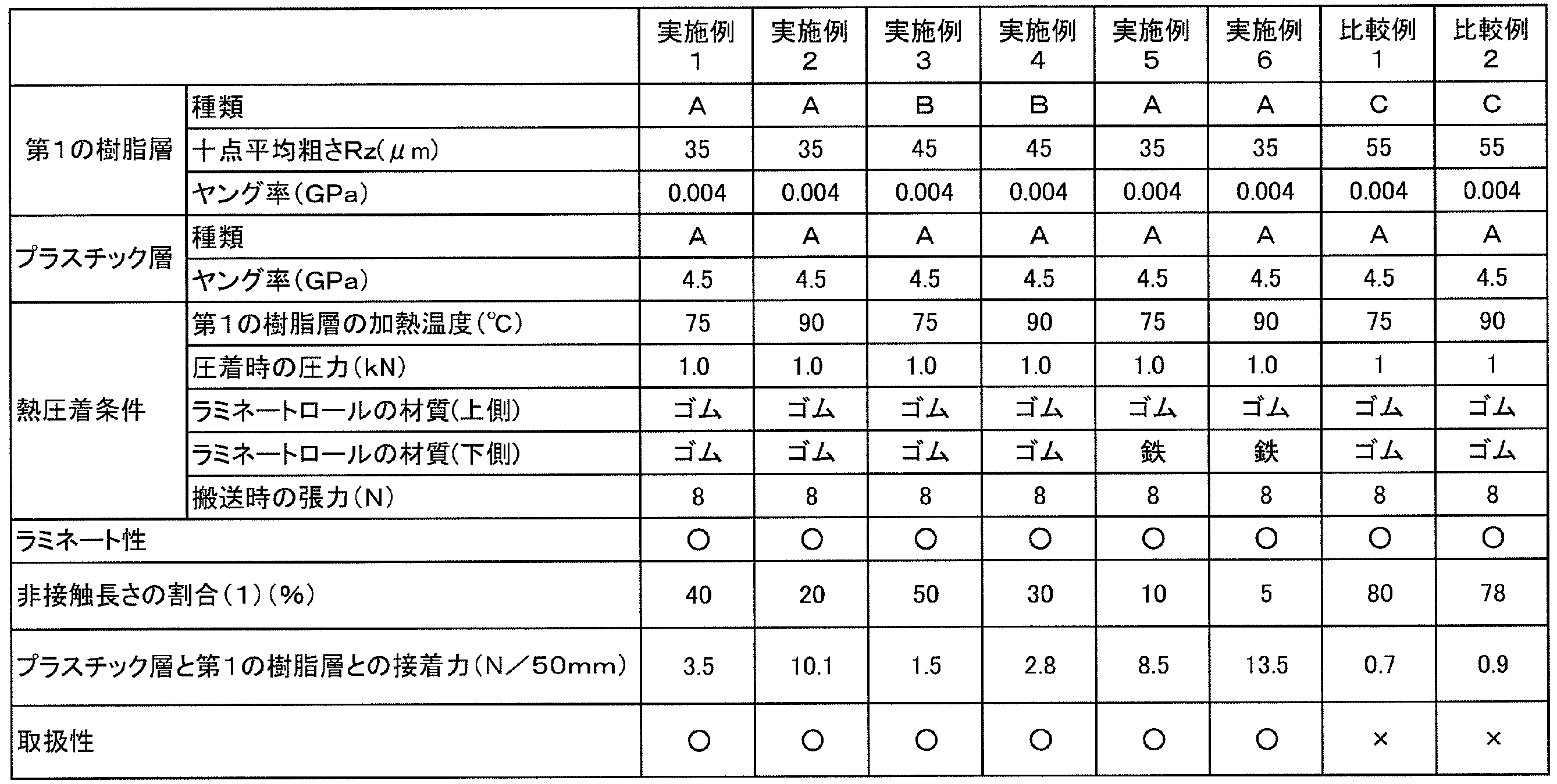
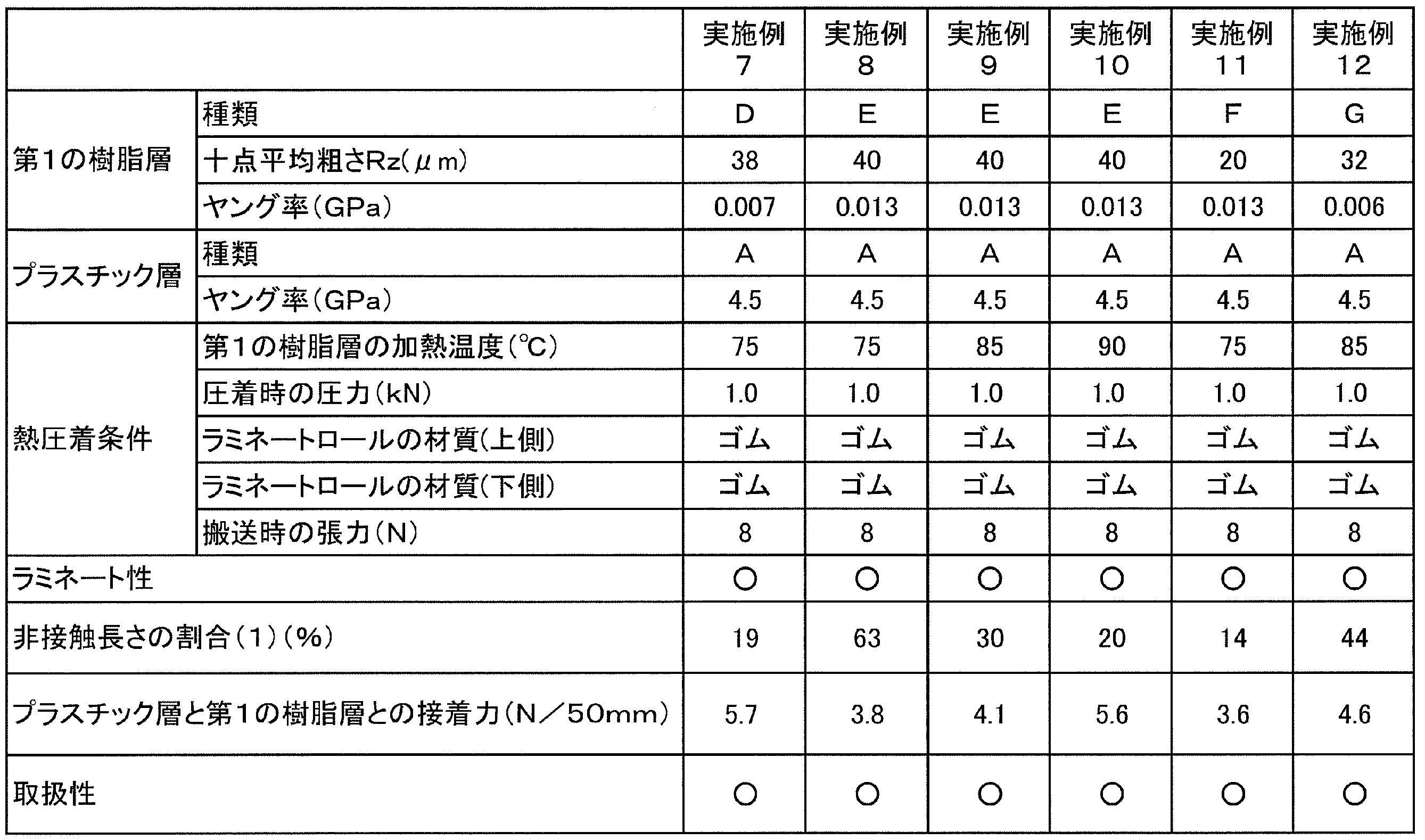
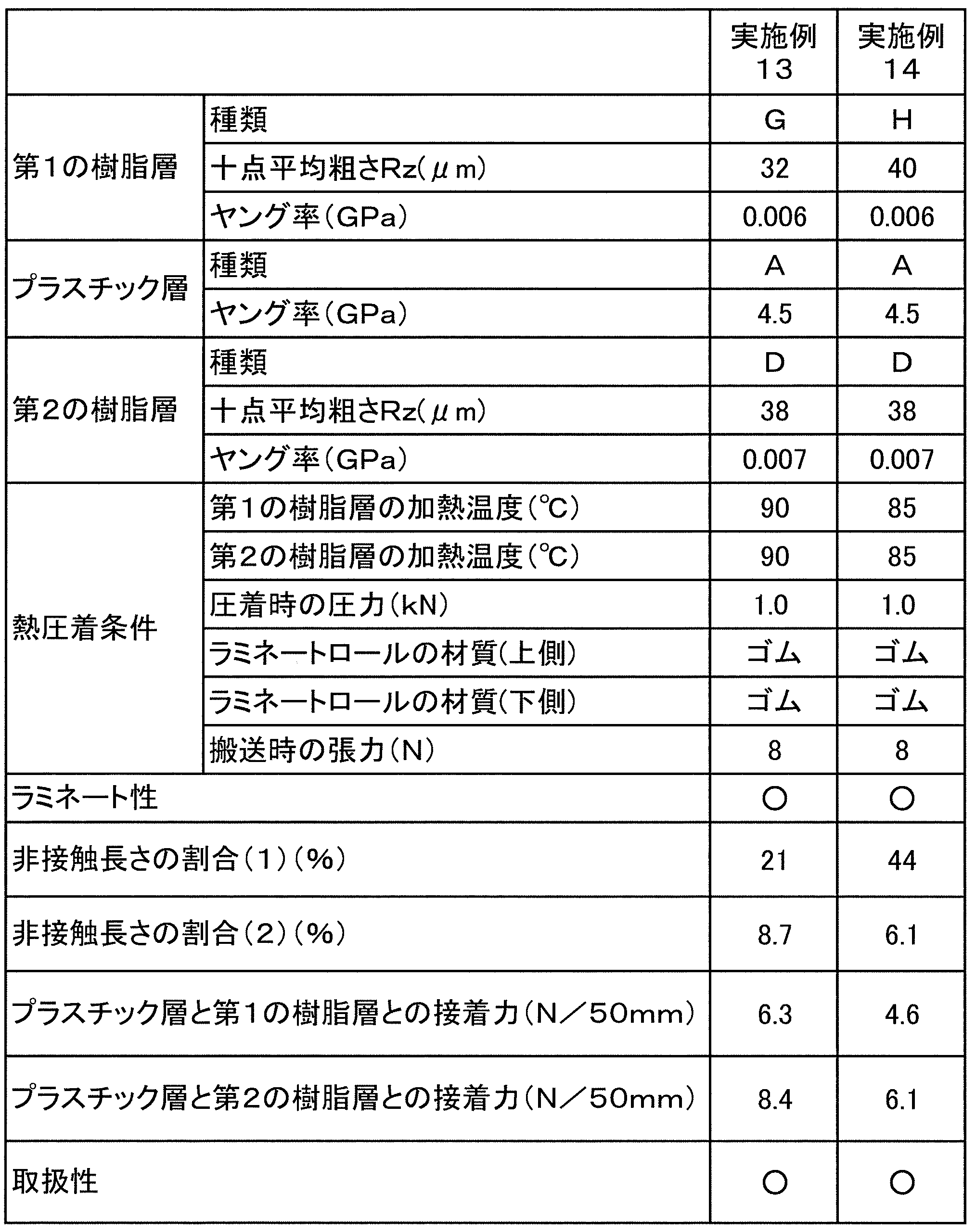
1a…第1の表面
1b…第2の表面
2…プラスチック層
2a…第1の表面
2b…第2の表面
3…第1の樹脂層
3a…外側の表面
4…第2の樹脂層
4a…外側の表面
11…合わせガラス
21…第1の合わせガラス部材
22…第2の合わせガラス部材
Claims (11)
- ヤング率が1GPa以上であるプラスチック層と、前記プラスチック層の第1の表面に積層された第1の樹脂層とを備え、
前記プラスチック層の前記第1の表面とは反対の第2の表面に積層された第2の樹脂層を備えるか、又は前記プラスチック層の前記第1の表面とは反対の第2の表面に第2の樹脂層を備えておらず、
中間膜の厚み方向の断面において、前記プラスチック層と前記第1の樹脂層との第1の積層界面を観察したときに、前記第1の積層界面における前記プラスチック層の表面の長さ100%に占める、前記第1の積層界面における前記プラスチック層の表面の前記第1の樹脂層が接触していない部分の長さの割合が、75%以下である、合わせガラス用中間膜。 - 前記プラスチック層のヤング率が前記第1の樹脂層のヤング率よりも高く、
中間膜が前記第2の樹脂層を備える場合に、前記プラスチック層のヤング率が前記第2の樹脂層のヤング率よりも高い、請求項1に記載の合わせガラス用中間膜。 - 中間膜が前記第2の樹脂層を備える場合に、中間膜の厚み方向の断面において、前記プラスチック層と前記第2の樹脂層との第2の積層界面を観察したときに、前記第2の積層界面における前記プラスチック層の表面の長さ100%に占める、前記第2の積層界面における前記プラスチック層の表面の前記第2の樹脂層が接触していない部分の長さの割合が、75%以下である、請求項1又は2に記載の合わせガラス用中間膜。
- 前記第1の樹脂層が、ポリビニルアセタール樹脂と可塑剤とを含み、
中間膜が前記第2の樹脂層を備える場合に、前記第2の樹脂層が、ポリビニルアセタール樹脂と可塑剤とを含む、請求項1~3のいずれか1項に記載の合わせガラス用中間膜。 - 前記第1の樹脂層と前記プラスチック層とが、ロールツーロール方式により、加熱温度65℃以上、150℃以下、圧着時の圧力0.1kN以上、5kN以下及び搬送時の張力100N以下の条件で熱圧着されている、請求項1~4のいずれか1項に記載の合わせガラス用中間膜。
- 前記第2の樹脂層を備える、請求項1~5のいずれか1項に記載の合わせガラス用中間膜。
- 前記第1の樹脂層が紫外線遮蔽剤を含む、請求項1~6のいずれか1項に記載の合わせガラス用中間膜。
- 前記第2の樹脂層を備え、
前記第2の樹脂層が紫外線遮蔽剤を含む、請求項1~7のいずれか1項に記載の合わせガラス用中間膜。 - 前記第1の樹脂層が酸化防止剤を含む、請求項1~8のいずれか1項に記載の合わせガラス用中間膜。
- 前記第2の樹脂層を備え、
前記第2の樹脂層が酸化防止剤を含む、請求項1~9のいずれか1項に記載の合わせガラス用中間膜。 - 第1の合わせガラス部材と、
第2の合わせガラス部材と、
請求項1~10のいずれか1項に記載の合わせガラス用中間膜とを備え、
前記合わせガラス用中間膜が、前記第1の合わせガラス部材と前記第2の合わせガラス部材との間に配置されている、合わせガラス。
Priority Applications (8)
| Application Number | Priority Date | Filing Date | Title |
|---|---|---|---|
| CA2944137A CA2944137A1 (en) | 2014-03-31 | 2015-03-31 | Intermediate film for laminated glass, and laminated glass |
| RU2016142456A RU2676356C2 (ru) | 2014-03-31 | 2015-03-31 | Промежуточная пленка для ламинированного стекла и ламинированное стекло |
| KR1020167018239A KR102353053B1 (ko) | 2014-03-31 | 2015-03-31 | 접합 유리용 중간막 및 접합 유리 |
| EP15772811.4A EP3127880A4 (en) | 2014-03-31 | 2015-03-31 | Intermediate film for laminated glass, and laminated glass |
| JP2015521163A JP6676374B2 (ja) | 2014-03-31 | 2015-03-31 | 合わせガラス用中間膜及び合わせガラス |
| CN201580016693.6A CN106132893A (zh) | 2014-03-31 | 2015-03-31 | 夹层玻璃用中间膜及夹层玻璃 |
| US15/129,738 US10639868B2 (en) | 2014-03-31 | 2015-03-31 | Intermediate film for laminated glass, and laminated glass |
| MX2016012548A MX388891B (es) | 2014-03-31 | 2015-03-31 | Pelicula intermedia para vidrio laminado, y vidrio laminado. |
Applications Claiming Priority (2)
| Application Number | Priority Date | Filing Date | Title |
|---|---|---|---|
| JP2014074230 | 2014-03-31 | ||
| JP2014-074230 | 2014-03-31 |
Publications (1)
| Publication Number | Publication Date |
|---|---|
| WO2015152301A1 true WO2015152301A1 (ja) | 2015-10-08 |
Family
ID=54240619
Family Applications (1)
| Application Number | Title | Priority Date | Filing Date |
|---|---|---|---|
| PCT/JP2015/060268 Ceased WO2015152301A1 (ja) | 2014-03-31 | 2015-03-31 | 合わせガラス用中間膜及び合わせガラス |
Country Status (9)
| Country | Link |
|---|---|
| US (1) | US10639868B2 (ja) |
| EP (1) | EP3127880A4 (ja) |
| JP (1) | JP6676374B2 (ja) |
| KR (1) | KR102353053B1 (ja) |
| CN (1) | CN106132893A (ja) |
| CA (1) | CA2944137A1 (ja) |
| MX (1) | MX388891B (ja) |
| RU (1) | RU2676356C2 (ja) |
| WO (1) | WO2015152301A1 (ja) |
Cited By (1)
| Publication number | Priority date | Publication date | Assignee | Title |
|---|---|---|---|---|
| JP2015189933A (ja) * | 2014-03-28 | 2015-11-02 | 住友金属鉱山株式会社 | 熱線遮蔽樹脂シート材および自動車、建造物 |
Families Citing this family (7)
| Publication number | Priority date | Publication date | Assignee | Title |
|---|---|---|---|---|
| JP5933139B1 (ja) * | 2014-09-30 | 2016-06-08 | 積水化学工業株式会社 | 合わせガラス用中間膜及び合わせガラス |
| JP6943767B2 (ja) * | 2016-08-03 | 2021-10-06 | 積水化学工業株式会社 | 着色合わせガラス用中間膜及び着色合わせガラス |
| CO2018000469A1 (es) * | 2017-11-30 | 2018-04-30 | Agp America Sa | Laminado automotriz con capa de compensación de sustrato de borde sólido invisible |
| KR102014327B1 (ko) * | 2018-10-23 | 2019-08-26 | 이기호 | 차열 중간막 조성물 및 그 제조방법 |
| US20220009205A1 (en) * | 2018-12-21 | 2022-01-13 | Sekisui Chemical Co., Ltd. | Interlayer for laminated glass and laminated glass |
| US12103271B2 (en) * | 2020-06-16 | 2024-10-01 | Saint-Gobain Glass France | Composite pane |
| CN115593049B (zh) * | 2022-10-13 | 2023-12-19 | 福建省万达汽车玻璃工业有限公司 | 夹层玻璃及其制备方法、车辆 |
Citations (4)
| Publication number | Priority date | Publication date | Assignee | Title |
|---|---|---|---|---|
| JPH1086659A (ja) * | 1996-08-13 | 1998-04-07 | Saint Gobain Vitrage | 側面衝撃を受けた場合の車両の搭乗者の保護用装置 |
| JP2003516921A (ja) * | 1999-12-14 | 2003-05-20 | ソリユテイア・インコーポレイテツド | 耐侵入性合わせガラス |
| JP2009161406A (ja) * | 2008-01-09 | 2009-07-23 | Central Glass Co Ltd | プラスチックフィルム挿入合わせガラスの製造方法およびプラスチックフィルム挿入合わせガラス |
| JP2009298661A (ja) * | 2008-06-16 | 2009-12-24 | Central Glass Co Ltd | プラスチックフィルム挿入合わせガラスの製造方法およびプラスチックフィルム挿入合わせガラス |
Family Cites Families (30)
| Publication number | Priority date | Publication date | Assignee | Title |
|---|---|---|---|---|
| US4952457A (en) | 1988-12-05 | 1990-08-28 | Monsanto Company | Laminated safety glass and polymeric laminate for use therein |
| AU621471B2 (en) * | 1989-03-31 | 1992-03-12 | Sekisui Kagaku Kogyo Kabushiki Kaisha | A method for the manufacture of thermoplastic resin sheets |
| US5024895A (en) | 1990-06-18 | 1991-06-18 | Monsanto Company | Laminate for a safety glazing |
| US5091258A (en) | 1990-08-20 | 1992-02-25 | Monsanto Company | Laminate for a safety glazing |
| JPH057889A (ja) * | 1991-06-28 | 1993-01-19 | Hitachi Kiden Kogyo Ltd | 曝気撹拌装置 |
| US5455103A (en) | 1994-01-24 | 1995-10-03 | Monsanto Company | Rough-surfaced interlayer |
| JP2000290046A (ja) * | 1999-04-09 | 2000-10-17 | Sekisui Chem Co Ltd | 合わせガラス用中間膜及びその製造方法 |
| JP4429428B2 (ja) | 1999-10-07 | 2010-03-10 | 積水化学工業株式会社 | 合わせガラス用中間膜及び合わせガラス |
| JP2001130931A (ja) | 1999-10-29 | 2001-05-15 | Sekisui Chem Co Ltd | 熱可塑性樹脂膜及び合わせガラス用中間膜 |
| US20030124296A1 (en) * | 2000-10-26 | 2003-07-03 | Smith Charles Anthony | Glass laminates for threat resistant window systems |
| US6800589B2 (en) * | 2001-02-02 | 2004-10-05 | Fuji Photo Film Co., Ltd. | Image-forming material and image formation method |
| JP2003192402A (ja) | 2001-12-25 | 2003-07-09 | Central Glass Co Ltd | 耐衝撃性および耐剥離性に優れた合わせガラス |
| WO2006025484A1 (ja) | 2004-09-02 | 2006-03-09 | Sekisui Chemical Co., Ltd. | 合わせガラス用中間膜及び合わせガラス |
| US8551600B2 (en) * | 2005-02-22 | 2013-10-08 | Solutia Inc. | Low distortion interlayer |
| US8053079B2 (en) * | 2006-09-14 | 2011-11-08 | Nippon Electric Glass Co., Ltd. | Sheet glass laminate structure and mulitiple glass laminate structure |
| JP4942556B2 (ja) | 2007-06-05 | 2012-05-30 | 株式会社ブリヂストン | 合わせガラス用中間膜、及びこれを用いた合わせガラス |
| EP2298707A4 (en) | 2008-06-16 | 2013-02-27 | Central Glass Co Ltd | METHOD FOR THE PRODUCTION OF COMPOSITE GLASS WITH INTEGRATED PLASTIC FOIL AND COMPOSITE GLASS WITH PLASTIC FOIL INSERTED |
| FR2936511B1 (fr) * | 2008-10-01 | 2011-06-24 | Saint Gobain | Procede de fabrication d'un vitrage feuillete |
| WO2010041391A1 (ja) * | 2008-10-06 | 2010-04-15 | 株式会社クラレ | 積層体 |
| JP5248978B2 (ja) | 2008-10-27 | 2013-07-31 | 株式会社ブリヂストン | 機能性フィルム |
| JP2010222233A (ja) | 2009-02-27 | 2010-10-07 | Central Glass Co Ltd | 断熱合わせガラス |
| WO2010101211A1 (ja) | 2009-03-06 | 2010-09-10 | 株式会社ブリヂストン | 熱線遮蔽性積層体、及びこれを用いた熱線遮蔽性合わせガラス |
| CN103140451B (zh) | 2010-09-30 | 2015-08-05 | 积水化学工业株式会社 | 夹层玻璃用中间膜及夹层玻璃 |
| EP3486082B1 (en) * | 2010-12-09 | 2021-11-10 | Sekisui Chemical Co., Ltd. | Interlayer for laminated glass, and laminated glass |
| JP2012148915A (ja) * | 2011-01-18 | 2012-08-09 | Sekisui Chem Co Ltd | 合わせガラス用中間膜及び合わせガラス |
| JP2013006723A (ja) * | 2011-06-23 | 2013-01-10 | Sekisui Chem Co Ltd | 合わせガラス用中間膜及び合わせガラス |
| EP2752396A4 (en) | 2011-08-31 | 2015-04-29 | Sekisui Chemical Co Ltd | INTERMEDIATE LAYER FOR COMPOSITE GLASS, METHOD FOR PRODUCING THE INTERMEDIATE LAYER FOR COMPOSITE GLASS AND COMPOSITE GLASS |
| KR101975625B1 (ko) | 2011-11-29 | 2019-05-07 | 데이진 필름 솔루션스 가부시키가이샤 | 2 축 연신 적층 폴리에스테르 필름, 그것으로 이루어지는 합판 유리용 적외선 차폐 구성체 및 그들로 이루어지는 합판 유리 |
| CN106029597B (zh) * | 2014-02-25 | 2023-03-14 | 积水化学工业株式会社 | 塑料片材、塑料片材的制造方法、夹层玻璃用中间膜及夹层玻璃 |
| WO2015129758A1 (ja) * | 2014-02-25 | 2015-09-03 | 積水化学工業株式会社 | 合わせガラス用中間膜、合わせガラス用中間膜の製造方法及び合わせガラス |
-
2015
- 2015-03-31 EP EP15772811.4A patent/EP3127880A4/en not_active Withdrawn
- 2015-03-31 CN CN201580016693.6A patent/CN106132893A/zh active Pending
- 2015-03-31 CA CA2944137A patent/CA2944137A1/en not_active Abandoned
- 2015-03-31 KR KR1020167018239A patent/KR102353053B1/ko active Active
- 2015-03-31 JP JP2015521163A patent/JP6676374B2/ja active Active
- 2015-03-31 WO PCT/JP2015/060268 patent/WO2015152301A1/ja not_active Ceased
- 2015-03-31 US US15/129,738 patent/US10639868B2/en active Active
- 2015-03-31 MX MX2016012548A patent/MX388891B/es unknown
- 2015-03-31 RU RU2016142456A patent/RU2676356C2/ru not_active IP Right Cessation
Patent Citations (4)
| Publication number | Priority date | Publication date | Assignee | Title |
|---|---|---|---|---|
| JPH1086659A (ja) * | 1996-08-13 | 1998-04-07 | Saint Gobain Vitrage | 側面衝撃を受けた場合の車両の搭乗者の保護用装置 |
| JP2003516921A (ja) * | 1999-12-14 | 2003-05-20 | ソリユテイア・インコーポレイテツド | 耐侵入性合わせガラス |
| JP2009161406A (ja) * | 2008-01-09 | 2009-07-23 | Central Glass Co Ltd | プラスチックフィルム挿入合わせガラスの製造方法およびプラスチックフィルム挿入合わせガラス |
| JP2009298661A (ja) * | 2008-06-16 | 2009-12-24 | Central Glass Co Ltd | プラスチックフィルム挿入合わせガラスの製造方法およびプラスチックフィルム挿入合わせガラス |
Non-Patent Citations (1)
| Title |
|---|
| See also references of EP3127880A4 * |
Cited By (1)
| Publication number | Priority date | Publication date | Assignee | Title |
|---|---|---|---|---|
| JP2015189933A (ja) * | 2014-03-28 | 2015-11-02 | 住友金属鉱山株式会社 | 熱線遮蔽樹脂シート材および自動車、建造物 |
Also Published As
| Publication number | Publication date |
|---|---|
| RU2016142456A3 (ja) | 2018-10-24 |
| JP6676374B2 (ja) | 2020-04-08 |
| CA2944137A1 (en) | 2015-10-08 |
| US20170144413A1 (en) | 2017-05-25 |
| CN106132893A (zh) | 2016-11-16 |
| MX2016012548A (es) | 2017-01-09 |
| KR102353053B1 (ko) | 2022-01-19 |
| RU2676356C2 (ru) | 2018-12-28 |
| EP3127880A1 (en) | 2017-02-08 |
| RU2016142456A (ru) | 2018-05-04 |
| KR20160138376A (ko) | 2016-12-05 |
| MX388891B (es) | 2025-03-20 |
| JPWO2015152301A1 (ja) | 2017-04-13 |
| EP3127880A4 (en) | 2017-09-20 |
| US10639868B2 (en) | 2020-05-05 |
Similar Documents
| Publication | Publication Date | Title |
|---|---|---|
| JP6676374B2 (ja) | 合わせガラス用中間膜及び合わせガラス | |
| JP6613141B2 (ja) | 合わせガラス用中間膜及び合わせガラス | |
| JP6530711B2 (ja) | 合わせガラス用中間膜、合わせガラス用中間膜の製造方法及び合わせガラス | |
| JP7305711B2 (ja) | 合わせガラス用中間膜、合わせガラス用中間膜の製造方法及び合わせガラス | |
| WO2012115198A1 (ja) | 合わせガラス用中間膜及び合わせガラス | |
| CN106660867A (zh) | 夹层玻璃用中间膜及夹层玻璃 | |
| WO2016125896A1 (ja) | 合わせガラス用中間膜及び合わせガラス | |
| JP6360704B2 (ja) | 合わせガラス用中間膜、合わせガラス用中間膜の製造方法、合わせガラス及び合わせガラスの製造方法 | |
| JP2017071530A (ja) | 合わせガラス用中間膜、合わせガラス用中間膜の製造方法及び合わせガラス | |
| JP6240018B2 (ja) | 合わせガラス用中間膜及び合わせガラス | |
| JP2017222572A (ja) | 合わせガラス用中間膜及び合わせガラス |
Legal Events
| Date | Code | Title | Description |
|---|---|---|---|
| ENP | Entry into the national phase |
Ref document number: 2015521163 Country of ref document: JP Kind code of ref document: A |
|
| 121 | Ep: the epo has been informed by wipo that ep was designated in this application |
Ref document number: 15772811 Country of ref document: EP Kind code of ref document: A1 |
|
| DPE1 | Request for preliminary examination filed after expiration of 19th month from priority date (pct application filed from 20040101) | ||
| ENP | Entry into the national phase |
Ref document number: 20167018239 Country of ref document: KR Kind code of ref document: A |
|
| REEP | Request for entry into the european phase |
Ref document number: 2015772811 Country of ref document: EP |
|
| WWE | Wipo information: entry into national phase |
Ref document number: 2015772811 Country of ref document: EP |
|
| WWE | Wipo information: entry into national phase |
Ref document number: MX/A/2016/012548 Country of ref document: MX |
|
| ENP | Entry into the national phase |
Ref document number: 2944137 Country of ref document: CA |
|
| WWE | Wipo information: entry into national phase |
Ref document number: 15129738 Country of ref document: US |
|
| NENP | Non-entry into the national phase |
Ref country code: DE |
|
| ENP | Entry into the national phase |
Ref document number: 2016142456 Country of ref document: RU Kind code of ref document: A |
|
| REG | Reference to national code |
Ref country code: BR Ref legal event code: B01A Ref document number: 112016021797 Country of ref document: BR |
|
| ENP | Entry into the national phase |
Ref document number: 112016021797 Country of ref document: BR Kind code of ref document: A2 Effective date: 20160922 |