WO2015156191A1 - 接着シート、その製造方法及び積層体 - Google Patents
接着シート、その製造方法及び積層体 Download PDFInfo
- Publication number
- WO2015156191A1 WO2015156191A1 PCT/JP2015/060380 JP2015060380W WO2015156191A1 WO 2015156191 A1 WO2015156191 A1 WO 2015156191A1 JP 2015060380 W JP2015060380 W JP 2015060380W WO 2015156191 A1 WO2015156191 A1 WO 2015156191A1
- Authority
- WO
- WIPO (PCT)
- Prior art keywords
- compound
- meth
- adhesive sheet
- adhesive
- thiol
- Prior art date
- Legal status (The legal status is an assumption and is not a legal conclusion. Google has not performed a legal analysis and makes no representation as to the accuracy of the status listed.)
- Ceased
Links
Classifications
-
- B—PERFORMING OPERATIONS; TRANSPORTING
- B32—LAYERED PRODUCTS
- B32B—LAYERED PRODUCTS, i.e. PRODUCTS BUILT-UP OF STRATA OF FLAT OR NON-FLAT, e.g. CELLULAR OR HONEYCOMB, FORM
- B32B7/00—Layered products characterised by the relation between layers; Layered products characterised by the relative orientation of features between layers, or by the relative values of a measurable parameter between layers, i.e. products comprising layers having different physical, chemical or physicochemical properties; Layered products characterised by the interconnection of layers
- B32B7/04—Interconnection of layers
- B32B7/12—Interconnection of layers using interposed adhesives or interposed materials with bonding properties
-
- B—PERFORMING OPERATIONS; TRANSPORTING
- B32—LAYERED PRODUCTS
- B32B—LAYERED PRODUCTS, i.e. PRODUCTS BUILT-UP OF STRATA OF FLAT OR NON-FLAT, e.g. CELLULAR OR HONEYCOMB, FORM
- B32B15/00—Layered products comprising a layer of metal
- B32B15/04—Layered products comprising a layer of metal comprising metal as the main or only constituent of a layer, which is next to another layer of the same or of a different material
- B32B15/06—Layered products comprising a layer of metal comprising metal as the main or only constituent of a layer, which is next to another layer of the same or of a different material of natural rubber or synthetic rubber
-
- B—PERFORMING OPERATIONS; TRANSPORTING
- B32—LAYERED PRODUCTS
- B32B—LAYERED PRODUCTS, i.e. PRODUCTS BUILT-UP OF STRATA OF FLAT OR NON-FLAT, e.g. CELLULAR OR HONEYCOMB, FORM
- B32B25/00—Layered products comprising a layer of natural or synthetic rubber
- B32B25/04—Layered products comprising a layer of natural or synthetic rubber comprising rubber as the main or only constituent of a layer, which is next to another layer of the same or of a different material
-
- B—PERFORMING OPERATIONS; TRANSPORTING
- B32—LAYERED PRODUCTS
- B32B—LAYERED PRODUCTS, i.e. PRODUCTS BUILT-UP OF STRATA OF FLAT OR NON-FLAT, e.g. CELLULAR OR HONEYCOMB, FORM
- B32B25/00—Layered products comprising a layer of natural or synthetic rubber
- B32B25/04—Layered products comprising a layer of natural or synthetic rubber comprising rubber as the main or only constituent of a layer, which is next to another layer of the same or of a different material
- B32B25/042—Layered products comprising a layer of natural or synthetic rubber comprising rubber as the main or only constituent of a layer, which is next to another layer of the same or of a different material of natural rubber or synthetic rubber
-
- B—PERFORMING OPERATIONS; TRANSPORTING
- B32—LAYERED PRODUCTS
- B32B—LAYERED PRODUCTS, i.e. PRODUCTS BUILT-UP OF STRATA OF FLAT OR NON-FLAT, e.g. CELLULAR OR HONEYCOMB, FORM
- B32B25/00—Layered products comprising a layer of natural or synthetic rubber
- B32B25/04—Layered products comprising a layer of natural or synthetic rubber comprising rubber as the main or only constituent of a layer, which is next to another layer of the same or of a different material
- B32B25/08—Layered products comprising a layer of natural or synthetic rubber comprising rubber as the main or only constituent of a layer, which is next to another layer of the same or of a different material of synthetic resin
-
- B—PERFORMING OPERATIONS; TRANSPORTING
- B32—LAYERED PRODUCTS
- B32B—LAYERED PRODUCTS, i.e. PRODUCTS BUILT-UP OF STRATA OF FLAT OR NON-FLAT, e.g. CELLULAR OR HONEYCOMB, FORM
- B32B25/00—Layered products comprising a layer of natural or synthetic rubber
- B32B25/12—Layered products comprising a layer of natural or synthetic rubber comprising natural rubber
-
- B—PERFORMING OPERATIONS; TRANSPORTING
- B32—LAYERED PRODUCTS
- B32B—LAYERED PRODUCTS, i.e. PRODUCTS BUILT-UP OF STRATA OF FLAT OR NON-FLAT, e.g. CELLULAR OR HONEYCOMB, FORM
- B32B25/00—Layered products comprising a layer of natural or synthetic rubber
- B32B25/14—Layered products comprising a layer of natural or synthetic rubber comprising synthetic rubber copolymers
-
- B—PERFORMING OPERATIONS; TRANSPORTING
- B32—LAYERED PRODUCTS
- B32B—LAYERED PRODUCTS, i.e. PRODUCTS BUILT-UP OF STRATA OF FLAT OR NON-FLAT, e.g. CELLULAR OR HONEYCOMB, FORM
- B32B27/00—Layered products comprising a layer of synthetic resin
- B32B27/30—Layered products comprising a layer of synthetic resin comprising vinyl (co)polymers; comprising acrylic (co)polymers
-
- B—PERFORMING OPERATIONS; TRANSPORTING
- B32—LAYERED PRODUCTS
- B32B—LAYERED PRODUCTS, i.e. PRODUCTS BUILT-UP OF STRATA OF FLAT OR NON-FLAT, e.g. CELLULAR OR HONEYCOMB, FORM
- B32B27/00—Layered products comprising a layer of synthetic resin
- B32B27/40—Layered products comprising a layer of synthetic resin comprising polyurethanes
-
- C—CHEMISTRY; METALLURGY
- C08—ORGANIC MACROMOLECULAR COMPOUNDS; THEIR PREPARATION OR CHEMICAL WORKING-UP; COMPOSITIONS BASED THEREON
- C08F—MACROMOLECULAR COMPOUNDS OBTAINED BY REACTIONS ONLY INVOLVING CARBON-TO-CARBON UNSATURATED BONDS
- C08F290/00—Macromolecular compounds obtained by polymerising monomers on to polymers modified by introduction of aliphatic unsaturated end or side groups
- C08F290/02—Macromolecular compounds obtained by polymerising monomers on to polymers modified by introduction of aliphatic unsaturated end or side groups on to polymers modified by introduction of unsaturated end groups
- C08F290/06—Polymers provided for in subclass C08G
- C08F290/067—Polyurethanes; Polyureas
-
- C—CHEMISTRY; METALLURGY
- C08—ORGANIC MACROMOLECULAR COMPOUNDS; THEIR PREPARATION OR CHEMICAL WORKING-UP; COMPOSITIONS BASED THEREON
- C08G—MACROMOLECULAR COMPOUNDS OBTAINED OTHERWISE THAN BY REACTIONS ONLY INVOLVING UNSATURATED CARBON-TO-CARBON BONDS
- C08G18/00—Polymeric products of isocyanates or isothiocyanates
- C08G18/06—Polymeric products of isocyanates or isothiocyanates with compounds having active hydrogen
- C08G18/28—Polymeric products of isocyanates or isothiocyanates with compounds having active hydrogen characterised by the compounds used containing active hydrogen
- C08G18/67—Unsaturated compounds having active hydrogen
- C08G18/671—Unsaturated compounds having only one group containing active hydrogen
- C08G18/672—Esters of acrylic or alkyl acrylic acid having only one group containing active hydrogen
-
- C—CHEMISTRY; METALLURGY
- C08—ORGANIC MACROMOLECULAR COMPOUNDS; THEIR PREPARATION OR CHEMICAL WORKING-UP; COMPOSITIONS BASED THEREON
- C08G—MACROMOLECULAR COMPOUNDS OBTAINED OTHERWISE THAN BY REACTIONS ONLY INVOLVING UNSATURATED CARBON-TO-CARBON BONDS
- C08G18/00—Polymeric products of isocyanates or isothiocyanates
- C08G18/06—Polymeric products of isocyanates or isothiocyanates with compounds having active hydrogen
- C08G18/70—Polymeric products of isocyanates or isothiocyanates with compounds having active hydrogen characterised by the isocyanates or isothiocyanates used
- C08G18/72—Polyisocyanates or polyisothiocyanates
- C08G18/74—Polyisocyanates or polyisothiocyanates cyclic
- C08G18/75—Polyisocyanates or polyisothiocyanates cyclic cycloaliphatic
- C08G18/751—Polyisocyanates or polyisothiocyanates cyclic cycloaliphatic containing only one cycloaliphatic ring
- C08G18/752—Polyisocyanates or polyisothiocyanates cyclic cycloaliphatic containing only one cycloaliphatic ring containing at least one isocyanate or isothiocyanate group linked to the cycloaliphatic ring by means of an aliphatic group
- C08G18/753—Polyisocyanates or polyisothiocyanates cyclic cycloaliphatic containing only one cycloaliphatic ring containing at least one isocyanate or isothiocyanate group linked to the cycloaliphatic ring by means of an aliphatic group containing one isocyanate or isothiocyanate group linked to the cycloaliphatic ring by means of an aliphatic group having a primary carbon atom next to the isocyanate or isothiocyanate group
- C08G18/755—Polyisocyanates or polyisothiocyanates cyclic cycloaliphatic containing only one cycloaliphatic ring containing at least one isocyanate or isothiocyanate group linked to the cycloaliphatic ring by means of an aliphatic group containing one isocyanate or isothiocyanate group linked to the cycloaliphatic ring by means of an aliphatic group having a primary carbon atom next to the isocyanate or isothiocyanate group and at least one isocyanate or isothiocyanate group linked to a secondary carbon atom of the cycloaliphatic ring, e.g. isophorone diisocyanate
-
- C—CHEMISTRY; METALLURGY
- C08—ORGANIC MACROMOLECULAR COMPOUNDS; THEIR PREPARATION OR CHEMICAL WORKING-UP; COMPOSITIONS BASED THEREON
- C08G—MACROMOLECULAR COMPOUNDS OBTAINED OTHERWISE THAN BY REACTIONS ONLY INVOLVING UNSATURATED CARBON-TO-CARBON BONDS
- C08G18/00—Polymeric products of isocyanates or isothiocyanates
- C08G18/06—Polymeric products of isocyanates or isothiocyanates with compounds having active hydrogen
- C08G18/70—Polymeric products of isocyanates or isothiocyanates with compounds having active hydrogen characterised by the isocyanates or isothiocyanates used
- C08G18/72—Polyisocyanates or polyisothiocyanates
- C08G18/77—Polyisocyanates or polyisothiocyanates having heteroatoms in addition to the isocyanate or isothiocyanate nitrogen and oxygen or sulfur
- C08G18/78—Nitrogen
- C08G18/79—Nitrogen characterised by the polyisocyanates used, these having groups formed by oligomerisation of isocyanates or isothiocyanates
- C08G18/791—Nitrogen characterised by the polyisocyanates used, these having groups formed by oligomerisation of isocyanates or isothiocyanates containing isocyanurate groups
- C08G18/792—Nitrogen characterised by the polyisocyanates used, these having groups formed by oligomerisation of isocyanates or isothiocyanates containing isocyanurate groups formed by oligomerisation of aliphatic and/or cycloaliphatic isocyanates or isothiocyanates
-
- C—CHEMISTRY; METALLURGY
- C08—ORGANIC MACROMOLECULAR COMPOUNDS; THEIR PREPARATION OR CHEMICAL WORKING-UP; COMPOSITIONS BASED THEREON
- C08G—MACROMOLECULAR COMPOUNDS OBTAINED OTHERWISE THAN BY REACTIONS ONLY INVOLVING UNSATURATED CARBON-TO-CARBON BONDS
- C08G18/00—Polymeric products of isocyanates or isothiocyanates
- C08G18/06—Polymeric products of isocyanates or isothiocyanates with compounds having active hydrogen
- C08G18/70—Polymeric products of isocyanates or isothiocyanates with compounds having active hydrogen characterised by the isocyanates or isothiocyanates used
- C08G18/72—Polyisocyanates or polyisothiocyanates
- C08G18/80—Masked polyisocyanates
- C08G18/8003—Masked polyisocyanates masked with compounds having at least two groups containing active hydrogen
- C08G18/8006—Masked polyisocyanates masked with compounds having at least two groups containing active hydrogen with compounds of C08G18/32
- C08G18/8009—Masked polyisocyanates masked with compounds having at least two groups containing active hydrogen with compounds of C08G18/32 with compounds of C08G18/3203
- C08G18/8022—Masked polyisocyanates masked with compounds having at least two groups containing active hydrogen with compounds of C08G18/32 with compounds of C08G18/3203 with polyols having at least three hydroxy groups
- C08G18/8029—Masked aromatic polyisocyanates
-
- C—CHEMISTRY; METALLURGY
- C08—ORGANIC MACROMOLECULAR COMPOUNDS; THEIR PREPARATION OR CHEMICAL WORKING-UP; COMPOSITIONS BASED THEREON
- C08G—MACROMOLECULAR COMPOUNDS OBTAINED OTHERWISE THAN BY REACTIONS ONLY INVOLVING UNSATURATED CARBON-TO-CARBON BONDS
- C08G75/00—Macromolecular compounds obtained by reactions forming a linkage containing sulfur with or without nitrogen, oxygen, or carbon in the main chain of the macromolecule
- C08G75/02—Polythioethers
- C08G75/04—Polythioethers from mercapto compounds or metallic derivatives thereof
- C08G75/045—Polythioethers from mercapto compounds or metallic derivatives thereof from mercapto compounds and unsaturated compounds
-
- C—CHEMISTRY; METALLURGY
- C09—DYES; PAINTS; POLISHES; NATURAL RESINS; ADHESIVES; COMPOSITIONS NOT OTHERWISE PROVIDED FOR; APPLICATIONS OF MATERIALS NOT OTHERWISE PROVIDED FOR
- C09J—ADHESIVES; NON-MECHANICAL ASPECTS OF ADHESIVE PROCESSES IN GENERAL; ADHESIVE PROCESSES NOT PROVIDED FOR ELSEWHERE; USE OF MATERIALS AS ADHESIVES
- C09J11/00—Features of adhesives not provided for in group C09J9/00, e.g. additives
- C09J11/02—Non-macromolecular additives
- C09J11/06—Non-macromolecular additives organic
-
- C—CHEMISTRY; METALLURGY
- C09—DYES; PAINTS; POLISHES; NATURAL RESINS; ADHESIVES; COMPOSITIONS NOT OTHERWISE PROVIDED FOR; APPLICATIONS OF MATERIALS NOT OTHERWISE PROVIDED FOR
- C09J—ADHESIVES; NON-MECHANICAL ASPECTS OF ADHESIVE PROCESSES IN GENERAL; ADHESIVE PROCESSES NOT PROVIDED FOR ELSEWHERE; USE OF MATERIALS AS ADHESIVES
- C09J175/00—Adhesives based on polyureas or polyurethanes; Adhesives based on derivatives of such polymers
- C09J175/04—Polyurethanes
- C09J175/14—Polyurethanes having carbon-to-carbon unsaturated bonds
- C09J175/16—Polyurethanes having carbon-to-carbon unsaturated bonds having terminal carbon-to-carbon unsaturated bonds
-
- C—CHEMISTRY; METALLURGY
- C09—DYES; PAINTS; POLISHES; NATURAL RESINS; ADHESIVES; COMPOSITIONS NOT OTHERWISE PROVIDED FOR; APPLICATIONS OF MATERIALS NOT OTHERWISE PROVIDED FOR
- C09J—ADHESIVES; NON-MECHANICAL ASPECTS OF ADHESIVE PROCESSES IN GENERAL; ADHESIVE PROCESSES NOT PROVIDED FOR ELSEWHERE; USE OF MATERIALS AS ADHESIVES
- C09J181/00—Adhesives based on macromolecular compounds obtained by reactions forming in the main chain of the macromolecule a linkage containing sulfur, with or without nitrogen, oxygen, or carbon only; Adhesives based on polysulfones; Adhesives based on derivatives of such polymers
-
- C—CHEMISTRY; METALLURGY
- C09—DYES; PAINTS; POLISHES; NATURAL RESINS; ADHESIVES; COMPOSITIONS NOT OTHERWISE PROVIDED FOR; APPLICATIONS OF MATERIALS NOT OTHERWISE PROVIDED FOR
- C09J—ADHESIVES; NON-MECHANICAL ASPECTS OF ADHESIVE PROCESSES IN GENERAL; ADHESIVE PROCESSES NOT PROVIDED FOR ELSEWHERE; USE OF MATERIALS AS ADHESIVES
- C09J183/00—Adhesives based on macromolecular compounds obtained by reactions forming in the main chain of the macromolecule a linkage containing silicon, with or without sulfur, nitrogen, oxygen, or carbon only; Adhesives based on derivatives of such polymers
- C09J183/04—Polysiloxanes
- C09J183/08—Polysiloxanes containing silicon bound to organic groups containing atoms other than carbon, hydrogen, and oxygen
-
- C—CHEMISTRY; METALLURGY
- C09—DYES; PAINTS; POLISHES; NATURAL RESINS; ADHESIVES; COMPOSITIONS NOT OTHERWISE PROVIDED FOR; APPLICATIONS OF MATERIALS NOT OTHERWISE PROVIDED FOR
- C09J—ADHESIVES; NON-MECHANICAL ASPECTS OF ADHESIVE PROCESSES IN GENERAL; ADHESIVE PROCESSES NOT PROVIDED FOR ELSEWHERE; USE OF MATERIALS AS ADHESIVES
- C09J7/00—Adhesives in the form of films or foils
- C09J7/10—Adhesives in the form of films or foils without carriers
-
- B—PERFORMING OPERATIONS; TRANSPORTING
- B32—LAYERED PRODUCTS
- B32B—LAYERED PRODUCTS, i.e. PRODUCTS BUILT-UP OF STRATA OF FLAT OR NON-FLAT, e.g. CELLULAR OR HONEYCOMB, FORM
- B32B2307/00—Properties of the layers or laminate
- B32B2307/70—Other properties
- B32B2307/748—Releasability
-
- B—PERFORMING OPERATIONS; TRANSPORTING
- B32—LAYERED PRODUCTS
- B32B—LAYERED PRODUCTS, i.e. PRODUCTS BUILT-UP OF STRATA OF FLAT OR NON-FLAT, e.g. CELLULAR OR HONEYCOMB, FORM
- B32B2405/00—Adhesive articles, e.g. adhesive tapes
-
- C—CHEMISTRY; METALLURGY
- C08—ORGANIC MACROMOLECULAR COMPOUNDS; THEIR PREPARATION OR CHEMICAL WORKING-UP; COMPOSITIONS BASED THEREON
- C08G—MACROMOLECULAR COMPOUNDS OBTAINED OTHERWISE THAN BY REACTIONS ONLY INVOLVING UNSATURATED CARBON-TO-CARBON BONDS
- C08G77/00—Macromolecular compounds obtained by reactions forming a linkage containing silicon with or without sulfur, nitrogen, oxygen or carbon in the main chain of the macromolecule
- C08G77/04—Polysiloxanes
- C08G77/22—Polysiloxanes containing silicon bound to organic groups containing atoms other than carbon, hydrogen and oxygen
- C08G77/28—Polysiloxanes containing silicon bound to organic groups containing atoms other than carbon, hydrogen and oxygen sulfur-containing groups
Definitions
- the present invention relates to an adhesive sheet, a method for producing the same, and a laminate, and more specifically, for example, an adhesive sheet suitable for rubber adhesion and a method for producing the same, and a laminate obtained by adhering a rubber layer using the adhesive sheet About.
- a method for adhering vulcanized rubber is disclosed in, for example, Japanese Patent Application Laid-Open No. 10-139901. In this method, the vulcanized rubber is surface-treated, and another member is attached to the surface-treated surface via an adhesive. Join.
- the present disclosure relates to, for example, an adhesive sheet that can exhibit high adhesive strength to rubber, a manufacturing method thereof, and a laminate using the adhesive sheet.
- a polythiol compound, a (meth) acryl compound having a plurality of at least one of an acryloyl group and a methacryloyl group, a radical generator, and a Michael addition catalyst are used.
- the ratio (Ac / SH) of the total mole number (Ac) of at least one of the acryloyl group and methacryloyl group contained in the (meth) acryl compound to the total mole number (SH) of the thiol group contained in the compound is 0.
- An adhesive sheet having an adhesive composition layer formed using a composition containing 25 or more and 0.80 or less is provided.
- an adhesive sheet capable of exhibiting high adhesive strength to rubber, a method for producing the same, and a laminate using the adhesive sheet.
- An adhesive sheet according to an embodiment of the present invention is a (meth) acrylic compound (hereinafter referred to as a (meth) acrylic compound) having a plurality of at least one of a polythiol compound (hereinafter also referred to as polythiol compound (A)), an acryloyl group and a methacryloyl group.
- A polythiol compound
- B radical generator
- C radical generator
- D Michael addition catalyst
- the ratio (Ac / SH) of the total mole number (Ac) of at least one of the acryloyl group and methacryloyl group contained in the (meth) acrylic compound (B) to the total mole number (SH) of the thiol group is 0.25.
- This is an adhesive sheet having an adhesive composition layer formed using a composition containing 0.80 or less.
- the substituent represented by “at least one of acryloyl group and methacryloyl group” may be referred to as “(meth) acryloyl group”.
- the adhesive sheet has at least an adhesive composition layer.
- the “adhesive composition layer” is a layer obtained by polymerizing the component (A) and the component (B) in the composition containing the components (A) to (D), as described later.
- the adhesive sheet firmly adhere
- the adhesive sheet should just have an adhesive composition layer at least, and may also have a support body etc. which are mentioned later. That is, the adhesive sheet may be composed only of an adhesive composition layer, and also comprises a support and an adhesive composition layer held on the surface of the support (and other layers as necessary). It may be configured to include.
- the adhesive sheet can exhibit a particularly high adhesive force to rubber.
- the adhesive sheet is not limited to unvulcanized rubber, and can exhibit high adhesive force to vulcanized rubber. Although these reasons are not clear, it is assumed that they are as follows.
- the adhesive composition layer in the adhesive sheet has a composition containing components (A) to (D) by causing a Michael addition reaction between a part of the polythiol compound (A) and the (meth) acrylic compound (B). It was obtained by curing.
- the other part of the polythiol compound (A) in the adhesive composition is activated by the radical generator (C) activated by energy such as heat or light.
- the radical generator (C) activated by energy such as heat or light.
- This thiyl radical reacts with the carbon-carbon double bond present in the rubber to form an adhesive layer.
- the adhesive sheet in addition to obtaining high film strength by the Michael addition reaction between the component (A) and the component (B), the thiol-ene reaction (Thiol-Ene Reactions) as described above, A high interfacial adhesive force is obtained by the chemical bonding of the adhesive composition layer to the rubber. And it is thought that the adhesive layer which has high adhesive force with respect to rubber
- the carbon-carbon double bond is present not only in the unvulcanized rubber but also in the vulcanized rubber, according to the adhesive sheet, not only the unvulcanized rubber but also particularly the vulcanized rubber has high adhesion. It is thought that power can be demonstrated.
- the sulfur atom of the thiol group of the polythiol compound (A) and the carbon atom of the carbon-carbon bond are chemically bonded by a hydrogen abstraction reaction from the carbon-carbon bond main chain existing in the rubber. Therefore, the adhesive sheet can exhibit an adhesive force to rubber even if carbon-carbon double bonds are not necessarily present in the rubber.
- the adhesive composition layer of the adhesive sheet and the rubber are chemically bonded as described above. Therefore, the adhesive can be bonded without performing roughening treatment such as polishing on the adhesive surface of the rubber. It is considered that the sheet can exhibit a sufficiently high adhesion to rubber in general. In this way, by omitting the roughening treatment for the rubber bonding surface, the bonding process can be simplified and made more efficient.
- the composition containing the components (A) to (D) can exhibit a high adhesive force to vulcanized rubber.
- the temperature is drastically reduced at a short time (for example, 100 Adhesion can be achieved at ⁇ 150 ° C for 3-30 minutes.
- composition used for forming the adhesive composition layer will be described.
- the polythiol compound (A), the (meth) acrylic compound (B), the radical generator (C), the Michael addition catalyst (D), and the surface conditioner (E) described later are each a component ( A), component (B), component (C), component (D), and component (E).
- the polythiol compound means a compound having two or more thiol groups in one molecule.
- a component (A) only 1 type of polythiol compounds may be used and 2 or more types of polythiol compounds may be used together.
- the number of thiol groups in one molecule is not particularly limited as long as it satisfies the relationship with the total number of moles of (meth) acryloyl groups in the component (B) described above, From the viewpoint of improvement, those having three or more thiol groups in one molecule are preferable.
- the upper limit of the number of thiol groups in one molecule of the polythiol compound (A) is not particularly limited, and can be appropriately selected as long as the effect of the present invention is not inhibited.
- the number of thiol groups in one molecule may differ depending on, for example, a low molecular compound and a high molecular compound, but is usually 2 to 7, preferably 3 to 6, More preferably, it can be appropriately determined within the range of 3 to 4. However, this range does not limit the scope of the present invention.
- the polythiol compound (A) includes primary, secondary, and tertiary thiols, but primary thiols are preferred from the viewpoint of improving adhesive strength.
- the molecular weight of the polythiol compound (A) is preferably 3000 or less, more preferably 2000 or less, still more preferably 1000 or less, even more preferably 900 or less, particularly from the viewpoint of improving the adhesive force. Preferably it is 800 or less.
- the lower limit of the molecular weight of the polythiol compound (A) is not particularly limited, but is preferably 200 or more, and more preferably 300 or more.
- molecular weight means the number average molecular weight of styrene conversion.
- polythiol compound (A) examples include aliphatic polythiols that may contain heteroatoms and aromatic polythiols that may contain heteroatoms. From the viewpoint of improving the adhesive force, an aliphatic polythiol that may contain a hetero atom is preferable.
- the “aliphatic polythiol optionally containing a heteroatom” means an aliphatic compound having a heteroatom having two or more thiol groups in one molecule.
- aromatic polythiol optionally containing a heteroatom refers to an aromatic compound which may contain a heteroatom having two or more thiol groups in one molecule.
- the hetero atom is preferably at least one selected from oxygen, nitrogen, sulfur, phosphorus, halogen, and silicon, more preferably oxygen, nitrogen, sulfur, phosphorus, from the viewpoint of improving adhesion. And at least one selected from halogen, and particularly preferably at least one selected from oxygen, nitrogen, and sulfur.
- aliphatic polythiol optionally containing heteroatoms
- examples of the aliphatic polythiol that may contain a hetero atom include polythiols having a moiety other than a thiol group as an aliphatic hydrocarbon such as alkanedithiol having 2 to 20 carbon atoms, and halogens of halohydrin adducts of alcohols.
- Polythiol obtained by substituting atoms with a thiol group, polythiol comprising a hydrogen sulfide reaction product of a polyepoxide compound, thioglycolic acid obtained by esterification of a polyhydric alcohol having 2 to 6 hydroxyl groups in the molecule with thioglycolic acid
- Examples of the polyhydric alcohol having 2 to 6 hydroxyl groups in the molecule include alkanediol having 2 to 20 carbon atoms, poly (oxyalkylene) glycol, glycerol, diglycerol, trimethylolpropane, ditrimethylolpropane, Examples include pentaerythritol and dipentaerythritol.
- the polythiol other than the thiol group is an aliphatic hydrocarbon
- the halogen atom of the halohydrin adduct of alcohol is a thiol group from the viewpoint of improving adhesive strength.
- Preferred are polythiols substituted with hydrogen sulfide, polythiols consisting of hydrogen sulfide reaction products of polyepoxide compounds, thioglycolic acid esterified products, mercapto fatty acid esterified products, and thiol isocyanurate compounds, and more preferred are mercapto fatty acid esterified products and thiol isocyanurate compounds.
- Mercapto fatty acid esterified products are particularly preferred. From the same viewpoint, a thiol containing no polysulfide group or siloxane bond is also preferred.
- Polythiol whose part other than thiol group is aliphatic hydrocarbon An example of a polythiol in which the portion other than the thiol group is an aliphatic hydrocarbon is alkanedithiol having 2 to 20 carbon atoms.
- alkanedithiol having 2 to 20 carbon atoms examples include 1,2-ethanedithiol, 1,1-propanedithiol, 1,2-propanedithiol, 1,3-propanedithiol, 2,2-propanedithiol, 1,4 -Butanedithiol, 2,3-butanedithiol, 1,5-pentanedithiol, 1,6-hexanedithiol, 1,8-octanedithiol, 1,10-decanedithiol, 1,1-cyclohexanedithiol, 1,2- And cyclohexanedithiol.
- thioglycolic acid ester examples include 1,4-butanediol bisthioglycolate, 1,6-hexanediol bisthioglycolate, trimethylolpropane tristhioglycolate, pentaerythritol tetrakisthioglycolate, and the like.
- a ⁇ -mercapto fatty acid ester product having a primary thiol group is preferable from the viewpoint of improving adhesive strength, and a ⁇ -mercaptopropionic acid of a polyhydric alcohol having 2 to 6 hydroxyl groups in the molecule.
- An esterified product is more preferable.
- the mercapto fatty acid ester product having a primary thiol group preferably has 4 to 6 thiol groups in one molecule from the viewpoint of improving adhesive strength, and preferably 4 or 5 in number. Preferably, it is four.
- the ⁇ -mercaptopropionate esterified product having a primary thiol group is preferably tetraethylene glycol bis (3-mercaptopropionate) (EGMP-4), trimethylolpropane tris (3-mercaptopropionate) (TMMP), pentaerythritol tetrakis (3-mercaptopropionate) (PEMP), and dipentaerythritol hexakis (3-mercaptopropionate) (DPMP).
- EGMP-4 tetraethylene glycol bis (3-mercaptopropionate)
- TMMP trimethylolpropane tris
- PEMP pentaerythritol tetrakis (3-mercaptopropionate)
- DPMP dipentaerythritol hexakis (3-mercaptopropionate)
- PEMP and DPMP are preferable, and PEMP is more preferable.
- Examples of the ⁇ -mercaptopropionic ester having a secondary thiol group include esterification products of polyhydric alcohols having 2 to 6 hydroxyl groups in the molecule and ⁇ -mercaptobutanoic acid. 1,4-bis (3-mercaptobutyryloxy) butane, pentaerythritol tetrakis (3-mercaptobutyrate) and the like.
- thiol isocyanurate compound As a thiol isocyanurate compound obtained by reacting an isocyanurate compound with a thiol, a thiol isocyanurate compound having a primary thiol group is preferable from the viewpoint of improving adhesive strength.
- the thiol isocyanurate compound having a primary thiol group the number of thiol groups in one molecule is preferably 2 to 4 and more preferably 3 from the viewpoint of improving adhesive strength.
- the thiol isocyanurate compound having a primary thiol group is preferably tris-[(3-mercaptopropionyloxy) -ethyl] -isocyanurate (TEMPIC).
- silicone modified with a thiol group examples include mercapto-modified silicone oils (for example, trade names KF-2001, KF-2004, X-22-167B (Shin-Etsu Chemical Co., Ltd.), SMS042, SMS022 (Gelest), PS849, PS850 ( UCT))) and the like.
- Aromaatic polythiols that may contain heteroatoms examples include aromatic polythiols exemplified below. As mentioned above, these aromatic polythiols may contain heteroatoms.
- Aromatic polythiols include 1,2-dimercaptobenzene, 1,3-dimercaptobenzene, 1,4-dimercaptobenzene, 1,2-bis (mercaptomethyl) benzene, 1,3-bis (mercaptomethyl) Benzene, 1,4-bis (mercaptomethyl) benzene, 1,2-bis (mercaptoethyl) benzene, 1,3-bis (mercaptoethyl) benzene, 1,4-bis (mercaptoethyl) benzene, 1,2, 3-trimercaptobenzene, 1,2,4-trimercaptobenzene, 1,3,5-trimercaptobenzene, 1,2,3-tris (mercaptomethyl) benzene, 1,2,4-tris (mercaptomethyl) Benzene, 1,3,5-tris (mercaptomethyl) benzene, 1,2,3-tris (mercaptoethyl) benze 1,2,4-tris (mercapto
- the (meth) acryl compound having a plurality of at least one of acryloyl group and methacryloyl group means a compound having two or more (meth) acryloyl groups in one molecule.
- the (meth) acrylic compound (B) is sufficient if the total of the number of acryloyl groups and the number of methacryloyl groups contained in one molecule is 2 or more, and only one of acryloyl group and methacryloyl group is contained in one molecule. May be present, and one molecule may have both an acryloyl group and a methacryloyl group.
- the component (B) only one (meth) acrylic compound may be used, or two or more (meth) acrylic compounds may be used in combination.
- Component (B) The number of (meth) acryloyl groups in one molecule is not particularly limited as long as the relationship with the total number of moles of thiol groups in component (A) is satisfied. From the viewpoint of increasing adhesive strength and adhesion resistance, the number of (meth) acryloyl groups in one molecule in the component (B) is, for example, in the case of a low molecular compound and a high molecular compound (eg, oligomer, polymer, etc.). Although it may differ, 2 or more and 70 or less are mentioned from a viewpoint of adhesive force, 2 or more and 10 or less are preferable and 3 or more and 7 or less are more preferable. However, this range does not limit the scope of the present invention.
- the number average molecular weight of a component (B) is 50000 or less from a viewpoint of improving adhesive force, for example, Preferably it is 40000 or less, More preferably, it is 35000. It is as follows. Although the minimum of the number average molecular weight of a component (B) is not specifically limited, For example, 2000 or more is mentioned.
- the (meth) acrylic compound (B) having a plurality of (meth) acryloyl groups include di (meth) acrylate and trifunctional or higher polyfunctional (meth) acrylate.
- the (meth) acrylic compound (B) having a plurality of (meth) acryloyl groups may have a nitrogen atom, specifically as a (meth) acrylic compound (B) having a plurality of (meth) acryloyl groups.
- Suitable examples include (meth) acrylate having a urethane skeleton and (meth) acrylate having an isocyanurate ring.
- (meth) acryl compound (B) having a plurality of (meth) acryloyl groups epoxy poly (meth) acrylate, polyester poly (meth) acrylate, and the like are also preferably mentioned.
- (meth) acrylate means at least one of acrylate and methacrylate corresponding thereto.
- a compound having three or more (meth) acryloyl groups is preferable from the viewpoint of obtaining an adhesive layer having high film strength.
- a (meth) acryl compound having an atom is more preferable, and specifically, a (meth) acrylate having at least one of a urethane skeleton and an isocyanurate ring is more preferable.
- a compound having 3 or more acryloyl groups is preferred among compounds having 3 or more (meth) acryloyl groups.
- Examples of the (meth) acrylate having a urethane skeleton include a hydroxy group-containing (meta) group having at least one (meth) acryloyloxy group and one hydroxy group in the molecule in at least one organic isocyanate compound.
- the urethane poly (meth) acrylate is an organic isocyanate compound, at least one selected from hydroxy group-containing (meth) acrylate and optionally an alkanediol, polyether diol, polybutadiene diol, polyester diol, polycarbonate diol, and amide diol. It may be a compound obtained by reacting a seed diol.
- a known method can be used as a method for obtaining urethane poly (meth) acrylate by reacting the organic isocyanate compound with hydroxy-containing (meth) acrylate.
- organic isocyanate compound examples include aromatic diisocyanates such as toluene diisocyanate, diphenylmethane diisocyanate, diphenyldimethylmethane diisocyanate, dibenzyl diisocyanate, naphthylene diisocyanate, phenylene diisocyanate, xylene diisocyanate, tetramethylxylylene diisocyanate; tetramethylene diisocyanate, hexa Aliphatic diisocyanates such as methylene diisocyanate, lysine diisocyanate, 2-methylpentane-1,5-diisocyanate, 3-methylpentane-1,5-diisocyanate, 2,2,4-trimethylhexamethylene-1,6-diisocyanate; isophorone Diisocyanate, cyclohexane diisocyanate, hydrogenated xylylene Diisocyanate, hydrogenated dipheny
- modified examples such as these adduct-modified products, carbodiimide-modified products, allophanate-modified products, biuret-modified products, uretdione-modified products, uretoimine-modified products, and isocyanurate-modified products can be given as specific examples of the organic isocyanate compounds.
- Examples of the hydroxy group-containing (meth) acrylate include 2-hydroxyethyl (meth) acrylate, 2-hydroxypropyl (meth) acrylate, 4-hydroxybutyl (meth) acrylate, glycerin di (meth) acrylate, and trimethylolpropane.
- Examples include di (meth) acrylate, pentaerythritol tri (meth) acrylate, and dipentaerythritol penta (meth) acrylate.
- Examples of the (meth) acrylic compound having an isocyanurate ring include those obtained by reacting an isocyanurate ring and a compound having a plurality of hydroxy groups with acrylic acid or methacrylic acid.
- Examples of the compound having an isocyanurate ring and a plurality of hydroxy groups include tris (2-hydroxyethyl) isocyanurate and tris (hydroxymethyl) isocyanurate.
- (meth) acrylates having at least one of these urethane skeletons and isocyanurate rings are preferred from the viewpoint of obtaining an adhesive layer having higher film strength.
- the number of ring structures contained in one molecule of the (meth) acrylate having a ring structure may differ depending on whether the compound is a low molecular compound or a polymer compound, and examples include 1 or more and 200 or less, Among these, 1 or more and 50 or less are preferable, 1 or more and 20 or less are more preferable, 2 or more and 10 or less are more preferable, and 3 or more and 10 or less are especially preferable.
- the number of each ring is counted as the “number of ring structures”. Specifically, for example, when the molecule has only one anthracene structure as a ring structure, the “number of ring structures” is 3.
- the ring structure examples include isocyanurate rings, aromatic rings, and aliphatic rings. That is, the above-mentioned “(meth) acrylate having a ring structure” is, for example, a urethane polymer obtained by reacting an organic isocyanate compound having a ring structure with a hydroxy group-containing (meth) acrylate in addition to a (meth) acrylate having an isocyanurate ring. (Meth) acrylate is mentioned.
- the organic isocyanate compound having a ring structure include the aromatic diisocyanate, the alicyclic diisocyanate, and an isocyanurate-modified product of the organic isocyanate compound.
- specific examples of the “(meth) acrylate having a ring structure” include compounds represented by the following structural formulas (1) to (5).
- di (meth) acrylates include, for example, di (meth) acrylates of linear alkanediols such as 1,6-hexanediol di (meth) acrylate and branches such as neopentyl glycol di (meth) acrylate.
- Di (meth) acrylate of alkanediol having a structure di (meth) acrylate of alkanediol having a ring structure such as dicyclopentanediol di (meth) acrylate, and polyether diol such as polyethylene glycol di (meth) acrylate
- Examples include di (meth) acrylate.
- di (meth) acrylate alkylene oxide adduct of di (meth) acrylate of linear alkanediol, alkylene oxide adduct of di (meth) acrylate of alkanediol having a branched structure, and polyether diol And an alkylene oxide adduct of di (meth) acrylate.
- carbon number of the alkanediol in the di (meth) acrylate of the linear alkanediol the di (meth) acrylate of the alkanediol having the branched structure, and the di (meth) acrylate of the alkanediol having a ring structure
- 2 or more and 50 or less are mentioned.
- 2-15 is mentioned, for example.
- trifunctional or higher polyfunctional (meth) acrylates include, for example, (meth) acrylic acid modified products of polyhydric alcohols such as trimethylolpropane, pentaerythritol, and glycerin (for example, polyhydric alcohols and (meta ) Ester with acrylic acid) or a modified alkylene oxide thereof (for example, an alkylene oxide adduct of the ester).
- polyhydric alcohols such as trimethylolpropane, pentaerythritol, and glycerin
- polyhydric alcohols and (meta ) Ester with acrylic acid for example, polyhydric alcohols and (meta ) Ester with acrylic acid
- a modified alkylene oxide thereof for example, an alkylene oxide adduct of the ester.
- carbon number of a polyhydric alcohol 6 or more and 100 or less are mentioned, for example.
- (meth) acrylic acid means at least one of acrylic acid and methacrylic acid.
- trifunctional or more polyfunctional (meth) acrylates for example, trimethylolpropane tri (meth) acrylate, dipentaerythritol penta (meth) acrylate, dipentaerythritol hexa (meth) acrylate, pentaerythritol tris (Meth) acrylate, pentaerythritol tetra (meth) acrylate, etc. are mentioned.
- epoxy poly (meth) acrylate and polyester poly (meth) acrylate can also be used as the (meth) acrylic compound (B) having a plurality of (meth) acryloyl groups.
- epoxy poly (meth) acrylate include bisphenol type epoxy di (meth) acrylate obtained by reacting a bisphenol type epoxy resin obtained by a condensation reaction of bisphenol A and epichlorohydrin and (meth) acrylic acid.
- Specific examples of the polyester poly (meth) acrylate include compounds obtained by reacting a polybasic acid such as phthalic acid, a polyhydric alcohol such as ethylene glycol, and (meth) acrylic acid.
- the radical generator is a compound that generates radicals when energy such as heat or light is applied. Specifically, it is a compound that acts on the polythiol compound (A) to generate thiyl radicals.
- the radical generator (C) at least one of a thermal radical generator and a photo radical generator can be used. Among these, a thermal radical generator is preferable from the viewpoint of improving adhesive force and a non-light-transmitting rubber can be bonded, and a thermal radical generator composed of peroxide is more preferable.
- a thermal radical generator composed of the peroxide a thermal radical generator composed of an organic peroxide and a thermal radical generator composed of an inorganic peroxide can be used. More preferred are radical generators.
- the radical generator (C) one kind of radical generator can be used alone or two or more kinds can be used in combination.
- thermal radical generator composed of an organic peroxide
- the thermal radical generator composed of an organic peroxide can be used alone or in combination of two or more.
- Redox generation consisting of a combination of oxidizing agent and reducing agent such as a combination of hydrogen peroxide and iron (II) salt, a combination of persulfate and sodium bisulfite, etc. Agents.
- the thermal radical generator composed of an inorganic peroxide can be used alone or in combination of two or more.
- photoradical generator known ones can be widely used and are not particularly limited. Examples thereof include intramolecular cleavage type photo radical generators, and benzoin alkyl ether photo radical generators such as benzoin ethyl ether, benzoin isobutyl ether and benzoin isopropyl ether; 2,2-diethoxyacetophenone, 4′-phenoxy-2 Acetophenone photo radical generator such as 2-dichloroacetophenone, 2-hydroxy-2-methylpropiophenone, 4′-isopropyl-2-hydroxy-2-methylpropiophenone, 4′-dodecyl-2-hydroxy- Propiophenone photoradical generators such as 2-methylpropiophenone; Anthraquinone photoradical generators such as benzyldimethyl ketal, 1-hydroxycyclohexyl phenyl ketone and 2-ethylanthraquinone, 2-chloroanthraquinone; Acylphosphine
- Other hydrogen abstraction type photo radical generators include benzophenone / amine photo radical generator, Michler ketone / benzophenone photo radical generator, thioxanthone / amine photo radical generator, and the like.
- a non-extractable photoradical generator can be used. For example, there are those obtained by polymerizing an acetophenone radical generator and those obtained by adding a double bond of an acrylic group to benzophenone. These photo radical generators can be used alone or in combination of two or more.
- the Michael addition catalyst refers to a compound that can promote the Michael addition reaction between the polythiol compound (A) and the (meth) acrylic compound (B). Any Michael addition catalyst can be used as the Michael addition catalyst (D).
- Examples of the Michael addition catalyst include amine-based catalysts, base catalysts, and organometallic catalysts.
- the amine-based catalyst is a catalyst having an amine skeleton.
- proline triazabicyclodecene (TBD), diazabicycloundecene (DBU), hexahydromethylpyrimidopyridine (MTBD), dia
- examples include zabicyclononane (DBN), tetramethylguanidine (TMG), triethylenediamine (TEDA), and the like.
- examples of the base catalyst include sodium methoxide, sodium ethoxide, potassium tertiary butoxide, potassium hydroxide, sodium hydroxide, sodium metal, lithium diisopropylamide (LDA), butyl lithium and the like.
- organometallic catalysts include ruthenium-based catalysts such as ruthenium cyclooctadiene cyclooctatriene and hydridoruthenium, iron-based catalysts such as iron trichloride and iron acetylacetonate, nickel acetylacetonate, nickel acetate, and nickel salicylaldehyde.
- ruthenium-based catalysts such as ruthenium cyclooctadiene cyclooctatriene and hydridoruthenium
- iron-based catalysts such as iron trichloride and iron acetylacetonate, nickel acetylacetonate, nickel acetate, and nickel salicylaldehyde.
- an amine catalyst is preferable, an amine catalyst having two or more amino groups in one molecule is more preferable, and an amine catalyst having a ring structure is particularly preferable. Most preferred is triethylenediamine.
- the composition used for forming the adhesive composition layer of the adhesive sheet may further contain an optional component.
- Optional components include surface conditioners, solvents, binders, fillers, pigment dispersants, conductivity imparting agents, UV absorbers, antioxidants, drying inhibitors, penetrants, pH adjusters, metal sequestering agents, antibacterial agents Examples include fungicides, surfactants, plasticizers, waxes, leveling agents and the like.
- the composition for forming the adhesive composition layer of the adhesive sheet can contain a surface conditioner (hereinafter also referred to as a surface conditioner (E)) as necessary.
- a surface conditioner hereinafter also referred to as a surface conditioner (E)
- Any surface conditioning agent can be used as the surface conditioning agent (E).
- the surface conditioner include acrylic, vinyl, silicone, fluorine, and silicone acrylate. Among these, a silicone acrylate type is preferable from the viewpoint of compatibility and surface tension reducing ability.
- the composition for forming the adhesive composition layer of the adhesive sheet can be prepared including a solvent as necessary.
- the solvent is not particularly limited as long as it does not react with other compounding components, and examples thereof include aromatic solvents and aliphatic solvents.
- Specific examples of the aromatic solvent include toluene, xylene and the like.
- Examples of the aliphatic solvent include hexane, butyl acetate, MEK (methyl ethyl ketone), and the like.
- a compound containing a carbon-carbon double bond may be blended as an optional component.
- the polythiol compound (A) reacts with the compound containing the carbon-carbon double bond.
- the thiol-ene reaction between the polythiol compound (A) and the carbon-carbon double bond in the rubber may be difficult to occur, and the adhesive strength of the adhesive sheet to the rubber may be reduced.
- the hydrogen abstraction reaction from the carbon-carbon bond main chain of the rubber hardly causes a reaction in which the sulfur atom of the thiol group of the polythiol compound (A) and the carbon atom of the carbon-carbon bond are chemically bonded.
- the adhesive strength of the adhesive sheet to rubber may be reduced. Accordingly, the ratio of the total number of moles of carbon-carbon double bonds contained in the compound containing carbon-carbon double bonds to the total number of moles of thiol groups contained in the blended polythiol compound (A) (carbon -Carbon double bond / thiol group) is preferably less than 0.4, preferably less than 0.1, more preferably 0.08 or less, and 0.05 or less.
- the total number of moles of carbon-carbon double bonds contained in a compound containing a carbon-carbon double bond to be blended is the carbon-carbon possessed by one molecule of the compound in the number of moles of the compound to be blended. It can be determined by multiplying the number of double bonds. Further, the ratio of the number of moles (carbon-carbon double bond / thiol group) is the total number of moles of the carbon-carbon double bond to be blended obtained as described above. ) By dividing by the total number of moles of thiol groups contained in.
- the ratio (Ac / SH) of the total number of moles (Ac) of (meth) acryloyl groups contained in (meth) acrylic compound (B) to the total number of moles (SH) of thiol groups contained in polythiol compound (A) is 0.25 to 0.80.
- the ratio (Ac / SH) is less than 0.25, a sufficiently strong adhesive composition layer cannot be obtained, and the adhesive strength of the rubber becomes small.
- the ratio (Ac / SH) is greater than 0.80, the thiol groups in the component (A) are less than the (meth) acryloyl groups in the component (B).
- the ratio (Ac / SH) is preferably 0.30 or more, and preferably 0.70 or less.
- the lower limit of the ratio (Ac / SH) is 0.25, 0.30, 0.35, 0.40, 0.45, 0.50, 0.60, or 0.70.
- the upper limit value is larger than the lower limit value, and is 0.70, 0.60, 0.50, 0.45, 0.40, 0.35, or 0.30.
- the “total number of thiol groups contained in polythiol compound (A) (SH)” is obtained by multiplying the number of moles of polythiol compound (A) by the number of thiol groups possessed by one molecule of polythiol compound (A). Can be calculated. That is, the “total number of thiol groups contained in the polythiol compound (A) (SH)” refers to the total amount of thiol groups in the total amount of the polythiol compound (A) contained in the composition, It does not indicate the number of thiol groups in one molecule of the polythiol compound.
- the “total number of (meth) acryloyl groups contained in (meth) acrylic compound (B) (Ac)” is obtained by dividing the blending amount by the theoretical molecular weight, and one molecule of (meth) acrylic compound (B) It can be determined by multiplying the (meth) acryloyl radical number. That is, “the total number of moles (Ac) of (meth) acryloyl groups contained in the (meth) acrylic compound (B)” is the total amount of (meth) acrylic compound (B) contained in the composition. It refers to the total amount of (meth) acryloyl groups, and does not refer to the number of (meth) acryloyl groups in one molecule of a (meth) acryl compound.
- the total number of moles (SH) of the thiol groups and the total number of moles (Ac) of the (meth) acryloyl groups are obtained.
- the molecular structures of the component (A) and the component (B) contained in the composition (adhesive composition layer or composition before becoming the adhesive layer) using a known measurement method such as NMR measurement or IR measurement, and After confirming the content, the (SH) value and the (Ac) value may be obtained by the above method.
- the ratio (radical generator (C) / thiol group) of the total number of moles of the radical generator (C) to be blended with respect to the total number of moles of thiol groups contained in the polythiol compound (A) is 0.025 or more. It is preferable. Thereby, sufficient adhesive force can be exhibited. From the same viewpoint, the ratio (radical generator (C) / thiol group) is preferably 0.03 or more, more preferably 0.035 or more, and particularly preferably 0.04 or more. Further, from the viewpoint of improving the adhesive force, the ratio (radical generator (C) / thiol group) is preferably 0.80 or less, more preferably 0.70 or less, and particularly preferably 0.60. It is as follows.
- the content of the Michael addition catalyst (D) in the composition forming the adhesive composition layer of the adhesive sheet sufficiently promotes the Michael addition reaction between the polythiol compound (A) and the (meth) acrylic compound (B). From the viewpoint of increasing the film strength and increasing the adhesive strength, it is preferably 0.005 to 5 parts by mass, and 0.01 to 4 parts by mass with respect to 100 parts by mass of the polythiol compound (A). More preferred is 0.05 to 3.5 parts by mass.
- the composition for forming the adhesive composition layer of the adhesive sheet contains optional components (for example, a surface conditioner (E), a carbon-carbon double bond) in addition to the components (A) to (D). Compounds, solvents, etc.).
- the total content of components (A) to (D) with respect to the total components excluding the solvent from the composition forming the adhesive composition layer of the adhesive sheet Is preferably 80% by mass or more, more preferably 90% by mass or more, still more preferably 95% by mass or more, and particularly preferably 98% by mass or more, based on the total amount of the composition excluding the solvent.
- the total content of components (A) to (E) is preferably 90% by mass or more, more preferably 95% by mass or more, and still more preferably 99% by mass with respect to the total amount of the composition excluding the solvent. % Or more, particularly preferably 100% by mass.
- the adhesive composition layer in this specification refers to a layer obtained by polymerizing the component (A) and the component (B) in the composition containing the components (A) to (D). Since the adhesive composition layer has a thiol group and a radical generator (C), the adhesive composition layer exhibits particularly high adhesion to rubber by thiol-ene reactions.
- the thickness of the adhesive composition layer can be appropriately selected according to the object to be bonded, the required adhesive force, and the like, and is, for example, 20 to 1000 ⁇ m, preferably 30 to 300 ⁇ m, and more preferably 30 ⁇ 200 ⁇ m.
- size of an adhesive composition layer can be suitably selected according to the object to adhere
- the adhesive sheet is formed, for example, by applying a composition containing the components (A) to (D) described above onto a support to form a coating film, and the components (A) and (B) in the coating film are formed.
- a composition containing the components (A) to (D) described above onto a support to form a coating film, and the components (A) and (B) in the coating film are formed.
- a sheet-like support such as a release sheet such as a release paper or a release film can be used. Examples of materials that can be used for the sheet-like support include paper, resin, resin-coated paper, metal, and the like.
- the material of the resin release sheet includes polyester resins such as polyethylene terephthalate, polycyclohexylene terephthalate, polyethylene naphthalate, polyamide resins such as nylon 46, modified nylon 6T, nylon MXD6, polyphthalamide, and polyphenylene sulfide.
- ketone resins such as polythioether sulfone and sulfone resins such as polysulfone and polyether sulfone.
- a transparent resin substrate mainly composed of an organic resin such as polyether nitrile, polyarylate, polyether imide, polyamide imide, polycarbonate, polymethyl methacrylate, triacetyl cellulose, polystyrene, or polyvinyl chloride is preferably used.
- the support is not limited to the above-described sheet-like support as long as the adhesive composition layer can be formed on the surface.
- the adhesive composition layer in the present specification can be formed on a pedestal or the like as a support.
- the thickness and shape of the support can be appropriately set according to the shape of the adhesive composition layer to be formed.
- the adhesive sheet is produced by applying a composition containing a polythiol compound (A), a (meth) acrylic compound (B), a radical generator (C), and a Michael addition catalyst (D) on a support.
- the method for producing the adhesive sheet includes at least the application step and the polymerization step, and may further include a preparation step for preparing the composition, a peeling step for peeling the adhesive composition layer from the support, and the like.
- a preparation step for preparing the composition includes at least the application step and the polymerization step, and may further include a preparation step for preparing the composition, a peeling step for peeling the adhesive composition layer from the support, and the like.
- the manufacturing method of the said adhesive sheet may also include a preparation process.
- the preparation step for example, the above components (A) to (D) are mixed to prepare a composition.
- the composition is applied onto the support to form a coating film (composition film).
- coating methods such as spray coating, dip coating, and spin coating.
- what is necessary is just to set suitably about the thickness of the formed coating film, a shape, a magnitude
- component (A) and component (B) in the coating film are polymerized to change the coating film into an adhesive composition layer. That is, in the polymerization step, an adhesive composition layer is obtained by imparting shape retention to the coating film (composition film) formed on the support by polymerization. Specifically, this polymerization step causes Michael addition reaction between the thiol group of component (A) and the (meth) acryloyl group of component (B) in the coating film (composition), whereby the adhesive composition layer becomes It is thought that it is held in a sheet shape.
- Examples of a method for polymerizing the component (A) and the component (B) in the coating film in the polymerization step include a method of leaving the film at room temperature after forming the coating film.
- the adhesive composition layer may be formed by heating the coating film to such an extent that the radical reaction by the radical generator does not start.
- the time required for the polymerization step can be adjusted by the amount of the Michael addition catalyst. From the viewpoint of maintaining workability at the time of forming the adhesive composition layer and maintaining the sheet shape of the adhesive composition layer at the time of adhering work (at the time of forming the laminate), it is preferably 1 minute or more, more preferably Is more than 3 minutes.
- the temperature of the coating film in the polymerization step it can usually be formed into a sheet at room temperature, but it can also be heated to such an extent that the radical generator in the material is not cleaved.
- the temperature of the coating film in the polymerization step is preferably 0 to 60 ° C., more preferably 15 to 40 ° C.
- the manufacturing method of the said adhesive sheet may further include the peeling process which peels an adhesive composition layer from a support body. That is, for example, when a sheet-like support is used as a support, an adhesive sheet configured to include the support and the adhesive composition layer is obtained through the application step and the polymerization step.
- an adhesive sheet composed of an adhesive composition layer peeled from the support is obtained through the peeling step.
- an adhesive sheet composed of an adhesive composition layer peeled from the support by passing through the applying step and the polymerization step and further passing through the peeling step. Is obtained.
- the adhesive composition layer of the adhesive sheet can exhibit high adhesive strength to rubber. For this reason, as described later, it is particularly suitable for bonding with rubber and can be suitably used for a laminate of a rubber layer and an adhesive layer.
- the use of the adhesive sheet is not limited to this, and for example, it can also be used as a coating application for adding decorative particles or the like by adding colored particles or the like to the composition.
- the laminated body which concerns on one Embodiment of this invention has a rubber layer, the contact bonding layer formed using the contact bonding composition layer of the said adhesive sheet, and another layer in this order. That is, the laminate is a laminate in which a plurality of layers are bonded, wherein at least one layer is formed of a rubber layer, and the rubber layer is formed using an adhesive composition layer of the adhesive sheet. It is bonded to an adjacent layer via
- the rubber layer and other layers bonded by the adhesive layer the entire adhesive surface of the rubber layer or other layers may be bonded via the adhesive layer, or only a part of each surface is bonded. It may be bonded via an adhesive layer.
- stacked through the contact bonding layer which concerns on this indication may be sufficient.
- all the layers are not limited to an aspect in which the layers are bonded via the adhesive layer according to the present disclosure.
- the other layer may be a rubber layer or a layer other than the rubber layer. The dimensions and the number of layers of each layer can be appropriately selected according to the purpose.
- the rubber layer may be vulcanized rubber or unvulcanized rubber.
- the rubber constituting the rubber layer preferably has a carbon-carbon double bond.
- the carbon atom of the carbon-carbon double bond of the rubber layer in contact with the adhesive layer forms a carbon-sulfur bond with the sulfur atom of the thiol group of the polythiol compound (A) of the adhesive sheet.
- a laminate can be obtained even if the rubber constituting the rubber layer does not have a carbon-carbon double bond.
- the sulfur atom of the thiol group of the polythiol compound (A) and the carbon atom of the carbon-carbon bond are chemically generated by a hydrogen abstraction reaction from the carbon-carbon bond main chain present in the rubber by the polythiol compound (A). It is speculated that it will be combined. However, from the viewpoint of improving the adhesive strength, it is preferable that the rubber constituting the rubber layer has a carbon-carbon double bond.
- the material of the rubber layer is not particularly limited, and for example, natural rubber (NR); polyisoprene synthetic rubber (IR), polybutadiene rubber (BR), styrene-butadiene copolymer rubber (SBR), acrylonitrile butadiene rubber (NBR). ), Chloroprene rubber (CR), butyl rubber (IIR) and other conjugated diene synthetic rubbers; ethylene-propylene copolymer rubber (EPM); ethylene-propylene-diene copolymer rubber (EPDM); polysiloxane rubber
- these rubber layer materials may be used alone or in combination of two or more.
- natural rubber (NR) and a combination of natural rubber and styrene-butadiene copolymer rubber (SBR / NR) are preferable.
- the layer other than the rubber layer include a metal layer, a resin layer, and a glass layer.
- these metal layer, resin layer, glass layer and the like can be strongly bonded to the rubber layer.
- an adhesive composition layer of an adhesive sheet is interposed between at least one of the rubber layers and another layer (a rubber layer or a layer other than the rubber layer) opposed to the rubber layer, and a laminated body.
- a laminated body is interposed between at least one of the rubber layers and another layer (a rubber layer or a layer other than the rubber layer) opposed to the rubber layer, and a laminated body.
- one surface of the adhesive composition layer is brought into contact with the adhesive surface of the rubber layer, and the adhesive composition layer is attached.
- the other surface of the adhesive composition layer (the surface not in contact with the adhesive surface of the rubber layer) is brought into contact with the adhesive surface of the other layer facing the rubber layer, so And a laminated body having a rubber layer, an adhesive composition layer, and other layers in this order.
- one surface of the adhesive sheet can be brought into contact with the adhesive surface of the rubber layer. That's fine.
- the adhesive sheet containing a support body and an adhesive composition layer the surface on the opposite side to the surface which contacted the support body among the surfaces which the adhesive composition layer of the said adhesive sheet has (it is not contacting the support body) Surface) may be brought into contact with the adhesive surface of the rubber layer.
- the adhesive sheet containing a support body and an adhesive composition layer after peeling the support body of the adhesive sheet affixed on the rubber layer from an adhesive composition layer, among the surfaces which an adhesive composition layer has What is necessary is just to make the adhesion surface of another layer contact the surface (surface on the opposite side to the surface which contacted the rubber layer) which the support body contacted.
- the method for bringing the other layer into contact with the adhesive composition layer after the adhesive composition layer has been attached to the rubber layer is not limited to this method.
- the other layer is a layer other than the rubber layer
- the adhesive surface of the rubber layer is brought into contact with the adhesive composition layer.
- the adhesive composition layers are brought into contact with each other to form a rubber layer, a first adhesive composition layer, and a second adhesive composition layer. And an overlapped body having other layers in this order may be obtained.
- the laminated body can be suitably manufactured by curing (applying an adhesive treatment) while applying a press pressure in the thickness direction to the laminated body as necessary.
- the press pressure is preferably 0.1 to 5.0 MPa, more preferably 0.4 to 4.0 MPa, particularly preferably. 0.5 to 3.0 MPa.
- the pressing time is preferably 5 to 120 minutes, more preferably 10 to 60 minutes, and particularly preferably 15 to 45 minutes.
- the adhesion between the adhesive composition layer and the rubber layer is preferably performed by heating.
- the temperature at which the thermal radical generator efficiently generates radicals can be appropriately selected as the heating temperature, but it is preferably about 1 minute half-life temperature of ⁇ 30 ° C. of the thermal radical generator.
- the adhesive composition layer of the adhesive sheet contains a photoradical generator as a radical generator
- the adhesion between the adhesive composition layer and the rubber layer is preferably performed by light irradiation.
- an ultraviolet lamp can be suitably used as the light source.
- the light irradiation time is preferably several seconds to several tens of seconds.
- Anti-aging agent N-phenyl-N ′-(1,3-dimethylbutyl) -p-phenylenediamine, manufactured by Ouchi Shinsei Chemical Co., Ltd., trade name “NOCRACK 6C”
- Vulcanization accelerator 1 1,3-diphenylguanidine, manufactured by Ouchi Shinsei Chemical Co., Ltd., trade name “Noxeller D (DP)”
- Example 1 to 10 and Comparative Examples 1 to 6 using NR / SBR as rubber, the (meth) acrylic compound to be blended with respect to the total number of moles of thiol groups contained in the blended polythiol compound (A) ( By changing the ratio (Ac / SH) of the total number of moles of (meth) acryloyl groups contained in B), the relationship between the ratio (Ac / SH) and adhesive force was examined.
- a laminated body was produced by sandwiching the adhesive composition layer of the obtained adhesive sheet between two rubbers (rubber base materials), and heating the laminated body. Heating was performed by holding at a temperature of 150 ° C. for 20 minutes while applying a press pressure of 2.5 MPa. Next, the adhesive strength of the adhesive layer formed using the adhesive composition layer as described above was measured. The results are shown in Tables 2 and 3.
- the force is less than 100 N / 25 mm, the reaction at the interface between the rubber substrate and the adhesive composition layer is not sufficient, and peeling occurs at the interface, or the cohesive force of the adhesive layer is not sufficient, and the adhesive layer itself is cohesive failure. Resulting in. When such a phenomenon occurs, the adhesive force is not sufficient.
- Examples 1 to 25 include components (A) to (D) and are included in component (B) with respect to the total number of moles of thiol groups included in component (A) ( Since a composition having a ratio of the total number of moles of (meth) acryloyl groups (Ac / SH) of 0.25 or more and 0.80 or less was used, the adhesive strength was high. On the other hand, Comparative Examples 1 to 12 had low adhesive strength because the ratio (Ac / SH) was outside the above range.
- the disclosure of Japanese Patent Application No. 2014-0798902 filed on April 7, 2014 is incorporated herein by reference in its entirety. All documents, patent applications, and technical standards mentioned in this specification are to the same extent as if each individual document, patent application, and technical standard were specifically and individually described to be incorporated by reference, Incorporated herein by reference.
- the adhesive sheet according to an embodiment of the present invention is particularly suitable for bonding with rubber and can be suitably used for a laminate of a rubber layer and an adhesive layer.
- the use of the adhesive sheet is not limited to this, and for example, it can also be used as a coating application for adding decorative particles or the like by adding colored particles or the like to the composition.
Landscapes
- Chemical & Material Sciences (AREA)
- Organic Chemistry (AREA)
- Chemical Kinetics & Catalysis (AREA)
- Health & Medical Sciences (AREA)
- Medicinal Chemistry (AREA)
- Polymers & Plastics (AREA)
- Adhesives Or Adhesive Processes (AREA)
- Laminated Bodies (AREA)
- Polymers With Sulfur, Phosphorus Or Metals In The Main Chain (AREA)
- Adhesive Tapes (AREA)
Abstract
Description
以上の状況に鑑みて、本開示は、例えば、ゴムに対して高い接着力を発揮できる接着シート及びその製造方法、並びに、これを用いた積層体に関する。
本発明の一実施形態に係る接着シートは、ポリチオール化合物(以下、ポリチオール化合物(A)ともいう)、アクリロイル基及びメタクリロイル基の少なくとも一方を複数有する(メタ)アクリル化合物(以下、(メタ)アクリル化合物(B)ともいう)、ラジカル発生剤(以下、ラジカル発生剤(C)ともいう)、並びにマイケル付加触媒(以下、マイケル付加触媒(D)ともいう)を、前記ポリチオール化合物(A)に含まれるチオール基の合計モル数(SH)に対する、前記(メタ)アクリル化合物(B)に含まれる前記アクリロイル基及びメタクリロイル基の少なくとも一方の合計モル数(Ac)の比(Ac/SH)が0.25以上0.80以下で含む組成物を用いて形成された接着組成物層を有する接着シートである。
以下、「アクリロイル基及びメタクリロイル基の少なくとも一方」で表される置換基を「(メタ)アクリロイル基」と称する場合がある。
前記接着シートは、少なくとも接着組成物層を有する。ここで、「接着組成物層」とは、後述にもあるように、成分(A)~(D)を含む組成物中の成分(A)と成分(B)とを重合させた層のことをいう。また、前記接着シートを用いれば、接着組成物層に後述する接着処理を施し成分(A)のラジカル反応を促進させることで、被着体(特にゴム)に強固に接着した「接着層」を形成することができる。
また、接着シートは、少なくとも接着組成物層を有していればよく、更に、後述する支持体等を有してもよい。すなわち、前記接着シートは、接着組成物層のみで構成されていてもよく、また、支持体と前記支持体の表面に保持された接着組成物層と(必要に応じてその他の層と)を含んで構成されていてもよい。
そして前記接着シートとゴムとを接着させる際には、接着組成物中のポリチオール化合物(A)の他の一部が、熱や光等のエネルギーによって活性化されたラジカル発生剤(C)の作用によりチイルラジカルとなる。このチイルラジカルが、ゴム中に存在する炭素-炭素二重結合と反応して接着層を形成する。
そのため前記接着シートを用いると、成分(A)と成分(B)とのマイケル付加反応により高い膜強度が得られることに加えて、上記のようなチオール・エン反応(Thiol-Ene Reactions)によって、接着組成物層がゴムに化学的に結合することで高い界面接着力が得られる。そして高い膜強度と高い界面接着力とが得られることにより、ゴムに対して高い接着力を有する接着層を形成できるものと考えられる。特に、炭素-炭素二重結合は未加硫ゴムのみならず加硫ゴムにも存在することから、前記接着シートによると、未加硫ゴムのみならず、特に加硫ゴムに対しても高い接着力を発揮することができると考えられる。
また、成分(A)~(D)を含む前記組成物は、加硫ゴムに対しても高い接着力を発揮できる。そのため、例えば前記接着シートを用いて加硫ゴム同士を接着する場合は、未加硫ゴム同士を接合させて加硫しながら接着させる場合などに比べ、飛躍的に低温かつ短時間(例えば、100~150℃、3~30分間)で接着を達成できる。
まず、接着組成物層の形成に用いる組成物について説明する。
なお、本明細書において、ポリチオール化合物(A)、(メタ)アクリル化合物(B)、ラジカル発生剤(C)、マイケル付加触媒(D)及び後述する表面調整剤(E)を、それぞれ、成分(A)、成分(B)、成分(C)、成分(D)及び成分(E)ということがある。
本発明において、ポリチオール化合物とは、1分子中にチオール基を2つ以上有する化合物のことをいう。成分(A)としては、ポリチオール化合物を1種のみ用いてもよいし、2種以上のポリチオール化合物を併用してもよい。
ポリチオール化合物(A)について、1分子中のチオール基の数は上述の成分(B)中の(メタ)アクリロイル基の合計モル数との関係を満たす限りにおいては特に制限はないが、接着力を向上させる観点から、1分子中にチオール基を3つ以上有するものが好ましい。前記ポリチオール化合物(A)の1分子中のチオール基の数の上限については特に限定はなく、本発明の効果を阻害しない限り適宜選定することができる。前記ポリチオール化合物(A)について、1分子中のチオール基の数は、例えば、低分子化合物の場合と高分子化合物との場合で異なることがあるが、通常2~7、好ましくは3~6、更に好ましくは3~4の範囲で適宜決定することができる。但し、当該範囲は本発明の範囲を制限するものではない。
また、ポリチオール化合物(A)には、1級、2級及び3級のチオールが含まれるが、接着力を向上させる観点から、1級チオールが好ましい。
ポリチオール化合物(A)の分子量は、接着力を向上させる観点から、好ましくは3000以下であり、より好ましくは2000以下であり、更に好ましくは1000以下であり、より更に好ましくは900以下であり、特に好ましくは800以下である。また、ポリチオール化合物(A)の分子量の下限は特に限定はないが、例えば、200以上が好ましく、300以上が更に好ましい。なお、ポリチオール化合物(A)がポリマーの場合、分子量とは、スチレン換算の数平均分子量のことをいう。
ここで、「ヘテロ原子を含んでいてもよい脂肪族ポリチオール」とは、1分子中にチオール基を2つ以上有する、ヘテロ原子を含んでもよい脂肪族化合物のことをいう。また、「ヘテロ原子を含んでいてもよい芳香族ポリチオール」とは、1分子中にチオール基を2つ以上有する、ヘテロ原子を含んでもよい芳香族化合物のことをいう。
前記ヘテロ原子としては、接着力の向上の観点から、好ましくは酸素、窒素、硫黄、リン、ハロゲン、及びケイ素から選択される少なくとも1種が挙げられ、更に好ましくは酸素、窒素、硫黄、リン、及びハロゲンから選択される少なくとも1種であり、特に好ましくは酸素、窒素、及び硫黄から選択される少なくとも1種である。
前記ヘテロ原子を含んでいてもよい脂肪族ポリチオールとしては、例えば、炭素数2~20のアルカンジチオール等のようにチオール基以外の部分が脂肪族炭化水素であるポリチオール、アルコールのハロヒドリン付加物のハロゲン原子をチオール基で置換してなるポリチオール、ポリエポキシド化合物の硫化水素反応生成物からなるポリチオール、分子内に水酸基2~6個を有する多価アルコールとチオグリコール酸とのエステル化により得られるチオグリコール酸エステル化物、分子内に水酸基2~6個を有する多価アルコールとメルカプト脂肪酸とのエステル化により得られるメルカプト脂肪酸エステル化物、イソシアヌレート化合物とチオールとを反応させてなるチオールイソシアヌレート化合物、ポリスルフィド基を含有するチオール、チオール基で変性されたシリコーン、チオール基で変性されたシルセスキオキサン等が挙げられる。
なお、前記分子内に水酸基2~6個を有する多価アルコールとしては、例えば、炭素数2~20のアルカンジオール、ポリ(オキシアルキレン)グリコール、グリセロール、ジグリセロール、トリメチロールプロパン、ジトリメチロールプロパン、ペンタエリスリトール、ジペンタエリスリトール等が挙げられる。
チオール基以外の部分が脂肪族炭化水素であるポリチオールの例としては炭素数2~20のアルカンジチオールがある。
前記炭素数2~20のアルカンジチオールとしては、1,2-エタンジチオール、1,1-プロパンジチオール、1,2-プロパンジチオール、1,3-プロパンジチオール、2,2-プロパンジチオール、1,4-ブタンジチオール、2,3-ブタンジチオール、1,5-ペンタンジチオール、1,6-ヘキサンジチオール、1,8-オクタンジチオール、1,10-デカンジチオール、1,1-シクロヘキサンジチオール、1,2-シクロヘキサンジチオール等が挙げられる。
チオグリコール酸エステル化物としては、1,4-ブタンジオールビスチオグリコレート、1,6-ヘキサンジオールビスチオグリコレート、トリメチロールプロパントリスチオグリコレート、ペンタエリスリトールテトラキスチオグリコレート等が挙げられる。
メルカプト脂肪酸エステル化物としては、接着力の向上の観点から、1級チオール基を有するβ-メルカプト脂肪酸エステル化物が好ましく、分子内に水酸基2~6個を有する多価アルコールの、β-メルカプトプロピオン酸エステル化物が更に好ましい。また、1級チオール基を有するメルカプト脂肪酸エステル化物は、接着力の向上の観点から、1分子中におけるチオール基の数が4~6個であることが好ましく、4個又は5個であることが好ましく、4個であることが更に好ましい。
イソシアヌレート化合物とチオールとを反応させてなるチオールイソシアヌレート化合物としては、接着力の向上の観点から、1級チオール基を有するチオールイソシアヌレート化合物が好ましい。また、1級チオール基を有するチオールイソシアヌレート化合物としては、接着力の向上の観点から、1分子中におけるチオール基の数が2~4個であることが好ましく、3個であることが更に好ましい。
前記1級チオール基を有するチオールイソシアヌレート化合物としては、トリス-[(3-メルカプトプロピオニルオキシ)-エチル]-イソシアヌレート(TEMPIC)が好ましい。
チオール基で変性されたシリコーンとしては、メルカプト変性シリコーンオイル(例えば、商品名KF-2001、KF-2004、X-22-167B(信越化学工業)、SMS042、SMS022(Gelest社)、PS849、PS850(UCT社))等が挙げられる。
ポリチオール化合物(A)として用いることのできる芳香族ポリチオールとしては、以下で例示する芳香族ポリチオールが挙げられる。上述のように、これら芳香族ポリチオールはヘテロ原子を含むものであってもよい。芳香族ポリチオールとしては、1,2-ジメルカプトベンゼン、1,3-ジメルカプトベンゼン、1,4-ジメルカプトベンゼン、1,2-ビス(メルカプトメチル)ベンゼン、1,3-ビス(メルカプトメチル)ベンゼン、1,4-ビス(メルカプトメチル)ベンゼン、1,2-ビス(メルカプトエチル)ベンゼン、1,3-ビス(メルカプトエチル)ベンゼン、1,4-ビス(メルカプトエチル)ベンゼン、1,2,3-トリメルカプトベンゼン、1,2,4-トリメルカプトベンゼン、1,3,5-トリメルカプトベンゼン、1,2,3-トリス(メルカプトメチル)ベンゼン、1,2,4-トリス(メルカプトメチル)ベンゼン、1,3,5-トリス(メルカプトメチル)ベンゼン、1,2,3-トリス(メルカプトエチル)ベンゼン、1,2,4-トリス(メルカプトエチル)ベンゼン、1,3,5-トリス(メルカプトエチル)ベンゼン、2,5-トルエンジチオール、3,4-トルエンジチオール、1,3-ジ(p-メトキシフェニル)プロパン-2,2-ジチオール、1,3-ジフェニルプロパン-2,2-ジチオール、フェニルメタン-1,1-ジチオール、2,4-ジ(p-メルカプトフェニル)ペンタン等が挙げられる。
本発明において、アクリロイル基及びメタクリロイル基の少なくとも一方を複数有する(メタ)アクリル化合物とは、1分子中に(メタ)アクリロイル基を2つ以上有する化合物のことをいう。(メタ)アクリル化合物(B)は、1分子中に含まれるアクリロイル基の数とメタクリロイル基の数との合計が2以上であればよく、1分子中にアクリロイル基及びメタクリロイル基のいずれか一方のみを2つ以上有していてもよく、1分子中にアクリロイル基及びメタクリロイル基の両方を有していてもよい。成分(B)としては、(メタ)アクリル化合物を1種のみ用いてもよいし、(メタ)アクリル化合物を2種以上併用してもよい。
なお、本明細書において、(メタ)アクリレートとは、アクリレート及びそれに対応するメタクリレートの少なくとも一方を意味する。
また、高い膜強度を有する接着層を得る観点から、(メタ)アクリロイル基を3つ以上有する化合物のうち、アクリロイル基を3つ以上有する化合物が好ましい。
前記有機イソシアネート化合物にヒドロキシ含有(メタ)アクリレートを反応させてウレタンポリ(メタ)アクリレートを得る方法としては、公知の方法を用いることができる。
イソシアヌレート環及び複数のヒドロキシ基を有する化合物としては、例えば、トリス(2-ヒドロキシエチル)イソシアヌレート、トリス(ヒドロキシメチル)イソシアヌレート等が挙げられる。
環構造を有する(メタ)アクリレートの1分子中に含まれる環構造の数としては、低分子化合物の場合と高分子化合物の場合とで異なることがあるが、例えば1以上200以下が挙げられ、その中でも1以上50以下が好ましく、1以上20以下がより好ましく、2以上10以下がさらに好ましく、3以上10以下が特に好ましい。ここで、環構造を有する(メタ)アクリレートが多環式の環構造を含む場合、それぞれの環の数を数えて上記「環構造の数」とする。具体的には、例えば1分子中に環構造としてアントラセン構造を1つのみ有する場合は、上記「環構造の数」が3となる。
すなわち、上記「環構造を有する(メタ)アクリレート」は、例えば、イソシアヌレート環を有する(メタ)アクリレートの他、環構造を有する有機イソシアネート化合物にヒドロキシ基含有(メタ)アクリレートを反応させたウレタンポリ(メタ)アクリレートが挙げられる。そして環構造を有する有機イソシアネート化合物としては、例えば、前記芳香族ジイソシアネート、前記脂環族ジイソシアネート、前記有機イソシアネート化合物のイソシアヌレート変性体等が挙げられる。
さらに、上記「環構造を有する(メタ)アクリレート」の具体例としては、下記構造式(1)~(5)で示される化合物が挙げられる。

また、ジ(メタ)アクリレートの具体例として、直鎖アルカンジオールのジ(メタ)アクリレートのアルキレンオキサイド付加物、分岐構造を有するアルカンジオールのジ(メタ)アクリレートのアルキレンオキサイド付加物、及びポリエーテルジオールのジ(メタ)アクリレートのアルキレンオキサイド付加物等も挙げられる。
なお、前記直鎖アルカンジオールのジ(メタ)アクリレート、前記分岐構造を有するアルカンジオールのジ(メタ)アクリレート、及び環構造を有するアルカンジオールのジ(メタ)アクリレートにおけるアルカンジオールの炭素数としては、例えば2以上50以下が挙げられる。
また、前記ポリエーテルのジオールジ(メタ)アクリレートにおけるポリエーテルの繰り返し単位数としては、例えば2以上15以下が挙げられる。
ここで、本明細書において、(メタ)アクリル酸とは、アクリル酸及びメタクリル酸の少なくとも一方を意味する。
3官能以上の多官能(メタ)アクリレートとして、さらに具体的には、例えば、トリメチロールプロパントリ(メタ)アクリレート、ジペンタエリスリトールペンタ(メタ)アクリレート、ジペンタエリスリトールヘキサ(メタ)アクリレート、ペンタエリスリトールトリ(メタ)アクリレート、ペンタエリスリトールテトラ(メタ)アクリレート等が挙げられる。
前記エポキシポリ(メタ)アクリレートの具体例としては、ビスフェノールAとエピクロルヒドリンの縮合反応で得られるビスフェノール型エポキシ樹脂と(メタ)アクリル酸とを反応させたビスフェノール型エポキシジ(メタ)アクリレートが挙げられる。
前記ポリエステルポリ(メタ)アクリレートの具体例としては、フタル酸等の多塩基酸とエチレングリコール等の多価アルコールと(メタ)アクリル酸との反応で得られる化合物が挙げられる。
ラジカル発生剤とは、熱や光等のエネルギーが付与されることでラジカルを発生させる化合物であり、具体的には、ポリチオール化合物(A)に作用してチイルラジカルを発生する化合物である。
ラジカル発生剤(C)としては、熱ラジカル発生剤及び光ラジカル発生剤の少なくとも1種を用いることができる。これらの中で、接着力の向上の観点及び非光透過性のゴムを接着できるという観点から、熱ラジカル発生剤が好ましく、過酸化物からなる熱ラジカル発生剤がより好ましい。前記過酸化物からなる熱ラジカル発生剤としては、有機過酸化物からなる熱ラジカル発生剤、及び、無機過酸化物からなる熱ラジカル発生剤を用いることができるが、有機過酸化物からなる熱ラジカル発生剤が更に好ましい。
ラジカル発生剤(C)としては、ラジカル発生剤1種を単独で又は2種以上を組み合わせて使用することもできる。
例えば分子内開裂型の光ラジカル発生剤が挙げられ、ベンゾインエチルエーテル、ベンゾインイソブチルエーテル、ベンゾインイソプロピルエーテル等のベンゾインアルキルエーテル系光ラジカル発生剤;2,2-ジエトキシアセトフェノン、4'-フェノキシ-2
,2-ジクロロアセトフェノン等のアセトフェノン系光ラジカル発生剤;2-ヒドロキシ-2-メチルプロピオフェノン、4'-イソプロピル-2-ヒドロキシ-2-メチルプロ
ピオフェノン、4'-ドデシル-2-ヒドロキシ-2-メチルプロピオフェノン等のプロ
ピオフェノン系光ラジカル発生剤;ベンジルジメチルケタール、1-ヒドロキシシクロヘキシルフェニルケトン及び2-エチルアントラキノン、2-クロロアントラキノン等のアントラキノン系光ラジカル発生剤;アシルフォスフィンオキサイド系光ラジカル発生剤等が挙げられる。
これらの光ラジカル発生剤は、1種を単独で又は2種以上を組み合わせて使用することもできる。
マイケル付加触媒とは、ポリチオール化合物(A)と(メタ)アクリル化合物(B)とのマイケル付加反応を促進しうる化合物のことをいう。
マイケル付加触媒(D)としては、任意のマイケル付加触媒を用いることができる。該マイケル付加触媒としては、例えば、アミン系触媒、塩基触媒、有機金属触媒等が挙げられる。
アミン系触媒は、アミン骨格を有する触媒であり、具体的には、例えば、プロリン、トリアザビシクロデセン(TBD)、ジアザビシクロウンデセン(DBU)、ヘキサヒドロメチルピリミドピリジン(MTBD)、ジアザビシクロノナン(DBN)、テトラメチルグアニジン(TMG)、トリエチレンジアミン(TEDA)等が挙げられる。
塩基触媒としては、例えば、ナトリウムメトキシド、ナトリウムエトキシド、カリウムターシャリーブトキシド、水酸化カリウム、水酸化ナトリウム、ナトリウム金属、リチウムジイソプロピルアミド(LDA)、ブチルリチウム等が挙げられる。
有機金属触媒としては、例えば、ルテニウムシクロオクタジエンシクロオクタトリエン、ヒドリドルテニウムなどのルテニウム系触媒、三塩化鉄や鉄アセチルアセトナートなどの鉄系触媒、ニッケルアセチルアセトナート、酢酸ニッケル、ニッケルサリチルアルデヒドなどのニッケル触媒、銅系触媒、パラジウム系触媒、スカンジウム系触媒、ランタン系触媒、イッテルビウム系触媒、スズ系触媒等が挙げられる。
これら触媒は、1種単独で用いてもよく、2種以上組み合わせて用いてもよい。
マイケル付加触媒(D)としては、これらの中でもアミン系触媒が好ましく、1分子内に2つ以上のアミノ基を有するアミン系触媒がさらに好ましく、環構造を有するアミン系触媒が特に好ましく、その中でもトリエチレンジアミンが最も好ましい。
前記接着シートの接着組成物層の形成に用いる組成物は、更に任意成分を含んでもよい。任意成分としては、表面調整剤、溶剤、バインダー、フィラー、顔料分散剤、導電性付与剤、紫外線吸収剤、酸化防止剤、乾燥防止剤、浸透剤、pH調整剤、金属封鎖剤、防菌防かび剤、界面活性剤、可塑剤、ワックス、レベリング剤等が挙げられる。
前記接着シートの接着組成物層を形成する組成物には、必要に応じて表面調整剤(以下、表面調整剤(E)ともいう)を含めることができる。表面調整剤(E)としては、任意の表面調整剤を使用することができる。該表面調整剤としては、アクリル系、ビニル系、シリコーン系、フッ素系、シリコーンアクリレート系などが挙げられる。これらの中でも、相溶性と表面張力低下能の観点からシリコーンアクリレート系が好ましい。
前記接着シートの接着組成物層を形成する組成物は、必要に応じて溶剤を含め、作製することができる。溶剤としては、他の配合成分と反応しないものであれば特に制限はなく、芳香族溶媒や脂肪族溶媒が挙げられる。
芳香族溶媒の具体例としては、トルエン、キシレン等が挙げられる。脂肪族溶媒としては、ヘキサン、酢酸ブチル、MEK(メチルエチルケトン)等が挙げられる。
前記接着シートの接着組成物層を形成する組成物には、任意成分として、炭素-炭素二重結合を含む化合物を配合してもよい。
ただし、この炭素-炭素二重結合を含む化合物の配合量が多くなると、ポリチオール化合物(A)がこの炭素-炭素二重結合を含む化合物と反応してしまう。これにより、ポリチオール化合物(A)とゴム中の炭素-炭素二重結合との間のチオール・エン反応が生じ難くなることがあり、ゴムに対する接着シートの接着力が低下するおそれがある。または、これにより、ゴムの炭素-炭素結合主鎖からの水素引き抜き反応により、ポリチオール化合物(A)のチオール基の硫黄原子と炭素-炭素結合の炭素原子とが化学的に結合する反応が生じ難くなることがあり、ゴムに対する接着シートの接着力が低下するおそれがある。したがって、配合されるポリチオール化合物(A)に含まれるチオール基の合計モル数に対する、配合される炭素-炭素二重結合を含む化合物に含まれる炭素-炭素二重結合の合計モル数の比(炭素-炭素二重結合/チオール基)が、0.4未満であることが好ましく、0.1未満であることが好ましく、0.08以下であることがより好ましく、0.05以下であることが更に好ましく、0.01以下であることがより更に好ましい。
ここで、配合される炭素-炭素二重結合を含む化合物に含まれる炭素-炭素二重結合の合計モル数は、配合される当該化合物のモル数に、当該化合物の1分子が有する炭素-炭素二重結合の数を乗じることにより求めることができる。
また、上記モル数の比(炭素-炭素二重結合/チオール基)は、前記のようにして得られる、配合される炭素-炭素二重結合の合計モル数を、配合されるポリチオール化合物(A)に含まれるチオール基の合計モル数で除することにより求めることができる。
ポリチオール化合物(A)に含まれるチオール基の合計モル数(SH)に対する、(メタ)アクリル化合物(B)に含まれる(メタ)アクリロイル基の合計モル数(Ac)の比(Ac/SH)は、0.25以上0.80以下である。比(Ac/SH)が0.25未満であると、十分に強固に硬化した接着組成物層が得られず、ゴムの接着強度が小さくなる。また、当該比(Ac/SH)が0.80より大きいと、成分(B)中の(メタ)アクリロイル基に対して成分(A)中のチオール基が少ないために、チオール基とゴム表面における炭素-炭素二重結合との間でチオール・エン反応が十分に行われず、接着組成物層をゴムに強固に接着させることができなくなり、界面接着力が低くなる。従って、当該比(Ac/SH)は、好ましくは0.30以上であり、好ましくは0.70以下である。ある実施形態では、前記の比(Ac/SH)の下限値は0.25、0.30、0.35、0.40、0.45、0.50、0.60または0.70であり、上限値は下限値よりも大きな値であって、0.70、0.60、0.50、0.45、0.40、0.35、または0.30である。
また、「(メタ)アクリル化合物(B)に含まれる(メタ)アクリロイル基の合計モル数(Ac)」は、配合量を理論分子量で除し、(メタ)アクリル化合物(B)の1分子が有する(メタ)アクリロイル基数を乗じることにより求めることができる。つまり、「(メタ)アクリル化合物(B)に含まれる(メタ)アクリロイル基の合計モル数(Ac)」は、前記組成物中に含有される(メタ)アクリル化合物(B)の総量中の(メタ)アクリロイル基の総量を指すものであり、(メタ)アクリル化合物一分子中の(メタ)アクリロイル基の数を指すものではない。
なお、組成物を調整した後や、接着組成物層又は接着層が形成された後に前記チオール基の合計モル数(SH)や前記(メタ)アクリロイル基の合計モル数(Ac)を求める場合は、例えば、NMR測定やIR測定等の公知の測定手法を用いて組成物(接着組成物層又は接着層となる前の組成物)に含まれる成分(A)及び成分(B)の分子構造及び含有量を確認した上で、前記方法により(SH)値及び(Ac)値を求めてもよい。
同様の観点から、成分(A)~(E)の合計含有量は、溶媒を除いた組成物の全量に対し、好ましくは90質量%以上、より好ましくは95質量%以上、更に好ましくは99質量%以上、特に好ましくは100質量%である。
本明細書における接着組成物層とは、成分(A)~(D)を含む組成物中の成分(A)と成分(B)とを重合させた層のことをいう。前記接着組成物層は、チオール基とラジカル発生剤(C)を有するため、チオール・エン反応(Thiol-Ene Reactions)により、特にゴムに対して高い接着力を発揮する。
接着組成物層の厚さは、接着する対象や要求される接着力等に応じて適宜選択することができるが、例えば、20~1000μmであり、好ましくは30~300μmであり、より好ましくは30~200μmである。
接着組成物層の大きさは、接着する対象や要求される接着力等に応じて適宜選択することができる。
前記接着シートは、例えば、上述の成分(A)~(D)を含む組成物を支持体上に付与して塗膜を形成し、前記塗膜中の成分(A)と成分(B)とを重合させることで、形成することができる。
支持体としては、例えば、まず、剥離紙や剥離フィルム等の剥離シートなどシート状の支持体を挙げることができる。
シート状の支持体に用いることのできる材料としては、例えば紙、樹脂、樹脂でコーティングされた紙、金属等が挙げられる。
例えば、樹脂製の剥離シートの材料としては、ポリエチレンテレフタレート、ポリシクロヘキシレンテレフタレート、ポリエチレンナフタレート等のポリエステル系樹脂、ナイロン46、変性ナイロン6T、ナイロンMXD6、ポリフタルアミド等のポリアミド系樹脂、ポリフェニレンスルフィド、ポリチオエーテルスルフォン等のケトン系樹脂、ポリスルフォン、ポリエーテルスルフォン等のスルフォン系樹脂等が挙げられる。剥離シートとしては、ポリエーテルニトリル、ポリアリレート、ポリエーテルイミド、ポリアミドイミド、ポリカーボネート、ポリメチルメタクリレート、トリアセチルセルロース、ポリスチレン、ポリビニルクロライド等の有機樹脂を主成分とする透明樹脂基板を好適に用いることができる。
なお、支持体は、表面に接着組成物層を形成できるものであれば上述のシート状の支持体に限定されるものではない。例えば、本明細書における接着組成物層は、台座等を支持体としてその上に形成することもできる。このように、支持体の厚みや形状は、形成する接着組成物層の形状等に応じて適宜設定することができる。
前記接着シートの製造方法は、ポリチオール化合物(A)、(メタ)アクリル化合物(B)、ラジカル発生剤(C)、及びマイケル付加触媒(D)を含む組成物を支持体上に付与して塗膜を形成する付与工程と、前記塗膜中の前記ポリチオール(A)と前記(メタ)アクリル化合物(B)とを重合させ、前記塗膜を接着組成物層とする重合工程と、を含む。つまり、前記接着シートは、上述の成分(A)~(D)を含む組成物を成形して接着組成物層を形成することにより製造される。
前記接着シートの製造方法は、少なくとも前記付与工程及び重合工程を含み、さらに、前記組成物を調製する調製工程、支持体から接着組成物層を剥離する剥離工程等を含んでもよい。
以下、それぞれの工程について説明する。
前記接着シートの製造方法は、調製工程を含んでもよい。調製工程では、例えば、上述の成分(A)~(D)を混合して組成物を調製する。
-付与工程-
付与工程では、組成物を支持体上に付与して塗膜(組成物の膜)を形成する。
支持体の表面に組成物を付与する方法としては、例えば、スプレー塗布法、浸漬塗布法、スピンコート法等の塗布法等が挙げられるが、特に限定されるものではない。
また、形成された塗膜の厚み、形状、大きさ等については、目的とする接着組成物層の厚み、形状、大きさ等に応じて適宜設定すればよい。
-重合工程-
重合工程では、塗膜中の成分(A)と成分(B)とを重合させ、塗膜を接着組成物層に変化させる。すなわち重合工程では、重合により支持体上に形成された塗膜(組成物の膜)に形状保持性を付与することにより、接着組成物層を得る。具体的には、この重合工程により、塗膜(組成物)中における成分(A)のチオール基と成分(B)の(メタ)アクリロイル基とがマイケル付加反応することにより、接着組成物層がシート形状に保持されるものと考えられる。
重合工程において塗膜中の成分(A)と成分(B)とを重合させる方法としては、例えば、塗膜の形成後、常温で放置する方法が挙げられる。また、塗膜の形成後、ラジカル発生剤によるラジカル反応が開始しない程度に加熱することにより、接着組成物層を形成してもよい。
重合工程にかける時間は、マイケル付加触媒の量により調整することができる。接着組成物層形成時の作業性及び接着作業時(積層体の形成時)に接着組成物層のシート形状を維持し得る程度に保形させる観点から、好ましくは1分間以上であり、より好ましくは3分間以上である。
また、重合工程における塗膜の温度に関しては、通常室温でシート化可能であるが、材料中のラジカル発生剤が開裂しない程度に加温することも可能である。以上の観点から重合工程における塗膜の温度は、好ましくは0~60℃であり、より好ましくは15~40℃である。
-剥離工程-
前記接着シートの製造方法は、さらに、支持体から接着組成物層を剥離する剥離工程を含んでもよい。すなわち、例えば支持体としてシート状の支持体を用いた場合は、前記付与工程及び前記重合工程を経ることで、前記支持体と前記接着組成物層とを含んで構成された接着シートが得られ、さらに前記剥離工程を経ることで、前記支持体から剥離された接着組成物層からなる接着シートが得られる。また、例えば支持体として台座等を用いた場合には、前記付与工程及び前記重合工程を経た後、さらに前記剥離工程を経ることで、前記支持体から剥離された接着組成物層からなる接着シートが得られる。
本発明の一実施形態に係る積層体は、ゴム層と、前記接着シートの接着組成物層を用いてなる接着層と、他の層と、をこの順で有する。即ち、前記積層体は、複数の層が接着されてなる積層体であって、少なくとも1つの層がゴム層からなり、前記ゴム層が、前記接着シートの接着組成物層を用いてなる接着層を介して隣接する層に接着されてなるものである。ここで、接着層によって接着されるゴム層と他の層とは、ゴム層や他の層の接着面全体が接着層を介して接着されていてもよいし、それぞれの表面の一部のみが接着層を介して接着されているものであってもよい。また、ゴム層を含む3つ以上の層が、本開示に係る接着層を介して積層されている態様であってもよい。但し、この場合、全ての層が本開示に係る接着層を介して接着されている態様に限定されるものではない。
前記他の層は、ゴム層でもよく、ゴム層以外の層であってもよい。
各層の寸法や層数は、目的に応じて適宜選択することができる。
ゴム層は、加硫ゴムであっても未加硫ゴムであってもよい。
また、ゴム層を構成するゴムが、炭素-炭素二重結合を有することが好ましい。この場合、前記接着層に接するゴム層が有する炭素-炭素二重結合の炭素原子が、前記接着シートが有するポリチオール化合物(A)のチオール基の硫黄原子と炭素-硫黄結合を形成すると推測される。
ただし、ゴム層を構成するゴムが、炭素-炭素二重結合を有しなくても、積層体を得ることができると推測される。この場合、ポリチオール化合物(A)による、ゴム中に存在する炭素-炭素結合主鎖からの水素引き抜き反応により、ポリチオール化合物(A)のチオール基の硫黄原子と炭素-炭素結合の炭素原子とが化学的に結合すると推測される。しかし、接着力の向上の観点からは、ゴム層を構成するゴムが、炭素-炭素二重結合を有することが好ましい。
ゴム層以外の層としては、金属層、樹脂層、ガラス層等が挙げられる。前記接着シートを用いると、これら金属層、樹脂層、ガラス層等をもゴム層に強力に接着することができる。
次に、前記接着シートを用いて積層体を製造する方法について説明する。
先ず、ゴム層のうちの少なくとも1層と、当該ゴム層と対向する他の層(ゴム層又はゴム層以外の層)との間に、接着シートの接着組成物層を介在させ、重ね合せ体を得る。
具体的には、例えば、先ずゴム層の接着面に、接着組成物層における一方の面を接触させ、前記接着組成物層を貼り付ける。次いで、前記接着組成物層における他方の面(前記ゴム層の接着面に接触していない面)に対して、前記ゴム層と対向する他の層の接着面を接触させ、重ね合わせ体(すなわち、ゴム層と、接着組成物層と、他の層と、をこの順で有する重ね合わせ体)を得る。
また、接着組成物層に他の層の接着面を接触させる工程においては、接着組成物層からなる接着シートを用いる場合、接着組成物層が有する面のうちゴム層と接触した面と反対側の面(ゴム層と接触していない面)に他の層の接着面を接触させればよい。そして、支持体と接着組成物層とを含む接着シートを用いる場合、ゴム層に貼り付けられた接着シートの支持体を接着組成物層から剥離した上で、接着組成物層が有する面のうち支持体が接触していた面(ゴム層と接触した面と反対側の面)に他の層の接着面を接触させればよい。
重ね合せ体にプレス圧を加える場合、接着力を向上させる観点から、プレス圧は、好ましくは0.1~5.0MPaであり、更に好ましくは0.4~4.0MPaであり、特に好ましくは0.5~3.0MPaである。プレス時間は、好ましくは5~120分間であり、更に好ましくは10~60分間であり、特に好ましくは15~45分間である。
接着シートの接着組成物層がラジカル発生剤として光ラジカル発生剤を含んでいる場合、接着組成物層とゴム層等との接着は光照射により行うことが好ましい。接着力の向上及びコスト低減の観点から、光源としては、紫外線ランプを好適に用いることができる。また、同様の観点から、光照射時間は、好ましくは数秒~数十秒である。
原料等としては、次のものを用いた。
<ポリチオール化合物(A)(成分(A))>
ペンタエリスリトールテトラキス(3-メルカプトプロピオネート)(PEMP):SC有機化学株式会社製
<(メタ)アクリル化合物(B)(成分(B))>
・前記構造式(1)で示される化合物(Z-Ac)
・前記構造式(2)で示される化合物(L-Ac)
・前記構造式(3)で示される化合物(D-Ac)
・前記構造式(4)で示される化合物(Z-MAc)
t-ブチル-2-エチルペルオキシヘキサノアート:日油株式会社製、商品名「パーブチルO」
<マイケル付加触媒(D)(成分(D))>
トリエチレンジアミン(TEDA)
<表面調整剤(E)(成分(E))>
シリコーンアクリレート系表面調整剤:東洋ケミカルズ(株)製、商品名「SIU2400」
ポリチオール化合物(A)に含まれるチオール基の合計モル数は、配合量を理論分子量で除し、ポリチオール化合物(A)の1分子が有するチオール基数を乗じることにより算出することにより求めた。
「(メタ)アクリル化合物(B)に含まれる(メタ)アクリロイル基の合計モル数(Ac)」は、配合量を理論分子量で除し、(メタ)アクリル化合物(B)の1分子が有する(メタ)アクリロイル基数を乗じることにより算出することにより求めた。
下記表1の配合に従い、ゴム(縦100mm×横25mm×厚さ3mm)を製造した。

天然ゴム(NR):RSS#3
スチレン-ブタジエン共重合体ゴム(SBR):JSR社製、商品名「JSR 1500」
老化防止剤:N-フェニル-N’-(1,3-ジメチルブチル)-p-フェニレンジアミン、大内新興化学工業株式会社製、商品名「ノクラック6C」
加硫促進剤1:1,3-ジフェニルグアニジン、大内新興化学工業株式会社製、商品名「ノクセラーD(D-P)」
加硫促進剤2:ジ-2-ベンゾチアゾリルジスルフィド、大内新興化学工業株式会社製、商品名「ノクセラーDM-P(DM)」
実施例1~10及び比較例1~6(ゴムとしてNR/SBRを使用)では、配合されるポリチオール化合物(A)に含まれるチオール基の合計モル数に対する、配合される(メタ)アクリル化合物(B)に含まれる(メタ)アクリロイル基の合計モル数の比(Ac/SH)を変えることにより、当該比(Ac/SH)と接着力との関係を検討した。
また、実施例11~25及び比較例7~12(ゴムとしてNRを使用)では、上記実施例1~10及び比較例1~6(ゴムとしてNR/SBRを使用)のゴム(NR/SBR)を他のゴム(NR)にしたこと以外は同様にして、当該比(Ac/SH)と接着力との関係を検討した。
次に、これら実施例及び比較例について具体的に説明する。
下記表2及び表3(各成分の数値は不揮発分の含有量(質量%)を示す。)に従い上記(A)~(E)の各成分に必要に応じて溶媒(溶剤)を添加して配合した組成物を、剥離シート上に成形して厚さ100μmの接着組成物層を有する接着シートを得た。溶媒(溶剤)としては、相溶性及び溶解性保持のため、MEK又は酢酸ブチルを使用した。また、ゴムとしてはNR/SBRを用いた。
得られた接着シートの接着組成物層を、2枚のゴム(ゴム基材)の間に挟んで重ね合わせ体を作製し、重ね合わせ体を加熱することで積層体を作製した。加熱は、温度150℃にて、2.5MPaのプレス圧を加えながら20分間保持することにより行った。次いで、上述のとおりに接着組成物層を用いて形成された接着層についての接着力を測定した。その結果を表2及び表3に示す。
積層体中の隣接するゴム基材の対向する両末端を、引張速度50mm/分の条件で、互いに離間するように(ゴム基材の主面の法線方向:互いに180°をなす方向に)引っ張り、剥離強度(N/25mm)を測定して接着力の指標とした。
接着力の値としては、剥離強度が100N/25mm以上であれば剥離が起こる前にゴム基材が破壊されるレベルの十分な接着力を有する。好ましくは300N/25mm以上である。一方100N/25mm未満の力ではゴム基材と接着組成物層との界面での反応が十分でなく前記界面で剥離が起こる、あるいは接着層の凝集力が十分でなく、接着層自身が凝集破壊してしまう。そのような現象が起こる場合は、接着力は十分とは言えない。
下記表4及び表5(各成分の数値は不揮発分の含有量(質量%)を示す。)に従い各成分を配合して組成物を得、当該組成物から接着シートを作製した。
得られた接着シートを用いて、上述と同様に積層体を作製し、上述と同様に積層体の接着層についての接着力を測定した。ゴムとしてはNRを用いた。その結果を表4及び表5に示す。


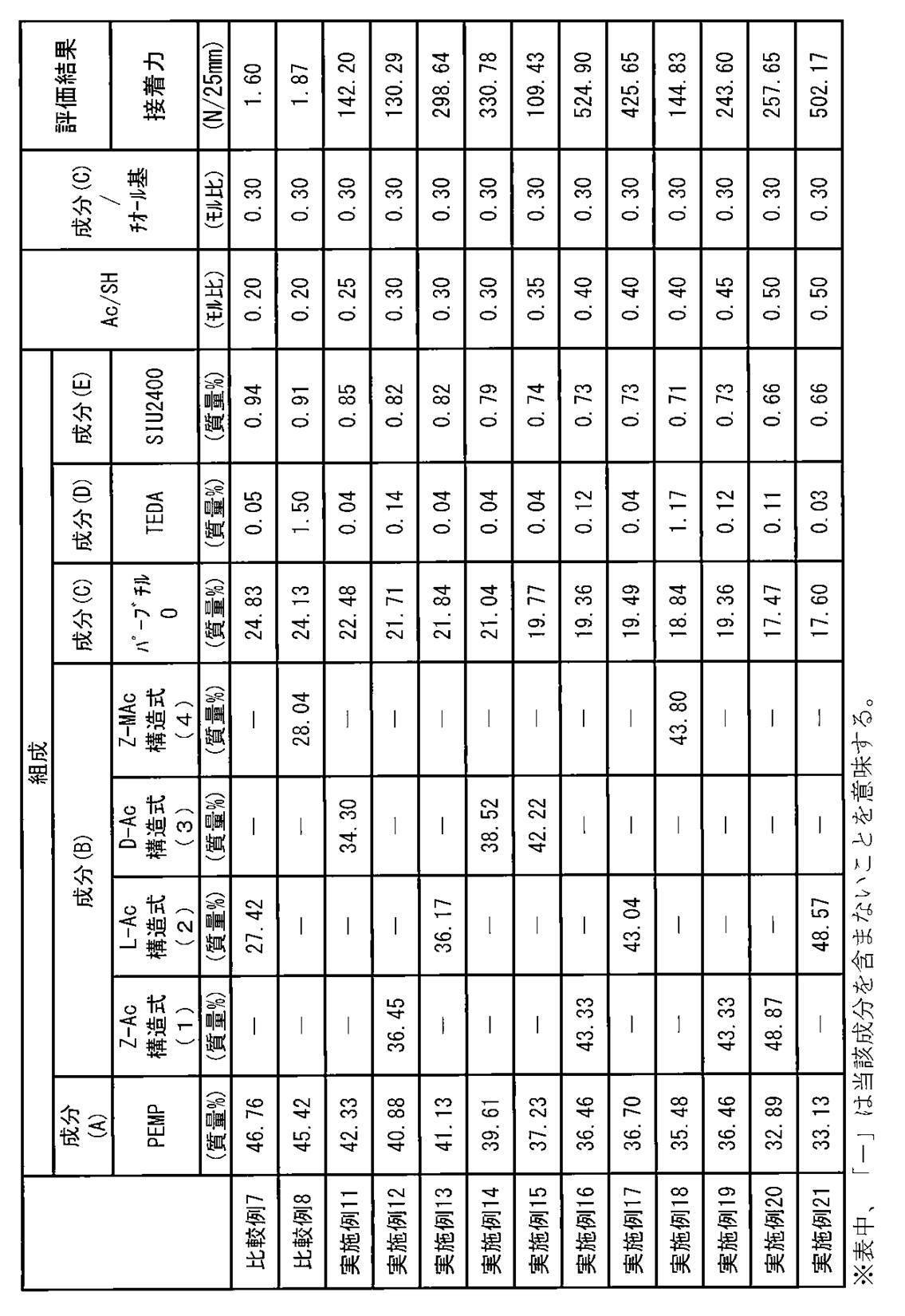

上述の各表に示すとおり、実施例1~25は、成分(A)~(D)を含み、かつ成分(A)に含まれるチオール基の合計モル数に対する、成分(B)に含まれる(メタ)アクリロイル基の合計モル数の比(Ac/SH)が0.25以上0.80以下である組成物を用いているため、接着力が高かった。
一方、比較例1~12は、比(Ac/SH)が前記範囲外であるため、接着力が低かった。
2014年4月7日に出願された日本国特許出願2014-078902号の開示は、その全体が参照により本明細書に取り込まれる。
本明細書に記載された全ての文献、特許出願、および技術規格は、個々の文献、特許出願、および技術規格が参照により取り込まれることが具体的かつ個々に記された場合と同程度に、本明細書中に参照により取り込まれる。
Claims (15)
- ポリチオール化合物、アクリロイル基及びメタクリロイル基の少なくとも一方を複数有する(メタ)アクリル化合物、ラジカル発生剤、並びにマイケル付加触媒を、
前記ポリチオール化合物に含まれるチオール基の合計モル数(SH)に対する、前記(メタ)アクリル化合物に含まれる前記アクリロイル基及びメタクリロイル基の少なくとも一方の合計モル数(Ac)の比(Ac/SH)が0.25以上0.80以下で含む組成物を用いて形成された接着組成物層を有する接着シート。 - 前記ラジカル発生剤が過酸化物からなる熱ラジカル発生剤である、請求項1に記載の接着シート。
- 前記ポリチオール化合物が1級チオールである、請求項1又は2に記載の接着シート。
- 前記マイケル付加触媒がアミン系触媒である、請求項1~3のいずれか1項に記載の接着シート。
- 前記ポリチオール化合物が、1分子中にチオール基を3つ以上有する、請求項1~4のいずれか1項に記載の接着シート。
- 前記ポリチオール化合物の分子量が、200~3000である、請求項1~5のいずれか1項に記載の接着シート。
- 前記ポリチオール化合物が、チオール基以外の部分が脂肪族炭化水素であるポリチオール、アルコールのハロヒドリン付加物のハロゲン原子をチオール基で置換してなるポリチオール、ポリエポキシド化合物の硫化水素反応生成物からなるポリチオール、分子内に水酸基2~6個を有する多価アルコールとチオグリコール酸とのエステル化により得られるチオグリコール酸エステル化物、分子内に水酸基2~6個を有する多価アルコールとメルカプト脂肪酸とのエステル化により得られるメルカプト脂肪酸エステル化物、イソシアヌレート化合物とチオールとを反応させてなるチオールイソシアヌレート化合物、ポリスルフィド基を含有するチオール、チオール基で変性されたシリコーン、またはチオール基で変性されたシルセスキオキサンである、請求項1~6のいずれか1項に記載の接着シート。
- 前記(メタ)アクリル化合物が、1分子中に前記アクリロイル基及びメタクリロイル基の少なくとも一方を3つ以上有する、請求項1~7のいずれか1項に記載の接着シート。
- 前記(メタ)アクリル化合物が、窒素原子を有する、請求項1~8のいずれか1項に記載の接着シート。
- 前記(メタ)アクリル化合物が、ウレタン骨格及びイソシアヌレート環の少なくとも一方を有する、請求項1~9のいずれか1項に記載の接着シート。
- 前記(メタ)アクリル化合物が、環構造を有する、請求項1~10のいずれか1項に記載の接着シート。
- 前記組成物中における、前記ポリチオール化合物に含まれるチオール基の合計モル数(SH)に対する、前記(メタ)アクリル化合物に含まれる前記アクリロイル基及びメタクリロイル基の少なくとも一方の合計モル数(Ac)の比(Ac/SH)が0.30以上0.70以下である、請求項1~11のいずれか1項に記載の接着シート。
- 前記組成物がさらに表面調整剤を含む、請求項1~12のいずれか一項に記載の接着シート。
- ポリチオール化合物、アクリロイル基及びメタクリロイル基の少なくとも一方を複数有する(メタ)アクリル化合物、ラジカル発生剤、並びにマイケル付加触媒を含む組成物を支持体上に付与して塗膜を形成する付与工程と、
前記塗膜中の前記ポリチオール化合物と前記(メタ)アクリル化合物とを重合させ、前記塗膜を接着組成物層とする重合工程と、
を含む、請求項1~13のいずれか1項に記載の接着シートの製造方法。 - ゴム層と、請求項1~13のいずれか1項に記載の接着シートの接着組成物層を用いて形成された接着層と、他の層と、をこの順で有する積層体。
Priority Applications (4)
| Application Number | Priority Date | Filing Date | Title |
|---|---|---|---|
| EP15775939.0A EP3130647B1 (en) | 2014-04-07 | 2015-04-01 | Adhesive sheet, manufacturing method therefor, and laminate |
| JP2016512686A JPWO2015156191A1 (ja) | 2014-04-07 | 2015-04-01 | 接着シート、その製造方法及び積層体 |
| US15/302,331 US20170021593A1 (en) | 2014-04-07 | 2015-04-01 | Adhesive sheet, manufacturing method thereof, and layered body |
| CN201580017805.XA CN106164197A (zh) | 2014-04-07 | 2015-04-01 | 粘接片、其制造方法和层叠体 |
Applications Claiming Priority (2)
| Application Number | Priority Date | Filing Date | Title |
|---|---|---|---|
| JP2014078902 | 2014-04-07 | ||
| JP2014-078902 | 2014-04-07 |
Publications (1)
| Publication Number | Publication Date |
|---|---|
| WO2015156191A1 true WO2015156191A1 (ja) | 2015-10-15 |
Family
ID=54287768
Family Applications (1)
| Application Number | Title | Priority Date | Filing Date |
|---|---|---|---|
| PCT/JP2015/060380 Ceased WO2015156191A1 (ja) | 2014-04-07 | 2015-04-01 | 接着シート、その製造方法及び積層体 |
Country Status (5)
| Country | Link |
|---|---|
| US (1) | US20170021593A1 (ja) |
| EP (1) | EP3130647B1 (ja) |
| JP (1) | JPWO2015156191A1 (ja) |
| CN (1) | CN106164197A (ja) |
| WO (1) | WO2015156191A1 (ja) |
Cited By (3)
| Publication number | Priority date | Publication date | Assignee | Title |
|---|---|---|---|---|
| JPWO2015156193A1 (ja) * | 2014-04-07 | 2017-04-13 | 株式会社ブリヂストン | 組成物、接着シートの製造方法、接着シート、積層体の製造方法、及び積層体 |
| KR20210099085A (ko) * | 2018-12-04 | 2021-08-11 | 아르끄마 프랑스 | 발포 생성물을 제조하기 위한 다중-구성 요소 시스템 |
| JP2022012343A (ja) * | 2020-07-01 | 2022-01-17 | 昭和電工マテリアルズ株式会社 | チオエーテル系プレポリマー、接着剤セット、及び構造体の製造方法 |
Families Citing this family (1)
| Publication number | Priority date | Publication date | Assignee | Title |
|---|---|---|---|---|
| CN110719928B (zh) * | 2017-06-09 | 2022-08-12 | Prc-迪索托国际公司 | 双重固化密封剂 |
Citations (6)
| Publication number | Priority date | Publication date | Assignee | Title |
|---|---|---|---|---|
| JPS60108430A (ja) * | 1983-11-18 | 1985-06-13 | Showa Highpolymer Co Ltd | 常温で硬化可能な組成物 |
| JP2004277660A (ja) * | 2003-03-18 | 2004-10-07 | Toagosei Co Ltd | 熱硬化型組成物 |
| JP2009256465A (ja) * | 2008-04-16 | 2009-11-05 | Bridgestone Corp | 活性エネルギー線架橋型接着剤 |
| JP2013544903A (ja) * | 2010-10-01 | 2013-12-19 | メルセンヌ ラボ アクチボラゲット | チオール−エンポリマーの物品の製造方法 |
| WO2014109217A1 (ja) * | 2013-01-08 | 2014-07-17 | 株式会社ブリヂストン | 積層体及びその製造方法 |
| WO2014203779A1 (ja) * | 2013-06-17 | 2014-12-24 | 昭和電工株式会社 | エンチオール系硬化性組成物およびその硬化物 |
Family Cites Families (6)
| Publication number | Priority date | Publication date | Assignee | Title |
|---|---|---|---|---|
| US4008341A (en) * | 1968-10-11 | 1977-02-15 | W. R. Grace & Co. | Curable liquid polymer compositions |
| GB1312530A (en) * | 1970-11-23 | 1973-04-04 | Grace W R & Co | Curable polyne polythiol compositions |
| US4126505A (en) * | 1974-11-05 | 1978-11-21 | Ciba-Geigy Corporation | Adhesive compositions |
| US20050119366A1 (en) * | 2003-11-28 | 2005-06-02 | Ashland Inc. | UV-curing thiolenes for pressure sensitive and hotmelt adhesives |
| US7317061B2 (en) * | 2004-04-29 | 2008-01-08 | Ashland Licensing And Intellectual Property Llc | Self-photoinitiating water-dispersible acrylate ionomers and synthetic methods |
| US20090047442A1 (en) * | 2007-08-17 | 2009-02-19 | Bowman Mark P | Method of coating a substrate with a radiation and chemically curable coating composition |
-
2015
- 2015-04-01 WO PCT/JP2015/060380 patent/WO2015156191A1/ja not_active Ceased
- 2015-04-01 CN CN201580017805.XA patent/CN106164197A/zh active Pending
- 2015-04-01 US US15/302,331 patent/US20170021593A1/en not_active Abandoned
- 2015-04-01 JP JP2016512686A patent/JPWO2015156191A1/ja active Pending
- 2015-04-01 EP EP15775939.0A patent/EP3130647B1/en not_active Not-in-force
Patent Citations (6)
| Publication number | Priority date | Publication date | Assignee | Title |
|---|---|---|---|---|
| JPS60108430A (ja) * | 1983-11-18 | 1985-06-13 | Showa Highpolymer Co Ltd | 常温で硬化可能な組成物 |
| JP2004277660A (ja) * | 2003-03-18 | 2004-10-07 | Toagosei Co Ltd | 熱硬化型組成物 |
| JP2009256465A (ja) * | 2008-04-16 | 2009-11-05 | Bridgestone Corp | 活性エネルギー線架橋型接着剤 |
| JP2013544903A (ja) * | 2010-10-01 | 2013-12-19 | メルセンヌ ラボ アクチボラゲット | チオール−エンポリマーの物品の製造方法 |
| WO2014109217A1 (ja) * | 2013-01-08 | 2014-07-17 | 株式会社ブリヂストン | 積層体及びその製造方法 |
| WO2014203779A1 (ja) * | 2013-06-17 | 2014-12-24 | 昭和電工株式会社 | エンチオール系硬化性組成物およびその硬化物 |
Non-Patent Citations (1)
| Title |
|---|
| See also references of EP3130647A4 * |
Cited By (4)
| Publication number | Priority date | Publication date | Assignee | Title |
|---|---|---|---|---|
| JPWO2015156193A1 (ja) * | 2014-04-07 | 2017-04-13 | 株式会社ブリヂストン | 組成物、接着シートの製造方法、接着シート、積層体の製造方法、及び積層体 |
| KR20210099085A (ko) * | 2018-12-04 | 2021-08-11 | 아르끄마 프랑스 | 발포 생성물을 제조하기 위한 다중-구성 요소 시스템 |
| KR102842578B1 (ko) | 2018-12-04 | 2025-08-05 | 아르끄마 프랑스 | 발포 생성물을 제조하기 위한 다중-구성 요소 시스템 |
| JP2022012343A (ja) * | 2020-07-01 | 2022-01-17 | 昭和電工マテリアルズ株式会社 | チオエーテル系プレポリマー、接着剤セット、及び構造体の製造方法 |
Also Published As
| Publication number | Publication date |
|---|---|
| JPWO2015156191A1 (ja) | 2017-04-13 |
| US20170021593A1 (en) | 2017-01-26 |
| CN106164197A (zh) | 2016-11-23 |
| EP3130647A4 (en) | 2017-04-05 |
| EP3130647A1 (en) | 2017-02-15 |
| EP3130647B1 (en) | 2018-09-12 |
Similar Documents
| Publication | Publication Date | Title |
|---|---|---|
| JP6429797B2 (ja) | 組成物、接着剤及び積層体 | |
| EP3130624B1 (en) | Composition, adhesive sheet manufacturing method, adhesive sheet, laminate manufacturing method, and laminate | |
| WO2014188914A1 (ja) | 組成物、接着剤、接着シート及び積層体 | |
| WO2015156191A1 (ja) | 接着シート、その製造方法及び積層体 | |
| EP3130626B1 (en) | Composition, adhesive, and laminate | |
| WO2015159708A1 (ja) | シート形成体、接着シート及び積層体 | |
| JP6085222B2 (ja) | 接合体の製造方法 | |
| JP2014227499A (ja) | 組成物、接着剤、接着シート及び積層体 | |
| JP6466935B2 (ja) | 重ね合わせ体、積層体の製造方法、積層体、及び接着組成物膜 | |
| JP6495182B2 (ja) | 接着シート、その製造方法及び積層体 | |
| EP3130625B1 (en) | Composition, adhesive, and laminate | |
| JP2015155150A (ja) | 空気入りタイヤ及び空気入りタイヤの製造方法 | |
| JP2016023197A (ja) | ゴム接着用積層体 | |
| JP2015206018A (ja) | 組成物、接着剤、接着シート、及び積層体 | |
| JP2016023198A (ja) | 接着剤組成物 | |
| JP2016016630A (ja) | 複合積層体及びその製造方法、並びに、免震構造体 |
Legal Events
| Date | Code | Title | Description |
|---|---|---|---|
| 121 | Ep: the epo has been informed by wipo that ep was designated in this application |
Ref document number: 15775939 Country of ref document: EP Kind code of ref document: A1 |
|
| ENP | Entry into the national phase |
Ref document number: 2016512686 Country of ref document: JP Kind code of ref document: A |
|
| WWE | Wipo information: entry into national phase |
Ref document number: 15302331 Country of ref document: US |
|
| NENP | Non-entry into the national phase |
Ref country code: DE |
|
| REEP | Request for entry into the european phase |
Ref document number: 2015775939 Country of ref document: EP |
|
| WWE | Wipo information: entry into national phase |
Ref document number: 2015775939 Country of ref document: EP |