WO2015159574A1 - Station de base, système de communication sans fil et procédé de communication - Google Patents
Station de base, système de communication sans fil et procédé de communication Download PDFInfo
- Publication number
- WO2015159574A1 WO2015159574A1 PCT/JP2015/053282 JP2015053282W WO2015159574A1 WO 2015159574 A1 WO2015159574 A1 WO 2015159574A1 JP 2015053282 W JP2015053282 W JP 2015053282W WO 2015159574 A1 WO2015159574 A1 WO 2015159574A1
- Authority
- WO
- WIPO (PCT)
- Prior art keywords
- cell
- base station
- service information
- adjacent
- neighboring
- Prior art date
- Legal status (The legal status is an assumption and is not a legal conclusion. Google has not performed a legal analysis and makes no representation as to the accuracy of the status listed.)
- Ceased
Links
Images

Classifications
-
- H—ELECTRICITY
- H04—ELECTRIC COMMUNICATION TECHNIQUE
- H04W—WIRELESS COMMUNICATION NETWORKS
- H04W36/00—Hand-off or reselection arrangements
- H04W36/0005—Control or signalling for completing the hand-off
- H04W36/0055—Transmission or use of information for re-establishing the radio link
- H04W36/0061—Transmission or use of information for re-establishing the radio link of neighbour cell information
-
- H—ELECTRICITY
- H04—ELECTRIC COMMUNICATION TECHNIQUE
- H04W—WIRELESS COMMUNICATION NETWORKS
- H04W48/00—Access restriction; Network selection; Access point selection
- H04W48/08—Access restriction or access information delivery, e.g. discovery data delivery
- H04W48/10—Access restriction or access information delivery, e.g. discovery data delivery using broadcasted information
-
- H—ELECTRICITY
- H04—ELECTRIC COMMUNICATION TECHNIQUE
- H04W—WIRELESS COMMUNICATION NETWORKS
- H04W24/00—Supervisory, monitoring or testing arrangements
- H04W24/02—Arrangements for optimising operational condition
-
- H—ELECTRICITY
- H04—ELECTRIC COMMUNICATION TECHNIQUE
- H04W—WIRELESS COMMUNICATION NETWORKS
- H04W84/00—Network topologies
- H04W84/02—Hierarchically pre-organised networks, e.g. paging networks, cellular networks, WLAN [Wireless Local Area Network] or WLL [Wireless Local Loop]
- H04W84/10—Small scale networks; Flat hierarchical networks
- H04W84/12—WLAN [Wireless Local Area Networks]
Definitions
- the present invention relates to a base station, a wireless communication system, and a communication method.
- Non-Patent Document 1 3GPP TS (3rd Generation Partnership Project Technical Specification) 36.300 V12.1.0 (Non-Patent Document 1) defines a function called Energy Saving. This function is available in the E-UTRAN (Evolved Universal Terrestrial Radio Access Network) E-UTRAN Node B (hereinafter referred to as “eNB”), which constitutes a cell that provides basic coverage.
- eNB Evolved Universal Terrestrial Radio Access Network
- the base station automatically switches the antenna power. For example, when a large amount of traffic is temporarily generated in a relatively narrow area within the coverage, a cell is added by turning on the power of the antenna of the base station. As a result, the communication capacity can be dynamically added.
- the cell for switching the antenna power supply accommodates a large volume of traffic temporarily generated in a relatively small area.
- This cell is called a capacity booster cell in 3GPP TS36.300 V12.1.0 (Non-Patent Document 1), and is called a “cell for dynamically adding communication capacity” in this specification.
- B The operation in which the UE uses at least two eNB radio resources connected by a non-ideal backhaul (such as an X2 interface) is called dual connectivity. This is defined in 3GPP TR (3GPP Technical Report) 36.842 V12.0.0 (Non-Patent Document 2).
- UE User Equipment
- MCG Master Cell Group
- MeNB Master eNB
- SeNB Secondary Cell Group
- SCG Secondary eNB
- SeNB Secondary eNB
- SCG Secondary eNB
- LTE Long Term Evolution
- 3G Third Generation
- GSM Global System for Mobile Communication
- Non-patent Document 1 Automatic Neighbor Relation (hereinafter referred to as ANR) defined in 3GPP TS36.300 V12.1.0 (Non-patent Document 1) enables the system to automatically execute the following operations without human intervention. It is a function.
- the eNB instructs the UE to collect and report system information broadcast in the neighboring cell.
- the eNB constructs a Neighbor Relation Table (adjacent relationship table; hereinafter referred to as NRT) based on the report from the UE.
- NRT Neighbor Relation Table
- the neighboring cell is not limited to a neighboring cell adjacent to the own cell, but is a cell that is in an inclusive relationship with the own cell (for example, a macro base station cell and a femto base station installed in the cell). Are in an inclusive relationship).
- Non-Patent Document 3 ANR is a part of the self-organizing network (hereinafter SON) function in 3GPP. It is also disclosed in Patent Documents 1 to 3 that the UE measures the communication quality of the neighboring cell and reports it to the network.
- SON self-organizing network
- the ANR uses the cell system information defined in 3GPP TS36.331 v12.1.0 (Non-patent Document 4) and 3GPP TS25.331 v12.1.0 (Non-patent Document 5).
- the UE measures the communication quality based on the received system information, and reports information such as the communication quality, cell ID, and TAI (Tracking area ID) to the network.
- the eNB determines the UE's handover destination cell only with the system information defined in 3GPP TS36.331 v12.1.0 (Non-Patent Document 4) and 3GPP TS25.331 v12.1.0 (Non-Patent Document 5). May be insufficient.
- an object of the present invention is to provide a base station, a wireless communication system, and a communication method that can solve the above-described problems.
- the base station of the present invention A storage unit; A processing unit, The storage unit stores an adjacency table, The processing unit transmits an information element transmitted from a base station constituting an adjacent cell adjacent to the own cell, indicating whether the base station has a function of a wireless LAN base station, and the adjacent cell dynamically communicating capacity Receiving the service information of the neighboring cell including at least one information element of information elements indicating whether or not the cell is a cell for adding, and registering the service information of the neighboring cell in the neighboring relationship table .
- the wireless communication system of the present invention includes: A terminal, A plurality of base stations, Each of the plurality of base stations transmits an information element indicating whether or not the base station has a function of a wireless LAN base station, transmitted by a base station configuring an adjacent cell adjacent to the own cell, and the adjacent cell is operated. And receiving the service information of the neighboring cell including at least one information element of information elements indicating whether or not the cell is a cell for adding a communication capacity, and storing the service information of the neighboring cell in an adjacent relationship table Register with.
- the communication method of the present invention includes: A communication method by a base station, An information element indicating whether or not the base station has the function of a wireless LAN base station, transmitted by a base station configuring an adjacent cell adjacent to the own cell, and for the adjacent cell to dynamically add communication capacity A reception step of receiving service information of the neighboring cell including at least one information element of information elements indicating whether or not the cell is a cell; A registration step of registering the service information of the adjacent cell in the adjacent relationship table.
- the base station can obtain sufficient information for determining the handover destination cell of the terminal.
- FIG. 1 is a diagram showing the overall configuration of the radio communication system of this embodiment.
- the wireless communication system of the present embodiment includes an eNB 10-1, an eNB 10-2, a UE 20, and an MME (Mobility Management Entity) 30.
- an eNB 10-1 As shown in FIG. 1, the wireless communication system of the present embodiment includes an eNB 10-1, an eNB 10-2, a UE 20, and an MME (Mobility Management Entity) 30.
- MME Mobility Management Entity
- ENB10-1 is a base station constituting the E-UTRAN cell 11-1.
- ENB10-2 is a base station constituting the E-UTRAN cell 11-2.
- UE 20 is a terminal that communicates with eNBs 10-1 and 10-2.
- the MME 30 is a mobility management server that constitutes an Evolved Packet Core (hereinafter referred to as EPC).
- EPC Evolved Packet Core
- eNB10-1 and 10-2 are simply referred to as eNB10 when not distinguished.
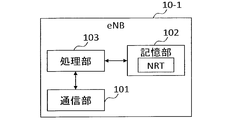
- FIG. 2 is a block diagram showing an example of the configuration of eNB 10-1 shown in FIG.
- the eNB 10-1 includes a communication unit 101, a storage unit 102, and a processing unit 103.
- the communication unit 101 communicates with the outside.
- the storage unit 102 stores an NRT (adjacent relationship table) or the like in which service information of an adjacent cell adjacent to the E-UTRAN cell 11-1 is registered.
- the processing unit 103 performs the following processing. ⁇ Process to broadcast service information of E-UTRAN cell 11-1 to E-UTRAN cell 11-1 via communication unit 101 ⁇ Communicate service information of neighboring cell adjacent to E-UTRAN cell 11-1 Processing received via unit 101, processing for constructing NRT, processing for determining UE 20 handover destination cell based on NRT, processing for notifying UE 20 of handover destination cell via communication unit 101
- the configuration of 2 is the same as that of eNB10-1.
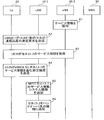
- FIG. 3 is a sequence diagram showing an example of a processing sequence when an NRT is constructed.
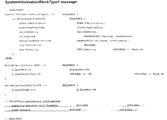
- FIG. 4 is a diagram illustrating an example of service information.
- Step A1 The processing unit 103 of the eNB 10-2 broadcasts service information of the E-UTRAN cell 11-2 as shown in FIG. 4 as system information in the E-UTRAN cell 11-2.
- FIG. 4 underlined “capacity-booster-cell-Capable” and “wLAN-Capable” are newly added information elements.
- Capacity-booster-cell-Capable is an information element indicating whether or not the E-UTRAN cell 11-2 is a cell for dynamically adding communication capacity.
- WLAN-Capable is an information element indicating whether or not the eNB 10-2 configuring the E-UTRAN cell 11-2 has the function of a wireless LAN base station.
- Step A2 The processing unit 103 of the eNB 10-1 transmits a communication quality measurement request for another cell to the UE 20 to report service information of the other cell.
- Step A3 The UE 20 acquires service information of the E-UTRAN cell 11-2 broadcasted by the eNB 10-2 in the E-UTRAN cell 11-2.
- Step A4 UE20 reports the measurement result including the service information of E-UTRAN cell 11-2 to eNB10-1.
- Step A5 The processing unit 103 of the eNB 10-1 adds the service information of the E-UTRAN cell 21 to the NRT. Thereby, the E-UTRAN cell 21 is added as an adjacent cell to the NRT of the eNB 10-1. At this time, the values of “capacity-booster-cell-Capable” and “wLAN-Capable” in the service information of the UTRAN cell 21 are set to the corresponding attribute values.
- Step A6 The processing unit 103 of the eNB 10-1 newly adds the E-UTRAN cell 11-2 as a handover destination cell candidate. That is, the E-UTRAN cell 11-2 is a target for measuring communication quality when the measurement request is transmitted next time. Therefore, the UE 20 that has received the measurement request next time acquires the service information of the E-UTRAN cell 11-2, and measures the communication quality of the E-UTRAN cell 11-2 based on this. (2-2) Handover Operation Next, the handover operation will be described.
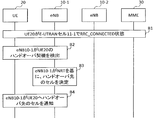
- FIG. 5 is a sequence diagram showing an example of a processing sequence at the time of handover.
- Step B1 UE 20 is in a state (RRC_CONNECTED state) connected to E-UTRAN cell 11-1.
- Step B2 The processing unit 103 of the eNB 10-1 determines that the UE 20 needs to be handed over from the E-UTRAN cell 11-1 to another cell based on the measurement result reported from the UE 20.
- Step B3 The processing unit 103 of the eNB 10-1 determines a handover destination cell of the UE 20 based on the service information of the neighboring cell registered in the NRT.
- Step B4 The processing unit 103 of the eNB 10-1 notifies the UE 20 of the handover destination cell. After the handover, the UE 20 continues communication in the handover destination cell. (2-3) Handover Destination Cell Determination Operation Next, the handover destination cell determination operation performed in step B3 in FIG. 5 will be described in detail.
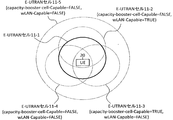
- FIG. 6 is a diagram illustrating an example of cell arrangement of the wireless communication system.
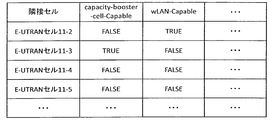
- the wireless communication system of the present embodiment has a cell arrangement as shown in FIG. Further, at the time of occurrence of the handover opportunity in step B2 in FIG. 5, the eNB 10-1 registers the E-UTRAN cells 11-3 to 11-5 with the NRT as adjacent cells in addition to the above-described E-UTRAN cell 11-2. Suppose you are. An example of the NRT at this time is shown in FIG.
- FIG. 7 is a diagram illustrating an example of an NRT in a wireless communication system.
- the E-UTRAN cell 11-5 is assumed to be a macro base station cell.
- the E-UTRAN cells 11-1 to 11-4 have a cell radius smaller than that of the macro base station cell, and are installed as a micro base station, pico base station, or femto base station cell
- the processing unit 103 of the eNB10-1 includes the QCIQIE value in the E-RAB Level QoS Parameters defined in 3GPP TS36.413 V12.1.0 (Non-Patent Document 6) and the UE ⁇ Aggregate Maximum Bit Rate. Compare the values of UE Aggregate Maximum Bit Rate Downlink IE and Aggregate Maximum Bit Rate Uplink IE with the past statistics. And the process part 103 of eNB10-1 estimates the data amount which UE20 transmitted / received in the past based on the comparison result.
- the processing unit 103 of the eNB 10-1 estimates the moving speed of the UE 20 based on the value of horizontal Velocity in the Location Information element defined in 3GPP TS 36.331 V12.1.0 (Non-patent Document 4).
- the processing unit 103 of the eNB 10-1 considers subscriber information such as the presence / absence of the function of the wireless LAN terminal in the UE 20 in addition to the amount of data transmitted / received in the past by the UE 20 and the moving speed of the UE 20, and based on the NRT, the UE 20 Handover control for determining a handover destination cell.
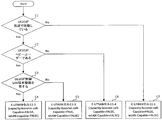
- FIG. 8 is a diagram showing an example of a processing flow showing determination logic when determining a handover destination cell.
- this processing flow is merely an example, and different judgment logic may be implemented according to the network operator policy or the network design policy. Below, each step of FIG. 8 is demonstrated.
- Step C1 The processing unit 103 of the eNB 10-1 determines whether or not the UE 20 is moving at a low speed. For example, when the moving speed of the UE 20 is less than the threshold, it is determined that the UE 20 is moving at a low speed.
- step C2 If UE20 is moving at low speed, go to step C2.
- Step C7 if the UE 20 is not moving at a low speed (moving at a high speed), the process proceeds to Step C7.
- Step C2 The processing unit 103 of the eNB 10-1 determines whether or not the user of the UE 20 is a heavy user. For example, if the amount of data transmitted / received in the past by the UE 20 (the past total data amount or the amount of data within the latest fixed period) may be equal to or greater than a threshold, the user of the UE 20 is determined to be a heavy user.
- step C6 if the user of UE20 is not a heavy user, the process proceeds to step C6.
- Step C3 The processing unit 103 of the eNB 10-1 determines whether the UE 20 has a wireless LAN terminal function.
- step C4 If UE20 has the function of a wireless LAN terminal, proceed to step C4.
- Step C4 The process proceeds to step C4 when the UE 20 moves at a low speed, the user of the UE 20 is a heavy user, and the UE 20 has a function of a wireless LAN terminal.
- the processing unit 103 of the eNB 10-1 selects the E-UTRAN cell 11-2 as a handover destination cell as follows.
- E-UTRAN cells 11-2 to 11-4 which are cells of a micro base station, a pico base station, and a femto base station with a small cell radius, which are installed for hot spot countermeasures, are selected.
- UE20 has the function of a wireless LAN terminal. Therefore, subsequently, the E-UTRAN cell 11-2 having the function of a wireless LAN base station is finally selected as a handover destination cell.
- Step C5 The process proceeds to step C5 when the UE 20 moves at a low speed, the user of the UE 20 is a heavy user, and the UE 20 does not have a function of a wireless LAN terminal.
- the processing unit 103 of the eNB 10-1 selects the E-UTRAN cell 11-3 as a handover destination cell as follows.
- E-UTRAN cells 11-2 to 11-4 which are cells of a micro base station, a pico base station, and a femto base station with a small cell radius, which are installed for hot spot countermeasures, are selected.
- UE20 does not have a wireless LAN terminal function, and the user of UE20 is a heavy user. Therefore, the E-UTRAN cell 11-3, which does not have the function of a wireless LAN base station and dynamically adds a communication capacity, is finally set as a handover destination. Select as a cell.
- Step C6 The process proceeds to step C6 when the UE 20 moves at a low speed and the user of the UE 20 is not a heavy user.
- the processing unit 103 of the eNB 10-1 selects the E-UTRAN cell 11-4 as a handover destination cell as follows.
- E-UTRAN cells 11-2 to 11-4 which are cells of a micro base station, a pico base station, and a femto base station with a small cell radius, which are installed for hot spot countermeasures, are selected.
- the E-UTRAN cell 11-4 which does not have the function of a wireless LAN base station and is not a cell for dynamically adding communication capacity, is finally selected as a handover destination. Select as a cell.
- Step C7 The process proceeds to step C7 when the UE 20 is moving at a high speed.
- the processing unit 103 of the eNB 10-1 selects the E-UTRAN cell 11-5 as a handover destination cell as follows.
- the E-UTRAN cell 11-5 which is a macro base station cell having a large cell radius, is finally selected as a handover destination cell.
- the present invention is a system defined in 3GPP TS36.331 v12.1.0 (Non-patent Document 4) and 3GPP TS25.331 v12.1.0 (Non-patent Document 5).
- the problem is that the information alone may be insufficient for the eNB to determine a UE handover destination cell.
- a heterogeneous network is assumed in which a micro base station, a pico base station, and a femto base station that configure a cell having a smaller cell radius than that of the macro base station are installed in a cell formed by the macro base station.
- the Source eNB should select a cell of a base station having a wireless LAN base station function or a cell for dynamically adding communication capacity as a UE handover destination cell.
- neighboring cells can function as wireless LAN base stations. It cannot be determined whether the cell is a base station cell or a cell for dynamically adding communication capacity. Therefore, a large amount of traffic may be sent to the macro base station, increasing the load on the macro base station and deteriorating the user experience of many users.
- service information information indicating whether a neighboring cell is a cell of a base station having a wireless LAN base station function or a cell for dynamically adding communication capacity
- service information indicating whether a neighboring cell is a cell of a base station having a wireless LAN base station function or a cell for dynamically adding communication capacity
- the eNB 10 receives the service information (“capacity-booster-cell-Capable” and “wLAN-Capable”) of the neighboring cell received by the UE 20 via the UE 20 connected to the own cell. Add two new information elements) and register with NRT.
- the eNB 10 is sufficient to determine the UE 20 handover destination cell, whether the neighboring cell is a base station cell having a wireless LAN base station function or a cell for dynamically adding communication capacity. Information can be obtained. Thereby, UE20 can be handed over to the cell of the base station provided with the function of a wireless LAN base station, or the cell for dynamically adding communication capacity.
- eNB10 acquires the service information of an adjacent cell by itself, and registers the acquired service information of the adjacent cell into NRT.
- the UE can be handed over to a cell of a base station having the function of a wireless LAN base station or a cell for dynamically adding communication capacity, and the same effect as in the above embodiment can be obtained.
- the eNB does not specify the UE capability from the UE Category defined in 3GPP TS36.306 V12.0.0 (Non-Patent Document 7).
- Ability may be specified.
- a UE user whose UE Category is Category 6 or Category 7 may be determined to be a heavy user.
- the eNB does not include the information element indicating “whether or not the cell is part of the SCG” in the service information. However, this information element may be included in the service information.
- the cell radius of the SeNB cell is smaller than that of the MeNB cell, and large-capacity data communication is possible. Therefore, for example, it is conceivable to hand over a heavy user's UE preferentially to some cells of the SCG.
- the eNB does not include an information element indicating whether “Machine to Machine (hereinafter referred to as M2M) is used in the cell” in the service information. It may be included in the information.
- M2M Machine to Machine
- UEs that use M2M have the property that they are installed in devices and send information at a fixed time of the day, and if the number of such UEs increases, there is a possibility that congestion will occur in the eNB There is.
- Some eNBs have a mechanism for regulating congestion. Therefore, for example, it is conceivable that a UE using M2M is handed over preferentially to an eNB cell having a mechanism for regulating congestion.
- the handover control of the above embodiment is applied to the handover between cells of E-UTRAN.
- the handover control of the above embodiment is not limited to the E-UTRAN cell and other wireless communication systems (GERAN (GSM EDGE Radio Access Network), CDMA (Code Division Multiple Access) 2000, wireless LAN, WiMAX (Worldwide Interoperability for Microwave Access). ) Etc.), or may be applied to handover between cells of other same wireless communication systems.
- the eNB broadcasts service information using a SystemInformationBlockType1 message (see FIG. 4) defined in 3GPP TS36.331V12.1.0 (Non-Patent Document 4).
- a new information element may be added to other information broadcast in the LTE radio communication system or system information broadcast in a radio communication system other than LTE.
- the UE reports service information to which a new information element has been added to the eNB.
- the service information may be included in information reported from the UE by a function called Minimization Drive Tests (hereinafter referred to as MDT) defined in 3GPP TS37.320 V12.0.0 (Non-Patent Document 8).
- MDT Minimization Drive Tests
- MDT is a function that allows the operator to report the measurement results to the eNB on behalf of the UE that the subscriber is using while measuring the communication quality of the cell while moving by a vehicle equipped with a measuring instrument. is there.
- OPDT can be reduced by MDT.
- the eNB adds two information elements “capacity-booster-cell-Capable” and “wLAN-Capable” to the service information.
- other information elements that can improve the user satisfaction of the UE may be added. The following can be considered as such information elements.
- -An information element (RN is assumed to have a small coverage.
- the UE is moving at high speed, for example, indicating whether or not the eNB constituting the cell is a Relay Node (relay node; hereinafter referred to as RN). Is not handed over to the cell of the RN, which makes it possible to avoid the deterioration of User Experience.)
- RN Relay Node
- -An information element indicating whether or not a cell is separated by the cell splitting function implemented by the Active Antenna System function defined in 3GPP TR37.822 V1.2.0 (Non-patent Document 9) (If it occurs permanently or frequently in a certain area, the cell may be separated, so for example, it is possible to preferentially hand over the heavy user's
- the service information of neighboring cells may be acquired by the eNB itself using a function for measuring the surrounding wireless environment called Network Monitoring Mode.
- the neighboring cell service information is acquired via a message received from the neighboring eNB via the X2 interface, the Iur interface, the Iurh interface, the Iurg interface, or the like, or 3GPP TS36.413 V12.1.0 (Non-Patent Document 6).
- RAN information management hereinafter referred to as RIM) procedure defined in (1)
- O & M Operaation & Maintenance
- a UE in IDLE mode may acquire service information of neighboring cells in a 3G network and report this to the base station. . (4-11)
- the eNB manages the NRT, but a device that manages a plurality of eNBs may manage the NRT of each eNB.
- a processing unit The storage unit Memorize adjacency table
- the processor is An information element indicating whether or not the base station has the function of a wireless LAN base station, transmitted by a base station configuring an adjacent cell adjacent to the own cell, and for the adjacent cell to dynamically add communication capacity
- Receiving service information of the neighboring cell including at least one information element of information elements indicating whether it is a cell;
- the processor is The base station according to appendix 1, wherein the service information of the own cell is transmitted in the own cell.
- the processor is The base station according to attachment 2, further including an information element indicating whether or not the own cell is a part of the SCG in the service information of the own cell.
- the processor is The base station according to appendix 2 or 3, further including an information element indicating whether M2M is used in the own cell in the service information of the own cell.
- the processor is The base station according to any one of appendices 2 to 4, further including an information element indicating whether or not the own station is a relay node in the service information of the own cell.
- the processor is An information element indicating whether the own cell is a cell dedicated to downlink communication or an information element indicating whether the own cell is a cell prioritizing downlink communication is further included in the service information of the own cell The base station according to any one of appendices 2 to 5.
- the processor is In the own cell, broadcast the service information of the own cell, The base station according to any one of supplementary notes 2 to 6, wherein the terminal receives the service information of the neighboring cell received from the neighboring cell by the terminal connected to the own cell.
- the processor is Any one of appendixes 2 to 6, wherein the service information of the own cell is transmitted to the base station configuring the neighbor cell via a predetermined interface, and the service information of the neighbor cell is received.
- the listed base station The processor is The base station according to any one of appendices 2 to 8, wherein the base station determines a handover destination cell of a terminal connected to the own cell based on the service information of the neighboring cell registered in the neighboring relationship table.
- the processor is Further using information indicating the amount of data transmitted / received in the past by the terminal connected to the own cell, the moving speed of the terminal, and whether or not the terminal has the function of a wireless LAN terminal, the handover destination of the terminal
- a terminal A plurality of base stations, Each of the plurality of base stations is An information element indicating whether or not the base station has the function of a wireless LAN base station, transmitted by a base station configuring an adjacent cell adjacent to the own cell, and for the adjacent cell to dynamically add communication capacity
- Receiving service information of the neighboring cell including at least one information element of information elements indicating whether it is a cell;
- a wireless communication system for registering the service information of an adjacent cell in an adjacent relationship table.
- Each of the plurality of base stations is The wireless communication system according to attachment 11, wherein the service information of the own cell is transmitted in the own cell.
- Each of the plurality of base stations is In the own cell, broadcast the service information of the own cell, The wireless communication system according to attachment 12, wherein the terminal receives the service information of the neighboring cell received from the neighboring cell by the terminal connected to the own cell.
- Each of the plurality of base stations is The wireless communication system according to appendix 12 or 13, wherein a handover destination cell of a terminal connected to the own cell is determined based on the service information of the neighboring cell registered in the neighboring relationship table.
- Appendix 15 A communication method by a base station, An information element indicating whether or not the base station has the function of a wireless LAN base station, transmitted by a base station configuring an adjacent cell adjacent to the own cell, and for the adjacent cell to dynamically add communication capacity
Landscapes
- Engineering & Computer Science (AREA)
- Computer Networks & Wireless Communication (AREA)
- Signal Processing (AREA)
- Computer Security & Cryptography (AREA)
- Mobile Radio Communication Systems (AREA)
Abstract
Priority Applications (3)
| Application Number | Priority Date | Filing Date | Title |
|---|---|---|---|
| EP15779732.5A EP3133867B1 (fr) | 2014-04-17 | 2015-02-05 | Station de base, système de communication sans fil et procédé de communication |
| JP2016513655A JP6414208B2 (ja) | 2014-04-17 | 2015-02-05 | 基地局、無線通信システム、通信方法 |
| US15/302,698 US10849030B2 (en) | 2014-04-17 | 2015-02-05 | Method and base station for cell splitting in a wireless communication network |
Applications Claiming Priority (2)
| Application Number | Priority Date | Filing Date | Title |
|---|---|---|---|
| JP2014-085221 | 2014-04-17 | ||
| JP2014085221 | 2014-04-17 |
Publications (1)
| Publication Number | Publication Date |
|---|---|
| WO2015159574A1 true WO2015159574A1 (fr) | 2015-10-22 |
Family
ID=54323792
Family Applications (1)
| Application Number | Title | Priority Date | Filing Date |
|---|---|---|---|
| PCT/JP2015/053282 Ceased WO2015159574A1 (fr) | 2014-04-17 | 2015-02-05 | Station de base, système de communication sans fil et procédé de communication |
Country Status (4)
| Country | Link |
|---|---|
| US (1) | US10849030B2 (fr) |
| EP (1) | EP3133867B1 (fr) |
| JP (2) | JP6414208B2 (fr) |
| WO (1) | WO2015159574A1 (fr) |
Cited By (1)
| Publication number | Priority date | Publication date | Assignee | Title |
|---|---|---|---|---|
| JP2019033499A (ja) * | 2014-04-17 | 2019-02-28 | 日本電気株式会社 | 基地局、無線通信システム、通信方法 |
Families Citing this family (6)
| Publication number | Priority date | Publication date | Assignee | Title |
|---|---|---|---|---|
| US10631316B1 (en) * | 2015-12-09 | 2020-04-21 | Sprint Spectrum L.P. | Systems and methods for adjusting a scheduling algorithm based on wireless device priority |
| US10383022B2 (en) * | 2016-09-13 | 2019-08-13 | Opanga Networks, Inc. | Directed handover of elephant flows |
| US10278082B2 (en) * | 2016-10-06 | 2019-04-30 | Telefonaktiebolaget Lm Ericsson (Publ) | Methods and nodes for establishing a neighbor relation in a wireless network |
| US10827549B2 (en) | 2019-01-07 | 2020-11-03 | At&T Intellectual Property I, L.P. | Facilitating automatic neighbor relationships for 5G or other next generation network |
| CN109831805B (zh) * | 2019-01-17 | 2021-11-23 | 安徽深蓝大健康智能科技有限公司 | 一种提高大数据传输稳定性的方法及计算机可读存储介质 |
| US11671912B2 (en) * | 2021-03-11 | 2023-06-06 | At&T Intellectual Property I, L.P. | Cellular communication network sleep management |
Citations (1)
| Publication number | Priority date | Publication date | Assignee | Title |
|---|---|---|---|---|
| JP2013502749A (ja) * | 2009-08-17 | 2013-01-24 | 日本電気株式会社 | 通信システム |
Family Cites Families (21)
| Publication number | Priority date | Publication date | Assignee | Title |
|---|---|---|---|---|
| CN101534532B (zh) | 2008-03-12 | 2012-02-08 | 中兴通讯股份有限公司 | 基于切换的承载建立方法及系统 |
| EP3573249B1 (fr) * | 2009-08-07 | 2023-11-08 | NEC Corporation | Système de communication radio, procédé de communication radio, station radio, station de commande et programme |
| JP5498859B2 (ja) | 2010-05-27 | 2014-05-21 | 株式会社Nttドコモ | 無線通信システム及びハンドオーバ方法 |
| JP5351917B2 (ja) | 2011-03-09 | 2013-11-27 | 株式会社エヌ・ティ・ティ・ドコモ | 移動局 |
| EP2708064B1 (fr) * | 2011-05-13 | 2019-08-07 | Telefonaktiebolaget LM Ericsson (publ) | Gestion de cellules voisines pour des noeuds relais mobiles |
| KR101896001B1 (ko) | 2011-07-12 | 2018-09-06 | 한국전자통신연구원 | 이종 네트워크 환경에서 단말의 이동성 관리 방법 |
| KR20130065902A (ko) * | 2011-12-12 | 2013-06-20 | 삼성전자주식회사 | 이동 통신 시스템 및 그 이동 통신 시스템에서 기지국 식별자 관리 방법 |
| US9629050B2 (en) * | 2012-02-03 | 2017-04-18 | Telefonaktiebolaget Lm Ericsson (Publ) | Method, apparatus and computer program for cell identification |
| JP5901342B2 (ja) | 2012-02-22 | 2016-04-06 | 三菱電機株式会社 | 隣接セル管理方法及びセルラーネットワークの無線基地局 |
| JP5946699B2 (ja) | 2012-06-01 | 2016-07-06 | 花王株式会社 | 水分透過バリア機能の評価方法 |
| CN103181204B (zh) | 2012-09-11 | 2016-03-09 | 华为技术有限公司 | 获取邻区信息的方法和装置 |
| US9374774B2 (en) * | 2012-12-18 | 2016-06-21 | Qualcomm Incorporated | WAN-WLAN cell selection in UEs |
| US10015709B2 (en) * | 2013-02-14 | 2018-07-03 | Hmd Global Oy | Handover of a user equipment having offloaded user data traffic between two small cells controlled by different macro cells |
| US20160014592A1 (en) * | 2013-04-01 | 2016-01-14 | Lg Electronics Inc. | Method and apparatus for transmitting mobility parameters in wireless communication system |
| US20160044518A1 (en) * | 2013-04-05 | 2016-02-11 | Telefonaktiebolaget L M Ericsson (Publ) | Methods of operating radio access network base stations and related network nodes |
| US10085188B2 (en) * | 2013-04-05 | 2018-09-25 | Telefonaktiebolaget Lm Ericsson (Publ) | Handover request indicating split of a radio bearer between cells |
| US9479230B2 (en) * | 2013-05-31 | 2016-10-25 | Blackberry Limited | Systems and methods for data offload in wireless networks |
| WO2015032565A1 (fr) * | 2013-09-09 | 2015-03-12 | Nokia Solutions And Networks Oy | Division sélective de porteuse dans un système cellulaire |
| WO2015046911A1 (fr) * | 2013-09-26 | 2015-04-02 | Lg Electronics Inc. | Procédé et appareil de signalisation entre des enb dans un système de communication sans fil prenant en charge la double connectivité |
| US9307458B1 (en) * | 2014-03-24 | 2016-04-05 | Sprint Spectrum L.P. | Controlling reverse-direction neighbor reports based on the characteristics of queued bearer traffic |
| WO2015159574A1 (fr) | 2014-04-17 | 2015-10-22 | 日本電気株式会社 | Station de base, système de communication sans fil et procédé de communication |
-
2015
- 2015-02-05 WO PCT/JP2015/053282 patent/WO2015159574A1/fr not_active Ceased
- 2015-02-05 US US15/302,698 patent/US10849030B2/en active Active
- 2015-02-05 EP EP15779732.5A patent/EP3133867B1/fr active Active
- 2015-02-05 JP JP2016513655A patent/JP6414208B2/ja active Active
-
2018
- 2018-09-26 JP JP2018179905A patent/JP2019033499A/ja active Pending
Patent Citations (1)
| Publication number | Priority date | Publication date | Assignee | Title |
|---|---|---|---|---|
| JP2013502749A (ja) * | 2009-08-17 | 2013-01-24 | 日本電気株式会社 | 通信システム |
Non-Patent Citations (1)
| Title |
|---|
| NEW POSTCOM: "Considerations on requirements and scenarios of WLAN/3GPP Radio Interworking", 3GPP TSG-RAN WG2#81 R2-130270, 28 January 2013 (2013-01-28), XP050668305, Retrieved from the Internet <URL:http://www.3gpp.org/ftp/tsg_ran/WG2_RL2/TSGR2_81/Docs/R2-130270.zip> * |
Cited By (2)
| Publication number | Priority date | Publication date | Assignee | Title |
|---|---|---|---|---|
| JP2019033499A (ja) * | 2014-04-17 | 2019-02-28 | 日本電気株式会社 | 基地局、無線通信システム、通信方法 |
| US10849030B2 (en) | 2014-04-17 | 2020-11-24 | Nec Corporation | Method and base station for cell splitting in a wireless communication network |
Also Published As
| Publication number | Publication date |
|---|---|
| EP3133867B1 (fr) | 2019-05-01 |
| JP6414208B2 (ja) | 2018-10-31 |
| US10849030B2 (en) | 2020-11-24 |
| US20170034750A1 (en) | 2017-02-02 |
| JPWO2015159574A1 (ja) | 2017-04-13 |
| JP2019033499A (ja) | 2019-02-28 |
| EP3133867A4 (fr) | 2017-09-06 |
| EP3133867A1 (fr) | 2017-02-22 |
Similar Documents
| Publication | Publication Date | Title |
|---|---|---|
| US11950207B2 (en) | Tracking area planning | |
| US9226204B2 (en) | Cell type information sharing between neighbor base stations | |
| EP2643998B1 (fr) | Procédé et appareil de suppression des interférences dans des réseaux hétérogènes | |
| US10979946B2 (en) | Hand-in with topology hiding | |
| CN101772099B (zh) | 小区切换的方法和系统及接入设备 | |
| JP6414208B2 (ja) | 基地局、無線通信システム、通信方法 | |
| JP2020198647A (ja) | 通信システムおよび基地局 | |
| JP5928756B2 (ja) | 移動通信ネットワークにおけるモビリティ制御方法および装置 | |
| US20140308953A1 (en) | Method and apparatus for managing radio resources in multi-carrier and hetnet-integrated mobile access environment | |
| US9277584B2 (en) | Carrier aggregation support for home base stations | |
| CN101926200A (zh) | 用于蜂窝通信中的频率接入限制的方法和设备 | |
| KR20120000859A (ko) | 무선 통신 시스템 및 그 시스템에서 핸드오버 수행 방법 | |
| EP3207729B1 (fr) | Entité de contrôle, dispositif de communication, système et procédés correspondants | |
| CN106937340A (zh) | 一种终端的切换方法和控制器、终端、基站以及系统 | |
| WO2012154096A1 (fr) | Procédés et agencements pour gérer des relations de cellules voisines dans un réseau cellulaire |
Legal Events
| Date | Code | Title | Description |
|---|---|---|---|
| 121 | Ep: the epo has been informed by wipo that ep was designated in this application |
Ref document number: 15779732 Country of ref document: EP Kind code of ref document: A1 |
|
| ENP | Entry into the national phase |
Ref document number: 2016513655 Country of ref document: JP Kind code of ref document: A |
|
| WWE | Wipo information: entry into national phase |
Ref document number: 15302698 Country of ref document: US |
|
| NENP | Non-entry into the national phase |
Ref country code: DE |
|
| REEP | Request for entry into the european phase |
Ref document number: 2015779732 Country of ref document: EP |
|
| WWE | Wipo information: entry into national phase |
Ref document number: 2015779732 Country of ref document: EP |