WO2015159861A1 - Dispositif de commande de détection, dispositif de montage, système de traitement d'informations de potentiel oculaire, et programme - Google Patents
Dispositif de commande de détection, dispositif de montage, système de traitement d'informations de potentiel oculaire, et programme Download PDFInfo
- Publication number
- WO2015159861A1 WO2015159861A1 PCT/JP2015/061382 JP2015061382W WO2015159861A1 WO 2015159861 A1 WO2015159861 A1 WO 2015159861A1 JP 2015061382 W JP2015061382 W JP 2015061382W WO 2015159861 A1 WO2015159861 A1 WO 2015159861A1
- Authority
- WO
- WIPO (PCT)
- Prior art keywords
- electrooculogram
- unit
- user
- acceleration
- detection
- Prior art date
- Legal status (The legal status is an assumption and is not a legal conclusion. Google has not performed a legal analysis and makes no representation as to the accuracy of the status listed.)
- Ceased
Links
Images





Classifications
-
- A—HUMAN NECESSITIES
- A61—MEDICAL OR VETERINARY SCIENCE; HYGIENE
- A61B—DIAGNOSIS; SURGERY; IDENTIFICATION
- A61B3/00—Apparatus for testing the eyes; Instruments for examining the eyes
- A61B3/10—Objective types, i.e. instruments for examining the eyes independent of the patients' perceptions or reactions
-
- A—HUMAN NECESSITIES
- A61—MEDICAL OR VETERINARY SCIENCE; HYGIENE
- A61B—DIAGNOSIS; SURGERY; IDENTIFICATION
- A61B3/00—Apparatus for testing the eyes; Instruments for examining the eyes
- A61B3/10—Objective types, i.e. instruments for examining the eyes independent of the patients' perceptions or reactions
- A61B3/113—Objective types, i.e. instruments for examining the eyes independent of the patients' perceptions or reactions for determining or recording eye movement
-
- A—HUMAN NECESSITIES
- A61—MEDICAL OR VETERINARY SCIENCE; HYGIENE
- A61B—DIAGNOSIS; SURGERY; IDENTIFICATION
- A61B5/00—Measuring for diagnostic purposes; Identification of persons
- A61B5/103—Measuring devices for testing the shape, pattern, colour, size or movement of the body or parts thereof, for diagnostic purposes
- A61B5/11—Measuring movement of the entire body or parts thereof, e.g. head or hand tremor or mobility of a limb
Definitions
- the present invention relates to a detection control device, a wearing tool, an electrooculogram information processing system, and a program.
- Patent Document 1 Japanese Patent Application Laid-Open No. 2012-093767
- Patent Document 2 Japanese Patent Application Laid-Open No. 2006-136556 Japanese Patent Application Laid-Open No. 2012-532696
- the power consumption may increase unnecessarily.
- the detection control device continuously acquires the user's electrooculogram when the acquisition unit that acquires the user's acceleration or angular velocity and the acceleration or angular velocity acquired by the acquisition unit satisfy a predetermined condition. And a control unit for starting detection of the electrooculogram by the electrooculogram detection unit that detects automatically.
- the electrooculogram detection unit may be provided in a wearing tool worn by the user.
- the detection control device may be provided in the wearing tool.
- the wearing tool may be eyewear worn by the user.
- the detector may further include a detection unit that detects the acceleration or angular velocity of the mounting tool, and the control unit may acquire the acceleration or angular velocity detected by the detection unit.
- the control unit continuously converts the electrooculogram by the electrooculogram detection unit. Detection of the electrooculogram by the electrooculogram detection unit without starting the continuous detection of the electrooculogram by the electrooculogram detection unit when the acquired acceleration or angular velocity does not satisfy a predetermined condition. May be maintained in a state that is not continuously performed.
- the control unit determines that the acquired acceleration or angular velocity satisfies a predetermined condition when it is determined that the acquired acceleration or angular velocity time change pattern matches the predetermined time change pattern. Good.
- the information processing apparatus further includes a transmission unit that transmits information on the electrooculogram continuously detected by the electrooculogram detection unit to an external electrooculogram information processing apparatus, and the control unit satisfies a predetermined condition for the acquired acceleration or angular velocity
- the transmission unit may start transmission of information on the electrooculogram continuously detected by the electrooculogram detection unit.
- the wearing tool includes the detection control device and is worn by the user.
- the electrooculogram information processing system receives the information on the electrooculogram continuously detected by the detection control device and the electrooculogram detection unit, and processes the received electrooculogram information.
- the detection control device is mounted on the user.
- the program continuously obtains the electrooculogram of the user when the computer acquires the acceleration or angular velocity of the user and the acceleration or angular velocity acquired by the acquisition unit satisfies a predetermined condition. It is made to function as a control part which starts detection of electrooculogram by an electrooculogram detection part detected automatically.
- An example of the utilization form of electrooculogram information processing system 10 in one embodiment is shown roughly.
- the glasses 100 and the smartphone 40 are schematically shown.
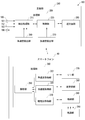
- the functional block configuration of the smart phone 40 and the functional block configuration of the processing unit 180 are schematically shown.
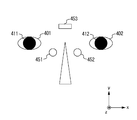
- the positional relationship between the electrooculogram detection electrode of the glasses 100 and the user 20 is schematically shown.
- An example of information used when control part 220 specifies a user's 20 movement is shown typically.
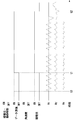
- movement sequence of each part in the electrooculogram information processing system 10 is shown typically.
- 3 is a flowchart illustrating processing executed in the control unit 220.
- the flowchart showing the process performed in the smart phone 40 is shown.
- FIG. 1 schematically shows an example of a usage pattern of an electrooculogram information processing system 10 according to an embodiment.
- the electrooculogram information processing system 10 includes glasses 100 and a smartphone 40.
- User 20 is a user of each of glasses 100 and smartphone 40.
- the user 20 is a wearer who wears the glasses 100.
- the smartphone 40 is an example of an electrooculogram information processing device.
- the glasses 100 are worn on the face of the user 20.
- the glasses 100 have a function of communicating with the smartphone 40.
- the glasses 100 detect the electrooculogram of the user 20 via the electrode that contacts the user 20, and transmit the detected electrooculogram information to the smartphone 40. Further, the glasses 100 detect the acceleration of the glasses 100 and transmit the detected acceleration information to the smartphone 40. Further, the glasses 100 detect the angular velocity of the glasses 100 and transmit information on the detected angular velocity to the smartphone 40.
- the smartphone 40 analyzes the electrooculogram received from the glasses 100.
- the smartphone 40 analyzes the electrooculogram received from the glasses 100 together with at least one of acceleration and angular velocity received from the glasses 100.
- the smartphone 40 provides information to the user 20 based on analysis results such as electrooculogram, acceleration, and angular velocity.
- the smartphone 40 identifies the state of the user 20 by analyzing the electrooculogram, acceleration, angular velocity, and the like. Specifically, the smartphone 40 specifies the line-of-sight direction, the blink state, and the like of the user 20. For example, the smartphone 40 determines the state of the user 20 based on the line-of-sight direction and the blink state. Specifically, the smartphone 40 determines whether the user 20 is tired or the like based on the line-of-sight direction and the blink state. The smartphone 40 issues a warning to the user 20 when determining that the user 20 is tired or the like. For example, the smartphone 40 generates a warning sound when it is determined that the user 20 is tired or the like.
- the electrooculogram information processing system 10 based on the acceleration detected by the glasses 100, it is determined whether or not the user 20 has started a predetermined operation such as a running operation. In response to the determination that the user 20 has started a predetermined operation, the eyeglasses 100 start an electrooculogram continuous detection operation, and the electrooculogram information processing system 10 detects the line of sight of the user 20. A process for determining fatigue or the like is started. For this reason, it is possible to suppress wasteful processing of detecting an electrooculogram, detecting a gaze direction, and determining fatigue when the running operation is not performed. Therefore, wasteful consumption of power in the glasses 100 and the smartphone 40 can be suppressed.
- a predetermined operation such as a running operation.
- various directions may be specified using the coordinate axes of the orthogonal coordinate system shown in FIG.
- the z-axis plus direction is determined by the user 20 in the direction along the front.
- the z-axis plus direction is an acceleration in a direction from the face of the user 20 toward the front portion of the glasses 100 of the glasses 100 attached to the face of the user 20.
- the y-axis minus direction is defined as the vertical direction.
- the x-axis, y-axis, and z-axis are right-handed orthogonal coordinate systems.
- the z-axis plus direction may be referred to as the front direction.
- the y-axis plus direction may be referred to as upward or the like.
- the y-axis minus direction may be referred to as downward or the like.
- the x-axis plus direction may be referred to as the left side or the like.
- the x-axis minus direction may be referred to as the right side or the like.
- FIG. 2 schematically shows the glasses 100 and the smartphone 40.
- the glasses 100 include a lens 110 and a frame 120. Glasses 100 and frame 120 are examples of eyewear.
- the frame 120 supports a pair of lenses 110.
- the frame 120 includes a rim 122, a bridge 124, an alloy 126, a temple 130, a modern 132, a right nose pad 141, a left nose pad 142, a first electrode 151, a second electrode 152, a third electrode 153, a ground electrode 154, and a processing unit. 180 and a power supply unit 190.
- the lens 110, the rim 122, the armor 126, the temple 130, and the modern 132 are each provided in a pair of left and right.
- the rim 122, the bridge 124, the right nose pad 141, the left nose pad 142, and the armor 126 are referred to as a front portion of the glasses 100.
- the rim 122 holds the lens 110.
- the armor 126 is provided outside the rim 122 and holds the temple 130 movably.
- the temple 130 presses the upper part of the user's 20 ear and pinches the pressed part.
- the modern 132 is provided at the tip of the temple 130. The modern 132 contacts the upper part of the ear of the user 20.
- the first electrode 151 is an example of an electrooculogram detection unit that detects electrooculogram.
- the first electrode 151 is provided on the surface of the right nose pad 141.
- the first electrode 151 is provided on the surface of the right nose pad 141 that faces the face of the user 20 when the user 20 wears the glasses 100.
- the first electrode 151 contacts the skin of the user 20.
- the first electrode 151 contacts the right side of the user 20 nose.
- the first electrode 151 mainly detects the electrooculogram of the right eye of the user 20.
- the second electrode 152 is an example of an electrooculogram detection unit that detects electrooculogram.
- the second electrode 152 is provided on the surface of the left nose pad 142.
- the second electrode 152 is provided on the surface of the left nose pad 142 that faces the face of the user 20 when the user 20 wears the glasses 100.
- the second electrode 152 contacts the skin of the user 20.
- the second electrode 152 contacts the left side of the user 20 nose.
- the second electrode 152 mainly detects the electrooculogram of the left eye of the user 20.
- the third electrode 153 is an example of an electrooculogram detection unit that detects electrooculogram.
- the third electrode 153 is provided on the surface of the bridge 124.
- the third electrode 153 is provided on the surface of the bridge 124 that faces the face of the user 20 when the user 20 wears the glasses 100.
- the third electrode 153 contacts the skin of the user 20.
- the electrooculogram detected by the third electrode 153 is used as a measurement reference for measuring the electrooculogram of the right eye and the electrooculogram of the left eye of the user 20.
- the ground electrode 154 is provided on the surface of the modern 132.
- the ground electrode 154 is provided on the surface of the modern 132 on the right side, for example.
- the ground electrode 154 is provided on the surface of the modern 132 that faces the face of the user 20 when the user 20 wears the glasses 100.
- the ground electrode 154 contacts the user 20's skin.
- the ground electrode 154 contacts the upper part of the right ear of the user 20.
- the potential of the ground electrode 154 provides the ground potential of the electric circuit included in the glasses 100.
- the processing unit 180 is provided inside the left temple 130.
- the electrooculogram of the user 20 detected by the first electrode 151, the second electrode 152, and the third electrode 153 is input to the processing unit 180.
- the processing unit 180 processes the input electrooculogram and transmits the processed potential to the smartphone 40.
- the power supply unit 190 is provided inside the temple 130 on the left side.
- the power supply unit 190 includes a battery such as a secondary battery.
- the power supply unit 190 supplies the electrical energy stored in the battery included in the power supply unit 190 to the processing unit 180.
- the power supply unit 190 generates DC power based on the potential of the ground electrode 154 from the electrical energy stored in the battery.
- the power supply unit 190 supplies DC power generated from the electrical energy stored in the battery to the processing unit 180.
- the power supply unit 190 is provided inside the temple 130 on the side where the ground electrode 154 is provided.
- the potential of the ground electrode 154 provides a negative potential of DC power supplied from the power supply unit 190 to the processing unit 180.
- the right modern 132 has a charging port for charging the power supply unit 190.
- the battery included in the power supply unit 190 is charged through a charging port provided in the modern 132 on the right side.
- FIG. 3 schematically shows a functional block configuration of the smartphone 40 and a functional block configuration of the processing unit 180.
- the processing unit 180 includes a processing unit 200, an angular velocity detection unit 260, an acceleration detection unit 270, a transmission / reception unit 280, and a substrate unit 290.
- the processing unit 200 includes a detection processing unit 210 and a control unit 220.
- the smartphone 40 includes a processing unit 300, a storage unit 360, a UI unit 370, a transmission / reception unit 380, and a power supply unit 390.
- the processing unit 200 is realized by a processor such as an MPU.
- Each unit of the smartphone 40 is mainly controlled by the processing unit 300.
- the transmission / reception unit 280 has a function of performing wireless communication with the smartphone 40.
- the transmission / reception unit 280 is realized by a communication processor.
- the transmission / reception unit 280 is realized by a communication processor having a short-range wireless communication function such as Bluetooth (registered trademark).
- the electric wire part 160 is provided inside the frame 120 of the glasses 100.
- the electric wire part 160 electrically connects the first electrode 151, the second electrode 152, the third electrode 153, the ground electrode 154, the power supply unit 190, and the processing unit 180.
- the electric wire unit 160 electrically connects the first electrode 151 and the processing unit 180, outputs an electrooculogram detected by the first electrode 151 to the processing unit 180, and the second electrode 152 and the processing unit 180.
- the third electrode 153 and the processing unit 180 are electrically connected to the third electrode 153 by electrically connecting the electric wire that outputs the electrooculogram detected by the second electrode 152 to the processing unit 180.
- the processing unit 200 acquires the electrooculogram of the user 20, and processes the acquired electrooculogram. Specifically, the detection processing unit 210 acquires the first electrooculogram that is the electrooculogram detected by the first electrode 151, and processes the acquired first electrooculogram. In addition, the detection processing unit 210 acquires a second ocular potential that is an ocular potential detected by the second electrode 152, and processes the acquired second ocular potential. Further, the detection processing unit 210 acquires a third ocular potential that is an ocular potential detected by the third electrode 153, and processes the acquired third ocular potential.
- the detection processing unit 210 processes the first ocular potential based on the third ocular potential.
- the first electrooculogram based on the third electrooculogram is referred to as V1.
- the detection processing unit 210 samples V1 at a predetermined cycle and generates time series data of V1.
- the detection processing unit 210 outputs the generated time series data of V1 to the transmission / reception unit 280.
- the detection processing unit 210 processes the second electrooculogram based on the third electrooculogram.
- the second ocular potential based on the third ocular potential is referred to as V2.
- the detection processing unit 210 samples V2 at a predetermined cycle, and generates time-series data of V2.
- the detection processing unit 210 outputs the generated V2 time-series data to the transmission / reception unit 280.
- the acceleration detection unit 270 detects the acceleration of the glasses 100.
- the acceleration detection unit 270 is, for example, a triaxial acceleration sensor.
- the acceleration detection unit 270 detects the acceleration of the center of gravity of the glasses 100. When the glasses 100 are worn on the user 20, the acceleration of the center of gravity of the glasses 100 corresponds to the acceleration of the head of the user 20.
- the acceleration detected by the acceleration detection unit 270 is input to the detection processing unit 210.
- the acceleration detected by the acceleration detection unit 270 is also input to the control unit 220.
- the angular velocity detection unit 260 detects the angular velocity of the glasses 100.
- the angular velocity detection unit 260 is, for example, a triaxial angular velocity sensor.
- the angular velocity detected by the angular velocity detector 260 is input to the detection processing unit 210.
- the detection processing unit 210 acquires the acceleration detected by the acceleration detection unit 270 and processes the acquired acceleration.
- the detection processing unit 210 samples acceleration at a predetermined cycle, and generates time-series acceleration data.
- the detection processing unit 210 outputs the time series data of the generated acceleration to the transmission / reception unit 280.
- the acceleration data output to the transmission / reception unit 280 includes time-series data of acceleration in each direction of the three axes.
- the detection processing unit 210 acquires the angular velocity detected by the angular velocity detection unit 260 and processes the acquired angular velocity.
- the detection processing unit 210 samples the angular velocity at a predetermined cycle, and generates time-series angular velocity data.
- the detection processing unit 210 outputs the generated time-series data of the angular velocity to the transmission / reception unit 280.
- the angular velocity data output to the transmission / reception unit 280 includes time-series data of angular velocities in the directions of the three axes.
- the transmission / reception unit 280 transmits the V1 time series data, the V2 time series data, the acceleration time series data, and the angular velocity time series data acquired from the detection processing unit 210 to the transmission / reception unit 380 by radio signals. As described above, the transmission / reception unit 280 transmits the electrooculogram information, the acceleration information, and the angular velocity information that are continuously detected to the smartphone 40.
- the processing in the detection processing unit 210 includes amplification processing for amplifying the input electro-oculogram, acceleration and angular velocity signals, and digitization processing for digitizing the input electro-oculogram, acceleration and angular velocity signals.
- the detection processing unit 210 may include an amplifier circuit that amplifies analog signals of input electrooculogram, acceleration, and angular velocity.
- the detection processing unit 210 may include an analog-to-digital conversion circuit that digitizes an analog signal of input ocular potential, acceleration, and angular velocity or an analog signal amplified by an amplifier circuit.
- the control unit 220 is an example of a detection control device.
- the control unit 220 acquires the acceleration of the user 20.
- the control part 220 starts the detection of the electrooculogram by the electrooculogram detection part which detects the electrooculogram of the user 20 continuously, when the acquired acceleration satisfy
- the control unit 220 drives the detection processing unit 210 when the acquired acceleration satisfies a predetermined condition, and the electrodes such as the first electrode 151, the second electrode 152, and the third electrode 153 are driven.
- the detection of the electrooculogram is started. Note that starting the detection of the electrooculogram may be starting an operation such as an amplification process or a digitization process in the detection processing unit 210.
- the detection of the electrooculogram may be started in the detection processing unit 210 by starting an operation of an amplification circuit that amplifies analog signals of the input electrooculogram, acceleration, and angular velocity. Further, starting the detection of the electrooculogram may be starting the operation of the above-described AD conversion circuit.
- the control unit 220 starts the continuous detection of the electrooculogram when the acquired acceleration satisfies the predetermined condition when the electrooculogram is not continuously detected.
- the predetermined condition is not satisfied, the state in which the detection of the electrooculogram is not continuously performed is maintained without starting the continuous detection of the electrooculogram.
- the control unit 220 does not start the continuous detection of the electrooculogram by the electrodes such as the first electrode 151 and the detection processing unit 210, and the detection process. The state where the unit 210 is not operating is maintained.
- the control unit 220 may determine that the acquired acceleration satisfies a predetermined condition when it is determined that the acquired time change pattern of the acceleration is suitable for the predetermined time change pattern. . In addition, the control unit 220 identifies the movement of the user 20 based on the time change of the acquired acceleration, and when the movement of the specified user 20 matches a predetermined movement, the acquired acceleration is It may be determined that a predetermined condition is satisfied.
- the control unit 220 When the acquired acceleration satisfies a predetermined condition, the control unit 220 causes the transmission / reception unit 280 to start transmitting information on the electrooculogram detected continuously. Note that, similarly to the electrooculogram detection control, the control unit 220 may cause the detection processing unit 210 to start continuous angular velocity detection when the acquired acceleration satisfies a predetermined condition. Similarly to the transmission control of the electrooculogram information, the control unit 220 starts the transmission of the continuously detected angular velocity information to the transmission / reception unit 280 when the acquired acceleration satisfies a predetermined condition. You may let me.
- the power supply unit 390 includes a battery such as a secondary battery.
- the power supply unit 390 supplies power to each unit of the smartphone 40 including the processing unit 300, the transmission / reception unit 380, and the UI unit 370.
- the UI unit 370 provides a user interface (UI) with the user 20.
- UI user interface
- the UI unit 370 includes a touch panel, operation keys, a sound generation device, and the like.
- the storage unit 360 is realized by a storage medium. Examples of the recording medium include a volatile storage medium and a nonvolatile storage medium.
- the storage unit 360 stores various parameters necessary for the operation of the processing unit 300.
- the storage unit 360 stores various types of information generated by the processing unit 300.
- the transmission / reception unit 380 has a function of performing wireless communication with the glasses 100.
- the transmission / reception unit 380 is realized by a communication processor having a short-range wireless communication function such as Bluetooth (registered trademark).
- the transmission / reception unit 380 and the transmission / reception unit 280 perform wireless communication in accordance with the Bluetooth (registered trademark) standard.
- communication between the transmission / reception unit 280 and the transmission / reception unit 380 is not limited to Bluetooth (registered trademark) communication.
- Communication between the transmission / reception unit 280 and the transmission / reception unit 380 can be realized by various types of wireless communication including, for example, a wireless LAN.
- Communication between the transmission / reception unit 280 and the transmission / reception unit 380 can be realized by various types of wired communication including USB.
- the transmission / reception unit 380 receives information indicating the electrooculogram transmitted from the glasses 100. In addition, the transmission / reception unit 380 receives information indicating the acceleration transmitted from the glasses 100. In addition, the transmission / reception unit 380 receives information indicating the angular velocity transmitted from the glasses 100. Specifically, the transmission / reception unit 380 receives the radio signal received from the transmission / reception unit 280, demodulates the received radio signal, and performs time series data of V1, time series data of V2, time series data of acceleration, and Receive data including time-series data of angular velocity is generated. The transmission / reception unit 380 outputs the generated reception data to the processing unit 300.
- the processing unit 300 includes an electrooculogram acquisition unit 310, an acceleration acquisition unit 320, an angular velocity acquisition unit 322, and an analysis unit 350.
- the electrooculogram acquisition unit 310 acquires the electrooculogram of the user 20 detected by the electrooculogram detection unit attached to the user 20. Specifically, the electrooculogram acquisition unit 310 acquires the electrooculogram of the user 20 detected by the first electrode 151, the second electrode 152, and the third electrode 153 provided in the glasses 100 worn by the user 20. To do. More specifically, the electrooculogram acquisition unit 310 acquires the electrooculogram detected by the glasses 100 by extracting the time series data of V1 and the time series data of V2 from the reception data output from the transmission / reception unit 380. To do.
- the acceleration acquisition unit 320 acquires the acceleration of the glasses 100 detected by the glasses 100. Specifically, the acceleration acquisition unit 320 acquires the acceleration detected by the glasses 100 based on the information received by the transmission / reception unit 380. More specifically, the acceleration acquisition unit 320 acquires the acceleration detected by the glasses 100 by extracting the acceleration data from the reception data output from the transmission / reception unit 380.
- the angular velocity acquisition unit 322 acquires the angular velocity of the glasses 100 detected by the glasses 100. Specifically, the angular velocity acquisition unit 322 acquires the angular velocity detected by the glasses 100 based on the information received by the transmission / reception unit 380. More specifically, the angular velocity acquisition unit 322 acquires the angular velocity detected by the glasses 100 by extracting the angular velocity data from the reception data output from the transmission / reception unit 380.
- the analysis unit 350 analyzes the electrooculogram acquired by the electrooculogram acquisition unit 310. Specifically, the analysis unit 350 uses the continuous electrooculogram information acquired by the electrooculogram acquisition unit 310 to specify the state of the user 20 at a plurality of timings. For example, the analysis unit 350 specifies the state of the user 20 at a plurality of timings using information on the continuous first and second electrooculograms acquired by the electrooculogram acquisition unit 310. Examples of the state of the user 20 include the user's 20 line-of-sight direction and the blink state.
- the analysis unit 350 analyzes the identified line-of-sight direction of the user 20 and identifies the state of the user 20. Moreover, the analysis part 350 specifies the presence or absence of a blink based on a 1st ocular potential or a 2nd ocular potential. The analysis unit 350 also analyzes the line-of-sight direction and the blink state of the user 20 to identify the state of the user 20. For example, the analysis unit 350 determines whether the user 20 is tired or the like as the state of the user 20. When the analysis unit 350 determines that the user 20 is tired or the like, the analysis unit 350 issues a warning to the user 20 through the UI unit 370.
- the analysis unit 350 analyzes the information of at least one of the acceleration acquired by the acceleration acquisition unit 320 and the angular velocity acquired by the angular velocity acquisition unit 322, and identifies the movement of the user 20. For example, the analysis unit 350 specifies the running form of the body part of the user 20 based on at least one of acceleration and angular velocity.
- the storage unit 360 causes the storage unit 360 to store the electrooculogram information analysis result described above and the information indicating the identified movement of the user 20 in association with each other.
- the UI unit 370 may present information representing the total running posture based on the running form and the line-of-sight direction stored in the storage unit 360 to the user 20 using a video or the like. For example, the UI unit 370 may present an icon such as an arrow indicating the viewing direction of the user 20 to the user 20 together with an icon representing the running form.
- the electrooculogram information processing system 10 when an acceleration of the user 20 that satisfies a predetermined condition is detected, a continuous detection operation such as an electrooculogram in the glasses 100 is started. Therefore, for example, in response to the user 20 starting a running operation, an electrooculogram continuous detection operation can be started.
- an electrooculogram continuous detection operation can be started. Therefore, it is possible to suppress wasteful consumption of the power of the power supply unit 190 when performing an operation that does not require continuous detection of the electrooculogram.
- FIG. 4 schematically shows the positional relationship between the electrooculogram detection electrode of the glasses 100 and the user 20.
- FIG. 4 shows a contact position where the electrooculogram detection electrode contacts the user 20 when the user 20 is wearing the glasses 100.
- the first contact position 451 represents a position where the first electrode 151 contacts the user 20.
- the second contact position 452 represents a position where the second electrode 152 contacts the user 20.
- the third contact position 453 represents a position where the third electrode 153 contacts the user 20.
- the first contact position 451 and the second contact position 452 are located below the center of the cornea 411 of the right eyeball 401 and the center of the cornea 412 of the left eyeball 402.
- the first contact position 451 and the second contact position 452 may be at positions where the distance between the first contact position 451 and the eyeball 401 and the distance between the second contact position 452 and the eyeball 402 are substantially equal. desirable. Further, it is desirable that the first contact position 451 and the second contact position 452 are separated from each other by a certain distance or more.
- the third contact position 453 is located above the center of the cornea 411 of the right eyeball 401 and the center of the cornea 412 of the left eyeball 402.
- the position of the third contact position 453 is a position where the distance between the third contact position 453 and the first contact position 451 and the distance between the third contact position 453 and the second contact position 452 are substantially equal. It may be.
- the third contact position 453 is such that the distance between the third contact position 453 and the eyeball 401 is separated from the distance between the eyeball 401 and the first contact position 451, and the third contact position 453 and the eyeball 402 are separated from each other. May be at a position that is separated from the distance between the eyeball 402 and the second contact position 452.
- the cornea side is positively charged and the retina side is negatively charged. Therefore, when the line-of-sight direction of the user 20 changes upward, V1 that is the potential of the first electrode 151 with respect to the third electrode 153 and V2 that is the potential of the second electrode 152 with respect to the third electrode 153 are Both will decline.
- V1 and V2 rise.
- V1 decreases and V2 increases.
- V1 increases and V2 decreases.
- the analysis unit 350 identifies the direction in which the line-of-sight direction has changed based on the change in V1 and the change in V2.
- the detection processing unit 210 measures the right eye and left eye potential by detecting V1 and V2. Therefore, the influence of noise applied to the electrooculogram can be reduced.
- the line-of-sight direction of the user 20 is determined by the direction of the eyeball 401 and the direction of the eyeball 402. Since the line-of-sight direction of the user 20 also changes depending on the direction of the head of the user 20, the global line-of-sight direction of the user 20 is determined by the direction of the eyeball 401, the direction of the eyeball 401 and the head of the user 20. In the description of the present embodiment, the line-of-sight direction determined by the direction of the eyeball 401 and the direction of the eyeball 401 may be simply referred to as the line-of-sight direction.
- V1 changes according to the position of the cornea 411.
- the analysis unit 350 specifies an angle change amount that is a change amount of the angle of the eyeball 401 in the rotation direction based on the change amount of V1.
- the analysis unit 350 identifies the angle of the eyeball 401 after the rotation based on the angle of the eyeball 401 before the change and the specified angle change amount.
- the analysis unit 350 specifies the orientation of the eyeball 401 based on the temporal change of V1.
- the analysis unit 350 identifies the rotation angle in the other plane as well as the angle in the xy plane. For example, the analysis unit 350 identifies the angle of the eyeball 402 by a process similar to the process related to the angle of the eyeball 401. Specifically, the analysis unit 350 specifies the direction of the eyeball 402 based on the time change of V2.
- the analysis unit 350 identifies the line-of-sight direction of the user 20 based on the orientation of the eyeball 401 and the orientation of the eyeball 402. For example, the analysis unit 350 may specify a direction in which a vector obtained by combining a vector of the direction of the eyeball 401 and a vector of the direction of the eyeball 402 faces as the line-of-sight direction of the user 20.
- the orientation of the eyeball 401 and the orientation of the eyeball 402 are an example of an index that represents the visual line direction of the user 20.
- the line-of-sight direction of the user 20 may be one line-of-sight direction determined from a vector of the direction of the eyeball 401, a vector of the direction of the eyeball 402, and the like. That is, the analysis unit 350 may specify the one line-of-sight direction from V1 and V2. In this case, the analysis unit 350 specifies one gaze direction by performing a predetermined calculation based on the change amount of V1 and the change amount of V2 without specifying the direction of the eyeball 401 and the direction of the eyeball 402. You can do it. For example, the analysis unit 350 may specify one gaze direction by performing a predetermined calculation that associates the variation amount of V1 and the variation amount of V2 with the variation amount of one gaze direction.
- the direction of the eyeball 401 can be rephrased as the position of the cornea 411.
- the direction of the eyeball 402 can be rephrased as the position of the cornea 412.
- the change in the direction of the eyeball 401 can be rephrased as the eyeball movement of the eyeball 401.
- a change in the direction of the eyeball 402 can be rephrased as eyeball movement. That is, the analysis unit 350 may specify the eye movement of the user 20 based on the electrooculogram detected by the glasses 100.
- FIG. 5 schematically shows an example of information used when the control unit 220 identifies the movement of the user 20.
- the information shown in FIG. 5 is stored in the storage unit 360.
- the storage unit 360 stores a temporal change pattern P of acceleration and a movement in association with each other. Specifically, the storage unit 360 corresponds to the time change pattern Pz of the acceleration Az in the z direction, the time change pattern Py of the acceleration Ay in the y direction, and the time change pattern Px of the acceleration Ax in the x direction, and the user's movement. Are stored.
- the user's movement includes running, walking, golf swing, baseball bat swing, driving a car, driving a bicycle, and the like.
- the control unit 220 uses the acceleration detection unit 270 to detect the Az time change pattern, the Ay time change pattern, and the acceleration Ax time change pattern stored in association with each movement. Compare with the time change pattern. For example, the control unit 220 compares the Az time change pattern detected by the acceleration detection unit 270 with the Az time change pattern Pz stored in the storage unit 360 to calculate the degree of coincidence Mz. In addition, the control unit 220 compares the Ay time change pattern detected by the acceleration detection unit 270 with the Ay time change pattern stored in the storage unit 360 to calculate the matching degree My. In addition, the control unit 220 compares the Ax time change pattern detected by the acceleration detection unit 270 with the Ax time change pattern stored in the storage unit 360 to calculate the matching degree Mx.
- the control unit 220 determines whether or not each of the coincidence degrees Mz, My, and Mx is higher than a predetermined coincidence degree for each direction of Az, Ay, and Ax. When an acceleration having a time change pattern that matches the time change patterns Pz, Py, and Px with a degree of coincidence higher than a predetermined degree of coincidence is detected, the control unit 220 detects that the user 20 corresponds to the time change pattern. It is determined that the movement stored in the storage unit 360 is associated with Pz, Py, and Px.
- the time change pattern may include information indicating the peak value of the magnitude of acceleration.
- the time change pattern may include information indicating a sign of acceleration.
- the time change pattern may include information indicating the duration of acceleration.
- the time change pattern may include information indicating a time between zero cross points at which acceleration continues.
- the time change pattern may include information indicating various feature amounts in addition to these feature amounts.
- the magnitude of acceleration used for determining the degree of coincidence may be a value obtained by normalizing the magnitudes of Az, Ay, and Ax to a predetermined magnitude.
- the magnitude of the acceleration may be a relative value between Az, Ay, and Ax.
- the length of the acceleration duration may be standardized to a predetermined length for each of Az, Ay, and Ax.
- the length of the acceleration duration may be a relative value between Az, Ay, and Ax.
- FIG. 6 schematically shows an operation sequence of each part in the electrooculogram information processing system 10.
- the time evolution of Az, Ay, and Ax detected by the acceleration detection unit 270, the state of the detection operation of the electrooculogram and angular velocity by the detection processing unit 210, and the information of the electrooculogram and angular velocity from the transmission / reception unit 280 are shown.
- movement analysis process are shown.
- the controller 220 matches Az, Ay corresponding to the time change pattern 1, the time change pattern 2, and the time change pattern 3 associated with the running motion over a predetermined length of time from time t0 to time t1. It is determined that a time change of Ax is detected. In this case, the control unit 220 starts the operation of the detection processing unit 210 from time t1 to start continuous detection of V1 and V2. In addition, the control unit 220 starts the operation of the detection processing unit 210 from time t1 to start continuous angular velocity detection. Further, the control unit 220 controls the transmission / reception unit 280 to start transmission of the time series data of the electrooculogram and the time series data of the angular velocity to the smartphone 40 from time t1. In addition, the control unit 220 controls the transmission / reception unit 280 to transmit a signal indicating that a running motion has been detected to the smartphone 40.
- the control unit 220 detects the time change of Az, Ay, and Ax corresponding to the time change pattern 1, the time change pattern 2, and the time change pattern 3 associated with the running movement after the time t1.
- the operation of the processing unit 210 is continued, and continuous detection of V1 and V2 and continuous detection of angular velocity are continued. Further, the control unit 220 continues to transmit the time series data of the electrooculogram and the time series data of the angular velocity from the transmission / reception unit 280 to the smartphone 40.
- the analysis unit 350 analyzes the time-series data of the electrooculogram received from the transmission / reception unit 280, the acceleration, and the angular velocity in response to receiving the signal indicating that the running motion is detected from the glasses 100.
- the motion analysis of the user 20 based on each time-series data is started.
- the storage unit 360 includes information such as the line of sight, blinking, and eye movement as the electrooculogram analysis result by the analysis unit 350, and the orientation of the head and the face of the user 20 as the motion analysis result by the analysis unit 350.
- the direction and the time are stored in association with each other.
- the analysis unit 350 determines that the user 20 is tired or painful by analyzing the time series data of the electrooculogram, the analysis unit 350 issues a warning to the user 20 through the UI unit 370.
- the control unit 220 detects time changes of Az, Ay, and Ax that match the time change pattern 1, the time change pattern 2, and the time change pattern 3 associated with the running movement over a period of a predetermined length. When it disappears, the operation of the detection processing unit 210 is stopped, and continuous detection of V1 and V2 and continuous detection of angular velocity are stopped. In addition, the control unit 220 controls the transmission / reception unit 280 to stop transmission of the time series data of the electrooculogram and the time series data of the angular velocity to the smartphone 40. In addition, the control unit 220 controls the transmission / reception unit 280 to transmit a signal indicating that the running motion is no longer detected to the smartphone 40. In the smartphone 40, the analysis unit 350 analyzes the time-series data of the electrooculogram received from the transmission / reception unit 280, the acceleration, The motion analysis of the user 20 based on each time series data of the angular velocity is stopped.
- the eyeglasses 100 and the detection processing of the electro-oculogram and the angular velocity and the data transmission processing of the detection result are started. Then, in response to the end of the running operation of the user 20, the eye potential and angular velocity detection processing and the detection result data transmission processing in the glasses 100 are stopped.
- FIG. 7 is a flowchart showing processing executed in the control unit 220. The processing shown in this flowchart is started when a task for performing control processing based on acceleration for the detection processing unit 210 and the transmission / reception unit 280 is started in the processing unit 200.
- step S700 the control unit 220 starts acquisition of acceleration output from the acceleration detection unit 270 and analysis processing of acceleration.
- step S ⁇ b> 702 the control unit 220 determines whether or not there is a pattern that matches the time pattern of acceleration detected by the acceleration detection unit 270 in the time change pattern P stored in the storage unit 360. If there is a pattern that matches the detected time change pattern in the time change pattern P, the control unit 220 identifies the movement associated with the matched pattern as the movement of the user 20, and step S ⁇ b> 704 is performed. The process is transferred to. If there is no pattern in the time change pattern P that matches the detected acceleration time change pattern, the process proceeds to step S708.
- step S704 the control unit 220 starts the operation of the detection processing unit 210 according to the identification of the movement of the user 20, and starts the detection operation of the electrooculogram and the angular velocity. Subsequently, the control unit 220 causes the transmission / reception unit 280 to transmit movement start information indicating that the identified movement has been started from the transmission / reception unit 280 to the transmission / reception unit 280, and causes the transmission / reception unit 280 to start transmission of the electrooculogram and angular velocity data (step S706). .
- step S712 it is determined whether or not the time change of the acceleration that matches the pattern P specified in step S702 is continued.
- the determination in step S712 is periodically repeated. If it is determined that the time change of the acceleration matching the pattern P is not continued, the process proceeds to step S714.
- step S714 the control unit 220 stops the operation of the detection processing unit 210 and stops the detection operation of the electrooculogram and the angular velocity. Subsequently, the control unit 220 causes the transmission / reception unit 280 to transmit movement stop information indicating that the movement specified in step S704 is no longer performed to the smartphone 40, and stops transmission of ocular potential and angular velocity data from the transmission / reception unit 280. (Step S716). After step S716, the process proceeds to step S702.
- step S708 the control unit 220 determines whether or not to end the control process based on the acceleration for the detection processing unit 210 and the transmission / reception unit 280. For example, when notified that the control process is to be ended, the control unit 220 determines to end the control process for the detection processing unit 210 and the transmission / reception unit 280. If it is determined not to end the control process, the process proceeds to step S702. If it is determined that the control process is to be terminated, the process of this flowchart is terminated.
- FIG. 8 is a flowchart showing processing executed in the smartphone 40. The processing shown in this flowchart is started when a task for performing analysis processing related to a user's exercise is started in the processing unit 300.
- step S802 the processing unit 300 determines whether or not the movement start information indicating that the user 20 has started a specific movement is received from the transmission / reception unit 280. If the movement start information has not been received, the process proceeds to step S808. When the movement start information is received, the process proceeds to step S804.
- step S804 the processing unit 300 controls the transmission / reception unit 380 to start receiving ocular potential time-series data, acceleration time-series data, and angular velocity time-series data continuously transmitted from the glasses 100.
- step S810 the processing unit 300 activates an analysis program corresponding to the movement started by the user 20.
- an analysis program corresponding to the movement started by the user 20 For example, when the movement of the identified user 20 is a running movement, a running analysis program corresponding to the movement of the identified user 20 is selected from a plurality of analysis programs installed in the smartphone 40, and Starts the selected running analysis program.
- the movement of the user 20 may be notified from the transmission / reception unit 280 by being included in the movement start information, or based on at least one of acceleration time-series data and angular velocity time-series data received by the transmission / reception unit 380. May be identified by analysis.
- step S820 the analysis unit 350 determines whether V1 or V2 has changed in the analysis target time. If it is determined in step S820 that V1 or V2 has changed, the process proceeds to step S822. If it is determined in step S820 that neither V1 nor V2 has changed, the process proceeds to step S824.
- step S822 based on the amount of change in V1 and the amount of change in V2, the state relating to the eyes of the user 20 is determined. Specifically, the analysis unit 350 identifies a new line-of-sight direction based on the currently set line-of-sight direction and the amount of change in V1 and the amount of change in V2. In step S822, analysis unit 350 determines the presence or absence of blinks based on the amount of change in V1 or the amount of change in V2.
- the analysis unit 350 analyzes the operation and state of the user 20 based on the acceleration and angular velocity of the analysis target time. For example, the analysis unit 350 specifies the orientation of the head of the user 20, the orientation of the face, and the like. Moreover, the analysis part 350 analyzes operation
- step S824 the analysis unit 350 analyzes the state of the user 20 based on the current gaze direction, blink, eye movement, and the like of the current user 20 specified in step S822, and performs processing according to the analysis result. Do. In addition, the analysis unit 350 determines whether the user 20 is tired, pained, or the like based on the visual line direction change history, blink frequency, or the like. If it is determined that the user 20 is present, a warning is issued to the user 20 through the UI unit 370. Note that the information such as the line-of-sight direction, blink, and eye movement analyzed in step S824 and the head direction and face direction of the user 20 as the result of motion analysis by the analysis unit 350 are associated with the detection time. It is stored in the storage unit 360 at any time.
- step S830 the processing unit 300 determines whether or not the motion stop information indicating that the user 20 has stopped the specific motion has been received from the transmission / reception unit 280.
- the analysis target time is advanced (step S832), and the process proceeds to step S820. If the motion stop information has not been received, the process proceeds to step S834.
- step S834 the processing unit 300 controls the transmission / reception unit 380 to stop receiving the time series data of the electrooculogram, the time series data of the acceleration, and the time series data of the angular velocity continuously transmitted from the glasses 100. Subsequently, in step S836, the processing unit 300 stops the operation by the analysis program activated in step S10. Thereby, the analysis process of the electrooculogram and the like in the analysis unit 350 ends.
- step S808 the processing unit 300 determines whether to end the analysis process related to the user's exercise. For example, when it is notified that a task for performing an analysis process related to the user's exercise is to be ended, it is determined that the analysis process related to the user's exercise is to be ended. If it is determined in step S808 that the analysis process related to the user's exercise is not to be terminated, the process proceeds to step S802. If it is determined that the analysis process related to the user's exercise is to be terminated, the process of this flowchart is terminated.
- step S824 differs depending on the program started in step S810.
- the analysis unit 350 specifies the head direction and the line-of-sight direction of the user 20, and the head direction and the line-of-sight. A process of specifying the global line-of-sight direction of the user 20 from the direction may be performed.
- the analysis unit 350 determines whether the user 20 is drowsy or tired, whether the user 20 is driving aside. Processing for analyzing whether or not attention is reduced may be performed.
- the detection processing unit 210 performs processing for calculating V1 and V2. It replaces with this and the analysis part 350 of the smart phone 40 may perform the process which calculates V1 and V2.
- the processing unit 200 generates time series data of the first ocular potential, the second ocular potential, and the third ocular potential, and the transmission / reception unit 280 causes the first ocular potential, the second ocular potential, and the third ocular potential.
- Each of the time series data may be transmitted to the smartphone 40.
- the analysis unit 350 uses V1 and V2 to specify the state of the user 20 such as the line-of-sight direction of the user 20.
- the analysis unit 350 may specify the state of the user 20 using an arbitrary linear combination of V1 and V2.
- the analysis unit 350 may specify the state of the user 20 using V1 + V2 and V1-V2.
- the analysis part 350 may specify the state of the user 20 using the time differentiation of V1 and the time differentiation of V2.
- the analysis unit 350 uses the first eye based on a predetermined reference potential such as the potential of the ground electrode 154 instead of the above-described V1 and V2 as the eye potential for specifying the line-of-sight direction.
- the potential and the second ocular potential based on the potential of the ground electrode 154 may be applied.
- the processing unit 200 functions as an electrooculogram acquisition unit that acquires the electrooculogram of the user 20 detected by the glasses 100, a function as an acceleration acquisition unit that acquires acceleration, and an angular velocity acquisition unit that acquires angular velocity. It may have the function of. Further, the processing unit 200 may further have the function of the analysis unit 350.
- the smartphone 40 may have a function of a detection unit that detects acceleration.
- the smartphone 40 may have a function of a detection unit that detects the angular velocity.
- the control unit 220 may acquire the acceleration detected by the smartphone 40 through the transmission / reception unit 380 and the transmission / reception unit 280. Then, the control unit 220 determines whether or not the acquired acceleration satisfies a predetermined condition, and when the acquired acceleration satisfies a predetermined condition, the electrooculogram continuous by the detection processing unit 210 or the like. Detection may be initiated.
- the processing unit 300 may have the function of the control unit 220.
- the function of detecting acceleration may be included in the smartphone 40 or the glasses 100.
- the processing unit 300 may acquire information on the acceleration detected by the glasses 100 through the transmission / reception unit 280 and the transmission / reception unit 380. Then, the processing unit 300 determines whether or not the acquired acceleration satisfies a predetermined condition, and when the acquired acceleration satisfies a predetermined condition, the processing unit 300 continuously detects the ocular potential in the glasses 100. May be started.
- the processing unit 300 may instruct the glasses 100 to start detecting the electrooculogram through the transmission / reception unit 380 and the transmission / reception unit 280.
- the control unit 220 acquires the acceleration of the user 20, determines whether the acquired acceleration satisfies a predetermined condition, and acquires the acceleration.
- An embodiment has been described in which continuous detection of electrooculogram and angular velocity is started when the acceleration that has been satisfied satisfies a predetermined condition.
- the control unit 220 may start continuous detection of at least one of electrooculogram and angular velocity when the acquired acceleration satisfies a predetermined condition.
- the control unit 220 may start continuous detection of at least one of electrooculogram and acceleration when the acquired angular velocity satisfies a predetermined condition.
- control unit 220 may start continuous detection of at least one of acceleration and angular velocity when the acquired electrooculogram satisfies a predetermined condition.
- the processing described as operations of the processing unit 300 and the transmission / reception unit 380 in the smartphone 40 is realized by a processor such as the processing unit 300 and the transmission / reception unit 380 controlling each hardware included in the smartphone 40 according to a program.
- a processor such as the processing unit 300 and the transmission / reception unit 380 controlling each hardware included in the smartphone 40 according to a program.
- the processing of the smartphone 40 described in relation to the smartphone 40 of the present embodiment includes a processor, a memory, and the like by the processor operating according to the program and controlling each hardware. This can be realized by the hardware and the program operating in cooperation. That is, the process can be realized by a so-called computer.
- the computer may load a program for controlling execution of the above-described processing, operate according to the read program, and execute the processing.
- the computer can load the program from a computer-readable recording medium storing the program.
- the processing described as the operation of the processing unit 200 in the glasses 100 can be realized by a so-called computer.
- the smartphone 40 is an example of an electrooculogram information processing apparatus that processes electrooculogram information detected by the glasses 100.
- the electrooculogram information processing apparatus may be an information processing apparatus having a communication function.
- the electrooculogram information processing apparatus may be a portable electronic device such as a mobile phone, a portable information terminal, a portable music player, etc. possessed by the user 20.
- the eyeglasses 100 as an example of eyewear can be used for the purpose of correcting the refractive error of the eyes of the user 20, protecting the eyes of the user 20, or dressing up.
- eyewear is not limited to glasses.
- the eyewear may be a face wearing device such as sunglasses, goggles, a head mounted display, or a head wearing device.
- the eyewear may be a frame of a face wearing device or a head wearing device or a part of the frame.
- Eyewear is an example of a wearing tool that can be worn by a user.
- the wearing tool is not limited to a wearing tool related to the eye such as eyewear.
- Various members such as a hat, a helmet, headphones, and a hearing aid can be applied as the wearing tool.
- Ocular Potential Information Processing System 100 Glasses 20 User 40 Smartphone 110 Lens 120 Frame 122 Rim 124 Bridge 126 Yoro 130 Temple 132 Modern 141 Right Nose Pad 142 Left Nose Pad 151 First Electrode 152 Second Electrode 153 Third Electrode 154 Ground Electrode 160 Electric wire unit 180 processing unit 190 power supply unit 200 processing unit 210 detection processing unit 220 control unit 260 angular velocity detection unit 270 acceleration detection unit 280 transmission / reception unit 290 substrate unit 300 processing unit 310 ocular potential acquisition unit 320 acceleration acquisition unit 322 angular velocity acquisition unit 350 analysis Unit 360 storage unit 370 UI unit 380 transmission / reception unit 390 power supply unit 401, 402 eyeball 411, 412 cornea 451 first contact position 452 second contact position 453 third contact position
Landscapes
- Health & Medical Sciences (AREA)
- Life Sciences & Earth Sciences (AREA)
- Engineering & Computer Science (AREA)
- Surgery (AREA)
- General Health & Medical Sciences (AREA)
- Biophysics (AREA)
- Biomedical Technology (AREA)
- Heart & Thoracic Surgery (AREA)
- Medical Informatics (AREA)
- Molecular Biology (AREA)
- Physics & Mathematics (AREA)
- Animal Behavior & Ethology (AREA)
- Veterinary Medicine (AREA)
- Public Health (AREA)
- Ophthalmology & Optometry (AREA)
- Human Computer Interaction (AREA)
- Physiology (AREA)
- Dentistry (AREA)
- Oral & Maxillofacial Surgery (AREA)
- Pathology (AREA)
- Eye Examination Apparatus (AREA)
- User Interface Of Digital Computer (AREA)
- Measurement Of The Respiration, Hearing Ability, Form, And Blood Characteristics Of Living Organisms (AREA)
Abstract
Dans la présente invention, un dispositif de commande de détection comprend une unité d'acquisition qui acquiert la vitesse d'accélération ou angulaire d'un utilisateur, et une unité de commande qui fait démarrer la détection de potentiel oculaire par une unité de détection de potentiel oculaire qui détecte de façon continue le potentiel oculaire de l'utilisateur, dans un cas où la vitesse d'accélération ou angulaire acquise par l'unité d'acquisition satisfait une condition prédéterminée. Un programme amène un ordinateur à fonctionner comme : l'unité d'acquisition qui acquiert la vitesse d'accélération ou angulaire de l'utilisateur, et l'unité de commande qui fait démarrer la détection de potentiel oculaire par l'unité de détection de potentiel oculaire qui détecte de façon continue le potentiel oculaire de l'utilisateur, dans un cas où la vitesse d'accélération ou angulaire acquise par l'unité d'acquisition satisfait une condition prédéterminée.
Applications Claiming Priority (2)
| Application Number | Priority Date | Filing Date | Title |
|---|---|---|---|
| JP2014-082747 | 2014-04-14 | ||
| JP2014082747A JP2015202183A (ja) | 2014-04-14 | 2014-04-14 | 検出制御装置、装着具、眼電位情報処理システム、及びプログラム |
Publications (1)
| Publication Number | Publication Date |
|---|---|
| WO2015159861A1 true WO2015159861A1 (fr) | 2015-10-22 |
Family
ID=54324067
Family Applications (1)
| Application Number | Title | Priority Date | Filing Date |
|---|---|---|---|
| PCT/JP2015/061382 Ceased WO2015159861A1 (fr) | 2014-04-14 | 2015-04-13 | Dispositif de commande de détection, dispositif de montage, système de traitement d'informations de potentiel oculaire, et programme |
Country Status (2)
| Country | Link |
|---|---|
| JP (1) | JP2015202183A (fr) |
| WO (1) | WO2015159861A1 (fr) |
Families Citing this family (4)
| Publication number | Priority date | Publication date | Assignee | Title |
|---|---|---|---|---|
| WO2017163510A1 (fr) * | 2016-03-23 | 2017-09-28 | 日本電気株式会社 | Dispositif de traitement d'informations, procédé de commande de dispositif de traitement d'informations et programme de commande de dispositif de traitement d'informations |
| WO2017163521A1 (fr) * | 2016-03-23 | 2017-09-28 | 日本電気株式会社 | Dispositif de traitement d'informations, procédé de commande pour dispositif de traitement d'informations et programme de commande pour dispositif de traitement d'informations |
| JP6706958B2 (ja) * | 2016-04-07 | 2020-06-10 | 株式会社ジンズホールディングス | 情報処理方法、情報処理装置及びプログラム |
| JP2017185076A (ja) * | 2016-04-07 | 2017-10-12 | 株式会社ジンズ | 情報処理方法、情報処理装置及びプログラム |
Citations (2)
| Publication number | Priority date | Publication date | Assignee | Title |
|---|---|---|---|---|
| JP2008246176A (ja) * | 2007-03-30 | 2008-10-16 | Matsushita Electric Works Ltd | 体動計測機器 |
| WO2012126809A1 (fr) * | 2011-03-18 | 2012-09-27 | Sensomotoric Instruments Gmbh | Dispositif et système de mesure optique |
-
2014
- 2014-04-14 JP JP2014082747A patent/JP2015202183A/ja active Pending
-
2015
- 2015-04-13 WO PCT/JP2015/061382 patent/WO2015159861A1/fr not_active Ceased
Patent Citations (2)
| Publication number | Priority date | Publication date | Assignee | Title |
|---|---|---|---|---|
| JP2008246176A (ja) * | 2007-03-30 | 2008-10-16 | Matsushita Electric Works Ltd | 体動計測機器 |
| WO2012126809A1 (fr) * | 2011-03-18 | 2012-09-27 | Sensomotoric Instruments Gmbh | Dispositif et système de mesure optique |
Also Published As
| Publication number | Publication date |
|---|---|
| JP2015202183A (ja) | 2015-11-16 |
Similar Documents
| Publication | Publication Date | Title |
|---|---|---|
| US20160070122A1 (en) | Computerized replacement temple for standard eyewear | |
| US20170255029A1 (en) | Systems and methods for charging eyewear | |
| US12282596B2 (en) | Eye detection methods and devices | |
| US20180064371A1 (en) | Posture detection apparatus, glasses-type electronic device, posture detection method, and program | |
| WO2015159853A1 (fr) | Dispositif de traitement d'information de potentiel oculaire, systeme de traitement de potentiel oculaire, gabarit et programme de montage | |
| WO2015159861A1 (fr) | Dispositif de commande de détection, dispositif de montage, système de traitement d'informations de potentiel oculaire, et programme | |
| JPWO2016194772A1 (ja) | 装着判定装置、眼鏡型電子機器、装着判定方法およびプログラム | |
| JP2015213734A (ja) | プログラム、情報処理装置、及びアイウエア | |
| WO2015159851A1 (fr) | Unité de détection, lunettes et système de détection de potentiel oculaire | |
| CN110366388B (zh) | 信息处理方法、信息处理装置以及计算机可读存储介质 | |
| JP2015202198A (ja) | アイウエア | |
| WO2015159850A1 (fr) | Dispositif de traitement d'informations de potentiel oculaire, système de traitement d'informations de potentiel oculaire, accessoire de fixation et programme | |
| JP6266417B2 (ja) | 情報処理装置、情報処理システム、及びプログラム | |
| JP6932007B2 (ja) | 情報処理方法、情報処理装置及びプログラム | |
| JP2019034144A (ja) | ウェアラブルデバイス対応眼電位データ処理装置、それを備えた眼鏡型ウェアラブルデバイス、及びウェアラブルデバイス対応眼電位データ処理方法 | |
| WO2016072395A1 (fr) | Programme, dispositif de traitement d'informations, et lunettes | |
| JP5919323B2 (ja) | 瞬き検出装置及び眼鏡型電子機器 | |
| JP2018010329A (ja) | プログラム、情報処理装置、及びアイウエア | |
| WO2017064800A1 (fr) | Programme, dispositif de traitement d'informations et lunettes | |
| US12449899B2 (en) | Techniques for selecting skin-electrode interface modulation modes based on sensitivity requirements and providing adjustments at the skin-electrode interface to achieve desired sensitivity needs and systems and methods of use thereof | |
| JP6594953B2 (ja) | 視線移動検出方法、プログラム、情報処理装置及びアイウエア | |
| WO2017150148A1 (fr) | Dispositif de détection de battements des paupières, équipement électronique de type lunettes, procédé de détection de battements des paupières, et programme | |
| WO2026072475A1 (fr) | Systèmes et procédés permettant d'améliorer l'expérience audio spatiale | |
| JP2018082727A (ja) | 信号処理方法、プログラム、情報処理装置及びアイウエア | |
| JP2017099457A (ja) | 人体電位検出装置、眼鏡型電子機器、人体電位検出方法およびプログラム |
Legal Events
| Date | Code | Title | Description |
|---|---|---|---|
| 121 | Ep: the epo has been informed by wipo that ep was designated in this application |
Ref document number: 15780442 Country of ref document: EP Kind code of ref document: A1 |
|
| NENP | Non-entry into the national phase |
Ref country code: DE |
|
| 122 | Ep: pct application non-entry in european phase |
Ref document number: 15780442 Country of ref document: EP Kind code of ref document: A1 |