WO2015163111A1 - Procédé de production de pâte à dissoudre - Google Patents
Procédé de production de pâte à dissoudre Download PDFInfo
- Publication number
- WO2015163111A1 WO2015163111A1 PCT/JP2015/060542 JP2015060542W WO2015163111A1 WO 2015163111 A1 WO2015163111 A1 WO 2015163111A1 JP 2015060542 W JP2015060542 W JP 2015060542W WO 2015163111 A1 WO2015163111 A1 WO 2015163111A1
- Authority
- WO
- WIPO (PCT)
- Prior art keywords
- pulp
- bleaching
- purity
- cellulose
- minutes
- Prior art date
- Legal status (The legal status is an assumption and is not a legal conclusion. Google has not performed a legal analysis and makes no representation as to the accuracy of the status listed.)
- Ceased
Links
Images




Classifications
-
- C—CHEMISTRY; METALLURGY
- C08—ORGANIC MACROMOLECULAR COMPOUNDS; THEIR PREPARATION OR CHEMICAL WORKING-UP; COMPOSITIONS BASED THEREON
- C08B—POLYSACCHARIDES; DERIVATIVES THEREOF
- C08B15/00—Preparation of other cellulose derivatives or modified cellulose, e.g. complexes
- C08B15/08—Fractionation of cellulose, e.g. separation of cellulose crystallites
-
- D—TEXTILES; PAPER
- D21—PAPER-MAKING; PRODUCTION OF CELLULOSE
- D21C—PRODUCTION OF CELLULOSE BY REMOVING NON-CELLULOSE SUBSTANCES FROM CELLULOSE-CONTAINING MATERIALS; REGENERATION OF PULPING LIQUORS; APPARATUS THEREFOR
- D21C3/00—Pulping cellulose-containing materials
- D21C3/02—Pulping cellulose-containing materials with inorganic bases or alkaline reacting compounds, e.g. sulfate processes
-
- D—TEXTILES; PAPER
- D21—PAPER-MAKING; PRODUCTION OF CELLULOSE
- D21C—PRODUCTION OF CELLULOSE BY REMOVING NON-CELLULOSE SUBSTANCES FROM CELLULOSE-CONTAINING MATERIALS; REGENERATION OF PULPING LIQUORS; APPARATUS THEREFOR
- D21C9/00—After-treatment of cellulose pulp, e.g. of wood pulp, or cotton linters ; Treatment of dilute or dewatered pulp or process improvement taking place after obtaining the raw cellulosic material and not provided for elsewhere
Definitions
- the present invention relates to a method for producing dissolving pulp.
- Dissolved pulp is known as a pulp having a high refining degree and an ⁇ -cellulose content of 90% or more among chemical pulps.
- cold alkali extraction is required even if it is a steaming method when obtaining ultra-high purity of ⁇ -cellulose.
- Patent Document 1 aims to provide a method for improving the quality of cellulose fiber used for forming dissolving pulp, and cellulose fiber is mixed with about 5% to about 30% (v: v) aqueous ammonia and about 0.0.
- Disclosed is a method for degumming cellulose fibers comprising the step of treating at a concentration (v / w).
- the present invention provides a method for producing a dissolving pulp of ultra high purity ( ⁇ cellulose content> 97%), high degree of polymerization ( ⁇ > 700), and high whiteness (ISO brightness> 90).
- the purpose is to provide.
- bleached pulp is immersed in a cold concentrated alkali to remove hemicellulose, and the purity of the dissolving pulp, that is, the content of ⁇ cellulose in the dissolving pulp (hereinafter referred to as “ ⁇ cellulose purity” in this specification).
- the step of immersing the bleached pulp in a cold concentrated alkali is performed at 15-100 ° C. in a 7.0-7.5 wt% aqueous sodium hydroxide solution.
- the treatment is characterized in that the treatment is performed for 30 to 120 minutes, preferably 30 to 90 minutes.
- the temperature of the aqueous sodium hydroxide solution should be controlled in the range of 15-45 ° C, the temperature of the aqueous sodium hydroxide solution should be controlled in the range of 15-40 ° C, and the bleached pulp should be immersed for 45-90 minutes. desirable.
- sodium metasilicate is added to the bleaching solution in a range of 0.2-0.5% by weight of the pulp to adjust the pH to 11-11.5. It is preferable to perform 0.2% or less hydrogen peroxide bleaching.
- a fiber fraction obtained by removing particles (soft cells) of 100 ⁇ m or less from a bleached kraft digested pulp derived from a bamboo material can be used.
- a dissolved pulp of ultra-high purity ⁇ cellulose content> 97%), high degree of polymerization ( ⁇ > 700), and high whiteness (ISO brightness> 90). it can.
- the step of immersing the bleached pulp in a cold concentrated alkali is a step of immersing the bleached pulp in a 7.0-7.5 wt% aqueous sodium hydroxide solution. If it is less than 7.0 wt%, the ⁇ -cellulose purity does not sufficiently increase. Even if it exceeds 7.5 wt%, the increase in ⁇ -cellulose purity is negligible.
- the temperature of the aqueous sodium hydroxide is in the range of 15-100 ° C. At higher temperatures, the alpha cellulose purity does not increase sufficiently. If it is 70 ° C. or higher, the purity slightly increases, but ⁇ cellulose is also decomposed. When it exceeds 100 degreeC, alpha cellulose purity will fall. More preferably, the temperature of the aqueous sodium hydroxide solution is controlled in the range of 15-45 ° C. This gives the highest alpha cellulose purity dissolving pulp. When it exceeds 45 degreeC, alpha cellulose purity will not fully raise.
- the time for immersing the bleached pulp in the aqueous sodium hydroxide solution is 30-90 minutes. If it is less than 30 minutes, the alpha cellulose purity does not rise sufficiently. When it exceeds 90 minutes, alpha cellulose purity will fall.
- the temperature of the aqueous sodium hydroxide solution is controlled in the range of 15 to 45 ° C., and the bleached pulp is immersed for 45 to 90 minutes. This gives the highest alpha cellulose purity dissolving pulp. If the temperature of the sodium hydroxide aqueous solution exceeds 45 ° C., the ⁇ -cellulose purity does not sufficiently increase. On the other hand, when the temperature is lower than 15 ° C., an effect corresponding to the cost required for cooling cannot be obtained. Moreover, when the immersion time exceeds 90 minutes, the ⁇ cellulose purity is lowered. On the other hand, if it is less than 45 minutes, alpha cellulose purity does not rise sufficiently.
- the reaction system can be made alkaline and has a buffering action.
- bleached pulp hardwood, conifer, bamboo-derived ECF (Elemental Chlorine Free) and TCF (Total Chlorine Free) bleached pulp can be used.
- a fiber fraction obtained by removing particles of 100 ⁇ m or less from bleached kraft digested pulp derived from bamboo material can be used.
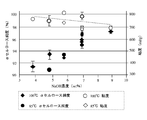
- Example 1 In a polypropylene bag, LBKP (craft pulp made from hardwood) was immersed for 60 minutes in aqueous sodium hydroxide solutions at various concentrations at a reaction temperature of 85 ° C. and 100 ° C. The treatment was performed in a drying cabinet or a water bath, and the reaction was started at a predetermined temperature ⁇ 3 ° C. The temperature raising time was about 20 to 30 minutes. After the treatment, dilution with water and filtration were repeated 2-3 times to neutralize the pH. The obtained alkali-treated pulp was dried overnight at 60 ° C. with a forced circulation dryer. After drying, the sample was left at room temperature to obtain a dry dissolving pulp sample. The obtained dissolved pulp sample was pulverized with a cutter mill, and the water content was measured.
- aqueous sodium hydroxide solutions at various concentrations at a reaction temperature of 85 ° C. and 100 ° C.
- the treatment was performed in a drying cabinet or a water bath, and the reaction was started at a predetermined
- the obtained dry dissolving pulp sample was subjected to ⁇ cellulose purity measurement and viscosity measurement.
- the purity of ⁇ -cellulose was measured with an accuracy of 0.1 mg of about 150 mg of absolute dryness, and a 20% sodium hydroxide aqueous solution and mili-Q water (ultra pure water) were added so as to be 17.5 wt% of sodium hydroxide. This was stirred with a stirrer for 30 minutes. Thereafter, 7.5 mL of miri-Q water was added and further stirred for 5 minutes. After stirring, suction filtration was performed with a glass fiber filter paper having a diameter of 47 mm (GF / C, manufactured by Advantec), which had been weighed in advance.
- GF / C manufactured by Advantec
- the solution used for the alkali treatment was co-washed twice with a 7.0-7.5 wt% aqueous sodium hydroxide solution, and the washing was filtered through a glass fiber filter paper.
- the obtained alkali-extracted fiber was washed several times with mili-Q water, and 10% acetic acid solution was added and suction filtered. After further washing with water, 10% acetic acid was again added to the filter paper and left for about 1 minute. Then, it aspirated and washed 6 times with water.
- the obtained filter paper and residue were dried overnight (or 4 hours or more) with a 105 ° C. dryer, allowed to cool to room temperature with a vacuum desiccator, and then weighed to determine the amount of ⁇ -cellulose recovered.
- Viscosity is measured by measuring a dissolved pulp sample of about 50 mg of absolute dryness with an accuracy of 0.1 mg, adding mili-Q water to a water content of 7.5 mL, and using a stirrer until the pulp is sufficiently dispersed. After stirring ( ⁇ 30 minutes), 7.5 mL of 1 mol / L copper ethylenediamine solution (Kanto Chemical) was added and stirred for 15-20 minutes with a stirrer to dissolve. The viscosity of the 0.5 mol / L copper ethylenediamine solution after dissolution was taken in a Cannon Fenceke dynamic viscosity tube and kept at 25 ° C. for 5 minutes, and then the flow down time was measured to measure the viscosity. From the measurement results, the intrinsic viscosity was calculated according to JIS 8215: Intrinsic Viscosity Measurement.
- the results are shown in FIG.
- the ⁇ -cellulose purity increased up to a concentration of about 7.0 wt% of the sodium hydroxide solution regardless of whether the treatment temperature was 85 ° C. or 100 ° C.
- the ⁇ cellulose purity was in a saturated state, and the effect of improving the ⁇ cellulose purity by making the sodium hydroxide solution concentration 7.0% or more was small.
- the alkali concentration before saturation a tendency that the ⁇ -cellulose purity was slightly higher under the treatment condition of 100 ° C. was observed.
- the viscosity tended to decrease as the alkali concentration increased. However, there was almost no effect due to the treatment temperature. However, the intrinsic viscosity constant was about 700 even under the processing conditions with the lowest viscosity, and it was judged that the viscosity was sufficiently high. From the above, it has been clarified that the alkali treatment of LBKP proceeds sufficiently by immersing in an aqueous solution having a sodium hydroxide concentration of about 7 wt% so that the pulp concentration is about 10% and performing the treatment for about 60 minutes. It was.
- Example 2 The alkali treatment was performed in the same manner as in Example 1. However, the treatment temperature was changed from 15 ° C to 100 ° C. Further, the treatment time was changed from 0 minutes to 120 minutes. In the 85 ° C. reaction system, the temperature rose from room temperature to 85 ° C. by 25 minutes after the start of the treatment. The ⁇ cellulose measurement method and the like were carried out in the same manner as in Example 1.
- the results for the treatment temperatures of 85 ° C. and 25 ° C. are shown in FIG.
- the treatment time of 0 minutes represents the alpha cellulose purity of LBKP used as a raw material.
- the ⁇ cellulose purity had reached 96% by the time the treatment time reached 25 minutes and the temperature of the treatment system reached 85 ° C.
- a maximum purity of 96.4% was obtained when the treatment time was 60 minutes, and thereafter a tendency for the ⁇ cellulose purity to gradually decline was observed.
- the first stage treatment was carried out at low temperature (4, 15, 22.5 ° C.) for 45 minutes, then raised to 85 ° C. over 25 minutes and then treated for 45 minutes, and raised from room temperature to 85 ° C. and held for 45 minutes Later, alkali treatment was carried out in a system that was treated at a low temperature (15, 30 ° C.) for 45 minutes.
- a low temperature 15, 30 ° C.
- FIG. 4 when the temperature was changed, the ⁇ cellulose purity was higher than that when treated at 85 ° C. for 90 minutes, but considerably more than when treated at 15 ° C. for 90 minutes. Alpha cellulose purity was low.
- a 7.0-7.5 wt% sodium hydroxide aqueous solution is used at a low temperature range of 4-45 ° C., preferably about 15-40 ° C. It has been clarified that dissolved pulp having the highest ⁇ -cellulose purity can be obtained by performing the treatment for about 45 to 90 minutes.
- Example 3 LBKP or alkali-treated LBKP (DP) was suspended in water at a pulp concentration of 10% in a polypropylene bag, a bleaching agent or an auxiliary agent was added, and then adjusted to a predetermined pH using sodium hydroxide or an aqueous sulfuric acid solution.
- the pulp and the bleaching reagent were well blended and then immersed in a predetermined 60 ° C. water bath for 120 minutes. After completion of the bleaching, the pulp was further diluted with water and filtered and washed. After washing, the sample was air-dried at 60 ° C. overnight, and this sample was used as a measurement sample for ⁇ cellulose purity, viscosity, and ISO whiteness.
- LBKP LBKP was bleached.
- a mixed system of hypochlorous acid (pH 10.5), oxone (persulfate, pH 3.0), thiourea (pH 6.5 or 10.5) and hydrogen peroxide was prepared.
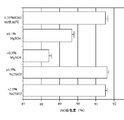
- hydrogen peroxide (pH 10.6-12.4) alone or a system in which sodium metasilicate was added to hydrogen peroxide was prepared. The results are shown in FIG.
- magnesium sulfate generally has a protective effect at a lower concentration than metasilicic acid, and has features such as chelating more metals to suppress side reactions, so magnesium sulfate is more powerful in polysaccharides. By coordinating, it is thought that the sugar residue browned in the pulp was also protected.
- Example 4 Pulp having an alkali treatment temperature of 21 ° C. and 85 ° C. was prepared.
- the alkali-treated pulp was diluted with water and filtered three times to obtain a neutral pH.
- the pulp concentration is concentrated from about 10% to about 30% by suction filtration, 5 wt% dilute sulfuric acid is added to lower the pH to 8-9, which is close to neutrality, and then washed twice with water. went.
- the measurement of ⁇ cellulose purity was the same as in Examples 1 to 3.
- Example 5 For alkali treatment, add 7.3 wt% sodium hydroxide aqueous solution so that LBKP is 10 wt% by dry weight, and stir well. After post-bleaching, treat at 18 ° C for 45 minutes at 45 ° C for pre-bleaching. It was. The pulp was washed as described above. In the hydrogen peroxide bleaching before alkali treatment, a predetermined concentration of hydrogen peroxide and 1.0 wt% (vs. pulp) sodium metasilicate were added to adjust the pH in the system to 11-11.5. The pulp concentration was 10 wt%. In the case of post-bleaching, the hydrogen peroxide concentration was 0.1-0.375%, and the pre-bleaching was 0.5-1.5% (both in weight percent of pulp). Bleaching was performed at 60 ° C. for 120 minutes. The obtained dissolved pulp sample was washed and air-dried at 60 ° C., and then the ⁇ cellulose purity, intrinsic viscosity constant, and ISO whiteness were measured.
- the post-bleaching showed better values in all of ⁇ -cellulose purity, viscosity and whiteness (FIG. 8).
- the hydrogen peroxide was 0.5% or less, the ⁇ cellulose purity and viscosity were not sufficiently increased.
- the limiting viscosity number was about 800, not limited to the hydrogen peroxide concentration, whereas in the case of post-bleaching, a tendency to decrease according to the hydrogen peroxide concentration was observed.
- post-bleaching was higher than pre-bleaching.
- the alpha cellulose purity showed the highest value when 0.1 or 0.2% (vs. pulp) hydrogen peroxide was used in post-bleaching, and higher than that without bleaching (0% in FIG. 8).
- Example 6 bamboo BKP was obtained by immersing a sieve (diameter 30-cm, depth 8-cm) having a mesh size of 100 ⁇ m in a tarai filled with 8 L of water, and putting BKP equivalent to 100 g of absolutely dry on the sieve. The pulp was washed with a lab stirrer (manufactured by Yamato) for 4 hours at 50 rpm. The fine particles that passed through the sieve were subjected to suction filtration with a nylon mesh having an opening of 50 ⁇ m. This was a parenchyma. For the pulp remaining on the sieve, the above washing was repeated a total of 5 times to eliminate fine particles as much as possible. This fraction was used as bamboo fiber.
- NBKP craft pulp made from softwood
- NBKP (craft pulp made from softwood) is added to 7.0 wt% sodium hydroxide aqueous solution so that the pulp becomes 10 wt%, and after alkali treatment at 85 ° C for 60 minutes, the alkali is removed with a dehydrator.
- the pulp concentration was diluted to 10%, and the pH was adjusted to 11.5 with sulfuric acid. Hydrogen peroxide was added to this so that it might become 0.25% (vs. pulp), and bleaching was performed at 60 ° C. for 60 minutes. After bleaching, washing with water and air drying, the ⁇ cellulose purity and viscosity were measured.
- LBKP, NBKP craft pulp made from coniferous material
- TCF-LBKP, bamboo BKP, bamboo fiber and soft cells were added with pulp so that the pulp concentration was 10% in a 7.3 wt% sodium hydroxide aqueous solution. Hold at 50 ° C. for 50 minutes. After treatment, the pulp was washed with water until the pH was near neutral. The washed alkali-treated pulp was added so as to have a pulp concentration of 10%, hydrogen peroxide 0.2%, and sodium metasilicate 0.5 wt% (both with respect to pulp concentration). At this time, the pH of the reaction system was 11.3-11.4. After stirring well, this was left still in a 60 ° C. water bath for 120 minutes. After the bleaching treatment, the pulp was washed again with water, air-dried at 60 ° C., and the ⁇ -cellulose purity, viscosity, whiteness and the like were measured.
- the pulp used for dissolving pulp production in this example and the dissolved pulp quality after alkali treatment are shown in Table 1, and it is understood that the ⁇ cellulose purity of LBKP and NBKP hardly changes.
- bamboo BKP has a particularly low purity of 85%. This is because fibers with high ⁇ cellulose purity (92.6%) and low parenchyma cells (78.4%) are mixed at a ratio of about 60-50: 40-50.
- the viscosity was high in LBKP, and NBKP and bamboo BKP were almost the same. There was no significant difference between bamboo fiber and parenchyma cells.
- the dissolving pulp produced from bamboo fiber and LBKP has a limiting viscosity number exceeding 700 mL / g, and is a high-grade dissolving pulp together with ⁇ cellulose purity.
- the whiteness of these dissolving pulps was 92.2 and 91.3, respectively, indicating a sufficient whiteness. From the above, it was found that bamboo fiber is most suitable for the production of the highest grade dissolving pulp, followed by LBKP.
Landscapes
- Chemical & Material Sciences (AREA)
- Engineering & Computer Science (AREA)
- Life Sciences & Earth Sciences (AREA)
- Health & Medical Sciences (AREA)
- Analytical Chemistry (AREA)
- Crystallography & Structural Chemistry (AREA)
- Biochemistry (AREA)
- Materials Engineering (AREA)
- Wood Science & Technology (AREA)
- Chemical Kinetics & Catalysis (AREA)
- Medicinal Chemistry (AREA)
- Polymers & Plastics (AREA)
- Organic Chemistry (AREA)
- Inorganic Chemistry (AREA)
- Paper (AREA)
- Polysaccharides And Polysaccharide Derivatives (AREA)
Abstract
La présente invention vise à fournir un procédé de production de pâte à dissoudre, dans lequel la pâte présente une pureté ultra-élevée (teneur en α-cellulose > 97 %), un degré élevé de polymérisation (η > 700) et une blancheur élevée (luminosité ISO > 90), le procédé de production de pâte à dissoudre selon la présente invention est un procédé de production de pâte à dissoudre, dans lequel un procédé de dé-hémicellulose est réalisé, et une pureté en α-cellulose est renforcée en raison d'une pâte blanchie immergée dans un alcalin concentré froid, et le procédé de production est caractérisé par le fait que l'étape d'immersion de la pâte blanchie dans l'alcalin concentré froid comprend la pâte blanchie immergée dans une solution aqueuse d'hydroxyde de sodium de 7,0-7,5 % en poids pendant 30 à 90 minutes à 15-100 °C.
Applications Claiming Priority (2)
| Application Number | Priority Date | Filing Date | Title |
|---|---|---|---|
| JP2014-087959 | 2014-04-22 | ||
| JP2014087959A JP6522885B2 (ja) | 2014-04-22 | 2014-04-22 | 溶解パルプの製造法 |
Publications (1)
| Publication Number | Publication Date |
|---|---|
| WO2015163111A1 true WO2015163111A1 (fr) | 2015-10-29 |
Family
ID=54332279
Family Applications (1)
| Application Number | Title | Priority Date | Filing Date |
|---|---|---|---|
| PCT/JP2015/060542 Ceased WO2015163111A1 (fr) | 2014-04-22 | 2015-04-03 | Procédé de production de pâte à dissoudre |
Country Status (2)
| Country | Link |
|---|---|
| JP (1) | JP6522885B2 (fr) |
| WO (1) | WO2015163111A1 (fr) |
Cited By (2)
| Publication number | Priority date | Publication date | Assignee | Title |
|---|---|---|---|---|
| EP3885488A4 (fr) * | 2018-12-31 | 2022-01-19 | Unicharm Corporation | Procédé de production de matière première de fibre de pâte, et matière première de fibre de pâte en tant que matière première de cellulose |
| CN115075031A (zh) * | 2022-06-06 | 2022-09-20 | 赣南师范大学 | 漂白竹浆中半纤维素的脱除方法和竹溶解浆及其应用 |
Families Citing this family (1)
| Publication number | Priority date | Publication date | Assignee | Title |
|---|---|---|---|---|
| JP6908957B2 (ja) * | 2017-01-12 | 2021-07-28 | 中越パルプ工業株式会社 | セルロースナノファイバー分散液の製造方法 |
Citations (3)
| Publication number | Priority date | Publication date | Assignee | Title |
|---|---|---|---|---|
| JPS5277202A (en) * | 1977-01-08 | 1977-06-29 | Jisuke Hayashi | Process for refining pulp |
| JP2005126871A (ja) * | 2003-10-27 | 2005-05-19 | Nafa Seikatsu Kenkyusho:Kk | 抗菌性を有する竹パルプ、竹を原料とするセルロース繊維およびこれらの製造方法 |
| JP2014029044A (ja) * | 2012-07-31 | 2014-02-13 | Nippon Paper Industries Co Ltd | 溶解クラフトパルプの製造方法 |
Family Cites Families (1)
| Publication number | Priority date | Publication date | Assignee | Title |
|---|---|---|---|---|
| AU2008253520B2 (en) * | 2007-05-23 | 2013-05-09 | Innotech Alberta Inc. | Method to remove hemicellulose from cellulosic fibres using a solution of ammonia and hydrogen peroxide |
-
2014
- 2014-04-22 JP JP2014087959A patent/JP6522885B2/ja active Active
-
2015
- 2015-04-03 WO PCT/JP2015/060542 patent/WO2015163111A1/fr not_active Ceased
Patent Citations (3)
| Publication number | Priority date | Publication date | Assignee | Title |
|---|---|---|---|---|
| JPS5277202A (en) * | 1977-01-08 | 1977-06-29 | Jisuke Hayashi | Process for refining pulp |
| JP2005126871A (ja) * | 2003-10-27 | 2005-05-19 | Nafa Seikatsu Kenkyusho:Kk | 抗菌性を有する竹パルプ、竹を原料とするセルロース繊維およびこれらの製造方法 |
| JP2014029044A (ja) * | 2012-07-31 | 2014-02-13 | Nippon Paper Industries Co Ltd | 溶解クラフトパルプの製造方法 |
Cited By (2)
| Publication number | Priority date | Publication date | Assignee | Title |
|---|---|---|---|---|
| EP3885488A4 (fr) * | 2018-12-31 | 2022-01-19 | Unicharm Corporation | Procédé de production de matière première de fibre de pâte, et matière première de fibre de pâte en tant que matière première de cellulose |
| CN115075031A (zh) * | 2022-06-06 | 2022-09-20 | 赣南师范大学 | 漂白竹浆中半纤维素的脱除方法和竹溶解浆及其应用 |
Also Published As
| Publication number | Publication date |
|---|---|
| JP2015206139A (ja) | 2015-11-19 |
| JP6522885B2 (ja) | 2019-05-29 |
Similar Documents
| Publication | Publication Date | Title |
|---|---|---|
| JP5094854B2 (ja) | パルプの反応性の強化 | |
| RU2753923C2 (ru) | Способ получения растворимой целлюлозы и растворимая целлюлоза, полученная таким способом (варианты) | |
| JP2015514881A5 (fr) | ||
| CN116568887A (zh) | 漂白来自回收纺织材料的浆料的方法 | |
| WO2015163111A1 (fr) | Procédé de production de pâte à dissoudre | |
| JP2015206136A (ja) | 溶解パルプの製造法 | |
| CN101558197B (zh) | 通过最终高温臭氧处理漂白化学纸浆的方法 | |
| US2999045A (en) | Deresination of wood pulp | |
| RU2341603C1 (ru) | Способ обработки целлюлозного волокна | |
| RU2703467C2 (ru) | Способ снижения вязкости целлюлозы при производстве растворимой целлюлозы | |
| CN105556030A (zh) | 在镁离子存在下用臭氧处理化学纸浆的方法 | |
| US1953191A (en) | Process of refining cellulose | |
| CN116446058A (zh) | 一种精细化工业大麻纤维的制备方法 | |
| US2202334A (en) | Treatment of textiles | |
| WO2016143760A1 (fr) | Procédé de production de cellulose | |
| US2186487A (en) | Bleaching pulp | |
| FI120652B (fi) | Menetelmä metalli-ioneja sisältävän massan loppuvalkaisemiseksi klooridioksidilla | |
| US3020196A (en) | Production of high brightness high strength wood pulps | |
| CS231164B2 (en) | Method of bleaching of cellulose fibre material | |
| JP3265036B2 (ja) | アルカリパルプの漂白方法 | |
| CN103261514B (zh) | 用于使用活化的过氧化氢使纸浆脱木质素和漂白的方法 | |
| WO2019124251A1 (fr) | Cellulose chimiquement modifiée et nanofibre de cellulose, et procédé de production associé | |
| JP2000080582A (ja) | 化学パルプの中濃度酸素漂白法 | |
| JP2003213582A (ja) | パルプの処理方法 | |
| JP2005042210A (ja) | Ecf漂白パルプの製造方法 |
Legal Events
| Date | Code | Title | Description |
|---|---|---|---|
| 121 | Ep: the epo has been informed by wipo that ep was designated in this application |
Ref document number: 15783269 Country of ref document: EP Kind code of ref document: A1 |
|
| NENP | Non-entry into the national phase |
Ref country code: DE |
|
| 122 | Ep: pct application non-entry in european phase |
Ref document number: 15783269 Country of ref document: EP Kind code of ref document: A1 |