WO2015163465A1 - 眼鏡レンズ - Google Patents
眼鏡レンズ Download PDFInfo
- Publication number
- WO2015163465A1 WO2015163465A1 PCT/JP2015/062598 JP2015062598W WO2015163465A1 WO 2015163465 A1 WO2015163465 A1 WO 2015163465A1 JP 2015062598 W JP2015062598 W JP 2015062598W WO 2015163465 A1 WO2015163465 A1 WO 2015163465A1
- Authority
- WO
- WIPO (PCT)
- Prior art keywords
- layer
- hard coat
- group
- mass
- coat layer
- Prior art date
- Legal status (The legal status is an assumption and is not a legal conclusion. Google has not performed a legal analysis and makes no representation as to the accuracy of the status listed.)
- Ceased
Links
Classifications
-
- G—PHYSICS
- G02—OPTICS
- G02B—OPTICAL ELEMENTS, SYSTEMS OR APPARATUS
- G02B1/00—Optical elements characterised by the material of which they are made; Optical coatings for optical elements
- G02B1/10—Optical coatings produced by application to, or surface treatment of, optical elements
- G02B1/14—Protective coatings, e.g. hard coatings
-
- G—PHYSICS
- G02—OPTICS
- G02B—OPTICAL ELEMENTS, SYSTEMS OR APPARATUS
- G02B1/00—Optical elements characterised by the material of which they are made; Optical coatings for optical elements
- G02B1/10—Optical coatings produced by application to, or surface treatment of, optical elements
- G02B1/11—Anti-reflection coatings
- G02B1/113—Anti-reflection coatings using inorganic layer materials only
- G02B1/115—Multilayers
-
- B—PERFORMING OPERATIONS; TRANSPORTING
- B05—SPRAYING OR ATOMISING IN GENERAL; APPLYING FLUENT MATERIALS TO SURFACES, IN GENERAL
- B05D—PROCESSES FOR APPLYING FLUENT MATERIALS TO SURFACES, IN GENERAL
- B05D1/00—Processes for applying liquids or other fluent materials
- B05D1/002—Processes for applying liquids or other fluent materials the substrate being rotated
- B05D1/005—Spin coating
-
- B—PERFORMING OPERATIONS; TRANSPORTING
- B05—SPRAYING OR ATOMISING IN GENERAL; APPLYING FLUENT MATERIALS TO SURFACES, IN GENERAL
- B05D—PROCESSES FOR APPLYING FLUENT MATERIALS TO SURFACES, IN GENERAL
- B05D1/00—Processes for applying liquids or other fluent materials
- B05D1/02—Processes for applying liquids or other fluent materials performed by spraying
-
- B—PERFORMING OPERATIONS; TRANSPORTING
- B05—SPRAYING OR ATOMISING IN GENERAL; APPLYING FLUENT MATERIALS TO SURFACES, IN GENERAL
- B05D—PROCESSES FOR APPLYING FLUENT MATERIALS TO SURFACES, IN GENERAL
- B05D1/00—Processes for applying liquids or other fluent materials
- B05D1/18—Processes for applying liquids or other fluent materials performed by dipping
-
- B—PERFORMING OPERATIONS; TRANSPORTING
- B32—LAYERED PRODUCTS
- B32B—LAYERED PRODUCTS, i.e. PRODUCTS BUILT-UP OF STRATA OF FLAT OR NON-FLAT, e.g. CELLULAR OR HONEYCOMB, FORM
- B32B27/00—Layered products comprising a layer of synthetic resin
- B32B27/18—Layered products comprising a layer of synthetic resin characterised by the use of special additives
- B32B27/20—Layered products comprising a layer of synthetic resin characterised by the use of special additives using fillers, pigments, thixotroping agents
-
- B—PERFORMING OPERATIONS; TRANSPORTING
- B32—LAYERED PRODUCTS
- B32B—LAYERED PRODUCTS, i.e. PRODUCTS BUILT-UP OF STRATA OF FLAT OR NON-FLAT, e.g. CELLULAR OR HONEYCOMB, FORM
- B32B27/00—Layered products comprising a layer of synthetic resin
- B32B27/38—Layered products comprising a layer of synthetic resin comprising epoxy resins
-
- G—PHYSICS
- G02—OPTICS
- G02B—OPTICAL ELEMENTS, SYSTEMS OR APPARATUS
- G02B1/00—Optical elements characterised by the material of which they are made; Optical coatings for optical elements
- G02B1/10—Optical coatings produced by application to, or surface treatment of, optical elements
- G02B1/11—Anti-reflection coatings
-
- G—PHYSICS
- G02—OPTICS
- G02C—SPECTACLES; SUNGLASSES OR GOGGLES INSOFAR AS THEY HAVE THE SAME FEATURES AS SPECTACLES; CONTACT LENSES
- G02C7/00—Optical parts
- G02C7/02—Lenses; Lens systems ; Methods of designing lenses
-
- G—PHYSICS
- G02—OPTICS
- G02C—SPECTACLES; SUNGLASSES OR GOGGLES INSOFAR AS THEY HAVE THE SAME FEATURES AS SPECTACLES; CONTACT LENSES
- G02C7/00—Optical parts
- G02C7/02—Lenses; Lens systems ; Methods of designing lenses
- G02C7/022—Ophthalmic lenses having special refractive features achieved by special materials or material structures
-
- G—PHYSICS
- G02—OPTICS
- G02C—SPECTACLES; SUNGLASSES OR GOGGLES INSOFAR AS THEY HAVE THE SAME FEATURES AS SPECTACLES; CONTACT LENSES
- G02C2202/00—Generic optical aspects applicable to one or more of the subgroups of G02C7/00
- G02C2202/16—Laminated or compound lenses
Definitions
- the present invention relates to a spectacle lens having a hard coat layer.
- the spectacle lens is required to have various characteristics, but the spectacle user is required to have a property that scratches are not easily formed by use in daily life, that is, scratch resistance.
- the film thickness of the hard coat is in the range of 1 to 3 ⁇ m, and it has scratch resistance for normal use of the spectacle lens.
- Patent Document 1 discloses a spectacle lens having a hard coat having a larger thickness for the purpose of suppressing the appearance of interference fringes as compared with the conventional hard coat.
- the present invention relates to the following spectacle lenses.
- a spectacle lens having a lens substrate, a hard coat layer, and an antireflection layer, The hard coat layer has a thickness of 10 ⁇ m or more and 50 ⁇ m or less; Glasses obtained by curing the curable composition containing the inorganic oxide particles, the silane coupling agent, and a polyfunctional epoxy compound of 20% by mass or more and 40% by mass or less in the matrix component. lens.
- the silane coupling agent has an organic group bonded to a silicon atom and an alkoxy group bonded to a silicon atom.
- a spectacle lens that exhibits excellent adhesion to a functional layer such as an antireflection layer formed on a hard coat layer.
- the spectacle lens of the present invention is a spectacle lens having a lens substrate, a hard coat layer, and an antireflection layer,
- the hard coat layer has a thickness of 10 ⁇ m or more and 50 ⁇ m or less;
- the hard coat layer is obtained by curing a curable composition containing 20% by mass or more and 40% by mass or less of a polyfunctional epoxy compound in the inorganic oxide particles, the silane coupling agent, and the matrix component.
- a polyfunctional epoxy compound in the above range in the curable composition used for forming the hard coat layer an excellent function layer such as an antireflection layer is formed on the hard coat layer. Shows adhesion.
- the thickness of the hard coat layer is preferably 15 ⁇ m or more, more preferably 18 ⁇ m or more.
- the film thickness is preferably 40 ⁇ m or less, more preferably 30 ⁇ m or less, from the viewpoint of suppressing the occurrence of initial cracks.
- the “film thickness” means an average film thickness, and the measurement method is according to the method described in the examples.
- the content of the polyfunctional epoxy compound in the curable composition used for forming the hard coat layer is formed on the hard coat layer, for example, from the viewpoint of high adhesion with a functional layer such as an antireflection layer, In a matrix component, it is 20 mass% or more, More preferably, it is 25 mass% or more. Content of a polyfunctional epoxy compound is 40 mass% or less in a matrix component.
- the matrix component means a silane coupling agent and a polyfunctional epoxy compound.
- the material used for the lens substrate of the spectacle lens examples include polyurethane materials (eg, polyurethane, polyurethane urea, polythiourethane), polycarbonate, plastics such as diethylene glycol bisallyl carbonate, inorganic glass, and the like.
- the thickness and diameter of the lens substrate are not particularly limited. Usually, the thickness is about 1 to 30 mm, and the diameter is about 50 to 100 mm.
- the spectacle lens of the present invention is a spectacle lens for correcting vision, it is usual to use a lens substrate having a refractive index ne of about 1.5 to 1.8.
- ne refractive index
- the lens substrate a colorless one is usually used, but a colored one can be used as long as the transparency is not impaired.
- the surface shape of the base material on which the cured film is formed is not particularly limited, and may be any shape such as a flat surface, a convex surface, or a concave surface.
- the lens substrate is provided with at least a hard coat layer and an antireflection layer.
- other functional layers include a primer layer, an interference fringe suppressing layer, a polarizing layer, and a photochromic layer.
- a functional layer such as an antireflection layer, a water repellent film, an ultraviolet absorbing film, an infrared absorbing film, a photochromic film, or an antistatic film can be further provided on the hard coat layer as necessary.
- known techniques relating to spectacle lenses can be applied.
- the hard coat layer may be directly formed on the surface of the lens substrate, or may be indirectly formed through one or more other functional layers.
- the spectacle lens of the present invention preferably has a lens substrate, a hard coat layer, and an antireflection layer provided on the hard coat layer, preferably provided on the lens substrate and the lens substrate.
- An interference fringe suppression layer provided; a primer layer provided on the interference fringe suppression layer; a hard coat layer provided on the primer layer; and an antireflection layer provided on the hard coat layer.
- the hard coat layer includes, for example, inorganic oxide particles (hereinafter also referred to as “component (A)”), a silane coupling agent (hereinafter also referred to as “component (B)”), and a polyfunctional epoxy compound (hereinafter referred to as “component ( C) is also obtained by curing.
- component (A) inorganic oxide particles
- component (B) silane coupling agent
- component ( C) polyfunctional epoxy compound
- Component (B) is a silane coupling agent, preferably a silane coupling agent having an organic group bonded to a silicon atom and a hydrolyzable group.
- the hydrolyzable group include an alkoxy group, an aryloxy group, and a hydroxy group, and an alkoxy group is preferable.
- the silane coupling agent is preferably an organosilicon compound represented by the following general formula (I) or a hydrolyzate thereof. (R 1 ) a (R 3 ) b Si (OR 2 ) 4 ⁇ (a + b) (I)
- a is 1 and b is 0 or 1.
- R 1 represents an organic group having a functional group such as an epoxy group such as a glycidoxy group, a vinyl group, a methacryloxy group, an acryloxy group, a mercapto group, an amino group or a phenyl group, and preferably an organic group having an epoxy group Represents.
- the functional group may be directly bonded to the silicon atom, or may be indirectly bonded via a linking group such as an alkylene group.
- R 2 is, for example, a hydrogen atom, an alkyl group, an acyl group, or an aryl group, and preferably an alkyl group.
- the alkyl group represented by R 2 is, for example, a linear or branched alkyl group having 1 to 4 carbon atoms, and specific examples include a methyl group, an ethyl group, a propyl group, a butyl group, and the like. Is a methyl group or an ethyl group.
- the acyl group represented by R 2 is, for example, an acyl group having 1 to 4 carbon atoms, and specific examples thereof include an acetyl group, a propionyl group, an oleyl group, and a benzoyl group.
- the aryl group represented by R 2 is, for example, an aryl group having 6 to 10 carbon atoms, and specific examples thereof include a phenyl group, a xylyl group, and a tolyl
- R 3 can be an alkyl group or an aryl group.
- the alkyl group represented by R 3 is, for example, a linear or branched alkyl group having 1 to 6 carbon atoms. Specific examples thereof include a methyl group, an ethyl group, a propyl group, a butyl group, a pentyl group, and a hexyl group. Etc.
- the aryl group represented by R 3 is, for example, an aryl group having 6 to 10 carbon atoms, and specific examples thereof include a phenyl group, a xylyl group, and a tolyl group.
- component (B) examples include glycidoxymethyltrimethoxysilane, glycidoxymethyltriethoxysilane, ⁇ -glycidoxyethyltriethoxysilane, ⁇ -glycidoxyethyltrimethoxysilane, ⁇ -glycid Xylethyltriethoxysilane, ⁇ -glycidoxypropyltrimethoxysilane, ⁇ -glycidoxypropyltriethoxysilane, ⁇ -glycidoxypropyltrimethoxysilane, ⁇ -glycidoxypropyltriethoxysilane, ⁇ -glycidoxypropyltrimethoxysilane, ⁇ -glycidoxypropyltriethoxysilane, ⁇ -glycid Xylpropyltrimethoxysilane, ⁇ -glycidoxypropyltriethoxysilane, ⁇ -glycidoxypropyltripropoxys
- silane coupling agents include, for example, trade names manufactured by Shin-Etsu Chemical Co., Ltd., KBM-303, KBM-402, KBM-403, KBE402, KBE403, KBM-1403, KBM-502, KBM- 503, KBE-502, KBE-503, KBM-5103, KBM-602, KBM-603, KBM-903, KBE-903, KBM-573, KBM-575, KBM-9659, KBE-585 KBM-802, KBM-803, KBE-846, KBE-9007.
- Component (C) is a polyfunctional epoxy compound having two or more epoxy groups in one molecule, and preferably a polyfunctional epoxy compound having two or three epoxy groups in one molecule.
- component (C) examples include 1,6-hexanediol diglycidyl ether, ethylene glycol diglycidyl ether, diethylene glycol diglycidyl ether, triethylene glycol diglycidyl ether, tetraethylene glycol diglycidyl ether, nonaethylene glycol diglycidyl.
- Alicyclic epoxy compounds such as bis-2,2-hydroxycyclohexylpropane diglycidyl ether, resorcin diglycidyl ether, bisphenol A diglycidyl ether, bisphenol F diglycidyl ether, bisphenol S diglycidyl ether, orthophthalic acid diglycidyl ester, Aromatic epoxy compounds such as phenol novolac polyglycidyl ether and cresol novolac polyglycidyl ether can be exemplified.
- the component (C) a compound having two or three epoxy groups (bifunctional or trifunctional epoxy compound) is more preferable from the viewpoint of adhesion to an adjacent layer or lens substrate.
- Examples of commercially available polyfunctional epoxy compounds are those manufactured by Nagase ChemteX Corporation, trade names “Denacol” series EX-201, EX-211, EX-212, EX-252, EX-313, EX-314, EX-321, EX-411, EX-421, EX-512, EX-521, EX-611, EX-612, EX-614, EX-614B and the like.
- the curable composition contains the components (A) to (C) described above, and optionally contains optional components such as an organic solvent, a surfactant (leveling agent), and a curing catalyst. It can be prepared by mixing.
- the content of the component (A) is preferably 20% by mass or more, more preferably 30% by mass or more, still more preferably 40% by mass or more, preferably 80% by mass or less, in the solid content of the curable composition. More preferably, it is 75 mass% or less, More preferably, it is 70 mass% or less.
- the content of the component (B) is preferably 5% by mass or more, more preferably 10% by mass or more, still more preferably 15% by mass or more, preferably 80% by mass or less, in the solid content of the curable composition. More preferably, it is 75 mass% or less, More preferably, it is 70 mass% or less.
- the content of the component (C) is preferably 5% by mass or more, more preferably 8% by mass or more, still more preferably 10% by mass or more, preferably 40% by mass or less, in the solid content of the curable composition. More preferably, it is 35 mass% or less, More preferably, it is 30 mass% or less.
- the filler / matrix ratio (hereinafter also simply referred to as “F / M ratio”) is preferably 0.2 or more, more preferably 0.4 or more, still more preferably 0.7 or more, and preferably 2.0 or more. Below, more preferably 1.6 or less, and still more preferably 1.4 or less.
- the F / M ratio means the mass ratio [component (A) / (component (B) + component (C))] of the component (A) to the total mass of the components (B) and (C). .
- the said hard-coat layer can be formed by apply
- a conventionally performed method such as a dipping method, a spin coating method, or a spray method can be applied.
- the curing process is usually performed by heating.
- the heat curing treatment can be performed, for example, by placing a lens coated with the above curable composition in an environment having an ambient temperature of 50 to 150 ° C. for about 30 minutes to 3 hours.
- the light irradiated for the curing process is, for example, an electron beam or an ultraviolet ray.
- the type of irradiation light and the irradiation conditions are appropriately selected according to the type of component (C).
- C type of component
- the primer layer is, for example, an aqueous resin layer formed from an aqueous resin composition containing a resin component and an aqueous solvent.
- the aqueous solvent contained in the aqueous resin composition is, for example, water, a mixed solvent of water and a polar solvent, and preferably water.
- the solid content concentration in the aqueous resin composition is preferably 1 to 60% by mass, more preferably 5 to 40% by mass, from the viewpoint of liquid stability and film-forming property.
- the water-based resin composition can contain additives such as an antioxidant, a dispersant, and a plasticizer as necessary in addition to the resin component.
- a commercially available aqueous resin composition may be diluted with a solvent such as water, alcohol, propylene glycol monomethyl ether (PGM), or the like.
- the aqueous resin composition can contain a resin component in a state dissolved in an aqueous solvent or dispersed as fine particles (preferably colloidal particles).
- a dispersion in which the resin component is dispersed in the form of fine particles in an aqueous solvent (preferably in water) is desirable.
- the particle diameter of the resin component is preferably 0.3 ⁇ m or less from the viewpoint of dispersion stability of the composition.
- the pH of the aqueous resin composition is preferably about 5.5 to 9.0 at 25 ° C. from the viewpoint of stability. The viscosity at 25 ° C.
- a coating film obtained after coating on a glass plate so as to have a thickness of 1 mm and drying at 120 ° C. for 1 hour has a glass transition temperature Tg of ⁇ 58 ° C. to 7 ° C., a pencil hardness of 4B to 2H, The tensile strength measured according to JISK 7113 is 15 to 69 MPa.
- Examples of the resin component of the water-based resin composition include at least one selected from a polyurethane resin, an acrylic resin, an epoxy resin, and the like, and a polyurethane resin is preferable.
- a water-based resin composition containing a polyurethane resin that is, a water-based polyurethane resin composition is, for example, a high-molecular-weight polyol compound and an organic polyisocyanate compound, together with a chain extender, if necessary, inert to the reaction and having an affinity for water. It can be prepared by making a prepolymer by urethanization in a large solvent and dispersing the prepolymer in an aqueous solvent containing a chain extender to increase the molecular weight.
- aqueous polyurethane resin composition for example, paragraphs [0009] to [0013] of Japanese Patent No. 3588375, paragraphs [0012] to [0021] of JP-A-8-34897, Reference can be made to paragraphs [0010] to [0033] of JP-A-11-92653, paragraphs [0010] to [0033] of JP-A-11-92655, and the like.
- said aqueous polyurethane resin composition it is also possible to use commercially available aqueous urethane as it is or after diluting with an aqueous solvent as needed.
- Examples of commercially available water-based polyurethanes include “Evaphanol” series manufactured by Nikka Chemical Co., Ltd., “Superflex” series manufactured by Daiichi Kogyo Seiyaku Co., Ltd., and “Adekabon titer” manufactured by ADEKA Corporation. Series, “Olestar” series manufactured by Mitsui Chemicals, “Bondic” series manufactured by Dainippon Ink and Chemicals, “Hydran” series, “Imperil” series manufactured by Bayer, Sofran Japan ) “Sofuranate” series, Kao Co., Ltd. "Poise” series, Sanyo Chemical Industries “Samprene” series, Hodogaya Chemical Co., Ltd. "IZerax” series, Zeneca Corporation ) “Neolets” series, etc., can be used.
- An aqueous resin layer can be formed as a primer layer by applying and drying the aqueous resin composition on the surface of the substrate.
- a coating method a known coating method such as a dip method or a spin coating method can be used.
- the application conditions may be appropriately set so that a primer layer having a desired film thickness can be formed.
- the polarizing film surface to be coated may be subjected to chemical treatment with acids, alkalis, various organic solvents, etc., physical treatment with plasma, ultraviolet rays, ozone, etc., and detergent treatment with various detergents. it can. Adhesion can be improved by performing such pretreatment.
- the aqueous resin layer can be formed as a primer layer by drying the composition. The drying can be performed, for example, by placing a member on which a primer layer is formed in an atmosphere at room temperature to 100 ° C. for 5 minutes to 24 hours.
- the spectacle lens of the present invention preferably further includes an interference fringe suppression layer between the lens base material and the hard coat layer.
- the interference fringe suppression layer preferably has an optical film thickness of 0.2 ⁇ to 0.3 ⁇ in light having a wavelength ⁇ of 450 to 650 nm.
- the interference fringe suppressing layer is obtained, for example, by applying a dispersion containing at least inorganic oxide particles and a resin.
- the inorganic oxide particles are used from the viewpoint of adjusting the refractive index of the interference fringe suppressing layer.
- tungsten oxide (WO 3 ) zinc oxide (ZnO), silicon oxide (SiO 2 ), aluminum oxide (Al 2 O 3).
- Inorganic oxide particles can be used in combination.
- composite oxide particles of two or more kinds of inorganic oxides can be used.
- the particle size of the inorganic oxide particles is preferably in the range of 5 to 30 nm from the viewpoint of optical properties.
- the resin for the interference fringe suppression layer examples include at least one selected from a polyurethane resin, an acrylic resin, an epoxy resin, and the like, preferably a polyurethane resin, more preferably an aqueous resin composition containing a polyurethane resin, that is, an aqueous polyurethane. It is a resin composition.
- a preferable example of the water-based polyurethane resin composition is a resin exemplified by the primer layer.
- the dispersion may contain an aqueous solvent.
- the aqueous solvent is, for example, water, a mixed solvent of water and a polar solvent, and preferably water.
- the solid content concentration in the aqueous resin composition is preferably 1 to 60% by mass, more preferably 5 to 40% by mass, from the viewpoint of liquid stability and film-forming property.
- the water-based resin composition can contain additives such as an antioxidant, a dispersant, and a plasticizer as necessary in addition to the resin component.
- a commercially available aqueous resin composition may be diluted with a solvent such as water, alcohol, propylene glycol monomethyl ether (PGM), or the like.
- the antireflection layer has, for example, a configuration in which low refractive index layers and high refractive index layers are alternately arranged.
- the antireflection layer has preferably 4 to 10 layers, more preferably 5 to 8 layers.
- the refractive index of the low refractive index layer is 500 to 550 nm, preferably 1.35 to 1.80, more preferably 1.45 to 1.50.
- the low refractive index layer is made of an inorganic oxide, preferably SiO 2 .
- the refractive index of the high refractive index layer is 500 to 550 nm, preferably 1.90 to 2.60, and more preferably 2.00 to 2.40.
- the high refractive index layer is made of, for example, an inorganic oxide.
- the inorganic oxide used for the high refractive index layer is preferably at least one selected from ZrO 2 , Ta 2 O 5 , Y 2 O 3 , TiO 2 , Nb 2 O 5 and Al 2 O 3 .
- the spectacle lens of the present invention may have the above hard coat layer and other functional layers only on the surface of the lens substrate, or on the back surface.
- the spectacle lens is preferably a plastic lens for spectacles whose lens base material is plastic.
- a primer base material is applied to a resin base material (plastic lens: manufactured by HOYA Co., Ltd., trade name: Ainoa, refractive index: 1.67) by a dip method, and is dried and solidified at 100 ° C. for 20 minutes to form a lens base material.
- Primer layers were formed on both sides, and a hard coat liquid composed of the following components was applied by a spray method and dried at 100 ° C. for 2 hours to solidify the hard coat film.
- a silicon oxide layer which is the first underlayer (low refractive index layer), is formed on the sample surface to which this hard coat has been applied by vacuum deposition, and a zirconium oxide layer and a silicon oxide layer are formed as the second to seventh layers. Were alternately laminated to form an antireflection layer (AR1).
- AR1 antireflection layer
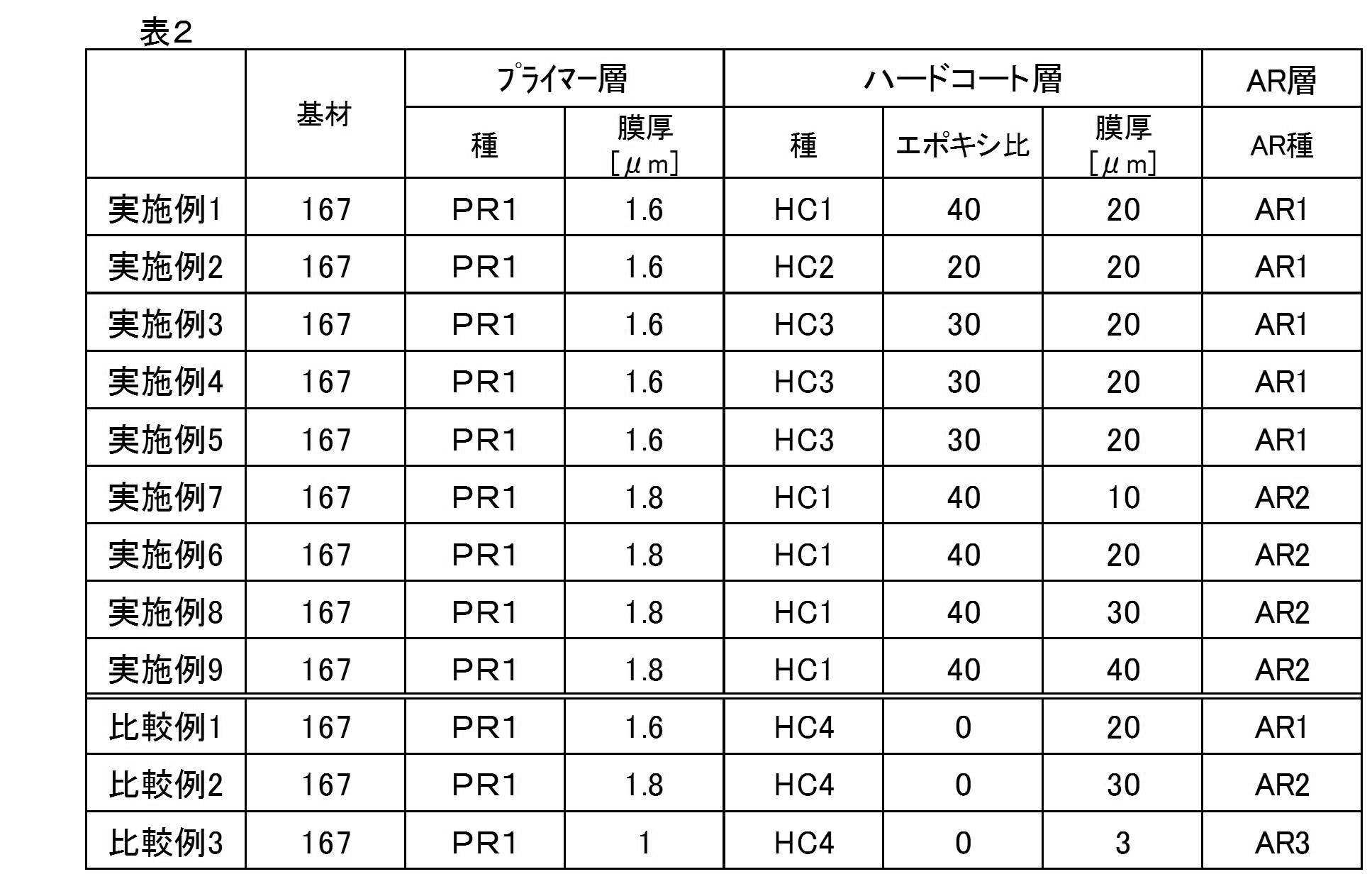
- Examples 2 to 9, Comparative Examples 1 to 3 A plastic lens was obtained in the same manner as in Example 1 except that the primer layer, hard coat layer, and AR layer were configured as shown in the following table. The obtained plastic lenses were evaluated and the results are shown in the table. However, only the comparative example 3 applied the hard coat liquid by the dip method.
- AR1 Low refractive material (SiO 2 ), High refractive material (ZrO 2 ) AR2: low refractive material (SiO 2 ), high refractive material (Ta 2 O 5 ) AR3: low refractive material (SiO 2 ), high refractive material (Nb 2 O 5 )
- the notation of the base material in the table is as follows. 167: manufactured by HOYA, plastic lens for spectacles, trade name EYNOA, refractive index 1.67
Landscapes
- Physics & Mathematics (AREA)
- General Physics & Mathematics (AREA)
- Optics & Photonics (AREA)
- Health & Medical Sciences (AREA)
- Ophthalmology & Optometry (AREA)
- General Health & Medical Sciences (AREA)
- Chemical & Material Sciences (AREA)
- Inorganic Chemistry (AREA)
- Surface Treatment Of Optical Elements (AREA)
- Eyeglasses (AREA)
- Laminated Bodies (AREA)
Abstract
Description
そこで本発明は、ハードコート層の上に形成される、例えば反射防止層等の機能層との優れた密着性を示す眼鏡レンズを提供することを課題とする。
[1] レンズ基材と、ハードコート層と、反射防止層とを有する眼鏡レンズであって、
前記ハードコート層が、10μm以上50μm以下の膜厚を有し、
前記ハードコート層が、無機酸化物粒子、シランカップリング剤、及びマトリックス成分中20質量%以上40質量%以下の多官能エポキシ化合物を含む硬化性組成物を硬化して得られるものである、眼鏡レンズ。
[2] 前記無機酸化物粒子がシリカ粒子である、[1]に記載の眼鏡レンズ。
[3] 前記シランカップリング剤が、ケイ素原子に結合する有機基と、ケイ素原子に結合するアルコキシ基を有する、[1]又は[2]に記載の眼鏡レンズ。
[4] 前記多官能エポキシ化合物が、2つ又は3つのエポキシ基を有する、[1]~[3]のいずれかに記載の眼鏡レンズ。
[5] 前記レンズ基材と、前記ハードコート層との間に、干渉縞抑制層を更に有する、[1]~[4]のいずれかに記載の眼鏡レンズ。
前記ハードコート層が、10μm以上50μm以下の膜厚を有し、
前記ハードコート層が、無機酸化物粒子、シランカップリング剤、及びマトリックス成分中20質量%以上40質量%以下の多官能エポキシ化合物を含む硬化性組成物を硬化して得られるものである。
ハードコート層の形成に用いられる硬化性組成物に上記の範囲の多官能エポキシ化合物が含有されることで、ハードコート層の上に形成される、例えば反射防止層等の機能層との優れた密着性を示す。
多官能エポキシ化合物が添加されることで、密着性に優れたハードコート層が得られる。
以下、本発明の眼鏡レンズの構成について詳細に説明する。
眼鏡レンズのレンズ基材に使用される材料としては、例えば、ポリウレタン系材料(例えばポリウレタン、ポリウレタンウレア、ポリチオウレタン)、ポリカーボネート、ジエチレングリコールビスアリルカーボネート等のプラスチック、無機ガラス、等が挙げられる。レンズ基材の厚さ及び直径は、特に限定されるものではない。通常、厚さは1~30mm程度、直径は50~100mm程度である。本発明の眼鏡レンズが視力矯正用の眼鏡レンズの場合、レンズ基材としては、屈折率neが1.5~1.8程度のものを使用することが通常である。レンズ基材としては、通常無色のものが使用されるが、透明性を損なわない範囲で着色したものを使用することもできる。また、その上に硬化被膜が形成される基材の表面形状は特に限定されず、平面、凸面、凹面等の任意の形状であることができる。
本発明の眼鏡レンズにおいて、レンズ基材には、少なくともハードコート層、及び反射防止層が設けられる。ほかの機能層としては、プライマー層、干渉縞抑制層、偏光層、フォトクロミック層等を挙げることができる。また、当該ハードコート層の上に、更に必要に応じて、反射防止層、撥水膜、紫外線吸収膜、赤外線吸収膜、フォトクロミック膜、帯電防止膜等の機能層を設けることもできる。これらほかの機能層については、眼鏡レンズに関する公知技術を適用することができる。
本発明の眼鏡レンズは、好ましくはレンズ基材と、ハードコート層と、前記ハードコート層上に設けられた反射防止層とを有し、好ましくはレンズ基材と、前記レンズ基材上に設けられたプライマー層と、前記プライマー層上に設けられたハードコート層と、前記ハードコート層上に設けられた反射防止層とを有し、より好ましくはレンズ基材と、前記レンズ基材上に設けられた干渉縞抑制層と、前記干渉縞抑制層上に設けられたプライマー層と、前記プライマー層上に設けられたハードコート層と、前記ハードコート層上に設けられた反射防止層とを有する。
ハードコート層は、例えば、無機酸化物粒子(以下「成分(A)」ともいう)と、シランカップリング剤(以下「成分(B)」ともいう)と、多官能エポキシ化合物(以下「成分(C)」ともいう)とを含む硬化性組成物を硬化して得られる。
加水分解性基としては、アルコキシ基、アリールオキシ基、ヒドロキシ基が挙げられ、好ましくはアルコキシ基である。
シランカップリング剤とは、好ましくは下記一般式(I)で表される有機ケイ素化合物又はその加水分解物である。
(R1)a(R3)bSi(OR2)4 - (a+b) ・・・(I)
R2で表されるアルキル基は、例えば直鎖又は分岐の炭素数1~4のアルキル基であって、具体例としては、メチル基、エチル基、プロピル基、ブチル基等が挙げられ、好ましくはメチル基又はエチル基である。
R2で表されるアシル基は、例えば、炭素数1~4のアシル基であって、具体例としては、アセチル基、プロピオニル基、オレイル基、ベンゾイル基等が挙げられる。
R2で表されるアリール基は、例えば炭素数6~10のアリール基であって、具体例としては、フェニル基、キシリル基、トリル基等が挙げられる。
R3で表されるアルキル基は、例えば直鎖又は分岐の炭素数1~6のアルキル基であって、具体例としては、メチル基、エチル基、プロピル基、ブチル基、ペンチル基、ヘキシル基等が挙げられる。
R3で表されるアリール基としては、例えば炭素数6~10のアリール基であって、具体例としては、フェニル基、キシリル基、トリル基等が挙げられる。
成分(B)の含有量は、硬化性組成物の固形分中、好ましくは5質量%以上、より好ましくは10質量%以上、更に好ましくは15質量%以上であり、好ましくは80質量%以下、より好ましくは75質量%以下、更に好ましくは70質量%以下である。
成分(C)の含有量は、硬化性組成物の固形分中、好ましくは5質量%以上、より好ましくは8質量%以上、更に好ましくは10質量%以上であり、好ましくは40質量%以下、より好ましくは35質量%以下、更に好ましくは30質量%以下である。
フィラー/マトリックス比(以下単に「F/M比」ともいう)は、好ましくは0.2以上、より好ましくは0.4以上、更に好ましくは0.7以上であり、また、好ましくは2.0以下、より好ましくは1.6以下、更に好ましくは1.4以下である。
なおF/M比とは、成分(B)と成分(C)の合計質量に対する、成分(A)の質量比[成分(A)/(成分(B)+成分(C))]を意味する。
プライマー層は、例えば、樹脂成分と水系溶媒を含有する水系樹脂組成物から形成される水系樹脂層である。
水系樹脂組成物に含まれる水系溶媒は、例えば、水、水と極性溶媒等との混合溶媒であり、好ましくは水である。水系樹脂組成物中の固形分濃度は、液安定性及び製膜性の観点から、好ましくは1~60質量%であり、より好ましくは5~40質量%である。水系樹脂組成物は、樹脂成分のほかに、必要に応じて、酸化防止剤、分散剤、可塑剤等の添加剤を含むことも可能である。また、市販されている水系樹脂組成物を、水、アルコール、プロピレングリコールモノメチルエーテル(PGM)等の溶媒で希釈して使用してもよい。
塗布方法としては、ディップ法、スピンコート法等の公知の塗布法を用いることができる。塗布条件は、所望の膜厚のプライマー層を形成できるように適宜設定すればよい。塗布前には、被塗布面である偏光膜表面に対し、酸、アルカリ、各種有機溶媒等による化学的処理、プラズマ、紫外線、オゾン等による物理的処理、各種洗剤を用いる洗剤処理を行うこともできる。このような前処理を行うことにより、密着性を向上させることができる。
水系樹脂組成物の塗工後、該組成物を乾燥させることによりプライマー層として水系樹脂層を形成することができる。上記乾燥は、例えば室温~100℃の雰囲気中に5分~24時間、プライマー層を形成した部材を配置することにより行うことができる。
本発明の眼鏡レンズは、上記レンズ基材と、上記ハードコート層との間に、干渉縞抑制層を更に有することが好ましい。
干渉縞抑制層は、干渉縞を抑制するため、波長λが450~650nmの光における光学膜厚が好ましくは0.2λ~0.3λである。
干渉縞抑制層は、例えば、無機酸化物粒子及び樹脂を少なくとも含有する分散液を塗工して得られる。
分散液は水系溶媒を含んでいてもよい。水系溶媒は、例えば、水、水と極性溶媒等との混合溶媒であり、好ましくは水である。水系樹脂組成物中の固形分濃度は、液安定性及び製膜性の観点から、好ましくは1~60質量%であり、より好ましくは5~40質量%である。水系樹脂組成物は、樹脂成分のほかに、必要に応じて、酸化防止剤、分散剤、可塑剤等の添加剤を含むことも可能である。また、市販されている水系樹脂組成物を、水、アルコール、プロピレングリコールモノメチルエーテル(PGM)等の溶媒で希釈して使用してもよい。
ハードコート層上に反射防止層が設けられる。反射防止層は、例えば、低屈折率層及び高屈折率層が交互に配置された構成を有する。反射防止層が有する層は、好ましくは4~10層、より好ましくは5~8層である。
低屈折率層の屈折率は、波長500~550nmで、好ましくは1.35~1.80、より好ましくは1.45~1.50である。低屈折率層は、無機酸化物からなり、好ましくはSiO2からなる。
高屈折率層の屈折率は、波長500~550nmで、好ましくは1.90~2.60であり、より好ましくは2.00~2.40である。
高屈折率層は、例えば、無機酸化物からなる。高屈折率層に用いられる無機酸化物としては、好ましくは、ZrO2、Ta2O5、Y2O3、TiO2、Nb2O5及びAl2O3の中から選ばれる少なくとも一種類の無機酸化物であり、より好ましくはZrO2又はTa2O5である。
ハードコート層が形成されたレンズ基材を用いて、光干渉法による非接触式膜厚測定器((株)システムロード製非接触式膜厚計測器FF8)により測定した。
連続荷重式表面測定機(新東科学(株)製Type22)を用いて、先端曲率半径が50μmのダイヤモンド針を装着して、眼鏡レンズとダイヤモンド針の当接荷重を1g/secで徐々に高めながら、10mm/secの速度で直線相対運度させて傷を形成した。蛍光灯下で目視において傷として認識され始める位置から、その荷重を求め「傷発生荷重」とし、当該傷を顕微鏡で確認して、眼鏡レンズの表面被膜が切削され始める位置から、その荷重を求め「膜剥離荷重」とした。
なお、表面被膜が切削されることで、形成される傷の色が白色を示す状態を示す。このように表面膜が切削されると肉眼でも目立つ傷となる。
JIS K5600―5―6(ISO 2409:1992)に基づいて反射防止層を有するプラスチックレンズ上に碁盤目を10×10個作り、セロファン粘着テープを用い剥離試験を3回行い、100個中の残った碁盤目を数えた。
※評価基準
A 剥離マス目数0/100~2/100
B 離マス目数3/100~5/100
C 剥離マス目数6/100以下
樹脂基材(プラスチックレンズ:HOYA(株)製,商品名:アイノア、屈折率1.67)に、プライマー液をディップ法にて塗布し、100℃で20分間乾燥固化することにより、レンズ基材両面にプライマー層を形成し、下記の成分で構成されるハードコート液をスプレー法により塗布し、100℃で2時間乾燥してハードコート膜を固化した。このハードコートが施されたサンプル表面に、真空蒸着法により1層目の下地層(低屈折率層)である酸化ケイ素層を形成し、2層目~7層目として、酸化ジルコニウム層、酸化ケイ素層を交互に積層して反射防止層(AR1)を形成した。
プライマー層、ハードコート層、AR層の構成を以下の表に示したものとした以外は、実施例1と同様の方法でプラスチックレンズを得た。得られたプラスチックレンズについて評価し、それらの結果を表に示す。ただし比較例3のみディップ法にてハードコート液を塗布した。
PR1: 水系ポリウレタン樹脂組成物(日華化学(株)製:エバファノールHA170)をプロピレングリコールモノメチルエーテルにて6倍に希釈したものを使用した。
〔有機ケイ素化合物〕
KBM403:γ-グリシドキシプロピルトリメトキシシラン(信越化学工業(株)製、商品名KBM403)
〔多官能エポキシ化合物〕
EX-321:トリメチロールプロパンポリグリシジルエーテル(グリシジル基官能基数:2~3官能、ナガセケムテック(株)製、商品名:デナコールEX-321)
〔無機酸化物〕
PGM-ST:SiO2ゾル(日産化学工業(株)製、商品名:PGM-ST)
MeOHシリカゾル:SiO2ゾル(日産化学工業(株)製、商品名:MeOHシリカゾル)
〔その他〕
レベリング材:界面活性剤(東レ・ダウコーニング(株)製、商品名Y7006)
アルミ系触媒:アルミニウムトリスアセチルアセトネート(川研ファインケミカル(株)製、商品名アルミキレートA(W))
希釈溶媒:メタノール、PGM、4-ヒドロキシ-4-メチル-2-ペンタノン(DAA)、水、塩化水素溶液
AR1:低屈折材料(SiO2)、高屈折材料(ZrO2)
AR2:低屈折材料(SiO2)、高屈折材料(Ta2O5)
AR3:低屈折材料(SiO2)、高屈折材料(Nb2O5)
167:HOYA(株)製、眼鏡用プラスチックレンズ、商品名EYNOA、屈折率1.67


Claims (5)
- レンズ基材と、ハードコート層と、反射防止層とを有する眼鏡レンズであって、
前記ハードコート層が、10μm以上50μm以下の膜厚を有し、
前記ハードコート層が、無機酸化物粒子、シランカップリング剤、及びマトリックス成分中20質量%以上40質量%以下の多官能エポキシ化合物を含む硬化性組成物を硬化して得られるものである、眼鏡レンズ。 - 前記無機酸化物粒子がシリカ粒子である、請求項1に記載の眼鏡レンズ。
- 前記シランカップリング剤が、ケイ素原子に結合する有機基と、ケイ素原子に結合するアルコキシ基を有する、請求項1又は2に記載の眼鏡レンズ。
- 前記多官能エポキシ化合物が、2つ又は3つのエポキシ基を有する、請求項1~3のいずれかに記載の眼鏡レンズ。
- 前記レンズ基材と、前記ハードコート層との間に、干渉縞抑制層を更に有する、請求項1~4のいずれかに記載の眼鏡レンズ。
Priority Applications (4)
| Application Number | Priority Date | Filing Date | Title |
|---|---|---|---|
| EP15783245.2A EP3136139A4 (en) | 2014-04-24 | 2015-04-24 | Eyeglass lens |
| US15/306,452 US20170139084A1 (en) | 2014-04-24 | 2015-04-24 | Spectacle lens |
| JP2016515235A JPWO2015163465A1 (ja) | 2014-04-24 | 2015-04-24 | 眼鏡レンズ |
| CN201580021450.1A CN106461814A (zh) | 2014-04-24 | 2015-04-24 | 眼镜镜片 |
Applications Claiming Priority (2)
| Application Number | Priority Date | Filing Date | Title |
|---|---|---|---|
| JP2014090745 | 2014-04-24 | ||
| JP2014-090745 | 2014-04-24 |
Publications (1)
| Publication Number | Publication Date |
|---|---|
| WO2015163465A1 true WO2015163465A1 (ja) | 2015-10-29 |
Family
ID=54332625
Family Applications (1)
| Application Number | Title | Priority Date | Filing Date |
|---|---|---|---|
| PCT/JP2015/062598 Ceased WO2015163465A1 (ja) | 2014-04-24 | 2015-04-24 | 眼鏡レンズ |
Country Status (5)
| Country | Link |
|---|---|
| US (1) | US20170139084A1 (ja) |
| EP (1) | EP3136139A4 (ja) |
| JP (1) | JPWO2015163465A1 (ja) |
| CN (1) | CN106461814A (ja) |
| WO (1) | WO2015163465A1 (ja) |
Cited By (5)
| Publication number | Priority date | Publication date | Assignee | Title |
|---|---|---|---|---|
| CN106371210A (zh) * | 2016-10-18 | 2017-02-01 | 孙绪刚 | 一种基于透明成像玻璃的增强现实眼镜 |
| JP2018008431A (ja) * | 2016-07-13 | 2018-01-18 | 大日本印刷株式会社 | 光学積層体 |
| WO2019044838A1 (ja) * | 2017-08-31 | 2019-03-07 | 日揮触媒化成株式会社 | ハードコート層形成用塗料組成物および光学部品 |
| WO2023127566A1 (ja) | 2021-12-27 | 2023-07-06 | 株式会社ニコン・エシロール | 膜、眼鏡レンズ、組成物 |
| WO2023243610A1 (ja) | 2022-06-15 | 2023-12-21 | 株式会社ニコン・エシロール | 眼鏡レンズ |
Families Citing this family (5)
| Publication number | Priority date | Publication date | Assignee | Title |
|---|---|---|---|---|
| EP3136140B1 (en) * | 2014-04-24 | 2021-02-17 | Hoya Lens Thailand Ltd. | Eyeglass lens |
| JP6788128B2 (ja) | 2018-03-29 | 2020-11-18 | ホヤ レンズ タイランド リミテッドHOYA Lens Thailand Ltd | コーティング組成物、眼鏡レンズ及び眼鏡レンズの製造方法 |
| CN109116574A (zh) * | 2018-06-19 | 2019-01-01 | 赵成玉 | 一种功能眼镜 |
| JP7499561B2 (ja) | 2018-12-28 | 2024-06-14 | ホヤ レンズ タイランド リミテッド | 眼鏡レンズの製造方法 |
| CN112327510A (zh) * | 2020-10-21 | 2021-02-05 | 视悦光学有限公司 | 一种耐刮伤镜片及其工艺 |
Citations (4)
| Publication number | Priority date | Publication date | Assignee | Title |
|---|---|---|---|---|
| JP2006139247A (ja) * | 2004-10-12 | 2006-06-01 | Seiko Epson Corp | レンズおよびレンズの製造方法 |
| JP2006146131A (ja) * | 2004-03-15 | 2006-06-08 | Seiko Epson Corp | プラスチックレンズ及びプラスチックレンズの製造方法 |
| JP2008096886A (ja) * | 2006-10-16 | 2008-04-24 | Seiko Epson Corp | プラスチックレンズおよびカラーレンズの製造方法 |
| JP2014048479A (ja) * | 2012-08-31 | 2014-03-17 | Hoya Lense Manufacturing Philippine Inc | 眼鏡レンズ |
Family Cites Families (10)
| Publication number | Priority date | Publication date | Assignee | Title |
|---|---|---|---|---|
| DE60043498D1 (de) * | 1999-06-24 | 2010-01-21 | Sdc Technologies Asia Ltd | Beschichteter artikel |
| JP4224227B2 (ja) * | 2001-07-27 | 2009-02-12 | リンテック株式会社 | 帯電防止性ハードコートフィルム及びその製造方法 |
| JP2004013127A (ja) * | 2002-06-11 | 2004-01-15 | Seiko Epson Corp | プライマー組成物及びプラスチックレンズ |
| JP2004170500A (ja) * | 2002-11-18 | 2004-06-17 | Seiko Epson Corp | プラスチックレンズ及びその製造方法 |
| JP2005010618A (ja) * | 2003-06-20 | 2005-01-13 | Seiko Epson Corp | プラスチックレンズ |
| CN100368828C (zh) * | 2004-10-12 | 2008-02-13 | 精工爱普生株式会社 | 透镜及透镜的制造方法 |
| JP2006171163A (ja) * | 2004-12-14 | 2006-06-29 | Seiko Epson Corp | レンズの製造方法 |
| JP2006308844A (ja) * | 2005-04-28 | 2006-11-09 | Seiko Epson Corp | プラスチックレンズ及びプラスチックレンズの製造方法 |
| JP2008310005A (ja) * | 2007-06-14 | 2008-12-25 | Seiko Epson Corp | 光学物品 |
| EP2952549A4 (en) * | 2013-01-31 | 2016-09-21 | Ehs Lens Philippines Inc | COATING COMPOSITION AND PROCESS FOR PRODUCING OPTICAL OBJECT |
-
2015
- 2015-04-24 WO PCT/JP2015/062598 patent/WO2015163465A1/ja not_active Ceased
- 2015-04-24 EP EP15783245.2A patent/EP3136139A4/en not_active Withdrawn
- 2015-04-24 JP JP2016515235A patent/JPWO2015163465A1/ja active Pending
- 2015-04-24 CN CN201580021450.1A patent/CN106461814A/zh active Pending
- 2015-04-24 US US15/306,452 patent/US20170139084A1/en not_active Abandoned
Patent Citations (4)
| Publication number | Priority date | Publication date | Assignee | Title |
|---|---|---|---|---|
| JP2006146131A (ja) * | 2004-03-15 | 2006-06-08 | Seiko Epson Corp | プラスチックレンズ及びプラスチックレンズの製造方法 |
| JP2006139247A (ja) * | 2004-10-12 | 2006-06-01 | Seiko Epson Corp | レンズおよびレンズの製造方法 |
| JP2008096886A (ja) * | 2006-10-16 | 2008-04-24 | Seiko Epson Corp | プラスチックレンズおよびカラーレンズの製造方法 |
| JP2014048479A (ja) * | 2012-08-31 | 2014-03-17 | Hoya Lense Manufacturing Philippine Inc | 眼鏡レンズ |
Non-Patent Citations (1)
| Title |
|---|
| See also references of EP3136139A4 * |
Cited By (10)
| Publication number | Priority date | Publication date | Assignee | Title |
|---|---|---|---|---|
| JP2018008431A (ja) * | 2016-07-13 | 2018-01-18 | 大日本印刷株式会社 | 光学積層体 |
| WO2018012464A1 (ja) * | 2016-07-13 | 2018-01-18 | 大日本印刷株式会社 | 光学積層体 |
| KR20190028637A (ko) * | 2016-07-13 | 2019-03-19 | 다이니폰 인사츠 가부시키가이샤 | 광학 적층체 |
| US10564324B2 (en) | 2016-07-13 | 2020-02-18 | Dai Nippon Printing Co., Ltd. | Optical layered body |
| KR102402877B1 (ko) | 2016-07-13 | 2022-05-30 | 다이니폰 인사츠 가부시키가이샤 | 광학 적층체 |
| CN106371210A (zh) * | 2016-10-18 | 2017-02-01 | 孙绪刚 | 一种基于透明成像玻璃的增强现实眼镜 |
| WO2019044838A1 (ja) * | 2017-08-31 | 2019-03-07 | 日揮触媒化成株式会社 | ハードコート層形成用塗料組成物および光学部品 |
| WO2023127566A1 (ja) | 2021-12-27 | 2023-07-06 | 株式会社ニコン・エシロール | 膜、眼鏡レンズ、組成物 |
| WO2023243610A1 (ja) | 2022-06-15 | 2023-12-21 | 株式会社ニコン・エシロール | 眼鏡レンズ |
| KR20250002701A (ko) | 2022-06-15 | 2025-01-07 | 가부시키가이샤 니콘. 에시로루 | 안경 렌즈 |
Also Published As
| Publication number | Publication date |
|---|---|
| EP3136139A1 (en) | 2017-03-01 |
| US20170139084A1 (en) | 2017-05-18 |
| CN106461814A (zh) | 2017-02-22 |
| JPWO2015163465A1 (ja) | 2017-04-20 |
| EP3136139A4 (en) | 2017-09-13 |
Similar Documents
| Publication | Publication Date | Title |
|---|---|---|
| JP6625049B2 (ja) | 眼鏡レンズ | |
| WO2015163465A1 (ja) | 眼鏡レンズ | |
| US10663625B2 (en) | Spectacle lens | |
| US20030129422A1 (en) | Hybrid film, antireflection film comprising it, optical product, and method for restoring the defogging property of hybrid film | |
| JPH065324B2 (ja) | 反射防止性を有する光学物品及びその製造方法 | |
| JP2009199022A (ja) | 光学部材 | |
| JPWO2015163466A1 (ja) | 眼鏡レンズ | |
| JP7701178B2 (ja) | 眼鏡レンズ及び眼鏡 | |
| KR100553013B1 (ko) | 코팅 조성물을 이용한 광학부재의 제조방법 및 광학부재 | |
| WO2020213159A1 (ja) | 低干渉縞光学物品およびそのコーティング剤 | |
| JP3779231B2 (ja) | コーティング組成物、それを利用した光学部材の製造方法及び光学部材 | |
| WO2015163463A1 (ja) | 眼鏡レンズ | |
| JP7701177B2 (ja) | 眼鏡レンズ及び眼鏡 | |
| JP7072742B1 (ja) | 低干渉縞光学物品およびそのコーティング剤組成物 | |
| JPH11302598A (ja) | コーティング組成物及びコーティング組成物が塗布された成型体及びその製造方法 |
Legal Events
| Date | Code | Title | Description |
|---|---|---|---|
| REEP | Request for entry into the european phase |
Ref document number: 2015783245 Country of ref document: EP |
|
| WWE | Wipo information: entry into national phase |
Ref document number: 2015783245 Country of ref document: EP |
|
| 121 | Ep: the epo has been informed by wipo that ep was designated in this application |
Ref document number: 15783245 Country of ref document: EP Kind code of ref document: A1 |
|
| ENP | Entry into the national phase |
Ref document number: 2016515235 Country of ref document: JP Kind code of ref document: A |
|
| NENP | Non-entry into the national phase |
Ref country code: DE |
|
| WWE | Wipo information: entry into national phase |
Ref document number: 15306452 Country of ref document: US |