WO2015163582A2 - 수지용 폴리에스테르계 가소제 - Google Patents
수지용 폴리에스테르계 가소제 Download PDFInfo
- Publication number
- WO2015163582A2 WO2015163582A2 PCT/KR2015/002599 KR2015002599W WO2015163582A2 WO 2015163582 A2 WO2015163582 A2 WO 2015163582A2 KR 2015002599 W KR2015002599 W KR 2015002599W WO 2015163582 A2 WO2015163582 A2 WO 2015163582A2
- Authority
- WO
- WIPO (PCT)
- Prior art keywords
- plasticizer
- resin
- polyester
- formula
- polyester plasticizer
- Prior art date
- Legal status (The legal status is an assumption and is not a legal conclusion. Google has not performed a legal analysis and makes no representation as to the accuracy of the status listed.)
- Ceased
Links
Classifications
-
- C—CHEMISTRY; METALLURGY
- C08—ORGANIC MACROMOLECULAR COMPOUNDS; THEIR PREPARATION OR CHEMICAL WORKING-UP; COMPOSITIONS BASED THEREON
- C08K—Use of inorganic or non-macromolecular organic substances as compounding ingredients
- C08K5/00—Use of organic ingredients
- C08K5/0008—Organic ingredients according to more than one of the "one dot" groups of C08K5/01 - C08K5/59
- C08K5/0016—Plasticisers
-
- C—CHEMISTRY; METALLURGY
- C08—ORGANIC MACROMOLECULAR COMPOUNDS; THEIR PREPARATION OR CHEMICAL WORKING-UP; COMPOSITIONS BASED THEREON
- C08K—Use of inorganic or non-macromolecular organic substances as compounding ingredients
- C08K5/00—Use of organic ingredients
- C08K5/04—Oxygen-containing compounds
- C08K5/10—Esters; Ether-esters
- C08K5/11—Esters; Ether-esters of acyclic polycarboxylic acids
-
- C—CHEMISTRY; METALLURGY
- C07—ORGANIC CHEMISTRY
- C07C—ACYCLIC OR CARBOCYCLIC COMPOUNDS
- C07C69/00—Esters of carboxylic acids; Esters of carbonic or haloformic acids
- C07C69/66—Esters of carboxylic acids having esterified carboxylic groups bound to acyclic carbon atoms and having any of the groups OH, O—metal, —CHO, keto, ether, acyloxy, groups, groups, or in the acid moiety
- C07C69/67—Esters of carboxylic acids having esterified carboxylic groups bound to acyclic carbon atoms and having any of the groups OH, O—metal, —CHO, keto, ether, acyloxy, groups, groups, or in the acid moiety of saturated acids
- C07C69/716—Esters of keto-carboxylic acids or aldehydo-carboxylic acids
-
- C—CHEMISTRY; METALLURGY
- C08—ORGANIC MACROMOLECULAR COMPOUNDS; THEIR PREPARATION OR CHEMICAL WORKING-UP; COMPOSITIONS BASED THEREON
- C08G—MACROMOLECULAR COMPOUNDS OBTAINED OTHERWISE THAN BY REACTIONS ONLY INVOLVING UNSATURATED CARBON-TO-CARBON BONDS
- C08G63/00—Macromolecular compounds obtained by reactions forming a carboxylic ester link in the main chain of the macromolecule
- C08G63/02—Polyesters derived from hydroxycarboxylic acids or from polycarboxylic acids and polyhydroxy compounds
- C08G63/12—Polyesters derived from hydroxycarboxylic acids or from polycarboxylic acids and polyhydroxy compounds derived from polycarboxylic acids and polyhydroxy compounds
- C08G63/16—Dicarboxylic acids and dihydroxy compounds
-
- C—CHEMISTRY; METALLURGY
- C08—ORGANIC MACROMOLECULAR COMPOUNDS; THEIR PREPARATION OR CHEMICAL WORKING-UP; COMPOSITIONS BASED THEREON
- C08L—COMPOSITIONS OF MACROMOLECULAR COMPOUNDS
- C08L101/00—Compositions of unspecified macromolecular compounds
-
- C—CHEMISTRY; METALLURGY
- C08—ORGANIC MACROMOLECULAR COMPOUNDS; THEIR PREPARATION OR CHEMICAL WORKING-UP; COMPOSITIONS BASED THEREON
- C08L—COMPOSITIONS OF MACROMOLECULAR COMPOUNDS
- C08L67/00—Compositions of polyesters obtained by reactions forming a carboxylic ester link in the main chain; Compositions of derivatives of such polymers
-
- C—CHEMISTRY; METALLURGY
- C08—ORGANIC MACROMOLECULAR COMPOUNDS; THEIR PREPARATION OR CHEMICAL WORKING-UP; COMPOSITIONS BASED THEREON
- C08L—COMPOSITIONS OF MACROMOLECULAR COMPOUNDS
- C08L69/00—Compositions of polycarbonates; Compositions of derivatives of polycarbonates
-
- C—CHEMISTRY; METALLURGY
- C08—ORGANIC MACROMOLECULAR COMPOUNDS; THEIR PREPARATION OR CHEMICAL WORKING-UP; COMPOSITIONS BASED THEREON
- C08K—Use of inorganic or non-macromolecular organic substances as compounding ingredients
- C08K2201/00—Specific properties of additives
- C08K2201/018—Additives for biodegradable polymeric composition
-
- C—CHEMISTRY; METALLURGY
- C08—ORGANIC MACROMOLECULAR COMPOUNDS; THEIR PREPARATION OR CHEMICAL WORKING-UP; COMPOSITIONS BASED THEREON
- C08L—COMPOSITIONS OF MACROMOLECULAR COMPOUNDS
- C08L2201/00—Properties
Definitions
- the present invention relates to a plasticizer for resin, and more particularly to a polyester plasticizer for resin.
- resins derived from petroleum are mostly used and are widely used as packaging materials such as various films and packaging materials.
- phthalate-based DBP dibutyl phthalate
- DOP dioctyl phthalate
- PVC polyvinyl chloride
- phthalate-based plasticizers are obtained from petroleum, and problems such as toxicity and environmental hormones have been highlighted. As a result, legislation such as banning the use of phthalate plasticizers is being promoted in some countries.
- biodegradable polymer resin having an environmentally friendly advantages.
- Polylactic aicd has been developed as a representative biodegradable polymer resin.
- Poly lactic acid prepared by polymerizing lactic acid derived from living organisms has been attempted to be used as an alternative material in various applications of conventional general purpose polymer resins.
- a biodegradable polymer resin such as forming a copolymer with other aliphatic hydroxycarboxylic acids or ester-forming the polylactic acid with an aliphatic polyhydric alcohol to form a polyester.
- polylactic acid is hard and flexible due to its high crystallinity, rigid molecular structure, and thermally decomposed during processing, so that polylactic acid is not suitable for use alone in packaging fields requiring flexibility.
- a method of adding a plasticizer to the polylactic acid may be additionally considered. Due to the addition of the plasticizer, research and development is required to weaken the properties of the polylactic acid.
- adipic acid ester is used as a plasticizer used in such polylactic acid
- adipic acid which is a main raw material of ester polymer
- alpha-ketoglutaric acid is known to be produced by the deamination reaction of glutamate in vivo, and corresponds to the intermediate of the Kreb cycle.
- alpha-ketoglutaric acid can be obtained from living organisms and it is known from conventional information that it cannot be obtained by petrochemical methods.
- An object of the present invention is to provide an environment-friendly plasticizer derived from an organism having sufficient processability to improve the mechanical properties such as durability, tensile strength, impact resistance and the like of the resin composition.
- the present invention is an aspect
- polyester plasticizer for resin represented by the formula (1):
- R is a linear or branched C 2 -C 20 alkylene, contains 0 or more oxygen as the ether structure in the middle of the carbon chain of the alkylene,
- n is an integer of 1-20.
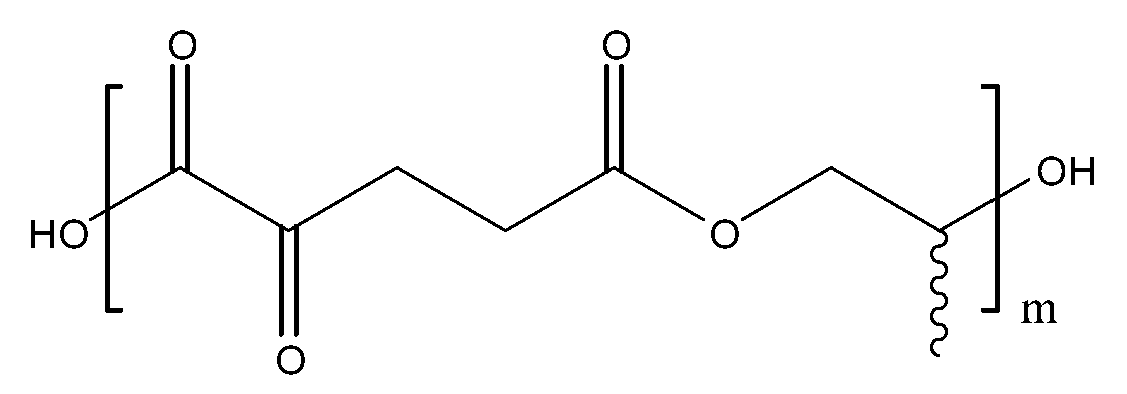
- polyester plasticizer comprising a plasticizer represented by the following Chemical Formula 1a or 1b or a combination thereof:
- plasticizers which are not petrochemically obtained but can be obtained from living organisms, and which are environmentally friendly and have a sufficient effect on processing properties for mechanical properties such as tensile strength and impact resistance of polymer resins as conventional plasticizers.
- polyester polymers prepared using alpha-ketoglutaric acid derived from living organisms as monomers, and confirmed that such polymers can improve mechanical properties such as durability, tensile strength and impact resistance of resins.
- the invention has been completed.
- the present invention provides a polyester plasticizer for resins represented by the following Chemical Formula 1:
- R is a linear or branched C 2 -C 20 alkylene, contains 0 or more oxygen as the ether structure in the middle of the carbon chain of the alkylene,
- n is an integer of 1-20.
- the compound of Formula 1 may have a structure of the polyester plasticizer according to one embodiment of the following formula 1a or 1b, a mixture thereof may be used as a plasticizer, but is not limited thereto.
- the present invention provides a polyester plasticizer comprising a compound represented by the following Chemical Formula 1a or 1b or a combination thereof:
- the polyester plasticizer according to the present invention can be used for any resin, but preferably can be applied as a plasticizer to biodegradable resins or general purpose resins.
- the biodegradable resin may be polylactic acid (poly-L-lactic acid (PLLA), poly-D-lactic acid (PDLA), stereocomplex-PLA (sc-PLA), polycaprolactone, polyglycolic acid, polycarbonate, and poly It may be one or more selected from the group consisting of butylsuccinate, but is not limited thereto.
- the universal resin may be one or more selected from the group consisting of polyvinyl chloride, polyethylene, polypropylene, acrylonitrile-butadiene-styrene resin (ABS resin), and polystyrene, but is not limited thereto.
- the polylactic acid (PLA) can be directly polycondensed lactic acid (WO 2013 / 184014A1), L-, D- and meso-types from l- and D-lactic acid as eco-friendly materials derived from living organisms.
- Lactide can be obtained and prepared from the lactide by a ring opening polymerization method (US 5,770,682 A).
- Each L-, D- and meso-type lactide has different thermal and physical properties depending on the isomer.
- L-lactide and D-lactide, which have high optical purity, have better thermal and physical properties than meso-type. Do. It is common to prepare and use each of PLLA and PDLA from L- and D-type lactide having high optical purity.
- the sc-PLA (stereo-complex) is prepared by melt-blending the PLLA and DLLA in a polymer resin state in which polymerization is completed, and has superior thermal and physical properties as compared with general PLLA and PDLA.
- the PLA is an environmentally friendly material derived from living organisms, but is applied to various materials.
- PLA has a problem of low thermal resistance due to thermal decomposition and weak flexibility after processing.
- the disadvantages of pyrolysis and the intermolecular force between the molecular chains are stronger, so there is a problem such as weakness and impact resistance.
- various resins including biodegradable resins and general purpose resins have unsuitable mechanical properties, and plasticizers are used to overcome these problems, and the polyester plasticizer according to Chemical Formula 1 of the present invention Mechanical properties can be improved.
- the polyester plasticizer according to the present invention when added to the resin, the polarity of the molecular chain of the resin is solvated by the polar portion of the plasticizer, thereby preventing the micro brown motion at low temperature while preventing the access between the molecular chains in three-dimensional structure. It is possible to give flexibility and elasticity at room temperature.
- the plasticizer according to the present invention is a polyester plasticizer including alpha-ketoglutaric acid as a monomer, and thus has one more ketone group per unit molecule in the main chain than the general polyester plasticizer, thereby increasing polarity.
- the plasticizer can be stably adsorbed in the main chain of the polymer resin to which the plasticizer is applied, and the mobility is imparted by the alkylene group, which is a nonpolar part of the plasticizer, to provide mechanical properties such as low flexibility and impact resistance of the polymer resin to which the plasticizer is applied. Can overcome the problem of physical properties.
- the plasticizer according to the present invention is an environmentally friendly plasticizer can be produced from the monomer alpha-ketoglutaric acid as a monomer, it has a great significance in that it can replace the phthalate-based plasticizer causing environmental hormone problems .
- the polyester plasticizer for the resin represented by Chemical Formula 1 may be prepared by a method including the step of reacting the polyester with alpha-ketoglutaric acid and R (OH) 2 , as shown in Scheme 1 below:
- composition of the mixed alcohol can be appropriately determined using self-known knowledge having ordinary knowledge in the field of organic chemistry.
- the reactant and the mixed alcohol may be put together in a reactor, and the temperature may be slowly increased, and the temperature may be maintained at the same time with stirring in the range of about 170-210 ° C., refluxed, and esterification may be performed.
- the esterification reaction may be terminated and cooled to prepare a polyester resin of the desired formula (1).
- Specific conditions of the polyester reaction are not limited to the above conditions, and can be appropriately determined by using a publicly known knowledge in the field of organic chemistry.
- the plasticizer according to the present invention can be prepared by using the alpha-ketoglutaric acid obtained from the organism as a monomer is environmentally friendly, low tensile strength and impact resistance of the polymer resin requiring the application of the plasticizer, etc.
- the mechanical properties of the can be sufficiently improved. Therefore, the phthalate-based plasticizer that causes the conventional environmental hormone problem is significant in that it can be replaced with an environmentally friendly plasticizer.
- Alpha-ketoglutaric acid 55.9% by weight
- 1,3-propanediol 36.1% by weight
- mixed alcohol 7.3% by weight
- a sample was prepared by blending 100 parts by weight of INGEO 2003D, a polylactic acid commercial product of NatureWorks LLC, and 10 to 20 parts by weight of the obtained polyester plasticizer.
- Alpha-ketoglutaric acid 55.1% by weight
- 1,2-propanediol 37.5% by weight
- mixed alcohol 7.5% by weight
- Alpha-ketoglutaric acid (56.2% by weight), 1,2-propanediol (35.7% by weight) and mixed alcohol (7.2% by weight) of the following composition are placed in a flask equipped with a condenser and slowly heated up at 170-210 ° C. The temperature was maintained at the same time with stirring in the range, refluxed and the esterification reaction was carried out.
- Polyester plasticizers containing adipic acid as monomers were prepared.
- Adipic acid (57.5% by weight), 1,3-propanediol (34.2% by weight) and mixed alcohol (7.1% by weight) of the following composition were placed in a flask equipped with a condenser and slowly heated up. At the same time, the temperature was maintained and refluxed to proceed with esterification.
- Polyester plasticizers were prepared using adipic acid as a monomer.
- Adipic acid (57.1 wt.%), 1,3-propanediol (34.3 wt.%) And mixed alcohol (7.2 wt.%) Of the following composition were placed in a flask equipped with a condenser and slowly warmed up. At the same time, the temperature was maintained and refluxed to proceed with esterification.
- Plasticizer was not used in TH-1000, a commercial PVC resin, Taiyo vinyl.
- the thermal properties of the glass transition temperature (Tg) and the melting point (Tm) of the samples prepared in Examples 1-3 and Comparative Examples 1-4 were measured according to the DSC ASTM D3418, 10 ° C / min method.
- the Tg value of the resin may be lowered to ensure flexibility, thereby improving stiffness, and the temperature of Tm. It was found that it can be lowered to ensure a commercial processing temperature to ensure the processability, it was confirmed that it can be useful in packaging applications.
- the plasticizer according to the present invention when the plasticizer according to the present invention is applied to the resin, the physical properties of the resin were improved to the same level as when the phthalate plasticizer having environmental hormones is applied.
Landscapes
- Chemical & Material Sciences (AREA)
- Organic Chemistry (AREA)
- Health & Medical Sciences (AREA)
- Chemical Kinetics & Catalysis (AREA)
- Medicinal Chemistry (AREA)
- Polymers & Plastics (AREA)
- Compositions Of Macromolecular Compounds (AREA)
- Organic Low-Molecular-Weight Compounds And Preparation Thereof (AREA)
- Biological Depolymerization Polymers (AREA)
- Polyesters Or Polycarbonates (AREA)
Abstract
Description




Claims (4)
- 하기 화학식 1로 표시되는 수지용 폴리에스테르계 가소제:[화학식 1]
 상기 화학식 1에서,R은 상기 화학식 1에서,R은 선형 또는 분지형의 C2-C20 알킬렌이고, 알킬렌의 탄소사슬 중간에 산소를 에테르 구조로서 0 개 이상 함유하고,m은 1 내지 20의 정수이다.
 - 하기 화학식 1a 또는 1b으로 표시되는 가소제, 또는 이들의 조합을 포함하는 폴리에스테르계 가소제:[화학식 1a]
 [화학식 1b]
 상기 화학식 1a 및 1b에서, m은 제1항에서의 정의와 같다.
 - 제1항 또는 제2항에 있어서, 상기 폴리에스테르계 가소제는 폴리유산(PLLA(poly-L-lactic acid), PDLA(poly-D-lactic acid), sc-PLA(stereocomplex-PLA)), 폴리카프로락톤, 폴리글리콜릭산, 폴리카보네이트 및 폴리부틸숙시네이트로 구성된 군에서 선택된 하나 이상의 생분해성 수지에 적용되는 것인 폴리에스테르계 가소제.
- 제1항 또는 제2항에 있어서, 상기 폴리에스테르계 가소제는 폴리비닐클로라이드, 폴리에틸렌, 폴리프로필렌, 아크릴로니트릴-부타디엔-스티렌 수지(ABS 수지), 및 폴리스티렌으로 구성된 군에서 선택된 하나 이상의 범용성 수지에 적용되는 것인 폴리에스테르계 가소제.
Priority Applications (4)
| Application Number | Priority Date | Filing Date | Title |
|---|---|---|---|
| CN201580021992.9A CN107108959B (zh) | 2014-04-24 | 2015-03-18 | 用于树脂的基于聚酯的增塑剂 |
| US15/305,862 US9725574B2 (en) | 2014-04-24 | 2015-03-18 | Polyester-based plasticizer for resin |
| JP2016564263A JP6486963B2 (ja) | 2014-04-24 | 2015-03-18 | 樹脂用ポリエステル系可塑剤 |
| EP15783628.9A EP3135721A4 (en) | 2014-04-24 | 2015-03-18 | Polyester-based plasticizer for resin |
Applications Claiming Priority (2)
| Application Number | Priority Date | Filing Date | Title |
|---|---|---|---|
| KR10-2014-0049555 | 2014-04-24 | ||
| KR20140049555 | 2014-04-24 |
Publications (2)
| Publication Number | Publication Date |
|---|---|
| WO2015163582A2 true WO2015163582A2 (ko) | 2015-10-29 |
| WO2015163582A3 WO2015163582A3 (ko) | 2017-06-22 |
Family
ID=54333386
Family Applications (1)
| Application Number | Title | Priority Date | Filing Date |
|---|---|---|---|
| PCT/KR2015/002599 Ceased WO2015163582A2 (ko) | 2014-04-24 | 2015-03-18 | 수지용 폴리에스테르계 가소제 |
Country Status (6)
| Country | Link |
|---|---|
| US (1) | US9725574B2 (ko) |
| EP (1) | EP3135721A4 (ko) |
| JP (1) | JP6486963B2 (ko) |
| KR (1) | KR101741697B1 (ko) |
| CN (1) | CN107108959B (ko) |
| WO (1) | WO2015163582A2 (ko) |
Families Citing this family (7)
| Publication number | Priority date | Publication date | Assignee | Title |
|---|---|---|---|---|
| US11427688B2 (en) * | 2017-04-17 | 2022-08-30 | Eastman Chemical Company | Copolyesters plasticized with polymeric plasticizer |
| WO2020232357A1 (en) * | 2019-05-16 | 2020-11-19 | Arizona Board Of Regents On Behalf Of Arizona State University | Metabolite delivery for modulating metabolic pathways of cells |
| WO2021142254A1 (en) * | 2020-01-08 | 2021-07-15 | Abhinav Acharya | Metabolite-based polymers, microparticles, and nanoparticles for immunotherapy and methods of treating a disease or disorder |
| EP3992227A1 (en) | 2020-07-20 | 2022-05-04 | Bio Bond ApS | Bio-based plasticiser for resins and blends containing said plasticiser |
| DE102020124314A1 (de) * | 2020-09-17 | 2022-03-17 | Heinrich-Heine-Universität Düsseldorf | Biologisch abbaubare Klebstoff-Zusammensetzung |
| CN116262815A (zh) * | 2021-12-15 | 2023-06-16 | 中国科学院大连化学物理研究所 | 一种聚酯树脂、骨组织工程支架及其制备方法 |
| CN115785595B (zh) * | 2022-11-28 | 2024-07-19 | 河源市普立隆新材料科技有限公司 | 一种基于无水增塑的聚乙烯醇熔融吹塑薄膜及其制备方法 |
Citations (2)
| Publication number | Priority date | Publication date | Assignee | Title |
|---|---|---|---|---|
| US5770682A (en) | 1995-07-25 | 1998-06-23 | Shimadzu Corporation | Method for producing polylactic acid |
| WO2013184014A1 (en) | 2012-06-06 | 2013-12-12 | Universidade De Coimbra | Process for preparing high molecular weight poly(lactic acid) by melt polycondensation |
Family Cites Families (11)
| Publication number | Priority date | Publication date | Assignee | Title |
|---|---|---|---|---|
| EP0051934B1 (en) * | 1980-11-07 | 1988-12-14 | Imperial Chemical Industries Plc | Anisotropic melt-forming polymers containing fumaric acid or substituted fumaric acid |
| JPH01104264A (ja) * | 1987-10-19 | 1989-04-21 | Terumo Corp | 医療用軟質樹脂組成物および医療用具 |
| US5247012A (en) * | 1989-12-08 | 1993-09-21 | The Geon Company | Glutaric acid based polyester internally plasticized PVC |
| JP2928892B2 (ja) * | 1990-11-27 | 1999-08-03 | 三洋化成工業株式会社 | 外科用接着剤 |
| DE69841061D1 (de) | 1997-10-31 | 2009-09-24 | Metabolix Inc | Verwendung von organischen Phosphon- oder Phosphinsäuren, oder von Metall-oxiden oder -hydroxiden, oder von Carbonsäuresalzen eines Metalls als Hitzestabilisatoren für Polyhydroxyalkanoate |
| JP2003038634A (ja) * | 2001-07-27 | 2003-02-12 | Sanyo Chem Ind Ltd | 外科用接着剤 |
| JP3421769B1 (ja) | 2002-04-02 | 2003-06-30 | 大八化学工業株式会社 | エステル化合物、生分解性脂肪族系ポリエステル樹脂用可塑剤及び生分解性樹脂組成物 |
| JP4071683B2 (ja) * | 2003-07-14 | 2008-04-02 | 第一工業製薬株式会社 | 可塑剤エマルション、その製造方法、及びこれを用いてなる生分解性樹脂組成物 |
| JP4463634B2 (ja) * | 2004-07-09 | 2010-05-19 | 花王株式会社 | 生分解性樹脂用可塑剤 |
| FR2927629B1 (fr) * | 2008-02-14 | 2011-07-29 | Bostik Sa | Composition adhesive thermofusible biodegradable. |
| AU2009295999B2 (en) * | 2008-09-29 | 2013-12-19 | Basf Se | Biodegradable polymer mixture |
-
2015
- 2015-03-18 WO PCT/KR2015/002599 patent/WO2015163582A2/ko not_active Ceased
- 2015-03-18 JP JP2016564263A patent/JP6486963B2/ja active Active
- 2015-03-18 EP EP15783628.9A patent/EP3135721A4/en not_active Withdrawn
- 2015-03-18 US US15/305,862 patent/US9725574B2/en active Active
- 2015-03-18 CN CN201580021992.9A patent/CN107108959B/zh active Active
- 2015-03-19 KR KR1020150038316A patent/KR101741697B1/ko active Active
Patent Citations (2)
| Publication number | Priority date | Publication date | Assignee | Title |
|---|---|---|---|---|
| US5770682A (en) | 1995-07-25 | 1998-06-23 | Shimadzu Corporation | Method for producing polylactic acid |
| WO2013184014A1 (en) | 2012-06-06 | 2013-12-12 | Universidade De Coimbra | Process for preparing high molecular weight poly(lactic acid) by melt polycondensation |
Non-Patent Citations (1)
| Title |
|---|
| See also references of EP3135721A4 |
Also Published As
| Publication number | Publication date |
|---|---|
| CN107108959A (zh) | 2017-08-29 |
| JP2017518401A (ja) | 2017-07-06 |
| US9725574B2 (en) | 2017-08-08 |
| JP6486963B2 (ja) | 2019-03-20 |
| CN107108959B (zh) | 2019-10-25 |
| KR20150123153A (ko) | 2015-11-03 |
| WO2015163582A3 (ko) | 2017-06-22 |
| KR101741697B1 (ko) | 2017-05-31 |
| EP3135721A4 (en) | 2018-07-11 |
| US20170066901A1 (en) | 2017-03-09 |
| EP3135721A2 (en) | 2017-03-01 |
Similar Documents
| Publication | Publication Date | Title |
|---|---|---|
| US9725574B2 (en) | Polyester-based plasticizer for resin | |
| JP5014908B2 (ja) | 結晶性ポリ乳酸樹脂組成物およびそれからなる成形体 | |
| JPH1072529A (ja) | ポリグリコール酸射出成形物及びその製造方法 | |
| WO2012144781A2 (ko) | 생분해성 고분자 복합재 | |
| WO2013073807A1 (ko) | 폴리유산 수지 및 공중합 폴리에스테르 수지 블렌드 및 이를 이용한 성형제품 | |
| WO2020197147A1 (ko) | 블록 공중합체 제조 방법 | |
| KR102365124B1 (ko) | 폴리알킬렌 카보네이트 수지 조성물 및 폴리알킬렌 카보네이트 수지 성형품 | |
| WO2004033528A1 (ja) | 高分子量脂肪族ポリエステル及びその製造方法 | |
| CN106574103B (zh) | 包括基于聚丙交酯的聚合物的组合物 | |
| WO2013073819A1 (ko) | 내충격성 및 내열성이 우수한 폴리유산 수지 및 공중합 폴리에스테르 수지 블렌드 및 이를 이용한 성형제품 | |
| JP5273646B2 (ja) | 難燃性ポリ乳酸系樹脂組成物およびそれを成形してなる成形体 | |
| EP3880733A1 (en) | Functional resin composition comprising biomass-derived component | |
| CN105531320B (zh) | 包含聚碳酸亚烃酯的树脂组合物 | |
| US20160130435A1 (en) | Thermoplastic resin composition and molded article made therefrom | |
| WO2020226200A1 (en) | Biodegradable copolyester resin produced by esterification and polycondensation of biomass-derived aliphatic dicarboxylic acid and aromatic dicarboxylic acid with diol and production method thereof | |
| WO2015108254A1 (ko) | 빠른 결정화 속도를 갖는 폴리유산-폴리알킬렌글리콜 공중합체 및 이를 포함하는 조성물 | |
| WO2013073818A1 (ko) | 내충격성 및 내열성이 우수한 폴리유산 수지 및 공중합 폴리에스테르 수지 블렌드 및 이를 이용한 성형제품 | |
| CN121219360A (zh) | 树脂组合物 | |
| WO2023172085A1 (ko) | 생분해성 필름 | |
| WO2020197148A1 (ko) | 트리블록 공중합체 및 이의 제조 방법 | |
| KR101362689B1 (ko) | 생분해성 수지 조성물용 나이트라일계 가소제 | |
| KR20210116070A (ko) | 폴리아미드 11 기반의 엘라스토머를 함유하는 강인화 pla 조성물 및 이의 제조방법 | |
| WO2023182686A1 (ko) | 결정화도가 우수한 폴리락타이드 수지 조성물, 및 이의 제조 방법 | |
| JP2019131720A (ja) | 可塑剤及びそれを含む樹脂組成物 | |
| WO2023182687A1 (ko) | 결정화 반감기가 우수한 폴리락타이드 수지 조성물, 및 이의 제조 방법 |
Legal Events
| Date | Code | Title | Description |
|---|---|---|---|
| 121 | Ep: the epo has been informed by wipo that ep was designated in this application |
Ref document number: 15783628 Country of ref document: EP Kind code of ref document: A2 |
|
| ENP | Entry into the national phase |
Ref document number: 2016564263 Country of ref document: JP Kind code of ref document: A |
|
| NENP | Non-entry into the national phase |
Ref country code: DE |
|
| REEP | Request for entry into the european phase |
Ref document number: 2015783628 Country of ref document: EP |
|
| WWE | Wipo information: entry into national phase |
Ref document number: 2015783628 Country of ref document: EP |
|
| WWE | Wipo information: entry into national phase |
Ref document number: 15305862 Country of ref document: US |