WO2015166951A1 - ポリカーボネート樹脂組成物、ならびにそれを用いた光学材料および光学レンズ - Google Patents
ポリカーボネート樹脂組成物、ならびにそれを用いた光学材料および光学レンズ Download PDFInfo
- Publication number
- WO2015166951A1 WO2015166951A1 PCT/JP2015/062842 JP2015062842W WO2015166951A1 WO 2015166951 A1 WO2015166951 A1 WO 2015166951A1 JP 2015062842 W JP2015062842 W JP 2015062842W WO 2015166951 A1 WO2015166951 A1 WO 2015166951A1
- Authority
- WO
- WIPO (PCT)
- Prior art keywords
- polycarbonate resin
- resin composition
- carbon atoms
- structural unit
- group
- Prior art date
- Legal status (The legal status is an assumption and is not a legal conclusion. Google has not performed a legal analysis and makes no representation as to the accuracy of the status listed.)
- Ceased
Links
Classifications
-
- C—CHEMISTRY; METALLURGY
- C08—ORGANIC MACROMOLECULAR COMPOUNDS; THEIR PREPARATION OR CHEMICAL WORKING-UP; COMPOSITIONS BASED THEREON
- C08G—MACROMOLECULAR COMPOUNDS OBTAINED OTHERWISE THAN BY REACTIONS ONLY INVOLVING UNSATURATED CARBON-TO-CARBON BONDS
- C08G64/00—Macromolecular compounds obtained by reactions forming a carbonic ester link in the main chain of the macromolecule
- C08G64/04—Aromatic polycarbonates
- C08G64/06—Aromatic polycarbonates not containing aliphatic unsaturation
-
- C—CHEMISTRY; METALLURGY
- C08—ORGANIC MACROMOLECULAR COMPOUNDS; THEIR PREPARATION OR CHEMICAL WORKING-UP; COMPOSITIONS BASED THEREON
- C08L—COMPOSITIONS OF MACROMOLECULAR COMPOUNDS
- C08L69/00—Compositions of polycarbonates; Compositions of derivatives of polycarbonates
-
- G—PHYSICS
- G02—OPTICS
- G02B—OPTICAL ELEMENTS, SYSTEMS OR APPARATUS
- G02B1/00—Optical elements characterised by the material of which they are made; Optical coatings for optical elements
- G02B1/04—Optical elements characterised by the material of which they are made; Optical coatings for optical elements made of organic materials, e.g. plastics
-
- G—PHYSICS
- G02—OPTICS
- G02B—OPTICAL ELEMENTS, SYSTEMS OR APPARATUS
- G02B1/00—Optical elements characterised by the material of which they are made; Optical coatings for optical elements
- G02B1/04—Optical elements characterised by the material of which they are made; Optical coatings for optical elements made of organic materials, e.g. plastics
- G02B1/041—Lenses
-
- C—CHEMISTRY; METALLURGY
- C08—ORGANIC MACROMOLECULAR COMPOUNDS; THEIR PREPARATION OR CHEMICAL WORKING-UP; COMPOSITIONS BASED THEREON
- C08L—COMPOSITIONS OF MACROMOLECULAR COMPOUNDS
- C08L2201/00—Properties
- C08L2201/10—Transparent films; Clear coatings; Transparent materials
-
- C—CHEMISTRY; METALLURGY
- C08—ORGANIC MACROMOLECULAR COMPOUNDS; THEIR PREPARATION OR CHEMICAL WORKING-UP; COMPOSITIONS BASED THEREON
- C08L—COMPOSITIONS OF MACROMOLECULAR COMPOUNDS
- C08L2205/00—Polymer mixtures characterised by other features
- C08L2205/02—Polymer mixtures characterised by other features containing two or more polymers of the same C08L -group
-
- C—CHEMISTRY; METALLURGY
- C08—ORGANIC MACROMOLECULAR COMPOUNDS; THEIR PREPARATION OR CHEMICAL WORKING-UP; COMPOSITIONS BASED THEREON
- C08L—COMPOSITIONS OF MACROMOLECULAR COMPOUNDS
- C08L2205/00—Polymer mixtures characterised by other features
- C08L2205/02—Polymer mixtures characterised by other features containing two or more polymers of the same C08L -group
- C08L2205/025—Polymer mixtures characterised by other features containing two or more polymers of the same C08L -group containing two or more polymers of the same hierarchy C08L, and differing only in parameters such as density, comonomer content, molecular weight, structure
Definitions
- the present invention relates to a polycarbonate resin composition and an optical molded body comprising the same. More specifically, the present invention relates to a polycarbonate resin composition having high refractive index and transparency and low optical distortion, and an optical material and an optical lens using the same.
- Optical lenses are used in various places such as optical systems of various cameras such as cameras, film-integrated cameras, and video cameras as well as glasses.
- the important physical properties of this lens material include refractive index (nD) and Abbe number ( ⁇ ).
- nD refractive index
- ⁇ Abbe number
- the lens element can be realized with a surface with a smaller curvature, so that the amount of aberration generated on this surface can be reduced, the number of lenses can be reduced, and the lens There is an advantage that the lens system can be reduced in size and weight by reducing the decentration sensitivity and the lens thickness.
- Optical glass and optical transparent resins are widely used as lens materials.
- An optical transparent resin has an advantage that an aspherical lens can be manufactured by injection molding and mass production is possible.
- Injection molding is a method in which a plastic is heated and softened, injection pressure is applied, the mold is pressed into a mold, filled in the mold, molded, and the molded product is taken out after waiting for the resin to cool.
- the fluidity of the resin improves as the temperature at which the resin is softened increases, the temperature at which the resin is softened is limited because the resin is easily decomposed and colored.
- the mold temperature is kept constant, but the general-purpose mold temperature controller uses pressurized water as the heating medium, so the upper limit of the mold temperature is about 150 ° C. Is the limit.
- the upper limit of the glass transition temperature of the resin that can be used is limited to about 160 ° C.
- Polycarbonate resin made of bisphenol A is widely used for optical lens applications, but further improvement in refractive index is required due to the expansion of optical lens applications. Moreover, since the polycarbonate resin which consists of bisphenol A has the weak point that birefringence is large, a use has restrictions. For this reason, resin for optical lenses having both a high refractive index and low birefringence has been widely developed.
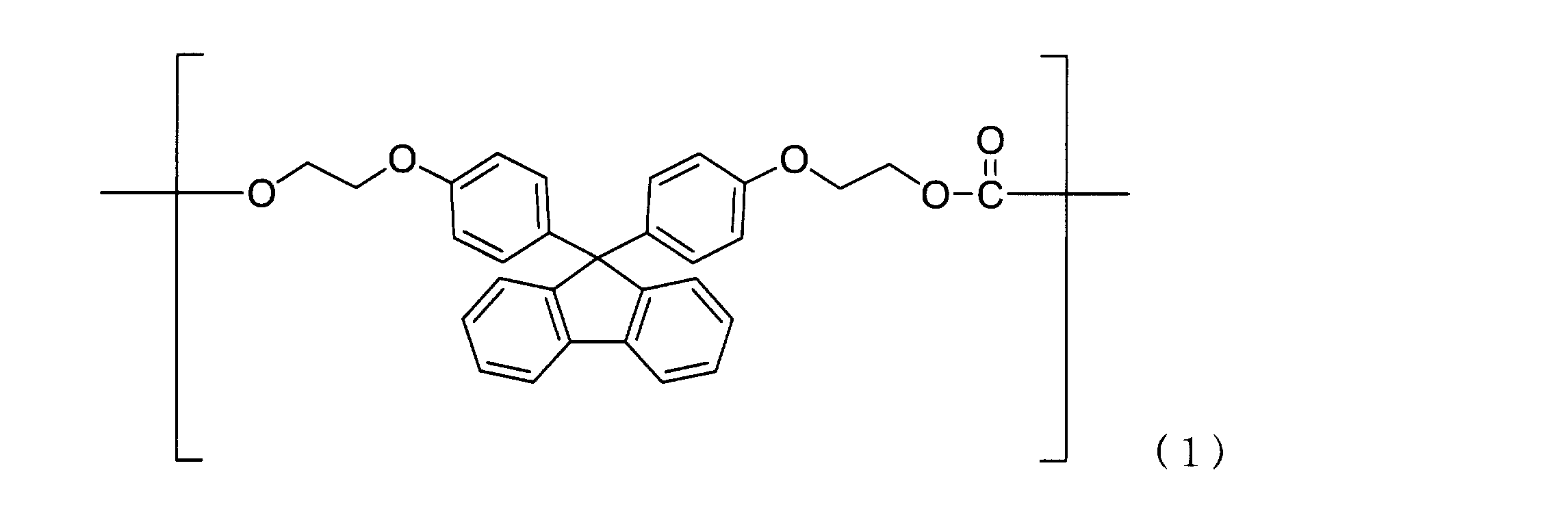
- Patent Document 1 discloses that a copolymer with a structural unit represented by the formula (1) has an improved refractive index.
- Patent Document 2 discloses a copolymer of polycarbonate resin containing a structural unit having a fluorene structure and bisphenol A.
- the structural unit currently disclosed by this literature differs from Formula (1).
- Patent Document 3 discloses a copolymer obtained by replacing bisphenol A-type polycarbonate or aromatic polycarbonate resin with the formula (2). However, although this resin composition has a high refractive index, it is described that the glass transition point exceeds 160 ° C.
- Polycarbonate resins made of bisphenol A are widely used for optical lens applications, but have limited applications because of their weak point of high birefringence. Particularly in recent mobile phone cameras and digital camera applications, as the resolution is increased by increasing the number of pixels, there is a demand for a low birefringence camera lens with high imaging performance.
- Patent Document 1 As a method for realizing low birefringence of a resin material, there is a method in which compositions having positive and negative birefringences having different signs cancel each other's birefringence (Patent Document 1).
- the sign of birefringence is determined by the difference between the polarizability in the polymer main chain direction and the polarizability in the polymer side chain direction.
- a polycarbonate resin made of bisphenol A in which the polarizability in the polymer main chain direction is greater than the polarizability in the polymer side chain direction has a positive birefringence, and the polarizability in the polymer side chain direction is greater.
- a polycarbonate resin made of bisphenol having a fluorene structure has negative birefringence. Therefore, a low refractive index is achieved by a copolymer obtained by combining these structural units having birefringence with different signs.
- Patent Documents 4 to 7 disclose polycarbonate resins having a 1,1′-binaphthalene structure, but these do not have a structural unit represented by the following formula (3).
- the polymer containing the structural unit shown by Formula (3) is described in patent document 6 and patent document 7, these are polyester carbonate resins instead of polycarbonate resin.
- X is an alkylene group having 1 to 4 carbon atoms.
- a polycarbonate resin composition and an optical molded body that have a high refractive index and a fluidity suitable for molding and that are low in birefringence and hardly cause optical distortion have not yet been provided.
- the problem to be solved by the present invention is to provide a polycarbonate resin composition having a high refractive index and fluidity suitable for molding, low birefringence, and hardly causing optical distortion.
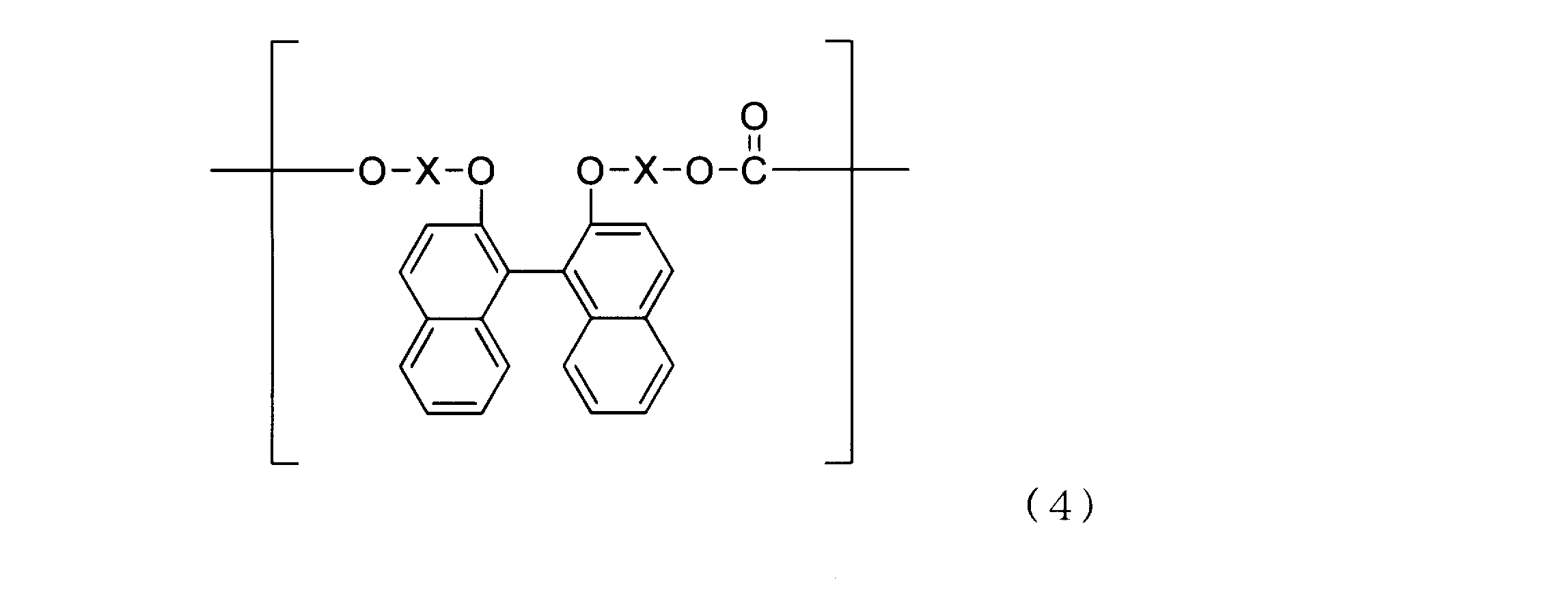
- the present inventors have made a polycarbonate resin (A) having a structural unit of the general formula (4) and a polycarbonate resin (B) having a structural unit of the general formula (5).
- the present inventors have found that the above-mentioned problems can be solved by a polycarbonate resin composition containing). That is, the present invention is as follows.
- a polycarbonate resin composition comprising a polycarbonate resin (A) having a structural unit (a) represented by the general formula (4) and a polycarbonate resin (B) having a structural unit (b) represented by the general formula (5).
- X is an alkylene group having 1 to 4 carbon atoms.
- R 1 and R 2 are each independently a hydrogen atom, an alkyl group having 1 to 20 carbon atoms, an alkoxyl group having 1 to 20 carbon atoms, a cycloalkyl group having 5 to 20 carbon atoms, or a carbon number.
- a 5- to 20-cycloalkoxyl group, an aryl group having 6 to 20 carbon atoms or an aryloxy group having 6 to 20 carbon atoms, and Y is an alkylene group having 1 to 4 carbon atoms.
- the polycarbonate resin (A) is the polycarbonate resin composition according to ⁇ 1>, wherein the proportion of the structural units other than the structural unit (a) is 20 mol% or less of the structural unit (a).
- the polycarbonate resin (B) is the polycarbonate resin composition according to ⁇ 1> or ⁇ 2>, wherein the proportion of the structural unit other than the structural unit (b) is 20 mol% or less of the structural unit (b).
- ⁇ 4> The polycarbonate resin composition according to any one of ⁇ 1> to ⁇ 3>, wherein the mass ratio (A: B) of the polycarbonate resin (A) and the polycarbonate resin (B) is 25:75 to 90:10.
- the polycarbonate resin (A) contains a homopolymer composed of the structural unit (a), and the polycarbonate resin (B) contains a homopolymer composed of the structural unit (b) ⁇ 1> to ⁇ 4 >
- the polycarbonate resin composition according to any one of the above.
- polycarbonate resin (A) is composed of a homopolymer composed of the structural unit (a)
- polycarbonate resin (B) is composed of a homopolymer composed of the structural unit (b).
- the polycarbonate resin composition as described.
- Polycarbonate resin (A) has a polystyrene equivalent average molecular weight (Mw) of 20,000 to 300,000, and polycarbonate resin (B) has a polystyrene equivalent average molecular weight (Mw) of 15,000 to 250,000 ⁇ 1>
- the polycarbonate resin composition according to any one of to ⁇ 8>.
- the polycarbonate resin composition of the present invention exhibits high refractive index, low Abbe number, high transparency, high glass transition temperature (heat resistance), and low birefringence. Using this resin as a raw material, an excellent high refractive index optical lens having substantially no optical distortion can be obtained. Further, the optical lens of the present invention can be injection-molded, and is highly productive and inexpensive.
- polycarbonate resin (A) contains the structural unit (a) represented by the general formula (4). That is, polycarbonate resin (A) consists of a polymer containing the structural unit (a) of General formula (4). Polycarbonate resin (A) may contain the structural unit of General formula (4) individually by 1 type, and may contain it in combination of 2 or more types.
- the repeating structural unit of the polycarbonate resin (A) may include a structural unit other than the structural unit (a) represented by the general formula (4), but the proportion of the structural unit other than the structural unit (a) is the general formula (4). ) Is preferably 20 mol% or less, more preferably 10 mol% or less, and still more preferably 0 mol% with respect to 100 mol% of the structural unit (a). Within this range, a high refractive index is maintained.
- the polycarbonate resin (A) is composed of a homopolymer composed of the structural unit of the general formula (4).
- the polystyrene-converted average molecular weight Mw of the polycarbonate resin (A) is preferably 20,000 to 300,000, more preferably 20,000 to 200,000, still more preferably 25,000 to 120,000, and 25,000 to 50,000. 000 is particularly preferred. If Mw is smaller than 20,000, the resin becomes brittle, which is not preferable. If Mw is greater than 300,000, the melt viscosity will be high, and it will be difficult to remove the resin after production, and it will be difficult to handle in the molten state due to poor fluidity.
- the method for producing the polycarbonate resin (A) is not particularly limited.
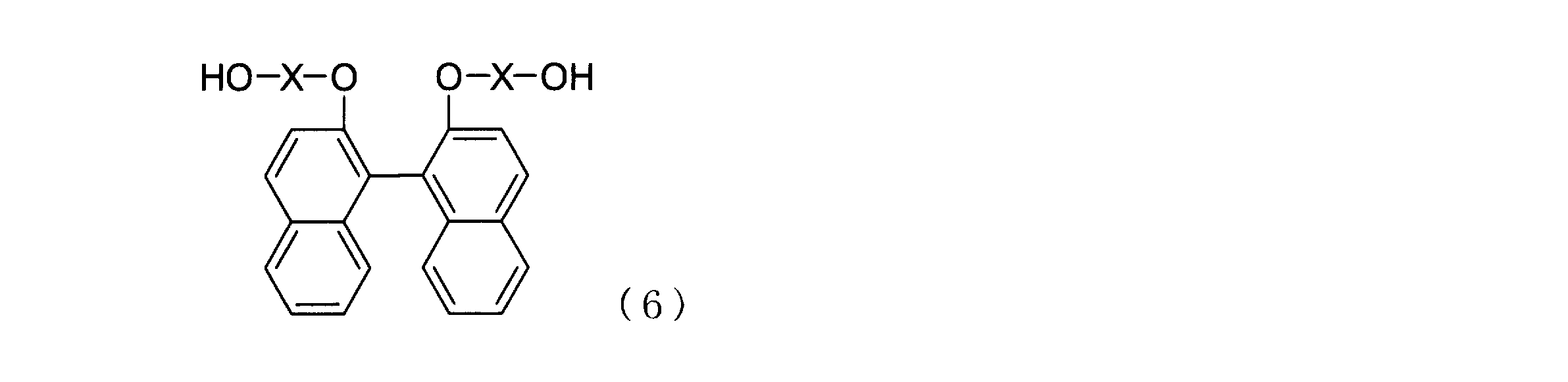
- the dihydroxy compound represented by the general formula (6) can be produced by a melt polycondensation method in the presence of a carbonic acid diester and a catalyst.
- a catalyst a basic compound catalyst, a transesterification catalyst, or a mixed catalyst composed of both can be used.
- X is an alkylene group having 1 to 4 carbon atoms.
- dihydroxy compound represented by the formula (6) 2,2′-bis (1-hydroxymethoxy) -1,1′-binaphthalene, 2,2′-bis (2-hydroxyethoxy) -1,1′- Binaphthalene, 2,2′-bis (3-hydroxypropyloxy) -1,1′-binaphthalene, 2,2′-bis (4-hydroxybutoxy) -1,1′-binaphthalene can be mentioned.
- a dihydroxy compound is preferable because it can be melt-polymerized by a general production process. In general, the greater the number of carbon atoms in X in formula (6), the lower the melt viscosity and the better the toughness and moldability.
- a compound in which X in the formula (6) is an alkylene group having 2 or more carbon atoms is more preferable from the viewpoint of excellent toughness and moldability.
- a compound in which X in formula (6) is an alkylene group having 3 or less carbon atoms is more preferable from the viewpoint of heat resistance. From the viewpoint of achieving both excellent moldability and heat resistance, a compound in which X in Formula (6) has 2 to 3 carbon atoms is more preferable.
- a compound in which X is an ethylene group having 2 carbon atoms in the formula (6), that is, 2,2′-bis (2-hydroxyethoxy), is excellent in terms of refractive index, monomer production and distribution.
- X is an ethylene group having 2 carbon atoms in the formula (6), that is, 2,2′-bis (2-hydroxyethoxy
- the polycarbonate resin (A) includes a structural unit in which X is an ethylene group in the general formula (4). These may be used alone or in combination of two or more.
- the polycarbonate resin (A) of the present invention may contain structural units derived from other dihydroxy compounds other than the dihydroxy compound of the general formula (6).
- the other dihydroxy compounds include ethylene glycol, 1,3- Aliphatic dihydroxy such as propanediol, 1,2-propanediol, 1,4-butanediol, 1,3-butanediol, 1,2-butanediol, 1,5-heptanediol, 1,6-hexanediol Compound, 1,2-cyclohexanedimethanol, 1,3-cyclohexanedimethanol, 1,4-cyclohexanedimethanol, tricyclodecane dimethanol, pentacyclopentadecanedimethanol, 2,6-decalin dimethanol, 1,5- Decalin dimethanol, 2,3-decalin dimethano , 2,3-norbornane dimethanol, 2,5-norbornane dimethanol, 1,3-adamantane dimethanol
- the other dihydroxy compound is preferably 20 mol% or less, and more preferably 10 mol% or less with respect to 100 mol% of the dihydroxy compound of the general formula (6). Within this range, a high refractive index is maintained.
- Examples of the carbonic acid diester include diphenyl carbonate, ditolyl carbonate, bis (chlorophenyl) carbonate, m-cresyl carbonate, dimethyl carbonate, diethyl carbonate, dibutyl carbonate, and dicyclohexyl carbonate. Of these, diphenyl carbonate is particularly preferred. Diphenyl carbonate is preferably used in a ratio of 0.90 to 1.15 mol, more preferably 0.95 to 1.10 mol, relative to 1 mol of the dihydroxy compound.
- Examples of the basic compound catalyst include alkali metal compounds and / or alkaline earth metal compounds, nitrogen-containing compounds, and the like.
- alkali metal compound examples include organic acid salts, inorganic salts, oxides, hydroxides, hydrides, and alkoxides of alkali metals.
- alkaline earth metal compound examples include organic acid salts, inorganic salts, oxides, hydroxides, hydrides or alkoxides of alkaline earth metal compounds.
- nitrogen-containing compound examples include quaternary ammonium hydroxide and salts thereof, amines and the like. Specifically, quaternary having alkyl, aryl, group, etc., such as tetramethylammonium hydroxide, tetraethylammonium hydroxide, tetrapropylammonium hydroxide, tetrabutylammonium hydroxide, trimethylbenzylammonium hydroxide, etc.
- Ammonium hydroxides such as triethylamine, dimethylbenzylamine, triphenylamine, secondary amines such as diethylamine and dibutylamine, primary amines such as propylamine and butylamine, 2-methylimidazole, 2- Imidazoles such as phenylimidazole and benzimidazole, or ammonia, tetramethylammonium borohydride, tetrabutylammonium borohydride, tetrabutyl Nmo tetraphenylborate, basic or basic salts such as tetraphenyl ammonium tetraphenylborate, or the like is used.
- zinc, tin, zirconium and lead salts are preferably used, and these can be used alone or in combination.
- zinc acetate, zinc benzoate, zinc 2-ethylhexanoate, tin (II) chloride, tin (IV) chloride, tin (II) acetate, tin (IV) acetate, dibutyltin dilaurate, dibutyltin oxide, dibutyltin Dimethoxide, zirconium acetylacetonate, zirconium oxyacetate, zirconium tetrabutoxide, lead (II) acetate, lead (IV) acetate and the like are used.
- These catalysts are used in a ratio of 1 ⁇ 10 ⁇ 9 to 1 ⁇ 10 ⁇ 3 mol, preferably 1 ⁇ 10 ⁇ 7 to 1 ⁇ 10 ⁇ 4 mol, relative to a total of 1 mol of the dihydroxy compound. .
- the melt polycondensation method is a method in which melt polycondensation is performed using the above-described raw materials and catalyst while removing by-products by a transesterification reaction under heating at normal pressure or reduced pressure.
- the reaction is generally carried out in a multistage process of two or more stages.
- the compound represented by the general formula (6) and the carbonic acid diester are melted in a reaction vessel and then retained without distilling off the by-product monohydroxy compound, A reaction may be performed.
- the reaction time in a state where the monohydroxy compound produced as a by-product is not distilled off is 20 minutes or more and 240 minutes or less, preferably 40 minutes or more and 180 minutes or less, particularly preferably 60 minutes or more and 150 minutes or less. It is. At this time, if the by-product monohydroxy compound is distilled off immediately after production, the polycarbonate resin finally obtained has a low content of high molecular weight.
- the above reaction time is only an example, and the preferred reaction time can vary depending on the reaction scale.
- Such a reaction may be carried out continuously or batchwise.
- the reactor used can be a vertical type equipped with a vertical stirring blade, max blend stirring blade, helical ribbon type stirring blade, etc., or a horizontal type equipped with paddle blades, lattice blades, glasses blades, etc. Extruder types equipped with the above may be used, or these may be used in appropriate combination in consideration of the viscosity of the polymer.
- the catalyst In the production method of polycarbonate resin, it is preferable to use the catalyst without deactivating it. However, if necessary, the catalyst may be removed or deactivated after the polymerization reaction in order to maintain thermal stability and hydrolysis stability.
- a method of deactivating the catalyst by adding a known acidic substance can be preferably carried out.
- the acidic substance include esters such as butyl benzoate; aromatic sulfonic acids such as p-toluenesulfonic acid; aromatic sulfonic acid esters such as butyl p-toluenesulfonate and hexyl p-toluenesulfonate.
- Phosphoric acids such as phosphorous acid, phosphoric acid, phosphonic acid; triphenyl phosphite, monophenyl phosphite, diphenyl phosphite, diethyl phosphite, di-n-propyl phosphite, diphosphorous acid Phosphorous esters such as n-butyl, di-n-hexyl phosphite, dioctyl phosphite, monooctyl phosphite; triphenyl phosphate, diphenyl phosphate, monophenyl phosphate, dibutyl phosphate, phosphoric acid Phosphate esters such as dioctyl and monooctyl phosphate; Phosphonic acids such as diphenylphosphonic acid, dioctylphosphonic acid and dibutylphosphonic acid Phosphonates such as diethyl phenylphosphonate; pho
- deactivators are preferably used. Is more preferable. These deactivators are used in an amount of 0.01 to 50 times mol, preferably 0.3 to 20 times mol for the amount of catalyst. When the amount is less than 0.01 times the amount of the catalyst, the deactivation effect is insufficient, which is not preferable. Moreover, when it is more than 50 times mole with respect to the amount of catalyst, since the heat resistance of resin falls and it becomes easy to color a molded object, it is unpreferable.
- a step of devolatilizing and removing the low boiling point compound in the polymer at a pressure of 0.1 to 1 mmHg and a temperature of 200 to 350 ° C. may be provided.
- a horizontal apparatus equipped with a stirring blade having excellent surface renewability, such as a paddle blade, a lattice blade, or a glasses blade, or a thin film evaporator is preferably used.
- the polycarbonate resin is desired to have as little foreign matter content as possible, and filtration of the molten raw material, filtration of the catalyst solution, and the like are suitably performed.
- the filter mesh is preferably 5 ⁇ m or less, more preferably 1 ⁇ m or less.
- generate is implemented suitably.
- the mesh of the polymer filter is preferably 100 ⁇ m or less, more preferably 30 ⁇ m or less.
- the step of collecting the resin pellets must be a low dust environment, and is preferably class 6 or less, more preferably class 5 or less.
- the polycarbonate resin (B) includes the structural unit (b) represented by the general formula (5). That is, polycarbonate resin (B) consists of a polymer containing the structural unit (b) of General formula (5). Polycarbonate resin (B) may contain the structural unit of General formula (5) individually by 1 type, and may contain it in combination of 2 or more type.
- the repeating structural unit of the polycarbonate resin (B) may include a structural unit other than the structural unit (b) represented by the general formula (5), but the proportion of the structural unit other than the structural unit (b) is represented by the general formula ( 5 mol% or less is desirable with respect to 100 mol% of the structural unit (b) represented by 5), 10 mol% or less is more desirable, and 0 mol% is even more desirable. Within this range, a high refractive index is maintained.
- the polycarbonate resin (B) is composed of a homopolymer composed of the structural unit of the general formula (5).
- the polyester carbonate resin having an ester bond (— (C ⁇ O) —O—) in addition to the carbonate bond is not included in the polycarbonate resin (B) in the present invention. Since the polycarbonate resin (B) does not have a hydrolyzable ester bond, it can achieve low water absorption and low birefringence as compared with the polyester carbonate resin.
- the polystyrene-converted average molecular weight Mw of the polycarbonate resin (B) is preferably 15,000 to 250,000, more preferably 20,000 to 200,000, still more preferably 20,000 to 120,000, and 20,000 to 45,000. 000 is particularly preferred.
- Mw is smaller than 20000, the resin may become brittle, which is not preferable. If Mw is larger than 200,000, the melt viscosity becomes high, so that it is difficult to remove the resin after production, and further, the fluidity becomes worse and it becomes difficult to handle in the molten state, which is not preferable.
- the method for producing the polycarbonate resin (B) is not particularly limited.
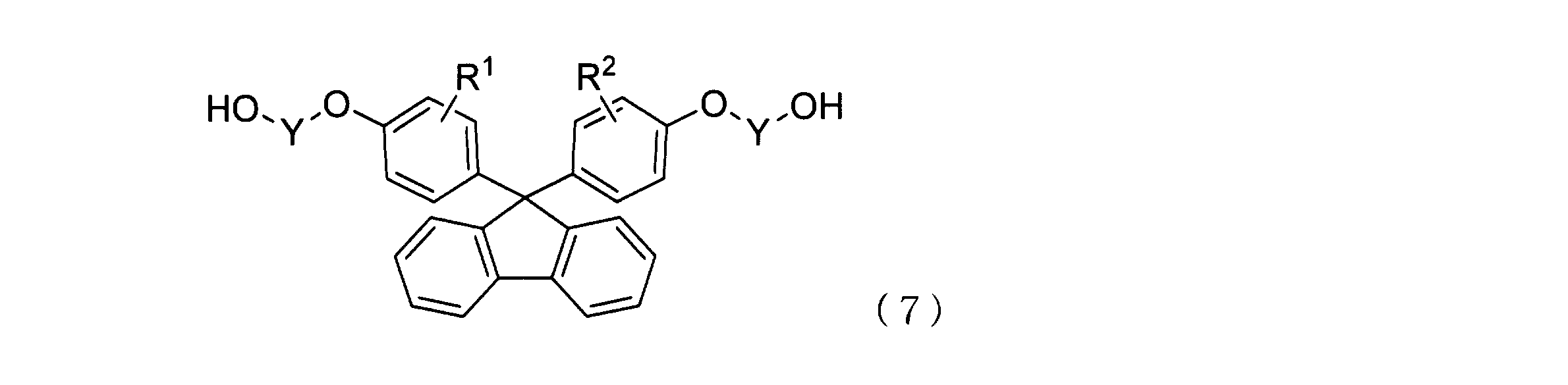
- the dihydroxy compound represented by the general formula (7) can be produced by a melt polycondensation method in the presence of a carbonic acid diester and a catalyst.
- a catalyst a basic compound catalyst, a transesterification catalyst, or a mixed catalyst composed of both can be used.
- R 1 and R 2 are each independently a hydrogen atom, an alkyl group having 1 to 20 carbon atoms, an alkoxyl group having 1 to 20 carbon atoms, a cycloalkyl group having 5 to 20 carbon atoms, or a carbon number.
- a 5- to 20-cycloalkoxyl group, an aryl group having 6 to 20 carbon atoms or an aryloxy group having 6 to 20 carbon atoms, and Y is an alkylene group having 1 to 4 carbon atoms.
- the dihydroxy compound is preferably a compound in which R 1 and R 2 are hydrogen atoms in the general formula (7) because the melt fluidity when molded as an optical lens is good.
- the polycarbonate resin (B) Includes a structural unit in which R 1 and R 2 in the general formula (5) are hydrogen atoms.
- Y in the formula (7) is preferably a compound which is an alkylene group having 2 or more carbon atoms because the larger the carbon number, the lower the melt viscosity and the toughness and moldability are improved.
- Y in formula (7) is preferably an alkylene group having 3 or less carbon atoms from the viewpoint of heat resistance. From the viewpoint of achieving both excellent moldability and heat resistance, Y in the formula (7) preferably has 2 to 3 carbon atoms, and particularly excellent in refractive index, monomer production and distribution.
- Y is preferably an ethylene group having 2 carbon atoms.
- 9,9-bis (4- (2-hydroxyethoxy) phenyl) fluorene 9,9-bis (4- (2-hydroxyethoxy) -3-methylphenyl) Fluorene, 9,9-bis (4- (2-hydroxyethoxy) -3-tert-butylphenyl) fluorene, 9,9-bis (4- (2-hydroxyethoxy) -3-isopropylphenyl) fluorene, 9, Examples thereof include 9-bis (4- (2-hydroxyethoxy) -3-cyclohexylphenyl) fluorene, 9,9-bis (4- (2-hydroxyethoxy) -3-phenylphenyl) fluorene, and the like. Of these, 9,9-bis (4- (2-hydroxyethoxy) phenyl) fluorene is preferred. You may use these individually or in combination of 2 or more types.
- the polycarbonate resin (B) of the present invention may contain structural units derived from other dihydroxy compounds other than the dihydroxy compound of the general formula (7).
- the other dihydroxy compounds include ethylene glycol, 1,3- Aliphatic dihydroxy such as propanediol, 1,2-propanediol, 1,4-butanediol, 1,3-butanediol, 1,2-butanediol, 1,5-heptanediol, 1,6-hexanediol Compound, 1,2-cyclohexanedimethanol, 1,3-cyclohexanedimethanol, 1,4-cyclohexanedimethanol, tricyclodecane dimethanol, pentacyclopentadecanedimethanol, 2,6-decalin dimethanol, 1,5- Decalin dimethanol, 2,3-decalin dimethano , 2,3-norbornane dimethanol, 2,5-norbornane dimethanol, 1,3-adamantane dimethanol
- the other dihydroxy compound is preferably 20 mol% or less, more preferably 10 mol% or less, relative to 100 mol% of the dihydroxy compound of the general formula (7). Within this range, a high refractive index is maintained.
- Examples of the carbonic acid diester include diphenyl carbonate, ditolyl carbonate, bis (chlorophenyl) carbonate, m-cresyl carbonate, dimethyl carbonate, diethyl carbonate, dibutyl carbonate, and dicyclohexyl carbonate. Of these, diphenyl carbonate is particularly preferred. Diphenyl carbonate is preferably used in a ratio of 0.90 to 1.15 mol, more preferably 0.95 to 1.10 mol, relative to 1 mol of the dihydroxy compound.
- Examples of the basic compound catalyst include alkali metal compounds and / or alkaline earth metal compounds, nitrogen-containing compounds, and the like.
- alkali metal compound examples include organic acid salts, inorganic salts, oxides, hydroxides, hydrides, and alkoxides of alkali metals.
- alkaline earth metal compound examples include organic acid salts, inorganic salts, oxides, hydroxides, hydrides or alkoxides of alkaline earth metal compounds.
- nitrogen-containing compound examples include quaternary ammonium hydroxide and salts thereof, amines and the like. Specifically, quaternary having alkyl, aryl, group, etc., such as tetramethylammonium hydroxide, tetraethylammonium hydroxide, tetrapropylammonium hydroxide, tetrabutylammonium hydroxide, trimethylbenzylammonium hydroxide, etc.
- Ammonium hydroxides such as triethylamine, dimethylbenzylamine, triphenylamine, secondary amines such as diethylamine and dibutylamine, primary amines such as propylamine and butylamine, 2-methylimidazole, 2- Imidazoles such as phenylimidazole and benzimidazole, or ammonia, tetramethylammonium borohydride, tetrabutylammonium borohydride, tetrabutyl Nmo tetraphenylborate, basic or basic salts such as tetraphenyl ammonium tetraphenylborate, or the like is used.
- zinc, tin, zirconium and lead salts are preferably used, and these can be used alone or in combination.
- zinc acetate, zinc benzoate, zinc 2-ethylhexanoate, tin (II) chloride, tin (IV) chloride, tin (II) acetate, tin (IV) acetate, dibutyltin dilaurate, dibutyltin oxide, dibutyltin Dimethoxide, zirconium acetylacetonate, zirconium oxyacetate, zirconium tetrabutoxide, lead (II) acetate, lead (IV) acetate and the like are used.
- These catalysts are used in a ratio of 1 ⁇ 10 ⁇ 9 to 1 ⁇ 10 ⁇ 3 mol, preferably 1 ⁇ 10 ⁇ 7 to 1 ⁇ 10 ⁇ 4 mol, relative to a total of 1 mol of the dihydroxy compound. .
- the melt polycondensation method is a method in which melt polycondensation is performed using the above-described raw materials and catalyst while removing by-products by a transesterification reaction under heating at normal pressure or reduced pressure.
- the reaction is generally carried out in a multistage process of two or more stages.
- the compound represented by the general formula (7) and the carbonic acid diester are melted in a reaction vessel and then retained without distilling off the by-product monohydroxy compound, A reaction may be performed.
- the reaction time in a state where the monohydroxy compound produced as a by-product is not distilled off is 20 minutes or more and 240 minutes or less, preferably 40 minutes or more and 180 minutes or less, particularly preferably 60 minutes or more and 150 minutes or less. It is. At this time, if the by-product monohydroxy compound is distilled off immediately after production, the polycarbonate resin finally obtained has a low content of high molecular weight.
- the above reaction time is only an example, and the preferred reaction time can vary depending on the reaction scale.
- Such a reaction may be carried out continuously or batchwise.
- the reactor used can be a vertical type equipped with a vertical stirring blade, max blend stirring blade, helical ribbon type stirring blade, etc., or a horizontal type equipped with paddle blades, lattice blades, glasses blades, etc. Extruder types equipped with the above may be used, or these may be used in appropriate combination in consideration of the viscosity of the polymer.
- the catalyst In the production method of the polycarbonate resin, it is preferable to use the catalyst without deactivation after the completion of the polymerization reaction. However, if necessary, the catalyst may be removed or deactivated in order to maintain thermal stability and hydrolysis stability.
- a method of deactivating the catalyst by adding a known acidic substance can be preferably carried out.
- the acidic substance include esters such as butyl benzoate; aromatic sulfonic acids such as p-toluenesulfonic acid; aromatic sulfonic acid esters such as butyl p-toluenesulfonate and hexyl p-toluenesulfonate.
- Phosphoric acids such as phosphorous acid, phosphoric acid, phosphonic acid; triphenyl phosphite, monophenyl phosphite, diphenyl phosphite, diethyl phosphite, di-n-propyl phosphite, diphosphorous acid Phosphorous esters such as n-butyl, di-n-hexyl phosphite, dioctyl phosphite, monooctyl phosphite; triphenyl phosphate, diphenyl phosphate, monophenyl phosphate, dibutyl phosphate, phosphoric acid Phosphate esters such as dioctyl and monooctyl phosphate; Phosphonic acids such as diphenylphosphonic acid, dioctylphosphonic acid and dibutylphosphonic acid Phosphonates such as diethyl phenylphosphonate; pho
- deactivators are preferably used. Is more preferable. These deactivators are used in an amount of 0.01 to 50 times mol, preferably 0.3 to 20 times mol for the amount of catalyst. When the amount is less than 0.01 times the amount of the catalyst, the deactivation effect is insufficient, which is not preferable. Moreover, when it is more than 50 times mole with respect to the amount of catalyst, since the heat resistance of resin falls and it becomes easy to color a molded object, it is unpreferable.
- a step of devolatilizing and removing the low boiling point compound in the polymer at a pressure of 0.1 to 1 mmHg and a temperature of 200 to 350 ° C. may be provided.
- a horizontal apparatus equipped with a stirring blade having excellent surface renewability, such as a paddle blade, a lattice blade, or a glasses blade, or a thin film evaporator is preferably used.
- the polycarbonate resin is desired to have as little foreign matter content as possible, and filtration of the molten raw material, filtration of the catalyst solution, and the like are suitably performed.
- the filter mesh is preferably 5 ⁇ m or less, more preferably 1 ⁇ m or less.
- generate is implemented suitably.
- the mesh of the polymer filter is preferably 100 ⁇ m or less, more preferably 30 ⁇ m or less.
- the step of collecting the resin pellets must be a low dust environment, and is preferably class 6 or less, more preferably class 5 or less.
- the polycarbonate resin composition of the present invention includes a polycarbonate resin (A) having a structural unit (a) represented by the general formula (4) and a polycarbonate resin having a structural unit (b) represented by the general formula (5).
- the present inventors By mixing the polycarbonate resin (A) having the structural unit (a) and the polycarbonate resin (B) having the structural unit (b), the present inventors have a high refractive index, a low Abbe number, a high transparency, It has been found that an excellent low birefringence can be achieved while realizing a high glass transition temperature (heat resistance). Furthermore, a material having a desired refractive index and Abbe number can be obtained by adjusting the blending ratio of the blend system, the temperature during blending, the degree of pressure reduction, and the like, and a simple and precise optical material design is possible. In particular, chromatic aberration can be corrected more accurately and easily by using a plurality of lenses in combination.
- the polycarbonate resin composition of the present invention may contain other resins in addition to the polycarbonate resin (A) and the polycarbonate resin (B) as long as the characteristics of the present invention are not impaired.
- Examples of other resins that may be included in the polycarbonate resin composition of the present invention include the following. Polyethylene, polypropylene, polyvinyl chloride, polystyrene, (meth) acrylic resin, ABS resin, polyamide, polyacetal, polycarbonate (but not polycarbonate resin (A) or polycarbonate resin (B)), polyphenylene ether, polyester, polyphenylene sulfide, polyimide , Polyethersulfone, polyetheretherketone, fluororesin, cycloolefin polymer, ethylene / vinyl acetate copolymer, epoxy resin, silicone resin, phenol resin, unsaturated polyester resin, polyurethane.
- the other resin that may be included in the polycarbonate resin composition of the present invention is preferably 20 parts by mass or less, and more preferably 10 parts by mass or less, with respect to the total mass of the polycarbonate resin (A) and the polycarbonate resin (B). If it is more than this, the compatibility may be poor and the transparency may be lowered.
- the polycarbonate resin (A) is more preferably composed of the structural unit (a), and the polycarbonate resin (B) is more preferably composed of the structural unit (b). .
- the polycarbonate resin (A) contains a homopolymer composed of the structural unit (a), and the polycarbonate resin (B) contains a homopolymer composed of the structural unit (b). It is a polycarbonate resin composition.
- the polycarbonate resin (A) is composed of a homopolymer composed of the structural unit (a), and the polycarbonate resin (B) is composed of a homopolymer composed of the structural unit (b). It is a polycarbonate resin composition.
- the resin composition which consists only of polycarbonate resin (A) and polycarbonate resin (B) is especially preferable.
- the polycarbonate resin composition comprises only a polycarbonate resin (A) composed of a homopolymer composed of the structural unit (a) and a polycarbonate resin (B) composed of a homopolymer composed of the structural unit (b). Become.
- the production method of the polycarbonate resin composition of the present invention is not particularly limited, for example, [1] A method in which the respective solids (preferably pellets) of the polycarbonate resins (A) and (B) are mixed and kneaded by a kneader, [2] A method of adding and kneading solid (B) (preferably pellets) to molten (A), [3] A method of adding and kneading solid (A) (preferably pellets) to molten (B), [4] A method of mixing and kneading the molten resins (A) and (B), It can be produced by any of the methods.
- Kneading may be either continuous or batch.
- the kneader is preferably an extruder if it is a continuous type, and a lab plast mill and a kneader are preferably used if it is a batch type.
- the extruder include a single screw extruder, a twin screw extruder, and a multi-screw extruder.
- the extruder can be appropriately provided with a gear pump for stably quantifying the resin discharge amount.
- the atmospheric pressure for melt kneading of the resin composition is not particularly limited, and normal pressure or reduced pressure, for example, pressure of normal pressure (760 mmHg) to 0.1 mmHg is used to prevent oxidation, decomposition products, removal of low-boiling components such as phenol. It is preferable from the viewpoint.
- the extruder may be a vent type or a no vent type, but is preferably a vent type extruder from the viewpoint of improving the quality of the extruded product.
- the pressure at the vent port may be normal pressure or reduced pressure, but may be, for example, normal pressure (760 mmHg) to 0.1 mmHg, preferably 100 to 0.1 mmHg.
- the pressure is about 50 to 0.1 mmHg from the viewpoint of prevention of oxidation, decomposition products, decomposition products, and removal of low-boiling components such as phenol.
- hydrogen devolatilization may be performed for the purpose of more efficiently reducing low-boiling components such as phenol.
- the polycarbonate resin composition of this invention may contain 2 or more types of polycarbonate resin (A) and (B), respectively.
- (A) and (B) in the formula (100 ⁇ (A)) / ((A) + (B)) are respectively two or more types of polycarbonate resins (A) and (B). It means the total mass.
- the temperature of the melt kneading of the resin composition is preferably 240 ° C. or higher, and preferably 260 ° C. or higher in terms of surface smoothness. If the melt kneading temperature is too high, the decrease in the molecular weight of the polycarbonate resin is promoted and the strength can be lowered. Therefore, from the viewpoint of thermal stability, it is preferably 400 ° C. or lower, more preferably 290 ° C. or lower, and further preferably 270 ° C. or lower.
- the polystyrene-converted weight average molecular weight difference ( ⁇ Mw) between the polycarbonate resins (A) and (B) is preferably 0 to 120,000, more preferably 0 to 80,000, still more preferably 0 to 20 , 000. If it is this range, compatibility is good without the viscosity difference of polycarbonate resin (A) and polycarbonate resin (B) being too large, and since the transparency of a blend resin composition is high, it is preferable.
- the polycarbonate resin composition of the present invention may contain an antioxidant, a release agent, an ultraviolet absorber, a fluidity modifier, a reinforcing agent, a crystal nucleating agent, a dye, an antistatic agent, an antibacterial agent, or the like as necessary. It may be added. These additives may be added in advance to each or either of the polycarbonate resin (A) and the polycarbonate resin (B) before kneading, or they may be added and kneaded at the same time during blend kneading. It may be kneaded or kneaded after mixing.
- the polycarbonate resin composition of the present invention may contain polycarbonates other than the polycarbonate resin (A) and the polycarbonate resin (B), but it is more preferable that the polycarbonate resin composition does not substantially contain the polycarbonate resin.
- Antioxidants include triethylene glycol-bis [3- (3-tert-butyl-5-methyl-4-hydroxyphenyl) propionate], 1,6-hexanediol-bis [3- (3,5-di- -Tert-butyl-4-hydroxyphenyl) propionate], pentaerythritol-tetrakis [3- (3,5-di-tert-butyl-4-hydroxyphenyl) propionate], octadecyl-3- (3,5-di- tert-butyl-4-hydroxyphenyl) propionate, 1,3,5-trimethyl-2,4,6-tris (3,5-di-tert-butyl-4-hydroxybenzyl) benzene, N, N-hexamethylene Bis (3,5-di-tert-butyl-4-hydroxy-hydrocinnamide), 3,5-di-te t-butyl-4-hydroxy-benzylphosphonate-diethy
- processing stabilizers include phosphorus processing heat stabilizers and sulfur processing heat stabilizers.
- the phosphorus processing heat stabilizer include phosphorous acid, phosphoric acid, phosphonous acid, phosphonic acid, and esters thereof.
- triphenyl phosphite tris (nonylphenyl) phosphite, tris (2,4-di-tert-butylphenyl) phosphite, tris (2,6-di-tert-butylphenyl) phosphite, Tridecyl phosphite, trioctyl phosphite, trioctadecyl phosphite, didecyl monophenyl phosphite, dioctyl monophenyl phosphite, diisopropyl monophenyl phosphite, monobutyl diphenyl phosphite, monodecyl dipheny
- Sulfur-based processing heat stabilizers include pentaerythritol-tetrakis (3-laurylthiopropionate), pentaerythritol-tetrakis (3-myristylthiopropionate), pentaerythritol-tetrakis (3-stearylthiopropionate) Dilauryl-3,3′-thiodipropionate, dimyristyl-3,3′-thiodipropionate, distearyl-3,3′-thiodipropionate, and the like.
- the content of the sulfur-based processing heat stabilizer in the polycarbonate resin is preferably 0.001 to 0.2 parts by mass with respect to 100 parts by mass of the polycarbonate resin.
- esters of alcohol and fatty acid include esters of monohydric alcohol and fatty acid, partial esters or total esters of polyhydric alcohol and fatty acid.
- the ester of the monohydric alcohol and the fatty acid is preferably an ester of a monohydric alcohol having 1 to 20 carbon atoms and a saturated fatty acid having 10 to 30 carbon atoms.
- the partial ester or total ester of a polyhydric alcohol and a fatty acid is preferably a partial ester or total ester of a polyhydric alcohol having 1 to 25 carbon atoms and a saturated fatty acid having 10 to 30 carbon atoms.
- examples of the ester of a monohydric alcohol and a saturated fatty acid include stearyl stearate, palmityl palmitate, butyl stearate, methyl laurate, isopropyl palmitate and the like.
- Examples of partial esters or total esters of polyhydric alcohols and saturated fatty acids include stearic acid monoglyceride, stearic acid monoglyceride, stearic acid diglyceride, stearic acid triglyceride, stearic acid monosorbate, behenic acid monoglyceride, capric acid monoglyceride, lauric acid monoglyceride, Pentaerythritol monostearate, pentaerythritol tetrastearate, pentaerythritol tetrapelargonate, propylene glycol monostearate, biphenyl biphenate, sorbitan monostearate, 2-ethylhexyl stearate
- Examples include all or partial esters of pentaerythritol. Of these, stearic acid monoglyceride and lauric acid monoglyceride are particularly preferred.
- the content of these release agents is preferably in the range of 0.005 to 2.0 parts by weight, more preferably in the range of 0.01 to 0.6 parts by weight, with respect to 100 parts by weight of the polycarbonate resin. The range of 0.5 parts by mass is more preferable.
- the ultraviolet absorber at least one ultraviolet ray selected from the group consisting of a benzotriazole ultraviolet absorber, a benzophenone ultraviolet absorber, a triazine ultraviolet absorber, a cyclic imino ester ultraviolet absorber, and a cyanoacrylate ultraviolet absorber.
- Absorbents are preferred. That is, any of the ultraviolet absorbers listed below may be used alone or in combination of two or more.
- benzotriazole ultraviolet absorber examples include 2- (2-hydroxy-5-methylphenyl) benzotriazole, 2- (2-hydroxy-5-tert-octylphenyl) benzotriazole, 2- (2-hydroxy- 3,5-dicumylphenyl) phenylbenzotriazole, 2- (2-hydroxy-3-tert-butyl-5-methylphenyl) -5-chlorobenzotriazole, 2,2′-methylenebis [4- (1,1 , 3,3-tetramethylbutyl) -6- (2N-benzotriazol-2-yl) phenol], 2- (2-hydroxy-3,5-di-tert-butylphenyl) benzotriazole, 2- ( 2-hydroxy-3,5-di-tert-butylphenyl) -5-chlorobenzotriazole, 2- (2-hydroxy -3,5-di-tert-amylphenyl) benzotriazole, 2- (2-hydroxy-5-tert-octyl
- benzophenone ultraviolet absorbers examples include 2,4-dihydroxybenzophenone, 2-hydroxy-4-methoxybenzophenone, 2-hydroxy-4-octoxybenzophenone, 2-hydroxy-4-benzyloxybenzophenone, 2-hydroxy-4- Methoxy-5-sulfoxybenzophenone, 2-hydroxy-4-methoxy-5-sulfoxytrihydridolate benzophenone, 2,2'-dihydroxy-4-methoxybenzophenone, 2,2 ', 4,4'-tetrahydroxybenzophenone 2,2'-dihydroxy-4,4'-dimethoxybenzophenone, 2,2'-dihydroxy-4,4'-dimethoxy-5-sodiumsulfoxybenzophenone, bis (5-benzoyl-4-hydroxy-2- Methoxyphenyl) Down, 2-hydroxy -4-n-dodecyloxy benzophenone, 2-hydroxy-4-methoxy-2'-carboxy benzophenone.
- triazine ultraviolet absorbers examples include 2- (4,6-diphenyl-1,3,5-triazin-2-yl) -5-[(hexyl) oxy] -phenol, 2- (4,6-bis ( 2,4-Dimethylphenyl) -1,3,5-triazin-2-yl) -5-[(octyl) oxy] -phenol, 2,4,6-tris (2-hydroxy-4-hexyloxy-3) -Methylphenyl) -1,3,5-triazine and the like.
- Cyclic imino ester UV absorbers include 2,2′-bis (3,1-benzoxazin-4-one), 2,2′-p-phenylenebis (3,1-benzoxazin-4-one) 2,2′-m-phenylenebis (3,1-benzoxazin-4-one), 2,2 ′-(4,4′-diphenylene) bis (3,1-benzoxazin-4-one), 2,2 '-(2,6-naphthalene) bis (3,1-benzoxazin-4-one), 2,2'-(1,5-naphthalene) bis (3,1-benzoxazin-4-one) ), 2,2 ′-(2-methyl-p-phenylene) bis (3,1-benzoxazin-4-one), 2,2 ′-(2-nitro-p-phenylene) bis (3,1- Benzoxazin-4-one) and 2,2 '-(2-chloro-p- Eniren) bis (3,1-benzoxazin-4-one
- Cyanoacrylate-based ultraviolet absorbers include 1,3-bis-[(2′-cyano-3 ′, 3′-diphenylacryloyl) oxy] -2,2-bis [(2-cyano-3,3-diphenyl). And acryloyl) oxy] methyl) propane and 1,3-bis-[(2-cyano-3,3-diphenylacryloyl) oxy] benzene.
- the content of the ultraviolet absorber is preferably 0.01 to 3.0 parts by mass, more preferably 0.02 to 1.0 parts by mass, and still more preferably 0 to 100 parts by mass of the polycarbonate resin. .05 to 0.8 parts by mass. If it is the range of this compounding quantity, it is possible to provide sufficient weather resistance to polycarbonate resin according to a use.
- a molded body can be produced using the polycarbonate resin of the present invention.
- it is molded by an arbitrary method such as an injection molding method, a compression molding method, an extrusion molding method, or a solution casting method.
- the polycarbonate resin composition of the present invention is excellent in moldability (good flowability) and heat resistance (high glass transition temperature), it can be used particularly advantageously in an optical lens that requires injection molding.
- the molecular weight (weight average molecular weight (Mw) in terms of polystyrene (Mw); weight average molecular weight after mixing) of the polycarbonate resin composition of the present invention is preferably 20,000 to 200,000, more preferably 25,000 to 120,000, and particularly preferably 25,000 to 50,000.
- the polycarbonate resin composition of the present invention preferably has a glass transition point (Tg) of 95 ° C. to 180 ° C., more preferably 115 ° C. to 160 ° C., further preferably 125 to 160 ° C., particularly preferably 125 to 145 ° C. ⁇ 140 ° C. is most preferred.
- Tg glass transition point
- the molded body produced from the polycarbonate resin composition of the present invention preferably has a refractive index of 1.640 to 1.680, more preferably 1.645 to 1.675, and even more preferably 1.650 to 1.670.
- the molded body produced from the polycarbonate resin composition of the present invention preferably has an Abbe number of 24 or less, more preferably 23 or less, and particularly preferably 22 or less.
- the lower limit of the Abbe number is not particularly limited, but when it is used as an optical lens, it is preferably 18 or more in consideration of specifications in use.
- the optical distortion of the polycarbonate resin composition of the present invention when the molded piece of the polycarbonate resin composition of the present invention is sandwiched between two polarizing plates and light leakage from behind is visually observed by the orthogonal Nicol method, the light leakage is remarkable. It is not, and it is preferable that it is slight.
- the optical distortion has a correlation with the birefringence of the resin composition, and the optical distortion is small, that is, the light leakage is small, the birefringence of the resin composition is low (small).
- the orientation birefringence ( ⁇ n) of the resin composition is preferably 0.250 or less, more preferably 0.200 or less, and further preferably 0.150 or less.
- GPC gel permeation chromatograph
- Tg glass transition temperature
- Refractive index (nD) measurement method A polycarbonate resin is press-molded into a 3 mm thick ⁇ 8 mm ⁇ 8 mm rectangular parallelepiped and measured with an Abbe refractometer.
- a polycarbonate resin is press-molded into a 3 mm thick ⁇ 8 mm ⁇ 8 mm rectangular parallelepiped, and is calculated from the refractive indexes of wavelengths 486 nm, 589 nm, and 656 nm using an Abbe refractometer using the following formula.
- ⁇ (nD-1) / (nF-nC)
- nD Refractive index at a wavelength of 589 nm
- nC Refractive index at a wavelength of 656 nm
- nF Refractive index at a wavelength of 486 nm
- Optical distortion observation method Evaluation is performed by sandwiching a 3 mm-thick molded piece made of the polycarbonate resin of the present invention between two polarizing plates and visually observing light leakage from behind by the orthogonal Nicol method. The evaluation is A: slight light leakage is observed, B: light leakage is present, and C: light leakage is significant.
- a polycarbonate resin is dissolved in methylene chloride to prepare a resin solution having a solid content concentration of 6.0% by mass. This resin solution is poured into a cast film production mold, peeled off after methylene chloride volatilization, and dried to produce a cast film having a thickness of 0.1 mm. The resulting cast film having a thickness of 0.1 mm was cut into squares of 5.0 cm, and then both ends of the film were sandwiched between chucks (3.0 cm between chucks) and stretched 1.5 times at Tg + 20 ° C. of polycarbonate resin. To do.
- phase difference (Re) at 700 nm is measured using an ellipsometer M-220 manufactured by JASCO Corporation, and the orientation birefringence ( ⁇ n) is obtained by the following formula.
- ⁇ n Re / d
- ⁇ n orientation birefringence
- Re phase difference
- d thickness
- the molded body produced from the polycarbonate resin composition of the present invention has low birefringence, it is suitable as a raw material for optical materials such as lenses, optical films, and optical sheets. That is, according to one form of this invention, the optical material using the molded object produced from the polycarbonate resin composition of the said embodiment is provided. In particular, it is suitable for an optical material such as a lens because it has low refraction and high transparency.
- One embodiment of the present invention is an optical lens using a molded body produced from the polycarbonate resin composition of the above embodiment.
- a coating layer such as an antireflection layer or a hard coating layer may be provided on the surface of the optical molded body, if necessary.
- the antireflection layer may be a single layer or a multilayer, and may be organic or inorganic, but is preferably inorganic. Specific examples include oxides or fluorides such as silicon oxide, aluminum oxide, zirconium oxide, titanium oxide, cerium oxide, magnesium oxide, and magnesium fluoride.
- An optical lens manufactured using the polycarbonate resin composition of the present invention has a high refractive index and excellent heat resistance, and thus, conventionally, an expensive high refractive index glass lens such as a telescope, binoculars, and a TV projector has been used. It can be used in various fields and is extremely useful. If necessary, it is preferably used in the form of an aspheric lens. Since an aspheric lens can substantially eliminate spherical aberration with a single lens, there is no need to remove spherical aberration with a combination of a plurality of spherical lenses, thus reducing weight and reducing production costs. It becomes possible. Therefore, the aspherical lens is particularly useful as a camera lens among optical lenses.
- the optical lens is molded by an arbitrary method such as an injection molding method, a compression molding method, or an injection compression molding method.
- an injection molding method such as an injection molding method, a compression molding method, or an injection compression molding method.
- a high refractive index low birefringence aspherical lens which is technically difficult to process with a glass lens, can be obtained more easily.
- the molding environment In order to avoid the contamination of foreign matter into the optical lens as much as possible, the molding environment must naturally be a low dust environment, preferably class 6 or less, more preferably class 5 or less.
- optical film produced using the polycarbonate resin composition of the present invention is excellent in transparency and heat resistance, it is suitably used for films for liquid crystal substrates, optical memory cards and the like.
- the molding environment In order to avoid contamination of the optical film as much as possible, the molding environment must naturally be a low dust environment, and is preferably class 6 or less, more preferably class 5 or less.
- Examples of uses other than the optical molded body include optical fibers, optical disks, automobile taillights and meter covers, and artificial marble using an appropriate filler such as silica.
- Refractive index (nD) A polycarbonate resin was press-molded into a 3 mm thick ⁇ 8 mm ⁇ 8 mm rectangular parallelepiped, and measured with an Abbe refractometer manufactured by ATAGO. 4) Abbe number ( ⁇ ): Polycarbonate resin was press-molded into a 3 mm thick ⁇ 8 mm ⁇ 8 mm rectangular parallelepiped, and calculated from the refractive indexes of wavelengths 486 nm, 589 nm, and 656 nm using the following formula using an Abbe refractometer manufactured by ATAGO. did.
- ⁇ (nD-1) / (nF-nC) nD: Refractive index at a wavelength of 589 nm nC: Refractive index at a wavelength of 656 nm nF: Refractive index at a wavelength of 486 nm 5)
- Optical distortion A 3 mm thick molded piece made of the polycarbonate resin of the present invention was sandwiched between two polarizing plates and evaluated by visually observing light leakage from behind using the orthogonal Nicol method. .
- the polycarbonate resin obtained in Examples 1 to 5 and Comparative Examples 1 to 3 was injected with a molded piece having a diameter of 50 mm and a thickness of 3 mm using a FANUC ROBOSHOT S-2000i30A injection molding machine. Molded. This molded piece was sandwiched between two polarizing plates and evaluated by visually observing light leakage from behind using a crossed Nicol method. The evaluation was A: slight light leakage was observed, B: light leakage was present, and C: light leakage was significant.
- Oriented birefringence ( ⁇ n) A cast film having a thickness of 0.1 mm was cut into squares of 5.0 cm, and then both ends of the film were sandwiched between chucks (3.0 cm between chucks), and the polycarbonate resin Tg + 20 ° C. Stretched 1.5 times.
- the phase difference (Re) at 700 nm was measured using an ellipsometer M-220 manufactured by JASCO Corporation, and the orientation birefringence ( ⁇ n) was determined by the following formula.
- ⁇ n Re / d
- ⁇ n orientation birefringence
- the cast film used for the measurement of orientation birefringence ( ⁇ n) was prepared by the following method.
- the polycarbonate resins obtained in Examples 1 to 5 and Comparative Examples 1 to 3 were dissolved in methylene chloride to prepare resin solutions having a solid content concentration of 6.0% by weight. This resin solution was poured into a cast film preparation mold, peeled off after methylene chloride volatilization, and dried to prepare a cast film having a thickness of 0.1 mm.
- the degree of vacuum was adjusted to 200 mmHg over 20 minutes, and the transesterification reaction was carried out under the conditions of 200 ° C. and 200 mmHg for 40 minutes. Further, the temperature was raised to 230 ° C. at a rate of 45 ° C./hr, and maintained at 230 ° C. and 200 mmHg for 10 minutes. Then, the pressure reduction degree was adjusted to 150 mmHg over 20 minutes, and it hold
- Example 1 The polycarbonate resin (A1) pellet 0.44 kg produced in Synthesis Example 1 and the polycarbonate resin (B1) pellet 4.57 kg produced in Synthesis Example 2 were thoroughly shaken and mixed, and the extruder (IPEC Co., Ltd., IPT type 35 mm in the same direction)
- the polycarbonate resin (A1) and the polycarbonate resin (B1) in a molten state were kneaded at 260 ° C. and a vent pressure of 25 mmHg by a shaft extruder, and pelletized to obtain 3.3 kg of blended pellets.
- the pellet had a Tg of 142 ° C. and no inflection point was found.
- Mw of this pellet was 26,000.
- the pellet was injection-molded to obtain a disc having a diameter of 50 mm and a thickness of 3 mm. The disc was transparent.
- Table 1 The evaluation results are shown in Table 1.
- Example 2 The polycarbonate resin (A1) pellets 1.34 kg produced in Synthesis Example 1 and 3.66 kg of the polycarbonate resin (B1) pellets produced in Synthesis Example 2 were shaken and mixed well, and an extruder (IPEC Co., Ltd. IPT type 35 mm in the same direction)
- the molten polycarbonate resin (A1) and polycarbonate resin (B1) were kneaded and pelletized at 260 ° C. and a vent pressure of 25 mmHg by a shaft extruder to obtain 3.2 kg of blended pellets.
- the pellet had a Tg of 136 ° C. and no inflection point was found.
- Mw of this pellet was 27,000.
- the pellet was injection-molded to obtain a disc having a diameter of 50 mm and a thickness of 3 mm. The disc was transparent.
- Table 1 The evaluation results are shown in Table 1.
- Example 3 2.30 kg of the polycarbonate resin (A1) pellets produced in Synthesis Example 1 and 2.70 kg of the polycarbonate resin (B1) pellets produced in Synthesis Example 2 were thoroughly shaken and mixed with an extruder (IPEC Co., Ltd., IPT type 35 mm, two in the same direction).
- IPEC Co., Ltd., IPT type 35 mm, two in the same direction The molten polycarbonate resin (A1) and polycarbonate resin (B1) were kneaded and pelletized at 260 ° C. and a vent pressure of 25 mmHg by a shaft extruder to obtain 3.2 kg of blended pellets.
- the Tg of the pellet was 128 ° C. and no inflection point was found.
- Mw of this pellet was 28,000.
- the pellet was injection-molded to obtain a disc having a diameter of 50 mm and a thickness of 3 mm. The disc was transparent.
- Table 1 The evaluation results are shown in Table 1.
- Example 4 The polycarbonate resin (A1) pellets 3.33 kg produced in Synthesis Example 1 and the polycarbonate resin (B1) pellets 1.67 kg produced in Synthesis Example 2 were thoroughly shaken and mixed, and an extruder (IPEC Co., Ltd., IPT type 35 mm in the same direction)
- the polycarbonate resin (A1) and the polycarbonate resin (B1) in a molten state were kneaded at 260 ° C. and a vent pressure of 25 mmHg by a shaft extruder, and pelletized to obtain 3.3 kg of blended pellets.
- the pellet had a Tg of 123 ° C. and no inflection point was found.
- Mw of this pellet was 30,000.
- the pellet was injection-molded to obtain a disc having a diameter of 50 mm and a thickness of 3 mm. The disc was transparent.
- Table 1 The evaluation results are shown in Table 1.
- Example 5 The polycarbonate resin (A1) pellets produced in Synthesis Example 1 (4.43 kg) and the polycarbonate resin (B1) pellets produced in Synthesis Example 2 (0.58 kg) were thoroughly shaken and mixed, and an extruder (IPEC Co., Ltd., IPT type 35 mm in the same direction)
- the polycarbonate resin (A1) and the polycarbonate resin (B1) in a molten state were kneaded at 260 ° C. and a vent pressure of 25 mmHg by a shaft extruder, and pelletized to obtain 3.3 kg of blended pellets.
- the pellet had a Tg of 117 ° C. and no inflection point was found.
- Mw of this pellet was 32,000.
- the pellet was injection-molded to obtain a disc having a diameter of 50 mm and a thickness of 3 mm. The disc was transparent.
- Table 1 The evaluation results are shown in Table 1.
- an optical material having a low birefringence and a high refractive index can be obtained. Since the optical material of the present invention has a high glass transition point and good fluidity, it can be injection-molded, has high productivity and is inexpensive. For this reason, it can be used in fields where expensive high-refractive-index glass lenses have been used, such as cameras, telescopes, binoculars, and television projectors, and is extremely useful. Further, according to the present invention, a high refractive index and low birefringence aspherical lens, which is technically difficult to process with a glass lens, can be easily obtained by injection molding, which is extremely useful.
Landscapes
- Physics & Mathematics (AREA)
- Chemical & Material Sciences (AREA)
- General Physics & Mathematics (AREA)
- Optics & Photonics (AREA)
- Health & Medical Sciences (AREA)
- Chemical Kinetics & Catalysis (AREA)
- Medicinal Chemistry (AREA)
- Polymers & Plastics (AREA)
- Organic Chemistry (AREA)
- Polyesters Or Polycarbonates (AREA)
- Compositions Of Macromolecular Compounds (AREA)
Abstract
Description
樹脂を軟化させる温度が高くなるほど樹脂の流動性は向上するものの、樹脂の分解や着色が発生しやすいため、軟化させる温度には制約がある。また、多くの成形機で金型の温度が一定に保たれるようになっているが、汎用金型温調機は熱媒に加圧水を使用しているため金型温度の上限は150℃程度が限界である。この結果、この装置を使用して、面精度の高い製品を製造する場合、使用出来る樹脂のガラス転移点温度の上限は160℃程度という制約がある。


一般式(4)で示される構成単位(a)を有するポリカーボネート樹脂(A)、および一般式(5)で示される構成単位(b)を有するポリカーボネート樹脂(B)を含むポリカーボネート樹脂組成物。

ポリカーボネート樹脂(A)は、構成単位(a)以外の構成単位の割合が構成単位(a)の20モル%以下である<1>記載のポリカーボネート樹脂組成物。
ポリカーボネート樹脂(B)は、構成単位(b)以外の構成単位の割合が構成単位(b)の20モル%以下である<1>または<2>記載のポリカーボネート樹脂組成物。
ポリカーボネート樹脂(A)およびポリカーボネート樹脂(B)の質量比率(A:B)が25:75~90:10である<1>~<3>のいずれか一項に記載のポリカーボネート樹脂組成物。
ポリカーボネート樹脂(A)が、構成単位(a)から構成されるホモポリマーを含有し、かつポリカーボネート樹脂(B)が、構成単位(b)から構成されるホモポリマーを含有する<1>~<4>のいずれか一項に記載のポリカーボネート樹脂組成物。
ポリカーボネート樹脂(A)が、構成単位(a)から構成されるホモポリマーからなり、かつポリカーボネート樹脂(B)が、構成単位(b)から構成されるホモポリマーからなるものである、<5>に記載のポリカーボネート樹脂組成物。
Xがエチレン基である<1>~<6>のいずれか一項に記載のポリカーボネート樹脂組成物。
R1およびR2が水素原子である<1>~<7>のいずれか一項に記載のポリカーボネート樹脂組成物。
ポリカーボネート樹脂(A)のポリスチレン換算平均分子量(Mw)が20,000~300,000であり、ポリカーボネート樹脂(B)のポリスチレン換算平均分子量(Mw)が15,000~250,000である<1>~<8>のいずれか一項に記載のポリカーボネート樹脂組成物。
ガラス転移点(Tg)が95℃~180℃である<1>~<9>のいずれか一項に記載のポリカーボネート樹脂組成物。
<1>~<10>のいずれか一項に記載のポリカーボネート樹脂組成物から作製された成形体。
屈折率が1.640~1.680である<11>に記載の成形体。
アッベ数が24以下である<11>に記載の成形体。
<11>~<13>のいずれか一項に記載の成形体を用いた光学材料。
<11>~<13>のいずれか一項に記載の成形体を用いた光学レンズ。
ポリカーボネート樹脂(A)は一般式(4)で示される構成単位(a)を含む。すなわち、ポリカーボネート樹脂(A)は一般式(4)の構成単位(a)を含むポリマーからなる。ポリカーボネート樹脂(A)は、一般式(4)の構成単位を1種単独で含んでもよいし、2種以上を組み合わせて含んでもよい。
ポリカーボネート樹脂(A)の製造方法について記載する。
ポリカーボネート樹脂(B)は、一般式(5)で示される構成単位(b)を含む。すなわち、ポリカーボネート樹脂(B)は一般式(5)の構成単位(b)を含むポリマーからなる。ポリカーボネート樹脂(B)は、一般式(5)の構成単位を1種単独で含んでもよいし、2種以上を組み合わせて含んでもよい。
ポリカーボネート樹脂(B)の製造方法について記載する。
本発明のポリカーボネート樹脂組成物は、一般式(4)で表される構成単位(a)を有するポリカーボネート樹脂(A)と、一般式(5)で表される構成単位(b)を有するポリカーボネート樹脂(B)とを少なくとも含有するポリカーボネート樹脂組成物である。
ポリエチレン、ポリプロピレン、ポリ塩化ビニル、ポリスチレン、(メタ)クリル樹脂、ABS樹脂、ポリアミド、ポリアセタール、ポリカーボネート(ただしポリカーボネート樹脂(A)及びポリカーボネート樹脂(B)でないもの)、ポリフェニレンエーテル、ポリエステル、ポリフェニレンサルファイド、ポリイミド、ポリエーテルサルホン、ポリエーテルエーテルケトン、フッ素樹脂、シクロオレフィンポリマー、エチレン・酢酸ビニル共重合体、エポキシ樹脂、シリコーン樹脂、フェノール樹脂、不飽和ポリエステル樹脂、ポリウレタン。
本発明のポリカーボネート樹脂組成物の製造方法は、特に制限はなく、例えば、
〔1〕ポリカーボネート樹脂(A)と(B)のそれぞれの固体(好ましくは、ペレット)を混合し、混練機により混練する方法、
〔2〕溶融状態の(A)に、固体の(B)(好ましくは、ペレット)を添加して混練する方法、
〔3〕溶融状態の(B)に、固体の(A)(好ましくは、ペレット)を添加して混練する方法、
〔4〕溶融状態の(A)と(B)の樹脂を混合して混練する方法、
のいずれの方法によって製造することもできる。
本発明のポリカーボネート樹脂を用いて成形体を製造できる。例えば射出成形法、圧縮成形法、押出成形法、溶液キャスティング法など任意の方法により成形される。本発明のポリカーボネート樹脂組成物は、成形性(良好な流動性)および耐熱性(高ガラス転移温度)に優れているので射出成形が必要となる光学レンズにおいて特に有利に使用することができる。
本発明のポリカーボネート樹脂組成物の分子量(ポリスチレン換算重量平均分子量(Mw);混合後の重量平均分子量)は20000~200000が好ましく、25000~120000がさらに好ましく、25000~50000が特に好ましい。
[測定条件]
装置;東ソー株式会社製、HLC-8320GPC
カラム;ガードカラム:TSKguardcolumn SuperMPHZ-M×1本
分析カラム:TSKgel SuperMultiporeHZ-M×3本
溶媒;テトラヒドロフラン
注入量;10μL
試料濃度;0.2w/v% テトラヒドロフラン溶液
溶媒流速;0.35ml/min
測定温度;40℃
検出器;RI
株式会社日立ハイテクサイエンスDSC7000X
ν=(nD-1)/(nF-nC)
nD:波長589nmでの屈折率
nC:波長656nmでの屈折率
nF:波長486nmでの屈折率
Δn=Re/d
Δn:配向複屈折
Re:位相差
d:厚さ
本発明のポリカーボネート樹脂組成物から作製された成形体は、低複屈折性であるので、レンズ、光学フィルム、および光学シート等の光学材料の原料として適する。すなわち、本発明の一形態によれば、上記実施形態のポリカーボネート樹脂組成物から作製された成形体を用いた光学材料が提供される。特にレンズ等の光学材料には、低屈折性であることともに、高い透明性を有するために好適である。本発明の一実施形態は上記実施形態のポリカーボネート樹脂組成物から作製された成形体を用いた光学レンズである。
本発明のポリカーボネート樹脂組成物を用いて製造される光学レンズは、高屈折率であり、耐熱性に優れるため、望遠鏡、双眼鏡、テレビプロジェクター等、従来、高価な高屈折率ガラスレンズが用いられていた分野に用いることができ、極めて有用である。必要に応じて、非球面レンズの形で用いることが好ましい。非球面レンズは、1枚のレンズで球面収差を実質的にゼロとすることが可能であるため、複数の球面レンズの組み合わせで球面収差を取り除く必要がなく、軽量化および生産コストの低減化が可能になる。従って、非球面レンズは、光学レンズの中でも特にカメラレンズとして有用である。
さらに、光学レンズは、例えば射出成形法、圧縮成形法、射出圧縮成形法など任意の方法により成形される。本発明により、ガラスレンズでは技術的に加工の困難な高屈折率低複屈折非球面レンズをより簡便に得ることができる。
本発明のポリカーボネート樹脂組成物を用いて製造される光学フィルムは、透明性および耐熱性に優れるため、液晶基板用フィルム、光メモリーカード等に好適に使用される。
なお、上記光学成形体以外の用途として、光ファイバー、光ディスク、自動車のテールライトやメーターカバーや、シリカなど適当な充填剤を用いた人工大理石等も挙げられる。
1)ポリスチレン換算重量平均分子量(Mw):ゲル浸透クロマトグラフ(GPC)を用い、テトラヒドロフランを展開溶媒として、既知の分子量(分子量分布=1)の標準ポリスチレンを用いて検量線を作成した。この検量線に基づいて、GPCのリテンションタイムから算出した。
[測定条件]
装置;東ソー株式会社製、HLC-8320GPC
カラム;ガードカラム:TSKguardcolumn SuperMPHZ-M×1本
分析カラム:TSKgel SuperMultiporeHZ-M×3本
溶媒;テトラヒドロフラン
注入量;10μL
試料濃度;0.2w/v% テトラヒドロフラン溶液
溶媒流速;0.35ml/min
測定温度;40℃
検出器;RI
2)ガラス転移温度(Tg):示差熱走査熱量分析計(DSC)により測定した。
株式会社日立ハイテクサイエンスDSC7000X
3)屈折率(nD):ポリカーボネート樹脂を3mm厚×8mm×8mmの直方体にプレス成形し、ATAGO(株)製アッベ屈折率計により測定した。
4)アッベ数(ν):ポリカーボネート樹脂を3mm厚×8mm×8mmの直方体にプレス成形し、ATAGO(株)製アッベ屈折率計により波長486nm、589nm、656nmの屈折率から下記式を用いて算出した。
ν=(nD-1)/(nF-nC)
nD:波長589nmでの屈折率
nC:波長656nmでの屈折率
nF:波長486nmでの屈折率
5)光学歪み:本発明のポリカーボネート樹脂からなる厚さ3mmの成形片を二枚の偏光板の間に挟み直交ニコル法で後ろからの光漏れを目視することにより評価した。より具体的には、実施例1~5および比較例1~3で得られたポリカーボネート樹脂をファナック(株)製ROBOSHOT S‐2000i30A射出成形機を用いて直径50mm及び厚さ3mmの成型片を射出成型した。この成型片を二枚の偏光板の間に挟み直交ニコル法で後ろからの光漏れを目視することにより評価した。評価は、A:僅かに光漏れが認められる、B:光漏れがある、C:光漏れが顕著である、とした。
6)配向複屈折(Δn):厚さ0.1mmのキャストフィルムを5.0cm各の正方形に切り出した後、フィルムの両端をチャックに挟み(チャック間3.0cm)、ポリカーボネート樹脂のTg+20℃で1.5倍に延伸した。日本分光(株)製エリプソメーターM-220を用いて700nmにおける位相差(Re)を測定し、下記式により配向複屈折(Δn)を求めた。
Δn=Re/d
Δn:配向複屈折
Re:位相差
d:厚さ
なお、配向複屈折(Δn)の測定に用いるキャストフィルムは以下の方法で作成した。実施例1~5、比較例1~3で得られたポリカーボネート樹脂を塩化メチレンに溶解させ、固形分濃度6.0重量%の樹脂溶液を作製した。この樹脂溶液をキャストフィルム作製型に流し込み、塩化メチレン揮発後に剥離、乾燥して、厚み0.1mmのキャストフィルムを作製した。
2,2’‐ビス(2‐ヒドロキシエトキシ)‐1,1’‐ビナフチル20.0kg(53.4モル)、ジフェニルカーボネート11.7kg(54.5モル)、および炭酸水素ナトリウム6.7×10⁻²g(8.0×10⁻⁴モル)を攪拌機および留出装置付きの50リットル反応器に入れ、窒素雰囲気760mmHgの下1時間かけて200℃に加熱し撹拌した。その後、同条件で110分間攪拌を行った。その後、20分かけて減圧度を200mmHgに調整し、200℃、200mmHgの条件下40分間保持しエステル交換反応を行った。さらに、45℃/hrの速度で230℃まで昇温し、230℃、200mmHgで10分間保持した。その後、20分かけて減圧度を150mmHgに調整し、230℃、150mmHgで10分間保持した。その後、10分かけて120mmHgに調整し、230℃、120mmHgで70分間保持した。その後、10分かけて100mmHgに調整し、230℃、100mmHgで10分間保持した。更に40分かけて1mmHg以下とし、230℃、1mmHg以下の条件下で30分間撹拌下重合反応を行った。反応終了後、反応器内に窒素を吹き込み加圧にし、生成したポリカーボネート樹脂をペレタイズしながら抜き出した。得られたポリカーボネート樹脂(A1)のMwは33000、Tgは115℃であった。
9,9-ビス(4-(2-ヒドロキシエトキシ)フェニル)フルオレン19.5kg(44.5モル)、ジフェニルカーボネート9.93kg(46.3モル)、および炭酸水素ナトリウム2.2×10⁻²g(2.7×10⁻⁴モル)を攪拌機および留出装置付きの50リットル反応器に入れ、窒素雰囲気760mmHgの下1時間かけて215℃に加熱し撹拌した。その後、15分かけて減圧度を150mmHgに調整し、215℃、15mmHgの条件下で20分間保持しエステル交換反応を行った。さらに37.5℃/hrの速度で240℃まで昇温し、240℃、150mmHgで10分間保持した。その後、10分かけて120mmHgに調整し、240℃、120mmHgで70分間保持した。その後、10分かけて100mmHgに調整し、240℃、100mmHgで10分間保持した。更に40分かけて1mmHg以下とし、240℃、1mmHg以下の条件下で10分間撹拌下重合反応を行った。反応終了後、反応器内に窒素を吹き込み加圧にし、生成したポリカーボネート樹脂をペレタイズしながら抜き出した。得られたポリカーボネート樹脂(B1)のMwは25000、Tgは146℃であった。
合成例1で製造したポリカーボネート樹脂(A1)ペレット0.44kgと、合成例2で製造したポリカーボネート樹脂(B1)ペレット4.57kgをよく振り混ぜ、押出機(アイペック(株)IPT型35mm同方向二軸押出機)により260℃、ベント圧力25mmHgで溶融状態のポリカーボネート樹脂(A1)およびポリカーボネート樹脂(B1)を混練りしてペレタイズしブレンドペレット3.3kgを得た。該ペレットのTgは142℃であり変曲点は発見されなかった。また、該ペレットのMwは26,000であった。該ペレットを射出成形して直径50mm及び厚さ3mmの円板を得た。円板は透明であった。評価結果を表1に示す。
合成例1で製造したポリカーボネート樹脂(A1)ペレット1.34kgと、合成例2で製造したポリカーボネート樹脂(B1)ペレット3.66kgをよく振り混ぜ、押出し機(アイペック(株)IPT型35mm同方向二軸押出機)により260℃、ベント圧力25mmHgで溶融状態のポリカーボネート樹脂(A1)およびポリカーボネート樹脂(B1)を混練りしてペレタイズしブレンドペレット3.2kgを得た。該ペレットのTgは136℃であり変曲点は発見されなかった。また、該ペレットのMwは27,000であった。該ペレットを射出成形して直径50mm及び厚さ3mmの円板を得た。円板は透明であった。評価結果を表1に示す。
合成例1で製造したポリカーボネート樹脂(A1)ペレット2.30kgと、合成例2で製造したポリカーボネート樹脂(B1)ペレット2.70kgをよく振り混ぜ、押出機(アイペック(株)IPT型35mm同方向二軸押出機)により260℃、ベント圧力25mmHgで溶融状態のポリカーボネート樹脂(A1)およびポリカーボネート樹脂(B1)を混練りしてペレタイズしブレンドペレット3.2kgを得た。該ペレットのTgは128℃であり変曲点は発見されなかった。また、該ペレットのMwは28,000であった。該ペレットを射出成形して直径50mm及び厚さ3mmの円板を得た。円板は透明であった。評価結果を表1に示す。
合成例1で製造したポリカーボネート樹脂(A1)ペレット3.33kgと、合成例2で製造したポリカーボネート樹脂(B1)ペレット1.67kgをよく振り混ぜ、押出機(アイペック(株)IPT型35mm同方向二軸押出機)により260℃、ベント圧力25mmHgで溶融状態のポリカーボネート樹脂(A1)およびポリカーボネート樹脂(B1)を混練りしてペレタイズしブレンドペレット3.3kgを得た。該ペレットのTgは123℃であり変曲点は発見されなかった。また、該ペレットのMwは30,000であった。該ペレットを射出成形して直径50mm及び厚さ3mmの円板を得た。円板は透明であった。評価結果を表1に示す。
合成例1で製造したポリカーボネート樹脂(A1)ペレット4.43kgと、合成例2で製造したポリカーボネート樹脂(B1)ペレット0.58kgをよく振り混ぜ、押出機(アイペック(株)IPT型35mm同方向二軸押出機)により260℃、ベント圧力25mmHgで溶融状態のポリカーボネート樹脂(A1)およびポリカーボネート樹脂(B1)を混練りしてペレタイズしブレンドペレット3.3kgを得た。該ペレットのTgは117℃であり変曲点は発見されなかった。また、該ペレットのMwは32,000であった。該ペレットを射出成形して直径50mm及び厚さ3mmの円板を得た。円板は透明であった。評価結果を表1に示す。
ビスフェノールA型ポリカーボネート樹脂からなるポリカーボネート樹脂“ユーピロンH-4000”(商品名:三菱エンジニアリングプラスチックス社製、MW:33000)のペレットを射出成形して直径50mm厚さ3mmの円板を得た。円板は透明であった。評価結果を表1に示す。
合成例1で作製したペレットを射出成形して直径50mm厚さ3mmの円板を得た。
円板は透明であった。評価結果を表1に示す。
合成例2で作製したペレットを射出成形して直径50mm厚さ3mmの円板を得た。
円板は透明であった。評価結果を表1に示す。

Claims (15)
- 一般式(4)で示される構成単位(a)を有するポリカーボネート樹脂(A)、および一般式(5)で示される構成単位(b)を有するポリカーボネート樹脂(B)を含むポリカーボネート樹脂組成物。

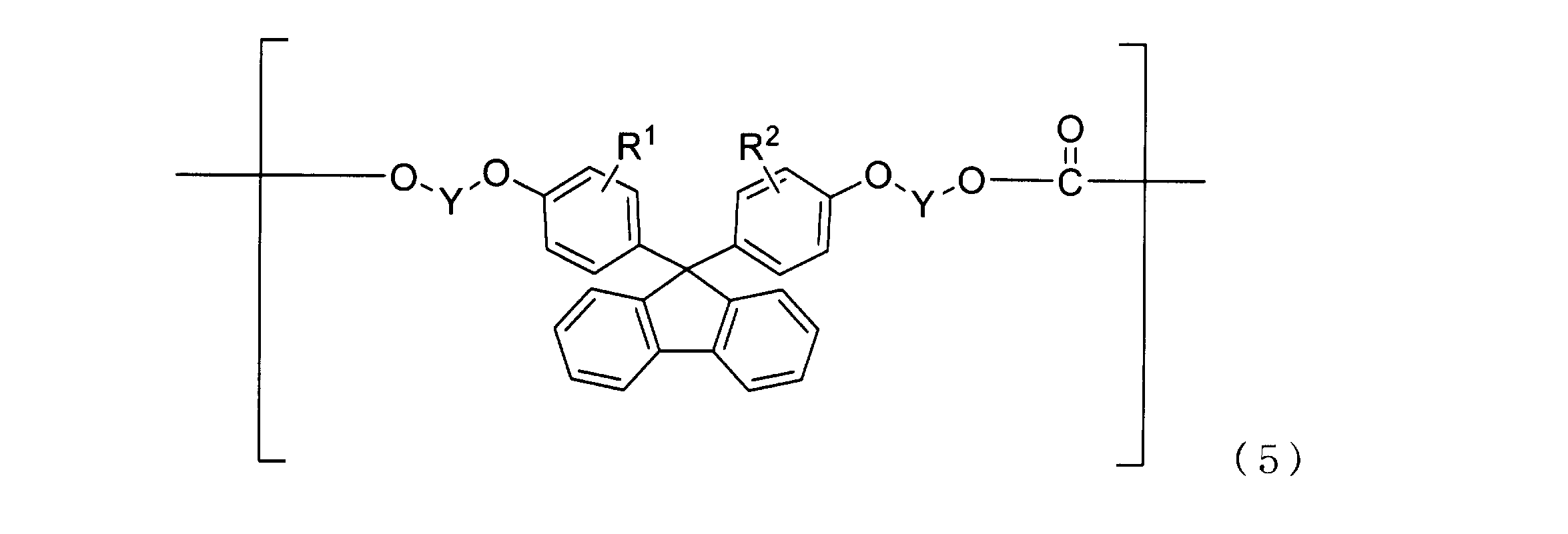
- ポリカーボネート樹脂(A)は、構成単位(a)以外の構成単位の割合が構成単位(a)の20モル%以下である請求項1記載のポリカーボネート樹脂組成物。
- ポリカーボネート樹脂(B)は、構成単位(b)以外の構成単位の割合が構成単位(b)の20モル%以下である請求項1または2記載のポリカーボネート樹脂組成物。
- ポリカーボネート樹脂(A)およびポリカーボネート樹脂(B)の質量比率(A:B)が25:75~90:10である請求項1~3のいずれか一項に記載のポリカーボネート樹脂組成物。
- ポリカーボネート樹脂(A)が、構成単位(a)から構成されるホモポリマーを含有し、かつポリカーボネート樹脂(B)が、構成単位(b)から構成されるホモポリマーを含有する請求項1~4のいずれか一項に記載のポリカーボネート樹脂組成物。
- ポリカーボネート樹脂(A)が、構成単位(a)から構成されるホモポリマーからなり、かつポリカーボネート樹脂(B)が、構成単位(b)から構成されるホモポリマーからなるものである、請求項5に記載のポリカーボネート樹脂組成物。
- Xがエチレン基である請求項1~6のいずれか一項に記載のポリカーボネート樹脂組成物。
- R1およびR2が水素原子である請求項1~7のいずれか一項に記載のポリカーボネート樹脂組成物。
- ポリカーボネート樹脂(A)のポリスチレン換算平均分子量(Mw)が20,000~300,000であり、ポリカーボネート樹脂(B)のポリスチレン換算平均分子量(Mw)が15,000~250,000である請求項1~8のいずれか一項に記載のポリカーボネート樹脂組成物。
- ガラス転移点(Tg)が95℃~180℃である請求項1~9のいずれか一項に記載のポリカーボネート樹脂組成物。
- 請求項1~10のいずれか一項に記載のポリカーボネート樹脂組成物から作製された成形体。
- 屈折率が1.640~1.680である請求項11に記載の成形体。
- アッベ数が24以下である請求項11に記載の成形体。
- 請求項11~13のいずれか一項に記載の成形体を用いた光学材料。
- 請求項11~13のいずれか一項に記載の成形体を用いた光学レンズ。
Priority Applications (6)
| Application Number | Priority Date | Filing Date | Title |
|---|---|---|---|
| EP15785795.4A EP3138876B1 (en) | 2014-05-02 | 2015-04-28 | Polycarbonate resin composition, and optical material and optical lens each manufactured using same |
| KR1020167033398A KR102169539B1 (ko) | 2014-05-02 | 2015-04-28 | 폴리카보네이트 수지 조성물, 그리고 그것을 사용한 광학 재료 및 광학 렌즈 |
| CN201580023583.2A CN106459572B (zh) | 2014-05-02 | 2015-04-28 | 聚碳酸酯树脂组合物以及使用该组合物的光学材料和光学透镜 |
| KR1020207019059A KR102255780B1 (ko) | 2014-05-02 | 2015-04-28 | 폴리카보네이트 수지 조성물, 그리고 그것을 사용한 광학 재료 및 광학 렌즈 |
| JP2016516390A JP6512219B2 (ja) | 2014-05-02 | 2015-04-28 | ポリカーボネート樹脂組成物、ならびにそれを用いた光学材料および光学レンズ |
| US15/305,895 US9982129B2 (en) | 2014-05-02 | 2015-04-28 | Polycarbonate resin composition, and optical material and optical lens each manufactured using same |
Applications Claiming Priority (2)
| Application Number | Priority Date | Filing Date | Title |
|---|---|---|---|
| JP2014-095320 | 2014-05-02 | ||
| JP2014095320 | 2014-05-02 |
Publications (1)
| Publication Number | Publication Date |
|---|---|
| WO2015166951A1 true WO2015166951A1 (ja) | 2015-11-05 |
Family
ID=54358678
Family Applications (1)
| Application Number | Title | Priority Date | Filing Date |
|---|---|---|---|
| PCT/JP2015/062842 Ceased WO2015166951A1 (ja) | 2014-05-02 | 2015-04-28 | ポリカーボネート樹脂組成物、ならびにそれを用いた光学材料および光学レンズ |
Country Status (7)
| Country | Link |
|---|---|
| US (1) | US9982129B2 (ja) |
| EP (1) | EP3138876B1 (ja) |
| JP (1) | JP6512219B2 (ja) |
| KR (2) | KR102255780B1 (ja) |
| CN (1) | CN106459572B (ja) |
| TW (1) | TWI641651B (ja) |
| WO (1) | WO2015166951A1 (ja) |
Cited By (5)
| Publication number | Priority date | Publication date | Assignee | Title |
|---|---|---|---|---|
| WO2019044875A1 (ja) * | 2017-08-30 | 2019-03-07 | 三菱瓦斯化学株式会社 | ポリカーボネート樹脂、その製造方法、及び、光学レンズ |
| KR20230096044A (ko) | 2020-10-27 | 2023-06-29 | 데이진 가부시키가이샤 | 열가소성 수지 및 그것을 포함하는 광학 부재 |
| WO2024237237A1 (ja) | 2023-05-18 | 2024-11-21 | 三菱瓦斯化学株式会社 | 熱可塑性樹脂組成物及びそれを含む光学レンズ |
| WO2024237238A1 (ja) | 2023-05-18 | 2024-11-21 | 三菱瓦斯化学株式会社 | 熱可塑性樹脂組成物の製造方法および熱可塑性樹脂組成物 |
| WO2025013886A1 (ja) | 2023-07-12 | 2025-01-16 | 三菱瓦斯化学株式会社 | 再生樹脂の製造方法 |
Families Citing this family (10)
| Publication number | Priority date | Publication date | Assignee | Title |
|---|---|---|---|---|
| US10689486B2 (en) * | 2014-05-07 | 2020-06-23 | Mitsubishi Gas Chemical Company, Inc. | Resin produced by polycondensation, and resin composition |
| WO2018212343A1 (ja) * | 2017-05-19 | 2018-11-22 | 三井化学株式会社 | ポリカーボネート樹脂レンズ、およびポリカーボネート樹脂組成物 |
| WO2019146507A1 (ja) * | 2018-01-23 | 2019-08-01 | 三菱瓦斯化学株式会社 | ポリカーボネート樹脂組成物、その製造方法及び光学レンズ |
| TWI835961B (zh) * | 2018-12-27 | 2024-03-21 | 日商三菱瓦斯化學股份有限公司 | 樹脂組成物、成形體、光學透鏡及光學透鏡單元 |
| CN114945619A (zh) | 2020-01-16 | 2022-08-26 | 旭化成株式会社 | 聚碳酸酯树脂、聚碳酸酯树脂组合物、包含它们的光学用成型体、以及环状碳酸酯 |
| CN112250853A (zh) * | 2020-09-09 | 2021-01-22 | 万华化学集团股份有限公司 | 一种光学聚碳酸酯及其制造方法、应用 |
| CN112250852B (zh) * | 2020-09-14 | 2023-01-13 | 万华化学集团股份有限公司 | 一种聚碳酸酯树脂、制备方法及形成的光学部件 |
| CN115703881B (zh) * | 2021-08-06 | 2023-09-15 | 中国科学院过程工程研究所 | 一种聚碳酸酯光学树脂及其制备方法和应用 |
| CN113912831A (zh) * | 2021-11-11 | 2022-01-11 | 万华化学集团股份有限公司 | 一种高折射率聚碳酸酯及其制备方法和应用 |
| CN115975165B (zh) * | 2022-03-29 | 2025-09-16 | 中国科学院成都有机化学有限公司 | 一种光学级聚碳酸酯及其制备方法和应用 |
Citations (5)
| Publication number | Priority date | Publication date | Assignee | Title |
|---|---|---|---|---|
| JP2000302857A (ja) * | 1999-04-21 | 2000-10-31 | Mitsubishi Gas Chem Co Inc | 光記録媒体用成形材料 |
| JP2000302858A (ja) * | 1999-04-21 | 2000-10-31 | Mitsubishi Gas Chem Co Inc | 光記録媒体用成形材料 |
| WO2007142149A1 (ja) * | 2006-06-05 | 2007-12-13 | Mitsubishi Gas Chemical Company, Inc. | 光学レンズ |
| JP2010248445A (ja) * | 2009-04-20 | 2010-11-04 | Mitsubishi Gas Chemical Co Inc | ポリカーボネート樹脂組成物 |
| WO2014073496A1 (ja) * | 2012-11-07 | 2014-05-15 | 三菱瓦斯化学株式会社 | ポリカーボネート樹脂、その製造方法および光学成形体 |
Family Cites Families (9)
| Publication number | Priority date | Publication date | Assignee | Title |
|---|---|---|---|---|
| JP3187142B2 (ja) | 1992-07-07 | 2001-07-11 | 帝人化成株式会社 | 高屈折率低複屈折性ポリカーボネート樹脂 |
| JP2001072872A (ja) | 1999-07-02 | 2001-03-21 | Konica Corp | 樹脂組成物および光学用レンズ |
| JP2002332345A (ja) | 2001-05-08 | 2002-11-22 | Konica Corp | 樹脂組成物及び光学用レンズ |
| JP2007057916A (ja) | 2005-08-25 | 2007-03-08 | Mitsubishi Gas Chem Co Inc | 光学レンズ |
| JP2008111047A (ja) * | 2006-10-30 | 2008-05-15 | Mitsubishi Gas Chem Co Inc | ポリカーボネート樹脂の製造方法 |
| US20110201762A1 (en) * | 2008-07-25 | 2011-08-18 | Mitsubishi Gas Chemical Company, Inc. | Polycarbonate resin composition and optical materials using the same |
| JP2010132782A (ja) | 2008-12-05 | 2010-06-17 | Mitsubishi Gas Chemical Co Inc | ポリカーボネート共重合体、その製造方法、及びその用途 |
| WO2010101265A1 (ja) * | 2009-03-06 | 2010-09-10 | 帝人化成株式会社 | コポリカーボネートおよび光学レンズ |
| CN102471467B (zh) * | 2009-07-24 | 2013-07-17 | 帝人化成株式会社 | 光学透镜用聚酯碳酸酯共聚物及光学透镜 |
-
2015
- 2015-04-28 US US15/305,895 patent/US9982129B2/en active Active
- 2015-04-28 KR KR1020207019059A patent/KR102255780B1/ko active Active
- 2015-04-28 EP EP15785795.4A patent/EP3138876B1/en active Active
- 2015-04-28 JP JP2016516390A patent/JP6512219B2/ja active Active
- 2015-04-28 CN CN201580023583.2A patent/CN106459572B/zh active Active
- 2015-04-28 WO PCT/JP2015/062842 patent/WO2015166951A1/ja not_active Ceased
- 2015-04-28 KR KR1020167033398A patent/KR102169539B1/ko active Active
- 2015-04-30 TW TW104113790A patent/TWI641651B/zh active
Patent Citations (5)
| Publication number | Priority date | Publication date | Assignee | Title |
|---|---|---|---|---|
| JP2000302857A (ja) * | 1999-04-21 | 2000-10-31 | Mitsubishi Gas Chem Co Inc | 光記録媒体用成形材料 |
| JP2000302858A (ja) * | 1999-04-21 | 2000-10-31 | Mitsubishi Gas Chem Co Inc | 光記録媒体用成形材料 |
| WO2007142149A1 (ja) * | 2006-06-05 | 2007-12-13 | Mitsubishi Gas Chemical Company, Inc. | 光学レンズ |
| JP2010248445A (ja) * | 2009-04-20 | 2010-11-04 | Mitsubishi Gas Chemical Co Inc | ポリカーボネート樹脂組成物 |
| WO2014073496A1 (ja) * | 2012-11-07 | 2014-05-15 | 三菱瓦斯化学株式会社 | ポリカーボネート樹脂、その製造方法および光学成形体 |
Non-Patent Citations (2)
| Title |
|---|
| T.TAKATA ET AL.: "Optically Active Poly(aryl carbonates) Consisting of Axially Chiral Units. Chiral Binaphthyl Group Induced Helical Polymer", JOURNAL OF AMERICAN CHEMICAL SOCIETY, vol. 120, April 1998 (1998-04-01), pages 4530 - 4531, XP055234222 * |
| TOSHIKAZU TAKATA ET AL.: "Synthesis and Polymerization of Cyclic Carbonates Containting a Binaphthyl Moiety", JAPANESE JOURNAL OF POLYMER SCIENCE AND TECHNOLOGY, vol. 54, no. 12, December 1997 (1997-12-01), pages 974 - 981, XP000752075 * |
Cited By (11)
| Publication number | Priority date | Publication date | Assignee | Title |
|---|---|---|---|---|
| WO2019044875A1 (ja) * | 2017-08-30 | 2019-03-07 | 三菱瓦斯化学株式会社 | ポリカーボネート樹脂、その製造方法、及び、光学レンズ |
| JPWO2019044875A1 (ja) * | 2017-08-30 | 2020-10-15 | 三菱瓦斯化学株式会社 | ポリカーボネート樹脂、その製造方法、及び、光学レンズ |
| US11434327B2 (en) | 2017-08-30 | 2022-09-06 | Mitsubishi Gas Chemical Company, Inc. | Polycarbonate resin, method for producing the same, and optical lens |
| JP7255485B2 (ja) | 2017-08-30 | 2023-04-11 | 三菱瓦斯化学株式会社 | ポリカーボネート樹脂、その製造方法、及び、光学レンズ |
| US11952460B2 (en) | 2017-08-30 | 2024-04-09 | Mitsubishi Gas Chemical Company, Inc. | Polycarbonate resin, method for producing the same, and optical lens |
| KR20230096044A (ko) | 2020-10-27 | 2023-06-29 | 데이진 가부시키가이샤 | 열가소성 수지 및 그것을 포함하는 광학 부재 |
| WO2024237237A1 (ja) | 2023-05-18 | 2024-11-21 | 三菱瓦斯化学株式会社 | 熱可塑性樹脂組成物及びそれを含む光学レンズ |
| WO2024237238A1 (ja) | 2023-05-18 | 2024-11-21 | 三菱瓦斯化学株式会社 | 熱可塑性樹脂組成物の製造方法および熱可塑性樹脂組成物 |
| KR20260009288A (ko) | 2023-05-18 | 2026-01-19 | 미츠비시 가스 가가쿠 가부시키가이샤 | 열가소성 수지 조성물의 제조 방법 및 열가소성 수지 조성물 |
| KR20260009287A (ko) | 2023-05-18 | 2026-01-19 | 미츠비시 가스 가가쿠 가부시키가이샤 | 열가소성 수지 조성물 및 그것을 포함하는 광학 렌즈 |
| WO2025013886A1 (ja) | 2023-07-12 | 2025-01-16 | 三菱瓦斯化学株式会社 | 再生樹脂の製造方法 |
Also Published As
| Publication number | Publication date |
|---|---|
| EP3138876A4 (en) | 2018-01-03 |
| TWI641651B (zh) | 2018-11-21 |
| KR20170007321A (ko) | 2017-01-18 |
| EP3138876A1 (en) | 2017-03-08 |
| KR102169539B1 (ko) | 2020-10-23 |
| CN106459572A (zh) | 2017-02-22 |
| KR102255780B1 (ko) | 2021-05-24 |
| TW201602229A (zh) | 2016-01-16 |
| JP6512219B2 (ja) | 2019-05-15 |
| EP3138876B1 (en) | 2018-10-17 |
| KR20200084910A (ko) | 2020-07-13 |
| US9982129B2 (en) | 2018-05-29 |
| JPWO2015166951A1 (ja) | 2017-04-20 |
| US20170051146A1 (en) | 2017-02-23 |
| CN106459572B (zh) | 2018-10-12 |
Similar Documents
| Publication | Publication Date | Title |
|---|---|---|
| JP6512219B2 (ja) | ポリカーボネート樹脂組成物、ならびにそれを用いた光学材料および光学レンズ | |
| JP6680286B2 (ja) | ポリカーボネート樹脂、その製造方法および光学成形体 | |
| JP6631514B2 (ja) | 重縮合で製造された樹脂および樹脂組成物 | |
| JP6464227B2 (ja) | ポリカーボネート共重合体樹脂組成物からなる光学レンズ | |
| JP5808959B2 (ja) | 高屈折率ポリカーボネート共重合体及び光学レンズ | |
| TWI761484B (zh) | 聚碳酸酯樹脂組成物及使用其之光學透鏡 | |
| JP6812985B2 (ja) | 熱可塑性樹脂組成物およびその成形体 | |
| WO2017078071A1 (ja) | 樹脂組成物の製造方法 | |
| KR102666254B1 (ko) | 수지 조성물 그리고 그것을 포함하는 광학 렌즈, 시트 및 필름 | |
| WO2023085340A1 (ja) | ポリカーボネート樹脂、ならびにそれを用いた光学レンズおよび光学フィルム | |
| HK1230639A1 (en) | Polycarbonate resin composition, and optical material and optical lens each manufactured using same | |
| HK1234085B (en) | Polycarbonate resin composition, and optical material and optical lens each manufactured using same | |
| HK1234085A1 (en) | Polycarbonate resin composition, and optical material and optical lens each manufactured using same |
Legal Events
| Date | Code | Title | Description |
|---|---|---|---|
| 121 | Ep: the epo has been informed by wipo that ep was designated in this application |
Ref document number: 15785795 Country of ref document: EP Kind code of ref document: A1 |
|
| ENP | Entry into the national phase |
Ref document number: 2016516390 Country of ref document: JP Kind code of ref document: A |
|
| WWE | Wipo information: entry into national phase |
Ref document number: 15305895 Country of ref document: US |
|
| REEP | Request for entry into the european phase |
Ref document number: 2015785795 Country of ref document: EP |
|
| WWE | Wipo information: entry into national phase |
Ref document number: 2015785795 Country of ref document: EP |
|
| NENP | Non-entry into the national phase |
Ref country code: DE |
|
| ENP | Entry into the national phase |
Ref document number: 20167033398 Country of ref document: KR Kind code of ref document: A |