WO2015170709A1 - 硬化性ポリシルセスキオキサン化合物、その製造方法、硬化性組成物、硬化物、及び、硬化性組成物等の使用方法 - Google Patents
硬化性ポリシルセスキオキサン化合物、その製造方法、硬化性組成物、硬化物、及び、硬化性組成物等の使用方法 Download PDFInfo
- Publication number
- WO2015170709A1 WO2015170709A1 PCT/JP2015/063217 JP2015063217W WO2015170709A1 WO 2015170709 A1 WO2015170709 A1 WO 2015170709A1 JP 2015063217 W JP2015063217 W JP 2015063217W WO 2015170709 A1 WO2015170709 A1 WO 2015170709A1
- Authority
- WO
- WIPO (PCT)
- Prior art keywords
- group
- ppm
- curable
- carbon atoms
- polysilsesquioxane compound
- Prior art date
- Legal status (The legal status is an assumption and is not a legal conclusion. Google has not performed a legal analysis and makes no representation as to the accuracy of the status listed.)
- Ceased
Links
- 0 C*C(C(*)C(*)C(*)I)[N+](*)[O-] Chemical compound C*C(C(*)C(*)C(*)I)[N+](*)[O-] 0.000 description 1
Images


Classifications
-
- C—CHEMISTRY; METALLURGY
- C08—ORGANIC MACROMOLECULAR COMPOUNDS; THEIR PREPARATION OR CHEMICAL WORKING-UP; COMPOSITIONS BASED THEREON
- C08G—MACROMOLECULAR COMPOUNDS OBTAINED OTHERWISE THAN BY REACTIONS ONLY INVOLVING UNSATURATED CARBON-TO-CARBON BONDS
- C08G77/00—Macromolecular compounds obtained by reactions forming a linkage containing silicon with or without sulfur, nitrogen, oxygen or carbon in the main chain of the macromolecule
- C08G77/04—Polysiloxanes
- C08G77/22—Polysiloxanes containing silicon bound to organic groups containing atoms other than carbon, hydrogen and oxygen
- C08G77/26—Polysiloxanes containing silicon bound to organic groups containing atoms other than carbon, hydrogen and oxygen nitrogen-containing groups
-
- C—CHEMISTRY; METALLURGY
- C08—ORGANIC MACROMOLECULAR COMPOUNDS; THEIR PREPARATION OR CHEMICAL WORKING-UP; COMPOSITIONS BASED THEREON
- C08G—MACROMOLECULAR COMPOUNDS OBTAINED OTHERWISE THAN BY REACTIONS ONLY INVOLVING UNSATURATED CARBON-TO-CARBON BONDS
- C08G77/00—Macromolecular compounds obtained by reactions forming a linkage containing silicon with or without sulfur, nitrogen, oxygen or carbon in the main chain of the macromolecule
- C08G77/04—Polysiloxanes
- C08G77/045—Polysiloxanes containing less than 25 silicon atoms
-
- C—CHEMISTRY; METALLURGY
- C08—ORGANIC MACROMOLECULAR COMPOUNDS; THEIR PREPARATION OR CHEMICAL WORKING-UP; COMPOSITIONS BASED THEREON
- C08G—MACROMOLECULAR COMPOUNDS OBTAINED OTHERWISE THAN BY REACTIONS ONLY INVOLVING UNSATURATED CARBON-TO-CARBON BONDS
- C08G77/00—Macromolecular compounds obtained by reactions forming a linkage containing silicon with or without sulfur, nitrogen, oxygen or carbon in the main chain of the macromolecule
- C08G77/04—Polysiloxanes
- C08G77/06—Preparatory processes
-
- C—CHEMISTRY; METALLURGY
- C08—ORGANIC MACROMOLECULAR COMPOUNDS; THEIR PREPARATION OR CHEMICAL WORKING-UP; COMPOSITIONS BASED THEREON
- C08G—MACROMOLECULAR COMPOUNDS OBTAINED OTHERWISE THAN BY REACTIONS ONLY INVOLVING UNSATURATED CARBON-TO-CARBON BONDS
- C08G77/00—Macromolecular compounds obtained by reactions forming a linkage containing silicon with or without sulfur, nitrogen, oxygen or carbon in the main chain of the macromolecule
- C08G77/04—Polysiloxanes
- C08G77/06—Preparatory processes
- C08G77/08—Preparatory processes characterised by the catalysts used
-
- C—CHEMISTRY; METALLURGY
- C08—ORGANIC MACROMOLECULAR COMPOUNDS; THEIR PREPARATION OR CHEMICAL WORKING-UP; COMPOSITIONS BASED THEREON
- C08G—MACROMOLECULAR COMPOUNDS OBTAINED OTHERWISE THAN BY REACTIONS ONLY INVOLVING UNSATURATED CARBON-TO-CARBON BONDS
- C08G77/00—Macromolecular compounds obtained by reactions forming a linkage containing silicon with or without sulfur, nitrogen, oxygen or carbon in the main chain of the macromolecule
- C08G77/04—Polysiloxanes
- C08G77/22—Polysiloxanes containing silicon bound to organic groups containing atoms other than carbon, hydrogen and oxygen
-
- C—CHEMISTRY; METALLURGY
- C08—ORGANIC MACROMOLECULAR COMPOUNDS; THEIR PREPARATION OR CHEMICAL WORKING-UP; COMPOSITIONS BASED THEREON
- C08K—Use of inorganic or non-macromolecular organic substances as compounding ingredients
- C08K5/00—Use of organic ingredients
- C08K5/54—Silicon-containing compounds
-
- C—CHEMISTRY; METALLURGY
- C08—ORGANIC MACROMOLECULAR COMPOUNDS; THEIR PREPARATION OR CHEMICAL WORKING-UP; COMPOSITIONS BASED THEREON
- C08K—Use of inorganic or non-macromolecular organic substances as compounding ingredients
- C08K5/00—Use of organic ingredients
- C08K5/54—Silicon-containing compounds
- C08K5/541—Silicon-containing compounds containing oxygen
- C08K5/5435—Silicon-containing compounds containing oxygen containing oxygen in a ring
-
- C—CHEMISTRY; METALLURGY
- C08—ORGANIC MACROMOLECULAR COMPOUNDS; THEIR PREPARATION OR CHEMICAL WORKING-UP; COMPOSITIONS BASED THEREON
- C08K—Use of inorganic or non-macromolecular organic substances as compounding ingredients
- C08K5/00—Use of organic ingredients
- C08K5/54—Silicon-containing compounds
- C08K5/544—Silicon-containing compounds containing nitrogen
- C08K5/5455—Silicon-containing compounds containing nitrogen containing at least one group
-
- C—CHEMISTRY; METALLURGY
- C08—ORGANIC MACROMOLECULAR COMPOUNDS; THEIR PREPARATION OR CHEMICAL WORKING-UP; COMPOSITIONS BASED THEREON
- C08L—COMPOSITIONS OF MACROMOLECULAR COMPOUNDS
- C08L83/00—Compositions of macromolecular compounds obtained by reactions forming in the main chain of the macromolecule a linkage containing silicon with or without sulfur, nitrogen, oxygen or carbon only; Compositions of derivatives of such polymers
- C08L83/04—Polysiloxanes
- C08L83/08—Polysiloxanes containing silicon bound to organic groups containing atoms other than carbon, hydrogen and oxygen
-
- C—CHEMISTRY; METALLURGY
- C09—DYES; PAINTS; POLISHES; NATURAL RESINS; ADHESIVES; COMPOSITIONS NOT OTHERWISE PROVIDED FOR; APPLICATIONS OF MATERIALS NOT OTHERWISE PROVIDED FOR
- C09J—ADHESIVES; NON-MECHANICAL ASPECTS OF ADHESIVE PROCESSES IN GENERAL; ADHESIVE PROCESSES NOT PROVIDED FOR ELSEWHERE; USE OF MATERIALS AS ADHESIVES
- C09J11/00—Features of adhesives not provided for in group C09J9/00, e.g. additives
- C09J11/02—Non-macromolecular additives
- C09J11/06—Non-macromolecular additives organic
-
- C—CHEMISTRY; METALLURGY
- C09—DYES; PAINTS; POLISHES; NATURAL RESINS; ADHESIVES; COMPOSITIONS NOT OTHERWISE PROVIDED FOR; APPLICATIONS OF MATERIALS NOT OTHERWISE PROVIDED FOR
- C09J—ADHESIVES; NON-MECHANICAL ASPECTS OF ADHESIVE PROCESSES IN GENERAL; ADHESIVE PROCESSES NOT PROVIDED FOR ELSEWHERE; USE OF MATERIALS AS ADHESIVES
- C09J183/00—Adhesives based on macromolecular compounds obtained by reactions forming in the main chain of the macromolecule a linkage containing silicon, with or without sulfur, nitrogen, oxygen, or carbon only; Adhesives based on derivatives of such polymers
- C09J183/04—Polysiloxanes
- C09J183/08—Polysiloxanes containing silicon bound to organic groups containing atoms other than carbon, hydrogen, and oxygen
-
- H—ELECTRICITY
- H10—SEMICONDUCTOR DEVICES; ELECTRIC SOLID-STATE DEVICES NOT OTHERWISE PROVIDED FOR
- H10H—INORGANIC LIGHT-EMITTING SEMICONDUCTOR DEVICES HAVING POTENTIAL BARRIERS
- H10H20/00—Individual inorganic light-emitting semiconductor devices having potential barriers, e.g. light-emitting diodes [LED]
- H10H20/80—Constructional details
- H10H20/85—Packages
- H10H20/852—Encapsulations
- H10H20/854—Encapsulations characterised by their material, e.g. epoxy or silicone resins
-
- H—ELECTRICITY
- H10—SEMICONDUCTOR DEVICES; ELECTRIC SOLID-STATE DEVICES NOT OTHERWISE PROVIDED FOR
- H10W—GENERIC PACKAGES, INTERCONNECTIONS, CONNECTORS OR OTHER CONSTRUCTIONAL DETAILS OF DEVICES COVERED BY CLASS H10
- H10W74/00—Encapsulations, e.g. protective coatings
- H10W74/10—Encapsulations, e.g. protective coatings characterised by their shape or disposition
-
- H—ELECTRICITY
- H10—SEMICONDUCTOR DEVICES; ELECTRIC SOLID-STATE DEVICES NOT OTHERWISE PROVIDED FOR
- H10W—GENERIC PACKAGES, INTERCONNECTIONS, CONNECTORS OR OTHER CONSTRUCTIONAL DETAILS OF DEVICES COVERED BY CLASS H10
- H10W74/00—Encapsulations, e.g. protective coatings
- H10W74/40—Encapsulations, e.g. protective coatings characterised by their materials
-
- H—ELECTRICITY
- H10—SEMICONDUCTOR DEVICES; ELECTRIC SOLID-STATE DEVICES NOT OTHERWISE PROVIDED FOR
- H10W—GENERIC PACKAGES, INTERCONNECTIONS, CONNECTORS OR OTHER CONSTRUCTIONAL DETAILS OF DEVICES COVERED BY CLASS H10
- H10W74/00—Encapsulations, e.g. protective coatings
- H10W74/40—Encapsulations, e.g. protective coatings characterised by their materials
- H10W74/47—Encapsulations, e.g. protective coatings characterised by their materials comprising organic materials, e.g. plastics or resins
- H10W74/476—Organic materials comprising silicon
-
- C—CHEMISTRY; METALLURGY
- C08—ORGANIC MACROMOLECULAR COMPOUNDS; THEIR PREPARATION OR CHEMICAL WORKING-UP; COMPOSITIONS BASED THEREON
- C08G—MACROMOLECULAR COMPOUNDS OBTAINED OTHERWISE THAN BY REACTIONS ONLY INVOLVING UNSATURATED CARBON-TO-CARBON BONDS
- C08G77/00—Macromolecular compounds obtained by reactions forming a linkage containing silicon with or without sulfur, nitrogen, oxygen or carbon in the main chain of the macromolecule
- C08G77/80—Siloxanes having aromatic substituents, e.g. phenyl side groups
Definitions
- the present invention relates to a curable polysilsesquioxane compound that has a high adhesive force, is excellent in heat resistance, peel resistance (delamination resistance), and has a reduced occurrence of cracks, a method for producing the same, and curing
- the present invention relates to an adhesive composition, a cured product obtained by curing the composition, and a method of using the composition as an optical element fixing agent.
- the optical element examples include various lasers such as a semiconductor laser (LD), light emitting elements such as a light emitting diode (LED), a light receiving element, a composite optical element, and an optical integrated circuit.
- LD semiconductor laser
- LED light emitting diode
- a curable composition is used as an adhesive or a sealing material for such an optical element.
- the cured product of the optical element fixing agent composition is exposed to higher energy light or higher temperature heat generated from the optical element for a long time, and deteriorates and peels off. And problems such as cracking occurred.
- Patent Documents 1 to 3 propose a composition for an optical element fixing agent containing a polysilsesquioxane compound as a main component.
- the polysilsesquioxane compound is represented by the formula: (R 0 SiO 3/2 ) n (wherein R 0 represents an alkyl group, an aryl group or the like which may have a substituent). It is a compound and is a substance having intermediate properties between inorganic silica [SiO 2 ] and organic silicone [(R 0 2 SiO) n ].
- Patent Document 4 discloses that in a solid Si-nuclear magnetic resonance spectrum, the peak top position is in the region of a chemical shift of ⁇ 40 ppm or more and 0 ppm or less, a peak having a specific half width, and a peak The top position is in a region where the chemical shift is ⁇ 80 ppm or more and less than ⁇ 40 ppm, has at least one peak selected from the group consisting of a peak having a half width of a specific peak, and a silicon content of 20% by weight or more
- a semiconductor light-emitting device member having a silanol content of 0.1 wt% or more and 10 wt% or less is described.
- JP 2004-359933 A JP 2005-263869 A JP 2006-328231 A JP 2007-1212975 A (US2009 / 0008673 A1)
- the present invention has been made in view of the actual situation of the prior art, has a high adhesive force, has excellent heat resistance and peel resistance, and can obtain a cured product with less occurrence of cracks. It is an object of the present invention to provide a curable composition, a method for producing the curable compound, a cured product obtained by curing the curable composition, and a method for using the curable composition.
- the present inventors have found that the curable polysilsesquioxane having at least one of the structural units represented by the formula: CHR 1 X 0 -D-SiO 3/2 , which will be described later.
- a 29 Si nuclear magnetic resonance spectrum having a first peak top in a region of ⁇ 73 ppm or more and less than ⁇ 65 ppm, a second peak top in a region of ⁇ 82 ppm or more and less than ⁇ 73 ppm, and ⁇ 65 ppm
- the curable polysilsesquioxane compound having substantially no peak in the region of less than ⁇ 55 ppm has a high adhesive force, excellent heat resistance and peeling resistance, and is a cured product with few cracks. And the present invention has been completed.
- curable polysilsesquioxane compounds (1) to (4) the method for producing curable polysilsesquioxane compounds (5) to (8), and the curing of (9) And a method of using the composition as a cured product of (10) and an optical element fixing agent of (11).
- a curable polysilsesquioxane compound having at least one of the structural units represented by: 29 Si nuclear magnetic resonance spectrum having a first peak top in a region from ⁇ 73 ppm to less than ⁇ 65 ppm, a second peak top in a region from ⁇ 82 ppm to less than ⁇ 73 ppm, and from ⁇ 65 ppm to less than ⁇ 55 ppm
- a curable polysilsesquioxane compound characterized by having substantially no peak in the region.
- the peak integration value (P2) in the region of ⁇ 82 ppm or more and less than ⁇ 73 ppm is 60 to 90% with respect to the integration value (P1) of the region of ⁇ 73 ppm or more and less than ⁇ 65 ppm.
- R 1 represents a hydrogen atom or an alkyl group having 1 to 6 carbon atoms
- X 0 represents a halogen atom, a cyano group or a group represented by the formula: OG (wherein G represents a protecting group for a hydroxyl group)
- D represents a single bond or a divalent organic group having 1 to 20 carbon atoms which may have a substituent
- R 3 represents a hydrogen atom or an alkyl group having 1 to 10 carbon atoms.
- the plurality of R 3 may be all the same or different.
- the method comprises the step (I) of polycondensing a mixture of at least one compound represented by The manufacturing method of curable polysilsesquioxane compound of description. (7) The curing according to (5) or (6), wherein the polycondensation catalyst is at least one acid catalyst selected from the group consisting of hydrochloric acid, boric acid, citric acid, acetic acid, sulfuric acid, and methanesulfonic acid.
- a curable composition containing the curable polysilsesquioxane compound according to any one of (1) to (4) and a silane coupling agent (10) A cured product obtained by heating the curable composition according to (9).
- (11) A method of using the curable polysilsesquioxane compound according to any one of (1) to (4) or the curable composition according to (9) as an optical element fixing agent.
- the curable polysilsesquioxane compound of the present invention and the curable composition of the present invention containing at least this compound and a silane coupling agent it has high adhesive strength, heat resistance, and peel resistance (anti-resistance).
- a cured product having excellent delamination and few cracks can be obtained.
- the method for producing a curable polysilsesquioxane compound of the present invention the curable polysilsesquioxane compound of the present invention can be efficiently produced. Even when the cured product of the present invention is irradiated with high-energy light or placed in a high-temperature state, it has a high adhesive force and can satisfactorily seal the optical element over a long period of time.
- the curable polysilsesquioxane compound of the present invention and the curable composition of the present invention can be used as an optical element fixing agent. In particular, it can be suitably used as an optical element adhesive and an optical element sealant.
- FIG. 2 is a 29 Si-NMR spectrum chart of the curable polysilsesquioxane compound of Example 1.
- FIG. 2 is a 29 Si-NMR spectrum chart of a curable polysilsesquioxane compound of Comparative Example 1.
- the present invention is divided into 1) a curable polysilsesquioxane compound, 2) a method for producing a curable polysilsesquioxane compound, 3) a curable composition, 4) a cured product, and 5) an optical element fixing.
- the method used as an agent will be described in detail.
- Curable polysilsesquioxane compound of the present invention comprises a curable polysilsesquioxane compound having at least one of the structural units represented by the formula: CHR 1 X 0 -D-SiO 3/2.
- the curable composition of the present invention is preferably a thermosetting composition.
- the curable polysilsesquioxane compound of the present invention is represented by the formula: R 2 SiO 3/2 in addition to the structural unit represented by the formula: CHR 1 X 0 -D-SiO 3/2. It is preferable to have at least one kind of structural unit.
- R 1 represents a hydrogen atom or an alkyl group having 1 to 6 carbon atoms.
- alkyl group having 1 to 6 carbon atoms of R 1 examples include methyl group, ethyl group, n-propyl group, isopropyl group, n-butyl group, isobutyl group, s-butyl group, t-butyl group, and n-pentyl. Group, n-hexyl group and the like. Among these, R 1 is preferably a hydrogen atom.
- X 0 represents a halogen atom such as a fluorine atom, a chlorine atom, a bromine atom or an iodine atom; a cyano group; or a group represented by the formula: OG.
- G represents a protecting group for a hydroxyl group.
- the well-known protecting group known as a hydroxyl-protecting group is mentioned.
- acyl protecting groups silyl protecting groups such as trimethylsilyl group, triethylsilyl group, t-butyldimethylsilyl group, t-butyldiphenylsilyl group; methoxymethyl group, methoxyethoxymethyl group, 1-ethoxyethyl group
- An acetal type protective group such as tetrahydropyran-2-yl group or tetrahydrofuran-2-yl group; an alkoxycarbonyl type protective group such as t-butoxycarbonyl group; methyl group, ethyl group, t-butyl group, octyl group
- ether-based protecting groups such as allyl group, triphenylmethyl group, benzyl group, p-
- the acyl-based protecting group is specifically a group represented by the formula: —C ( ⁇ O) R 5 .
- R 5 represents 1 to 6 carbon atoms such as methyl group, ethyl group, n-propyl group, isopropyl group, n-butyl group, isobutyl group, s-butyl group, t-butyl group, and n-pentyl group. Or a phenyl group optionally having a substituent.
- R 2 represents an alkyl group having 1 to 20 carbon atoms or an aryl group which may have a substituent.
- “may have a substituent” means “unsubstituted or has a substituent” (the same applies hereinafter).
- Examples of the substituent of the phenyl group which may have a substituent represented by R 5 include an alkyl group such as a methyl group, an ethyl group, an n-propyl group, an isopropyl group, and an n-butyl group (having 1 to 3 carbon atoms). 6 alkyl group); halogen atoms such as fluorine atom, chlorine atom and bromine atom; alkoxy groups such as methoxy group and ethoxy group (alkoxy group having 1 to 6 carbon atoms);
- a chlorine atom a group represented by the formula: OG ′ (wherein G ′ is an acyl group) And a group selected from a cyano group, a group selected from a chlorine atom, an acetoxy group and a cyano group is more preferable, and a cyano group is particularly preferable.
- D represents a divalent hydrocarbon group having 1 to 20 carbon atoms which may have a single bond or a substituent.
- the divalent hydrocarbon group having 1 to 20 carbon atoms include alkylene groups having 1 to 20 carbon atoms, alkenylene groups having 2 to 20 carbon atoms, alkynylene groups having 2 to 20 carbon atoms, and arylene groups having 6 to 20 carbon atoms. , (An alkylene group, an alkenylene group, or an alkynylene group) and an arylene group, and a divalent group having 7 to 20 carbon atoms.
- Examples of the alkylene group having 1 to 20 carbon atoms include methylene group, ethylene group, propylene group, trimethylene group, tetramethylene group, pentamethylene group and hexamethylene group.
- Examples of the alkenylene group having 2 to 20 carbon atoms include vinylene group, propenylene group, butenylene group and pentenylene group.
- Examples of the alkynylene group having 2 to 20 carbon atoms include an ethynylene group and a propynylene group.
- Examples of the arylene group having 6 to 20 carbon atoms include an o-phenylene group, an m-phenylene group, a p-phenylene group, and a 2,6-naphthylene group.
- alkylene group having 1 to 20 carbon atoms, alkenylene group having 2 to 20 carbon atoms, and alkynylene group having 2 to 20 carbon atoms may have include a halogen atom such as a fluorine atom and a chlorine atom.
- An alkoxy group such as a methoxy group or an ethoxy group (an alkoxy group having 1 to 6 carbon atoms); an alkylthio group such as a methylthio group or an ethylthio group (an alkylthio group having 1 to 6 carbon atoms); a methoxycarbonyl group or an ethoxycarbonyl group; An alkoxycarbonyl group (an alkoxycarbonyl group having 2 to 8 carbon atoms); and the like.
- substituents for the arylene group having 6 to 20 carbon atoms include: cyano group; nitro group; halogen atom such as fluorine atom, chlorine atom and bromine atom; alkyl group such as methyl group and ethyl group (having 1 to 6 carbon atoms). Alkyl groups); alkoxy groups such as methoxy groups and ethoxy groups (alkoxy groups having 1 to 6 carbon atoms); alkylthio groups such as methylthio groups and ethylthio groups (alkylthio groups having 1 to 6 carbon atoms); and the like. These substituents may be bonded at arbitrary positions in groups such as an alkylene group, an alkenylene group, an alkynylene group, and an arylene group, and a plurality of them may be bonded in the same or different manner.
- the divalent group consisting of a combination of an optionally substituted (alkylene group, alkenylene group, or alkynylene group) and an optionally substituted arylene group has the above substituents.
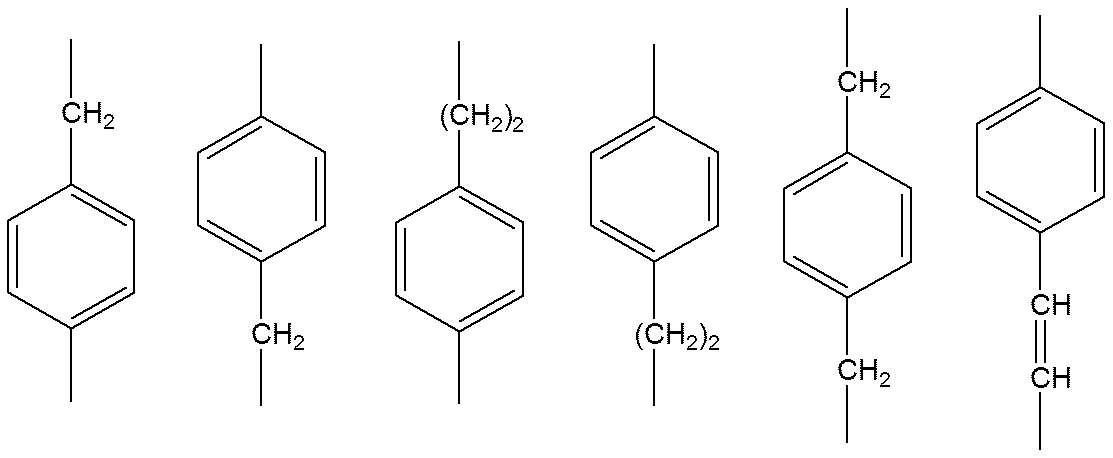
- a group in which at least one kind of alkylene group, alkenylene group or alkynylene group may be bonded in series with at least one kind of arylene group which may have the substituent include groups represented by the following formula.
- D is preferably an alkylene group having 1 to 10 carbon atoms, more preferably an alkylene group having 1 to 6 carbon atoms, and a methylene group or an ethylene group is preferable because a cured product having high adhesive strength can be obtained. Particularly preferred.
- R 2 represents an alkyl group having 1 to 20 carbon atoms or an aryl group which may have a substituent.
- alkyl group having 1 to 20 carbon atoms of R 2 include methyl group, ethyl group, n-propyl group, isopropyl group, n-butyl group, t-butyl group, isobutyl group, s-butyl group, and n-pentyl. Group, n-hexyl group, n-octyl group, n-decyl group, n-dodecyl group and the like.
- Examples of the aryl group of the aryl group which may have a substituent include a phenyl group, a 1-naphthyl group, a 2-naphthyl group, and an anthracenyl group. These substituents include methyl groups, ethyl groups, n-propyl groups, isopropyl groups, n-butyl groups, s-butyl groups, isobutyl groups, t-butyl groups and other alkyl groups having 1 to 6 carbon atoms; Group, an ethoxy group, an isopropoxy group and the like, an alkoxy group having 1 to 6 carbon atoms; a halogen atom such as a fluorine atom and a chlorine atom;
- the polysilsesquioxane compound is a silicon-based polymer obtained by polycondensation reaction of a trifunctional organosilane compound.
- the polysilsesquioxane compound has inorganic characteristics and side chain organic properties exhibited by the main chain siloxane (Si—O—Si) bond. It has the organic characteristics of the group.
- the structure of the curable polysilsesquioxane compound of the present invention is not particularly limited, and examples thereof include a ladder structure, a double-decker structure, a cage structure, a partially cleaved cage structure, a cyclic structure, and a random structure. It is done.
- the curable polysilsesquioxane compound of the present invention has the formula: RSiO 3/2 (wherein R represents a group represented by the formula: CHR 1 X 0 -D- or R 2 . The same as in the above)).
- the curable polysilsesquioxane compound of the present invention contains two or more structural units represented by the formula: CHR 1 X 0 —D—SiO 3/2 or the formula: CHR 1 X 0 —D—.
- a copolymer having a structural unit represented by R 2 SiO 3/2 the form thereof is not particularly limited, a random copolymer It may be a block copolymer, but is preferably a random copolymer from the viewpoint of availability.
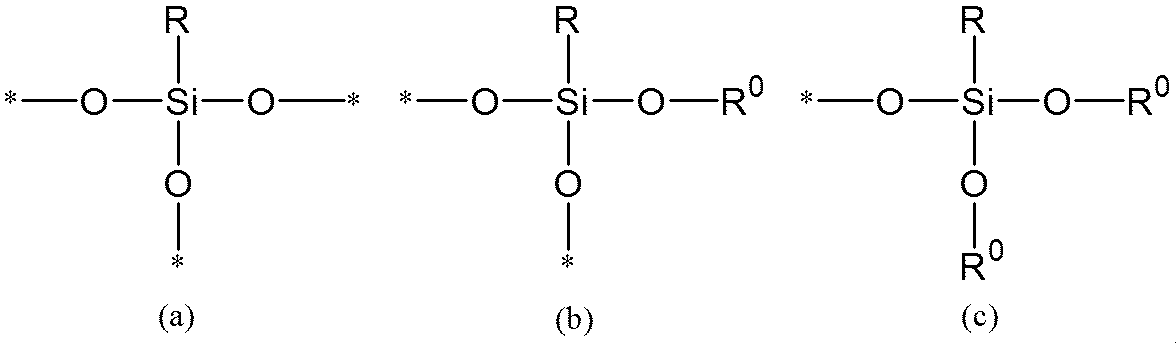
- the structural unit represented by the formula: RSiO 3/2 of the curable polysilsesquioxane compound of the present invention is generally referred to as a T site, in which three oxygen atoms are bonded to a silicon atom, and other groups ( R) has one bonded structure.
- Specific examples of the structure of the T site include those represented by the following formulas (a) to (c).
- R 0 represents a hydrogen atom or an alkyl group having 1 to 10 carbon atoms.
- alkyl group having 1 to 10 carbon atoms of R 0 include methyl group, ethyl group, n-propyl group, isopropyl group, n-butyl group, t-butyl group, isobutyl group, s-butyl group, n-pentyl group, Examples include n-hexyl group.
- the plurality of R 0 may be all the same or different. In the above formulas (a) to (c), a Si atom is bonded to *.
- the curable polysilsesquioxane compound of the present invention generally includes a halogen solvent such as chloroform; a ketone solvent such as acetone; an aromatic hydrocarbon solvent such as benzene; a sulfur-containing solvent such as dimethyl sulfoxide; It is soluble in various organic solvents such as an ether solvent such as: an ester solvent such as ethyl acetate; and a mixed solvent composed of two or more of these solvents.
- the solubility of the curable polysilsesquioxane compound of the present invention in chloroform at 20 ° C. is preferably 1 mg / 100 ml or more, more preferably 20 mg / 100 ml or more, and 40 mg / 100 ml or more. Is particularly preferred.
- T0 is a silicon atom having no siloxane bond
- T1 is a silicon atom having one siloxane bond (a silicon atom in the structure represented by the formula (c))
- T2 has two siloxane bonds.
- Silicon atoms (silicon atoms in the structure represented by the formula (b)) and T3 correspond to silicon atoms having three siloxane bonds (silicon atoms in the structure represented by the formula (a)), respectively. It is considered a peak.
- the curable polysilsesquioxane compound of the present invention has a first peak top (corresponding to T2) in the region of ⁇ 73 ppm or more and less than ⁇ 65 ppm, and a second peak top (T3 in the region of ⁇ 82 ppm or more and less than ⁇ 73 ppm). However, it has substantially no peak (corresponding to T1) in the region of ⁇ 65 ppm or more and less than ⁇ 55 ppm.
- “having substantially no peak (corresponding to T1) in the region of ⁇ 65 ppm or more and less than ⁇ 55 ppm” was measured for the 29 Si-NMR spectrum of the curable polysilsesquioxane compound of the present invention.
- the peak (corresponding to T1) is not observed in the region of ⁇ 65 ppm or more and less than ⁇ 55 ppm, or even if it is observed, the integrated value of the peak (corresponding to T1) in the region of ⁇ 65 ppm or more and less than ⁇ 55 ppm. Is less than 0.5% of the integrated value of the peak (corresponding to T2) in the region of ⁇ 73 ppm or more and less than ⁇ 65 ppm.
- the integrated value (P2) of the peak (corresponding to T3) in the region of ⁇ 82 ppm or more and less than ⁇ 73 ppm is obtained from the viewpoint of obtaining the superior effect of the present invention. It is preferably 60 to 90% with respect to the integrated value (P1) of the peak (corresponding to T2) in the region of ⁇ 73 ppm or more and less than ⁇ 65 ppm.
- the peak top is substantially absent in a region of ⁇ 65 ppm or more and less than ⁇ 55 ppm
- the first peak top is in a region of ⁇ 73 ppm or more and less than ⁇ 65 ppm
- the second peak top is ⁇ 82 ppm.
- Each of the curable polysilsesquioxane compounds present in the region of less than ⁇ 73 ppm has a high adhesive force even at high temperatures, has excellent heat resistance and peel resistance, and is a cured product with less cracking. The reason can be considered as follows.
- the curable polysilsesquioxane compound in which T1 is present has many sites that are desorbed by dehydration or dealcohol condensation when heated and cured, voids due to desorbed components are likely to occur.
- the adhesive strength is low.
- a large amount of T3 is present, a cured product having a relatively dense structure is generated, and hence the adhesive strength is considered to be sufficient.
- the 29 Si-NMR spectrum can be measured, for example, as follows.
- Measurement is performed using deuterated chloroform as a measurement solvent and Fe (acac) 3 as a relaxation reagent for shortening the relaxation time.
- the intensity of each peak is normalized with the area of the internal standard tetramethylsilane as 1, and the influence of errors for each measurement is excluded.
- Measurement is performed using a nuclear magnetic resonance spectrometer (for example, AV-500 manufactured by Bruker BioSpin). 29 Si resonance frequency: 99.352 MHz Probe: 5 mm ⁇ solution probe Measurement temperature: 25 ° C. Sample rotation speed: 20 kHz Measurement method: Inverse gate decoupling method 29 Si flip angle: 90 ° 29 Si 90 ° pulse width: 8.0 ⁇ s Repeat time: 5s Integration count: 9200 times Observation width: 30 kHz
- the mass average molecular weight (Mw) of the curable polysilsesquioxane compound of the present invention is preferably in the range of 800 to 5000, more preferably in the range of 1000 to 3000.
- the mass average molecular weight (Mw) can be determined, for example, as a standard polystyrene equivalent value by gel permeation chromatography (GPC) using tetrahydrofuran (THF) as a solvent.
- the molecular weight distribution (Mw / Mn, hereinafter referred to as PDI) of the curable polysilsesquioxane compound of the present invention is not particularly limited, but is usually 1.0 to 6.0, preferably 1.0 to 3.0. It is a range. By being in the said range, the hardened
- the method for producing the curable polysilsesquioxane compound of the present invention is not particularly limited, but the method for producing the curable polysilsesquioxane compound of the present invention described later is preferable.
- R 1, X 0, D is .R 3 represent the same meanings as described above, the similar to R 0, represents a hydrogen atom or a C 1-10 alkyl group having a carbon.
- Plurality of R 3 are all It may be the same or different, and has a step (I) in which at least one of the compounds represented by formula (I) is polycondensed in the presence of a polycondensation catalyst.
- R 2 represents the same meaning as described above.
- R 4 represents a hydrogen atom or an alkyl group having 1 to 10 carbon atoms as in R 0.
- a plurality of R 4 are the same or different. It is more preferable to have a step (I) in which at least one of the compounds represented by formula (1) is polycondensed in the presence of a polycondensation catalyst.
- step (I) the silane compound represented by the above formula (1) (hereinafter sometimes referred to as “silane compound (1)”), or this and the silane compound represented by the above formula (2).
- silane compound (2) is a step of polycondensation in the presence of a polycondensation catalyst.
- Specific examples of the silane compound (1) include cyanomethyltrimethoxysilane, cyanomethyltriethoxysilane, 1-cyanoethyltrimethoxysilane, 2-cyanoethyltrimethoxysilane, 2-cyanoethyltriethoxysilane, 2-cyanoethyltripropoxysilane.
- the silane compound (1) is more preferably a compound having a 2-cyanoethyl group or a compound having a 3-cyanopropyl group because a cured product having better adhesion can be obtained.
- silane compound (2) examples include methyltrimethoxysilane, methyltriethoxysilane, ethyltrimethoxysilane, ethyltriethoxysilane, n-propyltrimethoxysilane, n-butyltriethoxysilane, isobutyltrimethoxysilane, alkyltrialkoxysilane compounds such as n-pentyltriethoxysilane, n-hexyltrimethoxysilane, isooctyltriethoxysilane, dodecyltrimethoxysilane, methyldimethoxyethoxysilane, methyldiethoxymethoxysilane;
- phenyltrimethoxysilane 4-methoxyphenyltrimethoxysilane, 2-chlorophenyltrimethoxysilane, phenyltriethoxysilane, 2-methoxyphenyltriethoxysilane, phenyldimethoxyethoxysilane, phenyldiethoxymethoxysilane
- phenyltrialkoxysilane compounds; Etc can be used individually by 1 type or in combination of 2 or more types. It is preferable to use two or more silane compounds from the viewpoint of adjusting adhesive strength, heat resistance and discoloration resistance.
- Acid catalysts include inorganic acids such as hydrochloric acid, sulfuric acid, nitric acid, phosphoric acid, boric acid; methanesulfonic acid, trifluoromethanesulfonic acid, benzenesulfonic acid, p-toluenesulfonic acid, acetic acid, trifluoroacetic acid, citric acid, etc. Organic acids; and the like.
- At least one selected from hydrochloric acid, boric acid, citric acid, acetic acid, sulfuric acid, and methanesulfonic acid is preferable, and hydrochloric acid is particularly preferable.
- the amount of the polycondensation catalyst used depends on the silane compound (1) and the type of polycondensation catalyst used, but is usually 0.05 mol% to 30 mol% with respect to the total molar amount of the silane compound (1).
- the range is preferably from 0.1 mol% to 10 mol%, more preferably from 0.2 mol% to 5 mol%.
- the solvent to be used can be suitably selected according to the silane compound (1), the type of polycondensation catalyst, the amount used, and the like.
- water aromatic hydrocarbons such as benzene, toluene and xylene; esters such as methyl acetate, ethyl acetate, propyl acetate and methyl propionate; ketones such as acetone, methyl ethyl ketone, methyl isobutyl ketone and cyclohexanone; methyl alcohol And alcohols such as ethyl alcohol, n-propyl alcohol, isopropyl alcohol, n-butyl alcohol, isobutyl alcohol, s-butyl alcohol, t-butyl alcohol; These solvents can be used alone or in combination of two or more. Among these, water and alcohols are preferable and water is more preferable from the viewpoint of easily obtaining the target product.
- the amount of the solvent to be used is generally 1 ml to 1000 ml, preferably 10 ml to 500 ml, more preferably 50 ml to 200 ml, per mole of silane compound (1).
- the temperature and reaction time for polycondensation (reaction) of the silane compound (1) are selected depending on the silane compound (1) used, the type of polycondensation catalyst and solvent, the amount used, and the like.
- the reaction temperature is usually in the temperature range from 0 ° C. to the boiling point of the solvent used, preferably in the range of 20 ° C. to 100 ° C. If the reaction temperature is too low, the progress of the condensation reaction may be insufficient. On the other hand, if the reaction temperature is too high, it is difficult to suppress gelation.
- the reaction time is usually several minutes to 10 hours. In particular, it is preferable to carry out the reaction at a reaction temperature of 5 to 35 ° C. for several minutes to several hours, and then at 35 to 100 ° C. for several tens of minutes to several hours.
- step (II) when the polymerization reaction is performed in the presence of an acid catalyst in step (I), it is preferable to further include step (II) described later.
- An organic solvent is added to the reaction solution obtained in the step (I) to dissolve the polycondensate, and then an acid catalyst is used in the step (I), and a step (II) described later is further provided.
- the curable polysilsesquioxane compound of the present invention having the intended 29 Si-NMR spectrum pattern can be easily obtained.
- step (II) an organic solvent is added to the reaction solution obtained in step (I) to dissolve the polycondensate, and then an equimolar equivalent or more base is added to the acid catalyst used.
- the organic solvent to be used is not particularly limited as long as it can dissolve the produced polycondensate.
- a water-immiscible organic solvent having a boiling point of about 60 to 100 ° C. is preferable because of easy post-treatment.
- a water-immiscible organic solvent has a solubility in water at 25 ° C. of 10 g / L or less, and is generally an organic solvent that separates from water and forms two layers.
- organic solvents examples include aromatic compounds such as benzene; esters such as ethyl acetate and propyl acetate; ketones such as methyl isobutyl ketone; aliphatic hydrocarbons such as heptane and cyclohexane; halogenation such as chloroform. Hydrocarbons; ethers such as tetrahydrofuran; and the like.
- the organic solvent may be used in an amount that can dissolve the produced polycondensate, and is usually 0.5 to 5 parts by mass, preferably 1 to 1 part by mass with respect to 1 part by mass of the silane compound (1) used. 3 parts by mass.
- the base to be added it is preferable to use ammonia; or an organic base such as pyridine or triethylamine; since it is easy to obtain the target product of the present invention. From the viewpoint of easy handling, it is more preferable to use ammonia. preferable.
- the amount of the base used is usually in the range of 1.2 to 5 equivalents, preferably 1.5 to 2.5 equivalents, relative to the acid catalyst used in step (I).
- the temperature of the polycondensation reaction after adding the base is usually from 50 to 100 ° C., and the reaction time is usually from 30 minutes to 10 hours, depending on the reaction scale and the like.
- the reaction time is usually from 30 minutes to 10 hours, depending on the reaction scale and the like.
- the target curable polysilsesquioxane compound can be obtained by washing the reaction mixture with purified water and then concentrating and drying the organic layer.
- the resulting curable polysilsesquioxane compound of the present invention is considered to be represented by the following formula (a-1). .
- R 1 , R 2 , X 0 and D represent the same meaning as described above;
- Z 1 represents a group represented by the formula: OR 3 (R 3 represents the same meaning as described above);
- Z 2 represents a group represented by the formula: —OR 4 (R 4 represents the same meaning as described above.)
- Q and r are substantially 0, and m to p are each independently a positive Indicates an integer.
- Curable composition of this invention is characterized by containing the curable polysilsesquioxane compound of this invention, and a silane coupling agent.
- the content of the curable polysilsesquioxane compound of the present invention is usually preferably 60% by mass to 99.7% by mass with respect to the entire composition.
- the mass is more preferably from 95% by mass, and even more preferably from 80% to 90% by mass.
- the curable composition containing the curable polysilsesquioxane compound of the present invention and containing the silane coupling agent has high adhesive force, and is excellent in heat resistance and peel resistance. And it becomes hardened
- silane compounds having a vinyl group such as vinyltrimethoxysilane, vinyltriethoxysilane, vinyltrichlorosilane, p-styryltrimethoxysilane, vinyltriacetoxysilane; Silane compounds having a halogen atom such as ⁇ -chloropropyltrimethoxysilane, chloromethyltrimethoxysilane, chloromethylphenethyltrimethoxysilane; Silane compounds having (meth) acryloxy groups such as ⁇ -methacryloxypropyltrimethoxysilane, ⁇ -methacryloxypropylmethyldimethoxysilane, 3-acryloxypropyltrimethoxysilane; mercapto groups such as ⁇ -mercaptopropyltrimethoxysilane; Silane compound having; Silane compounds having a ureido group such as 3-ureido
- silane coupling agents can be used alone or in combination of two or more.
- a silane compound having an isocyanurate group and a silane coupling agent having an acid anhydride structure can be obtained because a cured product having excellent heat resistance and transparency and higher adhesion can be obtained. Is preferable, and it is more preferable to use both in combination.
- the use ratio is a mass ratio of the silane compound having an isocyanurate group and the silane coupling agent having an acid anhydride structure. In the range of 10: 0.5 to 10:10.
- a silane coupling agent at such a ratio, it is possible to obtain a curable composition capable of obtaining a cured product that is excellent in transparency and adhesiveness, is further excellent in heat resistance, and does not easily deteriorate even at high temperatures. Can do.
- the curable composition of the present invention may further contain other components as long as the object of the present invention is not impaired.
- other components include an antioxidant, an ultraviolet absorber, a light stabilizer, and a diluent.
- the usage-amount of another component is 10 mass% or less normally with respect to the whole curable composition.
- the antioxidant is added to prevent oxidative deterioration during heating.
- examples of the antioxidant include phosphorus antioxidants, phenolic antioxidants, sulfur antioxidants and the like.
- Examples of phosphorus antioxidants include phosphites and oxaphosphaphenanthrene oxides.
- phenolic antioxidants include monophenols, bisphenols, and high-molecular phenols.
- sulfur-based antioxidant include dilauryl-3,3′-thiodipropionate, dimyristyl-3,3′-thiodipropionate, distearyl-3,3′-thiodipropionate.
- antioxidants can be used alone or in combination of two or more.
- the usage-amount of antioxidant is 10 mass% or less normally with respect to the whole curable composition.
- the ultraviolet absorber is added for the purpose of improving the light resistance of the resulting cured product.
- examples of the ultraviolet absorber include salicylic acids, benzophenones, benzotriazoles, hindered amines and the like.
- An ultraviolet absorber can be used individually by 1 type or in combination of 2 or more types. The usage-amount of a ultraviolet absorber is 10 mass% or less normally with respect to the whole curable composition.
- the light stabilizer is added for the purpose of improving the light resistance of the resulting cured product.
- the light stabilizer include poly [ ⁇ 6- (1,1,3,3, -tetramethylbutyl) amino-1,3,5-triazine-2,4-diyl ⁇ ⁇ (2,2,6 , 6-tetramethyl-4-piperidine) imino ⁇ hexamethylene ⁇ (2,2,6,6-tetramethyl-4-piperidine) imino ⁇ ] and the like.
- light stabilizers can be used alone or in combination of two or more.
- the usage-amount of a light stabilizer is 10 mass% or less normally with respect to the whole curable composition.
- a diluent is added in order to adjust the viscosity of the curable composition.
- the diluent include glycerin diglycidyl ether, butanediol diglycidyl ether, neopentyl glycol glycidyl ether, cyclohexane dimethanol diglycidyl ether, alkylene diglycidyl ether, polyglycol diglycidyl ether, polypropylene glycol diglycidyl ether, and trimethylol.
- the curable composition of the present invention is a mixture of the curable polysilsesquioxane compound of the present invention, a silane coupling agent, and other components as required in a predetermined ratio, and mixed and defoamed by a known method. Can be obtained.
- the curable composition of the present invention obtained as described above, a cured product having high adhesive force can be obtained even when irradiated with high energy light or in a high temperature state. Therefore, the curable composition of the present invention is suitably used as a raw material for optical parts and molded articles, an adhesive, a coating agent, and the like. In particular, since the problem relating to the deterioration of the optical element fixing agent accompanying the increase in luminance of the optical element can be solved, the curable composition of the present invention can be suitably used as a composition for an optical element fixing agent. it can.
- cured material The hardened
- the heating temperature is usually 100 to 250 ° C., preferably 150 to 200 ° C., and the heating time is usually 10 minutes to 15 hours, preferably 30 minutes to 8 hours.
- the cured product of the present invention has a high adhesive force even when irradiated with high energy light or in a high temperature state. Therefore, the cured product of the present invention can solve the problem relating to the deterioration of the optical element fixing agent accompanying the increase in luminance of the optical element, and therefore can be suitably used as the optical element fixing agent.
- it is suitably used as a raw material, an adhesive, a coating agent, etc. for optical parts and molded products.
- the cured product obtained by heating the curable composition of the present invention has high adhesive strength. That is, the curable composition is applied to the mirror surface of the silicon chip, and the coated surface is placed on the adherend and pressure-bonded, and then heated and cured. This is left for 30 seconds on a measurement stage of a bond tester that has been heated to a predetermined temperature (for example, 23 ° C., 100 ° C.) in advance, and in a horizontal direction (shearing) with respect to the adhesion surface from a position 50 ⁇ m high from the adherend. Direction) and measure the adhesive force between the test piece and the adherend.
- the adhesive strength of the cured product is preferably 90 N / 2 mm ⁇ or more at 23 ° C. and 60 N / 2 mm ⁇ or more at 100 ° C.
- the cured product obtained by heating the curable composition of the present invention is excellent in peel resistance.
- the sapphire chip is pressure-bonded and cured by heat treatment at 170 ° C. for 2 hours, and then the sealant is poured into the cup and heated at 150 ° C. for 1 hour.
- Process to obtain a cured specimen This test piece was exposed to an environment of 85 ° C. and 85% RH for 168 hours, then pre-heated at 160 ° C. and treated by IR reflow with a maximum temperature of 260 ° C. for 1 minute, and then a heat cycle tester The test is allowed to stand at ⁇ 40 ° C. and + 100 ° C. for 30 minutes for one cycle, and 300 cycles are performed. Thereafter, the sealing material is removed, and it is examined whether or not the elements are peeled off together. In the cured product of the present invention, the probability of peeling is usually 25% or less.
- the method used as the optical element fixing agent of the present invention is the optical element fixing agent of the curable polysilsesquioxane compound of the present invention or the curable composition of the present invention. It is a method to use as.
- Use as an optical element fixing agent includes use as an optical element adhesive or optical element sealant.
- optical elements include light emitting elements such as LEDs and semiconductor lasers (LD), light receiving elements, composite optical elements, and optical integrated circuits.
- the curable polysilsesquioxane compound or curable composition of the present invention can be suitably used as an adhesive for optical elements.
- an adhesive for an optical element one or both adhesive surfaces of a material to be bonded (such as an optical element and its substrate) are used.
- Main substrate materials for bonding optical elements include glass such as soda lime glass and heat-resistant hard glass; ceramics; iron, copper, aluminum, gold, silver, platinum, chromium, titanium, and alloys of these metals , Metals such as stainless steel (SUS302, SUS304, SUS304L, SUS309, etc.); polyethylene terephthalate, polybutylene terephthalate, polyethylene naphthalate, ethylene-vinyl acetate copolymer, polystyrene, polycarbonate, polymethylpentene, polysulfone, polyetheretherketone , Synthetic resins such as polyethersulfone, polyphenylene sulfide, polyetherimide, polyimide, polyamide, acrylic resin, norbornene resin, cycloolefin resin, glass epoxy resin, etc. .
- the heating temperature depends on the type of curable polysilsesquioxane compound used, the curable composition, etc., but is usually 100 to 250 ° C., preferably 150 to 200 ° C., and the heating time is usually from 10 minutes. 15 hours, preferably 30 minutes to 8 hours.
- the curable polysilsesquioxane compound or curable composition of the present invention can be suitably used as a sealant for an optical element sealing body.
- a method of using the curable polysilsesquioxane compound or curable composition of the present invention as an optical element sealing agent for example, molding the composition into a desired shape and encapsulating the optical element Examples thereof include a method for producing an optical element sealing body by heating and curing the body after obtaining the body.
- the method for molding the curable polysilsesquioxane compound or curable composition of the present invention into a desired shape is not particularly limited, and is a known mold such as a normal transfer molding method or a casting method. The law can be adopted.
- the heating temperature depends on the type of curable polysilsesquioxane compound used, the curable composition, etc., but is usually 100 to 250 ° C., preferably 150 to 200 ° C., and the heating time is usually from 10 minutes. 15 hours, preferably 30 minutes to 8 hours.
- the obtained optical element encapsulant is excellent in adhesiveness because it uses the curable polysilsesquioxane compound or the curable composition of the present invention.
- Example 1 After charging 40.87 g (170 mmol) of phenyltriethoxysilane (manufactured by Tokyo Chemical Industry Co., Ltd.) and 6.52 g (30 mmol) of 2-cyanoethyltriethoxylane (manufactured by Amax Co.) into a 300 ml eggplant-shaped flask, An aqueous solution (10.85 g) in which 0.05 g of 35% hydrochloric acid (0.25 mol% with respect to the total amount of silane compounds) was dissolved in 8 ml was added with stirring. After raising the temperature to 0 ° C.
- FIG. 1 shows a 29 Si-NMR spectrum measurement chart.
- the horizontal axis represents the chemical shift value (ppm), and the vertical axis represents the peak intensity.
- FIG. 2 shows a 29 Si-NMR spectrum measurement chart.
- the horizontal axis represents the chemical shift value (ppm), and the vertical axis represents the peak intensity.
- Example 2 (Comparative Example 2) In Example 1, 33.7g of curable polysilsesquioxane compounds (A3) were obtained like Example 1 except not having added 28% ammonia water. M W of this thing is 920, PDI was 1.1. As a result of 29 Si-NMR spectrum measurement, the peak integrated value ratios of T1, T2, and T3 were as shown in Table 1 below.
- Example 2 To 100 parts (parts by mass, the same applies hereinafter) of the curable polysilsesquioxane compound (A1) obtained in Example 1, 1,3,5-N-tris [3- (trimethoxy (Silyl) propyl] isocyanurate (referred to as “(B1)” in Table 1 below) and 3-trimethoxysilylpropyl succinic anhydride (referred to as “(B2)” in Table 1 below). 1 part was added, diethylene glycol monoethyl acetate was added to make the solid content 80%, and the entire volume was sufficiently mixed and defoamed to obtain the curable composition 1 of Example 2.
- B1 1,3,5-N-tris [3- (trimethoxy (Silyl) propyl] isocyanurate
- (B2) 3-trimethoxysilylpropyl succinic anhydride
- Example 3 and 4 Comparative Examples 3 to 8
- Example 2 except that the kind of the curable polysilsesquioxane compound and the amount (parts) of the silane coupling agent were changed to those described in Table 1 below, the same as in Example 2,
- the curable compositions 2 and 3 of Examples 3 and 4 and the curable compositions 1r to 6r of Comparative Examples 3 to 8 were obtained.
- the cured products of the curable compositions 1 to 3 and 1r to 6r obtained in Examples 2 to 4 and Comparative Examples 3 to 8 were subjected to the following adhesive strength measurement, crack generation test, and peel resistance test to determine cracks. The occurrence rate and the peeling occurrence rate were calculated.
- Each of the curable compositions 1 to 3 and 1r to 6r was diluted with diethylene glycol monobutyl ether acetate to a solid content of 80% by mass. It apply
- the width of the resin part (fillet part) protruding from the silicon chip was measured. Fifteen pieces each having a fillet portion of 80 nm to 120 nm and having fillets on all four sides of the silicon chip were selected as evaluation samples. The fillet part of the selected sample is observed with an electron microscope (manufactured by Keyence Corporation), the number of samples having cracks is counted, the crack occurrence rate is 0% or more and less than 25% "A", 25% or more and less than 50% “B” and 50% or more and 100% were evaluated as “C”.
- the cured products of the curable compositions 1 to 3 obtained using the curable polysilsesquioxane compound (A1) of Example 1 all have an adhesive strength of 98 N / 2 mm ⁇ or more at 23 ° C. It was found that the adhesive strength was extremely excellent. In addition, it was found to be 65 N / 2 mm ⁇ or more even at 100 ° C. and excellent in heat resistance. In the crack generation test, no crack was observed, and all evaluations were A. All evaluations of the peel resistance test were also A, and it was found that the peel resistance was also excellent.
- the cured products of the curable compositions 1r to 6r of Comparative Examples 3 to 8 obtained using the curable polysilsesquioxane compounds (A2) and (A3) of Comparative Examples 1 and 2 have an adhesive strength. It was inferior and inferior in peeling resistance.
Landscapes
- Chemical & Material Sciences (AREA)
- Organic Chemistry (AREA)
- Chemical Kinetics & Catalysis (AREA)
- Health & Medical Sciences (AREA)
- Medicinal Chemistry (AREA)
- Polymers & Plastics (AREA)
- Silicon Polymers (AREA)
- Compositions Of Macromolecular Compounds (AREA)
- Structures Or Materials For Encapsulating Or Coating Semiconductor Devices Or Solid State Devices (AREA)
- Led Device Packages (AREA)
Abstract
Description
このような光素子の接着剤や封止材として、硬化性組成物(光素子固定剤用組成物)が利用されている。
ところが、近年における光素子の高輝度化に伴い、光素子固定剤用組成物の硬化物が、より高いエネルギーの光や光素子から発生する より高温の熱に長時間さらされ、劣化して剥離したり、クラックが発生したりする等の問題が生じた。
ポリシルセスキオキサン化合物は、式:(R0SiO3/2)n(式中、R0は置換基を有していてもよい、アルキル基、アリール基等を表す。)で表される化合物であり、無機シリカ[SiO2]と有機シリコーン[(R0 2SiO)n]の中間的な性質を有する物質である。
しかしながら、特許文献1~3に記載されたポリシルセスキオキサン化合物を主成分とする光素子固定剤用組成物の硬化物であっても、十分な接着力を保ちつつ、耐熱性や耐剥離性(耐デラミネーション)を得るのが困難な場合があった。
従って、高い接着力を有し、耐熱性、耐剥離性に優れ、かつクラックの発生の少ない硬化物が得られる硬化性組成物の開発が切望されている。
29Si核磁気共鳴スペクトルにおいて、-73ppm以上-65ppm未満の領域に第1のピークトップ、-82ppm以上-73ppm未満の領域に第2のピークトップを有し、かつ、-65ppm以上-55ppm未満の領域に、実質的にピークを有しないことを特徴とする硬化性ポリシルセスキオキサン化合物。
(4)質量平均分子量が800~5000の化合物である(1)~(3)のいずれかに記載の硬化性ポリシルセスキオキサン化合物。
(5)下記式(1)

(6)前記式(1)で表される化合物の少なくとも一種、及び、下記式(2)

(7)前記重縮合触媒が、塩酸、ホウ酸、クエン酸、酢酸、硫酸、及びメタンスルホン酸からなる群から選ばれる酸触媒の少なくとも一種である、(5)又は(6)に記載の硬化性ポリシルセスキオキサン化合物の製造方法。
(8)さらに、前記工程(I)で得られた反応液に有機溶媒を添加して重縮合物を溶解させた後、前記酸触媒に対して等モル当量以上の塩基を添加して、さらに重縮合反応を行う工程(II)を有する、(7)に記載の硬化性ポリシルセスキオキサン化合物の製造方法。
(10)(9)に記載の硬化性組成物を加熱することにより得られる硬化物。
(11)(1)~(4)のいずれかに記載の硬化性ポリシルセスキオキサン化合物、又は、(9)に記載の硬化性組成物を、光素子固定剤として使用する方法。
本発明の硬化性ポリシルセスキオキサン化合物の製造方法によれば、本発明の硬化性ポリシルセスキオキサン化合物を効率よく製造することができる。
本発明の硬化物は、高エネルギーの光が照射される場合や高温状態に置かれる場合であっても、高い接着力を有し、光素子を長期にわたって良好に封止することができる。
本発明の硬化性ポリシルセスキオキサン化合物、及び、本発明の硬化性組成物は、光素子固定剤として使用することができる。特に、光素子用接着剤、及び光素子用封止剤として好適に使用することができる。
本発明の硬化性ポリシルセスキオキサン化合物は、式:CHR1X0-D-SiO3/2で表される構成単位の少なくとも一種を有する硬化性ポリシルセスキオキサン化合物であって、29Si核磁気共鳴スペクトルにおいて、-73ppm以上-65ppm未満の領域に第1のピークトップ、-82ppm以上-73ppm未満の領域に第2のピークトップを有し、かつ、-65ppm以上-55ppm未満の領域に、実質的にピークを有しないことを特徴とする。
本発明の硬化性組成物は、熱硬化性組成物であることが好ましい。
前記式:CHR1X0-D-SiO3/2中、R1は、水素原子又は炭素数1~6のアルキル基を表す。
R1の、炭素数1~6のアルキル基としては、メチル基、エチル基、n-プロピル基、イソプロピル基、n-ブチル基、イソブチル基、s-ブチル基、t-ブチル基、n-ペンチル基、n-ヘキシル基等が挙げられる。
これらの中でも、R1としては水素原子が好ましい。
R5で表される置換基を有していてもよいフェニル基の置換基としては、メチル基、エチル基、n-プロピル基、イソプロピル基、n-ブチル基等のアルキル基(炭素数1~6のアルキル基);フッ素原子、塩素原子、臭素原子等のハロゲン原子;メトキシ基、エトキシ基等のアルコキシ基(炭素数1~6のアルコキシ基);が挙げられる。
炭素数1~20の2価の炭化水素基としては、炭素数1~20のアルキレン基、炭素数2~20のアルケニレン基、炭素数2~20のアルキニレン基、炭素数6~20のアリーレン基、(アルキレン基、アルケニレン基、又はアルキニレン基)とアリーレン基との組み合わせからなる炭素数7~20の2価の基等が挙げられる。
炭素数2~20のアルケニレン基としては、ビニレン基、プロペニレン基、ブテニレン基、ペンテニレン基等が挙げられる。
炭素数2~20のアルキニレン基としては、エチニレン基、プロピニレン基等が挙げられる。
炭素数6~20のアリーレン基としては、o-フェニレン基、m-フェニレン基、p-フェニレン基、2,6-ナフチレン基等が挙げられる。
これらの置換基は、アルキレン基、アルケニレン基、アルキニレン基及びアリーレン基等の基において任意の位置に結合していてよく、同一若しくは相異なって複数個が結合していてもよい。
R2の、炭素数1~20のアルキル基としては、メチル基、エチル基、n-プロピル基、イソプロピル基、n-ブチル基、t-ブチル基、イソブチル基、s-ブチル基、n-ペンチル基、n-ヘキシル基、n-オクチル基、n-デシル基、n-ドデシル基等が挙げられる。
これらの置換基としては、メチル基、エチル基、n-プロピル基、イソプロピル基、n-ブチル基、s-ブチル基、イソブチル基、t-ブチル基等の炭素数1~6のアルキル基;メトキシ基、エトキシ基、イソプロポキシ基等の炭素数1~6のアルコキシ基;フッ素原子、塩素原子等のハロゲン原子;等が挙げられる。
本発明の硬化性ポリシルセスキオキサン化合物が、前記式:CHR1X0-D-SiO3/2で表される構成単位の二種以上、又は、前記式:CHR1X0-D-SiO3/2で表される構成単位と、前記式:R2SiO3/2で表される構成単位とを有する共重合体である場合、その形態は特に限定されず、ランダム共重合体であっても、ブロック共重合体であってもよいが、入手容易性などの観点から、ランダム共重合体であることが好ましい。
Tサイトの構造としては、具体的には、下記式(a)~(c)で表されるものが挙げられる。
29Si-NMRスペクトルを測定した場合、Tサイトに由来するピークとして、通常-85ppm~-55ppmに、T0~T3の4種が観測される。
ここで、T0はシロキサン結合を持たないケイ素原子、T1は1個のシロキサン結合を有するケイ素原子(前記式(c)で表される構造中のケイ素原子)、T2は2個のシロキサン結合を有するケイ素原子(前記式(b)で表される構造中のケイ素原子)、T3は3個のシロキサン結合を有するケイ素原子(前記式(a)で表される構造中のケイ素原子)にそれぞれ対応するピークであると考えられている。
ここで、「-65ppm以上-55ppm未満の領域に、実質的にピーク(T1に該当)を有しない」とは、本発明の硬化性ポリシルセスキオキサン化合物の29Si-NMRスペクトルを測定した場合、-65ppm以上-55ppm未満の領域において、ピーク(T1に該当)が観測されないか、観測された場合であっても、-65ppm以上-55ppm未満の領域におけるピーク(T1に該当)の積分値が、-73ppm以上-65ppm未満の領域におけるピーク(T2に該当)の積分値の0.5%未満であることをいう。
〔試料条件例〕
測定溶媒を重水素化クロロホルム、及び、緩和時間短縮のため緩和試薬としてFe(acac)3を用いて測定する。
なお、各ピークの強度は内部標準テトラメチルシランの面積を1として規格化し、測定毎の誤差の影響を除く。
核磁気共鳴分光装置(例えば、ブルカー・バイオスピン社製 AV-500)を用いて測定する。
29Si共鳴周波数:99.352MHz
プローブ:5mmφ溶液プローブ
測定温度:25℃
試料回転数:20kHz
測定法:インバースゲートデカップリング法
29Siフリップ角:90°
29Si90°パルス幅:8.0μs
繰り返し時間:5s
積算回数:9200回
観測幅:30kHz
フーリエ変換後のスペクトルの各ピークについて、ピークトップの位置によりケミカルシフトを求め、積分を行なう。
質量平均分子量(Mw)は、例えば、テトラヒドロフラン(THF)を溶媒とするゲル・パーミエーション・クロマトグラフィー(GPC)による標準ポリスチレン換算値として求めることができる。
本発明の硬化性ポリシルセスキオキサン化合物の製造方法は、下記式(1)


工程(I)は、前記式(1)で表されるシラン化合物(以下、「シラン化合物(1)」ということがある。)、又は、このものと前記式(2)で表されるシラン化合物(以下、「シラン化合物(2)」ということがある。)を、重縮合触媒の存在下に、重縮合させる工程である。
シラン化合物(1)の具体例としては、シアノメチルトリメトキシシラン、シアノメチルトリエトキシシラン、1-シアノエチルトリメトキシシラン、2-シアノエチルトリメトキシシラン、2-シアノエチルトリエトキシシラン、2-シアノエチルトリプロポキシシラン、3-シアノプロピルトリメトキシシラン、3-シアノプロピルトリエトキシシラン、3-シアノプロピルトリプロポキシシラン、3-シアノプロピルトリブトキシシラン、4-シアノブチルトリメトキシシラン、5-シアノペンチルトリメトキシシラン、2-シアノプロピルトリメトキシシラン、2-(シアノメトキシ)エチルトリメトキシシラン、2-(2-シアノエトキシ)エチルトリメトキシシラン、o-(シアノメチル)フェニルトリプロポキシシラン、m-(シアノメチル)フェニルトリメトキシシラン、p-(シアノメチル)フェニルトリエトキシシラン、p-(2-シアノエチル)フェニルトリメトキシシラン;
2-クロロエチルトリエトキシシラン、2-ブロモエチルトリエトキシシラン;
メトキシメチルトリエトキシシラン、メチルチオメチルトリエトキシシラン、メトキシカルボニルメチルトリエトキシシラン、2-アクリロイルオキシエチルトリメトキシシラン、3-メタクリロイルオキシプロピルトリエトキシシラン;等が挙げられる。
等が挙げられる。
これらは、一種単独で、或いは二種以上を組み合わせて用いることができる。接着強度と、耐熱性や耐変色性を調整する観点から二種以上のシラン化合物を用いることが好ましい。
これらの中でも、目的物が得られ易い観点から、塩酸、ホウ酸、クエン酸、酢酸、硫酸、及びメタンスルホン酸から選ばれる少なくとも一種であるのが好ましく、塩酸が特に好ましい。
これらの中でも、目的物が得られ易い観点から、水、アルコール類が好ましく、水がより好ましい。
反応温度は、通常0℃から用いる溶媒の沸点までの温度範囲、好ましくは20℃~100℃の範囲である。反応温度があまりに低いと縮合反応の進行が不十分となる場合がある。一方、反応温度が高くなりすぎるとゲル化抑制が困難となる。
反応時間は、通常数分から10時間である。
なかでも、反応温度5~35℃で、数分から数時間、次いで、35~100℃にて、数十分から数時間反応させるのが好ましい。
前記工程(I)で得られた反応液に有機溶媒を添加して、重縮合物を溶解させた後、前記
工程(I)において酸触媒を使用し、さらに後述する工程(II)を設けることにより、目的とする29Si-NMRスペクトルパターンを有する本発明の硬化性ポリシルセスキオキサン化合物を容易に得ることができる。
工程(II)は、工程(I)で得られた反応液に有機溶媒を添加して重縮合物を溶解させた後、用いた酸触媒に対して等モル当量以上の塩基を添加して、重縮合反応を行う工程である。
用いる有機溶媒としては、生成した重縮合物を溶解し得るものであれば特に制約はない。これらの中でも、後処理の容易性から、沸点が60~100℃程度の水非混和性有機溶媒が好ましい。水非混和性有機溶媒は、25℃における水に対する溶解度が10g/L以下であり、一般的に、水と分離して二層となる有機溶媒である。
有機溶媒の使用量は、生成した重縮合物を溶解し得る量であればよく、用いたシラン化合物(1)1質量部に対して、通常、0.5~5質量部、好ましくは1~3質量部である。
塩基の使用量は、工程(I)で用いた酸触媒に対して、通常、1.2~5当量、好ましくは1.5~2.5当量の範囲である。
このように、工程(I)の重縮合反応に加えて、工程(II)の反応を行うことで、分子量の大きい、-65ppm以上-55ppm未満の領域に、実質的にピークを有しない、本発明の硬化性ポリシルセスキオキサン化合物を容易に得ることができる。

本発明の硬化性組成物は、本発明の硬化性ポリシルセスキオキサン化合物、及びシランカップリング剤を含有することを特徴とする。本発明の硬化性組成物において、本発明の硬化性ポリシルセスキオキサン化合物の含有量は、通常、組成物全体に対して、60質量%~99.7質量%であることが好ましく、70質量%~95質量%であることがより好ましく、80質量%~90質量%であることがさらに好ましい。このような範囲で本発明の硬化性ポリシルセスキオキサン化合物を含有し、かつシランカップリング剤を含有する硬化性組成物は、高い接着力を有し、耐熱性、耐剥離性に優れ、かつクラックの発生の少ない硬化物となる。
γ-クロロプロピルトリメトキシシラン、クロロメチルトリメトキシシラン、クロロメチルフェネチルトリメトキシシラン等のハロゲン原子を有するシラン化合物;
γ-メタクリロキシプロピルトリメトキシシラン、γ-メタクリロキシプロピルメチルジメトキシシラン、3-アクリロキシプロピルトリメトキシシラン等の(メタ)アクリロキシ基を有するシラン化合物;γ-メルカプトプロピルトリメトキシシラン等のメルカプト基を有するシラン化合物;
3-ウレイドプロピルトリエトキシシラン等のウレイド基を有するシラン化合物;
3-イソシアネートプロピルトリエトキシシラン等のイソシアネート基を有するシラン化合物;
1,3,5-N-トリス(3-トリメトキシシリルプロピル)イソシアヌレート、1,3,5,-N-トリス(3-トリエトキシシリルプロピル)イソシアヌレート等のイソシアヌレート基を有するシラン化合物;
2-(3,4-エポキシシクロヘキシル)エチルトリメトキシシラン、2-(3,4-エポキシシクロヘキシル)エチルトリエトキシシラン、3-グリシドキシプロピルトリメトキシシラン、3-グリシドキシプロピルトリエトキシシラン、3-グリシドキシプロピルメチルジメトキシシラン、3-グリシドキシプロピルメチルジエトキシシラン等のエポキシ基を有するシラン化合物;
2-トリメトキシシリルエチル無水コハク酸、3-トリメトキシシリルプロピル無水コハク酸、3-トリエトキシシリルプロピル無水コハク酸等の酸無水物構造を有するシランカップリング剤;
ビス(トリエトキシシリルプロピル)テトラスルフィド;オクタデシルジメチル(3-(トリメトキシシリル)プロピル)アンモニウムクロライド;等が挙げられる。
これらのシランカップリング剤は一種単独で、或いは二種以上を組み合わせて用いることができる。
これらの中でも、本発明においては、耐熱性、透明性に優れ、より高い接着力を有する硬化物を得ることができることから、イソシアヌレート基を有するシラン化合物、酸無水物構造を有するシランカップリング剤を用いるのが好ましく、両者を併用するのがより好ましい。
イソシアヌレート基を有するシラン化合物と酸無水物構造を有するシランカップリング剤を併用する場合、その使用割合は、イソシアヌレート基を有するシラン化合物と酸無水物構造を有するシランカップリング剤との質量比で、10:0.5~10:10の範囲である。
このような割合でシランカップリング剤を用いることにより、透明性、接着性により優れ、さらに耐熱性に優れ、高温にしても接着力が低下しにくい硬化物が得られる硬化性組成物を得ることができる。
フェノール系酸化防止剤としては、モノフェノール類、ビスフェノール類、高分子型フェノール類等が挙げられる。
硫黄系酸化防止剤としては、ジラウリル-3,3’-チオジプロピオネート、ジミリスチル-3,3’-チオジプロピオネート、ジステアリル-3,3’-チオジプロピオネート等が挙げられる。
紫外線吸収剤としては、サリチル酸類、ベンゾフェノン類、ベンゾトリアゾール類、ヒンダードアミン類等が挙げられる。
紫外線吸収剤は一種単独で、或いは二種以上を組み合わせて用いることができる。
紫外線吸収剤の使用量は、硬化性組成物全体に対して、通常、10質量%以下である。
光安定剤としては、例えば、ポリ[{6-(1,1,3,3,-テトラメチルブチル)アミノ-1,3,5-トリアジン-2,4-ジイル}{(2,2,6,6-テトラメチル-4-ピペリジン)イミノ}ヘキサメチレン{(2,2,6,6-テトラメチル-4-ピペリジン)イミノ}]等のヒンダードアミン類等が挙げられる。
光安定剤の使用量は、硬化性組成物全体に対して、通常、10質量%以下である。
希釈剤としては、例えば、グリセリンジグリシジルエーテル、ブタンジオールジグリシジルエーテル、ネオペンチルグリコールグリシジルエーテル、シクロヘキサンジメタノールジグリシジルエーテル、アルキレンジグリシジルエーテル、ポリグリコールジグリシジルエーテル、ポリプロピレングリコールジグリシジルエーテル、トリメチロールプロパントリグリシジルエーテル、グリセリントリグリシジルエーテル、4-ビニルシクロヘキセンモノオキサイド、ビニルシクロヘキセンジオキサイド、メチル化ビニルシクロヘキセンジオキサイド、ジグリシジルアニリン;等が挙げられる。
これらの希釈剤は一種単独で、或いは二種以上を組み合わせて用いることができる。
したがって、本発明の硬化性組成物は、光学部品や成形体の原料、接着剤、コーティング剤等として好適に使用される。特に、光素子の高輝度化に伴う、光素子固定剤の劣化に関する問題を解決することができることから、本発明の硬化性組成物は、光素子固定剤用組成物として好適に使用することができる。
本発明の硬化物は、本発明の硬化性組成物を加熱することにより得られる。
加熱する温度は、通常、100~250℃、好ましくは150~200℃であり、加熱時間は、通常10分から15時間、好ましくは30分から8時間である。
したがって、本発明の硬化物は、光素子の高輝度化に伴う光素子固定剤の劣化に関する問題を解決することができることから、光素子固定剤として好適に使用することができる。例えば、光学部品や成形体の原料、接着剤、コーティング剤等として好適に使用される。
すなわち、シリコンチップのミラー面に硬化性組成物を塗布し、塗布面を被着体の上に載せ圧着し、加熱処理して硬化させる。これを、予め所定温度(例えば、23℃、100℃)に加熱したボンドテスターの測定ステージ上に30秒間放置し、被着体から50μmの高さの位置より、接着面に対し水平方向(せん断方向)に応力をかけ、試験片と被着体との接着力を測定する。
硬化物の接着力は、23℃において90N/2mm□以上であり、かつ、100℃において60N/2mm□以上であることが好ましい。
LEDリードフレームに、硬化性組成物を塗布した上に、サファイアチップを圧着し、170℃で2時間加熱処理して硬化させた後、封止剤をカップ内に流し込み、150℃で1時間加熱処理して硬化物の試験片を得る。この試験片を85℃、85%RHの環境に168時間曝したのち、プレヒート160℃で、最高温度が260℃になる加熱時間1分間のIRリフローにて処理を行い、次いで、熱サイクル試験機にて、-40℃及び+100℃で各30分放置する試験を1サイクルとして、300サイクル実施する。その後、封止材を除去し、その際に素子が一緒に剥がれるか否かを調べる。本発明の硬化物においては、剥離する確率は通常25%以下である。
本発明の光素子固定剤として使用する方法は、本発明の硬化性ポリシルセスキオキサン化合物、又は、本発明の硬化性組成物を、光素子固定剤として使用する方法である。
光素子固定剤としての使用としては、光素子用接着剤や光素子用封止剤としての使用等が挙げられる。
光素子としては、LED、半導体レーザ(LD)等の発光素子、受光素子、複合光素子、光集積回路等が挙げられる。
本発明の硬化性ポリシルセスキオキサン化合物又は硬化性組成物は、光素子用接着剤として好適に使用することができる。
本発明の硬化性ポリシルセスキオキサン化合物又は硬化性組成物を光素子用接着剤として使用する方法としては、接着の対象とする材料(光素子とその基板等)の一方又は両方の接着面に該組成物を塗布し、圧着した後、加熱硬化させ、接着の対象とする材料同士を強固に接着させる方法が挙げられる。
本発明の硬化性ポリシルセスキオキサン化合物又は硬化性組成物は、光素子封止体の封止剤として好適に用いることができる。
本発明の硬化性ポリシルセスキオキサン化合物又は硬化性組成物を光素子用封止剤として使用する方法としては、例えば、該組成物を所望の形状に成形して、光素子を内包した成形体を得た後、そのものを加熱硬化させることにより光素子封止体を製造する方法等が挙げられる。
本発明の硬化性ポリシルセスキオキサン化合物又は硬化性組成物を所望の形状に成形する方法としては、特に限定されるものではなく、通常のトランスファー成形法や、注型法等の公知のモールド法を採用できる。
装置:ブルカー・バイオスピン社製 AV-500
29Si-NMR共鳴周波数:99.352MHz
プローブ:5mmφ溶液プローブ
測定温度:室温(25℃)
試料回転数:20kHz
測定法:インバースゲートデカップリング法
29Si フリップ角:90°
29Si 90°パルス幅:8.0μs
繰り返し時間:5s
積算回数:9200回
観測幅:30kHz
緩和時間短縮のため、緩和試薬としてFe(acac)3を添加し測定した。
ポリシルセスキオキサン濃度:15%
Fe(acac)3濃度:0.6%
測定溶媒:CDCl3
内部標準:TMS
フーリエ変換後のスペクトルの各ピークについて、ピークトップの位置によりケミカルシフトを求め、積分を行った。
300mlのナス型フラスコに、フェニルトリエトキシシラン(東京化成工業社製)40.87g(170mmol)と2-シアノエチルトリエトキシラン(アヅマックス社製)6.52g(30mmol)を仕込んだ後、蒸留水10.8mlに35%塩酸0.05g(シラン化合物の合計量に対して0.25モル%)を溶解した水溶液(10.85g)を撹拌しながら加え、全容を30℃にて2時間、次いで70℃に昇温して5時間撹拌したのち、酢酸プロピルを100g入れ撹拌し、さらに、28%アンモニア水0.06g(シラン化合物の合計量に対して0.5モル%)を撹拌しながら加え、全容を70℃に昇温して3時間撹拌した。反応液に精製水を加えて分液し、有機層を分取した。得られた有機層を水層がpH=7になるまで精製水にて洗浄した後、有機層をエバポレーターで濃縮した。得られた濃縮物を真空乾燥することにより、硬化性ポリシルセスキオキサン化合物(A1)を33.4g得た。このもののMWは1870、PDIは1.42であった。
また、29Si-NMRスペクトル測定を行った結果、T1、T2、T3のピーク積分値比は、下記第1表に示すとおりだった。
図1に、29Si-NMRスペクトル測定チャートを示す。図1中、横軸はケミカルシフト値(ppm)、縦軸はピーク強度をそれぞれ表す。
300mlのナス型フラスコに、フェニルトリエトキシシラン(東京化成工業社製)40.87g(170mmol)と2-シアノエチルトリエトキシラン(アヅマックス社製)6.52g(30mmol)を仕込んだ後、蒸留水10.8mlにギ酸0.92g(シラン化合物の合計量に対して10モル%)を溶解した水溶液(11.72g)を攪拌しながら加え、30℃にて2時間反応させた後、70℃に昇温し5時間保持した。反応終了後、反応液に酢酸エチル100gを添加して分液し、有機層を水層がpH=4になるまで精製水にて洗浄した。有機層をエバポレーターで濃縮し、得られた濃縮物を真空乾燥することにより硬化性ポリシルセスキオキサン化合物(A2)を30.3g得た。このもののMWは1610、PDIは1.460であった。
また、29Si-NMRスペクトル測定を行った結果、T1、T2、T3のピーク積分値比は、下記第1表に示すとおりだった。
図2に、29Si-NMRスペクトル測定チャートを示す。図2中、横軸はケミカルシフト値(ppm)、縦軸はピーク強度を表す。
実施例1において、28%アンモニア水を添加しなかった以外は、実施例1と同様にして、硬化性ポリシルセスキオキサン化合物(A3)を33.7g得た。このもののMWは920、PDIは1.1であった。
また、29Si-NMRスペクトル測定を行った結果、T1、T2、T3のピーク積分値比は、下記第1表に示すとおりだった。
実施例1で得た硬化性ポリシルセスキオキサン化合物(A1)100部(質量部、以下同じ)に、シランカップリング剤としての、1,3,5-N-トリス〔3-(トリメトキシシリル)プロピル〕イソシアヌレート(下記第1表において、「(B1)」という。)10部、及び、3-トリメトキシシリルプロピル無水コハク酸(下記第1表において、「(B2)」という。)1部を加え、ジエチレングリコールモノエチルアセテートを添加して固形分80%として、全容を十分に混合、脱泡することにより、実施例2の硬化性組成物1を得た。
実施例2において、硬化性ポリシルセスキオキサン化合物の種類、シランカップリング剤の使用量(部)を、下記第1表に記載したものに変更した以外は、実施例2と同様にして、実施例3、4の硬化性組成物2、3、比較例3~8の硬化性組成物1r~6rを得た。
2mm角のシリコンチップのミラー面に、硬化性組成物1~3、1r~6rのそれぞれを、厚さが約2μmになるよう塗布し、塗布面を被着体(銀メッキ銅板)の上に載せ圧着した。その後、170℃で2時間加熱処理して硬化させて試験片付被着体を得た。この試験片付被着体を、予め所定温度(23℃、100℃)に加熱したボンドテスター(シリーズ4000、デイジ社製)の測定ステージ上に30秒間放置し、被着体から50μmの高さの位置より、スピード200μm/sで接着面に対し水平方法(せん断方向)に応力をかけ、23℃及び100℃における、試験片と被着体との接着強度(N/2mm□)を測定した。測定結果を下記第1表に示す。
硬化性組成物1~3、1r~6rのそれぞれを、ジエチレングリコールモノブチルエーテルアセテートにて固形分80質量%になるよう希釈した。2mm角のシリコンチップのミラー面に、それぞれ厚さが約2μmになるよう塗布し、塗布面を被着体(銀メッキ銅板)の上に載せ圧着した。その後、170℃で2時間加熱処理して硬化させ、試験片付被着体を得た。デジタル顕微鏡(VHX-1000、キーエンス製)を用い、シリコンチップからはみ出している樹脂部(フィレット部)の幅を計測した。フィレット部が80nm~120nmかつシリコンチップの4辺すべてにフィレットがあるものを評価サンプルとして、それぞれ15個選定した。
選定したサンプルのフィレット部を電子顕微鏡(キーエンス社製)にて観察し、クラックを有するサンプルの数を数え、クラック発生率が0%以上25%未満を「A」、25%以上50%未満を「B」、50%以上100%を「C」と評価した。
LEDリードフレーム(エノモト社製、製品名:5050 D/G PKG LEADFRAME)に、硬化性組成物1~3、1r~6rを、0.4mmφ程度塗布した上に、0.5mm角のサファイアチップを圧着した。その後、170℃で2時間加熱処理して硬化させた後、封止剤(信越化学工業社製、製品名:EG6301)をカップ内に流し込み、150℃で1時間加熱処理して試験片を得た。
この試験片を85℃、85%RHの環境に168時間曝したのち、プレヒート160℃で、最高温度が260℃になる加熱時間1分間のIRリフロー(リフロー炉:相模理工社製、製品名「WL-15-20DNX型」)にて処理を行った。その後、熱サイクル試験機にて、-40℃及び+100℃で各30分放置する試験を1サイクルとして、300サイクル実施した。その後、封止材を除去する操作を行い、その際に素子が一緒に剥がれるか否かを調べた。この試験を、各硬化性組成物につき12回行った。
下記第1表に、素子が一緒に剥がれた回数を数え、剥離発生率が25%以下であれば「A」、25%より大きく50%以下であれば「B」、50%より大きければ「C」と評価した。この評価がA又はBであれば、良好な耐剥離性を有するといえる。

一方、比較例1、2の硬化性ポリシルセスキオキサン化合物(A2)、(A3)を用いて得られた比較例3~8の硬化性組成物1r~6rの硬化物は、接着強度が劣り、耐剥離性にも劣るものであった。
Claims (11)
- 式:CHR1X0-D-SiO3/2〔式中、R1は水素原子又は炭素数1~6のアルキル基を表し、X0はハロゲン原子、シアノ基又は式:OGで表される基(式中、Gは水酸基の保護基を表す。)を表し、Dは単結合又は置換基を有していてもよい炭素数1~20の2価の有機基を表す。〕で表される構成単位の少なくとも一種を有する硬化性ポリシルセスキオキサン化合物であって、
29Si核磁気共鳴スペクトルにおいて、-73ppm以上-65ppm未満の領域に第1のピークトップ、-82ppm以上-73ppm未満の領域に第2のピークトップを有し、かつ、-65ppm以上-55ppm未満の領域に、実質的にピークを有しないことを特徴とする硬化性ポリシルセスキオキサン化合物。 - さらに、式:R2SiO3/2(式中、R2は、炭素数1~20のアルキル基、又は置換基を有していてもよいアリール基を表す。)で表される構成単位の少なくとも一種を有する、請求項1に記載の硬化性ポリシルセスキオキサン化合物。
- 29Si核磁気共鳴スペクトルにおいて、-82ppm以上-73ppm未満の領域におけるピークの積分値(P2)が、-73ppm以上-65ppm未満の領域の積分値(P1)に対し、60~90%である、請求項1又は2に記載の硬化性ポリシルセスキオキサン化合物。
- 質量平均分子量が800~5000の化合物である、請求項1~3のいずれかに記載の硬化性ポリシルセスキオキサン化合物。
- 下記式(1)

- 下記式(1)


- 前記重縮合触媒が、塩酸、ホウ酸、クエン酸、酢酸、硫酸、及びメタンスルホン酸からなる群から選ばれる酸触媒の少なくとも一種である請求項5又は6に記載の硬化性ポリシルセスキオキサン化合物の製造方法。
- さらに、前記工程(I)で得られた反応液に有機溶媒を添加して重縮合物を溶解させた後、前記酸触媒に対して等モル当量以上の塩基を添加して、さらに重縮合反応を行う工程(II)を有する、請求項7に記載の硬化性ポリシルセスキオキサン化合物の製造方法。
- 請求項1~4のいずれかに記載の硬化性ポリシルセスキオキサン化合物、及びシランカップリング剤を含有する硬化性組成物。
- 請求項9に記載の硬化性組成物を加熱することにより得られる硬化物。
- 請求項1~4のいずれかに記載の硬化性ポリシルセスキオキサン化合物、又は、請求項9に記載の硬化性組成物を、光素子固定剤として使用する方法。
Priority Applications (6)
| Application Number | Priority Date | Filing Date | Title |
|---|---|---|---|
| US15/309,052 US10370498B2 (en) | 2014-05-07 | 2015-05-07 | Curable polysilsesquioxane compound, production method thereof, curable composition, cured product and use method of curable composition |
| CN201580025190.5A CN106414559B (zh) | 2014-05-07 | 2015-05-07 | 固化性聚倍半硅氧烷化合物、其制备方法、固化性组合物、固化物、和固化性组合物等的使用方法 |
| MYPI2016704041A MY190129A (en) | 2014-05-07 | 2015-05-07 | Curable polysilsesquioxane compound, production method thereof, curable composition, cured product and use method of curable composition, etc. |
| KR1020167031803A KR102253196B1 (ko) | 2014-05-07 | 2015-05-07 | 경화성 폴리실세스퀴옥산 화합물, 그 제조 방법, 경화성 조성물, 경화물, 및 경화성 조성물 등의 사용 방법 |
| JP2015559057A JP5981668B2 (ja) | 2014-05-07 | 2015-05-07 | 硬化性ポリシルセスキオキサン化合物、その製造方法、硬化性組成物、硬化物、及び、硬化性組成物等の使用方法 |
| EP15788814.0A EP3141573A4 (en) | 2014-05-07 | 2015-05-07 | Curable polysilsesquioxane compound, production method thereof, curable composition, cured product and use method of curable composition, etc. |
Applications Claiming Priority (2)
| Application Number | Priority Date | Filing Date | Title |
|---|---|---|---|
| JP2014096255 | 2014-05-07 | ||
| JP2014-096255 | 2014-05-07 |
Publications (1)
| Publication Number | Publication Date |
|---|---|
| WO2015170709A1 true WO2015170709A1 (ja) | 2015-11-12 |
Family
ID=54392559
Family Applications (1)
| Application Number | Title | Priority Date | Filing Date |
|---|---|---|---|
| PCT/JP2015/063217 Ceased WO2015170709A1 (ja) | 2014-05-07 | 2015-05-07 | 硬化性ポリシルセスキオキサン化合物、その製造方法、硬化性組成物、硬化物、及び、硬化性組成物等の使用方法 |
Country Status (7)
| Country | Link |
|---|---|
| US (1) | US10370498B2 (ja) |
| EP (1) | EP3141573A4 (ja) |
| JP (1) | JP5981668B2 (ja) |
| KR (1) | KR102253196B1 (ja) |
| CN (1) | CN106414559B (ja) |
| TW (1) | TWI700314B (ja) |
| WO (1) | WO2015170709A1 (ja) |
Cited By (3)
| Publication number | Priority date | Publication date | Assignee | Title |
|---|---|---|---|---|
| EP3173445A4 (en) * | 2014-07-23 | 2018-03-14 | LINTEC Corporation | Curable composition, method for manufacturing curable composition, cured product, method for using curable composition, and optical device |
| JP2022151346A (ja) * | 2021-03-26 | 2022-10-07 | リンテック株式会社 | 接着ペースト、接着ペーストの使用方法及び半導体装置の製造方法 |
| JP2023080676A (ja) * | 2021-11-30 | 2023-06-09 | リンテック株式会社 | シラン化合物重合体の製造方法 |
Families Citing this family (3)
| Publication number | Priority date | Publication date | Assignee | Title |
|---|---|---|---|---|
| KR102891164B1 (ko) * | 2018-09-28 | 2025-11-25 | 린텍 가부시키가이샤 | 경화성 폴리실세스퀴옥산 화합물, 경화성 조성물, 경화물, 및 경화성 조성물의 사용 방법 |
| WO2020202953A1 (ja) | 2019-03-29 | 2020-10-08 | 住友化学株式会社 | 無機多孔質担体、及びこれを用いた核酸の製造方法 |
| CN113956482B (zh) * | 2021-08-27 | 2023-01-24 | 江西宏柏新材料股份有限公司 | 一种高介电常数含氰基聚倍半硅氧烷微粉的合成方法及应用 |
Citations (6)
| Publication number | Priority date | Publication date | Assignee | Title |
|---|---|---|---|---|
| JP2008179811A (ja) * | 2006-12-28 | 2008-08-07 | Asahi Kasei Corp | シロキサン誘導体及びその硬化物 |
| WO2011111673A1 (ja) * | 2010-03-09 | 2011-09-15 | リンテック株式会社 | 硬化性組成物、硬化物および硬化性組成物の使用方法 |
| WO2012073988A1 (ja) * | 2010-11-30 | 2012-06-07 | リンテック株式会社 | 硬化性組成物、硬化物および硬化性組成物の使用方法 |
| JP2012197425A (ja) * | 2011-03-10 | 2012-10-18 | Lintec Corp | 硬化性組成物、硬化物および硬化性組成物の使用方法 |
| WO2013141360A1 (ja) * | 2012-03-23 | 2013-09-26 | リンテック株式会社 | 硬化性組成物、硬化物および硬化性組成物の使用方法 |
| WO2014069508A1 (ja) * | 2012-10-30 | 2014-05-08 | リンテック株式会社 | 硬化性ポリシルセスキオキサン化合物、その製造方法、硬化性組成物、硬化物、及び、硬化性組成物等の使用方法 |
Family Cites Families (10)
| Publication number | Priority date | Publication date | Assignee | Title |
|---|---|---|---|---|
| US7897667B2 (en) * | 2000-03-24 | 2011-03-01 | Hybrid Plastics, Inc. | Fluorinated POSS as alloying agents in nonfluorinated polymers |
| US7129370B2 (en) * | 2002-09-17 | 2006-10-31 | Chisso Corporation | Silicon compound and a production process for silicon compound |
| JP4734832B2 (ja) | 2003-05-14 | 2011-07-27 | ナガセケムテックス株式会社 | 光素子用封止材 |
| JP2005263869A (ja) | 2004-03-16 | 2005-09-29 | Nagase Chemtex Corp | 光半導体封止用樹脂組成物 |
| JP4882413B2 (ja) | 2005-02-23 | 2012-02-22 | 三菱化学株式会社 | 半導体発光デバイス用部材及びその製造方法、並びにそれを用いた半導体発光デバイス |
| TWI382077B (zh) | 2005-02-23 | 2013-01-11 | 三菱化學股份有限公司 | 半導體發光裝置用構件及其製造方法,暨使用其之半導體發光裝置 |
| JP2006328231A (ja) | 2005-05-26 | 2006-12-07 | Nagase Chemtex Corp | 光素子用封止樹脂組成物 |
| JP2007169375A (ja) * | 2005-12-20 | 2007-07-05 | Konishi Kagaku Ind Co Ltd | ポリオルガノシルセスキオキサンおよびその製造方法 |
| KR101524058B1 (ko) * | 2008-02-14 | 2015-05-29 | 린텍 가부시키가이샤 | 폴리오르가노실록산 화합물로 이루어진 성형재료, 봉합재료 및 봉합 광학 장치 |
| KR101172900B1 (ko) * | 2011-04-11 | 2012-08-10 | 주식회사 포스코건설 | 전로 고온공기 분사장치 |
-
2015
- 2015-05-06 TW TW104114351A patent/TWI700314B/zh active
- 2015-05-07 CN CN201580025190.5A patent/CN106414559B/zh active Active
- 2015-05-07 KR KR1020167031803A patent/KR102253196B1/ko active Active
- 2015-05-07 US US15/309,052 patent/US10370498B2/en active Active
- 2015-05-07 JP JP2015559057A patent/JP5981668B2/ja active Active
- 2015-05-07 WO PCT/JP2015/063217 patent/WO2015170709A1/ja not_active Ceased
- 2015-05-07 EP EP15788814.0A patent/EP3141573A4/en not_active Withdrawn
Patent Citations (6)
| Publication number | Priority date | Publication date | Assignee | Title |
|---|---|---|---|---|
| JP2008179811A (ja) * | 2006-12-28 | 2008-08-07 | Asahi Kasei Corp | シロキサン誘導体及びその硬化物 |
| WO2011111673A1 (ja) * | 2010-03-09 | 2011-09-15 | リンテック株式会社 | 硬化性組成物、硬化物および硬化性組成物の使用方法 |
| WO2012073988A1 (ja) * | 2010-11-30 | 2012-06-07 | リンテック株式会社 | 硬化性組成物、硬化物および硬化性組成物の使用方法 |
| JP2012197425A (ja) * | 2011-03-10 | 2012-10-18 | Lintec Corp | 硬化性組成物、硬化物および硬化性組成物の使用方法 |
| WO2013141360A1 (ja) * | 2012-03-23 | 2013-09-26 | リンテック株式会社 | 硬化性組成物、硬化物および硬化性組成物の使用方法 |
| WO2014069508A1 (ja) * | 2012-10-30 | 2014-05-08 | リンテック株式会社 | 硬化性ポリシルセスキオキサン化合物、その製造方法、硬化性組成物、硬化物、及び、硬化性組成物等の使用方法 |
Non-Patent Citations (1)
| Title |
|---|
| See also references of EP3141573A4 * |
Cited By (6)
| Publication number | Priority date | Publication date | Assignee | Title |
|---|---|---|---|---|
| EP3173445A4 (en) * | 2014-07-23 | 2018-03-14 | LINTEC Corporation | Curable composition, method for manufacturing curable composition, cured product, method for using curable composition, and optical device |
| US10308850B2 (en) | 2014-07-23 | 2019-06-04 | Lintec Corporation | Curable composition, method for manufacturing curable composition, cured product, method for using curable composition, and optical device |
| JP2022151346A (ja) * | 2021-03-26 | 2022-10-07 | リンテック株式会社 | 接着ペースト、接着ペーストの使用方法及び半導体装置の製造方法 |
| JP7765894B2 (ja) | 2021-03-26 | 2025-11-07 | リンテック株式会社 | 接着ペースト、接着ペーストの使用方法及び半導体装置の製造方法 |
| JP2023080676A (ja) * | 2021-11-30 | 2023-06-09 | リンテック株式会社 | シラン化合物重合体の製造方法 |
| JP7717589B2 (ja) | 2021-11-30 | 2025-08-04 | リンテック株式会社 | シラン化合物重合体の製造方法 |
Also Published As
| Publication number | Publication date |
|---|---|
| US20170073474A1 (en) | 2017-03-16 |
| EP3141573A1 (en) | 2017-03-15 |
| KR102253196B1 (ko) | 2021-05-17 |
| KR20170007296A (ko) | 2017-01-18 |
| JPWO2015170709A1 (ja) | 2017-04-20 |
| CN106414559B (zh) | 2019-09-20 |
| TW201602170A (zh) | 2016-01-16 |
| EP3141573A4 (en) | 2018-01-03 |
| JP5981668B2 (ja) | 2016-08-31 |
| CN106414559A (zh) | 2017-02-15 |
| US10370498B2 (en) | 2019-08-06 |
| CN106414559A8 (zh) | 2017-06-30 |
| TWI700314B (zh) | 2020-08-01 |
Similar Documents
| Publication | Publication Date | Title |
|---|---|---|
| JP5550162B1 (ja) | 硬化性ポリシルセスキオキサン化合物、その製造方法、硬化性組成物、硬化物、及び、硬化性組成物等の使用方法 | |
| JP5744221B2 (ja) | 硬化性組成物、硬化物および硬化性組成物の使用方法 | |
| JP6761491B2 (ja) | 硬化性組成物、硬化物および硬化性組成物の使用方法 | |
| JP5981668B2 (ja) | 硬化性ポリシルセスキオキサン化合物、その製造方法、硬化性組成物、硬化物、及び、硬化性組成物等の使用方法 | |
| JP6779235B2 (ja) | 硬化性組成物、硬化性組成物の製造方法、硬化物、硬化性組成物の使用方法、および光デバイス | |
| JP6228591B2 (ja) | 硬化性組成物、硬化物、硬化性組成物の使用方法、並びに、光素子封止体及びその製造方法 | |
| JP5976963B2 (ja) | 硬化性ポリシルセスキオキサン化合物、その製造方法、硬化性組成物、硬化物及び硬化性組成物の使用方法 | |
| JPWO2015041341A1 (ja) | 硬化性組成物、硬化物および硬化性組成物の使用方法 | |
| WO2015041343A1 (ja) | 硬化性組成物、硬化物および硬化性組成物の使用方法 |
Legal Events
| Date | Code | Title | Description |
|---|---|---|---|
| ENP | Entry into the national phase |
Ref document number: 2015559057 Country of ref document: JP Kind code of ref document: A |
|
| 121 | Ep: the epo has been informed by wipo that ep was designated in this application |
Ref document number: 15788814 Country of ref document: EP Kind code of ref document: A1 |
|
| WWE | Wipo information: entry into national phase |
Ref document number: 15309052 Country of ref document: US |
|
| NENP | Non-entry into the national phase |
Ref country code: DE |
|
| ENP | Entry into the national phase |
Ref document number: 20167031803 Country of ref document: KR Kind code of ref document: A |
|
| REEP | Request for entry into the european phase |
Ref document number: 2015788814 Country of ref document: EP |
|
| WWE | Wipo information: entry into national phase |
Ref document number: 2015788814 Country of ref document: EP |