WO2015178002A1 - Dispositif de traitement d'informations, système de traitement d'informations et procédé d'analyse d'historique de communications - Google Patents
Dispositif de traitement d'informations, système de traitement d'informations et procédé d'analyse d'historique de communications Download PDFInfo
- Publication number
- WO2015178002A1 WO2015178002A1 PCT/JP2015/002476 JP2015002476W WO2015178002A1 WO 2015178002 A1 WO2015178002 A1 WO 2015178002A1 JP 2015002476 W JP2015002476 W JP 2015002476W WO 2015178002 A1 WO2015178002 A1 WO 2015178002A1
- Authority
- WO
- WIPO (PCT)
- Prior art keywords
- user agent
- client
- degree
- server
- importance
- Prior art date
- Legal status (The legal status is an assumption and is not a legal conclusion. Google has not performed a legal analysis and makes no representation as to the accuracy of the status listed.)
- Ceased
Links
Images



Classifications
-
- H—ELECTRICITY
- H04—ELECTRIC COMMUNICATION TECHNIQUE
- H04L—TRANSMISSION OF DIGITAL INFORMATION, e.g. TELEGRAPHIC COMMUNICATION
- H04L63/00—Network architectures or network communication protocols for network security
- H04L63/14—Network architectures or network communication protocols for network security for detecting or protecting against malicious traffic
- H04L63/1408—Network architectures or network communication protocols for network security for detecting or protecting against malicious traffic by monitoring network traffic
- H04L63/1425—Traffic logging, e.g. anomaly detection
-
- G—PHYSICS
- G06—COMPUTING OR CALCULATING; COUNTING
- G06F—ELECTRIC DIGITAL DATA PROCESSING
- G06F13/00—Interconnection of, or transfer of information or other signals between, memories, input/output devices or central processing units
-
- G—PHYSICS
- G06—COMPUTING OR CALCULATING; COUNTING
- G06F—ELECTRIC DIGITAL DATA PROCESSING
- G06F21/00—Security arrangements for protecting computers, components thereof, programs or data against unauthorised activity
- G06F21/30—Authentication, i.e. establishing the identity or authorisation of security principals
- G06F21/31—User authentication
- G06F21/316—User authentication by observing the pattern of computer usage, e.g. typical user behaviour
-
- G—PHYSICS
- G06—COMPUTING OR CALCULATING; COUNTING
- G06F—ELECTRIC DIGITAL DATA PROCESSING
- G06F21/00—Security arrangements for protecting computers, components thereof, programs or data against unauthorised activity
- G06F21/30—Authentication, i.e. establishing the identity or authorisation of security principals
- G06F21/44—Program or device authentication
-
- G—PHYSICS
- G06—COMPUTING OR CALCULATING; COUNTING
- G06F—ELECTRIC DIGITAL DATA PROCESSING
- G06F21/00—Security arrangements for protecting computers, components thereof, programs or data against unauthorised activity
- G06F21/50—Monitoring users, programs or devices to maintain the integrity of platforms, e.g. of processors, firmware or operating systems
- G06F21/55—Detecting local intrusion or implementing counter-measures
-
- G—PHYSICS
- G06—COMPUTING OR CALCULATING; COUNTING
- G06F—ELECTRIC DIGITAL DATA PROCESSING
- G06F21/00—Security arrangements for protecting computers, components thereof, programs or data against unauthorised activity
- G06F21/50—Monitoring users, programs or devices to maintain the integrity of platforms, e.g. of processors, firmware or operating systems
- G06F21/55—Detecting local intrusion or implementing counter-measures
- G06F21/552—Detecting local intrusion or implementing counter-measures involving long-term monitoring or reporting
-
- G—PHYSICS
- G06—COMPUTING OR CALCULATING; COUNTING
- G06F—ELECTRIC DIGITAL DATA PROCESSING
- G06F21/00—Security arrangements for protecting computers, components thereof, programs or data against unauthorised activity
- G06F21/50—Monitoring users, programs or devices to maintain the integrity of platforms, e.g. of processors, firmware or operating systems
- G06F21/55—Detecting local intrusion or implementing counter-measures
- G06F21/554—Detecting local intrusion or implementing counter-measures involving event detection and direct action
-
- H—ELECTRICITY
- H04—ELECTRIC COMMUNICATION TECHNIQUE
- H04L—TRANSMISSION OF DIGITAL INFORMATION, e.g. TELEGRAPHIC COMMUNICATION
- H04L63/00—Network architectures or network communication protocols for network security
- H04L63/14—Network architectures or network communication protocols for network security for detecting or protecting against malicious traffic
- H04L63/1441—Countermeasures against malicious traffic
- H04L63/145—Countermeasures against malicious traffic the attack involving the propagation of malware through the network, e.g. viruses, trojans or worms
-
- H—ELECTRICITY
- H04—ELECTRIC COMMUNICATION TECHNIQUE
- H04L—TRANSMISSION OF DIGITAL INFORMATION, e.g. TELEGRAPHIC COMMUNICATION
- H04L63/00—Network architectures or network communication protocols for network security
- H04L63/14—Network architectures or network communication protocols for network security for detecting or protecting against malicious traffic
- H04L63/1441—Countermeasures against malicious traffic
- H04L63/1491—Countermeasures against malicious traffic using deception as countermeasure, e.g. honeypots, honeynets, decoys or entrapment
-
- G—PHYSICS
- G06—COMPUTING OR CALCULATING; COUNTING
- G06F—ELECTRIC DIGITAL DATA PROCESSING
- G06F21/00—Security arrangements for protecting computers, components thereof, programs or data against unauthorised activity
- G06F21/60—Protecting data
- G06F21/62—Protecting access to data via a platform, e.g. using keys or access control rules
- G06F21/6218—Protecting access to data via a platform, e.g. using keys or access control rules to a system of files or objects, e.g. local or distributed file system or database
- G06F21/6245—Protecting personal data, e.g. for financial or medical purposes
- G06F21/6254—Protecting personal data, e.g. for financial or medical purposes by anonymising data, e.g. decorrelating personal data from the owner's identification
Definitions
- the present invention relates to a technique for analyzing a communication history in a network.
- IDS Intrusion Detection System
- the targeted attack is an attack that makes intrusion of malware such as RAT (Remote Access Tool) into terminals in the corporate network by skillfully using contact points with external networks such as email and web. .
- RAT Remote Access Tool
- Patent Document 1 A technique for solving such a problem is described in Patent Document 1.
- a terminal infected with malware such as RAT has limited processing that can be executed autonomously. Therefore, the infected terminal communicates with a control server called a C & C (Command and Control) server, and receives information from the C & C server to collect information and transmit / receive data. Therefore, if communication between the infected terminal and the C & C server can be detected as unauthorized communication, this leads to discovery of an incident and prevention of information leakage.
- C & C Common and Control
- the malware communication detection system described in Patent Document 1 includes the following configuration.
- the proxy server generates an authentication program in response to a request from the client browser to the external server, and transmits the authentication program to the client.
- the browser of the client executes the received authentication program and transmits the execution result to the proxy server.
- the proxy server determines whether or not the request is a request from malware based on the received execution result, that is, whether or not the request can be accessed.
- the malware communication detection system of Patent Document 1 including the above-described configuration can detect that communication is performed by the malware even when the malware performs communication by disguising the browser.
- the technology described in the above-mentioned prior art documents has a problem that the environment (the business environment in which the system is used, the service environment, etc.) to which the technology for analyzing the communication history can be applied is limited. .
- the proxy server of the malware communication detection system described in Patent Document 1 may block any communication to an external network that is executed by a program other than the browser corresponding to the authentication program.
- a program other than the browser corresponding to the authentication program may not be possible to take protective measures that cause such inconvenience.
- An object of the present invention is to record an information processing apparatus, an information processing system, a communication history analysis method, and a program therefor that can solve the problem that the environment to which a technology for analyzing a communication history can be applied is limited.
- Another object of the present invention is to provide a computer-readable non-transitory recording medium.
- An information processing apparatus includes a communication between a client and a server, which includes at least a user agent character string included in a request header transmitted from the client, an identifier of the client, and an identifier of the server Based on the history, for each communication control means corresponding to the user agent character string, to calculate the degree of importance indicating the accuracy of being a practical user agent allowed to operate as a part of the client And a camouflage information notifying means for outputting impersonation information, which is information related to communication by the camouflaged user agent camouflaged with the practical user agent based on the master degree.
- An information processing system includes a proxy server connected to a network and relaying a request from a client to a server, and the server connected to the proxy server and connected to the network.
- a communication history including at least the client accessed via the server, a user agent character string included in a request header generated by the proxy server and transmitted from the client, an identifier of the client, and an identifier of the server
- each of the communication control means corresponding to the user agent character string indicates the accuracy of being a practical user agent allowed to operate as a part of the client.
- a degree-of-importance calculating means for calculating the degree of importance; and an impersonation information notifying means for outputting impersonation information, which is information related to communication by the impersonated user agent impersonating the practical user agent based on the degree of importance; ,including.
- the communication history analysis method includes at least a user agent character string included in a request header transmitted from the client, a client identifier, and the server identifier between the client and the server. Based on the communication history, for each of the communication control means corresponding to the user agent character string, a degree of importance indicating the accuracy of being a practical user agent allowed to operate as a part of the client is calculated. Based on the degree of importance, impersonation information, which is information related to communication by the impersonated user agent impersonating the practical user agent, is output.
- a non-transitory computer-readable recording medium includes a user agent character string, a client identifier, and a server identifier included in a request header transmitted from the client between the client and the server.
- the present invention has an effect that it is possible to obtain information related to communication by malware disguised as a user agent regardless of the usage environment.
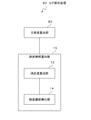
- FIG. 1 is a block diagram illustrating a configuration of a log analysis apparatus (also referred to as an information processing apparatus) 10 according to the first embodiment of the present invention.
- the log analysis apparatus 10 includes a majority calculation unit 12 and a camouflage information notification unit 15.
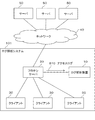
- FIG. 2 is a block diagram illustrating a configuration of a log analysis system (also referred to as an information processing system) 101 including the log analysis device 10.
- the log analysis system 101 includes a log analysis device 10, a proxy server 20, and a client 30. Further, the proxy server 20 is connected to the server 50 via the network 40.
- the proxy server 20 and the clients 30 may be in any number.
- the network 40 may be the Internet or a specific limited network.
- the server 50 is, for example, an HTTP (Hypertext Transfer Protocol) server.
- the practical user agent and the camouflaged user agent are collectively called communication control means.
- the “practical user agent” indicates a user agent permitted to operate as a part of the client 30.
- the practical user agent is, for example, an HTTP user agent of a web browser permitted to operate on the client 30.
- the practical user agent may be another user agent that is allowed to operate on the client 30 and transmits a user agent character string during communication.
- “Impersonated user agent” refers to unauthorized software that performs communication by impersonating a practical user agent.
- the camouflaged user agent is a part of malware or the like.
- the access log 810 is a history of communication between the client 30 and the server 50 relayed by the proxy server 20.
- the access log 810 is an access log of access to the server 50 that is executed by the client 30 via the proxy server 20.
- the access log 810 is a history of communication in which each of the practical user agent and the camouflaged user agent operating on the client 30 accesses the server 50 connected to the network 40 via the proxy server 20. .
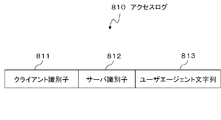
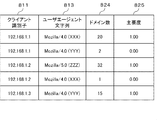
- FIG. 3 is a diagram illustrating an example of the structure of the access log 810.
- the access log 810 includes at least a client identifier 811, a server identifier 812, and a user agent character string 813.
- the client identifier 811 is, for example, an IP (Internet Protocol) address of the access source client 30.
- the client identifier 811 is not limited to an IP address, and may be any information that can identify the client 30.
- the server identifier 812 is, for example, a domain name.
- the server identifier 812 is not limited to a domain name, and may be any information that can identify the server 50.
- the user agent character string 813 is a character string for identifying a practical user agent included in the request sent by the access source client 30.
- the log analysis device 10 stores the access log 810 in a storage unit (not shown) in the log analysis device 10, for example. In addition, the log analysis device 10 may read the access log 810 as needed from an external storage unit (not shown).
- the request is, for example, a request for communication (for example, HTTP communication) between the client 30 and the server 50.
- the request is not limited to HTTP communication, and may be an arbitrary request.
- the proxy server 20 outputs an access log 810, which is information related to the request, to the log analysis device 10, for example. Further, the proxy server 20 may output the access log 810 to a storage unit (not shown). The proxy server 20 outputs the access log 810 every time the HTTP communication is relayed. Further, the proxy server 20 may collectively output the access logs 810 to the log analysis device 10 at a predetermined time or a timing requested from the log analysis device 10.
- the client 30 communicates with the server 50 connected to the network 40 via the proxy server 20. In other words, the client 30 accesses the server 50 connected to the network 40 via the proxy server 20.
- Each component shown in FIG. 1 may be a hardware unit circuit or a component divided into functional units of a computer device.
- the components shown in FIG. 1 will be described as components divided into functional units of the computer apparatus.
- the degree-of-importance calculation unit 12 calculates the degree of importance for each communication control unit corresponding to the user agent character string 813 based on the access log 810.
- the degree of importance indicates the degree of accuracy that the communication control means is a practical user agent allowed to operate as a part of the client 30.
- the degree of importance indicates, for example, the possibility that the communication control means that has executed communication for accessing the server 50 that is a web server is a practical user agent of a web browser allowed to operate on the client 30. It is an indicator to show.
- the degree-of-importance calculation unit 12 analyzes the access log 810 and calculates the degree of importance corresponding to each of the user agent character strings 813.
- the degree of importance corresponding to the user agent character string 813 is the degree of importance corresponding to either the practical user agent or the camouflaged user agent (that is, the communication control means).
- the importance calculation unit 12 calculates the importance corresponding to each of the user agent character strings 813 for each client 30.
- the degree of importance is a value calculated for a set of the client 30 and the user agent character string 813, that is, a set of the client 30 and the communication control means.
- the degree-of-importance calculation unit 12 may calculate the degree of importance corresponding to each of the user agent character strings 813 for each group of clients 30 grouped based on an arbitrary criterion.
- the degree of importance calculation unit 12 may calculate the degrees of importance corresponding to each of the user agent character strings 813 by collecting all the clients 30 together.
- the impersonation information notification unit 15 outputs impersonation information based on the degree of importance calculated by the degree of importance calculation unit 12.
- the camouflage information is information related to communication (access to the server 50) by the camouflaged user agent that camouflaged the practical user agent.
- the camouflage information notification unit 15 includes, for example, a camouflage degree calculation unit 13 and a camouflage communication detection unit 14.
- the impersonation degree calculation unit 13 calculates the degree of impersonation corresponding to each of the servers 50 based on the degree of importance calculated by the degree of importance calculation unit 12.
- the camouflage degree indicates the probability that the communication is a communication executed by the camouflaged user agent.
- the degree of impersonation is an index indicating whether or not the communication control means on the client 30 accessing a certain server 50 is a forged user agent impersonating a practical user agent. A detailed description of the method for calculating the camouflage degree will be described later.
- the camouflaged communication detection unit 14 detects a server 50 having a camouflage degree calculated by the camouflage degree calculation unit 13 equal to or greater than a threshold, and outputs impersonation information including the detected server identifier 812 of the server 50.
- the threshold value is calculated in advance empirically or theoretically, and is given to the log analysis device 10, for example.
- the camouflaged communication detection unit 14 may output impersonation information including arbitrary information such as a client identifier 811, a user agent character string 813, and an access log 810 related to the camouflage degree equal to or higher than the threshold.
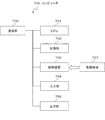
- FIG. 4 is a diagram illustrating a hardware configuration of a computer 700 that implements the log analysis apparatus 10 according to the present embodiment.
- the computer 700 includes a CPU (Central Processing Unit) 701, a storage unit 702, a storage device 703, an input unit 704, an output unit 705, and a communication unit 706. Furthermore, the computer 700 includes a recording medium (or storage medium) 707 supplied from the outside.
- the recording medium 707 is a non-volatile recording medium (non-temporary recording medium) that stores information non-temporarily.
- the recording medium 707 may be a temporary recording medium that holds information as a signal.
- the CPU 701 controls the overall operation of the computer 700 by operating an operating system (not shown). For example, the CPU 701 reads the program and data from the recording medium 707 mounted on the storage device 703 and writes the read program and data to the storage unit 702.
- the program is a program for causing the computer 700 to execute an operation of a flowchart shown in FIG.
- the CPU 701 executes various processes as the importance calculation unit 12 and the impersonation information notification unit 15 shown in FIG. 1 according to the read program and based on the read data.
- the CPU 701 may download the program and its data to the storage unit 702 from an external computer (not shown) connected to a communication network (not shown).
- the storage unit 702 stores the program and data.
- the storage unit 702 may store an access log 810, an access log 880 described later, information shown in FIG. 6, information shown in FIG.
- the storage device 703 is, for example, an optical disk, a flexible disk, a magnetic optical disk, an external hard disk semiconductor memory, and the like, and includes a recording medium 707.
- the storage device 703 (recording medium 707) stores the program in a computer-readable manner.
- the storage device 703 may store the data.
- the storage device 703 may store an access log 810, an access log 880 described later, information shown in FIG. 6, information shown in FIG.
- the input unit 704 receives an operation input by an operator and an input of information from the outside.
- Devices used for the input operation are, for example, a mouse, a keyboard, a built-in key button, and a touch panel.
- the output unit 705 is realized by a display, for example.
- the output unit 705 is used, for example, for an input request to an operator by GUI (Graphical User Interface), an output presentation to the operator, or the like.
- GUI Graphic User Interface
- the communication unit 706 implements an interface with the proxy server 20.
- the communication unit 706 is included as a part of the importance calculation unit 12, for example.
- the functional unit block of the log analysis apparatus 10 shown in FIG. 1 is realized by the computer 700 having the hardware configuration shown in FIG.
- the means for realizing each unit included in the computer 700 is not limited to the above.
- the computer 700 may be realized by one physically coupled device, or may be realized by two or more physically separated devices connected by wire or wirelessly and by a plurality of these devices. .
- the CPU 701 may read and execute the program code stored in the recording medium 707.
- the CPU 701 may store the code of the program stored in the recording medium 707 in the storage unit 702, the storage device 703, or both. That is, this embodiment includes an embodiment of a recording medium 707 that stores the program (software) executed by the computer 700 (CPU 701) temporarily or non-temporarily.
- a storage medium that stores information non-temporarily is also referred to as a non-volatile storage medium.
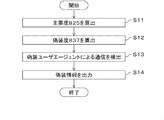
- FIG. 5 is a flowchart showing the operation of the log analysis apparatus 10 in the present embodiment. Note that the processing according to this flowchart may be executed based on the above-described program control by the CPU 701. Further, the step name of the process is described by a symbol as in S11.
- the log analysis device 10 executes the analysis processing of the access log 810 (communication history) in batches for the access log 810 for a certain period (for example, one day).
- a description will be given assuming that the access log 810 for one day is accumulated in the storage unit 702 that is a part of the importance calculation unit 12.
- the log analysis device 10 executes the processing of the flowchart shown in FIG. 5 at, for example, every predetermined time (for example, midnight). Further, when receiving an instruction from an operator via the input unit 704, for example, the log analysis apparatus 10 may execute the processing of the flowchart illustrated in FIG.
- the importance calculation unit 12 calculates the importance (step S11).
- FIG. 6 is a diagram illustrating an example of the calculated importance 825.
- the importance calculation unit 12 calculates the importance 825 by the following procedure, for example.
- the importance calculation unit 12 counts the number of access destination domains 824 for each set of the client identifier 811 and the user agent character string 813 based on the access log 810.
- the set of the client identifier 811 and the user agent character string 813 indicates a set of the client 30 and communication control means (practical user agent or impersonated user agent).
- the domain number 824 is the number of server identifiers 812 of the access destination.
- the degree-of-importance calculation unit 12 obtains the degree of importance 825 corresponding to the set of the client identifier 811 and the user agent character string 813 based on the number of domains 824.
- the degree-of-importance calculation unit 12 sets the degree of importance 825 to “1” when the number of domains 824 exceeds a threshold (for example, “10”) and “0” when the number of domains 824 is equal to or less than the threshold. And calculate.
- the threshold value is a predetermined threshold value empirically or theoretically.
- the importance calculation unit 12 calculates a function such that the value of the dependent variable approaches “1” as the value of the independent variable increases, and the value of the dependent variable approaches “0” as the value of the independent variable decreases.
- the degree of importance 825 corresponding to the dependent variable may be calculated. Examples of such functions include sigmoid functions and Gompertz functions.
- the importance calculation unit 12 processes the access log 810 including the user agent character string 813 corresponding to the practical user agent, which has a clear feature, that is, is not a detection target impersonation agent. ) May be excluded. Furthermore, the importance calculation unit 12 may exclude the access log 810 including the set of the user agent character string 813 and the server identifier 812, which has a clear feature, from the processing target (analysis target).
- the user agent character string 813 of the web browser is a character string starting with “Mozilla /”. Therefore, from the viewpoint of detecting a forged user agent that impersonates a practical user agent of a web browser, it is efficient to set only an object including the above-described user agent character string 813 as an analysis target.
- the camouflage degree calculation unit 13 of the camouflage information notification unit 15 calculates the camouflage degree based on the importance 825 (step S ⁇ b> 12). For example, the camouflage degree calculation unit 13 calculates the camouflage degree for each server 50.
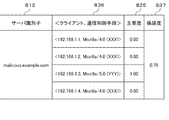
- FIG. 7 is a diagram illustrating an example of the calculated camouflage degree 837.
- FIG. 7 shows that the server identifier 812 “malicius.example.com” has been accessed from a set of four ⁇ client, communication control means> 836, and the degrees of importance corresponding to each of these sets 825 is shown.
- communication control means> 836 “client” is a client identifier 811 and “communication control means” is a user agent character string 813.
- FIG. 7 shows the camouflage degree 837 corresponding to the server identifier 812.
- FIG. 7 shows the camouflage degree 837 corresponding to the communication between the server 50 specified by the server identifier 812 and the communication control means operating on the client 30 specified by ⁇ client, communication control means> 836. Show.
- the camouflage degree calculation unit 13 calculates a value “0.75” obtained by subtracting the average value “0.25” of the importance 825 from “1” as the camouflage degree 837.
- the camouflage degree calculation unit 13 may calculate the camouflage degree 837 by any appropriate method regardless of the above-described example.
- the camouflaged communication detection unit 14 of the camouflage information notification unit 15 detects communication by the camouflaged user agent based on the camouflage degree 837 (step S ⁇ b> 13).
- the camouflaged communication detection unit 14 communicates the server identifier 812 with the domain by the camouflaged user agent. Judge that there is.
- the camouflaged communication detection unit 14 outputs camouflage information regarding communication by the camouflaged user agent (step S14).
- the impersonation information includes a server identifier 812, for example.
- the camouflaged communication detection unit 14 notifies the operator who is managing the log analysis system 101 via the output unit 705 shown in FIG. Further, the camouflaged communication detection unit 14 may notify the proxy server 20 of the camouflage information. In this case, the proxy server 20 may register the server identifier 812 included in the notified impersonation information in the black list, and block subsequent communication with the server 50 corresponding to the server identifier 812. With the above-described configuration, it is possible to make a temporary response until the final judgment of the operator is obtained.
- the log analysis apparatus 10 detects communication by the camouflaged user agent more suitably as the camouflaging of the user agent character string 813 of the main browser is more difficult.
- information such as installed plug-ins and toolbars is added to the user agent character string.
- a camouflaged user agent it is difficult for a camouflaged user agent to generate the user agent character string so that it completely matches the user agent character string of the Internet Explorer.
- a camouflaged user agent which is malware
- such behavior of malware is detected as malware activity by a behavior type detection method implemented in anti-virus software. It can be said that the log analysis apparatus 10 of the present embodiment plays a complementary role with respect to the technique of such anti-virus software.
- the first effect of the present embodiment described above is that it is possible to obtain information related to communication by malware disguised as a practical user agent regardless of the usage environment.
- the reason is that the degree-of-importance calculation unit 12 calculates the degree of importance 825, and the impersonation information notification unit 15 outputs impersonation information based on the degree of importance 825.
- the log analysis device 10 calculates the degree of impersonation 837 of communication with a certain server 50 to the degree of importance 825 on a plurality of clients 30 that communicate with the server 50 via the proxy server 20. Based on. Then, the log analysis device 10 can detect an access by other than the main practical user agent based on the camouflage degree 837.
- the main practical user agent is a practical user agent of a web browser mainly used in the client 30, for example. As a result, the log analysis device 10 can detect communication by a camouflaged user agent that camouflages a practical user agent of a web browser.
- the second effect of the present embodiment described above is that erroneous detection can be prevented in detection of communication by malware camouflaged as a practical user agent.
- camouflage information notification unit 15 calculates the camouflage degree 837 corresponding to the server identifier 812 and calculates the major degree 825 corresponding to each of the plurality of clients 30.
- the log analysis device 10 can suppress erroneous detection of the server 50 accessed by many clients 30 using a main browser as the server 50 that is a target of communication by the camouflaged user agent. This is because a practical user agent of the main browser calculates a relatively high degree of importance in a relatively large number of clients 30.
- the degree of importance calculation unit 12 calculates the degree of importance 825 by combining the user agent character string 813 and other header information such as an “Accept” header and an “Accept-Language” header.
- the log analysis device 10 detects communication by the camouflaged user agent even when the user agent character string 813 camouflaged by the camouflaged user agent matches the user agent character string 813 of the practical user agent.
- FIG. 8 is a block diagram showing a configuration of a log analysis device 80 according to the second exemplary embodiment of the present invention. As illustrated in FIG. 8, the log analysis device 80 according to the present exemplary embodiment is different from the log analysis device 10 according to the first exemplary embodiment in that it includes a importance calculation unit 82 instead of the importance calculation unit 12.
- FIG. 9 is a block diagram showing the configuration of the log analysis system 108 including the log analysis device 80.
- the log analysis system 108 includes a log analysis device 80, a proxy server 60, and a client 70. Further, the proxy server 60 is connected to the server 50 via the network 40.
- proxy servers 60 and clients 70 may be arbitrary.
- the agent tag is preferably a character string that is difficult to disguise. Specifically, it is preferable that the agent tag differs for each client 70 and is difficult to guess from the network 40 side.
- the client 70 embeds the agent tag in the user agent character string included in the request header, for example.
- the client 70 may embed the agent tag in the information of the request header other than the user agent character string.
- the access log is an access log 810 having the structure shown in FIG. 3 when the agent tag is embedded in the user agent character string.
- FIG. 10 is a diagram showing an example of the structure of the access log 880 when the agent tag is embedded in the information of the request header other than the user agent character string.
- the access log 880 includes at least a client identifier 811, a server identifier 812, a user agent character string 813, and an agent tag 888.
- the proxy tag 60 may delete the agent tag included in the request.
- the degree of importance 825 indicates the accuracy of being a practical user agent allowed to operate as a part of the client 70 as described above.
- the importance calculation unit 82 calculates the importance 825 for each of the communication control means corresponding to the user agent character string 813 including the agent tag.
- the importance calculation unit 82 calculates the importance 825 for each of the communication control means corresponding to the user agent character string 813 based on the access log 880.
- the degree-of-importance calculating unit 82 calculates the degree of importance 825 for each of the communication control means corresponding to the set of the user agent character string 813 and the agent tag 888 that does not include the agent tag.
- the log analysis device 80 may be configured by the computer 700 shown in FIG.
- the CPU 701 executes various processes as the importance calculation unit 82 and the impersonation information notification unit 15 illustrated in FIG. 8 according to the read program and based on the read data.
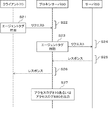
- FIG. 11 is a sequence diagram showing the operation of the log analysis system 108 when the access log 810 and the access log 880 are generated in the present embodiment.
- the client 70 adds an agent tag to the request to the server 50 (step S21).
- the client 70 transmits the request to the proxy server 60 (step S22).
- the proxy server 60 that has received the request from the client 70 deletes the agent tag (step S23).
- the proxy server 60 records the request without deleting the agent tag, for example, in the storage unit 702 illustrated in FIG.
- the proxy server 60 relays the request from which the agent tag has been deleted to the server 50 (step S24).
- the proxy server 60 receives the response transmitted from the server 50 (step S25).
- the proxy server 60 relays the response to the client 70 (step S26).
- the proxy server 60 outputs the access log 810 or the access log 880 based on the request information before the agent tag is deleted (step S27).
- the first effect of the present embodiment described above is that, in addition to the effect of the first embodiment, it is possible to improve the detection accuracy of communication by malware camouflaged in the browser.
- the reason is that the client 70 adds an agent tag to the request header, and the log analysis device 80 further calculates the degree of importance 825 based on the agent tag.
- the log analysis system 108 of this embodiment has an effect of preventing matching with a fixed user agent character string by adding an agent tag.
- the second effect of the present embodiment described above is that the agent tag can be prevented from being sent to the network 40, and the agent tag can be more difficult to guess on the network 40 side.
- the reason is that the proxy server 60 deletes the agent tag from the request and transfers the request from which the agent tag has been deleted.
- Each component described in each of the above embodiments does not necessarily need to be an independent entity.
- a plurality of arbitrary constituent elements may be realized as one module. Any one of the constituent elements may be realized by a plurality of modules. Further, any one of the components may be any other one of the components. Further, any one part of the constituent elements may overlap with any other part of the constituent elements.
- each component and a module that realizes each component may be realized by hardware if necessary. Moreover, each component and the module which implement
- the program is recorded on a computer-readable non-transitory recording medium such as a magnetic disk or a semiconductor memory and provided to the computer.
- the program is read from the non-transitory recording medium by the computer when the computer is started up.
- the read program causes the computer to function as a component in each of the above-described embodiments by controlling the operation of the computer.
- a plurality of operations are not limited to being executed at different timings. For example, other operations may occur during execution of an operation.
- the execution timing of one operation and another operation may partially or entirely overlap.
Landscapes
- Engineering & Computer Science (AREA)
- Computer Security & Cryptography (AREA)
- Theoretical Computer Science (AREA)
- General Engineering & Computer Science (AREA)
- Computer Hardware Design (AREA)
- Software Systems (AREA)
- Physics & Mathematics (AREA)
- General Physics & Mathematics (AREA)
- Computer Networks & Wireless Communication (AREA)
- Computing Systems (AREA)
- Signal Processing (AREA)
- General Health & Medical Sciences (AREA)
- Health & Medical Sciences (AREA)
- Virology (AREA)
- Social Psychology (AREA)
- Debugging And Monitoring (AREA)
- Computer And Data Communications (AREA)
Abstract
Priority Applications (2)
| Application Number | Priority Date | Filing Date | Title |
|---|---|---|---|
| US15/312,041 US10250625B2 (en) | 2014-05-22 | 2015-05-18 | Information processing device, communication history analysis method, and medium |
| JP2016520932A JP6635029B2 (ja) | 2014-05-22 | 2015-05-18 | 情報処理装置、情報処理システム及び通信履歴解析方法 |
Applications Claiming Priority (2)
| Application Number | Priority Date | Filing Date | Title |
|---|---|---|---|
| JP2014-106226 | 2014-05-22 | ||
| JP2014106226 | 2014-05-22 |
Publications (1)
| Publication Number | Publication Date |
|---|---|
| WO2015178002A1 true WO2015178002A1 (fr) | 2015-11-26 |
Family
ID=54553684
Family Applications (1)
| Application Number | Title | Priority Date | Filing Date |
|---|---|---|---|
| PCT/JP2015/002476 Ceased WO2015178002A1 (fr) | 2014-05-22 | 2015-05-18 | Dispositif de traitement d'informations, système de traitement d'informations et procédé d'analyse d'historique de communications |
Country Status (3)
| Country | Link |
|---|---|
| US (1) | US10250625B2 (fr) |
| JP (1) | JP6635029B2 (fr) |
| WO (1) | WO2015178002A1 (fr) |
Families Citing this family (2)
| Publication number | Priority date | Publication date | Assignee | Title |
|---|---|---|---|---|
| WO2017214004A1 (fr) | 2016-06-06 | 2017-12-14 | Mastercard International Incorporated | Procédé et système destinés à l'affichage dynamique d'images personnalisées |
| CN111125692B (zh) * | 2019-12-05 | 2022-07-12 | 任子行网络技术股份有限公司 | 反爬虫方法及装置 |
Citations (4)
| Publication number | Priority date | Publication date | Assignee | Title |
|---|---|---|---|---|
| JPH11306067A (ja) * | 1998-04-21 | 1999-11-05 | Osaka Gas Co Ltd | プロキシーシステム |
| JP2003280945A (ja) * | 2002-03-19 | 2003-10-03 | Hitachi Information Systems Ltd | ログ解析システム,該ログ解析システムによる解析対象抽出方法および解析対象抽出プログラム |
| JP2011233081A (ja) * | 2010-04-30 | 2011-11-17 | Kddi Corp | アプリケーション判定システムおよびプログラム |
| US20120143650A1 (en) * | 2010-12-06 | 2012-06-07 | Thomas Crowley | Method and system of assessing and managing risk associated with compromised network assets |
Family Cites Families (5)
| Publication number | Priority date | Publication date | Assignee | Title |
|---|---|---|---|---|
| JP2002132739A (ja) * | 2000-10-23 | 2002-05-10 | Nec Corp | スタブ検索ローディングシステム及び方法、サーバ装置、クライアント装置並びにコンピュータ可読記録媒体 |
| JP3759137B2 (ja) * | 2003-09-30 | 2006-03-22 | 日立電子サービス株式会社 | 無線通信装置およびなりすまし端末検出方法 |
| US8286225B2 (en) * | 2009-08-07 | 2012-10-09 | Palo Alto Research Center Incorporated | Method and apparatus for detecting cyber threats |
| JP2013192019A (ja) | 2012-03-13 | 2013-09-26 | Kddi Corp | マルウェア通信検知システム、マルウェア通信防止システム及びプログラム |
| GB2514796A (en) * | 2013-06-04 | 2014-12-10 | Ibm | Web service testing |
-
2015
- 2015-05-18 WO PCT/JP2015/002476 patent/WO2015178002A1/fr not_active Ceased
- 2015-05-18 JP JP2016520932A patent/JP6635029B2/ja not_active Expired - Fee Related
- 2015-05-18 US US15/312,041 patent/US10250625B2/en active Active
Patent Citations (4)
| Publication number | Priority date | Publication date | Assignee | Title |
|---|---|---|---|---|
| JPH11306067A (ja) * | 1998-04-21 | 1999-11-05 | Osaka Gas Co Ltd | プロキシーシステム |
| JP2003280945A (ja) * | 2002-03-19 | 2003-10-03 | Hitachi Information Systems Ltd | ログ解析システム,該ログ解析システムによる解析対象抽出方法および解析対象抽出プログラム |
| JP2011233081A (ja) * | 2010-04-30 | 2011-11-17 | Kddi Corp | アプリケーション判定システムおよびプログラム |
| US20120143650A1 (en) * | 2010-12-06 | 2012-06-07 | Thomas Crowley | Method and system of assessing and managing risk associated with compromised network assets |
Non-Patent Citations (1)
| Title |
|---|
| "Atarashii Type no Kogeki' no Taisaku ni Muketa Sekkei·Un'yo Guide", INFORMATION-TECHNOLOGY PROMOTION AGENCY, November 2011 (2011-11-01), Retrieved from the Internet <URL:https://www.ipa.go.jp/files/000017308.pdf> [retrieved on 20150715] * |
Also Published As
| Publication number | Publication date |
|---|---|
| JPWO2015178002A1 (ja) | 2017-04-20 |
| US10250625B2 (en) | 2019-04-02 |
| US20170085586A1 (en) | 2017-03-23 |
| JP6635029B2 (ja) | 2020-01-22 |
Similar Documents
| Publication | Publication Date | Title |
|---|---|---|
| US10666686B1 (en) | Virtualized exploit detection system | |
| US9853994B2 (en) | Attack analysis system, cooperation apparatus, attack analysis cooperation method, and program | |
| US8677493B2 (en) | Dynamic cleaning for malware using cloud technology | |
| US11374946B2 (en) | Inline malware detection | |
| CN105409164B (zh) | 通过使用硬件资源来检测网络业务中的矛盾的根套件检测 | |
| US11636208B2 (en) | Generating models for performing inline malware detection | |
| JP2020095753A (ja) | マルウェアのランタイム中の自動検出 | |
| CN113660224B (zh) | 基于网络漏洞扫描的态势感知防御方法、装置及系统 | |
| US12056237B2 (en) | Analysis of historical network traffic to identify network vulnerabilities | |
| US9916443B1 (en) | Detecting an attempt to exploit a memory allocation vulnerability | |
| JP5920169B2 (ja) | 不正コネクション検出方法、ネットワーク監視装置及びプログラム | |
| US8955138B1 (en) | Systems and methods for reevaluating apparently benign behavior on computing devices | |
| US10033761B2 (en) | System and method for monitoring falsification of content after detection of unauthorized access | |
| US20160373447A1 (en) | Unauthorized access detecting system and unauthorized access detecting method | |
| US20250039191A1 (en) | Visualization tool for real-time network risk assessment | |
| US12445484B2 (en) | Inline ransomware detection via server message block (SMB) traffic | |
| CN116860489A (zh) | 用于安全威胁的威胁风险评分的系统和方法 | |
| US20210194915A1 (en) | Identification of potential network vulnerability and security responses in light of real-time network risk assessment | |
| JP5389855B2 (ja) | 解析システム、解析方法および解析プログラム | |
| Arul et al. | Supervised deep learning vector quantization to detect MemCached DDOS malware attack on cloud | |
| EP3999985A1 (fr) | Détection de logiciel malveillant en ligne | |
| JP6635029B2 (ja) | 情報処理装置、情報処理システム及び通信履歴解析方法 | |
| US10757118B2 (en) | Method of aiding the detection of infection of a terminal by malware | |
| CN114143103A (zh) | Ad域威胁检测方法、装置及电子设备 | |
| JP6911723B2 (ja) | ネットワーク監視装置、ネットワーク監視方法及びネットワーク監視プログラム |
Legal Events
| Date | Code | Title | Description |
|---|---|---|---|
| 121 | Ep: the epo has been informed by wipo that ep was designated in this application |
Ref document number: 15796280 Country of ref document: EP Kind code of ref document: A1 |
|
| ENP | Entry into the national phase |
Ref document number: 2016520932 Country of ref document: JP Kind code of ref document: A |
|
| WWE | Wipo information: entry into national phase |
Ref document number: 15312041 Country of ref document: US |
|
| NENP | Non-entry into the national phase |
Ref country code: DE |
|
| 122 | Ep: pct application non-entry in european phase |
Ref document number: 15796280 Country of ref document: EP Kind code of ref document: A1 |