WO2015178151A1 - 難燃性樹脂組成物、及び、これを用いたケーブル - Google Patents
難燃性樹脂組成物、及び、これを用いたケーブル Download PDFInfo
- Publication number
- WO2015178151A1 WO2015178151A1 PCT/JP2015/062207 JP2015062207W WO2015178151A1 WO 2015178151 A1 WO2015178151 A1 WO 2015178151A1 JP 2015062207 W JP2015062207 W JP 2015062207W WO 2015178151 A1 WO2015178151 A1 WO 2015178151A1
- Authority
- WO
- WIPO (PCT)
- Prior art keywords
- parts
- mass
- flame retardant
- compound
- group
- Prior art date
- Legal status (The legal status is an assumption and is not a legal conclusion. Google has not performed a legal analysis and makes no representation as to the accuracy of the status listed.)
- Ceased
Links
- 0 CC1CC(*)(*)N(*)C(*)(*)C1 Chemical compound CC1CC(*)(*)N(*)C(*)(*)C1 0.000 description 1
Images

Classifications
-
- C—CHEMISTRY; METALLURGY
- C08—ORGANIC MACROMOLECULAR COMPOUNDS; THEIR PREPARATION OR CHEMICAL WORKING-UP; COMPOSITIONS BASED THEREON
- C08K—Use of inorganic or non-macromolecular organic substances as compounding ingredients
- C08K3/00—Use of inorganic substances as compounding ingredients
- C08K3/18—Oxygen-containing compounds, e.g. metal carbonyls
- C08K3/24—Acids; Salts thereof
- C08K3/26—Carbonates; Bicarbonates
-
- C—CHEMISTRY; METALLURGY
- C08—ORGANIC MACROMOLECULAR COMPOUNDS; THEIR PREPARATION OR CHEMICAL WORKING-UP; COMPOSITIONS BASED THEREON
- C08K—Use of inorganic or non-macromolecular organic substances as compounding ingredients
- C08K3/00—Use of inorganic substances as compounding ingredients
- C08K3/34—Silicon-containing compounds
-
- C—CHEMISTRY; METALLURGY
- C08—ORGANIC MACROMOLECULAR COMPOUNDS; THEIR PREPARATION OR CHEMICAL WORKING-UP; COMPOSITIONS BASED THEREON
- C08K—Use of inorganic or non-macromolecular organic substances as compounding ingredients
- C08K5/00—Use of organic ingredients
- C08K5/04—Oxygen-containing compounds
- C08K5/09—Carboxylic acids; Metal salts thereof; Anhydrides thereof
- C08K5/098—Metal salts of carboxylic acids
-
- C—CHEMISTRY; METALLURGY
- C08—ORGANIC MACROMOLECULAR COMPOUNDS; THEIR PREPARATION OR CHEMICAL WORKING-UP; COMPOSITIONS BASED THEREON
- C08K—Use of inorganic or non-macromolecular organic substances as compounding ingredients
- C08K5/00—Use of organic ingredients
- C08K5/16—Nitrogen-containing compounds
- C08K5/34—Heterocyclic compounds having nitrogen in the ring
- C08K5/3412—Heterocyclic compounds having nitrogen in the ring having one nitrogen atom in the ring
- C08K5/3432—Six-membered rings
- C08K5/3435—Piperidines
-
- C—CHEMISTRY; METALLURGY
- C08—ORGANIC MACROMOLECULAR COMPOUNDS; THEIR PREPARATION OR CHEMICAL WORKING-UP; COMPOSITIONS BASED THEREON
- C08L—COMPOSITIONS OF MACROMOLECULAR COMPOUNDS
- C08L23/00—Compositions of homopolymers or copolymers of unsaturated aliphatic hydrocarbons having only one carbon-to-carbon double bond; Compositions of derivatives of such polymers
- C08L23/02—Compositions of homopolymers or copolymers of unsaturated aliphatic hydrocarbons having only one carbon-to-carbon double bond; Compositions of derivatives of such polymers not modified by chemical after-treatment
-
- C—CHEMISTRY; METALLURGY
- C08—ORGANIC MACROMOLECULAR COMPOUNDS; THEIR PREPARATION OR CHEMICAL WORKING-UP; COMPOSITIONS BASED THEREON
- C08L—COMPOSITIONS OF MACROMOLECULAR COMPOUNDS
- C08L23/00—Compositions of homopolymers or copolymers of unsaturated aliphatic hydrocarbons having only one carbon-to-carbon double bond; Compositions of derivatives of such polymers
- C08L23/02—Compositions of homopolymers or copolymers of unsaturated aliphatic hydrocarbons having only one carbon-to-carbon double bond; Compositions of derivatives of such polymers not modified by chemical after-treatment
- C08L23/04—Homopolymers or copolymers of ethene
- C08L23/06—Polyethylene
-
- C—CHEMISTRY; METALLURGY
- C08—ORGANIC MACROMOLECULAR COMPOUNDS; THEIR PREPARATION OR CHEMICAL WORKING-UP; COMPOSITIONS BASED THEREON
- C08L—COMPOSITIONS OF MACROMOLECULAR COMPOUNDS
- C08L23/00—Compositions of homopolymers or copolymers of unsaturated aliphatic hydrocarbons having only one carbon-to-carbon double bond; Compositions of derivatives of such polymers
- C08L23/02—Compositions of homopolymers or copolymers of unsaturated aliphatic hydrocarbons having only one carbon-to-carbon double bond; Compositions of derivatives of such polymers not modified by chemical after-treatment
- C08L23/04—Homopolymers or copolymers of ethene
- C08L23/08—Copolymers of ethene
- C08L23/0807—Copolymers of ethene with unsaturated hydrocarbons only containing four or more carbon atoms
- C08L23/0815—Copolymers of ethene with unsaturated hydrocarbons only containing four or more carbon atoms with aliphatic 1-olefins containing one carbon-to-carbon double bond
-
- C—CHEMISTRY; METALLURGY
- C08—ORGANIC MACROMOLECULAR COMPOUNDS; THEIR PREPARATION OR CHEMICAL WORKING-UP; COMPOSITIONS BASED THEREON
- C08L—COMPOSITIONS OF MACROMOLECULAR COMPOUNDS
- C08L53/00—Compositions of block copolymers containing at least one sequence of a polymer obtained by reactions only involving carbon-to-carbon unsaturated bonds; Compositions of derivatives of such polymers
-
- C—CHEMISTRY; METALLURGY
- C08—ORGANIC MACROMOLECULAR COMPOUNDS; THEIR PREPARATION OR CHEMICAL WORKING-UP; COMPOSITIONS BASED THEREON
- C08L—COMPOSITIONS OF MACROMOLECULAR COMPOUNDS
- C08L83/00—Compositions of macromolecular compounds obtained by reactions forming in the main chain of the macromolecule a linkage containing silicon with or without sulfur, nitrogen, oxygen or carbon only; Compositions of derivatives of such polymers
- C08L83/04—Polysiloxanes
-
- C—CHEMISTRY; METALLURGY
- C09—DYES; PAINTS; POLISHES; NATURAL RESINS; ADHESIVES; COMPOSITIONS NOT OTHERWISE PROVIDED FOR; APPLICATIONS OF MATERIALS NOT OTHERWISE PROVIDED FOR
- C09K—MATERIALS FOR MISCELLANEOUS APPLICATIONS, NOT PROVIDED FOR ELSEWHERE
- C09K21/00—Fireproofing materials
- C09K21/02—Inorganic materials
-
- G—PHYSICS
- G02—OPTICS
- G02B—OPTICAL ELEMENTS, SYSTEMS OR APPARATUS
- G02B6/00—Light guides; Structural details of arrangements comprising light guides and other optical elements, e.g. couplings
- G02B6/44—Mechanical structures for providing tensile strength and external protection for fibres, e.g. optical transmission cables
- G02B6/4401—Optical cables
- G02B6/4429—Means specially adapted for strengthening or protecting the cables
- G02B6/4436—Heat resistant
-
- H—ELECTRICITY
- H01—ELECTRIC ELEMENTS
- H01B—CABLES; CONDUCTORS; INSULATORS; SELECTION OF MATERIALS FOR THEIR CONDUCTIVE, INSULATING OR DIELECTRIC PROPERTIES
- H01B3/00—Insulators or insulating bodies characterised by the insulating materials; Selection of materials for their insulating or dielectric properties
- H01B3/18—Insulators or insulating bodies characterised by the insulating materials; Selection of materials for their insulating or dielectric properties mainly consisting of organic substances
- H01B3/30—Insulators or insulating bodies characterised by the insulating materials; Selection of materials for their insulating or dielectric properties mainly consisting of organic substances plastics; resins; waxes
- H01B3/44—Insulators or insulating bodies characterised by the insulating materials; Selection of materials for their insulating or dielectric properties mainly consisting of organic substances plastics; resins; waxes vinyl resins; acrylic resins
-
- H—ELECTRICITY
- H01—ELECTRIC ELEMENTS
- H01B—CABLES; CONDUCTORS; INSULATORS; SELECTION OF MATERIALS FOR THEIR CONDUCTIVE, INSULATING OR DIELECTRIC PROPERTIES
- H01B3/00—Insulators or insulating bodies characterised by the insulating materials; Selection of materials for their insulating or dielectric properties
- H01B3/18—Insulators or insulating bodies characterised by the insulating materials; Selection of materials for their insulating or dielectric properties mainly consisting of organic substances
- H01B3/30—Insulators or insulating bodies characterised by the insulating materials; Selection of materials for their insulating or dielectric properties mainly consisting of organic substances plastics; resins; waxes
- H01B3/44—Insulators or insulating bodies characterised by the insulating materials; Selection of materials for their insulating or dielectric properties mainly consisting of organic substances plastics; resins; waxes vinyl resins; acrylic resins
- H01B3/441—Insulators or insulating bodies characterised by the insulating materials; Selection of materials for their insulating or dielectric properties mainly consisting of organic substances plastics; resins; waxes vinyl resins; acrylic resins from alkenes
-
- H—ELECTRICITY
- H01—ELECTRIC ELEMENTS
- H01B—CABLES; CONDUCTORS; INSULATORS; SELECTION OF MATERIALS FOR THEIR CONDUCTIVE, INSULATING OR DIELECTRIC PROPERTIES
- H01B3/00—Insulators or insulating bodies characterised by the insulating materials; Selection of materials for their insulating or dielectric properties
- H01B3/18—Insulators or insulating bodies characterised by the insulating materials; Selection of materials for their insulating or dielectric properties mainly consisting of organic substances
- H01B3/30—Insulators or insulating bodies characterised by the insulating materials; Selection of materials for their insulating or dielectric properties mainly consisting of organic substances plastics; resins; waxes
- H01B3/46—Insulators or insulating bodies characterised by the insulating materials; Selection of materials for their insulating or dielectric properties mainly consisting of organic substances plastics; resins; waxes silicones
-
- H—ELECTRICITY
- H01—ELECTRIC ELEMENTS
- H01B—CABLES; CONDUCTORS; INSULATORS; SELECTION OF MATERIALS FOR THEIR CONDUCTIVE, INSULATING OR DIELECTRIC PROPERTIES
- H01B7/00—Insulated conductors or cables characterised by their form
- H01B7/17—Protection against damage caused by external factors, e.g. sheaths or armouring
- H01B7/29—Protection against damage caused by extremes of temperature or by flame
- H01B7/295—Protection against damage caused by extremes of temperature or by flame using material resistant to flame
-
- C—CHEMISTRY; METALLURGY
- C08—ORGANIC MACROMOLECULAR COMPOUNDS; THEIR PREPARATION OR CHEMICAL WORKING-UP; COMPOSITIONS BASED THEREON
- C08L—COMPOSITIONS OF MACROMOLECULAR COMPOUNDS
- C08L2201/00—Properties
- C08L2201/02—Flame or fire retardant/resistant
-
- C—CHEMISTRY; METALLURGY
- C08—ORGANIC MACROMOLECULAR COMPOUNDS; THEIR PREPARATION OR CHEMICAL WORKING-UP; COMPOSITIONS BASED THEREON
- C08L—COMPOSITIONS OF MACROMOLECULAR COMPOUNDS
- C08L2201/00—Properties
- C08L2201/08—Stabilised against heat, light or radiation or oxydation
-
- C—CHEMISTRY; METALLURGY
- C08—ORGANIC MACROMOLECULAR COMPOUNDS; THEIR PREPARATION OR CHEMICAL WORKING-UP; COMPOSITIONS BASED THEREON
- C08L—COMPOSITIONS OF MACROMOLECULAR COMPOUNDS
- C08L2203/00—Applications
- C08L2203/20—Applications use in electrical or conductive gadgets
- C08L2203/202—Applications use in electrical or conductive gadgets use in electrical wires or wirecoating
-
- C—CHEMISTRY; METALLURGY
- C08—ORGANIC MACROMOLECULAR COMPOUNDS; THEIR PREPARATION OR CHEMICAL WORKING-UP; COMPOSITIONS BASED THEREON
- C08L—COMPOSITIONS OF MACROMOLECULAR COMPOUNDS
- C08L23/00—Compositions of homopolymers or copolymers of unsaturated aliphatic hydrocarbons having only one carbon-to-carbon double bond; Compositions of derivatives of such polymers
- C08L23/02—Compositions of homopolymers or copolymers of unsaturated aliphatic hydrocarbons having only one carbon-to-carbon double bond; Compositions of derivatives of such polymers not modified by chemical after-treatment
- C08L23/04—Homopolymers or copolymers of ethene
- C08L23/08—Copolymers of ethene
- C08L23/0846—Copolymers of ethene with unsaturated hydrocarbons containing atoms other than carbon or hydrogen
- C08L23/0869—Copolymers of ethene with unsaturated hydrocarbons containing atoms other than carbon or hydrogen with unsaturated acids, e.g. [meth]acrylic acid; with unsaturated esters, e.g. [meth]acrylic acid esters
Definitions
- the present invention relates to a flame retardant resin composition and a cable using the same.
- eco-materials are widely used for cable coverings, cable jackets, tubes, tapes, packaging materials, building materials, and the like.
- composition comprising a polyolefin resin and calcium carbonate as a flame retardant, silicone oil or magnesium stearate as a flame retardant aid, and an antioxidant is known ( See Patent Document 1 below).
- composition described in Patent Document 1 has the following problems.
- the present invention has been made in view of the above circumstances, and an object thereof is to provide a flame retardant resin composition capable of improving weather resistance while ensuring excellent flame retardancy, and a cable using the same.
- the present inventors have repeatedly studied to solve the above problems. For example, in order to improve the weather resistance of the composition, the present inventors tried to blend benzotriazole known as a light stabilizer. However, it has been found that the blending of benzotriazole does not sufficiently improve the weather resistance, but the blending of benzotriazole significantly reduces the flame retardancy. Therefore, the present inventors tried to blend a hindered amine compound in place of benzotriazole.
- a fatty acid is used as the fatty acid-containing compound
- the fatty acid and the hindered amine compound that is a base cause a neutralization reaction, and the function of the hindered amine compound may be inhibited.
- the present invention provides a base resin containing a polyolefin compound, a silicone compound, a fatty acid metal salt, at least one flame retardant selected from the group consisting of calcium carbonate particles and silicate compound particles, and a hindered A phenolic compound and a hindered amine compound, wherein the silicone compound is blended at a ratio of 0.1 parts by mass or more and 10 parts by mass or less with respect to 100 parts by mass of the base resin, and the fatty acid metal salt is It mix
- the hindered phenol compound is not less than 0.05 parts by weight and not more than 10 parts by weight with respect to 100 parts by weight of the base resin.
- the hindered amine compound is compounded at a ratio of 0.05 parts by mass or more and 10 parts by mass or less with respect to 100 parts by mass of the base resin, and the hindered amine compound is represented by the following formula (1).
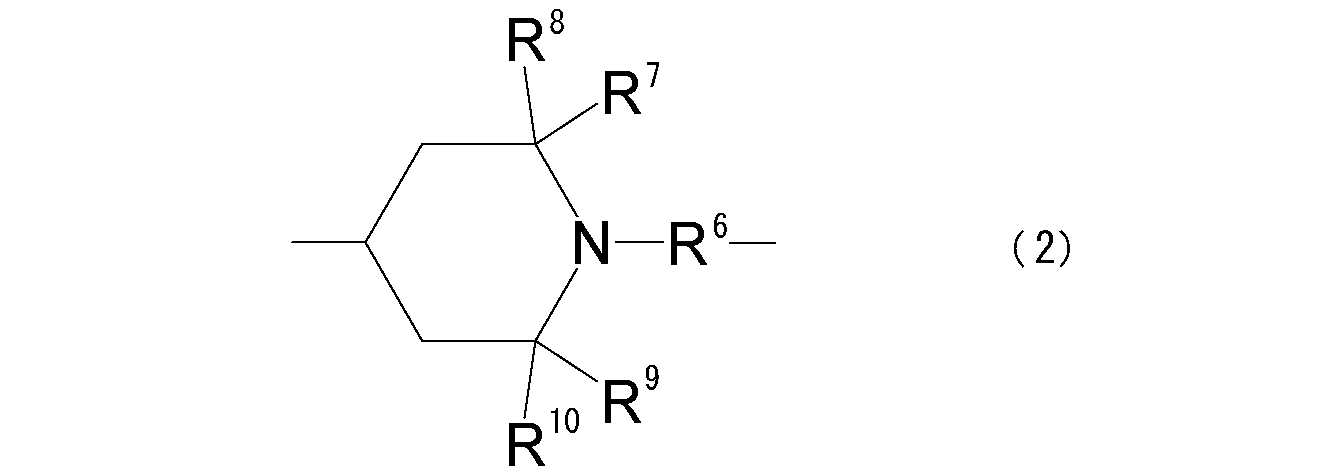
- It is a flame retardant resin composition having a divalent group or a divalent group represented by the following formula (2).
- R 1 represents an alkyl group or alkoxy group having 1 to 30 carbon atoms
- R 2 to R 5 each independently represents an alkyl group having 1 to 6 carbon atoms
- R 6 represents an alkylene group having 1 to 30 carbon atoms
- R 7 to R 10 each independently represents an alkyl group having 1 to 6 carbon atoms
- thermo resistance can be improved while ensuring excellent flame retardancy.
- the present inventors infer the reason why excellent flame retardancy is obtained in the flame retardant resin composition of the present invention as follows.
- the use of calcium carbonate particles or calcium silicate particles, a silicone compound, and a fatty acid metal salt may increase the flame retardant effect of the resin composition by forming a surface barrier layer during combustion.
- the fatty acid metal salt and the hindered amine compound By using a compound having a monovalent group represented by the above formula (1) or a divalent group represented by the above formula (2) as the hindered amine compound, the fatty acid metal salt and the hindered amine compound It is considered that the interaction can be reduced.
- the monovalent group represented by the above formula (1) when R 1 is a hydrogen atom, the fatty acid metal salt and the hindered amine compound easily interact, and the original function of the hindered amine compound is reduced. Decreases. Thus, the present inventors speculate that the weather resistance can be improved in the flame-retardant resin composition of the present invention.
- the silicone compound is blended in a proportion greater than 0.2 parts by mass with respect to 100 parts by mass of the base resin, and the fatty acid metal salt is based on 100 parts by mass of the base resin. More than 3 parts by mass, the hindered amine compound is compounded at a ratio of 0.05 parts by mass or more and less than 1 part by mass with respect to 100 parts by mass of the base resin, and the molecular weight of the hindered amine compound is 1000 or more. It is preferable that
- the hindered amine compound preferably has a molecular weight of 1000 or more.
- the molecular weight of the hindered amine compound is preferably 3000 or less.
- the said silicone type compound is mix
- this invention has a jacket and the transmission medium which is provided inside the said jacket, and is comprised with a conductor or an optical fiber, and the said jacket is comprised with the flame-retardant resin composition mentioned above. It is.
- the jacket of the present invention is composed of the above-mentioned flame retardant resin composition, and this flame retardant resin composition can improve weather resistance while ensuring excellent flame retardancy. It is also useful as a cable that runs through.
- “molecular weight” refers to a value calculated from a calibration curve created by measuring a retention time by gel permeation chromatography (GPC) and measuring a polystyrene standard sample.
- a flame retardant resin composition capable of improving weather resistance while ensuring excellent flame retardancy, and a cable using the same are provided.
- FIG. 2 is a cross-sectional view taken along line II-II in FIG. It is sectional drawing which shows other embodiment of the cable of this invention.
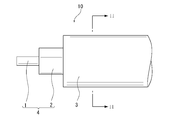
- FIG. 1 is a partial side view showing an embodiment of a cable according to the present invention.
- FIG. 2 is a sectional view taken along line II-II in FIG.
- the cable 10 includes an insulated wire 4 and a tube-like outer jacket 3 that covers the insulated wire 4.
- An example of such a cable 10 is a round cable.
- the insulated wire 4 includes an inner conductor 1 as a transmission medium and a tubular insulator 2 that covers the inner conductor 1. That is, in the cable 10, the inner conductor 1 is provided inside the tubular insulator 2 and is provided inside the tubular jacket 3.
- the tubular insulator 2 and the jacket 3 are made of a flame retardant resin composition
- the flame retardant resin composition includes a base resin containing a polyolefin compound, a silicone compound, a fatty acid It contains a metal salt, a flame retardant comprising at least one selected from the group consisting of calcium carbonate particles and silicate compound particles, a hindered phenol compound, and a hindered amine compound.
- the silicone compound is blended at a ratio of 0.1 parts by mass or more and 10 parts by mass or less with respect to 100 parts by mass of the base resin
- the fatty acid metal salt is 0.1 parts by mass with respect to 100 parts by mass of the base resin.
- the flame retardant is blended at a ratio of 5 parts by mass or more and 200 parts by mass or less with respect to 100 parts by mass of the base resin, and the hindered phenol compound is blended at a ratio of 100 parts by mass of the base resin.
- the hindered amine compound is blended at a ratio of 0.05 to 10 parts by mass with respect to 100 parts by mass of the base resin.
- the hindered amine compound has a monovalent group represented by the following formula (1) or a divalent group represented by the following formula (2).
- R 1 represents an alkyl group or alkoxy group having 1 to 30 carbon atoms
- R 2 to R 5 each independently represents an alkyl group having 1 to 6 carbon atoms
- R 6 represents an alkylene group having 1 to 30 carbon atoms
- R 7 to R 10 each independently represents an alkyl group having 1 to 6 carbon atoms
- the insulator 2 and the jacket 3 made of the flame retardant resin composition can improve the weather resistance while ensuring excellent flame retardancy. Therefore, the cable 10 is useful as a cable that passes outdoors.
- an inner conductor 1 as a transmission medium is prepared.
- the inner conductor 1 may be composed of only one strand, or may be configured by bundling a plurality of strands. Further, the inner conductor 1 is not particularly limited with respect to the conductor diameter, the material of the conductor, and the like, and can be appropriately determined according to the application.
- the flame retardant resin composition is prepared.
- the flame retardant resin composition is at least one selected from the group consisting of a base resin containing a polyolefin compound, a silicone compound, a fatty acid metal salt, calcium carbonate particles, and silicate compound particles.
- the flame retardant which consists of, a hindered phenol type compound, and a hindered amine type compound are included.
- the base resin may contain a polyolefin compound.
- the polyolefin-based compound include polyethylene (PE), ethylene-based copolymer, polypropylene (PP), propylene-based copolymer, modified polyolefin, and olefin-based thermoplastic elastomer. These can be used alone or in combination of two or more.
- ethylene copolymer examples include ethylene-ethyl acrylate copolymer (EEA), ethylene-methyl acrylate copolymer (EMA), ethylene vinyl acetate copolymer (EVA), ethylene-propylene copolymer, ethylene -Butene copolymer, ethylene-hexene copolymer and ethylene-octene copolymer. These can be used alone or in combination of two or more.
- ESA ethylene-ethyl acrylate copolymer
- EMA ethylene-methyl acrylate copolymer
- EVA ethylene vinyl acetate copolymer
- ethylene-propylene copolymer examples include ethylene-propylene copolymer and a random polypropylene copolymer.
- the base resin may be a mixed resin of a polyolefin compound and other resins.
- the resin other than the polyolefin-based compound for example, styrene-based thermoplastic elastomer ester such as styrene-butadiene rubber (SBR), hydrogenated SBR, styrene ethylene butylene styrene block copolymer (SEBS), engineering such as polycarbonate resin, etc.
- SBR styrene-based thermoplastic elastomer ester
- SEBS styrene ethylene butylene styrene block copolymer
- plastic for example, plastic.
- the content of the polyolefin-based compound in the base resin is not particularly limited, but is preferably 30 to 100% by mass, more preferably 50 to 100% by mass.
- the silicone compound functions as a flame retardant aid, and examples of the silicone compound include polyorganosiloxane.
- the polyorganosiloxane has a siloxane bond as a main chain and an organic group in a side chain.
- the organic group include a methyl group, a vinyl group, an ethyl group, a propyl group, and a phenyl group.
- polyorganosiloxane examples include dimethylpolysiloxane, methylethylpolysiloxane, methyloctylpolysiloxane, methylvinylpolysiloxane, methylphenylpolysiloxane, and methyl (3,3,3-trifluoropropyl) polysiloxane. Is mentioned.
- the polyorganosiloxane is used in the form of silicone oil, silicone powder, silicone gum or silicone resin. Among these, the polyorganosiloxane is preferably used in the form of silicone gum. In this case, bloom is less likely to occur.
- the silicone compound is blended at a ratio of 0.1 parts by mass or more and 10 parts by mass or less with respect to 100 parts by mass of the base resin.
- more excellent flame retardancy can be obtained as compared with the case where the blending ratio of the silicone compound is less than 0.1 parts by mass.
- the compounding ratio of the silicone compound with respect to 100 parts by mass of the base resin is within the above range, the non-uniformity in flame retardancy and weather resistance is less than when the compounding ratio of the silicone compound is larger than 10 parts by mass. Become. This is because the silicone compound is easily mixed with the base resin evenly, and it is difficult for partial formation of lumps.
- the blending ratio of the silicone compound to 100 parts by mass of the base resin is preferably 1 part by mass or more. In this case, more excellent flame retardancy can be obtained as compared with the case where the blending ratio of the silicone compound is less than 1 part by mass.
- the silicone compound may be attached in advance to the surface of the flame retardant. In this case, segregation of the silicone compound is less likely to occur in the flame retardant resin composition, and the uniformity of characteristics in the flame retardant resin composition is further improved.
- the silicone compound is added to the flame retardant and mixed to obtain a mixture, and then the mixture is dried at 40 to 75 ° C. for 10 to 40 minutes.
- the dried mixture can be obtained by grinding with a Henschel mixer, an atomizer or the like.
- the fatty acid metal salt functions as a flame retardant aid.
- a fatty acid having 12 to 28 carbon atoms is used as the fatty acid.
- fatty acids include lauric acid, myristic acid, palmitic acid, stearic acid, tuberculostearic acid, oleic acid, linoleic acid, arachidonic acid, behenic acid and montanic acid.
- stearic acid or tuberculostearic acid is preferable, and stearic acid is particularly preferable. In this case, more excellent flame retardancy can be obtained as compared with the case of using a fatty acid other than stearic acid or tuberculostearic acid.
- the metal constituting the fatty acid metal salt examples include magnesium, calcium, zinc and lead.
- the fatty acid metal salt magnesium stearate or calcium stearate is preferable. In this case, more excellent flame retardancy can be obtained as compared with the case of using a fatty acid metal salt other than magnesium stearate and calcium stearate.
- the fatty acid metal salt is blended at a ratio of 0.1 parts by mass or more and 20 parts by mass or less with respect to 100 parts by mass of the base resin. In this case, more excellent flame retardancy can be obtained as compared with the case where the proportion of the fatty acid metal salt is less than 0.1 parts by mass. Further, when the blending ratio of the fatty acid metal salt with respect to 100 parts by mass of the base resin is within the above range, the weather resistance is more excellent than when the blending ratio of the fatty acid metal salt with respect to 100 parts by mass of the base resin is larger than 20 parts by mass. Is obtained.
- the blending ratio of the fatty acid metal salt with respect to 100 parts by weight of the base resin is blended at a ratio larger than 3 parts by weight. In this case, more excellent flame retardancy can be obtained as compared with the case where the blending ratio of the fatty acid metal salt with respect to 100 parts by mass of the base resin is 3 parts by mass or less.
- the fatty acid metal salt may be attached to the surface of the flame retardant together with the silicone compound. In this case, segregation of the silicone compound and the fatty acid metal salt is less likely to occur in the flame retardant resin composition, and the uniformity of characteristics in the flame retardant resin composition is further improved.
- the silicone compound and the fatty acid metal salt are added to the flame retardant and mixed to obtain a mixture, and then the mixture is heated to 40 to 75 ° C. For 10 to 40 minutes, and the dried mixture is pulverized with a Henschel mixer, an atomizer or the like.
- the flame retardant comprises at least one selected from the group consisting of calcium carbonate particles and silicate compound particles. Therefore, the flame retardant may be composed only of calcium carbonate particles, may be composed only of silicate compound particles, or may be composed of a mixture thereof.
- the calcium carbonate particles may be either heavy calcium carbonate or light calcium carbonate.
- Silicate compound particles are particles composed of a silicate compound.
- the silicate compound include talc and clay.
- the clay include kaolin clay, wax clay, fired clay obtained by firing them, and modified clay whose surface is modified with a silane coupling agent. These can be used alone or in combination of two or more. Of these, kaolin clay is preferable. In this case, there is an advantage that the content of impurities is small and coloring is difficult.
- the flame retardant is blended at a ratio of 5 parts by mass or more and 200 parts by mass or less with respect to 100 parts by mass of the base resin. In this case, more excellent flame retardancy can be obtained as compared with the case where the ratio of the flame retardant is less than 5 parts by mass with respect to 100 parts by mass of the base resin.
- the flame retardant resin composition has a proportion greater than 200 parts by mass with respect to 100 parts by mass of the base resin. Mechanical properties can be further improved.
- the blending ratio of the flame retardant with respect to 100 parts by mass of the base resin is preferably 10 parts by mass or more and 80 parts by mass or less, more preferably 30 parts by mass or more and 70 parts by mass or less, and 40 parts by mass or more and 60 parts by mass. It is particularly preferred that When the blending ratio of the flame retardant with respect to 100 parts by mass of the base resin is within the above range, compared to the case where the blending ratio is out of the above ranges, the flame retarding resin composition has sufficient flame retardancy, and the machine The physical characteristics can be improved more sufficiently.
- Hindered phenolic compound is a compound having at least one monovalent group in the molecule having a substituent at the ortho position relative to the phenolic hydroxyl group represented by the following general formula (3). .
- R 11 and R 12 each independently represent a hydrogen atom or an alkyl group, and at least one of R 11 and R 12 is an alkyl group having 1 to 6 carbon atoms. .
- Examples of the alkyl group represented by R 11 and R 12 include those having 1 to 6 carbon atoms such as a methyl group, an ethyl group, a propyl group, a butyl group, and an amyl group. Among these, it is preferable that both R 11 and R 12 are bulky branched alkyl groups such as a t-butyl group.
- hindered phenol compounds include pentaerythritol-tetrakis [3- (3,5-di-t-butyl-4-hydroxyphenyl) propionate], octadecyl-3- (3,5-di-t.
- the hindered phenol compound is blended at a ratio of 0.05 parts by mass or more and 10 parts by mass or less with respect to 100 parts by mass of the base resin.
- the blending ratio of the hindered phenol compound to 100 parts by mass of the base resin is preferably 0.1 parts by mass or more and 3 parts by mass or less.
- the flame retardancy of the flame retardant resin composition is sufficiently ensured as compared with the blending ratio outside the above ranges.
- the mechanical characteristics can be improved more sufficiently.
- Hindered amine compound The hindered amine compound is a compound having at least one monovalent group represented by the above formula (1) or at least one divalent group represented by the above formula (2) in the molecule.
- R 1 represents an alkyl group or alkoxy group having 1 to 30 carbon atoms.
- the alkyl group include a methyl group, an ethyl group, a propyl group, a butoxy group, a pentyl group, a hexyl group, a heptyl group, an octyl group, a nonyl group, a decyl group, an undecyl group, a dodecyl group, a tridecyl group, a tetradecyl group, and a pentadecyl group.
- a methyl group is preferred as the alkyl group.
- alkoxy group examples include methoxy, ethoxy, propoxy, butoxy, pentyloxy, hexyloxy, heptyloxy, octyloxy, nonyloxy, decyloxy, undecyloxy, dodecyloxy, tri Decyloxy, tetradecyloxy, pentadecyloxy, hexadecyloxy, heptadecyloxy, octadecyloxy, nonadecyloxy, icosyloxy, henocosyloxy, docosyloxy, tricosyloxy, tetracosyloxy
- Examples include a ruoxy group, a pentacosyloxy group, a hexacosyloxy group, a heptacosyloxy group, an octacosyloxy group, a nonacosyloxy group, and a triacontyloxy group.
- R 2 to R 5 each independently represents an alkyl group having 1 to 6 carbon atoms.
- an alkyl group for example, a methyl group, an ethyl group, a propyl group, a butoxy group, a pentyl group, or a hexyl group can be used.
- R 6 represents an alkylene group having 1 to 30 carbon atoms.
- alkylene group examples include methylene group, ethylene group, propylene group, butylene group, pentylene group, hexylene group, heptylene group, octylene group, nonylene group, decylene group, undecylene group, dodecylene group, tridecylene group, tetradecylene group and pentadecylene group.
- R 7 to R 10 each independently represents an alkyl group having 1 to 6 carbon atoms.
- R 7 to R 10 the same alkyl groups represented by R 2 to R 5 can be used.
- the molecular weight of the hindered amine compound is preferably 1000 or more. In this case, superior weather resistance can be obtained as compared with the case where the molecular weight is less than 1000.
- the molecular weight of the hindered amine compound is more preferably 1600 or more.
- the molecular weight of the hindered amine compound is preferably 3000 or less, more preferably 2100 or less, and particularly preferably 1900 or less.
- R 1 represents an alkyl group in the formula (1) and the formula (2). In this case, more excellent weather resistance can be obtained.
- hindered amine compounds include 1,2,3,4-butanetetracarboxylic acid, tetramethyl ester, 1,2,2,6,6-pentamethyl-4-piperidinol, ⁇ , ⁇ , ⁇ ′, ⁇ '-tetramethyl-2,4,8,10-tetraoxaspiro [5.5] undecane-3,9-diethanol reaction product, bis (1,2,2,6,6-pentamethyl-4-piperidyl ) Sebacate, bis (1-undecanoxy-2,2,6,6-tetramethylpiperidin-4-yl) carbonate, 1,2,2,6,6-pentamethyl-4-piperidyl methacrylate, formaldehyde polycondensate and ⁇ 2,4,6-trichloro-1,3,5-triazine / [N, N′-bis (2,2,6,6-tetramethylpiperidin-4-yl) hexane-1,6-di Rudiamine] ⁇ morpholine polymer
- the hindered amine compound is blended at a ratio of 0.05 parts by mass or more and 10 parts by mass or less with respect to 100 parts by mass of the base resin.
- the blending ratio of the hindered amine compound is less than 0.05 parts by mass with respect to 100 parts by mass of the base resin.
- the flame retardant resin composition is compared with the case where the blending ratio of the hindered amine compound to 100 parts by mass of the base resin is larger than 10 parts by mass. The mechanical properties of the object can be further improved.
- the blending ratio of the hindered amine compound to 100 parts by mass of the base resin is preferably 0.2 parts by mass or more and 1 part by mass or less.
- the flame retardancy of the flame retardant resin composition is sufficiently ensured as compared with the blending ratio outside the above range, The mechanical properties can be improved more sufficiently.
- the silicone compound is blended in a proportion greater than 0.2 parts by weight with respect to 100 parts by weight of the base resin, and the fatty acid metal salt is blended in a proportion greater than 3 parts by weight with respect to 100 parts by weight of the base resin.
- the hindered amine compound is preferably blended at a ratio of 0.05 parts by mass or more and less than 1 part by mass with respect to 100 parts by mass of the base resin.
- the molecular weight of the hindered amine compound is more preferably 1600 or more.
- the molecular weight of the hindered amine compound is preferably 3000 or less.
- the molecular weight of the hindered amine compound is more preferably 2100 or less, and particularly preferably 1900 or less.
- the silicone compound is blended in a proportion larger than 1 part by mass with respect to 100 parts by mass of the base resin, the hindered amine compound has a monovalent group represented by the formula (1), and in the formula (1) R 1 preferably represents an alkyl group.
- alkyl group includes not only an unsubstituted alkyl group but also a substituted alkyl group.
- substituted alkyl group those obtained by substituting the hydrogen atom of the unsubstituted alkyl group with a halogen atom such as chlorine can be used.
- alkoxy group includes not only an unsubstituted alkoxy group but also a substituted alkoxy group.
- substituted alkoxy group those obtained by substituting a hydrogen atom of an unsubstituted alkoxy group with a halogen atom such as chlorine can be used.
- the flame retardant resin composition may further contain an additive as necessary.
- the additive is composed of a material different from the above-described base resin, silicone compound, fatty acid metal salt, flame retardant, hindered phenol compound, and hindered amine compound.
- antioxidants include antioxidants, ultraviolet degradation inhibitors, processing aids (lubricants), colorants, and antistatic agents. These can be used alone or in combination of two or more.
- an antioxidant, an ultraviolet degradation inhibitor, a processing aid, a colorant and an antistatic agent are all contained in the above-mentioned flame retardant resin composition, so that the flame retardant resin composition has flame retardancy. Refers to additives that do not improve.
- “does not improve the flame retardancy of the flame retardant resin composition” means a flame retardant resin composition containing an antioxidant, an ultraviolet degradation inhibitor, a processing aid, a colorant or an antistatic agent.
- the evaluation results by the vertical single-line combustion test used for the evaluation of the flame retardancy of the flame retardant resin composition are an antioxidant, an ultraviolet degradation inhibitor, a processing aid, a colorant and a charge. It says that it is the same or inferior to the flame retardant evaluation results for flame retardant resin compositions that differ only in that none of the inhibitors are included.
- antioxidants examples include phenolic antioxidants, amine antioxidants, sulfur antioxidants, phosphorus antioxidants, hydrazine antioxidants, amide antioxidants, phosphoric acid and citric acid. It is done. These can be used alone or in combination of two or more.
- a phenol-based antioxidant is particularly preferable.
- UV degradation inhibitor examples include benzophenone UV degradation inhibitors, salicylate UV degradation inhibitors, acrylonitrile UV degradation inhibitors, and metal complex UV degradation inhibitors. These can be used alone or in combination of two or more.
- processing aids include hydrocarbon processing aids, fatty acid processing aids, fatty acid amide processing aids, ester processing aids, alcohol processing aids, metal soaps and waxes. These can be used alone or in combination of two or more.
- a hydrocarbon processing aid is particularly preferable.
- the colorant examples include inorganic pigments, organic pigments, dyes, and carbon black. These can be used alone or in combination of two or more. Here, an inorganic pigment is particularly preferable as the colorant.
- inorganic pigments include chromates, ferrocyan compounds, sulfides, oxides, sulfates, silicates, carbonates and phosphates. These can be used alone or in combination of two or more.
- organic pigments examples include azo pigments, phthalocyanine pigments, vat dye pigments, dyed lake pigments, quinacridone pigments, and dioxazine pigments. These can be used alone or in combination of two or more.
- the dye examples include anthraquinone dyes, indigoid dyes, and azo dyes. These can be used alone or in combination of two or more.
- the antistatic agent examples include a cationic active agent, an anionic active agent, a nonionic active agent, and an amphoteric active agent. These can be used alone or in combination of two or more.
- a cationic activator is particularly preferable.
- cationic activator examples include primary amine salts, tertiary amines, quaternary ammonium compounds and pyridine derivatives. These can be used alone or in combination of two or more.
- anionic activator examples include sulfated oil, soap, sulfated ester oil, sulfated amide oil, sulfate esters, sulfonic acids and phosphate esters. These can be used alone or in combination of two or more.
- nonionic activators include polyhydric alcohol fatty acid esters and ethylene oxide adducts. These can be used alone or in combination of two or more.
- amphoteric activators include carboxylic acid derivatives and imidazoline derivatives. These can be used alone or in combination of two or more.
- the compounding quantity of the additive with respect to 100 parts by mass of the base resin is not particularly limited, it is more preferably 2 parts by mass or less, and particularly preferably less than 1 part by mass. However, it is preferable that the compounding quantity of the additive with respect to 100 mass parts of base resins is 0.1 mass part or more.
- the flame retardant resin composition is obtained by kneading a base resin, a silicone compound, a fatty acid metal salt, a flame retardant, a hindered phenol compound, a hindered amine compound, and an additive added as necessary. Can do.
- the kneading can be performed with a kneading machine such as a Banbury mixer, a tumbler, a pressure kneader, a kneading extruder, a twin screw extruder, a mixing roll, and the like.
- a part of the base resin and the silicone compound are kneaded, and the obtained master batch (MB) is mixed with the remaining base resin, fatty acid metal salt, difficulty You may knead
- the inner conductor 1 is covered with the flame retardant resin composition.
- the flame retardant resin composition is melt kneaded using an extruder to form a tubular extrudate. Then, the tubular extrudate is continuously coated on the inner conductor 1. Thus, the insulated wire 4 is obtained.
- ⁇ Coat> Finally, one insulated wire 4 obtained as described above is prepared, and these insulated wires 4 are covered with a jacket 3 made using the above-mentioned flame-retardant resin composition.
- the outer jacket 3 is a so-called sheath and protects the insulator 2 from physical or chemical damage.
- the cable 10 is obtained as described above.
- the present invention is not limited to the above embodiment.
- the cable 10 has one insulated wire 4 in the above embodiment
- the cable of the present invention may have two or more insulated wires 4 inside the jacket 3.
- a resin portion made of polypropylene or the like may be provided between the jacket 3 and the insulated wire 4.
- the insulator 2 and the jacket 3 of the insulated wire 4 are comprised with said flame-retardant resin composition
- the insulator 2 is comprised with normal insulation resin, and only the jacket 3 is The flame retardant resin composition constituting the insulator 2 may be used.
- the insulator 2 is not necessarily required and can be omitted.
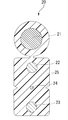
- FIG. 3 is a cross-sectional view showing a drop-type optical fiber cable as an example of an optical fiber cable.
- the optical fiber cable 20 includes a support wire 21, two tension members 22 and 23, an optical fiber 24, and a jacket 25 that covers them.
- the jacket 25 is composed of a flame-retardant resin composition that constitutes the insulator 2 and the jacket 3 of the insulated wire 4 in the above embodiment.
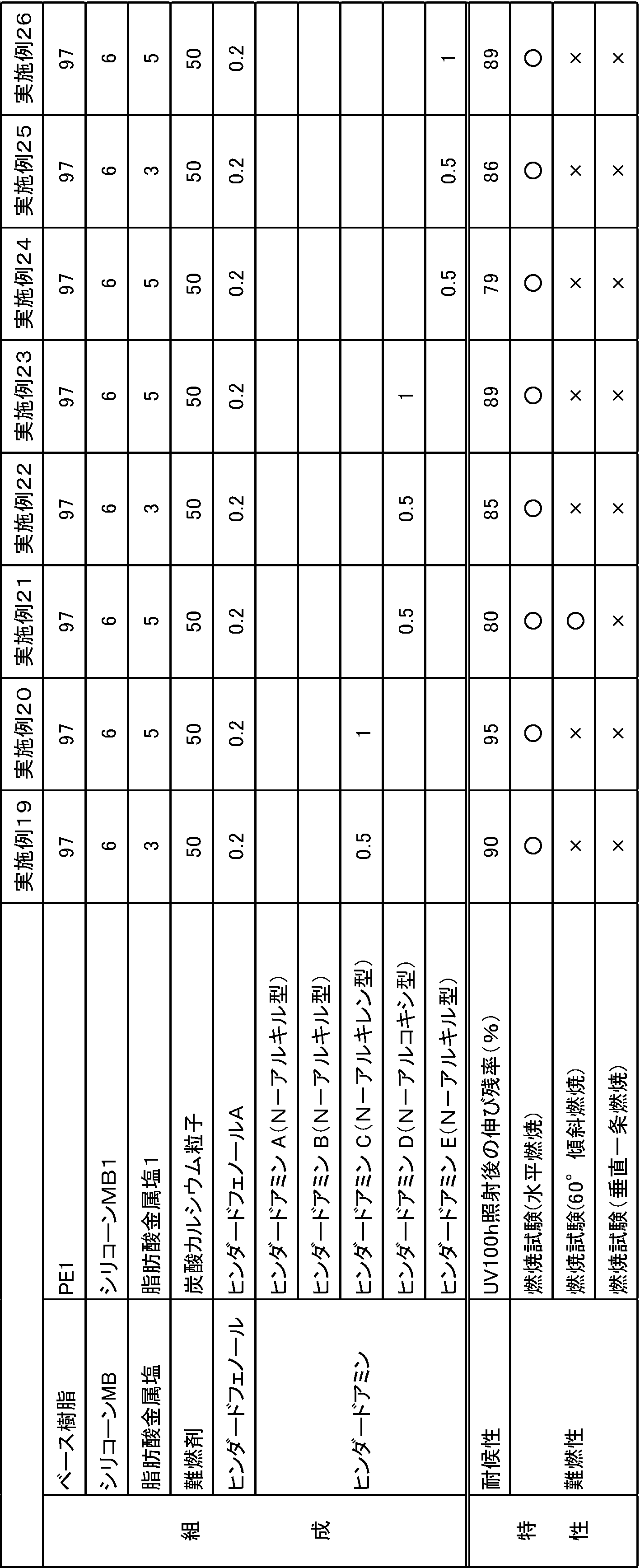
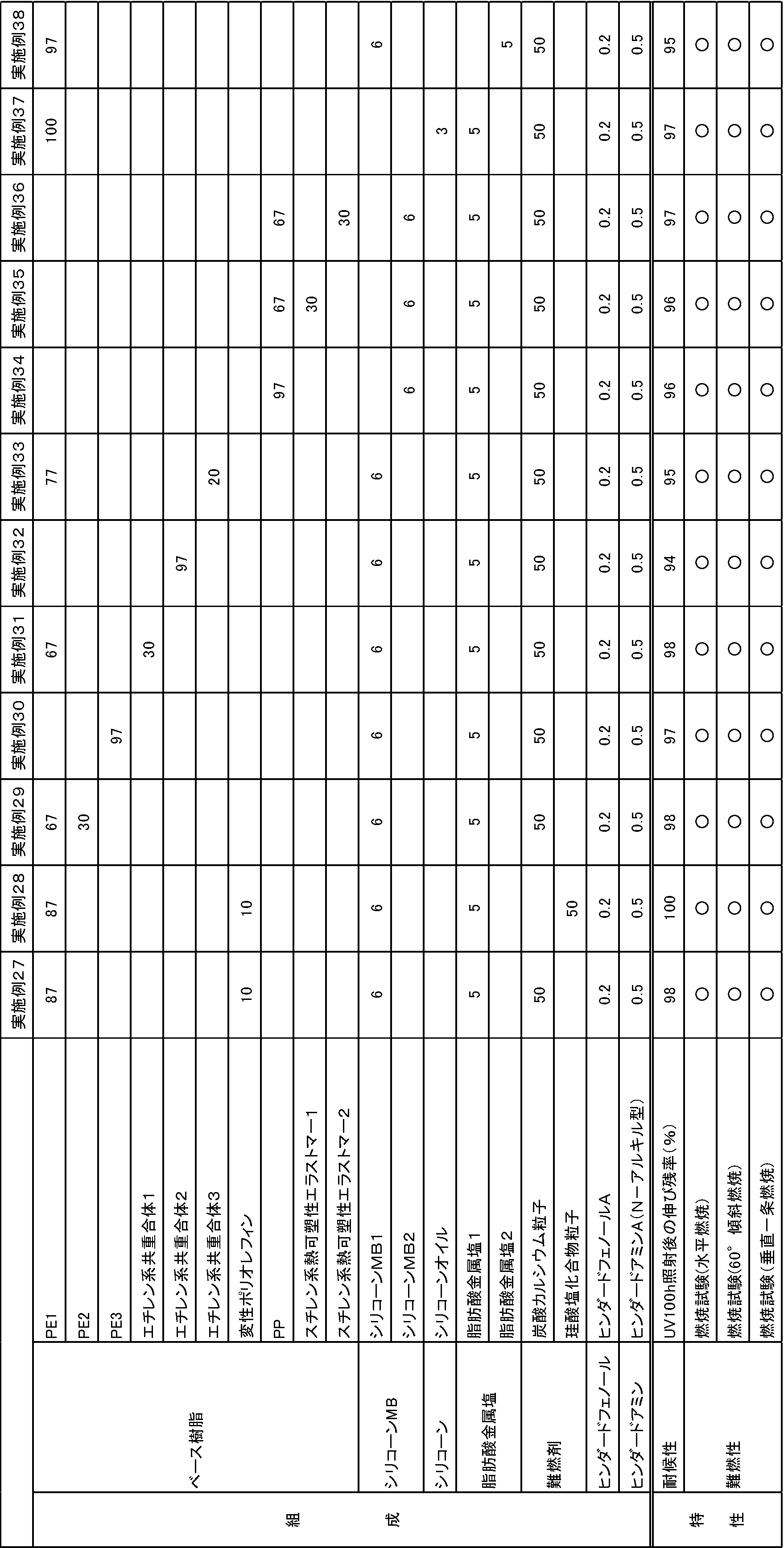
- Examples 1 to 38 and Comparative Examples 1 to 17 Base resin, silicone masterbatch (silicone MB), silicone, fatty acid metal salt, flame retardant, hindered phenol compound, hindered amine compound or benzotriazole are blended in the blending amounts shown in Tables 1 to 5, and Banbury mixer Were kneaded at 160 ° C. for 15 minutes to obtain a flame retardant resin composition.
- the unit of the blending amount of each blending component is part by mass.
- Tables 1 to 5 there are examples and comparative examples in which the blending amount of the base resin is not 100 parts by mass. In these examples and comparative examples, a part of the base resin is also present in the silicone MB. The total amount of the base resin and the amount of the base resin in the silicone MB is 100 parts by mass.
- A Base resin (A-1) Polyethylene (PE1) LLDPE, Excellen GMH GH030 (trade name, manufactured by Sumitomo Chemical Co., Ltd.) (A-2) Polyethylene (PE2) LLDPE, Evolue SP9018 (trade name, manufactured by Prime Polymer Co., Ltd.) (A-3) Polyethylene (PE3) LDPE, C150 (trade name, manufactured by Ube Maruzen Polyethylene) (A-4) Ethylene copolymer 1 Ethylene-butene copolymer, TAFMER DF940 (trade name, manufactured by Mitsui Chemicals) (A-5) Ethylene copolymer 2 Ethylene ethyl acrylate copolymer (EEA), A1150 (trade name, manufactured by Nippon Polyethylene) (A-6) Ethylene copolymer 3 Ethylene vinyl acetate copolymer (EVA), EV460 (trade name, manufactured by Mitsui DuPont Polychemical Co., Ltd.)
- Silicone MB (B-1) Silicone MB1 X-22-2125H (trade name, manufactured by Shin-Etsu Chemical Co., Ltd.) Contains 50% silicone gum (dimethylpolysiloxane) and 50% PE by weight (B-2) Silicone MB2 X-22-2101 (trade name, manufactured by Shin-Etsu Chemical Co., Ltd.) Contains 50% by weight silicone gum (dimethylpolysiloxane) and 50% by weight PP
- D Fatty acid metal salt
- D-1 Fatty acid metal salt 1 Magnesium stearate, Fcochem MGS (trade name, manufactured by ADEKA)
- D-2) Fatty acid metal salt 2 Calcium stearate, SC-P (trade name, manufactured by Sakai Chemical Co., Ltd.)
- E Flame retardant (E-1) Calcium carbonate particles NCC-P (trade name, manufactured by Nitto Flour Chemical Co., Ltd.) (E-2) Silicate compound particle talc particles, NANO ACE D-1000 (trade name, manufactured by Nippon Talc Co., Ltd.), average particle diameter of 1.0 ⁇ m
- Hindered amine compound (G-1) Hindered amine A Siasorb UV-3529 (trade name, manufactured by Cytec Industries, N-alkyl type, molecular weight 1700 ⁇ 10%
- G-2 Hindered amine B ADK STAB LA-63P (trade name, manufactured by ADEKA, N-alkyl type, molecular weight of about 2000)
- G-3 Hindered amine C Tinuvin 622SF (trade name, manufactured by BASF, N-alkylene type, molecular weight 3100 to 4000)
- Hindered amine D LA-81 (trade name, manufactured by ADEKA, N-alkoxy type, molecular weight 681)
- G-5 Hindered amine E Tinuvin 765 (trade name, manufactured by BASF, N-alkyl type, molecular weight 509)
- G-6 Hindered amine F CHIMASSORB 2020FDL (trade name, manufactured by BASF, NH type, molecular weight 2600-3400
- N-alkyl type is a hindered amine compound in which R 1 is an alkyl group in the formula (1)
- N-alkoxy type is a hindered amine compound in which R 1 is an alkoxy group in the formula (1)
- NH type is a hindered amine compound in which R 1 is a hydrogen atom in formula (1)
- N-alkylene type is a compound having a divalent group represented by formula (2) Means.
- Benzotriazole tinuvin (TINUVIN) 234 (trade name, manufactured by BASF, benzotriazole ultraviolet absorber, molecular weight 447)
- ⁇ Weather resistance> The resin compositions of Examples 1 to 38 and Comparative Examples 1 to 9 were press-pressed at 160 ° C. for 5 minutes to obtain sheet samples having a thickness of 1 mm. Thereafter, punching was performed with a JIS K 6251 No. 3 dumbbell-shaped punching blade to prepare a dumbbell-shaped test piece. Then, ultraviolet rays (UV light) were applied to the test piece using a metal halide lamp type light resistance tester (Iwasaki Electric Co., Ltd., Eye Super UV Tester “Model: SUV-W13, illuminance: 70 mW / cm 2 ).
- UV light ultraviolet rays
- the test piece was subjected to a tensile test in accordance with JIS K7350, and the tensile elongation residual rate was measured, and the results are shown in Tables 1 to 5.
- the tensile elongation residual rate is 50%. In the case of the following, it was judged as unacceptable in terms of weather resistance, and in the case where the residual tensile elongation exceeded 50%, it was regarded as acceptable in terms of weather resistance.
Landscapes
- Chemical & Material Sciences (AREA)
- Organic Chemistry (AREA)
- Health & Medical Sciences (AREA)
- Chemical Kinetics & Catalysis (AREA)
- Medicinal Chemistry (AREA)
- Polymers & Plastics (AREA)
- Physics & Mathematics (AREA)
- Spectroscopy & Molecular Physics (AREA)
- Inorganic Chemistry (AREA)
- Engineering & Computer Science (AREA)
- Materials Engineering (AREA)
- General Physics & Mathematics (AREA)
- Optics & Photonics (AREA)
- Compositions Of Macromolecular Compounds (AREA)
- Insulated Conductors (AREA)
- Organic Insulating Materials (AREA)
Abstract
ポリオレフィン系化合物を含むベース樹脂と、シリコーン系化合物と、脂肪酸金属塩と、炭酸カルシウム粒子及び珪酸塩化合物粒子からなる群より選ばれる少なくとも1種からなる難燃剤と、ヒンダードフェノール系化合物と、ヒンダードアミン系化合物とを含む難燃性樹脂組成物が開示されている。この組成物においては、シリコーン系化合物が、ベース樹脂100質量部に対して0.1質量部以上10質量部以下の割合で配合され、脂肪酸金属塩が、ベース樹脂100質量部に対して0.1質量部以上20質量部以下の割合で配合され、難燃剤が、ベース樹脂100質量部に対して5質量部以上200質量部以下の割合で配合され、ヒンダードフェノール系化合物がベース樹脂100質量部に対して0.05質量部以上10質量部以下の割合で配合され、ヒンダードアミン系化合物がベース樹脂100質量部に対して0.05質量部以上10質量部以下の割合で配合されている。ヒンダードアミン系化合物は、下記式(1)で表される一価の基等を有する。(上記式(1)中、R1は、炭素数1~30のアルキル基又はアルコキシ基を表し、R2~R5は各々独立に、炭素数1~6のアルキル基を表す)
Description
本発明は、難燃性樹脂組成物、及び、これを用いたケーブルに関する。
ケーブルの被覆、ケーブルの外被、チューブ、テープ、包装材、建材等にはいわゆるエコマテリアルが広く使用されるようになっている。
このようなエコマテリアルとして、ポリオレフィン樹脂に、難燃剤としての炭酸カルシウム、難燃助剤としてのシリコーン油やステアリン酸マグネシウム、及び、酸化防止剤などを添加してなる組成物が知られている(下記特許文献1参照)。
しかしながら、上記特許文献1に記載の組成物は、以下に示す課題を有していた。
すなわち、上記特許文献1に記載の組成物は、優れた難燃性を有するものの、耐候性の点で改善の余地があった。このため、上記組成物を用いて得られるケーブルは屋外を通るケーブルとして使用しにくかった。
このため、優れた難燃性を確保しながら、耐候性を改善できる難燃性樹脂組成物が求められていた。
本発明は、上記事情に鑑みてなされたものであり、優れた難燃性を確保しながら、耐候性を改善できる難燃性樹脂組成物、及び、これを用いたケーブルを提供することを目的とする。
本発明者らは上記課題を解決するため検討を重ねた。例えば本発明者らは組成物の耐候性を向上させるために、光安定剤として知られるベンゾトリアゾールを配合してみた。しかし、ベンゾトリアゾールを配合しても、耐候性が十分に向上しないばかりか、ベンゾトリアゾールを配合することで難燃性が著しく低下することが判明した。そこで、本発明者らは、ベンゾトリアゾールに代えて、ヒンダードアミン系化合物を配合することを試みた。ここで、脂肪酸含有化合物として脂肪酸を用いると、この脂肪酸と、塩基であるヒンダードアミン系化合物が中和反応を起こし、ヒンダードアミン系化合物の機能が阻害される可能性がある。しかし、脂肪酸含有化合物としてステアリン酸マグネシウムのような脂肪酸の金属塩が用いられていれば、このような中和反応は起こらず、ヒンダードアミン系化合物の機能が阻害されることはないものと考えていた。しかし、意外なことに、ヒンダードアミン系化合物であっても、耐候性を十分に向上させることができないばかりか、難燃性を低下させるものがあることが判明した。そこで、本発明者らは更に鋭意研究を重ねた結果、ヒンダードアミン系化合物に含まれる特定の基が上記課題を解決する上で極めて有用であることに気付いた。こうして本発明者らは、以下の発明により上記課題を解決するに至った。
すなわち本発明は、ポリオレフィン系化合物を含むベース樹脂と、シリコーン系化合物と、脂肪酸金属塩と、炭酸カルシウム粒子及び珪酸塩化合物粒子からなる群より選択される少なくとも1種からなる難燃剤と、ヒンダードフェノール系化合物と、ヒンダードアミン系化合物とを含み、前記シリコーン系化合物が、前記ベース樹脂100質量部に対して0.1質量部以上10質量部以下の割合で配合され、前記脂肪酸金属塩が、前記ベース樹脂100質量部に対して0.1質量部以上20質量部以下の割合で配合され、前記難燃剤が、前記ベース樹脂100質量部に対して5質量部以上200質量部以下の割合で配合され、前記ヒンダードフェノール系化合物が前記ベース樹脂100質量部に対して0.05質量部以上10質量部以下の割合で配合され、前記ヒンダードアミン系化合物が前記ベース樹脂100質量部に対して0.05質量部以上10質量部以下の割合で配合され、前記ヒンダードアミン系化合物が、下記式(1)で表される一価の基又は下記式(2)で表される二価の基を有する難燃性樹脂組成物である。
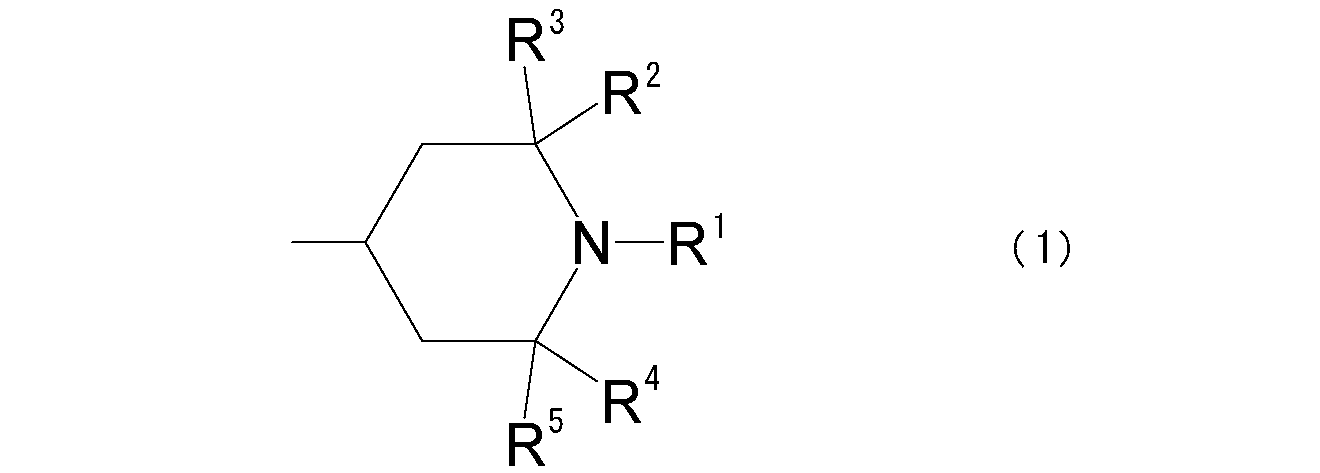
(上記式(1)中、R1は、炭素数1~30のアルキル基又はアルコキシ基を表し、R2~R5は各々独立に、炭素数1~6のアルキル基を表す)

(上記式(2)中、R6は、炭素数1~30のアルキレン基を表し、R7~R10は各々独立に、炭素数1~6のアルキル基を表す)
本発明の難燃性樹脂組成物によれば、優れた難燃性を確保しながら、耐候性を改善できる。
なお、本発明者らは、本発明の難燃性樹脂組成物において、優れた難燃性が得られる理由については以下のように推察している。
すなわち、炭酸カルシウム粒子又は珪酸塩カルシウム粒子とシリコーン系化合物と脂肪酸金属塩とを用いることで、燃焼時に表面バリア層が形成されることにより、樹脂組成物の難燃効果が高まるためではないかと本発明者らは推察している。
また本発明者らは、本発明の難燃性樹脂組成物において、耐候性を改善できる理由について詳細は不明であるが以下のように推察している。
すなわち、ヒンダードアミン系化合物として上記式(1)で表される一価の基又は上記式(2)で表される二価の基を有する化合物を用いることで、脂肪酸金属塩とヒンダードアミン系化合物との相互作用を低減することができると考えられる。これに対し、上記式(1)で表される一価の基において、R1が水素原子であると、脂肪酸金属塩とヒンダードアミン系化合物とが相互作用しやすくなり、ヒンダードアミン系化合物の本来の機能が低下する。こうして本発明者らは、本発明の難燃性樹脂組成物において、耐候性を改善できるものと推察している。
上記難燃性樹脂組成物においては、前記シリコーン系化合物が、前記ベース樹脂100質量部に対して0.2質量部より大きい割合で配合され、前記脂肪酸金属塩が前記ベース樹脂100質量部に対して3質量部より大きい割合で配合され、前記ヒンダードアミン系化合物が前記ベース樹脂100質量部に対して0.05質量部以上1質量部未満の割合で配合され、前記ヒンダードアミン系化合物の分子量が1000以上であることが好ましい。
この場合、より優れた難燃性が得られる。
上記難燃性樹脂組成物においては、前記ヒンダードアミン系化合物の分子量が1000以上であることが好ましい。
この場合、分子量が1000未満である場合と比べて、より優れた耐候性が得られる。
ここで、前記ヒンダードアミン系化合物の分子量は3000以下であることが好ましい。
この場合、より一層優れた難燃性が得られるとともに、耐候性をより改善できる。
ここで、上記難燃性樹脂組成物においては、前記シリコーン系化合物が、前記ベース樹脂100質量部に対して1質量部より大きい割合で配合され、前記ヒンダードアミン系化合物が前記式(1)で表される一価の基を有し、前記式(1)においてR1が前記アルキル基を表すことが好ましい。
この場合、より一層優れた難燃性が得られる。
また本発明は、外被と、前記外被の内側に設けられ、導体又は光ファイバで構成される伝送媒体と有し、前記外被が、上述した難燃性樹脂組成物で構成されるケーブルである。
この場合、外被が上述した難燃性樹脂組成物で構成され、この難燃性樹脂組成物が、優れた難燃性を確保しながら、耐候性を改善できるため、本発明のケーブルは屋外を通るケーブルとしても有用である。
なお、本発明において、「分子量」とは、ゲルパミエーションクロマトグラフィ(GPC)にて保持時間を測定し、ポリスチレン標準試料を測定することで作成した較正曲線から算出された値を言うものとする。
本発明によれば、優れた難燃性を確保しながら、耐候性を改善できる難燃性樹脂組成物、及び、これを用いたケーブルが提供される。
以下、本発明の実施形態について図1及び図2を用いて詳細に説明する。
[ケーブル]
図1は、本発明に係るケーブルの一実施形態を示す部分側面図である。図2は、図1のII-II線に沿った断面図である。図1及び図2に示すように、ケーブル10は、絶縁電線4と、絶縁電線4を被覆するチューブ状の外被3とを備えている。このようなケーブル10としては、例えば丸形ケーブルが挙げられる。そして、絶縁電線4は、伝送媒体としての内部導体1と、内部導体1を被覆するチューブ状の絶縁体2とを有している。すなわち、ケーブル10では、内部導体1は、チューブ状の絶縁体2の内側に設けられるとともにチューブ状の外被3の内側に設けられている。
図1は、本発明に係るケーブルの一実施形態を示す部分側面図である。図2は、図1のII-II線に沿った断面図である。図1及び図2に示すように、ケーブル10は、絶縁電線4と、絶縁電線4を被覆するチューブ状の外被3とを備えている。このようなケーブル10としては、例えば丸形ケーブルが挙げられる。そして、絶縁電線4は、伝送媒体としての内部導体1と、内部導体1を被覆するチューブ状の絶縁体2とを有している。すなわち、ケーブル10では、内部導体1は、チューブ状の絶縁体2の内側に設けられるとともにチューブ状の外被3の内側に設けられている。
ここで、チューブ状の絶縁体2及び外被3は難燃性樹脂組成物で構成されており、この難燃性樹脂組成物は、ポリオレフィン系化合物を含むベース樹脂と、シリコーン系化合物と、脂肪酸金属塩と、炭酸カルシウム粒子及び珪酸塩化合物粒子からなる群より選択される少なくとも1種からなる難燃剤と、ヒンダードフェノール系化合物と、ヒンダードアミン系化合物とを含む。ここで、シリコーン系化合物は、ベース樹脂100質量部に対して0.1質量部以上10質量部以下の割合で配合され、脂肪酸金属塩は、ベース樹脂100質量部に対して0.1質量部以上20質量部以下の割合で配合され、難燃剤は、ベース樹脂100質量部に対して5質量部以上200質量部以下の割合で配合され、ヒンダードフェノール系化合物はベース樹脂100質量部に対して0.05質量部以上10質量部以下の割合で配合され、ヒンダードアミン系化合物はベース樹脂100質量部に対して0.05質量部以上10質量部以下の割合で配合されている。そして、ヒンダードアミン系化合物は、下記式(1)で表される一価の基又は下記式(2)で表される二価の基を有する。
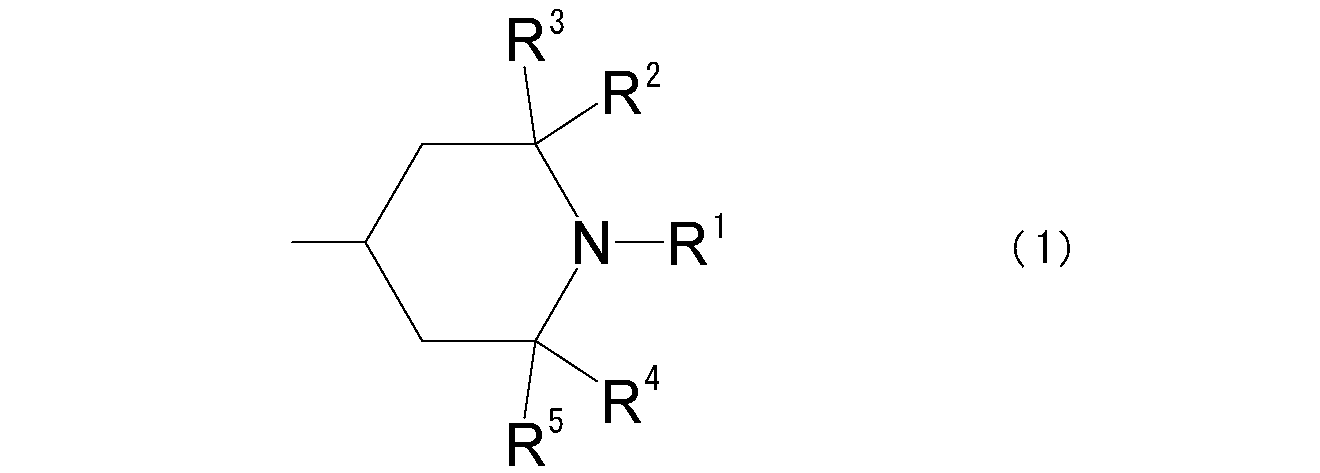
(上記式(1)中、R1は、炭素数1~30のアルキル基又はアルコキシ基を表し、R2~R5は各々独立に、炭素数1~6のアルキル基を表す)
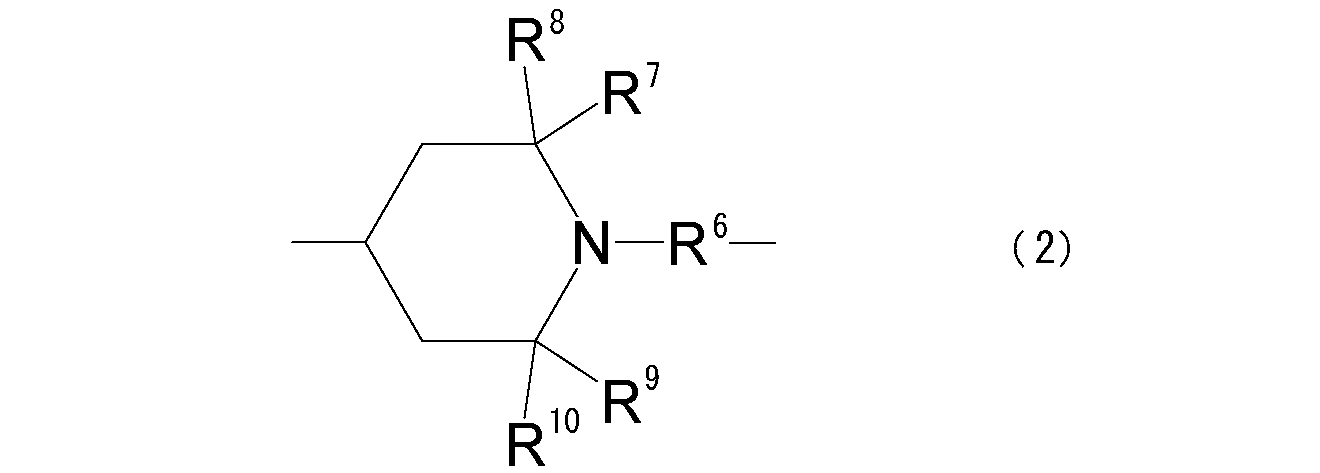
(上記式(2)中、R6は、炭素数1~30のアルキレン基を表し、R7~R10は各々独立に、炭素数1~6のアルキル基を表す)
上記難燃性樹脂組成物で構成される絶縁体2及び外被3は、優れた難燃性を確保しながら、耐候性を改善することができる。従って、ケーブル10は屋外を通るケーブルとして有用である。
[ケーブルの製造方法]
次に、上述したケーブル10の製造方法について説明する。
次に、上述したケーブル10の製造方法について説明する。
<導体>
まず伝送媒体としての内部導体1を準備する。内部導体1は、1本の素線のみで構成されてもよく、複数本の素線を束ねて構成されたものであってもよい。また、内部導体1は、導体径や導体の材質などについて特に限定されるものではなく、用途に応じて適宜定めることができる。
まず伝送媒体としての内部導体1を準備する。内部導体1は、1本の素線のみで構成されてもよく、複数本の素線を束ねて構成されたものであってもよい。また、内部導体1は、導体径や導体の材質などについて特に限定されるものではなく、用途に応じて適宜定めることができる。
<難燃性樹脂組成物>
一方、上記難燃性樹脂組成物を準備する。難燃性樹脂組成物は、上述したように、ポリオレフィン系化合物を含むベース樹脂と、シリコーン系化合物と、脂肪酸金属塩と、炭酸カルシウム粒子及び珪酸塩化合物粒子からなる群より選択される少なくとも1種からなる難燃剤と、ヒンダードフェノール系化合物と、ヒンダードアミン系化合物とを含む。
一方、上記難燃性樹脂組成物を準備する。難燃性樹脂組成物は、上述したように、ポリオレフィン系化合物を含むベース樹脂と、シリコーン系化合物と、脂肪酸金属塩と、炭酸カルシウム粒子及び珪酸塩化合物粒子からなる群より選択される少なくとも1種からなる難燃剤と、ヒンダードフェノール系化合物と、ヒンダードアミン系化合物とを含む。
(1)ベース樹脂
ベース樹脂は、ポリオレフィン系化合物を含んでいればよい。ポリオレフィン系化合物としては、例えばポリエチレン(PE)、エチレン系共重合体、ポリプロピレン(PP)、プロピレン系共重合体、変性ポリオレフィン、オレフィン系熱可塑性エラストマーなどが挙げられる。これらは単独で又は2種以上を組み合せて用いることができる。エチレン系共重合体としては、エチレン-アクリル酸エチル共重合体(EEA)、エチレン-アクリル酸メチル共重合体(EMA)、エチレン酢酸ビニル共重合体(EVA)、エチレン-プロピレン共重合体、エチレン-ブテン共重合体、エチレン-ヘキセン共重合体及びエチレン-オクテン共重合体などが挙げられる。これらは単独で又は2種以上を組み合せて用いることができる。プロピレン系共重合体としては、例えばブロックポリプロピレン共重合体及びランダムポリプロピレン共重合体などが挙げられる。
ベース樹脂は、ポリオレフィン系化合物を含んでいればよい。ポリオレフィン系化合物としては、例えばポリエチレン(PE)、エチレン系共重合体、ポリプロピレン(PP)、プロピレン系共重合体、変性ポリオレフィン、オレフィン系熱可塑性エラストマーなどが挙げられる。これらは単独で又は2種以上を組み合せて用いることができる。エチレン系共重合体としては、エチレン-アクリル酸エチル共重合体(EEA)、エチレン-アクリル酸メチル共重合体(EMA)、エチレン酢酸ビニル共重合体(EVA)、エチレン-プロピレン共重合体、エチレン-ブテン共重合体、エチレン-ヘキセン共重合体及びエチレン-オクテン共重合体などが挙げられる。これらは単独で又は2種以上を組み合せて用いることができる。プロピレン系共重合体としては、例えばブロックポリプロピレン共重合体及びランダムポリプロピレン共重合体などが挙げられる。
ベース樹脂は、ポリオレフィン系化合物と、それ以外の樹脂との混合樹脂であってもよい。この場合、ポリオレフィン系化合物以外の樹脂としては、例えばスチレン-ブタジエンゴム(SBR)、水添SBR、スチレンエチレンブチレンスチレンブロック共重合体(SEBS)などのスチレン系熱可塑性エラストマエステル、ポリカーボネート樹脂などのエンジニアリングプラスチックなどが挙げられる。
ベース樹脂中のポリオレフィン系化合物の含有率は特に制限されるものではないが、好ましくは30~100質量%であり、より好ましくは50~100質量%である。
(2)シリコーン系化合物
シリコーン系化合物は、難燃助剤として機能するものであり、シリコーン系化合物としては、ポリオルガノシロキサンなどが挙げられる。ここで、ポリオルガノシロキサンは、シロキサン結合を主鎖とし側鎖に有機基を有するものであり、有機基としては、例えばメチル基、ビニル基、エチル基、プロピル基、フェニル基などが挙げられる。具体的にはポリオルガノシロキサンとしては、例えばジメチルポリシロキサン、メチルエチルポリシロキサン、メチルオクチルポリシロキサン、メチルビニルポリシロキサン、メチルフェニルポリシロキサン、メチル(3,3,3-トリフルオロプロピル)ポリシロキサンなどが挙げられる。ポリオルガノシロキサンは、シリコーンオイル、シリコーンパウダー、シリコーンガム又はシリコーンレジンの形態で用いられる。中でも、ポリオルガノシロキサンは、シリコーンガムの形態で用いられることが好ましい。この場合、ブルームが起こりにくくなる。
シリコーン系化合物は、難燃助剤として機能するものであり、シリコーン系化合物としては、ポリオルガノシロキサンなどが挙げられる。ここで、ポリオルガノシロキサンは、シロキサン結合を主鎖とし側鎖に有機基を有するものであり、有機基としては、例えばメチル基、ビニル基、エチル基、プロピル基、フェニル基などが挙げられる。具体的にはポリオルガノシロキサンとしては、例えばジメチルポリシロキサン、メチルエチルポリシロキサン、メチルオクチルポリシロキサン、メチルビニルポリシロキサン、メチルフェニルポリシロキサン、メチル(3,3,3-トリフルオロプロピル)ポリシロキサンなどが挙げられる。ポリオルガノシロキサンは、シリコーンオイル、シリコーンパウダー、シリコーンガム又はシリコーンレジンの形態で用いられる。中でも、ポリオルガノシロキサンは、シリコーンガムの形態で用いられることが好ましい。この場合、ブルームが起こりにくくなる。
シリコーン系化合物は、上述したようにベース樹脂100質量部に対して0.1質量部以上10質量部以下の割合で配合される。この場合、シリコーン系化合物の配合割合が0.1質量部未満である場合に比べて、より優れた難燃性が得られる。また、ベース樹脂100質量部に対するシリコーン系化合物の配合割合が上記範囲内にあると、シリコーン系化合物の配合割合が10質量部より大きい場合に比べて、難燃性及び耐候性のムラがより少なくなる。これは、シリコーン系化合物がベース樹脂に均等に混ざりやすくなり、部分的に塊が発生するということが起こりにくくなるためである。
ベース樹脂100質量部に対するシリコーン系化合物の配合割合は1質量部以上であることが好ましい。この場合、シリコーン系化合物の配合割合が1質量部未満である場合に比べて、より優れた難燃性が得られる。
シリコーン系化合物は、難燃剤の表面に予め付着させておいてもよい。この場合、難燃性樹脂組成物中においてシリコーン系化合物の偏析が起こりにくくなり、難燃性樹脂組成物における特性の均一性がより向上する。
難燃剤の表面にシリコーン系化合物を付着させる方法としては、例えば難燃剤にシリコーン系化合物を添加して混合し、混合物を得た後、この混合物を40~75℃にて10~40分乾燥し、乾燥した混合物をヘンシェルミキサ、アトマイザなどにより粉砕することによって得ることができる。
(3)脂肪酸金属塩
脂肪酸金属塩は、難燃助剤として機能するものである。ここで、脂肪酸としては、例えば炭素原子数が12~28である脂肪酸が用いられる。このような脂肪酸としては、例えばラウリン酸、ミリスチン酸、パルミチン酸、ステアリン酸、ツベルクロステアリン酸、オレイン酸、リノール酸、アラキドン酸、ベヘン酸及びモンタン酸が挙げられる。中でも、脂肪酸としては、ステアリン酸又はツベルクロステアリン酸が好ましく、ステアリン酸が特に好ましい。この場合、ステアリン酸又はツベルクロステアリン酸以外の脂肪酸を用いる場合に比べて、より優れた難燃性が得られる。
脂肪酸金属塩は、難燃助剤として機能するものである。ここで、脂肪酸としては、例えば炭素原子数が12~28である脂肪酸が用いられる。このような脂肪酸としては、例えばラウリン酸、ミリスチン酸、パルミチン酸、ステアリン酸、ツベルクロステアリン酸、オレイン酸、リノール酸、アラキドン酸、ベヘン酸及びモンタン酸が挙げられる。中でも、脂肪酸としては、ステアリン酸又はツベルクロステアリン酸が好ましく、ステアリン酸が特に好ましい。この場合、ステアリン酸又はツベルクロステアリン酸以外の脂肪酸を用いる場合に比べて、より優れた難燃性が得られる。
脂肪酸の金属塩を構成する金属としては、マグネシウム、カルシウム、亜鉛及び鉛などが挙げられる。脂肪酸の金属塩としては、ステアリン酸マグネシウム又はステアリン酸カルシウムが好ましい。この場合、ステアリン酸マグネシウム及びステアリン酸カルシウム以外の脂肪酸金属塩を用いる場合に比べて、より優れた難燃性が得られる。
脂肪酸金属塩は、上述したようにベース樹脂100質量部に対して0.1質量部以上20質量部以下の割合で配合される。この場合、脂肪酸金属塩の割合が0.1質量部未満である場合に比べて、より優れた難燃性が得られる。また、ベース樹脂100質量部に対する脂肪酸金属塩の配合割合が上記範囲内にあると、ベース樹脂100質量部に対する脂肪酸金属塩の配合割合が20質量部より大きい場合に比べて、より優れた耐候性が得られる。
ベース樹脂100質量部に対する脂肪酸金属塩の配合割合は3質量部よりも大きい割合で配合されることが好ましい。この場合、ベース樹脂100質量部に対する脂肪酸金属塩の配合割合が3質量部以下である場合に比べて、より優れた難燃性が得られる。
脂肪酸金属塩はシリコーン系化合物とともに、難燃剤の表面に予め付着させておいてもよい。この場合、難燃性樹脂組成物中においてシリコーン化合物及び脂肪酸金属塩の偏析がより起こりにくくなり、難燃性樹脂組成物における特性の均一性がより向上する。
難燃剤の表面にシリコーン系化合物及び脂肪酸金属塩を付着させる方法としては、例えば難燃剤にシリコーン系化合物及び脂肪酸金属塩を添加して混合し、混合物を得た後、この混合物を40~75℃にて10~40分乾燥し、乾燥した混合物をヘンシェルミキサ、アトマイザなどにより粉砕する方法が挙げられる。
(4)難燃剤
難燃剤は、炭酸カルシウム粒子及び珪酸塩化合物粒子からなる群より選択される少なくとも1種からなる。従って、難燃剤は、炭酸カルシウム粒子のみで構成されてもよく、珪酸塩化合物粒子のみで構成されてもよく、これらの混合物で構成されてもよい。
難燃剤は、炭酸カルシウム粒子及び珪酸塩化合物粒子からなる群より選択される少なくとも1種からなる。従って、難燃剤は、炭酸カルシウム粒子のみで構成されてもよく、珪酸塩化合物粒子のみで構成されてもよく、これらの混合物で構成されてもよい。
(炭酸カルシウム粒子)
炭酸カルシウム粒子は、重質炭酸カルシウム又は軽質炭酸カルシウムのいずれでもよい。
炭酸カルシウム粒子は、重質炭酸カルシウム又は軽質炭酸カルシウムのいずれでもよい。
(珪酸塩化合物粒子)
珪酸塩化合物粒子は、珪酸塩化合物からなる粒子である。珪酸塩化合物としては、例えばタルク、クレイなどが挙げられる。ここで、クレイとしては、例えばカオリンクレイ、ろう石クレイ、それらを焼成処理した焼成クレイ、及び、シラン系カップリング剤等で表面改質した改質クレイ等が挙げられる。これらはそれぞれ単独で又は2種以上を組み合せて用いることができる。中でも、カオリンクレイが好ましい。この場合、不純物の含有量が少なく、着色し難いという利点が得られる。
珪酸塩化合物粒子は、珪酸塩化合物からなる粒子である。珪酸塩化合物としては、例えばタルク、クレイなどが挙げられる。ここで、クレイとしては、例えばカオリンクレイ、ろう石クレイ、それらを焼成処理した焼成クレイ、及び、シラン系カップリング剤等で表面改質した改質クレイ等が挙げられる。これらはそれぞれ単独で又は2種以上を組み合せて用いることができる。中でも、カオリンクレイが好ましい。この場合、不純物の含有量が少なく、着色し難いという利点が得られる。
難燃剤は、ベース樹脂100質量部に対して5質量部以上200質量部以下の割合で配合される。この場合、難燃剤の割合がベース樹脂100質量部に対して5質量部未満である場合に比べて、より優れた難燃性が得られる。
また、ベース樹脂100質量部に対する難燃剤の配合割合が上記範囲内にあると、ベース樹脂100質量部に対する難燃剤の配合割合が200質量部より大きい場合に比べて、難燃性樹脂組成物の機械的特性をより向上させることができる。
また、ベース樹脂100質量部に対する難燃剤の配合割合は10質量部以上80質量部以下であることが好ましく、30質量部以上70質量部以下であることがより好ましく、40質量部以上60質量部以下であることが特に好ましい。ベース樹脂100質量部に対する難燃剤の配合割合が上記範囲内である場合、配合割合が上記各範囲を外れる場合に比べて、難燃性樹脂組成物の難燃性を十分に確保しつつ、機械的特性をより十分に向上させることができる。
(5)ヒンダードフェノール系化合物
ヒンダードフェノール系化合物とは、下記一般式(3)で示されるフェノール性水酸基に対するオルト位に置換基を有する一価の基を分子内に少なくとも一個有する化合物をいう。

ヒンダードフェノール系化合物とは、下記一般式(3)で示されるフェノール性水酸基に対するオルト位に置換基を有する一価の基を分子内に少なくとも一個有する化合物をいう。
一般式(3)において、R11及びR12は、各々独立して、水素原子又はアルキル基を表し、R11及びR12のうちの少なくとも1つは炭素数が1~6のアルキル基である。
R11及びR12で表されるアルキル基としては、例えばメチル基、エチル基、プロピル基、ブチル基、アミル基等炭素数1~6のものが挙げられる。なかでも、R11及びR12がいずれも、t-ブチル基のような嵩高い分岐アルキル基であることが好ましい。
上記ヒンダードフェノール系化合物の具体例としては、ペンタエリスリトール-テトラキス〔3-(3,5-ジ-t-ブチル-4-ヒドロキシフェニル)プロピオネート〕、オクタデシル-3-(3,5-ジ-t-ブチル-4-ヒドロキシフェニル)プロピオネート、1,3,5-トリス(3,5-ジ-t-ブチル-4-ヒドロキシベンジル)-1,3,5-トリアジン-2,4,6-(1H,3H,5H)-トリオン、4,4',4''-(1-メチルプロパノールー3-イリデン)トリス(6-t-ブチル-m-クレゾール)、6,6'-ジ-t-ブチル-4,4'-ブチリデン-ジ-m-クレゾール、オクタデシル-3-(3,5-ジ-t-ブチル-4-ヒドロキシフェニル)プロピオネート、3,9-ビス[2-[3-(3-t-ブチル-4-ヒドロキシー5-メチルフェニル)プロピオニロキシ]-1,1-ジメチルエチル]-2,4,8,10-テトラオキサスピロ[5.5]ウンデカン、1,3,5-トリス(3,5-ジ-t-ブチル-4-ヒドロキシフェニルメチル)-2,4,6-トリメチルベンゼン等が挙げられる。
ヒンダードフェノール系化合物は、ベース樹脂100質量部に対して0.05質量部以上10質量部以下の割合で配合される。
この場合、ヒンダードフェノール系化合物の割合がベース樹脂100質量部に対して0.05質量部未満である場合に比べて、より優れた耐候性が得られる。また、ベース樹脂100質量部に対するヒンダードフェノール系化合物の配合割合が上記範囲内にあると、ベース樹脂100質量部に対するヒンダードフェノール系化合物の配合割合が10質量部より大きい場合に比べて、難燃性樹脂組成物の機械的特性をより向上させることができる。
また、ベース樹脂100質量部に対するヒンダードフェノール系化合物の配合割合は0.1質量部以上3質量部以下であることが好ましい。ベース樹脂100質量部に対するヒンダードフェノール系化合物の配合割合が上記範囲で配合される場合、配合割合が上記各範囲を外れる場合に比べて、難燃性樹脂組成物の難燃性を十分に確保しつつ、機械的特性をより十分に向上させることができる。
(6)ヒンダードアミン系化合物
ヒンダードアミン系化合物は、上記式(1)で表される一価の基又は上記式(2)で表される二価の基を分子内に少なくとも1個有する化合物である。
ヒンダードアミン系化合物は、上記式(1)で表される一価の基又は上記式(2)で表される二価の基を分子内に少なくとも1個有する化合物である。
上記式(1)において、R1は、炭素数1~30のアルキル基又はアルコキシ基を表す。アルキル基としては、例えばメチル基、エチル基、プロピル基、ブトキシ基、ペンチル基、ヘキシル基、ヘプチル基、オクチル基、ノニル基、デシル基、ウンデシル基、ドデシル基、トリデシル基,テトラデシル基,ペンタデシル基,ヘキサデシル基,ヘプタデシル基、オクタデシル基、ノナデシル基,イコシル基、ヘンイコシル基、ドコシル基、トリコシル基、テトラコシル基、ペンタコシル基、ヘキサコシル基、ヘプタコシル基、オクタコシル基、ノナコシル基、トリアコンチル基などが挙げられる。中でもアルキル基としては、メチル基が好ましい。
アルコキシ基としては、例えばメトキシ基、エトキシ基、プロポキシ基、ブトキシ基、ペンチルオキシ基、ヘキシルオキシ基、ヘプチルオキシ基、オクチルオキシ基、ノニルオキシ基、デシルオキシ基、ウンデシルオキシ基、ドデシルオキシ基、トリデシルオキシ基,テトラデシルオキシ基,ペンタデシルオキシ基,ヘキサデシルオキシ基,ヘプタデシルオキシ基、オクタデシルオキシ基、ノナデシルオキシ基,イコシルオキシ基、ヘンイコシルオキシ基、ドコシルオキシ基、トリコシルオキシ基、テトラコシルオキシ基、ペンタコシルオキシ基、ヘキサコシルオキシ基、ヘプタコシルオキシ基、オクタコシルオキシ基、ノナコシルオキシ基、トリアコンチルオキシ基などが挙げられる。
上記式(1)において、R2~R5は各々独立に、炭素数1~6のアルキル基を表す。このようなアルキル基としては、例えばメチル基、エチル基、プロピル基、ブトキシ基、ペンチル基、ヘキシル基を用いることができる。
上記式(2)において、R6は、炭素数1~30のアルキレン基を表す。アルキレン基としては、例えばメチレン基、エチレン基、プロピレン基、ブチレン基、ペンチレン基、ヘキシレン基、ヘプチレン基、オクチレン基、ノニレン基、デシレン基、ウンデシレン基、ドデシレン基、トリデシレン基,テトラデシレン基,ペンタデシレン基,ヘキサデシレン基,ヘプタデシレン基、オクタデシレン基、ノナデシレン基,エイコシレン基、ヘンエイコシレン基、ドコシレン基、トリコシレン基、テトラコシレン基、ペンタコシレン基、ヘキサコシレン基、ヘプタコシレン基、オクタコシレン基、ノナコシレン基、トリアコンチレン基などが挙げられる。中でもアルキレン基としては、エチレン基が好ましい。
上記式(2)において、R7~R10は各々独立に、炭素数1~6のアルキル基を表す。このようなアルキル基としては、R2~R5で表されるアルキル基と同様のものを用いることができる。
ヒンダードアミン系化合物の分子量は1000以上であることが好ましい。この場合、分子量が1000未満である場合と比べて、より優れた耐候性が得られる。ヒンダードアミン系化合物の分子量は1600以上であることがより好ましい。但し、ヒンダードアミン系化合物の分子量は3000以下であることが好ましく、2100以下であることがより好ましく、1900以下であることが特に好ましい。
またヒンダードアミン系化合物の分子量が1000以上である場合、式(1)及び式(2)において、R1がアルキル基を表すことが好ましい。この場合、より優れた耐候性が得られる。
ヒンダードアミン系化合物の具体例としては、1,2,3,4-ブタンテトラカルボン酸とテトラメチルエステルと1,2,2,6,6-ペンタメチル-4-ピペリジノールと、 β,β,β’,β’-テトラメチルー2,4,8,10-テトラオキサスピロ[5.5]ウンデカン-3,9-ジエタノールとの反応生成物、ビス(1,2,2,6,6-ペンタメチル-4-ピペリジル)セバケート、ビス(1-ウンデカノキシ-2,2,6,6-テトラメチルピペリジンー4-イル)カーボネート、1,2,2,6,6-ペンタメチル-4-ピペリジルメタクリレート、ホルムアルデヒド重縮合物と{2,4,6-トリクロロ-1,3,5-トリアジン・[N,N’-ビス(2,2,6,6-テトラメチルピペリジン-4-イル)ヘキサン-1,6-ジイルジアミン]・モルフォリン重合物}とギ酸との反応生成物、ビス(1,2,2,6,6-ペンタメチル-4-ピペリジル)セバケートとメチル1,2,2,6,6-ペンタメチル-4-ピペリジルセバケートとの混合物、ブタン二酸とジメチルエステルと4-ヒドロキシ-2,2,6,6-テトラメチル-1-ピペリジンエタノールとの反応生成物が挙げられる。
ヒンダードアミン系化合物は、ベース樹脂100質量部に対して0.05質量部以上10質量部以下の割合で配合される。
この場合、ヒンダードアミン系化合物の配合割合がベース樹脂100質量部に対して0.05質量部未満である場合に比べて、より優れた耐候性が得られる。また、ベース樹脂100質量部に対するヒンダードアミン系化合物の配合割合が上記範囲内にあると、ベース樹脂100質量部に対するヒンダードアミン系化合物の配合割合が10質量部より大きい場合に比べて、難燃性樹脂組成物の機械的特性をより向上させることができる。
また、ベース樹脂100質量部に対するヒンダードアミン系化合物の配合割合は0.2質量部以上1質量部以下であることが好ましい。ベース樹脂100質量部に対するヒンダードアミン系化合物の配合割合が上記範囲で配合される場合、配合割合が上記範囲を外れる場合に比べて、難燃性樹脂組成物の難燃性を十分に確保しつつ、機械的特性をより十分に向上させることができる。
また、シリコーン系化合物が、ベース樹脂100質量部に対して0.2質量部より大きい割合で配合され、脂肪酸金属塩がベース樹脂100質量部に対して3質量部より大きい割合で配合され、ヒンダードアミン系化合物の分子量が1000以上である場合、ヒンダードアミン系化合物がベース樹脂100質量部に対して0.05質量部以上1質量部未満の割合で配合されることが好ましい。
この場合、より優れた難燃性が得られる。
ここで、ヒンダードアミン系化合物の分子量は1600以上であることがより好ましい。
但し、ヒンダードアミン系化合物の分子量は3000以下であることが好ましい。
この場合、より一層優れた難燃性が得られるとともに、耐候性をより改善できる。
ヒンダードアミン系化合物の分子量は2100以下であることがより好ましく、1900以下であることが特に好ましい。
ここで、シリコーン系化合物がベース樹脂100質量部に対して1質量部より大きい割合で配合され、ヒンダードアミン系化合物が式(1)で表される一価の基を有し、式(1)においてR1がアルキル基を表すことが好ましい。
この場合、より一層優れた難燃性が得られる。
なお、上述した「アルキル基」には、非置換アルキル基のみならず、置換アルキル基も含まれる。置換アルキル基としては、非置換アルキル基の水素原子を塩素等のハロゲン原子で置換したものなどを用いることができる。また上述した「アルコキシ基」には、非置換アルコキシ基のみならず、置換アルコキシ基も含まれる。置換アルコキシ基としては、非置換アルコキシ基の水素原子を塩素等のハロゲン原子で置換したものなどを用いることができる。
上記難燃性樹脂組成物は、添加剤を必要に応じてさらに含んでもよい。添加剤は、上述したベース樹脂、シリコーン系化合物、脂肪酸金属塩、難燃剤、ヒンダードフェノール系化合物およびヒンダードアミン系化合物とは異なる材料で構成される。このような添加剤としては、例えば酸化防止剤、紫外線劣化防止剤、加工助剤(滑剤)、着色剤及び帯電防止剤が挙げられる。これらは単独で又は2種以上を組み合せて用いることができる。ここで、酸化防止剤、紫外線劣化防止剤、加工助剤、着色剤及び帯電防止剤はいずれも、上述した難燃性樹脂組成物に含まれることで、難燃性樹脂組成物の難燃性を向上させない添加剤を言う。ここで、「難燃性樹脂組成物の難燃性を向上させない」とは、酸化防止剤、紫外線劣化防止剤、加工助剤、着色剤又は帯電防止剤を含む難燃性樹脂組成物について、後述する実施例及び比較例で難燃性樹脂組成物の難燃性の評価に使用される垂直一条燃焼試験による評価結果が、酸化防止剤、紫外線劣化防止剤、加工助剤、着色剤及び帯電防止剤のいずれも含まない点でのみ異なる難燃性樹脂組成物についての難燃性の評価結果に対して同じか、又は劣ることを言う。
酸化防止剤としては、例えばフェノール系酸化防止剤、アミン系酸化防止剤、硫黄系酸化防止剤、リン系酸化防止剤、ヒドラジン系酸化防止剤、アミド系酸化防止剤、リン酸及びクエン酸が挙げられる。これらは単独で又は2種以上を組み合せて用いることができる。ここで、酸化防止剤としては、フェノール系酸化防止剤が特に好ましい。
紫外線劣化防止剤としては、例えばベンゾフェノン系紫外線劣化防止剤、サルチレート系紫外線劣化防止剤、アクリロニトリル系紫外線劣化防止剤及び金属錯塩系紫外線劣化防止剤が挙げられる。これらは単独で又は2種以上を組み合せて用いることができる。
加工助剤としては、例えば炭化水素系加工助剤、脂肪酸系加工助剤、脂肪酸アミド系加工助剤、エステル系加工助剤、アルコール系加工助剤、金属石鹸及びワックスが挙げられる。これらは単独で又は2種以上を組み合せて用いることができる。ここで、加工助剤としては、炭化水素系加工助剤が特に好ましい。
着色剤としては、例えば無機顔料、有機顔料、染料及びカーボンブラックが挙げられる。これらは単独で又は2種以上を組み合せて用いることができる。ここで、着色剤としては、無機顔料が特に好ましい。
無機顔料としては、例えばクロム酸塩、フェロシアン化合物、硫化物、酸化物、硫酸塩、ケイ酸塩、炭酸塩およびリン酸塩が挙げられる。これらは単独で又は2種以上を組み合せて用いることができる。
有機顔料としては、例えばアゾ系顔料、フタロシアニン系顔料、建染染料系顔料、染付レーキ系顔料、キナクリドン系顔料、ジオキサジン系顔料が挙げられる。これらは単独で又は2種以上を組み合せて用いることができる。
染料としては、例えばアントラキノン系染料、インジゴイド系染料およびアゾ系染料が挙げられる。これらは単独で又は2種以上を組み合せて用いることができる。
帯電防止剤としては、例えば陽イオン活性剤、アニオン活性剤、非イオン活性剤及び両性活性剤が挙げられる。これらは単独で又は2種以上を組み合せて用いることができる。ここで、帯電防止剤としては、陽イオン活性剤が特に好ましい。
陽イオン活性剤としては、例えば第一級アミン塩、第三級アミン、第四級アンモニウム化合物及びピリジン誘導体が挙げられる。これらは単独で又は2種以上を組み合せて用いることができる。
アニオン活性剤としては、例えば硫酸化油、石鹸、硫酸化エステル油、硫酸化アミド油、硫酸エステル類、スルホン酸類及びリン酸エステル類が挙げられる。これらは単独で又は2種以上を組み合せて用いることができる。
非イオン活性剤としては、例えば多価アルコール脂肪酸エステル類及びエチレンオキサイド付加物が挙げられる。これらは単独で又は2種以上を組み合せて用いることができる。
両性活性剤としては、例えばカルボン酸誘導体及びイミダゾリン誘導体が挙げられる。これらは単独で又は2種以上を組み合せて用いることができる。
ベース樹脂100質量部に対する添加剤の配合量は特に限定されるものではないが、2質量部以下であることがより好ましく、1質量部未満であることが特に好ましい。但し、ベース樹脂100質量部に対する添加剤の配合量は0.1質量部以上であることが好ましい。
上記難燃性樹脂組成物は、ベース樹脂、シリコーン系化合物、脂肪酸金属塩、難燃剤、ヒンダードフェノール系化合物、ヒンダードアミン系化合物、及び必要に応じて添加される添加剤を混練することにより得ることができる。混練は、例えばバンバリーミキサ、タンブラ、加圧ニーダ、混練押出機、二軸押出機、ミキシングロール等の混練機で行うことができる。このとき、シリコーン系化合物の分散性を向上させる観点からは、ベース樹脂の一部とシリコーン系化合物とを混練し、得られたマスターバッチ(MB)を、残りのベース樹脂、脂肪酸金属塩、難燃剤、ヒンダードフェノール系化合物、ヒンダードアミン系化合物、及び必要に応じて添加される添加剤と混練してもよい。
次に、上記難燃性樹脂組成物で内部導体1を被覆する。具体的には、上記の難燃性樹脂組成物を、押出機を用いて溶融混練し、チューブ状の押出物を形成する。そして、このチューブ状押出物を内部導体1上に連続的に被覆する。こうして絶縁電線4が得られる。
<外被>
最後に、上記のようにして得られた絶縁電線4を1本用意し、これら絶縁電線4を、上述した難燃性樹脂組成物を用いて作製した外被3で被覆する。外被3は、いわゆるシースであり、絶縁体2を物理的又は化学的な損傷から保護するものである。
最後に、上記のようにして得られた絶縁電線4を1本用意し、これら絶縁電線4を、上述した難燃性樹脂組成物を用いて作製した外被3で被覆する。外被3は、いわゆるシースであり、絶縁体2を物理的又は化学的な損傷から保護するものである。
以上のようにしてケーブル10が得られる。
本発明は、上記実施形態に限定されるものではない。例えば上記実施形態ではケーブル10は1本の絶縁電線4を有しているが、本発明のケーブルは、外被3の内側に絶縁電線4を2本以上有していてもよい。また外被3と絶縁電線4との間には、ポリプロピレン等からなる樹脂部が設けられていてもよい。
また上記実施形態では、絶縁電線4の絶縁体2及び外被3が上記の難燃性樹脂組成物で構成されているが、絶縁体2が通常の絶縁樹脂で構成され、外被3のみが、絶縁体2を構成する難燃性樹脂組成物で構成されてもよい。さらに絶縁体2は必ずしも必要なものではなく、省略が可能である。
さらに、上記実施形態において絶縁電線4の絶縁体2及び外被3を構成する難燃性樹脂組成物は、光ファイバケーブルにおいて光ファイバを被覆する外被としても適用可能である。例えば図3は、光ファイバケーブルの一例としてのドロップ型光ファイバケーブルを示す断面図である。図3に示すように、光ファイバケーブル20は、支持線21と、2本のテンションメンバ22,23と、光ファイバ24と、これらを被覆する外被25とを備えている。ここで、外被25が上記実施形態において絶縁電線4の絶縁体2及び外被3を構成する難燃性樹脂組成物で構成される。
以下、実施例及び比較例を挙げて本発明の内容をより具体的に説明するが、本発明は、以下の実施例に限定されるものではない。
(実施例1~38及び比較例1~17)
ベース樹脂、シリコーンマスターバッチ(シリコーンMB)、シリコーン、脂肪酸金属塩、難燃剤、ヒンダードフェノール系化合物、及び、ヒンダードアミン系化合物又はベンゾトリアゾールを、表1~5に示す配合量で配合し、バンバリーミキサによって160℃にて15分間混練し、難燃性樹脂組成物を得た。なお、表1~5において、各配合成分の配合量の単位は質量部である。また表1~5において、ベース樹脂の配合量が100質量部となっていない実施例及び比較例が存在するが、これらの実施例及び比較例では、シリコーンMB中にもベース樹脂の一部が含まれており、ベース樹脂の配合量とシリコーンMB中のベース樹脂の配合量とを合計すれば100質量部となる。
ベース樹脂、シリコーンマスターバッチ(シリコーンMB)、シリコーン、脂肪酸金属塩、難燃剤、ヒンダードフェノール系化合物、及び、ヒンダードアミン系化合物又はベンゾトリアゾールを、表1~5に示す配合量で配合し、バンバリーミキサによって160℃にて15分間混練し、難燃性樹脂組成物を得た。なお、表1~5において、各配合成分の配合量の単位は質量部である。また表1~5において、ベース樹脂の配合量が100質量部となっていない実施例及び比較例が存在するが、これらの実施例及び比較例では、シリコーンMB中にもベース樹脂の一部が含まれており、ベース樹脂の配合量とシリコーンMB中のベース樹脂の配合量とを合計すれば100質量部となる。
上記ベース樹脂、シリコーンMB、シリコーン、脂肪酸金属塩、難燃剤、ヒンダードフェノール系化合物、ヒンダードアミン系化合物及びベンゾトリアゾールとしては具体的には下記のものを用いた。
(A)ベース樹脂
(A-1)ポリエチレン(PE1)
LLDPE、エクセレンGMH GH030(商品名、住友化学社製)
(A-2)ポリエチレン(PE2)
LLDPE、エボリューSP9018(商品名、プライムポリマー社製)
(A-3)ポリエチレン(PE3)
LDPE、C150(商品名、宇部丸善ポリエチレン社製)
(A-4)エチレン系共重合体1
エチレン-ブテン系共重合体、タフマーDF940(商品名、三井化学社製)
(A-5)エチレン系共重合体2
エチレンエチルアクリレート共重合体(EEA)、A1150(商品名、日本ポリエチレン社製)
(A-6)エチレン系共重合体3
エチレンビニルアセテート共重合体(EVA)、EV460(商品名、三井デュポンポリケミカル社製)
(A-7)変性ポリオレフィン
マレイン酸変性ポリエチレン(m-PE)、タフマーMA8510(商品名、三井化学社製)
(A-8)ポリプロピレン(PP)
ブロックPP、E-150GK(商品名、プライムポリマー社製)
(A-9)スチレン系熱可塑性エラストマー1
水添スチレン-ブタジエンゴム(水添SBR)、ダイナロン1320P(商品名、JSR社製)
(A-10)スチレン系熱可塑性エラストマー2
スチレン-エチレン-エチレン-プロピレン-スチレン共重合体(SEEPS)、セプトン4033(商品名、クラレ社製)
(A-1)ポリエチレン(PE1)
LLDPE、エクセレンGMH GH030(商品名、住友化学社製)
(A-2)ポリエチレン(PE2)
LLDPE、エボリューSP9018(商品名、プライムポリマー社製)
(A-3)ポリエチレン(PE3)
LDPE、C150(商品名、宇部丸善ポリエチレン社製)
(A-4)エチレン系共重合体1
エチレン-ブテン系共重合体、タフマーDF940(商品名、三井化学社製)
(A-5)エチレン系共重合体2
エチレンエチルアクリレート共重合体(EEA)、A1150(商品名、日本ポリエチレン社製)
(A-6)エチレン系共重合体3
エチレンビニルアセテート共重合体(EVA)、EV460(商品名、三井デュポンポリケミカル社製)
(A-7)変性ポリオレフィン
マレイン酸変性ポリエチレン(m-PE)、タフマーMA8510(商品名、三井化学社製)
(A-8)ポリプロピレン(PP)
ブロックPP、E-150GK(商品名、プライムポリマー社製)
(A-9)スチレン系熱可塑性エラストマー1
水添スチレン-ブタジエンゴム(水添SBR)、ダイナロン1320P(商品名、JSR社製)
(A-10)スチレン系熱可塑性エラストマー2
スチレン-エチレン-エチレン-プロピレン-スチレン共重合体(SEEPS)、セプトン4033(商品名、クラレ社製)
(B)シリコーンMB
(B-1)シリコーンMB1
X-22-2125H(商品名、信越化学社製)
50質量%シリコーンガム(ジメチルポリシロキサン)と50質量%PEとを含有
(B-2)シリコーンMB2
X-22-2101(商品名、信越化学社製)
50質量%シリコーンガム(ジメチルポリシロキサン)と50質量%PPとを含有
(B-1)シリコーンMB1
X-22-2125H(商品名、信越化学社製)
50質量%シリコーンガム(ジメチルポリシロキサン)と50質量%PEとを含有
(B-2)シリコーンMB2
X-22-2101(商品名、信越化学社製)
50質量%シリコーンガム(ジメチルポリシロキサン)と50質量%PPとを含有
(C)シリコーンオイル
ELEMENT 14 PDMS 5K-J(商品名、モメンティブ社製)
ELEMENT 14 PDMS 5K-J(商品名、モメンティブ社製)
(D)脂肪酸金属塩
(D-1)脂肪酸金属塩1
ステアリン酸マグネシウム、エフコケムMGS(商品名、ADEKA社製)
(D-2)脂肪酸金属塩2
ステアリン酸カルシウム、SC-P(商品名、堺化学社製)
(D-1)脂肪酸金属塩1
ステアリン酸マグネシウム、エフコケムMGS(商品名、ADEKA社製)
(D-2)脂肪酸金属塩2
ステアリン酸カルシウム、SC-P(商品名、堺化学社製)
(E)難燃剤
(E-1)炭酸カルシウム粒子
NCC-P(商品名、日東粉化社製)
(E-2)珪酸塩化合物粒子
タルク粒子、NANO ACE D-1000(商品名、日本タルク社製)、平均粒径1.0μm
(E-1)炭酸カルシウム粒子
NCC-P(商品名、日東粉化社製)
(E-2)珪酸塩化合物粒子
タルク粒子、NANO ACE D-1000(商品名、日本タルク社製)、平均粒径1.0μm
(F)ヒンダードフェノール系化合物
(F-1)ヒンダードフェノールA
IRGANOX1010(商品名、BASF社製)
(F-1)ヒンダードフェノールA
IRGANOX1010(商品名、BASF社製)
(G)ヒンダードアミン系化合物
(G-1)ヒンダードアミンA
サイアソーブ UV-3529(商品名、サイテック・インダストリーズ社製、N-アルキル型、分子量1700±10%
(G-2)ヒンダードアミンB
アデカスタブLA-63P(商品名、ADEKA社製、N-アルキル型、分子量約2000
(G-3)ヒンダードアミンC
チヌビン(TINUVIN)622SF(商品名、BASF社製、N-アルキレン型、分子量3100~4000
(G-4)ヒンダードアミンD
LA-81(商品名、ADEKA社製、N-アルコキシ型、分子量681)
(G-5)ヒンダードアミンE
チヌビン(TINUVIN)765(商品名、BASF社製、N-アルキル型、分子量509)
(G-6)ヒンダードアミンF
キマソーブ(CHIMASSORB)2020FDL(商品名、BASF社製、N-H型、分子量2600~3400
(G-1)ヒンダードアミンA
サイアソーブ UV-3529(商品名、サイテック・インダストリーズ社製、N-アルキル型、分子量1700±10%
(G-2)ヒンダードアミンB
アデカスタブLA-63P(商品名、ADEKA社製、N-アルキル型、分子量約2000
(G-3)ヒンダードアミンC
チヌビン(TINUVIN)622SF(商品名、BASF社製、N-アルキレン型、分子量3100~4000
(G-4)ヒンダードアミンD
LA-81(商品名、ADEKA社製、N-アルコキシ型、分子量681)
(G-5)ヒンダードアミンE
チヌビン(TINUVIN)765(商品名、BASF社製、N-アルキル型、分子量509)
(G-6)ヒンダードアミンF
キマソーブ(CHIMASSORB)2020FDL(商品名、BASF社製、N-H型、分子量2600~3400
なお、「N-アルキル型」は、式(1)においてR1がアルキル基であるヒンダードアミン系化合物を、「N-アルコキシ型」は、式(1)においてR1がアルコキシ基であるヒンダードアミン系化合物を、「N-H型」は、式(1)においてR1が水素原子であるヒンダードアミン系化合物を、「N-アルキレン型」は、式(2)で表される二価の基を有する化合物を意味する。
(H)ベンゾトリアゾール
チヌビン(TINUVIN)234(商品名、BASF社製、ベンゾトリアゾール系紫外線吸収剤、分子量447)
チヌビン(TINUVIN)234(商品名、BASF社製、ベンゾトリアゾール系紫外線吸収剤、分子量447)
次いで、この難燃性樹脂組成物をバンバリーミキサによって160℃にて15分間混練した。その後、この難燃性樹脂組成物を、単軸押出機(L/D=20、スクリュー形状:フルフライトスクリュー、マース精機社製)に投入し、その押出機からからチューブ状の押出物を押し出し、導体(素線数1本/断面積2mm2)上に、厚さ0.7mmとなるように被覆した。こうして絶縁電線を得た。



[特性評価]
上記のようにして得られた実施例1~38及び比較例1~9の絶縁電線について、以下のようにして難燃性及び耐候性の評価を行った。
上記のようにして得られた実施例1~38及び比較例1~9の絶縁電線について、以下のようにして難燃性及び耐候性の評価を行った。
<難燃性>
(1)水平燃焼試験
実施例1~38及び比較例1~9の絶縁電線について、JIS C3005の水平燃焼試験を行い、難燃性を評価した。具体的には、各実施例及び比較例ごとに、10本の絶縁電線を用意して難燃性試験を行った。このとき、接炎は、30秒以内で電線に着火が起こるまで行った。結果を表1~5に示す。なお、表1~5において、10本全てが自己消火した場合には「○」と表記し、10本全てが自己消火しなかった場合には「×」と表記した。
(1)水平燃焼試験
実施例1~38及び比較例1~9の絶縁電線について、JIS C3005の水平燃焼試験を行い、難燃性を評価した。具体的には、各実施例及び比較例ごとに、10本の絶縁電線を用意して難燃性試験を行った。このとき、接炎は、30秒以内で電線に着火が起こるまで行った。結果を表1~5に示す。なお、表1~5において、10本全てが自己消火した場合には「○」と表記し、10本全てが自己消火しなかった場合には「×」と表記した。
(2)傾斜燃焼試験
実施例1~38及び比較例1~9の絶縁電線について、JIS C3005の60度傾斜燃焼試験を行い、難燃性を評価した。具体的には、各実施例及び比較例ごとに、10本の絶縁電線を用意して難燃性試験を行った。このとき、接炎は、30秒以内で電線に着火が起こるまで行った。結果を表1~5に示す。なお、表1~5において、10本全てが自己消火した場合には「○」と表記し、10本全てが自己消火しなかった場合には「×」と表記した。
実施例1~38及び比較例1~9の絶縁電線について、JIS C3005の60度傾斜燃焼試験を行い、難燃性を評価した。具体的には、各実施例及び比較例ごとに、10本の絶縁電線を用意して難燃性試験を行った。このとき、接炎は、30秒以内で電線に着火が起こるまで行った。結果を表1~5に示す。なお、表1~5において、10本全てが自己消火した場合には「○」と表記し、10本全てが自己消火しなかった場合には「×」と表記した。
(3)垂直一条燃焼試験
実施例1~38及び比較例1~9の絶縁電線について、JIS C3665の垂直一条燃焼試験を行い、難燃性を評価した。結果を表1~5に示す。なお、表1~5において、自己消火が見られ且つ絶縁電線を上部で支持する上部支持材の下端から炭化の終了時点までの長さが50~540mm以内である場合には「○」と表記し、そうでない場合には「×」と表記した。
実施例1~38及び比較例1~9の絶縁電線について、JIS C3665の垂直一条燃焼試験を行い、難燃性を評価した。結果を表1~5に示す。なお、表1~5において、自己消火が見られ且つ絶縁電線を上部で支持する上部支持材の下端から炭化の終了時点までの長さが50~540mm以内である場合には「○」と表記し、そうでない場合には「×」と表記した。
(4)評価
上記(1)~(3)のうち(1)の水平燃焼試験に合格すれば難燃性の点で合格とした。
上記(1)~(3)のうち(1)の水平燃焼試験に合格すれば難燃性の点で合格とした。
<耐候性>
実施例1~38及び比較例1~9の樹脂組成物を、160℃×5分加圧プレスすることで厚さ1mmのシートサンプルを得た。その後、JIS K 6251 3号形 ダンベル状打抜刃にて打ち抜きを行い、ダンベル状試験片を用意した。そして、この試験片に対して、メタルハライドランプ式耐光性試験機(岩崎電気社製、アイスーパーUVテスター「型式:SUV-W13、照度:70mW/cm2)を用いて紫外線(UV光)を100時間照射した後に試験片についてJIS K7350に準拠して引張試験を行い、引張伸び残率を測定した。結果を表1~5に示す。なお、表1~5において、引張伸び残率が50%以下である場合には耐候性の点で不合格であるとした。また引張伸び残率が50%を超える場合には耐候性の点で合格であるとした。
実施例1~38及び比較例1~9の樹脂組成物を、160℃×5分加圧プレスすることで厚さ1mmのシートサンプルを得た。その後、JIS K 6251 3号形 ダンベル状打抜刃にて打ち抜きを行い、ダンベル状試験片を用意した。そして、この試験片に対して、メタルハライドランプ式耐光性試験機(岩崎電気社製、アイスーパーUVテスター「型式:SUV-W13、照度:70mW/cm2)を用いて紫外線(UV光)を100時間照射した後に試験片についてJIS K7350に準拠して引張試験を行い、引張伸び残率を測定した。結果を表1~5に示す。なお、表1~5において、引張伸び残率が50%以下である場合には耐候性の点で不合格であるとした。また引張伸び残率が50%を超える場合には耐候性の点で合格であるとした。
表1~5に示す結果より、実施例1~38の絶縁電線は、難燃性及び耐候性の全ての点で合格基準に達していた。これに対し、比較例1~9の絶縁電線は、難燃性及び耐候性のうち少なくとも1つの点で合格基準に達していなかった。
このことから、本発明の難燃性樹脂組成物によれば、優れた難燃性を確保しながら、耐候性を改善できることが確認された。
1…内部導体(伝送媒体)
2…絶縁体
3…外被
4…絶縁電線
10…ケーブル
20…光ファイバケーブル(ケーブル)
24…光ファイバ(伝送媒体)
25…外被
2…絶縁体
3…外被
4…絶縁電線
10…ケーブル
20…光ファイバケーブル(ケーブル)
24…光ファイバ(伝送媒体)
25…外被
Claims (10)
- ポリオレフィン系化合物を含むベース樹脂と、
シリコーン系化合物と、
脂肪酸金属塩と、
炭酸カルシウム粒子及び珪酸塩化合物粒子からなる群より選ばれる少なくとも1種からなる難燃剤と、
ヒンダードフェノール系化合物と、
ヒンダードアミン系化合物とを含み、
前記シリコーン系化合物が、前記ベース樹脂100質量部に対して0.1質量部以上10質量部以下の割合で配合され、
前記脂肪酸金属塩が、前記ベース樹脂100質量部に対して0.1質量部以上20質量部以下の割合で配合され、
前記難燃剤が、前記ベース樹脂100質量部に対して5質量部以上200質量部以下の割合で配合され、
前記ヒンダードフェノール系化合物が前記ベース樹脂100質量部に対して0.05質量部以上10質量部以下の割合で配合され、
前記ヒンダードアミン系化合物が前記ベース樹脂100質量部に対して0.05質量部以上10質量部以下の割合で配合され、
前記ヒンダードアミン系化合物が、下記式(1)で表される一価の基又は下記式(2)で表される二価の基を有する難燃性樹脂組成物。

- 前記難燃剤が炭酸カルシウム粒子からなる請求項1に記載の難燃性樹脂組成物。
- 前記難燃剤が珪酸塩化合物粒子からなる請求項1に記載の難燃性樹脂組成物。
- 前記ヒンダードアミン系化合物が、前記式(1)で表される一価の基を有する請求項1~3のいずれか一項に記載の難燃性樹脂組成物。
- 前記ヒンダードアミン系化合物が、前記式(2)で表される二価の基を有する請求項1~3のいずれか一項に記載の難燃性樹脂組成物。
- 前記シリコーン系化合物が、前記ベース樹脂100質量部に対して0.2質量部より大きい割合で配合され、
前記脂肪酸金属塩が前記ベース樹脂100質量部に対して3質量部より大きい割合で配合され、
前記ヒンダードアミン系化合物が前記ベース樹脂100質量部に対して0.05質量部以上1質量部未満の割合で配合され、
前記ヒンダードアミン系化合物の分子量が1000以上である請求項1~5のいずれか一項に記載の難燃性樹脂組成物。 - 前記ヒンダードアミン系化合物の分子量が1000以上である請求項1~5のいずれか一項に記載の難燃性樹脂組成物。
- 前記ヒンダードアミン系化合物の分子量が3000以下である請求項7に記載の難燃性樹脂組成物。
- 前記シリコーン系化合物が、前記ベース樹脂100質量部に対して1質量部より大きい割合で配合され、
前記ヒンダードアミン系化合物が前記式(1)で表される一価の基を有し、前記式(1)においてR1が前記アルキル基を表す、請求項6~8のいずれか一項に記載の難燃性樹脂組成物。 - 外被と、
前記外被の内側に設けられ、導体又は光ファイバで構成される伝送媒体と有し、
前記外被が請求項1~9のいずれか一項に記載の難燃性樹脂組成物で構成されるケーブル。
Priority Applications (4)
| Application Number | Priority Date | Filing Date | Title |
|---|---|---|---|
| US15/305,734 US10106743B2 (en) | 2014-05-23 | 2015-04-22 | Flame retardant resin composition and cable using the same |
| CN201580008200.4A CN105980470B (zh) | 2014-05-23 | 2015-04-22 | 阻燃性树脂组合物和使用该阻燃性树脂组合物的缆线 |
| EP15796065.9A EP3147322B1 (en) | 2014-05-23 | 2015-04-22 | Flame-retardant resin composition, and cable produced using same |
| US16/140,732 US10800973B2 (en) | 2014-05-23 | 2018-09-25 | Flame-retardant resin composition and cable using same |
Applications Claiming Priority (2)
| Application Number | Priority Date | Filing Date | Title |
|---|---|---|---|
| JP2014106653A JP5852179B2 (ja) | 2014-05-23 | 2014-05-23 | 難燃性樹脂組成物、及び、これを用いたケーブル |
| JP2014-106653 | 2014-05-23 |
Related Child Applications (2)
| Application Number | Title | Priority Date | Filing Date |
|---|---|---|---|
| US15/305,734 A-371-Of-International US10106743B2 (en) | 2014-05-23 | 2015-04-22 | Flame retardant resin composition and cable using the same |
| US16/140,732 Continuation US10800973B2 (en) | 2014-05-23 | 2018-09-25 | Flame-retardant resin composition and cable using same |
Publications (1)
| Publication Number | Publication Date |
|---|---|
| WO2015178151A1 true WO2015178151A1 (ja) | 2015-11-26 |
Family
ID=54553827
Family Applications (1)
| Application Number | Title | Priority Date | Filing Date |
|---|---|---|---|
| PCT/JP2015/062207 Ceased WO2015178151A1 (ja) | 2014-05-23 | 2015-04-22 | 難燃性樹脂組成物、及び、これを用いたケーブル |
Country Status (6)
| Country | Link |
|---|---|
| US (2) | US10106743B2 (ja) |
| EP (1) | EP3147322B1 (ja) |
| JP (1) | JP5852179B2 (ja) |
| CN (2) | CN105980470B (ja) |
| TW (1) | TWI557217B (ja) |
| WO (1) | WO2015178151A1 (ja) |
Cited By (11)
| Publication number | Priority date | Publication date | Assignee | Title |
|---|---|---|---|---|
| WO2018034173A1 (ja) * | 2016-08-16 | 2018-02-22 | 株式会社フジクラ | 難燃性樹脂組成物、これを用いた絶縁電線、メタルケーブル、光ファイバケーブル及び成形品 |
| WO2018034174A1 (ja) * | 2016-08-16 | 2018-02-22 | 株式会社フジクラ | 難燃性樹脂組成物、これを用いた絶縁電線、メタルケーブル、光ファイバケーブル及び成形品 |
| US20180371220A1 (en) * | 2015-12-14 | 2018-12-27 | Fujikura Ltd. | Flame retardant resin composition and metal cable, optical fiber cable, and molded article using the same |
| CN109642061A (zh) * | 2016-11-22 | 2019-04-16 | 株式会社藤仓 | 阻燃性树脂组合物、使用其的绝缘电线、金属线缆、光纤线缆和成型品 |
| EP3375815A4 (en) * | 2015-12-14 | 2019-09-18 | Fujikura Ltd. | FLAME RESISTANT RESIN COMPOSITION, METAL CABLE THEREOF, FIBER OPTIC CABLE AND FORM BODY |
| JP2020097715A (ja) * | 2018-12-18 | 2020-06-25 | 株式会社フジクラ | 難燃性樹脂組成物、これを用いたケーブル、成形体及び難燃剤マスターバッチ |
| WO2020129871A1 (ja) * | 2018-12-18 | 2020-06-25 | 株式会社フジクラ | 難燃性樹脂組成物、ケーブル用難燃性樹脂組成物、これを用いたケーブル、成形体及び難燃剤マスターバッチ並びに難燃剤 |
| JP2020097716A (ja) * | 2018-12-18 | 2020-06-25 | 株式会社フジクラ | 難燃性樹脂組成物、ケーブル用難燃性樹脂組成物、これを用いたケーブル、成形体及び難燃剤マスターバッチ並びに難燃剤 |
| WO2021014858A1 (ja) * | 2019-07-20 | 2021-01-28 | 株式会社フジクラ | 難燃性樹脂組成物及びこれを用いたケーブル |
| KR20210110602A (ko) * | 2018-12-03 | 2021-09-08 | 이탈마치 케미칼스 에스피에이 | 무기 하이포아인산 금속염을 포함하는 폴리올레핀 무할로겐 난연 성형 조성물 |
| US11462340B2 (en) * | 2017-05-09 | 2022-10-04 | Borealis Ag | Cable insulation |
Families Citing this family (9)
| Publication number | Priority date | Publication date | Assignee | Title |
|---|---|---|---|---|
| WO2016208656A1 (ja) * | 2015-06-24 | 2016-12-29 | 株式会社フジクラ | 難燃性樹脂組成物、及び、これを用いたケーブル並びに光ファイバケーブル |
| JP2018039903A (ja) * | 2016-09-07 | 2018-03-15 | 株式会社フジクラ | 難燃性樹脂組成物、これを用いた絶縁電線、メタルケーブル、光ファイバケーブル、自動車用ワイヤハーネス、及び成形品 |
| JP2018039902A (ja) * | 2016-09-07 | 2018-03-15 | 株式会社フジクラ | 難燃性樹脂組成物、これを用いた絶縁電線、メタルケーブル、光ファイバケーブル、自動車用ワイヤハーネス、及び成形品 |
| EP3548553B1 (en) * | 2016-12-01 | 2021-03-31 | Dow Global Technologies LLC | Peroxide-curable polyolefin composition |
| JP6938026B2 (ja) * | 2018-02-22 | 2021-09-22 | 北川工業株式会社 | 難燃高減衰材料 |
| JP6475880B1 (ja) | 2018-03-22 | 2019-02-27 | 株式会社フジクラ | 難燃性樹脂組成物、これを用いた絶縁電線、ケーブル及び光ファイバケーブル |
| KR20210144771A (ko) | 2019-03-29 | 2021-11-30 | 가부시키가이샤 아데카 | 난연제 조성물 및 난연성 합성 수지 조성물 |
| CN110982162A (zh) * | 2019-11-15 | 2020-04-10 | 西安思后网络科技有限公司 | 一种乙烯阻燃硅橡胶缆料及其制备方法 |
| CN110903526A (zh) * | 2019-11-18 | 2020-03-24 | 西安思后网络科技有限公司 | 一种交联乙烯阻燃缆料及其制备方法 |
Citations (6)
| Publication number | Priority date | Publication date | Assignee | Title |
|---|---|---|---|---|
| JPH09169918A (ja) * | 1995-11-11 | 1997-06-30 | Alcatel Alsthom Co General Electricite | 高い耐延焼性を有する組成物 |
| JPH1143568A (ja) * | 1997-07-25 | 1999-02-16 | Sumitomo Bakelite Co Ltd | 塩化ビニル系樹脂組成物及びそのケーブル |
| JP2001011262A (ja) * | 1999-06-28 | 2001-01-16 | Fujikura Ltd | ノンハロゲン難燃性樹脂組成物およびこれを用いた難燃性電線・ケーブル |
| JP2006519895A (ja) * | 2003-02-18 | 2006-08-31 | ユニオン・カーバイド・ケミカルズ・アンド・プラスティックス・テクノロジー・コーポレイション | 難燃性組成物 |
| WO2009146831A1 (en) * | 2008-06-05 | 2009-12-10 | Borealis Ag | Flame retardant polyolefin composition comprising a high amount of inorganic filler |
| JP2013108053A (ja) * | 2011-10-28 | 2013-06-06 | Fujikura Ltd | 難燃性樹脂組成物、及び、これを用いたケーブル |
Family Cites Families (13)
| Publication number | Priority date | Publication date | Assignee | Title |
|---|---|---|---|---|
| DE19542157B4 (de) * | 1995-11-11 | 2004-09-02 | Alcatel Kabel Ag & Co. | Flammfeste, vernetzte oder unvernetzte Polymermischung |
| EP0774488A1 (fr) | 1995-11-11 | 1997-05-21 | Alcatel | Composition à haute résistance à la propagation du feu |
| JP2001089611A (ja) * | 1999-09-24 | 2001-04-03 | Japan Polyolefins Co Ltd | ポリオレフィン系樹脂組成物、そのフィルムおよび農業用フィルム |
| CN1916067A (zh) * | 2006-09-07 | 2007-02-21 | 浙江俊尔新材料有限公司 | 一种改性耐候聚丙烯材料 |
| US20100022683A1 (en) * | 2008-07-24 | 2010-01-28 | General Cable Technologies Corporation | Hard grade epr insulation compositions |
| CN102382371B (zh) * | 2010-12-14 | 2012-11-14 | 重庆文理学院 | 一种汽车内饰件材料及其制备方法 |
| US8633265B2 (en) * | 2011-01-19 | 2014-01-21 | Sabic Innovative Plastics Ip B.V. | UV stabilization of isosorbide polycarbonates |
| BR112014007395B1 (pt) | 2011-09-30 | 2020-12-01 | Dow Global Technologies Llc | composição, bainha isolante de fio e fio |
| JPWO2013047618A1 (ja) | 2011-09-30 | 2015-03-26 | 株式会社Adeka | 難燃性樹脂組成物及びこれを用いた電線 |
| JP5167428B1 (ja) | 2011-10-28 | 2013-03-21 | 株式会社フジクラ | 難燃性樹脂組成物、及び、これを用いたケーブル |
| JPWO2013081161A1 (ja) | 2011-12-02 | 2015-04-27 | 帝人株式会社 | ポリカーボネート−ポリジオルガノシロキサン共重合樹脂を含有する難燃性樹脂組成物およびその成形品 |
| US20140017494A1 (en) * | 2012-07-12 | 2014-01-16 | General Cable Technologies Corporation | Insulations containing non-migrating antistatic agent |
| CN103589073A (zh) * | 2013-10-24 | 2014-02-19 | 合肥会通新材料有限公司 | 一种耐uv聚丙烯复合材料及其制备方法 |
-
2014
- 2014-05-23 JP JP2014106653A patent/JP5852179B2/ja active Active
-
2015
- 2015-04-22 CN CN201580008200.4A patent/CN105980470B/zh active Active
- 2015-04-22 WO PCT/JP2015/062207 patent/WO2015178151A1/ja not_active Ceased
- 2015-04-22 CN CN201710908130.9A patent/CN107759830B/zh active Active
- 2015-04-22 EP EP15796065.9A patent/EP3147322B1/en active Active
- 2015-04-22 US US15/305,734 patent/US10106743B2/en active Active
- 2015-05-06 TW TW104114410A patent/TWI557217B/zh active
-
2018
- 2018-09-25 US US16/140,732 patent/US10800973B2/en active Active
Patent Citations (6)
| Publication number | Priority date | Publication date | Assignee | Title |
|---|---|---|---|---|
| JPH09169918A (ja) * | 1995-11-11 | 1997-06-30 | Alcatel Alsthom Co General Electricite | 高い耐延焼性を有する組成物 |
| JPH1143568A (ja) * | 1997-07-25 | 1999-02-16 | Sumitomo Bakelite Co Ltd | 塩化ビニル系樹脂組成物及びそのケーブル |
| JP2001011262A (ja) * | 1999-06-28 | 2001-01-16 | Fujikura Ltd | ノンハロゲン難燃性樹脂組成物およびこれを用いた難燃性電線・ケーブル |
| JP2006519895A (ja) * | 2003-02-18 | 2006-08-31 | ユニオン・カーバイド・ケミカルズ・アンド・プラスティックス・テクノロジー・コーポレイション | 難燃性組成物 |
| WO2009146831A1 (en) * | 2008-06-05 | 2009-12-10 | Borealis Ag | Flame retardant polyolefin composition comprising a high amount of inorganic filler |
| JP2013108053A (ja) * | 2011-10-28 | 2013-06-06 | Fujikura Ltd | 難燃性樹脂組成物、及び、これを用いたケーブル |
Cited By (21)
| Publication number | Priority date | Publication date | Assignee | Title |
|---|---|---|---|---|
| US10640634B2 (en) | 2015-12-14 | 2020-05-05 | Fujikura Ltd. | Flame retardant resin composition and metal cable, optical fiber cable, and molded article using the same |
| US20180371220A1 (en) * | 2015-12-14 | 2018-12-27 | Fujikura Ltd. | Flame retardant resin composition and metal cable, optical fiber cable, and molded article using the same |
| EP3385323A4 (en) * | 2015-12-14 | 2019-09-04 | Fujikura Ltd. | FLAME RETARDANT COMPOSITION, METAL CABLE AND OPTICAL FIBER CABLE USING EACH AND LAST MOLDED ARTICLE |
| EP3375815A4 (en) * | 2015-12-14 | 2019-09-18 | Fujikura Ltd. | FLAME RESISTANT RESIN COMPOSITION, METAL CABLE THEREOF, FIBER OPTIC CABLE AND FORM BODY |
| WO2018034174A1 (ja) * | 2016-08-16 | 2018-02-22 | 株式会社フジクラ | 難燃性樹脂組成物、これを用いた絶縁電線、メタルケーブル、光ファイバケーブル及び成形品 |
| JPWO2018034173A1 (ja) * | 2016-08-16 | 2019-02-21 | 株式会社フジクラ | 難燃性樹脂組成物、これを用いた絶縁電線、メタルケーブル、光ファイバケーブル及び成形品 |
| JPWO2018034174A1 (ja) * | 2016-08-16 | 2019-03-28 | 株式会社フジクラ | 難燃性樹脂組成物、これを用いた絶縁電線、メタルケーブル、光ファイバケーブル及び成形品 |
| WO2018034173A1 (ja) * | 2016-08-16 | 2018-02-22 | 株式会社フジクラ | 難燃性樹脂組成物、これを用いた絶縁電線、メタルケーブル、光ファイバケーブル及び成形品 |
| CN109642061B (zh) * | 2016-11-22 | 2021-06-11 | 株式会社藤仓 | 阻燃性树脂组合物、使用其的绝缘电线、金属线缆、光纤线缆和成型品 |
| US11028257B2 (en) | 2016-11-22 | 2021-06-08 | Fujikura Ltd. | Flame-retardant resin composition, and insulating wire, metal cable, optical fiber cable and molded article using the same |
| CN109642061A (zh) * | 2016-11-22 | 2019-04-16 | 株式会社藤仓 | 阻燃性树脂组合物、使用其的绝缘电线、金属线缆、光纤线缆和成型品 |
| US11462340B2 (en) * | 2017-05-09 | 2022-10-04 | Borealis Ag | Cable insulation |
| KR20210110602A (ko) * | 2018-12-03 | 2021-09-08 | 이탈마치 케미칼스 에스피에이 | 무기 하이포아인산 금속염을 포함하는 폴리올레핀 무할로겐 난연 성형 조성물 |
| KR102675718B1 (ko) | 2018-12-03 | 2024-06-14 | 이탈마치 케미칼스 에스피에이 | 무기 하이포아인산 금속염을 포함하는 폴리올레핀 무할로겐 난연 성형 조성물 |
| JP2020097715A (ja) * | 2018-12-18 | 2020-06-25 | 株式会社フジクラ | 難燃性樹脂組成物、これを用いたケーブル、成形体及び難燃剤マスターバッチ |
| WO2020129871A1 (ja) * | 2018-12-18 | 2020-06-25 | 株式会社フジクラ | 難燃性樹脂組成物、ケーブル用難燃性樹脂組成物、これを用いたケーブル、成形体及び難燃剤マスターバッチ並びに難燃剤 |
| JP2020097716A (ja) * | 2018-12-18 | 2020-06-25 | 株式会社フジクラ | 難燃性樹脂組成物、ケーブル用難燃性樹脂組成物、これを用いたケーブル、成形体及び難燃剤マスターバッチ並びに難燃剤 |
| JP2020097717A (ja) * | 2018-12-18 | 2020-06-25 | 株式会社フジクラ | 難燃性樹脂組成物、これを用いたケーブル、成形体及び難燃剤マスターバッチ並びに難燃剤 |
| EP3882305A4 (en) * | 2018-12-18 | 2022-08-31 | Fujikura Ltd. | FLAME RETARDANT RESIN COMPOSITION, FLAME RETARDANT RESIN COMPOSITION FOR WIRE, CABLE, MOLDING AND FLAME RETARDANT MASTERBATCH THEREOF AND FLAME RETARDANT |
| WO2021014858A1 (ja) * | 2019-07-20 | 2021-01-28 | 株式会社フジクラ | 難燃性樹脂組成物及びこれを用いたケーブル |
| JPWO2021014858A1 (ja) * | 2019-07-20 | 2021-12-09 | 株式会社フジクラ | 難燃性樹脂組成物及びこれを用いたケーブル |
Also Published As
| Publication number | Publication date |
|---|---|
| TWI557217B (zh) | 2016-11-11 |
| EP3147322A4 (en) | 2018-01-10 |
| EP3147322A1 (en) | 2017-03-29 |
| CN107759830B (zh) | 2020-09-22 |
| US20170051208A1 (en) | 2017-02-23 |
| CN105980470A (zh) | 2016-09-28 |
| US20190023989A1 (en) | 2019-01-24 |
| JP2015221865A (ja) | 2015-12-10 |
| CN107759830A (zh) | 2018-03-06 |
| CN105980470B (zh) | 2019-01-18 |
| JP5852179B2 (ja) | 2016-02-03 |
| US10800973B2 (en) | 2020-10-13 |
| EP3147322B1 (en) | 2018-06-06 |
| US10106743B2 (en) | 2018-10-23 |
| TW201610114A (zh) | 2016-03-16 |
Similar Documents
| Publication | Publication Date | Title |
|---|---|---|
| JP5852179B2 (ja) | 難燃性樹脂組成物、及び、これを用いたケーブル | |
| JP6053236B2 (ja) | 難燃性樹脂組成物を用いたケーブル | |
| CN105916930A (zh) | 阻燃性树脂组合物和使用其的缆线 | |
| EP3375816B1 (en) | Flame-retardant resin composition, metal cable using same, optical fiber cable, and molded article | |
| JP7176525B2 (ja) | 光ファイバ用又は電線用の外被 | |
| CN108026339B (zh) | 阻燃性树脂组合物、使用该阻燃性树脂组合物的金属缆线、光纤缆线和成型品 | |
| JP6209569B2 (ja) | 難燃性樹脂組成物、及び、これを用いたケーブル | |
| TWI663200B (zh) | 阻燃性樹脂組成物、使用此組成物之金屬電纜及光纖電纜以及成形品 | |
| JP6563016B2 (ja) | 難燃性樹脂組成物、及び、これを用いたケーブル並びに光ファイバケーブル | |
| JP2020097717A (ja) | 難燃性樹脂組成物、これを用いたケーブル、成形体及び難燃剤マスターバッチ並びに難燃剤 | |
| CN102666717A (zh) | 阻燃性高且不含卤素的有色热收缩管 | |
| WO2018096794A1 (ja) | 難燃性樹脂組成物、これを用いた絶縁電線、メタルケーブル、光ファイバケーブル及び成形品 |
Legal Events
| Date | Code | Title | Description |
|---|---|---|---|
| 121 | Ep: the epo has been informed by wipo that ep was designated in this application |
Ref document number: 15796065 Country of ref document: EP Kind code of ref document: A1 |
|
| REEP | Request for entry into the european phase |
Ref document number: 2015796065 Country of ref document: EP |
|
| WWE | Wipo information: entry into national phase |
Ref document number: 2015796065 Country of ref document: EP |
|
| WWE | Wipo information: entry into national phase |
Ref document number: 15305734 Country of ref document: US |
|
| NENP | Non-entry into the national phase |
Ref country code: DE |