WO2015178354A1 - 水分散型樹脂組成物、感熱記録層用樹脂組成物、保護層用樹脂組成物および感熱記録材料 - Google Patents
水分散型樹脂組成物、感熱記録層用樹脂組成物、保護層用樹脂組成物および感熱記録材料 Download PDFInfo
- Publication number
- WO2015178354A1 WO2015178354A1 PCT/JP2015/064232 JP2015064232W WO2015178354A1 WO 2015178354 A1 WO2015178354 A1 WO 2015178354A1 JP 2015064232 W JP2015064232 W JP 2015064232W WO 2015178354 A1 WO2015178354 A1 WO 2015178354A1
- Authority
- WO
- WIPO (PCT)
- Prior art keywords
- resin composition
- parts
- mass
- heat
- water
- Prior art date
- Legal status (The legal status is an assumption and is not a legal conclusion. Google has not performed a legal analysis and makes no representation as to the accuracy of the status listed.)
- Ceased
Links
Images
Classifications
-
- B—PERFORMING OPERATIONS; TRANSPORTING
- B41—PRINTING; LINING MACHINES; TYPEWRITERS; STAMPS
- B41M—PRINTING, DUPLICATING, MARKING, OR COPYING PROCESSES; COLOUR PRINTING
- B41M5/00—Duplicating or marking methods; Sheet materials for use therein
- B41M5/26—Thermography ; Marking by high energetic means, e.g. laser otherwise than by burning, and characterised by the material used
- B41M5/30—Thermography ; Marking by high energetic means, e.g. laser otherwise than by burning, and characterised by the material used using chemical colour formers
- B41M5/337—Additives; Binders
- B41M5/3372—Macromolecular compounds
-
- C—CHEMISTRY; METALLURGY
- C08—ORGANIC MACROMOLECULAR COMPOUNDS; THEIR PREPARATION OR CHEMICAL WORKING-UP; COMPOSITIONS BASED THEREON
- C08L—COMPOSITIONS OF MACROMOLECULAR COMPOUNDS
- C08L51/00—Compositions of graft polymers in which the grafted component is obtained by reactions only involving carbon-to-carbon unsaturated bonds; Compositions of derivatives of such polymers
-
- B—PERFORMING OPERATIONS; TRANSPORTING
- B41—PRINTING; LINING MACHINES; TYPEWRITERS; STAMPS
- B41M—PRINTING, DUPLICATING, MARKING, OR COPYING PROCESSES; COLOUR PRINTING
- B41M5/00—Duplicating or marking methods; Sheet materials for use therein
- B41M5/26—Thermography ; Marking by high energetic means, e.g. laser otherwise than by burning, and characterised by the material used
- B41M5/30—Thermography ; Marking by high energetic means, e.g. laser otherwise than by burning, and characterised by the material used using chemical colour formers
- B41M5/337—Additives; Binders
-
- B—PERFORMING OPERATIONS; TRANSPORTING
- B41—PRINTING; LINING MACHINES; TYPEWRITERS; STAMPS
- B41M—PRINTING, DUPLICATING, MARKING, OR COPYING PROCESSES; COLOUR PRINTING
- B41M5/00—Duplicating or marking methods; Sheet materials for use therein
- B41M5/26—Thermography ; Marking by high energetic means, e.g. laser otherwise than by burning, and characterised by the material used
- B41M5/40—Thermography ; Marking by high energetic means, e.g. laser otherwise than by burning, and characterised by the material used characterised by the base backcoat, intermediate, or covering layers, e.g. for thermal transfer dye-donor or dye-receiver sheets; Heat, radiation filtering or absorbing means or layers; combined with other image registration layers or compositions; Special originals for reproduction by thermography
- B41M5/42—Intermediate, backcoat, or covering layers
- B41M5/44—Intermediate, backcoat, or covering layers characterised by the macromolecular compounds
-
- C—CHEMISTRY; METALLURGY
- C08—ORGANIC MACROMOLECULAR COMPOUNDS; THEIR PREPARATION OR CHEMICAL WORKING-UP; COMPOSITIONS BASED THEREON
- C08F—MACROMOLECULAR COMPOUNDS OBTAINED BY REACTIONS ONLY INVOLVING CARBON-TO-CARBON UNSATURATED BONDS
- C08F220/00—Copolymers of compounds having one or more unsaturated aliphatic radicals, each having only one carbon-to-carbon double bond, and only one being terminated by only one carboxyl radical or a salt, anhydride ester, amide, imide or nitrile thereof
- C08F220/02—Monocarboxylic acids having less than ten carbon atoms; Derivatives thereof
- C08F220/42—Nitriles
- C08F220/44—Acrylonitrile
-
- C—CHEMISTRY; METALLURGY
- C08—ORGANIC MACROMOLECULAR COMPOUNDS; THEIR PREPARATION OR CHEMICAL WORKING-UP; COMPOSITIONS BASED THEREON
- C08F—MACROMOLECULAR COMPOUNDS OBTAINED BY REACTIONS ONLY INVOLVING CARBON-TO-CARBON UNSATURATED BONDS
- C08F265/00—Macromolecular compounds obtained by polymerising monomers on to polymers of unsaturated monocarboxylic acids or derivatives thereof as defined in group C08F20/00
- C08F265/02—Macromolecular compounds obtained by polymerising monomers on to polymers of unsaturated monocarboxylic acids or derivatives thereof as defined in group C08F20/00 on to polymers of acids, salts or anhydrides
-
- C—CHEMISTRY; METALLURGY
- C08—ORGANIC MACROMOLECULAR COMPOUNDS; THEIR PREPARATION OR CHEMICAL WORKING-UP; COMPOSITIONS BASED THEREON
- C08F—MACROMOLECULAR COMPOUNDS OBTAINED BY REACTIONS ONLY INVOLVING CARBON-TO-CARBON UNSATURATED BONDS
- C08F265/00—Macromolecular compounds obtained by polymerising monomers on to polymers of unsaturated monocarboxylic acids or derivatives thereof as defined in group C08F20/00
- C08F265/08—Macromolecular compounds obtained by polymerising monomers on to polymers of unsaturated monocarboxylic acids or derivatives thereof as defined in group C08F20/00 on to polymers of nitriles
-
- C—CHEMISTRY; METALLURGY
- C08—ORGANIC MACROMOLECULAR COMPOUNDS; THEIR PREPARATION OR CHEMICAL WORKING-UP; COMPOSITIONS BASED THEREON
- C08F—MACROMOLECULAR COMPOUNDS OBTAINED BY REACTIONS ONLY INVOLVING CARBON-TO-CARBON UNSATURATED BONDS
- C08F265/00—Macromolecular compounds obtained by polymerising monomers on to polymers of unsaturated monocarboxylic acids or derivatives thereof as defined in group C08F20/00
- C08F265/10—Macromolecular compounds obtained by polymerising monomers on to polymers of unsaturated monocarboxylic acids or derivatives thereof as defined in group C08F20/00 on to polymers of amides or imides
-
- C—CHEMISTRY; METALLURGY
- C08—ORGANIC MACROMOLECULAR COMPOUNDS; THEIR PREPARATION OR CHEMICAL WORKING-UP; COMPOSITIONS BASED THEREON
- C08L—COMPOSITIONS OF MACROMOLECULAR COMPOUNDS
- C08L101/00—Compositions of unspecified macromolecular compounds
- C08L101/02—Compositions of unspecified macromolecular compounds characterised by the presence of specified groups, e.g. terminal or pendant functional groups
- C08L101/06—Compositions of unspecified macromolecular compounds characterised by the presence of specified groups, e.g. terminal or pendant functional groups containing oxygen atoms
- C08L101/08—Carboxyl groups
-
- C—CHEMISTRY; METALLURGY
- C08—ORGANIC MACROMOLECULAR COMPOUNDS; THEIR PREPARATION OR CHEMICAL WORKING-UP; COMPOSITIONS BASED THEREON
- C08L—COMPOSITIONS OF MACROMOLECULAR COMPOUNDS
- C08L33/00—Compositions of homopolymers or copolymers of compounds having one or more unsaturated aliphatic radicals, each having only one carbon-to-carbon double bond, and only one being terminated by only one carboxyl radical, or of salts, anhydrides, esters, amides, imides or nitriles thereof; Compositions of derivatives of such polymers
- C08L33/04—Homopolymers or copolymers of esters
- C08L33/14—Homopolymers or copolymers of esters of esters containing halogen, nitrogen, sulfur, or oxygen atoms in addition to the carboxy oxygen
-
- C—CHEMISTRY; METALLURGY
- C08—ORGANIC MACROMOLECULAR COMPOUNDS; THEIR PREPARATION OR CHEMICAL WORKING-UP; COMPOSITIONS BASED THEREON
- C08L—COMPOSITIONS OF MACROMOLECULAR COMPOUNDS
- C08L33/00—Compositions of homopolymers or copolymers of compounds having one or more unsaturated aliphatic radicals, each having only one carbon-to-carbon double bond, and only one being terminated by only one carboxyl radical, or of salts, anhydrides, esters, amides, imides or nitriles thereof; Compositions of derivatives of such polymers
- C08L33/24—Homopolymers or copolymers of amides or imides
- C08L33/26—Homopolymers or copolymers of acrylamide or methacrylamide
-
- C—CHEMISTRY; METALLURGY
- C08—ORGANIC MACROMOLECULAR COMPOUNDS; THEIR PREPARATION OR CHEMICAL WORKING-UP; COMPOSITIONS BASED THEREON
- C08L—COMPOSITIONS OF MACROMOLECULAR COMPOUNDS
- C08L51/00—Compositions of graft polymers in which the grafted component is obtained by reactions only involving carbon-to-carbon unsaturated bonds; Compositions of derivatives of such polymers
- C08L51/003—Compositions of graft polymers in which the grafted component is obtained by reactions only involving carbon-to-carbon unsaturated bonds; Compositions of derivatives of such polymers grafted on to macromolecular compounds obtained by reactions only involving unsaturated carbon-to-carbon bonds
-
- C—CHEMISTRY; METALLURGY
- C09—DYES; PAINTS; POLISHES; NATURAL RESINS; ADHESIVES; COMPOSITIONS NOT OTHERWISE PROVIDED FOR; APPLICATIONS OF MATERIALS NOT OTHERWISE PROVIDED FOR
- C09D—COATING COMPOSITIONS, e.g. PAINTS, VARNISHES OR LACQUERS; FILLING PASTES; CHEMICAL PAINT OR INK REMOVERS; INKS; CORRECTING FLUIDS; WOODSTAINS; PASTES OR SOLIDS FOR COLOURING OR PRINTING; USE OF MATERIALS THEREFOR
- C09D151/00—Coating compositions based on graft polymers in which the grafted component is obtained by reactions only involving carbon-to-carbon unsaturated bonds; Coating compositions based on derivatives of such polymers
- C09D151/003—Coating compositions based on graft polymers in which the grafted component is obtained by reactions only involving carbon-to-carbon unsaturated bonds; Coating compositions based on derivatives of such polymers grafted on to macromolecular compounds obtained by reactions only involving unsaturated carbon-to-carbon bonds
-
- B—PERFORMING OPERATIONS; TRANSPORTING
- B41—PRINTING; LINING MACHINES; TYPEWRITERS; STAMPS
- B41M—PRINTING, DUPLICATING, MARKING, OR COPYING PROCESSES; COLOUR PRINTING
- B41M2205/00—Printing methods or features related to printing methods; Location or type of the layers
- B41M2205/04—Direct thermal recording [DTR]
-
- B—PERFORMING OPERATIONS; TRANSPORTING
- B41—PRINTING; LINING MACHINES; TYPEWRITERS; STAMPS
- B41M—PRINTING, DUPLICATING, MARKING, OR COPYING PROCESSES; COLOUR PRINTING
- B41M2205/00—Printing methods or features related to printing methods; Location or type of the layers
- B41M2205/40—Cover layers; Layers separated from substrate by imaging layer; Protective layers; Layers applied before imaging
-
- C—CHEMISTRY; METALLURGY
- C08—ORGANIC MACROMOLECULAR COMPOUNDS; THEIR PREPARATION OR CHEMICAL WORKING-UP; COMPOSITIONS BASED THEREON
- C08L—COMPOSITIONS OF MACROMOLECULAR COMPOUNDS
- C08L2201/00—Properties
- C08L2201/54—Aqueous solutions or dispersions
Definitions
- the present invention relates to a water-dispersed resin composition, a heat-sensitive recording layer resin composition, a protective layer resin composition, and a heat-sensitive recording material, and more specifically, includes a water-dispersed resin composition and the water-dispersed resin composition.
- the present invention relates to a heat-sensitive recording layer resin composition and a protective layer resin composition, and further to a heat-sensitive recording material obtained by using the heat-sensitive recording layer resin composition and the protective layer resin composition.
- the heat-sensitive recording material is formed by sequentially laminating a heat-sensitive recording layer and a protective layer on a support layer such as paper or a plastic film, and is widely used as, for example, a facsimile or a print sheet.
- the heat-sensitive recording layer and the protective layer of such a heat-sensitive recording material are formed from a resin material such as acrylic resin.
- the resin material include 90 parts of methacrylamide in the presence of a seed emulsion obtained by copolymerizing 46 parts of acrylonitrile, 46 parts of butyl acrylate, 5 parts of 2-hydroxyethyl methacrylate, 3 parts of methacrylic acid, A core-shell type copolymer emulsion obtained by copolymerizing 10 parts of methacrylic acid has been proposed (see, for example, Patent Document 1 (Production Example C)).
- a curtain coating method in which the copolymer emulsion is dropped in a curtain shape and passed through the support layer in the liquid. It has been known.
- copolymer emulsion described in the cited document 1 is not sufficiently spinnable, and when the curtain coating method or the like is employed, improvement in coatability may be required.
- An object of the present invention is to provide a heat-sensitive recording material having excellent running stability and durability, and further, a water-dispersed resin composition having excellent spinnability, and a heat-sensitive recording layer containing the water-dispersible resin composition. Another object is to provide a resin composition and a protective layer resin composition, and further a thermosensitive recording material obtained by using the thermosensitive recording layer resin composition and the protective layer resin composition.
- the water-dispersed resin composition of the present invention is [1] A first polymer obtained by polymerizing a first monomer component containing (meth) acrylamide, and a second polymer obtained by polymerizing a second monomer component containing a carboxy group-containing vinyl monomer. An aqueous dispersion resin composition, wherein at least a part of the carboxy group in the second polymer is neutralized, [2] The water dispersion according to [1], wherein a content ratio of the carboxy group-containing vinyl monomer is 4 parts by mass or more and 20 parts by mass or less with respect to 100 parts by mass of the second monomer component.
- Mold resin composition [3] The content ratio of (meth) acrylamide is 50 parts by mass or more and 100 parts by mass or less with respect to 100 parts by mass of the first monomer component, described in [1] or [2] above Water-dispersed resin composition, [4] The water according to any one of [1] to [3], wherein the first monomer component further contains a carboxy group-containing vinyl monomer and / or a hydroxyl group-containing vinyl monomer. Dispersion type resin composition. [5] The second monomer component further contains (meth) acrylonitrile, and the content ratio of (meth) acrylonitrile is 15 parts by mass or more and 90 parts by mass or less with respect to 100 parts by mass of the second monomer component.
- the carboxylic acid salt formed by neutralizing at least a part of the carboxy group is an ammonium salt, as described in any one of the above [1] to [6]
- the content ratio thereof is set to 0. 0 relative to 100 parts by mass of the total amount of the first monomer component.
- the content ratio is 100 parts by mass or more and 100 parts by mass or less.
- a resin composition for a heat-sensitive recording layer used for a heat-sensitive recording layer of a heat-sensitive recording material comprising a support layer, a heat-sensitive recording layer, and a protective layer, and described in any one of [1] to [10] above.
- a resin composition for a heat-sensitive recording layer comprising: [12] A resin composition for a heat sensitive recording layer used for a protective layer of a heat sensitive recording material comprising a support layer, a heat sensitive recording layer, and a protective layer, according to any one of [1] to [10] above.
- thermosensitive recording layer comprising a water-dispersed resin composition, [13] A support layer, a thermosensitive recording layer laminated on one side in the thickness direction of the support layer, and a protective layer laminated on one side in the thickness direction of the thermosensitive recording layer, wherein the thermosensitive recording layer is the above
- a heat-sensitive recording material comprising a cured product of the resin composition for a heat-sensitive recording layer according to [11], [14]
- the heat-sensitive recording layer resin composition is applied to the support layer by a curtain coating method, the heat-sensitive recording layer resin composition is cured to form the heat-sensitive recording layer, and then the heat-sensitive recording layer.
- the water-dispersed resin composition, the heat-sensitive recording layer resin composition, and the protective layer resin composition of the present invention By using the water-dispersed resin composition, the heat-sensitive recording layer resin composition, and the protective layer resin composition of the present invention, a heat-sensitive recording material having excellent running stability and durability can be obtained, and the spinnability is further improved. Also excellent.
- the heat-sensitive recording material of the present invention has excellent running stability and durability.
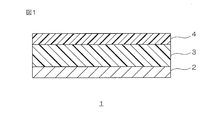
- FIG. 1 is a schematic view showing an embodiment of the heat-sensitive recording material of the present invention.
- the water-dispersed resin composition of the present invention contains a first polymer obtained by polymerizing the first monomer component and a second polymer obtained by polymerizing the second monomer component.
- the first monomer component contains (meth) acrylamide as an essential component.
- (meth) acryl includes acryl and methacryl (hereinafter the same).
- the first monomer component preferably contains methacrylamide. Thereby, heat resistance (sticking resistance), plasticizer resistance, and solvent resistance can be improved.
- the first monomer component can contain a copolymerizable monomer copolymerizable with (meth) acrylamide (hereinafter referred to as the first copolymerizable monomer) as an optional component.
- Examples of the first copolymerizable monomer include (meth) acrylic acid alkyl ester, functional group-containing vinyl monomer, vinyl ester, aromatic vinyl monomer, N-substituted unsaturated carboxylic acid amide, heterocyclic vinyl compound, halogen And vinylidene chloride compounds, ⁇ -olefins, dienes and the like.
- (meth) acrylic acid alkyl ester examples include 1 to 8 carbon atoms such as methyl (meth) acrylate, ethyl (meth) acrylate, n-butyl (meth) acrylate, 2-ethylhexyl (meth) acrylate, and the like.
- Examples of functional group-containing vinyl monomers include carboxy group-containing vinyl monomers, hydroxyl group-containing vinyl monomers, amino group-containing vinyl monomers, glycidyl group-containing vinyl monomers, cyano group-containing vinyl monomers, sulfonic acid group-containing vinyl monomers and salts thereof, Examples include acetoxy group-containing vinyl monomers and phosphate group-containing compounds.
- carboxy group-containing vinyl monomer examples include (meth) acrylic acid, maleic anhydride, fumaric acid, itaconic acid, crotonic acid and the like.
- hydroxyl group-containing vinyl monomer examples include 2-hydroxyethyl (meth) acrylate and 2-hydroxypropyl (meth) acrylate.
- amino group-containing vinyl monomers examples include 2-aminoethyl (meth) acrylate, 2- (N-methylamino) ethyl (meth) acrylate, and 2- (N, N-dimethylamino) (meth) acrylate. Examples include ethyl.
- Examples of the glycidyl group-containing vinyl monomer include glycidyl (meth) acrylate.
- Examples of the cyano group-containing vinyl monomer include (meth) acrylonitrile.
- Examples of the sulfonic acid group-containing vinyl monomer include allyl sulfonic acid and methallyl sulfonic acid.
- Examples of the salt include alkali metal salts such as sodium salt and potassium salt of the sulfonic acid group-containing vinyl monomer, such as ammonium salt. Specific examples include sodium allyl sulfonate, sodium methallyl sulfonate, and ammonium methallyl sulfonate.
- acetoacetoxy group-containing vinyl monomer examples include acetoacetoxyethyl (meth) acrylate.
- Examples of the phosphoric acid group-containing compound include 2-methacryloxyethyl acid phosphate.
- vinyl esters examples include vinyl acetate and vinyl propionate.
- aromatic vinyl monomer examples include styrene, ⁇ -methylstyrene, divinylbenzene and the like.
- N-substituted unsaturated carboxylic acid amide examples include N-methylol (meth) acrylamide.
- heterocyclic vinyl compound examples include vinyl pyrrolidone.
- Examples of the vinylidene halide compound include vinylidene chloride and vinylidene fluoride.
- ⁇ -olefins examples include ethylene and propylene.
- dienes examples include butadiene.
- crosslinkable vinyl monomer can also be mentioned as the first copolymerizable monomer.
- crosslinkable vinyl monomer examples include compounds containing two or more vinyl groups such as methylene bis (meth) acrylamide, divinylbenzene, and polyethylene glycol chain-containing di (meth) acrylate.
- These first copolymerizable monomers can be used alone or in combination of two or more.
- the first copolymerizable monomer is preferably a functional group-containing vinyl monomer, an aromatic vinyl monomer or a combination thereof, and more preferably, only a functional group-containing vinyl monomer is used.
- the plasticizer resistance can be improved.
- the first copolymerizable monomer is more preferably a carboxy group-containing vinyl monomer, a hydroxyl group-containing vinyl monomer, a sulfonic acid group-containing vinyl monomer, or a combination thereof, more preferably a carboxy group-containing vinyl monomer, a hydroxyl group.
- Examples thereof include vinyl-containing monomers or a combination thereof, and particularly preferred are (meth) acrylic acid, 2-hydroxyethyl (meth) acrylate, or a combination thereof.
- the water solubility of the first polymer can be improved and the water-dispersed resin composition can be stabilized.
- (meth) acryl includes acryl and methacryl, but in the first monomer component, methacryl is preferable from the viewpoint of water resistance.
- the content ratio of (meth) acrylamide and the first copolymerizable monomer is (meth) acrylamide, for example, 50 parts by mass or more, preferably 100 parts by mass of the first monomer component, 70 parts by mass or more, for example, 100 parts by mass or less, preferably 85 parts by mass or less.
- a 1st copolymerizable monomer is 0 mass part or more, for example, Preferably, it is 15 mass parts or more, for example, is 50 mass parts or less, Preferably, it is 30 mass parts or less.
- the first monomer component may contain only (meth) acrylamide without containing the first copolymerizable monomer, and (meth) acrylamide and the first copolymerizable monomer are in the above ratio. It may be used together. Preferably, (meth) acrylamide and the first copolymerizable monomer are used together in the above ratio.
- the content ratio is, for example, 0.01 mass with respect to 100 mass parts of the total amount of the first monomer component.
- Part or more preferably 0.2 part by weight or more, for example, 20 parts by weight or less, preferably 5 parts by weight or less, more preferably 1 part by weight or less.
- the viscosity can be reduced while suppressing the decrease in the molecular weight of the first polymer, and workability can be improved.
- the polymerization of the first monomer component is not particularly limited, and a known polymerization method is employed. For example, water, a first monomer component, and a polymerization initiator are blended, and the first monomer component is polymerized in water.
- the polymerization initiator is not particularly limited.
- persulfate ammonium persulfate, potassium persulfate, etc.
- hydrogen peroxide organic hydroperoxide
- 4,4′-azobis (4-cyanovaleric acid) acid etc.
- Water-soluble initiators such as oil-soluble initiators such as benzoyl peroxide and azobisisobutyronitrile, and redox initiators. These polymerization initiators can be used alone or in combination of two or more.
- the blending ratio of the polymerization initiator is appropriately set depending on the purpose and application, but is, for example, 0.1 parts by mass or more, for example, 20 parts by mass with respect to 100 parts by mass of the first monomer component. Hereinafter, it is preferably 10 parts by mass or less.
- the polymerization temperature is, for example, 30 ° C or higher, preferably 50 ° C or higher, for example, 95 ° C or lower, preferably 85 ° C or lower.
- the polymerization time is, for example, 1 hour or more, preferably 2 hours or more, for example, 30 hours or less, preferably 20 hours or less.
- an emulsifier (surfactant) described later can be blended as necessary from the viewpoint of improving the production stability.
- a pH adjuster for example, a metal ion sealing agent such as ethylenediaminetetraacetic acid and its salt, for example, mercaptans, low molecular halogen
- a molecular weight regulator chain transfer agent
- chain transfer agent chain transfer agent
- the weight average molecular weight of the first polymer is, for example, not less than 5,000, preferably not less than 10,000, for example, not more than 1,000,000, preferably not more than 50, in terms of standard polystyrene by gel permeation chromatography (GPC) measurement. 10,000 or less.
- the second monomer component contains a carboxy group-containing vinyl monomer as an essential component.
- carboxy group-containing vinyl monomer examples include those similar to the carboxy group-containing vinyl monomer in the first copolymerizable monomer described above. Specifically, for example, ethylenic groups such as (meth) acrylic acid and crotonic acid are used. Examples thereof include saturated monobasic carboxylic acids, for example, ethylenically unsaturated dibasic carboxylic acids such as itaconic acid, maleic acid and fumaric acid, and alkyl esters thereof.
- carboxy group-containing vinyl monomers can be used alone or in combination of two or more.
- the carboxy group-containing vinyl monomer is preferably an ethylenically unsaturated monobasic carboxylic acid, more preferably (meth) acrylic acid, and more preferably methacrylic from the viewpoint of improving water resistance. Examples include acids.
- the second monomer component can contain, as an optional component, a copolymerizable monomer that can be copolymerized with a carboxy group-containing vinyl monomer (hereinafter referred to as a second copolymerizable monomer).
- a copolymerizable monomer that can be copolymerized with a carboxy group-containing vinyl monomer (hereinafter referred to as a second copolymerizable monomer).
- Examples of the second copolymerizable monomer include the above-mentioned (meth) acrylic acid alkyl ester, the above-described functional group-containing vinyl monomer (excluding the carboxy group-containing vinyl monomer), the above-described vinyl esters, and the above-described aromatic vinyl monomer. And the above-mentioned N-substituted unsaturated carboxylic acid amides, the above-mentioned heterocyclic vinyl compounds, the above-mentioned vinylidene halide compounds, the above-mentioned ⁇ -olefins, the above-mentioned dienes, the above-mentioned crosslinkable vinyl monomers, and the like.
- examples of the second copolymerizable monomer further include amide group-containing vinyl monomers such as (meth) acrylamide as the functional group-containing vinyl monomer.
- These second copolymerizable monomers can be used alone or in combination of two or more.
- the second copolymerizable monomer is preferably a (meth) acrylic acid alkyl ester (particularly preferably, a combination of methyl (meth) acrylate and n-butyl (meth) acrylate), a functional group-containing vinyl.
- a monomer and an aromatic vinyl monomer are mentioned, More preferably, these combined use is mentioned, More preferably, combined use of (meth) acrylic-acid alkylester and a functional group containing vinyl monomer is mentioned.
- the second copolymerizable monomer is more preferably a cyano group-containing vinyl monomer, particularly preferably (meth) acrylonitrile.
- the content ratio of the carboxy group-containing vinyl monomer and the second copolymerizable monomer is, for example, 4 parts by mass or more, preferably carboxy group-containing vinyl monomer with respect to 100 parts by mass of the second monomer component. Is 4.5 parts by mass or more and 20 parts by mass or less, preferably 10 parts by mass or less. Further, the second copolymerizable monomer is 80 parts by mass or more, preferably 90 parts by mass or more, and 96 parts by mass or less, preferably 95.5 parts by mass or less.
- the content ratio of the carboxy group-containing vinyl monomer and the second copolymerizable monomer is within the above range, it has excellent swellability, can be easily formed into a film, and has durability (water resistance / solvent resistance). An excellent heat-sensitive recording material can be obtained, and a water-dispersed resin composition having excellent spinnability can be obtained.
- the content ratio of (meth) acrylonitrile is, for example, 15 parts by mass or more, preferably 30 parts by mass with respect to 100 parts by mass of the second monomer component.
- the second monomer component contains (meth) acrylonitrile in the above proportion, a heat-sensitive recording material excellent in durability (especially heat resistance, solvent resistance, plasticizer resistance, oil resistance) can be obtained.
- the content ratio is, for example, 0.01 mass with respect to 100 parts by mass of the total amount of the second monomer component.
- Part or more preferably 0.2 part by weight or more, for example, 20 parts by weight or less, preferably 5 parts by weight or less, more preferably 1 part by weight or less.
- the viscosity can be lowered while suppressing the molecular weight of the second polymer, and workability can be improved.
- the polymerization of the second monomer component is not particularly limited, and a known polymerization method is employed. For example, water, a second monomer component, and a polymerization initiator are blended, and the second monomer component is polymerized in water.
- the polymerization initiator is not particularly limited, and examples thereof include the same polymerization initiator as that used for the polymerization of the first monomer component described above. These polymerization initiators can be used alone or in combination of two or more.
- the blending ratio of the polymerization initiator is appropriately set according to the purpose and application, and is, for example, 0.1 parts by mass or more and 20 parts by mass or less with respect to 100 parts by mass of the second monomer component.
- the polymerization temperature is, for example, 30 ° C or higher, preferably 50 ° C or higher, for example, 95 ° C or lower, preferably 85 ° C or lower.
- the polymerization time is, for example, 1 hour or more, preferably 2 hours or more, for example, 30 hours or less, preferably 20 hours or less.
- the above-described emulsifier (surfactant) can be blended as necessary from the viewpoint of improving the production stability.
- the emulsifier examples include an anionic surfactant, a cationic surfactant, and a nonionic surfactant, and preferably an anionic surfactant and a nonionic surfactant.
- anionic surfactants such as higher alcohol sulfates, alkylbenzene sulfonates (such as dodecylbenzene sulfonate), aliphatic sulfonates, alkyl diphenyl ether sulfonates, such as polyethylene glycol
- Nonionic surfactants such as alkyl ester type, alkyl phenyl ether type, and alkyl ether type are listed.
- emulsifiers can be used alone or in combination of two or more.
- the blending ratio of the emulsifier is appropriately set according to the purpose and application.
- a pH adjuster for example, a metal ion sealing agent such as ethylenediaminetetraacetic acid and its salt, for example, mercaptans, low molecular halogen, etc.
- a molecular weight regulator chain transfer agent
- a compound can be blended at an appropriate ratio.
- the second polymer contains a carboxy group derived from the carboxy group-containing vinyl monomer of the second monomer component, and this carboxy group is neutralized by a neutralizing agent and salified.
- a neutralizing agent is added and held at a predetermined temperature for 30 minutes or more. Thereby, the carboxy group in the second polymer is neutralized (swelling softening treatment).
- the neutralizing agent examples include alkali metal hydroxides (sodium hydroxide, potassium hydroxide, etc.), amines, ammonia and the like.
- the neutralizing agent is preferably used as salt-containing water, and specific examples thereof include an aqueous solution of an alkali metal hydroxide and aqueous ammonia. These neutralizing agents can be used alone or in combination of two or more.
- ammonia is preferable.
- the blending ratio of the neutralizing agent is, for example, 20 mol or more, preferably 25 mol or more, more preferably 30 mol or more, with respect to 100 mol of the carboxy group-containing vinyl monomer contained in the second monomer component. , 200 mol or less, preferably 150 mol or less, more preferably 120 mol or less.
- the holding temperature is, for example, 40 ° C. or higher, preferably 50 ° C. or higher, for example, 90 ° C. or lower, preferably 80 ° C. or lower.
- the holding time is, for example, 30 minutes or more, preferably 1 hour or more, for example, 12 hours or less, preferably 10 hours or less.
- the carboxy group is neutralized and a carboxylate is formed.
- a carboxylate is formed by neutralization of the carboxy group.
- a heat-sensitive recording material having excellent running stability and durability can be obtained, and further, a water-dispersed resin composition having excellent spinnability can be obtained.
- aqueous ammonia is used as a neutralizing agent, workability is excellent, and when an ammonium salt is formed as a carboxylate, water resistance can be improved, and color development is also excellent.
- a heat-sensitive recording material can be obtained.
- the neutralizing agent (counter cation) in the water-dispersed resin composition is analyzed by various analyzers such as FT-IR apparatus, pyrolysis GC-MS apparatus, headspace GC-MS apparatus, and elemental analyzer. By doing this, it can be confirmed that the carboxy group is neutralized.
- the weight average molecular weight of the second polymer is, for example, 10,000 or more, preferably 50,000 or more, for example, 2 million or less, preferably 1 million or less, in terms of standard polystyrene as measured by gel permeation chromatography (GPC). It is.
- the solubility parameter (SP value) of the second polymer is, for example, 9.5 (cal / cm 3 ) 1/2 or more, for example, 13 (cal / cm 3 ) 1/2 or less.
- SP value solubility parameter
- (meth) acrylonitrile it is preferably 10.8 (cal / cm 3 ) 1/2 or more.
- solubility parameter (SP value) of the second polymer is within the above range, the blocking resistance and adhesion can be improved.
- the glass transition temperature of the second polymer is, for example, 20 ° C. or more, preferably 25 ° C. or more, for example, 130 ° C. or less, preferably 125 ° C. or less.
- (meth) acrylonitrile is used, it is preferably 30 ° C. or higher and 130 ° C. or lower.
- the glass transition temperature of the second polymer is within the above range, the film formability and durability (heat resistance) can be improved.
- the water-dispersed resin composition is not particularly limited as long as it contains the first polymer and the second polymer.
- the first polymer and the second polymer are separately separated by the method described above. After production, they can be obtained by mixing them.
- the blending ratio of the first polymer and the second polymer is, for example, 5 parts by mass or more, preferably 100 parts by mass of the second polymer, 10 parts by mass or more, for example, 500 parts by mass or less, preferably 200 parts by mass or less.
- a water-dispersed resin composition can be obtained with good workability, and running stability and durability can be improved.
- the solid concentration of the water-dispersed resin composition is, for example, 10% by mass or more, preferably 15% by mass or more, for example, 60% by mass or less, preferably 50% by mass or less.
- the pH of the water-dispersed resin composition is, for example, 5.5 or more, preferably 6.0 or more, for example, 11 or less, preferably 10 or less.
- the first polymer can be produced, and the second polymer can be produced in the presence of the obtained first polymer.
- the second polymer can be produced, and the first polymer can be produced in the presence of the obtained second polymer.
- first the first polymer is produced and the second polymer is produced in the presence of the resulting first polymer, or first the second polymer is produced and in the presence of the resulting second polymer.
- a first polymer is produced.
- a water-dispersed resin composition can be obtained as particles (core-shell particles) in which the second polymer is coated with the first polymer.
- the second polymer is produced, and the first polymer is produced in the presence of the obtained second polymer.
- core-shell particles in which the core polymer is partially coated with the shell polymer are obtained.
- a heat-sensitive recording material having excellent running stability and durability can be obtained, and furthermore, the spinnability is also excellent.
- the water-dispersed resin composition can further contain a non-crosslinkable urea compound.
- the non-crosslinkable urea compound is defined as a urea compound having a molecular weight of 1000 or less and which does not form a crosslinked structure with the first polymer and the second polymer.
- non-crosslinkable urea compound examples include urea or urea derivatives having 1 or less methylol groups in the molecule.
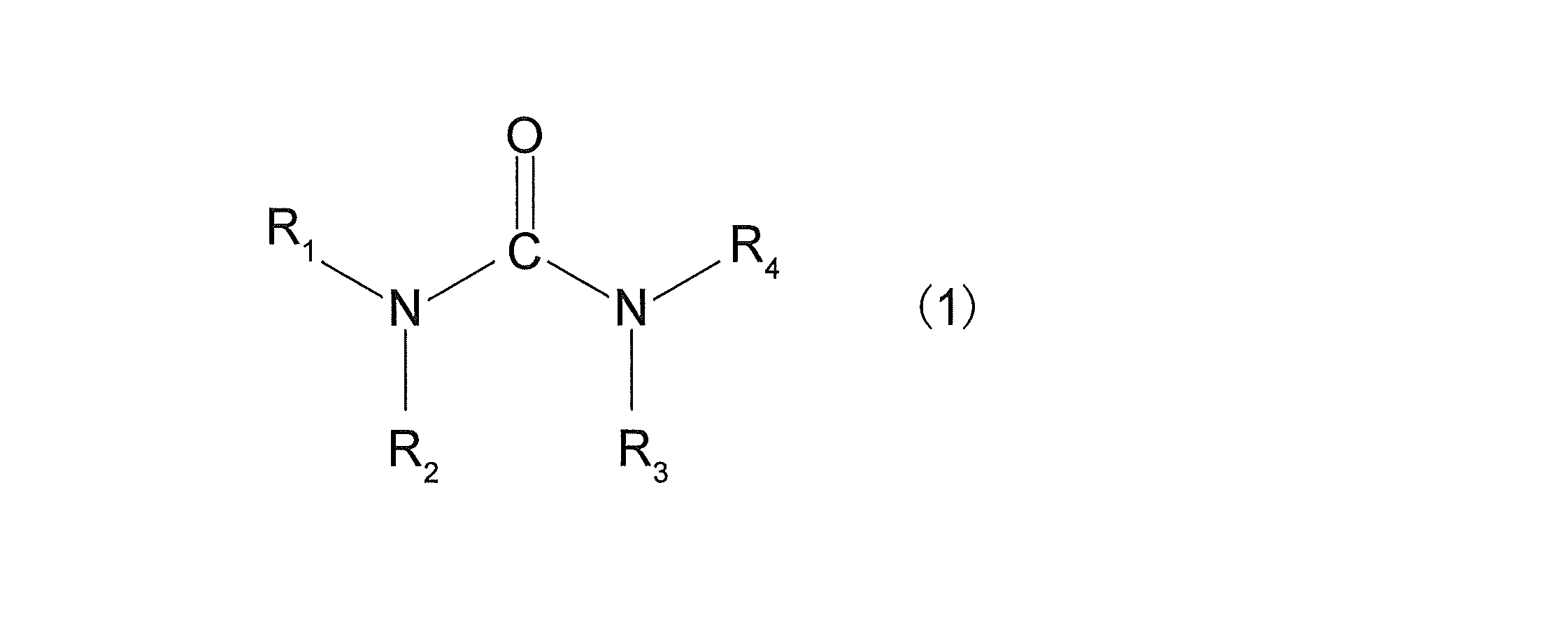
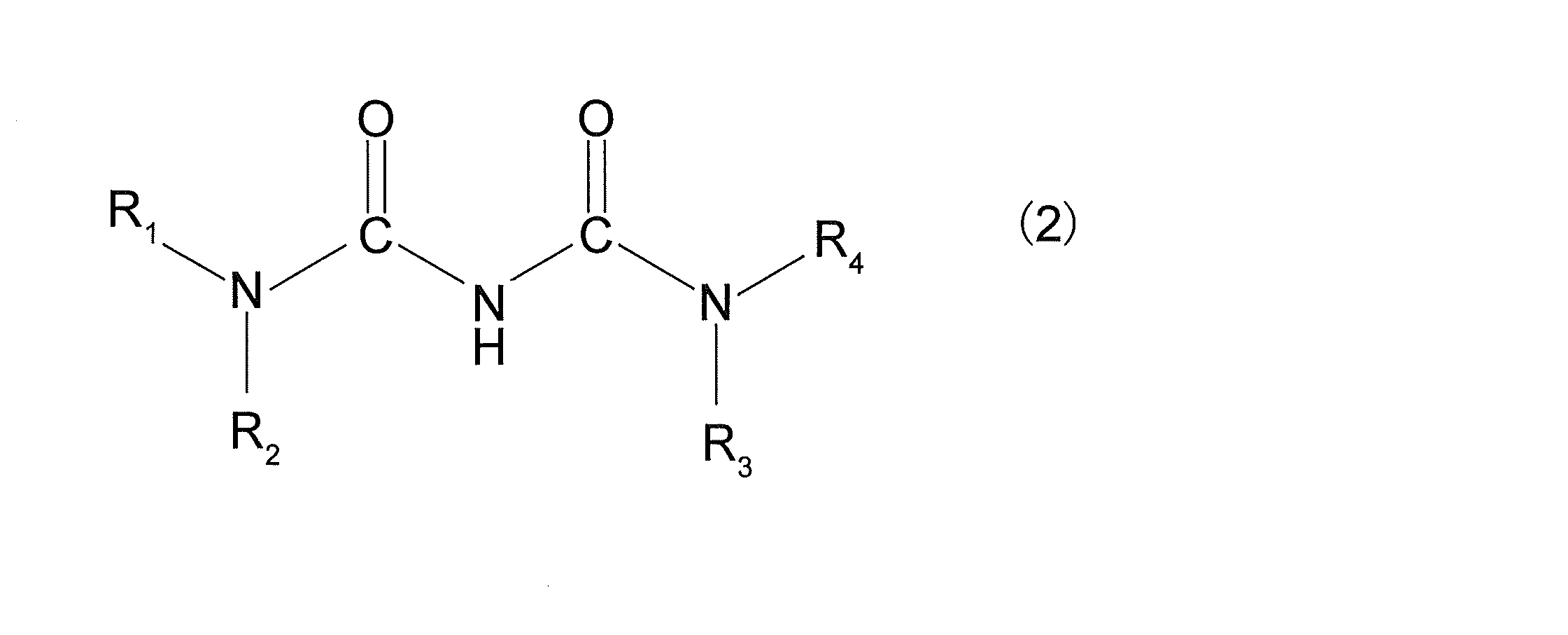
- non-crosslinkable urea compound examples include compounds represented by the following formula (1) or the following formula (2).
- R 1 to R 4 each independently represents a hydrogen atom or an alkyl group having 1 to 12 carbon atoms which may have a hydroxyl group, and R 1 to R 4 2 No two or more have a hydroxyl group at the same time.
- R 1 to R 4 each independently represents a hydrogen atom or an alkyl group having 1 to 12 carbon atoms which may have a hydroxyl group, and R 1 to R 4 2 No two or more have a hydroxyl group at the same time.
- R 1 to R 4 are each independently a hydrogen atom or a linear alkyl group such as methyl group, ethyl group, n-propyl group, n-butyl group, n-hexyl, such as i-propyl Group, a branched chain alkyl group such as i-butyl group or t-butyl group, or a monohydroxyalkyl group such as 2-hydroxyethyl group or 3-hydroxypropyl group, which may have a hydroxyl group 1 Represents an alkyl group of ⁇ 12.
- R 1 to R 4 are preferably a hydrogen atom or an alkyl group having 1 to 9 carbon atoms, more preferably a hydrogen atom, a methyl group or an ethyl group.
- R 1 to R 4 do not have a hydroxyl group at the same time. That is, when one of R 1 to R 4 is a C 1-12 alkyl group having a hydroxyl group, the remaining three are a hydrogen atom or a C 1-12 alkyl group having no hydroxyl group. is there.
- R 1 to R 4 are alkyl groups having 1 to 12 carbon atoms having no hydroxyl group, the remaining two are hydrogen atoms, R 1 1 to R 4 is an alkyl group having 1 to 12 carbon atoms having a hydroxyl group, the remaining 3 are hydrogen atoms, or all of R 1 to R 4 are hydrogen atoms.
- two of R 1 to R 4 are alkyl groups having 1 to 12 carbon atoms having no hydroxyl group, and the remaining two are hydrogen atoms, or all of R 1 to R 4 are hydrogen atoms. In a more preferred embodiment, two of R 1 to R 4 are alkyl groups having 1 to 12 carbon atoms having no hydroxyl group, and the remaining two are hydrogen atoms.
- non-crosslinkable urea compound for example, urea, for example, monoalkyl urea such as 1-alkyl urea, for example, dialkyl urea such as 1,1-dialkyl urea, 1,3-dialkyl urea, for example, 1-hydroxy
- urea for example, monoalkyl urea such as 1-alkyl urea
- dialkyl urea such as 1,1-dialkyl urea, 1,3-dialkyl urea
- 1-hydroxyalkylureas such as alkylureas
- urea derivatives such as the above monoalkylureas, the above dialkylureas and the biurets of the above hydroxyalkylureas.
- 1-monoalkylurea examples include 1-methylurea and 1-ethylurea, and preferably 1-methylurea.
- 1,1-dialkylurea examples include 1,1-dimethylurea and 1,1-diethylurea, and preferably 1,1-dimethylurea.
- 1,3-dialkylurea examples include 1,3-dimethylurea and 1,3-diethylurea, and preferably 1,3-dimethylurea.
- 1-hydroxyalkylurea examples include 1- (2-hydroxyethyl) urea and 1- (3-hydroxypropyl) urea.
- biuret of urea examples include biuret (urea dimer, C 2 H 5 N 3 O 2 ), N, N-dimethylbiuret, and the like.
- biuret a dimer of urea, C 2 H 5 N 3 O 2
- biuret is used.
- the non-crosslinkable urea compound is preferably urea, 1-alkylurea, 1,1-dialkylurea, 1,3-dialkylurea, 1-hydroxyalkylurea and biuret (urea dimer, C 2 H 5 N 3 O 2 ), more preferably urea, 1,1-dialkylurea and 1,3-dialkylurea. More preferred is urea, 1,1-dimethylurea or 1,3-dimethylurea.
- water resistance and plasticizer resistance can be improved.
- the blending ratio of the non-crosslinkable urea compound is, for example, 0.1 parts by mass or more, preferably 1 part by mass or more, more preferably 100 parts by mass of the total amount (solid content) of the first polymer and the second polymer. 2 parts by mass or more, more preferably 5 parts by mass or more, and for example, 50 parts by mass or less, preferably 40 parts by mass or less, more preferably 30 parts by mass or less, and further preferably 20 parts by mass. It is as follows.
- the blending ratio of the non-crosslinkable urea compound is within the above range, water resistance and plasticizer resistance can be improved.
- the water-dispersed resin composition can further contain other polymers (polymers excluding the first polymer and the second polymer), fillers, and the like.
- Examples of other polymers include polyolefin resins, and specific examples include ⁇ -olefins having 2 to 16 carbon atoms (for example, ethylene, propylene, 1-butene, 3-methyl-1-butene, And homopolymers and copolymers of 4-methyl-1-pentene, 3-methyl-1-pentene, 1-heptene, 1-hexene, 1-octene, 1-decene, 1-dodecene and the like. Preferred are homopolymers and copolymers of ethylene, propylene and 1-butene.
- the blending ratio is appropriately set according to the purpose and application.
- the blending ratio is, for example, 0.5 parts by mass or more, preferably 100 parts by mass with respect to the total amount of the first polymer and the second polymer. 2 parts by mass or more, more preferably 3 parts by mass or more, further preferably 5 parts by mass or more, for example, 50 parts by mass or less, preferably 40 parts by mass or less, more preferably 35 parts by mass or less, More preferably, it is 30 parts by mass or less.
- the filler examples include inorganic fillers such as calcium carbonate, magnesium carbonate, kaolin, talc, clay, aluminum hydroxide, barium sulfate, silicon oxide, titanium oxide, zinc oxide, colloidal silica, such as urea-formalin resin, Examples thereof include organic fine particles such as polystyrene fine powder. These fillers can be used alone or in combination of two or more.
- the blending ratio of the filler is appropriately set according to the purpose and application.
- the water-dispersed resin composition can be used within the range that does not impair the excellent effects of the present invention, for example, lubricants such as higher fatty acid metal salts and higher fatty acid amides (lubricants excluding polyolefin resins) such as ammonium zirconium carbonate and polyamide.
- lubricants such as higher fatty acid metal salts and higher fatty acid amides (lubricants excluding polyolefin resins) such as ammonium zirconium carbonate and polyamide.
- Known crosslinking agents such as epichlorohydrin and modified products thereof, film-forming aids, UV absorbers, antioxidants, antifoaming agents, wetting agents, viscosity modifiers, and other aids Additives can be included.
- the content ratio of the additive is appropriately set according to the purpose and application.
- the water-dispersed resin composition can be suitably used as a heat-sensitive recording layer resin composition for forming a heat-sensitive recording layer in a heat-sensitive recording material comprising a support layer, a heat-sensitive recording layer and a protective layer.
- the protective layer can be used as a protective layer resin composition for forming a protective layer.
- the heat-sensitive recording material 1 is laminated on a support layer 2, a heat-sensitive recording layer 3 laminated on one side in the thickness direction of the support layer 2, and a heat-sensitive recording layer 3 on one side in the thickness direction.
- the protective layer 4 is provided.
- Examples of the support layer 2 include paper and plastic sheets.
- the thickness of the support layer 2 is appropriately set according to the purpose and application.
- thermosensitive recording layer 3 is formed as a cured product of the resin composition for the thermosensitive recording layer.
- the heat-sensitive recording resin composition contains, for example, the above water-dispersed resin composition, a dye and a developer.
- the dye examples include known basic organic dyes such as fluoran organic dyes, triallylmethane organic dyes, and phenoxyazine organic dyes.
- the developer is not particularly limited, and examples thereof include known developers such as phenolic compounds and aromatic carboxylic acids.
- the mixing ratio of the dye and the developer is, for example, 100 parts by mass or more, for example, 3000 parts by mass or less with respect to 100 parts by mass of the dye.
- These dyes and developers are wet pulverized and mixed in the presence of the above water-dispersed resin composition, whereby a heat-sensitive recording layer resin composition is obtained. Further, for example, a dye and a developer are dispersed in the presence of another aqueous resin composition (for example, polyvinyl alcohol) other than the above water-dispersed resin composition, and the obtained dispersion and the above-described water dispersion are dispersed.
- the resin composition for a thermosensitive recording layer can also be obtained by mixing with the mold resin composition.
- the mixing ratio in the heat-sensitive recording layer resin composition is not particularly limited, but the solid content of the water-dispersed resin composition is, for example, 5 parts by mass or more, preferably 100 parts by mass of the total amount of the dye and the developer. Is 10 parts by mass or more, for example, 30 parts by mass or less, preferably 20 parts by mass or less.
- the resin composition for the heat sensitive recording layer may be a sensitizer such as inorganic pigments such as calcium carbonate, talc and kaolin, for example, benzophenone ultraviolet absorbers, triazole ultraviolet absorbers, waxes and fatty acid amides, if necessary. Can be contained in an appropriate ratio according to the purpose and application.
- a sensitizer such as inorganic pigments such as calcium carbonate, talc and kaolin, for example, benzophenone ultraviolet absorbers, triazole ultraviolet absorbers, waxes and fatty acid amides, if necessary. Can be contained in an appropriate ratio according to the purpose and application.
- such a heat-sensitive recording layer resin composition is preferably applied to the support layer 2 from a known coating method such as curtain coating method, roll coating method, blade coating method, By the curtain coating method, the coating is dried, dried and cured so that the thickness after drying is, for example, 2 to 20 g / m 2 .
- the carboxylate for example, ammonium salt
- the drying and curing conditions are appropriately set according to the formulation of the thermosensitive recording layer resin composition.
- the protective layer 4 is formed as a cured product of the protective layer resin composition.
- the protective layer resin composition for example, the above water-dispersed resin composition can be used as it is.
- Such a protective layer resin composition is preferably applied to the heat-sensitive recording layer 3 from the viewpoint of improving the production efficiency with known coating methods such as curtain coating, roll coating, and blade coating.
- the film is coated, dried and cured by the curtain coating method so that the thickness after drying becomes, for example, 1 to 10 g / m 2 .
- the carboxylate for example, ammonium salt
- the protective layer 4 is formed.
- the drying and curing conditions are appropriately set according to the formulation of the protective layer resin composition.
- the obtained heat-sensitive recording material has excellent running stability and durability.
- both the heat-sensitive recording layer 3 and the protective layer 4 are formed of the water-dispersed resin composition, but for example, the heat-sensitive recording layer 3 or the protective layer 4 Only any one of these may be formed with said water-dispersed resin composition.
- the heat-sensitive recording layer 3 or the protective layer 4 that is not formed by the water-dispersed resin composition is formed by a known method.
- the heat-sensitive recording material 1 includes the support layer 2, the heat-sensitive recording layer 3, and the protective layer 4.
- the heat-sensitive recording material 1 is provided between the support layer 2 and the heat-sensitive recording layer 3, An intermediate layer (not shown) may be interposed between the layer 4.
- Example 1 A separable flask equipped with a stirrer and a reflux condenser was charged with 60 parts of deionized water, 0.1 part of sodium dodecylbenzenesulfonate and 1.0 part of potassium persulfate, and replaced with nitrogen gas. The temperature rose. Subsequently, an emulsion (a mixture of the second monomer component, water and an emulsifier) having the following composition was continuously added in about 4 hours, and then held at 75 ° C. for about 4 hours to complete the polymerization, and the solid content was about 50 % Seed emulsion was obtained.
- emulsion a mixture of the second monomer component, water and an emulsifier
- Methacrylamide 70 parts 2-Hydroxyethyl methacrylate 15 parts Methacrylic acid 15 parts Deionized water 300 parts Subsequently, aqueous ammonia is added to make the mixture alkaline, and the temperature (75 ° C.) is maintained for 3 hours. did. Thereafter, the mixture was cooled to room temperature to obtain a water-dispersed resin composition having a solid content of about 20% and having a pH adjusted to about 8.0.
- Example 2 A separable flask equipped with a stirrer and a reflux condenser was charged with 100 parts of deionized water, 0.1 part of sodium dodecylbenzenesulfonate and 1.0 part of potassium persulfate, and replaced with nitrogen gas. The temperature rose. Next, an emulsion (a mixture of the second monomer component, water and an emulsifier) having the following composition was continuously added in about 4 hours, and then held at 75 ° C. for about 4 hours to complete the polymerization, and the solid content was about 40 % Seed emulsion was obtained.
- emulsion a mixture of the second monomer component, water and an emulsifier
- Example 3 A separable flask equipped with a stirrer and a reflux condenser was charged with 230 parts of deionized water and replaced with nitrogen gas, and then heated to 70 ° C. Next, 1.0 part of ammonium persulfate was added, and then a mixture having the following composition (mixture of the first monomer component and water) was continuously added over 2 hours with stirring, and then maintained for 2 hours to polymerize. Was completed to obtain an aqueous solution of a copolymer resin having a solid content of about 16%.
- 250 parts of the aqueous copolymer resin solution obtained above was added to 170 parts of deionized water for adjusting the solid content was added, and the temperature was raised to 75 ° C. while replacing with nitrogen again.
- 0.5 part of 4,4′-azobis (4-cyanovaleric acid) was added, and an emulsion (mixture of the second monomer component, water and emulsifier) having the following composition was continuously added over 4 hours.
- the polymerization was completed by maintaining at that temperature (75 ° C.) for 3 hours.
- Acrylonitrile 45 parts butyl acrylate 40 parts methacrylic acid 5 parts methyl methacrylate 10 parts sodium dodecylbenzenesulfonate 0.1 part deionized water 40.0 parts
- ammonia water is added to make the mixture alkaline, and the temperature is maintained for 3 hours. (75 ° C.) was held, and swelling and softening treatment was performed. Thereafter, the mixture was cooled to room temperature to obtain a water-dispersed resin composition having a solid content of about 25% and having a pH adjusted to about 6.0.
- Comparative Example 1 A separable flask equipped with a stirrer and reflux condenser was charged with 110 parts of deionized water, 0.1 part of sodium dodecylbenzenesulfonate and 1.0 part of potassium persulfate, and replaced with nitrogen gas. did. Next, an emulsion (a mixture of the second monomer component, water and an emulsifier) having the following composition was continuously added in about 4 hours, and then held at 75 ° C. for about 4 hours to complete the polymerization, and the solid content was about 40 % Seed emulsion was obtained.
- emulsion a mixture of the second monomer component, water and an emulsifier
- Methacrylamide 70 parts 2-Hydroxyethyl methacrylate 20 parts Methacrylic acid 10 parts Deionized water 200 parts Thereafter, the mixture was cooled to 40 ° C. or lower, and ammonia water was added to make it alkaline. In addition, it did not hold
- Comparative Example 2 A separable flask equipped with a stirrer and a reflux condenser was charged with 370 parts of deionized water and replaced with nitrogen gas, and then heated to 70 ° C. Next, 1.0 part of ammonium persulfate was added, and then a mixture having the following composition (mixture of the first monomer component and water) was continuously added over 2 hours with stirring, and then maintained for 2 hours to polymerize. Was completed to obtain an aqueous solution of a copolymer resin having a solid content of about 15%.
- 530 parts of the aqueous copolymer resin solution obtained above was charged with 100 parts of deionized water for solid content adjustment.
- the temperature was raised to 75 ° C. while replacing with nitrogen again.
- 0.5 part of 4,4′-azobis (4-cyanovaleric acid) was added, and an emulsion (mixture of the second monomer component, water and emulsifier) having the following composition was continuously added over 4 hours. Further, the polymerization was completed by maintaining at that temperature (75 ° C.) for 3 hours.
- Comparative Example 3 A separable flask equipped with a stirrer and a reflux condenser was charged with 300 parts of deionized water and 0.5 part of sodium dodecyl sulfate and replaced with nitrogen gas, and then heated to 75 ° C. Next, 0.5 part of potassium persulfate is added, and an emulsion (a mixture of the second monomer component, water and an emulsifier) having the following composition is continuously added over about 4 hours, and then aged at 75 ° C. for 2 hours. The polymerization was completed.
- emulsion a mixture of the second monomer component, water and an emulsifier
- Comparative Example 4 A water-dispersed resin composition was obtained in the same manner as in Example 1 except that ammonia water was added to make it alkaline, and the mixture was not maintained at that temperature.
- Example 4 To 100 parts of the water-dispersed resin composition (solid content of about 20%) obtained in Example 1, 86 parts of deionized water was added to dilute, and then 65% clay slurry (Engel Hard) dispersed in advance as a filler.
- Example 5 To 100 parts of the water-dispersed resin composition (solid content of about 25%) obtained in Example 2, 76 parts of deionized water was added for dilution, and a 40% solid content concentration polyolefin copolymer emulsion (manufactured by Mitsui Chemicals, Inc.).
- Chemipearl W4005) 6.2 parts (in terms of solid content, 5% by mass with respect to the solid content in the water-dispersed resin composition), and 13% aqueous solution of ammonium zirconium carbonate as a cross-linking agent (Daiichi Rare Element Chemical Industries, Ltd.) Manufactured by Zircozol AC-7) (19.1 parts (in terms of solid content, 10% by mass with respect to the solid content in the water-dispersed resin composition)) was uniformly mixed.
- Example 6 To 100 parts of the water-dispersed resin composition obtained in Example 3 (solid content of about 25%), 94 parts of deionized water was added for dilution, and then 60% calcium carbonate slurry (made by Okutama Kogyo Co., Ltd.) as a filler.
- Tamapearl TP-123CS 8.4 parts (in terms of solid content, 20% by mass with respect to the solid content in the water-dispersed resin composition), 40% solid content polyolefin copolymer emulsion (Mitsui Chemicals, Chemipearl W401) 6.3 parts (in terms of solid content, 5% by mass with respect to the solid content in the water-dispersed resin composition), and 25% aqueous solution of polyamide epichlorohydrin modified as a crosslinking agent (manufactured by Starlight PMC) , WS4024) 6 parts (in terms of solid content, 6 mass% with respect to the solid content in the water-dispersed resin composition) were uniformly mixed.
- Comparative Example 5 To 100 parts of the water-dispersed resin composition obtained in Comparative Example 1 (solid content of about 20%), 66 parts of deionized water was added for dilution, and then a 36% solid content zinc stearate dispersion (Chukyo). 5.5 parts (made by fats and oils, Z-8-36) (5% by mass with respect to the solid content in the water-dispersed resin composition in terms of solid content), and polyamide epichlorohydrin modified product 25 as a crosslinking agent % Aqueous solution (manufactured by Starlight PMC, WS4027) 2.4 parts (in terms of solid content, 3% by mass with respect to the solid content in the water-dispersed resin composition) was uniformly mixed.
- Comparative Example 6 To 100 parts of the water-dispersed resin composition obtained in Comparative Example 2 (solid content: about 23%), 74 parts of deionized water was added for dilution, and then 65% clay slurry (Engel Hard) dispersed in advance as a filler was added.
- Comparative Example 7 To 100 parts of the water-dispersed resin composition (solid content: about 18%) obtained in Comparative Example 3, 33.5 parts of deionized water was added for dilution. Subsequently, 5.5 parts of 65% clay slurry (manufactured by Engelhard, UW-90) dispersed in advance as a filler (in terms of solid content, 20% by mass with respect to the solid content in the water-dispersed resin composition), And 4.5 parts of a 40% solid content polyolefin copolymer emulsion (Mitsui Chemicals, Chemipearl W400) 4.5 parts (in terms of solid content, 10% by mass with respect to the solid content in the water-dispersed resin composition) Mixed.
- a 40% solid content polyolefin copolymer emulsion Mitsubishi Chemicals, Chemipearl W400
- Example 7 A heat-sensitive recording material was obtained in the same manner as in Example 4 except that the dispersion type resin composition obtained in Example 2 was used as a reference and its solid content was used as a reference.
- Comparative Example 8 A heat-sensitive recording material was obtained in the same manner as in Example 4 except that the dispersion resin composition obtained in Comparative Example 1 was used as a reference and its solid content was used as a reference.
- Comparative Example 9 A heat-sensitive recording material was obtained in the same manner as in Example 4 except that the dispersion resin composition obtained in Comparative Example 2 was used as a reference and its solid content was used as a reference.
- Comparative Example 10 A heat-sensitive recording material was obtained in the same manner as in Example 4 except that the dispersion resin composition obtained in Comparative Example 3 was used as a reference and its solid content was used as a reference.
- Comparative Example 11 A heat-sensitive recording material was obtained in the same manner as in Example 4 except that the dispersion resin composition obtained in Comparative Example 4 was used as a reference and its solid content was used as a reference.
- Comparative Example 12 A heat-sensitive recording material was obtained in the same manner as in Example 3 except that the dispersion type resin composition obtained in Comparative Example 1 was used as a reference and its solid content was used as a reference.
- Comparative Example 13 A heat-sensitive recording material was obtained in the same manner as in Example 3 except that the dispersion resin composition obtained in Comparative Example 2 was used as a reference and its solid content was used as a reference.
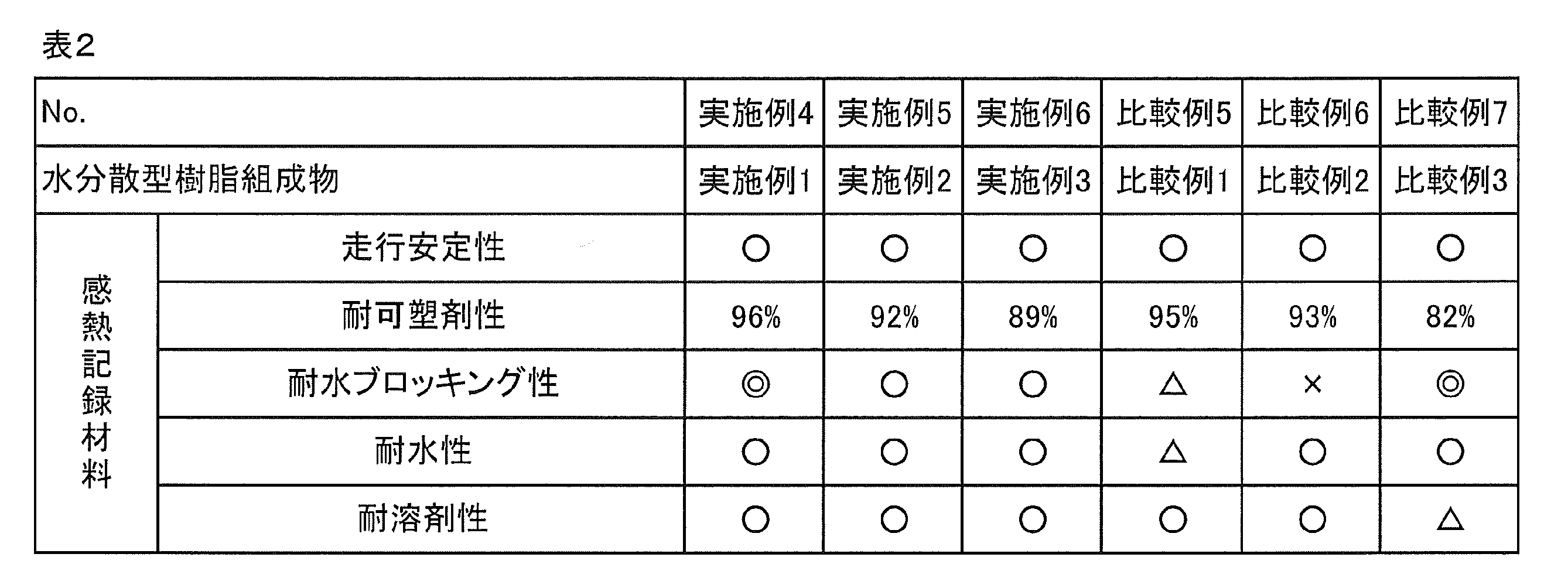
- Table 2 shows Examples 4 to 6 and Comparative Examples 5 to 7.
- Table 3 shows Example 7 and Comparative Examples 8 to 11, and Table 4 also shows Example 4 in which the manufacturing method of the thermosensitive recording material is the same.
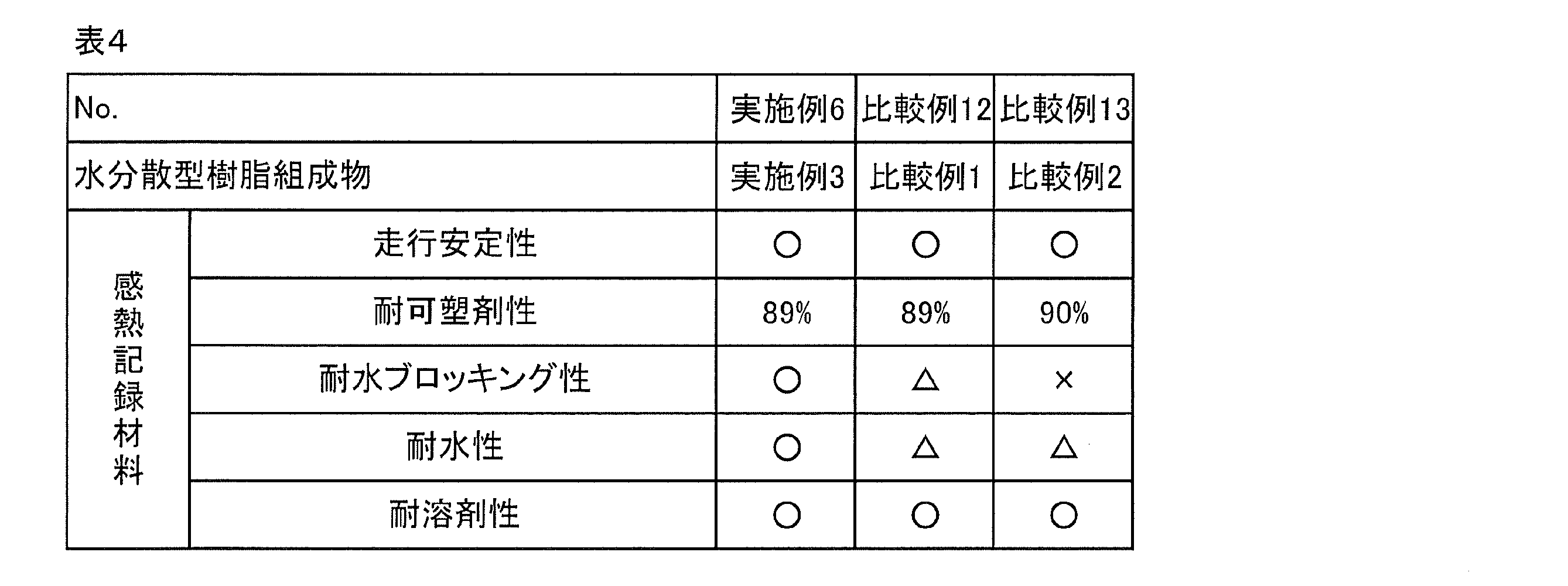
- Table 4 shows Comparative Examples 12 to 13, and Table 6 shows Example 6 in which the manufacturing method of the thermosensitive recording material is the same.
- ⁇ Spinning> A water-dispersed resin composition in which the solid content is adjusted so that the B-type viscosity (60 rotations) is about 250 mPa ⁇ s between circular plates with a diameter of 4 mm (gap 2 mm) using an extension viscometer (CaBER1 manufactured by Thermohake) The object was enclosed, the upper plate was pulled up by 6 mm at a speed of 300 mm / s and held as it was, and the time from when the plate was pulled up until the polymer filament broke was measured.
- ⁇ Plasticizer resistance> With respect to the heat-sensitive recording material, an image was prepared under the same conditions as described above, a transparent type polyvinyl chloride adhesive tape (manufactured by Nitto Denko) was attached to the image portion, left at 40 ° C. for 72 hours, and then peeled off. The density before and after sticking was measured with a Macbeth densitometer, and the retention of printing density was determined.
- ⁇ Water blocking resistance> A drop of water is dropped on the coated surface of the heat-sensitive recording material, the heat-sensitive recording material is superposed so that the coated surfaces overlap each other, a load of 100 g / cm 2 is applied, and the mixture is left for 24 hours or longer at 40 ° C./65% RH. Then, the overlapping surface was peeled off to determine the blocking state.
- the evaluation criteria are as follows. (Double-circle): There is no blocking at all and it peels off easily. ⁇ : There is some resistance when peeling, but it peels off without any problem, and no abnormality is seen on the coated surface. ⁇ : There is some resistance when peeled off, and scratches that appear to be defects are observed in places on the coated surface. X: It is difficult to peel off due to strong resistance, and the coated surface is severely damaged.
Landscapes
- Chemical & Material Sciences (AREA)
- Chemical Kinetics & Catalysis (AREA)
- Organic Chemistry (AREA)
- Medicinal Chemistry (AREA)
- Polymers & Plastics (AREA)
- Health & Medical Sciences (AREA)
- Physics & Mathematics (AREA)
- Optics & Photonics (AREA)
- General Chemical & Material Sciences (AREA)
- Wood Science & Technology (AREA)
- Materials Engineering (AREA)
- Engineering & Computer Science (AREA)
- Life Sciences & Earth Sciences (AREA)
- Heat Sensitive Colour Forming Recording (AREA)
- Compositions Of Macromolecular Compounds (AREA)
- Graft Or Block Polymers (AREA)
Abstract
Description
[1] (メタ)アクリルアミドを含有する第1モノマー成分を重合させることにより得られる第1ポリマーと、カルボキシ基含有ビニルモノマーを含有する第2モノマー成分を重合させることにより得られる第2ポリマーとを含み、前記第2ポリマーにおけるカルボキシ基の少なくとも一部が、中和されていることを特徴とする、水分散型樹脂組成物、
[2] カルボキシ基含有ビニルモノマーの含有割合が、前記第2モノマー成分100質量部に対して、4質量部以上20質量部以下であることを特徴とする、上記[1]に記載の水分散型樹脂組成物、
[3] (メタ)アクリルアミドの含有割合が、前記第1モノマー成分100質量部に対して、50質量部以上100質量部以下であることを特徴とする、上記[1]または[2]に記載の水分散型樹脂組成物、
[4] 前記第1モノマー成分が、さらに、カルボキシ基含有ビニルモノマーおよび/または水酸基含有ビニルモノマーを含有することを特徴とする、上記[1]~[3]のいずれか一項に記載の水分散型樹脂組成物。
[5] 前記第2モノマー成分が、さらに、(メタ)アクリロニトリルを含有し、(メタ)アクリロニトリルの含有割合が、前記第2モノマー成分100質量部に対して、15質量部以上90質量部以下であることを特徴とする、上記[1]~[4]のいずれか一項に記載の水分散型樹脂組成物、
[6] 前記第2ポリマー100質量部に対して、前記第1ポリマーの含有割合が、5質量部以上500質量部以下であることを特徴とする、上記[1]~[5]のいずれか一項に記載の水分散型樹脂組成物、
[7] 前記カルボキシ基の少なくとも一部が中和されることにより形成されるカルボン酸塩が、アンモニウム塩であることを特徴とする、上記[1]~[6]のいずれか一項に記載の水分散型樹脂組成物、
[8] 前記第2モノマー成分が重合された後、含塩水が添加され、30分以上保持されることにより、前記第2ポリマーにおけるカルボキシ基が、中和されていることを特徴とする、上記[1]~[7]のいずれか一項に記載の水分散型樹脂組成物、
[9] 前記第1モノマー成分および/または前記第2モノマー成分が、さらに、スルホン酸基含有ビニルモノマーおよび/またはその塩を含有することを特徴とする、上記[1]~[8]のいずれか一項に記載の水分散型樹脂組成物、
[10] 前記スルホン酸基含有ビニルモノマーおよび/またはその塩が前記第1モノマー成分に含有される場合には、その含有割合は、前記第1モノマー成分の総量100質量部に対して、0.01質量部以上20質量部以下であり、前記スルホン酸基含有ビニルモノマーおよび/またはその塩が前記第2モノマー成分に含有される場合には、その含有割合は、前記第2モノマー成分の総量100質量部に対して、0.01質量部以上20質量部以下であることを特徴とする、上記[9]に記載の水分散型樹脂組成物、
[11] 支持層、感熱記録層および保護層を備える感熱記録材料の感熱記録層に用いられる感熱記録層用樹脂組成物であって、上記[1]~[10]のいずれか一項に記載の水分散型樹脂組成物を含むことを特徴とする、感熱記録層用樹脂組成物、
[12] 支持層、感熱記録層および保護層を備える感熱記録材料の保護層に用いられる感熱記録層用樹脂組成物であって、上記[1]~[10]のいずれか一項に記載の水分散型樹脂組成物を含むことを特徴とする、保護層用樹脂組成物、
[13] 支持層と、前記支持層の厚み方向一方側に積層される感熱記録層と、前記感熱記録層の厚み方向一方側に積層される保護層とを備え、前記感熱記録層が、上記[11]に記載の感熱記録層用樹脂組成物の硬化物を含むことを特徴とする、感熱記録材料、
[14] 前記支持層に前記感熱記録層用樹脂組成物をカーテンコート法により塗工し、前記感熱記録層用樹脂組成物を硬化させて前記感熱記録層を形成し、次いで、前記感熱記録層に前記保護層を積層することにより得られることを特徴とする、上記[13]に記載の感熱記録材料、
[15] 支持層と、前記支持層の厚み方向一方側に積層される感熱記録層と、前記感熱記録層の厚み方向一方側に積層される保護層とを備え、前記保護層が、上記[12]に記載の保護層用樹脂組成物の硬化物を含むことを特徴とする、感熱記録材料、
[16] 前記支持層に前記感熱記録層を積層し、次いで、前記感熱記録層に前記保護層用樹脂組成物をカーテンコート法により塗工し、前記保護層用樹脂組成物を硬化させることにより得られることを特徴とする、上記[15]に記載の感熱記録材料
である。
R1~R4は、それぞれ独立して、水素原子、または、例えば、メチル基、エチル基、n-プロピル基、n-ブチル基、n-ヘキシルなどの直鎖アルキル基、例えば、i-プロピル基、i-ブチル基、t-ブチル基などの分枝鎖アルキル基、2-ヒドロキシエチル基、3-ヒドロキシプロピル基などのモノヒドロキシアルキル基などの、水酸基を有していてもよい炭素数1~12のアルキル基を表す。
実施例1
攪拌機、還流冷却機付きのセパラブルフラスコに、脱イオン水60部、ドデシルベンゼンスルホン酸ナトリウム0.1部、および、過硫酸カリウム1.0部を仕込み、窒素ガスで置換した後、75℃に昇温した。次いで、下記組成の乳化物(第2モノマー成分と水および乳化剤との混合物)を、約4時間で連続添加した後、75℃において約4時間保持することで重合を完結させ、固形分約50%のシードエマルションを得た。
アクリロニトリル 55部
アクリル酸n-ブチル 30部
メタクリル酸 10部
メタクリル酸メチル 5部
ドデシルベンゼンスルホン酸ナトリウム0.3部
脱イオン水 40部
次いで、同様のセパラブルフラスコに、上記で得られたシードエマルション1000部、および、脱イオン水1600部を仕込み、75℃に昇温した。次いで、過硫酸アンモニウム2.0部を添加し、下記組成の混合物(第1モノマー成分と水との混合物)を、攪拌しながら2時間かけて連続的に添加した。その後、2時間保持し、重合を完結させた。
メタクリルアミド 70部
メタクリル酸2-ヒドロキシエチル 15部
メタクリル酸 15部
脱イオン水 300部
その後、引き続きアンモニア水を添加してアルカリ性とし、さらに3時間その温度(75℃)を保持して、膨潤軟化処理した。その後、室温まで冷却し、pHが約8.0に調製された固形分約20%の水分散型樹脂組成物を得た。
攪拌機、還流冷却機付きのセパラブルフラスコに、脱イオン水100部、ドデシルベンゼンスルホン酸ナトリウム0.1部、および、過硫酸カリウム1.0部を仕込み、窒素ガスで置換した後、75℃に昇温した。次いで、下記組成の乳化物(第2モノマー成分と水および乳化剤との混合物)を、約4時間で連続添加した後、75℃において約4時間保持することで重合を完結させ、固形分約40%のシードエマルションを得た。
アクリロニトリル 40部
アクリル酸n-ブチル 40部
メタクリル酸 6部
メタクリルアミド 10部
スチレン 4部
ドデシルベンゼンスルホン酸ナトリウム0.3部
脱イオン水 50部
次いで、同様のセパラブルフラスコに、上記で得られたシードエマルション1250部、および、脱イオン水700部を仕込み、75℃に昇温した。次いで、過硫酸アンモニウム0.5部を添加し、下記組成の混合物(第1モノマー成分と水との混合物)を、攪拌しながら2時間かけて連続的に添加した。その後、2時間保持し重合を完結させた。
メタクリルアミド 79.5部
メタクリル酸2-ヒドロキシエチル 10部
メタクリル酸 10部
メタリルスルホン酸ナトリウム 0.5部
脱イオン水 300部
その後、引き続きアンモニア水を添加してアルカリ性とし、さらに3時間その温度(75℃)を保持して、膨潤軟化処理した。その後、室温まで冷却し、pHが約7.0に調製された固形分約25%の水分散型樹脂組成物を得た。
攪拌機、還流冷却機付きのセパラブルフラスコに、脱イオン水230部を仕込み、窒素ガスで置換した後、70℃に昇温した。次いで、過硫酸アンモニウム1.0部を添加してから下記組成の混合物(第1モノマー成分と水との混合物)を、攪拌しながら2時間かけて連続的に添加し、その後、2時間保持し重合を完結させることにより、固形分が約16%の共重合樹脂の水溶液を得た。
メタクリルアミド 82.5部
メタクリル酸2-ヒドロキシエチル 5部
メタクリル酸 10部
スチレン 2部
メタリルスルホン酸ナトリウム 0.5部
脱イオン水 300部
次いで、上記で得られた共重合樹脂水溶液250部に、固形分調整用の脱イオン水170部を加え、再び窒素置換しながら75℃に昇温した。次いで、4,4’-アゾビス(4-シアノ吉草酸)を0.5部添加し、下記組成の乳化物(第2モノマー成分と水および乳化剤との混合物)を4時間かけて連続的に添加し、さらにその温度(75℃)において3時間保持して重合を完結させた。
アクリロニトリル 45部
アクリル酸ブチル 40部
メタクリル酸 5部
メタクリル酸メチル 10部
ドデシルベンゼンスルホン酸ナトリウム0.1部
脱イオン水 40.0部
その後、引き続きアンモニア水を添加してアルカリ性とし、さらに3時間その温度(75℃)を保持して、膨潤軟化処理した。その後、室温まで冷却し、pHが約6.0に調製された固形分約25%の水分散型樹脂組成物を得た。
攪拌機、還流冷却機付きのセパラブルフラスコに、脱イオン水110部、ドデシルベンゼンスルホン酸ナトリウム0.1部および過硫酸カリウム1.0部を仕込み、窒素ガスで置換した後、70℃に昇温した。次いで、下記組成の乳化物(第2モノマー成分と水および乳化剤との混合物)を、約4時間で連続添加した後、75℃において約4時間保持することで重合を完結させ、固形分約40%のシードエマルションを得た。
アクリロニトリル 55部
アクリル酸n-ブチル 35部
メタクリル酸 1部
メタクリル酸2-ヒドロキシエチル 7部
メタクリルアミド 2部
ドデシルベンゼンスルホン酸ナトリウム0.3部
脱イオン水 40部
次いで、同様のセパラブルフラスコに、上記で得られたシードエマルション500部、および、脱イオン水800部を仕込み、75℃に昇温した。次いで、過硫酸アンモニウム2.0部を添加し、下記組成の混合物(第1モノマー成分と水との混合物)を、攪拌しながら2時間かけて連続的に添加した。その後、2時間保持し重合を完結させた。
メタクリルアミド 70部
メタクリル酸2-ヒドロキシエチル 20部
メタクリル酸 10部
脱イオン水 200部
その後、40℃以下に冷却し、アンモニア水を添加してアルカリ性とした。なお、40℃以上において保持しなかった。これにより、pHが約9.0に調製された固形分約20%の水分散型樹脂組成物を得た。
攪拌機、還流冷却機付きのセパラブルフラスコに、脱イオン水370部を仕込み、窒素ガスで置換した後、70℃に昇温した。次いで、過硫酸アンモニウム1.0部を添加してから下記組成の混合物(第1モノマー成分と水との混合物)を、攪拌しながら2時間かけて連続的に添加し、その後、2時間保持し重合を完結させることにより、固形分が約15%の共重合樹脂の水溶液を得た。
メタクリルアミド 83部
メタクリル酸2-ヒドロキシエチル 10部
メタクリル酸 5部
スチレン 2部
脱イオン水 200部
次いで、上記で得られた共重合樹脂水溶液530部に、固形分調整用の脱イオン水100部を加え、再び窒素置換しながら75℃に昇温した。次いで、4,4’-アゾビス(4-シアノ吉草酸)を0.5部添加し、下記組成の乳化物(第2モノマー成分と水および乳化剤との混合物)を4時間かけて連続的に添加し、さらにその温度(75℃)において3時間保持して重合を完結させた。
アクリロニトリル 60部
アクリル酸ブチル 35部
メタクリル酸2-ヒドロキシエチル 5部
ドデシルベンゼンスルホン酸ナトリウム0.1部
脱イオン水 40.0部
その後、40℃以下に冷却し、アンモニア水添加してアルカリ性とした。なお、40℃以上において保持しなかった。これにより、pHが約9.0に調製された固形分約23%の水分散型樹脂組成物を得た。
攪拌機、還流冷却機付きのセパラブルフラスコに、脱イオン水300部、および、ドデシル硫酸ナトリウム0.5部を仕込み、窒素ガスで置換した後、75℃に昇温した。次いで、過硫酸カリウム0.5部を添加し、下記組成の乳化物(第2モノマー成分と水および乳化剤との混合物)を約4時間かけて連続添加し、その後、75℃で2時間熟成し、重合を完結させた。
アクリロニトリル 45部
アクリル酸ブチル 25部
メタクリル酸メチル 15部
メタクリル酸 10部
スチレン 5部
ドデシル硫酸ナトリウム 0.3部
脱イオン水 80部
その後、引き続きアンモニア水添加してアルカリ性とし、さらに3時間その温度(75℃)を保持して、膨潤軟化処理した。その後、室温まで冷却し、pHが約8.0に調製された固形分約18%の水分散型樹脂組成物を得た。
アンモニア水を添加してアルカリ性とした後、その温度において保持しなかった以外は、実施例1と同様にして、水分散型樹脂組成物を得た。
実施例4
実施例1において得られた水分散型樹脂組成物(固形分約20%)100部に、脱イオン水86部を加えて希釈し、次いで、充填剤として予め分散した65%クレースラリー(エンゲルハード社製、UW-90)6.2部(固形分換算で、水分散型樹脂組成物中の固形分に対して20質量%)、40%固形分濃度のポリオレフィン共重合エマルション(三井化学社製、ケミパールW400)5部(固形分換算で、水分散型樹脂組成物中の固形分に対して10質量%)、および、架橋剤として炭酸ジルコニウムアンモニウム13%水溶液(第一希元素化学工業社製、ジルコゾールAC-7)9.2部(固形分換算で、水分散型樹脂組成物中の固形分に対して6質量%)を均一に混合した。
実施例2において得られた水分散型樹脂組成物(固形分約25%)100部に、脱イオン水76部を加えて希釈し、40%固形分濃度のポリオレフィン共重合エマルション(三井化学社製、ケミパールW4005)6.2部(固形分換算で、水分散型樹脂組成物中の固形分に対して5質量%)、および、架橋剤として炭酸ジルコニウムアンモニウム13%水溶液(第一希元素化学工業社製、ジルコゾールAC-7)19.1部(固形分換算で、水分散型樹脂組成物中の固形分に対して10質量%)を均一に混合した。
実施例3において得られた水分散型樹脂組成物(固形分約25%)100部に、脱イオン水94部を加えて希釈し、次いで、充填剤として60%炭酸カルシウムスラリー(奥多摩工業社製、タマパールTP-123CS)8.4部(固形分換算で、水分散型樹脂組成物中の固形分に対して20質量%)、40%固形分濃度のポリオレフィン共重合エマルション(三井化学社製、ケミパールW401)6.3部(固形分換算で、水分散型樹脂組成物中の固形分に対して5質量%)、および、架橋剤としてポリアミドエピクロロヒドリン変性体25%水溶液(星光PMC製、WS4024)6部(固形分換算で、水分散型樹脂組成物中の固形分に対して6質量%)を均一に混合した。
比較例1において得られた水分散型樹脂組成物(固形分約20%)100部に、脱イオン水66部を加えて希釈し、次いで、36%固形分濃度のステアリン酸亜鉛分散液(中京油脂製、Z-8-36)5.5部(固形分換算で、水分散型樹脂組成物中の固形分に対して5質量%)、および、架橋剤としてポリアミドエピクロロヒドリン変性体25%水溶液(星光PMC製、WS4027)2.4部(固形分換算で、水分散型樹脂組成物中の固形分に対して3質量%)を均一に混合した。
比較例2において得られた水分散型樹脂組成物(固形分約23%)100部に、脱イオン水74部を加えて希釈し、次いで、充填剤として予め分散した65%クレースラリー(エンゲルハード社製、UW-90)7部(固形分換算で、水分散型樹脂組成物中の固形分に対して20質量%)、40%固形分濃度のポリオレフィン共重合エマルション(三井化学社製、ケミパールW400)5.8部(固形分換算で、水分散型樹脂組成物中の固形分に対して10質量%)、および、架橋剤としてポリアミドエピクロロヒドリン変性体25%水溶液(星光PMC製、WS4024)5.5部(固形分換算で、水分散型樹脂組成物中の固形分に対して6質量%)を均一に混合した。
比較例3において得られた水分散型樹脂組成物(固形分約18%)100部に、脱イオン水33.5部を加えて希釈した。次いで、充填剤として予め分散した65%クレースラリー(エンゲルハード社製、UW-90)5.5部(固形分換算で、水分散型樹脂組成物中の固形分に対して20質量%)、および、40%固形分濃度のポリオレフィン共重合エマルション(三井化学社製、ケミパールW400)4.5部(固形分換算で、水分散型樹脂組成物中の固形分に対して10質量%)を均一に混合した。
実施例2において得られた分散型樹脂組成物を用いて、その固形分を基準とした以外は、実施例4と同様にして、感熱記録材料を得た。
比較例1において得られた分散型樹脂組成物を用いて、その固形分を基準とした以外は、実施例4と同様にして、感熱記録材料を得た。
比較例2において得られた分散型樹脂組成物を用いて、その固形分を基準とした以外は、実施例4と同様にして、感熱記録材料を得た。
比較例3において得られた分散型樹脂組成物を用いて、その固形分を基準とした以外は、実施例4と同様にして、感熱記録材料を得た。
比較例4において得られた分散型樹脂組成物を用いて、その固形分を基準とした以外は、実施例4と同様にして、感熱記録材料を得た。
比較例1において得られた分散型樹脂組成物を用いて、その固形分を基準とした以外は、実施例3と同様にして、感熱記録材料を得た。
比較例2において得られた分散型樹脂組成物を用いて、その固形分を基準とした以外は、実施例3と同様にして、感熱記録材料を得た。
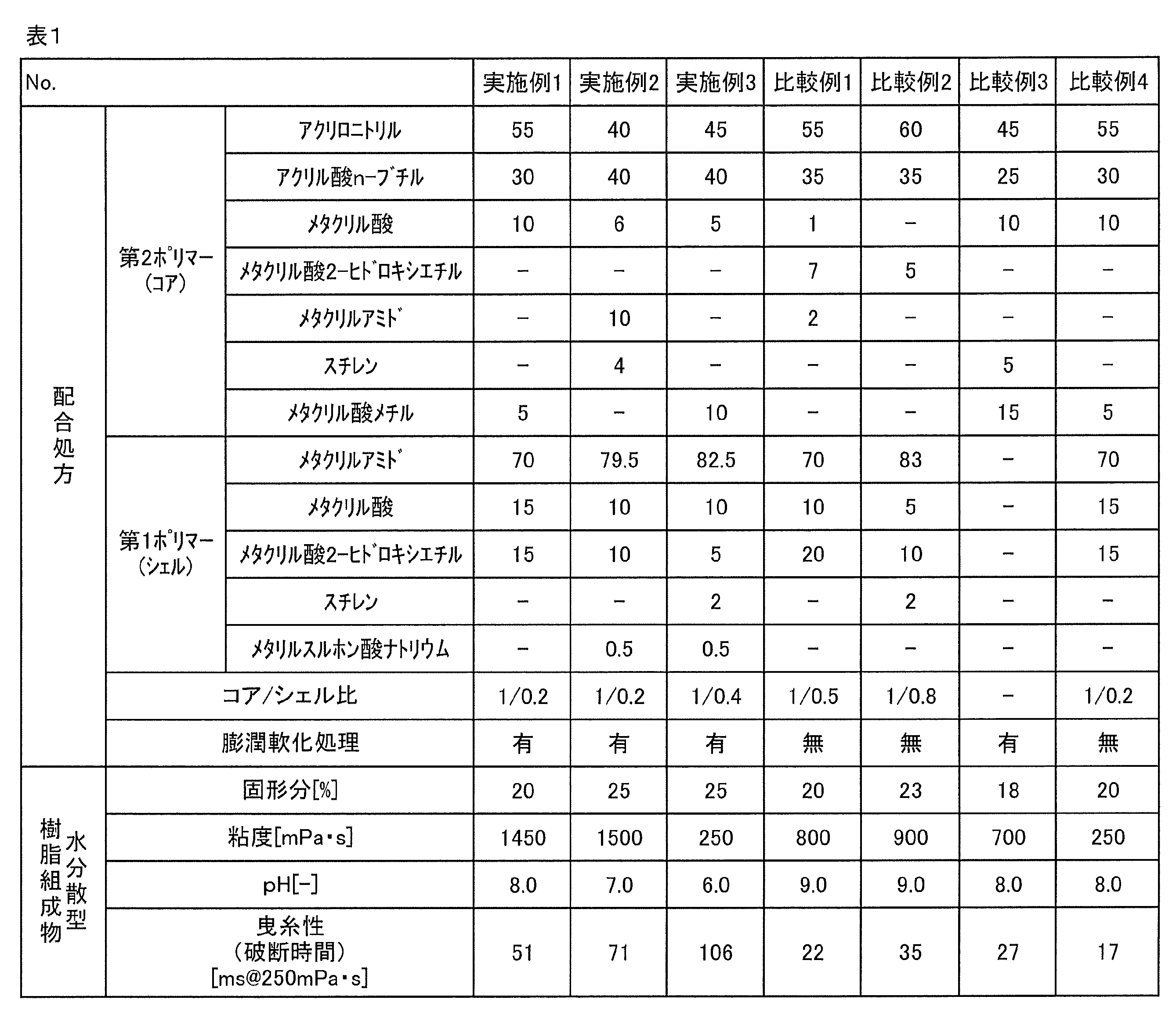
各実施例および各比較例において得られた水分散型樹脂組成物および感熱記録材料を以下の方法で評価した。その結果を、表1~表4に示す。
伸長粘度計(サーモハーケ社製、CaBER1)を用い、直径4mmの円形プレート間(ギャップ2mm)にB型粘度(60回転)が約250mPa・sとなるように固形分を調整した水分散型樹脂組成物を封入し、上方のプレートを300mm/sの速度で6mm引き上げてそのまま保持し、プレートの引き上げ開始時点からポリマーフィラメントが破断するまでの時間を測定した。
感熱記録材料について、感熱印字装置(大倉電気社製:TH-PMX)を使用して、以下の条件によってベタ黒印刷のパターン画像を作成し、その時の音の程度(パチパチ音)とヘッドの汚れ具合を総合的に評価した。
印加電圧 23 V
パルス幅 0.8 ms
印加エネルギー 0.54 mJ/ドット
評価基準を下記する。
○:印字時の印字音が小さく、印字後の印字ヘッドに汚れが付着していない。
△:印字時の印字音がやや大きいが、印字ヘッドに汚れは付着せず、実用上問題なし。
×:印字ヘッドに汚れが付着し、印字面にも保護層の剥がれが見られる。
感熱記録材料について、上記と同様条件にて画像を作成し、画像部に透明タイプのポリ塩化ビニル粘着テープ(日東電工製)を貼付け、40℃にて72時間放置した後剥がした。貼付け前後の濃度をマクベス濃度計にて測定し、印字濃度の保持率を求めた。
感熱記録材料の塗工面に水滴を1滴垂らし、塗工面同士が重なるように感熱記録体を重ね合わせ、100g/cm2の荷重をかけ、40℃/65%RHの条件下で24時間以上放置した後、重ねた面を剥がしてブロッキング状態を判定した。評価基準を下記する。
◎:ブロッキングが全く無く、容易に剥がれる。
○:剥がす際に多少抵抗があるが、問題なく剥がれ、塗工面に異常が見られない。
△:剥がす際に多少抵抗があり、塗工面の所々に欠陥らしき傷がみられる。
×:抵抗が強いため剥がしづらく、塗工面の損傷が激しい。
感熱記録材料を水に浸漬し、23℃にて24時間放置した後、塗工面のはがれ具合を目視観察した。評価基準を下記する。
○:塗工面の剥がれが見られない。
△:塗工面がわずかに剥がれるが、実用上問題なし。
×:塗工面の剥がれが発生する。
感熱記録材料の塗工面に油性マーカーで線を引き、発色度合を目視観察した。評価基準を下記する。
○:感熱層の発色なし。
△:感熱層がわずかに発色するも、実用上問題なし。
×:感熱層の発色が見られる。

2 支持層
3 感熱記録層
4 保護層
Claims (16)
- (メタ)アクリルアミドを含有する第1モノマー成分を重合させることにより得られる第1ポリマーと、
カルボキシ基含有ビニルモノマーを含有する第2モノマー成分を重合させることにより得られる第2ポリマーとを含み、
前記第2ポリマーにおけるカルボキシ基の少なくとも一部が、中和されていることを特徴とする、水分散型樹脂組成物。 - カルボキシ基含有ビニルモノマーの含有割合が、前記第2モノマー成分100質量部に対して、4質量部以上20質量部以下であることを特徴とする、請求項1に記載の水分散型樹脂組成物。
- (メタ)アクリルアミドの含有割合が、前記第1モノマー成分100質量部に対して、50質量部以上100質量部以下であることを特徴とする、請求項1または2に記載の水分散型樹脂組成物。
- 前記第1モノマー成分が、さらに、カルボキシ基含有ビニルモノマーおよび/または水酸基含有ビニルモノマーを含有することを特徴とする、請求項1~3のいずれか一項に記載の水分散型樹脂組成物。
- 前記第2モノマー成分が、さらに、(メタ)アクリロニトリルを含有し、
(メタ)アクリロニトリルの含有割合が、前記第2モノマー成分100質量部に対して、15質量部以上90質量部以下であることを特徴とする、請求項1~4のいずれか一項に記載の水分散型樹脂組成物。 - 前記第2ポリマー100質量部に対して、前記第1ポリマーの含有割合が、5質量部以上500質量部以下であることを特徴とする、請求項1~5のいずれか一項に記載の水分散型樹脂組成物。
- 前記カルボキシ基の少なくとも一部が中和されることにより形成されるカルボン酸塩が、アンモニウム塩であることを特徴とする、請求項1~6のいずれか一項に記載の水分散型樹脂組成物。
- 前記第2モノマー成分が重合された後、含塩水が添加され、30分以上保持されることにより、前記第2ポリマーにおけるカルボキシ基が、中和されていることを特徴とする、請求項1~7のいずれか一項に記載の水分散型樹脂組成物。
- 前記第1モノマー成分および/または前記第2モノマー成分が、さらに、スルホン酸基含有ビニルモノマーおよび/またはその塩を含有することを特徴とする、請求項1~8のいずれか一項に記載の水分散型樹脂組成物。
- 前記スルホン酸基含有ビニルモノマーおよび/またはその塩が前記第1モノマー成分に含有される場合には、その含有割合は、前記第1モノマー成分の総量100質量部に対して、0.01質量部以上20質量部以下であり、
前記スルホン酸基含有ビニルモノマーおよび/またはその塩が前記第2モノマー成分に含有される場合には、その含有割合は、前記第2モノマー成分の総量100質量部に対して、0.01質量部以上20質量部以下である
ことを特徴とする、請求項9に記載の水分散型樹脂組成物。 - 支持層、感熱記録層および保護層を備える感熱記録材料の感熱記録層に用いられる感熱記録層用樹脂組成物であって、
請求項1~10のいずれか一項に記載の水分散型樹脂組成物を含むことを特徴とする、感熱記録層用樹脂組成物。 - 支持層、感熱記録層および保護層を備える感熱記録材料の保護層に用いられる感熱記録層用樹脂組成物であって、
請求項1~10のいずれか一項に記載の水分散型樹脂組成物を含むことを特徴とする、保護層用樹脂組成物。 - 支持層と、
前記支持層の厚み方向一方側に積層される感熱記録層と、
前記感熱記録層の厚み方向一方側に積層される保護層とを備え、
前記感熱記録層が、請求項11に記載の感熱記録層用樹脂組成物の硬化物を含むことを特徴とする、感熱記録材料。 - 前記支持層に前記感熱記録層用樹脂組成物をカーテンコート法により塗工し、前記感熱記録層用樹脂組成物を硬化させて前記感熱記録層を形成し、
次いで、前記感熱記録層に前記保護層を積層する
ことにより得られることを特徴とする、請求項13に記載の感熱記録材料。 - 支持層と、
前記支持層の厚み方向一方側に積層される感熱記録層と、
前記感熱記録層の厚み方向一方側に積層される保護層とを備え、
前記保護層が、請求項12に記載の保護層用樹脂組成物の硬化物を含むことを特徴とする、感熱記録材料。 - 前記支持層に前記感熱記録層を積層し、
次いで、前記感熱記録層に前記保護層用樹脂組成物をカーテンコート法により塗工し、前記保護層用樹脂組成物を硬化させる
ことにより得られることを特徴とする、請求項15に記載の感熱記録材料。
Priority Applications (5)
| Application Number | Priority Date | Filing Date | Title |
|---|---|---|---|
| EP15795630.1A EP3147327B1 (en) | 2014-05-20 | 2015-05-18 | Water-dispersion-type resin composition, resin composition for heat-sensitive recording layer, resin composition for protective layer, and heat-sensitive recording material |
| JP2016521097A JP6396444B2 (ja) | 2014-05-20 | 2015-05-18 | 水分散型樹脂組成物、感熱記録層用樹脂組成物、保護層用樹脂組成物および感熱記録材料 |
| KR1020167031109A KR20160142874A (ko) | 2014-05-20 | 2015-05-18 | 수분산형 수지 조성물, 감열 기록층용 수지 조성물, 보호층용 수지 조성물 및 감열 기록 재료 |
| US15/310,316 US10226956B2 (en) | 2014-05-20 | 2015-05-18 | Aqueous dispersion resin composition, resin composition for a thermal recording layer, resin composition for a protection layer, and thermal recording material |
| CN201580024209.4A CN106414602B (zh) | 2014-05-20 | 2015-05-18 | 水分散型树脂组合物、热敏记录层用树脂组合物、保护层用树脂组合物及热敏记录材料 |
Applications Claiming Priority (2)
| Application Number | Priority Date | Filing Date | Title |
|---|---|---|---|
| JP2014-103930 | 2014-05-20 | ||
| JP2014103930 | 2014-05-20 |
Publications (1)
| Publication Number | Publication Date |
|---|---|
| WO2015178354A1 true WO2015178354A1 (ja) | 2015-11-26 |
Family
ID=54554023
Family Applications (1)
| Application Number | Title | Priority Date | Filing Date |
|---|---|---|---|
| PCT/JP2015/064232 Ceased WO2015178354A1 (ja) | 2014-05-20 | 2015-05-18 | 水分散型樹脂組成物、感熱記録層用樹脂組成物、保護層用樹脂組成物および感熱記録材料 |
Country Status (6)
| Country | Link |
|---|---|
| US (1) | US10226956B2 (ja) |
| EP (1) | EP3147327B1 (ja) |
| JP (1) | JP6396444B2 (ja) |
| KR (1) | KR20160142874A (ja) |
| CN (1) | CN106414602B (ja) |
| WO (1) | WO2015178354A1 (ja) |
Cited By (2)
| Publication number | Priority date | Publication date | Assignee | Title |
|---|---|---|---|---|
| JP2020152758A (ja) * | 2019-03-18 | 2020-09-24 | 三井化学株式会社 | 水分散型樹脂組成物、感熱記録層用樹脂組成物、および、保護層用樹脂組成物 |
| JP2021146549A (ja) * | 2020-03-17 | 2021-09-27 | 三井化学株式会社 | 積層体の製造方法および感熱記録材料の製造方法 |
Families Citing this family (1)
| Publication number | Priority date | Publication date | Assignee | Title |
|---|---|---|---|---|
| CN109722125B (zh) * | 2017-10-30 | 2022-04-29 | 荒川化学工业株式会社 | 水性预涂金属涂料用树脂 |
Citations (5)
| Publication number | Priority date | Publication date | Assignee | Title |
|---|---|---|---|---|
| JPS5632513A (en) * | 1979-06-26 | 1981-04-02 | Rohm & Haas | Manufacture of aqueous dispersion of nonnwatersoluble core*sheath pigment like polymer granular body |
| JPH04211411A (ja) * | 1990-02-03 | 1992-08-03 | Mitsui Toatsu Chem Inc | 有芯多層構造エマルション粒子 |
| JPH0569665A (ja) * | 1989-12-28 | 1993-03-23 | Mitsui Toatsu Chem Inc | 感熱記録材料 |
| JPH0673139A (ja) * | 1992-08-28 | 1994-03-15 | Mitsui Toatsu Chem Inc | 有芯多層構造エマルション粒子の製造方法 |
| JP2000027097A (ja) * | 1999-05-24 | 2000-01-25 | Mitsui Chemicals Inc | 水性エマルションを用いた剥離紙の背面処理剤 |
Family Cites Families (6)
| Publication number | Priority date | Publication date | Assignee | Title |
|---|---|---|---|---|
| US2300920A (en) | 1938-06-07 | 1942-11-03 | Johanna Auguste Asta Heuer | Interpolymers of vinyl sulphonic acid with another vinyl compound and aqueous emulsions thereof |
| CA1180474A (en) | 1979-06-26 | 1985-01-02 | Alexander Kowalski | Sequential heteropolymer dispersion and a particulate material obtainable therefrom useful in coating compositions as a thickening and/or opacifying agent |
| CA2035860C (en) * | 1989-07-10 | 1994-09-20 | Seiji Kawamoto | Aqueous emulsion comprising copolymer having two-layer structure |
| JPH1036458A (ja) * | 1996-07-30 | 1998-02-10 | Mitsui Petrochem Ind Ltd | 水性ポリマー組成物 |
| WO2006028111A1 (ja) * | 2004-09-10 | 2006-03-16 | Mitsui Chemicals, Inc. | 感熱紙用保護材料 |
| KR101148650B1 (ko) * | 2007-10-10 | 2012-05-25 | 미쓰이 가가쿠 가부시키가이샤 | 감열 기록 재료 |
-
2015
- 2015-05-18 WO PCT/JP2015/064232 patent/WO2015178354A1/ja not_active Ceased
- 2015-05-18 EP EP15795630.1A patent/EP3147327B1/en active Active
- 2015-05-18 KR KR1020167031109A patent/KR20160142874A/ko not_active Ceased
- 2015-05-18 US US15/310,316 patent/US10226956B2/en active Active
- 2015-05-18 CN CN201580024209.4A patent/CN106414602B/zh active Active
- 2015-05-18 JP JP2016521097A patent/JP6396444B2/ja active Active
Patent Citations (5)
| Publication number | Priority date | Publication date | Assignee | Title |
|---|---|---|---|---|
| JPS5632513A (en) * | 1979-06-26 | 1981-04-02 | Rohm & Haas | Manufacture of aqueous dispersion of nonnwatersoluble core*sheath pigment like polymer granular body |
| JPH0569665A (ja) * | 1989-12-28 | 1993-03-23 | Mitsui Toatsu Chem Inc | 感熱記録材料 |
| JPH04211411A (ja) * | 1990-02-03 | 1992-08-03 | Mitsui Toatsu Chem Inc | 有芯多層構造エマルション粒子 |
| JPH0673139A (ja) * | 1992-08-28 | 1994-03-15 | Mitsui Toatsu Chem Inc | 有芯多層構造エマルション粒子の製造方法 |
| JP2000027097A (ja) * | 1999-05-24 | 2000-01-25 | Mitsui Chemicals Inc | 水性エマルションを用いた剥離紙の背面処理剤 |
Cited By (4)
| Publication number | Priority date | Publication date | Assignee | Title |
|---|---|---|---|---|
| JP2020152758A (ja) * | 2019-03-18 | 2020-09-24 | 三井化学株式会社 | 水分散型樹脂組成物、感熱記録層用樹脂組成物、および、保護層用樹脂組成物 |
| JP7221097B2 (ja) | 2019-03-18 | 2023-02-13 | 三井化学株式会社 | 水分散型樹脂組成物、感熱記録層用樹脂組成物、および、保護層用樹脂組成物 |
| JP2021146549A (ja) * | 2020-03-17 | 2021-09-27 | 三井化学株式会社 | 積層体の製造方法および感熱記録材料の製造方法 |
| JP7636865B2 (ja) | 2020-03-17 | 2025-02-27 | 三井化学株式会社 | 積層体の製造方法および感熱記録材料の製造方法 |
Also Published As
| Publication number | Publication date |
|---|---|
| KR20160142874A (ko) | 2016-12-13 |
| EP3147327A1 (en) | 2017-03-29 |
| JP6396444B2 (ja) | 2018-09-26 |
| CN106414602A (zh) | 2017-02-15 |
| CN106414602B (zh) | 2019-04-09 |
| EP3147327A4 (en) | 2017-12-27 |
| JPWO2015178354A1 (ja) | 2017-04-20 |
| US20170151821A1 (en) | 2017-06-01 |
| US10226956B2 (en) | 2019-03-12 |
| EP3147327B1 (en) | 2020-08-19 |
Similar Documents
| Publication | Publication Date | Title |
|---|---|---|
| US8298987B2 (en) | Heat-sensitive recording materials | |
| JP6396444B2 (ja) | 水分散型樹脂組成物、感熱記録層用樹脂組成物、保護層用樹脂組成物および感熱記録材料 | |
| US8394740B2 (en) | Thermosensitive recording material | |
| CN100337842C (zh) | 热敏记录材料 | |
| JP7221097B2 (ja) | 水分散型樹脂組成物、感熱記録層用樹脂組成物、および、保護層用樹脂組成物 | |
| JP4579250B2 (ja) | 感熱紙用保護材料 | |
| JP6033951B2 (ja) | 保護層用組成物および感熱記録材料 | |
| JP7636865B2 (ja) | 積層体の製造方法および感熱記録材料の製造方法 | |
| JP2012056218A (ja) | 感熱紙保護層用樹脂およびそれを用いた感熱記録材料 | |
| JP2011051338A (ja) | 感熱紙保護層用樹脂およびそれを用いた感熱記録材料 |
Legal Events
| Date | Code | Title | Description |
|---|---|---|---|
| 121 | Ep: the epo has been informed by wipo that ep was designated in this application |
Ref document number: 15795630 Country of ref document: EP Kind code of ref document: A1 |
|
| ENP | Entry into the national phase |
Ref document number: 2016521097 Country of ref document: JP Kind code of ref document: A |
|
| ENP | Entry into the national phase |
Ref document number: 20167031109 Country of ref document: KR Kind code of ref document: A |
|
| WWE | Wipo information: entry into national phase |
Ref document number: 15310316 Country of ref document: US |
|
| REEP | Request for entry into the european phase |
Ref document number: 2015795630 Country of ref document: EP |
|
| WWE | Wipo information: entry into national phase |
Ref document number: 2015795630 Country of ref document: EP |
|
| NENP | Non-entry into the national phase |
Ref country code: DE |