WO2015178373A1 - Composition de résine époxyde et produit durci de cette dernière - Google Patents
Composition de résine époxyde et produit durci de cette dernière Download PDFInfo
- Publication number
- WO2015178373A1 WO2015178373A1 PCT/JP2015/064317 JP2015064317W WO2015178373A1 WO 2015178373 A1 WO2015178373 A1 WO 2015178373A1 JP 2015064317 W JP2015064317 W JP 2015064317W WO 2015178373 A1 WO2015178373 A1 WO 2015178373A1
- Authority
- WO
- WIPO (PCT)
- Prior art keywords
- resin composition
- epoxy resin
- group
- compound
- epoxy
- Prior art date
- Legal status (The legal status is an assumption and is not a legal conclusion. Google has not performed a legal analysis and makes no representation as to the accuracy of the status listed.)
- Ceased
Links
Images



Classifications
-
- C—CHEMISTRY; METALLURGY
- C08—ORGANIC MACROMOLECULAR COMPOUNDS; THEIR PREPARATION OR CHEMICAL WORKING-UP; COMPOSITIONS BASED THEREON
- C08G—MACROMOLECULAR COMPOUNDS OBTAINED OTHERWISE THAN BY REACTIONS ONLY INVOLVING UNSATURATED CARBON-TO-CARBON BONDS
- C08G59/00—Polycondensates containing more than one epoxy group per molecule; Macromolecules obtained by polymerising compounds containing more than one epoxy group per molecule using curing agents or catalysts which react with the epoxy groups
- C08G59/18—Macromolecules obtained by polymerising compounds containing more than one epoxy group per molecule using curing agents or catalysts which react with the epoxy groups ; e.g. general methods of curing
- C08G59/40—Macromolecules obtained by polymerising compounds containing more than one epoxy group per molecule using curing agents or catalysts which react with the epoxy groups ; e.g. general methods of curing characterised by the curing agents used
- C08G59/62—Alcohols or phenols
-
- C—CHEMISTRY; METALLURGY
- C08—ORGANIC MACROMOLECULAR COMPOUNDS; THEIR PREPARATION OR CHEMICAL WORKING-UP; COMPOSITIONS BASED THEREON
- C08G—MACROMOLECULAR COMPOUNDS OBTAINED OTHERWISE THAN BY REACTIONS ONLY INVOLVING UNSATURATED CARBON-TO-CARBON BONDS
- C08G59/00—Polycondensates containing more than one epoxy group per molecule; Macromolecules obtained by polymerising compounds containing more than one epoxy group per molecule using curing agents or catalysts which react with the epoxy groups
- C08G59/18—Macromolecules obtained by polymerising compounds containing more than one epoxy group per molecule using curing agents or catalysts which react with the epoxy groups ; e.g. general methods of curing
- C08G59/20—Macromolecules obtained by polymerising compounds containing more than one epoxy group per molecule using curing agents or catalysts which react with the epoxy groups ; e.g. general methods of curing characterised by the epoxy compounds used
- C08G59/22—Di-epoxy compounds
- C08G59/24—Di-epoxy compounds carbocyclic
-
- C—CHEMISTRY; METALLURGY
- C08—ORGANIC MACROMOLECULAR COMPOUNDS; THEIR PREPARATION OR CHEMICAL WORKING-UP; COMPOSITIONS BASED THEREON
- C08G—MACROMOLECULAR COMPOUNDS OBTAINED OTHERWISE THAN BY REACTIONS ONLY INVOLVING UNSATURATED CARBON-TO-CARBON BONDS
- C08G59/00—Polycondensates containing more than one epoxy group per molecule; Macromolecules obtained by polymerising compounds containing more than one epoxy group per molecule using curing agents or catalysts which react with the epoxy groups
- C08G59/18—Macromolecules obtained by polymerising compounds containing more than one epoxy group per molecule using curing agents or catalysts which react with the epoxy groups ; e.g. general methods of curing
- C08G59/68—Macromolecules obtained by polymerising compounds containing more than one epoxy group per molecule using curing agents or catalysts which react with the epoxy groups ; e.g. general methods of curing characterised by the catalysts used
- C08G59/72—Complexes of boron halides
-
- C—CHEMISTRY; METALLURGY
- C08—ORGANIC MACROMOLECULAR COMPOUNDS; THEIR PREPARATION OR CHEMICAL WORKING-UP; COMPOSITIONS BASED THEREON
- C08K—Use of inorganic or non-macromolecular organic substances as compounding ingredients
- C08K3/00—Use of inorganic substances as compounding ingredients
- C08K3/34—Silicon-containing compounds
- C08K3/36—Silica
-
- C—CHEMISTRY; METALLURGY
- C08—ORGANIC MACROMOLECULAR COMPOUNDS; THEIR PREPARATION OR CHEMICAL WORKING-UP; COMPOSITIONS BASED THEREON
- C08K—Use of inorganic or non-macromolecular organic substances as compounding ingredients
- C08K5/00—Use of organic ingredients
- C08K5/0008—Organic ingredients according to more than one of the "one dot" groups of C08K5/01 - C08K5/59
- C08K5/005—Stabilisers against oxidation, heat, light, ozone
-
- C—CHEMISTRY; METALLURGY
- C08—ORGANIC MACROMOLECULAR COMPOUNDS; THEIR PREPARATION OR CHEMICAL WORKING-UP; COMPOSITIONS BASED THEREON
- C08K—Use of inorganic or non-macromolecular organic substances as compounding ingredients
- C08K5/00—Use of organic ingredients
- C08K5/49—Phosphorus-containing compounds
- C08K5/51—Phosphorus bound to oxygen
- C08K5/52—Phosphorus bound to oxygen only
- C08K5/524—Esters of phosphorous acids, e.g. of H3PO3
-
- C—CHEMISTRY; METALLURGY
- C08—ORGANIC MACROMOLECULAR COMPOUNDS; THEIR PREPARATION OR CHEMICAL WORKING-UP; COMPOSITIONS BASED THEREON
- C08K—Use of inorganic or non-macromolecular organic substances as compounding ingredients
- C08K5/00—Use of organic ingredients
- C08K5/49—Phosphorus-containing compounds
- C08K5/51—Phosphorus bound to oxygen
- C08K5/52—Phosphorus bound to oxygen only
- C08K5/527—Cyclic esters
-
- C—CHEMISTRY; METALLURGY
- C08—ORGANIC MACROMOLECULAR COMPOUNDS; THEIR PREPARATION OR CHEMICAL WORKING-UP; COMPOSITIONS BASED THEREON
- C08L—COMPOSITIONS OF MACROMOLECULAR COMPOUNDS
- C08L63/00—Compositions of epoxy resins; Compositions of derivatives of epoxy resins
-
- C—CHEMISTRY; METALLURGY
- C08—ORGANIC MACROMOLECULAR COMPOUNDS; THEIR PREPARATION OR CHEMICAL WORKING-UP; COMPOSITIONS BASED THEREON
- C08L—COMPOSITIONS OF MACROMOLECULAR COMPOUNDS
- C08L67/00—Compositions of polyesters obtained by reactions forming a carboxylic ester link in the main chain; Compositions of derivatives of such polymers
- C08L67/04—Polyesters derived from hydroxycarboxylic acids, e.g. lactones
-
- C—CHEMISTRY; METALLURGY
- C08—ORGANIC MACROMOLECULAR COMPOUNDS; THEIR PREPARATION OR CHEMICAL WORKING-UP; COMPOSITIONS BASED THEREON
- C08J—WORKING-UP; GENERAL PROCESSES OF COMPOUNDING; AFTER-TREATMENT NOT COVERED BY SUBCLASSES C08B, C08C, C08F, C08G or C08H
- C08J2201/00—Foams characterised by the foaming process
- C08J2201/02—Foams characterised by the foaming process characterised by mechanical pre- or post-treatments
- C08J2201/026—Crosslinking before of after foaming
-
- C—CHEMISTRY; METALLURGY
- C08—ORGANIC MACROMOLECULAR COMPOUNDS; THEIR PREPARATION OR CHEMICAL WORKING-UP; COMPOSITIONS BASED THEREON
- C08J—WORKING-UP; GENERAL PROCESSES OF COMPOUNDING; AFTER-TREATMENT NOT COVERED BY SUBCLASSES C08B, C08C, C08F, C08G or C08H
- C08J2203/00—Foams characterized by the expanding agent
- C08J2203/22—Expandable microspheres, e.g. Expancel®
-
- C—CHEMISTRY; METALLURGY
- C08—ORGANIC MACROMOLECULAR COMPOUNDS; THEIR PREPARATION OR CHEMICAL WORKING-UP; COMPOSITIONS BASED THEREON
- C08J—WORKING-UP; GENERAL PROCESSES OF COMPOUNDING; AFTER-TREATMENT NOT COVERED BY SUBCLASSES C08B, C08C, C08F, C08G or C08H
- C08J2363/00—Characterised by the use of epoxy resins; Derivatives of epoxy resins
-
- C—CHEMISTRY; METALLURGY
- C08—ORGANIC MACROMOLECULAR COMPOUNDS; THEIR PREPARATION OR CHEMICAL WORKING-UP; COMPOSITIONS BASED THEREON
- C08J—WORKING-UP; GENERAL PROCESSES OF COMPOUNDING; AFTER-TREATMENT NOT COVERED BY SUBCLASSES C08B, C08C, C08F, C08G or C08H
- C08J9/00—Working-up of macromolecular substances to porous or cellular articles or materials; After-treatment thereof
- C08J9/32—Working-up of macromolecular substances to porous or cellular articles or materials; After-treatment thereof from compositions containing microballoons, e.g. syntactic foams
-
- C—CHEMISTRY; METALLURGY
- C08—ORGANIC MACROMOLECULAR COMPOUNDS; THEIR PREPARATION OR CHEMICAL WORKING-UP; COMPOSITIONS BASED THEREON
- C08K—Use of inorganic or non-macromolecular organic substances as compounding ingredients
- C08K7/00—Use of ingredients characterised by shape
- C08K7/22—Expanded, porous or hollow particles
- C08K7/24—Expanded, porous or hollow particles inorganic
- C08K7/28—Glass
Definitions
- the present invention relates to an epoxy resin composition and a cured product thereof, particularly an epoxy resin composition that can be preferably used as a resin composition for forming a syntactic foam and a cured product thereof.
- Epoxy resin compositions containing epoxy resins and epoxy compounds can be converted into lightweight, high-strength cured products by curing. It is widely used as a material for composing products, parts and the like.
- an epoxy resin composition as a material for forming a syntactic foam (see, for example, Patent Document 1).
- a syntactic foam is a structure in which microballoons (micro hollow spheres) are dispersed in a matrix resin (polymer matrix). Taking advantage of its lightweight and high strength characteristics, for example, as a buoyant body of a deep sea research ship in use.
- a method of filling an epoxy resin composition into a mold, a container or the like and curing it by heating is employed.
- the resin can be cured by heating at as low a temperature as possible.
- the heat generated by the curing reaction of the epoxy resin composition is as small as possible. If the heat generated by the curing reaction is large, the temperature inside the epoxy resin composition or the cured product becomes extremely high, making it difficult to control the process of performing the curing reaction, and heat exceeding the heat resistance of the mold or container. If this occurs, the durability may be adversely affected.
- the above-mentioned properties of being able to be cured at a low temperature and being small in heat generation due to the curing reaction are particularly important when the epoxy resin composition is used as a material for forming the above-mentioned syntactic foam.
- Syntactic foam is often used as a structure filled in a container (for example, a container made of polyethylene), but when performing a curing reaction in such a container, it cures at a low temperature that the container can withstand. It is important to be able to In addition, since the syntactic foam used as a buoyancy material is large, it is easy to store heat during curing, preventing runaway curing reaction and suppressing a sudden rise in internal temperature. The current situation is difficult.
- the epoxy resin composition has a low viscosity in order to efficiently fill the mold or the container or accurately reflect the shape of the mold or the container to the obtained molded body. .
- an object of the present invention is to provide an epoxy resin composition that can be cured by heating at a low temperature and that suppresses heat generation (curing heat generation) associated with curing, and a cured product thereof.
- Another object of the present invention is an epoxy resin composition having a low viscosity and easy to handle, which can be cured by heating at a low temperature, and in which heat generation (curing heat generation) associated with curing is suppressed, and a cured product thereof. Is to provide.
- an epoxy resin composition comprising, as essential components, an alicyclic epoxy compound, a polymer polyol having two or more terminal hydroxyl groups, and a Lewis acid-amine complex.
- an epoxy resin composition comprising, as essential components, an alicyclic epoxy compound, a polymer polyol having two or more terminal hydroxyl groups, and a Lewis acid-amine complex.
- it was found that it can be cured by heating at a low temperature, and that the heat generated by curing is suppressed, and that it can be preferably used particularly as a resin composition for forming a syntactic foam, and the present invention has been completed.
- the present invention includes an epoxy resin composition
- an epoxy resin composition comprising an alicyclic epoxy compound (A), a polymer polyol (B) having two or more terminal hydroxyl groups, and a Lewis acid-amine complex (C). Offer things.
- the antioxidant is a phosphite compound.
- the phosphite compound has the following formula (I) [In Formula (I), R 3 and R 4 are the same or different and each represents a substituted or unsubstituted hydrocarbon group. ] And a compound represented by the following formula (II) [In Formula (II), R 5 , R 6 and R 7 are the same or different and each represents a substituted or unsubstituted hydrocarbon group. ]
- the said epoxy resin composition which is at least 1 sort (s) selected from the group which consists of a compound represented by these is provided.
- the above epoxy resin composition containing at least one selected from the group consisting of silica filler and glass bubbles is provided.
- the present invention also provides a cured product obtained by curing the epoxy resin composition.
- the above epoxy resin composition which is a resin composition for forming a syntactic foam is provided.
- the present invention also provides a syntactic foam comprising a cured product of the epoxy resin composition and a microballoon dispersed in the cured product.
- An epoxy resin composition comprising an alicyclic epoxy compound (A), a polymer polyol (B) having two or more terminal hydroxyl groups, and a Lewis acid-amine complex (C).
- X represents a single bond or a linking group (a divalent group having one or more atoms).
- the compound represented by the formula (1) is at least one selected from the group consisting of compounds represented by the following formulas (1-1) to (1-10). Epoxy resin composition.
- l and m each represents an integer of 1 to 30;
- R represents an alkylene group having 1 to 8 carbon atoms; and
- n1 to n6 each represents an integer of 1 to 30.
- R ′ represents a group obtained by removing p hydroxyl groups (—OH) from a p-valent alcohol (p-valent organic group) in the structural formula, and p and q each represent a natural number. . ]
- the alicyclic epoxy compound (A) is contained in an amount of 30 to 98% by weight relative to the total amount (100% by weight) of the epoxy resin composition, according to any one of [1] to [4] Epoxy resin composition.
- the ratio of the alicyclic epoxy compound (A) to the total amount (100% by weight) of the epoxy compound (compound having an epoxy group) contained in the epoxy resin composition is 50% by weight or more.
- the polymer polyol (B) is a polyester polyol having an oligoester or polyester skeleton in the molecule and having two or more terminal hydroxyl groups in the molecule.
- the epoxy resin composition described in 1. [11] A structural unit in which the polymer polyol (B) has two or more terminal hydroxyl groups in the molecule and is formed by a ring-opening addition reaction (including ring-opening addition polymerization) of a lactone (lactone).
- the epoxy resin composition according to [10] which is a compound having at least —C (O) —R L —O—] (R L represents an alkylene group) in the molecule.
- r represents an integer of 1 to 20
- R 1 represents an r number of hydroxyl groups from a compound [R 1 (OH) r ] having r number of hydroxyl groups in the molecule in the structural formula.
- An organic group (organic residue) formed by removing s represents the number of repetitions of the structure (lactone unit) in parentheses to which s is attached, and represents an integer of 0 to 10, provided that the formula ( The total number of s in 3) is an integer of 1 or more, and R 2 represents an alkylene group.
- R 5 , R 6 and R 7 are the same or different and each represents a substituted or unsubstituted hydrocarbon group.
- Epoxy resin composition. [24] The epoxy resin composition according to any one of [1] to [23], wherein the viscosity at 25 ° C. is 1 to 10000 mPa ⁇ s.
- a syntactic foam comprising a cured product of the epoxy resin composition according to [27] and a microballoon dispersed in the cured product.
- the epoxy resin composition of the present invention Since the epoxy resin composition of the present invention has the above-described configuration, it can be cured by heating at a low temperature, and heat generation due to curing is suppressed. In addition, by selecting mainly the alicyclic epoxy compound (A) or the polymer polyol (B), it can be made low in viscosity and easy to handle. For this reason, especially the epoxy resin composition of this invention can be preferably used as a resin composition for syntactic foam formation. By using the epoxy resin composition of the present invention as a resin composition for forming a syntactic foam, a syntactic foam excellent in quality can be obtained with high productivity.
- FIG. 1 is a schematic view (sectional view) showing an example of a structure in which a syntactic foam is filled in a container.
- FIG. 2 is an explanatory view (sectional view) showing an example of a method for manufacturing a structure in which a syntactic foam is filled in a container.
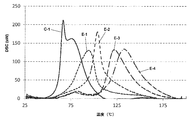
- FIG. 3 is a graph showing DSC measurement results of the epoxy resin compositions obtained in Examples 1 to 4 and Comparative Example 1.
- FIG. 4 is a graph showing DSC measurement results of the epoxy resin compositions obtained in Comparative Examples 2 and 3.
- the epoxy resin composition (curable epoxy resin composition) of the present invention comprises an alicyclic epoxy compound (A) and a polymer polyol (B) having two or more terminal hydroxyl groups (simply referred to as “polymer polyol (B)”). And a Lewis acid-amine complex (C) as essential components.
- the epoxy resin composition of this invention may contain arbitrary components, such as the below-mentioned antioxidant other than the said essential component, for example.
- the alicyclic epoxy compound (A) in the epoxy resin composition of the present invention is a compound having one or more alicyclic rings (aliphatic hydrocarbon rings) and one or more epoxy groups in the molecule.
- the alicyclic epoxy compound (A) include (i) at least one alicyclic epoxy group (an epoxy group composed of two adjacent carbon atoms and oxygen atoms constituting the alicyclic ring) in the molecule. (Preferably two or more) compounds; (ii) compounds having an epoxy group bonded directly to the alicyclic ring with a single bond; (iii) compounds having an alicyclic ring and a glycidyl group.
- numerator has, From a sclerosing
- the compound having at least one alicyclic epoxy group in the molecule is preferably a compound having two or more cyclohexene oxide groups in the molecule from the viewpoint of transparency and heat resistance of the cured product.
- a compound represented by the following formula (1) is preferable.
- the epoxy resin composition of the present invention contains a compound represented by the formula (1), the epoxy resin composition tends to have a lower viscosity.
- X represents a single bond or a linking group (a divalent group having one or more atoms).
- the linking group include divalent hydrocarbon groups, alkenylene groups in which part or all of carbon-carbon double bonds are epoxidized, carbonyl groups, ether bonds, ester bonds, carbonate groups, amide groups, and the like. And a group in which a plurality of are connected.
- Examples of the compound in which X in the formula (1) is a single bond include 3,4,3 ′, 4′-diepoxybicyclohexane and the like.
- Examples of the divalent hydrocarbon group include a linear or branched alkylene group having 1 to 18 carbon atoms and a divalent alicyclic hydrocarbon group.
- Examples of the linear or branched alkylene group having 1 to 18 carbon atoms include a methylene group, a methylmethylene group, a dimethylmethylene group, an ethylene group, a propylene group, and a trimethylene group.
- divalent alicyclic hydrocarbon group examples include 1,2-cyclopentylene group, 1,3-cyclopentylene group, cyclopentylidene group, 1,2-cyclohexylene group, 1,3-cyclopentylene group, And divalent cycloalkylene groups (including cycloalkylidene groups) such as cyclohexylene group, 1,4-cyclohexylene group and cyclohexylidene group.
- alkenylene group in the alkenylene group in which part or all of the carbon-carbon double bond is epoxidized include, for example, vinylene group, propenylene group, 1-butenylene group And straight-chain or branched alkenylene groups having 2 to 8 carbon atoms such as 2-butenylene group, butadienylene group, pentenylene group, hexenylene group, heptenylene group, octenylene group and the like.
- the epoxidized alkenylene group is preferably an alkenylene group in which all of the carbon-carbon double bonds are epoxidized, more preferably 2 to 4 carbon atoms in which all of the carbon-carbon double bonds are epoxidized. Alkenylene group.
- the linking group X is particularly preferably a linking group containing an oxygen atom, specifically, —CO—, —O—CO—O—, —COO—, —O—, —CONH—, epoxidation.
- Representative examples of the compound represented by the above formula (1) include 2,2-bis (3,4-epoxycyclohexane-1-yl) propane, bis (3,4-epoxycyclohexylmethyl) ether, , 2-bis (3,4-epoxycyclohexane-1-yl) ethane, 1,2-epoxy-1,2-bis (3,4-epoxycyclohexane-1-yl) ethane, the following formula (1-1) And compounds represented by (1-10).
- l and m each represents an integer of 1 to 30.
- R in the following formula (1-5) is an alkylene group having 1 to 8 carbon atoms, and is a methylene group, ethylene group, propylene group, isopropylene group, butylene group, isobutylene group, s-butylene group, pentylene group, hexylene.
- linear or branched alkylene groups such as a group, a heptylene group, and an octylene group.
- linear or branched alkylene groups having 1 to 3 carbon atoms such as a methylene group, an ethylene group, a propylene group, and an isopropylene group are preferable.
- N1 to n6 in the following formulas (1-9) and (1-10) each represents an integer of 1 to 30.
- Examples of the compound (ii) having an epoxy group bonded directly to the alicyclic ring with a single bond include compounds represented by the following formula (2).
- R ′ is a group obtained by removing p hydroxyl groups (—OH) from a p-valent alcohol (p-valent organic group) in the structural formula, and p and q each represent a natural number.
- the p-valent alcohol [R ′ (OH) p ] include polyhydric alcohols (such as alcohols having 1 to 15 carbon atoms) such as 2,2-bis (hydroxymethyl) -1-butanol.
- p is preferably 1 to 6, and q is preferably 1 to 30.
- q in each () (inside the parenthesis) may be the same or different.
- 1,2-epoxy-4- (2-oxiranyl) cyclohexane adduct of 2,2-bis (hydroxymethyl) -1-butanol for example, , Trade name “EHPE3150” (manufactured by Daicel Corporation), etc.
- Examples of the compound (iii) having an alicyclic ring and a glycidyl group include 2,2-bis [4- (2,3-epoxypropoxy) cyclohexyl] propane, 2,2-bis [3,5 -Dimethyl-4- (2,3-epoxypropoxy) cyclohexyl] propane, a compound obtained by hydrogenating a bisphenol A type epoxy compound (hydrogenated bisphenol A type epoxy compound), etc .; bis [o, o- (2,3 -Epoxypropoxy) cyclohexyl] methane, bis [o, p- (2,3-epoxypropoxy) cyclohexyl] methane, bis [p, p- (2,3-epoxypropoxy) cyclohexyl] methane, Bis [3,5-dimethyl-4- (2,3-epoxypropoxy) cyclohexyl] methane, a compound obtained by hydrogenating a bisphenol F-type epoxy compound (
- the alicyclic epoxy compound (A) is preferably a compound having (i) at least one alicyclic epoxy group in the molecule because of its high reactivity with the Lewis acid-amine complex (C).
- the compound represented by the above formula (1) is more preferable in terms of making the epoxy resin composition have a lower viscosity and further improving the heat resistance of the cured product, and more preferably the above formula (1-1).
- the alicyclic epoxy compound (A) can be used alone or in combination of two or more.
- the alicyclic epoxy compound (A) can be produced by a known or conventional method.
- commercially available products such as trade names “Celoxide 2021P” and “Celoxide 2081” (manufactured by Daicel Corporation) may be used.
- the content (blending amount) of the alicyclic epoxy compound (A) in the epoxy resin composition of the present invention is not particularly limited, but is 30 to 98% by weight with respect to the total amount (100% by weight) of the epoxy resin composition. More preferred is 40 to 95% by weight, still more preferred is 50 to 90% by weight.
- the content of the alicyclic epoxy compound (A) is 30% by weight or more, the epoxy resin composition has a lower viscosity, and the heat resistance of the cured product tends to be further improved.
- the amount of the polymer polyol (B) can be relatively increased, so that the heat generated by the curing reaction can be further reduced. There is.
- the ratio of the alicyclic epoxy compound (A) to the total amount (100% by weight) of the epoxy compound (compound having an epoxy group) contained in the epoxy resin composition of the present invention is not particularly limited, but is 50% by weight or more (for example, 50 to 100% by weight), more preferably 70% by weight or more (for example, 70 to 95% by weight).
- the epoxy resin composition has a lower viscosity, and the heat resistance of the cured product tends to be further improved.
- the polymer polyol (B) in the epoxy resin composition of the present invention is a polymer (including oligomers) having two or more terminal hydroxyl groups (hydroxyl group located at the end of the molecular chain) in the molecule.
- the terminal hydroxyl group of the polymer polyol (B) may be an alcoholic hydroxyl group or a phenolic hydroxyl group.
- the hydroxyl value of the polymer polyol (B) is not particularly limited, but is preferably 10 to 800 mgKOH / g, more preferably 50 to 600 mgKOH / g.
- the hydroxyl value of the polymer polyol (B) can be measured according to the method described in JIS K0070.
- the polymer polyol (B) may be liquid at 25 ° C. or may be solid. Especially, it is preferable that it is a liquid at 25 degreeC at the point which can obtain a low-viscosity epoxy resin composition easily.
- its viscosity at 25 ° C. is not particularly limited, but is preferably 100 to 25000 mPa ⁇ s, more preferably 500 to 10000 mPa ⁇ s.
- the viscosity of a polymer polyol (B) can be measured by the method similar to the viscosity of the below-mentioned epoxy resin composition.
- the number average molecular weight of the polymer polyol (B) is not particularly limited, but is preferably 200 to 10,000, more preferably 300 to 5,000, and still more preferably 400 to 4,000. By setting the number average molecular weight to 200 or more, heat generation due to curing is further suppressed, and the mechanical strength of the cured product or syntactic foam tends to be further improved. On the other hand, when the number average molecular weight is 10000 or less, it tends to be liquid (25 ° C.) at room temperature, so that the handleability tends to be improved and the preparation of the epoxy resin composition tends to be easier. Moreover, there exists a tendency which is easy to obtain a lower viscosity epoxy resin composition.
- the number average molecular weight of the polymer polyol (B) can be calculated from the molecular weight in terms of standard polystyrene measured by gel permeation chromatography.
- the polymer polyol (B) may be a linear polymer polyol or a branched polymer polyol.
- polymer polyol (B) examples include known or commonly used polymer polyols such as polyester polyol, polycarbonate polyol, polyacryl polyol, polyether polyol, epoxy polyol, polyolefin polyol, and polyether ester polyol.
- polyester polyols are preferable from the viewpoint of excellent compatibility with other components in the epoxy resin composition and improving the toughness of the cured product.
- the polyester polyol as the polymer polyol (B) is a polyester polyol having an oligoester or polyester skeleton in the molecule and two or more terminal hydroxyl groups in the molecule.
- the polyester polyol include polyesters such as polyol (including derivatives thereof), polycarboxylic acid (including derivatives thereof), hydroxycarboxylic acid (including derivatives thereof), and lactone (including derivatives thereof).
- polyester polyols obtained by polymerizing the monomer components polycondensation, ring-opening polymerization, etc.).
- polyol examples include ethylene glycol, diethylene glycol, 1,3-propanediol, 1,4-butanediol, 1,3-butanediol, 2,3-butanediol, 1,5 -Pentanediol, 3-methyl-1,5-pentanediol, 1,6-hexanediol, 2,6-hexanediol, 1,4-cyclohexanedimethanol, 1,12-dodecanediol, polybutadienediol, neopentyl glycol Tetramethylene glycol, propylene glycol, dipropylene glycol, glycerin, trimethylolpropane, 1,3-dihydroxyacetone, hexylene glycol, 1,2,6-hexanetriol, ditrimethylolpropane, pe Data erythritol, these derivatives.
- Phthalic acid isophthalic acid, terephthalic acid, citraconic acid, 1,10-decanedicarboxylic acid, methylhexahydrophthalic acid, hexahydrophthalic acid, methyltetrahydrophthalic acid, tetrahydrophthalic acid, pyromellitic acid, trimellitic acid, these Derivatives thereof (for example, acid anhydrides such as methylhexahydrophthalic anhydride, hexahydrophthalic anhydride, methyltetrahydrophthalic anhydride, tetrahydrophthalic anhydride, pyromellitic anhydride, trimellitic anhydride, etc.).
- lactone as the monomer component of the polyester polyol examples include 4- to 10-membered ring lactones such as ⁇ -butyrolactone, ⁇ -valerolactone, and ⁇ -caprolactone.
- the polyester polyol has a structural unit [—C having two or more terminal hydroxyl groups in the molecule and formed by ring-opening addition reaction (including ring-opening addition polymerization) of lactones (lactones).
- lactones lactones
- (O) —R L —O—] R L represents an alkylene group) (sometimes referred to as “lactone unit”) in the molecule (sometimes referred to as “lactone addition compound”) Is preferred.
- the lactone constituting the lactone unit in the lactone addition compound is preferably ⁇ -caprolactone.
- the lactone addition compound includes a structural unit [—C (2) having two or more terminal hydroxyl groups in the molecule and formed by a ring-opening addition reaction (including ring-opening addition polymerization) of ⁇ -caprolactone.
- a compound ( ⁇ -caprolactone addition compound) having at least O) — (CH 2 ) 5 —O—] in the molecule is preferable.
- the lactone addition compound may have only one lactone unit, or may have two or more lactone units.
- the number (total number) of lactone units in the molecule of the lactone addition compound is not particularly limited as long as it is 1 or more, but 2 or more (for example, 2 to 40) is preferable.
- the lactone addition compound has a structure in which two or more lactone units are directly bonded (polymerized) repeatedly, the number of repeating lactone units (degree of polymerization) in the structure is not particularly limited, but 2 to 20 is preferable.
- the addition form of the lactone unit in the said structure is not specifically limited, A random type may be sufficient and a block type may be sufficient.
- the number (total number) of hydroxyl groups in the molecule of the lactone addition compound is not particularly limited as long as it has 2 or more terminal hydroxyl groups, but is preferably 2 to 10, more preferably 2 to 4 It is.
- the lactone addition compound is not particularly limited. For example, by performing a ring-opening addition reaction (including ring-opening addition polymerization) of a lactone in the presence of a compound (initiator) having one or more hydroxyl groups in the molecule. can get.
- Examples of the compound having one or more hydroxyl groups in the molecule include aliphatic alcohols such as methanol, ethanol, propanol, butanol, pentanol, hexanol and octanol; aromatic alcohols such as benzyl alcohol; ethylene glycol, diethylene glycol, Triethylene glycol, polyethylene glycol, propylene glycol, dipropylene glycol, 1,3-butanediol, 1,4-butanediol, pentanediol, methylpentanediol, 2,4-diethylpentanediol, 1,6-hexanediol, 2-ethyl-1,3-hexanediol, neopentyl glycol, neopentyl glycol ester, cyclohexanedimethanol, glycerol, diglycerol, polyglycerol, tri Polyhydric alcohols such as
- Phenols polyvinyl alcohol, polyvinyl acetate partial hydrolyzate, starch, acrylic polyol Styrene-allyl alcohol copolymer resin, polyester polyol, polycaprolactone polyol, polypropylene polyol, polytetramethylene glycol, polycarbonate polyol, polybutadiene having a hydroxyl group, cellulose, cellulose acetate, cellulose acetate butyrate, cellulose polymer such as hydroxyethyl cellulose, etc. Examples thereof include an oligomer or a polymer having a hydroxyl group.
- the ring-opening addition reaction of lactone can be carried out by a known or conventional method, and is not particularly limited. For example, it is carried out by stirring and mixing the lactone with heating in the presence of an initiator as necessary. it can.
- the usage-amount (preparation amount) of an initiator and a lactone can be suitably adjusted according to the molecular weight etc. of the target lactone addition compound, and is not specifically limited.
- a known or conventional catalyst such as tetrabutyl titanate, tetraisopropyl titanate, tetraethyl titanate, dibutyltin oxide, dibutyltin laurate, tin octylate, stannous chloride is used as necessary.
- a catalyst can be suitably selected according to the kind of initiator and lactone, reaction conditions, etc., and is not specifically limited.
- lactone addition compound the compound represented by following formula (3) is mentioned, for example.
- R 1 is an organic group (organic residue) formed by removing r hydroxyl groups from a compound [R 1 (OH) r ] having r hydroxyl groups in the molecule in the structural formula. Indicates.
- the organic group include an organic group formed by removing r hydroxyl groups from a compound having one or more (r groups) hydroxyl groups in the above-described molecule in the structural formula.
- s means the number of repetitions of the structure (lactone unit) in parentheses with s, and represents an integer of 0 to 10. However, the total number of s in Expression (3) is an integer of 1 or more. In addition, when r is an integer greater than or equal to 2, several s may be the same and may differ.
- R 2 in the formula (3) represents an alkylene group, for example, methylene group, methylmethylene group, dimethylmethylene group, ethylene group, propylene group, trimethylene group, tetramethylene group, pentamethylene group, etc. 18 linear or branched alkylene groups and the like can be mentioned. Among these, as R 2 , a pentamethylene group is preferable. In addition, when several R ⁇ 2 > exists in Formula (3), these may be the same and may differ. Moreover, the addition form of the structure (lactone unit) in parentheses to which s is attached is not particularly limited, and may be a random type or a block type.
- the polymer polyol (B) can be used alone or in combination of two or more.
- examples of the polymer polyol (B) include trade names “Placcel 205”, “Placcel 205U”, “Placcel L205AL”, “Placcel 208”, “Placcel 210”, “Placcel 210N”, “Placcel 212”, “ Plaxel L212AL, Plaxel 220, Plaxel 220N, Plaxel 220NP1, Plaxel L220AL, Plaxel 230, Plaxel 230N, Plaxel 240, Plaxel 303, Plaxel 305, Plaxel 308, Plaxel 312, Plaxel 405D, Plaxel L320AL, Plaxel CD205, Plaxel CD210, Plaxel CD220, Plaxel CD205PL, "Luxel CD205HL”, “Plaxel CD210PL”, “Plaxel CD210HL”, “Plaxel CD220PL”, "Plaxelaxe
- the content (blending amount) of the polymer polyol (B) in the epoxy resin composition of the present invention is not particularly limited, but is preferably 1 to 70 parts by weight with respect to 100 parts by weight of the alicyclic epoxy compound (A), The amount is more preferably 2 to 50 parts by weight, still more preferably 5 to 30 parts by weight.
- the content of the polymer polyol (B) is 1 part by weight or more, heat generated by the curing reaction tends to be further suppressed.
- the content of the polymer polyol (B) is 70 parts by weight or less, the curing reaction tends to proceed sufficiently in a shorter time.
- the content (blending amount) of the polymer polyol (B) in the epoxy resin composition of the present invention is preferably 50 to 2000 parts by weight, more preferably 100 parts by weight of the Lewis acid-amine complex (C). 100 to 1500 parts by weight, more preferably 200 to 800 parts by weight.
- the Lewis acid-amine complex (C) in the epoxy resin composition of the present invention is a complex composed of a Lewis acid and an amine (amine compound) (an amine complex of Lewis acid).
- Examples of the Lewis acid constituting the Lewis acid-amine complex (C) include known and commonly used Lewis acids, and are not particularly limited.
- metal halides for example, titanium tetrachloride, tin tetrachloride, zirconium chloride, Aluminum chloride, iron chloride, zinc chloride, copper chloride, antimony chloride, zinc bromide, etc.
- boron halide compounds eg, boron trifluoride, boron trichloride, boron tribromide, etc.
- phosphorus halide compounds eg, , Phosphorus pentafluoride, phosphorus pentachloride, etc.
- halogenated arsenic compounds eg, arsenic pentafluoride, etc.
- halogenated antimony compounds eg, antimony pentafluoride, etc.
- metal triflate compounds eg, trifluoromethanesulfonic acid, etc.
- Trimethylsilyl scandium triflate, yttrium triflate, zinc triflate, etc.
- Examples of the amine constituting the Lewis acid-amine complex (C) include known or conventional amines, and are not particularly limited. Examples thereof include ammonia, aliphatic amines, alicyclic amines, aromatic amines, and heterocyclic amines. And publicly known or commonly used amine compounds (ammonia, primary amines, secondary amines, and tertiary amines).
- ammonia monomethylamine, dimethylamine, trimethylamine, monoethylamine, diethylamine, triethylamine, isopropylamine, n-butylamine, pentylamine, n-hexylamine, octylamine, dodecylamine, laurylamine, 4 , 4'-diaminodiphenylamine, isophoronediamine, triethylenetetramine, benzylamine, piperidine, aniline, monoethanolamine, diethanolamine, triethanolamine, cyclohexylamine, morpholine, guanidine, N-alkylmorpholine, 1,8-diazabicyclo [5 4.0] undecene-7,6-dibutylamino-1,8-diazabicyclo [5.4.0] undecene-7,1,5-diazabicyclo [4.3 .0] nonene-5,1,4-diazabicyclo [
- examples of the Lewis acid-amine complex (C) include BF 3 ⁇ n-hexylamine, BF 3 ⁇ monoethylamine, BF 3 ⁇ benzylamine, BF 3 ⁇ diethylamine, BF 3 ⁇ piperidine, and BF.
- the Lewis acid-amine complex (C) can be used alone or in combination of two or more.
- the Lewis acid-amine complex (C) can be produced by a method in which a Lewis acid and an amine are contacted to form a complex by a known or conventional method, or a commercially available product can be used. it can.
- the content (blending amount) of the Lewis acid-amine complex (C) in the epoxy resin composition of the present invention is not particularly limited, but the alicyclic epoxy compound (A) and polymer polyol (B) contained in the epoxy resin composition are not limited. ) Is preferably 0.5 to 10 parts by weight, more preferably 1 to 5 parts by weight per 100 parts by weight.
- the content of the Lewis acid-amine complex (C) is 0.5 parts by weight or more, the curing reaction tends to proceed more efficiently.
- the content of the Lewis acid-amine complex (C) is 10 parts by weight or less, heat generation due to the curing reaction is suppressed, and the heat resistance and mechanical properties of the cured product tend to be further improved.
- the epoxy resin composition of the present invention has an advantageous effect that heat generation due to curing is particularly suppressed.
- the reason for this is not clear, but the reactivity of the Lewis acid-amine complex (C) can be achieved by using the polymer polyol (B) and the Lewis acid-amine complex (C) in combination in the epoxy resin composition of the present invention. Is presumably because of moderate relaxation.
- the epoxy resin composition of the present invention preferably further contains an antioxidant.
- an antioxidant By containing an antioxidant, thickening of the epoxy resin composition over time is suppressed, and the heat resistance of the cured product is further improved.
- known or commonly used antioxidants can be used, and are not particularly limited. For example, phenolic compounds (phenolic antioxidants), hindered amine compounds (hindered amine antioxidants), phosphorus Compounds (phosphorus antioxidants), sulfur compounds (sulfur antioxidants) and the like.
- phenol compound examples include 2,6-di-t-butyl-p-cresol, butylated hydroxyanisole, 2,6-di-t-butyl-p-ethylphenol, stearyl- ⁇ - (3, Monophenols such as 5-di-t-butyl-4-hydroxyphenyl) propionate; 2,2′-methylenebis (4-methyl-6-t-butylphenol), 2,2′-methylenebis (4-ethyl-6) -T-butylphenol), 4,4'-thiobis (3-methyl-6-t-butylphenol), 4,4'-butylidenebis (3-methyl-6-t-butylphenol), 3,9-bis [1, 1-dimethyl-2- ⁇ - (3-tert-butyl-4-hydroxy-5-methylphenyl) propionyloxy ⁇ ethyl] 2,4,8,10-tetraoxaspir [5.5] Bisphenols such as undecane; 1,1,3-tris (2-methyl-4-hydroxy-5-
- hindered amine compound examples include bis (1,2,2,6,6-pentamethyl-4-piperidyl) [[3,5-bis (1,1-dimethylethyl) -4-hydroxyphenyl] methyl].
- Butyl malonate bis (1,2,2,6,6-pentamethyl-4-piperidyl) sebacate, methyl-1,2,2,6,6-pentamethyl-4-piperidyl sebacate, 4-benzoyloxy-2 2,6,6-tetramethylpiperidine and the like.
- Examples of the phosphorus compound include triphenyl phosphite, diphenylisodecyl phosphite, phenyl diisodecyl phosphite, tris (nonylphenyl) phosphite, diisodecylpentaerythritol phosphite, tris (2,4-di-t-butyl).
- Phenyl) phosphite cyclic neopentanetetrayl bis (octadecyl) phosphite, cyclic neopentane tetrayl bis (2,4-di-t-butylphenyl) phosphite, cyclic neopentane tetrayl bis (2, Phosphites such as 4-di-t-butyl-4-methylphenyl) phosphite, bis [2-tert-butyl-6-methyl-4- ⁇ 2- (octadecyloxycarbonyl) ethyl ⁇ phenyl] hydrogen phosphite Class; 9,10- Hydro-9-oxa-10-phosphaphenanthrene-10-oxide, 10- (3,5-di-t-butyl-4-hydroxybenzyl) -9,10-dihydro-9-oxa-10-phosphaphenanthrene And oxapho
- sulfur compound examples include dodecanethiol, dilauryl-3,3′-thiodipropionate, dimyristyl-3,3′-thiodipropionate, distearyl-3,3′-thiodipropionate, and the like. Can be mentioned.
- a phosphorus compound is preferable in that it can suppress thickening of the epoxy resin composition over time even when it contains glass bubbles or silica filler.
- a phosphite compound is particularly preferred.
- a composition containing an epoxy compound is presumed to be due to a silanol group possessed by glass bubbles or silica fillers, but tends to increase in viscosity over time.
- phosphite compound a known or commonly used phosphite compound can be used, and is not particularly limited. Specifically, for example, a compound represented by the following formula (I) or the following formula ( The compound represented by II) can be preferably used.
- R 3 and R 4 are the same or different and each represents a substituted or unsubstituted hydrocarbon group (monovalent hydrocarbon group).
- the substituted or unsubstituted hydrocarbon group include an alkyl group [eg, methyl group, ethyl group, propyl group, butyl group, pentyl group, hexyl group, 2-ethylhexyl group, etc.], cycloalkyl group [eg, cyclohexane Propyl group, cyclobutyl group, cyclopentyl group, cyclohexyl group, cyclododecyl group, etc.], aryl group [eg, phenyl group, tolyl group, xylyl group, naphthyl group, 2,6-di-t-butyl-4-methyl-1 -Phenyl group, 2,4-di-t-butyl-1-phenyl group, etc.],
- a halogenated hydrocarbon group in which one or more hydrogen atoms in the hydrocarbon group are substituted with a halogen atom for example, 1 or more of hydrogen atoms bonded to carbon atoms of these groups such as a halomethyl group, a 3-chloropropyl group, a halogenated alkyl group such as a 3,3,3-trifluoropropyl group, etc.], a hydroxyl group, a carboxy group , A nitro group, a substituted or unsubstituted amino group, a group substituted with a functional group such as a mercapto group, and the like.
- a halogenated hydrocarbon group in which one or more hydrogen atoms in the hydrocarbon group are substituted with a halogen atom for example, 1 or more of hydrogen atoms bonded to carbon atoms of these groups such as a halomethyl group, a 3-chloropropyl group, a halogenated alkyl group such as
- R 3 and R 4 are the same or different and are preferably a substituted or unsubstituted alkyl group or a substituted or unsubstituted aryl group, and in particular, a substituted or unsubstituted carbon number (the number of carbon atoms constituting the alkyl group) 8
- alkyl groups eg, 2-ethylhexyl group, stearyl group, etc.
- aryl groups eg, phenyl group, etc.
- alkyl substituted aryl groups eg, 2,6-di-t-butyl-4-methyl-1) -Phenyl group, 2,4-di-t-butyl-1-phenyl group and the like are more preferable.
- R ⁇ 5 >, R ⁇ 6 > and R ⁇ 7> are the same or different and show a substituted or unsubstituted hydrocarbon group (monovalent hydrocarbon group).
- the substituted or unsubstituted hydrocarbon group include the same hydrocarbon groups as those exemplified as R 3 and R 4 .
- R 5 , R 6 and R 7 are the same or different and are preferably a substituted or unsubstituted alkyl group or a substituted or unsubstituted aryl group, and more particularly a substituted or unsubstituted carbon number (constituting an alkyl group).
- alkyl group having 8 to 20 carbon atoms eg, 2-ethylhexyl group, stearyl group, etc.
- an aryl group eg, phenyl group
- an alkyl-substituted aryl group eg, 2,6-di-t-butyl-4) -Methyl-1-phenyl group, 2,4-di-t-butyl-1-phenyl group and the like are more preferable.
- examples of the phosphite compound include 9,10-dihydro-9-oxa-10-phosphaphenanthrene-10-oxide, bis (2,6-di-t-butyl- 4-methylphenyl) pentaerythritol-diphosphite, bis (2,4-di-t-butylphenyl) pentaerythritol-diphosphite, tris (2,4-di-t-butylphenyl) phosphite, tris (mono, dinonyl) Phenyl) phosphite, tris (2-ethylhexyl) phosphite, trisphenyl phosphite, tris (monononylphenyl) phosphite, trisisodecyl phosphite and the like.
- a phosphorous acid ester compound can also be used individually by 1 type, and can also be used in combination of 2 or more type.
- examples of the phosphite compound include trade names “JP-360”, “JP-308E” (manufactured by Johoku Chemical Industry Co., Ltd.), trade names “IRGAFOS168” (manufactured by BASF), and trade names.
- Commercial products such as “Sanko Epochlean” (manufactured by Sanko Co., Ltd.), trade names “Adeka Stub 3010”, “Adeka Stub PEP-36” (manufactured by ADEKA Co., Ltd.) can also be used.
- one kind of antioxidant can be used alone, or two or more kinds can be used in combination.
- a commercial item can also be used as an antioxidant.
- the content (blending amount) of the antioxidant (particularly the phosphite compound) in the epoxy resin composition of the present invention is not particularly limited, but is 100 parts by weight based on the total amount of the epoxy compound contained in the epoxy resin composition. 0.1 to 5 parts by weight, more preferably 0.2 to 3 parts by weight, still more preferably 0.3 to 2 parts by weight.
- the content of the antioxidant is set to 0.1 parts by weight or more, thickening over time (in particular, thickening when silica filler or glass bubble is included) is more efficiently suppressed, and the heat resistance of the cured product. Tend to improve more.
- the content of the antioxidant is 5 parts by weight or less, the raw material cost is further reduced, and defects such as coloring of the cured product tend to be suppressed.
- the epoxy resin composition of the present invention may contain an epoxy compound other than the alicyclic epoxy compound (A) (sometimes referred to as “other epoxy compounds”) as long as the effects of the present invention are not impaired.
- the other epoxy compounds include known and commonly used epoxy compounds, and are not particularly limited.
- aromatic glycidyl ether type epoxy compounds for example, bisphenol A type epoxy compounds, bisphenol F type epoxy compounds, biphenol type epoxies.
- phenol novolac type epoxy compounds cresol novolak type epoxy compounds, bisphenol A cresol novolac type epoxy compounds, naphthalene type epoxy compounds, epoxy compounds obtained from trisphenol methane, etc.
- aliphatic glycidyl ether type Aliphatic epoxy compounds such as epoxy compounds [for example, aliphatic polyglycidyl ethers] and the like can be mentioned.
- another epoxy compound can also be used individually by 1 type, and can also be used in combination of 2 or more type.
- the content (blending amount) of the other epoxy compound in the epoxy resin composition of the present invention is not particularly limited, but is 0 to 20 wt.% With respect to the total amount (100 wt%) of the epoxy compound contained in the epoxy resin composition. % Can be appropriately selected.
- the epoxy resin composition of the present invention may contain other components as long as the effects of the present invention are not impaired.
- other components for example, when a compound having a hydroxyl group such as ethylene glycol, diethylene glycol, propylene glycol, or glycerin is contained, the curing reaction can be allowed to proceed slowly.
- antifoaming agents silicone-based antifoaming agents, fluorine-based antifoaming agents, etc.
- leveling agents silane coupling agents ( ⁇ -glycidoxypropyltrimethoxysilane) within the range that does not impair the viscosity and transparency.
- silica filler As the silica filler, known or conventional silica fillers can be used.
- the content (total amount) of other components is not particularly limited, and ranges from 0 to 20% by weight (for example, 0.1 to 10% by weight) with respect to the epoxy resin composition (100% by weight) of the present invention. Can be selected as appropriate.
- the epoxy resin composition of the present invention may include a microballoon described later.
- the epoxy resin composition of the present invention is not particularly limited, but can be prepared by stirring and mixing each of the above-described components in a heated state as necessary.
- the epoxy resin composition of the present invention can be used as a one-component composition in which all components are mixed in advance, for example, two or more stored separately. It can also be used as a multi-component (for example, two-component) composition in which the components are mixed at a predetermined ratio before use.
- the method of stirring and mixing is not particularly limited, and for example, known or conventional stirring and mixing means such as various mixers such as a dissolver and a homogenizer, a kneader, a roll, a bead mill, and a self-revolving stirrer can be used. Further, after stirring and mixing, defoaming may be performed under reduced pressure or under vacuum.
- the epoxy resin composition of the present invention preferably exhibits a liquid state at 25 ° C. (is liquid).
- the viscosity at 25 ° C. of the epoxy resin composition of the present invention is not particularly limited, but is preferably 1 to 10000 mPa ⁇ s, more preferably 10 to 8000 mPa ⁇ s.
- the viscosity at 25 ° C. without containing a glass balloon is preferably 1 to 1000 mPa ⁇ s, more preferably 10 to 500 mPa ⁇ s.
- the viscosity at 25 ° C. of the epoxy resin composition of the present invention is determined by using, for example, a digital viscometer (model number “DVU-EII type”, manufactured by Tokimec Co., Ltd.), rotor: standard 1 ° 34 ′ ⁇ R24. , Temperature: 25 ° C., rotation speed: 100 rpm.
- a cured product can be obtained by curing the epoxy resin composition of the present invention.
- the curing means known or conventional means such as heat treatment or active energy ray irradiation treatment can be used.
- the epoxy resin composition of the present invention contains the Lewis acid-amine complex (C) as an essential component, Can be easily cured.
- the temperature for curing by heating is not particularly limited, but is preferably 30 to 200 ° C, more preferably 40 to 150 ° C, and still more preferably 50 to 120 ° C.
- the heating time (curing time) during curing is not particularly limited, but is preferably 0.1 to 48 hours, more preferably 1 to 24 hours.
- the curing temperature and curing time are lower than the lower limit of the above range, curing tends to be insufficient, and conversely, when higher than the upper limit of the above range, the epoxy resin composition or its cured product is decomposed. Neither is preferred because it may occur.
- the curing conditions depend on various conditions, for example, when the curing temperature is increased, the curing time can be shortened, and when the curing temperature is decreased, the curing time can be increased.
- hardening can also be performed in one step and can also be performed in two or more steps. Since the hardened
- the epoxy resin composition of the present invention has a relatively low curing temperature of 100 ° C. or less (for example, 40 to 80 ° C.), it is relatively short time of 48 hours or less (for example, 1 to 24). It is useful in that it can be cured in a long time).
- the epoxy resin composition of the present invention since the epoxy resin composition of the present invention has a small exotherm associated with the curing reaction, excessive heat generation associated with the curing reaction is suppressed even when a large cured product that easily stores heat is produced, and the reaction is runaway. It is possible to safely carry out the curing process without causing any problems.
- the epoxy resin composition of the present invention is particularly suitable as a resin composition for forming a syntactic foam (particularly a large syntactic foam) (sometimes referred to as “syntactic foam-forming resin composition”). It can be preferably used.
- the syntactic foam is a structure in which microballoons (micro hollow spheres) are dispersed in a matrix resin (polymer matrix).
- ⁇ Syntactic foam> As a method for producing a syntactic foam using the epoxy resin composition of the present invention (the syntactic foam produced using the epoxy resin composition of the present invention may be referred to as “syntactic foam of the present invention”). Can be applied to a known or conventional method for producing a syntactic foam, and is not particularly limited.
- the present invention can be achieved by a method of impregnating the epoxy resin composition of the present invention into a microballoon and curing the epoxy resin composition.
- the syntactic foam can be obtained.
- the syntactic foam of the present invention is a syntactic foam comprising a cured product of the epoxy resin composition of the present invention and microballoons dispersed in the cured product.
- the microballoon in the syntactic foam of the present invention a known or conventional microballoon used for the syntactic foam can be used.
- the average particle size of the microballoon is not particularly limited, but can be appropriately selected from the range of 10 to 500 ⁇ m.
- the material of the microballoon is not particularly limited, and can be appropriately selected from inorganic materials (for example, borosilicate glass, silica, carbon, ceramic, etc.), organic materials (for example, thermoplastic resin, thermosetting resin, etc.), and the like. Of these, glass is preferable. That is, the microballoon in the syntactic foam of the present invention is preferably a glass microballoon (glass bubble).
- a method for producing a syntactic foam using the epoxy resin composition of the present invention
- a microballoon is filled in a mold and then the epoxy of the present invention is used.
- the method include a method of producing a molded body of syntactic foam by impregnating and curing the resin composition; and a method of processing the molded body by a known or conventional means. More specifically, for example, JP 2000-239433 A, JP 2003-206372 A, JP 2010-65178 A, JP 2012-17382 A, JP 2010-65181 A, JP 2010-65 A.
- the syntactic foam of the present invention can be produced by a method disclosed in known documents such as 65183.
- the syntactic foam of the present invention can also be produced by filling the interior of a container with the epoxy resin composition of the present invention and a microballoon, and then curing the epoxy resin composition.
- the structure thus produced is a structure having a container and the syntactic foam of the present invention inside the container.
- the structure is preferably used as a buoyancy material, for example, after assembling appropriate members and the like as necessary.
- FIG. 1 is a schematic view showing an example of such a structure.
- 1 indicates a container (exterior container), and 2 indicates a syntactic foam.
- the material of the container in the said structure is not specifically limited, For example, a plastic, a metal, a ceramic, these composite materials etc. are mentioned.
- the epoxy resin composition of the present invention When used, it can be cured by heating at a low temperature, so that a container having low heat resistance (for example, a container made of polyethylene) can be used.
- a container having low heat resistance for example, a container made of polyethylene
- the range expands.
- the shape of a container etc. are not specifically limited.
- FIG. 2 is an explanatory view (sectional view) showing an example of a method for manufacturing the structure shown in FIG.
- the microballoon (M) is filled into the container 1 shown in (1) of FIG. 2 from the hole a at the bottom of the container 1 ((2) and (3) of FIG. 2).
- a lubricant such as petrolatum.
- the container 1 After filling the microballoon (M), the mixture (dispersion) 3 of the microballoon and the epoxy resin composition of the present invention is filled little by little through the hole b at the top of the container 1, and at the same time, the container 1 First, the microballoon (M) filled from the lower hole a is discharged from the container 1 ((4) in FIG. 2). At this time, it is preferable to keep the interface between the microballoon (M) and the mixture 3 clean in terms of producing a syntactic foam having a uniform specific gravity. Thereafter, when the mixture 3 is filled in the container 1, the filling is stopped, and the upper hole a and the lower hole b of the container 1 are closed ((5) in FIG. 2).
- the container 1 is heated to cure the epoxy resin composition of the present invention in the container 1, thereby forming the syntactic foam 2 inside the container 1 and obtaining the above structure (see FIG. 2). (6)).
- the method for manufacturing the structure is not limited to the method shown in FIG.
- the epoxy resin composition of the present invention is not limited to the above-mentioned resin composition for forming a syntactic foam, and includes, for example, a sealing application (sealant) for a semiconductor element and an optical semiconductor element, an adhesive, an electrical insulating agent, and a laminate.
- a sealing application for a semiconductor element and an optical semiconductor element
- an adhesive for a semiconductor element
- an electrical insulating agent for a semiconductor element and an optical semiconductor element
- a laminate for example, a sealing application (sealant) for a semiconductor element and an optical semiconductor element, an adhesive, an electrical insulating agent, and a laminate.
- Plate coating, ink, paint, sealant, resist, composite material, transparent substrate, transparent sheet, transparent film, optical element, optical lens, optical member, stereolithography, electronic paper, touch panel, solar cell substrate, optical waveguide, lead It can also be used for various applications such as optical plates and holographic memories.
- Example 1 As shown in Table 1, 95 parts by weight of an alicyclic epoxy compound (trade name “Celoxide 2021P”, manufactured by Daicel Corporation), polyester polyol (trade name “Placcel 305”, polycaprolactone triol, manufactured by Daicel Corporation) 5 parts by weight and 0.475 part by weight of bis (2,6-di-t-butyl-4-methylphenyl) pentaerythritol-diphosphite (trade name “Adeka Stab PEP-36”, manufactured by ADEKA Corporation) are placed in a flask. The mixture was heated and stirred at 100 ° C. for 2 hours, mixed and returned to room temperature.
- an alicyclic epoxy compound trade name “Celoxide 2021P”
- polyester polyol trade name “Placcel 305”, polycaprolactone triol, manufactured by Daicel Corporation
- a temperature showing an exothermic peak was also present on the higher temperature side.
- the respective exothermic peak temperatures of the epoxy resin compositions obtained in Examples 1 to 4 tended to increase in proportion to the amount of Plaxel 305 blended. From this, it was suggested that the epoxy resin composition can be cured while suppressing the temperature rise due to the curing reaction by changing the amount of the polymer polyol such as Plaxel 305 according to the curing conditions.
- E-1 shows the results of Example 1
- E-2 shows the results of Example 2
- E-3 shows the results of Example 3
- E-4 shows the results of Example 4
- C-1 shows the results of Comparative Example 1.
- each epoxy resin composition obtained in Comparative Examples 2 and 3 was replaced with a cationic curing catalyst instead of the Lewis acid-amine complex (boron trifluoride-monoethylamine complex) used in Comparative Examples 1 and 2. It corresponds to the one using (Sun-Aid SI-100L).
- a rapid and large exothermic peak appeared around 75 ° C.
- Table 2 and FIG. 4 in the system using a cationic curing catalyst, when a polymer polyol such as Plaxel 305 is blended, the reactivity is opposite to the system using a Lewis acid-amine complex. The exothermic peak temperature became lower.
- the epoxy resin composition obtained in the example has suppressed heat generation due to the curing reaction, and even in the case of Example 5 showing the highest temperature.
- the maximum temperature was about 180 ° C.
- the heat generation accompanying the curing reaction was significantly suppressed, and the curing reaction also proceeded efficiently as described below.
- the maximum resin temperature when the resin amount was increased and cured was also measured in the same manner as described above.
- a cylindrical container was used as the container.
- boron trifluoride-monoethylamine was uniformly dispersed in the epoxy resin composition, so that the same part by weight of epsilon caprolactone (as boron trifluoride-monoethylamine) ( Daicel Co., Ltd.) was used.
- the heat storage in the center part of the epoxy resin composition becomes conspicuous with the increase in the resin amount, in Examples 8 and 9, at 80 ° C.
- Viscosity stability at the time of silica compounding In order to evaluate the viscosity stability when silica (silica filler) was compounded with the epoxy resin composition of the present invention, the following test (acceleration test by heating) was performed. .
- the epoxy resin composition of the present invention is used as a sample for the test, the curing reaction proceeds by heating. Therefore, a composition obtained by removing the Lewis acid-amine salt from the epoxy resin composition of the present invention is used. Used as a sample.
- the sample of Test Example 1 was prepared by mixing the components shown in Table 5 while stirring at room temperature for 10 minutes using a rotation and revolution type mixer; the samples of Test Examples 2 to 4 were first shown in Table 5.
- silica (trade name “Furex RD-8”, Ryu Co., Ltd.) was mixed at the blending ratio shown in Table 5. (Mori) was added and stirred and mixed. For each sample obtained above (samples used in Test Examples 1 to 4), the change with time in viscosity when heated and stirred at 120 ° C. was measured.
- the viscosity of the sample was measured using a digital viscometer (model number “DVU-EII”, manufactured by Tokimec Co., Ltd.), rotor: standard 1 ° 34 ′ ⁇ R24, temperature: 25 ° C., rotation speed: 20 to 0.5 rpm It measured on condition of this. Viscosity before heating at 120 ° C. (0 h), after heating and stirring at 120 ° C. for 1 hour (1 h), after heating and stirring at 120 ° C. for 2 hours (2 h), after heating and stirring at 120 ° C. for 3 hours (3 h) The measurement results are shown in Table 5.
- the sample of Test Example 2 containing the phosphite compound Adeka Stub PEP-36 has higher viscosity stability than the sample of Test Example 1 containing no Adeka Stub PEP-36. Excellent in moldability and moldability.
- the plaque 305 was included as in the sample of the test example 3, it was confirmed that the viscosity stability was lower than that of the sample of the test example 1.
- the test example 4 It was confirmed that the viscosity stability was increased by adding ADK STAB PEP-36 as in the case of the sample of Test Example 2. From the above results, it is understood that the epoxy resin composition of the present invention has excellent viscosity stability even when it contains a silica filler, for example, by containing a phosphite compound.
- Celoxide 2021P Trade name “Celoxide 2021P” (3,4-epoxycyclohexylmethyl (3,4-epoxy) cyclohexanecarboxylate), Daicel Corporation
- Placcel 305 Trade name “Placcel 305” (polycaprolactone triol), ( ADEKA STAB PEP-36 manufactured by Daicel Corporation, trade name “ADEKA STAB PEP-36” (2,6-di-t-butyl-4-methylphenyl) pentaerythritol diphosphite), boron trifluoride mono from ADEKA Corporation Ethylamine: Boron trifluoride-monoethylamine complex, manufactured by Laborchemie Apolda GmbH SI-100L: Trade name “Sun-Aid SI-100L” (cationic curing catalyst; aromatic sulfonium salt), epsilon caprolactone ( ⁇ ) manufactured by Sanshin Chemical Industry
- the epoxy resin composition of the present invention can be preferably used particularly as a resin composition for forming a syntactic foam.
- the epoxy resin composition of the present invention includes, for example, sealing applications (sealants) for semiconductor elements and optical semiconductor elements, adhesives, electrical insulating agents, laminates, coatings, inks, paints, sealants, resists. , Composite materials, transparent substrates, transparent sheets, transparent films, optical elements, optical lenses, optical members, stereolithography, electronic paper, touch panels, solar cell substrates, optical waveguides, light guide plates, holographic memories, etc. You can also
Landscapes
- Chemical & Material Sciences (AREA)
- Health & Medical Sciences (AREA)
- Chemical Kinetics & Catalysis (AREA)
- Medicinal Chemistry (AREA)
- Polymers & Plastics (AREA)
- Organic Chemistry (AREA)
- Compositions Of Macromolecular Compounds (AREA)
- Epoxy Resins (AREA)
- Engineering & Computer Science (AREA)
- Materials Engineering (AREA)
Abstract
Priority Applications (3)
| Application Number | Priority Date | Filing Date | Title |
|---|---|---|---|
| EP15795376.1A EP3150650A4 (fr) | 2014-05-20 | 2015-05-19 | Composition de résine époxyde et produit durci de cette dernière |
| JP2016521104A JP6632972B2 (ja) | 2014-05-20 | 2015-05-19 | エポキシ樹脂組成物及びその硬化物 |
| US15/312,339 US10703856B2 (en) | 2014-05-20 | 2015-05-19 | Epoxy resin composition and cured product of same |
Applications Claiming Priority (2)
| Application Number | Priority Date | Filing Date | Title |
|---|---|---|---|
| JP2014104271 | 2014-05-20 | ||
| JP2014-104271 | 2014-05-20 |
Publications (1)
| Publication Number | Publication Date |
|---|---|
| WO2015178373A1 true WO2015178373A1 (fr) | 2015-11-26 |
Family
ID=54554041
Family Applications (1)
| Application Number | Title | Priority Date | Filing Date |
|---|---|---|---|
| PCT/JP2015/064317 Ceased WO2015178373A1 (fr) | 2014-05-20 | 2015-05-19 | Composition de résine époxyde et produit durci de cette dernière |
Country Status (5)
| Country | Link |
|---|---|
| US (1) | US10703856B2 (fr) |
| EP (1) | EP3150650A4 (fr) |
| JP (1) | JP6632972B2 (fr) |
| TW (1) | TW201546168A (fr) |
| WO (1) | WO2015178373A1 (fr) |
Cited By (2)
| Publication number | Priority date | Publication date | Assignee | Title |
|---|---|---|---|---|
| JP2018035232A (ja) * | 2016-08-30 | 2018-03-08 | 凸版印刷株式会社 | フィルム |
| JP2023508392A (ja) * | 2019-12-27 | 2023-03-02 | サイテック インダストリーズ インコーポレイテッド | 複合部品用の耐uv性表面材 |
Families Citing this family (4)
| Publication number | Priority date | Publication date | Assignee | Title |
|---|---|---|---|---|
| US11004767B2 (en) * | 2017-01-19 | 2021-05-11 | Sony Corporation | Composite material, electronic apparatus, and method for manufacturing electronic apparatus |
| CA3123246A1 (fr) * | 2018-12-19 | 2020-06-25 | Stepan Company | Compositions adhesives a un seul constituant |
| MX2021012687A (es) * | 2019-04-26 | 2021-11-12 | Stepan Co | Polimeros de polioles-epoxidos para aplicaciones de amortiguacion nvh. |
| WO2022164480A1 (fr) * | 2021-01-28 | 2022-08-04 | Kaneka Americas Holding, Inc. | Compositions de mousse syntactique |
Citations (6)
| Publication number | Priority date | Publication date | Assignee | Title |
|---|---|---|---|---|
| JPS5911317A (ja) * | 1982-07-08 | 1984-01-20 | Daicel Chem Ind Ltd | エポキシ樹脂組成物 |
| JPH0578639A (ja) * | 1991-09-19 | 1993-03-30 | Daicel Chem Ind Ltd | 感圧接着剤 |
| JPH11301149A (ja) * | 1998-04-24 | 1999-11-02 | Daio Paper Corp | 感圧疑似接着シート |
| JP2001039063A (ja) * | 1999-07-30 | 2001-02-13 | Mitsubishi Paper Mills Ltd | 圧着記録用紙 |
| JP2003238770A (ja) * | 2002-02-21 | 2003-08-27 | Ricoh Co Ltd | インクジェットヘッド製造用エポキシ樹脂組成物及びインクジェットヘッド製造方法 |
| JP2012001689A (ja) * | 2010-06-21 | 2012-01-05 | Adeka Corp | 光硬化性樹脂組成物 |
Family Cites Families (14)
| Publication number | Priority date | Publication date | Assignee | Title |
|---|---|---|---|---|
| ES305034A1 (es) * | 1963-10-18 | 1965-04-01 | Ciba Geigy | Procedimiento para endurecer compuestos poliepoxidos cicloalifaticos |
| US4294746A (en) * | 1980-06-17 | 1981-10-13 | Union Carbide Corporation | Stabilizers for cycloaliphatic epoxide containing compositions |
| DE4303562A1 (de) * | 1993-02-08 | 1994-08-18 | Hoechst Ag | Härtungsmittel für wäßrige Epoxidharz-Dispersionen |
| JPH07268065A (ja) * | 1993-11-17 | 1995-10-17 | Sophia Syst:Kk | 紫外線硬化型の無溶媒導電性ポリマー材料 |
| US5731369A (en) * | 1996-06-27 | 1998-03-24 | Minnesota Mining And Manufacturing Company | Cold curing epoxy resin formulations comprising amine-free antimony pentafluoride-alcohol complex |
| DE19630277A1 (de) * | 1996-07-26 | 1998-01-29 | Hoechst Ag | Härter für wasserverdünnbare Epoxidharzsysteme mit Topfzeit-Anzeige |
| JPH1130114A (ja) | 1997-07-10 | 1999-02-02 | Nippon Soken Inc | 電磁式弁駆動装置 |
| JP2007308683A (ja) * | 2006-04-17 | 2007-11-29 | Hitachi Chem Co Ltd | エポキシ樹脂硬化剤、エポキシ樹脂組成物、エポキシ樹脂硬化物及びそれを用いた光学部材 |
| EP2028244A1 (fr) * | 2007-08-02 | 2009-02-25 | Cytec Surface Specialties Austria GmbH | Peintures aqueuses à base de résines époxy |
| JP5521572B2 (ja) | 2010-01-22 | 2014-06-18 | 横浜ゴム株式会社 | シンタクチックフォーム用樹脂組成物 |
| JP5675230B2 (ja) * | 2010-09-03 | 2015-02-25 | 株式会社ダイセル | 熱硬化性エポキシ樹脂組成物及びその用途 |
| JP5832740B2 (ja) * | 2010-11-30 | 2015-12-16 | 株式会社ダイセル | 硬化性エポキシ樹脂組成物 |
| TWI545155B (zh) * | 2012-06-05 | 2016-08-11 | 三菱麗陽股份有限公司 | 環氧樹脂組成物、預浸絲束、複合材料補強壓力容器以及鋼腱 |
| BR112015010248A2 (pt) * | 2012-11-07 | 2017-07-11 | Dow Global Technologies Llc | composição de resina epóxi curável, processo para preparar a composição de resina epóxi curável e compósito |
-
2015
- 2015-05-19 EP EP15795376.1A patent/EP3150650A4/fr not_active Withdrawn
- 2015-05-19 WO PCT/JP2015/064317 patent/WO2015178373A1/fr not_active Ceased
- 2015-05-19 US US15/312,339 patent/US10703856B2/en active Active
- 2015-05-19 JP JP2016521104A patent/JP6632972B2/ja active Active
- 2015-05-20 TW TW104116088A patent/TW201546168A/zh unknown
Patent Citations (6)
| Publication number | Priority date | Publication date | Assignee | Title |
|---|---|---|---|---|
| JPS5911317A (ja) * | 1982-07-08 | 1984-01-20 | Daicel Chem Ind Ltd | エポキシ樹脂組成物 |
| JPH0578639A (ja) * | 1991-09-19 | 1993-03-30 | Daicel Chem Ind Ltd | 感圧接着剤 |
| JPH11301149A (ja) * | 1998-04-24 | 1999-11-02 | Daio Paper Corp | 感圧疑似接着シート |
| JP2001039063A (ja) * | 1999-07-30 | 2001-02-13 | Mitsubishi Paper Mills Ltd | 圧着記録用紙 |
| JP2003238770A (ja) * | 2002-02-21 | 2003-08-27 | Ricoh Co Ltd | インクジェットヘッド製造用エポキシ樹脂組成物及びインクジェットヘッド製造方法 |
| JP2012001689A (ja) * | 2010-06-21 | 2012-01-05 | Adeka Corp | 光硬化性樹脂組成物 |
Non-Patent Citations (1)
| Title |
|---|
| See also references of EP3150650A4 * |
Cited By (3)
| Publication number | Priority date | Publication date | Assignee | Title |
|---|---|---|---|---|
| JP2018035232A (ja) * | 2016-08-30 | 2018-03-08 | 凸版印刷株式会社 | フィルム |
| JP2023508392A (ja) * | 2019-12-27 | 2023-03-02 | サイテック インダストリーズ インコーポレイテッド | 複合部品用の耐uv性表面材 |
| JP7725477B2 (ja) | 2019-12-27 | 2025-08-19 | サイテック インダストリーズ インコーポレイテッド | 複合部品用の耐uv性表面材 |
Also Published As
| Publication number | Publication date |
|---|---|
| EP3150650A1 (fr) | 2017-04-05 |
| TW201546168A (zh) | 2015-12-16 |
| US20170096522A1 (en) | 2017-04-06 |
| JP6632972B2 (ja) | 2020-01-22 |
| JPWO2015178373A1 (ja) | 2017-04-20 |
| US10703856B2 (en) | 2020-07-07 |
| EP3150650A4 (fr) | 2017-12-06 |
Similar Documents
| Publication | Publication Date | Title |
|---|---|---|
| JP6632972B2 (ja) | エポキシ樹脂組成物及びその硬化物 | |
| CN103168074B (zh) | 固化性环氧树脂组合物 | |
| US9169418B2 (en) | Thermosetting epoxy resin composition and uses thereof | |
| EP2154170B1 (fr) | Compositions de résine époxy thermodurcissable et utilisation associée | |
| JP4969095B2 (ja) | 硬化性樹脂組成物およびその製造方法 | |
| JP7577707B2 (ja) | 回転電機用硬化性エポキシ組成物 | |
| US20160122466A1 (en) | Curable epoxy resin composition and cured product thereof, diolefin compound and production method therefor, and production method for diepoxy compound | |
| JP5000261B2 (ja) | エポキシ樹脂組成物及びエポキシ樹脂硬化物 | |
| TW201510054A (zh) | 環氧樹脂組成物及其硬化物、預浸漬物、以及纖維強化複合材料 | |
| JPH10218973A (ja) | カルドール構造を有する新規エポキシ樹脂 | |
| CN112673065A (zh) | 图像显示装置密封材料 | |
| WO2017138487A1 (fr) | Composition de résine époxy durcissable pour réflecteur blanc ainsi qu'article durci de celle-ci, substrat pour montage d'élément photo-semi-conducteur, dispositif photo-semi-conducteur, et procédés de fabrication associés | |
| KR20210151819A (ko) | 경화성 조성물 및 그의 경화물 | |
| JP2020055973A (ja) | 熱硬化性エポキシ樹脂組成物 | |
| JP5310690B2 (ja) | エポキシ樹脂組成物及びエポキシ樹脂硬化体 | |
| JP6816846B2 (ja) | 組成物、硬化物、硬化物の製造方法、コーティング膜の製造方法および組成物の製造方法 | |
| WO2017138268A1 (fr) | Composition de résine durcissable pour scellement de semi-conducteur, produit durci associé, et dispositif à semi-conducteurs | |
| JP2016176030A (ja) | 硬化性組成物及びその硬化物 | |
| JP7808702B2 (ja) | 硬化性組成物、硬化物、及び熱可塑性樹脂 | |
| EP4714994A1 (fr) | Composition à deux composants assurant une résistance au feu | |
| JP2006152088A (ja) | 硬化性組成物 | |
| WO2025175160A9 (fr) | Composition de résine époxy cycloaliphatique durcie au graphène | |
| JP2001158792A (ja) | エポキシ化合物 | |
| JP2025104882A (ja) | エポキシ樹脂組成物 | |
| JPH07233241A (ja) | エポキシ樹脂及びその製造方法 |
Legal Events
| Date | Code | Title | Description |
|---|---|---|---|
| 121 | Ep: the epo has been informed by wipo that ep was designated in this application |
Ref document number: 15795376 Country of ref document: EP Kind code of ref document: A1 |
|
| ENP | Entry into the national phase |
Ref document number: 2016521104 Country of ref document: JP Kind code of ref document: A |
|
| WWE | Wipo information: entry into national phase |
Ref document number: 15312339 Country of ref document: US |
|
| NENP | Non-entry into the national phase |
Ref country code: DE |
|
| REEP | Request for entry into the european phase |
Ref document number: 2015795376 Country of ref document: EP |
|
| WWE | Wipo information: entry into national phase |
Ref document number: 2015795376 Country of ref document: EP |