WO2015182349A1 - 防振ゴム組成物及び防振ゴム - Google Patents
防振ゴム組成物及び防振ゴム Download PDFInfo
- Publication number
- WO2015182349A1 WO2015182349A1 PCT/JP2015/063340 JP2015063340W WO2015182349A1 WO 2015182349 A1 WO2015182349 A1 WO 2015182349A1 JP 2015063340 W JP2015063340 W JP 2015063340W WO 2015182349 A1 WO2015182349 A1 WO 2015182349A1
- Authority
- WO
- WIPO (PCT)
- Prior art keywords
- rubber
- vibration
- mass
- acid
- group
- Prior art date
- Legal status (The legal status is an assumption and is not a legal conclusion. Google has not performed a legal analysis and makes no representation as to the accuracy of the status listed.)
- Ceased
Links
Classifications
-
- C—CHEMISTRY; METALLURGY
- C08—ORGANIC MACROMOLECULAR COMPOUNDS; THEIR PREPARATION OR CHEMICAL WORKING-UP; COMPOSITIONS BASED THEREON
- C08K—Use of inorganic or non-macromolecular organic substances as compounding ingredients
- C08K5/00—Use of organic ingredients
- C08K5/16—Nitrogen-containing compounds
- C08K5/22—Compounds containing nitrogen bound to another nitrogen atom
- C08K5/24—Derivatives of hydrazine
-
- C—CHEMISTRY; METALLURGY
- C08—ORGANIC MACROMOLECULAR COMPOUNDS; THEIR PREPARATION OR CHEMICAL WORKING-UP; COMPOSITIONS BASED THEREON
- C08K—Use of inorganic or non-macromolecular organic substances as compounding ingredients
- C08K3/00—Use of inorganic substances as compounding ingredients
- C08K3/02—Elements
- C08K3/04—Carbon
-
- C—CHEMISTRY; METALLURGY
- C08—ORGANIC MACROMOLECULAR COMPOUNDS; THEIR PREPARATION OR CHEMICAL WORKING-UP; COMPOSITIONS BASED THEREON
- C08K—Use of inorganic or non-macromolecular organic substances as compounding ingredients
- C08K3/00—Use of inorganic substances as compounding ingredients
- C08K3/34—Silicon-containing compounds
- C08K3/36—Silica
-
- C—CHEMISTRY; METALLURGY
- C08—ORGANIC MACROMOLECULAR COMPOUNDS; THEIR PREPARATION OR CHEMICAL WORKING-UP; COMPOSITIONS BASED THEREON
- C08K—Use of inorganic or non-macromolecular organic substances as compounding ingredients
- C08K5/00—Use of organic ingredients
- C08K5/16—Nitrogen-containing compounds
- C08K5/22—Compounds containing nitrogen bound to another nitrogen atom
- C08K5/24—Derivatives of hydrazine
- C08K5/25—Carboxylic acid hydrazides
-
- C—CHEMISTRY; METALLURGY
- C08—ORGANIC MACROMOLECULAR COMPOUNDS; THEIR PREPARATION OR CHEMICAL WORKING-UP; COMPOSITIONS BASED THEREON
- C08L—COMPOSITIONS OF MACROMOLECULAR COMPOUNDS
- C08L7/00—Compositions of natural rubber
-
- C—CHEMISTRY; METALLURGY
- C08—ORGANIC MACROMOLECULAR COMPOUNDS; THEIR PREPARATION OR CHEMICAL WORKING-UP; COMPOSITIONS BASED THEREON
- C08L—COMPOSITIONS OF MACROMOLECULAR COMPOUNDS
- C08L9/00—Compositions of homopolymers or copolymers of conjugated diene hydrocarbons
-
- F—MECHANICAL ENGINEERING; LIGHTING; HEATING; WEAPONS; BLASTING
- F16—ENGINEERING ELEMENTS AND UNITS; GENERAL MEASURES FOR PRODUCING AND MAINTAINING EFFECTIVE FUNCTIONING OF MACHINES OR INSTALLATIONS; THERMAL INSULATION IN GENERAL
- F16F—SPRINGS; SHOCK-ABSORBERS; MEANS FOR DAMPING VIBRATION
- F16F1/00—Springs
- F16F1/36—Springs made of rubber or other material having high internal friction, e.g. thermoplastic elastomers
-
- F—MECHANICAL ENGINEERING; LIGHTING; HEATING; WEAPONS; BLASTING
- F16—ENGINEERING ELEMENTS AND UNITS; GENERAL MEASURES FOR PRODUCING AND MAINTAINING EFFECTIVE FUNCTIONING OF MACHINES OR INSTALLATIONS; THERMAL INSULATION IN GENERAL
- F16F—SPRINGS; SHOCK-ABSORBERS; MEANS FOR DAMPING VIBRATION
- F16F1/00—Springs
- F16F1/36—Springs made of rubber or other material having high internal friction, e.g. thermoplastic elastomers
- F16F1/3605—Springs made of rubber or other material having high internal friction, e.g. thermoplastic elastomers characterised by their material
-
- F—MECHANICAL ENGINEERING; LIGHTING; HEATING; WEAPONS; BLASTING
- F16—ENGINEERING ELEMENTS AND UNITS; GENERAL MEASURES FOR PRODUCING AND MAINTAINING EFFECTIVE FUNCTIONING OF MACHINES OR INSTALLATIONS; THERMAL INSULATION IN GENERAL
- F16F—SPRINGS; SHOCK-ABSORBERS; MEANS FOR DAMPING VIBRATION
- F16F15/00—Suppression of vibrations in systems; Means or arrangements for avoiding or reducing out-of-balance forces, e.g. due to motion
- F16F15/02—Suppression of vibrations of non-rotating, e.g. reciprocating systems; Suppression of vibrations of rotating systems by use of members not moving with the rotating systems
- F16F15/04—Suppression of vibrations of non-rotating, e.g. reciprocating systems; Suppression of vibrations of rotating systems by use of members not moving with the rotating systems using elastic means
- F16F15/08—Suppression of vibrations of non-rotating, e.g. reciprocating systems; Suppression of vibrations of rotating systems by use of members not moving with the rotating systems using elastic means with rubber springs ; with springs made of rubber and metal
-
- F—MECHANICAL ENGINEERING; LIGHTING; HEATING; WEAPONS; BLASTING
- F16—ENGINEERING ELEMENTS AND UNITS; GENERAL MEASURES FOR PRODUCING AND MAINTAINING EFFECTIVE FUNCTIONING OF MACHINES OR INSTALLATIONS; THERMAL INSULATION IN GENERAL
- F16F—SPRINGS; SHOCK-ABSORBERS; MEANS FOR DAMPING VIBRATION
- F16F2224/00—Materials; Material properties
- F16F2224/02—Materials; Material properties solids
- F16F2224/025—Elastomers
Definitions
- the present invention relates to an anti-vibration rubber composition and an anti-vibration rubber using the same.
- anti-vibration rubber has been used in the fields of automobiles, general industrial machines, and the like to prevent vibrations, noises, etc. of engines and vehicle bodies.
- the performance required for the anti-vibration rubber is required to have a low dynamic magnification.
- the value of the dynamic ratio (dynamic spring constant (Kd) / static spring constant (Ks)) of the vibration-proof rubber composition as a vibration-proof member is sufficiently small. . Therefore, the smaller the dynamic spring constant in a vibration state for transmitting vibrations of an automobile engine and the like, and the higher the static rigidity, that is, the static spring constant indicating the support performance of the engine, the vehicle body, etc., the better the vibration isolation performance. Therefore, natural rubber with low dynamic magnification and high strength than before, or natural rubber blended with synthetic rubber such as butadiene rubber, styrene butadiene rubber, etc. It has been.
- JP-A-8-73658 proposes a method of adding carbon black to the rubber components of isoprene-based rubber and butadiene-based rubber as the rubber composition of the vibration-proof rubber in order to reduce the dynamic magnification. ing.
- Japanese Patent Laid-Open No. 2006-143859 proposes a method including a diene rubber, a hydrazine derivative, and carbon black as a vibration-proof rubber composition in order to achieve both durability and low dynamic magnification.
- Japanese Patent Application Laid-Open No. 2011-105870 also discloses a method of containing carbon black and silica in a specific amount ratio with respect to a diene rubber as a vibration-proof rubber composition in order to achieve both high durability and low dynamic magnification. Proposed.
- the present invention has been made in view of the above circumstances, and an object thereof is to provide an anti-vibration rubber composition capable of achieving both low dynamic magnification and crack growth resistance and an anti-vibration rubber obtained by curing the anti-vibration rubber composition.
- the inventor of the present invention uses a rubber component containing a diene rubber, contains carbon black and silica as fillers, and contains a filler in a specific content ratio. Furthermore, it has been found that the above object can be achieved by a rubber composition containing a hydrazine derivative. The present invention has been completed based on such findings.
- the present invention (1) A rubber component containing 60% by mass or more of a diene rubber, carbon black and silica, and the content ratio (a / b) of the carbon black (a) and the silica (b) is 10/90 on a mass basis.
- An anti-vibration rubber composition comprising a filler of ⁇ 90 / 10 and a hydrazine derivative; (2) The anti-vibration rubber composition according to (1), wherein the content of the hydrazine derivative with respect to 100 parts by mass of the rubber component is 0.01 to 5.0 parts by mass, (3) The anti-vibration rubber composition according to (1) or (2), wherein the content of the filler is 10 to 100 parts by mass with respect to 100 parts by mass of the rubber component, and (4) (1) to (3 Vibration-proof rubber composition obtained by curing the vibration-proof rubber composition according to any one of Is to provide.
- an anti-vibration rubber composition capable of achieving both a low dynamic magnification and crack growth resistance and an anti-vibration rubber obtained by curing the composition.
- the anti-vibration rubber composition of the present invention contains a rubber component, carbon black and silica as fillers, and a hydrazine derivative.
- the rubber component further contains 60% by mass or more of diene rubber, and the content ratio (a / b) of carbon black (a) and silica (b) is 10/90 to 90/10 on a mass basis.
- the components contained in the vibration-proof rubber composition of the present invention will be described.
- the type of diene rubber used as a material for the rubber component is not particularly limited, and natural rubber, isoprene rubber, butadiene rubber, styrene-butadiene rubber, chloroprene rubber, acrylonitrile-butadiene rubber, and the like can be used. . In the present invention, one of these can be used alone, or two or more can be used in combination. In the present invention, from the viewpoint of obtaining the basic physical properties such as tensile strength and the effect of low dynamic magnification, natural rubber is particularly preferably used alone or in combination of two or more of natural rubber and other rubber. Can do.
- the proportion of the diene rubber in the rubber component is essentially 60% by mass or more, preferably 70% by mass or more, and more preferably 80% by mass or more.
- rubbers such as known synthetic rubbers can be further contained within the range not departing from the object of the present invention.
- synthetic rubbers such as isobutylene-isoprene rubber, silicone rubber, acrylic rubber, ethylene propylene rubber, acrylate butadiene rubber, urethane rubber, chlorosulfonated rubber, chlorinated polyethylene, epichlorohydrin rubber, and fluororubber.
- modified synthetic rubbers in which the molecular chain ends of these synthetic rubbers are modified can also be used.
- the synthetic rubber and the modified synthetic rubber can be used by appropriately selecting one or two or more from the above.
- the carbon black constituting the vibration-insulating rubber composition of the present invention is not particularly limited.
- standard varieties SRF (Semi-Reinforcing Furnace), GPF (General Purpose Furnace), FEF (Fast Extruding Furnace), HAF (High Abrasion Furnace), ISAF (Intermediate Super Abrasion Furnace), SAF (Super Abrasion Furnace), Examples include FT (Fine Thermal), MT (Medium Thermal), and the like.
- FEF can be particularly preferably used.
- these carbon blacks may be used individually by 1 type, and may use 2 or more types together.
- the carbon black has an iodine adsorption amount of 10 to 70 mg / g and a DBP oil absorption amount (dibutyl phthalate oil absorption amount) of 30 to 30 from the viewpoint of enhancing the basic physical properties of the vibration-proof rubber and lowering the dynamic magnification. It is preferable to set it as 180 ml / 100g.
- the content of carbon black is not particularly limited, but is preferably 5 to 100 parts by mass, more preferably 5 to 60 parts by mass with respect to 100 parts by mass of the rubber component.
- silica constituting the vibration-proof rubber composition of the present invention
- examples of the silica constituting the vibration-proof rubber composition of the present invention include known wet silica (hydrous silicic acid), dry silica (anhydrous silicic acid), colloidal silica and the like.
- wet silica can be suitably used in the present invention.
- the silica preferably has a BET specific surface area of 30 to 230 m 2 / g, and more preferably 80 to 200 m 2 / g. By setting the BET specific surface area to 30 to 230 m 2 / g, it is easy to improve the crack growth resistance of the vibration-proof rubber by suppressing aggregation between particles and securing the surface area required for reinforcement.
- the content of silica is not particularly limited, but is preferably 5 to 100 parts by mass, more preferably 5 to 60 parts by mass with respect to 100 parts by mass of the rubber component. By making the content of silica within the above range, crack growth resistance is easily improved, which is preferable.
- the content ratio of carbon black and silica is 10/90 to 90/10 in terms of mass ratio (a / b) of carbon black (a) and silica (b). It is necessary to be.
- the content (a / b) is preferably 20/80 to 80/20, more preferably 40/60 to 60 on a mass basis. / 40.
- the total content of carbon black and silica is preferably 10 to 100 parts by mass and more preferably 10 to 60 parts by mass with respect to 100 parts by mass of the rubber component.
- the hydrazine derivative in vibration damping rubber composition of the present invention, the hydrazine derivative, a compound derived from hydrazine (H 2 NNH 2), it is not particularly limited as long as it is a compound having a N-N bond derived from hydrazine. Since the compound has an NN bond derived from hydrazine, it suppresses aggregation of carbon black and silica in the vibration-insulating rubber composition and enhances dispersibility, so that it has an excellent anti-low dynamic ratio and excellent crack growth resistance. A vibration rubber can be obtained.
- a compound derived from hydrazine H 2 NNH 2
- a compound derived from hydrazine derivative H 2 NNH 2
- a compound derived from hydrazine derivative H 2 NNH 2
- a compound derived from hydrazine derivative H 2 NNH 2
- a compound derived from hydrazine derivative H 2 NNH 2
- a compound derived from hydrazine derivative a compound derived from hydrazine (H 2 NNH 2 ) and having a hydrazine-derived NN bond
- the carbonyl compound include aldehyde, ketone compound, carboxylic acid, carbonic acid, and the like, and among them, carboxylic acid is preferable.
- carboxylic acid examples include dicarboxylic acids such as isophthalic acid, adipic acid, terephthalic acid, azelaic acid, succinic acid and icosanoic dicarboxylic acid; aromatic monocarboxylic acids such as naphthalene acid, benzoic acid and salicylic acid; Various carboxylic acids such as heterocyclic monocarboxylic acids such as acids can be used.
- the hydrazine derivative is preferably a compound represented by any one of the following general formulas (I) to (III).
- A is a single bond, a divalent group derived from an aromatic ring, a divalent group derived from a hydantoin ring which may have a substituent, or a saturated or unsaturated group having 1 to 18 carbon atoms. It is a divalent group derived from a linear hydrocarbon, B is a divalent group derived from an aromatic ring, X is a hydroxyl group or an amino group, and Y is a pyridyl group or a hydrazino group , R 1 ⁇ R 4 are each independently a hydrogen atom, an alkyl group having 1 to 18 carbon atoms, a cycloalkyl group, or a monovalent aromatic ring group.
- A represents a single bond, a divalent group derived from an aromatic ring, a divalent group derived from a hydantoin ring which may have a substituent, and a saturated group having 1 to 18 carbon atoms. Or it is any one divalent linking group selected from the group consisting of divalent groups derived from unsaturated linear hydrocarbons.
- the divalent group derived from an aromatic ring include a phenylene group, a naphthylene group, a pyridylene group, and a quinolylene group in which any of the ortho position, para position, and meta position is a connecting position.
- Examples of the substituent that the divalent group derived from the hydantoin ring may have include a hydrocarbon group having 1 to 6 carbon atoms, a halogen atom, and a hydroxy group.
- the divalent group derived from a saturated or unsaturated linear hydrocarbon having 1 to 18 carbon atoms is a divalent group in which carbon atoms at both ends of the saturated or unsaturated linear hydrocarbon having 1 to 18 carbon atoms are connected to each other. Examples thereof include an ethylene group, a tetramethylene group, a heptamethylene group, an octamethylene group, an octadecamethylene group, and a 7,11-octadecadienylene group.
- B is a divalent group derived from an aromatic ring, and specific examples include divalent aromatic groups such as a phenylene group and a naphthylene group.
- X is a hydroxy group or an amino group.
- X is a so-called substituent of B, and the substitution position may be any of the ortho, meta, and para positions, but the ortho position is particularly preferred.
- Y is a pyridyl group or a hydrazino group.
- the bonding position to the carbonyl group in the general formula (III) is preferably the 2-position or the 3-position.
- R 1 to R 4 are each independently a hydrogen atom, an alkyl group having 1 to 18 carbon atoms, a cycloalkyl group, or a monovalent aromatic ring group.
- the alkyl group having 1 to 18 carbon atoms may be linear or branched.
- Examples of the cycloalkyl group include cycloalkyl groups having 5 to 10 carbon atoms, and specific examples include a cyclohexyl group and a cyclooctyl group.
- Examples of the monovalent aromatic ring group include monovalent groups derived from an aromatic ring having 6 to 20 carbon atoms, and specific examples include a phenyl group, a naphthyl group, an anthracenyl group, and the like. .
- R 1 ⁇ R 4 among the above, a hydrogen atom, an alkyl group having 1 to 12 carbon atoms, a cycloalkyl group having 5 to 8 carbon atoms, and phenyl group are preferred.
- the compound represented by the general formula (I) include derivatives of dicarboxylic acid dihydrazide.
- isophthalic acid dihydrazide or isophthalic acid di (1-methylethylidene) hydrazide which is a derivative of adipic acid hydrazide, adipic acid di (1-methylethylidene) hydrazide, isophthalic acid di (1-methylpropylidene) ) Hydrazide, adipic acid di (1-methylpropylidene) hydrazide, isophthalic acid di (1,3-dimethylpropylidene) hydrazide, adipic acid di (1,3-dimethylpropylidene) hydrazide, isophthalic acid di (1-phenyl) Ethylidene) hydrazide, adipic acid di (1-phenylethylidene) hydrazide and the like.
- dihydrazide compound derivatives may also be mentioned.
- dicarboxylic acid dihydrazide such as terephthalic acid dihydrazide, azelaic acid dihydrazide, succinic acid dihydrazide, icosanoic dicarboxylic acid dihydrazide and the like.
- dicarboxylic acid dihydrazide isophthalic acid dihydrazide is preferable because of its excellent effect of reducing the dynamic magnification.
- Specific examples of the compound represented by the general formula (II) include aromatic monocarboxylic acid hydrazide derivatives. Specifically, for example, 2-naphthalenic acid-3-hydroxy (1-methylethylidene) hydrazide, 2-naphthalenic acid-3-hydroxy (1-methylpropylidene) hydrazide, 2-naphthalenic acid-3-hydroxy (1 , 3-dimethylpropylidene) hydrazide, 2-naphthalenic acid-3-hydroxy (1-phenylethylidene) hydrazide and the like, and derivatives of 2-naphthalenic acid-3-hydroxyhydrazide.
- derivatives of 2-naphthalenic acid-3-hydroxyhydrazide described above include salicylic acid hydrazide, 4-hydroxybenzoic acid hydrazide, anthranilic acid hydrazide, and 1-hydroxy-2-naphthalic acid hydrazide derivatives.
- derivatives of 2-naphthalenic acid-3-hydroxyhydrazide in particular, 2-naphthalenic acid-3-hydroxy (1-methylethylidene) hydrazide is preferable because of its excellent effect of reducing the dynamic magnification.
- the compound represented by the general formula (III) include derivatives of heterocyclic monocarboxylic acid hydrazides.
- isonicotinic acid (1-methylethylidene) hydrazide isonicotinic acid (1-methylpropylidene) hydrazide
- isonicotinic acid (1- And derivatives of isonicotinic acid hydrazide such as phenylethylidene
- derivatives of carbonic acid dihydrazide can be mentioned.
- the hydrazine derivatives represented by the general formulas (I) to (III) may be used singly or in combination of two or more.
- the content of such a hydrazine derivative in the vibration-proof rubber composition is preferably 0.01 to 5 parts by mass and preferably 0.01 to 3 parts by mass with respect to 100 parts by mass of the rubber component. More preferred is 0.1 to 0.5 parts by mass.
- the content of the hydrazine derivative is 0.01 parts by mass or more, it is easy to sufficiently obtain the effect of low dynamic magnification and crack growth resistance by the hydrazine derivative. It is difficult to damage other physical properties.
- crosslinking agent there is no restriction
- the content of the crosslinking agent in the vibration-insulating rubber composition is not particularly limited and may be appropriately selected depending on the intended purpose. It is 0.3 parts by mass to 10 parts by mass with respect to 100 parts by mass of the rubber component. Is preferred. When the content of the cross-linking agent is 0.3 parts by mass or more, the cross-linking can surely proceed. It can be prevented that the physical properties of the crosslinked product are impaired.
- the sulfur content in the anti-vibration rubber composition is not particularly limited and may be appropriately selected depending on the intended purpose, but is 0.3 to 5 parts by mass with respect to 100 parts by mass of the rubber component. preferable.
- the sulfur content is 0.3 parts by mass or more, a sufficient vulcanization effect is obtained and the target performance is easily achieved.
- the sulfur content is 5 parts by weight or less, the rubber component in the vibration-insulating rubber composition is not excessively cross-linked, and the resulting vibration-insulating rubber is prevented from becoming brittle, and the rubber fatigue performance Can be suppressed.
- vulcanization accelerator examples include CBS (N-cyclohexyl-2-benzothiazylsulfenamide), TBBS (Nt-butyl-2-benzothiazylsulfenamide), TBSI (Nt-butyl-2).
- -Sulfenamide-based vulcanization accelerators such as benzothiazylsulfenimide); Guanidine-based vulcanization accelerators such as DPG (diphenylguanidine); TMTD (tetramethyldisulfide), TETD (tetraethylthiuram disulfide), TBTD Examples include thiuram vulcanization accelerators such as (tetrabutyl thiuram disulfide) and tetrabenzyl thiuram disulfide; zinc dialkyldithiophosphate. These may be used alone or in combination of two or more.
- the content of the vulcanization accelerator is preferably 0.1 to 3 parts by mass, more preferably 0.5 to 2.5 parts by mass with respect to 100 parts by mass of the rubber component.
- a vulcanization acceleration aid such as zinc white or fatty acid can be contained in the vibration-proof rubber composition.
- the fatty acid may be saturated, unsaturated, linear or branched.
- the number of carbon atoms is not particularly limited. For example, those having 1 to 30 carbon atoms, preferably 15 to 30 carbon atoms can be used.
- fatty acid examples include cyclohexane acid (cyclohexanecarboxylic acid), naphthenic acid such as alkylcyclopentane having a side chain, hexanoic acid, octanoic acid, decanoic acid (including branched carboxylic acid such as neodecanoic acid), dodecane, etc.
- cyclohexane acid cyclohexanecarboxylic acid
- naphthenic acid such as alkylcyclopentane having a side chain
- hexanoic acid octanoic acid
- decanoic acid including branched carboxylic acid such as neodecanoic acid
- dodecane dodecane
- Acid tetradecanoic acid, hexadecanoic acid, octadecanoic acid (stearic acid) and other saturated fatty acids, methacrylic acid, oleic acid, linoleic acid, linolenic acid and other unsaturated fatty acids, rosin, tall oil acid, abietic acid and other resin acids, etc. Can be mentioned. These may be used alone or in combination of two or more. In the present invention, zinc white and stearic acid can be preferably used.
- the content of these vulcanization accelerating aids in the vibration-proof rubber composition is not particularly limited, but is preferably 1 to 10 parts by weight, more preferably 2 to 7 parts per 100 parts by weight of the rubber component.
- the content of the vulcanization accelerating auxiliary is 1 part by mass or more, kneading workability of the vibration-insulating rubber composition is hardly impaired, and an increase in dynamic magnification can be suppressed. Less likely to cause vulcanization delay.
- fillers include fine particle magnesium silicate, heavy calcium carbonate, magnesium carbonate, clay, talc and other inorganic fillers, high styrene resin, coumarone indene resin, phenol resin, lignin, modified melamine resin, petroleum resin, etc.
- Organic fillers can be used. These can be used individually by 1 type or in combination of 2 or more types.
- silane coupling agent can be contained in the vibration-proof rubber composition of the present invention.
- silane coupling agents vinyltriethoxysilane, vinyltris ( ⁇ -methoxyethoxy) silane, ⁇ -methacryloxypropyltrimethoxysilane, vinyltriacetoxysilane, ⁇ -glycidoxypropyltrimethoxysilane, ⁇ -glycidoxy Propyltriethoxysilane, ⁇ - (3,4-epoxycyclohexyl) ethyltrimethoxysilane, ⁇ -chloropropylmethoxysilane, vinyltrichlorosilane, ⁇ -mercaptopropyltrimethoxysilane, ⁇ -aminopropyltriethoxysilane, N- ⁇ (Aminoethyl) - ⁇ -a
- silane coupling agents can be used alone or in combination of two or more.
- the content thereof is not particularly limited, but can be preferably 1 to 10% by mass, more preferably 5 to 10% by mass, based on the content of the silica.
- the content of the silane coupling agent is 1% by mass or more with respect to the content of silica, the dispersibility of silica and the reinforcing effect of the vibration-proof rubber are easily expressed sufficiently, and the content is 10% by mass or less. Therefore, an excessive amount of the silane coupling agent is suppressed, which is preferable from an economical viewpoint.
- the anti-aging agent known ones can be used, and are not particularly limited, and examples thereof include a phenol type anti-aging agent, an imidazole type anti-aging agent and an amine type anti-aging agent. These anti-aging agents can be used alone or in combination of two or more.
- the content of the antioxidant is preferably 1 to 10 parts by mass, more preferably 1 to 7 parts by mass with respect to 100 parts by mass of the rubber component.
- plasticizer examples include waxes such as known paraffin wax and microcrystalline wax, amide compounds such as stearic acid amide, oleic acid amide, and erucic acid amide, and the like, and one kind is used alone or two or more kinds are used in combination. Use it.
- paraffin wax and microcrystalline wax can be preferably used. By including these, molding workability can be improved.
- the content is not particularly limited, but can be preferably 0.5 to 10 parts by mass with respect to 100 parts by mass of the rubber component.
- softening agent known ones can be used, and are not particularly limited. Specifically, process oils such as aromatic oils, naphthenic oils and paraffin oils; vegetable oils such as palm oil; alkylbenzene oils and the like Synthetic oil; castor oil and the like can be used. In the present invention, naphthenic oil can be suitably used. These can be used individually by 1 type or in combination of 2 or more types.
- the content of these softening agents is not particularly limited, but can be preferably 1 to 80 parts by mass with respect to 100 parts by mass of the rubber component. When the content is within the above range, the kneading workability of the vibration-insulating rubber composition is unlikely to be impaired.
- oil-extended rubber that is, rubber containing a softening agent
- the vibration-proof rubber composition of the present invention if necessary, commonly used antioxidants, lubricants, tackifiers, petroleum resins, ultraviolet absorbers, dispersants, Appropriate amounts of additives such as compatibilizing agents, homogenizing agents, and vulcanization retarders can be blended.
- each of the above components there is no particular limitation on the blending method of each of the above components, and all the components may be blended and kneaded at once, or each component may be divided into two or three stages. May be mixed and kneaded.
- a known kneader such as a roll, an internal mixer, a Banbury rotor or the like can be used.
- a known molding machine such as an extrusion molding machine or a press machine may be used.
- the anti-vibration rubber of the present invention is obtained by curing an anti-vibration rubber composition.
- the anti-vibration rubber composition can be cured, for example, by mixing the above-described vulcanizing agent with the anti-vibration rubber composition and heating.
- the curing conditions (vulcanization conditions) for curing the vibration-proof rubber composition are not particularly limited, but are usually 140 to 180 ° C., preferably 150 to 170 ° C., and 5 to 120 minutes. can do.
- the anti-vibration rubber obtained by curing the anti-vibration rubber composition of the present invention is an anti-vibration rubber used in a harsh environment where low dynamic magnification and crack growth resistance are required, particularly automobile engine mounts, strut mounts, although it is suitably used as an anti-vibration rubber used for a body mount, a suspension bush, etc., it is not limited to these.
- the content ratio of the filler in the vibration-proof rubber composition and the influence of the hydrazine derivative were examined.
- the components shown in Table 1 below were kneaded to obtain anti-vibration rubber compositions of Examples and Comparative Examples.
- the anti-vibration rubber vulcanized and cured under predetermined conditions is used as a sample, and the hardness (Hd), dynamic magnification (Kd 100 / Ks) of the obtained anti-vibration rubber, and The crack growth resistance was evaluated according to the following JIS standard.
- the sample used for each evaluation produced the sheet
- the dynamic magnification Kd 100 / Ks
- the static spring constant Ks was determined in accordance with JIS K 6385 at a displacement speed of 20 mm / min in the direction perpendicular to the axis of the test piece in the bidirectional load method of the static characteristic test.
- the dynamic spring constant Kd of each sample is set to a frequency of 100 Hz in the direction perpendicular to the axis of the test piece under a load of 10% (3 mm) in a non-resonant method of the dynamic property measurement test according to JIS K 6385.
- the measurement was performed under the condition of amplitude ⁇ 0.05 mm.
- the evaluation results are shown in Table 1.
- the index is the value of each of the corresponding examples and comparative examples, assuming that the dynamic magnification (Kd 100 / Ks) and crack growth resistance values of Comparative Examples A1, B1, C1, D1, E1 and F1 are 100 respectively. Is expressed as an index.
- Comparative example A1 corresponds to comparative example A1.
- Comparative example B1 corresponds to comparative example B1.
- Examples C1 to C3 correspond to the comparative example C1.
- Example D1 corresponds to comparative example D1.
- Example E1 corresponds to comparative example E1.
- Example F1 corresponds to comparative example F1.
- Zinc flower “No. 3 Zinc flower” manufactured by Hakusuitec Co., Ltd.
- Anti-aging agent RD 2,2,4-trimethyl-1,2-dihydroquinoline polymer, “NOCRACK 224” manufactured by Ouchi Shinsei Chemical Co., Ltd.
- Anti-aging agent 6C N-phenyl-N ′-(1,3-dimethylbutyl) -p-phenylenediamine, “NOCRACK 6C” manufactured by Ouchi Shinsei Chemical Co., Ltd.
- Oil Paraffinic oil
- Sulfur Tsurumi Chemical Co., Ltd.
- Sulfur Powder Accelerator CZ: Sulfenamide vulcanization accelerator, “Noxeller CZ-G” manufactured by Ouchi Shinsei Chemical Co., Ltd.
Landscapes
- Chemical & Material Sciences (AREA)
- Engineering & Computer Science (AREA)
- Health & Medical Sciences (AREA)
- Chemical Kinetics & Catalysis (AREA)
- Medicinal Chemistry (AREA)
- Polymers & Plastics (AREA)
- Organic Chemistry (AREA)
- General Engineering & Computer Science (AREA)
- Mechanical Engineering (AREA)
- Combustion & Propulsion (AREA)
- Physics & Mathematics (AREA)
- Acoustics & Sound (AREA)
- Aviation & Aerospace Engineering (AREA)
- Compositions Of Macromolecular Compounds (AREA)
- Vibration Prevention Devices (AREA)
- Springs (AREA)
Abstract
本発明は、ジエン系ゴムを60質量%以上含むゴム成分と、カーボンブラック及びシリカを含み、前記カーボンブラック(a)及び前記シリカ(b)の含有割合(a/b)が質量基準で10/90~90/10である充填剤と、ヒドラジン誘導体と、を含有する防振ゴム組成物、及び上記防振ゴム組成物を硬化させてなる防振ゴムである。
Description
本発明は、防振ゴム組成物及びそれを用いてなる防振ゴムに関する。
従来、防振ゴムは、自動車、一般産業機械等の分野において、エンジン、車体等の振動、騒音等を防止するために使用されている。防振ゴムに求められる性能としては、一般に、動倍率が低いことが要求される。
防振ゴムの防振性能を高めるには、防振部材である防振ゴム組成物の動倍率(動バネ定数(Kd)/静バネ定数(Ks))の値が十分小さいことが有効である。従って自動車のエンジン等の振動を伝達する振動状態での動バネ定数が小さく、かつエンジン、車体等の支持性能を示す静的剛性すなわち静バネ定数が大きいほど防振性能に優れるものとなる。そのため、従来より動倍率が低く強度の高い天然ゴムの単独、或いは天然ゴムを主体としてブタジエンゴム、スチレンブタジエンゴム等のジエン系合成ゴムをブレンドしたものをゴム成分としカーボンブラックを配合したものが使用されてきた。
例えば、特開平8-269239号公報では、防振ゴムの動倍率を低くするために、天然ゴムをゴム成分として、ゴム成分に対して特定の窒素吸着比表面積、ジブチルフタレート吸油量を有するカーボンブラックを添加する方法が提案されている。
例えば、特開平8-73658号公報では、動倍率を低くするために、防振ゴムのゴム組成物として、イソプレン系ゴムとブタジエン系ゴムのゴム成分に対してカーボンブラックを添加する方法が提案されている。
例えば、特開平8-73658号公報では、動倍率を低くするために、防振ゴムのゴム組成物として、イソプレン系ゴムとブタジエン系ゴムのゴム成分に対してカーボンブラックを添加する方法が提案されている。
例えば、特開2006-143859号公報では、耐久性と低動倍率を両立するために、防振ゴム組成物としてジエン系ゴムとヒドラジン誘導体とカーボンブラックを含む方法が提案されている。
例えば、特開2011-105870号公報では、高い耐久性と低動倍率を両立するために、防振ゴム組成物としてジエン系ゴムに対してカーボンブラックとシリカを特定の量比で含む方法についても提案されている。
例えば、特開2011-105870号公報では、高い耐久性と低動倍率を両立するために、防振ゴム組成物としてジエン系ゴムに対してカーボンブラックとシリカを特定の量比で含む方法についても提案されている。
しかし、特開平8-269239号公報に記載の方法では、動倍率を低くすることができず、また、特開平8-73658号公報に記載される方法では更に低動倍率化が求められ、また、耐亀裂成長性の観点では問題があり、対応することは困難であった。
また、特開2006-143859号公報及び特開2011-105870号公報に記載の方法では、耐亀裂成長性の観点では十分ではなく、耐亀裂成長性と低動倍率との両立は困難であった。
このように、防振ゴムにおける低動倍率化、耐亀裂成長性の向上は背反的な特性であり、従来の配合ではこれらの特性を同時に向上させることは困難であった。
また、特開2006-143859号公報及び特開2011-105870号公報に記載の方法では、耐亀裂成長性の観点では十分ではなく、耐亀裂成長性と低動倍率との両立は困難であった。
このように、防振ゴムにおける低動倍率化、耐亀裂成長性の向上は背反的な特性であり、従来の配合ではこれらの特性を同時に向上させることは困難であった。
本発明は、上記事情に鑑みなされたものであり、低動倍率と耐亀裂成長性とを両立させることができる防振ゴム組成物及びそれを硬化させてなる防振ゴムを提供することを目的とする。
本発明者は、上記目的を達成するため鋭意検討を重ねた結果、ジエン系ゴムを含むゴム成分を用いて、充填剤としてカーボンブラック及びシリカを含有し、充填剤を特定の含有割合で含有し、更にヒドラジン誘導体を含有するゴム組成物により、上記目的を達成し得ることを見出した。本発明は、かかる知見に基づいて完成したものである。
すなわち、本発明は、
(1)ジエン系ゴムを60質量%以上含むゴム成分と、カーボンブラック及びシリカを含み、前記カーボンブラック(a)及び前記シリカ(b)の含有割合(a/b)が質量基準で10/90~90/10である充填剤と、ヒドラジン誘導体と、を含有する防振ゴム組成物、
(2)前記ゴム成分100質量部に対する前記ヒドラジン誘導体の含有量が0.01~5.0質量部である(1)に記載の防振ゴム組成物、
(3)前記ゴム成分100質量部に対する前記充填剤の含有量が10~100質量部である(1)又は(2)に記載の防振ゴム組成物、並びに
(4)(1)~(3)のいずれか1つに記載の防振ゴム組成物を硬化させてなる防振ゴム、
を提供するものである。
(1)ジエン系ゴムを60質量%以上含むゴム成分と、カーボンブラック及びシリカを含み、前記カーボンブラック(a)及び前記シリカ(b)の含有割合(a/b)が質量基準で10/90~90/10である充填剤と、ヒドラジン誘導体と、を含有する防振ゴム組成物、
(2)前記ゴム成分100質量部に対する前記ヒドラジン誘導体の含有量が0.01~5.0質量部である(1)に記載の防振ゴム組成物、
(3)前記ゴム成分100質量部に対する前記充填剤の含有量が10~100質量部である(1)又は(2)に記載の防振ゴム組成物、並びに
(4)(1)~(3)のいずれか1つに記載の防振ゴム組成物を硬化させてなる防振ゴム、
を提供するものである。
本発明によれば、低動倍率と耐亀裂成長性とを両立させることができる防振ゴム組成物及びそれを硬化させてなる防振ゴムを提供することができる。
まず、本発明の防振ゴム組成物について説明する。
<防振ゴム組成物>
本発明の防振ゴム組成物は、ゴム成分と、充填剤としてカーボンブラック及びシリカと、ヒドラジン誘導体とを含有するものである。本発明においては更に、ゴム成分がジエン系ゴムを60質量%以上含み、カーボンブラック(a)及びシリカ(b)の含有割合(a/b)が質量基準で10/90~90/10である。
以下、本発明の防振ゴム組成物に含有される成分について説明する。
<防振ゴム組成物>
本発明の防振ゴム組成物は、ゴム成分と、充填剤としてカーボンブラック及びシリカと、ヒドラジン誘導体とを含有するものである。本発明においては更に、ゴム成分がジエン系ゴムを60質量%以上含み、カーボンブラック(a)及びシリカ(b)の含有割合(a/b)が質量基準で10/90~90/10である。
以下、本発明の防振ゴム組成物に含有される成分について説明する。
(ジエン系ゴム)
本発明において、ゴム成分の材料として用いられるジエン系ゴムの種類に特に制限はなく、天然ゴム、イソプレンゴム、ブタジエンゴム、スチレン-ブタジエンゴム、クロロプレンゴム、及びアクリロニトリル-ブタジエンゴム等を用いることができる。本発明においては、これらの中から1種を単独で、又は2種以上を組み合わせて用いることができる。本発明においては、引張強さ等の基本物性及び低動倍率化の効果を得る観点から特に天然ゴムを単独で、又は、天然ゴムと他のゴムとの2種以上を組み合わせて好適に用いることができる。
本発明において、ゴム成分の材料として用いられるジエン系ゴムの種類に特に制限はなく、天然ゴム、イソプレンゴム、ブタジエンゴム、スチレン-ブタジエンゴム、クロロプレンゴム、及びアクリロニトリル-ブタジエンゴム等を用いることができる。本発明においては、これらの中から1種を単独で、又は2種以上を組み合わせて用いることができる。本発明においては、引張強さ等の基本物性及び低動倍率化の効果を得る観点から特に天然ゴムを単独で、又は、天然ゴムと他のゴムとの2種以上を組み合わせて好適に用いることができる。
その際、上記ジエン系ゴムがゴム成分中に占める割合は、60質量%以上を必須とし、70質量%以上とすることが好ましく、80質量%以上とすることがより好ましい。上記ジエン系ゴムの割合とすることで、引張強さ等の基本物性を損なうことなく、動倍率の良好な防振ゴム組成物を得ることができる。
また、本発明の目的を逸脱しない範囲であれば、上記ゴム成分のほかに、公知の合成ゴム等の他のゴムを更に含有することもできる。その具体例としては、イソブチレン-イソプレンゴム、シリコーンゴム、アクリルゴム、エチレンプロピレンゴム、アクリレートブタジエンゴム、ウレタンゴム、クロロスルフォン化ゴム、塩素化ポリエチレン、エピクロルヒドリンゴム、フッ素ゴム等の合成ゴムが挙げられる。また、これら合成ゴムの分子鎖末端が変性された変性合成ゴムを用いることもできる。合成ゴムと変性合成ゴムは、以上の中から1種又は2種以上を適宜選択して使用することができる。
(カーボンブラック)
本発明の防振ゴム組成物を構成するカーボンブラックについては、特に限定されるものではない。例えば、標準品種であるSRF(Semi-Reinforcing Furnace)、GPF(General Purpose Furnace)、FEF(Fast Extruding Furnace)、HAF(High Abrasion Furnace)、ISAF(Intermediate Super Abrasion Furnace)、SAF(Super Abrasion Furnace)、FT(Fine Thermal)、MT(Medium Thermal)等を例示することができる。
本発明においては、特にFEFを好適に用いることができる。また、これらのカーボンブラックは、1種を単独で用いてもよく、2種以上を併用してもよい。なお、上記カーボンブラックは、防振ゴムの基本物性を高め、より低動倍率にする観点から、ヨウ素吸着量を10~70mg/gとし、また、DBP吸油量(ジブチルフタレート吸油量)を30~180ml/100gとすることが好ましい。
本発明の防振ゴム組成物を構成するカーボンブラックについては、特に限定されるものではない。例えば、標準品種であるSRF(Semi-Reinforcing Furnace)、GPF(General Purpose Furnace)、FEF(Fast Extruding Furnace)、HAF(High Abrasion Furnace)、ISAF(Intermediate Super Abrasion Furnace)、SAF(Super Abrasion Furnace)、FT(Fine Thermal)、MT(Medium Thermal)等を例示することができる。
本発明においては、特にFEFを好適に用いることができる。また、これらのカーボンブラックは、1種を単独で用いてもよく、2種以上を併用してもよい。なお、上記カーボンブラックは、防振ゴムの基本物性を高め、より低動倍率にする観点から、ヨウ素吸着量を10~70mg/gとし、また、DBP吸油量(ジブチルフタレート吸油量)を30~180ml/100gとすることが好ましい。
カーボンブラックの含有量は、特に制限されるものではないが、上記ゴム成分100質量部に対して、好ましくは5~100質量部、より好ましくは5~60質量部である。
(シリカ)
本発明の防振ゴム組成物を構成するシリカとしては、公知の湿式シリカ(含水ケイ酸)、乾式シリカ(無水ケイ酸)、コロイダルシリカ等が挙げられる。中でも、本発明においては湿式シリカを好適に用いることができる。なお、上記シリカは、BET比表面積が30~230m2/gであることが好ましく、80~200m2/gであることがより好ましい。BET比表面積を30~230m2/gとすることで、粒子間の凝集を抑えるとともに、補強性に要する表面積を確保することで、防振ゴムの耐亀裂成長性を向上し易くなる。
シリカの含有量は、特に制限されるものではないが、上記ゴム成分100質量部に対して好ましくは5~100質量部、より好ましくは5~60質量部である。シリカの含有量を前記範囲とすることで耐亀裂成長性を向上し易く、好ましい。
本発明の防振ゴム組成物を構成するシリカとしては、公知の湿式シリカ(含水ケイ酸)、乾式シリカ(無水ケイ酸)、コロイダルシリカ等が挙げられる。中でも、本発明においては湿式シリカを好適に用いることができる。なお、上記シリカは、BET比表面積が30~230m2/gであることが好ましく、80~200m2/gであることがより好ましい。BET比表面積を30~230m2/gとすることで、粒子間の凝集を抑えるとともに、補強性に要する表面積を確保することで、防振ゴムの耐亀裂成長性を向上し易くなる。
シリカの含有量は、特に制限されるものではないが、上記ゴム成分100質量部に対して好ましくは5~100質量部、より好ましくは5~60質量部である。シリカの含有量を前記範囲とすることで耐亀裂成長性を向上し易く、好ましい。
本発明の防振ゴム組成物において、カーボンブラック及びシリカの含有割合については、カーボンブラック(a)及びシリカ(b)の含有割合(a/b)が、質量基準で10/90~90/10であることを要する。防振ゴムの低動倍率と耐亀裂成長性の効果を高める観点から、含有割合(a/b)は、質量基準で、好ましくは20/80~80/20、より好ましくは40/60~60/40である。
カーボンブラック及びシリカの合計の含有量は、上記ゴム成分100質量部に対して10~100質量部であることが好ましく、10~60質量部であることがより好ましい。カーボンブラック及びシリカの含有量を上記範囲とすることで、防振ゴムの基本物性及び低動倍率化を高め得る防振ゴム組成物を得易く、好ましい。
カーボンブラック及びシリカの合計の含有量は、上記ゴム成分100質量部に対して10~100質量部であることが好ましく、10~60質量部であることがより好ましい。カーボンブラック及びシリカの含有量を上記範囲とすることで、防振ゴムの基本物性及び低動倍率化を高め得る防振ゴム組成物を得易く、好ましい。
(ヒドラジン誘導体)
本発明の防振ゴム組成物において、ヒドラジン誘導体としては、ヒドラジン(H2NNH2)から誘導される化合物であって、ヒドラジン由来のN-N結合を有する化合物であれば特に制限されない。化合物がヒドラジン由来のN-N結合を有することで、防振ゴム組成物中のカーボンブラック及びシリカの凝集を抑制し、分散性を高めることにより、低動倍率と耐亀裂成長性に優れた防振ゴムを得ることができる。
ヒドラジン(H2NNH2)から誘導される化合物であって、ヒドラジン由来のN-N結合を有する化合物(ヒドラジン誘導体)としては、例えば、ヒドラジンが有する2つのアミノ基の一方又は両方が、カルボニル化合物と脱水縮合して得られる化合物等が挙げられる。カルボニル化合物としては、アルデヒド、ケトン化合物、カルボン酸、炭酸等が挙げられ、中でも、カルボン酸が好ましい。
カルボン酸としては、例えば、イソフタル酸、アジピン酸、テレフタル酸、アゼライン酸、コハク酸、イコサノイックジカルボン酸等のジカルボン酸;ナフタレン酸、安息香酸、サリチル酸等の芳香族系モノカルボン酸;イソニコチン酸等の複素環系モノカルボン酸等、種々のカルボン酸を用いることができる。
中でも、ヒドラジン誘導体は、下記一般式(I)~(III)のいずれかで表される化合物であることが好ましい。
本発明の防振ゴム組成物において、ヒドラジン誘導体としては、ヒドラジン(H2NNH2)から誘導される化合物であって、ヒドラジン由来のN-N結合を有する化合物であれば特に制限されない。化合物がヒドラジン由来のN-N結合を有することで、防振ゴム組成物中のカーボンブラック及びシリカの凝集を抑制し、分散性を高めることにより、低動倍率と耐亀裂成長性に優れた防振ゴムを得ることができる。
ヒドラジン(H2NNH2)から誘導される化合物であって、ヒドラジン由来のN-N結合を有する化合物(ヒドラジン誘導体)としては、例えば、ヒドラジンが有する2つのアミノ基の一方又は両方が、カルボニル化合物と脱水縮合して得られる化合物等が挙げられる。カルボニル化合物としては、アルデヒド、ケトン化合物、カルボン酸、炭酸等が挙げられ、中でも、カルボン酸が好ましい。
カルボン酸としては、例えば、イソフタル酸、アジピン酸、テレフタル酸、アゼライン酸、コハク酸、イコサノイックジカルボン酸等のジカルボン酸;ナフタレン酸、安息香酸、サリチル酸等の芳香族系モノカルボン酸;イソニコチン酸等の複素環系モノカルボン酸等、種々のカルボン酸を用いることができる。
中でも、ヒドラジン誘導体は、下記一般式(I)~(III)のいずれかで表される化合物であることが好ましい。

上記式中、Aは、単結合、芳香族環由来の2価の基、置換基を有していてもよいヒダントイン環由来の2価の基、或いは、炭素数1~18の飽和又は不飽和直鎖状炭化水素由来の2価の基であり、Bは、芳香族環由来の2価の基であり、Xは、ヒドロキシル基又はアミノ基であり、Yは、ピリジル基又はヒドラジノ基であり、R1~R4は、各々独立に、水素原子、炭素数1~18のアルキル基、シクロアルキル基、又は1価の芳香族環基である。
一般式(I)において、Aは、単結合、芳香族環由来の2価の基、置換基を有していてもよいヒダントイン環由来の2価の基、及び、炭素数1~18の飽和又は不飽和直鎖状炭化水素由来の2価の基からなる群より選択されるいずれか1つの2価の連結基である。
芳香族環由来の2価の基としては、オルト位、パラ位、又はメタ位のいずれかが連結位置となるフェニレン基、ナフチレン基、ピリジレン基、キノリレン基等が挙げられる。
ヒダントイン環由来の2価の基が有していてもよい置換基としては、炭素数1~6の炭化水素基、ハロゲン原子、ヒドロキシ基等が挙げられる。
炭素数1~18の飽和又は不飽和直鎖状炭化水素由来の2価の基は、炭素数1~18の飽和又は不飽和直鎖状炭化水素の両端の炭素原子が連結位置となる2価の基であり、例えば、エチレン基、テトラメチレン基、ヘプタメチレン基、オクタメチレン基、オクタデカメチレン基、7,11-オクタデカジエニレン基等が挙げられる。
芳香族環由来の2価の基としては、オルト位、パラ位、又はメタ位のいずれかが連結位置となるフェニレン基、ナフチレン基、ピリジレン基、キノリレン基等が挙げられる。
ヒダントイン環由来の2価の基が有していてもよい置換基としては、炭素数1~6の炭化水素基、ハロゲン原子、ヒドロキシ基等が挙げられる。
炭素数1~18の飽和又は不飽和直鎖状炭化水素由来の2価の基は、炭素数1~18の飽和又は不飽和直鎖状炭化水素の両端の炭素原子が連結位置となる2価の基であり、例えば、エチレン基、テトラメチレン基、ヘプタメチレン基、オクタメチレン基、オクタデカメチレン基、7,11-オクタデカジエニレン基等が挙げられる。
一般式(II)において、Bは芳香族環由来の2価の基であり、具体的には、フェニレン基、ナフチレン基等の2価の芳香族基が挙げられる。
一般式(II)において、Xはヒドロキシ基又はアミノ基である。XはいわばBの置換基であり、置換位置としては、オルト位、メタ位、パラ位のいずれであってもよいが、特にオルト位が好ましい。
一般式(II)において、Xはヒドロキシ基又はアミノ基である。XはいわばBの置換基であり、置換位置としては、オルト位、メタ位、パラ位のいずれであってもよいが、特にオルト位が好ましい。
一般式(III) において、Yはピリジル基又はヒドラジノ基である。Yがピリジル基である場合、一般式(III) におけるカルボニル基への結合位置は、2位又は3位が好ましい。
一般式(I)~(III)において、R1~R4は、各々独立に、水素原子、炭素数1~18のアルキル基、シクロアルキル基、又は1価の芳香族環基である。
炭素数1~18のアルキル基は、直鎖状でも、分岐状でもよく、例えば、メチル基、エチル基、プロピル基、イソプロピル基、n-ブチル基、t-ブチル基、n-ヘキシル基、オクチル基、ドデシル基、オクタデシル基等が挙げられる。
シクロアルキル基は、例えば、炭素数5~10のシクロアルキル基が挙げられ、具体的には、例えば、シクロヘキシル基、シクロオクチル基等が挙げられる。
1価の芳香族環基としては、例えば、炭素数6~20の芳香族環由来の1価の基が挙げられ、具体的には、例えば、フェニル基、ナフチル基、アントラセニル基等が挙げられる。
R1~R4は、以上の中でも、水素原子、炭素数1~12のアルキル基、炭素数5~8のシクロアルキル基、及びフェニル基が好ましい。
炭素数1~18のアルキル基は、直鎖状でも、分岐状でもよく、例えば、メチル基、エチル基、プロピル基、イソプロピル基、n-ブチル基、t-ブチル基、n-ヘキシル基、オクチル基、ドデシル基、オクタデシル基等が挙げられる。
シクロアルキル基は、例えば、炭素数5~10のシクロアルキル基が挙げられ、具体的には、例えば、シクロヘキシル基、シクロオクチル基等が挙げられる。
1価の芳香族環基としては、例えば、炭素数6~20の芳香族環由来の1価の基が挙げられ、具体的には、例えば、フェニル基、ナフチル基、アントラセニル基等が挙げられる。
R1~R4は、以上の中でも、水素原子、炭素数1~12のアルキル基、炭素数5~8のシクロアルキル基、及びフェニル基が好ましい。
上記一般式(I)で表わされる具体的な化合物としては、ジカルボン酸ジヒドラジドの誘導体が挙げられる。
具体的には、例えば、イソフタル酸ジヒドラジド、又はアジピン酸ヒドラジドの誘導体であるイソフタル酸ジ(1-メチルエチリデン)ヒドラジド、アジピン酸ジ(1-メチルエチリデン)ヒドラジド、イソフタル酸ジ(1-メチルプロピリデン)ヒドラジド、アジピン酸ジ(1-メチルプロピリデン)ヒドラジド、イソフタル酸ジ(1,3-ジメチルプロピリデン)ヒドラジド、アジピン酸ジ(1,3-ジメチルプロピリデン)ヒドラジド、イソフタル酸ジ(1-フェニルエチリデン)ヒドラジド、アジピン酸ジ(1-フェニルエチリデン)ヒドラジド等が挙げられる。
以上のイソフタル酸ジヒドラジド、又はアジピン酸ジヒドラジドの誘導体の他、下記のジヒドラジド化合物の誘導体も挙げられる。
例えば、テレフタル酸ジヒドラジド、アゼライン酸ジヒドラジド、コハク酸ジヒドラジド、イコサノイックジカルボン酸ジヒドラジド等のジカルボン酸ジヒドラジドの誘導体である。この中でも、ジカルボン酸ジヒドラジドとしては、イソフタル酸ジヒドラジドが低動倍率化効果に優れ、好ましい。
具体的には、例えば、イソフタル酸ジヒドラジド、又はアジピン酸ヒドラジドの誘導体であるイソフタル酸ジ(1-メチルエチリデン)ヒドラジド、アジピン酸ジ(1-メチルエチリデン)ヒドラジド、イソフタル酸ジ(1-メチルプロピリデン)ヒドラジド、アジピン酸ジ(1-メチルプロピリデン)ヒドラジド、イソフタル酸ジ(1,3-ジメチルプロピリデン)ヒドラジド、アジピン酸ジ(1,3-ジメチルプロピリデン)ヒドラジド、イソフタル酸ジ(1-フェニルエチリデン)ヒドラジド、アジピン酸ジ(1-フェニルエチリデン)ヒドラジド等が挙げられる。
以上のイソフタル酸ジヒドラジド、又はアジピン酸ジヒドラジドの誘導体の他、下記のジヒドラジド化合物の誘導体も挙げられる。
例えば、テレフタル酸ジヒドラジド、アゼライン酸ジヒドラジド、コハク酸ジヒドラジド、イコサノイックジカルボン酸ジヒドラジド等のジカルボン酸ジヒドラジドの誘導体である。この中でも、ジカルボン酸ジヒドラジドとしては、イソフタル酸ジヒドラジドが低動倍率化効果に優れ、好ましい。
上記一般式(II)で表わされる具体的な化合物としては、芳香族系モノカルボン酸ヒドラジドの誘導体が挙げられる。
具体的には、例えば、2-ナフタレン酸-3-ヒドロキシ(1-メチルエチリデン)ヒドラジド、2-ナフタレン酸-3-ヒドロキシ(1-メチルプロピリデン)ヒドラジド、2-ナフタレン酸-3-ヒドロキシ(1,3-ジメチルプロピリデン)ヒドラジド、2-ナフタレン酸-3-ヒドロキシ(1-フェニルエチリデン)ヒドラジド等の2-ナフタレン酸-3-ヒドロキシヒドラジドの誘導体が挙げられる。
以上の2-ナフタレン酸-3-ヒドロキシヒドラジドの誘導体の他に、サリチル酸ヒドラジド、4-ヒドロキシ安息香酸ヒドラジド、アントラニル酸ヒドラジド、1-ヒドロキシ-2-ナフタレン酸ヒドラジドの各誘導体が挙げられる。中でも、特に、2-ナフタレン酸-3-ヒドロキシヒドラジドの誘導体、特に2-ナフタレン酸-3-ヒドロキシ(1-メチルエチリデン)ヒドラジドは低動倍率化効果に優れ、好ましい。
具体的には、例えば、2-ナフタレン酸-3-ヒドロキシ(1-メチルエチリデン)ヒドラジド、2-ナフタレン酸-3-ヒドロキシ(1-メチルプロピリデン)ヒドラジド、2-ナフタレン酸-3-ヒドロキシ(1,3-ジメチルプロピリデン)ヒドラジド、2-ナフタレン酸-3-ヒドロキシ(1-フェニルエチリデン)ヒドラジド等の2-ナフタレン酸-3-ヒドロキシヒドラジドの誘導体が挙げられる。
以上の2-ナフタレン酸-3-ヒドロキシヒドラジドの誘導体の他に、サリチル酸ヒドラジド、4-ヒドロキシ安息香酸ヒドラジド、アントラニル酸ヒドラジド、1-ヒドロキシ-2-ナフタレン酸ヒドラジドの各誘導体が挙げられる。中でも、特に、2-ナフタレン酸-3-ヒドロキシヒドラジドの誘導体、特に2-ナフタレン酸-3-ヒドロキシ(1-メチルエチリデン)ヒドラジドは低動倍率化効果に優れ、好ましい。
上記一般式(III)で表わされる具体的な化合物としては、複素環系モノカルボン酸ヒドラジドの誘導体が挙げられる。
具体的には、例えば、イソニコチン酸(1-メチルエチリデン)ヒドラジド、イソニコチン酸(1-メチルプロピリデン)ヒドラジド、イソニコチン酸(1,3-ジメチルプロピリデン)ヒドラジド、イソニコチン酸(1-フェニルエチリデン)ヒドラジド等のイソニコチン酸ヒドラジドの誘導体が挙げられる。
以上のイソニコチン酸ヒドラジドの誘導体の他に、炭酸ジヒドラジドの誘導体が挙げられる。
具体的には、例えば、イソニコチン酸(1-メチルエチリデン)ヒドラジド、イソニコチン酸(1-メチルプロピリデン)ヒドラジド、イソニコチン酸(1,3-ジメチルプロピリデン)ヒドラジド、イソニコチン酸(1-フェニルエチリデン)ヒドラジド等のイソニコチン酸ヒドラジドの誘導体が挙げられる。
以上のイソニコチン酸ヒドラジドの誘導体の他に、炭酸ジヒドラジドの誘導体が挙げられる。
なお、上記一般式(I)~(III)で表わされるヒドラジド化合物の合成方法は、Pant,U.C. Ramchandran,Reena;Joshi,B.C.Rev.Roum.Chim.(1979)24(3),471-82に記載されている。
上記一般式(I)~(III)で表わされるヒドラジン誘導体は、1種を単独で用いてもよく、2種以上を混合して用いてもよい。
このようなヒドラジン誘導体の防振ゴム組成物中の含有量は、ゴム成分100質量部に対して、0.01~5質量部であることが好ましく、0.01~3質量部であることがより好ましく、0.1~0.5質量部であることが更に好ましい。ヒドラジン誘導体の含有量が0.01質量部以上であることで、ヒドラジン誘導体による低動倍率化及び耐亀裂成長性の効果を十分に得易く、3質量部以下であることで、防振ゴムの他の物性を損ねにくい。
(その他成分)
本発明の防振ゴム組成物には、本発明に係るゴム成分、充填剤のカーボンブラック及びシリカ、並びにヒドラジン誘導体以外に、必要に応じて各種添加剤、例えば架橋剤、加硫促進剤、亜鉛華、脂肪酸、カーボンブラック及びシリカ以外の充填剤(以下、他の充填剤という)、シランカップリング剤、老化防止剤、可塑剤、軟化剤、加工助剤等を本発明の目的に反しない範囲で適宜含有することができる。以下、これら各成分について説明する。
本発明の防振ゴム組成物には、本発明に係るゴム成分、充填剤のカーボンブラック及びシリカ、並びにヒドラジン誘導体以外に、必要に応じて各種添加剤、例えば架橋剤、加硫促進剤、亜鉛華、脂肪酸、カーボンブラック及びシリカ以外の充填剤(以下、他の充填剤という)、シランカップリング剤、老化防止剤、可塑剤、軟化剤、加工助剤等を本発明の目的に反しない範囲で適宜含有することができる。以下、これら各成分について説明する。
架橋剤としては、特に制限はなく、目的に応じて適宜選択することができる。例えば、硫黄系架橋剤、有機過酸化物系架橋剤、無機架橋剤、ポリアミン架橋剤、樹脂架橋剤、硫黄化合物系架橋剤、オキシム-ニトロソアミン系架橋剤、硫黄等が挙げられるが、これらの中でも防振ゴム組成物に用いる架橋剤としては硫黄が好ましい。
防振ゴム組成物中の前記架橋剤の含有量としては、特に制限はなく、目的に応じて適宜選択することができるが、ゴム成分100質量部に対し、0.3質量部~10質量部が好ましい。前記架橋剤の含有量が0.3質量部以上であると、架橋を確実に進行させることができ、10質量部以下であると、一部の架橋剤により混練り中に架橋が進んでしまったり、架橋物の物性が損なわれたりすることを防止することができる。
防振ゴム組成物中の前記架橋剤の含有量としては、特に制限はなく、目的に応じて適宜選択することができるが、ゴム成分100質量部に対し、0.3質量部~10質量部が好ましい。前記架橋剤の含有量が0.3質量部以上であると、架橋を確実に進行させることができ、10質量部以下であると、一部の架橋剤により混練り中に架橋が進んでしまったり、架橋物の物性が損なわれたりすることを防止することができる。
防振ゴム組成物中の前記硫黄の含有量としては、特に制限はなく、目的に応じて適宜選択することができるが、ゴム成分100質量部に対し、0.3質量部~5質量部が好ましい。前記硫黄の含有量が、0.3質量部以上であることで、十分な加硫効果が得られて、目標性能を達成し易い。また、硫黄の含有量が、5重量部以下であることで、防振ゴム組成物中のゴム成分の架橋が進み過ぎず、得られる防振ゴムがもろくなることを抑制し、ゴムの疲労性能が低下することを抑えることができる。
加硫促進剤としては、CBS(N-シクロヘキシル-2-ベンゾチアジルスルフェンアミド)、TBBS(N-t-ブチル-2-ベンゾチアジルスルフェンアミド)、TBSI(N-t-ブチル-2-ベンゾチアジルスルフェンイミド)等のスルフェンアミド系の加硫促進剤;DPG(ジフェニルグアニジン)等のグアニジン系の加硫促進剤;TMTD(テトラメチルジスルフィド)、TETD(テトラエチルチウラムジスルフィド)、TBTD(テトラブチルチウラムジスルフィド)、テトラベンジルチウラムジスルフィド等のチウラム系加硫促進剤;ジアルキルジチオリン酸亜鉛等が例示される。これらは1種単独で用いてもよく、2種以上を併用してもよい。
加硫促進剤の含有量は上記ゴム成分100質量部に対して0.1~3質量部とすることが好ましく、0.5~2.5質量部とすることがより好ましい。
加硫促進剤の含有量は上記ゴム成分100質量部に対して0.1~3質量部とすることが好ましく、0.5~2.5質量部とすることがより好ましい。
本発明においては、加硫を促進する観点から、亜鉛華、脂肪酸等の加硫促進助剤を防振ゴム組成物に含有することができる。脂肪酸としては飽和、不飽和あるいは直鎖状、分岐状のいずれであってもよい。また、炭素数も特に制限されるものではなく、例えば、炭素数1~30、好ましくは15~30のものを使用することができる。
上記脂肪酸の具体例としては、シクロヘキサン酸(シクロヘキサンカルボン酸)、側鎖を有するアルキルシクロペンタン等のナフテン酸、ヘキサン酸、オクタン酸、デカン酸(ネオデカン酸等の分岐状カルボン酸を含む)、ドデカン酸、テトラデカン酸、ヘキサデカン酸、オクタデカン酸(ステアリン酸)等の飽和脂肪酸、メタクリル酸、オレイン酸、リノール酸、リノレン酸等の不飽和脂肪酸、ロジン、トール油酸、アビエチン酸等の樹脂酸等が挙げられる。これらは1種を単独で用いてもよく、2種以上を併用してもよい。本発明においては、亜鉛華及びステアリン酸を好適に用いることができる。これら加硫促進助剤の防振ゴム組成物中の含有量は、特に制限されるものではないが、上記ゴム成分100質量部に対して好ましくは1~10質量部、より好ましくは2~7質量部とすることができる。加硫促進助剤の含有量が1質量部以上であることで、防振ゴム組成物の混練作業性を損ねにくく、動倍率の上昇を抑制することができ、10質量部以下であることで、加硫遅延等を起こしにくい。
上記脂肪酸の具体例としては、シクロヘキサン酸(シクロヘキサンカルボン酸)、側鎖を有するアルキルシクロペンタン等のナフテン酸、ヘキサン酸、オクタン酸、デカン酸(ネオデカン酸等の分岐状カルボン酸を含む)、ドデカン酸、テトラデカン酸、ヘキサデカン酸、オクタデカン酸(ステアリン酸)等の飽和脂肪酸、メタクリル酸、オレイン酸、リノール酸、リノレン酸等の不飽和脂肪酸、ロジン、トール油酸、アビエチン酸等の樹脂酸等が挙げられる。これらは1種を単独で用いてもよく、2種以上を併用してもよい。本発明においては、亜鉛華及びステアリン酸を好適に用いることができる。これら加硫促進助剤の防振ゴム組成物中の含有量は、特に制限されるものではないが、上記ゴム成分100質量部に対して好ましくは1~10質量部、より好ましくは2~7質量部とすることができる。加硫促進助剤の含有量が1質量部以上であることで、防振ゴム組成物の混練作業性を損ねにくく、動倍率の上昇を抑制することができ、10質量部以下であることで、加硫遅延等を起こしにくい。
他の充填剤としては、微粒子ケイ酸マグネシウム、重質炭酸カルシウム、炭酸マグネシウム、クレー及びタルク等の無機充填剤、ハイスチレン樹脂、クマロンインデン樹脂、フェノール樹脂、リグニン、変性メラミン樹脂及び石油樹脂等の有機充填剤を使用することができる。これらは1種を単独で又は2種以上を組み合わせて用いることができる。
前記シリカの防振ゴム組成物中の分散性を向上させ、防振ゴムの補強性を向上させる観点から、本発明の防振ゴム組成物にシランカップリング剤を含有することができる。
シランカップリング剤としては、ビニルトリエトキシシラン、ビニルトリス(β-メトキシエトキシ)シラン、γ-メタクリロキシプロピルトリメトキシシラン、ビニルトリアセトキシシラン、γ-グリシドキシプロピルトリメトキシシラン、γ-グリシドキシプロピルトリエトキシシラン、β-(3,4-エポキシシクロヘキシル)エチルトリメトキシシラン、γ-クロロプロピルメトキシシラン、ビニルトリクロロシラン、γ-メルカプトプロピルトリメトキシシラン、γ-アミノプロピルトリエトキシシラン、N-β(アミノエチル)-γ-アミノプロピルトリメトキシシラン、ビス-トリエトキシシリルプロピルテトラスルフィド、ビス-トリエトキシシリルプロピルジスルフィド等を挙げることができる。
これらのシランカップリング剤は1種を単独で又は2種以上を組み合わせて用いることができる。また、その含有量は、特に制限されるものではないが、上記シリカの含有量に対して好ましくは1~10質量%、より好ましくは5~10質量%とすることができる。シランカップリング剤の含有量がシリカの含有量に対して1質量%以上であることで、シリカの分散性及び防振ゴムの補強性向上効果を十分に発現し易く、10質量%以下であることで、シランカップリング剤の配合過多を抑制し、経済的な面でも好ましい。
シランカップリング剤としては、ビニルトリエトキシシラン、ビニルトリス(β-メトキシエトキシ)シラン、γ-メタクリロキシプロピルトリメトキシシラン、ビニルトリアセトキシシラン、γ-グリシドキシプロピルトリメトキシシラン、γ-グリシドキシプロピルトリエトキシシラン、β-(3,4-エポキシシクロヘキシル)エチルトリメトキシシラン、γ-クロロプロピルメトキシシラン、ビニルトリクロロシラン、γ-メルカプトプロピルトリメトキシシラン、γ-アミノプロピルトリエトキシシラン、N-β(アミノエチル)-γ-アミノプロピルトリメトキシシラン、ビス-トリエトキシシリルプロピルテトラスルフィド、ビス-トリエトキシシリルプロピルジスルフィド等を挙げることができる。
これらのシランカップリング剤は1種を単独で又は2種以上を組み合わせて用いることができる。また、その含有量は、特に制限されるものではないが、上記シリカの含有量に対して好ましくは1~10質量%、より好ましくは5~10質量%とすることができる。シランカップリング剤の含有量がシリカの含有量に対して1質量%以上であることで、シリカの分散性及び防振ゴムの補強性向上効果を十分に発現し易く、10質量%以下であることで、シランカップリング剤の配合過多を抑制し、経済的な面でも好ましい。
老化防止剤としては、公知のものを用いることができ、特に制限されないが、フェノール系老化防止剤、イミダゾール系老化防止剤、アミン系老化防止剤等を挙げることができる。これら老化防止剤は1種を単独で又は2種以上を併用することができる。老化防止剤の含有量は、上記ゴム成分100質量部に対して好ましくは1~10質量部、より好ましくは1~7質量部である。
可塑剤としては、公知のパラフィンワックス及びミクロクリスタリンワックス等のワックス、ステアリン酸アミド、オレイン酸アミド及びエルカ酸アミド等のアマイド化合物等が例示され、1種を単独で又は2種以上を併用して用いればよい。特に本発明においては、パラフィンワックス、ミクロクリスタリンワックスを好適に用いることができる。これらの含有により、成形作業性を向上させることができる。含有量は、特に制限されるものではないが、上記ゴム成分100質量部に対して好ましくは0.5~10質量部とすることができる。
軟化剤としては、公知のものを使用することができ、特に制限されないが、具体的には、アロマティック油、ナフテニック油、パラフィン油等のプロセスオイル;やし油等の植物油;アルキルベンゼンオイル等の合成油;ヒマシ油等を使用することができる。本発明においては、ナフテニック油を好適に用いることができる。これらは1種を単独で又は2種以上を組み合わせて用いることができる。これら軟化剤の含有量は、特に制限されるものではないが、上記ゴム成分100質量部に対して好ましくは1~80質量部とすることができる。含有量が上記範囲内であることで、防振ゴム組成物の混練作業性を損ねにくい。
なお、油展されたゴム(すなわち、軟化剤を含有するゴム)を上記ゴム成分として用いる場合は、油展されたゴムに含有される軟化剤と、混合時に別途添加される軟化剤との合計量が上記範囲となるように調整すればよい。
なお、油展されたゴム(すなわち、軟化剤を含有するゴム)を上記ゴム成分として用いる場合は、油展されたゴムに含有される軟化剤と、混合時に別途添加される軟化剤との合計量が上記範囲となるように調整すればよい。
また、本発明の防振ゴム組成物には、上記の成分以外にも必要に応じて、通常使用されている酸化防止剤、滑剤、粘着付与剤、石油系樹脂、紫外線吸収剤、分散剤、相溶化剤、均質化剤、加硫遅延剤等の添加剤を適量配合することができる。
本発明の防振ゴム組成物を得る際、上記各成分の配合方法に特に制限はなく、全ての成分を一度に配合して混練してもよいし、2段階又は3段階に分けて各成分を配合して混練を行ってもよい。なお、成分の混練に際しては、ロール、インターナルミキサー、バンバリーローター等の公知の混練機を用いることができる。更に、混練物をシート状又は帯状等に成形する際には、押出成形機、プレス機等の公知の成形機を用いればよい。
<防振ゴム>
本発明の防振ゴムは、防振ゴム組成物を硬化させてなる。
防振ゴム組成物の硬化は、例えば、防振ゴム組成物に既述の加硫剤を配合し、加熱することにより、硬化することができる。
防振ゴム組成物を硬化させる際の硬化条件(加硫条件)は、特に限定されるものはないが、通常140~180℃、好ましくは150~170℃で、5~120分間の条件を採用することができる。
本発明の防振ゴムは、防振ゴム組成物を硬化させてなる。
防振ゴム組成物の硬化は、例えば、防振ゴム組成物に既述の加硫剤を配合し、加熱することにより、硬化することができる。
防振ゴム組成物を硬化させる際の硬化条件(加硫条件)は、特に限定されるものはないが、通常140~180℃、好ましくは150~170℃で、5~120分間の条件を採用することができる。
本発明の防振ゴム組成物を硬化させてなる防振ゴムは、低動倍率及び耐亀裂成長性が要求される過酷な環境において使用される防振ゴム、特に自動車のエンジンマウント、ストラットマウント、ボディマウント、サスペンションブッシュ等に使用する防振ゴムとして好適に使用されるものであるが、これらに限定されるものではない。
以下、本発明について実施例及び比較例を挙げて詳細に説明するが、本発明は下記実施例に制限されるものではない。
防振ゴム組成物中の充填剤の含有割合、ヒドラジン誘導体の影響について検討した。下記表1に示す各成分を混練し、実施例及び比較例の防振ゴム組成物を得た。得られた各防振ゴム組成物については、所定の条件で加硫硬化させた防振ゴムをサンプルとし、得られた防振ゴムの硬度(Hd)、動倍率(Kd100/Ks)、及び耐亀裂成長性を下記JIS規格に準拠して評価した。
なお、各評価に用いたサンプルは、上記の防振ゴム組成物から長さ120mm×幅120mm×厚さ2mmのシートを作製し、当該シートを加硫硬化して得られた防振ゴムシートを裁断し、それぞれのJIS規格に準拠した試験片とした。
ただし、動倍率(Kd100/Ks)の評価では、直径30mm×高さ30mmの円柱状の試料をサンプルとした。
なお、各評価に用いたサンプルは、上記の防振ゴム組成物から長さ120mm×幅120mm×厚さ2mmのシートを作製し、当該シートを加硫硬化して得られた防振ゴムシートを裁断し、それぞれのJIS規格に準拠した試験片とした。
ただし、動倍率(Kd100/Ks)の評価では、直径30mm×高さ30mmの円柱状の試料をサンプルとした。
[硬度(Hd)]
実施例及び比較例の防振ゴムの試験片について、JIS K 6253(タイプA)に準拠して測定した。
実施例及び比較例の防振ゴムの試験片について、JIS K 6253(タイプA)に準拠して測定した。
[動バネ定数(Kd100)及び動倍率(Kd100/Ks)]
各実施例及び比較例で得られたサンプルについて、静バネ定数Ksを、JIS K 6385に準拠して、静的特性試験の両方向負荷方式において、試験片の軸直角方向に変位速度20mm/分で0mm~+4.5mmの範囲のたわみを3回負荷し、3回目の負荷過程での荷重-たわみの関係を測定し、この関係を用いて同規格に記載の計算方法によりたわみの範囲=1.5~3.0mmで算出した。
各サンプルの動的バネ定数Kdを、JIS K 6385に準拠して、動的性質測定試験の非共振方法において、10%(3mm)たわむ荷重の下で、試験片の軸直角方向に振動数100Hz、振幅±0.05mmの条件で測定した。動倍率(Kd100/Ks)が低いほど防振性能に優れる(低動倍率である)ことを示す。
各実施例及び比較例で得られたサンプルについて、静バネ定数Ksを、JIS K 6385に準拠して、静的特性試験の両方向負荷方式において、試験片の軸直角方向に変位速度20mm/分で0mm~+4.5mmの範囲のたわみを3回負荷し、3回目の負荷過程での荷重-たわみの関係を測定し、この関係を用いて同規格に記載の計算方法によりたわみの範囲=1.5~3.0mmで算出した。
各サンプルの動的バネ定数Kdを、JIS K 6385に準拠して、動的性質測定試験の非共振方法において、10%(3mm)たわむ荷重の下で、試験片の軸直角方向に振動数100Hz、振幅±0.05mmの条件で測定した。動倍率(Kd100/Ks)が低いほど防振性能に優れる(低動倍率である)ことを示す。
[耐亀裂成長性]
各実施例及び比較例で得られたサンプルについて、JIS5号試験片中心部にφ=1mmのピンを貫通させて孔を開け、35℃で0~100%の一定歪みで繰り返し疲労を与え、サンプルが切断するまでの回数を測定し、評価を行った。評価については、比較例1を100として指数表示した。指数値が大きい程、切断するまでの回数が多く、耐亀裂成長性が良好であることを示す。
各実施例及び比較例で得られたサンプルについて、JIS5号試験片中心部にφ=1mmのピンを貫通させて孔を開け、35℃で0~100%の一定歪みで繰り返し疲労を与え、サンプルが切断するまでの回数を測定し、評価を行った。評価については、比較例1を100として指数表示した。指数値が大きい程、切断するまでの回数が多く、耐亀裂成長性が良好であることを示す。
評価結果は、表1に示した。指数は、比較例A1、B1、C1、D1、E1及びF1の動倍率(Kd100/Ks)並びに耐亀裂成長性の値をそれぞれ100としたときに、対応する各実施例及び比較例の値を指数として表示したものである。比較例A1には比較例A2が対応する。比較例B1には比較例B2が対応する。比較例C1には実施例C1~C3が対応する。比較例D1には実施例D1が対応する。比較例E1には実施例E1が対応する。比較例F1には実施例F1が対応する。
なお、動倍率が低いほど防振性能に優れるため、動倍率の指数が小さいほど動倍率が低いことを示す。また、耐亀裂成長性については数値が大きいほど良好であることを示す。
なお、動倍率が低いほど防振性能に優れるため、動倍率の指数が小さいほど動倍率が低いことを示す。また、耐亀裂成長性については数値が大きいほど良好であることを示す。
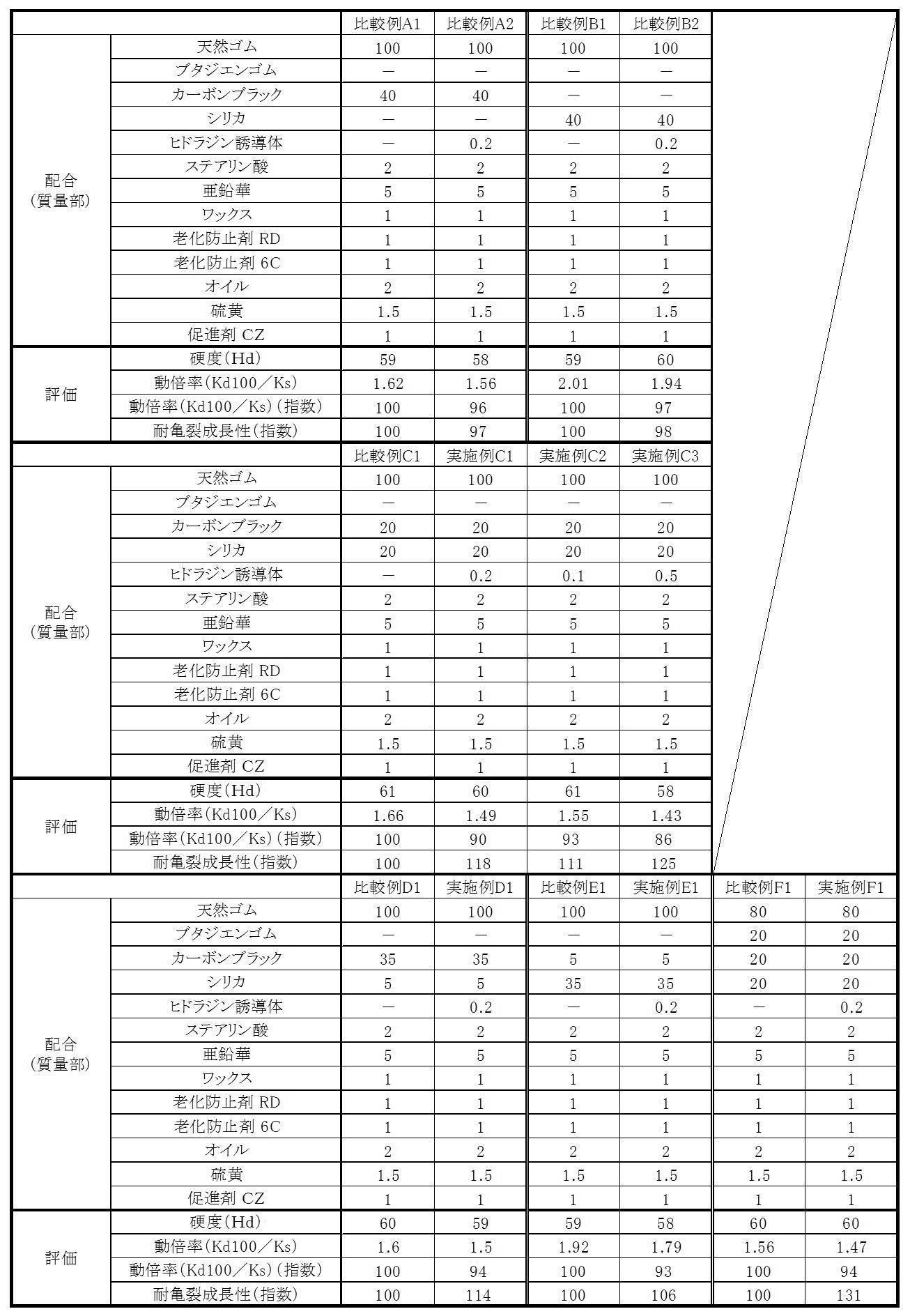
表1に示した各成分の詳細は下記の通りである。
・天然ゴム:「RSS#1」
・ブタジエンゴム:JSR株式会社製「BR01」、シス-1,4結合含量96%、ビニル結合含量2%
・カーボンブラック:旭カーボン株式会社製のFEF級カーボンブラック「旭#65」、ヨウ素吸着量43g/kg、DBP吸油量121ml/100g
・シリカ:東ソー・シリカ株式会社製「Nipsil AQ」、BET比表面積190m2/g
・ヒドラジン誘導体:イソフタル酸ジヒドラジド
・ステアリン酸:新日本理化株式会社製「ステアリン酸50S」
・亜鉛華:ハクスイテック株式会社製「3号亜鉛華」
・老化防止剤RD:2,2,4-トリメチル-1,2-ジヒドロキノリン重合体、大内新興化学工業株式会社製「ノクラック224」
・老化防止剤6C:N-フェニル-N’-(1,3-ジメチルブチル)-p-フェニレンジアミン、大内新興化学工業株式会社製「ノクラック 6C」
・オイル:パラフィン系オイル
・硫黄:鶴見化学工業株式会社製「粉末硫黄」
・促進剤CZ:スルフェンアミド系加硫促進剤、大内新興化学工業株式会社製「ノクセラー CZ-G」
・天然ゴム:「RSS#1」
・ブタジエンゴム:JSR株式会社製「BR01」、シス-1,4結合含量96%、ビニル結合含量2%
・カーボンブラック:旭カーボン株式会社製のFEF級カーボンブラック「旭#65」、ヨウ素吸着量43g/kg、DBP吸油量121ml/100g
・シリカ:東ソー・シリカ株式会社製「Nipsil AQ」、BET比表面積190m2/g
・ヒドラジン誘導体:イソフタル酸ジヒドラジド
・ステアリン酸:新日本理化株式会社製「ステアリン酸50S」
・亜鉛華:ハクスイテック株式会社製「3号亜鉛華」
・老化防止剤RD:2,2,4-トリメチル-1,2-ジヒドロキノリン重合体、大内新興化学工業株式会社製「ノクラック224」
・老化防止剤6C:N-フェニル-N’-(1,3-ジメチルブチル)-p-フェニレンジアミン、大内新興化学工業株式会社製「ノクラック 6C」
・オイル:パラフィン系オイル
・硫黄:鶴見化学工業株式会社製「粉末硫黄」
・促進剤CZ:スルフェンアミド系加硫促進剤、大内新興化学工業株式会社製「ノクセラー CZ-G」
表1の結果から、ジエン系ゴムを含むゴム成分を用いて、充填剤としてカーボンブラック及びシリカを含有し、充填剤を特定の含有割合で含有し、更にヒドラジン誘導体を含有する防振ゴム組成物により、低動倍率と耐亀裂成長性とを両立させることができることが確認された。
比較例A1、A2、B1、及びB2において、防振ゴム組成物に、充填剤としてカーボンブラック又はシリカを単独で含む場合には、ヒドラジン誘導体を含有する場合、動倍率を低くする効果は顕著ではなく、また、耐亀裂成長性は改善されなかったことが認められた。
一方で、比較例C1と実施例C1~C3との対比において、充填剤としてカーボンブラック及びシリカの両方を含み、ヒドラジン誘導体を含有する場合、動倍率、耐亀裂成長性ともに顕著に向上していることが認められた。
同様に、比較例D1と実施例D1との対比、及び、比較例E1と実施例E1との対比において、充填剤としてカーボンブラック及びシリカの両方を含み、ヒドラジン誘導体を含有する場合において、充填剤のカーボンブラックとシリカの含有割合を変更した場合においても、動倍率及び耐亀裂成長性ともに顕著に向上していることが認められた。また、比較例F1と実施例F1との対比において、ジエン系ゴム成分としてブタジエンゴムを含有する場合においても、動倍率及び耐亀裂成長性ともに顕著に向上していることが認められた。
Claims (4)
- ジエン系ゴムを60質量%以上含むゴム成分と、
カーボンブラック及びシリカを含み、前記カーボンブラック(a)及び前記シリカ(b)の含有割合(a/b)が質量基準で10/90~90/10である充填剤と、
ヒドラジン誘導体と、
を含有する防振ゴム組成物。 - 前記ゴム成分100質量部に対する前記ヒドラジン誘導体の含有量が0.01~5.0質量部である請求項1に記載の防振ゴム組成物。
- 前記ゴム成分100質量部に対する前記充填剤の含有量が10~100質量部である請求項1又は2に記載の防振ゴム組成物。
- 請求項1~3のいずれか1項に記載の防振ゴム組成物を硬化させてなる防振ゴム。
Priority Applications (3)
| Application Number | Priority Date | Filing Date | Title |
|---|---|---|---|
| US15/312,849 US10487192B2 (en) | 2014-05-27 | 2015-05-08 | Anti-vibration rubber composition and anti-vibration rubber |
| EP15800078.6A EP3150663B1 (en) | 2014-05-27 | 2015-05-08 | Anti-vibration rubber composition and anti-vibration rubber |
| CN201580026866.2A CN106414589B (zh) | 2014-05-27 | 2015-05-08 | 防振橡胶组合物和防振橡胶 |
Applications Claiming Priority (2)
| Application Number | Priority Date | Filing Date | Title |
|---|---|---|---|
| JP2014109142A JP6371588B2 (ja) | 2014-05-27 | 2014-05-27 | 防振ゴム組成物及び防振ゴム |
| JP2014-109142 | 2014-05-27 |
Publications (1)
| Publication Number | Publication Date |
|---|---|
| WO2015182349A1 true WO2015182349A1 (ja) | 2015-12-03 |
Family
ID=54698689
Family Applications (1)
| Application Number | Title | Priority Date | Filing Date |
|---|---|---|---|
| PCT/JP2015/063340 Ceased WO2015182349A1 (ja) | 2014-05-27 | 2015-05-08 | 防振ゴム組成物及び防振ゴム |
Country Status (5)
| Country | Link |
|---|---|
| US (1) | US10487192B2 (ja) |
| EP (1) | EP3150663B1 (ja) |
| JP (1) | JP6371588B2 (ja) |
| CN (1) | CN106414589B (ja) |
| WO (1) | WO2015182349A1 (ja) |
Cited By (4)
| Publication number | Priority date | Publication date | Assignee | Title |
|---|---|---|---|---|
| WO2021153242A1 (ja) * | 2020-01-30 | 2021-08-05 | 住友理工株式会社 | 防振ゴム組成物および防振ゴム部材 |
| WO2021192857A1 (ja) * | 2020-03-26 | 2021-09-30 | 住友理工株式会社 | 防振ゴム組成物および防振ゴム部材 |
| WO2023054341A1 (ja) | 2021-09-30 | 2023-04-06 | 住友理工株式会社 | 防振ゴム組成物および防振ゴム部材 |
| US11655931B2 (en) | 2020-03-12 | 2023-05-23 | Sumitomo Riko Company Limited | Heat insulating material and manufacturing method thereof |
Families Citing this family (7)
| Publication number | Priority date | Publication date | Assignee | Title |
|---|---|---|---|---|
| JP2018188522A (ja) * | 2017-04-28 | 2018-11-29 | 株式会社ブリヂストン | 防振ゴム用ゴム組成物及び車両用防振ゴム |
| CN112752792B (zh) | 2018-09-26 | 2023-04-18 | 住友理工株式会社 | 防振橡胶组合物以及防振橡胶构件 |
| JP7233283B2 (ja) * | 2019-03-29 | 2023-03-06 | 住友理工株式会社 | 防振ゴム組成物および防振ゴム部材 |
| JP6644962B1 (ja) * | 2019-03-29 | 2020-02-12 | 住友理工株式会社 | 防振ゴム組成物および防振ゴム部材 |
| WO2020202597A1 (ja) * | 2019-03-29 | 2020-10-08 | 住友理工株式会社 | 防振ゴム組成物および防振ゴム部材 |
| JP7693792B2 (ja) * | 2021-03-05 | 2025-06-17 | 住友理工株式会社 | 難燃性防振ゴム組成物および難燃性防振ゴム部材 |
| WO2023073923A1 (ja) * | 2021-10-29 | 2023-05-04 | 住友理工株式会社 | ゴムの混練方法 |
Citations (6)
| Publication number | Priority date | Publication date | Assignee | Title |
|---|---|---|---|---|
| JPH08283461A (ja) * | 1995-04-17 | 1996-10-29 | Bridgestone Corp | ゴム組成物 |
| JPH10139934A (ja) * | 1996-11-14 | 1998-05-26 | Bridgestone Corp | 低発熱性ゴム組成物 |
| JP2001049047A (ja) * | 1999-08-10 | 2001-02-20 | Bridgestone Corp | ゴム組成物及び空気入りタイヤ |
| JP2001172431A (ja) * | 1999-12-15 | 2001-06-26 | Bridgestone Corp | ゴム組成物及び空気入りタイヤ |
| JP2013147581A (ja) * | 2012-01-20 | 2013-08-01 | Bridgestone Corp | ゴム組成物およびそれを用いたタイヤ |
| JP2014237787A (ja) * | 2013-06-10 | 2014-12-18 | 東洋ゴム工業株式会社 | ゴム組成物及び空気入りタイヤ |
Family Cites Families (29)
| Publication number | Priority date | Publication date | Assignee | Title |
|---|---|---|---|---|
| US1741778A (en) * | 1929-01-21 | 1929-12-31 | Goodrich Co B F | Rubber composition and method of preserving rubber |
| JPH0873658A (ja) | 1994-09-08 | 1996-03-19 | Hokushin Ind Inc | 車両用防振ゴム組成物 |
| JPH08269239A (ja) | 1995-03-31 | 1996-10-15 | Tokai Rubber Ind Ltd | 防振ゴム組成物 |
| EP0857752B1 (en) * | 1996-08-26 | 2003-07-23 | Bridgestone Corporation | Rubber composition and pneumatic tire made by using the same |
| ES2269099T3 (es) * | 1999-02-05 | 2007-04-01 | Bridgestone Corporation | Mezcla de caucho y cubierta neumatica. |
| JP4334046B2 (ja) * | 1999-02-17 | 2009-09-16 | 株式会社ブリヂストン | ゴム組成物及びこれを用いた空気入りタイヤ |
| JP2001213112A (ja) * | 2000-02-01 | 2001-08-07 | Bridgestone Corp | 重荷重用空気入りタイヤ |
| EP1184412B1 (en) * | 2000-09-01 | 2005-01-12 | Bridgestone Corporation | Rubber composition and heavy duty pneumetic tire using the rubber composition |
| WO2002038667A2 (en) * | 2000-11-07 | 2002-05-16 | Bridgestone Corporation | Natural rubber produced from latex and composition comprising the same |
| US20050176858A1 (en) * | 2002-02-15 | 2005-08-11 | Bridgestone Corporation | Rubber composition and pneumatic tire made therefrom |
| JP2004143244A (ja) * | 2002-10-23 | 2004-05-20 | Bridgestone Corp | 重荷重用タイヤ |
| JP4577490B2 (ja) * | 2004-10-07 | 2010-11-10 | 株式会社ブリヂストン | ベルト用ゴム組成物及びベルト |
| JP5110765B2 (ja) * | 2004-11-18 | 2012-12-26 | 株式会社ブリヂストン | 防振ゴム |
| JP4909688B2 (ja) * | 2006-09-08 | 2012-04-04 | 株式会社ブリヂストン | ゴム複合体及びそれを用いたタイヤ |
| ES2472318T3 (es) * | 2007-03-05 | 2014-06-30 | Bridgestone Corporation | Cubierta neumática |
| JP5049837B2 (ja) * | 2007-09-28 | 2012-10-17 | 東海ゴム工業株式会社 | 防振ゴム組成物の製法およびそれによって得られた防振ゴム組成物 |
| JP2009108204A (ja) * | 2007-10-30 | 2009-05-21 | Bridgestone Corp | 変性天然ゴム及びその製造方法、並びにそれを用いたゴム組成物及びタイヤ |
| JP2009298880A (ja) * | 2008-06-11 | 2009-12-24 | Bridgestone Corp | 防振ゴム組成物及びそれを用いてなる防振ゴム |
| FR2940299B1 (fr) * | 2008-12-23 | 2012-08-03 | Michelin Soc Tech | Composant de pneumatique sans contact avec l'air a base de caoutchouc naturel, d'une charge renforcante et d'un dihydrazide. |
| JP6165406B2 (ja) | 2009-11-18 | 2017-07-19 | 株式会社ブリヂストン | 防振ゴム組成物及び防振ゴム |
| JP5445157B2 (ja) * | 2010-01-18 | 2014-03-19 | 株式会社ブリヂストン | 防振ゴム組成物及び防振ゴム |
| JP5303684B2 (ja) * | 2010-10-29 | 2013-10-02 | 株式会社ブリヂストン | 台タイヤ及びタイヤの製造方法 |
| FR2969165B1 (fr) * | 2010-12-21 | 2014-06-06 | Michelin Soc Tech | Composition a base de caoutchouc naturel et de noir de carbone comprenant un hydrazide, un hydrazone ou une poly-amine |
| EP3029099B1 (en) | 2011-02-23 | 2018-04-04 | Bridgestone Corporation | Rubber composition and tire produced using same, and process of producing rubber composition |
| JP6130253B2 (ja) * | 2013-07-12 | 2017-05-17 | 東洋ゴム工業株式会社 | ゴムマスターバッチの製造方法 |
| JP6151596B2 (ja) * | 2013-07-29 | 2017-06-21 | 東洋ゴム工業株式会社 | ゴム組成物の製造方法 |
| JP6116439B2 (ja) * | 2013-08-19 | 2017-04-19 | 東洋ゴム工業株式会社 | ゴム組成物の製造方法 |
| JP6215005B2 (ja) * | 2013-11-08 | 2017-10-18 | 東洋ゴム工業株式会社 | ゴム組成物の製造方法 |
| WO2015079659A1 (ja) * | 2013-11-28 | 2015-06-04 | 株式会社ブリヂストン | 空気入りタイヤ |
-
2014
- 2014-05-27 JP JP2014109142A patent/JP6371588B2/ja active Active
-
2015
- 2015-05-08 WO PCT/JP2015/063340 patent/WO2015182349A1/ja not_active Ceased
- 2015-05-08 CN CN201580026866.2A patent/CN106414589B/zh not_active Expired - Fee Related
- 2015-05-08 EP EP15800078.6A patent/EP3150663B1/en not_active Not-in-force
- 2015-05-08 US US15/312,849 patent/US10487192B2/en not_active Expired - Fee Related
Patent Citations (6)
| Publication number | Priority date | Publication date | Assignee | Title |
|---|---|---|---|---|
| JPH08283461A (ja) * | 1995-04-17 | 1996-10-29 | Bridgestone Corp | ゴム組成物 |
| JPH10139934A (ja) * | 1996-11-14 | 1998-05-26 | Bridgestone Corp | 低発熱性ゴム組成物 |
| JP2001049047A (ja) * | 1999-08-10 | 2001-02-20 | Bridgestone Corp | ゴム組成物及び空気入りタイヤ |
| JP2001172431A (ja) * | 1999-12-15 | 2001-06-26 | Bridgestone Corp | ゴム組成物及び空気入りタイヤ |
| JP2013147581A (ja) * | 2012-01-20 | 2013-08-01 | Bridgestone Corp | ゴム組成物およびそれを用いたタイヤ |
| JP2014237787A (ja) * | 2013-06-10 | 2014-12-18 | 東洋ゴム工業株式会社 | ゴム組成物及び空気入りタイヤ |
Non-Patent Citations (1)
| Title |
|---|
| See also references of EP3150663A4 * |
Cited By (9)
| Publication number | Priority date | Publication date | Assignee | Title |
|---|---|---|---|---|
| WO2021153242A1 (ja) * | 2020-01-30 | 2021-08-05 | 住友理工株式会社 | 防振ゴム組成物および防振ゴム部材 |
| JP2021120430A (ja) * | 2020-01-30 | 2021-08-19 | 住友理工株式会社 | 防振ゴム組成物および防振ゴム部材 |
| JP7364483B2 (ja) | 2020-01-30 | 2023-10-18 | 住友理工株式会社 | 防振ゴム組成物および防振ゴム部材 |
| US11655931B2 (en) | 2020-03-12 | 2023-05-23 | Sumitomo Riko Company Limited | Heat insulating material and manufacturing method thereof |
| WO2021192857A1 (ja) * | 2020-03-26 | 2021-09-30 | 住友理工株式会社 | 防振ゴム組成物および防振ゴム部材 |
| JP2021155526A (ja) * | 2020-03-26 | 2021-10-07 | 住友理工株式会社 | 防振ゴム組成物および防振ゴム部材 |
| US20210371626A1 (en) * | 2020-03-26 | 2021-12-02 | Sumitomo Riko Company Limited | Vibration isolation rubber composition and vibration isolation rubber member |
| JP7553258B2 (ja) | 2020-03-26 | 2024-09-18 | 住友理工株式会社 | 防振ゴム組成物および防振ゴム部材 |
| WO2023054341A1 (ja) | 2021-09-30 | 2023-04-06 | 住友理工株式会社 | 防振ゴム組成物および防振ゴム部材 |
Also Published As
| Publication number | Publication date |
|---|---|
| JP2015224279A (ja) | 2015-12-14 |
| US20170204248A1 (en) | 2017-07-20 |
| CN106414589B (zh) | 2019-02-12 |
| CN106414589A (zh) | 2017-02-15 |
| EP3150663A4 (en) | 2017-05-24 |
| EP3150663A1 (en) | 2017-04-05 |
| EP3150663B1 (en) | 2018-07-18 |
| JP6371588B2 (ja) | 2018-08-08 |
| US10487192B2 (en) | 2019-11-26 |
Similar Documents
| Publication | Publication Date | Title |
|---|---|---|
| JP6371588B2 (ja) | 防振ゴム組成物及び防振ゴム | |
| CN105264004B (zh) | 防振橡胶用橡胶组合物 | |
| JP5420224B2 (ja) | 防振ゴム用ゴム組成物、防振ゴムおよびその製造方法 | |
| JP2011105870A (ja) | 防振ゴム組成物及び防振ゴム | |
| JP5949493B2 (ja) | 防振ゴム組成物及び防振ゴム | |
| JP2012229323A (ja) | 防振ゴム組成物及び防振ゴム | |
| JP2015021097A (ja) | 防振ゴム用ゴム組成物および防振ゴム | |
| JP5873063B2 (ja) | 防振ゴム用ゴム組成物および防振ゴム | |
| JP6673351B2 (ja) | 防振ゴム組成物及び防振ゴム | |
| JP2010254872A (ja) | 防振ゴム用ゴム組成物 | |
| JP2013147581A (ja) | ゴム組成物およびそれを用いたタイヤ | |
| JP6579704B2 (ja) | ゴム組成物及び防振ゴム | |
| JP6702313B2 (ja) | 防振部材 | |
| JP6421074B2 (ja) | ゴム組成物及び防振ゴム | |
| JP2011162585A (ja) | 防振ゴム用ゴム組成物および防振ゴム | |
| JP6609934B2 (ja) | 防振ゴム用ゴム組成物及び防振ゴム | |
| JP6535920B2 (ja) | ゴム組成物及び防振ゴム | |
| JP5968191B2 (ja) | 防振ゴム組成物 | |
| JP2019048959A (ja) | 防振ゴム用ゴム組成物及び防振ゴム製品 | |
| JP6464016B2 (ja) | ゴム組成物及び防振ゴム | |
| JP2017226732A (ja) | 防振ゴム組成物及び防振ゴム | |
| JP2016204417A (ja) | ゴム組成物及び防振ゴム | |
| WO2016120991A1 (ja) | 防振ゴム用ゴム組成物および防振ゴム | |
| JP7682124B2 (ja) | 防振ゴム組成物及び防振ゴム | |
| JP2020090665A (ja) | 防振ゴム用ゴム組成物および防振ゴム |
Legal Events
| Date | Code | Title | Description |
|---|---|---|---|
| 121 | Ep: the epo has been informed by wipo that ep was designated in this application |
Ref document number: 15800078 Country of ref document: EP Kind code of ref document: A1 |
|
| REEP | Request for entry into the european phase |
Ref document number: 2015800078 Country of ref document: EP |
|
| WWE | Wipo information: entry into national phase |
Ref document number: 2015800078 Country of ref document: EP |
|
| WWE | Wipo information: entry into national phase |
Ref document number: 15312849 Country of ref document: US |
|
| NENP | Non-entry into the national phase |
Ref country code: DE |