WO2015182648A1 - 爆轟法による炭素粒子の製造方法 - Google Patents
爆轟法による炭素粒子の製造方法 Download PDFInfo
- Publication number
- WO2015182648A1 WO2015182648A1 PCT/JP2015/065220 JP2015065220W WO2015182648A1 WO 2015182648 A1 WO2015182648 A1 WO 2015182648A1 JP 2015065220 W JP2015065220 W JP 2015065220W WO 2015182648 A1 WO2015182648 A1 WO 2015182648A1
- Authority
- WO
- WIPO (PCT)
- Prior art keywords
- explosive
- detonation
- carbon particles
- substance
- raw material
- Prior art date
- Legal status (The legal status is an assumption and is not a legal conclusion. Google has not performed a legal analysis and makes no representation as to the accuracy of the status listed.)
- Ceased
Links
Images
Classifications
-
- C—CHEMISTRY; METALLURGY
- C01—INORGANIC CHEMISTRY
- C01B—NON-METALLIC ELEMENTS; COMPOUNDS THEREOF; METALLOIDS OR COMPOUNDS THEREOF NOT COVERED BY SUBCLASS C01C
- C01B32/00—Carbon; Compounds thereof
- C01B32/25—Diamond
-
- B—PERFORMING OPERATIONS; TRANSPORTING
- B01—PHYSICAL OR CHEMICAL PROCESSES OR APPARATUS IN GENERAL
- B01J—CHEMICAL OR PHYSICAL PROCESSES, e.g. CATALYSIS OR COLLOID CHEMISTRY; THEIR RELEVANT APPARATUS
- B01J3/00—Processes of utilising sub-atmospheric or super-atmospheric pressure to effect chemical or physical change of matter; Apparatus therefor
- B01J3/06—Processes using ultra-high pressure, e.g. for the formation of diamonds; Apparatus therefor, e.g. moulds or dies
- B01J3/062—Processes using ultra-high pressure, e.g. for the formation of diamonds; Apparatus therefor, e.g. moulds or dies characterised by the composition of the materials to be processed
-
- B—PERFORMING OPERATIONS; TRANSPORTING
- B01—PHYSICAL OR CHEMICAL PROCESSES OR APPARATUS IN GENERAL
- B01J—CHEMICAL OR PHYSICAL PROCESSES, e.g. CATALYSIS OR COLLOID CHEMISTRY; THEIR RELEVANT APPARATUS
- B01J3/00—Processes of utilising sub-atmospheric or super-atmospheric pressure to effect chemical or physical change of matter; Apparatus therefor
- B01J3/06—Processes using ultra-high pressure, e.g. for the formation of diamonds; Apparatus therefor, e.g. moulds or dies
- B01J3/08—Application of shock waves for chemical reactions or for modifying the crystal structure of substances
-
- C—CHEMISTRY; METALLURGY
- C01—INORGANIC CHEMISTRY
- C01B—NON-METALLIC ELEMENTS; COMPOUNDS THEREOF; METALLOIDS OR COMPOUNDS THEREOF NOT COVERED BY SUBCLASS C01C
- C01B32/00—Carbon; Compounds thereof
- C01B32/25—Diamond
- C01B32/26—Preparation
Definitions
- the present invention relates to a method for producing carbon particles by the detonation method. More specifically, the present invention produces carbon particles containing diamond and graphitic carbon by a detonation method using a raw material containing an aromatic compound having three or more nitro groups (also called explosive raw material). On how to do.
- Nanoscale diamonds also called nanodiamonds
- nanodiamonds can be synthesized using, for example, detonation reaction of explosives.
- detonation is performed only with the explosive raw material that is a carbon source, and carbon atoms decomposed and liberated from the molecules constituting the explosive raw material by detonation reaction are generated as diamond under high temperature and high pressure during detonation It is generally called the detonation method. See, for example, Non-Patent Document 1 for the production of nanodiamonds by the detonation method.
- the present invention solves the above-mentioned conventional problems, and an object thereof is to provide a method for producing carbon particles containing nanodiamond and graphitic carbon by a detonation method using an explosive material. More specifically, the object is to provide a method for producing nanodiamonds with high yield.
- the present inventors provide an explosive substance that is liquid at room temperature and normal pressure around the explosive raw material. It has been found that carbon particles containing a larger amount of diamond can be obtained by arranging and detonating reaction than in the conventional method described above, and the present invention has been completed.
- explosive means a substance capable of detonation reaction. Explosive-based materials are included in explosives.
- An explosive substance means a substance that causes a rapid combustion reaction. Explosive substances are generally classified into solid explosives that do not have fluidity at room temperature and normal pressure, and liquid explosives that have fluidity, but in this specification, fluids flow at normal temperature and normal pressure unless otherwise specified. It means a liquid explosive with sex.
- normal temperature and normal pressure shall mean the conditions of 25 degreeC and 1 atmosphere.
- the raw material When the explosive substance detonates, the raw material is decomposed to the atomic level, and free carbon atoms are aggregated in a solid state without being oxidized, and diamond or graphitic carbon is generated.
- the raw material At the time of detonation, the raw material is brought into a high temperature and high pressure state due to a decomposition reaction, but immediately expands and is cooled.
- the process from high temperature and high pressure to vacuum cooling occurs in a much shorter time than normal combustion or deflagration, which is an explosion phenomenon slower than detonation. Carbon particles are produced.
- the present invention is a method for producing carbon particles by a detonation method, and an explosive substance that is liquid at room temperature and normal pressure around a raw material containing an aromatic compound having three or more nitro groups.
- a manufacturing method characterized by including a disposing step and a step of detonating the explosive substance.
- the raw materials used in the production method of the present invention are trinitrotoluene, cyclotrimethylenetrinitramine, cyclotetramethylenetetranitramine, pentaerythritol tetranitrate and trinitrophenylmethyl as aromatic compounds having three or more nitro groups. It is preferable to include at least one selected from the group consisting of nitramines.
- explosive substances are liquid explosives that have fluidity at room temperature and normal pressure.
- the explosive substance preferably contains at least one selected from the group consisting of a mixture of hydrazine and hydrazine nitrate, a mixture of hydrazine and ammonium nitrate, nitromethane, and a mixture of hydrazine and nitromethane.
- detonation is performed with the source material and the explosive material loaded in the chamber and / or with the coolant disposed around the source material and the explosive material in the chamber. It is preferable. At this time, if the atmosphere in the chamber does not contain oxygen gas and / or if the coolant is a substance that does not substantially generate an oxidizing substance such as oxygen or ozone, the oxidation reaction can be suppressed.
- recover carbon particles from carbon in a medium improves, and the ratio by the mass ratio which can collect
- a ratio in a mass ratio at which carbon particles can be recovered from carbon in the raw material is referred to as “carbon particle yield” which is a mass ratio of the carbon particles to the raw material.
- a ratio in a mass ratio at which diamond can be recovered from carbon in the raw material is referred to as “diamond yield” which is a mass ratio of diamond to the raw material.
- the production method of the present invention can further include a step of recovering carbon particles from the residue obtained in the detonation step.
- the recovery step for example, if classification and purification treatment is performed, carbon particles can be obtained in the form of powder having a desired particle size.
- each above-mentioned preferable embodiment may combine those arbitrary two or more.
- carbon particles containing diamond and graphitic carbon can be obtained by a detonation method using an explosive material and a liquid explosive in combination.
- This carbon particle is a carbon particle having a higher diamond content than a conventional product obtained by a detonation method using an explosive material alone or in combination with an explosive material and a solid explosive.
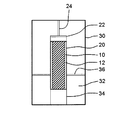
- FIG. 1 is a cross-sectional view schematically showing an example of an explosion device used in the production method of the present invention.
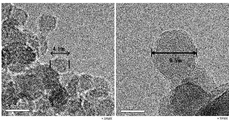
- FIG. 2 is a transmission electron micrograph of the carbon particles obtained in Experimental Example 3.
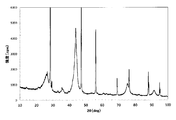
- FIG. 3 is an X-ray diffraction chart of the carbon particles obtained in Experimental Example 3.
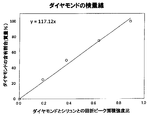
- FIG. 4 is a calibration curve graph used to determine the diamond content ratio of carbon particles.
- the production method of the present invention is a method of producing carbon particles by a detonation method, and is an explosive substance that is liquid at room temperature and pressure around a raw material containing an aromatic compound having three or more nitro groups And a step of detonating the explosive substance.
- an explosive substance that is liquid at normal temperature and normal pressure is placed around a raw material containing an aromatic compound having three or more nitro groups.
- An aromatic compound having three or more nitro groups is an explosive raw material contained in a raw material which is a carbon source for the detonation method.
- Explosive substances that are liquid at normal temperature and pressure are substances that cause stable detonation in order to generate carbon particles from raw materials.
- numerator which comprises an explosive substance contains a carbon atom
- the said explosive substance may become a carbon source with a raw material substance.
- the aromatic compound having 3 or more nitro groups is a compound having a structure in which 3 or more hydrogen atoms of an aromatic ring such as benzene, naphthalene, and anthracene are substituted with nitro groups.
- the aromatic compound may have a substituent other than a nitro group, and examples of the substituent include an alkyl group, a hydroxy group, a hydroxyalkyl group, an amino group, and a halogen group.
- positional isomers may exist, and any of these positional isomers can be used in the production method of the present invention.
- trinitrotoluene means 2,4,6-trinitrotoluene.
- aromatic compound examples include trinitrotoluene (also referred to as TNT), cyclotrimethylenetrinitramine (also referred to as RDX, hexogen), cyclotetramethylenetetranitramine (also referred to as HMX, octogen), and pentaerythritol tetranitrate (also referred to as PETN). And trinitrophenylmethylnitramine (also called tetryl). Of these aromatic compounds, TNT is particularly preferable because it is easily available.
- the aromatic compounds may be used alone or in combination of two or more.
- two or more of the aromatic compounds are used in combination include explosive explosives mainly composed of RDX and TNT, such as Composition B, cyclotol (75/25), (70/30), (65 / 30), composition B-2; mixed explosives mainly composed of HMX and TNT, such as octol (75/25); mixed explosives mainly composed of TNT and tetril, such as teritol.
- explosive explosives mainly composed of RDX and TNT such as Composition B, cyclotol (75/25), (70/30), (65 / 30), composition B-2
- mixed explosives mainly composed of HMX and TNT such as octol (75/25)
- mixed explosives mainly composed of TNT and tetril such as teritol.
- the content ratio of the aromatic compound having three or more nitro groups in the raw material is usually 50% by mass or more, preferably 80% by mass or more, more preferably 90% by mass or more, relative to the total mass of the raw material. More preferably, it is 95 mass% or more.
- the upper limit of the content of the aromatic compound having three or more nitro groups is most preferably 100% by mass, but the upper limit may be preferably about 99% by mass or 98% by mass.
- a liquid explosive having fluidity at normal temperature and normal pressure is used as the explosive substance. If a liquid explosive is used, compared with the case where a solid explosive is used, the freedom degree of a shape is high, an enlargement is easy, and operativity and safety
- the liquid explosive may be one that does not contain carbon as a constituent element. Examples of liquid explosives include a mixture of hydrazine and hydrazine nitrate, a mixture of hydrazine and ammonium nitrate, a mixture of hydrazine, hydrazine nitrate and ammonium nitrate, nitromethane, and a mixture of hydrazine and nitromethane. As used herein, hydrazine includes its hydrate, hydrazine hydrate.
- the type and the type of explosive substance are set so that the explosive speed when the explosive substance placed in the surrounding area is ignited alone is faster than the explosive speed when the raw material substance placed inside is ignited alone. It is important to select and use the composition appropriately.
- the amount of raw material and explosive substance used may be adjusted as appropriate according to the desired amount of carbon particles, and is not particularly limited.
- the ratio of explosive substance / raw material is expressed by mass ratio. , Preferably 0.1 or more, more preferably 0.2 or more, preferably 1 or less, more preferably 0.9 or less, and still more preferably 0.8 or less. If the ratio of the amount used is less than 0.1, a detonation reaction sufficient to generate carbon particles cannot be performed, and thus the yield may decrease. On the contrary, if the ratio of the amount used exceeds 1, the explosive substance is used more than necessary, which may increase the production cost.
- FIG. 1 is a cross-sectional view schematically showing an example of an explosion device used in the production method of the present invention.
- the explosive device shown in FIG. 1 is merely illustrative and is not intended to limit the present invention.
- the explosive substance 12 is arranged around the raw material substance 10.
- the high temperature and high pressure accompanying the shock wave generated by the detonation of the explosive substance 12 is applied to the raw material substance 10 as uniformly as possible, that is, in an explosive shape. It is preferable to arrange the source material 10 and the explosive material 12 symmetrically so as to ensure symmetry.
- the raw material 10 is solid and the explosive material 12 is a liquid explosive, for example, the raw material 10 is melted and pressed to produce a cylindrical molded body, and the molding is performed. After the body is placed in the center of the inside of the cylindrical container with the axial direction aligned, a liquid explosive may be injected around it.
- explosion container a container that contains a raw material and an explosive substance.
- a container made of a synthetic resin such as an acrylic resin because impurities such as metals can be prevented from being mixed.
- the explosive substance 12 is then detonated to generate carbon particles from the raw material substance 10.
- a shock wave generated by the detonation reaction of the explosive substance 12 propagates toward the raw material 10, and the shock wave is compressed by the shock wave to cause detonation, and the carbon decomposed and released from the organic molecules constituting the raw material 10. Atoms change to carbon particles containing diamond and graphitic carbon.
- Detonation may be performed in either an open system or a closed system.
- detonation may be performed inside earth or a tunnel excavated underground.
- it is preferable to perform detonation in a closed system because the residue can be prevented from scattering over a wide range.
- detonation may be performed in a state where an explosion container is loaded in, for example, a chamber.
- a chamber used for detonation is referred to as an “explosion chamber”.
- the explosion chamber may be made of metal or concrete as long as it has sufficient strength to withstand detonation. It is preferable to suspend and load the explosion container in the explosion chamber.
- the atmosphere in the explosion chamber When detonation is performed in an explosion chamber, if the atmosphere in the explosion chamber does not substantially contain oxygen during detonation, the oxidation reaction of carbon can be suppressed. Can be improved.
- the atmosphere in the explosion chamber is replaced with an inert gas such as nitrogen gas, argon gas or carbon dioxide gas, or is evacuated to about ⁇ 0.1 to ⁇ 0.01 MPaG.
- an inert gas may be injected into the explosion chamber to a weak positive pressure of about +0.000 to +0.001 MPaG.
- the symbol G attached after the pressure unit means a gauge pressure.
- the explosion container 20 may be installed in the cooling container 30 and the coolant 32 may be injected into the gap between the cooling container 30 and the explosion container 20.
- the coolant 32 is a substance that does not substantially generate an oxidizing substance such as oxygen or ozone, the oxidation reaction can be suppressed, so that the yield of carbon particles is improved.
- oxygen gas dissolved in the coolant 32 may be removed, or a coolant 32 that does not contain a constituent element that generates an oxidizing substance such as oxygen or ozone may be used.
- the coolant 32 include water, alkyl halides such as chlorofluorocarbons and carbon tetrachloride. Water is particularly preferred because it has little adverse effect on the environment.
- Explosive substance 12 is normally detonated using a detonator or explosive wire.
- an explosive agent may be interposed between the explosive substance 12 and the detonator or explosive wire.
- the explosive charge include Composition C-4 and SEP manufactured by Asahi Kasei Chemicals.
- the coolant 32 it is preferable to store the explosion container 20 in a liquid-tight container so that the coolant 32 does not enter the explosion container 20, for example.
- liquid-tight container examples include bags made of olefin-based synthetic resins such as polyethylene and polypropylene as raw materials. If the explosive substance 12 is detonated and detonated after setting in this way, carbon particles containing diamond and graphitic carbon can be obtained as the residue.
- the residue obtained in the detonation process may contain debris of an explosion container or blasting debris such as conductors / wires as impurities.
- this recovery step for example, if classification and purification treatment is performed, the carbon particles can be obtained in the form of a dry powder having a desired particle size.
- the sieve passing part is recovered.
- the residue on the sieve is classified again after crushing. Water is separated from the finally obtained sieve passage to obtain a dry powder.
- the sieve openings may be adjusted as appropriate, separation and purification treatments may be repeated, and the sieve passage having a sieve opening corresponding to the desired particle size may be used as the product.
- the recovered product is obtained by separating the water by centrifugation or the like and drying it to obtain a powder of carbon particles having a desired particle size.
- the acrylic resin when used as the explosion container 20, for example, the acrylic resin may be mixed in the carbon particles. In this case, for example, the acrylic resin may be removed by elution treatment with acetone. Further, depending on the use, it may be undesirable to mix a metal such as iron. In such a case, for example, treatment with hot concentrated nitric acid may be performed to remove metals such as iron.
- the carbon particles obtained by the production method of the present invention contain diamond and graphitic carbon. Therefore, even if it remains as it is or after any post-treatment, if the graphitic carbon remains sufficiently, the excellent characteristics of diamond and graphitic carbon can be utilized. Useful for various applications. For example, making use of diamond's excellent properties such as abrasiveness, durability, and wear resistance, such as tools, antiwear agents, lubricants, fluidized whetstones, fixed whetstones, plating / coating, durable films, lithium battery parts, etc. Useful for applications.
- graphite carbon such as conductivity, water repellency and biocompatibility, fiber materials, resin coatings that provide functionality, drug delivery systems, electronic device covers, battery electrode materials, electrical conductivity It is useful for applications such as adhesive film, reinforced rubber / water-repellent rubber, catalyst and adsorbent.
- the carbon particles may be subjected to perchloric acid treatment and / or plasma oxidation treatment to remove graphitic carbon.
- perchloric acid treatment and / or plasma oxidation treatment to remove graphitic carbon.
- diamond such as high refraction, transparency, and durability, it is particularly useful for use in optical parts such as optical lenses.
- the calibration curve for diamond uses five standard samples, and the ratio between the area intensity of the diffraction peak and the area intensity of the diffraction peak at the (220) plane and (311) plane of the silicon crystal added to each sample. From this, 4 inspections were made. The reason why the two peaks of the silicon crystal are used is to suppress the influence of the orientation of the powder silicon.
- the five standard samples are obtained by mixing the silicon crystal powder with the purified diamond so that the diamond content is 0% by mass, 25% by mass, 50% by mass, 75% by mass, or 100% by mass. .
- a calibration curve for diamond was obtained by plotting data of five standard samples with the vertical axis representing the diamond content ratio and the horizontal axis representing the area intensity ratio D220 / (Si220 + Si311) of the diffraction peak between diamond and silicon.
- the obtained calibration curve is shown in FIG.
- -X-ray diffractometer name Rigaku horizontal X-ray diffractometer SmartLab ⁇ Measuring method: ⁇ -2 ⁇ ⁇ X-ray source: Cu-K ⁇ ray ⁇ Excitation voltage-current: 45 kV-200 mA ⁇ Divergent slit: 2/3 ° ⁇ Scatter slit: 2/3 ° ⁇ Reception slit: 0.6mm
- TNT a commercially available cylindrical molded body (TNT's cylindrical filler, diameter 10 cm ⁇ length 20 cm, manufactured by Chuka Kayaku Co., Ltd.) was used.
- the mass of the TNT molded body was 2.52 kg, and the density was 1.60 g / cm 3 .
- hydrazine nitrate and hydrazine hydrate were mixed at a mass ratio of 3: 1 to prepare 0.93 kg of a hydrazine-based liquid explosive.
- detonation reaction was performed using an explosion device as shown in FIG.
- the molded body as the raw material 10 was placed in the center of the explosion container 20 having an inner diameter of 12 cm and a height of 20 cm, and the liquid explosive as the explosive substance 12 was filled around it.
- An explosive 22 (SEP), explosive wire, and No. 6 electric detonator 24 were attached to the top of the explosion container 20, covered, and stored in a liquid-tight polyethylene bag.
- a container having a capacity of 200 L was used as the cooling container 30.
- the explosion container 20 was installed in the cooling container 30. At this time, the outer bottom surface of the explosion container 20 was adjusted to be 29.5 cm in height from the inner bottom surface of the cooling container 30 by using the iron mount 34 and the iron perforated disk 36.
- distilled water was put into the cooling container 30 as the cooling material 32, and the cooling material 32 was filled in the gap between the cooling container 30 and the explosion container 20.
- a polyethylene bag containing distilled water was placed on top of the cooling vessel.
- a total of 200 L of distilled water was used.
- the cooling container 30 was covered, it was suspended from the ceiling in an explosion chamber with an internal volume of 30 m 3 using a wire sling.
- the inside of the explosion chamber was evacuated from atmospheric pressure, and the amount of remaining oxygen gas was calculated to be about 25.5 g.
- the explosive material 12 was detonated by detonating the explosive wire with the detonator. Then, about 200 L of water containing the residue was recovered from the explosion chamber and settled and separated to remove coarse rubble. At this time, since the supernatant liquid was strongly alkaline, the pH was adjusted to weak acidity by adding citric acid. The supernatant liquid that became weakly acidic was recovered as a waste liquid as it was. The precipitate was classified with a sieve having an opening of 100 ⁇ m / 16 ⁇ m using a vibrating sieve device (“KG-700-2W” manufactured by KOWA). The portion passing through the 16 ⁇ m sieve was recovered as it was.
- KG-700-2W manufactured by KOWA
- the residue on the sieve is crushed for about 5 minutes with an ultrasonic vibration device (Crest “4G-250-3-TSA”) to separate carbon from the rubble surface, and then the vibration sieve device (KOWA “KG” -700-2W "), and classified again with a sieve having an aperture of 100 ⁇ m / 32 ⁇ m / 16 ⁇ m, and a portion passing through the sieve was recovered.
- Each sieve passage was left in an 80 ° C. drier (“OF-450S” manufactured by ASONE) for 24 hours to evaporate the moisture, and then dried powder.
- Example 2 In this experimental example, as a raw material, mass 2.52Kg, density 1.60 g / cm 3 of TNT molded mass 3.82Kg, TNT molded density 1.61 g / cm 3 (of Chugokukayaku made TNT cylinder Except that it was changed to a shape-filled material (diameter 10 cm x length 30 cm) and the amount of explosive hydrazine liquid explosive was changed from 0.93 kg to 1.29 kg, the same as in Experimental Example 1. Thus, carbon particles having a 19 ⁇ m passage through a 16 ⁇ m sieve, 356.5 g through a 32 ⁇ m sieve and 222.2 g through a 100 ⁇ m sieve were obtained. The total recovered amount of carbon particles was 770.8 g. Table 1 below shows the experimental contents, the recovery amount and yield of carbon particles, and the total recovery amount and yield of diamond determined by the XRD quantitative method.
- Example 3 In this experimental example, as a raw material, mass 2.52Kg, density 1.60 g / cm 3 of TNT molded mass 6.30Kg, TNT molded density 1.59 g / cm 3 (of Chugokukayaku made TNT cylinder Changed shape filler, diameter 10cm x length 50cm), changed amount of explosive hydrazine liquid explosive from 0.93kg to 2.17kg, use of coolant distilled water Except for changing the amount from 200 L to 220 L, in the same manner as in Experimental Example 1, carbon particles of 257.4 g of 16 ⁇ m sieve passage, 531.8 g of 32 ⁇ m sieve passage, and 336.4 g of 100 ⁇ m sieve passage were obtained. The total recovered amount of carbon particles was 1125.6 g. Table 1 below shows the experimental contents, the total recovered amount and yield of carbon particles, and the total recovered amount and yield of diamond determined by the XRD quantitative method.
- FIG. 2 a transmission electron micrograph of the passage through the 16 ⁇ m sieve is shown in FIG. 2, and an X-ray diffraction chart of the passage through the 100 ⁇ m sieve is shown in FIG. From the left photograph in FIG. 2, carbon particles having a particle size of about 4.1 nm can be observed. In addition, carbon particles having a particle size of about 9.5 nm can be observed from the right photograph in FIG.
- Table 1 shows that carbon particles containing diamond and graphitic carbon can be produced by the detonation method even when the explosive raw material TNT and hydrazine liquid explosive are used in combination. Moreover, the obtained carbon particles are carbon particles having a higher diamond content than the conventional products. Actually, the yield of diamond is as high as 9.2 to 11.3%. On the other hand, according to Table 2 of Non-Patent Document 1, the diamond yield in the conventional method is 2.8% when TNT is used alone, and 4.1 to 8 when TNT and RDX are used in combination. .3%, and 3.75 to 8.2% when TNT and HMX are used in combination.
- the diamond is collected in comparison with the conventional method in which the explosive material is used alone or in combination with the explosive material and the solid explosive. It can be seen that the rate is improved.
- diamond can be produced with good yield from explosive materials by the detonation method. Therefore, the production method of the present invention makes a great contribution in various fields related to applications utilizing the excellent characteristics of diamond.
Landscapes
- Chemical & Material Sciences (AREA)
- Organic Chemistry (AREA)
- Life Sciences & Earth Sciences (AREA)
- General Life Sciences & Earth Sciences (AREA)
- Geology (AREA)
- Inorganic Chemistry (AREA)
- Chemical Kinetics & Catalysis (AREA)
- Crystallography & Structural Chemistry (AREA)
- Carbon And Carbon Compounds (AREA)
Abstract
本発明は、爆轟法により炭素粒子を製造する方法であって、3個以上のニトロ基を有する芳香族化合物を含む原料物質の周囲に常温・常圧で液体である爆発性物質を配置する工程と、前記爆発性物質を爆轟させる工程とを含むことを特徴とする製造方法に関する。本発明の製造方法によれば、爆轟法によりダイヤモンドを収率よく製造することができる。
Description
本発明は、爆轟法による炭素粒子の製造方法に関する。さらに詳しくは、本発明は、3個以上のニトロ基を有する芳香族化合物を含む原料物質(火薬系原料とも呼ばれる)を用いた爆轟法により、ダイヤモンドとグラファイト質の炭素を含む炭素粒子を製造する方法に関する。
ナノスケールのダイヤモンド(ナノダイヤモンドとも呼ばれる)は、高い硬度や極めて低い摩擦係数など、数多くの優れた特性を有するため、様々な分野で、すでに利用されており、また、極めて有望な新素材として、応用展開が検討されている。
ナノダイヤモンドは、例えば、爆薬の爆轟反応を利用して合成できることが知られている。この合成法は、炭素源である火薬系原料のみで爆轟を行い、爆轟反応により火薬系原料を構成する分子から分解・遊離した炭素原子が爆轟時の高温・高圧下でダイヤモンドとして生成されるというものであり、一般に爆轟法と呼ばれている。爆轟法によるナノダイヤモンドの製造については、例えば、非特許文献1を参照されたい。
従来、爆轟法によるナノダイヤモンドの製造は、例えば、ロシアやウクライナなどの東欧諸国、米国、中国などで行われてきた。これらの国々では、炭素源である火薬系原料として、軍事用の廃棄火薬が安価に入手できることから、トリニトロトルエンを単独で用いるか、あるいは、トリニトロトルエンと、シクロトリメチレントリニトラミン(RDX、ヘキソーゲンとも呼ばれる)またはシクロテトラメチレンテトラニトラミン(HMX、オクトーゲンとも呼ばれる)を併用することが行われてきた。
角舘洋三(著),「2・3.動的高圧力(爆轟法)」,ダイヤモンド工業協会(編),「ダイヤモンド技術総覧」,エヌジーティー,2007年1月,pp.28-33
ナノダイヤモンドの需要量は、その応用展開に伴って、今後ますます増加すると予想されている。ところが、軍事用の廃棄火薬を用いた製造では、生産量に限りがある。それゆえ、将来的に、国際市場において、供給量が不足する可能性がある。そこで、国内生産が期待されているが、上記した従来法では、ナノダイヤモンドを収率よく製造できないことから、経済的に採算が取れないという問題点がある。
本発明は、上記従来の問題点を解決するものであり、その目的は、火薬系原料を用いた爆轟法により、ナノダイヤモンドとグラファイト質の炭素を含む炭素粒子を製造する方法を提供すること、さらに詳しくは、ナノダイヤモンドを収率よく製造する方法を提供することにある。
本発明者らは、火薬系原料を用いた爆轟法により、ダイヤモンドとグラファイト質の炭素を含む炭素粒子を製造するにあたり、火薬系原料の周囲に常温・常圧で液体である爆発性物質を配置して爆轟反応を行えば、上記した従来法に比べて、ダイヤモンドを多く含む炭素粒子が得られることを見出し、本発明を完成した。
本明細書において、爆薬とは、爆轟反応を行うことができる物質を意味する。火薬系原料は、爆薬に含まれる。また、爆発性物質とは、急激な燃焼反応をもたらす物質を意味する。爆発性物質は、一般に、常温・常圧で流動性を有しない固体爆薬と流動性を有する液体爆薬に大別されるが、本明細書では、特に断りがない限り、常温・常圧で流動性を有する液体爆薬を意味する。なお、本明細書において、常温・常圧とは、25℃・1気圧の条件であることを意味するものとする。
爆発性物質が爆轟を起こすことにより、原料物質が原子レベルにまで分解され、酸化されずに遊離した炭素原子が固体状態に凝集して、ダイヤモンドやグラファイト質の炭素が生成される。爆轟時には、分解反応により原料物質は高温高圧の状態になるが、直ちに膨張して冷却される。この高温高圧状態から減圧冷却に至る過程は、通常の燃焼や、爆轟よりも遅い爆発現象である爆燃よりも非常に短い時間で起きるため、凝集した炭素が大きく成長する時間はなく、ナノスケールの炭素粒子が生成される。
すなわち、本発明は、爆轟法により炭素粒子を製造する方法であって、3個以上のニトロ基を有する芳香族化合物を含む原料物質の周囲に常温・常圧で液体である爆発性物質を配置する工程と、前記爆発性物質を爆轟させる工程とを含むことを特徴とする製造方法を提供する。
本発明の製造方法に用いる原料物質は、3個以上のニトロ基を有する芳香族化合物として、トリニトロトルエン、シクロトリメチレントリニトラミン、シクロテトラメチレンテトラニトラミン、四硝酸ペンタエリスリトールおよびトリニトロフェニルメチルニトラミンよりなる群から選択される少なくとも1種を含むことが好ましい。
また、爆発性物質は、常温・常圧で流動性を有する液体爆薬である。爆発性物質は、ヒドラジンと硝酸ヒドラジンの混合物、ヒドラジンと硝酸アンモニウムの混合物、ニトロメタン、およびヒドラジンとニトロメタンの混合物よりなる群から選択される少なくとも1種を含むことが好ましい。
本発明の製造方法では、原料物質と爆発性物質をチャンバー内に装填した状態で、および/または、チャンバー内で原料物質と爆発性物質の周囲に冷却材を配置した状態で、爆轟を行うことが好ましい。このとき、チャンバー内の雰囲気が酸素ガスを含まなければ、および/または、冷却材が実質的に酸素やオゾンなどの酸化性物質を発生しない物質であれば、酸化反応を抑制できるため、原料物質中の炭素から炭素粒子を回収できる質量比率での割合が向上し、ひいては原料物質中の炭素からダイヤモンドを回収できる質量比率での割合が向上する。本明細書では、原料物質中の炭素から炭素粒子を回収できる質量比率での割合を、原料物質に対する炭素粒子の質量比率である「炭素粒子の収率」という。また、原料物質中の炭素からダイヤモンドを回収できる質量比率での割合を、原料物質に対するダイヤモンドの質量比率である「ダイヤモンドの収率」という。
本発明の製造方法は、爆轟工程で得られた残渣から炭素粒子を回収する工程をさらに含むことができる。回収工程において、例えば、分級・精製処理を行えば、炭素粒子を所望の粒径を有する粉末の形態で得ることができる。なお、前記した各好ましい実施形態は、それらの任意の二つ以上を組み合わせてもよい。
本発明の製造方法によれば、火薬系原料と液体爆薬を併用する爆轟法により、ダイヤモンドとグラファイト質の炭素を含む炭素粒子が得られる。この炭素粒子は、火薬系原料を単独で用いるか、あるいは、火薬系原料と固体爆薬を併用する爆轟法により得られる従来品に比べて、ダイヤモンドの含有割合が高い炭素粒子である。
本発明の製造方法は、爆轟法により炭素粒子を製造する方法であって、3個以上のニトロ基を有する芳香族化合物を含む原料物質の周囲に常温・常圧で液体である爆発性物質を配置する工程と、前記爆発性物質を爆轟させる工程とを含むことを特徴とする。
本発明の製造方法では、まず、3個以上のニトロ基を有する芳香族化合物を含む原料物質の周囲に常温・常圧で液体である爆発性物質を配置する。3個以上のニトロ基を有する芳香族化合物は、爆轟法の炭素源である原料物質に含まれる火薬系原料である。常温・常圧で液体である爆発性物質は、原料物質から炭素粒子を生成させるために安定した爆轟を起こさせる物質である。なお、爆発性物質を構成する分子が炭素原子を含む場合には、当該爆発性物質が原料物質と共に炭素源となることがある。
3個以上のニトロ基を有する芳香族化合物とは、ベンゼン、ナフタレン、アントラセンなどの芳香環の3個以上の水素原子がニトロ基で置換された構造を有する化合物である。前記芳香族化合物は、ニトロ基以外の置換基を有していてもよく、その置換基としては、アルキル基、ヒドロキシ基、ヒドロキシアルキル基、アミノ基、ハロゲン基などが挙げられる。ニトロ基や置換基の位置関係により、位置異性体が存在する場合があるが、その位置異性体のいずれもが本発明の製造方法に使用可能である。例えば、前記芳香族化合物がトリニトロトルエンであれば、3個のニトロ基と1個のメチル基との位置関係により、6種類の位置異性体が考えられる。本明細書では、特に断らない限り、トリニトロトルエンとは、2,4,6-トリニトロトルエンを意味する。
前記芳香族化合物としては、トリニトロトルエン(TNTとも呼ばれる)、シクロトリメチレントリニトラミン(RDX、ヘキソーゲンとも呼ばれる)、シクロテトラメチレンテトラニトラミン(HMX、オクトーゲンとも呼ばれる)、四硝酸ペンタエリスリトール(PETNとも呼ばれる)、トリニトロフェニルメチルニトラミン(テトリルとも呼ばれる)などが挙げられる。これらの芳香族化合物のうち、入手が容易であることから、TNTが特に好ましい。前記芳香族化合物は、単独で用いても、2種以上を併用してもよい。前記芳香族化合物の2種以上を併用する具体例としては、RDXとTNTを主成分とする混合爆薬、例えば、コンポジションB、サイクロトール(75/25)、(70/30)、(65/30)、コンポジションB-2;HMXとTNTを主成分とする混合爆薬、例えば、オクトール(75/25);TNTとテトリルを主成分とする混合爆薬、例えば、テリトール;などが挙げられる。
原料物質における3個以上のニトロ基を有する芳香族化合物の含有割合は、原料物質の合計質量に対して、通常、50質量%以上、好ましくは80質量%以上、より好ましくは90質量%以上、さらに好ましくは95質量%以上である。3個以上のニトロ基を有する芳香族化合物の含有割合は、最も好ましくは100質量%を上限とするが、その上限は、好ましくは99質量%もしくは98質量%程度であってもよい。
本発明の製造方法では、爆発性物質として、常温・常圧で流動性を有する液体爆薬を用いる。液体爆薬を用いれば、固体爆薬を用いた場合に比べて、形状の自由度が高く、大型化が容易であり、操作性や安全性を向上させることができる。液体爆薬は、構成元素に炭素を含まないものであってもよい。液体爆薬としては、ヒドラジンと硝酸ヒドラジンの混合物、ヒドラジンと硝酸アンモニウムの混合物、ヒドラジンと硝酸ヒドラジンと硝酸アンモニウムの混合物、ニトロメタン、およびヒドラジンとニトロメタンの混合物などが挙げられる。本明細書では、ヒドラジンは、その水和物である抱水ヒドラジンを包含する。
なお、爆発性物質については、周囲に配置する爆発性物質を単独で起爆させた際の爆速が内側に配置する原料物質を単独で起爆させた際の爆速よりも速くなるように、その種類や組成を適宜選択して使用することが重要である。
原料物質と爆発性物質の使用量は、炭素粒子の所望量に応じて、それぞれ適宜調整すればよく、特に限定することはなく、爆発性物質/原料物質で表される比率は、質量比で、好ましくは0.1以上、より好ましくは0.2以上であり、また、好ましくは1以下、より好ましくは0.9以下、さらに好ましくは0.8以下である。当該使用量の比率が0.1未満であると、炭素粒子を生成するのに充分な爆轟反応を行うことができないため、収率が低下することがある。逆に、当該使用量の比率が1を超えると、必要以上に爆発性物質を用いることになるため、生産コストが上昇することがある。
以下、図面を参照しながら、本発明の製造方法を実施する形態について、詳しく説明する。図1は、本発明の製造方法に用いる爆発装置の一例を模式的に示す断面図である。図1に示す爆発装置は、単なる例示であって、本発明を限定することを意図するものではない。
まず、原料物質10の周囲に爆発性物質12を配置する。原料物質10の周囲に爆発性物質12を配置する際には、爆発性物質12の爆轟により生じる衝撃波に伴う高温高圧が原料物質10に対して、できるだけ均一に加わるように、すなわち爆発形状の対称性が担保されるように、原料物質10と爆発性物質12を対称的に配置することが好ましい。そこで、原料物質10が固体であり、爆発性物質12が液体爆薬であることに鑑みれば、例えば、原料物質10を溶填、圧填などして、円柱状の成型体を作製し、前記成型体を円筒状の容器の内側中央部に軸方向を揃えて設置した後、その周囲に液体爆薬を注入すればよい。あるいは、液体爆薬を円筒状の容器に注入した後、前記成型体を前記容器の内側中心部に軸方向を揃えて設置してもよい。以下、原料物質と爆発性物質を収容する容器を「爆発容器」という。爆発容器20としては、金属などの不純物混入を防止できることから、アクリル樹脂などの合成樹脂製の容器を用いることが好ましい。
本発明の製造方法では、次いで、爆発性物質12を爆轟させて原料物質10から炭素粒子を生成させる。爆発性物質12の爆轟反応により生じる衝撃波が原料物質10に向かって伝搬し、この衝撃波により原料物質10が圧縮されて爆轟を起こし、原料物質10を構成する有機分子から分解・遊離した炭素原子がダイヤモンドとグラファイト質の炭素を含む炭素粒子に変化する。
爆轟は、開放系または密閉系のいずれで行ってもよい。開放系で爆轟を行うには、例えば、地下を掘削した土塁や坑道の内部で爆轟を行えばよい。しかし、残渣が広範囲に飛散することを防止できることから、密閉系で爆轟を行うことが好ましい。密閉系で爆轟を行うには、爆発容器を、例えば、チャンバー内に装填した状態で爆轟を行えばよい。以下、爆轟を行うのに用いるチャンバーを「爆発チャンバー」という。爆発チャンバーは、爆轟に耐える十分な強度を有する限り、金属製やコンクリート製のいずれでもよい。爆発容器を爆発チャンバー内に懸架して装填することが好ましい。
爆発チャンバー内で爆轟を行う場合には、爆轟に際して、爆発チャンバー内の雰囲気が実質的に酸素を含まないようにすれば、炭素分の酸化反応を抑制できるため、炭素粒子の収率を向上することができる。このような雰囲気を得るには、爆発チャンバー内の雰囲気を、窒素ガスやアルゴンガス、炭酸ガスなどの不活性ガスで置換するか、あるいは、-0.1~-0.01MPaG程度まで真空引きするか、あるいは、真空引きして爆発チャンバーから大気(酸素)を放出した後、爆発チャンバーに不活性ガスを+0.000~+0.001MPaG程度の弱正圧まで注入すればよい。本明細書では、圧力単位の後に付した記号Gは、ゲージ圧であることを意味する。
また、生成したダイヤモンドを急冷して、グラファイト質の炭素への相転移を防止できることから、爆発チャンバー内で爆発容器の周囲に冷却材を配置することが好ましい。このように冷却材を配置するには、例えば、爆発容器20を冷却容器30内に設置し、冷却容器30と爆発容器20との間隙に冷却材32を注入すればよい。このとき、冷却材32が実質的に酸素やオゾンなどの酸化性物質を発生しない物質であれば、酸化反応を抑制できるため、炭素粒子の収率が向上する。この冷却材を得るには、例えば、冷却材32に溶存する酸素ガスを除去するか、あるいは、酸素やオゾンなどの酸化性物質を発生する構成元素を含まない冷却材32を用いればよい。冷却材32としては、水、ハロゲン化アルキル、例えば、フロン類、四塩化炭素などが挙げられる。環境に対する悪影響がほとんどないことから、水が特に好ましい。
爆発性物質12は、通常、雷管や導爆線を用いて起爆する。より確実に爆轟を起こさせるために、爆発性物質12と雷管や導爆線との間に伝爆薬を介在させてもよい。伝爆薬としては、例えば、コンポジションC-4、旭化成ケミカルズ製SEPなどが挙げられる。この場合、爆発容器20に伝爆薬22と雷管や導爆線24を取り付けた後、例えば、爆発チャンバー内に装填する。冷却材32を用いる場合には、爆発容器20を液密性の容器に収納して、例えば、爆発容器20に冷却材32が浸入しないようにすることが好ましい。液密性の容器としては、例えば、ポリエチレンやポリプロピレンなどのオレフィン系合成樹脂を原材料とする袋が挙げられる。このように設定した後、爆発性物質12を起爆して爆轟させれば、その残渣として、ダイヤモンドとグラファイト質の炭素を含む炭素粒子が得られる。
本発明の製造方法では、爆轟工程で得られた残渣が、不純物として、爆発容器の残骸や導線・ワイヤなどの爆破瓦礫を含むことがある。そのような場合には、爆轟工程で得られた残渣から瓦礫を除去して、炭素粒子を回収する工程を設けることが好ましい。この回収工程において、例えば、分級・精製処理を行えば、炭素粒子を所望の粒径を有する乾燥粉末の形態で得ることができる。
典型的には、まず、得られた残渣から粗大な瓦礫を除去した後、篩などで分級し、篩通過分と篩上残分とに分離し、篩通過分を回収する。篩上残分は、解砕した後、再度、分級する。最終的に得られた篩通過分から水を分離して、乾燥粉末とする。このとき、篩の目開きを適宜調整して、分離・精製処理を繰り返し、所望の粒径に対応する目開きを有する篩の篩通過分を製品とすればよい。
さらに詳しくは、例えば、冷却材32として水を用いて、爆発チャンバー内で爆轟を行った場合には、爆発チャンバーから残渣を含む水を回収し、沈降分離する。そして、沈降物から粗大な瓦礫を除去した後、上澄み液を廃液として回収し、沈殿物を篩などで分級して、篩通過分を得る。生成した炭素粒子の一部が瓦礫に付着していることもあるため、篩上残分を超音波振動などにより、解砕分離し、再度、篩などで分級する。通常、30μm程度の篩上残分は、爆発容器20の残骸や導線・ワイヤなどの爆破瓦礫であることが多いため、回収後に産業廃棄物として処分し、30μm程度の篩通過分を製品として回収することが好ましい。回収品は、遠心分離などにより水分を分離し、乾燥して、所望の粒径を有する炭素粒子の粉末として得る。
なお、爆発容器20として、例えば、アクリル樹脂製の容器を用いた場合には、炭素粒子にアクリル樹脂が混入していることがある。この場合には、例えば、アセトンでアクリル樹脂を溶出処理して、アクリル樹脂を除去すればよい。また、用途によっては、鉄などの金属が混入すると、望ましくない場合がある。このような場合には、例えば、熱濃硝酸で処理して、鉄などの金属を除去すればよい。
本発明の製造方法により得られる炭素粒子は、ダイヤモンドとグラファイト質の炭素を含んでいる。それゆえ、そのままの状態であっても、あるいは、何らかの後処理を行っても、グラファイト質の炭素が十分に残存している状態であれば、ダイヤモンドとグラファイト質の炭素の優れた特性を活かして、様々な用途に有用である。例えば、ダイヤモンドの研磨性、耐久性、耐摩耗性などの優れた特性を活かして、工具や耐摩耗剤、潤滑剤、流動砥石、固定砥石、メッキ・コーティング、耐久性フィルム、リチウム電池部品などの用途に有用である。また、グラファイト質の炭素の導電性、撥水性、生体適合性などの優れた特性を活かして、繊維材料、機能性を付与する樹脂コーティング、ドラッグデリバリーシステム、電子素子カバー、電池の電極材、導電性フィルム、強化ゴム・撥水性ゴム、触媒、吸着剤などの用途に有用である。さらに、例えば、炭素粒子に過塩素酸処理および/またはプラズマ酸化処理を施して、グラファイト質の炭素を除去してもよい。この場合には、ダイヤモンドの高屈折性、透明性、耐久性などの優れた特性を活かして、特に光学レンズなどの光学部品の用途に有用である。
以下、実施例を挙げて本発明をより具体的に説明するが、本発明はもとより下記実施例により制限を受けるものではなく、前・後記の趣旨に適合し得る範囲で適当に変更を加えて実施することも可能であり、それらはいずれも本発明の技術的範囲に包含される。
まず、本発明の炭素粒子を評価する方法について説明する。
<XRD定量法>
X線回折(XRD)の測定結果から、2θ=75°付近に現れるダイヤモンドの(220)面での回折ピークについて、面積強度を求め、予め作成した検量線を用いて、ダイヤモンドの含有割合を求めた。
X線回折(XRD)の測定結果から、2θ=75°付近に現れるダイヤモンドの(220)面での回折ピークについて、面積強度を求め、予め作成した検量線を用いて、ダイヤモンドの含有割合を求めた。
ダイヤモンドを定量するための基準物質として、本発明で別途製造したダイヤモンドを含む炭素粒子からグラファイト質の炭素などを過塩素酸で除去して精製したダイヤモンドを用いた。基準物質には、内部標準として、シリコン結晶の粉末(大阪薬研製Stansil-G03A、D50=5.2μm)を添加した。
ダイヤモンド用の検量線は、5つの標準試料を用いて、上記回折ピークの面積強度と、各試料に添加したシリコン結晶の(220)面および(311)面での回折ピークの面積強度との比率から、4点検量して作成した。シリコン結晶の2つのピークを用いたのは、粉末シリコンの配向の影響を抑えるためである。5つの標準試料は、上記精製ダイヤモンドに、上記シリコン結晶の粉末を、ダイヤモンドの含有割合が0質量%、25質量%、50質量%、75質量または100質量%となるように混合したものである。
ダイヤモンド用の検量線は、縦軸をダイヤモンドの含有割合、横軸をダイヤモンドとシリコンとの回折ピークの面積強度比D220/(Si220+Si311)として、5つの標準試料のデータをプロットすることにより得た。最小二乗法による直線近似により、含有割合yと面積強度比xとの関係式は、y=117.12xとなった。得られた検量線を図4に示す。
測定試料には、内部標準として、全炭素量に対して10質量%の上記シリコン結晶の粉末を添加した。X線回折(XRD)の測定結果から、上記回折ピークの面積強度比を算出し、図4に示す検量線を用いて、ダイヤモンドの含有割合を求めた。得られたダイヤモンドの含有割合を炭素粒子の合計回収量に掛けて、ダイヤモンドの合計回収量を算出した。本発明の製造方法で得られた炭素粒子は、ダイヤモンドとグラファイト質の炭素を主成分とすることがわかった。それ以外の構造の炭素成分は、実質的に認められなかった。
X線回折の測定条件を以下に示す。
・X線回折装置の装置名:リガク製水平型X線回折装置SmartLab
・測定方法:θ-2θ
・X線源:Cu-Kα線
・励起電圧-電流:45kV-200mA
・発散スリット:2/3°
・散乱スリット:2/3°
・受光スリット:0.6mm
X線回折の測定条件を以下に示す。
・X線回折装置の装置名:リガク製水平型X線回折装置SmartLab
・測定方法:θ-2θ
・X線源:Cu-Kα線
・励起電圧-電流:45kV-200mA
・発散スリット:2/3°
・散乱スリット:2/3°
・受光スリット:0.6mm
<透過型電子顕微鏡観察>
透過型電子顕微鏡を用いた測定の結果から、本発明の製造方法で得られた炭素粒子は、ダイヤモンドとグラファイト質の炭素とから形成されていることを確認した。そのため、これらの炭素成分の格子像が観察できるCCDカメラと撮影倍率を有する透過型電子顕微鏡を用いた。透過型電子顕微鏡の測定条件を以下に示す。
・TEMの装置名:日本電子製透過型電子顕微鏡JEM-ARM200F
・測定方法:懸濁法、分散溶媒:メタノール
・加速電圧:200kV
・CCDカメラ:Gatan製UltraScan
・撮影倍率:30万倍、80万倍
・写真倍率:220万倍、A4サイズに印刷時は590万倍
透過型電子顕微鏡を用いた測定の結果から、本発明の製造方法で得られた炭素粒子は、ダイヤモンドとグラファイト質の炭素とから形成されていることを確認した。そのため、これらの炭素成分の格子像が観察できるCCDカメラと撮影倍率を有する透過型電子顕微鏡を用いた。透過型電子顕微鏡の測定条件を以下に示す。
・TEMの装置名:日本電子製透過型電子顕微鏡JEM-ARM200F
・測定方法:懸濁法、分散溶媒:メタノール
・加速電圧:200kV
・CCDカメラ:Gatan製UltraScan
・撮影倍率:30万倍、80万倍
・写真倍率:220万倍、A4サイズに印刷時は590万倍
次に、本発明の製造方法により炭素粒子を製造した実験例について説明する。
≪実験例1≫
本実験例では、原料物質としてTNTを用いて、かつ、爆発性物質としてヒドラジン系液体爆薬を用いて、爆轟法により炭素粒子を製造した。
本実験例では、原料物質としてTNTを用いて、かつ、爆発性物質としてヒドラジン系液体爆薬を用いて、爆轟法により炭素粒子を製造した。
TNTは、市販されている円柱状の成型体(中国化薬製TNTの円柱形溶填物、直径10cm×長さ20cm)を用いた。TNT成型体の質量は2.52kg、密度は1.60g/cm3であった。また、硝酸ヒドラジンと抱水ヒドラジンを質量比3:1で混合して、0.93kgのヒドラジン系液体爆薬を調製した。
次に、図1に示すような爆発装置を用いて、爆轟反応を行った。原料物質10としての前記成型体を内径12cm、高さ20cmの爆発容器20の中央部に設置し、その周囲に爆発性物質12としての前記液体爆薬を充填した。爆発容器20の頂部に伝爆薬22(SEP)、導爆線および6号電気雷管24を装着し、蓋をした後、液密性のポリエチレン袋に収納した。容量200Lの容器を冷却容器30として用いた。爆発容器20を冷却容器30内に設置した。このとき、鉄製の架台34と鉄製の穴あき円板36を用いて、爆発容器20の外底面が冷却容器30の内底面から高さ29.5cmに位置するように調整した。そして、冷却容器30に冷却材32として蒸留水を入れて、冷却容器30と爆発容器20との間隙に冷却材32を充填した。また、蒸留水を入れたポリエチレン袋を冷却容器の上部に載置した。合計200Lの蒸留水を用いた。冷却容器30に蓋をした後、ワイヤースリングを用いて、内容積30m3の爆発チャンバー内に天井から懸架した。前記爆発チャンバー内を大気圧から真空引きし、残留する酸素ガスの量を計算値で約25.5gとした。
このように設定した後、前記導爆線を前記雷管で起爆することにより、爆発性物質12を爆轟させた。そして、前記爆発チャンバー内から残渣を含む水約200Lを回収し、沈降分離して粗大な瓦礫を除去した。このとき、上澄み液は、強アルカリ性であるため、クエン酸を添加して弱酸性にpH調整した。弱酸性になった上澄み液は、そのまま廃液として回収した。沈殿物は、振動篩装置(KOWA製「KG-700-2W」)を用いて、目開き100μm/16μmの篩で分級した。16μm篩通過分は、そのまま回収した。篩上残分は、超音波振動装置(クレスト製「4G-250-3-TSA」)で約5分間解砕して、瓦礫表面から炭素分を分離した後、振動篩装置(KOWA製「KG-700-2W」)を用いて、目開き100μm/32μm/16μmの篩で再度分級し、篩通過分を回収した。なお、各篩通過分は、80℃の乾燥機(アズワン製「OF-450S」)内に24時間放置して、水分を蒸発させた後、乾燥粉末とした。
かくして、16μm篩通過分104.5g、32μm篩通過分243.9gおよび100μm篩通過分144.1gとして、合計492.5gの炭素粒子を得た。本実験例における実験内容、炭素粒子の回収量および収率、ならびに、上記XRD定量法により求めたダイヤモンドの合計回収量および収率を下記表1に示す。
≪実験例2≫
本実験例では、原料物質として、質量2.52kg、密度1.60g/cm3のTNT成型体を質量3.82kg、密度1.61g/cm3のTNT成型体(中国化薬製TNTの円柱形溶填物、直径10cm×長さ30cm)に変更したこと、爆発性物質であるヒドラジン系液体爆薬の使用量を0.93kgから1.29kgに変更したこと以外は、実験例1と同様にして、16μm篩通過分192.1g、32μm篩通過分356.5gおよび100μm篩通過分222.2gの炭素粒子を得た。炭素粒子の合計回収量は、770.8gであった。本実験例における実験内容、炭素粒子の回収量および収率、ならびに、上記XRD定量法により求めたダイヤモンドの合計回収量および収率を下記表1に示す。
本実験例では、原料物質として、質量2.52kg、密度1.60g/cm3のTNT成型体を質量3.82kg、密度1.61g/cm3のTNT成型体(中国化薬製TNTの円柱形溶填物、直径10cm×長さ30cm)に変更したこと、爆発性物質であるヒドラジン系液体爆薬の使用量を0.93kgから1.29kgに変更したこと以外は、実験例1と同様にして、16μm篩通過分192.1g、32μm篩通過分356.5gおよび100μm篩通過分222.2gの炭素粒子を得た。炭素粒子の合計回収量は、770.8gであった。本実験例における実験内容、炭素粒子の回収量および収率、ならびに、上記XRD定量法により求めたダイヤモンドの合計回収量および収率を下記表1に示す。
≪実験例3≫
本実験例では、原料物質として、質量2.52kg、密度1.60g/cm3のTNT成型体を質量6.30kg、密度1.59g/cm3のTNT成型体(中国化薬製TNTの円柱形溶填物、直径10cm×長さ50cm)に変更したこと、爆発性物質であるヒドラジン系液体爆薬の使用量を0.93kgから2.17kgに変更したこと、冷却材である蒸留水の使用量を200Lから220Lに変更したこと以外は、実験例1と同様にして、16μm篩通過分257.4g、32μm篩通過分531.8gおよび100μm篩通過分336.4gの炭素粒子を得た。炭素粒子の合計回収量は、1125.6gであった。本実験例における実験内容、炭素粒子の合計回収量および収率、ならびに、上記XRD定量法により求めたダイヤモンドの合計回収量および収率を下記表1に示す。
本実験例では、原料物質として、質量2.52kg、密度1.60g/cm3のTNT成型体を質量6.30kg、密度1.59g/cm3のTNT成型体(中国化薬製TNTの円柱形溶填物、直径10cm×長さ50cm)に変更したこと、爆発性物質であるヒドラジン系液体爆薬の使用量を0.93kgから2.17kgに変更したこと、冷却材である蒸留水の使用量を200Lから220Lに変更したこと以外は、実験例1と同様にして、16μm篩通過分257.4g、32μm篩通過分531.8gおよび100μm篩通過分336.4gの炭素粒子を得た。炭素粒子の合計回収量は、1125.6gであった。本実験例における実験内容、炭素粒子の合計回収量および収率、ならびに、上記XRD定量法により求めたダイヤモンドの合計回収量および収率を下記表1に示す。
得られた炭素粒子のうち、16μm篩通過分の透過型電子顕微鏡写真を図2に示し、100μm篩通過分のX線回折チャートを図3に示す。図2の左写真から、粒径約4.1nmの炭素粒子を観察することができる。また、図2の右写真から、粒径約9.5nmの炭素粒子を観察することができる。

表1から、火薬系原料のTNTとヒドラジン系液体爆薬を併用しても、爆轟法によりダイヤモンドとグラファイト質の炭素を含む炭素粒子を製造できることがわかる。しかも、得られた炭素粒子は、従来品に比べて、ダイヤモンドの含有割合が高い炭素粒子である。実際、ダイヤモンドの収率は、9.2~11.3%という高い値である。これに対し、非特許文献1の表2によれば、従来法におけるダイヤモンドの収率は、TNTを単独で用いた場合に2.8%、TNTとRDXを併用した場合に4.1~8.3%、TNTとHMXを併用した場合に3.75~8.2%である。それゆえ、火薬系原料と液体爆薬を併用する本発明の製造方法によれば、火薬系原料を単独で用いるか、あるいは、火薬系原料と固体爆薬を併用する従来法に比べて、ダイヤモンドの収率が向上することがわかる。
本発明を特定の態様を参照して詳細に説明したが、本発明の精神と範囲を離れることなく様々な変更および修正が可能であることは、当業者にとって明らかである。
なお、本出願は、2014年5月30日付けで出願された日本特許出願(特願2014-113057)に基づいており、その全体が引用により援用される。
なお、本出願は、2014年5月30日付けで出願された日本特許出願(特願2014-113057)に基づいており、その全体が引用により援用される。
本発明の製造方法によれば、爆轟法により火薬系原料からダイヤモンドを収率よく製造することができる。それゆえ、本発明の製造方法は、ダイヤモンドの優れた特性を活かした用途に関連する様々な分野で多大の貢献をなすものである。
10 原料物質
12 爆発性物質
20 爆発容器
22 伝爆薬
24 雷管や導爆線
30 冷却容器
32 冷却材
34 架台
36 穴あき円板
12 爆発性物質
20 爆発容器
22 伝爆薬
24 雷管や導爆線
30 冷却容器
32 冷却材
34 架台
36 穴あき円板
Claims (8)
- 爆轟法により炭素粒子を製造する方法であって、3個以上のニトロ基を有する芳香族化合物を含む原料物質の周囲に常温・常圧で液体である爆発性物質を配置する工程と、前記爆発性物質を爆轟させる工程とを含むことを特徴とする製造方法。
- 前記原料物質が、トリニトロトルエン、シクロトリメチレントリニトラミン、シクロテトラメチレンテトラニトラミン、四硝酸ペンタエリスリトールおよびトリニトロフェニルメチルニトラミンよりなる群から選択される少なくとも1種を含む請求項1に記載の製造方法。
- 前記爆発性物質が、ヒドラジンと硝酸ヒドラジンとの混合物、ヒドラジンと硝酸アンモニウムとの混合物、ニトロメタン、およびヒドラジンとニトロメタンとの混合物よりなる群から選択される少なくとも1種を含む請求項1に記載の製造方法。
- 前記原料物質と前記爆発性物質をチャンバー内に装填した状態で前記爆轟を行う請求項1に記載の製造方法。
- 前記チャンバー内の雰囲気が実質的に酸素ガスを含まない請求項4に記載の製造方法。
- 前記チャンバー内で前記原料物質と前記爆発性物質との周囲に冷却材を配置する請求項4に記載の製造方法。
- 前記冷却材が実質的に酸化性物質を発生しない物質である請求項6に記載の製造方法。
- 前記爆轟工程で得られた残渣から炭素粒子を回収する工程をさらに含む請求項1~7のいずれか1項に記載の製造方法。
Priority Applications (2)
| Application Number | Priority Date | Filing Date | Title |
|---|---|---|---|
| EP15799381.7A EP3150552A4 (en) | 2014-05-30 | 2015-05-27 | Method for producing carbon particles by detonation |
| US15/313,789 US10201791B2 (en) | 2014-05-30 | 2015-05-27 | Method for producing carbon particles by detonation |
Applications Claiming Priority (2)
| Application Number | Priority Date | Filing Date | Title |
|---|---|---|---|
| JP2014-113057 | 2014-05-30 | ||
| JP2014113057A JP6114717B2 (ja) | 2014-05-30 | 2014-05-30 | 爆轟法による炭素粒子の製造方法 |
Publications (1)
| Publication Number | Publication Date |
|---|---|
| WO2015182648A1 true WO2015182648A1 (ja) | 2015-12-03 |
Family
ID=54698972
Family Applications (1)
| Application Number | Title | Priority Date | Filing Date |
|---|---|---|---|
| PCT/JP2015/065220 Ceased WO2015182648A1 (ja) | 2014-05-30 | 2015-05-27 | 爆轟法による炭素粒子の製造方法 |
Country Status (4)
| Country | Link |
|---|---|
| US (1) | US10201791B2 (ja) |
| EP (1) | EP3150552A4 (ja) |
| JP (1) | JP6114717B2 (ja) |
| WO (1) | WO2015182648A1 (ja) |
Families Citing this family (6)
| Publication number | Priority date | Publication date | Assignee | Title |
|---|---|---|---|---|
| KR101705943B1 (ko) * | 2014-04-08 | 2017-02-22 | 성균관대학교산학협력단 | 전기 폭발법을 이용한 다중층 그래핀이 코팅된 복합체 분말의 제조방법 |
| JP6416048B2 (ja) * | 2015-07-01 | 2018-10-31 | 株式会社神戸製鋼所 | グラファイト群、該グラファイト群を含む炭素粒子 |
| US10988607B2 (en) | 2016-03-18 | 2021-04-27 | Daicel Corporation | Curable resin composition and optical member |
| RU2712551C1 (ru) * | 2019-03-11 | 2020-01-29 | Валерий Юрьевич Долматов | Способ получения детонационных наноалмазов |
| RU2711599C1 (ru) * | 2019-03-11 | 2020-01-17 | Валерий Юрьевич Долматов | Способ получения детонационных наноалмазов |
| KR102540730B1 (ko) * | 2020-07-30 | 2023-06-12 | (주)서한에프앤씨 | 진공 팩을 이용한 고체에어로졸 소화기의 점화장치 및 이를 이용한 고체에어로졸 소화기 |
Citations (7)
| Publication number | Priority date | Publication date | Assignee | Title |
|---|---|---|---|---|
| JPH03271109A (ja) * | 1990-03-22 | 1991-12-03 | Agency Of Ind Science & Technol | ダイヤモンドの合成方法 |
| JP2005289677A (ja) * | 2004-03-31 | 2005-10-20 | Nof Corp | ダイヤモンド合成用爆薬組成物およびダイヤモンドの合成方法 |
| JP2006102656A (ja) * | 2004-10-06 | 2006-04-20 | Asahi Kasei Chemicals Corp | ダイヤモンドの製造方法 |
| WO2006075763A1 (ja) * | 2005-01-11 | 2006-07-20 | Hiroshi Ishizuka | 単結晶質ダイヤモンド微粉及びその製造方法 |
| JP2007269576A (ja) * | 2006-03-31 | 2007-10-18 | Nof Corp | クラスターダイヤモンドの合成方法、及び合成装置 |
| JP2012135718A (ja) * | 2010-12-27 | 2012-07-19 | Vision Development Co Ltd | ダイヤモンドの製造方法 |
| JP2012170913A (ja) * | 2011-02-23 | 2012-09-10 | Nippon Kayaku Co Ltd | 単結晶ナノダイヤモンド造粒粉体の製造方法 |
Family Cites Families (6)
| Publication number | Priority date | Publication date | Assignee | Title |
|---|---|---|---|---|
| GB2090239B (en) | 1980-07-31 | 1983-06-22 | Inst Khim Fiz An Sssr | Method of obtaining diamond and/or diamond-like modification of boron nitride |
| BG49267A3 (en) * | 1990-11-09 | 1991-09-16 | Любомиров СТОЕВ Христо | Method for preparing ultradispersional diamond |
| RU2051092C1 (ru) * | 1991-12-25 | 1995-12-27 | Научно-производственное объединение "Алтай" | Алмазсодержащее вещество и способ его получения |
| US20090285744A1 (en) * | 2005-06-29 | 2009-11-19 | Nippon Kayaku Kabushiki Kaisha | Process For Producing Fine Diamond and Fine Diamond |
| JP5553991B2 (ja) | 2005-12-30 | 2014-07-23 | フェデラルノエ ゴスダールストヴェンノエ ウチレゼデニエ“フェデラルノエ アゲンツトヴォ ポ プラヴォヴォイ ザシテ レズルタトフ インテレクチュアルノイ デヤテルノスティ ヴォエンノゴ,スペツィアルノゴ イ ドヴォイノゴ ナズナチェニヤ”プリ ミニステルストヴェ ユシティツィイ ロシイスコイ フェデラツィイ | ナノダイヤモンド及びその製造方法 |
| DK2222619T3 (en) * | 2007-12-21 | 2016-09-05 | Daren Normand Swanson | PROCESS FOR THE FORMATION OF DIAMONDS VIA DETONATION BY USING AN EXPLOSIVE FORMULATION WITH A POSITIVE FOR NEUTRAL oxygen |
-
2014
- 2014-05-30 JP JP2014113057A patent/JP6114717B2/ja active Active
-
2015
- 2015-05-27 WO PCT/JP2015/065220 patent/WO2015182648A1/ja not_active Ceased
- 2015-05-27 EP EP15799381.7A patent/EP3150552A4/en not_active Withdrawn
- 2015-05-27 US US15/313,789 patent/US10201791B2/en not_active Expired - Fee Related
Patent Citations (7)
| Publication number | Priority date | Publication date | Assignee | Title |
|---|---|---|---|---|
| JPH03271109A (ja) * | 1990-03-22 | 1991-12-03 | Agency Of Ind Science & Technol | ダイヤモンドの合成方法 |
| JP2005289677A (ja) * | 2004-03-31 | 2005-10-20 | Nof Corp | ダイヤモンド合成用爆薬組成物およびダイヤモンドの合成方法 |
| JP2006102656A (ja) * | 2004-10-06 | 2006-04-20 | Asahi Kasei Chemicals Corp | ダイヤモンドの製造方法 |
| WO2006075763A1 (ja) * | 2005-01-11 | 2006-07-20 | Hiroshi Ishizuka | 単結晶質ダイヤモンド微粉及びその製造方法 |
| JP2007269576A (ja) * | 2006-03-31 | 2007-10-18 | Nof Corp | クラスターダイヤモンドの合成方法、及び合成装置 |
| JP2012135718A (ja) * | 2010-12-27 | 2012-07-19 | Vision Development Co Ltd | ダイヤモンドの製造方法 |
| JP2012170913A (ja) * | 2011-02-23 | 2012-09-10 | Nippon Kayaku Co Ltd | 単結晶ナノダイヤモンド造粒粉体の製造方法 |
Non-Patent Citations (1)
| Title |
|---|
| See also references of EP3150552A4 * |
Also Published As
| Publication number | Publication date |
|---|---|
| EP3150552A4 (en) | 2017-12-06 |
| JP2015227260A (ja) | 2015-12-17 |
| EP3150552A1 (en) | 2017-04-05 |
| US10201791B2 (en) | 2019-02-12 |
| JP6114717B2 (ja) | 2017-04-12 |
| US20170183234A1 (en) | 2017-06-29 |
Similar Documents
| Publication | Publication Date | Title |
|---|---|---|
| JP6114717B2 (ja) | 爆轟法による炭素粒子の製造方法 | |
| JP5973987B2 (ja) | 爆轟法による炭素粒子の製造方法 | |
| Sun et al. | Comparative study on structure, energetic and mechanical properties of a ε-CL-20/HMX cocrystal and its composite with molecular dynamics simulation | |
| KR102046772B1 (ko) | 그래파이트군, 해당 그래파이트군을 포함하는 탄소 입자 | |
| JP6220769B2 (ja) | 爆轟法による炭素粒子の製造方法 | |
| JP6420228B2 (ja) | 被覆粒子の製造方法、並びに機能材料の製造方法 | |
| Langenderfer et al. | Detonation synthesis of nanoscale silicon carbide from elemental silicon | |
| JP2007269576A (ja) | クラスターダイヤモンドの合成方法、及び合成装置 | |
| CN101208462A (zh) | 微细金刚石的制造方法及微细金刚石 | |
| RU2697455C2 (ru) | Покрытые частицы | |
| JPH0659398B2 (ja) | ダイヤモンド合成用爆薬組成物 | |
| Shang et al. | Analysis crystal characteristics of diamond synthesized by different dynamic loading methods. | |
| JP7756634B2 (ja) | ダイヤモンド合成用爆薬組成物 | |
| Ahmed et al. | Thermal and Morphological Analysis of TNT and RDX Recovered From Unserviceable Composition B Explosive for Re-Utilization | |
| JP2018108904A (ja) | フッ素化グラファイト微粒子集合体およびその製造方法 |
Legal Events
| Date | Code | Title | Description |
|---|---|---|---|
| 121 | Ep: the epo has been informed by wipo that ep was designated in this application |
Ref document number: 15799381 Country of ref document: EP Kind code of ref document: A1 |
|
| REEP | Request for entry into the european phase |
Ref document number: 2015799381 Country of ref document: EP |
|
| WWE | Wipo information: entry into national phase |
Ref document number: 2015799381 Country of ref document: EP |
|
| WWE | Wipo information: entry into national phase |
Ref document number: 15313789 Country of ref document: US |
|
| NENP | Non-entry into the national phase |
Ref country code: DE |