WO2015188973A1 - A household appliance comprising a printed circuit board - Google Patents
A household appliance comprising a printed circuit board Download PDFInfo
- Publication number
- WO2015188973A1 WO2015188973A1 PCT/EP2015/059115 EP2015059115W WO2015188973A1 WO 2015188973 A1 WO2015188973 A1 WO 2015188973A1 EP 2015059115 W EP2015059115 W EP 2015059115W WO 2015188973 A1 WO2015188973 A1 WO 2015188973A1
- Authority
- WO
- WIPO (PCT)
- Prior art keywords
- housing
- front panel
- extension
- board
- board housing
- Prior art date
- Legal status (The legal status is an assumption and is not a legal conclusion. Google has not performed a legal analysis and makes no representation as to the accuracy of the status listed.)
- Ceased
Links
Images



Classifications
-
- A—HUMAN NECESSITIES
- A47—FURNITURE; DOMESTIC ARTICLES OR APPLIANCES; COFFEE MILLS; SPICE MILLS; SUCTION CLEANERS IN GENERAL
- A47L—DOMESTIC WASHING OR CLEANING; SUCTION CLEANERS IN GENERAL
- A47L15/00—Washing or rinsing machines for crockery or tableware
- A47L15/42—Details
- A47L15/4293—Arrangements for programme selection, e.g. control panels; Indication of the selected programme, programme progress or other parameters of the programme, e.g. by using display panels
-
- D—TEXTILES; PAPER
- D06—TREATMENT OF TEXTILES OR THE LIKE; LAUNDERING; FLEXIBLE MATERIALS NOT OTHERWISE PROVIDED FOR
- D06F—LAUNDERING, DRYING, IRONING, PRESSING OR FOLDING TEXTILE ARTICLES
- D06F34/00—Details of control systems for washing machines, washer-dryers or laundry dryers
- D06F34/28—Arrangements for programme selection, e.g. control panels therefor; Arrangements for indicating programme parameters, e.g. the selected programme or its progress
- D06F34/34—Arrangements for programme selection, e.g. control panels therefor; Arrangements for indicating programme parameters, e.g. the selected programme or its progress characterised by mounting or attachment features, e.g. detachable control panels or detachable display panels
-
- F—MECHANICAL ENGINEERING; LIGHTING; HEATING; WEAPONS; BLASTING
- F25—REFRIGERATION OR COOLING; COMBINED HEATING AND REFRIGERATION SYSTEMS; HEAT PUMP SYSTEMS; MANUFACTURE OR STORAGE OF ICE; LIQUEFACTION SOLIDIFICATION OF GASES
- F25D—REFRIGERATORS; COLD ROOMS; ICE-BOXES; COOLING OR FREEZING APPARATUS NOT OTHERWISE PROVIDED FOR
- F25D29/00—Arrangement or mounting of control or safety devices
- F25D29/005—Mounting of control devices
Definitions
- the present invention relates to a household appliance comprising a printed circuit board.
- Household appliances comprise a front panel that enables the user to control the household appliance and printed circuit boards disposed behind the front panel.
- printed circuit boards On these printed circuit boards a large number of electronic circuit elements, for example, switches, light sources, resistors, diodes and capacitors are used. While using the household appliance, the said electronic elements may heat up and may damage the front panel that is mostly produced from plastic. Moreover, a spark that may occur on the printed circuit board can even start a fire.
- the printed circuit boards are wrapped by elements called board retainers or board housings produced from nonflammable material.
- the board housing is mounted to the rear surface of the front panel by the state of the art fixing means.
- the board housing is fixed to the rear of the front panel by screwing; however, this method increases costs and labor time.
- Another fixing means is the snap-fitting method realized by clawed structures.
- the claw and the claw housing facing each other so as to be inserted into one another realize the fixing in the position the board housing is almost parallel to the surface of the front panel.
- the strength of the fixing between the board housing and the front panel is increased, on the other hand the disadvantage of the method is that once the assembly of the board housing is completed, it becomes difficult to dismount, and after dismounted, the initial strength cannot be provided and the clawed structures can be broken due to vibrations.
- a domestic appliance comprising a protector cover that is closed by a latch lock system.
- the aim of the present invention is the realization of a household appliance comprising a board housing that is easily attachable/detachable on the rear surface of the front panel.
- the household appliance realized in order to attain the aim of the present invention, explicated in the first claim and the respective claims thereof, comprises a front panel; a printed circuit board positioned behind the front panel; a board housing wherein the printed circuit board is placed; a first extension that is disposed on the inner surface of the front panel, that enables the board housing to be fixed to the front panel in a suspended manner and that is shaped as hooks to be inserted into one another; a first housing that is surrounded by the first extension and the inner surface of the front panel; a second extension that is disposed on the side of the board housing opposite the first extension and that is seated into the first housing by rotating the board housing around this side, and a second housing wherein the first extension is seated, that is surrounded by the second extension and the side of the board housing.
- the board housing has a first position wherein the board housing is inclined with respect to the front panel by being rotated around the axis of the side where the second extension is located, and a second position wherein the board housing is almost coplanar with the front panel.
- the board housing is first changed to the first position, thus the second extension is passed over the first extension and is inserted into the first housing, then the board housing is rotated and changed to the second position and the first extension is enabled to be seated into the second housing.
- the second housing is configured to widen towards its orifice.
- the second housing with wide orifice and the second extension that forms a wall of the second housing can be inserted easily through the gap between the first extension and the front panel when the board housing is in the first position.
- the first extension slides over the second extension and is seated into the second housing.
- the rotational movement of the board housing is guided and aligning the printed circuit board with the front panel is facilitated.
- the first extension has a cross-section that is wide enough to occupy the base of the second housing. After the second extension is inserted into the first housing, the first extension is seated entirely into the second housing when the board housing is changed from the first position to the second position and the board housing is prevented from moving parallel to the front panel surface.
- two supports are provided, that extend from the inner surface of the front panel towards two sides of the first extension, that support the first extension and that make the first housing a closed volume.
- the supports prevent the movement of the board housing along the side where the second extension is located when the second extension is seated into the first housing.
- the first extension is protected from external factors like impacts and prevented from damage by means of the supports.
- the second housing has side walls and cut-outs are provided between the first extension and the supports wide enough for the side walls of the second housing to pass through.
- the board housing is fixed to the front panel so as to be suspended in a firm manner.
- additional fixing means that provides locking of the board housing to the front panel are used. After the second extension is seated into the first housing and the first extension into the second housing, the board housing, fixed to the front panel by being suspended, is entirely fixed by additional fixing means so as not to be dislodged.
- the additional fixing means can be state of the art screw – screw socket or latch – housing pairs.
- the fixing of the board housing to the front panel is facilitated by means of the extensions and the assembly time becomes shorter. Furthermore, maintenance costs decrease since the board housing can be easily dislodged when required. Since the extensions do not deform one another while being seated into the housings, they can be used again and again safely.
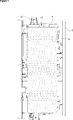
- Figure 1 – is the front schematic view of the household appliance related to an embodiment of the present invention.
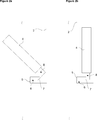
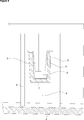
- Figure 2a – is the schematic view of the front panel and the board housing in the first position in an embodiment of the present invention.
- Figure 2b – is the schematic view of the front panel and the board housing in the second position in an embodiment of the present invention.
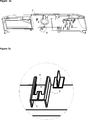
- Figure 3a – is the perspective view of the front panel in an embodiment of the present invention.
- Figure 3b – is the view of detail A in Figure 3a.
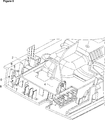
- Figure 4 – is the perspective view of the front panel and the board housing in an embodiment of the present invention.
- Figure 5 — is the perspective view of the front panel and the board housing in the first position in an embodiment of the present invention.
- Figure 6 — is the perspective view of the front panel and the cross-section of the board housing in an embodiment of the present invention.
- Figure 7a – is the detailed view of the front panel and the board housing in the first position in an embodiment of the present invention.
- Figure 7b – is the detailed view of the front panel and the board housing in the second position in an embodiment of the present invention.
- Figure 8 — is the cross-sectional view of the front panel and the board housing in an embodiment of the present invention.
- Figure 9 — is the detailed view of the first extension, the first housing, the second extension and the second housing in an embodiment of the present invention.
- the household appliance (1) comprises a front panel (2), a printed circuit board (3), and a board housing (4) fixed to the back side of the front panel (2) and wherein the printed circuit board (3) is disposed ( Figure 1).
- the printed circuit board (3) is placed into the board housing (4) and the board housing (4) is fixed to the back side of the front panel (2).
- the board housing (4) is preferably produced from a nonflammable material and prevents the sparks that may occur on the printed circuit board (3) from spreading to the household appliance (1).
- electronic components like light source, switch, diode, resistor can be disposed.
- the household appliance (1) of the present invention enables the board housing (4) to be mounted to the front panel (2) in a suspended manner and comprises
- the printed circuit board (3) is seated into the board housing (4) such that its effective surface faces the front panel (2).
- the board housing (4) is fixed to the front panel (2) in a suspended manner by changing the board housing (4) to the first position by aligning the side where the second extension (7) is located and the first extension (5) on the front panel (2) so as to face each other and by being rotated around the side where the second extension (7) is located; moving the board housing (4) near the inner surface of the front panel (2) and seating the end of the second extension (7) into the first housing (6) by passing through the gap between the first extension (5) and the front panel (2); after the second extension (7) is inserted through the orifice of the first housing (6), rotating the board housing (4) around the axis where the second extension is located so that the opposite side of the board housing (4) moves near the front panel (2) and changing the board housing (4) to the second position, and seating the first extension (5) into the second housing (8) as the board housing (4) changes to the second position.
- the board housing (4) is fixed to the front panel (2) in a suspended manner by means of the structure that is inserted into one another.
- the board housing (4) is dislodged by changing the board housing (4) from the second position to the first position, releasing the first extension (5) from the second housing (8) and then releasing the second extension (7) from the first housing (6).
- the second extension (7) of the present invention can either be located at the upper side or the lower side of the board housing (4) and when the board housing (4) is fixed so as to be suspended, the board housing (4) is partially movable with respect to the front panel (2). Since the first extension (5) is seated into the second housing (8) and the second extension (7) into the first housing (6) loosely, deformation does not occur.
- the board housing (4) is prevented from being dislodged in the vertical direction from the front panel (2). Moreover, while the board housing (4) is fixed to the front panel (2), the electronic components disposed on the printed circuit board (3) are prevented from being damaged ( Figure 2a, Figure 2b, Figure 5, Figure 7a, Figure 7b).
- the second housing (8) is configured to become narrower towards its base.
- the second extension (7) is enabled to be seated easily into the first housing (6).
- the first extension (5) with a cross-section that occupies the base of the second housing (8) is used.
- the board housing (4) is changed to the second position after the second extension (7) is seated into the first housing (6), and when the first extension (5) is seated into the second housing (8), the end of the first extension (5) completely occupies the base of the second housing (8) and thus the board housing (4) is prevented from moving.
- the board housing (4) is enabled to remain firm and the electronic components on the printed circuit board (3) are prevented from losing their functions when the electronic components on the printed circuit board (3) are aligned with the front panel (2) and the board housing (4) is fixed.
- the household appliance (1) comprises two supports (9) that extend almost perpendicularly to the inner surface of the front panel (2) and that support the first extension (5) by closing around the first housing (6).
- the strength of the first extension (5) against external factors is increased and is prevented from breaking.
- the supports (9) make the first housing (6) a closed volume by closing around the first housing (6) ( Figure 3a, Figure 3b).
- the household appliance (1) comprises a second housing (6) having side walls (10) and cut-outs (11) disposed between the supports (9) and the end of the first extension (5), wherein the side walls of the second housing (8) are inserted.
- the board housing (4) is prevented from being dislodged during transportation or due to vibrations originating from external effects ( Figure 9).
- the household appliance (1) comprises an additional fixing means (12) that enables the board housing (4) to be locked on the inner surface of the front panel (2).
- the additional fixing means (12) in this embodiment can be latch – housing pair or screw – screw socket pair that are snap fitted to one another.
- the board housing (4) that is suspended on the front panel (2) is enabled to be locked onto the front panel (2) ( Figure 4).
- fixing of the board housing (4) to the inner surface of the front panel (2) can be realized securely in a plug-and-use manner and can be performed over and over again by means of the first extension (5) and the second extension (7) pair.
- the number of components (for example screws) used in the fixing process is decreased, the assembly process is facilitated, saving in time is provided and most importantly the household appliance (1) is prevented from becoming defective due to dislodgement of the board housing (4) during transportation of the household appliance (1) from the factory to the user.
Landscapes
- Engineering & Computer Science (AREA)
- Textile Engineering (AREA)
- Casings For Electric Apparatus (AREA)
Abstract
The present invention relates to a household appliance (1) comprising a front panel (2), a printed circuit board (3), and a board housing (4) fixed to the back side of the front panel (2) and wherein the printed circuit board (3) is disposed, further described by the board housing (4) having a first position wherein the board housing (4) is inclined with respect to the surface of the front panel (2) and a second position wherein the board housing (4) is almost parallel to the front panel (2), at least one hook-shaped first extension (5) that is disposed on the inner surface of the front panel (2), the end of which faces the inner surface of the front panel (2), a first housing (6) that is situated between the first extension (5) and the inner surface of the front panel (2), at least one hook shaped second extension (7), disposed on the side of the board housing (4) opposite to the first extension (5), when the board housing (4) is rotated around the axis of the said side, that passes from the gap between the end of the first extension (5) and the inner surface of the front panel (2) and the end of which is inserted into the first housing (6), and a second housing (8) disposed between the second extension (7) and the side of the board housing (4), where into the first extension (5) is inserted when the board housing (4) is changed from the first position to the second position, providing the board housing (4) to be mounted to the front panel (2) so as to be suspended.
Description
The present invention relates to a household appliance comprising a printed circuit board.
Household appliances comprise a front panel that enables the user to control the household appliance and printed circuit boards disposed behind the front panel. On these printed circuit boards a large number of electronic circuit elements, for example, switches, light sources, resistors, diodes and capacitors are used. While using the household appliance, the said electronic elements may heat up and may damage the front panel that is mostly produced from plastic. Moreover, a spark that may occur on the printed circuit board can even start a fire. In order to prevent the said situation, the printed circuit boards are wrapped by elements called board retainers or board housings produced from nonflammable material. The board housing is mounted to the rear surface of the front panel by the state of the art fixing means. For example, the board housing is fixed to the rear of the front panel by screwing; however, this method increases costs and labor time. Another fixing means is the snap-fitting method realized by clawed structures. In this method, the claw and the claw housing facing each other so as to be inserted into one another realize the fixing in the position the board housing is almost parallel to the surface of the front panel. By means of the clawed fixing, the strength of the fixing between the board housing and the front panel is increased, on the other hand the disadvantage of the method is that once the assembly of the board housing is completed, it becomes difficult to dismount, and after dismounted, the initial strength cannot be provided and the clawed structures can be broken due to vibrations.
In the state of the art European Patent Application No. EP0943283, a domestic appliance is disclosed that comprises a protector cover that is closed by a latch lock system.
In the state of the art United States Patent Application No. US2012169193 and the European Patent Application No. EP1970479, a washer is disclosed wherein the protector cover is fixed to the front panel by the screwing method.
In the state of the art United States Patent Application No.US2013058060, a washer is disclosed wherein a hook member is used for fixing the printed circuit board to the protector cover.
The aim of the present invention is the realization of a household appliance comprising a board housing that is easily attachable/detachable on the rear surface of the front panel.
The household appliance realized in order to attain the aim of the present invention, explicated in the first claim and the respective claims thereof, comprises a front panel; a printed circuit board positioned behind the front panel; a board housing wherein the printed circuit board is placed; a first extension that is disposed on the inner surface of the front panel, that enables the board housing to be fixed to the front panel in a suspended manner and that is shaped as hooks to be inserted into one another; a first housing that is surrounded by the first extension and the inner surface of the front panel; a second extension that is disposed on the side of the board housing opposite the first extension and that is seated into the first housing by rotating the board housing around this side, and a second housing wherein the first extension is seated, that is surrounded by the second extension and the side of the board housing. The board housing has a first position wherein the board housing is inclined with respect to the front panel by being rotated around the axis of the side where the second extension is located, and a second position wherein the board housing is almost coplanar with the front panel. The board housing is first changed to the first position, thus the second extension is passed over the first extension and is inserted into the first housing, then the board housing is rotated and changed to the second position and the first extension is enabled to be seated into the second housing. By means of the present invention, fixing of the board housing to the front panel is facilitated and damage is prevented during mounting/dismounting operation.
In an embodiment of the present invention, the second housing is configured to widen towards its orifice. The second housing with wide orifice and the second extension that forms a wall of the second housing can be inserted easily through the gap between the first extension and the front panel when the board housing is in the first position. Moreover, while the board housing is changed from the first position to the second position, the first extension slides over the second extension and is seated into the second housing. Thus, the rotational movement of the board housing is guided and aligning the printed circuit board with the front panel is facilitated.
In an embodiment of the present invention, the first extension has a cross-section that is wide enough to occupy the base of the second housing. After the second extension is inserted into the first housing, the first extension is seated entirely into the second housing when the board housing is changed from the first position to the second position and the board housing is prevented from moving parallel to the front panel surface.
In an embodiment of the present invention, two supports are provided, that extend from the inner surface of the front panel towards two sides of the first extension, that support the first extension and that make the first housing a closed volume. The supports prevent the movement of the board housing along the side where the second extension is located when the second extension is seated into the first housing. At the same time, the first extension is protected from external factors like impacts and prevented from damage by means of the supports.
In an embodiment of the present invention, in the household appliance, the second housing has side walls and cut-outs are provided between the first extension and the supports wide enough for the side walls of the second housing to pass through. By means of this embodiment, the board housing is fixed to the front panel so as to be suspended in a firm manner.
In an embodiment of the present invention, additional fixing means that provides locking of the board housing to the front panel are used. After the second extension is seated into the first housing and the first extension into the second housing, the board housing, fixed to the front panel by being suspended, is entirely fixed by additional fixing means so as not to be dislodged. The additional fixing means can be state of the art screw – screw socket or latch – housing pairs.
In the household appliance of the present invention, the fixing of the board housing to the front panel is facilitated by means of the extensions and the assembly time becomes shorter. Furthermore, maintenance costs decrease since the board housing can be easily dislodged when required. Since the extensions do not deform one another while being seated into the housings, they can be used again and again safely.
The model embodiments that relate to the household appliance realized in order to attain the aim of the present invention are illustrated in the attached figures, where:
Figure 1 – is the front schematic view of the household appliance related to an embodiment of the present invention.
Figure 2a – is the schematic view of the front panel and the board housing in the first position in an embodiment of the present invention.
Figure 2b – is the schematic view of the front panel and the board housing in the second position in an embodiment of the present invention.
Figure 3a – is the perspective view of the front panel in an embodiment of the present invention.
Figure 3b – is the view of detail A in Figure 3a.
Figure 4 – is the perspective view of the front panel and the board housing in an embodiment of the present invention.
Figure 5 – is the perspective view of the front panel and the board housing in the first position in an embodiment of the present invention.
Figure 6 – is the perspective view of the front panel and the cross-section of the board housing in an embodiment of the present invention.
Figure 7a – is the detailed view of the front panel and the board housing in the first position in an embodiment of the present invention.
Figure 7b – is the detailed view of the front panel and the board housing in the second position in an embodiment of the present invention.
Figure 8 – is the cross-sectional view of the front panel and the board housing in an embodiment of the present invention.
Figure 9 – is the detailed view of the first extension, the first housing, the second extension and the second housing in an embodiment of the present invention.
The elements illustrated in the figures are numbered as follows:
1. Household appliance
2. Front panel
3. Printed circuit board
4. Board housing
5. First extension
6. First housing
7. Second extension
8. Second housing
9. Support
10. Side wall
11. Cut out
12. Additional fixing means
The household appliance (1) comprises a front panel (2), a printed circuit board (3), and a board housing (4) fixed to the back side of the front panel (2) and wherein the printed circuit board (3) is disposed (Figure 1).
In the household appliance (1), the printed circuit board (3) is placed into the board housing (4) and the board housing (4) is fixed to the back side of the front panel (2). The board housing (4) is preferably produced from a nonflammable material and prevents the sparks that may occur on the printed circuit board (3) from spreading to the household appliance (1). On the printed circuit board (3), electronic components (not shown in the figures) like light source, switch, diode, resistor can be disposed.
The household appliance (1) of the present invention enables the board housing (4) to be mounted to the front panel (2) in a suspended manner and comprises
- the board housing (4) having a first position wherein the board housing (4) is inclined with respect to the surface of the front panel (2) and a second position wherein the board housing (4) is almost parallel to the front panel (2),
- at least one hook-shaped first extension (5) that is disposed on the inner surface of the front panel (2), the end of which faces the inner surface of the front panel (2),
- a first housing (6) that is situated between the first extension (5) and the inner surface of the front panel (2),
- at least one hook-shaped second extension (7) that is disposed on the side of the board housing (4) opposite to the first extension (5), the end of which passes through the gap between the end of the first extension (5) and the inner surface of the front panel (2) and is inserted into the first housing (6) when the board housing (4) is rotated around the axis of the said side, and
- a second housing (8) that is disposed between the second extension (7) and the side of the board housing (4), wherein the first extension (5) is inserted when the board housing (4) is changed from the first position to the second position.
In the household appliance (1) of the present invention, the printed circuit board (3) is seated into the board housing (4) such that its effective surface faces the front panel (2). The board housing (4) is fixed to the front panel (2) in a suspended manner by changing the board housing (4) to the first position by aligning the side where the second extension (7) is located and the first extension (5) on the front panel (2) so as to face each other and by being rotated around the side where the second extension (7) is located; moving the board housing (4) near the inner surface of the front panel (2) and seating the end of the second extension (7) into the first housing (6) by passing through the gap between the first extension (5) and the front panel (2); after the second extension (7) is inserted through the orifice of the first housing (6), rotating the board housing (4) around the axis where the second extension is located so that the opposite side of the board housing (4) moves near the front panel (2) and changing the board housing (4) to the second position, and seating the first extension (5) into the second housing (8) as the board housing (4) changes to the second position. The board housing (4) is fixed to the front panel (2) in a suspended manner by means of the structure that is inserted into one another. The board housing (4) is dislodged by changing the board housing (4) from the second position to the first position, releasing the first extension (5) from the second housing (8) and then releasing the second extension (7) from the first housing (6). The second extension (7) of the present invention can either be located at the upper side or the lower side of the board housing (4) and when the board housing (4) is fixed so as to be suspended, the board housing (4) is partially movable with respect to the front panel (2). Since the first extension (5) is seated into the second housing (8) and the second extension (7) into the first housing (6) loosely, deformation does not occur. By the present invention, the board housing (4) is prevented from being dislodged in the vertical direction from the front panel (2). Moreover, while the board housing (4) is fixed to the front panel (2), the electronic components disposed on the printed circuit board (3) are prevented from being damaged (Figure 2a, Figure 2b, Figure 5, Figure 7a, Figure 7b).
In an embodiment of the present invention in the household appliance (1), the second housing (8) is configured to become narrower towards its base. By means of this embodiment, the second extension (7) is enabled to be seated easily into the first housing (6). Furthermore, by means of guiding the first extension (5) by resting against the second extension (7) while the first extension (5) is seated into the second housing (8), it becomes easy to align the electronic components on the printed circuit board (3) with the corresponding members on the front panel (2) surface, for example the switches and light holes.
In an embodiment of the present invention in the household appliance (1), the first extension (5) with a cross-section that occupies the base of the second housing (8) is used. In this embodiment, when the board housing (4) is changed to the second position after the second extension (7) is seated into the first housing (6), and when the first extension (5) is seated into the second housing (8), the end of the first extension (5) completely occupies the base of the second housing (8) and thus the board housing (4) is prevented from moving. The board housing (4) is enabled to remain firm and the electronic components on the printed circuit board (3) are prevented from losing their functions when the electronic components on the printed circuit board (3) are aligned with the front panel (2) and the board housing (4) is fixed.
In an embodiment of the present invention, the household appliance (1) comprises two supports (9) that extend almost perpendicularly to the inner surface of the front panel (2) and that support the first extension (5) by closing around the first housing (6). In this embodiment, the strength of the first extension (5) against external factors is increased and is prevented from breaking. Furthermore, the supports (9) make the first housing (6) a closed volume by closing around the first housing (6) (Figure 3a, Figure 3b).
In an embodiment of the present invention, the household appliance (1) comprises a second housing (6) having side walls (10) and cut-outs (11) disposed between the supports (9) and the end of the first extension (5), wherein the side walls of the second housing (8) are inserted. By means of this embodiment, the board housing (4) is prevented from being dislodged during transportation or due to vibrations originating from external effects (Figure 9).
In an embodiment of the present invention, the household appliance (1) comprises an additional fixing means (12) that enables the board housing (4) to be locked on the inner surface of the front panel (2). The additional fixing means (12) in this embodiment can be latch – housing pair or screw – screw socket pair that are snap fitted to one another. In this embodiment, the board housing (4) that is suspended on the front panel (2) is enabled to be locked onto the front panel (2) (Figure 4).
In the household appliance (1) of the present invention, fixing of the board housing (4) to the inner surface of the front panel (2) can be realized securely in a plug-and-use manner and can be performed over and over again by means of the first extension (5) and the second extension (7) pair. By means of the present invention, the number of components (for example screws) used in the fixing process is decreased, the assembly process is facilitated, saving in time is provided and most importantly the household appliance (1) is prevented from becoming defective due to dislodgement of the board housing (4) during transportation of the household appliance (1) from the factory to the user.
Claims (6)
- A household appliance (1) comprising a front panel (2), a printed circuit board (3) and a board housing (4) fixed to the back side of the front panel (2) and wherein the printed circuit board (3) is disposed characterized in that- the board housing (4) having a first position wherein the board housing (4) is inclined with respect to the surface of the front panel (2) and a second position wherein the board housing (4) is almost parallel to the front panel (2),- at least one hook-shaped first extension (5) that is disposed on the inner surface of the front panel (2), the end of which faces the inner surface of the front panel (2),- a first housing (6) that is situated between the first extension (5) and the inner surface of the front panel (2),- at least one hook shaped second extension (7), disposed on the side of the board housing (4) opposite to the first extension (5), when the board housing (4) is rotated around the axis of the said side, that passes from the gap between the end of the first extension (5) and the inner surface of the front panel (2) and the end of which is inserted into the first housing (6),- and a second housing (8) disposed between the second extension (7) and the side of the board housing (4), where into the first extension (5) is inserted when the board housing (4) is changed from the first position to the second position,- providing the board housing (4) to be mounted to the front panel (2) so as to be suspended.
- A household appliance (1) as in Claim 1, characterized by the second housing (8) which is configured to become narrower towards its base.
- A household appliance (1) as in any one of the above claims, characterized by the first extension (5), the end of which has a cross-section that almost entirely occupies the base of the second housing (8).
- A household appliance (1) as in any one of the above claims, characterized by two supports (9) that extend almost vertically to the inner surface of the front panel (2) and that support the first extension (5) by closing around the first housing (6).
- A household appliance (1) as in Claim 4, characterized by a second housing (6) having side walls (10) and by cut-outs (11) disposed between the supports (9) and the end of the first extension (5), wherein the side walls (10) of the second housing (8) are inserted.
- A household appliance (1) as in any one of the above claims, characterized by an additional fixing means (12) that enables the board housing (4) to be locked to the inner surface of the front panel (2).
Priority Applications (1)
| Application Number | Priority Date | Filing Date | Title |
|---|---|---|---|
| EP15718881.4A EP3155160B8 (en) | 2014-06-12 | 2015-04-28 | A household appliance comprising a printed circuit board |
Applications Claiming Priority (2)
| Application Number | Priority Date | Filing Date | Title |
|---|---|---|---|
| TR201406806 | 2014-06-12 | ||
| TRA2014/06806 | 2014-06-12 |
Publications (1)
| Publication Number | Publication Date |
|---|---|
| WO2015188973A1 true WO2015188973A1 (en) | 2015-12-17 |
Family
ID=53008506
Family Applications (1)
| Application Number | Title | Priority Date | Filing Date |
|---|---|---|---|
| PCT/EP2015/059115 Ceased WO2015188973A1 (en) | 2014-06-12 | 2015-04-28 | A household appliance comprising a printed circuit board |
Country Status (2)
| Country | Link |
|---|---|
| EP (1) | EP3155160B8 (en) |
| WO (1) | WO2015188973A1 (en) |
Cited By (2)
| Publication number | Priority date | Publication date | Assignee | Title |
|---|---|---|---|---|
| DE102019213456A1 (en) * | 2019-09-04 | 2021-03-04 | BSH Hausgeräte GmbH | Household dishwasher |
| EP4393372A1 (en) * | 2022-12-30 | 2024-07-03 | Arçelik Anonim Sirketi | A household appliance comprising a board holder |
Families Citing this family (1)
| Publication number | Priority date | Publication date | Assignee | Title |
|---|---|---|---|---|
| EP3969652B1 (en) * | 2019-05-15 | 2023-05-10 | Arçelik Anonim Sirketi | A washing machine comprising a protective cover |
Citations (5)
| Publication number | Priority date | Publication date | Assignee | Title |
|---|---|---|---|---|
| DE3739998C1 (en) * | 1987-11-25 | 1989-02-16 | Bosch Siemens Hausgeraete | Control and display device for electrically operated domestic appliances, especially for dishwashers |
| US20050122011A1 (en) * | 2003-12-04 | 2005-06-09 | Hwang Sung G. | Cabinet structure of home appliance |
| EP1596134A2 (en) * | 2004-05-10 | 2005-11-16 | Diehl AKO Stiftung & Co. KG | Time switch for cooker |
| DE102006039188A1 (en) * | 2005-08-22 | 2007-03-01 | Lg Electronics Inc. | A method for assembling the housing of a front loading horizontal axis clothes washing machine has decorative vertical front corners pieces with capping pieces held by a hook and opening arrangement |
| KR20070028152A (en) * | 2005-09-07 | 2007-03-12 | 엘지전자 주식회사 | Control panel of drum washing machine and upper deco |
-
2015
- 2015-04-28 WO PCT/EP2015/059115 patent/WO2015188973A1/en not_active Ceased
- 2015-04-28 EP EP15718881.4A patent/EP3155160B8/en active Active
Patent Citations (5)
| Publication number | Priority date | Publication date | Assignee | Title |
|---|---|---|---|---|
| DE3739998C1 (en) * | 1987-11-25 | 1989-02-16 | Bosch Siemens Hausgeraete | Control and display device for electrically operated domestic appliances, especially for dishwashers |
| US20050122011A1 (en) * | 2003-12-04 | 2005-06-09 | Hwang Sung G. | Cabinet structure of home appliance |
| EP1596134A2 (en) * | 2004-05-10 | 2005-11-16 | Diehl AKO Stiftung & Co. KG | Time switch for cooker |
| DE102006039188A1 (en) * | 2005-08-22 | 2007-03-01 | Lg Electronics Inc. | A method for assembling the housing of a front loading horizontal axis clothes washing machine has decorative vertical front corners pieces with capping pieces held by a hook and opening arrangement |
| KR20070028152A (en) * | 2005-09-07 | 2007-03-12 | 엘지전자 주식회사 | Control panel of drum washing machine and upper deco |
Cited By (6)
| Publication number | Priority date | Publication date | Assignee | Title |
|---|---|---|---|---|
| DE102019213456A1 (en) * | 2019-09-04 | 2021-03-04 | BSH Hausgeräte GmbH | Household dishwasher |
| WO2021043576A1 (en) | 2019-09-04 | 2021-03-11 | BSH Hausgeräte GmbH | Domestic dishwasher |
| CN114340467A (en) * | 2019-09-04 | 2022-04-12 | Bsh家用电器有限公司 | Household dish washer |
| CN114340467B (en) * | 2019-09-04 | 2024-04-09 | Bsh家用电器有限公司 | Household dishwasher |
| US12016511B2 (en) | 2019-09-04 | 2024-06-25 | BSH Hausgeräte GmbH | Domestic dishwasher |
| EP4393372A1 (en) * | 2022-12-30 | 2024-07-03 | Arçelik Anonim Sirketi | A household appliance comprising a board holder |
Also Published As
| Publication number | Publication date |
|---|---|
| EP3155160B8 (en) | 2019-07-17 |
| EP3155160A1 (en) | 2017-04-19 |
| EP3155160B1 (en) | 2019-06-12 |
Similar Documents
| Publication | Publication Date | Title |
|---|---|---|
| EP3155160B1 (en) | A household appliance comprising a printed circuit board | |
| CA2095904C (en) | Console with snap fit end caps | |
| EP2798111B1 (en) | A household appliance comprising a panel | |
| WO2018024558A1 (en) | Cooking appliance with improved side wire racks | |
| US20100220452A1 (en) | Operating panel for an electrical appliance | |
| CA2841199A1 (en) | Movable control panel to allow service access to built-in domestic appliance without removing appliance from built-in position | |
| EP2638200A1 (en) | A washer/dryer wherein ease of assembly is provided | |
| EP2360308B1 (en) | A control panel for a household appliance | |
| KR101375034B1 (en) | Handle on a distributing board | |
| US20180140162A1 (en) | Retainer for use in the door latch assembly of a household appliance | |
| WO2019129408A1 (en) | A washer/dryer comprising a plug holder | |
| EP3969652B1 (en) | A washing machine comprising a protective cover | |
| CN101469907B (en) | Household electrical appliance | |
| KR200486227Y1 (en) | Motor control center unit | |
| RU2667829C2 (en) | Indicator device containing display, and household appliances with such indicator device | |
| EP3767766A1 (en) | Electric or electronic device | |
| EP4393372B1 (en) | A household appliance comprising a board holder | |
| EP3155339A1 (en) | Household appliance | |
| WO2017194500A2 (en) | A household appliance comprising a knob safely mounted onto the panel | |
| CN212005793U (en) | Electromagnetic oven | |
| KR200337654Y1 (en) | trim-kit assembly | |
| RU194564U1 (en) | ELECTRIC CABINET WITH FRAME FRAME | |
| JPH09303793A (en) | Built-in kitchen furniture | |
| KR20090108437A (en) | Car box | |
| SE1850565A1 (en) | Fastening device, door for a switching cabinet as well as a switching cabinet comprising such a door |
Legal Events
| Date | Code | Title | Description |
|---|---|---|---|
| 121 | Ep: the epo has been informed by wipo that ep was designated in this application |
Ref document number: 15718881 Country of ref document: EP Kind code of ref document: A1 |
|
| REEP | Request for entry into the european phase |
Ref document number: 2015718881 Country of ref document: EP |
|
| WWE | Wipo information: entry into national phase |
Ref document number: 2015718881 Country of ref document: EP |
|
| NENP | Non-entry into the national phase |
Ref country code: DE |