WO2015197872A1 - Dérivés d'osw-1 et leur utilisation pour le traitement du cancer - Google Patents
Dérivés d'osw-1 et leur utilisation pour le traitement du cancer Download PDFInfo
- Publication number
- WO2015197872A1 WO2015197872A1 PCT/EP2015/064757 EP2015064757W WO2015197872A1 WO 2015197872 A1 WO2015197872 A1 WO 2015197872A1 EP 2015064757 W EP2015064757 W EP 2015064757W WO 2015197872 A1 WO2015197872 A1 WO 2015197872A1
- Authority
- WO
- WIPO (PCT)
- Prior art keywords
- group
- compound
- alkyl
- formula
- optionally substituted
- Prior art date
- Legal status (The legal status is an assumption and is not a legal conclusion. Google has not performed a legal analysis and makes no representation as to the accuracy of the status listed.)
- Ceased
Links
- 0 C[C@@](C*)CCC[C@@](C)[C@@]([C@](C1)O)[C@@](C)(CC2)[C@@]1[C@](CC1C3)[C@@]2[C@@](C)(CC2)[C@@]1C3C[C@@]2O Chemical compound C[C@@](C*)CCC[C@@](C)[C@@]([C@](C1)O)[C@@](C)(CC2)[C@@]1[C@](CC1C3)[C@@]2[C@@](C)(CC2)[C@@]1C3C[C@@]2O 0.000 description 7
- BZAVFFHQGXJIHS-GBRGEAIQSA-N CC[Si](CC)(CC)[O](C(C)[Si+](CC)(CC)[O-2])[C@@H](C[C@H]1OC(c(cc2)ccc2OC)=O)CO[C@H]1O[C@@H]([C@H](COC1O)O[Si+](CC)(CC)CC)[C@H]1OC(C)=O Chemical compound CC[Si](CC)(CC)[O](C(C)[Si+](CC)(CC)[O-2])[C@@H](C[C@H]1OC(c(cc2)ccc2OC)=O)CO[C@H]1O[C@@H]([C@H](COC1O)O[Si+](CC)(CC)CC)[C@H]1OC(C)=O BZAVFFHQGXJIHS-GBRGEAIQSA-N 0.000 description 1
Classifications
-
- C—CHEMISTRY; METALLURGY
- C07—ORGANIC CHEMISTRY
- C07J—STEROIDS
- C07J41/00—Normal steroids containing one or more nitrogen atoms not belonging to a hetero ring
- C07J41/0033—Normal steroids containing one or more nitrogen atoms not belonging to a hetero ring not covered by C07J41/0005
- C07J41/0088—Normal steroids containing one or more nitrogen atoms not belonging to a hetero ring not covered by C07J41/0005 containing unsubstituted amino radicals
-
- A—HUMAN NECESSITIES
- A61—MEDICAL OR VETERINARY SCIENCE; HYGIENE
- A61P—SPECIFIC THERAPEUTIC ACTIVITY OF CHEMICAL COMPOUNDS OR MEDICINAL PREPARATIONS
- A61P35/00—Antineoplastic agents
-
- A—HUMAN NECESSITIES
- A61—MEDICAL OR VETERINARY SCIENCE; HYGIENE
- A61P—SPECIFIC THERAPEUTIC ACTIVITY OF CHEMICAL COMPOUNDS OR MEDICINAL PREPARATIONS
- A61P35/00—Antineoplastic agents
- A61P35/02—Antineoplastic agents specific for leukemia
-
- C—CHEMISTRY; METALLURGY
- C07—ORGANIC CHEMISTRY
- C07J—STEROIDS
- C07J41/00—Normal steroids containing one or more nitrogen atoms not belonging to a hetero ring
- C07J41/0033—Normal steroids containing one or more nitrogen atoms not belonging to a hetero ring not covered by C07J41/0005
- C07J41/0055—Normal steroids containing one or more nitrogen atoms not belonging to a hetero ring not covered by C07J41/0005 the 17-beta position being substituted by an uninterrupted chain of at least three carbon atoms which may or may not be branched, e.g. cholane or cholestane derivatives, optionally cyclised, e.g. 17-beta-phenyl or 17-beta-furyl derivatives
-
- C—CHEMISTRY; METALLURGY
- C07—ORGANIC CHEMISTRY
- C07J—STEROIDS
- C07J43/00—Normal steroids having a nitrogen-containing hetero ring spiro-condensed or not condensed with the cyclopenta(a)hydrophenanthrene skeleton
- C07J43/003—Normal steroids having a nitrogen-containing hetero ring spiro-condensed or not condensed with the cyclopenta(a)hydrophenanthrene skeleton not condensed
-
- C—CHEMISTRY; METALLURGY
- C07—ORGANIC CHEMISTRY
- C07J—STEROIDS
- C07J31/00—Normal steroids containing one or more sulfur atoms not belonging to a hetero ring
- C07J31/006—Normal steroids containing one or more sulfur atoms not belonging to a hetero ring not covered by C07J31/003
Definitions
- the present invention relates to OSW-1 derivatives, their therapeutic use, especially in the treatment of cancer, and their method of synthesis.
- OSW-1 is a natural product belonging to the family of steroidal saponins and possessing anticancer properties.
- OSW-1 treatment leads to the overexpression or inhibition of the expression of a large number of miRNAs known to be associated with cancer and involved in proliferation, survival and cell migration, polarity and the epithelial-mesenchymal transition (Jin et al, Mol Med Reports 2013, 7, 1831-1837).
- OSW-1 target it is the oxysterol binding protein (OBP) and its close paralog OSBP-related protein-4L (ORP4L), a family of proteins involved in lipid metabolism, cell signaling, vesicular and non-vesicular trafficking in sterol transport.
- OBP oxysterol binding protein
- ORP4L OSBP-related protein-4L
- the compounds of this class carry a strongly hydrophobic steroid group and therefore have a very low solubility, especially in water where they are insoluble.
- the inventors of the present invention have surprisingly discovered that particular modifications of the structure of OSW-1, in particular with regard to the side chain, make it possible to obtain cytotoxic derivatives that are equally powerful and above all more soluble than OSW-1. 1 and its analogs previously described. These compounds are, in addition, more formable because carrying amine functional groups that can be salified.
- the present invention therefore more particularly relates to a compound of general formula (I:
- R 1 represents one or more substituent (s) identical (s) or different (s) each representing independently of each other a hydrogen atom, a halogen atom (preferably fluorine) or a trifluoromethyl group, (Ci -C 6 ) alkyl,
- R 3 to R 9 representing independently of each other a hydrogen atom or an optionally substituted (C 1 -C 6) alkyl group (preferably with a nitrogen and / or oxygen function), and
- n an integer from 1 to 6
- R 2 represents NR ", NNN , or O-R 12, preferably
- R 10 represents a hydrogen atom or an optionally substituted (preferably unsubstituted) (C 1 -C 6) alkyl group, and
- Ru represents a hydrogen atom or a (Ci-C 6) alkyl optionally substituted, optionally substituted aryl, aryl- (Ci-Ce) alkyl optionally substituted, Y (CH 2) 2 ⁇ Ri3, S0 2 R 14, COR 15 , C0 2 R 16 , or CONR 17 Ri8,
- Y 1 representing a single bond or a CO, CO 2 , CONR 19 or SO 2 group
- Y 2 representing an oxygen atom or a group NR 2 o or SO 2
- R13 to R 7 representing independently of each other a hydrogen atom or a (Ci-C 6) alkyl optionally substituted, optionally substituted aryl or aryl- (Ci-C 6) alkyl optionally substituted (preferably a hydrogen atom, hydrogen or a (C 1 -C 6 ) alkyl group), and
- R 6 R representing independently of each other a hydrogen atom or an optionally substituted (preferably unsubstituted) (C 1 -C 6 ) alkyl group
- R 2 is optionally substituted (C 1 -C 6) alkyl, optionally substituted aryl, optionally substituted (C 1 -C 6) aryl, Y 3 (CH 2 ) a 2 Y 4 R 2 , COR 22 , C 02 R 23 , or CONR 24 R 25 ,
- Y 4 represents an oxygen atom, or a group NR 27 or S0 2 ,
- a2 representing an integer from 1 to 6
- R 2 1 to R 24 represent, independently of one another, a hydrogen atom or an optionally substituted (C 1 -C 6 ) alkyl, optionally substituted aryl or optionally substituted (C 1 -C 6 ) alkyl (preferably an atom) group; hydrogen or a (C 1 -C 6 ) alkyl group), and R 25 to R 27 represent, independently of one another, a hydrogen atom or an optionally substituted (preferably unsubstituted) (C 1 -C 6 ) alkyl group.
- the ring junction may be of cis or trans configuration
- the compound of formula (I) may therefore adopt two different diastereoisomeric configurations and therefore be in the form of one or other of these diastereoisomers or in the form of a mixture of these in all proportions.
- the compound of formula (I) may therefore be in the form of one of their diastereoisomers or in the form of a mixture of these in all proportions.
- salts of a compound is meant in the present invention salts which are pharmaceutically acceptable, as defined above, and which possess the desired pharmacological activity of the parent compound.
- inorganic acids such as hydrochloric acid, hydrobromic acid, sulfuric acid, nitric acid, phosphoric acid and the like; or formed with organic acids such as acetic acid, formic acid, benzenesulfonic acid, benzoic acid, camphorsulphonic acid, citric acid, ethanesulfonic acid, fumaric acid, glucoheptonic acid, gluconic acid, glutamic acid, glycolic acid, hydroxynaphthoic acid, 2-hydroxyethanesulfonic acid, lactic acid, maleic acid, malic acid , mandelic acid, methanesulfonic acid, muconic acid, 2-naphthalenesulfonic acid, propionic acid, salicylic acid, succinic acid, dibenzoyl-L-tartaric acid, tartaric acid, p-toluenesulfonic acid, trimethylacetic acid, glucaric acid, trifluoroacetic acid, formic acid, benz
- (C x -C y ) alkyl represents linear or branched, saturated hydrocarbon chains comprising from x to y carbon atoms.
- (C 1 -C 6 ) alkyl represents chains of 1 to 6 carbon atoms. It may be in particular a methyl, ethyl, propyl, isopropyl, butyl, isobutyl, sec-butyl, tert-butyl, pentyl or hexyl group.
- (C 2 -C 6) alkenyl represents a hydrocarbon chain, linear or branched, having at least one double bond and having 2 to 6 carbon atoms. By way of example, mention may be made of ethenyl or allyl groups.
- (Ci-C 6) alkoxy represents a chain (Ci-C 6) alkyl group linked to the rest of the molecule via an oxygen atom.
- serialkylsilyl represents a group -SiAlkiAlk 2 Alk 3 with Alki, Alk 2 and Alk 3 representing, independently of each other, a (C 1 -C 6 ) alkyl group as defined above.
- aryl represents an aromatic hydrocarbon group, preferably containing from 6 to 10 carbon atoms, and comprising one or more contiguous rings, for example a phenyl or naphthyl group.
- aryl is an aromatic hydrocarbon group, preferably containing from 6 to 10 carbon atoms, and comprising one or more contiguous rings, for example a phenyl or naphthyl group.
- it is phenyl.
- aryl- (Ci-C 6) alkyl is understood within the meaning of the present invention, an aryl group as defined above bound to the rest of the molecule via a (Ci-C 6 ) alkyl as defined above. It may be in particular a benzyl group.
- heterocycle represents either a stable monocycle of 4 to 7, preferably 5 to 6, members, or a stable bicycle whose rings are formed from 8 to 11 atoms, the unicycle and the bicycle may be either saturated or unsaturated (including aromatics), 1 to 4 of the atoms forming the ring (s) being a heteroatom independently selected from sulfur, nitrogen and oxygen atoms, the other atoms forming the ring (s) ) being carbon atoms.
- furan By way of example, mention may be made of furan, pyrrole, thiophene, azetidine, pyrrolidine, morpholine, homopiperazine, thiazole, isothiazole, oxadiazole, imidazole, oxazole, isoxazole, triazole, tetrazole and pyridine.
- it is a 4- to 6-membered, preferably 5 or 6-membered saturated or unsaturated (including aromatic) monocycle, such as an azetidine, pyrrolidine, pyrrole, piperidine, morpholine or piperazine ring.
- optionally substituted is meant, in the sense of the present invention, that the group in question is optionally substituted by one or more substituents which may be chosen in particular from a halogen atom, a nitrogen and / or oxygen function, a group SO 2 R 28 , CN, N0 2 , (C 1 -C 6 ) alkyl optionally substituted by a nitrogen and / or oxygen function, (C 1 -C 6 ) alkoxy, aryl- (C 1 -C 6 ) alkyl, heterocycle and aryl with 1 ⁇ 2 represents a (C 1 -C 6 ) alkyl, aryl or aryl (C 1 -C 6 ) alkyl group, especially a (C 1 -C 6 ) alkyl group optionally substituted with a nitrogen and / or oxygen function.
- substituents which may be chosen in particular from a halogen atom, a nitrogen and / or oxygen function, a group SO 2 R 28 , CN, N0 2
- nitrogen function and / or oxygen is meant a group NR29R30, NR31COR32, NR33COOR34, NR35CONR36R37, OR 38, OCOR39, OCOOR40, OCONR41R42, COR43, COOR44 or CONR45R46, preferably a NR29R30 group or OR 38,
- R 29 to R 46 representing, independently of each other, a hydrogen atom or a (C 1 -C 6) alkyl, aryl or aryl (C 1 -C 6 ) alkyl group, preferably a hydrogen atom or a (C 1 -C 6 ) alkyl group.
- stereoisomer means a geometric isomer (or configuration isomer) or an optical isomer.
- the geometric isomers result from the different position of the substituents on a double bond which can then have a Z or E configuration, also called cis or trans.
- the optical isomers result in particular from the different position in the space of the substituents on a carbon atom comprising 4 different substituents. This carbon atom then constitutes a chiral center or asymmetric center.
- Optical isomers include diastereoisomers and enantiomers.
- Optical isomers that are images of each other in a mirror but not superimposable are referred to as "enantiomers”.
- Optical isomers that are not mirror images of each other in a mirror are referred to as "diastereoisomers”.
- asymmetric carbon is a carbon atom substituted by four different groups (a group may be a hydrogen atom).
- the compounds according to the invention comprise one to five R 1 groups, preferably 1 to 2 more preferably only 1 R 1 group.
- the R 1 group will preferably be located in the para position on the phenyl ring relative to the carbonyl group.
- the group R 1 may be in particular a group NR 3 R 4 or (C 1 -C 6 ) alkoxy, such as NHMe or OMe.
- the group R 1 is a (C 1 -C 6 ) alkoxy group, in particular a methoxy group.
- R 2 is a group N3.
- R 2 is a group NR , in which:
- R 10 represents a hydrogen atom or an optionally substituted (preferably unsubstituted) (C 1 -C 6) alkyl group, and
- Ru represents a hydrogen atom or an optionally substituted (C 1 -C 6 ) alkyl group, optionally substituted aryl, optionally substituted aryl (C 1 -C 6 ) alkyl, Y 1 (CH 2 ) al Y 2 R 13 , SO 2 R 14 , CORi 5 , C0 2 Ri 6 , or CONRjyRis,
- Y 1 representing a single bond or a group CO, CO 2 , CONR 19 or SO 2
- Y 2 representing an oxygen atom or an NR 2 o or S0 2 group
- R13 to Rn represent independently of each other a hydrogen atom or a (Ci-C 6) alkyl optionally substituted, optionally substituted aryl or aryl- (Ci-C 6) alkyl optionally substituted (preferably a hydrogen atom or a (C 1 -C 6 ) alkyl group, and
- R 2 o R representing independently of each other a hydrogen atom or an optionally substituted (Ci-C 6 ) alkyl group (preferably unsubstituted), • or Rio and Ru form with the nitrogen atom that carries an optionally substituted heterocycle.
- Rio and Ru do not form a ring with the nitrogen atom that carries them.
- Rio represents a hydrogen atom or a (C 1 -C 6) alkyl group. More particularly, Rio represents hydrogen or methyl.
- Ru represent in particular a hydrogen atom or a (Ci-C6) alkyl, optionally substituted aryl, aryl (Ci-C6) alkyl, Y (CH 2) a iY 2 Ri3, Ri4 S0 2, COR15, C0 2 Ri6 or CONR17R18, especially a hydrogen atom or a (Cl- Ce) alkyl, optionally substituted aryl (Ci-C6) alkyl, Y (CH 2) a iY 2 Ri3, SO2R14, coris, CO2R16, CONR17R18 or .
- Ru may represent a hydrogen atom or a (Ci-C6) alkyl, aryl, aryl- (Ci-C 6) alkyl, Y (CH 2) a iY 2 R 3, S0 2 R 4, COR 5, C0 2 Ri 6 , or CONR17R18.
- Ru will in particular represent a hydrogen atom or a (C 1 -C 6 ) alkyl, aryl, (C 1 -C 6 ) alkyl-aryl group, Y 1 (CH 2 ) a iY 2 Ri 3 , S0 2 R 4 , CORi 5 , C0 2 Ri 6 , or
- Ru will represent a hydrogen atom or a group (C
- Y 1 will preferably represent a single bond.
- Y 2 will advantageously represent an oxygen atom, an NR 2 o group or an S0 2 group, in particular an oxygen atom or an S0 2 group.
- al represents in particular an integer between 1 and 4, in particular 1 or 2, preferably 2.
- an optionally substituted (C 1 -C 6 ) alkyl group is advantageously a (C 1 -C 6 ) alkyl group optionally substituted by one or more substituents chosen from a halogen atom (such as fluorine), a nitrogen function and / or oxygenated, a group SO 2 R 28 , CN, NO 2 , (C 1 -C 6 ) alkyl optionally substituted by a nitrogen function and / or oxygen, (C 1 -C 6 ) alkoxy, aryl- (Ci-C 6) ) alkyl, heterocycle and aryl with I1 ⁇ 2 as defined above.
- a halogen atom such as fluorine
- a nitrogen function and / or oxygenated a group SO 2 R 28 , CN, NO 2 , (C 1 -C 6 ) alkyl optionally substituted by a nitrogen function and / or oxygen, (C 1
- an optionally substituted (Ci-C 6 ) alkyl group will be a (C 1 -C 6 ) alkyl group optionally substituted by one or more substituents chosen from a halogen atom (such as fluorine), a nitrogen function and / or oxygenated, a group SO 2 R 28 , (Ci-C 6 ) alkoxy, heterocycle and aryl.
- a halogen atom such as fluorine
- a (Ci-C 6) alkyl optionally substituted is a (Cl- C6) alkyl optionally substituted with one or more substituents selected from a halogen atom (such as fluorine), NR29R30, OR38, SO2R28, (Ci-C 6) alkoxy, heterocycle (such as morpholine or piperazine ring, including morpholine) and aryl (such as phenyl).
- a halogen atom such as fluorine
- NR29R30, OR38, SO2R28 (Ci-C 6) alkoxy
- heterocycle such as morpholine or piperazine ring, including morpholine
- aryl such as phenyl
- R 13 to R n advantageously represent, independently of one another, a hydrogen atom or a (C 1 -C 6 ) alkyl, aryl or aryl (C 1 -C 6 ) alkyl group, preferably an atom hydrogen or a (C 1 -C 6 ) alkyl group, more preferably a (C 1 -C 6 ) alkyl group.
- Ris to R 2 o will preferably represent, independently of each other, a hydrogen atom or a group (C 1 -C 6 ) alkyl.
- Ru may thus represent a (Ci-C 6 ) alkyl group, in which case Ru will preferably be a methyl, ethyl or isopropyl group.
- Ru may represent a hydrogen atom or an optionally substituted (Ci-C 6 ) alkyl group, in particular as defined above.
- Ru may alternatively represent a group Yi (CH 2 ) a iY 2 Ri 3 in which Y 1 represents a single bond, Y 2 is as defined above (and preferentially an oxygen atom, or a group SO 2 ), al represents 1 to 6, preferably 1 to 4, still more preferably 1 to 2, in particular 2, and R 13 represents a hydrogen atom or a (C 1 -C 6 ) alkyl group, especially a (C 1 -C 6 ) alkyl group.
- Ru may alternatively represent an aryl group (Ci-C 6) alkyl optionally substituted (especially unsubstituted), preferably an aryl group (Ci-C 2) alkyl optionally substituted (especially unsubstituted).
- the aryl will especially be a phenyl group.
- Ru may alternatively represent an optionally substituted (Ci-C 6 ) alkyl-aryl (in particular unsubstituted) group, preferably an optionally substituted (C1-C2) alkyl-aryl group (in particular unsubstituted).
- Aryl will be especially a phenyl group.
- Ru may finally represent a group S0 2 Ri4, COR15, C0 2 Ri 6 , or
- CONR17R18 particularly SO2R14, COR15, CONR17R18 or with R14 to Rn being independently of each other, a (Ci-C 6) alkyl and Ris representing a hydrogen atom or a (Ci-C 6) alkyl.
- Rio and Ru form with the nitrogen atom which carries them an optionally substituted heterocycle, in particular the heterocycle will have 5 to 6 members.
- the heterocycle will in particular comprise 1 to 3 heteroatoms (including the nitrogen atom bearing the groups Rio and Ru) chosen from N and O.
- the heterocycle may in particular be chosen from the azetidine, pyrrolidine, pyrrole and piperidine rings.
- morpholine, piperazine, homopiperazine, thiazole, oxazole, triazole and tetrazole in particular chosen from the morpholine, piperazine and triazole rings (in particular 1, 2,3-triazole), preferably chosen from the morpholine and triazole rings (in particular 1 , 2,3-triazole).
- This heterocycle will be optionally substituted by one or more substituents which may be chosen in particular from a halogen atom, a nitrogen and / or oxygen function, a group S0 2 R 2 8, CN, N0 2 , (C 1 -C 6 ) alkyl optionally substituted with a nitrogen and / or oxygen function, (C 1 -C 6 ) alkoxy, aryl (C 1 -C 6 ) alkyl, heterocycle and aryl with R 2 8 representing a (C 1 -C 6) alkyl, aryl or aryl group. (C 1 -C 6 ) alkyl.
- the heterocycle will be optionally substituted with a (C 1 -C 6 ) alkyl group optionally substituted with a nitrogen and / or oxygenated function.
- Nitrogen and / or oxygen function is advantageously a group NR29R30, NR31COR32, NR33COOR34, NR35CONR36R37, OR 38, OCOR39, OCOOR40, OCONR41R42, COR43, COOR44 or CONR45R46, preferably a group NR29R30 or OR38.
- R 2 is a grouping: ⁇ K 12 with
- R 2 is (C 1 -C 6 ) alkyl, aryl, aryl (C 1 -C 6 ) alkyl, Y 3 (CH 2 ) a 2 Y 4 R 2 , COR 22 , C0 2 R 23 , or CONR 24 R 25 .
- R 2 represents a group Y 3 (CH 2) a2 Y 4 R 2 i, R 2 i advantageously representing a group (Ci-Ce) alkyl and a2 advantageously representing 1 to 6, preferably 1 to 4, still preferably 1 to 2, in particular 2.
- Y 4 may in particular represent a group NR 27 or S0 2 , in particular S0 2 .
- Y 3 will advantageously represent a single bond or a CONR group 26 , in particular a CONR 26 group, with R 26 preferably representing a hydrogen atom or a (C 1 -C 6 ) alkyl group, preferably a hydrogen atom.
- the compounds according to the invention correspond to compounds
- the compounds of the present invention may be chosen from the compounds mentioned in the following table: or a pharmaceutically acceptable salt and / or solvate thereof, such as a salt formed with formic acid.
- the present invention also relates to a compound according to the invention of formula (I) as defined above, for its use as a medicament, in particular for the treatment of cancer.
- the present invention also relates to the use of a compound of formula (I) as defined above, for the manufacture of a medicament, in particular for the treatment of cancer.
- the present invention also relates to a method of treating cancer, comprising administering to a person in need of an effective dose of a compound of formula (I) as defined above.
- the cancer may be more particularly in this case colon cancer, breast cancer, kidney cancer, liver cancer, pancreatic cancer, prostate cancer, glioblastoma, lung cancer, neuroblastoma , an inflammatory myofibroblastic tumor, or lymphoma.
- the present invention also relates to a pharmaceutical composition
- a pharmaceutical composition comprising at least one compound of formula (I) as defined above, and at least one pharmaceutically acceptable excipient.
- compositions according to the invention can be formulated especially for oral administration or by injection, said compositions being intended for mammals, including humans.
- the active ingredient can be administered in unit dosage forms, in admixture with conventional pharmaceutical carriers, to animals or humans.
- the compounds of the invention as active ingredients can be used at doses of between 0.01 mg and 1000 mg per day, given as a single dose once a day or administered in several doses throughout the day, for example twice a day in equal doses.
- the dose administered per day is advantageously between 5 mg and 500 mg, more advantageously between 10 mg and 200 mg. It may be necessary to use doses out of these ranges which the skilled person can realize himself.
- compositions according to the invention may also comprise at least one other active ingredient, such as an anticancer agent.
- the present invention also relates to a pharmaceutical composition
- a pharmaceutical composition comprising:
- the present invention also relates to a pharmaceutical composition as defined above for its use as a medicament, in particular for the treatment of cancer.
- the present invention also relates to processes for preparing the compounds of formula (I) according to the invention.
- the present invention thus relates to a first process for preparing a compound of formula (I) according to the invention comprising the following steps:
- GPi represents an O-protecting group and R 2 GP represents a group R 2 as defined above, optionally in protected form,
- LGi represents a leaving group
- GP 2 , GP 3 and GP 4 each represent, independently of each other, an O-protecting group
- Ri G p represents a group R 1 as defined above, optionally in a protected form
- protecting group or “protecting group” is intended to denote a group that selectively blocks a reactive site in a multifunctional compound so that a chemical reaction can be selectively carried out at the level of another unprotected reactive site in the meaning conventionally associated with it in synthetic chemistry.
- O-protecting group is intended to mean any substituent which protects the hydroxyl or carboxyl group, that is to say a reactive oxygen atom, against undesirable reactions such as cleavage groups.
- a hydroxyl group protected by an O-protecting group may be for example an ether, an ester, a carbonate, an acetal
- the O-protecting groups comprise a (C 1 -C 6 ) alkyl group optionally substituted with one or more (especially 1 to 3) halogen atoms (such as chlorine atoms), such as methyl, ethyl, tert-butyl and 2,2,2-trichloroethyl; an aryl (C 1 -C 6 ) alkyl group, such as benzyl, the aryl ring being optionally substituted by one or more methoxy groups, such as benzyl (Bn) and / or methoxybenzyl (PMB); a trityl group of formula -CAriAr 2 Ar 3, such as triphenylmethyl (also called trityl-Tr), (4-methoxyphenyl) diphenylmethyl (also called me
- Ar 2 and Ar 3 representing, independently of each other, an aryl, such as phenyl, optionally substituted by one or more methoxy groups;
- R GP2 representing a group (Ci-C 6) alkyl (such as methyl ethyl or) optionally substituted by an aryl group (such as phenyl), (Ci-C 6) alkoxy (such as methoxy) or trialkylsilyl (such as SiMe 3 );
- RG P3, P4 RG and RG S P representing, independently of each other, a (Ci-C 6) alkyl or aryl (such as phenyl);
- RG P6 and RG P 7 represent, independently of one another, a (C 1 -C 6 ) alkyl, (C 2 -C 6 ) alkenyl, aryl, aryl- (C 1 -C 6 ) alkyl or 9 -fluorénylméthyle.
- aryl ring being optionally substituted (preferably unsubstituted) with one or more methoxy groups (in particular Bn).
- N-protecting group is meant, within the meaning of the present invention, any substituent that protects a primary or secondary amine function against the reactions such as the N-protecting groups described in Greene “Protective Groups In Organic Synthesis", (John Wiley & Sons, New York (1981)) and Harrison et al. Compendium of Synthetic Organic Methods, Vols. 1 to 8 (J. Wiley & sons, 1971 to 1996).
- An amine functional group protected by an N-protecting group may be, for example, a carbamate, an amide, a sulfonamide, an N-alkyl derivative, an amino acetal derivative, an N-benzyl derivative, an imine derivative, an enamine derivative or a derivative.
- the N-protecting groups comprise a formyl group; an aryl group, such as phenyl, optionally substituted by one or more methoxy groups, such as the ⁇ -methoxyphenyl (PMP) group; aryl- (Ci-C 6) alkyl, such as benzyl, the aryl ring being optionally substituted by one or more methoxy groups, such as benzyl (Bn), /?
- a group -CO-R GPI such as acetyl (Ac), pivaloyl (Piv or Pv), benzoyl (Bz) and / or methoxybenzylcarbonyl (Moz); a group -C0 2 -RG PI such as tbutyloxycarbonyl (Boc), trichloroethoxycarbonyl (TROC), allyloxycarbonyl (Alloc), benzyloxycarbonyl (Cbz or Z) and 9-fluorenylmethyloxycarbonyl (Fmoc); a group -S0 2 -RG PI such as phenylsulfonyl, tosyl (Ts or Tos) and 2-nitrobenzenesulfonyl (also called nosyl - Nos or Ns); and similar,
- R GPI representing a (Ci-Ce) alkyl group optionally substituted with one or more halogen flavors such as F or Cl; a (C 2 -C 6 ) alkenyl group such as an allyl group; an aryl group, such as phenyl, optionally substituted by one or more groups selected from OMe (methoxy) and NO 2 (nitro); an aryl (C 1 -C 6 ) alkyl group, such as benzyl, the aryl ring being optionally substituted by one or more methoxy groups; or a 9-fluorenylmethyl group.
- deprotection is meant, in the sense of the present invention, the process by which a protecting group is removed once the selective reaction is complete. Some protecting groups may be preferred over others because of their convenience or relative ease of disposal.
- leaving group is meant, in the sense of the present invention, a chemical group that can be easily moved by a nucleophile during a nucleophilic substitution reaction, the nucleophile being more particularly a alcohol.
- a leaving group may be more particularly a halogen atom, a sulfonate or an imidate.
- the halogen atom can be a chlorine or bromine atom.
- the sulfonate will more particularly be a group -OSO 2 -R 'with R' representing a group (C 1 -C 6 ) alkyl, aryl, aryl- (C 1 -C 6 ) alkyl or (C 1 -C 6 ) alkyl-aryl, said the group being optionally substituted with one or more halogen atoms such as fluorine.
- the sulphonate may in particular be a mesylate (CH 3 -S (O 2 ) O-), a triflate (CF 3 -S (O) 2 O-) or a tosylate (/? - Me-C 6 H 4 -S (0) 2 0-).
- Step 1)
- the condensation reaction can be carried out in a solvent such as dichloromethane.
- the condensation reaction will advantageously be carried out in the presence of trimethylsilyl trimethanesulfonate.
- GPi, GP 2 , GP 3 and GP 4 identical or different, will advantageously represent a silyl group of formula -SIRGP 3 RGP 4 RGP5 with RGP 3 , RGP4 and RGPS as defined above or an aryl- (Ci-C) group 6 ) alkyl, the aryl ring being optionally substituted (preferably unsubstituted) by one or more methoxy groups.
- GPi, GP 2 , GP 3 and GP 4 represent a silyl group of formula -SiRG P3 RG P4 RG P 5 such that TES and TBMS and are advantageously identical.
- the N-protecting group will be more particularly a -C0 2 -R GPI group with R GPI as defined above, and in particular a Cbz group.
- the O-protecting group will be more particularly a silyl group of formula P -SÎRG 3RG RG P4 P 5 (especially TBDMS or TES) or aryl- (Ci-C6) alkyl, the aryl ring being optionally substituted (preferably not substituted) with one or more methoxy groups (in particular Bn).
- the deprotection step will be carried out under conditions well known to those skilled in the art.
- O-protecting groups TES and TBDMS may be deprotected in the presence of palladium chloride, bis acetonitrile. This reaction may be carried out in a solvent such as acetone.
- the O-protecting group Bn and the N-protecting group Cbz may be deprotected in the presence of Raney nickel. This reaction may be carried out in a solvent such as ethanol, water and a mixture thereof.
- the step of reducing the double bond can be carried out under conditions well known to those skilled in the art, for example in the presence of Raney nickel, especially in a solvent such as ethanol, water and a mixture of them.
- the salification step may be carried out under conditions well known to those skilled in the art, in the presence of a pharmaceutically acceptable acid or base.
- a pharmaceutically acceptable acid or base When the compound is in a solvated form, this solvation generally takes place in the last stage of the process, the solvent of the solvated form being in this case the solvent of the reaction medium.
- Such a method is illustrated in more detail below, according to different embodiments.
- the present invention relates to a process for preparing a compound of formula (I) according to the invention for which R 2 represents 3 characterized by the following successive stages:
- Diagram 1 are substituted derivatives of general formula IVa wherein A represents a leaving group such as OTs and "is as defined in general formula I, with sodium azide in a solvent such ue dimethylformamide;
- the compound of formula la is salified in the preceding step in the presence of a pharmaceutically acceptable base to give a pharmaceutically acceptable salt of the compound of formula la.
- the present invention relates to a process for preparing a compound of formula (I) according to the invention for which R 2 represents Rio
- the present invention relates to a process for preparing a compound of formula (I) according to the invention for which R 2 represents:
- the present invention also relates to a second process for preparing a compound of formula (I) according to the invention for which R 2 represents a 1,2,3-triazol-1-yl group optionally substituted with a (Ci-C) group.
- Step 1) optionally salif ⁇ cation and / or solvation to give a compound of formula (Id) according to the invention in the form of a salt and / or a pharmaceutically acceptable solvate.
- the compound (Id) corresponds to a compound of formula (I) according to the invention for which R 2 represents a 1,2,3-triazol-1-yl group optionally substituted by an optionally substituted (C 1 -C 6 ) alkyl group by a nitrogen and / or oxygen function.
- step (1) can be carried out in a solvent such as methanol, THF, water and a mixture thereof.
- This reaction can be carried out in the presence of sodium (R) -5 - ((S) -1,2-dihydroxyethyl) -4-hydroxy-2-oxo-2,5-dihydrofuran-3-olate and copper sulfate pentahydrate.
- the group R represents a (C 1 -C 6) alkyl group optionally substituted with a nitrogen and / or oxygen function.
- Nitrogen and / or oxygen function is advantageously a NR29R30 group, NR31COR32, NR33COOR34, NR35CONR36R37, OR 38, OCOR39, OCOOR40, OCONR41R42, COR43, COOR44 or CONR45R46, preferably a NR29R30 group or OR38, with R29 to R46 as defined above .
- Step (2) see step (iii)
- Step (3) see step (iv)
- the present invention also relates to a third process for preparing a compound of formula (I) according to the invention for which R 2 represents a NRioRn group, Rio and Ru not forming a ring with the nitrogen atom that carries them, comprising the following steps:
- This reduction reaction of the azide function can be carried out under conditions well known to those skilled in the art, for example in the presence of triphenylphosphine as reducing agent.
- the reaction can be carried out in THF as a solvent.
- This substitution reaction can be carried out under conditions well known to those skilled in the art.
- the reaction may be carried out in the presence of a compound of formula R 10 LG 2 or R 11 LG 2 with Rio and Ru as defined above and other than a hydrogen atom and LG 2 representing a leaving group. It may be a halogen atom such as a chlorine atom.
- the Ru group contains a carbonyl unit linked to the LG 2 group
- LG 2 may also be an imidazole or a group -OC (O) Alk with Alk representing a (C 1 -C 6 ) alkyl group.
- the reaction may be carried out in the presence of a base such as pyridine or triethylamine.
- a base such as pyridine or triethylamine.
- the dichloromethane may be used as a solvent for this reaction.
- Rio and Ru each represent a group other than a hydrogen atom, two successive substitution reactions can be carried out, the first substitution reaction preferably aimed at introducing the Ru substituent.
- the intermediate and final compounds can be, if desired, purified according to one or more purification methods chosen from extraction, filtration, silica gel chromatography, preparative HPLC on normal or reverse phase, crystallization. .
- the compounds of the present invention can be synthesized using the synthetic routes described below or using synthetic methods known to those skilled in the art. Mass and NMR spectra confirm the structures of the compounds.
- phase A water / 0.04% NH 3
- phase B Acetonitrile
- phase A water / 0.05% formic acid
- phase B Acetonitrile / 0.05%> formic acid total flow rate: 2 mL / min
- phase A water / 0.1% formic acid
- phase B Acetonitrile / 0.1% formic acid total flow rate: 2 mL / min
- phase A water / 0.05% TFA
- phase B acetonitrile / 0.05% TFA
- Intermediate 4c is prepared from intermediate 6c according to the method described for intermediate 4a with a yield of 80%.
- Diosides 1 and 2 are prepared according to the method described by Deng, S. et al., J. Org. Hem., 1999, 64, 202-208.
- the dioside 2 is prepared according to the method described in scheme 5 by protecting the intermediates 7a and 7b with the Cbz group. It is obtained in the form of a yellow solid with a yield of 0.5%.
- Example 1 (2S, 3R, 4S, 5R) -2 - (((2S, 3R, 4S, 5S) -3-acetoxy-2 - (((3S, 10R, -13S, -16S) -17- ( (2R, 6R) -7-azido-6-methylheptan-2-yl) -3-hydroxy-10,13-dimethyl-2,3,4,7,8,9,10,11,12,13,14 , 15,16,17-Tetradecahydro-1H-cyclopenta [a] phenenanthren-16-yl) oxy) -5-hydroxytetrahydro-2H-pyran-4-yl) oxy) -4,5-dihydroxytetrahydro-2H-pyran 3-yl 4-methoxybenzoate
- Example 1 is synthesized according to Method 1:
- Step 1 0.34 g (0.358 mmol) activated dioside 1 as 2- (2,2,2-trichloro-1-iminoethoxy) (method described by Deng, S. et al., J. Org. Chem. 1999, 64, 202-208) and 0.1 g (0.18 mmol) of intermediate 4b are placed in 10 mL of dichloromethane in the presence of 4A sieve (0.7 g, 0.18 mmol) and stirred. at room temperature for 15 min. After cooling to -65 ° C, a 0.14 M solution of trimethylsilyl trifluoromethanesulfonate (1.79 mL) in CH 2 Cl 2 is added dropwise and the mixture is stirred for 30 min.
- Step 2 0.13 g (0.097 mmol) of the preceding intermediate is placed in 4.8 mL of acetone and 0.2 mL of water in the presence of palladium chloride, bis acetonitrile (7.5 mg, 0.029 mmol ). The medium is stirred for 3h at room temperature, filtered through Celite® and then concentrated to dryness. The residue obtained is purified on flash silica (CH 2 Cl 2 / MeOH gradient: 100/0 to 90/10 in 25 min). Compound 1 is isolated as an orange solid (0.021 g) with a yield of 24%.
- Example 2 is synthesized according to method 2:
- Step 1 glycosylation of the steroid 2i with dioside 1 under the conditions described in step 1 of method 1.
- Step 2 0.096 g (0.10 mmol) of intermediate is placed in 5 mL of EtOH in the presence of 200 of a suspension of Raney Nickel (50% in water). The mixture is stirred for 4 days at 50 ° C. in a sealed tube. After concentration to dryness, the residue obtained is purified on flash silica (gradient CH 2 Cl 2 / MeOH: 100/0 to 90/10 in 30 minutes). Compound 2 is isolated as a white solid (0.053 g) with a yield of 35%.
- Tr 2.24 C NMR (125MHz, CD 3 OD, ppm): 13.2; 17.4; 18.5; 19.8; 21.0; 21.9; 23.6; 30.3; 32.3; 32.9; 33.3 (2 carbons); 35.4; 36.6; 36.8; 37.7; 38.5; 41.0; 43.0; 43.4; 46.6; 51.7; 56.0; 56.1; 62.1; 66.1; 66.5; 69.5; 70.9; 72.3; 72.4; 75.1; 75.6; 81.0; 82.6; 103.4; 103.6; 114.8 (2 carbons); 122.3; 123.6; 133.2 (2 carbons); 142.3; 165.3; 167.0; 171.0.
- Example 3 is synthesized according to method 2 from steroid 3a and dioside 1 (yield: 50%).
- Example 4 is synthesized according to method 3:
- Step 1 glycosylation of the steroid 3a by dioside 1 under the conditions described in step 1 of method 1.
- Step 2 deprotection of the silyl groups by palladium chloride, bis acetonitrile under the conditions described in step 2 of method 1.
- Step 3 Deprotection of benzyl with Raney nickel under the conditions described in step 2 of method 2.
- Compound 4 is isolated after purification by HPLC as a white solid (0.059 g) with a yield of 35%.
- Example 7 (2S, 3R, 4S, 5R) -2 - (((2S, 3R, 4S, 5S) -3-acetoxy-5-hydroxy-2 - (((3S, -10R, 13S, 16S, 17R ) -3-hydroxy-17 - ((2R, 6R) -7 - ((2-methoxyethyl) amino) -6-methylheptan-2-yl) -10, 13-dimethyl-2,3,4,7,8 , 9, 10, 1, 12, 13, 14, 15, 16, 17-tetradecahydro-1H-cyclopenta [a] phenenanthren-16-yl) oxy) tetrahydro-2H-pyran-4-yl) oxy) -4 5-Dihydroxytetrahydro-2H-pyran-3-yl 4-methoxybenzoate
- Example 8 (2S, 3R, 4S, 5R) -2 - (((2S, 3R, 4S, 5S) -3-acetoxy-5-hydroxy-2 - (((3S, -5S, 1 OS) formate, 13S, 16S, 17R) -3-hydroxy-17 - ((2R, 6R) -7 - ((2-methoxy-ethyl) amino) -6-methylheptan-2-yl) -10,13-dimethylhexadecahydro-1H- Cyclo-penta [a] phenanthren-16-yl) oxy) tetrahydro-2H-pyran-4-yl) oxy) -4,5-dihydroxytetrahydro-2H-pyran-3-yl
- Example 12 (2S, 3R, 4S, 5R) -2 - (((2S, 3R, 4S, 5S) -3-acetoxy-5-hydroxy-2 - (((3S, -1R, 13S) formate, 16S, 17R) -3-hydroxy-10,13-dimethyl-17 - ((2R, 6R) -6-methyl-7-morpholinomhe-2-yl) -2,3,4,7,8,9 , 10, 11, 12, 13, 14, 15, 16, 17-tetradecahydro-1H-cyclopenta [a] phenenanthren-16-yl) oxy) tetrahydro-2H-pyran-4-yl) oxy) -4,5- dihydroxytetrahydro-2H-pyran-3-yl 4-methoxybenzoate
- Example 13 (2S, 3R, 4S, 5R) -2 - (((2S, 3R, 4S, 5S) -3-acetoxy-5-hydroxy-2 - (((3S, 5S, -10S, 13S) formate 16S, 17R) -3-hydroxy-10,13-dimethyl-17 - ((2R, 6R) -6-methyl-7-morpholinoheptan-2-yl) hexadecahydro-1H-cyclopenta [a] phenanthren-16- yl) oxy) tetrahydro-2H-pyran-4-yl) oxy) -4,5-dihydroxytetrahydro-2H-pyran-3-yl
- Example 14 (2S, 3R, 4S, 5R) -2 - (((2R, 3R, 4S, 5S) -3-acetoxy-5-hydroxy-2 - (((3S, 1 OR, 13S, 16S) formate 17R) -3-hydroxy-10,13-dimethyl-17- ((2R, 6R) -6-methyl-7 - ((2- (methylsulfonyl) ethyl) amino) heptan-2-yl) -2,3 , 4,7,8,9, 10, 1, 12, 13, 14, 15, 16, 17-tetradecahydro-1H-cyclopenta [a] phenenanthren-16-yl) oxy) tetrahydro-2H-pyran-4 (yl) oxy) -4,5-dihydroxytetrahydro-2H-pyran-3-yl 4-methoxybenzoate
- Example 17 (2S, 3R, 4S, 5R) -2 - (((2S, 3R, 4S, 5S) -3-acetoxy-2 - (((3S, 10R, 13S, -16S, 17R) - formate 17 - ((2R, 6R) -7- (benzyl (methyl) amino) -6-methylheptan-2-yl) -3-hydroxy-10,13-dimethyl-2,3,4,7,8,9, 10,11,13,13,14,15,16,17-Tetradecahydro-1H-cyclopenta [a] phenenanthren-16-yl) oxy) -5-hydroxytetrahydro-2H-pyran-4-yl) oxy) -4 5-dihydroxytetrahydro-2H-pyran-3-yl 4-methoxybenzoate
- Example 18 (2S, 3R, 4S, 5R) -2 - (((2R, 3R, 4S, 5S) -3-acetoxy-5-hydroxy-2 - (((3S, 10R, 13S, 16S, 17R) 3-hydroxy-10,13-dimethyl-17 - ((2R, 6R) -6-methyl-7- (4 - ((methylamino) methyl) -1H-1,2,3-triazol-1-yl) heptan-2-yl) -2,3,4,7,8,9,10, 1, 12,13, 14, 15, 16, 17-tetradecahydro-1H-cyclopenta [a] phenanthren-16-yl oxy) tetrahydro-2H-pyran-4-yl) oxy) -4,5-dihydroxytetrahydro-2H-pyran-3-yl 4-methoxybenzoate
- Example 18 is synthesized according to method 4: 0.12 g (0.13 mmol) of compound 1 is placed in a solution of 3.5 mL of methanol, 1 mL of THF and 0.5 mL of water. 0.05 g, (0.24 mmol) of sodium (R) -5 - ((S) -1,2-dihydroxyethyl) -4-hydroxy-2-oxo-2,5-dihydrofuran-3-olate followed by 0.06 g (0.24 mmol) of copper sulfate pentahydrate and 0.05 ml (0.59 mmol) of N-methylprop-2-yn-1-amine are added. The mixture is sonicated for 7 minutes.
- Example 19 (2S, 3R, 4S, 5R) -2 - (((2S, 3R, 4S, 5S) -2 - (((3S, 10R, 13S, 16S, 17R) -17 - ((2R, 6R ) -7-acetamido-6-methylheptan-2-yl) -3-hydroxy-10,13-dimethyl-2,3,4,7,8,9,10,11,12,13,14,15,16 , 17-Tetradecahydro-1H-cyclopenta [a] phenenanthren-16-yl) oxy) -3-acetoxy-5-hydroxytetrahydro-2H-pyran-4-yl) oxy) -4,5-dihydroxytetrahydro-2H-pyran 3-yl 4-methoxybenzoate
- Example 19 is synthesized according to method 5:
- Step 1 glycosylation of steroid 4b with dioside 1 under the conditions described in step 1 of method 1.
- Step 2 The azide of the intermediate obtained in the previous step (0.095 g, 0.071 mmol) is placed in a solution of 5 mL of THF and 1.5 mL of water. Triphenylphosphine is added (0.056 g, 0.21 mmol) and then the mixture is stirred for 40h at room temperature. After filtration on celite®, the medium is concentrated to dryness and the residue obtained is purified on flash silica (gradient CH 2 Cl 2 / MeOH: 100/0 to 90/10 in 20 minutes).
- Step 3 0.074 g (0.056 mmol) of intermediate obtained in the preceding step is placed in the presence of 9.10 of pyridine (0.11 mmol) in 2 ml of dichloromethane at 0 ° C. under argon. 0.01 1 ml (0.19 mmol) of acetic anhydride is added and then the mixture is stirred overnight at room temperature. The reaction medium is washed with water, and then the organic phases are concentrated to dryness after drying. The residue obtained is used as it is for the next step.
- Step 4 Desilylation of the intermediate obtained in the preceding step under the conditions described in step 2 of Method 1.
- Compound 19 is isolated as a brown solid (0.027 g) in 41% yield.
- Example 20 (2S, 3R, 4S, 5R) -2 - (((2S, 3R, 4S, 5S) -3-acetoxy-5-hydroxy-2 - (((3S, 10R, 13S, 16S, 17R) 3-hydroxy-10,13-dimethyl-17 - ((2R, 6R) -6-methyl-7- (methylsulfonamido) heptan-2-yl) -2,3,4,7,8,9,10 1, 12,13, 14,15, 16,17-Tetradecahydro-1H-cyclopenta [a] phenenanthren-16-yl) oxy) tetrahydro-2H-pyran-4-yl) oxy) -4,5-dihydroxytetrahydro- 2H-pyran-3-yl 4-methoxybenzoate
- Example 21 (2S, 3R, 4S, 5R) -2 - (((2S, 3R, 4S, 5S) -3-acetoxy-5-hydroxy-2 - (((3S, 10R, 13S, 16S, 17R) 3-hydroxy-10,13-dimethyl-17 - ((2R, 6R) -6-methyl-7- (3-methylureido) heptan-2-yl) -2,3,4,7,8,9, 10, 11, 12, 13, 14, 15, 16, 17-tetradecahydro-1H-cyclopenta [a] phenanthren- 16-yl) oxy) tetrahydro-2H-pyran-4-yl) oxy) -4,5-dihydroxytetrahydro-2H-pyran-3-yl 4-methoxybenzoate
- Example 22 (2S, 3R, 4S, 5R) -2 - (((2R, 3R, 4S, 5S) -3-acetoxy-5-hydroxy-2 - (((3S, 10R, 13S, 16S, 17R) 3-hydroxy-10,13-dimethyl-17 - ((2R, 6R) -6-methyl-7 - (((2- (methylsulfonyl) ethyl) carbamoyl) oxy) heptan-2-yl) -2,3 4,7,8,9,10,11,12,13,14,15,16,17-Tetradecahydro-1H-cyclopenta [a] phenenanthren-16-yl) oxy) tetrahydro-2H-pyran-4-yl ) oxy) -4,5-dihydroxytetrahydro-2H-pyran-3-yl 4-methoxybenzoate
- Example 23 (2S, 3R, 4S, 5R) -2 - (((2R, 3R, 4S, 5S) -3-acetoxy-5-hydroxy-2 - (((3S, 5S, 1 OS, 13S, 16S 17R) -3-hydroxy-10,13-dimethyl-17 - ((2R, 6R) -6-methyl-7 - (((2- (methylsulfonyl) ethyl) carbamoyl) oxy) heptan-2-yl) hexadecahydro 1 H-cyclopenta [a] phenen-16-yl) oxy) tetrahydro-2H-pyran-4-yl) oxy) -4,5-dihydroxytetrahydro-2H-pyran-3-yl 4-methoxybenzoate
- This compound (whose double bond was reduced by Raney nickel) is obtained in a mixture with the compound of Example 22 and isolated by HPLC with a yield of 3%).
- Example 24 (2S, 3R, 4S, 5R) -2 - (((2S, 3R, 4S, 5S) -3-acetoxy-2 - (((3S, 10R, 13S, 16S, 17R) - 17- ( (2R, 6R) -7 - ((tert-butoxycarbonyl) amino) -6-methylheptan-2-yl) -3-hydroxy-10,13-dimethyl-2,3,4,7,8,9,10 1 1, 12, 13, 14, 15, 16, 17-tetradecahydro-1H-cyclopenta [a] phenenanthren-16-yl) oxy) -5-hydroxytetrahydro-2H-pyran-4-yl) oxy) -4,5 Dihydroxytetrahydro-2H-pyran-3-yl 4-methoxybenzoate.
- Example 25 (2S, 3R, 4S, 5R) -2 - (((2S, 3R, 4S, 5S) -3-acetoxy-5-hydroxy-2 - (((3S, 1 OS, 13S, 16S, 17R ) -3-hydroxy-17 - ((2R, 6R) -7 - ((2-hydroxyethyl) amino) -6-methylheptan-2-yl) -10, 13-dimethylhexadecahydro-1H-cyclopenta [a] phenenanthren- 16-yl) oxy) tetrahydro-2H-pyran-4-yl) oxy) -4,5-dihydroxytetrahydro-2H-pyran-3-yl-methoxybenzoate.
- Example 26 (2S, 3R, 4S, 5R) -2 - (((2S, 3R, 4S, 5S) -3-acetoxy-5-hydroxy-2 - (((3S, 10S, 13S, 16S, 17R) 3-hydroxy-10,13-dimethyl-17 - ((2R, 6R) -6-methyl-7 - ((2-morpholinoethyl) amino) heptan-2-yl) hexadecahydro-1H-cyclopenta [a] phenirhren-16-yl) oxy) tetrahydro-2H-pyran-4-yl) oxy) -4,5-dihydroxytetrahydro-2H-pyran-3-yl-methoxybenzoate
- Example 27 (2S, 3R, 4S, 5R) -2 - (((2S, 3R, 4S, 5S) -3-acetoxy-5-hydroxy-2 - (((3S, 1 OS, 13S, 16S) formate 17R) -3-hydroxy-10,13-dimethyl-17 - ((2R, 6R) -6-methyl-7- (piperazin-1-yl) heptan-2-yl) hexadecahydro-1H-cyclopenta [ a] phenanthren-16-yl) oxy) tetrahydro-2H-pyran-4-yl) oxy) -4,5-dihydroxytetrahydro-2H-pyran-3-yl 4-methoxyben zoate
- Example 27 is synthesized according to method 1 from steroid 6e and dioside 1 using in step 2 palladium on carbon in MeOH under hydrogen
- Example 28 (2S, 3R, 4S, 5R) -2 - (((2S, 3R, 4S, 5S) -3-acetoxy-5-hydroxy-2 - (((3S, 1 OS, 13S, 16S) formate 17R) -3-hydroxy-10,13-dimethyl-17 - ((2R, 6R) -6-methyl-7- (methyl (2- (methylamino) ethyl) amino) heptan-2-yl) hexadecahydro-1H- cyclopenta [ ⁇ ] phenanthren-16-yl) oxy) tetrahydro-2H-pyran-4-yl) oxy) -4,5-dihydroxytetrahydro-2H-pyran-3-yl-methoxybenzoate.
- Example 29 (2S, 3R, 4S, 5R) -2 - (((2S, 3R, 4S, 5S) -3-acetoxy-5-hydroxy-2 - (((3S, 10S, 13S, 16S, 17R) 3-hydroxy-10,13-dimethyl-17 - ((2R, 6R) -6-methyl-7 - ((2,2,2-trifluoroethyl) amino) heptan-2-yl) hexadecahydro-1H- cyclopenta [a] phenanthren-16-yl) oxy) tetrahydro-2H-pyran-4-yl) oxy) -4,5-dihydroxytetrahydro-2H-pyran-3-yl-methoxybenzoate
- Example 30 (2S, 3R, 4S, 5R) -2 - (((2S, 3R, 4S, 5S) -3-acetoxy-5-hydroxy-2 - (((3S, 10S, 13S, 16S, 17R ) -3-hydroxy-17 - ((2R, 6R) -7 - ((2-methoxyethyl) amino) -6-methylheptan-2-yl) -10, 13-dimethylhexadecahydro-1H-cyclopenta [a] phenenanthren- 16-yl) oxy) tetrahydro-2H-pyran-4-yl) oxy) -4,5-dihydroxytetrahydro-2H-pyran-3-yl-4- (methylamino) benzoate.
- A549 cells non-small cell lung carcinoma - ATCC CCL-185) and HCT 1 16 (carcinoma colorectal - ATCC CCL-247) were cultured in Minimal Essential Medium Eagle (MEM) medium with 5% fetal calf serum (S VF).
- MEM Minimal Essential Medium Eagle
- S VF fetal calf serum
- Namalwa cells (Burkitt's lymphoma - ATCC CRL-1432) were cultured in Dulbecco's Modified Eagle Medium (DMEM) with 10% S VF and RPMI-1640 medium with 10% S VF respectively. All media contained a mixture of fungizone (1.25 ⁇ g / mL) and penicillin-streptomycin (100 U / 100 ⁇ g / mL).
- the cells were maintained under standard culture conditions and maintained at 37 ° C, 5% CO 2 and 95% moisture. Antiproliferative activity on a panel of 3 tumor lines. The antiproliferative activities of the compounds of the invention were measured using an ATPlite proliferation assay kit (Perkin Elmer, Villebon sur Yvette, France) on 2 cell lines. The cells were seeded in 96-well plates (10 3 cells / well for A549, 1, 5.10 3 cells / well for HCT1 16 and 3.10 4 cells / well for Namalwa) at a concentration allowing the cells to be in the phase. exponential growth throughout the 72h of treatment. The adherent cells (A549 and HCT1 16) are seeded the day before the treatment to allow their adhesion.
Landscapes
- Chemical & Material Sciences (AREA)
- Health & Medical Sciences (AREA)
- Organic Chemistry (AREA)
- General Health & Medical Sciences (AREA)
- Chemical Kinetics & Catalysis (AREA)
- General Chemical & Material Sciences (AREA)
- Medicinal Chemistry (AREA)
- Nuclear Medicine, Radiotherapy & Molecular Imaging (AREA)
- Pharmacology & Pharmacy (AREA)
- Life Sciences & Earth Sciences (AREA)
- Animal Behavior & Ethology (AREA)
- Public Health (AREA)
- Veterinary Medicine (AREA)
- Oncology (AREA)
- Hematology (AREA)
- Pharmaceuticals Containing Other Organic And Inorganic Compounds (AREA)
Abstract
La présente invention concerne un composé de formule (I) suivante: (I) ou un sel et/ou un solvate pharmaceutiquement acceptable de celui-ci, son utilisation dans le traitement du cancer, les compositions pharmaceutiques le contenant et des procédés de préparation de celui-ci.
Description
DÉRIVÉS D'OSW-1 ET LEUR UTILISATION POUR LE TRAITEMENT DU CANCER
La présente invention concerne des dérivés d'OSW-1, leur utilisation thérapeutique, notamment dans le traitement du cancer, et leur procédé de synthèse.
OSW-1 est un produit naturel appartenant à la famille des saponines stéroïdiques et possédant des propriétés anticancéreuses.

OSW-1
C'est un cytotoxique puissant in vitro (IC50= 10~10-10~9M) sur diverses lignées de cellules cancéreuses, tandis que les cellules saines sont signifïcativement moins sensibles (Zhou et al, J. Nat. Cancer Inst., 2005, 97(23), 1781-1785; Garcia-Prieto et al, J. Biol. Chem., 2013, 288(5), 3240-3250). Plus précisément, l'action cytotoxique d'OSW-1 sur des cellules leucémiques à une concentration subnanomolaire est médiée par une élévation temps-dépendante de Ca2+ conduisant à une perte de potentiel de la membrane mitochondriale, l'activation de la caspase-3 et l'induction de l'apoptose (Zhou et al, J. Nat. Cancer Inst., 2005, 97(23), 1781-1785; Garcia-Prieto et al, J. Biol. Chem., 2013, 288(5), 3240-3250). Parallèlement, le traitement par OSW-1 conduit à la surexpression ou à l'inhibition de l'expression d'un grand nombre de miRNA connus comme associés au cancer et impliqués notamment dans la prolifération, la survie et la migration cellulaire, la polarité et la transition épithélio-mésenchymateuse (Jin et al, Mol. Med. Reports 2013, 7, 1831-1837).
En 2011, Burgett et al (Nature Chem. Biol, 2011, 7, 639-647) ont identifié la cible d'OSW-1 : il s'agit de l'oxysterol binding protein (OBP) et son proche paralogue OSBP-related protein-4L (ORP4L), une famille de protéines impliquée dans le métabolisme des lipides, la signalisation cellulaire, le trafic vésiculaire et non- vésiculaire du transport des stérols.
Les composés de cette classe sont porteurs d'un groupement stéroïde fortement hydrophobe et par conséquent, présentent une solubilité très faible, tout particulièrement dans l'eau où ils sont insolubles.
Les inventeurs de la présente invention ont découvert de façon surprenante que des modifications particulières de la structure d'OSW-l, portant en particulier sur la chaîne latérale, permettaient d'obtenir des dérivés cytotoxiques tout aussi puissants et surtout plus solubles qu'OSW-1 et que ses analogues précédemment décrits. Ces composés sont, en outre, plus formulables car porteurs de fonctions aminés pouvant être salifiées.
La présente invention a donc plus particulièrement pour objet un composé de formule générale (I :

(I)
ou un sel et/ou un solvate pharmaceutiquement acceptable de celui-ci,
dans laquelle :
- " représente une liaison double ou simple,
- Ri représente un ou plusieurs substituant(s) identique(s) ou différent(s) chacun représentant indépendamment les uns des autres un atome d'hydrogène, un atome d'halogène (de préférence le fluor) ou un groupe trifluorométhyle, (Ci-C6)alkyle,
(Ci-C6)alcoxy, NR3R4, (CH2)mNR5R6, 0(CH2)mNR7R8, ou C02R9,
avec R3 à R9 représentant indépendamment les uns des autres un atome d'hydrogène ou un groupe (Ci-C6)alkyle éventuellement substitué (préférentiellement par une fonction azotée et/ou oxygénée), et
m représentant un nombre entier compris entre 1 et 6,
Rio
I + -
- R2 représente N R" , N N N , ou 0— R12 , de préférence
Rio
N— Ru ou N=N=N" 5
avec :
• soit Rio représente un atome d'hydrogène ou un groupe (Ci-Ce)alkyle éventuellement substitué (de préférence non substitué), et
Ru représente un atome d'hydrogène ou un groupe (Ci-C6)alkyle éventuellement substitué, aryle éventuellement substitué, aryl-(Ci-Ce)alkyle éventuellement substitué, Yi(CH2)aiY2Ri3, S02R14, COR15, C02R16, ou CONR17Ri8,
avec Yi représentant une liaison simple ou un groupe CO, C02, CONR19 ou S02, Y2 représentant un atome d'oxygène ou un groupe NR2o ou S02,
al représentant un nombre entier compris entre let 6,
R13 à Ri7 représentant indépendamment les uns des autres un atome d'hydrogène ou un groupe (Ci-C6)alkyle éventuellement substitué, aryle éventuellement substitué ou aryl- (Ci-C6)alkyle éventuellement substitué (de préférence un atome d'hydrogène ou un groupe (Ci-C6)alkyle), et
Ris à R20 représentant indépendamment les uns des autres un atome d'hydrogène ou un groupe (Ci-C6)alkyle éventuellement substitué (de préférence non substitué),
• soit Rio et Ru forment avec l'atome d'azote qui les porte un hétérocycle éventuellement substitué, et
· Ri2 représentant un groupe (Ci-Ce)alkyle éventuellement substitué, aryle éventuellement substitué, aryl-(Ci-C6)alkyle éventuellement substitué, Y3(CH2)a2Y4R2i, COR22, C02R23, ou CONR24R25,
avec Y3 représentant une liaison simple ou un groupe CO, C02 ou CONR26,
Y4 représentant un atome d'oxygène, ou un groupe NR27 ou S02,
a2 représentant un nombre entier compris entre 1 et 6,
R2i à R24 représentant indépendamment les uns des autres un atome d'hydrogène ou un groupe (Ci-C6)alkyle éventuellement substitué, aryle éventuellement substitué ou aryl- (Ci-C6)alkyle éventuellement substitué (de préférence un atome d'hydrogène ou un groupe (Ci-C6)alkyle), et
• R25 à R27 représentant indépendamment l'un de l'autre un atome d'hydrogène ou un groupe (Ci-C6)alkyle éventuellement substitué (de préférence non substitué).
Lorsque " représente une liaison simple, la jonction de cycle pourra être de configuration cis ou trans. Le composé de formule (I) pourra donc adopter deux configurations diastéréoisomériques différentes et donc se présenter sous forme de l'un ou l'autre de ces diastéréoisomères ou sous forme d'un mélange de ceux-ci en toutes proportions.
De même, les groupes Ri et R2 peuvent chacun comporter un ou plusieurs centres asymétriques (tel qu'un carbone asymétrique) et/ou une ou plusieurs doubles liaisons C=C impliquant que ces groupes peuvent adopter différentes configurations stéréoisomériques. Le composé de formule (I) pourra donc se présenter sous forme d'un de leurs diastéréoisomères ou sous forme d'un mélange de ceux-ci en toutes proportions.
Par « sels pharmaceutiquement acceptables » d'un composé, on entend désigner dans la présente invention des sels qui sont pharmaceutiquement acceptables, comme défini ci-dessus, et qui possèdent l'activité pharmaco logique souhaitée du composé parent.
II s'agit en particulier de sels d'addition d'acide formés avec des acides inorganiques tels que l'acide chlorhydrique, l'acide bromhydrique, l'acide sulfurique, l'acide nitrique, l'acide phosphorique et similaires ; ou formés avec des acides organiques tels que l'acide acétique, l'acide formique, l'acide benzènesulfo nique, l'acide benzoïque, l'acide camphresulfo nique, l'acide citrique, l'acide éthane- sulfo nique, l'acide fumarique, l'acide glucoheptonique, l'acide gluconique, l'acide glutamique, l'acide glycolique, l'acide hydroxynaphtoïque, l'acide 2- hydroxyéthanesulfo nique, l'acide lactique, l'acide maléique, l'acide malique, l'acide mandélique, l'acide méthanesulfonique, l'acide muconique, l'acide 2- naphtalènesulfonique, l'acide propionique, l'acide salicylique, l'acide succinique, l'acide dibenzoyl-L-tartrique, l'acide tartrique, l'acide p-toluènesulfonique, l'acide triméthylacétique, l'acide glucarique, l'acide trifluoroacétique et similaires. Selon un
mode de réalisation particulier, il s'agira d'un sel formé avec l'acide formique ou l'acide glucarique.
Le terme « (Cx-Cy)alkyl » représente des chaînes hydrocarbonées linéaires ou ramifiées, saturées, comprenant de x à y atomes de carbone. Ainsi, le terme « (Ci- C6)alkyle » représente des chaînes comprenant 1 à 6 atomes de carbone. Il peut s'agir notamment d'un groupe méthyle, éthyle, propyle, isopropyle, butyle, isobutyle, sec- butyle, tert-butyle, pentyle ou encore hexyle.
Le terme « (C2-C6)alcényle » représente une chaîne hydrocarbonée, linéaire ou ramifiée, comportant au moins une double liaison et comportant 2 à 6 atomes de carbone. A titre d'exemple, on peut citer les groupes éthényle ou allyle.
Le terme « (Ci-C6)alcoxy » représente une chaîne (Ci-C6)alkyle liée au reste de la molécule par l'intermédiaire d'un atome d'oxygène. A titre d'exemple, on peut citer les groupes méthoxy, éthoxy, propoxy, isopropoxy, butoxy ou encore tert-butoxy.
Le terme « trialkylsilyle » représente un groupe -SiAlkiAlk2Alk3 avec Alki, Alk2 et Alk3 représentant, indépendamment les uns des autres, un groupe (Ci-C6)alkyle tel que défini ci-dessus.
Le terme « aryle » représente un groupement hydrocarboné aromatique, comportant de préférence de 6 à 10 atomes de carbone, et comprenant un ou plusieurs cycles accolés, comme par exemple un groupement phényle ou naphtyle. Avantageusement, il s'agit du phényle.
Par « aryl-(Ci-C6)alkyle », on entend, au sens de la présente invention, un groupement aryle tel que défini ci-dessus lié au reste de la molécule par l'intermédiaire d'un groupe (Ci-C6)alkyle tel que défini ci-dessus. Il peut s'agir en particulier d'un groupe benzyle.
Le terme « hétérocycle » représente soit un monocycle stable de 4 à 7, de préférence 5 à 6, chaînons, soit un bicycle stable dont les cycles sont formés de 8 à 11 atomes, le monocycle et le bicycle pouvant être soit saturés, soit insaturés (y compris aromatiques), 1 à 4 des atomes formant le(s) cycle(s) étant un hétéroatome choisi indépendamment parmi les atomes de soufre, d'azote et d'oxygène, les autres atomes formant le(s) cycle(s) étant des atomes de carbone. A titre d'exemple on peut citer un furane, pyrrole, thiophène, azétidine, pyrrolidine, morpholine, homopipérazine, thiazole, isothiazole, oxadiazole, imidazole, oxazole, isoxazole, triazole, tétrazole, pyridine,
pipéridine, pyrazine, pipérazine, tétrahydropyrane, pyrimidine, quinazoline, quinoline, quinoxaline, benzofurane, benzothiophène, indoline, indolizine, benzothiazole, benzothiényle, benzopyranne, benzoxazole, benzo[l ,3]dioxole, benzoisoxazole, benzimidazole, chromane, chromène, dihydrobenzofurane, dihydrobenzothiényle, dihydroisoxazole, isoquinoline, dihydrobenzo[l ,4]dioxine, imidazo[l ,2-a] pyridine, furo[2,3-c] pyridine, 2,3-dihydro-lH-indene, [l ,3]dioxolo [4,5-c] pyridine, pyrrolo [ 1 ,2- c] pyrimidine, pyrrolo [1 ,2-a] pyrimidine, tetrahydronaphtalène, benzo [b][l ,4]oxazine. De préférence, il s'agit d'un monocycle saturé ou insaturé (y compris aromatique) à 4 à 6 chaînons, de préférence à 5 ou 6 chaînons, tel qu'un cycle azétidine, pyrrolidine, pyrrole, pipéridine, morpholine, pipérazine, homopipérazine, thiazole oxazole, triazole, ou tétrazole, notamment morpholine, pipérazine ou triazole (en particulier 1 ,2,3- triazole), de préférence morpholine ou triazole (en particulier 1 ,2,3-triazole).
Par « éventuellement substitué », on entend, au sens de la présente invention, que le groupe en question est éventuellement substitué par un ou plusieurs substituants qui peuvent être choisis notamment parmi un atome d'halogène, une fonction azotée et/ou oxygénée, un groupement SO2R28, CN, N02, (Ci-C6)alkyle éventuellement substitué par une fonction azotée et/ou oxygénée, (Ci-C6)alcoxy, aryl-(Ci-C6)alkyle, hétérocycle et aryle avec !½ représentant un groupe (Ci-Ce)alkyle, aryle ou aryl-(Ci- C6)alkyle, notamment un groupe (Ci-Ce)alkyle éventuellement substitué par une fonction azotée et/ou oxygénée.
Par « fonction azotée et/ou oxygénée », on entend notamment un groupe NR29R30, NR31COR32, NR33COOR34, NR35CONR36R37, OR38, OCOR39, OCOOR40, OCONR41R42, COR43, COOR44 ou CONR45R46, de préférence un groupe NR29R30 ou OR38,
avec R29 à R46 représentant, indépendamment les uns des autres, un atome d'hydrogène ou un groupe (Ci-Ce)alkyle, aryle ou aryl-(Ci-C6)alkyle, de préférence un atome d'hydrogène ou un groupe (Ci-C6)alkyle.
Par « stéréoisomère », on entend, au sens de la présente invention, un isomère géométrique (ou isomère de configuration) ou un isomère optique.
Les isomères géométriques résultent de la position différente des substituants sur une double liaison qui peut avoir alors une configuration Z ou E, encore appelée cis ou trans.
Les isomères optiques résultent notamment de la position différente dans l'espace des substituants sur un atome de carbone comprenant 4 substituants différents. Cet atome de carbone constitue alors un centre chiral ou centre asymétrique. Les isomères optiques comprennent des diastéréoisomères et des énantio mères. Les isomères optiques qui sont des images l'un de l'autre dans un miroir mais non superposables sont désignés par « énantio mères ». Les isomères optiques qui ne sont pas des images superposables l'un de l'autre dans un miroir sont désignés par « diastéréoisomères ».
Un « carbone asymétrique » est un atome de carbone substitué par quatre groupes différents (un groupe pouvant être un atome d'hydrogène).
Avantageusement, les composés selon l'invention comprennent un à cinq groupements Ri, préférentiellement 1 à 2 encore préférentiellement 1 seul groupement Ri . Dans ce dernier cas (1 seul groupement Ri), le groupement Ri sera situé de préférence en position para sur le noyau phényle par rapport au groupement carbonyle.
Le groupement Ri pourra être en particulier un groupement NR3R4 ou (Ci- C6)alcoxy, tel que NHMe ou OMe.
Avantageusement, le groupement Ri est un groupement (Ci-C6)alcoxy, en particulier un groupement méthoxy.
Avantageusement, " représente une simple liaison.
Dans un premier mode de réalisation, R2 est un groupement N3.
R10
Dans un second mode de réalisation, R2 est un groupement N R , dans lequel :
• soit Rio représente un atome d'hydrogène ou un groupe (Ci-Ce)alkyle éventuellement substitué (de préférence non substitué), et
Ru représente un atome d'hydrogène ou un groupe (Ci-C6)alkyle éventuellement substitué, aryle éventuellement substitué, aryl-(Ci-Ce)alkyle éventuellement substitué, Yi(CH2)alY2R13, S02Ri4, CORi5, C02Ri6, ou CONRjyRis,
avec Yi représentant une liaison simple ou un groupe CO, C02, CONR19 ou S02,
Y2 représentant un atome d'oxygène ou un groupe NR2o ou S02,
al représentant un nombre entier compris entre let 6,
R13 à Rn représentant indépendamment les uns des autres un atome d'hydrogène ou un groupe (Ci-C6)alkyle éventuellement substitué, aryle éventuellement substitué ou aryl- (Ci-C6)alkyle éventuellement substitué (de préférence un atome d'hydrogène ou un groupe (Ci-C6)alkyle), et
Ris à R2o représentant indépendamment les uns des autres un atome d'hydrogène ou un groupe (Ci-C6)alkyle éventuellement substitué (de préférence non substitué), • soit Rio et Ru forment avec l'atome d'azote qui les porte un hétérocycle éventuellement substitué.
Selon un premier aspect, Rio et Ru ne forment pas de cycle avec l'atome d'azote qui les porte.
Dans ce cas, avantageusement, Rio représente un atome d'hydrogène ou un groupe (Ci-C6)alkyle. Plus particulièrement, Rio représente un hydrogène ou un méthyle.
Ru représentera notamment un atome d'hydrogène ou un groupe (Ci-C6)alkyle éventuellement substitué, aryle, aryl-(Ci-C6)alkyle, Yi(CH2)aiY2Ri3, S02Ri4, COR15, C02Ri6, ou CONR17R18, en particulier un atome d'hydrogène ou un groupe (Ci- Ce)alkyle éventuellement substitué, aryl-(Ci-C6)alkyle, Yi(CH2)aiY2Ri3, SO2R14, CORis, CO2R16, ou CONR17R18.
Ru pourra représenter un atome d'hydrogène ou un groupe (Ci-C6)alkyle, aryle, aryl-(Ci-C6)alkyle, Yi(CH2)aiY2Ri3, S02Ri4, CORi5, C02Ri6, ou CONR17R18.
Ru représentera notamment un atome d'hydrogène ou un groupe (Ci-C6)alkyle, aryle, (Ci-C6)alkyl-aryle, Yi(CH2)aiY2Ri3, S02Ri4, CORi5, C02Ri6, ou

En particulier, Ru représentera un atome d'hydrogène ou un groupe (Ci-
C6)alkyle, aryl-(Ci-C6)alkyle, Yi(CH2)aiY2Ri3, S02Ri4, CORi5, ou

Dans ce premier aspect, Yi représentera de préférence une liaison simple.
Dans ce premier aspect, Y2 représentera avantageusement un atome d'oxygène, un groupe NR2o ou un groupe S02, notamment un atome d'oxygène ou un groupe S02.
Dans ce premier aspect, al représentera notamment un nombre entier compris entre 1 et 4, notamment 1 ou 2, de préférence 2.
Dans ce premier aspect, un groupe (Ci-C6)alkyle éventuellement substitué est avantageusement un groupe (Ci-C6)alkyle éventuellement substitué par un ou plusieurs substituants choisis parmi un atome d'halogène (tel que fluor), une fonction azotée et/ou oxygénée, un groupement SO2R28, CN, NO2, (Ci-C6)alkyle éventuellement substitué par une fonction azotée et/ou oxygénée, (Ci-C6)alcoxy, aryl-(Ci-C6)alkyle, hétérocycle et aryle avec I½ tel que défini précédemment. En particulier, un groupe (Ci-C6)alkyle éventuellement substitué sera un groupe (Ci-C6)alkyle éventuellement substitué par un ou plusieurs substituants choisis parmi un atome d'halogène (tel que fluor), une fonction azotée et/ou oxygénée, un groupement SO2R28, (Ci-C6)alcoxy, hétérocycle et aryle. Plus particulièrement, un groupe (Ci-C6)alkyle éventuellement substitué sera un groupe (Ci- C6)alkyle éventuellement substitué par un ou plusieurs substituants choisis parmi un atome d'halogène (tel que fluor), NR29R30, OR38, SO2R28, (Ci-C6)alcoxy, hétérocycle (tel que morpholine ou pipérazine, notamment morpholine) et aryle (tel que phényle).
Dans ce premier aspect, R13 à Rn représenteront avantageusement, indépendamment les uns des autres, un atome d'hydrogène ou un groupe (Ci-C6)alkyle, aryle ou aryl-(Ci-C6)alkyle, de préférence un atome d'hydrogène ou un groupe (Ci- C6)alkyle, de manière encore préférée un groupe (Ci-C6)alkyle.
Dans ce premier aspect, Ris à R2o représentera de préférence, indépendamment les uns des autres, un atome d'hydrogène ou un groupe (Ci-C6)alkyle. Ru peut ainsi représenter un groupement (Ci-C6)alkyle, dans ce cas Ru sera préférentiellement un groupement méthyle, éthyle ou isopropyle.
Ru pourra représenter un atome d'hydrogène ou un groupe (Ci-C6)alkyle éventuellement substitué, en particulier tel que défini précédemment.
Ru peut alternativement représenter un groupement Yi(CH2)aiY2Ri3 dans lequel Yi représente une liaison simple, Y2 est tel que défini ci-dessus (et préférentiellement un atome d'oxygène, ou un groupe SO2), al représente 1 à 6, préférentiellement 1 à 4, encore préférentiellement 1 à 2, notamment 2, et R13 représente un atome d'hydrogène ou un groupe (Ci-C6)alkyle, notamment un groupe (Ci-Ce)alkyle.
Ru peut alternativement représenter un groupement aryl-(Ci-C6)alkyle éventuellement substitué (notamment non substitué), préférentiellement un groupement aryl-(Ci-C2)alkyle éventuellement substitué (notamment non substitué). L' aryle sera particulièrement un groupement phényle.
Ru peut alternativement représenter un groupement (Ci-C6)alkyle-aryle éventuellement substitué (notamment non substitué), préférentiellement un groupement (Ci-C2)alkyle-aryle éventuellement substitué (notamment non substitué). L'aryle sera particulièrement un groupement phényle.
Ru peut enfin représenter un groupement S02Ri4, COR15, C02Ri6, ou
CONR17R18, en particulier SO2R14, COR15, ou CONR17R18 avec R14 à Rn représentant, indépendamment les uns des autres, un groupe (Ci-C6)alkyle et Ris représentant un atome d'hydrogène ou un groupe (Ci-C6)alkyle.
Selon un second aspect, Rio et Ru forment avec l'atome d'azote qui les porte un hétérocycle éventuellement substitué, en particulier l'hétérocycle aura 5 à 6 chaînons. L'hétérocycle comprendra notamment 1 à 3 hétéroatomes (y compris l'atome d'azote portant les groupes Rio et Ru) choisis parmi N et O. L'hétérocycle pourra en particulier être choisi parmi les cycles azétidine, pyrrolidine, pyrrole, pipéridine, morpholine, pipérazine, homopipérazine, thiazole, oxazole, triazole, et tétrazole, notamment choisi parmi les cycles morpholine, pipérazine et triazole (en particulier 1 ,2,3-triazole), de préférence choisi parmi les cycles morpholine et triazole (en particulier 1 ,2,3-triazole).
Cet hétérocycle sera éventuellement substitué par un ou plusieurs substituants qui peuvent être choisis notamment parmi un atome d'halogène, une fonction azotée et/ou oxygénée, un groupement S02R28, CN, N02, (Ci-C6)alkyle éventuellement substitué par une fonction azotée et/ou oxygénée, (Ci-C6)alcoxy, aryl-(Ci-C6)alkyle, hétérocycle et aryle avec R28 représentant un groupe (Ci-Ce)alkyle, aryle ou aryl-(Ci- C6)alkyle. De préférence, l'hétérocycle sera éventuellement substitué par un groupe (Ci- C6)alkyle éventuellement substitué par une fonction azotée et/ou oxygénée. La fonction azotée et/ou oxygénée sera avantageusement un groupe NR29R30, NR31COR32, NR33COOR34, NR35CONR36R37, OR38, OCOR39, OCOOR40, OCONR41R42, COR43, COOR44 ou CONR45R46, de préférence un groupe NR29R30 ou OR38.
En articulier l'hétérocycle formé par Rio et R et l'atome d'azote qui les porte

Ri2 représentant un groupe (Ci-C6)alkyle, aryle, aryl-(Ci-C6)alkyle, Y3(CH2)a2Y4R2i, COR22, C02R23, ou CONR24R25.
Avantageusement Ri2 représente un groupe Y3(CH2)a2Y4R2i, avec R2i représentant avantageusement un groupe (Ci-Ce)alkyle et a2 représentant avantageusement 1 à 6, préférentiellement 1 à 4, encore préférentiellement 1 à 2, notamment 2. Dans ce cas, Y4 pourra représenter en particulier un groupe NR27 ou S02, notamment S02.
Y3 représentera avantageusement une liaison simple ou un groupe CONR26, notamment un groupe CONR26, avec R26 représentant de préférence un atome d'hydrogène ou un groupe (Ci-C6)alkyle, de préférence un atome d'hydrogène.
Avantageusement, les composés selon l'invention correspondent à des composés
Rio selon le premier ou deuxième mode de réalisation, avec R2 représentant ^ ^11 ou N=N=N~
Les composés de la présente invention pourront être choisis parmi les composés cités dans le tableau suivant :


 ou un sel et/ou un solvate pharmaceutiquement acceptable de ceux-ci, tel qu'un sel formé avec l'acide formique.
Il pourra s'agir en particulier d'un composé selon l'un des exemples 1 à 30 décrit ci-après.
La présente invention a également pour objet un composé selon l'invention de formule (I) tel que défini ci-dessus, pour son utilisation en tant que médicament, notamment destiné au traitement du cancer.
La présente invention concerne également l'utilisation d'un composé de formule (I) tel que défini ci-dessus, pour la fabrication d'un médicament, notamment destiné au traitement du cancer.
La présente invention concerne également une méthode de traitement du cancer, comprenant l'administration à une personne en ayant besoin d'une dose efficace d'un composé de formule (I) tel que défini ci-dessus.
Le cancer pourra être plus particulièrement dans ce cas un cancer du côlon, un cancer du sein, un cancer du rein, un cancer du foie, un cancer du pancréas, un cancer de la prostate, un glioblastome, un cancer du poumon, un neuroblastome, une tumeur myofibroblastique inflammatoire, ou un lymphome.
La présente invention concerne également une composition pharmaceutique comprenant au moins un composé de formule (I) tel que défini ci-dessus, et au moins un excipient pharmaceutiquement acceptable.
Les compositions pharmaceutiques selon l'invention peuvent être formulées notamment pour une administration orale ou par injection, lesdites compositions étant destinées aux mammifères, y compris l'homme.
L'ingrédient actif peut être administré sous formes unitaires d'administration, en mélange avec des supports pharmaceutiques classiques, aux animaux ou aux êtres humains. Les composés de l'invention en tant que principes actifs peuvent être utilisés à des doses comprises entre 0,01 mg et 1000 mg par jour, donnés en une seule dose une fois par jour ou administrés en plusieurs doses tout au long de la journée, par exemple deux fois par jour en doses égales. La dose administrée par jour est avantageusement comprise entre 5 mg et 500 mg, encore plus avantageusement entre 10 mg et 200 mg.
Il peut être nécessaire d'utiliser des doses sortant de ces gammes ce dont l'homme du métier peut se rendre compte lui-même.
Les compositions pharmaceutiques selon l'invention peuvent comprendre en outre au moins un autre principe actif, tel qu'un agent anticancéreux.
La présente invention a également pour objet une composition pharmaceutique comprenant :
(i) au moins un composé de formule (I) tel que défini ci-dessus, et
(ii) au moins un autre principe actif, tel qu'un agent anticancéreux,
en tant que produit de combinaison, pour une utilisation simultanée, séparée ou étalée dans le temps.
La présente invention concerne également une composition pharmaceutique telle que définie ci-dessus pour son utilisation en tant que médicament, notamment destiné au traitement du cancer.
La présente invention a également pour objet des procédés de préparation des composés de formule (I) selon l'invention.
La présente invention concerne ainsi un premier procédé de préparation d'un composé de formule (I) selon l'invention comprenant les étapes suivantes :
(1) condensation d'un composé de formule (II) suivante :

pour laquelle " est tel que défini ci-dessus, GPi représente un groupe O- protecteur et R2GP représente un groupe R2 tel que défini ci-dessus éventuellement sous une forme protégée,
avec un composé de formule (III) suivante :

pour laquelle LGi représente un groupe partant ; GP2, GP3 et GP4 représentent chacun, indépendamment les uns des autres, un groupe O-protecteur ; et RiGp représente un groupe Ri tel que défini ci-dessus éventuellement sous une forme protégée,
déprotection des groupes protecteurs pour donner un composé de formule (I), lorsque " représente une liaison double, éventuellement réduction de la double liaison pour donner un composé de formule (I) pour lequel " représente une liaison simple, et
éventuellement salification et/ou solvatation pour donner un composé de formule (I) selon l'invention sous forme d'un sel et/ou un solvate pharmaceutiquement acceptable.
Par « groupe protecteur » ou « groupe de protection », on entend désigner, au sens de la présente invention, un groupe qui bloque sélectivement un site réactif dans un composé multifonctionnel de telle sorte qu'une réaction chimique peut être effectuée sélectivement au niveau d'un autre site réactif non protégé dans la signification classiquement associée à celui-ci en chimie de synthèse.
Par « groupe O-protecteur », on entend, au sens de la présente invention, tout substituant qui protège le groupe hydroxyle ou carboxyle, c'est-à-dire un atome d'oxygène réactif, contre les réactions indésirables telles que les groupes O-protecteur décrits dans Greene « Protective Groups In Organic synthesis », (John Wiley & Sons, New York (1981)) et Harrison et al. « Compendium of Synthetic Organic Methods", Vols. 1 à 8 (J. Wiley & sons, 1971 à 1996). Un groupe hydroxyle protégé par un groupe O-protecteur peut être par exemple un éther, un ester, un carbonate, un acétal et similaire. En particulier, les groupes O-protecteurs comprennent un groupe (Ci- C6)alkyle éventuellement substitué per un ou plusieurs (notamment 1 à 3) atomes d'halogène (tels que des atomes de chlore), tel que les groupes méthyle, éthyle,
tert-butyle et 2,2,2-trichloroéthyle ; un groupe aryl-(Ci-C6)alkyle, tel que benzyle, le noyau aryle étant éventuellement substitué par un ou plusieurs groupes méthoxy, tel que les groupes benzyle (Bn) et /?-methoxybenzyle (PMB) ; un groupe trityle de formule -CAriAr2Ar3, tel que les groupes triphénylméthyle (aussi appelé trityle - Tr), (4- méthoxyphényl)diphénylméthyle (aussi appelé méthoxytrityle - NMT) et bis-(4- méthoxyphényl)phénylméthyle (aussi appelé diméthoxytrityle - DMT) ; un groupe méthyle substitué de formule -CH2ORGP2 OU -CH2SRGP2 (en particulier -CH2ORGP2), tel que les groupes méthoxyméthyle (MOM), benzyloxyméthyle, 2-méthoxyéthoxyméthyle (MEM), 2-(triméthylsilyl)éthoxyméthyle et méthylthiométhyle ; un groupe éthyle substitué de formule -CH2CH2OPVGP2 OU -CH2CH2SRGP2 (en particulier -CH2CH2OPVGP2), tel que le groupe éthoxyéthyle (EE) ; un groupe silyle de formule - SÏRGP3RGP4RGP5, tel que les groupes triméthylsilyle (TMS), triéthylsilyle (TES), t-butyldiméthylsilyle (TBS ou TBDMS) et t-butyldiphénylsilyle (TBDPS) ; un groupe carbonylé de formule -CO-RGP6, tel que les groupes acétyle (Ac), pivaloyle (Piv ou Pv) et benzoyle (Bz), ou de formule -C02-RGP7, tel que les groupes allyloxycarbonyle (Alloc) et 9-fluorénylméthyloxycarbonyle (Fmoc) ; ou un groupe tétrahydropyranyle

avec Ari, Ar2 et Ar3 représentant, indépendamment les uns des autres, un aryle, tel que phényle, éventuellement substitué par un ou plusieurs groupes méthoxy ; RGP2 représentant un groupe (Ci-C6)alkyle (tel que méthyle or éthyle) éventuellement substitué par un groupe aryle (tel que phényle), (Ci-C6)alcoxy (tel que méthoxy) ou trialkylsilyle (tel que SiMe3) ; RGP3, RGP4 et RGPS représentant, indépendamment les uns des autres, un groupe (Ci-C6)alkyle ou aryle (tel que phényle) ; et RGP6 et RGP7 représentant, indépendamment l'un de l'autre, un groupe (Ci-C6)alkyle, (C2- C6)alcényle, aryle, aryl-(Ci-C6)alkyle ou 9-fluorénylméthyle.
En particulier, il s'agira d'un groupe silyle de formule -SÏRGP3RGP4RGP5 (en particulier TBDMS ou TES) ou d'un groupe aryl-(Ci-C6)alkyle, le noyau aryle étant éventuellement substitué (de préférence non substitué) par un ou plusieurs groupes méthoxy (en particulier Bn).
Par « groupe N-protecteur », on entend, au sens de la présente invention, tout substituant qui protège une fonction aminé primaire ou secondaire contre les réactions
indésirables tels que les groupes N-protecteur décrits dans Greene « Protective Groups In Organic synthesis », (John Wiley & Sons, New York (1981)) et Harrison et al. « Compendium of Synthetic Organic Methods », Vols. 1 à 8 (J. Wiley & sons, 1971 à 1996). Une fonction aminé protégée par un groupe N-protecteur peut être par exemple un carbamate, un amide, un sulfonamide, un dérivé N-alkylé, un dérivé amino acétale, un dérivé N-benzylé, un dérivé imine, un dérivé énamine ou un dérivé N-hétéroatome. En particulier, les groupes N-protecteurs comprennent un groupe formyle ; un groupe aryle, tel que phényle, éventuellement substitué par un ou plusieurs groupes méthoxy, tel que le groupe /?-méthoxyphényle (PMP); un groupe aryl-(Ci-C6)alkyle, tel que benzyle, le noyau aryle étant éventuellement substitué par un ou plusieurs groupes méthoxy, tel que les groupes benzyle (Bn), /?-methoxybenzyle (PMB) et 3,4- diméthoxybenzyle (DMPM) ; un groupe -CO-RGPI tel que les groupes acétyle (Ac), pivaloyle (Piv ou Pv), benzoyle (Bz) et /?-méthoxybenzylcarbonyle (Moz) ; un groupe -C02-RGPI tel que les groupes tbutyloxycarbonyle (Boc), trichloroéthoxycarbonyle (TROC), allyloxycarbonyle (Alloc), benzyloxycarbonyle (Cbz or Z) et 9- fluorénylméthyloxycarbonyle (Fmoc) ; un groupe -S02-RGPI tel que les groupes phénylsulfonyle, tosyle (Ts ou Tos) et 2-nitrobenzènesulfonyle (aussi appelé nosyle - Nos or Ns) ; et similaire,
avec RGPI représentant un groupe (Ci-Ce)alkyle éventuellement substitué par un ou plusieurs arômes d'halogènes tels que F ou Cl ; un groupe (C2-C6)alcényle tel qu'un groupe allyle ; un groupe aryle, tel que phényle, éventuellement substitué par un ou plusieurs groupes choisis parmi les groupes OMe (méthoxy) et N02 (nitro) ; un groupe aryl-(Ci-C6)alkyle, tel que benzyle, le noyau aryle étant éventuellement substitué par un ou plusieurs groupes méthoxy ; ou un groupe 9-fluorénylméthyle.
En particulier, il s'agira d'un groupe -C02-RGPI tel que Cbz.
Par « déprotection », on entend, au sens de la présente invention, le procédé par lequel un groupe protecteur est éliminé une fois que la réaction sélective est achevée. Certains groupes protecteurs peuvent être préférés par rapport à d'autres en raison de leur commodité ou de leur facilité relative d'élimination.
Par « groupe partant », on entend, au sens de la présente invention, un groupement chimique qui peut être facilement déplacé par un nucléophile lors d'une réaction de substitution nucléophile, le nucléophile étant plus particulièrement un
alcool. Un tel groupe partant peut être plus particulièrement un atome d'halogène, un sulfonate ou un imidate. L'atome d'halogène peut être un atome de chlore ou de brome. Le sulfonate sera plus particulièrement un groupe -OS02-R' avec R' représentant un groupe (Ci-C6)alkyle, aryle, aryl-(Ci-C6)alkyle ou (Ci-C6)alkyl-aryle, ledit groupe étant éventuellement substitué avec un ou plusieurs atomes d'halogènes tels que fluor. Le sulfonate peut être notamment un mésylate (CH3-S(02)0-), un triflate (CF3-S(0)20-) ou encore un tosylate (/?-Me-C6H4-S(0)20-). L'imidate sera plus particulièrement un groupe -OC(=NH)-R" avec R" représentant un groupe (Ci-C6)alkyle éventuellement substitué avec un ou plusieurs atomes d'halogène tels que le chlore ou le fluor. L'imidate peut être plus particulièrement un groupe -OC(=NH)CCl3 ou -OC(=NH)CF3.
Etape (1) :
La réaction de condensation peut être réalisée dans un solvant tel que le dichlorométhane .
LGi représentera plus particulièrement un imidate tel que -OC(=NH)CCl3. Dans ce cas, la réaction de condensation sera réalisée avantageusement en présence de triméthanesulfonate de triméthylsilyle.
GPi, GP2, GP3 et GP4, identiques ou différents, représenteront avantageusement un groupe silyle de formule -SÏRGP3RGP4RGP5 avec RGP3, RGP4 et RGPS tels que définis ci- dessus ou un groupe aryl-(Ci-C6)alkyle, le noyau aryle étant éventuellement substitué (de préférence non substitué) par un ou plusieurs groupes méthoxy. Il pourra s'agir notamment d'un groupe TES, TBDMS ou Bn.
De préférence, GPi, GP2, GP3 et GP4 représentent un groupe silyle de formule -SÎRGP3RGP4RGP5 tel que TES et TBMS et sont avantageusement identiques.
Par groupe Ri ou R2 « sous une forme protégée », on entend plus particulièrement que les fonctions NH, NH2, COOH (notamment lorsque Ri = CO2R9 avec R9 = H) et OH (notamment en présence d'un groupe Y4R21 = OH) présentes dans ces groupes Ri et R2 peuvent être sous une forme protégée en remplaçant un atome d'hydrogène de ces fonctions par un groupe N-protecteur pour NH et NH2 ou O- protecteur pour COOH et OH.
Le groupe N-protecteur sera plus particulièrement un groupe -C02-RGPI avec RGPI tel que défini ci-dessus, et notamment un groupe Cbz.
Le groupe O-protecteur sera plus particulièrement un groupe silyle de formule -SÎRGP3RGP4RGP5 (en particulier TBDMS ou TES) ou un groupe aryl-(Ci-C6)alkyle, le noyau aryle étant éventuellement substitué (de préférence non substitué) par un ou plusieurs groupes méthoxy (en particulier Bn).
Les composés de formule (II) et (III) peuvent être préparés par des méthodes bien connues de l'homme du métier et illustrées dans la partie expérimentale ci-après. Etape (ii) :
L'étape de déprotection sera réalisée dans des conditions bien connues de l'homme du métier.
Par exemple, les groupes O-protecteurs TES et TBDMS pourront être déprotégés en présence de chlorure de palladium, bis acétonitrile. Cette réaction pourra être réalisée dans un solvant tel que l'acétone.
Le groupe O-protecteur Bn et le groupe N-protecteur Cbz pourront être déprotégés en présence de nickel de Raney. Cette réaction pourra être réalisée dans un solvant tel que l'éthanol, l'eau et un mélange de ceux-ci.
Etape (iii) :
L'étape de réduction de la double liaison peut être réalisée dans des conditions bien connues de l'homme du métier, par exemple en présence de nickel de Raney, notamment dans un solvant tel que l'éthanol, l'eau et un mélange de ceux-ci.
Etape (iv) :
L'étape de salifïcation pourra être réalisée dans des conditions bien connues de l'homme du métier, en présence d'un acide ou d'une base pharmaceutiquement acceptable.
Lorsque le composé se trouve sous une forme solvatée, cette solvatation a généralement lieu dans la dernière étape du procédé, le solvant de la forme solvatée étant dans ce cas le solvant du milieu réactionnel. Un tel procédé est illustré plus en détails ci-après, selon différents modes de réalisation.
Selon un premier mode de réalisation, la présente invention concerne un procédé de préparation d'un composé de formule (I) selon l'invention pour lequel R2 représente 3 caractérisée par les étapes successives suivantes :

Schéma 1
(al) on substitue des dérivés de formule générale IVa pour lesquels A représente un groupement partant tel que OTs et " est tel que défini dans la formule générale I, par de l'azoture de sodium dans un solvant tel ue le diméthylformamide ;

(a2) le composé Va obtenu, pour lequel " est tel que défini précédemment est sélectivement protégé en position 3 par un groupement O-protecteur tel que tertbutyldiméthylsilyle en utilisant le chlorure de tertbutyldiméthylsilyle et une base telle que le DBU (l,8-Diazabicyclo[5.4.0]undéc-7-ène) dans un solvant tel que le THF (tétrah drofurane) ;

(a3) on condense un dérivé de formule générale Ma pour lequel RIGP est tel que défini précédemment, GP2, GP3, et GP4 représentent des groupements O-protecteurs tels que triéthylsilyle, avec le dérivé de formule générale Ha décrit précédemment en présence de trifluorométhanesulfonate de triméthylsilyle dans un solvant tel que le dichlorométhane ;
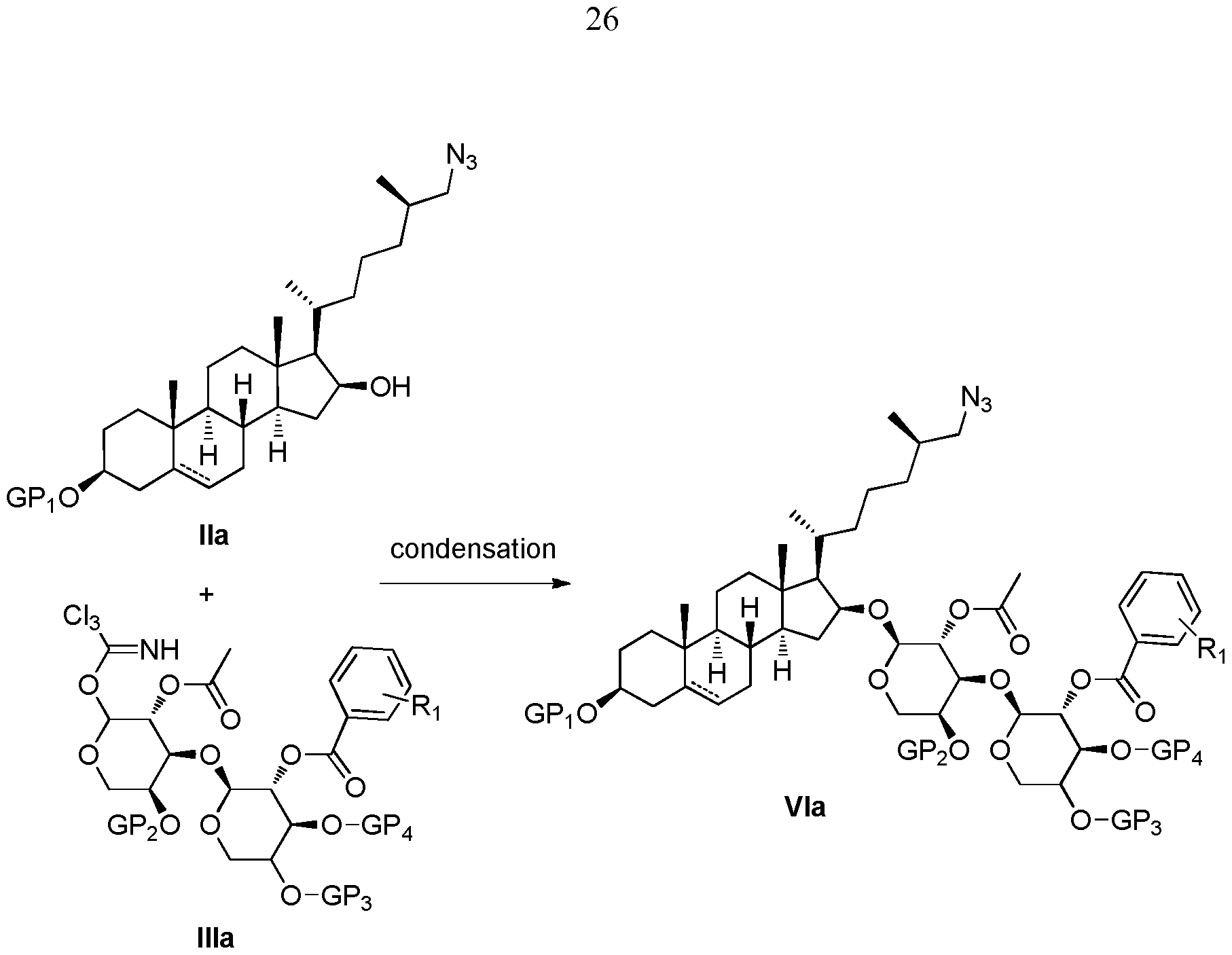
(a4) les fonctions O-protégées de l'intermédiaire Via ainsi obtenu, sont déprotégées en traitant par le chlorure de palladium, bis acétonitrile dans un solvant tel que l'acétone pour donner un composé de formule la (composé de formule (I) avec R2 = N3) ;


(a5) éventuellement, on salifie le composé de formule la obtenu à l'étape précédente en présence d'une base pharmaceutiquement acceptable pour donner un sel pharmaceutiquement acceptable du composé de formule la.
Selon un second mode de réalisation, la présente invention concerne un procédé de préparation d'un composé de formule (I) selon l'invention pour lequel R2 représente Rio
N Ru ayec j^io et teis que définis ci-dessus et caractérisé par les étapes successives suivantes :
 (bl) on substitue des dérivés de formule générale Ilb pour lesquels A représente un groupement partant tel que OTs, " est tel que défini dans la formule générale I et GPi représente un groupement O-protecteur tel que benzyle, par de l'azoture de sodium
Rio
ou des aminés HN Rl 1 pour lesquelles Rio et Ru sont tels que définis ci-dessus, dans un solvant tel que le diméthylformamide pour donner un composé Ile portant un groupe N3 ou NRioRn ;

(b2) dans le cas où l'aminé du composé Ile est secondaire, elle est ensuite protégée par un groupement GP', N-protecteur tel que Cbz en utilisant le chloroformiate de benzyle en présence d'une base telle que K2C03 dans un mélange de solvants tel que eau/THF our donner un composé Ild portant un groupe NRnGP' ;

(b3) selon (a3) en condensant des dérivés de formule générale Illa pour lesquels RIGP est tel que défini précédemment, GP2, GP3, et GP4 représentent des groupements O- protecteurs tels que triéthylsilyle avec des dérivés de formule générale Ile ou Ild décrits précédemment ;

(b4) la déprotection des fonctions O-protégées et N-protégées de l'intermédiaire VIb ainsi que, lorsque R2 représente l'azoture, sa réduction en aminé, sont obtenues en traitant l'intermédiaire VIb par une suspension de nickel de Raney dans un mélange de solvants tel que l'EtOH et l'eau pour donner un composé de formule Ib (composé de formule (I) avec R2 = NR10Rn) ;

(b5) selon (a5).
Selon un troisième mode de réalisation, la présente invention concerne un procédé de préparation d'un composé de formule (I) selon l'invention pour lequel R2 représente :
Rio
N R-i -i ayec j^io et teis que définis ci-dessus,
ou 0 R12 avec Ri2 tel que défini ci-dessus,
caractérisé par les étapes successives suivantes :


Schéma 3
(cl) selon (bl) en substituant des dérivés de formule générale Ilb tels que définis pour (bl) et dont la fonction alcool est protégée par un groupement O-protecteur tel que
Rio
benzyle ou tertbutyldiméthylsilyle, soit par des aminés HN Rl 1 pour lesquelles Rio et Ru sont tels que définis ci-dessus, dans un solvant tel que le diméthylformamide, soit par un alcool H0 R12 , soit par d'autres méthodes bien connues de l'homme du métier, notamment en présence de carbonate de potassium, d'iodure de potassium et d'amine R24R25NH avec R24 et R2s tels que définis précédemment pour donner accès à un groupe R2 = -OCONR24R25 ;
(c2) selon (b2) ;
(c3) selon (b3) ;
(c4) selon (a4) ;
(c5) la déprotection des fonctions N-protégées et l'éventuelle réduction de la double liaison de l'intermédiaire VII sont obtenues par traitement avec une suspension de Nickel de Raney dans un mélange de solvants tel que l'EtOH et l'eau pour donner un composé de formule le (composé de formule (I) avec R2 = NR10Rn ou ORi2) ;

(c6) selon (a5). La présente invention concerne également un deuxième procédé de préparation d'un composé de formule (I) selon l'invention pour lequel R2 représente un groupe 1,2,3-triazol-l-yle éventuellement substitué par un groupe (Ci-C6)alkyle éventuellement substitué par une fonction azotée et/ou oxygénée comprenant les étapes suivantes : (1) réaction d'un composé de formule (I) pour lequel R2 = N3 avec un composé de formule R avec R représentant H ou un groupe (Ci-C6)alkyle éventuellement substitué par une fonction azotée et/ou oxygénée pour donner un composé de formule (Id) suivante (correspondant à un composé de formule (I) pour lequel R2 représente un groupe 1,2,3-triazol-l-yle éventuellement substitué par un groupe (Ci-C6)alkyle éventuellement substitué par une fonction azotée et/ou oxygénée) :
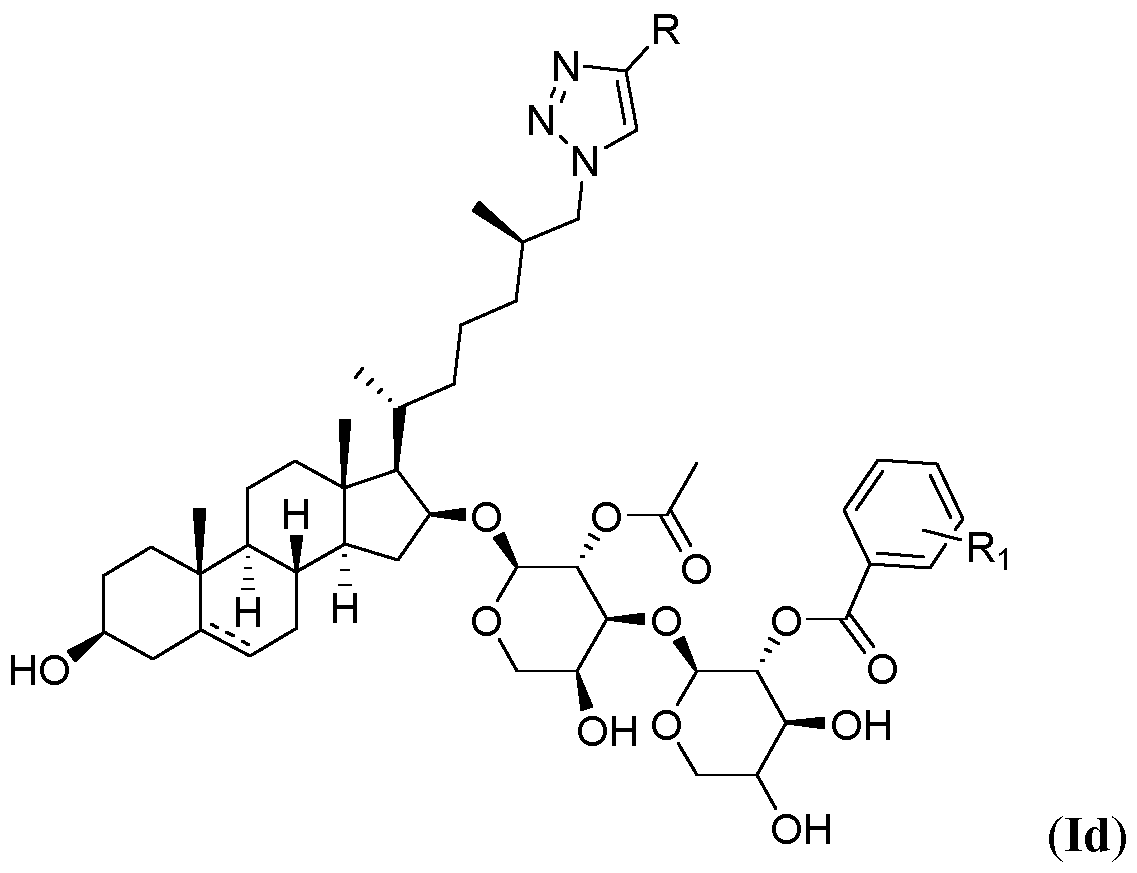
pour laquelle " , R et Ri sont tels que définis précédemment,
lorsque " représente une liaison double, éventuellement réduction de la double liaison pour donner un composé de formule (Id) pour lequel " représente une liaison simple, et
éventuellement salifïcation et/ou solvatation pour donner un composé de formule (Id) selon l'invention sous forme d'un sel et/ou un solvate pharmaceutiquement acceptable. Etape (1) :
Le composé (Id) correspond à un composé de formule (I) selon l'invention pour lequel R2 représente un groupe 1 ,2,3-triazol-l-yle éventuellement substitué par un groupe (Ci-C6)alkyle éventuellement substitué par une fonction azotée et/ou oxygénée.
La réaction de l'étape (1) peut être réalisée dans un solvant tel que le méthanol, le THF, l'eau et un mélange de ceux-ci.
Cette réaction peut être réalisée en présence de (R)-5-((S)-l ,2-dihydroxyethyl)- 4-hydroxy-2-oxo-2,5-dihydrofuran-3-olate de sodium et de sulfate de cuivre pentahydrate.
Le groupe R représente un groupe (Ci-Ce)alkyle éventuellement substitué par une fonction azotée et/ou oxygénée. La fonction azotée et/ou oxygénée sera avantageusement un groupe NR29R30, NR31COR32, NR33COOR34, NR35CONR36R37, OR38, OCOR39, OCOOR40, OCONR41R42, COR43, COOR44 ou CONR45R46, de préférence un groupe NR29R30 ou OR38, avec R29 à R46 tels que définis précédemment.
Etape (2) : voir étape (iii)
Etape (3) : voir étape (iv) La présente invention concerne également un troisième procédé de préparation d'un composé de formule (I) selon l'invention pour lequel R2 représente un groupe NRioRn, Rio et Ru ne formant pas un cycle avec l'atome d'azote qui les porte, comprenant les étapes suivantes :
(a) réduction d'un composé de formule (Via) suivante :
pour

précédemment,
pour donner un composé de formule (VId) suivante :
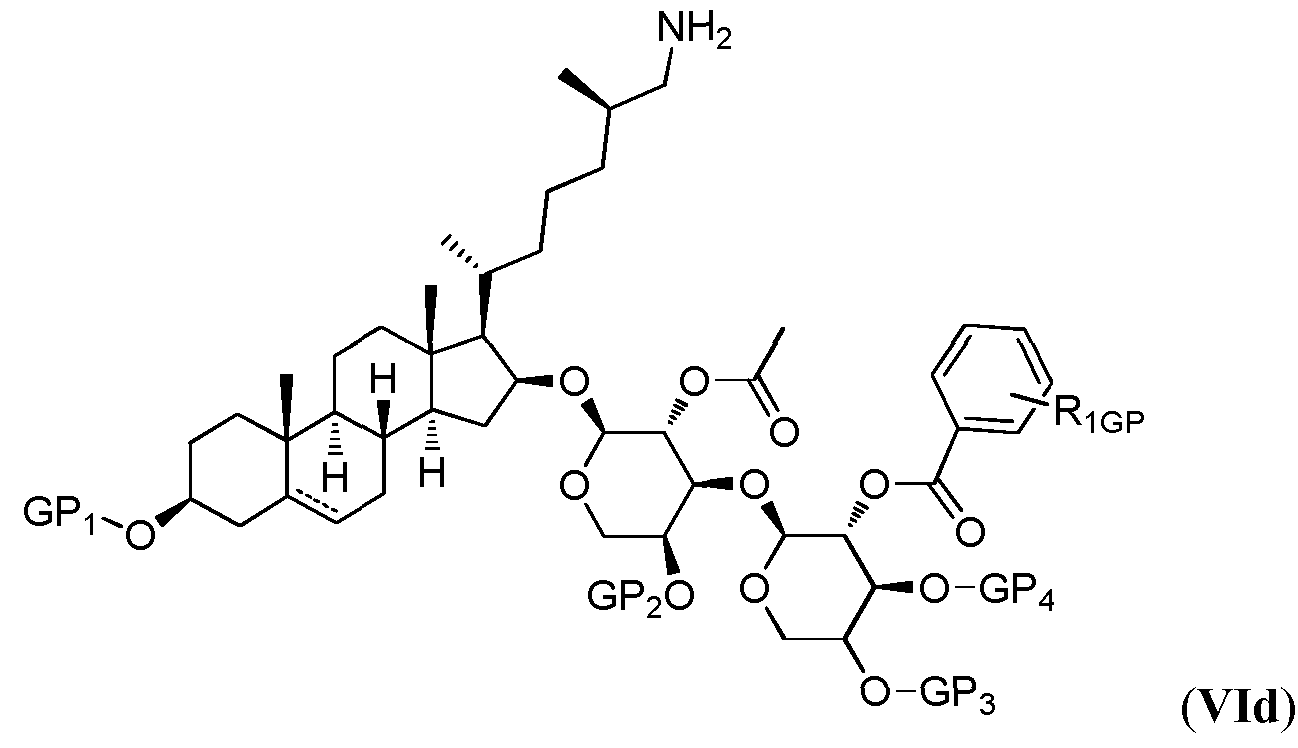
pour laquelle RIGP, GPi, GP2, GP3 et GP4 sont tels que définis précédemment,
(b) éventuellement substitution du composé de formule (VId) obtenu à l'étape (a) précédente pour donner un composé de formule (Vie) suivante :

pour laquelle " , Rio, Ru, RIGP, GPI , GP2, GP3 et GP4 sont tels que définis précédemment, l'un au moins de Rio et Ru ne représentant pas un atome d'hydrogène,
(c) déprotection des groupes protecteurs pour donner un composé de formule (I) avec R2 = NRioRn,
(d) lorsque " représente une liaison double, éventuellement réduction de la double liaison pour donner un composé de formule (I) pour lequel " représente une liaison simple et R2 = NRioRn, et
(e) éventuellement salifïcation et/ou solvatation pour donner un composé de formule (I) selon l'invention sous forme d'un sel et/ou un solvate pharmaceutiquement acceptable.
Etape (a) :
Cette réaction de réduction de la fonction azoture peut être réalisée dans des conditions bien connues de l'homme du métier, par exemple en présence de triphénylphosphine comme agent réducteur. La réaction peut être réalisée dans le THF comme solvant.
Etape (b) :
Cette réaction de substitution peut être réalisée dans des conditions bien connues de l'homme du métier.
La réaction pourra être réalisée en présence d'un composé de formule R10LG2 ou R1 1LG2 avec Rio et Ru tels que définis ci-dessus et autre qu'un atome d'hydrogène et LG2 représentant un groupe partant. Il pourra s'agir d'un atome d'halogène tel qu'un atome de chlore. Lorsque le groupe Ru comporte un motif carbonyle lié au groupe LG2, LG2 pourra être également un imidazole ou un groupe -OC(0)Alk avec Alk représentant un groupe (Ci-C6)alkyle.
La réaction pourra être réalisée en présence d'une base telle que la pyridine ou la triéthy lamine. Le dichlorométhane pourra être utilisé comme solvant pour cette réaction.
Si Rio et Ru représentent chacun un groupe autre qu'un atome d'hydrogène, deux réactions successives de substitution pourront être réalisées, la première réaction de substitution visant de préférence à introduire le substituant Ru.
Etape (c) : voir étape (ii) Etape (d) : voir étape (iii)
Etape (e) : voir étape (iv)
Les composés intermédiaires et finaux peuvent être, si on le désire, purifiés suivant une ou plusieurs méthodes de purification choisies parmi, l'extraction, la fïltration, la chromatographie sur gel de silice, l'HPLC préparative sur phase normale ou inverse, la cristallisation.
Les matières premières utilisées dans les procédés décrits précédemment sont commerciales ou aisément accessibles à l'homme du métier selon des procédés décrits dans la littérature.
EXEMPLES
Les abréviations suivantes ont été utilisées :
DMAP : N,N-Diméthylaminopyridine
DMF : Diméthylformamide
ES : Electrospray
HPLC : Chromatographie Liquide Haute Performance
RMN : Résonance Magnétique Nucléaire
TFA : Acide trifluoroacétique
THF : Tétrahydrofurane
SYNTHESE DES COMPOSES SELON L'INVENTION
Les composés de la présente invention peuvent être synthétisés en utilisant les voies de synthèse décrites ci-dessous ou en utilisant des méthodes de synthèse connues de l'homme de métier. Les spectres de masse et RMN confirment les structures des composés.
Les exemples suivants illustrent l'invention sans en limiter la portée.
MEHTODES ANALYTIQUES par HPLC :
Méthode A :
phase A : eau/ 0.04%NH3, phase B : Acétonitrile
débit total : 0,80 mL/min
Colonne : X-Bridge RP18, 3,0*50 mm, 2,2 μιη, 40°C
Gradient binaire :
Temps (mn) 0 6,2 7,2 7,5
Voie B (%) 50 100 100 10
Méthode B :
phase A : eau/0.05% acide formique, phase B : Acétonitrile/0.05%> acide formique débit total : 2 mL/min
XbridgeShield-RPC18, 4.6x50 mm, 3.5 μιη
Gradient binaire :
Temps (mn) 0 4 4,25 4,4 5
Voie B (%) 3 100 100 3 3
Méthode C :
phase A : eau/0.1% acide formique, phase B : Acétonitrile/0.1% acide formique débit total : 2 mL/min
XbridgeShield-RPC18, 4.6x50 mm, 3.5 μιη
Gradient binaire :
Temps (mn) 0 4 4,25 4,4
Voie B (%) 3 100 100 3
Méthode D :
phase A : eau/0.05% TFA, phase B : Acétonitrile/0.05% TFA
débit total : 1 mL/min
Shim pack VP-ODS, 3x50 mm, 4.6 μιη
Gradient binaire :
Temps (mn) 0 6 9 9,5 10
Voie B (%) 5 100 100 3 3
INTERMEDIAIRES :
Intermédiaire 1 :

L'intermédiaire 1 est obtenu selon la méthode décrite par Denance, M et al., Steroids, 2006, 71(7), 599-602.
Intermédiaires 2 :
Intermédiaire 2a :

RMN C13, (100 MHz, CDC13, ppm) : 13,1 ; 17,7 ; 18,2 ; 19,4 ; 20,7 ; 23,7 ; 29,8 ; 31,5 ; 31,6 ; 31,8 ; 33,6 ; 34,5 ; 36,0 ; 36,5 ; 36,8 ; 37,2 ; 39,8 ; 42,2 ; 42,3 ; 50,1 ; 54,5 ; 57,9 ; 61,4 ; 71,8 ; 72,4 ; 121,5 ; 140,9. Intermédiaires 2b-i :
Les intermédiaires 2b-2i sont préparés selon la méthode décrite pour l'intermédiaire 2a en utilisant différents agents d'alkylation.

Intermédiaire de départ R A Rendement ES, m/z obtenus
2b Bn NHMe 50% 522, [M+H]+
(2R,6R)-6-((3S,10R,13S, 2c Bn NMe2 84% 536, [M+H]+ -16S,17R)-3-(benzyloxy)- 580, [M-
2d Bn NHEt 80%
16- hydroxy-10,13- H+HC02H]" dimethyl-2,3,4,7,8,9,- 2e Bn NHiPr 73% 550, [M+H]+ 10,11,12,13,14,15,16,17- tetradecahydro- 1 H- 2f Bn NH(CH2)2OMe 84% 566, [M+H]+ cyclopenta[a]phenanthren-
17- yl)-2-methylheptyl 2g Bn
4-methylbenzenesulfonate NC__/° 75% 578, [M+H]+
0
2h Bn 25% 614, [M+H]+ (Qin, H-J et al, Tet. Let, HN ¾
2006, 47(19), 3217-3219) 556,
2i Bn N3 100%
[M+Na]+
Intermédiaires 3 :
Intermédiaire 3

0,29g (0,55 mmol) de stéroïde 2b est placé en présence de chloroformiate de benzyle (0,14g, 0,83 mmol) et de bicarbonate de sodium (93 mg, 1,12 mmol) dans 8 mL d'un mélange THF/H2O :3/l puis le mélange est agité 4h à température ambiante. Après extraction et concentration à sec des phases organiques, le résidu obtenu est purifié sur silice flash (gradient CH2Cl2/AcOEt : 100/0 à 90/10 sur 20 min). Le stéroïde 3a est obtenu sous forme de solide blanc (0,33 g) avec un rendement de 90 %.

RMN C13, (100 MHz, CDC13, ppm) : 13,0 ; 17,2 ; 18,1 ; 19,3 ; 20,7 ; 23,4 ; 28,4 ; 29,8 ; 31,2 ; 31,4 ; 31,8 ; 32,1 ; 34,1 ; 35,0 ; 36,5 ; 36,6 ; 36,9 ; 37,1 ; 39,1 ; 39,8 ; 42,2 ; 50,1 ; 54,5 ; 55,2 ; 61,3 ; 66,9 ; 69,9 ; 72,2 ; 78,5 ; 121,3 ; 127,4 (2 carbones) ; 127,5 (2 carbones) ; 127,7 ; 127,8 ; 128,3 (2 carbones) ; 128,4 (2 carbones) ; 137,1 ; 139,1 ; 141,1.
Intermédiaires 3b-e :
Les intermédiaires 3b-e sont réparés selon la méthode décrite pour l'intermédiaire 3a

Intermédiaires 3b-e :

Intermédiaires 3f-i:
Les intermédiaires 3f-i sont préparés selon la méthode décrite pour l'intermédiaire 3a.

Intermédiaires 3f-i :

Intermédiaire 4a :
L'intermédiaire 4a est préparé selon la méthode décrite par Chen B. et al, Tetrahedron, 2003, 59(17), p. 3183-3188 à partir du (3S,10R,13S,16S,17R)-17-((2R,6R)-7-hydroxy- 6-methylheptan-2-yl)-10,13-dimethyl-2,3,4,7,8,9,10,l 1,-12,13, 14,-15, 16,17- tetradecahydro-lH-cyclopenta[a]phenanthrene-3,16-diol (préparé selon la méthode décrite par Zheng, D. et al, Biorg. Med. Chem. Let., 2011, 21(11), 3257-3260).
-TBDMS

Intermédiaire 4b :
L'intermédiaire 4b est préparé à partir de l'intermédiaire 2a selon la méthode décrite pour l'intermédiaire 4a avec un rendement de 99%.

(ES, m/z): [M-OH]+ = 540
RMN C13, (100 MHz, CDC13, ppm) : -4,5 (2 carbones) ; 13,1 ; 17,7 ; 18,2 ; 18,8 ; 19,4 ; 20,7 ; 23,7 ; 25,9 (3 carbones) ; 29,8 ; 31,5 ; 31,8 ; 32,1 ; 33,6 ; 34,5 ; 36,0 ; 36,6 ; 36,8 ; 37,3 ; 39,9 ; 42,2 ; 42,8 ; 50,2 ; 54,5 ; 57,9 ; 61,4 ; 72,5 ; 72,6 ; 120,9 ; 142,2.
Intermédiaire 4c :

L'intermédiaire 4c est préparé à partir de l'intermédiaire 6c selon la méthode décrite pour l'intermédiaire 4a avec un rendement de 80%.
(ES, m/z): [M+H]+ = 692
Intermédiaire 5 :
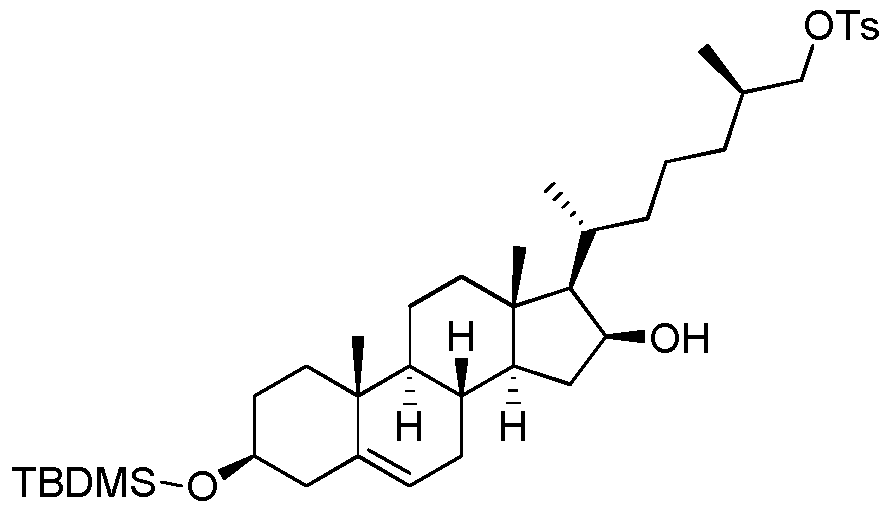
L'intermédiaire 4a (0, 15 g, 0,77 mmol) est placé dans 7 mL de THF en présence d'Et3N (0,34 ml, 2,43 mmol) et de fluorure de tétrabutylammonium 1M dans le THF (0,89 ml, 0,89 mmol). Le mélange est agité à température ambiante pendant 4h puis concentré à sec. Le résidu obtenu est purifié sur silice flash (gradient heptane/AcOEt : 100/0 à 60/40 sur 25 min). L'intermédiaire est isolé sous forme de solide blanc (0,23 g) avec un rendement de 56 %. Ce solide (0,44 mmol) est ensuite placé dans 5 mL de dichlorométhane, en présence de 5,4 mg (0,044 mmol) de DMAP, 0, 184 mL (1 ,32 mmol) de triéthylamine et 0, 10g (0,53 mmol) de chlorure de tosyle. Ce mélange est agité à température ambiante pendant une nuit puis repris par l'eau et extrait au dichlorométhane. Après séchage et concentration à sec des phases organiques, le résidu obtenu est purifié sur silice flash (gradient heptane/AcOEt : 100/0 à 80/20 sur 25 min). L'intermédiaire 5 est isolé sous forme de solide blanc (0,27g) avec un rendement de 89%.
(ES, m/z) : [M-TBS+HCOOH]" = 617
Intermédiaires 6 :
Intermédiaire 6a :

(ES, m/z) : [M+H]+ = 622
Intermédiaires 6b-h :
Les intermédiaires 6b-h sont préparés selon la méthode décrite pour l'intermédiaire 6a. Intermédiaire 6b : s +H]+, rendement,


Intermédiaire 7 :

0,36 g (0,54 mmol) de (2R,6R)-6-((3S,10R,13S,16S,17R)-3-(benzyloxy)-16-hydroxy- 10,13-dimethyl-2,3,4,7,8,9,10,l 1,12,13, 14,15, 16,17-tetradecahydro-lH-cyclopenta[a] phenanthren-17-yl)-2-methylheptyl 4-methylbenzenesulfonate (préparé selon la méthode décrite par Qin, H-J et al., Tet. Let., 2006, 47(19), 3217-3219) est placé en présence de chlorhydrate de 2-(méthylsulfonyl)-éthanamine (0,26 g, 1,63 mmol), de carbonate de potassium (0,22 g, 1,63 mmol) et d'iodure de potassium (0,27 g, 1,63 mmol) dans 10 mL de DMF puis le mélange est chauffé à 120°C pendant 2h. Après concentration à sec, le résidu est repris avec une solution saturée de bicarbonate de potassium et extrait avec AcOEt. Après séchage et concentration à sec des phases organiques, le résidu obtenu est purifié sur silice flash (gradient : CFLCyMeOH : 100/0
à 90/10 en 30 min). Le composé 7 est obtenu sous forme de gomme blanche (0,18 g) avec un rendement de 54%.
(ES, m/z) : [M-H+HCOOH]" = 702
RMN C13, (100MHz, CDC13, ppm) : 13,1 ; 16,9 ; 18,2 ; 19,4 ; 20,7 ; 23,5 ; 28,4 ; 29,7 ; 31,5 ; 31,8 ; 32,4 ; 33,5 ; 34,9 ; 35,7 ; 36,6 ; 36,9 ; 37,2 ; 39,1 ; 39,9 ; 41,8 ; 42,2 ; 50,2 ; 54,4 ; 54,5 ; 61,6 ; 69,9 ; 70,4 ; 72,4 ; 78,5 ; 121,3 ; 127,4 ; 127,6 (2 carbones) ; 128,4 (2 carbones) ; 138,8 ; 141,1 ; 156,4.
Diosides 1 et 2 :
Les diosides 1 et 2 sont préparés selon la méthode décrite par Deng, S. et ai, J. Org. hem., 1999, 64, 202-208.

Schéma 4
Dioside 1 : (2S,3R,4R,5R)-2-(((3R,4R,5S)-3-acetoxy-2-hydroxy-5-((triethylsilyl)- oxy)tetrahydro-2H-pyran-4-yl)oxy)-4,5-bis((triethylsilyl)oxy)tetrahydro-2H-pyran-3-yl 4- methoxybenzoate
A partir du (2S,3R,4S,5R)-2-(benzyloxy)oxane-3,4,5-triol selon la méthode décrite dans le schéma 4, le dioside 1 est obtenu sous forme huile incolore avec un rendement de 2,6%.

(ES, m/z) : [M+H20] = 818,9
HPLC (méthode A) : Tr = 6,21 mn
RMN H1, (400MHz, CDC13, ppm): 8,037-7,985(m, 4H), 6,946-6,918(m, 4H), 5,036 (s,lH), 5,024-4,707 (m, 3H), 4,012-3,726 (m, 1 1H), 3,279-3,165 (m, 1H), 1 ,908 (s, 3H), 1 ,001-0,843 (m, 27H), 0,693-0,506 (m,18H).
Dioside 2 :
Le dioside 2 est préparé selon la méthode décrite dans le schéma 5 en procédant à la protection des intermédiaires 7a et 7b avec le groupement Cbz. Il est obtenu sous forme de solide jaune avec un rendement de 0.5%.

(ES, m/z):(M+Na) =956.6
HPLC (méthode D) : Tr = 7.10 mn
RMN H1, (400MHz, CDC13, ppm): 7.967-8.021(t,2H), 7.261-7.306(m,7H), 5.158-
5.300(s,2H), 4.675-5.014(m,6H), 3.667-4.056(m,7H), 3.373(s,3H), 3.368 (m,lH), 1.838- 1.914 (d,3H), 0.827-1.256(m,30H), 0.478-0.675(m,15H).

Schéma 5
COMPOSES SELON L'INVENTION
Exemple 1 : (2S,3R,4S,5R)-2-(((2S,3R,4S,5S)-3-acetoxy-2-(((3S,10R,-13S,-16S)-17- ((2R,6R)-7-azido-6-methylheptan-2-yl)-3-hydroxy- 10, 13-dimethyl-2,3,4,7,8,9, 10, 11,12,13,14,15,16,17-tetradecahydro- 1 H-cyclopenta[a]phenanthren- 16-yl)oxy)-5- hydroxytetrahydro-2H-pyran-4-yl)oxy)-4,5-dihydroxytetrahydro-2H-pyran-3-yl 4-methoxybenzoate
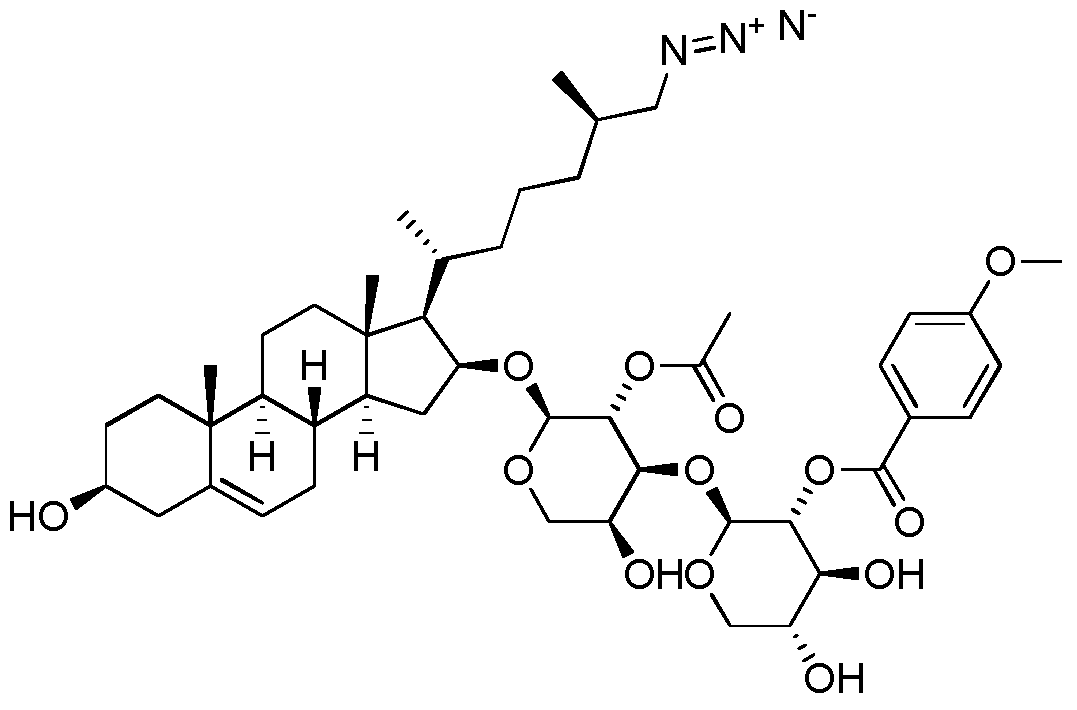
L'exemple 1 est synthétisé selon la méthode 1 :
Etape 1 : 0,34 g (0,358 mmol) de dioside 1 activé sous forme de 2-(2,2,2-trichloro-l- iminoéthoxy) (méthode décrite par Deng, S. et al., J. Org. Chem., 1999, 64, 202-208) et 0,1 g (0,18 mmol) d'intermédiaire 4b sont placés dans 10 mL de dichlorométhane en présence de tamis 4Â (0,7 g, 0,18 mmol) et agité à température ambiante pendant 15 min. Après refroidissement à -65°C, une solution à 0,14M de triméthylsilyl trifluorométhanesulfonate (1,79 mL) dans CH2CI2 est additionnée goutte à goutte et le mélange est agité pendant 30 min. Après addition de 0,5 mL d'Et3N puis filtration sur Celite®, le milieu est concentré à sec. Le résidu obtenu est purifié sur silice flash (gradient Heptane/CH2Cl2 : 100/0 à 50/50 en 25mn) et isolé avec un rendement de 54%. Etape 2 : 0,13 g (0,097 mmol) d'intermédiaire précédent est placé dans 4,8 mL d'acétone et 0,2 mL d'eau en présence de chlorure de palladium, bis acétonitrile (7,5 mg, 0,029 mmol). Le milieu est agité 3h à température ambiante, filtré sur Celite® puis concentré à sec. Le résidu obtenu est purifié sur silice flash (gradient CH2Cl2/MeOH : 100/0 à 90/10 en 25mn). Le composé 1 est isolé sous forme de solide orange (0,021g) avec un rendement de 24%.
Solide orange
(ES, m/z) : [M-H+HC02H]" = 928,37
HPLC (méthode C) : Tr = 4,02 mn
RMN C13, (100MHz, CD3OD, ppm) : 13, 1 ; 18, 1 ; 18,6 ; 19,8 ; 21 ,0 ; 21 ,9 ; 23,4 ; 30,6 ; 32,3 ; 32,9 (2 carbones) ; 34,7 ; 36,0 ; 37,3 ; 37,5 ; 37,7 ; 38,5 ; 41 ,0 ; 43,0 ; 43,3 ; 51 ,7 ; 56, 1 ; 56,3 ; 58,7 ; 62,1 ; 66,3 ; 66,7 ; 69,8 ; 71 ,0 ; 72, 1 ; 72,4 ; 75,3 ; 75,8 ; 81 ,2 ; 82,6 ; 103,9 ; 104,3 ; 1 14,8 (2 carbones) ; 122,3 ; 123,6 ; 133,2 (2 carbones) ; 142,3 ; 165,4 ; 167,1 ; 170,9.
Exemple 2 : (2S,3R,4S,5R)-2-(((2S,3R,4S,5S)-3-acetoxy-2-(((3S, 10R,13S, 16S.17R)- 17-((2R,6R)-7-amino-6-methylheptan-2-yl)-3-hydroxy- 10, 13-dimethyl-2,3,4,7,8,9, 10, 1 1 , 12,13, 14, 15,16, 17-tetradecahydro- 1 H-cyclopenta[a]-phenanthren- 16-yl)oxy)-5- hydroxytetrahydro-2H-pyran-4-yl)oxy)-4,5-dihydro-xytetrahydro-2H-pyran-3-yl 4-methoxybenzoate

L'exemple 2 est synthétisé selon la méthode 2 :
Etape 1 : glycosylation du stéroïde 2i par le dioside 1 dans les conditions décrites dans l'étape 1 de la méthode 1.
Etape 2 : 0,096 g (0, 10 mmol) d'intermédiaire est placé dans 5 mL d'EtOH en présence de 200 d'une suspension de Nickel de Raney (à 50 % dans l'eau). Le mélange est agité pendant 4 jours à 50°C en tube scellé. Après concentration à sec, le résidu obtenu est purifié sur silice flash (gradient CH2Cl2/MeOH : 100/0 à 90/10 en 30 mn). Le composé 2 est isolé sous forme de solide blanc (0,053 g) avec un rendement de 35%. Solide blanc
(ES, m/z) : [M+H]+ = 858,52
HPLC (méthode C) : Tr = 2,24
RMN C , (125MHz, CD3OD, ppm) : 13,2 ; 17,4 ; 18,5 ; 19,8 ; 21,0 ; 21,9 ; 23,6 ; 30,3 ; 32,3 ; 32,9 ; 33,3 (2 carbones) ; 35,4 ; 36,6 ; 36,8 ; 37,7 ; 38,5 ; 41,0 ; 43,0 ; 43,4 ; 46,6 ; 51,7 ; 56,0 ; 56,1 ; 62,1 ; 66,1 ; 66,5 ; 69,5 ; 70,9 ; 72,3 ; 72,4 ; 75,1 ; 75,6 ; 81,0 ; 82,6 ; 103,4 ; 103,6 ; 114,8 (2 carbones) ; 122,3 ; 123,6 ; 133,2 (2 carbones) ; 142,3 ; 165,3 ; 167,0 ; 171,0.
Exemple 3 : (2S,3R,4S,5R)-2-(((2S,3R,4S,5S)-3-acetoxy-5-hydroxy-2-(((3S,10R,13S, 16S, 17R)-3-hydroxy- 10, 13-dimethyl- 17-((2R,6R)-6-methyl-7-(methylamino)heptan-2- yl)-2,3,4,7,8,9,10,l l,12,13,14,15,16,17-tetradecahydro-lH-cyclopenta[a]phenanthren- 16-yl)oxy)tetrahydro-2H-pyran-4-yl)oxy)-4,5-dihy droxytetrahydro-2H-pyran-3-yl 4-methoxybenzoa

L'exemple 3 est synthétisé selon la méthode 2 à partir du stéroïde 3a et du dioside 1 (rendement : 50 %).
Solide blanc
(ES, m/z) : [M+H]+ = 872,37
HPLC (méthode C) : Tr=2,24 mn
RMN C13, (100MHz, CD3OD, ppm) : 13,2 ; 18,2 ; 18,6 ; 19,8 ; 21,0 ; 21,9 ; 23,6 ; 30,5 ; 32,3 ; 32,9 (2 carbones) ; 33,6 ; 36,0 ; 36,6 ; 37,3 (2 carbones) ; 37,7 ; 38,5 ; 41,0 ; 43,0 ; 43,3 ; 51,7 ; 56,1 ; 56,3 ; 58,9 ; 62,1 ; 66,3 ; 66,6 ; 69,7 ; 71,0 ; 72,2 ; 72,4 ; 75,2 ; 75,7 ; 81,2 ; 82,6 ; 103,8 ; 104,1 ; 114,8 (2 carbones) ; 122,3 ; 123,6 ; 133,2 (2 carbones) ; 142,3 ; 165,4 ; 167,0 ; 171,0.
Exemple 4 : Formiate de (2S,3R,4S,5R)-2-(((2S,3R,4S,5S)-3-acetoxy-2-(((3S,10R, - 13S,- 16S,- 17R)- 17-((2R,6R)-7-(dimethylamino)-6-methylheptan-2-yl)-3-hydroxy- 10,13-dimethyl-2,3,4,7,8,9,10,l 1,12,13, 14,15, 16,17-tetradecahydro-lH-cyclopenta[a]- phenanthren-16-yl)oxy)-5-hydroxytetrahydro-2H-pyran-4-yl)oxy)-4,5- dihydroxytetrahydro-2H-pyran-3-yl 4-meth nzoate

L'exemple 4 est synthétisé selon la méthode 3 :
Etape 1 : glycosylation du stéroïde 3a par le dioside 1 dans les conditions décrites dans l'étape 1 de la méthode 1.
Etape 2 : déprotection des groupements silyles par le chlorure de palladium, bis acétonitrile dans les conditions décrites dans l'étape 2 de la méthode 1.
Etape 3 : déprotection du benzyle par le nickel de Raney dans les conditions décrites dans l'étape 2 de la méthode 2.
Le composé 4 est isolé après purification par HPLC, sous forme de solide blanc (0,059 g) avec un rendement de 35 %.
Solide blanc
(ES, m/z) : [M+H]+ = 886,45
HPLC (méthode C) : Tr = 2,32 mn
RMN C13, (125MHz, CD3OD, ppm) : 13,4 ; 17,8 ; 18,5 ; 20,0 ; 21,1 ; 22,0 ; 23,7 ; 30,2 ; 31,2 ; 32,4 ; 33,0 (2 carbones) ; 35,5 ; 36,5 ; 36,9 ; 37,8 ; 38,6 ; 41,2 ; 43,2 ; 43,5 ; 44,7 (2 carbones) ; 51,9 ; 56,2 (2 carbones) ; 62,3 ; 66,3 ; 66,5 ; 66,7 ; 69,8 ; 71,1 ; 72,6 ; 72,7 ; 75,3 ; 75,9 ; 81,5 ; 82,7 ; 103,4 ; 103,9 ; 114,9 (2 carbones) ; 122,4 ; 123,8 ; 133,9 (2 carbones) ; 142,5 ; 165,5 ; 167,1 ; 171,2.
Exemple 5 : Formiate de (2S,3R,4S,5R)-2-(((2S,3R,4S,5S)-3-acetoxy-2-(((3S,5S, 10S, - 13S,- 16S, 17R)- 17-((2R,6R)-7-(dimethylamino)-6-methylheptan-2-yl)-3-hydroxy- 10, - 13 -dimethylhexadecahydro- 1 H-cyclopenta[a]phenanthren- 16-yl)oxy)-5 -hydroxy- tetrahydro-2H-pyran-4-yl)oxy)-4,5-dihydroxytetrahydro-2H-pyran-3-yl
4-methox benzoate

Ce composé (dont la double liaison a été réduite par le nickel de Raney) est obtenu en mélange avec le composé de l'exemple 4 et isolé par HPLC avec un rendement de 7%. Solide blanc
(ES, m/z) : M+ = 888,43
HPLC (méthode C) : Tr = 2,38 mn
RMN C13, (125MHz, CD3OD, ppm) : 12,9 ; 13,6 ; 17,7 ; 18,4 ; 21 , 1 ; 22,2 ; 23,6 ; 25,4 ; 30,0 ; 30, 1 ; 31 ,2 ; 32,3 ; 33,4 ; 36,3 ; 36,7 ; 36,8 (2 carbones) ; 38,3 ; 39,0 ; 41 ,4 ; 43,9 ; 44,7 (2 carbones) ; 46,4 ; 55,8 ; 56,0 ; 56,2 ; 62,5 ; 66,2 ; 66,5 ; 66,7 ; 69,8 ; 71 , 1 ; 72,0 ; 72,7 ; 75,3 ; 75,9 ; 81,5 ; 82,8 ; 103,4 ; 103,9 ; 1 14,9 (2 carbones) ; 123,8 ; 133,3 (2 carbones) ; 165,5 ; 167,1 ; 171,2.
Exemple 6 : (2S,3R,4S,5R)-2-(((2S,3R,4S,5S)-3-acetoxy-5-hydroxy-2-(((3S,-10R, -13S,16S, 17R)-3-hydroxy- 17-((2R,6R)-7-(isopropylamino)-6-methylheptan-2-yl)- 10, 13-dimethyl-2,3,4,7,8,9, 10,l 1 , 12,13, 14,15, 16,17-tetradecahydro-lH-cyclo- penta[a]phenanthren-16-yl)oxy)tetrahydro-2H-pyran-4-yl)oxy)-4,5-dihydroxy- tetrahydro-2H-pyran-3-yl 4-methoxybenzoate

L'exemple 6 est synthétisé selon la méthode 3 à partir du stéroïde 3c et du dioside 1 (rendement = 7 %).
Solide blanc
(ES, m/z) : [M+H]+ = 900,42
HPLC (méthode C) : Tr = 2,37 mn
RMN C13, (125MHz, CD3OD, ppm) : 13,4 ; 17,8 ; 18,6 ; 19,3 ; 19,4 ; 20,0 ; 21 , 1 ; 22,1 ; 23,8 ; 30,4 ; 32,4 ; 33,0 (3 carbones) ; 35,7 ; 36,6 ; 37,0 ; 37,8 ; 38,6 ; 41 ,2 ; 43,2 ; 51 ,9 ; 52,2 ; 52,5 ; 52,8 ; 56,2 (2 carbones) ; 62,3 ; 66,3 ; 66,6 ; 69,6 ; 71 ,0 ; 72,5 ; 72,6 ; 75,2 ; 75,7 ; 81 ,3 ; 82,8 ; 103,5 ; 103,7 ; 1 14,9 (2 carbones) ; 122,4 ; 123,8 ; 133,3 (2 carbones) ; 142,5 ; 165,5 ; 167,1 ; 171,2.
Exemple 7 : (2S,3R,4S,5R)-2-(((2S,3R,4S,5S)-3-acetoxy-5-hydroxy-2-(((3S,-10R,13S, 16S, 17R)-3-hydroxy- 17-((2R,6R)-7-((2-methoxyethyl)amino)-6-methylheptan-2-yl)- 10, 13-dimethyl-2,3,4,7,8,9,10, l 1 ,12, 13, 14, 15, 16, 17-tetradecahydro-lH-cyclopenta[a] phenanthren-16-yl)oxy)tetrahydro-2H-pyran-4-yl)oxy)-4,5-dihydroxytetrahydro-2H- pyran-3-yl 4-methoxybenzoate
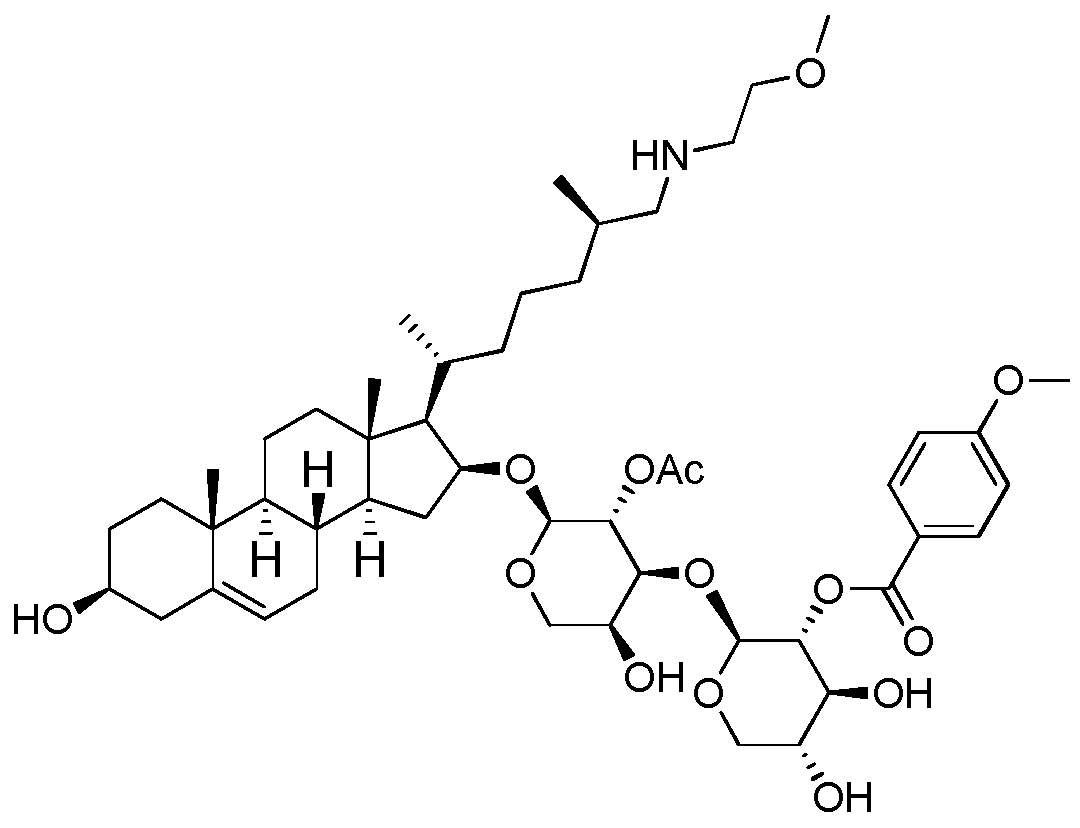
L'exemple 7 est synthétisé selon la méthode 3 à partir du stéroïde 3d et du dioside 1 (rendement = 6%).
Solide blanc
(ES, m/z) : [M+H]+ = 916,44
HPLC (méthode C) : Tr=2,34 mn
RMN C13, (125MHz, CD3OD, ppm) : 13,4 ; 17,7 ; 18,6 ; 20,0 ; 21,1 ; 22,1 ; 23,7 ; 30,4 ; 32,4 (2 carbones) ; 33,0 (2 carbones) ; 35,8 ; 36,7 ; 36,9 ; 37,8 ; 38,6 ; 41,2 ; 43,2 ; 43,5 ; 48,6 ; 51,9 ; 55,2 ; 56,2 (2 carbones) ; 59,5 ; 62,3 ; 66,4 ; 66,6 ; 68,4 ; 69,6 ; 71,1 ; 72,5 ; 72,6 ; 75,3 ; 75,7 ; 81,3 ; 82,8 ; 103,6 ; 103,7 ; 114,9 (2 carbones); 122,4 ; 123,8 ; 133,3 (2 carbones) ; 142,5 ; 165,5 ; 167,1 ; 171,1.
Exemple 8 : Formiate de (2S,3R,4S,5R)-2-(((2S,3R,4S,5S)-3-acetoxy-5-hydroxy-2- (((3S,-5S, 1 OS, 13S, 16S, 17R)-3-hydroxy- 17-((2R,6R)-7-((2-methoxy-ethyl)amino)-6- methylheptan-2-yl)- 10, 13-dimethylhexadecahydro- 1 H-cyclo-penta[a]phenanthren- 16- yl)oxy)tetrahydro-2H-pyran-4-yl)oxy)-4,5-dihydroxytetrahydro-2H-pyran-3-yl
4-methoxybenzoate

Ce composé (dont la double liaison a été réduite par le nickel de Raney) est obtenu en mélange avec le composé de l'exemple 7et isolé par HPLC avec un rendement de 2%). Solide blanc
(ES, m/z) : [M+H]+ = 918,50
HPLC (méthode C) : Tr = 2,38 mn
RMN C13, (125MHz, CD3OD, ppm) : 12,9 ; 13,6 ; 17,7 ; 18,5 ; 21,1 ; 22,3 ; 23,7 ; 30,0 ; 30,4 ; 32,3 ; 32,4 ; 33,4 ; 35,7 ; 36,7 (4 carbones) ; 38,3 ; 39,0 ; 41 ,4 ; 43,8 ; 46,4 ; 48,6 ; 55,1 ; 56,0 (2 carbones); 56,2 ; 59,5 ; 62,5 ; 66,3 ; 66,6 ; 68,4 ; 69,6 ; 71,1 ; 72,0 ; 72,5 ; 75,3 ; 75,8 ; 81,3 ; 82,8 ; 103,5 ; 103,7 ; 114,9 (2 carbones) ; 123,8 ; 133,3 (2 carbones) ; 165,5 ; 167,1 ; 171,0.
Exemple 9 : (2S,3R,4S,5R)-2-(((2S,3R,4S,5S)-3-acetoxy-2-(((3S,10R,-13S,-16S,-17R)- 17-((2R,6R)-7-(ethyl(2-methoxyethyl)amino)-6-methylheptan-2-yl)-3-hydroxy- 10,13- dimethyl-2,3,4,7,8,9,10,11,12,13, 14,15, 16,17-tetradecahydro-lH-cyclopenta[a] phenanthren-16-yl)oxy)-5-hydroxytetrahydro-2H-pyran-4-yl)oxy)-4,5-dihydroxy tetrahydro-2H-pyran-3-yl 4-methoxybenzoate

L'exemple 9 est synthétisé selon la méthode 3 à partir du stéroïde 3d et du dioside 1 (rendement = 17%).
Solide blanc
(ES, m/z) : [M+H]+ = 944,61
HPLC (méthode C) : Tr=2,40 mn
RMN C13, (100MHz, CD3OD, ppm) : 1 1,9 ; 13,2 ; 18,8 ; 19,0 ; 19,9 ; 21,1 ; 21 ,9 ; 23,5 ; 30,5 ; 32,3 ; 32,7 ; 32,9 (2 carbones) ; 37,4 (2 carbones) ; 37,4 ; 37,6 ; 37,7 ; 38,5 ; 41,0 ; 43,0 ; 43,3 ; 50,1 ; 51,7 ; 54,6 ; 56,1 ; 56,3 ; 59,1 ; 62,0 ; 62,9 ; 66,4 ; 66,7 ; 69,8 ; 71,0 ; 72,0 ; 72,1 ; 72,4 ; 75,2 ; 75,8 ; 81,3 ; 82,7 ; 103,9 ; 104,4 ; 114,8 (2 carbones) ; 122,4 ; 123,6 ; 133,2 (2 carbones) ; 142,3 ; 165,3 ; 167,0 ; 170,9.
Exemple 10 : (2S,3R,4S,5R)-2-(((2S,3R,4S,5S)-3-acetoxy-2-(((3S,10R,13S,-16S,17R)- 17-((2R,6R)-7-(ethylamino)-6-methylheptan-2-yl)-3-hydroxy- 10, 13-dimethyl-2,3,4,7,8, 9,10,11,12,13,14,15,16,17-tetradecahydro- 1 H-cyclopenta[a]phenanthren- 16-yl)oxy)-5- hydroxytetrahydro-2H-pyran-4-yl)oxy)-4,5-dihydroxytetrahydro-2H-pyran-3-yl 4-methoxybenzoate

L'exemple 10 est synthétisé selon la méthode 3 à partir du stéroïde 3b et du dioside 1 (rendement = 6%).
Solide blanc
(ES, m/z) : [M+H]+ = 886,38
HPLC (méthode C) : Tr = 2,34 mn
RMN C13, (125MHz, CD3OD, ppm) : 1 1,7 ; 13,4 ; 17,7 ; 18,6 ; 20,0 ; 21,1 ; 22,1 ; 23,7 ; 30,4 ; 32,4 ; 32,8 ; 33,0 (2 carbones) ; 35,6 ; 36,6 ; 36,9 ; 37,8 ; 38,6 ; 41,2 ; 43,2 (2 carbones) ; 44,9 ; 51,9 ; 54,9 ; 56,2 (2 carbones) ; 62,3 ; 66,3 ; 66,6 ; 69,6 ; 71,0 ; 72,5 ; 72,6 ; 75,3 ; 75,7 ; 81,3 ; 82,8 ; 103,5 ; 103,7 ; 114,9 (2 carbones) ; 122,4 ; 123,8 ; 133,3 (2 carbones) ; 142,5 ; 165,5 ; 167,1 ; 171,2.
Exemple 11 : Formiate de (2S,3R,4S,5R)-2-(((2S,3R,4S,5S)-3-acetoxy-2-(((3S,5S,10S, - 13S,- 16S, 17R)- 17-((2R,6R)-7-(ethylamino)-6-methylheptan-2-yl)-3-hydroxy- 10,13- dimethylhexadecahydro- 1 H-cyclopenta[a]phenanthren- 16-yl)oxy)-5-hydroxytetrahydro- 2H-pyran-4-yl)oxy)-4,5-dihydroxytetrahydro-2H-pyran-3-yl 4-methoxybenzoate

Ce composé (dont la double liaison a été réduite par le nickel de Raney) est obtenu en mélange avec le composé de l'exemple 10 et isolé par HPLC avec un rendement de
2%).
Solide blanc
(ES, m/z) : [M+H]+ = 888,48
HPLC (méthode C) : Tr = 2,38mn
RMN C13, (125MHz, CD3OD, ppm) : 1 1 ,7 ; 12,9 ; 13,6 ; 17,7 ; 18,5 ; 21 ,2 ; 22,2 ; 23,7 ; 30, 1 ; 30,4 ; 32,3 ; 32,8 ; 33,4 ; 35,7 ; 36,6 ; 36,7 ; 36,8 ; 36,9 ; 38,3 ; 39,0 ; 41 ,4 ; 43,8 ; 44,9 ; 46,4 ; 54,9 ; 56,0 (2carbones) ; 56,2 ; 62,4 ; 66,4 ; 66,6 ; 69,6 ; 71 ,1 ; 72,0 ; 72,5 ; 75,3 ; 75,7 ; 81 ,3 ; 82,8 ; 103,5 ; 103,7 ; 1 14,9 (2 carbones) ; 123,8 ; 133,3 (2 carbones) ; 165,5 ; 167,1 ; 171,2.
Exemple 12 : Formiate de (2S,3R,4S,5R)-2-(((2S,3R,4S,5S)-3-acetoxy-5-hydroxy-2- (((3S,- 1 OR, 13S, 16S, 17R)-3-hydroxy- 10, 13-dimethyl- 17-((2R,6R)-6-methyl-7-morpho- linoheptan-2-yl)-2,3,4,7,8,9,10, l l ,12, 13,14, 15,16, 17-tetradecahydro-lH-cyclopenta[a] phenanthren-16-yl)oxy)tetrahydro-2H-pyran-4-yl)oxy)-4,5-dihydroxytetrahydro-2H- pyran-3-yl 4-methoxybenzoate

L'exemple 12 est synthétisé selon la méthode 3 à partir du stéroïde 2g et du dioside 1 (rendement = 3%).
Solide blanc
(ES, m/z) : [M+H]+ = 928,46
HPLC (méthode C) : Tr = 2,34 mn
RMN C13, (125MHz, CD3OD, ppm) : 13,4 ; 18,6 (2 carbones) ; 20,0 ; 21,1 ; 22,1 ; 23,8 ; 30,4 ; 30,8 ; 32,4 ; 33,0 ; 36,5 ; 37,0 ; 37,1 ; 37,8 ; 38,6 ; 41,2 ; 43,2 (2 carbones) ; 51,9 ; 55,0 (2 carbones); 56,2 ; 56,3 ; 62,4 ; 66,6 ; 66,8 ; 67,1 (3 carbones) ; 69,6 ; 71 ,2 ; 72,4 ; 72,6 ; 75,4 ; 76,0 ; 81,6 ; 82,8 ; 103,9 ; 104,0 ; 114,9 (2 carbones) ; 122,5 ; 123,8 ; 133,3 (2 carbones) ; 142,5 ; 165,5 ; 167,1 ; 171,1.
Exemple 13 : Formiate de (2S,3R,4S,5R)-2-(((2S,3R,4S,5S)-3-acetoxy-5-hydroxy-2- (((3S,5S,-10S,13S,16S,17R)-3-hydroxy-10,13-dimethyl-17-((2R,6R)-6-methyl-7- morpholinoheptan-2-yl)hexadecahydro- 1 H-cyclopenta[a]phenanthren- 16-yl)oxy) tetrahydro-2H-pyran-4-yl)oxy)-4,5-dihydroxytetrahydro-2H-pyran-3-yl
4-methoxybenzoate

Ce composé (dont la double liaison a été réduite par le nickel de Raney) est obtenu en mélange avec le composé de l'exemple 12 et isolé par HPLC avec un rendement de
1 %).
Solide blanc
(ES, m/z) : [M+H]+ = 930,48
HPLC (méthode C) : Tr = 2,38 mn
RMN C13, (125MHz, CD3OD, ppm) : 12,9 ; 13,6 ; 18,4 ; 18,5 ; 21 , 1 ; 22,3 ; 23,8 ; 30, 1 ; 30,3 ; 30,7 ; 32,3 ; 33,4 ; 36,3 ; 36,7 (2 carbones) ; 36,8 ; 37,0 ; 38,3 ; 39,0 ; 41 ,4 ; 43,8 ; 46,4 ; 54,9 (2 carbones) ; 56,0 (2 carbones) ; 56,2 ; 62,5 ; 66,7 ; 66,8 ; 67,0 (2 carbones) ; 67,1 ; 69,9 ; 71,2 ; 72,0 ; 72,5 ; 75,4 ; 76,0 ; 81,6 ; 82,8 ; 103,8 ; 104,0 ; 1 14,9 (2 carbones) ; 123,8 ; 133,2 (2 carbones) ; 165,5 ; 167,1 ; 171 ,1.
Exemple 14 : Formiate de (2S,3R,4S,5R)-2-(((2R,3R,4S,5S)-3-acetoxy-5-hydroxy-2- (((3S, 1 OR, 13S, 16S, 17R)-3-hydroxy- 10, 13-dimethyl- 17-((2R,6R)-6-methyl-7-((2- (methylsulfonyl)ethyl)amino)heptan-2-yl)-2,3,4,7,8,9, 10, l 1 ,12, 13, 14, 15, 16, 17- tetradecahydro- 1 H-cyclopenta[a]phenanthren- 16-yl)oxy)tetrahydro-2H-pyran-4- yl)oxy)-4,5-dihydroxytetrahydro-2H-pyran-3-yl 4-methoxybenzoate

L'exemple 14 est synthétisé selon la méthode 3 à partir du stéroïde 3e et du dioside 1 (rendement = 58 %).
Solide blanc
(ES, m/z) : [M+H]+ = 964,45
HPLC (méthode C) : Tr = 2,32 mn
RMN C13, (125MHz, CD3OD, ppm) : 13,4 ; 18,0 ; 18,5 ; 20,0 ; 21 , 1 ; 22,1 ; 23,7 ; 30,2 ; 32,4 ; 33,0 (2 carbones) ; 33,3 ; 35,4 ; 36,4 ; 36,9 ; 37,8 ; 38,6 ; 41 ,2 ; 41 ,7 ; 42,3 ; 43,2 ; 43,6 ; 51 ,9 ; 52,3 ; 56,0 ; 56,2 ; 56,3 ; 62,4 ; 66,6 ; 66,7 ; 69,8 ; 71 ,1 ; 72,6 (2 carbones) ; 75,4 ; 75,9 ; 81,6 ; 82,8 ; 103,4 ; 103,9 ; 1 15,0 (2 carbones) ; 122,4 ; 123,7 ; 133,3 (2 carbones) ; 142,5 ; 165,6 ; 167,2 ; 171 ,5.
Exemple 15 : Formiate de (2S,3R,4S,5R)-2-(((2R,3R,4S,5S)-3-acetoxy-5-hydroxy-2- (((3S,5S, 1 OS, 13S, 16S, 17R)-3-hydroxy- 10, 13-dimethyl- 17-((2R,6R)-6-methyl-7-((2- (methylsulfonyl)ethyl)amino)heptan-2-yl)hexadecahydro- 1 H-cyclopenta[a]
phenanthren-16-yl)oxy)tetrahydro-2H-pyran-4-yl)oxy)-4,5-dihydroxytetrahydro-2H- pyran-3-yl 4-methoxybenzoate

Ce composé (dont la double liaison a été réduite par le nickel de Raney) est obtenu en mélange avec le composé de l'exemple 14 et isolé par HPLC avec un rendement de
3%).
Solide blanc
(ES, m/z) : [M+H]+ = 966,45
HPLC (méthode C) : Tr = 2,37mn
RMN C13, (125MHz, CD3OD, ppm) : 12,9 ; 13,6 ; 18, 1 ; 18,5 ; 21 , 1 ; 22,3 ; 23,7 ; 30, 1 ;
30.3 ; 32,3 ; 33,3 ; 33,4 ; 35,8 ; 36,6 ; 36,7 ; 36,8 ; 37,0 ; 38,3 ; 39,0 ; 41 ,4 ; 41 ,7 ; 43,4 ; 43,8 ; 46,4 ; 52,8 ; 55,9 ; 56,0 ; 56,2 ; 56,3 ; 62,5 ; 66,6 ; 66,7 ; 69,8 ; 71 , 1 ; 72,0 ; 72,6 ;
75.4 ; 75,9 ; 81 ,4 ; 82,8 ; 103,6 ; 103,9 ; 1 14,9 (2 carbones) ; 123,7 ; 133,4 (2 carbones) ; 165,5 ; 167,2 ; 171,4.
Exemple 16 : (2S,3R,4S,5R)-2-(((2S,3R,4S,5S)-3-acetoxy-2-(((3S, 10R,13S, 16S,17R)- 17-((2R,6R)-7-(benzylamino)-6-methylheptan-2-yl)-3-hydroxy- 10, 13-dimethyl-
2,3,4,7,8,9,10, 1 1 ,12, 13, 14, 15, 16, 17-tetradecahydro-lH-cyclopenta[a] phenanthren-16- yl)oxy)-5-hydroxytetrahydro-2H-pyran-4-yl)oxy)-4,5-dihydroxytetrahydro-2H-pyran-3- yl 4-methoxybenzoate

L'exemple 16 est synthétisé selon la méthode 1 à partir du stéroïde 6a et du dioside 1 (rendement = 38%).
Solide blanc
(ES, m/z) : [M+H]+ = 948,48
HPLC (méthode C) : Tr=2,72 mn
RMN C13, (100MHz, CD3OD, ppm) : 13,2 ; 18,4 ; 18,7 ; 19,8 ; 21,0 ; 21,9 ; 23,4 ; 30,5 ; 32,3 ; 32,9 (2 carbones) ; 33,5 ; 36,7 ; 37,2 ; 37,3 ; 37,7 ; 38,5 ; 41,0 ; 43,0 ; 43,3 ; 51,7 ; 54,2 ; 55,9 ; 56,1 ; 56,3 ; 61,9 ; 66,3 ; 66,6 ; 69,7 ; 71,0 ; 72,1 ; 72,4 ; 75,2 ; 75,7 ; 81,2 ; 82,6 ; 103,8 ; 104,1 ; 114,8 (2 carbones) ; 122,3 ; 123,6 (2 carbones) ; 128,8 ; 129,7 (2 carbones) ; 130,0 (2 carbones) ; 133,2 (2 carbones) ; 142,3 ; 165,3 ; 167,0 ; 171,0.
Exemple 17 : Formiate de (2S,3R,4S,5R)-2-(((2S,3R,4S,5S)-3-acetoxy-2-(((3S,10R, 13S,- 16S, 17R)- 17-((2R,6R)-7-(benzyl(methyl)amino)-6-methylheptan-2-yl)-3-hydroxy- 10,13-dimethyl-2,3,4,7,8,9,10,l 1,12,13, 14,15, 16,17-tetradecahydro-lH-cyclopenta[a] phenanthren-16-yl)oxy)-5-hydroxytetrahydro-2H-pyran-4-yl)oxy)-4,5-dihydroxy tetrahydro-2H-pyran-3-yl 4-methoxybenzoate

L'exemple 17 est synthétisé selon la méthode 1 à partir du stéroïde 6b et du dioside 1 (rendement = 36%).
Solide blanc
(ES, m/z) : [M+H]+ = 962,42
HPLC (méthode C) : Tr = 2,52 mn
RMN C13, (125MHz, CD3OD, ppm) : 13,4 ; 18,1 ; 18,6 ; 20,0 ; 21 ,2 ; 22,1 ; 23,5 ; 30,4 ; 31 ,2 ; 32,4 ; 33,0 (2 carbones) ; 36,0 ; 36,7 ; 37,0 ; 37,8 ; 38,7 ; 41 ,2 ; 42,2 ; 43,2 ; 43,5 ; 51 ,9 ; 56,2 (2 carbones) ; 62,3 (2 carbones) ; 64,2 ; 66,5 ; 66,7 ; 69,8 ; 71 ,1 ; 72,6 (2 carbones) ; 75,3 ; 75,8 ; 81,4 ; 82,8 ; 103,6 ; 103,9 ; 1 14,9 (2 carbones); 122,4 ; 123,8 ; 130,3 (2 carbones) ; 130,6 ; 132,1 (2 carbones) ; 133,3 (2 carbones) ; 138,6 ; 142,5 ; 165,5 ; 167,1 ; 171,2.
Exemple 18 : (2S,3R,4S,5R)-2-(((2R,3R,4S,5S)-3-acetoxy-5-hydroxy-2-(((3S, 10R, 13S, 16S, 17R)-3-hydroxy- 10, 13-dimethyl- 17-((2R,6R)-6-methyl-7-(4-((methylamino) methyl)-lH-l ,2,3-triazol-l-yl)heptan-2-yl)-2,3,4,7,8,9,10,l 1 , 12,13, 14, 15, 16, 17- tetradecahydro- 1 H-cyclopenta[a]phenanthren- 16-yl)oxy)tetrahydro-2H-pyran-4- yl)oxy)-4,5-dihydroxytetrahydro-2H-pyran-3-yl 4-methoxybenzoate

L'exemple 18 est synthétisé selon la méthode 4 : 0,12 g (0,13 mmol) de composé 1 est placé dans une solution de 3,5 mL de méthanol, 1 mL de THF et 0,5 mL d'eau. 0,05 g, (0,24 mmol) de (R)-5-((S)-l,2-dihydroxyéthyl)-4-hydroxy-2-oxo-2,5-dihydrofuran-3- olate de sodium puis 0,06g (0,24 mmol) de sulfate de cuivre pentahydrate et 0,05 mL (0,59 mmol) de N-méthylprop-2-yn-l -aminé sont additionné. Le mélange est passé au bain à ultrasons pendant 7 min.
Après concentration à sec, le résidu obtenu est purifié sur silice flash (gradient CH2Cl2/MeOH/NH4OH : 100/0/0 à 80/20 en 20 mn). Le composé 18 est isolé sous forme de solide orange (0.077 g) avec un rendement de 59%.
Solide orange
(ES, m/z) : [M+H]+ = 953,45
HPLC (méthode C) : Tr = 2,46 mn
RMN C13, (100 MHz, CD3OD, ppm) : 13,2 ; 17,8 ; 18,6 ; 19,9 ; 21,1 ; 21,9 ; 23,3 ; 30,5 ; 32,3 ; 32,9 (2 carbones) ; 35,1 ; 35,6 ; 35,7 ; 37,1 ; 37,3 ; 37,7 ; 38,5 ; 41,0 ; 43,0 ; 43,3 ; 46,2 ; 51,7 ; 56,1 ; 56,2 ; 57,1 ; 62,2 ; 66,4 ; 66,7 ; 69,8 ; 71,0 ; 72,2 ; 72,4 ; 75,2 ; 75,8 ; 81,2 ; 82,5 ; 103,9 ; 104,0 ; 114,8 (2 carbones) ; 122,3 ; 123,6 ; 125,2 ; 133,2 (2 carbones) ; 142,3 ; 145,1 ; 165,3 ; 167,1 ; 170,9. Exemple 19 : (2S,3R,4S,5R)-2-(((2S,3R,4S,5S)-2-(((3S,10R,13S,16S,17R)-17-((2R, 6R)-7-acetamido-6-methylheptan-2-yl)-3-hydroxy- 10, 13-dimethyl-2,3,4,7,8,9, 10, 11,12,13,14,15,16,17-tetradecahydro- 1 H-cyclopenta[a]phenanthren- 16-yl)oxy)-3- acetoxy-5-hydroxytetrahydro-2H-pyran-4-yl)oxy)-4,5-dihydroxytetrahydro-2H-pyran- 3-yl 4-methoxybenzoate

L'exemple 19 est synthétisé selon la méthode 5 :
Etape 1 : glycosylation du stéroïde 4b par le dioside 1 dans les conditions décrites dans l'étape 1 de la méthode 1.
Etape 2 : l'azoture de l'intermédiaire obtenu à l'étape précédente (0,095 g, 0,071 mmol) est placé dans une solution de 5 mL de THF et 1 ,5 mL d'eau. La triphénylphosphine est ajoutée (0,056 g, 0,21 mmol) puis le mélange est agité pendant 40h à température ambiante. Après fïltration sur Celite®, le milieu est concentré à sec et le résidu obtenu est purifié sur silice flash (gradient CH2Cl2/MeOH : 100/0 à 90/10 en 20 mn).
Etape 3 : 0,074 g (0,056 mmol) d'intermédiaire obtenu à l'étape précédente est placé en présence de 9, 10 de pyridine (0, 1 13 mmol) dans 2 mL de dichlorométhane à 0°C sous argon. 0,01 1 mL (0, 1 19 mmol) d'anhydride acétique est additionné puis le mélange est agité 1 nuit à température ambiante. Le milieu réactionnel est lavé à l'eau, puis les phases organiques sont concentrées à sec après séchage. Le résidu obtenu est utilisé tel quel pour l'étape suivante.
Etape 4 : désilylation de l'intermédiaire obtenu à l'étape précédente dans les conditions décrites dans l'étape 2 de la méthode 1.
Le composé 19 est isolé sous forme de solide brun (0,027 g) avec un rendement de 41%.
(ES, m/z) : [M+H]+ = 900,43
HPLC (méthode C) : Tr = 3,25 mn
RMN C13, (100MHz, CD3OD, ppm) : 13,1 ; 18,1 ; 18,6 ; 19,8 ; 21 ,0 ; 21 ,9 ; 22,6 ; 23,5 ; 30,5 ; 32,2 ; 32,8 (2 carbones); 34,4 ; 36,4 ; 37,5 ; 37,6 (2 carbones) ; 38,4 ; 41 ,0 ; 43,0 ; 43,2 ; 46,7 ; 51 ,7 ; 56,0 ; 56,2 ; 62,0 ; 66,3 ; 66,7 ; 69,8 ; 71 ,0 ; 72,1 ; 72,4 ; 75,2 ; 75,8 ;
81 ,2 ; 82,6 ; 103,8 ; 104,3 ; 1 14,7 (2 carbones) ; 122,6 ; 123,5 ; 133,1 (2 carbones) ; 142,2 ; 165,2 ; 167,0 ; 170,9 ; 173,0.
Exemple 20 : (2S,3R,4S,5R)-2-(((2S,3R,4S,5S)-3-acetoxy-5-hydroxy-2-(((3S, 10R,13S, 16S, 17R)-3-hydroxy- 10, 13-dimethyl- 17-((2R,6R)-6-methyl-7-(methylsulfonamido) heptan-2-yl)-2,3,4,7,8,9, 10,l 1 , 12,13, 14,15, 16,17-tetradecahydro-lH-cyclopenta[a] phenanthren-16-yl)oxy)tetrahydro-2H-pyran-4-yl)oxy)-4,5-dihydroxytetrahydro-2H- pyran-3-yl 4-methoxybenzoate

L'exemple 20 est synthétisé selon la méthode 5 à partir du stéroïde 4b et du dioside 1, en utilisant à l'étape 3 le chlorure de méthylsulfonyle au lieu de l'anhydride acétique (rendement = 20%).
Solide blanc
(ES, m/z) : [M-H] = 934,31
HPLC (méthode C) : Tr = 3 ,42 mn
RMN C13, (100MHz, CD3OD, ppm) : 13,2 ; 18,1 ; 18,7 ; 19,8 ; 21 ,0 ; 21 ,9 ; 23,3 ; 30,6 ;
32,3 ; 32,9 (2 carbones) ; 34,8 ; 35,9 ; 37,3 ; 37,7 (2 carbones) ; 38,5 ; 39,7 ; 41 ,0 ; 43,0 ;
43,3 ; 50, 1 ; 51 ,7 ; 56,1 ; 56,3 ; 62,1 ; 66,4 ; 66,7 ; 69,9 ; 71 ,1 ; 72,2 ; 72,5 ; 75,3 ; 75,9 ;
81 ,2 ; 82,5 ; 103,5 ; 104,4 ; 1 14,8 (2 carbones) ; 122,4 ; 123,6 ; 133,2 (2 carbones) ; 142,3 ; 165,3 ; 167,1 ; 171, 1.
Exemple 21 : (2S,3R,4S,5R)-2-(((2S,3R,4S,5S)-3-acetoxy-5-hydroxy-2-(((3S, 10R, 13S, 16S, 17R)-3-hydroxy- 10, 13-dimethyl- 17-((2R,6R)-6-methyl-7-(3-methylureido)heptan- 2-yl)-2,3,4,7,8,9,10,l l , 12,13, 14, 15,16, 17-tetradecahydro-lH-cyclopenta[a]phenanthren-
16-yl)oxy)tetrahydro-2H-pyran-4-yl)oxy)-4,5-dihydroxytetrahydro-2H-pyran-3-yl 4-methoxybenzoate

L'exemple 21 est synthétisé selon la méthode 5 à partir du stéroïde 4b et du dioside 1 en utilisant à l'étape 3 le N-méthyl-lH-imidazole-l -carboxamide au lieu de l'anhydride acétique (rendement = 10%).
Solide blanc
(ES, m/z) : [M+H]+ = 915,42
HPLC (méthode C) : Tr = 3,23 mn
RMN C13, (100MHz, CD3OD, ppm) : 13,4 ; 18,3 ; 18,8 ; 20,0 ; 21 ,2 ; 22,1 ; 23,6 ; 27,3 ;
30.7 ; 32,4 ; 33, 1 (2 carbones) ; 35,3 ; 36,6 ; 37,6 ; 37,7 ; 37,9 ; 38,7 ; 41 ,2 ; 43,2 ; 43,5 ; 47,5 ; 51 ,9 ; 56,3 ; 56,5 ; 62,3 ; 66,6 ; 66,9 ; 70,1 ; 71 ,2 ; 72,4 ; 72,6 ; 75,5 ; 76,0 ; 81 ,4 ;
82.8 ; 104,1 ; 104,5 ; 1 14,9 (2 carbones) ; 122,5 ; 123,8 ; 133,4 (2 carbones) ; 142,5 ; 162,0 ; 165,6 ; 167,3 ; 171 ,2.
Exemple 22 : (2S,3R,4S,5R)-2-(((2R,3R,4S,5S)-3-acetoxy-5-hydroxy-2-(((3S, 10R, 13S, 16S, 17R)-3-hydroxy- 10, 13-dimethyl- 17-((2R,6R)-6-methyl-7-(((2-(methylsulfonyl) ethyl)carbamoyl)oxy)heptan-2-yl)-2,3,4,7,8,9,10,l l , 12,13, 14, 15,16, 17-tetradecahydro- lH-cyclopenta[a]phenanthren-16-yl)oxy)tetrahydro-2H-pyran-4-yl)oxy)-4,5- dihydroxytetrahydro-2H-pyran-3-yl 4-methoxybenzoate

L'exemple 22 est synthétisé selon la méthode 3 à partir du stéroïde 7 et du dioside 1 (rendement = 39%).
Solide blanc
(ES, m/z) : [M+H]+= 1008,47
HPLC (méthode C) : Tr = 3,40mn
RMN C13, (125MHz, CD3OD, ppm) : 13,1 ; 17,3 ; 18,7 ; 19,8 ; 21 ,0 ; 21 ,9 ; 23,4 ; 30,5 ; 32,3 ; 32,9 (2 carbones) ; 34,1 ; 35,2 ; 36,0 ; 37,4 ; 37,5 ; 37,7 ; 38,5 ; 41 ,0 ; 41 ,4 ; 43,0 ; 43,3 ; 51 ,7 ; 54,8 ; 56,1 ; 56,3 ; 62,2 ; 66,4 ; 66,7 ; 69,8 ; 70,9 ; 71 , 1 ; 72,2 ; 72,4 ; 75,3 ; 75,8 ; 81 ,2 ; 82,5 ; 103,8 ; 104,3 ; 1 14,8 (2 carbones) ; 122,3 ; 123,6 ; 133,2 (2 carbones) ; 142,3 ; 159,0 ; 165,3 ; 167,1 ; 171 ,0.
Exemple 23 : (2S,3R,4S,5R)-2-(((2R,3R,4S,5S)-3-acetoxy-5-hydroxy-2-(((3S,5S, 1 OS, 13S, 16S, 17R)-3-hydroxy- 10, 13-dimethyl- 17-((2R,6R)-6-methyl-7-(((2- (methylsulfonyl)ethyl)carbamoyl)oxy)heptan-2-yl)hexadecahydro- 1 H-cyclopenta[a] phenanthren-16-yl)oxy)tetrahydro-2H-pyran-4-yl)oxy)-4,5-dihydroxytetrahydro-2H- pyran-3-yl 4-methoxybenzoate

Ce composé (dont la double liaison a été réduite par le nickel de Raney) est obtenu en mélange avec le composé de l'exemple 22 et isolé par HPLC avec un rendement de 3%).
Solide blanc
(ES, m/z) : [M+H]+= 1010,44
HPLC (méthode C): Tr=3,49mn
RMN C13, (125MHz, CD3OD, ppm) : 12,9 ; 13,5 ; 17,4 ; 18,8 ; 21 ,2 ; 22,3 ; 23,5 ; 30, 1 ; 30,7 ; 32,3 ; 33,4 ; 34,2 ; 35,3 ; 36,2 ; 36,7 ; 36,8 ; 37,5 ; 37,6 ; 38,3 ; 39,0 ; 41 ,4 ; 41 ,6 ; 43,8 ; 46,4 ; 55,0 ; 56,0 ; 56,2 (2 carbones) ; 62,5 ; 66,6 ; 66,8 ; 70,0 ; 71 ,0 ; 71 ,2 ; 72,3 ; 72,4 ; 75,4 ; 76,0 ; 81,4 ; 82,7 ; 104,0 ; 104,4 ; 1 15,0 (2 carbones) ; 123,7 ; 133,3 (2 carbones) ; 157,5 ; 165,5 ; 167,2 ; 171 ,2.
Exemple 24 : (2S,3R,4S,5R)-2-(((2S,3R,4S,5S)-3-acetoxy-2-(((3S,10R,13S, 16S,17R)- 17-((2R,6R)-7-((tert-butoxycarbonyl)amino)-6-methylheptan-2-yl)-3-hydroxy- 10, 13- dimethyl-2,3,4,7,8,9, 10, 1 1 ,12, 13, 14,15, 16, 17-tetradecahydro-lH-cyclopenta[a] phenanthren-16-yl)oxy)-5-hydroxytetrahydro-2H-pyran-4-yl)oxy)-4,5-dihydro xytetrahydro-2H-pyran-3-yl 4-methoxybenzoate.

L'exemple 24 est synthétisé selon la méthode 5 à partir du stéroïde 4b et du dioside 1 en utilisant à l'étape 3, BOC20 dans le THF au lieu de l'anhydride acétique (rendement = 14%).
Solide blanc.
(ES, m/z) : [M+H]+ = 958
HPLC (méthode C) : Tr = 4,06 mn
RMN C13, (100MHz, CD3OD, ppm) : 13, 1 ; 18, 1 ; 18,7 ; 19,8 ; 21 ,0 ; 21 ,9 ; 23,5 ; 28,9 (3 carbones) ; 30,6 ; 32,3 ; 32,9 (2 carbones) ; 34,8 ; 36,5 ; 37,6 ; 37,7 ; 38,5 ; 41,0 ; 43,0 ; 43,3 ; 47,6 ; 51 ,7 ; 56,1 ; 56,3 ; 62,0 ; 66,4 ; 66,7 ; 69,9 ; 71 ,0 ; 72, 1 ; 72,5 ; 75,3 ; 75,9 ; 79,8 ; 81,2 ; 82,6 ; 103,9 ; 104,4 ; 114,8 (2 carbones) ; 122,4 ; 123,6 ; 133,2 (2 carbones) ; 142,3 ; 158,6 ; 165,4 ; 167,1 ; 171 ,0.
Exemple 25 : (2S,3R,4S,5R)-2-(((2S,3R,4S,5S)-3-acetoxy-5-hydroxy-2- (((3S, 1 OS, 13S, 16S, 17R)-3-hydroxy- 17-((2R,6R)-7-((2-hydroxyethyl)amino)-6- methylheptan-2-yl)- 10, 13-dimethylhexadecahydro- 1 H-cyclopenta[a]phenanthren- 16- yl)oxy)tetrahydro-2H-pyran-4-yl)oxy)-4,5-dihydroxytetrahydro-2H-pyran-3-yl 4- methoxybenzoate.

L'exemple 25 est synthétisé selon la méthode 1 à partir du stéroïde 3f et du dioside 1 (rendement = 37%).
Solide blanc
(ES, m/z) : [M+H]+ =904
HPLC (méthode C) : Tr = 2,41 mn
RMN C13, (100MHz, CD3OD, ppm) : 12,7 ; 13,3 ; 18,3 ; 18,6 ; 21 ,0 ; 22,0 ; 23,3 ; 29,7 ; 30,2 ; 31 ,9 ; 33,0 ; 33,7 ; 36,3 ; 36,4 ; 36,6 ; 37,1 (2 carbones) ; 38,0 ; 38,7 ; 41 ,0 ; 43,4 ; 46,0 ; 52,2 ; 55,6 ; 55,8 ; 56,0 ; 56,8 ; 60,9 ; 61 ,9 ; 66, 1 ; 66,4 ; 69,5 ; 70,7 ; 71 ,7 ; 72,0 ; 75,0 ; 75,5 ; 81 ,0 ; 82,5 ; 103,6 ; 104,0 ; 1 14,6 (2 carbones) ; 123,3 ; 133,0 (2 carbones) ; 165,1 ; 166,9 ; 170,8.
Exemple 26 : (2S,3R,4S,5R)-2-(((2S,3R,4S,5S)-3-acetoxy-5-hydroxy-2-(((3S, 10S, 13S, 16S, 17R)-3-hydroxy- 10, 13-dimethyl- 17-((2R,6R)-6-methyl-7-((2-morpholino ethyl)amino)heptan-2-yl)hexadecahydro- 1 H-cyclopenta[a]phenanthren- 16- yl)oxy)tetrahydro-2H-pyran-4-yl)oxy)-4,5-dihydroxytetrahydro-2H-pyran-3-yl 4- methoxybenzoate

Solide blanc
(ES, m/z) : [M-H]+ = 973
HPLC (méthode C) : Tr = 2,30mn
RMN C13, (100MHz, CD3OD, ppm) : 12,7 ; 13,4 ; 18,4 ; 18,6 ; 21,0 ; 22,1 ; 23,5 ; 29,9 ; 30,4 ; 32,0 ; 33,2 ; 33,9 ; 36,5 ; 36,6 ; 36,9 ; 37,3 (2 carbones) ; 38,2 ; 38,9 ; 41,3 ; 43,6 ; 46,3 ; 46,6 ; 54,8 (2 carbones) ; 55,9 ; 56,0 (2 carbones) ; 57,1 ; 58,2 ; 62,0 ; 66,3 ; 66,6 ; 67,9 (2 carbones) ; 69,8 ; 71,0 ; 71,9 ; 72,2 ; 75,2 ; 75,7 ; 81,2 ; 82,7 ; 103,8 ; 104,2 ; 114,8 (2 carbones) ; 123,6 ; 133,2 ( 2 carbones) ; 165,3; 167,0 ; 170,9.
Exemple 27 : Formiate de (2S,3R,4S,5R)-2-(((2S,3R,4S,5S)-3-acetoxy-5-hydroxy-2- (((3S, 1 OS, 13S, 16S, 17R)-3-hydroxy- 10, 13-dimethyl- 17-((2R,6R)-6-methyl-7-(pipera zin- 1 -yl)heptan-2-yl)hexadecahydro- 1 H-cyclopenta[a]phenanthren- 16-yl)oxy) tetrahydro-2H-pyran-4-yl)oxy)-4,5-dihydroxytetrahydro-2H-pyran-3-yl 4-methoxyben zoate

L'exemple 27 est synthétisé selon la méthode 1 à partir du stéroïde 6e et du dioside 1 en utilisant à l'étape 2 du palladium sur charbon dans le MeOH sous hydrogène
(rendement = 5%).
Solide blanc.
(ES, m/z) : [M-H]~ = 929
HPLC (méthode C) : Tr = 2,13 mn
RMN C13, (100MHz, CD3OD, ppm) : 12,9 ; 13,6 ; 18,0 (2 carbones) ; 21,1 ; 22,3 ; 24,1 ;
30,0 ; 30,4 ; 31,8 ; 32,3 ; 33,3 ; 36,6 ; 36,7 (2 carbones); 36,9 ; 37,2 ; 38,3 ; 39,0 ; 41,5 ; 43,8 ; 45,2 (2 carbones) ; 46,4 ; 51,9 (2 carbones) ; 56,0 (2 carbones) ; 56,3 ; 62,7 ; 66,5 ; 66,7 ; 66,8 ; 69,9 ; 71,1 ; 72,0 ; 72,4 ; 75,3 ; 75,9 ; 81,5 ; 82,8 ; 103,8 ; 103,9 ; 114,9 (2 carbones) ; 123,8 ; 133,3 (2 carbones) ; 165,5 ; 167,2 ; 170,9.
Exemple 28 : Formiate de (2S,3R,4S,5R)-2-(((2S,3R,4S,5S)-3-acetoxy-5-hydroxy-2- (((3S, 1 OS, 13S, 16S, 17R)-3-hydroxy- 10, 13-dimethyl- 17-((2R,6R)-6-methyl-7-(methyl(2- (methylamino)ethyl)amino)heptan-2-yl)hexadecahydro-lH-cyclopenta[a]phenanthren- 16-yl)oxy)tetrahydro-2H-pyran-4-yl)oxy)-4,5-dihydroxytetrahydro-2H-pyran-3-yl 4- methoxybenzoate.

L'exemple 28 est synthétisé selon la méthode 1 à partir du stéroïde 6f et du dioside 1 en utilisant à l'étape 2 du palladium sur charbon dans un mélange CELCk/MeOH sous hydrogène (rendement = 2%).
Solide blanc
(ES, m/z) : [M+H]+ = 931
HPLC (méthode C) : Tr = 2,02 mn
RMN C13, (100MHz, CD3OD, ppm) : 12,9 ; 13,6 ; 18,3 ; 18,8 ; 21,2 ; 22,2 ; 24,1 ; 30,0 ; 30,2 ; 32,3 ; 32,6 ; 33,3 ; 34,2 ; 36,0 ; 36,3 ; 36,7 ; 36,8 ; 36,9 ; 38,3 ; 39,0 ; 41,5 ; 42,1 ; 43,9 ; 46,4 ; 47,9 ; 55,0 ; 56,0 ( 2 carbones) ; 56,3 ; 63,0 ; 66,7 (2 carbones) ; 67,3 ; 69,9 ; 71,2 ; 72,0 ; 72,5 ; 75,4 ; 76,0 ; 81,7 ; 83,0 ; 103,6 ; 104,0 ; 114,9 (2 carbones) ; 123,7 ; 133,4 ( 2 carbones) ; 165,5 ; 167,2 ; 171,3.
Exemple 29 : (2S,3R,4S,5R)-2-(((2S,3R,4S,5S)-3-acetoxy-5-hydroxy-2-(((3S, 10S, 13S, 16S, 17R)-3-hydroxy- 10, 13-dimethyl- 17-((2R,6R)-6-methyl-7-((2,2,2-trifluoro ethyl)amino)heptan-2-yl)hexadecahydro- 1 H-cyclopenta[a]phenanthren- 16- yl)oxy)tetrahydro-2H-pyran-4-yl)oxy)-4,5-dihydroxytetrahydro-2H-pyran-3-yl 4- methoxybenzoate
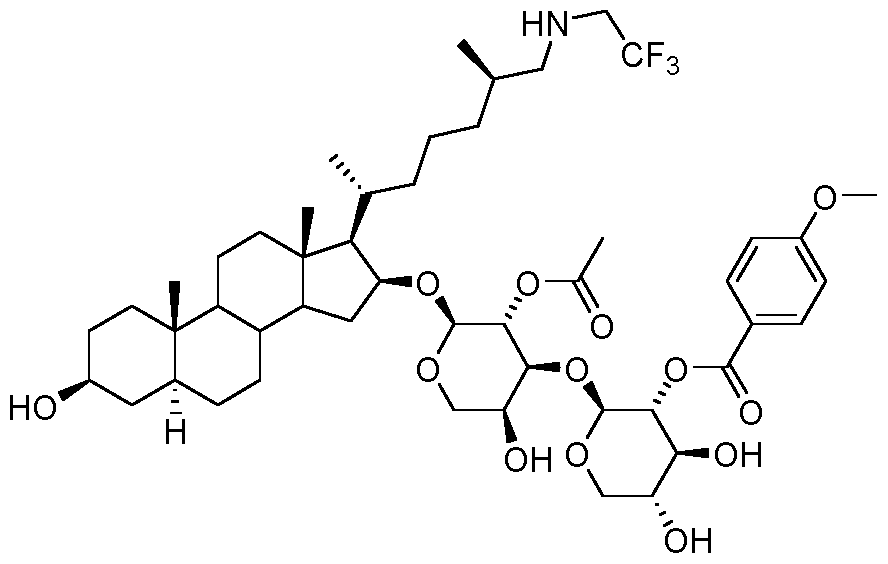
L'exemple 29 est synthétisé selon la méthode 1 à partir du stéroïde 3h et du dioside 1 en utilisant une étape 3 de déprotection avec du palladium sur charbon dans le MeOH sous hydrogène (rendement = 26%).
Solide blanc
(ES, m/z) : [M+H]+ = 942
HPLC (méthode C) : Tr = 3,06 mn
RMN C13, (100MHz, CD3OD, ppm) : 12,7 ; 13,4 ; 18,3 ; 18,6 ; 21 ,0 ; 22, 1 ; 23,5 ; 29,9 ; 30,6 ; 32, 1 ; 33,2 ; 34,4 ; 36,5 ; 36,6 ; 36,7 ; 37,4 ( 2 carbones) ; 38,2 ; 38,9 ; 41 ,3 ; 43,6 ; 46,2 ; 51,4 ; 55,9 ( 2 carbones) ; 56, 1 ; 57,3 ; 62,2 ; 66,3 ; 66,6 ; 69,8 ; 71 ,0 ; 71 ,9 ; 72,1 ; 75,2 ; 75,8 ; 81 ,2 ; 82,6 ; 103,9 ; 104,3 ; 1 14,8 (2 carbones) ; 123,6 ; 125,1 ; 133,2 ( 2 carbones) ; 165,4 ; 167,1 ; 171,0.
Exemple 30 : (2S,3R,4S,5R)-2-(((2S,3R,4S,5S)-3-acetoxy-5-hydroxy-2-(((3S, 10S, 13 S, 16S, 17R)-3-hydroxy- 17-((2R,6R)-7-((2-methoxyethyl)amino)-6-methylheptan-2- yl)- 10, 13-dimethylhexadecahydro- 1 H-cyclopenta[a]phenanthren- 16-yl)oxy)tetrahydro- 2H-pyran-4-yl)oxy)-4,5-dihydroxytetrahydro-2H-pyran-3-yl 4-(methylamino)benzoate.

L'exemple 30 est synthétisé selon la méthode 1 à partir du stéroïde 3i et du dioside 2 en utilisant une étape 3 de déprotection avec du palladium sur charbon dans le MeOH sous hydrogène (rendement = 9%).
Solide beige
(ES, m/z) : [M+H]+ = 917
HPLC (méthode C) : Tr = 2,44mn
RMN C13, (100MHz, CD3OD, ppm) : 12,7 ; 13,4 ; 18,3 ; 18,6 ; 21 ,0 ; 22, 1 ; 23,5 ; 29,9 ; 30,6 ; 32, 1 ; 33,2 ; 34,4 ; 36,5 ; 36,6 ; 36,7 ; 37,4 ( 2 carbones) ; 38,2 ; 38,9 ; 41 ,3 ; 43,6 ; 46,2 ; 51 ,4 ; 55,9 ( 2 carbones) ; 56, 1 ; 57,3 ; 62,2 ; 66,3 ; 66,6 ; 69,8 ; 71 ,0 ; 71 ,9 ; 72,1 ; 75,2 ; 75,8 ; 81 ,2 ; 82,6 ; 103,9 ; 104,3 ; 1 14,8 (2 carbones) ; 123,6 ; 125,1 ; 133,2 ( 2 carbones) ; 165,4 ; 167,1 ; 171,0. EVALUATION PHARMACOLOGIOUE
Culture cellulaire. Les cellules A549 (carcinome de poumon non à petites cellules - ATCC CCL-185) et HCT 1 16 (carcinoma colorectal - ATCC CCL-247) ont été cultivées en milieu Minimum Essential Médium Eagle (MEM) avec 5% de sérum de veau foetal (S VF). Les cellules Namalwa (Lymphome de Burkitt - ATCC CRL-1432) ont été cultivées en milieu Dulbecco's modified Eagle Médium (DMEM) avec 10% de S VF et du milieu RPMI-1640 avec 10% de S VF respectivement. Tous les milieux contenaient un mélange de fungizone (1.25 μg/mL) et de pénicilline-streptomycine (100 U / 100 μg/mL). Les cellules ont été entretenues dans les conditions standards de culture et maintenues à 37°C, 5% C02 et 95% d'humidité.
Activité antiproliférative sur un panel de 3 lignées tumorales. Les activités antiprolifératives des composés de l'invention ont été mesurées à l'aide d'un kit « ATPlite prolifération assay » (Perkin Elmer, Villebon sur Yvette, France) sur 2 lignées cellulaires. Les cellules ont été ensemencées dans des plaques 96 puits (103 cellules/puits pour A549, 1 ,5.103 cellules/puits pour HCT1 16 et 3.104 cellules/puits pour Namalwa) à une concentration permettant aux cellules d'être dans la phase exponentielle de croissance tout au long des 72h de traitement. Les cellules adhérentes (A549 et HCT1 16) sont ensemencées la veille du traitement pour permettre leur adhésion. Les cellules sont traitées par des doses croissantes de composé (1 1 d'une solution 10X à 1% DMSO - 6 puits/ condition). Pour éliminer les problèmes éventuels d'adhérence au plastique, les pointes de pipette ont été changées entre deux dilutions successives. Les cellules ont été incubées à 37°C, 5% C02 pendant 72h. La viabilité cellulaire a ensuite été mesurée par dosage de ΑΤΡ relargué par les cellules vivantes. Pour chaque dose de composé, le pourcentage de cellules vivantes par rapport au contrôle solvant a été calculé. Les valeurs d'ICso (concentration effectrice à 50%) ont été déterminées en utilisant l'algorithme du logiciel GraphPad (GraphPad Software Inc., CA, USA) correspondant à une analyse dose-réponse sigmoïdale (modèle de régression non linéaire, avec pente de Hill variable).
Composé A-549 (IC50, M) HCT116 (IC50, M) Namalwa (IC50, M)
OSW-1 7.78E-10* 1.78E-10 3.07E-10
1 3.21E-10 6.23E-10 9.59E-10
12 2.22E-10 5.30E-10 6.29E-10
23 6.45E-10 8.94E-10 8.13E-10
24 6.90E-1 1 1.1 1E-10 2.01E-10
29 1.90E-10 3.38E-10 4.89E-10
* Mimaki Y. et al. , Bioorg. Med. Chem. Lett., 1997, 7(5), 633-636.
Claims
1. Composé de formule générale (I) suivante :

(I)
ou un sel et/ou un solvate pharmaceutiquement acceptable de celui-ci,
dans laquelle :
- " représente une liaison double ou simple,
- Ri représente un ou plusieurs substituant(s) identique(s) ou différent(s) chacun représentant indépendamment les uns des autres un atome d'hydrogène, un atome d'halogène, de préférence de fluor, ou un groupe trifluorométhyle, (Ci-C6)alkyle, (Ci-C6)alcoxy, NR3R4, (CH2)mNR5R6, 0(CH2)mNR7R8, ou C02R9,
avec R3 à R9 représentant indépendamment les uns des autres un atome d'hydrogène ou un groupe (Ci-C6)alkyle éventuellement substitué, et
m représentant un nombre entier compris entre 1 et 6,
R10
I + -
- R2 représente N Rn ou N— N— N ,
avec :
• soit Rio représente un atome d'hydrogène ou un groupe (Ci-Ce)alkyle éventuellement substitué, et
Ru représente un atome d'hydrogène ou un groupe (Ci-C6)alkyle éventuellement substitué, aryle éventuellement substitué, aryl-(Ci-Ce)alkyle éventuellement substitué, Yi(CH2)aiY2Ri3, S02R14, COR15, C02R16, ou CONR17R18,
avec Yi représentant une liaison simple ou un groupe CO, C02, CONR19 ou S02, Y2 représentant un atome d'oxygène ou un groupe NR2o ou S02,
al représentant un nombre entier compris entre 1 et 6,
R13 à R17 représentant indépendamment les uns des autres un atome d'hydrogène ou un groupe (Ci-C6)alkyle éventuellement substitué, aryle éventuellement substitué ou aryl- (Ci-C6)alkyle éventuellement substitué, et
Ris à R20 représentant indépendamment les uns des autres un atome d'hydrogène ou un groupe (Ci-C6)alkyle éventuellement substitué,
• soit Rio et Ru forment avec l'atome d'azote qui les porte un hétérocycle éventuellement substitué.
2. Composé selon la revendication 1, caractérisé en ce que Ri représente un ou plusieurs substituant(s) identique(s) ou différent(s), de préférence un substituant en position para, chacun représentant indépendamment les uns des autres un groupe NR3R4 ou (Ci-C6)alcoxy, tel que NHMe ou OMe.
3. Composé selon l'une des revendications 1 et 2, caractérisé en ce que R2 représente un groupe N=N=N~ 4. Composé selon l'une des revendications 1 et 2, caractérisé en ce que R2
R10
représente un groupe N Rl 1 pour lequel Rio représente un atome d'hydrogène ou un groupe (Ci-C6)alkyle et Ru représente un atome d'hydrogène ou un groupe (Ci- Ce)alkyle ou aryl-(Ci-C6)alkyle.
5. Composé selon l'une des revendications 1 et 2, caractérisé en ce que R2
R10
représente un groupe N Rl 1 pour lequel Rio représente un atome d'hydrogène ou un groupe (Ci-C6)alkyle et Ru représente un atome d'hydrogène ou un groupe (Ci- Ce)alkyle substitué, notamment par un ou plusieurs substituants choisis parmi un atome d'halogène, NR29R3o, OR38, S02R2s, (Ci-C6)alcoxy, hétérocycle et aryle, avec R2s représentant un groupe (Ci-C6)alkyle, aryle ou aryl-(Ci-C6)alkyle et R29, R30 et R38
représentant, indépendamment les uns des autres, un atome d'hydrogène ou un groupe (Ci-C6)alkyle, aryle ou aryl-(Ci-C6)alkyle.
6. Composé selon l'une des revendications 1 et 2, caractérisé en ce que R2
Rio
représente un groupe N Rl 1 pour lequel Rio représente un atome d'hydrogène ou un groupe (Ci-C6)alkyle et Ri i représente Yi(CH2)aiY2Ri3 dans lequel Yi représente une liaison simple, Y2 est tel que défini à la revendication 1 , al représente un nombre entier compris entre 1 et 6, préférentiellement entre 1 et 4, encore préférentiellement entre 1 et 2, et R13 représente un atome d'hydrogène ou un groupe (Ci-C6)alkyle.
7. Composé selon l'une des revendications 1 et 2, caractérisé en ce que R2
Rio
représente un groupe N Rl 1 pour lequel Rio représente un atome d'hydrogène ou un groupe (Ci-C6)alkyle et Ru représente un groupe S02Ri4, COR15, C02Ri6 ou CONR17R18 avec R14 à R17 représentant, indépendamment les uns des autres, un groupe (Ci-C6)alkyle et Ris représentant un atome d'hydrogène ou un groupe (Ci-C6)alkyle.
8. Composé selon l'une des revendications 1 et 2, caractérisé en ce que R2
R10
représente un groupe N Rl 1 pour lequel Rio et Ru forment avec l'atome d'azote un hétérocycle choisi parmi les cycles morpholine, pipérazine et triazole,
éventuellement substitué par un groupe (Ci-C6)alkyle éventuellement substitué par un groupe NR29R30 ou OR38 avec R29, R30 et R38 représentant, indépendamment les uns des autres, un atome d'hydrogène ou un groupe (Ci-C6)alkyle.
9. Composé selon la revendication 1 , caractérisé en ce qu'il est choisi parmi les composés suivants :


 ou un sel et/ou un solvate pharmaceutiquement acceptable de ceux-ci, tel qu'un sel formé avec l'acide formique.
10. Composé selon l'une quelconque des revendications 1 à 9, pour son utilisation en tant que médicament.
11. Composé selon l'une quelconque des revendications 1 à 9, pour son utilisation en tant que médicament destiné au traitement du cancer.
12. Composition pharmaceutique comprenant au moins un composé de formule (I) selon l'une quelconque des revendications 1 à 9, et au moins un excipient pharmaceutiquement acceptable.
13. Composition pharmaceutique selon la revendication 12, comprenant en outre au moins un autre principe actif tel qu'un agent anticancéreux.
14. Composition pharmaceutique comprenant :
(i) au moins un composé de formule (I) selon l'une quelconque des revendications 1 à 9, et
(ii) au moins un autre principe actif, tel qu'un agent anticancéreux,
en tant que produit de combinaison, pour une utilisation simultanée, séparée ou étalée dans le temps.
15. Procédé de préparation d'un composé de formule (I) selon l'une quelconque des revendications 1 à 9 comprenant les étapes suivantes :
(i) condensation d'un composé de formule (II) suivante :
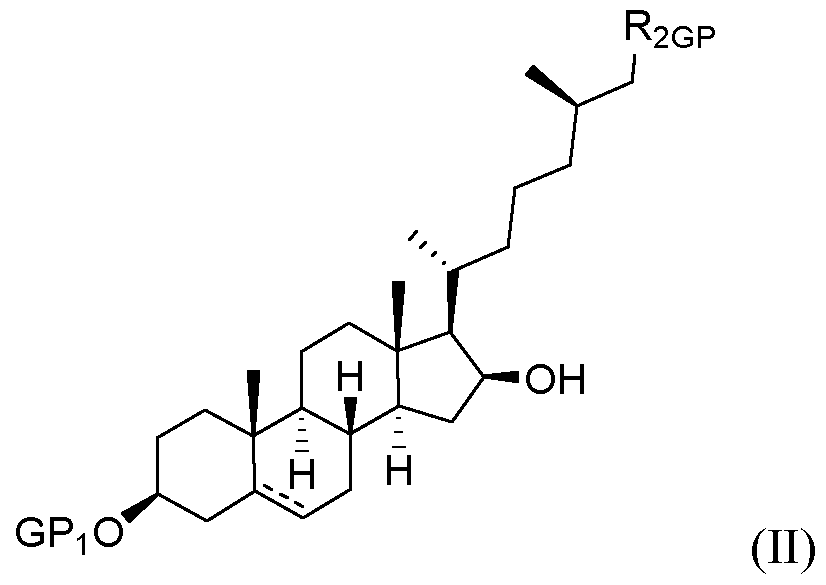
pour laquelle est tel que défini à la revendication 1 , GPi représente groupe O-protecteur et R2GP représente un groupe R2 tel que défini à la revendication 1 éventuellement sous une forme protégée,
avec un composé de formule (III) suivante :

pour laquelle LGi représente un groupe partant ; GP2, GP3 et GP4 représentent chacun, indépendamment les uns des autres, un groupe O-protecteur ; et RiGp représente un groupe Ri tel que défini à la revendication 1 éventuellement sous une forme protégée,
(ii) déprotection des groupes protecteurs pour donner un composé de formule (I),
(iii) lorsque " représente une liaison double, éventuellement réduction de la double liaison pour donner un composé de formule (I) pour lequel " représente une liaison simple, et
(iv) éventuellement salifïcation et/ou solvatation pour donner un composé de formule (I) sous forme d'un sel et/ou un solvate pharmaceutiquement acceptable.
16. Procédé de préparation d'un composé de formule (I) selon l'une quelconque des revendications 1 à 9, pour lequel R2 représente un groupe 1 ,2,3-triazol-l-yle éventuellement substitué par un groupe (Ci-C6)alkyle éventuellement substitué par une fonction azotée et/ou oxygénée, comprenant les étapes suivantes :
(1) réaction d'un composé de formule (I) pour lequel R2 = N3 avec un composé de formule R avec R représentant H ou un groupe (Ci-Ce)alkyle éventuellement substitué par une fonction azotée et/ou oxygénée pour donner un composé de formule (Id) suivante :

pour laquelle R est tel que défini ci-dessus et " et Ri sont tels que définis à la revendication 1 ,
lorsque " représente une liaison double, éventuellement réduction de la double liaison pour donner un composé de formule (Id) pour lequel " représente une liaison simple, et
(3) éventuellement salifïcation et/ou solvatation pour donner un composé de formule (Id) sous forme d'un sel et/ou un solvate pharmaceutiquement acceptable.
17. Procédé de préparation d'un composé de formule (I) selon l'une quelconque des revendications 1 à 9, pour lequel R2 représente un groupe NRioRn, Rio et Ru ne formant pas un cycle avec l'atome d'azote qui les porte, comprenant les étapes suivantes :
(a) rédu tion d'un composé de formule (Via) suivante :

pour donner un composé de formule (VId) suivante :

pour laquelle RIGP, GPI , GP2, GP3 et GP4 sont tels que définis ci-dessus et " est tel que défini à la revendication 1 ,
(b) éventuellement substitution du composé de formule (VId) obtenu à l'étape (a) précédente pour donner un composé de formule (Vie) suivante :

pour laquelle RIGP, GPI , GP2, GP3 et GP4 sont tels que définis ci-dessus et " , Rio et Ru sont tels que définis à la revendication 1 , l'un au moins de Rio et Ru ne représentant pas un atome d'hydrogène,
(c) déprotection des groupes protecteurs pour donner un composé de formule (I) avec R2 = NR10R11,
lorsque " représente une liaison double, éventuellement réduction de la double liaison pour donner un composé de formule (I) pour lequel " représente une liaison simple et R2 = NR10Rl l 5 et
éventuellement salifïcation et/ou solvatation pour donner un composé de formule (I) sous forme d'un sel et/ou un solvate pharmaceutiquement acceptable.
Applications Claiming Priority (2)
| Application Number | Priority Date | Filing Date | Title |
|---|---|---|---|
| FR1456093 | 2014-06-27 | ||
| FR1456093A FR3022907A1 (fr) | 2014-06-27 | 2014-06-27 | Derives d'osw-1 et leur utilisation en tant que medicament |
Publications (1)
| Publication Number | Publication Date |
|---|---|
| WO2015197872A1 true WO2015197872A1 (fr) | 2015-12-30 |
Family
ID=51688209
Family Applications (1)
| Application Number | Title | Priority Date | Filing Date |
|---|---|---|---|
| PCT/EP2015/064757 Ceased WO2015197872A1 (fr) | 2014-06-27 | 2015-06-29 | Dérivés d'osw-1 et leur utilisation pour le traitement du cancer |
Country Status (2)
| Country | Link |
|---|---|
| FR (1) | FR3022907A1 (fr) |
| WO (1) | WO2015197872A1 (fr) |
Citations (1)
| Publication number | Priority date | Publication date | Assignee | Title |
|---|---|---|---|---|
| WO2010088866A2 (fr) * | 2009-02-09 | 2010-08-12 | Uniwersytet W Bialymstoku | Nouveaux composés de saponine, procédés pour les préparer, leur utilisation et compositions pharmaceutiques |
-
2014
- 2014-06-27 FR FR1456093A patent/FR3022907A1/fr not_active Withdrawn
-
2015
- 2015-06-29 WO PCT/EP2015/064757 patent/WO2015197872A1/fr not_active Ceased
Patent Citations (1)
| Publication number | Priority date | Publication date | Assignee | Title |
|---|---|---|---|---|
| WO2010088866A2 (fr) * | 2009-02-09 | 2010-08-12 | Uniwersytet W Bialymstoku | Nouveaux composés de saponine, procédés pour les préparer, leur utilisation et compositions pharmaceutiques |
Non-Patent Citations (2)
| Title |
|---|
| DAN ZHENG ET AL: "Synthesis of cholestane glycosides bearing OSW-1 disaccharide or its 1->4-linked analogue and their antitumor activities", BIOORGANIC & MEDICINAL CHEMISTRY LETTERS, vol. 20, no. 18, 2010, pages 5439 - 5442, XP055148838, ISSN: 0960-894X, DOI: 10.1016/j.bmcl.2010.07.085 * |
| DAN ZHENG ET AL: "Synthesis of cholestane saponins as mimics of OSW-1 and their cytotoxic activities", BIOORGANIC & MEDICINAL CHEMISTRY LETTERS, vol. 21, no. 11, 2011, pages 3257 - 3260, XP028211459, ISSN: 0960-894X, [retrieved on 20110413], DOI: 10.1016/J.BMCL.2011.04.030 * |
Also Published As
| Publication number | Publication date |
|---|---|
| FR3022907A1 (fr) | 2016-01-01 |
Similar Documents
| Publication | Publication Date | Title |
|---|---|---|
| EP3164393B1 (fr) | Dérivés de flavaglines | |
| CA2690349C (fr) | Derives de 7 -alkynyl-1,8-naphthyridones, leur preparation et leur application en therapeutique | |
| EP0060745A2 (fr) | Nouveaux dérivés antibiotiques dérivés des céphalosporines | |
| FR2934593A1 (fr) | Derives dimeriques d'artemisinine et application en therapie anticancereuse | |
| FR2712289A1 (fr) | Nouveaux dérivés de taxicine, leur préparation et les compositions pharmaceutiques qui les contiennent. | |
| EP1101765B1 (fr) | Nouveaux composés analogues de la camptothécine, leur procédé de préparation et les compositions pharmaceutiques qui les contiennent | |
| EP1664055B9 (fr) | Derives de 9-amino-podophyllotoxine, leur procede de preparation et les compositions pharmaceutiques qui les contiennent | |
| JP2000513716A (ja) | タキサン誘導体、その調製、及びそれを含有する処方物 | |
| JP5960130B2 (ja) | テセタキセルおよび関連化合物ならびに対応する合成中間体の調製 | |
| EP1513833B1 (fr) | Nouveaux derives de 3-(4-oxo-4h-chromen-2-yl)-(1h)-quinolein-4-ones, leur procede de preparation et les compositions pharmaceutiques qui les contiennent | |
| EP0427606A1 (fr) | Dérivés d'amidino-4 chromanne et d'amidino-4 pyranno (3,2-c) pyridine, procédé d'obtention et compositions pharmaceutiques les contenant | |
| FR3022907A1 (fr) | Derives d'osw-1 et leur utilisation en tant que medicament | |
| FR2711370A1 (fr) | Nouveaux taxoïdes, leur préparation et les compositions pharmaceutiques qui les contiennent. | |
| CA2196102A1 (fr) | Derives de streptogramine, leur preparation et les compositions pharmaceutiques qui les contiennent | |
| FR2827864A1 (fr) | Nouveaux derives de benzo[b]pyrano[3,2-h]acridin-7-one, leur procede de preparation et les compositions pharmaceutiques qui les contiennent | |
| WO2013162922A1 (fr) | Composés taxane, compositions et procédés | |
| WO2005073211A1 (fr) | Derives de pyranone utiles pour le traitement du cancer | |
| EP2493885B1 (fr) | Molecules polyketides comme agents anticancereux | |
| CA2244508C (fr) | Nouveaux composes de bis pyrido¬4,3-b|carbazole, leur procede de preparation et les compositions pharmaceutiques qui les contiennent | |
| EP1491544A1 (fr) | Dérivés de benzo(a)pyrano(3,2-h)acridin-7-one, leur procédé de préparation et les compositions pharmaceutiques qui les contiennent | |
| EP1561753A2 (fr) | Dérivés de benzo[b]chroménonapthyridin-7-one et de pyrano[2',3':7,8]quino[2,3-b]quinoxalin-7-one, leur procédé de préparation, les compositions pharmaceutiques qui les contiennent et leurs propriétés antitumorales pour le traitement du cancer | |
| US8697892B2 (en) | Taxane compounds, compositions and methods | |
| WO2002094840A2 (fr) | Derives tricycliques de dihydroquinoleines, leur procede de preparation et les compositions pharmaceutiques qui les contiennent | |
| EP2376511B1 (fr) | Derives bicycliques de morphine-6-glucuronide, leur preparation et leur application en therapeutique | |
| WO1992001706A1 (fr) | Nouveaux derives de la 6-methyl 19-nor progesterone, substitue en 3 et leur procede d'obtention |
Legal Events
| Date | Code | Title | Description |
|---|---|---|---|
| 121 | Ep: the epo has been informed by wipo that ep was designated in this application |
Ref document number: 15734334 Country of ref document: EP Kind code of ref document: A1 |
|
| NENP | Non-entry into the national phase |
Ref country code: DE |
|
| 122 | Ep: pct application non-entry in european phase |
Ref document number: 15734334 Country of ref document: EP Kind code of ref document: A1 |