WO2016004881A1 - Procédés de fourniture de communications simultanées entre une pluralité de dispositifs de communications sans fil - Google Patents
Procédés de fourniture de communications simultanées entre une pluralité de dispositifs de communications sans fil Download PDFInfo
- Publication number
- WO2016004881A1 WO2016004881A1 PCT/CN2015/083604 CN2015083604W WO2016004881A1 WO 2016004881 A1 WO2016004881 A1 WO 2016004881A1 CN 2015083604 W CN2015083604 W CN 2015083604W WO 2016004881 A1 WO2016004881 A1 WO 2016004881A1
- Authority
- WO
- WIPO (PCT)
- Prior art keywords
- frames
- responding
- wireless communications
- communications devices
- sent
- Prior art date
- Legal status (The legal status is an assumption and is not a legal conclusion. Google has not performed a legal analysis and makes no representation as to the accuracy of the status listed.)
- Ceased
Links
Images




Classifications
-
- H—ELECTRICITY
- H04—ELECTRIC COMMUNICATION TECHNIQUE
- H04W—WIRELESS COMMUNICATION NETWORKS
- H04W74/00—Wireless channel access
- H04W74/002—Transmission of channel access control information
- H04W74/006—Transmission of channel access control information in the downlink, i.e. towards the terminal
-
- H—ELECTRICITY
- H04—ELECTRIC COMMUNICATION TECHNIQUE
- H04L—TRANSMISSION OF DIGITAL INFORMATION, e.g. TELEGRAPHIC COMMUNICATION
- H04L5/00—Arrangements affording multiple use of the transmission path
- H04L5/0001—Arrangements for dividing the transmission path
- H04L5/0003—Two-dimensional division
- H04L5/0005—Time-frequency
- H04L5/0007—Time-frequency the frequencies being orthogonal, e.g. OFDM(A) or DMT
-
- H—ELECTRICITY
- H04—ELECTRIC COMMUNICATION TECHNIQUE
- H04B—TRANSMISSION
- H04B7/00—Radio transmission systems, i.e. using radiation field
- H04B7/02—Diversity systems; Multi-antenna system, i.e. transmission or reception using multiple antennas
- H04B7/04—Diversity systems; Multi-antenna system, i.e. transmission or reception using multiple antennas using two or more spaced independent antennas
- H04B7/0413—MIMO systems
- H04B7/0452—Multi-user MIMO systems
-
- H—ELECTRICITY
- H04—ELECTRIC COMMUNICATION TECHNIQUE
- H04W—WIRELESS COMMUNICATION NETWORKS
- H04W84/00—Network topologies
- H04W84/02—Hierarchically pre-organised networks, e.g. paging networks, cellular networks, WLAN [Wireless Local Area Network] or WLL [Wireless Local Loop]
- H04W84/10—Small scale networks; Flat hierarchical networks
- H04W84/12—WLAN [Wireless Local Area Networks]
Definitions
- the disclosed embodiments relate generally to wireless communication, and, more particularly, to methods for providing concurrent communications among multiple wireless communications devices.
- Multi-user multiple-input multiple-output (MU-MIMO) transmission is becoming a new system technique to enable high system capacity.
- MU-MIMO has several key advantages.
- MU-MIMO allows the higher degree spatial multiplexing gain to be obtained without the need for higher number of antennas at the mobile stations by keeping the intelligence and cost at the access point.
- MU-MIMO appears immune to most propagation limitations plaguing SU-MIMO communications because multiuser diversity can be extracted even in a simple line of sight (LOS) propagation environment.
- LOS line of sight
- the LOS propagation which causes degradation in single user spatial multiplexing schemes, is no longer a problem in the multiuser setting.
- the amount of data transmitted over the internet has been growing exponentially.
- wireless connections will not only connect people via voice and data communications but also will connect smart devices, also called Internet of Things (IoT) .
- IoT Internet of Things
- the number of devices connected through wireless communication demands higher efficiency of the wireless network. Consequently, MU-MIMO becomes more widely adopted.
- the downlink MU-MIMO will need multiple stations to feedback acknowledgement in the uplink.
- One way to send the uplink feedback for MU-MIMO is to send the feedback sequentially.
- the first user will send the feedback the response immediately.
- the following users will send the feedback after polling by the access point (AP) .
- the sequential feedback using AP polling in the uplink direction limits the system efficiency.
- Improvement and enhancement are required for uplink feedback responses for MU-MIMO.
- the wireless station communicates with a plurality of wireless communications devices by using multiple users multiple input and multiple output (MU-MIMO) and Orthogonal Frequency Demodulation Multiple Access (OFDMA) transmission.
- the wireless station transmits a wideband signal to a plurality of wireless communications devices using downlink MIMO and/or OFDMA.
- the wireless station receives a plurality of responding frames from the plurality of wireless communications devices concurrently each using a corresponding uplink narrow band.
- the pluralities of frames are sent concurrently using OFDMA.
- the wireless station transmits a MU indication bit and MU bandwidth assignment information in the downlink MIMO and/or OFDMA frames.
- the MU indication bit is included in the PHY SIG field.
- the MU bandwidth assignment information is included in the PHY SIG field.
- the uplink responding frames from multiple wireless communications devices are sent on a corresponding narrow concurrently over more than one transmission instance.
- AP polling is used between two transmission instances.
- SIFS is used in between the two transmission instances.
- the mixed use of the sequential uplink responding frames and the concurrent uplink OFDMA responding frames are used.
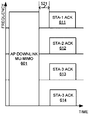
- Figure 1 illustrates an exemplary wireless network 100 with downlink MU-MIMO and/or OFDMA scheme and concurrent uplink feedback in accordance with embodiments of the current invention.
- Figure 2 illustrates an exemplary diagram in a wireless system with downlink MU-MIMO and/or OFDMA scheme and concurrent responding feedbacks in accordance with embodiments of the current invention.
- Figure 3 shows an exemplary configuration for multiple wireless communications devices to send the corresponding responding frames concurrently over more than one transmission instances in accordance with embodiments of the current invention.
- Figure 4 shows and exemplary configuration for multiple wireless communications devices to send the corresponding responding frames concurrently over more than one transmission instances using AP polls in accordance with embodiments of the current invention.
- Figure 5 shows an exemplary diagram for multiple wireless communications devices to send the corresponding responding frames concurrently over more than one transmission instances and at least one transmission instance has less than the maximum allowed wireless communications devices in accordance with embodiments of the current invention.
- Figure 6A shows an exemplary diagram for uplink responding frames using MU OFDMA by leaving the unoccupied bandwidth empty in accordance with embodiments of the current invention.
- Figure 6B shows an exemplary diagram for uplink responding frames using MU OFDMA by occupying the bandwidth with duplicated responding frames in accordance with embodiments of the current invention.
- Figure 7 shows an exemplary diagram of a mixed use the sequential responding frames and the concurrent OFDMA uplink responding frames in accordance with embodiments of the current invention.
- Figure 8 shows an exemplary flow chart of a wireless station performs downlink MIMO/OFDMA with uplink MU responding frames using OFDMA in accordance with embodiments of the current invention.
- Figure 9 shows an exemplary flow chart of a wireless communication device performs downlink MIMO/OFDMA with uplink MU responding frames using OFDMA in accordance with embodiments of the current invention.
- FIG. 1 illustrates an exemplary wireless network 100 with downlink MU-MIMO and concurrent uplink feedback in accordance with embodiments of the current invention.
- Wireless communication system 100 includes one or more wireless networks, each of the wireless communication network has a fixed base infrastructure unit, such as wireless communications stations 102 103, and 104, forming wireless networks distributed over a geographical region.
- the base unit may also be referred to as an access point, an access terminal, a base station, a Node-B, an eNode-B, or by other terminology used in the art.
- Each of the receiving wireless communications stations 102, 103, and 104 serves a geographic area.
- Backhaul connections113, 114 and 115 connect the non-co-located wireless communications stations, such as 102, 103, and 104. These backhaul connections can be either ideal or non-ideal
- a wireless communications device 101in wireless network 100 is served by base station 102 via uplink 111 and downlink 112.
- Other wireless communications devices 105, 106, 107, and 108 are served by different base stations.
- Wireless communications devices 105 and 106 are served by base station 102.
- Wireless communications device 107 is served by base station 104.
- Wireless communications device 108 is served by base station 103.
- wireless communication network 100 is an OFDMA /MIMO system comprising base stations /access points (APs) 102, 103 and 104, and a plurality of mobile stations, such as wireless stations101, 105, 106, 107 and 108.
- each base station serves multiple wireless communications devices that periodically transmit packets.
- huge number of wireless stations contenting for the wireless channel results in collisions, long transmission range leads to high interface spaces and short packets increase overhead caused by headers.
- downlink transmissions to multiple wireless stations using MIMO and/or OFDMA are aggregated.
- data frames from different mobile stations meeting certain criteria are aggregated using OFDMA and transmitted together.
- multi-user OFDMA is used for uplink transmission.
- a network entity, such as a wireless controller 109 is connected with base stations such as base stations 102, 103, and 104, via links of 116, 117, and 118.
- Figure 1 further shows simplified block diagrams of wireless stations 101 and base station 102 in accordance with the current invention.
- Wireless communication station 102 has an antenna 126, which transmits and receives radio signals.
- a RF transceiver module 123 coupled with the antenna, receives RF signals from antenna 126, converts them to baseband signals and sends them to processor 122.
- RF transceiver 123 also converts received baseband signals from processor 122, converts them to RF signals, and sends out to antenna 126.
- Processor 122 processes the received baseband signals and invokes different functional modules to perform features in base station 102.
- Memory 121 stores program instructions and data 124 to control the operations of base station 102.
- Base station 102 also includes a set of control modules, such as UL MU handler 125 that carry out functional tasks to communicate with wireless communications devices.
- Wireless communications device 101 has an antenna 135, which transmits and receives radio signals.
- a RF transceiver module 134 coupled with the antenna, receives RF signals from antenna 135, converts them to baseband signals and sends them to processor 132.
- RF transceiver 134 also converts received baseband signals from processor 132, converts them to RF signals, and sends out to antenna 135.
- Processor 132 processes the received baseband signals and invokes different functional modules to perform features in mobile station 101.
- Memory 131 stores program instructions and data 136 to control the operations of mobile station 101.
- Wireless communications device 101 also includes a set of control modules that carry out functional tasks.
- a downlink MIMO /OFDMA handler 191 handles downlink data and control frames using MU-MIMO and/or OFDMA scheme.
- a UL MU handler 192 handles uplink responding frames using OFDMA.
- FIG. 2 illustrates an exemplary diagram in a wireless system with downlink MU-MIMO and/or OFMDA scheme and concurrent responding feedbacks in accordance with embodiments of the current invention.
- An AP 201 with antenna 211 is configured to support downlink MU-MIMO and/or OFDMA and uplink OFDMA.
- Exemplary multiple mobile stations STA-1 202, STA-2 203 and STA-N 204 connect to AP 201 via antennas 212, 213 and 214, respectively.
- antennas 211 to 214 each is an antenna array in supporting of MIMO.
- AP 201 transmits downlink information with wideband comprising of a plurality of narrow band channels.
- AP 201 transmits information to a plurality of wireless communications devices using MIMO and/or OFDMA.
- AP 201 receives uplink responding frames from the plurality of wireless communications stations concurrently using OFDMA.
- AP 201 exchanges capacity information with the plurality of wireless communications devices, such as STA-1 202, STA-2 203, and STA-N 204. Based on the capacity information, uplink responding message can be sent concurrently using OFDMA or can be sent sequentially using AP polling.
- Figure 2 further illustrates the base station initiates MU operation in accordance to embodiments of the current invention.
- Multiple STAs STA-1 202, STA-2 203, and STA-N 204 are connected with AP 201.
- the wireless communications devices receive downlink transmission from wireless stations, such as AP 201, using MIMO or OFDMA scheme.
- the downlink frames can be data transmission or control frames.
- STA-1 202 and STA-2 203 are configured to be in one MU group 205.
- STA-N 204 is in a different MU group based on the capacity information.
- the downlink frames can be data frames.
- AP 201 transmits downlink data to STA-1 202, STA-2 203, and STA-N 204, using MU- MIMO and/or OFDMA.
- both MU-MIMO and OFDMA are used for the downlink transmission, with a first subset of wireless communications devices receiving MU-MIMO frames, while a second subset of wireless communications devices receiving OFMDA frames.
- the AP transmits downlink data frames.
- control frames are transmitted using MU-MIMO or OFDMA.
- the control frames is the clear-to-send (CTS) message.
- CTS clear-to-send
- one or more wireless communications devices Upon receiving the downlink frames, one or more wireless communications devices send responding messages using OFDMA. Each wireless communications device replies a responding message in different frequency band concurrently. As shown in Figure 2, STA-1 202, STA-2 203 and STA-N 204 respond with an ACK messages in different frequency bands concurrently at steps 231, 232, and 233, respectively.
- an indication is included to indicate the configuration for concurrent responding using uplink OFDMA.
- an indication bit is included in the physical layer signal field (PHY SIG) .
- the bandwidth assignment for the uplink responding frames can be included in PHY SIG field or be predefined or preconfigured.
- the preconfigured bandwidth is at least based on the number of wireless communications devices in the MU group. Upon detecting this indicator, the wireless communications devices start uses OFDMA for uplink responding messages. There are different configurations based on the number of wireless communications devices and the bandwidth of the uplink OFDMA channel.
- Figure 3 shows an exemplary diagram for multiple wireless communications devices to send the corresponding responding frames concurrently over more than one transmission instances in accordance with embodiments of the current invention.
- the wireless communication station sends downlink wideband signal to multiple wireless communications devices, STA-1 to STA-8.
- the bandwidth needed for the responding message for each communications device is 20M.
- the total uplink OFDMA bandwidth is 80M. Therefore, there are total of four wireless communication devices can send the uplink responding frames concurrently.
- STA-1, STA-2, STA-3, and STA-4 are configured to be in the first subset to send their responding frames concurrently using uplink OFDMA at steps 311, 312, 313, and 314, respectively.
- STA-5, STA-6, STA-7, and STA-8 are configured to be in the second set to send their responding frames concurrently using uplink OFDMA at steps 315, 316, 317, and 318, respectively.
- the first set of wireless communications devices Upon receiving the downlink frames, the first set of wireless communications devices back off for a short inter-frame space (SIFS) 321.
- the first set of communications devices send their responding frames in different frequency band concurrently using OFDMA.
- the second set of wireless communications devices after backing off for SIFS 322, send their responding frames in different frequency band concurrently using OFDMA.
- the total bandwidth required to send responding frames from multiple wireless communication devices is greater than the available uplink OFDMA bandwidth, multiple OFDMA packets with SIFS spacing are used. In another embodiment, if the total bandwidth required sending responding frames from multiple wireless communication devices is greater than the available uplink OFDMA bandwidth, AP polls the second set of wireless communications devices for the second transmission instance.
- Figure 4 shows an exemplary diagram for multiple wireless communications devices to send the corresponding responding frames concurrently over more than one transmission instances using AP polls in accordance with embodiments of the current invention.
- the wireless communication station sends downlink wideband signal to multiple wireless communications devices, STA-1 to STA-8.
- STA-1, STA-2, STA-3, and STA-4 are configured to be in the first subset to send their responding frames concurrently using uplink OFDMA at steps 411, 412, 413, and 414, respectively.
- STA-5, STA-6, STA-7, and STA-8 are configured to be in the second set to send their responding frames concurrently using uplink OFDMA at steps 415, 416, 417, and 418, respectively.
- the first set of wireless communications devices Upon receiving the downlink frames, the first set of wireless communications devices back off for a short inter-frame space (SIFS) 421.
- the first set of communications devices send their responding frames in different frequency band concurrently using OFDMA.
- AP polling is used for the second set of the wireless communications devices. After SIFS 422, AP polling for the second set of wireless communications devices at step 419.
- the second set of wireless communications devices after backing off for SIFS 423, send their responding frames in different frequency band concurrently using OFDMA.
- the wireless communications devices can be assigned to different MU group for uplink OFDMA transmission even when the uplink OFMDA has enough bandwidth for the responding frames.
- Figure 5 shows an exemplary diagram for multiple wireless communications devices to send the corresponding responding frames concurrently over more than one transmission instances and at least one transmission instance has less than the maximum allowed wireless communications devices in accordance with embodiments of the current invention.
- the wireless communication station sends downlink wideband signal to multiple wireless communications devices, STA-1 to STA-4.
- the responding frames from STA-1 to STA-4 can fit in the bandwidth of the uplink OFDMA transmission, different configuration can be adopted.
- STA-1 and STA-2 are configured to be in the first subset to send their responding frames concurrently using uplink OFDMA at steps 511 and 512, respectively.
- STA-3 and STA-4 are configured to be in the second set to send their responding frames concurrently using uplink OFDMA at steps 513 and 514, respectively.
- the first set of wireless communications devices Upon receiving the downlink frames, the first set of wireless communications devices back off for a short inter-frame space (SIFS) 521.
- the first set of communications devices send their responding frames in different frequency band concurrently using OFDMA.
- AP polling is used for the second set of the wireless communications devices. After SIFS 522, AP polling for the second set of wireless communications devices at step 519.
- the second set of wireless communications devices after backing off for SIFS 523, send their responding frames in different frequency band concurrently using OFDMA.
- the second set of wireless communications devices can send their responding frames using OFDMA after SIFS without AP polls.
- the multiple responding frames from corresponding wireless devices may not occupy the entire uplink bandwidth. Different approaches are used for the unoccupied bandwidth. In one embodiment, the unoccupied bandwidth is left empty. In another embodiment, duplicated responding frames are used to occupy the unused bandwidth.
- FIG. 6A shows an exemplary diagram for uplink responding frames using MU OFDMA by leaving the unoccupied bandwidth empty in accordance with embodiments of the current invention.
- the wireless communication station sends downlink wideband signal to multiple wireless communications devices, STA-1, STA-2, STA-3.
- the wireless communications devices Upon receiving the downlink frames, the wireless communications devices back off for a short inter-frame space (SIFS) 621.
- STA-1, STA-2, and STA-3 send corresponding responding frames in different frequency bands concurrently at steps 611, 612, and 613, respectively.
- the unoccupied bandwidth is left empty, leaving the bandwidth no energy.
- Figure 6B shows an exemplary diagram for uplink responding frames using MU OFDMA by occupying the bandwidth with duplicated responding frames in accordance with embodiments of the current invention.
- the wireless communication station sends downlink wideband signal to multiple wireless communications devices, STA-1, STA-2, STA-3.
- the wireless communications devices Upon receiving the downlink frames, the wireless communications devices back off for a short inter-frame space (SIFS) 621.
- STA-1, STA-2, and STA-3 send corresponding responding frames in different frequency bands concurrently at steps 611, 612, and 613, respectively.
- the unoccupied bandwidth is filled with a duplicated responding frame from STA-3.
- one or more duplicated responding frames can be used to either entirely occupy the whole bandwidth or occupy a portion of the unoccupied bandwidth.
- the duplicated responding frame can be randomly picked.
- the duplicated responding frames can be predefined or preconfigured.
- FIG. 7 shows an exemplary diagram of a mixed use the sequential responding frames and the concurrent OFDMA uplink responding frames in accordance with embodiments of the current invention.
- the wireless communication station sends downlink wideband signal to multiple wireless communications devices, STA-1 and STA-2.
- STA-1 and STA-2 is setup to send responding frames sequentially.
- SIFS 721 STA-1 sends the responding frame step 711.
- STA-2 sends the responding frames in response to the AP polling.
- the wireless communication station sends downlink wideband signal to multiple wireless communications devices, STA-3, STA-4, STA-5, and STA-6.
- STA-3, STA-4, STA-5, and STA-6 are configured to send their responding frames concurrently using uplink OFDMA.
- SIFS 722, STA3, STA-4, STA-5, and STA-6 sends their corresponding responding frames at steps 714, 715, 716, 717 and 718, respectively.
- Figure 8 shows an exemplary flow chart of a wireless station performs downlink MIMO/OFDMA with uplink MU responding frames using OFDMA in accordance with embodiments of the current invention.
- the wireless station exchanges information about transmission capability with the plurality of wireless communications devices.
- the wireless station transmits a wideband signal to the plurality of wireless communications devices concurrently using MIMO scheme and OFDMA, wherein the wideband comprises a plurality of narrow bands, wherein the wideband is separated into at least a first sub-band and a second sub-band, wherein wide band signal is sent in accordance with a predetermined rule.
- the wireless station receives a plurality of responding frames from the plurality of wireless communications devices, wherein each frame is sent over a corresponding narrow band, wherein the a plurality of responding frames are received in accordance with a predetermined rule.
- Figure 9 shows an exemplary flow chart of a wireless communication device performs downlink MIMO/OFDMA with uplink MU responding frames using OFDMA in accordance with embodiments of the current invention.
- the wireless communications device exchanges information regarding transmission capability with a remote wireless station at step 901.
- the wireless communications device receives a downlink wideband signal of MIMO or OFDMA scheme, wherein the downlink wideband comprises a plurality of narrow bands sending to a plurality of corresponding wireless communications devices concurrently.
- the wireless communications device transmits a responding frame in an uplink wideband, wherein the uplink wideband comprises a plurality of narrow bands from the plurality of wireless communications devices, wherein each responding frame of a corresponding wireless communications devices is sent over a corresponding narrow band, wherein the a plurality of responding frames are transmitted in accordance with a predetermined rule.
Landscapes
- Engineering & Computer Science (AREA)
- Signal Processing (AREA)
- Computer Networks & Wireless Communication (AREA)
- Mobile Radio Communication Systems (AREA)
Abstract
L'invention concerne des procédés pour la fourniture de communications simultanées entre une pluralité de dispositifs de communications sans fil. Dans un aspect de l'invention, la station sans fil transmet un signal à large bande à une pluralité de dispositifs de communications sans fil au moyen d'un système MIMO et/ou OFDMA de liaison descendante. La station sans fil reçoit simultanément une pluralité de trames de réponse, de la pluralité de dispositifs de communications sans fil, via la technologie OFDMA. Dans un mode de réalisation, la station sans fil transmet un bit d'indication MU et informations d'attribution de largeur de bande MU dans les trames MIMO et/ou OFDMA de liaison descendante. Dans un autre aspect de l'invention, les trames de réponse de liaison montante provenant d'une pluralité de dispositifs de communications sans fil sont envoyées simultanément sur plus d'une instance de transmission. On ne peut utiliser qu'une interrogation d'AP ou SIFS entre deux instances de transmission. Lorsque les trames de réponse simultanées occupent moins d'une largeur de bande d'une largeur de bande OFDMA de liaison montante disponible, la largeur de bande inoccupée est laissée vide ou occupée par une ou plusieurs trames de réponse dupliquées.
Priority Applications (1)
| Application Number | Priority Date | Filing Date | Title |
|---|---|---|---|
| EP15818457.2A EP3152854A4 (fr) | 2014-07-08 | 2015-07-08 | Procédés de fourniture de communications simultanées entre une pluralité de dispositifs de communications sans fil |
Applications Claiming Priority (2)
| Application Number | Priority Date | Filing Date | Title |
|---|---|---|---|
| US201462021776P | 2014-07-08 | 2014-07-08 | |
| US62/021,776 | 2014-07-08 |
Publications (1)
| Publication Number | Publication Date |
|---|---|
| WO2016004881A1 true WO2016004881A1 (fr) | 2016-01-14 |
Family
ID=55063597
Family Applications (1)
| Application Number | Title | Priority Date | Filing Date |
|---|---|---|---|
| PCT/CN2015/083604 Ceased WO2016004881A1 (fr) | 2014-07-08 | 2015-07-08 | Procédés de fourniture de communications simultanées entre une pluralité de dispositifs de communications sans fil |
Country Status (3)
| Country | Link |
|---|---|
| US (1) | US20160014811A1 (fr) |
| EP (1) | EP3152854A4 (fr) |
| WO (1) | WO2016004881A1 (fr) |
Families Citing this family (4)
| Publication number | Priority date | Publication date | Assignee | Title |
|---|---|---|---|---|
| US11533675B2 (en) * | 2015-07-27 | 2022-12-20 | Apple Inc. | System and methods for system operation for narrowband-LTE for cellular IoT |
| EP3488537A1 (fr) * | 2016-07-21 | 2019-05-29 | Interdigital Patent Holdings, Inc. | Configuration à entrées multiples et sorties multiples (mimo) dans des systèmes wlan à ondes millimétriques (mmw) |
| EP3809651B1 (fr) * | 2019-10-14 | 2022-09-14 | Volkswagen AG | Dispositif de communication sans fil et appareil, procédé et programme informatique correspondants |
| WO2021087966A1 (fr) * | 2019-11-08 | 2021-05-14 | Qualcomm Incorporated | Signalisation pour transmissions en liaison montante se chevauchant |
Citations (4)
| Publication number | Priority date | Publication date | Assignee | Title |
|---|---|---|---|---|
| US20110235593A1 (en) * | 2010-03-29 | 2011-09-29 | Gong Michelle X | Techniques for efficient acknowledgement for UL MU mimo and uplink OFDMA in wireless networks |
| WO2011123422A2 (fr) * | 2010-04-01 | 2011-10-06 | Intel Corporation | Opérations de type classique dans un réseau sans fil mimo mu |
| EP2498531A1 (fr) * | 2010-01-12 | 2012-09-12 | ZTE Corporation | Procédé de retour d'information sur un état de canal et équipement utilisateur |
| US20120327882A1 (en) * | 2010-03-04 | 2012-12-27 | Electronics Telecommunications Research Institute | Base station, mobile station, mimo feedback receiving method, and mimo feedback transmitting method |
Family Cites Families (9)
| Publication number | Priority date | Publication date | Assignee | Title |
|---|---|---|---|---|
| US8498359B2 (en) * | 2009-06-05 | 2013-07-30 | Broadcom Corporation | Transmission acknowledgment within multiple user, multiple access, and/or MIMO wireless communications |
| EP3349535B1 (fr) * | 2011-06-24 | 2020-02-19 | Interdigital Patent Holdings, Inc. | Procédé et appareil permettant de prendre en charge des protocoles de transmission à large bande et à bandes passantes multiples |
| US9756612B2 (en) * | 2011-08-07 | 2017-09-05 | Lg Electronics Inc. | Method and apparatus for transmitting and receiving frame on the basis of frequency selection transmission |
| US9712231B2 (en) * | 2013-04-15 | 2017-07-18 | Avago Technologies General Ip (Singapore) Pte. Ltd. | Multiple narrow bandwidth channel access and MAC operation within wireless communications |
| US9398579B2 (en) * | 2013-05-03 | 2016-07-19 | Qualcomm Incorporated | Systems and methods for downlink frequency domain multiplexing transmissions |
| US9467259B2 (en) * | 2013-11-01 | 2016-10-11 | Qualcomm Incorporated | Methods and apparatus for wireless communication using a mixed format |
| US10230497B2 (en) * | 2013-11-01 | 2019-03-12 | Qualcomm Incorporated | Protocols for multiple user frame exchanges |
| US9325463B2 (en) * | 2013-11-19 | 2016-04-26 | Intel IP Corporation | High-efficiency WLAN (HEW) master station and methods to increase information bits for HEW communication |
| WO2015081288A1 (fr) * | 2013-11-27 | 2015-06-04 | Marvell Semiconductor, Inc. | Protection d'accès au support et négociation de bande passante dans un réseau local sans fil |
-
2015
- 2015-07-08 WO PCT/CN2015/083604 patent/WO2016004881A1/fr not_active Ceased
- 2015-07-08 US US14/794,680 patent/US20160014811A1/en not_active Abandoned
- 2015-07-08 EP EP15818457.2A patent/EP3152854A4/fr not_active Withdrawn
Patent Citations (4)
| Publication number | Priority date | Publication date | Assignee | Title |
|---|---|---|---|---|
| EP2498531A1 (fr) * | 2010-01-12 | 2012-09-12 | ZTE Corporation | Procédé de retour d'information sur un état de canal et équipement utilisateur |
| US20120327882A1 (en) * | 2010-03-04 | 2012-12-27 | Electronics Telecommunications Research Institute | Base station, mobile station, mimo feedback receiving method, and mimo feedback transmitting method |
| US20110235593A1 (en) * | 2010-03-29 | 2011-09-29 | Gong Michelle X | Techniques for efficient acknowledgement for UL MU mimo and uplink OFDMA in wireless networks |
| WO2011123422A2 (fr) * | 2010-04-01 | 2011-10-06 | Intel Corporation | Opérations de type classique dans un réseau sans fil mimo mu |
Non-Patent Citations (1)
| Title |
|---|
| See also references of EP3152854A4 * |
Also Published As
| Publication number | Publication date |
|---|---|
| EP3152854A1 (fr) | 2017-04-12 |
| EP3152854A4 (fr) | 2017-12-20 |
| US20160014811A1 (en) | 2016-01-14 |
Similar Documents
| Publication | Publication Date | Title |
|---|---|---|
| US9780926B2 (en) | Burst OFDMA supporting MU-MIMO | |
| JP7104197B2 (ja) | 端末、無線通信方法、基地局及びシステム | |
| US10111134B2 (en) | Communication apparatus, communication method, and communication system for handling frames of variable length | |
| CN111587556B (zh) | 用户装置和无线通信方法 | |
| EP3241391B1 (fr) | Procédé et station pour des communications numériques avec prévention des interférences | |
| US9166660B2 (en) | Uplink multi-user multiple input multiple output beamforming | |
| TWI446742B (zh) | Communication devices and communication methods, computer program products, and communication systems | |
| US20150029986A1 (en) | Mu-mimo transmission method in wireless lan system | |
| JP2020523855A (ja) | 無線通信システムにおいてアップリンクチャネルを送受信する方法及びそのための装置 | |
| KR20120016624A (ko) | 통신 장치 및 통신 방법, 컴퓨터 프로그램 및 통신 시스템 | |
| JP2010263489A (ja) | 通信装置及び通信方法、コンピューター・プログラム、並びに通信システム | |
| US20190123991A1 (en) | Systems and Methods for a Sounding Frame in an IEEE 802.11AX Compliant Network | |
| CN110089042A (zh) | 无线通信方法 | |
| CN108476476B (zh) | 功率指示系统和方法 | |
| US10038543B2 (en) | Many to one communications protocol | |
| US20120275332A1 (en) | Interference avoidance method and apparatus for supporting same in a wireless lan system | |
| WO2016004881A1 (fr) | Procédés de fourniture de communications simultanées entre une pluralité de dispositifs de communications sans fil | |
| US20150043671A1 (en) | Cooperation multi-input multi-output transmitting/receiving method and terminal for supporting the same | |
| CN109728839A (zh) | 一种接收上行报文的方法及无线局域网设备 | |
| KR20110120052A (ko) | 순차적 리스폰스 프로토콜을 이용한 데이터 통신 방법 및 상기 방법이 적용된 단말 | |
| US12237886B2 (en) | Multi-antenna wireless transmitter and method with MIMO beamforming | |
| WO2024091369A1 (fr) | Sensibilisation à la capacité d'annulation de brouillage pour des communications de liaison latérale | |
| JP5790810B2 (ja) | 通信装置及び通信方法 |
Legal Events
| Date | Code | Title | Description |
|---|---|---|---|
| 121 | Ep: the epo has been informed by wipo that ep was designated in this application |
Ref document number: 15818457 Country of ref document: EP Kind code of ref document: A1 |
|
| REEP | Request for entry into the european phase |
Ref document number: 2015818457 Country of ref document: EP |
|
| WWE | Wipo information: entry into national phase |
Ref document number: 2015818457 Country of ref document: EP |
|
| NENP | Non-entry into the national phase |
Ref country code: DE |