WO2016006108A1 - Mémoire et son procédé de commande - Google Patents
Mémoire et son procédé de commande Download PDFInfo
- Publication number
- WO2016006108A1 WO2016006108A1 PCT/JP2014/068610 JP2014068610W WO2016006108A1 WO 2016006108 A1 WO2016006108 A1 WO 2016006108A1 JP 2014068610 W JP2014068610 W JP 2014068610W WO 2016006108 A1 WO2016006108 A1 WO 2016006108A1
- Authority
- WO
- WIPO (PCT)
- Prior art keywords
- data
- storage
- cache memory
- processor
- cluster
- Prior art date
- Legal status (The legal status is an assumption and is not a legal conclusion. Google has not performed a legal analysis and makes no representation as to the accuracy of the status listed.)
- Ceased
Links
Images




Classifications
-
- G—PHYSICS
- G06—COMPUTING OR CALCULATING; COUNTING
- G06F—ELECTRIC DIGITAL DATA PROCESSING
- G06F11/00—Error detection; Error correction; Monitoring
- G06F11/07—Responding to the occurrence of a fault, e.g. fault tolerance
- G06F11/14—Error detection or correction of the data by redundancy in operations
- G06F11/1446—Point-in-time backing up or restoration of persistent data
- G06F11/1458—Management of the backup or restore process
- G06F11/1469—Backup restoration techniques
-
- G—PHYSICS
- G06—COMPUTING OR CALCULATING; COUNTING
- G06F—ELECTRIC DIGITAL DATA PROCESSING
- G06F11/00—Error detection; Error correction; Monitoring
- G06F11/07—Responding to the occurrence of a fault, e.g. fault tolerance
- G06F11/14—Error detection or correction of the data by redundancy in operations
- G06F11/1402—Saving, restoring, recovering or retrying
- G06F11/1415—Saving, restoring, recovering or retrying at system level
- G06F11/1435—Saving, restoring, recovering or retrying at system level using file system or storage system metadata
-
- G—PHYSICS
- G06—COMPUTING OR CALCULATING; COUNTING
- G06F—ELECTRIC DIGITAL DATA PROCESSING
- G06F11/00—Error detection; Error correction; Monitoring
- G06F11/07—Responding to the occurrence of a fault, e.g. fault tolerance
- G06F11/14—Error detection or correction of the data by redundancy in operations
- G06F11/1402—Saving, restoring, recovering or retrying
- G06F11/1415—Saving, restoring, recovering or retrying at system level
- G06F11/1441—Resetting or repowering
-
- G—PHYSICS
- G06—COMPUTING OR CALCULATING; COUNTING
- G06F—ELECTRIC DIGITAL DATA PROCESSING
- G06F12/00—Accessing, addressing or allocating within memory systems or architectures
- G06F12/02—Addressing or allocation; Relocation
- G06F12/08—Addressing or allocation; Relocation in hierarchically structured memory systems, e.g. virtual memory systems
-
- G—PHYSICS
- G06—COMPUTING OR CALCULATING; COUNTING
- G06F—ELECTRIC DIGITAL DATA PROCESSING
- G06F12/00—Accessing, addressing or allocating within memory systems or architectures
- G06F12/02—Addressing or allocation; Relocation
- G06F12/08—Addressing or allocation; Relocation in hierarchically structured memory systems, e.g. virtual memory systems
- G06F12/0802—Addressing of a memory level in which the access to the desired data or data block requires associative addressing means, e.g. caches
- G06F12/0866—Addressing of a memory level in which the access to the desired data or data block requires associative addressing means, e.g. caches for peripheral storage systems, e.g. disk cache
- G06F12/0868—Data transfer between cache memory and other subsystems, e.g. storage devices or host systems
-
- G—PHYSICS
- G06—COMPUTING OR CALCULATING; COUNTING
- G06F—ELECTRIC DIGITAL DATA PROCESSING
- G06F12/00—Accessing, addressing or allocating within memory systems or architectures
- G06F12/16—Protection against loss of memory contents
-
- G—PHYSICS
- G06—COMPUTING OR CALCULATING; COUNTING
- G06F—ELECTRIC DIGITAL DATA PROCESSING
- G06F3/00—Input arrangements for transferring data to be processed into a form capable of being handled by the computer; Output arrangements for transferring data from processing unit to output unit, e.g. interface arrangements
- G06F3/06—Digital input from, or digital output to, record carriers, e.g. RAID, emulated record carriers or networked record carriers
-
- G—PHYSICS
- G06—COMPUTING OR CALCULATING; COUNTING
- G06F—ELECTRIC DIGITAL DATA PROCESSING
- G06F11/00—Error detection; Error correction; Monitoring
- G06F11/07—Responding to the occurrence of a fault, e.g. fault tolerance
- G06F11/14—Error detection or correction of the data by redundancy in operations
- G06F11/1446—Point-in-time backing up or restoration of persistent data
-
- G—PHYSICS
- G06—COMPUTING OR CALCULATING; COUNTING
- G06F—ELECTRIC DIGITAL DATA PROCESSING
- G06F2201/00—Indexing scheme relating to error detection, to error correction, and to monitoring
- G06F2201/84—Using snapshots, i.e. a logical point-in-time copy of the data
-
- G—PHYSICS
- G06—COMPUTING OR CALCULATING; COUNTING
- G06F—ELECTRIC DIGITAL DATA PROCESSING
- G06F2212/00—Indexing scheme relating to accessing, addressing or allocation within memory systems or architectures
- G06F2212/21—Employing a record carrier using a specific recording technology
- G06F2212/214—Solid state disk
-
- G—PHYSICS
- G06—COMPUTING OR CALCULATING; COUNTING
- G06F—ELECTRIC DIGITAL DATA PROCESSING
- G06F2212/00—Indexing scheme relating to accessing, addressing or allocation within memory systems or architectures
- G06F2212/22—Employing cache memory using specific memory technology
- G06F2212/225—Hybrid cache memory, e.g. having both volatile and non-volatile portions
Definitions
- the present invention relates to a storage and its control method.
- Patent Literature 1 discloses such a technique.
- Patent Document 1 If the technology disclosed in Patent Document 1 is used, data will not be lost even during a power failure. However, if the amount of data stored in the cache memory is large, it takes a long time to restore the data after the power is restored, and it takes time to resume the work using the storage.
- an object of the present invention is to shorten the time until the storage can be used and to speed up the resumption of the business using the storage.
- a typical storage according to the present invention is a storage having a plurality of clusters, each of which has a processor, a cache memory, and a save memory, and each processor of each cluster stores a plurality of data in the cache memory.
- the present invention is grasped as a storage control method.
- the present invention it is possible to shorten the time until the storage can be used, and it is possible to accelerate the resumption of the business using the storage.
- the processing may be described using the processor (CPU: Central Processing ⁇ Unit) as the subject, but the processor may be a controller including the processor, and the processor executes a program to execute a predetermined process.
- the storage resource for example, memory
- the communication interface device for example, communication port
- the processing described with the processor as the subject may be processing performed by a system (for example, a general computer or server) having the processor.
- the processor may include a hardware circuit that performs not only the program but also a part or all of the processing performed by the processor.
- the program may be installed in the computer by a program distribution server or a storage medium readable by the computer.
- the program distribution server includes a processor and a storage resource, and the storage resource further stores a distribution program and a program to be distributed. Then, by executing the distribution program, the processor of the program distribution server distributes the distribution target program to other computers.
- the computer has input / output devices for various settings.
- input / output devices include a display, a keyboard, a pointer device, and the like, but other devices may be used.
- a serial interface or a network interface is used as the input / output device, a display computer having a display or a keyboard or a pointer device is connected to the interface, and the display information is transmitted to the display computer.
- display may be performed by the display computer, or input and display on the input device may be substituted by receiving the input.
- FIG. 1 is a diagram for explaining the outline of the present embodiment and is a diagram showing an example of processing related to a cache memory.
- the storage 100 includes clusters 1 to 101 and clusters 2 to 102, and each cluster has a volatile cache memory, thereby speeding up reading and writing of data.
- the storage 100 has a plurality of storage devices such as HDD (Hard Disk Drive) and SSD (Solid State Drive) that store data, and sets a plurality of LDEVs (Logical Devices) in the plurality of storage devices.
- LDEV Logical Devices
- partial areas of a plurality of storage devices may be combined into one LDEV of one area, or a plurality of partial areas of one storage device may be set as different LDEVs.
- AAA111, etc. is data
- AAA111, AAA131, and AAA171 are data with the same contents and the same value, and corresponding data, but are different because the stored memory or device is different or the stored time is different. Signed.
- the AAA 111 and the BBA 112 are not corresponding data, and their contents and values may be different or the same. When viewed from a host (not shown), AAA 111, AAA 131, and AAA 171 appear to be data at the same address, and AAA 111, BBA 112, etc. appear to be data at different addresses.
- the cache memory stores clean data and dirty data, and the dirty data is further classified into other dirty data and own dirty data. Since clean data is stored as AAA 171 in LDEV AA 170 like AAA 111, AAA 171 remains even if AAA 111 in the cache memory is lost. On the other hand, dirty data is not stored in LDEV AA170 or LDEV BB180 like BBA112 or BBA122, and is lost when BBA112 or BBA122 in the cache memory is lost.
- the difference between the other system and the own system is the difference in the cluster, but which will be the other system and which will be the own system will be explained later.
- the other dirty data BBA112 of cluster 1 101 and the own dirty data BBA122 of cluster 2 102 have the same contents and the same value, the data is duplicated, and AAB113 of the own dirty data of cluster 1 101 and cluster 2 102
- the AAB123 of the other system dirty data has the same contents and the same value, and the data is duplicated.
- the state of the cache memory when a failure such as a power failure occurs is the cache memories 110 and 120.
- the storage 100 uses a power source such as a battery, and the AAA 111, BBA 112, and AAB 113 stored in the cache memory 110 are nonvolatile.
- AAA 131, BBA 132, and AAB 133, and BBB 121, BBA 122, and AAB 123 stored in the cache memory 120 are stored as AAA 141, BBA 142, and AAB 143 in the non-volatile save memory 140.
- the storage 100 When recovering from a failure such as a power failure, the storage 100 restores the data from the save memories 130 and 140 to the cache memory, and makes the storage 100 usable.
- the cache memory states at this time are the cache memories 150 and 160. That is, the AAB 133 of the own dirty data stored in the save memory 130 is restored as the AAB 153 of the cache memory 150, and the BBA 142 of the own dirty data stored in the save memory 140 is restored as the BBA 162 of the cache memory 160.
- AAA 171 of LDEV AA 170, BBA 162 of cache memory 160, AAB 153 of cache memory 150, BBB 181 of LDEV BB 180 are AAA 111, BBA 112, 122, AAB 113, 123, BBB 121 of cache memories 110 and 120 at the time of failure, respectively.
- the cache memory 110 and the cache memory 150 may be physically the same memory element, or may be physically different memory elements, and the cache memory 120 and the cache memory 160 are physically the same. Or a physically different memory element. In any case, it may be used as a cache memory. Further, other data such as AAA 131 is not restored. Thereby, after recovering from a failure, the time until the storage 100 becomes usable can be shortened.
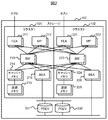
- FIG. 2 is a diagram illustrating an example of a hardware configuration of the storage 100. Since the clusters 1 to 101 and the clusters 2 to 102 of the storage 100 have the same configuration, they will be described together. Moreover, each component may be one or plural.
- FEA (Front End Adapter) 211 and 221 are adapters for connecting the storage 100 and the host. The FEAs 211 and 221 receive read / write requests and write data from the host, and transmit read data to the host. The FEA 211, 221 may be an adapter such as a fiber channel. The FEA 211 and 221 communicate with other components in the storage 100 via SW (Switch) 213 and 223.
- SW Switch
- MP (Micro Processors) 212 and 222 are processors that operate according to a program stored in a memory (not shown), and determine information acquired via SWs 213 and 223 according to the program, or via SWs 213 and 223. To instruct other components to operate.
- the MPs 212 and 222 may interpret the request received from the host by the FEA 211 and 221 and instruct other components. Further, a failure occurring in the storage 100 may be detected, the program may be executed based on the detected failure content, and the FEA 211, 221 may instruct which cache memory 214, 224 will write which data. .
- SWs 213 and 223 are circuits that relay communication between the components, and may be a computer bus or a circuit that is an alternative to the bus.
- Cache memories 214 and 224 are memories for temporarily storing data and for speeding up reading and writing of data via the FEA 211 and 221 and are volatile memories with high access speed.
- the cache memory 214 corresponds to the cache memories 110 and 150 shown in FIG. 1
- the cache memory 224 corresponds to the cache memories 120 and 160 shown in FIG.
- the save memories 215 and 225 copy and store the data stored in the cache memories 214 and 224 according to the instructions of the MPs 212 and 222, and copy the data stored in the save memories 215 and 225 to the cache memories 214 and 224 and restore them.
- This is a non-volatile memory.
- a circuit for transferring data may be provided between the cache memories 214 and 224 and the save memories 215 and 225.
- the save memory 215 corresponds to the save memory 130 shown in FIG. 1, and the save memory 225 corresponds to the save memory 140 shown in FIG.
- the evacuation memories 215 and 225 may be, for example, SSDs or flash memories, or may be memories having a dedicated battery that can be driven for a long time.
- BEA (Back End Adapter) 216 and 226 are adapters that are connected to a storage device that actually stores data in the storage 100.
- the BEAs 216 and 226 write data to the storage device based on the instructions and data received via the SWs 213 and 223, and read data from the storage device based on the instructions received via the SWs 213 and 223, and send the data to the SWs 213 and 223. Or send.
- the BEAs 216 and 226 may be adapters such as SAS (Serial Attached SCSI).
- PDEV (Physical Device) 231 and 232 are storage devices such as physical HDDs and SDDs.
- the PDEVs 231 and 232 have a plurality of ports, and can be accessed from either the cluster 1 101 or the cluster 2 102 by connecting to the BEA 216 and the BEA 226.
- LDEVs may be set in the PDEVs 231 and 232, and a plurality of PDEVs may be RAID (Redundant Arrays of Inexpensive Disks).
- the storage 100 has a power supply (not shown). There are commercial power sources and batteries supplied from the outside. When the supply of commercial power is stopped, the battery automatically supplies power, and the storage 100 can be operated for a predetermined time according to the capacity of the battery and the operation content.
- FIG. 3 is a diagram showing an example of the operation when there is no failure, and is a diagram for explaining the types of data in the cache memories 110 and 120. Components already described are given the same reference numerals.
- the FEA 221 has two ports 301 and 302, and the ports 301 and 302 are, for example, fiber channel ports.
- the FEA 221 transfers the write data received at the port 301 to the cache memories 110 and 120 so as to become the BBA 112 of the other system dirty data and the BBA 122 of the own system dirty data as indicated by an arrow 303.
- the FEA 221 transfers the write data received at the port 302 to the cache memories 110 and 120 as AAB113 of its own dirty data and AAB123 of the other dirty data as indicated by an arrow 304.
- data transmitted / received at the port 301 is the own system of the cluster 2 102
- data transmitted / received at the port 302 is the own system of the cluster 1 101.
- FIG. 3 shows an example of the ports 301 and 302 of the FEA 221, but the port of the FEA 211 may be used, and which cluster own system is set to each port of the FEA 211.
- one MP whose reading / writing is controlled is set as an owner in one LDEV.
- the data that the MP212 including the MP305 of the cluster 1 to 101 controls the reading and writing is the own system of the cluster 1 to 101
- the data that the MP222 including the MP306 of the cluster 2 to 102 controls the reading and writing is the own data of the cluster 2 to 102. It may be a system.
- the cache memories 110 and 120 shown in FIG. 3 are in a state before the failure, but are immediately before the failure time shown in FIG. 1 and store the same data as the failure time. For this reason, AAB113 of the own system dirty data has not yet been written to LDEV AA170, and AAB309 does not exist, and is shown by a dotted line in FIG.
- the AAB 113 is written to the LDEV AA 170 as AAB309 as indicated by an arrow 307 at some timing, so the MP305 that controls this writing is determined among the plurality of MP212s. That is, MP305 is set to be the owner of LDEV AA170 that controls all reading and writing of LDEV AA170. With this setting, since the AAB 113 is the same cluster 1 101 as the MP 305, it may be the own system of the cluster 1 101. On the other hand, in the cluster 2 ⁇ 102, the MP 306 writes BBA 122 to the LDEV BB 180 as BBA 310 as indicated by the arrow 308. Note that writing data from the cache memory to the LDEV as indicated by arrows 307 and 308 is called destage.
- All data in the cache memories 110 and 120 are received by any of the ports FEA 211 and 221 and are temporarily written to either the LDEV AA 170 or the LDEV BB 180 by any of the MPs 305 and 306. , 120. For this reason, all the data in the cache memories 110 and 120 are always the own dirty data in either the cluster 1 101 or the cluster 2 102 when they are written to the cache memory 110 120. And even if dirty data becomes clean data when written to an LDEV, all dirty data is self-system dirty data of any cluster.
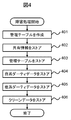
- FIG. 4 is a diagram showing an example of a flowchart of failure processing.
- This example is a flowchart of an MP program, and when a failure such as a power failure is detected, it is executed by each of a plurality of MPs 212 and 222 using battery power.
- the failure may be detected by the MPs 212 and 222, or may be detected by another circuit, and the MPs 212 and 222 may receive notification from the detected circuit.
- an arbitrary one of the MPs 212 and 222 will be described as MP.
- FIG. 6 is a diagram showing an example of data of failure processing and recovery processing, and the cluster 1 to 101 data is shown as a representative, but the data of other clusters has the same configuration. Each step shown in FIG. 4 will be described in association with the data shown in FIG.
- the MP creates a management table.
- the management table is information for managing data stored in the save memory 130.
- the AAB 113 of the own-system dirty data is stored at the address 0x06AAA (0x represents a hexadecimal number) of the cache memory 110 and is stored as the AAB 133 at the address 0x03AAA of the save memory 130.
- the clean data AAA 111 is stored at address 0x04AAB of the cache memory 110, and the address 0x01AAB of the save memory 130 is stored. Is stored as AAA131.
- the MP creates a management table by associating the address 632 in the save memory of each data with the address 633 in the cache memory and assigning the flag 634 as to whether the own system, other system, or clean.
- the address 632 of the save memory may be an SSD LBA (LogicalLogicBlock Address).
- data size information such as AAA 111 may be included in the management table, or the data size may be constant and not included in the management table.
- the MP stores the shared information 611 in the cache memory 110 in the save memory 130 as the shared information 631.
- the shared information 611 is configuration information of the storage 100, and includes information such as the relationship between ports and LDEVs and which MP is the owner of the LDEV. Further, when the content of the failure detected at the time of failure detection can be recorded in the shared information 611, the failure information may be included.
- the MP stores the management table in the save memory 130. On the basis of the management table created in step 401, the MP stores its own dirty data in the save memory 130 in step 404. Further, in step 405, the MP stores other-system dirty data in the save memory 130 based on the management table, and in step 406, the MP stores clean data in the save memory 130 based on the management table, and ends the process.
- FIG. 5 is a diagram showing an example of a flowchart of the recovery process. This example is also a flowchart of the MP program, and is executed by each of the plurality of MPs 212 and 222 when restarting from a failure such as a power failure. Here, it is assumed that the power failure has been recovered at least and the power supply from the commercial power source has been resumed.
- the MP restores the shared information 631 in the save memory 130 to the cache memory 150 as shared information 651.
- step 502 the MP restores its own dirty data based on the management table. That is, the AAB 133 is read from the address 0x03AAA of the save memory address 632 in which the flag 634 is self-system dirty data, and is written as the AAB153 to the address 0x06AAA of the cache memory address 633.
- step 503 the MP checks whether another cluster, for example, the cluster 2 102 has a blockage. The MP may communicate with other MPs to confirm the blockage, or may refer to the failure information when the failure information is included in the shared information 631.
- step 504 If it is determined in step 504 that the other clusters are not blocked, that is, if all the clusters are determined to be normal, the process proceeds to step 507 where the AAB153 of the restored local dirty data is destaged to the LDEV AA170. .
- the AAB 309 actually exists, and the AABs 113 and 153 become clean data and can secure fault tolerance.
- Business can then be resumed at this point.
- the business processing may be resumed on a host (not shown) different from the storage 100, or the storage 100 refuses communication with the host via the FEA until step 507, and the host via the FEA at step 507 It is also possible to be able to communicate with.
- each MP performs the same procedure. For example, in the cluster 2 102, the BBA 122 of the local dirty data is restored to the cache memory and destaged to the LDEV BB 180. For this reason, work may be resumed when step 507 is completed in all clusters.
- step 504 the MP proceeds to step 505 and restores the other system dirty data based on the management table. That is, as shown in FIG. 7, the BBA 132 is read from the address 0x02BBA at the address 632 of the save memory that is the other dirty data by the flag 634, and is written as the BBA 152 at the address 0x05BBA at the address 633 of the cache memory.
- step 506 the MP changes the BBA 152 of the other dirty data to the own dirty data. At this time, the MP may change the contents of the shared information 651 and become the owner of both the LDEV AA170 and the LDEV BB180.
- step 507 the MP destages the restored local dirty data to LDEV AA170 and LDEV BB180.
- the PDEVs 231 and 232 are physically connected so that they can be accessed from both the clusters 1 and 101 and the clusters 2 and 102. Therefore, the MP212 and 305 can physically access the LDEV BB180. It is.
- both AAB 309 and BBA 310 actually exist, and AAB 113 and 153 and BBA 112 and 152 become clean data. Business can then be resumed at this point.
- the storage 100 has 3 or more clusters and 2 or more non-blocked clusters, one of the non-blocked clusters restores its own dirty data of the blocked cluster and the other is blocked. There is no need to restore the local dirty data of the non-cluster. Further, data to be restored may be distributed among a plurality of non-blocked clusters.
- the management table may include information on which cluster's own dirty data.
- the MP may restore clean data.
- FIG. 8 is a diagram illustrating an example of data when the MP restores clean data in Step 502 and the MP determines that there is no block in another cluster in Step 504.
- the MP reads the AAA 131 from the address 0x01AAB of the save memory address 632 in which the flag 634 is clean data, and writes it as the AAA 151 to the address 0x04AAB of the cache memory address 633. Since the AAA 151 of the clean data is already stored in the LDEV AA 170, it is not necessary to destage in step 507.
- FIG. 9 is a diagram showing an example of the case where the MP restores the clean data in Step 502 and the MP determines that another cluster is blocked in Step 504.
- the restored data in the cache memory 150 is the same as the data in the cache memory 110 at the time of failure.
- Cluster 1 Cluster 2 110, 120, 150, 160, 214, 224: cache memory 130, 140, 215, 225: save memory
Landscapes
- Engineering & Computer Science (AREA)
- Theoretical Computer Science (AREA)
- Physics & Mathematics (AREA)
- General Engineering & Computer Science (AREA)
- General Physics & Mathematics (AREA)
- Quality & Reliability (AREA)
- Library & Information Science (AREA)
- Human Computer Interaction (AREA)
- Memory System Of A Hierarchy Structure (AREA)
- Techniques For Improving Reliability Of Storages (AREA)
Abstract
L'invention a trait à une mémoire dotée d'une pluralité de sous-contrôleurs, chaque sous-contrôleur possédant un processeur, un cache et un espace de sauvegarde. Chaque processeur des sous-contrôleurs effectue une commande qui aboutit à l'écriture d'une pluralité de données dans le cache, effectue une commande pour que toutes les données sauvegardées dans le cache soient mémorisées dans l'espace de sauvegarde lorsqu'une défaillance se produit, et effectue une commande de telle sorte qu'une partie des données mémorisées dans l'espace de sauvegarde soit restaurée dans le cache pendant le rétablissement après défaillance.
Priority Applications (2)
| Application Number | Priority Date | Filing Date | Title |
|---|---|---|---|
| US14/425,897 US9836359B2 (en) | 2014-07-11 | 2014-07-11 | Storage and control method of the same |
| PCT/JP2014/068610 WO2016006108A1 (fr) | 2014-07-11 | 2014-07-11 | Mémoire et son procédé de commande |
Applications Claiming Priority (1)
| Application Number | Priority Date | Filing Date | Title |
|---|---|---|---|
| PCT/JP2014/068610 WO2016006108A1 (fr) | 2014-07-11 | 2014-07-11 | Mémoire et son procédé de commande |
Publications (1)
| Publication Number | Publication Date |
|---|---|
| WO2016006108A1 true WO2016006108A1 (fr) | 2016-01-14 |
Family
ID=55063779
Family Applications (1)
| Application Number | Title | Priority Date | Filing Date |
|---|---|---|---|
| PCT/JP2014/068610 Ceased WO2016006108A1 (fr) | 2014-07-11 | 2014-07-11 | Mémoire et son procédé de commande |
Country Status (2)
| Country | Link |
|---|---|
| US (1) | US9836359B2 (fr) |
| WO (1) | WO2016006108A1 (fr) |
Families Citing this family (3)
| Publication number | Priority date | Publication date | Assignee | Title |
|---|---|---|---|---|
| CN107665158A (zh) * | 2017-09-22 | 2018-02-06 | 郑州云海信息技术有限公司 | 一种存储集群恢复方法及设备 |
| US11762940B2 (en) * | 2020-09-12 | 2023-09-19 | HCL America Inc. | Component level data management and state change detection in web applications for data loss protection |
| JP2024095192A (ja) * | 2022-12-28 | 2024-07-10 | 株式会社日立製作所 | マルチノードシステム及び電源制御方法 |
Citations (4)
| Publication number | Priority date | Publication date | Assignee | Title |
|---|---|---|---|---|
| JP2001147865A (ja) * | 1999-11-22 | 2001-05-29 | Hitachi Ltd | ディスク制御装置 |
| JP2011170589A (ja) * | 2010-02-18 | 2011-09-01 | Nec Corp | ストレージ制御装置、ストレージ装置およびストレージ制御方法 |
| JP2012078941A (ja) * | 2010-09-30 | 2012-04-19 | Toshiba Corp | 情報処理装置及びキャッシュ制御方法 |
| US20130254457A1 (en) * | 2012-03-21 | 2013-09-26 | Lsi Corporation | Methods and structure for rapid offloading of cached data in a volatile cache memory of a storage controller to a nonvolatile memory |
Family Cites Families (4)
| Publication number | Priority date | Publication date | Assignee | Title |
|---|---|---|---|---|
| US7085886B2 (en) * | 2003-05-28 | 2006-08-01 | International Buisness Machines Corporation | Autonomic power loss recovery for a multi-cluster storage sub-system |
| US7260695B2 (en) * | 2004-03-05 | 2007-08-21 | International Business Machines Corporation | Scanning modified data during power loss |
| JP4437489B2 (ja) | 2006-10-25 | 2010-03-24 | 株式会社日立製作所 | 揮発性キャッシュメモリと不揮発性メモリとを備えたストレージシステム |
| US7669008B2 (en) * | 2007-02-09 | 2010-02-23 | International Business Machines Corporation | Destage management of redundant data copies |
-
2014
- 2014-07-11 WO PCT/JP2014/068610 patent/WO2016006108A1/fr not_active Ceased
- 2014-07-11 US US14/425,897 patent/US9836359B2/en active Active
Patent Citations (4)
| Publication number | Priority date | Publication date | Assignee | Title |
|---|---|---|---|---|
| JP2001147865A (ja) * | 1999-11-22 | 2001-05-29 | Hitachi Ltd | ディスク制御装置 |
| JP2011170589A (ja) * | 2010-02-18 | 2011-09-01 | Nec Corp | ストレージ制御装置、ストレージ装置およびストレージ制御方法 |
| JP2012078941A (ja) * | 2010-09-30 | 2012-04-19 | Toshiba Corp | 情報処理装置及びキャッシュ制御方法 |
| US20130254457A1 (en) * | 2012-03-21 | 2013-09-26 | Lsi Corporation | Methods and structure for rapid offloading of cached data in a volatile cache memory of a storage controller to a nonvolatile memory |
Also Published As
| Publication number | Publication date |
|---|---|
| US9836359B2 (en) | 2017-12-05 |
| US20160259695A1 (en) | 2016-09-08 |
Similar Documents
| Publication | Publication Date | Title |
|---|---|---|
| US8296534B1 (en) | Techniques for using flash-based memory in recovery processing | |
| US8010485B1 (en) | Background movement of data between nodes in a storage cluster | |
| US7793061B1 (en) | Techniques for using flash-based memory as a write cache and a vault | |
| CN108885538B (zh) | 在包括多个存储设备的存储阵列中迁移数据 | |
| JP4041473B2 (ja) | マルチクラスタ・ストレージ・サブシステムのための自律型パワー・ロス・リカバリ | |
| US20150331624A1 (en) | Host-controlled flash translation layer snapshot | |
| US20140281123A1 (en) | System and method for handling i/o write requests | |
| US9891989B2 (en) | Storage apparatus, storage system, and storage apparatus control method for updating stored data stored in nonvolatile memory | |
| US20190324859A1 (en) | Method and Apparatus for Restoring Data after Power Failure for An Open-Channel Solid State Drive | |
| US10664193B2 (en) | Storage system for improved efficiency of parity generation and minimized processor load | |
| US10234929B2 (en) | Storage system and control apparatus | |
| US12554414B2 (en) | Storage device, memory device, and computing system including the same | |
| US9836223B2 (en) | Changing storage volume ownership using cache memory | |
| CN113711189B (zh) | 用于管理固态驱动器上的降低电力故障能量需求的系统及方法 | |
| KR20210137922A (ko) | 복구 공간으로 패리티 공간을 사용한 데이터 복구 시스템, 방법 및 장치 | |
| CN115480909A (zh) | 存储系统和数据处理方法 | |
| JP7318367B2 (ja) | ストレージ制御装置及びストレージ制御プログラム | |
| US20180307427A1 (en) | Storage control apparatus and storage control method | |
| CN106919339B (zh) | 一种硬盘阵列及硬盘阵列处理操作请求的方法 | |
| WO2016006108A1 (fr) | Mémoire et son procédé de commande | |
| US8171324B2 (en) | Information processing device, data writing method, and program for the same | |
| JP2015052853A (ja) | ストレージ制御装置、制御方法及びプログラム | |
| JP5773446B2 (ja) | 記憶装置、冗長性回復方法、およびプログラム | |
| US11385815B2 (en) | Storage system | |
| US8667218B2 (en) | Storage apparatus comprising RAID groups of RAID 1 series and control method of writing to RAID group of RAID 1 series |
Legal Events
| Date | Code | Title | Description |
|---|---|---|---|
| WWE | Wipo information: entry into national phase |
Ref document number: 14425897 Country of ref document: US |
|
| 121 | Ep: the epo has been informed by wipo that ep was designated in this application |
Ref document number: 14897094 Country of ref document: EP Kind code of ref document: A1 |
|
| NENP | Non-entry into the national phase |
Ref country code: DE |
|
| 122 | Ep: pct application non-entry in european phase |
Ref document number: 14897094 Country of ref document: EP Kind code of ref document: A1 |
|
| NENP | Non-entry into the national phase |
Ref country code: JP |