WO2016006131A1 - 吸水性樹脂及び吸収性物品 - Google Patents
吸水性樹脂及び吸収性物品 Download PDFInfo
- Publication number
- WO2016006131A1 WO2016006131A1 PCT/JP2014/079244 JP2014079244W WO2016006131A1 WO 2016006131 A1 WO2016006131 A1 WO 2016006131A1 JP 2014079244 W JP2014079244 W JP 2014079244W WO 2016006131 A1 WO2016006131 A1 WO 2016006131A1
- Authority
- WO
- WIPO (PCT)
- Prior art keywords
- water
- absorbent resin
- absorbent
- mass
- polymerization
- Prior art date
- Legal status (The legal status is an assumption and is not a legal conclusion. Google has not performed a legal analysis and makes no representation as to the accuracy of the status listed.)
- Ceased
Links
Images

Classifications
-
- C—CHEMISTRY; METALLURGY
- C08—ORGANIC MACROMOLECULAR COMPOUNDS; THEIR PREPARATION OR CHEMICAL WORKING-UP; COMPOSITIONS BASED THEREON
- C08F—MACROMOLECULAR COMPOUNDS OBTAINED BY REACTIONS ONLY INVOLVING CARBON-TO-CARBON UNSATURATED BONDS
- C08F120/00—Homopolymers of compounds having one or more unsaturated aliphatic radicals, each having only one carbon-to-carbon double bond, and only one being terminated by only one carboxyl radical or a salt, anhydride, ester, amide, imide or nitrile thereof
- C08F120/02—Monocarboxylic acids having less than ten carbon atoms; Derivatives thereof
- C08F120/04—Acids; Metal salts or ammonium salts thereof
- C08F120/06—Acrylic acid; Methacrylic acid; Metal salts or ammonium salts thereof
-
- A—HUMAN NECESSITIES
- A61—MEDICAL OR VETERINARY SCIENCE; HYGIENE
- A61L—METHODS OR APPARATUS FOR STERILISING MATERIALS OR OBJECTS IN GENERAL; DISINFECTION, STERILISATION OR DEODORISATION OF AIR; CHEMICAL ASPECTS OF BANDAGES, DRESSINGS, ABSORBENT PADS OR SURGICAL ARTICLES; MATERIALS FOR BANDAGES, DRESSINGS, ABSORBENT PADS OR SURGICAL ARTICLES
- A61L15/00—Chemical aspects of, or use of materials for, bandages, dressings or absorbent pads
- A61L15/16—Bandages, dressings or absorbent pads for physiological fluids such as urine or blood, e.g. sanitary towels, tampons
- A61L15/22—Bandages, dressings or absorbent pads for physiological fluids such as urine or blood, e.g. sanitary towels, tampons containing macromolecular materials
- A61L15/24—Macromolecular compounds obtained by reactions only involving carbon-to-carbon unsaturated bonds; Derivatives thereof
-
- A—HUMAN NECESSITIES
- A61—MEDICAL OR VETERINARY SCIENCE; HYGIENE
- A61F—FILTERS IMPLANTABLE INTO BLOOD VESSELS; PROSTHESES; DEVICES PROVIDING PATENCY TO, OR PREVENTING COLLAPSING OF, TUBULAR STRUCTURES OF THE BODY, e.g. STENTS; ORTHOPAEDIC, NURSING OR CONTRACEPTIVE DEVICES; FOMENTATION; TREATMENT OR PROTECTION OF EYES OR EARS; BANDAGES, DRESSINGS OR ABSORBENT PADS; FIRST-AID KITS
- A61F13/00—Bandages or dressings; Absorbent pads
- A61F13/15—Absorbent pads, e.g. sanitary towels, swabs or tampons for external or internal application to the body; Supporting or fastening means therefor; Tampon applicators
- A61F13/53—Absorbent pads, e.g. sanitary towels, swabs or tampons for external or internal application to the body; Supporting or fastening means therefor; Tampon applicators characterised by the absorbing medium
-
- A—HUMAN NECESSITIES
- A61—MEDICAL OR VETERINARY SCIENCE; HYGIENE
- A61F—FILTERS IMPLANTABLE INTO BLOOD VESSELS; PROSTHESES; DEVICES PROVIDING PATENCY TO, OR PREVENTING COLLAPSING OF, TUBULAR STRUCTURES OF THE BODY, e.g. STENTS; ORTHOPAEDIC, NURSING OR CONTRACEPTIVE DEVICES; FOMENTATION; TREATMENT OR PROTECTION OF EYES OR EARS; BANDAGES, DRESSINGS OR ABSORBENT PADS; FIRST-AID KITS
- A61F5/00—Orthopaedic methods or devices for non-surgical treatment of bones or joints; Nursing devices ; Anti-rape devices
- A61F5/44—Devices worn by the patient for reception of urine, faeces, catamenial or other discharge; Colostomy devices
-
- A—HUMAN NECESSITIES
- A61—MEDICAL OR VETERINARY SCIENCE; HYGIENE
- A61L—METHODS OR APPARATUS FOR STERILISING MATERIALS OR OBJECTS IN GENERAL; DISINFECTION, STERILISATION OR DEODORISATION OF AIR; CHEMICAL ASPECTS OF BANDAGES, DRESSINGS, ABSORBENT PADS OR SURGICAL ARTICLES; MATERIALS FOR BANDAGES, DRESSINGS, ABSORBENT PADS OR SURGICAL ARTICLES
- A61L15/00—Chemical aspects of, or use of materials for, bandages, dressings or absorbent pads
- A61L15/16—Bandages, dressings or absorbent pads for physiological fluids such as urine or blood, e.g. sanitary towels, tampons
- A61L15/42—Use of materials characterised by their function or physical properties
- A61L15/60—Liquid-swellable gel-forming materials, e.g. super-absorbents
-
- C—CHEMISTRY; METALLURGY
- C08—ORGANIC MACROMOLECULAR COMPOUNDS; THEIR PREPARATION OR CHEMICAL WORKING-UP; COMPOSITIONS BASED THEREON
- C08F—MACROMOLECULAR COMPOUNDS OBTAINED BY REACTIONS ONLY INVOLVING CARBON-TO-CARBON UNSATURATED BONDS
- C08F2/00—Processes of polymerisation
- C08F2/32—Polymerisation in water-in-oil emulsions
-
- C—CHEMISTRY; METALLURGY
- C08—ORGANIC MACROMOLECULAR COMPOUNDS; THEIR PREPARATION OR CHEMICAL WORKING-UP; COMPOSITIONS BASED THEREON
- C08J—WORKING-UP; GENERAL PROCESSES OF COMPOUNDING; AFTER-TREATMENT NOT COVERED BY SUBCLASSES C08B, C08C, C08F, C08G or C08H
- C08J3/00—Processes of treating or compounding macromolecular substances
- C08J3/24—Crosslinking, e.g. vulcanising, of macromolecules
-
- A—HUMAN NECESSITIES
- A61—MEDICAL OR VETERINARY SCIENCE; HYGIENE
- A61F—FILTERS IMPLANTABLE INTO BLOOD VESSELS; PROSTHESES; DEVICES PROVIDING PATENCY TO, OR PREVENTING COLLAPSING OF, TUBULAR STRUCTURES OF THE BODY, e.g. STENTS; ORTHOPAEDIC, NURSING OR CONTRACEPTIVE DEVICES; FOMENTATION; TREATMENT OR PROTECTION OF EYES OR EARS; BANDAGES, DRESSINGS OR ABSORBENT PADS; FIRST-AID KITS
- A61F13/00—Bandages or dressings; Absorbent pads
- A61F13/15—Absorbent pads, e.g. sanitary towels, swabs or tampons for external or internal application to the body; Supporting or fastening means therefor; Tampon applicators
- A61F13/53—Absorbent pads, e.g. sanitary towels, swabs or tampons for external or internal application to the body; Supporting or fastening means therefor; Tampon applicators characterised by the absorbing medium
- A61F2013/530481—Absorbent pads, e.g. sanitary towels, swabs or tampons for external or internal application to the body; Supporting or fastening means therefor; Tampon applicators characterised by the absorbing medium having superabsorbent materials, i.e. highly absorbent polymer gel materials
-
- C—CHEMISTRY; METALLURGY
- C08—ORGANIC MACROMOLECULAR COMPOUNDS; THEIR PREPARATION OR CHEMICAL WORKING-UP; COMPOSITIONS BASED THEREON
- C08F—MACROMOLECULAR COMPOUNDS OBTAINED BY REACTIONS ONLY INVOLVING CARBON-TO-CARBON UNSATURATED BONDS
- C08F220/00—Copolymers of compounds having one or more unsaturated aliphatic radicals, each having only one carbon-to-carbon double bond, and only one being terminated by only one carboxyl radical or a salt, anhydride ester, amide, imide or nitrile thereof
- C08F220/02—Monocarboxylic acids having less than ten carbon atoms; Derivatives thereof
- C08F220/04—Acids; Metal salts or ammonium salts thereof
- C08F220/06—Acrylic acid; Methacrylic acid; Metal salts or ammonium salts thereof
-
- C—CHEMISTRY; METALLURGY
- C08—ORGANIC MACROMOLECULAR COMPOUNDS; THEIR PREPARATION OR CHEMICAL WORKING-UP; COMPOSITIONS BASED THEREON
- C08F—MACROMOLECULAR COMPOUNDS OBTAINED BY REACTIONS ONLY INVOLVING CARBON-TO-CARBON UNSATURATED BONDS
- C08F2810/00—Chemical modification of a polymer
- C08F2810/20—Chemical modification of a polymer leading to a crosslinking, either explicitly or inherently
-
- C—CHEMISTRY; METALLURGY
- C08—ORGANIC MACROMOLECULAR COMPOUNDS; THEIR PREPARATION OR CHEMICAL WORKING-UP; COMPOSITIONS BASED THEREON
- C08J—WORKING-UP; GENERAL PROCESSES OF COMPOUNDING; AFTER-TREATMENT NOT COVERED BY SUBCLASSES C08B, C08C, C08F, C08G or C08H
- C08J2333/00—Characterised by the use of homopolymers or copolymers of compounds having one or more unsaturated aliphatic radicals, each having only one carbon-to-carbon double bond, and only one being terminated by only one carboxyl radical, or of salts, anhydrides, esters, amides, imides, or nitriles thereof; Derivatives of such polymers
- C08J2333/02—Homopolymers or copolymers of acids; Metal or ammonium salts thereof
Definitions
- the present invention relates to a water-absorbent resin and an absorbent article, and more particularly, to a water-absorbent resin constituting an absorbent body suitably used for sanitary materials such as sanitary goods and disposable diapers, and an absorbent article using the same.
- the acrylic acid partially neutralized salt polymer cross-linked product has excellent water absorption ability, and since it is easy to industrially obtain acrylic acid as a raw material, the quality is constant and inexpensive. Since it has many advantages such as being able to be produced and being less susceptible to spoilage, it is regarded as a preferred water-absorbent resin.
- an absorbent body is formed using such a water-absorbent resin, a liquid-permeable sheet (top sheet) through which the liquid can pass, and the liquid passes therethrough. It can be set as an absorbent article by hold
- the absorbent body formed using a water absorbent resin is usually composed of a water absorbent resin and hydrophilic fibers.
- the absorbent body is, for example, a mixed dispersion obtained by mixing a water absorbent resin and hydrophilic fibers so as to have a uniform composition, a sandwich structure in which the water absorbent resin is sandwiched between layered hydrophilic fibers.
- the water-absorbent resin may be exposed to the atmosphere for a long time due to unexpected shutdown of the manufacturing equipment.
- the water-absorbent resin since the water-absorbent resin is hygroscopic, a part or the whole may be agglomerated.
- the agglomerated water-absorbent resin is remarkably lowered in fluidity, and causes troubles such as blocking in the piping of the production facility and bridge formation in the powder hopper. In addition, it may interfere with the uniform dispersion of the water-absorbent resin during the adjustment of the above-described absorber.
- water-absorbent resin obtained by these methods does not necessarily satisfy the performance for solving the above-mentioned problems, and there is still room for improvement.
- conventional water-absorbing resins are colored in pale yellow or dark yellow depending on the state of the product, although there are differences in degree.
- the absorbent body is thinned by increasing the ratio of the water-absorbent resin, if the water-absorbent resin is colored, the cleanliness of appearance is reduced as an absorbent article in which it is used. Therefore, the commercial value tends to decrease.
- An object of the present invention is to provide a water-absorbent resin that can be efficiently produced while preventing the above-described problem and an absorbent article using an absorbent body including the absorbent resin.
- the present invention provides the following.
- the present invention is a water-absorbing resin obtained by polymerizing a water-soluble ethylenically unsaturated monomer and post-crosslinking with a post-crosslinking agent, and satisfies the following requirements: Resin.
- the present invention is the water absorbent resin according to the invention according to (1), wherein the physiological saline water absorption capacity under a load of 4.14 kPa is 16 ml / g or more.
- the present invention is an absorbent article using the absorbent body containing the water absorbent resin described in (1) or (2).
- a water-absorbing resin in a hygroscopic state has good dispersibility, prevents occurrence of troubles such as blocking in a pipe and bridge formation in a powder hopper, and efficiently absorbs it.
- a property article can be manufactured.
- Water-absorbent resin >> The water-absorbent resin according to the present invention has the following properties.
- the water-absorbing resin according to the present invention is a water-absorbing resin obtained by polymerizing a water-soluble ethylenically unsaturated monomer and post-crosslinking with a post-crosslinking agent, and satisfies the following properties: It is a water absorbent resin.
- the water absorbent resin according to the present invention is characterized in that the yellowness is 5.0 or less.
- the yellowness is measured with a color difference meter in which X, Y, and Z, which are tristimulus values of a colorimetric color difference meter, are corrected with a standard white board, and X, Y, Z of the water absorbent resin to be measured.
- the yellowness (YI value) can be calculated from the following equation.
- the water-absorbent resin according to the present invention is characterized in that the gel strength is 1800 Pa or less.
- the gel strength is measured by the method described in the examples described later, and after storing a 50-fold swollen gel in a thermo-hygrostat for 15 hours, a card meter (for example, Eye Techno Engineering). This is a value measured using a card meter (product number: ME-600).
- the gel strength is 1800 Pa or less, preferably 1600 Pa or less, and more preferably 1500 Pa or less.
- the gel strength is preferably 500 Pa or more, more preferably 600 Pa or more, and further preferably 800 Pa or more.
- the water-absorbent resin according to the present invention has excellent fluidity in a hygroscopic state.
- the fluidity of the water-absorbent resin after moisture absorption can be evaluated by “fluidity after moisture absorption test” described in the examples described later.
- the water-absorbent resin according to the present invention having such properties, in producing an absorbent article using the same, even if it is a water-absorbent resin in a hygroscopic state, a part or the whole of the water-absorbent resin is a lump.
- the occurrence of troubles during production such as blocking in the piping and bridge formation in the powder hopper can be suppressed.
- the absorbent resin according to the present invention has a low yellowness and can enhance the cleanliness of the resulting absorbent body and absorbent articles including the absorbent body, giving the user a good impression and willingness to purchase. It is.
- the water-absorbent resin according to the present invention preferably has a median particle size of 200 to 600 ⁇ m, more preferably 200 to 550 ⁇ m, further preferably 300 to 500 ⁇ m, and more preferably 300 to 450 ⁇ m. Even more preferably.
- the mass ratio of particles of 150 to 850 ⁇ m in the total ratio is preferably 85 mass% or more, and more preferably 90 mass% or more. Further, the mass ratio of the particles of 300 to 400 ⁇ m in the total ratio is preferably 20% by mass or more, more preferably 25% by mass or more, and further preferably 30% by mass or more.
- the particles of the water-absorbing resin may have a form (secondary particles) in which fine particles (primary particles) are aggregated in addition to the form of each single particle.
- a shape of the primary particles in the case of the primary particles produced by reverse phase suspension polymerization, for example, a substantially spherical single particle shape having a smooth surface shape such as a true spherical shape, an elliptical spherical shape and the like can be mentioned. .
- the primary particles having such a shape have a smooth surface shape, so that the fluidity as a powder is increased, and the aggregated particles are easily packed closely, so that they are not easily broken even when subjected to an impact. It becomes a water-absorbing resin with high strength.
- the physiological saline water absorption capacity under a load of 4.14 kPa is preferably 16 ml / g or more, more preferably 18 ml / g or more, and 20 ml / g or more. More preferably it is.
- the physiological saline water absorption capacity under load is preferably 50 ml / g or less, more preferably 40 ml / g or less.
- the yellowness, the gel strength, the saline water absorption ability under the load of 4.14 kPa, the median particle diameter (particle size distribution), and the fluidity after the moisture absorption test are all described later. It can be measured by the measurement method described in the examples.
- additives depending on the purpose can be blended.
- additives include inorganic powders, surfactants, oxidizing agents, reducing agents, metal chelating agents, radical chain inhibitors, antioxidants, antibacterial agents, and deodorants.
- the flowability of the water absorbent resin can be improved by adding 0.05 to 5 parts by mass of amorphous silica as an inorganic powder to 100 parts by mass of the water absorbent resin.
- the water absorbent resin according to the present invention can be produced by polymerizing a water-soluble ethylenically unsaturated monomer.
- a typical polymerization method such as an aqueous solution polymerization method, an emulsion polymerization method, a reverse phase suspension polymerization method, or the like is used.
- aqueous solution polymerization method polymerization is performed by heating a water-soluble ethylenically unsaturated monomer aqueous solution while stirring as necessary.
- reverse phase suspension polymerization method polymerization is performed by heating a water-soluble ethylenically unsaturated monomer in a hydrocarbon dispersion medium with stirring.
- the reverse phase suspension polymerization method is preferred from the viewpoint of precise polymerization reaction control and wide particle size control.
- a method for producing a water-absorbent resin a method for producing a water-absorbent resin by subjecting a water-soluble ethylenically unsaturated monomer to reverse phase suspension polymerization in a hydrocarbon dispersion medium, in the presence of an internal cross-linking agent.
- a production method having a step of performing polymerization in the presence of at least an azo compound and a peroxide, and a step of performing post-crosslinking with a post-crosslinking agent on a hydrogel having an internal cross-linked structure obtained by polymerization. It is done.
- water-soluble ethylenically unsaturated monomer examples include (meth) acrylic acid (in the present specification, “acryl” and “methacryl” are collectively referred to as “(meth) acryl”; the same shall apply hereinafter) and 2- (meth) acrylamide-2-methylpropanesulfonic acid and salts thereof; (meth) acrylamide, N, N-dimethyl (meth) acrylamide, 2-hydroxyethyl (meth) acrylate, N-methylol (meth) Nonionic monomers such as acrylamide and polyethylene glycol mono (meth) acrylate; amino groups such as N, N-diethylaminoethyl (meth) acrylate, N, N-diethylaminopropyl (meth) acrylate and diethylaminopropyl (meth) acrylamide Examples thereof include unsaturated monomers and
- water-soluble ethylenically unsaturated monomers (meth) acrylic acid or a salt thereof, (meth) acrylamide, and N, N-dimethylacrylamide are preferable from the viewpoint of industrial availability. , (Meth) acrylic acid and salts thereof are more preferred.
- These water-soluble ethylenically unsaturated monomers may be used alone or in combination of two or more.
- acrylic acid and its salts are widely used as raw materials for water-absorbing resins, and these acrylic acid partial neutralized salts are used by copolymerizing the other water-soluble ethylenically unsaturated monomers described above.
- the partially neutralized acrylic acid salt is preferably used as a main water-soluble ethylenically unsaturated monomer in an amount of 70 to 100 mol% based on the total water-soluble ethylenically unsaturated monomer.
- the water-soluble ethylenically unsaturated monomer is preferably dispersed in a hydrocarbon dispersion medium in the form of an aqueous solution and subjected to reverse phase suspension polymerization.
- a hydrocarbon dispersion medium in the form of an aqueous solution and subjected to reverse phase suspension polymerization.
- the concentration of the water-soluble ethylenically unsaturated monomer in this aqueous solution is preferably in the range of 20% by mass to below the saturated concentration.
- concentration of a water-soluble ethylenically unsaturated monomer it is more preferable that it is 55 mass% or less, It is further more preferable that it is 50 mass% or less, It is further more preferable that it is 45 mass% or less.
- concentration of the water-soluble ethylenically unsaturated monomer is more preferably 25% by mass or more, further preferably 28% by mass or more, and further preferably 30% by mass or more.
- the acid group is previously alkaline if necessary. You may use what was neutralized with the neutralizing agent.
- alkaline neutralizer include alkali metal salts such as sodium hydroxide, sodium carbonate, sodium hydrogen carbonate, potassium hydroxide, and potassium carbonate; ammonia and the like. These alkaline neutralizers may be used in the form of an aqueous solution in order to simplify the neutralization operation.
- the alkaline neutralizer mentioned above may be used independently and may combine 2 or more types.
- the degree of neutralization of the water-soluble ethylenically unsaturated monomer with the alkaline neutralizing agent is 10 to 100 mol% as the degree of neutralization for all acid groups of the water-soluble ethylenically unsaturated monomer. It is preferably 30 to 90 mol%, more preferably 40 to 85 mol%, still more preferably 50 to 80 mol%.
- hydrocarbon dispersion medium examples include those having 6 to 8 carbon atoms such as n-hexane, n-heptane, 2-methylhexane, 3-methylhexane, 2,3-dimethylpentane, 3-ethylpentane, and n-octane.
- Aliphatic hydrocarbons cyclohexane, methylcyclohexane, cyclopentane, methylcyclopentane, trans-1,2-dimethylcyclopentane, cis-1,3-dimethylcyclopentane, trans-1,3-dimethylcyclopentane, etc.
- Aromatic hydrocarbons such as benzene, toluene and xylene.
- hydrocarbon dispersion media n-hexane, n-heptane, and cyclohexane are particularly preferably used because they are easily available industrially, have stable quality, and are inexpensive.
- These hydrocarbon dispersion media may be used alone or in combination of two or more.
- a suitable result can be obtained by using a commercially available product such as Exol heptane (manufactured by ExxonMobil: containing 75 to 85% by mass of hydrocarbon of heptane and its isomer). be able to.
- the amount of the hydrocarbon dispersion medium used is that from the viewpoint of uniformly dispersing the water-soluble ethylenically unsaturated monomer and facilitating control of the polymerization temperature, the first stage water-soluble ethylenically unsaturated monomer
- the amount is preferably 100 to 1500 parts by mass, more preferably 200 to 1400 parts by mass with respect to 100 parts by mass.
- the reverse phase suspension polymerization is performed in one stage (single stage) or in multiple stages of two or more stages.
- the first stage polymerization described above is the first stage in single stage polymerization or multistage polymerization. (Hereinafter the same).
- a dispersion stabilizer In the reverse phase suspension polymerization, a dispersion stabilizer can be used in order to improve the dispersion stability of the water-soluble ethylenically unsaturated monomer in the hydrocarbon dispersion medium. As the dispersion stabilizer, a surfactant can be used.
- surfactant examples include sucrose fatty acid ester, polyglycerin fatty acid ester, sorbitan fatty acid ester, polyoxyethylene sorbitan fatty acid ester, polyoxyethylene glycerin fatty acid ester, sorbitol fatty acid ester, polyoxyethylene sorbitol fatty acid ester, polyoxyethylene Alkyl ether, polyoxyethylene alkylphenyl ether, polyoxyethylene castor oil, polyoxyethylene hydrogenated castor oil, alkylallyl formaldehyde condensed polyoxyethylene ether, polyoxyethylene polyoxypropylene block copolymer, polyoxyethylene polyoxypropyl alkyl ether, Polyethylene glycol fatty acid ester, alkyl glucoside, N-alkyl gluconami , Polyoxyethylene fatty acid amides, polyoxyethylene alkyl amines, phosphoric esters of polyoxyethylene alkyl ethers, can be used phosphoric acid ester of polyoxyethylene alkyl ary
- sorbitan fatty acid ester sorbitan fatty acid ester, polyglycerin fatty acid ester, and sucrose fatty acid ester are preferably used from the viewpoint of dispersion stability of the monomer.
- These surfactants may be used alone or in combination of two or more.
- the amount of the surfactant used is preferably 0.1 to 30 parts by mass, preferably 0.3 to 20 parts per 100 parts by mass of the water-soluble ethylenically unsaturated monomer in the first stage. More preferably, it is part by mass.
- a polymer dispersant may be used in combination with the surfactant described above.
- polymeric dispersant examples include maleic anhydride-modified polyethylene, maleic anhydride-modified polypropylene, maleic anhydride-modified ethylene / propylene copolymer, maleic anhydride-modified EPDM (ethylene / propylene / diene / terpolymer), and anhydrous.
- maleic acid-modified polybutadiene maleic anhydride / ethylene copolymer, maleic anhydride / propylene copolymer, maleic anhydride / ethylene / propylene copolymer, maleic anhydride / butadiene copolymer, polyethylene, polypropylene, ethylene / propylene
- the copolymer include oxidized polyethylene, oxidized polypropylene, oxidized ethylene / propylene copolymer, ethylene / acrylic acid copolymer, ethyl cellulose, and ethyl hydroxyethyl cellulose.
- polymeric dispersants in particular, from the viewpoint of dispersion stability of the monomer, maleic anhydride-modified polyethylene, maleic anhydride-modified polypropylene, maleic anhydride-modified ethylene / propylene copolymer, maleic anhydride / Ethylene copolymer, maleic anhydride / propylene copolymer, maleic anhydride / ethylene / propylene copolymer, polyethylene, polypropylene, ethylene / propylene copolymer, oxidized polyethylene, oxidized polypropylene, oxidized ethylene / propylene copolymer It is preferable to use a polymer. These polymer dispersants may be used alone or in combination of two or more.
- the amount of the polymeric dispersant used is preferably 0.1 to 30 parts by mass, and preferably 0.3 to 20 parts per 100 parts by mass of the water-soluble ethylenically unsaturated monomer in the first stage. More preferably, it is part by mass.
- Internal cross-linking agent examples include those capable of crosslinking the polymer of the water-soluble ethylenically unsaturated monomer to be used.
- (poly) ethylene glycol ““(poly)” is prefixed with “poly”. It means the case with and without. The same shall apply hereinafter), (poly) propylene glycol, 1,4-butanediol, trimethylolpropane, diols such as (poly) glycerin, polyols such as triol, and (meth) acrylic acid, maleic acid, fumaric acid, etc.
- Unsaturated polyesters obtained by reacting with acids bisacrylamides such as N, N-methylenebisacrylamide; di (meth) acrylates or tris obtained by reacting polyepoxides with (meth) acrylic acid (Meth) acrylic acid esters; di (meth) acrylic acid carbamyl esters obtained by reacting polyisocyanates such as tolylene diisocyanate and hexamethylene diisocyanate with hydroxyethyl (meth) acrylate; allylated starch, allyl Cellulose, diallyl phthalate, N, Compounds having two or more polymerizable unsaturated groups such as', N ′′ -triallyl isocyanate, divinylbenzene; (poly) ethylene glycol diglycidyl ether, (poly) propylene glycol diglycidyl ether, (poly) glycerin diglycidyl Polyglycidyl compounds such as diglycidyl compounds such as ether and t
- polyglycidyl compounds are preferably used, diglycidyl ether compounds are more preferably used, (poly) ethylene glycol diglycidyl ether, (poly) propylene glycol diglycidyl ether, (poly) glycerin. It is particularly preferred to use diglycidyl ether.
- diglycidyl ether compounds may be used alone or in combination of two or more.
- the amount of the internal crosslinking agent used is preferably 0.000001 to 0.02 mol, preferably 0.00001 to 0.01 mol, per 1 mol of the water-soluble ethylenically unsaturated monomer. More preferably, it is 0.00001 to 0.005 mol, and further preferably 0.00005 to 0.002 mol.
- “in the presence of an azo compound and a peroxide” does not necessarily mean that the azo compound and the peroxide coexist at the start of the polymerization reaction. It means a state in which the other compound is present while the monomer conversion by cleavage is less than 10%, but both of them in an aqueous solution containing a water-soluble ethylenically unsaturated monomer before the start of the polymerization reaction. It is preferable that they coexist with each other.
- the azo compound and the peroxide may be added to the polymerization reaction system through separate flow paths, or may be sequentially added to the polymerization reaction system through the same flow path.
- the form of the azo compound and peroxide used may be a powder or an aqueous solution.
- azo compounds examples include 1- ⁇ (1-cyano-1-methylethyl) azo ⁇ formamide, 2,2′-azobis [2- (N-phenylamidino) propane] dihydrochloride, 2,2 ′.
- peroxide examples include persulfates such as potassium persulfate, ammonium persulfate, and sodium persulfate; methyl ethyl ketone peroxide, methyl isobutyl ketone peroxide, di-t-butyl peroxide, t-butyl cumyl peroxide, t And peroxides such as -butyl peroxyacetate, t-butyl peroxyisobutyrate, t-butyl peroxypivalate, and hydrogen peroxide.
- persulfates such as potassium persulfate, ammonium persulfate, and sodium persulfate
- methyl ethyl ketone peroxide methyl isobutyl ketone peroxide
- di-t-butyl peroxide di-t-butyl peroxide
- t-butyl cumyl peroxide t
- t And peroxides such as -butyl per
- potassium persulfate, ammonium persulfate, sodium persulfate, and hydrogen peroxide are preferably used, and potassium persulfate, ammonium persulfate, and sodium persulfate are more preferably used.
- potassium persulfate, ammonium persulfate, and sodium persulfate are more preferably used.
- These peroxides may be used alone or in combination of two or more.
- the amount of the azo compound and peroxide used is preferably 0.00005 mol or more, more preferably 0.0001 mol or more with respect to 1 mol of the water-soluble ethylenically unsaturated monomer. Moreover, it is preferable that it is 0.005 mol or less with respect to 1 mol of water-soluble ethylenically unsaturated monomers, and it is more preferable that it is 0.001 mol or less.
- the amount of the azo compound and peroxide used is preferably 40% by weight or more of the total amount of the azo compound and peroxide used, and preferably 50% by weight or more. It is more preferable to set it as a ratio, it is more preferable to set it as the ratio which is 60 mass% or more, and it is more preferable to set it as the ratio which is 70 mass% or more.
- the proportion of the azo compound is preferably 95% by mass or less, more preferably 90% by mass or less, of the total amount of the azo compound and peroxide used, more preferably 85% by mass or less. It is more preferable to set it as the ratio which is, and it is still more preferable to set it as the ratio which is 80 mass% or less. Further, the mass ratio range (azo compound: peroxide) is preferably 8:12 to 19: 1.
- reverse phase suspension polymerization may be performed by adding other components to an aqueous solution containing a water-soluble ethylenically unsaturated monomer as desired.
- various additives such as thickeners and chain transfer agents can be added.
- reverse phase suspension polymerization can be performed by adding a thickener to an aqueous solution containing a water-soluble ethylenically unsaturated monomer.
- a thickener By adjusting the aqueous solution viscosity by adding a thickener in this way, it is possible to control the median particle size obtained in the reverse phase suspension polymerization.
- thickener examples include hydroxyethyl cellulose, hydroxypropyl cellulose, methyl cellulose, carboxymethyl cellulose, polyacrylic acid, polyacrylic acid (partial) neutralized product, polyethylene glycol, polyacrylamide, polyethyleneimine, dextrin, sodium alginate, polyvinyl alcohol Polyvinyl pyrrolidone, polyethylene oxide, etc. can be used.
- polymerization is the same, there exists a tendency for the median particle diameter of the particle
- reverse phase suspension polymerization In reverse phase suspension polymerization, an aqueous monomer solution containing a water-soluble ethylenically unsaturated monomer is dispersed in a hydrocarbon dispersion medium in the presence of a surfactant and / or a polymeric dispersant. . At this time, as long as the polymerization reaction is not started, the addition timing of the surfactant and the polymer dispersant may be before or after the addition of the monomer aqueous solution.
- Such reverse phase suspension polymerization can be carried out in one or more stages. Also, it is preferably performed in 2 to 3 stages from the viewpoint of increasing productivity.
- reverse-phase suspension polymerization When reverse-phase suspension polymerization is performed in two or more stages, water-soluble ethylenic unsaturation is performed on the reaction mixture obtained by the first-stage polymerization reaction after the first-stage reverse-phase suspension polymerization. Monomers may be added and mixed, and reverse phase suspension polymerization in the second and subsequent stages may be performed in the same manner as in the first stage.
- reversed-phase suspension polymerization in each stage after the second stage in addition to the water-soluble ethylenically unsaturated monomer, the above-described azo compound, peroxide and internal crosslinking agent are added in each stage after the second stage.
- the amount of the water-soluble ethylenically unsaturated monomer added during the reverse phase suspension polymerization is added within the range of the molar ratio of each component to the water-soluble ethylenically unsaturated monomer described above. It is preferable to perform phase suspension polymerization.
- the reaction temperature of the polymerization reaction is 20 to 110 ° C. from the viewpoint of allowing the polymerization to proceed rapidly and shortening the polymerization time, thereby improving economy and allowing the reaction to be carried out smoothly by easily removing the heat of polymerization. It is preferable that the temperature is 40 to 90 ° C.
- the reaction time is preferably 0.5 to 4 hours.
- the hydrogel obtained by polymerizing the water-soluble ethylenically unsaturated monomer is post-crosslinked with a post-crosslinking agent (post-crosslinking reaction). It is obtained with.
- This post-crosslinking reaction is preferably performed in the presence of a post-crosslinking agent after the polymerization of the water-soluble ethylenically unsaturated monomer.
- the crosslink density near the surface of the water-absorbent resin is increased, and various performances such as gel strength and water absorption capacity under load are obtained. Can be obtained.
- post-crosslinking agent examples include compounds having two or more reactive functional groups.
- polyols such as ethylene glycol, propylene glycol, 1,4-butanediol, trimethylolpropane, glycerin, polyoxyethylene glycol, polyoxypropylene glycol, polyglycerin; (poly) ethylene glycol diglycidyl ether, (poly) Polyglycidyl compounds such as glycerin diglycidyl ether, (poly) glycerin triglycidyl ether, trimethylolpropane triglycidyl ether, (poly) propylene glycol polyglycidyl ether, (poly) glycerol polyglycidyl ether; epichlorohydrin, epibromohydrin, ⁇ -Haloepoxy compounds such as methyl epichlorohydrin; isocyanates such as 2,4-tolylene diisocyanate and hex
- post-crosslinking agents (poly) ethylene glycol diglycidyl ether, (poly) glycerin diglycidyl ether, (poly) glycerin triglycidyl ether, trimethylolpropane triglycidyl ether, (poly) propylene glycol polyglycidyl ether, ( Polyglycidyl compounds such as poly) glycerol polyglycidyl ether are particularly preferred. These post-crosslinking agents may be used alone or in combination of two or more.
- the amount of the post-crosslinking agent used is preferably 0.00001 to 0.01 mol, preferably 0.00005 to 0.005 mol, based on 1 mol of the total amount of the water-soluble ethylenically unsaturated monomer used in the polymerization. 005 mol is more preferable, and 0.0001 to 0.002 mol is particularly preferable.
- the post-crosslinking agent may be added as it is or may be added as an aqueous solution, but if necessary, it may be added as a solution using a hydrophilic organic solvent as a solvent.
- a hydrophilic organic solvent include lower alcohols such as methyl alcohol, ethyl alcohol, n-propyl alcohol and isopropyl alcohol; ketones such as acetone and methyl ethyl ketone; ethers such as diethyl ether, dioxane and tetrahydrofuran; N, N Amides such as dimethylformamide; sulfoxides such as dimethyl sulfoxide.
- These hydrophilic organic solvents may be used alone or in combination of two or more or as a mixed solvent with water.
- the post-crosslinking agent may be added after the polymerization reaction of the water-soluble ethylenically unsaturated monomer is almost completed. It is preferably added in the presence of water in the range of 400 parts by weight, more preferably in the presence of water in the range of 5 to 200 parts by weight, and added in the presence of water in the range of 10 to 100 parts by weight. Is more preferable, and it is even more preferable to add in the presence of water in the range of 20 to 60 parts by mass.
- the amount of moisture means the total amount of moisture contained in the polymerization reaction system and moisture used as necessary when adding the post-crosslinking agent.
- the reaction temperature in the post-crosslinking reaction is preferably 50 to 250 ° C., more preferably 60 to 180 ° C., further preferably 60 to 140 ° C., and more preferably 70 to 120 ° C. Further preferred.
- the post-crosslinking reaction time is preferably 1 to 300 minutes, more preferably 5 to 200 minutes.
- ⁇ Drying process> After performing the above-described reverse phase suspension polymerization, it is preferable to perform a drying step in which water, a hydrocarbon dispersion medium, and the like are removed by distillation by applying energy such as heat from the outside.
- a drying step in which water, a hydrocarbon dispersion medium, and the like are removed by distillation by applying energy such as heat from the outside.
- water and the hydrocarbon dispersion medium are temporarily removed from the system by azeotropic distillation by heating the system in which the hydrogel is dispersed in the hydrocarbon dispersion medium. Distill off. At this time, if only the distilled hydrocarbon dispersion medium is returned to the system, continuous azeotropic distillation is possible.
- the temperature in the system during drying is maintained below the azeotropic temperature of the hydrocarbon dispersion medium, which is preferable from the standpoint that the resin is hardly deteriorated. Subsequently, water and hydrocarbon dispersion medium are distilled off to obtain water-absorbent resin particles.
- the treatment conditions of the drying step after the polymerization and adjusting the amount of dehydration it is possible to control various performances of the resulting water-absorbent resin.
- the drying treatment by distillation may be performed under normal pressure or under reduced pressure. Moreover, you may carry out under airflow, such as nitrogen, from a viewpoint of improving drying efficiency.
- the drying temperature is preferably 70 to 250 ° C., more preferably 80 to 180 ° C., further preferably 80 to 140 ° C., and more preferably 90 to A temperature of 130 ° C. is particularly preferable.
- the drying temperature is preferably 60 to 110 ° C., more preferably 70 to 100 ° C.
- the post-crosslinking step with the post-crosslinking agent is performed after the polymerization of the water-soluble ethylenically unsaturated monomer by the reverse phase suspension polymerization as described above, the distillation described above is performed after the cross-linking step. So that the drying process is performed. Or you may make it perform a post-crosslinking process and a drying process simultaneously.
- a chelating agent such as a chelating agent, a reducing agent, an oxidizing agent, an antibacterial agent, and a deodorizing agent after superposition
- polymerization during drying, or after drying with respect to a water absorbing resin as needed.
- the water-absorbent resin according to the present invention constitutes an absorbent body used for sanitary materials such as sanitary goods and disposable diapers, and is suitably used for absorbent articles including the absorbent body.
- the absorbent body using the water-absorbent resin is composed of, for example, a water-absorbent resin and hydrophilic fibers.
- the structure of the absorber is a mixed dispersion obtained by mixing the water-absorbent resin and the hydrophilic fiber so as to have a uniform composition, and a sandwich in which the water-absorbent resin is sandwiched between layered hydrophilic fibers. Examples include a structure, a structure in which a water-absorbing resin and a hydrophilic fiber are wrapped with a tissue.
- the absorbent body may contain other components, for example, an adhesive binder such as a heat-fusible synthetic fiber, a hot melt adhesive, and an adhesive emulsion for enhancing the shape retention of the absorbent body. .
- the content of the water-absorbing resin in the absorber is preferably 5 to 95% by mass, more preferably 20 to 90% by mass, and further preferably 30 to 80% by mass.
- the content of the water-absorbent resin is less than 5% by mass, the absorption capacity of the absorber is lowered, which may cause liquid leakage and reversion.
- the content of the water-absorbing resin exceeds 95% by mass, the cost of the absorber increases and the feel of the absorber becomes harder.
- hydrophilic fibers include cellulose fibers such as cotton-like pulp, mechanical pulp, chemical pulp, and semi-chemical pulp obtained from wood, synthetic cellulose fibers such as rayon and acetate, and polyamides, polyesters, and polyolefins that have been hydrophilized. Examples thereof include fibers made of resin.
- the absorbent body using the water absorbent resin between a liquid permeable sheet (top sheet) through which liquid can pass and a liquid impermeable sheet (back sheet) through which liquid cannot pass. It can be set as an absorbent article.
- the liquid permeable sheet is disposed on the side in contact with the body, and the liquid impermeable sheet is disposed on the opposite side in contact with the body.
- liquid permeable sheet examples include air-through type, spunbond type, chemical bond type, needle punch type nonwoven fabrics and porous synthetic resin sheets made of fibers such as polyethylene, polypropylene, and polyester.
- liquid impermeable sheet examples include synthetic resin films made of resins such as polyethylene, polypropylene, and polyvinyl chloride.
- the gel elastic modulus of this measurement sample was measured using a card meter (manufactured by iTechno Engineering Co., Ltd .: Card Meter Mini ME-600).
- the card meter conditions are as follows. ⁇ Pressure sensitive axis: 16mm ⁇ ⁇ Spring: 400g ⁇ Load: 400g ⁇ Rising speed: 1 inch / 21 sec ⁇ Test mode: viscosity
- the 1 includes a burette unit 1, a conduit 2, a measurement table 3, and a measurement unit 4 placed on the measurement table 3.
- a rubber stopper 14 is connected to the upper part of the burette 10
- an air introduction pipe 11 and a cock 12 are connected to the lower part
- a cock 13 is attached to the upper part of the air introduction pipe 11.
- a conduit 2 is attached from the burette unit 1 to the measuring table 3, and the diameter of the conduit 2 is 6 mm.
- a hole with a diameter of 2 mm is opened at the center of the measuring table 3 and the conduit 2 is connected.
- the measuring unit 4 includes a cylinder 40, a nylon mesh 41 attached to the bottom of the cylinder 40, and a weight 42.
- the inner diameter of the cylinder 40 is 2.0 cm.
- the nylon mesh 41 is formed to 200 mesh (aperture 75 ⁇ m). A predetermined amount of the water absorbent resin 5 is uniformly dispersed on the nylon mesh 41.
- the weight 42 has a diameter of 1.9 cm and a mass of 119.6 g. The weight 42 is placed on the water absorbent resin 5 so that a load of 4.14 kPa can be uniformly applied to the water absorbent resin 5.
- the cock 12 and the cock 13 of the burette unit 1 are closed, and physiological saline adjusted to 25 ° C. is introduced from the upper part of the burette 10. Then, the cock 12 and the cock 13 of the burette part 1 were opened. Next, the height of the measurement table 3 was adjusted so that the tip of the conduit 2 at the center of the measurement table 3 and the air introduction port of the air introduction tube 11 had the same height.
- the amount of decrease in physiological saline in the burette 10 (the amount of physiological saline absorbed by the water absorbent resin 5) Wa (mL) was continuously read from the time when the water absorbent resin 5 started to absorb water.
- the physiological saline water-absorbing ability under the 4.14 kPa load of the water-absorbing resin after 60 minutes from the start of water absorption was determined by the following equation.
- the water-absorbing resin was put into the combined uppermost sieve and classified by shaking for 20 minutes using a low-tap shaker. After classification, the mass of the water-absorbent resin remaining on each sieve was calculated as a mass percentage with respect to the total amount, and the particle size distribution was determined. With respect to this particle size distribution, the sieve screen was integrated in order from the largest particle size, and the relationship between the sieve opening and the integrated value of the mass percentage of the water absorbent resin remaining on the sieve was plotted on a logarithmic probability paper. By connecting the plots on the probability paper with a straight line, the particle diameter corresponding to an integrated mass percentage of 50 mass% was defined as the median particle diameter.
- the mass ratio of the particles of 300 to 400 ⁇ m in the ratio of the entire water-absorbing resin is the mass ratio of the water-absorbing resin remaining on the sieve having an opening of 300 ⁇ m with respect to the whole in the above-described measurement.
- the mass proportion of particles of 150 to 850 ⁇ m in the proportion of the entire water-absorbent resin is the sum of the mass proportion of the water-absorbent resin remaining on the sieves of 150 ⁇ m, 250 ⁇ m, 300 ⁇ m, 400 ⁇ m, 500 ⁇ m, and 600 ⁇ m. It is a thing.
- This mixture was uniformly placed in a stainless steel petri dish having a diameter of 10 cm, and left to stand in a constant temperature and humidity chamber at 40 ° C. and a relative humidity of 90% RH for 1 hour.
- the mass (Wb) of the moisture-absorbed sample after standing for 1 hour was measured.
- the sample after moisture absorption was carefully transferred to a 12 mesh (JIS standard sieve) on which a tray was laid, and the sieve was tapped 5 times with the palm of the hand. Next, the sieve was rotated 90 degrees in the circumferential direction and then further lightly tapped five times.
- the mass (Wc) of the sample after moisture absorption that passed through 12 mesh and remained in the tray was measured, and the fluidity (%) after the moisture absorption test was determined by the following equation.
- Absorber B was prepared in the same manner as described above.
- the state of the water absorbent resin, the absorbent body B, and the absorbent body production machine is evaluated by three workers according to the criteria shown in Table 1 below, and the evaluation values of the respective items are averaged. Thus, workability at the time of manufacturing the absorbent body was evaluated.
- Example 1 As a reflux condenser, a dropping funnel, a nitrogen gas introduction tube, and a stirrer, a 2-L round bottom cylindrical separable flask having an inner diameter of 110 mm and equipped with a stirring blade having two inclined paddle blades with a blade diameter of 50 mm in two stages. Got ready.
- n-heptane 300 g was taken as a hydrocarbon dispersion medium, 0.74 g of sucrose stearate ester of HLB3 (Mitsubishi Chemical Foods Co., Ltd., Ryoto Sugar Ester S-370) as a surfactant, and polymer dispersion 0.74 g of maleic anhydride-modified ethylene / propylene copolymer (Mitsui Chemicals, High Wax 1105A) was added as an agent, and the temperature was raised to 80 ° C. while stirring to dissolve the surfactant, and then up to 50 ° C. Cooled down.
- the monomer aqueous solution prepared as described above is added to the separable flask, and the inside of the system is sufficiently substituted with nitrogen. Then, the flask is immersed in a 70 ° C. water bath and the temperature is raised, and polymerization is performed for 60 minutes. A first stage polymerization slurry was obtained.
- the entire amount of the second stage monomer aqueous solution was added to the first stage polymerization slurry liquid, and the inside of the system was sufficiently replaced with nitrogen.
- the flask was immersed in a 70 ° C. water bath to raise the temperature, and the second stage polymerization was carried out for 30 minutes.
- the temperature of the reaction solution was raised in an oil bath at 125 ° C., and 252 g of water was extracted out of the system while refluxing n-heptane by azeotropic distillation of n-heptane and water.
- n-heptane As a post-crosslinking agent, 4.42 g (0.51 mmol) of a 2% by weight aqueous solution of ethylene glycol diglycidyl ether was added and held at 80 ° C. for 2 hours. Thereafter, n-heptane was evaporated and dried to obtain a dried product.
- the dried product was passed through a sieve having an opening of 1000 ⁇ m to obtain 231.2 g of a water-absorbent resin in a form in which spherical particles were aggregated.
- the water absorbent resin thus obtained was evaluated according to the various test methods described above.
- the obtained water-absorbent resin has a mass ratio of particles of 150 to 850 ⁇ m in the total ratio of 95% by mass, a mass ratio of particles of 300 to 400 ⁇ m of 33% by mass, and a median particle diameter of 370 ⁇ m. Met.
- Example 2 was the same as Example 1 except that 255 g of water was withdrawn from the system while refluxing n-heptane by azeotropic distillation of n-heptane and water after the second stage polymerization. did. As a result, 232.1 g of a water-absorbing resin different from the water-absorbing resin obtained in Example 1 was obtained. The water absorbent resin thus obtained was evaluated according to the various test methods described above.
- the obtained water-absorbent resin has a mass ratio of particles of 150 to 850 ⁇ m in the total proportion of 95 mass%, a mass ratio of particles of 300 to 400 ⁇ m is 33 mass%, and a median particle diameter of 375 ⁇ m. Met.
- Example 3 In Example 3, the peroxide dissolved in the first-stage monomer aqueous solution was 0.033 g (0.137 mmol) of sodium persulfate, and the peroxide dissolved in the second-stage monomer aqueous solution was 0.045 g of sodium persulfate ( 0.189 mmol), except that it was the same as Example 1. As a result, 231.8 g of a water-absorbing resin different in the type of peroxide used for polymerization from the water-absorbing resin obtained in Example 3 was obtained. The water absorbent resin thus obtained was evaluated according to the various test methods described above.
- the obtained water-absorbent resin has a mass ratio of particles of 150 to 850 ⁇ m in the total ratio of 94% by mass, a mass ratio of particles of 300 to 400 ⁇ m of 33% by mass, and a median particle diameter of 360 ⁇ m. Met.
- Comparative Example 1 In Comparative Example 1, a round bottom cylinder with an inner diameter of 110 mm and a 2 L capacity equipped with a reflux condenser, a dropping funnel, a nitrogen gas introduction pipe, and an agitating blade having two inclined paddle blades with a blade diameter of 50 mm in two stages as a stirrer A type separable flask was prepared, 300 g of n-heptane was taken as a hydrocarbon dispersion medium, and sucrose stearate ester of HLB3 as a surfactant (Mitsubishi Chemical Foods Co., Ltd., Ryoto Sugar Ester S-370) 0.74 g, 0.74 g of maleic anhydride-modified ethylene / propylene copolymer (Mitsui Chemicals, High Wax 1105A) as a polymeric dispersant was added, and the temperature was raised to 80 ° C. with stirring, the surfactant. Was dissolved and then cooled to 50 ° C.
- the monomer aqueous solution prepared as described above is added to the separable flask, and the inside of the system is sufficiently substituted with nitrogen. Then, the flask is immersed in a 70 ° C. water bath and the temperature is raised, and polymerization is performed for 60 minutes. A first stage polymerization slurry was obtained.
- the entire amount of the second stage monomer aqueous solution was added to the first stage polymerization slurry liquid, and the inside of the system was sufficiently replaced with nitrogen. Thereafter, the flask was again immersed in a 70 ° C. water bath and the temperature was raised, and the second stage polymerization was carried out for 30 minutes.
- the temperature of the reaction solution was raised in an oil bath at 125 ° C., and 257 g of water was extracted out of the system while refluxing n-heptane by azeotropic distillation of n-heptane and water.
- n-heptane As a post-crosslinking agent, 4.42 g (0.51 mmol) of a 2% by weight aqueous solution of ethylene glycol diglycidyl ether was added and held at 80 ° C. for 2 hours. Thereafter, n-heptane was evaporated and dried to obtain a dried product.
- This dried product was passed through a sieve having an opening of 1000 ⁇ m to obtain 228.2 g of a water-absorbent resin in a form in which spherical particles were aggregated.
- the water absorbent resin thus obtained was evaluated according to the various test methods described above.
- the obtained water-absorbent resin has a mass ratio of particles of 150 to 850 ⁇ m in the total proportion of 95% by mass, a mass ratio of particles of 300 to 400 ⁇ m of 31% by mass, and a median particle diameter of 350 ⁇ m. Met.
- Comparative Example 2 In Comparative Example 2, the amount of the internal cross-linking agent ethylene glycol diglycidyl ether dissolved in the first-stage monomer aqueous solution was 0.016 g (0.090 mmol), and the internal cross-linking agent ethylene glycol di-dissolved in the second-stage monomer aqueous solution was used. The amount of glycidyl ether added was 0.014 g (0.074 mmol), and after the second stage polymerization, 257 g of water was removed from the system while refluxing n-heptane by azeotropic distillation of n-heptane and water.
- the obtained water-absorbent resin has a mass ratio of particles of 150 to 850 ⁇ m in the total proportion of 95 mass%, a mass ratio of particles of 300 to 400 ⁇ m is 33 mass%, and a median particle diameter of 375 ⁇ m. Met.
- Comparative Example 3 In Comparative Example 3, the internal crosslinking agent ethylene glycol diglycidyl ether dissolved in the first-stage monomer aqueous solution was added in an amount of 0.011 g (0.063 mmol), and the internal crosslinking agent ethylene glycol di-dissolved in the second-stage monomer aqueous solution. The amount of glycidyl ether added was 0.014 g (0.074 mmol), and after the second stage polymerization, 263 g of water was removed from the system while refluxing n-heptane by azeotropic distillation of n-heptane and water.
- the obtained water-absorbent resin has a mass ratio of particles of 150 to 850 ⁇ m in the total proportion of 92 mass%, a mass ratio of particles of 300 to 400 ⁇ m is 30 mass%, and a median particle diameter of 360 ⁇ m. there were.
- the water-absorbent resin obtained in the examples in which the yellowness and the gel strength are in a specific numerical range were excellent in fluidity after the moisture absorption test as compared with the water-absorbent resin of the comparative example. .
- Table 3 shows the evaluation results of the absorbent bodies manufactured using the water-absorbent resins obtained in Examples 1 to 3 and Comparative Examples 1 to 3, and the results of workability evaluation at the time of manufacturing the absorbent bodies. .
- the absorbent body using the water absorbent resin of the example is superior in appearance (clean feeling) compared to the case where the water absorbent resin of the comparative example is used.
- the evaluation was excellent in workability during production and excellent in dispersibility of the water absorbent resin.
Landscapes
- Health & Medical Sciences (AREA)
- Chemical & Material Sciences (AREA)
- Chemical Kinetics & Catalysis (AREA)
- Public Health (AREA)
- Engineering & Computer Science (AREA)
- Veterinary Medicine (AREA)
- Epidemiology (AREA)
- Life Sciences & Earth Sciences (AREA)
- Animal Behavior & Ethology (AREA)
- General Health & Medical Sciences (AREA)
- Polymers & Plastics (AREA)
- Medicinal Chemistry (AREA)
- Organic Chemistry (AREA)
- Heart & Thoracic Surgery (AREA)
- Vascular Medicine (AREA)
- Biomedical Technology (AREA)
- Hematology (AREA)
- Materials Engineering (AREA)
- Oil, Petroleum & Natural Gas (AREA)
- Dispersion Chemistry (AREA)
- Orthopedic Medicine & Surgery (AREA)
- Nursing (AREA)
- Absorbent Articles And Supports Therefor (AREA)
- Addition Polymer Or Copolymer, Post-Treatments, Or Chemical Modifications (AREA)
- Polymerisation Methods In General (AREA)
- Compositions Of Macromolecular Compounds (AREA)
- General Chemical & Material Sciences (AREA)
- Solid-Sorbent Or Filter-Aiding Compositions (AREA)
Abstract
Description
(A)黄色度が5.0以下
(B)ゲル強度が1800Pa以下
本発明に係る吸水性樹脂は、以下に述べる性質を有する。
(A)黄色度が5.0以下
(B)ゲル強度が1800Pa以下
本発明に係る吸水性樹脂は、黄色度が5.0以下であることに特徴がある。ここで黄色度とは、標準用白板で測色色差計の三刺激値であるX、Y、Zを補正した色差計で測定するものであり、測定対象の吸水性樹脂のX,Y,Zから次式により黄色度(YI値)を算出することができる。なお、黄色度は0.0以上が好ましい。
黄色度=100(1.28X-1.06Z)/Y
また、本発明に係る吸水性樹脂は、ゲル強度が1800Pa以下であることに特徴がある。ここで、ゲル強度とは、後述する実施例に記載の方法で測定されるものであり、50倍膨潤のゲルを恒温恒湿槽内で15時間保管した後、カードメーター(例えば、アイテクノエンジニアリング製カードメーター、品番:ME-600)を用いて測定した値である。ゲル強度は、1800Pa以下であり、1600Pa以下が好ましく、1500Pa以下がより好ましい。また、ゲル強度は、500Pa以上が好ましく、600Pa以上がより好ましく、800Pa以上がさらに好ましい。
本発明に係る吸水性樹脂は、中位粒子径が200~600μmであることが好ましく、200~550μmであることがより好ましく、300~500μmであることがさらに好ましく、300~450μmであることがよりさらに好ましい。
本発明に係る吸水性樹脂は、水溶性エチレン性不飽和単量体を重合させることによって製造することができる。
[水溶性エチレン性不飽和単量体]
水溶性エチレン性不飽和単量体としては、例えば、(メタ)アクリル酸(本明細書においては、「アクリ」及び「メタクリ」を合わせて「(メタ)アクリ」と表記する。以下同様)及びその塩;2-(メタ)アクリルアミド-2-メチルプロパンスルホン酸及びその塩;(メタ)アクリルアミド、N,N-ジメチル(メタ)アクリルアミド、2-ヒドロキシエチル(メタ)アクリレート、N-メチロール(メタ)アクリルアミド、ポリエチレングリコールモノ(メタ)アクリレート等の非イオン性単量体;N,N-ジエチルアミノエチル(メタ)アクリレート、N,N-ジエチルアミノプロピル(メタ)アクリレート、ジエチルアミノプロピル(メタ)アクリルアミド等のアミノ基含有不飽和単量体及びその4級化物等が挙げられる。これらの水溶性エチレン性不飽和単量体の中でも、工業的に入手が容易であること等の観点から、(メタ)アクリル酸又はその塩、(メタ)アクリルアミド、N,N-ジメチルアクリルアミドが好ましく、(メタ)アクリル酸及びその塩がより好ましい。なお、これらの水溶性エチレン性不飽和単量体は、単独で用いてもよく、2種類以上を組み合わせてもよい。
炭化水素分散媒としては、例えば、n-ヘキサン、n-ヘプタン、2-メチルヘキサン、3-メチルヘキサン、2,3-ジメチルペンタン、3-エチルペンタン、n-オクタン等の炭素数6~8の脂肪族炭化水素;シクロヘキサン、メチルシクロヘキサン、シクロペンタン、メチルシクロペンタン、trans-1,2-ジメチルシクロペンタン、cis-1,3-ジメチルシクロペンタン、trans-1,3-ジメチルシクロペンタン等の脂環族炭化水素;ベンゼン、トルエン、キシレン等の芳香族炭化水素等が挙げられる。これらの炭化水素分散媒の中でも、特に、工業的に入手が容易であり、品質が安定しており且つ安価である点で、n-ヘキサン、n-ヘプタン、シクロヘキサンが好適に用いられる。これらの炭化水素分散媒は、単独で用いてもよく、2種類以上を組み合わせてもよい。なお、炭化水素分散媒の混合物の例としては、エクソールヘプタン(エクソンモービル社製:ヘプタン及びその異性体の炭化水素75~85質量%含有)等の市販品を用いても好適な結果を得ることができる。
(界面活性剤)
逆相懸濁重合では、水溶性エチレン性不飽和単量体の炭化水素分散媒中での分散安定性を向上させるために、分散安定剤を用いることもできる。その分散安定剤としては、界面活性剤を用いることができる。
また、逆相懸濁重合で用いられる分散安定剤としては、前述した界面活性剤と共に、高分子系分散剤を併せて用いてもよい。
内部架橋剤としては、使用する水溶性エチレン性不飽和単量体の重合体を架橋できるものが挙げられ、例えば、(ポリ)エチレングリコール〔「(ポリ)」とは「ポリ」の接頭語がある場合とない場合を意味する。以下同様〕、(ポリ)プロピレングリコール、1,4-ブタンジオール、トリメチロールプロパン、(ポリ)グリセリン等のジオール、トリオール等のポリオール類と(メタ)アクリル酸、マレイン酸、フマル酸等の不飽和酸とを反応させて得られる不飽和ポリエステル類;N,N-メチレンビスアクリルアミド等のビスアクリルアミド類;ポリエポキシドと(メタ)アクリル酸とを反応させて得られるジ(メタ)アクリル酸エステル類又はトリ(メタ)アクリル酸エステル類;トリレンジイソシアネート、ヘキサメチレンジイソシアネート等のポリイソシアネートと(メタ)アクリル酸ヒドロキシエチルとを反応させて得られるジ(メタ)アクリル酸カルバミルエステル類;アリル化澱粉、アリル化セルロース、ジアリルフタレート、N,N’,N’’-トリアリルイソシアネート、ジビニルベンゼン等の重合性不飽和基を2個以上有する化合物;(ポリ)エチレングリコールジグリシジルエーテル、(ポリ)プロピレングリコールジグリシジルエーテル、(ポリ)グリセリンジグリシジルエーテル等のジグリシジル化合物、トリグリシジル化合物等のポリグリシジル化合物;エピクロルヒドリン、エピブロムヒドリン、α-メチルエピクロルヒドリン等のエピハロヒドリン化合物;2,4-トリレンジイソシアネート、ヘキサメチレンジイソシアネート等のイソシアネート化合物;3-メチル-3-オキセタンメタノール、3-エチル-3-オキセタンメタノール、3-ブチル-3-オキセタンメタノール、3-メチル-3-オキセタンエタノール、3-エチル-3-オキセタンエタノール、3-ブチル-3-オキセタンエタノール等のオキセタン化合物等の反応性官能基を2個以上有する化合物等が挙げられる。これらの内部架橋剤の中でも、ポリグリシジル化合物を用いることが好ましく、ジグリシジルエーテル化合物を用いることがより好ましく、(ポリ)エチレングリコールジグリシジルエーテル、(ポリ)プロピレングリコールジグリシジルエーテル、(ポリ)グリセリンジグリシジルエーテルを用いることが特に好ましい。これらの内部架橋剤は、単独で用いてもよく、2種類以上を組み合わせてもよい。
吸水性樹脂の製造方法の一例では、水溶性エチレン性不飽和単量体に対して、アゾ系化合物と過酸化物との存在下において逆相懸濁重合を行う。
アゾ系化合物としては、例えば、1-{(1-シアノ-1-メチルエチル)アゾ}ホルムアミド、2,2’-アゾビス[2-(N-フェニルアミジノ)プロパン]二塩酸塩、2,2’-アゾビス{2-[N-(4-クロロフェニル)アミジノ]プロパン}二塩酸塩、2,2’-アゾビス{2-[N-(4-ヒドロキシフェニル)アミジノ]プロパン}二塩酸塩、2,2’-アゾビス[2-(N-ベンジルアミジノ)プロパン]二塩酸塩、2,2’-アゾビス[2-(N-アリルアミジノ)プロパン]二塩酸塩、2,2’-アゾビス(2-アミジノプロパン)二塩酸塩、2,2’-アゾビス{2-[N-(2-ヒドロキシエチル)アミジノ]プロパン}二塩酸塩、2,2’-アゾビス[2-(5-メチル-2-イミダゾリン-2-イル)プロパン]二塩酸塩、2,2’-アゾビス[2-(2-イミダゾリン-2-イル)プロパン]二塩酸塩、2,2’-アゾビス[2-(4,5,6,7-テトラヒドロ-1H-1,3-ジアゼピン-2-イル)プロパン]二塩酸塩、2,2’-アゾビス[2-(5-ヒドロキシ-3,4,5,6-テトラヒドロピリミジン-2-イル)プロパン]二塩酸塩、2,2’-アゾビス{2-[1-(2-ヒドロキシエチル)-2-イミダゾリン-2-イル]プロパン}二塩酸塩、2,2’-アゾビス[2-(2-イミダゾリン-2-イル)プロパン]、2,2’-アゾビス{2-メチル-N-[1,1-ビス(ヒドロキシメチル)-2-ヒドロキシエチル]プロピオンアミド}、2,2’-アゾビス{2-メチル-N-[1,1-ビス(ヒドロキシメチル)エチル]プロピオンアミド}、2,2’-アゾビス[2-メチル-N-(2-ヒドロキシエチル)プロピオンアミド]、2,2’-アゾビス(2-メチルプロピオンアミド)二塩酸塩、4,4’-アゾビス-4-シアノバレイン酸、2,2’-アゾビス[2-(ヒドロキシメチル)プロピオニトリル]、2,2’-アゾビス[2-(2-イミダゾリン-2-イル)プロパン]二硫酸塩二水和物、2,2’-アゾビス[N-(2-カルボキシエチル)-2-メチルプロピオンアミジン]四水和物、2,2’-アゾビス[2-メチル-N-(2-ヒドロキシエチル)プロピオンアミド]等のアゾ化合物が挙げられる。これらの中でも、2,2’-アゾビス(2-アミジノプロパン)二塩酸塩、2,2’-アゾビス{2-[1-(2-ヒドロキシエチル)-2-イミダゾリン-2-イル]プロパン}二塩酸塩、2,2’-アゾビス[N-(2-カルボキシエチル)-2-メチルプロピオンアミジン]四水和物が好ましい。これら化合物は、単独で用いてもよく、2種類以上を組み合わせて用いてもよい。
過酸化物としては、例えば、過硫酸カリウム、過硫酸アンモニウム、過硫酸ナトリウム等の過硫酸塩類;メチルエチルケトンパーオキシド、メチルイソブチルケトンパーオキシド、ジ-t-ブチルパーオキシド、t-ブチルクミルパーオキシド、t-ブチルパーオキシアセテート、t-ブチルパーオキシイソブチレート、t-ブチルパーオキシピバレート、過酸化水素等の過酸化物類が挙げられる。これらの過酸化物の中でも、過硫酸カリウム、過硫酸アンモニウム、過硫酸ナトリウム、過酸化水素を用いることが好ましく、さらに、過硫酸カリウム、過硫酸アンモニウム、過硫酸ナトリウムを用いることがより好ましい。これらの過酸化物は、単独で用いてもよく、2種類以上を組み合わせて用いてもよい。
アゾ系化合物及び過酸化物の使用量としては、水溶性エチレン性不飽和単量体1モルに対して0.00005モル以上であることが好ましく、0.0001モル以上であることがより好ましい。また、水溶性エチレン性不飽和単量体1モルに対して0.005モル以下であることが好ましく、0.001モル以下であることがより好ましい。
この吸水性樹脂の製造方法の一例では、所望によりその他の成分を、水溶性エチレン性不飽和単量体を含む水溶液に添加して逆相懸濁重合を行うようにしてもよい。その他の成分としては、増粘剤や連鎖移動剤等の各種の添加剤を添加することができる。
一例として、水溶性エチレン性不飽和単量体を含む水溶液に対して増粘剤を添加して逆相懸濁重合を行うことができる。このように増粘剤を添加して水溶液粘度を調整することによって、逆相懸濁重合において得られる中位粒子径を制御することが可能である。
逆相懸濁重合を行うにあたっては、界面活性剤及び/又は高分子系分散剤の存在下に、水溶性エチレン性不飽和単量体を含む単量体水溶液を、炭化水素分散媒に分散させる。このとき、重合反応を開始する前であれば、界面活性剤や高分子系分散剤の添加時期は、単量体水溶液添加の前後どちらであってもよい。
次に、本発明に係る吸水性樹脂においては、水溶性エチレン性不飽和単量体を重合して得られた含水ゲル状物に対して、後架橋剤で後架橋すること(後架橋反応)で得られる。この後架橋反応は、水溶性エチレン性不飽和単量体の重合後以降に後架橋剤の存在下に行うことが好ましい。このように、重合後以降に、含水ゲル状物に対して後架橋反応を施すことによって、吸水性樹脂の表面近傍の架橋密度を高めて、ゲル強度や荷重下での吸水能等の諸性能を高めたものが得られる。
前述した逆相懸濁重合を行った後、熱等のエネルギーを外部から加えることで、水、炭化水素分散媒等を蒸留により除去する乾燥工程を行うことが好ましい。逆相懸濁重合後の含水ゲルから脱水を行う場合、炭化水素分散媒中に含水ゲルが分散している系を加熱することで、水と炭化水素分散媒を共沸蒸留により系外に一旦留去する。このとき、留去した炭化水素分散媒のみを系内へ返送すると、連続的な共沸蒸留が可能である。その場合、乾燥中の系内の温度が、炭化水素分散媒の共沸温度以下に維持されるため、樹脂が劣化しにくい等の観点から好ましい。引き続き、水及び炭化水素分散媒を留去することにより、吸水性樹脂の粒子が得られる。この重合後における乾燥工程の処理条件を制御して脱水量を調整することにより、得られる吸水性樹脂の諸性能を制御することが可能である。
本発明に係る吸水性樹脂は、生理用品、紙おむつ等の衛生材料に用いられる吸収体を構成するものであり、その吸収体を含む吸収性物品に好適に用いられる。
以下、実施例及び比較例を示して本発明をより詳細に説明するが、本発明は以下の実施例等により何ら限定されるものではない。
下記の実施例及び比較例にて得られる吸水性樹脂について、下記に示す各種の試験に供して評価した。以下、各評価試験方法について説明する。
吸水性樹脂2.0gを、内径3cmのガラス製測定容器に入れ、その吸水性樹脂の黄色度を、標準用白板で測色色差計の三刺激値である、X、Y、Zを補正した色差計(Color Meter ZE2000,日本電色工業株式会社製)で測定し、得られた吸水性樹脂のX,Y,Z(三刺激値)から、下記式により黄色度を算出した。
黄色度=100(1.28X-1.06Z)/Y
100mL容のビーカーに、0.9質量%塩化ナトリウム水溶液(生理食塩水)49.0gを量り取り、マグネチックスターラーバー(8mmφ×30mmのリング無し)を投入し、マグネチックスターラー(iuchi社製:HS-30D)の上に配置した。引き続き、マグネチックスターラーバーを600回転/分で回転するように調整した。
・感圧軸:16mmφ
・スプリング:400g用
・荷重:400g
・上昇速度:1inch/21sec
・試験モード:粘調
図1に概略構成を示した測定装置Xを用いて、吸水性樹脂の4.14kPa荷重下での生理食塩水吸水能を測定した。
吸水性樹脂50gに、滑剤として、0.25gの非晶質シリカ(エボニックデグサジャパン株式会社製、カープレックス#80)を混合した。
吸水性樹脂10gに、滑剤として、0.03gの非晶質シリカ(エボニックデグサジャパン株式会社製、カープレックス#80)を混合した。
(1)吸収体の作製
気流型混合装置(株式会社オーテック社製、パッドフォーマー)を用いて、吸水性樹脂80質量部と解砕パルプ(レオニア社製、レイフロック)20質量部を混合し、この混合物を坪量約500g/m2となるように散布した。得られたものを、40cm×12cmの大きさのシート状に切断し、吸収体コアを作製した。次に、吸収体コアの上下を、吸収体コアと同じ大きさで、坪量16g/m2の2枚のティッシュッペーパーで挟んだ状態で、全体に196kPaの荷重を30秒間加えてプレスすることにより、吸収体Aを作製した。
吸収体Aの外観は、以下の方法によって評価した。すなわち、10名のパネラーを選出し、得られた吸収体の外観(清潔感)を以下基準によって3段階評価してもらい、パネラーの評価値を平均することで、吸収体の外観を評価した。
段階A:白くて清潔感がある(評価値:5)。
段階B:やや黄色がかって見える(評価値:3)。
段階C:黄色がかって見える(評価値:1)
前述した製造例に記載の製造プロセスに従って、吸収体Bを10回連続で製造した。

[実施例1]
還流冷却器、滴下ロート、窒素ガス導入管、並びに、攪拌機として、翼径50mmの4枚傾斜パドル翼を2段で有する攪拌翼を備えた内径110mm、2L容の丸底円筒型セパラブルフラスコを準備した。このフラスコに、炭化水素分散媒としてn-ヘプタン300gをとり、界面活性剤としてHLB3のショ糖ステアリン酸エステル(三菱化学フーズ株式会社、リョートーシュガーエステルS-370)0.74g、高分子系分散剤として無水マレイン酸変性エチレン・プロピレン共重合体(三井化学株式会社、ハイワックス1105A)0.74gを添加し、攪拌しつつ80℃まで昇温して界面活性剤を溶解した後、50℃まで冷却した。
実施例2では、第2段目の重合後、n-ヘプタンと水との共沸蒸留によりn-ヘプタンを還流しながら255gの水を系外へ抜き出したこと以外は、実施例1と同様とした。これにより、実施例1にて得られた吸水性樹脂とは吸水能が異なる吸水性樹脂232.1gを得た。このようにして得られた吸水性樹脂を、前述の各種試験方法に従って評価した。
実施例3では、1段目モノマー水溶液に溶解させる過酸化物を過硫酸ナトリウム0.033g(0.137ミリモル)とし、2段目モノマー水溶液に溶解させる過酸化物を過硫酸ナトリウム0.045g(0.189ミリモル)としたこと以外は、実施例1と同様とした。これにより、実施例3にて得られた吸水性樹脂とは重合に用いる過酸化物の種類が異なる吸水性樹脂231.8gを得た。このようにして得られた吸水性樹脂を、前述の各種試験方法に従って評価した。
比較例1では、還流冷却器、滴下ロート、窒素ガス導入管、並びに、攪拌機として、翼径50mmの4枚傾斜パドル翼を2段で有する攪拌翼を備えた内径110mm、2L容の丸底円筒型セパラブルフラスコを準備し、このフラスコに、炭化水素分散媒としてn-ヘプタン300gをとり、界面活性剤としてHLB3のショ糖ステアリン酸エステル(三菱化学フーズ株式会社、リョートーシュガーエステルS-370)0.74g、高分子系分散剤として無水マレイン酸変性エチレン・プロピレン共重合体(三井化学株式会社、ハイワックス1105A)0.74gを添加し、攪拌しつつ80℃まで昇温して界面活性剤を溶解した後、50℃まで冷却した。
比較例2では、1段目モノマー水溶液に溶解させる内部架橋剤エチレングリコールジグリシジルエーテルの添加量を0.016g(0.090ミリモル)とし、2段目モノマー水溶液に溶解させる内部架橋剤エチレングリコールジグリシジルエーテルの添加量を0.014g(0.074ミリモル)とし、第2段目の重合後、n-ヘプタンと水との共沸蒸留によりn-ヘプタンを還流しながら257gの水を系外へ抜き出した後、後架橋剤としてエチレングリコールジグリシジルエーテルの2質量%水溶液6.64g(0.77ミリモル)を添加したこと以外は、比較例1と同様とし、吸水性樹脂230.4gを得た。このようにして得られた吸水性樹脂を、前述の各種試験方法に従って評価した。
比較例3では、1段目モノマー水溶液に溶解させる内部架橋剤エチレングリコールジグリシジルエーテルの添加量を0.011g(0.063ミリモル)とし、2段目モノマー水溶液に溶解させる内部架橋剤エチレングリコールジグリシジルエーテルの添加量を0.014g(0.074ミリモル)とし、第2段目の重合後、n-ヘプタンと水との共沸蒸留によりn-ヘプタンを還流しながら263gの水を系外へ抜き出した後、後架橋剤としてエチレングリコールジグリシジルエーテルの2質量%水溶液3.32g(0.39ミリモル)を添加したこと以外は、比較例1と同様とし、吸水性樹脂229.6gを得た。このようにして得られた吸水性樹脂を、前述の各種試験方法に従って評価した。
[吸水性樹脂の評価]
下記表2に、実施例1~3、及び、比較例1~3にて得られた吸水性樹脂の評価結果を示す。
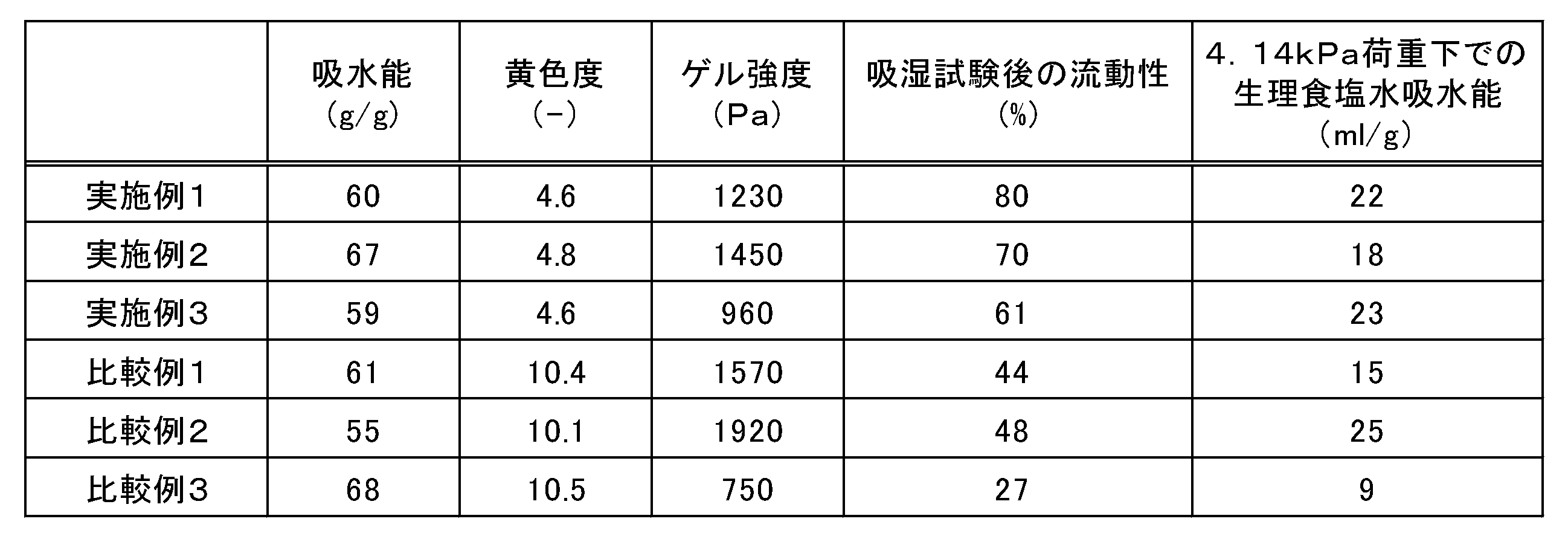
下記表3に、実施例1~3、及び、比較例1~3にて得られた吸水性樹脂を用いて製造した吸収体の評価、並びにその吸収体製造時における作業性評価の結果を示す。

1 ビュレット部
2 導管
3 測定台
4 測定部
5 吸水性樹脂
Claims (3)
- 水溶性エチレン性不飽和単量体を重合させ、かつ後架橋剤で後架橋することにより得られる吸水性樹脂であって、以下の要件を満たすことを特徴とする吸水性樹脂。
(A)黄色度が5.0以下
(B)ゲル強度が1800Pa以下 - 4.14kPa荷重下での生理食塩水吸水能が16ml/g以上である請求項1に記載の吸水性樹脂。
- 請求項1又は2に記載の吸水性樹脂を含む吸収体を用いてなる吸収性物品。
Priority Applications (9)
| Application Number | Priority Date | Filing Date | Title |
|---|---|---|---|
| EP14882126.7A EP2993190B2 (en) | 2014-07-11 | 2014-11-04 | Water-absorbent resin and absorbent article |
| CN201480009320.1A CN105517661B (zh) | 2014-07-11 | 2014-11-04 | 吸水性树脂和吸收性物品 |
| MX2017000346A MX2017000346A (es) | 2014-07-11 | 2014-11-04 | Resina absorbente al agua y articulo absorbente. |
| MYPI2016002322A MY188358A (en) | 2014-07-11 | 2014-11-04 | Water-absorbent resin and absorbent article |
| KR1020157027127A KR101679393B1 (ko) | 2014-07-11 | 2014-11-04 | 흡수성 수지 및 흡수성 물품 |
| CA2953652A CA2953652C (en) | 2014-07-11 | 2014-11-04 | Water-absorbent resin and absorbent article |
| SG11201700055VA SG11201700055VA (en) | 2014-07-11 | 2014-11-04 | Water-absorbent resin and absorbent article |
| BR112017000536-0A BR112017000536B1 (pt) | 2014-07-11 | 2014-11-04 | resina absorvente de água e artigo absorvente |
| US14/784,259 US9982069B2 (en) | 2014-07-11 | 2014-11-04 | Water-absorbent resin and absorbent article |
Applications Claiming Priority (4)
| Application Number | Priority Date | Filing Date | Title |
|---|---|---|---|
| JP2014143716 | 2014-07-11 | ||
| JP2014-143716 | 2014-07-11 | ||
| JP2014-223723 | 2014-10-31 | ||
| JP2014223723A JP5719079B1 (ja) | 2014-07-11 | 2014-10-31 | 吸水性樹脂及び吸収性物品 |
Publications (1)
| Publication Number | Publication Date |
|---|---|
| WO2016006131A1 true WO2016006131A1 (ja) | 2016-01-14 |
Family
ID=53277457
Family Applications (1)
| Application Number | Title | Priority Date | Filing Date |
|---|---|---|---|
| PCT/JP2014/079244 Ceased WO2016006131A1 (ja) | 2014-07-11 | 2014-11-04 | 吸水性樹脂及び吸収性物品 |
Country Status (13)
| Country | Link |
|---|---|
| US (1) | US9982069B2 (ja) |
| EP (1) | EP2993190B2 (ja) |
| JP (1) | JP5719079B1 (ja) |
| KR (1) | KR101679393B1 (ja) |
| CN (1) | CN105517661B (ja) |
| BR (1) | BR112017000536B1 (ja) |
| CA (1) | CA2953652C (ja) |
| MX (1) | MX2017000346A (ja) |
| MY (1) | MY188358A (ja) |
| SA (1) | SA517380669B1 (ja) |
| SG (1) | SG11201700055VA (ja) |
| TW (1) | TWI531360B (ja) |
| WO (1) | WO2016006131A1 (ja) |
Cited By (2)
| Publication number | Priority date | Publication date | Assignee | Title |
|---|---|---|---|---|
| EP2993190B1 (en) | 2014-07-11 | 2018-01-31 | Sumitomo Seika Chemicals Co. Ltd. | Water-absorbent resin and absorbent article |
| EP3878874A4 (en) * | 2018-11-05 | 2022-08-10 | Sumitomo Seika Chemicals Co., Ltd. | WATER-ABSORBENT RESIN |
Families Citing this family (23)
| Publication number | Priority date | Publication date | Assignee | Title |
|---|---|---|---|---|
| JP2016028116A (ja) | 2014-07-11 | 2016-02-25 | 住友精化株式会社 | 吸水性樹脂及び吸収性物品 |
| JP5766344B1 (ja) † | 2014-07-11 | 2015-08-19 | 住友精化株式会社 | 吸水性樹脂及び吸収性物品 |
| WO2018144463A1 (en) | 2017-01-31 | 2018-08-09 | Purewick Corporation | Apparatus and methods for receiving discharged urine |
| JPWO2018159800A1 (ja) | 2017-03-02 | 2019-12-26 | 住友精化株式会社 | 吸水性樹脂及び吸収性物品 |
| CN110446727B (zh) | 2017-03-31 | 2022-08-26 | 住友精化株式会社 | 吸水性树脂颗粒 |
| EP3787572B1 (en) * | 2018-05-02 | 2022-07-06 | Purewick Corporation | Fluid collection devices, systems, and methods |
| WO2020218167A1 (ja) * | 2019-04-23 | 2020-10-29 | 住友精化株式会社 | 吸水性樹脂粒子 |
| WO2020218160A1 (ja) * | 2019-04-23 | 2020-10-29 | 住友精化株式会社 | 吸水性樹脂粒子、吸収体及び吸収性物品 |
| CA3143904C (en) | 2019-06-21 | 2023-11-28 | Purewick Corporation | Fluid collection devices including a base securement area, and related systems and methods |
| EP4051190B1 (en) | 2019-10-28 | 2024-05-22 | Purewick Corporation | Fluid collection assemblies including a sample port |
| WO2021117786A1 (ja) * | 2019-12-13 | 2021-06-17 | 住友精化株式会社 | 被覆樹脂粒子及び被覆樹脂粒子を製造する方法 |
| US12521288B2 (en) | 2020-03-26 | 2026-01-13 | Purewick Corporation | Multi-layer urine capture device and related methods |
| US12465514B2 (en) | 2020-04-17 | 2025-11-11 | Purewick Corporation | Fluid collection devices, systems, and methods securing a protruding portion in position for use |
| US12472090B2 (en) | 2020-04-17 | 2025-11-18 | Purewick Corporation | Female external catheter devices having a urethral cup, and related systems and methods |
| WO2021211801A1 (en) | 2020-04-17 | 2021-10-21 | Purewick Corporation | Fluid collection assemblies including a fluid impermeable barrier having a sump and a base |
| US12491104B2 (en) | 2020-04-20 | 2025-12-09 | Purewick Corporation | Fluid collection devices adjustable between a vacuum-based orientation and a gravity-based orientation, and related systems and methods |
| US12440370B2 (en) | 2020-10-21 | 2025-10-14 | Purewick Corporation | Apparatus with compressible casing for receiving discharged urine |
| US12569365B2 (en) | 2020-10-21 | 2026-03-10 | Purewick Corporation | Fluid collection assemblies including at least one shape memory material disposed in the conduit |
| JP2024503636A (ja) | 2021-01-07 | 2024-01-26 | ピュアウィック コーポレイション | 車椅子に固定可能な尿収集システムおよび関連する方法 |
| US12551385B2 (en) | 2021-03-05 | 2026-02-17 | Purewick Corporation | Fluid collection assembly including a tube having porous wicking material for improved fluid transport |
| US12558472B2 (en) | 2021-03-05 | 2026-02-24 | Purewick Corporation | Portable fluid collection systems with storage and related methods |
| US12575960B2 (en) | 2021-06-24 | 2026-03-17 | Purewick Corporation | Urine collection systems having one or more of volume, pressure, or flow indicators, and related methods |
| US12594062B2 (en) | 2021-09-08 | 2026-04-07 | Purewick Corporation | Fluid collection assemblies including an extension |
Citations (7)
| Publication number | Priority date | Publication date | Assignee | Title |
|---|---|---|---|---|
| JPH09136966A (ja) | 1995-11-13 | 1997-05-27 | Sanyo Chem Ind Ltd | 吸水性樹脂粒子およびその製法 |
| JPH11347402A (ja) | 1998-04-10 | 1999-12-21 | Sanyo Chem Ind Ltd | 吸水剤及びその製法 |
| JP2003246810A (ja) * | 2001-12-19 | 2003-09-05 | Nippon Shokubai Co Ltd | アクリル酸組成物とその製造方法、および、該アクリル酸組成物を用いた吸水性樹脂の製造方法、並びに吸水性樹脂 |
| JP2003246812A (ja) * | 2001-12-19 | 2003-09-05 | Nippon Shokubai Co Ltd | 吸水性樹脂およびその製造方法 |
| JP2012012482A (ja) * | 2010-06-30 | 2012-01-19 | Nippon Shokubai Co Ltd | ポリアクリル酸アンモニウム塩系吸水性樹脂およびその製造方法 |
| JP2012031292A (ja) * | 2010-07-30 | 2012-02-16 | Nippon Shokubai Co Ltd | ポリアクリル酸(塩)系吸水性樹脂およびその製造方法 |
| WO2012081355A1 (ja) * | 2010-12-16 | 2012-06-21 | 住友精化株式会社 | 吸水性樹脂の製造方法 |
Family Cites Families (37)
| Publication number | Priority date | Publication date | Assignee | Title |
|---|---|---|---|---|
| JPS61271303A (ja) * | 1985-05-24 | 1986-12-01 | Lion Corp | 吸水性樹脂の製造方法 |
| DE3713601A1 (de) * | 1987-04-23 | 1988-11-10 | Stockhausen Chem Fab Gmbh | Verfahren zur herstellung eines stark wasserabsorbierenden polymerisats |
| CN1071356C (zh) | 1994-12-08 | 2001-09-19 | 株式会社日本触媒 | 吸水性树脂及其制造方法以及吸水性树脂组合物 |
| US5981070A (en) | 1995-07-07 | 1999-11-09 | Nippon Shokubai Co., Ltd | Water-absorbent agent powders and manufacturing method of the same |
| JP3913867B2 (ja) | 1997-11-14 | 2007-05-09 | 株式会社日本触媒 | 吸水剤およびその製造方法 |
| US6444744B1 (en) | 1998-03-11 | 2002-09-03 | Nippon Shokubai Co., Ltd. | Hydrophilic resin, absorbent article, and acrylic acid for polymerization |
| JP3326110B2 (ja) * | 1998-05-25 | 2002-09-17 | 花王株式会社 | 高吸水性樹脂の製法 |
| JP2000026510A (ja) | 1998-07-06 | 2000-01-25 | Sanyo Chem Ind Ltd | 樹脂の製造法および吸水性樹脂 |
| TWI278480B (en) | 1999-12-15 | 2007-04-11 | Nippon Catalytic Chem Ind | Water-absorbent resin composition |
| WO2001079314A1 (fr) | 2000-04-13 | 2001-10-25 | Sanyo Chemical Industries, Ltd. | Polymere reticule, procede de preparation associe, structure absorbante et article absorbant |
| JP4805490B2 (ja) | 2000-08-03 | 2011-11-02 | 株式会社日本触媒 | 吸水性樹脂の製造方法 |
| US6906159B2 (en) | 2000-08-03 | 2005-06-14 | Nippon Shokubai Co., Ltd. | Water-absorbent resin, hydropolymer, process for producing them, and uses of them |
| US7193006B2 (en) | 2002-12-06 | 2007-03-20 | Nippon Shokubai Co., Ltd. | Process for continuous production of water-absorbent resin product |
| CN1317308C (zh) | 2003-03-26 | 2007-05-23 | 巴斯福股份公司 | 颜色稳定的超吸收性聚合物组合物 |
| TW200500046A (en) | 2003-03-26 | 2005-01-01 | Basf Ag | Color-stable superabsorbent polymer composition |
| WO2006014031A1 (en) | 2004-08-06 | 2006-02-09 | Nippon Shokubai Co., Ltd. | Particulate water-absorbing agent with water-absorbing resin as main component, method for production of the same, and absorbing article |
| JP5091477B2 (ja) | 2005-04-12 | 2012-12-05 | 株式会社日本触媒 | ポリアクリル酸(塩)系吸水性樹脂を主成分とする粒子状吸水剤、その製造方法、この粒子状吸水剤を用いた吸収体及び吸収性物品 |
| US8003210B2 (en) † | 2005-05-16 | 2011-08-23 | Sumitomo Seika Chemicals Co., Ltd. | Process for producing water-absorbing resin particles, water-absorbing resin particles made by the process, and absorbent materials and absorbent articles made by using the particles |
| ATE467645T1 (de) * | 2006-07-19 | 2010-05-15 | Basf Se | Verfahren zur herstellung wasserabsorbierender polymerpartikel mit hoher permeabilität durch polymerisation von tropfen einer monomerlösung |
| US8198376B2 (en) | 2006-07-24 | 2012-06-12 | Sumitomo Seika Chemicals Co., Ltd. | Process for production of water-absorbable resin |
| CN101605818B (zh) | 2007-02-06 | 2012-10-03 | 巴斯夫欧洲公司 | 通过聚合单体溶液的液滴生产吸水性聚合物颗粒的方法 |
| SA08290402B1 (ar) | 2007-07-04 | 2014-05-22 | نيبون شوكوباي كو. ، ليمتد | عامل دقائقي ماص للماء وطريقة لتصنيعه |
| US8737373B2 (en) | 2008-05-09 | 2014-05-27 | Qualcomm Incorporated | Signaling separate unicast and broadcast information with a common pilot |
| US9848314B2 (en) | 2008-05-19 | 2017-12-19 | Qualcomm Incorporated | Managing discovery in a wireless peer-to-peer network |
| US8742023B2 (en) | 2008-12-26 | 2014-06-03 | San-Dia Polymers, Ltd. | Absorbent resin particle, process for producing the same, absorber containing the same, and absorbent article |
| JP5823497B2 (ja) | 2011-03-28 | 2015-11-25 | 住友精化株式会社 | 吸水性樹脂の製造方法 |
| TW201247249A (en) | 2011-04-21 | 2012-12-01 | Sumitomo Seika Chemicals | Water-absorbent resin, absorbent material, and absorbent article |
| JP5917829B2 (ja) * | 2011-05-11 | 2016-05-18 | 住友精化株式会社 | 吸水性樹脂、及びその製造方法 |
| WO2013031654A1 (ja) | 2011-08-30 | 2013-03-07 | 住友精化株式会社 | 吸水性樹脂の製造方法、及びそれにより得られる吸水性樹脂 |
| EP3063189B1 (de) * | 2013-10-30 | 2019-01-30 | Basf Se | Wasserabsorbierende polymerpartikel |
| JP2014143716A (ja) | 2014-03-12 | 2014-08-07 | Sony Corp | 画像処理装置および方法、プログラム、並びに記録媒体 |
| JP5689204B1 (ja) | 2014-07-11 | 2015-03-25 | 住友精化株式会社 | 吸水性樹脂の製造方法、吸水性樹脂、吸水剤、吸収性物品 |
| JP2016028116A (ja) | 2014-07-11 | 2016-02-25 | 住友精化株式会社 | 吸水性樹脂及び吸収性物品 |
| JP5719079B1 (ja) | 2014-07-11 | 2015-05-13 | 住友精化株式会社 | 吸水性樹脂及び吸収性物品 |
| JP5719078B1 (ja) * | 2014-07-11 | 2015-05-13 | 住友精化株式会社 | 吸水性樹脂の製造方法 |
| JP5766344B1 (ja) * | 2014-07-11 | 2015-08-19 | 住友精化株式会社 | 吸水性樹脂及び吸収性物品 |
| JP5961669B2 (ja) | 2014-08-11 | 2016-08-02 | 株式会社マキタ | Dcブラシレスモータを備えた電動工具 |
-
2014
- 2014-10-31 JP JP2014223723A patent/JP5719079B1/ja active Active
- 2014-11-04 EP EP14882126.7A patent/EP2993190B2/en active Active
- 2014-11-04 MY MYPI2016002322A patent/MY188358A/en unknown
- 2014-11-04 SG SG11201700055VA patent/SG11201700055VA/en unknown
- 2014-11-04 WO PCT/JP2014/079244 patent/WO2016006131A1/ja not_active Ceased
- 2014-11-04 CN CN201480009320.1A patent/CN105517661B/zh active Active
- 2014-11-04 KR KR1020157027127A patent/KR101679393B1/ko active Active
- 2014-11-04 CA CA2953652A patent/CA2953652C/en active Active
- 2014-11-04 BR BR112017000536-0A patent/BR112017000536B1/pt not_active IP Right Cessation
- 2014-11-04 US US14/784,259 patent/US9982069B2/en active Active
- 2014-11-04 MX MX2017000346A patent/MX2017000346A/es unknown
-
2015
- 2015-07-07 TW TW104122050A patent/TWI531360B/zh not_active IP Right Cessation
-
2017
- 2017-01-05 SA SA517380669A patent/SA517380669B1/ar unknown
Patent Citations (7)
| Publication number | Priority date | Publication date | Assignee | Title |
|---|---|---|---|---|
| JPH09136966A (ja) | 1995-11-13 | 1997-05-27 | Sanyo Chem Ind Ltd | 吸水性樹脂粒子およびその製法 |
| JPH11347402A (ja) | 1998-04-10 | 1999-12-21 | Sanyo Chem Ind Ltd | 吸水剤及びその製法 |
| JP2003246810A (ja) * | 2001-12-19 | 2003-09-05 | Nippon Shokubai Co Ltd | アクリル酸組成物とその製造方法、および、該アクリル酸組成物を用いた吸水性樹脂の製造方法、並びに吸水性樹脂 |
| JP2003246812A (ja) * | 2001-12-19 | 2003-09-05 | Nippon Shokubai Co Ltd | 吸水性樹脂およびその製造方法 |
| JP2012012482A (ja) * | 2010-06-30 | 2012-01-19 | Nippon Shokubai Co Ltd | ポリアクリル酸アンモニウム塩系吸水性樹脂およびその製造方法 |
| JP2012031292A (ja) * | 2010-07-30 | 2012-02-16 | Nippon Shokubai Co Ltd | ポリアクリル酸(塩)系吸水性樹脂およびその製造方法 |
| WO2012081355A1 (ja) * | 2010-12-16 | 2012-06-21 | 住友精化株式会社 | 吸水性樹脂の製造方法 |
Non-Patent Citations (1)
| Title |
|---|
| See also references of EP2993190A1 |
Cited By (2)
| Publication number | Priority date | Publication date | Assignee | Title |
|---|---|---|---|---|
| EP2993190B1 (en) | 2014-07-11 | 2018-01-31 | Sumitomo Seika Chemicals Co. Ltd. | Water-absorbent resin and absorbent article |
| EP3878874A4 (en) * | 2018-11-05 | 2022-08-10 | Sumitomo Seika Chemicals Co., Ltd. | WATER-ABSORBENT RESIN |
Also Published As
| Publication number | Publication date |
|---|---|
| SA517380669B1 (ar) | 2020-05-11 |
| JP2016028115A (ja) | 2016-02-25 |
| JP5719079B1 (ja) | 2015-05-13 |
| MY188358A (en) | 2021-12-02 |
| CA2953652C (en) | 2018-04-24 |
| EP2993190A1 (en) | 2016-03-09 |
| BR112017000536A2 (pt) | 2017-11-14 |
| KR101679393B1 (ko) | 2016-11-25 |
| BR112017000536B1 (pt) | 2020-12-08 |
| US9982069B2 (en) | 2018-05-29 |
| EP2993190B2 (en) | 2022-05-04 |
| CA2953652A1 (en) | 2016-01-14 |
| KR20160017651A (ko) | 2016-02-16 |
| MX2017000346A (es) | 2017-08-25 |
| CN105517661A (zh) | 2016-04-20 |
| US20170107312A1 (en) | 2017-04-20 |
| TW201605423A (zh) | 2016-02-16 |
| EP2993190A4 (en) | 2016-12-28 |
| EP2993190B1 (en) | 2018-01-31 |
| TWI531360B (zh) | 2016-05-01 |
| SG11201700055VA (en) | 2017-02-27 |
| CN105517661B (zh) | 2017-07-18 |
Similar Documents
| Publication | Publication Date | Title |
|---|---|---|
| JP5719079B1 (ja) | 吸水性樹脂及び吸収性物品 | |
| JP5766344B1 (ja) | 吸水性樹脂及び吸収性物品 | |
| JP5689204B1 (ja) | 吸水性樹脂の製造方法、吸水性樹脂、吸水剤、吸収性物品 | |
| JP5893116B2 (ja) | 吸水性樹脂及び吸水性樹脂の製造方法 | |
| JP5893117B2 (ja) | 吸水性樹脂及び吸収性物品 | |
| JP5719078B1 (ja) | 吸水性樹脂の製造方法 | |
| WO2016006132A1 (ja) | 吸水性樹脂及び吸収性物品 | |
| JP6993878B2 (ja) | 吸水性樹脂および吸水剤 | |
| JP7194101B2 (ja) | 吸水性樹脂 | |
| WO2016104374A1 (ja) | 吸水性樹脂組成物 | |
| JP2016028131A (ja) | 吸水性樹脂及び吸水性樹脂の製造方法 | |
| WO2018159800A1 (ja) | 吸水性樹脂及び吸収性物品 | |
| JPWO2018159802A1 (ja) | 吸水性樹脂及び吸収性物品 | |
| JPWO2018168850A1 (ja) | 吸水性樹脂組成物、吸収体、及び吸収性物品 | |
| JP2016027846A (ja) | 吸水性樹脂及び吸収性物品 | |
| US12403449B2 (en) | Water-absorbing resin | |
| WO2022019218A1 (ja) | 吸水性樹脂組成物、吸水性樹脂組成物の製造方法、及び吸水性樹脂粒子の吸水速度低速化方法 | |
| JP2016027845A (ja) | 吸水性樹脂及び吸収性物品 |
Legal Events
| Date | Code | Title | Description |
|---|---|---|---|
| WWE | Wipo information: entry into national phase |
Ref document number: 2014882126 Country of ref document: EP |
|
| ENP | Entry into the national phase |
Ref document number: 20157027127 Country of ref document: KR Kind code of ref document: A |
|
| WWE | Wipo information: entry into national phase |
Ref document number: 14784259 Country of ref document: US |
|
| 121 | Ep: the epo has been informed by wipo that ep was designated in this application |
Ref document number: 14882126 Country of ref document: EP Kind code of ref document: A1 |
|
| WWE | Wipo information: entry into national phase |
Ref document number: IDP00201607937 Country of ref document: ID |
|
| ENP | Entry into the national phase |
Ref document number: 2953652 Country of ref document: CA |
|
| WWE | Wipo information: entry into national phase |
Ref document number: MX/A/2017/000346 Country of ref document: MX |
|
| NENP | Non-entry into the national phase |
Ref country code: DE |
|
| REG | Reference to national code |
Ref country code: BR Ref legal event code: B01A Ref document number: 112017000536 Country of ref document: BR |
|
| ENP | Entry into the national phase |
Ref document number: 112017000536 Country of ref document: BR Kind code of ref document: A2 Effective date: 20170110 |