WO2016006156A1 - Clavier de saisie de texte - Google Patents
Clavier de saisie de texte Download PDFInfo
- Publication number
- WO2016006156A1 WO2016006156A1 PCT/JP2015/002824 JP2015002824W WO2016006156A1 WO 2016006156 A1 WO2016006156 A1 WO 2016006156A1 JP 2015002824 W JP2015002824 W JP 2015002824W WO 2016006156 A1 WO2016006156 A1 WO 2016006156A1
- Authority
- WO
- WIPO (PCT)
- Prior art keywords
- key
- keys
- thumb
- keyboard
- character
- Prior art date
- Legal status (The legal status is an assumption and is not a legal conclusion. Google has not performed a legal analysis and makes no representation as to the accuracy of the status listed.)
- Ceased
Links
Images



Classifications
-
- G—PHYSICS
- G06—COMPUTING OR CALCULATING; COUNTING
- G06F—ELECTRIC DIGITAL DATA PROCESSING
- G06F3/00—Input arrangements for transferring data to be processed into a form capable of being handled by the computer; Output arrangements for transferring data from processing unit to output unit, e.g. interface arrangements
- G06F3/01—Input arrangements or combined input and output arrangements for interaction between user and computer
- G06F3/02—Input arrangements using manually operated switches, e.g. using keyboards or dials
- G06F3/0202—Constructional details or processes of manufacture of the input device
- G06F3/0216—Arrangements for ergonomically adjusting the disposition of keys of a keyboard
-
- G—PHYSICS
- G06—COMPUTING OR CALCULATING; COUNTING
- G06F—ELECTRIC DIGITAL DATA PROCESSING
- G06F3/00—Input arrangements for transferring data to be processed into a form capable of being handled by the computer; Output arrangements for transferring data from processing unit to output unit, e.g. interface arrangements
- G06F3/01—Input arrangements or combined input and output arrangements for interaction between user and computer
- G06F3/018—Input/output arrangements for oriental characters
-
- G—PHYSICS
- G06—COMPUTING OR CALCULATING; COUNTING
- G06F—ELECTRIC DIGITAL DATA PROCESSING
- G06F3/00—Input arrangements for transferring data to be processed into a form capable of being handled by the computer; Output arrangements for transferring data from processing unit to output unit, e.g. interface arrangements
- G06F3/01—Input arrangements or combined input and output arrangements for interaction between user and computer
- G06F3/02—Input arrangements using manually operated switches, e.g. using keyboards or dials
- G06F3/0202—Constructional details or processes of manufacture of the input device
- G06F3/0219—Special purpose keyboards
-
- G—PHYSICS
- G06—COMPUTING OR CALCULATING; COUNTING
- G06F—ELECTRIC DIGITAL DATA PROCESSING
- G06F3/00—Input arrangements for transferring data to be processed into a form capable of being handled by the computer; Output arrangements for transferring data from processing unit to output unit, e.g. interface arrangements
- G06F3/01—Input arrangements or combined input and output arrangements for interaction between user and computer
- G06F3/02—Input arrangements using manually operated switches, e.g. using keyboards or dials
- G06F3/023—Arrangements for converting discrete items of information into a coded form, e.g. arrangements for interpreting keyboard generated codes as alphanumeric codes, operand codes or instruction codes
-
- G—PHYSICS
- G06—COMPUTING OR CALCULATING; COUNTING
- G06F—ELECTRIC DIGITAL DATA PROCESSING
- G06F3/00—Input arrangements for transferring data to be processed into a form capable of being handled by the computer; Output arrangements for transferring data from processing unit to output unit, e.g. interface arrangements
- G06F3/01—Input arrangements or combined input and output arrangements for interaction between user and computer
- G06F3/02—Input arrangements using manually operated switches, e.g. using keyboards or dials
- G06F3/023—Arrangements for converting discrete items of information into a coded form, e.g. arrangements for interpreting keyboard generated codes as alphanumeric codes, operand codes or instruction codes
- G06F3/0233—Character input methods
-
- G—PHYSICS
- G06—COMPUTING OR CALCULATING; COUNTING
- G06F—ELECTRIC DIGITAL DATA PROCESSING
- G06F3/00—Input arrangements for transferring data to be processed into a form capable of being handled by the computer; Output arrangements for transferring data from processing unit to output unit, e.g. interface arrangements
- G06F3/01—Input arrangements or combined input and output arrangements for interaction between user and computer
- G06F3/048—Interaction techniques based on graphical user interfaces [GUI]
- G06F3/0487—Interaction techniques based on graphical user interfaces [GUI] using specific features provided by the input device, e.g. functions controlled by the rotation of a mouse with dual sensing arrangements, or of the nature of the input device, e.g. tap gestures based on pressure sensed by a digitiser
- G06F3/0488—Interaction techniques based on graphical user interfaces [GUI] using specific features provided by the input device, e.g. functions controlled by the rotation of a mouse with dual sensing arrangements, or of the nature of the input device, e.g. tap gestures based on pressure sensed by a digitiser using a touch-screen or digitiser, e.g. input of commands through traced gestures
- G06F3/04886—Interaction techniques based on graphical user interfaces [GUI] using specific features provided by the input device, e.g. functions controlled by the rotation of a mouse with dual sensing arrangements, or of the nature of the input device, e.g. tap gestures based on pressure sensed by a digitiser using a touch-screen or digitiser, e.g. input of commands through traced gestures by partitioning the display area of the touch-screen or the surface of the digitising tablet into independently controllable areas, e.g. virtual keyboards or menus
-
- H—ELECTRICITY
- H03—ELECTRONIC CIRCUITRY
- H03M—CODING; DECODING; CODE CONVERSION IN GENERAL
- H03M11/00—Coding in connection with keyboards or like devices, i.e. coding of the position of operated keys
- H03M11/02—Details
- H03M11/04—Coding of multifunction keys
- H03M11/06—Coding of multifunction keys by operating the multifunction key itself in different ways
-
- H—ELECTRICITY
- H03—ELECTRONIC CIRCUITRY
- H03M—CODING; DECODING; CODE CONVERSION IN GENERAL
- H03M11/00—Coding in connection with keyboards or like devices, i.e. coding of the position of operated keys
- H03M11/02—Details
- H03M11/04—Coding of multifunction keys
- H03M11/14—Coding of multifunction keys by using additional keys, e.g. shift keys, which determine the function performed by the multifunction key
Definitions
- the present invention relates to a character keyboard for character input used in a word processor, a personal computer, and the like, and a software keyboard displayed on a touch panel screen of a tablet terminal or the like and used for input.
- a keyboard for a personal computer generally used in an English-speaking region is provided with a large space key having a width corresponding to several general character keys at the center of the lowermost row of five character key strings.
- shift keys and control keys are arranged on the left and right outer edges of the character key string, and the design is such that the little finger of the hand different from the hand operating the key to be simultaneously pressed is extended and the key is pressed (FIG. 5).
- Such an arrangement of keys follows the design of the mechanical typewriter that was once popular.
- Japanese Utility Model Publication No. 61-42176 and Japanese Patent Publication No. 63-49262 proposed a so-called “thumb shift keyboard” as a Japanese word processor keyboard.
- thumb shift keyboard when the fingers from the index finger to the little finger of both hands are placed on the eight keys in the middle stage of the character key arrangement, which is the home position for the operation of the character input keyboard, By placing independent keys at passively placed positions (hereinafter referred to as the home position of the thumb) and simultaneously pressing these two keys and character keys, there are three types of kana with one character key. It is possible to input characters.
- the home position of each finger is the A key for the left little finger, the S key for the left ring finger, and the D middle finger for the left hand Key
- left hand index finger is F key key
- right hand index finger is J key
- right hand middle finger is K key
- right hand ring finger is L key
- right hand little finger is; key.
- a Japanese male with an average size hand places each finger from the index finger to the little finger in the home position, the left thumb is approximately in front of the V key and the right thumb is approximately the N key. Located in front.
- the home position of the thumb in the present invention corresponds to the area in contact with the lower end of the V key for the left thumb, and N for the right thumb, if expressed using the character key names on the QWERTY keyboard. Corresponds to the area touching the bottom of the key.
- the keys placed at the home positions of the left and right thumbs each have a width equal to or more than two character keys.
- two shift keys and control keys are arranged at the left and right ends of the character key string in the same manner as in the English keyboard (FIG. 7).
- the key placed at the home position of the thumb is restricted to allow the key to be placed in the middle, and the restriction of the key width allows the three
- touch typing the key operation and the two keys on the left and right sides of the key facilitate key operation without touching the key
- the arrangement of the shift key and the control key used in the character input keyboard is changed to a position where it can be touch-typed with the thumb so that simultaneous keying with other keys is easy”.
- the shift key and the control key on which the simultaneous keying with other keys is the basic operation should be placed at the home position of the thumb or a position adjacent thereto. . Because even if the thumb is pressing the shift key or the control key at the home position of the thumb or the position adjacent to it, each finger from the index finger to the little finger does not come off from the home position, and the key is pressed simultaneously with the shift key or the control key. This is because the fingering of each finger from the index finger to the little finger is not greatly restricted.
- the shift key and the control key are arranged at positions where the left and right little fingers must be moved from the original home position to be pressed.
- the present invention seeks to solve the problem that the efficiency of input work of a personal computer or the like is reduced due to such an unreasonable key arrangement.
- the width of the space key which occupies a larger area than necessary in the character input keyboard of an existing personal computer, is changed from one time to 1 ⁇ Limit the length to 5 times and place it at the home position of either the left or right thumb.
- a shift key having a width that is 1 to 1.5 times the width of other character keys is also arranged.
- Control keys are placed in the space between the home positions of the left and right thumbs created by limiting the width of the two keys. Keys are also arranged at positions adjacent to the outside of the home position of both thumbs.
- the shift key and the control key are arranged at positions where the thumb can be pressed without destroying the home position, the operability when simultaneously pressing the shift key, the control key and another key is improved.
- Japanese MS-IME registered trademark
- Google registered trademark
- ATOK registered trademark
- the improved operability of the shift key makes it easier to use the character key by simultaneous keying with the shift key, which has not been used so far when inputting Japanese, and improves the efficiency of Japanese input work ( FIG. 3).
- the present invention has a morphological feature of “putting an independent key at the home position of the thumb”, a virtual thumb shift keyboard using a key remapping software (an application that realizes a change of a character key arrangement in software) is used. It is also suitable for realization (Fig. 4).
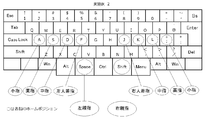
- Example 1 It is a top view which shows embodiment of this invention.
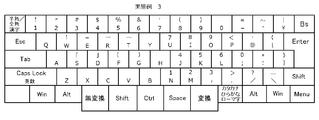
- Example 2 It is a top view which shows embodiment of this invention.
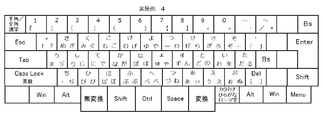
- Example 3 It is a top view which shows embodiment of this invention.
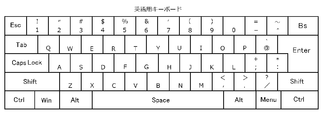
- Example 4 It is a top view which shows the typical key arrangement
- FIGS. Examples of the present invention are shown in FIGS.
- a space key is placed at one of the thumb home positions
- a shift key is placed at one
- a control key is placed between the home positions of the two thumbs.
- the width of these three keys is assumed to be 1 to 1.5 times the width of the character key.
- the vertical length of these three keys and the shape of the key outside the home position of the thumb are not within the scope of the claims of the present invention.
- FIG. 1 shows an embodiment of a Japanese keyboard for a personal computer.
- a shift key is placed at the home position of the left thumb, a space key is placed at the home position of the right thumb, and a control key is placed between them.
- Two control keys are placed on the left and right outer edges of the character key string on the existing keyboard and placed on the left outer edge. In this example, one shift key is omitted.
- the key adjacent to the outside of the home position of the left thumb is a non-conversion key
- the key adjacent to the outside of the home position of the right thumb is a conversion key.
- the width of the left and right thumb home positions and the three keys positioned in the middle of the home positions are about one time the width of the character keys.
- FIG. 2 shows an embodiment of an English keyboard for a personal computer.
- a shift key is placed at the home position of the right thumb, a space key is placed at the home position of the left thumb, and a control key is placed between them.
- Two keys are placed on the left and right outer edges of the character key row on the existing keyboard and the right outer edge. In this example, one shift key is omitted.
- the key adjacent to the left thumb home position is an alt key
- the key adjacent to the right thumb home position is a menu key.
- the widths of the left and right thumb home positions and the three keys located in the middle of the home positions are about 1.3 times the width of the character keys.
- FIG. 3 shows an example in which the efficiency of Japanese input is improved by using the key remap software provided on the Internet for a fee or free of charge after implementing the present invention on a Japanese keyboard for a personal computer.
- Characters and symbols inputted by single keystroke of the key are shown in the lower part of each key, and characters and symbols inputted by simultaneous keying with the shift key are shown in the upper part of each key.
- Japanese input is performed by romaji input using a keyboard with a general QWERTY layout, numbers, long symbols, and square brackets are input using the keys placed at the top of the character key string. There are difficulties.
- a character and a symbol that are input by simultaneously pressing the shift key and the character key are defined so that numbers, a long sound symbol, a bracket, etc. can be easily input. .
- FIG. 4 shows an example in which a virtual thumb shift keyboard is realized by implementing the present invention in a Japanese keyboard for a personal computer and changing the arrangement of character keys using key remapping software.
- Characters and symbols entered by single keystroke of the key in the upper middle of each key are characters and symbols entered by simultaneous keystroke with the shift key on the left thumb home position on the lower left side of each key, Characters and symbols inputted by simultaneous keystrokes with the space key on the home position of the right thumb are shown on the lower right side of each key.
- the arrangement of letters and symbols is exemplary and is invented by the inventors of the present invention.
- the character input keyboard manufactured according to the embodiment of the present invention is of a type that can be immediately enjoyed without any practice or learning if there is experience using an existing personal computer keyboard. .
- the present invention can be applied not only to a physical keyboard but also to a software keyboard used for input in a tablet computer equipped with a touch panel.
- the present invention not only improves the efficiency of Japanese input work, but also improves the operability of all personal computer keyboards regardless of the language used, and the industrial applicability is extremely high.
Landscapes
- Engineering & Computer Science (AREA)
- Theoretical Computer Science (AREA)
- General Engineering & Computer Science (AREA)
- Human Computer Interaction (AREA)
- Physics & Mathematics (AREA)
- General Physics & Mathematics (AREA)
- Input From Keyboards Or The Like (AREA)
- User Interface Of Digital Computer (AREA)
Abstract
L'invention concerne un clavier de saisie de texte comprenant une touche espace, une touche majuscule et une touche de commande. Lorsque huit doigts, autrement dit les index, majeurs, annulaires et auriculaires des deux mains, sont placés sur huit touches dans la rangée centrale d'une disposition de touches de caractères, qui sont désignées comme étant des positions initiales lors d'une opération au clavier, le point où les pouces gauche et droit se situent passivement est défini comme la position initiale de chaque pouce. Trois touches, chacune ayant une largeur représentant de 1 à 1,5 fois la largeur de chacune des autres touches de caractères, sont situées au niveau des positions initiales respectives des pouces gauche et droit et en leur milieu. La touche majuscule est disposée au niveau d'une des positions initiales des pouces. La touche espace est disposée au niveau de l'autre position initiale des pouces. Une touche de commande est disposée au milieu des deux positions initiales des pouces.
Priority Applications (1)
| Application Number | Priority Date | Filing Date | Title |
|---|---|---|---|
| US15/320,346 US10275042B2 (en) | 2014-07-07 | 2015-06-04 | Text input keyboard |
Applications Claiming Priority (2)
| Application Number | Priority Date | Filing Date | Title |
|---|---|---|---|
| JP2014-139378 | 2014-07-07 | ||
| JP2014139378A JP6346808B2 (ja) | 2014-07-07 | 2014-07-07 | 文字入力用キーボード |
Publications (1)
| Publication Number | Publication Date |
|---|---|
| WO2016006156A1 true WO2016006156A1 (fr) | 2016-01-14 |
Family
ID=55063816
Family Applications (1)
| Application Number | Title | Priority Date | Filing Date |
|---|---|---|---|
| PCT/JP2015/002824 Ceased WO2016006156A1 (fr) | 2014-07-07 | 2015-06-04 | Clavier de saisie de texte |
Country Status (3)
| Country | Link |
|---|---|
| US (1) | US10275042B2 (fr) |
| JP (1) | JP6346808B2 (fr) |
| WO (1) | WO2016006156A1 (fr) |
Families Citing this family (1)
| Publication number | Priority date | Publication date | Assignee | Title |
|---|---|---|---|---|
| US12131136B2 (en) * | 2021-04-17 | 2024-10-29 | Aidin NASIRISHARGH | Virtual keyboard for writing programming codes in electronic device |
Citations (9)
| Publication number | Priority date | Publication date | Assignee | Title |
|---|---|---|---|---|
| JPS61100859A (ja) * | 1984-10-22 | 1986-05-19 | Nec Corp | 日本語入力装置 |
| JPS6284323A (ja) * | 1985-05-07 | 1987-04-17 | ロイ フアルタン | キ−ボ−ド |
| JPH03235112A (ja) * | 1990-02-13 | 1991-10-21 | Masanari Demura | ローマ字仮名漢字変換式日本文入力および英数字入力用鍵盤配列 |
| JP2001075707A (ja) * | 1999-09-03 | 2001-03-23 | Kazuyuki Ozawa | 本キーボードの形に於ける、文字配列 |
| US6241406B1 (en) * | 1998-09-22 | 2001-06-05 | Leung Lap Yan | Computer keyboard |
| JP2003505777A (ja) * | 1999-07-26 | 2003-02-12 | 始 黒澤 | 文字入力キーボード |
| WO2010035574A1 (fr) * | 2008-09-29 | 2010-04-01 | シャープ株式会社 | Dispositif et procédé d'entrée, programme et support d'enregistrement |
| US8226308B1 (en) * | 2007-05-04 | 2012-07-24 | Alfred Saviour Borg | Ergonomic keyboard with divided keys |
| JP2013025328A (ja) * | 2011-07-14 | 2013-02-04 | Hiroshi Kishimoto | 情報入力装置 |
Family Cites Families (45)
| Publication number | Priority date | Publication date | Assignee | Title |
|---|---|---|---|---|
| FR2082059A5 (fr) | 1970-03-02 | 1971-12-10 | Saint John Frost Ines | |
| US3847263A (en) | 1973-03-06 | 1974-11-12 | X Box | English keyboard scheme |
| US4449839A (en) | 1982-09-22 | 1984-05-22 | Bleuer Keith T | Keyboard with elongate keys |
| US4913573A (en) | 1987-02-18 | 1990-04-03 | Retter Dale J | Alpha-numeric keyboard |
| CA1334742C (fr) * | 1988-12-27 | 1995-03-14 | An Wang | Clavier a touches digitales et a touches a stylet |
| US5620267A (en) * | 1993-10-15 | 1997-04-15 | Keyboard Advancements, Inc. | Keyboard with thumb activated control key |
| JP3235112B2 (ja) | 1991-03-26 | 2001-12-04 | オムロン株式会社 | モータ制御装置 |
| JP3523343B2 (ja) | 1993-12-27 | 2004-04-26 | ミサワホーム株式会社 | キー入力装置およびキー入力方法 |
| US5584588A (en) | 1995-04-21 | 1996-12-17 | Harbaugh; Gary B. | Computer keyboard layout |
| US5818437A (en) | 1995-07-26 | 1998-10-06 | Tegic Communications, Inc. | Reduced keyboard disambiguating computer |
| JP3727399B2 (ja) | 1996-02-19 | 2005-12-14 | ミサワホーム株式会社 | 画面表示式キー入力装置 |
| US20010013859A1 (en) * | 1997-07-02 | 2001-08-16 | Roylance William H. | Palm top computer keyboard having full-sized keys suitable for touch-typing |
| US6198474B1 (en) * | 1997-07-02 | 2001-03-06 | William H. Roylance | Computer keyboard having full-sized keys suitable for touch typing and thumb operable space key also acting as a shift key |
| GB2343414B (en) | 1998-11-23 | 2000-09-27 | Mun San Ho | A keyboard layout |
| US7506252B2 (en) * | 1999-01-26 | 2009-03-17 | Blumberg Marvin R | Speed typing apparatus for entering letters of alphabet with at least thirteen-letter input elements |
| US6558056B2 (en) * | 2000-05-05 | 2003-05-06 | David V. Euley | Barrier free computer keyboard |
| US7504967B2 (en) | 2001-06-12 | 2009-03-17 | Research In Motion Limited | Portable electronic device with keyboard |
| US6876312B2 (en) | 2001-07-10 | 2005-04-05 | Behavior Tech Computer Corporation | Keyboard with multi-function keys |
| US6712534B2 (en) * | 2001-07-23 | 2004-03-30 | Sanjay M. Patel | Ergonomic and efficient keyboard |
| US7083342B2 (en) | 2001-12-21 | 2006-08-01 | Griffin Jason T | Keyboard arrangement |
| US20030218599A1 (en) | 2002-03-06 | 2003-11-27 | Kim Burke | Computer keyboard arrangement |
| SG125895A1 (en) | 2002-04-04 | 2006-10-30 | Xrgomics Pte Ltd | Reduced keyboard system that emulates qwerty-type mapping and typing |
| US20030201915A1 (en) | 2002-04-24 | 2003-10-30 | Anderson Charles S. | Computer keyboard |
| US20030206122A1 (en) | 2002-05-02 | 2003-11-06 | Emerson Harry E. | Computer keyboard having additional symbol keys |
| CN2586201Y (zh) * | 2002-06-18 | 2003-11-12 | 谢庆云 | 一种便携式键盘 |
| US7081837B2 (en) * | 2003-04-24 | 2006-07-25 | Taylor Bollman | Compressed standardized keyboard |
| US20100040400A1 (en) | 2003-08-29 | 2010-02-18 | Hirsch Steven B | Keyboard and keys |
| US7056043B2 (en) | 2004-02-26 | 2006-06-06 | Research In Motion Limited | Keyboard for a mobile device |
| KR100557139B1 (ko) | 2004-06-19 | 2006-03-03 | 삼성전자주식회사 | 키보드의 키 배열 |
| EP1782170A4 (fr) | 2004-07-29 | 2012-04-25 | Paul Lloyd Baker | Clavier pour ordinateur portable |
| US20110206437A1 (en) | 2004-07-29 | 2011-08-25 | Paul Lloyd Baker | Keyboard for a handheld computer device |
| US20060176283A1 (en) | 2004-08-06 | 2006-08-10 | Daniel Suraqui | Finger activated reduced keyboard and a method for performing text input |
| EP1832956A1 (fr) | 2006-03-10 | 2007-09-12 | E-Lead Electronic Co., Ltd. | Clavier miniaturisé |
| US7724157B1 (en) | 2007-01-05 | 2010-05-25 | Gray Keith I | Keyboard |
| CN101790710A (zh) | 2007-08-28 | 2010-07-28 | 迅科有限公司 | 按键输入界面方法 |
| US8487876B2 (en) | 2007-12-07 | 2013-07-16 | Microsoft Corporation | Ergonomic hand-held text input device |
| JP5176832B2 (ja) * | 2008-09-29 | 2013-04-03 | 富士通株式会社 | キーボードおよび情報処理装置 |
| AT507455A1 (de) | 2008-10-30 | 2010-05-15 | Care Tec Gmbh | Verfahren zur eingabe von daten |
| CN101882005B (zh) * | 2008-11-21 | 2013-10-16 | 杭州惠道科技有限公司 | 一种小尺寸电子设备键盘 |
| US8633901B2 (en) * | 2009-01-30 | 2014-01-21 | Blackberry Limited | Handheld electronic device having a touchscreen and a method of using a touchscreen of a handheld electronic device |
| CN102576254B (zh) * | 2009-09-16 | 2015-11-25 | 普雷姆·库马·奈尔 | 数据录入设备(ded) |
| JP2011192179A (ja) | 2010-03-16 | 2011-09-29 | Kyocera Corp | 文字入力装置、文字入力方法及び文字入力プログラム |
| JP5161338B2 (ja) | 2011-05-09 | 2013-03-13 | 株式会社ソニー・コンピュータエンタテインメント | キーボード |
| CN102221896B (zh) | 2011-07-11 | 2012-10-24 | 任文 | 一种新式计算机键盘 |
| US9335837B2 (en) | 2011-12-09 | 2016-05-10 | Microsoft Technology Licensing, Llc | Text flow sensitive backspace key for bi-directional content |
-
2014
- 2014-07-07 JP JP2014139378A patent/JP6346808B2/ja not_active Expired - Fee Related
-
2015
- 2015-06-04 US US15/320,346 patent/US10275042B2/en active Active
- 2015-06-04 WO PCT/JP2015/002824 patent/WO2016006156A1/fr not_active Ceased
Patent Citations (9)
| Publication number | Priority date | Publication date | Assignee | Title |
|---|---|---|---|---|
| JPS61100859A (ja) * | 1984-10-22 | 1986-05-19 | Nec Corp | 日本語入力装置 |
| JPS6284323A (ja) * | 1985-05-07 | 1987-04-17 | ロイ フアルタン | キ−ボ−ド |
| JPH03235112A (ja) * | 1990-02-13 | 1991-10-21 | Masanari Demura | ローマ字仮名漢字変換式日本文入力および英数字入力用鍵盤配列 |
| US6241406B1 (en) * | 1998-09-22 | 2001-06-05 | Leung Lap Yan | Computer keyboard |
| JP2003505777A (ja) * | 1999-07-26 | 2003-02-12 | 始 黒澤 | 文字入力キーボード |
| JP2001075707A (ja) * | 1999-09-03 | 2001-03-23 | Kazuyuki Ozawa | 本キーボードの形に於ける、文字配列 |
| US8226308B1 (en) * | 2007-05-04 | 2012-07-24 | Alfred Saviour Borg | Ergonomic keyboard with divided keys |
| WO2010035574A1 (fr) * | 2008-09-29 | 2010-04-01 | シャープ株式会社 | Dispositif et procédé d'entrée, programme et support d'enregistrement |
| JP2013025328A (ja) * | 2011-07-14 | 2013-02-04 | Hiroshi Kishimoto | 情報入力装置 |
Also Published As
| Publication number | Publication date |
|---|---|
| JP2016018303A (ja) | 2016-02-01 |
| US20170351340A1 (en) | 2017-12-07 |
| JP6346808B2 (ja) | 2018-06-20 |
| US10275042B2 (en) | 2019-04-30 |
Similar Documents
| Publication | Publication Date | Title |
|---|---|---|
| JP2014506697A (ja) | キーパッド | |
| CN103257715B (zh) | 一种汉语拼音键盘及基于该键盘的输入法 | |
| JP2013003761A (ja) | 選択肢選択・文字入力装置、選択肢選択・文字入力方法、コンピュータ読取可能なプログラム及び記録媒体 | |
| JP6346808B2 (ja) | 文字入力用キーボード | |
| JP4894032B2 (ja) | 文字入力キーボード | |
| KR101173537B1 (ko) | 쾌속 터치 자판 | |
| JP4229528B2 (ja) | キー入力装置 | |
| JP4068829B2 (ja) | 入力装置 | |
| JP4395177B2 (ja) | キーボード | |
| KR101127868B1 (ko) | 멀티터칭을 위한 한손 한글자판배열 및 입력방법 | |
| JP6769631B2 (ja) | オールインワン方式による情報通信機器の文字入力装置 | |
| KR20140083206A (ko) | 한글 문자 입력 자판 배열 | |
| KR20090070357A (ko) | 한글 입력기 및 한글 입력 방법 | |
| TWI502409B (zh) | keyboard | |
| JP5016087B2 (ja) | キーボード | |
| JP2008123114A (ja) | 文字入力キーボードを備えた電子機器 | |
| KR101550140B1 (ko) | 터치스크린을 이용한 문자입력방법 | |
| JP4987945B2 (ja) | キーボード | |
| KR20110011722U (ko) | 키보드 | |
| KR20120117711A (ko) | 문자 입력을 위한 영어 단짝문자 힐 자판과 한글 가족자음 나이러 자판 | |
| CN104991655A (zh) | 一种新型键盘 | |
| KR20150025807A (ko) | 가상 키보드 및 이를 구비한 휴대 단말기 | |
| WO2007036149A1 (fr) | Clavier d'entrée de caractères | |
| JP2019192182A (ja) | 日本語標準キーボード | |
| JP2020135399A (ja) | 符号入力インターフェースを提供する方法及びプログラム |
Legal Events
| Date | Code | Title | Description |
|---|---|---|---|
| 121 | Ep: the epo has been informed by wipo that ep was designated in this application |
Ref document number: 15818469 Country of ref document: EP Kind code of ref document: A1 |
|
| WWE | Wipo information: entry into national phase |
Ref document number: 15320346 Country of ref document: US |
|
| NENP | Non-entry into the national phase |
Ref country code: DE |
|
| 122 | Ep: pct application non-entry in european phase |
Ref document number: 15818469 Country of ref document: EP Kind code of ref document: A1 |