WO2016006322A1 - Dispositif - Google Patents
Dispositif Download PDFInfo
- Publication number
- WO2016006322A1 WO2016006322A1 PCT/JP2015/064206 JP2015064206W WO2016006322A1 WO 2016006322 A1 WO2016006322 A1 WO 2016006322A1 JP 2015064206 W JP2015064206 W JP 2015064206W WO 2016006322 A1 WO2016006322 A1 WO 2016006322A1
- Authority
- WO
- WIPO (PCT)
- Prior art keywords
- traffic
- cell
- information
- control
- cell group
- Prior art date
- Legal status (The legal status is an assumption and is not a legal conclusion. Google has not performed a legal analysis and makes no representation as to the accuracy of the status listed.)
- Ceased
Links
Images




Classifications
-
- H—ELECTRICITY
- H04—ELECTRIC COMMUNICATION TECHNIQUE
- H04W—WIRELESS COMMUNICATION NETWORKS
- H04W28/00—Network traffic management; Network resource management
- H04W28/02—Traffic management, e.g. flow control or congestion control
- H04W28/10—Flow control between communication endpoints
- H04W28/12—Flow control between communication endpoints using signalling between network elements
-
- H—ELECTRICITY
- H04—ELECTRIC COMMUNICATION TECHNIQUE
- H04W—WIRELESS COMMUNICATION NETWORKS
- H04W16/00—Network planning, e.g. coverage or traffic planning tools; Network deployment, e.g. resource partitioning or cells structures
- H04W16/24—Cell structures
- H04W16/32—Hierarchical cell structures
-
- H—ELECTRICITY
- H04—ELECTRIC COMMUNICATION TECHNIQUE
- H04W—WIRELESS COMMUNICATION NETWORKS
- H04W24/00—Supervisory, monitoring or testing arrangements
- H04W24/08—Testing, supervising or monitoring using real traffic
-
- H—ELECTRICITY
- H04—ELECTRIC COMMUNICATION TECHNIQUE
- H04W—WIRELESS COMMUNICATION NETWORKS
- H04W28/00—Network traffic management; Network resource management
- H04W28/02—Traffic management, e.g. flow control or congestion control
- H04W28/0231—Traffic management, e.g. flow control or congestion control based on communication conditions
- H04W28/0236—Traffic management, e.g. flow control or congestion control based on communication conditions radio quality, e.g. interference, losses or delay
-
- H—ELECTRICITY
- H04—ELECTRIC COMMUNICATION TECHNIQUE
- H04W—WIRELESS COMMUNICATION NETWORKS
- H04W52/00—Power management, e.g. Transmission Power Control [TPC] or power classes
- H04W52/02—Power saving arrangements
- H04W52/0209—Power saving arrangements in terminal devices
-
- H—ELECTRICITY
- H04—ELECTRIC COMMUNICATION TECHNIQUE
- H04W—WIRELESS COMMUNICATION NETWORKS
- H04W52/00—Power management, e.g. Transmission Power Control [TPC] or power classes
- H04W52/04—Transmission power control [TPC]
- H04W52/18—TPC being performed according to specific parameters
-
- H—ELECTRICITY
- H04—ELECTRIC COMMUNICATION TECHNIQUE
- H04W—WIRELESS COMMUNICATION NETWORKS
- H04W88/00—Devices specially adapted for wireless communication networks, e.g. terminals, base stations or access point devices
- H04W88/08—Access point devices
- H04W88/10—Access point devices adapted for operation in multiple networks, e.g. multi-mode access points
-
- Y—GENERAL TAGGING OF NEW TECHNOLOGICAL DEVELOPMENTS; GENERAL TAGGING OF CROSS-SECTIONAL TECHNOLOGIES SPANNING OVER SEVERAL SECTIONS OF THE IPC; TECHNICAL SUBJECTS COVERED BY FORMER USPC CROSS-REFERENCE ART COLLECTIONS [XRACs] AND DIGESTS
- Y02—TECHNOLOGIES OR APPLICATIONS FOR MITIGATION OR ADAPTATION AGAINST CLIMATE CHANGE
- Y02D—CLIMATE CHANGE MITIGATION TECHNOLOGIES IN INFORMATION AND COMMUNICATION TECHNOLOGIES [ICT], I.E. INFORMATION AND COMMUNICATION TECHNOLOGIES AIMING AT THE REDUCTION OF THEIR OWN ENERGY USE
- Y02D30/00—Reducing energy consumption in communication networks
- Y02D30/70—Reducing energy consumption in communication networks in wireless communication networks
Definitions
- This disclosure relates to an apparatus.
- a 3G mobile phone service called the third generation was started in Japan. Initially, small-sized packets were sent and received for voice calls and email transmissions. However, with the introduction of HSDPA (High Speed Downlink Packet Access), larger-sized packets are sent and received for downloading music files and streaming video. With such an increase in packet capacity, LTE (Long Term Evolution) services that use OFDMA (Orthogonal Frequency Division Multiple Access) on the downlink have also started to expand on the wireless network side. In addition, 4G service is scheduled to start around 2015. As a result, a maximum of 1 Gbps (bit per second) can be realized semi-fixed, and a maximum of 100 Mbps can be realized even in a mobile environment.
- OFDMA Orthogonal Frequency Division Multiple Access
- Non-Patent Document 1 (particularly “5.2.2 Load management”) proposes to exchange traffic load information between eNBs so that the eNB can appropriately control the traffic load.
- Non-Patent Document 2 proposes performing load balancing (for example, changing a handover parameter) based on load information exchanged between eNBs.
- 3GPP TS 36.420 V11.0.0 2012-09 “3rd Generation Partnership Project; Technical Specification Group Radio Access Network; Evolved Universal Terrestrial Radio Access Network (E-UTRAN); X2 general aspects and leasein (11) 3GPP TR 36.902 V9.3.0 (2010-12) “3rd Generation Partnership Project; Technical Specification Group Radio Access Network; Evolved Universal Terrestrial Radio Access Network (E-UTRAN); Self-configuring and self-optimizing network (SON) solutions (Release 9) "
- a network-intensive control mechanism such as SDN (Software-Defined Networking) is introduced.
- SDN Software-Defined Networking
- OpenFlow routing control mechanism can be introduced into a cellular system. For example, routing according to the traffic situation for each cell may be performed.
- a heavy load may arise for a controller that performs centralized control to collect information on cell traffic. For example, if a large number of small cells are arranged at a high density, the number of cells in the cellular system can be very large, resulting in a very large load.
- the traffic information is provided to an acquisition unit that acquires traffic information regarding traffic of a cell group including two or more cells, and a control device that performs routing control of traffic of the plurality of cell groups including the cell group. And a providing unit that provides the apparatus.
- An apparatus for each of a plurality of cell groups each including two or more cells, traffic information related to traffic of the cell group, the traffic provided by the information processing apparatus corresponding to the cell group
- An apparatus includes an acquisition unit that acquires information and a control unit that performs routing control of traffic of the plurality of cell groups based on the traffic information for each of the plurality of cell groups.
- the present disclosure it is possible to reduce the load on the controller that performs centralized control of the network.
- the above effects are not necessarily limited, and any of the effects shown in the present specification or other effects that can be grasped from the present specification are exhibited together with or in place of the above effects. May be.
- elements having substantially the same functional configuration may be distinguished by adding different alphabets after the same reference numerals.
- a plurality of elements having substantially the same functional configuration are differentiated as necessary, such as the base stations 10A, 10B, and 10C.
- the base stations 10A, 10B, and 10C are simply referred to as the base station 10.
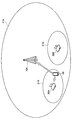
- FIG. 1 is an explanatory diagram illustrating an example of a schematic configuration of a communication system 1 according to the present embodiment.
- the communication system 1 includes a base station 10, a base station 20, a network 30, a network 40, an information processing apparatus 100, and a control apparatus 200.
- the base station 10 is a base station of the macro cell 11.
- the base station 10 performs wireless communication with a terminal device located in the macro cell 11.
- the base station 10 is connected to the network 30.
- the base station 20 is a base station of the small cell 21.
- the base station 20 performs wireless communication with a terminal device located in the small cell 21.
- the base station 20 is connected to the network 30.
- the small cell 21 overlaps with the macro cell 11.
- the small cells 21A and 21B overlap with the macro cell 11A
- the small cells 21C, 21D, and 21E overlap with the macro cell 11B.
- the small cell 21 may be a cell formed by a terminal device operating as a base station.
- the base station 20 may be a terminal device that operates as a base station. More specifically, for example, the terminal device may dynamically set the operation mode to a mobile station mode for operating as a mobile station or a base station mode for operating as a base station. Good.
- the base station 20 may be a terminal device whose operation mode is the base station mode.
- the terminal device may be connected to the network 30 via a wireless backhaul between the terminal device and any base station (for example, the base station 10).
- the network 30 is a network to which base stations are connected.
- the network 30 is connected to the network 40.
- the network 30 transfers cell traffic of base stations connected to the network 30.
- the traffic includes traffic destined for the terminal device (ie, downlink traffic) and / or traffic from the terminal device (ie, uplink traffic).
- the control information included in the traffic may be transferred via the control plane, and other information may be transferred via the data plane. Further, the control plane and the data plane may be separated physically or virtually.
- the network 30 transfers traffic between a base station connected to the network 30 and the network 40. Further, for example, the network 30 transfers traffic between base stations connected to the network 30.
- the network 30 includes network nodes such as switches, routers and / or gateways.
- the network node is a network node that supports SDN or OpenFlow.
- network 30A and the network 30B may be non-overlapping networks, or may be partially or entirely overlapping networks.
- the network 40 is a network connected to the network 30 and other networks.
- the network 40 transfers the traffic of the cell of the base station connected to the network 30.
- the traffic includes traffic destined for the terminal device (ie, downlink traffic) and / or traffic from the terminal device (ie, uplink traffic).
- the control information included in the traffic may be transferred via the control plane, and other information may be transferred via the data plane. Further, the control plane and the data plane may be separated physically or virtually.
- the network 40 transfers traffic between the network 30 and the other network.
- the network 40 transfers traffic between the networks 30.
- the network 40 includes network nodes such as switches, routers, and / or gateways.
- the network node is a network node that supports SDN or OpenFlow.
- the information processing apparatus 100 provides the control apparatus 200 with traffic information regarding traffic of a cell group including two or more cells.
- the two or more cells include a macro cell 11 and a small cell 21 that overlaps the macro cell 11.
- the information processing apparatus 100 collects information on traffic from the base station 10 or the base station 20.
- the information processing apparatus 100 has a control plane for exchanging control information with the control apparatus 200. This control plane may be physically or virtually separated from the data plane.
- the first cell group includes the macro cell 11A, the small cell 21A, and the small cell 21B
- the information processing apparatus 100A provides the control apparatus 200 with traffic information regarding the traffic of the first cell group.
- the second cell group includes a macro cell 11B, a small cell 21C, a small cell 21D, and a small cell 21E
- the information processing apparatus 100B provides traffic information regarding the traffic of the second cell group to the control apparatus 200.
- the traffic information may be provided as OpenFlow flow statistical information.
- each cell group includes one macro cell 11
- the cell group according to the embodiment of the present disclosure is not limited to such an example.
- the cell group may include two or more macro cells 11 (and small cells 21 overlapping with the macro cells 11 included in the two or more macro cells 11).
- each cell group demonstrated the example containing the macrocell 11 and the small cell 21, the cell group which concerns on embodiment of this indication is not limited to the example which concerns.
- the network 30 may exist for every cell group, or may be shared between cell groups.
- the information processing apparatus 100 is connected to the network 30.
- the information processing apparatus 100A is connected to the network 30A
- the information processing apparatus 100B is connected to the network 30B.
- the information processing apparatus 100 may be connected to another network (for example, the network 40) instead of being connected to the network 30.
- the information processing apparatus 100 may be a network node included in the network 30.
- Control device 200 In the embodiment of the present disclosure, the control device 200 performs the routing control of the traffic of the plurality of cell groups based on the traffic information for each of the plurality of cell groups.
- control device 200 routes the traffic of the first cell group and the second cell group based on the traffic information about the first cell group and the traffic information about the second cell group. Take control.
- the plurality of cell groups are two cell groups (that is, the first cell group and the second cell group)
- the present disclosure is not limited to the example.
- the plurality of cell groups may include three or more cell groups.
- the control device 200 may collect traffic information from three or more information processing devices 100.
- control device 200 is connected to the network 40.
- the control device 200 may be connected to another network (for example, the network 30) instead of being connected to the network 40.
- control device 200 may be a network node included in the network 40.
- the communication system 1 is a cellular system.
- the information processing apparatus 100 and the control apparatus 200 are core network nodes of the cellular system.
- Each of the information processing apparatus 100 and the control apparatus 200 is an existing core network node (for example, MME (Mobility Management Entity), S-GW (Serving Gateway) or P-GW (PDN (Packet Data Network) Gateway)). It may be a new core network node.
- MME Mobility Management Entity
- S-GW Serving Gateway
- P-GW Packet Data Network Gateway
- the information processing apparatus 100 may be a HeNB-GW (Home evolved Node B), and the control apparatus 200 may be a core network node.
- the control device 200 may be a HeNB-GW, and the information processing device 100 may be a node that assists the HeNB-GW.
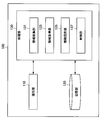
- FIG. 2 is an explanatory diagram illustrating an example of a schematic configuration of the information processing apparatus 100 according to the present embodiment.
- the information processing apparatus 100 includes a communication unit 110, a storage unit 120, and a processing unit 130.
- the communication unit 110 transmits and receives information.
- the communication unit 110 transmits information to other nodes and receives information from other nodes.
- the other nodes include the base station 10, the base station 20, and / or the control device 100.
- Storage unit 120 The storage unit 120 temporarily or permanently stores a program and data for the operation of the information processing apparatus 100.
- the processing unit 130 provides various functions of the information processing apparatus 100.
- the processing unit 130 includes an information collection unit 131, an information acquisition unit 133, an information provision unit 135, and a control unit 137.
- the processing unit 130 may further include other components other than these components. That is, the processing unit 130 can perform operations other than the operations of these components.
- the information collection unit 131 collects information related to traffic from base stations of one or more cells included in a cell group including two or more cells.
- the cell group is a cell group corresponding to the information processing apparatus 100.
- the cell group corresponding to the information processing apparatus 100A is the first cell group (that is, the cell group including the macro cell 11A, the small cell 21A, and the small cell 21B). Therefore, the information collection unit 131 of the information processing apparatus 100A collects information about traffic from the base stations of one or more cells included in the first cell group.
- the cell group corresponding to the information processing apparatus 100B is the second cell group (that is, the cell group including the macro cell 11B, the small cell 21C, the small cell 21D, and the small cell 21E). Therefore, the information collection unit 131 of the information processing device 100B collects information regarding traffic from the base stations of one or more cells included in the second cell group.
- the two or more cells include a macro cell 11 and a small cell 21 that overlaps the macro cell 11.
- the small cell 21 may include a cell formed by a terminal device operating as a base station.
- the two or more cells may include only the macro cell 11.
- the two or more cells may include only the small cell 21.
- the information collection unit 131 collects information related to traffic from the base stations 10 of the macro cell 11 included in the cell group.
- the information regarding traffic is information regarding traffic of the macro cell 11 and the small cell 21 overlapping the macro cell 11.
- FIG. 3 is an explanatory diagram for describing a first example of information collection regarding traffic by the information processing apparatus 100.
- an information processing apparatus 100A a base station 10A of a macro cell 11A, a base station 20A of a small cell 21A, and a base station 20B of a small cell 21B are shown.
- the base station 20A reports information related to the traffic of the small cell 21A to the base station 10A
- the base station 20B reports information related to the traffic of the small cell 21B to the base station 10A.
- base station 10A reports the information regarding the traffic of macrocell 11A, small cell 21A, and small cell 21B to information processing apparatus 100A.
- the information related to the traffic of the macro cell 11A, the small cell 21A, and the small cell 21B includes information related to traffic for each cell. That is, the information related to the traffic of the macro cell 11A, the small cell 21A, and the small cell 21B includes information related to the traffic of the macro cell 11A, information related to the traffic of the small cell 21A, and information related to the traffic of the small cell 21B.
- the information regarding the traffic of the macro cell 11A, the small cell 21A, and the small cell 21B may be information regarding all the traffic of the macro cell 11A, the small cell 21A, and the small cell 21B.
- the base station 10A determines that all the traffic of the macro cell 11A, the small cell 21A, and the small cell 21B is based on the information on the traffic of the macro cell 11A, the information on the traffic of the small cell 21A, and the information on the traffic of the small cell 21B. Information may be generated.
- the information collection unit 131 may collect information on traffic from the base stations of each cell included in the cell group.
- the information collection unit 131 may collect information on traffic from the base stations of each cell included in the cell group.
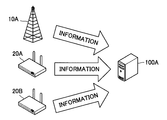
- FIG. 4 is an explanatory diagram for explaining a second example of information collection regarding traffic by the information processing apparatus 100.
- an information processing apparatus 100A a base station 10A, a base station 20A, and a base station 20B are shown.
- the base station 10A reports information about the traffic of the macro cell 11A to the information processing apparatus 100A
- the base station 20A reports information about the traffic of the small cell 21A to the information processing apparatus 100A
- the base station 20B Information regarding traffic may be reported to the information processing apparatus 100A.
- the cell group includes one macro cell 11
- the embodiment of the present disclosure is not limited to the example.
- the cell group may include two or more macro cells 11.
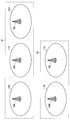
- a specific example of this point will be described with reference to FIG.
- FIG. 5 is an explanatory diagram for explaining a third example of information collection regarding traffic by the information processing apparatus 100.
- an information processing apparatus 100A, a base station 10A, and a base station 10C are shown.
- the cell 11A of the base station 10A and the cell 11C of the base station 10C may be included in the first cell group corresponding to the information processing apparatus 100.
- the base station 10A and the base station 10C may report information on traffic to the information processing apparatus 100A.
- Traffic includes traffic addressed to the terminal device (ie, downlink traffic) and / or traffic from the terminal device (ie, uplink traffic). Including.
- the traffic is traffic processed by a cell base station (for example, in a certain period).
- the traffic may be traffic that is assumed to be processed in the future by a cell base station (for example, in a certain period of time).
- the information related to traffic is information indicating a traffic volume (for example, a total volume or an average value).
- the information related to traffic may be information indicating a history of traffic volume.
- the information related to traffic may be traffic volume statistical information, and may be converted into a format defined as OpenFlow flow statistical information.
- the information related to traffic may be information related to the number of control information.
- (E) Specific Operation (e-1) Request For example, the information collection unit 131 requests the base station of one or more cells included in the cell group to report information on traffic.
- the information collection unit 131 requests a base station of a macro cell included in the cell group to report information on traffic.
- the information collection unit 131 of the information processing apparatus 100A requests the base station 10A of the macro cell 11A to report information on traffic.
- the base station 10A requests the base station 20 of the small cell 21 that overlaps the macro cell 11A (that is, the base station 20A of the small cell 21A and the base station 20B of the small cell 21B) to report information on traffic.
- the base station 10A requests the base station 20 of the small cell 21 that overlaps the macro cell 11A (that is, the base station 20A of the small cell 21A and the base station 20B of the small cell 21B) to report information on traffic.
- FIG. 3 or FIG. 4 information about traffic is reported.
- the information collecting unit 131 may request the base station of each cell included in the cell group to report traffic information.
- the information collection unit 131 of the information processing apparatus 100A requests the base station 10A of the macro cell 11A, the base station 20A of the small cell 21A, and the base station 20B of the small cell 21B to report information on traffic. May be.
- information related to traffic may be reported as described with reference to FIG. 3 or FIG.
- the information collection unit 131 transmits a message requesting the report to the base station of the one or more cells via the communication unit 110.
- the message is called a resource status request message.
- the message may be a message with another name.
- the information processing apparatus 100 may unicast the message, or may multicast or broadcast the message.
- the base station 10 may also unicast the message, or may multicast or broadcast the message.
- the information collection unit 131 requests the report from the base station of the one or more cells in response to the occurrence of an event.
- the event is a request from the control device 200. That is, the information collection unit 131 requests the report in response to a request from the control device 200.
- the information collection unit 131 may periodically request the report from the base station of the one or more cells.
- the information collection unit 131 requests the base station of one or more cells included in the cell group to report information on traffic. Thereby, for example, the information processing apparatus 100 can collect information on traffic as necessary. Instead of the information collection unit 131 requesting the report, base stations of one or more cells included in the cell group may voluntarily perform the report.
- the information collection unit 131 transmits information indicating a condition for reporting information related to traffic (hereinafter referred to as “report condition information”) to one or more cells included in the cell group. To the base station.
- the information collection unit 131 requests a base station of one or more cells included in the cell group to report information on traffic
- the one or more cells The reporting condition information is provided to the base station of the cell.
- a message requesting the report includes the report condition information.
- the reporting condition information is information relating to the timing of the reporting.
- the said report condition information contains the information regarding the timing of the said report.
- the report condition information indicates whether the report is a periodic report or a report according to the occurrence of an event.
- the report condition information indicates the cycle of the report.
- the report condition information includes information related to the event.
- the event is a change in traffic volume within a period exceeding a threshold value
- the report condition information indicates the threshold value.
- the reporting condition information may indicate the period.
- the report condition information is provided.
- the information processing apparatus 100 can collect information on traffic under a desired condition.
- the information acquisition unit 133 acquires traffic information regarding the traffic of the cell group.
- the traffic includes traffic destined for the terminal device (that is, downlink traffic) and / or traffic from the terminal device (that is, uplink traffic).
- the traffic is traffic processed by a cell base station (for example, in a certain period).
- the traffic may be traffic that is assumed to be processed in the future by a cell base station (for example, in a certain period of time).
- the traffic may be a concept of a data amount in the data plane, the number of packets, or a flow in OpenFlow.
- the traffic may be the amount of data included in the control information in the control plane or the number of control information.
- the traffic may be all traffic or traffic excluding traffic completed within the cell group (that is, traffic outside the cell group and traffic into the cell group). May be.
- Traffic information (b-1) Information granularity-First example (per cell)
- the traffic information includes information related to traffic for each cell included in the cell group.
- the first cell group corresponding to the information processing apparatus 100A includes a macro cell 11A, a small cell 21A, and a small cell 21B. Therefore, the traffic information regarding the traffic of the first cell group includes information regarding the traffic of the macro cell 11A, information regarding the traffic of the small cell 21A, and information regarding the traffic of the small cell 21B.
- the second cell group corresponding to the information processing apparatus 100B includes a macro cell 11B, a small cell 21C, a small cell 21D, and a small cell 21E. Therefore, the traffic information related to the traffic of the second cell group includes information related to the traffic of the macro cell 11B, information related to the traffic of the small cell 21C, information related to the traffic of the small cell 21D, and information related to the traffic of the small cell 21E.
- the traffic information may be information related to traffic of the entire cell group.
- the first cell group corresponding to the information processing apparatus 100A includes a macro cell 11A, a small cell 21A, and a small cell 21B. Therefore, the traffic information related to the traffic of the first cell group may be information related to all traffic of the macro cell 11A, the small cell 21A, and the small cell 21B.
- the information processing apparatus 100 determines the macro cell 11A and the small cell 21A based on the information about the traffic of the macro cell 11A, the information about the traffic of the small cell 21A, and the information about the traffic of the small cell 21B. And you may produce
- the second cell group corresponding to the information processing apparatus 100B includes a macro cell 11B, a small cell 21C, a small cell 21D, and a small cell 21E. Therefore, the traffic information related to the traffic of the second cell group may be information related to all traffic of the macro cell 11B, the small cell 21C, the small cell 21D, and the small cell 21E.
- the information processing apparatus 100 (for example, the processing unit 130) is based on information on the traffic of the macro cell 11B, information on the traffic of the small cell 21C, information on the traffic of the small cell 21D, and information on the traffic of the small cell 21E.
- information regarding all traffic of the macro cell 11B, the small cell 21C, the small cell 21D, and the small cell 21E may be generated.
- the traffic information is information indicating a traffic amount (for example, a total amount or an average value).
- the traffic information may be information indicating a traffic volume history.
- the traffic information may be traffic volume statistical information, and may be converted into a format defined as OpenFlow flow statistical information.
- the information related to traffic may be information related to the number of control information.
- (C) Specific Operation For example, information regarding traffic collected by the information collection unit 131 is stored in the storage unit 120 as the traffic information. At any later timing, the information acquisition unit 133 acquires the traffic information from the storage unit 120.
- information on traffic collected by the information collection unit 131 is stored in the storage unit 120 as the traffic information, and the traffic information is generated by the processing unit 130 based on the information stored in the storage unit 120. May be stored in the storage unit 120.
- the information acquisition unit 133 may acquire the traffic information from the storage unit 120 at any timing thereafter.
- the said information regarding the traffic for every cell is the identification information (cell or base station) (for example, it may be stored together with the cell ID).
- the information providing unit 135 provides the traffic information to the control device 200 that performs traffic routing control of a plurality of cell groups including the cell group.
- the information providing unit 135 provides the traffic information to the control device 200 in response to a request from the control device 200.
- the information collection unit 131 and the information provision unit 135 may voluntarily provide the traffic information to the control device 200.
- the information providing unit 135 may provide the traffic information to the control device 200 periodically.
- the traffic information related to the traffic of the cell group is provided to the control device 200.
- the control device 200 is provided with traffic information regarding the traffic of the cell group by the information processing device 100 corresponding to the cell group. Therefore, the load required for collecting traffic information is distributed between the control device 200 and the information processing device 100. Therefore, the load on the control device 200 can be reduced.
- the number of cells in the cellular system can be very large. . Even in such a case, the load required for collecting the traffic information is distributed between the control device 200 and the information processing device 100, so the load on the control device 200 can be reduced.
- Control unit 137 (A) Routing control
- the control unit 137 performs routing control of the traffic of the cell group.
- routing control it is possible to reduce the load on the controller (that is, the control device 200) that performs centralized control of the network.
- the routing control performed by information processing device 100 (control unit 137) is assigned to the cell group. Control of routing within the corresponding network.
- the network includes a base station of each cell included in the cell group.
- the first cell group includes a macro cell 11A, a small cell 21A, and a small cell 21B.
- the first network corresponding to the first cell group includes a base station 10A, a base station 20A, a base station 20B, and a network 30A.
- the information processing apparatus 100A corresponding to the first cell group controls routing in the first network.
- the second cell group includes a macro cell 11B, a small cell 21C, a small cell 21D, and a small cell 21E.
- the second network corresponding to the second cell group includes a base station 10B, a base station 20C, a base station 20D, a base station 20E, and a network 30B.
- the information processing apparatus 100B corresponding to the second cell group performs routing control in the second network.
- the routing control performed by the control device 200 is control of routing in a network excluding a network corresponding to each of the plurality of cell groups.
- the plurality of cell groups include the first cell group and the second cell group.
- the network excluding the network corresponding to each of the plurality of cell groups is a network excluding the first network and the second network, specifically, for example, the network 40.
- the control device 200 performs routing control within the network 40.
- A-2 Selection of base station through which traffic passes
- the routing control performed by the control unit 137 selects a base station through which traffic for a terminal device located in a cell included in the cell group passes. Including that. That is, the control unit 137 selects a base station through which traffic for a terminal device located in a cell included in the cell group passes.
- the traffic includes traffic addressed to the terminal device (that is, downlink traffic) and / or traffic from the terminal device (that is, uplink traffic).
- the control unit 137 includes a base station (that is, the macrocell 11 of the macrocell 11) through which traffic for the terminal devices located in the macrocell 11 and the small cell 21 included in the cell group passes.
- the base station 10 or the base station 20) of the small cell 21 is selected.
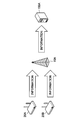
- FIG. 6 is an explanatory diagram for explaining an example of a base station through which downlink traffic passes.
- a base station 10A of the macro cell 11A, a base station 21A of the small cell 21A, and a base station 21B of the small cell 21B are shown.
- the terminal device 50 located in the macro cell 11A and the small cell 21A is shown.
- the control unit 137 selects the base station 10A or the base station 20A as a base station through which traffic addressed to the terminal device 50 (that is, downlink traffic) passes.
- CoMP Coordinatd Multi-Point
- the control unit 137 may select both the base station 10A and the base station 20B.
- the routing control may include a process related to scheduling for mapping information to resource blocks in the frequency and time axis directions.
- FIG. 7 is an explanatory diagram for explaining an example of a base station through which uplink traffic passes.
- the control unit 137 selects the base station 10A or the base station 20A as a base station through which traffic from the terminal device 50 (that is, uplink traffic) passes.
- the control unit 137 may select both the base station 10A and the base station 20B.
- the routing control may include a process related to scheduling for mapping information to resource blocks in the frequency and time axis directions.
- the control unit 137 based on information on channel quality of cells included in the cell group (hereinafter referred to as "channel quality information"), The base station through which the traffic for the terminal device passes is selected.
- channel quality is a channel quality for the terminal device.
- the control unit 137 is a base station of a cell (or the best cell) with better channel quality for the terminal device. Select.
- the control unit 137 selects the base station 20A of the small cell 21A as a base station through which traffic addressed to the terminal device 50 (that is, downlink traffic) passes.
- the control unit 137 selects the base station 20A of the small cell 21A as a base station through which traffic addressed to the terminal device 50 (that is, uplink traffic) passes.
- the channel quality information is provided to the information processing apparatus 100 by a base station of a cell included in the cell group.
- the base station may periodically provide the channel quality information to the information processing apparatus 100, or may provide the channel quality information to the information processing apparatus 100 in response to the occurrence of an event.
- the base station may provide the channel quality information to the information processing apparatus 100 in response to a request from the information processing apparatus 100 (processing unit 130).
- the channel quality information may be provided to the information processing apparatus 100 via a base station by a terminal apparatus located in a cell included in the cell group.
- the terminal device may periodically provide the channel quality information to the information processing device 100, or may provide the channel quality information to the information processing device 100 in response to the occurrence of an event.
- the terminal apparatus may provide the channel quality information to the information processing apparatus 100 in response to a request from the information processing apparatus 100 (processing unit 130).
- the request may be made by transmitting an RRC connection reconfiguration (RRC (Radio Resource Control) Connection) message.
- RRC connection reconfiguration RRC (Radio Resource Control) Connection
- the measurement configuration (measurement configuration) may be set in the terminal device.
- the setting configuration includes a measurement object, a reporting configuration, a measurement ID (Measurement identities), and a measurement gap (Measurement gaps).
- the channel quality information may include RSRP (Reference Signal Received Power), RSRQ (Reference Signal Received Quality), CQI (Channel Quality Indicator), SINR (Signal to Interference and Noise Ratio). Further, the channel quality information may include an effective communication speed, an average information amount per symbol, and an average coding rate. Note that the information on the average information amount per symbol and the average coding rate may be acquired from a base station that has transmitted / received data to the terminal apparatus at an arbitrary multilevel modulation scheme and coding rate.
- the control unit 137 selects the base station through which the traffic for the terminal device passes based on the channel quality information. Thereby, for example, it becomes possible to pass traffic for a terminal device through a base station of a cell having good channel quality for the terminal device. As a result, the traffic capacity in the cell group may increase. Alternatively, radio resources can be effectively used in the cell group. Also, the transmission delay of traffic can be shortened.
- the control unit 137 may select the base station through which the traffic for the terminal device passes, based on information on traffic of cells included in the cell group.
- control unit 137 may select a base station of a cell having a lower traffic load as the base station through which the traffic for the terminal device passes.
- the traffic load may be a degree of traffic load on the cell. As an example, it may be a ratio of the traffic amount to the bandwidth of the frequency band of the cell.
- the control unit 137 may select the base station 20A of the small cell 21A as a base station through which traffic destined for the terminal device 50 (that is, downlink traffic) passes.
- the control unit 137 may select the base station 20A of the small cell 21A as a base station through which traffic from the terminal device 50 (that is, uplink traffic) passes.
- the information regarding the traffic of the cells included in the cell group may be information collected by the information collecting unit 131, for example. Further, the traffic load may be calculated based on information collected by the information collection unit 131 and information on the frequency band of the cells included in the cell group (for example, information indicating a bandwidth or the like).
- the information related to the frequency band may be known to the information processing apparatus 100, or may be provided to the information processing apparatus 100 by a base station.
- the said information regarding the traffic of the cell contained in the said cell group is information which shows traffic load, and may be provided to the information processing apparatus 100 by the base station.
- the control unit 137 selects the base station through which the traffic for the terminal device passes based on the information on the traffic of the cells included in the cell group.
- the control unit 137 selects the base station through which the traffic for the terminal device passes based on the information on the traffic of the cells included in the cell group.
- the traffic load can be leveled in the cell group. That is, the load on the base station can be distributed. Also, the transmission delay of traffic can be shortened.
- the control unit 137 passes the traffic for the terminal device for each traffic group (or for each packet or for each set of packets). May be selected. For example, for the first group of traffic, the control unit 137 may select the base station through which the traffic for the terminal device passes based on the channel quality information. In addition, the control unit 137 may select the base station through which the traffic for the terminal device passes for the second group of traffic based on information on the traffic of the cells included in the cell group. .
- the traffic may be classified into a group of traffic according to the quality of service (QoS) of the traffic. That is, the traffic QoS may differ between traffic groups.
- QoS quality of service
- the control unit 137 may perform control for selecting a specific base station for a specific QoS traffic group. Further, the control unit 137 may store information relating to threshold values such as the traffic, channel quality information, and / or QoS, and may select the base station based on the information relating to the threshold values. In addition, the information related to the threshold value may be dynamically updated by the control device 200.
- the routing control performed by the control unit 137 includes controlling the network node that transfers the traffic of the cell group. That is, the control unit 137 controls the network node that transfers the traffic of the cell group.
- the network node includes a network node (for example, a switch, a router, and / or a gateway) included in the network 30.
- the control unit 137 controls the network node included in the network 30 so that traffic on the terminal device is transferred to the base station selected as described above. More specifically, for example, the control unit 137 transmits control information indicating a transfer destination to the network node included in the network 30 via the communication unit 110. As a result, the network node forwards traffic for the terminal device based on the control information.
- the network node may discriminate traffic (in other words, a traffic group) having different forwarding destinations in units of frames, packets, or segments.
- the network node includes an IP address, a MAC address, a port number, a protocol, an application type, base station identification information (eg, eNodeB IP address, PCI (Physical Cell Identity), and ECGI (E -UTRAN Cell Global Identifier)), or a combination of them may be used to determine traffic at different forwarding destinations.
- the network node may be a terminal node of tunneling (for example, GTP (General Packet Radio Service Tunneling Protocol)), and an IP address (for example, TEID (Tunnelling End ID)) allocated to the terminal node, Or you may discriminate
- the control unit 137 sets up, modifies, or sets a bearer between the terminal device and the network node serving as the transfer destination for each traffic having a different transfer destination (in other words, for each traffic group). Release control may be performed.
- the network node includes base stations (for example, base station 10 and base station 20) of cells included in the cell group.
- the control unit 137 controls the selected base station so that the selected base station allocates uplink resources to the terminal device as described above. More specifically, for example, the control unit 137 transmits control information instructing allocation of uplink resources to the terminal device to the selected base station via the communication unit 110. As a result, the selected base station allocates an uplink resource to the terminal device based on the control information.
- the control part 137 may transmit the control information which instruct
- Control of frequency band for cell The control unit 137 may control the frequency band and / or the maximum transmission power for cells included in the cell group.
- control unit 137 may control the frequency band or the maximum transmission power based on information on the traffic of the cells included in the cell group.
- control unit 137 may assign a frequency band to each of the macro cell 11 and the small cell 21 based on the traffic amount (or traffic load) of each of the macro cell 11 and the small cell 21.
- the traffic volume of the macro cell 11 is small and the traffic volume of the small cell 21 is large (or the traffic load of the macro cell 11 is low and the traffic load of the small cell 21 is high).
- the frequency band allocated to the macro cell 11 may be reduced and the frequency band allocated to the small cell 21 may be increased. Accordingly, for example, the amount of radio resources that can be used for the cell can be adjusted according to the increase or decrease of the traffic of the cell.
- control unit 137 may determine the maximum transmission power of each of the macro cell 11 and the small cell 21 based on the traffic amount (or traffic load) of each of the macro cell 11 and the small cell 21. For example, the traffic volume of the macro cell 11 is small and the traffic volume of the small cell 21 is large (or the traffic load of the macro cell 11 is low and the traffic load of the small cell 21 is high). In this case, the maximum transmission power for the macro cell 11 may be further reduced and the maximum transmission power for the small cell 21 may be increased. Thereby, for example, the communication quality of the cell can be adjusted according to the increase or decrease of the traffic of the cell.
- control unit 137 may determine the maximum transmission power of each of the macro cell 11 and the small cell 21 so that the interference between the macro cell 11 and the small cell 21 is equal to or lower than an allowable level. Thereby, for example, the same radio resource can be used in both the macro cell 11 and the small cell 21.
- the control unit 137 notifies the cell base station (for example, the base station 10 and / or the base station 20) of information indicating the allocated frequency band and / or the determined maximum transmission power via the communication unit 110. May be.
- control unit 137 may control the frequency band and / or the maximum transmission power for the cells included in the cell group. Thereby, for example, the capacity of traffic in the cell group can be increased. Alternatively, radio resources can be effectively used in the cell group.
- the control unit 137 may control the frequency band and / or the maximum transmission power based on the result of the routing control by the control unit 137.
- the control part 137 may control switching of the operation mode of the base station of the cell contained in the said cell group.
- the switching may include switching the operation mode from one of the first mode and the second mode to the other.
- the first mode is a mode capable of performing wireless communication with a terminal device (hereinafter referred to as “active mode”), and the second mode consumes more power than the first mode. It may be a small mode (hereinafter referred to as “sleep mode”). That is, the control unit 137 may control switching of the operation mode from one of the active mode and the sleep mode to the other.
- control unit 137 may transmit control information instructing the switching to the base station via the communication unit 110.
- the control unit 137 may control the switching based on information regarding the traffic of the cells included in the cell group. As an example, the control unit 137 may control switching of the operation mode so that the operation mode of the base station of the cell is switched from the active mode to the sleep mode when there is no traffic in the cell. . As another example, when the traffic of the macro cell 11 increases, the control unit 137 switches the operation mode so that the operation mode of the base station 20 of the small cell 21 is switched from the sleep mode to the active mode. You may control. That is, the control unit 137 can control the switching of the operation mode of the base station of the cell according to dynamically changing traffic.
- control unit 137 may further control switching of operation modes of terminal devices operable as mobile stations and base stations.
- the switching may include switching the operation mode from one of a mobile station mode (ie, a mode for operating as a mobile station) and a base station mode (ie, a mode for operating as a base station) to the other. .
- the control unit 137 may control the switching of the operation mode of the higher-level terminal device based on information regarding the traffic of the cells included in the cell group. As an example, the control unit 137 may switch the operation mode of the terminal device from the base station mode to the mobile station mode when there is no cell traffic in the terminal device whose operation mode is the base station mode. The switching of the operation mode of the terminal device may be controlled.
- the control unit 137 causes the terminal device to switch the operation mode of the terminal device located in the macro cell 11 from the mobile station mode to the base station mode.
- the switching of the operation mode may be controlled. Thereby, for example, it becomes possible to increase or decrease the number of base stations according to the increase or decrease of traffic.
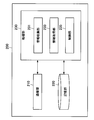
- FIG. 8 is an explanatory diagram illustrating an example of a schematic configuration of the control device 200 according to the present embodiment.
- the control device 200 includes a communication unit 210, a storage unit 220, and a processing unit 230.
- the communication unit 210 transmits and receives information.
- the communication unit 210 transmits information to other nodes and receives information from other nodes.
- the other nodes include the information processing apparatus 100 and the like.
- the storage unit 220 temporarily or permanently stores a program and data for the operation of the control device 200.
- the processing unit 230 provides various functions of the control device 200.
- the processing unit 230 includes an information collection unit 231, an information acquisition unit 233, and a control unit 235. Note that the processing unit 230 may further include other components other than these components. That is, the processing unit 230 can perform operations other than the operations of these components.
- the information collection unit 231 collects traffic information regarding the traffic of the cell group from the information processing apparatus 100 corresponding to each of the plurality of cell groups.
- Each of the plurality of cell groups includes two or more cells.
- Traffic Information is as described in relation to the information processing apparatus 100. Therefore, the overlapping description is omitted here.
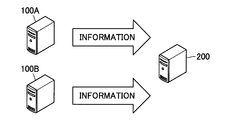
- FIG. 9 is an explanatory diagram for explaining an example of traffic information collection by the control device 200.
- an information processing device 100A corresponding to the first cell group, an information processing device 100B corresponding to the second cell group, and a control device 200 are illustrated.
- the information processing apparatus 100A provides the traffic information regarding the traffic of the first cell group to the control apparatus 200
- the information processing apparatus 100B provides the traffic information regarding the traffic of the second cell group to the control apparatus 200.
- the control device 200 collects traffic information related to the traffic of the first cell group from the information processing device 100A, and collects traffic information related to the traffic of the second cell group from the information processing device 100B. .
- the information collection unit 231 requests the information processing apparatus 100 corresponding to each of the plurality of cell groups to provide traffic information.
- the information collection unit 231 transmits a message requesting the provision to the information processing apparatus 100 corresponding to each of the plurality of cell groups via the communication unit 210.
- this message is called a resource status request message.
- the message may be a message with another name.
- the information processing apparatus 100 corresponding to each of the plurality of cell groups may voluntarily provide the traffic information to the control apparatus 200.
- the information acquisition unit 233 acquires, for each of the plurality of cell groups, traffic information related to traffic of the cell group, and the traffic information provided by the information processing apparatus 100 corresponding to the cell group.
- the traffic information collected by the information collection unit 231 is stored in the storage unit 220.
- the information acquisition unit 233 acquires the traffic information from the storage unit 220.
- Control unit 235 (A) Routing control The control unit 235 performs traffic routing control for the plurality of cell groups based on the traffic information for each of the plurality of cell groups. That is, the control device 200 can include a function of an orchestrator that performs control such as routing and / or network monitoring in addition to a function of a controller that controls a network node.
- an orchestrator that performs control such as routing and / or network monitoring in addition to a function of a controller that controls a network node.
- the routing control performed by information processing apparatus 100 is performed on the cell group. Control of routing within the corresponding network.
- the network includes a base station of each cell included in the cell group. The explanation about this point is as described above. Therefore, the overlapping description is omitted here.
- control device 200 is a routing control in a network excluding a network corresponding to each of the plurality of cell groups.
- control unit 235 is a routing control in a network excluding a network corresponding to each of the plurality of cell groups.
- control unit 235 further includes the plurality of pieces of information based on information on a network (hereinafter referred to as “network information”) used for routing traffic of the plurality of cell groups.
- network information used for routing traffic of the plurality of cell groups. The above routing control of the traffic of the cell group is performed.
- the network used for routing traffic of the plurality of cell groups is the network 40
- the network information is information regarding the network 40.
- the network information includes information related to a line included in the network 40 (for example, information indicating a line capacity and / or a transmission delay). Further, for example, the network information includes information related to network nodes included in the network 40 (for example, information indicating processing time and / or buffer capacity).
- the control device 200 can acquire and update the network information periodically or in response to the occurrence of an event.
- Such network information makes it possible to determine a desirable route for traffic, for example.
- (A-3) Route selection For example, the routing control performed by the control unit 235 is performed based on the traffic information and the network information for each of the plurality of cell groups. Including selecting a route for the traffic. That is, the control unit 235 selects a traffic route for each of the plurality of cell groups based on the traffic information for each of the plurality of cell groups and the network information.
- control unit 235 selects the traffic routes of the plurality of cell groups so that the routing of the traffic of the entire cell groups is optimized. In this case, the routing of traffic for individual cell groups may not be optimal.
- control unit 235 preferentially selects a faster route (for example, a shorter route) for a cell group having a larger traffic volume.
- control unit 235 may select a route for each packet or each group of packets. Alternatively, the control unit 235 may select a single route for the entire traffic of the cell group.
- the routing control performed by the control unit 235 is performed based on the traffic information and the network information for each of the plurality of cell groups. It may include causing a network node to perform priority control or bandwidth control for traffic. That is, the control unit 235 causes the network node to perform priority control or bandwidth control for the traffic of the plurality of cell groups based on the traffic information for each of the plurality of cell groups and the network information. May be.
- control unit 235 causes a network node (for example, a network node included in the network 40) to perform priority control so that traffic in a cell group with a larger traffic volume is transferred with higher priority. Also good.
- control unit 235 may cause a network node (for example, a network node included in the network 40) to perform bandwidth control so that a wider line bandwidth is allocated for traffic of a cell group having a larger traffic volume. .
- the routing control performed by the control unit 235 includes controlling the network node that transfers the traffic of the plurality of cell groups. That is, the control unit 235 controls the network node that transfers the traffic of the plurality of cell groups.
- the network node includes a network node (for example, a switch, a router, and / or a gateway) included in the network 40.
- the control unit 235 controls the network node included in the network 40 so that the traffic of the cell group is transferred through the route determined as described above. More specifically, for example, the control unit 235 transmits control information indicating a transfer destination to the network node included in the network 40 via the communication unit 210. As a result, the network node forwards the traffic of the cell group based on the control information.
- the network node may discriminate traffic (in other words, a traffic group) having different forwarding destinations in units of frames, packets, or segments.
- the network node may determine traffic with different transfer destinations based on any of an IP address, a MAC address, a port number, or a combination thereof. Further, the network node may be a terminal node of tunneling (for example, GTP (General Packet Radio Service Tunneling Protocol)), and an IP address (for example, TEID (Tunnelling End ID)) allocated to the terminal node, Or you may discriminate
- GTP General Packet Radio Service Tunneling Protocol
- control unit 235 may cause the network node to perform the priority control and the bandwidth control.
- control unit 235 may transmit control information instructing the priority control or the band control to the network node via the communication unit 210.
- the network node may perform the priority control or the band control based on the control information.
- control unit 235 is included in the network used for routing traffic of the plurality of cell groups based on the traffic information for each of the plurality of cell groups. Control the configuration of a line or network node.
- the network used for routing traffic of the plurality of cell groups includes a network 40. That is, the control unit 235 controls the configuration of a line or network node included in the network 40.
- control unit 235 controls the configuration of the line or the network node based on the traffic information or the routing control result for each of the plurality of cell groups and the network information.
- control unit 235 controls the configuration of lines or network nodes included in the network 40 so that the traffic of the plurality of cell groups is more smoothly transferred in the network 40.
- control unit 235 determines a change in the configuration of the line included in the network 40 and makes a request for the change to the corresponding network node (eg, switch). As a result, the corresponding network node performs the operation for the change.
- the control unit 235 determines a change in the configuration of the line included in the network 40 and makes a request for the change to the corresponding network node (eg, switch).
- the corresponding network node performs the operation for the change.
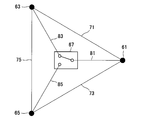
- FIG. 10 is an explanatory diagram for explaining an example of changing the configuration of a line included in the network.
- network nodes 61, 63, 65, 67 and lines 71, 73, 75, 81, 83, 85 included in the network 40 are shown.
- the line 71 is a line connecting the network node 61 and the network node 63
- the line 73 is a line connecting the network node 61 and the network node 65
- the line 75 is connected to the network node 63 and the network node 65.
- the line 81 is a line connecting the network node 61 and the network node 67
- the line 83 is a line connecting the network node 63 and the network node 67
- the line 85 is connected to the network node 65 and the network node 67.
- the lines 71, 73, 75, 81, 83, 85 are lines having a bandwidth Pbps.
- the network node 67 can form a line connecting two of the network node 61, the network node 63, and the network node 65 by connecting two of the lines 81, 83, and 85. .
- the amount of traffic transmitted and received between the network node 61 and the network node 63 is the amount of traffic transmitted and received between the network node 61 and the network node 65, and the network node 63 and the network node. More than the amount of traffic sent to and received from 65.
- the network node 67 connects the line 81 and the line 83.
- the line 81 and the line 83 connect the network node 61 and the network node 63, and the bandwidth between the network node 61 and the network node 63 is 2 Pbps.
- the amount of traffic transmitted and received between the network node 61 and the network node 65 is the amount of traffic transmitted and received between the network node 61 and the network node 63, and the network node 63 and the network node. More than the amount of traffic sent to and received from 65.
- the network node 67 connects the line 81 and the line 85.
- the line 81 and the line 85 connect the network node 61 and the network node 65, and the bandwidth between the network node 61 and the network node 65 is 2 Pbps.
- control unit 235 determines a change in the configuration of the network node included in the network 40 and makes a request for the change to the corresponding network node. As a result, the corresponding network node performs the operation for the change.
- control unit 235 determines a change in the buffer size of the network node so that the network node can hold the traffic to be transferred. Then, the control unit 235 requests the network node to change the buffer size.
- control unit 235 determines addition or deletion of a virtualized network node. Then, the control unit 235 requests the network node that realizes the virtualized network node to add or delete the virtualized network node.
- control unit 235 determines the configuration of the line or network node included in the network used for routing the traffic of the plurality of cell groups based on the traffic information for each of the plurality of cell groups. Control. Thereby, for example, the traffic of the plurality of cell groups can be smoothly transferred.
- the network used for routing the traffic of the plurality of cell groups may further include a network corresponding to each cell group (for example, a network including the base station and the network 30) in addition to the network 40. That is, the control device 200 (the control unit 235) may further control the configuration of a line or a network node included in a network corresponding to each cell group. In this case, the control device 200 (the control unit 235) may determine a frequency band for each cell group (or a frequency band for cells included in each cell group). Alternatively, the information processing apparatus 100 (the control unit 137) may control the configuration of a line or a network node included in a network corresponding to each cell group.
- the control unit 235 may change cells included in the cell group included in the plurality of cell groups. In other words, the control unit 235 may change the cells included in the cell group that is the jurisdiction of the information processing apparatus 100.
- the control unit 235 deletes at least one cell from the cell groups included in the plurality of cell groups, and adds the at least one cell to other cell groups included in the plurality of cell groups. May be.
- the at least one cell may include a macro cell.
- the at least one cell may further include a small cell overlapping the macro cell.
- the control unit 235 may change the cells included in the cell groups included in the plurality of cell groups based on the traffic information for each of the cell groups included in the plurality of cell groups. As an example, at least one cell may be deleted from a cell group with a higher traffic volume, and the at least one cell may be added to a cell group with a lower traffic volume.
- a specific example of this point will be described with reference to FIGS. 11 and 12.
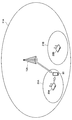
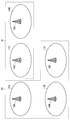
- FIG. 11 and FIG. 12 are explanatory diagrams for explaining an example of changing a cell included in a cell group.
- a first cell group 91 and a second cell group 93 are shown.
- the first cell group 91 includes a macro cell 11A, a macro cell 11C, and a macro cell 11D.
- the first cell group 91 may further include one or more small cells 21 that respectively overlap the macro cell 11A, the macro cell 11C, or the macro cell 11D.
- the second cell group 93 includes a macro cell 11B and a macro cell 11E.
- the second cell group 93 may further include one or more small cells 21 that respectively overlap the macro cell 11B or the macro cell 11E.
- the traffic volume of the first cell group 91 is large and the traffic volume of the second cell group 93 is small.
- the control unit 235 deletes the macro cell 11A (and the small cell 21 that overlaps the macro cell 11A) from the first cell group 91 having a large traffic volume, and the second traffic volume having a small traffic volume is stored.
- the macro cell 11A (and the small cell 21 overlapping the macro cell 11A) is added to the cell group 93.
- control unit 235 may decide to change the cell group and request the information processing apparatus 100 to make the change. As a result, the cell group managed by the information processing apparatus 100 may be changed.
- control unit 235 may change the cells included in the cell groups included in the plurality of cell groups. Thereby, for example, it becomes possible to level traffic between cell groups. Therefore, the load on the network corresponding to the cell group and / or the information processing apparatus 100 can be leveled.
- the control unit 235 may control a frequency band for a cell group included in the plurality of cell groups.
- control unit 235 may control the frequency band for the cell group based on the traffic information for the cell group.
- the control unit 233 sets the frequency band for the cell group (specifically, for example, a part of the cell group). Alternatively, the usable frequency band as a whole may be increased.
- the control unit 233 requests the frequency management system to permit the use of a shared band (that is, a frequency band shared among a plurality of wireless communication systems) in the part or the whole of the cell group.
- the permitted frequency band may be assigned to the part or the whole of the cell group. Thereby, for example, the amount of radio resources that can be used for the cell can be adjusted according to the increase or decrease of the traffic of the cell group.
- the control unit 235 may notify the information processing apparatus 100 or a corresponding base station (for example, the base station 10 and / or the base station 20) of the allocated frequency band via the communication unit 210.
- control unit 235 may control the frequency band based on the result of the routing control by the control unit 235.
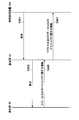
- FIG. 13 is a sequence diagram illustrating an example of a schematic flow of a process of reporting / collecting information related to cell traffic.
- the information processing apparatus 100 corresponding to the cell group requests the base station 10 of the macro cell 11 included in the cell group to report information on traffic (S401). Specifically, for example, the information processing apparatus 100 transmits a message requesting the report to the base station 10.
- the base station 10 of the macro cell 11 requests the base station 20 of the small cell 21 overlapping the macro cell 11 to report information on traffic (S403). Specifically, for example, the base station 10 transmits a message requesting the report to the base station 20.
- the base station 20 of the small cell 21 reports information related to the traffic of the small cell 21 to the base station 10 of the macro cell 11 (S405). Specifically, for example, the base station 20 transmits a message including the above information regarding traffic of the small cell 21 to the base station 10.
- the base station 10 of the macro cell 11 reports information related to the traffic of the macro cell 11 and the small cell 21 to the information processing apparatus 100 (S407). Specifically, for example, the base station 10 transmits a message including the above information regarding the traffic of the macro cell 11 and the small cell 21 to the information processing apparatus 100.
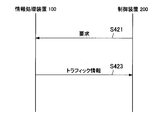
- FIG. 14 is a sequence diagram illustrating an example of a schematic flow of a process for providing / collecting information regarding cell group traffic.
- the control device 200 requests the information processing device 100 corresponding to each of the plurality of cell groups to provide traffic information (S421). Specifically, for example, the control device 200 transmits a message requesting the provision to the information processing device 100 corresponding to each of the plurality of cell groups.
- the information processing apparatus 100 provides traffic information related to the traffic of the cell group to the control apparatus 200 (S423). Specifically, for example, the information processing apparatus 100 transmits a message including the traffic information to the control apparatus 200.
- FIG. 15 is a sequence diagram illustrating an example of a schematic flow of routing control processing by the information processing device 100.
- the information processing apparatus 100 selects a base station through which traffic for a terminal apparatus located in a cell included in the cell group passes (S441).
- the information processing apparatus 100 transmits control information indicating the transfer destination to the network node included in the network 30 (S443). Further, the information processing apparatus 100 transmits control information instructing allocation of uplink resources to the terminal apparatus to the selected base station (S445).
- the network node included in the network 30 forwards traffic for the terminal device based on the control information (S447). Further, the selected base station allocates uplink resources to the terminal device based on the control information (S449).
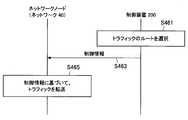
- FIG. 16 is a sequence diagram illustrating an example of a schematic flow of a routing control process by the control device 200.
- the control device 200 selects a traffic route for each of the plurality of cell groups based on the traffic information for each of the plurality of cell groups (S461).
- control device 200 transmits control information indicating the transfer destination to the network node included in the network 40 (S463).
- the network node included in the network 40 transfers the traffic of the cell group based on the control information (S465).
- each of the information processing apparatus 100 and the control apparatus 200 may be realized as any type of server such as a tower server, a rack server, or a blade server.
- a module for example, an integrated circuit module configured by one die or a blade server slot mounted on a server. Card or blade).
- FIG. 17 is a block diagram illustrating an example of a schematic configuration of a server 700 to which the technology according to the present disclosure can be applied.
- the server 700 includes a processor 701, a memory 702, a storage 703, a network interface 704, and a bus 706.
- the processor 701 may be a CPU (Central Processing Unit) or a DSP (Digital Signal Processor), for example, and controls various functions of the server 700.
- the memory 702 includes a RAM (Random Access Memory) and a ROM (Read Only Memory), and stores programs and data executed by the processor 701.
- the storage 703 may include a storage medium such as a semiconductor memory or a hard disk.
- the network interface 704 is a wired communication interface for connecting the server 700 to the wired communication network 705.
- the wired communication network 705 may be a core network such as EPC (Evolved Packet Core) or a PDN (Packet Data Network) such as the Internet.
- EPC Evolved Packet Core
- PDN Packet Data Network
- the bus 706 connects the processor 701, the memory 702, the storage 703, and the network interface 704 to each other.
- the bus 706 may include two or more buses with different speeds (eg, a high speed bus and a low speed bus).
- one or more components may be implemented in the processor 701.
- a program for causing a processor to function as the one or more components is installed in the server 700, and the processor 701 is The program may be executed.
- the server 700 may include a module including the processor 701 and the memory 702, and the one or more components may be mounted in the module.
- the module may store a program for causing the processor to function as the one or more components in the memory 702 and execute the program by the processor 701.
- the server 700 or the module may be provided as an apparatus including the one or more components, and the program for causing a processor to function as the one or more components may be provided.
- a readable recording medium in which the program is recorded may be provided.
- one or more components information collection unit 231, information acquisition unit 233, and / or control unit 235 included in the processing unit 230 described with reference to FIG. The one or more components described above.
- the information processing apparatus 100 includes an information acquisition unit 133 that acquires traffic information regarding traffic of a cell group including two or more cells, and traffic of a plurality of cell groups including the cell group.
- the information providing unit 135 that provides the traffic information is included in the control device 200 that performs the routing control.
- the control device 200 is traffic information related to traffic of a cell group for each of a plurality of cell groups each including two or more cells, and information processing corresponding to the cell group.
- An information acquisition unit 233 that acquires the traffic information provided by the apparatus 100, and a control unit 235 that performs routing control of traffic of the plurality of cell groups based on the traffic information for each of the plurality of cell groups; .
- the control device 200 it becomes possible to reduce the load on the controller (ie, the control device 200) that performs centralized control of the network. More specifically, for example, for each cell group, the control device 200 is provided with traffic information regarding the traffic of the cell group by the information processing device 100 corresponding to the cell group. Therefore, the load required for collecting traffic information is distributed between the control device 200 and the information processing device 100. Therefore, the load on the control device 200 can be reduced.
- a cell group including two or more cells may be a base station group including two or more base stations.
- each of the two or more sectors may be treated as a cell. That is, each of the two or more sectors may be included in a cell group as a cell.
- each of the two or more frequency channels is treated as a cell. Also good.
- each of the two or more frequency channels may be included in a cell group as a cell.
- each of two or more component carriers may be included in a cell group as a cell.
- two or more RAN radio access network
- GERAN GSM EDGE radio access network
- UTRAN UMTS Terrestrial radio access network
- E-UTRAN evolved UMTS terrestrial radio access network
- the present disclosure is not limited to such an example.
- Two or more cells corresponding to one base station may be included in different cell groups.
- the first frequency channel A cell group may include cells of the first frequency channel of the base station group
- a second cell group may include cells of the second frequency channel of the base station group.
- the information processing apparatus has been described as collecting information related to traffic from the base station, but the present disclosure is not limited to such an example.
- the information processing apparatus may collect information on traffic from a network node (for example, a switch or a router) that forwards the traffic.
- a network node for example, a switch or a router
- the information processing device is a network node that forwards traffic, instead of collecting information about traffic from other network nodes (for example, a base station, a switch, or a router), information about traffic is generated by itself. May be.
- each of the information processing apparatus and the control apparatus performs routing control
- the routing by the information processing apparatus described above may be performed by the control apparatus. That is, there is no sharing of routing control between the information processing apparatus and the control apparatus, and the control apparatus may perform the entire routing control.
- each of the two or more information processing apparatuses is a virtual apparatus, and may be mounted on the same apparatus by a virtualization technique.
- control device and the information processing device are mounted on different devices, but the present disclosure is not limited to such an example.
- the control device and one or more information processing devices may be mounted on the same device.
- each of the control device and the one or more information processing devices is a virtual device, and may be mounted on the same device using a virtualization technique.
- processing steps in the processing of the present specification do not necessarily have to be executed in time series according to the order described in the flowchart or the sequence diagram.
- the processing steps in the processing may be executed in an order different from the order described as a flowchart or a sequence diagram, or may be executed in parallel.
- a processor for example, a CPU, a DSP, etc.
- a device for example, an information processing device, a control device, or a module thereof
- a component for example, an information collection unit, an information acquisition unit,
- a computer program for functioning as an information providing unit and / or a control unit in other words, a computer program for causing the processor to execute the operation of the components of the device
- a recording medium on which the computer program is recorded may be provided.
- An apparatus for example, a finished product or a module for a finished product (a component, a processing circuit, a chip, or the like) including a memory that stores the computer program and one or more processors that can execute the computer program May also be provided.
- a method including the operation of the components of the apparatus for example, an information collection unit, an information acquisition unit, an information provision unit, and / or a control unit is also included in the technology according to the present disclosure.
- the apparatus includes selecting a base station through which traffic for a terminal device located in a cell included in the cell group passes, according to (7) or (8) apparatus.
- the said control part is an apparatus as described in said (9) which selects the said base station through which the said traffic about the said terminal device passes based on the information regarding the channel quality of the cell contained in the said cell group.
- the said control part is an apparatus as described in said (9) or (10) which selects the said base station through which the said traffic about the said terminal device passes based on the information regarding the traffic of the cell contained in the said cell group.
- the said control part is an apparatus as described in said (13) which controls the said frequency band or the said maximum transmission power based on the information regarding the traffic of the cell contained in the said cell group.
- a control unit that controls switching of operation modes of base stations of cells included in the cell group; The switching includes switching the operation mode from one of the first mode and the second mode to the other,
- the first mode is a mode capable of performing wireless communication with a terminal device,
- the second mode is a mode that consumes less power than the first mode.
- the acquisition unit For each of a plurality of cell groups each including two or more cells, traffic information related to traffic of the cell group, the acquisition unit acquiring the traffic information provided by an information processing device corresponding to the cell group; A controller that performs routing control of traffic of the plurality of cell groups based on the traffic information for each of the plurality of cell groups; A device comprising: (17)
- the information processing apparatus corresponding to the cell group is an apparatus that controls routing in a network corresponding to the cell group;
- the network includes a base station for each cell included in the cell group;
- the routing control performed by the control unit is control of routing in a network excluding a network corresponding to each of the plurality of cell groups.
- the apparatus according to item 1. (20) The apparatus according to any one of (16) to (19), wherein the control unit controls a configuration of a line or a network node included in a network used for routing traffic of the plurality of cell groups.
- (21) Obtaining traffic information about the traffic of a cell group containing two or more cells; Providing the traffic information to a control device that performs routing control of traffic of a plurality of cell groups including the cell group by a processor; Including methods.
- (22) Obtaining traffic information about the traffic of a cell group containing two or more cells; Providing the traffic information to a control device that performs routing control of traffic of a plurality of cell groups including the cell group; A program that causes a processor to execute.
Landscapes
- Engineering & Computer Science (AREA)
- Computer Networks & Wireless Communication (AREA)
- Signal Processing (AREA)
- Mobile Radio Communication Systems (AREA)
Abstract
Priority Applications (4)
| Application Number | Priority Date | Filing Date | Title |
|---|---|---|---|
| EP15819071.0A EP3169103B1 (fr) | 2014-07-09 | 2015-05-18 | Dispositif de réduction de charge sur un contrôleur |
| EP19186788.6A EP3576487B1 (fr) | 2014-07-09 | 2015-05-18 | Appareil pour routage dans un réseau |
| US15/316,962 US10172040B2 (en) | 2014-07-09 | 2015-05-18 | Apparatus for routing traffic in a plurality of cell groups each including two or more cells |
| US16/166,067 US10827387B2 (en) | 2014-07-09 | 2018-10-20 | Apparatus for routing traffic in a plurality of cell groups each including two or more cells |
Applications Claiming Priority (2)
| Application Number | Priority Date | Filing Date | Title |
|---|---|---|---|
| JP2014-141234 | 2014-07-09 | ||
| JP2014141234 | 2014-07-09 |
Related Child Applications (2)
| Application Number | Title | Priority Date | Filing Date |
|---|---|---|---|
| US15/316,962 A-371-Of-International US10172040B2 (en) | 2014-07-09 | 2015-05-18 | Apparatus for routing traffic in a plurality of cell groups each including two or more cells |
| US16/166,067 Continuation US10827387B2 (en) | 2014-07-09 | 2018-10-20 | Apparatus for routing traffic in a plurality of cell groups each including two or more cells |
Publications (1)
| Publication Number | Publication Date |
|---|---|
| WO2016006322A1 true WO2016006322A1 (fr) | 2016-01-14 |
Family
ID=55063966
Family Applications (1)
| Application Number | Title | Priority Date | Filing Date |
|---|---|---|---|
| PCT/JP2015/064206 Ceased WO2016006322A1 (fr) | 2014-07-09 | 2015-05-18 | Dispositif |
Country Status (3)
| Country | Link |
|---|---|
| US (2) | US10172040B2 (fr) |
| EP (2) | EP3576487B1 (fr) |
| WO (1) | WO2016006322A1 (fr) |
Cited By (1)
| Publication number | Priority date | Publication date | Assignee | Title |
|---|---|---|---|---|
| JPWO2020026361A1 (ja) * | 2018-07-31 | 2021-05-13 | 富士通株式会社 | 制御装置、通信装置及び通信システム |
Families Citing this family (7)
| Publication number | Priority date | Publication date | Assignee | Title |
|---|---|---|---|---|
| US10219305B2 (en) * | 2013-11-21 | 2019-02-26 | Bao Tran | Communication apparatus |
| EP3160180B1 (fr) * | 2014-06-20 | 2019-01-09 | Sony Corporation | Dispositif et procédé |
| WO2018116096A1 (fr) * | 2016-12-19 | 2018-06-28 | Netsia, Inc. | Système et procédé de virtualisation programmable de réseaux hétérogènes à canaux communs utilisant une application associée à une connectivité double |
| JP7082282B2 (ja) * | 2018-06-06 | 2022-06-08 | 富士通株式会社 | パケット解析プログラム、パケット解析方法およびパケット解析装置 |
| US10979913B2 (en) * | 2019-04-03 | 2021-04-13 | At&T Intellectual Property I, L.P. | Wireless network coverage based on a predetermined device cluster model selected according to a current key performance indicator |
| EP3745761A1 (fr) * | 2019-05-28 | 2020-12-02 | Samsung Electronics Co., Ltd. | Virtualisation des fonctions ran basée sur la charge des stations de base |
| WO2021102670A1 (fr) * | 2019-11-26 | 2021-06-03 | Qualcomm Incorporated | Commande de transmission dans une couche d'application fondée sur des mesures de qualité de porteuse radio dans une communication véhiculaire |
Citations (2)
| Publication number | Priority date | Publication date | Assignee | Title |
|---|---|---|---|---|
| JP2003125439A (ja) * | 2001-08-10 | 2003-04-25 | Soc Francaise Du Radiotelephone | エリア配置計画(lac) |
| JP2009177815A (ja) * | 2008-01-28 | 2009-08-06 | Fujitsu Ltd | 通信システム |
Family Cites Families (15)
| Publication number | Priority date | Publication date | Assignee | Title |
|---|---|---|---|---|
| US7024200B2 (en) * | 2000-08-14 | 2006-04-04 | Vesuvius, Inc. | Communique system with active feedback for cellular communication networks |
| AU2002244889A1 (en) * | 2002-03-25 | 2003-10-08 | Nokia Corporation | Data routing |
| US9473265B2 (en) * | 2005-12-22 | 2016-10-18 | Qualcomm Incorporated | Methods and apparatus for communicating information utilizing a plurality of dictionaries |
| EP2020109A4 (fr) * | 2006-05-22 | 2011-12-28 | Ericsson Telefon Ab L M | Procédé et dispositif d'acquisition et de conservation de la commande du trafic associé à une station radio fixe dans un système de téléphonie cellulaire |
| US7907540B2 (en) * | 2007-12-18 | 2011-03-15 | Intel Corporation | Relays in wireless communication networks |
| KR101754970B1 (ko) * | 2010-01-12 | 2017-07-06 | 삼성전자주식회사 | 무선 통신 시스템의 채널 상태 측정 기준신호 처리 장치 및 방법 |
| US8948085B2 (en) * | 2010-03-17 | 2015-02-03 | Qualcomm Incorporated | Methods and apparatus for best-effort radio backhaul among cells on unlicensed or shared spectrum |
| JP5610074B2 (ja) | 2010-06-30 | 2014-10-22 | 富士通株式会社 | エネルギ効率の良いモバイルオーバレイネットワークの遷移メカニズム |
| CN103931268A (zh) * | 2011-05-18 | 2014-07-16 | 诺基亚通信公司 | 接入移动通信资源 |
| JP6012844B2 (ja) * | 2012-03-22 | 2016-10-25 | インターデイジタル パテント ホールディングス インコーポレイテッド | バックホールトラフィックをオフロードするための方法および装置 |
| CN104521187B (zh) * | 2012-08-03 | 2017-10-17 | 华为技术有限公司 | 支持具有统一回程传送网络的多无线电接入技术中继的系统和方法 |
| US8971845B2 (en) * | 2013-02-26 | 2015-03-03 | Cisco Technology, Inc. | Systems, methods and media for location reporting at a charging area level granularity |
| US8863066B1 (en) * | 2013-05-15 | 2014-10-14 | International Business Machines Corporation | Wiring-optimal method to route high performance clock nets satisfying electrical and reliability constraints |
| US9226197B2 (en) * | 2013-10-21 | 2015-12-29 | At&T Intellectual Property I, L.P. | Network based speed dependent load balancing |
| WO2015064054A1 (fr) * | 2013-10-28 | 2015-05-07 | 日本電気株式会社 | Station de base sans fil, procédé d'équilibrage de charges de trafic et support d'informations ayant un programme stocké sur ce dernier |
-
2015
- 2015-05-18 EP EP19186788.6A patent/EP3576487B1/fr not_active Not-in-force
- 2015-05-18 US US15/316,962 patent/US10172040B2/en active Active
- 2015-05-18 EP EP15819071.0A patent/EP3169103B1/fr active Active
- 2015-05-18 WO PCT/JP2015/064206 patent/WO2016006322A1/fr not_active Ceased
-
2018
- 2018-10-20 US US16/166,067 patent/US10827387B2/en active Active
Patent Citations (2)
| Publication number | Priority date | Publication date | Assignee | Title |
|---|---|---|---|---|
| JP2003125439A (ja) * | 2001-08-10 | 2003-04-25 | Soc Francaise Du Radiotelephone | エリア配置計画(lac) |
| JP2009177815A (ja) * | 2008-01-28 | 2009-08-06 | Fujitsu Ltd | 通信システム |
Cited By (2)
| Publication number | Priority date | Publication date | Assignee | Title |
|---|---|---|---|---|
| JPWO2020026361A1 (ja) * | 2018-07-31 | 2021-05-13 | 富士通株式会社 | 制御装置、通信装置及び通信システム |
| JP7131613B2 (ja) | 2018-07-31 | 2022-09-06 | 富士通株式会社 | 制御装置、通信装置及び通信システム |
Also Published As
| Publication number | Publication date |
|---|---|
| EP3169103A4 (fr) | 2018-02-21 |
| EP3576487A1 (fr) | 2019-12-04 |
| EP3576487B1 (fr) | 2022-04-13 |
| US20170105145A1 (en) | 2017-04-13 |
| EP3169103A1 (fr) | 2017-05-17 |
| US10172040B2 (en) | 2019-01-01 |
| US10827387B2 (en) | 2020-11-03 |
| EP3169103B1 (fr) | 2019-08-21 |
| US20190053101A1 (en) | 2019-02-14 |
Similar Documents
| Publication | Publication Date | Title |
|---|---|---|
| US11191072B2 (en) | Information transmission method and radio access network device | |
| US11395220B2 (en) | Method and apparatus for allocating resource to network slice | |
| US10827387B2 (en) | Apparatus for routing traffic in a plurality of cell groups each including two or more cells | |
| US10932288B2 (en) | Wireless device, radio network node and methods performed therein for handling communication between wireless devices in a wireless communication network | |
| EP3403464B1 (fr) | Dispositif de communication émetteur, dispositif de communication récepteur, procédés réalisés par ces dispositifs dans le contexte de tranches de réseau et programme informatique | |
| US11477681B2 (en) | Method and device for collecting and reporting cell measurement information in next generation mobile communication system | |
| US20190150213A1 (en) | Method for managing radio resources in communication system and apparatus for the same | |
| WO2021027860A1 (fr) | Procédé de routage, procédé de génération de bsr appareil et support de stockage | |
| CN103517323B (zh) | 无线异构网络的数据传输方法、分流设备、基站设备 | |
| CN108353008A (zh) | 在无线接入网络中执行网络切片的方法和系统 | |
| CN102598823A (zh) | 无线通信系统、无线通信方法、无线台站、以及程序 | |
| CN110050415B (zh) | 用于上行链路传送的方法和设备 | |
| US10341991B2 (en) | Dynamic uplink/downlink subframe configuration | |
| WO2015148157A1 (fr) | Nœud b évolué et entité de gestion de la mobilité, et équipement utilisateur et procédés pour la prise en charge de services avec et sans surveillance | |
| KR20230069987A (ko) | 라우팅 방법, 장치 및 시스템 | |
| US12604331B2 (en) | Method and apparatus for resource restriction | |
| CN105191401A (zh) | 通信系统中确定具有双连接的用户设备的移动性的方法 | |
| JP7813891B2 (ja) | デュアル接続性アーキテクチャにおける無線アクセスネットワーク(RAN)可視体感品質(QoE)測定のためのシステムおよび方法 | |
| EP2625826B1 (fr) | Traitement d'abonnés dans des réseaux de télécommunication radio | |
| US20230308939A1 (en) | Technique for controlling performance management depending on network load | |
| KR20200078448A (ko) | 이동통신 서비스 제공 방법 및 이를 위한 장치 | |
| KR20190046132A (ko) | 패킷 처리 장치 및 방법 |
Legal Events
| Date | Code | Title | Description |
|---|---|---|---|
| 121 | Ep: the epo has been informed by wipo that ep was designated in this application |
Ref document number: 15819071 Country of ref document: EP Kind code of ref document: A1 |
|
| WWE | Wipo information: entry into national phase |
Ref document number: 15316962 Country of ref document: US |
|
| REEP | Request for entry into the european phase |
Ref document number: 2015819071 Country of ref document: EP |
|
| WWE | Wipo information: entry into national phase |
Ref document number: 2015819071 Country of ref document: EP |
|
| NENP | Non-entry into the national phase |
Ref country code: DE |
|
| NENP | Non-entry into the national phase |
Ref country code: JP |