WO2016006540A1 - 樹脂ビーズ、樹脂ビーズの製造方法並びに該樹脂ビーズを含む製品 - Google Patents
樹脂ビーズ、樹脂ビーズの製造方法並びに該樹脂ビーズを含む製品 Download PDFInfo
- Publication number
- WO2016006540A1 WO2016006540A1 PCT/JP2015/069234 JP2015069234W WO2016006540A1 WO 2016006540 A1 WO2016006540 A1 WO 2016006540A1 JP 2015069234 W JP2015069234 W JP 2015069234W WO 2016006540 A1 WO2016006540 A1 WO 2016006540A1
- Authority
- WO
- WIPO (PCT)
- Prior art keywords
- resin
- resin beads
- polymerizable
- silicone
- monomer
- Prior art date
- Legal status (The legal status is an assumption and is not a legal conclusion. Google has not performed a legal analysis and makes no representation as to the accuracy of the status listed.)
- Ceased
Links
Images
Classifications
-
- C—CHEMISTRY; METALLURGY
- C08—ORGANIC MACROMOLECULAR COMPOUNDS; THEIR PREPARATION OR CHEMICAL WORKING-UP; COMPOSITIONS BASED THEREON
- C08L—COMPOSITIONS OF MACROMOLECULAR COMPOUNDS
- C08L33/00—Compositions of homopolymers or copolymers of compounds having one or more unsaturated aliphatic radicals, each having only one carbon-to-carbon double bond, and only one being terminated by only one carboxyl radical, or of salts, anhydrides, esters, amides, imides or nitriles thereof; Compositions of derivatives of such polymers
- C08L33/04—Homopolymers or copolymers of esters
- C08L33/06—Homopolymers or copolymers of esters of esters containing only carbon, hydrogen and oxygen, which oxygen atoms are present only as part of the carboxyl radical
- C08L33/10—Homopolymers or copolymers of methacrylic acid esters
-
- A—HUMAN NECESSITIES
- A61—MEDICAL OR VETERINARY SCIENCE; HYGIENE
- A61K—PREPARATIONS FOR MEDICAL, DENTAL OR TOILETRY PURPOSES
- A61K8/00—Cosmetics or similar toiletry preparations
- A61K8/02—Cosmetics or similar toiletry preparations characterised by special physical form
- A61K8/0241—Containing particulates characterized by their shape and/or structure
- A61K8/025—Explicitly spheroidal or spherical shape
-
- A—HUMAN NECESSITIES
- A61—MEDICAL OR VETERINARY SCIENCE; HYGIENE
- A61K—PREPARATIONS FOR MEDICAL, DENTAL OR TOILETRY PURPOSES
- A61K8/00—Cosmetics or similar toiletry preparations
- A61K8/02—Cosmetics or similar toiletry preparations characterised by special physical form
- A61K8/0241—Containing particulates characterized by their shape and/or structure
- A61K8/0279—Porous; Hollow
-
- A—HUMAN NECESSITIES
- A61—MEDICAL OR VETERINARY SCIENCE; HYGIENE
- A61K—PREPARATIONS FOR MEDICAL, DENTAL OR TOILETRY PURPOSES
- A61K8/00—Cosmetics or similar toiletry preparations
- A61K8/18—Cosmetics or similar toiletry preparations characterised by the composition
- A61K8/72—Cosmetics or similar toiletry preparations characterised by the composition containing organic macromolecular compounds
- A61K8/81—Cosmetics or similar toiletry preparations characterised by the composition containing organic macromolecular compounds obtained by reactions involving only carbon-to-carbon unsaturated bonds
- A61K8/8141—Compositions of homopolymers or copolymers of compounds having one or more unsaturated aliphatic radicals, each having only one carbon-to-carbon double bond, and at least one being terminated by only one carboxyl radical, or of salts, anhydrides, esters, amides, imides or nitriles thereof; Compositions of derivatives of such polymers
- A61K8/8152—Homopolymers or copolymers of esters, e.g. (meth)acrylic acid esters; Compositions of derivatives of such polymers
-
- A—HUMAN NECESSITIES
- A61—MEDICAL OR VETERINARY SCIENCE; HYGIENE
- A61K—PREPARATIONS FOR MEDICAL, DENTAL OR TOILETRY PURPOSES
- A61K8/00—Cosmetics or similar toiletry preparations
- A61K8/18—Cosmetics or similar toiletry preparations characterised by the composition
- A61K8/72—Cosmetics or similar toiletry preparations characterised by the composition containing organic macromolecular compounds
- A61K8/81—Cosmetics or similar toiletry preparations characterised by the composition containing organic macromolecular compounds obtained by reactions involving only carbon-to-carbon unsaturated bonds
- A61K8/8164—Compositions of homopolymers or copolymers of compounds having one or more unsaturated aliphatic radicals, each having only one carbon-to-carbon double bond, and at least one being terminated by a carboxyl radical, and containing at least one other carboxyl radical in the molecule, or of salts, anhydrides, esters, amides, imides or nitriles thereof; Compositions of derivatives of such polymers, e.g. poly (methyl vinyl ether-co-maleic anhydride)
-
- A—HUMAN NECESSITIES
- A61—MEDICAL OR VETERINARY SCIENCE; HYGIENE
- A61K—PREPARATIONS FOR MEDICAL, DENTAL OR TOILETRY PURPOSES
- A61K8/00—Cosmetics or similar toiletry preparations
- A61K8/18—Cosmetics or similar toiletry preparations characterised by the composition
- A61K8/72—Cosmetics or similar toiletry preparations characterised by the composition containing organic macromolecular compounds
- A61K8/84—Cosmetics or similar toiletry preparations characterised by the composition containing organic macromolecular compounds obtained by reactions otherwise than those involving only carbon-carbon unsaturated bonds
- A61K8/89—Polysiloxanes
- A61K8/891—Polysiloxanes saturated, e.g. dimethicone, phenyl trimethicone, C24-C28 methicone or stearyl dimethicone
- A61K8/893—Polysiloxanes saturated, e.g. dimethicone, phenyl trimethicone, C24-C28 methicone or stearyl dimethicone modified by an alkoxy or aryloxy group, e.g. behenoxy dimethicone or stearoxy dimethicone
-
- A—HUMAN NECESSITIES
- A61—MEDICAL OR VETERINARY SCIENCE; HYGIENE
- A61K—PREPARATIONS FOR MEDICAL, DENTAL OR TOILETRY PURPOSES
- A61K8/00—Cosmetics or similar toiletry preparations
- A61K8/18—Cosmetics or similar toiletry preparations characterised by the composition
- A61K8/72—Cosmetics or similar toiletry preparations characterised by the composition containing organic macromolecular compounds
- A61K8/84—Cosmetics or similar toiletry preparations characterised by the composition containing organic macromolecular compounds obtained by reactions otherwise than those involving only carbon-carbon unsaturated bonds
- A61K8/89—Polysiloxanes
- A61K8/891—Polysiloxanes saturated, e.g. dimethicone, phenyl trimethicone, C24-C28 methicone or stearyl dimethicone
- A61K8/894—Polysiloxanes saturated, e.g. dimethicone, phenyl trimethicone, C24-C28 methicone or stearyl dimethicone modified by a polyoxyalkylene group, e.g. cetyl dimethicone copolyol
-
- A—HUMAN NECESSITIES
- A61—MEDICAL OR VETERINARY SCIENCE; HYGIENE
- A61K—PREPARATIONS FOR MEDICAL, DENTAL OR TOILETRY PURPOSES
- A61K8/00—Cosmetics or similar toiletry preparations
- A61K8/18—Cosmetics or similar toiletry preparations characterised by the composition
- A61K8/72—Cosmetics or similar toiletry preparations characterised by the composition containing organic macromolecular compounds
- A61K8/84—Cosmetics or similar toiletry preparations characterised by the composition containing organic macromolecular compounds obtained by reactions otherwise than those involving only carbon-carbon unsaturated bonds
- A61K8/89—Polysiloxanes
- A61K8/895—Polysiloxanes containing silicon bound to unsaturated aliphatic groups, e.g. vinyl dimethicone
-
- A—HUMAN NECESSITIES
- A61—MEDICAL OR VETERINARY SCIENCE; HYGIENE
- A61K—PREPARATIONS FOR MEDICAL, DENTAL OR TOILETRY PURPOSES
- A61K8/00—Cosmetics or similar toiletry preparations
- A61K8/18—Cosmetics or similar toiletry preparations characterised by the composition
- A61K8/72—Cosmetics or similar toiletry preparations characterised by the composition containing organic macromolecular compounds
- A61K8/91—Graft copolymers
-
- A—HUMAN NECESSITIES
- A61—MEDICAL OR VETERINARY SCIENCE; HYGIENE
- A61Q—SPECIFIC USE OF COSMETICS OR SIMILAR TOILETRY PREPARATIONS
- A61Q1/00—Make-up preparations; Body powders; Preparations for removing make-up
-
- A—HUMAN NECESSITIES
- A61—MEDICAL OR VETERINARY SCIENCE; HYGIENE
- A61Q—SPECIFIC USE OF COSMETICS OR SIMILAR TOILETRY PREPARATIONS
- A61Q1/00—Make-up preparations; Body powders; Preparations for removing make-up
- A61Q1/02—Preparations containing skin colorants, e.g. pigments
-
- A—HUMAN NECESSITIES
- A61—MEDICAL OR VETERINARY SCIENCE; HYGIENE
- A61Q—SPECIFIC USE OF COSMETICS OR SIMILAR TOILETRY PREPARATIONS
- A61Q19/00—Preparations for care of the skin
- A61Q19/008—Preparations for oily skin
-
- C—CHEMISTRY; METALLURGY
- C08—ORGANIC MACROMOLECULAR COMPOUNDS; THEIR PREPARATION OR CHEMICAL WORKING-UP; COMPOSITIONS BASED THEREON
- C08F—MACROMOLECULAR COMPOUNDS OBTAINED BY REACTIONS ONLY INVOLVING CARBON-TO-CARBON UNSATURATED BONDS
- C08F2/00—Processes of polymerisation
- C08F2/12—Polymerisation in non-solvents
- C08F2/16—Aqueous medium
- C08F2/18—Suspension polymerisation
-
- C—CHEMISTRY; METALLURGY
- C08—ORGANIC MACROMOLECULAR COMPOUNDS; THEIR PREPARATION OR CHEMICAL WORKING-UP; COMPOSITIONS BASED THEREON
- C08F—MACROMOLECULAR COMPOUNDS OBTAINED BY REACTIONS ONLY INVOLVING CARBON-TO-CARBON UNSATURATED BONDS
- C08F2/00—Processes of polymerisation
- C08F2/44—Polymerisation in the presence of compounding ingredients, e.g. plasticisers, dyestuffs, fillers
-
- C—CHEMISTRY; METALLURGY
- C08—ORGANIC MACROMOLECULAR COMPOUNDS; THEIR PREPARATION OR CHEMICAL WORKING-UP; COMPOSITIONS BASED THEREON
- C08K—Use of inorganic or non-macromolecular organic substances as compounding ingredients
- C08K5/00—Use of organic ingredients
- C08K5/54—Silicon-containing compounds
-
- C—CHEMISTRY; METALLURGY
- C08—ORGANIC MACROMOLECULAR COMPOUNDS; THEIR PREPARATION OR CHEMICAL WORKING-UP; COMPOSITIONS BASED THEREON
- C08L—COMPOSITIONS OF MACROMOLECULAR COMPOUNDS
- C08L33/00—Compositions of homopolymers or copolymers of compounds having one or more unsaturated aliphatic radicals, each having only one carbon-to-carbon double bond, and only one being terminated by only one carboxyl radical, or of salts, anhydrides, esters, amides, imides or nitriles thereof; Compositions of derivatives of such polymers
- C08L33/04—Homopolymers or copolymers of esters
-
- C—CHEMISTRY; METALLURGY
- C08—ORGANIC MACROMOLECULAR COMPOUNDS; THEIR PREPARATION OR CHEMICAL WORKING-UP; COMPOSITIONS BASED THEREON
- C08L—COMPOSITIONS OF MACROMOLECULAR COMPOUNDS
- C08L35/00—Compositions of homopolymers or copolymers of compounds having one or more unsaturated aliphatic radicals, each having only one carbon-to-carbon double bond, and at least one being terminated by a carboxyl radical, and containing at least one other carboxyl radical in the molecule, or of salts, anhydrides, esters, amides, imides or nitriles thereof; Compositions of derivatives of such polymers
- C08L35/02—Homopolymers or copolymers of esters
-
- A—HUMAN NECESSITIES
- A61—MEDICAL OR VETERINARY SCIENCE; HYGIENE
- A61K—PREPARATIONS FOR MEDICAL, DENTAL OR TOILETRY PURPOSES
- A61K2800/00—Properties of cosmetic compositions or active ingredients thereof or formulation aids used therein and process related aspects
- A61K2800/40—Chemical, physico-chemical or functional or structural properties of particular ingredients
- A61K2800/41—Particular ingredients further characterized by their size
- A61K2800/412—Microsized, i.e. having sizes between 0.1 and 100 microns
-
- A—HUMAN NECESSITIES
- A61—MEDICAL OR VETERINARY SCIENCE; HYGIENE
- A61K—PREPARATIONS FOR MEDICAL, DENTAL OR TOILETRY PURPOSES
- A61K2800/00—Properties of cosmetic compositions or active ingredients thereof or formulation aids used therein and process related aspects
- A61K2800/40—Chemical, physico-chemical or functional or structural properties of particular ingredients
- A61K2800/42—Colour properties
- A61K2800/43—Pigments; Dyes
-
- A—HUMAN NECESSITIES
- A61—MEDICAL OR VETERINARY SCIENCE; HYGIENE
- A61K—PREPARATIONS FOR MEDICAL, DENTAL OR TOILETRY PURPOSES
- A61K2800/00—Properties of cosmetic compositions or active ingredients thereof or formulation aids used therein and process related aspects
- A61K2800/40—Chemical, physico-chemical or functional or structural properties of particular ingredients
- A61K2800/59—Mixtures
- A61K2800/594—Mixtures of polymers
-
- C—CHEMISTRY; METALLURGY
- C08—ORGANIC MACROMOLECULAR COMPOUNDS; THEIR PREPARATION OR CHEMICAL WORKING-UP; COMPOSITIONS BASED THEREON
- C08F—MACROMOLECULAR COMPOUNDS OBTAINED BY REACTIONS ONLY INVOLVING CARBON-TO-CARBON UNSATURATED BONDS
- C08F220/00—Copolymers of compounds having one or more unsaturated aliphatic radicals, each having only one carbon-to-carbon double bond, and only one being terminated by only one carboxyl radical or a salt, anhydride ester, amide, imide or nitrile thereof
- C08F220/02—Monocarboxylic acids having less than ten carbon atoms; Derivatives thereof
- C08F220/10—Esters
- C08F220/12—Esters of monohydric alcohols or phenols
- C08F220/16—Esters of monohydric alcohols or phenols of phenols or of alcohols containing two or more carbon atoms
- C08F220/18—Esters of monohydric alcohols or phenols of phenols or of alcohols containing two or more carbon atoms with acrylic or methacrylic acids
- C08F220/1804—C4-(meth)acrylate, e.g. butyl (meth)acrylate, isobutyl (meth)acrylate or tert-butyl (meth)acrylate
-
- C—CHEMISTRY; METALLURGY
- C08—ORGANIC MACROMOLECULAR COMPOUNDS; THEIR PREPARATION OR CHEMICAL WORKING-UP; COMPOSITIONS BASED THEREON
- C08F—MACROMOLECULAR COMPOUNDS OBTAINED BY REACTIONS ONLY INVOLVING CARBON-TO-CARBON UNSATURATED BONDS
- C08F220/00—Copolymers of compounds having one or more unsaturated aliphatic radicals, each having only one carbon-to-carbon double bond, and only one being terminated by only one carboxyl radical or a salt, anhydride ester, amide, imide or nitrile thereof
- C08F220/02—Monocarboxylic acids having less than ten carbon atoms; Derivatives thereof
- C08F220/10—Esters
- C08F220/12—Esters of monohydric alcohols or phenols
- C08F220/16—Esters of monohydric alcohols or phenols of phenols or of alcohols containing two or more carbon atoms
- C08F220/18—Esters of monohydric alcohols or phenols of phenols or of alcohols containing two or more carbon atoms with acrylic or methacrylic acids
- C08F220/1812—C12-(meth)acrylate, e.g. lauryl (meth)acrylate
-
- C—CHEMISTRY; METALLURGY
- C08—ORGANIC MACROMOLECULAR COMPOUNDS; THEIR PREPARATION OR CHEMICAL WORKING-UP; COMPOSITIONS BASED THEREON
- C08F—MACROMOLECULAR COMPOUNDS OBTAINED BY REACTIONS ONLY INVOLVING CARBON-TO-CARBON UNSATURATED BONDS
- C08F222/00—Copolymers of compounds having one or more unsaturated aliphatic radicals, each having only one carbon-to-carbon double bond, and at least one being terminated by a carboxyl radical and containing at least one other carboxyl radical in the molecule; Salts, anhydrides, esters, amides, imides, or nitriles thereof
- C08F222/10—Esters
- C08F222/1006—Esters of polyhydric alcohols or polyhydric phenols
- C08F222/102—Esters of polyhydric alcohols or polyhydric phenols of dialcohols, e.g. ethylene glycol di(meth)acrylate or 1,4-butanediol dimethacrylate
-
- C—CHEMISTRY; METALLURGY
- C08—ORGANIC MACROMOLECULAR COMPOUNDS; THEIR PREPARATION OR CHEMICAL WORKING-UP; COMPOSITIONS BASED THEREON
- C08L—COMPOSITIONS OF MACROMOLECULAR COMPOUNDS
- C08L2203/00—Applications
Definitions
- the present invention relates to resin beads, which are resin particles containing a non-polymerizable silicone compound, a method for producing the same, and uses thereof. More specifically, the present invention relates to an oil-absorbing resin comprising a non-polymerizable silicone compound, which is a functional material capable of imparting water repellency, fixed inside and having a resin particle surface roughened. Beads, methods for producing the resin beads, products in the field requiring such functionality, for example, cosmetics, skin drugs such as paints and adhesives, paints, molded products, films, coating agents, or resin compositions It relates to the use of things.
- resin beads have been used in various fields such as matting agents, slipping agents, and anti-blocking agents because of their spherical characteristics.
- various resin powders (resin particles) are used for makeup purposes in order to improve extensibility.
- these resin powders are liable to flow out due to water or sweat, and in that case, there is a problem that makeup collapse occurs, and when used in cosmetics, for the purpose of maintaining adhesion to the skin, Modification of resin powder is performed.
- a method for modifying the resin powder for example, there is a method of improving adhesion to the skin by hydrophobizing the resin powder.
- a method of hydrophobizing treatment in that case, a method of heat-treating an oil agent on the surface of the powder, a method of baking methyl hydrogen polysiloxane on the powder, and the like are known.
- excellent adhesion to the skin and a feeling of use, rich in hydrophobicity, and good cosmetics for example, an acrylic-silicone graft copolymer is used.
- a proposal for surface-coated powder has been made (see Patent Document 1).
- Patent Document 3 although it is desired that the silicone polymer frequently used in cosmetics is given water repellency, at the same time, improved adhesion to the skin and the compatibility with coexisting oils is desired. If a long-chain alkyl group (hydrophobic group) is introduced into the silicone polymer to improve compatibility, the hydrophilicity will be lost. If a hydrophilic group is introduced to improve adhesion, the hydrophobicity will be lost. It is said that it is difficult to solve both solubility and adhesion at the same time. In response to this problem, Patent Document 3 gives water repellency by simultaneously copolymerizing four different types of monomer units containing a specific amount of a silicone macromonomer having a specific structure. It is said that it can improve the adhesiveness to the skin and improve makeup.
- the above-described method for baking methylhydrogenpolysiloxane has problems such as uneven surface treatment depending on the resin beads used and reaction conditions, and thermal degradation of the resin depending on the baking temperature.
- the method of covering the powder surface with the silicone-acrylic graft copolymer proposed in Patent Document 1 is not sufficiently adsorbed depending on the powder and is used in combination.
- the coating resin may peel off from the powder surface, and it is difficult to say that the effect of modifying the resin powder is sufficient.
- the porous resin powder proposed in Patent Document 2 is, for example, when used as a cosmetic, a powder having a high specific surface area has excessive water absorption and moisture absorption. As a result, sebum secretion is promoted and makeup collapse is likely to occur, and it is difficult to say that the effect of modifying the resin powder is sufficient.
- Patent Document 3 the use of a copolymer obtained by copolymerizing monomer units containing a silicone macromonomer having a specific structure of polymerizability is less sticky, smoothly extends, and gives a refreshing feeling of use. It is said that the properties of a silicone polymer rich in water repellency can be imparted to cosmetics.
- the adsorption is not sufficient, and it is used in combination.
- the coating resin may peel off from the powder surface, and it is difficult to say that the effect of modifying the resin powder is sufficient.
- the method of adding a copolymer obtained by copolymerizing a monomer unit containing a silicone macromonomer having a specific structure of polymerizability to cosmetics simultaneously acts on other powders having a high specific surface area contained in cosmetics. Therefore, if it becomes impossible to adsorb in a sufficient amount on the surface of the resin beads, or the copolymer is also adsorbed to the skin, there may be a feeling of tension as a feeling of use, and the improvement effect as a cosmetic is sufficient It was hard to say.
- the present inventor can impart both water repellency and oil absorbency to a product by using it as a raw material.
- a raw material for cosmetics when used as a raw material for cosmetics, they have come to recognize the usefulness of developing resin beads that are less likely to cause makeup disintegration, have good elongation to the skin, and that can realize a product that does not feel sticky.
- the object of the present invention has been made in view of such a situation, and when added, for example, when used in cosmetics, the product has a high level of stable water repellency and oil absorption.
- resin beads that can be applied to the skin have good stretch to the skin, have no stickiness, and can have an excellent makeup, and a method for producing the resin beads, and the use thereof To provide various products with excellent characteristics.
- the present invention is a suspension polymerization of a monomer mixture containing a plurality of monomers having a copolymerizable functional group, at least in the presence of a non-polymerizable silicone compound, and There is provided a resin bead characterized in that it is a resin particle having a roughened surface.
- the non-polymerizable silicone compound is added in an amount of 1.0 to 30 parts by mass with respect to 100 parts by mass of the monomer mixture as a resin forming component.
- the non-polymerizable silicone compound is a silicone polymer; the non-polymerizable silicone compound is a silicone acrylic copolymer, a polyether-modified silicone, a polyether-alkyl-modified silicone, and a silicone elastomer.
- the monomer having a copolymerizable functional group is a (meth) acrylate type; a copolymerizable functional group in the monomer mixture; A monomer having a plurality thereof and a content thereof of 10% by mass or more; Meth) acrylate; further, it is formed by suspension polymerization in a state in which the pigment is present; volume average particle diameter of the resin particles, and the like that is 20 ⁇ m or less.
- the present invention provides a method for producing a resin bead for producing any of the resin beads, wherein the monomer mixture includes a plurality of monomers having a copolymerizable functional group, A polymerizable solution containing a polymerizable silicone compound, a polymerization initiator, and, if necessary, a pigment is subjected to suspension polymerization in an aqueous phase in which a dispersion stabilizer is dissolved to have at least water repellency and the surface thereof.
- a method for producing resin beads characterized in that resin beads having a roughened surface are obtained.
- the present invention is any product selected from the group consisting of cosmetics, skin drugs, paints, molded articles, films, coating agents, and resin compositions containing resin beads.
- the present invention provides a product having water repellency and oil absorption, wherein the resin beads are any of the resin beads described above.
- the resin bead includes a monomer mixture containing a plurality of monomers having a copolymerizable functional group, such as (meth) acrylate, and the non-polymerizable silicone compound is present.
- the non-polymerizable silicone compound is immobilized inside the product, and the product with the resin beads added thereto is unprecedented with sufficient water repellency. It will be characteristic.
- disproportionation occurs at the resin powder interface due to the difference in water affinity between the resin portion constituting the resin beads, for example, an acrylic resin and a non-polymerizable silicone compound, as shown in FIG.
- the resin beads have both excellent oil absorption and increased oil absorption.
- the resin beads of the present invention are particularly applicable when used in cosmetics and the like, since they can stably achieve both sufficient water repellency and oil absorption effect at the same time and enable excellent makeup. In particular, a remarkable effect can be obtained.
- the present inventor has contained a non-polymerizable silicone compound fixed inside the resin bead, and the resin particle surface is rough. Newly found resin beads. And by using this resin bead, excellent water repellency and oil absorption (oil absorption effect) can be realized stably at the same time. For example, when this resin bead is used in cosmetics, it is contained in sweat, etc.
- the present invention has been achieved by finding out that makeup collapse caused by water, body fat and the like can be reduced, and that the problems of the prior art mentioned above can be solved brilliantly.
- the resin beads of the present invention are obtained by suspension polymerization of a monomer mixture containing a plurality of monomers having a copolymerizable functional group in the presence of at least a non-polymerizable silicone compound.
- the non-polymerizable silicone compound constituting the resin beads of the present invention is not particularly limited as long as it is non-polymerizable, and any known non-polymerizable silicone compound can be used.
- any suitable for skin preparations such as cosmetics, paints and adhesives, paints, molded articles, films, coating agents, and resin compositions.
- silicone that is used as a raw material for cosmetics and non-polymerizable is preferable.
- the non-polymerizable silicone compound used in the present invention is preferably a silicone polymer.
- Specific examples include the following.
- polyether modified silicone polyester modified silicone, acrylic modified silicone, polyether ester modified silicone, polyether alkyl modified silicone, polyether acrylic modified silicone, polyester acrylic modified silicone, polyglycerin modified silicone , Polyglycerin alkyl modified silicone, phenyl modified silicone, amino modified silicone, carbinol modified silicone, polyalkoxy modified silicone, amino polyether modified silicone, amide alkyl modified silicone, amino glycol modified silicone, amino Phenyl-modified silicone, polyether silicone alkyl co-modified silicone, polyglycerin silicone alkyl co-modified silicone, Modified silicones with various organic groups such as rulkyl silicone co-modified silicone, silicone acrylic copolymer, silicone elastomer, trimethylsiloxysilicate silicone (cross-linked silicone oil), heat-modified silicone, polymer silicone And the like.
- These structures may be linear, branched, or cyclic structures, and may be highly polymerized, crosslinked, or graft polymerized.
- These non-polymerizable silicone compounds may be used alone or in combination of two or more. Further, according to the study of the present inventor, depending on its use, among silicone compounds, silicone acrylic copolymer-based silicone, polyether-modified silicone, polyether-alkyl-modified silicone, silicone elastomer-based that are excellent in cosmetic suitability Known non-polymerizable silicone compounds such as silicone can be used more suitably.
- the resin beads of the present invention are obtained by suspension polymerization of a monomer mixture containing a plurality of monomers having a copolymerizable functional group in the presence of at least a non-polymerizable silicone compound as described above. And at least the resin particle surface is a roughened resin particle (copolymer).
- the resin component constituting the resin beads of the present invention is not particularly limited, and any known resin that can be used can be used. For example, in consideration of the purpose of use, a material suitable for cosmetics, skin drugs, paints, molded articles, films, coating agents, and resin compositions may be appropriately used.
- (meth) acrylate resin for example, (meth) acrylate resin, styrene resin, olefin resin, polyester resin, polyurethane resin, poly (thio) ether resin, polysulfone resin, polyimide resin, polycarbonate resin,
- examples thereof include polyamide resins, epoxy resins, phenol resins, melamine resins, ultraviolet curable resins, natural product-derived polymers, heat-modified silicone polymers, and thermoplastic elastomers.
- the resin component of the resin beads of the present invention is one obtained by selecting a plurality of monomers having a copolymerizable functional group to form the above-mentioned resins and polymerizing them in combination. Any one is acceptable. More preferable examples of the monomer (monomer) having a copolymerizable functional group used in the present invention include a polyfunctional monomer and a crosslinkable monomer having a plurality of copolymerizable functional groups. Details of these monomers will be described later. Further, according to the study of the present inventor, an acrylic resin such as (meth) acrylate, which is excellent in cosmetic suitability such as transparency, among monomers having a copolymerizable functional group, depending on the use.
- a monomer that forms is more preferred.
- known acrylic or methacrylic monomers, and methacrylic monomers can be more preferably used.
- (meth) acrylate means methacrylate or acrylate.
- methacrylic acid esters such as lauryl methacrylate can be suitably used.
- a resin forming component constituting the resin beads of the present invention a monomer having a plurality of copolymerizable functional groups is used in an amount of 10% by mass in all monomers used. As mentioned above, it is preferable to comprise so that it may contain 20 mass% or more. That is, by configuring in this way, the resin beads formed by suspension polymerization have a non-polymerizable silicone compound fixed inside, and the ability to prevent movement within the resin is further improved. When used in cosmetics, a more uniform and good water repellent effect can be obtained, and the effect can be maintained more stably.
- Examples of the monomer having a plurality of copolymerizable functional groups preferably used in the present invention include copolymerizable monomers such as those listed below and cross-linkable monomers.
- the copolymerizable polyfunctional monomer or crosslinking monomer a general copolymerizable monomer containing a double bond capable of copolymerization is used.
- Suitable monomers for such crosslinking suitable for the present invention include, for example, (poly) ethylene glycols such as ethylene glycol di (meth) acrylate, diethylene glycol di (meth) acrylate, triethylene glycol di (meth) acrylate, and the like.
- an aliphatic bifunctional (meth) acrylate such as (poly) ethylene glycol di (meth) acrylate and hexanediol di (meth) acrylate, and (poly) ethylene glycol dimethacrylate and hexanediol. It is more preferable to use an aliphatic bifunctional methacrylate such as dimethacrylate.
- trifunctional (meth) acrylates such as pentaerythritol tri (meth) acrylate, trimethylolpropane tri (meth) acrylate, trimethylolpropane ethoxytri (meth) acrylate, glycerin propoxytri (meth) acrylate, pentaerythritol tetra (meth) ) Acrylates, tetrafunctional (meth) acrylates such as pentaerythritol ethoxytetra (meth) acrylate, ditrimethylolpropane tetra (meth) acrylate, hexafunctional (meth) acrylates such as dipentaerythritol hexa (meth) acrylate, and derivatives thereof (Meth) acrylates such as xylylene bisoxetane, 3-ethyl-3 [[(3-ethyloxetane-3yl) methoxy] methyl]
- the resin beads of the present invention having the resin component obtained by polymerizing the monomer as described above, the non-polymerizable silicone compound as described above is used with respect to the resin component. It is preferable that it is contained within the following range. That is, the resin beads of the present invention contain a non-polymerizable silicone compound in an amount of 1.0 to 30 parts by mass with respect to 100 parts by mass of the monomer mixture that is a resin forming component. It is preferable. When the proportion is less than 1.0 part by mass, the expression of the water repellent effect or the roughening effect may be reduced, and when it exceeds 30 parts by mass, a remarkable effect commensurate with the increase in use amount cannot be expected.
- the resin beads of the present invention are prepared by using 1.0 to 25 parts by mass of the non-polymerizable silicone compound based on 100 parts by mass of the monomer that is a resin forming component. It is preferably used in an amount of 1.0 to 20 parts by mass.
- the resin beads of the present invention comprising the above-described resin component and a non-polymerizable silicone compound as essential constituent components depend on the use, but other than these components
- a pigment may be contained.
- resin beads containing the pigment can be obtained by suspension polymerization in the presence of the pigment.
- pigments used in this case include metal oxides such as titanium dioxide, zinc oxide, petal (bengala), yellow iron oxide, black iron oxide, and the legal dye Japanese name yellow No. 4, red No. 202, blue No. 1, carbon black and the like.
- extender pigments such as mica, talc, kaolin and calcium carbonate, and surfactants and dispersants for dispersing the pigments may be contained.
- an ultraviolet absorbing component may be contained, and examples thereof include fine particle titanium dioxide, fine particle zinc oxide, cinnamic acid ultraviolet absorber, dibenzoylmethane ultraviolet absorber and the like.
- the resin beads of the present invention comprising these components are preferably fine particles having a volume average particle size of 20 ⁇ m or less, and are fine particles having a volume average particle size of 15 ⁇ m or less. Is more preferable. When it is within the above range, the resin beads of the present invention can effectively exhibit, for example, the slipperiness and soft focus properties required for the resin beads for cosmetics.
- the method for producing resin beads of the present invention comprises a monomer mixture containing a plurality of monomers having a copolymerizable functional group, a non-polymerizable silicone compound, a polymerization initiator, and a polymer containing a pigment as required.
- the solution is characterized by suspension polymerization in an aqueous phase in which a dispersion stabilizer is dissolved.
- the resin bead of this invention which can manufacture stably the resin particle which shows water repellency at least and the surface roughened, and has both uniform and favorable water repellency and oil absorption effect Is obtained.
- the “monomer mixture” defined in the present invention means that two or more monomers coexist at the time of the reaction.
- a plurality of monomers are not necessarily mixed in advance. It is not meant to be in a state.
- a monomer mixture, a non-polymerizable silicone compound, a polymerization initiator, and an organic solvent as necessary are mixed and mixed to prepare a polymerizable solution that becomes an oil phase.
- the resin of the present invention comprising a non-polymerizable silicone compound immobilized therein by suspension polymerization of the polymerizable solution thus prepared in an aqueous phase in which a dispersion stabilizer is dissolved. Beads can be obtained stably and easily.
- any known polymerization initiator may be used as long as it can achieve the object of the present invention.
- peroxides include lauryl peroxide, benzoyl peroxide, and t-butylperoxy (2-ethylhexaate).
- azo compounds include 2,2′-azobisisobutyronitrile, 2,2′-azobis (2,4-dimethylvaleronitrile), 2,2′-azobisisolacric acid alkyl ester, and the like. These may be used alone or in combination of two or more.
- organic solvents that can be suitably used include the following.
- ester solvents such as ethyl acetate and butyl acetate
- ketone solvents such as methyl ethyl ketone and methyl isobutyl ketone
- alcohols such as n-butanol
- ether solvents such as ethyl cellosolve, butyl cellosolve, ethylene glycol diethyl ether
- Glycol ether solvents such as dipropylene glycol monomethyl ether and glycol ester solvents such as propylene glycol monomethyl ether acetate can be used, but are not particularly limited. These may be used alone or in combination of two or more.
- the resin beads can be made to have a porous structure having pores inside as long as the gist of the present invention is not impaired.
- any known method can be preferably used.
- an organic solvent as a production method, a known one can be used.
- the organic solvent that can be suitably used in this case in addition to the above-mentioned organic solvents, for example, saturated aliphatic hydrocarbons such as n-hexane, n-octane, n-dodecane and the like can be used. Not. These may be used alone or in combination of two or more.
- an aqueous medium (aqueous phase) in which a dispersion stabilizer (protective colloid) is dissolved in deionized water is prepared.
- the above-described polymerizable solution is mixed with stirring.
- the suspension droplet diameter of the polymerizable solution may be adjusted using an emulsifier such as a homogenizer.
- a homogenizer or the like can easily adjust the suspension droplet diameter of the polymerizable solution by changing the rotational speed and adjusting the shearing force, and as a result, appropriately adjust the particle diameter of the resin particles obtained by suspension polymerization. It becomes possible to adjust to.
- Suspension droplets created by an emulsifying device such as a homogenizer are dispersion stabilizers to prevent problems such as droplet breakage and coalescence during droplet adjustment, transfer to the polymerization device, and polymerization process. It is preferable to set the type and concentration.
- the dispersion stabilizer suitably used in the present invention include water-soluble polymers such as methyl cellulose, polyvinyl alcohol, and sodium acrylate, and inorganic salts such as hydroxyapatite, tricalcium phosphate, and calcium carbonate. These may be used alone or in combination of two or more.
- the suspension obtained as described above is heated, for example, at a temperature of 60 to 80 ° C. for 3 to 10 hours to perform suspension polymerization, whereby the resin beads of the present invention are obtained. Furthermore, after removing the dispersion stabilizer, etc. in the washing step, peptize and disperse in deionized water, etc., remove the dissolved matter again in the washing step, repeat the washing if necessary, and then dry. .
- the particles obtained in the aggregated state are crushed to obtain powdery resin beads.
- the resin beads having at least water repellency and having a roughened surface according to the present invention obtained as described above are used for skin drugs such as cosmetics, paints and adhesives, paints, molded articles, and films. It can be used as a constituent material for coating agents and resin compositions. In the examples, a case of using as a cosmetic will be described as an application example, but the present invention is not limited to this.
- V-65 (hereinafter abbreviated as V-65) manufactured by Wako Pure Chemical Industries, Ltd., which is 2,2′-azobis (2,4-dimethylvaleronitrile), was used.
- Example 1 Example in which a non-polymerizable silicone acrylic copolymer is contained in a polymerizable monomer solution
- lauryl methacrylate (trade name: LMA, manufactured by Kao Corporation) was prepared in a solution prepared by dissolving 4 parts of V-65 in 200 parts of polyethylene glycol dimethacrylate (trade name: NK1G, manufactured by Shin-Nakamura Chemical Co., Ltd.).
- 200 parts and 28 parts of non-polymerizable silicone acrylic copolymer manufactured by Shin-Etsu Chemical Co., Ltd., trade name: KP-578, active ingredient 100%
- KP-578 used above is a graft copolymer composed of an acrylic polymer and dimethylpolysiloxane.
- the viscosity at 25 ° C. is 150 to 200 mPa ⁇ s.
- the polymerizable monomer solution prepared above is added to and mixed in an aqueous phase in which 80 parts of PVA as a dispersion stabilizer is dissolved in 1600 parts of ion-exchanged water in another container, and the mixture is mixed with a dissolver at 2500 rpm. After stirring for 5 minutes, the mixture was further stirred at 8000 rpm for 5 minutes using a homogenizer to obtain a uniform suspension.
- the suspension obtained above was charged into a reactor of a polymerization apparatus equipped with a stirrer and a nitrogen gas introduction tube, and a polymerization reaction was carried out at 70 ° C. for 6 hours. After cooling, the resin fine particles produced from this suspension were filtered and washed. The resin beads thus obtained were re-peptized in ion exchange water, and then the fine particles were filtered and washed from the suspension. Further, drying and pulverization were performed to obtain resin beads containing a non-polymerizable silicone compound immobilized therein, and these were used as the resin beads of this example.
- Example 2 Example in which a non-polymerizable polyether alkyl co-modified silicone is contained in a polymerizable monomer solution
- a non-polymerizable polyether alkyl co-modified silicone is contained in a polymerizable monomer solution
- hexanediol dimethacrylate manufactured by Shin-Nakamura Chemical Co., Ltd., trade name: NK Ester HD-N
- butyl methacrylate manufactured by Mitsubishi Rayon Co., Ltd.
- non-polymerizable polyether alkyl co-modified silicone 80 parts manufactured by Shin-Etsu Chemical Co., Ltd., trade name: KSG-310, active ingredient 25 to 35
- a solution prepared by dissolving 4 parts of V-65 in 20 parts of propylene glycol monomethyl ether acetate were added.
- Example 2 An aqueous phase in which 88 parts of PVA was dissolved as a dispersion stabilizer was used.
- a resin bead containing a non-polymerizable silicone compound was obtained and used as a resin bead of this example.
- KSG-310 used above is a mixture of 25 to 35% polyether alkyl co-modified silicone and mineral oil, and is a material used in cosmetics.
- Example 3 Example in which a non-polymerizable silicone elastomer is contained in a polymerizable monomer solution
- a solution prepared by dissolving 4 parts of V-65 in 80 parts of hexanediol dimethacrylate manufactured by Shin-Nakamura Chemical Co., Ltd., trade name: NK Ester HD-N
- lauryl methacrylate manufactured by Kao Corporation, trade name: LMA
- non-polymerizable silicone elastomer manufactured by Toray Dow Corning Co., Ltd., trade name: 9040SEB, active ingredient 15%
- the silicone elastomer (trade name: 9040SEB) used above is a mixture of 12% dimethicone crosspolymer and 88% cyclopentasiloxane.
- Example 4 Example in which a non-polymerizable polyether / alkyl co-modified silicone is contained in a polymerizable monomer solution
- 200 parts of hexanediol dimethacrylate manufactured by Shin-Nakamura Chemical Co., Ltd., trade name: NK ester HD-N
- 200 parts of butyl methacrylate manufactured by Mitsubishi Rayon Co., Ltd.
- non-polymerizable polyether / alkyl co-modified 8 parts of silicone manufactured by Shin-Etsu Chemical Co., Ltd., trade name: KF-6038, active ingredient 100%
- a solution prepared by dissolving 4 parts of V-65 in 20 parts of propylene glycol monomethyl ether acetate was added.
- a resin that contains a non-polymerizable silicone compound therein is subjected to operations such as subsequent washing in the same manner as in Example 1. Beads were obtained and used as the resin beads of this example.
- Example 5 Example of resin beads produced by incorporating a non-polymerizable polyether-modified silicone into a polymerizable monomer solution
- hexanediol dimethacrylate manufactured by Shin-Nakamura Chemical Co., Ltd., product
- NK1G polyethylene glycol dimethacrylate
- NK ester HD-N NK ester HD-N
- 60 parts of non-polymerizable polyether-modified silicone manufactured by Shin-Etsu Chemical Co., Ltd., trade name: KF-6016, active ingredient 100%
- the same operation as in Example 1 was performed to obtain resin beads containing a non-polymerizable silicone compound immobilized therein, and this was used as the resin beads of this Example. It was.
- Example 6> Example of porous resin beads produced by containing a non-polymerizable silicone acrylic copolymer in a polymerizable monomer solution
- lauryl methacrylate (trade name: LMA, manufactured by Kao Corporation) was dissolved in a solution prepared by dissolving 4 parts of V-65 in 200 parts of polyethylene glycol dimethacrylate (trade name: NK1G, manufactured by Shin-Nakamura Chemical Co., Ltd.).
- Example 1 200 parts, 36 parts of non-polymerizable silicone acrylic copolymer (manufactured by Shin-Etsu Chemical Co., Ltd., trade name: KP-578, active ingredient 100%) as used in Example 1, and propylene glycol monomethyl ether Porous formed by adding 400 parts of acetate, stirring and mixing them uniformly, and preparing a polymerizable monomer solution in the same manner as in Example 1 and immobilizing a non-polymerizable silicone compound inside. Resin beads were obtained and used as the resin beads of this example. In this example, an oil layer containing a monomer and an organic solvent, propylene glycol monomethyl ether acetate, is subjected to suspension polymerization in an underwater medium, so that the resulting resin beads are porous.
- non-polymerizable silicone acrylic copolymer manufactured by Shin-Etsu Chemical Co., Ltd., trade name: KP-578, active ingredient 100%
- propylene glycol monomethyl ether Porous formed by adding 400 parts
- Example 7 Example in which a non-polymerizable silicone acrylic copolymer is contained in a polymerizable monomer liquid in which titanium dioxide is dispersed
- 80 parts of titanium dioxide manufactured by Ishihara Sangyo Co., Ltd., trade name: Taipei PFC407
- 200 parts of lauryl methacrylate trade name: LMA, produced by Kao Co., Ltd.
- the same non-polymerizable as used in Example 1 36 parts of silicone acrylic copolymer (manufactured by Shin-Etsu Chemical Co., Ltd., trade name: KP-578, active ingredient 100%) was added and dispersed to prepare a titanium dioxide dispersion in advance.
- Example 1 a solution prepared by dissolving 4 parts of V-65 in 200 parts of polyethylene glycol dimethacrylate (trade name: NK1G, manufactured by Shin-Nakamura Chemical Co., Ltd.) was stirred and mixed uniformly to prepare a polymerizable monomer liquid. Except for the above, the same operation as in Example 1 was carried out to obtain resin beads containing a non-polymerizable silicone compound and titanium dioxide inside, and this was used as the resin beads of this Example.
- polyethylene glycol dimethacrylate trade name: NK1G, manufactured by Shin-Nakamura Chemical Co., Ltd.
- ⁇ Comparative Example 2> (Example when the beads of Comparative Example 1 are coated with a silicone compound) 100 parts of the resin beads obtained in Comparative Example 1 were put into a Hensyl mixer, and the silicone acrylic copolymer used in Example 1 (trade name: KP-, manufactured by Shin-Etsu Chemical Co., Ltd.) was previously added to 7 parts of isopropyl alcohol. 578, 100% active ingredient) A solution in which 7 parts were dissolved was poured, and the mixture was uniformly stirred and mixed, followed by drying and crushing to obtain resin beads of this comparative example.
- the obtained resin beads are those in which a silicone compound is coated on the surface of the resin beads.
- Example of porous beads not containing a silicone compound in a polymerizable monomer solution In the same manner as in Example 4, lauryl methacrylate (manufactured by Kao Corporation) was prepared by dissolving 4 parts of V-65 in 200 parts of polyethylene glycol dimethacrylate (manufactured by Shin-Nakamura Chemical Co., Ltd., trade name: NK1G) prepared in advance. , Trade name: LMA) 200 parts and 400 parts of propylene glycol monomethyl ether acetate were added, and these were uniformly stirred and mixed to prepare a polymerizable monomer solution. Quality resin beads were obtained. The obtained resin beads are porous as in Example 4, but do not contain a silicone compound.
- ⁇ Comparative Example 4> (Example when no silicone compound is contained in the polymerizable monomer liquid in which titanium dioxide is dispersed)
- 80 parts of titanium dioxide (trade name: PFC407, manufactured by Ishihara Sangyo Co., Ltd.) and 200 parts of lauryl methacrylate (trade name: LMA, manufactured by Kao Co., Ltd.) were added and dispersed to prepare a titanium dioxide dispersion in advance.
- a solution prepared by dissolving 4 parts of V-65 in 200 parts of polyethylene glycol dimethacrylate (trade name: NK1G, manufactured by Shin-Nakamura Chemical Co., Ltd.) was stirred and mixed uniformly to prepare a polymerizable monomer liquid.
- a resin bead of this comparative example was obtained in the same manner as in Example 1 except that.
- the obtained resin beads are the same as in Example 7 in that titanium dioxide was contained during suspension polymerization, but they did not contain a silicone compound.
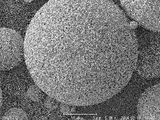
- FIG. 1 shows an electron micrograph showing the resin particle surface state of the resin beads of Example 1.
- the case where the surface state of the resin particles is a roughened state as shown in FIG. 1 was defined as a “roughened” state defined in the present invention.
- Example 14 and Comparative Example 8 were prepared by using the resin beads of Example 7 and Comparative Example 4, respectively, and blending them together with the components shown in Table 3 in the blending amounts shown in Table 3. 2 were produced, and their usability was evaluated. More specifically, Cosmetic-2 was produced as follows. First, after mixing the oil phase components shown in Table 3, a powder mixture in which the powder components shown in Table 3 were mixed in advance was added to the oil phase components and dispersed with a disper. Then, water-soluble components listed in Table 3 were added to the mixture while stirring, and the resulting mixture was emulsified to obtain Cosmetic-2 as an emulsified liquid foundation. As the components in the table, those conventionally used as raw materials for cosmetics were used. Using the obtained cosmetic-2, the usability of the items shown in Table 4 was evaluated according to the evaluation criteria shown in Table 4. The results are summarized in Table 4.
- the resin beads of the examples of the present invention As a result, it was confirmed that by using the resin beads of the examples of the present invention, it is possible to obtain a cosmetic exhibiting an effect of preventing the makeup from collapsing.
- the resin beads of the present invention are also used to provide a stable and repellent product at a high level. It was found that the resin beads of the present invention can be imparted with water and oil absorbency, and are useful as materials capable of imparting functionality.
- the resin beads of the present invention themselves contain a silicone compound, the silicone compound is immobilized inside the resin beads, and in addition, the resin bead surface is roughened.
- the resin beads of the present invention it becomes a useful material that can simultaneously realize stable water repellency and oil absorption effect in the product.
- the resin beads of the present invention for cosmetics, for example, a product having stable water repellency and oil absorption and realizing a good makeup feeling can be obtained. Therefore, the resin beads of the present invention are optimal for use in fields requiring such properties and functions, such as cosmetics, skin preparations, paints, molded articles, films, coating agents, and resin compositions. It is expected to be used for various purposes.
Landscapes
- Health & Medical Sciences (AREA)
- Life Sciences & Earth Sciences (AREA)
- Public Health (AREA)
- Veterinary Medicine (AREA)
- Animal Behavior & Ethology (AREA)
- General Health & Medical Sciences (AREA)
- Chemical & Material Sciences (AREA)
- Epidemiology (AREA)
- Birds (AREA)
- Chemical Kinetics & Catalysis (AREA)
- Medicinal Chemistry (AREA)
- Polymers & Plastics (AREA)
- Organic Chemistry (AREA)
- Dermatology (AREA)
- Cosmetics (AREA)
- Addition Polymer Or Copolymer, Post-Treatments, Or Chemical Modifications (AREA)
- Polymerisation Methods In General (AREA)
Abstract
Description
まず、予め調製した、ポリエチレングリコールジメタクリレート(新中村化学工業社製、商品名:NK1G)200部にV-65を4部溶解した溶液に、ラウリルメタアクリレート(花王社製、商品名:LMA)200部と、非重合性のシリコーンアクリル共重合体(信越化学工業社製、商品名:KP-578、有効成分100%)28部を加え、これらを均一に撹拌混合し、重合性モノマー液を調製した。上記で使用したKP-578は、アクリルポリマーと、ジメチルポリシロキサンからなるグラフト共重合体である。25℃における粘度は、150~200mPa・sである。
まず、ヘキサンジオールジメタクリレート(新中村化学工業社製、商品名:NKエステル HD-N)200部に、メタクリル酸ブチル(三菱レイヨン社製)200部と、非重合性のポリエーテルアルキル共変性シリコーン(信越化学工業社製、商品名:KSG-310、有効成分25~35%)80部と、予め調製した、プロピレングリコールモノメチルエーテルアセテート20部にV-65を4部溶解した溶液を加えた。そして、これらを均一に撹拌混合し、重合性モノマー液を調製した。次に、別の容器に、イオン交換水1600部に、分散安定剤としてPVAを88部溶解した水相を用いて行った以外は、実施例1と同様に、その後の洗浄などの操作を行い、非重合性のシリコーン化合物を内部に含有してなる樹脂ビーズを得て、これを本実施例の樹脂ビーズとした。上記で使用したKSG-310は、ポリエーテルアルキル共変性シリコーン25~35%と、ミネラルオイルの混合物で、化粧品に使用されている材料である。
予め調製した、ヘキサンジオールジメタクリレート(新中村化学工業社製、商品名:NKエステル HD-N)80部にV-65を4部溶解した溶液に、ラウリルメタアクリレート(花王社製、商品名:LMA)320部と、非重合性のシリコーンエラストマー(東レ・ダウコーニング社製、商品名:9040S.E.B、有効成分15%)100部を加え、これらを均一に撹拌混合し、重合性モノマー液を調製した以外は実施例1と同様に操作し、非重合性のシリコーン化合物を内部に固定化して含有してなる樹脂ビーズを得て、これを本実施例の樹脂ビーズとした。上記で使用したシリコーンエラストマー(商品名:9040S.E.B)は、ジメチコンクロスポリマー12%とシクロペンタシロキサン88%の混合物である。
まず、ヘキサンジオールジメタクリレート(新中村化学工業社製、商品名:NKエステル HD-N)200部に、メタクリル酸ブチル(三菱レイヨン社製)200部と、非重合性のポリエーテル・アルキル共変性シリコーン(信越化学工業社製、商品名:KF-6038、有効成分100%)8部を加え、予め調製した、プロピレングリコールモノメチルエーテルアセテート20部にV-65を4部溶解した溶液を加えた。そして、これらを均一に撹拌混合し、重合性モノマー液を調製した以外は、実施例1と同様に、その後の洗浄などの操作を行い、非重合性のシリコーン化合物を内部に含有してなる樹脂ビーズを得て、これを本実施例の樹脂ビーズとした。上記で使用したシリコーン共重合体は、ポリエーテル・アルキル共変性シリコーン界面活性剤(HLB=3.0)として市販されているものであり、ラウリルPEG-9ポリジメチルシロキシエチルジメチコンである。
まず、予め調製した、ポリエチレングリコールジメタクリレート(新中村化学工業社製、商品名:NK1G)200部にV-65を4部溶解した溶液に、ヘキサンジオールジメタクリレート(新中村化学工業社製、商品名:NKエステル HD-N)200部と、非重合性のポリエーテル変性シリコーン(信越化学工業社製、商品名:KF-6016、有効成分100%)60部を加え、これらを均一に撹拌混合し、重合性モノマー液を調製した以外は実施例1と同様に操作し、非重合性のシリコーン化合物を内部に固定化して含有してなる樹脂ビーズを得て、これを本実施例の樹脂ビーズとした。上記で使用したシリコーン共重合体は、ポリエーテル変性シリコーン界面活性剤(HLB=4.5)として市販されており、PEG-9・メチルエーテルジメチコンである。
まず、予め調製した、ポリエチレングリコールジメタクリレート(新中村化学工業社製、商品名:NK1G)200部に、V-65を4部溶解した溶液に、ラウリルメタアクリレート(花王社製、商品名:LMA)200部と、実施例1で使用したと同様の非重合性のシリコーンアクリル共重合体(信越化学工業社製、商品名:KP-578、有効成分100%)36部と、プロピレングリコールモノメチルエーテルアセテート400部を加え、これらを均一に撹拌混合し、重合性モノマー液を調製した以外は実施例1と同様に操作し、非重合性のシリコーン化合物を内部に固定化して含有してなる多孔質樹脂ビーズを得て、これを本実施例の樹脂ビーズとした。この例では、単量体と有機溶剤であるプロピレングリコールモノメチルエーテルアセテートを含む油層を水中媒体中で懸濁重合するため、得られる樹脂ビーズは多孔質となる。
まず、二酸化チタン(石原産業社製、商品名:タイペークPFC407)80部と、ラウリルメタアクリレート(花王社製、商品名:LMA)200部と、実施例1で使用したと同様の非重合性のシリコーンアクリル共重合体(信越化学工業社製、商品名:KP-578、有効成分100%)36部とを加え分散し、予め二酸化チタンの分散液を調製した。この分散液に、予め調整したポリエチレングリコールジメタクリレート(新中村化学工業社製、商品名:NK1G)200部にV-65を4部溶解した溶液を均一に撹拌混合し、重合性モノマー液を調製した以外は実施例1と同様に操作し、非重合性のシリコーン化合物と二酸化チタンとを内部に含有してなる樹脂ビーズを得て、これを本実施例の樹脂ビーズとした。
実施例1で用いたと同様に、予め調製したポリエチレングリコールジメタクリレート(新中村化学工業社製、商品名:NK1G)200部にV-65を4部溶解した溶液に、ラウリルメタアクリレート(花王社製、商品名:LMA)200部を加え、これらを均一に撹拌混合し、重合性モノマー液を調製した以外は実施例1と同様に操作し、本比較例の樹脂ビーズを得た。得られた樹脂ビーズは、シリコーン化合物を含有しないものである。
比較例1で得た樹脂ビーズ100部をヘンシルミキサーに投入し、これに予めイソプロピルアルコール7部に、実施例1で使用したシリコーンアクリル共重合体(信越化学工業社製、商品名:KP-578、有効成分100%)7部を溶解した溶液を注入して、均一に撹拌混合した後、乾燥、解砕処理を行って、本比較例の樹脂ビーズを得た。得られた樹脂ビーズは、シリコーン化合物が樹脂ビーズ表面に被覆したものとなる。
実施例4で用いたと同様に、予め調製したポリエチレングリコールジメタクリレート(新中村化学工業社製、商品名:NK1G)200部にV-65を4部溶解した溶液に、ラウリルメタアクリレート(花王社製、商品名:LMA)200部とプロピレングリコールモノメチルエーテルアセテート400部を加え、これらを均一に撹拌混合し、重合性モノマー液を調製した以外は実施例4と同様に操作し、本比較例の多孔質樹脂ビーズを得た。得られた樹脂ビーズは、実施例4と同様に多孔質であるが、シリコーン化合物を含有しないものである。
まず、二酸化チタン(石原産業社製、商品名:PFC407)80部と、ラウリルメタアクリレート(花王社製、商品名:LMA)200部とを加え分散し、予め二酸化チタンの分散液を調整した。この分散液に、予め調整したポリエチレングリコールジメタクリレート(新中村化学工業社製、商品名:NK1G)200部にV-65を4部溶解した溶液を均一に撹拌混合し、重合性モノマー液を調製した以外は実施例1と同様に操作し、本比較例の樹脂ビーズを得た。得られた樹脂ビーズは、懸濁重合時に二酸化チタンを含有させた点と、樹脂組成が実施例7と同様であるが、シリコーン化合物を含有しないものである。
実施例及び比較例の各樹脂ビーズについて、その体積平均粒子径を測定し、更に、以下のようにして、撥水性と吸油量(吸油性)と樹脂粒子表面状態を評価した。
実施例1~7及び比較例1~4の各樹脂ビーズの体積平均粒子径を、コールターカウンター(ベックマン・コールター社製)で測定した。そして、得られた結果を表1にまとめて示した。
実施例1~7及び比較例1~4の各樹脂ビーズにおける撥水性を下記のようにして観察し、以下の基準で評価した。具体的には、50mlの試験管に20mlのイオン交換水を入れ、その中に樹脂ビーズ0.5gを投入した後、スパチュラーで軽く撹拌した。そして、1日後に樹脂ビーズが表面に浮いているか否かを観察して、その沈降状態で撥水性を評価した。評価基準は、樹脂ビーズが完全に浮いている状態を○、一部沈降している場合を△、ほぼ沈降している場合を×として、評価した。その結果を表1にまとめて示した。
実施例1~7及び比較例1~4の各樹脂ビーズにおける吸油量を下記のようにして測定し、吸油性を評価した。具体的には、5.0gの各樹脂ビーズに脂肪酸トリグリセリド(花王社製、商品名:ココナードMT)を徐々に滴下してヘラで混ぜ合わせた。滴下が進むと樹脂ビーズが徐々に濡れ、樹脂ビーズがひと塊に纏まった時点の滴下量(g)を樹脂ビーズの吸油量とし、吸油性(吸油効果)を評価した。その結果を表1にまとめて示した。
実施例1~7及び比較例1~4の各樹脂ビーズの樹脂粒子表面状態を走査型電子顕微鏡(ELIONIX製、ERA-8000)で観察した。5000倍での観察結果で、樹脂粒子表面が平滑である場合を「平滑」とし、粗面化されている場合を「粗面」とし、顔料を内部に含有した状態にできず樹脂表面に吸着・凝集している場合を「顔料吸着」とし、多孔である場合を「多孔」としてそれぞれ表現し、その結果を表1にまとめて示した。図1に、実施例1の樹脂ビーズの樹脂粒子表面状態を観察した、電子顕微鏡写真の図を示した。樹脂粒子表面の状態が、図1のような粗面化状態である場合を、本発明で規定する「粗面化している」状態とした。
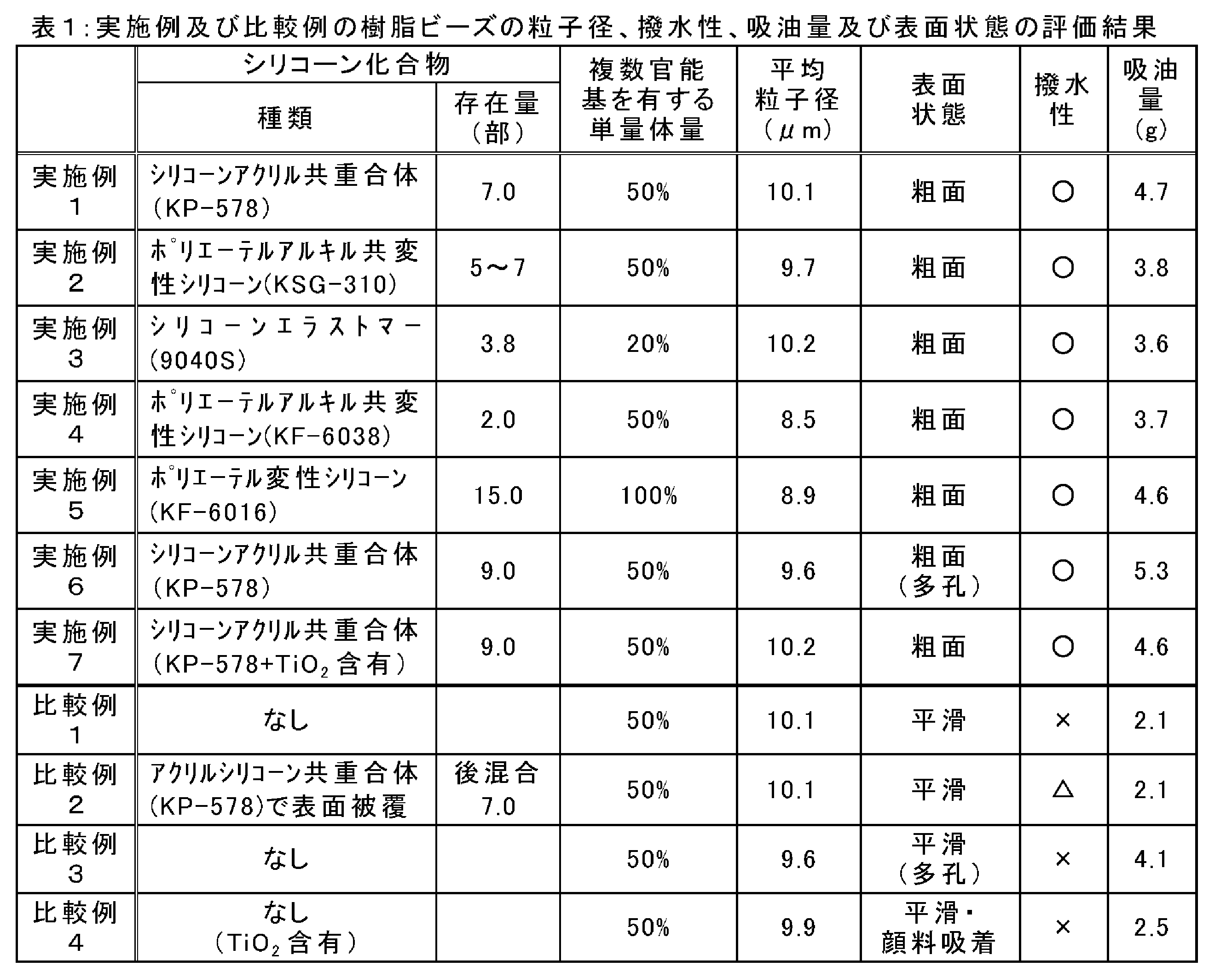
実施例1~6及び比較例1~3の各樹脂ビーズをそれぞれに用い、これを表2に記載した各成分とともに表2に示した配合量で配合することにより、実施例8~13及び比較例5~7の化粧料-1をそれぞれ製造し、その使用性について評価した。より具体的には、以下のようにして化粧料を製造した。まず、表2に記載したように、従来より化粧料の原料に用いられている、シリコーン処理された各粉体(マイカ、タルク、微粒子酸化チタン、硫酸バリウム)と、実施例及び比較例の各樹脂ビーズとを表2に記載の量で配合し、均一になるまで混合して粉体混合物とした。そして、得られた粉体混合物と、予め、従来より化粧料の原料に用いられている、ワセリン、スクワラン、トリオクタン酸グリセリルを混合したものを加えて、均一なるまで混合した。そして、これを容器に充填し、必要に応じてプレス成型して、それぞれに異なる樹脂ビーズを含有した各化粧料-1を得た。得られた各化粧料-1を用いて、表4に示した項目の使用性について、表4に示す評価基準で評価し、結果を表4にまとめて示した。
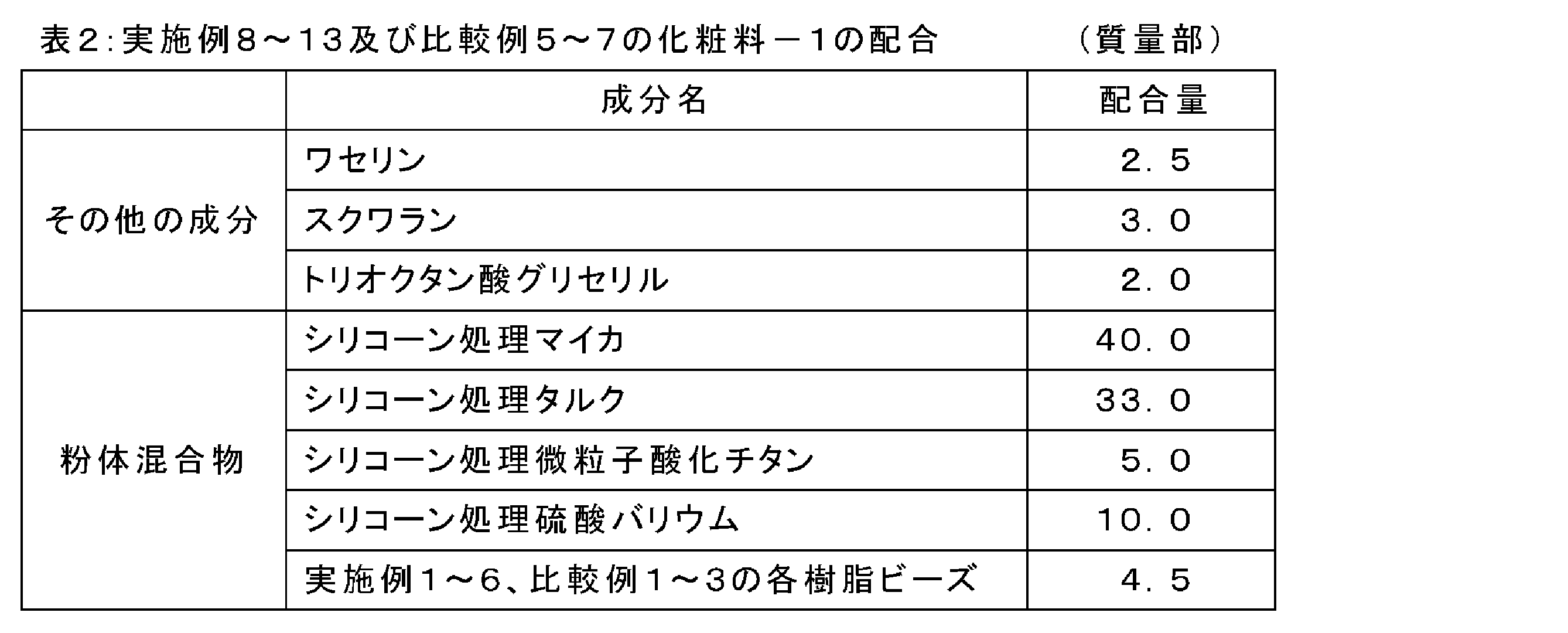
実施例7及び比較例4の各樹脂ビーズをそれぞれに用い、これを表3に記載した各成分とともに表3に示した配合量で配合することにより、実施例14と比較例8の化粧料-2をそれぞれ製造し、その使用性について評価した。より具体的には、以下のようにして化粧料-2を製造した。まず、表3に記載の油相成分を混合した後、この油相成分に、表3に記載の粉体成分を予め均一になるまで混合した粉体混合物を添加してディスパーで分散した。そして、この中に、表3に記載の水溶性成分を撹拌しながら添加し、得られた混合物を乳化させて、乳化液状のファンデーションである化粧料-2をそれぞれ得た。表中の成分には、いずれも、従来より化粧料の原料に用いられているものを用いた。得られた化粧料-2を用いて、表4に示す項目の使用性について、表4に示す評価基準で評価し、結果を表4にまとめて示した。
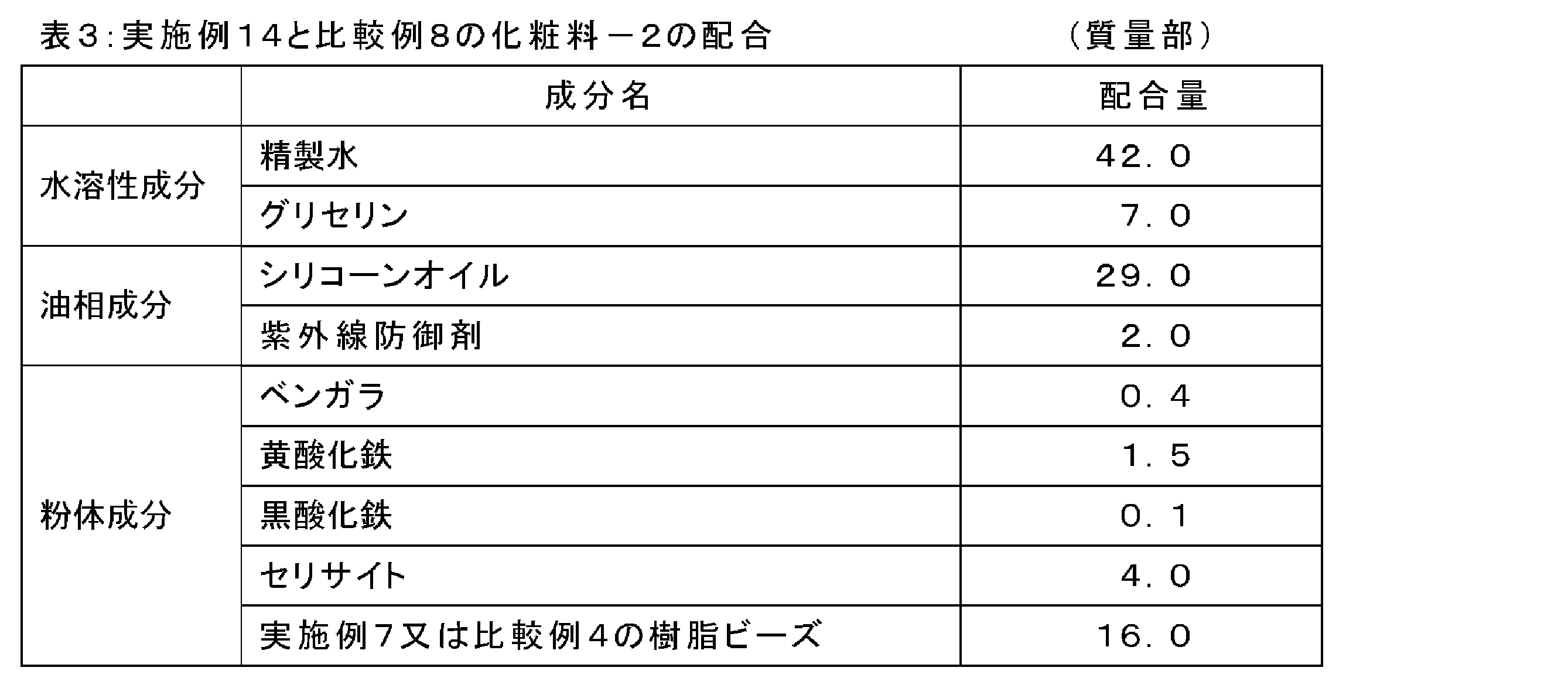
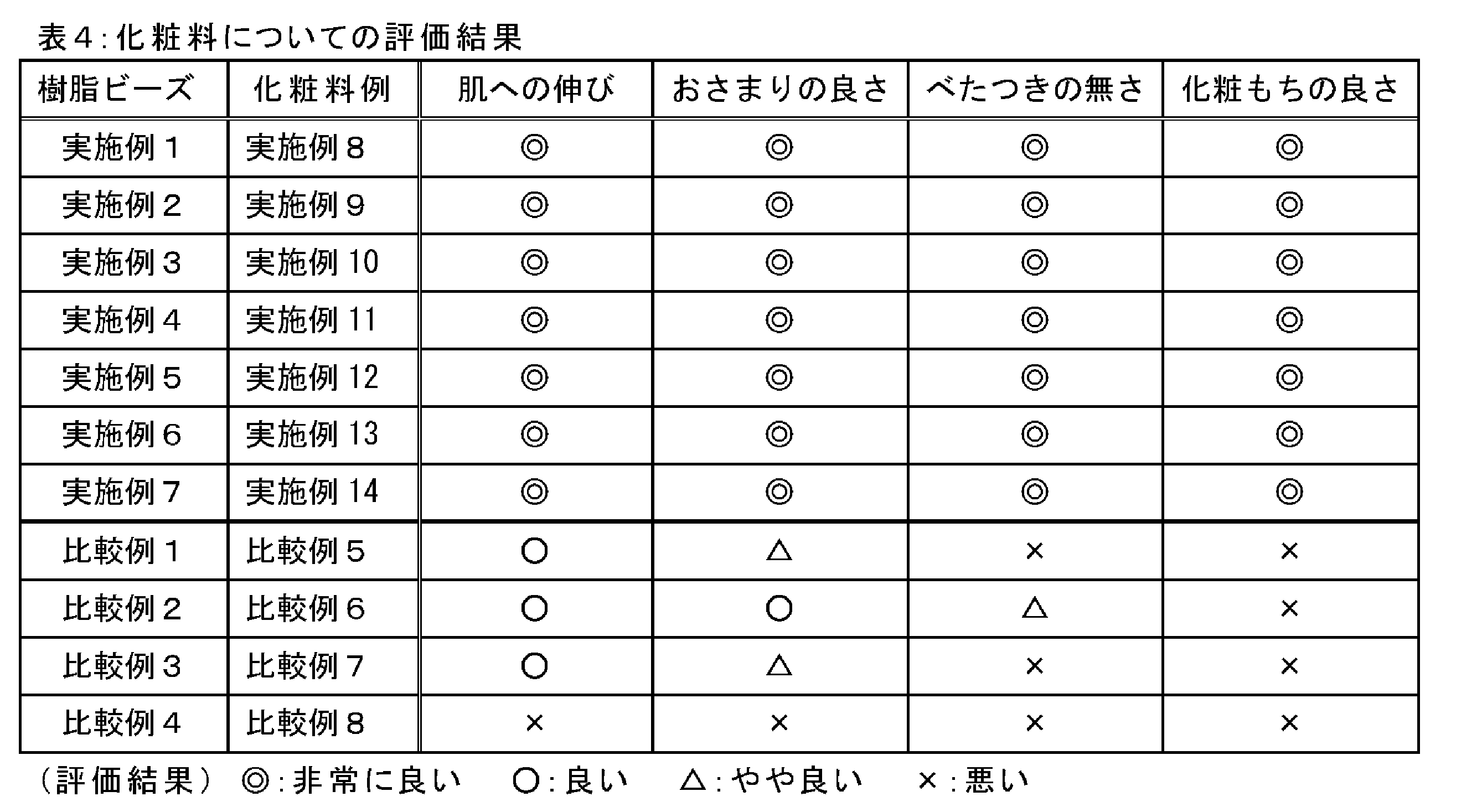
実施例1~7の樹脂ビーズと、比較例1~4の樹脂ビーズとを比較すると、表1に示したように、実施例1~7の樹脂ビーズは、いずれも比較例の各樹脂ビーズと比べて明らかに撥水性に優れ、更に、樹脂表面が粗面化されており(図1参照)、比較例3の多孔質樹脂ビーズと同等の吸油量があり、吸油性に優れていることが確認できた。また、実施例1~7の樹脂ビーズをそれぞれに使用して製造した実施例8~14の各化粧料は、比較例1~4の樹脂ビーズをそれぞれに使用して製造した比較例5~8の各化粧料と比較すると、べたつきがなく、伸び広がりも軽く、おさまりも良く、化粧もちの良い化粧料となった。この結果、本発明の実施例の樹脂ビーズを用いることで、化粧崩れ防止効果を示す化粧料を得ることができることが確認された。また、塗り薬や貼り薬といった外皮用薬、塗料、成形体、フィルム、コーティング剤、樹脂組成物においても、同様に、本発明の樹脂ビーズを用いることで、その製品に、高いレベルで安定した撥水性及び吸油性の付与ができ、本発明の樹脂ビーズは、機能性を付与できる材料として有用であることがわかった。
Claims (11)
- 共重合可能な官能基を有する単量体を複数含む単量体混合物を、少なくとも、非重合性のシリコーン化合物が存在している状態で懸濁重合してなり、且つ、表面が粗面化している樹脂粒子であることを特徴とする樹脂ビーズ。
- 前記非重合性のシリコーン化合物の前記懸濁重合の際における存在量が、樹脂の形成成分である前記単量体混合物100質量部に対して1.0~30質量部の割合で添加されている請求項1に記載の樹脂ビーズ。
- 前記非重合性のシリコーン化合物が、シリコーン重合体である請求項1又2に記載の樹脂ビーズ。
- 前記非重合性のシリコーン化合物が、シリコーンアクリル共重合体、ポリエーテル変性シリコーン、ポリエーテル・アルキル変性シリコーン及びシリコーンエラストマーからなる群から選択されるいずれかである請求項1又は2に記載の樹脂ビーズ。
- 前記共重合可能な官能基を有する単量体が、(メタ)アクリレート系である請求項1~4のいずれか1項に記載の樹脂ビーズ。
- 前記単量体混合物中に、共重合可能な官能基を複数有する単量体を含み、且つ、その含有量が10質量%以上である請求項1~5のいずれか1項に記載の樹脂ビーズ。
- 前記共重合可能な官能基を複数有する単量体が、ジ(メタ)アクリレートである請求項6に記載の樹脂ビーズ。
- 更に、顔料が存在している状態で懸濁重合してなる請求項1~7のいずれか1項に記載の樹脂ビーズ。
- 前記樹脂粒子の体積平均粒子径が20μm以下である請求項1~8のいずれか1項に記載の樹脂ビーズ。
- 請求項1~9のいずれか1項に記載の樹脂ビーズを製造する樹脂ビーズの製造方法であって、共重合可能な官能基を有する単量体を複数含む単量体混合物、非重合性のシリコーン化合物、重合開始剤、及び必要に応じて顔料を含む重合性溶液を、分散安定化剤を溶解した水相で懸濁重合させて、少なくとも撥水性を有し、且つ、その表面が粗面化した樹脂ビーズを得ることを特徴とする樹脂ビーズの製造方法。
- 樹脂ビーズを含有してなる、化粧料、外皮用薬、塗料、成形体、フィルム、コーティング剤及び樹脂組成物からなる群から選ばれるいずれかの製品であって、前記樹脂ビーズが、請求項1~9のいずれか1項に記載の樹脂ビーズであることを特徴とする撥水性及び吸油性を有する製品。
Priority Applications (6)
| Application Number | Priority Date | Filing Date | Title |
|---|---|---|---|
| JP2016532909A JP6150947B2 (ja) | 2014-07-09 | 2015-07-03 | 樹脂ビーズ、樹脂ビーズの製造方法並びに該樹脂ビーズを含む製品 |
| BR112016027832-1A BR112016027832B1 (pt) | 2014-07-09 | 2015-07-03 | esferas de resina, processo de produção de esferas de resina e produto repelente de água e absorvente de óleo |
| EP15818900.1A EP3168240B1 (en) | 2014-07-09 | 2015-07-03 | Use of a silicone compound for obtaining resin beads |
| KR1020167033657A KR101807455B1 (ko) | 2014-07-09 | 2015-07-03 | 수지 비즈, 수지 비즈의 제조 방법 및 상기 수지 비즈를 포함하는 제품 |
| CN201580028766.3A CN106459230B (zh) | 2014-07-09 | 2015-07-03 | 树脂微珠、树脂微珠的制造方法以及包含该树脂微珠的制品 |
| US15/305,571 US9809705B2 (en) | 2014-07-09 | 2015-07-03 | Resin beads, method for manufacting resin beads and product including resin beads |
Applications Claiming Priority (2)
| Application Number | Priority Date | Filing Date | Title |
|---|---|---|---|
| JP2014-141641 | 2014-07-09 | ||
| JP2014141641 | 2014-07-09 |
Publications (1)
| Publication Number | Publication Date |
|---|---|
| WO2016006540A1 true WO2016006540A1 (ja) | 2016-01-14 |
Family
ID=55064176
Family Applications (1)
| Application Number | Title | Priority Date | Filing Date |
|---|---|---|---|
| PCT/JP2015/069234 Ceased WO2016006540A1 (ja) | 2014-07-09 | 2015-07-03 | 樹脂ビーズ、樹脂ビーズの製造方法並びに該樹脂ビーズを含む製品 |
Country Status (7)
| Country | Link |
|---|---|
| US (1) | US9809705B2 (ja) |
| EP (1) | EP3168240B1 (ja) |
| JP (1) | JP6150947B2 (ja) |
| KR (1) | KR101807455B1 (ja) |
| CN (1) | CN106459230B (ja) |
| BR (1) | BR112016027832B1 (ja) |
| WO (1) | WO2016006540A1 (ja) |
Cited By (3)
| Publication number | Priority date | Publication date | Assignee | Title |
|---|---|---|---|---|
| JP2021161305A (ja) * | 2020-04-01 | 2021-10-11 | 横浜ゴム株式会社 | タイヤ用ゴム組成物 |
| KR20230031782A (ko) | 2021-08-27 | 2023-03-07 | 닛폰 에쿠스란 고교 가부시키가이샤 | 다공질 수지 입자, 그 입자의 제조 방법, 및 그 입자를 함유하는 퍼스널 케어 제품, 단열재 및 차음재 |
| WO2026048726A1 (ja) * | 2024-08-30 | 2026-03-05 | 積水化学工業株式会社 | 多孔質シリコーン粒子及び多孔質シリコーン粒子の製造方法 |
Families Citing this family (5)
| Publication number | Priority date | Publication date | Assignee | Title |
|---|---|---|---|---|
| CN106232632B (zh) | 2014-05-12 | 2018-09-21 | 大日精化工业株式会社 | 树脂微珠、树脂微珠的制造方法以及包含该树脂微珠的制品 |
| WO2020092138A1 (en) | 2018-10-30 | 2020-05-07 | Rohm And Haas Company | Aqueous dispersion of polymeric composite microspheres |
| JP2020132866A (ja) | 2019-02-25 | 2020-08-31 | ローム アンド ハース カンパニーRohm And Haas Company | ポリマー複合ミクロスフェアの水性分散液 |
| JP6872068B1 (ja) * | 2020-09-01 | 2021-05-19 | 大日精化工業株式会社 | 樹脂ビーズ、樹脂ビーズの製造方法、及び樹脂ビーズを用いた製品 |
| JP6921293B1 (ja) * | 2020-12-23 | 2021-08-18 | 大日精化工業株式会社 | 樹脂ビーズ、樹脂ビーズの製造方法、及び樹脂ビーズを用いた製品 |
Citations (10)
| Publication number | Priority date | Publication date | Assignee | Title |
|---|---|---|---|---|
| JPS6173713A (ja) * | 1984-09-20 | 1986-04-15 | Mitsui Toatsu Chem Inc | 塩化ビニル樹脂の製造方法 |
| JPH0892524A (ja) * | 1994-09-19 | 1996-04-09 | Nippon Shokubai Co Ltd | 水性複合樹脂分散液およびその製造方法 |
| JPH08104772A (ja) * | 1994-10-07 | 1996-04-23 | Hitachi Chem Co Ltd | 発泡性スチレン系重合体粒子、その製造法及び発泡成形品 |
| WO2001070826A1 (fr) * | 2000-03-21 | 2001-09-27 | Sekisui Plastics Co., Ltd. | Particule de resine et son procede de fabrication |
| JP2003073405A (ja) * | 2001-09-04 | 2003-03-12 | Sekisui Plastics Co Ltd | 樹脂粒子の製造方法およびその方法により得られる樹脂粒子 |
| JP2004002728A (ja) * | 2002-04-01 | 2004-01-08 | Rohm & Haas Co | マクロレティキュラーポリマーの調製 |
| JP2007100097A (ja) * | 2005-10-06 | 2007-04-19 | L'oreal Sa | ポリマー粒子の分散物、それを含む組成物、及び美容処理方法 |
| JP2009138034A (ja) * | 2007-12-03 | 2009-06-25 | Nippon Shokubai Co Ltd | 粒子、および粒子の製造方法 |
| WO2011121821A1 (ja) * | 2010-03-29 | 2011-10-06 | 積水化成品工業株式会社 | 表面に凸部を有する樹脂粒子及びその製造方法、それを用いた塗布用組成物、塗布物及び外用剤 |
| WO2013161098A1 (ja) * | 2012-04-27 | 2013-10-31 | 積水化成品工業株式会社 | 重合体粒子、その製造方法、及び、その用途 |
Family Cites Families (19)
| Publication number | Priority date | Publication date | Assignee | Title |
|---|---|---|---|---|
| JPS608302A (ja) * | 1983-06-29 | 1985-01-17 | Ricoh Co Ltd | 懸濁重合法による重合体粒子の製造方法 |
| JP3501817B2 (ja) | 1992-06-12 | 2004-03-02 | 株式会社コーセー | 化粧料 |
| JPH08109279A (ja) * | 1994-10-12 | 1996-04-30 | Hitachi Chem Co Ltd | 発泡性スチレン系重合体粒子、その製造法及び発泡成形品 |
| FR2735689B1 (fr) * | 1995-06-21 | 1997-08-01 | Oreal | Composition comprenant une dispersion de particules de polymeres dans un milieu non aqueux |
| JP3666104B2 (ja) | 1996-02-26 | 2005-06-29 | 住友化学株式会社 | 微小ポリマー粒子が分散している重合体粒子からなるマスターバッチの製造方法 |
| JP3663498B2 (ja) | 1996-03-26 | 2005-06-22 | 東亞合成株式会社 | 耐衝撃性樹脂組成物の製造方法 |
| JPH107704A (ja) * | 1996-06-25 | 1998-01-13 | Origin Electric Co Ltd | 樹脂粒子、その製造方法、樹脂粒子を用いた塗料及び 化粧品 |
| JP2000034310A (ja) * | 1998-07-17 | 2000-02-02 | Toagosei Co Ltd | エマルションの製造方法 |
| JP3669898B2 (ja) * | 2000-04-17 | 2005-07-13 | 積水化成品工業株式会社 | 球状樹脂粒子およびその製造方法ならびに外用剤 |
| WO2005094758A1 (ja) | 2004-03-31 | 2005-10-13 | Shin-Etsu Chemical Co., Ltd. | シリコーン重合体を含有する化粧料 |
| JP5009028B2 (ja) | 2007-04-09 | 2012-08-22 | 花王株式会社 | 樹脂粒子 |
| JP5634031B2 (ja) * | 2009-03-27 | 2014-12-03 | 株式会社日本触媒 | 重合体粒子およびそれを用いた重合体粒子含有組成物 |
| JP5508209B2 (ja) | 2010-09-28 | 2014-05-28 | 信越化学工業株式会社 | 化粧料 |
| JP6028570B2 (ja) | 2011-01-25 | 2016-11-16 | 住友大阪セメント株式会社 | 紫外線遮蔽複合粒子とその製造方法及び紫外線遮蔽複合粒子含有分散液及び水系分散体及び油系分散体並びに化粧料 |
| WO2012157757A1 (ja) * | 2011-05-18 | 2012-11-22 | 住友大阪セメント株式会社 | 紫外線遮蔽剤及びその製造方法、紫外線遮蔽剤含有分散液、並びに化粧料 |
| JP5881341B2 (ja) | 2011-09-05 | 2016-03-09 | アイカ工業株式会社 | 複合微粒子の製造方法 |
| JP6029507B2 (ja) | 2012-03-27 | 2016-11-24 | 積水化成品工業株式会社 | 多孔質樹脂粒子、多孔質樹脂粒子の製造方法、及び、その用途 |
| KR101428220B1 (ko) | 2012-11-23 | 2014-08-07 | 현대자동차주식회사 | 자동화 수동변속기 |
| CN106232632B (zh) * | 2014-05-12 | 2018-09-21 | 大日精化工业株式会社 | 树脂微珠、树脂微珠的制造方法以及包含该树脂微珠的制品 |
-
2015
- 2015-07-03 WO PCT/JP2015/069234 patent/WO2016006540A1/ja not_active Ceased
- 2015-07-03 KR KR1020167033657A patent/KR101807455B1/ko active Active
- 2015-07-03 EP EP15818900.1A patent/EP3168240B1/en active Active
- 2015-07-03 US US15/305,571 patent/US9809705B2/en active Active
- 2015-07-03 BR BR112016027832-1A patent/BR112016027832B1/pt active IP Right Grant
- 2015-07-03 CN CN201580028766.3A patent/CN106459230B/zh active Active
- 2015-07-03 JP JP2016532909A patent/JP6150947B2/ja active Active
Patent Citations (10)
| Publication number | Priority date | Publication date | Assignee | Title |
|---|---|---|---|---|
| JPS6173713A (ja) * | 1984-09-20 | 1986-04-15 | Mitsui Toatsu Chem Inc | 塩化ビニル樹脂の製造方法 |
| JPH0892524A (ja) * | 1994-09-19 | 1996-04-09 | Nippon Shokubai Co Ltd | 水性複合樹脂分散液およびその製造方法 |
| JPH08104772A (ja) * | 1994-10-07 | 1996-04-23 | Hitachi Chem Co Ltd | 発泡性スチレン系重合体粒子、その製造法及び発泡成形品 |
| WO2001070826A1 (fr) * | 2000-03-21 | 2001-09-27 | Sekisui Plastics Co., Ltd. | Particule de resine et son procede de fabrication |
| JP2003073405A (ja) * | 2001-09-04 | 2003-03-12 | Sekisui Plastics Co Ltd | 樹脂粒子の製造方法およびその方法により得られる樹脂粒子 |
| JP2004002728A (ja) * | 2002-04-01 | 2004-01-08 | Rohm & Haas Co | マクロレティキュラーポリマーの調製 |
| JP2007100097A (ja) * | 2005-10-06 | 2007-04-19 | L'oreal Sa | ポリマー粒子の分散物、それを含む組成物、及び美容処理方法 |
| JP2009138034A (ja) * | 2007-12-03 | 2009-06-25 | Nippon Shokubai Co Ltd | 粒子、および粒子の製造方法 |
| WO2011121821A1 (ja) * | 2010-03-29 | 2011-10-06 | 積水化成品工業株式会社 | 表面に凸部を有する樹脂粒子及びその製造方法、それを用いた塗布用組成物、塗布物及び外用剤 |
| WO2013161098A1 (ja) * | 2012-04-27 | 2013-10-31 | 積水化成品工業株式会社 | 重合体粒子、その製造方法、及び、その用途 |
Non-Patent Citations (1)
| Title |
|---|
| See also references of EP3168240A4 * |
Cited By (4)
| Publication number | Priority date | Publication date | Assignee | Title |
|---|---|---|---|---|
| JP2021161305A (ja) * | 2020-04-01 | 2021-10-11 | 横浜ゴム株式会社 | タイヤ用ゴム組成物 |
| JP7545021B2 (ja) | 2020-04-01 | 2024-09-04 | 横浜ゴム株式会社 | タイヤ用ゴム組成物 |
| KR20230031782A (ko) | 2021-08-27 | 2023-03-07 | 닛폰 에쿠스란 고교 가부시키가이샤 | 다공질 수지 입자, 그 입자의 제조 방법, 및 그 입자를 함유하는 퍼스널 케어 제품, 단열재 및 차음재 |
| WO2026048726A1 (ja) * | 2024-08-30 | 2026-03-05 | 積水化学工業株式会社 | 多孔質シリコーン粒子及び多孔質シリコーン粒子の製造方法 |
Also Published As
| Publication number | Publication date |
|---|---|
| EP3168240A4 (en) | 2018-03-21 |
| EP3168240A1 (en) | 2017-05-17 |
| CN106459230A (zh) | 2017-02-22 |
| BR112016027832B1 (pt) | 2020-11-03 |
| KR101807455B1 (ko) | 2017-12-08 |
| JPWO2016006540A1 (ja) | 2017-04-27 |
| US9809705B2 (en) | 2017-11-07 |
| US20170044360A1 (en) | 2017-02-16 |
| JP6150947B2 (ja) | 2017-06-21 |
| KR20160148001A (ko) | 2016-12-23 |
| EP3168240B1 (en) | 2020-01-01 |
| CN106459230B (zh) | 2019-04-12 |
Similar Documents
| Publication | Publication Date | Title |
|---|---|---|
| JP6150947B2 (ja) | 樹脂ビーズ、樹脂ビーズの製造方法並びに該樹脂ビーズを含む製品 | |
| JP6184593B2 (ja) | 樹脂ビーズ、樹脂ビーズの製造方法並びに該樹脂ビーズを含む製品 | |
| JP5590539B2 (ja) | シリコーン(メタ)アクリレート粒子、その調製方法、およびその使用 | |
| CN106488802B (zh) | 中空颗粒、其制备方法、其用途以及生产微囊颗粒的方法 | |
| JP5439102B2 (ja) | 中空粒子、その製造法及びその用途 | |
| JP5799367B2 (ja) | 樹脂粒子、樹脂粒子の製造方法、及びその用途 | |
| JP2009149880A5 (ja) | ||
| JP6728334B2 (ja) | 中空粒子及びその用途 | |
| JPWO2017038138A1 (ja) | 複合粒子及びその製造方法、並びにその用途 | |
| JP5998302B1 (ja) | 有機−無機ハイブリッド中空粒子及びその用途 | |
| WO2013027849A9 (ja) | 異形樹脂粒子およびその製造方法並びにその用途 | |
| JP7379209B2 (ja) | 有機無機複合粒子の製造方法 | |
| JP5244666B2 (ja) | 球状複合粒子、その製造方法及びそれを含む化粧料 | |
| JP5651509B2 (ja) | 異形粒子及びその製造法 | |
| JP2014101303A (ja) | コアシェル型複合粒子の製造方法及びコアシェル型複合粒子 | |
| JP6801249B2 (ja) | 有機無機複合粒子及びそのラテックス並びにその製造方法 | |
| WO2000056820A1 (en) | Powder for cosmetic preparation with ultraviolet-screening property |
Legal Events
| Date | Code | Title | Description |
|---|---|---|---|
| 121 | Ep: the epo has been informed by wipo that ep was designated in this application |
Ref document number: 15818900 Country of ref document: EP Kind code of ref document: A1 |
|
| ENP | Entry into the national phase |
Ref document number: 2016532909 Country of ref document: JP Kind code of ref document: A |
|
| WWE | Wipo information: entry into national phase |
Ref document number: 15305571 Country of ref document: US |
|
| REEP | Request for entry into the european phase |
Ref document number: 2015818900 Country of ref document: EP |
|
| WWE | Wipo information: entry into national phase |
Ref document number: 2015818900 Country of ref document: EP |
|
| ENP | Entry into the national phase |
Ref document number: 20167033657 Country of ref document: KR Kind code of ref document: A |
|
| REG | Reference to national code |
Ref country code: BR Ref legal event code: B01A Ref document number: 112016027832 Country of ref document: BR |
|
| NENP | Non-entry into the national phase |
Ref country code: DE |
|
| ENP | Entry into the national phase |
Ref document number: 112016027832 Country of ref document: BR Kind code of ref document: A2 Effective date: 20161128 |