WO2016009643A1 - 熱転写受像シート及びその製造方法 - Google Patents
熱転写受像シート及びその製造方法 Download PDFInfo
- Publication number
- WO2016009643A1 WO2016009643A1 PCT/JP2015/003559 JP2015003559W WO2016009643A1 WO 2016009643 A1 WO2016009643 A1 WO 2016009643A1 JP 2015003559 W JP2015003559 W JP 2015003559W WO 2016009643 A1 WO2016009643 A1 WO 2016009643A1
- Authority
- WO
- WIPO (PCT)
- Prior art keywords
- thermal transfer
- transfer image
- receiving sheet
- parts
- layer
- Prior art date
- Legal status (The legal status is an assumption and is not a legal conclusion. Google has not performed a legal analysis and makes no representation as to the accuracy of the status listed.)
- Ceased
Links
Images

Classifications
-
- B—PERFORMING OPERATIONS; TRANSPORTING
- B41—PRINTING; LINING MACHINES; TYPEWRITERS; STAMPS
- B41M—PRINTING, DUPLICATING, MARKING, OR COPYING PROCESSES; COLOUR PRINTING
- B41M5/00—Duplicating or marking methods; Sheet materials for use therein
- B41M5/26—Thermography ; Marking by high energetic means, e.g. laser otherwise than by burning, and characterised by the material used
- B41M5/40—Thermography ; Marking by high energetic means, e.g. laser otherwise than by burning, and characterised by the material used characterised by the base backcoat, intermediate, or covering layers, e.g. for thermal transfer dye-donor or dye-receiver sheets; Heat, radiation filtering or absorbing means or layers; combined with other image registration layers or compositions; Special originals for reproduction by thermography
- B41M5/42—Intermediate, backcoat, or covering layers
- B41M5/44—Intermediate, backcoat, or covering layers characterised by the macromolecular compounds
-
- B—PERFORMING OPERATIONS; TRANSPORTING
- B41—PRINTING; LINING MACHINES; TYPEWRITERS; STAMPS
- B41M—PRINTING, DUPLICATING, MARKING, OR COPYING PROCESSES; COLOUR PRINTING
- B41M5/00—Duplicating or marking methods; Sheet materials for use therein
- B41M5/26—Thermography ; Marking by high energetic means, e.g. laser otherwise than by burning, and characterised by the material used
- B41M5/40—Thermography ; Marking by high energetic means, e.g. laser otherwise than by burning, and characterised by the material used characterised by the base backcoat, intermediate, or covering layers, e.g. for thermal transfer dye-donor or dye-receiver sheets; Heat, radiation filtering or absorbing means or layers; combined with other image registration layers or compositions; Special originals for reproduction by thermography
- B41M5/42—Intermediate, backcoat, or covering layers
-
- B—PERFORMING OPERATIONS; TRANSPORTING
- B41—PRINTING; LINING MACHINES; TYPEWRITERS; STAMPS
- B41M—PRINTING, DUPLICATING, MARKING, OR COPYING PROCESSES; COLOUR PRINTING
- B41M5/00—Duplicating or marking methods; Sheet materials for use therein
- B41M5/26—Thermography ; Marking by high energetic means, e.g. laser otherwise than by burning, and characterised by the material used
- B41M5/40—Thermography ; Marking by high energetic means, e.g. laser otherwise than by burning, and characterised by the material used characterised by the base backcoat, intermediate, or covering layers, e.g. for thermal transfer dye-donor or dye-receiver sheets; Heat, radiation filtering or absorbing means or layers; combined with other image registration layers or compositions; Special originals for reproduction by thermography
- B41M5/42—Intermediate, backcoat, or covering layers
- B41M5/426—Intermediate, backcoat, or covering layers characterised by inorganic compounds, e.g. metals, metal salts, metal complexes
-
- B—PERFORMING OPERATIONS; TRANSPORTING
- B41—PRINTING; LINING MACHINES; TYPEWRITERS; STAMPS
- B41M—PRINTING, DUPLICATING, MARKING, OR COPYING PROCESSES; COLOUR PRINTING
- B41M5/00—Duplicating or marking methods; Sheet materials for use therein
- B41M5/50—Recording sheets characterised by the coating used to improve ink, dye or pigment receptivity, e.g. for ink-jet or thermal dye transfer recording
- B41M5/502—Recording sheets characterised by the coating used to improve ink, dye or pigment receptivity, e.g. for ink-jet or thermal dye transfer recording characterised by structural details, e.g. multilayer materials
- B41M5/506—Intermediate layers
-
- B—PERFORMING OPERATIONS; TRANSPORTING
- B41—PRINTING; LINING MACHINES; TYPEWRITERS; STAMPS
- B41M—PRINTING, DUPLICATING, MARKING, OR COPYING PROCESSES; COLOUR PRINTING
- B41M5/00—Duplicating or marking methods; Sheet materials for use therein
- B41M5/50—Recording sheets characterised by the coating used to improve ink, dye or pigment receptivity, e.g. for ink-jet or thermal dye transfer recording
- B41M5/52—Macromolecular coatings
- B41M5/5254—Macromolecular coatings characterised by the use of polymers obtained by reactions only involving carbon-to-carbon unsaturated bonds, e.g. vinyl polymers
-
- B—PERFORMING OPERATIONS; TRANSPORTING
- B41—PRINTING; LINING MACHINES; TYPEWRITERS; STAMPS
- B41M—PRINTING, DUPLICATING, MARKING, OR COPYING PROCESSES; COLOUR PRINTING
- B41M5/00—Duplicating or marking methods; Sheet materials for use therein
- B41M5/50—Recording sheets characterised by the coating used to improve ink, dye or pigment receptivity, e.g. for ink-jet or thermal dye transfer recording
- B41M5/52—Macromolecular coatings
- B41M5/5263—Macromolecular coatings characterised by the use of polymers obtained otherwise than by reactions only involving carbon-to-carbon unsaturated bonds
- B41M5/5281—Polyurethanes or polyureas
-
- B—PERFORMING OPERATIONS; TRANSPORTING
- B41—PRINTING; LINING MACHINES; TYPEWRITERS; STAMPS
- B41M—PRINTING, DUPLICATING, MARKING, OR COPYING PROCESSES; COLOUR PRINTING
- B41M2205/00—Printing methods or features related to printing methods; Location or type of the layers
- B41M2205/02—Dye diffusion thermal transfer printing (D2T2)
-
- B—PERFORMING OPERATIONS; TRANSPORTING
- B41—PRINTING; LINING MACHINES; TYPEWRITERS; STAMPS
- B41M—PRINTING, DUPLICATING, MARKING, OR COPYING PROCESSES; COLOUR PRINTING
- B41M2205/00—Printing methods or features related to printing methods; Location or type of the layers
- B41M2205/32—Thermal receivers
-
- B—PERFORMING OPERATIONS; TRANSPORTING
- B41—PRINTING; LINING MACHINES; TYPEWRITERS; STAMPS
- B41M—PRINTING, DUPLICATING, MARKING, OR COPYING PROCESSES; COLOUR PRINTING
- B41M2205/00—Printing methods or features related to printing methods; Location or type of the layers
- B41M2205/38—Intermediate layers; Layers between substrate and imaging layer
Definitions
- the present invention relates to a thermal transfer image receiving sheet and a method for producing the same.
- Thermal transfer image-receiving sheets used in thermal transfer printers include, for example, a layer formed by sequentially laminating a heat insulating layer, an undercoat layer, and a dye receiving layer on one surface of a substrate.
- thermal transfer image receiving sheet for example, there are those described in Patent Documents 1 to 5.
- JP 2009-160829 A Japanese Patent Laid-Open No. 4-103395 Japanese Patent Laid-Open No. 4-99697 JP 2012-196958 A JP 2012-2104017 A
- the thermal transfer image-receiving sheet according to the above-described prior art has a low printing density, poor substrate adhesion, and high speed in a high-temperature and high-humidity environment when high-speed printing is performed using a recent high-speed printing printer.
- the present invention has been made paying attention to such points. Even when high-speed printing is performed, the printing density is high, the substrate adhesion is good, and high-speed printing is performed in a high-temperature and high-humidity environment.
- the thermal transfer image-receiving sheet according to one embodiment of the present invention is a thermal transfer image-receiving sheet formed by sequentially laminating a heat insulating layer, an undercoat layer, and a dye-receiving layer on one surface of a substrate.
- the main component is a polycondensate formed by using at least one of alkoxide, alkoxide hydrolyzate and tin chloride, a water-soluble polymer, a vinylpyrrolidone-vinylimidazole copolymer, and a urethane resin. It is characterized by.
- the print density is sufficiently high, and the substrate adhesion, particularly the adhesion between the heat-insulating layer and the dye-receiving layer, is good.
- FIG. 1 is a side sectional view of the thermal transfer image receiving sheet 1.
- the thermal transfer image receiving sheet 1 of the present embodiment is constituted by laminating at least a base material 2, a heat insulating layer 3, an undercoat layer 4, and a dye receiving layer 5 in this order. This embodiment is characterized by the undercoat layer 4.
- the base material 2 can be a conventionally known material, for example, polyesters such as polyethylene terephthalate and polyethylene naphthalate, polyolefins such as polypropylene and polyethylene, films of synthetic resins such as polyvinyl chloride, polycarbonate, polyvinyl alcohol, polystyrene and polyamide. , And paper such as high-quality paper, medium-quality paper, coated paper, art paper, and resin-laminated paper can be used alone or in combination.
- the thickness of the substrate 2 can be in the range of 25 ⁇ m or more and 250 ⁇ m or less in consideration of the stiffness, strength, heat resistance, etc. of the printed material, but the thickness is preferably 50 ⁇ m or more and 200 ⁇ m or less.
- the heat insulation layer 3 provided on one surface of the substrate 2 can be made of the same material as the heat insulation layer of a conventionally known thermal transfer image receiving sheet.
- the heat insulating layer 3 for example, a layer composed of hollow particles and a binder resin, a layer using a foamed film such as a foamed polypropylene film or a foamed polyethylene terephthalate, or the like, and further, a skin layer is provided on one or both sides of the foamed film And a heat insulating layer using a composite film.
- the heat insulating layer 3 a composite film in which a skin layer is provided on one or both sides of a foamed film in consideration of smoothness, glossiness and the like that affect the image quality.
- a composite film in which a skin layer is provided on one or both sides of a foamed film in consideration of smoothness, glossiness and the like that affect the image quality.
- the thing of the range of 10 micrometers or more and 80 micrometers or less can be used for the thickness of the heat insulation layer 3
- the thing within the range whose thickness is 20 micrometers or more and 60 micrometers or less is preferable.
- the dye receiving layer 5 provided on the outermost surface on the heat insulating layer 3 side of the substrate 2 can be made of the same material as the dye receiving layer of a conventionally known thermal transfer image receiving sheet, and at least separated from the binder resin. Contains a mold.
- binder resin used for the dye receiving layer 5 examples include polyvinyl butyral, polyvinyl acetoacetal, polyester such as polyethylene terephthalate and polyethylene naphthalate, polyvinyl chloride, polyvinyl acetate, vinyl chloride-vinyl acetate copolymer, polyethylene, Ethylene-vinyl acetate copolymer, vinyl chloride-acrylic copolymer, styrene-acrylic copolymer, polybutadiene, polyolefin such as polypropylene and polyethylene, polyurethane, polyamide, polystyrene, polycaprolactone, epoxy resin, ketone resin, or these Modified resins and the like can be mentioned, but it is particularly preferable to use a vinyl chloride-vinyl acetate copolymer.
- Examples of the release agent used in the dye receiving layer 5 include various oils such as silicone, fluorine, and phosphate esters, surfactants, various fillers such as metal oxides and silica, and waxes. Can be used. Moreover, you may use these individually or in mixture of 2 or more types. Among these, it is preferable to use silicone oil.
- the thickness of the dye receiving layer 5 can be in the range of 0.1 ⁇ m to 10 ⁇ m, but the thickness is preferably about 0.2 ⁇ m to 8 ⁇ m.
- the dye receiving layer 5 may contain well-known additives, such as a crosslinking agent, antioxidant, and a fluorescent dye, as needed.
- the thermal transfer image receiving sheet 1 of the present embodiment has at least an undercoat layer 4 between the heat insulating layer 3 and the dye receiving layer 5.
- the undercoat layer 4 of this embodiment is formed using at least one of alkoxide, alkoxide hydrolyzate and tin chloride, a water-soluble polymer, a vinylpyrrolidone-vinylimidazole copolymer, and a urethane resin.
- a main component refers to the component exceeding 50 mass% with respect to the undercoat layer 4 whole, for example.
- the undercoat layer 4 is formed by applying at least one of alkoxide, an alkoxide hydrolyzate and tin chloride, a water-soluble polymer, a vinylpyrrolidone-vinylimidazole copolymer, and a urethane resin as main components.
- a liquid (coating liquid for forming the undercoat layer) is formed on the heat insulating layer 3 by drying.
- thermal transfer image-receiving sheet that has good adhesion to the dye-receiving layer 5 and can reduce the occurrence of shine even when high-speed printing is performed in a high-temperature and high-humidity environment.
- At least one of the alkoxide, alkoxide hydrolyzate and tin chloride, and a water-soluble polymer In addition to the vinyl pyrrolidone-vinyl imidazole copolymer and the urethane resin, it may further contain other components. Further, the total of at least one of the alkoxide, the alkoxide hydrolyzate and tin chloride, the water-soluble polymer, the vinylpyrrolidone-vinylimidazole copolymer, and the urethane resin is the total of the undercoat layer 4 after formation. From the whole, it should just be contained by more than 50 mass%, and if it is contained 80 mass% or more, it is more preferable.
- the alkoxide, alkoxide hydrolyzate, and tin chloride used in the formation of the undercoat layer 4 are each an inorganic component rich in reactivity.
- a water-soluble polymer, a urethane resin, and a vinylpyrrolidone-vinylimidazole copolymer form a complex at the molecular level.
- the polycondensate with at least one of the alkoxide, the alkoxide hydrolyzate and tin chloride contained in the undercoat layer 4 not only contributes to further improvement in the printing density during high-speed printing, but also has a high water solubility. It is thought that it contributes to the improvement of the adhesion between the undercoat layer 4 and the heat insulating layer 3 and / or the adhesion between the undercoat layer 4 and the dye-receiving layer 5, which is insufficient by molecules alone.
- the urethane-based resin is considered to contribute to the improvement of the adhesion between the undercoat layer 4 and the heat insulating layer 3 and / or the further adhesion between the undercoat layer 4 and the dye receiving layer 5. For this reason, the provision of the urethane-based resin exhibits an effect that the occurrence of abnormal transfer can be prevented even in the case of higher speed printing.
- the vinyl pyrrolidone-vinyl imidazole copolymer is considered to have been compensated by the vinyl imidazole component for the poor heat resistance and moisture resistance of the water-soluble polymer component and the vinyl pyrrolidone component. Furthermore, by providing a vinylpyrrolidone-vinylimidazole copolymer, it is possible to exhibit a function of reducing the occurrence of shine on high-speed printing in a high temperature and high humidity environment.
- Examples of the alkoxide used for the undercoat layer 4 include tetraethoxysilane [Si (OC 2 H 5 ) 4 ], triisopropoxyaluminum [Al (O—C 3 H 7 ) 3 ] (—C 3 H 7 is isopropyl).
- tetraethoxysilane or triisopropoxyaluminum is preferable because it is relatively stable even in an aqueous solvent.
- M (OR) n (1) In the general formula (1), M represents a metal such as Si, Ti, Al, Zr, etc. R represents an alkyl group such as CH 3 or C 2 H 5.
- n 1 to 4 different depending on the type of M. Represents an integer.
- n 1 to 4 different depending on the type of M. Represents an integer.
- the alkoxide used for the undercoat layer 4 may be a mixture of the above-described tetraethoxysilane and triisopropoxyaluminum.
- the tin chloride used in the undercoat layer 4 may be stannous chloride (SnCl 2 ), stannic chloride (SnCl 3 ), or a mixture thereof, and may be used as an anhydride or a hydrate. it can.
- alkoxide, a hydrolyzate of alkoxide, and tin chloride can be used alone or as a mixture thereof.
- Examples of the urethane resin used for the undercoat layer 4 include an emulsion polyurethane resin, an ester polyurethane resin, and an ether polyurethane resin obtained by emulsifying an ester polyurethane resin, an ether polyurethane resin, and a carbonate polyurethane resin with an emulsifier.
- An ionomer-type polyurethane resin in which a metal salt such as carboxylic acid or sulfonic acid or an ammonium salt is partially bonded to a carbonate-based polyurethane resin to impart water solubility can be used.
- an emulsion type polyester urethane resin or an ionomer type polyurethane resin obtained by emulsifying an ester polyurethane resin having a carboxyl group may be used for the undercoat layer 4.
- the urethane resin used for the undercoat layer 4 may be a mixture of the ester polyurethane resin and the ionomer polyurethane resin described above.
- water-soluble polymer used in the undercoat layer 4 examples include polyvinyl alcohol, polyvinyl pyrrolidone, starch, gelatin, methyl cellulose, ethyl cellulose, carboxymethyl cellulose, and sodium alginate. Among these, polyvinyl alcohol and polyvinyl pyrrolidone are preferable, and polyvinyl alcohol is more preferable.
- the polyvinyl alcohol here is generally obtained by saponifying polyvinyl acetate, and from the so-called partially saponified polyvinyl alcohol in which several tens percent of acetate groups remain, only a few percent of acetate groups remain. And so-called fully saponified polyvinyl alcohol.
- the water-soluble polymer used for the undercoat layer 4 may be a mixture of the above-described polyvinyl alcohol and polyvinylpyrrolidone.
- the vinylpyrrolidone-vinylimidazole copolymer used for the undercoat layer 4 is a copolymer of an N-vinylpyrrolidone monomer and a vinylimidazole that is a vinyl polymerizable monomer.
- Examples of the copolymerization form include random copolymerization, block copolymerization, and graft copolymerization, but are not limited thereto.
- the N-vinyl pyrrolidone monomer means N-vinyl pyrrolidone (N-vinyl-2-pyrrolidone, N-vinyl-4-pyrrolidone, etc.) and derivatives thereof.
- N-vinylpyrrolidone examples include N-vinyl-3-methylpyrrolidone, N-vinyl-5-methylpyrrolidone, and N-vinyl-3. Examples thereof include -benzylpyrrolidone and N-vinyl-3,3,5-trimethylpyrrolidone having a substituent on the pyrrolidone ring, but are not particularly limited.
- the undercoat layer 4 includes a coating solution containing at least one of alkoxide, alkoxide hydrolyzate and tin chloride, a water-soluble polymer, a vinylpyrrolidone-vinylimidazole copolymer, and a urethane resin as main components.
- the undercoat layer 4 or the undercoat layer forming coating liquid is, for example, a crosslinking agent such as an isocyanate compound, a whitening agent such as titanium oxide, a fluorescent dye, a silane coupling agent, and the like, as long as the above performance is not impaired.
- a crosslinking agent such as an isocyanate compound
- a whitening agent such as titanium oxide
- a fluorescent dye such as titanium oxide
- a silane coupling agent a silane coupling agent
- additives such as a dispersant, a viscosity modifier and a stabilizer can be used.
- the undercoat layer 4 can have a thickness in the range of 0.1 ⁇ m to 6 ⁇ m, and preferably has a thickness in the range of 0.2 ⁇ m to 5 ⁇ m. If the thickness of the undercoat layer 4 is less than 0.1 ⁇ m, it is difficult to adjust the thickness of the undercoat layer 4. If the thickness of the undercoat layer 4 is less than 0.1 ⁇ m and variations occur, the print density varies. There is also a concern that the adhesion between the undercoat layer 4 and the heat insulating layer 3 and / or the adhesion between the undercoat layer 4 and the dye receiving layer 5 may be problematic. On the other hand, if the thickness of the undercoat layer 4 exceeds 6 ⁇ m, the print density during high-speed printing may be saturated. Therefore, from the viewpoint of cost, the thickness of the undercoat layer 4 is preferably 6 ⁇ m or less.
- the thermal transfer image receiving sheet 1 of the present embodiment may be provided with an adhesive layer (not shown) for bonding the substrate 2 and the heat insulating layer 3 together.
- an adhesive layer the same material as the adhesive layer of a conventionally known thermal transfer image receiving sheet can be used.
- a polyolefin resin such as polyethylene, a urethane resin, an acrylic resin, a polyester resin, an epoxy resin, a phenol resin, or a vinyl acetate resin can be used for the adhesive layer.
- polyethylene, urethane resin, and acrylic resin are preferable.
- the thermal transfer image receiving sheet 1 of the present embodiment may be provided with a back layer (not shown) on the side opposite to the side on which the heat insulating layer 3 of the substrate 2 is provided.
- the back layer is provided, for example, to improve printer conveyance, prevent blocking with the dye receiving layer 5, and prevent curling of the thermal transfer image receiving sheet 1 before and after printing.
- a material used for the back surface layer the same material as the back surface layer of a conventionally known thermal transfer image receiving sheet can be used.
- a polyolefin resin such as polyethylene resin or polypropylene resin, an acrylic resin, a polycarbonate resin, a polyvinyl alcohol resin, a polyvinyl acetal resin, a polyester resin, a polystyrene resin, or a binder resin such as polyamide is used.
- a back surface layer may contain well-known additives, such as a filler and an antistatic agent, as needed.
- the thermal transfer image receiving sheet 1 is formed by sequentially laminating the heat insulating layer 3, the undercoat layer 4 and the dye receiving layer 5 on one surface of the substrate 2.
- the heat insulating layer 3 is formed on one surface of the substrate 2.
- a melt extrusion method can be used for the formation of the heat insulating layer 3.
- an undercoat layer forming coating solution for forming the undercoat layer 4 is applied on the heat insulating layer 3 and dried to form the undercoat layer 4.
- the coating solution for forming the undercoat layer is formed after the formation of at least one of alkoxide, an alkoxide hydrolyzate and tin chloride, a water-soluble polymer, a vinylpyrrolidone-vinylimidazole copolymer, and a urethane resin.
- the undercoat layer 4 is adjusted to be a main component.
- the urethane resin may be at least one of an ester polyurethane resin and an ionomer type polyurethane resin.
- the water-soluble polymer may be at least one of polyvinyl alcohol and polyvinyl pyrrolidone.
- the alkoxide may be at least one of tetraethoxysilane and triisopropoxyaluminum.
- Example ⁇ Examples 1 to 16 and Comparative Examples 1 to 15 of the present invention will be described below. Below, the material etc. which were used for each Example and each comparative example are shown. In the text, “part” is based on mass unless otherwise specified. The present invention is not limited to the examples.
- Example 1 A high-quality paper having a thickness of 140 ⁇ m was used as a substrate, and a first polyethylene resin layer having a thickness of 30 ⁇ m was formed on one surface by a melt extrusion method. Moreover, the 40-micrometer-thick heat insulation layer which provided the skin layer on the single side
- a polyethylene resin is melt-extruded between the surface of the base material opposite to the first polyethylene resin layer side and the surface of the heat insulating layer not provided with the skin layer, thereby second polyethylene resin. Layers were formed and pasted together using the sandrami method. Further, the melt-extruded second polyethylene resin layer was formed to have a thickness of 15 ⁇ m.
- the undercoat layer forming coating solution-1 was applied to the skin layer side of the foamed polypropylene film so that the thickness after drying was 3 ⁇ m and dried.
- the undercoat layer according to Example 1 was formed.
- a dye-receiving layer-forming coating solution was applied so that the thickness after drying was 3 ⁇ m and dried to form the dye-receiving layer according to Example 1.
- a thermal transfer image receiving sheet according to Example 1 was obtained.
- Example 2 A thermal transfer image receiving sheet according to Example 2 was obtained in the same manner as in Example 1 except that the thermal transfer image receiving sheet produced in Example 1 was changed to the coating liquid 2 for forming an undercoat layer of the following composition. It was. ⁇ Undercoat layer forming coating solution-2> Stannous chloride 2.0 parts Methylcellulose 1.5 parts (Metroses SM4000, manufactured by Shin-Etsu Chemical Co., Ltd.) Emulsion-type ester polyurethane 2.5 parts Vinylpyrrolidone-vinylimidazole copolymer 1.5 parts Pure water 61.0 parts Ethyl alcohol 28.0 parts Isopropyl alcohol 3.5 parts
- Example 3 A thermal transfer image-receiving sheet according to Example 3 was obtained in the same manner as in Example 1 except that the undercoat layer was changed to the undercoat layer-forming coating solution-3 in the thermal transfer image-receiving sheet prepared in Example 1. It was. ⁇ Undercoat layer forming coating solution-3> Stannous chloride 2.0 parts Polyvinyl alcohol 1.5 parts (PVA424H, manufactured by Kuraray Co., Ltd.) Emulsion-type ether polyurethane 2.5 parts Vinylpyrrolidone-vinylimidazole copolymer 1.5 parts Pure water 61.0 parts Ethyl alcohol 28.0 parts Isopropyl alcohol 3.5 parts
- Example 4 A thermal transfer image-receiving sheet according to Example 4 was obtained in the same manner as in Example 1 except that the undercoat layer was changed to the undercoat layer-forming coating solution-4 having the following composition in the thermal transfer image-receiving sheet produced in Example 1. It was.
- Emulsion ether type polyurethane 2.0 parts Vinylpyrrolidone-vinylimidazole copolymer 2.5 parts 0.1N hydrochloric acid 51.5 parts Pure water 32.5 parts Isopropyl alcohol 3.5 parts
- Example 5 A thermal transfer image-receiving sheet according to Example 5 was obtained in the same manner as in Example 1 except that the thermal transfer image-receiving sheet produced in Example 1 was changed to the undercoat layer-forming coating solution-5 of the following composition. It was. ⁇ Coating liquid for forming undercoat layer-5> Stannous chloride 2.0 parts Polyvinyl alcohol 1.5 parts (PVA424H, manufactured by Kuraray Co., Ltd.) Emulsion-type ester polyurethane 2.5 parts Vinylpyrrolidone-vinylimidazole copolymer 1.5 parts Pure water 61.0 parts Ethyl alcohol 28.0 parts Isopropyl alcohol 3.5 parts
- Example 6 A thermal transfer image-receiving sheet according to Example 6 was obtained in the same manner as in Example 1 except that the thermal transfer image-receiving sheet produced in Example 1 was changed to the coating liquid 6 for forming an undercoat layer having the following composition. It was. ⁇ Coating liquid for undercoat layer formation-6> Stannous chloride 2.0 parts Polyvinyl alcohol 1.5 parts (PVA424H, manufactured by Kuraray Co., Ltd.) Ionomer-type ether polyurethane 2.5 parts Vinylpyrrolidone-vinylimidazole copolymer 1.5 parts Pure water 61.0 parts Ethyl alcohol 28.0 parts Isopropyl alcohol 3.5 parts
- Example 7 A thermal transfer image-receiving sheet according to Example 7 was obtained in the same manner as in Example 1 except that the thermal transfer image-receiving sheet produced in Example 1 was changed to the coating liquid 7 for forming an undercoat layer having the following composition. It was. ⁇ Coating liquid for undercoat layer formation-7> Stannous chloride 2.0 parts Polyvinylpyrrolidone 1.5 parts (ISP Japan Co., Ltd.) Emulsion-type ester polyurethane 2.5 parts Vinylpyrrolidone-vinylimidazole copolymer 1.5 parts Pure water 61.0 parts Ethyl alcohol 28.0 parts Isopropyl alcohol 3.5 parts
- Example 8 A thermal transfer image-receiving sheet according to Example 8 was obtained in the same manner as in Example 1 except that the thermal transfer image-receiving sheet produced in Example 1 was changed to an undercoat layer-forming coating solution-8 of the following composition. It was. ⁇ Coating liquid for undercoat layer formation-8> Stannous chloride 2.0 parts Polyvinylpyrrolidone 1.5 parts (ISP Japan Co., Ltd.) Ionomer-type ether polyurethane 2.5 parts Vinylpyrrolidone-vinylimidazole copolymer 1.5 parts Pure water 61.0 parts Ethyl alcohol 28.0 parts Isopropyl alcohol 3.5 parts
- Example 9 A thermal transfer image-receiving sheet according to Example 9 was obtained in the same manner as in Example 1 except that the thermal transfer image-receiving sheet produced in Example 1 was changed to the undercoat layer-forming coating solution-9 having the following composition. It was. ⁇ Coating liquid for forming undercoat layer-9> Tetraethoxysilane 6.0 parts Polyvinyl alcohol 2.0 parts (PVA424H, manufactured by Kuraray Co., Ltd.) Emulsion-type ester polyurethane 2.0 parts Vinylpyrrolidone-vinylimidazole copolymer 2.5 parts 0.1N hydrochloric acid 51.5 parts Pure water 32.5 parts Isopropyl alcohol 3.5 parts
- Example 10 A thermal transfer image-receiving sheet according to Example 10 was obtained in the same manner as in Example 1, except that the thermal transfer image-receiving sheet produced in Example 1 was changed to the undercoat layer-forming coating solution-10 of the following composition. It was. ⁇ Undercoat layer forming coating solution-10> Tetraethoxysilane 6.0 parts Polyvinyl alcohol 2.0 parts (PVA424H, manufactured by Kuraray Co., Ltd.) Ionomer-type ether polyurethane 2.0 parts Vinyl pyrrolidone-vinyl imidazole copolymer 2.5 parts 0.1N hydrochloric acid 51.5 parts Pure water 32.5 parts Isopropyl alcohol 3.5 parts
- Example 11 A thermal transfer image-receiving sheet according to Example 11 was obtained in the same manner as in Example 1 except that the thermal transfer image-receiving sheet produced in Example 1 was changed to an undercoat layer-forming coating solution-11 having the following composition. It was. ⁇ Undercoat layer forming coating solution-11> Tetraethoxysilane 6.0 parts Polyvinylpyrrolidone 2.0 parts (ISP Japan Co., Ltd.) Emulsion-type ester polyurethane 2.0 parts Vinylpyrrolidone-vinylimidazole copolymer 2.5 parts 0.1N hydrochloric acid 51.5 parts Pure water 32.5 parts Isopropyl alcohol 3.5 parts
- Example 12 A thermal transfer image-receiving sheet according to Example 12 was obtained in the same manner as in Example 1, except that the thermal transfer image-receiving sheet produced in Example 1 was changed to an undercoat layer-forming coating solution-12 having the following composition. It was. ⁇ Undercoat layer forming coating solution-12> Tetraethoxysilane 6.0 parts Polyvinylpyrrolidone 2.0 parts (ISP Japan Co., Ltd.) Ionomer-type ether polyurethane 2.0 parts Vinyl pyrrolidone-vinyl imidazole copolymer 2.5 parts 0.1N hydrochloric acid 51.5 parts Pure water 32.5 parts Isopropyl alcohol 3.5 parts
- Example 13 A thermal transfer image-receiving sheet according to Example 13 was obtained in the same manner as in Example 1 except that the thermal transfer image-receiving sheet produced in Example 1 was changed to the coating liquid 13 for forming an undercoat layer having the following composition. It was. ⁇ Undercoat layer forming coating solution-13> Triisopropoxyaluminum 6.0 parts Polyvinyl alcohol 2.0 parts (PVA424H, manufactured by Kuraray Co., Ltd.) Emulsion-type ester polyurethane 2.0 parts Vinylpyrrolidone-vinylimidazole copolymer 2.5 parts 0.1N hydrochloric acid 51.5 parts Pure water 32.5 parts Isopropyl alcohol 3.5 parts
- Example 14 A thermal transfer image-receiving sheet according to Example 14 was obtained in the same manner as in Example 1, except that the thermal transfer image-receiving sheet produced in Example 1 was changed to the coating liquid for forming an undercoat layer-14 having the following composition. It was. ⁇ Undercoat layer forming coating solution-14> Triisopropoxyaluminum 6.0 parts Polyvinyl alcohol 2.0 parts (PVA424H, manufactured by Kuraray Co., Ltd.) Ionomer-type ether polyurethane 2.0 parts Vinyl pyrrolidone-vinyl imidazole copolymer 2.5 parts 0.1N hydrochloric acid 51.5 parts Pure water 32.5 parts Isopropyl alcohol 3.5 parts
- Example 15 A thermal transfer image-receiving sheet according to Example 15 was obtained in the same manner as in Example 1 except that the thermal transfer image-receiving sheet produced in Example 1 was changed to the undercoat layer-forming coating solution-15 of the following composition. It was. ⁇ Undercoat layer forming coating solution-15> Triisopropoxyaluminum 6.0 parts Polyvinylpyrrolidone 2.0 parts (manufactured by ISP Japan) Emulsion-type ester polyurethane 2.0 parts Vinylpyrrolidone-vinylimidazole copolymer 2.5 parts 0.1N hydrochloric acid 51.5 parts Pure water 32.5 parts Isopropyl alcohol 3.5 parts
- Example 16 A thermal transfer image-receiving sheet according to Example 16 was obtained in the same manner as in Example 1 except that the thermal transfer image-receiving sheet produced in Example 1 was changed to the coating liquid 16 for forming an undercoat layer having the following composition. It was.
- ⁇ Undercoat layer forming coating solution-16> Triisopropoxyaluminum 6.0 parts Polyvinylpyrrolidone 2.0 parts (manufactured by ISP Japan) Ionomer-type ether polyurethane 2.0 parts Vinyl pyrrolidone-vinyl imidazole copolymer 2.5 parts 0.1N hydrochloric acid 51.5 parts Pure water 32.5 parts Isopropyl alcohol 3.5 parts
- Comparative Example 1 A thermal transfer image-receiving sheet according to Comparative Example 1 was obtained in the same manner as in Example 1 except that the thermal transfer image-receiving sheet prepared in Example 1 was changed to an undercoat layer-forming coating solution-17 having the following composition. It was. ⁇ Undercoat layer forming coating solution-17> Stannous chloride 2.5 parts Polyvinyl alcohol 1.9 parts (PVA424H, manufactured by Kuraray Co., Ltd.) Emulsion type ester polyurethane 3.1 parts Pure water 61.0 parts Ethyl alcohol 28.0 parts Isopropyl alcohol 3.5 parts
- Comparative Example 2 A thermal transfer image-receiving sheet according to Comparative Example 2 was obtained in the same manner as in Example 1, except that the thermal transfer image-receiving sheet produced in Example 1 was changed to an undercoat layer-forming coating solution-18 having the following composition. It was. ⁇ Undercoat layer forming coating solution-18> Stannous chloride 3.1 parts Polyvinyl alcohol 2.2 parts (PVA424H, manufactured by Kuraray Co., Ltd.) Vinylpyrrolidone-vinylimidazole copolymer 2.2 parts Pure water 61.0 parts Ethyl alcohol 28.0 parts Isopropyl alcohol 3.5 parts
- Example 3 A thermal transfer image-receiving sheet according to Comparative Example 3 was obtained in the same manner as in Example 1, except that the thermal transfer image-receiving sheet produced in Example 1 was changed to the coating liquid 19 for forming an undercoat layer having the following composition. It was. ⁇ Undercoat layer forming coating solution-19> Stannous chloride 2.5 parts Emulsion type ester polyurethane 3.1 parts Vinylpyrrolidone-vinylimidazole copolymer 1.9 parts Pure water 61.0 parts Ethyl alcohol 28.0 parts Isopropyl alcohol 3.5 parts
- Example 4 A thermal transfer image-receiving sheet according to Comparative Example 4 was obtained in the same manner as in Example 1, except that the thermal transfer image-receiving sheet produced in Example 1 was changed to the undercoat layer-forming coating solution-20 for the following composition. It was. ⁇ Undercoat layer forming coating solution-20> 2.1 parts of polyvinyl alcohol (PVA424H, manufactured by Kuraray Co., Ltd.) Emulsion-type ester polyurethane 3.3 parts Vinylpyrrolidone-vinylimidazole copolymer 2.1 parts Pure water 61.0 parts Ethyl alcohol 28.0 parts Isopropyl alcohol 3.5 parts
- Example 5 A thermal transfer image-receiving sheet according to Comparative Example 5 was obtained in the same manner as in Example 1 except that the thermal transfer image-receiving sheet prepared in Example 1 was changed to the undercoat layer-forming coating solution 21 of the following composition. It was. ⁇ Undercoat layer forming coating liquid-21> Stannous chloride 4.3 parts Polyvinyl alcohol 3.2 parts (PVA424H, manufactured by Kuraray Co., Ltd.) Pure water 61.0 parts Ethyl alcohol 28.0 parts Isopropyl alcohol 3.5 parts
- Example 6 A thermal transfer image-receiving sheet according to Comparative Example 6 was obtained in the same manner as in Example 1, except that the thermal transfer image-receiving sheet prepared in Example 1 was changed to the coating liquid for forming an undercoat layer-22 as the following composition. It was. ⁇ Undercoat layer forming coating solution-22> Stannous chloride 3.3 parts Emulsion-type ester polyurethane 4.2 parts Pure water 61.0 parts Ethyl alcohol 28.0 parts Isopropyl alcohol 3.5 parts
- Example 7 A thermal transfer image-receiving sheet according to Comparative Example 7 was obtained in the same manner as in Example 1, except that the thermal transfer image-receiving sheet produced in Example 1 was changed to an undercoat layer-forming coating solution -23 having the following composition. It was. ⁇ Undercoat layer forming coating solution-23> Stannous chloride 4.3 parts Vinylpyrrolidone-vinylimidazole copolymer 3.2 parts Pure water 61.0 parts Ethyl alcohol 28.0 parts Isopropyl alcohol 3.5 parts
- thermo transfer image-receiving sheet according to Comparative Example 8 was obtained in the same manner as in Example 1, except that the thermal transfer image-receiving sheet produced in Example 1 was changed to the undercoat layer-forming coating solution -24 having the following composition. It was. ⁇ Undercoat layer forming coating solution-24> 2.8 parts of polyvinyl alcohol (PVA424H, manufactured by Kuraray Co., Ltd.) Emulsion type ester polyurethane 4.7 parts Pure water 61.0 parts Ethyl alcohol 28.0 parts Isopropyl alcohol 3.5 parts
- thermo transfer image-receiving sheet according to Comparative Example 9 was obtained in the same manner as in Example 1, except that the thermal transfer image-receiving sheet prepared in Example 1 was changed to an undercoat layer-forming coating solution-25 having the following composition. It was.
- ⁇ Coating liquid for forming undercoat layer-25> 3.7 parts of polyvinyl alcohol (PVA424H, manufactured by Kuraray Co., Ltd.) Vinylpyrrolidone-vinylimidazole copolymer 3.7 parts Pure water 61.0 parts Ethyl alcohol 28.0 parts Isopropyl alcohol 3.6 parts
- Example 10 A thermal transfer image-receiving sheet according to Comparative Example 10 was obtained in the same manner as in Example 1 except that the thermal transfer image-receiving sheet produced in Example 1 was changed to an undercoat layer-forming coating solution -26 having the following composition. It was. ⁇ Undercoat layer forming coating solution-26> Emulsion-type ester polyurethane 4.7 parts Vinylpyrrolidone-vinylimidazole copolymer 2.8 parts Pure water 61.0 parts Ethyl alcohol 28.0 parts Isopropyl alcohol 3.5 parts
- thermo transfer image-receiving sheet according to Comparative Example 11 was obtained in the same manner as in Example 1, except that the thermal transfer image-receiving sheet prepared in Example 1 was changed to the coating liquid for forming an undercoat layer-27 having the following composition. It was. ⁇ Undercoat layer forming coating solution-27> Stannous chloride 7.5 parts Pure water 61.0 parts Ethyl alcohol 28.0 parts Isopropyl alcohol 3.5 parts
- thermo transfer image-receiving sheet according to Comparative Example 12 was obtained in the same manner as in Example 1, except that the thermal transfer image-receiving sheet prepared in Example 1 was changed to an undercoat layer-forming coating solution -28 having the following composition. It was. ⁇ Undercoat layer forming coating solution-28> 7.5 parts of polyvinyl alcohol (PVA424H, manufactured by Kuraray Co., Ltd.) Pure water 61.0 parts Ethyl alcohol 28.0 parts Isopropyl alcohol 3.5 parts
- thermo transfer image-receiving sheet according to Comparative Example 13 was obtained in the same manner as in Example 1 except that the thermal transfer image-receiving sheet produced in Example 1 was changed to an undercoat layer-forming coating solution-29 having the following composition. It was. ⁇ Coating liquid for forming undercoat layer-29> Emulsion-type ester polyurethane 7.5 parts Pure water 61.0 parts Ethyl alcohol 28.0 parts Isopropyl alcohol 3.5 parts
- thermo transfer image-receiving sheet according to Comparative Example 14 was obtained in the same manner as in Example 1, except that the thermal transfer image-receiving sheet produced in Example 1 was changed to an undercoat layer-forming coating liquid-30 as the following composition. It was. ⁇ Coating liquid for undercoat layer-30> Vinylpyrrolidone-vinylimidazole copolymer 7.5 parts Pure water 61.0 parts Ethyl alcohol 28.0 parts Isopropyl alcohol 3.5 parts
- a polyethylene terephthalate film with a single-sided easy adhesion treatment of 4.5 ⁇ m was used as the substrate.
- a heat-resistant slipping layer-forming coating solution having the following composition is applied to the opposite surface of the easy-adhesion treated surface and dried so that the coating amount after drying is 1.0 g / m 2.
- a coated substrate was obtained.
- a heat transfer layer-forming coating solution having the following composition is applied to the surface of the substrate with the heat resistant slipping layer and dried so that the coating amount after drying is 1.0 g / m 2.
- a thermal transfer layer was formed.
- a thermal transfer recording medium was obtained.
- ⁇ Print evaluation> Using the thermal transfer image-receiving sheets and thermal transfer recording media of Examples 1 to 16 and Comparative Examples 1 to 15, the resolution is 300 ⁇ 300 DPI, and the printing speed can be changed between 1.5 msec / line and 1.4 msec / line. A solid image was printed with a thermal printer, and the following evaluation was performed. At 1.5 msec / line, which is a printing speed equivalent to a recent high-speed printing printer, evaluation of the maximum reflection density, abnormal transfer, and peeling test was performed. In addition, a printer was installed in a high temperature and high humidity environment, and printing was similarly performed at a printing speed of 1.5 msec / line to evaluate the shine.
- abnormal transfer and peeling tests were evaluated at a printing speed of 1.4 msec / line, which is faster than that of recent high-speed printing printers.
- the evaluation results are shown in Table 1.
- the abnormal transfer referred to here means peeling at any layer on the thermal transfer image receiving sheet side during thermal transfer and transferring to the thermal transfer layer.
- the thermal transfer image-receiving sheet contains at least one of alkoxide, alkoxide hydrolyzate and tin chloride, water-soluble polymer, vinylpyrrolidone-vinylimidazole copolymer, and urethane resin as main components.
- the thermal transfer image-receiving sheet provided with an undercoat layer formed by applying and drying the coating liquid has a sufficiently high maximum reflection density at 1.5 msec / line, which is equivalent to a recent high-speed printing printer, and is not capable of abnormal transfer. There were no problems.
- the thermal transfer image-receiving sheet has sufficient adhesion strength so that each layer of the thermal transfer image-receiving sheet is not peeled off even in a peeling test. It could not be confirmed, and the effect of the present invention was confirmed.
- the urethane resin is an ester polyurethane or ionomer type polyurethane
- the adhesive layer had sufficient adhesion strength without peeling from any layer of the thermal transfer image receiving sheet, and the effect of the present invention could be confirmed.
- the water-soluble polymer is polyvinyl alcohol.
- the water-soluble polymer is used. By using polyvinylpyrrolidone, the maximum reflection density was further increased, and the effect of the present invention was confirmed.
- the thermal transfer image-receiving sheets of Comparative Examples 1, 5, 6, 8, and 11 to 13 did not use a vinylpyrrolidone-vinylimidazole copolymer in the undercoat layer. As a result, the shine was confirmed visually.
- the thermal transfer image-receiving sheets of Comparative Examples 2, 5, 7, 9, 11, 12, and 14 did not use a urethane-based resin for the undercoat layer, heat insulation was not obtained in the peel test at a printing speed of 1.5 msec / line. It was confirmed that a part of the layer was peeled off from the underlayer or abnormal transfer occurred. Further, abnormal printing occurred at a printing speed of 1.4 msec / line.
- the thermal transfer image-receiving sheets of Comparative Examples 3, 6, 7, 10, 11, 13, and 14 did not use a water-soluble polymer in the undercoat layer, so that the maximum reflection density was greatly reduced.
- the thermal transfer image-receiving sheets of Comparative Examples 4, 8, 9, 10, 12, 13, and 14 did not use at least one of tin chloride, alkoxide, and a hydrolyzate thereof in the undercoat layer, so 1.5 msec / line
- the thermal transfer image-receiving sheets of Comparative Examples 4, 8, 9, 10, 12, 13, and 14 did not use at least one of tin chloride, alkoxide, and a hydrolyzate thereof in the undercoat layer, so 1.5 msec / line
- the thermal transfer image receiving sheet of Comparative Example 15 abnormal transfer occurred over the entire surface because no undercoat layer was provided between the dye receiving layer and the heat insulating layer. As a result, the maximum reflection density could not be measured.
- a thermal transfer recording medium is an ink ribbon called a thermal ribbon that is used in a thermal transfer printer.
- This thermal transfer recording medium has a configuration in which a thermal transfer layer is provided on one surface of a substrate and a heat-resistant slip layer (backcoat layer) is provided on the other surface of the substrate.
- the thermal transfer layer is an ink layer, and the ink is sublimated (sublimation transfer method) or melted (melt transfer method) by the heat generated in the thermal head of the printer, and transferred to the thermal transfer image receiving sheet side.
- thermal transfer recording media and thermal transfer image-receiving sheets cannot obtain sufficient print density. Problems have arisen.
- a specific resin is used for the dye receiving layer, or a specific resin or a specific resin film is used for the heat insulating layer.
- the thermal transfer image receiving sheet peels off from any layer on the dye receiving layer side and is fused to the surface of the thermal transfer layer to cause abnormal transfer.
- the thermal transfer layer and the dye-receiving layer are thermally fused, resulting in hue fluctuations. As a result, the print surface is partially matted. The so-called “shine” in which the maximum reflection density decreases has come to occur.
- Patent Document 1 an image receiving layer containing an alkoxysilyl group-containing urethane resin is laminated on an intermediate layer (heat insulating layer) containing hollow particles, whereby the substrate adherence is achieved.
- An intermediate layer heat insulating layer
- a thermal transfer image-receiving sheet having good properties and high print density has been proposed.
- Patent Document 2 by providing an undercoat layer made of a polymer having an inorganic main chain which is an oxide of titanium formed from a titanic acid organic salt or a titanium alkoxide between a polyolefin support and a dye receiving layer, Dye-receiving elements with improved adhesion of the dye-receiving layer to the support have been proposed.
- Patent Document 3 by providing an undercoat layer made of a polymer having an inorganic main chain which is an oxide of zirconium formed from a zirconium acid organic salt or a zirconium alkoxide between a polyolefin support and a dye-receiving layer, Dye-receiving elements with improved adhesion of the dye-receiving layer to the support have been proposed.
- Patent Documents 4 and 5 by providing a barrier layer containing a specific resin between the receiving layer and the porous layer, the adhesiveness to the receiving layer is good, the solvent resistance is excellent, and the maximum reflection density is lowered.
- “koge” a thermal transfer image receiving sheet having no practical problem has been proposed.
- the thermal transfer image-receiving sheet according to the prior art has a low print density, poor substrate adhesion, and high speed in a high-temperature and high-humidity environment when high-speed printing is performed using a recent high-speed printing printer. Some prints cause shine.
- the thermal transfer image-receiving sheet 1 has a heat insulating layer 3, an undercoat layer 4 and a dye on one surface of the substrate 2.
- the receiving layer 5 is sequentially laminated, and the undercoat layer 4 is formed of at least one of alkoxide, alkoxide hydrolyzate and tin chloride, a water-soluble polymer, a vinylpyrrolidone-vinylimidazole copolymer, and a urethane resin.
- the main component is a polycondensate formed using With such a configuration, even when high-speed printing is performed using a recent high-speed printing printer, the printing density is sufficiently high, and adhesion to the substrate, particularly adhesion to the heat insulating layer 3 and the dye receiving layer 5 is good. Even when high-speed printing is performed in a high-temperature and high-humidity environment, the occurrence of shine can be reduced.
- the urethane resin in the thermal transfer image receiving sheet 1 may be at least one of an ester polyurethane resin and an ionomer type polyurethane resin. With such a configuration, the adhesion strength between layers can be increased. For this reason, even if printing is performed at a speed higher than that of a recent high-speed printing printer, it does not peel from any layer of the thermal transfer image receiving sheet.
- the water-soluble polymer in the thermal transfer image receiving sheet 1 may be at least one of polyvinyl alcohol and polyvinyl pyrrolidone. With such a configuration, the maximum reflection density can be further increased.
- the alkoxide in the thermal transfer image receiving sheet 1 may be at least one of tetraethoxysilane and triisopropoxyaluminum.
- the thermal transfer image receiving sheet 1 according to the present embodiment has a heat insulating layer on one surface of the substrate 2. 3, the undercoat layer 4 and the dye receiving layer 5 are sequentially laminated.
- the undercoat layer 4 is formed by forming at least one of alkoxide, an alkoxide hydrolyzate and tin chloride, a water-soluble polymer, a vinylpyrrolidone-vinylimidazole copolymer, and a urethane resin.
- the coating solution for forming the undercoat layer adjusted to be the main component in 4 is applied on the heat insulating layer 3 and dried.
- the thermal transfer image-receiving sheet 1 with reduced generation of shine can be produced even when high-speed printing is performed in a high-temperature and high-humidity environment.
- the urethane resin used in the method for producing the thermal transfer image receiving sheet 1 may be at least one of an ester polyurethane resin and an ionomer type polyurethane resin. If it is such a structure, the thermal transfer image receiving sheet 1 which raised the adhesion strength between layers can be manufactured. Therefore, it is possible to manufacture the thermal transfer image receiving sheet 1 that does not peel from any layer of the thermal transfer image receiving sheet even when printing is performed at a speed higher than that of a recent high speed printer.
- the water-soluble polymer used in the method for producing the thermal transfer image receiving sheet 1 may be at least one of polyvinyl alcohol and polyvinyl pyrrolidone. With such a configuration, the thermal transfer image receiving sheet 1 having a higher maximum reflection density can be manufactured.
- the alkoxide used in the method for producing the thermal transfer image receiving sheet 1 may be at least one of tetraethoxysilane and triisopropoxyaluminum. With such a configuration, the thermal transfer image-receiving sheet 1 having a sufficiently high maximum reflection density can be produced even when printing is performed at a printing speed equivalent to a recent high-speed printing printer. Further, it is possible to manufacture the thermal transfer image receiving sheet 1 with reduced abnormal transfer defects. Furthermore, the thermal transfer image receiving sheet 1 having increased adhesion strength between layers can be produced.
- the thermal transfer image-receiving sheet obtained in accordance with the present invention can be used in a sublimation transfer type printer, and in addition to the high speed and high functionality of the printer, various images can be easily formed in full color. Can be widely used for cards such as ID cards, amusement output, etc.
Landscapes
- Physics & Mathematics (AREA)
- Optics & Photonics (AREA)
- Chemical & Material Sciences (AREA)
- Chemical Kinetics & Catalysis (AREA)
- Inorganic Chemistry (AREA)
- Thermal Transfer Or Thermal Recording In General (AREA)
Abstract
Description
本発明は、そのような点に着目してなされたもので、高速印画を行っても、印画濃度が高く、基材密着性も良好であり、かつ高温・高湿環境下で高速印画を行ってもテカリの発生を軽減できる熱転写受像シート及びその製造方法を提供することを目的としている。
すなわち、本発明の一態様である熱転写受像シートは、基材の一方の面に、断熱層、下引き層、及び染料受容層を順次積層して形成した熱転写受像シートにおいて、下引き層は、アルコキシド、アルコキシドの加水分解物及び塩化錫の少なくとも一つと、水溶性高分子と、ビニルピロリドン-ビニルイミダゾール共重合体と、ウレタン系樹脂とを用いて形成される重縮合物を主成分としていることを特徴とする。
(熱転写受像シート1の構成)
図1は、熱転写受像シート1の側断面図である。本実施形態の熱転写受像シート1は、少なくとも基材2、断熱層3、下引き層4及び染料受容層5がこの順に積層されて構成される。本実施形態は、下引き層4に特徴がある。
基材2の厚さは、印画物としてのコシ、強度や耐熱性等を考慮し、25μm以上250μm以下の範囲のものが使用できるが、厚さが50μm以上200μm以下のものが好ましい。
断熱層3の厚さは、10μm以上80μm以下の範囲内のものが使用できるが、その厚さが20μm以上60μm以下の範囲内のものが好ましい。
染料受容層5に用いられるバインダ樹脂としては、例えば、ポリビニルブチラール、ポリビニルアセトアセタール、ポリエチレンテレフタレートやポリエチレンナフタレート等のポリエステル、ポリ塩化ビニル、ポリ酢酸ビニル、塩化ビニル-酢酸ビニル共重合体、ポリエチレン、エチレン-酢酸ビニル共重合体、塩化ビニル-アクリル共重合体、スチレン-アクリル共重合体、ポリブタジエン、ポリプロピレンやポリエチレン等のポリオレフィン、ポリウレタン、ポリアミド、ポリスチレン、ポリカプロラクトン、エポキシ樹脂、ケトン樹脂、あるいはこれらの変性樹脂等を挙げることができるが、特に塩化ビニル-酢酸ビニル共重合体を用いることが好ましい。
この下引き層4の形成は、アルコキシド、アルコキシドの加水分解物及び塩化錫の少なくとも一つと、水溶性高分子と、ビニルピロリドン-ビニルイミダゾール共重合体と、ウレタン系樹脂とを主成分として含む塗布液(下引き層形成用塗布液)を、断熱層3上に塗布し乾燥して形成される。この下引き層4を使用することによって、後述の実施例から分かるように、昨今の高速印画プリンタを用いて高速印画を行っても、印画濃度が十分に高く、隣接して積層された断熱層3又は/及び染料受容層5との密着性が良好であり、かつ高温・高湿環境下で高速印画を行ってもテカリの発生を軽減できる熱転写受像シートを得ることができる。
また、上記アルコキシド、アルコキシドの加水分解物及び塩化錫の少なくとも一つと、水溶性高分子と、ビニルピロリドン-ビニルイミダゾール共重合体と、ウレタン系樹脂との合計は、形成後の下引き層4の全体からみて、50質量%超で含まれていればよく、80質量%以上含まれていればより好ましい。
また、ビニルピロリドン-ビニルイミダゾール共重合体は、水溶性高分子成分とビニルピロリドン成分の耐熱性、耐湿性が劣る点をビニルイミダゾール成分が補ったものと考えられる。さらに、ビニルピロリドン-ビニルイミダゾール共重合体を備えることで、高温・高湿環境下における高速印画にてテカリの発生を軽減する機能を発揮できる。
その中でもテトラエトキシシラン又はトリイソプロポキシアルミニウムが水系の溶媒中においても比較的安定であるため好ましい。
M(OR)n ・・・(1)
(一般式(1)において、MはSi、Ti、Al、Zr等の金属を表す。RはCH3、C2H5等のアルキル基を表す。nはMの種類によって異なる1~4の整数を表す。)
また、アルコキシドの加水分解物としては、例えば、テトラエトキシシランやトリイソプロポキシアルミニウムの加水分解物を例示できる。
また、下引き層4に用いられるアルコキシドとしては、上述したテトラエトキシシランとトリイソプロポキシアルミニウムとの混合物であってもよい。
要するに、本実施形態では、アルコキシド、アルコキシドの加水分解物、塩化錫を、それぞれ単体で、又はそれらを混合して使用することができる。
また、下引き層4に用いられるウレタン系樹脂としては、上述したエステル系ポリウレタン樹脂とアイオノマー型ポリウレタン樹脂との混合物であってもよい。
また、下引き層4に用いられる水溶性高分子としては、上述したポリビニルアルコールとポリビニルピロリドンとの混合物であってもよい。
以下、本実施形態の熱転写受像シート1の製造方法について、簡単に説明する。
本実施形態では、熱転写受像シート1を、基材2の一方の面に、断熱層3、下引き層4及び染料受容層5を順次積層して形成する。なお、基材2、断熱層3、下引き層4及び染料受容層5の各層の材料等については既に説明しているため、ここでは、その説明を省略する。
本実施形態では、まず、基材2の一方の面に断熱層3を形成する。断熱層3の形成には、例えば、溶融押し出し法を用いることができる。
次に、下引き層4上に、染料受容層5を形成するための染料受容層形成用塗布液を塗布し乾燥して、染料受容層5を形成する。
こうして、本実施形態に係る熱転写受像シート1を形成する。
以下に、本発明の実施例1~16及び比較例1~15について説明する。以下では、各実施例及び各比較例に用いた材料などを示す。なお、文中で「部」とあるのは、特に断りのない限り質量基準である。また、本発明は実施例に限定されるものではない。
基材として厚さ140μmの上質紙を使用し、一方の面に溶融押し出し法により厚さ30μmの第1ポリエチレン樹脂層を形成した。また、発泡ポリプロピレンフィルムの片面にスキン層を設けた、厚さ40μmの断熱層を用意した。
塩化第一錫 2.0部
メチルセルロース 1.5部
(メトローズSM4000、信越化学工業(株)製)
エマルジョン型エーテル系ポリウレタン 2.5部
ビニルピロリドン-ビニルイミダゾール共重合体 1.5部
純水 61.0部
エチルアルコール 28.0部
イソプロピルアルコール 3.5部
<染料受容層形成用塗布液>
塩化ビニル-酢酸ビニル共重合体 19.5部
(ソルバインC、日信化学工業(株)製)
アミノ変性シリコーン 0.5部
(KF-393、信越化学工業(株)製)
メチルエチルケトン 40.0部
トルエン 40.0部
実施例1で作製した熱転写受像シートにおいて、下引き層を下記組成の下引き層形成用塗布液-2にした以外は、実施例1と同様にして、実施例2に係る熱転写受像シートを得た。
<下引き層形成用塗布液-2>
塩化第一錫 2.0部
メチルセルロース 1.5部
(メトローズSM4000、信越化学工業(株)製)
エマルジョン型エステル系ポリウレタン 2.5部
ビニルピロリドン-ビニルイミダゾール共重合体 1.5部
純水 61.0部
エチルアルコール 28.0部
イソプロピルアルコール 3.5部
実施例1で作製した熱転写受像シートにおいて、下引き層を下記組成の下引き層形成用塗布液-3にした以外は、実施例1と同様にして、実施例3に係る熱転写受像シートを得た。
<下引き層形成用塗布液-3>
塩化第一錫 2.0部
ポリビニルアルコール 1.5部
(PVA424H、(株)クラレ製)
エマルジョン型エーテル系ポリウレタン 2.5部
ビニルピロリドン-ビニルイミダゾール共重合体 1.5部
純水 61.0部
エチルアルコール 28.0部
イソプロピルアルコール 3.5部
実施例1で作製した熱転写受像シートにおいて、下引き層を下記組成の下引き層形成用塗布液-4にした以外は、実施例1と同様にして、実施例4に係る熱転写受像シートを得た。
<下引き層形成用塗布液-4>
テトラエトキシシラン 6.0部
メチルセルロース 2.0部
(メトローズSM4000、信越化学工業(株)製)
エマルジョン型エーテル系ポリウレタン 2.0部
ビニルピロリドン-ビニルイミダゾール共重合体 2.5部
0.1N塩酸 51.5部
純水 32.5部
イソプロピルアルコール 3.5部
実施例1で作製した熱転写受像シートにおいて、下引き層を下記組成の下引き層形成用塗布液-5にした以外は、実施例1と同様にして、実施例5に係る熱転写受像シートを得た。
<下引き層形成用塗布液-5>
塩化第一錫 2.0部
ポリビニルアルコール 1.5部
(PVA424H、(株)クラレ製)
エマルジョン型エステル系ポリウレタン 2.5部
ビニルピロリドン-ビニルイミダゾール共重合体 1.5部
純水 61.0部
エチルアルコール 28.0部
イソプロピルアルコール 3.5部
実施例1で作製した熱転写受像シートにおいて、下引き層を下記組成の下引き層形成用塗布液-6にした以外は、実施例1と同様にして、実施例6に係る熱転写受像シートを得た。
<下引き層形成用塗布液-6>
塩化第一錫 2.0部
ポリビニルアルコール 1.5部
(PVA424H、(株)クラレ製)
アイオノマー型エーテル系ポリウレタン 2.5部
ビニルピロリドン-ビニルイミダゾール共重合体 1.5部
純水 61.0部
エチルアルコール 28.0部
イソプロピルアルコール 3.5部
実施例1で作製した熱転写受像シートにおいて、下引き層を下記組成の下引き層形成用塗布液-7にした以外は、実施例1と同様にして、実施例7にかかる熱転写受像シートを得た。
<下引き層形成用塗布液-7>
塩化第一錫 2.0部
ポリビニルピロリドン 1.5部
(ISPジャパン(株)製)
エマルジョン型エステル系ポリウレタン 2.5部
ビニルピロリドン-ビニルイミダゾール共重合体 1.5部
純水 61.0部
エチルアルコール 28.0部
イソプロピルアルコール 3.5部
実施例1で作製した熱転写受像シートにおいて、下引き層を下記組成の下引き層形成用塗布液-8にした以外は、実施例1と同様にして、実施例8に係る熱転写受像シートを得た。
<下引き層形成用塗布液-8>
塩化第一錫 2.0部
ポリビニルピロリドン 1.5部
(ISPジャパン(株)製)
アイオノマー型エーテル系ポリウレタン 2.5部
ビニルピロリドン-ビニルイミダゾール共重合体 1.5部
純水 61.0部
エチルアルコール 28.0部
イソプロピルアルコール 3.5部
実施例1で作製した熱転写受像シートにおいて、下引き層を下記組成の下引き層形成用塗布液-9にした以外は、実施例1と同様にして、実施例9に係る熱転写受像シートを得た。
<下引き層形成用塗布液-9>
テトラエトキシシラン 6.0部
ポリビニルアルコール 2.0部
(PVA424H、(株)クラレ製)
エマルジョン型エステル系ポリウレタン 2.0部
ビニルピロリドン-ビニルイミダゾール共重合体 2.5部
0.1N塩酸 51.5部
純水 32.5部
イソプロピルアルコール 3.5部
実施例1で作製した熱転写受像シートにおいて、下引き層を下記組成の下引き層形成用塗布液-10にした以外は、実施例1と同様にして、実施例10に係る熱転写受像シートを得た。
<下引き層形成用塗布液-10>
テトラエトキシシラン 6.0部
ポリビニルアルコール 2.0部
(PVA424H、(株)クラレ製)
アイオノマー型エーテル系ポリウレタン 2.0部
ビニルピロリドン-ビニルイミダゾール共重合体 2.5部
0.1N塩酸 51.5部
純水 32.5部
イソプロピルアルコール 3.5部
実施例1で作製した熱転写受像シートにおいて、下引き層を下記組成の下引き層形成用塗布液-11にした以外は、実施例1と同様にして、実施例11に係る熱転写受像シートを得た。
<下引き層形成用塗布液-11>
テトラエトキシシラン 6.0部
ポリビニルピロリドン 2.0部
(ISPジャパン(株)製)
エマルジョン型エステル系ポリウレタン 2.0部
ビニルピロリドン-ビニルイミダゾール共重合体 2.5部
0.1N塩酸 51.5部
純水 32.5部
イソプロピルアルコール 3.5部
実施例1で作製した熱転写受像シートにおいて、下引き層を下記組成の下引き層形成用塗布液-12にした以外は、実施例1と同様にして、実施例12に係る熱転写受像シートを得た。
<下引き層形成用塗布液-12>
テトラエトキシシラン 6.0部
ポリビニルピロリドン 2.0部
(ISPジャパン(株)製)
アイオノマー型エーテル系ポリウレタン 2.0部
ビニルピロリドン-ビニルイミダゾール共重合体 2.5部
0.1N塩酸 51.5部
純水 32.5部
イソプロピルアルコール 3.5部
実施例1で作製した熱転写受像シートにおいて、下引き層を下記組成の下引き層形成用塗布液-13にした以外は、実施例1と同様にして、実施例13に係る熱転写受像シートを得た。
<下引き層形成用塗布液-13>
トリイソプロポキシアルミニウム 6.0部
ポリビニルアルコール 2.0部
(PVA424H、(株)クラレ製)
エマルジョン型エステル系ポリウレタン 2.0部
ビニルピロリドン-ビニルイミダゾール共重合体 2.5部
0.1N塩酸 51.5部
純水 32.5部
イソプロピルアルコール 3.5部
実施例1で作製した熱転写受像シートにおいて、下引き層を下記組成の下引き層形成用塗布液-14にした以外は、実施例1と同様にして、実施例14に係る熱転写受像シートを得た。
<下引き層形成用塗布液-14>
トリイソプロポキシアルミニウム 6.0部
ポリビニルアルコール 2.0部
(PVA424H、(株)クラレ製)
アイオノマー型エーテル系ポリウレタン 2.0部
ビニルピロリドン-ビニルイミダゾール共重合体 2.5部
0.1N塩酸 51.5部
純水 32.5部
イソプロピルアルコール 3.5部
実施例1で作製した熱転写受像シートにおいて、下引き層を下記組成の下引き層形成用塗布液-15にした以外は、実施例1と同様にして、実施例15に係る熱転写受像シートを得た。
<下引き層形成用塗布液-15>
トリイソプロポキシアルミニウム 6.0部
ポリビニルピロリドン 2.0部
(ISPジャパン(株)製)
エマルジョン型エステル系ポリウレタン 2.0部
ビニルピロリドン-ビニルイミダゾール共重合体 2.5部
0.1N塩酸 51.5部
純水 32.5部
イソプロピルアルコール 3.5部
実施例1で作製した熱転写受像シートにおいて、下引き層を下記組成の下引き層形成用塗布液-16にした以外は、実施例1と同様にして、実施例16に係る熱転写受像シートを得た。
<下引き層形成用塗布液-16>
トリイソプロポキシアルミニウム 6.0部
ポリビニルピロリドン 2.0部
(ISPジャパン(株)製)
アイオノマー型エーテル系ポリウレタン 2.0部
ビニルピロリドン-ビニルイミダゾール共重合体 2.5部
0.1N塩酸 51.5部
純水 32.5部
イソプロピルアルコール 3.5部
実施例1で作製した熱転写受像シートにおいて、下引き層を下記組成の下引き層形成用塗布液-17にした以外は、実施例1と同様にして、比較例1に係る熱転写受像シートを得た。
<下引き層形成用塗布液-17>
塩化第一錫 2.5部
ポリビニルアルコール 1.9部
(PVA424H、(株)クラレ製)
エマルジョン型エステル系ポリウレタン 3.1部
純水 61.0部
エチルアルコール 28.0部
イソプロピルアルコール 3.5部
実施例1で作製した熱転写受像シートにおいて、下引き層を下記組成の下引き層形成用塗布液-18にした以外は、実施例1と同様にして、比較例2に係る熱転写受像シートを得た。
<下引き層形成用塗布液-18>
塩化第一錫 3.1部
ポリビニルアルコール 2.2部
(PVA424H、(株)クラレ製)
ビニルピロリドン-ビニルイミダゾール共重合体 2.2部
純水 61.0部
エチルアルコール 28.0部
イソプロピルアルコール 3.5部
実施例1で作製した熱転写受像シートにおいて、下引き層を下記組成の下引き層形成用塗布液-19にした以外は、実施例1と同様にして、比較例3に係る熱転写受像シートを得た。
<下引き層形成用塗布液-19>
塩化第一錫 2.5部
エマルジョン型エステル系ポリウレタン 3.1部
ビニルピロリドン-ビニルイミダゾール共重合体 1.9部
純水 61.0部
エチルアルコール 28.0部
イソプロピルアルコール 3.5部
実施例1で作製した熱転写受像シートにおいて、下引き層を下記組成の下引き層形成用塗布液-20にした以外は、実施例1と同様にして、比較例4に係る熱転写受像シートを得た。
<下引き層形成用塗布液-20>
ポリビニルアルコール 2.1部
(PVA424H、(株)クラレ製)
エマルジョン型エステル系ポリウレタン 3.3部
ビニルピロリドン-ビニルイミダゾール共重合体 2.1部
純水 61.0部
エチルアルコール 28.0部
イソプロピルアルコール 3.5部
実施例1で作製した熱転写受像シートにおいて、下引き層を下記組成の下引き層形成用塗布液-21にした以外は、実施例1と同様にして、比較例5に係る熱転写受像シートを得た。
<下引き層形成用塗布液-21>
塩化第一錫 4.3部
ポリビニルアルコール 3.2部
(PVA424H、(株)クラレ製)
純水 61.0部
エチルアルコール 28.0部
イソプロピルアルコール 3.5部
実施例1で作製した熱転写受像シートにおいて、下引き層を下記組成の下引き層形成用塗布液-22にした以外は、実施例1と同様にして、比較例6に係る熱転写受像シートを得た。
<下引き層形成用塗布液-22>
塩化第一錫 3.3部
エマルジョン型エステル系ポリウレタン 4.2部
純水 61.0部
エチルアルコール 28.0部
イソプロピルアルコール 3.5部
実施例1で作製した熱転写受像シートにおいて、下引き層を下記組成の下引き層形成用塗布液-23にした以外は、実施例1と同様にして、比較例7に係る熱転写受像シートを得た。
<下引き層形成用塗布液-23>
塩化第一錫 4.3部
ビニルピロリドン-ビニルイミダゾール共重合体 3.2部
純水 61.0部
エチルアルコール 28.0部
イソプロピルアルコール 3.5部
実施例1で作製した熱転写受像シートにおいて、下引き層を下記組成の下引き層形成用塗布液-24にした以外は、実施例1と同様にして、比較例8に係る熱転写受像シートを得た。
<下引き層形成用塗布液-24>
ポリビニルアルコール 2.8部
(PVA424H、(株)クラレ製)
エマルジョン型エステル系ポリウレタン 4.7部
純水 61.0部
エチルアルコール 28.0部
イソプロピルアルコール 3.5部
実施例1で作製した熱転写受像シートにおいて、下引き層を下記組成の下引き層形成用塗布液-25にした以外は、実施例1と同様にして、比較例9に係る熱転写受像シートを得た。
<下引き層形成用塗布液-25>
ポリビニルアルコール 3.7部
(PVA424H、(株)クラレ製)
ビニルピロリドン-ビニルイミダゾール共重合体 3.7部
純水 61.0部
エチルアルコール 28.0部
イソプロピルアルコール 3.6部
実施例1で作製した熱転写受像シートにおいて、下引き層を下記組成の下引き層形成用塗布液-26にした以外は、実施例1と同様にして、比較例10に係る熱転写受像シートを得た。
<下引き層形成用塗布液-26>
エマルジョン型エステル系ポリウレタン 4.7部
ビニルピロリドン-ビニルイミダゾール共重合体 2.8部
純水 61.0部
エチルアルコール 28.0部
イソプロピルアルコール 3.5部
実施例1で作製した熱転写受像シートにおいて、下引き層を下記組成の下引き層形成用塗布液-27にした以外は、実施例1と同様にして、比較例11に係る熱転写受像シートを得た。
<下引き層形成用塗布液-27>
塩化第一錫 7.5部
純水 61.0部
エチルアルコール 28.0部
イソプロピルアルコール 3.5部
実施例1で作製した熱転写受像シートにおいて、下引き層を下記組成の下引き層形成用塗布液-28にした以外は、実施例1と同様にして、比較例12に係る熱転写受像シートを得た。
<下引き層形成用塗布液-28>
ポリビニルアルコール 7.5部
(PVA424H、(株)クラレ製)
純水 61.0部
エチルアルコール 28.0部
イソプロピルアルコール 3.5部
実施例1で作製した熱転写受像シートにおいて、下引き層を下記組成の下引き層形成用塗布液-29にした以外は、実施例1と同様にして、比較例13に係る熱転写受像シートを得た。
<下引き層形成用塗布液-29>
エマルジョン型エステル系ポリウレタン 7.5部
純水 61.0部
エチルアルコール 28.0部
イソプロピルアルコール 3.5部
実施例1で作製した熱転写受像シートにおいて、下引き層を下記組成の下引き層形成用塗布液-30にした以外は、実施例1と同様にして、比較例14に係る熱転写受像シートを得た。
<下引き層形成用塗布液-30>
ビニルピロリドン-ビニルイミダゾール共重合体 7.5部
純水 61.0部
エチルアルコール 28.0部
イソプロピルアルコール 3.5部
実施例1の発泡ポリプロピレンフィルムのスキン層側に、下引き層を設けることなく、実施例1と同様の染料受容層形成用塗布液を、乾燥後の厚みが3μmとなるように塗布、乾燥することで、染料受容層を形成した。こうして、比較例15に係る熱転写受像シートを得た。
基材として、4.5μmの片面易接着処理付きポリエチレンテレフタレートフィルムを使用した。そして、その易接着処理面の反対面に、下記組成の耐熱滑性層形成用塗布液を、乾燥後の塗布量が1.0g/m2となるように塗布、乾燥して耐熱滑性層付き基材を得た。
次に、その耐熱滑性層付き基材の易接着処理面に、下記組成の熱転写層形成用塗布液を、乾燥後の塗布量が1.0g/m2となるように塗布、乾燥して熱転写層を形成した。こうして、熱転写記録媒体を得た。
シリコーン系アクリルグラフトポリマー 50.0部
(東亜合成(株)US-350)
メチルエチルケトン 50.0部
<熱転写層形成用塗布液>
C.I.ソルベントブルー36 2.5部
C.I.ソルベントブルー63 2.5部
ポリビニルアセタール樹脂 5.0部
トルエン 45.0部
メチルエチルケトン 45.0部
実施例1~16、比較例1~15の熱転写受像シート及び熱転写記録媒体を使用し、解像度が300×300DPIの、印画速度を1.5msec/lineと1.4msec/lineとで変更できる評価用サーマルプリンタにてベタ画像の印画を行い、以下の評価を行った。
昨今の高速印画プリンタ相当の印画速度である1.5msec/lineでは、最高反射濃度、異常転写、剥離試験の評価を行った。また、高温・高湿環境下にプリンタを設置し、同じく1.5msec/lineの印画速度にて印画を行い、テカリの評価を行った。また、昨今の高速印画プリンタより速い印画速度の1.4msec/lineでは、異常転写及び剥離試験の評価を行った。評価結果を表1に示す。なお、ここで言う異常転写とは、熱転写時に熱転写受像シート側のいずれかの層間にて剥離し、熱転写層へ転写してしまうことを言う。
・最高反射濃度は、X-rite528にて測定を行った。
(異常転写の評価)
・異常転写の評価は、以下の基準にて行った。
○:異常転写の発生無し。
×:異常転写が部分的に発生。
××:異常転写が全面に発生。
(剥離試験の評価)
・剥離試験は、ベタ画像にセロテープ(登録商標)CT-24(ニチバン(株)製)を貼り付けて試験を行った。剥離試験の評価は、以下の基準にて行った。
○:剥離無し。
△:いずれかの層より、セロテープ(登録商標)を貼り付けた面積の4分の1未満の面積が剥離。
×:いずれかの層より、セロテープ(登録商標)を貼り付けた面積の4分の1以上の面積が剥離。
(テカリの評価)
・テカリの評価は、目視で以下の基準にて行った。
○:テカリが目視にて確認できない
×:テカリが目視にて確認できる
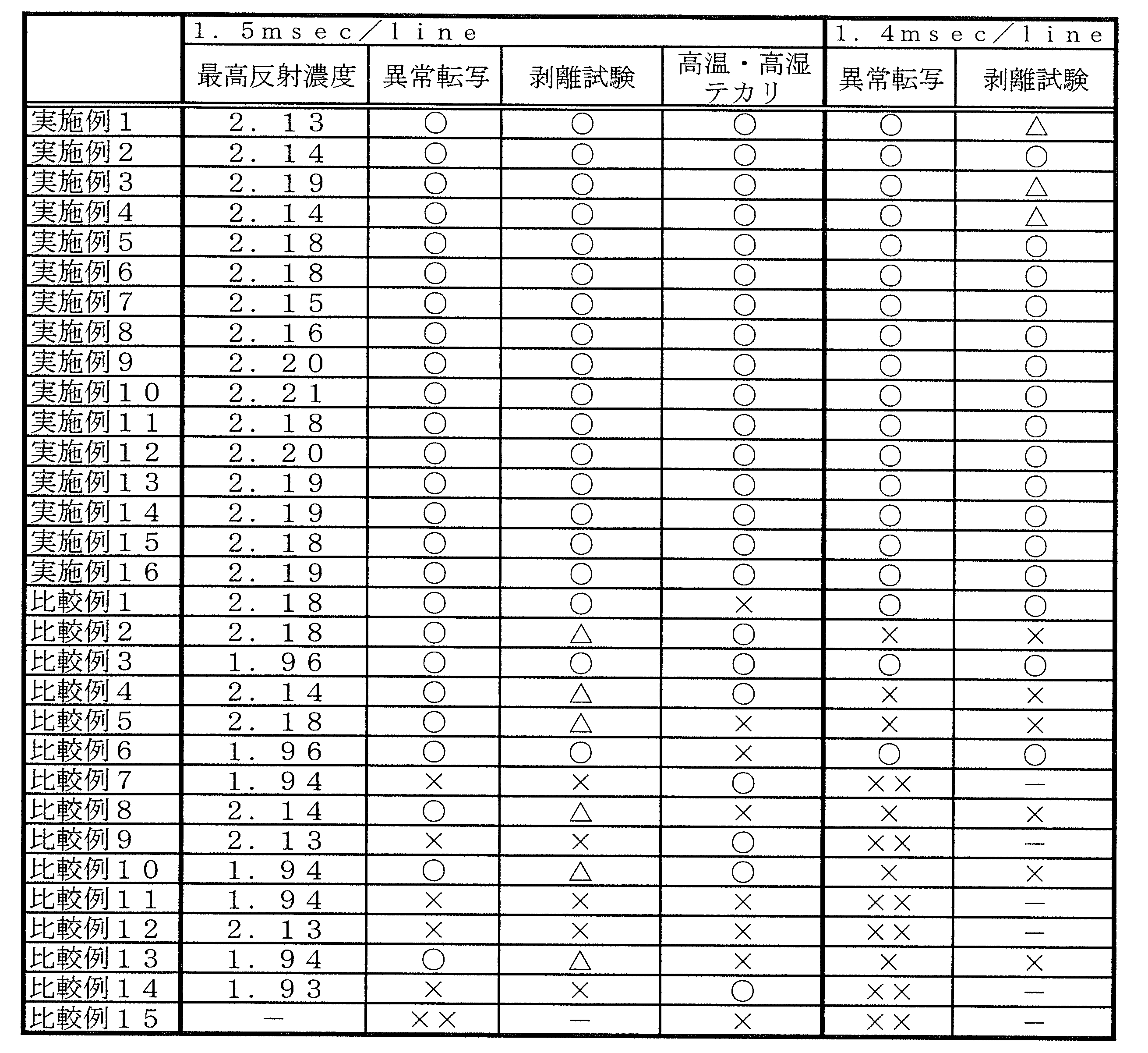
また、実施例3、5、6、9、10、13、14では水溶性高分子をポリビニルアルコールとすることで、また、実施例7、8、11、12、15、16では水溶性高分子をポリビニルピロリドンとすることで、最高反射濃度が更に大きくなり、本発明による効果が確認できた。
また、実施例4、9~12ではテトラエトキシシランを用いることで、また、実施例13~16ではトリイソプロポキシアルミニウムを用いることで、昨今の高速印画プリンタ相当の印画速度である1.5msec/lineでは、最高反射濃度も十分に高く、異常転写の不具合も発生しなかった。また、上記物質を用いることで、剥離試験においても熱転写受像シートの各層が剥離することなく、十分な密着強度を有しており、本発明による効果が確認できた。
また、比較例2、5、7、9、11、12、14の熱転写受像シートは、下引き層にウレタン系樹脂を用いなかったため、1.5msec/lineの印画速度においては、剥離試験では断熱層と下地層間で一部分が剥離するか、異常転写が発生してしまうことが確認できた。また、1.4msec/lineの印画速度においては、異常転写が発生する結果となった。
また、比較例4、8、9、10、12、13、14の熱転写受像シートは、下引き層に塩化錫、アルコキシド及びその加水分解物の少なくとも一つを用いなかったため、1.5msec/lineの印画速度においては、剥離試験では断熱層と下地層間で一部分が剥離するか、異常転写が発生してしまうことが確認できた。また、1.4msec/lineの印画速度においては、異常転写が発生する結果となった。
また、比較例15の熱転写受像シートは、染料受容層と断熱層との間に下引き層を設けなかったことにより、全面に異常転写が発生してしまった。その結果、最高反射濃度の測定も実施できなかった。
一般に、熱転写記録媒体は、熱転写方式のプリンタに使用され、サーマルリボンと呼ばれるインクリボンのことである。この熱転写記録媒体は、基材の一方の面に熱転写層、その基材の他方の面に耐熱滑性層(バックコート層)を設けた構成となっている。ここで熱転写層は、インクの層であって、プリンタのサーマルヘッドに発生する熱によって、そのインクが昇華(昇華転写方式)あるいは溶融(溶融転写方式)して、熱転写受像シート側に転写されるものである。
さらに昨今の高速印画プリンタにおいて、特に高温・高湿環境下における印画では、熱転写層と染料受容層が熱融着することで色相変動が起こり、その結果、印画物表面が部分的にマット化して最高反射濃度が低下する、いわゆる「テカリ」が発生するようになってきた。
また特許文献2では、ポリオレフィン支持体と染料受容層との間に、チタン酸有機塩又はチタニウムアルコキシドから形成されるチタンの酸化物である無機主鎖を有するポリマーからなる下塗り層を設けることで、染料受容層の支持体への粘着を改善した染料受容素子が提案されている。
また、特許文献2及び3に提案されている染料受容素子を用いて、昨今の高速印画プリンタにて印画を行ったところ、十分な印画濃度を得ることができなかった。そのうえ、染料受容層が熱転写層表面に融着する異常転写が発生してしまった。
また特許文献4及び5に提案されている熱転写受像シートを用いて、昨今の高速印画プリンタにて印画を行ったところ、高温・高湿環境下では実用上問題となるコゲ(テカリ)が発生することがわかった。
しかしながら、従来技術に係る熱転写受像シートには、昨今の高速印画プリンタを用いて高速印画を行った場合、印画濃度が低く、基材密着性も良好ではなく、かつ高温・高湿環境下で高速印画を行うとテカリが発生するものがある。
(1)上述の課題を有する従来技術に係る熱転写受像シートに対し、本実施形態に係る熱転写受像シート1であれば、基材2の一方の面に、断熱層3、下引き層4及び染料受容層5が順次積層されており、下引き層4を、アルコキシド、アルコキシドの加水分解物及び塩化錫の少なくとも一つと、水溶性高分子と、ビニルピロリドン-ビニルイミダゾール共重合体と、ウレタン系樹脂とを用いて形成される重縮合物を主成分とするものとしている。
このような構成であれば、昨今の高速印画プリンタを用いて高速印画を行っても、印画濃度が十分に高く、基材密着性、特に断熱層3及び染料受容層5との密着性が良好であり、かつ高温・高湿環境下で高速印画を行ってもテカリの発生を軽減することができる。
このような構成であれば、層間における密着強度を高めることができる。このため、昨今の高速印画プリンタより速い速度で印画を行っても、熱転写受像シートのいずれの層からも剥離することがない。
このような構成であれば、最高反射濃度をさらに高くすることができる。
このような構成であれば、昨今の高速印画プリンタ相当の印画速度であっても、最高反射濃度を十分に高くすることができる。また、異常転写の不具合も低減することができる。さらに、層間における密着強度を高めることができる。
このような構成であれば、昨今の高速印画プリンタを用いて高速印画を行っても、印画濃度が十分に高く、基材密着性、特に断熱層3及び染料受容層5との密着性が良好であり、かつ高温・高湿環境下で高速印画を行ってもテカリの発生を軽減した熱転写受像シート1を製造することができる。
このような構成であれば、層間における密着強度を高めた熱転写受像シート1を製造することができる。このため、昨今の高速印画プリンタより速い速度で印画を行っても、熱転写受像シートのいずれの層からも剥離することがない熱転写受像シート1を製造することができる。
このような構成であれば、最高反射濃度をさらに高くした熱転写受像シート1を製造することができる。
このような構成であれば、昨今の高速印画プリンタ相当の印画速度で印画しても、最高反射濃度が十分に高い熱転写受像シート1を製造することができる。また、異常転写の不具合を低減した熱転写受像シート1を製造することができる。さらに、層間における密着強度を高めた熱転写受像シート1を製造することができる。
2:基材
3:断熱層
4:下引き層
5:染料受容層
Claims (8)
- 基材の一方の面に、断熱層、下引き層及び染料受容層を順次積層して形成した熱転写受像シートにおいて、
前記下引き層は、アルコキシド、アルコキシドの加水分解物及び塩化錫の少なくとも一つと、水溶性高分子と、ビニルピロリドン-ビニルイミダゾール共重合体と、ウレタン系樹脂とを用いて形成される重縮合物を主成分としていることを特徴とする熱転写受像シート。 - 前記ウレタン系樹脂は、エステル系ポリウレタン樹脂及びアイオノマー型ポリウレタン樹脂の少なくとも一方であることを特徴とする請求項1に記載の熱転写受像シート。
- 前記水溶性高分子は、ポリビニルアルコール及びポリビニルピロリドンの少なくとも一方であることを特徴とする請求項1又は請求項2に記載の熱転写受像シート。
- 前記アルコキシドは、テトラエトキシシラン及びトリイソプロポキシアルミニウムの少なくとも一方であることを特徴とする請求項1から請求項3のいずれか1項に記載の熱転写受像シート。
- 基材の一方の面に、断熱層、下引き層及び染料受容層を順次積層して形成される熱転写受像シートの製造方法であって、
前記下引き層を、アルコキシド、アルコキシドの加水分解物及び塩化錫の少なくとも一つと、水溶性高分子と、ビニルピロリドン-ビニルイミダゾール共重合体と、ウレタン系樹脂とが形成後の下引き層において主成分となるように調整した塗布液を前記断熱層上に塗布し乾燥して、形成することを特徴とする熱転写受像シートの製造方法。 - 前記ウレタン系樹脂は、エステル系ポリウレタン樹脂及びアイオノマー型ポリウレタン樹脂の少なくとも一方であることを特徴とする請求項5に記載の熱転写受像シートの製造方法。
- 前記水溶性高分子は、ポリビニルアルコール及びポリビニルピロリドンの少なくとも一方であることを特徴とする請求項5又は請求項6に記載の熱転写受像シートの製造方法。
- 前記アルコキシドは、テトラエトキシシラン及びトリイソプロポキシアルミニウムの少なくとも一方であることを特徴とする請求項5から請求項7のいずれか1項に記載の熱転写受像シートの製造方法。
Priority Applications (4)
| Application Number | Priority Date | Filing Date | Title |
|---|---|---|---|
| CN201580038288.4A CN106536211B (zh) | 2014-07-17 | 2015-07-14 | 热转印图像接收片材及其制造方法 |
| EP15821806.5A EP3170676B1 (en) | 2014-07-17 | 2015-07-14 | Thermal transfer image receiving sheet and method for producing same |
| JP2016534282A JP6558369B2 (ja) | 2014-07-17 | 2015-07-14 | 熱転写受像シート及びその製造方法 |
| US15/407,393 US9987867B2 (en) | 2014-07-17 | 2017-01-17 | Thermal transfer image receiving sheet and method for fabricating the same |
Applications Claiming Priority (2)
| Application Number | Priority Date | Filing Date | Title |
|---|---|---|---|
| JP2014-146979 | 2014-07-17 | ||
| JP2014146979 | 2014-07-17 |
Related Child Applications (1)
| Application Number | Title | Priority Date | Filing Date |
|---|---|---|---|
| US15/407,393 Continuation US9987867B2 (en) | 2014-07-17 | 2017-01-17 | Thermal transfer image receiving sheet and method for fabricating the same |
Publications (1)
| Publication Number | Publication Date |
|---|---|
| WO2016009643A1 true WO2016009643A1 (ja) | 2016-01-21 |
Family
ID=55078151
Family Applications (1)
| Application Number | Title | Priority Date | Filing Date |
|---|---|---|---|
| PCT/JP2015/003559 Ceased WO2016009643A1 (ja) | 2014-07-17 | 2015-07-14 | 熱転写受像シート及びその製造方法 |
Country Status (6)
| Country | Link |
|---|---|
| US (1) | US9987867B2 (ja) |
| EP (1) | EP3170676B1 (ja) |
| JP (1) | JP6558369B2 (ja) |
| CN (1) | CN106536211B (ja) |
| TW (1) | TWI681023B (ja) |
| WO (1) | WO2016009643A1 (ja) |
Cited By (3)
| Publication number | Priority date | Publication date | Assignee | Title |
|---|---|---|---|---|
| JP2016068541A (ja) * | 2014-10-02 | 2016-05-09 | 凸版印刷株式会社 | 熱転写受像シートおよびその製造方法 |
| WO2019093042A1 (ja) | 2017-11-13 | 2019-05-16 | ヤーマン株式会社 | 美容マスク |
| US12133855B2 (en) | 2018-02-01 | 2024-11-05 | Trustees Of Tufts College | Lipid-like nanocomplexes and uses thereof |
Families Citing this family (5)
| Publication number | Priority date | Publication date | Assignee | Title |
|---|---|---|---|---|
| JP7283885B2 (ja) * | 2018-11-05 | 2023-05-30 | サカタインクス株式会社 | 水性プライマー組成物とインクのセット及び印刷物 |
| CN115635786B (zh) * | 2022-09-28 | 2025-04-08 | 湖南鼎一致远科技发展有限公司 | 一种适用于热升华软标印刷的高浓度和高均匀性的铜版纸涂层 |
| CN115431656B (zh) * | 2022-10-19 | 2024-05-31 | 湖南鼎一致远科技发展有限公司 | 一种适用于热升华软标印刷的pet膜涂层 |
| WO2025184336A2 (en) * | 2024-02-27 | 2025-09-04 | Sts Refill Technology, Llc | Method of fabricating a thermal transfer image |
| CN119388898B (zh) * | 2024-09-18 | 2025-10-21 | 湖南鼎一致远科技发展股份有限公司 | 一种热转印接收片及其制备方法 |
Citations (4)
| Publication number | Priority date | Publication date | Assignee | Title |
|---|---|---|---|---|
| JP2006272926A (ja) * | 2005-03-30 | 2006-10-12 | Dainippon Printing Co Ltd | 熱転写受像シート |
| JP2012196958A (ja) * | 2011-03-07 | 2012-10-18 | Dainippon Printing Co Ltd | 熱転写受像シート |
| JP2012196852A (ja) * | 2011-03-22 | 2012-10-18 | Toppan Printing Co Ltd | 感熱転写記録媒体 |
| JP2012206351A (ja) * | 2011-03-29 | 2012-10-25 | Toppan Printing Co Ltd | 感熱転写記録媒体 |
Family Cites Families (7)
| Publication number | Priority date | Publication date | Assignee | Title |
|---|---|---|---|---|
| US4965238A (en) | 1989-12-11 | 1990-10-23 | Eastman Kodak Company | Thermal dye transfer receiving element with subbing layer for dye image-receiving layer |
| US4965239A (en) | 1989-12-11 | 1990-10-23 | Eastman Kodak Company | Thermal dye transfer receiving element with subbing layer for dye image-receiving layer |
| JP4319964B2 (ja) * | 2004-10-25 | 2009-08-26 | 大日本印刷株式会社 | 熱転写シート |
| JP2009160829A (ja) * | 2008-01-08 | 2009-07-23 | Oji Paper Co Ltd | 熱転写受容シート |
| JP4983616B2 (ja) * | 2008-01-16 | 2012-07-25 | ソニー株式会社 | 熱転写記録媒体 |
| WO2012121096A1 (ja) * | 2011-03-07 | 2012-09-13 | 大日本印刷株式会社 | 熱転写受像シート、及び熱転写受像シートの製造方法 |
| JP5786743B2 (ja) | 2011-03-31 | 2015-09-30 | 大日本印刷株式会社 | 熱転写受像シート、及び熱転写受像シートの製造方法 |
-
2015
- 2015-07-14 WO PCT/JP2015/003559 patent/WO2016009643A1/ja not_active Ceased
- 2015-07-14 JP JP2016534282A patent/JP6558369B2/ja not_active Expired - Fee Related
- 2015-07-14 EP EP15821806.5A patent/EP3170676B1/en not_active Not-in-force
- 2015-07-14 CN CN201580038288.4A patent/CN106536211B/zh not_active Expired - Fee Related
- 2015-07-16 TW TW104123027A patent/TWI681023B/zh not_active IP Right Cessation
-
2017
- 2017-01-17 US US15/407,393 patent/US9987867B2/en not_active Expired - Fee Related
Patent Citations (4)
| Publication number | Priority date | Publication date | Assignee | Title |
|---|---|---|---|---|
| JP2006272926A (ja) * | 2005-03-30 | 2006-10-12 | Dainippon Printing Co Ltd | 熱転写受像シート |
| JP2012196958A (ja) * | 2011-03-07 | 2012-10-18 | Dainippon Printing Co Ltd | 熱転写受像シート |
| JP2012196852A (ja) * | 2011-03-22 | 2012-10-18 | Toppan Printing Co Ltd | 感熱転写記録媒体 |
| JP2012206351A (ja) * | 2011-03-29 | 2012-10-25 | Toppan Printing Co Ltd | 感熱転写記録媒体 |
Cited By (3)
| Publication number | Priority date | Publication date | Assignee | Title |
|---|---|---|---|---|
| JP2016068541A (ja) * | 2014-10-02 | 2016-05-09 | 凸版印刷株式会社 | 熱転写受像シートおよびその製造方法 |
| WO2019093042A1 (ja) | 2017-11-13 | 2019-05-16 | ヤーマン株式会社 | 美容マスク |
| US12133855B2 (en) | 2018-02-01 | 2024-11-05 | Trustees Of Tufts College | Lipid-like nanocomplexes and uses thereof |
Also Published As
| Publication number | Publication date |
|---|---|
| US9987867B2 (en) | 2018-06-05 |
| TW201610044A (zh) | 2016-03-16 |
| EP3170676A4 (en) | 2018-03-21 |
| JPWO2016009643A1 (ja) | 2017-05-25 |
| CN106536211B (zh) | 2018-11-09 |
| EP3170676B1 (en) | 2020-09-09 |
| US20170120653A1 (en) | 2017-05-04 |
| CN106536211A (zh) | 2017-03-22 |
| TWI681023B (zh) | 2020-01-01 |
| EP3170676A1 (en) | 2017-05-24 |
| JP6558369B2 (ja) | 2019-08-14 |
Similar Documents
| Publication | Publication Date | Title |
|---|---|---|
| JP6558369B2 (ja) | 熱転写受像シート及びその製造方法 | |
| JP5585351B2 (ja) | 感熱転写記録媒体 | |
| JP2012206351A (ja) | 感熱転写記録媒体 | |
| JP6273964B2 (ja) | 熱転写受像シート及びその製造方法 | |
| JP6369270B2 (ja) | 熱転写受像シートおよびその製造方法 | |
| JP6183116B2 (ja) | 熱転写受像シート及びその製造方法 | |
| JP2016060053A (ja) | 保護層付き熱転写シート | |
| JP5640799B2 (ja) | 感熱転写記録媒体 | |
| JP5640847B2 (ja) | 感熱転写記録媒体 | |
| JP5674242B2 (ja) | 感熱転写記録媒体 | |
| JP5891885B2 (ja) | 感熱転写記録媒体 | |
| JP6255940B2 (ja) | 熱転写受像シート及びその製造方法 | |
| JP5751436B2 (ja) | 感熱転写記録媒体 | |
| JP5924032B2 (ja) | 感熱転写記録媒体 | |
| JP5924056B2 (ja) | 感熱転写記録媒体 | |
| JP2014237289A (ja) | 感熱転写記録媒体 | |
| JP5659652B2 (ja) | 感熱転写記録媒体 | |
| JP6375844B2 (ja) | 熱転写受像シート及びその製造方法 | |
| JP2010234733A (ja) | 熱転写シート | |
| JP2017052106A (ja) | 昇華転写用受像シート | |
| JP5862378B2 (ja) | 感熱転写記録媒体 | |
| JP6273938B2 (ja) | 感熱転写記録媒体 | |
| JP2012071512A (ja) | 感熱転写記録媒体 | |
| JP2012066466A (ja) | 感熱転写記録媒体 | |
| JP2017077630A (ja) | 熱転写受像シート |
Legal Events
| Date | Code | Title | Description |
|---|---|---|---|
| 121 | Ep: the epo has been informed by wipo that ep was designated in this application |
Ref document number: 15821806 Country of ref document: EP Kind code of ref document: A1 |
|
| REEP | Request for entry into the european phase |
Ref document number: 2015821806 Country of ref document: EP |
|
| WWE | Wipo information: entry into national phase |
Ref document number: 2015821806 Country of ref document: EP |
|
| ENP | Entry into the national phase |
Ref document number: 2016534282 Country of ref document: JP Kind code of ref document: A |
|
| NENP | Non-entry into the national phase |
Ref country code: DE |