WO2016010091A1 - Structure de maille - Google Patents
Structure de maille Download PDFInfo
- Publication number
- WO2016010091A1 WO2016010091A1 PCT/JP2015/070316 JP2015070316W WO2016010091A1 WO 2016010091 A1 WO2016010091 A1 WO 2016010091A1 JP 2015070316 W JP2015070316 W JP 2015070316W WO 2016010091 A1 WO2016010091 A1 WO 2016010091A1
- Authority
- WO
- WIPO (PCT)
- Prior art keywords
- stitch
- fabric
- thread
- tape
- seam
- Prior art date
- Legal status (The legal status is an assumption and is not a legal conclusion. Google has not performed a legal analysis and makes no representation as to the accuracy of the status listed.)
- Ceased
Links
Images







Classifications
-
- A—HUMAN NECESSITIES
- A41—WEARING APPAREL
- A41D—OUTERWEAR; PROTECTIVE GARMENTS; ACCESSORIES
- A41D27/00—Details of garments or of their making
- A41D27/24—Hems; Seams
-
- D—TEXTILES; PAPER
- D05—SEWING; EMBROIDERING; TUFTING
- D05B—SEWING
- D05B1/00—General types of sewing apparatus or machines without mechanism for lateral movement of the needle or the work or both
- D05B1/08—General types of sewing apparatus or machines without mechanism for lateral movement of the needle or the work or both for making multi-thread seams
- D05B1/10—Double chain-stitch seams
-
- D—TEXTILES; PAPER
- D05—SEWING; EMBROIDERING; TUFTING
- D05B—SEWING
- D05B93/00—Stitches; Stitch seams
Definitions
- This disclosure relates to a stitch structure.
- a flat seamer is, for example, a sewing machine that uses four needles, has four stitches, four needle threads, one lower thread, and one upper decoration thread, and has a flat seam. It is a method (for example, refer patent document 1, patent document 2).
- the sewing machine for a flat seam is a flat seam sewing machine, and a seam formed by the flat seam is called a flat seam.
- the sewn portion is stitched in a state where the fabric ends are butted together, so that the sewing portion is soft and there are few irregularities.
- clothes sewn with a flat seamer do not have a seam allowance on the back side of the fabric, so that the seam allowance is not applied to the skin and the stress on the skin is reduced. That is, it provides a good comfort for the wearer.
- the flat seamer is easier to cope with the elongation of the fabric than the ordinary sewing method, and the strength and durability of the sewing portion are very excellent. For this reason, flat seamers are widely used in sportswear such as underwear, swimwear, various sports uniforms, and wet suits.
- an object of the present disclosure is to provide a seam structure with less skin contact and excellent quality.
- the present disclosure is a first fabric having a first end and a second fabric having a second end, and the direction in which the second end extends is substantially parallel to the direction in which the first end extends.
- the second fabric is disposed by being adjacent to the first fabric, the first thread, the first stitch extending in the direction substantially parallel to the direction in which the first end extends, and the second thread.
- a second seam extending in a direction substantially parallel to the direction in which the second end extends, a third seam formed by a decorative thread, and a tape-like member having a base and an adhesive portion, and a first surface
- a second seam structure wherein the first thread is arranged so that at least the first fabric reciprocates and penetrates in the thickness direction at the first seam.
- the second thread is arranged so as to pass through at least the second fabric repeatedly reciprocating in its thickness direction.
- a third seam is disposed on the first surface, and at the third seam, the decorative thread is disposed so as to repeatedly span at least the first thread and the second thread, and the tape
- the seam structure is characterized in that the first member is disposed on the second surface, and the adhesive portion of the tape-like member bonds the first fabric and the second fabric.
- the stitch structure of the present disclosure has little skin contact and is excellent in quality.
- FIG. 1 is a schematic cross-sectional view of a stitch structure 1 according to the first embodiment of the present disclosure.
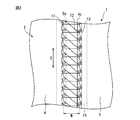
- FIG. 2 is a schematic plan view of the first surface 2 of the stitch structure 1 according to the first embodiment of the present disclosure.
- FIG. 3 is a schematic plan view of the second surface 3 of the stitch structure 1 according to the first embodiment of the present disclosure.
- FIG. 4 is a perspective view illustrating an example of a sewing machine used to form the stitch structure of the present disclosure.
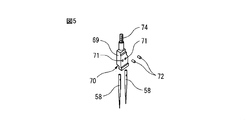
- FIG. 5 is an exploded perspective view showing a needle basket and each needle in the sewing machine shown in FIG.
- FIG. 6 is a perspective view showing movement paths of the needle and the lower looper.
- FIG. 7 is a diagram schematically showing how two fabrics are stitched together using the sewing machine shown in FIG. FIG.
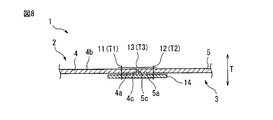
- FIG. 8 is a schematic cross-sectional view of a stitch structure according to the second embodiment of the present disclosure.
- FIG. 9 is a schematic cross-sectional view of a stitch structure according to the third embodiment of the present disclosure.
- FIG. 10 is a schematic cross-sectional view of a stitch structure according to the fourth embodiment of the present disclosure.
- FIG. 1 is a cross-sectional view
- FIG. 2 is a plan view of a first surface 2 of the stitch structure 1.
- FIG. 1 is a cross-sectional view
- FIG. 2 is a plan view of a first surface 2 of the stitch structure 1.
- the stitch structure 1 of the present disclosure is formed by a first fabric 4 having a first end 4a, a second fabric 5 having a second end 5a, and a first thread T1, and the first end 4a extends.
- a first stitch 11 extending in a direction substantially parallel to the direction D and a second thread T2
- a second stitch 12 extending in a direction substantially parallel to the direction D in which the second end 5a extends, and a decorative thread T3
- a tape-like member 14 having a base portion and an adhesive portion, and has a first surface 2 and a second surface 3.
- the first seam 11 and the second seam 12 are disposed so as to extend in a substantially parallel direction (direction D) with a certain width W therebetween.
- the first fabric 4 and the second fabric 5 are adjacent so that the direction in which the first end 4a extends and the direction in which the second end 5a extends extend in a substantially parallel direction (direction D). Are arranged.
- the first fabric 4 and the second fabric 5 are arranged in a state where the first end 4 a and the second end 5 a overlap in the thickness direction T of the stitch structure 1.
- the first thread T ⁇ b> 1 is disposed so as to repeatedly reciprocate in the thickness direction T of the first fabric 4 and the tape-shaped member 14 through the first fabric 4 and the tape-shaped member 14. Yes.
- the first thread T ⁇ b> 1 is on the second surface 3 side of the stitch structure 1 of the surface 4 b of the first fabric 4 on the first surface 2 side of the stitch structure 1 and the tape-like member 14. It is reciprocating repeatedly between the surface 14a.
- the second thread T2 is arranged so as to repeatedly reciprocate through the second fabric 5 and the tape-like member 14 in the thickness direction T of the second fabric 5 and the tape-like member 14.
- the second thread T ⁇ b> 2 is a surface 4 b of the first fabric 4 on the first surface 2 side of the seam structure 1 and a tape-like member 14 on the second surface 3 side of the seam structure 1. It is reciprocating repeatedly between the surface 14a.
- the third seam 13 is disposed on the first surface 2 side of the seam structure 1, and at the third seam 13, the decorative thread T3 is repeatedly stretched between the first thread T1 and the second thread T2. Has been placed.
- the third stitch 13 meanders between the first thread T1 and the second thread T2.
- the tape-shaped member 14 is disposed on the second surface 3 side, and the adhesive portion of the tape-shaped member 14 bonds the first fabric 4 and the second fabric 5.
- the end surface 4 c of the first end 4 a of the first fabric 4 and the end surface 5 c of the second end 5 a of the second fabric 5 are between the first stitch 11 and the second stitch 12. Exists.
- the wearer is less likely to feel the skin.
- the 2nd surface 3 since the junction part of the 1st fabric 4 and the 2nd fabric 5 is covered with the tape-shaped member 14, it is excellent in quality.
- the end surface 4 c of the first end 4 a of the first fabric 4 and the end surface 5 c of the second end 5 a of the second fabric 5 include the first stitch 11 and the first stitch 4.
- at least the end surface of the first end portion of the first fabric is present between the first stitch and the second stitch, so that the end surface of the first end portion exists. Is covered with the third seam (decoration thread) and cannot be directly visually recognized from the outside, so that it is excellent in quality such as beauty.
- the end surface of the second end portion of the second fabric may not exist between the first stitch and the second stitch.
- the end surface 5 c of the second end 5 a of the second fabric 5 exists between the first seam 11 and the second seam 12.
- the end surface of the second end portion of the second fabric exists on the outer side of the first stitch (on the side opposite to the second stitch). If the tape-like member adheres the first fabric and the second fabric, that is, covers the end surface of the second end of the second fabric, the problem of touch caused by the end surface of the second end is unlikely to occur. Because. Further, since the end surface of the second end portion of the second fabric exists outside the first stitch, the first stitch repeatedly reciprocates at least the first fabric and the second fabric in the thickness direction. Since it arrange
- the first thread T1 repeatedly reciprocates in the thickness direction T through the first fabric 4 and the tape-like member 14.
- the strength of the seam structure is increased by arranging the first seam so as to repeatedly reciprocate and penetrate the member including the tape-like member in the thickness direction thereof. Become.
- the strength of the seam structure is increased by arranging the member including the tape-like member so as to reciprocate and penetrate in the thickness direction.
- the first fabric and the second fabric are not particularly limited, and include fabrics that are usually used in the art, such as woven fabrics, knitted fabrics, and nonwoven fabrics.
- the yarns such as the first yarn, the second yarn, and the decorative yarn (and the third yarn and the fourth yarn described later) include those commonly used in the art, for example, for flat seams.
- the first fabric And the thing which is easy to extend is preferable so that the elongation of a 2nd fabric may not be inhibited.
- the base of the tape-shaped member is not particularly limited, and examples thereof include fabrics such as woven fabrics, knitted fabrics, and non-woven fabrics. Preferably there is. Further, when the base portion of the tape-shaped member is a knitted fabric and the first stitch and the second stitch are exposed on the surface of the tape-shaped member, the first stitch and the second stitch are configured, respectively. Since the 1st yarn and the 2nd yarn can sink into the base which is a knitted fabric, the touch nature of the 2nd surface improves.
- the thickness of the tape-shaped member is thinner than when it is a knitted fabric, but the first and second stitches are less likely to sink into the base and are worn. A person tends to feel the first and second stitches on the second surface, and the touch tends to decrease.
- a tape-shaped member As an adhesive part of a tape-shaped member, what is normally used in this technical field is mentioned, For example, what has adhesiveness at room temperature, what has adhesiveness by heating, etc. are mentioned.
- the tape-shaped member include a base having a polyester knitted fabric and a polyurethane hot melt adhesive. The said tape-shaped member adhere
- the tape-shaped member has a certain thickness also from the viewpoint described above.
- the thickness of the tape-shaped member is not particularly limited, but is preferably about 0.1 mm to 0.5 mm, for example.
- FIG. 4 is a perspective view showing an example of the sewing machine 50 used to form the stitch structure 1 of the present embodiment.
- This sewing machine 50 basically has the same configuration as a conventional four-needle flat seamer.
- the first two stitches and the second stitches are formed with two inner needle threads in a state where the two outer needles and needle threads of the four needles and the upper decoration thread are removed.
- the stitches and the decorative thread on the first surface are formed with the lower thread.
- the sewing machine 50 includes a sewing machine main body 52 fixed to the base 51 and a bed 53 provided to extend from the sewing machine main body 52.
- the sewing machine main body 52 is substantially L-shaped and has a rising portion 54 that rises upward from the base 51, a horizontal portion 55 that is bent at a substantially right angle from the upper end portion of the rising portion 54 and extends in the horizontal direction, A needle bar guide 56 provided at the tip of the horizontal portion 55.
- a needle bar 57 is accommodated in the needle bar guide 56 in a state where the needle bar 57 can reciprocate in the vertical direction and the upper end protrudes upward from the needle bar guide 56.
- the needle bar 57 receives power from a motor (not shown) provided in the base 51 and reciprocates in the vertical direction.
- Two needles 58 are provided at the lower end of the needle bar 57 below the needle bar guide 56. The two needles 58 move up and down as the needle bar 57 is driven to move up and down.
- the bed 53 extends in a substantially horizontal direction from the rising portion 54 of the sewing machine main body 52, and is arranged so that the tip thereof faces two needles 58 provided on the needle bar guide portion 56.
- a lower looper 61 is provided inside the bed 53 in the vicinity of the front end thereof, that is, at a position facing the lower side of the needle 58.
- the lower looper 61 moves in an elliptical orbit in synchronization with the vertical movement of the needle 58.
- Needle thread T11 is supplied to the two needles 58 from a thread winding reel (not shown) via a first thread guide piece 62, a second thread guide piece 63, and a third thread guide piece 64.
- each needle thread T11 is individually adjusted by a tension adjusting means 65 interposed between the first thread guide piece 62 and a thread winding reel (not shown).
- the decorative yarn T12 is supplied to the lower looper 61 through a tension adjusting means 68 from a thread winding reel (not shown) through the sewing machine main body 52. Thereby, the tension of the decorative thread T12 supplied to the lower looper 61 is easily adjusted.
- the tape-like member 14 faces the fabric cutter 90 that cuts the first end of the first fabric and the second end of the second fabric, and between the fabric cutter 90 and the needle 58. And a tape-like member supply means (not shown) for supplying.
- the tape-like member 14 is stacked on the first fabric and the second fabric through the guide hole 91.
- FIG. 5 is an exploded perspective view showing the needle basket 69 and the two needles 58.
- the needle basket 69 has a substantially rectangular cross section and has an insertion hole 70 into which the two needles 58 are inserted.
- the two needles 58 are inserted into the insertion hole 70, and the mounting bolt 72 is screwed into the screw hole 71 to be attached to the needle cage 69.
- the insertion hole 70 has a rectangular shape, and the two needles 58 are mounted side by side in the width direction of the needle basket 69.
- Two needles 58 are attached to the needle basket 69, and the needle basket 69 is screwed onto the needle bar 57 with a mounting portion 74 having an external thread formed on the side opposite to the side on which the two needles 58 are attached. By attaching, the two needles 58 are attached to the needle bar 57.
- FIG. 6 is a perspective view showing movement paths of the needle 58 and the lower looper 61 in the sewing machine 50.
- An insertion hole 81 is formed near the tip of the needle 58, and the needle thread T ⁇ b> 11 is inserted through the insertion hole 81.
- the needle 58 reciprocates up and down to form a first stitch (and a second stitch).
- the lower looper 61 is long and has a sharp tip 85.
- a decorative thread T12 is inserted through the lower looper 61 from the rear end 86 side to the vicinity of the front end 85.
- the decorative thread T12 is operated by the lower looper 61 to form the third stitch.
- the lower looper 61 is moved in an elliptical shape so as to surround the passage route of the needle 58 in a plane substantially perpendicular to the vertical direction of the needle 58. Such movement of the lower looper 61 on the elliptical orbit is performed in synchronization with the vertical movement of the needle 58.
- FIG. 7 is a diagram schematically illustrating a state in which two fabrics are stitched together using the sewing machine 50.
- the first fabric 4 and the second fabric 5 are arranged along the lap former 92 in a state where the first end 4a and the second end 5a are combined with the surface forming the second surface 3 facing upward. Enter the sewing machine 50.
- the fabric cutter 90 cuts a seam allowance portion (a part of the first end portion 4a) of the first fabric 4 and a seam allowance portion (a part of the second end portion 5a) of the second fabric 5.
- the tape-like member 14 is supplied between the fabric cutter 90 and the needle 58 through a guide hole 91 from a tape-like member supply unit (not shown). Appropriate tension is applied to the tape-like member 14 by tension adjusting means (not shown).
- the tape-shaped member 14 is disposed so as to cover the first end 4 a of the first fabric 4 and the second end 5 a of the second fabric 5.
- the first fabric 4, the second fabric 5, and the tape-shaped member 14 are sewn together by the two needle threads T11 that penetrate the tape-shaped member 14 in the thickness direction.
- the decorative thread T12 is engaged between the two needle threads T11 so that the two needle threads T11 are alternately routed.
- the portion including the tape-like member 14 is heated, and the tape-like member 14 is bonded to the first fabric 4 and the second fabric 5.
- the heating can be performed in a separate process from the sewing process by a hot press device provided separately from the sewing machine 50. Further, a heating press device can be provided immediately after the sewing machine 50, and the heating can be performed following the sewing process. The heating is performed by a method known in the art.
- FIG. 8 is a cross-sectional view schematically showing the stitch structure 1 of the present embodiment.
- the 1st fabric 4 and the 2nd fabric 5 are arrange
- the first thread T ⁇ b> 1 repeatedly reciprocates the first fabric 4 and the tape-shaped member 14 in the thickness direction T of the first fabric 4 and the tape-shaped member 14.
- the second thread T2 repeats the second fabric 5 and the tape-like member 14 in the thickness direction T of the second fabric 5 and the tape-like member 14 at the second stitch 12. It arrange
- the second surface 3 of the stitch structure 1 is used on the skin side of the wearer, but in the present embodiment, the thickness of the stitch structure can be reduced, The skin contact is improved when worn.
- FIG. 9 is a cross-sectional view schematically showing the stitch structure 1 of the present embodiment.
- the first thread T1 is disposed so as to repeatedly reciprocate through the first fabric 4 in the thickness direction T of the first fabric, and the second stitch.
- the second thread T2 is arranged so as to repeatedly reciprocate and penetrate the second fabric 5 in the thickness direction T of the second fabric 5.
- the first seam 11 and the second seam 12 do not penetrate the tape-like member 14, and the tape-like member 14 is above the first seam 11 and the second seam 12. Therefore, the first fabric 4 and the second fabric 5 are bonded.
- the second surface 3 of the seam structure 1 is used on the skin side of the wearer. However, in the present embodiment, when the wearer wears the first stitch 11 and Since it becomes difficult to feel the second stitch 12, the skin contact is improved.
- FIG. 10 is a cross-sectional view schematically showing the stitch structure 1 of the present embodiment.
- the stitch structure 1 includes a fourth stitch 21 from the first stitch 11 and a fifth stitch from the second stitch 12 between the first stitch 11 and the second stitch 12. And eyes 22.
- the third thread T4 is arranged so as to repeatedly reciprocate in the thickness direction T of the first fabric 4 and the tape-like member 14 through the first fabric 4 and the tape-like member 14.
- the fourth stitch 21 extends in a direction (not shown) substantially parallel to the direction (not shown) in which the first stitch 11 extends.
- the fourth thread T5 is arranged so as to repeatedly reciprocate and penetrate the second fabric 5 and the tape-like member 14 in the thickness direction T of the second fabric 5 and the tape-like member 14. And extends in a direction (not shown) substantially parallel to a direction (not shown) in which the second seam 12 extends.
- the decorative thread T3 spans between the first thread T1, the second thread T2, the third thread T4, and the fourth thread T5.
- the stitch structure 1 includes a fourth stitch 21 and a fifth stitch 22 in addition to the first stitch 11 and the second stitch 12. However, since the first thread T1, the second thread T2, the third thread T4, and the fourth thread T5 are spanned, the strength of the stitch structure 1 is increased.
- the seam structure of the present disclosure is not limited to a flat seam sewing machine, but other sewing machines such as a flat two-needle sewing machine. Or a flat three-needle sewing machine or the like.
- the stitch structure of the present disclosure is, for example, that the first fabric and the second fabric are arranged at desired positions and are fixed with a tape-like member. Then, it can be formed by forming the first stitch, the second stitch, and the third stitch on the first fabric, the second fabric, and the tape-like member.
- the clothes including the stitch structure of the present disclosure are not particularly limited, and examples thereof include clothes that directly contact the wearer's skin, such as sports clothes, such as swimwear, compression wear, and underwear.
- Example 1 As examples of experiments for confirming the effects of the present disclosure, a sample of the stitch structure shown in FIGS. 1 to 3 and a sample of a stitch structure using a conventional flat seam (four needle threads, one lower thread and upper thread) A sample of the stitch structure with 6 stitches of one decorative thread) and a conventional double-needle double-sided ornament (after overlock), and a stitch structure with single-cut double-needle double-sided ornament Samples were made and their thicknesses were compared.
- the fabric (the first fabric and the second fabric) was a knitted fabric having a thickness of 0.45 mm.
- the tape-like member had a hot melt at the adhesive portion, a knitted base at the base, and a thickness of 0.2 mm.
- a polyester thread (No. 50) was used as the needle thread and the decorative thread.
- a polyester yarn (No. 50) was used as the needle yarn, and a polyna (No. 110) was used as the decorative yarn.
- the sample of the seam structure of the present disclosure has a thickness of 0.75 mm, and the sample of the seam structure by the conventional flat seam has a thickness of 1.44 mm and has a stitch of a double-needle double-sided ornament.
- the structural sample had a thickness of 1.93 mm, and the single-sided double-needle sample had a thickness of 1.44 mm.
- the stitch structure of the present disclosure can significantly reduce the thickness of the stitch portion as compared with the conventional stitch structure.
- the surface on the tape-like member side of the sample of the stitch structure according to the present disclosure had a smooth surface, and had less skin contact than other samples.
- the first thread is arranged so as to pass through the first fabric and the tape-like member repeatedly reciprocatingly in the thickness direction, and in the second seam, the second thread
- the seam structure according to any one of aspects 1 to 4 wherein the second fabric and the tape-like member are disposed so as to repeatedly reciprocate in the thickness direction thereof.
- the stitch structure has a fourth stitch from the first stitch and a fifth stitch from the second stitch between the first stitch and the second stitch, and the fourth stitch. Then, the third yarn is arranged so as to pass through at least the first fabric by reciprocating repeatedly in the thickness direction, and at the fifth stitch, the fourth yarn passes at least the second fabric.
- the stitch structure according to any one of aspects 1 to 6, wherein the stitch structure is disposed so as to repeatedly reciprocate and penetrate in the thickness direction.
Landscapes
- Engineering & Computer Science (AREA)
- Textile Engineering (AREA)
- Details Of Garments (AREA)
- Sewing Machines And Sewing (AREA)
Abstract
La présente invention vise à fournir une structure de maille étant légèrement en contact avec la peau et ayant une excellente qualité de produit. Cette structure de maille (1) comprend une première surface (2) et une seconde surface (3) et comprend : un premier tissu (4) ayant une première section d'extrémité (4a) ; un second tissu (5) ayant une seconde section d'extrémité (5a) ; un premier maillage (11) qui s'étend dans une direction sensiblement parallèle à la direction d'extension (D) de la première section d'extrémité (4a) ; un deuxième maillage (12) qui s'étend dans une direction sensiblement parallèle à la direction d'extension (D) de la seconde section d'extrémité (5a) ; un troisième maillage (13) ; et un élément en forme de bande (14). La structure de maille (1) est caractérisée par : un premier fil (T1) et un second fil (T2) disposés dans le premier maillage (11) et le deuxième maillage (12), respectivement, de façon à revenir et pénétrer de façon répétée dans au moins le premier tissu (4) et au moins le second tissu (5), dans la direction d'épaisseur de ces derniers ; un fil décoratif (T3) disposé dans le troisième maillage (13) de façon à s'étendre de façon répétée entre au moins le premier fil (T1) et le second fil (T2) ; et l'élément en forme de bande (14) reliant le premier tissu (4) et le second tissu (5).
Priority Applications (3)
| Application Number | Priority Date | Filing Date | Title |
|---|---|---|---|
| US15/326,212 US10980300B2 (en) | 2014-07-15 | 2015-07-15 | Stitch structure |
| EP15822039.2A EP3170932B1 (fr) | 2014-07-15 | 2015-07-15 | Structure de maille |
| CN201580037297.1A CN106795674B (zh) | 2014-07-15 | 2015-07-15 | 线迹结构以及衣服 |
Applications Claiming Priority (2)
| Application Number | Priority Date | Filing Date | Title |
|---|---|---|---|
| JP2014145443A JP6406903B2 (ja) | 2014-07-15 | 2014-07-15 | 縫目構造 |
| JP2014-145443 | 2014-07-15 |
Publications (1)
| Publication Number | Publication Date |
|---|---|
| WO2016010091A1 true WO2016010091A1 (fr) | 2016-01-21 |
Family
ID=55078577
Family Applications (1)
| Application Number | Title | Priority Date | Filing Date |
|---|---|---|---|
| PCT/JP2015/070316 Ceased WO2016010091A1 (fr) | 2014-07-15 | 2015-07-15 | Structure de maille |
Country Status (5)
| Country | Link |
|---|---|
| US (1) | US10980300B2 (fr) |
| EP (1) | EP3170932B1 (fr) |
| JP (1) | JP6406903B2 (fr) |
| CN (1) | CN106795674B (fr) |
| WO (1) | WO2016010091A1 (fr) |
Families Citing this family (5)
| Publication number | Priority date | Publication date | Assignee | Title |
|---|---|---|---|---|
| PT3541218T (pt) * | 2016-11-21 | 2022-12-07 | Sanko Tekstil Isletmeleri San Ve Tic As | Vedação de costura e método para formar a mesma em produtos de ganga estirável e de outros tecidos |
| DE102017100791B4 (de) * | 2017-01-17 | 2018-09-06 | Pilz Gmbh & Co. Kg | Mehrschichtiger, taktiler Sensor mit Befestigungsmittel |
| JP7163208B2 (ja) * | 2019-02-01 | 2022-10-31 | 株式会社タチエス | 車両用シート |
| CN111020896B (zh) * | 2019-11-25 | 2021-08-03 | 杭州新生印染有限公司 | 一种布料连接装置 |
| CN117188052B (zh) * | 2023-08-29 | 2025-10-14 | 安徽省宇鸿纺织工艺制品有限公司 | 一种用于拼布工艺被生产的叠布装置 |
Citations (5)
| Publication number | Priority date | Publication date | Assignee | Title |
|---|---|---|---|---|
| JPH01102179U (fr) * | 1987-12-28 | 1989-07-10 | ||
| JPH08238389A (ja) * | 1995-03-06 | 1996-09-17 | Nippon Union Special Kk | フラットシームの縫目構造 |
| JP2003095191A (ja) * | 2001-09-21 | 2003-04-03 | Inapori Toreideingu:Kk | 縫製品の製造方法及びウエットスーツの製造方法 |
| JP2005531695A (ja) * | 2002-01-04 | 2005-10-20 | リック ファウラー | 耐久、防水加工が為された織物生地の縁、端部、パッチ及び継ぎ目とその形成方法 |
| US20110030596A1 (en) * | 2009-08-05 | 2011-02-10 | Faurecia Automotive Seating, Inc. | Flat seam construction for automotive upholstery |
Family Cites Families (20)
| Publication number | Priority date | Publication date | Assignee | Title |
|---|---|---|---|---|
| FR1031453A (fr) * | 1950-09-29 | 1953-06-24 | Karlsruhe Augsburg Iweka | Couture à plusieurs rangs pour l'assemblage de bords d'étoffes et dispositif pour sa confection |
| US2975737A (en) | 1957-07-03 | 1961-03-21 | Union Special Machine Co | Sewing machine with looper thread retainer |
| GB1124856A (en) * | 1966-02-12 | 1968-08-21 | Karlsruhe Augsburg Iweka | Method and apparatus for producing seam connections |
| GB1109050A (en) * | 1966-07-20 | 1968-04-10 | Wm E Wright & Sons Co | Trims and findings for textile garments and the like |
| US3540975A (en) * | 1967-08-17 | 1970-11-17 | Wright Co Wm E | Iron-on trims and findings |
| JPS605188A (ja) | 1983-06-21 | 1985-01-11 | グンゼ株式会社 | 身生地端に帯状物を縫い付ける方法 |
| FR2568108B1 (fr) | 1984-07-30 | 1989-01-06 | Architectural Design | Nouveau type de couture |
| US5077837A (en) * | 1991-02-11 | 1992-01-07 | Dive N'surf, Inc. | Knee or elbow protector |
| US5603123A (en) * | 1995-05-26 | 1997-02-18 | Chupa; Barbara A. | Invalid garment and method for making the same |
| JP3170238B2 (ja) * | 1997-03-24 | 2001-05-28 | 洋 古舘 | 縫製システム及び縫製方法 |
| US6119613A (en) | 1997-08-12 | 2000-09-19 | Pegasus Sewing Machine Mfg. Co., Ltd. | Method and apparatus for preventing a seam from raveling in double chain stitch sewing machine |
| US6124010A (en) * | 1999-04-21 | 2000-09-26 | Peca Corporation | Seam structure of foam sheets for sportswear products |
| JP2007075362A (ja) | 2005-09-14 | 2007-03-29 | Yamato Sewing Mach Co Ltd | 縫目構造 |
| JP4837346B2 (ja) * | 2005-09-20 | 2011-12-14 | 日本ゴア株式会社 | 目止めテープおよびこれを用いた繊維製品 |
| JP4537947B2 (ja) | 2005-12-20 | 2010-09-08 | 株式会社ワールド | 布地の縫製方法 |
| JP4725864B2 (ja) | 2008-09-26 | 2011-07-13 | ヤマトミシン製造株式会社 | 偏平縫いミシン |
| US8347438B2 (en) * | 2008-09-29 | 2013-01-08 | Nike, Inc. | Footwear uppers and other textile components including reinforced and abutting edge joint seams |
| JP2012081184A (ja) | 2010-10-14 | 2012-04-26 | Morimoto Mfg Co Ltd | 上飾り縫目構造 |
| JP5494598B2 (ja) | 2011-05-23 | 2014-05-14 | ヤマトミシン製造株式会社 | 縫目のほつれ止め方法、縫目のほつれ止め装置及び縫目構造 |
| JP5341961B2 (ja) | 2011-08-08 | 2013-11-13 | 株式会社ゴタリオ | 縫製品、及び生地の縫製方法 |
-
2014
- 2014-07-15 JP JP2014145443A patent/JP6406903B2/ja active Active
-
2015
- 2015-07-15 US US15/326,212 patent/US10980300B2/en active Active
- 2015-07-15 CN CN201580037297.1A patent/CN106795674B/zh active Active
- 2015-07-15 EP EP15822039.2A patent/EP3170932B1/fr active Active
- 2015-07-15 WO PCT/JP2015/070316 patent/WO2016010091A1/fr not_active Ceased
Patent Citations (5)
| Publication number | Priority date | Publication date | Assignee | Title |
|---|---|---|---|---|
| JPH01102179U (fr) * | 1987-12-28 | 1989-07-10 | ||
| JPH08238389A (ja) * | 1995-03-06 | 1996-09-17 | Nippon Union Special Kk | フラットシームの縫目構造 |
| JP2003095191A (ja) * | 2001-09-21 | 2003-04-03 | Inapori Toreideingu:Kk | 縫製品の製造方法及びウエットスーツの製造方法 |
| JP2005531695A (ja) * | 2002-01-04 | 2005-10-20 | リック ファウラー | 耐久、防水加工が為された織物生地の縁、端部、パッチ及び継ぎ目とその形成方法 |
| US20110030596A1 (en) * | 2009-08-05 | 2011-02-10 | Faurecia Automotive Seating, Inc. | Flat seam construction for automotive upholstery |
Non-Patent Citations (1)
| Title |
|---|
| See also references of EP3170932A4 * |
Also Published As
| Publication number | Publication date |
|---|---|
| EP3170932A4 (fr) | 2018-03-21 |
| JP2016019699A (ja) | 2016-02-04 |
| EP3170932B1 (fr) | 2019-07-03 |
| CN106795674B (zh) | 2019-08-30 |
| CN106795674A (zh) | 2017-05-31 |
| EP3170932A1 (fr) | 2017-05-24 |
| US20170196286A1 (en) | 2017-07-13 |
| US10980300B2 (en) | 2021-04-20 |
| JP6406903B2 (ja) | 2018-10-17 |
Similar Documents
| Publication | Publication Date | Title |
|---|---|---|
| CN107898067B (zh) | 带拉链的产品 | |
| US10309046B2 (en) | Seam structure for fabric | |
| JP6406903B2 (ja) | 縫目構造 | |
| EP3462996A1 (fr) | Couvre-matelas tricoté, matelas et procédé de fabrication d'un couvre-matelas tricoté | |
| JP2016168190A (ja) | 縫製品及び生地の縫製方法 | |
| CN210997068U (zh) | 一种裁切前工序与裁切工序一体化装置 | |
| JP2010051429A (ja) | ミシンの押え及びブラインドステッチ縫い目用の縫製方法 | |
| JP6521638B2 (ja) | 縫目構造、及び当該縫目構造を備える衣服 | |
| CN109267256A (zh) | 双面面料拼接缝合的拼接针法 | |
| KR101789993B1 (ko) | 의류 원단의 봉제 방법 | |
| HK1232925A1 (en) | Stitch structure | |
| JP5421327B2 (ja) | 接合布帛の製造方法、その製造装置、接合布帛及び長尺体付布帛 | |
| US12029267B2 (en) | Garment having an overlock stitch and the related production process | |
| CN217459809U (zh) | 一种适用于拉链缝合的压脚组件 | |
| HK1234113B (en) | Stitch structure | |
| CN216074266U (zh) | 一种缝纫机压脚护套 | |
| HK1234113A1 (en) | Stitch structure | |
| KR101237692B1 (ko) | 이중편직물을 이용한 봉제장갑 | |
| JP3067122U (ja) | 縫製品 | |
| HK40072360A (en) | Garment having an overlock stitch and the related production process | |
| JP2006274471A (ja) | 線状装飾、線状装飾形成方法及び線状装飾形成装置 | |
| CN106637687B (zh) | 一种平缝无痕缝制工艺及其缝制结构 | |
| KR200453942Y1 (ko) | 장식부재 재봉장치 | |
| CA2563914A1 (fr) | Tricotage a mailles cousues et procede correspondant |
Legal Events
| Date | Code | Title | Description |
|---|---|---|---|
| 121 | Ep: the epo has been informed by wipo that ep was designated in this application |
Ref document number: 15822039 Country of ref document: EP Kind code of ref document: A1 |
|
| REEP | Request for entry into the european phase |
Ref document number: 2015822039 Country of ref document: EP |
|
| WWE | Wipo information: entry into national phase |
Ref document number: 2015822039 Country of ref document: EP |
|
| WWE | Wipo information: entry into national phase |
Ref document number: 15326212 Country of ref document: US |
|
| NENP | Non-entry into the national phase |
Ref country code: DE |