WO2016010102A1 - 栄養組成物 - Google Patents
栄養組成物 Download PDFInfo
- Publication number
- WO2016010102A1 WO2016010102A1 PCT/JP2015/070362 JP2015070362W WO2016010102A1 WO 2016010102 A1 WO2016010102 A1 WO 2016010102A1 JP 2015070362 W JP2015070362 W JP 2015070362W WO 2016010102 A1 WO2016010102 A1 WO 2016010102A1
- Authority
- WO
- WIPO (PCT)
- Prior art keywords
- nutritional composition
- fatty acid
- lipid
- mass
- composition according
- Prior art date
- Legal status (The legal status is an assumption and is not a legal conclusion. Google has not performed a legal analysis and makes no representation as to the accuracy of the status listed.)
- Ceased
Links
Classifications
-
- A—HUMAN NECESSITIES
- A23—FOODS OR FOODSTUFFS; TREATMENT THEREOF, NOT COVERED BY OTHER CLASSES
- A23L—FOODS, FOODSTUFFS OR NON-ALCOHOLIC BEVERAGES, NOT OTHERWISE PROVIDED FOR; PREPARATION OR TREATMENT THEREOF
- A23L33/00—Modifying nutritive qualities of foods; Dietetic products; Preparation or treatment thereof
- A23L33/40—Complete food formulations for specific consumer groups or specific purposes, e.g. infant formula
-
- A—HUMAN NECESSITIES
- A21—BAKING; EDIBLE DOUGHS
- A21D—TREATMENT OF FLOUR OR DOUGH FOR BAKING, e.g. BY ADDITION OF MATERIALS; BAKING; BAKERY PRODUCTS
- A21D2/00—Treatment of flour or dough by adding materials thereto before or during baking
- A21D2/08—Treatment of flour or dough by adding materials thereto before or during baking by adding organic substances
- A21D2/14—Organic oxygen compounds
-
- A—HUMAN NECESSITIES
- A21—BAKING; EDIBLE DOUGHS
- A21D—TREATMENT OF FLOUR OR DOUGH FOR BAKING, e.g. BY ADDITION OF MATERIALS; BAKING; BAKERY PRODUCTS
- A21D13/00—Finished or partly finished bakery products
- A21D13/80—Pastry not otherwise provided for elsewhere, e.g. cakes, biscuits or cookies
-
- A—HUMAN NECESSITIES
- A21—BAKING; EDIBLE DOUGHS
- A21D—TREATMENT OF FLOUR OR DOUGH FOR BAKING, e.g. BY ADDITION OF MATERIALS; BAKING; BAKERY PRODUCTS
- A21D2/00—Treatment of flour or dough by adding materials thereto before or during baking
- A21D2/08—Treatment of flour or dough by adding materials thereto before or during baking by adding organic substances
- A21D2/14—Organic oxygen compounds
- A21D2/18—Carbohydrates
- A21D2/181—Sugars or sugar alcohols
-
- A—HUMAN NECESSITIES
- A21—BAKING; EDIBLE DOUGHS
- A21D—TREATMENT OF FLOUR OR DOUGH FOR BAKING, e.g. BY ADDITION OF MATERIALS; BAKING; BAKERY PRODUCTS
- A21D2/00—Treatment of flour or dough by adding materials thereto before or during baking
- A21D2/08—Treatment of flour or dough by adding materials thereto before or during baking by adding organic substances
- A21D2/24—Organic nitrogen compounds
- A21D2/26—Proteins
-
- A—HUMAN NECESSITIES
- A23—FOODS OR FOODSTUFFS; TREATMENT THEREOF, NOT COVERED BY OTHER CLASSES
- A23L—FOODS, FOODSTUFFS OR NON-ALCOHOLIC BEVERAGES, NOT OTHERWISE PROVIDED FOR; PREPARATION OR TREATMENT THEREOF
- A23L33/00—Modifying nutritive qualities of foods; Dietetic products; Preparation or treatment thereof
- A23L33/10—Modifying nutritive qualities of foods; Dietetic products; Preparation or treatment thereof using additives
- A23L33/115—Fatty acids or derivatives thereof; Fats or oils
-
- A—HUMAN NECESSITIES
- A23—FOODS OR FOODSTUFFS; TREATMENT THEREOF, NOT COVERED BY OTHER CLASSES
- A23L—FOODS, FOODSTUFFS OR NON-ALCOHOLIC BEVERAGES, NOT OTHERWISE PROVIDED FOR; PREPARATION OR TREATMENT THEREOF
- A23L33/00—Modifying nutritive qualities of foods; Dietetic products; Preparation or treatment thereof
- A23L33/10—Modifying nutritive qualities of foods; Dietetic products; Preparation or treatment thereof using additives
- A23L33/17—Amino acids, peptides or proteins
-
- A—HUMAN NECESSITIES
- A23—FOODS OR FOODSTUFFS; TREATMENT THEREOF, NOT COVERED BY OTHER CLASSES
- A23L—FOODS, FOODSTUFFS OR NON-ALCOHOLIC BEVERAGES, NOT OTHERWISE PROVIDED FOR; PREPARATION OR TREATMENT THEREOF
- A23L9/00—Puddings; Cream substitutes; Preparation or treatment thereof
- A23L9/10—Puddings; Dry powder puddings
-
- A—HUMAN NECESSITIES
- A21—BAKING; EDIBLE DOUGHS
- A21D—TREATMENT OF FLOUR OR DOUGH FOR BAKING, e.g. BY ADDITION OF MATERIALS; BAKING; BAKERY PRODUCTS
- A21D2/00—Treatment of flour or dough by adding materials thereto before or during baking
- A21D2/08—Treatment of flour or dough by adding materials thereto before or during baking by adding organic substances
- A21D2/14—Organic oxygen compounds
- A21D2/18—Carbohydrates
-
- A—HUMAN NECESSITIES
- A23—FOODS OR FOODSTUFFS; TREATMENT THEREOF, NOT COVERED BY OTHER CLASSES
- A23V—INDEXING SCHEME RELATING TO FOODS, FOODSTUFFS OR NON-ALCOHOLIC BEVERAGES AND LACTIC OR PROPIONIC ACID BACTERIA USED IN FOODSTUFFS OR FOOD PREPARATION
- A23V2002/00—Food compositions, function of food ingredients or processes for food or foodstuffs
Definitions
- the present invention relates to a nutritional composition. More specifically, even a nutritional composition with a fairly high ratio of lipids to the total protein and carbohydrates made it less oily, easier to eat, and easier to get the amount of energy needed. It relates to a nutritional composition.
- Carbohydrates are composed of digestible carbohydrates and non-digestible dietary fibers.
- carbohydrates are composed of monosaccharides such as glucose, disaccharides such as sucrose, and oligosaccharides, depending on the number of sugar units. It is divided into polysaccharides such as starch and starch.
- Dietary fiber is a general term for indigestible components that are not digested by digestive enzymes, and is broadly divided into water-soluble dietary fiber and insoluble dietary fiber.
- Proteins are amino acid-peptide bonds, and in the case of humans, there are amino acids (essential amino acids) that cannot be created in the body, so these essential amino acids must be supplemented from the diet.
- Lipid is a general term for substances that are insoluble in water and isolated from living organisms, and the main one is fat in which one molecule of glycerin and three molecules of fatty acid are ester-linked. Lipids play an important role in maintaining the elements that make up living organisms such as biological membranes. On the other hand, when it comes to energy content, carbohydrates and proteins are only 4 kilocalories per gram, while lipids are 9 kilocalories per gram, so lipid is the most efficient energy source among the three major nutrients.
- carbohydrates, proteins, and lipids are important energy sources that are indispensable for our life support and physical activity. Therefore, it is required to balance these three major nutrients in everyday meals.
- our diet has become so rich that it is said to be satiety, and the westernization of food has progressed, and carbohydrates (sugars) have changed to the main menu, and the majority of energy sources have been changed to carbohydrates (sugars).
- carbsugars Dependent life continues for a long time.
- Carbohydrates ingested from meals are metabolized in the body to become saccharides, and the saccharides ride in the bloodstream and are used as energy sources by cells throughout the body. The quality will eventually be converted to fat and accumulated in the body.
- carbohydrate (sugar) is said to cause obesity and diabetes, and recently, a low-carbohydrate diet aimed at weight loss has been actively proposed as a carbohydrate (sugar) -restricted diet. It has come to be.
- ketone diet uses a ketone body produced by the breakdown of lipids as an energy source for cells.
- ketone body refers to acetoacetic acid, 3-hydroxybutyric acid ( ⁇ -hydroxybutyric acid), and acetone.
- Patent Document 1 discloses a nutritional composition containing protein, lipid, and digestible carbohydrate, having an energy of 2520-3080 kilojoule per 100 g of dry mass, and the total of protein and digestible carbohydrate.
- a lipid composition with a weight of 2.7 to 3.4: 1 and a lipid composition rich in polyunsaturated fatty acids such as linolenic acid is used to control seizures in childhood epilepsy .
- An object of the present invention is to provide a nutritional composition that is less oily, easy to eat, and easy to obtain the necessary amount of energy.
- the present inventors have conducted extensive research on the nutritional composition as described above. Surprisingly, by using a lipid rich in triacylglycerol having a medium chain fatty acid having 6 to 12 carbon atoms, It has been found that even a nutritional composition having a high ratio of lipid to the total with protein can be obtained that is less likely to feel oily, easy to eat, and easy to take the required amount of energy. Was completed.
- a nutritional composition containing lipids, proteins and carbohydrates, wherein the energy per 100 g of the nutritional composition is 150 to 750 kilocalories, and the protein and carbohydrates.
- the ratio of lipid to the total is 1.8 to 6.0, and the lipid contains 50% by mass or more of triacylglycerol having a medium chain fatty acid having 6 to 12 carbon atoms as a constituent fatty acid.
- a nutritional composition can be provided.
- the lipid is one or more selected from liquid oil, solid oil, and powdered oil.
- a nutritional composition in which the lipid contains less than 15% by mass of linolenic acid and ⁇ -linolenic acid based on fatty acids.
- a nutritional composition wherein the lipid contains less than 16% by mass of polyunsaturated fatty acids (fatty acids having two or more unsaturated bonds) based on fatty acids. be able to.
- the lipid contains 20 to 100% by mass of a saturated fatty acid based on the fatty acid.
- a nutritional composition in which the lipid contains 0 to 50% by mass of a monounsaturated fatty acid based on the fatty acid.
- a nutritional composition in which the constituent fatty acid of the triacylglycerol having a medium chain fatty acid is composed only of a medium chain fatty acid having 6 to 12 carbon atoms.
- a nutritional composition in which the constituent fatty acid of the triacylglycerol having a medium chain fatty acid is composed only of a medium chain fatty acid having 8, 10 or 12 carbon atoms. it can.
- a nutritional composition comprising 0-25% by weight carbohydrate, 0-40% by weight protein, and 15-80% by weight lipid in the final product. Can do. According to one preferable aspect of the present invention, it is possible to provide a nutritional composition in which the ratio of lipid to the total of protein and carbohydrate is 1.8 or more and less than 4.0. According to one preferable aspect of the present invention, it is possible to provide a nutritional composition in which the ratio of lipid to the total of protein and carbohydrate is 4.0 or more and less than 6.0.
- the nutritional composition is any of a gel food, a solid food, a powdered food, and a liquid food.
- a food containing the above nutritional composition can be provided.
- a nutritive composition having a high amount of lipid such as a ketone diet can be made oily by using a large amount of triacylglycerol having a medium chain fatty acid having 6 to 12 carbon atoms as a constituent fatty acid. It is possible to easily produce a nutritional composition that is difficult to feel, easy to eat, and easy to take the required amount of energy. In addition, by using medium chain fatty acids that contribute to nutritional supplementation and improvement in endurance, not only it becomes easy to eat, but also the necessary energy can be taken easily and in large quantities. Therefore, it is possible to continue the ketogenic diet, which was conventionally avoided, without difficulty. Furthermore, since the storage stability near normal temperature (25 ° C.) is improved by the antibacterial action inherent in medium chain fatty acids, it is possible to provide a dietary supplement that is convenient for carrying around and can be used as a portable food.
- the “nutrient composition” of the present invention includes a predetermined amount of lipid, protein, and carbohydrate, has a predetermined energy amount, and further, a ratio of lipid to the total of protein and carbohydrate (hereinafter referred to as “ketone ratio”). .) Is within the predetermined numerical range, and is not particularly limited as long as it contains a predetermined amount of triacylglycerol having a medium chain fatty acid having 6 to 12 carbon atoms. Specific forms include solid, semi-solid and liquid forms. Specific product forms include, for example, powdered foods such as powder, solid foods such as cookies, donuts and biscuits, pudding, jelly, and the like.
- the nutritional composition is a gel-like food because it is easy to swallow even for elderly people, the amount eaten can be seen visually, and it is easy to carry.
- the nutrition composition of this invention can also take the form of all-in-one instead of 1 meal, it is preferable to take the form which is eaten complementarily, taking a normal meal.
- the “nutrient composition” in the present invention is preferably 15 to 80% by mass of lipid, 0 to 40% by mass of protein, and 0 to 25% by mass of carbohydrate in the final product. More preferably, lipid, 0-30% by weight protein, 1-20% by weight carbohydrate, 22-70% by weight lipid, 0-20% by weight protein, 1-18% by weight carbohydrate. More preferably it is.
- the “nutrient composition” can also contain sufficient minerals, vitamins, and the like to avoid malnutrition.
- these mass% is a numerical value when the nutritional composition which is a final product shall be 100 mass%.
- the “nutrient composition” of the present invention needs to have a relatively high energy so that the necessary energy can be consumed easily and in large quantities. Specifically, it has an energy of 150 to 750 kilocalories per 100 g of the nutritional composition. Preferably, it has 200 to 730 kilocalories per 100 grams of nutritional composition. More preferably, it has 220 to 710 kcal per 100 g of nutritional composition.
- the “nutrient composition” of the present invention needs to have a high ratio of lipid to the total of protein and carbohydrate (hereinafter referred to as “ketone ratio”) so that a ketone body can be produced.
- the ketone ratio is 1.8 to 6.0.
- the ketone ratio is 2.5 to 5.9. More preferably, the ketone ratio is 3.0 to 5.9.
- the “nutrient composition” of the present invention is one having a ketone ratio of 1.8 to 4.0 and a ketone ratio of 4 It can be divided into those that are 0.0 to 6.0. Even if the ketone ratio is less than 4.0, epilepsy patients are useful because they can be taken under certain restrictions.
- the “protein” of the present invention is not particularly limited as long as it contains a peptide larger than 8 amino acids.
- examples thereof include corn gluten, wheat gluten, soy protein, wheat protein, milk protein, whey protein, animal protein (including collagen) obtained from meat or fish meat, egg white, and egg yolk.
- a protein such as casein having a strong emulsifying power.
- all human essential amino acids, especially lysine, leucine, methionine, and cysteine are contained as much as possible. Therefore, it is preferable to include ⁇ -lactalbumin, which contains many of these amino acids.
- the amount of protein in the final nutritional composition is preferably 0 to 40% by mass, more preferably 0 to 30% by mass, and further preferably 0 to 20% by mass.
- Examples of the “sugar” of the present invention include glucose, dextrin, lactose, sucrose, galactose, ribose, trehalose, starch, processed starch, starch syrup, and powdered starch syrup. Since carbohydrates such as non-glucose reduce oxidative stress, it is preferable to use lactose, galactose, ribose or the like.
- the amount of carbohydrate in the final nutritional composition is preferably 0 to 25% by mass, more preferably 1 to 20% by mass, and further preferably 1 to 18% by mass.
- lipid As the “lipid” of the present invention, fats and oils are preferable. Examples of the oils and fats include liquid oils, solid oils, and powdered oils and fats, and one or more of these can be used.
- the amount of lipid in the final nutritional composition is preferably 15 to 80% by mass, more preferably 20 to 75% by mass, and further preferably 22 to 70% by mass. In order to make it easy to eat even if it is a high lipid, 50% by mass or more of the lipid in the nutritional composition is a triacyl having a medium chain fatty acid having 6 to 12 carbon atoms as a constituent fatty acid. Must be glycerol.
- the triacylglycerol is preferably 70% by mass or more, more preferably 80% by mass or more, and still more preferably 90% by mass or more based on the lipid in the nutritional composition. preferable. Moreover, it is most preferable that all (100% by mass) of the lipid contained in the nutritional composition of the present invention is the triacylglycerol.
- lipids derived from raw materials other than the lipids to be blended are included in the calculation.
- the lipid content contained in the cocoa powder is about 22% by mass, so that the corresponding lipid is contained in the nutritional composition.
- the lipid content contained in the almond powder is about 54% by mass, so that the corresponding lipid is contained in the nutritional composition.
- the lipid in the nutritional composition of the present invention includes triacylglycerol having a medium chain fatty acid having 6 to 12 carbon atoms as a constituent fatty acid. It may be triacylglycerol containing only -12 medium chain fatty acids, or a mixed acid group triacylglycerol containing medium chain fatty acids having 6 to 12 carbon atoms as constituent fatty acids.
- the bonding position of each medium chain fatty acid to glycerin is not particularly limited.
- a part of the constituent fatty acid may contain a fatty acid other than those having 6 to 12 carbon atoms, for example, a long chain fatty acid having more than 12 carbon atoms may be contained.
- the lipid used in the present invention may be a mixture in which fats and oils of a plurality of different molecular species are mixed, such as a mixture of trioctanoyl glycerol and tridecanoyl glycerol.
- the medium chain fatty acid having 6 to 12 carbon atoms is preferably a linear saturated fatty acid.
- the triacylglycerol is 50% by mass or more of the lipid. Therefore, the total amount of medium chain fatty acids contained in the fat and oil constituting the lipid is preferably 10% by mass to 100% by mass and more preferably 25% by mass to 100% by mass in terms of fatty acid. Preferably, it is 40 to 100% by mass.
- the triacylglycerol containing a medium chain fatty acid contained in the nutritional composition of the present invention is preferably a triacylglycerol (hereinafter also referred to as “MCT”) in which the constituent fatty acid consists of only a medium chain fatty acid having 6 to 12 carbon atoms. Furthermore, MCT which a constituent fatty acid consists only of C8, 10 or 12 medium chain fatty acid is more preferable.
- MCT contained in the lipid of the nutritional composition of the present invention can be produced by a conventionally known method. For example, a fatty acid having 6 to 12 carbon atoms and glycerol can be produced by heating to 120 to 180 ° C. under a catalyst, preferably without a catalyst, and preferably under a reduced pressure, and dehydrating and condensing.
- any edible oil may be used as long as the lipid content and the triacylglycerol content including medium chain fatty acids having 6 to 12 carbon atoms satisfy the specific range. It doesn't matter.
- medium chain fatty acid oil for example, palm oil (coconut oil), palm kernel oil, palm oil, palm fractionated oil (palm olein, palm super olein, etc.), shea fat, shea fractionated oil, monkey fat, monkey Fractionated oil, iripe oil, soybean oil, rapeseed oil, cottonseed oil, safflower oil, sunflower oil, rice oil, corn oil, sesame oil, olive oil, milk fat, cocoa butter, etc.
- MCT medium chain fatty acid oil
- coconut oil coconut oil containing a large amount of lauric acid (C12: 0) is suitably used as the lipid of the present invention.
- lipid of the present invention, not only liquid oils as described above but also solid oils and powdered oils are preferably used.
- the solid oil include margarine and shortening.
- Margarine is a processed food obtained by adding fermented milk, salt and vitamins to a refined oil and fat, emulsifying it, and kneading it. It contains water, seasonings and the like in addition to the oil and fat.
- the lipid content of margarine in the present invention is calculated as excluding auxiliary materials such as water, fermented milk and seasonings contained in margarine.
- Powdered fats and oils are manufactured by any one of spraying, pulverization, and coating methods, and are manufactured by processes such as heat drying, cooling solidification, freeze drying, and microencapsulation.
- a liquid oil having a low melting point for example, a water phase and an oil phase are mixed, and the obtained O / W type emulsion is spray-dried to produce a powdered fat.
- powdered fats and oils can be manufactured by cooling solidification, for example. Since such powdered fats and oils may use carbohydrates and proteins as excipients, the powdered fats and oils themselves may be the “nutrient composition” of the present invention.
- the product: Nisshin MCT powder by Nisshin Eulio Group, Inc. is mentioned, for example.
- the lipid portion may contain diacylglycerol, monoacylglycerol, phospholipid, lysophospholipid, cholesterol and glycolipid in addition to triacylglycerol. If about 97% of the lipid is triacylglycerol, a good nutritional composition can be obtained in terms of effectiveness, safety, taste and the like. Replacing a part of triacylglycerol with phospholipid, lysophospholipid, diacylglycerol, and monoacylglycerol can also improve the digestibility (can suppress the occurrence of symptoms such as diarrhea).
- the amount of phospholipid is preferably less than 14% by weight, preferably less than 8% by weight of the lipid, in order to suppress too high phosphorus concentrations.
- the “nutrient composition” of the present invention it is preferable not to contain linolenic acid and ⁇ -linolenic acid as much as possible in order to suppress oxidation and make it easy to eat.
- the amount of linolenic acid and ⁇ -linolenic acid is preferably less than 15% by weight of the lipid.
- the linolenic acid and ⁇ -linolenic acid are preferably configured to supply energy within 14% of the energy of the “nutrient composition” of the present invention (using 37.8 kJ / g fatty acid).
- the amount of polyunsaturated fatty acids is less than 16 mass% of the lipids based on the fatty acids in order to suppress oxidation and make it easy to eat. It is preferable that The lipid portion may contain ⁇ 3-fatty acids and ⁇ 6-fatty acids other than ⁇ -linolenic acid, but the amount of these fatty acids preferably does not exceed 2.0 mass% of the lipid. Moreover, although arachidonic acid may be contained, it is preferable not to exceed 1.0 mass% of the lipid.
- the amount of trans fatty acid contained in the lipid is 20% by mass or less, preferably 0 to 10% by mass, more preferably 0.2 to 4.0% by mass based on the fatty acid.
- the amount of saturated fatty acid is as large as possible in order to prepare a product and make it easy to eat.
- the amount of the saturated fatty acid is 20 to 100% by mass of the lipid, preferably 25 to 100% by mass, more preferably 30 to 100% by mass, based on the fatty acid.
- the saturated fatty acid has 8 to 24 carbon atoms, and preferably contains caprylic acid (C8: 0), capric acid (C10: 0) or lauric acid (C12: 0) among the saturated fatty acids. Therefore, these fatty acids are preferably 50 to 100% by mass, more preferably 70 to 100% by mass, and still more preferably 80 to 100% by mass based on the fatty acid.
- the amount of the monounsaturated fatty acid is 0 to 50% by mass, preferably 10 to 45% by mass of the lipid, based on the fatty acid, in order to make the form of the product easy to eat %, More preferably 15 to 40% by mass.
- Examples of the “other raw materials” of the present invention include almond powder, cocoa powder, chocolate, caramel, cheese, nuts, and honey, fruit paste, fruit puree, vegetable paste, vegetable puree, processed products such as vegetable puree, and polyglycerin fatty acid.
- Emulsifiers such as esters, sucrose fatty acid esters, sorbitan fatty acid esters, monoglycerides and organic acid monoglycerides, vitamins such as vitamin A, vitamin B, vitamin E and vitamin C, minerals such as iron, calcium and magnesium, whole milk powder, Milk ingredients such as skim milk powder, milk powder and creaming powder, gelling agents such as gellan gum, xanthan gum and agar, dietary fibers such as indigestible dextrin, polydextrose, carrageenan and cellulose, sugars such as erythritol Sweeteners such as lecoles, sucralose, thaumatin and neotame, organic acids such as succinic acid, malic acid and citric acid, various
- the present invention includes foods containing the nutritional composition of the present invention.
- foods in which creams, jams, marshmallows, strawberries and the like are wrapped in a nutritional composition or sandwiched between them are listed.
- covering the surface of a nutrition composition with chocolate, sugar, egg white, soy sauce, fats and oils, etc. is mentioned.
- ketogenic diet was developed to mimic the state of starvation without reducing calories, and has been conventionally used to treat epilepsy (sputum) in humans.
- epilepsy sinoplasmic plasmic plasmic plasmic plasmic plasmic plasmic plasmic plasmic plasmic plasmic plasmic plasmic plasmic plasmic plasmic plasmic plasmic plasmic plasmic plasmic plasmic plasmic , and acetone diet, and in order to generate a lot of ketone bodies in the body, sugar and protein were suppressed as much as possible, and about 90% of calories depended on lipids A ketogenic diet (today's classic ketogenic diet) was developed.
- Ketone diet consumes a large amount of lipids, so enough calories can be obtained, but since insulin signaling is low, this forms a kind of starvation.
- low insulin signaling increases lipoprotein lipase activity in non-adipocyte tissues, stimulating free fatty acid intake and fatty acid oxidation in muscle and liver tissues.
- Fatty acid oxidation in the liver produces high levels of acetyl-CoA, which is used to produce ketone bodies. Since there is no enzyme that metabolizes ketone bodies in the liver, ketone bodies are released into the blood and used in cells of peripheral tissues. Furthermore, as the blood ketone body concentration increases, the utilization of glucose decreases and the state of low insulin signaling is sustained.
- Such a “ketone diet” makes it possible to treat certain diseases. For example, treatment of seizures in sudden epilepsy, weight loss, threatening disorder, mental problems such as separation anxiety, muscle metabolism such as fatigue and weakness, type 2 diabetes due to insulin secretion or deficiency disorder, etc. .
- ketone bodies have been found to be an energy source for brain activity in place of carbohydrates, and may be effective in the treatment of certain neurodegenerative diseases such as Parkinson's disease and Alzheimer's disease. I came.
- a diet that restricts carbohydrates is performed, and by using ketone bodies exclusively as energy sources, cancer cells that cannot effectively use ketone bodies are found. Treatment methods have been devised to attack the soldiers.
- the “nutrient composition” of the present invention is effective in improving the frequency of seizures in epileptic patients and reducing the severity of seizures. In particular, it is considered effective for epileptic patients who do not have inborn errors of metabolism. It is also unlikely to cause undesirable side effects such as growth retardation, metabolic acidosis, reduced immune function, kidney problems and constipation. It can also be used effectively as a diet applied to weight control and weight management plans for adults and other obese people with a BMI of more than 25, especially for obese people suffering from metabolic syndrome or insulin resistance.
- the “nutrient composition” of the present invention is not particularly used as a single nutrient, but is particularly effective when used in combination with other different nutrients (meals).
- the ketosis state induced by ketogenic diet limits glucose utilization and creates a state of low insulin signaling.
- the “nutrition composition” of the present invention is effectively used in the treatment of patients having diseases affected by such metabolic changes and the prevention of such diseases.
- ⁇ Analysis method> The triacylglycerol content was measured according to AOCS Ce5-86. Each fatty acid content was measured according to AOCS Ce1f-96.
- MCT Medium Chain fatty acid having 6 to 12 carbon atoms
- MCT1 MCT (Nisshin Oillio Group shares) in which triacylglycerol is composed of fatty acids n-octanoic acid (8 carbon atoms) and n-decanoic acid (10 carbon atoms) in a mass ratio of 30:70 MCT1 was made in-house: C10R).
- MCT2 Melt Cipheral Component styrene resin
- MCT2 Neshin Oillio Group shares
- triacylglycerol is composed of n-octanoic acid (8 carbon atoms) and n-decanoic acid (10 carbon atoms) and the mass ratio is 75:25 MCT2 was made in-house (O.D.O.).
- Vegetable fat / oil 1 Hardened palm oil (manufactured by Nisshin Oillio Group, Inc., medium chain fatty acid content of triacylglycerol 12.3% by mass (breakdown: n-octanoic acid content 8.0% by mass, Vegetable oils and fats were defined as n-decanoic acid content 4.3 mass%), MTG content 53.2 mass%, MCT content 0 mass%).
- Hyelin rapeseed extremely hardened oil (manufactured by Yokoseki Oil & Fat Co., Ltd., MTG content 0% by mass) was used as vegetable fat 2
- Rapeseed oil (manufactured by Nissin Oilio Group, MTG content 0% by mass, saturated fatty acid 6% by mass, monounsaturated fatty acid 62% by mass, polyunsaturated fatty acid 30% by mass, oleic acid 60% by mass Linolenic acid 10% by mass) was defined as vegetable oil 3.
- Transesterified oil 1 Transesterified oil obtained by chemically transesterifying a mixed oil of 50 parts by mass of palm stearin extremely hardened oil and 50 parts by weight of palm kernel olein extremely hardened oil (medium chain in fatty acid constituting triacylglycerol) Fatty acid content of 3.2% by mass (breakdown: n-octanoic acid 2.0% by mass, n-decanoic acid content 1.2% by mass), MTG content 13.2% by mass, MCT content 0% by mass) It was set to 1.
- Transesterified oil 2 Transesterified oil obtained by chemical transesterification of palm olein (MTG content 0% by mass) was designated as transesterified oil 2.
- ⁇ Preparation of margarine> According to the composition shown in Table 1, an oil phase and an aqueous phase were prepared, and in accordance with a conventional method, quenching plasticization was performed with a combinator to prepare medium chain margarine and long chain margarine.
- the MTG content in the lipid is shown in Table 1.
- the MTG content in the lipid is calculated from a value obtained by dividing the sum of the MTG contents contained in the used fats and oils by the net lipid content excluding the emulsifier, water and salt.
- Example 1 ⁇ Manufacture of powdered oil and fat>
- the powdered fats of Example 1 and Comparative Example 1 were produced according to a conventional method. Specifically, first, MCT2 or vegetable oil 3 shown in the following composition is used as an oil phase, and this is mixed well with an aqueous phase obtained by adding water to processed starch and dextrin, and an O / W type emulsion is prepared. Produced. And this emulsion was dried with hot air by the spray-drying method, and powdered fats and oils were obtained.
- MCT powder powdered fat of Example 1
- Comparative Example 1 the powdered fat of Comparative Example 1
- Example 2 ⁇ Manufacture of almond cookies> According to the composition shown in Table 3 below, almond cookies of Example 2 and Comparative Example 2 were produced according to a conventional method. Specifically, first, MCT powder or LCT powder, sweetener sugar cut (registered trademark, Kaoru Asada Co., Ltd.), almond powder, egg white and baking soda are added to the medium chain or long chain margarine shown below. And mixed well to obtain a cookie dough. The cookie was manufactured by extending to a thickness of 3 mm, punching out with a 3 cm round shape, and baking in an oven at 150 ° C. for 15 minutes.
- MCT powder or LCT powder, sweetener sugar cut registered trademark, Kaoru Asada Co., Ltd.
- almond powder egg white
- baking soda are added to the medium chain or long chain margarine shown below.
- the cookie was manufactured by extending to a thickness of 3 mm, punching out with a 3 cm round shape, and baking in an oven at 150 ° C. for 15 minutes.
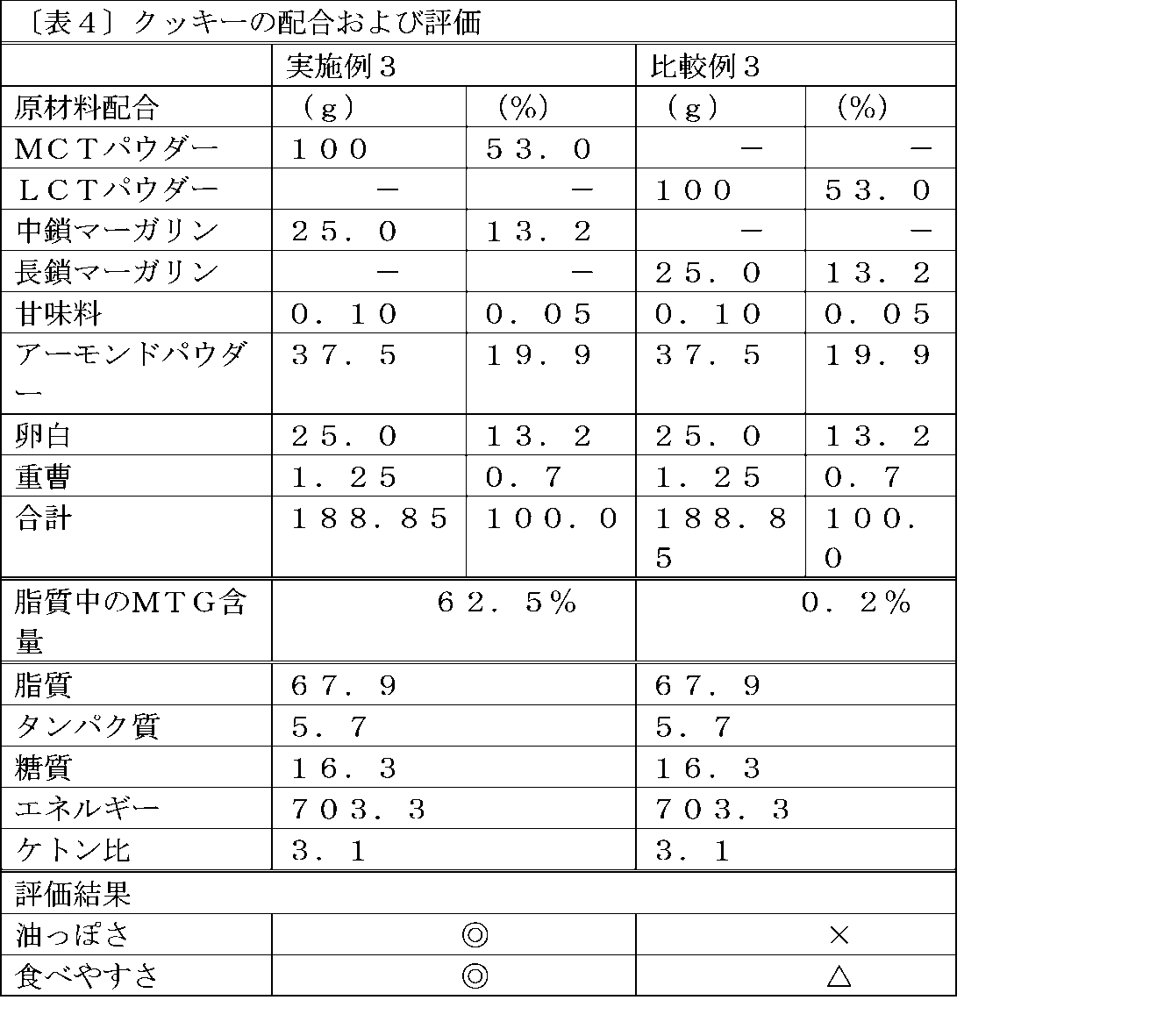
- Example 3 ⁇ Manufacture of improved almond cookies> According to the composition shown in Table 4 below, improved almond cookies of Example 3 and Comparative Example 3 were produced. In order to improve the ketone ratio, in the formulation of Table 4 below, as a sweetener in the formulation of Table 3 of [Example 2] above, instead of Sugar Cut (registered trademark), Milasi (registered trademark, DSP 5 Kyodo Food & Chemical Co., Ltd.) was used. The other components were adjusted for this change. Others were the same as in Example 2.
- Sugar Cut registered trademark
- Milasi registered trademark, DSP 5 Kyodo Food & Chemical Co., Ltd.
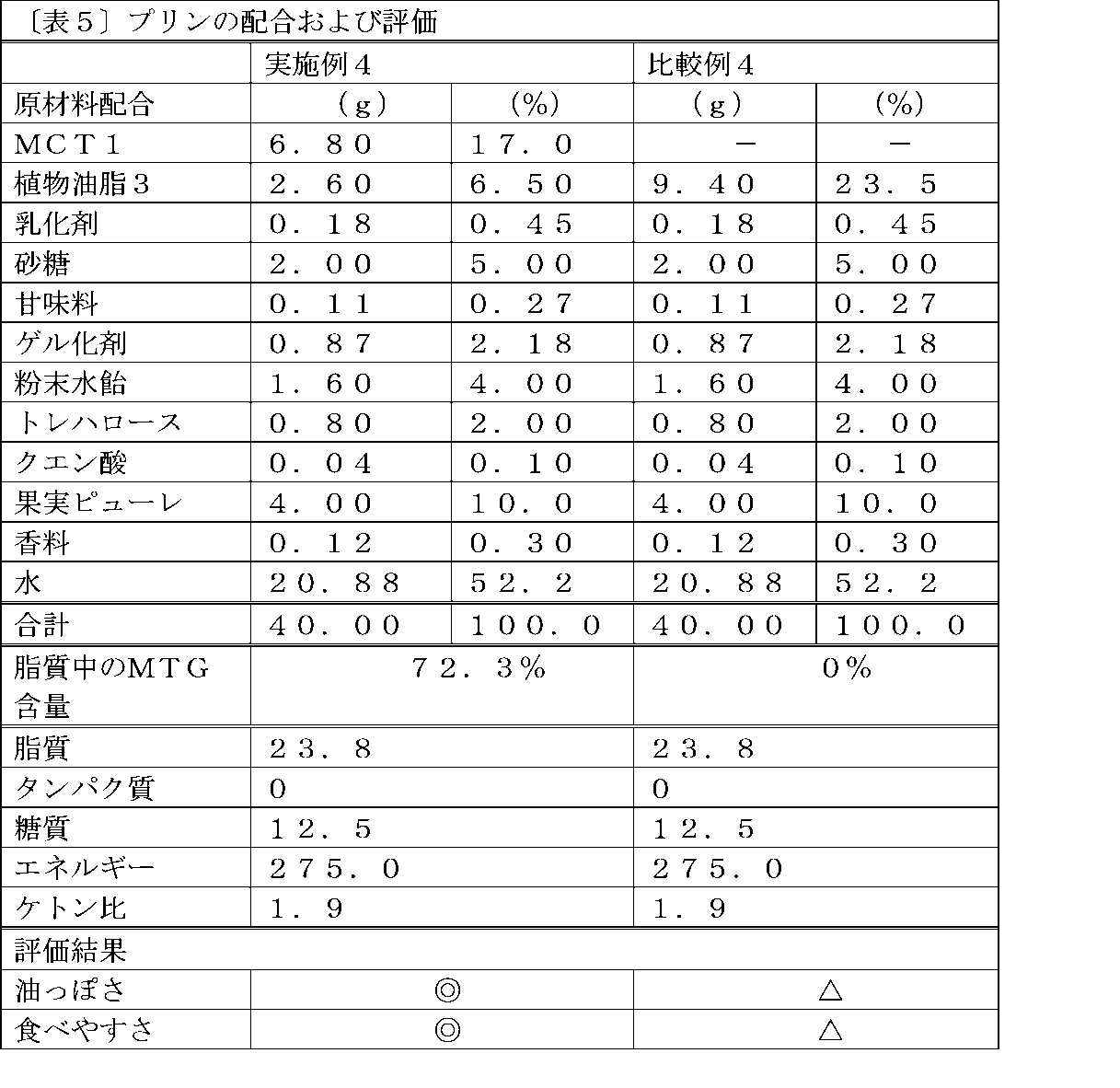
- Example 4 ⁇ Manufacture of pudding> Purines of Example 4 and Comparative Example 4 were produced according to a conventional method according to the formulation shown in Table 5 below. Specifically, agar was dissolved in boiling water, and then raw materials other than puree or paste and lipid were added and dissolved by stirring. Thereafter, puree or paste was added and mixed to obtain a uniform preparation solution, and then lipid was added and pre-emulsified with a homomixer, and further homogenized with a homogenizer. 40 g of the emulsified preparation thus obtained was filled and sealed in a plastic container, sterilized by retort (121.1 ° C., 25 minutes), and then cooled to obtain a pudding.
- retort (121.1 ° C., 25 minutes
- Example 5 ⁇ Manufacture of improved pudding> According to the formulation shown in Table 6 below, improved puddings of Example 5 and Comparative Example 5 were produced. In order to improve the ketone ratio, in the formulation of Table 6 below, protein (casein Na, whey protein, collagen) not added in the formulation of Table 5 of [Example 4] is used, and sugar, trehalose Citric acid and fruit puree were removed. The other ingredients were adjusted accordingly. Others were the same as in Example 4.
Landscapes
- Life Sciences & Earth Sciences (AREA)
- Engineering & Computer Science (AREA)
- Food Science & Technology (AREA)
- Health & Medical Sciences (AREA)
- Chemical & Material Sciences (AREA)
- Nutrition Science (AREA)
- Polymers & Plastics (AREA)
- Mycology (AREA)
- Pediatric Medicine (AREA)
- Proteomics, Peptides & Aminoacids (AREA)
- Oil, Petroleum & Natural Gas (AREA)
- Molecular Biology (AREA)
- Coloring Foods And Improving Nutritive Qualities (AREA)
- Grain Derivatives (AREA)
- Edible Oils And Fats (AREA)
- Bakery Products And Manufacturing Methods Therefor (AREA)
- Acyclic And Carbocyclic Compounds In Medicinal Compositions (AREA)
Abstract
Description
炭水化物は、消化可能な糖質と消化可能でない食物繊維とからなり、例えば、糖質は構成する糖単位の数によって、グルコースのような単糖、ショ糖のような二糖、オリゴ糖のような少糖、でんぷんのような多糖に分けられる。食物繊維は消化酵素によって消化されない難消化性成分の総称であり、大きく水溶性食物繊維と不溶性食物繊維とに分けられる。
タンパク質は、アミノ酸がペプチド結合したものであり、人の場合は体内で作り出せないアミノ酸(必須アミノ酸)が存在するので、これらの必須アミノ酸は食事から補給されなければならない。
脂質は、生物から単離される水に溶けない物質の総称であり、主なものは1分子のグリセリンと3分子の脂肪酸がエステル結合した脂肪である。脂質は、生体膜などの生物を構成する要素を維持する上で重要な機能を果たしている。
他方、エネルギー量に関していえば、炭水化物及びタンパク質が1g当たり4キロカロリーしかないのに対し、脂質は1g当たり9キロカロリーもあるので、三大栄養素の中で脂質は最も効率のよいエネルギー源である。
したがって、炭水化物(糖質)のとり過ぎは、肥満や糖尿病の原因になるといわれており、最近は、体重減少を目的とした低炭水化物ダイエットという、炭水化物(糖質)を制限した食事も盛んに提案されるようになってきている。
例えば、特許文献1では、タンパク質、脂質及び消化可能な炭水化物を含有する栄養組成物であって、乾燥質量100g当たり2520~3080キロジュールのエネルギーを有し、かつ、タンパク質と消化可能な炭水化物の合計に対する脂質の重量が2.7~3.4:1であり、前記脂質がリノレン酸などの多価不飽和脂肪酸を多く含む栄養組成物を、小児てんかんの発作を制御するために利用している。
また、特許文献2では、ケトン食療法によって、哺乳動物の脳におけるタンパク質凝集を減少させ、アルツハイマー型認知症を治療している。
しかしながら、従来の「ケトン食」は、タンパク質や糖質に比べて、脂質がかなり多く含まれているため、油っぽくて、食べにくいという問題があった。そのため、需要者が自ら好んで食べられない、又は、ケトン食療法を継続したくても長続きしないという問題があった。そこで、「ケトン食」であっても、油っぽさを感じにくく、食べやすくて、しかも、必要なエネルギー量を取りやすくした栄養組成物が求められていた。
本発明の好ましい一態様によれば、前記脂質が、液状油、固形油、粉末油脂から選ばれる1種又は2種以上である、栄養組成物を提供することができる。
本発明の好ましい一態様によれば、前記脂質が、脂肪酸を基準として、リノレン酸及びα-リノレン酸を15質量%未満しか含まない、栄養組成物を提供することができる。
本発明の好ましい一態様によれば、前記脂質が、脂肪酸を基準として、多価不飽和脂肪酸(2以上の不飽和結合を有する脂肪酸)を16質量%未満しか含まない、栄養組成物を提供することができる。
本発明の好ましい一態様によれば、前記脂質が、脂肪酸を基準として、飽和脂肪酸を20~100質量%含む、栄養組成物を提供することができる。
本発明の好ましい一態様によれば、前記脂質が、脂肪酸を基準として、モノ不飽和脂肪酸を0~50質量%含む、栄養組成物を提供することができる。
本発明の好ましい一態様によれば、前記中鎖脂肪酸を有するトリアシルグリセロールの構成脂肪酸が、炭素数6~12の中鎖脂肪酸のみから構成されている、栄養組成物を提供することができる。
本発明の好ましい一態様によれば、前記中鎖脂肪酸を有するトリアシルグリセロールの構成脂肪酸が、炭素数8、10又は12の中鎖脂肪酸のみから構成されている、栄養組成物を提供することができる。
本発明の好ましい一態様によれば、最終製品中、0~25質量%の糖質、0~40質量%のタンパク質、及び、15~80質量%の脂質を含む、栄養組成物を提供することができる。
本発明の好ましい一態様によれば、タンパク質と糖質の合計に対する脂質の割合が1.8以上4.0未満である、栄養組成物を提供することができる。
本発明の好ましい一態様によれば、タンパク質と糖質の合計に対する脂質の割合が4.0以上6.0未満である、栄養組成物を提供することができる。
本発明の好ましい一態様によれば、前記栄養組成物が、ゲル状食品、固形食品、粉末食品、液体食品のいずれかである、栄養組成物を提供することができる。
本発明の好ましい一態様によれば、上記栄養組成物を含む食品を提供することができる。
さらに、中鎖脂肪酸が本来有する抗菌作用により、常温(25℃)付近での保存安定性が向上するので、常時持ち運びに便利であり、携帯食としても利用できる栄養補助食品が提供できる。
本発明において「栄養組成物」は、脂質、タンパク質、及び糖質を所定量含み、所定のエネルギー量を有し、さらに、タンパク質と糖質の合計に対する脂質の割合(以下、「ケトン比」という。)が所定の数値範囲内のものであって、炭素数6~12の中鎖脂肪酸を有するトリアシルグリセロールを所定量含むものであれば特に制限されない。
具体的な形態としては、固体、半固体、液体などの形態が挙げられ、具体的な製品形態としては、例えば、パウダーなどの粉末食品、クッキー、ドーナツ、ビスケット等の固形食品、プリン、ゼリーなどのゲル状食品などが挙げられる。さらに、例えば、前記粉末食品を水に溶かして得られた液体食品なども挙げられる。特に、栄養組成物がゲル状食品である場合は、高齢者でも飲み込みやすい性質を有し、食べた量も見た目でわかり、持ち運びも容易であるため、好ましい。なお、本発明の栄養組成物は、1食に代わるオールインの形態もとり得るが、普通の食事をとりながら、補完的に喫食されるような形態をとる方が好ましい。
なお、古典的なケトン食では、ケトン比が4.0程度であることから、本発明の「栄養組成物」を、ケトン比が1.8~4.0であるものと、ケトン比が4.0~6.0であるものとに分けることができる。なお、ケトン比が4.0未満のものであっても、てんかん患者は、一定の制限の下、摂取することができるので有用である。
最終的な栄養組成物中のタンパク質の量は、好ましくは0~40質量%であり、より好ましくは0~30質量%であり、さらに好ましくは0~20質量%である。
最終的な栄養組成物中の糖質の量は、好ましくは0~25質量%であり、より好ましくは1~20質量%であり、さらに好ましくは1~18質量%である。
そして、高脂質であっても油っぽくなく、食べやすくするためには、当該栄養組成物中の脂質の50質量%以上が、構成脂肪酸として炭素数6~12の中鎖脂肪酸を有するトリアシルグリセロールでなくてはならない。また、上記栄養組成物中の脂質に対して、上記トリアシルグリセロールが70質量%以上であることが好ましく、また80質量%以上であることがより好ましく、さらに90質量%以上であることがより好ましい。また、本発明の栄養組成物に含まれる脂質のすべて(100質量%)が、上記トリアシルグリセロールであることが最も好ましい。
また、本発明において用いられる脂質は、例えば、トリオクタノイルグリセロールとトリデカノイルグリセロールとの混合物等、複数の異なる分子種の油脂が混ざり合った混合物であってもよい。ここで、炭素数6~12の中鎖脂肪酸は、直鎖状の飽和脂肪酸であることが好ましい。
本発明の栄養組成物の脂質中に含まれるMCTは、従来公知の方法で製造できる。例えば、炭素数6~12の脂肪酸とグリセロールとを、触媒下、好ましくは無触媒下で、また、好ましくは減圧下で、120~180℃に加熱し、脱水縮合させることにより製造できる。
また、ショートニングとは、大豆油、とうもろこし油等の植物油脂や動物油脂を原料とした練り込み用の常温で半固形(クリーム状)の油脂である。ショートニングは、マーガリンやバターなどの乳化製品と異なり、一般的には、白色の無味無臭のものであって、水や乳成分を含まず、ほぼ100%が油脂成分である。
粉末油脂は、噴霧式、粉砕式、コーティング式のいずれかの方式で製造されるものであり、加熱乾燥、冷却固化、凍結乾燥、マイクロカプセル化などの工程により製造される。融点が低い液体油であれば、例えば、水相と油相を混合し、得られたO/W型の乳化物を噴霧乾燥して、粉末油脂を製造することができる。また、融点が高い固形の油脂であれば、例えば、冷却固化によって、粉末油脂を製造することができる。このような粉末油脂は糖質やタンパク質を賦形剤として利用することがあるため、粉末油脂自体が、本発明の「栄養組成物」となることがある。なお、本発明における好ましい粉末油脂として、例えば、日清オイリオグループ(株)製の商品:日清MCTパウダーが挙げられる。
また、BMIが25を超える成人その他の肥満の人、特に、メタボリック症候群又はインスリン抵抗性に苦しむ肥満人用の体重調節、体重管理計画に適用される食事としても有効に利用できる。なお、本発明の「栄養組成物」は、単一の栄養物として使用されるのではなく、他の異なる栄養物(食事)と併用されるときに特に有効である。
さらに、老人性認知症やアルツハイマー型認知症に苦しむ患者や、ある種の癌に苦しむ患者に向けた治療用の食品としても有効であろうし、これらの疾患を予防するためにも効果を発揮することが期待される。
以上まとめると、ケトン食療法によって誘導されたケトーシス状態は、グルコースの利用を制限し、低いインシュリンシグナル伝達の状態を生み出す。このような代謝変更によって影響を受ける疾患を有する患者の治療及びそうした疾患の予防において、本発明の「栄養組成物」は有効に利用される。
以下において「%」とは、特別な記載がない場合、質量%を示す。
また、脂質、タンパク質、糖質の含量は、栄養組成物100質量%に対する質量%として計算されている。また、エネルギーは、栄養組成物100g当たりキロカロリーとして計算されている。さらに、「ケトン比」は、栄養組成物に含まれる脂質、タンパク質、糖質の含量に基づき、「脂質/(タンパク質+糖質)」で計算されている。
トリアシルグリセロール含量は、AOCS Ce5-86に準じて測定した。
各脂肪酸含量は、AOCS Ce1f-96に準じて測定した。
<使用油脂>
〔MCT1〕:トリアシルグリセロールを構成する脂肪酸がn-オクタン酸(炭素数8)とn-デカン酸(炭素数10)であり、その質量比が30:70であるMCT(日清オイリオグループ株式会社社内製:C10R)をMCT1とした。
〔MCT2〕:トリアシルグリセロールを構成する脂肪酸がn-オクタン酸(炭素数8)とn-デカン酸(炭素数10)であり、その質量比が75:25であるMCT(日清オイリオグループ株式会社社内製:O.D.O.)をMCT2とした。
〔植物油脂1〕:ヤシ硬化油(日清オイリオグループ株式会社製、トリアシルグリセロールを構成する脂肪酸中の中鎖脂肪酸含量12.3質量%(内訳:n-オクタン酸含量8.0質量%、n-デカン酸含量4.3質量%)、MTG含量53.2質量%、MCT含量0質量%)を植物油脂1とした。
〔植物油脂2〕:ハイエルシン菜種極度硬化油(横関油脂工業株式会社製、MTG含量0質量%)を植物油脂2とした。
〔植物油脂3〕:菜種油(日清オイリオグループ株式会社製、MTG含量0質量%、飽和脂肪酸6質量%、モノ不飽和脂肪酸62質量%、多価不飽和脂肪酸30質量%、オレイン酸60質量%、リノレン酸10質量%)を植物油脂3とした。
〔植物油脂4〕:パーム中融点画分(日清オイリオグループ株式会社製、MTG含量0質量%)を植物油脂4とした。
〔エステル交換油1〕:パームステアリン極度硬化油50質量部とパーム核オレイン極度硬化油50質量部との混合油を化学的エステル交換したエステル交換油(トリアシルグリセロールを構成する脂肪酸中の中鎖脂肪酸含量3.2質量%(内訳:n-オクタン酸2.0質量%、n-デカン酸含量1.2質量%)、MTG含量13.2質量%、MCT含量0質量%)をエステル交換油1とした。
〔エステル交換油2〕:パームオレインを化学的エステル交換したエステル交換油(MTG含量0質量%)をエステル交換油2とした。
表1の配合に従って、油相と水相とを調製し、常法に従って、コンビネーターにより急冷可塑化することにより、中鎖マーガリンと長鎖マーガリンを調製した。脂質中のMTG含量について表1に示した。なお、脂質中のMTG含量は、使用した油脂に含まれているMTG含量の総和を、乳化剤、水、食塩を除いた正味の脂質含量で割った値から算出している。

<粉末油脂の製造>
下記表2の配合に従って、実施例1、比較例1の粉末油脂を、常法に従って製造した。具体的には、まず、下記の配合に示されたMCT2又は植物油脂3を油相とし、これを加工でんぷん及びデキストリンに水を加えた水相と良く混合し、O/W型の乳化物を作製した。そして、この乳化物をスプレードライ法にて熱風乾燥し粉末油脂を得た。なお、これ以降、実施例1の粉末油脂を「MCTパウダー」といい、比較例1の粉末油脂を「LCTパウダー」という。

<アーモンドクッキーの製造>
下記表3の配合に従って、実施例2、比較例2のアーモンドクッキーを、常法に従って製造した。具体的には、まず、下記に示された配合の中鎖又は長鎖マーガリンに、MCTパウダー又はLCTパウダー、甘味料シュガーカット(登録商標、株式会社浅田飴)、アーモンドパウダー、卵白、重曹を加えてよく混合し、クッキー生地を得た。3mm厚に延ばして、3cmの丸型で型抜きし、150℃のオーブンで15分間焼成し、クッキーを製造した。

<改良型アーモンドクッキーの製造>
下記表4の配合に従って、実施例3、比較例3の改良型アーモンドクッキーを作製した。ケトン比を向上させるため、下記表4の配合においては、上記[実施例2]の上記表3の配合において、甘味料として、シュガーカット(登録商標)に代えて、ミラスィー(登録商標、DSP五協フード&ケミカル株式会社)を使用した。この変更に合わせて、他の成分を調整した。その他は実施例2と同様に行った。
<プリンの製造>
下記表5の配合に従って、実施例4、比較例4のプリンを、常法に従って製造した。具体的には、沸騰した水に寒天を溶解させ、その後、ピューレ又はペースト及び脂質以外の原料を投入し、撹拌溶解した。その後、ピューレ又はペーストを投入し、混合して均一な調合液とした後、脂質を投入してホモミキサーで予備乳化し、さらに、ホモジナイザーで均質化した。このようにして得られた乳化調合液を40gずつ、プラスチック容器に充填・密封し、レトルト殺菌(121.1℃、25分間)し、その後冷却して、プリンを得た。
<改良型プリンの製造>
下記表6の配合に従って、実施例5、比較例5の改良型プリンを作製した。ケトン比を向上させるため、下記表6の配合においては、上記[実施例4]の上記表5の配合において、添加されてないタンパク質(カゼインNa、ホエイタンパク質、コラーゲン)を使用し、砂糖、トレハロース、クエン酸、果実ピューレを取り除いた。それに合わせて、他の成分を調整した。その他は実施例4と同様に行った。

上記で製造した、実施例及び比較例の栄養組成物の官能的評価等については、以下の評価方法に従って評価した。
(1)油っぽさの評価方法
以下の基準に従って、熟練した10名のパネラーにより、総合的に評価した。
◎:油っぽくない
○:わずかに油っぽい
△:少し油っぽい
×:油っぽい
(2)食べやすさの評価方法
以下の基準に従って、熟練した10名のパネラーにより、総合的に評価した。
◎:非常に食べやすい
○:食べやすい
△:やや食べにくい
×:食べにくい
Claims (13)
- 脂質、タンパク質及び糖質を含有する栄養組成物であって、前記栄養組成物100g当たりのエネルギーが150~750キロカロリーであり、かつ、タンパク質と糖質の合計に対する脂質の割合が1.8~6.0であり、前記脂質には、構成脂肪酸として炭素数6~12の中鎖脂肪酸を有するトリアシルグリセロールが前記脂質の50質量%以上含まれている、栄養組成物。
- 前記脂質が、液状油、固形油、粉末油脂から選ばれる1種又は2種以上である、請求項1に記載の栄養組成物。
- 前記脂質が、脂肪酸を基準として、リノレン酸及びα-リノレン酸を15質量%未満しか含まない、請求項1又は2に記載の栄養組成物。
- 前記脂質が、脂肪酸を基準として、多価不飽和脂肪酸(2以上の不飽和結合を有する脂肪酸)を16質量%未満しか含まない、請求項1ないし3のいずれか1項に記載の栄養組成物。
- 前記脂質が、脂肪酸を基準として、飽和脂肪酸を20~100質量%含む、請求項1ないし4のいずれか1項に記載の栄養組成物。
- 前記脂質が、脂肪酸を基準として、モノ不飽和脂肪酸を0~50質量%含む、請求項1ないし5のいずれか1項に記載の栄養組成物。
- 前記中鎖脂肪酸を有するトリアシルグリセロールの構成脂肪酸が、炭素数6~12の中鎖脂肪酸のみから構成されている、請求項1ないし6のいずれか1項に記載の栄養組成物。
- 前記中鎖脂肪酸を有するトリアシルグリセロールの構成脂肪酸が、炭素数8、10又は12の中鎖脂肪酸のみから構成されている、請求項1ないし7のいずれか1項に記載の栄養組成物。
- 前記栄養組成物は、最終製品中、0~25質量%の糖質、0~40質量%のタンパク質、及び、15~80質量%の脂質を含む、請求項1ないし8のいずれか1項に記載の栄養組成物。
- 前記栄養組成物において、タンパク質と糖質の合計に対する脂質の割合が1.8以上4.0未満である、請求項1ないし9のいずれか1項に記載の栄養組成物。
- 前記栄養組成物において、タンパク質と糖質の合計に対する脂質の割合が4.0以上6.0未満である、請求項1ないし10のいずれか1項に記載の栄養組成物。
- 前記栄養組成物が、ゲル状食品、固形食品、粉末食品、液体食品のいずれかである、請求項1ないし11のいずれか1項に記載の栄養組成物。
- 請求項1ないし12のいずれか1項に記載の栄養組成物を含む食品。
Priority Applications (4)
| Application Number | Priority Date | Filing Date | Title |
|---|---|---|---|
| CN201580039795.XA CN106659220A (zh) | 2014-07-17 | 2015-07-16 | 营养组合物 |
| JP2016530250A JPWO2016010102A1 (ja) | 2014-07-17 | 2015-07-16 | 栄養組成物 |
| US15/326,417 US20170196229A1 (en) | 2014-07-17 | 2015-07-16 | Nutritional composition |
| EP15822238.0A EP3170409A4 (en) | 2014-07-17 | 2015-07-16 | Nutritional composition |
Applications Claiming Priority (2)
| Application Number | Priority Date | Filing Date | Title |
|---|---|---|---|
| JP2014146881 | 2014-07-17 | ||
| JP2014-146881 | 2014-07-17 |
Publications (1)
| Publication Number | Publication Date |
|---|---|
| WO2016010102A1 true WO2016010102A1 (ja) | 2016-01-21 |
Family
ID=55078588
Family Applications (1)
| Application Number | Title | Priority Date | Filing Date |
|---|---|---|---|
| PCT/JP2015/070362 Ceased WO2016010102A1 (ja) | 2014-07-17 | 2015-07-16 | 栄養組成物 |
Country Status (5)
| Country | Link |
|---|---|
| US (1) | US20170196229A1 (ja) |
| EP (1) | EP3170409A4 (ja) |
| JP (2) | JPWO2016010102A1 (ja) |
| CN (1) | CN106659220A (ja) |
| WO (1) | WO2016010102A1 (ja) |
Cited By (15)
| Publication number | Priority date | Publication date | Assignee | Title |
|---|---|---|---|---|
| JP2017046688A (ja) * | 2015-08-31 | 2017-03-09 | 株式会社みやぎヘルスイノベーション | 体重増加抑制用飲料組成物 |
| WO2018179952A1 (ja) * | 2017-03-30 | 2018-10-04 | テルモ株式会社 | 高カロリー栄養組成物および包装体 |
| WO2018207921A1 (ja) * | 2017-05-12 | 2018-11-15 | 日清オイリオグループ株式会社 | 総ケトン体濃度上昇剤、油脂組成物、医薬組成物、食品組成物 |
| WO2019017006A1 (ja) * | 2017-07-21 | 2019-01-24 | テルモ株式会社 | 高カロリー栄養組成物および包装体 |
| WO2019022149A1 (ja) * | 2017-07-26 | 2019-01-31 | 株式会社明治 | ケトン体生成促進剤 |
| JP2019062785A (ja) * | 2017-09-29 | 2019-04-25 | アクテイブ株式会社 | 甘味料およびその利用方法 |
| WO2020188834A1 (ja) * | 2019-03-18 | 2020-09-24 | 株式会社0 | タンパク質高含有アイスクリーム |
| JP2021007338A (ja) * | 2019-07-01 | 2021-01-28 | 日清オイリオグループ株式会社 | ベーカリー食品用生地及びベーカリー食品 |
| JP2021153551A (ja) * | 2020-03-30 | 2021-10-07 | 日清オイリオグループ株式会社 | チョコレート |
| JP2021531738A (ja) * | 2018-07-10 | 2021-11-25 | ソシエテ・デ・プロデュイ・ネスレ・エス・アー | ケトン曝露を増加させるためのmct製剤、並びにかかる製剤の製造及び使用方法 |
| WO2022156515A1 (zh) * | 2021-01-22 | 2022-07-28 | 南昌大学 | 一种功能食品专用油脂基料油及其制备方法和应用 |
| JP2022160981A (ja) * | 2021-04-07 | 2022-10-20 | 日清オイリオグループ株式会社 | 油脂組成物、油脂組成物を含む食品、及び油脂組成物の白濁の抑制方法 |
| JP2024011479A (ja) * | 2022-07-14 | 2024-01-25 | 株式会社岐阜セラツク製造所 | 油脂成分を含有する組成物及びその利用並びに組成物の製造方法 |
| EP4256966A4 (en) * | 2021-06-01 | 2024-12-11 | Osaka Gas Co., Ltd. | 3-hydroxybutyric-acid-containing oil and fat composition |
| US12575584B2 (en) | 2021-01-22 | 2026-03-17 | Nanchang University | Functional edible oil, preparation method therefor and use thereof |
Families Citing this family (5)
| Publication number | Priority date | Publication date | Assignee | Title |
|---|---|---|---|---|
| GB201210699D0 (en) | 2012-06-15 | 2012-08-01 | Vitaflo Ltd | Nutritional food |
| CN108175016A (zh) * | 2018-01-03 | 2018-06-19 | 杭州衡美食品科技有限公司 | 一种生酮固体饮料及其制备方法 |
| CN109198641A (zh) * | 2018-08-14 | 2019-01-15 | 北京万莱康营养与健康食品科学技术研究院有限公司 | 一种低碳水化合物含量的食品配方及由其制备的防弹咖啡 |
| IT201900022854A1 (it) * | 2019-12-03 | 2021-06-03 | Dr Schaer S P A | Formulazione alimentare e prodotto alimentare da forno per la gestione della dieta chetogenica |
| CN117835834A (zh) * | 2021-09-03 | 2024-04-05 | 日清奥利友集团株式会社 | 凝胶状食品和凝胶状食品的制造方法 |
Citations (3)
| Publication number | Priority date | Publication date | Assignee | Title |
|---|---|---|---|---|
| JPS63309162A (ja) * | 1987-06-10 | 1988-12-16 | Nisshin Flour Milling Co Ltd | 経口,経管栄養食の製造法 |
| JP2010506587A (ja) * | 2006-10-17 | 2010-03-04 | エヌ.ブイ.・ヌートリシア | ケト原性食 |
| WO2013186570A1 (en) * | 2012-06-15 | 2013-12-19 | Vitaflo (International) Ltd | Nutritional product |
Family Cites Families (9)
| Publication number | Priority date | Publication date | Assignee | Title |
|---|---|---|---|---|
| JP3573842B2 (ja) * | 1995-09-22 | 2004-10-06 | 花王株式会社 | 低蓄積性油脂代替物 |
| JP3520678B2 (ja) * | 1996-08-06 | 2004-04-19 | 味の素株式会社 | フライ済み食品およびその製造方法 |
| CN1256941C (zh) * | 2001-07-16 | 2006-05-24 | 日清奥利友集团株式会社 | 身体脂肪量调整剂 |
| JP4407085B2 (ja) * | 2001-08-30 | 2010-02-03 | 日清オイリオグループ株式会社 | コーティング用油脂 |
| US7919526B2 (en) * | 2004-03-04 | 2011-04-05 | Htl High-Tech Lipids Ltd. | Structured triglycerides and emulsions comprising same |
| WO2009002145A1 (en) * | 2007-06-26 | 2008-12-31 | N.V. Nutricia | Lipid composition for improving function of brain functioning |
| WO2011093693A1 (en) * | 2010-01-29 | 2011-08-04 | N.V. Nutricia | Liquid enteral nutritional composition suitable for tube feeding, minimizing lower and upper tract digestive conditions |
| CN102283384B (zh) * | 2011-09-09 | 2014-04-02 | 深圳市捷利康生物科技有限公司 | 生酮饮食及其制作方法 |
| US20130310457A1 (en) * | 2013-07-25 | 2013-11-21 | Niral Ramesh | Solid-in-oil dispersions |
-
2015
- 2015-07-16 US US15/326,417 patent/US20170196229A1/en not_active Abandoned
- 2015-07-16 EP EP15822238.0A patent/EP3170409A4/en not_active Withdrawn
- 2015-07-16 WO PCT/JP2015/070362 patent/WO2016010102A1/ja not_active Ceased
- 2015-07-16 JP JP2016530250A patent/JPWO2016010102A1/ja active Pending
- 2015-07-16 CN CN201580039795.XA patent/CN106659220A/zh active Pending
-
2017
- 2017-01-25 JP JP2017011281A patent/JP2017070311A/ja active Pending
Patent Citations (3)
| Publication number | Priority date | Publication date | Assignee | Title |
|---|---|---|---|---|
| JPS63309162A (ja) * | 1987-06-10 | 1988-12-16 | Nisshin Flour Milling Co Ltd | 経口,経管栄養食の製造法 |
| JP2010506587A (ja) * | 2006-10-17 | 2010-03-04 | エヌ.ブイ.・ヌートリシア | ケト原性食 |
| WO2013186570A1 (en) * | 2012-06-15 | 2013-12-19 | Vitaflo (International) Ltd | Nutritional product |
Non-Patent Citations (1)
| Title |
|---|
| See also references of EP3170409A4 * |
Cited By (25)
| Publication number | Priority date | Publication date | Assignee | Title |
|---|---|---|---|---|
| JP2017046688A (ja) * | 2015-08-31 | 2017-03-09 | 株式会社みやぎヘルスイノベーション | 体重増加抑制用飲料組成物 |
| JPWO2018179952A1 (ja) * | 2017-03-30 | 2020-02-06 | テルモ株式会社 | 高カロリー栄養組成物および包装体 |
| WO2018179952A1 (ja) * | 2017-03-30 | 2018-10-04 | テルモ株式会社 | 高カロリー栄養組成物および包装体 |
| WO2018207921A1 (ja) * | 2017-05-12 | 2018-11-15 | 日清オイリオグループ株式会社 | 総ケトン体濃度上昇剤、油脂組成物、医薬組成物、食品組成物 |
| WO2019017006A1 (ja) * | 2017-07-21 | 2019-01-24 | テルモ株式会社 | 高カロリー栄養組成物および包装体 |
| CN110944659A (zh) * | 2017-07-21 | 2020-03-31 | 泰尔茂株式会社 | 高卡路里营养组合物和包装体 |
| JPWO2019017006A1 (ja) * | 2017-07-21 | 2020-08-20 | テルモ株式会社 | 高カロリー栄養組成物および包装体 |
| JP7084926B2 (ja) | 2017-07-21 | 2022-06-15 | テルモ株式会社 | 高カロリー栄養組成物および包装体 |
| WO2019022149A1 (ja) * | 2017-07-26 | 2019-01-31 | 株式会社明治 | ケトン体生成促進剤 |
| JPWO2019022149A1 (ja) * | 2017-07-26 | 2020-07-30 | 株式会社明治 | ケトン体生成促進剤 |
| JP7157743B2 (ja) | 2017-07-26 | 2022-10-20 | 株式会社明治 | ケトン体生成促進剤 |
| JP2019062785A (ja) * | 2017-09-29 | 2019-04-25 | アクテイブ株式会社 | 甘味料およびその利用方法 |
| JP2024096953A (ja) * | 2018-07-10 | 2024-07-17 | ソシエテ・デ・プロデュイ・ネスレ・エス・アー | ケトン曝露を増加させるためのmct製剤、並びにかかる製剤の製造方法 |
| JP2021531738A (ja) * | 2018-07-10 | 2021-11-25 | ソシエテ・デ・プロデュイ・ネスレ・エス・アー | ケトン曝露を増加させるためのmct製剤、並びにかかる製剤の製造及び使用方法 |
| WO2020188834A1 (ja) * | 2019-03-18 | 2020-09-24 | 株式会社0 | タンパク質高含有アイスクリーム |
| JP7383335B2 (ja) | 2019-07-01 | 2023-11-20 | 日清オイリオグループ株式会社 | ベーカリー食品用生地及びベーカリー食品 |
| JP2021007338A (ja) * | 2019-07-01 | 2021-01-28 | 日清オイリオグループ株式会社 | ベーカリー食品用生地及びベーカリー食品 |
| JP2021153551A (ja) * | 2020-03-30 | 2021-10-07 | 日清オイリオグループ株式会社 | チョコレート |
| JP7542913B2 (ja) | 2020-03-30 | 2024-09-02 | 日清オイリオグループ株式会社 | チョコレート |
| WO2022156515A1 (zh) * | 2021-01-22 | 2022-07-28 | 南昌大学 | 一种功能食品专用油脂基料油及其制备方法和应用 |
| US12575584B2 (en) | 2021-01-22 | 2026-03-17 | Nanchang University | Functional edible oil, preparation method therefor and use thereof |
| JP2022160981A (ja) * | 2021-04-07 | 2022-10-20 | 日清オイリオグループ株式会社 | 油脂組成物、油脂組成物を含む食品、及び油脂組成物の白濁の抑制方法 |
| JP7799400B2 (ja) | 2021-04-07 | 2026-01-15 | 日清オイリオグループ株式会社 | 油脂組成物、油脂組成物を含む食品、及び油脂組成物の白濁の抑制方法 |
| EP4256966A4 (en) * | 2021-06-01 | 2024-12-11 | Osaka Gas Co., Ltd. | 3-hydroxybutyric-acid-containing oil and fat composition |
| JP2024011479A (ja) * | 2022-07-14 | 2024-01-25 | 株式会社岐阜セラツク製造所 | 油脂成分を含有する組成物及びその利用並びに組成物の製造方法 |
Also Published As
| Publication number | Publication date |
|---|---|
| CN106659220A (zh) | 2017-05-10 |
| EP3170409A1 (en) | 2017-05-24 |
| JPWO2016010102A1 (ja) | 2017-04-27 |
| US20170196229A1 (en) | 2017-07-13 |
| JP2017070311A (ja) | 2017-04-13 |
| EP3170409A4 (en) | 2017-12-13 |
Similar Documents
| Publication | Publication Date | Title |
|---|---|---|
| JP2017070311A (ja) | 栄養組成物 | |
| CA2417971C (en) | Oil/fat composition | |
| JP6573404B2 (ja) | 粉末チョコレート | |
| JP2019047817A (ja) | 体重増加抑制用飲料組成物および体重増加抑制方法 | |
| JP5976263B2 (ja) | 穀粉を実質的に含まない焼き菓子 | |
| JP2015522256A (ja) | 栄養製品 | |
| US6287624B1 (en) | Foods containing fat or oil | |
| WO2016013617A1 (ja) | 脳機能改善剤、及び認知機能障害の予防または治療剤 | |
| Gurr | Lipids and nutrition | |
| AU2005306076A1 (en) | Satiety emulsions and food compositions | |
| JP3482253B2 (ja) | 調理用油脂 | |
| JP4687863B2 (ja) | リン脂質含有の安定なマトリックスを含んでいる機能食品 | |
| Henry | Processing, manufacturing, uses and labelling of fats in the food supply | |
| JP5702292B2 (ja) | パーキンソン病患者の内臓脂肪減少抑制剤 | |
| JPH07274825A (ja) | 易吸収性飲食品およびその製造法 | |
| JP2015530086A (ja) | チョコレート塊を含有する食用油中水エマルション | |
| Hernandez et al. | Applications of omega-3 fats in foods | |
| JP2025138092A (ja) | 睡眠周期改善剤及びそれを用いた飲食品 | |
| JP6534554B2 (ja) | 焼成複合菓子及びその製造方法 | |
| FI125932B (en) | Foods for use in the prevention and treatment of high cholesterol and blood pressure | |
| WO2018230487A1 (ja) | 消化管症状を抑制するための組成物及び方法 | |
| JP2008247791A (ja) | 肝機能改善剤 | |
| JP2015211646A (ja) | カプセル製剤 | |
| JPS63237759A (ja) | 治療用食品 | |
| Jones | G03-1487 Fat and Fat Substitutes |
Legal Events
| Date | Code | Title | Description |
|---|---|---|---|
| 121 | Ep: the epo has been informed by wipo that ep was designated in this application |
Ref document number: 15822238 Country of ref document: EP Kind code of ref document: A1 |
|
| ENP | Entry into the national phase |
Ref document number: 2016530250 Country of ref document: JP Kind code of ref document: A |
|
| WWE | Wipo information: entry into national phase |
Ref document number: 15326417 Country of ref document: US |
|
| REEP | Request for entry into the european phase |
Ref document number: 2015822238 Country of ref document: EP |
|
| WWE | Wipo information: entry into national phase |
Ref document number: 2015822238 Country of ref document: EP |
|
| NENP | Non-entry into the national phase |
Ref country code: DE |