WO2016013071A1 - Poudre de cuisson, son procédé de fabrication et aliment utilisant la poudre de cuisson - Google Patents
Poudre de cuisson, son procédé de fabrication et aliment utilisant la poudre de cuisson Download PDFInfo
- Publication number
- WO2016013071A1 WO2016013071A1 PCT/JP2014/069459 JP2014069459W WO2016013071A1 WO 2016013071 A1 WO2016013071 A1 WO 2016013071A1 JP 2014069459 W JP2014069459 W JP 2014069459W WO 2016013071 A1 WO2016013071 A1 WO 2016013071A1
- Authority
- WO
- WIPO (PCT)
- Prior art keywords
- median diameter
- acid
- baking powder
- agent
- kinds
- Prior art date
- Legal status (The legal status is an assumption and is not a legal conclusion. Google has not performed a legal analysis and makes no representation as to the accuracy of the status listed.)
- Ceased
Links
Images


Classifications
-
- A—HUMAN NECESSITIES
- A21—BAKING; EDIBLE DOUGHS
- A21D—TREATMENT OF FLOUR OR DOUGH FOR BAKING, e.g. BY ADDITION OF MATERIALS; BAKING; BAKERY PRODUCTS
- A21D2/00—Treatment of flour or dough by adding materials thereto before or during baking
Definitions
- the present invention relates to baking powder, a method for producing the same, and a food product using the baking powder.
- the present invention relates to a slow-acting baking powder containing an acid agent coated with a coating agent, a method for producing the same, and a food product using the baking powder.
- Baking powder is a type of swelling agent, the main agent that produces carbon dioxide (sodium bicarbonate), and baked alum, fumaric acid, tartaric acid that acts as an aid to adjust the rate of gas generation by reacting with the main agent. It is a food additive comprising an acidic agent such as sodium, and an excipient such as wheat flour and starch to improve the storage stability by adjusting the concentration so that the main agent and auxiliary agent do not react during storage.
- the generation time of carbon dioxide gas is controlled by an acid agent, and the immediate effect that generates a large amount of gas at a low temperature, the slow-acting property that generates a large amount of gas after reaching a high temperature, and baked slowly.
- Patent Document 1 discloses a method in which a baking powder raw material and a high melting point oil and fat such as sugar ester are mixed and stirred at a temperature higher than the melting point of 70 to 85 ° C., and the baking powder raw material is coated with the oil and fat.
- Patent Document 2 discloses a method in which one acid agent and a high melting point oil and fat such as hardened rapeseed oil are mixed and stirred at a temperature equal to or lower than the melting point to contact and collide, and the acid agent surface is coated with the oil and fat. ing.
- Patent Document 1 since the manufacturing method of Patent Document 1 is heated to a high temperature when mixing the baking powder raw material and the fats and oils, sodium hydrogen carbonate as the main agent self-decomposes into carbon dioxide gas and water regardless of the acid agent. Furthermore, there is a problem that the decomposition reaction is further advanced by the water eluted there, and the quality of the carbon dioxide generation amount of the baking powder is greatly reduced. In addition, when stirring and cooling a mixture of oil and baking powder raw material heated and melted to a high temperature, the oil and fat that returns to the solid cannot be dispersed by stirring, and the medium diameter in the finally obtained baking powder The mixture particles of 1 mm or more are generated.
- Patent Document 2 has a problem that depending on the type of the acid agent to be coated, the surface of the acid agent cannot be successfully coated with fats and oils, and the intended delayed action baking powder may not be obtained. .
- the present invention solves such problems of the prior art, can coat fats and oils on an acid agent regardless of the type of acid agent, and has a desired delayed action and high quality baking powder. And it aims at providing the manufacturing method. Moreover, an object of this invention is to provide the foodstuff manufactured using the said baking powder.
- the baking powder according to the present invention is a baking powder containing sodium hydrogen carbonate and an acid agent coated with an oil having a median diameter of 100 ⁇ m or more and a melting point of 55 ° C. to 75 ° C.
- the acid agent is one or more kinds of acid agents. It consists of an acidic agent with a median diameter of 100 ⁇ m or more and one or more acidic agents with a median diameter of less than 100 ⁇ m, and the surface of one or more acidic agents with a median diameter of 100 ⁇ m or more is acidic with one or more median diameters of less than 100 ⁇ m. It is formed by coating with an oil and fat containing an agent.
- the weight ratio of one or more kinds of acid agents having a median diameter of 100 ⁇ m or more and one or more kinds of acid agents having a medium diameter of less than 100 ⁇ m is preferably 5: 1 to 1: 1.
- the method for producing baking powder according to the present invention comprises one or more kinds of acid agents having a median diameter of 100 ⁇ m or more, one or more kinds of acid agents having a median diameter of less than 100 ⁇ m, a median diameter of 100 ⁇ m or more, and a melting point of 55 ° C. to 75 ° C. After stirring the oil and fat at 0 ° C. below the melting point, sodium hydrogen carbonate is added.
- the weight ratio of one or more kinds of acid agents having a median diameter of 100 ⁇ m or more and one or more kinds of acid agents having a medium diameter of less than 100 ⁇ m is preferably 5: 1 to 1: 1.
- the food according to the present invention is produced using the above baking powder.
- the baking powder of the present invention it is possible to provide a slow-acting baking powder capable of more precisely controlling the time and temperature of gas generation. Moreover, the manufacturing method of the baking powder of this invention can coat fat and oil on the whole surface of an acidic agent irrespective of the magnitude
- the baking powder manufacturing method of this embodiment is as follows. First, one or more kinds of acidic agents having a median diameter of 100 ⁇ m or more, one or more kinds of acid agents having a median diameter of less than 100 ⁇ m, a median diameter of 100 ⁇ m or more, and a melting point of 55 ° C. Powdered fats and oils of ⁇ 75 ° C. are stirred at a temperature below the melting point of the fats and oils and fats are coated with an acid agent, and then sodium hydrogen carbonate is added.
- the acidic agent is an acid or a salt thereof that can be added to food and is solid at room temperature.
- the inventors of the present invention have intensively studied the method of coating the surface of the acid agent with the high melting point oil and fat.
- the median diameter of the acid agent is smaller than the median diameter of the oil and fat, the acid agent is coated on the surface of the oil and fat.
- the median diameter for classifying coarse particles and fine particles of the acid agent may be a relative value with respect to the median diameter of the high melting point oil used as a coating agent, but it is preferable to classify the median diameter by 100 ⁇ m.
- Oils with a melting point of 55 to 75 ° C. are easily melted by the heat generated during pulverization. Therefore, it is industrially difficult to obtain particles having a median diameter of less than 200 ⁇ m, and particles having a median diameter of less than 100 ⁇ m are obtained at low cost on the market. It is not possible. Therefore, if acidic agent particles having a median diameter of 100 ⁇ m or more are included substantially, the surface of the acidic agent can be coated with fats and oils.
- the acid agent having a median diameter of 100 ⁇ m or more for example, organic acids such as fumaric acid, citric acid, malic acid, glucono delta lactone, tartaric acid and salts thereof, calcium dihydrogen pyrophosphate And inorganic salts such as potassium dihydrogen phosphate and potassium carbonate.
- organic acids such as fumaric acid, citric acid, malic acid, glucono delta lactone, tartaric acid and salts thereof
- calcium dihydrogen pyrophosphate calcium dihydrogen pyrophosphate
- inorganic salts such as potassium dihydrogen phosphate and potassium carbonate.
- powdered fats and oils having a median diameter of 100 ⁇ m or more and a melting point of 55 to 75 ° C. include, for example, liquid fats and oils containing higher fatty acids such as stearic acid, palmitic acid, stearic acid, and unsaturated fatty acids (for example, rapeseed oil, Palm oil, soybean oil, cottonseed oil, corn oil, beef tallow, lard, etc.) and hydrogenated to increase the amount of saturated fatty acid and solidify, emulsifiers such as glycerin fatty acid ester, sucrose fatty acid ester, and the like.
- liquid fats and oils containing higher fatty acids such as stearic acid, palmitic acid, stearic acid, and unsaturated fatty acids (for example, rapeseed oil, Palm oil, soybean oil, cottonseed oil, corn oil, beef tallow, lard, etc.) and hydrogenated to increase the amount of saturated fatty acid and solidify, emuls
- an acidic agent having a median diameter of 100 ⁇ m or more By mixing and stirring an acidic agent having a median diameter of 100 ⁇ m or more, an acidic agent having a median diameter of less than 100 ⁇ m, and a powdered oil having a median diameter of 100 ⁇ m or more and a melting point of 55 to 75 ° C., the mixture is stirred at a temperature below the melting point of the oil and fat.
- the weight ratio of one or more kinds of acid agents having a median diameter of 100 ⁇ m or more and one or more kinds of acid agents having a median diameter of less than 100 ⁇ m is preferably 5: 1 to 1: 1. With such a weight ratio, the entire surface of the acid agent particles can be coated with fats and oils without unevenness. Further, the oil or fat surface is not coated with the acid agent particles.
- the weight ratio of one or more kinds of acid agents having a median diameter of 100 ⁇ m or more and one or more kinds of acid agents having a median diameter of less than 100 ⁇ m to the high melting point fat is 20: 1 to 10: 1. Preferably there is. More preferably, the ratio is 17: 1 to 11: 1. If it is such a weight ratio, an acidic agent can be coated with fats and oils.
- the acid agent is a mixture of a plurality of acid agents having different characteristics such as the median diameter and the melting rate. Since each acid agent can be coated with oils and fats, the time and temperature for generating gas can be finely adjusted. As a result, the intended delayed action can be controlled more strictly.
- the acid agent is composed of one or more kinds of acid agents having a median diameter of 100 ⁇ m or more and one or more kinds of acid agents having a medium diameter of less than 100 ⁇ m.
- “Fire escape” refers to the ease with which heat is transmitted to the unbaked portion of the dough that has not been baked yet, as high-temperature steam passes through the cavity inside the baked sponge-like dough. For example, when cooking a hot cake on a hot plate, it gradually baked from the lower surface, but if steam cannot pass through the baked sponge structure, heat will not be transmitted to the middle layer and it will be burnt. However, such a state is called “bad fire”.
- This characteristic of “burn-out” is greatly influenced by the gas generation condition around the temperature (60 ° C.) at which the gelatinization of the flour is started, for example, when preparing a food dough such as a hot cake.
- an acidic agent having a median diameter of 100 ⁇ m or more and an acidic agent having a median diameter of less than 100 ⁇ m are coated, when making the dough, up to around the temperature at which gelatinization of flour starts. Gas generation can be delayed. Further, an acidic agent having a median diameter of 100 ⁇ m or more generates large bubbles, and an acidic agent having a median diameter of less than 100 ⁇ m generates many small bubbles. Therefore, as shown in FIG. In addition, it is possible to make a fabric having a sponge-like structure in which large bubbles are joined by small bubbles. With such a sponge-like structure, a passage through which steam can pass through the walls of the main large bubbles is secured, so that it is possible to improve the escape. Moreover, a lighter texture can be given because many small bubbles exist in the dough.
- each acid agent can be coated with fats and oils, so that the time and temperature for generating gas can be finely adjusted. As a result, the intended delayed action can be controlled more strictly.
- the weight ratio of one or more types of acidic agents of 100 ⁇ m or more and one or more types of acidic agents of less than 100 ⁇ m is preferably 5: 1 to 1: 1. If it is such a weight ratio, a foodstuff with a good burn-in and a good texture can be obtained.
- the weight ratio of one or more kinds of acid agents having a median diameter of 100 ⁇ m or more and one or more kinds of acid agents having a median diameter of less than 100 ⁇ m to the high melting point fat is 20: 1 to 10: 1. Preferably there is. More preferably, the ratio is 17: 1 to 11: 1. With such a weight ratio, the desired delayed action can be obtained.
- various kinds of acid agents having different time for gas generation and different temperatures for generating gas can be combined.
- the time and temperature of gas generation can be controlled more strictly according to the type and characteristics.
- the baking powder is composed of sodium hydrogen carbonate and an oil-coated acid agent.
- the present invention is not limited to this, and in order to improve storage stability, shaping such as wheat flour and corn starch (starch) is used. Agents can also be included.
- the baking powder according to this embodiment is not particularly limited as long as it is a food for which a slow-acting baking powder is usually used, and can be used.
- foods that normally use slow-baking powder include fried confectionery such as donuts, steamed breads, muffins, pound cakes, sponge cakes and other cakes, shoe confectionery, cookies, Imagawa Yaki, Japanese sweets such as dorayaki, fried foods such as tempura, foods such as okonomiyaki and takoyaki.
- the baking powder according to this embodiment can also be used as a raw material for mixed powder suitable for cooking foods as described above.
- Example 1 Fumaric acid (median diameter: 180 ⁇ m) and glucono delta lactone (median diameter: 170 ⁇ m), which are acidic agents of 100 ⁇ m or more, and dihydrogen phosphate, which is an acidic agent of less than 100 ⁇ m, in the weight ratio shown in Table 1 below
- a mixture of calcium (median diameter: 34 ⁇ m) and higher fatty acid of 100 ⁇ m or more (stearic acid: median diameter: 320 ⁇ m) is put in a vertical mixer (tank inner diameter: 200 nm), and the number of stirring blade rotations is: The mixture was stirred at 2000 rpm until the powder temperature reached 50 to 55 ° C., and the acid agent was coated with fat and oil.
- baking powder of Example 1 was produced by adding sodium bicarbonate (sodium hydrogen carbonate) and corn starch as an excipient at the weight ratio shown in Table 1 below.
- Comparative Example 1 A baking powder of Comparative Example 1 was produced in the same manner as in Example 1 except that the higher fatty acid (stearic acid) was not added.
- Comparative Example 2 Each acid agent was individually mixed with a higher fatty acid (stearic acid) in the weight ratio shown in Table 1 and stirred under the same conditions as in Example 1 to apply oil and fat coating, and then each acid agent coated with oil and fat was mixed. .
- baking powder of Comparative Example 2 was produced by adding sodium bicarbonate and corn starch as an excipient at the weight ratio shown in Table 1.
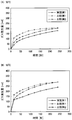
- Example 1 The baking powder obtained in Example 1, Comparative Example 1 and Comparative Example 2 was measured for gas generation as follows, and a hot cake was prepared using these baking powders and evaluated. It was.
- the prepared hot cake was evaluated for the degree of “burn-out” in three stages (excellent: ⁇ , intermediate: ⁇ , inferior: ⁇ ).
- Table 3 shows the results of sensory evaluation of the texture of the hot cakes of each Example and Comparative Example, together with a part of the results of the gas generation amount (ml) described above.
- Example 1 The inner layer is long and crisp, the texture is soft and light, and the flame is good. Comparative Example 1: The inner layer is rounded and crisp, with a moist texture and a poor flame. Comparative Example 2: The inner layer is slightly rounded, has a moist texture, and has a slightly poor flame.
- baking powder concerning the present invention As mentioned above, although baking powder concerning the present invention, its manufacturing method, and foodstuffs using the baking powder were explained in detail with one embodiment, the present invention is not limited to the above embodiment. Of course, various improvements and modifications may be made without departing from the scope of the present invention.
Landscapes
- Life Sciences & Earth Sciences (AREA)
- Engineering & Computer Science (AREA)
- Food Science & Technology (AREA)
- Bakery Products And Manufacturing Methods Therefor (AREA)
Abstract
L'objectif de la présente invention est de fournir une poudre de cuisson ayant une excellente efficacité retardée. L'invention concerne une poudre de cuisson comprenant du bicarbonate de sodium et des agents acides, lesdits agents acides ayant un diamètre médian de 100 µm ou plus et étant enrobés d'une matière grasse ayant un point de fusion de 55 à 75 <sp />°C, où : les agents acides sont constitués d'un ou plusieurs types d'agents acides ayant un diamètre médian de 100 µm ou plus et un ou plusieurs types d'agents acides ayant un diamètre médian inférieur à 100 µm ; et un ou plusieurs types d'agents acides ayant un diamètre médian de 100 µm ou plus sont enrobés en surface avec la matière grasse contenant un ou plusieurs types d'agents acides ayant un diamètre médian inférieur à 100 µm.
Priority Applications (1)
| Application Number | Priority Date | Filing Date | Title |
|---|---|---|---|
| PCT/JP2014/069459 WO2016013071A1 (fr) | 2014-07-23 | 2014-07-23 | Poudre de cuisson, son procédé de fabrication et aliment utilisant la poudre de cuisson |
Applications Claiming Priority (1)
| Application Number | Priority Date | Filing Date | Title |
|---|---|---|---|
| PCT/JP2014/069459 WO2016013071A1 (fr) | 2014-07-23 | 2014-07-23 | Poudre de cuisson, son procédé de fabrication et aliment utilisant la poudre de cuisson |
Publications (1)
| Publication Number | Publication Date |
|---|---|
| WO2016013071A1 true WO2016013071A1 (fr) | 2016-01-28 |
Family
ID=55162627
Family Applications (1)
| Application Number | Title | Priority Date | Filing Date |
|---|---|---|---|
| PCT/JP2014/069459 Ceased WO2016013071A1 (fr) | 2014-07-23 | 2014-07-23 | Poudre de cuisson, son procédé de fabrication et aliment utilisant la poudre de cuisson |
Country Status (1)
| Country | Link |
|---|---|
| WO (1) | WO2016013071A1 (fr) |
Cited By (1)
| Publication number | Priority date | Publication date | Assignee | Title |
|---|---|---|---|---|
| US10115311B2 (en) | 2016-11-15 | 2018-10-30 | Hyundai Motor Company | Apparatus and computer readable recording medium for situational warning |
Citations (4)
| Publication number | Priority date | Publication date | Assignee | Title |
|---|---|---|---|---|
| JPS484541B1 (fr) * | 1968-12-18 | 1973-02-09 | ||
| US6312741B1 (en) * | 2000-02-22 | 2001-11-06 | Balchem Corporation | Encapsulated food acids for preservation of baked goods |
| JP2011067195A (ja) * | 2009-08-27 | 2011-04-07 | Nisshin Flour Milling Inc | 新規なベーキングパウダー組成物及びそれを用いた加工品 |
| EP2570030A1 (fr) * | 2010-03-17 | 2013-03-20 | Kudos Blends Ltd | Compositions de levage à faible teneur en sodium |
-
2014
- 2014-07-23 WO PCT/JP2014/069459 patent/WO2016013071A1/fr not_active Ceased
Patent Citations (4)
| Publication number | Priority date | Publication date | Assignee | Title |
|---|---|---|---|---|
| JPS484541B1 (fr) * | 1968-12-18 | 1973-02-09 | ||
| US6312741B1 (en) * | 2000-02-22 | 2001-11-06 | Balchem Corporation | Encapsulated food acids for preservation of baked goods |
| JP2011067195A (ja) * | 2009-08-27 | 2011-04-07 | Nisshin Flour Milling Inc | 新規なベーキングパウダー組成物及びそれを用いた加工品 |
| EP2570030A1 (fr) * | 2010-03-17 | 2013-03-20 | Kudos Blends Ltd | Compositions de levage à faible teneur en sodium |
Cited By (1)
| Publication number | Priority date | Publication date | Assignee | Title |
|---|---|---|---|---|
| US10115311B2 (en) | 2016-11-15 | 2018-10-30 | Hyundai Motor Company | Apparatus and computer readable recording medium for situational warning |
Similar Documents
| Publication | Publication Date | Title |
|---|---|---|
| JP6118634B2 (ja) | ベーキングパウダ及びその製造方法、並びに、そのベーキングパウダを用いた食品 | |
| JP5520141B2 (ja) | 新規なベーキングパウダー組成物及びそれを用いた加工品 | |
| EP1206912B1 (fr) | Procede de fabrication de nouilles frites instantanees | |
| JP5857345B2 (ja) | 制菌剤 | |
| JP2018019645A (ja) | アメリカンドッグ用ミックス粉及びアメリカンドッグの製造方法 | |
| JP2011004767A (ja) | 新規のふくらまし酸組成物 | |
| WO2016013071A1 (fr) | Poudre de cuisson, son procédé de fabrication et aliment utilisant la poudre de cuisson | |
| JP6732748B2 (ja) | ハードビスケット及びその製造方法 | |
| JP2018027057A (ja) | 冷凍生地、及びそれを用いるパン類の製造方法 | |
| JP6495708B2 (ja) | 熱処理穀粉及びその製造方法 | |
| TW201501648A (zh) | 粉末乳化劑組成物及其製造方法 | |
| JP6841744B2 (ja) | 油ちょうベーカリー食品用ミックス及びそれを用いた油ちょうベーカリー食品用生地の製造方法 | |
| TW201607434A (zh) | 發粉及其製造方法、以及使用其發粉之食品 | |
| JP7125449B2 (ja) | ベーキングパウダー組成物及び食品の製造方法 | |
| JP4376451B2 (ja) | バッター用造粒組成物の製造方法 | |
| CN113473864B (zh) | 谷粉组合物的制造方法 | |
| JP4376450B2 (ja) | バッター用穀粉類造粒物 | |
| JP6801971B2 (ja) | ベーキングパウダー組成物の製造方法 | |
| JP4219559B2 (ja) | 膨らみの良い冷凍パイ生地 | |
| JP2004313185A (ja) | 膨張剤を含有するミックス粉及びこれを用いた食品 | |
| JP2019135999A (ja) | バッター生地加熱食品用ミックス、バッター生地加熱食品、及びバッター生地加熱食品の製造方法 | |
| JP2016093115A (ja) | アメリカンドッグ用ミックス、アメリカンドッグの製造方法及びアメリカンドッグ | |
| JP2017012017A (ja) | 艶出し用水中油型乳化物およびこの製造方法 | |
| WO2023087625A1 (fr) | Agent de levage, son procédé de préparation et son utilisation | |
| JP6947594B2 (ja) | 被覆物及びその製造方法、並びに母材の被覆方法 |
Legal Events
| Date | Code | Title | Description |
|---|---|---|---|
| 121 | Ep: the epo has been informed by wipo that ep was designated in this application |
Ref document number: 14897992 Country of ref document: EP Kind code of ref document: A1 |
|
| NENP | Non-entry into the national phase |
Ref country code: DE |
|
| 122 | Ep: pct application non-entry in european phase |
Ref document number: 14897992 Country of ref document: EP Kind code of ref document: A1 |
|
| NENP | Non-entry into the national phase |
Ref country code: JP |