WO2016013657A1 - ヘテロアリールで置換されたフェニルテトラヒドロイソキノリン化合物 - Google Patents
ヘテロアリールで置換されたフェニルテトラヒドロイソキノリン化合物 Download PDFInfo
- Publication number
- WO2016013657A1 WO2016013657A1 PCT/JP2015/071111 JP2015071111W WO2016013657A1 WO 2016013657 A1 WO2016013657 A1 WO 2016013657A1 JP 2015071111 W JP2015071111 W JP 2015071111W WO 2016013657 A1 WO2016013657 A1 WO 2016013657A1
- Authority
- WO
- WIPO (PCT)
- Prior art keywords
- ethoxy
- compound
- methyl
- dichloro
- phenyl
- Prior art date
- Legal status (The legal status is an assumption and is not a legal conclusion. Google has not performed a legal analysis and makes no representation as to the accuracy of the status listed.)
- Ceased
Links
Classifications
-
- A—HUMAN NECESSITIES
- A61—MEDICAL OR VETERINARY SCIENCE; HYGIENE
- A61K—PREPARATIONS FOR MEDICAL, DENTAL OR TOILETRY PURPOSES
- A61K31/00—Medicinal preparations containing organic active ingredients
- A61K31/33—Heterocyclic compounds
- A61K31/395—Heterocyclic compounds having nitrogen as a ring hetero atom, e.g. guanethidine or rifamycins
- A61K31/435—Heterocyclic compounds having nitrogen as a ring hetero atom, e.g. guanethidine or rifamycins having six-membered rings with one nitrogen as the only ring hetero atom
- A61K31/47—Quinolines; Isoquinolines
- A61K31/472—Non-condensed isoquinolines, e.g. papaverine
- A61K31/4725—Non-condensed isoquinolines, e.g. papaverine containing further heterocyclic rings
-
- A—HUMAN NECESSITIES
- A61—MEDICAL OR VETERINARY SCIENCE; HYGIENE
- A61K—PREPARATIONS FOR MEDICAL, DENTAL OR TOILETRY PURPOSES
- A61K31/00—Medicinal preparations containing organic active ingredients
- A61K31/33—Heterocyclic compounds
- A61K31/395—Heterocyclic compounds having nitrogen as a ring hetero atom, e.g. guanethidine or rifamycins
- A61K31/495—Heterocyclic compounds having nitrogen as a ring hetero atom, e.g. guanethidine or rifamycins having six-membered rings with two or more nitrogen atoms as the only ring heteroatoms, e.g. piperazine or tetrazines
- A61K31/50—Pyridazines; Hydrogenated pyridazines
- A61K31/501—Pyridazines; Hydrogenated pyridazines not condensed and containing further heterocyclic rings
-
- A—HUMAN NECESSITIES
- A61—MEDICAL OR VETERINARY SCIENCE; HYGIENE
- A61K—PREPARATIONS FOR MEDICAL, DENTAL OR TOILETRY PURPOSES
- A61K31/00—Medicinal preparations containing organic active ingredients
- A61K31/33—Heterocyclic compounds
- A61K31/395—Heterocyclic compounds having nitrogen as a ring hetero atom, e.g. guanethidine or rifamycins
- A61K31/495—Heterocyclic compounds having nitrogen as a ring hetero atom, e.g. guanethidine or rifamycins having six-membered rings with two or more nitrogen atoms as the only ring heteroatoms, e.g. piperazine or tetrazines
- A61K31/505—Pyrimidines; Hydrogenated pyrimidines, e.g. trimethoprim
- A61K31/506—Pyrimidines; Hydrogenated pyrimidines, e.g. trimethoprim not condensed and containing further heterocyclic rings
-
- A—HUMAN NECESSITIES
- A61—MEDICAL OR VETERINARY SCIENCE; HYGIENE
- A61P—SPECIFIC THERAPEUTIC ACTIVITY OF CHEMICAL COMPOUNDS OR MEDICINAL PREPARATIONS
- A61P1/00—Drugs for disorders of the alimentary tract or the digestive system
-
- A—HUMAN NECESSITIES
- A61—MEDICAL OR VETERINARY SCIENCE; HYGIENE
- A61P—SPECIFIC THERAPEUTIC ACTIVITY OF CHEMICAL COMPOUNDS OR MEDICINAL PREPARATIONS
- A61P1/00—Drugs for disorders of the alimentary tract or the digestive system
- A61P1/10—Laxatives
-
- A—HUMAN NECESSITIES
- A61—MEDICAL OR VETERINARY SCIENCE; HYGIENE
- A61P—SPECIFIC THERAPEUTIC ACTIVITY OF CHEMICAL COMPOUNDS OR MEDICINAL PREPARATIONS
- A61P13/00—Drugs for disorders of the urinary system
-
- A—HUMAN NECESSITIES
- A61—MEDICAL OR VETERINARY SCIENCE; HYGIENE
- A61P—SPECIFIC THERAPEUTIC ACTIVITY OF CHEMICAL COMPOUNDS OR MEDICINAL PREPARATIONS
- A61P13/00—Drugs for disorders of the urinary system
- A61P13/12—Drugs for disorders of the urinary system of the kidneys
-
- A—HUMAN NECESSITIES
- A61—MEDICAL OR VETERINARY SCIENCE; HYGIENE
- A61P—SPECIFIC THERAPEUTIC ACTIVITY OF CHEMICAL COMPOUNDS OR MEDICINAL PREPARATIONS
- A61P19/00—Drugs for skeletal disorders
-
- A—HUMAN NECESSITIES
- A61—MEDICAL OR VETERINARY SCIENCE; HYGIENE
- A61P—SPECIFIC THERAPEUTIC ACTIVITY OF CHEMICAL COMPOUNDS OR MEDICINAL PREPARATIONS
- A61P43/00—Drugs for specific purposes, not provided for in groups A61P1/00-A61P41/00
-
- A—HUMAN NECESSITIES
- A61—MEDICAL OR VETERINARY SCIENCE; HYGIENE
- A61P—SPECIFIC THERAPEUTIC ACTIVITY OF CHEMICAL COMPOUNDS OR MEDICINAL PREPARATIONS
- A61P7/00—Drugs for disorders of the blood or the extracellular fluid
-
- A—HUMAN NECESSITIES
- A61—MEDICAL OR VETERINARY SCIENCE; HYGIENE
- A61P—SPECIFIC THERAPEUTIC ACTIVITY OF CHEMICAL COMPOUNDS OR MEDICINAL PREPARATIONS
- A61P9/00—Drugs for disorders of the cardiovascular system
- A61P9/12—Antihypertensives
-
- C—CHEMISTRY; METALLURGY
- C07—ORGANIC CHEMISTRY
- C07D—HETEROCYCLIC COMPOUNDS
- C07D401/00—Heterocyclic compounds containing two or more hetero rings, having nitrogen atoms as the only ring hetero atoms, at least one ring being a six-membered ring with only one nitrogen atom
- C07D401/02—Heterocyclic compounds containing two or more hetero rings, having nitrogen atoms as the only ring hetero atoms, at least one ring being a six-membered ring with only one nitrogen atom containing two hetero rings
- C07D401/10—Heterocyclic compounds containing two or more hetero rings, having nitrogen atoms as the only ring hetero atoms, at least one ring being a six-membered ring with only one nitrogen atom containing two hetero rings linked by a carbon chain containing aromatic rings
-
- C—CHEMISTRY; METALLURGY
- C07—ORGANIC CHEMISTRY
- C07D—HETEROCYCLIC COMPOUNDS
- C07D401/00—Heterocyclic compounds containing two or more hetero rings, having nitrogen atoms as the only ring hetero atoms, at least one ring being a six-membered ring with only one nitrogen atom
- C07D401/14—Heterocyclic compounds containing two or more hetero rings, having nitrogen atoms as the only ring hetero atoms, at least one ring being a six-membered ring with only one nitrogen atom containing three or more hetero rings
-
- C—CHEMISTRY; METALLURGY
- C07—ORGANIC CHEMISTRY
- C07D—HETEROCYCLIC COMPOUNDS
- C07D403/00—Heterocyclic compounds containing two or more hetero rings, having nitrogen atoms as the only ring hetero atoms, not provided for by group C07D401/00
- C07D403/14—Heterocyclic compounds containing two or more hetero rings, having nitrogen atoms as the only ring hetero atoms, not provided for by group C07D401/00 containing three or more hetero rings
-
- C—CHEMISTRY; METALLURGY
- C07—ORGANIC CHEMISTRY
- C07D—HETEROCYCLIC COMPOUNDS
- C07D405/00—Heterocyclic compounds containing both one or more hetero rings having oxygen atoms as the only ring hetero atoms, and one or more rings having nitrogen as the only ring hetero atom
- C07D405/02—Heterocyclic compounds containing both one or more hetero rings having oxygen atoms as the only ring hetero atoms, and one or more rings having nitrogen as the only ring hetero atom containing two hetero rings
- C07D405/10—Heterocyclic compounds containing both one or more hetero rings having oxygen atoms as the only ring hetero atoms, and one or more rings having nitrogen as the only ring hetero atom containing two hetero rings linked by a carbon chain containing aromatic rings
-
- C—CHEMISTRY; METALLURGY
- C07—ORGANIC CHEMISTRY
- C07D—HETEROCYCLIC COMPOUNDS
- C07D413/00—Heterocyclic compounds containing two or more hetero rings, at least one ring having nitrogen and oxygen atoms as the only ring hetero atoms
- C07D413/02—Heterocyclic compounds containing two or more hetero rings, at least one ring having nitrogen and oxygen atoms as the only ring hetero atoms containing two hetero rings
- C07D413/10—Heterocyclic compounds containing two or more hetero rings, at least one ring having nitrogen and oxygen atoms as the only ring hetero atoms containing two hetero rings linked by a carbon chain containing aromatic rings
-
- C—CHEMISTRY; METALLURGY
- C07—ORGANIC CHEMISTRY
- C07D—HETEROCYCLIC COMPOUNDS
- C07D413/00—Heterocyclic compounds containing two or more hetero rings, at least one ring having nitrogen and oxygen atoms as the only ring hetero atoms
- C07D413/14—Heterocyclic compounds containing two or more hetero rings, at least one ring having nitrogen and oxygen atoms as the only ring hetero atoms containing three or more hetero rings
-
- C—CHEMISTRY; METALLURGY
- C07—ORGANIC CHEMISTRY
- C07D—HETEROCYCLIC COMPOUNDS
- C07D417/00—Heterocyclic compounds containing two or more hetero rings, at least one ring having nitrogen and sulfur atoms as the only ring hetero atoms, not provided for by group C07D415/00
- C07D417/02—Heterocyclic compounds containing two or more hetero rings, at least one ring having nitrogen and sulfur atoms as the only ring hetero atoms, not provided for by group C07D415/00 containing two hetero rings
- C07D417/10—Heterocyclic compounds containing two or more hetero rings, at least one ring having nitrogen and sulfur atoms as the only ring hetero atoms, not provided for by group C07D415/00 containing two hetero rings linked by a carbon chain containing aromatic rings
Definitions
- the present invention relates to a novel compound having an inhibitory action on sodium / proton exchange transporter 3 (Na + / H + exchanger 3, Natrium Hydrogen Exchanger 3) (hereinafter also referred to as “NHE3”) and a medicament containing them as an active ingredient.
- Na + / H + exchanger 3, Natrium Hydrogen Exchanger 3 sodium / proton exchange transporter 3
- NHE3 Natrium Hydrogen Exchanger 3
- Constipation and constipation refer to a condition in which the number of bowel movements and the amount of bowel movement decrease, and the excretion of the bowel is painful or difficult. It is estimated that the frequency of constipation is increasing due to changes in dietary habits, lack of exercise, social life that is stressed by time, and an aging population.
- Ingested food is digested in the stomach and small intestine, and its nutrients are absorbed mainly in the small intestine. Thereafter, the intestinal contents that have become indigestible are sent from the small intestine to the large intestine.
- the large intestine water is absorbed and solidifies, moves to the anal side by peristaltic movement, reaches the sigmoid colon, and accumulates.
- the stored stool flows into the rectum by a contraction movement called large peristalsis, the rectal wall develops and is transmitted to the defecation center of the spinal cord by the stimulation, causing a defecation reflex, causing anal sphincter relaxation and rectal contraction .
- constipation by the cerebrum, voluntarily increasing abdominal pressure and defecation.
- the autonomic nervous function, motor function, or defecation reflex function of the lower gastrointestinal tract is decreased, or water overabsorption or decrease in intestinal fluid secretion in the intestinal tract is induced. And constipation develops.
- constipation causes a illness in the whole body due to constipation in addition to a decrease in QOL and constipation occurs as a partial symptom associated with a systemic disease, the importance of the treatment has been pointed out.
- Constipation is divided into organic constipation and functional constipation depending on the cause.
- Organic constipation is constipation that develops when the gastrointestinal tract is obstructed by colonic polyps or colon cancer.
- functional constipation is classified into drug constipation, symptomatic constipation and chronic idiopathic constipation.
- Drug constipation is constipation caused by drugs that suppress intestinal motility such as opioids.
- Symptomatic constipation is constipation that occurs secondary to diseases other than gastrointestinal diseases.
- Chronic idiopathic constipation is the most frequent constipation among functional constipation. Chronic idiopathic constipation develops due to stress and changes in the eating environment.
- Constipation-type irritable bowel syndrome is a constipation in which there is no organic change in the digestive tract and gastrointestinal symptoms mainly consisting of abdominal pain / abdominal discomfort and abnormal bowel movement. Some patients with functional constipation may be classified as IBS-C.
- Drugs used for constipation include salt laxatives such as magnesium oxide or osmotic laxatives classified as saccharide laxatives such as lactulose, swelling laxatives such as polycarbophil calcium, and stimulant laxatives such as sennoside and picosulfate sodium And invasive laxatives such as dioctyl sodium sulfosuccinate.
- Serotonin 4 (5-HT4) receptor agonists such as purcaropride, type-2 chloride channel (ClC-2) agonists such as rubiprostone are also used.
- a salt laxative or an expansive laxative is used.
- Magnesium oxide which is a salt laxative, requires attention to hypermagnesemia in the elderly or when kidney damage occurs.
- Polycarbophil calcium which is an expansive laxative, has a mild action and takes time to develop the effect. If these drugs are insufficient, irritant laxatives are used.
- stimulant laxatives act on the intestinal plexus and increase peristaltic movement, but become habitual after long-term use, resulting in atrophy of the plexus and worsening colonic relaxation. Its use is kept in a short time with as little as possible.
- even approved rubiprostone has nausea and vomiting as side effects. In addition, it is carefully administered to patients whose renal function is highly reduced.
- Non-patent Documents 1 and 2 It is desirable to create safer and more effective constipation treatments, and such agents are considered beneficial for many patients with chronic constipation.
- the gastrointestinal tract reabsorbs this to maintain sodium homeostasis. That is, the gastrointestinal tract absorbs 9 L of body fluid and about 800 mmol of sodium, of which 7.5 L of body fluid and 650 mmol of sodium are derived from the digestive juice, and the remaining 1.5 L of body fluid and 150 mmol of sodium are orally derived ( Non-patent document 3).
- the digestive tract absorbs almost all of the sodium, and the amount of sodium excreted in the stool is about 5 mmol.
- Electroneutral transport is mainly done by NHE3 expressed in the small intestine and proximal colon. For example, it has been reported that about half of sodium absorption in the jejunum is derived from NHE3 (Non-patent Document 5). Electrogenic transport is made by the epithelial sodium channel ENac in the distal colon.
- NHE3 inhibitory substance A substance that inhibits NHE3 activity in the intestinal tract (hereinafter referred to as NHE3 inhibitory substance) retains sodium in the intestinal tract by suppressing sodium absorption from the intestinal tract. Since the stored sodium draws out water by osmotic pressure, it softens the intestinal contents. Therefore, NHE3 inhibitors are considered useful as therapeutic agents for chronic constipation, IBS-C, or drug-induced constipation (Non-patent Documents 6 and 7).
- NHE3 inhibitor suppresses sodium absorption from the intestine and discharges sodium into feces. Therefore, it is considered useful as a drug that mimics low salt.
- NHE3 inhibitor mimicking salt reduction lowers blood pressure in rats and, moreover, lowers blood pressure more strongly when used in combination with an angiotensin converting enzyme inhibitor (Non-patent Document 6). Therefore, it is considered that NHE3 inhibitor exerts a therapeutic effect in combination therapy with a single agent and an existing antihypertensive drug.
- NHE3 inhibitors are considered useful as drugs that reduce the risk of developing heart disease in patients with renal failure.
- NHE3 inhibitors have been reported not only to suppress sodium absorption from the intestinal tract but also to suppress phosphorus absorption and enhance the excretion of phosphorus into the stool (Patent Document 24, Non-Patent Document 24). Reference 8). Furthermore, certain NHE3 inhibitors have been reported to reduce blood phosphorus levels upon administration to renal failure rats.
- Phosphorus metabolism is maintained by two main actions, absorption and excretion in the small intestine and kidney.
- About 1.2 g of phosphorus is ingested a day, about one third of which is excreted in feces, and the remaining two thirds of about 0.8 g are absorbed (Non-patent Document 9).
- about 0.8 g of phosphorus is excreted in urine every day.
- the digestive juice also contains phosphorus and is excreted in the feces. Even in the body, there is an equilibrium of phosphorus between bone and blood.
- hyperphosphatemia in particular, causes bone and parathyroid abnormalities, exacerbates vascular calcification, increases the risk of developing osteoporosis and cardiovascular disease, and has a significant impact on life prognosis. To point out. And he recommends correcting with priority on hyperphosphatemia.
- a phosphorus adsorbent which is a therapeutic agent for hyperphosphatemia.
- Phosphorus adsorbents are drugs that enhance phosphorus excretion by binding to phosphorus in the intestinal tract and moving directly to feces. Although these drugs are surely effective in lowering blood phosphorus levels, the dose is several grams per day and the burden of medication is large. Originally, water restriction is compulsory, but in dialysis patients with many medication tablets, adherence is significantly impaired by medication burden.
- Phosphorus adsorbents are classified into metal-containing types and polymer-based phosphorus adsorbents, but each has its own problems. With metal-based phosphorus adsorbents, there are concerns about long-term safety due to metal loading. In addition, since the polymer-based phosphorus adsorbent swells in the intestine, gastrointestinal symptoms such as constipation and abdominal bloating frequently occur.
- a new drug for treating hyperphosphatemia is desired to have a good adherence with improved safety and convenience.
- NHE3 inhibitors do not contain metals and are not polymers, there are no side effects specific to the above phosphorus adsorbents. It is also considered that the dose can be reduced as compared with the phosphorus adsorbent. Therefore, the NHE3 inhibitor is considered useful as a therapeutic agent for hyperphosphatemia with improved adherence and improved safety and convenience. An NHE3 inhibitor that can be used for a long time is considered to be useful as a drug for improving CKD-MBD.
- NHE3 inhibitors become drugs that can treat hyperphosphatemia and CKD-MBD in patients with renal failure, drugs that can reduce fluid retention, and drugs that can also improve constipation in patients with renal failure. It is expected to improve the overall QOL of the product and to be a very useful drug.
- NHE3 inhibitors can expel body fluids into feces regardless of kidney function. Therefore, it is considered that NHE3 inhibitor is useful as a novel therapeutic agent for heart failure.
- fluid retention develops in patients with cirrhosis.
- Drug fluid retention also develops with PPAR agonists that are useful in the treatment of type 2 diabetes. It is believed that NHE3 inhibitors can also reduce these fluid retention.
- Patent Document 1 As compounds that inhibit NHE3, acylguanidine derivatives (Patent Document 1), amidine derivatives (Patent Documents 2 to 3), guanidine derivatives (Patent Documents 4 to 6), tetrahydroisoquinoline derivatives (Patent Documents 7 to 14), 2-Aminoimidazolidine or 2-aminoimidazole derivatives (patent documents 15 to 19), aminodihydroisoquinoline derivatives (patent documents 20 to 21), aminoindane derivatives (patent documents 22 to 23) and the like have been reported. Compounds having the structure of the invention are not disclosed.
- An object of the present invention is to provide a compound having an excellent NHE3 inhibitory action.
- R 11 and R 12 are the same or different and each represents a hydrogen atom or a halogen atom
- R 2 represents a hydrogen atom or C 1-6 alkyl
- Ring E represents pyrrole, furan, pyrazole, imidazole, isoxazole, oxazole, isothiazole, triazole, oxadiazole, tetrazole, pyridine, pyridazine, pyrimidine, or pyrazine
- R 31 and R 32 are the same or different and each represents a hydrogen atom, cyano, C 1-6 alkyl, C 1-6 alkoxy, or mono C 1-6 alkylamino
- W represents a single bond, a formula —NH—, a formula —O—, or a formula —CONH—
- Y represents a hydrogen atom or any structure of the following formula [3 ′],
- Z 1 represents any structure of the following formula group [4 ′],
- Z 3 represents the structure of the following formula [4-a],
- L 2 , L 2 ′, L 2 ′′ and L 2 ′ ′′ are the same or different and represent any structure of the following formula group [5],
- a ′, A ′′ and A ′ ′′ represent the same structure as the structure represented by A.
- Y is a hydrogen atom or a structure represented by the following formula [3],
- Z 1 is any structure of the following formula group [4],
- L 2 and L 2 ′ are the same in any structure of the following formula group [5],
- a ′ is to provide a compound or a pharmaceutically acceptable salt thereof according to (1), wherein A ′ is the same structure as the structure represented by A.
- Y is a structure represented by the following formula [3]
- Z 1 is any structure of the following formula group [6]
- R 11 and R 12 are halogen atoms;
- R 2 is C 1-6 alkyl;
- Ring E is pyrazole, imidazole, triazole, tetrazole, pyridine, pyridazine, or pyrimidine;
- W is a single bond, formula —NH—, formula —O—, or formula —CONH—,
- Z 1 is any structure of the following formula group [17],
- L 2 and L 2 ′ are any structure of the following formula group [5]
- R 11 and R 12 are chlorine atoms, R 2 is methyl; Ring E is triazole, tetrazole, pyridine, pyridazine, or pyrimidine; W is a single bond, formula —NH—, or formula —CONH—, Z 1 is any structure of the following formula group [17 ′]
- An object of the present invention is to provide an NHE3 inhibitor comprising the compound according to any one of (1) to (10) or a pharmaceutically acceptable salt thereof as an active ingredient.
- An object of the present invention is to provide an intestinal water secretion promoter comprising the compound according to any one of (1) to (10) or a pharmaceutically acceptable salt thereof as an active ingredient.
- (1) It is intended to provide a prophylactic or therapeutic agent for hyperphosphatemia containing the compound according to any one of (1) to (10) or a pharmaceutically acceptable salt thereof as an active ingredient.
- (2) As another aspect of the present invention, (1) It is intended to provide a prophylactic or therapeutic agent for CKD-MBD comprising the compound according to any one of (1) to (10) or a pharmaceutically acceptable salt thereof as an active ingredient.
- the present invention it has become possible to provide a compound having an excellent NHE3 inhibitory action.
- the compound of the present invention has an NHE3 inhibitory action.
- the medicament containing the compound of the present invention as an active ingredient can be an effective medicament for preventing or treating fluid retention due to constipation, hypertension, nephropathy, renal failure, heart failure, cirrhosis or fluid retention due to drugs.
- Some compounds of the present invention have a phosphorus absorption inhibitory action.
- a medicament containing these compounds as an active ingredient can be an effective medicament for preventing or treating hyperphosphatemia and CKD-MBD.
- the present invention provides a compound represented by the above formula [1] having an excellent NHE3 inhibitory action or a pharmaceutically acceptable salt thereof.
- Halogen atom means a fluorine atom, a chlorine atom, a bromine atom or an iodine atom.
- C 1-6 alkyl refers to a linear or branched alkyl having 1 to 6 carbon atoms.
- methyl, ethyl, n-propyl, isopropyl, n-butyl, isobutyl, sec-butyl, tert-butyl, n-pentyl, isopentyl, neopentyl, 2-methylbutyl, n-hexyl, isohexyl and the like can be mentioned.
- C 1-6 alkoxy represents linear or branched alkoxy having 1 to 6 carbon atoms.
- “Mono C 1-6 alkylamino” refers to amino having one “C 1-6 alkyl” as a substituent. For example, methylamino, ethylamino, n-propylamino, isopropylamino, n-butylamino, isobutylamino, sec-butylamino, tert-butylamino, n-pentylamino, isopentylamino, neopentylamino, 2-methyl Examples include butylamino, n-hexylamino, isohexylamino and the like.
- One preferred embodiment of the compound of the present invention is as follows.
- Preferred R 11 is a halogen atom, more preferred R 11 is a chlorine atom
- Preferred R 12 is a halogen atom, more preferred R 12 is a chlorine atom
- Preferred R 2 is C 1-6 alkyl, more preferred R 2 is methyl
- Preferred ring E is pyrazole, imidazole, triazole, tetrazole, pyridine, pyridazine, pyrimidine, or pyrazine, At this time, preferable R 31 is a hydrogen atom, preferable R 32 is a hydrogen atom, In this case, preferred W is a single bond or the formula —NH—, More preferred ring E is triazole, tetrazole or pyrimidine, At this time, preferable R 31 is a hydrogen atom, preferable R 32 is a hydrogen atom, In this case, preferred W is a single bond or the formula —NH—, One more preferred ring E is triazole or tetrazole, At this time, preferable R 31 is a hydrogen atom, preferable R 32 is a hydrogen atom, At this time, preferable W is a single bond, At this time, particularly preferred rings E and W (in the formula [7], a structure represented by the following formula [8]) are any structures of the
- Another more preferred ring E is pyrimidine, At this time, preferable R 31 is a hydrogen atom, preferable R 32 is a hydrogen atom, In this case, preferable W is the formula —NH—. At this time, particularly preferred rings E and W (in the formula [7], a structure represented by the following formula [8]) are structures of the following formula [11],
- Preferred Y is a structure represented by the following formula [3],
- Preferred Z 1 is any structure of the following formula group [6],
- Desirable L 2 and L 2 ′ are structures of the following formula group [5].
- Preferred R 11 is a halogen atom, more preferred R 11 is a chlorine atom
- Preferred R 12 is a halogen atom, more preferred R 12 is a chlorine atom
- Preferred R 2 is C 1-6 alkyl, more preferred R 2 is methyl
- Preferred ring E is pyrazole, imidazole, triazole, tetrazole, pyridine, pyridazine, or pyrimidine; At this time, preferable R 31 is a hydrogen atom, preferable R 32 is a hydrogen atom, In this case, preferable W is a single bond, a formula —NH—, or a formula —CONH—, More preferred ring E is triazole, tetrazole, pyridine, pyridazine, or pyrimidine, At this time, preferable R 31 is a hydrogen atom, preferable R 32 is a hydrogen atom, In this case, preferable W is a single bond, a formula —NH—, or a formula —CONH—, One more preferred ring E is triazole or tetrazole, At this time, preferable R 31 is a hydrogen atom, preferable R 32 is a hydrogen atom, At this time, preferable W is a single bond, At this time
- Another more preferred ring E is pyridine, pyridazine, or pyrimidine,
- preferable R 31 is a hydrogen atom
- preferable R 32 is a hydrogen atom
- preferable W is the formula —NH— or the formula —CONH—
- particularly preferable rings E and W are structures of the following formula [20],
- Preferred Y is a structure represented by the following formula [3],
- Preferred Z 1 is any structure of the following formula group [17],
- More preferred Z 1 is any structure of the following formula group [17 ′],
- Desirable L 2 and L 2 ′ are structures of the following formula group [5].
- One preferred embodiment of the compound of the present invention is a compound represented by the following formula [1-a] or a pharmaceutically acceptable salt thereof.
- Ring E is triazole, tetrazole, or pyrimidine,
- preferable W is a single bond or a formula —NH—.
- Ring E is triazole or tetrazole
- preferable W is a case of a single bond
- a particularly preferred embodiment is In the formula [1-a], the structure represented by the following formula [8] is a structure of any one of the following formula group [10].
- Ring E is a pyrimidine
- W is the formula —NH—
- Z 1 is a structure of the following formula [12],
- L 2 and L 2 ′ are the same in any structure of the following formula group [13],
- Another preferred embodiment of the compound of the present invention is a compound represented by the following formula [1-a] or a pharmaceutically acceptable salt thereof.
- Ring E is triazole, tetrazole, pyridine, pyridazine, or pyrimidine;
- W is a single bond, a formula —NH—, or a formula —CONH—.
- Ring E is triazole or tetrazole
- W is a case of a single bond
- Preferred Z 1 is the structure of the following formula [17 ′]
- L 2 and L 2 ′ are the structures of the following formula group [5].
- Ring E is pyridine, pyridazine, or pyrimidine
- W is the formula —NH— or the formula —CONH—
- Preferred Z 1 is the structure of the following formula [21]
- L 2 and L 2 ′ are the same in any structure of the following formula group [22],
- the compound of the present invention is a heteroaryl-substituted phenyltetrahydroisoquinoline compound, and the compound of the present invention may be a pharmaceutically acceptable salt thereof (hereinafter referred to as “the compound of the present invention” as appropriate).
- Examples of pharmaceutically acceptable salts include hydrochlorides, hydrobromides, hydroiodides, phosphates, sulfates, nitrates, mineral salts such as methanesulfonate, ethanesulfone, and the like.
- Acid salt such as trifluoromethane sulfonate, oxalate, tartrate, citrate, maleate, succinate, acetate, tri Acid addition salts such as organic acid salts such as fluoroacetate, benzoate, mandelate, ascorbate, lactate, gluconate, malate, glycine salt, lysine salt, arginine salt, ornithine salt, Amino acid salts such as glutamate and aspartate, or inorganic or ammonium salts such as lithium, sodium, potassium, calcium and magnesium salts; Triethylamine salts, diisopropylamine salts, salts with organic bases such as cyclohexylamine salts.
- the salt includes a hydrated salt.
- the compounds of the present invention may have asymmetric centers, in which case various optical isomers exist.
- the compounds of the present invention may exist as separate optically active forms of (R) and (S) and as racemates or (RS) mixtures.
- diastereomers by respective optical isomerism also exist.
- the compounds of the present invention also include mixtures containing all these types in any proportion.
- diastereomers can be separated by methods well known to those skilled in the art, such as fractional crystallization, and optically active forms can be obtained by organic chemistry techniques well known for this purpose. it can.
- the compound of the present invention may have geometric isomers such as cis isomer and trans isomer.
- the compound of the present invention has tautomerism, and various tautomers exist.
- the compounds of the present invention include those isomers and mixtures containing these isomers in any proportion.
- this invention compound or its salt forms a hydrate or a solvate, they are also contained in the range of this invention compound or its salt.
- the compound of the present invention has an NHE3 inhibitory action.
- the compound of the present invention can soften the intestinal contents and eliminate constipation by storing sodium in the intestinal tract and drawing water.
- constipation includes organic constipation, drug constipation and symptomatic constipation, and other constipation.
- the compound of the present invention can also be used in combination with an existing constipation therapeutic drug or a drug under development having an action mechanism other than NHE3 inhibitory action.
- an existing constipation therapeutic drug or a drug under development having an action mechanism other than NHE3 inhibitory action By combining the compound of the present invention with other drugs, a stronger pharmacological effect can be expected when used in combination than the effect obtained with each single agent.
- Examples of existing constipation treatments that can be used in combination include osmotic laxatives classified into salt laxatives such as magnesium oxide or saccharide laxatives such as lactulose, swelling laxatives such as polycarbophil calcium, sennoside and picosulfate Stimulant laxatives such as sodium, invasive laxatives such as dioctylsodium sulfosuccinate, serotonin 4 (5-HT4) receptor agonists such as mosapride, type-2 chloride channel (ClC-2) agonists such as rubiprostone be able to.
- salt laxatives such as magnesium oxide or saccharide laxatives such as lactulose
- swelling laxatives such as polycarbophil calcium, sennoside and picosulfate Stimulant laxatives such as sodium
- invasive laxatives such as dioctylsodium sulfosuccinate
- drugs that can be used in combination include guanylate cyclase receptor agonists such as linaclotide, opioid receptor antagonists such as methylnaltrexone, IBAT inhibitors such as erobixibat, and SGLT1 inhibitors such as KWA-0711 And serotonin 4 (5-HT4) receptor agonists such as DSP-6952, and GPR38 agonists such as DS-3801.
- guanylate cyclase receptor agonists such as linaclotide
- opioid receptor antagonists such as methylnaltrexone
- IBAT inhibitors such as erobixibat
- SGLT1 inhibitors such as KWA-0711 And serotonin 4 (5-HT4) receptor agonists
- DSP-6952 DSP-6952
- GPR38 agonists such as DS-3801.
- the compound of the present invention can prevent or treat hypertension by inhibiting sodium absorption in the intestinal tract and excreting sodium in the stool.
- hypertension includes essential hypertension, secondary hypertension, and salt-sensitive hypertension. It is also considered useful as a drug that mimics salt reduction.
- the compound of the present invention can prevent or treat nephropathy by inhibiting sodium absorption in the intestinal tract.
- nephropathy includes diabetic nephropathy, glomerulonephritis, nephrosclerosis, and polycystic kidney.
- fluid retention includes fluid retention due to renal failure, fluid retention due to heart failure, fluid retention due to cirrhosis, and fluid retention due to drugs.
- the compound of the present invention is used in combination with existing antihypertensive drugs, nephropathy therapeutic drugs, or existing therapeutic drugs that improve fluid retention, or drugs under development that have an action mechanism other than NHE3 inhibitory action. You can also. By combining the compound of the present invention with other drugs, a stronger pharmacological effect can be expected when used in combination than the effect obtained with each single agent.
- angiotensin II receptor antagonists such as candesartan
- angiotensin converting enzyme inhibitors such as lisinopril
- Aldosterone receptor antagonists such as eplerenone
- renin inhibitors such as aliskiren
- calcium channel antagonists such as amlodipine
- diuretics such as thiazide and loop diuretics
- ⁇ and ⁇ blockers such as carvedilol
- K channel blockers such as amiodarone, etc.
- Aldesterone receptor antagonist urotensin receptor antagonist such as ACT-058362, phosphodiesterase inhibitor such as PF-489791, NEP / ECE inhibitor such as daglutril, TGFbeta antibody such as LY-2382770, glycation reaction inhibition such as aminoguanidine Agents, Keap1-Nrf2 activators such as bardoxolone methyl, VAP-1 inhibitors such as ASP-8232, aldesterone synthase inhibitors, intestinal trypsin inhibitors, LPA receptor antagonists, Dimethylsulfoxide hydrolase inhibitors, and the like EP4 receptor antagonist.
- urotensin receptor antagonist such as ACT-058362
- phosphodiesterase inhibitor such as PF-489791
- NEP / ECE inhibitor such as daglutril
- TGFbeta antibody such as LY-2382770
- glycation reaction inhibition such as aminoguanidine Agents
- the compound of the present invention is expected to suppress the development of diabetic nephropathy by combination with a therapeutic drug for diabetes or a drug under development.
- the above-mentioned antidiabetic drugs that can be used in combination include insulin preparations, ⁇ -glucosidase inhibitors such as acarbose, SGLT2 inhibitors such as luceogliflozin, biguanides such as metformin, insulin secretagogues such as mitiglinide, ditags such as sitagliptin Peptidyl peptidase IV inhibitors, GLP-1 receptor agonists such as liraglutide, PPAR ⁇ agonists such as pioglitazone, and aldose reductase inhibitors such as epalrestat.
- ⁇ -glucosidase inhibitors such as acarbose
- SGLT2 inhibitors such as luceogliflozin
- biguanides such as metformin
- insulin secretagogues such as mitiglinide
- ditags such as sitagliptin Peptidyl peptidase IV inhibitors
- drugs that can be used in combination include glucokinase activators such as PF-0437319, glucagon receptor antagonists such as MK-0893, GLP-1 receptor agonists such as TTP054, amylin agonists such as pramlintide, INCB- 11 beta HSD1 inhibitors such as 13739, GPR40 receptor agonists such as TAK-875, ACC inhibitors such as PSN-821, GPR119 receptor agonists such as PSN-821, GPR120 receptor agonists such as LC-540449, SB ⁇
- TGR5 receptor agonists such as 756050
- aldose reductase inhibitors such as ranirestat
- SGLT1 inhibitors such as KWA-0711
- adiponectin receptor agonists such as TGR5 receptor agonists.
- the compound of the present invention inhibits phosphorus absorption in the intestinal tract and excretes phosphorus in the stool. Therefore, it is considered useful as a therapeutic agent for hyperphosphatemia.
- the compound of the present invention can prevent or treat CKD-MBD by inhibiting phosphorus absorption in the intestinal tract.
- CKD-MBD includes hyperphosphatemia, hypercalcemia, hyperparathyroidism, vascular calcification, and osteoporosis due to abnormal bone metabolism.
- the compound of the present invention can also be used in combination with an existing therapeutic drug for CKD-MBD or a drug under development having an action mechanism other than NHE3 inhibitory action.
- an existing therapeutic drug for CKD-MBD or a drug under development having an action mechanism other than NHE3 inhibitory action.
- Examples of existing CKD-MBD therapeutics that can be used in combination include calcium carbonate, sevelamer hydrochloride, bixalomer, phosphorus adsorbents such as lanthanum carbonate and ferric citrate, and hyperparathyroidism such as cinacalcet and falecalcitriol.
- Examples include therapeutic agents, osteoporosis therapeutic agents such as bisphosphonate preparations such as ibandronate sodium, and the like.
- therapeutic agents for CKD-MBD under development include phosphorus adsorbents such as PA21, and therapeutic agents for hyperparathyroidism such as ONO-5163 and KHK7580.
- the compound of the present invention can be administered alone or with a pharmaceutically or pharmaceutically acceptable additive.
- the medicament of the present invention can be produced by blending the compound of the present invention with a pharmaceutically acceptable additive.
- a pharmaceutically acceptable additive Specifically, conventional excipients or diluents, and commonly used binders, disintegrating agents, lubricants, coating agents, dragees, pH adjusting agents, solubilizers, or aqueous or non-aqueous It can be prepared into tablets, pills, capsules, granules, powders, powders, solutions, emulsions, suspensions, injections, etc. by adding conventional solvents and the like.
- the additive examples include water, lactose, dextrose, fructose, sucrose, sorbitol, mannitol, polyethylene glycol, propylene glycol, starch, corn starch, gum, gelatin, alginate, calcium silicate, calcium phosphate, cellulose, water syrup, Methylcellulose, polyvinylpyrrolidone, alkyl parahydroxybenzoate, talc, stearic acid, magnesium stearate, agar, pectin, gum arabic, glycerin, sesame oil, olive oil, soybean oil cocoa butter, ethylene glycol, low viscosity hydroxypropylcellulose (HPC-L) , Microcrystalline cellulose, carboxymethylcellulose (CMC), sodium carboxymethylcellulose (CMC-Na), etc. It is what can be mentioned.
- the compound of the present invention can be formulated by forming an inclusion compound with ⁇ , ⁇ , ⁇ -cyclodextrin, methylated cyclodextrin or the like.
- the medicament according to the present invention can be a single preparation (compounding agent) or two or more preparations obtained by separately formulating the compound of the present invention and the compound that can be used in combination.
- the individual preparations can be administered simultaneously or at a certain time interval.
- the two or more types of preparations can be administered at different times each day.
- the two or more types of preparations can also be administered by different routes.
- Formulation Example 1 A granule containing the following ingredients is produced. Ingredients: Compound represented by the formula [1] or a pharmaceutically acceptable salt thereof, lactose, corn starch, HPC-L. The compound represented by the formula [1] or a pharmaceutically acceptable salt thereof and lactose are passed through a sieve. Pass cornstarch through sieve. These are mixed with a mixer. An HPC-L aqueous solution is added to the mixed powder, kneaded, granulated (extruded granulation), and dried. The obtained dried granules are sieved with a vibration sieve to obtain granules.
- Formulation Example 2 A powder for capsule filling containing the following components is produced. Ingredients: Compound represented by the formula [1] or a pharmaceutically acceptable salt thereof, lactose, corn starch, magnesium stearate. The compound represented by the formula [1] or a pharmaceutically acceptable salt thereof and lactose are passed through a sieve. Pass cornstarch through sieve. These and magnesium stearate are mixed in a mixer to obtain a powder. The resulting powder can be filled into capsules.
- Formulation Example 3 A capsule filling granule containing the following ingredients is produced.
- the compound represented by the formula [1] or a pharmaceutically acceptable salt thereof and lactose are passed through a sieve. Pass cornstarch through sieve. These are mixed with a mixer.
- An HPC-L aqueous solution is added to the mixed powder, kneaded, granulated, and dried. The obtained dried granule is sieved with a vibration sieve and sized to obtain a granule.
- the resulting granules can be filled into capsules.
- Formulation Example 4 A tablet containing the following ingredients is produced. Ingredients: Compound represented by the formula [1] or a pharmaceutically acceptable salt thereof, lactose, microcrystalline cellulose, magnesium stearate, CMC-Na. The compound represented by the formula [1] or a pharmaceutically acceptable salt thereof, lactose, microcrystalline cellulose and CMC-Na are passed through a sieve and mixed. Magnesium stearate is added to the mixed powder to obtain a mixed powder for preparation. The mixed powder is directly hit to obtain a tablet.
- the compound of the present invention when used as an NHE3 inhibitor or the like, the compound of the present invention may be orally administered as it is. Moreover, you may administer orally as an agent which contains this invention compound as an active ingredient.
- the compound of the present invention when used as a phosphorus absorption inhibitor or the like, the compound of the present invention may be orally administered as it is. Moreover, you may administer orally as an agent which contains this invention compound as an active ingredient.
- the dose of the compound of the present invention varies depending on the administration subject, administration route, target disease, symptom, and the like.
- the dose is preferably 1 mg to 200 mg, and it is desirable to administer this amount once to three times a day or once every two to three days.
- the compound of the present invention can be synthesized by the following method.
- the following production method is an example of a general production method and does not limit the production method.
- the compound of the present invention can be synthesized by a method known per se in the chemical field, or a method that undergoes one or two or more processes similar thereto.
- a method for example, Organic Functional Group Preparations (Organic Function Group PREPARATIONS) 2nd Edition Academic Press, Inc., 1986, Comprehensive Organic Transformations (Comprehensive Organic Transformations (Comprehensive Organic Transformations). ) The methods described in VHS Publishers, Inc. (1989), peptide synthesis basics and experiments, published by Maruzen Co., Ltd. (1985), and the like.
- an appropriate method for protecting and deprotecting a functional group contained in a starting material or an intermediate is a method well known to those skilled in the art, for example, Greens Protective Groups in Organic Synthesis (Greene's Protective). It can be carried out according to the method described in “Groups in Organic Synthesis”, John Willy and Sons, 2006, etc.
- the general manufacturing method of this invention compound is shown to scheme 1 to 18, the following manufacturing method shows the example of the general manufacturing method of the compound which occupies most of an Example, and does not limit a manufacturing method.
- the order in which the steps are carried out is changed, a protective group is applied to the hydroxy group or amino group, the reaction is carried out, and deprotection is carried out in a later step, R 2 by adding a new step in the middle of each step, R 11 , R 12 , ring E, G 2 , G 3 , G 4 , Z A , Z B , X 1 , Z 1 , and W are well known to those skilled in the art such as changing without departing from the present invention.
- the compound of the present invention can also be produced by using the method.
- the “Sonogashira coupling reaction” means, for example, a palladium catalyst and copper in the presence of a base such as triethylamine or N, N-diisopropylethylamine in an inert solvent at a temperature of 20 ° C. to 200 ° C. It means a reaction in which an aryl halide compound or a heteroaryl halide compound and an acetylene compound are coupled using a catalyst.
- Examples of the palladium catalyst used in the “Sonogashira coupling reaction” include tetrakistriphenylphosphine palladium (0), tris (dibenzylideneacetone) dipalladium (0), bis (triphenylphosphine) palladium (II) dichloride, and the like. Palladium catalysts known to those skilled in the art are mentioned. Examples of the copper catalyst include copper catalysts known to those skilled in the art such as copper (I) iodide, copper (I) bromide, and copper (I) chloride.
- “Husgen cyclization reaction” means, for example, in an inert solvent at a temperature of 20 ° C. to 160 ° C. in the presence or absence of a copper catalyst, a base, and sodium ascorbate, or In the absence, it means a reaction in which an azide compound and an alkyne compound are cycloadded with a [3 + 2] dipole cycloaddition.
- Examples of the copper catalyst used in the “Husgen cyclization reaction” include copper catalysts known to those skilled in the art, such as copper (I) iodide, copper (I) bromide, and copper (II) sulfate.
- the “Suzuki coupling reaction” means, for example, a vinyl halide compound, an aryl in an inert solvent at a temperature of 20 ° C. to 160 ° C. in the presence of a palladium catalyst and a base such as potassium carbonate or sodium carbonate. It means a reaction for coupling a halide compound or heteroaryl halide compound with an arylboron compound or heteroarylboron compound.
- Palladium catalysts used in the “Suzuki coupling reaction” include tetrakis (triphenylphosphine) palladium (0), bis (dibenzylideneacetone) palladium (0), tris (dibenzylideneacetone) dipalladium (0), bis (tri Phenylphosphine) palladium (II) dichloride, bis (triphenylphosphine) palladium (II) diacetate or [1,1′-bis (diphenylphosphino) ferrocene] palladium (II) dichloride, dichloromethane complex (1: 1), etc. Palladium catalysts known to those skilled in the art are mentioned. Further, a palladium (0) catalyst can be generated in the system using palladium (II) acetate or palladium-activated carbon and triphenylphosphine in the presence of a base and used for the reaction.
- Step (1-1) Production method of compound (1-b) and compound (1-c): Compound (1-b) and compound (1-c) are obtained by optical resolution of compound (1-a) using chiral preparative HPLC or the like. ) Can be obtained with high optical purity.
- Scheme 2 Synthesis method of compound (2-c) from compound (1-b)
- R 2 , R 11 , and R 12 are the same as above, and G 1 represents a protective group for the acetylene group.
- Scheme 3 Method of synthesizing compound (3-f) from compound (1-b) or (3-d)
- Step (3-1) Production method of compound (3-f): Compound (3-f) can be produced by carrying out “Suzuki coupling reaction” between compound (1-b) and compound (3-a).
- the compound (3-f) can be produced by a coupling reaction using a palladium (0) catalyst such as Step (3-4): Production method of compound (3-d): [1,1′-bis (diphenylphosphino) ferrocene] palladium (compound (1-b)) as a substrate in an inert solvent at a temperature of 20 ° C. to 160 ° C. II) Dichloride Compound (3-d) can be produced by reacting with bis (pinacolato) diboron in the presence of a palladium catalyst such as dichloromethane complex (1: 1) and a base such as potassium acetate.
- a palladium catalyst such as dichloromethane complex (1: 1
- a base such as potassium acetate.
- Step (3-5) Separate production method of compound (3-f): Compound (3-f) can be produced by carrying out “Suzuki coupling reaction” of compound (3-d) and compound (3-e).
- Scheme 4 Synthesis method of compound (4-b) from compound (1-b)
- Step (4-1) Production method of compound (4-a): Palladium (0) such as tetrakis (triphenylphosphine) palladium (0) using compound (1-b) as a substrate in an inert solvent at a temperature of 20 ° C. to 160 ° C.
- Compound (4-a) can be produced by reacting with zinc dicyanide in the presence of a catalyst.
- Step (4-2) Production method of compound (4-b): Compound (4-a) as a substrate, in an inert solvent at a temperature of 20 ° C.
- R 2 , R 11 , and R 12 are the same as above, and G 2 represents a C 1-6 alkyl group.
- Step (5-1) Production method of compound (5-a): Compound (5-a) is produced by reacting compound (4-a) with hydroxylamine in an inert solvent at a temperature of 20 ° C. to 80 ° C. can do.
- Compound (5-c) can be produced by reacting with 5-b).
- Scheme 6 Method of synthesizing compound (6-b) from compound (2-c)
- R 2 , R 11 , and R 12 are the same as above, and G 2 represents a C 1-6 alkyl group.
- Step (6-1) Production method of compound (6-b): Compound (2-c) as substrate and phenyl isocyanate and base such as triethylamine, N, N-diisopropylethylamine in an inert solvent at a temperature of 20 ° C. to 100 ° C.
- Compound (6-b) can be produced by reacting with compound (6-a) in the presence.
- Scheme 7 Method of synthesizing compound (7-d) from compound (7-a)
- n is an integer of 2 ⁇ 5
- Z A represents any one of structures represented by the following formula group [14].
- Step (7-1) Production method of compound (7-c): Compound (7-a) as a substrate, in an inert solvent at a temperature of 0 ° C. to 100 ° C. in the presence of a base such as triethylamine, N, N-diisopropylethylamine, or the like Compound (7-c) can be produced by reacting with compound (7-b) in the presence.
- Step (8-1) Production method of compound (8-d): Using compound (7-a) as a substrate, various carbodiimides, diphenylphosphate azide, benzotriazol-1-yloxy-tris in an inert solvent at a temperature of 0 ° C. to 80 ° C. Triethylamine, N, N-diisopropylethylamine, etc. in the presence of a dehydrating condensing agent such as dimethylaminophosphonium salt, 4- (4,6-dimethoxy-1,3,5-triazin-2-yl) -4-methylmorpholine hydrochloride
- Compound (8-d) can be produced by reacting Compound (8-a) in the presence or absence of a base.
- Step (8-2) Separate production method of compound (8-d): Compound (7-a) as a substrate and compound in the presence of a base such as triethylamine, N, N-diisopropylethylamine in an inert solvent at a temperature of 0 ° C. to 80 ° C.
- Compound (8-d) can be produced by reacting (8-b).
- Step (9-1) Production method of compound (9-a): Compound (9-a) can be produced by carrying out “Husgen cyclization reaction” between compound (2-c) and compound (7-a).
- Scheme 10 Method of synthesizing compound (10-i) from compound (10-a)
- Step (10-1) Method for producing compound (10-c): presence of a base such as triethylamine, N, N-diisopropylethylamine, or potassium carbonate in an inert solvent at a temperature of 20 to 180 ° C. using compound (10-a) as a substrate
- Compound (10-c) can be produced by reacting (10-b) in the absence or absence.
- Step (10-2) Production method of compound (10-e): Compound (10-e) is reacted with compound (10-d) in the same manner as in step (10-1) using compound (10-a) as a substrate. Can be manufactured.
- Step (10-3) Production method of compound (10-f): Compound (10-f) is reacted with triphenylphosphine and water in an inert solvent at a temperature of 0 to 80 ° C. using compound (10-e) as a substrate. ) Can be manufactured.
- Step (10-5) Production method of compound (10-g): Compound (10-g) can be produced by carrying out “Suzuki coupling reaction” between compound (10-c) and compound (3-d).
- Step (10-6) Production method of compound (10-h): Compound (10-h) can be produced by carrying out “Suzuki coupling reaction” between compound (10-a) and compound (3-d).
- Step (10-7) Separate production method of compound (10-g): Compound (10-g) is reacted with compound (10-b) by the same procedure as in step (10-1) using compound (10-h) as a substrate. Can be manufactured.
- Step (10-8) Production method of compound (10-i): Compound (10-g) is used as a substrate, and an acid such as hydrochloric acid, hydrobromic acid, or trifluoroacetic acid is used in an inert solvent at a temperature of 20 ° C to 100 ° C.
- the compound (10-i) can be produced by a deprotection reaction using a palladium-activated carbon or the like in a hydrogen atmosphere or under hydrogen pressure, in the presence or absence of an acid.
- Step (10-9) Separate production method of compound (10-i): Compound (10-i) is reacted with compound (10-j) in the same manner as in step (10-1) using compound (10-h) as a substrate. Can be manufactured.
- Scheme 11 Method of synthesizing compound (11-f) from compound (10-a)
- Step (11-1) Production method of compound (11-b): Using compound (10-a) as a substrate, (11-a) in the presence of a base such as potassium tert-butoxide in an inert solvent at a temperature of 0 ° C. to 60 ° C. By reacting, compound (11-b) can be produced.
- Step (11-8) Separate production method of compound (11-f): Compound (11-f) is subjected to deprotection reaction using hydrazine or the like in an inert solvent at a temperature of 20 ° C. to 100 ° C. using compound (11-i) as a substrate. ) Can be manufactured.
- Scheme 12 Method of synthesizing compound (12-f) from compound (12-a)
- R 2 , R 11 , R 12 , n, Hal 1 , Hal 2 , and G 4 are the same as above, and X 1 is the same or different and represents the formula —CH— or a nitrogen atom.
- Step (12-1) Production method of compound (12-c): Using compound (12-a) as a substrate, in an inert solvent at a temperature of 0 ° C. to 160 ° C. in the presence of a base such as potassium carbonate and in the presence of tetrabutylammonium iodide. Alternatively, compound (12-c) can be produced by reacting with compound (12-b) in the absence.
- Step (12-3) Separate production method of compound (12-d): Compound (12-a) as a substrate, in an inert solvent at a temperature of 0 ° C. to 160 ° C., in the presence of a base such as potassium carbonate, and in the presence of tetrabutylammonium iodide Compound (12-d) can be produced by reacting with compound (12-e) in the absence or absence.
- Scheme 13 Method of synthesizing compounds (13-e) and (13-f) from compound (4-a)
- Step (13-1) Production method of compound (13-a): Compound (4-a) as substrate, alkali metal alkoxide such as sodium methoxide, hydrochloric acid or the like in an alcohol solvent such as methanol or ethanol at a temperature of 0 ° C. to 80 ° C.
- the compound (13-a) can be produced by reacting an acid of the above or acetyl chloride or the like.
- compound (13-c) and compound (13-d) can be produced.
- Step (13-3) Production method of compound (13-e): Compound (12-f) can be produced by performing the same operation as in step (10-8) using compound (13-c) as a substrate.
- Scheme 14 Method of synthesizing compound (14-e) from compound (14-a)
- Step (14-1) Production method of compound (14-b): Compound (14-b) can be produced by carrying out “Suzuki coupling reaction” between compound (14-a) and compound (3-d).
- Step (14-2) Production method of compound (14-c): Compound (14-b) is used as a substrate and reacted with lithium hydroxide, sodium hydroxide or the like in an inert solvent at a temperature of 0 ° C. to 100 ° C. (14-c) can be produced.
- Scheme 15 Method of synthesizing compound (15-b) from compound (15-a)
- Step (15-1) Production method of compound (15-b): Compound (15-b) can be produced by carrying out a “Husgen cyclization reaction” between compound (15-a) and compound (2-c).
- Scheme 16 Method of synthesizing compound (16-b) from compound (16-a)
- Step (16-1) Production method of compound (16-b): Compound (16-b) is reacted with compound (7-b) in the same manner as in step (7-1) using compound (16-a) as a substrate. Can be manufactured.
- a base such as triethylamine, N, N-diisopropylethylamine, or the like
- Compound (16-d) can be produced by reacting with compound (16-c) in the presence.
- Step (17-1) Production method of compound (17-a): Compound (17-a) is reacted with compound (8-a) by the same procedure as in step (8-1) using compound (16-a) as a substrate. Can be manufactured.
- Step (17-3) Separate production method of compound (17-a): Compound (17-a) is reacted with compound (8-c) in the same manner as in step (8-3) using compound (16-a) as a substrate. Can be manufactured.
- Scheme 18 Method of synthesizing compound (18-c) from compound (18-a)
- n, Z 1 , Hal 1 , Hal 2 , ring E, R 2 , R 11 , and R 12 are the same as described above.
- Step (18-1) Production method of compound (18-b): Compound (18-b) is reacted with compound (10-a) by the same procedure as in step (10-1) using compound (18-a) as a substrate. Can be manufactured.
- Scheme 19 Method of synthesizing compound (19-c) from compound (7-a)
- n, R 2 , R 11 , and R 12 are the same as described above, n 2 represents 4, and Z B represents a structure represented by the following formula [15].
- Step (19-1) Production method of compound (19-b): Compound (19-b) is reacted with compound (19-a) in the same manner as in step (8-1) using compound (7-a) as a substrate. Can be manufactured.
- the reaction temperature in the general production method of the compound of the present invention is ⁇ 78 ° C. to 250 ° C., preferably ⁇ 20 ° C. to 80 ° C.
- the reaction time is 5 minutes to 3 days, preferably 30 minutes to 18 hours.
- This production method can be carried out under normal pressure, under pressure, under microwave irradiation, or the like.
- base examples include alkali metal or alkaline earth metal hydrides (lithium hydride, sodium hydride, potassium hydride, calcium hydride, etc.), alkali metal or alkaline earth metal amides (lithium amide).
- alkali metal or alkaline earth metal hydroxides sodium hydroxide, potassium hydroxide, hydroxide) Lithium, barium hydroxide, etc.
- alkali metal or alkaline earth metal carbonates sodium carbonate, potassium carbonate, calcium carbonate, cesium carbonate, etc.
- alkali metal hydrogen carbonates sodium bicarbonate, potassium bicarbonate, etc.
- Alkali metal or alkaline earth metal Inorganic bases such as phosphates (tripotassium phosphate, etc.), alkali metal or C 1-15 alkoxide of an alkaline earth metal (sodium methoxide, sodium ethoxide, potassium tert- butoxide, etc.), amines (triethylamine, N , N-diisopropy
- Examples of the “acid” include inorganic acids (hydrochloric acid, hydrobromic acid, sulfuric acid, nitric acid, phosphoric acid, etc.), organic acids (p-toluenesulfonic acid, methanesulfonic acid, trifluoroacetic acid, formic acid, acetic acid, camphorsulfone, etc.) Acid), Lewis acid (boron trifluoride, boron tribromide, aluminum chloride, scandium triflate, ytterbium triflate, etc.).
- the “inert solvent” is not particularly limited as long as it does not inhibit the reaction and dissolves the starting materials to some extent.
- nitrile solvents, amide solvents, halogenated carbon solvents, ether solvents, aromatics A group solvent, a hydrocarbon solvent, an ester solvent, an alcohol solvent, a sulfoxide solvent, and water may be mentioned, and two or more of these may be used in an appropriate ratio.
- Examples of the nitrile solvent include acetonitrile and propionitrile.
- Examples of the amide solvent include N, N-dimethylformamide (hereinafter sometimes abbreviated as DMF), N, N-dimethylacetamide, and N-methylpyrrolidone.
- Examples of the halogenated carbon solvent include dichloromethane, chloroform, 1,2-dichloroethane, and carbon tetrachloride.
- Examples of the ether solvent include diethyl ether (hereinafter sometimes abbreviated as “ether”), tetrahydrofuran (hereinafter sometimes abbreviated as THF), 1,4-dioxane, and 1,2-dimethoxyethane. .
- Examples of the aromatic solvent include benzene, toluene, xylene, and pyridine.
- Examples of the hydrocarbon solvent include pentane, hexane, heptane, and cyclohexane.
- Examples of the ester solvent include ethyl acetate and ethyl formate.
- Examples of the alcohol solvent include methanol, ethanol, isopropyl alcohol, tert-butyl alcohol, and ethylene glycol.
- Examples of the sulfoxide solvent include dimethyl sulfoxide (hereinafter sometimes abbreviated as DMSO).
- the compound obtained by the above production method can be isolated and purified by known means, for example, solvent extraction, liquid conversion, phase transfer, crystallization, recrystallization, and various chromatography.
- amino protecting group examples include C 1-6 acyl (formyl, acetyl, propionyl, etc.) generally used in peptide synthesis, C 2-15 alkoxycarbonyl (methoxycarbonyl, ethoxycarbonyl, tert-butoxycarbonyl, benzyl).
- These groups may be substituted with one or more substituents selected from a halogen atom, C 1-6 alkoxy (methoxy, ethoxy, propoxy, etc.), and nitro.
- Examples of the protecting group for carboxy include C 1-6 alkyl (methyl, ethyl, tert-butyl, etc.), C 7-20 aralkyl (benzyl, trityl, etc.), phenyl, substituted silyl (trimethylsilyl, triethylsilyl, dimethylphenylsilyl). Tert-butyldimethylsilyl, tert-butyldiethylsilyl, tert-butyldiphenylsilyl and the like) and C 2-6 alkenyl (1-allyl and the like). These groups may be substituted with one or more substituents selected from a halogen atom, C 1-6 alkoxy (methoxy, ethoxy, propoxy, etc.), and nitro.
- hydroxy protecting groups include C 1-6 alkyl (methyl, ethyl, tert-butyl, etc.), C 7-20 aralkyl (benzyl, trityl, etc.), phenyl, substituted silyl (trimethylsilyl, triethylsilyl, dimethylphenylsilyl).
- Carbonyl is protected by forming, for example, cyclic acetals (1,3-dioxane, 1,3-dioxolane, etc.), acyclic acetals (di-C 1-6 alkylacetals (dimethyl acetal, diethyl acetal, etc.)). be able to.
- the NMR (nuclear magnetic resonance) spectrum was measured at 200 MHz (GEMINI 2000/200, Varian Instruments), 300 MHz (INOVA 300, Varian Instruments, JEOL JNM-ECP300, JEOL, JEOL JNM-ECX300, JEOL), 500 MHz ECA at room temperature. , JEOL JNM-ECP500, JEOL) Measured at 600 MHz (JEOL JNM-ECA600, JEOL).
- the chemical shift value in the present specification is shown as a parts per million ( ⁇ ) value with respect to the internal standard substance (tetramethylsilane).
- Mass spectra are Waters micromass ZQ (ESI: Electrospray ionization method), Waters Acquity SQ Detector® (ESI: Electrospray ionization method), Thermo SCIENTIFIC LTQ XL (ESI: Electrospray ionization method) Ionization method), Shimadzu LCMS-2010EV mass spectrometer (ESI: electrospray ionization method / APCI: atmospheric pressure ionization method Dual), Shimadzu LCMS-IT-TOF mass spectrometer (ESI: electrospray ionization method / APCI: atmospheric pressure ionization method Dual) ), ThermoFisher Scienti ic LCQ Deca XP (ESI: electrospray ionization method), or Agilent Technologies Quadrupole LC / MS 6130 was measured by (ESI:: electron spray ionization method / APCI atmospheric pressure ionization method Dual).
- reaction was measured by TLC (Merck “Silica gel 60, F254” or Fuji Silysia Chemical “CHROMATOREX TLC Plates NH”), reverse phase HPLC or LC-MS.
- the reaction solution was allowed to cool, water was added, and the mixture was extracted with ethyl acetate.
- the organic layer was dried over anhydrous magnesium sulfate and filtered through Celite (registered trademark), and then the filtrate was concentrated under reduced pressure.
- (4S) -4- (3-bromophenyl) -6,8-dichloro-2-methyl-1,2,3,4-tetrahydroisoquinoline (0. 66 g), bis (pinacolato) diboron (0.67 g), potassium acetate (0.35 g), [1,1′-bis (diphenylphosphino) ferrocene] palladium (II) dichloride dichloromethane complex (1: 1) (0 .14 g) of 1,4-dioxane (8.8 mL) was stirred at 80 ° C. for 12 hours.
- (4S) -4- (3-bromophenyl) -6,8-dichloro-2-methyl-1,2,3,4-tetrahydroisoquinoline (0. 50 g) of N, N-dimethylformamide (5.0 mL) was added with zinc dicyanide (0.40 g) and tetrakis (triphenylphosphine) palladium (0) (0.31 g) at room temperature, and the mixture was stirred at 100 ° C. for 5 hours. Stir. Water was added to the reaction mixture, and the mixture was extracted with ethyl acetate. The organic layer was dried over anhydrous magnesium sulfate, filtered, and the filtrate was concentrated under reduced pressure.
- Triethylamine (0.32 mL) was added to a solution of 4-nitrophenyl (0.89 g) of (2- ⁇ 2- [2- (2-azidoethoxy) ethoxy] ethoxy ⁇ ethyl) carbamate in chloroform (4.0 mL).
- 1,3-bis (2-aminoethyl) urea hydrochloride (0.25 g) was added, and the mixture was stirred at room temperature for 30 minutes. Thereafter, N, N-dimethylformamide (4.0 mL) was added, and the mixture was stirred at 60 ° C. for 2 hours.
- Reference Example 6-6 1-azido-N- (2- ⁇ 2- [2- (2-azidoethoxy) ethoxy] ethoxy ⁇ ethyl) -15,18-bis (1-azido-13-oxo-3,6 , 9-Trioxa-12-azatetradecan-14-yl) -13-oxo-3,6,9-trioxa-12,15,18-triazaicosane-20-amide
- Triethylamine (0.94 mL) was added to a solution of 4,6-dichloropyrimidine (0.50 g) in tetrahydrofuran (0.84 mL), and then 2.0 mol / L methylamine-tetrahydrofuran solution (1.7 mL) under ice-cooling. was added dropwise and stirred at room temperature for 23 hours. After the reaction solution was concentrated, the obtained residue was purified by silica gel column chromatography (MORITEX Purif Pack-NH, chloroform) to obtain the title compound (0.45 g, 93%) as a colorless solid.
- Triethylamine (0.56 mL) was added to a solution of 4,6-dichloropyrimidine (0.60 g) in tetrahydrofuran (10 mL), and then ⁇ 2- [2- (2-aminoethoxy) ethoxy] ethyl ⁇ carbamine
- a suspension of tert-butyl acid (0.50 g) in tetrahydrofuran (15 mL) was added in small portions and stirred at room temperature for 20 hours. Furthermore, it stirred at 60 degreeC for 5 hours. The reaction solution was allowed to cool and then concentrated under reduced pressure. Water was added to the obtained residue, and the mixture was extracted with ethyl acetate.
- Table 1-1 below shows the structures of Reference Examples 8-4 to 8-11.
- the acid tert-butyl (0.17 g, 75%) was obtained as a light brown oil.
- reaction solution was concentrated under reduced pressure, ethyl acetate was added to the resulting residue, and the mixture was filtered through Celite (registered trademark), and the filtrate was concentrated under reduced pressure.
- reaction solution was allowed to cool, and the insoluble material was filtered off and washed with diethyl ether.
- the filtrate was concentrated under reduced pressure, and the remaining aqueous layer was extracted with chloroform.
- the organic layer was dried over anhydrous magnesium sulfate, filtered, and the filtrate was concentrated under reduced pressure.
- 1,4-Diisocyanatobutane (0.30 g) was added to a chloroform (10 mL) solution of tert-butyl (2-aminoethyl) carbamate (0.69 g). After stirring at room temperature for 1 hour, the insoluble material was collected by filtration and washed with chloroform. (4,11-dioxo-3,5,10,12-tetraazatetradecane-1,14-diyl) biscarbamic acid di- Tert-butyl (0.81 g, 82%) was obtained as a colorless solid.
- Example 1-2 (4S) -6,8-dichloro-2-methyl-4- [3- (pyridin-3-yl) phenyl] -1,2,3,4-tetrahydroisoquinoline trifluoroacetate Argon gas Under atmosphere, (4S) -4- (3-bromophenyl) -6,8-dichloro-2-methyl-1,2,3,4-tetrahydroisoquinoline (50 mg) obtained in Reference Example 1-1, tetrakis To a suspension of (triphenylphosphine) palladium (0) (7.8 mg) and pyridin-3-ylboronic acid (25 mg) in ethanol (1.5 mL) was added a saturated aqueous sodium hydrogen carbonate solution (0.30 mL) and heated.
- Example 1-3 (4S) -6,8-Dichloro-2-methyl-4- [3- (1H-pyrazol-3-yl) phenyl] -1,2,3,4-tetrahydroisoquinoline (1) Nitrogen Under a gas atmosphere, (4S) -4- (3-bromophenyl) -6,8-dichloro-2-methyl-1,2,3,4-tetrahydroisoquinoline (2S, 3S) obtained in Reference Example 1-2 was used.
- Example 1-5 (4S) -6,8-Dichloro-2-methyl-4- [3- (6-methylpyridazin-4-yl) phenyl] -1,2,3,4-tetrahydroisoquinoline trifluoroacetic acid Salt
- pyridin-3-ylboronic acid instead of using pyridin-3-ylboronic acid, except using 3-methyl-5- (4,4,5,5-tetramethyl-1,3,2-dioxaborolan-2-yl) pyridazine, Substantially the same reaction as in Example 1-2 was carried out to give the title compound (28 mg) as a yellow amorphous substance.
- Example 1-6 (4S) -6,8-Dichloro-2-methyl-4- [3- (pyridin-2-yl) phenyl] -1,2,3,4-tetrahydroisoquinoline trifluoroacetate Argon gas Under atmosphere, (4S) -4- (3-bromophenyl) -6,8-dichloro-2-methyl-1,2,3,4-tetrahydroisoquinoline (50 mg) obtained in Reference Example 1-1, tetrakis A solution of (triphenylphosphine) palladium (0) (7.8 mg) and 2- (tributylstannanyl) pyridine (74 mg) in 1,4-dioxane (1.5 mL) was stirred at 100 ° C.
- Example 1-7 4- ⁇ 3-[(4S) -6,8-dichloro-2-methyl-1,2,3,4-tetrahydroisoquinolin-4-yl] phenyl ⁇ pyridine-2-carbonitrile Pyridine- Substantially except that 4- (4,4,5,5-tetramethyl-1,3,2-dioxaborolan-2-yl) pyridin-2-carbonitrile is used instead of using 4-ylboronic acid was subjected to the same reaction as in Example 1-1 to obtain the title compound (8.5 mg, 16%) as a pale yellow amorphous substance.
- Example 1-8 6,8-Dichloro-2-methyl-4- [3- (1-methyl-1H-1,2,3-triazol-4-yl) phenyl] -1,2,3,4 Tetrahydroisoquinoline 6,8-dichloro-2-methyl-4- [3- (4,4,5,5-tetramethyl-1,3,2-dioxaborolane) obtained in Reference Example 3-1 under a nitrogen gas atmosphere -2-yl) phenyl] -1,2,3,4-tetrahydroisoquinoline (50 mg) in a dioxane (1.0 mL) -water (0.25 mL) mixed solution with 4-bromo-1-methyltriazole (23 mg) , Tri (2-furyl) phosphine (17 mg), cesium carbonate (78 mg), tris (dibenzylideneacetone) dipalladium (0) (11 mg) were added, and the mixture was stirred at 90 ° C.
- Example 1-9 4- ⁇ 3-[(4S) -6,8-dichloro-2-methyl-1,2,3,4-tetrahydroisoquinolin-4-yl] phenyl ⁇ -N-methylpyridine-2- Amine Trifluoroacetate (4S) -6,8-Dichloro-2-methyl-4- [3- (4,4,5,5-tetramethyl-) obtained in Reference Example 3-2 under nitrogen gas atmosphere 1,3,2-dioxaborolan-2-yl) phenyl] -1,2,3,4-tetrahydroisoquinoline (40 mg), 4-bromo-N-methylpyridin-2-amine obtained in Reference Example 8-1 (36 mg), a suspension of 1,4-dioxane (4.8 mL) in tetrakis (triphenylphosphine) palladium (0) (5.6 mg), saturated aqueous sodium hydrogen carbonate solution (0.96 mL) under heating to reflux 3.
- 4S Trifluoroacetate
- Example 1-10 (4S) -6,8-Dichloro-2-methyl-4- [3- (pyrimidin-5-yl) phenyl] -1,2,3,4-tetrahydroisoquinoline trifluoroacetate
- Example 1-9 substantially except that By carrying out the same reaction, to give the title compound (45 mg) as a colorless
- Example 1-11 (4S) -6,8-dichloro-4- [3- (2-methoxypyridin-4-yl) phenyl] -2-methyl-1,2,3,4-tetrahydroisoquinoline trifluoroacetic acid Salt (4S) -6,8-dichloro-2-methyl-4- [3- (4,4,5,5-tetramethyl-1,3,2-dioxaborolane-2 obtained in Reference Example 3-2 Instead of using -yl) phenyl] -1,2,3,4-tetrahydroisoquinoline, (4S) -4- (3-bromophenyl) -6,8-dichloro- obtained in Reference Example 1-1 Instead of using 2-methyl-1,2,3,4-tetrahydroisoquinoline and 4-bromo-N-methylpyridin-2-amine obtained in Reference Example 8-1 (2-methoxypyridine) -4-yl) Other than using boronic acid , And out the same reaction as substantially Example 1-9 to give the title compound (
- Example 1-12 (4S) -6,8-dichloro-4- [3- (2-ethylpyridin-4-yl) phenyl] -2-methyl-1,2,3,4-tetrahydroisoquinoline trifluoroacetic acid Salt (4S) -6,8-dichloro-2-methyl-4- [3- (4,4,5,5-tetramethyl-1,3,2-dioxaborolane-2 obtained in Reference Example 3-2 Instead of using -yl) phenyl] -1,2,3,4-tetrahydroisoquinoline, (4S) -4- (3-bromophenyl) -6,8-dichloro- obtained in Reference Example 1-1 Instead of using 2-methyl-1,2,3,4-tetrahydroisoquinoline and using 4-bromo-N-methylpyridin-2-amine obtained in Reference Example 8-1, 2-ethyl-4 -(4,4,5,5-tetramethyl-1,3,2 Except for using dioxaborolan-2-yl)
- Example 1-13 (4S) -6,8-Dichloro-4- [3- (6-methoxypyrimidin-4-yl) phenyl] -2-methyl-1,2,3,4-tetrahydroisoquinoline trifluoroacetic acid Salt
- Example 1-9 was substantially obtained except that 4-chloro-6-methoxypyrimidine was used instead of using 4-bromo-N-methylpyridin-2-amine obtained in Reference Example 8-1.
- the title compound (2.6 mg) was obtained as a colorless amorphous substance by the same reaction as that described above.
- Example 1-14 (4S) -6,8-Dichloro-2-methyl-4- [3- (pyrazin-2-yl) phenyl] -1,2,3,4-tetrahydroisoquinoline trifluoroacetate 2-
- the title compound (11 mg) was diluted lightly by conducting a reaction substantially the same as in Example 1-6, except that 2- (tributylstannanyl) pyrazine was used instead of (tributylstannanyl) pyridine. Obtained as a yellow oil.
- Example 1-15 6- ⁇ 3-[(4S) -6,8-dichloro-2-methyl-1,2,3,4-tetrahydroisoquinolin-4-yl] phenyl ⁇ -N-methylpyrimidine-4- Amine trifluoroacetate salt
- 4-bromo-N-methylpyridin-2-amine obtained in Reference Example 8-1 6-chloro-N-methylpyrimidine- obtained in Reference Example 8-2
- the reaction was carried out substantially in the same manner as in Example 1-9 except that 4-amine was used to obtain the title compound (49 mg) as a pale yellow amorphous substance.
- Example 1-16 (4S) -6,8-Dichloro-2-methyl-4- [3- (pyrimidin-2-yl) phenyl] -1,2,3,4-tetrahydroisoquinoline trifluoroacetate 2-
- the title compound (11 mg) was purified in the same manner as in Example 1-6 except that 2- (tributylstannanyl) pyrimidine was used instead of (tributylstannanyl) pyridine. Obtained as an amorphous material.
- Example 1-17 (4S) -6,8-Dichloro-2-methyl-4- [3- (pyridazin-4-yl) phenyl] -1,2,3,4-tetrahydroisoquinoline trifluoroacetate 2- Instead of using (tributylstannanyl) pyridine, 4- (tributylstannanyl) pyridazine was used, and (4S) -4- (3-bromophenyl) -6,8- obtained in Reference Example 1-1 was used.
- Example 1-20 (4S) -6,8-Dichloro-2-methyl-4- [3- (pyridazin-3-yl) phenyl] -1,2,3,4-tetrahydroisoquinoline hydrochloride under a nitrogen gas atmosphere (4S) -6,8-dichloro-2-methyl-4- [3- (4,4,5,5-tetramethyl-1,3,2-dioxaborolane-2 obtained in Reference Example 3-2 -Yl) phenyl] -1,2,3,4-tetrahydroisoquinoline (30 mg), 3-bromopyridazine hydrobromide (25 mg) in 1,2-dimethoxyethane (2.0 mL) was added tetrakis (tri Phenylphosphine) palladium (0) (12 mg), 2 mol / L aqueous sodium hydrogen carbonate solution (0.12 mL) were added, and the mixture was stirred for 1 hour under microwave irradiation (Biotage 60, 120 ° C.
- the reaction solution was allowed to cool and then filtered through Celite (registered trademark), and the filtrate was concentrated under reduced pressure.
- Example 1-21 (4S) -6,8-Dichloro-2-methyl-4- [3- (1H-pyrrol-2-yl) phenyl] -1,2,3,4-tetrahydroisoquinoline (1) Pyridine The reaction was substantially the same as in Example 1-1 except that [1- (tert-butoxycarbonyl) -1H-pyrrol-2-yl] boronic acid was used instead of -4-ylboronic acid.
- Example 1-22 (4S) -6,8-dichloro-2-methyl-4- [3- (1,3-oxazol-2-yl) phenyl] -1,2,3,4-tetrahydroisoquinoline hydrochloride
- 2- (tributylstannanyl) -1,3-oxazole was used instead of using 2- (tributylstannanyl) pyridine.
- the title compound (6.6 mg, 13%) was obtained as a colorless solid.
- Example 1-23 (4S) -6,8-dichloro-4- [3- (furan-2-yl) phenyl] -2-methyl-1,2,3,4-tetrahydroisoquinoline 2- (tributylstannanyl) ) Substantially the same reaction as in Example 1-6 except that tributyl (furan-2-yl) stannane was used instead of pyridine to give the title compound (28 mg, 58%) as colorless Obtained as an amorphous material.
- Tables 2-1 to 2-2 below show the structures of Examples 1-2 to 1-23.
- the solvent was distilled off under reduced pressure, and the resulting residue was dissolved in ethyl acetate (0.5 mL), and 4 mol / L hydrogen chloride-ethyl acetate (0.5 mL) was added dropwise under ice cooling. After stirring for 15 minutes, the solvent was distilled off under reduced pressure to obtain the title compound (49 mg, 42%) as a light brown amorphous substance.
- Example 6-1 1,1′-butane-1,4-diylbis [3- (2- ⁇ 2- [2- (4- ⁇ 3-[(4S) -6,8-dichloro-2-methyl-] 1,2,3,4-tetrahydroisoquinolin-4-yl] phenyl ⁇ -1H-1,2,3-triazol-1-yl) ethoxy] ethoxy ⁇ ethyl) urea]
- Example 6-2 1,1′-butane-1,4-diylbis ⁇ 3- [2- (2- ⁇ 2- [2- (4- ⁇ 3-[(4S) -6,8-dichloro-2] -Methyl-1,2,3,4-tetrahydroisoquinolin-4-yl] phenyl ⁇ -1H-1,2,3-triazol-1-yl) ethoxy] ethoxy ⁇ ethoxy) ethyl] urea ⁇ hydrochloride
- Example 6-3 N, N′-bis (2- ⁇ 2- [2- (4- ⁇ 3-[(4S) -6,8-dichloro-2-methyl-1,2,3,4-tetrahydro Isoquinolin-4-yl] phenyl ⁇ -1H-1,2,3-triazol-1-yl) ethoxy] ethoxy ⁇ ethyl) butanediamide hydrochloride 1,1′-butane-1, obtained in Reference Example 5-2 Instead of using 4-diylbis [3- (2- ⁇ 2- [2- (2-azidoethoxy) ethoxy] ethoxy ⁇ ethyl) urea], the N, N′-bis ⁇ Except that 2- [2- (2-azidoethoxy) ethoxy] ethyl ⁇ butanediamide was used, substantially the same reaction as in Example 6-2 was carried out to give the title compound (7.0 mg) as a colorless amorphous product.
- Example 6-4 (4- ⁇ 3-[(4S) -6,8-dichloro-2-methyl-1,2,3,4-tetrahydroisoquinolin-4-yl] phenyl ⁇ -1H-1, 2,3-triazol-1-yl) -N- (2- ⁇ 2- [2- (4- ⁇ 3-[(4S) -6,8-dichloro-2-methyl-1,2,3,4) -Tetrahydroisoquinolin-4-yl] phenyl ⁇ -1H-1,2,3-triazol-1-yl) ethoxy] ethoxy ⁇ ethyl) -10-oxo-3,6,12-trioxa-9-azatetradecane-14 Amide hydrochloride 1,1′-butane-1,4-diylbis [3- (2- ⁇ 2- [2- (2-azidoethoxy) ethoxy] ethoxy ⁇ ethyl) urea obtained in Reference Example 5-2 1-a
- Example 6-5 1,1′-Benzene-1,4-diylbis [3- (2- ⁇ 2- [2- (4- ⁇ 3-[(4S) -6,8-dichloro-2-methyl- 1,2,3,4-tetrahydroisoquinolin-4-yl] phenyl ⁇ -1H-1,2,3-triazol-1-yl) ethoxy] ethoxy ⁇ ethyl) urea] hydrochloride obtained in Reference Example 5-2 Instead of using 1,1′-butane-1,4-diylbis [3- (2- ⁇ 2- [2- (2-azidoethoxy) ethoxy] ethoxy ⁇ ethyl) urea], Reference Example 5-3 Example 6-2 was substantially the same except that the obtained 1,1′-benzene-1,4-diylbis (3- ⁇ 2- [2- (2-azidoethoxy) ethoxy] ethyl ⁇ urea) was used.
- Example 6-6 (2R, 3R) -N, N′-bis (2- ⁇ 2- [2- (4- ⁇ 3-[(4S) -6,8-dichloro-2-methyl-1,2) , 3,4-Tetrahydroisoquinolin-4-yl] phenyl ⁇ -1H-1,2,3-triazol-1-yl) ethoxy] ethoxy ⁇ ethyl) -2,3-dihydroxybutanediamide hydrochloride
- Reference Example 5-2 instead of using 1,1′-butane-1,4-diylbis [3- (2- ⁇ 2- [2- (2-azidoethoxy) ethoxy] ethoxy ⁇ ethyl) urea] obtained in 1), Reference Example 6 Substantially other than using (2R, 3R) -N, N′-bis ⁇ 2- [2- (2-azidoethoxy) ethoxy] ethyl ⁇ -2,3-dihydroxybutan
- Example 6-8 (2R, 3S, 4R, 5S) -N, N′-bis [2- (2- ⁇ 2- [2- (4- ⁇ 3-[(4S) -6,8-dichloro- 2-methyl-1,2,3,4-tetrahydroisoquinolin-4-yl] phenyl ⁇ -1H-1,2,3-triazol-1-yl) ethoxy] ethoxy ⁇ ethoxy) ethyl] -2,3,4 , 5-Tetrahydroxyhexanediamide hydrochloride (2R, 3S, 4R, 5S) -N, N′-bis (2- ⁇ 2- [2- (2-azidoethoxy) ethoxy] ethoxy ⁇ ethyl) -2,3 obtained in Reference Example 6-5 , 4,5-tetrahydroxyhexanediamide (87 mg) in a tert-butanol (8.0 mL) -water (2.0 mL) mixed solution was added (4S
- Example 6-9 (2R, 3R) -N, N′-bis [14- (4- ⁇ 3-[(4S) -6,8-dichloro-2-methyl-1,2,3,4-tetrahydro Isoquinolin-4-yl] phenyl ⁇ -1H-1,2,3-triazol-1-yl) -3,6,9,12-tetraoxatetradec-1-yl] -2,3-dihydroxybutanediamide hydrochloride Salt (4S) -6,8-dichloro-4- (3-ethynylphenyl) -2-methyl-1,2,3,4-tetrahydroisoquinoline hydrochloride obtained in Reference Example 2-2 (0.13 g) , Copper sulfate (2.8 mg), sodium ascorbate (7.1 mg), N, N-diisopropylethylamine (0.18 mL) in ethanol (6.4 mL) -water (1.6 mL) in a mixed solution of Reference
- Example 6-10 (2R, 3R) -N, N′-bis [17- (4- ⁇ 3-[(4S) -6,8-dichloro-2-methyl-1,2,3,4-tetrahydro Isoquinolin-4-yl] phenyl ⁇ -1H-1,2,3-triazol-1-yl) -3,6,9,12,15-pentaoxaheptade-1-yl] -2,3-dihydroxybutane Diamide hydrochloride (2R, 3R) -N, N′-bis (14-azido-3,6,9,12-tetraoxatetradec-1-yl) -2,3 obtained in Reference Example 7-4 -(2R, 3R) -N, N'-bis (17-azido-3,6,9,12,15-pentaoxaheptadeca-decide obtained in Reference Example 7-5 instead of using dihydroxybutanediamide Except that 1-yl) -2,3-di
- Example 6-13 1,1 ′-[carbonylbis (iminoethane-2,1-diyl)] bis ⁇ 3- [2- (2- ⁇ 2- [2- (4- ⁇ 3-[(4S)- 6,8-dichloro-2-methyl-1,2,3,4-tetrahydroisoquinolin-4-yl] phenyl ⁇ -1H-1,2,3-triazol-1-yl) ethoxy] ethoxy ⁇ ethoxy) ethyl]
- the solvent was distilled off under reduced pressure, and 1,4-dioxane (2.0 mL) was added to the resulting residue, and then 4 mol / L hydrogen chloride-1,4-dioxane (0.88 mL) was added and stirred.
- the solvent was distilled off under reduced pressure, and the resulting residue was dissolved in a small amount of methanol, and then ethyl acetate was added.
- the obtained suspension was concentrated under reduced pressure to obtain the title compound (0.10 g, 49%) as a colorless amorphous substance.
- Tables 3-1 to 3-2 below show the structures of Examples 6-2 to 6-13.
- Example 7-1 1,1'-butane-1,4-diylbis ⁇ 3- [14- (4- ⁇ 3-[(4S) -6,8-dichloro-2-methyl-1,2,3 4-tetrahydroisoquinolin-4-yl] phenyl ⁇ -1H-1,2,3-triazol-1-yl) -3,6,9,12-tetraoxatetradec-1-yl] urea ⁇ hydrochloride
- Example 7-2 1,1′-butane-1,4-diylbis ⁇ 3- [2- (2- ⁇ 2-[(6- ⁇ 3-[(4S) -6,8-dichloro-2-methyl) -1,2,3,4-tetrahydroisoquinolin-4-yl] phenyl ⁇ pyrimidin-4-yl) amino] ethoxy ⁇ ethoxy) ethyl] urea ⁇ 4 hydrochloride N- ⁇ 2 obtained in Reference Example 8-3 -[2- (2-aminoethoxy) ethoxy] ethyl ⁇ -6- ⁇ 3-[(4S) -6,8-dichloro-2-methyl-1,2,3,4-tetrahydroisoquinolin-4-yl] Phenyl ⁇ pyrimidin-4-amine trifluoroacetate (0.12 g) in 1,2-dichloroethane (10 mL) was added triethylamine (0.17 mL), and
- Example 7-3 1,1′-butane-1,4-diylbis ⁇ 3- [2- (2- ⁇ 2-[(5- ⁇ 3-[(4S) -6,8-dichloro-2-methyl -1,2,3,4-Tetrahydroisoquinolin-4-yl] phenyl ⁇ pyrimidin-2-yl) amino] ethoxy ⁇ ethoxy) ethyl] urea ⁇ hydrochloride N- ⁇ 2- [2- (2-Aminoethoxy) ethoxy] ethyl ⁇ -6- ⁇ 3-[(4S) -6,8-dichloro-2-methyl-1,2,3,4-tetrahydroisoquinolin-4-yl] phenyl ⁇ Instead of using pyrimidine-4-amine trifluoroacetate, N- ⁇ 2- [2- (2-aminoethoxy) ethoxy] ethyl ⁇ -5- ⁇ 3- [ (4S) -6,8
- Example 7-4 1,1′-butane-1,4-diylbis ⁇ 3- [2- (2- ⁇ 2-[(4- ⁇ 3-[(4S) -6,8-dichloro-2-methyl] -1,2,3,4-tetrahydroisoquinolin-4-yl] phenyl ⁇ pyridin-2-yl) amino] ethoxy ⁇ ethoxy) ethyl] urea ⁇ pentahydrochloride N- ⁇ 2 obtained in Reference Example 8-3 -[2- (2-aminoethoxy) ethoxy] ethyl ⁇ -6- ⁇ 3-[(4S) -6,8-dichloro-2-methyl-1,2,3,4-tetrahydroisoquinolin-4-yl] N- ⁇ 2- [2- (2- (2-aminoethoxy) ethoxy] ethyl ⁇ -4- ⁇ 3- obtained in Reference Example 8-7 instead of using phenyl ⁇ pyrimi
- Example 7-5 1,1′-butane-1,4-diylbis [3- (2- ⁇ 2- [2- (4- ⁇ 3-[(4S) -6,8-dichloro-2-methyl- 1,2,3,4-tetrahydroisoquinolin-4-yl] phenyl ⁇ -1H-pyrazol-1-yl) ethoxy] ethoxy ⁇ ethyl) urea] diformate salt 14- (4 obtained in Reference Example 7-2 - ⁇ 3-[(4S) -6,8-dichloro-2-methyl-1,2,3,4-tetrahydroisoquinolin-4-yl] phenyl ⁇ -1H-1,2,3-triazol-1-yl ) -3,6,9,12-tetraoxatetradecan-1-amine Instead of using 2- ⁇ 2- [2- (4- ⁇ 3-[(4S)] obtained in Reference Example 12-1.
- Example 7-6 1,1′-butane-1,4-diylbis ⁇ 3- [2- (2- ⁇ 2-[(6- ⁇ 3-[(4S) -6,8-dichloro-2-methyl) -1,2,3,4-tetrahydroisoquinolin-4-yl] phenyl ⁇ pyridazin-4-yl) amino] ethoxy ⁇ ethoxy) ethyl] urea ⁇ pentahydrochloride N- ⁇ 2 obtained in Reference Example 8-3 -[2- (2-aminoethoxy) ethoxy] ethyl ⁇ -6- ⁇ 3-[(4S) -6,8-dichloro-2-methyl-1,2,3,4-tetrahydroisoquinolin-4-yl] Instead of using phenyl ⁇ pyrimidin-4-amine trifluoroacetate, N- ⁇ 2- [2- (2-aminoethoxy) ethoxy] ethyl ⁇ -6
- Example 7-7 1,1′-butane-1,4-diylbis ⁇ 3- [2- (2- ⁇ 2-[(5- ⁇ 3-[(4S) -6,8-dichloro-2-methyl) -1,2,3,4-tetrahydroisoquinolin-4-yl] phenyl ⁇ pyridin-2-yl) amino] ethoxy ⁇ ethoxy) ethyl] urea ⁇ N- ⁇ 2- [2- (2-aminoethoxy) ethoxy] ethyl ⁇ -6- ⁇ 3-[(4S) -6,8-dichloro-2-methyl-1, obtained in Reference Example 8-3 Instead of using 2,3,4-tetrahydroisoquinolin-4-yl] phenyl ⁇ pyrimidin-4-amine trifluoroacetate, N- ⁇ 2- [2- (2- (2- Aminoethoxy) ethoxy] ethyl ⁇ -5- ⁇ 3-[(4S
- Example 7-8 1,1′-Benzene-1,4-diylbis ⁇ 3- [2- (2- ⁇ 2-[(5- ⁇ 3-[(4S) -6,8-dichloro-2-methyl] -1,2,3,4-tetrahydroisoquinolin-4-yl] phenyl ⁇ pyridin-2-yl) amino] ethoxy ⁇ ethoxy) ethyl] urea ⁇ N- ⁇ 2- [2- (2-aminoethoxy) ethoxy] ethyl ⁇ -6- ⁇ 3-[(4S) -6,8-dichloro-2-methyl-1, obtained in Reference Example 8-3 Instead of using 2,3,4-tetrahydroisoquinolin-4-yl] phenyl ⁇ pyrimidin-4-amine trifluoroacetate, N- ⁇ 2- [2- (2- (2- Aminoethoxy) ethoxy] ethyl ⁇ -5- ⁇ 3-[(4S
- Example 7-9 1,1′-butane-1,4-diylbis [3- (2- ⁇ 2- [2- (5- ⁇ 3-[(4S) -6,8-dichloro-2-methyl- 1,2,3,4-Tetrahydroisoquinolin-4-yl] phenyl ⁇ -2H-tetrazol-2-yl) ethoxy] ethoxy ⁇ ethyl) urea] hydrochloride N- ⁇ 2- [2- (2-Aminoethoxy) ethoxy] ethyl ⁇ -6- ⁇ 3-[(4S) -6,8-dichloro-2-methyl-1,2,3,4-tetrahydroisoquinolin-4-yl] phenyl ⁇ Instead of using pyrimidine-4-amine trifluoroacetate, 2- ⁇ 2- [2- (5- ⁇ 3-[(4S) -6,8-dichloro-] obtained in Reference Example 12-2 2-methyl-1,2,3,4-te
- Example 7-11 1,1′-benzene-1,4-diylbis ⁇ 3- [2- (2- ⁇ 2-[(6- ⁇ 3-[(4S) -6,8-dichloro-2-methyl] -1,2,3,4-tetrahydroisoquinolin-4-yl] phenyl ⁇ pyrimidin-4-yl) oxy] ethoxy ⁇ ethoxy) ethyl] urea ⁇ trifluoroacetate N- ⁇ obtained in Reference Example 8-3 2- [2- (2-Aminoethoxy) ethoxy] ethyl ⁇ -6- ⁇ 3-[(4S) -6,8-dichloro-2-methyl-1,2,3,4-tetrahydroisoquinolin-4-yl ] 2- (2- ⁇ 2-[(6- ⁇ 3-[(4S) -6,8-) obtained in Reference Example 11-1 instead of using phenyl ⁇ pyrimidin-4-amine trifluoroacetate
- Example 7-12 1,1′-butane-1,4-diylbis ⁇ 3- [2- (2- ⁇ 2-[(6- ⁇ 3-[(4S) -6,8-dichloro-2-methyl) -1,2,3,4-tetrahydroisoquinolin-4-yl] phenyl ⁇ pyrimidin-4-yl) oxy] ethoxy ⁇ ethoxy) ethyl] urea ⁇ 4 hydrochloride N- ⁇ 2 obtained in Reference Example 8-3 -[2- (2-aminoethoxy) ethoxy] ethyl ⁇ -6- ⁇ 3-[(4S) -6,8-dichloro-2-methyl-1,2,3,4-tetrahydroisoquinolin-4-yl] 2- (2- ⁇ 2-[(6- ⁇ 3-[(4S) -6,8-dichloro) obtained in Reference Example 11-1 instead of using phenyl ⁇ pyrimidin-4-amine trifluoro
- Example 7-13 1,1′-butane-1,4-diylbis ⁇ 3- [2- (2- ⁇ 2-[(5- ⁇ 3-[(4S) -6,8-dichloro-2-methyl) -1,2,3,4-Tetrahydroisoquinolin-4-yl] phenyl ⁇ pyridazin-3-yl) amino] ethoxy ⁇ ethoxy) ethyl] urea ⁇ 4 hydrochloride 14- (4 obtained in Reference Example 7-2 - ⁇ 3-[(4S) -6,8-dichloro-2-methyl-1,2,3,4-tetrahydroisoquinolin-4-yl] phenyl ⁇ -1H-1,2,3-triazol-1-yl ) -3,6,9,12-tetraoxatetradecan-1-amine N- ⁇ 2- [2- (2-aminoethoxy) ethoxy] ethyl ⁇ obtained in Reference Example 10-3 -5- ⁇ 3-
- Example 7-14 1,1′-Benzene-1,4-diylbis ⁇ 3- [2- (2- ⁇ 2-[(6- ⁇ 3-[(4S) -6,8-dichloro-2-methyl] -1,2,3,4-tetrahydroisoquinolin-4-yl] phenyl ⁇ pyrimidin-4-yl) amino] ethoxy ⁇ ethoxy) ethyl] urea ⁇ trifluoroacetate instead of using 1,4-diisocyanatobutane Except that 1,4-diisocyanatobenzene was used, the reaction was carried out in substantially the same manner as in Example 7-2 (the operation to make a hydrochloride salt was not carried out) to give the title compound (11 mg) as a pale yellow Obtained as an amorphous material.
- Example 7-15 1,1′-butane-1,4-diylbis [3- (2- ⁇ 2- [2- (4- ⁇ 3-[(4S) -6,8-dichloro-2-methyl- 1,2,3,4-tetrahydroisoquinolin-4-yl] phenyl ⁇ -1H-imidazol-1-yl) ethoxy] ethoxy ⁇ ethyl) urea] hydrochloride 14- (4- ⁇ 3-[(4S) -6,8-dichloro-2-methyl-1,2,3,4-tetrahydroisoquinolin-4-yl] phenyl ⁇ -1H-1,2,3-triazol-1-yl) Instead of using 3,6,9,12-tetraoxatetradecan-1-amine, the 2- ⁇ 2- [2- (4- ⁇ 3-[(4S)-] obtained in Reference Example 13-1 was used.
- Example 7-16 1,1′-Benzene-1,4-diylbis (3- ⁇ 2- [2- (2- ⁇ 2-[(6- ⁇ 3-[(4S) -6,8-dichloro- 2-methyl-1,2,3,4-tetrahydroisoquinolin-4-yl] phenyl ⁇ pyrimidin-4-yl) amino] ethoxy ⁇ ethoxy) ethoxy] ethyl ⁇ urea) hydrochloride obtained in Reference Example 7-2 14- (4- ⁇ 3-[(4S) -6,8-dichloro-2-methyl-1,2,3,4-tetrahydroisoquinolin-4-yl] phenyl ⁇ -1H-1,2,3-triazole -1-yl) -3,6,9,12-tetraoxatetradecan-1-amine, instead of using N- (2- ⁇ 2- [2- (2- Aminoethoxy) ethoxy] ethoxy ⁇ ethyl)
- Example 7-17 1,1′-butane-1,4-diylbis (3- ⁇ 2- [2- (2- ⁇ 2-[(5- ⁇ 3-[(4S) -6,8-dichloro- 2-methyl-1,2,3,4-tetrahydroisoquinolin-4-yl] phenyl ⁇ pyridin-2-yl) amino] ethoxy ⁇ ethoxy) ethoxy] ethyl ⁇ urea) hydrochloride obtained in Reference Example 7-2 14- (4- ⁇ 3-[(4S) -6,8-dichloro-2-methyl-1,2,3,4-tetrahydroisoquinolin-4-yl] phenyl ⁇ -1H-1,2,3-triazole -1-yl) -3,6,9,12-tetraoxatetradecan-1-amine, instead of using N- (2- ⁇ 2- [2- (2- Aminoethoxy) ethoxy] ethoxy ⁇ ethyl)
- Example 7-18 N, N ′-(10,17-dioxo-3,6,21,24-tetraoxa-9,11,16,18-tetraazahexacosane-1,26-diyl) bis (5- ⁇ 3-[(4S) -6,8-dichloro-2-methyl-1,2,3,4-tetrahydroisoquinolin-4-yl] phenyl ⁇ pyridine-2-carboxamide) hydrochloride obtained in Reference Example 7-2 14- (4- ⁇ 3-[(4S) -6,8-dichloro-2-methyl-1,2,3,4-tetrahydroisoquinolin-4-yl] phenyl ⁇ -1H-1,2,3 Instead of using -triazol-1-yl) -3,6,9,12-tetraoxatetradecan-1-amine, N- ⁇ 2- [2- (2-amino) obtained in Reference Example 15-1 was used.
- Example 7-20 1,1′-butane-1,4-diylbis ⁇ 3- [2- (2- ⁇ 2-[(6- ⁇ 3-[(4S) -6,8-dichloro-2-methyl) -1,2,3,4-tetrahydroisoquinolin-4-yl] phenyl ⁇ pyrazin-2-yl) amino] ethoxy ⁇ ethoxy) ethyl] urea ⁇ pentahydrochloride 14- (4 obtained in Reference Example 7-2 - ⁇ 3-[(4S) -6,8-dichloro-2-methyl-1,2,3,4-tetrahydroisoquinolin-4-yl] phenyl ⁇ -1H-1,2,3-triazol-1-yl ) -3,6,9,12-tetraoxatetradecan-1-amine instead of using N- ⁇ 2- [2- (2-aminoethoxy) ethoxy] ethyl ⁇ obtained in Reference Example 8-4 -6-
- Example 7-22 1,1′-butane-1,4-diylbis ⁇ 3- [2- (2- ⁇ 2- [2- (5- ⁇ 3-[(4S) -6,8-dichloro-2) -Methyl-1,2,3,4-tetrahydroisoquinolin-4-yl] phenyl ⁇ -4H-1,2,4-triazol-3-yl) ethoxy] ethoxy ⁇ ethoxy) ethyl] urea ⁇ diformate Reference Example 2- ⁇ 2- [2- (5- ⁇ 3-[(4S) -6,8-dichloro-2-methyl-1,2,3,4-tetrahydroisoquinolin-4-yl] obtained in 14-1.
- Example 7-26 1,1 ′-[ethane-1,2-diylbis (oxyethane-2,1-diyl)] bis ⁇ 3- [2- (2- ⁇ 2- [2- (4- ⁇ 3- [(4S) -6,8-dichloro-2-methyl-1,2,3,4-tetrahydroisoquinolin-4-yl] phenyl ⁇ -1H-1,2,3-triazol-1-yl) ethoxy] ethoxy ⁇ Ethoxy) ethyl] urea ⁇ hydrochloride [2- (2- ⁇ 2- [2- (4- ⁇ 3-[(4S) -6,8-dichloro-2-methyl) obtained in Reference Example 16-1] -1,2,3,4-tetrahydroisoquinolin-4-yl] phenyl ⁇ -1H-1,2,3-triazol-1-yl) ethoxy] ethoxy ⁇ ethoxy) ethyl] carbamic acid 4-nitro
- Example 7-27 1,1′-hexane-1,6-diylbis ⁇ 3- [2- (2- ⁇ 2- [2- (4- ⁇ 3-[(4S) -6,8-dichloro-2) -Methyl-1,2,3,4-tetrahydroisoquinolin-4-yl] phenyl ⁇ -1H-1,2,3-triazol-1-yl) ethoxy] ethoxy ⁇ ethoxy) ethyl] urea ⁇ hydrochloride 1,4 -The reaction was carried out in substantially the same manner as in Example 7-1 except that 1,6-diisocyanatohexane was used instead of diisocyanatobutane. Obtained as material.
- Example 7-28 1,1′-octane-1,8-diylbis ⁇ 3- [2- (2- ⁇ 2- [2- (4- ⁇ 3-[(4S) -6,8-dichloro-2) -Methyl-1,2,3,4-tetrahydroisoquinolin-4-yl] phenyl ⁇ -1H-1,2,3-triazol-1-yl) ethoxy] ethoxy ⁇ ethoxy) ethyl] urea ⁇ hydrochloride 1,4 -The reaction was carried out in substantially the same manner as in Example 7-1 except that 1,8-diisocyanatooctane was used instead of diisocyanatobutane. Obtained as material.
- Example 7-29 1,1′-butane-1,4-diylbis ⁇ 3- [14- (5- ⁇ 3-[(4S) -6,8-dichloro-2-methyl-1,2,3 4-tetrahydroisoquinolin-4-yl] phenyl ⁇ -2H-tetrazol-2-yl) -3,6,9,12-tetraoxatetradec-1-yl] urea ⁇ hydrochloride obtained in Reference Example 7-2 14- (4- ⁇ 3-[(4S) -6,8-dichloro-2-methyl-1,2,3,4-tetrahydroisoquinolin-4-yl] phenyl ⁇ -1H-1,2,3- Instead of using triazol-1-yl) -3,6,9,12-tetraoxatetradecan-1-amine, 14- (5- ⁇ 3-[(4S)-] obtained in Reference Example 12-3 was used.
- Example 7-31 1,1′-butane-1,4-diylbis (3- ⁇ 2- [2- (2- ⁇ 2-[(6- ⁇ 3-[(4S) -6,8-dichloro- 2-methyl-1,2,3,4-tetrahydroisoquinolin-4-yl] phenyl ⁇ pyrimidin-4-yl) oxy] ethoxy ⁇ ethoxy) ethoxy] ethyl ⁇ urea) hydrochloride obtained in Reference Example 7-2 14- (4- ⁇ 3-[(4S) -6,8-dichloro-2-methyl-1,2,3,4-tetrahydroisoquinolin-4-yl] phenyl ⁇ -1H-1,2,3-triazole Instead of using -1-yl) -3,6,9,12-tetraoxatetradecan-1-amine, 2- [2- (2- ⁇ 2-[(6 - ⁇ 3-[(4S) -6,8-dichloro-2-methyl
- Example 7-32 1,1′-butane-1,4-diylbis (3- ⁇ 2- [2- (2- ⁇ 2-[(5- ⁇ 3-[(4S) -6,8-dichloro- 2-methyl-1,2,3,4-tetrahydroisoquinolin-4-yl] phenyl ⁇ pyridazin-3-yl) amino] ethoxy ⁇ ethoxy) ethoxy] ethyl ⁇ urea) tetrahydrochloride obtained in Reference Example 7-2 14- (4- ⁇ 3-[(4S) -6,8-dichloro-2-methyl-1,2,3,4-tetrahydroisoquinolin-4-yl] phenyl ⁇ -1H-1,2,3- Instead of using triazol-1-yl) -3,6,9,12-tetraoxatetradecan-1-amine, N- (2- ⁇ 2- [2- (2 -Aminoethoxy) ethoxy] ethoxy ⁇
- Example 7-33 1,1′-butane-1,4-diylbis (3- ⁇ 2- [2- (2- ⁇ 2-[(6- ⁇ 3-[(4S) -6,8-dichloro- 2-Methyl-1,2,3,4-tetrahydroisoquinolin-4-yl] phenyl ⁇ pyrazin-2-yl) amino] ethoxy ⁇ ethoxy) ethoxy] ethyl ⁇ urea) 6 hydrochloride obtained in Reference Example 7-2 14- (4- ⁇ 3-[(4S) -6,8-dichloro-2-methyl-1,2,3,4-tetrahydroisoquinolin-4-yl] phenyl ⁇ -1H-1,2,3- Instead of using triazol-1-yl) -3,6,9,12-tetraoxatetradecan-1-amine, N- (2- ⁇ 2- [2- (2 -Aminoethoxy) ethoxy] ethoxy ⁇ e
- Example 7-34 1,1′-ethane-1,2-diylbis ⁇ 3- [2- (2- ⁇ 2- [2- (4- ⁇ 3-[(4S) -6,8-dichloro-2) -Methyl-1,2,3,4-tetrahydroisoquinolin-4-yl] phenyl ⁇ -1H-1,2,3-triazol-1-yl) ethoxy] ethoxy ⁇ ethoxy) ethyl] urea ⁇ hydrochloride 2,2
- a reaction similar to Example 7-26 was carried out except that ethane-1,2-diamine was used instead of '-[ethane-1,2-diylbis (oxy)] diethanamine.
- Example 7-35 1,1′-propane-1,3-diylbis ⁇ 3- [2- (2- ⁇ 2- [2- (4- ⁇ 3-[(4S) -6,8-dichloro-2] -Methyl-1,2,3,4-tetrahydroisoquinolin-4-yl] phenyl ⁇ -1H-1,2,3-triazol-1-yl) ethoxy] ethoxy ⁇ ethoxy) ethyl] urea ⁇ hydrochloride
- Example 7 -36 1,3-bis [2- (2- ⁇ 2- [2- (4- ⁇ 3-[(4S) -6,8-dichloro-2-methyl-1,2,3,4-tetrahydroisoquinoline] -4-yl] phenyl ⁇ -1H-1,2,3-triazol-1-yl) ethoxy] ethoxy ⁇ ethoxy) ethyl] urea hydrochloride 2,2 ′-[ethan
- Example 7-37 1,1 ′-(oxydiethane-2,1-diyl) bis ⁇ 3- [2- (2- ⁇ 2- [2- (4- ⁇ 3-[(4S) -6,8- Dichloro-2-methyl-1,2,3,4-tetrahydroisoquinolin-4-yl] phenyl ⁇ -1H-1,2,3-triazol-1-yl) ethoxy] ethoxy ⁇ ethoxy) ethyl] urea ⁇ hydrochloride Substantially the same as Example 7-26, except that instead of 2,2 ′-[ethane-1,2-diylbis (oxy)] dietanamine, 2,2′-oxydiethanamine was used.
- Example 7-38 1,1′-butane-1,4-diylbis (3- ⁇ 2- [2- (2- ⁇ 2-[(5- ⁇ 3-[(4S) -6,8-dichloro- 2-methyl-1,2,3,4-tetrahydroisoquinolin-4-yl] phenyl ⁇ pyrimidin-2-yl) amino] ethoxy ⁇ ethoxy) ethoxy] ethyl ⁇ urea) hydrochloride obtained in Reference Example 7-2 14- (4- ⁇ 3-[(4S) -6,8-dichloro-2-methyl-1,2,3,4-tetrahydroisoquinolin-4-yl] phenyl ⁇ -1H-1,2,3-triazole -1-yl) -3,6,9,12-tetraoxatetradecan-1-amine, instead of using N- (2- ⁇ 2- [2- (2- Aminoethoxy) ethoxy] ethoxy ⁇ ethyl)
- Example 7-39 1,1′-butane-1,4-diylbis ⁇ 3- [17- (4- ⁇ 3-[(4S) -6,8-dichloro-2-methyl-1,2,3 4-tetrahydroisoquinolin-4-yl] phenyl ⁇ -1H-1,2,3-triazol-1-yl) -3,6,9,12,15-pentaoxaheptade-1-yl] urea ⁇ hydrochloride 17- (4- ⁇ 3-[(4S) -6,8-dichloro-2-methyl-1,2,3,4-tetrahydroisoquinolin-4-yl] phenyl ⁇ -obtained in Reference Example 7-3 1H-1,2,3-triazol-1-yl) -3,6,9,12,15-pentaoxaheptadecan-1-amine (0.13 g) in 1,2-dichloroethane (4.0 mL) 1,4-diisocyana
- Example 7-40 1,1′-butane-1,4-diylbis (3- ⁇ 2- [2- (2- ⁇ 2-[(6- ⁇ 3-[(4S) -6,8-dichloro- 2-methyl-1,2,3,4-tetrahydroisoquinolin-4-yl] phenyl ⁇ pyrimidin-4-yl) amino] ethoxy ⁇ ethoxy) ethoxy] ethyl ⁇ urea) trifluoroacetate salt (1) under nitrogen gas atmosphere 1,1′-butane-1,4-diylbis [3- (2- ⁇ 2- [2- (2-azidoethoxy) ethoxy] ethoxy ⁇ ethyl) urea] obtained in Reference Example 5-2 0.5 g) in methanol (10 mL) was added 10% palladium-activated carbon (25 mg), and the mixture was stirred at room temperature for 3 hours in a hydrogen gas atmosphere.
- Tables 4-1 to 4-3 below show the structures of Examples 7-2 to 7-40.
- Example 7-43 1,3-bis [14- (4- ⁇ 3-[(4S) -6,8-dichloro-2-methyl-1,2,3,4-tetrahydroisoquinolin-4-yl] phenyl ⁇ -1H-1,2,3-triazol-1-yl) -3,6,9,12-tetraoxatetradec-1-yl] urea hydrochloride 14- (4 obtained in Reference Example 7-2 - ⁇ 3-[(4S) -6,8-dichloro-2-methyl-1,2,3,4-tetrahydroisoquinolin-4-yl] phenyl ⁇ -1H-1,2,3-triazol-1-yl ) -3,6,9,12-tetraoxatetradecan-1-amine (85 mg) and triethylamine (45 mg) in chloroform (5.0 mL) were added bis (trichloromethyl) carbonate (6.5 mg) at room temperature.
- Example 7-44 1,3-bis [14- (4- ⁇ 3-[(4S) -6,8-dichloro-2-methyl-1,2,3,4-tetrahydroisoquinolin-4-yl] phenyl ⁇ -1H-1,2,3-triazol-1-yl) -3,6,9,12-tetraoxatetradec-1-yl] urea hydrochloride 14- (4 obtained in Reference Example 7-2 - ⁇ 3-[(4S) -6,8-dichloro-2-methyl-1,2,3,4-tetrahydroisoquinolin-4-yl] phenyl ⁇ -1H-1,2,3-triazol-1-yl ) -3,6,9,12-tetraoxatetradecan-1-amine instead of using 17- (4- ⁇ 3-[(4S) -6,8-dichloromethane] obtained in Reference Example 7-3 -2-Methyl-1,2,3,4-tetrahydroisoquinol
- Example 7-45 1,1′-Benzene-1,4-diylbis ⁇ 3- [14- (4- ⁇ 3-[(4S) -6,8-dichloro-2-methyl-1,2,3 4-tetrahydroisoquinolin-4-yl] phenyl ⁇ -1H-1,2,3-triazol-1-yl) -3,6,9,12-tetraoxatetradec-1-yl] urea ⁇ hydrochloride 1, The title compound (47 mg, 61%) was prepared in substantially the same manner as in Example 7-1 except that 1,4-diisocyanatobenzene was used instead of 4-diisocyanatobutane. Was obtained as a colorless amorphous substance.
- Example 7-46 1,1′-Benzene-1,4-diylbis ⁇ 3- [17- (4- ⁇ 3-[(4S) -6,8-dichloro-2-methyl-1,2,3 4-tetrahydroisoquinolin-4-yl] phenyl ⁇ -1H-1,2,3-triazol-1-yl) -3,6,9,12,15-pentaoxaheptade-1-yl] urea ⁇ hydrochloride 14- (4- ⁇ 3-[(4S) -6,8-dichloro-2-methyl-1,2,3,4-tetrahydroisoquinolin-4-yl] phenyl ⁇ -obtained in Reference Example 7-2 Instead of using 1H-1,2,3-triazol-1-yl) -3,6,9,12-tetraoxatetradecan-1-amine, the 17- (4- ⁇ 3-[(4S) -6,8-dichloro-2-methyl-1,2,3,4-
- Table 5-1 below shows the structures of Examples 7-42 to 7-46.
- Example 8-1 N, N′-bis [2- (2- ⁇ 2-[(5- ⁇ 3-[(4S) -6,8-dichloro-2-methyl-1,2,3,4- Tetrahydroisoquinolin-4-yl] phenyl ⁇ pyridin-2-yl) amino] ethoxy ⁇ ethoxy) ethyl] butanediamide hydrochloride
- reverse phase preparative HPLC column (YMC-Actus Triart 5 ⁇ m C18 50 ⁇ 30 mm)
- a saturated aqueous sodium hydrogen carbonate solution was added, and the mixture was extracted with
- Example 8-2 (2R, 3R) -N, N′-bis [2- (2- ⁇ 2-[(5- ⁇ 3-[(4S) -6,8-dichloro-2-methyl-1, 2,3,4-tetrahydroisoquinolin-4-yl] phenyl ⁇ pyridin-2-yl) amino] ethoxy ⁇ ethoxy) ethyl] -2,3-dihydroxybutanediamide hydrochloride N--obtained in Reference Example 10-1 ⁇ 2- [2- (2-aminoethoxy) ethoxy] ethyl ⁇ -5- ⁇ 3-[(4S) -6,8-dichloro-2-methyl-1,2,3,4-tetrahydroisoquinoline-4- Yl] phenyl ⁇ pyridin-2-amine trifluoroacetate (45 mg) in N, N-dimethylformamide (1.0 mL) solution with O- (7-azabenzotriazol-1-yl
- Example 8-3 N, N′-bis [2- (2- ⁇ 2-[(5- ⁇ 3-[(4S) -6,8-dichloro-2-methyl-1,2,3,4- Tetrahydroisoquinolin-4-yl] phenyl ⁇ pyridin-2-yl) amino] ethoxy ⁇ ethoxy) ethyl] hexanediamide hydrochloride Substantially except that instead of using butanedioyl dichloride, hexanedioyl dichloride is used. The same reaction as in Example 8-1 was performed to give the title compound (21 mg) as a colorless solid.
- Example 8-4 N, N′-bis [2- (2- ⁇ 2-[(5- ⁇ 3-[(4S) -6,8-dichloro-2-methyl-1,2,3,4- Tetrahydroisoquinolin-4-yl] phenyl ⁇ pyridin-2-yl) amino] ethoxy ⁇ ethoxy) ethyl] benzene-1,2-dicarboxamide hydrochloride Instead of using butanedioyl dichloride, benzene-1,2-dichloride The reaction was carried out substantially in the same manner as in Example 8-1 except that dicarbonyl was used to give the title compound (12 mg) as a colorless solid.
- Example 8-5 (2R, 3R) -N, N′-bis [2- (2- ⁇ 2- [2- (4- ⁇ 3-[(4S) -6,8-dichloro-2-methyl-] 1,2,3,4-tetrahydroisoquinolin-4-yl] phenyl ⁇ -1H-1,2,3-triazol-1-yl) ethoxy] ethoxy ⁇ ethoxy) ethyl] -2,3-dihydroxybutanediamide hydrochloride 2- (2- ⁇ 2- [2- (4- ⁇ 3-[(4S) -6,8-dichloro-2-methyl-1,2,3,4-tetrahydro] obtained in Reference Example 7-1 To a solution of isoquinolin-4-yl] phenyl ⁇ -1H-1,2,3-triazol-1-yl) ethoxy] ethoxy ⁇ ethoxy) ethanamine (40 mg) in N, N-dimethylformamide (1.0 mL)
- Example 8-6 N, N′-bis [2- (2- ⁇ 2-[(6- ⁇ 3-[(4S) -6,8-dichloro-2-methyl-1,2,3,4- Tetrahydroisoquinolin-4-yl] phenyl ⁇ pyrazin-2-yl) amino] ethoxy ⁇ ethoxy) ethyl] butanediamide pentahydrochloride N- ⁇ 2- [2- (2-aminoethoxy) obtained in Reference Example 10-1 Ethoxy] ethyl ⁇ -5- ⁇ 3-[(4S) -6,8-dichloro-2-methyl-1,2,3,4-tetrahydroisoquinolin-4-yl] phenyl ⁇ pyridin-2-amine trifluoroacetic acid Instead of using a salt, N- ⁇ 2- [2- (2-aminoethoxy) ethoxy] ethyl ⁇ -6- ⁇ 3-[(4S) -6,8-dich
- Example 8-7 1-[(5- ⁇ 3-[(4S) -6,8-dichloro-2-methyl-1,2,3,4-tetrahydroisoquinolin-4-yl] phenyl ⁇ pyridine-2- Yl) amino] -N- [2- (2- ⁇ 2-[(5- ⁇ 3-[(4S) -6,8-dichloro-2-methyl-1,2,3,4-tetrahydroisoquinoline-4 -Yl] phenyl ⁇ pyridin-2-yl) amino] ethoxy ⁇ ethoxy) ethyl] -10-oxo-3,6,12-trioxa-9-azatetradecan-14-amide hydrochloride instead of using butanedioyl dichloride
- the title compound (12 mg) was obtained as a colorless solid by substantially the same reaction as in Example 8-1, except that 2,2′-oxydiacetyl chloride was used.
- Example 8-8 (2R, 3R) -N, N′-bis [2- (2- ⁇ 2-[(6- ⁇ 3-[(4S) -6,8-dichloro-2-methyl-1, 2,3,4-tetrahydroisoquinolin-4-yl] phenyl ⁇ pyrimidin-4-yl) amino] ethoxy ⁇ ethoxy) ethyl] -2,3-dihydroxybutanediamide hydrochloride N--obtained in Reference Example 10-1 ⁇ 2- [2- (2-aminoethoxy) ethoxy] ethyl ⁇ -5- ⁇ 3-[(4S) -6,8-dichloro-2-methyl-1,2,3,4-tetrahydroisoquinoline-4- Yl] phenyl ⁇ pyridin-2-amine instead of using trifluoroacetate, N- ⁇ 2- [2- (2-aminoethoxy) ethoxy] ethyl ⁇ -substantially obtained
- Example 8-10 (2R, 3R) -N, N′-bis ⁇ 2- [2- (2- ⁇ 2-[(6- ⁇ 3-[(4S) -6,8-dichloro-2-methyl) -1,2,3,4-tetrahydroisoquinolin-4-yl] phenyl ⁇ pyrimidin-4-yl) amino] ethoxy ⁇ ethoxy) ethoxy] ethyl ⁇ -2,3-dihydroxybutanediamide hydrochloride
- Reference Example 10-1 The obtained N- ⁇ 2- [2- (2-aminoethoxy) ethoxy] ethyl ⁇ -5- ⁇ 3-[(4S) -6,8-dichloro-2-methyl-1,2,3,4- Instead of using tetrahydroisoquinolin-4-yl] phenyl ⁇ pyridin-2-amine trifluoroacetate, N- (2- ⁇ 2- [2- (2-aminoethoxy)) obtained in Reference
- Example 8-11 1-[(6- ⁇ 3-[(4R) -6,8-dichloro-2-methyl-1,2,3,4-tetrahydroisoquinolin-4-yl] phenyl ⁇ pyrimidine-4- Yl) amino] -N- ⁇ 2- [2- (2- ⁇ 2-[(6- ⁇ 3-[(4S) -6,8-dichloro-2-methyl-1,2,3,4-tetrahydro) Isoquinolin-4-yl] phenyl ⁇ pyrimidin-4-yl) amino] ethoxy ⁇ ethoxy) ethoxy] ethyl ⁇ -13-oxo-3,6,9,15-tetraoxa-12-azaheptadecane-17-amide hydrochloride Reference Example N- ⁇ 2- [2- (2-aminoethoxy) ethoxy] ethyl ⁇ -5- ⁇ 3-[(4S) -6,8-dichloro-2-methyl
- Example 8-12 N, N′-bis ⁇ 2- [2- (2- ⁇ 2-[(6- ⁇ 3-[(4S) -6,8-dichloro-2-methyl-1,2,3) , 4-Tetrahydroisoquinolin-4-yl] phenyl ⁇ pyrimidin-4-yl) amino] ethoxy ⁇ ethoxy) ethoxy] ethyl ⁇ butanediamide hydrochloride N- ⁇ 2- [2- (2 -Aminoethoxy) ethoxy] ethyl ⁇ -5- ⁇ 3-[(4S) -6,8-dichloro-2-methyl-1,2,3,4-tetrahydroisoquinolin-4-yl] phenyl ⁇ pyridine-2- Instead of using amine trifluoroacetate, N- (2- ⁇ 2- [2- (2-aminoethoxy) ethoxy] ethoxy ⁇ ethyl) -6- ⁇ 3- [ (4S) -6
- Example 8-13 N, N′-bis ⁇ 2- [2- (2- ⁇ 2-[(6- ⁇ 3-[(4S) -6,8-dichloro-2-methyl-1,2,3) , 4-Tetrahydroisoquinolin-4-yl] phenyl ⁇ pyrimidin-4-yl) amino] ethoxy ⁇ ethoxy) ethoxy] ethyl ⁇ hexanediamide hydrochloride N- ⁇ 2- [2- ( 2-aminoethoxy) ethoxy] ethyl ⁇ -5- ⁇ 3-[(4S) -6,8-dichloro-2-methyl-1,2,3,4-tetrahydroisoquinolin-4-yl] phenyl ⁇ pyridine-2 -Instead of using amine trifluoroacetate, N- (2- ⁇ 2- [2- (2-aminoethoxy) ethoxy] ethoxy ⁇ ethyl) -6- ⁇ 3- obtained in Reference
- Example 8-16 (2R, 3R) -N, N′-bis [2- (2- ⁇ 2-[(6- ⁇ 3-[(4S) -6,8-dichloro-2-methyl-1, 2,3,4-tetrahydroisoquinolin-4-yl] phenyl ⁇ pyrimidin-4-yl) oxy] ethoxy ⁇ ethoxy) ethyl] -2,3-dihydroxybutanediamide hydrochloride N--obtained in Reference Example 10-1 ⁇ 2- [2- (2-aminoethoxy) ethoxy] ethyl ⁇ -5- ⁇ 3-[(4S) -6,8-dichloro-2-methyl-1,2,3,4-tetrahydroisoquinoline-4- Yl] phenyl ⁇ pyridin-2-amine instead of using trifluoroacetate, 2- (2- ⁇ 2-[(6- ⁇ 3-[(4S) -6,6) obtained in Reference Example 11-1 8-
- Example 8-18 1-[(6- ⁇ 3-[(4R) -6,8-dichloro-2-methyl-1,2,3,4-tetrahydroisoquinolin-4-yl] phenyl ⁇ pyrimidine-4- Yl) oxy] -N- ⁇ 2- [2- (2- ⁇ 2-[(6- ⁇ 3-[(4S) -6,8-dichloro-2-methyl-1,2,3,4-tetrahydro) Isoquinolin-4-yl] phenyl ⁇ pyrimidin-4-yl) oxy] ethoxy ⁇ ethoxy) ethoxy] ethyl ⁇ -13-oxo-3,6,9,15-tetraoxa-12-azaheptadecane-17-amide hydrochloride Reference Example N- ⁇ 2- [2- (2-aminoethoxy) ethoxy] ethyl ⁇ -5- ⁇ 3-[(4S) -6,8-dichloro-2
- Example 8-20 (2R, 3R) -N, N′-bis ⁇ 2- [2- (2- ⁇ 2-[(6- ⁇ 3-[(4S) -6,8-dichloro-2-methyl) -1,2,3,4-tetrahydroisoquinolin-4-yl] phenyl ⁇ pyrazin-2-yl) amino] ethoxy ⁇ ethoxy) ethoxy] ethyl ⁇ -2,3-dihydroxybutanediamide tetrahydrochloride Reference Example 10-3 N- ⁇ 2- [2- (2-aminoethoxy) ethoxy] ethyl ⁇ -5- ⁇ 3-[(4S) -6,8-dichloro-2-methyl-1,2,3,4 Instead of using -tetrahydroisoquinolin-4-yl] phenyl ⁇ pyridazin-3-amine, N- (2- ⁇ 2- [2- (2-aminoethoxy) ethoxy] eth
- Example 8-22 N, N′-bis ⁇ 2- [2- (2- ⁇ 2-[(6- ⁇ 3-[(4S) -6,8-dichloro-2-methyl-1,2,3) , 4-Tetrahydroisoquinolin-4-yl] phenyl ⁇ pyrimidin-4-yl) oxy] ethoxy ⁇ ethoxy) ethoxy] ethyl ⁇ butanediamide hydrochloride N- ⁇ 2- [2- (2 -Aminoethoxy) ethoxy] ethyl ⁇ -5- ⁇ 3-[(4S) -6,8-dichloro-2-methyl-1,2,3,4-tetrahydroisoquinolin-4-yl] phenyl ⁇ pyridine-2- Instead of using amine trifluoroacetate, 2- [2- (2- ⁇ 2-[(6- ⁇ 3-[(4S) -6,8-dichloro-2) obtained in Reference Example 11-2] was used.
- the solvent was distilled off under reduced pressure, and water (1.0 mL) and trifluoroacetic acid (2.0 mL) were added to the resulting residue, followed by stirring at room temperature overnight.
- Example 8-26 (2R, 3S, 4R, 5S) -N, N′-bis ⁇ 2- [2- (2- ⁇ 2-[(6- ⁇ 3-[(4S) -6,8-dichloro) -2-methyl-1,2,3,4-tetrahydroisoquinolin-4-yl] phenyl ⁇ pyrimidin-4-yl) amino] ethoxy ⁇ ethoxy) ethoxy] ethyl ⁇ -2,3,4,5-tetrahydroxyhexane Diamide hydrochloride 2- (2- ⁇ 2- [2- (5- ⁇ 3-[(4S) -6,8-dichloro-2-methyl-1,2,3] obtained in Reference Example 14-3 Instead of using 4-tetrahydroisoquinolin-4-yl] phenyl ⁇ -4H-1,2,4-triazol-3-yl) ethoxy] ethoxy ⁇ ethoxy) ethanamine, the N--- obtained in Reference Example 8-9 (2
- Tables 6-1 to 6-3 below show the structures of Examples 8-2 to 8-26.
- Example 9-1 (4- ⁇ 3-[(4S) -6,8-dichloro-2-methyl-1,2,3,4-tetrahydroisoquinolin-4-yl] phenyl ⁇ -1H-1, 2,3-triazol-1-yl) -N- [2- (2- ⁇ 2- [2- (4- ⁇ 3-[(4S) -6,8-dichloro-2-methyl-1,2, 3,4-tetrahydroisoquinolin-4-yl] phenyl ⁇ -1H-1,2,3-triazol-1-yl) ethoxy] ethoxy ⁇ ethoxy) ethyl] -15,18-bis [1- (4- ⁇ 3 -[(4S) -6,8-dichloro-2-methyl-1,2,3,4-tetrahydroisoquinolin-4-yl] phenyl ⁇ -1H-1,2,3-triazol-1-yl) -13 -Oxo-3,6,9-
- the NHE3 inhibitory action of the compound of the present invention can be evaluated according to a known method such as the method described in Test Example 1.
- Test example 1 The NHE3 inhibitory action of the compound of the present invention was measured using the method described in Test Example 1 below. Test example 1
- An endogenous NHE-deficient cell line uses frog rat kidney (OK) cells (ATCC), and the method of Jacques Poyssegur et al. (Proc. Natl. Acad. Sci. USA. 1984 Vol. 81. 4833). -4837).
- the expression plasmid was obtained by inserting human NHE3 (SLC9A3, Accession No. NM — 004174) cDNA sequence (Gencopier) into pcDNA3.2 / V5-DEST vector (Life Technologies). It was constructed. The constructed human NHE3 expression plasmid was gene-transferred to endogenous NHE-deficient OK cells to prepare stably expressing cells. Gene transfer was performed by electroporation using a Nucleofector 2b apparatus (Lonza). Geneticin (Life Technologies) Selection was performed under a medium containing 500 ug / mL, and a stable expression cell line was isolated.
- NHE3 inhibition test Method for measuring NHE3 activity using cells Activity was determined using the recovery of intracellular pH that occurs via NHE3 after acidification in the cell as an index. Measurement of intracellular pH was carried out by partially modifying the pH sensitive fluorescent indicator method reported by Tsien et al. (Proc. Natl. Acad. Sci. USA., 1984, 81, 7436-7440). A human NHE3 stably expressing cell line was seeded in a poly-D lysine-coated 96-well plate (Greiner) and allowed to grow overnight.
- the medium is aspirated from the wells and the cells are washed with Hanks balanced salt buffer (137 mM NaCl, 20 mM HEPES, 5.6 mM glucose, 5.3 mM KCl, 1.3 mM CaCl 2 , 0.5 mM MgCl 2 , 0 .4 mM MgSO 4 , 0.4 mM KH 2 PO 4 , 0.3 mM Na 2 HPO 4 , pH 7.4) and then washed once, then Hanks balanced salt containing 0.25 ⁇ M BCECF-AM (Dojin Chemical Co., Ltd.) Buffer was added and incubated at 37 ° C for 30 minutes.
- Hanks balanced salt buffer 137 mM NaCl, 20 mM HEPES, 5.6 mM glucose, 5.3 mM KCl, 1.3 mM CaCl 2 , 0.5 mM MgCl 2 , 0 .4 mM MgSO 4 , 0.4
- NH 4 Cl free buffer 133.8 mM choline chloride, 10 mM HEPES, 5 mM glucose, 4.7 mM KCl, 1.25 mM CaCl 2 , 1 .25 mM MgCl 2, 0.97 mM K 2 HPO 4, 0.23 mM KH 2 PO 4, reduced intracellular pH by washing with pH 7.4.
- 70 ⁇ L of a test compound solution prepared with a buffer solution containing no NH 4 Cl was added to the cells, and a buffer solution (133.8 mM NaCl, containing 70 ⁇ L of sodium ions in a measuring device FDSS6000 (Hamamatsu Photonics)) was added.
- the phosphorous absorption inhibitory action of the compound of the present invention can be evaluated according to a known method such as the method described in Test Example 2.
- Test example 2 The phosphorus absorption inhibitory action of the compound of the present invention was measured using the method described in Test Example 2 below. Test example 2
- the test compound was suspended or dissolved in Japanese Pharmacopoeia water for injection (manufactured by Hikari Pharmaceutical Co., Ltd.) to a concentration of 0.2 mg / mL or 0.6 mg / mL, and orally administered in a volume of 5 ml / kg body weight.
- the same volume of Japanese Pharmacopoeia water for injection was administered to the control group.
- a phosphoric acid solution (1.3 mM NaH 2 PO 4 ) containing 32 P phosphoric acid (Perkin Elmer) was administered at 5 ml / kg.
- Blood was collected from the tail vein 30 minutes after administration of the phosphate solution, and the blood sample was immediately mixed with EDTA-2K (manufactured by DOJINDO). Thereafter, the mixture was centrifuged at 3000 rpm for 10 minutes at 4 ° C. to collect plasma. Radioactivity in 100 ⁇ L of plasma was measured with a liquid scintillation counter, and used as a phosphate absorption count.
- Phosphate absorption inhibition rate (%) (1 ⁇ phosphate absorption count of test compound administration group / phosphate absorption count of control group) ⁇ 100
- phosphate absorption inhibition rate (%, administered dose is 1 mg / kg or 3 mg / kg) of each compound is shown in Table 8-1 below.
- the minimum effective dose (Minimum Effective Dose, MED) can also be calculated by measuring the inhibition rate at a plurality of doses.
- the compound of the present invention has an excellent NHE3 inhibitory action, and can provide a medicinal product effective in preventing or treating fluid retention due to constipation, hypertension, nephropathy, renal failure, heart failure, cirrhosis or fluid retention due to drugs It becomes.
- a pharmaceutical agent that has an excellent phosphorus absorption inhibitory effect and is effective in preventing or treating CKD-MBD typified by hyperphosphatemia.
- the present invention is expected to reduce the burden on patients and contribute to the development of the pharmaceutical industry.
Landscapes
- Chemical & Material Sciences (AREA)
- Organic Chemistry (AREA)
- Health & Medical Sciences (AREA)
- General Health & Medical Sciences (AREA)
- Veterinary Medicine (AREA)
- Public Health (AREA)
- Medicinal Chemistry (AREA)
- Animal Behavior & Ethology (AREA)
- Life Sciences & Earth Sciences (AREA)
- Pharmacology & Pharmacy (AREA)
- Bioinformatics & Cheminformatics (AREA)
- Nuclear Medicine, Radiotherapy & Molecular Imaging (AREA)
- Engineering & Computer Science (AREA)
- General Chemical & Material Sciences (AREA)
- Chemical Kinetics & Catalysis (AREA)
- Epidemiology (AREA)
- Urology & Nephrology (AREA)
- Cardiology (AREA)
- Heart & Thoracic Surgery (AREA)
- Hematology (AREA)
- Diabetes (AREA)
- Physical Education & Sports Medicine (AREA)
- Pharmaceuticals Containing Other Organic And Inorganic Compounds (AREA)
- Plural Heterocyclic Compounds (AREA)
Abstract
Description
近年、承認されたルビプロストンにおいても、副作用として悪心や嘔吐が認められる。また、腎機能が高度に低下した患者には慎重投与となっている。

Aは、下記式[2]で表される構造を示し、

R11及びR12は、同一に又は異なって、水素原子又はハロゲン原子を示し、
R2は、水素原子又はC1-6アルキルを示し、
環Eは、ピロール、フラン、ピラゾール、イミダゾール、イソオキサゾール、オキサゾール、イソチアゾール、トリアゾール、オキサジアゾール、テトラゾール、ピリジン、ピリダジン、ピリミジン、又はピラジンを示し、
R31及びR32は、同一に又は異なって、水素原子、シアノ、C1-6アルキル、C1-6アルコキシ、又はモノC1-6アルキルアミノを示し、
Wは、単結合、式-NH-、式-O-、又は式-CONH-を示し、
Yは、水素原子又は下記式[3’]のいずれかの構造を示し、

Z1は、下記式群[4’]のいずれかの構造を示し、
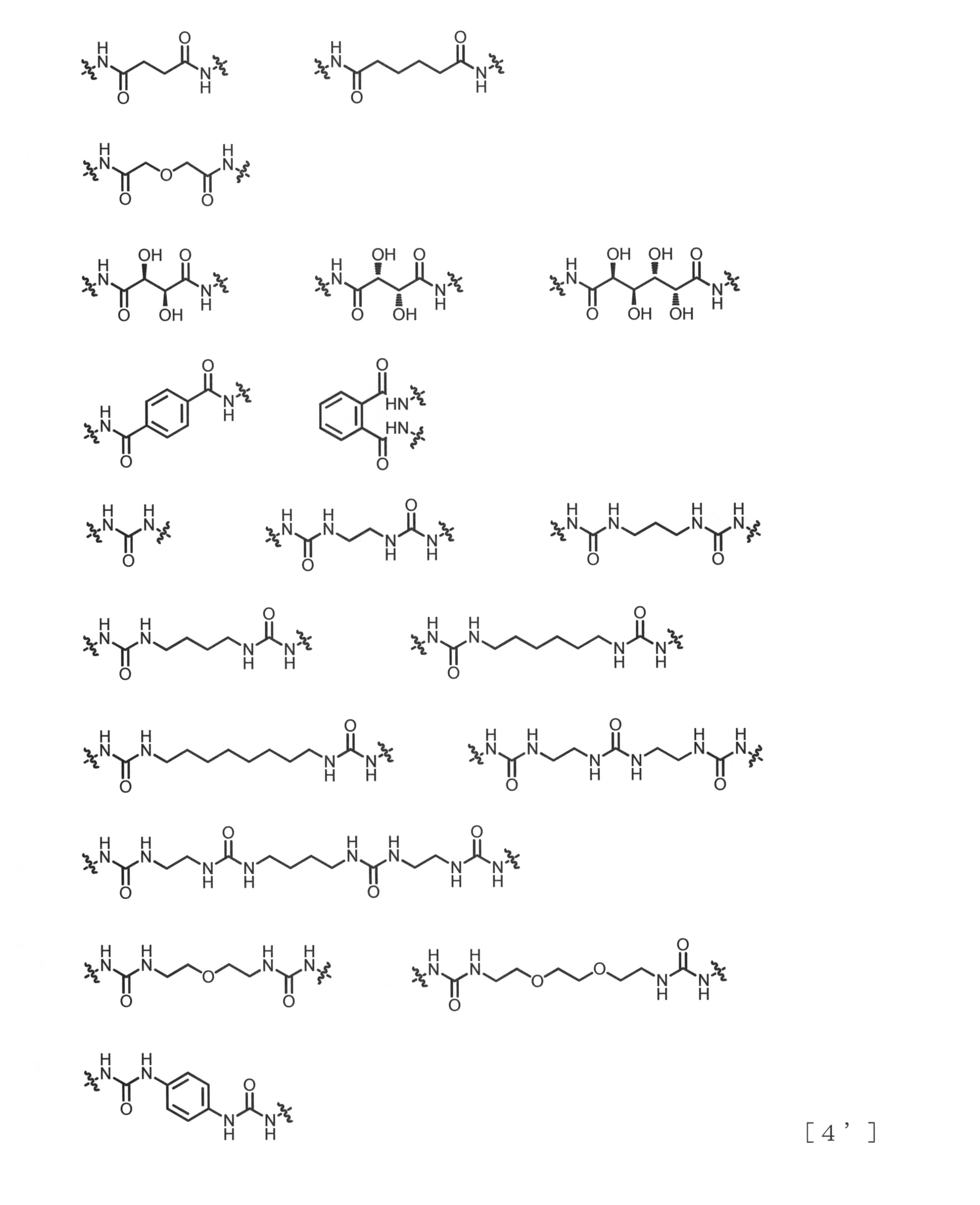
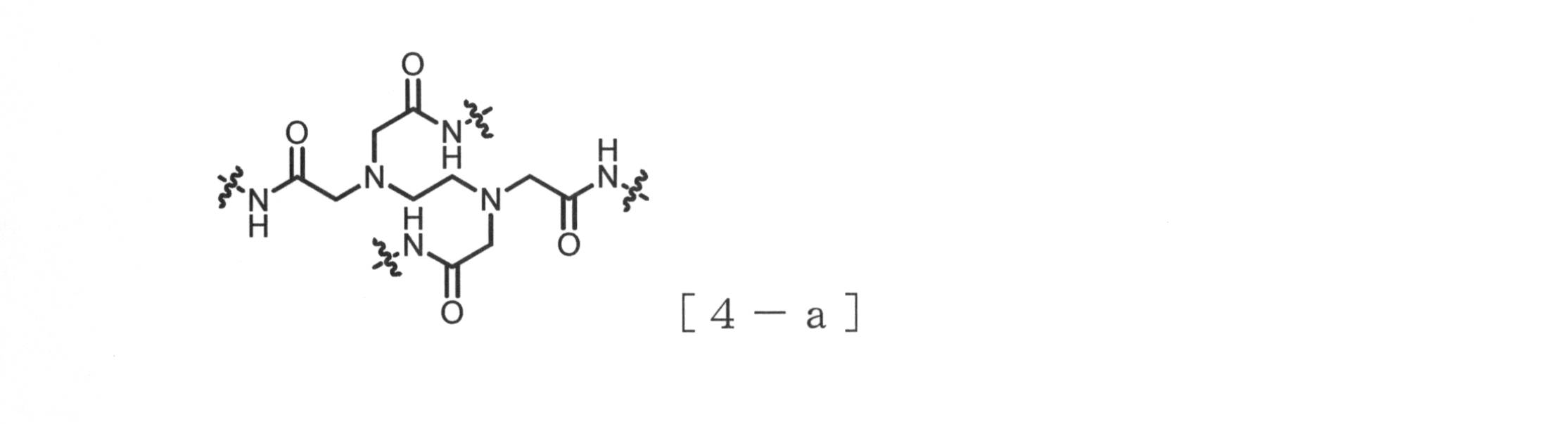
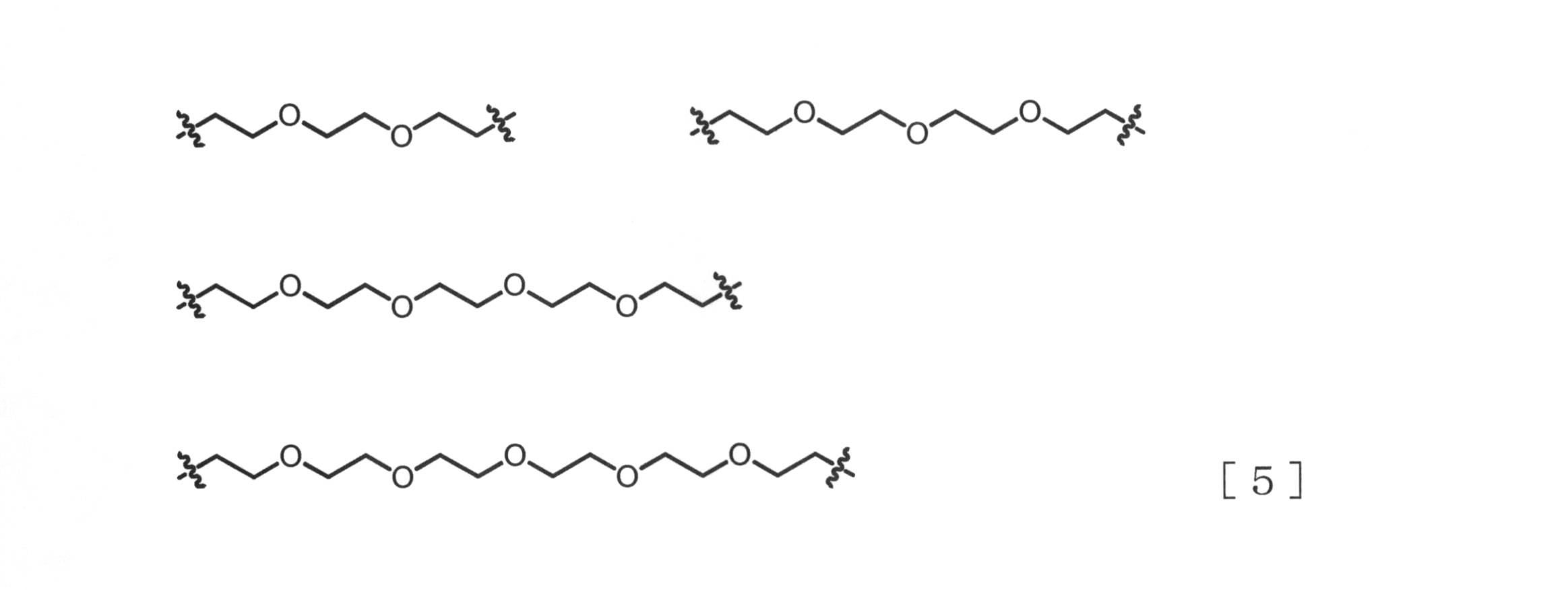
で表される化合物又はその製薬学的に許容される塩を提供することである。
(2)本発明の他の態様としては、
Yが、水素原子又は下記式[3]で表される構造であり、

Z1が、下記式群[4]のいずれかの構造であり、

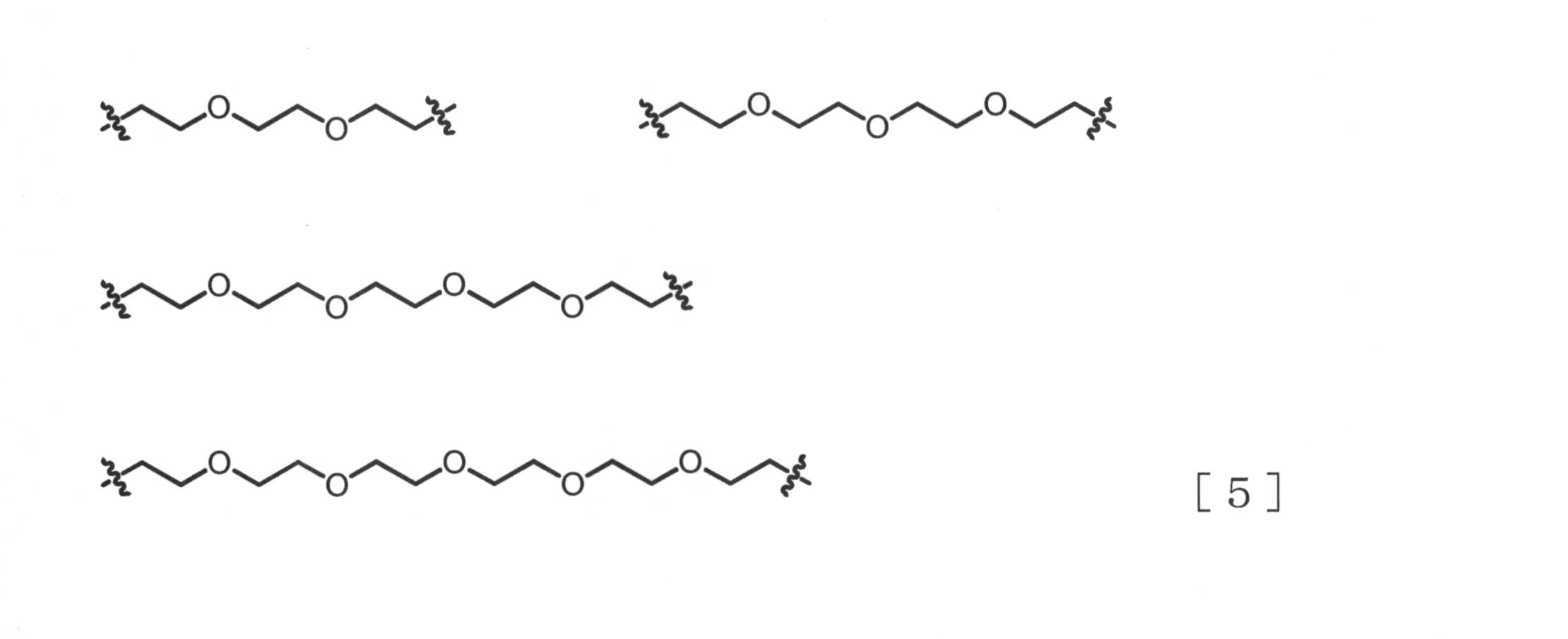
である、(1)に記載の化合物又はその製薬学的に許容される塩を提供することである。
Yが、下記式[3]で表される構造
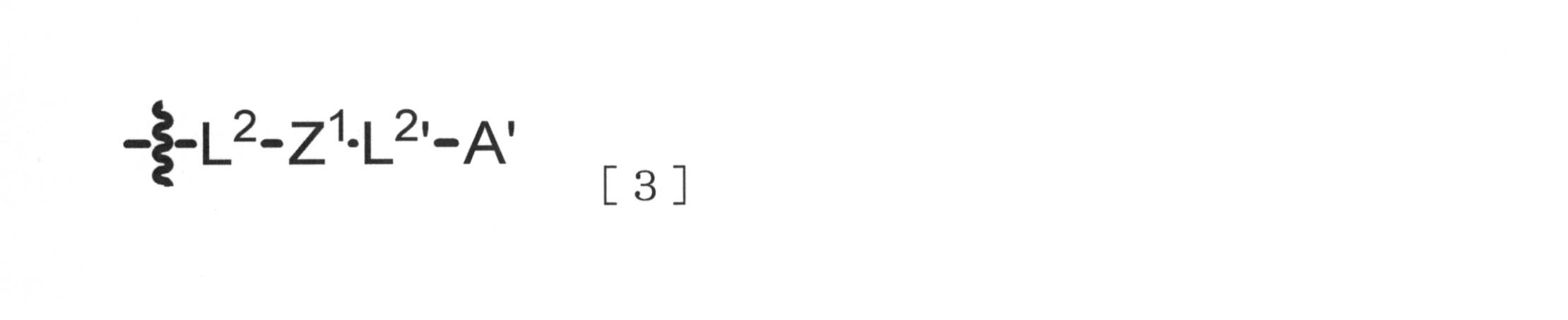
L2、L2’、Z1、及びA’は、前記の通りである。)
である、(1)又は(2)に記載の化合物又はその製薬学的に許容される塩を提供することである。
Z1が、下記式群[6]のいずれかの構造
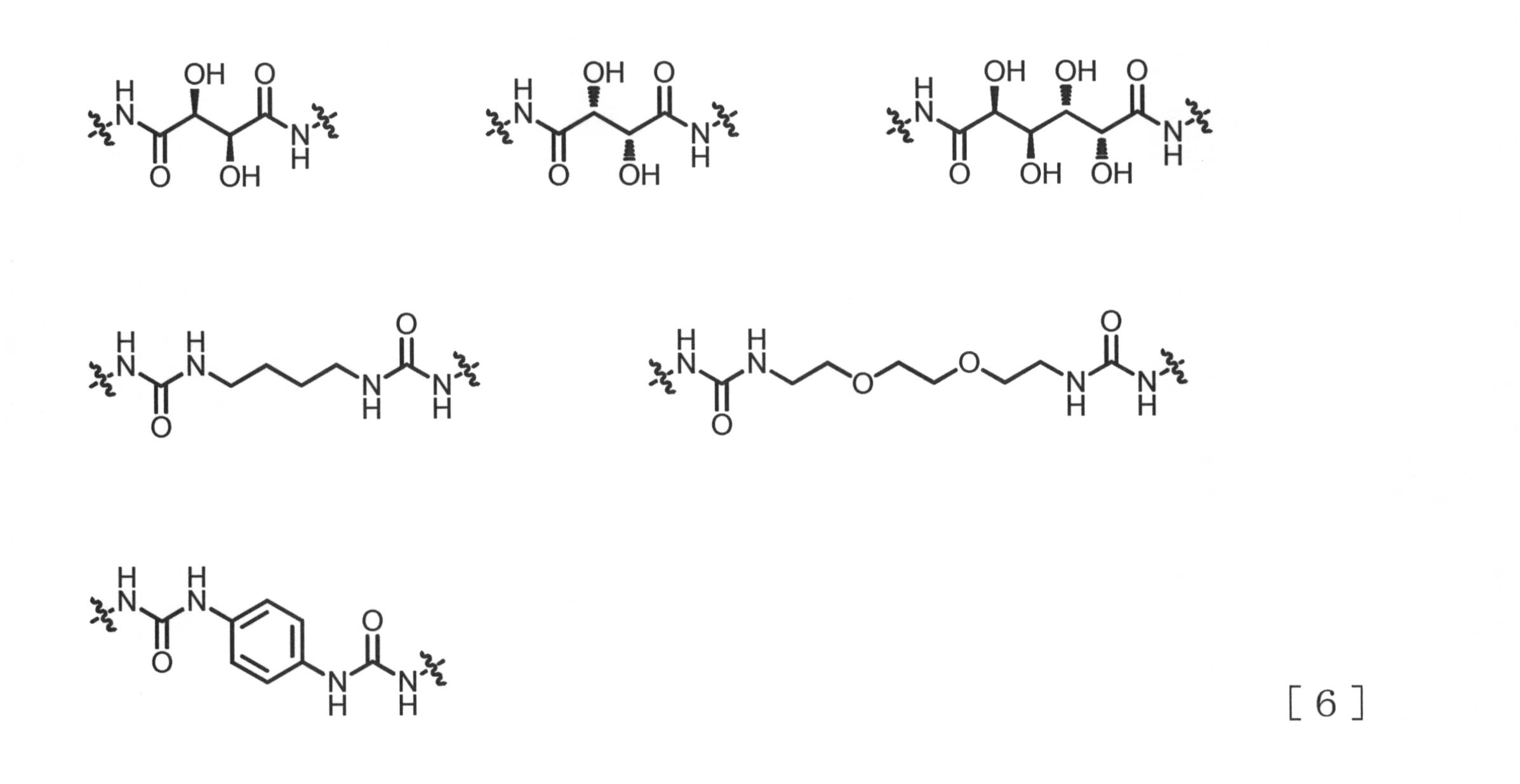
前記式[2]で表される構造が、下記式[7]
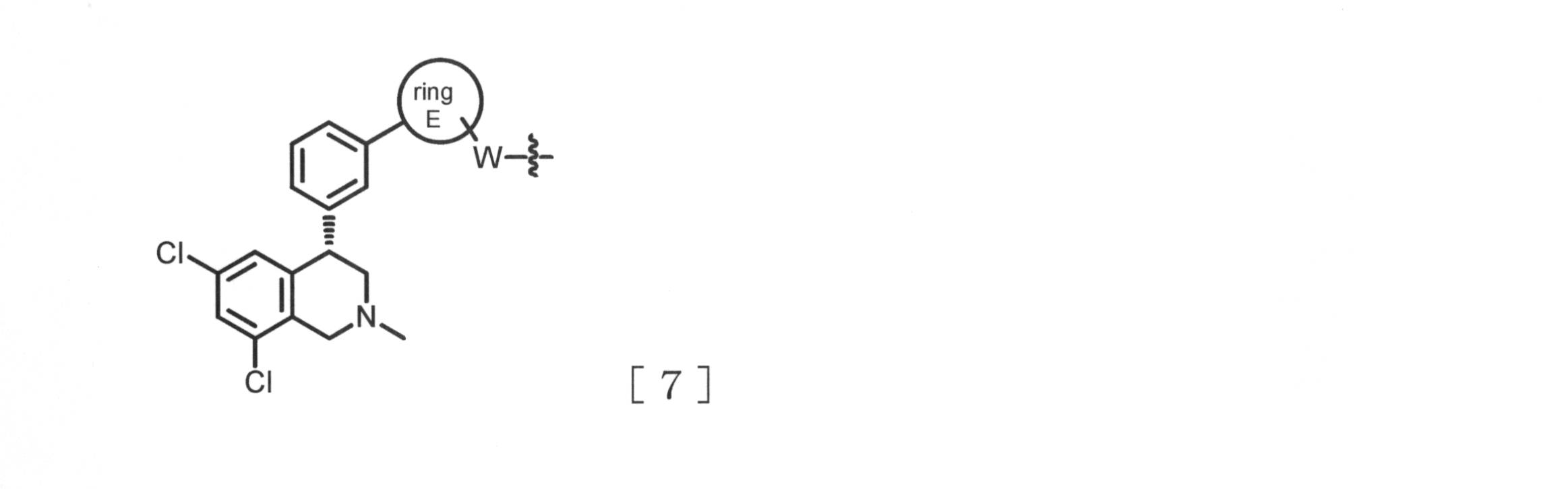
環E及びWは、前記の通りである。)
である、(4)に記載の化合物又はその製薬学的に許容される塩を提供することである。
前記式[7]中、下記式[8]で表される構造が、下記式群[9]のいずれかの構造


下記式[16]
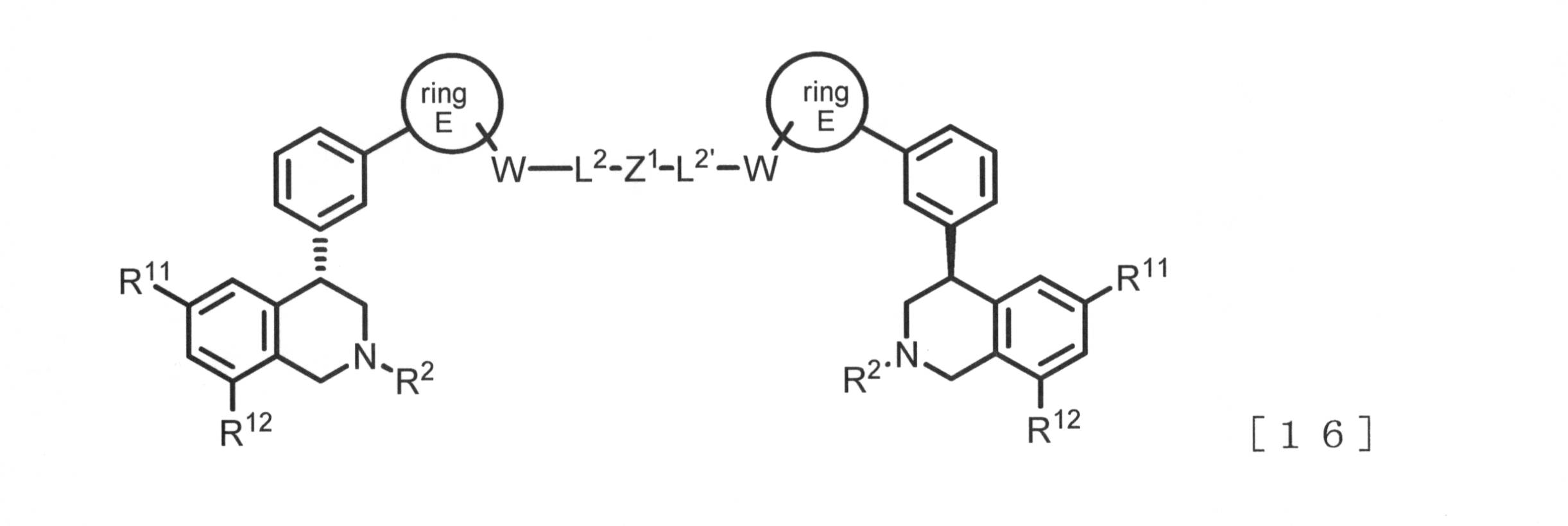
R11及びR12が、ハロゲン原子であり、
R2が、C1-6アルキルであり、
環Eが、ピラゾール、イミダゾール、トリアゾール、テトラゾール、ピリジン、ピリダジン、又はピリミジンであり、
Wが、単結合、式-NH-、式-O-、又は式-CONH-であり、
Z1が、下記式群[17]のいずれかの構造であり、
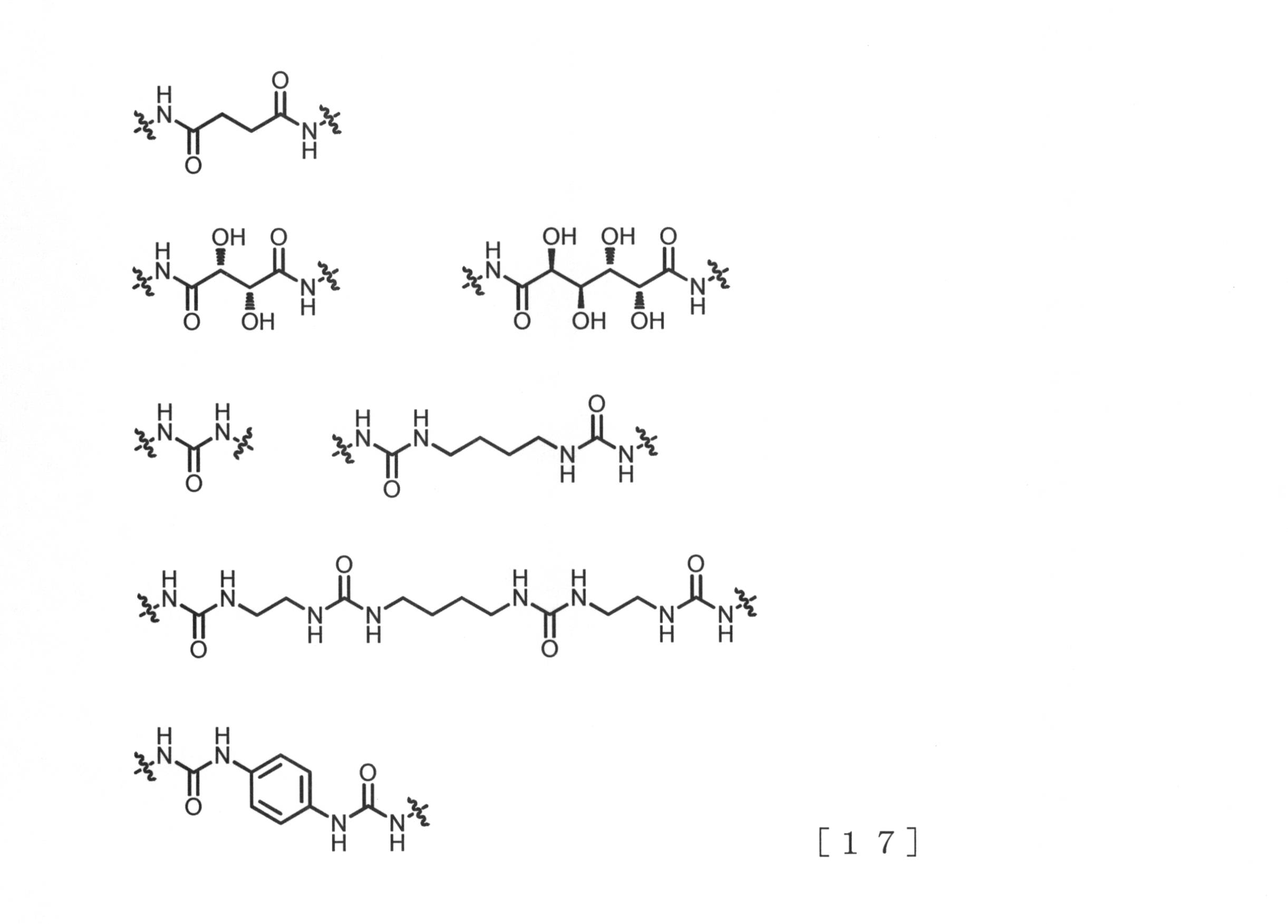
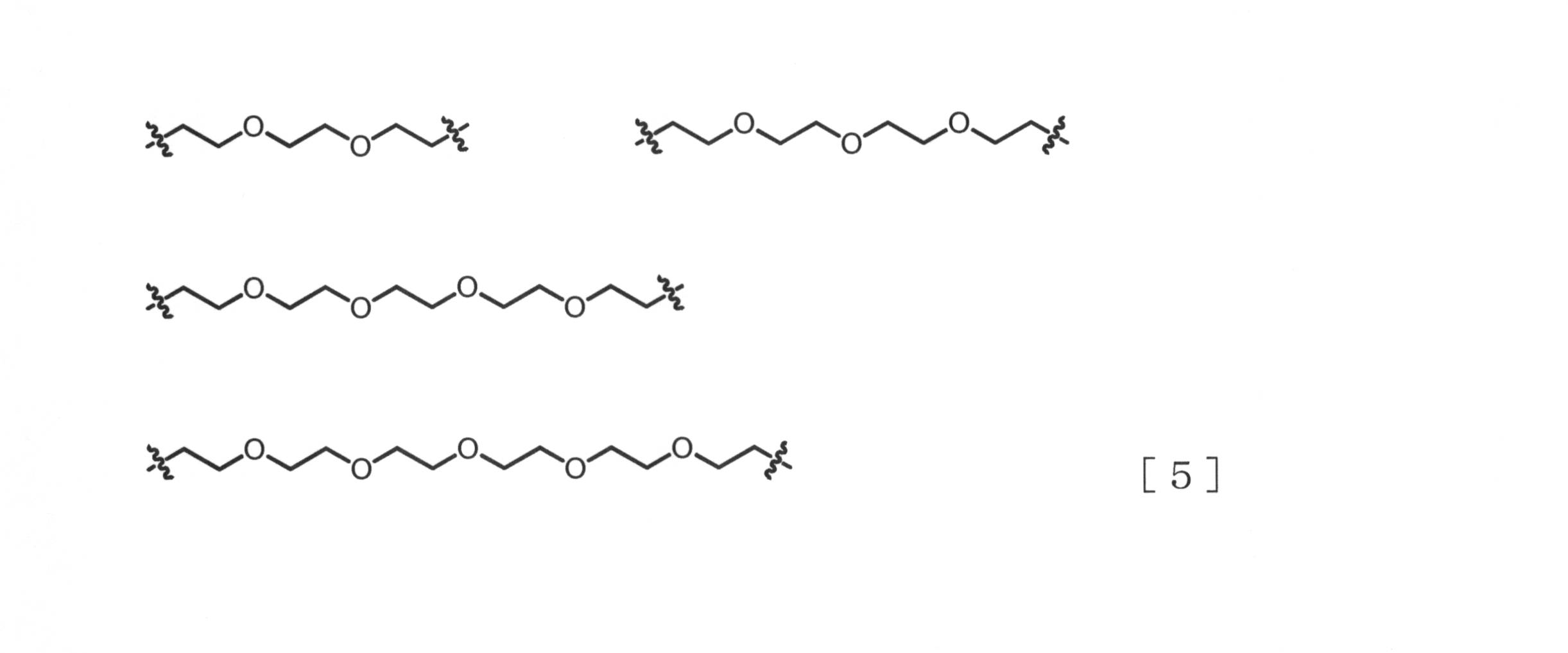
で表される、(1)に記載の化合物又はその製薬学的に許容される塩を提供することである。
R11及びR12が、塩素原子であり、
R2が、メチルであり、
環Eが、トリアゾール、テトラゾール、ピリジン、ピリダジン、又はピリミジンであり、
Wが、単結合、式-NH-、又は式-CONH-であり、
Z1が、下記式群[17’]のいずれかの構造
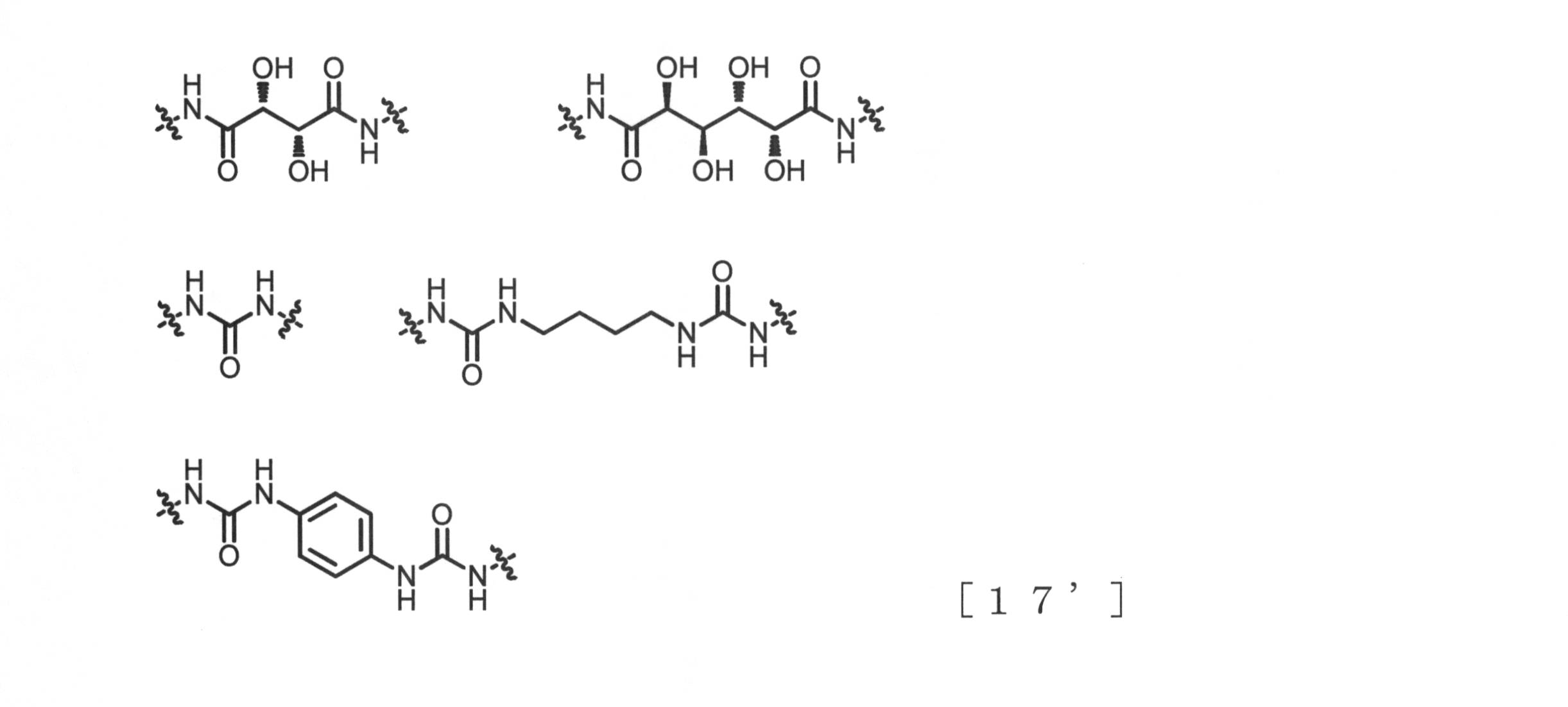
前記式[16]中、下記式[8]で表される構造が、下記式群[18]のいずれかの構造

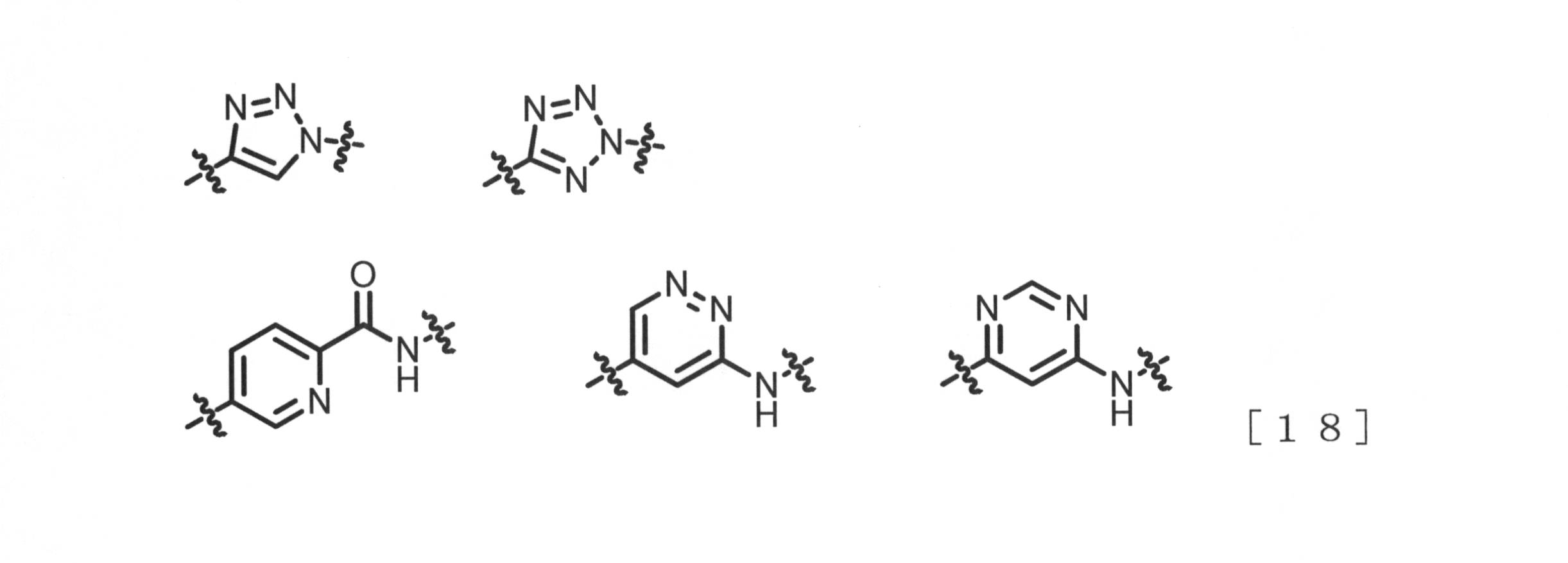
以下に示す、(1)又は(7)に記載の化合物又はその製薬学的に許容される塩を提供することである:
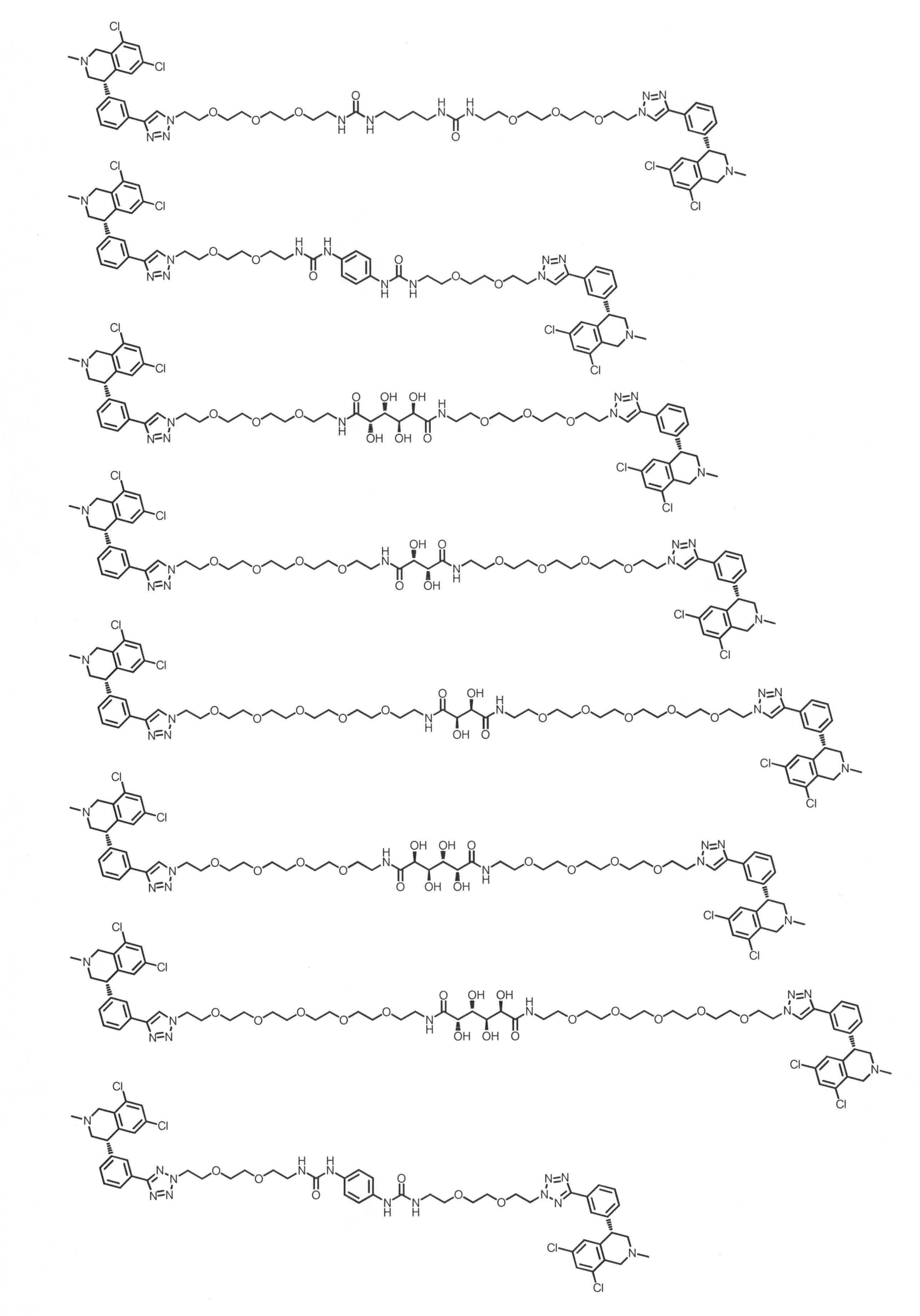
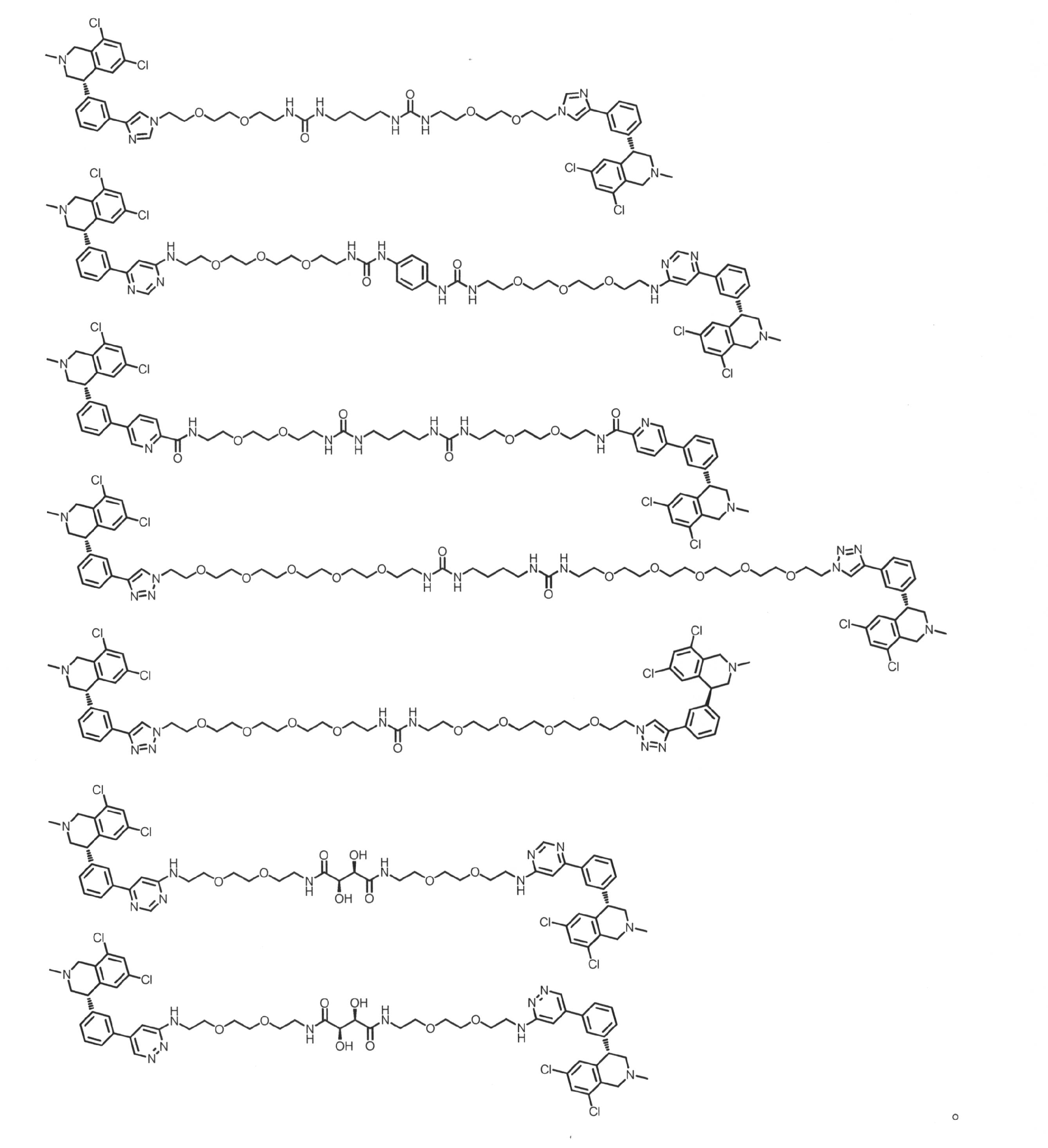
(1)~(10)のいずれかに記載の化合物又はその製薬学的に許容される塩を有効成分として含有する医薬を提供することである。
(1)~(10)のいずれかに記載の化合物又はその製薬学的に許容される塩を有効成分として含有するNHE3阻害剤を提供することである。
(1)~(10)のいずれかに記載の化合物又はその製薬学的に許容される塩を有効成分として含有する腸内水分分泌促進剤を提供することである。
(1)~(10)のいずれかに記載の化合物又はその製薬学的に許容される塩を有効成分として含有する便秘の予防薬又は治療薬を提供することである。
(1)~(10)のいずれかに記載の化合物又はその製薬学的に許容される塩を有効成分として含有するナトリウム吸収抑制剤を提供することである。
(1)~(10)のいずれかに記載の化合物又はその製薬学的に許容される塩を有効成分として含有する高血圧の予防薬又は治療薬を提供することである。
(1)~(10)のいずれかに記載の化合物又はその製薬学的に許容される塩を有効成分として含有する腎症の予防薬又は治療薬を提供することである。
(1)~(10)のいずれかに記載の化合物又はその製薬学的に許容される塩を有効成分として含有する体液貯留の予防薬又は治療薬を提供することである。
(1)~(10)のいずれかに記載の化合物又はその製薬学的に許容される塩を有効成分として含有するリン吸収抑制剤を提供することである。
(1)~(10)のいずれかに記載の化合物又はその製薬学的に許容される塩を有効成分として含有する高リン血症の予防薬又は治療薬を提供することである。
(1)~(10)のいずれかに記載の化合物又はその製薬学的に許容される塩を有効成分として含有するCKD-MBDの予防薬又は治療薬を提供することである。
本発明化合物はNHE3阻害作用を有する。本発明化合物を有効成分とする医薬は、便秘、高血圧、腎症、腎不全に由来する体液貯留、心不全や肝硬変や薬剤による体液貯留の予防又は治療に有効な医薬となり得る。
また、本発明化合物の中にはリン吸収抑制作用を有するものも存在する。これらの化合物を有効成分とする医薬は、高リン血症やCKD-MBDの予防又は治療に有効な医薬となり得る。
好ましいR12はハロゲン原子であり、より好ましいR12は塩素原子であり、
好ましいR2はC1-6アルキルであり、より好ましいR2はメチルであり、
このとき、好ましいR31は水素原子であり、好ましいR32は水素原子であり、
このとき、好ましいWは単結合又は式-NH-であり、
より好ましい環Eは、トリアゾール、テトラゾール、又はピリミジンであり、
このとき、好ましいR31は水素原子であり、好ましいR32は水素原子であり、
このとき、好ましいWは単結合又は式-NH-であり、
ひとつのさらに好ましい環Eは、トリアゾール又はテトラゾールであり、
このとき、好ましいR31は水素原子であり、好ましいR32は水素原子であり、
このとき、好ましいWは単結合であり、
このとき、特に好ましい環EとW(前記式[7]中、下記式[8]で表される構造)は、下記式群[10]のいずれかの構造であり、


このとき、好ましいR31は水素原子であり、好ましいR32は水素原子であり、
このとき、好ましいWは式-NH-であり、
このとき、特に好ましい環EとW(前記式[7]中、下記式[8]で表される構造)は、下記式[11]の構造であり、



好ましいZ1は、下記式群[6]のいずれかの構造であり、
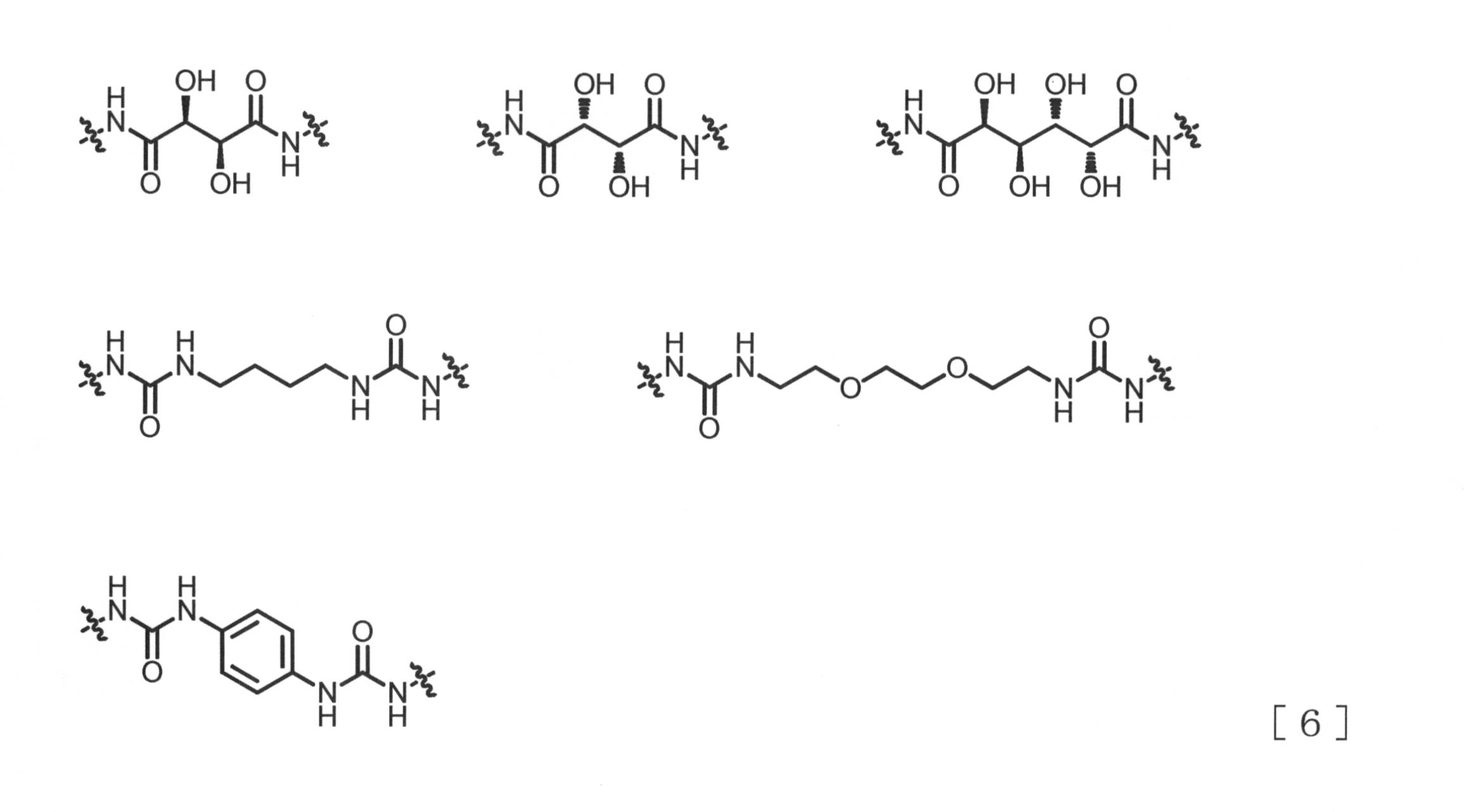
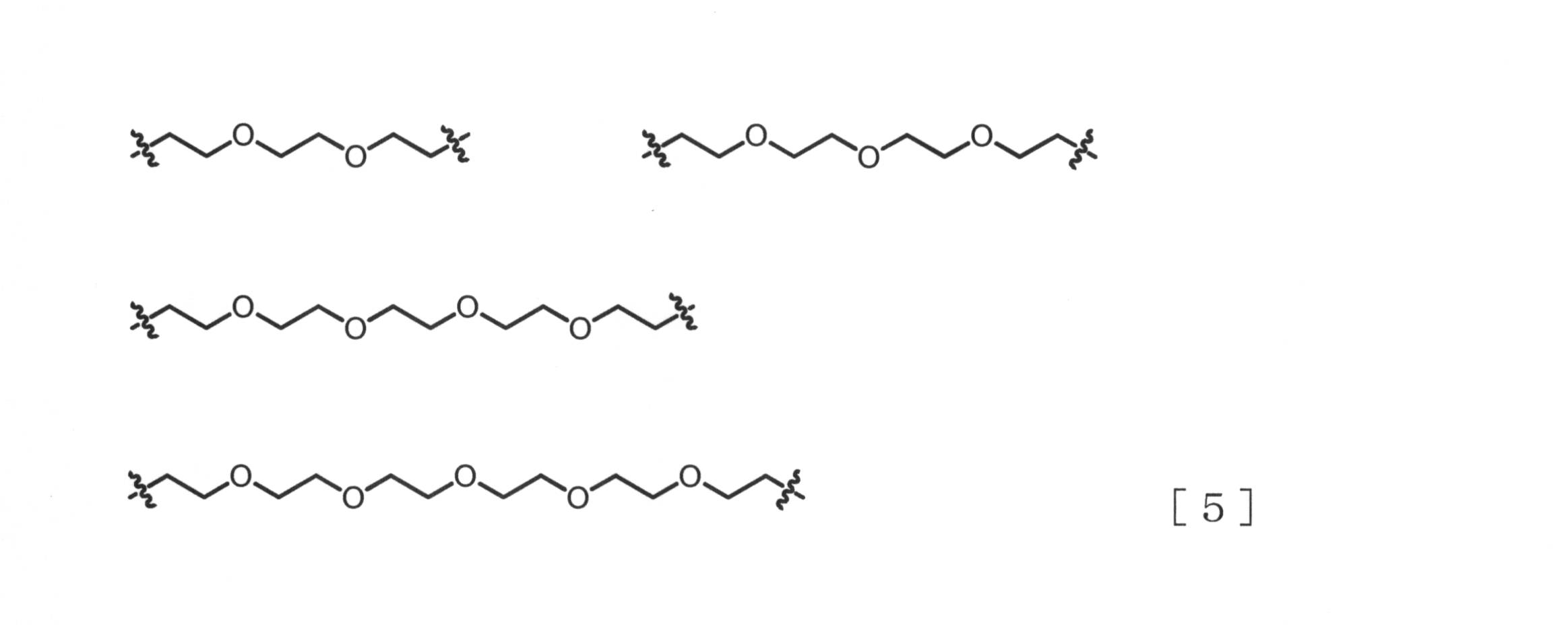
好ましいR12はハロゲン原子であり、より好ましいR12は塩素原子であり、
好ましいR2はC1-6アルキルであり、より好ましいR2はメチルであり、
このとき、好ましいR31は水素原子であり、好ましいR32は水素原子であり、
このとき、好ましいWは単結合、式-NH-、又は式-CONH-であり、
より好ましい環Eは、トリアゾール、テトラゾール、ピリジン、ピリダジン、又はピリミジンであり、
このとき、好ましいR31は水素原子であり、好ましいR32は水素原子であり、
このとき、好ましいWは単結合、式-NH-、又は式-CONH-であり、
ひとつのさらに好ましい環Eは、トリアゾール又はテトラゾールであり、
このとき、好ましいR31は水素原子であり、好ましいR32は水素原子であり、
このとき、好ましいWは単結合であり、
このとき、特に好ましい環EとW(前記式[7]中、下記式[8]で表される構造)は、下記式群[19]のいずれかの構造であり、


このとき、好ましいR31は水素原子であり、好ましいR32は水素原子であり、
このとき、好ましいWは式-NH-又は式-CONH-であり、
このとき、特に好ましい環EとW(前記式[7]中、下記式[8]で表される構造)は、下記式[20]の構造であり、

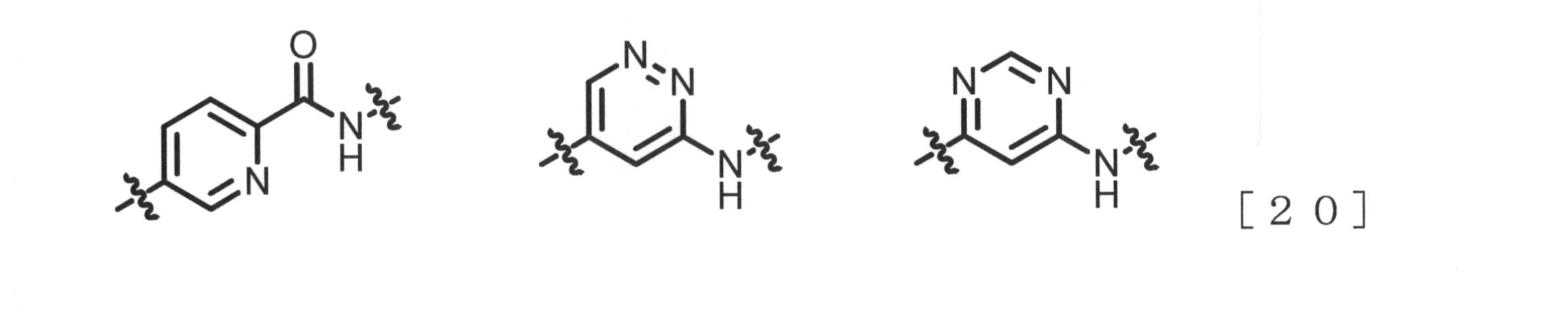
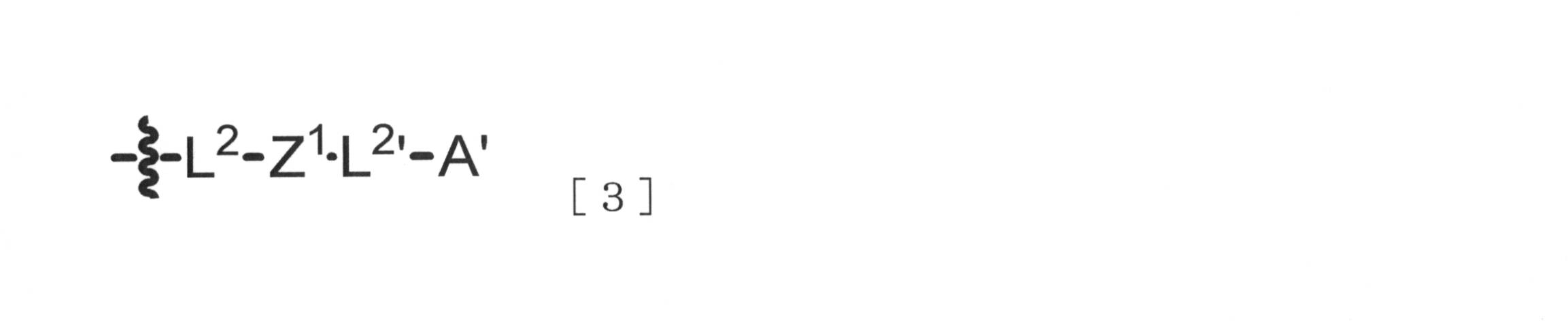
好ましいZ1は、下記式群[17]のいずれかの構造であり、
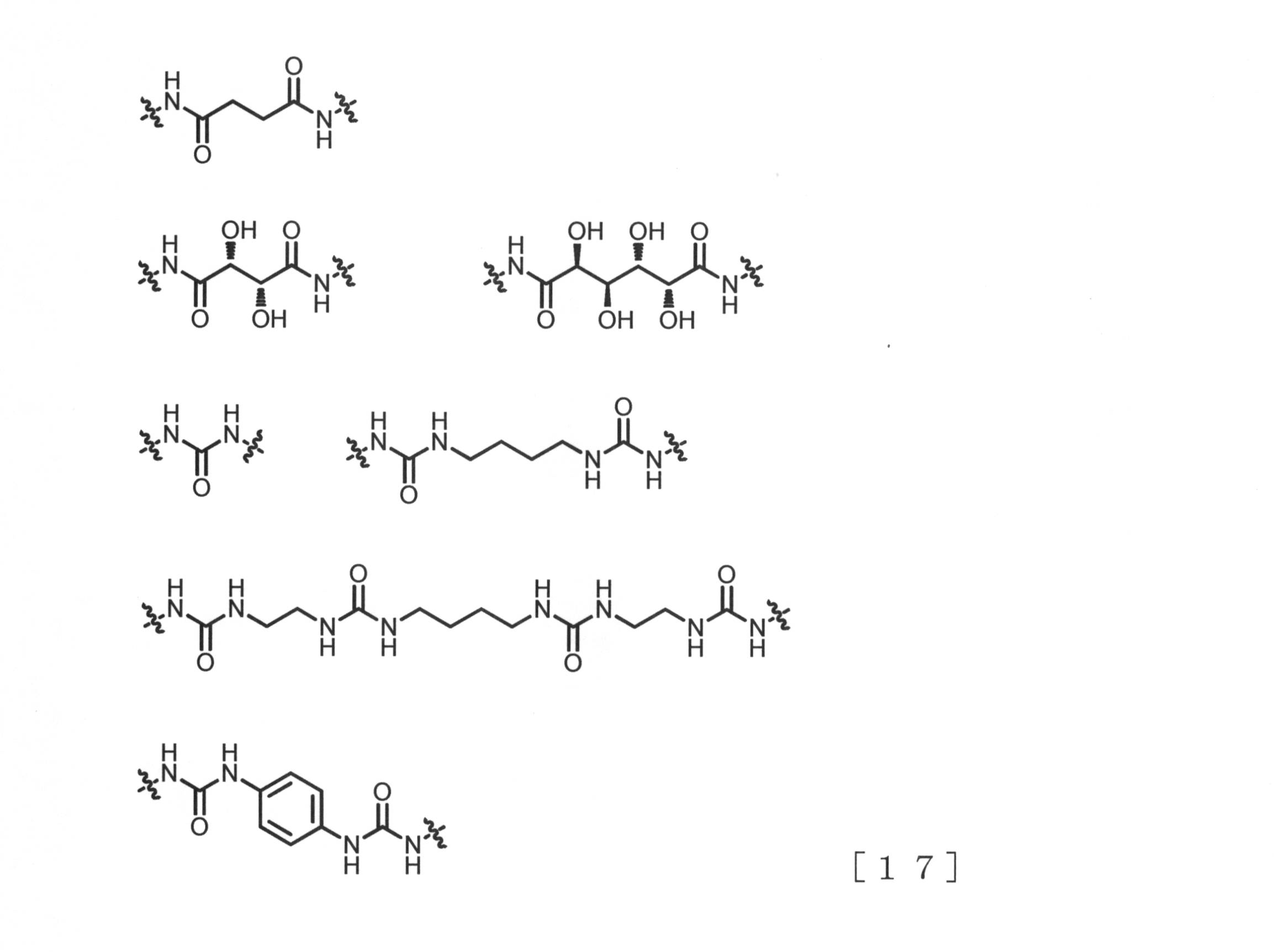
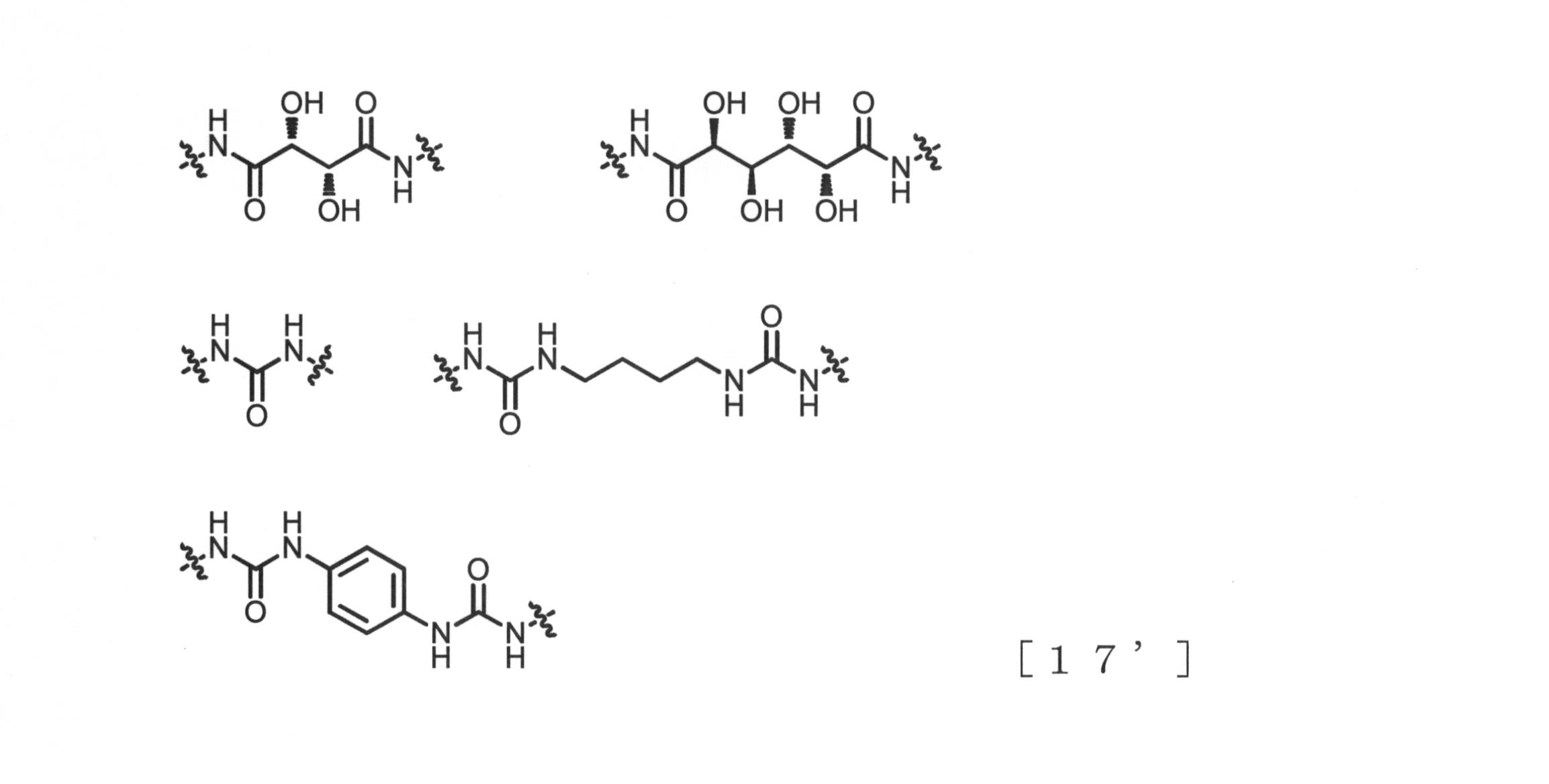
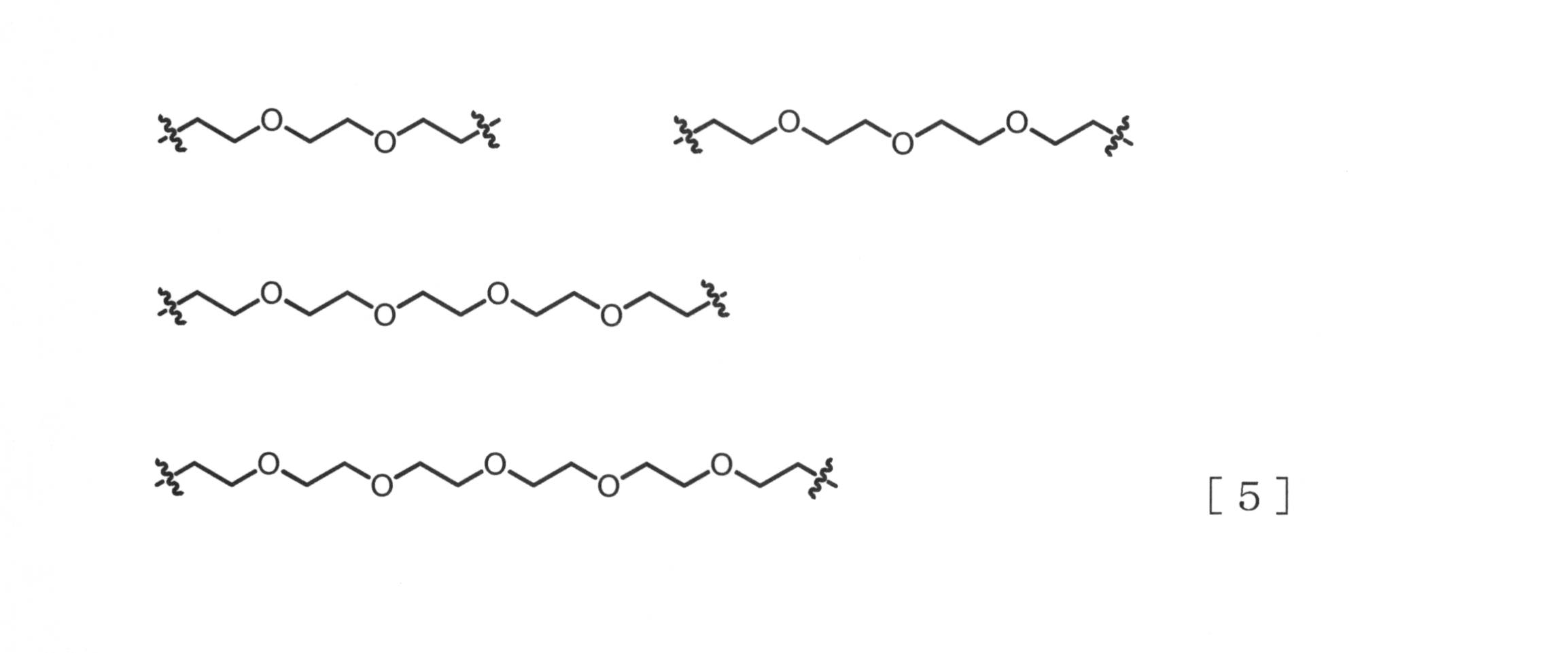
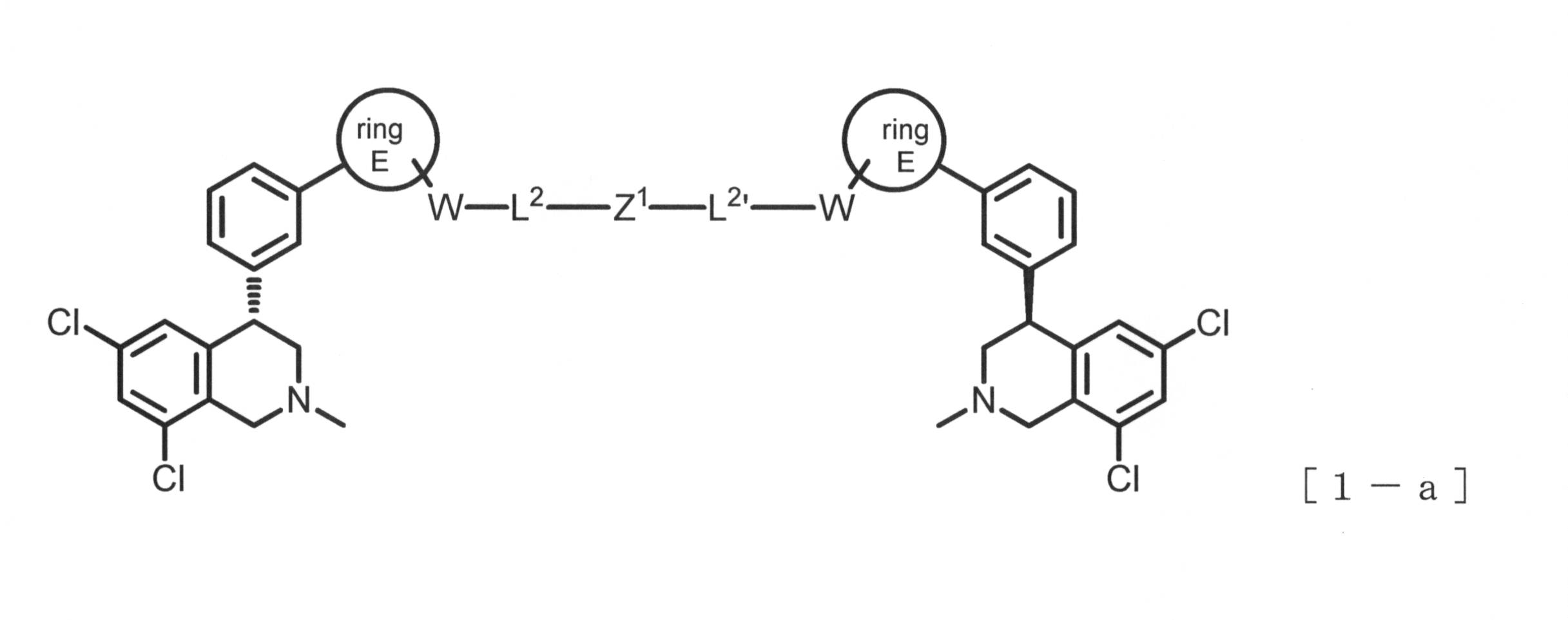
環Eがトリアゾール、テトラゾール、又はピリミジンであり、
このとき、好ましいWは単結合又は式-NH-である場合である。
環Eがトリアゾール又はテトラゾールであり、
このとき、好ましいWは単結合である場合であり、
このとき、特に好ましい態様は、
前記式[1-a]中、下記式[8]で表される構造が、下記式群[10]のいずれかの構造である場合である。
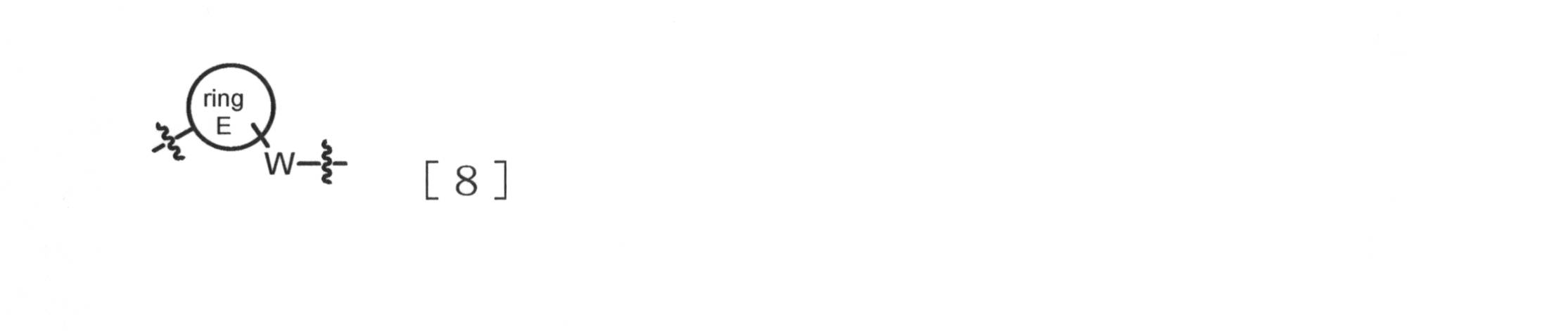

環Eが、ピリミジンであり、
このとき、好ましいWは式-NH-であり、
Z1が、下記式[12]の構造であり、


前記式[1-a]中、下記式[8]で表される構造が、下記式[11]の構造である場合である。



環Eがトリアゾール、テトラゾール、ピリジン、ピリダジン、又はピリミジンであり、
このとき、好ましいWは単結合、式-NH-、又は式-CONH-である場合である。
環Eがトリアゾール又はテトラゾールあり、
このとき、好ましいWは単結合である場合であり、
好ましいZ1は、下記式[17’]の構造であり、

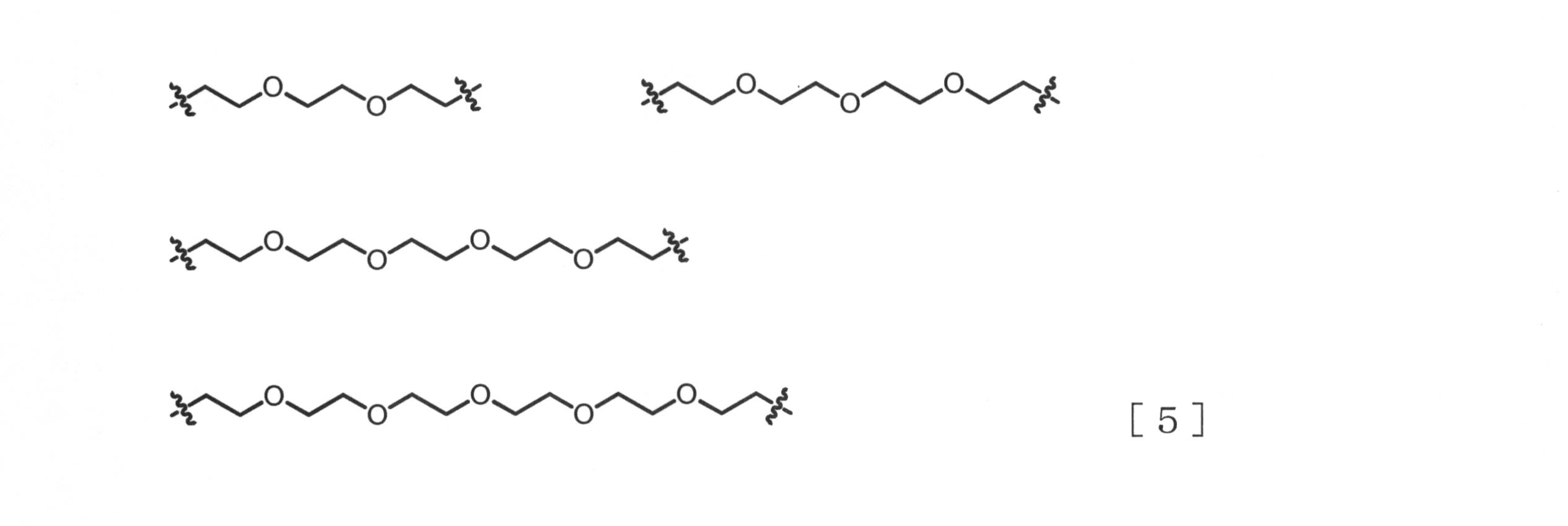
前記式[1-a]中、下記式[8]で表される構造が、下記式群[19]のいずれかの構造である場合であり、


環Eが、ピリジン、ピリダジン、又はピリミジンであり、
このとき、好ましいWは式-NH-又は式-CONH-であり、
好ましいZ1は、下記式[21]の構造であり、
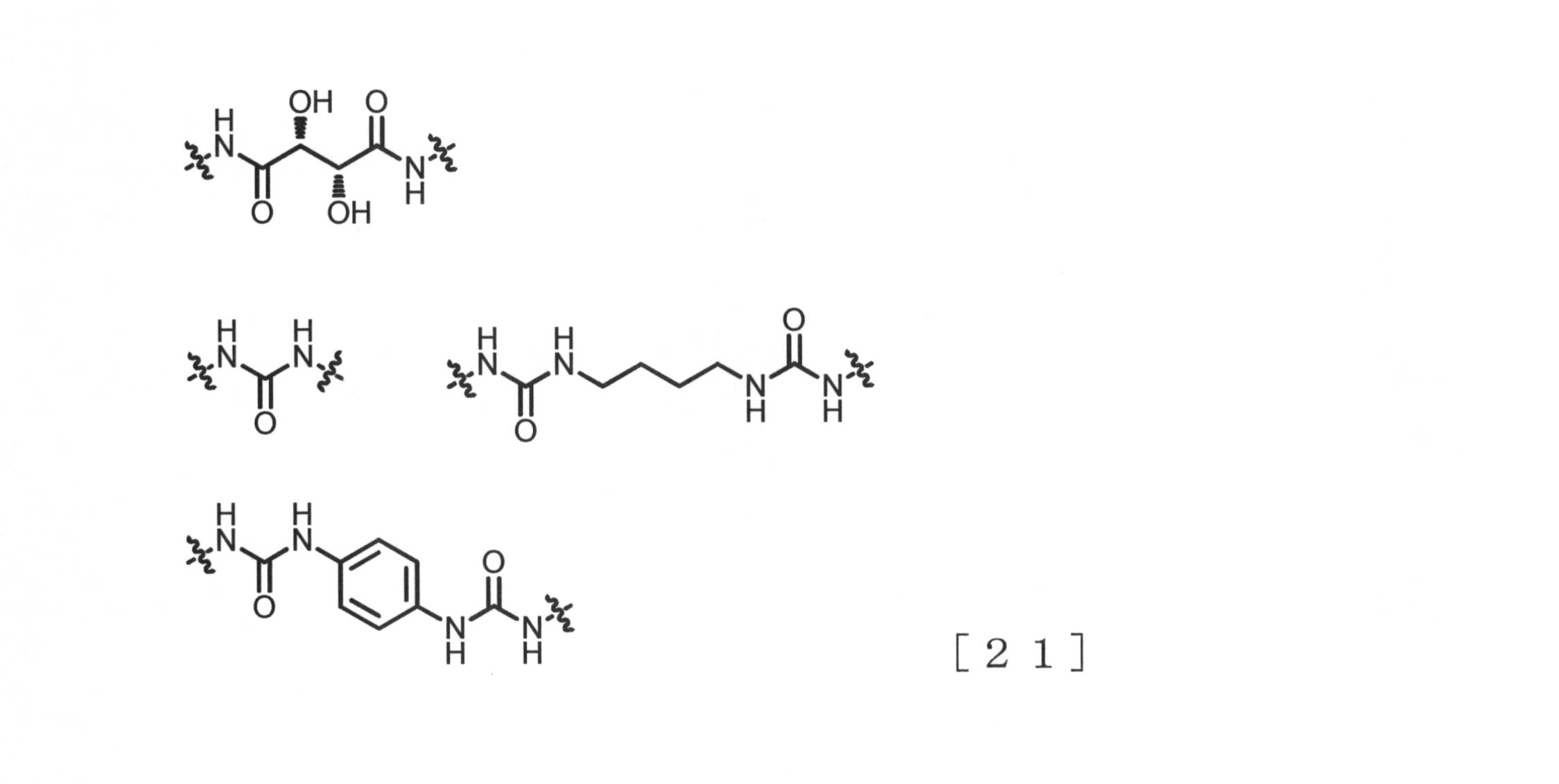

前記式[1-a]中、下記式[8]で表される構造が、下記式[23]の構造である場合である。
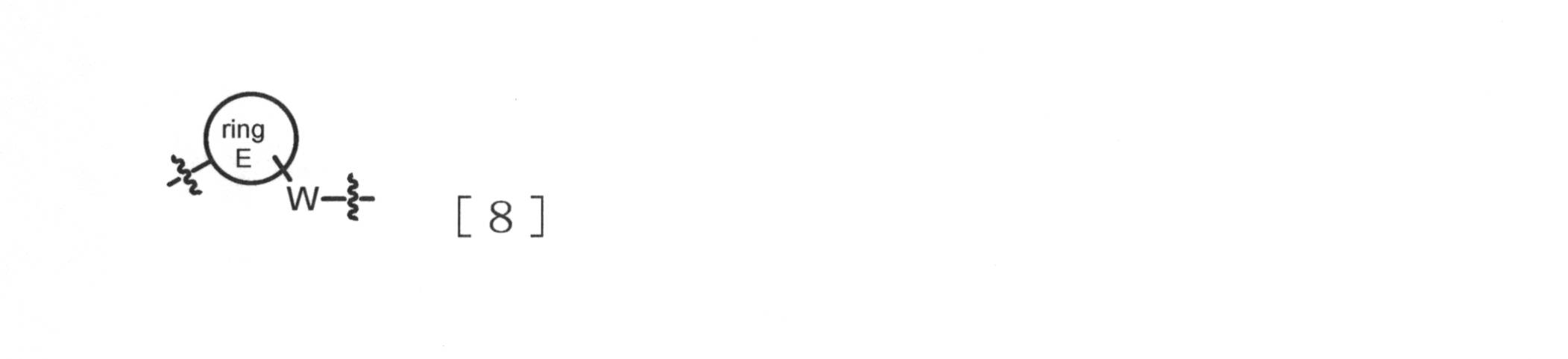
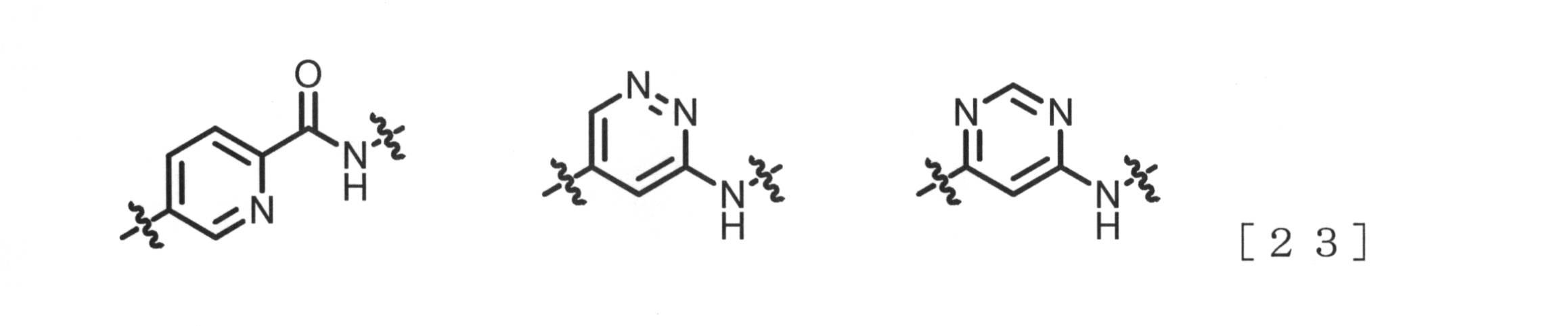
さらに、本発明化合物又はその塩が水和物又は溶媒和物を形成する場合、それらも本発明化合物又はその塩の範囲内に含まれる。
製剤例1
以下の成分を含有する顆粒剤を製造する。
成分:式[1]で表される化合物又はその製薬学的に許容される塩、乳糖、コーンスターチ、HPC-L。
式[1]で表される化合物又はその製薬学的に許容される塩と乳糖をふるいに通す。コーンスターチをふるいに通す。これらを混合機にて混合する。混合末にHPC-L水溶液を添加し、練合、造粒(押し出し造粒)した後、乾燥する。得られた乾燥顆粒を振動ふるいで篩過し顆粒剤を得る。
以下の成分を含有するカプセル充填用散剤を製造する。
成分:式[1]で表される化合物又はその製薬学的に許容される塩、乳糖、コーンスターチ、ステアリン酸マグネシウム。
式[1]で表される化合物又はその製薬学的に許容される塩と乳糖をふるいに通す。コーンスターチをふるいに通す。これらとステアリン酸マグネシウムを混合機にて混合し、散剤を得る。得られた散剤はカプセルに充填することができる。
以下の成分を含有するカプセル充填用顆粒剤を製造する。
成分:式[1]で表される化合物又はその製薬学的に許容される塩、乳糖、コーンスターチ、HPC-L。
式[1]で表される化合物又はその製薬学的に許容される塩と乳糖をふるいに通す。コーンスターチをふるいに通す。これらを混合機にて混合する。混合末にHPC-L水溶液を添加し、練合、造粒した後、乾燥する。得られた乾燥顆粒を振動ふるいで篩過し整粒し、顆粒を得る。得られた顆粒はカプセルに充填することができる。
以下の成分を含有する錠剤を製造する。
成分:式[1]で表される化合物又はその製薬学的に許容される塩、乳糖、微結晶セルロース、ステアリン酸マグネシウム、CMC-Na。
式[1]で表される化合物又はその製薬学的に許容される塩と乳糖と微結晶セルロース、CMC-Naをふるいに通し、混合する。混合末にステアリン酸マグネシウムを添加し、製剤用混合末を得る。本混合末を直打し錠剤を得る。
スキーム1:化合物(1-a)から化合物(1-b)、(1-c)の合成法
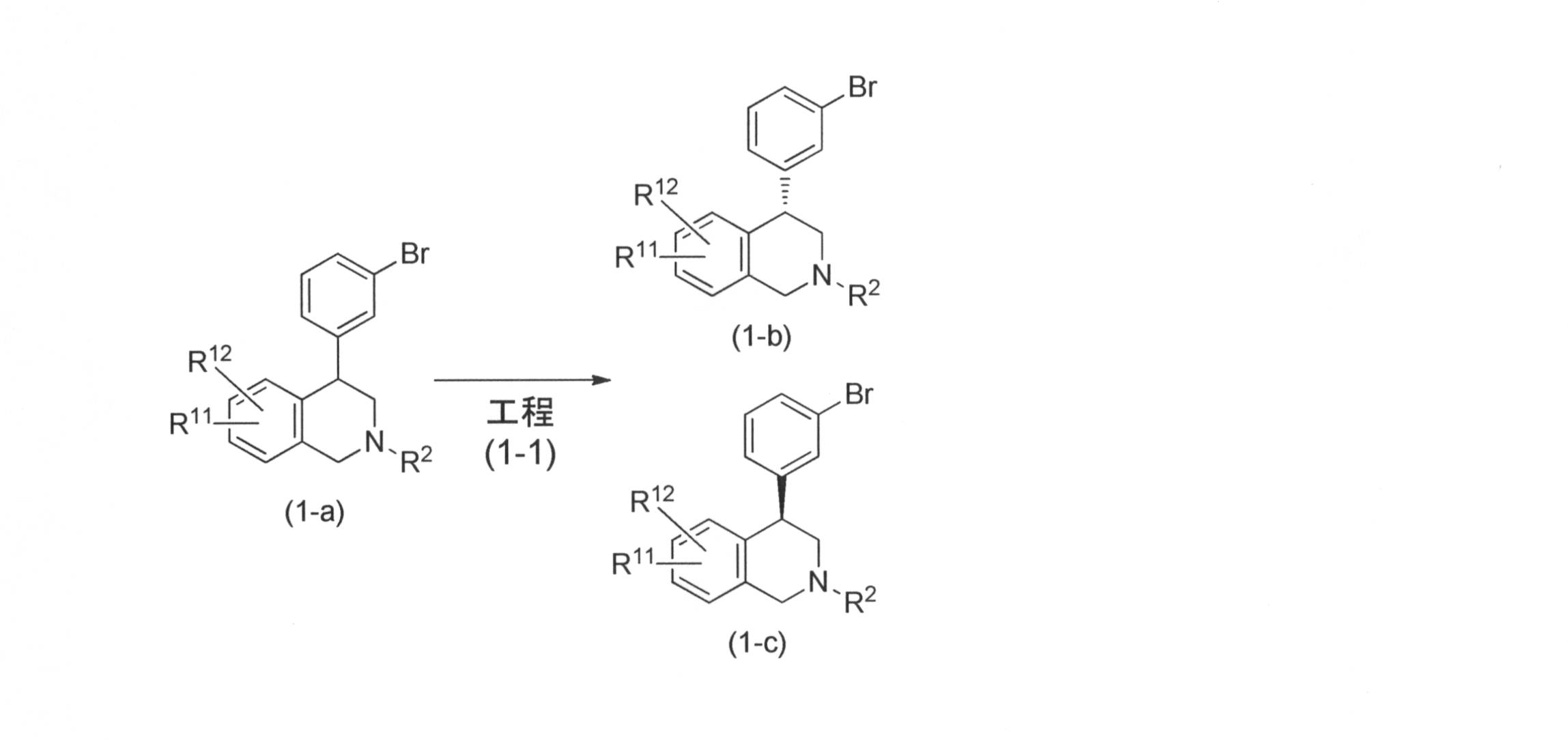
化合物(1-b)、化合物(1-c)の製造方法:キラル分取HPLC等を用いて化合物(1-a)を光学分割することにより、化合物(1-b)、化合物(1-c)を高い光学純度で入手することができる。
スキーム2:化合物(1-b)から化合物(2-c)の合成法
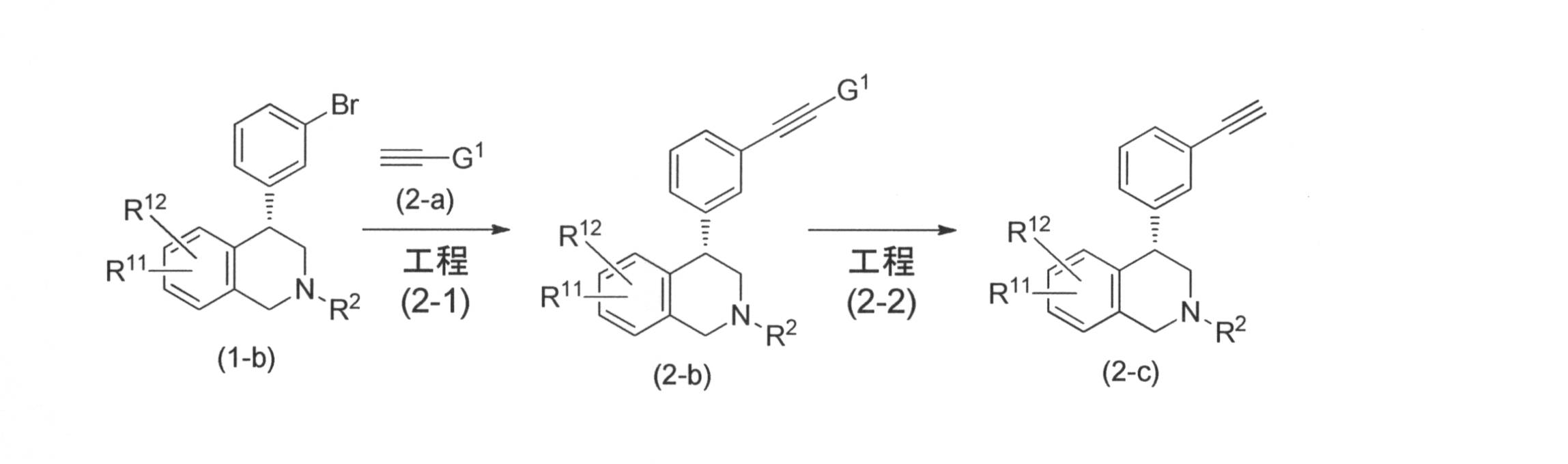
化合物(2-b)の製造方法:化合物(1-b)と化合物(2-a)の「薗頭カップリング反応」を行うことにより、化合物(2-b)を製造することができる。
工程(2-2):
化合物(2-c)の製造方法:化合物(2-b)を基質とし、不活性溶媒中、0℃乃至80℃の温度で、炭酸カリウム、又はテトラブチルアンモニウムフルオライド等を用いた脱保護反応により、化合物(2-c)を製造することができる。
スキーム3:化合物(1-b)、又は(3-d)から化合物(3-f)の合成法
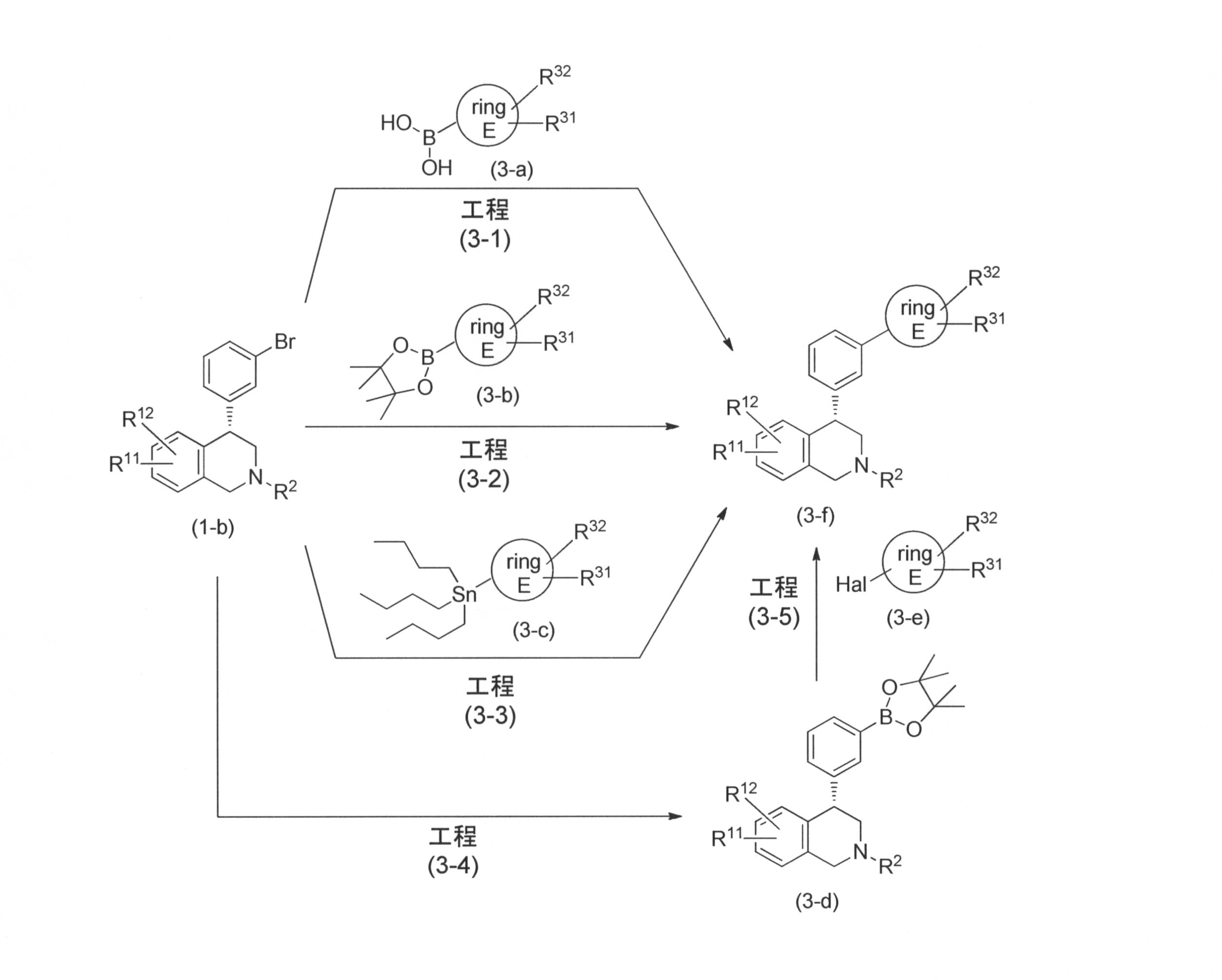
化合物(3-f)の製造方法:化合物(1-b)と化合物(3-a)の「鈴木カップリング反応」を行うことにより、化合物(3-f)を製造することができる。
工程(3-2):
化合物(3-f)の別途製造方法:化合物(1-b)と化合物(3-b)の「鈴木カップリング反応」を行うことにより、化合物(3-f)を製造することができる。
工程(3-3):
化合物(3-f)の別途製造方法:化合物(1-b)と化合物(3-c)を、不活性溶媒中、20℃乃至160℃の温度で、テトラキス(トリフェニルホスフィン)パラジウム(0)等のパラジウム(0)触媒を用いてカップリング反応させることにより、化合物(3-f)を製造することができる。
工程(3-4):
化合物(3-d)の製造方法:化合物(1-b)を基質とし、不活性溶媒中、20℃乃至160℃の温度で、[1,1’-ビス(ジフェニルホスフィノ)フェロセン]パラジウム(II)ジクロリド ジクロロメタン錯体(1:1)等のパラジウム触媒、及び酢酸カリウム等の塩基存在下、ビス(ピナコラト)ジボロンと反応させることにより、化合物(3-d)を製造することができる。
工程(3-5):
化合物(3-f)の別途製造方法:化合物(3-d)と化合物(3-e)の「鈴木カップリング反応」を行うことにより、化合物(3-f)を製造することができる。
スキーム4:化合物(1-b)から化合物(4-b)の合成法
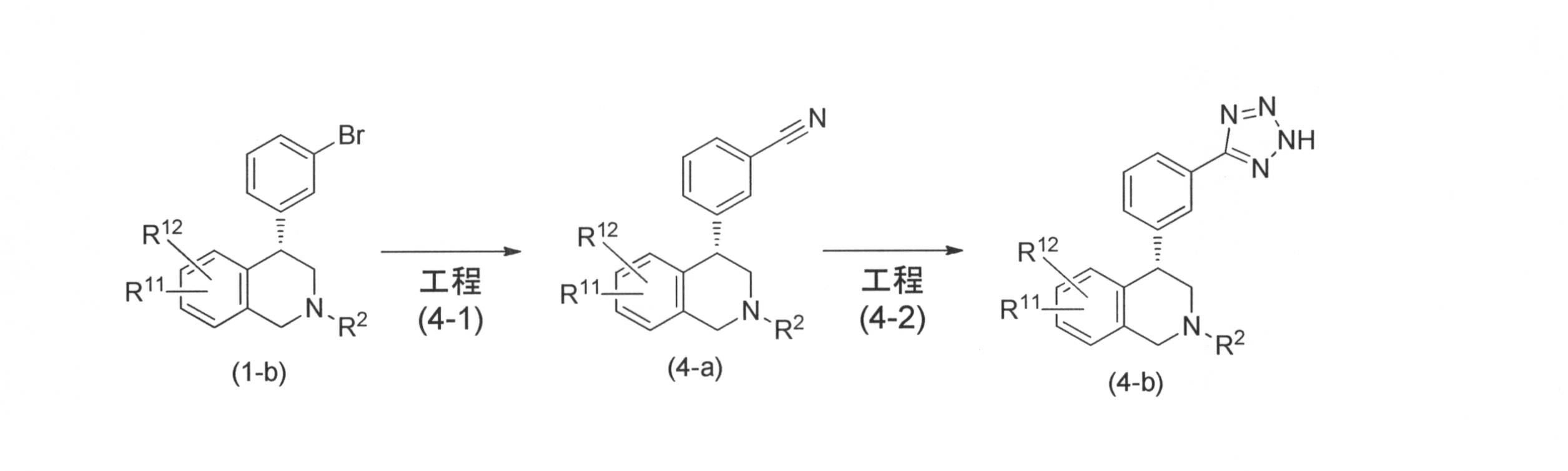
化合物(4-a)の製造方法:化合物(1-b)を基質とし、不活性溶媒中、20℃乃至160℃の温度で、テトラキス(トリフェニルホスフィン)パラジウム(0)等のパラジウム(0)触媒存在下、亜鉛ジシアニドと反応させることにより、化合物(4-a)を製造することができる。
工程(4-2):
化合物(4-b)の製造方法:化合物(4-a)を基質とし、不活性溶媒中、20℃乃至150℃の温度で、塩化アンモニウム、又はトリエチルアミン塩酸塩等のアミンの無機酸塩存在下、アジ化ナトリウム等のアジ化物を反応させることにより、化合物(4-b)を製造することができる。
スキーム5:化合物(4-a)から化合物(5-c)の合成法
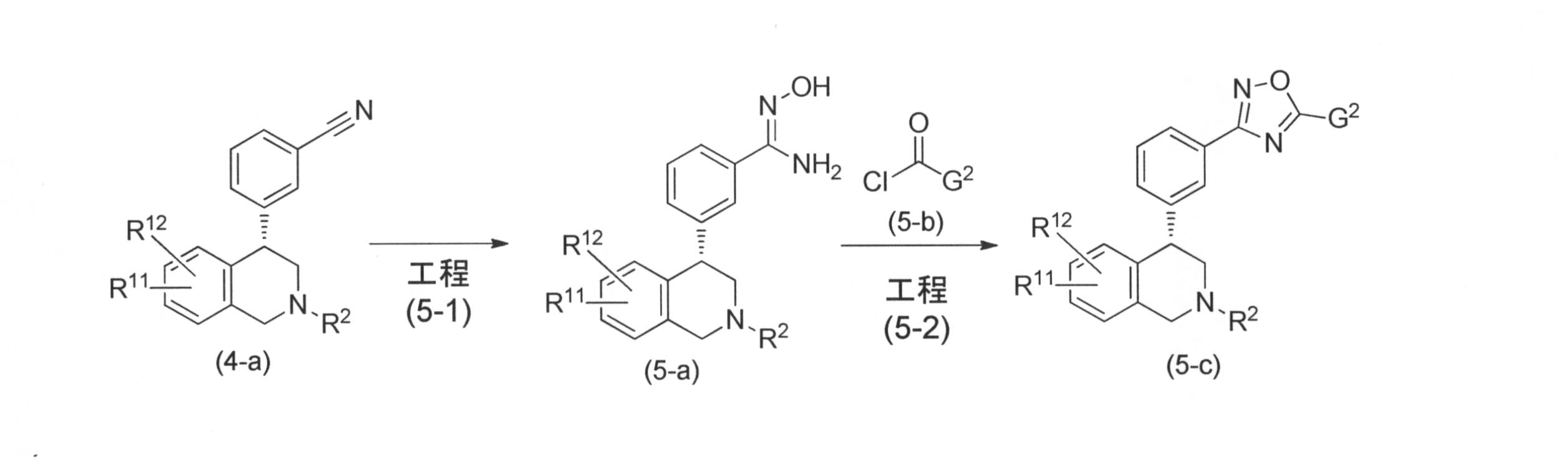
化合物(5-a)の製造方法:化合物(4-a)を基質とし、不活性溶媒中、20℃乃至80℃の温度で、ヒドロキシルアミンと反応させることにより、化合物(5-a)を製造することができる。
工程(5-2):
化合物(5-c)の製造方法:化合物(5-a)を基質とし、不活性溶媒中、0℃乃至160℃の温度で、トリエチルアミン、N,N-ジイソプロピルエチルアミン等の塩基存在下、化合物(5-b)と反応させることにより、化合物(5-c)を製造することができる。
スキーム6:化合物(2-c)から化合物(6-b)の合成法

化合物(6-b)の製造方法:化合物(2-c)を基質とし、不活性溶媒中、20℃乃至100℃の温度で、イソシアン酸フェニル、及びトリエチルアミン、N,N-ジイソプロピルエチルアミン等の塩基存在下、化合物(6-a)と反応させることにより、化合物(6-b)を製造することができる。
スキーム7:化合物(7-a)から化合物(7-d)の合成法
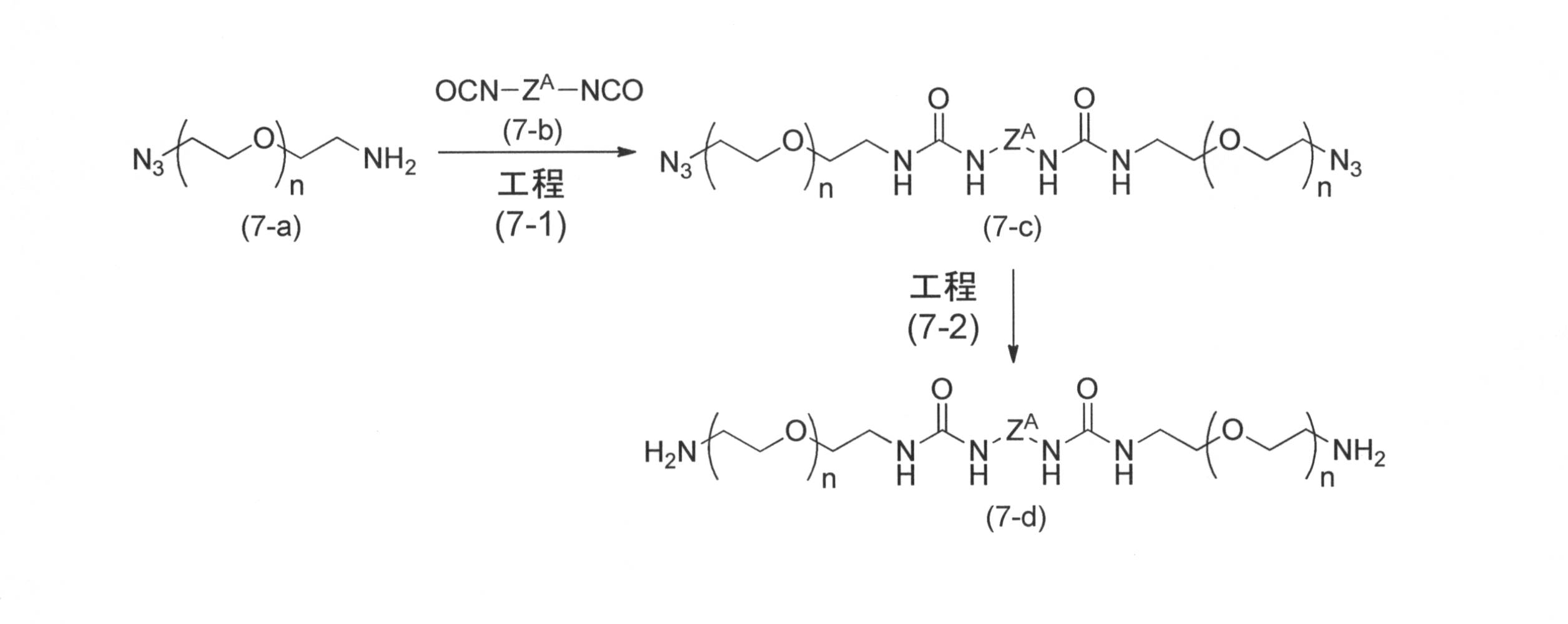
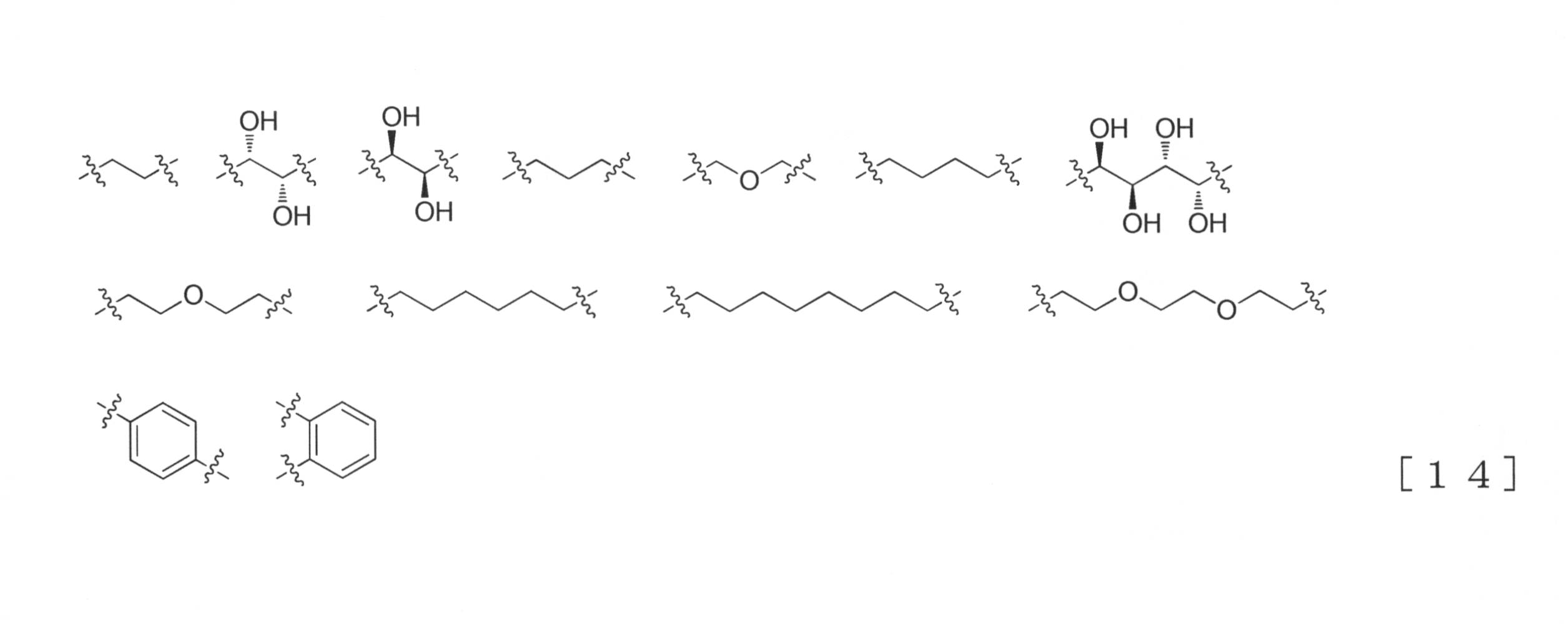
化合物(7-c)の製造方法:化合物(7-a)を基質とし、不活性溶媒中、0℃乃至100℃の温度で、トリエチルアミン、N,N-ジイソプロピルエチルアミン等の塩基存在下、又は非存在下、化合物(7-b)と反応させることにより、化合物(7-c)を製造することができる。
工程(7-2):
化合物(7-d)の製造方法:化合物(7-b)を基質とし、不活性溶媒中、0℃乃至80℃の温度で、トリフェニルホスフィン、水を作用させるか、又は水素雰囲気下又は水素加圧下、酸存在下又は非存在下、パラジウム-活性炭素等を作用させることにより、化合物(7-d)を製造することができる。
スキーム8:化合物(7-a)から化合物(8-d)の合成法
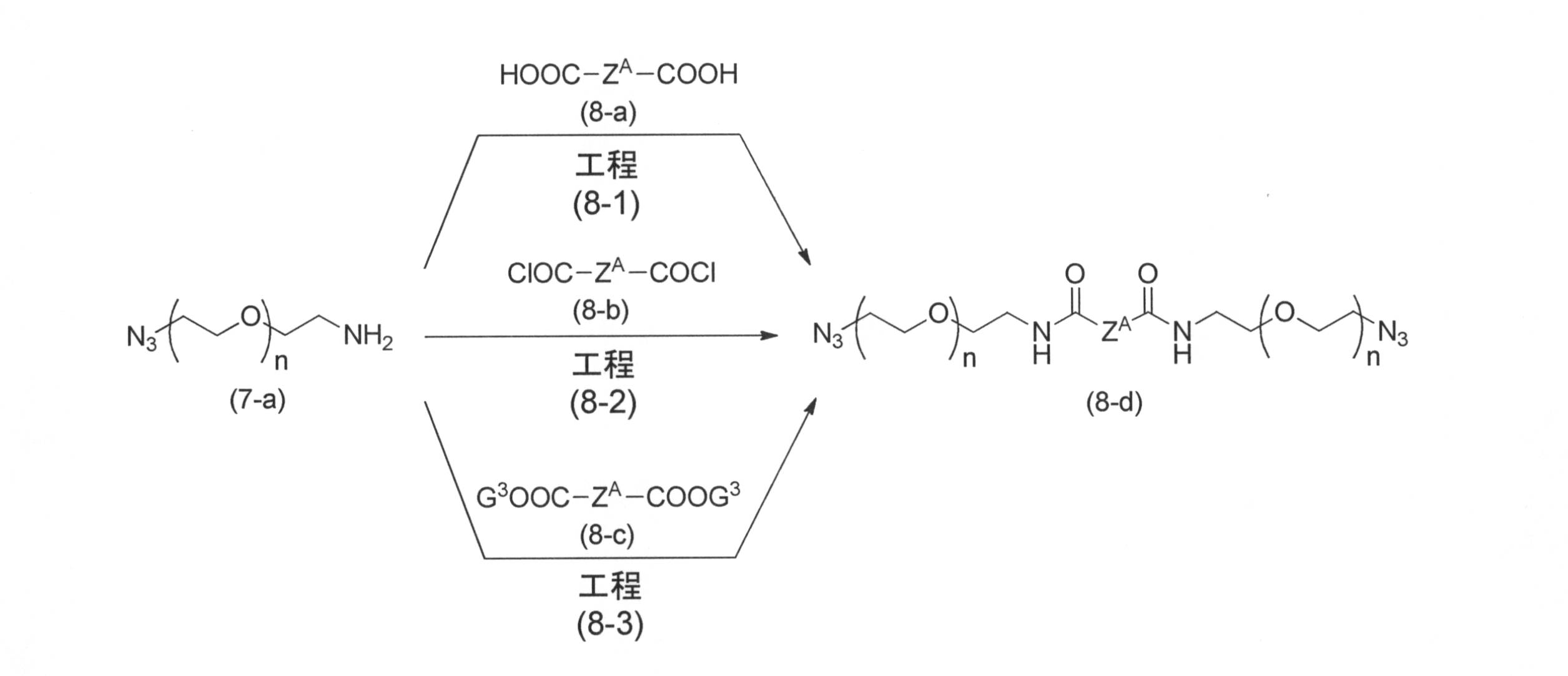
化合物(8-d)の製造方法:化合物(7-a)を基質とし、不活性溶媒中、0℃乃至80℃の温度で、各種カルボジイミド、ジフェニルリン酸アジド、ベンゾトリアゾール-1-イルオキシ-トリスジメチルアミノホスホニウム塩、4-(4、6-ジメトキシ-1、3、5-トリアジン-2-イル)-4-メチルモルホリン塩酸塩等の脱水縮合剤存在下、トリエチルアミン、N,N-ジイソプロピルエチルアミン等の塩基存在下、又は非存在下、化合物(8-a)を反応させることにより、化合物(8-d)を製造することができる。
工程(8-2):
化合物(8-d)の別途製造方法:化合物(7-a)を基質とし、不活性溶媒中、0℃乃至80℃の温度で、トリエチルアミン、N,N-ジイソプロピルエチルアミン等の塩基存在下、化合物(8-b)を反応させることにより、化合物(8-d)を製造することができる。
工程(8-3):
化合物(8-d)の別途製造方法:化合物(7-a)を基質とし、不活性溶媒中、0℃乃至80℃の温度で、トリエチルアミン、N,N-ジイソプロピルエチルアミン等の塩基存在下又は非存在下、化合物(8-c)を反応させることにより、化合物(8-d)を製造することができる。
スキーム9:化合物(2-c)から化合物(9-a)の合成法
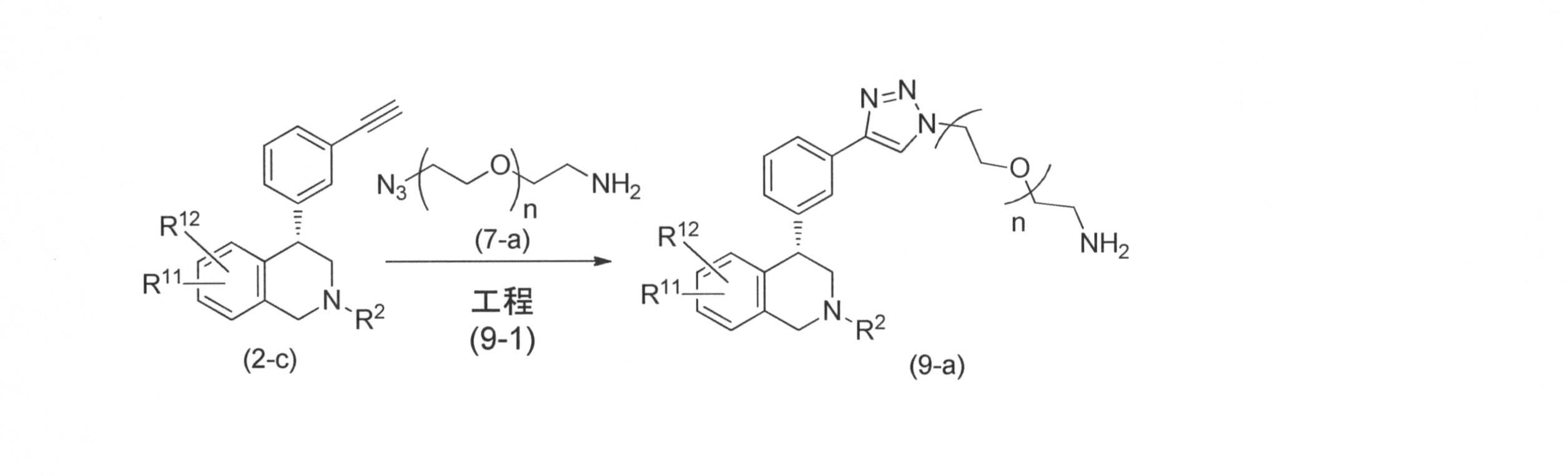
化合物(9-a)の製造方法:化合物(2-c)と化合物(7-a)の「ヒュスゲン環化反応」を行うことにより、化合物(9-a)を製造することができる。
スキーム10:化合物(10-a)から化合物(10-i)の合成法
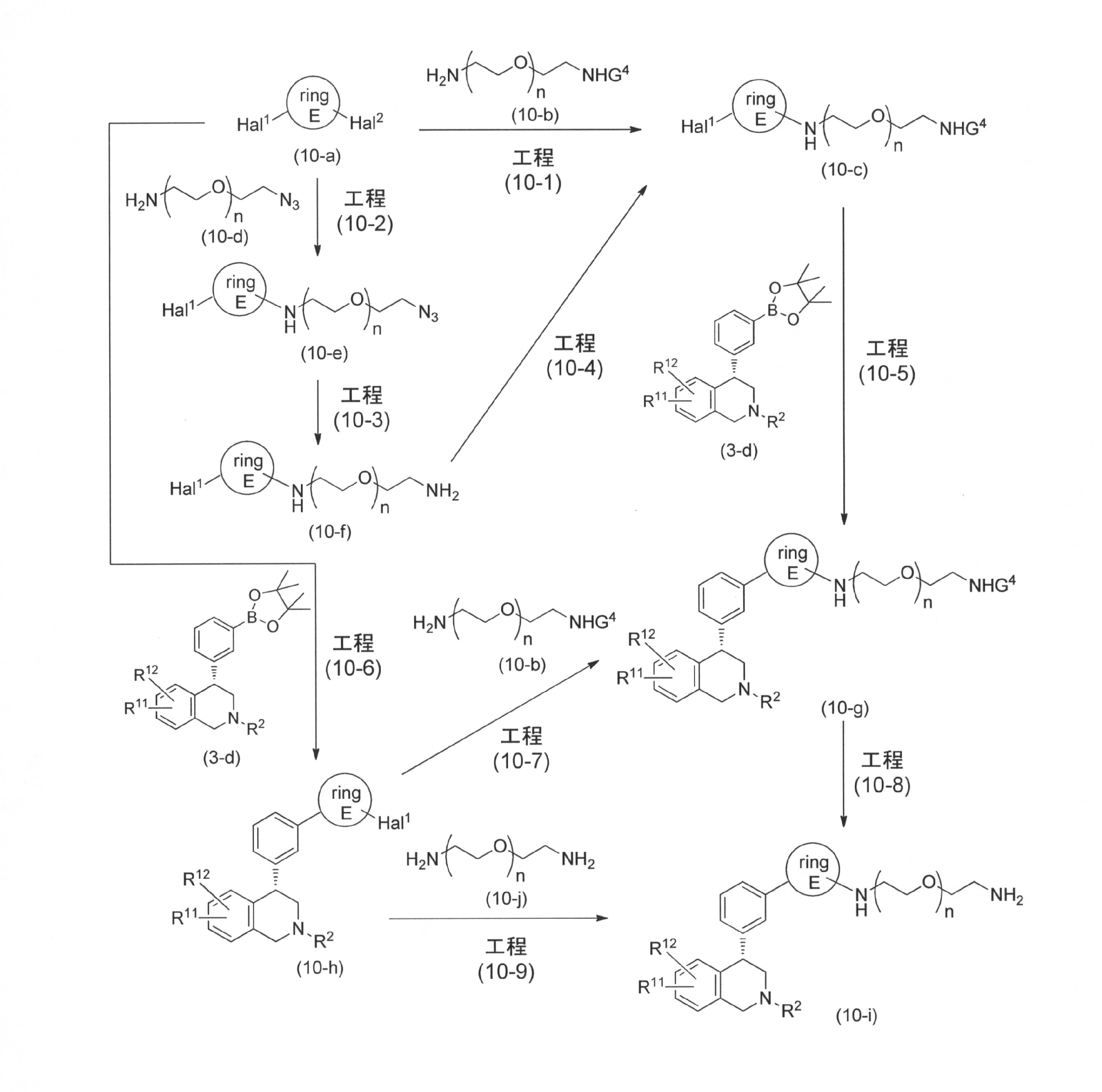
化合物(10-c)の製造方法:化合物(10-a)を基質とし、不活性溶媒中、20℃乃至180℃の温度で、トリエチルアミン、N,N-ジイソプロピルエチルアミン、あるいは炭酸カリウム等の塩基存在下、又は非存在下、(10-b)を反応させることにより、化合物(10-c)を製造することができる。
工程(10-2):
化合物(10-e)の製造方法:化合物(10-a)を基質とし、工程(10-1)と同様の操作で化合物(10-d)と反応させることにより、化合物(10-e)を製造することができる。
工程(10-3):
化合物(10-f)の製造方法:化合物(10-e)を基質とし、不活性溶媒中、0℃乃至80℃の温度で、トリフェニルホスフィン、水を作用させることにより、化合物(10-f)を製造することができる。
工程(10-4):
化合物(10-c)の別途製造方法:化合物(10-f)を基質とし、不活性溶媒中、0℃乃至80℃の温度で、二炭酸ジ-tert-ブチル等を用いてアミノ基を保護することにより、化合物(10-c)を製造することができる。
工程(10-5):
化合物(10-g)の製造方法:化合物(10-c)と化合物(3-d)の「鈴木カップリング反応」を行うことにより、化合物(10-g)を製造することができる。
工程(10-6):
化合物(10-h)の製造方法:化合物(10-a)と化合物(3-d)の「鈴木カップリング反応」を行うことにより、化合物(10-h)を製造することができる。
工程(10-7):
化合物(10-g)の別途製造方法:化合物(10-h)を基質とし、工程(10-1)と同様の操作で化合物(10-b)と反応させることにより、化合物(10-g)を製造することができる。
工程(10-8):
化合物(10-i)の製造方法:化合物(10-g)を基質とし、不活性溶媒中、20℃乃至100℃の温度で、塩酸、臭化水素酸、あるいはトリフルオロ酢酸等の酸を用いた脱保護反応、又は水素雰囲気下又は水素加圧下、酸存在下又は非存在下、パラジウム-活性炭素等を用いた脱保護反応により、化合物(10-i)を製造することができる。
工程(10-9):
化合物(10-i)の別途製造方法:化合物(10-h)を基質とし、工程(10-1)と同様の操作で化合物(10-j)と反応させることにより、化合物(10-i)を製造することができる。
スキーム11:化合物(10-a)から化合物(11-f)の合成法
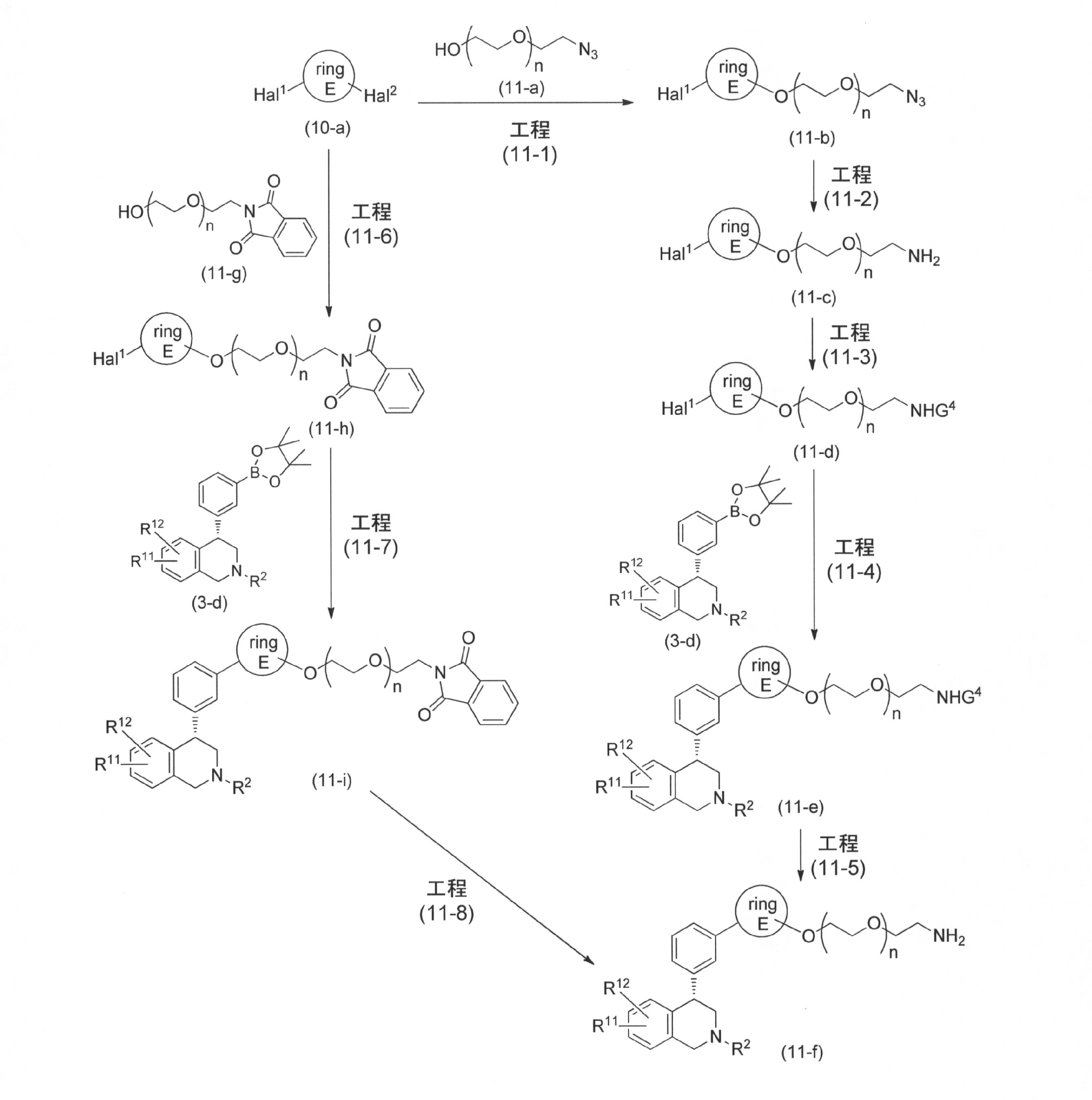
化合物(11-b)の製造方法:化合物(10-a)を基質とし、不活性溶媒中、0℃乃至60℃の温度で、カリウムtert-ブトキシド等の塩基存在下、(11-a)を反応させることにより、化合物(11-b)を製造することができる。
工程(11-2):
化合物(11-c)の製造方法:化合物(11-b)を基質とし、工程(10-3)と同様の操作を行うことにより、化合物(11-c)を製造することができる。
工程(11-3):
化合物(11-d)の製造方法:化合物(11-c)を基質とし、不活性溶媒中、0℃乃至80℃の温度で、二炭酸ジ-tert-ブチル等を用いてアミノ基を保護することにより、化合物(11-d)を製造することができる。
工程(11-4):
化合物(11-e)の製造方法:化合物(11-d)と化合物(3-d)の「鈴木カップリング反応」を行うことにより、化合物(11-e)を製造することができる。
工程(11-5):
化合物(11-f)の製造方法:化合物(11-e)を基質とし、工程(10-8)と同様の操作を行うことにより、化合物(11-f)を製造することができる。
工程(11-6):
化合物(11-h)の製造方法:化合物(10-a)を基質とし、不活性溶媒中、0℃乃至100℃の温度で、水素化ナトリウム等の塩基存在下、(11-g)を反応させることにより、化合物(11-h)を製造することができる。
工程(11-7):
化合物(11-i)の製造方法:化合物(11-h)と化合物(3-d)の「鈴木カップリング反応」を行うことにより、化合物(11-i)を製造することができる。
工程(11-8):
化合物(11-f)の別途製造方法:化合物(11-i)を基質とし、不活性溶媒中、20℃乃至100℃の温度で、ヒドラジン等を用いた脱保護反応により、化合物(11-f)を製造することができる。
スキーム12:化合物(12-a)から化合物(12-f)の合成法

化合物(12-c)の製造方法:化合物(12-a)を基質とし、不活性溶媒中、0℃乃至160℃の温度で、炭酸カリウム等の塩基存在下、及びテトラブチルアンモニウムヨージド存在下、又は非存在下、化合物(12-b)と反応させることにより、化合物(12-c)を製造することができる。
工程(12-2):
化合物(12-d)の製造方法:化合物(12-c)と化合物(3-d)の「鈴木カップリング反応」を行うことにより、化合物(12-d)を製造することができる。
工程(12-3):
化合物(12-d)の別途製造方法:化合物(12-a)を基質とし、不活性溶媒中、0℃乃至160℃の温度で、炭酸カリウム等の塩基存在下、及びテトラブチルアンモニウムヨージド存在下、又は非存在下、化合物(12-e)と反応させることにより、化合物(12-d)を製造することができる。
工程(12-4):
化合物(12-f)の製造方法:化合物(12-d)を基質とし、工程(10-8)と同様の操作を行うことにより、化合物(12-f)を製造することができる。
スキーム13:化合物(4-a)から化合物(13-e)、(13-f)の合成法
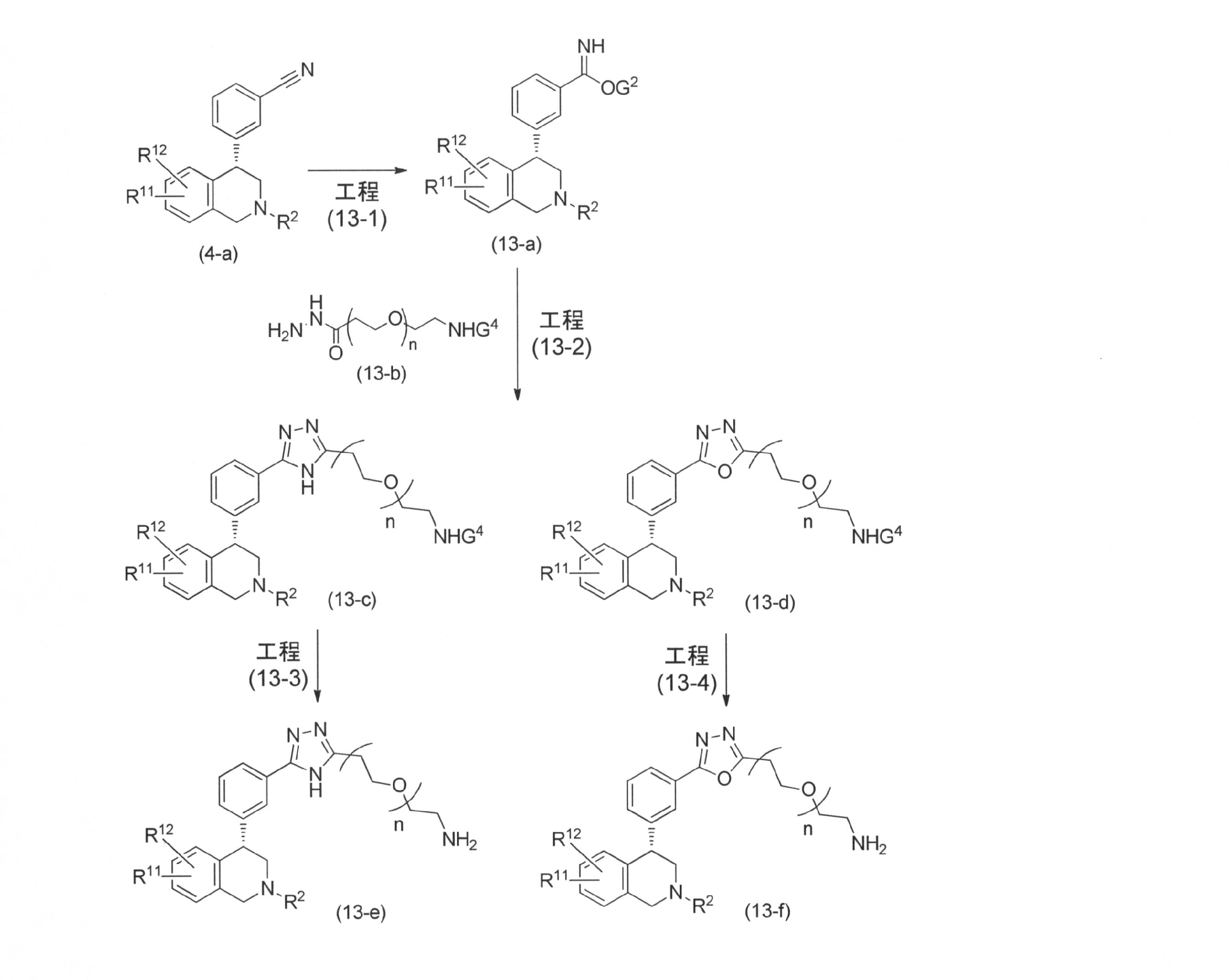
化合物(13-a)の製造方法:化合物(4-a)を基質とし、メタノール、エタノール等のアルコール溶媒中、0℃乃至80℃の温度で、ナトリウムメトキシド等のアルカリ金属アルコキシド、又は塩酸等の酸、又は塩化アセチル等を作用させることにより、化合物(13-a)を製造することができる。
工程(13-2):
化合物(13-c)、化合物(13-d)の製造方法:化合物(13-a)を基質とし、不活性溶媒中、20℃乃至160℃の温度で、化合物(13-b)と反応させることにより、化合物(13-c)、化合物(13-d)を製造することができる。得られる化合物はシリカゲルカラムクロマトグラフィーやHPLC等を用い、分割することでそれぞれ単離することができる。
工程(13-3):
化合物(13-e)の製造方法:化合物(13-c)を基質とし、工程(10-8)と同様の操作を行うことにより、化合物(12-f)を製造することができる。
工程(13-4):
化合物(13-f)の製造方法:化合物(13-d)を基質とし、工程(10-8)と同様の操作を行うことにより、化合物(13-f)を製造することができる。
スキーム14:化合物(14-a)から化合物(14-e)の合成法
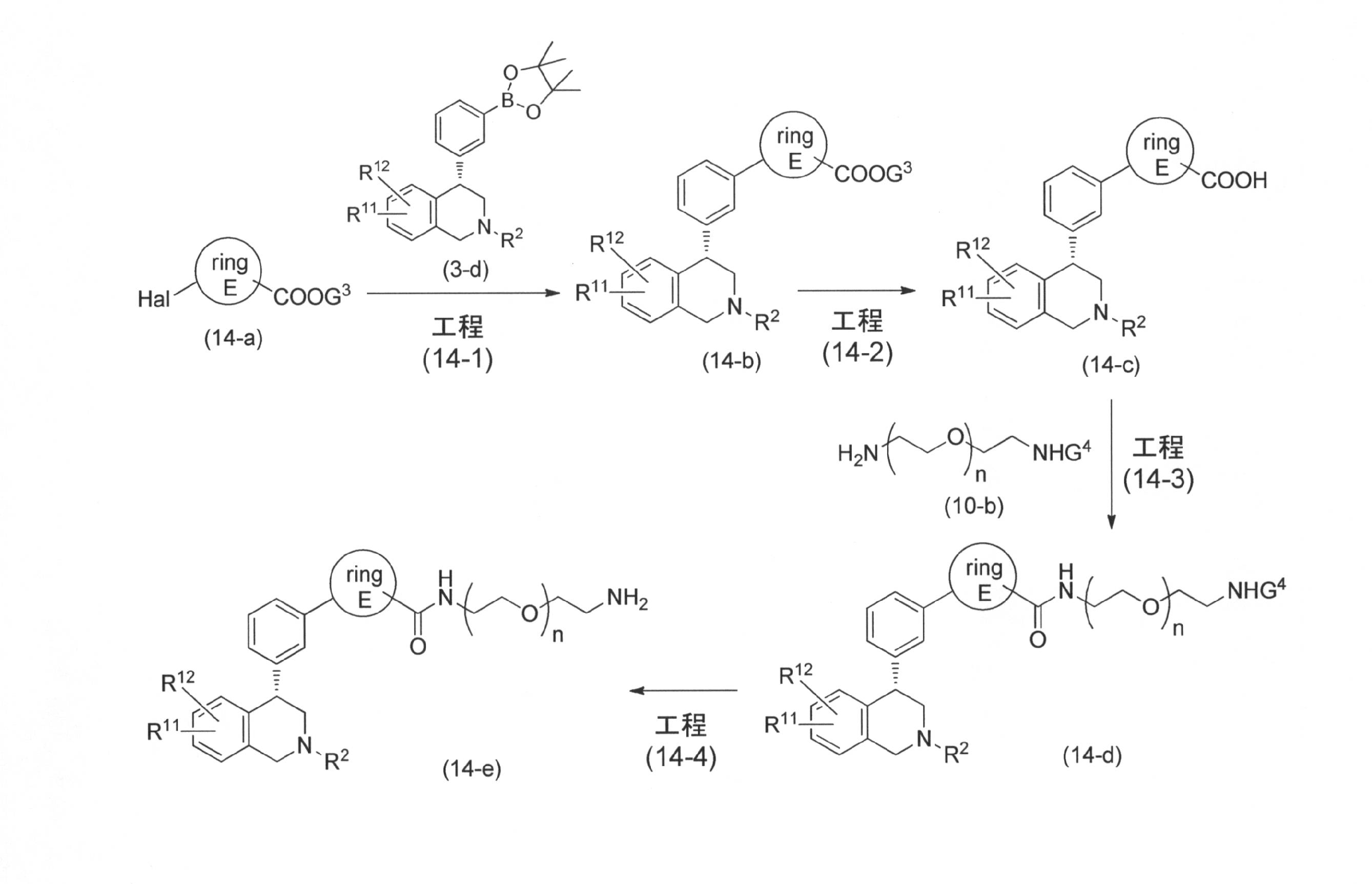
化合物(14-b)の製造方法:化合物(14-a)と化合物(3-d)の「鈴木カップリング反応」を行うことにより、化合物(14-b)を製造することができる。
工程(14-2):
化合物(14-c)の製造方法:化合物(14-b)を基質とし、不活性溶媒中、0℃乃至100℃の温度で、水酸化リチウム、又は水酸化ナトリウム等を作用させることにより、化合物(14-c)を製造することができる。
工程(14-3):
化合物(14-d)の別途製造方法:化合物(14-c)を基質とし、工程(8-1)と同様の操作で化合物(10-b)と反応させることにより、化合物(14-d)を製造することができる。
工程(14-4):
化合物(14-d)を基質とし、工程(10-8)と同様の操作を行うことにより、化合物(14-e)を製造することができる。
スキーム15:化合物(15-a)から化合物(15-b)の合成法
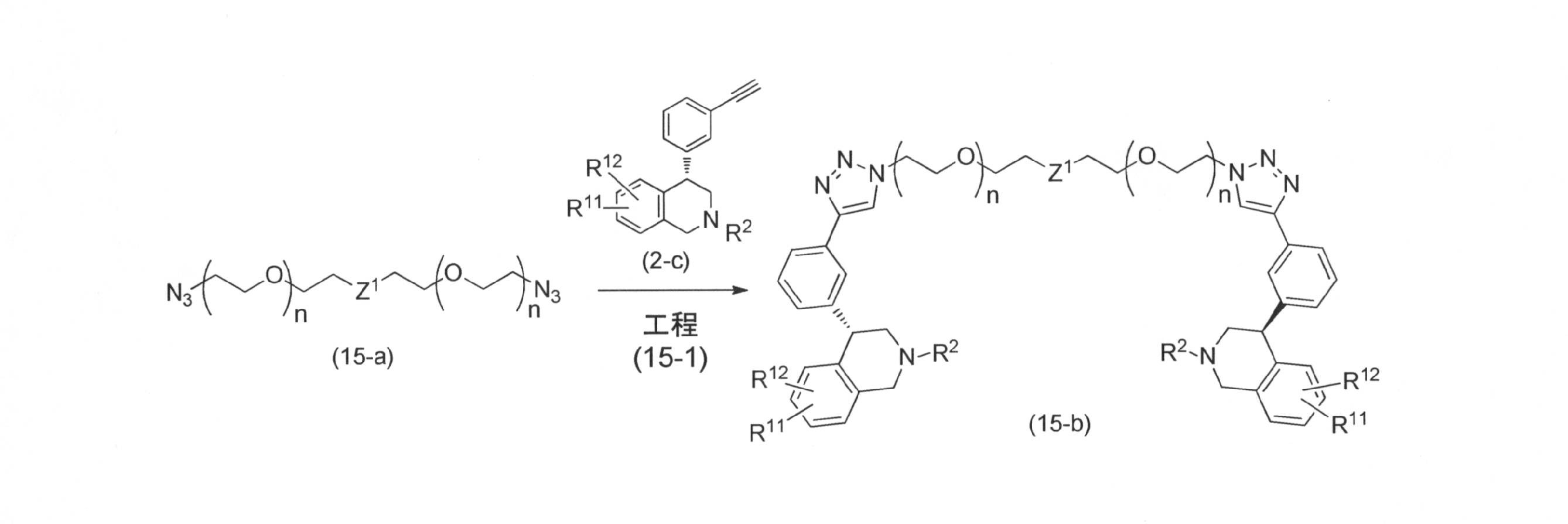
化合物(15-b)の製造方法:化合物(15-a)と化合物(2-c)の「ヒュスゲン環化反応」を行うことにより、化合物(15-b)を製造することができる。
スキーム16:化合物(16-a)から化合物(16-b)の合成法
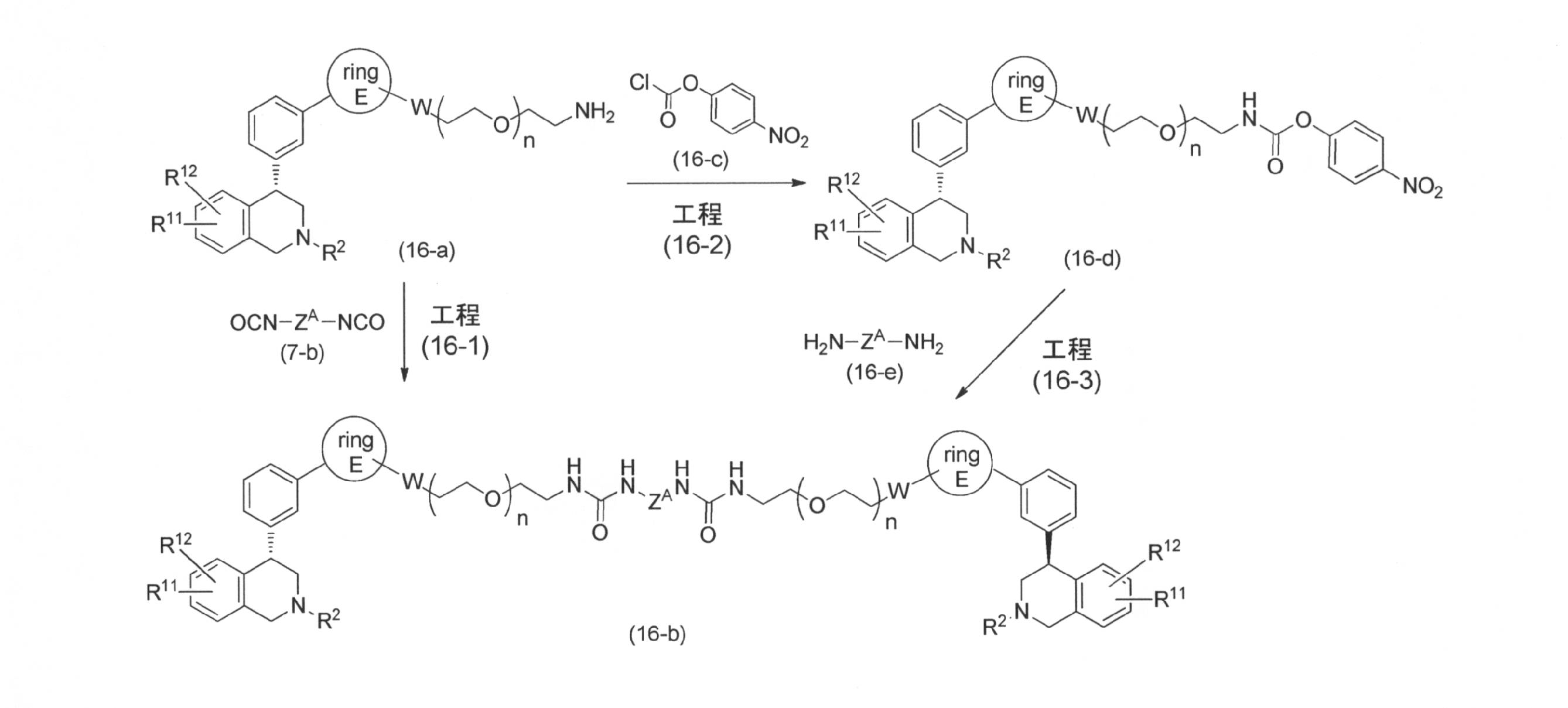
化合物(16-b)の製造方法:化合物(16-a)を基質とし、工程(7-1)と同様の操作で化合物(7-b)と反応させることにより、化合物(16-b)を製造することができる。
化合物(16-d)の製造方法:化合物(16-a)を基質とし、不活性溶媒中、0℃乃至160℃の温度で、トリエチルアミン、N,N-ジイソプロピルエチルアミン等の塩基存在下、又は非存在下、化合物(16-c)と反応させることにより、化合物(16-d)を製造することができる。
化合物(16-b)の別途製造方法:化合物(16-d)を基質とし、不活性溶媒中、0℃乃至160℃の温度で、トリエチルアミン、N,N-ジイソプロピルエチルアミン等の塩基存在下、又は非存在下、化合物(16-e)と反応させることにより、化合物(16-b)を製造することができる。
スキーム17:化合物(16-a)から化合物(17-a)の合成法

化合物(17-a)の製造方法:化合物(16-a)を基質とし、工程(8-1)と同様の操作で化合物(8-a)と反応させることにより、化合物(17-a)を製造することができる。
工程(17-2):
化合物(17-a)の別途製造方法:化合物(16-a)を基質とし、工程(8-2)と同様の操作で化合物(8-b)と反応させることにより、化合物(17-a)を製造することができる。
工程(17-3):
化合物(17-a)の別途製造方法:化合物(16-a)を基質とし、工程(8-3)と同様の操作で化合物(8-c)と反応させることにより、化合物(17-a)を製造することができる。
スキーム18:化合物(18-a)から化合物(18-c)の合成法
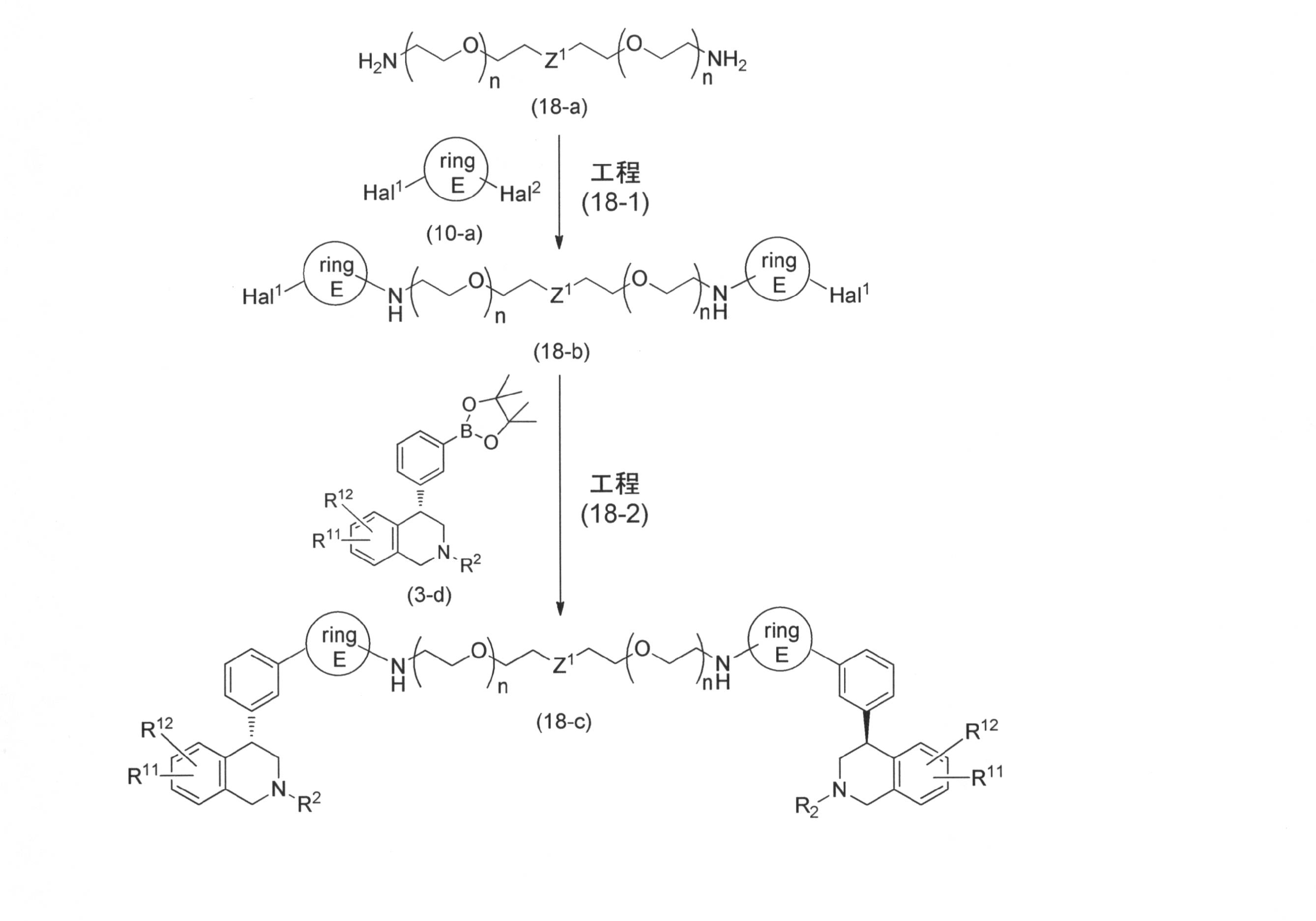
化合物(18-b)の製造方法:化合物(18-a)を基質とし、工程(10-1)と同様の操作で化合物(10-a)と反応させることにより、化合物(18-b)を製造することができる。
工程(18-2):
化合物(18-c)の製造方法:化合物(18-b)と化合物(3-d)の「鈴木カップリング反応」を行うことにより、化合物(18-c)を製造することができる。
スキーム19:化合物(7-a)から化合物(19-c)の合成法
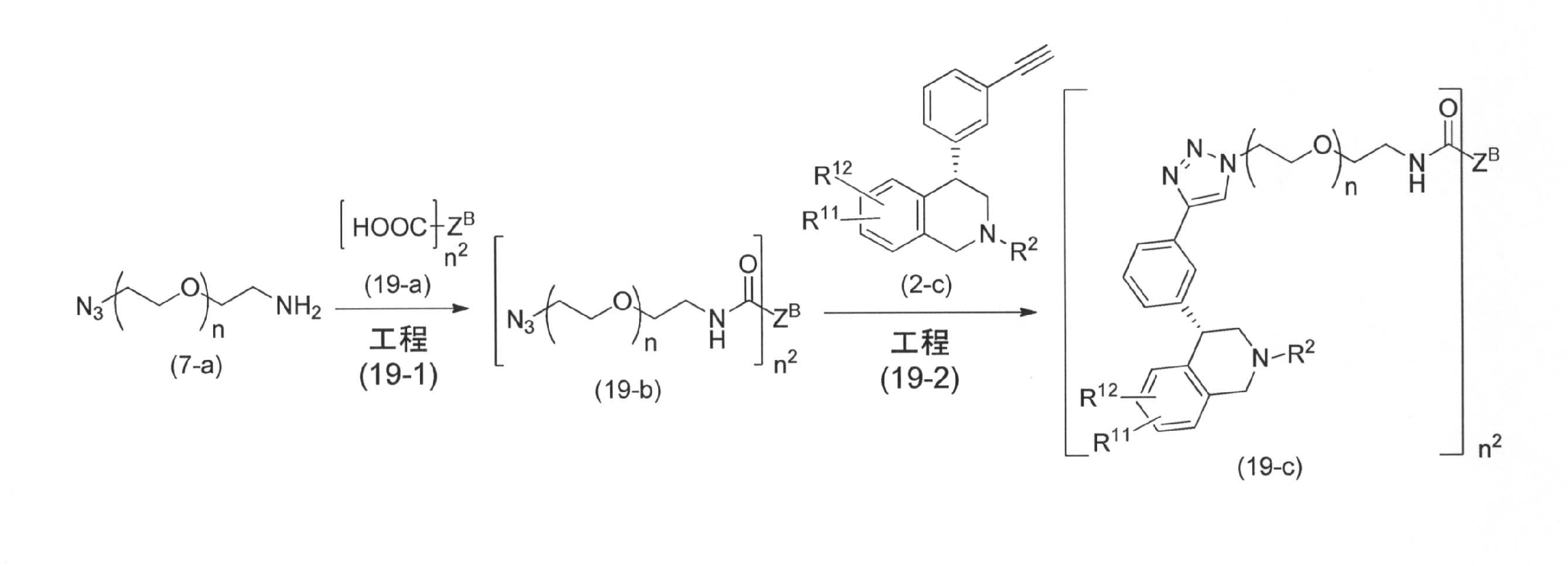

化合物(19-b)の製造方法:化合物(7-a)を基質とし、工程(8-1)と同様の操作で化合物(19-a)と反応させることにより、化合物(19-b)を製造することができる。
工程(19-2):
化合物(19-c)の製造方法:化合物(19-b)と化合物(2-c)の「ヒュスゲン環化反応」を行うことにより、化合物(19-c)を製造することができる。
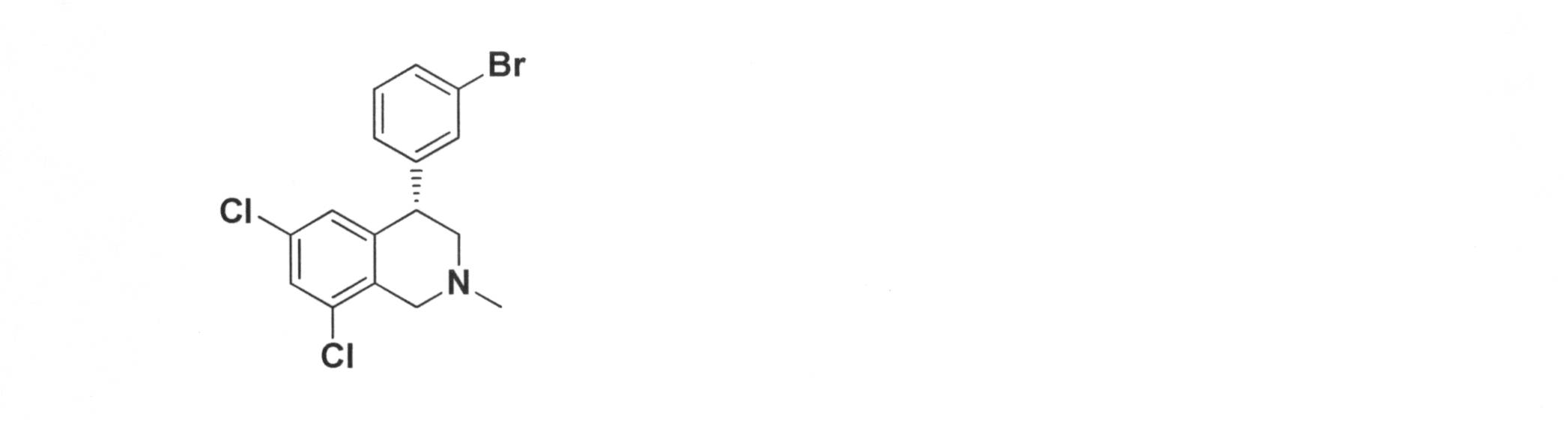
LC-MS 保持時間0.647 min
LC:Agilent 1290
ESI/APCI MS:Agilent 6130
Column: Waters Acquity CSH C18 1.7um, 2.1x50mm
Solvent: H2O:CH3CN(0.1% Formic acid)
Gradient: 0.8mL/min, 0min(80:20) →1.2-1.4min(1:99)
MS (+) : 372 [M+H]+.
キラルHPLC 保持時間 2.780 min
Column: CHIRALPAK IA 3um, 4.6x150mm
Solvent: Hexane:2-propanol=10:90, 1ml/min.
4-(3-ブロモフェニル)-6,8-ジクロロ-2-メチル-1,2,3,4-テトラヒドロイソキノリン(68g、WO2003/048129 パンフレット記載)のエタノール(1.4L)溶液を40℃に加熱し、(2S,3S)-(+)-ジベンゾイル-D-酒石酸(65g)、水(68mL)を加え、72℃まで昇温後、放冷攪拌した。40~50℃まで放冷した時点で種晶を加えた。反応系を氷冷し、不溶物をろ過、氷冷したエタノールで洗浄して、表題化合物(55g、38%、99.5%ee)を無色固体として得た。
1H NMR (300 MHz, CD3OD) δppm 1.17 (t, J=7.0Hz, 3H), 2.87 (s, 3H), 3.13-3.26 (m, 1H), 3.46-3.54 (m, 1H), 3.55-3.65 (m, 2H), 4.05-4.17 (m, 1H), 4.37-4.54 (m, 2H), 4.83-4.91 (m, 2H), 5.87-5.93 (m, 2H), 6.64-6.70 (m, 1H), 7.10-7.18 (m, 1H), 7.28 (t, J=7.8Hz, 1H), 7.37-7.43 (m, 2H), 7.45-7.53 (m, 5H), 7.57-7.67 (m, 2H), 8.06-8.15 (m, 4H).
MS (+) : 372 [M+H]+.
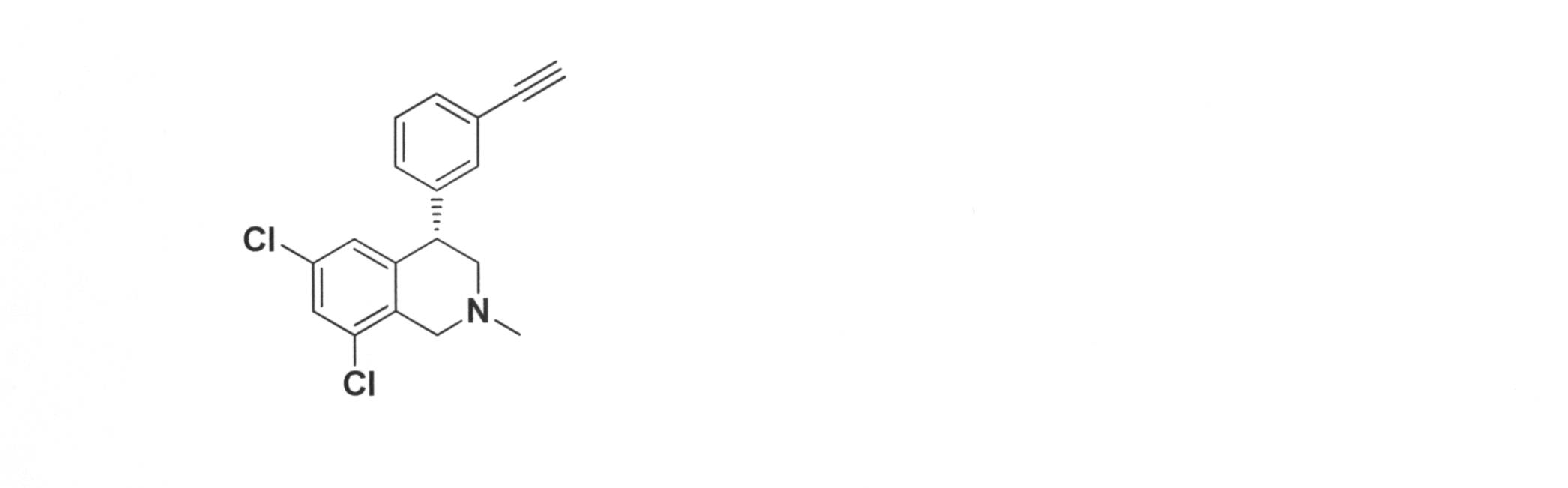
LC-MS 保持時間0.935 min
LC:Agilent 1290
ESI/APCI MS:Agilent 6130
Column: Waters Acquity CSH C18 1.7um, 2.1x50mm
Solvent: H2O:CH3CN(0.1% Formic acid)
Gradient: 0.8mL/min, 0min(80:20) →1.2-1.4min(1:99)
MS (+) : 388 [M+H]+.
(2)(4S)-6,8-ジクロロ-2-メチル-4-{3-[(トリメチルシリル)エチニル]フェニル}-1,2,3,4-テトラヒドロイソキノリン(0.13g)のメタノール(3.8mL)溶液に、氷冷下で炭酸カリウム(0.18g)を加え、室温で1時間攪拌した。反応液に水を加え、酢酸エチルで抽出した。有機層を無水硫酸マグネシウムで乾燥させ、ろ別後、ろ液を減圧下濃縮した。得られた残渣をシリカゲルカラムクロマトグラフィー(Biotage(登録商標)SNAP Cartridge KP-NH、ヘキサン:酢酸エチル=100:0→80:20)で精製し、表題化合物(83mg、82%)を褐色油状物質として得た。
LC-MS 保持時間0.635 min
LC:Agilent 1290
ESI/APCI MS:Agilent 6130
Column: Waters Acquity CSH C18 1.7um, 2.1x50mm
Solvent: H2O:CH3CN(0.1% Formic acid)
Gradient: 0.8mL/min, 0min(80:20) →1.2-1.4min(1:99)
MS (+) : 316 [M+H]+.
参考例2-1で得られた(4S)-6,8-ジクロロ-4-(3-エチニルフェニル)-2-メチル-1,2,3,4-テトラヒドロイソキノリンをエタノール溶解させた後、4mol/L塩化水素-1,4-ジオキサンを加え、減圧下溶媒を留去して、表題化合物(0.17g)を無色固体として得た。
LC-MS 保持時間 0.635 min
LC:Agilent 1290
ESI/APCI MS:Agilent 6130
Column: Waters Acquity CSH C18 1.7um, 2.1x50mm
Solvent: H2O:CH3CN(0.1% Formic acid)
Gradient: 0.8mL/min, 0min(80:20) →1.2-1.4min(1:99)
MS (+) : 316 [M+H]+.
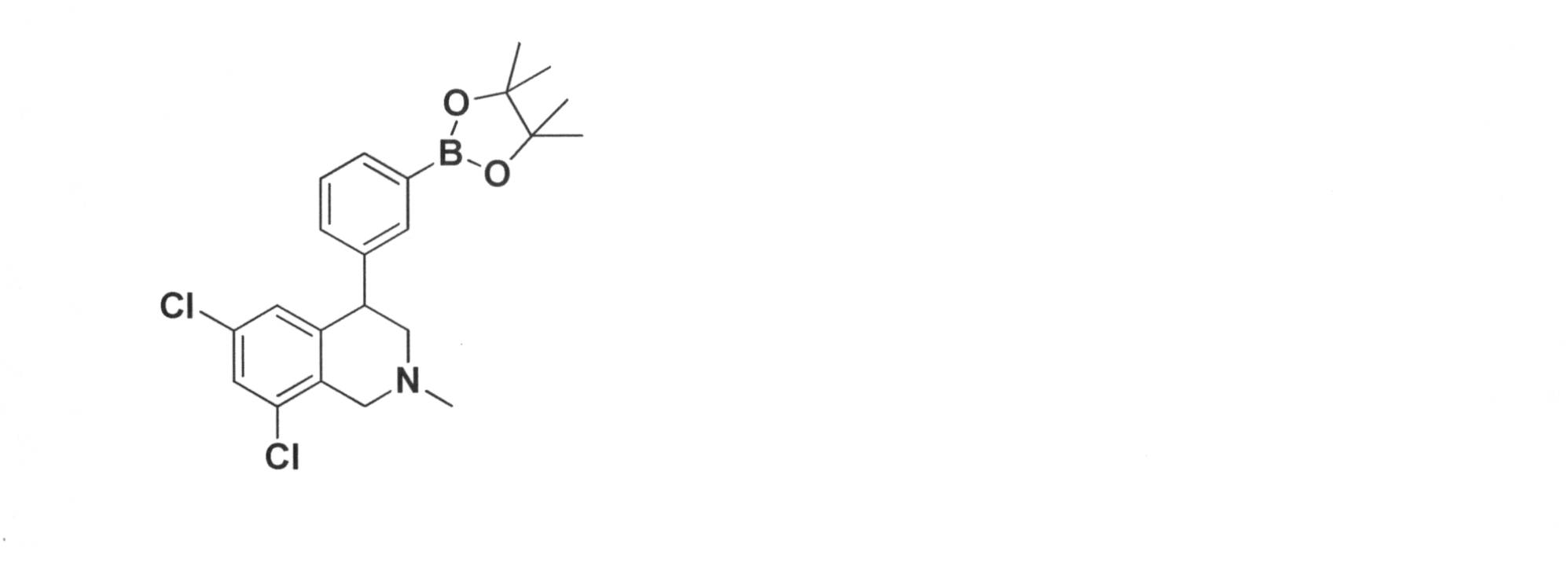
1H NMR (300 MHz, CDCl3) δ ppm 1.36 (s, 12H), 2.49 (s, 3H), 2.59 (dd, J=11.5, 9.5Hz, 1H), 3.02-3.09 (m, 1H), 3.44-3.52 (m, 1H), 3.94 (d, J=16.0Hz, 1H), 4.25-4.33 (m, 1H), 6.72-6.77 (m, 1H), 7.15-7.23 (m, 2H), 7.28-7.35 (m, 1H), 7.63 (s, 1H), 7.73 (dt, J=7.3, 1.2Hz, 1H).
MS (+) : 418 [M+H]+.
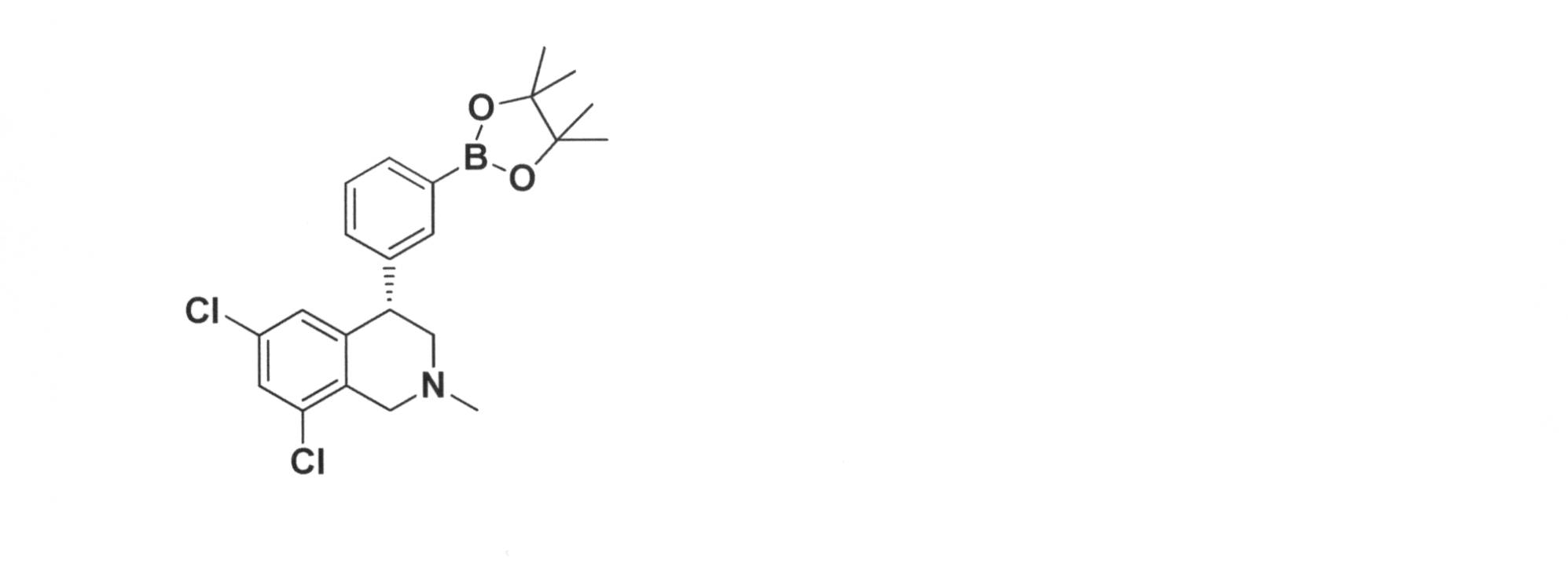
1H NMR (300 MHz, CDCl3) δ ppm 1.36 (s, 12H), 2.48 (s, 3H), 2.52-2.63 (m, 1H), 2.96-3.06 (m, 1H), 3.42-3.53 (m, 1H), 3.82-3.94 (m, 1H), 4.22-4.33 (m, 1H), 6.73-6.78 (m, 1H), 7.15-7.23 (m, 2H), 7.28-7.35 (m, 1H), 7.62-7.66 (m, 1H), 7.69-7.75 (m, 1H).
MS (+) : 418 [M+H]+.
参考例3-2で得られた((4S)-6,8-ジクロロ-2-メチル-4-[3-(4,4,5,5-テトラメチル-1,3,2-ジオキサボロラン-2-イル)フェニル]-1,2,3,4-テトラヒドロイソキノリン(25mg)に4mol/L塩化水素-酢酸エチル(0.20mL)を加え、室温で13時間攪拌した。不溶物をろ取して、表題化合物(22mg)を無色固体として得た。
1H NMR (300 MHz, DMSO-d6) δppm 1.29 (s, 12H), 2.96 (s, 3H), 3.46-3.64 (m, 1H), 3.65-3.86 (m, 1H), 4.25-4.51 (m, 1H), 4.51-4.63 (m, 1H), 4.63-4.83 (m, 1H), 6.71 (br. s., 1H), 7.35-7.51 (m, 2H), 7.55 (br. s., 1H), 7.61-7.76 (m, 2H), 11.32 (br. s., 1H).
MS (+) : 418 [M+H]+.
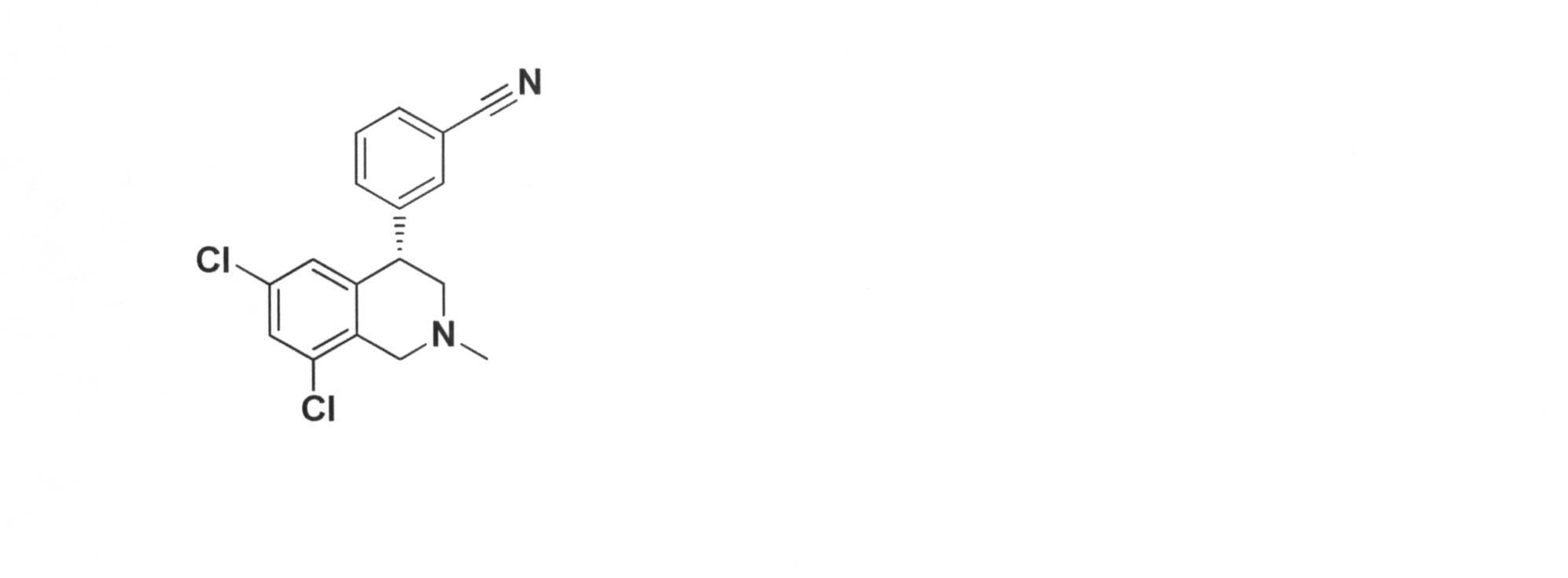
LC-MS 保持時間0.553 min
LC:Agilent 1290
ESI/APCI MS:Agilent 6130
Column: Waters Acquity CSH C18 1.7um, 2.1x50mm
Solvent: H2O:CH3CN(0.1% Formic acid)
Gradient: 0.8mL/min, 0min(80:20) →1.2-1.4min(1:99)
MS (+) : 317 [M+H]+.

LC-MS 保持時間0.588 min
LC:Agilent 1290
ESI/APCI MS:Agilent 6130
Column: Waters Acquity CSH C18 1.7um, 2.1x50mm
Solvent: H2O:CH3CN(0.1% Formic acid)
Gradient: 0.8mL/min, 0min(80:20) →1.2-1.4min(1:99)
MS (+) : 489 [M+H]+.

1H NMR (300 MHz, CDCl3) δppm 1.43-1.58 (m, 4H), 3.15-3.23 (m, 4H), 3.32-3.45 (m, 8H), 3.52-3.58 (m, 4H), 3.62-3.72 (m, 20H), 5.10-5.25 (m, 4H).
MS (+) : 577 [M+H]+.

LC-MS 保持時間 0.679 min
LC:Agilent 1290
ESI/APCI MS:Agilent 6130
Column: Waters Acquity CSH C18 1.7um, 2.1x50mm
Solvent: H2O:CH3CN(0.1% Formic acid)
Gradient: 0.8mL/min, 0min(80:20) →1.2-1.4min(1:99)
MS (+) : 509 [M+H]+.
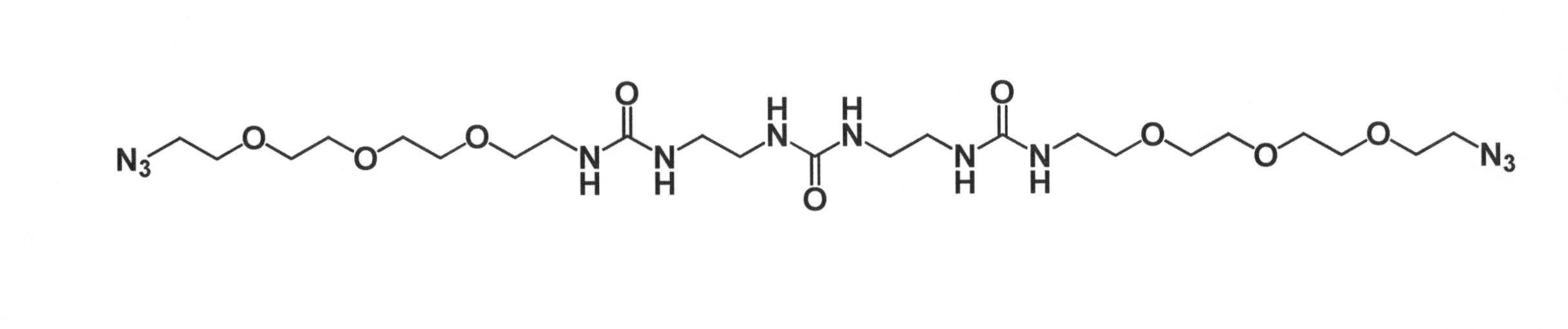
LC-MS 保持時間 0.728 min
LC:Agilent 1290
ESI/APCI MS:Agilent 6130
Column: Waters Acquity CSH C18 1.7um, 2.1x50mm
Solvent: H2O:CH3CN(0.1% Formic acid)
Gradient: 0.8mL/min, 0min(80:20) →1.2-1.4min(1:99)
MS (+) : 347 [M+H]+.
(2)[カルボニルビス(イミノエタン-2,1-ジイル)]ビスカルバミン酸ジ-tert-ブチル(1.4g)に4mol/L塩化水素-1,4-ジオキサン溶液(5.0mL)を加え、室温で1時間攪拌後、1,4-ジオキサン(5.0mL)を加え、室温で16時間攪拌した。不溶物をろ取し、クロロホルムで洗浄して、1,3-ビス(2-アミノエチル)尿素 塩酸塩(0.70g、80%)を無色アモルファス状物質として得た。
LC-MS 保持時間 0.230 min
LC:Agilent 1290
ESI/APCI MS:Agilent 6130
Column: Waters Acquity CSH C18 1.7um, 2.1x50mm
Solvent: H2O:CH3CN(0.1% Formic acid)
Gradient: 0.8mL/min, 0min(80:20) →1.2-1.4min(1:99)
MS (+) : 147 [M+H]+.
(3)2-{2-[2-(2-アジドエトキシ)エトキシ]エトキシ}エタンアミン(0.93g)のクロロホルム(10mL)溶液に、トリエチルアミン(0.85mL)、カルボノクロリド酸4-ニトロフェニル(0.82g)を加え、0℃で30分間攪拌した。反応液に水を加え、クロロホルムで抽出した。有機層を硫酸ナトリウムで乾燥させ、ろ別後、ろ液を減圧下濃縮した。得られた残渣をシリカゲルカラムクロマトグラフィー(Biotage(登録商標)SNAP Cartridge HP-Sphere、ヘキサン:酢酸エチル=95:5→0:100)で精製し、(2-{2-[2-(2-アジドエトキシ)エトキシ]エトキシ}エチル)カルバミン酸4-ニトロフェニル(0.90g、55%)を無色油状物質として得た。
LC-MS 保持時間 0.868 min
LC:Agilent 1290
ESI/APCI MS:Agilent 6130
Column: Waters Acquity CSH C18 1.7um, 2.1x50mm
Solvent: H2O:CH3CN(0.1% Formic acid)
Gradient: 0.8mL/min, 0min(80:20) →1.2-1.4min(1:99)
MS (+) : 384 [M+H]+.
(4)(2-{2-[2-(2-アジドエトキシ)エトキシ]エトキシ}エチル)カルバミン酸4-ニトロフェニル(0.89g)のクロロホルム(4.0mL)溶液に、トリエチルアミン(0.32mL)、1,3-ビス(2-アミノエチル)尿素 塩酸塩(0.25g)を加え、室温で30分攪拌した。その後N,N-ジメチルホルムアミド(4.0mL)を加え、60℃で2時間攪拌した。反応溶液に酢酸エチル(20mL)を加え、氷冷下30分攪拌した後、不溶物をろ取し、表題化合物(0.55g、75%)を無色アモルファス状物質として得た。
LC-MS 保持時間 0.580 min
LC:Agilent 1290
ESI/APCI MS:Agilent 6130
Column: Waters Acquity CSH C18 1.7um, 2.1x50mm
Solvent: H2O:CH3CN(0.1% Formic acid)
Gradient: 0.8mL/min, 0min(80:20) →1.2-1.4min(1:99)
MS (+) : 635 [M+H]+.
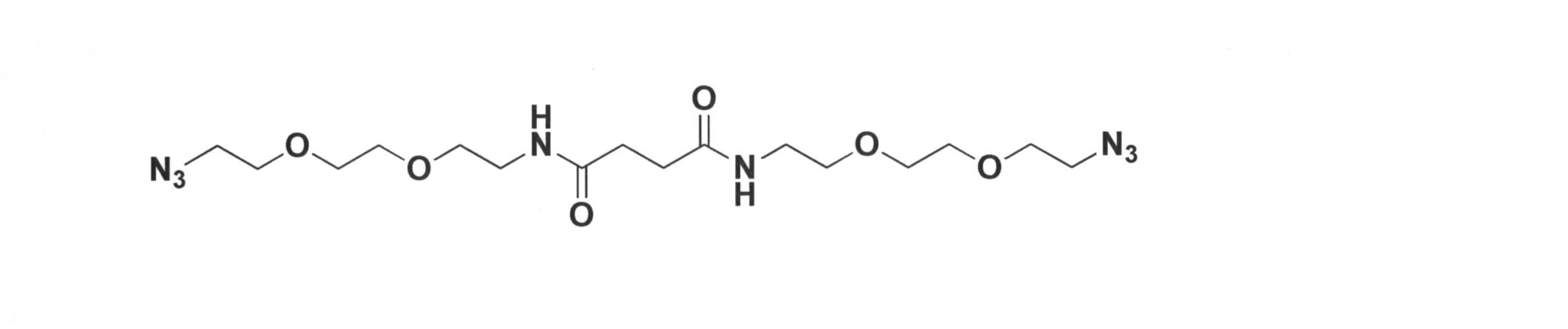
LC-MS 保持時間 0.583 min
LC:Agilent 1290
ESI/APCI MS:Agilent 6130
Column: Waters Acquity CSH C18 1.7um, 2.1x50mm
Solvent: H2O:CH3CN(0.1% Formic acid)
Gradient: 0.8mL/min, 0min(80:20) →1.2-1.4min(1:99)
MS (+) : 431 [M+H]+.
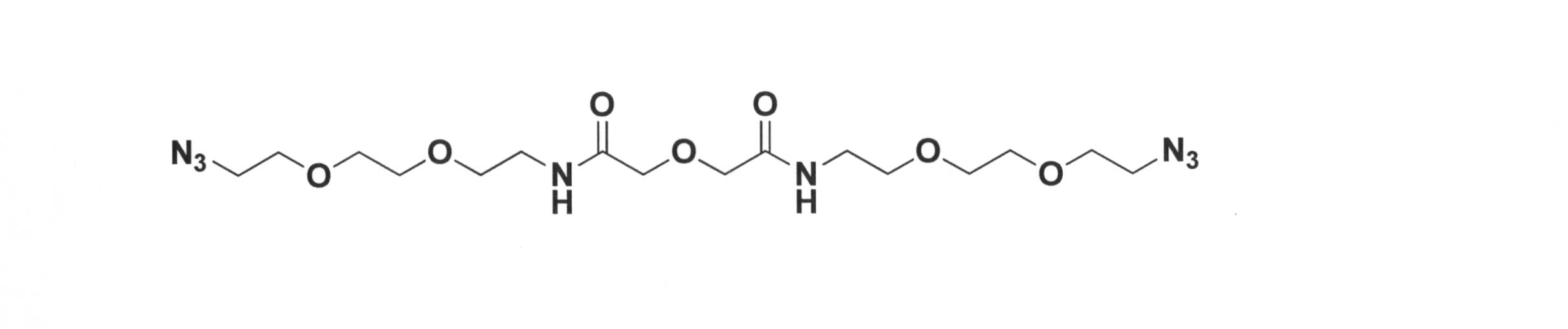
LC-MS 保持時間 0.601 min
LC:Agilent 1290
ESI/APCI MS:Agilent 6130
Column: Waters Acquity CSH C18 1.7um, 2.1x50mm
Solvent: H2O:CH3CN(0.1% Formic acid)
Gradient: 0.8mL/min, 0min(80:20) →1.2-1.4min(1:99)
MS (+) : 447 [M+H]+.

LC-MS 保持時間 0.512 min
LC:Agilent 1290
ESI/APCI MS:Agilent 6130
Column: Waters Acquity CSH C18 1.7um, 2.1x50mm
Solvent: H2O:CH3CN(0.1% Formic acid)
Gradient: 0.8mL/min, 0min(80:20) →1.2-1.4min(1:99)
MS (+) : 463 [M+H]+.
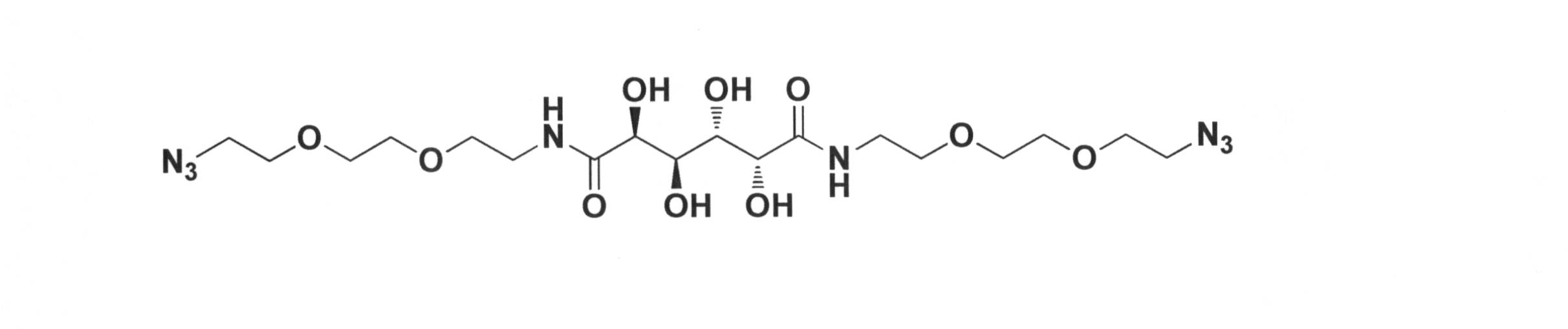
LC-MS 保持時間 0.823 min
LC:Agilent 1290
ESI/APCI MS:Agilent 6130
Column: Waters Acquity CSH C18 1.7um, 2.1x50mm
Solvent: H2O:CH3CN(0.1% Formic acid)
Gradient: 0.8mL/min, 0min(95:5) →1.2min(50:50)
1.0mL/min, →1.38min(3:97)
MS (+) : 523 [M+H]+.
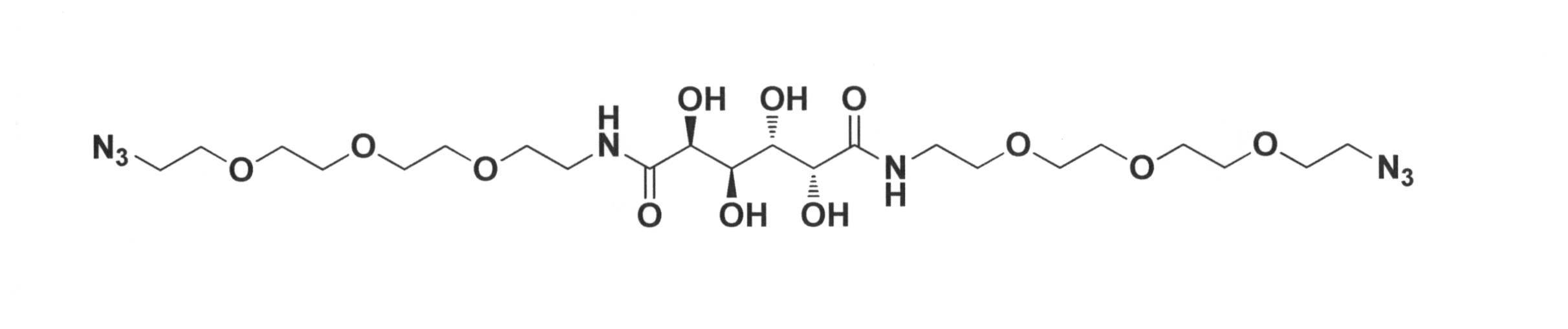
LC-MS 保持時間 0.934 min
LC:Agilent 1290
ESI/APCI MS:Agilent 6130
Column: Waters Acquity CSH C18 1.7um, 2.1x50mm
Solvent: H2O:CH3CN(0.1% Formic acid)
Gradient: 0.8mL/min, 0min(95:5) →1.2min(50:50)
1.0mL/min, →1.38min(3:97)
MS (+) : 611 [M+H]+.

LC-MS 保持時間1.200 min
LC:Agilent 1290
ESI/APCI MS:Agilent 6130
Column: Waters Acquity CSH C18 1.7um, 2.1x50mm
Solvent: H2O:CH3CN(0.1% Formic acid)
Gradient: 0.8mL/min, 0min(95:5) →1.2min(50:50)
1.0mL/min, →1.38min(3:97)
MS (+) : 1094 [M+H]+.
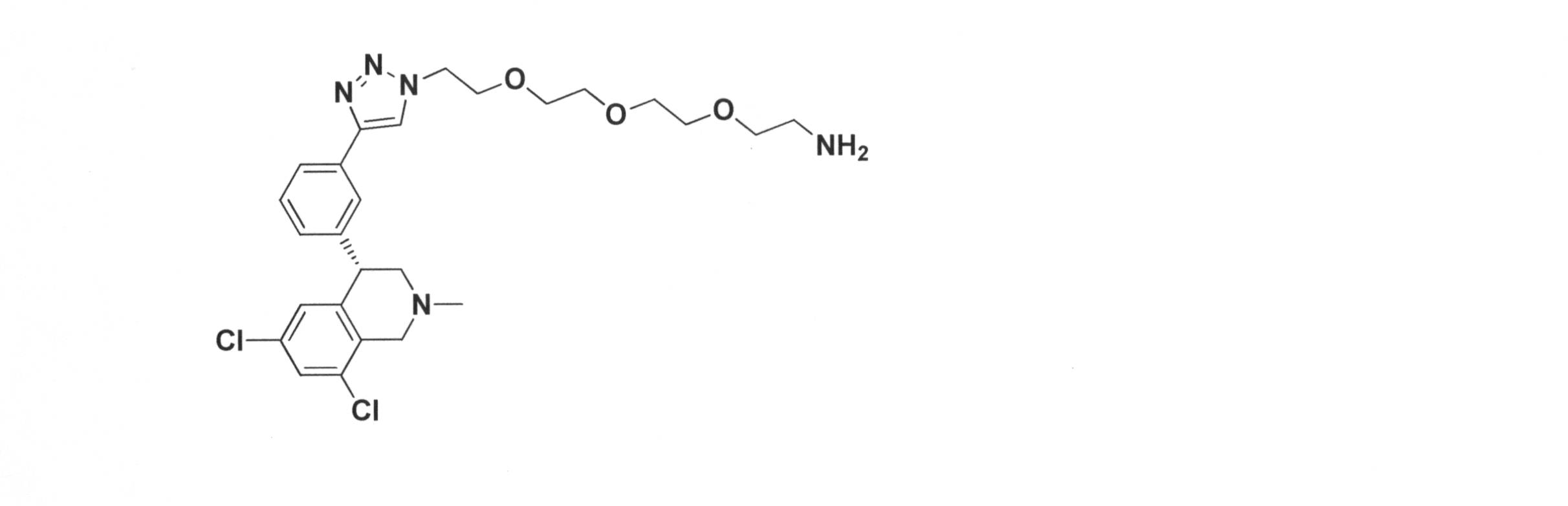
LC-MS 保持時間 0.769 min
LC:Agilent 1290
ESI/APCI MS:Agilent 6130
Column: Waters Acquity CSH C18 1.7um, 2.1x50mm
Solvent: H2O:CH3CN(0.1% Formic acid)
Gradient: 0.8mL/min, 0min(95:5) →1.2min(50:50)
1.0mL/min, →1.38min(3:97)
MS (+) : 534 [M+H]+.
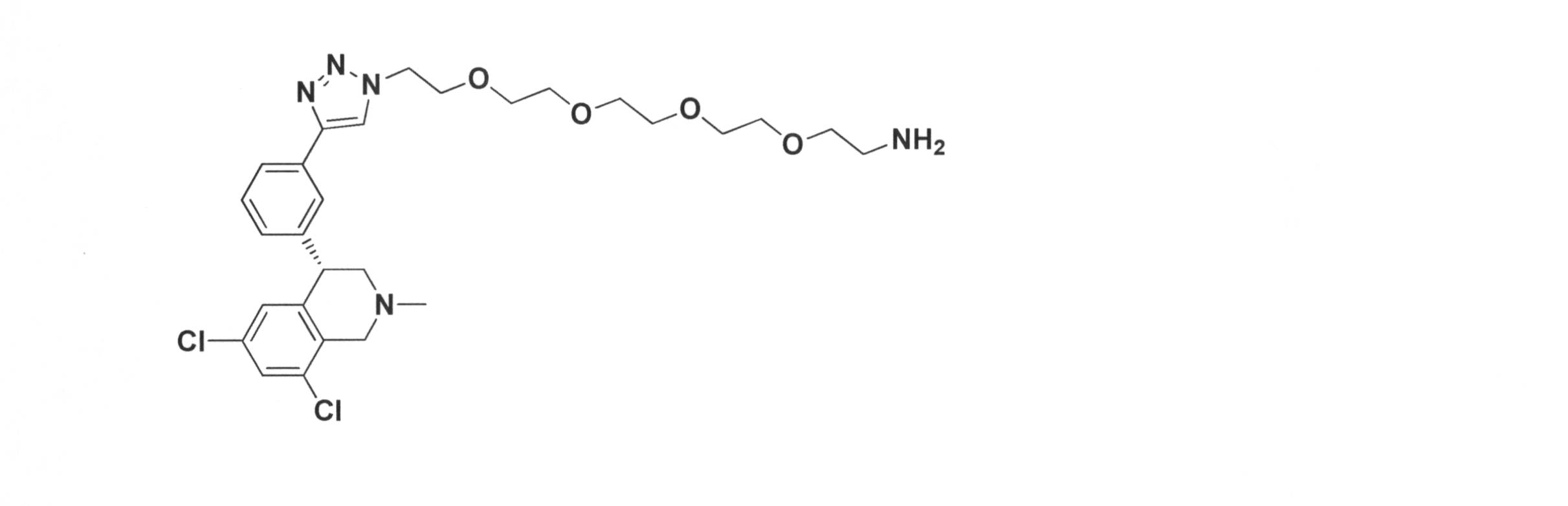
1H NMR (300 MHz, CDCl3) δppm 2.45 (s, 6H), 3.50-3.65 (m, 12H), 3.66-3.72 (m, 4H), 4.11-4.19 (m, 4H), 7.30-7.38 (m, 4H), 7.74-7.84 (m, 4H).
MS (+) : 547 [M+H]+.
(2)3,6,9,12-テトラオキサテトラデカン-1,14-ジイルビス(4-メチルベンゼンスルホナート)(4.7g)のN,N-ジメチルホルムアミド(40mL)溶液に、テトラブチルアンモニウムヨージド(0.31g)、アジ化ナトリウム(2.2g)を加え、80℃で3時間攪拌した。反応溶液を放冷後、減圧下溶媒を留去した。得られた残渣にジエチルエーテルを加え、室温で15分攪拌した。不溶物をろ別し、ろ液を減圧下濃縮した。得られた残渣をシリカゲルカラムクロマトグラフィー(Biotage(登録商標)SNAP Cartridge HP-Sphere、ヘキサン:酢酸エチル=75:25→10:90)で精製し、1,14-ジアジド-3,6,9,12-テトラオキサテトラデカン(1.7g、71%(2工程))を淡黄色油状物質として得た。
1H NMR (300 MHz, CDCl3) δppm 3.39 (t, J=5.1Hz, 4H), 3.64-3.71 (m, 16H).
MS (+) : 311 [M+Na]+.
(3)1,14-ジアジド-3,6,9,12-テトラオキサテトラデカン(1.7g)のジエチルエーテル(10mL)溶液に、氷冷下でテトラヒドロフラン(1mL)、1mol/L塩酸(15mL)を加えた。その後、トリフェニルホスフィン(1.6g)のジエチルエーテル(5.0mL)溶液を加え、室温で30時間攪拌した。有機層を除去し、水層をジエチルエーテルで洗浄した。水層に水酸化ナトリウムを加え、pHを14とした後、クロロホルムで抽出した。有機層を無水硫酸マグネシウムで乾燥させ、ろ別後、ろ液を減圧下濃縮して14-アジド-3,6,9,12-テトラオキサテトラデカン-1-アミン(1.3g、85%)を無色油状物質として得た。
1H NMR (300 MHz, CDCl3) δppm 2.87 (t, J=5.2Hz, 2H), 3.39 (t, J=5.2Hz, 2H), 3.48-3.54 (m, 2H), 3.58-3.72 (m, 14H).
MS (+) : 263 [M+H]+.
(4)2-(2-(2-(2-アジドエトキシ)エトキシ)エトキシ)エタンアミンを使用する代わりに、14-アジド-3,6,9,12-テトラオキサテトラデカン-1-アミンを使用する以外は、実質的に参考例7-1と同様の反応を実施して、表題化合物(98mg、30%)を無色油状物質として得た。
1H NMR (300 MHz, CDCl3) δppm 2.48 (s, 3H), 2.63 (dd, J=11.5, 8.5Hz, 1H), 2.84 (t, J=5.3Hz, 2H), 3.02 (dd, J=11.5, 5.3Hz, 1H), 3.42-3.69 (m, 15H), 3.84 (d, J=15.7Hz, 1H), 3.88-3.96 (m, 2H), 4.21-4.32 (m, 1H), 4.55-4.63 (m, 2H), 6.81 (dd, J=2.0, 0.9Hz, 1H), 7.10 (dt, J=7.7, 1.4Hz, 1H), 7.22 (dd, J=2.0, 0.9Hz, 1H), 7.36 (t, J=7.7Hz, 1H), 7.68 (dt, J=7.7, 1.4Hz, 1H), 7.74 (t, J=1.4Hz, 1H), 7.99 (s, 1H).
MS (+) : 578 [M+H]+.
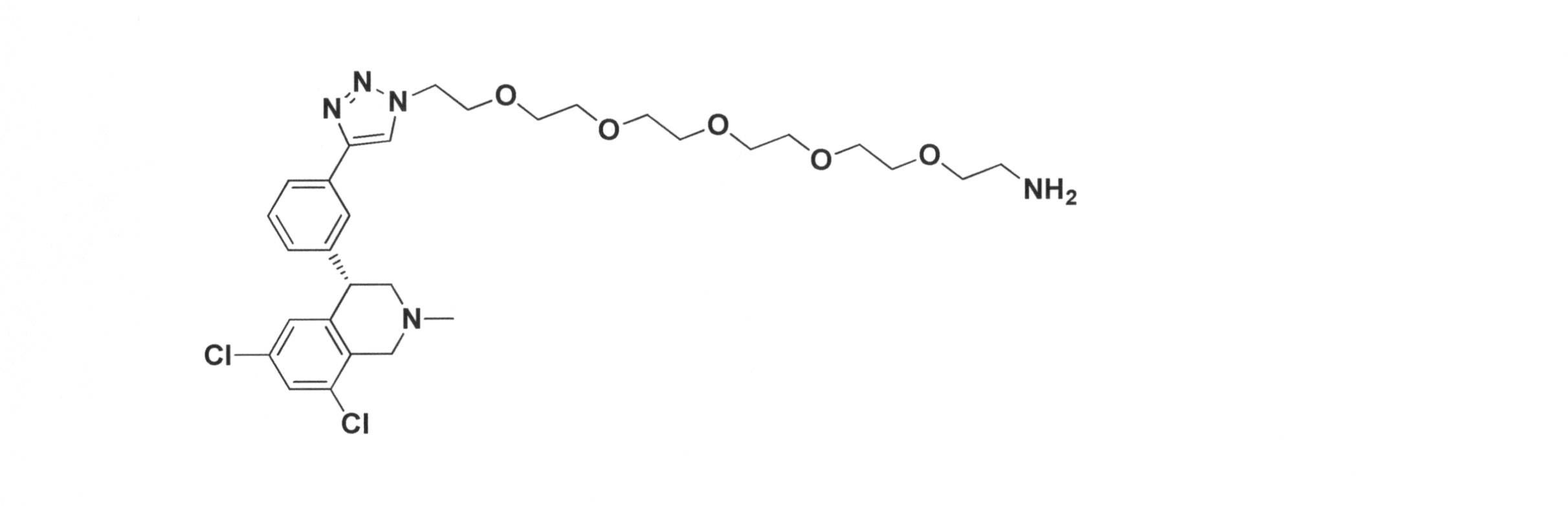
1H NMR (300 MHz, CDCl3) δppm 2.48 (s, 3H), 2.63 (dd, J=11.7, 8.5Hz, 1H), 2.84 (t, J=5.3Hz, 2H), 3.03 (dd, J=11.7, 4.7Hz, 1H), 3.43-3.70 (m, 19H), 3.84 (d, J=16.0Hz, 1H), 3.88-3.95 (m, 2H), 4.21-4.33 (m, 1H), 4.54-4.63 (m, 2H), 6.81 (d, J=1.1Hz, 1H), 7.10 (d, J=7.7Hz, 1H), 7.19-7.25 (m, 1H), 7.36 (t, J=7.7Hz, 1H), 7.68 (dt, J=7.7, 1.4Hz, 1H), 7.72-7.76 (m, 1H), 7.99 (s, 1H).
MS (+) : 622 [M+H]+.
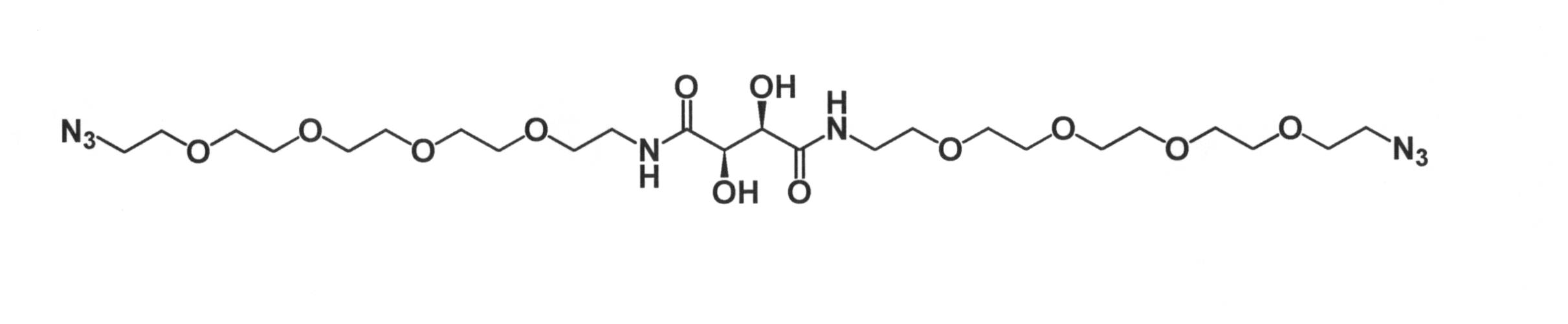
LC-MS 保持時間1.097 min
LC:Agilent 1290
ESI/APCI MS:Agilent 6130
Column: Waters Acquity CSH C18 1.7um, 2.1x50mm
Solvent: H2O:CH3CN(0.1% Formic acid)
Gradient: 0.8mL/min, 0min(95:5) →1.2min(50:50)
1.0mL/min, →1.38min(3:97)
MS (+) : 639 [M+H]+.

LC-MS 保持時間1.144 min
LC:Agilent 1290
ESI/APCI MS:Agilent 6130
Column: Waters Acquity CSH C18 1.7um, 2.1x50mm
Solvent: H2O:CH3CN(0.1% Formic acid)
Gradient: 0.8mL/min, 0min(95:5) →1.2min(50:50)
1.0mL/min, →1.38min(3:97)
MS (+) : 727 [M+H]+.

LC-MS 保持時間1.012 min
LC:Agilent 1290
ESI/APCI MS:Agilent 6130
Column: Waters Acquity CSH C18 1.7um, 2.1x50mm
Solvent: H2O:CH3CN(0.1% Formic acid)
Gradient: 0.8mL/min, 0min(95:5) →1.2min(50:50)
1.0mL/min, →1.38min(3:97)
MS (+) : 699 [M+H]+.

LC-MS 保持時間1.066 min
LC:Agilent 1290
ESI/APCI MS:Agilent 6130
Column: Waters Acquity CSH C18 1.7um, 2.1x50mm
Solvent: H2O:CH3CN(0.1% Formic acid)
Gradient: 0.8mL/min, 0min(95:5) →1.2min(50:50)
1.0mL/min, →1.38min(3:97)
MS (+) : 787 [M+H]+.

1H NMR (300 MHz, CDCl3) δ ppm 2.91 (d, J=5.1Hz, 3H), 6.56 (d, J=1.6Hz, 1H), 6.73 (dd, J=5.4, 1.6Hz, 1H), 7.90 (d, J=5.4Hz, 1H).
MS (+) : 187 [M+H]+.

1H NMR (300 MHz, CDCl3) δ ppm 2.96 (d, J=5.0Hz, 3H), 6.35 (s, 1H), 8.35 (s, 1H).
MS (+) : 144 [M+H]+.
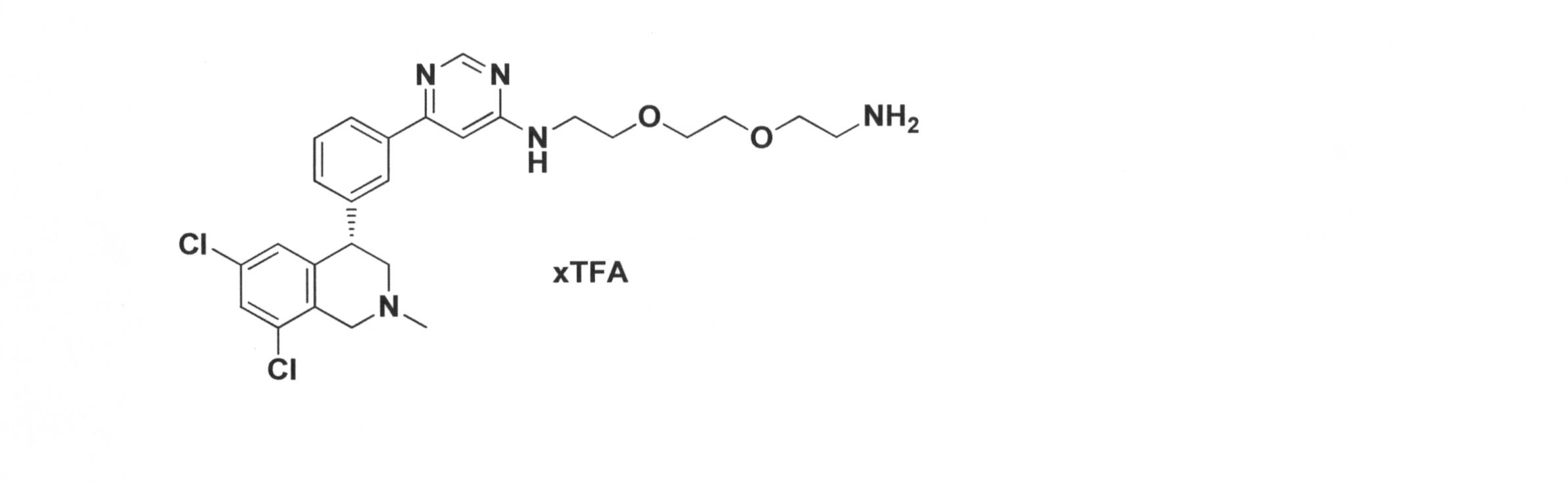
1H NMR (300 MHz, CDCl3) δ ppm 1.45 (s, 9H), 3.22-3.76 (m, 12H), 6.39 (s, 1H), 8.35 (s, 1H).
MS (+) : 361 [M+H]+.
(2)アルゴンガス雰囲気下、参考例3-3で得られた(4S)-6,8-ジクロロ-2-メチル-4-[3-(4,4,5,5-テトラメチル-1,3,2-ジオキサボロラン-2-イル)フェニル]-1,2,3,4-テトラヒドロイソキノリン塩酸塩(0.25g)、[2-(2-{2-[(6-クロロピリミジン-4-イル)アミノ]エトキシ}エトキシ)エチル]カルバミン酸 tert-ブチル(0.20g)、テトラキス(トリフェニルホスフィン)パラジウム(0)(32mg)の1,4-ジオキサン(8.0mL)懸濁液に、飽和炭酸水素ナトリウム水溶液(1.4mL)を加え、加熱還流下12時間攪拌した。反応溶液を放冷後、不溶物をろ別した。得られたろ液を逆相分取HPLC(カラム(YMC-Actus Triart 5μm C18 50x30mm)、移動相(0.1%トリフルオロ酢酸 in H2O:0.1%トリフルオロ酢酸 in MeCN=90:10→20:80→5:95、40mL/min.)にて精製して、[2-(2-{2-[(6-{3-[(4S)-6,8-ジクロロ-2-メチル-1,2,3,4-テトラヒドロイソキノリン-4-イル]フェニル}ピリミジン-4-イル)アミノ]エトキシ}エトキシ)エチル]カルバミン酸 tert-ブチル トリフルオロ酢酸塩(0.28g)を無色アモルファス状物質として得た。
1H NMR (300 MHz, CD3OD) δ ppm 1.41 (s, 9H), 3.12-3.25 (m, 5H), 3.44-3.97 (m, 12H), 4.45-4.56 (m, 1H), 4.73-4.84 (m, 2H), 6.85-6.92 (m, 1H), 6.98-7.08 (m, 1H), 7.53-7.61 (m, 2H), 7.65-7.91 (m, 3H), 8.65-8.75 (m, 1H).
MS (+) : 616 [M+H]+.
(3)[2-(2-{2-[(6-{3-[(4S)-6,8-ジクロロ-2-メチル-1,2,3,4-テトラヒドロイソキノリン-4-イル]フェニル}ピリミジン-4-イル)アミノ]エトキシ}エトキシ)エチル]カルバミン酸 tert-ブチル トリフルオロ酢酸塩(0.28g)の1,2-ジクロロエタン(15mL)溶液に、トリフルオロ酢酸(5.0mL)を加え、室温で2時間攪拌した。反応溶液を減圧下濃縮し、メタノール共沸し、減圧下溶媒を留去して、表題化合物(0.33g)を無色アモルファス状物質として得た。
1H NMR (600 MHz, CD3OD) δ ppm 3.04-3.15 (m, 5H), 3.57-3.91 (m, 12H), 4.41-4.51 (m, 1H), 4.69-4.78 (m, 2H), 6.80-6.89 (m, 1H), 6.96-7.07 (m, 1H), 7.47-7.57 (m, 2H), 7.62-7.69 (m, 1H), 7.70-7.88 (m, 2H), 8.59-8.71 (m, 1H).
MS (+) : 516 [M+H]+.
(1)2,6-ジクロロピラジン(0.30g)、{2-[2-(2-アミノエトキシ)エトキシ]エチル}カルバミン酸 tert-ブチル(0.50g)、トリエチルアミン(0.62mL)のN,N-ジメチルホルムアミド(15mL)溶液を80℃で4時間攪拌した。反応溶液を放冷後、水を加え、酢酸エチルで抽出した。有機層を飽和食塩水で洗浄後、無水硫酸マグネシウムで乾燥させ、ろ別後、ろ液を減圧下濃縮した。得られた残渣をシリカゲルカラムクロマトグラフィー(Biotage(登録商標)SNAP Cartridge HP-Sphere、クロロホルム:メタノール=100:0→80:20)で精製し、更にシリカゲルカラムクロマトグラフィー(Biotage(登録商標)SNAP Cartridge HP-Sphere、ヘキサン:酢酸エチル=92:8→34:66)で精製して、[2-(2-{2-[(6-クロロピラジン-2-イル)アミノ]エトキシ}エトキシ)エチル]カルバミン酸 tert-ブチル(0.29g、40%)を無色油状物質として得た。
1H NMR (300 MHz, CDCl3) δppm 1.45 (s, 9H), 3.20-3.45 (m, 2H), 3.53-3.71 (m, 10H), 5.00-5.10 (m, 1H), 5.34-5.46 (m, 1H), 7.67-7.88 (m, 2H).
MS (+) : 361 [M+H]+.
(2)窒素ガス雰囲気下、参考例3-2で得られた(4S)-6,8-ジクロロ-2-メチル-4-[3-(4,4,5,5-テトラメチル-1,3,2-ジオキサボロラン-2-イル)フェニル]-1,2,3,4-テトラヒドロイソキノリン(0.16g)、[2-(2-{2-[(6-クロロピラジン-2-イル)アミノ]エトキシ}エトキシ)エチル]カルバミン酸 tert-ブチル(0.25g)の1,4-ジオキサン(7.5mL)溶液に、炭酸水素ナトリウム(0.16g)の水溶液(2.5mL)、テトラキス(トリフェニルホスフィン)パラジウム(0)(22mg)を加え、110℃で12時間攪拌した。反応溶液を減圧下濃縮後、逆相分取HPLC(カラム(YMC-Actus Triart 5μm C18 50x30mm)、移動相(0.1%トリフルオロ酢酸 in H2O:0.1%トリフルオロ酢酸 in MeCN=97:3→30:70→5:95、40mL/min.)で精製し、[2-(2-{2-[(6-{3-[(4S)-6,8-ジクロロ-2-メチル-1,2,3,4-テトラヒドロイソキノリン-4-イル]フェニル}ピラジン-2-イル)アミノ]エトキシ}エトキシ)エチル]カルバミン酸 tert-ブチル トリフルオロ酢酸塩(0.25g)を黄色油状物質として得た。
1H NMR (300 MHz, CDCl3) δppm 1.43 (br. s., 9H), 3.06 (s, 3H), 3.21-3.89 (m, 16H), 3.99-4.24 (m, 1H), 4.65-4.89 (m, 2H), 6.79-6.86 (m, 1H), 7.32 (d, J=7.7Hz, 1H), 7.36-7.39 (m, 1H), 7.53 (t, J=7.7Hz, 1H), 7.76 (s, 1H), 7.89 (d, J=7.7Hz, 1H), 8.10 (s, 1H), 8.21 (s, 1H).
MS (+) : 616 [M+H]+.
(3)[2-(2-{2-[(6-{3-[(4S)-6,8-ジクロロ-2-メチル-1,2,3,4-テトラヒドロイソキノリン-4-イル]フェニル}ピラジン-2-イル)アミノ]エトキシ}エトキシ)エチル]カルバミン酸 tert-ブチル トリフルオロ酢酸塩(0.29g)の1,2-ジクロロエタン(3.0mL)溶液に、氷冷下、トリフルオロ酢酸(1.0mL)を加え、室温で1時間攪拌した。反応溶液を減圧下濃縮し、得られた残渣をシリカゲルカラムクロマトグラフィー(Biotage(登録商標)SNAP Cartridge KP-NH、クロロホルム:メタノール=100:0→80:20)で精製し、表題化合物(0.18g、78%(2工程))を無色油状物質として得た。
1H NMR (600 MHz, CD3OD) δppm 2.50 (s, 3H), 2.66-2.71 (m, 1H), 2.76 (t, J=5.4Hz, 2H), 3.07-3.12 (m, 1H), 3.50 (t, J=5.4Hz, 2H), 3.58 (d, J=16.10Hz, 1H), 3.60-3.71 (m, 8H), 3.88 (d, J=16.10Hz, 1H), 4.37-4.41 (m, 1H), 6.85 (m, 1H), 7.25 (d, J=7.8Hz, 1H), 7.30-7.38 (m, 1H), 7.44 (t, J=7.8Hz, 1H), 7.81 (s, 1H), 7.86 (s, 1H), 7.92 (d, J=7.8Hz, 1H), 8.13 (s, 1H).
MS (+) : 516 [M+H]+.
参考例8-5 N-{2-[2-(2-アミノエトキシ)エトキシ]エチル}-5-{3-[(4S)-6,8-ジクロロ-2-メチル-1,2,3,4-テトラヒドロイソキノリン-4-イル]フェニル}ピリミジン-2-アミン 2トリフルオロ酢酸塩
(1){2-[2-(2-アミノエトキシ)エトキシ]エチル}カルバミン酸tert-ブチル(0.40g)のジメチルスルホキシド(5.0mL)溶液に、炭酸カリウム(0.45g)、2,5-ジブロモピリミジン(0.38g)を加え、100℃で2時間攪拌した。反応溶液に水を加え、酢酸エチルで抽出した。有機層を無水硫酸マグネシウムで乾燥させ、ろ別後、ろ液を減圧下濃縮した。得られた残渣をシリカゲルカラムクロマトグラフィー(Biotage(登録商標)SNAP Cartridge HP-Sphere、ヘキサン:酢酸エチル=100:0→20:80)で精製し、[2-(2-{2-[(5-ブロモピリミジン-2-イル)アミノ]エトキシ}エトキシ)エチル]カルバミン酸 tert-ブチル(0.51g、78%)を無色アモルファス状物質として得た。
LC-MS 保持時間 0.928 min
LC:Agilent 1290
ESI/APCI MS:Agilent 6130
Column: Waters Acquity CSH C18 1.7um, 2.1x50mm
Solvent: H2O:CH3CN(0.1% Formic acid)
Gradient: 0.8mL/min, 0min(80:20) →1.2-1.4min(1:99)
MS (+) : 405 [M+H]+.
(2)参考例8-3(1)で得られた[2-(2-{2-[(6-クロロピリミジン-4-イル)アミノ]エトキシ}エトキシ)エチル]カルバミン酸 tert-ブチルを使用する代わりに、[2-(2-{2-[(5-ブロモピリミジン-2-イル)アミノ]エトキシ}エトキシ)エチル]カルバミン酸 tert-ブチルを使用する以外は、実質的に参考例8-3(2)(3)と同様の反応を実施して、表題化合物(0.10g)を無色アモルファス状物質として得た。
LC-MS 保持時間 0.294 min
LC:Agilent 1290
ESI/APCI MS:Agilent 6130
Column: Waters Acquity CSH C18 1.7um, 2.1x50mm
Solvent: H2O:CH3CN(0.1% Formic acid)
Gradient: 0.8mL/min, 0min(80:20) →1.2-1.4min(1:99)
MS (+) : 516 [M+H]+.
4,6-ジクロロピリミジンを使用する代わりに4-ブロモ-2-フルオロピリジンを使用し、参考例3-3で得られた(4S)-6,8-ジクロロ-2-メチル-4-[3-(4,4,5,5-テトラメチル-1,3,2-ジオキサボロラン-2-イル)フェニル]-1,2,3,4-テトラヒドロイソキノリン塩酸塩を使用する代わりに参考例3-1で得られた6,8-ジクロロ-2-メチル-4-[3-(4,4,5,5-テトラメチル-1,3,2-ジオキサボロラン-2-イル)フェニル]-1,2,3,4-テトラヒドロイソキノリンを使用する以外は、実質的に参考例8-3(1)(2)(3)と同様の反応を実施して、表題化合物(40mg)を無色アモルファス状物質として得た。
1H NMR (300 MHz, CD3OD) δ ppm 3.06-3.13 (m, 2H), 3.17 (s, 3H), 3.60-3.83 (m, 11H), 3.85-3.95 (m, 1H), 4.46-4.58 (m, 1H), 4.73-4.87 (m, 2H), 6.82-6.89 (m, 1H), 7.18-7.25 (m, 1H), 7.32-7.38 (m, 1H), 7.43-7.49 (m, 1H), 7.50-7.54 (m, 1H), 7.59-7.67 (m, 1H), 7.71-7.76 (m, 1H), 7.78-7.85 (m, 1H), 7.88-7.94 (m, 1H).
MS (+) : 515 [M+H]+.
4,6-ジクロロピリミジンを使用する代わりに、4-ブロモ-2-フルオロピリジンを使用する以外は、実質的に参考例8-3(1)(2)(3)と同様の反応を実施して、表題化合物(0.34g)を無色油状物質として得た。
1H NMR (300 MHz, CD3OD) δ ppm 3.06-3.13 (m, 2H), 3.16 (s, 3H), 3.60-3.75 (m, 9H), 3.75-3.82 (m, 2H), 3.85-3.96 (m, 1H), 4.46-4.57 (m, 1H), 4.72-4.83 (m, 2H), 6.84-6.90 (m, 1H), 7.18-7.24 (m, 1H), 7.31-7.35 (m, 1H), 7.43-7.49 (m, 1H), 7.53-7.56 (m, 1H), 7.59-7.67 (m, 1H), 7.70-7.74 (m, 1H), 7.79-7.85 (m, 1H), 7.88-7.93 (m, 2H).
MS (+) : 515 [M+H]+.
2,5-ジブロモピリミジンの代わりに3,5-ジブロモピリダジンを使用する以外は、実質的に参考例8-5(1)(2)と同様の反応を実施して、表題化合物(0.18g)を褐色油状物質として得た。
1H NMR (300 MHz, CDCl3) δppm 1.45 (br. s., 9H), 2.49 (s, 3H), 2.61-2.71 (m, 1H), 2.87-3.20 (m, 1H), 3.25-3.90 (m, 14H), 4.27-4.41 (m, 1H), 4.95 (br. s., 1H), 5.06 (br. s., 1H), 6.67-7.01 (m, 2H), 7.12-7.26 (m, 2H), 7.42 (t, J=7.7Hz, 1H), 7.81 (d, J=7.7Hz, 1H), 7.88-7.96 (m, 1H), 8.53-8.70 (m, 1H).
MS (+) : 616 [M+H]+.
(2)参考例8-3(2)で得られた[2-(2-{2-[(6-{3-[(4S)-6,8-ジクロロ-2-メチル-1,2,3,4-テトラヒドロイソキノリン-4-イル]フェニル}ピリミジン-4-イル)アミノ]エトキシ}エトキシ)エチル]カルバミン酸 tert-ブチルを使用する代わりに[2-(2-{2-[(6-{3-[(4S)-6,8-ジクロロ-2-メチル-1,2,3,4-テトラヒドロイソキノリン-4-イル]フェニル}ピリダジン-4-イル)アミノ]エトキシ}エトキシ)エチル]カルバミン酸 tert-ブチルを使用する以外は、実質的に参考例8-3(3)と同様の反応を実施して、表題化合物(0.18g、quant.)を褐色油状物質として得た。
1H NMR (600 MHz, CD3OD) δppm 3.07-3.14 (m, 2H), 3.19 (s, 3H), 3.63-3.75 (m, 10H), 3.75-3.83 (m, 4H), 3.86-3.98 (m, 1H), 4.44-4.58 (m, 1H), 4.76-4.90 (m, 3H), 6.89 (s, 1H), 7.33-7.40 (m, 1H), 7.49-7.57 (m, 1H), 7.59 (d, J=7.8Hz, 1H), 7.72 (t, J=7.8Hz, 1H), 7.85 (s, 1H), 7.88 (d, J=7.8Hz, 1H), 8.49-8.82 (m, 1H).
MS (+) : 516 [M+H]+
(1)2-{2-[2-(2-アジドエトキシ)エトキシ]エトキシ}エタンアミン(2.8g)のN,N-ジメチルホルムアミド(24mL)溶液に、二炭酸ジ-tert-ブチル(2.8g)を加え、室温で2時間攪拌した。反応溶液を減圧下濃縮し、得られた残渣をシリカゲルカラムクロマトグラフィー(Biotage(登録商標)SNAP Cartridge HP-Sphere、ヘキサン:酢酸エチル=98:2→30:70)で精製して、(2-{2-[2-(2-アジドエトキシ)エトキシ]エトキシ}エチル)カルバミン酸 tert-ブチル(4.2g)を無色油状物質として得た。
1H NMR (300 MHz, CDCl3) δ ppm 1.45 (s, 9H), 3.26-3.37 (m, 2H), 3.36-3.44 (m, 2H), 3.50-3.59 (m, 2H), 3.59-3.73 (m, 10H), 5.02 (br. s, 1H).
MS (+) : 341 [M+Na]+.
(2)(2-{2-[2-(2-アジドエトキシ)エトキシ]エトキシ}エチル)カルバミン酸 tert-ブチル(4.2g)のテトラヒドロフラン(35mL)溶液に、トリフェニルホスフィン(3.7g)を加え、室温で2時間攪拌した。反応溶液に水(10mL)を加え、室温で45分間、60℃で2時間攪拌した。反応溶液を放冷後、減圧下濃縮し、得られた残渣をシリカゲルカラムクロマトグラフィー(Biotage(登録商標)SNAP Cartridge KP-NH、クロロホルム:酢酸エチル=100:0→0:100)で精製した。溶媒を減圧下留去後、得られた残渣に水を加え、トルエンで洗浄し、水層を減圧下濃縮して、(2-{2-[2-(2-アミノエトキシ)エトキシ]エトキシ}エチル)カルバミン酸 tert-ブチル(3.1g、84%(2工程))を無色油状物質として得た。
1H NMR (300 MHz, CDCl3) δ ppm 1.45 (s, 9H), 2.84-2.91 (m, 2H), 3.25-3.37 (m, 2H), 3.48-3.58 (m, 4H), 3.59-3.70 (m, 8H), 5.25 (br. s, 1H).
MS (+) : 293 [M+H]+.
(3)4,6-ジクロロピリミジン(0.20g)、(2-{2-[2-(2-アミノエトキシ)エトキシ]エトキシ}エチル)カルバミン酸 tert-ブチル(0.36g)のアセトニトリル(7.4mL)溶液に、炭酸カリウム(0.20g)を加え、80℃で17時間攪拌した。反応溶液を放冷後、減圧下濃縮し、得られた残渣をシリカゲルカラムクロマトグラフィー(Biotage(登録商標)SNAP Cartridge HP-Sphere、クロロホルム:メタノール=100:0→88:12)で精製して{2-[2-(2-{2-[(6-クロロピリミジン-4-イル)アミノ]エトキシ}エトキシ)エトキシ]エチル}カルバミン酸 tert-ブチル(0.51g、quant.)を黄色油状物質として得た。
1H NMR (300 MHz, CDCl3) δ ppm 1.44 (s, 9H), 3.20-3.40 (m, 2H), 3.44-3.75 (m, 14H), 6.42 (s, 1H), 8.34 (s, 1H).
MS (+) : 405 [M+H]+.
(4)参考例8-3(1)で得られた[2-(2-{2-[(6-クロロピリミジン-4-イル)アミノ]エトキシ}エトキシ)エチル]カルバミン酸 tert-ブチルを使用する代わりに、{2-[2-(2-{2-[(6-クロロピリミジン-4-イル)アミノ]エトキシ}エトキシ)エトキシ]エチル}カルバミン酸 tert-ブチルを使用する以外は、実質的に参考例8-3(2)と同様の反応を実施して、{2-[2-(2-{2-[(6-{3-[(4S)-6,8-ジクロロ-2-メチル-1,2,3,4-テトラヒドロイソキノリン-4-イル]フェニル}ピリミジン-4-イル)アミノ]エトキシ}エトキシ)エトキシ]エチル}カルバミン酸 tert-ブチル トリフルオロ酢酸塩(0.17g)を無色油状物質として得た。
LC-MS 保持時間 0.547 min
LC:Agilent 1290
ESI/APCI MS:Agilent 6130
Column: Waters Acquity CSH C18 1.7um, 2.1x50mm
Solvent: H2O:CH3CN(0.1% Formic acid)
Gradient: 0.8mL/min, 0min(80:20) →1.2-1.4min(1:99)
MS (+) : 660 [M+H]+.
(5)参考例8-4(2)で得られた[2-(2-{2-[(6-{3-[(4S)-6,8-ジクロロ-2-メチル-1,2,3,4-テトラヒドロイソキノリン-4-イル]フェニル}ピラジン-2-イル)アミノ]エトキシ}エトキシ)エチル]カルバミン酸 tert-ブチル トリフルオロ酢酸塩を使用する代わりに、{2-[2-(2-{2-[(6-{3-[(4S)-6,8-ジクロロ-2-メチル-1,2,3,4-テトラヒドロイソキノリン-4-イル]フェニル}ピリミジン-4-イル)アミノ]エトキシ}エトキシ)エトキシ]エチル}カルバミン酸 tert-ブチルを使用する以外は、実質的に参考例8-4(3)と同様の反応を実施して、表題化合物(0.11g、40%(2工程)を無色油状物質として得た。
1H NMR (300 MHz, CDCl3) δ ppm 2.46 (s, 3H), 2.56-2.67 (m, 1H), 2.81-2.90 (m, 2H), 2.94-3.06 (m, 1H), 3.47-3.57 (m, 3H), 3.58-3.73 (m, 12H), 3.76-3.86 (m, 1H), 4.25-4.36 (m, 1H), 6.28 (br. s, 1H), 6.70-6.77 (m, 1H), 6.78-6.83 (m, 1H), 7.16-7.24 (m, 2H), 7.39 (t, J=7.6Hz, 1H), 7.78-7.87 (m, 2H), 8.64 (d, J=1.1Hz, 1H).
MS (+) : 560 [M+H]+.
(1)2,5-ジブロモピリミジンの代わりに3,5-ジブロモピリダジンを使用し、{2-[2-(2-アミノエトキシ)エトキシ]エチル}カルバミン酸 tert-ブチルを使用する代わりに、参考例8-9(2)で得た(2-{2-[2-(2-アミノエトキシ)エトキシ]エトキシ}エチル)カルバミン酸 tert-ブチルを使用する以外は、実質的に参考例8-5(1)と同様の反応を実施して、{2-[2-(2-{2-[(6-ブロモピリダジン-4-イル)アミノ]エトキシ}エトキシ)エトキシ]エチル}カルバミン酸 tert-ブチル(0.28g、50%)を褐色油状物質として得た。
1H NMR (300 MHz, CDCl3) δppm 1.45 (s, 9H), 3.21-3.70 (m, 16H), 5.26 (br. s., 1H), 5.44 (br. s., 1H), 6.59-6.75 (m, 1H), 8.50-8.62 (m, 1H).
MS (+) : 449, 451 [M+H]+.
MS (-) : 447, 449 [M-H]-.
(2)参考例8-4(1)で得られた[2-(2-{2-[(6-クロロピラジン-2-イル)アミノ]エトキシ}エトキシ)エチル]カルバミン酸 tert-ブチルを使用する代わりに、{2-[2-(2-{2-[(6-ブロモピリダジン-4-イル)アミノ]エトキシ}エトキシ)エトキシ]エチル}カルバミン酸 tert-ブチルを使用する以外は、実質的に参考例8-4(2)(3)と同様の反応を実施して、表題化合物(34mg、13%(2工程))を無色油状物質として得た。
1H NMR (300 MHz, CD3OD) δppm 2.50 (s, 3H), 2.63-2.86 (m, 3H), 3.05-3.17 (m, 1H), 3.44-3.74 (m, 15H), 3.86-3.94 (m, 1H), 4.35-4.46 (m, 1H), 6.85 (s, 1H), 7.05 (d, J=3.4Hz, 1H), 7.25-7.35 (m, 2H), 7.44-7.53 (m, 1H), 7.74-7.85 (m, 2H), 8.53 (d, J=3.4Hz, 1H).
MS (+) : 560 [M+H]+.
4,6-ジクロロピリミジンを使用する代わりに2,6-ジクロロピラジンを使用し、2-[2-(2-アミノエトキシ)エトキシ]エチル}カルバミン酸 tert-ブチルを使用する代わりに、参考例8-9(2)で得られた2-{2-[2-(2-アミノエトキシ)エトキシ]エトキシ}エチル)カルバミン酸 tert-ブチルを使用する以外は、実質的に参考例8-4(1)(2)(3)と同様の反応を実施して、表題化合物(0.14g、27%(3工程))を無色油状物質として得た。
1H NMR (300 MHz, CDCl3) δppm 2.46-2.51 (m, 3H), 2.55-2.75 (m, 1H), 2.84-2.92 (m, 2H), 2.98-3.08 (m, 1H), 3.50-3.60 (m, 3H), 3.61-3.77 (m, 12H), 3.77-3.85 (m, 1H), 4.25-4.37 (m, 1H), 5.68 (m, 1H), 6.83-6.87 (m, 1H), 7.14-7.21 (m, 1H), 7.21-7.26 (m, 1H), 7.32-7.52 (m, 1H), 7.78-7.83 (m, 1H), 7.83-7.93 (m, 2H), 8.22 (s, 1H).
MS (+) : 560 [M+H]+.

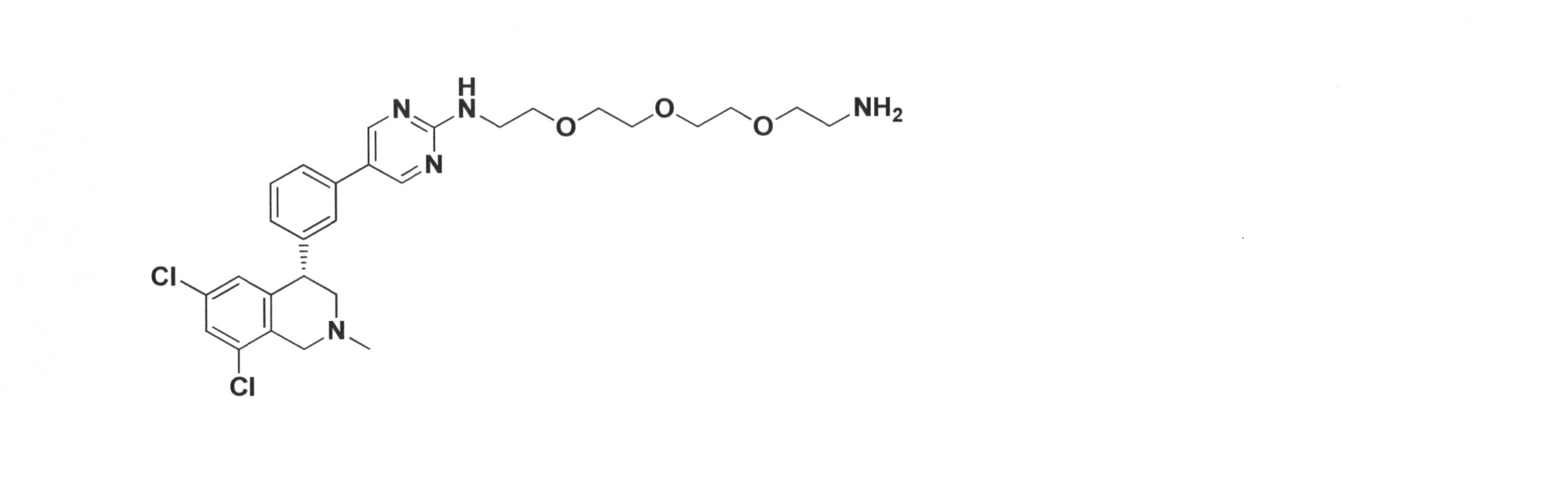
LC-MS 保持時間 0.849 min
LC:Agilent 1290
ESI/APCI MS:Agilent 6130
Column: Waters Acquity CSH C18 1.7um, 2.1x50mm
Solvent: H2O:CH3CN(0.1% Formic acid)
Gradient: 0.8mL/min, 0min(80:20) →1.2-1.4min(1:99)
MS (+) : 375, 377 [M+H]+.
(2)(N-(2-{2-[2-(2-アジドエトキシ)エトキシ]エトキシ}エチル)-5-ブロモピリミジン-2-アミン(1.8g)のテトラヒドロフラン(42mL)-水(8.3mL)混合溶液に、トリフェニルホスフィン(1.2g)を加え、室温で6時間攪拌した。反応溶液に二炭酸ジ-tert-ブチル(1.9g)を加え、室温で終夜間攪拌した。反応溶液に水を加え、酢酸エチルで抽出した。有機層を無水硫酸マグネシウムで乾燥させ、ろ別後、ろ液を減圧下濃縮した。得られた残渣をシリカゲルカラムクロマトグラフィー(Biotage(登録商標)SNAP Cartridge HP-Sphere、ヘキサン:酢酸エチル=100:0→0:100)で精製し、N-(2-{2-[2-(2-アジドエトキシ)エトキシ]エトキシ}エチル)-5-ブロモピリミジン-2-アミン(1.1g、57%)を得た。
LC-MS 保持時間 0.929 min
LC:Agilent 1290
ESI/APCI MS:Agilent 6130
Column: Waters Acquity CSH C18 1.7um, 2.1x50mm
Solvent: H2O:CH3CN(0.1% Formic acid)
Gradient: 0.8mL/min, 0min(80:20) →1.2-1.4min(1:99)
MS (+) : 449, 451 [M+H]+.
(3)参考例8-4(1)で得られた[2-(2-{2-[(6-クロロピラジン-2-イル)アミノ]エトキシ}エトキシ)エチル]カルバミン酸 tert-ブチルを使用する代わりに、({2-[2-(2-{2-[(5-ブロモピリミジン-2-イル)アミノ]エトキシ}エトキシ)エトキシ]エチル}カルバミン酸 tert-ブチルを使用する以外は、参考例8-4(2)(3)と同様の反応を実施して、表題化合物(0.27g、33%(2工程))を淡黄油状物質として得た。
LC-MS 保持時間 0.358 min
LC:Agilent 1290
ESI/APCI MS:Agilent 6130
Column: Waters Acquity CSH C18 1.7um, 2.1x50mm
Solvent: H2O:CH3CN(0.1% Formic acid)
Gradient: 0.8mL/min, 0min(80:20) →1.2-1.4min(1:99)
MS (+) : 560 [M+H]+.
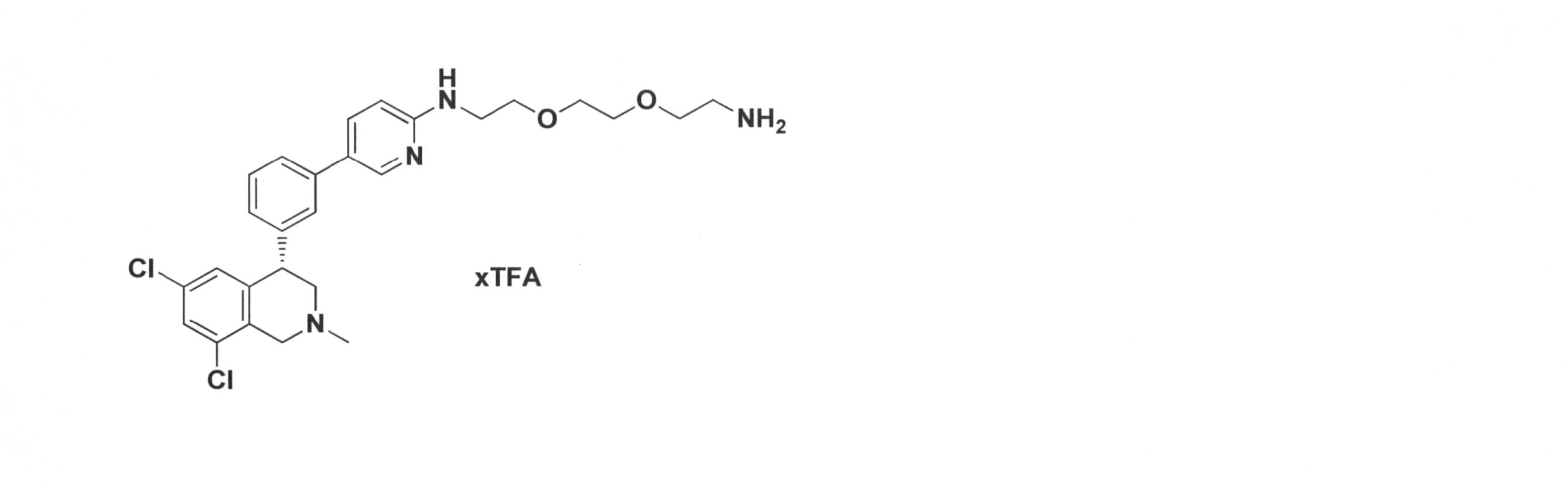
LC-MS 保持時間 0.661 min
LC:Agilent 1290
ESI/APCI MS:Agilent 6130
Column: Waters Acquity CSH C18 1.7um, 2.1x50mm
Solvent: H2O:CH3CN(0.1% Formic acid)
Gradient: 0.8mL/min, 0min(80:20) →1.2-1.4min(1:99)
MS (+) : 387 [M+H]+.
(2) (4S)-6,8-ジクロロ-4-[3-(6-フルオロピリジン-3-イル)フェニル]-2-メチル-1,2,3,4-テトラヒドロイソキノリン(0.14g)と{2-[2-(2-アミノエトキシ)エトキシ]エチル}カルバミン酸 tert-ブチル(0.90g)の混合物を、マイクロウェーブ照射下(バイオタージ60、130℃)で4時間攪拌した。反応溶液に水を加え、酢酸エチルで抽出した。有機層を無水硫酸マグネシウムで乾燥させ、ろ別後、ろ液を減圧下濃縮した。得られた残渣をシリカゲルカラムクロマトグラフィー(Biotage(登録商標)SNAP Cartridge HP-Sphere、クロロホルム:メタノール=98:2→80:20)で精製し、[2-(2-{2-[(5-{3-[(4S)-6,8-ジクロロ-2-メチル-1,2,3,4-テトラヒドロイソキノリン-4-イル]フェニル}ピリジン-2-イル)アミノ]エトキシ}エトキシ)エチル]カルバミン酸 tert-ブチル(0.17g、75%)を淡褐色油状物質として得た。
LC-MS 保持時間 0.520 min
LC:Agilent 1290
ESI/APCI MS:Agilent 6130
Column: Waters Acquity CSH C18 1.7um, 2.1x50mm
Solvent: H2O:CH3CN(0.1% Formic acid)
Gradient: 0.8mL/min, 0min(80:20) →1.2-1.4min(1:99)
MS (+) : 615 [M+H]+.
(3)参考例8-3(2)で得られた[2-(2-{2-[(6-{3-[(4S)-6,8-ジクロロ-2-メチル-1,2,3,4-テトラヒドロイソキノリン-4-イル]フェニル}ピリミジン-4-イル)アミノ]エトキシ}エトキシ)エチル]カルバミン酸 tert-ブチル トリフルオロ酢酸塩を使用する代わりに、[2-(2-{2-[(5-{3-[(4S)-6,8-ジクロロ-2-メチル-1,2,3,4-テトラヒドロイソキノリン-4-イル]フェニル}ピリジン-2-イル)アミノ]エトキシ}エトキシ)エチル]カルバミン酸 tert-ブチルを使用する以外は、実質的に参考例8-3(3)と同様の反応を実施して、表題化合物(0.27g)を褐色油状物質として得た。
LC-MS 保持時間 0.568 min
LC:Agilent 1290
ESI/APCI MS:Agilent 6130
Column: Waters Acquity CSH C18 1.7um, 2.1x50mm
Solvent: H2O:CH3CN(0.1% Formic acid)
Gradient: 0.8mL/min, 0min(95:5) →1.2min(50:50)
1.0mL/min, →1.38min(3:97)
MS (+) : 515 [M+H]+.
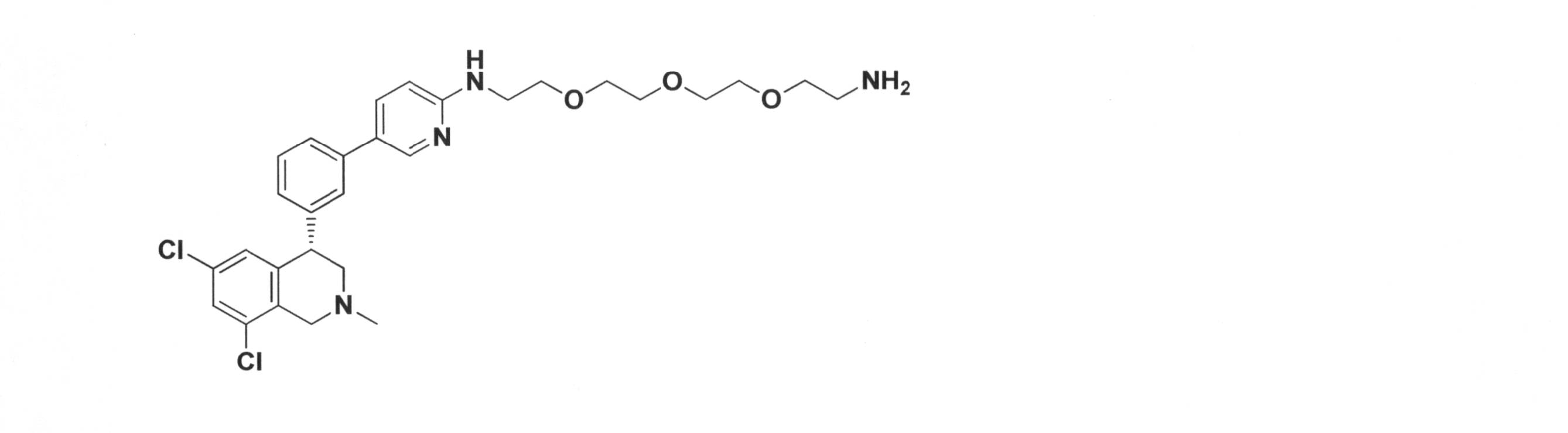
LC-MS 保持時間 0.594 min
LC:Agilent 1290
ESI/APCI MS:Agilent 6130
Column: Waters Acquity CSH C18 1.7um, 2.1x50mm
Solvent: H2O:CH3CN(0.1% Formic acid)
Gradient: 0.8mL/min, 0min(95:5) →1.2min(50:50)
1.0mL/min, →1.38min(3:97)
MS (+) : 559 [M+H]+.
参考例10-3 N-{2-[2-(2-アミノエトキシ)エトキシ]エチル}-5-{3-[(4S)-6,8-ジクロロ-2-メチル-1,2,3,4-テトラヒドロイソキノリン-4-イル]フェニル}ピリダジン-3-アミン
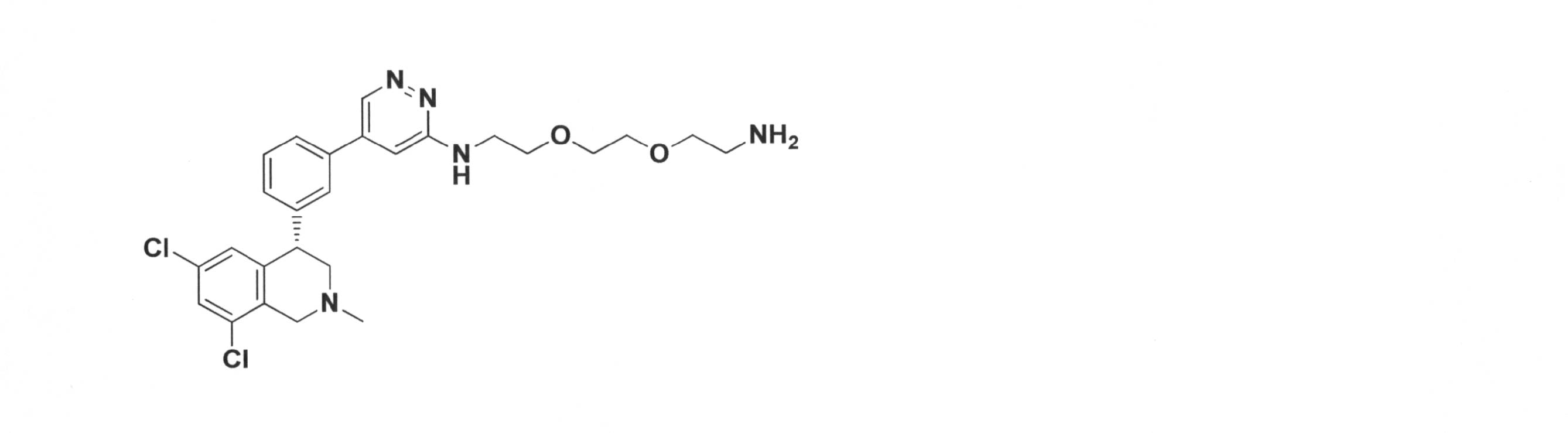
1H NMR (600 MHz, CDCl3) δppm 2.49 (s, 3H), 2.65-2.70 (m, 1H), 2.97-3.09 (m, 1H), 3.59 (d, J=16.1Hz, 1H), 3.81 (d, J=16.1Hz, 1H), 4.27-4.41 (m, 1H), 6.80-6.84 (m, 1H), 7.24-7.26 (m, 1H), 7.33 (d, J=7.7Hz, 1H), 7.49 (t, J=7.7Hz, 1H), 7.86 (d, J=2.3Hz, 1H), 7.91 (d, J=7.7Hz, 1H), 7.97 (s, 1H), 9.16 (d, J=2.3Hz, 1H).
MS (+) : 404 [M+H]+.
(2)(4S)-6,8-ジクロロ-4-[3-(6-クロロピリダジン-4-イル)フェニル]-2-メチル-1,2,3,4-テトラヒドロイソキノリン(0.14g)、2,2’-[エタン-1,2-ジイルビス(オキシ)]ジエタンアミン(0.52mL)の1,4-ジオキサン(4.0mL)溶液を外温150℃で4時間、120℃で19時間攪拌した。反応溶液を減圧下濃縮後、得られた残渣を逆相分取HPLC(カラム(YMC-Actus Triart 5μm C18 50x30mm)、移動相(0.1%ギ酸 in H2O:0.1%ギ酸 in MeCN=95:5→80:20→50:50→5:95、40mL/min.)で精製し、更にシリカゲルカラムクロマトグラフィー(MORITEX Purif Pack-NH、クロロホルム:メタノール=100:0→80:20)で精製して、表題化合物(0.12g、64%)を無色油状物質として得た。
LC-MS 保持時間0.477 min
LC:Agilent 1290
ESI/APCI MS:Agilent 6130
Column: Waters Acquity CSH C18 1.7um, 2.1x50mm
Solvent: H2O:CH3CN(0.1% Formic acid)
Gradient: 0.8mL/min, 0min(95:5) →1.2min(50:50)
1.0mL/min, →1.38min(3:97)
MS (+) : 516 [M+H]+.
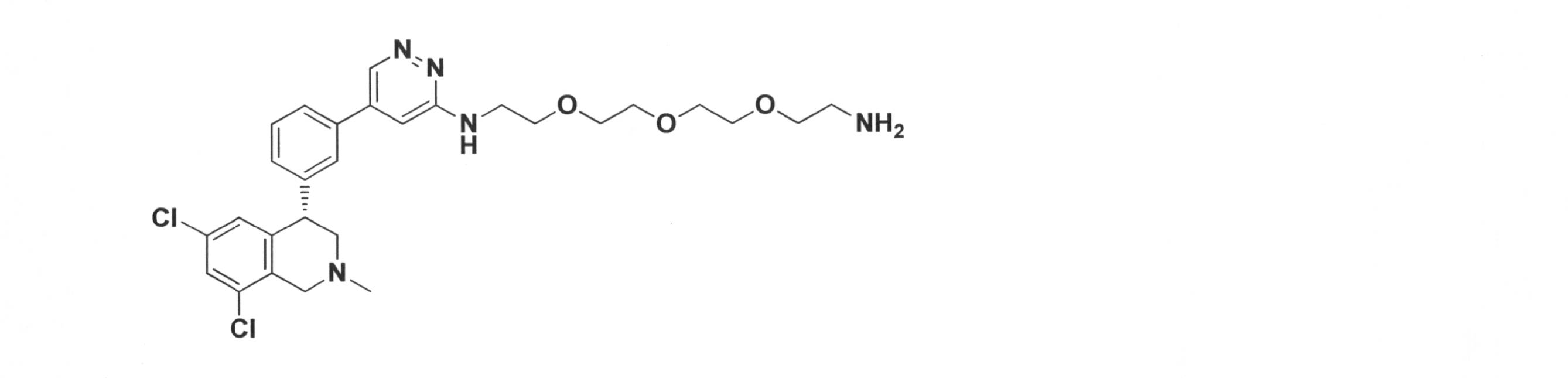
1H NMR (300 MHz, CDCl3) δppm 2.48 (s, 3H), 2.60-2.70 (m, 1H), 2.86-2.92 (m, 2H), 2.99-3.08 (m, 1H), 3.37-3.57 (m, 5H), 3.61-3.79 (m, 10H), 3.79-3.88 (m, 1H), 4.29-4.37 (m, 1H), 6.22 (br. s., 1H), 6.78 (d, J=2.7Hz, 1H), 6.81-6.85 (m, 1H), 7.18-7.25 (m, 2H), 7.41 (t, J=7.6Hz, 1H), 7.80 (d, J=7.6Hz, 1H), 7.88-7.92 (m, 1H), 8.61 (d, J=2.7Hz, 1H).
MS (+) : 560 [M+H]+.
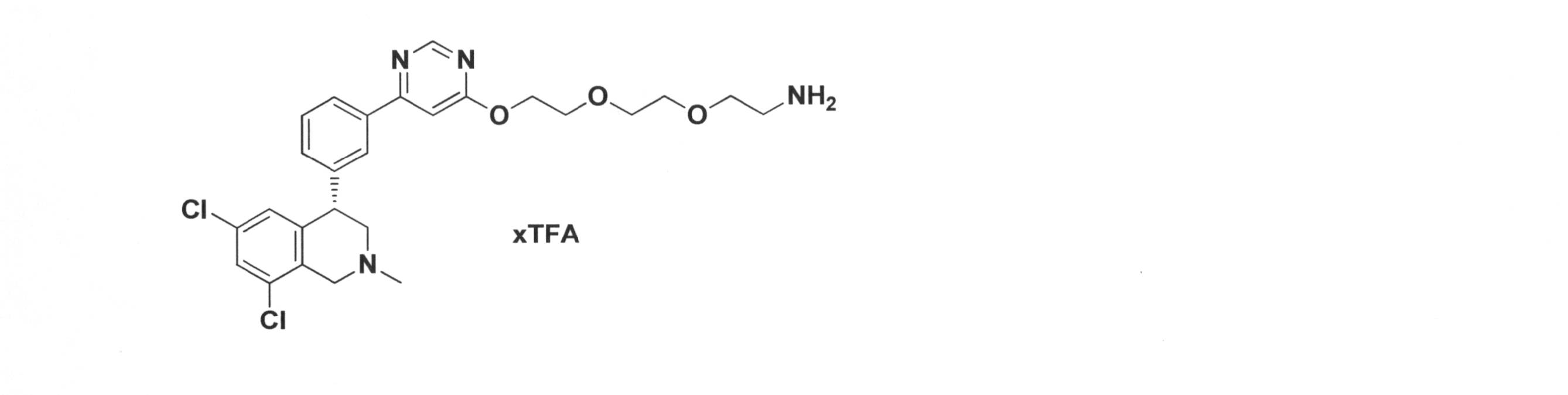
1H NMR (300 MHz, CDCl3) δ ppm 3.51-3.57 (m, 2H), 3.59-3.71 (m, 6H), 3.73-3.80 (m, 2H), 3.89-3.95 (m, 2H), 7.70-7.74 (m, 2H), 7.84-7.88 (m, 2H).
MS (+) : 280 [M+H]+.
(2)2-{2-[2-(2-ヒドロキシエトキシ)エトキシ]エチル}-1H-イソインドール-1,3(2H)-ジオン(0.16g)の1,4-ジオキサン(3.0mL)溶液に、氷冷下、水素化ナトリウム(純度55%、28mg)を加え、室温で25分間攪拌した。反応溶液に4,6-ジクロロピリミジン(0.10g)を少量ずつ加え、80℃で10時間攪拌した。氷冷下、硫酸ナトリウム10水和物を加え、不溶物をろ別し、ろ液を減圧下濃縮した。得られた残渣をシリカゲルカラムクロマトグラフィー(Biotage(登録商標)SNAP Cartridge HP-Sphere、クロロホルム:メタノール=100:0→94:6)で精製し、更にシリカゲルカラムクロマトグラフィー(Biotage(登録商標)SNAP Cartridge HP-Sphere、ヘキサン:酢酸エチル=99::1→50:50→25:75)で精製して、2-[2-(2-{2-[(6-クロロピリミジン-4-イル)オキシ]エトキシ}エトキシ)エチル]-1H-イソインドール-1,3(2H)-ジオン(75mg、33%)を無色固体として得た。
1H NMR (600 MHz, CDCl3) δ ppm 3.54-3.59 (m, 4H), 3.66 (t, J=5.8Hz, 2H), 3.68-3.71 (m, 2H), 3.82 (t, J=5.8Hz, 2H), 4.35-4.41 (m, 2H), 6.69 (d, J=0.8Hz, 1H), 7.59-7.66 (m, 2H), 7.71-7.77 (m, 2H), 8.45 (s, 1H).
MS (+) : 392 [M+H]+.
(3)参考例8-3(1)で得られた[2-(2-{2-[(6-クロロピリミジン-4-イル)アミノ]エトキシ}エトキシ)エチル]カルバミン酸 tert-ブチルを使用する代わりに、2-[2-(2-{2-[(6-クロロピリミジン-4-イル)オキシ]エトキシ}エトキシ)エチル]-1H-イソインドール-1,3(2H)-ジオンを使用する以外は、実質的に参考例8-3(2)と同様の反応を実施して、{2-[2-(2-{2-[(6-{3-[(4S)-6,8-ジクロロ-2-メチル-1,2,3,4-テトラヒドロイソキノリン-4-イル]フェニル}ピリミジン-4-イル)オキシ]エトキシ}エトキシ)エチル]-1H-イソインドール-1,3(2H)-ジオン(0.57g、60%)を淡黄色アモルファス状物質として得た。
1H NMR (300 MHz, CDCl3) δ ppm 2.48 (s, 3H), 2.58-2.69 (m, 1H), 2.98-3.08 (m, 1H), 3.49-3.71 (m, 5H), 3.72-3.87 (m, 5H), 3.87-3.94 (m, 2H), 4.28-4.37 (m, 1H), 4.46-4.53 (m, 2H), 6.78-6.81 (m, 1H), 7.12 (d, J=1.1Hz, 1H), 7.21-7.29 (m, 2H), 7.40-7.47 (m, 1H), 7.65-7.69 (m, 2H), 7.79-7.83 (m, 2H), 7.86-7.93 (m, 2H), 8.80 (d, J=1.1Hz, 1H).
MS (+) : 647 [M+H]+.
(4){2-[2-(2-{2-[(6-{3-[(4S)-6,8-ジクロロ-2-メチル-1,2,3,4-テトラヒドロイソキノリン-4-イル]フェニル}ピリミジン-4-イル)オキシ]エトキシ}エトキシ)エチル]-1H-イソインドール-1,3(2H)-ジオン(0.57g)のエタノール(21mL)溶液に、ヒドラジン-1水和物(2.1mL)を加え、80℃で2時間攪拌した。反応溶液を放冷後、不溶物をろ別し、ジエチルエーテルで洗浄した。ろ液を減圧下濃縮し、残った水層をクロロホルムで抽出した。有機層を無水硫酸マグネシウムで乾燥させ、ろ別後、ろ液を減圧下濃縮した。得られた残渣をシリカゲルカラムクロマトグラフィー(MORITEX Purif Pack-NH、酢酸エチル:メタノール=100:0→95:5)で精製し、更にシリカゲルカラムクロマトグラフィー(Biotage(登録商標)SNAP Cartridge HP-Sphere、クロロホルム:メタノール=99:1→91:9→80:20→50:50→75:25)で精製し表題化合物(0.34g、74%)を淡褐色油状物質として得た。
1H NMR (300 MHz, CDCl3) δ ppm 2.48 (s, 3H), 2.58-2.68 (m, 1H), 2.84-2.92 (m, 2H), 2.97-3.07 (m, 1H), 3.48-3.61 (m, 3H), 3.63-3.69 (m, 2H), 3.70-3.76 (m, 2H), 3.77-3.86 (m, 1H), 3.86-3.92 (m, 2H), 4.27-4.36 (m, 1H), 4.55-4.63 (m, 2H), 6.77-6.82 (m, 1H), 7.14 (d, J=1.1Hz, 1H), 7.21-7.29 (m, 2H), 7.39-7.48 (m, 1H), 7.85-7.93 (m, 2H), 8.81 (d, J=1.1Hz, 1H).
MS (+) : 517 [M+H]+.

1H NMR (300 MHz, CDCl3) δ ppm 3.33-3.45 (m, 2H), 3.59-3.76 (m, 10H), 3.79-3.90 (m, 2H), 4.51-4.60 (m, 2H), 6.79-6.85 (m, 1H), 8.56 (d, J=0.8Hz, 1H).
MS (+) : 332 [M+H]+.
(2)(N-(2-{2-[2-(2-アジドエトキシ)エトキシ]エトキシ}エチル)-5-ブロモピリミジン-2-アミンを使用する代わりに、4-(2-{2-[2-(2-アジドエトキシ)エトキシ]エトキシ}エトキシ)-6-クロロピリミジンを使用する以外は、実質的に参考例9-1(2)と同様の反応を実施して、{2-[2-(2-{2-[(6-クロロピリミジン-4-イル)オキシ]エトキシ}エトキシ)エトキシ]エチル}カルバミン酸 tert-ブチル(1.6g、92%)を無色油状物質として得た。
1H NMR (300 MHz, CDCl3) δ ppm 1.44 (s, 9H), 3.31 (q, J=5.2Hz, 2H), 3.50-3.57 (m, 2H), 3.58-3.74 (m, 8H), 3.82-3.88 (m, 2H), 4.51-4.62 (m, 2H), 5.06 (br. s., 1H), 6.82 (d, J=0.9Hz, 1H), 8.56 (d, J=0.9Hz, 1H).
MS (+) : 406 [M+H]+.
(3)窒素ガス雰囲気下、参考例3-3で得られた(4S)-6,8-ジクロロ-2-メチル-4-[3-(4,4,5,5-テトラメチル-1,3,2-ジオキサボロラン-2-イル)フェニル]-1,2,3,4-テトラヒドロイソキノリン塩酸塩(1.2g)の1,4-ジオキサン(16mL)-水(4.0mL)混合溶液に、炭酸カリウム(2.1g)を加え、室温で10分間攪拌後、{2-[2-(2-{2-[(6-クロロピリミジン-4-イル)オキシ]エトキシ}エトキシ)エトキシ]エチル}カルバミン酸 tert-ブチル(1.6g)、テトラキス(トリフェニルホスフィン)パラジウム(0)(0.31g)を加え、95℃で16時間攪拌した。反応溶液を減圧下濃縮後、得られた残渣をシリカゲルカラムクロマトグラフィー(Biotage(登録商標)SNAP Cartridge HP-Sphere、ヘキサン:酢酸エチル=85:15→0:100)で精製し、更にシリカゲルカラムクロマトグラフィー(Biotage(登録商標)SNAP Cartridge KP-NH、ヘキサン:酢酸エチル=92:8→65:35)で精製して、({2-[2-(2-{2-[(6-{3-[(4S)-6,8-ジクロロ-2-メチル-1,2,3,4-テトラヒドロイソキノリン-4-イル]フェニル}ピリミジン-4-イル)オキシ]エトキシ}エトキシ)エトキシ]エチル}カルバミン酸 tert-ブチル(1.2g、69%)を無色油状物質として得た。
1H NMR (300 MHz, CDCl3) δ ppm 1.43 (s, 9H), 2.48 (s, 3H), 2.63 (dd, J=11.8, 8.1Hz, 1H), 3.01 (dd, J=11.8, 5.4Hz, 1H), 3.31 (m, 2H), 3.50-3.56 (m, 2H), 3.57-3.85 (m, 10H), 3.85-3.93 (m, 2H), 4.26-4.36 (m, 1H), 4.55-4.63 (m, 2H), 5.06 (br. s., 1H), 6.80 (s, 1H), 7.13 (d, J=0.6Hz, 1H), 7.24 (m, J=2.2Hz, 2H), 7.43 (t, J=7.6Hz, 1H), 7.85-7.92 (m, 2H), 8.81 (d, J=0.6Hz, 1H).
MS (+) : 661 [M+H]+.
(4)参考例8-4(2)で得られた[2-(2-{2-[(6-{3-[(4S)-6,8-ジクロロ-2-メチル-1,2,3,4-テトラヒドロイソキノリン-4-イル]フェニル}ピラジン-2-イル)アミノ]エトキシ}エトキシ)エチル]カルバミン酸 tert-ブチル トリフルオロ酢酸塩を使用する代わりに、({2-[2-(2-{2-[(6-{3-[(4S)-6,8-ジクロロ-2-メチル-1,2,3,4-テトラヒドロイソキノリン-4-イル]フェニル}ピリミジン-4-イル)オキシ]エトキシ}エトキシ)エトキシ]エチル}カルバミン酸 tert-ブチルを使用する以外は、実質的に参考例8-4(3)と同様の反応を実施して、表題化合物(1.0g、97%)を無色油状物質として得た。
1H NMR (300 MHz, CDCl3) δ ppm 2.48 (s, 3H), 2.63 (dd, J=11.5, 8.1Hz, 1H), 2.86 (t, J=5.2Hz, 2H), 3.01 (dd, J=11.5, 5.4Hz, 1H), 3.45-3.76 (m, 11H), 3.81 (d, J=16.3Hz, 1H), 3.85-3.92 (m, 2H), 4.23-4.38 (m, 1H), 4.53-4.66 (m, 2H), 6.80 (d, J=1.2Hz, 1H), 7.14 (d, J=1.1Hz, 1H), 7.21-7.26 (m, 2H), 7.43 (t, J=7.6Hz, 1H), 7.84-7.94 (m, 2H), 8.81 (d, J=1.1Hz, 1H).
MS (+) : 561 [M+H]+.
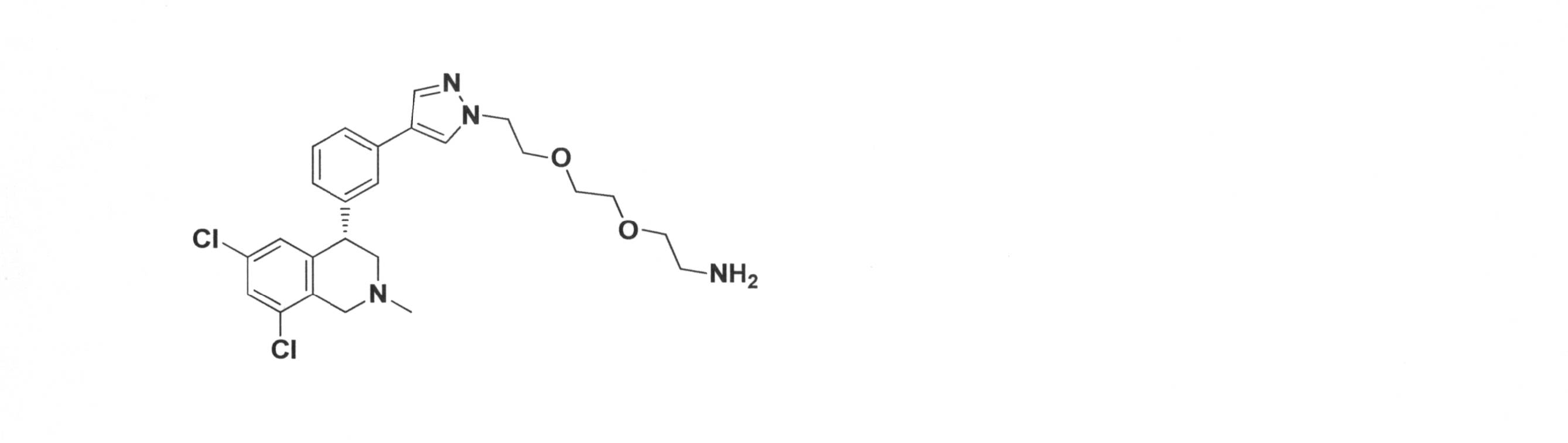
1H NMR (300 MHz, CDCl3) δ ppm 1.45 (s, 9H), 3.28-3.36 (m, 2H), 3.45-3.51 (m, 2H), 3.53-3.58 (m, 2H), 3.62-3.69 (m, 4H), 3.78-3.86 (m, 2H), 5.01 (br. s., 1H).
(2)後述の実施例1-4で得られた(4S)-6,8-ジクロロ-2-メチル-4-[3-(1H-ピラゾール-4-イル)フェニル]-1,2,3,4-テトラヒドロイソキノリン(0.11g)、{2-[2-(2-ブロモエトキシ)エトキシ]エチル}カルバミン酸 tert-ブチル(0.15g)、炭酸カリウム(76mg)、テトラブチルアンモニウムヨージド(11mg)の1,4-ジオキサン(1.1mL)溶液を、60℃で1日攪拌した。反応溶液を放冷後、水を加え、酢酸エチルで抽出した。有機層を無水硫酸マグネシウムで乾燥させ、ろ別後、ろ液を減圧下濃縮した。得られた残渣をシリカゲルカラムクロマトグラフィー(Biotage(登録商標)SNAP Cartridge KP-NH、ヘキサン:酢酸エチル=100:0→70:30)で精製し、(2-{2-[2-(4-{3-[(4S)-6,8-ジクロロ-2-メチル-1,2,3,4-テトラヒドロイソキノリン-4-イル]フェニル}-1H-ピラゾール-1-イル)エトキシ]エトキシ}エチル)カルバミン酸 tert-ブチル(85mg、47%)を無色油状物質として得た。
1H NMR (300 MHz, CDCl3) δppm 1.43 (s, 9H), 2.49 (s, 3H), 2.60 (dd, J=11.5, 8.7Hz, 1H), 3.02 (dd, J=11.5, 5.9Hz, 1H), 3.24-3.77 (m, 9H), 3.81-3.92 (m, 3H), 4.20-4.27 (m, 1H), 4.33 (t, J=5.4Hz, 2H), 5.02 (br. s., 1H), 6.81-6.83 (m, 1H), 6.99 (d, J=7.6Hz, 1H), 7.22-7.41 (m, 4H), 7.74 (s, 1H), 7.76 (s, 1H).
MS (+) : 589 [M+H]+.
(3)参考例8-4(2)で得られた[2-(2-{2-[(6-{3-[(4S)-6,8-ジクロロ-2-メチル-1,2,3,4-テトラヒドロイソキノリン-4-イル]フェニル}ピラジン-2-イル)アミノ]エトキシ}エトキシ)エチル]カルバミン酸 tert-ブチル トリフルオロ酢酸塩を使用する代わりに、(2-{2-[2-(4-{3-[(4S)-6,8-ジクロロ-2-メチル-1,2,3,4-テトラヒドロイソキノリン-4-イル]フェニル}-1H-ピラゾール-1-イル)エトキシ]エトキシ}エチル)カルバミン酸 tert-ブチルを使用する以外は、実質的に参考例8-4(3)と同様の反応を実施して、表題化合物(52mg、74%)を褐色油状物質として得た。
LC-MS 保持時間 0.736 min
LC:Agilent 1290
ESI/APCI MS:Agilent 6130
Column: Waters Acquity CSH C18 1.7um, 2.1x50mm
Solvent: H2O:CH3CN(0.1% Formic acid)
Gradient: 0.8mL/min, 0min(95:5) →1.2min(50:50)
1.0mL/min, →1.38min(3:97)
MS (+) : 489 [M+H]+.
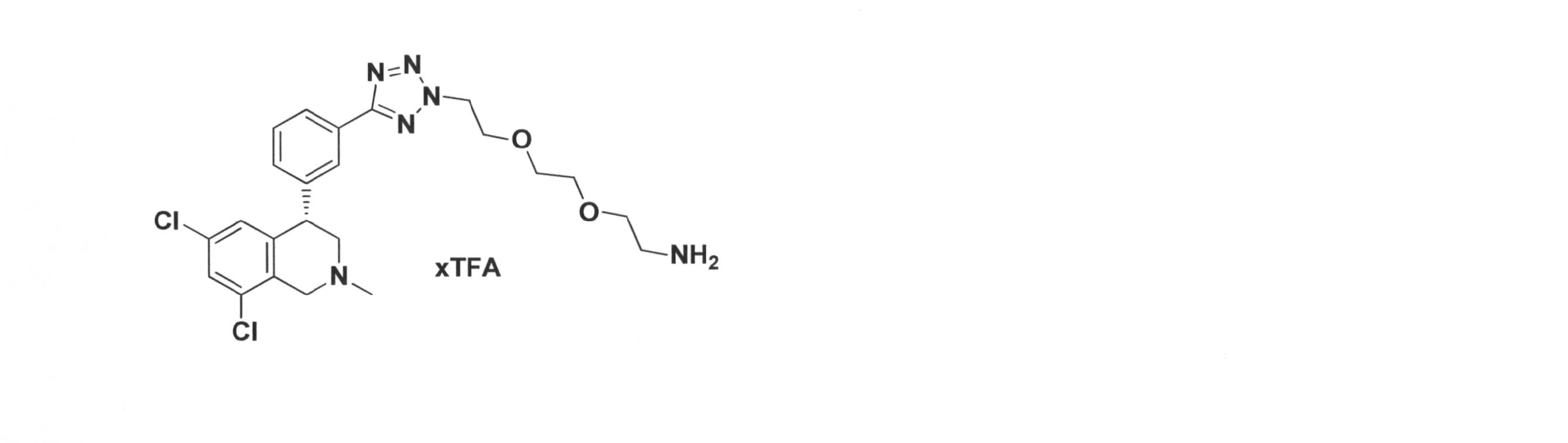
1H NMR (300 MHz, CDCl3) δppm 1.42 (s, 9H), 2.49 (s, 3H), 2.65 (dd, J=11.7, 8.4Hz, 1H), 3.03 (dd, J=11.7, 5.6Hz, 1H), 3.20-3.34 (m, 2H), 3.43-3.66 (m, 7H), 3.83 (d, J=15.9Hz, 1H), 4.11 (t, J=5.7 Hz, 2H), 4.26-4.36 (m, 1H), 4.85 (t, J=5.7Hz, 2H), 6.80 (d, J=1.1Hz, 1H), 7.22-7.30 (m, 2H), 7.44 (t, J=7.8 Hz, 1H), 7.98 (t, J=1.4 Hz, 1H), 8.06 (dt, J=7.8, 1.4Hz, 1H).
MS (+) : 591 [M+H]+.
(2)参考例8-3(2)で得られた[2-(2-{2-[(6-{3-[(4S)-6,8-ジクロロ-2-メチル-1,2,3,4-テトラヒドロイソキノリン-4-イル]フェニル}ピリミジン-4-イル)アミノ]エトキシ}エトキシ)エチル]カルバミン酸 tert-ブチルを使用する代わりに、(2-{2-[2-(5-{3-[(4S)-6,8-ジクロロ-2-メチル-1,2,3,4-テトラヒドロイソキノリン-4-イル]フェニル}-2H-テトラゾール-2-イル)エトキシ]エトキシ}エチル)カルバミン酸 tert-ブチルを使用する以外は、実質的に参考例8-3(3)と同様の反応を実施して、表題化合物(0.34g)を淡黄色油状物質として得た。
LC-MS 保持時間 0.720 min
LC:Agilent 1290
ESI/APCI MS:Agilent 6130
Column: Waters Acquity CSH C18 1.7um, 2.1x50mm
Solvent: H2O:CH3CN(0.1% Formic acid)
Gradient: 0.8mL/min, 0min(95:5) →1.2min(50:50)
1.0mL/min, →1.38min(3:97)
MS (+) : 491 [M+H]+.
参考例12-3 14-(5-{3-[(4S)-6,8-ジクロロ-2-メチル-1,2,3,4-テトラヒドロイソキノリン-4-イル]フェニル}-2H-テトラゾール-2-イル)-3,6,9,12-テトラオキサテトラデカン-1-アミン
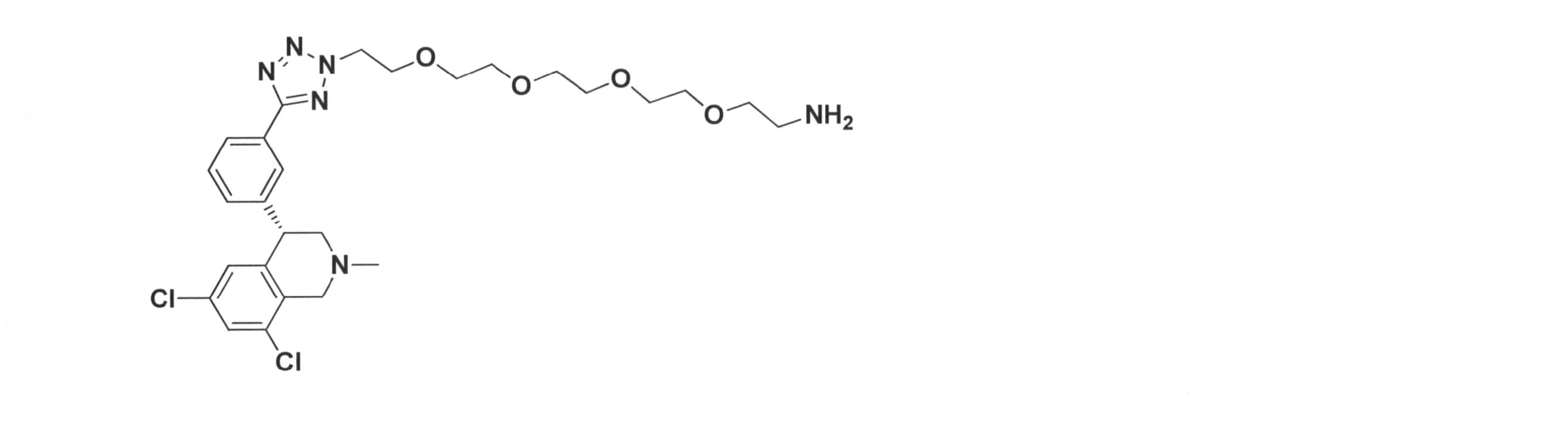
1H NMR (300 MHz, CDCl3) δppm 3.39 (t, J=5.1Hz, 2H), 3.56-3.77 (m, 18H).
MS (+) : 264 [M+H]+.
(2)14-アジド-3,6,9,12-テトラオキサテトラデカン-1-オール(5.5g)のテトラヒドロフラン(60mL)溶液に、トリフェニルホスフィン(4.3g)を加え、室温で5分間攪拌後、水(6.0mL)を加え、室温で5時間攪拌した。その反応溶液に二炭酸ジ-tert-ブチル(4.3g)、テトラヒドロフラン(1.5mL)を加え、室温で66時間攪拌した。減圧下溶媒を留去後、得られた残渣をシリカゲルカラムクロマトグラフィー(Biotage(登録商標)SNAP Cartridge HP-Sphere、クロロホルム:メタノール=100:0→85:15)で精製し、(14-ヒドロキシ-3,6,9,12-テトラオキサテトラデカ-1-イル)カルバミン酸 tert-ブチル(3.3g)を淡黄色油状物質として得た。
1H NMR (300 MHz, CDCl3) δppm 1.45 (s, 9H), 3.32 (q, J=5.1Hz, 2H), 3.50-3.57 (m, 2H), 3.59-3.81 (m, 16H).
MS (+) : 360 [M+Na]+.
(3){2-[2-(2-ヒドロキシエトキシ)エトキシ]エチル}カルバミン酸 tert-ブチルの代わりに、(14-ヒドロキシ-3,6,9,12-テトラオキサテトラデカ-1-イル)カルバミン酸 tert-ブチルを使用する以外は、実質的に参考例12-1(1)と同様の反応を実施して、(14-ブロモ-3,6,9,12-テトラオキサテトラデカ-1-イル)カルバミン酸 tert-ブチル(1.1g、60%)を無色油状物質として得た。
1H NMR (300 MHz, CDCl3) δppm 1.45 (s, 9H), 3.31 (q, J=5.3Hz, 2H), 3.44-3.51 (m, 2H), 3.51-3.57 (m, 2H), 3.59-3.71 (m, 12H), 3.77-3.85 (m, 2H).
MS (+) : 422 [M+Na]+.
(4)後述の実施例1-4で得られた(4S)-6,8-ジクロロ-2-メチル-4-[3-(1H-ピラゾール-4-イル)フェニル]-1,2,3,4-テトラヒドロイソキノリンを使用する代わりに、実施例2-1で得られた(4S)-6,8-ジクロロ-2-メチル-4-[3-(2H-テトラゾール-5-イル)フェニル]-1,2,3,4-テトラヒドロイソキノリンを使用し、参考例12-1(1)で得られた{2-[2-(2-ブロモエトキシ)エトキシ]エチル}カルバミン酸 tert-ブチルの代わりに、(14-ブロモ-3,6,9,12-テトラオキサテトラデカ-1-イル)カルバミン酸 tert-ブチルを使用する以外は、実質的に参考例12-1(2)(3)と同様の反応を実施して、表題化合物(0.13g、36%(2工程))を無色油状物質として得た。
1H NMR (300 MHz, CDCl3) δppm 2.48 (s, 3H), 2.64 (dd, J=11.6, 8.3Hz, 1H), 2.86 (t, J=5.2Hz, 2H), 2.97-3.08 (m, 1H), 3.47-3.53 (m, 2H), 3.56-3.68 (m, 13H), 3.83 (d, J=16.0Hz, 1H), 4.06-4.15 (m, 2H), 4.26-4.34 (m, 1H), 4.84 (t, J=5.6Hz, 2H), 6.80 (dd, J=2.1, 1.0Hz, 1H), 7.21-7.29 (m, 2H), 7.44 (t, J=7.7Hz, 1H), 7.98 (t, J=1.7Hz, 1H), 8.05 (dt, J=7.7, 1.7Hz, 1H).
MS (+) : 579 [M+H]+.
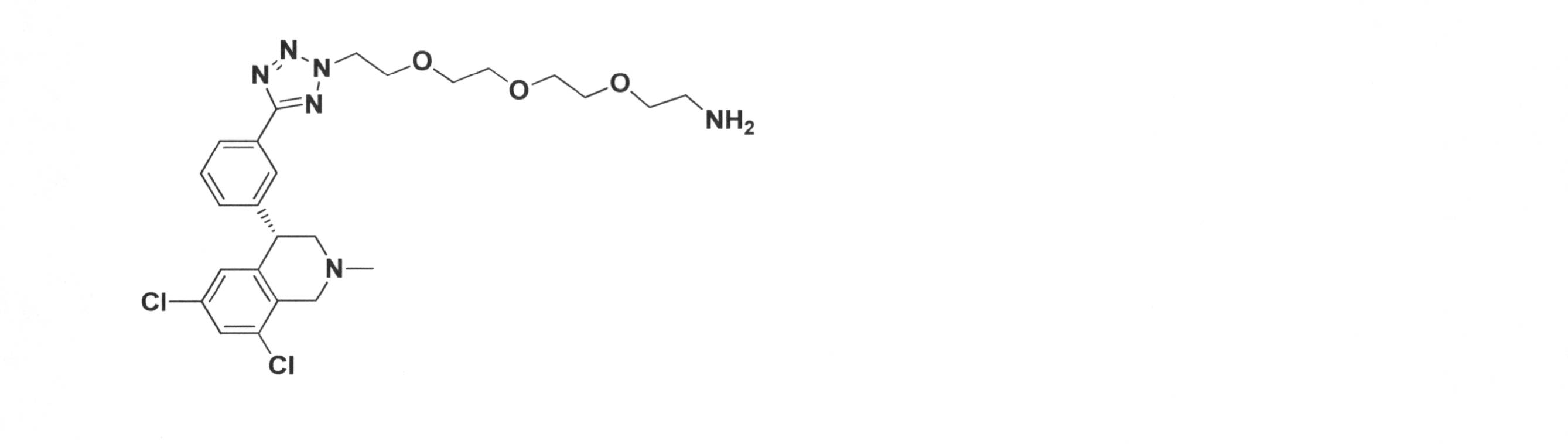
1H NMR (300 MHz, CDCl3) δppm 1.45 (s, 9H), 3.32 (q, J=4.9Hz, 2H), 3.51-3.57 (m, 2H), 3.59-3.77 (m, 12H).
MS (+) : 316 [M+Na]+.
(2){2-[2-(2-ヒドロキシエトキシ)エトキシ]エチル}カルバミン酸 tert-ブチルの代わりに、(2-{2-[2-(2-ヒドロキシエトキシ)エトキシ]エトキシ}エチル)カルバミン酸 tert-ブチルを使用する以外は、実質的に参考例12-1(1)と同様の反応を実施して、(2-{2-[2-(2-ブロモエトキシ)エトキシ]エトキシ}エチル)カルバミン酸 tert-ブチル(2.2g、74%)を無色油状物質として得た。
1H NMR (300 MHz, CDCl3) δppm 1.45 (s, 9H), 3.32 (q, J=5.3Hz, 2H), 3.44-3.51 (m, 2H), 3.52-3.58 (m, 2H), 3.59-3.73 (m, 8H), 3.82 (t, J=6.3Hz, 2H).
MS (+) : 378 [M+Na]+.
(3)後述の実施例1-4で得られた(4S)-6,8-ジクロロ-2-メチル-4-[3-(1H-ピラゾール-4-イル)フェニル]-1,2,3,4-テトラヒドロイソキノリンを使用する代わりに、実施例2-1で得られた(4S)-6,8-ジクロロ-2-メチル-4-[3-(2H-テトラゾール-5-イル)フェニル]-1,2,3,4-テトラヒドロイソキノリンを使用し、参考例12-1(1)で得られた{2-[2-(2-ブロモエトキシ)エトキシ]エチル}カルバミン酸 tert-ブチルの代わりに、(2-{2-[2-(2-ブロモエトキシ)エトキシ]エトキシ}エチル)カルバミン酸 tert-ブチルを使用する以外は、実質的に参考例12-1(2)(3)と同様の反応を実施して、表題化合物(0.42g)を淡黄色アモルファス状物質として得た。
1H NMR (300 MHz, CDCl3) δppm 2.48 (s, 3H), 2.64 (dd, J=11.6, 8.3Hz, 1H), 2.84 (t, J=5.2Hz, 2H), 3.02 (dd, J=11.6, 5.7Hz, 1H), 3.47 (t, J=5.2Hz, 2H), 3.51-3.68 (m, 9H), 3.83 (d, J=16.2Hz, 1H), 4.07-4.15 (m, 2H), 4.27-4.35 (m, 1H), 4.84 (t, J=5.7Hz, 2H), 6.80 (d, J=1.1Hz, 1H), 7.23-7.28 (m, 2H), 7.44 (t, J=7.7Hz, 1H), 7.98 (t, J=1.7Hz, 1H), 8.02-8.09 (m, 1H).
MS (+) : 535 [M+H]+.

LC-MS 保持時間 1.005 min
LC:Agilent 1290
ESI/APCI MS:Agilent 6130
Column: Waters Acquity CSH C18 1.7um, 2.1x50mm
Solvent: H2O:CH3CN(0.1% Formic acid)
Gradient: 0.8mL/min, 0min(95:5) →1.2min(50:50)
1.0mL/min, →1.38min(3:97)
MS (+) : 426 [M+H]+.
(2)窒素ガス雰囲気下、参考例3-2で得られた(4S)-6,8-ジクロロ-2-メチル-4-[3-(4,4,5,5-テトラメチル-1,3,2-ジオキサボロラン-2-イル)フェニル]-1,2,3,4-テトラヒドロイソキノリン(60mg)の1,4-ジオキサン(4.2mL)-水(0.83mL)混合溶液に、(2-{2-[2-(4-ヨード-1H-イミダゾール-1-イル)エトキシ]エトキシ}エチル)カルバミン酸 tert-ブチル(73mg)、テトラキス(トリフェニルホスフィン)パラジウム(0)(17mg)、炭酸カリウム(59mg)を加え、100℃で2時間攪拌した。反応溶液に水を加え、酢酸エチルで抽出した。有機層を無水硫酸マグネシウムで乾燥させ、ろ別後、ろ液を減圧下濃縮した。得られた残渣をシリカゲルカラムクロマトグラフィー(Biotage(登録商標)SNAP Cartridge HP-Sphere、クロロホルム:メタノール=100:0→90:10)で精製し、((2-{2-[2-(4-{3-[(4S)-6,8-ジクロロ-2-メチル-1,2,3,4-テトラヒドロイソキノリン-4-イル]フェニル}-1H-イミダゾール-1-イル)エトキシ]エトキシ}エチル)カルバミン酸 tert-ブチル(36mg、43%)をとして得た。
LC-MS 保持時間 0.873 min
LC:Agilent 1290
ESI/APCI MS:Agilent 6130
Column: Waters Acquity CSH C18 1.7um, 2.1x50mm
Solvent: H2O:CH3CN(0.1% Formic acid)
Gradient: 0.8mL/min, 0min(95:5) →1.2min(50:50)
1.0mL/min, →1.38min(3:97)
MS (+) : 589 [M+H]+.
(3)参考例8-4(2)で得られた[2-(2-{2-[(6-{3-[(4S)-6,8-ジクロロ-2-メチル-1,2,3,4-テトラヒドロイソキノリン-4-イル]フェニル}ピラジン-2-イル)アミノ]エトキシ}エトキシ)エチル]カルバミン酸 tert-ブチル トリフルオロ酢酸塩を使用する代わりに、{((2-{2-[2-(4-{3-[(4S)-6,8-ジクロロ-2-メチル-1,2,3,4-テトラヒドロイソキノリン-4-イル]フェニル}-1H-イミダゾール-1-イル)エトキシ]エトキシ}エチル)カルバミン酸 tert-ブチルを使用する以外は、実質的に参考例8-4(3)と同様の反応を実施して、表題化合物(30mg、100%)を淡黄色油状物質として得た。
LC-MS 保持時間 0.357 min
LC:Agilent 1290
ESI/APCI MS:Agilent 6130
Column: Waters Acquity CSH C18 1.7um, 2.1x50mm
Solvent: H2O:CH3CN(0.1% Formic acid)
Gradient: 0.8mL/min, 0min(95:5) →1.2min(50:50)
1.0mL/min, →1.38min(3:97)
MS (+) : 489 [M+H]+.
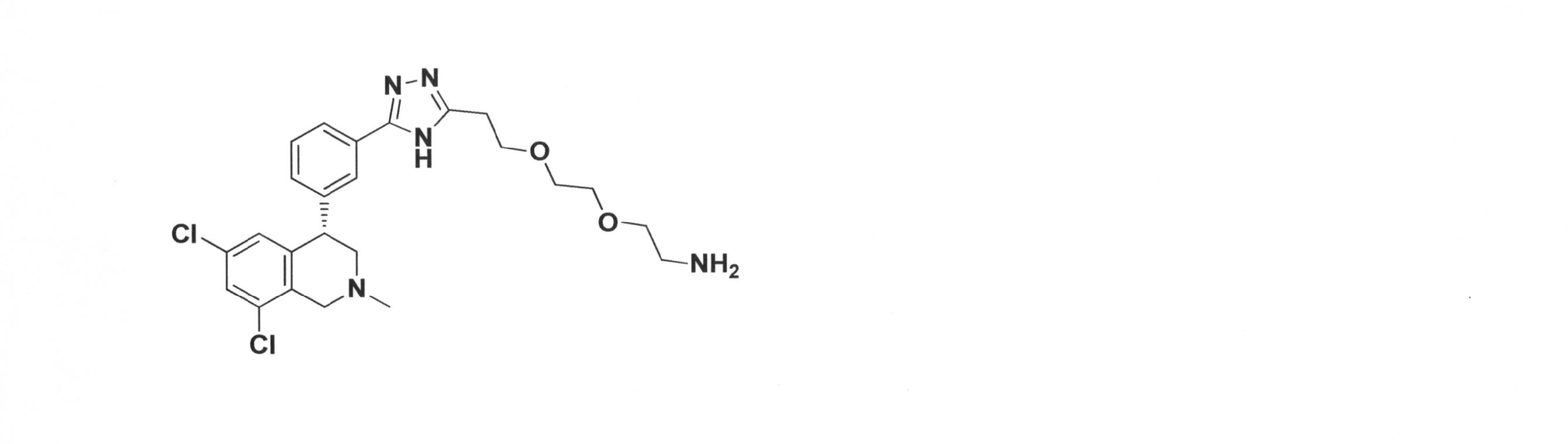
1H NMR (300 MHz, CDCl3) δppm 1.42-1.48 (m, 18H), 2.52 (t, J=6.5Hz, 2H), 3.27-3.35 (m, 2H), 3.51-3.56 (m, 2H), 3.60 (s, 4H), 3.72 (t, J=6.5Hz, 2H), 4.81-5.17 (m, 1H).
(2)2,2-ジメチル-4-オキソ-3,8,11-トリオキサ-5-アザテトラデカン-14-酸 tert-ブチル(5.0g)のクロロホルム(25mL)溶液に、氷冷下でトリフルオロ酢酸(25mL)を加え、室温で4時間攪拌した。反応溶液を減圧下濃縮後、クロロホルム共沸し、減圧下溶媒を留去して、3-[2-(2-アミノエトキシ)エトキシ]プロパン酸 トリフルオロ酢酸塩(4.3g)を褐色油状物質として得た。
LC-MS 保持時間 0.208 min
LC:Agilent 1290
ESI/APCI MS:Agilent 6130
Column: Waters Acquity CSH C18 1.7um, 2.1x50mm
Solvent: H2O:CH3CN(0.1% Formic acid)
Gradient: 0.8mL/min, 0min(95:5) →1.2min(50:50)
1.0mL/min, →1.38min(3:97)
MS (+) : 178 [M+H]+.
MS (-) : 176 [M-H]-.
(3)3-[2-(2-アミノエトキシ)エトキシ]プロパン酸 トリフルオロ酢酸塩(3.3g)の水(17mL)溶液に、水浴中で飽和炭酸水素ナトリウム(2.4g)、クロロギ酸ベンジル(1.6mL)の1,4-ジオキサン(5.0mL)溶液を加え、室温で1日攪拌した。反応溶液を減圧下濃縮後、1mol/L塩酸を加え、酢酸エチルで抽出した。有機層を無水硫酸マグネシウムで乾燥させ、ろ別後、ろ液を減圧下濃縮して、3-オキソ-1-フェニル-2,7,10-トリオキサ-4-アザトリデカン-13-酸(3.5g、98%(2工程))を淡黄色油状物質として得た。
1H NMR (300 MHz, DMSO-d6) δppm 2.44 (t, J=6.4Hz, 2H), 3.10-3.17 (m, 2H), 3.38-3.43 (m, 2H), 3.46-3.50 (m, 4H), 3.57-3.62 (m, 2H), 5.01 (s, 2H), 7.28-7.37 (m, 5H).
MS (+) : 312 [M+H]+.
MS (-) : 310 [M-H]-.
(4)3-オキソ-1-フェニル-2,7,10-トリオキサ-4-アザトリデカン-13-酸(3.5g)、カルバジン酸 tert-ブチル(2.2g)、1-エチル-3-(3-ジメチルアミノプロピル)カルボジイミド塩酸塩(3.2g)、1-ヒドロキシベンゾトリアゾール1水和物(2.6g)、トリエチルアミン(2.4mL)のクロロホルム(35mL)溶液を、室温で1日攪拌した。反応溶液に水を加え、クロロホルムで抽出した。有機層を無水硫酸マグネシウムで乾燥させ、ろ別後、ろ液を減圧下濃縮した。得られた残渣をシリカゲルカラムクロマトグラフィー(Biotage(登録商標)SNAP Cartridge HP-Sphere、クロロホルム:メタノール=100:0→90:10)で精製し、4,14-ジオキソ-16-フェニル-7,10,15-トリオキサ-2,3,13-トリアザヘキサデカン-1-酸 tert-ブチル(2.1g、44%)を無色油状物質として得た。
LC-MS 保持時間0.789 min
LC:Agilent 1290
ESI/APCI MS:Agilent 6130
Column: Waters Acquity CSH C18 1.7um, 2.1x50mm
Solvent: H2O:CH3CN(0.1% Formic acid)
Gradient: 0.8mL/min, 0min(80:20) →1.2-1.4min(1:99)
MS (-) : 424 [M-H]-.
(5)4,14-ジオキソ-16-フェニル-7,10,15-トリオキサ-2,3,13-トリアザヘキサデカン-1-酸 tert-ブチル(2.1g)のクロロホルム(11mL)溶液に、氷冷下でトリフルオロ酢酸(11mL)を加え、室温で2時間攪拌した。反応溶液を減圧下濃縮後、得られた残渣をシリカゲルカラムクロマトグラフィー(Biotage(登録商標)SNAP Cartridge KP-NH、クロロホルム:メタノール=100:0→90:10)で精製し、{2-[2-(3-ヒドラジニル-3-オキソプロポキシ)エトキシ]エチル}カルバミン酸ベンジル (1.2g、72%)を無色アモルファス状物質として得た。
1H NMR (300 MHz, CDCl3) δppm 2.47-2.52 (m, 2H), 3.39-3.44 (m, 2H), 3.56-3.70 (m, 8H), 4.99-5.14 (m, 2H), 6.81-7.00 (m, 1H), 7.31-7.41 (m, 5H), 8.22 (br. s., 1 H).
MS (+) : 326 [M+H]+.
(6)窒素ガス雰囲気下、参考例4-1で得られた3-[(4S)-6,8-ジクロロ-2-メチル-1,2,3,4-テトラヒドロイソキノリン-4-イル]ベンゾニトリル(0.60g)のエタノール(6.0mL)溶液に、氷冷下で塩化アセチル(4.8mL)を滴下し、密閉条件下、室温で1日攪拌した。氷冷下で飽和炭酸水素ナトリウム水溶液をゆっくり加え、酢酸エチルで抽出した。有機層を無水硫酸マグネシウムで乾燥させ、ろ別後、ろ液を減圧下濃縮して、3-[(4S)-6,8-ジクロロ-2-メチル-1,2,3,4-テトラヒドロイソキノリン-4-イル]ベンゼンカルボキシミド酸エチル(0.63g、91%)を黄色油状物質として得た。
LC-MS 保持時間0.645 min
LC:Agilent 1290
ESI/APCI MS:Agilent 6130
Column: Waters Acquity CSH C18 1.7um, 2.1x50mm
Solvent: H2O:CH3CN(0.1% Formic acid)
Gradient: 0.8mL/min, 0min(95:5) →1.2min(50:50)
1.0mL/min, →1.38min(3:97)
MS (+) : 363 [M+H]+.
(7){2-[2-(3-ヒドラジニル-3-オキソプロポキシ)エトキシ]エチル}カルバミン酸ベンジル(0.33g)、3-[(4S)-6,8-ジクロロ-2-メチル-1,2,3,4-テトラヒドロイソキノリン-4-イル]ベンゼンカルボキシミド酸エチル(0.31g)の酢酸(3.1mL)溶液を、加熱還流下で2時間攪拌した。反応溶液を濃縮後、得られた残渣をシリカゲルカラムクロマトグラフィー(Biotage(登録商標)SNAP Cartridge HP-Sphere、クロロホルム:メタノール=100:0→90:10)で精製した後、更にシリカゲルカラムクロマトグラフィー(Biotage(登録商標)SNAP Cartridge KP-NH、ヘキサン:酢酸エチル=100:0→0:100)で精製して、(2-{2-[2-(5-{3-[(4S)-6,8-ジクロロ-2-メチル-1,2,3,4-テトラヒドロイソキノリン-4-イル]フェニル}-4H-1,2,4-トリアゾール-3-イル)エトキシ]エトキシ}エチル)カルバミン酸ベンジル(0.35g、66%)を淡黄色油状物質として得た。また、(2-{2-[2-(5-{3-[(4S)-6,8-ジクロロ-2-メチル-1,2,3,4-テトラヒドロイソキノリン-4-イル]フェニル}-1,3,4-オキサジアゾール-2-イル)エトキシ]エトキシ}エチル)カルバミン酸ベンジル(0.16g、30%)を淡黄色油状物質として得た。
(7)-1:(2-{2-[2-(5-{3-[(4S)-6,8-ジクロロ-2-メチル-1,2,3,4-テトラヒドロイソキノリン-4-イル]フェニル}-4H-1,2,4-トリアゾール-3-イル)エトキシ]エトキシ}エチル)カルバミン酸ベンジル
LC-MS 保持時間1.171 min
LC:Agilent 1290
ESI/APCI MS:Agilent 6130
Column: Waters Acquity CSH C18 1.7um, 2.1x50mm
Solvent: H2O:CH3CN(0.1% Formic acid)
Gradient: 0.8mL/min, 0min(95:5) →1.2min(50:50)
1.0mL/min, →1.38min(3:97)
MS (+) : 624 [M+H]+.
MS (-) : 622 [M-H]-.
(7)-2:(2-{2-[2-(5-{3-[(4S)-6,8-ジクロロ-2-メチル-1,2,3,4-テトラヒドロイソキノリン-4-イル]フェニル}-1,3,4-オキサジアゾール-2-イル)エトキシ]エトキシ}エチル)カルバミン酸ベンジル
LC-MS 保持時間1.219 min
LC:Agilent 1290
ESI/APCI MS:Agilent 6130
Column: Waters Acquity CSH C18 1.7um, 2.1x50mm
Solvent: H2O:CH3CN(0.1% Formic acid)
Gradient: 0.8mL/min, 0min(95:5) →1.2min(50:50)
1.0mL/min, →1.38min(3:97)
MS (+) : 625 [M+H]+.
(8)窒素ガス雰囲気下、(2-{2-[2-(5-{3-[(4S)-6,8-ジクロロ-2-メチル-1,2,3,4-テトラヒドロイソキノリン-4-イル]フェニル}-4H-1,2,4-トリアゾール-3-イル)エトキシ]エトキシ}エチル)カルバミン酸ベンジル(0.35g)のメタノール(11mL)溶液に、10%パラジウム-活性炭素(35mg)を加え、水素ガス雰囲気下、室温で1日攪拌した。10%パラジウム-活性炭素をセライト(登録商標)でろ別し、クロロホルムで洗浄後、ろ液を減圧下濃縮した。得られた残渣をシリカゲルカラムクロマトグラフィー(Biotage(登録商標)SNAP Cartridge KP-NH、ヘキサン:酢酸エチル=100:0→98:2)で精製して、表題化合物(0.12g、44%)を無色アモルファス状物質として得た。
1H NMR (300 MHz, CDCl3) δppm 2.48 (s, 3H), 2.62 (dd, J=11.5, 8.9Hz, 1H), 3.02-3.19 (m, 5H), 3.45-3.72 (m, 7H), 3.83-3.90 (m, 3H), 4.24-4.34 (m, 1H), 6.78-6.82 (m, 1H), 7.06-7.14 (m, 1H), 7.18-7.22 (m, 1H), 7.36 (t, J=7.7Hz, 1H), 7.89-7.95 (m, 1H), 7.97-8.03 (m, 1H).
MS (+) : 490 [M+H]+.
MS (-) : 488 [M-H]-.

LC-MS 保持時間0.676 min
LC:Agilent 1290
ESI/APCI MS:Agilent 6130
Column: Waters Acquity CSH C18 1.7um, 2.1x50mm
Solvent: H2O:CH3CN(0.1% Formic acid)
Gradient: 0.8mL/min, 0min(95:5) →1.2min(50:50)
1.0mL/min, →1.38min(3:97)
MS (+) : 491 [M+H]+.
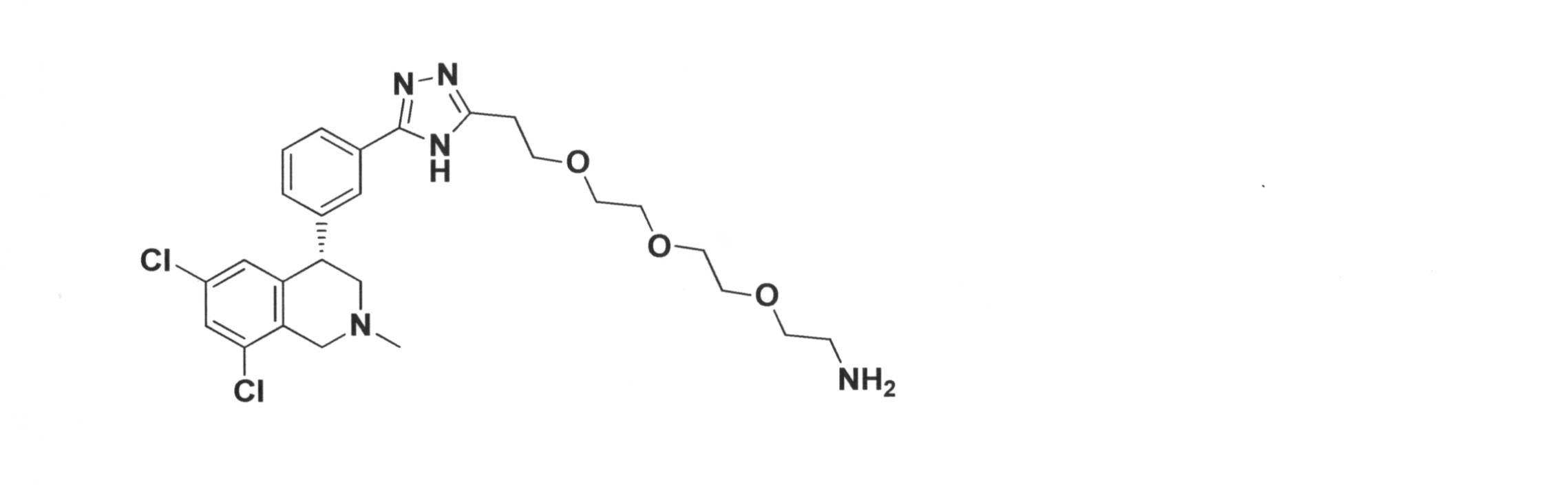
1H NMR (300 MHz, CDCl3) δppm 1.44 (s, 9H), 2.48 (t, J=6.5Hz, 2H), 3.33-3.42 (m, 2H), 3.51-3.63 (m, 10H), 3.67-3.73 (m, 2H), 5.10 (s, 2H), 5.28-5.39 (m, 1H), 7.31-7.40 (m, 5H).
(2)3-オキソ-1-フェニル-2,7,10,13-テトラオキサ-4-アザヘキサデカン-16-酸 tert-ブチル(2.1g)の1,4-ジオキサン(10mL)溶液に、4mol/L塩化水素-1,4-ジオキサン溶液(10mL)を加え、室温で1日攪拌した。反応溶液を減圧下濃縮後、クロロホルム共沸し、減圧下溶媒を留去して、3-オキソ-1-フェニル-2,7,10,13-テトラオキサ-4-アザヘキサデカン-16-酸(1.8g、99%)を無色油状物質として得た。
1H NMR (300 MHz, CDCl3) δppm 2.59 (t, J=5.9Hz, 2H), 3.36-3.77 (m, 14H), 5.07-5.14 (m, 2H), 7.34-7.38 (m, 5H).
MS (+) : 356 [M+H]+.
MS (-) : 354 [M-H]-.
(3)参考例14-1(3)で得られた3-オキソ-1-フェニル-2,7,10-トリオキサ-4-アザトリデカン-13-酸を使用する代わりに、3-オキソ-1-フェニル-2,7,10,13-テトラオキサ-4-アザヘキサデカン-16-酸を使用する以外は、実質的に参考例14-1(4)(5)(7)(8)と同様の反応を実施して、表題化合物(0.11g、18%(4工程))を無色アモルファス状物質として得た。
1H NMR (300 MHz, CDCl3) δppm 2.46-2.49 (m, 3H), 2.63 (dd, J=11.5, 9.0Hz, 1H), 2.88-2.94 (m, 2H), 2.98-3.08 (m, 1H), 3.14 (t, J=5.4Hz, 2H), 3.50-3.85 (m, 14H), 4.27-4.34 (m, 1H), 6.79-6.82 (m, 1H), 7.09-7.15 (m, 1H), 7.21 (dd, J=2.0, 0.8Hz, 1H), 7.36 (t, J=7.6Hz, 1H), 7.89-7.94 (m, 1H), 7.98-8.04 (m, 1H).
MS (+) : 534 [M+H]+.
MS (-) : 532 [M-H]-.
参考例15-1 N-{2-[2-(2-アミノエトキシ)エトキシ]エチル}-5-{3-[(4S)-6,8-ジクロロ-2-メチル-1,2,3,4-テトラヒドロイソキノリン-4-イル]フェニル}ピリジン-2-カルボキサミド
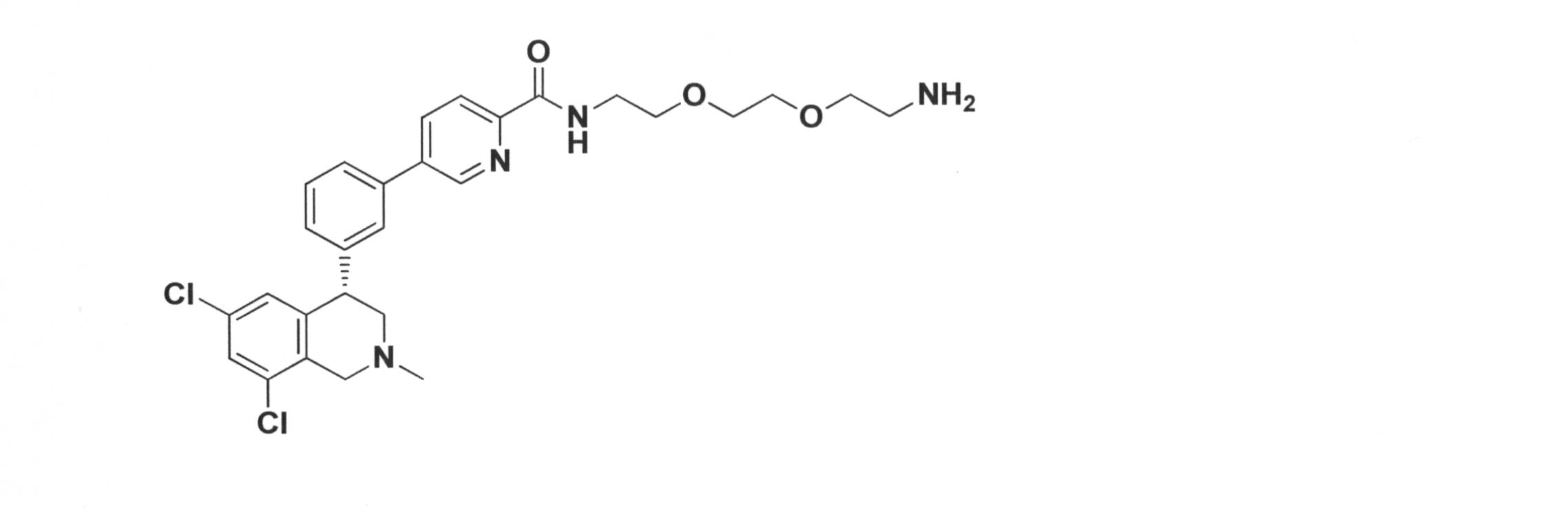
LC-MS 保持時間 0.606 min
LC:Agilent 1290
ESI/APCI MS:Agilent 6130
Column: Waters Acquity CSH C18 1.7um, 2.1x50mm
Solvent: H2O:CH3CN(0.1% Formic acid)
Gradient: 0.8mL/min, 0min(80:20) →1.2-1.4min(1:99)
MS (+) : 427 [M+H]+.
(2)5-{3-[(4S)-6,8-ジクロロ-2-メチル-1,2,3,4-テトラヒドロイソキノリン-4-イル]フェニル}ピリジン-2-カルボン酸メチル(90mg)のテトラヒドロフラン(3.0mL)-水(1.0mL)混合溶液に、水酸化リチウム1水和物(18mg)を加え、室温で1時間攪拌した。反応溶液の減圧下濃縮して、5-{3-[(4S)-6,8-ジクロロ-2-メチル-1,2,3,4-テトラヒドロイソキノリン-4-イル]フェニル}ピリジン-2-カルボン酸 リチウム(88mg)を淡黄色固体として得た。
LC-MS 保持時間 0.882 min
LC:Agilent 1290
ESI/APCI MS:Agilent 6130
Column: Waters Acquity CSH C18 1.7um, 2.1x50mm
Solvent: H2O:CH3CN(0.1% Formic acid)
Gradient: 0.8mL/min, 0min(95:5) →1.2min(50:50)
1.0mL/min, →1.38min(3:97)
MS (+) : 413 [M+H]+.
(3)5-{3-[(4S)-6,8-ジクロロ-2-メチル-1,2,3,4-テトラヒドロイソキノリン-4-イル]フェニル}ピリジン-2-カルボン酸 リチウム(88mg)のN,N-ジメチルホルムアミド(2.0mL)溶液に、{2-[2-(2-アミノエトキシ)エトキシ]エチル}カルバミン酸tert-ブチル(80mg)、O-(7-アザベンゾトリアゾール-1-イル)-N,N,N’,N’-テトラメチルウロニウムヘキサフルオロリン酸塩(0.13g)、N,N-ジイソプロピルエチルアミン(45mg)を加え、室温で終夜攪拌した。反応溶液を逆相分取HPLC(カラム(YMC-Actus Triart 5μm C18 50x30mm)、移動相(0.1%トリフルオロ酢酸 in H2O:0.1%トリフルオロ酢酸 in MeCN=90:10→20:80→5:95、40mL/min.)で精製し、{2-[2-(2-{[(5-{3-[(4S)-6,8-ジクロロ-2-メチル-1,2,3,4-テトラヒドロイソキノリン-4-イル]フェニル}ピリジン-2-イル)カルボニル]アミノ}エトキシ)エトキシ]エチル}カルバミン酸 tert-ブチル(0.14g)を淡褐色油状物質として得た。
LC-MS 保持時間 1.275 min
LC:Agilent 1290
ESI/APCI MS:Agilent 6130
Column: Waters Acquity CSH C18 1.7um, 2.1x50mm
Solvent: H2O:CH3CN(0.1% Formic acid)
Gradient: 0.8mL/min, 0min(95:5) →1.2min(50:50)
1.0mL/min, →1.38min(3:97)
MS (+) : 643 [M+H]+.
(4)参考例8-4(2)で得られた[2-(2-{2-[(6-{3-[(4S)-6,8-ジクロロ-2-メチル-1,2,3,4-テトラヒドロイソキノリン-4-イル]フェニル}ピラジン-2-イル)アミノ]エトキシ}エトキシ)エチル]カルバミン酸 tert-ブチル トリフルオロ酢酸塩を使用する代わりに、{2-[2-(2-{[(5-{3-[(4S)-6,8-ジクロロ-2-メチル-1,2,3,4-テトラヒドロイソキノリン-4-イル]フェニル}ピリジン-2-イル)カルボニル]アミノ}エトキシ)エトキシ]エチル}カルバミン酸 tert-ブチルを使用する以外は、実質的に参考例8-4(3)と同様の反応を実施して、表題化合物(25mg、22%(3工程))を無色油状物質として得た。
LC-MS 保持時間 0.793 min
LC:Agilent 1290
ESI/APCI MS:Agilent 6130
Column: Waters Acquity CSH C18 1.7um, 2.1x50mm
Solvent: H2O:CH3CN(0.1% Formic acid)
Gradient: 0.8mL/min, 0min(95:5) →1.2min(50:50)
1.0mL/min, →1.38min(3:97)
MS (+) : 543 [M+H]+.

LC-MS 保持時間 1.235 min
LC:Agilent 1290
ESI/APCI MS:Agilent 6130
Column: Waters Acquity CSH C18 1.7um, 2.1x50mm
Solvent: H2O:CH3CN(0.1% Formic acid)
Gradient: 0.8mL/min, 0min(95:5) →1.2min(50:50)
1.0mL/min, →1.38min(3:97)
MS (+) : 699 [M+H]+.
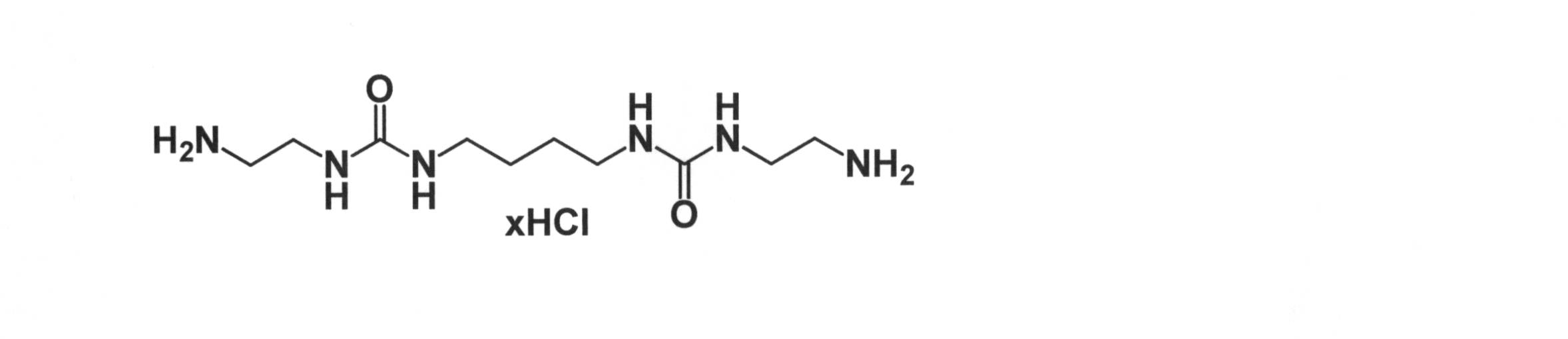
1H NMR (300 MHz, CD3OD) δ ppm 1.33-1.56 (m, 22H) 3.02-3.24 (m, 12H).
(2)(4,11-ジオキソ-3,5,10,12-テトラアザテトラデカン-1,14-ジイル)ビスカルバミン酸ジ-tert-ブチル(0.40g)のメタノール(10mL)溶液に、4mol/L塩化水素-1,4-ジオキサン溶液(0.9mL)を加え、室温で6時間攪拌した。反応溶液を減圧下濃縮後、メタノール、クロロホルム、テトラヒドロフランを加え、室温で攪拌し、不溶物をろ取して表題化合物(0.20g、88%)を無色固体として得た。
1H NMR (300 MHz, CD3OD) δ ppm 1.41-1.60 (m, 4H) 2.96-3.05 (m, 4H) 3.08-3.19 (m, 4H) 3.33-3.42 (m, 4H).
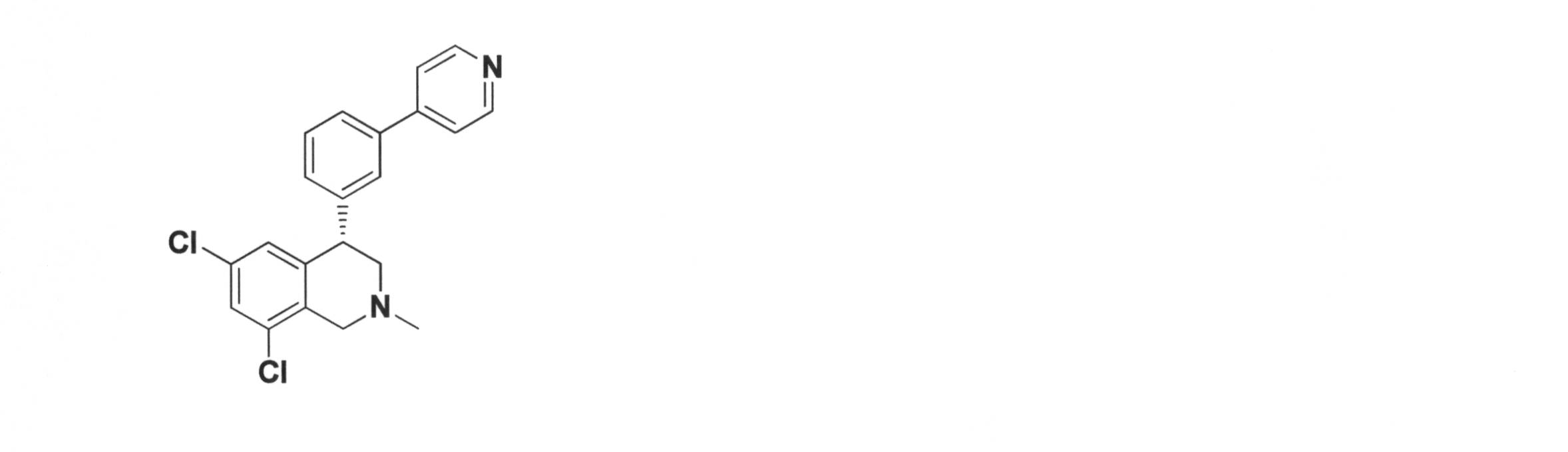
1H NMR (300 MHz, CDCl3) δ ppm 2.49 (s, 3H), 2.57-2.68 (m, 1H), 2.95-3.06 (m, 1H), 3.52-3.62 (m, 1H), 3.74-3.85 (m, 1H), 4.24-4.35 (m, 1H), 6.83 (d, J=1.2Hz, 1H), 7.21-7.27 (m, 2H), 7.40-7.51 (m, 4H), 7.51-7.57 (m, 1H), 8.61-8.69 (m, 2H).
MS (+) : 369 [M+H]+
アルゴンガス雰囲気下、参考例1-1で得られた(4S)-4-(3-ブロモフェニル)-6,8-ジクロロ-2-メチル-1,2,3,4-テトラヒドロイソキノリン(50mg)、テトラキス(トリフェニルホスフィン)パラジウム(0)(7.8mg)、ピリジン-3-イルボロン酸(25mg)のエタノール(1.5mL)懸濁液に、飽和炭酸水素ナトリウム水溶液(0.30mL)を加え、加熱還流下、4時間攪拌した。反応溶液に無水硫酸マグネシウムを加え、ろ別後、ろ液を減圧下濃縮した。得られた残渣を逆相分取HPLC(カラム(YMC-Actus Triart 5μm C18 50x30mm)、移動相(0.1%ギ酸 in H2O:0.1%ギ酸 in MeCN=95:5→80:20→50:50→5:95、40mL/min.)で精製し、表題化合物(32mg)を無色油状物質として得た。
1H NMR (300 MHz, CD3OD) δ ppm 3.18 (s, 3H), 3.64-3.78 (m, 1H), 3.85-3.99 (m, 1H), 4.46-4.59 (m, 1H), 4.73-4.90 (m, 2H), 6.87-6.92 (m, 1H), 7.42-7.49 (m, 1H), 7.50-7.55 (m, 1H), 7.62-7.70 (m, 1H), 7.74-7.79 (m, 1H), 7.82-7.88 (m, 1H), 8.11 (dd, J=8.2, 5.7Hz, 1H), 8.79-8.90 (m, 2H), 9.18 (d, J=1.6Hz, 1H).
MS (+) : 369 [M+H]+.
(1)窒素ガス雰囲気下、参考例1-2で得られた(4S)-4-(3-ブロモフェニル)-6,8-ジクロロ-2-メチル-1,2,3,4-テトラヒドロイソキノリン (2S,3S)-(+)-ジベンゾイル-D-酒石酸塩1エタノール1水和物(0.10g)の1,4-ジオキサン(8.0mL)-水(2.0mL)混合溶液に、1-(テトラヒドロ-2H-ピラン-2-イル)-5-(4,4,5,5-テトラメチル-1,3,2-ジオキサボロラン-2-イル)-1H-ピラゾール(57mg)、クロロ[2-(ジシクロヘキシルホスフィノ)-3,6-ジメトキシ-2’-4’-6’-トリ-i-プロピル-1,1’-ビフェニル][2-(2-アミノエチル)フェニル]パラジウム(II)(10mg)、ナトリウム tert-ブトキシド(60mg)を加え、100℃で1時間攪拌した。反応溶液に水を加え、酢酸エチルで抽出した。有機層を無水硫酸マグネシウムで乾燥させ、ろ別後、ろ液を減圧下濃縮した。得られた残渣をシリカゲルカラムクロマトグラフィー(Biotage(登録商標)SNAP Cartridge HP-Sphere、ヘキサン:酢酸エチル=100:0→0:100)で精製し、(4S)-6,8-ジクロロ-2-メチル-4-{3-[1-(テトラヒドロ-2H-ピラン-2-イル)-1H-ピラゾール-5-イル]フェニル}-1,2,3,4-テトラヒドロイソキノリン(10mg、16%)を無色油状物質として得た。
LC-MS 保持時間 0.661 min
LC:Agilent 1290
ESI/APCI MS:Agilent 6130
Column: Waters Acquity CSH C18 1.7um, 2.1x50mm
Solvent: H2O:CH3CN(0.1% Formic acid)
Gradient: 0.8mL/min, 0min(80:20) →1.2-1.4min(1:99)
MS (+) : 442 [M+H]+.
(2)(4S)-6,8-ジクロロ-2-メチル-4-{3-[1-(テトラヒドロ-2H-ピラン-2-イル)-1H-ピラゾール-5-イル]フェニル}-1,2,3,4-テトラヒドロイソキノリン(10mg)のメタノール(1.6mL)-水(0.40mL)混合溶液に、トリフルオロ酢酸(1.0mL)を加え、室温で1時間攪拌した。反応溶液を減圧下濃縮し、得られた残渣をシリカゲルカラムクロマトグラフィー(Biotage(登録商標)SNAP Cartridge KP-NH、ヘキサン:酢酸エチル=100:0→0:100)で精製して、表題化合物(0.30mg、4.0%)を無色アモルファス状物質として得た。
LC-MS 保持時間 0.541 min
LC:Agilent 1290
ESI/APCI MS:Agilent 6130
Column: Waters Acquity CSH C18 1.7um, 2.1x50mm
Solvent: H2O:CH3CN(0.1% Formic acid)
Gradient: 0.8mL/min, 0min(80:20) →1.2-1.4min(1:99)
MS (+) : 358 [M+H]+.
(1)窒素ガス雰囲気下、参考例1-1で得られた(4S)-4-(3-ブロモフェニル)-6,8-ジクロロ-2-メチル-1,2,3,4-テトラヒドロイソキノリン(0.50g)の1,4-ジオキサン(10mL)-水(2.5mL)混合溶液に、4-(4,4,5,5-テトラメチル-1,3,2-ジオキサボロラン-2-イル)-1H-ピラゾール-1-カルボン酸 tert-ブチル(0.59g)、トリス(ジベンジリデンアセトン)ジパラジウム(0)(0.12g)、トリ(2-フリル)ホスフィン(0.19g)、炭酸セシウム(0.88g)を加え、90℃で5時間攪拌した。反応溶液に水を加え、酢酸エチルで抽出した。有機層を無水硫酸マグネシウムで乾燥させ、ろ別後、ろ液を減圧下濃縮した。得られた残渣をシリカゲルカラムクロマトグラフィー(Biotage(登録商標)SNAP Cartridge HP-Sphere、ヘキサン:酢酸エチル=100:0→5:95)で精製し、4-{3-[(4S)-6,8-ジクロロ-2-メチル-1,2,3,4-テトラヒドロイソキノリン-4-イル]フェニル}-1H-ピラゾール-1-カルボン酸 tert-ブチル(0.42g、68%)を無色油状物質として得た。
LC-MS 保持時間0.740 min
LC:Agilent 1290
ESI/APCI MS:Agilent 6130
Column: Waters Acquity CSH C18 1.7um, 2.1x50mm
Solvent: H2O:CH3CN(0.1% Formic acid)
Gradient: 0.8mL/min, 0min(80:20) →1.2-1.4min(1:99)
MS (+) : 458 [M+H]+.
(2)4-{3-[(4S)-6,8-ジクロロ-2-メチル-1,2,3,4-テトラヒドロイソキノリン-4-イル]フェニル}-1H-ピラゾール-1-カルボン酸 tert-ブチル(0.42g)のクロロホルム(2.1mL)溶液に、氷冷下でトリフルオロ酢酸(2.1mL)を加え、室温で2時間攪拌した。反応溶液を減圧下濃縮後、クロロホルム共沸し、減圧下溶媒を留去して、表題化合物(0.42g)を黒色油状物質として得た。
LC-MS 保持時間0.514 min
LC:Agilent 1290
ESI/APCI MS:Agilent 6130
Column: Waters Acquity CSH C18 1.7um, 2.1x50mm
Solvent: H2O:CH3CN(0.1% Formic acid)
Gradient: 0.8mL/min, 0min(80:20) →1.2-1.4min(1:99)
MS (+) : 358 [M+H]+.
ピリジン-3-イルボロン酸を使用する代わりに、3-メチル-5-(4,4,5,5-テトラメチル-1,3,2-ジオキサボロラン-2-イル)ピリダジンを使用する以外は、実質的に実施例1-2と同様の反応を実施して、表題化合物(28mg)を黄色アモルファス状物質として得た。
1H NMR (300 MHz, CD3OD) δ ppm 2.85 (s, 3H), 3.17 (s, 3H), 3.65-3.79 (m, 1H), 3.87-3.99 (m, 1H), 4.45-4.59 (m, 1H), 4.74-4.89 (m, 2H), 6.85-6.92 (m, 1H), 7.49-7.58 (m, 2H), 7.65-7.75 (m, 1H), 7.90-7.96 (m, 1H), 7.97-8.05 (m, 1H), 8.36-8.42 (m, 1H), 9.56-9.63 (m, 1H).
MS (+) : 384 [M+H]+.
アルゴンガス雰囲気下、参考例1-1で得られた(4S)-4-(3-ブロモフェニル)-6,8-ジクロロ-2-メチル-1,2,3,4-テトラヒドロイソキノリン(50mg)、テトラキス(トリフェニルホスフィン)パラジウム(0)(7.8mg)、2-(トリブチルスタンナニル)ピリジン(74mg)の1,4-ジオキサン(1.5mL)溶液を、100℃で15時間攪拌した。反応溶液を放冷後、逆相分取HPLC(カラム(YMC-Actus Triart 5μm C18 50x30mm)、移動相(0.1%トリフルオロ酢酸 in H2O:0.1%トリフルオロ酢酸 in MeCN=90:10→20:80→5:95、40mL/min.)にて精製して、表題化合物(65mg)を淡黄色油状物質として得た。
1H NMR (300 MHz, CD3OD) δ ppm 3.17 (s, 3H), 3.63-3.76 (m, 1H), 3.87-3.97 (m, 1H), 4.47-4.58 (m, 1H), 4.72-4.86 (m, 2H), 6.90-6.95 (m, 1H), 7.46-7.51 (m, 1H), 7.53-7.57 (m, 1H), 7.63-7.70 (m, 1H), 7.70-7.76 (m, 1H), 7.86-7.91 (m, 1H), 7.94-8.00 (m, 1H), 8.11-8.17 (m, 1H), 8.26-8.35 (m, 1H), 8.72-8.78 (m, 1H).
MS (+) : 369 [M+H]+.
ピリジン-4-イルボロン酸を使用する代わりに、4-(4,4,5,5-テトラメチル-1,3,2-ジオキサボロラン-2-イル)ピリジン-2-カルボニトリルを使用する以外は、実質的に実施例1-1と同様の反応を実施して、表題化合物(8.5mg、16%)を淡黄色アモルファス状物質として得た。
1H NMR (300 MHz, CDCl3) δ ppm 2.49 (s, 3H), 2.61-2.70 (m, 1H), 2.95-3.04 (m, 1H), 3.58-3.68 (m, 1H), 3.70-3.80 (m, 1H), 4.25-4.33 (m, 1H), 6.78-6.82 (m, 1H), 7.25-7.27 (m, 1H), 7.30-7.35 (m, 1H), 7.42-7.56 (m, 3H), 7.65-7.71 (m, 1H), 7.85-7.90 (m, 1H), 8.74 (dd, J=5.1, 0.8Hz, 1H).
MS (+) : 394 [M+H]+.
窒素ガス雰囲気下、参考例3-1で得られた6,8-ジクロロ-2-メチル-4-[3-(4,4,5,5-テトラメチル-1,3,2-ジオキサボロラン-2-イル)フェニル]-1,2,3,4-テトラヒドロイソキノリン(50mg)のジオキサン(1.0mL)-水(0.25mL)混合溶液に、4-ブロモ-1-メチルトリアゾール(23mg)、トリ(2-フリル)ホスフィン(17mg)、炭酸セシウム(78mg)、トリス(ジベンジリデンアセトン)ジパラジウム(0)(11mg)を加えて、90℃で5時間撹拌した。反応溶液を放冷後、水を加えて、酢酸エチルで抽出した。有機層を無水硫酸マグネシウムで乾燥させ、ろ別後、ろ液を減圧下濃縮した。得られた残渣をシリカゲルカラムクロマトグラフィー(Biotage(登録商標)SNAP Cartridge HP-Sphere、ヘキサン:酢酸エチル=100:0→5:95)で精製し、表題化合物(12mg、収率23%)を淡褐色アモルファス状物質として得た。
1H NMR (300 MHz, CDCl3) δppm 2.48 (s, 3H), 2.63 (dd, J=11.0, 8.5Hz, 1H), 3.03 (dd, J=11.0, 4.9Hz, 1H), 3.52 (d, J=15.7Hz, 1H), 3.84 (d, J=15.7Hz, 1H), 4.15 (s, 3H), 4.25-4.32 (m, 1H), 6.80-6.83 (m, 1H), 7.08-7.15 (m, 1H), 7.23 (d, J=2.0Hz, 1H), 7.33-7.40 (m, 1H), 7.60-7.80 (m, 3H).
MS (+) : 373 [M+H]+.
窒素ガス雰囲気下、参考例3-2で得られた(4S)-6,8-ジクロロ-2-メチル-4-[3-(4,4,5,5-テトラメチル-1,3,2-ジオキサボロラン-2-イル)フェニル]-1,2,3,4-テトラヒドロイソキノリン(40mg)、参考例8-1で得られた4-ブロモ-N-メチルピリジン-2-アミン(36mg)、テトラキス(トリフェニルホスフィン)パラジウム(0)(5.6mg)、飽和炭酸水素ナトリウム水溶液(0.96mL)の1,4-ジオキサン(4.8mL)懸濁液を加熱還流下3.5時間攪拌した。反応溶液を逆相分取HPLC(カラム(YMC-Actus Triart 5μm C18 50x30mm)、移動相(0.1%トリフルオロ酢酸 in H2O:0.1%トリフルオロ酢酸 in MeCN=90:10→20:80→5:95、40mL/min.)で精製し、表題化合物(39mg)を無色アモルファス状物質として得た。
1H NMR (300 MHz, CD3OD) δ ppm 3.08 (s, 3H), 3.17 (s, 3H), 3.63-3.76 (m, 1H), 3.85-3.96 (m, 1H), 4.46-4.58 (m, 1H), 4.73-4.87 (m, 2H), 6.83-6.90 (m, 1H), 7.17-7.23 (m, 1H), 7.24-7.28 (m, 1H), 7.43-7.49 (m, 1H), 7.50-7.55 (m, 1H), 7.59-7.67 (m, 1H), 7.71-7.76 (m, 1H), 7.79-7.85 (m, 1H), 7.87-7.92 (m, 1H).
MS (+) : 398 [M+H]+.
参考例3-2で得られた(4S)-6,8-ジクロロ-2-メチル-4-[3-(4,4,5,5-テトラメチル-1,3,2-ジオキサボロラン-2-イル)フェニル]-1,2,3,4-テトラヒドロイソキノリンを使用する代わりに、参考例1-1で得られた(4S)-4-(3-ブロモフェニル)-6,8-ジクロロ-2-メチル-1,2,3,4-テトラヒドロイソキノリンを使用し、参考例8-1で得られた4-ブロモ-N-メチルピリジン-2-アミンを使用する代わりに、ピリミジン-5-イルボロン酸を使用する以外は、実質的に実施例1-9と同様の反応を実施して、表題化合物(45mg)を無色アモルファス状物質として得た。
1H NMR (300 MHz, CD3OD) δ ppm 3.18 (s, 3H), 3.63-3.77 (m, 1H), 3.87-3.98 (m, 1H), 4.45-4.58 (m, 1H), 4.71-4.88 (m, 2H), 6.88-6.94 (m, 1H), 7.36-7.42 (m, 1H), 7.49-7.53 (m, 1H), 7.58-7.66 (m, 1H), 7.67-7.70 (m, 1H), 7.74-7.79 (m, 1H), 9.08 (s, 2H), 9.15 (s, 1H).
MS (+) : 370 [M+H]+.
参考例3-2で得られた(4S)-6,8-ジクロロ-2-メチル-4-[3-(4,4,5,5-テトラメチル-1,3,2-ジオキサボロラン-2-イル)フェニル]-1,2,3,4-テトラヒドロイソキノリンを使用する代わりに、参考例1-1で得られた(4S)-4-(3-ブロモフェニル)-6,8-ジクロロ-2-メチル-1,2,3,4-テトラヒドロイソキノリンを使用し、参考例8-1で得られた4-ブロモ-N-メチルピリジン-2-アミンを使用する代わりに、(2-メトキシピリジン-4-イル)ボロン酸を使用する以外は、実質的に実施例1-9と同様の反応を実施して、表題化合物(41mg)を無色アモルファス状物質として得た。
1H NMR (300 MHz, CD3OD) δ ppm 3.17 (s, 3H), 3.63-3.76 (m, 1H), 3.86-3.96 (m, 1H), 4.06 (s, 3H), 4.46-4.58 (m, 1H), 4.72-4.87 (m, 2H), 6.86-6.92 (m, 1H), 7.26-7.31 (m, 1H), 7.35-7.44 (m, 2H), 7.50-7.54 (m, 1H), 7.55-7.64 (m, 1H), 7.70-7.75 (m, 1H), 7.78-7.84 (m, 1H), 8.21-8.26 (m, 1H).
MS (+) : 399 [M+H]+.
参考例3-2で得られた(4S)-6,8-ジクロロ-2-メチル-4-[3-(4,4,5,5-テトラメチル-1,3,2-ジオキサボロラン-2-イル)フェニル]-1,2,3,4-テトラヒドロイソキノリンを使用する代わりに、参考例1-1で得られた(4S)-4-(3-ブロモフェニル)-6,8-ジクロロ-2-メチル-1,2,3,4-テトラヒドロイソキノリンを使用し、参考例8-1で得られた4-ブロモ-N-メチルピリジン-2-アミンを使用する代わりに、2-エチル-4-(4,4,5,5-テトラメチル-1,3,2-ジオキサボロラン-2-イル)ピリジンを使用する以外は、実質的に実施例1-9と同様の反応を実施して、表題化合物(25mg)を黄色アモルファス状物質として得た。
1H NMR (300 MHz, CD3OD) δ ppm 1.47 (t, J=7.6Hz, 3H), 3.09-3.17 (m, 2H), 3.17 (s, 3H), 3.65-3.79 (m, 1H), 3.88-4.00 (m, 1H), 4.46-4.58 (m, 1H), 4.75-4.89 (m, 2H), 6.84-6.92 (m, 1H), 7.50-7.57 (m, 2H), 7.65-7.74 (m, 1H), 7.90-7.95 (m, 1H), 7.97-8.04 (m, 1H), 8.17-8.23 (m, 1H), 8.24-8.29 (m, 1H), 8.69-8.75 (m, 1H).
MS (+) : 397 [M+H]+.
参考例8-1で得られた4-ブロモ-N-メチルピリジン-2-アミンを使用する代わりに、4-クロロ-6-メトキシピリミジンを使用する以外は、実質的に実施例1-9と同様の反応を実施して、表題化合物(2.6mg)を無色アモルファス状物質として得た。
1H NMR (300 MHz, CD3OD) δ ppm 3.16 (s, 3H), 3.60-3.75 (m, 1H), 3.85-3.95 (m, 1H), 4.38 (s, 3H), 4.46-4.59 (m, 1H), 4.65-4.80 (m, 2H), 6.86-6.94 (m, 1H), 7.32-7.36 (m, 1H), 7.39-7.46 (m, 1H), 7.53-7.56 (m, 1H), 7.56-7.63 (m, 1H), 7.96-8.01 (m, 1H), 8.04-8.10 (m, 1H), 8.79 (d, J=1.1Hz, 1H).
MS (+) : 400 [M+H]+.
実施例1-14 (4S)-6,8-ジクロロ-2-メチル-4-[3-(ピラジン-2-イル)フェニル]-1,2,3,4-テトラヒドロイソキノリン トリフルオロ酢酸塩
2-(トリブチルスタンナニル)ピリジンを使用する代わりに、2-(トリブチルスタンナニル)ピラジンを使用する以外は、実質的に実施例1-6と同様の反応を実施して、表題化合物(11mg)を淡黄色油状物質として得た。
1H NMR (300 MHz, CD3OD) δ ppm 3.17 (s, 3H), 3.62-3.76 (m, 1H), 3.86-3.98 (m, 1H), 4.46-4.59 (m, 1H), 4.70-4.84 (m, 2H), 6.88-6.95 (m, 1H), 7.37-7.45 (m, 1H), 7.51-7.56 (m, 1H), 7.57-7.66 (m, 1H), 8.00-8.05 (m, 1H), 8.08-8.15 (m, 1H), 8.54-8.60 (m, 1H), 8.66-8.71 (m, 1H), 9.11-9.17 (m, 1H).
MS (+) : 370 [M+H]+.
参考例8-1で得られた4-ブロモ-N-メチルピリジン-2-アミンを使用する代わりに、参考例8-2で得られた6-クロロ-N-メチルピリミジン-4-アミンを使用する以外は、実質的に実施例1-9と同様の反応を実施して、表題化合物(49mg)を淡黄色アモルファス状物質として得た。
1H NMR (300 MHz, CD3OD) δ ppm 3.09-3.21 (m, 6H), 3.60-3.77 (m, 1H), 3.85-3.98 (m, 1H), 4.43-4.58 (m, 1H), 4.71-4.87 (m, 2H), 6.87 (s, 1H), 6.97-7.12 (m, 1H), 7.50-7.62 (m, 2H), 7.64-8.00 (m, 3H), 8.55-8.77 (m, 1H).
MS (+) : 399 [M+H]+.
2-(トリブチルスタンナニル)ピリジンを使用する代わりに、2-(トリブチルスタンナニル)ピリミジンを使用する以外は、実質的に実施例1-6と同様の反応を実施して、表題化合物(11mg)を無色アモルファス状物質として得た。
1H NMR (300 MHz, CD3OD) δ ppm 3.16 (s, 3H), 3.61-3.74 (m, 1H), 3.85-3.96 (m, 1H), 4.47-4.59 (m, 1H), 4.68-4.80 (m, 2H), 6.89-6.95 (m, 1H), 7.36-7.41 (m, 1H), 7.41-7.46 (m, 1H), 7.53-7.55 (m, 1H), 7.56-7.63 (m, 1H), 8.28-8.32 (m, 1H), 8.39-8.47 (m, 1H), 8.84 (s, 1H), 8.86 (s, 1H).
MS (+) : 370 [M+H]+.
2-(トリブチルスタンナニル)ピリジンを使用する代わりに、4-(トリブチルスタンナニル)ピリダジンを使用し、参考例1-1で得られた(4S)-4-(3-ブロモフェニル)-6,8-ジクロロ-2-メチル-1,2,3,4-テトラヒドロイソキノリンを使用する代わりに、参考例1-2で得られた(4S)-4-(3-ブロモフェニル)-6,8-ジクロロ-2-メチル-1,2,3,4-テトラヒドロイソキノリン (2S,3S)-(+)-ジベンゾイル-D-酒石酸塩1エタノール1水和物を使用する以外は、実質的に実施例1-6と同様の反応を実施して、表題化合物(22mg)を淡褐色アモルファス状物質として得た。
1H NMR (300 MHz, CD3OD) δ ppm 3.18 (s, 3H), 3.64-3.77 (m, 1H), 3.87-3.98 (m, 1H), 4.44-4.59 (m, 1H), 4.75-4.87 (m, 2H), 6.87-6.93 (m, 1H), 7.45-7.51 (m, 1H), 7.52-7.55 (m, 1H), 7.63-7.71 (m, 1H), 7.84-7.89 (m, 1H), 7.92-7.97 (m, 1H), 8.17-8.23 (m, 1H), 9.29-9.35 (m, 1H), 9.62-9.67 (m, 1H).
MS (+) : 370 [M+H]+.
窒素ガス雰囲気下、参考例3-2で得られた(4S)-6,8-ジクロロ-2-メチル-4-[3-(4,4,5,5-テトラメチル-1,3,2-ジオキサボロラン-2-イル)フェニル]-1,2,3,4-テトラヒドロイソキノリン(50mg)のジオキサン(1.0mL)、水(0.25mL)溶液に、4-ブロモ-1-メチル-1H-イミダゾール(14mg)、トリ(2-フリル)ホスフィン(17mg)、炭酸セシウム(78mg)、トリス(ジベンジリデンアセトン)ジパラジウム(0)(11mg)を加えて、90℃で1日撹拌した。反応溶液を放冷後、水を加えて、酢酸エチルで抽出した。有機層を無水硫酸マグネシウムで乾燥させ、ろ別後、ろ液を減圧下濃縮した。得られた残渣をLC-MS分取(LC(Agilent1260)、ESIMS(6130Quadrupole、ESI)、カラム(YMC-Actus Triart 5μm C18 50x30mm)、移動相(0.1%ギ酸 in H2O:0.1%ギ酸 in CH3CN=95:5→50:50→5:95)、50mL/min.)で精製して、表題化合物(3.6mg、収率6.7%)を無色油状物質として得た。
1H NMR (300 MHz, CD3OD) δppm 2.60 (s, 3H), 2.80 (dd, J=11.8, 9.8Hz, 1H), 3.17-3.26 (m, 1H), 3.62-3.71 (m, 1H), 3.76 (s, 3H), 4.01-4.12 (m, 1H), 4.37 (dd, J=9.8, 5.8Hz, 1H), 6.79-6.83 (m, 1H), 7.07 (d, J=7.6Hz, 1H), 7.31-7.38 (m, 2H), 7.46 (s, 1H), 7.54-7.69 (m, 3H).
MS (+) : 372 [M+H]+.
窒素ガス雰囲気下、参考例3-3で得られた(4S)-6,8-ジクロロ-2-メチル-4-[3-(4,4,5,5-テトラメチル-1,3,2-ジオキサボロラン-2-イル)フェニル]-1,2,3,4-テトラヒドロイソキノリン塩酸塩(50mg)のジオキサン(1.0mL)、水(0.25mL)溶液に、3-ブロモ-5-メチル-イソチアゾール(24mg)、トリ(2-フリル)ホスフィン(17mg)、炭酸セシウム(78mg)、トリス(ジベンジリデンアセトン)ジパラジウム(0)(11mg)を加えて、90℃で5時間撹拌した。反応溶液を放冷後、水を加えて、酢酸エチルで抽出した。有機層を無水硫酸マグネシウムで乾燥させ、ろ別後、ろ液を減圧下濃縮した。得られた残渣をシリカゲルカラムクロマトグラフィー(Biotage(登録商標)SNAP Cartridge HP-Sphere、ヘキサン:酢酸エチル=100:0→10:90)で精製した。得られた黄色油状物質(30mg)に酢酸エチル(1.5mL)と4mol/L塩化水素-酢酸エチル(0.5mL)を加え、減圧下溶媒を留去して、表題化合物(31mg、収率55%)を淡褐色固体として得た。
1H NMR (300 MHz, CD3OD) δppm 2.50 (s, 3H), 3.17 (s, 3H), 3.57-3.70 (m, 1H), 3.86-3.96 (m, 1H), 4.40-4.53 (m, 1H), 4.62-4.84 (m, 2H), 6.87 (s., 1H), 7.28-7.37 (m, 1H), 7.45 (s, 1H), 7.50-7.59 (m, 2H), 7.63 (s, 1H), 7.71 (d, J=7.8Hz, 1H).
MS (+) : 389 [M+H]+.
窒素ガス雰囲気下、参考例3-2で得られた(4S)-6,8-ジクロロ-2-メチル-4-[3-(4,4,5,5-テトラメチル-1,3,2-ジオキサボロラン-2-イル)フェニル]-1,2,3,4-テトラヒドロイソキノリン(30mg)、3-ブロモピリダジン臭化水素酸塩(25mg)の1,2-ジメトキシエタン(2.0mL)溶液に、テトラキス(トリフェニルホスフィン)パラジウム(0)(12mg)、2mol/L炭酸水素ナトリウム水溶液(0.12mL)を加え、マイクロウェーブ照射下(バイオタージ60、120℃)で1時間攪拌した。反応溶液を放冷後、セライト(登録商標)ろ過し、ろ液を減圧下濃縮した。得られた残渣をシリカゲルカラムクロマトグラフィー(Biotage(登録商標)SNAP Cartridge HP-Sphere、ヘキサン:酢酸エチル=80:20→0:100→クロロホルム:メタノール=100:0→80:20)で精製し、更にられた残渣をシリカゲルカラムクロマトグラフィー(Biotage(登録商標)SNAP Cartridge KP-NH、ヘキサン:酢酸エチル=88:12→0:100)で精製した。減圧下溶媒を留去し、得られた残渣に酢酸エチル(0.1mL)を加えた後、4mol/L塩化水素-酢酸エチル(0.1mL)を滴下し、室温で15分間攪拌後、減圧下溶媒を留去して、表題化合物(2.4mg)を淡黄色固体として得た。
1H NMR (600 MHz, CD3OD) δ ppm 3.19 (br. s., 3H), 3.27-3.34 (m, 2H), 3.68-3.83 (m, 1H), 3.84-4.00 (m, 1H), 4.45-4.61 (m, 1H), 6.88 (br. s., 1H), 7.55 (br. s., 1H), 7.58-7.65 (m, 1H), 7.67-7.79 (m, 1H), 8.08-8.25 (m, 2H), 8.38-8.55 (m, 1H), 8.86-9.02 (m, 1H), 9.54 (br. s., 1H).
MS (+) : 370 [M+H]+.
(1)ピリジン-4-イルボロン酸を使用する代わりに、[1-(tert-ブトキシカルボニル)-1H-ピロール-2-イル]ボロン酸を使用する以外は、実質的に実施例1-1と同様の反応を実施して、2-{3-[(4S)-6,8-ジクロロ-2-メチル-1,2,3,4-テトラヒドロイソキノリン-4-イル]フェニル}-1H-ピロール-1-カルボン酸 tert-ブチル(54mg、58%)を淡黄色アモルファス状物質として得た。
1H NMR (300 MHz, CDCl3) δ ppm 1.35 (s, 9H), 2.48 (s, 3H), 2.60 (dd, J=11.5, 8.5Hz, 1H), 3.02 (dd, J=11.5, 5.4Hz, 1H), 3.48 (d, J=16.3Hz, 1H), 3.83 (d, J=16.3Hz, 1H), 4.23 (br. s., 1H), 6.13-6.19 (m, 1H), 6.19-6.24 (m, 1H), 6.85 (s, 1H), 7.10 (d, J=7.3Hz, 1H), 7.15 (s, 1H), 7.20-7.26 (m, 2H), 7.28 (d, J=7.5Hz, 1H), 7.33 (dd, J=3.2, 1.8Hz, 1H).
MS (+) : 457 [M+H]+.
(2)2-{3-[(4S)-6,8-ジクロロ-2-メチル-1,2,3,4-テトラヒドロイソキノリン-4-イル]フェニル}-1H-ピロール-1-カルボン酸 tert-ブチル(42mg)の1,2-ジクロロエタン(1.8mL)溶液に、トリフルオロ酢酸(0.9mL)を加え、室温で30分間攪拌した。反応溶液に水を加え、飽和炭酸ナトリウム水溶液をゆっくり加えた後、酢酸エチルで抽出した。有機層を飽和炭酸ナトリウム水溶液及び飽和食塩水で洗浄し、無水硫酸ナトリウムで乾燥させ、ろ別後、ろ液を減圧下濃縮した。得られた残渣をシリカゲルカラムクロマトグラフィー(Biotage(登録商標)SNAP Cartridge HP-Sphere、ヘキサン:酢酸エチル=88:12→9:91)で精製し、表題化合物(16mg、48%)を無色アモルファス状物質として得た。
1H NMR (600 MHz, CDCl3) δ ppm 2.50 (s, 3H), 2.63 (br. s., 1H), 3.02 (br. s., 1H), 3.55 (d, J=15.7Hz, 1H), 3.84 (d, J=16.1Hz, 1H), 4.25 (br. s., 1H), 6.25-6.33 (m, 1H), 6.47-6.54 (m, 1H), 6.82 (s, 1H), 6.84-6.89 (m, 1H), 6.99 (d, J=7.8Hz, 1H), 7.24 (d, J=1.7Hz, 1H), 7.27 (br. s., 1H), 7.31 (t, J=7.6Hz, 1H), 7.39 (d, J=7.8Hz, 1H), 8.46 (br. s., 1 H).
MS (+) : 357 [M+H]+.
2-(トリブチルスタンナニル)ピリジンを使用する代わりに、2-(トリブチルスタンナニル)-1,3-オキサゾールを使用する以外は、実質的に実施例1-6と同様の反応を実施して、表題化合物(6.6mg、13%)を無色固体として得た。
LC-MS 保持時間 0.581 min
LC:Agilent 1290
ESI/APCI MS:Agilent 6130
Column: Waters Acquity CSH C18 1.7um, 2.1x50mm
Solvent: H2O:CH3CN(0.1% Formic acid)
Gradient: 0.8mL/min, 0min(80:20) →1.2-1.4min(1:99)
MS (+) : 359 [M+H]+.
2-(トリブチルスタンナニル)ピリジンを使用する代わりに、トリブチル(フラン-2-イル)スタンナンを使用する以外は、実質的に実施例1-6と同様の反応を実施して、表題化合物(28mg、58%)を無色アモルファス状物質として得た。
1H NMR (300 MHz, CDCl3) δ ppm 2.37-2.53 (m, 3H), 2.60 (dd, J=11.6, 8.6Hz, 1H), 2.95-3.10 (m, 1H), 3.44-3.58 (m, 1H), 3.84 (d, J=16.2Hz, 1H), 4.17-4.34 (m, 1H), 6.47 (dd, J=3.3, 1.8Hz, 1H), 6.64 (dd, J=3.3, 0.7Hz, 1H), 6.81 (d, J=0.9Hz, 1H), 7.03 (dt, J=7.7, 1.4Hz, 1H), 7.23 (d, J=2.2Hz, 1H), 7.32 (t, J=7.7Hz, 1H), 7.43-7.52 (m, 2H), 7.53-7.61 (m, 1H).
MS (+) : 358 [M+H]+.
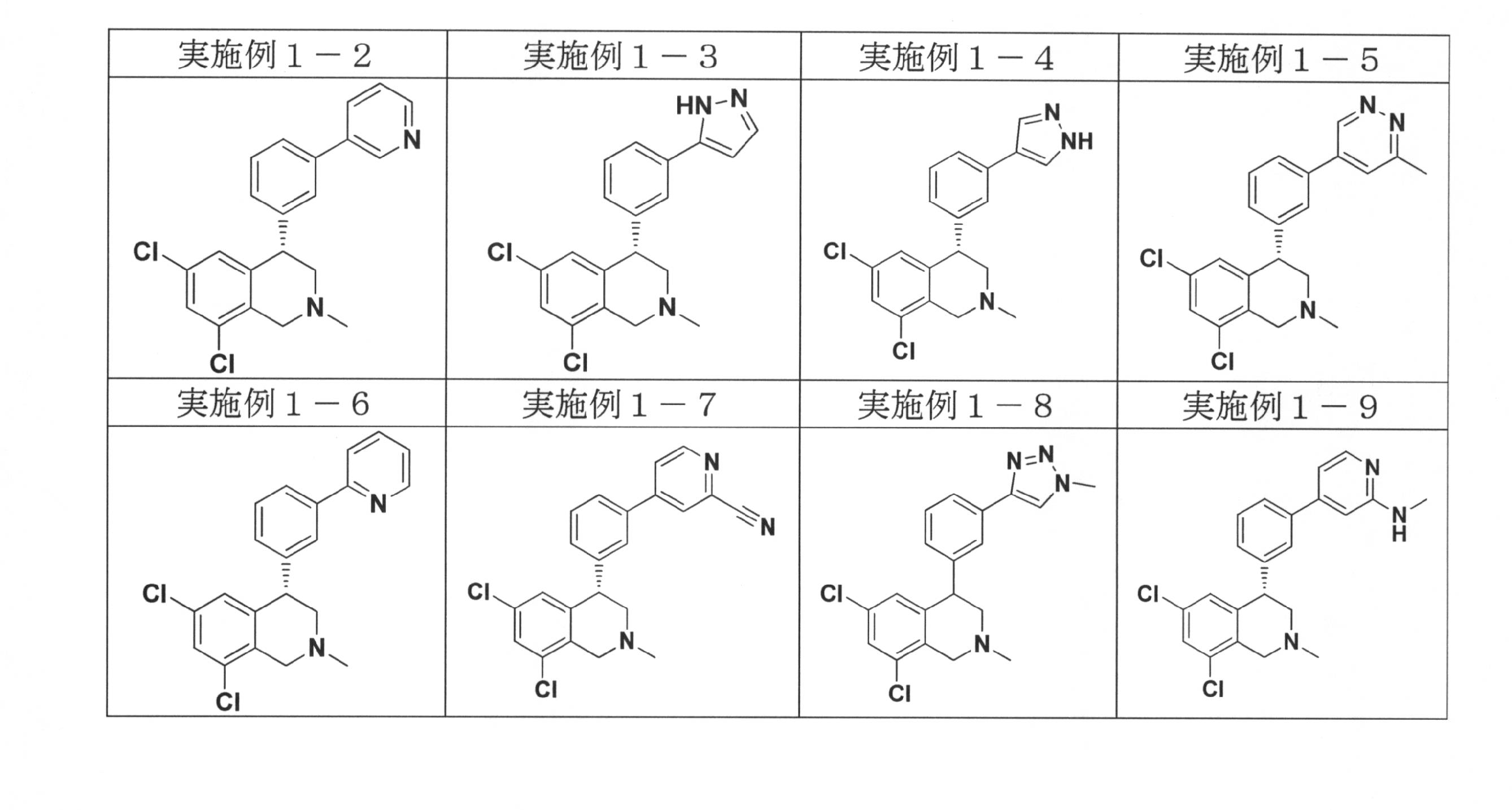
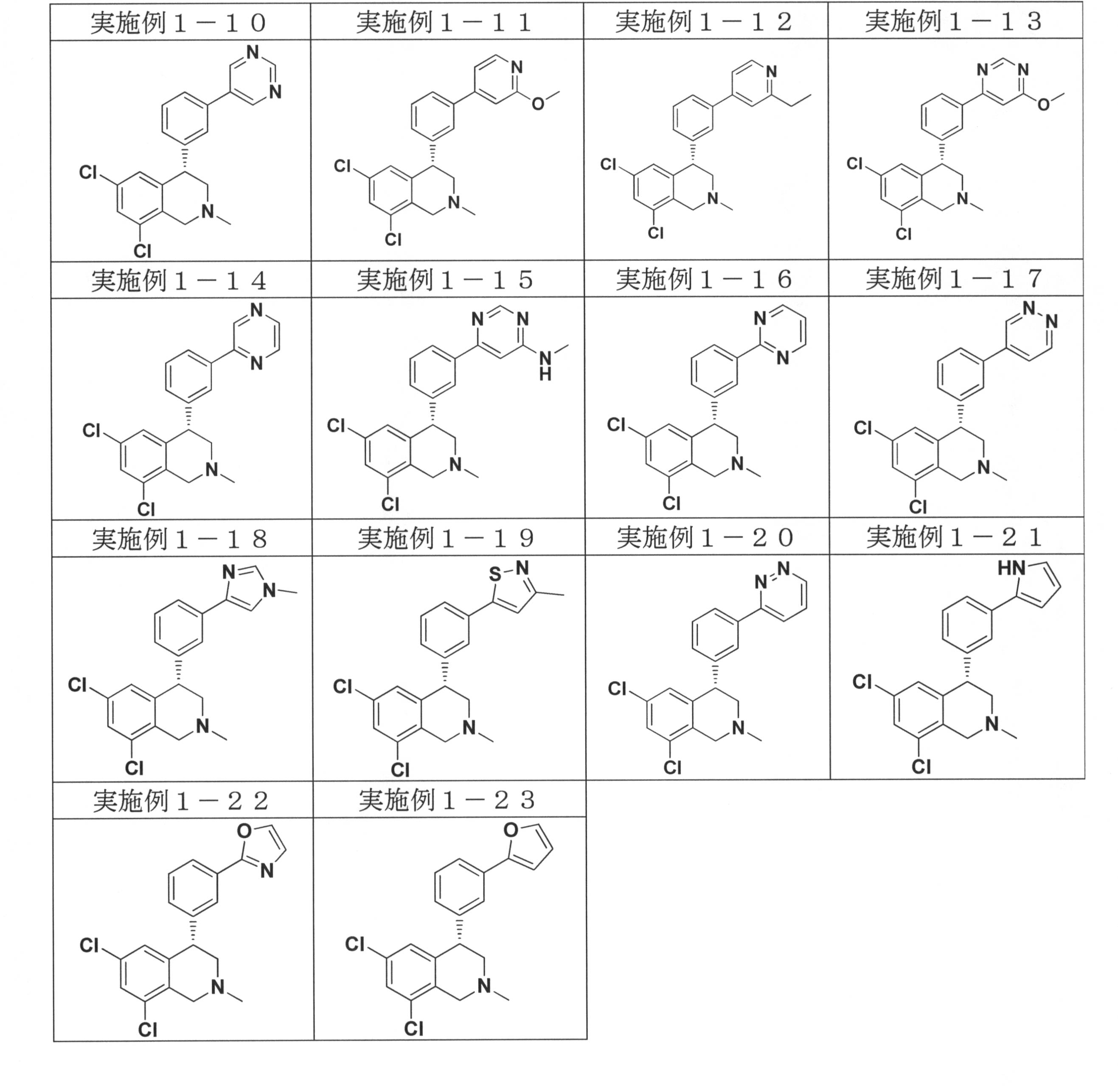

1H NMR (300 MHz, CD3OD) δ ppm 2.75 (s, 3H), 2.92-3.05 (m, 1H), 3.38 (dd, J=11.2, 5.1Hz, 1H), 3.88 (d, J=16.2Hz, 1H), 4.25 (d, J=16.5Hz, 1H), 4.83-4.97 (m, 1H), 6.82 (d, J=1.2Hz, 1H), 7.13-7.30 (m, 2H), 7.44 (t, J=7.8Hz, 1H), 8.10 (d, J=7.8Hz, 1H), 8.23 (s, 1H).
MS (+) : 360 [M+H]+.
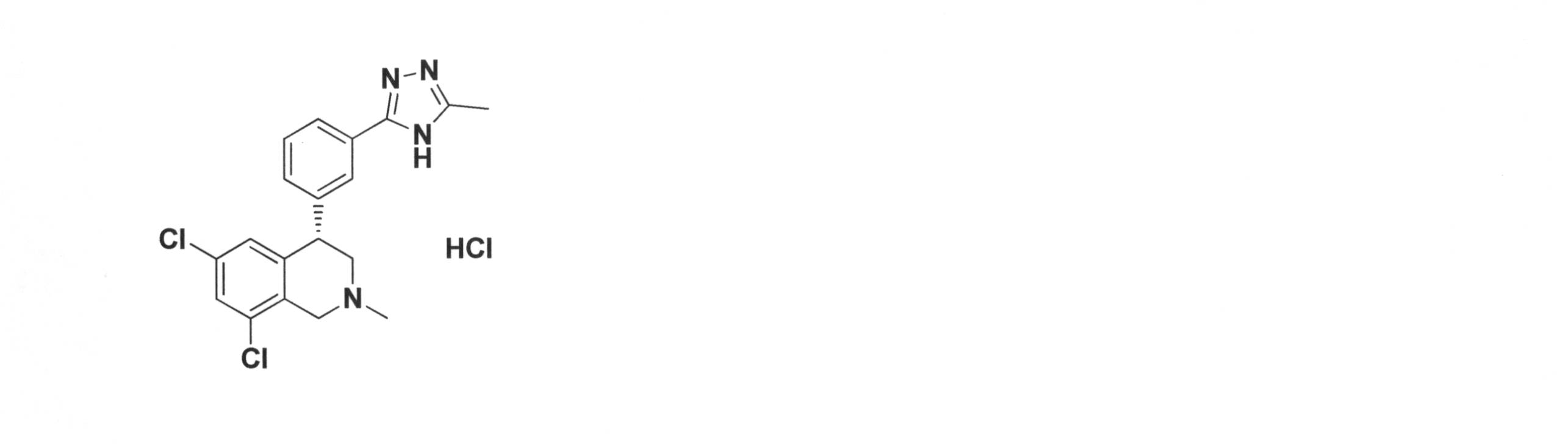
1H NMR (300 MHz, CD3OD) δ ppm 2.72 (s, 3H), 3.18 (s, 3H), 3.59-3.79 (m, 1H), 3.93 (dd, J=11.8, 6.1Hz, 1H), 4.47-4.65 (m, 1H), 4.76-4.86 (m, 2H), 6.88 (br. s., 1H), 7.52-7.60 (m, 2H), 7.68 (t, J=7.8Hz, 1H), 7.94-8.05 (m, 2H).
MS (+) : 373 [M+H]+.
MS (-) : 371 [M-H]-.

1H NMR (300 MHz, CD3OD) δ ppm 2.65 (s, 3H), 3.16 (s, 3H), 3.55-3.72 (m, 1H), 3.86-3.96 (m, 1H), 4.43-4.55 (m, 1H), 4.68-4.85 (m, 2H), 6.84-6.92 (m, 1H), 7.44-7.64 (m, 3H), 7.96 (s, 1H), 8.04-8.12 (m, 1H).
MS (+) : 374 [M+H]+.
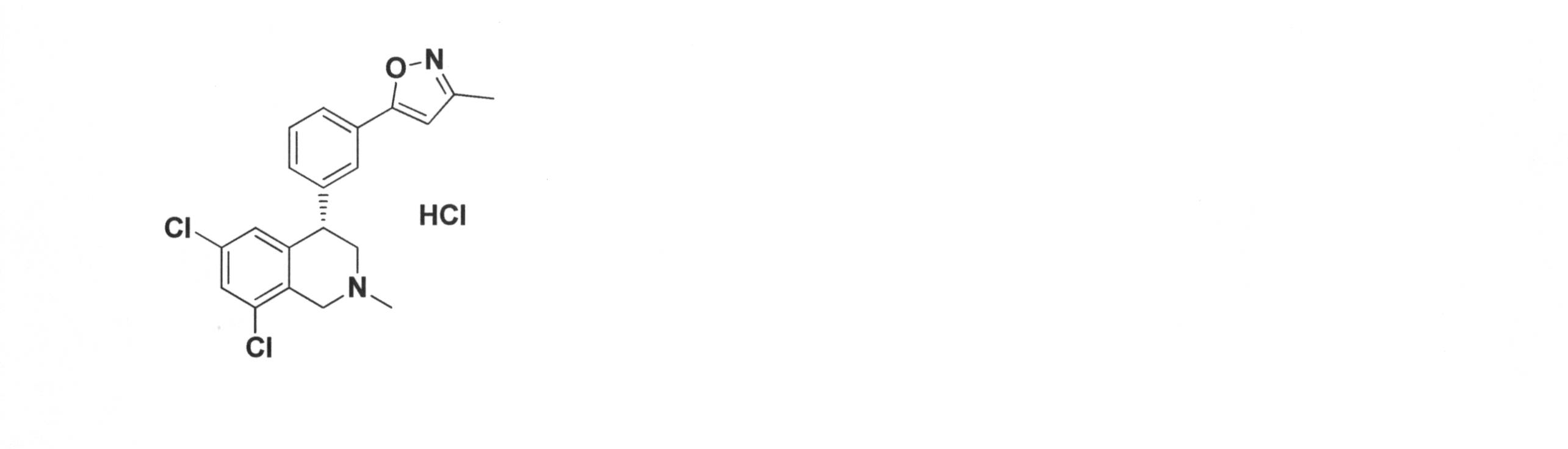
1H NMR (600 MHz, DMSO-d6) δ ppm 2.28 (s, 3H), 2.98 (br. s., 3H), 3.51-3.69 (m, 1H), 3.69-3.88 (m, 1H), 4.31-4.48 (m, 1H), 4.53-4.70 (m, 1H), 4.70-4.80 (m, 1H), 6.78 (br. s., 1H), 6.91 (s, 1H), 7.39 (d, J=8.0Hz, 1H), 7.57 (t, J=8.0Hz, 1H), 7.68 (br. s., 1H), 7.76 (s, 1H), 7.83 (d, J=8.0Hz, 1H), 11.22 (br. s., 1H).
MS (+) : 373 [M+H]+
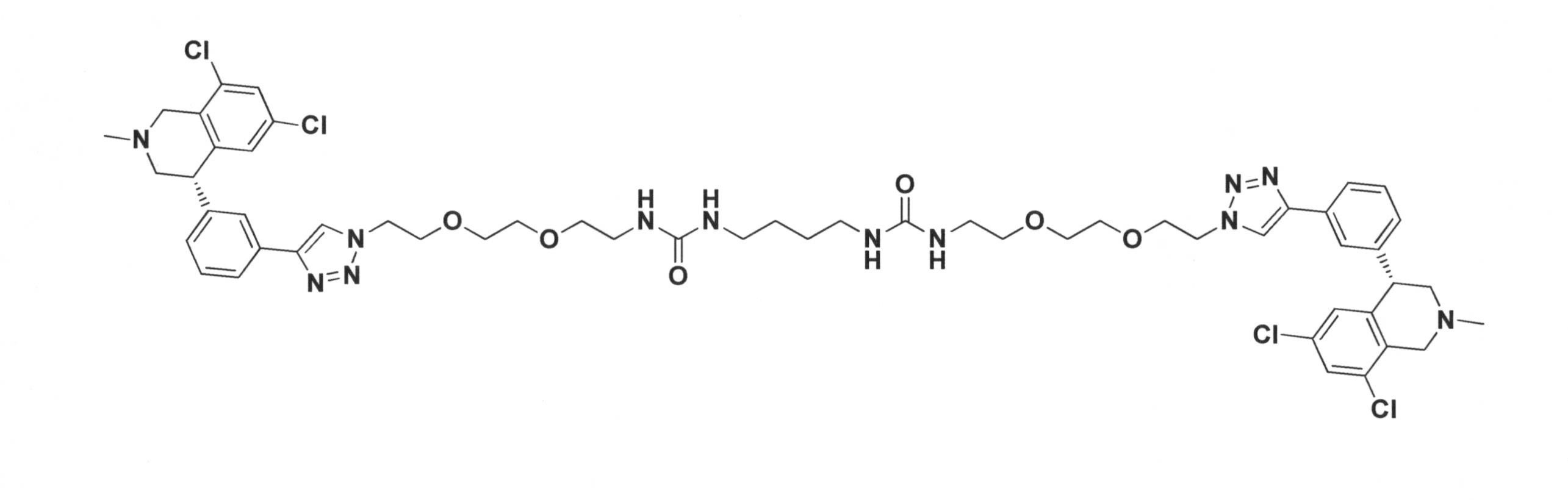
LC-MS 保持時間 0.548 min
LC:Agilent 1290
ESI/APCI MS:Agilent 6130
Column: Waters Acquity CSH C18 1.7um, 2.1x50mm
Solvent: H2O:CH3CN(0.1% Formic acid)
Gradient: 0.8mL/min, 0min(80:20) →1.2-1.4min(1:99)
MS (+) : 1121 [M+H]+.
参考例2-2で得られた(4S)-6,8-ジクロロ-4-(3-エチニルフェニル)-2-メチル-1,2,3,4-テトラヒドロイソキノリン塩酸塩(0.30g)のtert-ブタノール(4.0mL)-水(1.0mL)混合溶液に、参考例5-2で得られた1,1’-ブタン-1,4-ジイルビス[3-(2-{2-[2-(2-アジドエトキシ)エトキシ]エトキシ}エチル)尿素](0.25g)、硫酸銅(21mg)、アスコルビン酸ナトリウム(33mg)を加え、室温で3時間攪拌した。その後、加熱還流下で2日間攪拌した。反応溶液を減圧下濃縮し、得られた残渣をシリカゲルカラムクロマトグラフィー(Biotage(登録商標)SNAP Cartridge KP-NH、クロロホルム:メタノール=100:0→70:30)で精製し、減圧下溶媒を留去した。得られた残渣をLC-MS分取(LC(Agilent1260)、ESIMS(6130Quadrupole、ESI)、カラム(YMC-Actus Triart 5μm C18 50x30mm)、移動相(0.1%ギ酸 in H2O:0.1%ギ酸 in CH3CN=90:10→80:20→5:95)、50mL/min.)で精製した。減圧下溶媒を留去し、得られた残渣をシリカゲルカラムクロマトグラフィー(Biotage(登録商標)SNAP Cartridge KP-NH、クロロホルム:メタノール=100:0→70:30)で精製した。減圧下溶媒を留去し、得られた残渣をエタノールに溶解させ、4mol/L塩化水素-1,4-ジオキサン(0.20mL)を加え、溶媒を減圧下留去して、表題化合物(78mg)を無色アモルファス状物質として得た。
LC-MS 保持時間0.555 min
LC:Agilent 1290
ESI/APCI MS:Agilent 6130
Column: Waters Acquity CSH C18 1.7um, 2.1x50mm
Solvent: H2O:CH3CN(0.1% Formic acid)
Gradient: 0.8mL/min, 0min(80:20) →1.2-1.4min(1:99)
MS (+) : 1209 [M+H]+, 1231 [M+Na] +.
参考例5-2で得られた1,1’-ブタン-1,4-ジイルビス[3-(2-{2-[2-(2-アジドエトキシ)エトキシ]エトキシ}エチル)尿素]を使用する代わりに参考例6-1で得られたN,N’-ビス{2-[2-(2-アジドエトキシ)エトキシ]エチル}ブタンジアミドを使用する以外は、実質的に実施例6-2と同様の反応を実施して、表題化合物(7.0mg)を無色アモルファス状物質として得た。
LC-MS 保持時間 0.542 min
LC:Agilent 1290
ESI/APCI MS:Agilent 6130
Column: Waters Acquity CSH C18 1.7um, 2.1x50mm
Solvent: H2O:CH3CN(0.1% Formic acid)
Gradient: 0.8mL/min, 0min(80:20) →1.2-1.4min(1:99)
MS (+) : 1063 [M+H]+.
参考例5-2で得られた1,1’-ブタン-1,4-ジイルビス[3-(2-{2-[2-(2-アジドエトキシ)エトキシ]エトキシ}エチル)尿素]を使用する代わりに参考例6-2で得られた1-アジド-N-{2-[2-(2-アジドエトキシ)エトキシ]エチル}-10-オキソ-3,6,12-トリオキサ-9-アザテトラデカン-14-アミドを使用する以外は、実質的に実施例6-2と同様の反応を実施して、表題化合物(33mg)を無色アモルファス状物質として得た。
LC-MS 保持時間 1.027 min
LC:Agilent 1290
ESI/APCI MS:Agilent 6130
Column: Waters Acquity CSH C18 1.7um, 2.1x50mm
Solvent: H2O:CH3CN(0.1% Formic acid)
Gradient: 0.8mL/min, 0min(95:5) →1.2min(50:50)
1.0mL/min, →1.38min(3:97)
MS (+) : 1079 [M+H]+.
参考例5-2で得られた1,1’-ブタン-1,4-ジイルビス[3-(2-{2-[2-(2-アジドエトキシ)エトキシ]エトキシ}エチル)尿素]を使用する代わりに参考例5-3で得られた1,1’-ベンゼン-1,4-ジイルビス(3-{2-[2-(2-アジドエトキシ)エトキシ]エチル}尿素)を使用する以外は、実質的に実施例6-2と同様の反応を実施して、表題化合物(41mg)を無色アモルファス状物質として得た。
LC-MS 保持時間 1.069 min
LC:Agilent 1290
ESI/APCI MS:Agilent 6130
Column: Waters Acquity CSH C18 1.7um, 2.1x50mm
Solvent: H2O:CH3CN(0.1% Formic acid)
Gradient: 0.8mL/min, 0min(95:5) →1.2min(50:50)
1.0mL/min, →1.38min(3:97)
MS (+) : 1141 [M+H]+.
参考例5-2で得られた1,1’-ブタン-1,4-ジイルビス[3-(2-{2-[2-(2-アジドエトキシ)エトキシ]エトキシ}エチル)尿素]を使用する代わりに参考例6-3で得られた(2R,3R)-N,N’-ビス{2-[2-(2-アジドエトキシ)エトキシ]エチル}-2,3-ジヒドロキシブタンジアミドを使用する以外は、実質的に実施例6-2と同様の反応を実施して、表題化合物(20mg)を無色アモルファス状物質として得た。
LC-MS 保持時間 1.008 min
LC:Agilent 1290
ESI/APCI MS:Agilent 6130
Column: Waters Acquity CSH C18 1.7um, 2.1x50mm
Solvent: H2O:CH3CN(0.1% Formic acid)
Gradient: 0.8mL/min, 0min(95:5) →1.2min(50:50)
1.0mL/min, →1.38min(3:97)
MS (+) : 1095 [M+H]+.
参考例6-4で得られた(2R,3S,4R,5S)-N,N’-ビス{2-[2-(2-アジドエトキシ)エトキシ]エチル}-2,3,4,5-テトラヒドロキシヘキサンジアミド(74mg)のtert-ブタノール(8.0mL)-水(2.0mL)混合溶液に、参考例2-2で得られた(4S)-6,8-ジクロロ-4-(3-エチニルフェニル)-2-メチル-1,2,3,4-テトラヒドロイソキノリン塩酸塩(0.10g)、硫酸銅(7.1mg)、アスコルビン酸ナトリウム(11mg)、トリエチルアミン(0.40mL)を加え、室温で3時間攪拌した。反応溶液を減圧下濃縮し、得られた残渣をシリカゲルカラムクロマトグラフィー(Biotage(登録商標)SNAP Cartridge KP-NH、クロロホルム:メタノール=100:0→70:30)で精製し、減圧下溶媒を留去した。得られた残渣をエタノールに溶解させ、4mol/L塩化水素-1,4-ジオキサン(0.20mL)を加え、溶媒を減圧下留去して、表題化合物(0.15g)を淡緑色アモルファス状物質として得た。
LC-MS 保持時間 0.976 min
LC:Agilent 1290
ESI/APCI MS:Agilent 6130
Column: Waters Acquity CSH C18 1.7um, 2.1x50mm
Solvent: H2O:CH3CN(0.1% Formic acid)
Gradient: 0.8mL/min, 0min(95:5) →1.2min(50:50)
1.0mL/min, →1.38min(3:97)
MS (+) : 1155 [M+H]+.
参考例6-5で得られた(2R,3S,4R,5S)-N,N’-ビス(2-{2-[2-(2-アジドエトキシ)エトキシ]エトキシ}エチル)-2,3,4,5-テトラヒドロキシヘキサンジアミド(87mg)のtert-ブタノール(8.0mL)-水(2.0mL)混合溶液に、参考例2-2で得られた(4S)-6,8-ジクロロ-4-(3-エチニルフェニル)-2-メチル-1,2,3,4-テトラヒドロイソキノリン塩酸塩(0.10g)、硫酸銅(7.1mg)、アスコルビン酸ナトリウム(11mg)、トリエチルアミン(0.40mL)を加え、室温で3時間攪拌した。反応溶液を減圧下濃縮し、得られた残渣をシリカゲルカラムクロマトグラフィー(Biotage(登録商標)SNAP Cartridge KP-NH、クロロホルム:メタノール=100:0→70:30)で精製し、減圧下溶媒を留去した。得られた残渣をエタノールに溶解させ、4mol/L塩化水素-1,4-ジオキサン(0.20mL)を加え、溶媒を減圧下留去して、表題化合物(0.14g)を淡緑色アモルファス状物質として得た。
LC-MS 保持時間 1.016 min
LC:Agilent 1290
ESI/APCI MS:Agilent 6130
Column: Waters Acquity CSH C18 1.7um, 2.1x50mm
Solvent: H2O:CH3CN(0.1% Formic acid)
Gradient: 0.8mL/min, 0min(95:5) →1.2min(50:50)
1.0mL/min, →1.38min(3:97)
MS (+) : 1243 [M+H]+.
参考例2-2で得られた(4S)-6,8-ジクロロ-4-(3-エチニルフェニル)-2-メチル-1,2,3,4-テトラヒドロイソキノリン塩酸塩(0.13g)、硫酸銅(2.8mg)、アスコルビン酸ナトリウム(7.1mg)、N,N-ジイソプロピルエチルアミン(0.18mL)のエタノール(6.4mL)-水(1.6mL)混合溶液に、参考例7-4で得られた(2R,3R)-N,N’-ビス(14-アジド-3,6,9,12-テトラオキサテトラデカ-1-イル)-2,3-ジヒドロキシブタンジアミド(0.11g)のエタノール(1.6mL)-水(0.4mL)混合溶液を加え、室温で22時間攪拌した。その後、硫酸銅(2.8mg)、アスコルビン酸ナトリウム(7.1mg)を加え、室温で24時間攪拌した。反応溶液を減圧下濃縮し、得られた残渣を逆相分取HPLC(カラム(YMC-Actus Triart 5μm C18 50x30mm)、移動相(0.1%ギ酸 in H2O:0.1%ギ酸 in MeCN=95:5→80:20→50:50→5:95、40mL/min.)で精製した。減圧下溶媒を留去し、得られた残渣をシリカゲルカラムクロマトグラフィー(Biotage(登録商標)SNAP Cartridge KP-NH、クロロホルム:メタノール=98:2→85:15)で精製した。減圧下溶媒を留去し、得られた残渣(30mg)にエタノール(3.0mL)、4mol/L塩化水素-酢酸エチル(24μL)を加え、室温で15分間攪拌した。減圧下溶媒を留去し、得られた残渣にジエチルエーテルを加え、粉末化した後、上澄みを除去した。得られた残渣を減圧下濃縮して、表題化合物(33mg、14%)を無色アモルファス状物質として得た。
LC-MS 保持時間 1.041 min
LC:Agilent 1290
ESI/APCI MS:Agilent 6130
Column: Waters Acquity CSH C18 1.7um, 2.1x50mm
Solvent: H2O:CH3CN(0.1% Formic acid)
Gradient: 0.8mL/min, 0min(95:5) →1.2min(50:50)
1.0mL/min, →1.38min(3:97)
MS (+) : 1271 [M+H]+.
参考例7-4で得られた(2R,3R)-N,N’-ビス(14-アジド-3,6,9,12-テトラオキサテトラデカ-1-イル)-2,3-ジヒドロキシブタンジアミドを使用する代わりに参考例7-5で得られた(2R,3R)-N,N’-ビス(17-アジド-3,6,9,12,15-ペンタオキサヘプタデカ-1-イル)-2,3-ジヒドロキシブタンジアミドを使用する以外は、実質的に実施例6-9と同様の反応を実施して、表題化合物(37mg、9.9%)を無色アモルファス状物質として得た。
LC-MS 保持時間 1.059 min
LC:Agilent 1290
ESI/APCI MS:Agilent 6130
Column: Waters Acquity CSH C18 1.7um, 2.1x50mm
Solvent: H2O:CH3CN(0.1% Formic acid)
Gradient: 0.8mL/min, 0min(95:5) →1.2min(50:50)
1.0mL/min, →1.38min(3:97)
MS (+) : 1360 [M+H]+.
参考例7-4で得られた(2R,3R)-N,N’-ビス(14-アジド-3,6,9,12-テトラオキサテトラデカ-1-イル)-2,3-ジヒドロキシブタンジアミドを使用する代わりに参考例7-6で得られた(2R,3S,4R,5S)-N,N’-ビス(14-アジド-3,6,9,12-テトラオキサテトラデカ-1-イル)-2,3,4,5-テトラヒドロキシヘキサンジアミドを使用する以外は、実質的に実施例6-9と同様の反応を実施して、表題化合物(72mg、19%)を無色アモルファス状物質として得た。
LC-MS 保持時間 1.022 min
LC:Agilent 1290
ESI/APCI MS:Agilent 6130
Column: Waters Acquity CSH C18 1.7um, 2.1x50mm
Solvent: H2O:CH3CN(0.1% Formic acid)
Gradient: 0.8mL/min, 0min(95:5) →1.2min(50:50)
1.0mL/min, →1.38min(3:97)
MS (-) : 1329 [M-H]-.
参考例7-4で得られた(2R,3R)-N,N’-ビス(14-アジド-3,6,9,12-テトラオキサテトラデカ-1-イル)-2,3-ジヒドロキシブタンジアミドを使用する代わりに参考例7-7で得られた(2R,3S,4R,5S)-N,N’-ビス(17-アジド-3,6,9,12,15-ペンタオキサヘプタデカ-1-イル)-2,3,4,5-テトラヒドロキシヘキサンジアミドを使用する以外は、実質的に実施例6-9と同様の反応を実施して、表題化合物(85mg、19%)を無色アモルファス状物質として得た。
LC-MS 保持時間 1.037 min
LC:Agilent 1290
ESI/APCI MS:Agilent 6130
Column: Waters Acquity CSH C18 1.7um, 2.1x50mm
Solvent: H2O:CH3CN(0.1% Formic acid)
Gradient: 0.8mL/min, 0min(95:5) →1.2min(50:50)
1.0mL/min, →1.38min(3:97)
MS (+) : 1420 [M+H]+.
参考例2-2で得られた(4S)-6,8-ジクロロ-4-(3-エチニルフェニル)-2-メチル-1,2,3,4-テトラヒドロイソキノリン塩酸塩(0.12g)のエタノール(6.0mL)-水(1.5mL)混合溶液に、炭酸水素ナトリウム(30mg)を加え、窒素ガス雰囲気下で10分間攪拌後、参考例5-4で得られた1,1’-[カルボニルビス(イミノエタン-2,1-ジイル)]ビス[3-(2-{2-[2-(2-アジドエトキシ)エトキシ]エトキシ}エチル)尿素](0.10g)、硫酸銅(2.6mg)、アスコルビン酸ナトリウム(7.0mg)を加え、50℃で3時間攪拌した。反応溶液を減圧下濃縮し、得られた残渣をシリカゲルカラムクロマトグラフィー(Biotage(登録商標)SNAP Cartridge KP-NH、クロロホルム:メタノール=100:0→60:40)で精製した。減圧下溶媒を留去し、得られた残渣に1,4-ジオキサン(2.0mL)を加えた後、4mol/L塩化水素-1,4-ジオキサン(0.88mL)を加え、攪拌した。減圧下溶媒を留去し、得られた残渣を少量のメタノールに溶解させた後、酢酸エチルを加えた。得られた懸濁液を減圧下濃縮して、表題化合物(0.10g、49%)を無色アモルファス状物質として得た。
LC-MS 保持時間0.561 min
LC:Agilent 1290
ESI/APCI MS:Agilent 6130
Column: Waters Acquity CSH C18 1.7um, 2.1x50mm
Solvent: H2O:CH3CN(0.1% Formic acid)
Gradient: 0.8mL/min, 0min(80:20) →1.2-1.4min(1:99)
MS (+) : 1267 [M+H]+.
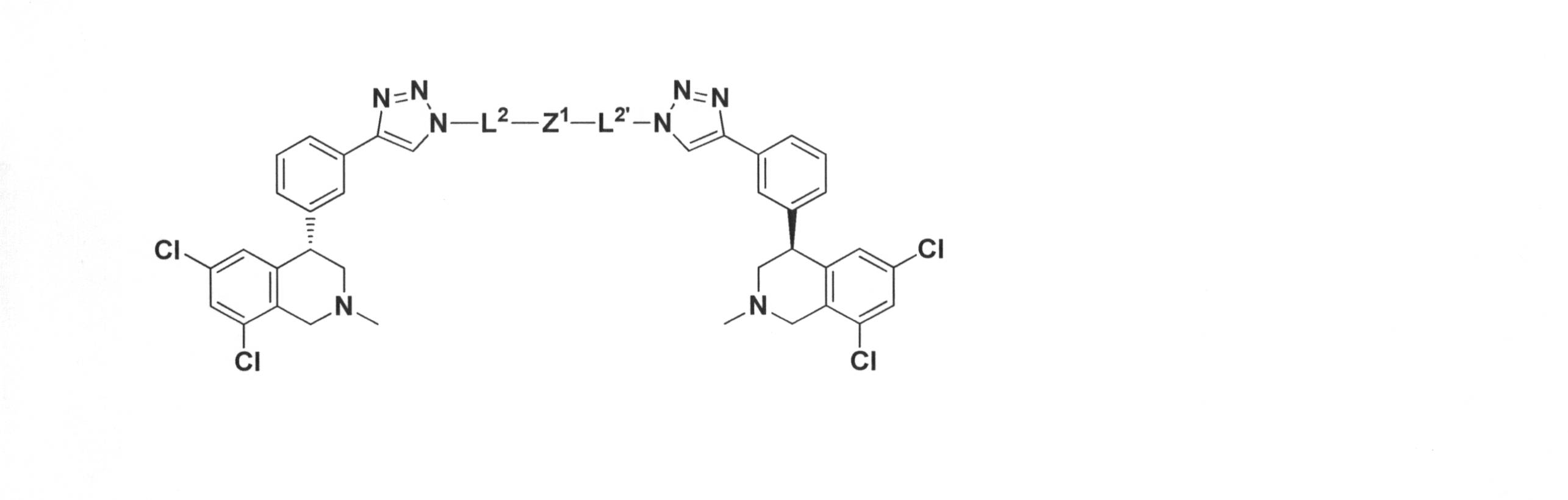
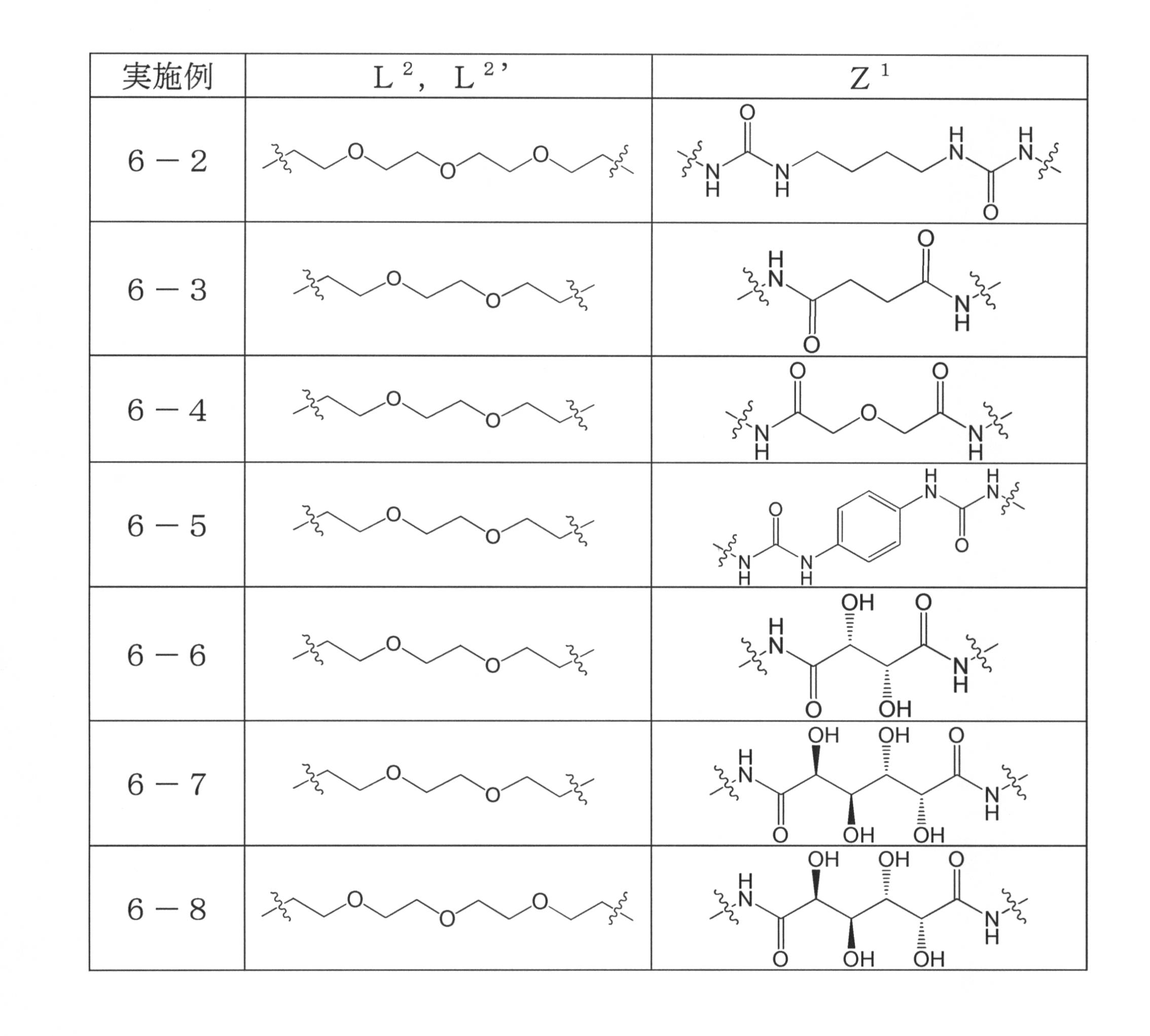
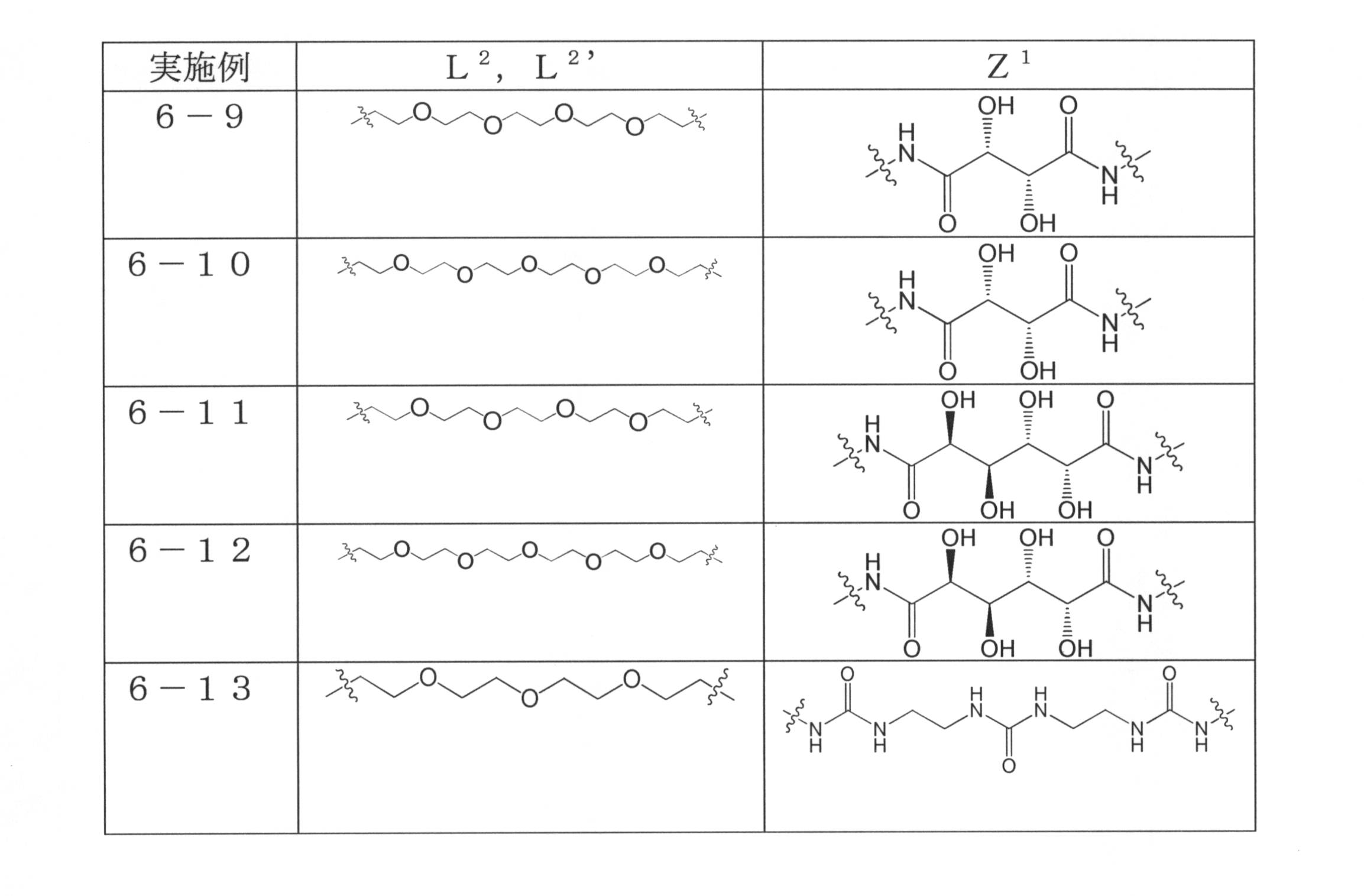

LC-MS 保持時間 1.078 min
LC:Agilent 1290
ESI/APCI MS:Agilent 6130
Column: Waters Acquity CSH C18 1.7um, 2.1x50mm
Solvent: H2O:CH3CN(0.1% Formic acid)
Gradient: 0.8mL/min, 0min(95:5) →1.2min(50:50)
1.0mL/min, →1.38min(3:97)
MS (+) : 1297 [M+H]+.
参考例8-3で得られたN-{2-[2-(2-アミノエトキシ)エトキシ]エチル}-6-{3-[(4S)-6,8-ジクロロ-2-メチル-1,2,3,4-テトラヒドロイソキノリン-4-イル]フェニル}ピリミジン-4-アミン トリフルオロ酢酸塩(0.12g)の1,2-ジクロロエタン(10mL)溶液に、トリエチルアミン(0.17mL)を加えた後、1,4-ジイソシアナトブタン(8.0mg)の1,2-ジクロロエタン(4.0mL)溶液を滴下し、室温で15分間攪拌した。反応溶液を減圧下濃縮後、逆相分取HPLC(カラム(YMC-Actus Triart 5μm C18 50x30mm)、移動相(0.1%トリフルオロ酢酸 in H2O:0.1%トリフルオロ酢酸 in MeCN=97:3→30:70→5:95、40mL/min.)で精製し、更にリカゲルカラムクロマトグラフィー(MORITEX Purif Pack-NH)で精製した。減圧下溶媒を留去し、得られた残渣(49mg)にエタノール(1.5mL)、2mol/L塩酸(0.13mL)を加えた後、減圧下溶媒を留去して、表題化合物(55mg、61%)を淡黄色アモルファス状物質として得た。
LC-MS 保持時間 0.851 min
LC:Agilent 1290
ESI/APCI MS:Agilent 6130
Column: Waters Acquity CSH C18 1.7um, 2.1x50mm
Solvent: H2O:CH3CN(0.1% Formic acid)
Gradient: 0.8mL/min, 0min(95:5) →1.2min(50:50)
1.0mL/min, →1.38min(3:97)
MS (+) : 1173 [M+H]+.
参考例8-3で得られたN-{2-[2-(2-アミノエトキシ)エトキシ]エチル}-6-{3-[(4S)-6,8-ジクロロ-2-メチル-1,2,3,4-テトラヒドロイソキノリン-4-イル]フェニル}ピリミジン-4-アミン トリフルオロ酢酸塩を使用する代わりに、参考例8-5で得られたN-{2-[2-(2-アミノエトキシ)エトキシ]エチル}-5-{3-[(4S)-6,8-ジクロロ-2-メチル-1,2,3,4-テトラヒドロイソキノリン-4-イル]フェニル}ピリミジン-2-アミン トリフルオロ酢酸塩を使用する以外は、実質的に実施例7-2と同様の反応を実施して、表題化合物(32mg)を淡黄色アモルファス状物質として得た。
LC-MS 保持時間 1.103 min
LC:Agilent 1290
ESI/APCI MS:Agilent 6130
Column: Waters Acquity CSH C18 1.7um, 2.1x50mm
Solvent: H2O:CH3CN(0.1% Formic acid)
Gradient: 0.8mL/min, 0min(95:5) →1.2min(50:50)
1.0mL/min, →1.38min(3:97)
MS (+) : 1173 [M+H]+.
参考例8-3で得られたN-{2-[2-(2-アミノエトキシ)エトキシ]エチル}-6-{3-[(4S)-6,8-ジクロロ-2-メチル-1,2,3,4-テトラヒドロイソキノリン-4-イル]フェニル}ピリミジン-4-アミン トリフルオロ酢酸塩を使用する代わりに、参考例8-7で得られたN-{2-[2-(2-アミノエトキシ)エトキシ]エチル}-4-{3-[(4S)-6,8-ジクロロ-2-メチル-1,2,3,4-テトラヒドロイソキノリン-4-イル]フェニル}ピリジン-2-アミン トリフルオロ酢酸塩を使用する以外は、実質的に実施例7-2と同様の反応を実施して、表題化合物(62mg)を無色アモルファス状物質として得た。
LC-MS 保持時間 0.806 min
LC:Agilent 1290
ESI/APCI MS:Agilent 6130
Column: Waters Acquity CSH C18 1.7um, 2.1x50mm
Solvent: H2O:CH3CN(0.1% Formic acid)
Gradient: 0.8mL/min, 0min(95:5) →1.2min(50:50)
1.0mL/min, →1.38min(3:97)
MS (+) : 1171 [M+H]+.
参考例7-2で得られた14-(4-{3-[(4S)-6,8-ジクロロ-2-メチル-1,2,3,4-テトラヒドロイソキノリン-4-イル]フェニル}-1H-1,2,3-トリアゾール-1-イル)-3,6,9,12-テトラオキサテトラデカン-1-アミンを使用する代わりに、参考例12-1で得られた2-{2-[2-(4-{3-[(4S)-6,8-ジクロロ-2-メチル-1,2,3,4-テトラヒドロイソキノリン-4-イル]フェニル}-1H-ピラゾール-1-イル)エトキシ]エトキシ}エタンアミンを使用する以外は、実質的に実施例7-1と同様の反応を実施して(塩酸塩とする操作は行わない)、表題化合物(3.1mg、5.1%)を無色油状物質として得た。
LC-MS 保持時間1.083 min
LC:Agilent 1290
ESI/APCI MS:Agilent 6130
Column: Waters Acquity CSH C18 1.7um, 2.1x50mm
Solvent: H2O:CH3CN(0.1% Formic acid)
Gradient: 0.8mL/min, 0min(95:5) →1.2min(50:50)
1.0mL/min, →1.38min(3:97)
MS (+) : 1119 [M+H]+.
参考例8-3で得られたN-{2-[2-(2-アミノエトキシ)エトキシ]エチル}-6-{3-[(4S)-6,8-ジクロロ-2-メチル-1,2,3,4-テトラヒドロイソキノリン-4-イル]フェニル}ピリミジン-4-アミン トリフルオロ酢酸塩を使用する代わりに、参考例8-8で得られたN-{2-[2-(2-アミノエトキシ)エトキシ]エチル}-6-{3-[(4S)-6,8-ジクロロ-2-メチル-1,2,3,4-テトラヒドロイソキノリン-4-イル]フェニル}ピリダジン-4-アミン トリフルオロ酢酸塩を使用する以外は、実質的に実施例7-2と同様の反応を実施して、表題化合物(34mg、22%)を淡黄色アモルファス状物質として得た。
LC-MS 保持時間 0.748 min
LC:Agilent 1290
ESI/APCI MS:Agilent 6130
Column: Waters Acquity CSH C18 1.7um, 2.1x50mm
Solvent: H2O:CH3CN(0.1% Formic acid)
Gradient: 0.8mL/min, 0min(95:5) →1.2min(50:50)
1.0mL/min, →1.38min(3:97)
MS (+) : 1173 [M+H]+.
参考例8-3で得られたN-{2-[2-(2-アミノエトキシ)エトキシ]エチル}-6-{3-[(4S)-6,8-ジクロロ-2-メチル-1,2,3,4-テトラヒドロイソキノリン-4-イル]フェニル}ピリミジン-4-アミン トリフルオロ酢酸塩を使用する代わりに、参考例10-1で得られたN-{2-[2-(2-アミノエトキシ)エトキシ]エチル}-5-{3-[(4S)-6,8-ジクロロ-2-メチル-1,2,3,4-テトラヒドロイソキノリン-4-イル]フェニル}ピリジン-2-アミン トリフルオロ酢酸塩を使用する以外は、実質的に実施例7-2と同様の反応を実施して(塩酸塩とする操作は行わない)、表題化合物(4.0mg、13%)を淡褐色固体として得た。
LC-MS 保持時間 0.829 min
LC:Agilent 1290
ESI/APCI MS:Agilent 6130
Column: Waters Acquity CSH C18 1.7um, 2.1x50mm
Solvent: H2O:CH3CN(0.1% Formic acid)
Gradient: 0.8mL/min, 0min(95:5) →1.2min(50:50)
1.0mL/min, →1.38min(3:97)
MS (+) : 1171 [M+H]+.
参考例8-3で得られたN-{2-[2-(2-アミノエトキシ)エトキシ]エチル}-6-{3-[(4S)-6,8-ジクロロ-2-メチル-1,2,3,4-テトラヒドロイソキノリン-4-イル]フェニル}ピリミジン-4-アミン トリフルオロ酢酸塩を使用する代わりに、参考例10-1で得られたN-{2-[2-(2-アミノエトキシ)エトキシ]エチル}-5-{3-[(4S)-6,8-ジクロロ-2-メチル-1,2,3,4-テトラヒドロイソキノリン-4-イル]フェニル}ピリジン-2-アミン トリフルオロ酢酸塩を使用し、1,4-ジイソシアナトブタンを使用する代わりに1,4-ジイソシアナトベンゼンを使用する以外は、実質的に実施例7-2と同様の反応を実施して(塩酸塩とする操作は行わない)、表題化合物(4.0mg、13%)を淡褐色固体として得た。
LC-MS 保持時間 0.845 min
LC:Agilent 1290
ESI/APCI MS:Agilent 6130
Column: Waters Acquity CSH C18 1.7um, 2.1x50mm
Solvent: H2O:CH3CN(0.1% Formic acid)
Gradient: 0.8mL/min, 0min(95:5) →1.2min(50:50)
1.0mL/min, →1.38min(3:97)
MS (+) : 1191 [M+H]+.
参考例8-3で得られたN-{2-[2-(2-アミノエトキシ)エトキシ]エチル}-6-{3-[(4S)-6,8-ジクロロ-2-メチル-1,2,3,4-テトラヒドロイソキノリン-4-イル]フェニル}ピリミジン-4-アミン トリフルオロ酢酸塩を使用する代わりに、参考例12-2で得られた2-{2-[2-(5-{3-[(4S)-6,8-ジクロロ-2-メチル-1,2,3,4-テトラヒドロイソキノリン-4-イル]フェニル}-2H-テトラゾール-2-イル)エトキシ]エトキシ}エタンアミン トリフルオロ酢酸塩を使用する以外は、実質的に実施例7-2と同様の反応を実施して、表題化合物(62mg)を無色固体として得た。
LC-MS 保持時間1.099 min
LC:Agilent 1290
ESI/APCI MS:Agilent 6130
Column: Waters Acquity CSH C18 1.7um, 2.1x50mm
Solvent: H2O:CH3CN(0.1% Formic acid)
Gradient: 0.8mL/min, 0min(95:5) →1.2min(50:50)
1.0mL/min, →1.38min(3:97)
MS (+) : 1123 [M+H]+.
参考例8-3で得られたN-{2-[2-(2-アミノエトキシ)エトキシ]エチル}-6-{3-[(4S)-6,8-ジクロロ-2-メチル-1,2,3,4-テトラヒドロイソキノリン-4-イル]フェニル}ピリミジン-4-アミン トリフルオロ酢酸塩を使用する代わりに、参考例12-2で得られた2-{2-[2-(5-{3-[(4S)-6,8-ジクロロ-2-メチル-1,2,3,4-テトラヒドロイソキノリン-4-イル]フェニル}-2H-テトラゾール-2-イル)エトキシ]エトキシ}エタンアミン トリフルオロ酢酸塩を使用し、1,4-ジイソシアナトブタンを使用する代わりに1,4-ジイソシアナトベンゼンを使用する以外は、実質的に実施例7-2と同様の反応を実施して、表題化合物(17mg)を無色固体として得た。
LC-MS 保持時間1.135 min
LC:Agilent 1290
ESI/APCI MS:Agilent 6130
Column: Waters Acquity CSH C18 1.7um, 2.1x50mm
Solvent: H2O:CH3CN(0.1% Formic acid)
Gradient: 0.8mL/min, 0min(95:5) →1.2min(50:50)
1.0mL/min, →1.38min(3:97)
MS (+) : 1143 [M+H]+.
参考例8-3で得られたN-{2-[2-(2-アミノエトキシ)エトキシ]エチル}-6-{3-[(4S)-6,8-ジクロロ-2-メチル-1,2,3,4-テトラヒドロイソキノリン-4-イル]フェニル}ピリミジン-4-アミン トリフルオロ酢酸塩を使用する代わりに参考例11-1で得られた2-(2-{2-[(6-{3-[(4S)-6,8-ジクロロ-2-メチル-1,2,3,4-テトラヒドロイソキノリン-4-イル]フェニル}ピリミジン-4-イル)オキシ]エトキシ}エトキシ)エタンアミンのトリフルオロ酢酸塩を使用し、1,4-ジイソシアナトブタンを使用する代わりに1,4-ジイソシアナトベンゼンを使用する以外は、実質的に実施例7-2と同様の反応を実施して(塩酸塩とする操作は行わない)、表題化合物(2.2mg)を淡黄色アモルファス状物質として得た。
LC-MS 保持時間 0.642 min
LC:Agilent 1290
ESI/APCI MS:Agilent 6130
Column: Waters Acquity CSH C18 1.7um, 2.1x50mm
Solvent: H2O:CH3CN(0.1% Formic acid)
Gradient: 0.8mL/min, 0min(80:20) →1.2-1.4min(1:99)
MS (+) : 1195 [M+H]+.
参考例8-3で得られたN-{2-[2-(2-アミノエトキシ)エトキシ]エチル}-6-{3-[(4S)-6,8-ジクロロ-2-メチル-1,2,3,4-テトラヒドロイソキノリン-4-イル]フェニル}ピリミジン-4-アミン トリフルオロ酢酸塩を使用する代わりに参考例11-1で得られた2-(2-{2-[(6-{3-[(4S)-6,8-ジクロロ-2-メチル-1,2,3,4-テトラヒドロイソキノリン-4-イル]フェニル}ピリミジン-4-イル)オキシ]エトキシ}エトキシ)エタンアミンのトリフルオロ酢酸塩を使用する以外は、実質的に実施例7-2と同様の反応を実施して、表題化合物(15mg、60%)を無色アモルファス状物質として得た。
LC-MS 保持時間 1.143 min
LC:Agilent 1290
ESI/APCI MS:Agilent 6130
Column: Waters Acquity CSH C18 1.7um, 2.1x50mm
Solvent: H2O:CH3CN(0.1% Formic acid)
Gradient: 0.8mL/min, 0min(95:5) →1.2min(50:50)
1.0mL/min, →1.38min(3:97)
MS (+) : 1175 [M+H]+.
参考例7-2で得られた14-(4-{3-[(4S)-6,8-ジクロロ-2-メチル-1,2,3,4-テトラヒドロイソキノリン-4-イル]フェニル}-1H-1,2,3-トリアゾール-1-イル)-3,6,9,12-テトラオキサテトラデカン-1-アミンを使用する代わりに、参考例10-3で得られたN-{2-[2-(2-アミノエトキシ)エトキシ]エチル}-5-{3-[(4S)-6,8-ジクロロ-2-メチル-1,2,3,4-テトラヒドロイソキノリン-4-イル]フェニル}ピリダジン-3-アミンを使用する以外は、実質的に実施例7-1と同様の反応を実施して、表題化合物(25mg、46%)を無色アモルファス状物質として得た。
LC-MS 保持時間 0.744 min
LC:Agilent 1290
ESI/APCI MS:Agilent 6130
Column: Waters Acquity CSH C18 1.7um, 2.1x50mm
Solvent: H2O:CH3CN(0.1% Formic acid)
Gradient: 0.8mL/min, 0min(95:5) →1.2min(50:50)
1.0mL/min, →1.38min(3:97)
MS (+) : 1173 [M+H]+.
1,4-ジイソシアナトブタンを使用する代わりに1,4-ジイソシアナトベンゼンを使用する以外は、実質的に実施例7-2と同様の反応を実施して(塩酸塩とする操作は行わない)、表題化合物(11mg)を淡黄色アモルファス状物質として得た。
LC-MS 保持時間 0.870 min
LC:Agilent 1290
ESI/APCI MS:Agilent 6130
Column: Waters Acquity CSH C18 1.7um, 2.1x50mm
Solvent: H2O:CH3CN(0.1% Formic acid)
Gradient: 0.8mL/min, 0min(95:5) →1.2min(50:50)
1.0mL/min, →1.38min(3:97)
MS (+) : 1193 [M+H]+.
参考例7-2で得られた14-(4-{3-[(4S)-6,8-ジクロロ-2-メチル-1,2,3,4-テトラヒドロイソキノリン-4-イル]フェニル}-1H-1,2,3-トリアゾール-1-イル)-3,6,9,12-テトラオキサテトラデカン-1-アミンを使用する代わりに、参考例13-1で得られた2-{2-[2-(4-{3-[(4S)-6,8-ジクロロ-2-メチル-1,2,3,4-テトラヒドロイソキノリン-4-イル]フェニル}-1H-イミダゾール-1-イル)エトキシ]エトキシ}エタンアミンを使用する以外は、実質的に実施例7-1と同様の反応を実施して、表題化合物(15mg)を無色アモルファス状物質として得た。
LC-MS 保持時間 0.717 min
LC:Agilent 1290
ESI/APCI MS:Agilent 6130
Column: Waters Acquity CSH C18 1.7um, 2.1x50mm
Solvent: H2O:CH3CN(0.1% Formic acid)
Gradient: 0.8mL/min, 0min(95:5) →1.2min(50:50)
1.0mL/min, →1.38min(3:97)
MS (+) : 1119 [M+H]+.
参考例7-2で得られた14-(4-{3-[(4S)-6,8-ジクロロ-2-メチル-1,2,3,4-テトラヒドロイソキノリン-4-イル]フェニル}-1H-1,2,3-トリアゾール-1-イル)-3,6,9,12-テトラオキサテトラデカン-1-アミンを使用する代わりに、参考例8-9で得られたN-(2-{2-[2-(2-アミノエトキシ)エトキシ]エトキシ}エチル)-6-{3-[(4S)-6,8-ジクロロ-2-メチル-1,2,3,4-テトラヒドロイソキノリン-4-イル]フェニル}ピリミジン-4-アミンを使用し、1,4-ジイソシアナトブタンを使用する代わりに1,4-ジイソシアナトベンゼンを使用する以外は、実質的に実施例7-1と同様の反応を実施して、表題化合物(42mg)を淡黄色アモルファス状物質として得た。
LC-MS 保持時間 0.890 min
LC:Agilent 1290
ESI/APCI MS:Agilent 6130
Column: Waters Acquity CSH C18 1.7um, 2.1x50mm
Solvent: H2O:CH3CN(0.1% Formic acid)
Gradient: 0.8mL/min, 0min(95:5) →1.2min(50:50)
1.0mL/min, →1.38min(3:97)
MS (+) : 1281 [M+H]+.
参考例7-2で得られた14-(4-{3-[(4S)-6,8-ジクロロ-2-メチル-1,2,3,4-テトラヒドロイソキノリン-4-イル]フェニル}-1H-1,2,3-トリアゾール-1-イル)-3,6,9,12-テトラオキサテトラデカン-1-アミンを使用する代わりに、参考例10-2で得られたN-(2-{2-[2-(2-アミノエトキシ)エトキシ]エトキシ}エチル)-5-{3-[(4S)-6,8-ジクロロ-2-メチル-1,2,3,4-テトラヒドロイソキノリン-4-イル]フェニル}ピリジン-2-アミンを使用する以外は、実質的に実施例7-1と同様の反応を実施して、表題化合物(14mg)を無色固体として得た。
LC-MS 保持時間 0.845 min
LC:Agilent 1290
ESI/APCI MS:Agilent 6130
Column: Waters Acquity CSH C18 1.7um, 2.1x50mm
Solvent: H2O:CH3CN(0.1% Formic acid)
Gradient: 0.8mL/min, 0min(95:5) →1.2min(50:50)
1.0mL/min, →1.38min(3:97)
MS (+) : 1260 [M+H]+.
参考例7-2で得られた14-(4-{3-[(4S)-6,8-ジクロロ-2-メチル-1,2,3,4-テトラヒドロイソキノリン-4-イル]フェニル}-1H-1,2,3-トリアゾール-1-イル)-3,6,9,12-テトラオキサテトラデカン-1-アミンを使用する代わりに、参考例15-1で得られたN-{2-[2-(2-アミノエトキシ)エトキシ]エチル}-5-{3-[(4S)-6,8-ジクロロ-2-メチル-1,2,3,4-テトラヒドロイソキノリン-4-イル]フェニル}ピリジン-2-カルボキサミドを使用する以外は、実質的に実施例7-1と同様の反応を実施して、表題化合物(26mg)を無色固体として得た。
LC-MS 保持時間 1.132 min
LC:Agilent 1290
ESI/APCI MS:Agilent 6130
Column: Waters Acquity CSH C18 1.7um, 2.1x50mm
Solvent: H2O:CH3CN(0.1% Formic acid)
Gradient: 0.8mL/min, 0min(95:5) →1.2min(50:50)
1.0mL/min, →1.38min(3:97)
MS (+) : 1227 [M+H]+.
実施例7-19 1,1’-ブタン-1,4-ジイルビス(3-{2-[2-(2-{2-[(6-{3-[(4S)-6,8-ジクロロ-2-メチル-1,2,3,4-テトラヒドロイソキノリン-4-イル]フェニル}ピリダジン-4-イル)アミノ]エトキシ}エトキシ)エトキシ]エチル}尿素)6塩酸塩
参考例7-2で得られた14-(4-{3-[(4S)-6,8-ジクロロ-2-メチル-1,2,3,4-テトラヒドロイソキノリン-4-イル]フェニル}-1H-1,2,3-トリアゾール-1-イル)-3,6,9,12-テトラオキサテトラデカン-1-アミンを使用する代わりに参考例8-10で得られたN-(2-{2-[2-(2-アミノエトキシ)エトキシ]エトキシ}エチル)-6-{3-[(4S)-6,8-ジクロロ-2-メチル-1,2,3,4-テトラヒドロイソキノリン-4-イル]フェニル}ピリダジン-4-アミンを使用する以外は、実質的に実施例7-1と同様の反応を実施して、表題化合物(34mg、76%)を無色アモルファス状物質として得た。
LC-MS 保持時間 0.771 min
LC:Agilent 1290
ESI/APCI MS:Agilent 6130
Column: Waters Acquity CSH C18 1.7um, 2.1x50mm
Solvent: H2O:CH3CN(0.1% Formic acid)
Gradient: 0.8mL/min, 0min(95:5) →1.2min(50:50)
1.0mL/min, →1.38min(3:97)
MS (+) : 1262 [M+H]+.
参考例7-2で得られた14-(4-{3-[(4S)-6,8-ジクロロ-2-メチル-1,2,3,4-テトラヒドロイソキノリン-4-イル]フェニル}-1H-1,2,3-トリアゾール-1-イル)-3,6,9,12-テトラオキサテトラデカン-1-アミンを使用する代わりに、参考例8-4で得られたN-{2-[2-(2-アミノエトキシ)エトキシ]エチル}-6-{3-[(4S)-6,8-ジクロロ-2-メチル-1,2,3,4-テトラヒドロイソキノリン-4-イル]フェニル}ピラジン-2-アミンを使用する以外は、実質的に実施例7-1と同様の反応を実施して、表題化合物(48mg、69%)を黄色アモルファス状物質として得た。
LC-MS 保持時間 1.114 min
LC:Agilent 1290
ESI/APCI MS:Agilent 6130
Column: Waters Acquity CSH C18 1.7um, 2.1x50mm
Solvent: H2O:CH3CN(0.1% Formic acid)
Gradient: 0.8mL/min, 0min(95:5) →1.2min(50:50)
1.0mL/min, →1.38min(3:97)
MS (+) : 1173 [M+H]+.
参考例14-1で得られた2-{2-[2-(5-{3-[(4S)-6,8-ジクロロ-2-メチル-1,2,3,4-テトラヒドロイソキノリン-4-イル]フェニル}-4H-1,2,4-トリアゾール-3-イル)エトキシ]エトキシ}エタンアミン(30mg)のクロロホルム(0.6mL)溶液に、1,4-ジイソシアナトブタン(3.9μL)のクロロホルム(0.6mL)溶液をゆっくり滴下し、室温で2時間攪拌した。反応溶液を減圧下濃縮後、得られた残渣をLC-MS分取(LC(Agilent1260)、ESIMS(6130Quadrupole、ESI)、カラム(YMC-Actus Triart 5μm C18 50x30mm)、移動相(0.1%ギ酸 in H2O:0.1%ギ酸 in CH3CN=95:5→50:50→5:95)、50mL/min.)で精製して、表題化合物(4.5mg、13%)を無色アモルファス状物質として得た。
LC-MS 保持時間0.973 min
LC:Agilent 1290
ESI/APCI MS:Agilent 6130
Column: Waters Acquity CSH C18 1.7um, 2.1x50mm
Solvent: H2O:CH3CN(0.1% Formic acid)
Gradient: 0.8mL/min, 0min(95:5) →1.2min(50:50)
1.0mL/min, →1.38min(3:97)
MS (+) : 1121 [M+H]+.
参考例14-1で得られた2-{2-[2-(5-{3-[(4S)-6,8-ジクロロ-2-メチル-1,2,3,4-テトラヒドロイソキノリン-4-イル]フェニル}-4H-1,2,4-トリアゾール-3-イル)エトキシ]エトキシ}エタンアミンを使用する代わりに、参考例14-3で得られた2-(2-{2-[2-(5-{3-[(4S)-6,8-ジクロロ-2-メチル-1,2,3,4-テトラヒドロイソキノリン-4-イル]フェニル}-4H-1,2,4-トリアゾール-3-イル)エトキシ]エトキシ}エトキシ)エタンアミンを使用する以外は、実質的に実施例7-21と同様の反応を実施して、表題化合物(16mg、44%)を無色アモルファス状物質として得た。
LC-MS 保持時間0.989 min
LC:Agilent 1290
ESI/APCI MS:Agilent 6130
Column: Waters Acquity CSH C18 1.7um, 2.1x50mm
Solvent: H2O:CH3CN(0.1% Formic acid)
Gradient: 0.8mL/min, 0min(95:5) →1.2min(50:50)
1.0mL/min, →1.38min(3:97)
MS (+) : 1209 [M+H]+.
MS (-) : 1207 [M-H]-.
参考例14-1で得られた2-{2-[2-(5-{3-[(4S)-6,8-ジクロロ-2-メチル-1,2,3,4-テトラヒドロイソキノリン-4-イル]フェニル}-4H-1,2,4-トリアゾール-3-イル)エトキシ]エトキシ}エタンアミンを使用する代わりに、参考例14-2で得られた2-{2-[2-(5-{3-[(4S)-6,8-ジクロロ-2-メチル-1,2,3,4-テトラヒドロイソキノリン-4-イル]フェニル}-1,3,4-オキサジアゾール-2-イル)エトキシ]エトキシ}エタンアミンを使用する以外は、実質的に実施例7-21と同様の反応を実施して、表題化合物(9.3mg、15%)を無色アモルファス状物質として得た。
LC-MS 保持時間1.030 min
LC:Agilent 1290
ESI/APCI MS:Agilent 6130
Column: Waters Acquity CSH C18 1.7um, 2.1x50mm
Solvent: H2O:CH3CN(0.1% Formic acid)
Gradient: 0.8mL/min, 0min(95:5) →1.2min(50:50)
1.0mL/min, →1.38min(3:97)
MS (+) : 1123 [M+H]+.
参考例7-1で得られた2-(2-{2-[2-(4-{3-[(4S)-6,8-ジクロロ-2-メチル-1,2,3,4-テトラヒドロイソキノリン-4-イル]フェニル}-1H-1,2,3-トリアゾール-1-イル)エトキシ]エトキシ}エトキシ)エタンアミン(40mg)のクロロホルム(1.0mL)溶液に、1,4-ジイソシアナトベンゼン(4.8mg)を加え、室温にて終夜攪拌した。反応溶液を濃縮後、得られた残渣を分取TLC(富士シリシア化学「CHROMATOREX TLC Plates NH 0.25mm」、クロロホルム:メタノール=40:1)で精製した。減圧下溶媒を留去後、得られた残渣をメタノールに溶解させ、4mol/L塩化水素-1,4-ジオキサン溶液を加えた後、減圧下溶媒を留去して、表題化合物(25mg)を無色固体として得た。
LC-MS 保持時間 1.066 min
LC:Agilent 1290
ESI/APCI MS:Agilent 6130
Column: Waters Acquity CSH C18 1.7um, 2.1x50mm
Solvent: H2O:CH3CN(0.1% Formic acid)
Gradient: 0.8mL/min, 0min(95:5) →1.2min(50:50)
1.0mL/min, →1.38min(3:97)
MS (+) : 1229 [M+H]+.
参考例7-2で得られた14-(4-{3-[(4S)-6,8-ジクロロ-2-メチル-1,2,3,4-テトラヒドロイソキノリン-4-イル]フェニル}-1H-1,2,3-トリアゾール-1-イル)-3,6,9,12-テトラオキサテトラデカン-1-アミンを使用する代わりに、参考例11-2で得られた2-[2-(2-{2-[(6-{3-[(4S)-6,8-ジクロロ-2-メチル-1,2,3,4-テトラヒドロイソキノリン-4-イル]フェニル}ピリミジン-4-イル)オキシ]エトキシ}エトキシ)エトキシ]エタンアミンを使用し、1,4-ジイソシアナトブタンを使用する代わりに1,4-ジイソシアナトベンゼンを使用する以外は、実質的に実施例7-1と同様の反応を実施して、表題化合物(32mg)を淡黄色アモルファス状物質として得た。
LC-MS 保持時間 0.680 min
LC:Agilent 1290
ESI/APCI MS:Agilent 6130
Column: Waters Acquity CSH C18 1.7um, 2.1x50mm
Solvent: H2O:CH3CN(0.1% Formic acid)
Gradient: 0.8mL/min, 0min(80:20) →1.2-1.4min(1:99)
MS (+) : 1283 [M+H]+.
参考例16-1で得られた[2-(2-{2-[2-(4-{3-[(4S)-6,8-ジクロロ-2-メチル-1,2,3,4-テトラヒドロイソキノリン-4-イル]フェニル}-1H-1,2,3-トリアゾール-1-イル)エトキシ]エトキシ}エトキシ)エチル]カルバミン酸 4-ニトロフェニル(42mg)のクロロホルム(1.2mL)-トリエチルアミン(7.8μL)混合溶液に、トリエチルアミン(17μL)、2,2’-[エタン-1,2-ジイルビス(オキシ)]ジエタンアミンのクロロホルム溶液(0.5mol/L、48μL)を加え、80℃で3時間攪拌した。反応溶液を減圧下濃縮し、得られた残渣を分取TLC(富士シリシア化学「CHROMATOREX TLC Plates NH 0.25mm」、クロロホルム:メタノール=40:1)で精製した。減圧下溶媒を留去後、得られた残渣をメタノールに溶解させ、4mol/L塩化水素-1,4-ジオキサン溶液を加えた後、減圧下溶媒を留去して、表題化合物(15mg)を、無色アモルファス状物質として得た。
LC-MS 保持時間 1.036 min
LC:Agilent 1290
ESI/APCI MS:Agilent 6130
Column: Waters Acquity CSH C18 1.7um, 2.1x50mm
Solvent: H2O:CH3CN(0.1% Formic acid)
Gradient: 0.8mL/min, 0min(95:5) →1.2min(50:50)
1.0mL/min, →1.38min(3:97)
MS (+) : 1291 [M+Na]+.
1,4-ジイソシアナトブタンを使用する代わりに1,6-ジイソシアナトヘキサンを使用する以外は、実質的に実施例7-1と同様の反応を実施して、表題化合物(11mg)を無色アモルファス状物質として得た。
LC-MS 保持時間 1.088 min
LC:Agilent 1290
ESI/APCI MS:Agilent 6130
Column: Waters Acquity CSH C18 1.7um, 2.1x50mm
Solvent: H2O:CH3CN(0.1% Formic acid)
Gradient: 0.8mL/min, 0min(95:5) →1.2min(50:50)
1.0mL/min, →1.38min(3:97)
MS (+) : 1237 [M+H]+.
1,4-ジイソシアナトブタンを使用する代わりに1,8-ジイソシアナトオクタンを使用する以外は、実質的に実施例7-1と同様の反応を実施して、表題化合物(20mg)を無色アモルファス状物質として得た。
LC-MS 保持時間 1.139 min
LC:Agilent 1290
ESI/APCI MS:Agilent 6130
Column: Waters Acquity CSH C18 1.7um, 2.1x50mm
Solvent: H2O:CH3CN(0.1% Formic acid)
Gradient: 0.8mL/min, 0min(95:5) →1.2min(50:50)
1.0mL/min, →1.38min(3:97)
MS (+) : 1265 [M+H]+.
参考例7-2で得られた14-(4-{3-[(4S)-6,8-ジクロロ-2-メチル-1,2,3,4-テトラヒドロイソキノリン-4-イル]フェニル}-1H-1,2,3-トリアゾール-1-イル)-3,6,9,12-テトラオキサテトラデカン-1-アミンを使用する代わりに、参考例12-3で得られた14-(5-{3-[(4S)-6,8-ジクロロ-2-メチル-1,2,3,4-テトラヒドロイソキノリン-4-イル]フェニル}-2H-テトラゾール-2-イル)-3,6,9,12-テトラオキサテトラデカン-1-アミンを使用する以外は、実質的に実施例7-1と同様の反応を実施して、表題化合物(60mg)を無色アモルファス状物質として得た。
LC-MS 保持時間 1.153 min
LC:Agilent 1290
ESI/APCI MS:Agilent 6130
Column: Waters Acquity CSH C18 1.7um, 2.1x50mm
Solvent: H2O:CH3CN(0.1% Formic acid)
Gradient: 0.8mL/min, 0min(95:5) →1.2min(50:50)
1.0mL/min, →1.38min(3:97)
MS (+) : 1299 [M+H]+.
参考例7-2で得られた14-(4-{3-[(4S)-6,8-ジクロロ-2-メチル-1,2,3,4-テトラヒドロイソキノリン-4-イル]フェニル}-1H-1,2,3-トリアゾール-1-イル)-3,6,9,12-テトラオキサテトラデカン-1-アミンを使用する代わりに、参考例12-4で得られた2-(2-{2-[2-(5-{3-[(4S)-6,8-ジクロロ-2-メチル-1,2,3,4-テトラヒドロイソキノリン-4-イル]フェニル}-2H-テトラゾール-2-イル)エトキシ]エトキシ}エトキシ)エタンアミンを使用する以外は、実質的に実施例7-1と同様の反応を実施して、表題化合物(0.22g)を無色油状物質として得た。
LC-MS 保持時間 1.138 min
LC:Agilent 1290
ESI/APCI MS:Agilent 6130
Column: Waters Acquity CSH C18 1.7um, 2.1x50mm
Solvent: H2O:CH3CN(0.1% Formic acid)
Gradient: 0.8mL/min, 0min(95:5) →1.2min(50:50)
1.0mL/min, →1.38min(3:97)
MS (+) : 1211 [M+H]+.
参考例7-2で得られた14-(4-{3-[(4S)-6,8-ジクロロ-2-メチル-1,2,3,4-テトラヒドロイソキノリン-4-イル]フェニル}-1H-1,2,3-トリアゾール-1-イル)-3,6,9,12-テトラオキサテトラデカン-1-アミンを使用する代わりに、参考例11-2で得られた2-[2-(2-{2-[(6-{3-[(4S)-6,8-ジクロロ-2-メチル-1,2,3,4-テトラヒドロイソキノリン-4-イル]フェニル}ピリミジン-4-イル)オキシ]エトキシ}エトキシ)エトキシ]エタンアミンを使用する以外は、実質的に実施例7-1と同様の反応を実施して、表題化合物(76mg)を無色油状物質として得た。
LC-MS 保持時間 0.654 min
LC:Agilent 1290
ESI/APCI MS:Agilent 6130
Column: Waters Acquity CSH C18 1.7um, 2.1x50mm
Solvent: H2O:CH3CN(0.1% Formic acid)
Gradient: 0.8mL/min, 0min(80:20) →1.2-1.4min(1:99)
MS (+) : 1263 [M+H]+.
参考例7-2で得られた14-(4-{3-[(4S)-6,8-ジクロロ-2-メチル-1,2,3,4-テトラヒドロイソキノリン-4-イル]フェニル}-1H-1,2,3-トリアゾール-1-イル)-3,6,9,12-テトラオキサテトラデカン-1-アミンを使用する代わりに、参考例10-4で得られたN-(2-{2-[2-(2-アミノエトキシ)エトキシ]エトキシ}エチル)-5-{3-[(4S)-6,8-ジクロロ-2-メチル-1,2,3,4-テトラヒドロイソキノリン-4-イル]フェニル}ピリダジン-3-アミンを使用する以外は、実質的に実施例7-1と同様の反応を実施して、表題化合物(29mg、77%)を無色アモルファス状物質として得た。
LC-MS 保持時間 0.788 min
LC:Agilent 1290
ESI/APCI MS:Agilent 6130
Column: Waters Acquity CSH C18 1.7um, 2.1x50mm
Solvent: H2O:CH3CN(0.1% Formic acid)
Gradient: 0.8mL/min, 0min(95:5) →1.2min(50:50)
1.0mL/min, →1.38min(3:97)
MS (+) : 1262 [M+H]+.
参考例7-2で得られた14-(4-{3-[(4S)-6,8-ジクロロ-2-メチル-1,2,3,4-テトラヒドロイソキノリン-4-イル]フェニル}-1H-1,2,3-トリアゾール-1-イル)-3,6,9,12-テトラオキサテトラデカン-1-アミンを使用する代わりに、参考例8-11で得られたN-(2-{2-[2-(2-アミノエトキシ)エトキシ]エトキシ}エチル)-6-{3-[(4S)-6,8-ジクロロ-2-メチル-1,2,3,4-テトラヒドロイソキノリン-4-イル]フェニル}ピラジン-2-アミンを使用する以外は、実質的に実施例7-1と同様の反応を実施して、表題化合物(78mg、76%)を黄色アモルファス状物質として得た。
LC-MS 保持時間 1.154 min
LC:Agilent 1290
ESI/APCI MS:Agilent 6130
Column: Waters Acquity CSH C18 1.7um, 2.1x50mm
Solvent: H2O:CH3CN(0.1% Formic acid)
Gradient: 0.8mL/min, 0min(95:5) →1.2min(50:50)
1.0mL/min, →1.38min(3:97)
MS (+) : 1262 [M+H]+.
2,2’-[エタン-1,2-ジイルビス(オキシ)]ジエタンアミンを使用する代わりに、エタン-1,2-ジアミンを使用する以外は、実質的に実施例7-26と同様の反応を実施して、表題化合物(30mg)を無色アモルファス状物質として得た。
LC-MS 保持時間 1.045 min
LC:Agilent 1290
ESI/APCI MS:Agilent 6130
Column: Waters Acquity CSH C18 1.7um, 2.1x50mm
Solvent: H2O:CH3CN(0.1% Formic acid)
Gradient: 0.8mL/min, 0min(95:5) →1.2min(50:50)
1.0mL/min, →1.38min(3:97)
MS (+) : 1181 [M+H]+.
実施例7-36 1,3-ビス[2-(2-{2-[2-(4-{3-[(4S)-6,8-ジクロロ-2-メチル-1,2,3,4-テトラヒドロイソキノリン-4-イル]フェニル}-1H-1,2,3-トリアゾール-1-イル)エトキシ]エトキシ}エトキシ)エチル]尿素 塩酸塩
2,2’-[エタン-1,2-ジイルビス(オキシ)]ジエタンアミンを使用する代わりに、プロパン-1,3-ジアミンを使用する以外は、実質的に実施例7-26と同様の反応を実施して、1,1’-プロパン-1,3-ジイルビス{3-[2-(2-{2-[2-(4-{3-[(4S)-6,8-ジクロロ-2-メチル-1,2,3,4-テトラヒドロイソキノリン-4-イル]フェニル}-1H-1,2,3-トリアゾール-1-イル)エトキシ]エトキシ}エトキシ)エチル]尿素}塩酸塩(25mg)を無色アモルファス状物質として得た。また、1,3-ビス[2-(2-{2-[2-(4-{3-[(4S)-6,8-ジクロロ-2-メチル-1,2,3,4-テトラヒドロイソキノリン-4-イル]フェニル}-1H-1,2,3-トリアゾール-1-イル)エトキシ]エトキシ}エトキシ)エチル]尿素 塩酸塩(13mg)を無色アモルファス状物質として得た。
実施例7-35
LC-MS 保持時間 1.053 min
LC:Agilent 1290
ESI/APCI MS:Agilent 6130
Column: Waters Acquity CSH C18 1.7um, 2.1x50mm
Solvent: H2O:CH3CN(0.1% Formic acid)
Gradient: 0.8mL/min, 0min(95:5) →1.2min(50:50)
1.0mL/min, →1.38min(3:97)
MS (+) : 1195 [M+H]+.
実施例7-36
LC-MS 保持時間 1.068 min
LC:Agilent 1290
ESI/APCI MS:Agilent 6130
Column: Waters Acquity CSH C18 1.7um, 2.1x50mm
Solvent: H2O:CH3CN(0.1% Formic acid)
Gradient: 0.8mL/min, 0min(95:5) →1.2min(50:50)
1.0mL/min, →1.38min(3:97)
MS (+) : 1095 [M+H]+.
2,2’-[エタン-1,2-ジイルビス(オキシ)]ジエタンアミンを使用する代わりに、2,2’-オキシジエタンアミンを使用する以外は、実質的に実施例7-26と同様の反応を実施して、表題化合物(30mg)を無色固体として得た。
LC-MS 保持時間 1.052 min
LC:Agilent 1290
ESI/APCI MS:Agilent 6130
Column: Waters Acquity CSH C18 1.7um, 2.1x50mm
Solvent: H2O:CH3CN(0.1% Formic acid)
Gradient: 0.8mL/min, 0min(95:5) →1.2min(50:50)
1.0mL/min, →1.38min(3:97)
MS (+) : 1225 [M+H]+.
参考例7-2で得られた14-(4-{3-[(4S)-6,8-ジクロロ-2-メチル-1,2,3,4-テトラヒドロイソキノリン-4-イル]フェニル}-1H-1,2,3-トリアゾール-1-イル)-3,6,9,12-テトラオキサテトラデカン-1-アミンを使用する代わりに、参考例9-1で得られたN-(2-{2-[2-(2-アミノエトキシ)エトキシ]エトキシ}エチル)-5-{3-[(4S)-6,8-ジクロロ-2-メチル-1,2,3,4-テトラヒドロイソキノリン-4-イル]フェニル}ピリミジン-2-アミンを使用する以外は、実質的に実施例7-1と同様の反応を実施して、表題化合物(30mg)を無色アモルファス状物質として得た。
LC-MS 保持時間 1.134 min
LC:Agilent 1290
ESI/APCI MS:Agilent 6130
Column: Waters Acquity CSH C18 1.7um, 2.1x50mm
Solvent: H2O:CH3CN(0.1% Formic acid)
Gradient: 0.8mL/min, 0min(95:5) →1.2min(50:50)
1.0mL/min, →1.38min(3:97)
MS (+) : 1283 [M+Na]+.
参考例7-3で得られた17-(4-{3-[(4S)-6,8-ジクロロ-2-メチル-1,2,3,4-テトラヒドロイソキノリン-4-イル]フェニル}-1H-1,2,3-トリアゾール-1-イル)-3,6,9,12,15-ペンタオキサヘプタデカン-1-アミン(0.13g)の1,2-ジクロロエタン(4.0mL)溶液に、1,4-ジイソシアナトブタンの1,2-ジクロロエタン溶液(0.05mol/L、1.6mL)を加え、室温で10分間攪拌した。その後、1,4-ジイソシアナトブタンの1,2-ジクロロエタン溶液(0.05mol/L、0.20mL)を追加し、室温で10分間攪拌した。反応溶液を濃縮後、得られた残渣を逆相分取HPLC(カラム(YMC-Actus Triart 5μm C18 50x30mm)、移動相(0.1%ギ酸 in H2O:0.1%ギ酸 in MeCN=95:5→80:20→50:50→5:95、40mL/min.)で精製した。減圧下溶媒を留去し、得られた残渣をシリカゲルカラムクロマトグラフィー(Biotage(登録商標)SNAP Cartridge KP-NH、クロロホルム:メタノール=99:1→85:15)で精製した。減圧下溶媒を留去し、得られた残渣(0.10g)にエタノール(3.0mL)、4mol/L塩化水素-酢酸エチル(74μL)を加え、室温で15分間攪拌した。減圧下溶媒を留去し、得られた残渣にジエチルエーテルを加え、粉末化した後、上澄みを除去した。得られた残渣を減圧下濃縮して、表題化合物(83mg)を無色アモルファス状物質として得た。
LC-MS 保持時間 1.091 min
LC:Agilent 1290
ESI/APCI MS:Agilent 6130
Column: Waters Acquity CSH C18 1.7um, 2.1x50mm
Solvent: H2O:CH3CN(0.1% Formic acid)
Gradient: 0.8mL/min, 0min(95:5) →1.2min(50:50)
1.0mL/min, →1.38min(3:97)
MS (+) : 1283 [M+Na]+.
(1)窒素ガス雰囲気下、参考例5-2で得られた1,1’-ブタン-1,4-ジイルビス[3-(2-{2-[2-(2-アジドエトキシ)エトキシ]エトキシ}エチル)尿素](0.5g)のメタノール(10mL)溶液に、10%パラジウム-活性炭素(25mg)を加え、水素ガス雰囲気下、室温で3時間攪拌した。10%パラジウム-活性炭素をセライト(登録商標)でろ別し、クロロホルムで洗浄後、ろ液を減圧下濃縮して、1,1’-ブタン-1,4-ジイルビス[3-(2-{2-[2-(2-アミノエトキシ)エトキシ]エトキシ}エチル)尿素](0.45g、99%)を無色固体として得た。
1H NMR (300 MHz, DMSO-d6) δ ppm 1.31-1.36 (m, 4H), 2.63 (t, J=5.8Hz, 4H), 2.92-3.00 (m, 4H), 3.12 (q, J=5.8Hz, 4H), 3.31-3.40 (m, 8H), 3.43-3.59 (m, 16H), 5.81 (t, J=5.7Hz, 2H), 5.93 (t, J=5.7Hz, 2H).
MS (+) : 525 [M+H]+.
(2)4,6-ジクロロピリミジン(43mg)、1,1’-ブタン-1,4-ジイルビス[3-(2-{2-[2-(2-アミノエトキシ)エトキシ]エトキシ}エチル)尿素](30mg)のテトラヒドロフラン(1.0mL)懸濁液に、トリエチルアミン(40μL)を加え、70℃で19時間攪拌した。反応溶液を放冷後、減圧下濃縮した。得られた残渣に水を加え、クロロホルムで抽出した。有機層を無水硫酸マグネシウムで乾燥させ、ろ別後、ろ液を減圧下濃縮した。得られた残渣をシリカゲルカラムクロマトグラフィー(Biotage(登録商標)SNAP Cartridge HP-Sphere、ヘキサン:酢酸エチル=99:1→0:100→クロロホルム:メタノール=100:0→80:20)で精製し、1,1’-ブタン-1,4-ジイルビス(3-{2-[2-(2-{2-[(6-クロロピリミジン-4-イル)アミノ]エトキシ}エトキシ)エトキシ]エチル}尿素)(28mg、65%)を無色油状物質として得た。
1H NMR (300 MHz, CDCl3) δ ppm 1.40-1.58 (m, 4H), 3.07-3.25 (m, 4H), 3.29-3.43 (m, 4H), 3.48-3.75 (m, 28H), 5.32-5.58 (m, 4H), 6.34-6.65 (m, 4H), 8.32 (s, 2H).
MS (+) : 749 [M+H]+.
(3)アルゴンガス雰囲気下、参考例3-3で得られた(4S)-6,8-ジクロロ-2-メチル-4-[3-(4,4,5,5-テトラメチル-1,3,2-ジオキサボロラン-2-イル)フェニル]-1,2,3,4-テトラヒドロイソキノリン塩酸塩(41mg)、1,1’-ブタン-1,4-ジイルビス(3-{2-[2-(2-{2-[(6-クロロピリミジン-4-イル)アミノ]エトキシ}エトキシ)エトキシ]エチル}尿素)(28mg)、テトラキス(トリフェニルホスフィン)パラジウム(0)(6.5mg)の1,4-ジオキサン(1.8mL)懸濁液に、飽和炭酸水素ナトリウム水溶液(0.45mL)を加え、加熱還流下12時間攪拌した。(4S)-6,8-ジクロロ-2-メチル-4-[3-(4,4,5,5-テトラメチル-1,3,2-ジオキサボロラン-2-イル)フェニル]-1,2,3,4-テトラヒドロイソキノリン塩酸塩(42mg)、テトラキス(トリフェニルホスフィン)パラジウム(0)(13mg)、飽和炭酸水素ナトリウム水溶液(0.23mL)を追加し、加熱還流下6時間攪拌した。反応溶液を放冷後、不溶物をろ別した。得られたろ液を逆相分取HPLC(カラム(YMC-Actus Triart 5μm C18 50x30mm)、移動相(0.1%トリフルオロ酢酸 in H2O:0.1%トリフルオロ酢酸 in MeCN=97:3→30:70→5:95、40mL/min.)にて精製して、表題化合物(30mg)を淡黄色油状物質として得た。
LC-MS 保持時間 0.872 min
LC:Agilent 1290
ESI/APCI MS:Agilent 6130
Column: Waters Acquity CSH C18 1.7um, 2.1x50mm
Solvent: H2O:CH3CN(0.1% Formic acid)
Gradient: 0.8mL/min, 0min(95:5) →1.2min(50:50)
1.0mL/min, →1.38min(3:97)
MS (+) : 1262 [M+H]+.
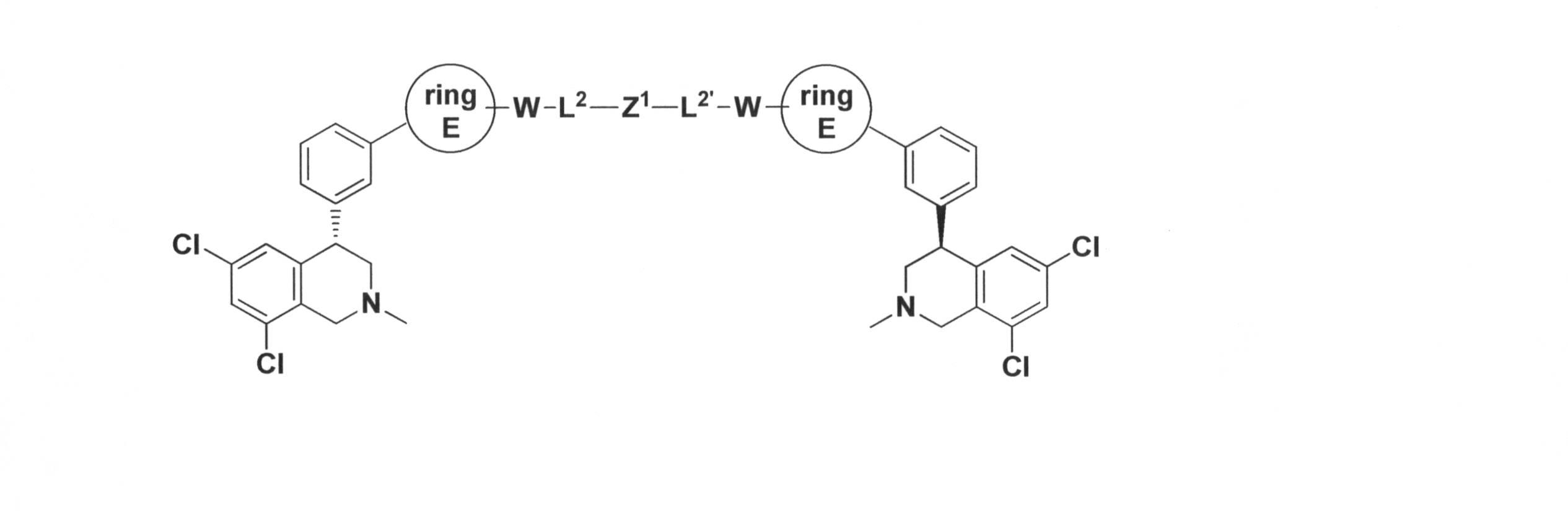
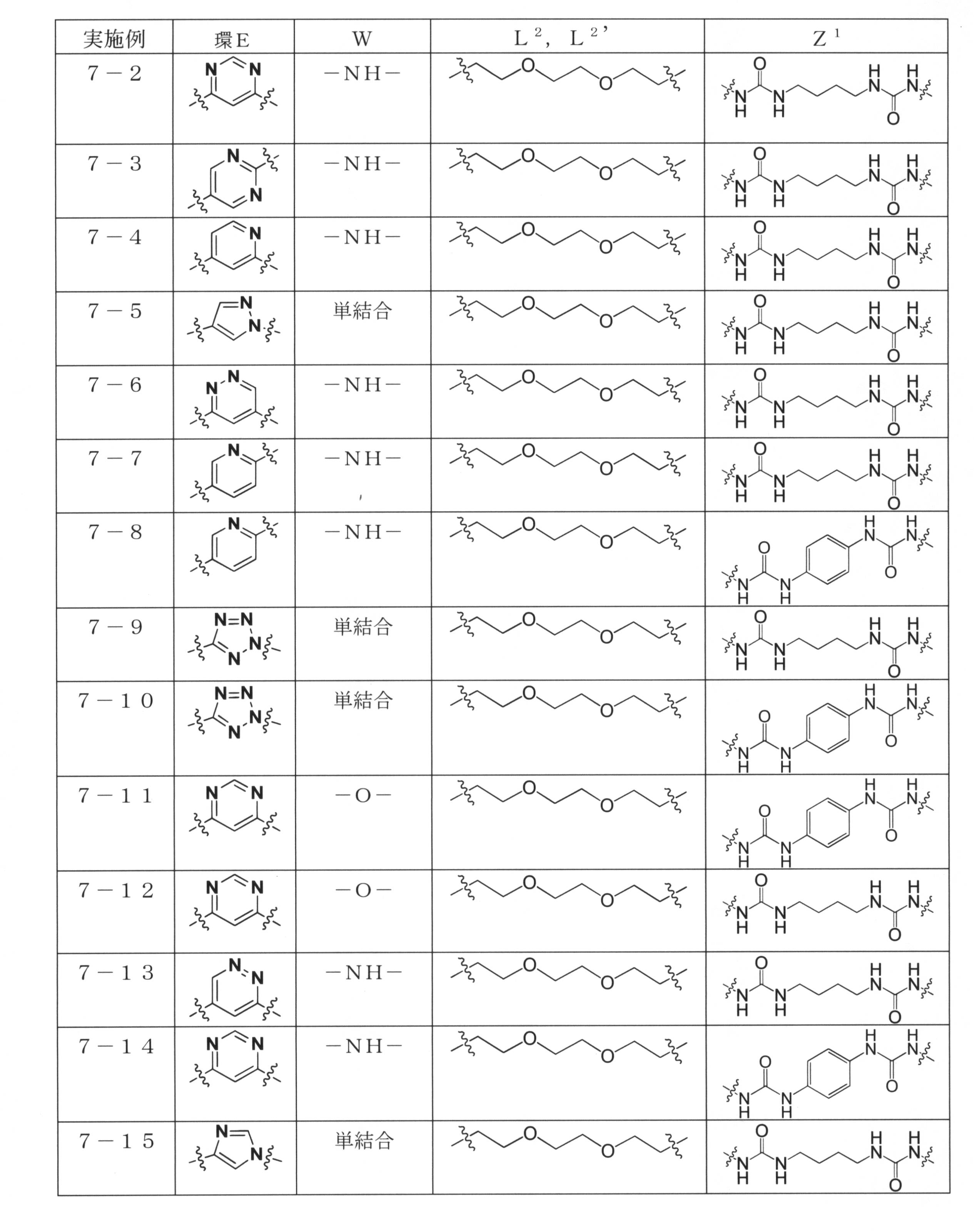
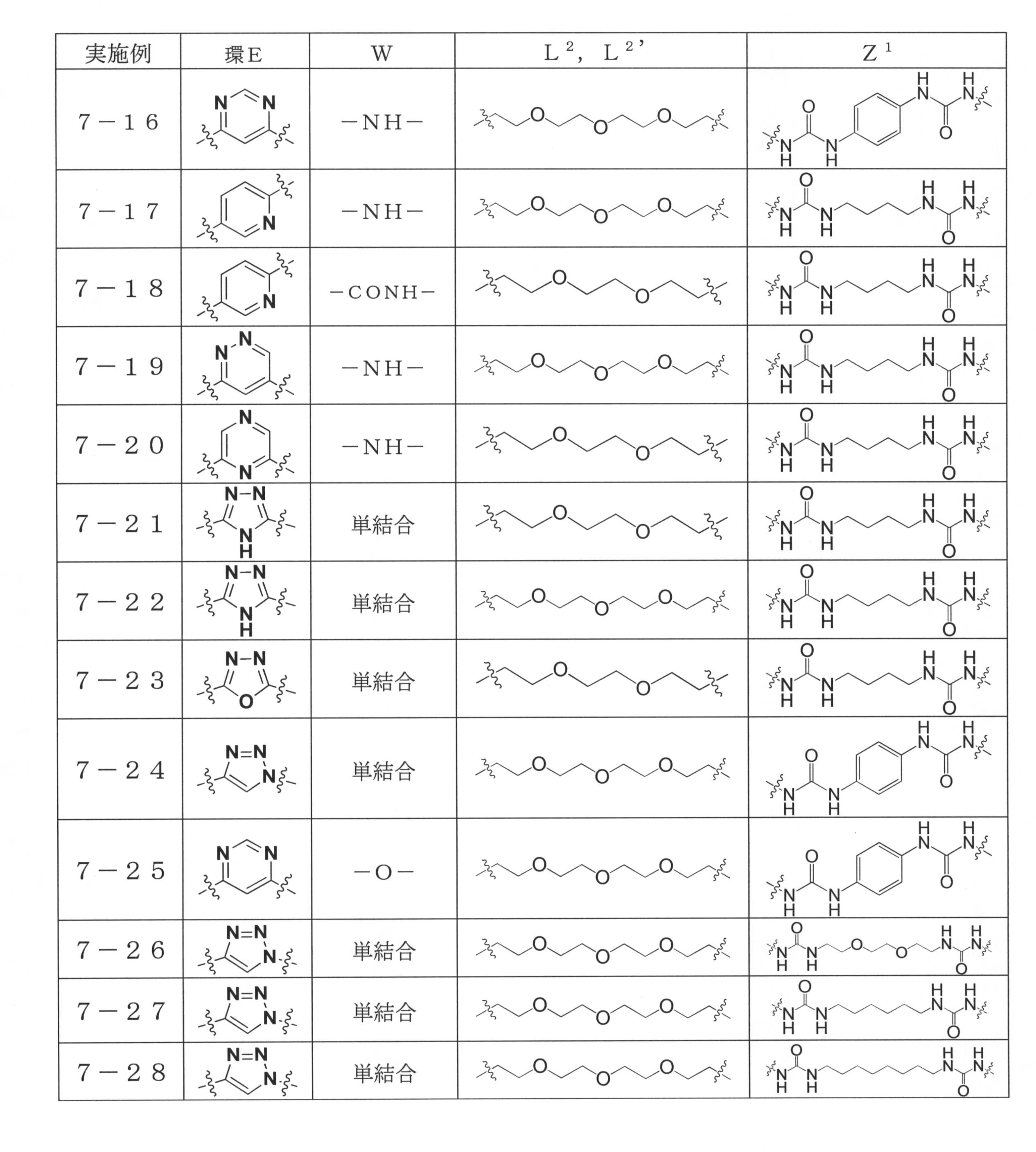
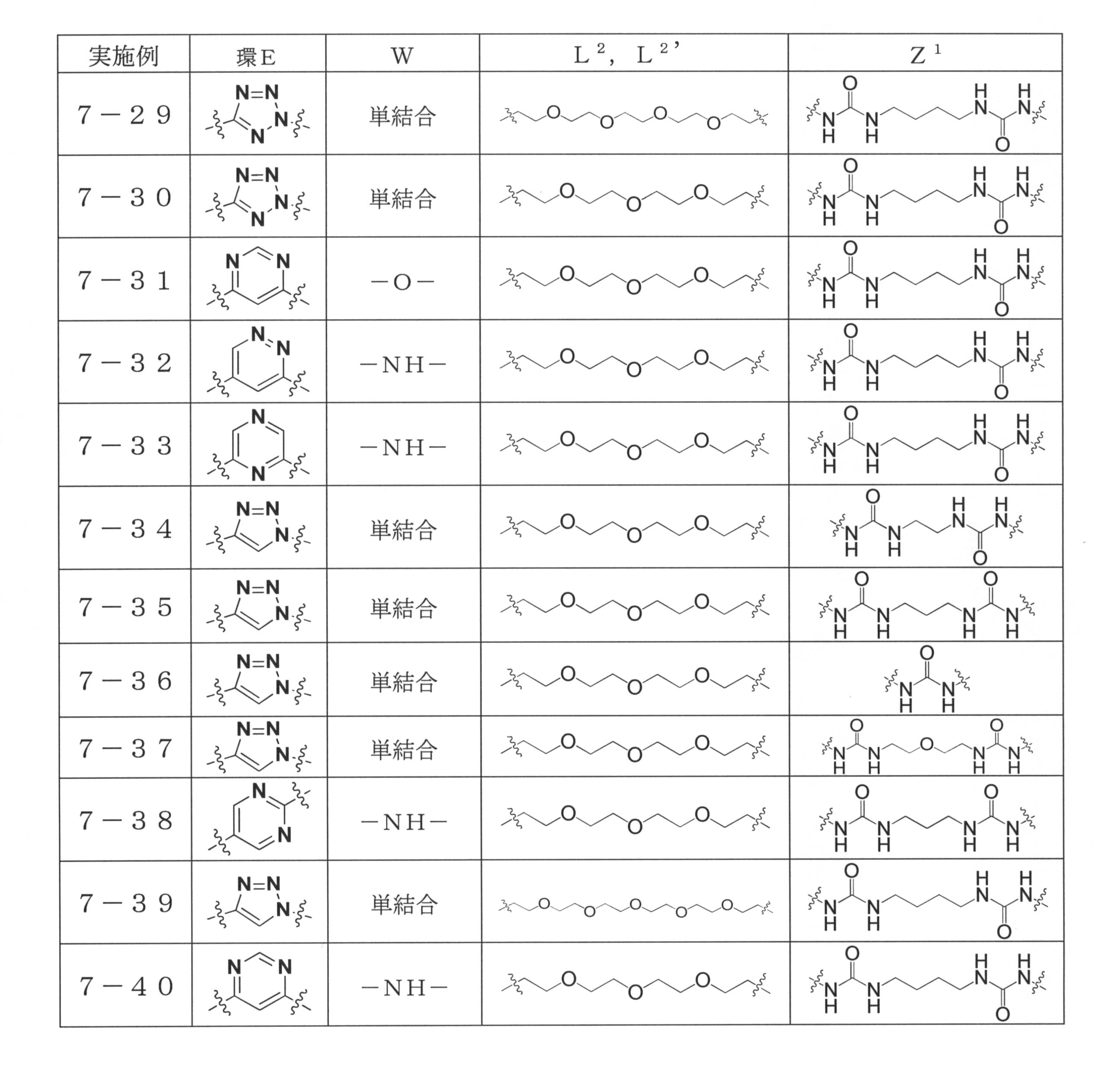

LC-MS 保持時間 0.822 min
LC:Agilent 1290
ESI/APCI MS:Agilent 6130
Column: Waters Acquity CSH C18 1.7um, 2.1x50mm
Solvent: H2O:CH3CN(0.1% Formic acid)
Gradient: 0.8mL/min, 0min(95:5) →1.2min(50:50)
1.0mL/min, →1.38min(3:97)
MS (+) : 1191 [M+H]+.
参考例16-1で得られた[2-(2-{2-[2-(4-{3-[(4S)-6,8-ジクロロ-2-メチル-1,2,3,4-テトラヒドロイソキノリン-4-イル]フェニル}-1H-1,2,3-トリアゾール-1-イル)エトキシ]エトキシ}エトキシ)エチル]カルバミン酸 4-ニトロフェニル(87mg)、参考例17-1で得られた1,1’-ブタン-1,4-ジイルビス[3-(2-アミノエチル)尿素]塩酸塩(20mg)、トリエチルアミン(43μL)のクロロホルム(2.0mL)溶液を80℃で4時間攪拌した。反応溶液を減圧下濃縮し、得られた残渣を逆相分取HPLC(カラム(YMC-Actus Triart 5μm C18 50x30mm)、移動相(0.1%ギ酸 in H2O:0.1%ギ酸 in MeCN=95:5→80:20→50:50→5:95、40mL/min.)で精製し、表題化合物(8.0mg)を無色固体として得た。
LC-MS 保持時間0.921 min
LC:Agilent 1290
ESI/APCI MS:Agilent 6130
Column: Waters Acquity CSH C18 1.7um, 2.1x50mm
Solvent: H2O:CH3CN(0.1% Formic acid)
Gradient: 0.8mL/min, 0min(95:5) →1.2min(50:50)
1.0mL/min, →1.38min(3:97)
MS (+) : 1381 [M+H]+.
参考例7-2で得られた14-(4-{3-[(4S)-6,8-ジクロロ-2-メチル-1,2,3,4-テトラヒドロイソキノリン-4-イル]フェニル}-1H-1,2,3-トリアゾール-1-イル)-3,6,9,12-テトラオキサテトラデカン-1-アミン(85mg)、トリエチルアミン(45mg)のクロロホルム(5.0mL)溶液に、炭酸ビス(トリクロロメチル)(6.5mg)を加え、室温で30分間攪拌した。反応溶液を減圧下濃縮後、得られた残渣を逆相分取HPLC(カラム(YMC-Actus Triart 5μm C18 50x30mm)、移動相(0.1%ギ酸 in H2O:0.1%ギ酸 in MeCN=95:5→80:20→50:50→5:95、40mL/min.)で精製した。減圧下溶媒を留去し、得られた残渣をシリカゲルカラムクロマトグラフィー(Biotage(登録商標)SNAP Cartridge KP-NH、クロロホルム:メタノール=98:2→85:15)で精製した。減圧下溶媒を留去し、得られた残渣(82mg)にエタノール(3.0mL)、4mol/L塩化水素-酢酸エチル(69μL)を加え、室温で15分間攪拌した。減圧下溶媒を留去し、得られた残渣にジエチルエーテルを加え、粉末化した後、上澄みを除去した。得られた残渣を減圧下濃縮して、表題化合物(60mg、72%)を無色アモルファス状物質として得た。
LC-MS 保持時間0.984 min
LC:Agilent 1290
ESI/APCI MS:Agilent 6130
Column: Waters Acquity CSH C18 1.7um, 2.1x50mm
Solvent: H2O:CH3CN(0.1% Formic acid)
Gradient: 0.8mL/min, 0min(95:5) →1.2min(50:50)
1.0mL/min, →1.38min(3:97)
MS (+) : 1183 [M+H]+.
参考例7-2で得られた14-(4-{3-[(4S)-6,8-ジクロロ-2-メチル-1,2,3,4-テトラヒドロイソキノリン-4-イル]フェニル}-1H-1,2,3-トリアゾール-1-イル)-3,6,9,12-テトラオキサテトラデカン-1-アミンを使用する代わりに、参考例7-3で得られた17-(4-{3-[(4S)-6,8-ジクロロ-2-メチル-1,2,3,4-テトラヒドロイソキノリン-4-イル]フェニル}-1H-1,2,3-トリアゾール-1-イル)-3,6,9,12,15-ペンタオキサヘプタデカン-1-アミンを使用する以外は、実質的に実施例7-43と同様の反応を実施して、表題化合物(19mg、22%)を無色アモルファス状物質として得た。
LC-MS 保持時間1.094 min
LC:Agilent 1290
ESI/APCI MS:Agilent 6130
Column: Waters Acquity CSH C18 1.7um, 2.1x50mm
Solvent: H2O:CH3CN(0.1% Formic acid)
Gradient: 0.8mL/min, 0min(95:5) →1.2min(50:50)
1.0mL/min, →1.38min(3:97)
MS (+) : 1271 [M+H]+.
1,4-ジイソシアナトブタンを使用する代わりに1,4-ジイソシアナトベンゼンを使用する以外は、実質的に実施例7-1と同様の反応を実施して、表題化合物(47mg、61%)を無色アモルファス状物質として得た。
LC-MS 保持時間1.004 min
LC:Agilent 1290
ESI/APCI MS:Agilent 6130
Column: Waters Acquity CSH C18 1.7um, 2.1x50mm
Solvent: H2O:CH3CN(0.1% Formic acid)
Gradient: 0.8mL/min, 0min(95:5) →1.2min(50:50)
1.0mL/min, →1.38min(3:97)
MS (+) : 1317 [M+H]+.
参考例7-2で得られた14-(4-{3-[(4S)-6,8-ジクロロ-2-メチル-1,2,3,4-テトラヒドロイソキノリン-4-イル]フェニル}-1H-1,2,3-トリアゾール-1-イル)-3,6,9,12-テトラオキサテトラデカン-1-アミンを使用する代わりに、参考例7-3で得られた17-(4-{3-[(4S)-6,8-ジクロロ-2-メチル-1,2,3,4-テトラヒドロイソキノリン-4-イル]フェニル}-1H-1,2,3-トリアゾール-1-イル)-3,6,9,12,15-ペンタオキサヘプタデカン-1-アミンを使用し、1,4-ジイソシアナトブタンを使用する代わりに1,4-ジイソシアナトベンゼンを使用する以外は、実質的に実施例7-1と同様の反応を実施して、表題化合物(51mg、62%)を無色アモルファス状物質として得た。
LC-MS 保持時間1.021 min
LC:Agilent 1290
ESI/APCI MS:Agilent 6130
Column: Waters Acquity CSH C18 1.7um, 2.1x50mm
Solvent: H2O:CH3CN(0.1% Formic acid)
Gradient: 0.8mL/min, 0min(95:5) →1.2min(50:50)
1.0mL/min, →1.38min(3:97)
MS (+) : 1405 [M+H]+.

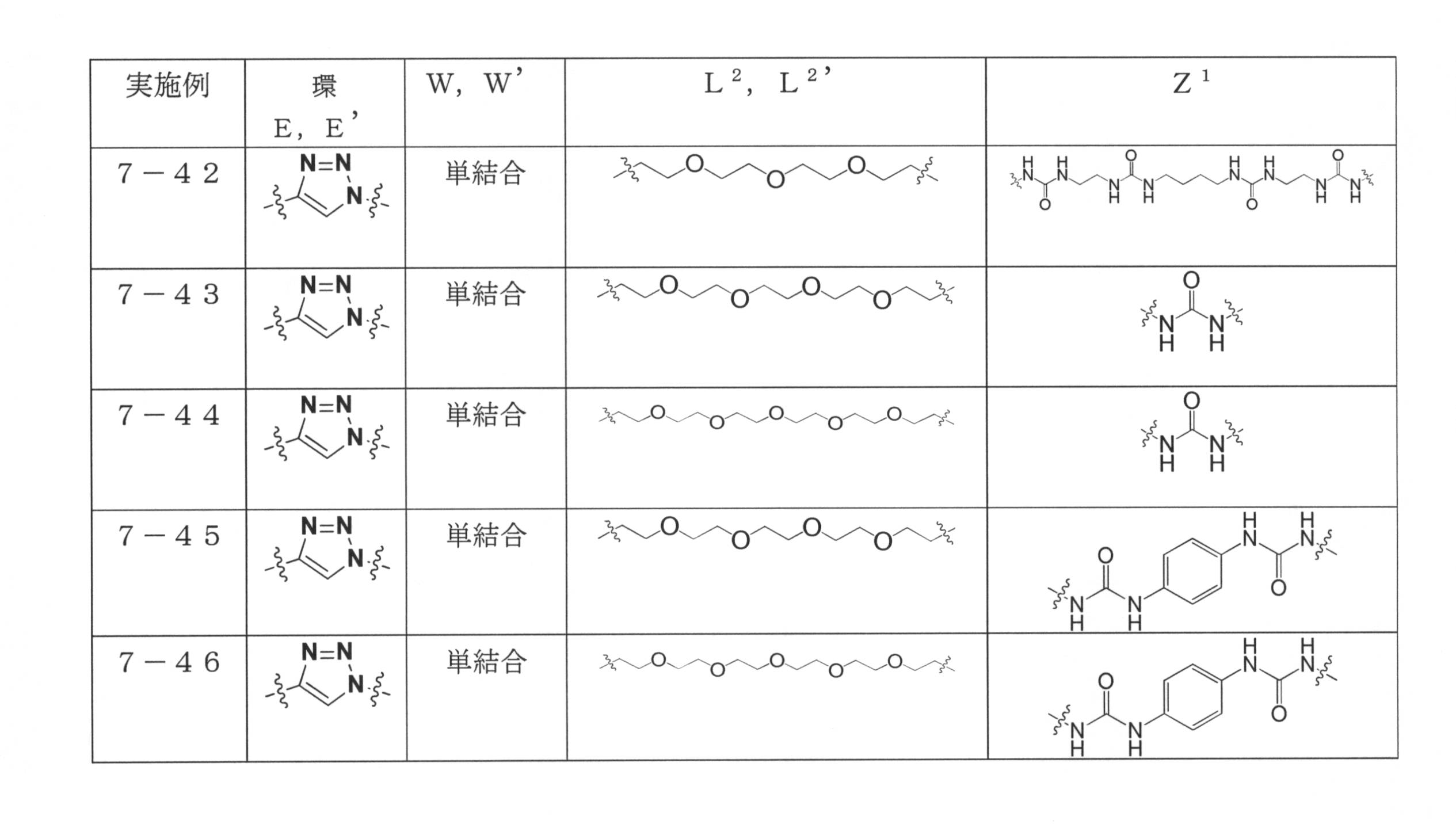
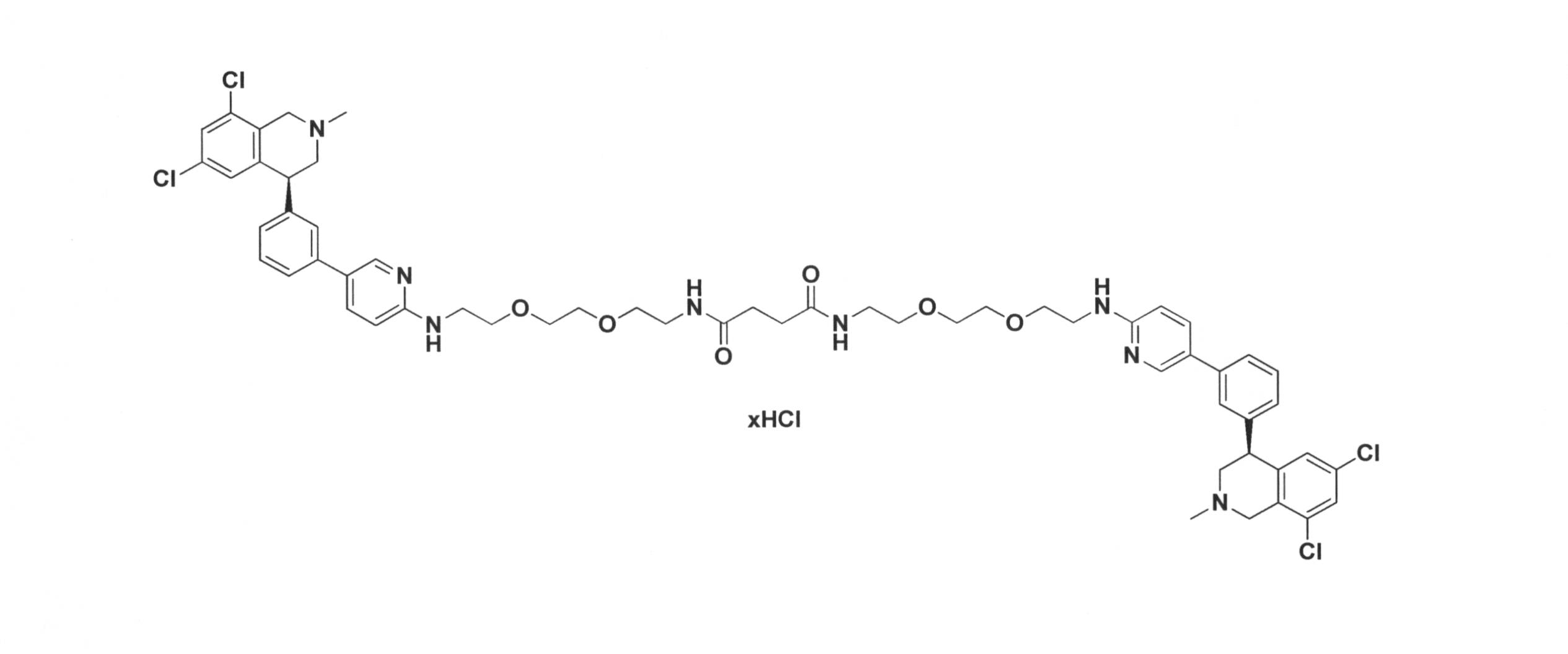
LC-MS 保持時間 0.823 min
LC:Agilent 1290
ESI/APCI MS:Agilent 6130
Column: Waters Acquity CSH C18 1.7um, 2.1x50mm
Solvent: H2O:CH3CN(0.1% Formic acid)
Gradient: 0.8mL/min, 0min(95:5) →1.2min(50:50)
1.0mL/min, →1.38min(3:97)
MS (+) : 1113 [M+H]+.
参考例10-1で得られたN-{2-[2-(2-アミノエトキシ)エトキシ]エチル}-5-{3-[(4S)-6,8-ジクロロ-2-メチル-1,2,3,4-テトラヒドロイソキノリン-4-イル]フェニル}ピリジン-2-アミン トリフルオロ酢酸塩(45mg)のN,N-ジメチルホルムアミド(1.0mL)溶液に、O-(7-アザベンゾトリアゾール-1-イル)-N,N,N’,N’-テトラメチルウロニウムヘキサフルオロリン酸塩(27mg)、N,N-ジイソプロピルエチルアミン(12μL)、L-(+)-酒石酸(5.4mg)を加え、室温で終夜攪拌した。反応用液を逆相分取HPLC(カラム(YMC-Actus Triart 5μm C18 50x30mm)、移動相(0.1%トリフルオロ酢酸 in H2O:0.1%トリフルオロ酢酸 in MeCN=90:10→20:80→5:95、40mL/min.)で精製し、更に分取TLC(富士シリシア化学「CHROMATOREX TLC Plates NH 0.25mm」、クロロホルム:メタノール=20:1)で精製した。減圧下溶媒を留去後、得られた残渣をメタノールに溶解させ、4mol/L塩化水素-1,4-ジオキサン溶液を加えた後、減圧下溶媒を留去して、表題化合物(10mg)を無色固体として得た。
LC-MS 保持時間 0.809 min
LC:Agilent 1290
ESI/APCI MS:Agilent 6130
Column: Waters Acquity CSH C18 1.7um, 2.1x50mm
Solvent: H2O:CH3CN(0.1% Formic acid)
Gradient: 0.8mL/min, 0min(95:5) →1.2min(50:50)
1.0mL/min, →1.38min(3:97)
MS (+) : 1145 [M+H]+.
二塩化ブタンジオイルを使用する代わりに、二塩化ヘキサンジオイルを使用する以外は、実質的に実施例8-1と同様の反応を実施して、表題化合物(21mg)を無色固体として得た。
LC-MS 保持時間 0.833 min
LC:Agilent 1290
ESI/APCI MS:Agilent 6130
Column: Waters Acquity CSH C18 1.7um, 2.1x50mm
Solvent: H2O:CH3CN(0.1% Formic acid)
Gradient: 0.8mL/min, 0min(95:5) →1.2min(50:50)
1.0mL/min, →1.38min(3:97)
MS (+) : 1141 [M+H]+.
二塩化ブタンジオイルを使用する代わりに、二塩化ベンゼン-1,2-ジカルボニルを使用する以外は、実質的に実施例8-1と同様の反応を実施して、表題化合物(12mg)を無色固体として得た。
LC-MS 保持時間 0.861 min
LC:Agilent 1290
ESI/APCI MS:Agilent 6130
Column: Waters Acquity CSH C18 1.7um, 2.1x50mm
Solvent: H2O:CH3CN(0.1% Formic acid)
Gradient: 0.8mL/min, 0min(95:5) →1.2min(50:50)
1.0mL/min, →1.38min(3:97)
MS (+) : 1161 [M+H]+.
参考例7-1で得られた2-(2-{2-[2-(4-{3-[(4S)-6,8-ジクロロ-2-メチル-1,2,3,4-テトラヒドロイソキノリン-4-イル]フェニル}-1H-1,2,3-トリアゾール-1-イル)エトキシ]エトキシ}エトキシ)エタンアミン(40mg)のN,N-ジメチルホルムアミド(1.0mL)溶液に、O-(7-アザベンゾトリアゾール-1-イル)-N,N,N’,N’-テトラメチルウロニウムヘキサフルオロリン酸塩(28mg)、N,N-ジイソプロピルエチルアミン(13μL)、L-(+)-酒石酸のN,N-ジメチルホルムアミド溶液(0.5mol/L、60μL)を加え、室温で終夜攪拌した。反応用液を逆相分取HPLC(カラム(YMC-Actus Triart 5μm C18 50x30mm)、移動相(0.1%トリフルオロ酢酸 in H2O:0.1%トリフルオロ酢酸 in MeCN=90:10→20:80→5:95、40mL/min.)で精製し、更に分取TLC(富士シリシア化学「CHROMATOREX TLC Plates NH 0.25mm」、クロロホルム:メタノール=20:1)で精製した。減圧下溶媒を留去後、得られた残渣をメタノールに溶解させ、4mol/L塩化水素-1,4-ジオキサン溶液を加えた後、減圧下溶媒を留去して、表題化合物(14mg)を無色アモルファス状物質として得た。
LC-MS 保持時間 1.013 min
LC:Agilent 1290
ESI/APCI MS:Agilent 6130
Column: Waters Acquity CSH C18 1.7um, 2.1x50mm
Solvent: H2O:CH3CN(0.1% Formic acid)
Gradient: 0.8mL/min, 0min(95:5) →1.2min(50:50)
1.0mL/min, →1.38min(3:97)
MS (+) : 1183 [M+H]+.
参考例10-1で得られたN-{2-[2-(2-アミノエトキシ)エトキシ]エチル}-5-{3-[(4S)-6,8-ジクロロ-2-メチル-1,2,3,4-テトラヒドロイソキノリン-4-イル]フェニル}ピリジン-2-アミン トリフルオロ酢酸塩を使用する代わりに、参考例8-4で得られたN-{2-[2-(2-アミノエトキシ)エトキシ]エチル}-6-{3-[(4S)-6,8-ジクロロ-2-メチル-1,2,3,4-テトラヒドロイソキノリン-4-イル]フェニル}ピラジン-2-アミンを使用する以外は、実質的に実施例8-1と同様の反応を実施して、表題化合物(23mg、31%)を黄色アモルファス状物質として得た。
LC-MS 保持時間 1.108 min
LC:Agilent 1290
ESI/APCI MS:Agilent 6130
Column: Waters Acquity CSH C18 1.7um, 2.1x50mm
Solvent: H2O:CH3CN(0.1% Formic acid)
Gradient: 0.8mL/min, 0min(95:5) →1.2min(50:50)
1.0mL/min, →1.38min(3:97)
MS (+) : 1115 [M+H]+.
二塩化ブタンジオイルを使用する代わりに、塩化 2,2’-オキシジアセチルを使用する以外は、実質的に実施例8-1と同様の反応を実施して、表題化合物(12mg)を無色固体として得た。
LC-MS 保持時間 0.827 min
LC:Agilent 1290
ESI/APCI MS:Agilent 6130
Column: Waters Acquity CSH C18 1.7um, 2.1x50mm
Solvent: H2O:CH3CN(0.1% Formic acid)
Gradient: 0.8mL/min, 0min(95:5) →1.2min(50:50)
1.0mL/min, →1.38min(3:97)
MS (+) : 1129 [M+H]+.
参考例10-1で得られたN-{2-[2-(2-アミノエトキシ)エトキシ]エチル}-5-{3-[(4S)-6,8-ジクロロ-2-メチル-1,2,3,4-テトラヒドロイソキノリン-4-イル]フェニル}ピリジン-2-アミン トリフルオロ酢酸塩を使用する代わりに、実質的に参考例8-3で得られたN-{2-[2-(2-アミノエトキシ)エトキシ]エチル}-6-{3-[(4S)-6,8-ジクロロ-2-メチル-1,2,3,4-テトラヒドロイソキノリン-4-イル]フェニル}ピリミジン-4-アミン トリフルオロ酢酸塩をシリカゲルカラムクロマトグラフィー(Biotage(登録商標)SNAP Cartridge KP-NH、クロロホルム:メタノール=100:0→85:15)で精製して得られたN-{2-[2-(2-アミノエトキシ)エトキシ]エチル}-6-{3-[(4S)-6,8-ジクロロ-2-メチル-1,2,3,4-テトラヒドロイソキノリン-4-イル]フェニル}ピリミジン-4-アミンを使用する以外は、実質的に実施例8-2と同様の反応を実施して、表題化合物(60mg)を淡黄色アモルファス状物質として得た。
LC-MS 保持時間 0.823 min
LC:Agilent 1290
ESI/APCI MS:Agilent 6130
Column: Waters Acquity CSH C18 1.7um, 2.1x50mm
Solvent: H2O:CH3CN(0.1% Formic acid)
Gradient: 0.8mL/min, 0min(95:5) →1.2min(50:50)
1.0mL/min, →1.38min(3:97)
MS (+) : 1147 [M+H]+.
参考例7-1で得られた2-(2-{2-[2-(4-{3-[(4S)-6,8-ジクロロ-2-メチル-1,2,3,4-テトラヒドロイソキノリン-4-イル]フェニル}-1H-1,2,3-トリアゾール-1-イル)エトキシ]エトキシ}エトキシ)エタンアミン(0.10g)のN,N-ジメチルホルムアミド(5.0mL)溶液に、O-(7-アザベンゾトリアゾール-1-イル)-N,N,N’,N’-テトラメチルウロニウムヘキサフルオロリン酸塩(85mg)、N,N-ジイソプロピルエチルアミン(29mg)、D-(-)-酒石酸(13mg)を加え、室温で3時間攪拌した。反応溶液を濃縮後、得られた残渣をシリカゲルカラムクロマトグラフィー(Biotage(登録商標)SNAP Cartridge KP-NH、クロロホルム:メタノール=100:0→70:30)で精製した。減圧下溶媒を留去し、得られた残渣をエタノール(5.0mL)に溶解し、4mol/L塩化水素-酢酸エチル(0.20mL)を加えた。減圧下溶媒を留去し、表題化合物(15mg)を無色アモルファス状物質として得た。
LC-MS 保持時間 1.010 min
LC:Agilent 1290
ESI/APCI MS:Agilent 6130
Column: Waters Acquity CSH C18 1.7um, 2.1x50mm
Solvent: H2O:CH3CN(0.1% Formic acid)
Gradient: 0.8mL/min, 0min(95:5) →1.2min(50:50)
1.0mL/min, →1.38min(3:97)
MS (+) : 1183 [M+H]+.
参考例10-1で得られたN-{2-[2-(2-アミノエトキシ)エトキシ]エチル}-5-{3-[(4S)-6,8-ジクロロ-2-メチル-1,2,3,4-テトラヒドロイソキノリン-4-イル]フェニル}ピリジン-2-アミン トリフルオロ酢酸塩を使用する代わりに、参考例8-9で得られたN-(2-{2-[2-(2-アミノエトキシ)エトキシ]エトキシ}エチル)-6-{3-[(4S)-6,8-ジクロロ-2-メチル-1,2,3,4-テトラヒドロイソキノリン-4-イル]フェニル}ピリミジン-4-アミンを使用する以外は、実質的に実施例8-2と同様の反応を実施して、表題化合物(60mg)を淡黄色アモルファス状物質として得た。
LC-MS 保持時間 0.861 min
LC:Agilent 1290
ESI/APCI MS:Agilent 6130
Column: Waters Acquity CSH C18 1.7um, 2.1x50mm
Solvent: H2O:CH3CN(0.1% Formic acid)
Gradient: 0.8mL/min, 0min(95:5) →1.2min(50:50)
1.0mL/min, →1.38min(3:97)
MS (+) : 1235 [M+H]+.
参考例10-1で得られたN-{2-[2-(2-アミノエトキシ)エトキシ]エチル}-5-{3-[(4S)-6,8-ジクロロ-2-メチル-1,2,3,4-テトラヒドロイソキノリン-4-イル]フェニル}ピリジン-2-アミン トリフルオロ酢酸塩を使用する代わりに、参考例8-9で得られたN-(2-{2-[2-(2-アミノエトキシ)エトキシ]エトキシ}エチル)-6-{3-[(4S)-6,8-ジクロロ-2-メチル-1,2,3,4-テトラヒドロイソキノリン-4-イル]フェニル}ピリミジン-4-アミンを使用し、二塩化ブタンジオイルを使用する代わりに、塩化 2,2’-オキシジアセチルを使用する以外は、実質的に実施例8-1と同様の反応を実施して、表題化合物(30mg)を無色アモルファス状物質として得た。
LC-MS 保持時間 0.882 min
LC:Agilent 1290
ESI/APCI MS:Agilent 6130
Column: Waters Acquity CSH C18 1.7um, 2.1x50mm
Solvent: H2O:CH3CN(0.1% Formic acid)
Gradient: 0.8mL/min, 0min(95:5) →1.2min(50:50)
1.0mL/min, →1.38min(3:97)
MS (+) : 1219 [M+H]+.
参考例10-1で得られたN-{2-[2-(2-アミノエトキシ)エトキシ]エチル}-5-{3-[(4S)-6,8-ジクロロ-2-メチル-1,2,3,4-テトラヒドロイソキノリン-4-イル]フェニル}ピリジン-2-アミン トリフルオロ酢酸塩を使用する代わりに、参考例8-9で得られたN-(2-{2-[2-(2-アミノエトキシ)エトキシ]エトキシ}エチル)-6-{3-[(4S)-6,8-ジクロロ-2-メチル-1,2,3,4-テトラヒドロイソキノリン-4-イル]フェニル}ピリミジン-4-アミンを使用する以外は、実質的に実施例8-1と同様の反応を実施して、表題化合物(47mg)を無色アモルファス状物質として得た。
LC-MS 保持時間 0.884 min
LC:Agilent 1290
ESI/APCI MS:Agilent 6130
Column: Waters Acquity CSH C18 1.7um, 2.1x50mm
Solvent: H2O:CH3CN(0.1% Formic acid)
Gradient: 0.8mL/min, 0min(95:5) →1.2min(50:50)
1.0mL/min, →1.38min(3:97)
MS (+) : 1203 [M+H]+.
参考例10-1で得られたN-{2-[2-(2-アミノエトキシ)エトキシ]エチル}-5-{3-[(4S)-6,8-ジクロロ-2-メチル-1,2,3,4-テトラヒドロイソキノリン-4-イル]フェニル}ピリジン-2-アミン トリフルオロ酢酸塩を使用する代わりに、参考例8-9で得られたN-(2-{2-[2-(2-アミノエトキシ)エトキシ]エトキシ}エチル)-6-{3-[(4S)-6,8-ジクロロ-2-メチル-1,2,3,4-テトラヒドロイソキノリン-4-イル]フェニル}ピリミジン-4-アミンを使用し、二塩化ブタンジオイルを使用する代わりに、 二塩化ヘキサンジオイルを使用する以外は、実質的に実施例8-1と同様の反応を実施して、表題化合物(47mg)を無色アモルファス状物質として得た。
LC-MS 保持時間 0.894 min
LC:Agilent 1290
ESI/APCI MS:Agilent 6130
Column: Waters Acquity CSH C18 1.7um, 2.1x50mm
Solvent: H2O:CH3CN(0.1% Formic acid)
Gradient: 0.8mL/min, 0min(95:5) →1.2min(50:50)
1.0mL/min, →1.38min(3:97)
MS (+) : 1231 [M+H]+.
参考例10-3で得られたN-{2-[2-(2-アミノエトキシ)エトキシ]エチル}-5-{3-[(4S)-6,8-ジクロロ-2-メチル-1,2,3,4-テトラヒドロイソキノリン-4-イル]フェニル}ピリダジン-3-アミン(51mg)、L-(+)-酒石酸(7.4mg)のN,N-ジメチルホルムアミド(0.3mL)溶液に、トリエチルアミン(14μL)、1-エチル-3-(3-ジメチルアミノプロピル)カルボジイミド塩酸塩(19mg)、1-ヒドロキシベンゾトリアゾール1水和物(15mg)を加え、室温で4時間攪拌した。反応溶液を逆相分取HPLC(カラム(YMC-Actus Triart 5μm C18 50x30mm)、移動相(0.1%ギ酸 in H2O:0.1%ギ酸 in MeCN=95:5→80:20→50:50→5:95、40mL/min.)で精製した。減圧下溶媒を留去し、得られた残渣をシリカゲルカラムクロマトグラフィー(Biotage(登録商標)SNAP Cartridge KP-NH、クロロホルム:メタノール=100:0→80:20)で精製した。減圧下溶媒を留去し、得られた残渣(37mg)をエタノール(1.0mL)に溶解し、2mol/L塩酸(0.20mL)を加え、室温で10分間攪拌した。減圧下溶媒を留去し、表題化合物(35mg、55%)を無色アモルファス状物質として得た。
LC-MS 保持時間 0.734 min
LC:Agilent 1290
ESI/APCI MS:Agilent 6130
Column: Waters Acquity CSH C18 1.7um, 2.1x50mm
Solvent: H2O:CH3CN(0.1% Formic acid)
Gradient: 0.8mL/min, 0min(95:5) →1.2min(50:50)
1.0mL/min, →1.38min(3:97)
MS (+) : 1147 [M+H]+.
参考例14-3で得られた2-(2-{2-[2-(5-{3-[(4S)-6,8-ジクロロ-2-メチル-1,2,3,4-テトラヒドロイソキノリン-4-イル]フェニル}-4H-1,2,4-トリアゾール-3-イル)エトキシ]エトキシ}エトキシ)エタンアミン(50mg)、1-エチル-3-(3-ジメチルアミノプロピル)カルボジイミド塩酸塩(27mg)、1-ヒドロキシベンゾトリアゾール1水和物(21mg)、トリエチルアミン(20μL)のクロロホルム(1.0mL)溶液に、L-(+)-酒石酸(6.3mg)のN,N-ジメチルホルムアミド(1.0mL)溶液をゆっくり滴下し、室温で5時間攪拌した。反応溶液を減圧下濃縮後、得られた残渣をLC-MS分取(LC(Agilent1260)、ESIMS(6130Quadrupole、ESI)、カラム(YMC-Actus Triart 5μm C18 50x30mm)、移動相(0.1%ギ酸 in H2O:0.1%ギ酸 in CH3CN=95:5→50:50→5:95)、50mL/min.)で精製して、表題化合物(7.0mg、13%)を黄色アモルファス状物質として得た。
LC-MS 保持時間0.985 min
LC:Agilent 1290
ESI/APCI MS:Agilent 6130
Column: Waters Acquity CSH C18 1.7um, 2.1x50mm
Solvent: H2O:CH3CN(0.1% Formic acid)
Gradient: 0.8mL/min, 0min(95:5) →1.2min(50:50)
1.0mL/min, →1.38min(3:97)
MS (+) : 1183 [M+H]+.
参考例10-1で得られたN-{2-[2-(2-アミノエトキシ)エトキシ]エチル}-5-{3-[(4S)-6,8-ジクロロ-2-メチル-1,2,3,4-テトラヒドロイソキノリン-4-イル]フェニル}ピリジン-2-アミン トリフルオロ酢酸塩を使用する代わりに、参考例11-1で得られた2-(2-{2-[(6-{3-[(4S)-6,8-ジクロロ-2-メチル-1,2,3,4-テトラヒドロイソキノリン-4-イル]フェニル}ピリミジン-4-イル)オキシ]エトキシ}エトキシ)エタンアミンを使用する以外は、実質的に実施例8-2と同様の反応を実施して、表題化合物(54mg)を無色アモルファス状物質として得た。
LC-MS 保持時間 1.133 min
LC:Agilent 1290
ESI/APCI MS:Agilent 6130
Column: Waters Acquity CSH C18 1.7um, 2.1x50mm
Solvent: H2O:CH3CN(0.1% Formic acid)
Gradient: 0.8mL/min, 0min(95:5) →1.2min(50:50)
1.0mL/min, →1.38min(3:97)
MS (+) : 1149 [M+H]+.
参考例10-1で得られたN-{2-[2-(2-アミノエトキシ)エトキシ]エチル}-5-{3-[(4S)-6,8-ジクロロ-2-メチル-1,2,3,4-テトラヒドロイソキノリン-4-イル]フェニル}ピリジン-2-アミン トリフルオロ酢酸塩を使用する代わりに、参考例11-2で得られた2-[2-(2-{2-[(6-{3-[(4S)-6,8-ジクロロ-2-メチル-1,2,3,4-テトラヒドロイソキノリン-4-イル]フェニル}ピリミジン-4-イル)オキシ]エトキシ}エトキシ)エトキシ]エタンアミンを使用する以外は、実質的に実施例8-2と同様の反応を実施して、表題化合物(60mg)を無色アモルファス状物質として得た。
LC-MS 保持時間 1.161 min
LC:Agilent 1290
ESI/APCI MS:Agilent 6130
Column: Waters Acquity CSH C18 1.7um, 2.1x50mm
Solvent: H2O:CH3CN(0.1% Formic acid)
Gradient: 0.8mL/min, 0min(95:5) →1.2min(50:50)
1.0mL/min, →1.38min(3:97)
MS (+) : 1237 [M+H]+.
参考例10-1で得られたN-{2-[2-(2-アミノエトキシ)エトキシ]エチル}-5-{3-[(4S)-6,8-ジクロロ-2-メチル-1,2,3,4-テトラヒドロイソキノリン-4-イル]フェニル}ピリジン-2-アミン トリフルオロ酢酸塩を使用する代わりに、参考例11-2で得られた2-[2-(2-{2-[(6-{3-[(4S)-6,8-ジクロロ-2-メチル-1,2,3,4-テトラヒドロイソキノリン-4-イル]フェニル}ピリミジン-4-イル)オキシ]エトキシ}エトキシ)エトキシ]エタンアミンを使用し、L-(+)-酒石酸を使用する代わりに、ジグリコール酸を使用する以外は、実質的に実施例8-2と同様の反応を実施して、表題化合物(75mg)を無色アモルファス状物質として得た。
LC-MS 保持時間 1.189 min
LC:Agilent 1290
ESI/APCI MS:Agilent 6130
Column: Waters Acquity CSH C18 1.7um, 2.1x50mm
Solvent: H2O:CH3CN(0.1% Formic acid)
Gradient: 0.8mL/min, 0min(95:5) →1.2min(50:50)
1.0mL/min, →1.38min(3:97)
MS (+) : 1221 [M+H]+.
参考例10-3で得られたN-{2-[2-(2-アミノエトキシ)エトキシ]エチル}-5-{3-[(4S)-6,8-ジクロロ-2-メチル-1,2,3,4-テトラヒドロイソキノリン-4-イル]フェニル}ピリダジン-3-アミンを使用する代わりに、参考例10-4で得られたN-(2-{2-[2-(2-アミノエトキシ)エトキシ]エトキシ}エチル)-5-{3-[(4S)-6,8-ジクロロ-2-メチル-1,2,3,4-テトラヒドロイソキノリン-4-イル]フェニル}ピリダジン-3-アミンを使用する以外は、実質的に実施例8-14と同様の反応を実施して、表題化合物(18mg、41%)を無色アモルファス状物質として得た。
LC-MS 保持時間 0.758 min
LC:Agilent 1290
ESI/APCI MS:Agilent 6130
Column: Waters Acquity CSH C18 1.7um, 2.1x50mm
Solvent: H2O:CH3CN(0.1% Formic acid)
Gradient: 0.8mL/min, 0min(95:5) →1.2min(50:50)
1.0mL/min, →1.38min(3:97)
MS (+) : 1235 [M+H]+.
参考例10-3で得られたN-{2-[2-(2-アミノエトキシ)エトキシ]エチル}-5-{3-[(4S)-6,8-ジクロロ-2-メチル-1,2,3,4-テトラヒドロイソキノリン-4-イル]フェニル}ピリダジン-3-アミンを使用する代わりに、参考例8-11で得られたN-(2-{2-[2-(2-アミノエトキシ)エトキシ]エトキシ}エチル)-6-{3-[(4S)-6,8-ジクロロ-2-メチル-1,2,3,4-テトラヒドロイソキノリン-4-イル]フェニル}ピラジン-2-アミンを使用する以外は、実質的に実施例8-14と同様の反応を実施して、表題化合物(25mg、35%)を黄色アモルファス状物質として得た。
LC-MS 保持時間 1.131 min
LC:Agilent 1290
ESI/APCI MS:Agilent 6130
Column: Waters Acquity CSH C18 1.7um, 2.1x50mm
Solvent: H2O:CH3CN(0.1% Formic acid)
Gradient: 0.8mL/min, 0min(95:5) →1.2min(50:50)
1.0mL/min, →1.38min(3:97)
MS (+) : 1235 [M+H]+.
参考例10-1で得られたN-{2-[2-(2-アミノエトキシ)エトキシ]エチル}-5-{3-[(4S)-6,8-ジクロロ-2-メチル-1,2,3,4-テトラヒドロイソキノリン-4-イル]フェニル}ピリジン-2-アミン トリフルオロ酢酸塩を使用する代わりに、参考例9-1で得られたN-(2-{2-[2-(2-アミノエトキシ)エトキシ]エトキシ}エチル)-5-{3-[(4S)-6,8-ジクロロ-2-メチル-1,2,3,4-テトラヒドロイソキノリン-4-イル]フェニル}ピリミジン-2-アミンを使用する以外は、実質的に実施例8-2と同様の反応を実施して(塩酸塩とする操作は行わない)、表題化合物(8.0mg、6.0%)を無色アモルファス状物質として得た。
LC-MS 保持時間 1.119 min
LC:Agilent 1290
ESI/APCI MS:Agilent 6130
Column: Waters Acquity CSH C18 1.7um, 2.1x50mm
Solvent: H2O:CH3CN(0.1% Formic acid)
Gradient: 0.8mL/min, 0min(95:5) →1.2min(50:50)
1.0mL/min, →1.38min(3:97)
MS (+) : 1235 [M+H]+.
参考例10-1で得られたN-{2-[2-(2-アミノエトキシ)エトキシ]エチル}-5-{3-[(4S)-6,8-ジクロロ-2-メチル-1,2,3,4-テトラヒドロイソキノリン-4-イル]フェニル}ピリジン-2-アミン トリフルオロ酢酸塩を使用する代わりに、参考例11-2で得られた2-[2-(2-{2-[(6-{3-[(4S)-6,8-ジクロロ-2-メチル-1,2,3,4-テトラヒドロイソキノリン-4-イル]フェニル}ピリミジン-4-イル)オキシ]エトキシ}エトキシ)エトキシ]エタンアミンを使用する以外は、実質的に実施例8-1と同様の反応を実施して、表題化合物(40mg)を無色アモルファス状物質として得た。
LC-MS 保持時間 0.657 min
LC:Agilent 1290
ESI/APCI MS:Agilent 6130
Column: Waters Acquity CSH C18 1.7um, 2.1x50mm
Solvent: H2O:CH3CN(0.1% Formic acid)
Gradient: 0.8mL/min, 0min(80:20) →1.2-1.4min(1:99)
MS (+) : 1205 [M+H]+, 1227 [M+Na]+.
参考例10-1で得られたN-{2-[2-(2-アミノエトキシ)エトキシ]エチル}-5-{3-[(4S)-6,8-ジクロロ-2-メチル-1,2,3,4-テトラヒドロイソキノリン-4-イル]フェニル}ピリジン-2-アミン トリフルオロ酢酸塩を使用する代わりに、参考例11-2で得られた2-[2-(2-{2-[(6-{3-[(4S)-6,8-ジクロロ-2-メチル-1,2,3,4-テトラヒドロイソキノリン-4-イル]フェニル}ピリミジン-4-イル)オキシ]エトキシ}エトキシ)エトキシ]エタンアミンを使用し、二塩化ブタンジオイルを使用する代わりに、 二塩化ヘキサンジオイルを使用する以外は、実質的に実施例8-1と同様の反応を実施して、表題化合物(14mg)を無色アモルファス状物質として得た。
LC-MS 保持時間 0.662 min
LC:Agilent 1290
ESI/APCI MS:Agilent 6130
Column: Waters Acquity CSH C18 1.7um, 2.1x50mm
Solvent: H2O:CH3CN(0.1% Formic acid)
Gradient: 0.8mL/min, 0min(80:20) →1.2-1.4min(1:99)
MS (+) : 1233 [M+H]+, 1255 [M+Na]+.
参考例14-3で得られた2-(2-{2-[2-(5-{3-[(4S)-6,8-ジクロロ-2-メチル-1,2,3,4-テトラヒドロイソキノリン-4-イル]フェニル}-4H-1,2,4-トリアゾール-3-イル)エトキシ]エトキシ}エトキシ)エタンアミン(58mg)と、(4R,4’S,5S,5’R)-2,2,2’,2’-テトラメチル-4,4’-ビ-1,3-ジオキソラン-5,5’-ジカルボン酸(16mg、WO2006/091894 パンフレット記載)のN,N-ジメチルホルムアミド(1.1mL)溶液に、O-(7-アザベンゾトリアゾール-1-イル)-N,N,N’,N’-テトラメチルウロニウムヘキサフルオロリン酸塩(45mg)、N,N-ジイソプロピルエチルアミン(38μL)を加え、室温で75分間攪拌した。反応溶液を逆相分取HPLC(カラム(YMC-Actus Triart 5μm C18 50x30mm)、移動相(0.1%ギ酸 in H2O:0.1%ギ酸 in MeCN=97:3→30:70→5:95、40mL/min.)で精製した。減圧下溶媒を留去し、得られた残渣に水(1.0mL)、トリフルオロ酢酸(2.0mL)を加え、室温で終夜攪拌した。減圧下溶媒を留去し、得られた残渣を逆相分取HPLC(カラム(YMC-Actus Triart 5μm C18 50x30mm)、移動相(0.1%ギ酸 in H2O:0.1%ギ酸 in MeCN=97:3→30:70→5:95、40mL/min.)で精製した。得られた精製溶液をPL-HCO3 MP-SPE(登録商標)(0.20g)用いて中和し、その溶液を減圧下濃縮した。得られた残渣をエタノール(1.0mL)に溶解し、2moL/L塩酸(3.0μL)を加えた後、減圧下濃縮して、表題化合物(2.4mg)を淡黄色アモルファス状物質として得た。
LC-MS 保持時間 0.960 min
LC:Agilent 1290
ESI/APCI MS:Agilent 6130
Column: Waters Acquity CSH C18 1.7um, 2.1x50mm
Solvent: H2O:CH3CN(0.1% Formic acid)
Gradient: 0.8mL/min, 0min(95:5) →1.2min(50:50)
1.0mL/min, →1.38min(3:97)
MS (+) : 1243 [M+H]+
参考例14-3で得られた2-(2-{2-[2-(5-{3-[(4S)-6,8-ジクロロ-2-メチル-1,2,3,4-テトラヒドロイソキノリン-4-イル]フェニル}-4H-1,2,4-トリアゾール-3-イル)エトキシ]エトキシ}エトキシ)エタンアミンを使用する代わりに、参考例12-4で得られた2-(2-{2-[2-(5-{3-[(4S)-6,8-ジクロロ-2-メチル-1,2,3,4-テトラヒドロイソキノリン-4-イル]フェニル}-2H-テトラゾール-2-イル)エトキシ]エトキシ}エトキシ)エタンアミンを使用する以外は、実質的に実施例8-24と同様の反応を実施して、表題化合物(20mg、28%)を淡黄色アモルファス状物質として得た。
LC-MS 保持時間 0.984 min
LC:Agilent 1290
ESI/APCI MS:Agilent 6130
Column: Waters Acquity CSH C18 1.7um, 2.1x50mm
Solvent: H2O:CH3CN(0.1% Formic acid)
Gradient: 0.8mL/min, 0min(95:5) →1.2min(50:50)
1.0mL/min, →1.38min(3:97)
MS (+) : 1245 [M+H]+
参考例14-3で得られた2-(2-{2-[2-(5-{3-[(4S)-6,8-ジクロロ-2-メチル-1,2,3,4-テトラヒドロイソキノリン-4-イル]フェニル}-4H-1,2,4-トリアゾール-3-イル)エトキシ]エトキシ}エトキシ)エタンアミンを使用する代わりに、参考例8-9で得られたN-(2-{2-[2-(2-アミノエトキシ)エトキシ]エトキシ}エチル)-6-{3-[(4S)-6,8-ジクロロ-2-メチル-1,2,3,4-テトラヒドロイソキノリン-4-イル]フェニル}ピリミジン-4-アミンを使用する以外は、実質的に実施例8-24と同様の反応を実施して、表題化合物(25mg、31%)を淡黄色アモルファス状物質として得た。
LC-MS 保持時間 0.738 min
LC:Agilent 1290
ESI/APCI MS:Agilent 6130
Column: Waters Acquity CSH C18 1.7um, 2.1x50mm
Solvent: H2O:CH3CN(0.1% Formic acid)
Gradient: 0.8mL/min, 0min(95:5) →1.2min(50:50)
1.0mL/min, →1.38min(3:97)
MS (+) : 1295 [M+H]+
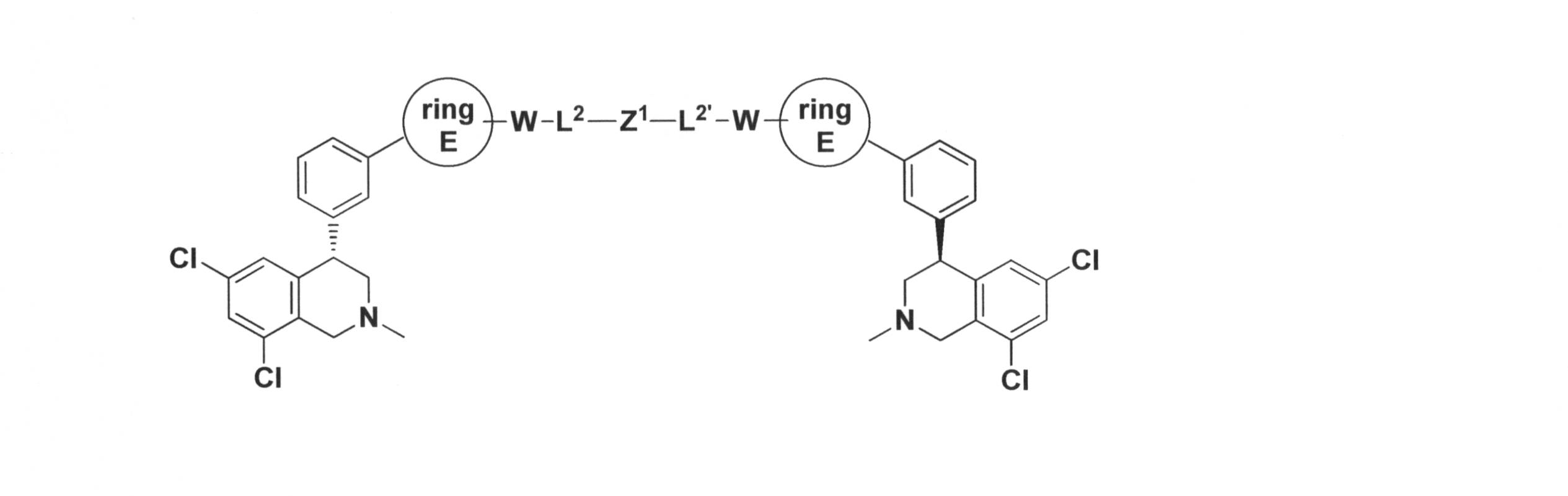
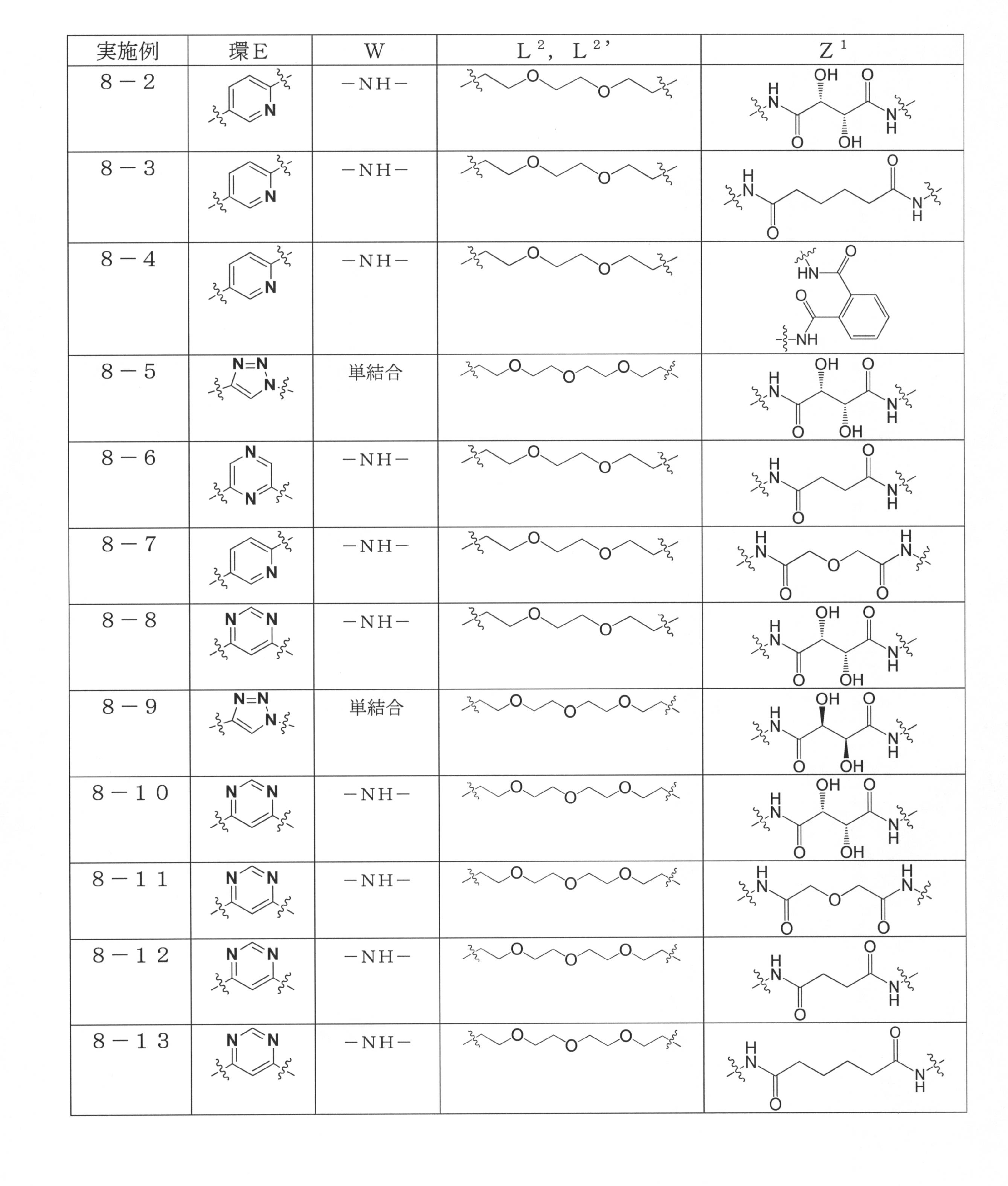
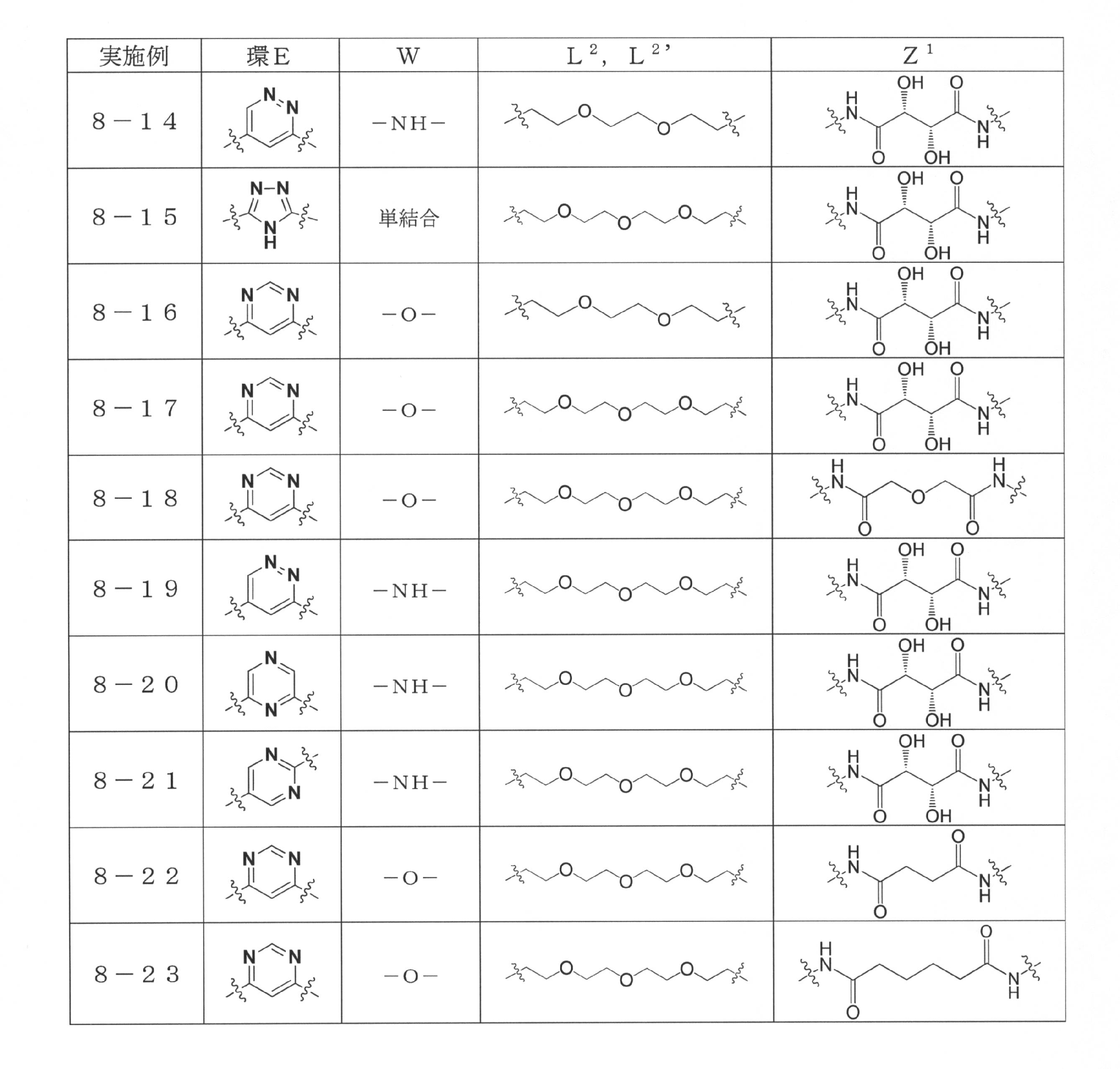
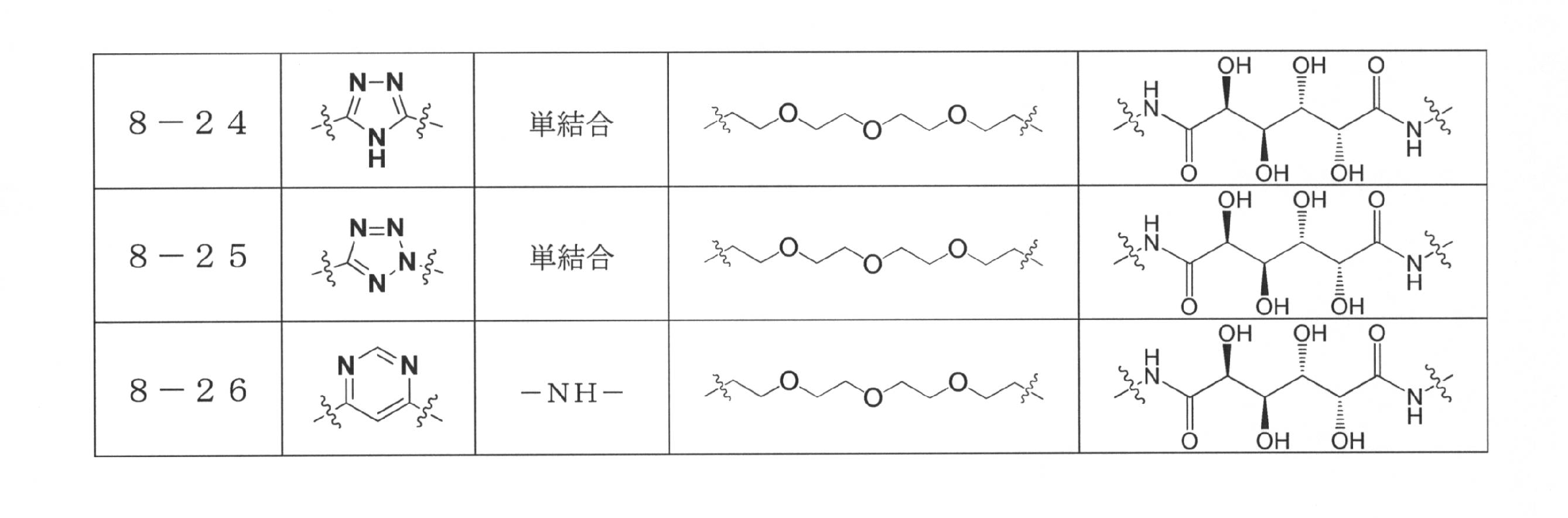

LC-MS 保持時間 1.073 min
LC:Agilent 1290
ESI/APCI MS:Agilent 6130
Column: Waters Acquity CSH C18 1.7um, 2.1x50mm
Solvent: H2O:CH3CN(0.1% Formic acid)
Gradient: 0.8mL/min, 0min(95:5) →1.2min(50:50)
1.0mL/min, →1.38min(3:97)
MS (+) : 2359 [M+H]+.
試験例1
内在NHE欠損細胞株はフクロネズミ腎臓(OK)細胞(ATCC)を用い、Jacques Pouyssegurらの方法(Proc.Natl. Acad. Sci.USA.1984 Vol. 81. 4833-4837)に従い作製した。
発現プラスミドはヒトNHE3(SLC9A3、Accession No.NM_004174)cDNA配列(ジーンコピア社)をpcDNA3.2/V5-DESTベクター(ライフテクノロジーズ社)に挿入し構築した。
構築したヒトNHE3発現プラスミドを内在NHE欠損OK細胞へ遺伝子導入し、安定発現細胞を作製した。遺伝子導入はヌクレオフェクター2b装置(ロンザ社)を用いエレクトロポレーション法にて実施した。ジェネティシン(ライフテクノロジーズ社) 500 ug/mL含有培地下で選択し安定発現細胞株を単離した。
細胞を用いたNHE3活性測定法:細胞内の酸性化後にNHE3を介して起こる細胞内pHの回復を指標に活性を判定した。細胞内pHの測定はTsien ら(Proc. Natl. Acad. Sci. USA.,1984,81,7436-7440)により報告されたpH感受性蛍光指示薬法を一部改変して実施した。
ヒトNHE3安定発現細胞株をポリDリジンコート96ウェルプレート(グライナー社)中に播種し、一晩増殖させた。培地をウェルから吸引し、細胞をハンクス平衡塩緩衝液(137 mM NaCl、20 mM HEPES、5.6 mM グルコース、5.3 mM KCl、1.3 mM CaCl2、0.5 mM MgCl2、0.4 mM MgSO4、0.4 mM KH2PO4、0.3mM Na2HPO4、pH7.4)で1回洗浄した後、0.25μM BCECF-AM(同仁化学社)を含むハンクス平衡塩緩衝液を加え37℃で30分間インキュベートした。ウェルから液を吸引し、NH4Cl緩衝液(20 mM NH4Cl、115 mM 塩化コリン、20 mM HEPES、5 mM グルコース、4.7 mM KCl、1.25 mM CaCl2、1.25 mM MgCl2、pH7.4)を添加後37℃で10分間インキュベートした。NH4Cl緩衝液中でインキュベートした細胞を、NH4Clを含まない緩衝液(133.8 mM 塩化コリン、10 mM HEPES、5 mM グルコース、4.7 mM KCl,1.25 mM CaCl2、1.25 mM MgCl2、0.97 mM K2HPO4、0.23 mM KH2PO4、pH7.4)で洗浄することによって細胞内pHを低下させた。洗浄工程後、NH4Clを含まない緩衝液で調製した試験化合物溶液70μLを細胞へ添加し、測定器FDSS6000(浜松ホトニクス社)内で70μLのナトリウムイオンを含む緩衝液(133.8 mM NaCl、10mM HEPES、5 mM グルコース、4.7 mM KCl、1.25 mM CaCl2、1.25 mM MgCl2、0.97 mM Na2HPO4、0.23 mM NaH2PO4、pH7.4)を加えることでpHの回復を開始させた。細胞内pHの回復をBCECF蛍光(励起波長480 nm、蛍光波長520~560 nm)によってモニターし、pH回復の初速域をプロットした。試験化合物を含まないpHの回復を最大回復とし、その最大回復を50%抑制するのに必要な試験化合物濃度をIC50値として算出した。
各化合物のヒトNHE3阻害活性(nM)を以下の表7-1に示す。
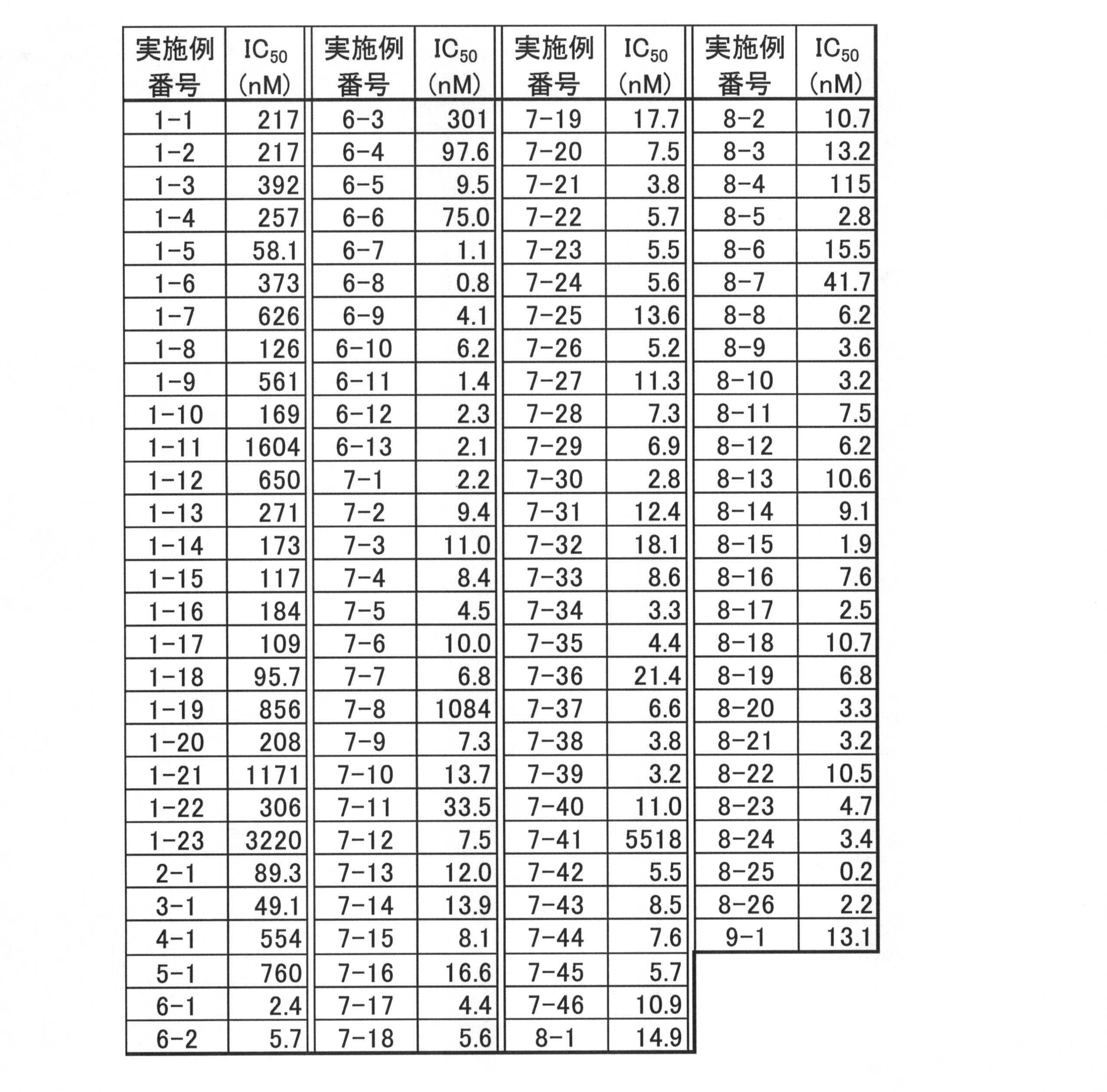
試験例2
8週齢のSD系雄性ラット(日本エスエルシー株式会社)を実験動物として用いた。被験化合物を日本薬局方注射用水(光製薬社製)に、0.2mg/mLまたは0.6mg/mLの濃度となるように懸濁あるいは溶解し、5ml/kg体重の容量で経口投与した。対照群には日本薬局方注射用水を同容量投与した。被験化合物及び注射用水投与から5分後に 32Pリン酸(パーキンエルマー)を含有するリン酸溶液(1.3mM NaH2PO4)を5ml/kgで投与した。リン酸溶液投与30分後に尾静脈より採血し、血液試料を直ちにEDTA-2K(DOJINDO社製)と混合した。その後、3000rpm、10分間、4℃で遠心分離し、血漿を回収した。
血漿100μL中の放射活性を液体シンチレーションカウンターで測定し、リン酸吸収カウントとした。対照群の血漿中の放射活性をコントロールとして、リン酸吸収抑制率を以下の式により求めた。
リン酸吸収抑制率(%)=(1―被験化合物投与群のリン酸吸収カウント/対照群のリン酸吸収カウント)× 100
各化合物のリン酸吸収抑制率(%、投与用量は1mg/kg又は3mg/kg)を以下の表8-1に示す。なお、複数の用量での抑制率を測定することで、最小有効用量(Minimum Effective Dose、MED)を算出することもできる。
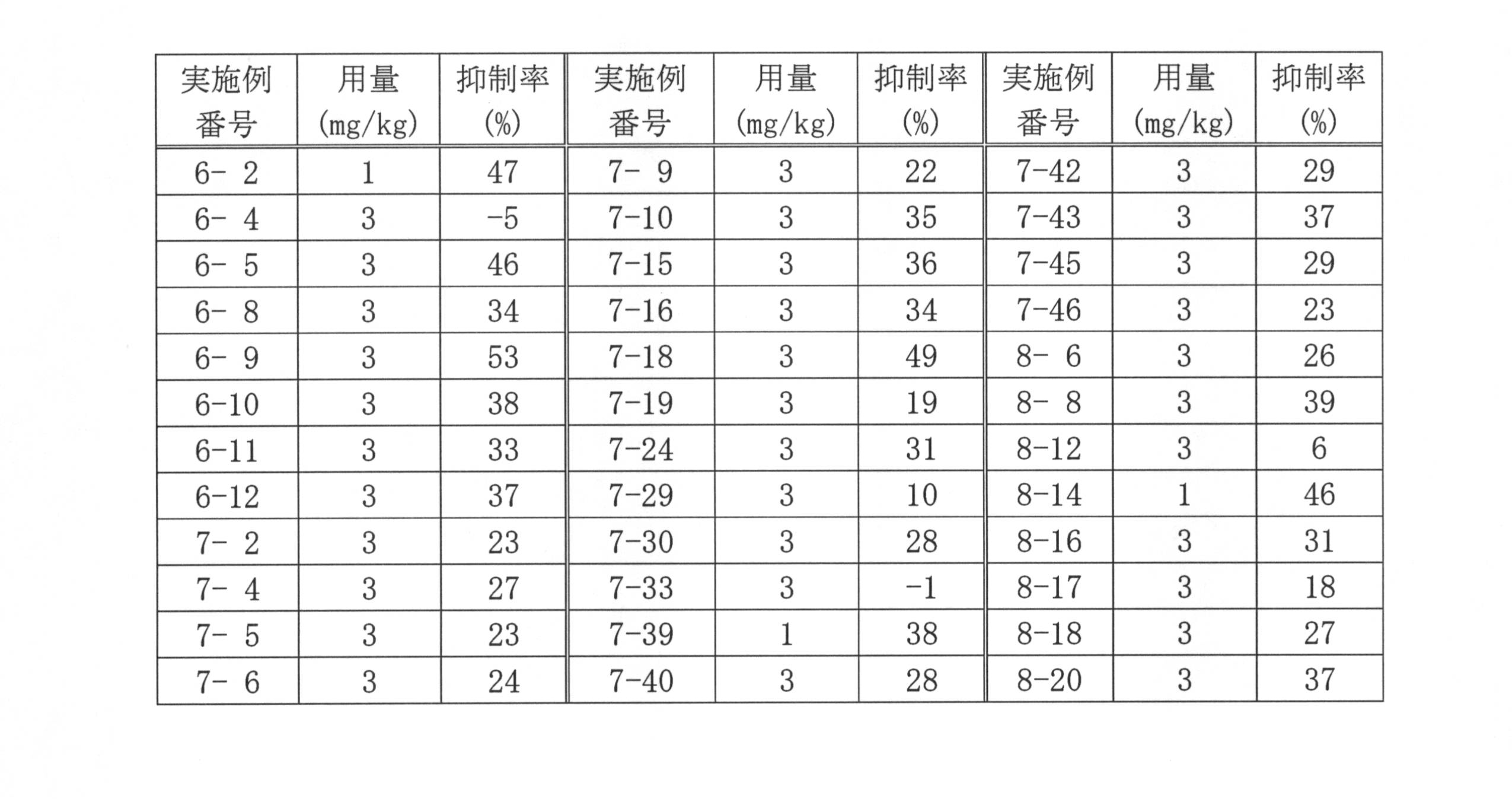
Claims (17)
- 下記式[1]
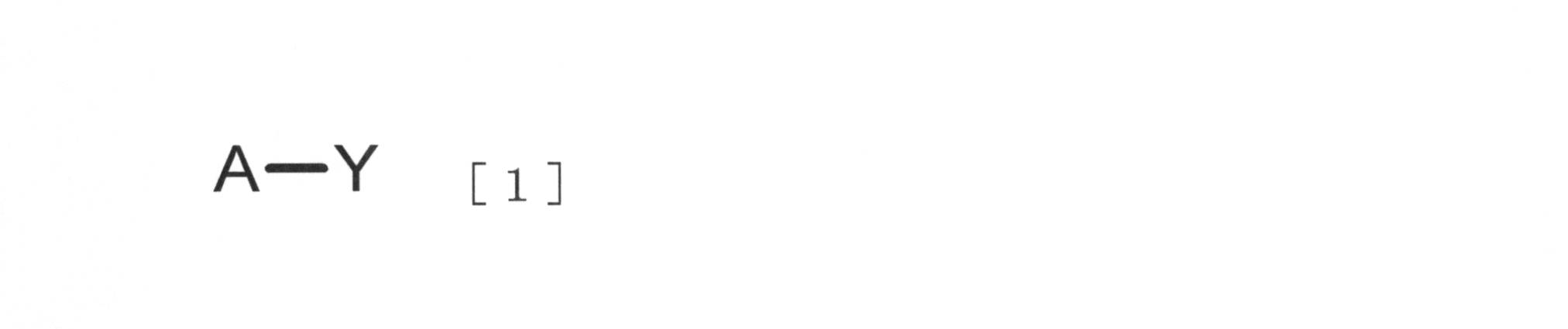
Aは、下記式[2]で表される構造を示し、
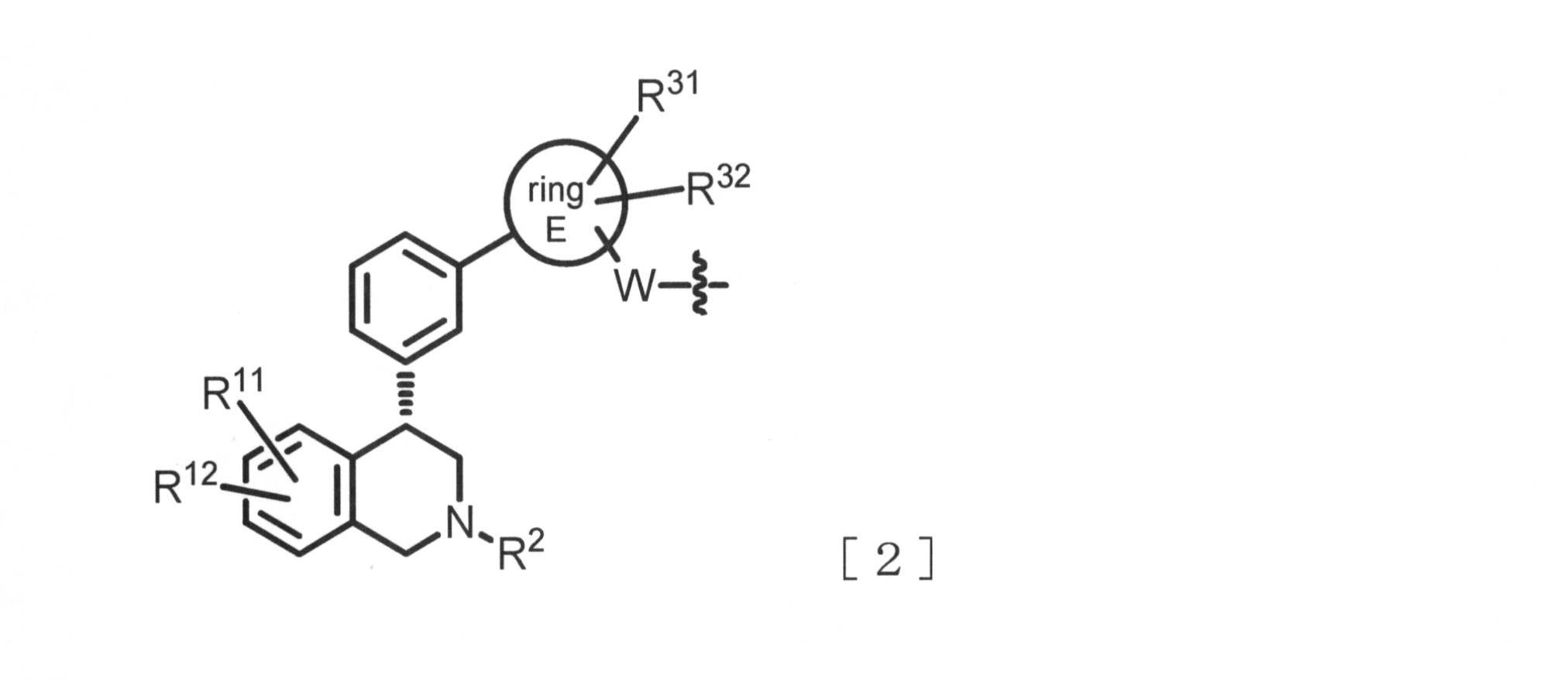
R11及びR12は、同一に又は異なって、水素原子又はハロゲン原子を示し、
R2は、水素原子又はC1-6アルキルを示し、
環Eは、ピロール、フラン、ピラゾール、イミダゾール、イソオキサゾール、オキサゾール、イソチアゾール、トリアゾール、オキサジアゾール、テトラゾール、ピリジン、ピリダジン、ピリミジン、又はピラジンを示し、
R31及びR32は、同一に又は異なって、水素原子、シアノ、C1-6アルキル、C1-6アルコキシ、又はモノC1-6アルキルアミノを示し、
Wは、単結合、式-NH-、式-O-、又は式-CONH-を示し、
Yは、水素原子又は下記式[3’]のいずれかの構造を示し、
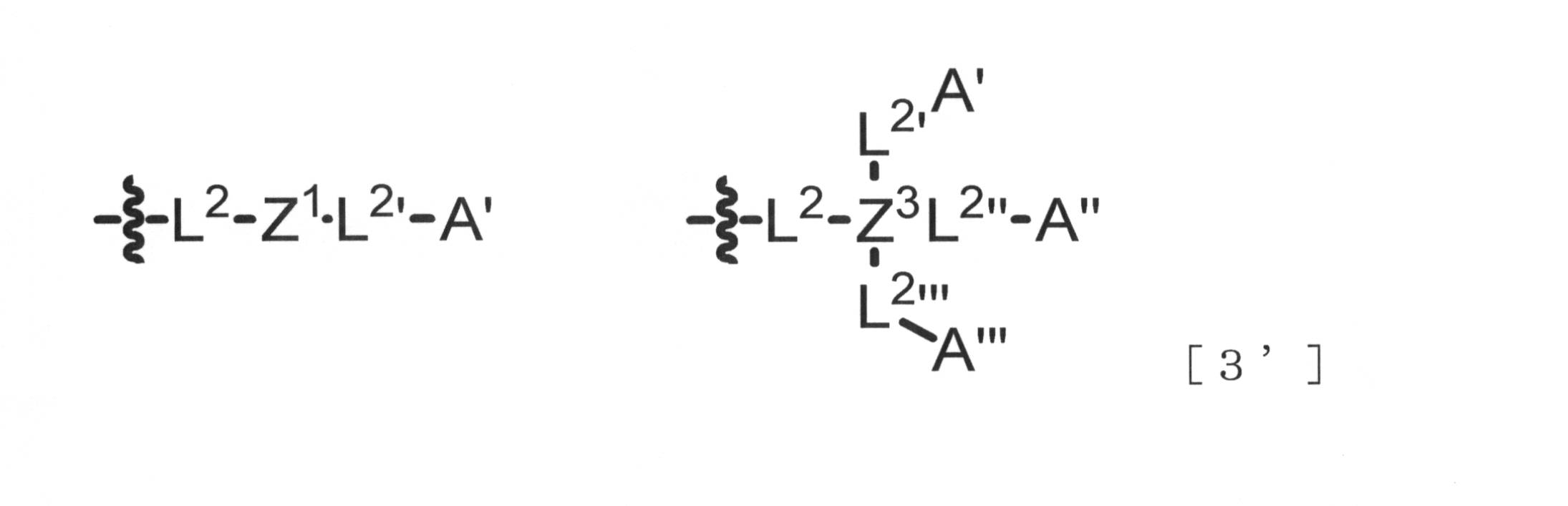
Z1は、下記式群[4’]のいずれかの構造を示し、

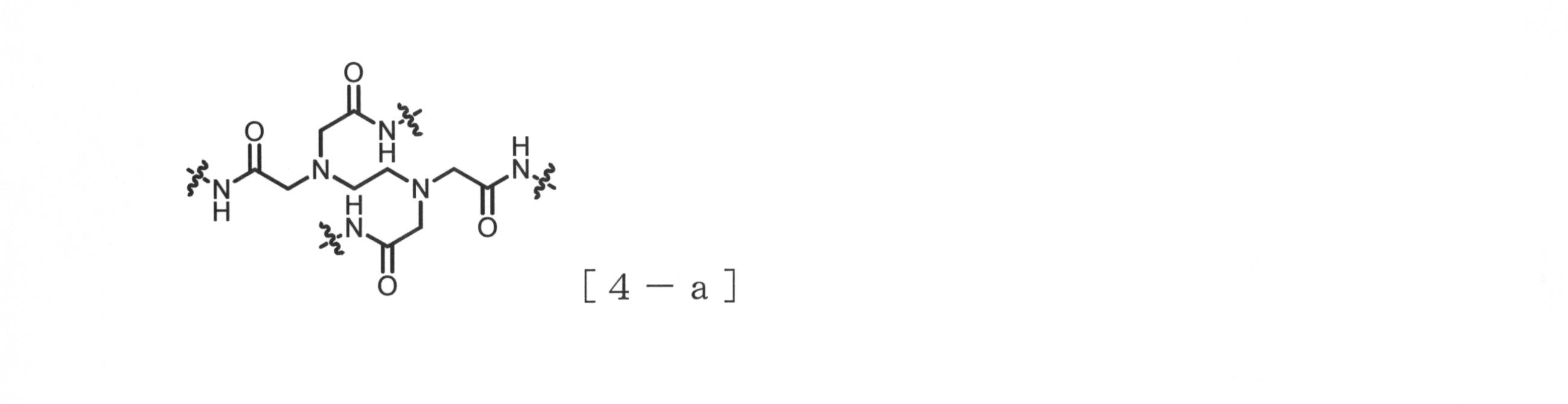
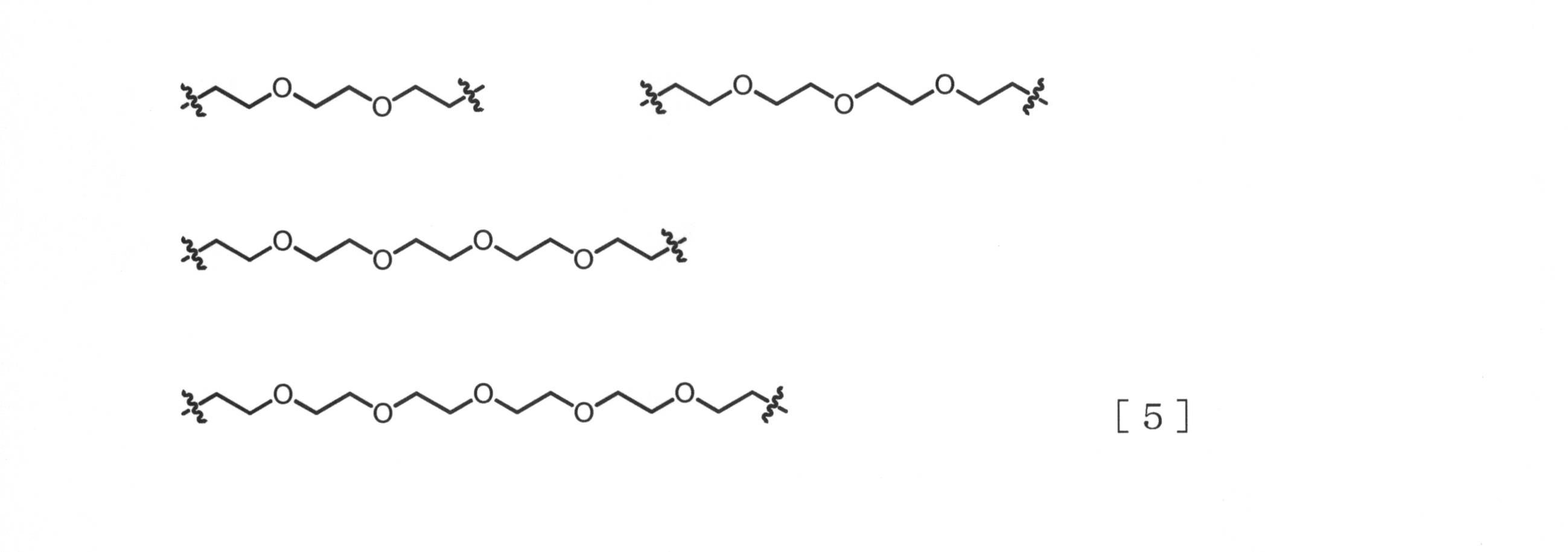
で表される化合物又はその製薬学的に許容される塩。 - Yが、水素原子又は下記式[3]で表される構造であり、

Z1が、下記式群[4]のいずれかの構造であり、
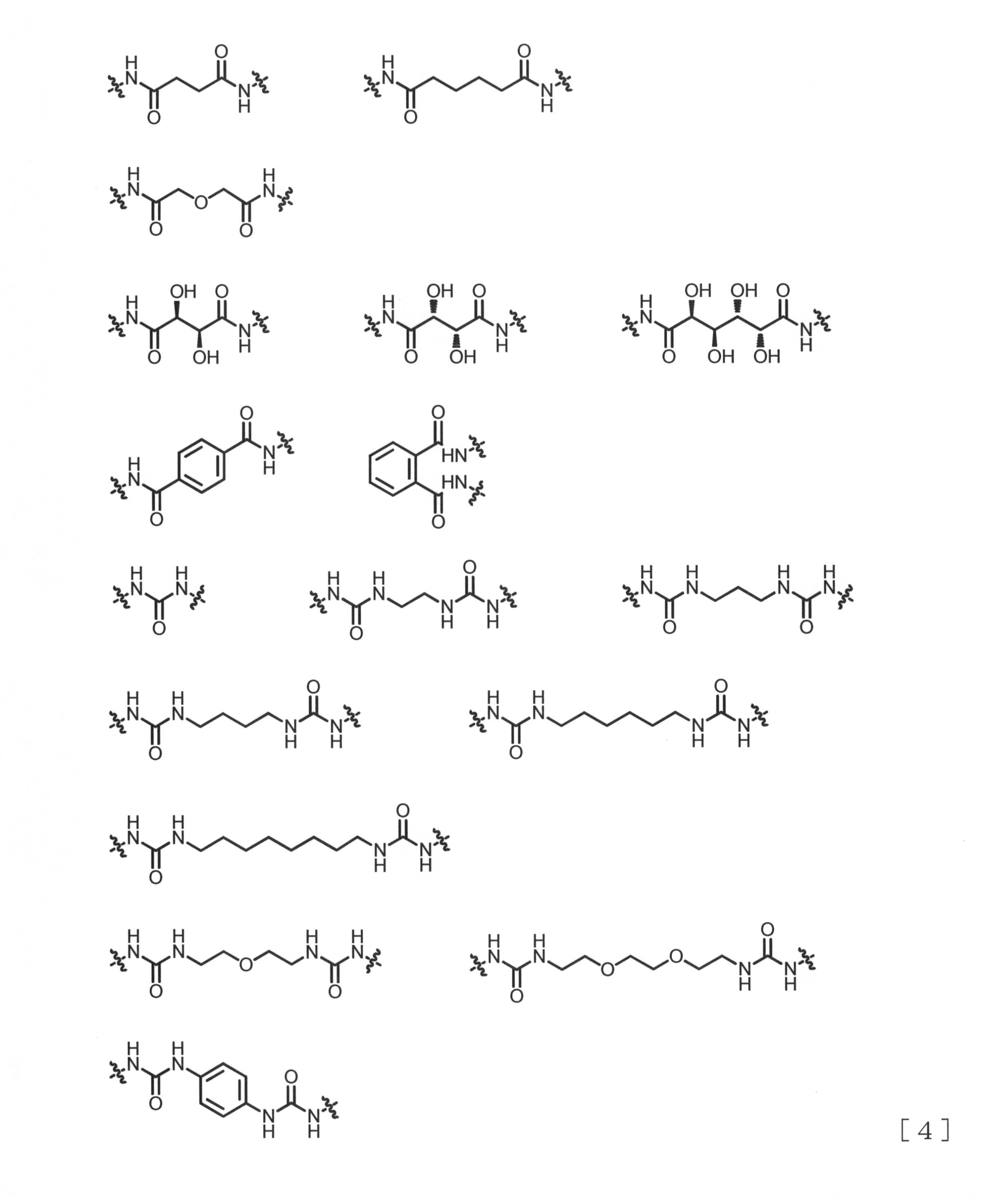
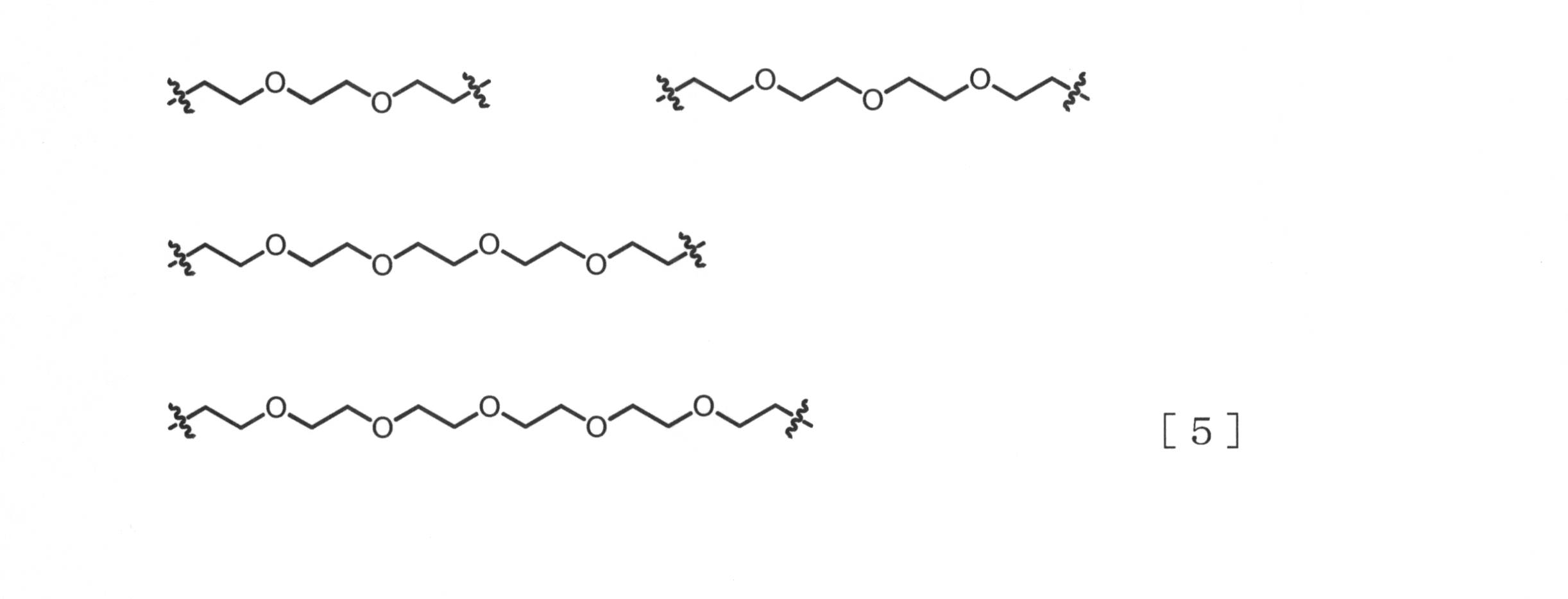
である、請求項1に記載の化合物又はその製薬学的に許容される塩。 - Yが、下記式[3]で表される構造

L2、L2’、Z1、及びA’は、前記の通りである。)
である、請求項1又は2に記載の化合物又はその製薬学的に許容される塩。 - Z1が、下記式群[6]のいずれかの構造
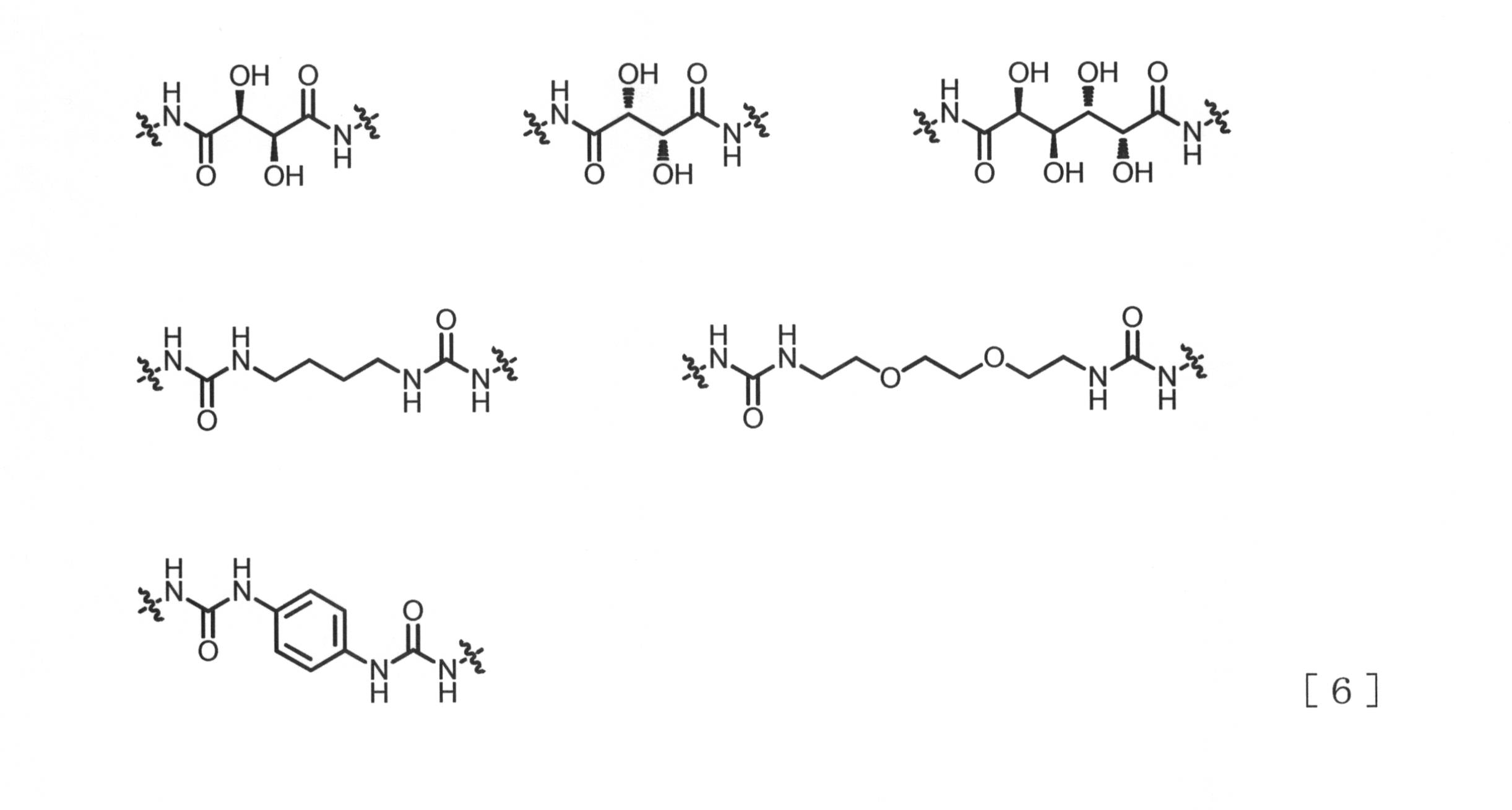
- 前記式[2]で表される構造が、下記式[7]
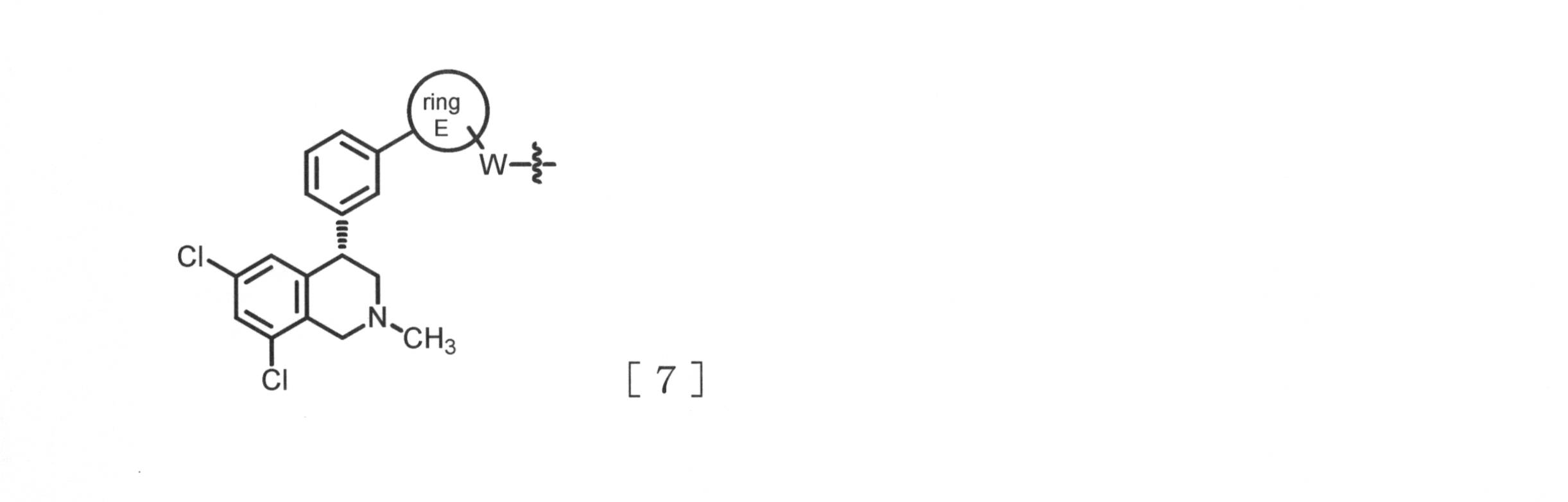
環E 及びWは、前記の通りである。)
である、請求項4に記載の化合物又はその製薬学的に許容される塩。 - 前記式[7]中、下記式[8]で表される構造が、下記式群[9]のいずれかの構造
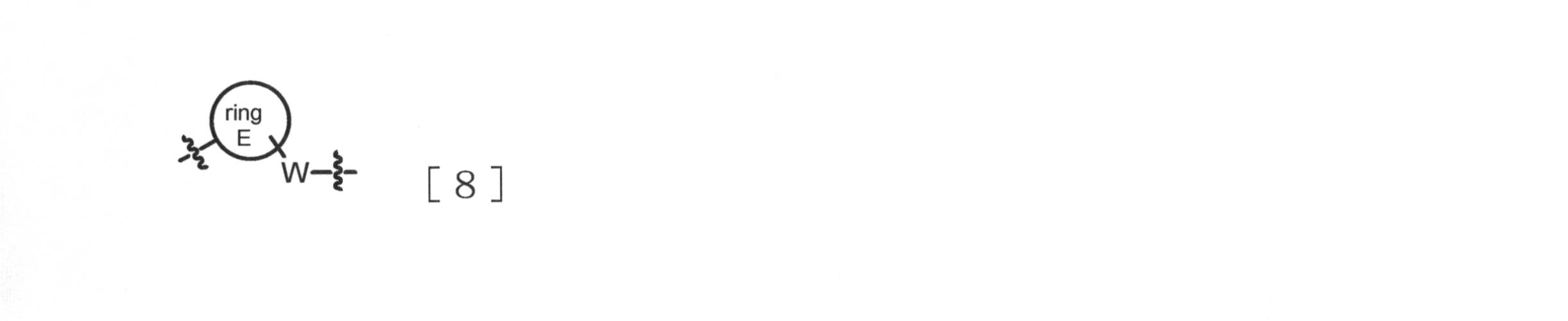

- 請求項1~6のいずれか1項に記載の化合物又はその製薬学的に許容される塩を有効成分として含有する医薬。
- 請求項1~6のいずれか1項に記載の化合物又はその製薬学的に許容される塩を有効成分として含有するNHE3阻害剤。
- 請求項1~6のいずれか1項に記載の化合物又はその製薬学的に許容される塩を有効成分として含有する腸内水分分泌促進剤。
- 請求項1~6のいずれか1項に記載の化合物又はその製薬学的に許容される塩を有効成分として含有する便秘の予防薬又は治療薬。
- 請求項1~6のいずれか1項に記載の化合物又はその製薬学的に許容される塩を有効成分として含有するナトリウム吸収抑制剤。
- 請求項1~6のいずれか1項に記載の化合物又はその製薬学的に許容される塩を有効成分として含有する高血圧の予防薬又は治療薬。
- 請求項1~6のいずれか1項に記載の化合物又はその製薬学的に許容される塩を有効成分として含有する腎症の予防薬又は治療薬。
- 請求項1~6のいずれか1項に記載の化合物又はその製薬学的に許容される塩を有効成分として含有する体液貯留の予防薬又は治療薬。
- 請求項1~6のいずれか1項に記載の化合物又はその製薬学的に許容される塩を有効成分として含有するリン吸収抑制剤。
- 請求項1~6のいずれか1項に記載の化合物又はその製薬学的に許容される塩を有効成分として含有する高リン血症の予防薬又は治療薬。
- 請求項1~6のいずれか1項に記載の化合物又はその製薬学的に許容される塩を有効成分として含有するCKD-MBDの予防薬又は治療薬。
Priority Applications (26)
| Application Number | Priority Date | Filing Date | Title |
|---|---|---|---|
| JP2016535994A JP6292307B2 (ja) | 2014-07-25 | 2015-07-24 | ヘテロアリールで置換されたフェニルテトラヒドロイソキノリン化合物 |
| NZ728313A NZ728313B2 (en) | 2014-07-25 | 2015-07-24 | Phenyl tetrahydroisoquinoline compound substituted with heteroaryl |
| MX2017001117A MX375386B (es) | 2014-07-25 | 2015-07-24 | Compuesto de feniltetrahidroisoquinolina sustituido con heteroarilo. |
| SG11201700398RA SG11201700398RA (en) | 2014-07-25 | 2015-07-24 | Phenyl tetrahydroisoquinoline compound substituted with heteroaryl |
| SI201530498T SI3173408T1 (sl) | 2014-07-25 | 2015-07-24 | Spojina fenil tetrahidroizokinolin substituirana s heteroarilom |
| HRP20181978TT HRP20181978T1 (hr) | 2014-07-25 | 2015-07-24 | Spoj fenil tetrahidroizokinolina supstituiran s heteroarilom |
| CA2955572A CA2955572C (en) | 2014-07-25 | 2015-07-24 | Phenyl tetrahydroisoquinoline compound substituted with heteroaryl |
| PL15825310T PL3173408T3 (pl) | 2014-07-25 | 2015-07-24 | Związek fenylotetrahydroizochinolinowy podstawiony heteroarylem |
| KR1020177003057A KR102386666B1 (ko) | 2014-07-25 | 2015-07-24 | 헤테로아릴로 치환된 페닐테트라히드로이소퀴놀린 화합물 |
| US15/328,223 US9932331B2 (en) | 2014-07-25 | 2015-07-24 | Phenyl tetrahydroisoquinoline compound substituted with heteroaryl |
| MYPI2017700214A MY182318A (en) | 2014-07-25 | 2015-07-24 | Phenyl tetrahydroisoquinoline compound substituted with heteroaryl |
| AU2015293134A AU2015293134B2 (en) | 2014-07-25 | 2015-07-24 | Phenyl tetrahydroisoquinoline compound substituted with heteroaryl |
| MEP-2019-10A ME03311B (me) | 2014-07-25 | 2015-07-24 | Fenil teтrahidroizokvinolinsko jedinjenje supsтituisano heteroarilom |
| RU2017105836A RU2703456C2 (ru) | 2014-07-25 | 2015-07-24 | Фенилтетрагидроизохинолиновое соединение, замещенное гетероарилом |
| LTEP15825310.4T LT3173408T (lt) | 2014-07-25 | 2015-07-24 | Fenilo tetrahidroizochinolino junginys, turintis heteroarilo pakaitų |
| CN201580040318.5A CN106536502B (zh) | 2014-07-25 | 2015-07-24 | 被杂芳基取代的苯基四氢异喹啉化合物 |
| RS20190060A RS58378B1 (sr) | 2014-07-25 | 2015-07-24 | Fenil tetrahidroizokvinolinsko jedinjenje supstituisano heteroarilom |
| BR112017000691-0A BR112017000691B1 (pt) | 2014-07-25 | 2015-07-24 | Feniltetra-hidroisoquinolina substituído com heteroari-la, seu uso, medicamento, inibidores de nhe3, de absorção de sódio e de absorção de fósforo, promotor de secre-ção de água intestinal e fármaco profilático ou terapêu-tico para constipação |
| DK15825310.4T DK3173408T3 (en) | 2014-07-25 | 2015-07-24 | PHENYLTETRAHYDROISOQUINOLINE COMPOUND SUBSTITUTED WITH HETEROARYL |
| EP15825310.4A EP3173408B1 (en) | 2014-07-25 | 2015-07-24 | Phenyl tetrahydroisoquinoline compound substituted with heteroaryl |
| ES15825310T ES2701498T3 (es) | 2014-07-25 | 2015-07-24 | Compuesto de feniltetrahidroisoquinolina sustituido con heteroarilo |
| SM20190104T SMT201900104T1 (it) | 2014-07-25 | 2015-07-24 | Composto fenil tetraidroisochinolina sostituito con eteroarile |
| IL25011717A IL250117B (en) | 2014-07-25 | 2017-01-15 | A tetrahydroisoquinoline phenyl compound is substituted with a heteroaryl |
| PH12017500119A PH12017500119A1 (en) | 2014-07-25 | 2017-01-20 | Phenyl tetrahydroisoquinoline compound substituted with heteroaryl |
| ZA2017/00563A ZA201700563B (en) | 2014-07-25 | 2017-01-24 | Phenyl tetrahydroisoquinoline compound substituted with heteroaryl |
| CY20191100125T CY1121401T1 (el) | 2014-07-25 | 2019-01-30 | Ενωση φαινυλο-τετραϋδροϊσοκινολινης υποκατεστημενη με ετεροαρυλ |
Applications Claiming Priority (4)
| Application Number | Priority Date | Filing Date | Title |
|---|---|---|---|
| JP2014-151726 | 2014-07-25 | ||
| JP2014151726 | 2014-07-25 | ||
| JP2015-051289 | 2015-03-13 | ||
| JP2015051289 | 2015-03-13 |
Publications (1)
| Publication Number | Publication Date |
|---|---|
| WO2016013657A1 true WO2016013657A1 (ja) | 2016-01-28 |
Family
ID=55163179
Family Applications (1)
| Application Number | Title | Priority Date | Filing Date |
|---|---|---|---|
| PCT/JP2015/071111 Ceased WO2016013657A1 (ja) | 2014-07-25 | 2015-07-24 | ヘテロアリールで置換されたフェニルテトラヒドロイソキノリン化合物 |
Country Status (28)
| Country | Link |
|---|---|
| US (1) | US9932331B2 (ja) |
| EP (1) | EP3173408B1 (ja) |
| JP (1) | JP6292307B2 (ja) |
| KR (1) | KR102386666B1 (ja) |
| CN (1) | CN106536502B (ja) |
| AU (1) | AU2015293134B2 (ja) |
| BR (1) | BR112017000691B1 (ja) |
| CA (1) | CA2955572C (ja) |
| CY (1) | CY1121401T1 (ja) |
| DK (1) | DK3173408T3 (ja) |
| ES (1) | ES2701498T3 (ja) |
| HR (1) | HRP20181978T1 (ja) |
| IL (1) | IL250117B (ja) |
| LT (1) | LT3173408T (ja) |
| ME (1) | ME03311B (ja) |
| MX (1) | MX375386B (ja) |
| MY (1) | MY182318A (ja) |
| PH (1) | PH12017500119A1 (ja) |
| PL (1) | PL3173408T3 (ja) |
| PT (1) | PT3173408T (ja) |
| RS (1) | RS58378B1 (ja) |
| RU (1) | RU2703456C2 (ja) |
| SG (1) | SG11201700398RA (ja) |
| SI (1) | SI3173408T1 (ja) |
| SM (1) | SMT201900104T1 (ja) |
| TW (1) | TWI666206B (ja) |
| WO (1) | WO2016013657A1 (ja) |
| ZA (1) | ZA201700563B (ja) |
Cited By (2)
| Publication number | Priority date | Publication date | Assignee | Title |
|---|---|---|---|---|
| JP2020505333A (ja) * | 2017-01-09 | 2020-02-20 | アルデリックス, インコーポレイテッド | Nhe媒介性アンチポートの阻害薬 |
| CN118387998A (zh) * | 2024-04-19 | 2024-07-26 | 中原环保股份有限公司 | 一种原位精准化学除磷的控制方法及其装置 |
Families Citing this family (5)
| Publication number | Priority date | Publication date | Assignee | Title |
|---|---|---|---|---|
| JP6903923B2 (ja) * | 2016-01-22 | 2021-07-14 | 大正製薬株式会社 | ヘテロアリールで置換されたフェニルテトラヒドロイソキノリン化合物を有効成分として含有する医薬 |
| CN109012748B (zh) * | 2018-07-27 | 2021-03-16 | 安徽师范大学 | 吡啶取代吡咯基稀土金属催化剂及其制备方法和应用 |
| CN114174289B (zh) | 2019-05-31 | 2025-03-07 | Ube株式会社 | 苯并三唑衍生物 |
| US12024521B2 (en) | 2020-06-30 | 2024-07-02 | Prosetta Biosciences, Inc. | Isoquinoline derivatives, methods of synthesis and uses thereof |
| CN114716458A (zh) * | 2021-01-04 | 2022-07-08 | 上海济煜医药科技有限公司 | 四氢异喹啉类化合物 |
Citations (8)
| Publication number | Priority date | Publication date | Assignee | Title |
|---|---|---|---|---|
| JP2005515205A (ja) * | 2001-12-05 | 2005-05-26 | アベンティス・ファーマ・ドイチユラント・ゲゼルシャフト・ミット・ベシュレンクテル・ハフツング | 置換4−フェニルテトラヒドロイソキノリン類、その製造方法、その医薬としての用途、およびそれらを含む医薬 |
| JP2005524616A (ja) * | 2001-12-22 | 2005-08-18 | アベンティス・ファーマ・ドイチユラント・ゲゼルシャフト・ミット・ベシュレンクテル・ハフツング | 置換された4−フェニルテトラヒドロイソキノリニウム塩、それらの製造方法、それらの医薬としての使用及びそれらを含む医薬 |
| JP2006521306A (ja) * | 2003-03-24 | 2006-09-21 | サノフィ−アベンティス・ドイチュラント・ゲゼルシャフト・ミット・ベシュレンクテル・ハフツング | 置換4−フェニルテトラヒドロイソキノリン、その製造方法、医薬としてのその使用、およびこのような化合物を含有する医薬 |
| JP2008513525A (ja) * | 2004-09-23 | 2008-05-01 | サノフィ−アベンティス・ドイチュラント・ゲゼルシャフト・ミット・ベシュレンクテル・ハフツング | 置換された4−フェニルテトラヒドロイソキノリン、それらの製造方法、医薬としてのそれらの使用及びそれらを含有する医薬 |
| JP2008526906A (ja) * | 2005-01-12 | 2008-07-24 | サノフィ−アベンティス | 置換4−フェニルテトラヒドロイソキノリン、それらの製造方法、薬物としてのそれらの使用およびそれらを含む薬物 |
| JP2009508889A (ja) * | 2005-09-20 | 2009-03-05 | サノフィ−アベンティス | 置換された4−フェニルテトラヒドロイソキノリン、それらの製造方法、薬剤としてのそれらの使用、及びそれらを含む薬剤 |
| JP2012514009A (ja) * | 2008-12-31 | 2012-06-21 | アーデリクス,インコーポレーテッド | 体液貯留または塩分過負荷と関連する障害および消化管障害の治療におけるnhe媒介性アンチポートを阻害するための組成物および方法 |
| WO2014029984A1 (en) * | 2012-08-21 | 2014-02-27 | Ardelyx, Inc. | Compounds and methods for inhibiting nhe-mediated antiport in the treatment of disorders associated with fluid retention or salt overload and gastrointestinal tract disorders |
Family Cites Families (23)
| Publication number | Priority date | Publication date | Assignee | Title |
|---|---|---|---|---|
| DE19548812A1 (de) | 1995-12-27 | 1997-07-03 | Hoechst Ag | Verwendung von Inhibitoren des zellulären Na·+·/H·+·-Exchangers (NHE) zur Herstellung eines Medikaments zur Atemstimulation |
| DE19945302A1 (de) | 1999-09-22 | 2001-03-29 | Merck Patent Gmbh | Biphenylderivate als NHE-3-Inhibitoren |
| DE10015248A1 (de) | 2000-03-28 | 2001-10-04 | Merck Patent Gmbh | Bisamidino-Verbindungen als NHE-3 Inhibitoren |
| DE10019062A1 (de) | 2000-04-18 | 2001-10-25 | Merck Patent Gmbh | 2-Guanidino-4-aryl-chinazoline als NHE-3 Inhibitoren |
| US6911453B2 (en) | 2001-12-05 | 2005-06-28 | Aventis Pharma Deutschland Gmbh | Substituted 4-phenyltetrahydroisoquinolinium, process for their preparation, their use as a medicament, and medicament containing them |
| DE10161767A1 (de) | 2001-12-15 | 2003-06-26 | Merck Patent Gmbh | 2-Guanidino-4-heterocyclyl-chinazoline |
| DE10163239A1 (de) | 2001-12-21 | 2003-07-10 | Aventis Pharma Gmbh | Substituierte Imidazolidine, Verfahren zu ihrer Herstellung, ihre Verwendung als Medikament oder Diagnostikum sowie enthaltendes Medikament |
| US20030187045A1 (en) | 2001-12-21 | 2003-10-02 | Uwe Heinelt | Substituted imidazolidines, process for their preparation, and their use as a medicament or diagnostic |
| US6703405B2 (en) | 2001-12-22 | 2004-03-09 | Aventis Pharma Deutschland Gmbh | Substituted 4-phenyltetrahydroisoquinolinium salts, process for their preparation, their use as a medicament, and medicament containing them |
| DE10163992A1 (de) | 2001-12-24 | 2003-07-03 | Merck Patent Gmbh | 4-Aryl-chinazoline |
| US7049333B2 (en) | 2002-06-04 | 2006-05-23 | Sanofi-Aventis Deutschland Gmbh | Substituted thiophenes: compositions, processes of making, and uses in disease treatment and diagnosis |
| DE10224892A1 (de) | 2002-06-04 | 2003-12-18 | Aventis Pharma Gmbh | Substituierte Thiophene, Verfahren zu ihrer Herstellung, ihre Verwendung als Medikament oder Diagnostikum sowie sie enthaltendes Medikament |
| DE10304294A1 (de) | 2003-02-04 | 2004-08-12 | Aventis Pharma Deutschland Gmbh | N-Substituierte(Benzoimidazol-2-yl)-phenyl, Verfahren zu ihrer Herstellung , ihre Verwendung als Medikament oder Diagnostikum sowie sie enthaltendes Medikament |
| US20050054705A1 (en) | 2003-02-04 | 2005-03-10 | Aventis Pharma Deutschland Gmbh | N-substituted (benzoimidazol-2-yl) phenylamines, process for their preparation, their use as medicament or diagnostic aid, and medicament comprising them |
| DE10304374A1 (de) | 2003-02-04 | 2004-08-05 | Aventis Pharma Deutschland Gmbh | Neue substituierte 2-Aminoimidazole, Verfahren zu ihrer Herstellung, ihre Verwendung als Medikament oder Diagnostikum sowie sie enthaltendes Medikament |
| US7241775B2 (en) | 2003-03-24 | 2007-07-10 | Sanofi-Aventis Deutschland Gmbh | Composition, process of making, and medical use of substituted 4-phenyltetrahydroisoquinolines |
| AU2003241471A1 (en) | 2003-05-13 | 2005-01-21 | Electric Power Research Institute, Inc. | Application of symbol sequence analysis and temporal irreversibility to monitoring and controlling boiler flames |
| DE10341240A1 (de) | 2003-09-08 | 2005-04-07 | Aventis Pharma Deutschland Gmbh | Substituierte Thienoimidazole, Verfahren zu ihrer Herstellung, ihre Verwendung als Medikament oder Diagnostikum sowie sie enthaltendes Medikament |
| DE102006012545A1 (de) | 2006-03-18 | 2007-09-27 | Sanofi-Aventis | Substituierte 2-Amino-4-phenyl-dihydrochinoline, Verfahren zu ihrer Herstellung, ihre Verwendung als Medikament, sowie sie enthaltendes Medikament |
| DE102006012544A1 (de) | 2006-03-18 | 2007-09-27 | Sanofi-Aventis | Substituierte 1-Amino 4-phenyl-dihydroisochinoline, Verfahren zu ihrer Herstellung, ihre Verwendung als Medikament, sowie sie enthaltendes Medikament |
| EP2342178B1 (en) | 2008-09-02 | 2016-09-28 | Sanofi | Substituted aminoindanes and analogs thereof, and the pharmaceutical use thereof |
| RU2015107019A (ru) | 2012-08-21 | 2016-10-10 | Эрделикс Инк. | Соединения и способы для ингибирования nhe-опосредованного антипорта в лечении расстройств, ассоциированных с задержкой жидкости или солевой перегрузкой и заболеваний желудочно-кишечного тракта |
| CN105392483B (zh) * | 2013-04-12 | 2019-03-15 | 阿德利克斯公司 | 用于抑制磷酸盐转运的nhe3结合化合物和方法 |
-
2015
- 2015-07-24 WO PCT/JP2015/071111 patent/WO2016013657A1/ja not_active Ceased
- 2015-07-24 CN CN201580040318.5A patent/CN106536502B/zh active Active
- 2015-07-24 US US15/328,223 patent/US9932331B2/en active Active
- 2015-07-24 MX MX2017001117A patent/MX375386B/es active IP Right Grant
- 2015-07-24 CA CA2955572A patent/CA2955572C/en active Active
- 2015-07-24 RS RS20190060A patent/RS58378B1/sr unknown
- 2015-07-24 KR KR1020177003057A patent/KR102386666B1/ko active Active
- 2015-07-24 MY MYPI2017700214A patent/MY182318A/en unknown
- 2015-07-24 SI SI201530498T patent/SI3173408T1/sl unknown
- 2015-07-24 JP JP2016535994A patent/JP6292307B2/ja active Active
- 2015-07-24 RU RU2017105836A patent/RU2703456C2/ru active
- 2015-07-24 EP EP15825310.4A patent/EP3173408B1/en active Active
- 2015-07-24 SM SM20190104T patent/SMT201900104T1/it unknown
- 2015-07-24 ME MEP-2019-10A patent/ME03311B/me unknown
- 2015-07-24 AU AU2015293134A patent/AU2015293134B2/en active Active
- 2015-07-24 BR BR112017000691-0A patent/BR112017000691B1/pt active IP Right Grant
- 2015-07-24 HR HRP20181978TT patent/HRP20181978T1/hr unknown
- 2015-07-24 PT PT15825310T patent/PT3173408T/pt unknown
- 2015-07-24 PL PL15825310T patent/PL3173408T3/pl unknown
- 2015-07-24 LT LTEP15825310.4T patent/LT3173408T/lt unknown
- 2015-07-24 ES ES15825310T patent/ES2701498T3/es active Active
- 2015-07-24 DK DK15825310.4T patent/DK3173408T3/en active
- 2015-07-24 TW TW104124071A patent/TWI666206B/zh active
- 2015-07-24 SG SG11201700398RA patent/SG11201700398RA/en unknown
-
2017
- 2017-01-15 IL IL25011717A patent/IL250117B/en active IP Right Grant
- 2017-01-20 PH PH12017500119A patent/PH12017500119A1/en unknown
- 2017-01-24 ZA ZA2017/00563A patent/ZA201700563B/en unknown
-
2019
- 2019-01-30 CY CY20191100125T patent/CY1121401T1/el unknown
Patent Citations (8)
| Publication number | Priority date | Publication date | Assignee | Title |
|---|---|---|---|---|
| JP2005515205A (ja) * | 2001-12-05 | 2005-05-26 | アベンティス・ファーマ・ドイチユラント・ゲゼルシャフト・ミット・ベシュレンクテル・ハフツング | 置換4−フェニルテトラヒドロイソキノリン類、その製造方法、その医薬としての用途、およびそれらを含む医薬 |
| JP2005524616A (ja) * | 2001-12-22 | 2005-08-18 | アベンティス・ファーマ・ドイチユラント・ゲゼルシャフト・ミット・ベシュレンクテル・ハフツング | 置換された4−フェニルテトラヒドロイソキノリニウム塩、それらの製造方法、それらの医薬としての使用及びそれらを含む医薬 |
| JP2006521306A (ja) * | 2003-03-24 | 2006-09-21 | サノフィ−アベンティス・ドイチュラント・ゲゼルシャフト・ミット・ベシュレンクテル・ハフツング | 置換4−フェニルテトラヒドロイソキノリン、その製造方法、医薬としてのその使用、およびこのような化合物を含有する医薬 |
| JP2008513525A (ja) * | 2004-09-23 | 2008-05-01 | サノフィ−アベンティス・ドイチュラント・ゲゼルシャフト・ミット・ベシュレンクテル・ハフツング | 置換された4−フェニルテトラヒドロイソキノリン、それらの製造方法、医薬としてのそれらの使用及びそれらを含有する医薬 |
| JP2008526906A (ja) * | 2005-01-12 | 2008-07-24 | サノフィ−アベンティス | 置換4−フェニルテトラヒドロイソキノリン、それらの製造方法、薬物としてのそれらの使用およびそれらを含む薬物 |
| JP2009508889A (ja) * | 2005-09-20 | 2009-03-05 | サノフィ−アベンティス | 置換された4−フェニルテトラヒドロイソキノリン、それらの製造方法、薬剤としてのそれらの使用、及びそれらを含む薬剤 |
| JP2012514009A (ja) * | 2008-12-31 | 2012-06-21 | アーデリクス,インコーポレーテッド | 体液貯留または塩分過負荷と関連する障害および消化管障害の治療におけるnhe媒介性アンチポートを阻害するための組成物および方法 |
| WO2014029984A1 (en) * | 2012-08-21 | 2014-02-27 | Ardelyx, Inc. | Compounds and methods for inhibiting nhe-mediated antiport in the treatment of disorders associated with fluid retention or salt overload and gastrointestinal tract disorders |
Non-Patent Citations (1)
| Title |
|---|
| See also references of EP3173408A4 * |
Cited By (2)
| Publication number | Priority date | Publication date | Assignee | Title |
|---|---|---|---|---|
| JP2020505333A (ja) * | 2017-01-09 | 2020-02-20 | アルデリックス, インコーポレイテッド | Nhe媒介性アンチポートの阻害薬 |
| CN118387998A (zh) * | 2024-04-19 | 2024-07-26 | 中原环保股份有限公司 | 一种原位精准化学除磷的控制方法及其装置 |
Also Published As
Similar Documents
| Publication | Publication Date | Title |
|---|---|---|
| JP6292307B2 (ja) | ヘテロアリールで置換されたフェニルテトラヒドロイソキノリン化合物 | |
| TWI917480B (zh) | 用於治療trpm3介導病症之雜環衍生物 | |
| CN115054600B (zh) | 芳族磺酰胺衍生物 | |
| US20180338980A1 (en) | Aromatic sulfonamide derivatives | |
| EP3315492B1 (en) | Pyrazole derivative, or pharmaceutically acceptable salt thereof | |
| CN107207527B (zh) | 作为tnap抑制剂的吡啶并噁嗪酮化合物 | |
| KR101863708B1 (ko) | 고혈압 및/또는 섬유증 치료용 조성물 | |
| JP6903923B2 (ja) | ヘテロアリールで置換されたフェニルテトラヒドロイソキノリン化合物を有効成分として含有する医薬 | |
| CN121362177A (zh) | Apj激动剂 | |
| ES2641469T3 (es) | Compuesto de 2-piridona | |
| HK1231060B (en) | Phenyl tetrahydroisoquinoline compound substituted with heteroaryl | |
| NZ728313B2 (en) | Phenyl tetrahydroisoquinoline compound substituted with heteroaryl | |
| HK1231060A1 (en) | Phenyl tetrahydroisoquinoline compound substituted with heteroaryl | |
| EP3515895B1 (en) | Imidazole derivatives for the treatment of hypertension and/or fibrosis |
Legal Events
| Date | Code | Title | Description |
|---|---|---|---|
| 121 | Ep: the epo has been informed by wipo that ep was designated in this application |
Ref document number: 15825310 Country of ref document: EP Kind code of ref document: A1 |
|
| ENP | Entry into the national phase |
Ref document number: 2016535994 Country of ref document: JP Kind code of ref document: A |
|
| WWE | Wipo information: entry into national phase |
Ref document number: 250117 Country of ref document: IL |
|
| ENP | Entry into the national phase |
Ref document number: 2955572 Country of ref document: CA |
|
| WWE | Wipo information: entry into national phase |
Ref document number: 12017500119 Country of ref document: PH |
|
| WWE | Wipo information: entry into national phase |
Ref document number: 15328223 Country of ref document: US |
|
| REG | Reference to national code |
Ref country code: BR Ref legal event code: B01A Ref document number: 112017000691 Country of ref document: BR |
|
| WWE | Wipo information: entry into national phase |
Ref document number: MX/A/2017/001117 Country of ref document: MX |
|
| NENP | Non-entry into the national phase |
Ref country code: DE |
|
| ENP | Entry into the national phase |
Ref document number: 20177003057 Country of ref document: KR Kind code of ref document: A |
|
| ENP | Entry into the national phase |
Ref document number: 2015293134 Country of ref document: AU Date of ref document: 20150724 Kind code of ref document: A |
|
| REEP | Request for entry into the european phase |
Ref document number: 2015825310 Country of ref document: EP |
|
| WWE | Wipo information: entry into national phase |
Ref document number: 2015825310 Country of ref document: EP |
|
| ENP | Entry into the national phase |
Ref document number: 2017105836 Country of ref document: RU Kind code of ref document: A |
|
| ENP | Entry into the national phase |
Ref document number: 112017000691 Country of ref document: BR Kind code of ref document: A2 Effective date: 20170112 |