WO2016017086A1 - Système, dispositif, procédé et programme de prédiction de caractéristique comportementale - Google Patents
Système, dispositif, procédé et programme de prédiction de caractéristique comportementale Download PDFInfo
- Publication number
- WO2016017086A1 WO2016017086A1 PCT/JP2015/003503 JP2015003503W WO2016017086A1 WO 2016017086 A1 WO2016017086 A1 WO 2016017086A1 JP 2015003503 W JP2015003503 W JP 2015003503W WO 2016017086 A1 WO2016017086 A1 WO 2016017086A1
- Authority
- WO
- WIPO (PCT)
- Prior art keywords
- user
- feature amount
- base station
- behavior characteristic
- communication state
- Prior art date
- Legal status (The legal status is an assumption and is not a legal conclusion. Google has not performed a legal analysis and makes no representation as to the accuracy of the status listed.)
- Ceased
Links
Images




Classifications
-
- G—PHYSICS
- G06—COMPUTING OR CALCULATING; COUNTING
- G06N—COMPUTING ARRANGEMENTS BASED ON SPECIFIC COMPUTATIONAL MODELS
- G06N5/00—Computing arrangements using knowledge-based models
- G06N5/04—Inference or reasoning models
-
- G—PHYSICS
- G06—COMPUTING OR CALCULATING; COUNTING
- G06N—COMPUTING ARRANGEMENTS BASED ON SPECIFIC COMPUTATIONAL MODELS
- G06N20/00—Machine learning
-
- G—PHYSICS
- G06—COMPUTING OR CALCULATING; COUNTING
- G06N—COMPUTING ARRANGEMENTS BASED ON SPECIFIC COMPUTATIONAL MODELS
- G06N5/00—Computing arrangements using knowledge-based models
- G06N5/02—Knowledge representation; Symbolic representation
- G06N5/022—Knowledge engineering; Knowledge acquisition
-
- G—PHYSICS
- G06—COMPUTING OR CALCULATING; COUNTING
- G06Q—INFORMATION AND COMMUNICATION TECHNOLOGY [ICT] SPECIALLY ADAPTED FOR ADMINISTRATIVE, COMMERCIAL, FINANCIAL, MANAGERIAL OR SUPERVISORY PURPOSES; SYSTEMS OR METHODS SPECIALLY ADAPTED FOR ADMINISTRATIVE, COMMERCIAL, FINANCIAL, MANAGERIAL OR SUPERVISORY PURPOSES, NOT OTHERWISE PROVIDED FOR
- G06Q10/00—Administration; Management
- G06Q10/04—Forecasting or optimisation specially adapted for administrative or management purposes, e.g. linear programming or "cutting stock problem"
-
- G—PHYSICS
- G06—COMPUTING OR CALCULATING; COUNTING
- G06Q—INFORMATION AND COMMUNICATION TECHNOLOGY [ICT] SPECIALLY ADAPTED FOR ADMINISTRATIVE, COMMERCIAL, FINANCIAL, MANAGERIAL OR SUPERVISORY PURPOSES; SYSTEMS OR METHODS SPECIALLY ADAPTED FOR ADMINISTRATIVE, COMMERCIAL, FINANCIAL, MANAGERIAL OR SUPERVISORY PURPOSES, NOT OTHERWISE PROVIDED FOR
- G06Q30/00—Commerce
- G06Q30/02—Marketing; Price estimation or determination; Fundraising
- G06Q30/0201—Market modelling; Market analysis; Collecting market data
- G06Q30/0202—Market predictions or forecasting for commercial activities
-
- G—PHYSICS
- G06—COMPUTING OR CALCULATING; COUNTING
- G06Q—INFORMATION AND COMMUNICATION TECHNOLOGY [ICT] SPECIALLY ADAPTED FOR ADMINISTRATIVE, COMMERCIAL, FINANCIAL, MANAGERIAL OR SUPERVISORY PURPOSES; SYSTEMS OR METHODS SPECIALLY ADAPTED FOR ADMINISTRATIVE, COMMERCIAL, FINANCIAL, MANAGERIAL OR SUPERVISORY PURPOSES, NOT OTHERWISE PROVIDED FOR
- G06Q50/00—Information and communication technology [ICT] specially adapted for implementation of business processes of specific business sectors, e.g. utilities or tourism
- G06Q50/10—Services
- G06Q50/18—Legal services
Definitions
- the present invention relates to a behavior characteristic prediction system that predicts a behavior characteristic of a user, a behavior characteristic predictor, a behavior characteristic prediction learning method, a behavior characteristic prediction method, and a behavior characteristic prediction program.
- Communication companies providing communication services provide various communication services in order to acquire customers.
- the communication company predicts customers who are likely to cancel or customers with low satisfaction with the communication service, and implements various measures for those customers.
- Patent Document 1 describes a cancellation prediction support method for predicting a customer who is likely to cancel.
- a plurality of customers are classified using usage details data including a call time, a call partner, a call charge, etc. for each call, and a listing rule prepared according to a customer's call pattern
- the customer classification result the customer who is likely to cancel is determined from the plurality of customers.
- a customer who is likely to cancel is determined according to the call history of each customer.
- the call history is information indicating the result of the customer's behavior, and it is difficult to say that the call history is sufficient information indicating the customer's satisfaction.
- a customer with a high call frequency may change the telecommunications company in search of a better communication service, and even a customer with a low call frequency should feel unhappy with the current service. For example, a contract may be maintained. Therefore, in order to make a customer churn prediction, it is desirable to make a prediction that reflects not only the customer call history but also the quality of service provided in response to the customer communication or call.
- a behavior characteristic prediction system a behavior characteristic predictor, a behavior characteristic prediction learning method, a behavior characteristic prediction method, and a behavior characteristic prediction that can perform behavior characteristic prediction reflecting the service situation provided to the user.
- the main purpose is to provide a program.
- a behavior characteristic prediction system calculates a feature quantity that can affect a user's cancellation based on a communication status log representing a communication status of a base station when the user communicates or makes a call. And a learning device that learns a model indicating a user's behavior characteristic using the calculated feature amount as an explanatory variable, and a prediction that predicts the user's behavior characteristic using the feature amount and the model generated from the communication state log And a vessel.
- the behavior characteristic predictor according to the present invention is learned using a feature amount calculated based on a communication state log indicating a communication state of a base station when a user performs communication or a call, and the calculated feature amount as an explanatory variable. And a prediction unit that predicts the user behavior characteristics based on the model indicating the user behavior characteristics.
- the behavior characteristic prediction model learning method calculates a feature amount that can affect a user's cancellation based on a communication state log representing a communication state of a base station when the user performs communication or a call.
- the prediction model is learned by using the obtained feature amount as an explanatory variable and the user's behavior characteristic as an objective variable.
- the behavior characteristic prediction method is learned using a feature amount calculated based on a communication state log indicating a communication state of a base station when a user performs communication or a call, and the calculated feature amount as explanatory variables.
- the behavior characteristic of the user is predicted based on the model indicating the behavior characteristic of the user.
- the behavior characteristic prediction model learning program calculates a feature quantity that can affect a user's cancellation based on a communication state log representing a communication state of a base station when the user communicates or makes a call.
- Feature calculation process, learning process for learning a prediction model using the calculated feature quantity as an explanatory variable, user behavior characteristic as a target variable, and a user behavior characteristic using a feature quantity generated from a communication state log An output process for outputting a prediction model for predicting the above is executed.
- the behavior characteristic prediction program provides a computer with a feature amount calculated based on a communication state log indicating a communication state of a base station when a user communicates or makes a call, and the calculated feature amount as an explanatory variable. Based on the model indicating the behavioral characteristics of the user learned as, a prediction process for predicting the behavioral characteristics of the user is executed.
- FIG. FIG. 1 is a block diagram showing a configuration example of a first embodiment of a behavior characteristic prediction system according to the present invention.
- the behavior characteristic prediction system of the present embodiment includes a learning data storage unit 11, a feature amount calculation unit 12, a learning device 13, a prediction device 14, and an output unit 15.
- user cancellation is exemplified as the user behavior characteristics, but the user behavior characteristics may include, for example, the degree of user dissatisfaction with the service.
- the learning data storage unit 11 stores learning data for predicting user behavior characteristics. For example, when a mobile phone user consents to the disclosure of personal information, a churn prediction model is learned using the user's information, so that appropriate campaigns and services can be provided to the user. Become.
- a user corresponds to a customer.
- the feature amount calculation unit 12 described later calculates feature amounts that can affect the user's cancellation using the learning data.
- a communication state log representing the communication state of the base station when the user performs communication or a call is used as information for calculating a feature quantity that can affect the cancellation of the user. That is, this communication status log can be said to be data for identifying what transaction is generated by communicating with which base station.
- CTL Call Trace Trace
- the CTL is information collected at each base station, and includes an attribute representing the content of communication performed with the communication terminal and an attribute representing the communication state of the base station itself.
- the communication status log may include location information of each base station and location information of the connection source communication terminal.
- FIG. 2 is an explanatory diagram showing an operation example of communication processing.
- the example illustrated in FIG. 2 illustrates an LTE (Long Term Term Evolution) network environment.
- the mobile terminal 21 communicates with the eNB (eNode B ⁇ : base station apparatus) 22, and the eNB 22 communicates with the MME (Mobility Management Entity) 23. Further, the eNB 22 that performs communication is also changed according to the movement of the mobile terminal 21.
- the eNB eNode B ⁇ : base station apparatus
- MME Mobility Management Entity
- the eNB 22 with which the mobile terminal 21 communicates is changed by the movement of the mobile terminal 21 that has been communicating with the communication destination via the communication network indicated by the solid line. After the change, the mobile terminal 21 communicates with the communication destination via the communication network indicated by the broken line.
- Each eNB 22 and MME 23 illustrated in FIG. 2 each acquire a communication state log.
- the communication state log acquired here is stored in the learning data storage unit 11.
- eNB22 and MME23 acquire the communication state log which shows communication states, such as a user, bandwidth, electric power, for every communication, for example. That is, the communication status log includes information indicating a communication status such as a use band, a communication amount, and electric power for each user communication performed for each eNB 22 or each MME 23.
- the communication status log may include information indicating the communication status of the base station at a certain time.
- the communication status log may include, for example, the number of terminals connected to the base station at a certain point in time and average power.
- the number of simultaneously connected terminals may include not only the number of terminals that are actually connected, but also the number of terminals that cannot communicate despite a connection request being made.
- the communication status log may include not only information indicating the content of the transaction that occurs when the user performs communication or a call, but also the communication status of the base station when the transaction occurs.
- the learning data storage unit 11 stores information representing the behavior characteristics of the user. Specifically, the learning data storage unit 11 may store information for specifying a user who has canceled in the past. In addition, the learning data storage unit 11 may store the degree of dissatisfaction with the user's service collected by a questionnaire or the like as information indicating the behavioral characteristics of the user, although the cancellation is not performed.
- the feature quantity calculation unit 12 calculates a feature quantity that can affect the user's cancellation based on the learning data stored in the learning data storage unit 11. Specifically, the feature amount calculation unit 12 calculates a feature amount that can affect the user's cancellation based on a communication state log indicating a communication state of the base station when the user performs communication or a telephone call.
- This feature amount may be the attribute itself included in the communication status log, or may be a statistical amount calculated based on this attribute. That is, the feature amount is arbitrary as long as it is a value that can affect the user's cancellation, and is considered in advance by the user or the like.
- the feature amount calculation unit 12 calculates, for each user, the average or standard deviation of the used bandwidth when communication is performed, the difference from the assumed average bandwidth, and the like as the statistics of the communication state.
- the feature amount calculated in this way represents the goodness of service experienced when the user communicates or makes a call.
- the feature amount calculation unit 12 specifies a base station to which the user is connected in time series, and calculates a communication state of the base station at the specified time as a feature amount.
- the feature amount calculation unit 12 uses, as the feature amount of the communication state of the base station, for example, a time series such as the number of simultaneous connections to the base station, the power used by the base station, and the degree of tightness of the band used by the base station. Calculate statistics of information. It can be said that the feature amount calculated in this way represents difficulty in connection to the base station.
- a base station to which the user connects for example, a base station that is assumed from the position of the user acquired from GPS (Global Positioning System) may be identified as a connection destination base station, and the user connection to the base station A connection destination base station may be specified based on the history.
- GPS Global Positioning System
- the feature amount calculation unit 12 calculates the time series of the communication state of the base station connected for each user, and calculates the statistical amount as the feature amount.
- the feature amount calculation unit 12 specifies a series of services performed by the user using, for example, a call detail record CDR (Call Detail Record) and a communication state log.
- CDR Call Detail Record
- a communication terminal may connect to a plurality of base stations.
- the base station to be used also changes according to a change in the position of the user.
- the CTL may be divided into a plurality of parts even when a series of services are used.
- the CDR it is possible to specify one function performed by a single call or application.
- a series of services means a unit that a user recognizes as a single process, such as a single call or a processing unit defined for each application.
- the feature amount calculation unit 12 may specify a series of services from the start to the end of the call.
- the feature amount calculation unit 12 may specify a series of services from when an application starts to when it ends.
- the feature amount calculated in this manner represents the degree of change in the communication state of the communication or call felt by the user.
- the feature amount calculation unit 12 uses the communication state time series information or its statistics as, for example, the average or fluctuation degree of the communication speed for each unit function performed by each user, the number of times the communication speed falls below a certain standard, etc. May be calculated as a feature amount.
- the fourth feature value is a statistic obtained by counting the time periods when each user was unable to communicate with the base station.
- the feature amount calculation unit 12 calculates the sum of the time periods in which there is no communication state log for each user as a communication state statistic.
- the feature amount calculation unit 12 may calculate, for example, the sum total of periods in which the interval of the acquired communication state logs is greater than or equal to a predetermined value as the feature amount.
- the user's communication status log is not acquired at the base station, the user may be out of service area. It can be said that the longer this period, the longer the time during which the user could not communicate or talk, and thus the feature amount calculated in this way represents the degree to which the user cannot use the service.
- any of the feature values described above can be said to be a feature value that can affect a user's cancellation.
- the feature amounts calculated by the feature amount calculation unit 12 are not limited to the four feature amounts.
- the feature amount calculation unit 12 calculates one or a plurality of the feature amounts described above.
- the learning device 13 learns a model indicating a user's behavior characteristic using the calculated feature amount as an explanatory variable. Specifically, the learning device 13 learns the user's churn model using information representing the churn of the user as an objective variable and the feature quantity calculated by the feature quantity calculation unit 12 as an explanatory variable.
- the method by which the learning device 13 learns the model is arbitrary, and various methods such as regression analysis and discriminant analysis are available.
- the learning device 13 may select an appropriate learning method according to the objective variable.
- the predictor 14 predicts a user's behavior characteristic using the feature amount generated from the communication state log.
- the predictor 14 uses, for example, information representing the user's cancellation as a target variable, and uses a feature amount generated based on a communication state log acquired at each base station as an explanatory variable when predicting the user's cancellation. .
- the feature amount calculation unit 12 calculates a feature amount using the communication state log of the prediction target user.
- the predictor 14 predicts the behavior characteristics of the prediction target user using the model learned by the learning device 13 and the feature amount of the prediction target user.
- the predictor 14 predicts the user behavior characteristics based on the communication state log representing the communication state of the base station. Therefore, it becomes possible to predict the behavior characteristics including the feeling of the user's service that cannot be determined only by the communication history, and the accuracy of the prediction can be further improved.
- the telecommunications company can grasp the degree of dissatisfaction with the service provided by that person only with a general communication history. It was difficult to do. For this reason, it has been difficult to take appropriate measures for such users.
- the feature amount calculation unit 12 calculates a feature amount that can affect the user's cancellation based on the communication state log. It can be said that the feature amount calculated in this way represents the perceived situation of the user who receives the service. Then, the predictor 14 predicts behavioral characteristics using a model learned using this feature quantity as an explanatory variable.
- the communication company can provide services that reduce the dissatisfaction of the churners, and the user can be provided with more desired services.
- the output unit 15 outputs the prediction result by the predictor 14. For example, the output unit 15 may output a list of high-ranking users who are highly likely to cancel. The output unit 15 may output information on a base station that is frequently used by a user who has a high probability of cancellation. However, the content output by the output unit 15 is not limited to the above content. The output unit 15 may output arbitrary information related to behavior characteristic prediction. The output unit 15 may output the prediction model itself.
- the feature amount calculation unit 12, the learning unit 13, the prediction unit 14, and the output unit 15 are realized by a CPU of a computer that operates according to a program (behavior characteristic prediction model learning program, behavior characteristic prediction program).
- a program behavior characteristic prediction model learning program, behavior characteristic prediction program.
- the program is stored in a storage unit (not shown) in the behavior characteristic prediction system, and the CPU reads the program, and according to the program, the feature amount calculation unit 12, the learning device 13, the predictor 14, and the output unit 15 are read. May operate as
- each of the feature amount calculation unit 12, the learning device 13, the predictor 14, and the output unit 15 may be realized by dedicated hardware.
- the learning data storage unit 11 is realized by, for example, a magnetic disk device.
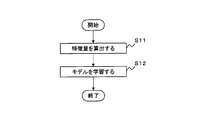
- FIG. 3 is a flowchart showing an operation example until the behavior characteristic prediction system of the present embodiment generates a prediction model.
- the feature amount calculation unit 12 calculates a feature amount that can affect the user's cancellation based on the communication state log (step S11). And the learning device 13 learns the model which shows a user's action characteristic by using the calculated feature-value as an explanatory variable (step S12). Specifically, the learning device 13 learns a prediction model that predicts user churn.
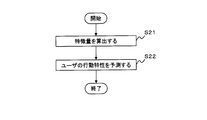
- FIG. 4 is a flowchart illustrating an operation example in which behavior characteristic prediction is performed using the prediction model generated by the behavior characteristic prediction system of the present embodiment.
- the feature amount calculation unit 12 calculates a feature amount used for the prediction model based on the communication state log of the prediction target user (step S21).
- the predictor 14 predicts a user's behavior characteristic using the feature amount generated from the communication state log and the prediction model (step S22).
- the predictor 14 is based on the feature amount calculated based on the communication state log, and the model indicating the user behavior characteristics learned using the calculated feature amount as an explanatory variable. Predicting user behavioral characteristics. Therefore, it is possible to predict behavior characteristics reflecting the service status provided to the user.
- the feature amount calculation unit 12 calculates a feature amount that can affect the cancellation of the user based on the communication state log, and the learning device 13 uses the calculated feature amount as an explanatory variable to determine the user's behavior. Learn the model that shows the characteristics. And the predictor 14 predicts a user's action characteristic using the feature-value and model which were produced
- a telecommunications company can provide a more appropriate service to a user who clearly expresses an intention to enjoy an appropriate service using personal information. It will be possible to receive the provision of the service.
- Embodiment 2 An embodiment for visualizing the prediction result will be described.
- One reason for the user to cancel is the performance problem of the base station. This is because it is considered that user dissatisfaction accumulates when the situation where it is difficult to connect to the base station continues. Therefore, in the following embodiment, in order to determine the base station whose performance should be improved, the output unit 15 visualizes the relationship between the user predicted to be canceled by the predictor 14 and the base station to which the user is connected. The method will be described.
- the configuration of the behavior characteristic prediction system of this embodiment is the same as that of the first embodiment.
- the user's cancellation prediction has already been performed by the predictor 14.
- a user whose churn is predicted is referred to as a predicted churn user.
- the output unit 15 calculates a score (hereinafter referred to as a connection score) corresponding to the connection time with each base station for each predicted cancellation user.
- the connection score is a value that is calculated to be larger as the connection time is longer.
- the output part 15 calculates the sum total of the connection score calculated for every prediction cancellation user for every base station.
- the output unit 15 outputs base station information according to the calculated sum of connection scores.
- the output unit 15 may output text information in which the sum of connection scores is associated with the base station.
- the output part 15 may change and output the aspect of the base station superimposed and displayed on the map according to the sum total of a connection score.
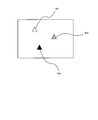
- FIG. 5 is an explanatory diagram showing an example of outputting base station information.
- the output unit 15 outputs the base station in a manner that is easily visible at a corresponding position on the map.
- the output unit 15 outputs the base station in a triangle at a corresponding position on the map.
- the output unit 15 outputs a triangle indicating the base station in dark black as the connection score is higher.
- the form and color of the base station are not limited to the method illustrated in FIG.
- the output unit 15 may improve the performance based on the connection status of a user who has already been canceled, instead of the connection status of the user whose cancellation is predicted, or instead of the connection status of the user whose cancellation is predicted.
- Information for determining a station may be visualized.
- the method of visualizing based on the connection status of a user who has already been canceled is the same as the method of visualizing based on the connection status of a user predicted to be canceled.
- the telecommunications company can grasp the information of the base station to which many users who have already been cancelled are connected, so whether or not the base station should improve the performance based on this information. I can judge. That is, the behavior characteristic prediction system of the present embodiment can be applied to a purpose of examining the cause of cancellation of a user who has actually canceled.
- Embodiment 3 FIG. Next, another embodiment for visualizing the prediction result will be described.
- the configuration of the behavior characteristic prediction system of this embodiment is the same as that of the first embodiment.
- the user's movement history can be specified based on the user's position information. If the user's movement history can be grasped, the base station with which the user is communicating can also be estimated. Therefore, in the present embodiment, the flow line of the predicted cancellation user is output on the map on the screen.
- the method of obtaining the flow line of the predicted cancellation user is arbitrary. For example, if the communication status log includes location information and time when the user requested connection, the output unit 15 identifies the user location information based on the location information and time, and the location information is You may output the flow line connected to a series on the map of a screen. In addition, even when the communication status log does not include the user's position information, if the user agrees to disclose information acquired by another GPS, the output unit 15 User location information may be specified.
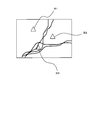
- FIG. 6 is an explanatory diagram showing an example of outputting the base station and the flow line of the user.
- the output unit 15 indicates that the base station indicated by the triangle and the flow line of the predicted cancellation user are displayed on the map.
- the frequency of the predicted cancellation user moving near the base station B3 is high. Therefore, it is suggested that this base station B3 may affect the cancellation of the predicted canceled user.
- the daily flow line of the predicted cancellation user As illustrated in FIG. 6, by displaying the daily flow line of the predicted cancellation user on the map on the screen, it is possible to predict the base station to which the user is connected every day. In particular, it is presumed that a base station that is frequently connected to a predicted churn user or a base station that has a long connection time is likely to affect the churn of the user.
- the communication company can use the flow line of the predicted cancellation user as information for determining whether the base station should improve the performance.
- the output unit 15 may display not only the predicted canceled user's flow line but also the already canceled user's flow line. By visualizing such information, the communication company can grasp the base station close to the flow line of the user who has already been canceled, and can determine whether or not the base station should improve the performance based on this information. That is, the behavior characteristic prediction system of the present embodiment can be applied to a purpose of examining the cause of cancellation of a user who has actually canceled.
- Embodiment 4 FIG. Next, still another embodiment for visualizing the prediction result will be described.
- the configuration of the behavior characteristic prediction system of this embodiment is the same as that of the first embodiment.
- the output unit 15 of the present embodiment outputs information indicating the base station at a corresponding position on the map and outputs information indicating the predicted cancellation user at a position on the map corresponding to the address.
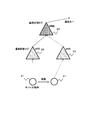
- FIG. 7 is an explanatory diagram showing an example of outputting the relationship between the base station and the user's address.
- the base station is output as a triangle at a corresponding position on the map on the screen, and the position corresponding to the address of the predicted cancellation user is output as a circle.
- the output unit 15 divides the map into a plurality of areas, and in a manner according to the number of prediction target users having addresses corresponding to each area, An area may be displayed.
- FIG. 8 is an explanatory diagram showing another example of outputting the relationship between the base station and the user's address.
- the output unit 15 calculates the number of prediction target users for each area divided on the map, and indicates that the larger the calculated number, the darker the area is displayed. .
- the telecommunications company can infer a base station that is likely to connect with a user who is predicted to churn. Based on this information, the communication company determines whether the base station should improve performance. it can.
- the output unit 15 may output the relationship between the base station and the user's address using the number of already canceled users as well as the number of predicted canceled users. Good. By visualizing such information, it is possible to grasp a base station close to a place where many already canceled users live. Therefore, it is possible to determine whether or not the base station should improve performance based on this information. That is, the behavior characteristic prediction system of the present embodiment can be applied to a purpose of examining the cause of cancellation of a user who has actually canceled.
- the output unit 15 may display the base station by changing the mode of the base station according to the band tightness.
- the output unit 15 may display the outer frame of a base station with a high degree of tightness as a broken line and display the outer frame of a base station with a low degree of tightness as a solid line.
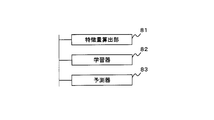
- FIG. 9 is a block diagram showing an outline of the behavior characteristic prediction system according to the present invention.
- the behavior characteristic prediction system according to the present invention affects user cancellation based on a communication status log (for example, CTL) representing a communication status of a base station when a user (for example, a customer) communicates or makes a call.
- a communication status log for example, CTL
- a feature amount calculation unit 81 (for example, the feature amount calculation unit 12) that calculates a feature amount to be obtained, and a learning unit 82 (for example, a learning unit) that learns a model indicating a user's behavior characteristics using the calculated feature amount as an explanatory variable 13) and a predictor 83 (for example, the predictor 14) that predicts the behavioral characteristics of the user (for example, the user's cancellation) using the feature amount and the model generated from the communication state log.
- a learning unit 82 for example, a learning unit
- a predictor 83 for example, the predictor 14
- the communication company can suppress the cancellation of the user, and the user can receive better service.
- the feature amount calculation unit 81 estimates a connection destination base station in a time series from a user's movement history or connection history, and time series information of a communication state of the base station in a time zone estimated as a connection destination, or A statistical amount obtained by collecting the time series information may be calculated as a feature amount (for example, a second feature amount).
- the feature amount calculation unit 81 identifies a series of services performed by the user, and sets the feature amount (for example, the third amount of time series information of the communication state in the identified service or the statistical amount obtained by collecting the time series information). (Feature amount) may be calculated.
- the feature amount calculation unit 81 may calculate a statistic amount (for example, a fourth feature amount) obtained by totaling the time zones during which each user cannot communicate with the base station as the feature amount.
- a statistic amount for example, a fourth feature amount
- the predictor 83 may perform user churn prediction.
- the behavior characteristic prediction system then outputs an output unit (for example, the second embodiment) that visualizes a relationship between a user (for example, a predicted cancellation user) predicted to be canceled by the predictor 83 and a base station to which the user is connected.
- an output unit for example, the second embodiment
- the feature amount calculation unit 81 may calculate a statistic obtained by tabulating the communication state of the base station when each user communicates or makes a call as a feature amount (for example, the first feature amount).
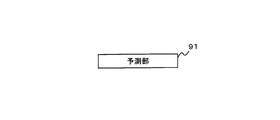
- FIG. 10 is a block diagram showing an outline of the behavior characteristic predictor according to the present invention.
- the behavior characteristic predictor according to the present invention is learned using a feature amount calculated based on a communication state log indicating a communication state of a base station when a user performs communication or a call, and the calculated feature amount as an explanatory variable.
- a predicting unit 91 (for example, a predictor 14) that predicts a user's behavior characteristic (for example, user's cancellation) based on the model indicating the user's behavior characteristic.
- the behavior characteristic predictor illustrated in FIG. 10 is an arbitrary feature amount (for example, the first feature amount to the fourth feature amount) calculated by the feature amount calculation unit 81 of the behavior characteristic prediction system illustrated in FIG. One or more can be used.
- the behavior characteristic predictor may predict the behavior characteristic using a feature amount created from CDR or user attribute data.
- FIG. 11 is a block diagram showing an outline of the configuration of a computer.
- the computer 1000 includes a CPU 1001, a main storage device 1002, an auxiliary storage device 1003, and an interface 1004.
- the above-described behavior characteristic prediction system is implemented in one or more computers 1000.
- the behavior characteristic prediction system according to the present invention may be configured by one device, or may be configured by connecting two or more physically separated devices by wire or wirelessly.
- each processing unit described above is stored in the auxiliary storage device 1003 in the form of a program (a behavior characteristic prediction model learning program, a behavior characteristic prediction program).
- the CPU 1001 reads out the program from the auxiliary storage device 1003, develops it in the main storage device 1002, and executes the above processing according to the above program.
- the auxiliary storage device 1003 is an example of a tangible medium that is not temporary.
- Other examples of non-temporary tangible media include magnetic disk, magneto-optical disk, CD-ROM (Compact Disc Read Only Memory), DVD-ROM (Digital Versatile Disk Read Only Memory) connected via the interface 1004 And semiconductor memory.
- CD-ROM Compact Disc Read Only Memory
- DVD-ROM Digital Versatile Disk Read Only Memory
- the program may be for realizing a part of the above-described functions. Further, the program may be a so-called difference file (difference program) that realizes the above-described function in combination with another program already stored in the auxiliary storage device 1003.
- difference file difference program
Landscapes
- Engineering & Computer Science (AREA)
- Business, Economics & Management (AREA)
- Theoretical Computer Science (AREA)
- Strategic Management (AREA)
- General Physics & Mathematics (AREA)
- Physics & Mathematics (AREA)
- Development Economics (AREA)
- Economics (AREA)
- Software Systems (AREA)
- Data Mining & Analysis (AREA)
- General Engineering & Computer Science (AREA)
- Accounting & Taxation (AREA)
- Entrepreneurship & Innovation (AREA)
- Finance (AREA)
- Marketing (AREA)
- Human Resources & Organizations (AREA)
- Mathematical Physics (AREA)
- General Business, Economics & Management (AREA)
- Computing Systems (AREA)
- Artificial Intelligence (AREA)
- Evolutionary Computation (AREA)
- Tourism & Hospitality (AREA)
- Game Theory and Decision Science (AREA)
- Computational Linguistics (AREA)
- Quality & Reliability (AREA)
- Operations Research (AREA)
- Medical Informatics (AREA)
- Computer Vision & Pattern Recognition (AREA)
- General Health & Medical Sciences (AREA)
- Technology Law (AREA)
- Health & Medical Sciences (AREA)
- Primary Health Care (AREA)
- Telephonic Communication Services (AREA)
- Management, Administration, Business Operations System, And Electronic Commerce (AREA)
- Mobile Radio Communication Systems (AREA)
Abstract
Priority Applications (3)
| Application Number | Priority Date | Filing Date | Title |
|---|---|---|---|
| US15/500,477 US20170213158A1 (en) | 2014-07-31 | 2015-07-10 | Behavioral characteristic prediction system, behavioral characteristic prediction device, method and program |
| JP2016537733A JP6493405B2 (ja) | 2014-07-31 | 2015-07-10 | 行動特性予測システム、行動特性予測器、方法およびプログラム |
| EP15828245.9A EP3176744A4 (fr) | 2014-07-31 | 2015-07-10 | Système, dispositif, procédé et programme de prédiction de caractéristique comportementale |
Applications Claiming Priority (2)
| Application Number | Priority Date | Filing Date | Title |
|---|---|---|---|
| US201462031296P | 2014-07-31 | 2014-07-31 | |
| US62/031,296 | 2014-07-31 |
Publications (1)
| Publication Number | Publication Date |
|---|---|
| WO2016017086A1 true WO2016017086A1 (fr) | 2016-02-04 |
Family
ID=55217012
Family Applications (1)
| Application Number | Title | Priority Date | Filing Date |
|---|---|---|---|
| PCT/JP2015/003503 Ceased WO2016017086A1 (fr) | 2014-07-31 | 2015-07-10 | Système, dispositif, procédé et programme de prédiction de caractéristique comportementale |
Country Status (4)
| Country | Link |
|---|---|
| US (1) | US20170213158A1 (fr) |
| EP (1) | EP3176744A4 (fr) |
| JP (1) | JP6493405B2 (fr) |
| WO (1) | WO2016017086A1 (fr) |
Cited By (11)
| Publication number | Priority date | Publication date | Assignee | Title |
|---|---|---|---|---|
| WO2018079225A1 (fr) * | 2016-10-31 | 2018-05-03 | 日本電気株式会社 | Système, procédé et programme de prédiction automatique |
| WO2018135120A1 (fr) * | 2017-01-20 | 2018-07-26 | 株式会社日立製作所 | Dispositif d'estimation de la valeur d'un indicateur et procédé d'estimation de la valeur d'un indicateur |
| JP2018169843A (ja) * | 2017-03-30 | 2018-11-01 | 日本電気株式会社 | 情報処理装置、情報処理方法および情報処理プログラム |
| WO2019013248A1 (fr) * | 2017-07-14 | 2019-01-17 | 日本電気株式会社 | Procédé, dispositif et programme d'évaluation de qualité de communication |
| JP2019095825A (ja) * | 2017-11-17 | 2019-06-20 | 株式会社Nttドコモ | ユーザ特性推定装置及びユーザ特性推定方法 |
| JP2020077244A (ja) * | 2018-11-08 | 2020-05-21 | Kddi株式会社 | 端末における起動中アプリケーションを推定する装置、方法及びシステム |
| US10885011B2 (en) | 2015-11-25 | 2021-01-05 | Dotdata, Inc. | Information processing system, descriptor creation method, and descriptor creation program |
| US11514062B2 (en) | 2017-10-05 | 2022-11-29 | Dotdata, Inc. | Feature value generation device, feature value generation method, and feature value generation program |
| WO2023047511A1 (fr) * | 2021-09-24 | 2023-03-30 | 日本電気株式会社 | Système de prédiction d'annulation de contrat, procédé de prédiction d'annulation de contrat et support d'enregistrement de programme |
| US11727203B2 (en) | 2017-03-30 | 2023-08-15 | Dotdata, Inc. | Information processing system, feature description method and feature description program |
| EP4546242A1 (fr) | 2023-10-25 | 2025-04-30 | Fujitsu Limited | Programme informatique, procédé de génération de modèle et appareil de traitement d'informations |
Families Citing this family (3)
| Publication number | Priority date | Publication date | Assignee | Title |
|---|---|---|---|---|
| JP2020149196A (ja) * | 2019-03-12 | 2020-09-17 | 国立研究開発法人情報通信研究機構 | パーソナリティ予測装置、および学習データ収集装置 |
| US20220253774A1 (en) * | 2021-02-11 | 2022-08-11 | Bank Of America Corporation | Implementing big data and artificial intelligence to determine likelihood of post-acceptance facility or service renunciation |
| US12165080B2 (en) | 2021-02-12 | 2024-12-10 | Bank Of America Corporation | Leveraging big data, statistical computation and artificial intelligence to determine a likelihood of object renunciation prior to a resource event |
Citations (1)
| Publication number | Priority date | Publication date | Assignee | Title |
|---|---|---|---|---|
| JP2002334200A (ja) * | 2001-05-11 | 2002-11-22 | Ntt Data Corp | 解約予測支援方法及びシステム |
Family Cites Families (2)
| Publication number | Priority date | Publication date | Assignee | Title |
|---|---|---|---|---|
| US20130196687A1 (en) * | 2010-08-03 | 2013-08-01 | Ntt Docomo, Inc. | Communication terminal |
| US8804929B2 (en) * | 2012-10-30 | 2014-08-12 | Alcatel Lucent | System and method for generating subscriber churn predictions |
-
2015
- 2015-07-10 EP EP15828245.9A patent/EP3176744A4/fr not_active Withdrawn
- 2015-07-10 WO PCT/JP2015/003503 patent/WO2016017086A1/fr not_active Ceased
- 2015-07-10 JP JP2016537733A patent/JP6493405B2/ja active Active
- 2015-07-10 US US15/500,477 patent/US20170213158A1/en not_active Abandoned
Patent Citations (1)
| Publication number | Priority date | Publication date | Assignee | Title |
|---|---|---|---|---|
| JP2002334200A (ja) * | 2001-05-11 | 2002-11-22 | Ntt Data Corp | 解約予測支援方法及びシステム |
Non-Patent Citations (4)
| Title |
|---|
| SATOSHI NAKANO: "Mobile-Carrier Churning Behavior Analysis Based on Customer Satisfaction", PROCEEDINGS OF THE 2012 IEICE GENERAL CONFERENCE, TSUSHIN 2, 6 March 2012 (2012-03-06), pages 164, XP008185212 * |
| See also references of EP3176744A4 * |
| TOMOHARU IWATA: "Recommendation Method for Extending Subscription Periods", IPSJ, vol. 48, no. SIG6(TOM17, 15 March 2007 (2007-03-15), pages 65 - 74 * |
| YOSHIKAZU SAKAMAKI: "A Proposal for Predicting Churn of Mobile Phone Customers using Web Access History Data", JOURNAL OF JAPAN INDUSTRIAL MANAGEMENT ASSOCIATION, vol. 64, no. 2, 15 July 2013 (2013-07-15), pages 177 - 186, XP008185210 * |
Cited By (21)
| Publication number | Priority date | Publication date | Assignee | Title |
|---|---|---|---|---|
| US10885011B2 (en) | 2015-11-25 | 2021-01-05 | Dotdata, Inc. | Information processing system, descriptor creation method, and descriptor creation program |
| JPWO2018079225A1 (ja) * | 2016-10-31 | 2019-09-12 | 日本電気株式会社 | 自動予測システム、自動予測方法および自動予測プログラム |
| WO2018079225A1 (fr) * | 2016-10-31 | 2018-05-03 | 日本電気株式会社 | Système, procédé et programme de prédiction automatique |
| JP7069029B2 (ja) | 2016-10-31 | 2022-05-17 | ドットデータ インコーポレイテッド | 自動予測システム、自動予測方法および自動予測プログラム |
| WO2018135120A1 (fr) * | 2017-01-20 | 2018-07-26 | 株式会社日立製作所 | Dispositif d'estimation de la valeur d'un indicateur et procédé d'estimation de la valeur d'un indicateur |
| JP2018116603A (ja) * | 2017-01-20 | 2018-07-26 | 株式会社日立製作所 | 指標値推定装置及び指標値推定方法 |
| JP2018169843A (ja) * | 2017-03-30 | 2018-11-01 | 日本電気株式会社 | 情報処理装置、情報処理方法および情報処理プログラム |
| US11727203B2 (en) | 2017-03-30 | 2023-08-15 | Dotdata, Inc. | Information processing system, feature description method and feature description program |
| JP2022000825A (ja) * | 2017-03-30 | 2022-01-04 | 日本電気株式会社 | 情報処理装置、情報処理方法および情報処理プログラム |
| US11240133B2 (en) | 2017-07-14 | 2022-02-01 | Nec Corporation | Communication quality evaluation device, communication quality evaluation method, and communication quality evaluation program |
| WO2019013248A1 (fr) * | 2017-07-14 | 2019-01-17 | 日本電気株式会社 | Procédé, dispositif et programme d'évaluation de qualité de communication |
| JPWO2019013248A1 (ja) * | 2017-07-14 | 2020-02-27 | 日本電気株式会社 | 通信品質評価装置、通信品質評価方法、および通信品質評価プログラム |
| US11514062B2 (en) | 2017-10-05 | 2022-11-29 | Dotdata, Inc. | Feature value generation device, feature value generation method, and feature value generation program |
| JP7016243B2 (ja) | 2017-11-17 | 2022-02-21 | 株式会社Nttドコモ | ユーザ特性推定装置及びユーザ特性推定方法 |
| JP2019095825A (ja) * | 2017-11-17 | 2019-06-20 | 株式会社Nttドコモ | ユーザ特性推定装置及びユーザ特性推定方法 |
| JP7014696B2 (ja) | 2018-11-08 | 2022-02-01 | Kddi株式会社 | 端末における起動中アプリケーションを推定する装置、方法及びシステム |
| JP2020077244A (ja) * | 2018-11-08 | 2020-05-21 | Kddi株式会社 | 端末における起動中アプリケーションを推定する装置、方法及びシステム |
| WO2023047511A1 (fr) * | 2021-09-24 | 2023-03-30 | 日本電気株式会社 | Système de prédiction d'annulation de contrat, procédé de prédiction d'annulation de contrat et support d'enregistrement de programme |
| JPWO2023047511A1 (fr) * | 2021-09-24 | 2023-03-30 | ||
| JP7758044B2 (ja) | 2021-09-24 | 2025-10-22 | 日本電気株式会社 | 解約予測システム、解約予測方法および解約予測プログラム |
| EP4546242A1 (fr) | 2023-10-25 | 2025-04-30 | Fujitsu Limited | Programme informatique, procédé de génération de modèle et appareil de traitement d'informations |
Also Published As
| Publication number | Publication date |
|---|---|
| US20170213158A1 (en) | 2017-07-27 |
| EP3176744A1 (fr) | 2017-06-07 |
| JP6493405B2 (ja) | 2019-04-03 |
| JPWO2016017086A1 (ja) | 2017-05-18 |
| EP3176744A4 (fr) | 2018-01-17 |
Similar Documents
| Publication | Publication Date | Title |
|---|---|---|
| JP6493405B2 (ja) | 行動特性予測システム、行動特性予測器、方法およびプログラム | |
| US9413848B2 (en) | Method of outputting estimated QoEs on a terminal on an application basis | |
| US20240086738A1 (en) | Causal analysis | |
| CN106993104B (zh) | 来电处理方法、装置及终端 | |
| US20170251258A1 (en) | Techniques for context aware video recommendation | |
| CN111435482A (zh) | 一种外呼模型的构建方法、外呼方法、装置和存储介质 | |
| CN105284139A (zh) | 基于用户设备的历史位置的分类位置标识 | |
| CN103181150A (zh) | 计算移动设备的电池续航时间的装置和方法 | |
| TWI505667B (zh) | 完成有關於通訊網路節點之預測分析的方法與系統 | |
| US20150170184A1 (en) | Method for providing advertisement service based on call | |
| US20150134419A1 (en) | Customer experience management (cem) metrics and operational correlation techniques | |
| WO2016002133A1 (fr) | Système de prédiction et procédé de prédiction | |
| US20170242711A1 (en) | Remote management of virtual app lifecycle based on context and social network activities | |
| CN102130993A (zh) | 基于移动终端的信息记录方法及系统 | |
| US9949139B2 (en) | System, method, and computer program for calculating a customer value for communication service provider customers for network optimization and planning | |
| US11272254B1 (en) | System, method, and computer program for using user attention data to make content recommendations | |
| Sani et al. | The wireless data drain of users, apps, & platforms | |
| US11178633B2 (en) | Asset location tracking in open space environments | |
| JPWO2019013248A1 (ja) | 通信品質評価装置、通信品質評価方法、および通信品質評価プログラム | |
| JP2015153157A (ja) | 仮想情報管理システム | |
| CN112422755A (zh) | 电话拨打方法、装置及存储介质 | |
| KR20210146182A (ko) | 웹-지도정보 알고리즘 기반 상권분석 자동화시스템 | |
| JP4589182B2 (ja) | 市場特性予測支援方法および装置 | |
| CN113840316B (zh) | 无线网络维护方法、装置、设备和计算机可读存储介质 | |
| CN109285035A (zh) | 预测应用留存数据的方法、装置、设备及存储介质 |
Legal Events
| Date | Code | Title | Description |
|---|---|---|---|
| 121 | Ep: the epo has been informed by wipo that ep was designated in this application |
Ref document number: 15828245 Country of ref document: EP Kind code of ref document: A1 |
|
| ENP | Entry into the national phase |
Ref document number: 2016537733 Country of ref document: JP Kind code of ref document: A |
|
| WWE | Wipo information: entry into national phase |
Ref document number: 15500477 Country of ref document: US |
|
| NENP | Non-entry into the national phase |
Ref country code: DE |
|
| REEP | Request for entry into the european phase |
Ref document number: 2015828245 Country of ref document: EP |
|
| WWE | Wipo information: entry into national phase |
Ref document number: 2015828245 Country of ref document: EP |