WO2016017371A1 - 繊維強化複合材料用2液型エポキシ樹脂組成物および繊維強化複合材料 - Google Patents
繊維強化複合材料用2液型エポキシ樹脂組成物および繊維強化複合材料 Download PDFInfo
- Publication number
- WO2016017371A1 WO2016017371A1 PCT/JP2015/069224 JP2015069224W WO2016017371A1 WO 2016017371 A1 WO2016017371 A1 WO 2016017371A1 JP 2015069224 W JP2015069224 W JP 2015069224W WO 2016017371 A1 WO2016017371 A1 WO 2016017371A1
- Authority
- WO
- WIPO (PCT)
- Prior art keywords
- epoxy resin
- fiber
- reinforced composite
- resin composition
- component
- Prior art date
- Legal status (The legal status is an assumption and is not a legal conclusion. Google has not performed a legal analysis and makes no representation as to the accuracy of the status listed.)
- Ceased
Links
Classifications
-
- C—CHEMISTRY; METALLURGY
- C08—ORGANIC MACROMOLECULAR COMPOUNDS; THEIR PREPARATION OR CHEMICAL WORKING-UP; COMPOSITIONS BASED THEREON
- C08J—WORKING-UP; GENERAL PROCESSES OF COMPOUNDING; AFTER-TREATMENT NOT COVERED BY SUBCLASSES C08B, C08C, C08F, C08G or C08H
- C08J5/00—Manufacture of articles or shaped materials containing macromolecular substances
- C08J5/04—Reinforcing macromolecular compounds with loose or coherent fibrous material
-
- C—CHEMISTRY; METALLURGY
- C08—ORGANIC MACROMOLECULAR COMPOUNDS; THEIR PREPARATION OR CHEMICAL WORKING-UP; COMPOSITIONS BASED THEREON
- C08G—MACROMOLECULAR COMPOUNDS OBTAINED OTHERWISE THAN BY REACTIONS ONLY INVOLVING UNSATURATED CARBON-TO-CARBON BONDS
- C08G59/00—Polycondensates containing more than one epoxy group per molecule; Macromolecules obtained by polymerising compounds containing more than one epoxy group per molecule using curing agents or catalysts which react with the epoxy groups
- C08G59/18—Macromolecules obtained by polymerising compounds containing more than one epoxy group per molecule using curing agents or catalysts which react with the epoxy groups ; e.g. general methods of curing
- C08G59/20—Macromolecules obtained by polymerising compounds containing more than one epoxy group per molecule using curing agents or catalysts which react with the epoxy groups ; e.g. general methods of curing characterised by the epoxy compounds used
- C08G59/32—Epoxy compounds containing three or more epoxy groups
- C08G59/3227—Compounds containing acyclic nitrogen atoms
-
- C—CHEMISTRY; METALLURGY
- C08—ORGANIC MACROMOLECULAR COMPOUNDS; THEIR PREPARATION OR CHEMICAL WORKING-UP; COMPOSITIONS BASED THEREON
- C08G—MACROMOLECULAR COMPOUNDS OBTAINED OTHERWISE THAN BY REACTIONS ONLY INVOLVING UNSATURATED CARBON-TO-CARBON BONDS
- C08G59/00—Polycondensates containing more than one epoxy group per molecule; Macromolecules obtained by polymerising compounds containing more than one epoxy group per molecule using curing agents or catalysts which react with the epoxy groups
- C08G59/18—Macromolecules obtained by polymerising compounds containing more than one epoxy group per molecule using curing agents or catalysts which react with the epoxy groups ; e.g. general methods of curing
- C08G59/40—Macromolecules obtained by polymerising compounds containing more than one epoxy group per molecule using curing agents or catalysts which react with the epoxy groups ; e.g. general methods of curing characterised by the curing agents used
- C08G59/50—Amines
- C08G59/5033—Amines aromatic
-
- C—CHEMISTRY; METALLURGY
- C08—ORGANIC MACROMOLECULAR COMPOUNDS; THEIR PREPARATION OR CHEMICAL WORKING-UP; COMPOSITIONS BASED THEREON
- C08G—MACROMOLECULAR COMPOUNDS OBTAINED OTHERWISE THAN BY REACTIONS ONLY INVOLVING UNSATURATED CARBON-TO-CARBON BONDS
- C08G59/00—Polycondensates containing more than one epoxy group per molecule; Macromolecules obtained by polymerising compounds containing more than one epoxy group per molecule using curing agents or catalysts which react with the epoxy groups
- C08G59/18—Macromolecules obtained by polymerising compounds containing more than one epoxy group per molecule using curing agents or catalysts which react with the epoxy groups ; e.g. general methods of curing
- C08G59/40—Macromolecules obtained by polymerising compounds containing more than one epoxy group per molecule using curing agents or catalysts which react with the epoxy groups ; e.g. general methods of curing characterised by the curing agents used
- C08G59/50—Amines
- C08G59/56—Amines together with other curing agents
-
- C—CHEMISTRY; METALLURGY
- C08—ORGANIC MACROMOLECULAR COMPOUNDS; THEIR PREPARATION OR CHEMICAL WORKING-UP; COMPOSITIONS BASED THEREON
- C08G—MACROMOLECULAR COMPOUNDS OBTAINED OTHERWISE THAN BY REACTIONS ONLY INVOLVING UNSATURATED CARBON-TO-CARBON BONDS
- C08G59/00—Polycondensates containing more than one epoxy group per molecule; Macromolecules obtained by polymerising compounds containing more than one epoxy group per molecule using curing agents or catalysts which react with the epoxy groups
- C08G59/18—Macromolecules obtained by polymerising compounds containing more than one epoxy group per molecule using curing agents or catalysts which react with the epoxy groups ; e.g. general methods of curing
- C08G59/40—Macromolecules obtained by polymerising compounds containing more than one epoxy group per molecule using curing agents or catalysts which react with the epoxy groups ; e.g. general methods of curing characterised by the curing agents used
- C08G59/62—Alcohols or phenols
- C08G59/621—Phenols
-
- C—CHEMISTRY; METALLURGY
- C08—ORGANIC MACROMOLECULAR COMPOUNDS; THEIR PREPARATION OR CHEMICAL WORKING-UP; COMPOSITIONS BASED THEREON
- C08J—WORKING-UP; GENERAL PROCESSES OF COMPOUNDING; AFTER-TREATMENT NOT COVERED BY SUBCLASSES C08B, C08C, C08F, C08G or C08H
- C08J5/00—Manufacture of articles or shaped materials containing macromolecular substances
- C08J5/04—Reinforcing macromolecular compounds with loose or coherent fibrous material
- C08J5/0405—Reinforcing macromolecular compounds with loose or coherent fibrous material with inorganic fibres
- C08J5/042—Reinforcing macromolecular compounds with loose or coherent fibrous material with inorganic fibres with carbon fibres
-
- C—CHEMISTRY; METALLURGY
- C08—ORGANIC MACROMOLECULAR COMPOUNDS; THEIR PREPARATION OR CHEMICAL WORKING-UP; COMPOSITIONS BASED THEREON
- C08J—WORKING-UP; GENERAL PROCESSES OF COMPOUNDING; AFTER-TREATMENT NOT COVERED BY SUBCLASSES C08B, C08C, C08F, C08G or C08H
- C08J5/00—Manufacture of articles or shaped materials containing macromolecular substances
- C08J5/04—Reinforcing macromolecular compounds with loose or coherent fibrous material
- C08J5/10—Reinforcing macromolecular compounds with loose or coherent fibrous material characterised by the additives used in the polymer mixture
-
- C—CHEMISTRY; METALLURGY
- C08—ORGANIC MACROMOLECULAR COMPOUNDS; THEIR PREPARATION OR CHEMICAL WORKING-UP; COMPOSITIONS BASED THEREON
- C08J—WORKING-UP; GENERAL PROCESSES OF COMPOUNDING; AFTER-TREATMENT NOT COVERED BY SUBCLASSES C08B, C08C, C08F, C08G or C08H
- C08J5/00—Manufacture of articles or shaped materials containing macromolecular substances
- C08J5/24—Impregnating materials with prepolymers which can be polymerised in situ, e.g. manufacture of prepregs
-
- C—CHEMISTRY; METALLURGY
- C08—ORGANIC MACROMOLECULAR COMPOUNDS; THEIR PREPARATION OR CHEMICAL WORKING-UP; COMPOSITIONS BASED THEREON
- C08J—WORKING-UP; GENERAL PROCESSES OF COMPOUNDING; AFTER-TREATMENT NOT COVERED BY SUBCLASSES C08B, C08C, C08F, C08G or C08H
- C08J2363/00—Characterised by the use of epoxy resins; Derivatives of epoxy resins
Definitions
- the present invention relates to a two-pack type epoxy resin composition for fiber reinforced composite materials suitably used for fiber reinforced composite materials such as aircraft members, spacecraft members, and automobile members, and a fiber reinforced composite material using the same. .
- Fiber reinforced composite materials composed of reinforced fibers and matrix resins can be designed using the advantages of reinforced fibers and matrix resins, so the applications are expanding to the aerospace field, sports field, general industrial field, etc. .
- the reinforcing fiber glass fiber, aramid fiber, carbon fiber, boron fiber or the like is used.
- the matrix resin either a thermosetting resin or a thermoplastic resin is used, but a thermosetting resin that can be easily impregnated into the reinforcing fiber is often used.
- thermosetting resin epoxy resin, unsaturated polyester resin, vinyl ester resin, phenol resin, bismaleimide resin, cyanate resin and the like are used.
- a prepreg method As a method for forming a fiber reinforced composite material, a prepreg method, a hand lay-up method, a filament winding method, a pultrusion method, an RTM (Resin Transfer Molding) method, or the like is applied.
- a prepreg method a prepreg obtained by impregnating a reinforcing fiber with an epoxy resin composition is laminated in a desired shape and heated to obtain a molded product.
- this prepreg method is suitable for the production of fiber-reinforced composite materials having high material strength required for structural materials such as aircraft and automobiles.
- this prepreg method is subject to many processes such as preparation and lamination of prepregs.
- the RTM method is a method in which reinforcing fibers are placed in a mold in advance, a liquid epoxy resin composition is poured into the mold, impregnated into the reinforcing fibers, and heat cured to obtain a molded product.
- a liquid epoxy resin composition is poured into the mold, impregnated into the reinforcing fibers, and heat cured to obtain a molded product.
- the two-pack type epoxy resin composition is composed of an epoxy main agent liquid containing an epoxy resin as a main component and a curing agent liquid containing a curing agent as a main component. It is an epoxy resin composition obtained by mixing.
- an epoxy resin composition in which all components including a main agent and a curing agent are mixed together is called a one-pack type epoxy resin composition.
- a solid material having low reactivity is often selected as the curing agent component, and a press roll or the like is used to impregnate the reinforcing fiber with the one-pack type epoxy resin composition.
- a press roll or the like is used to impregnate the reinforcing fiber with the one-pack type epoxy resin composition.
- the two-pack type epoxy resin composition by making both the epoxy main agent liquid and the curing agent liquid liquid, the mixture of the main agent liquid and the curing agent liquid can also be made a low viscosity liquid, and the epoxy resin composition It becomes easy to impregnate the object with the reinforcing fiber.
- the storage conditions are not particularly limited and can be stored for a long time.
- the RTM method in order to produce a fiber-reinforced composite material with high efficiency, it is essential to shorten the resin curing time. Further, in many cases, heat resistance is required for fiber reinforced composite materials used in the automobile and aircraft fields.
- the cured epoxy resin has a significantly reduced rigidity at a glass transition temperature or higher, and accordingly, the mechanical properties of the fiber-reinforced composite material containing the same are also lowered. Therefore, the glass transition temperature of the cured resin is regarded as an index of heat resistance of the fiber reinforced composite material, and its improvement is desired.
- Patent Document 1 discloses an epoxy resin composition for RTM having high-speed curability using 4-tert-butylcatechol as a curing accelerator.
- 4-tert-butylcatechol partially volatilizes during heat curing, and voids are generated in the resulting fiber-reinforced composite material.
- a problem may occur in the surface quality.
- Patent Document 2 discloses an RTM epoxy resin composition having high-speed curability using an acid ester as a curing accelerator.
- the heat resistance of the resin cured product is remarkably reduced by adding an acid ester, and in this case, the acid ester is partially volatilized at the time of heat curing, and the resulting fiber-reinforced composite
- the object of the present invention is to improve the above-mentioned drawbacks of the prior art, have high-speed curability and obtain a high heat-resistant resin cured product, as well as a high-grade fiber-reinforced composite without causing voids during heat curing.
- An object of the present invention is to provide a two-pack type epoxy resin composition for fiber-reinforced composite material from which the material is obtained.
- the two-pack type epoxy resin composition for fiber-reinforced composite material of the present invention has the following configuration. That is, an epoxy resin composition containing the following components (A) to (C), an epoxy main agent liquid containing 30% by mass or more and 100% by mass or less of component (A), and a curing agent containing component (B): It is a two-pack type epoxy resin composition for fiber-reinforced composite materials made of a liquid.
- the fiber-reinforced composite material of the present invention comprises the following: It has a configuration. That is, it is a fiber-reinforced composite material obtained by combining and curing the above-described two-pack type epoxy resin composition for fiber-reinforced composite material and reinforcing fibers.
- the fiber reinforced composite material 2 has a high-speed curability and a highly heat-resistant resin cured product, and a high-grade fiber reinforced composite material can be obtained without generating voids during heat curing.
- a liquid epoxy resin composition can be provided.
- the two-pack type epoxy resin composition for fiber-reinforced composite material according to the present invention is an epoxy resin composition containing the following components (A) to (C), and the component (A) is 30% by mass or more and 100% by mass: % Of an epoxy main agent liquid containing at most% and a curing agent liquid containing component (B).
- A Glycidylamine type epoxy resin
- B Aromatic amine
- C Compound having two or more aromatic rings having a phenolic hydroxyl group
- the component (A) in the present invention is a glycidylamine type epoxy resin.
- component (A) examples include N, N, N ′, N′-tetraglycidyldiaminodiphenylmethane, triglycidylaminophenol, N, N-diglycidylaniline, N, N, N ′, N′-tetraglycidyl.
- examples thereof include xylylenediamine and polyfunctional glycidylamine type epoxy resins such as alkyl, aryl, alkoxy, aryloxy, halogen-substituted derivatives, isomers, hydrogenated products, and the like.
- Such an epoxy resin contributes to increasing the crosslink density of the cured resin, and by using it, the heat resistance of the fiber-reinforced composite material can be improved.
- polyfunctional glycidylamine type epoxy resins described above trifunctional or higher glycidylamine type epoxy resins, particularly trifunctional or higher functional glycidylamine type epoxy resins are preferable.
- polyfunctional means having two or more glycidyl groups, and trifunctional means having three glycidyl groups.
- N, N, N ′, N′-tetraglycidyldiaminodiphenylmethane, triglycidylaminophenol, or a derivative or isomer thereof is preferably used.
- N, N, N ′, N′-tetraglycidyldiaminodiphenylmethane, or derivatives or isomers thereof include N, N, N ′, N′-tetraglycidyl-4,4′-diaminodiphenylmethane, N, N , N ′, N′-tetraglycidyl-3,3′-dimethyl-4,4′-diaminodiphenylmethane, N, N, N ′, N′-tetraglycidyl-3,3′-diethyl-4,4′- Diaminodiphenylmethane, N, N, N ′, N′-tetraglycidyl-3,3′-diisopropyl-4,4′-diaminodiphenylmethane, N, N, N ′, N′-tetraglycidyl-3,3′-di -T-butyl-4,4'-dia
- triglycidylaminophenol or derivatives or isomers thereof include N, N, O-triglycidyl-p-aminophenol, N, N, O-triglycidyl-m-aminophenol and the like. it can.
- the glycidylamine type epoxy resin has the effect of increasing the heat resistance of the resin cured product, and the content ratio thereof is contained in the epoxy main agent liquid by 30% by mass to 100% by mass with respect to the total mass of the epoxy main agent liquid.
- the preferable content ratio is 50% by mass or more.
- the epoxy resins other than the component (A) are bisphenol type epoxy resin, phenol novolac type epoxy resin, cresol novolac type epoxy resin, resorcinol type epoxy resin, phenol aralkyl type epoxy resin, naphthol aralkyl type epoxy resin, dicyclopentadiene.
- epoxy resin other than the component (A) bisphenol A diglycidyl ether, bisphenol F diglycidyl ether, tetrabromobisphenol A diglycidyl ether, bisphenol AD diglycidyl ether, 2,2 ′, 6, 6′-tetramethyl-4,4′-biphenol diglycidyl ether, diglycidyl ether of 9,9-bis (4-hydroxyphenyl) fluorene, triglycidyl ether of tris (p-hydroxyphenyl) methane, tetrakis (p- Hydroxyphenyl) ethane tetraglycidyl ether, phenol novolac glycidyl ether, cresol novolak glycidyl ether, glycidyl ether of phenol and dicyclopentadiene condensate, biphenyl aralkyl Resin glycidyl ether, triglycidyl isocyanur
- the bisphenol type epoxy resin is preferably used because it provides an excellent contribution to the balance of toughness and heat resistance of the cured resin, and in particular, the liquid bisphenol type epoxy resin provides an excellent contribution to impregnation into reinforcing fibers, It is preferably used as an epoxy resin other than the component (A) contained in the epoxy main agent liquid.
- the bisphenol type epoxy resin is obtained by glycidylation of two phenolic hydroxyl groups of a bisphenol compound.
- the bisphenol type bisphenol A type, bisphenol F type, bisphenol AD type, bisphenol S type, or these Examples include halogens of bisphenol, alkyl-substituted products, and hydrogenated products.
- a bisphenol-type epoxy resin not only a monomer but the high molecular weight body which has several repeating units can also be used conveniently. From the viewpoint of the balance between toughness and heat resistance of the cured resin, when the bisphenol type epoxy resin is contained, the content ratio is preferably 20% by mass or more with respect to the total mass of the epoxy main agent liquid in the epoxy main agent liquid. 70% by mass or less, more preferably 20% by mass or more and 50% by mass or less.
- Component (B) in the present invention is an aromatic amine.
- the aromatic amine is not particularly limited as long as it is an aromatic amine used as an epoxy resin curing agent.
- the curing agent liquid needs to be in a liquid state. It is preferable to use the aromatic amine.
- a solid aromatic amine is used as the aromatic amine, it is preferable to add a liquid amine to the curing agent liquid to form a mixture of the liquid amine and the solid aromatic amine, From the viewpoint of obtaining a cured resin having high mechanical properties, it is more preferable to use a mixture of a liquid aromatic amine and a solid aromatic amine. That is, in any case, a liquid amine is contained in the curing agent liquid.
- liquid means that the viscosity at 25 ° C. is 1000 Pa ⁇ s or less
- solid means that there is no fluidity at 25 ° C or very low fluidity. Specifically, it means that the viscosity at 25 ° C. is larger than 1000 Pa ⁇ s.
- the viscosity is an E-type viscometer equipped with a standard cone rotor (1 ° 34 ′ ⁇ R24) according to “Cone-plate-rotary viscometer viscosity measurement method” in JIS Z8803 (1991). ) Measured using Tokimec TVE-30H).
- liquid amines include those classified as aliphatic amines, such as ethylenediamine, diethylenetriamine, triethylenetetramine, tetraethylenepentamine, 2-methyl-1,5-diaminopentane, and alicyclic.
- aliphatic amines such as ethylenediamine, diethylenetriamine, triethylenetetramine, tetraethylenepentamine, 2-methyl-1,5-diaminopentane, and alicyclic.
- amines include methylene bis (cyclohexylamine), 4,4′-methylenebis (2-methylcyclohexylamine), aminocyclohexanealkylamine, isophoronediamine, and the like, and those classified as aromatic amines.
- 2,2'-diethyldiaminodiphenylmethane 2,4-diethyl-6-methyl-m-phenylenediamine, 4,6-diethyl-2-methyl-m-phenylenediamine, 4,6-diethyl-m-phenylenediamine, etc.
- diethyltoluenediamine 4'-methylenebis (N-methylaniline), 4,4'-methylenebis (N-ethylaniline), 4,4'-methylenebis (N-sec-butylaniline), N, N'-di-sec-butyl -P-phenylenediamine and the like.
- liquid aromatic amine When a liquid aromatic amine is used, an epoxy resin cured product having a high glass transition temperature and a high elastic modulus can be obtained, which is preferable.
- liquid aromatic amines include “jER Cure” (registered trademark) W manufactured by Mitsubishi Chemical Corporation and “Aradur” (registered trademark) 5200US manufactured by Huntsman Japan.
- solid aromatic amines include 4,4′-diaminodiphenylmethane, 3,3′-diaminodiphenylsulfone, 4,4′-diaminodiphenylsulfone, and 3,3′-diisopropyl- 4,4′-diaminodiphenylmethane, 3,3′-di-t-butyl-4,4′-diaminodiphenylmethane, 3,3′-diethyl-5,5′-dimethyl-4,4′-diaminodiphenylmethane, 3, , 3'-di-t-butyl-5,5'-dimethyl-4,4'-diaminodiphenylmethane, 3,3 ', 5,5'-tetraethyl-4,4'-diaminodiphenylmethane, 3,3'- Diisopropyl-5,5′-diethyl-4,4′-d
- the curing agent liquid can be obtained by liquefying only other liquid aromatic amines or by dissolving other components in a mixture of liquid amine and solid aromatic amine as necessary.
- the content ratio is not particularly limited as long as the curing agent liquid is liquid, but impregnation into reinforcing fibers.
- the solid aromatic amine is preferably 80% by mass or less, more preferably 20% by mass or more and 80% by mass or less, based on the total amount of amine.
- the content ratio of the curing agent liquid is a ratio of the total number of active hydrogens (H) in all curing agents in the curing agent liquid and the total number of epoxy groups (E) in all epoxy resins in the epoxy main agent liquid.
- / E preferably satisfies the range of 0.8 to 1.1, more preferably satisfies the range of 0.85 to 1.05, and more preferably satisfies the range of 0.9 to 1 .
- H / E is less than 0.8, the reaction rate of the cured resin may be insufficient, and heat resistance and material strength may be reduced.
- the reaction rate of the cured resin is sufficient, but the plastic deformation ability is insufficient, and the impact resistance of the fiber reinforced composite material may be insufficient.
- the curing agent liquid contains only the component (B) as a curing agent, since H corresponds to the total number of active hydrogens in the component (B), the content ratio of the component (B) is indicated by H / E. It is.
- Component (C) in the present invention is a compound having two or more aromatic rings having a phenolic hydroxyl group. That is, the compound of component (C) has a hydroxyphenyl structure.
- this component (C) include bisphenol A, bisphenol S, bisphenol F, biphenol, bisphenol fluorene, 2,2-bis (4-hydroxy-3,5-dimethylphenyl) propane, 4,4′-methylenebis. (2,6-dimethylphenol), 4,4′-methylenebis (2,6-di-tert-butylphenol), biphenol, bisphenolfluorene, biscresol fluorene, phenol novolak, cresol novolak and the like.
- the component (C) is preferably a bisphenol containing two or more phenolic hydroxyl groups.
- the component (C) preferably has an acid dissociation constant pKa of 7 or more and 9.8 or less, particularly preferably 7 or more and 9 or less.
- the measurement method of pKa can be calculated from the concentration of the relevant substance and the hydrogen ion concentration by measuring the hydrogen ion concentration using, for example, a pH meter.
- the component (C) a single compound or a plurality of compounds may be used.
- the acid dissociation constant pKa of the compound is preferably within the above range.
- the viscosity stability of the epoxy resin composition after mixing the epoxy main agent liquid and the curing agent liquid is remarkably lowered and thickened.
- the resin impregnation property to the material may be impaired.
- a sufficient curing accelerating effect may not be obtained.
- Component (C) is usually a low molecular weight compound from the viewpoint of ease of preparation and viscosity stability at low temperatures.
- the low molecular weight compound here means a compound having a molecular weight of 1000 or less.
- the content ratio of the component (C) is preferably 1 part by mass or more and 20 parts by mass or less, more preferably 1 part by mass or more and 15 parts by mass or less, particularly 1 part by mass with respect to 100 parts by mass of the total epoxy resin contained in the epoxy main agent liquid.
- the amount is preferably 10 parts by mass or more and 10 parts by mass or less. If the content ratio of the component (C) is less than 1 part by mass, a sufficient curing accelerating effect cannot be obtained. On the other hand, if it is more than 20 parts by mass, the heat resistance of the resin cured product may be significantly reduced.
- the epoxy resin composition of the present invention can contain a plasticizer, a dye, a pigment, an inorganic filler, an antioxidant, an ultraviolet absorber, a coupling agent, a surfactant and the like as necessary.
- the epoxy resin composition of the present invention may contain a toughening agent such as core-shell polymer particles as necessary.
- the epoxy resin composition of the present invention is a two-component type comprising an epoxy main agent liquid containing the component (A) in the above-described content ratio and a curing agent liquid containing the component (B), and the content ratio described above immediately before use.
- the epoxy main agent liquid and the curing agent liquid are mixed and used.
- a component (C) may be made to contain in any of an epoxy main ingredient liquid and a hardening
- the epoxy main agent liquid and the curing agent liquid should be heated separately before mixing, and the epoxy resin composition is obtained by mixing with a mixer immediately before use, such as injection into a mold. From the viewpoint of the pot life of the resin.
- the epoxy resin composition of the present invention preferably has a viscosity at 70 ° C. of 10 mPa ⁇ s or more and 500 mPa ⁇ s or less, and more preferably 10 mPa ⁇ s or more and 250 mPa ⁇ s or less.
- An epoxy resin composition having a viscosity at 70 ° C. of 500 mPa ⁇ s or less is excellent in impregnation into reinforcing fibers, whereby a high-grade fiber-reinforced composite material is obtained.
- the epoxy resin composition having a viscosity of 10 mPa ⁇ s or more does not have a too low viscosity at the molding temperature, thereby suppressing the generation of pits generated by entraining air when injected into the reinforcing fiber base material. Is less likely to be uneven.
- a viscosity shall measure the epoxy resin composition immediately after mixing 2 liquids, an epoxy main ingredient liquid and a hardening
- the fiber reinforced composite material using the epoxy resin composition of the present invention is suitably used for industrial material applications, particularly aircraft and automobile materials.
- molding methods for such fiber reinforced composite materials include hand lay-up method, filament winding method, pultrusion method, RTM method and the like, and these methods need to be cured in a short time. Therefore, the epoxy resin composition of the present invention is preferably used.
- the curing time for forming the fiber reinforced composite material depends on the gelation time of the epoxy resin composition used therein, and the shorter the gelation time of the epoxy resin composition, the more fiber reinforced The curing time for forming the composite material is also shortened. Therefore, for the purpose of improving the productivity of the fiber reinforced composite material, it is preferable that the epoxy resin composition has a gelation time at a molding temperature of 5 minutes or less, particularly an epoxy resin composition of 4 minutes or less. It is preferable that there is a short time.
- the gelation time can be measured as follows.
- the epoxy main agent liquid and the curing agent liquid were placed on a die heated to 180 ° C.
- the epoxy resin composition immediately after mixing the two liquids is added as a sample, a torsional stress is applied, and the increase in viscosity with the progress of curing of the sample is measured as torque transmitted to the die.
- the time until the torque reaches 0.001 N ⁇ m after the start of measurement is defined as the gel time.
- the molding temperature is appropriately adjusted in a temperature range of usually 120 ° C. or higher and 200 ° C. or lower depending on the types of component (B) and component (C) used.
- the gelation time is 5 minutes or less.
- the curing temperature is adjusted to a temperature range of 180 ° C. or higher and 200 ° C. or lower.
- the glass transition temperature of the resin cured product obtained by complete curing is 170 ° C. or higher and 250 ° C. or lower. It is preferable that it is 180 degreeC or more and 220 degrees C or less, and it is still more preferable.
- a resin cured product having a glass transition temperature of less than 170 ° C. may have insufficient heat resistance.
- the glass transition temperature of the cured resin is obtained by DMA measurement.
- the glass transition temperature may be abbreviated as Tg.
- the fiber-reinforced composite material of the present invention is obtained by combining the above-described two-pack type epoxy resin composition for fiber-reinforced composite material and a reinforcing fiber and curing.
- a molding method using a two-component resin such as a hand lay-up method, a filament winding method, a pultrusion method, and an RTM method is preferably used as the molding method for obtaining the fiber-reinforced composite material of the present invention.
- the RTM method is particularly preferably used from the viewpoint of productivity and the degree of freedom of shape of the obtained molded body.
- a resin is injected into a reinforcing fiber base disposed in a mold and cured to obtain a reinforcing fiber composite material.
- the reinforcing fiber carbon fiber, glass fiber, aramid fiber, boron fiber, PBO fiber, high-strength polyethylene fiber, alumina fiber, silicon carbide fiber, or the like can be used. Two or more kinds of these fibers may be mixed and used.
- the form and arrangement of the reinforcing fibers are not limited. For example, fiber structures (fiber base materials) such as long fibers arranged in one direction, a single tow, a woven fabric, a knit, a non-woven fabric, a mat and a braid are used. It is done.
- carbon fibers can be suitably used as reinforcing fibers because of their excellent specific modulus and specific strength.
- any type of carbon fiber can be used depending on the application, but in terms of interlayer toughness and impact resistance, a tensile elastic modulus of at most 400 GPa, preferably 230 to 400 GPa. It is preferable to use carbon fibers having From the viewpoint of obtaining a fiber-reinforced composite material having high rigidity and mechanical strength, it is preferable to use carbon fibers having a tensile strength of at least 4.4 GPa, preferably 4.4 to 6.5 GPa. The tensile elongation is also an important factor, and it is preferable to use a carbon fiber having a tensile elongation of at least 1.7%, preferably 1.7 to 2.3%. Therefore, the carbon fiber having the characteristics that the tensile elastic modulus, the tensile strength ⁇ , and the tensile elongation are within the above-described ranges is most suitable.
- Carbon fibers include “Torayca” (registered trademark) T800G-24K, “Torayca” (registered trademark) T800S-24K, “Torayca” (registered trademark) T700G-24K, “Torayca” (registered trademark) T300- 3K, and “Torayca” (registered trademark) T700S-12K (above, manufactured by Toray Industries, Inc.).
- Fiber reinforced composite materials used in the aircraft field are required to have high heat resistance, heat and humidity resistance, and mechanical properties such as compressive strength.
- the fiber reinforced composite material of the present invention is excellent in heat resistance and moist heat resistance because the glass transition temperature of the cured epoxy resin that is a matrix resin can usually be 170 ° C. or higher and 250 ° C. or lower.
- the compressive strength of the fiber reinforced composite material depends on the amount of voids (voids) generated in the fiber reinforced composite material caused by the volatilization of components in the epoxy resin composition, the void ratio as an index thereof is 0.1. It is preferable that it is less than%.
- the void ratio of the fiber reinforced composite material is a percentage of the ratio of the area occupied by the void portion to the area of an arbitrary region when the polished cross section is observed with an optical microscope.
- the fiber reinforced composite material having high heat resistance and a low void ratio has a high H / W 0 ° compressive strength, which is 0 ° compressive strength at the time of wet heat, for example, a high H / W 0 ° compressive strength of 1100 MPa or more. Can show.
- epoxy resin “Araldite” (registered trademark) MY721 (manufactured by Huntsman Advanced Materials): Tetraglycidyldiaminodiphenylmethane “Araldite” (registered trademark) MY0600 (manufactured by Huntsman Advanced Materials) ): Triglycidyl-m-aminophenol Epoxy resin other than component (A) “EPON” (registered trademark) 825 (manufactured by Mitsubishi Chemical Corporation): bisphenol A type epoxy resin (viscosity: 7000 mPa ⁇ s (25 ° C.)) "Celoxide” (registered trademark) 2021P (manufactured by Daicel Corporation): alicyclic epoxy resin (viscosity: 350 mPa ⁇ s (25 ° C)) 3.
- Component (B) aromatic amine “jER Cure” (registered trademark) W (manufactured by Mitsubishi Chemical Corporation): diethyltoluenediamine (viscosity: 160 mPa ⁇ s (25 ° C.)) “Kayahard” (registered trademark) AA (manufactured by Nippon Kayaku Co., Ltd.): 2,2′-diethyl-4,4′-diaminodiphenylmethane (viscosity: 2000 mPa ⁇ s (25 ° C.)) “Lonza Cure” (registered trademark) M-MIPA (Lonza Japan Co., Ltd.): 3,3′-diisopropyl-5,5′-dimethyl-4,4′-diaminodiphenylmethane (viscosity:> 1000 Pa ⁇ s (25 °C)) “Lonza Cure” (registered trademark) M-DIPA (Lonza
- Bisphenol A (manufactured by Kanto Chemical Co., Inc.): 4,4′-isopropylidenediphenol (pKa: 10.2)
- Bisphenol S (manufactured by Kanto Chemical Co., Inc.): 4,4′-sulfonyldiphenol (pKa: 7.8)
- Phenol novolac resin H-4 (manufactured by Meiwa Kasei Co., Ltd.) (pKa: 9.8) 6).
- Acid ester, p-toluenesulfonic acid-n-propyl (manufactured by Tokyo Chemical Industry Co., Ltd.)
- An epoxy resin such as a glycidylamine type epoxy resin is used as an epoxy main agent liquid
- an amine compound such as an aromatic amine
- C a compound having two or more aromatic rings having a phenolic hydroxyl group.
- An epoxy resin composition was prepared by mixing the phenol compound or acid ester compound of No. 1 as a curing agent liquid at a content ratio shown in Tables 1 to 3.
- the specimen to be measured was measured using an E-type viscometer equipped with a standard cone rotor (1 ° 34 ′ ⁇ R24) according to “cone-viscosity measurement method using a flat plate rotational viscometer” in JIS Z8803 (1991). It measured in the state hold
- the E-type viscometer TVE-30H manufactured by Tokimec Co., Ltd. was used.
- an epoxy resin composition immediately after mixing two liquids of an epoxy main agent liquid and a curing agent liquid was used.
- ⁇ Preparation of cured resin plate> The epoxy resin composition prepared above was degassed in a vacuum, and then poured into a mold set to 2 mm in thickness with a 2 mm thick “Teflon” (registered trademark) spacer. Curing was performed at a temperature of 180 ° C. for 2 hours to obtain a cured resin plate having a thickness of 2 mm.
- Tg glass transition temperature
- Carbon fiber unidirectional woven fabric (plain weave, warp: carbon fiber T800S-24K-10C, manufactured by Toray Industries, Inc., carbon fiber basis weight) cut into a mold having a plate-like cavity of 400 mm x 400 mm x 1.2 mm, 395 mm x 395 mm 295 g / m 2 , warp density 7.2 / 25 mm, weft: glass fiber ECE225 1/0 1Z Nittobo Co., Ltd., weft density 7.5 / 25 mm), carbon fiber direction 0 °, 0 A set of four laminated in the direction was set and clamped.
- the epoxy resin composition adjusted as described above and previously heated to 80 ° C. was molded using a resin injection device at an injection pressure of 0.2 MPa. Injection into the mold.
- the intermediate of the fiber reinforced composite material was demolded.
- the mold was heated to 130 ° C. at a heating rate of 1.5 ° C./min, heated at 130 ° C. for 2 hours, and then cooled to 30 ° C.
- the fiber-reinforced composite material was obtained by subjecting the demolded intermediate of the fiber-reinforced composite material to a post-curing step.
- the temperature was increased from 30 ° C. to 180 ° C. at a temperature increase rate of 1.5 ° C./min, heated at 180 ° C. for 2 hours, and then decreased to 30 ° C.
- the 0 ° compressive strength is measured according to ASTM D695, using a universal material testing machine (Instron 4208 Instron manufactured by Instron Japan Co., Ltd.) as a testing machine, and the crosshead speed at the time of measurement is 1.27 mm / min, the measurement temperature was 82 ° C.
- Examples 1 to 5 As described above, an epoxy resin composition was produced at the content ratio described in Table 1, and the viscosity and gelation time at 70 ° C. were measured. In addition, a cured resin plate and a fiber reinforced composite material were prepared using each epoxy resin composition, and Tg, void ratio, and H / W0 ° compressive strength were measured. By adding bisphenol S as component (C) to 1 part by mass or more and 20 parts by mass or less with respect to 100 parts by mass of the total epoxy resin in the epoxy main agent liquid, the gelation time can be shortened to 5 minutes or less. The Tg of the cured resin also maintained 170 ° C. or higher, and both high-speed curability and heat resistance were good.
- the fiber reinforced composite material also had a void ratio of less than 0.1% and an H / W 0 ° compressive strength of 1100 MPa or more, and was satisfactory in all of quality, heat resistance, and mechanical properties.
- Example 6 (Examples 6 to 9)
- the content ratio of MY721 and EPON825 in the epoxy main agent liquid was changed to prepare an epoxy resin composition with the content ratio shown in Table 1, and the viscosity and gelation time at 70 ° C. were measured.
- a cured resin plate and a fiber reinforced composite material were prepared using each epoxy resin composition, and Tg, void ratio, and H / W0 ° compressive strength were measured.
- the mass ratio of MY721 / EPON825 was changed to 100/0 in Example 6, 80/20 in Example 7, 50/50 in Example 8, and 30/70 in Example 9. It was 5 minutes or less, and the Tg of the resin cured product was also maintained at 170 ° C.
- the fiber reinforced composite material also had a void ratio of less than 0.1% and an H / W 0 ° compressive strength of 1100 MPa or more, and was satisfactory in all of quality, heat resistance, and mechanical properties.
- Example 10 In Example 2, using MY0600 instead of MY721 in the epoxy main agent solution, an epoxy resin composition was prepared at the content ratio described in Table 1, and the viscosity and gelation time at 70 ° C. were measured. In addition, using this epoxy resin composition, a cured resin plate and a fiber-reinforced composite material were prepared, and Tg, void ratio, and H / W0 ° compressive strength were measured. The gelation time was 3.5 minutes, and the Tg of the cured resin was 182 ° C., both high-speed curability and heat resistance were good. Moreover, generation
- Example 11 In Example 2, the content ratio of the liquid aromatic amine and the solid aromatic amine in the curing agent liquid was changed to produce an epoxy resin composition with the content ratio described in Table 1, and the viscosity and gel at 70 ° C. The conversion time was measured. In addition, a cured resin plate and a fiber reinforced composite material were prepared using each epoxy resin composition, and Tg, void ratio, and H / W0 ° compressive strength were measured. The jER cure W / (M-MIPA + M-DIPA) in mass ratio was changed to 100/0 in Example 11, 80/20 in Example 12, and 20/80 in Example 13. It was 5 minutes or less, and the Tg of the resin cured product was also maintained at 170 ° C.
- the fiber reinforced composite material also had a void ratio of less than 0.1% and an H / W 0 ° compressive strength of 1100 MPa or more, and was satisfactory in all of quality, heat resistance, and mechanical properties.
- Example 14 In Example 2, an ancamine 2049, which is a liquid alicyclic amine, was used in place of jER cure W, to prepare an epoxy resin composition with the content ratio shown in Table 1, and the viscosity and gelation time at 70 ° C. was measured. In addition, using this epoxy resin composition, a cured resin plate and a fiber-reinforced composite material were prepared, and Tg, void ratio, and H / W0 ° compressive strength were measured. The gelation time was 3.3 minutes, and the Tg of the cured resin was 179 ° C., both high-speed curability and heat resistance were good.
- the fiber reinforced composite material also had a void ratio of less than 0.1% and a H / W 0 ° compressive strength of 1100 MPa, which was satisfactory in all of the quality, heat resistance, and mechanical properties.
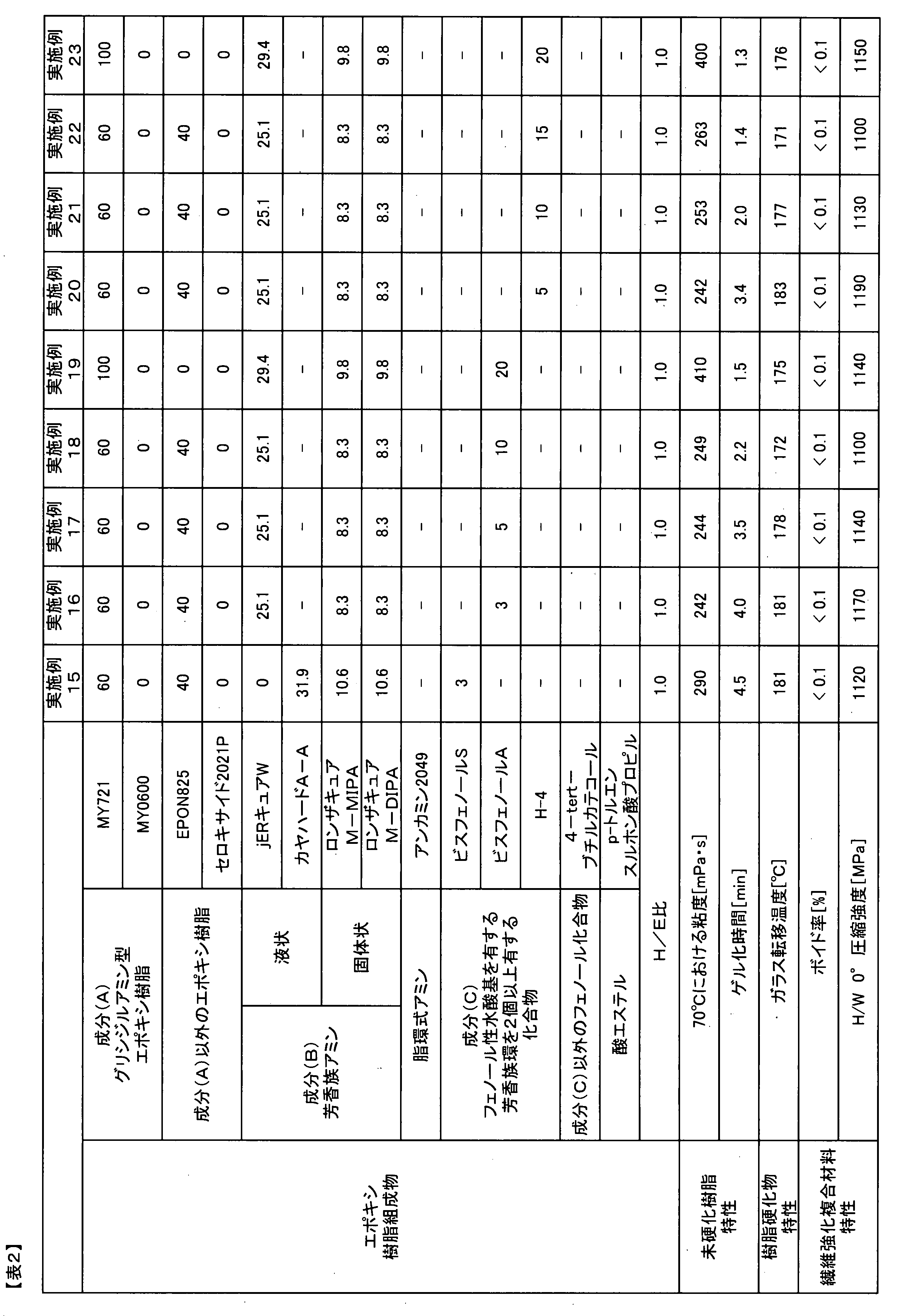
- Example 15 In Example 2, using Kayahard AA instead of jER Cure W as a liquid aromatic amine, an epoxy resin composition was prepared with the content ratio shown in Table 2, and the viscosity and gelation time at 70 ° C. were adjusted. It was measured. In addition, using this epoxy resin composition, a cured resin plate and a fiber-reinforced composite material were prepared, and Tg, void ratio, and H / W0 ° compressive strength were measured. The gelation time was 4.5 minutes, and the Tg of the cured resin was 181 ° C., both high-speed curability and heat resistance were good.
- the fiber reinforced composite material also had a void ratio of less than 0.1% and a H / W 0 ° compressive strength of 1120 MPa, which was satisfactory in all of the quality, heat resistance, and mechanical properties.
- Examples 16 to 18 In the same manner as in Example 2, except that bisphenol A was used instead of bisphenol S as the component (C) and the addition amount of the component (C) was changed, an epoxy resin composition was prepared at the content ratio shown in Table 2. The viscosity at 70 ° C. and the gelation time were measured. In addition, a cured resin plate and a fiber reinforced composite material were prepared using each epoxy resin composition, and Tg, void ratio, and H / W0 ° compressive strength were measured. By adding 3 parts by weight or more and 10 parts by weight or less of component (C) to 100 parts by weight of the total epoxy resin in the epoxy base resin solution, the gelation time can be shortened to 5 minutes or less, and the Tg of the cured resin is further reduced.
- the temperature was maintained at 170 ° C. or higher, and both high-speed curability and heat resistance were good. Moreover, generation
- Example 19 As in Example 6, except that bisphenol A was used instead of bisphenol S as the component (C), and the amount of component (C) added was changed to 20 parts by mass with respect to 100 parts by mass of the total epoxy resin in the epoxy base liquid.
- an epoxy resin composition was prepared at the content ratio described in Table 2, and the viscosity at 70 ° C. and the gelation time were measured.
- a cured resin plate and a fiber-reinforced composite material were prepared, and Tg, void ratio, and H / W0 ° compressive strength were measured. The gelation time was 1.5 minutes, and the Tg of the cured resin was 175 ° C., both high-speed curability and heat resistance were good.
- the fiber reinforced composite material also had a void ratio of less than 0.1% and a H / W 0 ° compressive strength of 1140 MPa, which was satisfactory in all of the quality, heat resistance, and mechanical properties.
- Example 20 to 22 In the same manner as in Example 2, except that H-4 was used in place of bisphenol S as the component (C) and the addition amount of the component (C) was changed, the epoxy resin composition having the content ratio shown in Table 2 was used. The viscosity and gelation time at 70 ° C. were measured. In addition, a cured resin plate and a fiber reinforced composite material were prepared using each epoxy resin composition, and Tg, void ratio, and H / W0 ° compressive strength were measured. By adding 5 parts by weight or more and 15 parts by weight or less of component (C) to 100 parts by weight of the total epoxy resin in the epoxy base resin solution, the gelation time can be shortened to 5 minutes or less, and the Tg of the cured resin is further reduced.
- the temperature was maintained at 170 ° C. or higher, and both high-speed curability and heat resistance were good. Moreover, generation
- Example 23 Example 4 except that H-4 was used in place of bisphenol S as component (C), and the addition amount of component (C) was changed to 20 parts by mass with respect to 100 parts by mass of the total epoxy resin in the epoxy base liquid.
- the epoxy resin composition was produced with the content ratio described in Table 2, and the viscosity and gelation time at 70 ° C. were measured.
- a cured resin plate and a fiber-reinforced composite material were prepared, and Tg, void ratio, and H / W0 ° compressive strength were measured.
- the gelation time was 1.3 minutes, and the Tg of the cured resin was 176 ° C., both high-speed curability and heat resistance were good.
- the fiber reinforced composite material also had a void ratio of less than 0.1% and a H / W 0 ° compressive strength of 1150 MPa, which was satisfactory in all of the quality, heat resistance, and mechanical properties.
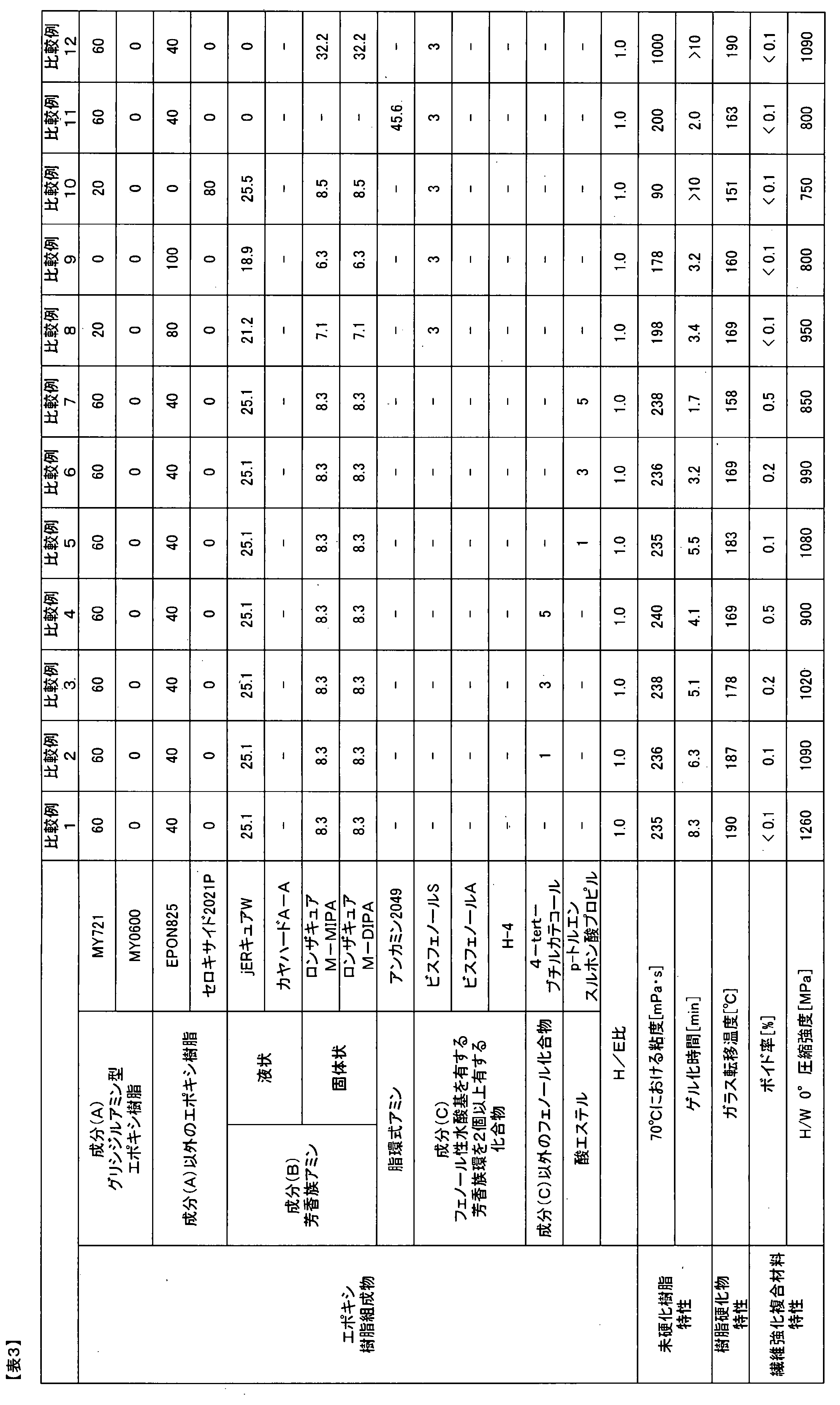
- Example 1 Comparative Example 1 Except that the component (C) was not added, an epoxy resin composition was prepared in the same proportion as in Example 2 except that the component (C) was not added, and the viscosity and gelation time at 70 ° C. were measured.
- a cured resin plate and a fiber-reinforced composite material were prepared, and Tg, void ratio, and H / W0 ° compressive strength were measured.
- the gelation time was 8.3 minutes, and the Tg of the cured resin was 190 ° C.
- the fiber reinforced composite material had a void ratio of less than 0.1% and a H / W 0 ° compressive strength of 1260 MPa, and was satisfactory in all of quality, heat resistance, and mechanical properties.
- the fiber reinforced composite material also had a void ratio of 0.1% or more and an H / W 0 ° compressive strength of less than 1100 MPa, and no results were obtained that satisfied all of the quality, heat resistance, and mechanical properties.
- the gelation time was shortened to 5 minutes or less, and the Tg of the cured resin was reduced. It could not be maintained at 170 ° C. or higher, and a result that both high-speed curability and heat resistance were satisfied was not obtained. Moreover, a volatile component was seen at the time of heat-curing, and some degradation of the surface quality of the cured resin product due to voids was seen. Further, the fiber reinforced composite material also had a void ratio of 0.1% or more and an H / W 0 ° compressive strength of less than 1100 MPa, and no results were obtained that satisfied all of the quality, heat resistance, and mechanical properties.
- Example 2 the content ratio of MY721 and EPON825 in the epoxy main agent liquid was changed to prepare an epoxy resin composition with the content ratio described in Table 3, and the viscosity and gelation time at 70 ° C. were measured.
- a cured resin plate and a fiber reinforced composite material were prepared using each epoxy resin composition, and Tg, void ratio, and H / W0 ° compressive strength were measured.
- the mass ratio of MY721 / EPON825 was changed to 20/80 in Comparative Example 8 and 0/100 in Comparative Example 9, but in either case, the gelation time was reduced to 5 minutes or less, and the Tg of the cured resin was reduced. It could not be maintained at 170 ° C.
- Example 11 (Comparative Example 11)
- an ancamine 2049 which is an alicyclic amine, was used in place of the aromatic amine in the curing agent solution to prepare an epoxy resin composition with the content ratio described in Table 3, and the viscosity at 70 ° C. and Gelation time was measured.
- a cured resin plate and a fiber-reinforced composite material were prepared, and Tg, void ratio, and H / W0 ° compressive strength were measured.
- the gel time was 2.0 minutes and the Tg of the cured resin was 168 ° C.
- Example 12 In Example 2, only the solid aromatic amine Lonacure M-MIPA and Loncure M-DIPA were used as the curing agent, and the epoxy resin, the curing agent, and the component (C) were contained in the content ratios shown in Table 3.
- Bisphenol S was blended as a one-pack type to prepare an epoxy resin composition, and the viscosity and gelation time at 70 ° C. were measured.
- a cured resin plate and a fiber-reinforced composite material were prepared, and Tg, void ratio, and H / W0 ° compressive strength were measured. The gel time was longer than 10 minutes, and the Tg of the cured resin was 190 ° C.
- the heat resistance was good, the curability was lower than in the examples, and the results that both high-speed curability and heat resistance were satisfied were not obtained.
- the resin viscosity at 70 ° C. was 1000 mPa ⁇ s, which was higher than that of the Examples, and the impregnation property to the reinforcing fibers was sometimes inferior.
- production of the void was not seen about the resin hardened
- the compressive strength was 1090 MPa, and no results were obtained that satisfied all of the quality, heat resistance and mechanical properties.
- the two-pack type epoxy resin composition for fiber-reinforced composite material of the present invention is excellent in high-speed curability and heat resistance.
- a high-performance fiber-reinforced composite material can be produced in a short time with high productivity by the RTM method.
- the two-pack type epoxy resin composition for fiber-reinforced composite material of the present invention is excellent in molding a fiber-reinforced composite material having a large shape, and is particularly suitable for application to aircraft and automobile members.
- the two-pack type epoxy resin composition for fiber-reinforced composite material of the present invention is excellent in high-speed curability and high heat resistance, a high-grade fiber-reinforced composite material can be provided with high productivity by the RTM method or the like.
- the application of fiber reinforced composite materials for aircraft and automobile applications will progress, and further contributions to improving fuel economy and reducing greenhouse gas emissions due to further weight reduction can be expected.
Landscapes
- Chemical & Material Sciences (AREA)
- Health & Medical Sciences (AREA)
- Chemical Kinetics & Catalysis (AREA)
- Medicinal Chemistry (AREA)
- Polymers & Plastics (AREA)
- Organic Chemistry (AREA)
- Engineering & Computer Science (AREA)
- Materials Engineering (AREA)
- Manufacturing & Machinery (AREA)
- Inorganic Chemistry (AREA)
- Epoxy Resins (AREA)
- Reinforced Plastic Materials (AREA)
Abstract
Description
(A)グリシジルアミン型エポキシ樹脂
(B)芳香族アミン
(C)フェノール性水酸基を有する芳香族環を2個以上有する化合物
また、上記課題を解決するため、本発明の繊維強化複合材料は次の構成を有する。すなわち、前記した繊維強化複合材料用2液型エポキシ樹脂組成物と強化繊維を組み合わせて、硬化してなる、繊維強化複合材料である。
(A)グリシジルアミン型エポキシ樹脂
(B)芳香族アミン
(C)フェノール性水酸基を有する芳香族環を2個以上有する化合物
各実施例・比較例の樹脂組成物を得るために、以下の樹脂原料を用いた。なお、表1~3中の樹脂組成物の欄における各成分の数値は含有割合を示し、その単位は、特に断らない限り「質量部」である。
1.成分(A)であるエポキシ樹脂
・“アラルダイト”(登録商標)MY721(ハンツマン・アドバンスド・マテリアルズ社製):テトラグリシジルジアミノジフェニルメタン
・“アラルダイト”(登録商標)MY0600(ハンツマン・アドバンスド・マテリアルズ社製):トリグリシジル-m-アミノフェノール
2.成分(A)以外のエポキシ樹脂
・“EPON”(登録商標)825(三菱化学(株)製):ビスフェノールA型エポキシ樹脂(粘度:7000mPa・s(25℃))
・“セロキサイド”(登録商標)2021P((株)ダイセル製):脂環式エポキシ樹脂(粘度:350mPa・s(25℃))
3.成分(B)である芳香族アミン
・“jERキュア”(登録商標)W(三菱化学(株)製):ジエチルトルエンジアミン(粘度:160mPa・s(25℃))
・“カヤハード”(登録商標)A-A(日本化薬(株)製):2,2’-ジエチル-4,4’-ジアミノジフェニルメタン(粘度:2000mPa・s(25℃))
・“ロンザキュア”(登録商標)M-MIPA(ロンザジャパン(株)製):3,3’-ジイソプロピル-5,5’-ジメチル-4,4’-ジアミノジフェニルメタン(粘度:>1000Pa・s(25℃))
・“ロンザキュア”(登録商標)M-DIPA(ロンザジャパン(株)製):3,3’,5,5’-テトライソプロピル-4,4’-ジアミノジフェニルメタン(粘度:>1000Pa・s(25℃))
4.脂環式アミン
・“アンカミン”(登録商標)2049(エア-プロダクツジャパン(株)製):4,4’-メチレンビス(2-メチルシクロヘキシルアミン)(粘度:120mPa・s(25℃))
5.成分(C)であるフェノール性水酸基を有する芳香族環を2個以上有する化合物
・ビスフェノールA(関東化学(株)製):4,4’-イソプロピリデンジフェノール(pKa:10.2)
・ビスフェノールS(関東化学(株)製):4,4’-スルホニルジフェノール(pKa:7.8)
・フェノールノボラック樹脂:H-4(明和化成(株)製)(pKa:9.8)
6.成分(C)以外のフェノール化合物
・4-tert-ブチルカテコール:DIC-TBC(DIC(株)製)
7.酸エステル
・p-トルエンスルホン酸-n-プロピル(東京化成工業(株)製)
(A)グリシジルアミン型エポキシ樹脂等のエポキシ樹脂を用いてエポキシ主剤液とし、(B)芳香族アミン等のアミン化合物、および(C)フェノール性水酸基を有する芳香族環を2個以上有する化合物等のフェノール化合物あるいは酸エステル化合物を用いて硬化剤液として、表1~3に記載した含有割合で混合し、エポキシ樹脂組成物を調製した。
測定すべき検体を、JIS Z8803(1991)における「円すい-平板形回転粘度計による粘度測定方法」に従い、標準コーンローター(1°34’×R24)を装着したE型粘度計を使用して、測定すべき温度に保持した状態で測定した。E型粘度計としては、(株)トキメック製TVE-30Hを用いた。なお、検体としては、エポキシ主剤液と硬化剤液の2液を混合した直後のエポキシ樹脂組成物を用いた。
加硫/硬化特性試験機として、JSRトレーディング(株)製“キュラストメーター”(登録商標)V型を用いて、180℃に加熱したダイスに、エポキシ主剤液と硬化剤液の2液を混合した直後のエポキシ樹脂組成物をサンプルとして投入し、ねじり応力をかけてサンプルの硬化の進行にともなう粘度上昇を、ダイスに伝わるトルクとして測定した。測定開始後、トルクが0.001N・mに達するまでの時間をゲル化時間とした。
上記で調製したエポキシ樹脂組成物を真空中で脱泡した後、2mm厚の“テフロン”(登録商標)製スペーサーにより厚み2mmになるように設定したモールド中に注入した。180℃の温度で2時間硬化させ、厚さ2mmの樹脂硬化板を得た。
樹脂硬化板から幅12.7mm、長さ40mmの試験片を切り出し、DMA(TAインスツルメンツ社製ARES)を用いてTg測定を行った。測定条件は、昇温速度5℃/分である。測定で得られた貯蔵弾性率G’の変曲点での温度をTgとした。
400mm×400mm×1.2mmの板状キャビティーを有する金型に、395mm×395mmに切り出した炭素繊維一方向織物(平織、縦糸:炭素繊維T800S-24K-10C 東レ(株)製、炭素繊維目付295g/m2、縦糸密度7.2本/25mm、横糸:ガラス繊維ECE225 1/0 1Z 日東紡(株)製、横糸密度7.5本/25mm)を、炭素繊維方向を0°として、0°方向に揃えて4枚積層したものをセットし、型締めを行った。続いて、金型を80℃に加温した後、前記のようにして調整され、予め80℃に加温されたエポキシ樹脂組成物を、樹脂注入装置を用いて、注入圧0.2MPaで金型内に注入した。樹脂注入後、予備硬化工程を経てから、繊維強化複合材料の中間体を脱型した。予備硬化工程では、金型を昇温速度1.5℃/minで130℃まで昇温して、130℃で2時間加熱した後、30℃まで降温した。次いで、脱型された、繊維強化複合材料の中間体を、後硬化工程に供することで繊維強化複合材料を得た。後硬化工程では、30℃から180℃まで昇温速度1.5℃/minで昇温して、180℃で2時間加熱した後、30℃まで降温した。
前記のようにして得られた繊維強化複合材料を、0°方向と長さ方向とが同じになるようにして、長さ79.4mm×幅12.7mmにカットし、0°圧縮強度用試験片を作製した。この試験片について、72℃温水中に14日間浸漬した後、繊維強化複合材料の0°圧縮強度を測定した。0°圧縮強度の測定は、ASTM D695に準拠し、試験機として、材料万能試験機(インストロン・ジャパン(株)製 4208型インストロン)を用い、測定時のクロスヘッドスピードを1.27mm/min、測定温度を82℃とした。
前記のようにして、表1に記載した含有割合で、エポキシ樹脂組成物を作製し、70℃における粘度およびゲル化時間を測定した。また、それぞれのエポキシ樹脂組成物を用いて、樹脂硬化板および繊維強化複合材料を作製し、Tg、ボイド率およびH/W0°圧縮強度を測定した。成分(C)としてビスフェノールSを、エポキシ主剤液における全エポキシ樹脂100質量部に対して1質量部以上20質量部以下添加することによって、ゲル化時間を5分以下に短縮することができ、さらに樹脂硬化物のTgも170℃以上を維持しており、高速硬化性、耐熱性共に良好であった。また、樹脂硬化物についてボイドの発生は見られず、表面が高品位な樹脂硬化物が得られた。さらに、繊維強化複合材料についてもボイド率は0.1%未満、H/W0°圧縮強度も1100MPa以上であり、品位、耐熱性、力学特性の全てにおいて良好であった。
実施例2において、エポキシ主剤液中のMY721とEPON825の含有割合を変更して、表1に記載した含有割合でエポキシ樹脂組成物を作製し、70℃における粘度およびゲル化時間を測定した。また、それぞれのエポキシ樹脂組成物を用いて、樹脂硬化板および繊維強化複合材料を作製し、Tg、ボイド率およびH/W0°圧縮強度を測定した。質量比でMY721/EPON825を、実施例6では100/0、実施例7では80/20、実施例8では50/50、実施例9では30/70に変更したが、いずれもゲル化時間は5分以下であり、さらに樹脂硬化物のTgも170℃以上を維持しており、高速硬化性、耐熱性共に良好であった。また、樹脂硬化物についてボイドの発生は見られず、表面が高品位な樹脂硬化物が得られた。さらに、繊維強化複合材料についてもボイド率は0.1%未満、H/W0°圧縮強度も1100MPa以上であり、品位、耐熱性、力学特性の全てにおいて良好であった。
実施例2において、エポキシ主剤液中のMY721の代わりにMY0600を使用して、表1に記載した含有割合でエポキシ樹脂組成物を作製し、70℃における粘度およびゲル化時間を測定した。また、このエポキシ樹脂組成物を用いて、樹脂硬化板および繊維強化複合材料を作製し、Tg、ボイド率およびH/W0°圧縮強度を測定した。ゲル化時間が3.5分であり、さらに樹脂硬化物のTgも182℃と高速硬化性、耐熱性共に良好であった。また、樹脂硬化物についてボイドの発生は見られず、表面が高品位な樹脂硬化物が得られた。さらに、繊維強化複合材料についてもボイド率は0.1%未満、H/W0°圧縮強度も1180MPaであり、品位、耐熱性、力学特性の全てにおいて良好であった。
実施例2において、硬化剤液中の液状芳香族アミンと固体状芳香族アミンの含有割合を変更して、表1に記載した含有割合でエポキシ樹脂組成物を作製し、70℃における粘度およびゲル化時間を測定した。また、それぞれのエポキシ樹脂組成物を用いて、樹脂硬化板および繊維強化複合材料を作製し、Tg、ボイド率およびH/W0°圧縮強度を測定した。質量比でjERキュアW/(M-MIPA+M-DIPA)を、実施例11では100/0、実施例12では80/20、実施例13では20/80に変更したが、いずれもゲル化時間は5分以下であり、さらに樹脂硬化物のTgも170℃以上を維持しており、高速硬化性、耐熱性共に良好であった。また、樹脂硬化物についてボイドの発生は見られず、表面が高品位な樹脂硬化物が得られた。さらに、繊維強化複合材料についてもボイド率は0.1%未満、H/W0°圧縮強度も1100MPa以上であり、品位、耐熱性、力学特性の全てにおいて良好であった。
実施例2において、jERキュアWの代わりに液状の脂環式アミンであるアンカミン2049を使用して、表1に記載した含有割合でエポキシ樹脂組成物を作製し、70℃における粘度およびゲル化時間を測定した。また、このエポキシ樹脂組成物を用いて、樹脂硬化板および繊維強化複合材料を作製し、Tg、ボイド率およびH/W0°圧縮強度を測定した。ゲル化時間が3.3分であり、さらに樹脂硬化物のTgも179℃と高速硬化性、耐熱性共に良好であった。また、樹脂硬化物についてボイドの発生は見られず、表面が高品位な樹脂硬化物が得られた。さらに、繊維強化複合材料についてもボイド率は0.1%未満、H/W0°圧縮強度も1100MPaであり、品位、耐熱性、力学特性の全てにおいて良好であった。
実施例2において、液状芳香族アミンとしてjERキュアWの代わりにカヤハードA-Aを使用して、表2に記載した含有割合でエポキシ樹脂組成物を作製し、70℃における粘度およびゲル化時間を測定した。また、このエポキシ樹脂組成物を用いて、樹脂硬化板および繊維強化複合材料を作製し、Tg、ボイド率およびH/W0°圧縮強度を測定した。ゲル化時間は4.5分であり、さらに樹脂硬化物のTgも181℃と高速硬化性、耐熱性共に良好であった。また、樹脂硬化物についてボイドの発生は見られず、表面が高品位な樹脂硬化物が得られた。さらに、繊維強化複合材料についてもボイド率は0.1%未満、H/W0°圧縮強度も1120MPaであり、品位、耐熱性、力学特性の全てにおいて良好であった。
成分(C)としてビスフェノールSの代わりにビスフェノールAを使用し、成分(C)の添加量を変更した以外は実施例2と同様に、表2に記載した含有割合でエポキシ樹脂組成物を作製し、70℃における粘度およびゲル化時間を測定した。また、それぞれのエポキシ樹脂組成物を用いて、樹脂硬化板および繊維強化複合材料を作製し、Tg、ボイド率およびH/W0°圧縮強度を測定した。成分(C)をエポキシ主剤液における全エポキシ樹脂100質量部に対して3質量部以上10質量部以下添加することによってゲル化時間を5分以下に短縮することができ、さらに樹脂硬化物のTgも170℃以上を維持しており、高速硬化性、耐熱性共に良好であった。また、樹脂硬化物についてボイドの発生は見られず、表面が高品位な樹脂硬化物が得られた。さらに、繊維強化複合材料についてもボイド率は0.1%未満、H/W0°圧縮強度も1100MPa以上であり、品位、耐熱性、力学特性の全てにおいて良好であった。
成分(C)としてビスフェノールSの代わりにビスフェノールAを使用し、成分(C)の添加量をエポキシ主剤液における全エポキシ樹脂100質量部に対して20質量部に変更した以外は実施例6と同様に、表2に記載した含有割合でエポキシ樹脂組成物を作製し、70℃における粘度およびゲル化時間を測定した。また、このエポキシ樹脂組成物を用いて、樹脂硬化板および繊維強化複合材料を作製し、Tg、ボイド率およびH/W0°圧縮強度を測定した。ゲル化時間は1.5分であり、さらに樹脂硬化物のTgも175℃と高速硬化性、耐熱性共に良好であった。また、樹脂硬化物についてボイドの発生は見られず、表面が高品位な樹脂硬化物が得られた。さらに、繊維強化複合材料についてもボイド率は0.1%未満、H/W0°圧縮強度も1140MPaであり、品位、耐熱性、力学特性の全てにおいて良好であった。
成分(C)としてビスフェノールSの代わりにH-4を使用し、成分(C)の添加量を変更した以外は、実施例2と同様に、表2に記載した含有割合でエポキシ樹脂組成物を作製し、70℃における粘度およびゲル化時間を測定した。また、それぞれのエポキシ樹脂組成物を用いて、樹脂硬化板および繊維強化複合材料を作製し、Tg、ボイド率およびH/W0°圧縮強度を測定した。成分(C)をエポキシ主剤液における全エポキシ樹脂100質量部に対して5質量部以上15質量部以下添加することによってゲル化時間を5分以下に短縮することができ、さらに樹脂硬化物のTgも170℃以上を維持しており、高速硬化性、耐熱性共に良好であった。また、樹脂硬化物についてボイドの発生は見られず、表面が高品位な樹脂硬化物が得られた。さらに、繊維強化複合材料についてもボイド率は0.1%未満、H/W0°圧縮強度も1100MPa以上であり、品位、耐熱性、力学特性の全てにおいて良好であった。
成分(C)としてビスフェノールSの代わりにH-4を使用し、成分(C)の添加量をエポキシ主剤液における全エポキシ樹脂100質量部に対して20質量部に変更した以外は実施例6と同様に、表2に記載した含有割合でエポキシ樹脂組成物を作製し、70℃における粘度およびゲル化時間を測定した。また、このエポキシ樹脂組成物を用いて、樹脂硬化板および繊維強化複合材料を作製し、Tg、ボイド率およびH/W0°圧縮強度を測定した。ゲル化時間は1.3分であり、さらに樹脂硬化物のTgも176℃と高速硬化性、耐熱性共に良好であった。また、樹脂硬化物についてボイドの発生は見られず、表面が高品位な樹脂硬化物が得られた。さらに、繊維強化複合材料についてもボイド率は0.1%未満、H/W0°圧縮強度も1150MPaであり、品位、耐熱性、力学特性の全てにおいて良好であった。
成分(C)を添加しなかったこと以外は実施例2と同様に、表3に記載した含有割合でエポキシ樹脂組成物を作製し、70℃における粘度およびゲル化時間を測定した。また、このエポキシ樹脂組成物を用いて、樹脂硬化板および繊維強化複合材料を作製し、Tg、ボイド率およびH/W0°圧縮強度を測定した。ゲル化時間が8.3分、樹脂硬化物のTgが190℃であった。耐熱性は良好であるものの、実施例に比べ硬化性は低く、高速硬化性、耐熱性を共に満足するという結果は得られなかった。また、繊維強化複合材料についてはボイド率が0.1%未満、H/W0°圧縮強度が1260MPaであり、品位、耐熱性、力学特性の全てにおいて良好であった。
成分(C)であるビスフェノールSの代わりに4-tert-ブチルカテコールを使用し、4-tert-ブチルカテコールの添加量を変更した以外は実施例2と同様に、表3に記載した含有割合でエポキシ樹脂組成物を作製し、70℃における粘度およびゲル化時間を測定した。また、それぞれのエポキシ樹脂組成物を用いて、樹脂硬化板および繊維強化複合材料を作製し、Tg、ボイド率およびH/W0°圧縮強度を測定した。4-tert-ブチルカテコールをエポキシ主剤液における全エポキシ樹脂100質量部に対して1質量部以上5質量部以下添加したが、ゲル化時間を5分以下に短縮し、かつ樹脂硬化物のTgを170℃以上に維持することはできず、高速硬化性、耐熱性を共に満足するという結果は得られなかった。また、加熱硬化時に揮発成分が見られ、ボイドによる樹脂硬化物の表面品位の劣化が一部見られた。さらに、繊維強化複合材料についてもボイド率は0.1%以上、H/W0°圧縮強度も1100MPa未満であり、品位、耐熱性、力学特性の全てを満足するという結果は得られなかった。
成分(C)であるビスフェノールSの代わりにp-トルエンスルホン酸プロピルを使用し、p-トルエンスルホン酸プロピルの添加量を変更した以外は実施例2と同様に、表3に記載した含有割合でエポキシ樹脂組成物を作製し、70℃における粘度およびゲル化時間を測定した。また、それぞれのエポキシ樹脂組成物を用いて、樹脂硬化板および繊維強化複合材料を作製し、Tg、ボイド率およびH/W0°圧縮強度を測定した。p-トルエンスルホン酸プロピルをエポキシ主剤液における全エポキシ樹脂100質量部に対して1質量部以上5質量部以下添加したが、ゲル化時間を5分以下に短縮し、かつ樹脂硬化物のTgを170℃以上に維持することはできず、高速硬化性、耐熱性を共に満足するという結果は得られなかった。また、加熱硬化時に揮発成分が見られ、ボイドによる樹脂硬化物の表面品位の劣化が一部見られた。さらに、繊維強化複合材料についてもボイド率は0.1%以上、H/W0°圧縮強度も1100MPa未満であり、品位、耐熱性、力学特性の全てを満足するという結果は得られなかった。
実施例2において、エポキシ主剤液中のMY721とEPON825の含有割合を変更して、表3に記載した含有割合でエポキシ樹脂組成物を作製し、70℃における粘度およびゲル化時間を測定した。また、それぞれのエポキシ樹脂組成物を用いて、樹脂硬化板および繊維強化複合材料を作製し、Tg、ボイド率およびH/W0°圧縮強度を測定した。質量比でMY721/EPON825を、比較例8で20/80、比較例9で0/100に変更したが、いずれの場合もゲル化時間を5分以下に短縮し、かつ樹脂硬化物のTgを170℃以上に維持することはできず、高速硬化性、耐熱性を共に満足するという結果は得られなかった。また、樹脂硬化物についてボイドの発生は見られず、表面が高品位な樹脂硬化物が得られたが、繊維強化複合材料についてはボイド率が0.1%未満であったものの、H/W0°圧縮強度が1100MPa未満であり、品位、耐熱性、力学特性の全てを満足するという結果は得られなかった。
比較例8において、エポキシ主剤液中のEPON825をセロキサイド2021Pに変更して、表3に記載した含有割合でエポキシ樹脂組成物を作製し、70℃における粘度およびゲル化時間を測定した。また、このエポキシ樹脂組成物を用いて、樹脂硬化板および繊維強化複合材料を作製し、Tg、ボイド率およびH/W0°圧縮強度を測定した。ゲル化時間が10分より長く、樹脂硬化物のTgが151℃であった。実施例に比べ、高速硬化性、耐熱性共に低く、満足する結果は得られなかった。また、樹脂硬化物についてボイドの発生は見られず、表面が高品位な樹脂硬化物が得られたが、繊維強化複合材料についてはボイド率が0.1%未満であったものの、H/W0°圧縮強度が750MPaであり、品位、耐熱性、力学特性の全てを満足するという結果は得られなかった。
実施例2において、硬化剤液中の芳香族アミンの代わりに脂環式アミンであるアンカミン2049を使用して、表3に記載した含有割合でエポキシ樹脂組成物を作製し、70℃における粘度およびゲル化時間を測定した。また、このエポキシ樹脂組成物を用いて、樹脂硬化板および繊維強化複合材料を作製し、Tg、ボイド率およびH/W0°圧縮強度を測定した。ゲル化時間が2.0分、樹脂硬化物のTgが168℃であった。高速硬化性は良好であったものの、実施例に比べ耐熱性は低く、高速硬化性、耐熱性を共に満足するという結果は得られなかった。また、樹脂硬化物についてボイドの発生は見られず、表面が高品位な樹脂硬化物が得られたが、繊維強化複合材料についてはボイド率が0.1%未満であったものの、H/W0°圧縮強度が800MPaであり、品位、耐熱性、力学特性の全てを満足するという結果は得られなかった。
実施例2において、硬化剤として固体状芳香族アミンであるロンザキュアM-MIPAおよびロンザキュアM-DIPAのみを使用し、表3に記載した含有割合で、エポキシ樹脂、硬化剤および成分(C)であるビスフェノールSを1液型として配合して、エポキシ樹脂組成物を作製し、70℃における粘度およびゲル化時間を測定した。また、このエポキシ樹脂組成物を用いて、樹脂硬化板および繊維強化複合材料を作製し、Tg、ボイド率およびH/W0°圧縮強度を測定した。ゲル化時間が10分より長く、樹脂硬化物のTgが190℃であった。耐熱性は良好であるものの、実施例に比べ硬化性は低く、高速硬化性、耐熱性を共に満足するという結果は得られなかった。また、70℃における樹脂粘度についても1000mPa・sと実施例より高く、強化繊維への含浸性が劣る場合があった。また、樹脂硬化物についてボイドの発生は見られず、表面が高品位な樹脂硬化物が得られたが、繊維強化複合材料についてはボイド率が0.1%未満であったものの、H/W0°圧縮強度が1090MPaであり、品位、耐熱性、力学特性の全てを満足するという結果は得られなかった。

Claims (13)
- 次の(A)~(C)の成分を含むエポキシ樹脂組成物であって、成分(A)を30質量%以上100質量%以下含むエポキシ主剤液と、成分(B)を含む硬化剤液からなる、繊維強化複合材料用2液型エポキシ樹脂組成物。
(A)グリシジルアミン型エポキシ樹脂
(B)芳香族アミン
(C)フェノール性水酸基を有する芳香族環を2個以上有する化合物 - 成分(A)が、3官能以上のグリシジルアミン型エポキシ樹脂である、請求項1に記載の繊維強化複合材料用2液型エポキシ樹脂組成物。
- 成分(A)が、N,N,N’,N’-テトラグリシジルジアミノジフェニルメタン、トリグリシジルアミノフェノール、またはこれらの誘導体もしくは異性体から選ばれるグリシジルアミン型エポキシ樹脂である、請求項1または2に記載の繊維強化複合材料用2液型エポキシ樹脂組成物。
- エポキシ主剤液に、液状ビスフェノール型エポキシ樹脂が含まれる、請求項1~3のいずれかに記載の繊維強化複合材料用2液型エポキシ樹脂組成物。
- 硬化剤液に、液状アミンが含まれる、請求項1~4のいずれかに記載の繊維強化複合材料用2液型エポキシ樹脂組成物。
- 成分(B)が、液状芳香族アミンと固体状芳香族アミンの混合物である、請求項1~5のいずれかに記載の繊維強化複合材料用2液型エポキシ樹脂組成物。
- 成分(C)が、フェノール性水酸基を2つ以上含むビスフェノール類である、請求項1~6のいずれかに記載の繊維強化複合材料用2液型エポキシ樹脂組成物。
- 成分(C)の酸解離定数pKaが、7以上9.8以下である、請求項1~7のいずれかに記載の繊維強化複合材料用2液型エポキシ樹脂組成物。
- 成分(C)が、エポキシ主剤液に含まれる全エポキシ樹脂100質量部に対して1質量部以上20質量部以下含まれる、請求項1~8のいずれかに記載の繊維強化複合材料用2液型エポキシ樹脂組成物。
- E型粘度計で測定した70℃における粘度が10mPa・s以上500mPa・s以下である、請求項1~9のいずれかに記載の繊維強化複合材料用2液型エポキシ樹脂組成物。
- RTM法で使用される、請求項1~10のいずれかに記載の繊維強化複合材料用2液型エポキシ樹脂組成物。
- 請求項1~11のいずれかに記載の繊維強化複合材料用2液型エポキシ樹脂組成物と強化繊維を組み合わせて、硬化してなる、繊維強化複合材料。
- 強化繊維が炭素繊維である、請求項12に記載の繊維強化複合材料。
Priority Applications (5)
| Application Number | Priority Date | Filing Date | Title |
|---|---|---|---|
| EP15826619.7A EP3176200B1 (en) | 2014-07-31 | 2015-07-03 | Two-pack type epoxy resin composition for fiber-reinforced composite material, and fiber-reinforced composite material |
| CN201580041120.9A CN106574039B (zh) | 2014-07-31 | 2015-07-03 | 纤维强化复合材料用二液型环氧树脂组合物和纤维强化复合材料 |
| JP2015534849A JP6617559B2 (ja) | 2014-07-31 | 2015-07-03 | 繊維強化複合材料用2液型エポキシ樹脂組成物および繊維強化複合材料 |
| KR1020177004016A KR102351861B1 (ko) | 2014-07-31 | 2015-07-03 | 섬유 강화 복합 재료용 2액형 에폭시 수지 조성물 및 섬유 강화 복합 재료 |
| US15/327,099 US20170158829A1 (en) | 2014-07-31 | 2015-07-03 | Two-pack type epoxy resin composition for fiber-reinforced composite material, and fiber-reinforced composite material |
Applications Claiming Priority (2)
| Application Number | Priority Date | Filing Date | Title |
|---|---|---|---|
| JP2014155752 | 2014-07-31 | ||
| JP2014-155752 | 2014-07-31 |
Publications (1)
| Publication Number | Publication Date |
|---|---|
| WO2016017371A1 true WO2016017371A1 (ja) | 2016-02-04 |
Family
ID=55217276
Family Applications (1)
| Application Number | Title | Priority Date | Filing Date |
|---|---|---|---|
| PCT/JP2015/069224 Ceased WO2016017371A1 (ja) | 2014-07-31 | 2015-07-03 | 繊維強化複合材料用2液型エポキシ樹脂組成物および繊維強化複合材料 |
Country Status (6)
| Country | Link |
|---|---|
| US (1) | US20170158829A1 (ja) |
| EP (1) | EP3176200B1 (ja) |
| JP (1) | JP6617559B2 (ja) |
| KR (1) | KR102351861B1 (ja) |
| CN (1) | CN106574039B (ja) |
| WO (1) | WO2016017371A1 (ja) |
Cited By (8)
| Publication number | Priority date | Publication date | Assignee | Title |
|---|---|---|---|---|
| US20180244880A1 (en) * | 2015-09-03 | 2018-08-30 | Toray Industries, Inc. | Epoxy resin composition, prepreg, and carbon fiber reinforced composite material |
| CN108699221A (zh) * | 2016-04-12 | 2018-10-23 | 三菱瓦斯化学株式会社 | 环氧树脂固化剂、环氧树脂组合物、碳纤维增强复合材料 |
| CN109843968A (zh) * | 2016-10-14 | 2019-06-04 | 日铁化学材料株式会社 | 纤维强化复合材料用树脂组合物和使用它的纤维强化复合材料 |
| JP2019157095A (ja) * | 2018-03-16 | 2019-09-19 | 帝人株式会社 | エポキシ樹脂組成物、プリプレグ、及び繊維強化複合材料 |
| JP2019157096A (ja) * | 2018-03-16 | 2019-09-19 | 帝人株式会社 | エポキシ樹脂組成物、プリプレグ、及び繊維強化複合材料 |
| JP2019163438A (ja) * | 2018-03-16 | 2019-09-26 | 帝人株式会社 | エポキシ樹脂組成物、プリプレグ、繊維強化複合材料、及びそれらの製造方法 |
| JP2020527180A (ja) * | 2017-07-12 | 2020-09-03 | ヘクセル コンポジッツ、リミテッド | 樹脂硬化剤系の改善 |
| JP2021501227A (ja) * | 2017-10-26 | 2021-01-14 | サイテック インダストリーズ インコーポレイテッド | 樹脂組成物及び樹脂注入プロセス |
Families Citing this family (9)
| Publication number | Priority date | Publication date | Assignee | Title |
|---|---|---|---|---|
| EP3153228B1 (en) * | 2014-06-04 | 2024-03-13 | Mitsubishi Chemical Corporation | Potting material for membrane modules and hollow fiber membrane module comprising same |
| JP7425612B2 (ja) * | 2019-04-10 | 2024-01-31 | シチズン時計株式会社 | 熱硬化性樹脂組成物、時計部品、夜光カプセルおよび夜光カプセルの製造方法 |
| EP4051723A1 (en) * | 2019-11-01 | 2022-09-07 | Hexcel Composites Limited | Epoxy resin compositions |
| CN111087761A (zh) * | 2019-12-31 | 2020-05-01 | 华东理工大学华昌聚合物有限公司 | 一种环氧树脂及其制备方法 |
| CN111805945A (zh) * | 2020-07-08 | 2020-10-23 | 百佳瑞航天航空新材料(苏州)有限公司 | 一种航天航空碳纤维复合材料试件的加工方法 |
| CN111793193A (zh) * | 2020-08-14 | 2020-10-20 | 黑龙江省科学院石油化学研究院 | 一种无溶剂型耐温180℃超低黏度环氧树脂基体及其制备方法 |
| JP2023025401A (ja) | 2021-08-10 | 2023-02-22 | 帝人株式会社 | 繊維強化複合材料およびその製造方法 |
| JPWO2023145341A1 (ja) | 2022-01-28 | 2023-08-03 | ||
| KR102818881B1 (ko) * | 2022-12-16 | 2025-06-10 | 현대제철 주식회사 | 저점도 특성 및 보이드 저감효과가 우수한 에폭시 수지 조성물, 이를 이용한 섬유강화 복합재 제조방법 및 이를 이용하여 제조된 섬유강화 복합재 |
Citations (3)
| Publication number | Priority date | Publication date | Assignee | Title |
|---|---|---|---|---|
| JPS6028420A (ja) * | 1983-07-26 | 1985-02-13 | Yokohama Rubber Co Ltd:The | エポキシ樹脂組成物 |
| JPS63159424A (ja) * | 1986-12-24 | 1988-07-02 | Dainippon Ink & Chem Inc | エポキシ樹脂組成物 |
| JP2013159618A (ja) * | 2012-02-01 | 2013-08-19 | Toray Ind Inc | エポキシ樹脂組成物、繊維強化複合材料およびそれらの製造方法 |
Family Cites Families (6)
| Publication number | Priority date | Publication date | Assignee | Title |
|---|---|---|---|---|
| GB9326427D0 (en) | 1993-12-24 | 1994-02-23 | Dow Deutschland Inc | Kinetically controlled in-situ generation of catalytic species for the curing of epoxy/amine compositions |
| CN1286875C (zh) * | 2001-11-07 | 2006-11-29 | 东丽株式会社 | 纤维强化复合材料用环氧树脂组合物、纤维强化复合材料的制法以及纤维强化复合材料 |
| JP4015613B2 (ja) * | 2003-12-15 | 2007-11-28 | 三洋化成工業株式会社 | 注型用樹脂組成物 |
| JP2007162001A (ja) * | 2005-11-21 | 2007-06-28 | Shin Etsu Chem Co Ltd | 液状エポキシ樹脂組成物 |
| CN101945944B (zh) * | 2008-03-25 | 2012-08-22 | 东丽株式会社 | 环氧树脂组合物、纤维增强复合材料及其制造方法 |
| JP5792593B2 (ja) * | 2011-11-04 | 2015-10-14 | 京セラケミカル株式会社 | ディップコート用エポキシ樹脂組成物 |
-
2015
- 2015-07-03 EP EP15826619.7A patent/EP3176200B1/en active Active
- 2015-07-03 US US15/327,099 patent/US20170158829A1/en not_active Abandoned
- 2015-07-03 JP JP2015534849A patent/JP6617559B2/ja not_active Expired - Fee Related
- 2015-07-03 KR KR1020177004016A patent/KR102351861B1/ko not_active Expired - Fee Related
- 2015-07-03 CN CN201580041120.9A patent/CN106574039B/zh not_active Expired - Fee Related
- 2015-07-03 WO PCT/JP2015/069224 patent/WO2016017371A1/ja not_active Ceased
Patent Citations (3)
| Publication number | Priority date | Publication date | Assignee | Title |
|---|---|---|---|---|
| JPS6028420A (ja) * | 1983-07-26 | 1985-02-13 | Yokohama Rubber Co Ltd:The | エポキシ樹脂組成物 |
| JPS63159424A (ja) * | 1986-12-24 | 1988-07-02 | Dainippon Ink & Chem Inc | エポキシ樹脂組成物 |
| JP2013159618A (ja) * | 2012-02-01 | 2013-08-19 | Toray Ind Inc | エポキシ樹脂組成物、繊維強化複合材料およびそれらの製造方法 |
Cited By (20)
| Publication number | Priority date | Publication date | Assignee | Title |
|---|---|---|---|---|
| US10851217B2 (en) * | 2015-09-03 | 2020-12-01 | Toray Industries, Inc. | Epoxy resin composition, prepreg, and carbon fiber reinforced composite material |
| US20180244880A1 (en) * | 2015-09-03 | 2018-08-30 | Toray Industries, Inc. | Epoxy resin composition, prepreg, and carbon fiber reinforced composite material |
| US10767001B2 (en) | 2016-04-12 | 2020-09-08 | Mitsubishi Gas Chemical Company, Inc. | Epoxy resin curing agent, epoxy resin composition, and carbon fiber-reinforced composite material |
| CN108699221A (zh) * | 2016-04-12 | 2018-10-23 | 三菱瓦斯化学株式会社 | 环氧树脂固化剂、环氧树脂组合物、碳纤维增强复合材料 |
| EP3444291A4 (en) * | 2016-04-12 | 2019-03-20 | Mitsubishi Gas Chemical Company, Inc. | EPOXY RESIN HARDENER, HARDENED EPOXY RESIN PRODUCT AND FIBER-REINFORCED COMPOSITE |
| TWI730067B (zh) * | 2016-04-12 | 2021-06-11 | 日商三菱瓦斯化學股份有限公司 | 環氧樹脂硬化劑、環氧樹脂組成物及碳纖維強化複合材 |
| CN109843968A (zh) * | 2016-10-14 | 2019-06-04 | 日铁化学材料株式会社 | 纤维强化复合材料用树脂组合物和使用它的纤维强化复合材料 |
| KR20190068552A (ko) * | 2016-10-14 | 2019-06-18 | 닛테츠 케미컬 앤드 머티리얼 가부시키가이샤 | 섬유 강화 복합 재료용 수지 조성물 및 그것을 이용한 섬유 강화 복합 재료 |
| KR102399500B1 (ko) * | 2016-10-14 | 2022-05-19 | 닛테츠 케미컬 앤드 머티리얼 가부시키가이샤 | 섬유 강화 복합 재료용 수지 조성물 및 그것을 이용한 섬유 강화 복합 재료 |
| CN109843968B (zh) * | 2016-10-14 | 2022-03-25 | 日铁化学材料株式会社 | 纤维强化复合材料用树脂组合物和使用它的纤维强化复合材料 |
| JP2020527180A (ja) * | 2017-07-12 | 2020-09-03 | ヘクセル コンポジッツ、リミテッド | 樹脂硬化剤系の改善 |
| JP7242628B2 (ja) | 2017-07-12 | 2023-03-20 | ヘクセル コンポジッツ、リミテッド | 樹脂硬化剤系の改善 |
| JP7240394B2 (ja) | 2017-10-26 | 2023-03-15 | サイテック インダストリーズ インコーポレイテッド | 樹脂組成物及び樹脂注入プロセス |
| JP2021501227A (ja) * | 2017-10-26 | 2021-01-14 | サイテック インダストリーズ インコーポレイテッド | 樹脂組成物及び樹脂注入プロセス |
| JP2019157095A (ja) * | 2018-03-16 | 2019-09-19 | 帝人株式会社 | エポキシ樹脂組成物、プリプレグ、及び繊維強化複合材料 |
| JP7190258B2 (ja) | 2018-03-16 | 2022-12-15 | 帝人株式会社 | エポキシ樹脂組成物、プリプレグ、及び繊維強化複合材料 |
| JP7224800B2 (ja) | 2018-03-16 | 2023-02-20 | 帝人株式会社 | エポキシ樹脂組成物、プリプレグ、繊維強化複合材料、及びそれらの製造方法 |
| JP2019163438A (ja) * | 2018-03-16 | 2019-09-26 | 帝人株式会社 | エポキシ樹脂組成物、プリプレグ、繊維強化複合材料、及びそれらの製造方法 |
| JP2019157096A (ja) * | 2018-03-16 | 2019-09-19 | 帝人株式会社 | エポキシ樹脂組成物、プリプレグ、及び繊維強化複合材料 |
| JP7315304B2 (ja) | 2018-03-16 | 2023-07-26 | 帝人株式会社 | エポキシ樹脂組成物、プリプレグ、及び繊維強化複合材料 |
Also Published As
| Publication number | Publication date |
|---|---|
| CN106574039B (zh) | 2019-12-17 |
| EP3176200A1 (en) | 2017-06-07 |
| JP6617559B2 (ja) | 2019-12-11 |
| KR20170037987A (ko) | 2017-04-05 |
| EP3176200B1 (en) | 2019-04-17 |
| JPWO2016017371A1 (ja) | 2017-04-27 |
| EP3176200A4 (en) | 2018-01-03 |
| KR102351861B1 (ko) | 2022-01-17 |
| US20170158829A1 (en) | 2017-06-08 |
| CN106574039A (zh) | 2017-04-19 |
Similar Documents
| Publication | Publication Date | Title |
|---|---|---|
| JP6617559B2 (ja) | 繊維強化複合材料用2液型エポキシ樹脂組成物および繊維強化複合材料 | |
| JP5454138B2 (ja) | エポキシ樹脂組成物、繊維強化複合材料、およびその製造方法 | |
| RU2574054C2 (ru) | Отверждаемые композиции на основе эпоксидных смол и композитные материалы, полученные из них | |
| JP5403184B1 (ja) | 繊維強化複合材料 | |
| US9039951B2 (en) | Curable resin composition and short-cure method | |
| CN110637041B (zh) | 纤维增强复合材料用环氧树脂组合物及纤维增强复合材料 | |
| JP2017149887A (ja) | 繊維強化複合材料用エポキシ樹脂組成物、および繊維強化複合材料 | |
| US11111333B2 (en) | Resin compositions and resin infusion process | |
| US12091479B2 (en) | Epoxy resin composition for fiber-reinforced composite material, fiber-reinforced composite material, and production method thereof | |
| JP2018135496A (ja) | 繊維強化複合材料用2液型エポキシ樹脂組成物および繊維強化複合材料 | |
| KR101950627B1 (ko) | 에폭시 수지 조성물, 및 이것을 이용한 필름, 프리프레그 및 섬유 강화 플라스틱 | |
| WO2023176935A1 (ja) | Rtm用エポキシ樹脂組成物、樹脂硬化物、繊維強化複合材料およびその製造方法 | |
| AU2024228062A1 (en) | Epoxy resin composition for rtm, cured resin product and fiber-reinforced composite material, and manufacturing method therefor | |
| JP2018053065A (ja) | 繊維強化複合材料用エポキシ樹脂組成物、および繊維強化複合材料 | |
| JP2016210860A (ja) | エポキシ樹脂組成物および繊維強化複合材料用プリプレグ | |
| JP2016147926A (ja) | 繊維強化複合材料用エポキシ樹脂組成物、エポキシ樹脂硬化物および繊維強化複合材料 | |
| US12600853B2 (en) | Epoxy resin composition, prepreg, and fiber reinforced composite material | |
| TW201938628A (zh) | 纖維強化複合材料用樹脂組成物、纖維強化複合材料、硬化物及成形體的製造方法 | |
| JP6421897B1 (ja) | エポキシ樹脂組成物、プリプレグ、繊維強化複合材料およびその製造方法 | |
| EP4317236A1 (en) | Epoxy resin composition, prepreg, and fiber-reinforced composite material | |
| JP7816137B2 (ja) | 繊維強化複合材料用エポキシ樹脂組成物、繊維強化複合材料、および繊維強化複合材料の製造方法 | |
| JP2026042370A (ja) | 繊維強化複合材料用エポキシ樹脂組成物、繊維強化複合材料、および繊維強化複合材料の製造方法 | |
| WO2021095627A1 (ja) | エポキシ樹脂組成物、プリプレグおよび繊維強化複合材料 |
Legal Events
| Date | Code | Title | Description |
|---|---|---|---|
| ENP | Entry into the national phase |
Ref document number: 2015534849 Country of ref document: JP Kind code of ref document: A |
|
| 121 | Ep: the epo has been informed by wipo that ep was designated in this application |
Ref document number: 15826619 Country of ref document: EP Kind code of ref document: A1 |
|
| REEP | Request for entry into the european phase |
Ref document number: 2015826619 Country of ref document: EP |
|
| WWE | Wipo information: entry into national phase |
Ref document number: 15327099 Country of ref document: US |
|
| NENP | Non-entry into the national phase |
Ref country code: DE |
|
| ENP | Entry into the national phase |
Ref document number: 20177004016 Country of ref document: KR Kind code of ref document: A |