WO2016017548A1 - 潤滑剤組成物及び潤滑剤組成物の製造方法 - Google Patents
潤滑剤組成物及び潤滑剤組成物の製造方法 Download PDFInfo
- Publication number
- WO2016017548A1 WO2016017548A1 PCT/JP2015/071138 JP2015071138W WO2016017548A1 WO 2016017548 A1 WO2016017548 A1 WO 2016017548A1 JP 2015071138 W JP2015071138 W JP 2015071138W WO 2016017548 A1 WO2016017548 A1 WO 2016017548A1
- Authority
- WO
- WIPO (PCT)
- Prior art keywords
- lubricant composition
- oil
- carbon atoms
- ester
- lubricant
- Prior art date
- Legal status (The legal status is an assumption and is not a legal conclusion. Google has not performed a legal analysis and makes no representation as to the accuracy of the status listed.)
- Ceased
Links
Classifications
-
- C—CHEMISTRY; METALLURGY
- C10—PETROLEUM, GAS OR COKE INDUSTRIES; TECHNICAL GASES CONTAINING CARBON MONOXIDE; FUELS; LUBRICANTS; PEAT
- C10M—LUBRICATING COMPOSITIONS; USE OF CHEMICAL SUBSTANCES EITHER ALONE OR AS LUBRICATING INGREDIENTS IN A LUBRICATING COMPOSITION
- C10M159/00—Lubricating compositions characterised by the additive being of unknown or incompletely defined constitution
- C10M159/12—Reaction products
-
- C—CHEMISTRY; METALLURGY
- C10—PETROLEUM, GAS OR COKE INDUSTRIES; TECHNICAL GASES CONTAINING CARBON MONOXIDE; FUELS; LUBRICANTS; PEAT
- C10M—LUBRICATING COMPOSITIONS; USE OF CHEMICAL SUBSTANCES EITHER ALONE OR AS LUBRICATING INGREDIENTS IN A LUBRICATING COMPOSITION
- C10M129/00—Lubricating compositions characterised by the additive being an organic non-macromolecular compound containing oxygen
- C10M129/02—Lubricating compositions characterised by the additive being an organic non-macromolecular compound containing oxygen having a carbon chain of less than 30 atoms
- C10M129/68—Esters
- C10M129/78—Complex esters, i.e. compounds containing at least three esterified carboxyl groups and derived from the combination of at least three different types of the following five types of compound: monohydroxy compounds, polyhydroxy compounds, monocarboxylic acids, polycarboxylic acids, hydroxy carboxylic acids
-
- C—CHEMISTRY; METALLURGY
- C10—PETROLEUM, GAS OR COKE INDUSTRIES; TECHNICAL GASES CONTAINING CARBON MONOXIDE; FUELS; LUBRICANTS; PEAT
- C10M—LUBRICATING COMPOSITIONS; USE OF CHEMICAL SUBSTANCES EITHER ALONE OR AS LUBRICATING INGREDIENTS IN A LUBRICATING COMPOSITION
- C10M169/00—Lubricating compositions characterised by containing as components a mixture of at least two types of ingredient selected from base-materials, thickeners or additives, covered by the preceding groups, each of these compounds being essential
- C10M169/04—Mixtures of base-materials and additives
- C10M169/042—Mixtures of base-materials and additives the additives being compounds of unknown or incompletely defined constitution only
-
- C—CHEMISTRY; METALLURGY
- C10—PETROLEUM, GAS OR COKE INDUSTRIES; TECHNICAL GASES CONTAINING CARBON MONOXIDE; FUELS; LUBRICANTS; PEAT
- C10M—LUBRICATING COMPOSITIONS; USE OF CHEMICAL SUBSTANCES EITHER ALONE OR AS LUBRICATING INGREDIENTS IN A LUBRICATING COMPOSITION
- C10M169/00—Lubricating compositions characterised by containing as components a mixture of at least two types of ingredient selected from base-materials, thickeners or additives, covered by the preceding groups, each of these compounds being essential
- C10M169/04—Mixtures of base-materials and additives
- C10M169/045—Mixtures of base-materials and additives the additives being a mixture of compounds of unknown or incompletely defined constitution and non-macromolecular compounds
-
- C—CHEMISTRY; METALLURGY
- C10—PETROLEUM, GAS OR COKE INDUSTRIES; TECHNICAL GASES CONTAINING CARBON MONOXIDE; FUELS; LUBRICANTS; PEAT
- C10M—LUBRICATING COMPOSITIONS; USE OF CHEMICAL SUBSTANCES EITHER ALONE OR AS LUBRICATING INGREDIENTS IN A LUBRICATING COMPOSITION
- C10M2203/00—Organic non-macromolecular hydrocarbon compounds and hydrocarbon fractions as ingredients in lubricant compositions
- C10M2203/02—Well-defined aliphatic compounds
- C10M2203/024—Well-defined aliphatic compounds unsaturated
-
- C—CHEMISTRY; METALLURGY
- C10—PETROLEUM, GAS OR COKE INDUSTRIES; TECHNICAL GASES CONTAINING CARBON MONOXIDE; FUELS; LUBRICANTS; PEAT
- C10M—LUBRICATING COMPOSITIONS; USE OF CHEMICAL SUBSTANCES EITHER ALONE OR AS LUBRICATING INGREDIENTS IN A LUBRICATING COMPOSITION
- C10M2203/00—Organic non-macromolecular hydrocarbon compounds and hydrocarbon fractions as ingredients in lubricant compositions
- C10M2203/10—Petroleum or coal fractions, e.g. tars, solvents, bitumen
- C10M2203/1006—Petroleum or coal fractions, e.g. tars, solvents, bitumen used as base material
-
- C—CHEMISTRY; METALLURGY
- C10—PETROLEUM, GAS OR COKE INDUSTRIES; TECHNICAL GASES CONTAINING CARBON MONOXIDE; FUELS; LUBRICANTS; PEAT
- C10M—LUBRICATING COMPOSITIONS; USE OF CHEMICAL SUBSTANCES EITHER ALONE OR AS LUBRICATING INGREDIENTS IN A LUBRICATING COMPOSITION
- C10M2205/00—Organic macromolecular hydrocarbon compounds or fractions, whether or not modified by oxidation as ingredients in lubricant compositions
- C10M2205/02—Organic macromolecular hydrocarbon compounds or fractions, whether or not modified by oxidation as ingredients in lubricant compositions containing acyclic monomers
- C10M2205/0206—Organic macromolecular hydrocarbon compounds or fractions, whether or not modified by oxidation as ingredients in lubricant compositions containing acyclic monomers used as base material
-
- C—CHEMISTRY; METALLURGY
- C10—PETROLEUM, GAS OR COKE INDUSTRIES; TECHNICAL GASES CONTAINING CARBON MONOXIDE; FUELS; LUBRICANTS; PEAT
- C10M—LUBRICATING COMPOSITIONS; USE OF CHEMICAL SUBSTANCES EITHER ALONE OR AS LUBRICATING INGREDIENTS IN A LUBRICATING COMPOSITION
- C10M2205/00—Organic macromolecular hydrocarbon compounds or fractions, whether or not modified by oxidation as ingredients in lubricant compositions
- C10M2205/02—Organic macromolecular hydrocarbon compounds or fractions, whether or not modified by oxidation as ingredients in lubricant compositions containing acyclic monomers
- C10M2205/028—Organic macromolecular hydrocarbon compounds or fractions, whether or not modified by oxidation as ingredients in lubricant compositions containing acyclic monomers containing aliphatic monomers having more than four carbon atoms
- C10M2205/0285—Organic macromolecular hydrocarbon compounds or fractions, whether or not modified by oxidation as ingredients in lubricant compositions containing acyclic monomers containing aliphatic monomers having more than four carbon atoms used as base material
-
- C—CHEMISTRY; METALLURGY
- C10—PETROLEUM, GAS OR COKE INDUSTRIES; TECHNICAL GASES CONTAINING CARBON MONOXIDE; FUELS; LUBRICANTS; PEAT
- C10M—LUBRICATING COMPOSITIONS; USE OF CHEMICAL SUBSTANCES EITHER ALONE OR AS LUBRICATING INGREDIENTS IN A LUBRICATING COMPOSITION
- C10M2207/00—Organic non-macromolecular hydrocarbon compounds containing hydrogen, carbon and oxygen as ingredients in lubricant compositions
- C10M2207/003—Organic non-macromolecular hydrocarbon compounds containing hydrogen, carbon and oxygen as ingredients in lubricant compositions used as base material
-
- C—CHEMISTRY; METALLURGY
- C10—PETROLEUM, GAS OR COKE INDUSTRIES; TECHNICAL GASES CONTAINING CARBON MONOXIDE; FUELS; LUBRICANTS; PEAT
- C10M—LUBRICATING COMPOSITIONS; USE OF CHEMICAL SUBSTANCES EITHER ALONE OR AS LUBRICATING INGREDIENTS IN A LUBRICATING COMPOSITION
- C10M2207/00—Organic non-macromolecular hydrocarbon compounds containing hydrogen, carbon and oxygen as ingredients in lubricant compositions
- C10M2207/04—Ethers; Acetals; Ortho-esters; Ortho-carbonates
- C10M2207/0406—Ethers; Acetals; Ortho-esters; Ortho-carbonates used as base material
-
- C—CHEMISTRY; METALLURGY
- C10—PETROLEUM, GAS OR COKE INDUSTRIES; TECHNICAL GASES CONTAINING CARBON MONOXIDE; FUELS; LUBRICANTS; PEAT
- C10M—LUBRICATING COMPOSITIONS; USE OF CHEMICAL SUBSTANCES EITHER ALONE OR AS LUBRICATING INGREDIENTS IN A LUBRICATING COMPOSITION
- C10M2207/00—Organic non-macromolecular hydrocarbon compounds containing hydrogen, carbon and oxygen as ingredients in lubricant compositions
- C10M2207/28—Esters
- C10M2207/2805—Esters used as base material
-
- C—CHEMISTRY; METALLURGY
- C10—PETROLEUM, GAS OR COKE INDUSTRIES; TECHNICAL GASES CONTAINING CARBON MONOXIDE; FUELS; LUBRICANTS; PEAT
- C10M—LUBRICATING COMPOSITIONS; USE OF CHEMICAL SUBSTANCES EITHER ALONE OR AS LUBRICATING INGREDIENTS IN A LUBRICATING COMPOSITION
- C10M2207/00—Organic non-macromolecular hydrocarbon compounds containing hydrogen, carbon and oxygen as ingredients in lubricant compositions
- C10M2207/28—Esters
- C10M2207/30—Complex esters, i.e. compounds containing at leasst three esterified carboxyl groups and derived from the combination of at least three different types of the following five types of compounds: monohydroxyl compounds, polyhydroxy xompounds, monocarboxylic acids, polycarboxylic acids or hydroxy carboxylic acids
-
- C—CHEMISTRY; METALLURGY
- C10—PETROLEUM, GAS OR COKE INDUSTRIES; TECHNICAL GASES CONTAINING CARBON MONOXIDE; FUELS; LUBRICANTS; PEAT
- C10M—LUBRICATING COMPOSITIONS; USE OF CHEMICAL SUBSTANCES EITHER ALONE OR AS LUBRICATING INGREDIENTS IN A LUBRICATING COMPOSITION
- C10M2207/00—Organic non-macromolecular hydrocarbon compounds containing hydrogen, carbon and oxygen as ingredients in lubricant compositions
- C10M2207/28—Esters
- C10M2207/30—Complex esters, i.e. compounds containing at leasst three esterified carboxyl groups and derived from the combination of at least three different types of the following five types of compounds: monohydroxyl compounds, polyhydroxy xompounds, monocarboxylic acids, polycarboxylic acids or hydroxy carboxylic acids
- C10M2207/301—Complex esters, i.e. compounds containing at leasst three esterified carboxyl groups and derived from the combination of at least three different types of the following five types of compounds: monohydroxyl compounds, polyhydroxy xompounds, monocarboxylic acids, polycarboxylic acids or hydroxy carboxylic acids used as base material
-
- C—CHEMISTRY; METALLURGY
- C10—PETROLEUM, GAS OR COKE INDUSTRIES; TECHNICAL GASES CONTAINING CARBON MONOXIDE; FUELS; LUBRICANTS; PEAT
- C10M—LUBRICATING COMPOSITIONS; USE OF CHEMICAL SUBSTANCES EITHER ALONE OR AS LUBRICATING INGREDIENTS IN A LUBRICATING COMPOSITION
- C10M2207/00—Organic non-macromolecular hydrocarbon compounds containing hydrogen, carbon and oxygen as ingredients in lubricant compositions
- C10M2207/28—Esters
- C10M2207/30—Complex esters, i.e. compounds containing at leasst three esterified carboxyl groups and derived from the combination of at least three different types of the following five types of compounds: monohydroxyl compounds, polyhydroxy xompounds, monocarboxylic acids, polycarboxylic acids or hydroxy carboxylic acids
- C10M2207/304—Complex esters, i.e. compounds containing at leasst three esterified carboxyl groups and derived from the combination of at least three different types of the following five types of compounds: monohydroxyl compounds, polyhydroxy xompounds, monocarboxylic acids, polycarboxylic acids or hydroxy carboxylic acids derived from the combination of monohydroxy compounds, dihydroxy compounds and dicarboxylic acids only and having no free hydroxy or carboxyl groups
-
- C—CHEMISTRY; METALLURGY
- C10—PETROLEUM, GAS OR COKE INDUSTRIES; TECHNICAL GASES CONTAINING CARBON MONOXIDE; FUELS; LUBRICANTS; PEAT
- C10M—LUBRICATING COMPOSITIONS; USE OF CHEMICAL SUBSTANCES EITHER ALONE OR AS LUBRICATING INGREDIENTS IN A LUBRICATING COMPOSITION
- C10M2219/00—Organic non-macromolecular compounds containing sulfur, selenium or tellurium as ingredients in lubricant compositions
- C10M2219/06—Thio-acids; Thiocyanates; Derivatives thereof
- C10M2219/062—Thio-acids; Thiocyanates; Derivatives thereof having carbon-to-sulfur double bonds
- C10M2219/066—Thiocarbamic type compounds
- C10M2219/068—Thiocarbamate metal salts
-
- C—CHEMISTRY; METALLURGY
- C10—PETROLEUM, GAS OR COKE INDUSTRIES; TECHNICAL GASES CONTAINING CARBON MONOXIDE; FUELS; LUBRICANTS; PEAT
- C10M—LUBRICATING COMPOSITIONS; USE OF CHEMICAL SUBSTANCES EITHER ALONE OR AS LUBRICATING INGREDIENTS IN A LUBRICATING COMPOSITION
- C10M2223/00—Organic non-macromolecular compounds containing phosphorus as ingredients in lubricant compositions
- C10M2223/02—Organic non-macromolecular compounds containing phosphorus as ingredients in lubricant compositions having no phosphorus-to-carbon bonds
- C10M2223/04—Phosphate esters
- C10M2223/045—Metal containing thio derivatives
-
- C—CHEMISTRY; METALLURGY
- C10—PETROLEUM, GAS OR COKE INDUSTRIES; TECHNICAL GASES CONTAINING CARBON MONOXIDE; FUELS; LUBRICANTS; PEAT
- C10N—INDEXING SCHEME ASSOCIATED WITH SUBCLASS C10M RELATING TO LUBRICATING COMPOSITIONS
- C10N2010/00—Metal present as such or in compounds
- C10N2010/04—Groups 2 or 12
-
- C—CHEMISTRY; METALLURGY
- C10—PETROLEUM, GAS OR COKE INDUSTRIES; TECHNICAL GASES CONTAINING CARBON MONOXIDE; FUELS; LUBRICANTS; PEAT
- C10N—INDEXING SCHEME ASSOCIATED WITH SUBCLASS C10M RELATING TO LUBRICATING COMPOSITIONS
- C10N2010/00—Metal present as such or in compounds
- C10N2010/12—Groups 6 or 16
-
- C—CHEMISTRY; METALLURGY
- C10—PETROLEUM, GAS OR COKE INDUSTRIES; TECHNICAL GASES CONTAINING CARBON MONOXIDE; FUELS; LUBRICANTS; PEAT
- C10N—INDEXING SCHEME ASSOCIATED WITH SUBCLASS C10M RELATING TO LUBRICATING COMPOSITIONS
- C10N2020/00—Specified physical or chemical properties or characteristics, i.e. function, of component of lubricating compositions
- C10N2020/01—Physico-chemical properties
- C10N2020/02—Viscosity; Viscosity index
-
- C—CHEMISTRY; METALLURGY
- C10—PETROLEUM, GAS OR COKE INDUSTRIES; TECHNICAL GASES CONTAINING CARBON MONOXIDE; FUELS; LUBRICANTS; PEAT
- C10N—INDEXING SCHEME ASSOCIATED WITH SUBCLASS C10M RELATING TO LUBRICATING COMPOSITIONS
- C10N2030/00—Specified physical or chemical properties which is improved by the additive characterising the lubricating composition, e.g. multifunctional additives
- C10N2030/02—Pour-point; Viscosity index
-
- C—CHEMISTRY; METALLURGY
- C10—PETROLEUM, GAS OR COKE INDUSTRIES; TECHNICAL GASES CONTAINING CARBON MONOXIDE; FUELS; LUBRICANTS; PEAT
- C10N—INDEXING SCHEME ASSOCIATED WITH SUBCLASS C10M RELATING TO LUBRICATING COMPOSITIONS
- C10N2030/00—Specified physical or chemical properties which is improved by the additive characterising the lubricating composition, e.g. multifunctional additives
- C10N2030/06—Oiliness; Film-strength; Anti-wear; Resistance to extreme pressure
-
- C—CHEMISTRY; METALLURGY
- C10—PETROLEUM, GAS OR COKE INDUSTRIES; TECHNICAL GASES CONTAINING CARBON MONOXIDE; FUELS; LUBRICANTS; PEAT
- C10N—INDEXING SCHEME ASSOCIATED WITH SUBCLASS C10M RELATING TO LUBRICATING COMPOSITIONS
- C10N2030/00—Specified physical or chemical properties which is improved by the additive characterising the lubricating composition, e.g. multifunctional additives
- C10N2030/50—Emission or smoke controlling properties
-
- C—CHEMISTRY; METALLURGY
- C10—PETROLEUM, GAS OR COKE INDUSTRIES; TECHNICAL GASES CONTAINING CARBON MONOXIDE; FUELS; LUBRICANTS; PEAT
- C10N—INDEXING SCHEME ASSOCIATED WITH SUBCLASS C10M RELATING TO LUBRICATING COMPOSITIONS
- C10N2030/00—Specified physical or chemical properties which is improved by the additive characterising the lubricating composition, e.g. multifunctional additives
- C10N2030/54—Fuel economy
-
- C—CHEMISTRY; METALLURGY
- C10—PETROLEUM, GAS OR COKE INDUSTRIES; TECHNICAL GASES CONTAINING CARBON MONOXIDE; FUELS; LUBRICANTS; PEAT
- C10N—INDEXING SCHEME ASSOCIATED WITH SUBCLASS C10M RELATING TO LUBRICATING COMPOSITIONS
- C10N2040/00—Specified use or application for which the lubricating composition is intended
- C10N2040/02—Bearings
-
- C—CHEMISTRY; METALLURGY
- C10—PETROLEUM, GAS OR COKE INDUSTRIES; TECHNICAL GASES CONTAINING CARBON MONOXIDE; FUELS; LUBRICANTS; PEAT
- C10N—INDEXING SCHEME ASSOCIATED WITH SUBCLASS C10M RELATING TO LUBRICATING COMPOSITIONS
- C10N2040/00—Specified use or application for which the lubricating composition is intended
- C10N2040/04—Oil-bath; Gear-boxes; Automatic transmissions; Traction drives
-
- C—CHEMISTRY; METALLURGY
- C10—PETROLEUM, GAS OR COKE INDUSTRIES; TECHNICAL GASES CONTAINING CARBON MONOXIDE; FUELS; LUBRICANTS; PEAT
- C10N—INDEXING SCHEME ASSOCIATED WITH SUBCLASS C10M RELATING TO LUBRICATING COMPOSITIONS
- C10N2040/00—Specified use or application for which the lubricating composition is intended
- C10N2040/08—Hydraulic fluids, e.g. brake-fluids
-
- C—CHEMISTRY; METALLURGY
- C10—PETROLEUM, GAS OR COKE INDUSTRIES; TECHNICAL GASES CONTAINING CARBON MONOXIDE; FUELS; LUBRICANTS; PEAT
- C10N—INDEXING SCHEME ASSOCIATED WITH SUBCLASS C10M RELATING TO LUBRICATING COMPOSITIONS
- C10N2040/00—Specified use or application for which the lubricating composition is intended
- C10N2040/20—Metal working
-
- C—CHEMISTRY; METALLURGY
- C10—PETROLEUM, GAS OR COKE INDUSTRIES; TECHNICAL GASES CONTAINING CARBON MONOXIDE; FUELS; LUBRICANTS; PEAT
- C10N—INDEXING SCHEME ASSOCIATED WITH SUBCLASS C10M RELATING TO LUBRICATING COMPOSITIONS
- C10N2040/00—Specified use or application for which the lubricating composition is intended
- C10N2040/25—Internal-combustion engines
-
- C—CHEMISTRY; METALLURGY
- C10—PETROLEUM, GAS OR COKE INDUSTRIES; TECHNICAL GASES CONTAINING CARBON MONOXIDE; FUELS; LUBRICANTS; PEAT
- C10N—INDEXING SCHEME ASSOCIATED WITH SUBCLASS C10M RELATING TO LUBRICATING COMPOSITIONS
- C10N2040/00—Specified use or application for which the lubricating composition is intended
- C10N2040/30—Refrigerators lubricants or compressors lubricants
-
- C—CHEMISTRY; METALLURGY
- C10—PETROLEUM, GAS OR COKE INDUSTRIES; TECHNICAL GASES CONTAINING CARBON MONOXIDE; FUELS; LUBRICANTS; PEAT
- C10N—INDEXING SCHEME ASSOCIATED WITH SUBCLASS C10M RELATING TO LUBRICATING COMPOSITIONS
- C10N2040/00—Specified use or application for which the lubricating composition is intended
- C10N2040/50—Medical uses
-
- C—CHEMISTRY; METALLURGY
- C10—PETROLEUM, GAS OR COKE INDUSTRIES; TECHNICAL GASES CONTAINING CARBON MONOXIDE; FUELS; LUBRICANTS; PEAT
- C10N—INDEXING SCHEME ASSOCIATED WITH SUBCLASS C10M RELATING TO LUBRICATING COMPOSITIONS
- C10N2050/00—Form in which the lubricant is applied to the material being lubricated
- C10N2050/10—Form in which the lubricant is applied to the material being lubricated semi-solid; greasy
Definitions
- the present invention relates to a lubricant composition. More specifically, the present invention relates to a lubricant composition containing a specific complex ester, which has both low friction and low wear properties.
- the friction state includes a fluid lubrication state where fluid oil exists between the friction surfaces, a boundary lubrication state where the friction surfaces are in contact with each other and easily worn, and a mixed lubrication state which is intermediate between these states. ing.
- the oil film is likely to be cut when the engine is started, and therefore, boundary lubrication is likely to occur. Since the viscosity of the lubricant composition is high from the start until the oil temperature rises, the viscosity resistance is large, resulting in energy loss. In addition, during idling, oil temperature rise and friction at low speed occur at the same time, so boundary lubrication tends to occur. Even in applications other than internal combustion engines, the lubricant composition is required to exhibit good friction characteristics at various temperatures and load ranges.
- Lubricant compositions generally contain base oil and various additives.
- Base oils include mineral oils obtained from crude oils, chemically synthesized ester oils, fluorine oils, polyalphaolefin oils, and the like.
- ester oils are suitably used for jet aircraft, automobile engine oils, greases and the like because of their low pour point, high viscosity index, high flash point, good lubricating properties, biodegradability, and the like.
- ester oils are used as base oils or additives.
- a monoester obtained from a reaction between an aliphatic monocarboxylic acid and a monohydric alcohol a diester obtained from a reaction between an aliphatic dibasic acid and a monohydric alcohol; obtained from a reaction between a polyhydric alcohol and an aliphatic carboxylic acid
- Various esters are disclosed (Patent Documents 1 to 9) such as polyol esters; and complex esters obtained by reaction with polyols, polybasic acids, and aliphatic monocarboxylic acids.
- the lubricant composition is required to exhibit good friction characteristics at various temperatures and load ranges.
- it is effective to reduce the viscous resistance of the lubricant composition, that is, to lower the friction in the fluid lubrication state by lowering the viscosity, while the lower the lubricant composition.
- As the viscosity increases deterioration of the apparatus due to wear in the boundary lubrication state becomes a problem.
- it has been studied to add various ester-based compositions at a predetermined ratio to the lubricant composition.
- the problem to be solved by the present invention is to provide a lubricant composition having both low friction and low wear properties at various temperatures and loads.
- a lubricant composition containing a specific amount of a composite ester A containing a polyester prepared by condensing an alcohol and a carboxylic acid at a specific ratio has a high temperature and It has been found that low wear and low friction can be exhibited even under severe conditions such as high pressure. That is, the said subject is solved by this invention of the following structures.
- the other component is a compound having at least one of zinc, molybdenum, sulfur and phosphorus as a constituent element.
- the lubricant composition according to any one of [1] to [12], which is used as an agent or rolling oil.
- At least one of the mixture b1 and the monool c1 represented by the following general formula (1) has a molar number of mol of a1 / mol of carboxylic acid of b1 / mol of hydroxyl group of c1 of 1 / 1.5 to A method for producing a lubricant composition, which is a step of mixing and condensing so as to be 2.0 / 0.7 to 1.5;
- R represents a linear alkyl group having 8 or more carbon atoms or a branched alkyl group having 8 or more carbon atoms.
- the lubricant composition of the present invention can exhibit low friction and low wear at various temperatures and loads.
- the lubricant composition of the present invention is excellent in low viscosity and low friction in a fluid lubrication state, and can exhibit low wear even in a boundary lubrication state such as high temperature and high load.
- a numerical range expressed using “to” means a range including numerical values described before and after “to” as a lower limit value and an upper limit value.
- the lubricant composition of the present invention comprises a polymerization reaction mixture of unsaturated fatty acid having 18 to 22 carbon atoms, containing at least 75% by mass of trivalent or higher polyol a1 and divalent carboxylic acid having 36 to 44 carbon atoms, And a mixture obtained by hydrogenating the polymerization reaction mixture, and at least one mixture b1, and a lubricant containing a composite ester A containing a polyester condensed with a monool c1 represented by the following general formula (1) Relates to the composition.
- R—OH Formula (1) In general formula (1), R represents a linear alkyl group having 8 or more carbon atoms or a branched alkyl group having 8 or more carbon atoms.
- the components a1 to c1 have a molar number of mol of a1 / mol of carboxylic acid of b1 / mol of hydroxyl group of c1 of 1 / 1.5-2. 0 / 0.7 to 1.5, preferably 1 / 1.55 to 1.9 / 0.8 to 1.4, more preferably 1 / 1.60 to 1.8 / 0.8 to 1.3 It is obtained by charging and condensation reaction.
- the charging ratio of P / Q is 1 / 0.7 to 1 Is preferably 0.0, more preferably 1 / 0.75 to 0.95, and even more preferably 1 / 0.8 to 0.9. That is, it is preferable to obtain the composite ester A by charging each component so that the charging ratio of the total number of moles of hydroxyl groups / the total number of moles of carboxylic acids falls within the above range.
- the lubricant composition can exhibit wear resistance while maintaining the viscosity characteristics of the base oil. Further, in the present invention, good friction characteristics can be obtained both in the fluid lubrication state and the boundary lubrication state.
- the content of the composite ester A may be 0.1 to 5% by mass, preferably 0.3 to 3% by mass, and preferably 0.5 to 2% by mass with respect to the total mass of the lubricant composition. More preferably. As described above, the composite ester A exhibits good lubricating properties only by adding a small amount to the lubricant composition.
- trivalent or higher polyol a1 (also referred to as a1 component or simply a1) is a compound containing three or more alcoholic hydroxyl groups and / or phenolic hydroxyl groups in the molecule, and contains three or more alcoholic hydroxyl groups. A compound having 3 to 6 alcoholic hydroxyl groups is more preferable.
- Preferred trivalent or higher polyol a1 is an alcohol represented by the following general formula (a1-1).
- Z represents an m1-valent linking group
- m1 represents an integer of 3 or more, preferably 3 to 6, and more preferably 3 or 4.
- Z is preferably an aliphatic linking group, and is preferably an alkylene linking group optionally linked by an oxygen atom.
- the alkylene linking group preferably has 2 to 20 carbon atoms, more preferably 2 to 15 carbon atoms, still more preferably 3 to 10 carbon atoms, and particularly preferably 5 to 7 carbon atoms.
- Z is more preferably a linking group having a neopentyl partial structure represented by the following structural formula (Z-1) from the viewpoint of reducing friction at high temperatures.
- the trivalent or higher polyol a1 is more preferably a trivalent polyol such as trimethylolethane, trimethylolpropane or glycerin, a tetravalent polyol such as pentaerythritol, ditrimethylolethane or ditrimethylolpropane, or a pentavalent or higher valent such as dipentaerythritol. And trimethylolethane and trimethylolpropane are particularly preferable.
- the b1 component preferably contains at least 80% by mass of a divalent carboxylic acid having 36 to 44 carbon atoms, more preferably 85% by mass or more, still more preferably 90% by mass or more, and particularly preferably 94% by mass or more. That is, the component b1 is mainly composed of a divalent carboxylic acid having 36 to 44 carbon atoms.
- An industrially available polymerization reaction mixture of an unsaturated fatty acid having 18 to 22 carbon atoms may contain a monocarboxylic acid or a tricarboxylic acid in addition to a divalent carboxylic acid.
- the divalent carboxylic acid is contained in the above range or more with respect to the total mass of the polymerization reaction mixture.
- Examples of unsaturated fatty acids having 18 to 22 carbon atoms used as a raw material for b1 include petrothelic acid, oleic acid, elaidic acid, vaccenic acid, linoleic acid, linolenic acid, ⁇ -eleostearic acid, ⁇ -eleostearic acid, punica C18 unsaturated fatty acids such as acids and parinaric acid (preferably oleic acid and linoleic acid), C20 unsaturated fatty acids such as cadreic acid and arachidonic acid, C22 unsaturated acids such as cetreic acid and erucic acid. A saturated fatty acid (preferably erucic acid) is mentioned.
- a polymerization reaction mixture is obtained by polymerizing one or more of these.
- the polymerization reaction mixture is preferably purified by distillation or the like so that the divalent carboxylic acid is 75% by mass or more.
- the component b1 preferably contains 75% by mass or more of dimerized product of unsaturated fatty acid having 18 carbon atoms, so-called dimer acid, or dimerized product of unsaturated fatty acid having 22 carbon atoms, and 75% by mass of dimer acid. % Or more is particularly preferable.
- dimer acid refers to an aliphatic or alicyclic dicarboxylic acid produced by dimerization of an unsaturated fatty acid (usually having 18 carbon atoms) by polymerization or Diels-Alder reaction. Dimer acid contains a number of structural isomers. As a structure of the compound contained in dimer acid, the following can be illustrated, for example.
- dimer acid examples include Tsunodim (registered trademark) 205, 216, 228, and 395 manufactured by Tsukino Food Industries, Ltd., and products manufactured by Cognis, Unikema, and Croda may also be used.
- the mixture b1 may include a mixture obtained by hydrogenating the polymerization reaction mixture. That is, as the polymerization reaction mixture, a mixture obtained by reducing the carbon-carbon double bond by a method such as hydrogenation may be used. By using such a polymerization reaction mixture, the oxidation resistance of the resulting lubricant composition is improved. Examples of the hydrogenated dimer acid include Prepol 1006 and 1009 manufactured by Croda.
- the mixture b1 may be a polymerization reaction mixture obtained by hydrogenation, or may be a mixture of a polymerization reaction mixture obtained by hydrogenation and a polymerization reaction mixture not hydrogenated. .
- polymerization reaction mixture of unsaturated fatty acids having 22 carbon atoms include dimerized erucic acid.
- dimerization product of unsaturated fatty acid having 22 carbon atoms POLIPOL 1004 manufactured by Croda Corporation is cited.
- the monool c1 (sometimes referred to as the c1 component or simply c1) is represented by the following general formula (1).
- R—OH Formula (1) R represents a linear alkyl group having 8 or more carbon atoms or a branched alkyl group having 8 or more carbon atoms.
- the linear alkyl group or branched alkyl group represented by R may each have 8 or more carbon atoms, preferably 10 or more, and more preferably 14 or more.
- the carbon number of the linear alkyl group or branched alkyl group represented by R is preferably 8 to 25, more preferably 14 to 25, and even more preferably 16 to 20, respectively.
- the linear alkyl group or branched alkyl group represented by R is an unsubstituted linear alkyl group or an unsubstituted branched alkyl group.
- the alkyl group represented by R is preferably a branched alkyl group.
- R is more preferably a branched alkyl group having 8 to 25 carbon atoms, and further preferably a branched alkyl group having 16 to 20 carbon atoms.
- the monool c1 include octanol, decanol, tridecanol, hexadecanol, octadecanol, 2-ethylhexanol, 2-hexyl-1-decanol, branched alkyl monool having 14 carbon atoms, branched alkyl having 16 carbon atoms. Examples thereof include monools, branched alkyl monools having 18 carbon atoms, and branched alkyl monools having 20 carbon atoms.
- branched alkyl group examples include 2-ethylhexanol, 2-hexyl-1-decanol, branched alkyl monool having 14 carbon atoms (for example, Fine Oxocol 140N, manufactured by Nissan Chemical Co., Ltd.) having 16 carbon atoms.
- Branched alkyl monools for example, Fine Chemicals 1600 manufactured by Nissan Chemical Co., Ltd.
- branched alkyl monools having 18 carbon atoms for example, Fine Oxocol 180 series manufactured by Nissan Chemical Industries, Ltd.
- branched alkyl monools having 20 carbon atoms For example, Nissan Chemical Co., Ltd. Fine Oxocol 2000
- 2-hexyl-1-decanol branched alkyl monool having 16 carbon atoms (for example, Fine Oxocol 1600 manufactured by Nissan Chemical Co., Ltd.), branched alkyl monool having 18 carbon atoms (for example, manufactured by Nissan Chemical Industries, Fine Oxo) Cole 180 series) and branched alkyl monools having 20 carbon atoms (for example, Fine Oxocol 2000 manufactured by Nissan Chemical Co., Ltd.) are preferably used.
- components other than a1 to c1 may be used as a further condensation raw material.
- Further condensation raw materials include dihydric alcohols (preferably aliphatic dihydric alcohols having 2 to 40 carbon atoms), monovalent carboxylic acids (preferably aliphatic carboxylic acids having 4 or more carbon atoms, more preferably 8 or more carbon atoms).
- aliphatic dicarboxylic acids other than b1 preferably aliphatic dicarboxylic acids having 4 to 10 carbon atoms).
- the complex ester A is a polymerization reaction mixture of at least 75% by mass of a trihydric or higher polyol a1 as described above and a divalent carboxylic acid having 36 to 44 carbon atoms and an unsaturated fatty acid having 18 to 22 carbon atoms. And a mixture b1 obtained by hydrogenating the polymerization reaction mixture, and R—OH (wherein R is a linear alkyl group having 8 or more carbon atoms or a branched alkyl group having 8 or more carbon atoms) It is obtained by mixing the monool c1 represented and condensing this mixture.
- the composite ester A includes at least the polyester obtained by condensing the a1 component, the b1 component, and the c1 component.
- the composite ester A is a mixture containing a polyester in which at least a1 to c1 are randomly condensed.
- a light component having only one structure derived from the component b1 or a structure derived from the component b1 And an oligomer or polymer component having two or more.
- the light component include a monoester or diester obtained by reacting one or two of the two carboxylic acids of the divalent carboxylic acid that is the main component of b1 with the monool of the c1 component. it can. Since the polyester contained in the composite ester A has a structure derived from the a1 component, it can form a crosslinked structure and can improve the lubrication characteristics.
- the composite ester A contains a polyester having two or more structures derived from the a1 component.
- a1 component which is a crosslinking component
- a three-dimensional crosslinked structure can be formed, and the lubricating properties are further improved.
- the content of the oligomer or polymer component excluding the light component is preferably 50% or more, more preferably 60 to 85%, still more preferably 65 to 80% in terms of the area ratio of GPC.
- the molecular weight of the above-mentioned complex ester A is preferably 1000 to 100,000, more preferably 2000 to 20000, and still more preferably 3000 to 10,000 in terms of weight average molecular weight in terms of standard polystyrene using gel permeation chromatography (GPC).
- the molecular weight of the composite ester A is an average of the molecular weights of the polyester in which a1 to c1 are randomly condensed and the above-described light component, oligomer, or polymer component. By setting the molecular weight within an appropriate range, good lubricating characteristics can be obtained with low viscosity. In the present specification, a value measured under the following conditions is specifically adopted as the weight average molecular weight in terms of polystyrene.
- HEC-8220GPC manufactured by Tosoh Corporation
- the columns are “TSKgel, SuperHZM-H (manufactured by Tosoh Corporation, 4.6 mm ID ⁇ 15 cm)”, “TSKgel, SuperHZ4000 (manufactured by Tosoh Corporation, 4.6 mmID ⁇ 15 cm)”, TSKgel, SuperHZ2000 (Tosoh Corporation) 3 ", 4.6 mm ID x 15 cm)” was used.
- an unreacted c1 component may be contained in the complex ester A.
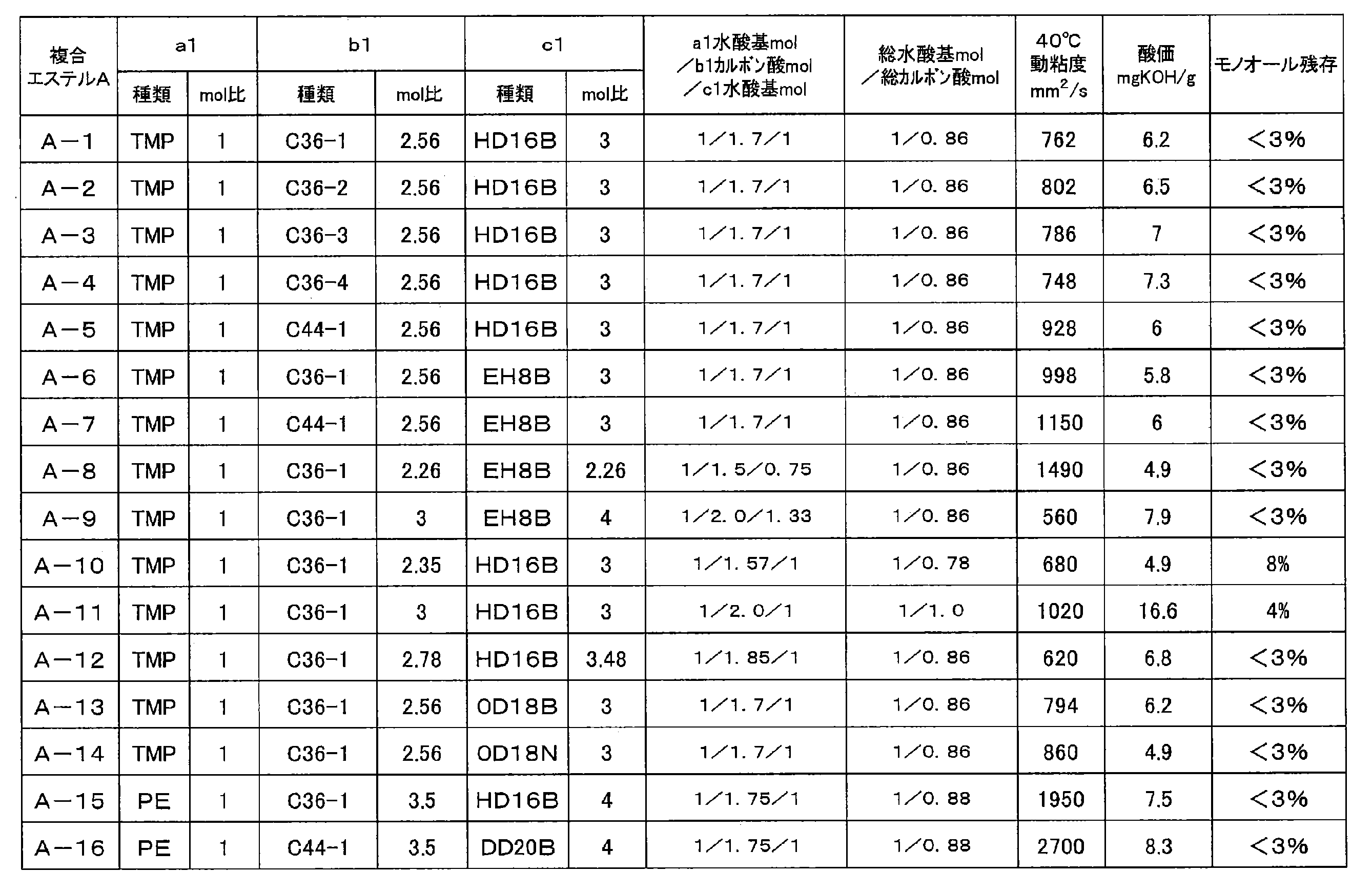
- the content of the unreacted c1 component with respect to the total amount of the complex ester A is preferably 10% or less, more preferably 6% or less, and particularly preferably 4% or less.
- the content of the unreacted c1 component can be calculated using the area ratio of the molecular weight peak corresponding to c1 in the GPC measurement described above.
- the kinematic viscosity at 40 ° C. of the complex ester A is preferably 400 to 2000 mm 2 / s, more preferably 500 to 2000 mm 2 / s, still more preferably 500 to 1500 mm 2 / s, still more preferably 600 to 1200 mm 2 / s, Particularly preferred is 700 to 1100 mm 2 / s.
- the kinematic viscosity at 40 ° C. employs a value measured in a constant temperature water bath at 40.0 ° C. using an Ubbelohde viscometer.
- the acid value of complex ester A (the number of mg of KOH required to neutralize 1 g of sample) is preferably 0 to 50 mgKOH / g, more preferably 0 to 15 mgKOH / g, and 2 to 10 mgKOH / g. More preferably, it is g.
- the acid value of the complex ester A (the number of mg of KOH required to neutralize 1 g of the sample) is a value measured according to the JIS K2501 method.
- the ratio of the a1 component to the c1 component in the ratio of mol of hydroxyl group of a1 / mol of carboxylic acid of b1 / mol of hydroxyl group of c1 is 1 / 1.5 to 2.0 / 0.7 to 1.5.
- a condensation reaction is performed.
- the composite ester A is obtained by subjecting the mixture charged as described above to a condensation reaction in the presence or absence of a catalyst or a condensing agent. In the condensation, it is desirable to heat or to make an appropriate amount of a solvent azeotropic with water or a low molecular alcohol. As a result, the reaction proceeds smoothly without the complex ester A being colored.
- This solvent is preferably a hydrocarbon solvent having a boiling point of 100 to 200 ° C., more preferably a hydrocarbon solvent having a boiling point of 100 to 170 ° C., and most preferably a hydrocarbon solvent having a boiling point of 110 to 160 ° C. Examples of these solvents include toluene, xylene, mesitylene and the like.
- the amount to be added is too large, the liquid temperature will be in the vicinity of the solvent and condensation will not proceed easily. On the other hand, if the amount is too small, azeotropy does not go smoothly. From the viewpoint of productivity, it is preferable to carry out the condensation reaction without using a solvent.
- the reaction is carried out at a liquid temperature of 120 to 250 ° C., preferably 130 to 240 ° C., more preferably 150 to 230 ° C., and particularly preferably 170 to 230 ° C.
- a solvent containing water or a low molecular alcohol is azeotroped, cooled at the cooling site, and separated into a liquid. This water may be removed.
- the reaction may be performed at a higher temperature.
- the reaction time since the theoretically generated water amount is calculated from the number of moles charged, it is preferable to carry out the reaction until the water amount is obtained, but it is difficult to complete the reaction completely.
- the reaction time is 1 to 24 hours, preferably 3 to 20 hours, more preferably 5 to 18 hours, and most preferably 6 to 15 hours. More preferable reaction conditions include a reaction without solvent and no catalyst at 170 to 200 ° C. for 1 to 10 hours (preferably 2 to 8 hours), and then at 201 to 240 ° C. for another 1 to 10 hours (preferably 2 It is preferable to react for ⁇ 8 hours.
- the present invention relates to a lubricant composition containing at least composite ester A.
- the composite ester A and various additives and / or media can be added to the lubricant composition.
- the lubricant composition of the present invention further comprises a medium, 0.1 to 5% by mass of the composite ester A and 70 to 99.9% by mass of the medium with respect to the total mass of the lubricant composition, It is preferable that 0 to 29.9% by mass of other components other than the complex ester A and the medium are included with respect to the total mass of the composition.
- the increase rate (%) of the kinematic viscosity due to the addition of the complex ester A can be calculated by the following relational expression.
- NA represents the kinematic viscosity at 40 ° C. of only the medium and other components without adding the complex ester A
- NB represents the kinematic viscosity at 40 ° C. when the complex ester A is added.
- Kinematic viscosity increase rate (%) [ ⁇ (NB) ⁇ (NA) ⁇ / (NA)] ⁇ 100
- the rate of increase (%) in kinematic viscosity is preferably 15% or less, more preferably 10% or less, still more preferably 5% or less, particularly preferably 2% or less, and most preferably 1.5% or less. It is preferred that the lubricant composition of the present invention is prepared by adding the complex ester A so that the kinematic viscosity increase rate is in the above range.
- (Medium) Media also referred to as base oil
- base oil include mineral oils, oil compounds, polyolefin oils (eg polyalphaolefins), silicone oils, ether oils (eg perfluoropolyether oils, diphenyl ether derivatives), ester oils (eg aromatic ester oils, Monovalent fatty acid ester, divalent fatty acid diester, polyol ester lubricating oil).
- a medium is at least 1 sort (s) chosen from mineral oil, polyolefin oil, and ester oil.
- the “medium” means all the media generally called “fluid liquids”. However, it is not necessary to be in a liquid state at room temperature or a temperature to be used, and any form material such as a solid and a gel can be used in addition to the liquid. There is no restriction
- the kinematic viscosity at 40 ° C. of the medium is preferably from 1 ⁇ 500mm 2 / s, more preferably 1.5 ⁇ 200mm 2 / s, 2 ⁇ 50mm 2 / s is more preferable.
- the viscosity index of the medium is preferably 90 or more, more preferably 105 or more, and still more preferably 110 or more.
- the viscosity index of the medium is preferably 160 or less.
- a compound preferable as a component other than the composite ester A and the medium, that is, a preferable additive to the lubricant composition of the present invention is a compound having at least one of zinc, molybdenum, sulfur and phosphorus as a constituent element.
- Such compounds have functions such as friction modifiers, antiwear agents, and antioxidants.
- the compound having at least one of zinc, molybdenum, sulfur and phosphorus as a constituent element means a compound which may contain zinc, molybdenum, sulfur and phosphorus in any state. Specific examples include compounds containing zinc, molybdenum, sulfur, and phosphorus as simple substances (oxidation number 0), ions, complexes, and the like.
- organic molybdenum compounds examples include organic molybdenum compounds, inorganic molybdenum compounds, organic zinc compounds, (phosphite) phosphoric acid derivatives, organic sulfur compounds, and the like. Of these, organic molybdenum compounds and organic zinc compounds are preferred.
- a compound having at least one of zinc, molybdenum, sulfur and phosphorus as a constituent element may be added alone to the lubricant composition of the present invention, or a combination of two or more of the lubricant composition of the present invention. It may be added to the product.
- an organic molybdenum compound, an inorganic molybdenum compound, an organic zinc compound is added to the lubricant composition of the present invention.
- organic molybdenum compound used as an additive in the lubricant composition examples include organic molybdenum compounds containing phosphorus such as molybdenum dithiophosphate (sometimes referred to as MoDTP).
- organic molybdenum compound containing sulfur such as molybdenum dithiocarbamate (sometimes referred to as MoDTC) represented by the following formula can be given.
- organic molybdenum compound containing sulfur examples include sulfurized oxymolybdenum-N, N-di-octyldithiocarbamate (C 8 -Mo (DTC)), sulfurized oxymolybdenum-N, N-di-tridecyldithiocarbamate ( C 16 -Mo (DTC) and the like are preferable.
- R 1 to R 4 may be the same or different and each independently represents a hydrocarbon group.
- R 1 to R 4 are preferably each independently an alkyl group or an aryl group.
- Examples of other sulfur-containing organic molybdenum compounds include complexes of inorganic molybdenum compounds and sulfur-containing organic compounds.
- Examples of the inorganic molybdenum compound used in the organic molybdenum compound that is a complex of an inorganic molybdenum compound and a sulfur-containing organic compound include molybdenum oxides such as molybdenum dioxide and molybdenum trioxide, orthomolybdic acid, paramolybdic acid, and (poly) sulfurization.
- Molybdic acid such as molybdic acid, metal salts of these molybdic acids, molybdate such as ammonium salt, molybdenum disulfide, molybdenum trisulfide, molybdenum pentasulfide, molybdenum sulfide such as polysulfide molybdenum, molybdenum sulfide, molybdenum sulfide Examples thereof include metal salts or amine salts, and molybdenum halides such as molybdenum chloride.
- Examples of the sulfur-containing organic compound used in the organic molybdenum compound that is a complex of an inorganic molybdenum compound and a sulfur-containing organic compound include alkyl (thio) xanthate, thiadiazole, mercaptothiadiazole, thiocarbonate, and tetrahydrocarbyl thiuram disulfide. Bis (di (thio) hydrocarbyl dithiophosphonate) disulfide, organic (poly) sulfide, sulfurized ester and the like.
- Examples of other organic molybdenum compounds containing sulfur include complexes of sulfur-containing molybdenum compounds such as molybdenum sulfide and sulfurized molybdenum acid with alkenyl succinimides.
- organic molybdenum compound an organic molybdenum compound that does not contain phosphorus or sulfur as a constituent element can be used.
- organic molybdenum compounds that do not contain phosphorus or sulfur as constituent elements include molybdenum-amine complexes, molybdenum-succinimide complexes, molybdenum salts of organic acids, and molybdenum salts of alcohols. Amine complexes, molybdenum salts of organic acids and molybdenum salts of alcohols are preferred.
- the inorganic molybdenum compound used as an additive in the lubricant composition is the same as that exemplified as the inorganic molybdenum compound used for the organic molybdenum compound that is a complex of the inorganic molybdenum compound and the sulfur-containing organic compound.
- the organozinc compound used as an additive in the lubricant composition is preferably zinc dithiophosphate (ZDTP) zinc diphosphate (ZDP) represented by the following formula.
- Q 1 , Q 2 , Q 3 and Q 4 may be the same or different, and are each independently isopropyl, butyl, isobutyl, pentyl, isopentyl, neopentyl, hexyl, heptyl
- ZDTP zinc dithiophosphate
- C 4 / C 5 ZnDTP zinc n-butyl-n-pentyldithiophosphate
- C 8 ZnDTP zinc di-2-ethylhexyldithiophosphate
- ZDTP zinc dithiophosphate
- the molybdenum content is preferably 10 to 2000 ppm, more preferably 10 to 1000 ppm, based on the total mass of the lubricant composition. Preferably, it is contained in an amount of 50 to 800 ppm, more preferably 100 to 600 ppm.
- the content thereof is preferably 100 to 50000 ppm in terms of zinc content, more preferably 100 to 30000 ppm%, based on the total mass of the lubricant composition. More preferably, it is contained in an amount of 100 to 10,000 ppm, particularly preferably 200 to 2000 ppm, and most preferably 300 to 1200 ppm.
- the stability of the lubricant composition can be improved, and severe conditions such as high temperature and / or high pressure can be achieved.
- the lubrication characteristics under the conditions can be improved, and more excellent lubrication performance and wear suppression ability can be exhibited.
- Examples of the (sub) phosphoric acid derivative include, in addition to the above-mentioned zinc dithiophosphate (ZDTP) and zinc diphosphate (ZDP), phosphites, phosphate esters, tricresyl phosphate and other aromatic phosphate esters, phosphorus Aliphatic phosphate esters such as trialkyl acids can be exemplified as preferred examples. Of these, aromatic phosphate esters such as tricresyl phosphate and aliphatic phosphate esters such as trialkyl phosphate are more preferable.
- organic sulfur compound polysulfides are preferable, and dialkyl polysulfide is more preferable.
- components other than the composite ester A and the medium include, in addition to the above compounds, a viscosity index improver (preferably a polyalkyl (meth) acrylate, an alkyl (meth) acrylate- (meth) acrylate having a polar group).
- a viscosity index improver preferably a polyalkyl (meth) acrylate, an alkyl (meth) acrylate- (meth) acrylate having a polar group.
- the lubricant composition of the present invention preferably has a kinematic viscosity at 40 ° C. of 500 mm 2 / s or less, more preferably 200 mm 2 / s or less, and even more preferably 100 mm 2 / s or less. 50 mm 2 / s or less is particularly preferable, and 5 to 50 mm 2 / s is most preferable. Viscosity needs to be adjusted to an appropriate viscosity depending on the usage environment.
- the kinematic viscosity at 40 ° C. of the lubricant composition is specifically a value measured in a constant temperature water bath at 40.0 ° C. using an Ubbelohde viscometer.
- the present invention relates to a process for obtaining a composite ester A, and a method for producing a lubricant composition having a concentration of the composite ester A of 0.1 to 5% by mass, and the lubricant produced by such a production method. It also relates to the composition.
- the step of obtaining the composite ester A includes at least a polymerization reaction mixture of unsaturated fatty acids having 18 to 22 carbon atoms, which contains at least 75% by mass of a trivalent or higher polyol a1 and a divalent carboxylic acid having 36 to 44 carbon atoms, and
- the mixture b1 obtained by hydrogenating the polymerization reaction mixture, and the monool c1 represented by the following general formula (1) are converted into the number of mols of hydroxyl groups of a1 / the number of mols of carboxylic acids of b1.
- This is a step of mixing and condensing so that the mol number of hydroxyl groups of / c1 is 1 / 1.5 to 2.0 / 0.7 to 1.5.
- R represents a linear alkyl group having 8 or more carbon atoms or a branched alkyl group having 8 or more carbon atoms.
- the mixing ratio of the a1 component to the c1 component is such that the mol number of hydroxyl group of a1 / mol number of carboxylic acid of b1 / mol number of hydroxyl group of c1 is 1 / 1.5 to 2.0 / 0.7 to 1.5. It is preferably 1 / 1.55 to 1.9 / 0.8 to 1.4, more preferably 1 / 1.60 to 1.8 / 0.8 to 1.3.
- the lubricant composition of the present invention can be prepared by adding the complex ester A in an oily medium or an aqueous medium so as to have a concentration of 0.1 to 5% by mass, and dissolving and / or dispersing it. it can. Dissolution and / or dispersion may be performed under heating.
- the lubricant composition of the present invention may be prepared as a grease composition.
- a thickener or the like can be added as necessary within a range that does not impair the object of the present invention.
- One embodiment of the grease composition is a composition further containing 10 to 50% by mass of a thickener.
- thickeners examples include soaps such as metal soaps and composite metal soaps, benton, silica gel, urea thickeners (urea compounds, urea / urethane compounds, urethane compounds, etc.) Any thickener such as a series thickener can be used. Among these, a soap-based thickener and a urea-based thickener are preferably used because they are less likely to damage the resin member.
- Examples of the soap-based thickener include sodium soap, calcium soap, aluminum soap, lithium soap and the like. Among these, lithium soap is preferable from the viewpoint of water resistance and thermal stability. Examples of the lithium soap include lithium stearate and lithium-12-hydroxystearate.
- examples of the urea thickener include urea compounds, urea / urethane compounds, urethane compounds, and mixtures thereof.
- urea compounds, urea / urethane compounds and urethane compounds include diurea compounds, triurea compounds, tetraurea compounds, polyurea compounds (excluding diurea compounds, triurea compounds and tetraurea compounds), urea / urethane compounds, diurethane compounds or mixtures thereof. Etc.
- a diurea compound, a urea / urethane compound, a diurethane compound or a mixture thereof is used.
- solid lubricants include polytetrafluoroethylene, boron nitride, fullerene, graphite, fluorinated graphite, melamine cyanurate, molybdenum disulfide, Mo-dithiocarbamate, antimony sulfide, and alkali (earth) metal borates. Can be mentioned.
- wax examples include natural waxes, mineral oils and various synthetic waxes, and specifically include montan wax, carnauba wax, amide compounds of higher fatty acids, paraffin wax, microcrystalline wax, polyethylene wax, polyolefin wax. And ester wax.
- benzotriazole benzimidazole, thiadiazole and the like are known as metal deactivators, and these can be added.
- a thickener can be added to the grease composition.
- the thickener include polymethacrylate, polyisobutylene, polystyrene and the like.
- Poly (meth) acrylate is also known to prevent cold abnormal noise in cold regions.
- the lubricant composition of the present invention can be supplied, for example, between two sliding surfaces and used to reduce friction.
- the lubricant composition of the present invention can form a film on the sliding surface.
- steel specifically, carbon steel for machine structure, alloy steel for structural machinery such as nickel chrome steel, nickel chrome molybdenum steel, chrome steel, chrome molybdenum steel, aluminum chrome molybdenum steel, Examples include stainless steel and multi-aged steel.
- various metals other than steel, or inorganic or organic materials other than metals are widely used.
- inorganic or organic materials other than metals include various plastics, ceramics, carbon, etc., and mixtures thereof.
- examples of the metal material other than steel include cast iron, copper / copper-lead / aluminum alloy, castings thereof, and white metal.
- the lubricant composition of the present invention can be used for various applications.
- Oil, Marine / Aircraft Lubricant, Machine Oil, Turbine Oil, Bearing Oil, Hydraulic Oil, Compressor / Vacuum Pump Oil, Refrigerator Oil, Metalworking Lubricant, Magnetic Recording Medium Lubricant, Micromachine Lubricant It can be used as a lubricant for artificial bone, shock absorber oil or rolling oil. It is also used for air conditioners and refrigerators with reciprocating and rotary hermetic compressors, automotive air conditioners and dehumidifiers, freezers, refrigerated warehouses, vending machines, showcases, chemical plant and other cooling devices. .
- a lubricant for metal processing that does not contain chlorine-based compounds, for example, when hot-rolling metal materials such as steel materials and Al alloys, or when performing processing such as cutting, cold rolling oil of aluminum, cutting Oil, grinding oil, drawing oil, metal working oil such as press working oil and metal plastic working oil, especially as a deterrent to wear, breakage and surface roughness during high speed and high load processing, broaching, gun drilling It is also useful as a metalworking oil composition that can be applied to low speed and heavy cutting. Further, it can be used for various grease lubricants, magnetic recording medium lubricants, micromachine lubricants, artificial bone lubricants, and the like.
- the elemental composition of the composition can be a carbohydrate, for example, polyoxyethylene ether widely used in cake mix, salad dressing, shortening oil, chocolate, etc. as an emulsifying, dispersing or solubilizing agent is used.
- a high-performance lubricating oil that is completely harmless to the human body can be used for lubrication of food production line manufacturing equipment and medical equipment members.
- the lubricant composition of the present invention can be used as cutting oil or rolling oil by emulsifying and dispersing it in an aqueous system or by dispersing it in a polar solvent or a resin medium.
- the lubricant composition of the present invention can be used for various applications as a release agent.
- it can also be used as an antifouling agent that promotes the detachment of dirt adhering to the fiber product and prevents the fiber product from being soiled by being kneaded or applied in advance to a textile product such as clothing.
- the mixture of components a1 to c1 was reacted at 190 ° C. for 5 hours and further at 220 ° C. for 4 hours under a nitrogen stream of 0.3 L / min. Water generated during the reaction was removed. The reaction product was allowed to cool to room temperature to obtain complex ester A-1 as a yellow transparent liquid.
- Trimethylolpropane is used as the a1 component
- dimer acid is used as the b1 component (Tsunodaim 395 manufactured by Tsukuno Foods Co., Ltd., C36 dicarboxylic acid content is 95%)
- 2-ethylhexanol is used as the c1 component
- the number of mols of hydroxyl group of a1 / b1 carboxylic acid was prepared so that the ratio of mol number / mol number of monool hydroxyl group was 1 / 1.7 / 1. This was condensed using the same method as the synthesis of A-1 to obtain a complex ester A-6.
- Trimethylolpropane is used as the a1 component
- dimer acid is used as the b1 component
- 2-ethylhexanol is used as the c1 component
- the number of mols of hydroxyl group of a1 / b1 carboxylic acid It charged so that ratio of mol number / hydroxyl mol number of monool might be set to 1/1 / 0.75. This was condensed using the same method as the synthesis of A-1 to obtain a complex ester A-8.
- Trimethylolpropane is used as the a1 component
- dimer acid is used as the b1 component
- 2-ethylhexanol is used as the c1 component
- the number of mols of hydroxyl group of a1 / b1 carboxylic acid was prepared so that the ratio of mol number / mol number of monool hydroxyl group was 1 / 2.0 / 1.33. This was condensed using the same method as the synthesis of A-1 to obtain a complex ester A-9.
- Trimethylolpropane is used as the a1 component
- dimer acid is used as the b1 component
- n-octadecanol is used as the c1 component
- the number of moles of hydroxyl groups in a1 / carbon The mixture was prepared so that the ratio of mol number of acid / mol number of hydroxyl group of monool was 1 / 1.7 / 1. This was condensed using the same method as the synthesis of A-1 to obtain a complex ester A-14.
- compositions of the composite esters A-1 to A-14 are as shown in Table 1. Moreover, each component is as follows. ⁇ A1 component> TMP: trimethylolpropane PE: pentaerythritol ⁇ b1 component> C36-1: Tsunoda Foods, Tsunodim 395, C36 dicarboxylic acid content 95% C36-2: Tsukino Foods, Tsunodim 228, C36 dicarboxylic acid content 81% C36-3: Tsukino Foods, Tsunodim 216, C36 dicarboxylic acid content 79% C36-4: Hydrogenated dimer acid (manufactured by Croda, Pripol 1009, C36 dicarboxylic acid content 98%) C44-1: Polymer mainly composed of C44 dicarboxylic acid (manufactured by Croda, Pripol 1004, C44 dicarboxylic acid content 95%) ⁇ C1 component> EH8B: 2-eth
- compositions of the comparative composite esters X-1 to X-4 are as shown in Table 2.
- Example 1 The composite ester A shown in Table 1 was mixed with a base oil to prepare a lubricant composition.
- the following base oil was used.
- B1 Mineral oil (manufactured by JX Nippon Oil & Energy, Super Oil N46) Kinematic viscosity at 40 ° C. 46.1 mm 2 / s
- B2 Poly alpha olefin oil (ANDEROL FGC 32, manufactured by ANDEROL) Kinematic viscosity at 40 ° C. 32.6 mm 2 / s
- B3 Ester oil (ANDEROL 495, manufactured by ANDEROL) Kinematic viscosity at 40 ° C.
- B4 Base oil in which Mo dithiocarbamate is added to B1 at a Mo content of 500 ppm and Zn dithiophosphate is added at a ppm of 1000 ppm, kinematic viscosity at 40 ° C. 46.2 mm 2 / s
- the upper test piece after the test was observed with a microscope, but almost no wear was observed, and it is considered that the frictional behavior from the fluid lubrication region to the mixed lubrication region could be observed.
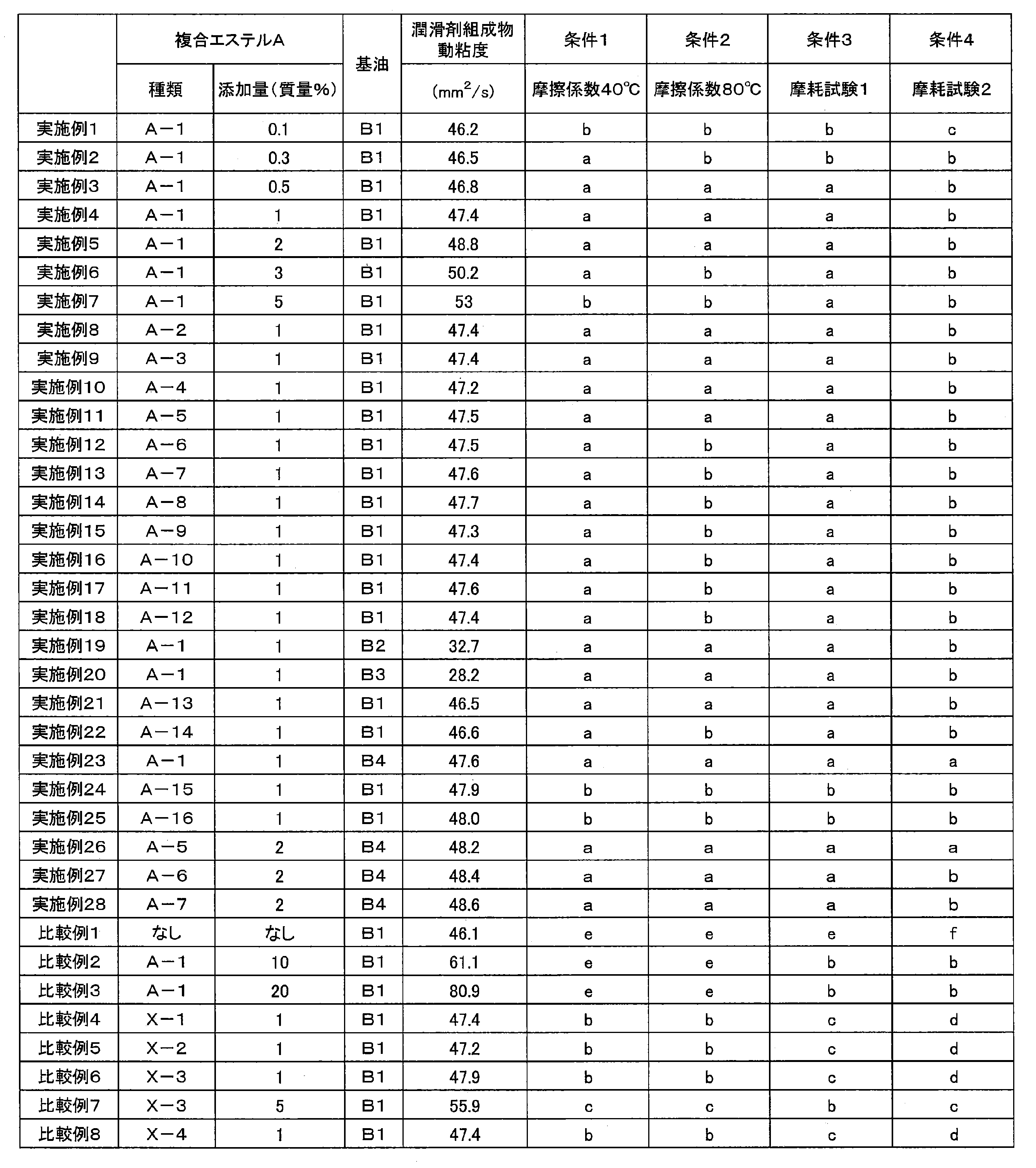
- the observed coefficient of friction was evaluated according to the following criteria. The results are shown in Table 4 below. Other evaluation results were normalized by setting the friction coefficient of Condition 1 of Comparative Example 1 to 100% and evaluated as follows. The smaller the value, the smaller the coefficient of friction, indicating better lubricating properties. For a and b, the coefficient of friction was greatly reduced, and it was judged that the improvement effect was great. Although c and d showed a decrease in the friction coefficient, the effect was small, and e was judged to be equal to or less than that of Comparative Example 1 and no improvement was observed.
- the wear mark of the upper test piece after the test was observed with a microscope.
- the wear scar diameter obtained in the wear test 1 of Comparative Example 1 was standardized as 100%, and evaluated according to the following criteria. The results are shown in Table 4 below. A smaller value represents less wear. From a to c, it was judged that the wear marks were clearly small and the improvement effect was large. The effect of d was small although the wear scar was small. It was judged that e was equal to the abrasion test 1 of Comparative Example 1 and no improvement was observed. f was judged to be larger than the wear test 1 of Comparative Example 1. In the tests of conditions 3 and 4, an evaluation of c or higher was regarded as a pass evaluation. a: Less than 50% b: 50% or more and less than 70% c: 70% or more and less than 85% d: 85% or more and less than 95% e: 95% or more and less than 105% f: 105% or more
- Table 4 shows the compositions and evaluation results of the lubricant compositions of Examples and Comparative Examples.
- the examples show excellent wear resistance under a wide temperature range and load conditions.
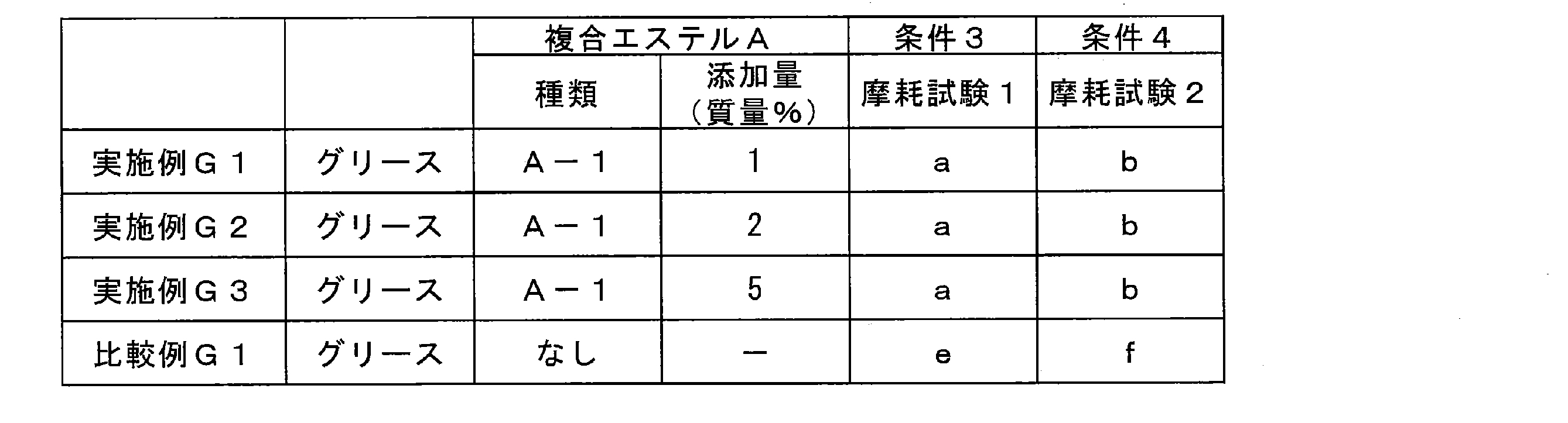
- the lubricant composition of the present invention has good lubricating properties even in the grease composition.
Landscapes
- Chemical & Material Sciences (AREA)
- Chemical Kinetics & Catalysis (AREA)
- General Chemical & Material Sciences (AREA)
- Oil, Petroleum & Natural Gas (AREA)
- Organic Chemistry (AREA)
- Lubricants (AREA)
Abstract
Description
低摩擦化と低摩耗化を達成するために、潤滑剤組成物に様々なエステル系組成物を、所定の割合で添加することが検討されている。しかし、上述したようなエステル系組成物を用いた潤滑剤組成物においても、低摩擦化と低摩耗化の両立は十分といえず、様々な温度、荷重においてこれらを両立することは困難であった。このため、さらに良好な潤滑特性、低粘度かつ流体潤滑状態での低摩擦性、及び高温かつ高荷重のような境界潤滑状態での低摩耗性を示す潤滑剤組成物が求められている。
すなわち、上記課題は、以下の構成の本発明によって解決される。
一般式(1):
R-OH
一般式(1)中、Rは炭素数8以上の直鎖アルキル基又は炭素数8以上の分岐アルキル基を表す。
[2]一般式(1)において、Rは炭素数8~25の直鎖アルキル基又は炭素数8~25の分岐アルキル基である[1]に記載の潤滑剤組成物。
[3]一般式(1)において、Rは炭素数16~20の直鎖アルキル基又は炭素数16~20の分岐アルキル基である[1]又は[2]に記載の潤滑剤組成物。
[4]一般式(1)において、Rは分岐アルキル基である[1]~[3]のいずれかに記載の潤滑剤組成物。
[5]複合エステルAの含有量は、潤滑剤組成物の全質量に対して0.5~2質量%である[1]~[4]のいずれかに記載の潤滑剤組成物。
[6]a1の水酸基mol数及びc1の水酸基mol数の合計の水酸基mol数をPとし、b1のカルボン酸mol数をQとした場合、P/Qの仕込み比が、1/0.7~0.95である[1]~[5]のいずれかに記載の潤滑剤組成物。
[7]複合エステルAの40℃における動粘度が500~2000mm2/sである[1]~[6]のいずれかに記載の潤滑剤組成物。
[8]40℃における動粘度が5~100mm2/sである[1]~[7]のいずれかに記載の潤滑剤組成物。
[9]媒体をさらに含み、潤滑剤組成物の全質量に対し、複合エステルAを0.1~5質量%と、媒体を70~99.9質量%含み、潤滑剤組成物の全質量に対し、複合エステルA及び媒体以外の他の成分を0~29.9質量%含む[1]~[8]のいずれかに記載の潤滑剤組成物。
[10]媒体が鉱油、ポリオレフィン油、エステル油及びエーテル油から選ばれる少なくとも1種である[9]に記載の潤滑剤組成物。
[11]他の成分が亜鉛、モリブデン、硫黄及びリンのうち少なくとも1種を構成元素として有する化合物である[9]又は[10]に記載の潤滑剤組成物。
[12]他の成分が、有機モリブデン化合物及び有機亜鉛化合物の少なくとも1種である[9]~[11]のいずれかに記載の潤滑剤組成物。
[13]グリース用潤滑油、離型剤、内燃機関用オイル、金属加工用(切削用)オイル、軸受け用オイル、燃焼機関用燃料、車両エンジン油、ギヤ油、自動車用作動油、船舶・航空機用潤滑油、マシン油,タービン油、軸受用オイル、油圧作動油、圧縮機・真空ポンプ油、冷凍機油、金属加工用潤滑油剤、磁気記録媒体用潤滑剤、マイクロマシン用潤滑剤、人工骨用潤滑剤、又は圧延油として用いられる[1]~[12]のいずれかに記載の潤滑剤組成物。
[14]複合エステルAを得る工程と、複合エステルAの濃度が0.1~5質量%である潤滑剤組成物を得る工程を含み、複合エステルAを得る工程は、少なくとも、3価以上のポリオールa1、炭素数36~44の2価カルボン酸を少なくとも75質量%含有する、炭素数18~22の不飽和脂肪酸の重合反応混合物、及び重合反応混合物を水素添加して得られた混合物、の少なくともいずれかの混合物b1、及び、下記一般式(1)で表されるモノオールc1を、a1の水酸基mol数/b1のカルボン酸mol数/c1の水酸基mol数が、1/1.5~2.0/0.7~1.5となるように混合し、縮合させる工程である潤滑剤組成物の製造方法;
一般式(1):
R-OH
一般式(1)中、Rは炭素数8以上の直鎖アルキル基又は炭素数8以上の分岐アルキル基を表す。
本発明の潤滑剤組成物は、少なくとも、3価以上のポリオールa1、炭素数36~44の2価カルボン酸を少なくとも75質量%含有する、炭素数18~22の不飽和脂肪酸の重合反応混合物、及び重合反応混合物を水素添加して得られた混合物、の少なくともいずれかの混合物b1、及び下記一般式(1)で表されるモノオールc1が縮合したポリエステルを含む複合エステルAを含有する潤滑剤組成物に関する。ここで、a1の水酸基mol数/b1のカルボン酸mol数/c1の水酸基mol数の仕込み比は、1/1.5~2.0/0.7~1.5であり、複合エステルAの含有量は、潤滑剤組成物の全質量に対して0.1~5質量%である。
R-OH 一般式(1)
一般式(1)中、Rは炭素数8以上の直鎖アルキル基又は炭素数8以上の分岐アルキル基を表す。
このように、各成分を特定の比率で仕込み、縮合させることによって、得られる複合エステルAの架橋度、粘度、酸価、モノオール残存量などを最適な値とすることができる。このため、複合エステルAを基油等に極少量添加するだけで摩耗を抑制できるため、潤滑剤組成物は基油の粘度特性を維持したまま、耐摩耗性を発揮することができる。また、本発明では、流体潤滑状態、境界潤滑状態いずれにおいても良好な摩擦特性が得られる。
3価以上のポリオールa1(a1成分あるいは単にa1と呼ぶこともある)は、アルコール性水酸基及び/又はフェノール性水酸基を分子内に3つ以上含有する化合物であり、アルコール性水酸基を3つ以上含有する化合物が好ましく、アルコール性水酸基を3~6個有する化合物がより好ましい。
好ましい3価以上のポリオールa1は、下記一般式(a1-1)で表されるアルコールである。

Zは脂肪族連結基が好ましく、酸素原子で連結されていてもよいアルキレン連結基が好ましい。アルキレン連結基の炭素数は、2~20であることが好ましく、2~15であることがより好ましく、3~10であることがさらに好ましく、5~7であることが特に好ましい。また、Zは下記構造式(Z-1)で表すネオペンチル部分構造を有する連結基であることが高温での摩擦低減の観点からさらに好ましい。

炭素数36~44の2価カルボン酸を少なくとも75質量%含有する、炭素数18~22の不飽和脂肪酸の重合反応混合物、及び重合反応混合物を水素添加して得られた混合物、の少なくともいずれかの混合物b1(b1成分あるいは単にb1と呼ぶこともある)は、炭素数36~44の2価カルボン酸を少なくとも75質量%含むものである。b1成分は、炭素数36~44の2価カルボン酸を少なくとも80質量%以上含むことが好ましく、より好ましくは85質量%以上、更に好ましくは90質量%以上、特に好ましくは94質量%以上含む。すなわち、b1成分は、炭素数36~44の2価カルボン酸を主成分とするものである。工業的に入手できる炭素数18~22の不飽和脂肪酸の重合反応混合物には、2価カルボン酸の他にモノカルボン酸、トリカルボン酸が含まれていることがあるが、本発明で用いるb1成分は、2価カルボン酸が重合反応混合物の全質量に対して上記範囲以上含まれているものである。
特にb1成分は、炭素数18の不飽和脂肪酸の2量体化物、いわゆるダイマー酸、あるいは炭素数22の不飽和脂肪酸の2量体化物を75質量%以上含むことが好ましく、ダイマー酸を75質量%以上含むことが特に好ましい。
ここでダイマー酸とは、不飽和脂肪酸(通常は、炭素数18)が重合またはDiels-Alder反応等によって二量化して生じる脂肪族または脂環族ジカルボン酸をいう。ダイマー酸には多数の構造異性体が含まれている。ダイマー酸中に含まれる化合物の構造としては、例えば以下のものを例示することができる。

モノオールc1(c1成分あるいは単にc1と呼ぶこともある)は、下記一般式(1)で表されるものである。
R-OH 一般式(1)
一般式(1)中、Rは炭素数8以上の直鎖アルキル基又は炭素数8以上の分岐アルキル基を表す。Rで表される直鎖アルキル基又は分岐アルキル基の炭素数は、各々、8以上であればよく、10以上が好ましく、14以上がより好ましい。また、Rで表される直鎖アルキル基又は分岐アルキル基の炭素数は、各々、8~25であることが好ましく、14~25であることがより好ましく、16~20であることがさらに好ましい。なお、Rで表される直鎖アルキル基又は分岐アルキル基は、無置換の直鎖アルキル基又は無置換の分岐アルキル基であることが好ましい。
複合エステルAにおいては、a1~c1以外の成分を更なる縮合原料として用いてもよい。更なる縮合原料としては、2価アルコール(好ましくは炭素数2~40の脂肪族2価アルコール)、1価カルボン酸(好ましくは炭素数4以上の脂肪族カルボン酸、より好ましくは炭素数8以上の脂肪族カルボン酸)、b1以外の2価カルボン酸(好ましくは炭素数4~10の脂肪族ジカルボン酸)を例示することができる。
複合エステルAは、少なくとも、上述したような3価以上のポリオールa1と、炭素数36~44の2価カルボン酸を少なくとも75質量%含有する、炭素数18~22の不飽和脂肪酸の重合反応混合物、及び重合反応混合物を水素添加して得られた混合物、の少なくともいずれかの混合物b1と、R-OH(Rは炭素数8以上の直鎖アルキル基又は炭素数8以上の分岐アルキル基)で表されるモノオールc1を混合し、この混合物を縮合させることで得られる。複合エステルAは、上述したa1成分と、b1成分と、c1成分が縮合したポリエステルを少なくとも含む。
「HLC-8220GPC(東ソー(株)社製)装置」。カラムは「TSKgel、SuperHZM-H(東ソー(株)社製、4.6mmID×15cm)」、「TSKgel、SuperHZ4000(東ソー(株)社製、4.6mmID×15cm)」、TSKgel、SuperHZ2000(東ソー(株)社製、4.6mmID×15cm)」を3本用いた。
・溶離液 THF(テトラヒドロフラン)
・流速 0.35ml/min
・測定温度 40℃(カラム、インレット、RI)
・分析時間 20分
・試料濃度 0.1%
・サンプル注入量 10μl
複合エステルAは、a1成分~c1成分をa1の水酸基mol数/b1のカルボン酸mol数/c1の水酸基mol数の比が、1/1.5~2.0/0.7~1.5、好ましくは1/1.55~1.9/0.8~1.4、更に好ましくは1/1.60~1.8/0.8~1.3となるように仕込み、縮合反応させることにより得られる。
縮合の際は、加熱するか、水または低分子アルコールと共沸する溶媒を適量存在させることが望ましい。これにより複合エステルAが着色することなく、反応もスムーズに進行する。この溶媒は沸点100~200℃の炭化水素系溶媒が好ましく、100~170℃の炭化水素系溶媒がさらに好ましく、110~160℃の炭化水素系溶媒が最も好ましい。これらの溶媒として、例えばトルエン、キシレン、メシチレンなどがあげられる。添加する量は、多すぎると液温がその溶媒付近となり、縮合が進行しにくくなる。一方、少なすぎると、共沸がスムーズに行かない。生産性の観点からは溶媒を用いずに縮合反応を行うことが好ましい。
反応時間は、仕込みのモル数より理論発生水量が計算されるので、この水量が得られる時点まで反応を行うことが好ましいが、完全に反応を完結させることは困難である。理論水発生量が60~99%の時点で反応を終了しても、得られた複合エステルAを含有する潤滑剤組成物の潤滑特性は良好である。反応時間は1~24時間であり、好ましくは3~20時間、さらに好ましくは5~18時間、最も好ましくは6~15時間である。
より好ましい反応条件としては、無溶媒、無触媒で170~200℃で1~10時間(好ましくは2~8時間)反応させた後、201℃~240℃で更に1~10時間(好ましくは2~8時間)反応させることが好ましい。
本発明は、複合エステルAを少なくとも含有する潤滑剤組成物に関するものである。例えば、潤滑剤組成物には、複合エステルAと各種添加剤及び/または媒体を添加することができる。
本発明の潤滑剤組成物は、媒体をさらに含み、潤滑剤組成物の全質量に対し、複合エステルAを0.1~5質量%と、媒体を70~99.9質量%含み、潤滑剤組成物の全質量に対し、複合エステルA及び媒体以外の他の成分を0~29.9質量%含むことが好ましい。
動粘度上昇率(%)=[{(NB)-(NA)}/(NA)]×100
動粘度の上昇率(%)は、15%以下となることが好ましく、10%以下がより好ましく、5%以下が更に好ましく、2%以下が特に好ましく、1.5%以下が最も好ましい。動粘度上昇率が上記範囲となるように複合エステルAを添加し、本発明の潤滑剤組成物が調製されることが好ましい。
媒体(基油とも呼ぶ)としては、鉱油、油脂化合物、ポリオレフィン油(例えばポリアルファオレフィン)、シリコーン油、エーテル油(例えばパーフルオロポリエーテル油、ジフェニルエーテル誘導体)、エステル油(例えば芳香族エステル油、1価脂肪酸エステル、2価脂肪酸ジエステル、ポリオールエステル潤滑油)、から選択される1種又は2種以上を挙げることができる。中でも、媒体は、鉱油、ポリオレフィン油、エステル油から選ばれる少なくとも1種であることが好ましい。
なお、本発明でいう粘度指数とは、JIS K 2283-1993に準拠して測定された粘度指数を意味する。
複合エステルA及び媒体以外の他の成分として好ましい化合物、すなわち本発明の潤滑剤組成物への好ましい添加剤は、亜鉛、モリブデン、硫黄及びリンのうち少なくとも1種を構成元素として有する化合物である。このような化合物は、摩擦調整剤、摩耗防止剤、酸化防止剤などの機能を有する。亜鉛、モリブデン、硫黄及びリンのうち少なくとも1種を構成元素として有する化合物とは、化合物中に亜鉛、モリブデン、硫黄およびリンをいかなる状態で含んでもよい化合物を意味する。具体的には亜鉛、モリブデン、硫黄およびリンが、単体(酸化数0)、イオン、錯体などとして含まれる化合物を挙げることができる。このような化合物としては、有機モリブデン化合物、無機モリブデン化合物、有機亜鉛化合物、(亜)リン酸誘導体、有機硫黄化合物などが挙げられる。その中でも有機モリブデン化合物及び有機亜鉛化合物が好ましい。
別の有機モリブデン化合物としては、下式で表されるモリブデンジチオカーバメート(MoDTCと言われることもある)等の硫黄を含有する有機モリブデン化合物を挙げることができる。硫黄を含有する有機モリブデン化合物としては、例えば、硫化オキシモリブデン-N,N-ジ-オクチルジチオカルバメート(C8-Mo(DTC))、硫化オキシモリブデン-N,N-ジ-トリデシルジチオカルバメート(C16-Mo(DTC)などが好ましい。

その他の硫黄を含有する有機モリブデン化合物としては、硫化モリブデン、硫化モリブデン酸等の硫黄含有モリブデン化合物とアルケニルコハク酸イミドとの錯体等を挙げることができる。

また、有機亜鉛化合物を用いる場合、その含有量は潤滑剤組成物全質量に対して、亜鉛含量で100~50000ppm含まれていることが好ましく、100~30000ppm%含まれていることがより好ましく、100~10000ppm含まれていることがさらに好ましく、200~2000ppm含まれていることが特に好ましく、300~1200ppm含まれていることが最も好ましい。
潤滑剤組成物中の有機モリブデン化合物や有機亜鉛化合物などの有機金属化合物の含有量を上記範囲内とすることにより、潤滑剤組成物の安定性を高めることができ、高温および/または高圧といった過酷条件での潤滑特性を改善でき、より優れた潤滑性能、摩耗抑制能を発揮することができる。
このような添加剤を添加することにより、摩耗抑制等の潤滑剤組成物としての好ましい機能を付与することができる。本発明において用いることができる添加剤については、特開2011-89106号公報の段落0098~0165の記載を参照することができる。
本発明の潤滑剤組成物は、40℃での動粘度が500mm2/s以下であることが好ましく、200mm2/s以下であることがより好ましく、100mm2/s以下であることがさらに好ましく、50mm2/s以下であることが特に好ましく、5~50mm2/sであることが最も好ましい。粘性は、使用環境により適正な粘性が求められるため、それに合わせることが必要である。本明細書中、潤滑剤組成物の40℃での動粘度は具体的には、ウベローデ粘度計を用い、40.0℃の恒温水槽中で測定した値を採用する。
本発明は、複合エステルAを得る工程と、複合エステルAの濃度が0.1~5質量%である潤滑剤組成物の製造方法に関するものであり、このような製造方法によって製造された潤滑剤組成物に関するものでもある。複合エステルAを得る工程は、少なくとも、3価以上のポリオールa1、炭素数36~44の2価カルボン酸を少なくとも75質量%含有する、炭素数18~22の不飽和脂肪酸の重合反応混合物、及び重合反応混合物を水素添加して得られた混合物、の少なくともいずれかの混合物b1、及び、下記一般式(1)で表されるモノオールc1を、a1の水酸基mol数/b1のカルボン酸mol数/c1の水酸基mol数が、1/1.5~2.0/0.7~1.5となるように混合し、縮合させる工程である。
一般式(1):
R-OH
一般式(1)中、Rは炭素数8以上の直鎖アルキル基又は炭素数8以上の分岐アルキル基を表す。
a1成分~c1成分の混合比率は、a1の水酸基mol数/b1のカルボン酸mol数/c1の水酸基mol数が、1/1.5~2.0/0.7~1.5であればよく、好ましくは1/1.55~1.9/0.8~1.4、更に好ましくは1/1.60~1.8/0.8~1.3である。
本発明の潤滑剤組成物は、例えば、2つの摺動面間に供給され、摩擦を低減するために用いることができる。本発明の潤滑剤組成物は、摺動面に皮膜を形成し得る。摺動面の材質としては、鋼鉄では、具体的には、機械構造用炭素鋼、ニッケルクロム鋼材・ニッケルクロムモリブデン鋼材・クロム鋼材・クロムモリブデン鋼材・アルミニウムクロムモリブデン鋼材などの構造機械用合金鋼、ステンレス鋼、マルチエージング鋼などが挙げられる。
なお、摺動面の材質については、特開2011-89106号公報の段落0168~0175の記載を参照することができる。
また各種グリース用潤滑油、磁気記録媒体用潤滑剤、マイクロマシン用潤滑剤や人工骨用潤滑剤等に利用することができる。また、組成物の元素組成を炭水化物とすることができるため、例えば、乳化、分散化、可溶化剤としてケーキミックス、サラダドレッシング、ショートニングオイル、チョコレート等に広く利用されている、ポリオキシエチレンエーテルを含むソルビタン脂肪酸エステルを食用油を基油とした組成物を潤滑油とすることで、全く人体に無害の高性能潤滑油を食品製造ラインの製造機器や医療機器部材の潤滑に用いることができる。
さらに、本発明の潤滑剤組成物を水系に乳化して分散したり、極性溶媒中や樹脂媒体中に分散したりすることで、切削油や圧延油として用いることができる。
また、衣料などの繊維製品に予め練り込んだり、塗布したりすることにより、繊維製品に付着した汚れの離脱を促進して繊維製品の汚れを防止する防汚剤としても用いることができる。
a1成分としてトリメチロールプロパン9.38g、b1成分としてダイマー酸(築野食品社製ツノダイム395、C36ジカルボン酸含率95%)100.0g、c1成分として2-ヘキシル-1-デカノール(日産化学社製ファインオキソコール1600)50.6g(a1の水酸基mol数/b1のカルボン酸mol数/モノオールの水酸基mol数の比=1/1.7/1)をディーンスターク脱水装置がついた反応容器に仕込んだ。a1~c1成分の混合物を0.3L/minの窒素気流下190℃で5時間、更に220℃で4時間反応させた。反応中に発生した水は除去した。反応物を室温まで放冷し、黄色透明の液状物として複合エステルA-1を得た。
a1成分としてトリメチロールプロパン、b1成分としてダイマー酸(築野食品社製ツノダイム228、C36ジカルボン酸含率81%)、c1成分として2-ヘキシル-1-デカノール(日産化学社製ファインオキソコール1600)を用い、a1の水酸基mol数/b1のカルボン酸mol数/モノオールの水酸基mol数の比が1/1.7/1となるように仕込んだ。これをA-1の合成と同じ手法を用いて縮合し複合エステルA-2を得た。
a1成分としてトリメチロールプロパン、b1成分としてダイマー酸(築野食品社製ツノダイム216、C36ジカルボン酸含率79%)、c1成分として2-ヘキシル-1-デカノール(日産化学社製ファインオキソコール1600)を用い、a1の水酸基mol数/b1のカルボン酸mol数/モノオールの水酸基mol数の比が1/1.7/1となるように仕込んだ。これをA-1の合成と同じ手法を用いて縮合し複合エステルA-3を得た。
a1成分としてトリメチロールプロパン、b1成分として水素添加されたダイマー酸(クローダ社製プリポール1009、C36ジカルボン酸含率98%)、c1成分として2-ヘキシル-1-デカノール(日産化学社製ファインオキソコール1600)を用い、a1の水酸基mol数/b1のカルボン酸mol数/モノオールの水酸基mol数の比が1/1.7/1となるように仕込んだ。これをA-1の合成と同じ手法を用いて縮合し複合エステルA-4を得た。
a1成分としてトリメチロールプロパン、b1成分としてC44のジカルボン酸を主成分とする重合物(クローダ社製プリポール1004、C44ジカルボン酸含率95%)、c1成分として2-ヘキシル-1-デカノール(日産化学社製ファインオキソコール1600)を用い、a1の水酸基mol数/b1のカルボン酸mol数/モノオールの水酸基mol数の比が1/1.7/1となるように仕込んだ。これをA-1の合成と同じ手法を用いて縮合し複合エステルA-5を得た。
a1成分としてトリメチロールプロパン、b1成分としてダイマー酸(築野食品社製ツノダイム395、C36ジカルボン酸含率95%)、c1成分として2-エチルヘキサノールを用い、a1の水酸基mol数/b1のカルボン酸mol数/モノオールの水酸基mol数の比が1/1.7/1となるように仕込んだ。これをA-1の合成と同じ手法を用いて縮合し複合エステルA-6を得た。
a1成分としてトリメチロールプロパン、b1成分としてC44のジカルボン酸を主成分とする重合物(クローダ社製プリポール1004、C44ジカルボン酸含率95%)、c1成分として2-エチルヘキサノールを用い、a1の水酸基mol数/b1のカルボン酸mol数/モノオールの水酸基mol数の比が1/1.7/1となるように仕込んだ。これをA-1の合成と同じ手法を用いて縮合し複合エステルA-7を得た。
a1成分としてトリメチロールプロパン、b1成分としてダイマー酸(築野食品社製ツノダイム395、C36ジカルボン酸含率95%)、c1成分として2-エチルヘキサノールを用い、a1の水酸基mol数/b1のカルボン酸mol数/モノオールの水酸基mol数の比が1/1.5/0.75となるように仕込んだ。これをA-1の合成と同じ手法を用いて縮合し複合エステルA-8を得た。
a1成分としてトリメチロールプロパン、b1成分としてダイマー酸(築野食品社製ツノダイム395、C36ジカルボン酸含率95%)、c1成分として2-エチルヘキサノールを用い、a1の水酸基mol数/b1のカルボン酸mol数/モノオールの水酸基mol数の比が1/2.0/1.33となるように仕込んだ。これをA-1の合成と同じ手法を用いて縮合し複合エステルA-9を得た。
a1成分としてトリメチロールプロパン、b1成分としてダイマー酸(築野食品社製ツノダイム395、C36ジカルボン酸含率95%)、c1成分として2-ヘキシル-1-デカノール(日産化学社製ファインオキソコール1600)を用い、a1の水酸基mol数/b1のカルボン酸mol数/モノオールの水酸基mol数の比が1/1.57/1となるように仕込んだ。これをA-1の合成と同じ手法を用いて縮合し複合エステルA-10を得た。
a1成分としてトリメチロールプロパン、b1成分としてダイマー酸(築野食品社製ツノダイム395、C36ジカルボン酸含率95%)、c1成分として2-ヘキシル-1-デカノール(日産化学社製ファインオキソコール1600)を用い、a1の水酸基mol数/b1のカルボン酸mol数/モノオールの水酸基mol数の比が1/2.0/1となるように仕込んだ。これをA-1の合成と同じ手法を用いて縮合し複合エステルA-11を得た。
a1成分としてトリメチロールプロパン、b1成分としてダイマー酸(築野食品社製ツノダイム395、C36ジカルボン酸含率95%)、c1成分として2-ヘキシル-1-デカノール(日産化学社製ファインオキソコール1600)を用い、a1の水酸基mol数/b1のカルボン酸mol数/モノオールの水酸基mol数の比が1/1.85/1となるように仕込んだ。これをA-1の合成と同じ手法を用いて縮合し複合エステルA-12を得た。
a1成分としてトリメチロールプロパン、b1成分としてダイマー酸(築野食品社製ツノダイム395、C36ジカルボン酸含率95%)、c1成分として炭素数18の分岐アルキル基を有するモノアルコール(日産化学社製ファインオキソコール180N)を用い、a1の水酸基mol数/b1のカルボン酸mol数/モノオールの水酸基mol数の比が1/1.7/1となるように仕込んだ。これをA-1の合成と同じ手法を用いて縮合し複合エステルA-13を得た。
a1成分としてトリメチロールプロパン、b1成分としてダイマー酸(築野食品社製ツノダイム395、C36ジカルボン酸含率95%)、c1成分としてn-オクタデカノールを用い、a1の水酸基mol数/b1のカルボン酸mol数/モノオールの水酸基mol数の比が1/1.7/1となるように仕込んだ。これをA-1の合成と同じ手法を用いて縮合し複合エステルA-14を得た。
<a1成分>
TMP:トリメチロールプロパン
PE:ペンタエリスリトール
<b1成分>
C36-1:築野食品社製、ツノダイム395、C36ジカルボン酸含率95%
C36-2:築野食品社製、ツノダイム228、C36ジカルボン酸含率81%
C36-3:築野食品社製、ツノダイム216、C36ジカルボン酸含率79%
C36-4:水素添加されたダイマー酸(クローダ社製、プリポール1009、C36ジカルボン酸含率98%)
C44-1:C44のジカルボン酸を主成分とする重合物(クローダ社製、プリポール1004、C44ジカルボン酸含率95%)
<c1成分>
EH8B:2-エチルヘキサノール
HD16B:2-ヘキシル-1-デカノール(日産化学社製、ファインオキソコール1600)
OD18B:炭素数18の分岐アルキル基を有するモノアルコール(日産化学社製、ファインオキソコール180N)
OD18N:n-オクタデカノール
DD20B:炭素数20の分岐アルキル基を有するモノアルコール(日産化学社製、ファインオキソコール2000)
複合エステルA-1の合成においてダイマー酸の20mol%をアジピン酸に置き換えて、a1の水酸基mol数/b1のカルボン酸mol数/モノオールの水酸基mol数の比が1/1.4/1となるように仕込んだ。これを複合エステルA-1の合成と同じ手法を用いて縮合し比較用複合エステルX-1を得た。
a1成分としてトリメチロールプロパン、b1成分としてダイマー酸(築野食品社製ツノダイム395、C36ジカルボン酸含率95%)、c1成分として2-へキシル-1-デカノールを用い、a1の水酸基mol数/b1のカルボン酸mol数/モノオールの水酸基mol数の比が1/2.11/1.45となるように仕込んだ。これをA-1の合成と同じ手法を用いて縮合し比較用複合エステルX-2を得た。
a1成分としてトリメチロールプロパン、b1成分としてダイマー酸(築野食品社製ツノダイム395、C36ジカルボン酸含率95%)、c1成分として2-へキシル-1-デカノールを用い、a1の水酸基mol数/b1のカルボン酸mol数/モノオールの水酸基mol数の比が1/1.48/0.73となるように仕込んだ。これをA-1の合成と同じ手法を用いて縮合し比較用複合エステルX-3を得た。
複合エステルA-1の合成においてダイマー酸の50mol%をアジピン酸に置き換えて、a1の水酸基mol数/b1のカルボン酸mol数/モノオールの水酸基mol数の比が1/0.92/1.01となるように仕込んだ。これを複合エステルA-1の合成と
同じ手法を用いて縮合し比較用複合エステルX-4を得た。

表1に示す複合エステルAを基油と混合し、潤滑剤組成物を調製した。なお、基油は以下のものを用いた。
B1:鉱油(JX日鉱日石エネルギー社製、スーパーオイルN46)
40℃における動粘度46.1mm2/s
B2:ポリαオレフィン油(ANDEROL社製、ANDEROL FGC 32)40℃における動粘度32.6mm2/s
B3:エステル油(ANDEROL社製、ANDEROL 495)
40℃における動粘度28.0mm2/s
B4:B1にMoジチオカーバメートをMo含量として500ppm、ZnジチオホスフェートをZn含量として1000ppm添加した基油、40℃における動粘度46.2mm2/s
表1に示す複合エステルA又は表2に示す比較用複合エステルを基油と混合し、潤滑剤組成物を調製した。
<摩擦係数評価>
各実施例および比較例の潤滑剤組成物について、振動型摩擦摩耗試験機(Optimol Instruments Prueftechnik GmbH社製、商品名:SRV 3)を用いて、振動数50Hz、荷重10N、振幅1mmの条件で温度40℃(条件1)と80℃(条件2)それぞれについて1時間摩擦摩耗試験を行い、時間30分おける摩擦係数を測定した。上部試験片は10mmSUJ-2ボール、下部試験片24mmSUJ-2ディスクを用いた。試験後の上部試験片を顕微鏡を用いて観測したが、ほとんど摩耗は見られず、流体潤滑領域から混合潤滑領域の摩擦挙動が観測できていると考えられる。観測した摩擦係数を以下の基準にしたがって評価した。その結果を下記表4に示した。
比較例1の条件1の摩擦係数を100%として他の評価結果を規格化、以下のように評価した。値が小さいほど摩擦係数が小さく、良好な潤滑特性であることを表す。a,bは摩擦係数が大きく低下しており、改良効果が大きいと判断した。c,dは摩擦係数の低下は見られたものの効果は小さかった、eは比較例1と比べて同等又はそれ以下で改良が見られなかったと判断した。なお、条件1及び2の試験では、b以上の評価を合格評価とした。
a:60%未満
b:60%以上70%未満
c:70%以上80%未満
d:80%以上95%未満
e:95%以上
上記試験機にて荷重、温度を下記条件にした以外は摩擦係数試験と同じ試験を行った。

値が小さいほど摩耗が少ないことを表す。a~cは摩耗痕が明らかに小さく、改良効果が大きいと判断した。dは摩耗痕は小さくなっていたものの効果は小さかった。eは比較例1の摩耗試験1と同等で改良が見られなかったと判断した。fは比較例1の摩耗試験1よりも摩耗が大きいと判断した。なお、条件3及び4の試験では、c以上の評価を合格評価とした。
a:50%未満
b:50%以上70%未満
c:70%以上85%未満
d:85%以上95%未満
e:95%以上105%未満
f:105%以上
値が小さいほど摩耗が少ないことを表す。a~cは摩耗痕が明らかに小さく、改良効果が大きいと判断した。dは摩耗痕は小さくなっていたものの効果は小さかった。eは比較例G1の摩耗試験1と同等で改良が見られなかったと判断した。fは比較例G1の摩耗試験1よりも摩耗が大きいと判断した。なお、条件3及び4の試験では、c以上の評価を合格評価とした。
a:50%未満
b:50%以上70%未満
c:70%以上85%未満
d:85%以上95%未満
e:95%以上105%未満
f:105%以上
Claims (14)
- 少なくとも、3価以上のポリオールa1、
炭素数36~44の2価カルボン酸を少なくとも75質量%含有する、炭素数18~22の不飽和脂肪酸の重合反応混合物、及び前記重合反応混合物を水素添加して得られた混合物、の少なくともいずれかの混合物b1、及び、
下記一般式(1)で表されるモノオールc1が縮合したポリエステルを含む複合エステルAを含有する潤滑剤組成物であって、
前記a1の水酸基mol数/前記b1のカルボン酸mol数/前記c1の水酸基mol数の仕込み比が、1/1.5~2.0/0.7~1.5であり、
前記複合エステルAの含有量は、前記潤滑剤組成物の全質量に対して0.1~5質量%である潤滑剤組成物;
一般式(1):
R-OH
一般式(1)中、Rは炭素数8以上の直鎖アルキル基又は炭素数8以上の分岐アルキル基を表す。 - 前記一般式(1)において、Rは炭素数8~25の直鎖アルキル基又は炭素数8~25の分岐アルキル基である請求項1に記載の潤滑剤組成物。
- 前記一般式(1)において、Rは炭素数16~20の直鎖アルキル基又は炭素数16~20の分岐アルキル基である請求項1又は2に記載の潤滑剤組成物。
- 前記一般式(1)において、Rは分岐アルキル基である請求項1~3のいずれか1項に記載の潤滑剤組成物。
- 前記複合エステルAの含有量は、前記潤滑剤組成物の全質量に対して0.5~2質量%である請求項1~4のいずれか1項に記載の潤滑剤組成物。
- 前記a1の水酸基mol数及び前記c1の水酸基mol数の合計の水酸基mol数をPとし、前記b1のカルボン酸mol数をQとした場合、P/Qの仕込み比が、1/0.7~0.95である請求項1~5のいずれか1項に記載の潤滑剤組成物。
- 前記複合エステルAの40℃における動粘度が500~2000mm2/sである請求項1~6のいずれか1項に記載の潤滑剤組成物。
- 40℃における動粘度が5~100mm2/sである請求項1~7のいずれか1項に記載の潤滑剤組成物。
- 媒体をさらに含み、
前記潤滑剤組成物の全質量に対し、前記複合エステルAを0.1~5質量%と、前記媒体を70~99.9質量%含み、
前記潤滑剤組成物の全質量に対し、前記複合エステルA及び前記媒体以外の他の成分を0~29.9質量%含む請求項1~8のいずれか1項に記載の潤滑剤組成物。 - 前記媒体が鉱油、ポリオレフィン油、エステル油及びエーテル油から選ばれる少なくとも1種である請求項9に記載の潤滑剤組成物。
- 前記他の成分が亜鉛、モリブデン、硫黄及びリンのうち少なくとも1種を構成元素として有する化合物である請求項9又は10に記載の潤滑剤組成物。
- 前記他の成分が、有機モリブデン化合物及び有機亜鉛化合物の少なくとも1種である請求項9~11のいずれか1項に記載の潤滑剤組成物。
- グリース用潤滑油、離型剤、内燃機関用オイル、金属加工用(切削用)オイル、軸受け用オイル、燃焼機関用燃料、車両エンジン油、ギヤ油、自動車用作動油、船舶・航空機用潤滑油、マシン油,タービン油、軸受用オイル、油圧作動油、圧縮機・真空ポンプ油、冷凍機油、金属加工用潤滑油剤、磁気記録媒体用潤滑剤、マイクロマシン用潤滑剤、人工骨用潤滑剤、又は圧延油として用いられる請求項1~12のいずれか1項に記載の潤滑剤組成物。
- 複合エステルAを得る工程と、
前記複合エステルAの濃度が0.1~5質量%である潤滑剤組成物を得る工程を含み、
前記複合エステルAを得る工程は、少なくとも、3価以上のポリオールa1、
炭素数36~44の2価カルボン酸を少なくとも75質量%含有する、炭素数18~22の不飽和脂肪酸の重合反応混合物、及び前記重合反応混合物を水素添加して得られた混合物、の少なくともいずれかの混合物b1、及び、
下記一般式(1)で表されるモノオールc1を、前記a1の水酸基mol数/前記b1のカルボン酸mol数/前記c1の水酸基mol数が、1/1.5~2.0/0.7~1.5となるように混合し、縮合させる工程である潤滑剤組成物の製造方法;
一般式(1):
R-OH
一般式(1)中、Rは炭素数8以上の直鎖アルキル基又は炭素数8以上の分岐アルキル基を表す。
Priority Applications (4)
| Application Number | Priority Date | Filing Date | Title |
|---|---|---|---|
| CN201580038573.6A CN106661483A (zh) | 2014-08-01 | 2015-07-24 | 润滑剂组合物以及润滑剂组合物的制造方法 |
| JP2016538323A JP6348182B2 (ja) | 2014-08-01 | 2015-07-24 | 潤滑剤組成物及び潤滑剤組成物の製造方法 |
| EP15827870.5A EP3176245B1 (en) | 2014-08-01 | 2015-07-24 | Lubricant composition and manufacturing method of lubricant composition |
| US15/413,644 US20170130160A1 (en) | 2014-08-01 | 2017-01-24 | Lubricant composition and manufacturing method of lubricant composition |
Applications Claiming Priority (2)
| Application Number | Priority Date | Filing Date | Title |
|---|---|---|---|
| JP2014157529 | 2014-08-01 | ||
| JP2014-157529 | 2014-08-01 |
Related Child Applications (1)
| Application Number | Title | Priority Date | Filing Date |
|---|---|---|---|
| US15/413,644 Continuation US20170130160A1 (en) | 2014-08-01 | 2017-01-24 | Lubricant composition and manufacturing method of lubricant composition |
Publications (1)
| Publication Number | Publication Date |
|---|---|
| WO2016017548A1 true WO2016017548A1 (ja) | 2016-02-04 |
Family
ID=55217449
Family Applications (1)
| Application Number | Title | Priority Date | Filing Date |
|---|---|---|---|
| PCT/JP2015/071138 Ceased WO2016017548A1 (ja) | 2014-08-01 | 2015-07-24 | 潤滑剤組成物及び潤滑剤組成物の製造方法 |
Country Status (5)
| Country | Link |
|---|---|
| US (1) | US20170130160A1 (ja) |
| EP (1) | EP3176245B1 (ja) |
| JP (1) | JP6348182B2 (ja) |
| CN (1) | CN106661483A (ja) |
| WO (1) | WO2016017548A1 (ja) |
Cited By (5)
| Publication number | Priority date | Publication date | Assignee | Title |
|---|---|---|---|---|
| CN106433859A (zh) * | 2016-09-21 | 2017-02-22 | 广西大学 | 一种625合金拉拔润滑剂组合物 |
| JP2018145258A (ja) * | 2017-03-02 | 2018-09-20 | 株式会社Uacj | アルミニウム用熱間圧延油、アルミニウム用熱間圧延クーラント及びアルミニウム圧延板の製造方法 |
| CN111247233A (zh) * | 2017-10-25 | 2020-06-05 | 昭和电工株式会社 | 润滑油组合物及其制造方法 |
| JP2022098527A (ja) * | 2020-12-22 | 2022-07-04 | 東洋インキScホールディングス株式会社 | 金属粒子含有組成物、接合用ペースト及び接合体 |
| JP7361435B1 (ja) | 2023-04-28 | 2023-10-16 | 築野グループ株式会社 | 二塩基酸とアルキルアルコールのアルキレンオキサイド付加物とのエステル |
Families Citing this family (8)
| Publication number | Priority date | Publication date | Assignee | Title |
|---|---|---|---|---|
| CN107999692B (zh) * | 2017-11-07 | 2020-01-10 | 沈阳大学 | 压铸铝合金水性脱模剂及其制备方法 |
| CN110408456A (zh) * | 2018-04-28 | 2019-11-05 | 宝山钢铁股份有限公司 | 一种适合单机架可逆轧机生产高强钢产品用的冷轧轧制油 |
| CN111073739B (zh) * | 2019-12-09 | 2022-02-18 | 洛阳烨方新材料科技有限公司 | 金属冷塑成型润滑剂及其制备方法 |
| CN111088103B (zh) * | 2019-12-24 | 2021-12-03 | 南京科润工业介质股份有限公司 | 一种环保型刀具磨削油 |
| JP7524543B2 (ja) * | 2020-01-15 | 2024-07-30 | 富士フイルムビジネスイノベーション株式会社 | 静電荷像現像用トナー、静電荷像現像剤、トナーカートリッジ、プロセスカートリッジ、画像形成装置及び画像形成方法 |
| CN112958848A (zh) * | 2021-03-03 | 2021-06-15 | 厦门大学 | 富勒烯纳米球粒子切削油的齿轮插削工艺使用方法 |
| CN115636761B (zh) * | 2021-07-20 | 2024-07-05 | 中国石油天然气股份有限公司 | 一种油溶性表面活性剂、驱油剂及其应用 |
| CN119220316B (zh) * | 2023-06-29 | 2025-12-26 | 中国石油化工股份有限公司 | 一种用于玻璃加工的切削油及其制备方法与应用 |
Citations (5)
| Publication number | Priority date | Publication date | Assignee | Title |
|---|---|---|---|---|
| JPS5933395A (ja) * | 1982-08-18 | 1984-02-23 | Kawasaki Steel Corp | 金属材料の冷間圧延用潤滑油 |
| JP2001500549A (ja) * | 1996-09-06 | 2001-01-16 | エクソン・ケミカル・パテンツ・インク | 潤滑剤ベースストックと高粘度複合アルコールエステルとのブレンド |
| WO2011037217A1 (ja) * | 2009-09-28 | 2011-03-31 | 富士フイルム株式会社 | 複合アルコールエステル組成物及びその製造方法、並びにその用途 |
| WO2015016258A1 (ja) * | 2013-07-31 | 2015-02-05 | 富士フイルム株式会社 | 複合ポリエステル組成物、潤滑剤組成物、潤滑剤及び複合ポリエステル組成物の製造方法 |
| JP2015071685A (ja) * | 2013-10-02 | 2015-04-16 | 富士フイルム株式会社 | 複合ポリエステル組成物及び潤滑剤 |
Family Cites Families (8)
| Publication number | Priority date | Publication date | Assignee | Title |
|---|---|---|---|---|
| JPS5217516B2 (ja) * | 1972-04-14 | 1977-05-16 | ||
| JPS61246293A (ja) * | 1985-04-03 | 1986-11-01 | Kao Corp | 鉄鋼用冷間圧延油 |
| JP3354024B2 (ja) * | 1994-12-22 | 2002-12-09 | 株式会社神戸製鋼所 | アルミニウム及びアルミニウム合金板の低温成形用潤滑剤 |
| GB0404535D0 (en) * | 2004-03-01 | 2004-03-31 | Ici Plc | Antiwear automotive formulations |
| GB0410649D0 (en) * | 2004-05-13 | 2004-06-16 | Ici Plc | Antiwear automotive formulations |
| DE102006027602A1 (de) * | 2006-06-13 | 2007-12-20 | Cognis Ip Management Gmbh | Schmierstoffzusammensetzungen enthaltend Komplexester |
| GB0822256D0 (en) * | 2008-12-05 | 2009-01-14 | Croda Int Plc | Gear oil additive |
| EP2345710A1 (en) * | 2010-01-18 | 2011-07-20 | Cognis IP Management GmbH | Lubricant with enhanced energy efficiency |
-
2015
- 2015-07-24 CN CN201580038573.6A patent/CN106661483A/zh active Pending
- 2015-07-24 EP EP15827870.5A patent/EP3176245B1/en active Active
- 2015-07-24 JP JP2016538323A patent/JP6348182B2/ja active Active
- 2015-07-24 WO PCT/JP2015/071138 patent/WO2016017548A1/ja not_active Ceased
-
2017
- 2017-01-24 US US15/413,644 patent/US20170130160A1/en not_active Abandoned
Patent Citations (5)
| Publication number | Priority date | Publication date | Assignee | Title |
|---|---|---|---|---|
| JPS5933395A (ja) * | 1982-08-18 | 1984-02-23 | Kawasaki Steel Corp | 金属材料の冷間圧延用潤滑油 |
| JP2001500549A (ja) * | 1996-09-06 | 2001-01-16 | エクソン・ケミカル・パテンツ・インク | 潤滑剤ベースストックと高粘度複合アルコールエステルとのブレンド |
| WO2011037217A1 (ja) * | 2009-09-28 | 2011-03-31 | 富士フイルム株式会社 | 複合アルコールエステル組成物及びその製造方法、並びにその用途 |
| WO2015016258A1 (ja) * | 2013-07-31 | 2015-02-05 | 富士フイルム株式会社 | 複合ポリエステル組成物、潤滑剤組成物、潤滑剤及び複合ポリエステル組成物の製造方法 |
| JP2015071685A (ja) * | 2013-10-02 | 2015-04-16 | 富士フイルム株式会社 | 複合ポリエステル組成物及び潤滑剤 |
Non-Patent Citations (1)
| Title |
|---|
| See also references of EP3176245A4 * |
Cited By (7)
| Publication number | Priority date | Publication date | Assignee | Title |
|---|---|---|---|---|
| CN106433859A (zh) * | 2016-09-21 | 2017-02-22 | 广西大学 | 一种625合金拉拔润滑剂组合物 |
| JP2018145258A (ja) * | 2017-03-02 | 2018-09-20 | 株式会社Uacj | アルミニウム用熱間圧延油、アルミニウム用熱間圧延クーラント及びアルミニウム圧延板の製造方法 |
| CN111247233A (zh) * | 2017-10-25 | 2020-06-05 | 昭和电工株式会社 | 润滑油组合物及其制造方法 |
| JP2022098527A (ja) * | 2020-12-22 | 2022-07-04 | 東洋インキScホールディングス株式会社 | 金属粒子含有組成物、接合用ペースト及び接合体 |
| JP7581841B2 (ja) | 2020-12-22 | 2024-11-13 | artience株式会社 | 金属粒子含有組成物、接合用ペースト及び接合体 |
| JP7361435B1 (ja) | 2023-04-28 | 2023-10-16 | 築野グループ株式会社 | 二塩基酸とアルキルアルコールのアルキレンオキサイド付加物とのエステル |
| JP2024159214A (ja) * | 2023-04-28 | 2024-11-08 | 築野グループ株式会社 | 二塩基酸とアルキルアルコールのアルキレンオキサイド付加物とのエステル |
Also Published As
| Publication number | Publication date |
|---|---|
| EP3176245A4 (en) | 2017-06-07 |
| CN106661483A (zh) | 2017-05-10 |
| JPWO2016017548A1 (ja) | 2017-05-18 |
| EP3176245B1 (en) | 2019-10-30 |
| JP6348182B2 (ja) | 2018-06-27 |
| EP3176245A1 (en) | 2017-06-07 |
| US20170130160A1 (en) | 2017-05-11 |
Similar Documents
| Publication | Publication Date | Title |
|---|---|---|
| JP6348182B2 (ja) | 潤滑剤組成物及び潤滑剤組成物の製造方法 | |
| US8722596B2 (en) | Additive for lubricating oil and lubricating oil composition containing same | |
| JP6276958B2 (ja) | 複合ポリエステル組成物及び潤滑剤 | |
| JP2011168677A (ja) | 無段変速機用潤滑油組成物 | |
| JP2011178990A (ja) | 潤滑油添加剤及びそれを含有する潤滑油組成物 | |
| JP5509547B2 (ja) | 工業用潤滑油組成物 | |
| JP6118900B2 (ja) | 複合ポリエステル組成物の製造方法、複合ポリエステル組成物、潤滑剤組成物及び潤滑剤 | |
| JP5509583B2 (ja) | 工業用又は自動車用潤滑油組成物 | |
| JP6676762B2 (ja) | 潤滑剤組成物の製造方法及び潤滑剤組成物 | |
| JP6155206B2 (ja) | 潤滑剤組成物 | |
| JP2018095792A (ja) | 潤滑剤組成物 | |
| JP7336916B2 (ja) | 潤滑油組成物 | |
| JP7168342B2 (ja) | モリブデンジチオカルバメート組成物及びモリブデンジチオカルバメートの製造方法 | |
| JP2010254767A (ja) | 潤滑油組成物 | |
| JP6602876B2 (ja) | グリース組成物 | |
| WO2016021641A1 (ja) | グリース組成物 | |
| JP6527248B2 (ja) | 潤滑剤組成物及び潤滑剤組成物の製造方法 | |
| JP2018141049A (ja) | 潤滑剤組成物 | |
| JP2022092773A (ja) | グリース組成物及びこのグリース組成物を用いた摺動部分の潤滑方法 | |
| JP2015071687A (ja) | 複合ポリアミドエステル組成物及び潤滑剤 | |
| WO2017164150A1 (ja) | 潤滑剤組成物、潤滑剤組成物の製造方法及びポリエステル化合物 | |
| JP2021188031A (ja) | 動力伝達用潤滑油基油 | |
| JP2015071686A (ja) | 複合ポリエステル組成物及び潤滑剤 |
Legal Events
| Date | Code | Title | Description |
|---|---|---|---|
| 121 | Ep: the epo has been informed by wipo that ep was designated in this application |
Ref document number: 15827870 Country of ref document: EP Kind code of ref document: A1 |
|
| REEP | Request for entry into the european phase |
Ref document number: 2015827870 Country of ref document: EP |
|
| WWE | Wipo information: entry into national phase |
Ref document number: 2015827870 Country of ref document: EP |
|
| ENP | Entry into the national phase |
Ref document number: 2016538323 Country of ref document: JP Kind code of ref document: A |
|
| NENP | Non-entry into the national phase |
Ref country code: DE |