WO2016017825A1 - Film intermédiaire pour verre stratifié, et verre stratifié - Google Patents
Film intermédiaire pour verre stratifié, et verre stratifié Download PDFInfo
- Publication number
- WO2016017825A1 WO2016017825A1 PCT/JP2015/072004 JP2015072004W WO2016017825A1 WO 2016017825 A1 WO2016017825 A1 WO 2016017825A1 JP 2015072004 W JP2015072004 W JP 2015072004W WO 2016017825 A1 WO2016017825 A1 WO 2016017825A1
- Authority
- WO
- WIPO (PCT)
- Prior art keywords
- laminated glass
- interlayer film
- light emitting
- emitting layer
- weight
- Prior art date
- Legal status (The legal status is an assumption and is not a legal conclusion. Google has not performed a legal analysis and makes no representation as to the accuracy of the status listed.)
- Ceased
Links
Images



Classifications
-
- C—CHEMISTRY; METALLURGY
- C03—GLASS; MINERAL OR SLAG WOOL
- C03C—CHEMICAL COMPOSITION OF GLASSES, GLAZES OR VITREOUS ENAMELS; SURFACE TREATMENT OF GLASS; SURFACE TREATMENT OF FIBRES OR FILAMENTS MADE FROM GLASS, MINERALS OR SLAGS; JOINING GLASS TO GLASS OR OTHER MATERIALS
- C03C27/00—Joining pieces of glass to pieces of other inorganic material; Joining glass to glass other than by fusing
- C03C27/06—Joining glass to glass by processes other than fusing
- C03C27/10—Joining glass to glass by processes other than fusing with the aid of adhesive specially adapted for that purpose
-
- B—PERFORMING OPERATIONS; TRANSPORTING
- B32—LAYERED PRODUCTS
- B32B—LAYERED PRODUCTS, i.e. PRODUCTS BUILT-UP OF STRATA OF FLAT OR NON-FLAT, e.g. CELLULAR OR HONEYCOMB, FORM
- B32B17/00—Layered products essentially comprising sheet glass, or glass, slag, or like fibres
- B32B17/06—Layered products essentially comprising sheet glass, or glass, slag, or like fibres comprising glass as the main or only constituent of a layer, next to another layer of a specific material
- B32B17/10—Layered products essentially comprising sheet glass, or glass, slag, or like fibres comprising glass as the main or only constituent of a layer, next to another layer of a specific material of synthetic resin
- B32B17/10005—Layered products essentially comprising sheet glass, or glass, slag, or like fibres comprising glass as the main or only constituent of a layer, next to another layer of a specific material of synthetic resin laminated safety glass or glazing
- B32B17/10009—Layered products essentially comprising sheet glass, or glass, slag, or like fibres comprising glass as the main or only constituent of a layer, next to another layer of a specific material of synthetic resin laminated safety glass or glazing characterized by the number, the constitution or treatment of glass sheets
- B32B17/10036—Layered products essentially comprising sheet glass, or glass, slag, or like fibres comprising glass as the main or only constituent of a layer, next to another layer of a specific material of synthetic resin laminated safety glass or glazing characterized by the number, the constitution or treatment of glass sheets comprising two outer glass sheets
-
- B—PERFORMING OPERATIONS; TRANSPORTING
- B32—LAYERED PRODUCTS
- B32B—LAYERED PRODUCTS, i.e. PRODUCTS BUILT-UP OF STRATA OF FLAT OR NON-FLAT, e.g. CELLULAR OR HONEYCOMB, FORM
- B32B17/00—Layered products essentially comprising sheet glass, or glass, slag, or like fibres
- B32B17/06—Layered products essentially comprising sheet glass, or glass, slag, or like fibres comprising glass as the main or only constituent of a layer, next to another layer of a specific material
- B32B17/10—Layered products essentially comprising sheet glass, or glass, slag, or like fibres comprising glass as the main or only constituent of a layer, next to another layer of a specific material of synthetic resin
- B32B17/10005—Layered products essentially comprising sheet glass, or glass, slag, or like fibres comprising glass as the main or only constituent of a layer, next to another layer of a specific material of synthetic resin laminated safety glass or glazing
- B32B17/10165—Functional features of the laminated safety glass or glazing
- B32B17/10541—Functional features of the laminated safety glass or glazing comprising a light source or a light guide
-
- B—PERFORMING OPERATIONS; TRANSPORTING
- B32—LAYERED PRODUCTS
- B32B—LAYERED PRODUCTS, i.e. PRODUCTS BUILT-UP OF STRATA OF FLAT OR NON-FLAT, e.g. CELLULAR OR HONEYCOMB, FORM
- B32B17/00—Layered products essentially comprising sheet glass, or glass, slag, or like fibres
- B32B17/06—Layered products essentially comprising sheet glass, or glass, slag, or like fibres comprising glass as the main or only constituent of a layer, next to another layer of a specific material
- B32B17/10—Layered products essentially comprising sheet glass, or glass, slag, or like fibres comprising glass as the main or only constituent of a layer, next to another layer of a specific material of synthetic resin
- B32B17/10005—Layered products essentially comprising sheet glass, or glass, slag, or like fibres comprising glass as the main or only constituent of a layer, next to another layer of a specific material of synthetic resin laminated safety glass or glazing
- B32B17/1055—Layered products essentially comprising sheet glass, or glass, slag, or like fibres comprising glass as the main or only constituent of a layer, next to another layer of a specific material of synthetic resin laminated safety glass or glazing characterized by the resin layer, i.e. interlayer
- B32B17/10559—Shape of the cross-section
- B32B17/10568—Shape of the cross-section varying in thickness
-
- B—PERFORMING OPERATIONS; TRANSPORTING
- B32—LAYERED PRODUCTS
- B32B—LAYERED PRODUCTS, i.e. PRODUCTS BUILT-UP OF STRATA OF FLAT OR NON-FLAT, e.g. CELLULAR OR HONEYCOMB, FORM
- B32B17/00—Layered products essentially comprising sheet glass, or glass, slag, or like fibres
- B32B17/06—Layered products essentially comprising sheet glass, or glass, slag, or like fibres comprising glass as the main or only constituent of a layer, next to another layer of a specific material
- B32B17/10—Layered products essentially comprising sheet glass, or glass, slag, or like fibres comprising glass as the main or only constituent of a layer, next to another layer of a specific material of synthetic resin
- B32B17/10005—Layered products essentially comprising sheet glass, or glass, slag, or like fibres comprising glass as the main or only constituent of a layer, next to another layer of a specific material of synthetic resin laminated safety glass or glazing
- B32B17/1055—Layered products essentially comprising sheet glass, or glass, slag, or like fibres comprising glass as the main or only constituent of a layer, next to another layer of a specific material of synthetic resin laminated safety glass or glazing characterized by the resin layer, i.e. interlayer
- B32B17/10651—Layered products essentially comprising sheet glass, or glass, slag, or like fibres comprising glass as the main or only constituent of a layer, next to another layer of a specific material of synthetic resin laminated safety glass or glazing characterized by the resin layer, i.e. interlayer comprising colorants, e.g. dyes or pigments
- B32B17/10669—Luminescent agents
-
- B—PERFORMING OPERATIONS; TRANSPORTING
- B32—LAYERED PRODUCTS
- B32B—LAYERED PRODUCTS, i.e. PRODUCTS BUILT-UP OF STRATA OF FLAT OR NON-FLAT, e.g. CELLULAR OR HONEYCOMB, FORM
- B32B17/00—Layered products essentially comprising sheet glass, or glass, slag, or like fibres
- B32B17/06—Layered products essentially comprising sheet glass, or glass, slag, or like fibres comprising glass as the main or only constituent of a layer, next to another layer of a specific material
- B32B17/10—Layered products essentially comprising sheet glass, or glass, slag, or like fibres comprising glass as the main or only constituent of a layer, next to another layer of a specific material of synthetic resin
- B32B17/10005—Layered products essentially comprising sheet glass, or glass, slag, or like fibres comprising glass as the main or only constituent of a layer, next to another layer of a specific material of synthetic resin laminated safety glass or glazing
- B32B17/1055—Layered products essentially comprising sheet glass, or glass, slag, or like fibres comprising glass as the main or only constituent of a layer, next to another layer of a specific material of synthetic resin laminated safety glass or glazing characterized by the resin layer, i.e. interlayer
- B32B17/10688—Adjustment of the adherence to the glass layers
-
- B—PERFORMING OPERATIONS; TRANSPORTING
- B32—LAYERED PRODUCTS
- B32B—LAYERED PRODUCTS, i.e. PRODUCTS BUILT-UP OF STRATA OF FLAT OR NON-FLAT, e.g. CELLULAR OR HONEYCOMB, FORM
- B32B17/00—Layered products essentially comprising sheet glass, or glass, slag, or like fibres
- B32B17/06—Layered products essentially comprising sheet glass, or glass, slag, or like fibres comprising glass as the main or only constituent of a layer, next to another layer of a specific material
- B32B17/10—Layered products essentially comprising sheet glass, or glass, slag, or like fibres comprising glass as the main or only constituent of a layer, next to another layer of a specific material of synthetic resin
- B32B17/10005—Layered products essentially comprising sheet glass, or glass, slag, or like fibres comprising glass as the main or only constituent of a layer, next to another layer of a specific material of synthetic resin laminated safety glass or glazing
- B32B17/1055—Layered products essentially comprising sheet glass, or glass, slag, or like fibres comprising glass as the main or only constituent of a layer, next to another layer of a specific material of synthetic resin laminated safety glass or glazing characterized by the resin layer, i.e. interlayer
- B32B17/10761—Layered products essentially comprising sheet glass, or glass, slag, or like fibres comprising glass as the main or only constituent of a layer, next to another layer of a specific material of synthetic resin laminated safety glass or glazing characterized by the resin layer, i.e. interlayer containing vinyl acetal
-
- B—PERFORMING OPERATIONS; TRANSPORTING
- B32—LAYERED PRODUCTS
- B32B—LAYERED PRODUCTS, i.e. PRODUCTS BUILT-UP OF STRATA OF FLAT OR NON-FLAT, e.g. CELLULAR OR HONEYCOMB, FORM
- B32B27/00—Layered products comprising a layer of synthetic resin
- B32B27/18—Layered products comprising a layer of synthetic resin characterised by the use of special additives
-
- B—PERFORMING OPERATIONS; TRANSPORTING
- B60—VEHICLES IN GENERAL
- B60J—WINDOWS, WINDSCREENS, NON-FIXED ROOFS, DOORS, OR SIMILAR DEVICES FOR VEHICLES; REMOVABLE EXTERNAL PROTECTIVE COVERINGS SPECIALLY ADAPTED FOR VEHICLES
- B60J1/00—Windows; Windscreens; Accessories therefor
- B60J1/02—Windows; Windscreens; Accessories therefor arranged at the vehicle front, e.g. structure of the glazing, mounting of the glazing
-
- C—CHEMISTRY; METALLURGY
- C08—ORGANIC MACROMOLECULAR COMPOUNDS; THEIR PREPARATION OR CHEMICAL WORKING-UP; COMPOSITIONS BASED THEREON
- C08K—Use of inorganic or non-macromolecular organic substances as compounding ingredients
- C08K5/00—Use of organic ingredients
- C08K5/56—Organo-metallic compounds, i.e. organic compounds containing a metal-to-carbon bond
-
- C—CHEMISTRY; METALLURGY
- C09—DYES; PAINTS; POLISHES; NATURAL RESINS; ADHESIVES; COMPOSITIONS NOT OTHERWISE PROVIDED FOR; APPLICATIONS OF MATERIALS NOT OTHERWISE PROVIDED FOR
- C09K—MATERIALS FOR MISCELLANEOUS APPLICATIONS, NOT PROVIDED FOR ELSEWHERE
- C09K11/00—Luminescent materials, e.g. electroluminescent or chemiluminescent
- C09K11/02—Use of particular materials as binders, particle coatings or suspension media therefor
- C09K11/025—Use of particular materials as binders, particle coatings or suspension media therefor non-luminescent particle coatings or suspension media
-
- C—CHEMISTRY; METALLURGY
- C09—DYES; PAINTS; POLISHES; NATURAL RESINS; ADHESIVES; COMPOSITIONS NOT OTHERWISE PROVIDED FOR; APPLICATIONS OF MATERIALS NOT OTHERWISE PROVIDED FOR
- C09K—MATERIALS FOR MISCELLANEOUS APPLICATIONS, NOT PROVIDED FOR ELSEWHERE
- C09K11/00—Luminescent materials, e.g. electroluminescent or chemiluminescent
- C09K11/06—Luminescent materials, e.g. electroluminescent or chemiluminescent containing organic luminescent materials
-
- B—PERFORMING OPERATIONS; TRANSPORTING
- B32—LAYERED PRODUCTS
- B32B—LAYERED PRODUCTS, i.e. PRODUCTS BUILT-UP OF STRATA OF FLAT OR NON-FLAT, e.g. CELLULAR OR HONEYCOMB, FORM
- B32B2264/00—Composition or properties of particles which form a particulate layer or are present as additives
-
- B—PERFORMING OPERATIONS; TRANSPORTING
- B32—LAYERED PRODUCTS
- B32B—LAYERED PRODUCTS, i.e. PRODUCTS BUILT-UP OF STRATA OF FLAT OR NON-FLAT, e.g. CELLULAR OR HONEYCOMB, FORM
- B32B2307/00—Properties of the layers or laminate
- B32B2307/40—Properties of the layers or laminate having particular optical properties
- B32B2307/422—Luminescent, fluorescent, phosphorescent
-
- B—PERFORMING OPERATIONS; TRANSPORTING
- B32—LAYERED PRODUCTS
- B32B—LAYERED PRODUCTS, i.e. PRODUCTS BUILT-UP OF STRATA OF FLAT OR NON-FLAT, e.g. CELLULAR OR HONEYCOMB, FORM
- B32B2605/00—Vehicles
- B32B2605/08—Cars
-
- C—CHEMISTRY; METALLURGY
- C09—DYES; PAINTS; POLISHES; NATURAL RESINS; ADHESIVES; COMPOSITIONS NOT OTHERWISE PROVIDED FOR; APPLICATIONS OF MATERIALS NOT OTHERWISE PROVIDED FOR
- C09K—MATERIALS FOR MISCELLANEOUS APPLICATIONS, NOT PROVIDED FOR ELSEWHERE
- C09K2211/00—Chemical nature of organic luminescent or tenebrescent compounds
- C09K2211/10—Non-macromolecular compounds
- C09K2211/1003—Carbocyclic compounds
- C09K2211/1007—Non-condensed systems
-
- C—CHEMISTRY; METALLURGY
- C09—DYES; PAINTS; POLISHES; NATURAL RESINS; ADHESIVES; COMPOSITIONS NOT OTHERWISE PROVIDED FOR; APPLICATIONS OF MATERIALS NOT OTHERWISE PROVIDED FOR
- C09K—MATERIALS FOR MISCELLANEOUS APPLICATIONS, NOT PROVIDED FOR ELSEWHERE
- C09K2211/00—Chemical nature of organic luminescent or tenebrescent compounds
- C09K2211/10—Non-macromolecular compounds
- C09K2211/1018—Heterocyclic compounds
- C09K2211/1025—Heterocyclic compounds characterised by ligands
- C09K2211/1044—Heterocyclic compounds characterised by ligands containing two nitrogen atoms as heteroatoms
-
- C—CHEMISTRY; METALLURGY
- C09—DYES; PAINTS; POLISHES; NATURAL RESINS; ADHESIVES; COMPOSITIONS NOT OTHERWISE PROVIDED FOR; APPLICATIONS OF MATERIALS NOT OTHERWISE PROVIDED FOR
- C09K—MATERIALS FOR MISCELLANEOUS APPLICATIONS, NOT PROVIDED FOR ELSEWHERE
- C09K2211/00—Chemical nature of organic luminescent or tenebrescent compounds
- C09K2211/18—Metal complexes
- C09K2211/188—Metal complexes of other metals not provided for in one of the previous groups
Definitions
- the present invention relates to an interlayer film for laminated glass capable of displaying an image with high emission intensity by irradiating light rays, and a laminated glass including the interlayer film for laminated glass.
- Laminated glass is safe because it does not scatter glass fragments even if it is damaged by an external impact, so it can be used as a windshield, side glass, rear glass for vehicles such as automobiles, and window glass for aircraft, buildings, etc. Widely used.
- the laminated glass include a laminated glass obtained by integrating an interlayer film for laminated glass including a liquid plasticizer and a polyvinyl acetal resin between at least a pair of glasses.
- HUD head-up display
- Patent Document 2 the applicant of the present application is for a laminated glass having a light emitting layer containing a binder resin and at least one light emitting material selected from the group consisting of a light emitting particle, a light emitting pigment, and a light emitting dye.
- An interlayer film has been disclosed.
- Luminescent materials such as luminescent particles, luminescent pigments, and luminescent dyes have the property of emitting light when irradiated with light of a specific wavelength.
- An object of the present invention is to provide an interlayer film for laminated glass capable of displaying an image with high light emission intensity by irradiating light, and a laminated glass including the interlayer film for laminated glass.
- the present invention 1 is an interlayer film for laminated glass having a light emitting layer containing a thermoplastic resin and a lanthanoid complex having a polydentate ligand containing a halogen atom, wherein potassium, sodium and
- the interlayer film for laminated glass has a total magnesium content of 50 ppm or less.
- Invention 2 includes a light emitting layer containing a thermoplastic resin, a lanthanoid complex having a multidentate ligand containing a halogen atom, a thermoplastic resin, an alkali metal salt, an alkaline earth metal salt, and a magnesium salt.
- the interlayer film for laminated glass is less than the total content of alkaline earth metal and magnesium.
- the present inventors examined the cause of the decrease in emission intensity when an interlayer film for laminated glass was produced using a lanthanoid complex having a polydentate ligand containing a halogen atom. As a result, it was found that the cause is potassium, sodium, magnesium, especially magnesium contained in the interlayer film for laminated glass.
- the interlayer film for laminated glass contains potassium, sodium, and magnesium derived from raw materials such as a neutralizing agent used during the production of the plastic resin.
- the interlayer film for laminated glass of the present invention 1 has a light emitting layer containing a thermoplastic resin and a lanthanoid complex having a multidentate ligand containing a halogen atom.
- the light emitting layer contains a lanthanoid complex having a multidentate ligand containing a halogen atom as a light emitting material, an image with high contrast can be displayed by irradiating the light emitting layer with light.
- thermoplastic resin is not particularly limited.
- polyvinyl acetal resin ethylene-vinyl acetate copolymer resin, ethylene-acrylic copolymer resin, polyurethane resin, polyurethane resin containing sulfur element, polyvinyl alcohol resin, vinyl chloride.
- resins and polyethylene terephthalate resins include resins and polyethylene terephthalate resins.
- a polyvinyl acetal resin is preferable.
- the polyvinyl acetal is not particularly limited as long as it is a polyvinyl acetal obtained by acetalizing polyvinyl alcohol with an aldehyde, but polyvinyl butyral is preferable. Moreover, you may use together 2 or more types of polyvinyl acetal as needed.
- the preferable lower limit of the degree of acetalization of the polyvinyl acetal is 40 mol%, the preferable upper limit is 85 mol%, the more preferable lower limit is 60 mol%, and the more preferable upper limit is 75 mol%.
- the polyvinyl acetal has a preferred lower limit of the hydroxyl group content of 15 mol% and a preferred upper limit of 35 mol%.
- the hydroxyl group amount is 15 mol% or more, the interlayer film for laminated glass can be easily molded.
- the amount of hydroxyl group is 35 mol% or less, handling of the resulting interlayer film for laminated glass becomes easy.
- the degree of acetalization and the amount of hydroxyl groups can be measured in accordance with, for example, JIS K6728 “Testing method for polyvinyl butyral”.
- the polyvinyl acetal can be prepared by acetalizing polyvinyl alcohol with an aldehyde.
- the polyvinyl alcohol is usually obtained by saponifying polyvinyl acetate, and polyvinyl alcohol having a saponification degree of 70 to 99.8 mol% is generally used.
- the preferable lower limit of the polymerization degree of the polyvinyl alcohol is 500, and the preferable upper limit is 4000.
- the polymerization degree of the polyvinyl alcohol is 500 or more, the penetration resistance of the obtained laminated glass is increased.
- the polymerization degree of the polyvinyl alcohol is 4000 or less, the interlayer film for laminated glass can be easily molded.
- the minimum with a more preferable polymerization degree of the said polyvinyl alcohol is 1000, and a more preferable upper limit is 3600.
- the aldehyde is not particularly limited, but generally an aldehyde having 1 to 10 carbon atoms is preferably used.
- the aldehyde having 1 to 10 carbon atoms is not particularly limited.
- n-butyraldehyde, n-hexylaldehyde, and n-valeraldehyde are preferable, and n-butyraldehyde is more preferable.
- These aldehydes may be used alone or in combination of two or more.
- the lanthanoid complex having a polydentate ligand containing a halogen atom emits light with high emission intensity when irradiated with light.
- a lanthanoid complex having a bidentate ligand containing a halogen atom or a lanthanoid complex having a tridentate ligand containing a halogen atom is preferable because it emits light with an even higher emission intensity when irradiated with light. .
- the lanthanoid complex having a polydentate ligand containing a halogen atom includes a lanthanoid complex having a tetradentate ligand containing a halogen atom, a lanthanoid complex having a pentadentate ligand containing a halogen atom, and a halogen atom. And a lanthanoid complex having a hexadentate ligand containing.
- the inventors of the present invention 1 show that, among lanthanoid complexes, a lanthanoid complex having a multidentate ligand containing a halogen atom is irradiated with light having a wavelength of 300 to 410 nm, whereby light having a wavelength of 580 to 780 nm is emitted. It was found that an interlayer film for laminated glass capable of displaying a high-contrast image can be obtained by using this.
- the lanthanoid includes lanthanum, cerium, praseodymium, neodymium, promethium, samarium, europium, gadolinium, terbium, dysprosium, holmium, erbium, thulium, ytterbium or lutetium. Since higher emission intensity can be obtained, the lanthanoid is preferably neodymium, europium or terbium, more preferably europium or terbium, and still more preferably europium.
- Examples of the lanthanoid complex having a bidentate ligand containing a halogen atom include tris (trifluoroacetylacetone) phenanthroline europium, tris (trifluoroacetylacetone) diphenylphenanthroline europium, tris (hexafluoroacetylacetone) diphenylphenanthroline europium, and tris (hexa). Fluoroacetylacetone) bis (triphenylphosphine) europium, tris (trifluoroacetylacetone) 2,2′-bipyridine europium, tris (hexafluoroacetylacetone) 2,2′-bipyridine europium, and the like.
- Examples of the lanthanoid complex having a tridentate ligand containing a halogen atom include terpyridine trifluoroacetylacetone europium, terpyridine hexafluoroacetylacetone europium, and the like.
- halogen atom of the lanthanoid complex having a multidentate ligand containing a halogen atom a fluorine atom, a chlorine atom, a bromine atom, or an iodine atom can be used.
- a fluorine atom is preferable because the structure of the ligand is stabilized.
- a lanthanoid complex having a bidentate ligand having an acetylacetone skeleton containing a halogen atom is preferable because of particularly excellent initial light-emitting properties.
- Examples of the lanthanoid complex having a bidentate ligand having an acetylacetone skeleton containing a halogen atom include Eu (TFA) 3 phen, Eu (TFA) 3 dpphen, Eu (HFA) 3 phen, and [Eu (FOD) 3 ].
- the lanthanoid complex having a polydentate ligand containing a halogen atom is preferably in the form of particles. By being in the form of particles, it becomes easier to finely disperse the lanthanoid complex having a polydentate ligand containing a halogen atom in the interlayer film for laminated glass.
- the preferred lower limit of the average particle size of the lanthanoid complex is 0.01 ⁇ m
- the preferred upper limit is 10 ⁇ m
- the more preferred lower limit is 0.03 ⁇ m
- a more preferred upper limit is 1 ⁇ m.
- the content of the lanthanoid complex having a polydentate ligand containing a halogen atom in the light emitting layer is preferably 0.001 part by weight with respect to 100 parts by weight of the thermoplastic resin, and 10 parts by weight with respect to the preferred upper limit.
- the content of the lanthanoid complex having a polydentate ligand containing a halogen atom is 0.001 part by weight or more, an image with higher contrast can be displayed.
- the content of the lanthanoid complex having a polydentate ligand containing a halogen atom is 10 parts by weight or less, the transparency of the interlayer film for laminated glass is further enhanced.
- the more preferred lower limit of the content of the lanthanoid complex having a polydentate ligand containing a halogen atom is 0.01 parts by weight, the more preferred upper limit is 5 parts by weight, the still more preferred lower limit is 0.05 parts by weight, and the still more preferred upper limit is 1 part by weight, and a particularly preferred lower limit is 0.2 part by weight.
- the light emitting layer may contain potassium, sodium, and magnesium derived from raw materials such as a neutralizing agent used at the time of producing the thermoplastic resin.
- the total content of potassium, sodium and magnesium contained in the light emitting layer is 50 ppm or less.
- the total content of potassium, sodium and magnesium contained in the light emitting layer is preferably 40 ppm or less, more preferably 35 ppm or less, and further preferably 10 ppm or less.
- the content of magnesium contained in the light emitting layer is preferably 40 ppm or less.
- the content of magnesium contained in the light emitting layer is more preferably 35 ppm or less, still more preferably 30 ppm or less, and particularly preferably 20 ppm or less.
- the magnesium content in the light emitting layer may be 0 ppm.
- thermoplastic resin In order to make the total content of potassium, sodium and magnesium contained in the light emitting layer 50 ppm or less, it is preferable to wash the thermoplastic resin with an excess amount of ion-exchanged water a plurality of times. In particular, washing with ion exchange water multiple times before the neutralization step during the production of thermoplastic resin, washing multiple times with ion exchange water after the neutralization step, 10 times more ion exchange water in these washing steps
- the total content of potassium, sodium and magnesium contained in the light emitting layer can be adjusted to 50 ppm or less by combining methods such as using
- the light emitting layer preferably further contains a dispersant.
- a dispersant By containing a dispersant, aggregation of the lanthanoid complex having a polydentate ligand containing a halogen atom can be suppressed, and more uniform light emission can be obtained.
- the dispersant is, for example, a compound having a sulfonic acid structure such as a linear alkylbenzene sulfonate, or an ester structure such as a diester compound, a ricinoleic acid alkyl ester, a phthalic acid ester, an adipic acid ester, a sebacic acid ester, or a phosphoric acid ester.
- Compounds having an ether structure such as polyoxyethylene glycol, polyoxypropylene glycol and alkylphenyl-polyoxyethylene-ether, compounds having a carboxylic acid structure such as polycarboxylic acid, laurylamine, dimethyllauryl
- Compounds having an amine structure such as amines, oleylpropylenediamine, secondary amines of polyoxyethylene, tertiary amines of polyoxyethylene, and diamines of polyoxyethylene
- polyalkylenepolyaminealkyleneoxy Dispersants such as compounds having a polyamine structure such as amides, compounds having an amide structure such as oleic acid diethanolamide and alkanol fatty acid amide, and compounds having a high molecular weight amide structure such as polyvinylpyrrolidone and polyester acid amide amine salts Can be used.
- high molecular weight dispersing agents such as polyoxyethylene alkyl ether phosphoric acid (salt), high molecular polycarboxylic acid, and condensed ricinoleic acid ester.
- the high molecular weight dispersant is defined as a dispersant having a molecular weight of 10,000 or more.
- the preferred lower limit of the content of the dispersant with respect to 100 parts by weight of the lanthanoid complex having the multidentate ligand containing the halogen atom in the light emitting layer is 1 part by weight, and the preferred upper limit is 50. Parts by weight.
- the lanthanoid complex having a polydentate ligand containing a halogen atom can be uniformly dispersed in the light emitting layer.
- the more preferable lower limit of the content of the dispersant is 3 parts by weight, the more preferable upper limit is 30 parts by weight, the still more preferable lower limit is 5 parts by weight, and the still more preferable upper limit is 25 parts by weight.
- the light emitting layer may further contain an ultraviolet absorber.
- the light emitting layer contains an ultraviolet absorber, the light resistance of the light emitting layer is increased.
- the content of the ultraviolet absorber in the light emitting layer is preferably 1 part by weight, more preferably 100 parts by weight of the thermoplastic resin.
- a preferred upper limit is 0.5 parts by weight, a more preferred upper limit is 0.2 parts by weight, and a particularly preferred upper limit is 0.1 parts by weight.
- Examples of the ultraviolet absorber include a compound having a malonic ester structure, a compound having an oxalic acid anilide structure, a compound having a benzotriazole structure, a compound having a benzophenone structure, a compound having a triazine structure, a compound having a benzoate structure, and a hindered amine
- Examples include ultraviolet absorbers such as compounds having a structure.
- the light emitting layer may further contain a plasticizer.
- the plasticizer is not particularly limited, and examples thereof include organic ester plasticizers such as monobasic organic acid esters and polybasic organic acid esters, phosphoric acid plasticizers such as organic phosphoric acid plasticizers and organic phosphorous acid plasticizers, and the like. Is mentioned.
- the plasticizer is preferably a liquid plasticizer.
- the monobasic organic acid ester is not particularly limited.
- glycol such as triethylene glycol, tetraethylene glycol, tripropylene glycol, butyric acid, isobutyric acid, caproic acid, 2-ethylbutyric acid, heptylic acid, n-octyl
- glycol esters obtained by reaction with monobasic organic acids such as acid, 2-ethylhexyl acid, pelargonic acid (n-nonyl acid), and decyl acid.
- triethylene glycol dicaproate, triethylene glycol di-2-ethylbutyrate, triethylene glycol di-n-octylate, triethylene glycol di-2-ethylhexylate and the like are preferable.
- the polybasic organic acid ester is not particularly limited.
- an ester compound of a polybasic organic acid such as adipic acid, sebacic acid or azelaic acid and an alcohol having a linear or branched structure having 4 to 8 carbon atoms.
- dibutyl sebacic acid ester, dioctyl azelaic acid ester, dibutyl carbitol adipic acid ester and the like are preferable.
- the organic ester plasticizer is not particularly limited, and triethylene glycol di-2-ethylbutyrate, triethylene glycol di-2-ethylhexanoate, triethylene glycol dicaprylate, triethylene glycol di-n-octanoate, Triethylene glycol di-n-heptanoate, tetraethylene glycol di-n-heptanoate, tetraethylene glycol di-2-ethylhexanoate, dibutyl sebacate, dioctyl azelate, dibutyl carbitol adipate, ethylene glycol di-2-ethyl Butyrate, 1,3-propylene glycol di-2-ethyl butyrate, 1,4-butylene glycol di-2-ethyl butyrate, diethylene glycol di-2-ethyl butyrate, diethylene glycol di- -Ethylhexanoate, dipropylene glycol di-2-ethylbutyrate,
- the organophosphate plasticizer is not particularly limited, and examples thereof include tributoxyethyl phosphate, isodecylphenyl phosphate, triisopropyl phosphate, and the like.
- dihexyl adipate DHA
- triethylene glycol di-2-ethylhexanoate 3GO
- tetraethylene glycol di-2-ethylhexanoate 4GO
- content of the said plasticizer in the said light emitting layer is not specifically limited,
- the preferable minimum with respect to 100 weight part of the said thermoplastic resins is 30 weight part, and a preferable upper limit is 100 weight part.
- the content of the plasticizer is 30 parts by weight or more, the melt viscosity of the laminated glass interlayer film becomes low, so that the laminated glass interlayer film can be easily formed.
- the content of the plasticizer is 100 parts by weight or less, the transparency of the interlayer film for laminated glass increases.
- a more preferred lower limit of the plasticizer content is 35 parts by weight, a more preferred upper limit is 80 parts by weight, a still more preferred lower limit is 45 parts by weight, a still more preferred upper limit is 70 parts by weight, a particularly preferred lower limit is 50 parts by weight, and a particularly preferred upper limit. Is 63 parts by weight.
- the antioxidant is not particularly limited, and examples thereof include an antioxidant having a fail structure, an antioxidant containing sulfur, and an antioxidant containing phosphorus.
- the antioxidant having the phenol structure is an antioxidant having a phenol skeleton.
- antioxidant having a phenol structure examples include 2,6-di-t-butyl-p-cresol (BHT), butylated hydroxyanisole (BHA), 2,6-di-t-butyl-4- Ethylphenol, stearyl- ⁇ - (3,5-di-t-butyl-4-hydroxyphenyl) propionate, 2,2′-methylenebis- (4-methyl-6-butylphenol), 2,2′-methylenebis- ( 4-ethyl-6-t-butylphenol), 4,4'-butylidene-bis- (3-methyl-6-t-butylphenol), 1,1,3-tris- (2-methyl-hydroxy-5-t -Butylphenyl) butane, tetrakis [methylene-3- (3 ', 5'-butyl-4-hydroxyphenyl) propionate] methane, 1,3,3-tris- (2-methyl) 4-hydroxy-5-tert-butylphenol) butane, 1,3,5-trimethyl-2
- the light emitting layer may contain additives such as a light stabilizer, an antistatic agent, a blue pigment, a blue dye, a green pigment, and a green dye as necessary.
- the interlayer film for laminated glass according to the first aspect of the present invention may have a single-layer structure composed only of the light emitting layer or a multilayer structure in which other layers are laminated.
- the light emitting layer may be disposed on the entire surface of the interlayer film for laminated glass, or may be disposed only on a part thereof. It may be disposed on the entire surface in a plane direction perpendicular to the thickness direction of the film, or may be disposed only on a part thereof.
- the light emitting layer is arranged only in part, information can be displayed only in the light emitting area, with the part as a light emitting area and the other part as a non-light emitting area.
- the plasticizer content (hereinafter also referred to as content X) with respect to 100 parts by weight of the thermoplastic resin in the light emitting layer is changed to other.
- the content of the plasticizer relative to 100 parts by weight of the thermoplastic resin in the layer (hereinafter also referred to as content Y) can be increased.
- the content X is preferably 5 parts by weight or more, more preferably 10 parts by weight or more, and still more preferably 15 parts by weight or more than the content Y.
- the difference between the content X and the content Y is preferably 50 parts by weight or less, more preferably 40 parts by weight or less. Preferably, it is 35 parts by weight or less.
- the preferred lower limit of the content X is 45 parts by weight, the more preferred lower limit is 50 parts by weight, the still more preferred lower limit is 55 parts by weight, the preferred upper limit is 80 parts by weight, the more preferred upper limit is 75 parts by weight, and the more preferred upper limit is 70 parts by weight. Parts by weight.
- the preferred lower limit of the content Y is 20 parts by weight, the more preferred lower limit is 30 parts by weight, the still more preferred lower limit is 35 parts by weight, the preferred upper limit is 45 parts by weight, the more preferred upper limit is 43 parts by weight, and the more preferred upper limit is 41 parts. Parts by weight.
- the thermoplastic resin in the light emitting layer is preferably polyvinyl acetal X.
- the polyvinyl acetal X can be prepared by acetalizing polyvinyl alcohol with an aldehyde.
- the polyvinyl alcohol is usually obtained by saponifying polyvinyl acetate.
- a preferable lower limit of the average degree of polymerization of the polyvinyl alcohol is 200, and a preferable upper limit is 5000.
- the average degree of polymerization of the polyvinyl alcohol By setting the average degree of polymerization of the polyvinyl alcohol to 200 or more, the penetration resistance of the interlayer film for laminated glass obtained can be improved, and by setting it to 5000 or less, the moldability of the light emitting layer can be ensured. it can.
- the more preferable lower limit of the average degree of polymerization of the polyvinyl alcohol is 500, and the more preferable upper limit is 4000.
- the average degree of polymerization of the polyvinyl alcohol is determined by a method based on JIS K6726 “Testing method for polyvinyl alcohol”.
- the preferable lower limit of the carbon number of the aldehyde for acetalizing the polyvinyl alcohol is 4, and the preferable upper limit is 6.
- the aldehyde having 4 to 6 carbon atoms may be a linear aldehyde or a branched aldehyde, and examples thereof include n-butyraldehyde and n-valeraldehyde. .
- the upper limit with the preferable amount of hydroxyl groups of the said polyvinyl acetal X is 30 mol%.
- the more preferable upper limit of the hydroxyl group amount of the polyvinyl acetal X is 28 mol%, the more preferable upper limit is 26 mol%, the particularly preferable upper limit is 24 mol%, the preferable lower limit is 10 mol%, the more preferable lower limit is 15 mol%, and the more preferable lower limit. Is 20 mol%.
- the amount of hydroxyl groups in the polyvinyl acetal X is a value obtained by dividing the amount of ethylene groups to which the hydroxyl groups are bonded by the total amount of ethylene groups in the main chain, as a percentage (mol%).
- the amount of the ethylene group to which the hydroxyl group is bonded can be determined, for example, by measuring the amount of ethylene group to which the hydroxyl group of the polyvinyl acetal X is bonded by a method based on JIS K6728 “Testing method for polyvinyl butyral”. it can.
- the minimum with the preferable amount of acetal groups of the said polyvinyl acetal X is 60 mol%, and a preferable upper limit is 85 mol%.
- a preferable upper limit is 85 mol%.
- the lower limit of the amount of acetal group of the polyvinyl acetal X is more preferably 65 mol%, still more preferably 68 mol% or more.
- the amount of the acetal group can be determined by measuring the amount of ethylene group to which the acetal group of the polyvinyl acetal X is bonded by a method based on JIS K6728 “Testing method for polyvinyl butyral”.
- the minimum with the preferable amount of acetyl groups of the said polyvinyl acetal X is 0.1 mol%, and a preferable upper limit is 30 mol%.
- a preferable upper limit is 30 mol%.
- the more preferable lower limit of the acetyl group amount is 1 mol%, the more preferable lower limit is 5 mol%, the particularly preferable lower limit is 8 mol%, the more preferable upper limit is 25 mol%, and the still more preferable upper limit is 20 mol%.
- the amount of acetyl groups is the value obtained by subtracting the amount of ethylene groups to which acetal groups are bonded and the amount of ethylene groups to which hydroxyl groups are bonded from the total amount of ethylene groups in the main chain. This is a value expressed as a percentage (mol%) of the mole fraction obtained by dividing by.
- the polyvinyl acetal X is a polyvinyl acetal having an acetyl group content of 8 mol% or more, or Polyvinyl acetal having an acetyl group amount of less than 8 mol% and an acetal group amount of 65 mol% or more is preferred.
- the polyvinyl acetal X is a polyvinyl acetal having an acetyl group amount of 8 mol% or more, or a polyvinyl acetal having an acetyl group amount of less than 8 mol% and an acetal group amount of 68 mol% or more. More preferable.
- the thermoplastic resin in the other layer is preferably polyvinyl acetal Y.
- the polyvinyl acetal Y preferably has a larger amount of hydroxyl groups than the polyvinyl acetal X.
- the polyvinyl acetal Y can be prepared by acetalizing polyvinyl alcohol with an aldehyde.
- the polyvinyl alcohol is usually obtained by saponifying polyvinyl acetate.
- the preferable minimum of the average degree of polymerization of the said polyvinyl alcohol is 200, and a preferable upper limit is 5000.
- the more preferable lower limit of the average degree of polymerization of the polyvinyl alcohol is 500, and the more preferable upper limit is 4000.
- the preferable lower limit of the carbon number of the aldehyde for acetalizing the polyvinyl alcohol Y is 3, and the preferable upper limit is 4.
- the aldehyde having 3 to 4 carbon atoms may be a linear aldehyde or a branched aldehyde, and examples thereof include n-butyraldehyde.
- the upper limit with the preferable amount of hydroxyl groups of the said polyvinyl acetal Y is 33 mol%, and a preferable minimum is 28 mol%.
- the preferable lower limit of the amount of acetal group is 60 mol%, and the preferable upper limit is 80 mol%.
- the amount of the acetal group is 60 mol% or more, an amount of plasticizer necessary for exhibiting sufficient penetration resistance can be contained.
- the amount of the acetal group 80 mol% or less it is possible to ensure the adhesive force between the other layer and the glass.
- a more preferable lower limit of the amount of the acetal group is 65 mol%, and a more preferable upper limit is 69 mol%.
- the upper limit with the preferable amount of acetyl groups of the said polyvinyl acetal Y is 7 mol%.
- the amount of acetyl groups of the polyvinyl acetal Y 7 mol% or less the hydrophobicity of other layers can be increased and whitening can be prevented.
- a more preferable upper limit of the amount of the acetyl group is 2 mol%, and a preferable lower limit is 0.1 mol%.
- the amount of hydroxyl groups, the amount of acetal groups, and the amount of acetyl groups of polyvinyl acetal Y can be measured by the same method as for polyvinyl acetal X.
- any one of the light emitting layer and other layers, any two layers, or all layers may be a heat ray absorbent.
- the heat ray absorber is not particularly limited as long as it has the ability to shield infrared rays, but is tin-doped indium oxide (ITO) particles, antimony-doped tin oxide (ATO) particles, aluminum-doped zinc oxide (AZO) particles, indium-doped oxide.
- ITO indium oxide
- ATO antimony-doped tin oxide
- AZO aluminum-doped zinc oxide
- At least one selected from the group consisting of zinc (IZO) particles, tin-doped zinc oxide particles, silicon-doped zinc oxide particles, lanthanum hexaboride particles and cerium hexaboride particles is preferred.
- the said light emitting layer contains a heat ray absorber
- content of the heat ray absorber contained in the said light emitting layer is 0.00001 weight% or more and 1 weight% or less in 100 weight% of the said light emitting layers.
- the content of the heat ray absorbent contained in the other layer is 0.00001% by weight or more and 1% by weight or less in 100% by weight of the other layer. Is preferred.
- the content of the heat ray absorbent contained in the light emitting layer or the other layer is within the above preferable range, sufficient heat shielding performance can be exhibited.
- the thickness of the interlayer film for laminated glass of the present invention 1 is not particularly limited, but a preferable lower limit is 50 ⁇ m, a preferable upper limit is 2200 ⁇ m, a more preferable lower limit is 100 ⁇ m, a more preferable upper limit is 1700 ⁇ m, and a further preferable upper limit is 1000 ⁇ m. There is a particularly preferred upper limit of 900 ⁇ m.
- the lower limit of the thickness of the entire interlayer film for laminated glass means the thickness of the minimum thickness portion of the entire interlayer film for laminated glass, and the upper limit of the thickness of the entire interlayer film for laminated glass is the middle for laminated glass It means the thickness of the maximum thickness portion of the entire film.
- the thickness of the light emitting layer is not particularly limited, but a preferable lower limit is 50 ⁇ m and a preferable upper limit is 1000 ⁇ m. When the thickness of the light emitting layer is within this range, light emission with sufficiently high contrast can be obtained when a light beam having a specific wavelength is irradiated.
- the more preferable lower limit of the thickness of the light emitting layer is 80 ⁇ m, the more preferable upper limit is 760 ⁇ m, the still more preferable lower limit is 90 ⁇ m, the still more preferable upper limit is 500 ⁇ m, and the particularly preferable upper limit is 300 ⁇ m.
- the interlayer film for laminated glass of the present invention 1 may have a wedge shape in cross section. If the cross-sectional shape of the interlayer film for laminated glass is wedge-shaped, it is possible to display an image with the occurrence of double images prevented by adjusting the wedge-shaped wedge angle ⁇ according to the attachment angle of the laminated glass. From the viewpoint of further suppressing double images, the preferable lower limit of the wedge angle ⁇ is 0.1 mrad, the preferable lower limit is 0.2 mrad, the more preferable lower limit is 0.3 mrad, the preferable upper limit is 1 mrad, and the more preferable upper limit is 0. .9 mrad.
- an interlayer film for laminated glass having a wedge-shaped cross section is manufactured by a method of extruding a resin composition using an extruder, a slightly inner region (specifically, from one end on the thin side) , Where X is the distance between one end and the other end, and has a minimum thickness in the range from 0X to 0.2X inward from one end on the thin side, and one end on the thick side
- the maximum thickness in the region slightly inside specifically, when the distance between one end and the other end is X, the region from 0X to 0.2X inward from one end on the thick side
- It may become the shape which has. In the present specification, such a shape is also included in the wedge shape.
- the cross-sectional shape of the interlayer film for laminated glass of the present invention 1 is wedge-shaped, it preferably has a multilayer structure including a light emitting layer and other layers (hereinafter sometimes referred to as “shape auxiliary layer”). While the thickness of the light emitting layer is kept within a certain range, by laminating the shape auxiliary layer, the cross-sectional shape of the entire interlayer film for laminated glass can be adjusted to a wedge shape with a constant wedge angle.
- the shape auxiliary layer may be laminated only on one surface of the light emitting layer, or may be laminated on both surfaces. Further, a plurality of shape auxiliary layers may be laminated.
- the light emitting layer may have a wedge-shaped cross section or a rectangular shape.
- the difference between the maximum thickness and the minimum thickness of the light emitting layer is preferably 100 ⁇ m or less. Thereby, an image can be displayed with a certain range of luminance.
- the difference between the maximum thickness and the minimum thickness of the light emitting layer is more preferably 95 ⁇ m or less, and still more preferably 90 ⁇ m or less.
- the thickness of the light emitting layer is not particularly limited, but a preferable lower limit is 50 ⁇ m and a preferable upper limit is 700 ⁇ m. When the thickness of the light emitting layer is within this range, a sufficiently high contrast image can be displayed.
- the more preferable lower limit of the thickness of the light emitting layer is 70 ⁇ m
- the more preferable upper limit is 400 ⁇ m
- the still more preferable lower limit is 80 ⁇ m
- the still more preferable upper limit is 150 ⁇ m.
- the lower limit of the thickness of the light emitting layer means the thickness of the minimum thickness portion of the light emitting layer
- the upper limit of the thickness of the light emitting layer means the thickness of the maximum thickness portion of the light emitting layer.
- the shape auxiliary layer has a role of being laminated on the light emitting layer and adjusting the cross sectional shape of the laminated glass intermediate film as a wedge shape having a constant wedge angle.
- the shape auxiliary layer preferably has a wedge-shaped, triangular, trapezoidal or rectangular cross-sectional shape.
- the thickness of the shape auxiliary layer is not particularly limited, but from the viewpoint of practical use and from the viewpoint of sufficiently increasing the adhesive strength and penetration resistance, the preferred lower limit is 10 ⁇ m, the preferred upper limit is 1000 ⁇ m, and the more preferred lower limit is 200 ⁇ m, A more preferable upper limit is 800 ⁇ m, and a further preferable lower limit is 300 ⁇ m.
- the lower limit of the thickness of the shape auxiliary layer means the thickness of the minimum thickness portion of the shape auxiliary layer, and the upper limit of the thickness of the shape auxiliary layer means the thickness of the maximum thickness portion of the shape auxiliary layer. To do. Further, when a plurality of shape auxiliary layers are used in combination, the total thickness is meant.
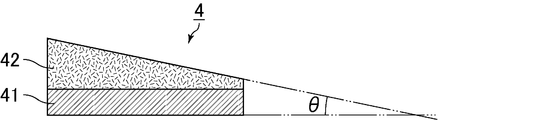
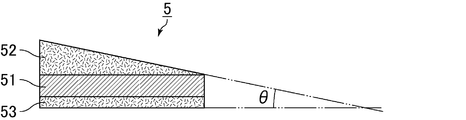
- FIGS. 1 to 3 are schematic views for explaining an example of the case where the cross-sectional shape of the interlayer film for laminated glass of the present invention 1 is a wedge shape.
- FIGS. 1 to 3 for convenience of illustration, the thickness and wedge angle ⁇ of the interlayer film for laminated glass and each layer constituting the interlayer film for laminated glass are shown to be different from the actual thickness and wedge angle. Yes.
- FIG. 1 shows a cross section in the thickness direction of the interlayer film 1 for laminated glass.
- the interlayer film 1 for laminated glass has a two-layer structure in which a shape auxiliary layer 12 is laminated on one surface of a light emitting layer 11 containing a light emitting material.
- the light emitting layer 11 has a rectangular shape
- the shape auxiliary layer 12 has a wedge shape, a triangular shape, or a trapezoidal shape, so that the laminated film intermediate film 1 has a wedge angle ⁇ of 0.1 to 1 mrad as a whole. It has a wedge shape.
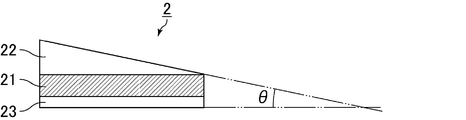
- FIG. 2 shows a cross section in the thickness direction of the interlayer film 2 for laminated glass.
- the interlayer film 2 for laminated glass has a three-layer structure in which a shape auxiliary layer 22 and a shape auxiliary layer 23 are laminated on both surfaces of a light emitting layer 21 containing a light emitting material.
- the shape auxiliary layer 22 is wedge-shaped, triangular, or trapezoidal so that the interlayer film 2 for laminated glass as a whole is wedged.
- the wedge shape has an angle ⁇ of 0.1 to 1 mrad.
- FIG. 3 shows a cross section in the thickness direction of the interlayer film 3 for laminated glass.
- the interlayer film 3 for laminated glass has a three-layer structure in which a shape auxiliary layer 32 and a shape auxiliary layer 33 are laminated on both surfaces of a light emitting layer 31 containing a light emitting material.
- the light emitting layer 31 has a gentle wedge shape with a difference between the maximum thickness and the minimum thickness of 100 ⁇ m or less.
- the wedge angle ⁇ of the laminated glass intermediate film 3 as a whole is increased. It has a wedge shape of 0.1 to 1 mrad.
- the method for producing the interlayer film for laminated glass of the first invention is not particularly limited.
- a plasticizer solution containing a plasticizer and a lanthanoid complex and a thermoplastic resin are sufficiently mixed to produce a resin composition for forming a light emitting layer.
- the resin composition for forming the light emitting layer can be extruded using an extruder to produce an interlayer film for laminated glass.
- the interlayer film for laminated glass of the present invention 1 has the light emitting layer, it emits light when irradiated with a light beam having a specific wavelength. By utilizing this property, information can be displayed with high contrast.
- a spot light source manufactured by Hamamatsu Photonics, LC-8
- a xenon flash lamp manufactured by Heraeus, CW lamp
- a black light manufactured by Inoue Seieido
- Carry hand and the like.
- the laminated glass in which the interlayer film for laminated glass of the present invention 1 is laminated between a pair of glass plates is also one aspect of the present invention.
- the said glass plate can use the transparent plate glass generally used. Examples thereof include inorganic glass such as float plate glass, polished plate glass, template glass, netted glass, wire-containing plate glass, colored plate glass, heat ray absorbing glass, heat ray reflecting glass, and green glass.
- the ultraviolet shielding glass in which the ultraviolet shielding coating layer was formed in the glass surface can be used, it is preferable to use as a glass plate opposite to the side irradiated with the light ray of a specific wavelength.
- organic plastics plates such as polyethylene terephthalate, polycarbonate, and polyacrylate can be used as the glass plate.
- Two or more types of glass plates may be used as the glass plate.
- stacked the intermediate film for laminated glasses of this invention 1 between transparent float plate glass and colored glass plates like green glass is mentioned.
- the present inventors examined the cause of the decrease in emission intensity when an interlayer film for laminated glass was produced using a lanthanoid complex having a polydentate ligand containing a halogen atom. As a result, it discovered that the alkali metal contained in the intermediate film for laminated glasses, alkaline-earth metal, and magnesium were the cause.
- an alkali metal salt, an alkaline earth metal salt, or a magnesium salt is blended as an adhesive strength adjusting agent for adjusting the adhesive strength with the glass plate.
- the lanthanoid complex When a lanthanoid complex having a multidentate ligand containing a halogen atom is blended in such an interlayer film for laminated glass, the lanthanoid complex emits light by interaction of alkali metal, alkaline earth metal or magnesium with the lanthanoid complex. Was thought to decline. However, in order to maintain the penetration resistance of the interlayer film for laminated glass, it is essential to add an adhesive strength modifier.
- the present inventors have made a light-emitting layer containing a thermoplastic resin, a lanthanoid complex having a polydentate ligand containing a halogen atom, a thermoplastic resin, an alkali metal salt, an alkaline earth metal, and the like.
- Laminating an adhesive layer containing a salt or a magnesium salt, and suppressing the blending amount of alkali metal, alkaline earth metal and magnesium in the light emitting layer, while maintaining the penetration resistance of the interlayer film for laminated glass It has been found that an interlayer film for laminated glass capable of displaying an image with high contrast can be obtained by irradiating light rays, and the present invention 2 has been completed.
- the interlayer film for laminated glass of the present invention 2 has a light emitting layer containing a thermoplastic resin and a lanthanoid complex having a multidentate ligand containing a halogen atom.
- the light-emitting layer contains a lanthanoid complex having a multidentate ligand containing a halogen atom as a light-emitting agent, so that the interlayer film for laminated glass of the present invention 2 displays an image with high contrast when irradiated with light. Have a role to play.
- thermoplastic resin is not particularly limited.
- polyvinyl acetal resin ethylene-vinyl acetate copolymer resin, ethylene-acrylic copolymer resin, polyurethane resin, polyurethane resin containing sulfur element, polyvinyl alcohol resin, vinyl chloride.
- resins and polyethylene terephthalate resins include resins and polyethylene terephthalate resins.
- a polyvinyl acetal resin is preferable.
- the polyvinyl acetal is not particularly limited as long as it is a polyvinyl acetal obtained by acetalizing polyvinyl alcohol with an aldehyde, but polyvinyl butyral is preferable. Moreover, you may use together 2 or more types of polyvinyl acetal as needed.
- the preferable lower limit of the degree of acetalization of the polyvinyl acetal is 40 mol%, the preferable upper limit is 85 mol%, the more preferable lower limit is 60 mol%, and the more preferable upper limit is 75 mol%.
- the polyvinyl acetal has a preferred lower limit of the hydroxyl group content of 15 mol% and a preferred upper limit of 35 mol%.
- the hydroxyl group amount is 15 mol% or more, the interlayer film for laminated glass can be easily molded.
- the amount of hydroxyl group is 35 mol% or less, handling of the resulting interlayer film for laminated glass becomes easy.
- the degree of acetalization and the amount of hydroxyl groups can be measured in accordance with, for example, JIS K6728 “Testing method for polyvinyl butyral”.
- the polyvinyl acetal can be prepared by acetalizing polyvinyl alcohol with an aldehyde.
- the polyvinyl alcohol is usually obtained by saponifying polyvinyl acetate, and polyvinyl alcohol having a saponification degree of 70 to 99.8 mol% is generally used.
- the preferable lower limit of the polymerization degree of the polyvinyl alcohol is 500, and the preferable upper limit is 4000.
- the polymerization degree of the polyvinyl alcohol is 500 or more, the penetration resistance of the obtained laminated glass is increased.
- the polymerization degree of the polyvinyl alcohol is 4000 or less, the interlayer film for laminated glass can be easily molded.
- the minimum with a more preferable polymerization degree of the said polyvinyl alcohol is 1000, and a more preferable upper limit is 3600.
- the aldehyde is not particularly limited, but generally an aldehyde having 1 to 10 carbon atoms is preferably used.
- the aldehyde having 1 to 10 carbon atoms is not particularly limited.
- n-butyraldehyde, n-hexylaldehyde, and n-valeraldehyde are preferable, and n-butyraldehyde is more preferable.
- These aldehydes may be used alone or in combination of two or more.
- the lanthanoid complex having a polydentate ligand containing a halogen atom emits light with high emission intensity when irradiated with light.
- the inventors of the present invention 2 show that lanthanoid complexes having a multidentate ligand containing a halogen atom among lanthanoid complexes emit light having a wavelength of 580 to 780 nm by irradiating light having a wavelength of 300 to 410 nm. It was found that an interlayer film for laminated glass capable of displaying a high-contrast image can be obtained by using this.
- a lanthanoid complex having a bidentate ligand containing a halogen atom or a lanthanoid complex having a tridentate ligand containing a halogen atom is preferable.
- the lanthanoid includes lanthanum, cerium, praseodymium, neodymium, promethium, samarium, europium, gadolinium, terbium, dysprosium, holmium, erbium, thulium, ytterbium or lutetium. Since higher emission intensity can be obtained, the lanthanoid is preferably neodymium, europium or terbium, more preferably europium or terbium, and still more preferably europium.
- Examples of the lanthanoid complex having a bidentate ligand containing a halogen atom include tris (trifluoroacetylacetone) phenanthroline europium, tris (trifluoroacetylacetone) diphenylphenanthroline europium, tris (hexafluoroacetylacetone) diphenylphenanthroline europium, and tris (hexa). Fluoroacetylacetone) bis (triphenylphosphine) europium, tris (trifluoroacetylacetone) 2 ′, 2′-bipyridine europium, tris (hexafluoroacetylacetone) 2,2′-bipyridine europium.
- Examples of the lanthanoid complex having a tridentate ligand containing a halogen atom include terpyridine trifluoroacetylacetone europium and terpyridine hexafluoroacetylacetone europium.
- halogen atom of the lanthanoid complex having a multidentate ligand containing a halogen atom a fluorine atom, a chlorine atom, a bromine atom, or an iodine atom can be used.
- a fluorine atom is preferable because the structure of the ligand is stabilized.
- a lanthanoid complex having a bidentate ligand containing a halogen atom and having an acetylacetone skeleton is particularly preferable because of excellent initial light-emitting properties.
- Examples of the lanthanoid complex having a bidentate ligand containing a halogen atom and having an acetylacetone skeleton include Eu (TFA) 3 phen, Eu (TFA) 3 dpphen, Eu (HFA) 3 phen, and [Eu (FOD) 3 ].
- the lanthanoid complex having a polydentate ligand containing a halogen atom is preferably in the form of particles. By being in the form of particles, it becomes easier to finely disperse the lanthanoid complex having a polydentate ligand containing a halogen atom in the interlayer film for laminated glass.
- the preferable lower limit of the average particle diameter of the particles composed of the lanthanoid complex having a polydentate ligand containing a halogen atom is 0.01 ⁇ m
- the preferable upper limit is 10 ⁇ m
- the more preferable lower limit is 0.03 ⁇ m
- the more preferable upper limit is 1 ⁇ m. is there.
- the content of the lanthanoid complex having a polydentate ligand containing a halogen atom in the light emitting layer is preferably 0.001 part by weight with respect to 100 parts by weight of the thermoplastic resin, and 10 parts by weight with respect to the preferred upper limit.
- the content of the lanthanoid complex having a polydentate ligand containing a halogen atom is 0.001 part by weight or more, an image with higher contrast can be displayed.
- the content of the lanthanoid complex having a polydentate ligand containing a halogen atom is 10 parts by weight or less, the transparency of the interlayer film for laminated glass is further enhanced.
- the more preferred lower limit of the content of the lanthanoid complex having a polydentate ligand containing a halogen atom is 0.01 parts by weight, the more preferred upper limit is 5 parts by weight, the still more preferred lower limit is 0.05 parts by weight, and the still more preferred upper limit is 1 part by weight, and a particularly preferred lower limit is 0.2 part by weight.
- the light emitting layer may contain a metal such as an alkali metal, an alkaline earth metal, or magnesium derived from a neutralizing agent used when synthesizing the thermoplastic resin of the thermoplastic resin.
- a metal such as an alkali metal, an alkaline earth metal, or magnesium derived from a neutralizing agent used when synthesizing the thermoplastic resin of the thermoplastic resin.
- the total content of alkali metal, alkaline earth metal and magnesium contained in the light emitting layer is the sum of alkali metal, alkaline earth metal and magnesium contained in the adhesive layer. Less than the content of. More specifically, the total content of sodium, potassium and magnesium contained in the light emitting layer is less than the total content of sodium, potassium and magnesium contained in the adhesive layer.
- the content of magnesium contained in the light emitting layer is preferably 40 ppm or less.
- the content of magnesium contained in the light emitting layer is more preferably 35 ppm or less, still more preferably 30 ppm or less, and particularly preferably 20 ppm or less.
- the magnesium content in the light emitting layer may be 0 ppm.
- thermoplastic resin In order to reduce the total content of metals such as alkali metals, alkaline earth metals, and magnesium contained in the light emitting layer, it is preferable to wash the thermoplastic resin multiple times with an excessive amount of ion-exchanged water. In particular, washing with ion exchange water multiple times before the neutralization step during the production of thermoplastic resin, washing multiple times with ion exchange water after the neutralization step, 10 times more ion exchange water in these washing steps.
- the total content of metals such as alkali metals, alkaline earth metals, and magnesium contained in the light emitting layer can be reduced by combining methods such as
- the light emitting layer preferably further contains a dispersant.
- a dispersant By containing a dispersant, aggregation of the lanthanoid complex having a polydentate ligand containing a halogen atom can be suppressed, and more uniform light emission can be obtained.
- the dispersant is, for example, a compound having a sulfonic acid structure such as a linear alkylbenzene sulfonate, or an ester structure such as a diester compound, a ricinoleic acid alkyl ester, a phthalic acid ester, an adipic acid ester, a sebacic acid ester, or a phosphoric acid ester.
- Compounds having an ether structure such as polyoxyethylene glycol, polyoxypropylene glycol and alkylphenyl-polyoxyethylene-ether, compounds having a carboxylic acid structure such as polycarboxylic acid, laurylamine, dimethyllauryl
- Compounds having an amine structure such as amines, oleylpropylenediamine, secondary amines of polyoxyethylene, tertiary amines of polyoxyethylene, and diamines of polyoxyethylene
- polyalkylenepolyaminealkyleneoxy Dispersants such as compounds having a polyamine structure such as amides, compounds having an amide structure such as oleic acid diethanolamide and alkanol fatty acid amide, and compounds having a high molecular weight amide structure such as polyvinylpyrrolidone and polyester acid amide amine salts Can be used.
- high molecular weight dispersing agents such as polyoxyethylene alkyl ether phosphoric acid (salt), high molecular polycarboxylic acid, and condensed ricinoleic acid ester.
- the high molecular weight dispersant is defined as a dispersant having a molecular weight of 10,000 or more.
- the preferred lower limit of the content of the dispersant with respect to 100 parts by weight of the lanthanoid complex having the multidentate ligand containing the halogen atom in the light emitting layer is 1 part by weight, and the preferred upper limit is 50. Parts by weight.
- the lanthanoid complex having a polydentate ligand containing a halogen atom can be uniformly dispersed in the light emitting layer.
- the more preferable lower limit of the content of the dispersant is 3 parts by weight, the more preferable upper limit is 30 parts by weight, the still more preferable lower limit is 5 parts by weight, and the still more preferable upper limit is 25 parts by weight.
- the light emitting layer may further contain an ultraviolet absorber.
- the light emitting layer contains an ultraviolet absorber, the light resistance of the light emitting layer is increased.
- the content of the ultraviolet absorber in the light emitting layer is preferably 1 part by weight, more preferably 100 parts by weight of the thermoplastic resin.
- a preferred upper limit is 0.5 parts by weight, a more preferred upper limit is 0.2 parts by weight, and a particularly preferred upper limit is 0.1 parts by weight.
- Examples of the ultraviolet absorber include a compound having a malonic ester structure, a compound having an oxalic acid anilide structure, a compound having a benzotriazole structure, a compound having a benzophenone structure, a compound having a triazine structure, a compound having a benzoate structure, and a hindered amine
- Examples include ultraviolet absorbers such as compounds having a structure.
- the light emitting layer may further contain a plasticizer.
- the plasticizer is not particularly limited, and examples thereof include organic ester plasticizers such as monobasic organic acid esters and polybasic organic acid esters, phosphoric acid plasticizers such as organic phosphoric acid plasticizers and organic phosphorous acid plasticizers, and the like. Is mentioned.
- the plasticizer is preferably a liquid plasticizer.
- the monobasic organic acid ester is not particularly limited.
- glycol such as triethylene glycol, tetraethylene glycol, tripropylene glycol, butyric acid, isobutyric acid, caproic acid, 2-ethylbutyric acid, heptylic acid, n-octyl
- glycol esters obtained by reaction with monobasic organic acids such as acid, 2-ethylhexyl acid, pelargonic acid (n-nonyl acid), and decyl acid.
- triethylene glycol dicaproate, triethylene glycol di-2-ethylbutyrate, triethylene glycol di-n-octylate, triethylene glycol di-2-ethylhexylate and the like are preferable.
- the polybasic organic acid ester is not particularly limited.
- an ester compound of a polybasic organic acid such as adipic acid, sebacic acid or azelaic acid and an alcohol having a linear or branched structure having 4 to 8 carbon atoms.
- dibutyl sebacic acid ester, dioctyl azelaic acid ester, dibutyl carbitol adipic acid ester and the like are preferable.
- the organic ester plasticizer is not particularly limited, and triethylene glycol di-2-ethylbutyrate, triethylene glycol di-2-ethylhexanoate, triethylene glycol dicaprylate, triethylene glycol di-n-octanoate, Triethylene glycol di-n-heptanoate, tetraethylene glycol di-n-heptanoate, tetraethylene glycol di-2-ethylhexanoate, dibutyl sebacate, dioctyl azelate, dibutyl carbitol adipate, ethylene glycol di-2-ethyl Butyrate, 1,3-propylene glycol di-2-ethyl butyrate, 1,4-butylene glycol di-2-ethyl butyrate, diethylene glycol di-2-ethyl butyrate, diethylene glycol di- -Ethylhexanoate, dipropylene glycol di-2-ethylbutyrate,
- the organophosphate plasticizer is not particularly limited, and examples thereof include tributoxyethyl phosphate, isodecylphenyl phosphate, triisopropyl phosphate, and the like.
- dihexyl adipate DHA
- triethylene glycol di-2-ethylhexanoate 3GO
- tetraethylene glycol di-2-ethylhexanoate 4GO
- content of the said plasticizer in the said light emitting layer is not specifically limited,
- the preferable minimum with respect to 100 weight part of the said thermoplastic resins is 30 weight part, and a preferable upper limit is 100 weight part.
- the content of the plasticizer is 30 parts by weight or more, the melt viscosity of the laminated glass interlayer film becomes low, so that the laminated glass interlayer film can be easily formed.
- the content of the plasticizer is 100 parts by weight or less, the transparency of the interlayer film for laminated glass increases.
- a more preferred lower limit of the plasticizer content is 35 parts by weight, a more preferred upper limit is 80 parts by weight, a still more preferred lower limit is 45 parts by weight, a still more preferred upper limit is 70 parts by weight, a particularly preferred lower limit is 50 parts by weight, and a particularly preferred upper limit. Is 63 parts by weight.
- the antioxidant is not particularly limited, and examples thereof include an antioxidant having a fail structure, an antioxidant containing sulfur, and an antioxidant containing phosphorus.
- the antioxidant having the phenol structure is an antioxidant having a phenol skeleton.
- antioxidant having a phenol structure examples include 2,6-di-t-butyl-p-cresol (BHT), butylated hydroxyanisole (BHA), 2,6-di-t-butyl-4- Ethylphenol, stearyl- ⁇ - (3,5-di-t-butyl-4-hydroxyphenyl) propionate, 2,2′-methylenebis- (4-methyl-6-butylphenol), 2,2′-methylenebis- ( 4-ethyl-6-t-butylphenol), 4,4'-butylidene-bis- (3-methyl-6-t-butylphenol), 1,1,3-tris- (2-methyl-hydroxy-5-t -Butylphenyl) butane, tetrakis [methylene-3- (3 ', 5'-butyl-4-hydroxyphenyl) propionate] methane, 1,3,3-tris- (2-methyl) 4-hydroxy-5-tert-butylphenol) butane, 1,3,5-trimethyl-2
- the light emitting layer may contain additives such as a light stabilizer, an antistatic agent, a blue pigment, a blue dye, a green pigment, and a green dye as necessary.
- the thickness of the said light emitting layer is not specifically limited, A preferable minimum is 50 micrometers and a preferable upper limit is 1000 micrometers. When the thickness of the light emitting layer is within this range, light emission with sufficiently high contrast can be obtained when a light beam having a specific wavelength is irradiated.
- the more preferable lower limit of the thickness of the light emitting layer is 80 ⁇ m, the more preferable upper limit is 500 ⁇ m, the still more preferable lower limit is 90 ⁇ m, and the still more preferable upper limit is 300 ⁇ m.
- the light emitting layer may be disposed on the entire surface of the interlayer film for laminated glass of the present invention 2, or may be disposed only on a part thereof, and is perpendicular to the thickness direction of the interlayer film for laminated glass of the present invention 2. It may be arranged on the entire surface in the surface direction, or may be arranged only in part. In the case where the light emitting layer is arranged only in part, information can be displayed only in the light emitting area, with the part as a light emitting area and the other part as a non-light emitting area.
- the adhesive layer includes a thermoplastic resin and at least one metal salt selected from the group consisting of alkali metal salts, alkaline earth metal salts, and magnesium salts.
- the said adhesive layer has a role which adjusts the adhesive force of the intermediate film for laminated glasses easily, and maintains the penetration resistance of the intermediate film for laminated glasses.
- thermoplastic resin contained in the adhesive layer the same thermoplastic resin as the thermoplastic resin contained in the light emitting layer can be used.
- the adhesive layer may also contain an additive such as a plasticizer like the light emitting layer.
- At least one metal salt selected from the group consisting of an alkali metal salt, an alkaline earth metal salt, and a magnesium salt has a role as an adhesion adjusting agent.
- the metal salt is more preferably an alkali metal salt of an organic acid having 1 to 16 carbon atoms, an alkaline earth metal salt of an organic acid having 1 to 16 carbon atoms, or a magnesium salt of an organic acid having 1 to 16 carbon atoms. More preferably, an alkali metal salt of an organic acid having 2 to 16 carbon atoms, an alkaline earth metal salt of an organic acid having 2 to 16 carbon atoms, or a magnesium salt having 2 to 16 carbon atoms.
- a magnesium salt of carboxylic acid or a potassium salt of carboxylic acid having 2 to 16 carbon atoms is particularly preferable.
- the magnesium salt of the carboxylic acid having 2 to 16 carbon atoms and the potassium salt of the carboxylic acid having 2 to 16 carbon atoms are not particularly limited, and examples thereof include magnesium acetate, potassium acetate, magnesium propionate, potassium propionate, 2- Examples thereof include magnesium ethyl butanoate, potassium 2-ethylbutanoate, magnesium 2-ethylhexanoate, potassium 2-ethylhexanoate and the like.
- the preferable lower limit of the carbon number of the organic acid is 1, the preferable upper limit is 10, the more preferable lower limit is 2, and the more preferable upper limit is 8.
- content of the said metal salt in the said contact bonding layer is not specifically limited,
- the preferable minimum with respect to 100 weight part of the said thermoplastic resins is 0.0005 weight part, and a preferable upper limit is 0.05 weight part.
- the content of the metal salt is 0.0005 parts by weight or more, the penetration resistance of the laminated glass is further enhanced.
- the content of the metal salt is 0.05 parts by weight or less, the transparency of the interlayer film for laminated glass increases.
- the minimum with more preferable content of the said metal salt is 0.002 weight part, and a more preferable upper limit is 0.02 weight part.
- the total content of sodium, potassium and magnesium in the adhesive layer is preferably 300 ppm or less, more preferably 200 ppm or less, further preferably 150 ppm or less, and particularly preferably 100 ppm or less.
- the magnesium content in the adhesive layer is preferably 150 ppm or less, more preferably 100 ppm or less, still more preferably 50 ppm or less, and particularly preferably 30 ppm or less.
- the adhesive layer includes sodium, potassium, and magnesium derived from the neutralizing agent used when synthesizing the thermoplastic resin, in addition to the metal salt blended as the adhesive strength modifier. .
- the thickness of the said contact bonding layer is not specifically limited, A preferable minimum is 50 micrometers and a preferable upper limit is 1000 micrometers. When the thickness of the adhesive layer is within this range, a laminated glass having much higher penetration resistance can be obtained.
- the more preferable lower limit of the thickness of the adhesive layer is 100 ⁇ m, the more preferable upper limit is 900 ⁇ m, the still more preferable lower limit is 200 ⁇ m, and the still more preferable upper limit is 800 ⁇ m.
- the interlayer film for laminated glass of the present invention 2 may have a two-layer structure in which the light emitting layer and the adhesive layer are laminated, but the first adhesive layer, the light emitting layer, and the second adhesive layer are A three-layer structure arranged in this order is preferable. Further, it may have a multilayer structure in which another layer is laminated between the first adhesive layer and the light emitting layer or between the second adhesive layer and the light emitting layer.
- the content of the plasticizer (hereinafter also referred to as content X) with respect to 100 parts by weight of the thermoplastic resin in the light emitting layer is the first.
- the content of the plasticizer relative to 100 parts by weight of the thermoplastic resin in the two adhesive layers (hereinafter also referred to as “content Y”) can be increased.
- the content X is preferably 5 parts by weight or more, more preferably 10 parts by weight or more, and still more preferably 15 parts by weight or more than the content Y.
- the difference between the content X and the content Y is preferably 50 parts by weight or less, more preferably 40 parts by weight or less. Preferably, it is 35 parts by weight or less.
- the preferred lower limit of the content X is 45 parts by weight, the more preferred lower limit is 50 parts by weight, the still more preferred lower limit is 55 parts by weight, the preferred upper limit is 80 parts by weight, the more preferred upper limit is 75 parts by weight, and the more preferred upper limit is 70 parts by weight. Parts by weight.
- the preferred lower limit of the content Y is 20 parts by weight, the more preferred lower limit is 30 parts by weight, the still more preferred lower limit is 35 parts by weight, the preferred upper limit is 45 parts by weight, the more preferred upper limit is 43 parts by weight, and the more preferred upper limit is 41 parts. Parts by weight.
- the thermoplastic resin in the light emitting layer is preferably polyvinyl acetal X.
- the polyvinyl acetal X can be prepared by acetalizing polyvinyl alcohol with an aldehyde.
- the polyvinyl alcohol is usually obtained by saponifying polyvinyl acetate.
- the preferable lower limit of the average degree of polymerization of the polyvinyl alcohol is 200, and the preferable upper limit is 5000.
- the more preferable lower limit of the average degree of polymerization of the polyvinyl alcohol is 500, and the more preferable upper limit is 4000.
- the average degree of polymerization of the polyvinyl alcohol is determined by a method based on JIS K6726 “Testing method for polyvinyl alcohol”.
- the preferable lower limit of the carbon number of the aldehyde for acetalizing the polyvinyl alcohol is 4, and the preferable upper limit is 6.
- the aldehyde having 4 to 6 carbon atoms may be a linear aldehyde or a branched aldehyde, and examples thereof include n-butyraldehyde and n-valeraldehyde. .
- the upper limit with the preferable amount of hydroxyl groups of the said polyvinyl acetal X is 30 mol%.
- the more preferable upper limit of the hydroxyl group amount of the polyvinyl acetal X is 28 mol%, the more preferable upper limit is 26 mol%, the particularly preferable upper limit is 24 mol%, the preferable lower limit is 10 mol%, the more preferable lower limit is 15 mol%, and the more preferable lower limit. Is 20 mol%.
- the amount of hydroxyl groups in the polyvinyl acetal X is a value obtained by dividing the amount of ethylene groups to which the hydroxyl groups are bonded by the total amount of ethylene groups in the main chain, as a percentage (mol%).
- the amount of the ethylene group to which the hydroxyl group is bonded can be determined, for example, by measuring the amount of ethylene group to which the hydroxyl group of the polyvinyl acetal X is bonded by a method based on JIS K6728 “Testing method for polyvinyl butyral”. it can.
- the minimum with the preferable amount of acetal groups of the said polyvinyl acetal X is 60 mol%, and a preferable upper limit is 85 mol%.
- a preferable upper limit is 85 mol%.
- the lower limit of the amount of acetal group of the polyvinyl acetal X is more preferably 65 mol%, still more preferably 68 mol% or more.
- the amount of the acetal group can be determined by measuring the amount of ethylene group to which the acetal group of the polyvinyl acetal X is bonded by a method based on JIS K6728 “Testing method for polyvinyl butyral”.
- the minimum with the preferable amount of acetyl groups of the said polyvinyl acetal X is 0.1 mol%, and a preferable upper limit is 30 mol%.
- a preferable upper limit is 30 mol%.
- the more preferable lower limit of the acetyl group amount is 1 mol%, the more preferable lower limit is 5 mol%, the particularly preferable lower limit is 8 mol%, the more preferable upper limit is 25 mol%, and the still more preferable upper limit is 20 mol%.
- the amount of acetyl groups is the value obtained by subtracting the amount of ethylene groups to which acetal groups are bonded and the amount of ethylene groups to which hydroxyl groups are bonded from the total amount of ethylene groups in the main chain. This is a value expressed as a percentage (mol%) of the mole fraction obtained by dividing by.
- the polyvinyl acetal X is a polyvinyl acetal having an acetyl group content of 8 mol% or more, or Polyvinyl acetal having an acetyl group amount of less than 8 mol% and an acetal group amount of 65 mol% or more is preferred.
- the polyvinyl acetal X is a polyvinyl acetal having an acetyl group amount of 8 mol% or more, or a polyvinyl acetal having an acetyl group amount of less than 8 mol% and an acetal group amount of 68 mol% or more. More preferable.
- the thermoplastic resin in the first and second adhesive layers is preferably polyvinyl acetal Y.
- the polyvinyl acetal Y preferably has a larger amount of hydroxyl groups than the polyvinyl acetal X.
- the polyvinyl acetal Y can be prepared by acetalizing polyvinyl alcohol with an aldehyde.
- the polyvinyl alcohol is usually obtained by saponifying polyvinyl acetate.
- the preferable minimum of the average degree of polymerization of the said polyvinyl alcohol is 200, and a preferable upper limit is 5000.
- the more preferable lower limit of the average degree of polymerization of the polyvinyl alcohol is 500, and the more preferable upper limit is 4000.
- the preferable lower limit of the carbon number of the aldehyde for acetalizing the polyvinyl alcohol Y is 3, and the preferable upper limit is 4.
- the aldehyde having 3 to 4 carbon atoms may be a linear aldehyde or a branched aldehyde, and examples thereof include n-butyraldehyde.
- the upper limit with the preferable amount of hydroxyl groups of the said polyvinyl acetal Y is 33 mol%, and a preferable minimum is 28 mol%.
- the preferable lower limit of the amount of acetal group is 60 mol%, and the preferable upper limit is 80 mol%.
- the amount of the acetal group is 60 mol% or more, an amount of plasticizer necessary for exhibiting sufficient penetration resistance can be contained.
- the amount of the acetal group 80 mol% or less it is possible to ensure the adhesive force between the other layer and the glass.
- a more preferable lower limit of the amount of the acetal group is 65 mol%, and a more preferable upper limit is 69 mol%.
- the upper limit with the preferable amount of acetyl groups of the said polyvinyl acetal Y is 7 mol%.
- the amount of acetyl groups of the polyvinyl acetal Y 7 mol% or less the hydrophobicity of other layers can be increased and whitening can be prevented.
- a more preferable upper limit of the amount of the acetyl group is 2 mol%, and a preferable lower limit is 0.1 mol%.
- the amount of hydroxyl groups, the amount of acetal groups, and the amount of acetyl groups of polyvinyl acetal Y can be measured by the same method as for polyvinyl acetal X.
- any one of the light emitting layer, the adhesive layer, and other layers, any two layers, or all the layers A heat ray absorbent can be contained.
- the heat ray absorber is not particularly limited as long as it has the ability to shield infrared rays, but is tin-doped indium oxide (ITO) particles, antimony-doped tin oxide (ATO) particles, aluminum-doped zinc oxide (AZO) particles, indium-doped oxide.
- ITO indium oxide
- ATO antimony-doped tin oxide
- AZO aluminum-doped zinc oxide
- At least one selected from the group consisting of zinc (IZO) particles, tin-doped zinc oxide particles, silicon-doped zinc oxide particles, lanthanum hexaboride particles and cerium hexaboride particles is preferred.
- the said light emitting layer contains a heat ray absorber
- content of the heat ray absorber contained in the said light emitting layer is 0.00001 weight% or more and 1 weight% or less in 100 weight% of the said light emitting layers.
- the content of the heat ray absorbent contained in the other layer is 0.00001% by weight or more and 1% by weight or less in 100% by weight of the other layer. Is preferred.
- the content of the heat ray absorbent contained in the light emitting layer or the other layer is within the above preferable range, sufficient heat shielding performance can be exhibited.
- the thickness of the interlayer film for laminated glass of the present invention 2 is not particularly limited, but a preferable lower limit is 50 ⁇ m, a preferable upper limit is 2200 ⁇ m, a more preferable lower limit is 100 ⁇ m, a more preferable upper limit is 1700 ⁇ m, and a further preferable upper limit is 1000 ⁇ m. There is a particularly preferred upper limit of 900 ⁇ m.
- the lower limit of the thickness of the entire interlayer film for laminated glass means the thickness of the minimum thickness portion of the entire interlayer film for laminated glass, and the upper limit of the thickness of the entire interlayer film for laminated glass is the middle for laminated glass It means the thickness of the maximum thickness portion of the entire film.
- the thickness of the light emitting layer is not particularly limited, but a preferable lower limit is 50 ⁇ m and a preferable upper limit is 1000 ⁇ m.
- a preferable lower limit is 50 ⁇ m and a preferable upper limit is 1000 ⁇ m.
- the more preferable lower limit of the thickness of the light emitting layer is 80 ⁇ m
- the more preferable upper limit is 760 ⁇ m
- the still more preferable lower limit is 90 ⁇ m
- the still more preferable upper limit is 500 ⁇ m
- the particularly preferable upper limit is 300 ⁇ m.
- the interlayer film for laminated glass of the present invention 2 may have a wedge shape in cross section. If the cross-sectional shape of the interlayer film for laminated glass is wedge-shaped, it is possible to display an image with the occurrence of double images prevented by adjusting the wedge-shaped wedge angle ⁇ according to the attachment angle of the laminated glass. From the viewpoint of further suppressing double images, the preferable lower limit of the wedge angle ⁇ is 0.1 mrad, the more preferable lower limit is 0.2 mrad, the still more preferable lower limit is 0.3 mrad, the preferable upper limit is 1 mrad, and the more preferable upper limit is 0.9 mrad.
- an interlayer film for laminated glass having a wedge-shaped cross section is manufactured by a method of extruding a resin composition using an extruder, a slightly inner region (specifically, from one end on the thin side) , Where X is the distance between one end and the other end, and has a minimum thickness in the range from 0X to 0.2X inward from one end on the thin side, and one end on the thick side
- the maximum thickness in the region slightly inside specifically, when the distance between one end and the other end is X, the region from 0X to 0.2X inward from one end on the thick side
- It may become the shape which has. In the present specification, such a shape is also included in the wedge shape.
- the thickness of the light emitting layer is set within a certain range, and the entire interlayer film for laminated glass is adjusted by adjusting the cross-sectional shape of the adhesive layer.
- the cross-sectional shape can be adjusted to a wedge shape with a constant wedge angle.
- the entire cross sectional shape of the interlayer film for laminated glass has a constant wedge angle. You may adjust so that it may become a wedge shape.
- the shape auxiliary layer may be laminated only on one surface of the light emitting layer, or may be laminated on both surfaces. Further, a plurality of shape auxiliary layers may be laminated.
- the light emitting layer may have a wedge-shaped cross section or a rectangular shape.
- the difference between the maximum thickness and the minimum thickness of the light emitting layer is preferably 100 ⁇ m or less. Thereby, an image can be displayed with a certain range of luminance.
- the difference between the maximum thickness and the minimum thickness of the light emitting layer is more preferably 95 ⁇ m or less, and still more preferably 90 ⁇ m or less.
- the thickness of the light emitting layer is not particularly limited, but a preferable lower limit is 50 ⁇ m and a preferable upper limit is 700 ⁇ m. When the thickness of the light emitting layer is within this range, a sufficiently high contrast image can be displayed.
- the more preferable lower limit of the thickness of the light emitting layer is 70 ⁇ m
- the more preferable upper limit is 400 ⁇ m
- the still more preferable lower limit is 80 ⁇ m
- the still more preferable upper limit is 150 ⁇ m.
- the lower limit of the thickness of the light emitting layer means the thickness of the minimum thickness portion of the light emitting layer
- the upper limit of the thickness of the light emitting layer means the thickness of the maximum thickness portion of the light emitting layer.
- the adhesive layer When adjusting the cross-sectional shape of the adhesive layer so that the cross-sectional shape of the interlayer film for laminated glass as a whole is a wedge shape having a constant wedge angle, the adhesive layer has a wedge-shaped, triangular, trapezoidal cross-sectional shape. Or it is preferable that it is a rectangle.
- the cross sectional shape of the interlayer film for laminated glass as a whole can be adjusted to a wedge shape having a constant wedge angle.
- the thickness of the adhesive layer is not particularly limited, but practical aspects
- the preferable lower limit is 10 ⁇ m
- the preferable upper limit is 1000 ⁇ m
- the more preferable lower limit is 200 ⁇ m
- the more preferable upper limit is 800 ⁇ m
- the further preferable lower limit is 300 ⁇ m.
- the lower limit of the thickness of the adhesive layer means the thickness of the minimum thickness portion of the adhesive layer
- the upper limit of the thickness of the adhesive layer means the thickness of the maximum thickness portion of the adhesive layer. Further, when a plurality of adhesive layers are used in combination, the total thickness is meant.
- FIGS. 4 to 6 are schematic views for explaining an example when the cross-sectional shape of the interlayer film for laminated glass of the present invention 2 is a wedge shape. 4 to 6, for convenience of illustration, the thickness and wedge angle ⁇ of the interlayer film for laminated glass and each layer constituting the interlayer film for laminated glass are shown to be different from the actual thickness and wedge angle. Yes.
- FIG. 4 shows a cross section in the thickness direction of the interlayer film 4 for laminated glass.
- the interlayer film 4 for laminated glass has a two-layer structure in which an adhesive layer 42 is laminated on one surface of a light emitting layer 41 containing a light emitting material.
- the light emitting layer 41 has a rectangular shape, but the wedge layer ⁇ has a wedge angle ⁇ of 0.1 to 1 mrad as a whole of the interlayer film 4 for laminated glass by making the shape of the adhesive layer 42 a wedge shape, a triangle or a trapezoid. It has become.
- FIG. 5 shows a cross section in the thickness direction of the interlayer film 5 for laminated glass.
- the interlayer film 5 for laminated glass has a three-layer structure in which an adhesive layer 52 and an adhesive layer 53 are laminated on both surfaces of a light emitting layer 51 containing a light emitting material.
- the light emitting layer 51 and the adhesive layer 53 have a rectangular shape with a constant thickness, whereas the shape of the adhesive layer 52 is wedge-shaped, triangular, or trapezoidal so that the interlayer film 5 for laminated glass has a wedge angle ⁇ as a whole.
- FIG. 6 shows a cross section in the thickness direction of the interlayer film 6 for laminated glass.
- the interlayer film 6 for laminated glass has a three-layer structure in which an adhesive layer 62 and an adhesive layer 63 are laminated on both surfaces of a light emitting layer 61 containing a light emitting material.
- the light emitting layer 61 has a gentle wedge shape with a difference between the maximum thickness and the minimum thickness of 100 ⁇ m or less.
- the wedge angle ⁇ of the laminated glass intermediate film 6 as a whole is 0. .It has a wedge shape of 1 to 1 mrad.
- the manufacturing method of the interlayer film for laminated glass of the present invention 2 is not particularly limited.
- a plasticizer solution containing a plasticizer and a lanthanoid complex having a polydentate ligand containing a halogen atom and a thermoplastic resin are sufficiently mixed to produce a resin composition for forming a light emitting layer.
- a plasticizer solution containing the metal salt and the plasticizer and a thermoplastic resin are sufficiently mixed to prepare a resin composition for forming the first and second adhesive layers.
- the resin composition for forming the light emitting layer and the resin composition for forming the first and second adhesive layers are coextruded using a coextrusion machine, and the first adhesive layer, the light emitting layer, and the second adhesive An interlayer film for laminated glass in which layers are laminated in this order can be produced.
- the interlayer film for laminated glass of the present invention 2 has the light emitting layer, it emits light when irradiated with a light beam having a specific wavelength. By utilizing this property, information can be displayed with high contrast.
- a spot light source manufactured by Hamamatsu Photonics, LC-8
- a xenon flash lamp manufactured by Heraeus, CW lamp
- a black light manufactured by Inoue Seieido
- Carry hand and the like.
- the laminated glass in which the interlayer film for laminated glass of the present invention 2 is laminated between a pair of glass plates is also one aspect of the present invention.
- the said glass plate can use the transparent plate glass generally used. Examples thereof include inorganic glass such as float plate glass, polished plate glass, template glass, netted glass, wire-containing plate glass, colored plate glass, heat ray absorbing glass, heat ray reflecting glass, and green glass.
- the ultraviolet shielding glass in which the ultraviolet shielding coating layer was formed in the glass surface can be used, it is preferable to use as a glass plate opposite to the side irradiated with the light ray of a specific wavelength.
- organic plastics plates such as polyethylene terephthalate, polycarbonate, and polyacrylate can be used as the glass plate.
- Two or more types of glass plates may be used as the glass plate.
- stacked the intermediate film for laminated glasses of this invention 2 between transparent float plate glass and the colored glass plate like green glass is mentioned.
- the laminated glass containing the intermediate film for laminated glasses which can display an image with high light emission intensity by irradiating a light ray, and this intermediate film for laminated glasses can be provided.
- Example 1 (1) Preparation of Eu (TFA) 3 phen Europium acetate (Eu (CH 3 COO) 3 ) 5 g (12.5 mmol) was dissolved in 50 mL of distilled water, and trifluoroacetylacetone (TFA, CH 3 COCH 2 COCF 3 ) 7 g (33.6 mmol) was added and stirred at room temperature for 3 hours. The precipitated solid was filtered, washed with water, and recrystallized with methanol and distilled water to obtain Eu (TFA) 3 (H 2 O) 2 ).
- Polyvinyl butyral 1 (hereinafter also referred to as “PVB1”) was obtained.
- the amount of acetyl groups of polyvinyl butyral 1 was 0.9 mol%, the degree of butyralization was 68.5 mol%, and the amount of hydroxyl groups was 30.6 mol%.
- the obtained interlayer film for laminated glass was laminated between a pair of clear glass (thickness 2.5 mm) having a length of 5 cm and a width of 5 cm to obtain a laminate.
- the obtained laminate was vacuum-pressed while being held at 90 ° C. for 30 minutes with a vacuum laminator to be pressure-bonded. After the pressure bonding, pressure bonding was performed for 20 minutes using an autoclave under conditions of 140 ° C. and 14 MPa to obtain a laminated glass.
- Example 2 (1) instead of Eu (TFA) 3 dpphen
- Example 3 (1) instead of Eu (HFA) 3 phen
- Tb (TFA) 3phen was obtained in the same manner as in Example 1 except that terbium acetate was used instead of europium acetate.
- Example 5 An interlayer film for laminated glass and a laminated glass were produced in the same manner as in Example 2 except that magnesium chloride was added to the resin composition so that the magnesium content in the obtained interlayer film for laminated glass was 30 ppm.
- Example 6 An interlayer film for laminated glass and a laminated glass were produced in the same manner as in Example 3 except that magnesium chloride was added to the resin composition so that the magnesium content in the obtained interlayer film for laminated glass was 30 ppm.
- Example 7 An interlayer film for laminated glass and a laminated glass were produced in the same manner as in Example 4 except that magnesium chloride was added to the resin composition so that the magnesium content in the obtained interlayer film for laminated glass was 30 ppm.
- Example 8 An interlayer film for laminated glass and a laminated glass were produced in the same manner as in Example 2 except that potassium chloride was added to the resin composition so that the content of potassium in the obtained interlayer film for laminated glass was 30 ppm.
- Example 9 An interlayer film for laminated glass and a laminated glass were produced in the same manner as in Example 2 except that sodium chloride was added to the resin composition so that the sodium content in the obtained interlayer film for laminated glass was 30 ppm.
- Example 10 An interlayer film for laminated glass and a laminated glass were produced in the same manner as in Example 3 except that the resin composition was mixed with magnesium chloride so that the magnesium content in the obtained interlayer film for laminated glass was 40 ppm.
- Example 11 An interlayer film for laminated glass and a laminated glass were produced in the same manner as in Example 4 except that magnesium chloride was added to the resin composition so that the magnesium content in the obtained interlayer film for laminated glass was 40 ppm.
- Example 1 An interlayer film for laminated glass and a laminated glass were produced in the same manner as in Example 2 except that magnesium chloride was added to the resin composition so that the magnesium content in the obtained interlayer film for laminated glass was 70 ppm.
- Comparative Example 2 An interlayer film for laminated glass and a laminated glass were produced in the same manner as in Example 2 except that sodium chloride was added to the resin composition so that the sodium content in the obtained interlayer film for laminated glass was 100 ppm.
- Example 3 An interlayer film for laminated glass and a laminated glass were produced in the same manner as in Example 3 except that the resin composition was blended with magnesium chloride so that the magnesium content in the obtained interlayer film for laminated glass was 70 ppm.
- Example 4 An interlayer film for laminated glass and a laminated glass were produced in the same manner as in Example 3 except that sodium chloride was added to the resin composition so that the sodium content in the obtained interlayer film for laminated glass was 100 ppm.
- Example 12 to 17, Comparative Examples 7 to 8 Sodium chloride, potassium chloride, and magnesium chloride in the luminescent plasticizer solution so that the resin composition contains sodium, potassium, and magnesium in the resulting interlayer film for laminated glass as shown in Table 3.
- An interlayer film for laminated glass and a laminated glass were produced in the same manner as in Example 1 except that the blending amount was changed and the type and content of the luminescent particles were changed as shown in Table 3.
- Example 18 0.2 parts by weight of Eu (HFA) 3 phen obtained in Example 3 was added to 40 parts by weight of triethylene glycol di-2-ethylhexanoate (3GO), and further tin-doped indium oxide particles as a heat ray absorbent An amount of 0.15% by weight in 100% by weight of the intermediate film from which (ITO particles) can be obtained was added to prepare a luminescent plasticizer solution.
- a resin composition was prepared by sufficiently kneading the total amount of the obtained plasticizer solution and 100 parts by weight of the obtained polyvinyl butyral 1 with a mixing roll. The obtained resin composition was extruded using an extruder to obtain an interlayer film for laminated glass (thickness: 760 ⁇ m).
- the obtained interlayer film for laminated glass was laminated between a pair of clear glass (thickness 2.5 mm) having a length of 5 cm and a width of 5 cm to obtain a laminate.
- the obtained laminate was vacuum-pressed while being held at 90 ° C. for 30 minutes with a vacuum laminator to be pressure-bonded. After the pressure bonding, pressure bonding was performed for 20 minutes using an autoclave under conditions of 140 ° C. and 14 MPa to obtain a laminated glass.
- Example 19 0.2 parts by weight of Eu (HFA) 3 phen obtained in Example 3 was added to 40 parts by weight of triethylene glycol di-2-ethylhexanoate (3GO), and cesium-doped tungsten oxide ( An amount of 0.05% by weight in 100% by weight of the intermediate film from which Cs0.33WO3) particles (CWO particles) can be obtained was added to prepare a luminescent plasticizer solution.
- a resin composition was prepared by sufficiently kneading the total amount of the obtained plasticizer solution and 100 parts by weight of the obtained polyvinyl butyral 1 with a mixing roll. The obtained resin composition was extruded using an extruder to obtain an interlayer film for laminated glass (thickness: 760 ⁇ m).
- the obtained interlayer film for laminated glass was laminated between a pair of clear glass (thickness 2.5 mm) having a length of 5 cm and a width of 5 cm to obtain a laminate.
- the obtained laminate was vacuum-pressed while being held at 90 ° C. for 30 minutes with a vacuum laminator to be pressure-bonded. After the pressure bonding, pressure bonding was performed for 20 minutes using an autoclave under conditions of 140 ° C. and 14 MPa to obtain a laminated glass.
- Example 20 An interlayer film for laminated glass and a laminated glass were produced in the same manner as in Example 18 except that the type of the luminescent particles and the content of the heat ray absorbent were changed as shown in Table 4.
- the test solution was obtained by making a constant volume with 18.2 M ⁇ ⁇ cm of ultrapure water.
- quantitative analysis of the metal in the test solution was performed in a closed system using an ICP emission spectrometer (ICPE-9000) manufactured by Shimadzu Corporation, and the content of the obtained metal in the interlayer film for laminated glass was measured. The metal content was calculated.
- PVB2 polyvinyl butyral 2
- the amount of acetyl groups in PVB2 was 13 mol%, the amount of butyral groups was 65 mol%, and the amount of hydroxyl groups was 22 mol%.
- the resin composition forming the light emitting layer and the resin composition forming the first and second adhesive layers are coextruded using a coextrusion machine, and the first adhesive layer An interlayer film for laminated glass in which the light emitting layer and the second adhesive layer were laminated in this order was obtained.
- the light emitting layer had a thickness of 100 ⁇ m
- the first and second resin layers each had a thickness of 350 ⁇ m
- the laminated glass intermediate film had a thickness of 800 ⁇ m.
- the obtained interlayer film for laminated glass was laminated between a pair of clear glass (thickness 2.5 mm) 30 cm long and 30 cm wide to obtain a laminate.
- the obtained laminate was vacuum-pressed while being held at 90 ° C. for 30 minutes with a vacuum laminator to be pressure-bonded. After the pressure bonding, pressure bonding was performed for 20 minutes using an autoclave under conditions of 140 ° C. and 14 MPa, and the intermediate film portion protruding from the glass was cut off to obtain a laminated glass for penetration resistance evaluation.
- Example 23 (1) instead of Eu (TFA) 3 dpphen Preparation 1,10-phenanthroline, except for using 4,7-diphenyl-phenanthroline in the same manner as in Example 22 to give the Eu (TFA) 3 dpphen.
- Examples 25 to 34 Comparative Examples 9 to 13, Reference Example 1
- the contents of sodium, potassium and magnesium in the light emitting layer and the adhesive layer obtained are as shown in Tables 5, 6 and 7.
- Tables 5, 6 and 7. By changing the blending amount of sodium chloride, potassium chloride and magnesium chloride, and the blending amount of magnesium acetate in the plasticizer solution in the resin composition forming the first and second adhesive layers, the kind of the europium complex used and the plasticizer An intermediate film for laminated glass, a laminated glass, and a laminated glass for evaluation of penetration resistance were produced in the same manner as in Example 22 except that the blending amounts of were set as shown in Tables 5, 6, and 7.
- a container for dissolution was prepared, ultrapure water (6 mg) and hydrogen peroxide (1 mg) were placed in the container, an insert container was placed in the container for dissolution, and the lid was closed.
- a microwave sample pretreatment device (“ETHOS One” manufactured by Milestone General Co., Ltd.)
- the dissolution vessel was heated at 200 ° C. for 15 minutes, and then the contents in the insert vessel were subjected to specific resistance at 25 ° C.
- the test solution was obtained by making a constant volume with 18.2 M ⁇ ⁇ cm of ultrapure water.
- quantitative analysis of the metal in the test solution was performed in a closed system using an ICP emission analyzer (ICPE-9000) manufactured by Shimadzu Corporation. From the obtained metal content, The metal content was calculated.
- the entire surface of the laminated glass is irradiated with light, and the shortest distance from the surface of the laminated glass is 35 cm at an angle of 45 degrees from the surface of the laminated glass irradiated with light,
- the luminance was measured with a luminance meter (“SR-3AR” manufactured by Topcon Technohouse Co., Ltd.) arranged on the side irradiated with light.
- Example 35 (Preparation of resin composition for light emitting layer) To 40 parts by weight of triethylene glycol di-2-ethylhexanoate (3GO), 0.5 part by weight of Eu (HFA) 3 phen obtained in Example 3 was added to prepare a luminescent plasticizer solution.
- the resin composition for light emitting layers was prepared by fully knead
- the resin composition for the light emitting layer and the resin composition for the shape auxiliary layer were coextruded using a coextrusion machine, and the shape auxiliary layer, the light emitting layer, and the shape auxiliary layer were laminated in this order.
- An interlayer film for laminated glass having a three-layer structure was obtained.
- the extrusion direction of the obtained interlayer film was 1 m when the shortest distance between one end and the other end in the vertical direction was measured.
- the light emitting layer in the obtained interlayer film for laminated glass has a wedge-shaped cross-sectional shape having a minimum thickness of 100 ⁇ m and a maximum thickness of 200 ⁇ m.
- the entire interlayer film for laminated glass has a minimum thickness of 800 ⁇ m, a maximum thickness of 1250 ⁇ m, and a wedge angle ⁇ 0.45 mrad. It had a wedge-shaped cross-sectional shape.
- One end of the interlayer film for laminated glass has a minimum thickness and the other end has a maximum thickness, and the minimum thickness and the maximum thickness were measured by observation with an optical microscope.
- the obtained interlayer film was sandwiched between two transparent float glasses (length 1000 mm ⁇ width 300 mm ⁇ thickness 2.5 mm) to obtain a laminate.
- the obtained laminated body was temporarily press-bonded using a 230 ° C. heating roll. Then, the laminated body temporarily crimped
- An intermediate film (thin portion) 10 cm long ⁇ 10 cm wide was cut out so that a point 10 cm from the one end on the shortest distance between the one end and the other end was the center.
- the obtained intermediate film (thin portion) was sandwiched between two transparent float glasses (5 cm long ⁇ 5 cm wide ⁇ 2.5 mm thick) to obtain a laminate.
- the obtained laminated body was temporarily press-bonded using a 230 ° C. heating roll. Then, the laminated body temporarily crimped
- Examples 37 to 38, Comparative Examples 14 to 15 The blending amount of sodium chloride, potassium chloride and magnesium chloride in the resin composition for the light emitting layer is changed and used so that the contents of sodium, potassium and magnesium in the light emitting layer to be the amounts shown in Table 9 are used.
- An interlayer film for laminated glass, a laminated glass, and a laminated glass for luminance measurement were produced in the same manner as in Example 35 except that the types of europium complexes were as shown in Table 9.
- Example 39 (Preparation of resin composition for light emitting layer) To 40 parts by weight of triethylene glycol di-2-ethylhexanoate (3GO), 0.2 part by weight of Eu (HFA) obtained in Example 3 was added to prepare a luminescent plasticizer solution.
- the resin composition for light emitting layers was prepared by fully knead
- a sound insulation layer resin composition was prepared by sufficiently kneading 60 parts by weight of triethylene glycol di-2-ethylhexanoate (3GO) and 100 parts by weight of polyvinyl butyral 2 with a mixing roll.
- 3GO triethylene glycol di-2-ethylhexanoate
- the resin composition for the light emitting layer was extruded as a single layer using an extruder to obtain a light emitting layer (thickness: 760 ⁇ m).
- the first resin layer, the sound insulation layer, and the second resin layer resin composition and the sound insulation layer resin composition are coextruded using a coextrusion machine.
- a laminate having a three-layer structure illustrated in FIG. 3 was obtained in which the resin layers were laminated in this order.
- the light emitting layer was laminated
- the shortest distance between one end and the other end in the direction perpendicular to the direction of extrusion of the intermediate film was 1 m.
- the sound insulating layer in the interlayer film for laminated glass thus obtained has a wedge-shaped cross-sectional shape with a minimum thickness of 100 ⁇ m and a maximum thickness of 200 ⁇ m, and the first resin layer has a wedge-shaped cross-sectional shape with a minimum thickness of 350 ⁇ m and a maximum thickness of 525 ⁇ m.
- the second resin layer has a wedge-shaped cross-sectional shape with a minimum thickness of 350 ⁇ m and a maximum thickness of 525 ⁇ m
- the entire interlayer film for laminated glass has a wedge-shaped cross-sectional shape with a minimum thickness of 1560 ⁇ m, a maximum thickness of 2010 ⁇ m, and a wedge angle ⁇ 0.45 mrad.
- One end of the interlayer film for laminated glass has a minimum thickness and the other end has a maximum thickness, and the minimum thickness and the maximum thickness were measured by observation with an optical microscope.
- the obtained interlayer film was sandwiched between two transparent float glasses (length 1000 mm ⁇ width 300 mm ⁇ thickness 2.5 mm) to obtain a laminate.
- the obtained laminated body was temporarily press-bonded using a 230 ° C. heating roll. Then, the laminated body temporarily crimped
- An intermediate film (thin portion) 10 cm long ⁇ 10 cm wide was cut out so that a point 10 cm from the one end on the shortest distance between the one end and the other end was the center.
- the obtained intermediate film (thin portion) was sandwiched between two transparent float glasses (5 cm long ⁇ 5 cm wide ⁇ 2.5 mm thick) to obtain a laminate.
- the obtained laminated body was temporarily press-bonded using a 230 ° C. heating roll. Then, the laminated body temporarily crimped
- Examples 40 to 44, Comparative Examples 16 to 17 Polyvinyl butyral resin type, luminescent particle type, luminescent particle content, plasticizer content, first resin layer minimum thickness, first resin layer maximum thickness, sound insulating layer minimum thickness, sound insulating layer Maximum thickness, minimum thickness of the second resin layer, maximum thickness of the second resin layer, minimum thickness of the light emitting layer, maximum thickness of the light emitting layer, minimum thickness of the entire intermediate film, maximum thickness of the entire intermediate film, and wedge angle ⁇
- Tables 10 and 11 Were changed as shown in Tables 10 and 11, and an interlayer film for laminated glass and laminated glass were produced in the same manner as in Example 39.
- the blending amounts of sodium chloride, potassium chloride and magnesium chloride in the resin composition for the light emitting layer are adjusted so that the contents of sodium, potassium and magnesium in the obtained light emitting layer are as shown in Tables 10 and 11.
- An interlayer film for laminated glass, a laminated glass, and a laminated glass for luminance measurement were produced in the same manner as in Example 39 except that the types of europium complexes used were changed as shown in Tables 10 and 11.
- a container for dissolution was prepared, ultrapure water (6 mg) and hydrogen peroxide (1 mg) were placed in the container, an insert container was placed in the container for dissolution, and the lid was closed.
- a microwave sample pretreatment device (“ETHOS One” manufactured by Milestone General Co., Ltd.)
- the dissolution vessel was heated at 200 ° C. for 15 minutes, and then the contents in the insert vessel were subjected to specific resistance at 25 ° C.
- the test solution was obtained by making a constant volume with 18.2 M ⁇ ⁇ cm of ultrapure water.
- quantitative analysis of the metal in the test solution was performed in a closed system using an ICP emission analyzer (ICPE-9000) manufactured by Shimadzu Corporation. From the obtained metal content, The metal content was calculated.
- a high power xenon light source manufactured by Asahi Spectroscopic Co., Ltd., “REX-”
- a laminated glass for measuring luminance is placed in a dark room at a position 10 cm away from the surface of the laminated glass. 250 ”, irradiation wavelength 405 nm), the entire surface of the laminated glass is irradiated with light, and the shortest distance from the surface of the laminated glass is 35 cm at an angle of 45 degrees from the surface of the laminated glass irradiated with light, and
- the luminance was measured by a luminance meter (“SR-3AR”, manufactured by Topcon Technohouse Co., Ltd.) arranged on the side irradiated with light.
- SR-3AR manufactured by Topcon Technohouse Co., Ltd.
- the laminated glass (length 1000 mm ⁇ width 300 mm) obtained in the examples and comparative examples was placed at the position of the windshield. Display information was reflected on the laminated glass from the display unit installed below the laminated glass, and the presence or absence of a double image was visually confirmed at a predetermined position. The case where a double image was not confirmed was evaluated as “ ⁇ ”, and the case where a double image was confirmed was evaluated as “x”.
- the laminated glass containing the intermediate film for laminated glasses which can display an image with high light emission intensity by irradiating a light ray, and this intermediate film for laminated glasses can be provided.
Landscapes
- Chemical & Material Sciences (AREA)
- Engineering & Computer Science (AREA)
- Organic Chemistry (AREA)
- Materials Engineering (AREA)
- Chemical Kinetics & Catalysis (AREA)
- Health & Medical Sciences (AREA)
- Medicinal Chemistry (AREA)
- Polymers & Plastics (AREA)
- Mechanical Engineering (AREA)
- Life Sciences & Earth Sciences (AREA)
- Ceramic Engineering (AREA)
- General Chemical & Material Sciences (AREA)
- Geochemistry & Mineralogy (AREA)
- Joining Of Glass To Other Materials (AREA)
- Laminated Bodies (AREA)
Abstract
Priority Applications (13)
| Application Number | Priority Date | Filing Date | Title |
|---|---|---|---|
| MX2017000889A MX2017000889A (es) | 2014-08-01 | 2015-08-03 | Pelicula intermedia para vidrio laminado, y vidrio laminado. |
| JP2015542090A JP5973082B2 (ja) | 2014-08-01 | 2015-08-03 | 合わせガラス用中間膜及び合わせガラス |
| AU2015297377A AU2015297377B2 (en) | 2014-08-01 | 2015-08-03 | Intermediate film for laminated glass, and laminated glass |
| CA2951233A CA2951233A1 (fr) | 2014-08-01 | 2015-08-03 | Film intermediaire pour verre stratifie, et verre stratifie |
| US15/316,293 US20170197386A1 (en) | 2014-08-01 | 2015-08-03 | Intermediate film for laminated glass, and laminated glass |
| CN201580031928.9A CN106458746B (zh) | 2014-08-01 | 2015-08-03 | 夹层玻璃用中间膜及夹层玻璃 |
| BR112017001868A BR112017001868A2 (pt) | 2014-08-01 | 2015-08-03 | filme intermediário para vidro laminado e vidro laminado |
| KR1020167026034A KR20170038755A (ko) | 2014-08-01 | 2015-08-03 | 합판 유리용 중간막 및 합판 유리 |
| EP15827272.4A EP3176136B1 (fr) | 2014-08-01 | 2015-08-03 | Film intermédiaire pour verre stratifié, et verre stratifié |
| RU2017106169A RU2681156C2 (ru) | 2014-08-01 | 2015-08-03 | Межслоевая пленка для ламинированного стекла, а также ламинированное стекло |
| EP20168855.3A EP3711946A1 (fr) | 2014-08-01 | 2015-08-03 | Film intermédiaire pour verre stratifié, et verre stratifié |
| ZA2016/08605A ZA201608605B (en) | 2014-08-01 | 2016-12-13 | Intermediate film for laminated glass, and laminated glass |
| US16/666,710 US20200061976A1 (en) | 2014-08-01 | 2019-10-29 | Intermediate film for laminated glass, and laminated glass |
Applications Claiming Priority (4)
| Application Number | Priority Date | Filing Date | Title |
|---|---|---|---|
| JP2014-158222 | 2014-08-01 | ||
| JP2014158224 | 2014-08-01 | ||
| JP2014158222 | 2014-08-01 | ||
| JP2014-158224 | 2014-08-01 |
Related Child Applications (2)
| Application Number | Title | Priority Date | Filing Date |
|---|---|---|---|
| US15/316,293 A-371-Of-International US20170197386A1 (en) | 2014-08-01 | 2015-08-03 | Intermediate film for laminated glass, and laminated glass |
| US16/666,710 Division US20200061976A1 (en) | 2014-08-01 | 2019-10-29 | Intermediate film for laminated glass, and laminated glass |
Publications (1)
| Publication Number | Publication Date |
|---|---|
| WO2016017825A1 true WO2016017825A1 (fr) | 2016-02-04 |
Family
ID=55217719
Family Applications (1)
| Application Number | Title | Priority Date | Filing Date |
|---|---|---|---|
| PCT/JP2015/072004 Ceased WO2016017825A1 (fr) | 2014-08-01 | 2015-08-03 | Film intermédiaire pour verre stratifié, et verre stratifié |
Country Status (12)
| Country | Link |
|---|---|
| US (2) | US20170197386A1 (fr) |
| EP (2) | EP3176136B1 (fr) |
| JP (2) | JP5973082B2 (fr) |
| KR (1) | KR20170038755A (fr) |
| CN (1) | CN106458746B (fr) |
| AU (1) | AU2015297377B2 (fr) |
| BR (1) | BR112017001868A2 (fr) |
| CA (1) | CA2951233A1 (fr) |
| MX (1) | MX2017000889A (fr) |
| RU (1) | RU2681156C2 (fr) |
| WO (1) | WO2016017825A1 (fr) |
| ZA (1) | ZA201608605B (fr) |
Cited By (7)
| Publication number | Priority date | Publication date | Assignee | Title |
|---|---|---|---|---|
| JP2017141131A (ja) * | 2016-02-09 | 2017-08-17 | 積水化学工業株式会社 | 発光性シート、合わせガラス用中間膜、及び、合わせガラス |
| WO2017150555A1 (fr) * | 2016-02-29 | 2017-09-08 | 積水化学工業株式会社 | Dispositif d'affichage apte à afficher un motif de gradation, verre pour toit de véhicule automobile, et verre à vitre pour bâtiment |
| WO2017170728A1 (fr) * | 2016-03-30 | 2017-10-05 | 積水化学工業株式会社 | Couche intermédiaire pour verre feuilleté et verre feuilleté |
| WO2018181305A1 (fr) * | 2017-03-29 | 2018-10-04 | 積水化学工業株式会社 | Verre incurvé lumineux et dispositif de signalisation numérique incurvé |
| WO2019189737A1 (fr) * | 2018-03-29 | 2019-10-03 | 積水化学工業株式会社 | Verre feuilleté, système d'affichage tête haute et procédé de fabrication d'un système d'affichage tête haute |
| EP3527543A4 (fr) * | 2016-10-12 | 2020-06-10 | Sekisui Chemical Co., Ltd. | Film intermédiaire de verre feuilleté et verre feuilleté |
| JPWO2019189734A1 (ja) * | 2018-03-29 | 2021-02-12 | 積水化学工業株式会社 | 合わせガラス用中間膜、合わせガラス及び合わせガラスの取り付け方法 |
Families Citing this family (7)
| Publication number | Priority date | Publication date | Assignee | Title |
|---|---|---|---|---|
| CN106132891B (zh) * | 2014-09-29 | 2021-05-04 | 积水化学工业株式会社 | 夹层玻璃用中间膜和夹层玻璃 |
| JP6027704B1 (ja) * | 2014-12-24 | 2016-11-16 | 積水化学工業株式会社 | ディスプレイ装置、合わせガラス用中間膜及び合わせガラス |
| CN108137403B (zh) * | 2015-09-28 | 2021-02-19 | 积水化学工业株式会社 | 夹层玻璃用中间膜及夹层玻璃 |
| AU2017216713A1 (en) * | 2016-02-09 | 2018-06-07 | Sekisui Chemical Co., Ltd. | Light-emitting sheet, interlayer for laminated glass, and laminated glass |
| JP2018146511A (ja) * | 2017-03-08 | 2018-09-20 | トヨタ自動車株式会社 | 膜厚測定方法及び自動車の製造方法 |
| CN109311746B (zh) * | 2017-03-30 | 2022-09-30 | 积水化学工业株式会社 | 夹层玻璃用中间膜及夹层玻璃 |
| CN113286766B (zh) | 2019-01-09 | 2022-10-25 | 积水化学工业株式会社 | 夹层玻璃用中间膜及夹层玻璃 |
Citations (3)
| Publication number | Priority date | Publication date | Assignee | Title |
|---|---|---|---|---|
| JP5503089B1 (ja) * | 2012-09-28 | 2014-05-28 | 積水化学工業株式会社 | 合わせガラス用中間膜及び合わせガラス |
| WO2015046541A1 (fr) * | 2013-09-27 | 2015-04-02 | 積水化学工業株式会社 | Film intermédiaire pour verre feuilleté, et verre feuilleté |
| JP2015147725A (ja) * | 2014-02-05 | 2015-08-20 | クラレイ ユーロップ ゲゼルシャフト ミット ベシュレンクテル ハフツングKuraray Europe GmbH | 可塑剤を含有するポリビニルアセタールシートと、可塑剤含分が少ないポリビニルアセタールシートとを有する層状体から、合わせガラス積層体を製造する方法 |
Family Cites Families (18)
| Publication number | Priority date | Publication date | Assignee | Title |
|---|---|---|---|---|
| MX171971B (es) | 1989-10-16 | 1993-11-24 | Libbey Owens Ford Co | Panel exhibidor para un parabrisas de vehiculo |
| TWI277617B (en) * | 2002-03-26 | 2007-04-01 | Sumitomo Chemical Co | Metal complexes and organic electro luminescence elements |
| RU2261890C2 (ru) * | 2003-11-21 | 2005-10-10 | Самсунг Электроникс Ко., Лтд. | Электролюминесцентный полимерный нанокомпозитный материал |
| KR20080021011A (ko) * | 2005-05-11 | 2008-03-06 | 이 아이 듀폰 디 네모아 앤드 캄파니 | 쐐기 프로파일을 갖는 중합체 중간층 |
| CN101171541A (zh) * | 2005-05-11 | 2008-04-30 | 纳幕尔杜邦公司 | 具有楔形轮廓的聚合物夹层 |
| RU2523814C2 (ru) * | 2008-12-22 | 2014-07-27 | Секисуй Кемикал Ко., Лтд. | Слоистый материал для многослойного стекла и межслойная пленка для многослойного стекла |
| DE102009044181A1 (de) * | 2009-10-05 | 2011-04-07 | Saint-Gobain Sekurit Deutschland Gmbh & Co. Kg | Verbundglasscheibe als Head-Up-Display |
| WO2011125791A1 (fr) * | 2010-03-31 | 2011-10-13 | 株式会社クラレ | Film d'acétal polyvinylique et ses utilisations |
| EP2409833A1 (fr) * | 2010-07-23 | 2012-01-25 | Saint-Gobain Glass France | Vitrage feuilleté pour visualisation tête haute |
| FR2968240B1 (fr) * | 2010-12-03 | 2012-12-14 | Saint Gobain | Vitrage feuillete pour systeme de visualisation tete haute |
| EP3486082B1 (fr) * | 2010-12-09 | 2021-11-10 | Sekisui Chemical Co., Ltd. | Couche intermédiaire pour verre stratifié et verre stratifié |
| MX343861B (es) * | 2011-04-15 | 2016-11-25 | Saint Gobain | Método para producir una película que tiene partículas luminiscentes. |
| JP6192281B2 (ja) | 2011-12-12 | 2017-09-06 | 積水化学工業株式会社 | 発光シート、合わせガラス用中間膜及び合わせガラス |
| FR2985042B1 (fr) * | 2011-12-22 | 2014-01-17 | Saint Gobain | Dispositif de visualisation d'une image sur un support feuillete |
| CN103889917A (zh) * | 2012-02-10 | 2014-06-25 | 积水化学工业株式会社 | 夹层玻璃用中间膜及夹层玻璃 |
| US10421254B2 (en) * | 2012-09-28 | 2019-09-24 | Sekisui Chemical Co., Ltd. | Intermediate film for laminated glass, and laminated glass |
| CN104823286B (zh) * | 2012-10-03 | 2017-03-08 | 株式会社普利司通 | 太阳能电池用密封膜和使用其的太阳能电池 |
| JP6027704B1 (ja) * | 2014-12-24 | 2016-11-16 | 積水化学工業株式会社 | ディスプレイ装置、合わせガラス用中間膜及び合わせガラス |
-
2015
- 2015-08-03 AU AU2015297377A patent/AU2015297377B2/en not_active Expired - Fee Related
- 2015-08-03 JP JP2015542090A patent/JP5973082B2/ja not_active Expired - Fee Related
- 2015-08-03 WO PCT/JP2015/072004 patent/WO2016017825A1/fr not_active Ceased
- 2015-08-03 MX MX2017000889A patent/MX2017000889A/es unknown
- 2015-08-03 EP EP15827272.4A patent/EP3176136B1/fr active Active
- 2015-08-03 US US15/316,293 patent/US20170197386A1/en not_active Abandoned
- 2015-08-03 CN CN201580031928.9A patent/CN106458746B/zh not_active Expired - Fee Related
- 2015-08-03 BR BR112017001868A patent/BR112017001868A2/pt not_active Application Discontinuation
- 2015-08-03 CA CA2951233A patent/CA2951233A1/fr not_active Abandoned
- 2015-08-03 RU RU2017106169A patent/RU2681156C2/ru active
- 2015-08-03 EP EP20168855.3A patent/EP3711946A1/fr not_active Withdrawn
- 2015-08-03 KR KR1020167026034A patent/KR20170038755A/ko not_active Ceased
-
2016
- 2016-07-12 JP JP2016137585A patent/JP2016216356A/ja active Pending
- 2016-12-13 ZA ZA2016/08605A patent/ZA201608605B/en unknown
-
2019
- 2019-10-29 US US16/666,710 patent/US20200061976A1/en not_active Abandoned
Patent Citations (3)
| Publication number | Priority date | Publication date | Assignee | Title |
|---|---|---|---|---|
| JP5503089B1 (ja) * | 2012-09-28 | 2014-05-28 | 積水化学工業株式会社 | 合わせガラス用中間膜及び合わせガラス |
| WO2015046541A1 (fr) * | 2013-09-27 | 2015-04-02 | 積水化学工業株式会社 | Film intermédiaire pour verre feuilleté, et verre feuilleté |
| JP2015147725A (ja) * | 2014-02-05 | 2015-08-20 | クラレイ ユーロップ ゲゼルシャフト ミット ベシュレンクテル ハフツングKuraray Europe GmbH | 可塑剤を含有するポリビニルアセタールシートと、可塑剤含分が少ないポリビニルアセタールシートとを有する層状体から、合わせガラス積層体を製造する方法 |
Cited By (22)
| Publication number | Priority date | Publication date | Assignee | Title |
|---|---|---|---|---|
| JP2017141131A (ja) * | 2016-02-09 | 2017-08-17 | 積水化学工業株式会社 | 発光性シート、合わせガラス用中間膜、及び、合わせガラス |
| US10473296B2 (en) | 2016-02-29 | 2019-11-12 | Sekisui Chemical Co., Ltd. | Display device capable of displaying gradation pattern, glass for automobile roof, and window glass for building |
| JPWO2017150555A1 (ja) * | 2016-02-29 | 2018-03-08 | 積水化学工業株式会社 | グラデーション模様を表示できるディスプレイ装置、自動車ルーフ用ガラス及び建築物用窓ガラス |
| CN108349802A (zh) * | 2016-02-29 | 2018-07-31 | 积水化学工业株式会社 | 能够显示渐变图案的显示装置、汽车车顶用玻璃和建筑物用窗玻璃 |
| CN108349802B (zh) * | 2016-02-29 | 2022-04-15 | 积水化学工业株式会社 | 能够显示渐变图案的显示装置、汽车车顶用玻璃和建筑物用窗玻璃 |
| WO2017150555A1 (fr) * | 2016-02-29 | 2017-09-08 | 積水化学工業株式会社 | Dispositif d'affichage apte à afficher un motif de gradation, verre pour toit de véhicule automobile, et verre à vitre pour bâtiment |
| WO2017170728A1 (fr) * | 2016-03-30 | 2017-10-05 | 積水化学工業株式会社 | Couche intermédiaire pour verre feuilleté et verre feuilleté |
| JP7084140B2 (ja) | 2016-03-30 | 2022-06-14 | 積水化学工業株式会社 | 合わせガラス用中間膜及び合わせガラス |
| KR20180128397A (ko) * | 2016-03-30 | 2018-12-03 | 세키스이가가쿠 고교가부시키가이샤 | 접합 유리용 중간막 및 접합 유리 |
| JPWO2017170728A1 (ja) * | 2016-03-30 | 2019-02-14 | 積水化学工業株式会社 | 合わせガラス用中間膜及び合わせガラス |
| US10906273B2 (en) | 2016-03-30 | 2021-02-02 | Sekisui Chemical Co., Ltd. | Interlayer for laminated glass, and laminated glass |
| KR102338547B1 (ko) | 2016-03-30 | 2021-12-14 | 세키스이가가쿠 고교가부시키가이샤 | 접합 유리용 중간막 및 접합 유리 |
| EP3527543A4 (fr) * | 2016-10-12 | 2020-06-10 | Sekisui Chemical Co., Ltd. | Film intermédiaire de verre feuilleté et verre feuilleté |
| JPWO2018181305A1 (ja) * | 2017-03-29 | 2020-02-13 | 積水化学工業株式会社 | 発光性曲面ガラス及び曲面デジタルサイネージ |
| JP7010814B2 (ja) | 2017-03-29 | 2022-02-10 | 積水化学工業株式会社 | 発光性曲面ガラス及び曲面デジタルサイネージ |
| WO2018181305A1 (fr) * | 2017-03-29 | 2018-10-04 | 積水化学工業株式会社 | Verre incurvé lumineux et dispositif de signalisation numérique incurvé |
| US11545056B2 (en) | 2017-03-29 | 2023-01-03 | Sekisui Chemical Co., Ltd. | Luminous curved glass and curved digital signage |
| JPWO2019189734A1 (ja) * | 2018-03-29 | 2021-02-12 | 積水化学工業株式会社 | 合わせガラス用中間膜、合わせガラス及び合わせガラスの取り付け方法 |
| JPWO2019189737A1 (ja) * | 2018-03-29 | 2021-03-18 | 積水化学工業株式会社 | 合わせガラス、ヘッドアップディスプレイシステム及びヘッドアップディスプレイシステムの製造方法 |
| CN111918852A (zh) * | 2018-03-29 | 2020-11-10 | 积水化学工业株式会社 | 夹层玻璃、平视显示系统和平视显示系统的制造方法 |
| WO2019189737A1 (fr) * | 2018-03-29 | 2019-10-03 | 積水化学工業株式会社 | Verre feuilleté, système d'affichage tête haute et procédé de fabrication d'un système d'affichage tête haute |
| JP7569151B2 (ja) | 2018-03-29 | 2024-10-17 | 積水化学工業株式会社 | 合わせガラス及び合わせガラスの取り付け方法 |
Also Published As
| Publication number | Publication date |
|---|---|
| RU2017106169A (ru) | 2018-09-03 |
| MX2017000889A (es) | 2017-05-01 |
| AU2015297377B2 (en) | 2018-09-27 |
| JP5973082B2 (ja) | 2016-08-23 |
| EP3176136A1 (fr) | 2017-06-07 |
| CN106458746B (zh) | 2020-07-24 |
| EP3176136B1 (fr) | 2020-07-08 |
| JPWO2016017825A1 (ja) | 2017-04-27 |
| US20200061976A1 (en) | 2020-02-27 |
| RU2681156C2 (ru) | 2019-03-04 |
| EP3711946A1 (fr) | 2020-09-23 |
| EP3176136A4 (fr) | 2018-03-07 |
| US20170197386A1 (en) | 2017-07-13 |
| RU2017106169A3 (fr) | 2019-01-17 |
| CA2951233A1 (fr) | 2016-02-04 |
| KR20170038755A (ko) | 2017-04-07 |
| JP2016216356A (ja) | 2016-12-22 |
| CN106458746A (zh) | 2017-02-22 |
| BR112017001868A2 (pt) | 2017-11-28 |
| AU2015297377A1 (en) | 2016-12-15 |
| ZA201608605B (en) | 2018-05-30 |
Similar Documents
| Publication | Publication Date | Title |
|---|---|---|
| JP5973082B2 (ja) | 合わせガラス用中間膜及び合わせガラス | |
| JP6595963B2 (ja) | ディスプレイ装置、合わせガラス用中間膜及び合わせガラス | |
| JP5973083B2 (ja) | 合わせガラス用中間膜及び合わせガラス | |
| JP6956076B2 (ja) | 発光ディスプレイ、合わせガラス用中間膜、合わせガラス、及び、発光ディスプレイシステム | |
| WO2017150555A1 (fr) | Dispositif d'affichage apte à afficher un motif de gradation, verre pour toit de véhicule automobile, et verre à vitre pour bâtiment | |
| JP7164432B2 (ja) | 発光ディスプレイシステム及びヘッドアップディスプレイ | |
| JP2017141131A (ja) | 発光性シート、合わせガラス用中間膜、及び、合わせガラス | |
| JP6235759B1 (ja) | 発光性シート、合わせガラス用中間膜、及び、合わせガラス |
Legal Events
| Date | Code | Title | Description |
|---|---|---|---|
| ENP | Entry into the national phase |
Ref document number: 2015542090 Country of ref document: JP Kind code of ref document: A |
|
| 121 | Ep: the epo has been informed by wipo that ep was designated in this application |
Ref document number: 15827272 Country of ref document: EP Kind code of ref document: A1 |
|
| ENP | Entry into the national phase |
Ref document number: 20167026034 Country of ref document: KR Kind code of ref document: A |
|
| ENP | Entry into the national phase |
Ref document number: 2951233 Country of ref document: CA |
|
| WWE | Wipo information: entry into national phase |
Ref document number: 15316293 Country of ref document: US |
|
| ENP | Entry into the national phase |
Ref document number: 2015297377 Country of ref document: AU Date of ref document: 20150803 Kind code of ref document: A |
|
| WWE | Wipo information: entry into national phase |
Ref document number: MX/A/2017/000889 Country of ref document: MX |
|
| NENP | Non-entry into the national phase |
Ref country code: DE |
|
| REG | Reference to national code |
Ref country code: BR Ref legal event code: B01A Ref document number: 112017001868 Country of ref document: BR |
|
| REEP | Request for entry into the european phase |
Ref document number: 2015827272 Country of ref document: EP |
|
| WWE | Wipo information: entry into national phase |
Ref document number: 2015827272 Country of ref document: EP |
|
| ENP | Entry into the national phase |
Ref document number: 2017106169 Country of ref document: RU Kind code of ref document: A |
|
| ENP | Entry into the national phase |
Ref document number: 112017001868 Country of ref document: BR Kind code of ref document: A2 Effective date: 20170130 |