WO2016020959A1 - 生体溶解性無機繊維 - Google Patents
生体溶解性無機繊維 Download PDFInfo
- Publication number
- WO2016020959A1 WO2016020959A1 PCT/JP2014/005215 JP2014005215W WO2016020959A1 WO 2016020959 A1 WO2016020959 A1 WO 2016020959A1 JP 2014005215 W JP2014005215 W JP 2014005215W WO 2016020959 A1 WO2016020959 A1 WO 2016020959A1
- Authority
- WO
- WIPO (PCT)
- Prior art keywords
- weight
- less
- inorganic fiber
- mgo
- sio
- Prior art date
- Legal status (The legal status is an assumption and is not a legal conclusion. Google has not performed a legal analysis and makes no representation as to the accuracy of the status listed.)
- Ceased
Links
Classifications
-
- C—CHEMISTRY; METALLURGY
- C03—GLASS; MINERAL OR SLAG WOOL
- C03C—CHEMICAL COMPOSITION OF GLASSES, GLAZES OR VITREOUS ENAMELS; SURFACE TREATMENT OF GLASS; SURFACE TREATMENT OF FIBRES OR FILAMENTS MADE FROM GLASS, MINERALS OR SLAGS; JOINING GLASS TO GLASS OR OTHER MATERIALS
- C03C13/00—Fibre or filament compositions
-
- C—CHEMISTRY; METALLURGY
- C03—GLASS; MINERAL OR SLAG WOOL
- C03C—CHEMICAL COMPOSITION OF GLASSES, GLAZES OR VITREOUS ENAMELS; SURFACE TREATMENT OF GLASS; SURFACE TREATMENT OF FIBRES OR FILAMENTS MADE FROM GLASS, MINERALS OR SLAGS; JOINING GLASS TO GLASS OR OTHER MATERIALS
- C03C3/00—Glass compositions
- C03C3/04—Glass compositions containing silica
- C03C3/076—Glass compositions containing silica with 40% to 90% silica, by weight
- C03C3/083—Glass compositions containing silica with 40% to 90% silica, by weight containing aluminium oxide or an iron compound
- C03C3/085—Glass compositions containing silica with 40% to 90% silica, by weight containing aluminium oxide or an iron compound containing an oxide of a divalent metal
- C03C3/087—Glass compositions containing silica with 40% to 90% silica, by weight containing aluminium oxide or an iron compound containing an oxide of a divalent metal containing calcium oxide, e.g. common sheet or container glass
-
- C—CHEMISTRY; METALLURGY
- C03—GLASS; MINERAL OR SLAG WOOL
- C03C—CHEMICAL COMPOSITION OF GLASSES, GLAZES OR VITREOUS ENAMELS; SURFACE TREATMENT OF GLASS; SURFACE TREATMENT OF FIBRES OR FILAMENTS MADE FROM GLASS, MINERALS OR SLAGS; JOINING GLASS TO GLASS OR OTHER MATERIALS
- C03C4/00—Compositions for glass with special properties
- C03C4/0007—Compositions for glass with special properties for biologically-compatible glass
- C03C4/0014—Biodegradable glass
-
- C—CHEMISTRY; METALLURGY
- C03—GLASS; MINERAL OR SLAG WOOL
- C03C—CHEMICAL COMPOSITION OF GLASSES, GLAZES OR VITREOUS ENAMELS; SURFACE TREATMENT OF GLASS; SURFACE TREATMENT OF FIBRES OR FILAMENTS MADE FROM GLASS, MINERALS OR SLAGS; JOINING GLASS TO GLASS OR OTHER MATERIALS
- C03C4/00—Compositions for glass with special properties
- C03C4/20—Compositions for glass with special properties for chemical resistant glass
-
- D—TEXTILES; PAPER
- D01—NATURAL OR MAN-MADE THREADS OR FIBRES; SPINNING
- D01D—MECHANICAL METHODS OR APPARATUS IN THE MANUFACTURE OF ARTIFICIAL FILAMENTS, THREADS, FIBRES, BRISTLES OR RIBBONS
- D01D5/00—Formation of filaments, threads, or the like
- D01D5/08—Melt spinning methods
-
- D—TEXTILES; PAPER
- D01—NATURAL OR MAN-MADE THREADS OR FIBRES; SPINNING
- D01F—CHEMICAL FEATURES IN THE MANUFACTURE OF ARTIFICIAL FILAMENTS, THREADS, FIBRES, BRISTLES OR RIBBONS; APPARATUS SPECIALLY ADAPTED FOR THE MANUFACTURE OF CARBON FILAMENTS
- D01F9/00—Artificial filaments or the like of other substances; Manufacture thereof; Apparatus specially adapted for the manufacture of carbon filaments
- D01F9/08—Artificial filaments or the like of other substances; Manufacture thereof; Apparatus specially adapted for the manufacture of carbon filaments of inorganic material
-
- F—MECHANICAL ENGINEERING; LIGHTING; HEATING; WEAPONS; BLASTING
- F16—ENGINEERING ELEMENTS AND UNITS; GENERAL MEASURES FOR PRODUCING AND MAINTAINING EFFECTIVE FUNCTIONING OF MACHINES OR INSTALLATIONS; THERMAL INSULATION IN GENERAL
- F16L—PIPES; JOINTS OR FITTINGS FOR PIPES; SUPPORTS FOR PIPES, CABLES OR PROTECTIVE TUBING; MEANS FOR THERMAL INSULATION IN GENERAL
- F16L59/00—Thermal insulation in general
- F16L59/04—Arrangements using dry fillers, e.g. using slag wool
-
- C—CHEMISTRY; METALLURGY
- C03—GLASS; MINERAL OR SLAG WOOL
- C03C—CHEMICAL COMPOSITION OF GLASSES, GLAZES OR VITREOUS ENAMELS; SURFACE TREATMENT OF GLASS; SURFACE TREATMENT OF FIBRES OR FILAMENTS MADE FROM GLASS, MINERALS OR SLAGS; JOINING GLASS TO GLASS OR OTHER MATERIALS
- C03C2204/00—Glasses, glazes or enamels with special properties
-
- C—CHEMISTRY; METALLURGY
- C03—GLASS; MINERAL OR SLAG WOOL
- C03C—CHEMICAL COMPOSITION OF GLASSES, GLAZES OR VITREOUS ENAMELS; SURFACE TREATMENT OF GLASS; SURFACE TREATMENT OF FIBRES OR FILAMENTS MADE FROM GLASS, MINERALS OR SLAGS; JOINING GLASS TO GLASS OR OTHER MATERIALS
- C03C2213/00—Glass fibres or filaments
- C03C2213/02—Biodegradable glass fibres
-
- D—TEXTILES; PAPER
- D10—INDEXING SCHEME ASSOCIATED WITH SUBLASSES OF SECTION D, RELATING TO TEXTILES
- D10B—INDEXING SCHEME ASSOCIATED WITH SUBLASSES OF SECTION D, RELATING TO TEXTILES
- D10B2401/00—Physical properties
- D10B2401/12—Physical properties biodegradable
Definitions
- the present invention relates to a biosoluble inorganic fiber.
- inorganic fibers like asbestos are secondary-processed into regular and irregular shapes, together with various binders and additives, and are used as joint materials and fireproof tiles in furnaces such as heat treatment equipment, industrial kilns, and incinerators. It is used as a joint material, a sealing material, a packing material, a heat insulating material and the like for filling gaps such as heat insulating bricks, iron skins, and mortar refractories. When used, it is often exposed to high temperatures and is required to have heat resistance.
- alumina is often used as a member in the furnace, and there is a problem that the fibers contained in the secondary processed product react with the alumina and the secondary processed product or member adheres or melts. .
- An object of the present invention is to provide an inorganic fiber having excellent biosolubility, heat resistance, and alumina resistance.
- An inorganic fiber mainly composed of three components of SiO 2 , MgO and CaO and having the following composition.
- SiO 2 73.6 wt% to 85.9 wt%
- MgO 9.0% to 15.0% by weight
- CaO 5.1% to 12.4% by weight
- Al 2 O 3 0 wt% or more and less than 2.3 wt% Fe 2 O 3 : 0 wt% to 0.50 wt% 1.
- SrO less than 0.1% by weight
- Inorganic fiber of 1 which has the following compositions.
- an inorganic fiber having excellent biosolubility, heat resistance, and alumina resistance.
- the inorganic fiber of the present invention contains three components of SiO 2 , MgO and CaO as main components and has the following composition.
- SiO 2 73.6 wt% to 85.9 wt%
- MgO 9.0% to 21.3% by weight
- CaO 5.1% to 12.4% by weight
- Al 2 O 3 0 wt% or more and less than 2.3 wt% Fe 2 O 3 : 0 wt% to 0.50 wt%
- the main component is the three components with the highest content (% by weight) among all the components contained in the inorganic fiber (the component with the highest content, the component with the second highest content, and the content with the third It means that three of the higher components are SiO 2 , MgO and CaO.
- ⁇ % by weight to ⁇ % by weight means from ⁇ % by weight to ⁇ % by weight.
- the three main components have the following composition.
- SiO 2 74.0 wt% to 80.0 wt%
- MgO 9.0% to 18.0% by weight
- CaO 5.1% to 12.4% by weight
- the three main components have the following composition.
- SiO 2 74.2 wt% to 78.4 wt%
- MgO 9.7 wt% to 16.1 wt%
- CaO 5.2 wt% to 12.2 wt%
- the lower limit of the amount of SiO 2 is, for example, 73.6 wt% or more, 73.7 wt% or more, 74.2 wt% or more, 74.4 wt% or more, 75.0 wt% or more. Or 75.8% by weight or more.
- an upper limit can be 85.9 weight% or less, 82.0 weight% or less, 81.0 weight% or less, 80.0 weight% or less, or 78.0 weight% or less, for example.
- the lower limit and the upper limit can be arbitrarily combined.
- the lower limit of the MgO amount is, for example, 9.0 wt% or more, 9.2 wt% or more, 9.4 wt% or more, 9.6 wt% or more, 9.7 wt% or more, It can be 10.0 weight% or more, 11.0 weight% or more, or 11.8 weight% or more.
- the upper limit is, for example, 21.3% by weight or less, 20.0% by weight or less, 18.0% by weight or less, 16.0% by weight or less, 15.0% by weight or less, 14.0% by weight or less, or It can be 13.5 weight% or less.
- the lower limit and the upper limit can be arbitrarily combined.
- the lower limit of the CaO amount can be, for example, 5.1% by weight or more, 5.9% by weight or more, 6.5% by weight or more, or 7.7% by weight or more.
- an upper limit can be made into 12.4 weight% or less, 12.2 weight% or less, 11.2 weight% or less, or 10.2 weight% or less, for example.
- the lower limit and the upper limit can be arbitrarily combined.
- the total amount of SiO 2 , MgO and CaO is 87.5 wt% or more, 90.0 wt% or more, 92.0 wt% or more, 94.0 wt% or more, 96.0 wt% or more, 98.0 wt% As mentioned above, it is good also as 99.5 weight% or more or 100.0 weight% (however, an unavoidable impurity may be included).
- the rest other than the specified components is oxides or impurities of other elements.
- the lower limit of the amount of Fe 2 O 3 can be, for example, 0.00 wt% or more, or more than 0.00 wt%.
- an upper limit can be 0.60 weight% or less, 0.50 weight% or less, 0.40 weight% or less, 0.30 weight% or less, or 0.20 weight% or less, for example. If the amount of Fe 2 O 3 is large, the fiber may be colored by heating, or crystallization may be promoted to lower the strength. Moreover, there exists a possibility of reducing heat resistance.
- the lower limit and the upper limit can be arbitrarily combined.
- the lower limit of the amount of Al 2 O 3 can be, for example, 0.0 wt% or more, more than 0.0 wt%, 0.15 wt% or more, or 0.17 wt% or more.
- the upper limit is, for example, less than 2.3% by weight, 2.2% by weight or less, 2.0% by weight or less, 1.8% by weight or less, 1.6% by weight or less, 1.5% by weight or less, .4% by weight or less, 1.3% by weight or less, or 1.2% by weight or less.
- the lower limit and the upper limit can be arbitrarily combined.
- Each of TiO 2 and ZrO 2 may or may not be contained, and the lower limit is, for example, 0% by weight or more, 0.1% by weight or more, 0.15% by weight or more, 0.5% by weight As mentioned above, it can be 1.0 weight% or more, 1.5 weight% or more, 2.0 weight% or more, or 2.5 weight% or more.
- the upper limit is, for example, 12.4% by weight or less, 12.0% by weight or less, 10.0% by weight or less, 8.0% by weight or less, 6.0% by weight or less, 5.0% by weight or less, 3 0.0% by weight or less, 2.3% by weight or less, 2.0% by weight or less, 1.0% by weight or less, 0.5% by weight or less, less than 0.1% by weight or 0.05% by weight or less it can.
- the lower limit and the upper limit can be arbitrarily combined.
- ZrO 2 is preferably contained in an amount of 0.5% by weight to 8.0% by weight, 3.0% by weight to 7.0% by weight, and more preferably 3.5% by weight to 6.0% by weight.
- the lower limit value of ZrO 2 can be set to 5.05% by weight or more or 5.5% by weight or more.
- TiO 2 is preferably contained in an amount of 0.5 wt% to 8.0 wt%, more preferably 1.0 wt% to 7.0 wt%.
- Inorganic fiber of the present invention in any of the above amount, can include one or more selected from Al 2 O 3, ZrO 2 and TiO 2.
- a suitable inorganic fiber is composed mainly of three components of SiO 2 , MgO and CaO and has the following composition.
- SiO 2 73.6 wt% to 85.9 wt%
- MgO 9.0% to 21.3% by weight
- CaO 5.1% to 12.4% by weight
- Al 2 O 3 Less than 2.3 wt% Fe 2 O 3 : 0 wt% to 0.50 wt%
- ZrO 2 0.00% by weight to 0.05% by weight
- a suitable inorganic fiber is composed mainly of three components of SiO 2 , MgO and CaO and has the following composition.
- SiO 2 73.6 wt% to 85.9 wt%
- MgO 9.0% to 21.3% by weight
- CaO 5.1% to 12.4% by weight
- Al 2 O 3 Less than 2.3 wt%
- ZrO 2 3.0 wt% to 7.0 wt%
- a suitable inorganic fiber is composed mainly of three components of SiO 2 , MgO and CaO and has the following composition.
- SiO 2 73.6 wt% to 85.9 wt%
- MgO 9.0% to 21.3% by weight
- CaO 5.1% to 12.4% by weight
- Al 2 O 3 Less than 2.3 wt%
- ZrO 2 0.0 wt% to 7.0 wt%
- TiO 2 0.5 wt% to 8.0 wt%
- the inorganic fiber of the present invention is Sc, La, Ce, Pr, Nd, Sm, Eu, Gd, Tb, Dy, Ho, Er, Tm, Yb, Lu, Y, or a mixture thereof. May or may not be included.
- the amount of these oxides may be 3.0% by weight or less, 2.0% by weight or less, 1.0% by weight or less, or 0.5% by weight or less, respectively.
- Each of the alkali metal oxides may or may not be included, and these may be 3% or less, 2% or less, It can be less than 0.5%, less than 0.5%, less than 0.4%, less than 0.3%, less than 0.2%, or less than 0.10% by weight. Further, the amount of the alkali metal oxide may be more than 0.01 mol% and less than 0.20 mol%.
- Each of ZnO, B 2 O 3 , P 2 O 5 , SrO, BaO, Cr 2 O 3 may or may not be contained, and is 3.0% by weight or less, 2.0% by weight or less, It may be 1.0% by weight or less, 0.5% by weight or less, less than 0.1% by weight, or 0.05% by weight or less.
- Inorganic fibers can be produced by a known method such as a melting method or a sol-gel method, but the melting method is preferred because of low cost.
- a raw material melt is produced by a normal method, and the melt is made into a fiber.
- it can be manufactured by a spinning method in which a melted raw material is poured onto a wheel rotating at high speed, and a blow method in which the melted raw material is fiberized by applying compressed air.
- the average fiber diameter of the inorganic fiber of the present invention is usually 0.1 to 50 ⁇ m, preferably 0.5 to 20 ⁇ m, more preferably 1 to 10 ⁇ m, and most preferably 1 to 8 ⁇ m.
- the average fiber diameter may be adjusted by a known production method such as the number of rotations, acceleration, compressed air pressure, wind speed, and air volume so as to obtain a desired fiber diameter.
- the inorganic fiber of this invention does not need to heat-process.
- the temperature may be any temperature that maintains the fiber shape. Since the fiber physical properties change depending on the heating temperature and the heating time, it may be appropriately treated so as to obtain desired performance (creep resistance, shrinkage rate, strength, elasticity).
- the inorganic fiber changes from amorphous to crystalline by the prescribed heat treatment, but it is sufficient that the desired performance is achieved as described above, and it may be in either amorphous or crystalline state.
- the crystalline parts may be mixed together.
- the heating temperature is preferably 600 ° C. or higher, 800 ° C. or higher, more preferably 1000 ° C. or higher, 1200 ° C. or higher, 1300 ° C.
- 1400 ° C. or higher 600 ° C. to 1400 ° C., more preferably 700 ° C. to 1200 ° C. , 800 ° C to 1200 ° C, 700 ° C to 1000 ° C, and 800 ° C to 1000 ° C.
- the inorganic fiber of the present invention dissolves in physiological saline having a pH of 7.4 by having the above composition. Furthermore, it has solubility even after heating (after crystallization).
- the dissolution rate constant is a measurement method described in Examples, preferably 100 ng / cm 2 ⁇ h or more, 150 ng / cm 2 ⁇ h or more, 200 ng / cm 2 ⁇ h or more, 300 ng / cm 2 ⁇ h or more, 500 ng / cm 2 ⁇ h or more, or 1000 ng / cm 2 ⁇ h or more.
- the inorganic fiber of the present invention preferably has low alumina reactivity. Preferably, it does not react with alumina at least at 1300 ° C.
- the term “does not react with alumina” means a state in which the alumina pellets are not melted and adhered to the fleece or blanket produced from the fibers (not x) when measured by the method described in the examples.
- the heat shrinkage rate of the fiber is preferably 20% or less, more preferably 10% or less, most preferably in heating at 1200 ° C., 1300 ° C., 1350 ° C., 1400 ° C. for 8 hours when measured by the method described in the examples. Is 5% or less, or 3% or less. In heating at 1300 ° C. for 100 hours, it is preferably 10% or less.
- the fiber of the present invention is excellent in tensile strength.
- the tensile strength of the fiber is preferably 45 kPa or more when measured by the method described in the examples.
- Various secondary products can be obtained from the fibers of the present invention.
- bulks, blankets, blocks, ropes, yarns, textiles, fibers coated with surfactants, shotless bulks that reduce or eliminate shots (unfibrinated products), boards that are manufactured using solvents such as water, and molds , Paper, felt, and shaped articles such as wet felt impregnated with colloidal silica can be obtained.
- a regular product obtained by treating these regular products with colloid or the like is obtained.
- the amorphous material (mastic, a caster, a coating material, etc.) manufactured using solvents, such as water, is also obtained.
- a structure in which these regular and irregular shaped products and various heating elements are combined can be obtained.
- the fibers of the present invention include heat treatment equipment, joint materials in furnaces such as industrial kilns and incinerators, joint materials for filling gaps such as refractory tiles, heat-insulating bricks, iron skins, mortar refractories, sealing materials, Packing material, cushioning material, heat insulating material, fireproofing material, fireproofing material, heat insulating material, protective material, coating material, filter material, filter material, insulating material, jointing material, filling material, repair material, heat resistant material, noncombustible material, soundproofing material , Sound-absorbing materials, friction materials (for example, brake pad additives), glass plate / steel sheet transport rolls, automobile catalyst carrier holding materials, various fiber reinforced composite materials (for example, fiber reinforced cement, fiber reinforced plastic and other reinforcing fibers, heat resistance Materials, reinforcing fibers such as refractory materials, reinforcing fibers such as adhesives and coating materials) and the like.
- various fiber reinforced composite materials for example, fiber reinforced cement, fiber reinforced plastic and other reinfor
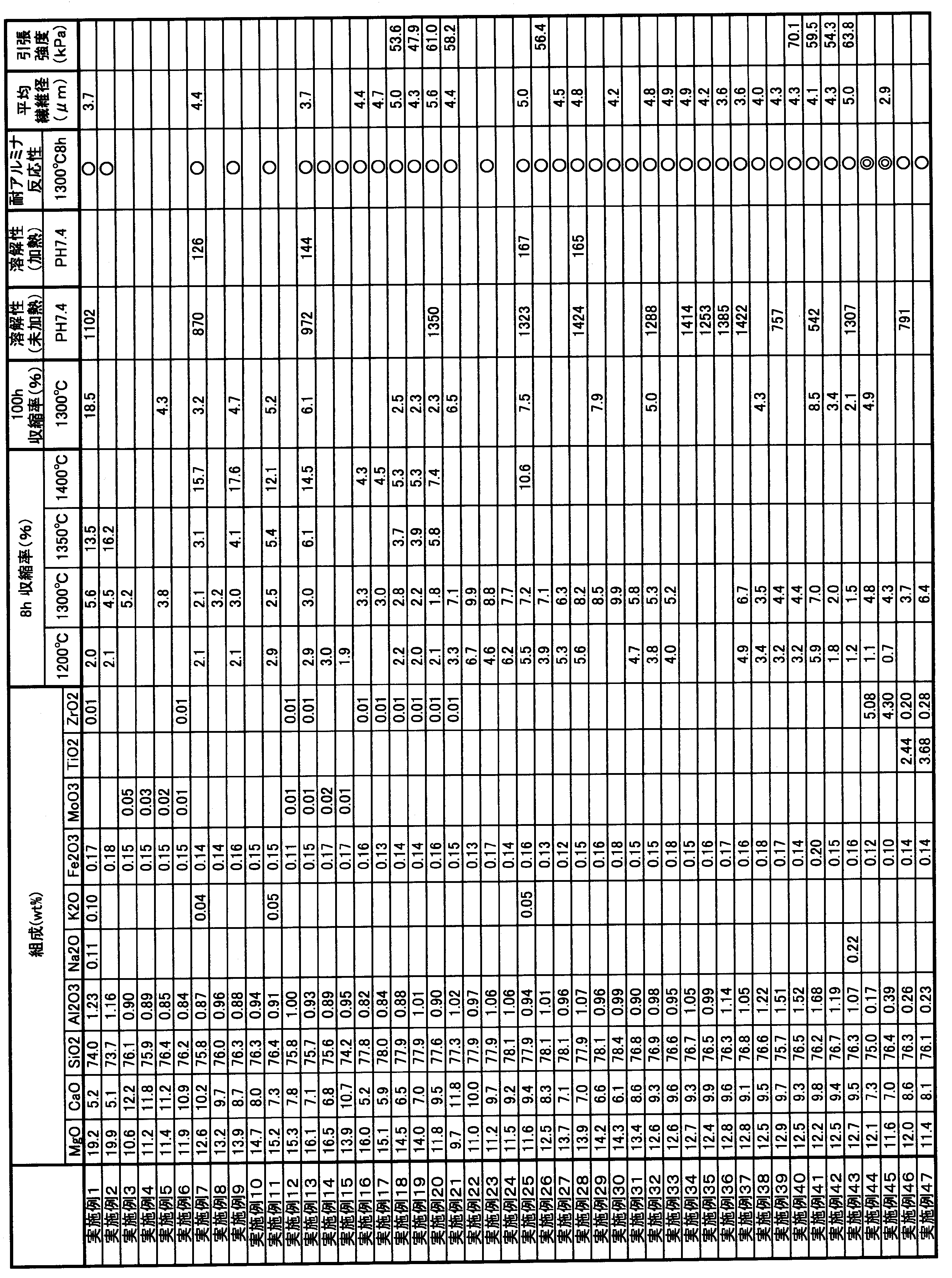
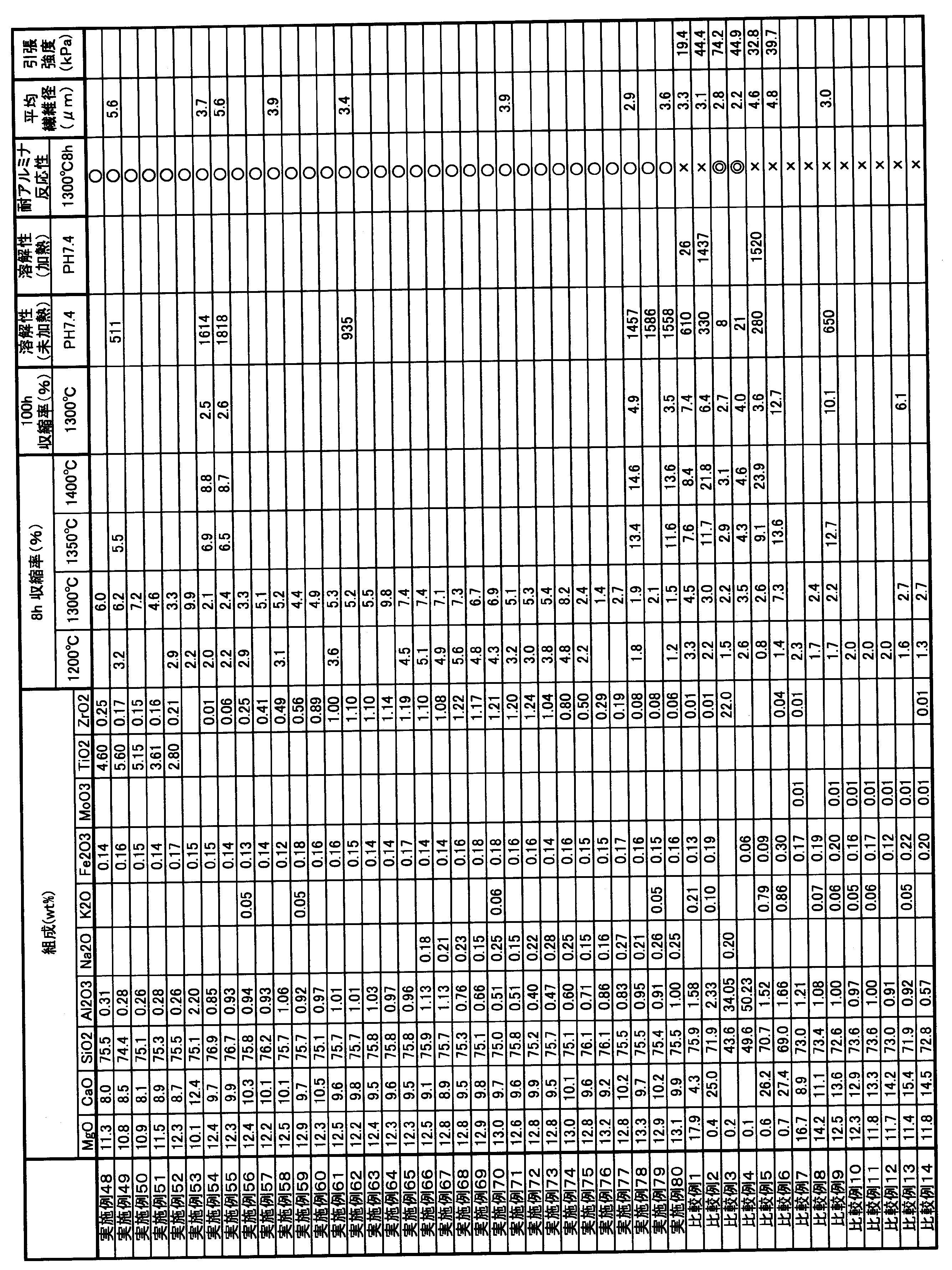
- Examples 1 to 80, Comparative Examples 1 to 14 Fibers having the compositions shown in Tables 1 and 2 were produced by a melting method and evaluated by the following methods. The results are shown in Tables 1 and 2.
- surface shows that it is below a detection limit (less than about 0.01 weight%).
- the heat shrinkage rate was measured as an evaluation of the heat resistance of the fiber.
- the heat shrinkage rate of the fiber is before and after the fleece or blanket (length: 150 mm, width: 50 mm, thickness: 5-50 mm) is manufactured from the fiber and fired at a predetermined temperature of 1200 ° C.-1400 ° C. for 8 hours or 100 hours. It was measured. Two or more platinum pins were driven into the surface of each manufactured sample, the distance between the platinum pins was measured before and after heating, and the dimensional change rate was defined as the heat shrinkage rate.
- alumina resistance About 1 g of alumina powder with a purity of 99% or more was press-molded with a 17 mm diameter mold into pellets. This pellet was placed on a fleece-like or blanket (length: 50 mm, thickness: 5-50 mm) sample made from fiber, and heated in this state at 1300 ° C. for 8 hours to confirm the reactivity after heating. ⁇ if there is no reaction with the pellet ⁇ , light adhesion to the sample (the pellet is easily peeled off by hand, the pellet and sample are not melted) ⁇ , there is a reaction (the pellet and sample melt and adhere) ) was marked with x.
- the biosolubility of unheated fiber and fiber heat-treated at 1300 ° C. for 8 hours was measured by the following method.
- the fiber was placed on a membrane filter, pH 7.4 physiological saline was dropped onto the fiber with a micropump, and the filtrate that passed through the fiber and filter was stored in a container.
- the collected filtrate was taken out after 24 hours, and the eluted components were quantified with an ICP emission spectrometer, and the solubility was calculated.
- the measurement elements were three elements of Si, Mg and Ca which are main elements.
- the average fiber diameter was measured and converted to a dissolution rate constant (unit: ng / cm 2 ⁇ h) which is the amount of elution per unit surface area / unit time.
- Average fiber diameter After observing and photographing 400 or more fibers with an electron microscope, the diameter of the photographed fibers was measured, and the average value of all the measured fibers was defined as the average fiber diameter.
- the fiber was subjected to needling treatment to produce a blanket, and the tensile strength was measured with a universal testing machine.
- a sample having a density of about 128 kg / m 3 , a width of 50 mm, and a thickness of 25 mm was used.
- the test conditions were that both ends were chucked so that the span was 100 mm, and the tensile speed was 20 mm / min. The maximum load applied when the test piece broke was taken as the tensile strength.
- the inorganic fiber of the present invention can be used for various purposes as a heat insulating material or as a substitute for asbestos.
Landscapes
- Chemical & Material Sciences (AREA)
- Engineering & Computer Science (AREA)
- Life Sciences & Earth Sciences (AREA)
- General Chemical & Material Sciences (AREA)
- Chemical Kinetics & Catalysis (AREA)
- Organic Chemistry (AREA)
- Geochemistry & Mineralogy (AREA)
- Materials Engineering (AREA)
- Textile Engineering (AREA)
- Mechanical Engineering (AREA)
- General Engineering & Computer Science (AREA)
- Biodiversity & Conservation Biology (AREA)
- Health & Medical Sciences (AREA)
- Molecular Biology (AREA)
- Inorganic Fibers (AREA)
- Glass Compositions (AREA)
Abstract
Description
1.SiO2、MgO及びCaOの3成分を主成分とし、以下の組成を有する無機繊維。
SiO2:73.6重量%~85.9重量%
MgO:9.0重量%~15.0重量%
CaO:5.1重量%~12.4重量%
Al2O3:0重量%以上2.3重量%未満
Fe2O3:0重量%~0.50重量%
SrO:0.1重量%未満
2.以下の組成を有する1記載の無機繊維。
SiO2:74.0重量%~80.0重量%
MgO:9.0重量%~15.0重量%
CaO:5.1重量%~12.4重量%
Al2O3:0重量%以上2.3重量%未満
Fe2O3:0重量%~0.50重量%
SrO:0.1重量%未満
3.MgOを9.0重量%~14.0重量%含む1又は2記載の無機繊維。
4.Al2O3を0.17重量%~2.2重量%含む1~3のいずれか記載の無機繊維。
5.ZrO2を0.1重量%超10.9重量%以下含む1~4のいずれか記載の無機繊維。
6.TiO2を0.1重量%超10.9重量%以下含む1~5のいずれか記載の無機繊維。
7.アルカリ金属酸化物を、0.01mol%超0.20mol%未満含む1~6のいずれか記載の無機繊維。
8.B2O3を0.1重量%未満を含む1~7のいずれか記載の無機繊維。
9.SiO2、MgO及びCaOの量の合計が、90.0重量%以上である1~8のいずれか記載の無機繊維。
10.SiO2、MgO及びCaOの量の合計が、93.0重量%以上である1~9のいずれか記載の無機繊維。
11.SiO2、MgO及びCaOの量の合計が、96.0重量%以上である1~10のいずれか記載の無機繊維。
12.1~11のいずれか記載の無機繊維を用いて製造された二次製品又は複合材料。
SiO2:73.6重量%~85.9重量%
MgO:9.0重量%~21.3重量%
CaO:5.1重量%~12.4重量%
Al2O3:0重量%以上2.3重量%未満
Fe2O3:0重量%~0.50重量%
SiO2:74.0重量%~80.0重量%
MgO:9.0重量%~18.0重量%
CaO:5.1重量%~12.4重量%
SiO2:74.2重量%~78.4重量%
MgO:9.7重量%~16.1重量%
CaO:5.2重量%~12.2重量%
特定する成分以外の残りは他の元素の酸化物又は不純物等である。
SiO2:73.6重量%~85.9重量%
MgO:9.0重量%~21.3重量%
CaO:5.1重量%~12.4重量%
Al2O3:2.3重量%未満
Fe2O3:0重量%~0.50重量%
ZrO2:0.00重量%~0.05重量%
SiO2:73.6重量%~85.9重量%
MgO:9.0重量%~21.3重量%
CaO:5.1重量%~12.4重量%
Al2O3:2.3重量%未満
ZrO2:3.0重量%~7.0重量%
SiO2:73.6重量%~85.9重量%
MgO:9.0重量%~21.3重量%
CaO:5.1重量%~12.4重量%
Al2O3:2.3重量%未満
ZrO2:0.0重量%~7.0重量%
TiO2:0.5重量%~8.0重量%、
また、アルカリ金属酸化物の量を、0.01mol%超0.20mol%未満としてもよい。
加熱処理する場合は、繊維形状を維持する温度であればよい。加熱温度、加熱時間により繊維物性が変化するので適宜所望の性能(耐クリープ性、収縮率、強度、弾性)がでるように処理すればよい。
所定の加熱処理により無機繊維は非晶質から結晶質へ変化するが、上記の記載のように所望の性能がでればよく、非晶質、結晶質のどちらの状態でもよく、非晶質、結晶質部分がそれぞれが混在している状態でもよい。
加熱温度は、好ましくは、600℃以上、800℃以上、さらに好ましくは1000℃以上、1200℃以上、1300℃以上、1400℃以上でよく、600℃~1400℃、さらに好ましくは、700℃~1200℃、800℃~1200℃、700℃~1000℃、800℃~1000℃である。
表1,2に示す組成を有する繊維を溶融法で製造し、以下の方法で評価した。結果を表1,2に示す。尚、表中の組成の空欄は検出限界以下(約0.01重量%未満)であることを示す。
繊維の耐熱性の評価として加熱収縮率を測定した。
繊維の加熱収縮率は、繊維からフリース又はブランケット(長さ150mm、幅50mm、厚み5~50mm)を製造して、1200℃~1400℃の所定の温度で、8時間又は100時間焼成した前後で測定した。
製造した各サンプル表面に白金ピンを2点以上打ち込み、その白金ピン間の距離を加熱前後で測定し、その寸法変化率を加熱収縮率とした。
純度99%以上のアルミナ粉末約1gを、直径17mmの金型でプレス成形しペレットとした。このペレットを、繊維から製造したフリース状又はブランケット(縦横50mm、厚み5~50mm)のサンプル上に置いて、この状態で1300℃で8時間加熱し、加熱後の反応性を確認した。ペレットと全く反応していない場合を◎、サンプルと軽い付着(簡単に手でペレットがはがせ、外観でペレットとサンプルが溶融していない状態)を○、反応有り(ペレットとサンプルが溶融し付着している状態)を×とした。
以下の方法で、未加熱の繊維及び1300℃で8時間加熱処理した繊維の生体溶解性を測定した。
繊維を、メンブレンフィルター上に置き、繊維上にマイクロポンプによりpH7.4の生理食塩水を滴下させ、繊維、フィルターを通った濾液を容器内に溜めた。溜めた濾液を24時間経過後に取り出し、溶出成分をICP発光分析装置により定量し、溶解度を算出した。測定元素は主要元素であるSi、Mg、Caの3元素とした。平均繊維径を測定して単位表面積・単位時間当たりの溶出量である溶解速度定数(単位:ng/cm2・h)に換算した。
400本以上の繊維を、電子顕微鏡で観察・撮影した後、撮影した繊維について、その径を計測し、全計測繊維の平均値を平均繊維径とした。
繊維にニードリング処理を施しブランケットを製造して、万能試験機にて引張強度を測定した。ブランケットは、密度約128kg/m3、幅50mm、厚さ25mmのサンプルを使用した。試験条件は、スパンが100mmとなるように両端をチャックし、引張速度は20mm/分とした。試験片が破壊した際の最大負荷加重を引張強度とした。
この明細書に記載の文献の内容を全てここに援用する。
Claims (12)
- SiO2、MgO及びCaOの3成分を主成分とし、以下の組成を有する無機繊維。
SiO2:73.6重量%~85.9重量%
MgO:9.0重量%~15.0重量%
CaO:5.1重量%~12.4重量%
Al2O3:0重量%以上2.3重量%未満
Fe2O3:0重量%~0.50重量%
SrO:0.1重量%未満 - 以下の組成を有する請求項1記載の無機繊維。
SiO2:74.0重量%~80.0重量%
MgO:9.0重量%~15.0重量%
CaO:5.1重量%~12.4重量%
Al2O3:0重量%以上2.3重量%未満
Fe2O3:0重量%~0.50重量%
SrO:0.1重量%未満 - MgOを9.0重量%~14.0重量%含む請求項1又は2記載の無機繊維。
- Al2O3を0.17重量%~2.2重量%含む請求項1~3のいずれか記載の無機繊維。
- ZrO2を0.1重量%超10.9重量%以下含む請求項1~4のいずれか記載の無機繊維。
- TiO2を0.1重量%超10.9重量%以下含む請求項1~5のいずれか記載の無機繊維。
- アルカリ金属酸化物を、0.01mol%超0.20mol%未満含む請求項1~6のいずれか記載の無機繊維。
- B2O3を0.1重量%未満を含む請求項1~7のいずれか記載の無機繊維。
- SiO2、MgO及びCaOの量の合計が、90.0重量%以上である請求項1~8のいずれか記載の無機繊維。
- SiO2、MgO及びCaOの量の合計が、93.0重量%以上である請求項1~9のいずれか記載の無機繊維。
- SiO2、MgO及びCaOの量の合計が、96.0重量%以上である請求項1~10のいずれか記載の無機繊維。
- 請求項1~11のいずれか記載の無機繊維を用いて製造された二次製品又は複合材料。
Priority Applications (5)
| Application Number | Priority Date | Filing Date | Title |
|---|---|---|---|
| EP14899219.1A EP3178795B1 (en) | 2014-08-08 | 2014-10-15 | Bio-soluble inorganic fiber |
| US15/324,046 US9932264B2 (en) | 2014-08-08 | 2014-10-15 | Bio-soluble inorganic fiber |
| CN201480081023.8A CN106573828A (zh) | 2014-08-08 | 2014-10-15 | 生物可溶性无机纤维 |
| KR1020177003517A KR20170029573A (ko) | 2014-08-08 | 2014-10-15 | 생체 용해성 무기섬유 |
| KR1020197012443A KR102168895B1 (ko) | 2014-08-08 | 2014-10-15 | 생체 용해성 무기섬유 |
Applications Claiming Priority (2)
| Application Number | Priority Date | Filing Date | Title |
|---|---|---|---|
| JP2014-163059 | 2014-08-08 | ||
| JP2014163059A JP5634637B1 (ja) | 2014-08-08 | 2014-08-08 | 生体溶解性無機繊維 |
Publications (1)
| Publication Number | Publication Date |
|---|---|
| WO2016020959A1 true WO2016020959A1 (ja) | 2016-02-11 |
Family
ID=52139044
Family Applications (1)
| Application Number | Title | Priority Date | Filing Date |
|---|---|---|---|
| PCT/JP2014/005215 Ceased WO2016020959A1 (ja) | 2014-08-08 | 2014-10-15 | 生体溶解性無機繊維 |
Country Status (8)
| Country | Link |
|---|---|
| US (1) | US9932264B2 (ja) |
| EP (1) | EP3178795B1 (ja) |
| JP (1) | JP5634637B1 (ja) |
| KR (2) | KR102168895B1 (ja) |
| CN (1) | CN106573828A (ja) |
| MY (1) | MY177825A (ja) |
| TW (1) | TWI649284B (ja) |
| WO (1) | WO2016020959A1 (ja) |
Cited By (2)
| Publication number | Priority date | Publication date | Assignee | Title |
|---|---|---|---|---|
| JP2018153777A (ja) * | 2017-03-21 | 2018-10-04 | 株式会社日本触媒 | アクリル酸製造用触媒ならびに該触媒を用いたアクリル酸の製造方法 |
| JP2019171335A (ja) * | 2018-03-29 | 2019-10-10 | 株式会社日本触媒 | 不飽和アルデヒドおよび/または不飽和カルボン酸製造用触媒および該触媒を用いた不飽和アルデヒドおよび/または不飽和カルボン酸の製造方法 |
Families Citing this family (10)
| Publication number | Priority date | Publication date | Assignee | Title |
|---|---|---|---|---|
| JP6630136B2 (ja) * | 2015-11-27 | 2020-01-15 | 曙ブレーキ工業株式会社 | 摩擦材 |
| WO2017127501A1 (en) * | 2016-01-19 | 2017-07-27 | Unifrax I Llc | Inorganic fiber |
| KR102458534B1 (ko) * | 2016-06-10 | 2022-10-27 | 락울 에이/에스 | 마찰 재료 |
| WO2019074794A1 (en) | 2017-10-10 | 2019-04-18 | Unifrax 1 Llc | INORGANIC FIBER WITH LOW BIOPERSISTANCE EXEMPT FROM CRYSTALLINE SILICA |
| CN109928641B (zh) | 2017-12-19 | 2022-11-15 | 欧文斯科宁知识产权资产有限公司 | 高性能玻璃纤维组合物 |
| JP6634459B2 (ja) * | 2018-02-20 | 2020-01-22 | ニチアス株式会社 | 膨張性シート |
| JP7176905B2 (ja) * | 2018-09-21 | 2022-11-22 | ニチアス株式会社 | 不燃性バックアップ材及びその製造方法 |
| KR102780160B1 (ko) * | 2020-08-26 | 2025-03-12 | 주식회사 케이씨씨 | 세라믹 섬유 조성물 및 이로부터 제조된 세라믹 섬유 |
| CN116568647A (zh) * | 2020-12-11 | 2023-08-08 | 尤尼弗瑞克斯 I 有限责任公司 | 低生物持久性耐高温无机纤维 |
| KR102468065B1 (ko) * | 2022-08-29 | 2022-11-18 | 케이알에스티대한동방(주) | 생체용해성 섬유가 포함된 판유리 제조용 롤 디스크, 그것으로 제작된 롤 및 그 롤 디스크의 제조방법 |
Citations (4)
| Publication number | Priority date | Publication date | Assignee | Title |
|---|---|---|---|---|
| JP2004036050A (ja) * | 2002-07-05 | 2004-02-05 | Saint-Gobain Tm Kk | 耐水性および生体溶解性を有する無機繊維とその製造方法 |
| JP2005515307A (ja) * | 2002-01-10 | 2005-05-26 | ユニフラックス コーポレイション | 高温耐性ガラス質無機繊維 |
| JP4977253B1 (ja) * | 2011-03-30 | 2012-07-18 | ニチアス株式会社 | 無機繊維質ペーパー及びその製造方法並びに設備 |
| JP5006979B1 (ja) * | 2011-03-31 | 2012-08-22 | ニチアス株式会社 | 生体溶解性無機繊維の製造方法 |
Family Cites Families (15)
| Publication number | Priority date | Publication date | Assignee | Title |
|---|---|---|---|---|
| NZ246629A (en) * | 1992-01-17 | 1997-07-27 | Morgan Crucible Co | Saline soluble fibres for refractory insulation comprising greater than 58 percent by weight of silicon dioxide |
| KR100469776B1 (ko) | 1995-10-30 | 2005-09-16 | 유니프랙스 코포레이션 | 내고온성유리섬유 |
| JP4066138B2 (ja) | 1999-09-10 | 2008-03-26 | ザ・モーガン・クルーシブル・カンパニー・ピーエルシー | 高温耐性塩類液可溶性繊維 |
| JP4019111B2 (ja) * | 2001-04-09 | 2007-12-12 | サンゴバン・ティーエム株式会社 | 生理食塩水に可溶な無機繊維とその製造方法 |
| US7875566B2 (en) | 2004-11-01 | 2011-01-25 | The Morgan Crucible Company Plc | Modification of alkaline earth silicate fibres |
| MX2007005117A (es) | 2004-11-01 | 2007-07-04 | Morgan Crucible Co | Modificacion de fibras de silicato alcalinoterreo. |
| EP2086897B1 (en) | 2006-11-28 | 2010-11-17 | The Morgan Crucible Company Plc | Inorganic fibre compositions |
| JP4975179B2 (ja) * | 2010-10-14 | 2012-07-11 | ニチアス株式会社 | 無機繊維質成形体及びその製造方法並びに加熱設備 |
| JP4862099B1 (ja) | 2010-12-28 | 2012-01-25 | ニチアス株式会社 | 生体溶解性無機繊維 |
| US20120171486A1 (en) | 2010-12-29 | 2012-07-05 | Nichias Corporation | Biosoluble inorganic fiber |
| US20120168665A1 (en) | 2010-12-28 | 2012-07-05 | Nichias Corporation | Biosoluble inorganic fiber |
| JP5015336B1 (ja) * | 2011-03-31 | 2012-08-29 | ニチアス株式会社 | 無機繊維質ペーパー及びその製造方法 |
| US8940134B2 (en) * | 2011-04-05 | 2015-01-27 | Nichias Corporation | Paper comprising heat treated bio-soluble inorganic fibers, and method and equipment for making same |
| JP5138806B1 (ja) * | 2011-12-01 | 2013-02-06 | ニチアス株式会社 | 生体溶解性無機繊維及びその製造方法 |
| JP5277337B1 (ja) * | 2012-05-22 | 2013-08-28 | ニチアス株式会社 | 加熱装置 |
-
2014
- 2014-08-08 JP JP2014163059A patent/JP5634637B1/ja active Active
- 2014-08-20 TW TW103128628A patent/TWI649284B/zh active
- 2014-10-15 MY MYPI2017700058A patent/MY177825A/en unknown
- 2014-10-15 WO PCT/JP2014/005215 patent/WO2016020959A1/ja not_active Ceased
- 2014-10-15 KR KR1020197012443A patent/KR102168895B1/ko active Active
- 2014-10-15 CN CN201480081023.8A patent/CN106573828A/zh active Pending
- 2014-10-15 US US15/324,046 patent/US9932264B2/en active Active
- 2014-10-15 EP EP14899219.1A patent/EP3178795B1/en active Active
- 2014-10-15 KR KR1020177003517A patent/KR20170029573A/ko not_active Ceased
Patent Citations (4)
| Publication number | Priority date | Publication date | Assignee | Title |
|---|---|---|---|---|
| JP2005515307A (ja) * | 2002-01-10 | 2005-05-26 | ユニフラックス コーポレイション | 高温耐性ガラス質無機繊維 |
| JP2004036050A (ja) * | 2002-07-05 | 2004-02-05 | Saint-Gobain Tm Kk | 耐水性および生体溶解性を有する無機繊維とその製造方法 |
| JP4977253B1 (ja) * | 2011-03-30 | 2012-07-18 | ニチアス株式会社 | 無機繊維質ペーパー及びその製造方法並びに設備 |
| JP5006979B1 (ja) * | 2011-03-31 | 2012-08-22 | ニチアス株式会社 | 生体溶解性無機繊維の製造方法 |
Non-Patent Citations (1)
| Title |
|---|
| See also references of EP3178795A4 * |
Cited By (2)
| Publication number | Priority date | Publication date | Assignee | Title |
|---|---|---|---|---|
| JP2018153777A (ja) * | 2017-03-21 | 2018-10-04 | 株式会社日本触媒 | アクリル酸製造用触媒ならびに該触媒を用いたアクリル酸の製造方法 |
| JP2019171335A (ja) * | 2018-03-29 | 2019-10-10 | 株式会社日本触媒 | 不飽和アルデヒドおよび/または不飽和カルボン酸製造用触媒および該触媒を用いた不飽和アルデヒドおよび/または不飽和カルボン酸の製造方法 |
Also Published As
| Publication number | Publication date |
|---|---|
| US20170197872A1 (en) | 2017-07-13 |
| KR102168895B1 (ko) | 2020-10-22 |
| EP3178795B1 (en) | 2024-05-01 |
| TW201605753A (zh) | 2016-02-16 |
| KR20170029573A (ko) | 2017-03-15 |
| EP3178795A4 (en) | 2018-03-07 |
| JP5634637B1 (ja) | 2014-12-03 |
| KR20190047744A (ko) | 2019-05-08 |
| EP3178795A1 (en) | 2017-06-14 |
| TWI649284B (zh) | 2019-02-01 |
| MY177825A (en) | 2020-09-23 |
| CN106573828A (zh) | 2017-04-19 |
| JP2016037427A (ja) | 2016-03-22 |
| US9932264B2 (en) | 2018-04-03 |
Similar Documents
| Publication | Publication Date | Title |
|---|---|---|
| JP5634637B1 (ja) | 生体溶解性無機繊維 | |
| JP6554269B2 (ja) | 生体溶解性無機繊維の製造方法 | |
| JP6266250B2 (ja) | 耐熱無機繊維 | |
| JP6634459B2 (ja) | 膨張性シート | |
| JP6386232B2 (ja) | 表面改質無機繊維及びその製造方法 | |
| JP6348843B2 (ja) | 生体溶解性無機繊維及びその組成物 | |
| JP6212040B2 (ja) | 耐熱無機繊維 | |
| WO2014045527A1 (ja) | 耐熱性を有する生体溶解性無機繊維及びその組成物 | |
| WO2013111232A1 (ja) | 無機繊維質定形体及びその硬度の調整方法 | |
| JP6513905B2 (ja) | 生体溶解性無機繊維 | |
| WO2013132858A1 (ja) | 生理食塩水に可溶なLa/Ce含有無機繊維及びその組成物 | |
| JP6453824B2 (ja) | 無機繊維質成形体 | |
| JPWO2013132859A1 (ja) | 生理食塩水に可溶なSr/Ba含有無機繊維及びその組成物 | |
| WO2013183241A1 (ja) | 生理食塩水に可溶なAl-Ca系無機繊維及びその組成物 | |
| WO2014020842A1 (ja) | Si/Al/Ca含有無機繊維 |
Legal Events
| Date | Code | Title | Description |
|---|---|---|---|
| 121 | Ep: the epo has been informed by wipo that ep was designated in this application |
Ref document number: 14899219 Country of ref document: EP Kind code of ref document: A1 |
|
| WWE | Wipo information: entry into national phase |
Ref document number: 15324046 Country of ref document: US |
|
| REEP | Request for entry into the european phase |
Ref document number: 2014899219 Country of ref document: EP |
|
| WWE | Wipo information: entry into national phase |
Ref document number: 2014899219 Country of ref document: EP |
|
| ENP | Entry into the national phase |
Ref document number: 20177003517 Country of ref document: KR Kind code of ref document: A |
|
| NENP | Non-entry into the national phase |
Ref country code: DE |