WO2016035527A1 - 車両用ガラス物品 - Google Patents
車両用ガラス物品 Download PDFInfo
- Publication number
- WO2016035527A1 WO2016035527A1 PCT/JP2015/072841 JP2015072841W WO2016035527A1 WO 2016035527 A1 WO2016035527 A1 WO 2016035527A1 JP 2015072841 W JP2015072841 W JP 2015072841W WO 2016035527 A1 WO2016035527 A1 WO 2016035527A1
- Authority
- WO
- WIPO (PCT)
- Prior art keywords
- glass
- thin plate
- functional film
- adhesive
- windshield
- Prior art date
- Legal status (The legal status is an assumption and is not a legal conclusion. Google has not performed a legal analysis and makes no representation as to the accuracy of the status listed.)
- Ceased
Links
Images


Classifications
-
- B—PERFORMING OPERATIONS; TRANSPORTING
- B32—LAYERED PRODUCTS
- B32B—LAYERED PRODUCTS, i.e. PRODUCTS BUILT-UP OF STRATA OF FLAT OR NON-FLAT, e.g. CELLULAR OR HONEYCOMB, FORM
- B32B17/00—Layered products essentially comprising sheet glass, or glass, slag, or like fibres
- B32B17/06—Layered products essentially comprising sheet glass, or glass, slag, or like fibres comprising glass as the main or only constituent of a layer, next to another layer of a specific material
-
- B—PERFORMING OPERATIONS; TRANSPORTING
- B32—LAYERED PRODUCTS
- B32B—LAYERED PRODUCTS, i.e. PRODUCTS BUILT-UP OF STRATA OF FLAT OR NON-FLAT, e.g. CELLULAR OR HONEYCOMB, FORM
- B32B17/00—Layered products essentially comprising sheet glass, or glass, slag, or like fibres
- B32B17/06—Layered products essentially comprising sheet glass, or glass, slag, or like fibres comprising glass as the main or only constituent of a layer, next to another layer of a specific material
- B32B17/10—Layered products essentially comprising sheet glass, or glass, slag, or like fibres comprising glass as the main or only constituent of a layer, next to another layer of a specific material of synthetic resin
- B32B17/10005—Layered products essentially comprising sheet glass, or glass, slag, or like fibres comprising glass as the main or only constituent of a layer, next to another layer of a specific material of synthetic resin laminated safety glass or glazing
- B32B17/10165—Functional features of the laminated safety glass or glazing
- B32B17/10339—Specific parts of the laminated safety glass or glazing being colored or tinted
- B32B17/10348—Specific parts of the laminated safety glass or glazing being colored or tinted comprising an obscuration band
-
- B—PERFORMING OPERATIONS; TRANSPORTING
- B32—LAYERED PRODUCTS
- B32B—LAYERED PRODUCTS, i.e. PRODUCTS BUILT-UP OF STRATA OF FLAT OR NON-FLAT, e.g. CELLULAR OR HONEYCOMB, FORM
- B32B17/00—Layered products essentially comprising sheet glass, or glass, slag, or like fibres
- B32B17/06—Layered products essentially comprising sheet glass, or glass, slag, or like fibres comprising glass as the main or only constituent of a layer, next to another layer of a specific material
- B32B17/10—Layered products essentially comprising sheet glass, or glass, slag, or like fibres comprising glass as the main or only constituent of a layer, next to another layer of a specific material of synthetic resin
- B32B17/10005—Layered products essentially comprising sheet glass, or glass, slag, or like fibres comprising glass as the main or only constituent of a layer, next to another layer of a specific material of synthetic resin laminated safety glass or glazing
- B32B17/1055—Layered products essentially comprising sheet glass, or glass, slag, or like fibres comprising glass as the main or only constituent of a layer, next to another layer of a specific material of synthetic resin laminated safety glass or glazing characterized by the resin layer, i.e. interlayer
- B32B17/10761—Layered products essentially comprising sheet glass, or glass, slag, or like fibres comprising glass as the main or only constituent of a layer, next to another layer of a specific material of synthetic resin laminated safety glass or glazing characterized by the resin layer, i.e. interlayer containing vinyl acetal
-
- B—PERFORMING OPERATIONS; TRANSPORTING
- B32—LAYERED PRODUCTS
- B32B—LAYERED PRODUCTS, i.e. PRODUCTS BUILT-UP OF STRATA OF FLAT OR NON-FLAT, e.g. CELLULAR OR HONEYCOMB, FORM
- B32B27/00—Layered products comprising a layer of synthetic resin
- B32B27/06—Layered products comprising a layer of synthetic resin as the main or only constituent of a layer, which is next to another layer of the same or of a different material
-
- B—PERFORMING OPERATIONS; TRANSPORTING
- B32—LAYERED PRODUCTS
- B32B—LAYERED PRODUCTS, i.e. PRODUCTS BUILT-UP OF STRATA OF FLAT OR NON-FLAT, e.g. CELLULAR OR HONEYCOMB, FORM
- B32B27/00—Layered products comprising a layer of synthetic resin
- B32B27/30—Layered products comprising a layer of synthetic resin comprising vinyl (co)polymers; comprising acrylic (co)polymers
- B32B27/306—Layered products comprising a layer of synthetic resin comprising vinyl (co)polymers; comprising acrylic (co)polymers comprising vinyl acetate or vinyl alcohol (co)polymers
-
- B—PERFORMING OPERATIONS; TRANSPORTING
- B32—LAYERED PRODUCTS
- B32B—LAYERED PRODUCTS, i.e. PRODUCTS BUILT-UP OF STRATA OF FLAT OR NON-FLAT, e.g. CELLULAR OR HONEYCOMB, FORM
- B32B27/00—Layered products comprising a layer of synthetic resin
- B32B27/30—Layered products comprising a layer of synthetic resin comprising vinyl (co)polymers; comprising acrylic (co)polymers
- B32B27/308—Layered products comprising a layer of synthetic resin comprising vinyl (co)polymers; comprising acrylic (co)polymers comprising acrylic (co)polymers
-
- B—PERFORMING OPERATIONS; TRANSPORTING
- B32—LAYERED PRODUCTS
- B32B—LAYERED PRODUCTS, i.e. PRODUCTS BUILT-UP OF STRATA OF FLAT OR NON-FLAT, e.g. CELLULAR OR HONEYCOMB, FORM
- B32B27/00—Layered products comprising a layer of synthetic resin
- B32B27/38—Layered products comprising a layer of synthetic resin comprising epoxy resins
-
- B—PERFORMING OPERATIONS; TRANSPORTING
- B32—LAYERED PRODUCTS
- B32B—LAYERED PRODUCTS, i.e. PRODUCTS BUILT-UP OF STRATA OF FLAT OR NON-FLAT, e.g. CELLULAR OR HONEYCOMB, FORM
- B32B27/00—Layered products comprising a layer of synthetic resin
- B32B27/40—Layered products comprising a layer of synthetic resin comprising polyurethanes
-
- B—PERFORMING OPERATIONS; TRANSPORTING
- B32—LAYERED PRODUCTS
- B32B—LAYERED PRODUCTS, i.e. PRODUCTS BUILT-UP OF STRATA OF FLAT OR NON-FLAT, e.g. CELLULAR OR HONEYCOMB, FORM
- B32B3/00—Layered products comprising a layer with external or internal discontinuities or unevennesses, or a layer of non-planar shape; Layered products comprising a layer having particular features of form
- B32B3/02—Layered products comprising a layer with external or internal discontinuities or unevennesses, or a layer of non-planar shape; Layered products comprising a layer having particular features of form characterised by features of form at particular places, e.g. in edge regions
- B32B3/08—Layered products comprising a layer with external or internal discontinuities or unevennesses, or a layer of non-planar shape; Layered products comprising a layer having particular features of form characterised by features of form at particular places, e.g. in edge regions characterised by added members at particular parts
-
- B—PERFORMING OPERATIONS; TRANSPORTING
- B32—LAYERED PRODUCTS
- B32B—LAYERED PRODUCTS, i.e. PRODUCTS BUILT-UP OF STRATA OF FLAT OR NON-FLAT, e.g. CELLULAR OR HONEYCOMB, FORM
- B32B7/00—Layered products characterised by the relation between layers; Layered products characterised by the relative orientation of features between layers, or by the relative values of a measurable parameter between layers, i.e. products comprising layers having different physical, chemical or physicochemical properties; Layered products characterised by the interconnection of layers
- B32B7/04—Interconnection of layers
- B32B7/12—Interconnection of layers using interposed adhesives or interposed materials with bonding properties
-
- B—PERFORMING OPERATIONS; TRANSPORTING
- B60—VEHICLES IN GENERAL
- B60J—WINDOWS, WINDSCREENS, NON-FIXED ROOFS, DOORS, OR SIMILAR DEVICES FOR VEHICLES; REMOVABLE EXTERNAL PROTECTIVE COVERINGS SPECIALLY ADAPTED FOR VEHICLES
- B60J1/00—Windows; Windscreens; Accessories therefor
- B60J1/02—Windows; Windscreens; Accessories therefor arranged at the vehicle front, e.g. structure of the glazing, mounting of the glazing
-
- C—CHEMISTRY; METALLURGY
- C09—DYES; PAINTS; POLISHES; NATURAL RESINS; ADHESIVES; COMPOSITIONS NOT OTHERWISE PROVIDED FOR; APPLICATIONS OF MATERIALS NOT OTHERWISE PROVIDED FOR
- C09J—ADHESIVES; NON-MECHANICAL ASPECTS OF ADHESIVE PROCESSES IN GENERAL; ADHESIVE PROCESSES NOT PROVIDED FOR ELSEWHERE; USE OF MATERIALS AS ADHESIVES
- C09J201/00—Adhesives based on unspecified macromolecular compounds
-
- G—PHYSICS
- G09—EDUCATION; CRYPTOGRAPHY; DISPLAY; ADVERTISING; SEALS
- G09F—DISPLAYING; ADVERTISING; SIGNS; LABELS OR NAME-PLATES; SEALS
- G09F3/00—Labels, tag tickets, or similar identification or indication means; Seals; Postage or like stamps
- G09F3/08—Fastening or securing by means not forming part of the material of the label itself
- G09F3/10—Fastening or securing by means not forming part of the material of the label itself by an adhesive layer
-
- G—PHYSICS
- G09—EDUCATION; CRYPTOGRAPHY; DISPLAY; ADVERTISING; SEALS
- G09F—DISPLAYING; ADVERTISING; SIGNS; LABELS OR NAME-PLATES; SEALS
- G09F3/00—Labels, tag tickets, or similar identification or indication means; Seals; Postage or like stamps
- G09F3/08—Fastening or securing by means not forming part of the material of the label itself
- G09F3/18—Casings, frames or enclosures for labels
- G09F3/20—Casings, frames or enclosures for labels for adjustable, removable, or interchangeable labels
- G09F3/203—Casings, frames or enclosures for labels for adjustable, removable, or interchangeable labels specially adapted to be attached to a transparent surface, e.g. the window of a car
-
- B—PERFORMING OPERATIONS; TRANSPORTING
- B32—LAYERED PRODUCTS
- B32B—LAYERED PRODUCTS, i.e. PRODUCTS BUILT-UP OF STRATA OF FLAT OR NON-FLAT, e.g. CELLULAR OR HONEYCOMB, FORM
- B32B2250/00—Layers arrangement
- B32B2250/44—Number of layers variable across the laminate
-
- B—PERFORMING OPERATIONS; TRANSPORTING
- B32—LAYERED PRODUCTS
- B32B—LAYERED PRODUCTS, i.e. PRODUCTS BUILT-UP OF STRATA OF FLAT OR NON-FLAT, e.g. CELLULAR OR HONEYCOMB, FORM
- B32B2307/00—Properties of the layers or laminate
- B32B2307/40—Properties of the layers or laminate having particular optical properties
- B32B2307/416—Reflective
-
- B—PERFORMING OPERATIONS; TRANSPORTING
- B32—LAYERED PRODUCTS
- B32B—LAYERED PRODUCTS, i.e. PRODUCTS BUILT-UP OF STRATA OF FLAT OR NON-FLAT, e.g. CELLULAR OR HONEYCOMB, FORM
- B32B2307/00—Properties of the layers or laminate
- B32B2307/70—Other properties
- B32B2307/714—Inert, i.e. inert to chemical degradation, corrosion
- B32B2307/7145—Rot proof, resistant to bacteria, mildew, mould, fungi
-
- B—PERFORMING OPERATIONS; TRANSPORTING
- B32—LAYERED PRODUCTS
- B32B—LAYERED PRODUCTS, i.e. PRODUCTS BUILT-UP OF STRATA OF FLAT OR NON-FLAT, e.g. CELLULAR OR HONEYCOMB, FORM
- B32B2307/00—Properties of the layers or laminate
- B32B2307/70—Other properties
- B32B2307/72—Density
-
- B—PERFORMING OPERATIONS; TRANSPORTING
- B32—LAYERED PRODUCTS
- B32B—LAYERED PRODUCTS, i.e. PRODUCTS BUILT-UP OF STRATA OF FLAT OR NON-FLAT, e.g. CELLULAR OR HONEYCOMB, FORM
- B32B2307/00—Properties of the layers or laminate
- B32B2307/70—Other properties
- B32B2307/728—Hydrophilic
-
- B—PERFORMING OPERATIONS; TRANSPORTING
- B32—LAYERED PRODUCTS
- B32B—LAYERED PRODUCTS, i.e. PRODUCTS BUILT-UP OF STRATA OF FLAT OR NON-FLAT, e.g. CELLULAR OR HONEYCOMB, FORM
- B32B2307/00—Properties of the layers or laminate
- B32B2307/70—Other properties
- B32B2307/732—Dimensional properties
-
- B—PERFORMING OPERATIONS; TRANSPORTING
- B32—LAYERED PRODUCTS
- B32B—LAYERED PRODUCTS, i.e. PRODUCTS BUILT-UP OF STRATA OF FLAT OR NON-FLAT, e.g. CELLULAR OR HONEYCOMB, FORM
- B32B2309/00—Parameters for the laminating or treatment process; Apparatus details
- B32B2309/08—Dimensions, e.g. volume
- B32B2309/10—Dimensions, e.g. volume linear, e.g. length, distance, width
- B32B2309/105—Thickness
-
- B—PERFORMING OPERATIONS; TRANSPORTING
- B32—LAYERED PRODUCTS
- B32B—LAYERED PRODUCTS, i.e. PRODUCTS BUILT-UP OF STRATA OF FLAT OR NON-FLAT, e.g. CELLULAR OR HONEYCOMB, FORM
- B32B2605/00—Vehicles
- B32B2605/006—Transparent parts other than made from inorganic glass, e.g. polycarbonate glazings
-
- G—PHYSICS
- G09—EDUCATION; CRYPTOGRAPHY; DISPLAY; ADVERTISING; SEALS
- G09F—DISPLAYING; ADVERTISING; SIGNS; LABELS OR NAME-PLATES; SEALS
- G09F3/00—Labels, tag tickets, or similar identification or indication means; Seals; Postage or like stamps
- G09F3/02—Forms or constructions
- G09F2003/0222—Features for removal or adhesion, e.g. tabs
Definitions
- the present invention relates to a vehicle glass article, and more particularly to a vehicle glass article having a functional film on a glass substrate, wherein the functional film is damaged in peeling after an adhesive sheet is pasted and used on the functional film. It is related with the glass article for vehicles which can exfoliate an adhesive sheet.
- an adhesive sheet having an adhesive layer and a display layer is often attached to a vehicle glass article, and the application may be changed as necessary.
- an adhesive sheet such as a vehicle verification seal or an inspection seal is attached to the inner surface of a car windshield.
- These pressure-sensitive adhesive sheets are pasted with a high pressure-sensitive adhesive force so as not to be peeled off until the time of replacement. And at the time of pasting, the operation
- the windshield When the adhesive sheet is scraped off using the above-mentioned metal scraper, the windshield may be damaged, and measures to prevent it are considered.
- the adhesive sheet when sticking an adhesive sheet, stick the adhesive sheet on a base layer having an adhesive layer having a lower adhesive strength than the adhesive sheet, stick the base layer to the windshield via the adhesive layer, Has been proposed to peel off the adhesive sheet together with the base layer and the adhesive layer (see Patent Document 1).
- the present invention has been made from the above viewpoint, and in a glass article for vehicles having a functional film on a glass substrate, an adhesive sheet is stuck on the functional film, and the functional film is damaged in peeling after use. It aims at providing the glass article for vehicles which can exfoliate an adhesive sheet without it.
- the glass article for vehicles of the present invention is a glass substrate, a functional film formed on at least a part of the surface of the glass substrate, and bonded on the functional film, on the main surface opposite to the functional film side.
- the pressure-sensitive adhesive sheet in a glass article for a vehicle having a functional film on a glass substrate, can be peeled without damaging the functional film in the peeling after the pressure-sensitive adhesive sheet is stuck on the functional film and used.
- a vehicle glass article can be provided.
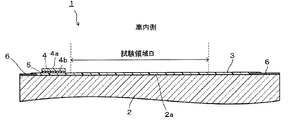
- FIG. 2 is a sectional view taken along the line XX of the automobile windshield shown in FIG. It is the enlarged front view seen from the vehicle inner side of the sticking part at the time of sticking an adhesive sheet to the windshield for motor vehicles shown in FIG.
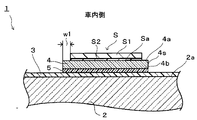
- FIG. 4 is a cross-sectional view taken along line YY of the adhesive sheet pasting portion of the automobile windshield shown in FIG. 3. It is the enlarged front view seen from the vehicle inner side of the sticking part at the time of sticking an adhesive sheet to another example of embodiment of the windshield for motor vehicles which is a glass article for vehicles of the present invention.
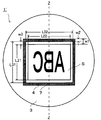
- FIG. 6 is a cross-sectional view taken along the line ZZ of the adhesive sheet pasting portion of the automobile windshield shown in FIG. 5.
- Examples of the vehicle in the vehicle glass article of the present invention include trains and automobiles, and examples of the glass article include window glass such as a windshield, side glass, and rear glass.
- the glass article for vehicles of the present invention is particularly suitably used for an automobile windshield.
- an embodiment of a vehicle glass article of the present invention will be described with reference to the drawings, taking an automobile windshield as an example.
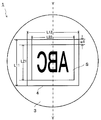
- FIG. 1 and FIG. 2 are a front view of an example of an embodiment of an automotive windshield, which is a vehicle glass article according to the present invention, as viewed from the inside of the vehicle, and a sectional view taken along line XX.
- 3 and 4 are an enlarged front view and a cross-sectional view taken along the line YY when the adhesive sheet is attached to the automobile windshield shown in FIG.
- FIG. 1 The front view of Fig. 1 corresponds to the front windshield for automobiles.
- the cross-sectional view of FIG. 2 is a cross-sectional view in which the left side is on an automobile windshield.
- the notations “upper” and “lower” used in the following description indicate upper and lower when the automobile windshield is mounted on the automobile, respectively.
- “inside the vehicle” indicates the inside of the vehicle when the vehicle windshield is mounted on the vehicle.
- an automotive windshield 1 includes a glass substrate 2 and a black ceramic layer 6 that is a black layer formed in a frame shape on the periphery of the main surface 2a on the inner side of the glass substrate 2;
- the functional film 3 is provided on the main surface 2a on the vehicle inner side of the glass substrate 2 so that the end portion is inside the end portion of the glass substrate 2 and in the region where the black ceramic layer 6 is formed.
- a black ceramic layer is not essential but is a layer provided arbitrarily.
- the automotive windshield 1 has an adhesive layer 5 and a glass thin plate 4 in that order on a part of the functional film 3.
- the glass thin plate 4 is provided for attaching an adhesive sheet S having an adhesive surface Sa smaller than the main surface 4a on the main surface 4a opposite to the main surface 4b on the functional film 3 side.
- windshieldshield each component constituting the automobile windshield (hereinafter also simply referred to as “windshield”) 1 will be described.
- Glass substrate examples of the material of the glass substrate 2 used for the front glass 1 include ordinary soda lime glass (also referred to as soda lime silicate glass), aluminosilicate glass, borosilicate glass, alkali-free borosilicate glass, and quartz glass. Of these, soda lime glass is particularly preferable as the glass substrate 2.
- a method for forming the glass substrate 2 is not particularly limited. In the case of the windshield 1, for example, a glass substrate 2 formed by a float method or the like is preferable.
- a glass substrate made of glass or tempered glass that absorbs ultraviolet rays or infrared rays can be used.
- a laminated glass in which a plurality of glass plates are bonded with an intermediate film interposed therebetween may be used.
- the shape of the glass substrate 2 may be a flat plate, or the entire surface or a part thereof may have a curvature.
- the thickness of the glass substrate 2 can be selected as appropriate. In the case of the windshield 1, the thickness of the glass substrate 2 is preferably 3.5 to 5.5 mm.
- the sum of the thickness of two glass plates and the thickness of the intermediate film is preferably in the numerical range.
- the glass article for vehicles of this invention is other than a windshield
- the glass of the material similar to the above is suitably selected according to a use.
- the shape, thickness, and the like are appropriately selected depending on the application.
- the glass forming method is not particularly limited.
- the black ceramic layer 6 is a layer arbitrarily provided as described above. As described above, the black ceramic layer is normally provided in a frame shape on the peripheral edge portion of the main surface of the glass substrate, and thus serves to conceal the vehicle body mounting portion of the windshield.
- the black ceramic layer is provided on at least one main surface of the glass substrate.
- the black ceramic layer is preferably provided on the inner surface of the window glass 2 like the windshield 1, but may be provided on the outer surface of the vehicle as necessary.
- a black ceramic layer may be formed in the vehicle inner surface of the glass plate of a vehicle outer side.
- the peripheral portion where the black ceramic layer is formed does not necessarily have to be all four sides of the peripheral portion, and the black ceramic layer may be formed on a part of the peripheral portion.
- the width of the black ceramic layer is a width that needs to be concealed, and does not necessarily have to be the same width on the upper, lower, left, and right sides, and the width may change in one side.
- a black ceramic layer formed on a glass substrate by a conventionally known method can be applied without particular limitation. Specifically, a black ceramic paste prepared by adding a heat-resistant black pigment powder together with a low-melting glass powder to a resin and solvent and kneading it is applied to the desired area on the glass substrate by printing, etc., and then heated and baked. And a black ceramic layer formed.
- the functional film 3 is not limited as long as it provides various functions required for the windshield. Specific examples include an antifogging film, an antifouling film, an ultraviolet absorbing film, an infrared absorbing film, and a low reflection film.
- the functional film 3 is located on the inner side of the glass substrate 2 so that the end portion is inside the end portion of the glass substrate 2 and in the region where the black ceramic layer 6 is formed. Is provided in substantially the entire region on the main surface 2a.
- Such a functional film 3 is usually provided so as to ensure the driver's visibility on the windshield 1.
- the visible light transmittance Tv (%) of the glass substrate 2 with the functional film 3 measured according to the specification of JIS R3211 is 70% or more. It is said.
- the windshield is usually set to be highly transparent as a whole including the test region B.
- the functional film is not particularly limited as long as the functional film is disposed on at least part of the surface of the glass substrate.
- the functional film may be formed in each whole area
- the functional film is a functional film mainly composed of a resin, or when a functional film mainly composed of a resin is laminated on a functional film mainly composed of an inorganic substance, the functional film is bonded to an adhesive sheet. There is a high possibility of damage during replacement. Therefore, especially in such a functional film, the effect of protecting the functional film by applying a glass thin plate to be described later to the adhesive sheet is marked.
- Examples of such a functional film mainly composed of a resin include an antifogging film and an antifouling film mainly composed of a hydrophilic resin or a water absorbent resin.
- the water-absorbing resin used includes a resin having a hydrophilic group or a hydrophilic chain (such as a polyoxyethylene group) without any particular limitation.
- the water-absorbing resin may be a linear polymer or a non-linear polymer, but a resin that is a non-linear polymer having a three-dimensional network structure is preferable from the viewpoint of durability and the like.
- the water-absorbing resin composed of a linear polymer include hydroxypropyl cellulose, polyvinyl alcohol, polyvinyl acetal, polyvinyl pyrrolidone, polyvinyl acetate, and the like.
- the resin that is a non-linear polymer having a three-dimensional network structure include a cured product of a curable resin and a crosslinked resin in which a crosslinkable resin is crosslinked.
- the resin having a three-dimensional network structure include a cured product of a curable epoxy resin, a urethane resin, and a crosslinked acrylic resin.
- the functional film may be a single layer film or a laminated film in which two or more different types are laminated.
- an antifogging film a two-layer structure in which a layer having low water absorption is provided on the glass substrate side and a layer having high water absorption is provided thereon is preferable because both peeling resistance and high water absorption can be achieved.
- the thickness of the functional film is a thickness that allows the function film to function.
- 3 to 30 ⁇ m is preferable as the anti-fogging film having a two-layer structure mainly composed of a cured product of a curable epoxy resin.
- the functional film can be formed by a conventionally known method.
- a liquid composition containing the material itself constituting the functional film, or its raw material, and usually a solvent is prepared, and after applying the obtained liquid composition to a predetermined surface of the glass substrate, if necessary, A functional film can be formed on the glass substrate by drying, reacting, or the like.
- the glass thin plate 4 is disposed on the upper side of the test region B defined in JIS R3212 (1998) via an adhesive layer 5.
- the area surrounded by a dotted line is the test area B.
- the glass thin plate when the vehicle glass article is a windshield, the glass thin plate is provided outside the visual field area that secures the driver's view of the windshield together with the adhesive layer. Moreover, it is preferable that a driver
- region contains the test area
- the glass thin plate 4 is provided for attaching an adhesive sheet S having an adhesive surface Sa smaller than the main surface 4a on the main surface 4a opposite to the main surface 4b on the functional film 3 side.
- 3 and 4 are an enlarged front view and a cross-sectional view taken along the line YY showing the state in which the adhesive sheet S is stuck on the main surface 4a of the glass thin plate 4 of the windshield 1, as viewed from the vehicle interior side.
- 3 and 4 are formed by laminating an adhesive layer S2 and a display layer S1 in order from the glass thin plate 4 side.
- the adhesive layer S2 is transparent, and the display layer S1 has a display portion on which characters are printed on the glass thin plate 4 side (vehicle outer side) so that “ABC” is displayed when viewed from the vehicle outer side.
- the display layer S1 shown in FIGS. 3 and 4 is made of a transparent material, and the characters viewed from the inside of the vehicle are characters obtained by inverting “ABC”.
- the main surface 4a of the glass thin plate 4 of the windshield 1 shown in FIGS. 1 to 4 is a rectangle having a short side length L11 and a long side length L12.
- the adhesive surface Sa of the adhesive sheet S shown in FIGS. 3 and 4 has a short side length L21 shorter than the short side length L11 of the main surface 4a of the glass thin plate 4, and the long side length is the above. It is a rectangle of L22 shorter than the length L12 of the long side of the main surface 4a of the glass thin plate 4.
- the adhesive surface Sa of the adhesive sheet S is smaller than the main surface 4a of the glass thin plate 4.
- the pressure-sensitive adhesive surface Sa of the pressure-sensitive adhesive sheet S is smaller than the main surface 4a of the glass thin plate 4 means that the pressure-sensitive adhesive surface Sa overlaps the main surface 4a without the outer periphery of the pressure-sensitive adhesive surface Sa exceeding the outer periphery of the main surface 4a. Say what you can do.
- the relationship between the length of the short side and the length of the long side of the main surface 4a of the glass thin plate 4 and the pressure-sensitive adhesive surface Sa of the pressure-sensitive adhesive sheet S is about 1.2 to twice as long as L11, L12 is preferably about 1.2 to 2 times L22.
- the distance w1 from the outer periphery of the glass thin plate 4 to the outer periphery of the adhesive sheet S is preferably about 5 to 10 mm.
- the distance w1 may be the same or different on all four sides.
- the main surface 4a of the glass thin plate 4 of the windshield 1 shown in FIGS. 1 to 4 is provided in a size corresponding to one sheet of the adhesive sheet S, for example.
- the windshield 1 is applied to affix two or more adhesive sheets having an adhesive surface smaller than the adhesive surface Sa of the adhesive sheet S. Is also possible.
- the glass thin plate provided on the functional film of the glass substrate via the adhesive layer may be set to a size corresponding to one adhesive sheet of a specific size, You may set to the magnitude
- a glass thin plate having a size of about 100 ⁇ 100 mm at the maximum can be used.
- the pressure-sensitive adhesive sheet include a pressure-sensitive adhesive sheet affixed to the windshield so as to be recognized from the outside of the vehicle, such as a vehicle verification sheet, an inspection sheet, a pass sheet, and a parking sheet.
- the display layer has a display unit made up of a number indicating the month of the next vehicle inspection instead of the above “ABC” on the glass thin plate 4 side (vehicle outer side). As long as the display unit is recognizable when viewed from the outside of the vehicle, the display layer is not necessarily transparent.
- the material of the glass thin plate examples include ordinary soda lime glass, aluminosilicate glass, borosilicate glass, alkali-free borosilicate glass, and quartz glass.
- a glass thin plate made of glass or tempered glass that absorbs ultraviolet rays or infrared rays can be used.
- aluminosilicate glass is particularly preferable from the viewpoint of scratch resistance against treatment of a metal scraper or the like when the adhesive sheet is replaced.
- the thickness of the glass thin plate is appropriately selected according to the type of glass and the shape of the glass substrate to be disposed. Specifically, the thickness of the glass thin plate is preferably 1 mm or less. 0.7 mm or less is more preferable, and 0.4 mm or less is particularly preferable. When the thickness of the glass thin plate exceeds 1 mm, the outer periphery of the glass thin plate is conspicuous, which is not preferable in terms of appearance. Although the minimum of the thickness of a glass thin plate is not restrict
- the glass substrate has a curvature in the windshield, and therefore, the glass thin plate is particularly required to have a curved surface following ability.
- the thickness of the glass thin plate is preferably 1 mm or less and sufficiently thick to follow the curved surface of the glass substrate.
- the glass sheet 4 of the windshield 1 shown in FIGS. 1 to 4 has an anti-reflection treatment on its end face 4s.
- Specific examples of the antireflection treatment include polishing and etching.
- the glass thin plate 4 is disposed on the functional film 3 via the adhesive layer 5 as described above.
- the adhesive layer 5 has the same dimensions and shape as the glass thin plate 4 except for the thickness.
- WHEREIN Usually, a glass thin plate and an adhesion layer are made into the same dimension and shape except thickness.
- Examples of the material constituting the adhesive layer include acrylic adhesives, silicone adhesives, butadiene adhesives, polyurethane adhesives, and the like.
- the type of the pressure-sensitive adhesive is appropriately selected according to the required adhesive force and the like, such as the type of the functional film and the glass thin plate, the size of the glass thin plate, and the like.
- the acrylic pressure-sensitive adhesive is a polymer containing an acrylic monomer unit as a main component.
- the acrylic monomer include (meth) acrylic acid, itaconic acid, (anhydrous) maleic acid, (anhydrous) fumaric acid, crotonic acid, and alkyl esters thereof.
- Examples of the carbon number of the alkyl group of the alkyl ester include 1 to 10.
- “(meth) acrylic acid” is used as a general term for acrylic acid and methacrylic acid. The same applies to (meth) acrylate.
- a monomer having a functional group that can be a crosslinking point such as a hydroxy group or a glycidyl group.
- Preferred examples of the monomer having a functional group that can serve as a crosslinking point include hydroxyethyl (meth) acrylate and glycidyl (meth) acrylate.
- a polymer having a crosslinking point is obtained by reacting a crosslinking agent with a functional group, and a cohesive force can be secured when used as a pressure-sensitive adhesive.
- cross-linking agents include melamine resins, urea resins, epoxy resins, metal oxides, metal salts, metal hydroxides, metal chelates, polyisocyanates, carboxy group-containing polymers, acid anhydrides, polyamines, and so on. It is suitably selected according to the type of functional group that can be obtained.
- a photocurable resin composition comprising a curable compound having photocurability, a photopolymerization initiator, and a liquid composition containing a non-curable oligomer as necessary is used as a raw material. To do.
- the curable compound in the photocurable resin composition is composed of one or more curable compounds that cause a curing reaction when the photocurable resin composition is cured. At least one of the curable compounds is a compound having a hydroxyl group that does not react when the photocurable resin composition is cured.
- the curable compound includes at least one oligomer (A) having a curable group and having a number average molecular weight of 1,000 to 100,000, and a monomer (B having a curable group and having a molecular weight of 125 to 600). 1) or more.
- oligomer (A) it is preferable to use at least one selected from urethane oligomers as the oligomer (A), alkyl acrylates having an alkyl group having 8 to 22 carbon atoms, and alkyl methacrylate as the monomer (B).
- the photopolymerization initiator contained in the photocurable resin composition include acetophenone series, ketal series, benzoin or benzoin ether series, phosphine oxide series, benzophenone series, thioxanthone series, and quinone series. .
- the non-curable oligomer is an oligomer containing a hydroxyl group that does not undergo a curing reaction with the curable compound in the composition when the photocurable resin composition is cured.
- Examples of non-curable oligomers containing hydroxyl groups include high molecular weight polyols.
- a polyoxypropylene diol in which a part of oxypropylene groups is substituted with an oxyethylene group is reacted with a polyisocyanate compound to obtain a prepolymer having an isocyanate group, and then a monomer.
- the monomer (B) include a composition containing a monomer having a hydroxyl group.
- these pressure-sensitive adhesive layers contain various additives such as an ultraviolet absorber, an infrared absorber, a curing agent, a plasticizer, and a tackifier component as long as the effects of the present invention are not impaired. Can be made.
- the thickness of the adhesive layer is not particularly limited as long as the desired adhesive force can be obtained, and the thickness according to the material such as the adhesive layer, the functional film, and the glass thin plate may be appropriately selected. Specifically, the thickness is preferably 0.5 ⁇ m to 100 ⁇ m, more preferably 5 to 30 ⁇ m.
- the adhesive layer is usually formed on one main surface of the glass thin plate, on the main surface 4b on the functional film 3 side of the glass thin plate 4 in the cross-sectional view shown in FIG.
- the adhesive layer 5 and the glass thin plate 4 are bonded in order from the functional film side.
- Formation of the adhesion layer on a glass thin plate can be performed by a normal method.
- the pressure-sensitive adhesive composition prepared in advance is applied to a glass sheet by a general coating film forming method such as a bar coating method, a reverse coating method, a gravure coating method, a die coating method, or a roll coating method. It is applied with a uniform thickness on the adhesive layer forming surface.
- the pressure-sensitive adhesive composition comprises, for example, a pressure-sensitive adhesive or a pressure-sensitive adhesive raw material that reacts to form a pressure-sensitive adhesive and a solvent, and optional components that are appropriately blended as necessary.
- the pressure-sensitive adhesive composition coating film then becomes a pressure-sensitive adhesive layer after being dried and, if necessary, subjected to a curing treatment with heat or light.
- the vehicle glass article of the present invention has been described above by taking the windshield 1 shown in FIGS. 1 to 4 as an example.
- an antireflection treatment is applied to the end face 4 s of the glass thin plate 4 in order to solve the problem that the outer periphery of the glass thin plate 4 is conspicuous and the appearance is not good.
- the appearance of the glass thin plate may be improved by clearly showing the outer periphery of the glass thin plate by providing a belt-like black layer on the peripheral portion of the main surface of the glass thin plate in place of the antireflection treatment. .
- each element is set so that the region excluding the region where the black layer on the main surface of the glass thin plate is larger than the adhesive surface of the pressure-sensitive adhesive sheet. adjust.
- peripheral part in which a black layer is formed it is not necessary to necessarily be all four sides of a peripheral part of a glass thin plate, The aspect in which the black layer was formed in a part of peripheral part is also contained in this invention.
- FIGS. 5 and 6 show a windshield 1 ′ having the same configuration as the windshield 1 shown in FIGS. 1 to 4 except that the glass thin plate 4 has a black layer 7 in a frame shape at the peripheral edge of the main surface 4a.
- FIG. 2 shows an enlarged front view of the pasted portion when the adhesive sheet S is pasted, as viewed from the inside of the vehicle, and a sectional view taken along the line ZZ. Only the portions of the windshield 1 ′ different from the windshield 1 will be described below.
- the black layer 7 is provided in a frame shape on the peripheral portion of the main surface 4 a on the opposite side of the main surface 4 b on the functional film 3 side of the glass thin plate 4.
- the width w2 of the black layer 7 is not particularly limited as long as it can improve the appearance.
- the width w2 of the black layer 7 may be the same or different on the four sides. Specifically, the width w2 of the black layer 7 is preferably 1 to 3 mm.
- the pressure-sensitive adhesive sheet S shown in FIGS. 5 and 6 is the same as the pressure-sensitive adhesive sheet S shown in FIGS. 3 and 4, and the size of the main surface 4a of the glass thin plate 4 is also determined by the windshield 1 and the windshield 1 ′. The same.
- the length L31 of the short side and the length L32 of the long side of the region excluding the black layer 7 from the main surface 4a of the glass thin plate 4 are the pressure-sensitive adhesive sheet S.
- the distance w3 may be the same or different for all four sides.
- the black layer 7 is formed only on the peripheral portion of the main surface 4a of the glass thin plate 4, but covers the end 4s of the glass thin plate 4 from the peripheral portion. It may be formed continuously. Further, the black layer may be formed in a band shape in the range of the width w2 at the peripheral portion of the main surface 4b on the opposite side instead of the main surface 4a of the glass thin plate 4.
- the black layer 7 can be formed by the same method as that for forming a black layer similar to this on a normal glass plate, for example, by pigment printing.
- the “black” of the black layer may be adjusted so as not to transmit visible light to the extent that at least the outer periphery of the glass thin plate can be recognized as a boundary.
- the black pigment to be used includes a combination of pigments that become black by a combination of a plurality of colored pigments.
- the black layer may be configured as an integrated film in which the entire layer is continuous, or may be configured by a dot pattern or the like that is an aggregate of fine dots.
- the windshield 1 shown in FIGS. 1 to 4 and the windshield 1 ′ shown in FIGS. 5 and 6 have been described, but the vehicle glass article of the present invention is not limited to this. These can be changed or modified without departing from the spirit and scope of the present invention.
- Glass sheet A Dragon Trail (trade name, manufactured by Asahi Glass Co., Ltd., chemically strengthened aluminosilicate glass)
- Glass sheet B AN100 (trade name, manufactured by Asahi Glass Co., Ltd., non-alkali borosilicate glass)
- Glass sheet C Asahi Glass Co., Ltd., chemically strengthened soda lime glass
- Glass sheet D Asahi Glass Co., Ltd., chemically strengthened soda lime glass (a type with higher tempering stress than glass sheet 3)
- laminated glass laminated glass in which a polyvinyl butyral resin interlayer film having a thickness of 0.75 mm was laminated between two glass plates having a thickness of 100 mm and a thickness of 2 mm (made of soda lime glass) was used.
- a laminated glass with an antifogging film was prepared on the main surface of one side of the laminated glass using the two types of compositions prepared as follows and used for the test.
- composition for forming underlayer In a glass container in which a stirrer and a thermometer are set, propylene glycol monomethyl ether (150.00 g, manufactured by Daishin Chemical Co., Ltd.), bisphenol A diglycidyl ether (93.17 g, jER828 (trade name, manufactured by Mitsubishi Chemical Corporation)) , Polyoxyalkylenetriamine (38.20 g, Jeffamine T403 (trade name, manufactured by Huntsman)), aminosilane (18.63 g, KBM903 (trade name, manufactured by Shin-Etsu Chemical Co., Ltd.)), and placed at 25 ° C. for 30 minutes. Stir.
- propylene glycol monomethyl ether 150.00 g, manufactured by Daishin Chemical Co., Ltd.
- bisphenol A diglycidyl ether 93.17 g, jER828 (trade name, manufactured by Mitsubishi Chemical Corporation)
- Polyoxyalkylenetriamine 38.20 g, Jeffamine T403 (trade name, manufactured by Hunts
- ⁇ Preparation of water-absorbing layer forming composition> In a glass container in which a stirrer and a thermometer are set, ethanol (586.30 g, manufactured by Kanto Chemical), methyl ethyl ketone (196.37 g, manufactured by Kanto Chemical), aliphatic polyglycidyl ether (248.73 g, Denacol EX-1610, (Trade name, manufactured by Nagase ChemteX)) and glycerin polyglycidyl ether (206.65 g, Denacol EX-313, (trade name, manufactured by Nagase ChemteX)) were added and stirred for 10 minutes.
- ethanol 86.30 g, manufactured by Kanto Chemical
- methyl ethyl ketone (196.37 g, manufactured by Kanto Chemical
- aliphatic polyglycidyl ether (248.73 g, Denacol EX-1610, (Trade name, manufactured by Nagase Chemte
- organosilica sol 29.92 g, NBAC-ST (trade name, manufactured by Nissan Chemical Industries, Ltd.), average primary particle size: 10 to 20 nm, SiO 2 content 30 mass%), 2-methylimidazole (10.29 g, Shikoku Kasei Co., Ltd.) was added and further stirred for 10 minutes.
- polyoxyalkylene triamine 90.70 g, Jeffamine T403 (trade name, manufactured by Huntsman) was added and stirred at 25 ° C. for 1 hour.
- aminosilane 92.57 g, KBM903 (trade name, manufactured by Shin-Etsu Chemical Co., Ltd.) was added with stirring, and the mixture was further stirred at 25 ° C. for 3 hours.
- methyl ethyl ketone (438.46 g, manufactured by Kanto Chemical Co., Inc.
- a leveling agent (0.95 g, BYK307 (trade name, manufactured by Big Chemie) was added with stirring to obtain a water-absorbing layer forming composition (A-2).
- Example 1 The same laminated glass with an antifogging film as used in the scratch resistance test was prepared. Separately, an adhesive layer-attached glass sheet D having an adhesive layer with a thickness of 100 ⁇ m made of an acrylic adhesive in the entire region of one main surface of the same glass sheet D as used above was prepared. A glass article A was obtained by laminating the glass thin plate D with an adhesive layer on the antifogging film of the laminated glass with the antifogging film so that the adhesive layer was on the antifogging film side.
- Example 2 A glass article B was obtained in the same manner as in Example 1 except that instead of the glass sheet D, a glass sheet E having a thickness of 0.4 mm was used.
- Example 3 A glass thin plate D and a glass thin plate E similar to the above were prepared, and the end surfaces thereof were polished (antireflection treatment) to obtain a glass thin plate F and a glass thin plate G.
- glass article C and glass article D were obtained in the same manner except that glass sheet F and glass sheet G were used instead of glass sheet D.
- Example 5 A glass thin plate D and a glass thin plate E similar to the above were prepared, and a black layer was formed in a frame shape by pigment printing on the peripheral portion of one of the main surfaces thereof to obtain a glass thin plate H and a glass thin plate I.
- glass article E and glass article F were obtained in the same manner except that glass sheet H and glass sheet I were used instead of glass sheet D, respectively.
- the glass thin plate H and the glass thin plate I are on the antifogging film of the laminated glass with the antifogging film so that the black layer is opposite to the laminated glass side with the antifogging film. Arranged through the adhesive layer.
- SYMBOLS 1 ... Automotive windshield, 2 ... Glass substrate, 3 ... Functional film, 4 ... Glass thin plate, 5 ... Adhesive layer, 6 ... Black ceramic layer, 7 ... Black layer, S ... Adhesive sheet, S1 ... Display layer, S2 ... Adhesive layer of the adhesive sheet.
Landscapes
- Engineering & Computer Science (AREA)
- Physics & Mathematics (AREA)
- General Physics & Mathematics (AREA)
- Theoretical Computer Science (AREA)
- Chemical & Material Sciences (AREA)
- Organic Chemistry (AREA)
- Mechanical Engineering (AREA)
- Laminated Bodies (AREA)
- Joining Of Glass To Other Materials (AREA)
- Adhesives Or Adhesive Processes (AREA)
Abstract
Description
本発明の車両用ガラス物品における車両としては、例えば、電車、自動車等が挙げられ、ガラス物品としては、フロントガラス、サイドガラス、リアガラス等の窓ガラス等が挙げられる。
なお、本発明の車両用ガラス物品において、黒色セラミックス層は必須ではなく、任意に設けられる層である。
以下、自動車用フロントガラス(以下、単に「フロントガラス」ともいう。)1を構成する各構成要素について説明する。
フロントガラス1に用いるガラス基板2の材質としては、通常のソーダライムガラス(ソーダライムシリケートガラスともいう)、アルミノシリケートガラス、ホウ珪酸ガラス、無アルカリボロシリケートガラス、石英ガラス等が挙げられる。ガラス基板2としては、これらのうちでもソーダライムガラスが特に好ましい。ガラス基板2の成形法についても特に限定されない。フロントガラス1の場合、例えば、フロート法等により成形されたガラス基板2が好ましい。ガラス基板2としては、紫外線や赤外線を吸収するガラスや強化ガラスからなるガラス基板を用いることも可能である。複数枚のガラス板が中間膜を挟んで接着された合わせガラスであってもよい。
黒色セラミックス層6は、上記のとおり任意に設けられる層である。黒色セラミックス層は、通常、上記のようにガラス基板の主面の周縁部に額縁状に設けられることで、フロントガラスの車体取り付け部分を隠蔽する役割を果たしている。
機能膜3は、フロントガラスに求められる各種機能を付与する膜であれば制限されない。具体的には、防曇膜、防汚膜、紫外線吸収膜、赤外線吸収膜、低反射膜等が挙げられる。図1、図2に示されるフロントガラス1において、機能膜3は端部がガラス基板2の端部よりも内側でかつ黒色セラミックス層6の形成領域内に存在するようにガラス基板2の車内側の主面2a上の略全領域に設けられている。
機能膜が防曇膜の場合、用いられる吸水性樹脂としては、親水性基や親水性連鎖(ポリオキシエチレン基など)を有する樹脂が特に制限なく挙げられる。吸水性樹脂は線状重合体であっても非線状重合体であってもよいが、耐久性等の面から3次元網目構造を有する非線状の重合体である樹脂が好ましい。
図1、図2に示されるフロントガラス1において、ガラス薄板4は、JIS R3212(1998年)に規定される試験領域Bの上側に粘着層5を介して配設されている。なお、図1に示すフロントガラス1の正面図においては、点線で囲まれた領域が試験領域Bである。
図1、図2に示されるフロントガラス1において、上記のとおりガラス薄板4は機能膜3上に粘着層5を介して配設されている。粘着層5は厚さを除いてガラス薄板4と同寸同形である。なお、フロントガラス1に限らず、本発明の車両用ガラス物品において、通常、ガラス薄板と粘着層は厚さを除いて同寸同形とされる。
図5および図6に示されるとおり、黒色層7は、ガラス薄板4の機能膜3側の主面4bと反対側の主面4aの周縁部に額縁状に設けられている。黒色層7の幅w2は、上記見栄えを改善できる幅であれば特に制限されない。黒色層7の幅w2は、4辺で同じであっても異なってもよい。黒色層7の幅w2は、具体的には、1~3mmとすることが好ましい。
また、同様の観点から、黒色層は、層全体が連続した一体膜として構成されてもよく、微細なドットの集合体であるドットパターン等により構成されてもよい。
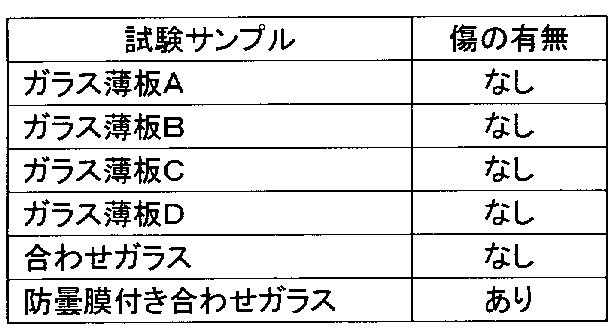
本発明の車両用ガラス物品においてガラス薄板として使用されるガラス薄板の4種類、および、通常、自動車用フロントガラスとして使用される合わせガラス(ただし、試験サイズである。)、該合わせガラスに機能膜として防曇膜を形成した防曇膜付き合わせガラスに対して、粘着シートを貼付し剥離する際の耐傷つき性について試験を行った試験例について以下に説明する。
ガラス薄板A~Dとして試験に供した4種類の材質は以下のとおりである。なお、ガラス薄板A~Dの形状は、全て50×50mm、厚み0.7mmとした。
(1)ガラス薄板A;Dragon Trail(商品名、旭硝子社製、化学強化されたアルミノシリケートガラス)
(2)ガラス薄板B;AN100(商品名、旭硝子社製、無アルカリボロシリケートガラス)
(3)ガラス薄板C;旭硝子社製、化学強化されたソーダライムガラス
(4)ガラス薄板D;旭硝子社製、化学強化されたソーダライムガラス(ガラス薄板3より強化応力が高いタイプ)
撹拌機、温度計がセットされたガラス容器に、プロピレングリコールモノメチルエーテル(150.00g、大伸化学社製)、ビスフェノールAジグリシジルエーテル(93.17g、jER828(商品名、三菱化学社製))、ポリオキシアルキレントリアミン(38.20g、ジェファーミンT403(商品名、ハンツマン社製))、アミノシラン(18.63g、KBM903(商品名、信越化学工業社製))を入れ、25℃にて30分間撹拌した。次いで、プロピレングリコールモノメチルエーテル(大伸化学社製)で5倍に希釈して、レベリング剤(0.375g、BYK307(商品名、ビックケミー社製))を添加して、下地層形成用組成物(A-1)を得た。
撹拌機、温度計がセットされたガラス容器に、エタノール(586.30g、関東化学製)、メチルエチルケトン(196.37g、関東化学製)、脂肪族ポリグリシジルエーテル(248.73g、デナコールEX-1610、(商品名、ナガセケムテックス社製))、グリセリンポリグリシジルエーテル(206.65g、デナコールEX-313、(商品名、ナガセケムテックス社製))を添加し10分間撹拌した。次いで、オルガノシリカゾル(29.92g、NBAC-ST(商品名、日産化学工業社製)、平均一次粒子径:10~20nm、SiO2含有量30質量%)、2-メチルイミダゾール(10.29g、四国化成社製)を添加し、さらに10分間撹拌した。
上記合わせガラスの防曇膜形成面を酸化セリウムで研磨洗浄し乾燥させた。該合わせガラスの防曇膜形成面に、上記で得られた下地層形成用組成物A-1をフローコートによって塗布して、100℃の電気炉で30分間保持し、下地層を形成した。次いで、形成した下地層表面に、上記で得られた吸水層形成用組成物A-2をフローコートによって塗布して、100℃の電気炉で30分間保持して吸水層を形成し、2層からなる防曇膜を有する防曇膜付き合わせガラスを得た。
ガラス薄板A~D、合わせガラス、防曇膜付き合わせガラスを試験サンプルとして以下の手順で試験を行い評価した。
上記耐傷つき性試験に用いたのと同様の防曇膜付き合わせガラスを作製した。これとは別に、上記に用いたのと同様のガラス薄板Dの一方の主面の全領域にアクリル系粘着剤からなる厚さ100μmの粘着層を有する粘着層付きガラス薄板Dを作製した。該防曇膜付き合わせガラスの防曇膜上に粘着層付きガラス薄板Dを粘着層が防曇膜側になるようにして貼合してガラス物品Aを得た。
実施例1において、ガラス薄板Dのかわりに、ガラス薄板Dの厚さを0.4mmとしたガラス薄板Eを用いた以外は同様にして、ガラス物品Bを得た。
上記同様のガラス薄板D、ガラス薄板Eを準備し、その端面を研磨処理(反射防止処理)して、ガラス薄板F、ガラス薄板Gとした。
実施例1において、ガラス薄板Dのかわりに、ガラス薄板F、ガラス薄板Gを用いた以外は同様にして、それぞれガラス物品C、ガラス物品Dを得た。
上記同様のガラス薄板D、ガラス薄板Eを準備し、その一方の主面の周縁部に顔料プリントにより、額縁状に黒色層を形成して、ガラス薄板H、ガラス薄板Iとした。
実施例1において、ガラス薄板Dのかわりに、ガラス薄板H、ガラス薄板Iを用いた以外は同様にして、それぞれガラス物品E、ガラス物品Fを得た。なお、ガラス物品E、ガラス物品Fにおいて、ガラス薄板H、ガラス薄板Iは黒色層が防曇膜付き合わせガラス側とは反対側となるように、防曇膜付き合わせガラスの防曇膜上に粘着層を介して配置された。
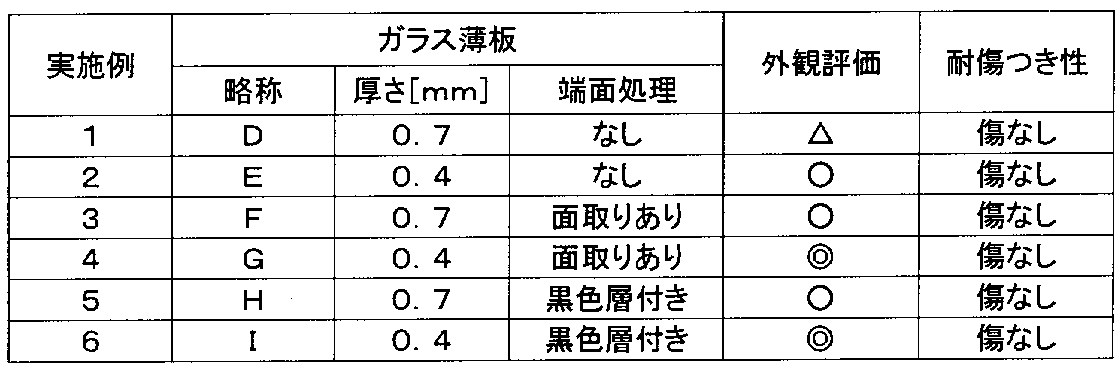
上記で得られた、ガラス物品A~Fについて、防曇膜付き合わせガラス上のガラス薄板の外周付近について目視で外観を以下の評価基準で評価した。結果を表2に示す。
△;ギラツキがあり端面が目立つが実使用に耐えうる。
○;ギラツキや厚さにより若干端面が目立つ。
◎;端面はほとんど目立たない。
Claims (7)
- ガラス基板と、
前記ガラス基板の少なくとも一部の表面に設けられた機能膜と、
前記機能膜上に貼合され、前記機能膜側と反対側の主面上に該主面より小さい粘着面を有する粘着シートを貼付するためのガラス薄板と、
前記機能膜と前記ガラス薄板の間に設けられた粘着層と
を有する車両用ガラス物品。 - 前記ガラス薄板の厚みが1mm以下である請求項1記載の車両用ガラス物品。
- 前記車両用ガラス物品は自動車用フロントガラスであり、前記ガラス薄板は前記自動車用フロントガラスにおける運転者の視界を確保する視野領域の外側に設けられる請求項2記載の車両用ガラス物品。
- 前記視野領域は、少なくともJIS R3212(1998年)に規定される試験領域Bを含む請求項3記載の車両用ガラス物品。
- 前記ガラス薄板は、端面が反射防止処理されている、請求項1~4のいずれか1項に記載の車両用ガラス物品。
- 前記機能膜は、樹脂を主体とする機能膜である請求項1~5のいずれか1項に記載の車両用ガラス物品。
- 前記ガラス薄板は、少なくとも一方の主面の周縁部に帯状の黒色層を有し、前記黒色層の有る領域を除いた領域が、前記粘着シートの粘着面より大きい請求項1~6のいずれか1項に記載の車両用ガラス物品。
Priority Applications (4)
| Application Number | Priority Date | Filing Date | Title |
|---|---|---|---|
| JP2016546398A JPWO2016035527A1 (ja) | 2014-09-01 | 2015-08-12 | 車両用ガラス物品 |
| EP15837686.3A EP3189994A4 (en) | 2014-09-01 | 2015-08-12 | Glass article for vehicles |
| CN201580045191.6A CN106660435A (zh) | 2014-09-01 | 2015-08-12 | 车辆用玻璃物品 |
| US15/437,558 US20170157897A1 (en) | 2014-09-01 | 2017-02-21 | Vehicle glass article |
Applications Claiming Priority (2)
| Application Number | Priority Date | Filing Date | Title |
|---|---|---|---|
| JP2014-177285 | 2014-09-01 | ||
| JP2014177285 | 2014-09-01 |
Publications (1)
| Publication Number | Publication Date |
|---|---|
| WO2016035527A1 true WO2016035527A1 (ja) | 2016-03-10 |
Family
ID=55439593
Family Applications (1)
| Application Number | Title | Priority Date | Filing Date |
|---|---|---|---|
| PCT/JP2015/072841 Ceased WO2016035527A1 (ja) | 2014-09-01 | 2015-08-12 | 車両用ガラス物品 |
Country Status (5)
| Country | Link |
|---|---|
| US (1) | US20170157897A1 (ja) |
| EP (1) | EP3189994A4 (ja) |
| JP (1) | JPWO2016035527A1 (ja) |
| CN (1) | CN106660435A (ja) |
| WO (1) | WO2016035527A1 (ja) |
Cited By (9)
| Publication number | Priority date | Publication date | Assignee | Title |
|---|---|---|---|---|
| CN106393872A (zh) * | 2016-08-04 | 2017-02-15 | 浙江飞越洁具制造有限公司 | 一种防污玻璃 |
| WO2017061553A1 (ja) * | 2015-10-09 | 2017-04-13 | 旭硝子株式会社 | 車両用フロントウインド及びそれを用いた車両用物品 |
| JP2017071390A (ja) * | 2015-10-09 | 2017-04-13 | 旭硝子株式会社 | 車両用フロントウインド及びそれを用いた車両用物品 |
| WO2017183590A1 (ja) * | 2016-04-19 | 2017-10-26 | 旭硝子株式会社 | 自動車用窓ガラス |
| JP2017212148A (ja) * | 2016-05-26 | 2017-11-30 | 日本板硝子株式会社 | ウインドシールド |
| JP2017216193A (ja) * | 2016-06-02 | 2017-12-07 | 日本板硝子株式会社 | ウインドシールド |
| JP2020115467A (ja) * | 2020-04-08 | 2020-07-30 | 日本板硝子株式会社 | ウインドシールド |
| JP2021160715A (ja) * | 2020-03-31 | 2021-10-11 | 日本板硝子株式会社 | 自動車用窓ガラス |
| CN113787889A (zh) * | 2021-09-18 | 2021-12-14 | 福耀玻璃工业集团股份有限公司 | 车窗玻璃及车辆 |
Families Citing this family (6)
| Publication number | Priority date | Publication date | Assignee | Title |
|---|---|---|---|---|
| US20160221307A1 (en) * | 2015-01-13 | 2016-08-04 | Driessen Aerospace Group N.V. | Glass surfaces for use in aircraft and other vehicles |
| CA2989999C (en) | 2015-07-27 | 2019-07-09 | Halliburton Energy Services, Inc. | Centrifugal particle accumulator and filter |
| US10981358B2 (en) * | 2018-04-03 | 2021-04-20 | AGC Inc. | Laminated glass |
| EP3818024A1 (en) * | 2018-07-06 | 2021-05-12 | AGC Glass Europe | Glazing with optically transparent sensor area |
| WO2020020498A1 (de) * | 2018-07-26 | 2020-01-30 | Saint-Gobain Glass France | Fahrzeugscheibeneinheit mit krümmungsabhängiger einfärbung |
| JP7188132B2 (ja) * | 2019-01-25 | 2022-12-13 | Agc株式会社 | 車両用構造体の製造方法、及び保護フィルム付き透明基板の製造方法 |
Citations (5)
| Publication number | Priority date | Publication date | Assignee | Title |
|---|---|---|---|---|
| JP2000297260A (ja) * | 1999-04-16 | 2000-10-24 | Teikoku Printing Inks Mfg Co Ltd | 両面粘着シート及びこれを用いた製品 |
| JP2005260659A (ja) * | 2004-03-12 | 2005-09-22 | Nippon Sheet Glass Co Ltd | アンテナ付き車両用ウィンドシールド |
| WO2008069186A1 (ja) * | 2006-12-04 | 2008-06-12 | Asahi Glass Company, Limited | 車両窓用防曇ガラス、その製造方法、及びその固定構造 |
| JP2009035444A (ja) * | 2007-08-01 | 2009-02-19 | Nippon Sheet Glass Co Ltd | ウインドシールドおよびウインドシールド用中間膜 |
| JP2012207114A (ja) * | 2011-03-29 | 2012-10-25 | Honda Access Corp | 車両用粘着積層体 |
Family Cites Families (8)
| Publication number | Priority date | Publication date | Assignee | Title |
|---|---|---|---|---|
| US5131967A (en) * | 1990-12-21 | 1992-07-21 | Ford Motor Company | Method of making laminated glazing units |
| JPH10130596A (ja) * | 1996-09-03 | 1998-05-19 | Lintec Corp | 自動車用再剥離型ウインドウフィルム |
| JP4627815B2 (ja) * | 1997-11-05 | 2011-02-09 | 株式会社ブリヂストン | 粘着フィルム |
| US8486535B1 (en) * | 2010-05-24 | 2013-07-16 | Rockwell Collins, Inc. | Systems and methods for adherable and removable thin flexible glass |
| CN201703329U (zh) * | 2010-06-23 | 2011-01-12 | 赵利辉 | 一种汽车年检贴标装置 |
| CN201895627U (zh) * | 2010-10-27 | 2011-07-13 | 张小祥 | 环保汽车年检标识粘贴框 |
| CN202294604U (zh) * | 2011-10-26 | 2012-07-04 | 邹思伟 | 汽车年检标贴夹 |
| GB201307495D0 (en) * | 2013-04-25 | 2013-06-12 | Pilkington Group Ltd | Laminated glazing |
-
2015
- 2015-08-12 JP JP2016546398A patent/JPWO2016035527A1/ja active Pending
- 2015-08-12 CN CN201580045191.6A patent/CN106660435A/zh active Pending
- 2015-08-12 WO PCT/JP2015/072841 patent/WO2016035527A1/ja not_active Ceased
- 2015-08-12 EP EP15837686.3A patent/EP3189994A4/en not_active Withdrawn
-
2017
- 2017-02-21 US US15/437,558 patent/US20170157897A1/en not_active Abandoned
Patent Citations (5)
| Publication number | Priority date | Publication date | Assignee | Title |
|---|---|---|---|---|
| JP2000297260A (ja) * | 1999-04-16 | 2000-10-24 | Teikoku Printing Inks Mfg Co Ltd | 両面粘着シート及びこれを用いた製品 |
| JP2005260659A (ja) * | 2004-03-12 | 2005-09-22 | Nippon Sheet Glass Co Ltd | アンテナ付き車両用ウィンドシールド |
| WO2008069186A1 (ja) * | 2006-12-04 | 2008-06-12 | Asahi Glass Company, Limited | 車両窓用防曇ガラス、その製造方法、及びその固定構造 |
| JP2009035444A (ja) * | 2007-08-01 | 2009-02-19 | Nippon Sheet Glass Co Ltd | ウインドシールドおよびウインドシールド用中間膜 |
| JP2012207114A (ja) * | 2011-03-29 | 2012-10-25 | Honda Access Corp | 車両用粘着積層体 |
Non-Patent Citations (1)
| Title |
|---|
| See also references of EP3189994A4 * |
Cited By (17)
| Publication number | Priority date | Publication date | Assignee | Title |
|---|---|---|---|---|
| US10507709B2 (en) | 2015-10-09 | 2019-12-17 | AGC Inc. | Vehicle windshield and vehicle component using same |
| WO2017061553A1 (ja) * | 2015-10-09 | 2017-04-13 | 旭硝子株式会社 | 車両用フロントウインド及びそれを用いた車両用物品 |
| JP2017071390A (ja) * | 2015-10-09 | 2017-04-13 | 旭硝子株式会社 | 車両用フロントウインド及びそれを用いた車両用物品 |
| US11065943B2 (en) | 2015-10-09 | 2021-07-20 | AGC Inc. | Vehicle windshield and vehicle component using same |
| WO2017183590A1 (ja) * | 2016-04-19 | 2017-10-26 | 旭硝子株式会社 | 自動車用窓ガラス |
| US10688849B2 (en) | 2016-04-19 | 2020-06-23 | AGC Inc. | Automobile window glass |
| JPWO2017183590A1 (ja) * | 2016-04-19 | 2019-02-28 | Agc株式会社 | 自動車用窓ガラス |
| JP2017212148A (ja) * | 2016-05-26 | 2017-11-30 | 日本板硝子株式会社 | ウインドシールド |
| JP2017216193A (ja) * | 2016-06-02 | 2017-12-07 | 日本板硝子株式会社 | ウインドシールド |
| CN106393872A (zh) * | 2016-08-04 | 2017-02-15 | 浙江飞越洁具制造有限公司 | 一种防污玻璃 |
| JP2021160715A (ja) * | 2020-03-31 | 2021-10-11 | 日本板硝子株式会社 | 自動車用窓ガラス |
| JP7607494B2 (ja) | 2020-03-31 | 2024-12-27 | 日本板硝子株式会社 | 自動車用窓ガラス |
| JP2020115467A (ja) * | 2020-04-08 | 2020-07-30 | 日本板硝子株式会社 | ウインドシールド |
| JP2022183166A (ja) * | 2020-04-08 | 2022-12-08 | 日本板硝子株式会社 | ウインドシールド |
| JP7449994B2 (ja) | 2020-04-08 | 2024-03-14 | 日本板硝子株式会社 | ウインドシールド |
| CN113787889A (zh) * | 2021-09-18 | 2021-12-14 | 福耀玻璃工业集团股份有限公司 | 车窗玻璃及车辆 |
| CN113787889B (zh) * | 2021-09-18 | 2022-07-12 | 福耀玻璃工业集团股份有限公司 | 车窗玻璃及车辆 |
Also Published As
| Publication number | Publication date |
|---|---|
| JPWO2016035527A1 (ja) | 2017-06-15 |
| EP3189994A4 (en) | 2018-04-18 |
| US20170157897A1 (en) | 2017-06-08 |
| CN106660435A (zh) | 2017-05-10 |
| EP3189994A1 (en) | 2017-07-12 |
Similar Documents
| Publication | Publication Date | Title |
|---|---|---|
| WO2016035527A1 (ja) | 車両用ガラス物品 | |
| US12103397B2 (en) | Vehicle interior systems having a curved cover glass with improved reliability and methods for forming the same | |
| JP4791467B2 (ja) | 両面接着シート及びパネル積層体 | |
| CN104768752B (zh) | 层叠体以及显示装置 | |
| JP7729344B2 (ja) | 合わせガラス | |
| US20180257978A1 (en) | Plate with print layer, display device using same, and glass with functional layer for in-vehicle display devices | |
| JP6610539B2 (ja) | 窓枠付き車両窓部材およびその製造方法 | |
| KR101727906B1 (ko) | 자동차용 글레이징 시트 | |
| JP2010125719A (ja) | 飛散防止性能付きガラス | |
| JP2013086466A (ja) | 前面板および前面板の製造方法 | |
| KR20130100345A (ko) | 하드코트층 부착 폴리카보네이트 | |
| EP3446903B1 (en) | Automobile window glass | |
| KR20140029179A (ko) | 아이콘 시트의 제조 방법, 아이콘 시트 및 그것을 사용한 터치 패널 | |
| CN104619494B (zh) | 层叠板及表面保护板 | |
| JP5439019B2 (ja) | 表示素子用基板およびその製造方法 | |
| JP5238594B2 (ja) | 表示素子用基板およびその製造方法 | |
| JP6759407B2 (ja) | ポリマープラスチックフロントパネルとその製法 | |
| KR20130038217A (ko) | 윈도우에 부착하기 위한 라미네이트 필름 | |
| JP4882535B2 (ja) | 機能性ガラス体 | |
| JP6801762B2 (ja) | 表示装置 | |
| JP2025008857A (ja) | カバーガラス、カバーガラスの製造方法、表示装置 | |
| JP2019077781A (ja) | 光学透明粘着シート、積層体、光学透明粘着シートの製造方法、及び、積層シート | |
| JP2007167814A (ja) | 機能性被膜形成ガラス基材の製法 | |
| TW202432370A (zh) | 覆蓋玻璃、顯示裝置、覆蓋玻璃之製造方法 | |
| TW202438467A (zh) | 轉印加飾片材、及玻璃物品之製造方法 |
Legal Events
| Date | Code | Title | Description |
|---|---|---|---|
| 121 | Ep: the epo has been informed by wipo that ep was designated in this application |
Ref document number: 15837686 Country of ref document: EP Kind code of ref document: A1 |
|
| ENP | Entry into the national phase |
Ref document number: 2016546398 Country of ref document: JP Kind code of ref document: A |
|
| NENP | Non-entry into the national phase |
Ref country code: DE |
|
| REEP | Request for entry into the european phase |
Ref document number: 2015837686 Country of ref document: EP |
|
| WWE | Wipo information: entry into national phase |
Ref document number: 2015837686 Country of ref document: EP |