WO2016043276A1 - 香味劣化抑制剤 - Google Patents
香味劣化抑制剤 Download PDFInfo
- Publication number
- WO2016043276A1 WO2016043276A1 PCT/JP2015/076514 JP2015076514W WO2016043276A1 WO 2016043276 A1 WO2016043276 A1 WO 2016043276A1 JP 2015076514 W JP2015076514 W JP 2015076514W WO 2016043276 A1 WO2016043276 A1 WO 2016043276A1
- Authority
- WO
- WIPO (PCT)
- Prior art keywords
- flavor
- cider
- flavor deterioration
- adsorbent
- apple extract
- Prior art date
- Legal status (The legal status is an assumption and is not a legal conclusion. Google has not performed a legal analysis and makes no representation as to the accuracy of the status listed.)
- Ceased
Links
Images


Classifications
-
- C—CHEMISTRY; METALLURGY
- C11—ANIMAL OR VEGETABLE OILS, FATS, FATTY SUBSTANCES OR WAXES; FATTY ACIDS THEREFROM; DETERGENTS; CANDLES
- C11B—PRODUCING, e.g. BY PRESSING RAW MATERIALS OR BY EXTRACTION FROM WASTE MATERIALS, REFINING OR PRESERVING FATS, FATTY SUBSTANCES, e.g. LANOLIN, FATTY OILS OR WAXES; ESSENTIAL OILS; PERFUMES
- C11B9/00—Essential oils; Perfumes
-
- A—HUMAN NECESSITIES
- A23—FOODS OR FOODSTUFFS; TREATMENT THEREOF, NOT COVERED BY OTHER CLASSES
- A23L—FOODS, FOODSTUFFS OR NON-ALCOHOLIC BEVERAGES, NOT OTHERWISE PROVIDED FOR; PREPARATION OR TREATMENT THEREOF
- A23L2/00—Non-alcoholic beverages; Dry compositions or concentrates therefor; Preparation or treatment thereof
- A23L2/52—Adding ingredients
- A23L2/56—Flavouring or bittering agents
-
- A—HUMAN NECESSITIES
- A23—FOODS OR FOODSTUFFS; TREATMENT THEREOF, NOT COVERED BY OTHER CLASSES
- A23B—PRESERVATION OF FOODS, FOODSTUFFS OR NON-ALCOHOLIC BEVERAGES; CHEMICAL RIPENING OF FRUIT OR VEGETABLES
- A23B11/00—Preservation of milk or dairy products
- A23B11/10—Preservation of milk or milk preparations
- A23B11/18—Preservation of milk or milk preparations by addition of preservatives
-
- A—HUMAN NECESSITIES
- A23—FOODS OR FOODSTUFFS; TREATMENT THEREOF, NOT COVERED BY OTHER CLASSES
- A23B—PRESERVATION OF FOODS, FOODSTUFFS OR NON-ALCOHOLIC BEVERAGES; CHEMICAL RIPENING OF FRUIT OR VEGETABLES
- A23B11/00—Preservation of milk or dairy products
- A23B11/30—Preservation of cream or cream preparations
-
- A—HUMAN NECESSITIES
- A23—FOODS OR FOODSTUFFS; TREATMENT THEREOF, NOT COVERED BY OTHER CLASSES
- A23C—DAIRY PRODUCTS, e.g. MILK, BUTTER OR CHEESE; MILK OR CHEESE SUBSTITUTES; PREPARATION THEREOF
- A23C13/00—Cream; Cream preparations; Making thereof
- A23C13/12—Cream preparations
-
- A—HUMAN NECESSITIES
- A23—FOODS OR FOODSTUFFS; TREATMENT THEREOF, NOT COVERED BY OTHER CLASSES
- A23C—DAIRY PRODUCTS, e.g. MILK, BUTTER OR CHEESE; MILK OR CHEESE SUBSTITUTES; PREPARATION THEREOF
- A23C9/00—Milk preparations; Milk powder or milk powder preparations
- A23C9/12—Fermented milk preparations; Treatment using microorganisms or enzymes
- A23C9/13—Fermented milk preparations; Treatment using microorganisms or enzymes using additives
-
- A—HUMAN NECESSITIES
- A23—FOODS OR FOODSTUFFS; TREATMENT THEREOF, NOT COVERED BY OTHER CLASSES
- A23C—DAIRY PRODUCTS, e.g. MILK, BUTTER OR CHEESE; MILK OR CHEESE SUBSTITUTES; PREPARATION THEREOF
- A23C9/00—Milk preparations; Milk powder or milk powder preparations
- A23C9/12—Fermented milk preparations; Treatment using microorganisms or enzymes
- A23C9/13—Fermented milk preparations; Treatment using microorganisms or enzymes using additives
- A23C9/1307—Milk products or derivatives; Fruit or vegetable juices; Sugars, sugar alcohols, sweeteners; Oligosaccharides; Organic acids or salts thereof or acidifying agents; Flavours, dyes or pigments; Inert or aerosol gases; Carbonation methods
-
- A—HUMAN NECESSITIES
- A23—FOODS OR FOODSTUFFS; TREATMENT THEREOF, NOT COVERED BY OTHER CLASSES
- A23C—DAIRY PRODUCTS, e.g. MILK, BUTTER OR CHEESE; MILK OR CHEESE SUBSTITUTES; PREPARATION THEREOF
- A23C9/00—Milk preparations; Milk powder or milk powder preparations
- A23C9/152—Milk preparations; Milk powder or milk powder preparations containing additives
-
- A—HUMAN NECESSITIES
- A23—FOODS OR FOODSTUFFS; TREATMENT THEREOF, NOT COVERED BY OTHER CLASSES
- A23C—DAIRY PRODUCTS, e.g. MILK, BUTTER OR CHEESE; MILK OR CHEESE SUBSTITUTES; PREPARATION THEREOF
- A23C9/00—Milk preparations; Milk powder or milk powder preparations
- A23C9/152—Milk preparations; Milk powder or milk powder preparations containing additives
- A23C9/154—Milk preparations; Milk powder or milk powder preparations containing additives containing thickening substances, eggs or cereal preparations; Milk gels
- A23C9/1544—Non-acidified gels, e.g. custards, creams, desserts, puddings, shakes or foams, containing eggs or thickening or gelling agents other than sugar; Milk products containing natural or microbial polysaccharides, e.g. cellulose or cellulose derivatives; Milk products containing nutrient fibres
-
- A—HUMAN NECESSITIES
- A23—FOODS OR FOODSTUFFS; TREATMENT THEREOF, NOT COVERED BY OTHER CLASSES
- A23C—DAIRY PRODUCTS, e.g. MILK, BUTTER OR CHEESE; MILK OR CHEESE SUBSTITUTES; PREPARATION THEREOF
- A23C9/00—Milk preparations; Milk powder or milk powder preparations
- A23C9/152—Milk preparations; Milk powder or milk powder preparations containing additives
- A23C9/156—Flavoured milk preparations ; Addition of fruits, vegetables, sugars, sugar alcohols or sweeteners
-
- A—HUMAN NECESSITIES
- A23—FOODS OR FOODSTUFFS; TREATMENT THEREOF, NOT COVERED BY OTHER CLASSES
- A23G—COCOA; COCOA PRODUCTS, e.g. CHOCOLATE; SUBSTITUTES FOR COCOA OR COCOA PRODUCTS; CONFECTIONERY; CHEWING GUM; ICE-CREAM; PREPARATION THEREOF
- A23G3/00—Sweetmeats; Confectionery; Marzipan; Coated or filled products
- A23G3/34—Sweetmeats, confectionery or marzipan; Processes for the preparation thereof
-
- A—HUMAN NECESSITIES
- A23—FOODS OR FOODSTUFFS; TREATMENT THEREOF, NOT COVERED BY OTHER CLASSES
- A23G—COCOA; COCOA PRODUCTS, e.g. CHOCOLATE; SUBSTITUTES FOR COCOA OR COCOA PRODUCTS; CONFECTIONERY; CHEWING GUM; ICE-CREAM; PREPARATION THEREOF
- A23G9/00—Frozen sweets, e.g. ice confectionery, ice-cream; Mixtures therefor
- A23G9/32—Frozen sweets, e.g. ice confectionery, ice-cream; Mixtures therefor characterised by the composition containing organic or inorganic compounds
-
- A—HUMAN NECESSITIES
- A23—FOODS OR FOODSTUFFS; TREATMENT THEREOF, NOT COVERED BY OTHER CLASSES
- A23G—COCOA; COCOA PRODUCTS, e.g. CHOCOLATE; SUBSTITUTES FOR COCOA OR COCOA PRODUCTS; CONFECTIONERY; CHEWING GUM; ICE-CREAM; PREPARATION THEREOF
- A23G9/00—Frozen sweets, e.g. ice confectionery, ice-cream; Mixtures therefor
- A23G9/44—Frozen sweets, e.g. ice confectionery, ice-cream; Mixtures therefor characterised by shape, structure or physical form
-
- A—HUMAN NECESSITIES
- A23—FOODS OR FOODSTUFFS; TREATMENT THEREOF, NOT COVERED BY OTHER CLASSES
- A23G—COCOA; COCOA PRODUCTS, e.g. CHOCOLATE; SUBSTITUTES FOR COCOA OR COCOA PRODUCTS; CONFECTIONERY; CHEWING GUM; ICE-CREAM; PREPARATION THEREOF
- A23G9/00—Frozen sweets, e.g. ice confectionery, ice-cream; Mixtures therefor
- A23G9/52—Liquid products; Solid products in the form of powders, flakes or granules for making liquid products ; Finished or semi-finished solid products, frozen granules
-
- A—HUMAN NECESSITIES
- A23—FOODS OR FOODSTUFFS; TREATMENT THEREOF, NOT COVERED BY OTHER CLASSES
- A23L—FOODS, FOODSTUFFS OR NON-ALCOHOLIC BEVERAGES, NOT OTHERWISE PROVIDED FOR; PREPARATION OR TREATMENT THEREOF
- A23L2/00—Non-alcoholic beverages; Dry compositions or concentrates therefor; Preparation or treatment thereof
-
- A—HUMAN NECESSITIES
- A23—FOODS OR FOODSTUFFS; TREATMENT THEREOF, NOT COVERED BY OTHER CLASSES
- A23L—FOODS, FOODSTUFFS OR NON-ALCOHOLIC BEVERAGES, NOT OTHERWISE PROVIDED FOR; PREPARATION OR TREATMENT THEREOF
- A23L2/00—Non-alcoholic beverages; Dry compositions or concentrates therefor; Preparation or treatment thereof
- A23L2/02—Non-alcoholic beverages; Dry compositions or concentrates therefor; Preparation or treatment thereof containing fruit or vegetable juices
- A23L2/04—Extraction of juices
-
- C—CHEMISTRY; METALLURGY
- C09—DYES; PAINTS; POLISHES; NATURAL RESINS; ADHESIVES; COMPOSITIONS NOT OTHERWISE PROVIDED FOR; APPLICATIONS OF MATERIALS NOT OTHERWISE PROVIDED FOR
- C09K—MATERIALS FOR MISCELLANEOUS APPLICATIONS, NOT PROVIDED FOR ELSEWHERE
- C09K15/00—Anti-oxidant compositions; Compositions inhibiting chemical change
- C09K15/04—Anti-oxidant compositions; Compositions inhibiting chemical change containing organic compounds
- C09K15/06—Anti-oxidant compositions; Compositions inhibiting chemical change containing organic compounds containing oxygen
- C09K15/08—Anti-oxidant compositions; Compositions inhibiting chemical change containing organic compounds containing oxygen containing a phenol or quinone moiety
-
- A—HUMAN NECESSITIES
- A23—FOODS OR FOODSTUFFS; TREATMENT THEREOF, NOT COVERED BY OTHER CLASSES
- A23V—INDEXING SCHEME RELATING TO FOODS, FOODSTUFFS OR NON-ALCOHOLIC BEVERAGES AND LACTIC OR PROPIONIC ACID BACTERIA USED IN FOODSTUFFS OR FOOD PREPARATION
- A23V2002/00—Food compositions, function of food ingredients or processes for food or foodstuffs
Definitions
- the present invention relates to a flavor deterioration inhibitor derived from a specific natural product that can be widely applied to foods and drinks containing flavor components, and a method for producing the same, a flavor and food / beverage products containing the flavor deterioration inhibitor, and a flavor deterioration inhibitor. Regarding the method.
- citral which is known as a key component such as lemon flavor, causes a cyclization reaction by light or heat and changes to a substance such as photocitral. It is considered.
- sales shelves are set very bright in order to appeal the product attractively to consumers and produce a clean feeling.
- light transmission such as recent PET bottles, plastic containers or transparent bags Food / beverage products enclosed in sexual containers are widespread.
- Non-Patent Document 1 ⁇ -glucosylrutin has an effect of suppressing flavor deterioration (see Patent Document 1), prevents deterioration by containing a coumarin derivative (see Patent Document 2), or an emulsion containing tocopherol and ferulic acid. It has been proposed that a tea extract is used in combination (Patent Document 3).
- apples are classified as belonging to the genus Malus. There are more than 20 apple genus in Europe and Asia, and about 10 in the United States. Japanese cedar, Ezono apple or Nokaidou are naturally distributed in Japan, but all apples are cultivated for food. domestic non-patent literature 2).
- Apples cultivated for food are edible and processed, and varieties such as Fuji, Tsugaru and Jonagold are cultivated for raw consumption. For processing, ciders are used as raw materials for alcoholic beverages. Varieties for Calvados are cultivated (Non-patent Document 3).
- apple extracts contain caffeic acid derivatives, p-coumaric acid derivatives, flavan-3-ols, flavonols and dihydrochalcones. (Patent Document 4), but there is no report on flavor deterioration suppression.
- the natural product-derived flavor deterioration inhibitor in the prior art has a temporary flavor deterioration suppressing effect, it needs to be used in a certain amount in order to exert the flavor deterioration suppressing effect.
- the taste and smell of the flavor deterioration inhibitor itself adversely affecting the taste and aroma of the food and drink itself, and it still does not exhibit a satisfactory effect.
- An object of the present invention is to provide a flavor deterioration inhibitor that can significantly suppress a flavor deterioration phenomenon based on factors such as light or heat.
- the present invention provides a flavor deterioration inhibitor that is highly safe and can be suitably used for food and drink. Moreover, it aims at providing the flavor deterioration inhibitor which acts effectively with respect to the flavor deterioration phenomenon which arises especially under the influence of light among the said factors.
- the present inventors have intensively studied the flavor deterioration-inhibiting activity of a variety of natural product-derived components, mainly plants, and as a result, using cider apple extract, In contrast, it has been found that flavor deterioration of foods and the like due to heat or oxygen can be suppressed for a long period of time.
- the present invention relates to the following [1] to [12].
- a flavor deterioration inhibitor comprising a cider apple extract or containing a cider apple extract as an active ingredient.
- the apple for cider has a total polyphenol content in the juice of 0.2% by mass or more and a malic acidity of 0.45% by mass or less according to any one of [1] to [4] The flavor deterioration inhibitor as described.
- a method for inhibiting flavor deterioration of a test object comprising adding the flavor deterioration inhibiting agent according to any one of [1] to [7] to a test object that is susceptible to flavor deterioration.
- a method for producing a flavor deterioration inhibitor comprising a step of adsorbing and desorbing an apple extract for cider with a synthetic resin adsorbent.
- a method for producing a flavor deterioration inhibitor comprising the following steps (a) to (c): (A) Step of obtaining cider apple extract by contacting cider apple with water or polar organic solvent (b) After contacting cider apple extract obtained in step (a) with an adsorbent, A step of eluting the component adsorbed on the adsorbent with an organic solvent aqueous solution to obtain an adsorbent treated product (c) A step of concentrating the adsorbent treated product obtained in step (b)
- polyphenols such as quercetin, caffeic acid, chlorogenic acid, phloretin, and catechin contained in cider apple extract and other trace components act synergistically. Effectively suppresses the flavor deterioration phenomenon.
- citrus foods and drinks including citral or products containing citral and foods and drinks containing milk efficient degradation of the flavor that progresses gradually at each stage during production, distribution, storage or display
- the quality of the product can be maintained stably at a low cost and for a long period of time by maintaining the freshness inherent in the product.
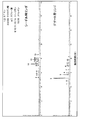
- FIG. 1 shows a comparison of HPLC profiles for the cider apple extract of Example 1 and the dessert apple extract of Comparative Example 1.
- FIG. 2 is a graph showing a comparison of polyphenol compositions for the cider apple extract of Example 1 and the dessert apple extract of Comparative Example 1.
- FIG. 3 is a comparison of total polyphenols and procyanidins for the cider apple extract of Example 1 and the dessert apple extract of Comparative Example 1.
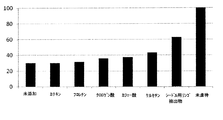
- FIG. 4 is a graph in which various extracts are added and the residual citral rate is compared.
- FIG. 5 is a graph comparing the residual ratio (%) of citral by adding the apple extract for cider of Example 1 and each polyphenol.
- mass% and weight% have the same meaning.
- the cider apple has a total polyphenol content of 0.2% by mass or more in the juice and an amino nitrogen content of 8 mg ⁇ % or more.
- the use part of the apple for cider is a part (fruit) containing fruit and / or peel, fruit juice, juice or residue of juice.
- the pulp and / or skin may be a dried product (dried fruit), and the juice and juice may be a concentrate.
- Bittersweet cider apples have a total polyphenol content of 0.2% or more in the juice, an amino nitrogen content of 8 mg ⁇ % or more, and a malic acid content of 0.45% by mass or less. It points to something.
- the juicing method is not particularly limited, but for example, the raw material is washed and crushed and pressed as it is or while adding sulfurous acid. Fruit juice is obtained, preferably pectin-degrading enzyme is added and allowed to act. Next, a method of obtaining a clarified juice by means of centrifugation or filtration can be mentioned.
- (B) Extraction method Although it does not specifically limit as an extraction method, for example, the fruit which is a raw material, dry fruit, fruit juice, squeezed, or the residue after squeezing is made to contact with a solvent for a predetermined period, and it heats as needed. And a method of stirring or refluxing. The obtained extract is centrifuged and filtered to obtain a clear cider apple extract.
- the extraction may be performed under heating, room temperature or cooling conditions.
- the extraction temperature can be arbitrarily determined and is not particularly limited, but is preferably 0 ° C. or higher and 100 ° C. or lower, more preferably 30 ° C. or higher and 70 ° C. or lower.
- the extraction time is preferably 1 hour to 72 hours, more preferably 2 hours to 7 hours.
- the solvent used for the extraction treatment is water or a polar organic solvent, and the organic solvent may be a hydrate.
- the polar organic solvent include alcohol and acetone.
- water or aliphatic alcohols having 2 to 4 carbon atoms such as ethanol, propanol or butanol are preferable from the viewpoint of safety to the human body and handleability.
- the amount of solvent used for extraction can be arbitrarily selected, but generally the amount of solvent is 0.5 parts by weight or more and 100 parts by weight or less with respect to 1 part by weight of the raw material.
- a deodorizing and refining operation of the flavor or aroma peculiar to the material may be performed by performing a treatment such as distillation.
- solids insoluble in the solvent are removed to obtain a cider apple extract, and various solid-liquid separation means such as centrifugal separation, filtration or pressing can be used as the solids removal method.
- the obtained cider apple extract can be used as a cider apple extract as it is as a flavor deterioration inhibitor, but may be used after appropriately diluted with a liquid such as water, ethanol, glycerin or propylene glycol. An excipient such as dextrin can also be added. These can be further concentrated and used as a paste-like extract.
- the cider apple extract it can be used as a flavor deterioration inhibitor as a powder.
- the powdering method is not particularly limited, and examples thereof include hot air drying, freeze drying, spray drying, drum drying, foam drying, and fluidized bed drying.
- those extracted by supercritical extraction, fractionated or deodorized can be used as apple extract for cider.
- (C) Adsorbent treatment The cider apple extract obtained by the above method is preferably treated with an adsorbent to obtain an adsorbent-treated product.
- An apple extract for cider is brought into contact with an adsorbent, and useful components such as phloretin, catechin, quercetin, caffeic acid or chlorogenic acid are adsorbed on the adsorbent, and then the useful components are eluted with an elution solvent to adsorb the adsorbent. Treated.
- Examples of the adsorbent include activated carbon, activated clay, and resin adsorbent. Among these, a resin adsorbent is preferable.
- Examples of the resin adsorbent include a synthetic resin adsorbent, silica gel, an ion exchange resin, and a chelate resin, and a synthetic resin adsorbent is particularly preferable in terms of ease of use.
- the synthetic resin adsorbent examples include adsorbents made of aromatic resin, acrylic resin, acrylonitrile resin, and the like.
- Such synthetic resin adsorbents are commercially available.
- Sepa beads SP825, SP850 and SP700 aboveve, aromatic high surface area resin, manufactured by Mitsubishi Chemical Corporation
- Sepa beads SP207 aromatic modified resin, manufactured by Mitsubishi Chemical Corporation
- Diaion HP20SS, Sepa beads SP20SS and SP207SS aboveve, aromatic small particle size resin, manufactured by Mitsubishi Chemical Corporation
- Amberlite XAD2, XAD4, XAD18, FPX66, XAD1180, XAD1180N, XAD1600N and XAD2000 styrene resin
- XAD7HP acrylic resin
- XAD761
- the adsorbent may be pretreated prior to the adsorption treatment.
- the pretreatment includes, for example, washing the adsorbent with a solvent such as ethanol to remove impurities, and further washing with water to remove the solvent such as ethanol. Can be performed.
- the treatment with the adsorbent may be performed by either a batch method or a column method, but a column method capable of efficiently treating with a relatively small amount of adsorbent is preferable.
- the treatment with the adsorbent may be performed at least once.
- the ratio between the adsorbent and the extract can be selected according to the type of adsorbent used.
- washing liquid is preferably a solvent that elutes non-adsorbed components and suppresses elution of useful components such as phloretin, catechin, quercetin, caffeic acid, or chlorogenic acid.
- cleaning liquid include water, methanol, and ethyl acetate.
- the amount of the cleaning liquid used can be appropriately selected according to the composition of the cleaning liquid. You may perform washing
- the components adsorbed on the adsorbent are eluted with the elution solvent.
- an elution solvent an organic solvent aqueous solution is preferable, and an aqueous solution of the monovalent lower alcohol is more preferable.
- monohydric alcohols having 1 to 4 carbon atoms are preferable, and monohydric alcohols having 1 to 3 carbon atoms (such as ethanol) are particularly preferable.
- the amount of the eluting solvent can be appropriately selected depending on the composition of the solvent.
- the elution may be performed by changing the concentration of the alcohol stepwise or continuously.
- the concentration of alcohol in the elution solvent is preferably 10 to 99% by volume, more preferably 95 to 99% by volume.
- the cider apple extract (including the adsorbent-treated product) obtained by the above method may be used after being concentrated.
- the concentration method may be performed by a generally known method. Examples of the concentration method include a method of recovering a solvent using an evaporator, and a method of concentrating by using a small amount of an eluent with respect to the amount of the solution loaded during the synthetic adsorption resin treatment.
- composition of polyphenols contained in the apple extract for cider obtained by the above method includes condensed tannins as polymer polyphenol compounds, catechin, chlorogenic acid, caffeine as simple polyphenol compounds, etc. Acid, quercetin and phloretin are included.
- the phloretin content in the total polyphenol in the apple extract for cider is preferably 8% by mass or more, more preferably 10% by mass or more, and further preferably 12% by mass or more. . Although an upper limit is not specifically limited, Usually, it is 25 mass% or less, Preferably it is 20 mass% or less. When the phloretin content in the total polyphenol is 8% by mass or more, the effect of the flavor deterioration inhibitor can be exhibited in food and drink.
- the procyanidins content in the total polyphenol in the apple extract for cider is preferably 25% by mass or less, more preferably 20% by mass or less, and further preferably 15% by mass or less. is there.
- the lower limit is usually 5% by mass or more, preferably 10% by mass or more.
- the flavor deterioration inhibitor of the present invention contains the aforementioned apple resin extract for cider (regardless of whether it is an adsorbent-treated extract, concentrate or dried solid). As long as it is a component other than the resin-treated product, it may contain a diluent, a carrier, and other additives.
- the diluent or carrier is not particularly limited as long as it does not interfere with the effects of the present invention.
- sucrose, glucose, dextrin, starches, cyclodextrin, trehalose, lactose, maltose, palatinose, xylose, starch syrup and liquid Sugars such as sugar, alcohols such as ethanol, propylene glycol and glycerin, reduced starch syrup, reduced maltose starch syrup, sugar alcohols such as sorbitol, lactitol, palatinit, mannitol, xylitol, erythritol and maltitol, gum arabic, xanthan gum, carrageenan, guar gum And polysaccharides such as gellan gum and water.
- antioxidants examples include antioxidants, auxiliaries such as chelating agents, fragrances, spice extracts, edible plant extracts, fruit extracts, cold press oil low-boiling fractions, and preservatives. Can do.
- auxiliaries such as chelating agents, fragrances, spice extracts, edible plant extracts, fruit extracts, cold press oil low-boiling fractions, and preservatives. Can do.
- antioxidants for example, BHT, BHA, ⁇ -tocopherol and vitamin C
- preservatives for example, sorbic acid, benzoic acid and shirako protein extracts
- shelf life improvers for example, , Sodium acetate, glycine, glycerin fatty acid ester, lysozyme and chitosan
- cider apple extract (including adsorbent processed product) in 100% by weight of the flavor deterioration inhibitor. ) In a solid conversion, and preferably adjusted so as to be contained at a ratio of 1 ppm or more and 50 mass% or less.
- the cider apple extract (including the adsorbent-treated product) is preferably contained at a rate of 1 ppb or more and 5000 ppm or less in solid conversion in 100% by mass of the food or drink. It is preferable to do.
- the food and drink to which the flavor deterioration inhibitor of the present invention can be added is not particularly limited, but the flavor deterioration inhibitor of the present invention is particularly effective for suppressing deterioration of citrus flavor or milk flavor.
- Examples of foods and drinks having a citrus flavor include carbonated beverages, fruit juice beverages, sports drinks, alcoholic beverages, tea / coffee beverages, soy beverages, functional beverages and soup beverages, frozen desserts, candy desserts, chewing gums and the like
- Examples include confectionery such as baked confectionery and seasonings such as miso, soy sauce, sauce, sauce and dressing.
- Examples of foods and drinks containing milk include beverages such as tea / coffee-based beverages, cocoa beverages, fermented milk and milk-containing acidic beverages, confectionery, yogurt, jelly, mousse, ice cream, sorbet, pudding and cream.
- beverages such as tea / coffee-based beverages, cocoa beverages, fermented milk and milk-containing acidic beverages, confectionery, yogurt, jelly, mousse, ice cream, sorbet, pudding and cream.
- beverages include frozen desserts, butter, margarine, cheese and dairy and fat products containing them.
- mass% is also described as “%”
- mass ppm is also described as “ppm”.
- Example 1 600 g of cider apple (Dabinett) was cut into a dice, 600 g of distilled water was added thereto, and crushed using a food processor to obtain a paste. 0.24 g of pectinase was added to this paste, followed by extraction with stirring at 50 ° C. for 4 hours. The solution was cooled to 25 ° C., centrifuged at 4000 rpm for 30 minutes, and the supernatant was collected. 3g of celite was added to the supernatant, followed by filtration to obtain 1047ml of a clear crude crude extract for cider.
- the obtained cider apple extract was concentrated under reduced pressure using an evaporator and dried to obtain 1.5 g of cider apple powder formulation.
- Example 1 Comparative Example 1 Using 600 g of raw apple (also called “dessert apple”) (Fuji), the same operation as in Example 1 was performed to obtain 1055 ml of raw apple crude extract. 100 ml of the raw apple raw extract was subsequently subjected to a purification operation with a resin in the same manner as in Example 1 to obtain 1.4 g of raw apple powder formulation.
- the resin-treated cider apple extract obtained in Example 1 and the resin-treated raw apple (dessert apple) extract obtained in Comparative Example 1 were measured under the following conditions using HPLC. The result is shown in FIG.
- FIG. 2 shows the composition of polyphenol contained in each resin-treated apple extract obtained from the HPLC analysis result of FIG.
- the cider apple extract contains polyphenols such as catechin, chlorogenic acid, caffeic acid, quercetin, and phloretin, and is compared with the raw edible apple (dessert apple) extract.
- the content of quercetin, caffeic acid and phloretin was high and the content of procyanidins was low.
- the cider apple extract had a phloretin content in the total polyphenol of 8% by mass or more.
- the mixed solution was stirred with a test tube mixer. Subsequently, 1 ml of 20% aqueous sodium carbonate solution was added, 1.1 ml of distilled water was added, the volume was made up to 10 ml of total, and the mixture was stirred with a test tube mixer. OD765nm was measured after leaving still for 1 hour. Quantification was performed using a calibration curve, and the total amount of polyphenol (chlorogenic acid equivalent value) was calculated.
- the obtained potato resin-treated product was concentrated under reduced pressure using an evaporator and dried to obtain 0.14 g of a potato powder formulation.
- Comparative Example 3 The same operation as in Comparative Example 2 was performed using the dried yacon powder to obtain 0.13 g of a yacon powder formulation.
- Comparative Example 4 The same operation as in Comparative Example 2 was performed using dried perilla powder to obtain 0.15 g perilla powder formulation.
- Comparative Example 5 The same operation as in Comparative Example 2 was performed using the dried blueberry powder to obtain 0.15 g of a blueberry powder formulation.
- Comparative Example 6 The same operation as in Comparative Example 2 was performed using the dried black currant powder to obtain 0.14 g of a black currant powder formulation.
- Comparative Example 7 The same operation as in Comparative Example 2 was performed using the dried lychee seed powder to obtain 0.13 g of a lychee seed powder formulation.
- Comparative Example 8 The same operation as in Comparative Example 2 was performed using the dried tea powder to obtain 0.15 g of a tea powder formulation.
- Comparative Example 9 The same operation as in Comparative Example 2 was performed using the dried evening primrose powder to obtain 0.11 g of evening primrose powder formulation.
- Comparative Example 10 The same operation as in Comparative Example 2 was performed using the dried olive leaf powder to obtain 0.11 g of an olive leaf powder formulation.
- Comparative Example 11 Using the dried grape seed powder, the same operation as in Comparative Example 2 was performed to obtain 0.15 g of a grape seed powder formulation.
- Comparative Example 12 The same operation as in Comparative Example 2 was performed using the dry yellow leaves powder to obtain 0.09 g of the yellow leaves powder formulation.
- Comparative Example 13 The same operation as in Comparative Example 2 was performed using the dried rose powder to obtain 0.11 g of a rose powder formulation.
- Comparative Example 14 The same operation as in Comparative Example 2 was performed using dry coffee powder to obtain 0.21 g of a coffee powder formulation.
- a transparent PET bottle is filled with 350 g of a sugar acid solution, citral is 10 ppm, and each flavor deterioration inhibitor prepared in Example 1 and Comparative Examples 1 to 14 is added so that the solid concentration is 5 ppm. It was used for.
- the fluorescent light irradiation was similarly performed about the citral-containing sugar acid liquid prepared without adding the flavor deterioration inhibitor in the said prescription.
- a sugar acid solution without a citral-containing flavor deterioration inhibitor that was not irradiated with a fluorescent lamp was used as a control (not abused).
- Light degradation test A test object in which a transparent PET bottle was filled with a test specimen was irradiated with light using a light stability tester (“LH30-14M” manufactured by Nagano Science Co., Ltd.). Irradiation conditions were as follows: irradiation with a white fluorescent lamp (illuminance of 10,000 lux) was performed for 168 hours at a temperature of 25 ° C.
- Solid phase extraction method The citral-containing sugar acid solution subjected to the photodegradation test was concentrated by a solid phase extraction method.
- the eluate was dehydrated by adding a small amount of anhydrous sodium sulfate, the solvent was distilled off under a nitrogen atmosphere, 10 ⁇ l of 5-nonanone was added as an internal standard substance, and the volume was accurately made up to 1 ml with ethanol using a measuring flask. .
- the prepared sample was measured by gas chromatography (GC) to analyze the residual amount of citral and the amount of by-products.
- Citral residual ratio (%) (A / B) ⁇ 100
- FIG. 4 shows the result of analyzing the citral residual rate in the light deterioration test conducted in Experimental Example 1.
- Example 2 Using a simple polyphenol contained in an apple extract for cider treated with an adsorbent, the light degradation inhibitory effect was examined using citral as an index. In the same manner as in Experimental Example 1, each substance was added to the reaction system so as to have a solid concentration of 5 ppm and subjected to a photodegradation test. A comparative graph of the citral residual rate is shown in FIG.
- quercetin, caffeic acid and chlorogenic acid had the effect of suppressing the photodegradation of citral.
- the effect of suppressing the light deterioration of citral by the pure product itself was inferior compared with the cider apple extract treated with the adsorbent.
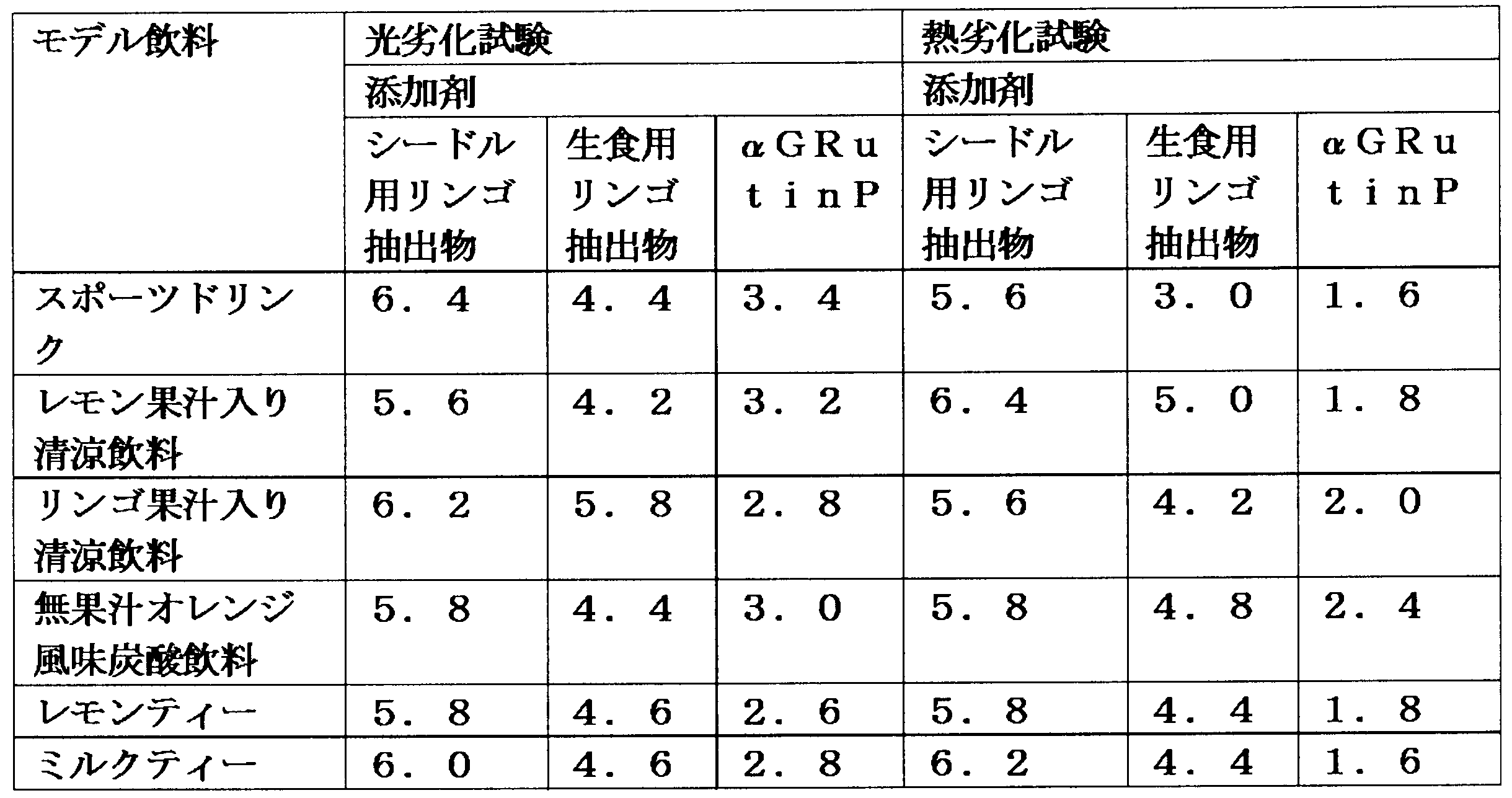
- the results are shown in Table 1.
- the score of evaluation in Table 1 is the average score of each panel scored according to the following criteria.
- the following evaluation examples 2 to 5 are the same evaluation method.
- Sensory evaluation criteria 7 Has the same flavor as the control. 1: The flavor is significantly deteriorated.
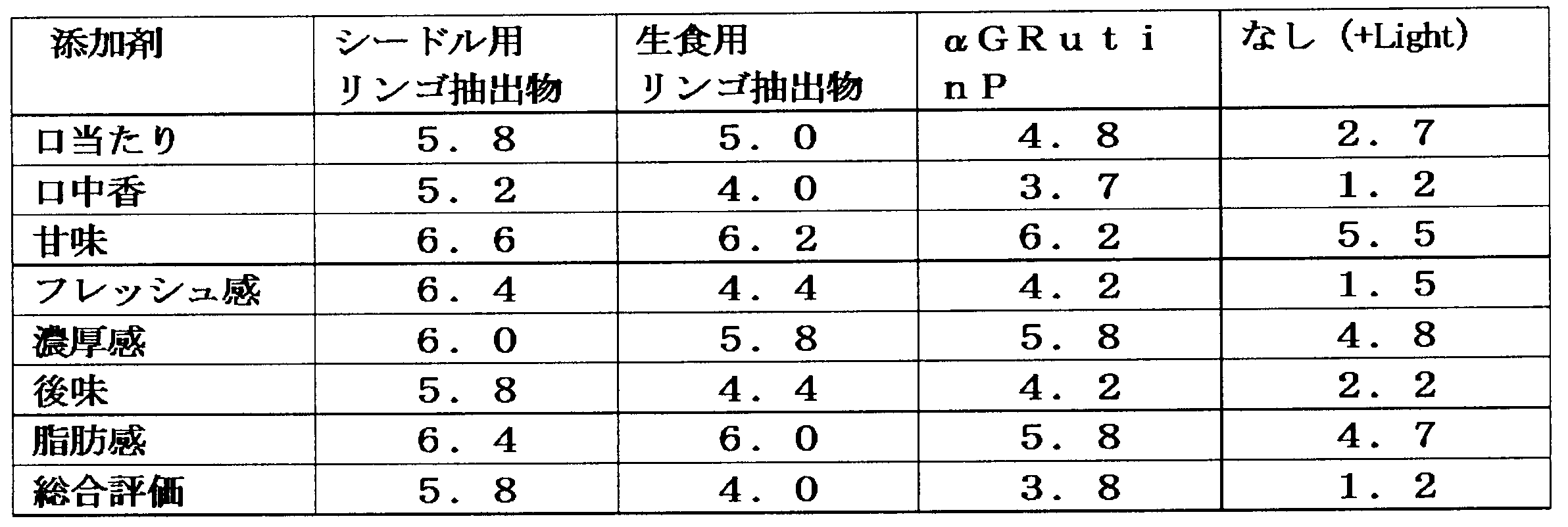
- the flavor deterioration inhibitor (cider apple extract) of the present invention is a photodegradation of flavor when added to various foods and drinks, compared to apple extract for raw eating and ⁇ GRutinP. It has been found that the effect of suppressing is high.
- gummy candies are placed in a photostability tester (“LH30-14M” manufactured by Nagano Science Co., Ltd.), irradiated with a fluorescent lamp (10000 lux, 25 ° C., 100 hours), and then selected by 10 experienced panels. Evaluation was performed.
- a photostability tester (“LH30-14M” manufactured by Nagano Science Co., Ltd.)
- a fluorescent lamp (10000 lux, 25 ° C., 100 hours
- Table 13 shows the results of a relative evaluation of the results of changes in color tone and the degree of flavor deterioration with a control of 5 points. Shown in The score of evaluation in Table 13 is the average score of each panel scored according to the following criteria.
- Color tone Relative evaluation was made in increments of 1 point up to 1 point in a completely faded state, with 5 points being no change compared to the control.
- Sensory evaluation Relative evaluation was made in increments of 1 point up to 1 point where the flavor was remarkably deteriorated, with 5 points indicating no change in flavor as compared with the control.
- the flavor deterioration inhibitor of the present invention has a high effect of suppressing flavor photodegradation when added to confectionery as compared to raw apple extract. I understood it.
Landscapes
- Chemical & Material Sciences (AREA)
- Life Sciences & Earth Sciences (AREA)
- Engineering & Computer Science (AREA)
- Food Science & Technology (AREA)
- Polymers & Plastics (AREA)
- Wood Science & Technology (AREA)
- Nutrition Science (AREA)
- Health & Medical Sciences (AREA)
- Organic Chemistry (AREA)
- Microbiology (AREA)
- Chemical Kinetics & Catalysis (AREA)
- Oil, Petroleum & Natural Gas (AREA)
- Zoology (AREA)
- Inorganic Chemistry (AREA)
- Dispersion Chemistry (AREA)
- Materials Engineering (AREA)
- Seasonings (AREA)
- Non-Alcoholic Beverages (AREA)
- Confectionery (AREA)
- Grain Derivatives (AREA)
- Tea And Coffee (AREA)
- Dairy Products (AREA)
- Fats And Perfumes (AREA)
Abstract
Description
[1]シードル用リンゴ抽出物からなる、またはシードル用リンゴ抽出物を有効成分として含有する、香味劣化抑制剤。
[2]前記シードル用リンゴ抽出物は、シードル用リンゴ抽出液の吸着剤処理物である[1]に記載の香味劣化抑制剤。
[3]前記吸着剤が合成樹脂吸着剤である[2]に記載の香味劣化抑制剤。
[4]前記シードル用リンゴが果実、ドライ果実、果汁、搾汁または搾汁後の残渣である[1]~[3]のいずれか1に記載の香味劣化抑制剤。
[5]前記シードル用リンゴは、搾汁液中の総ポリフェノール含量が0.2質量%以上であり、かつリンゴ酸度が0.45質量%以下である[1]~[4]のいずれか1に記載の香味劣化抑制剤。
[6]前記シードル用リンゴ抽出物における総ポリフェノール中のフロレチン含量が8質量%以上である[1]~[5]のいずれか1に記載の香味劣化抑制剤。
[7]前記シードル用リンゴ抽出物における総ポリフェノール中のプロシアニジン類含量が25質量%以下である[1]~[6]のいずれか1に記載の香味劣化抑制剤。
[8][1]~[7]のいずれか1に記載の香味劣化抑制剤を含有する香料。
[9][1]~[7]のいずれか1に記載の香味劣化抑制剤を含有する飲食品。
[10][1]~[7]のいずれか1に記載の香味劣化抑制剤を、香味劣化を受け得る被検物に添加する該被検物の香味劣化抑制方法。
[11]シードル用リンゴ抽出液を合成樹脂吸着剤で吸脱着処理する工程を含む香味劣化抑制剤の製造方法。
[12]以下の工程(a)~(c)を含む香味劣化抑制剤の製造方法。
(a)シードル用リンゴを水又は極性有機溶媒と接触させてシードル用リンゴ抽出液を得る工程
(b)工程(a)で得られたシードル用リンゴ抽出液を吸着剤に接触させた後に、該吸着剤に吸着された成分を有機溶媒水溶液で溶出して吸着剤処理物を得る工程
(c)工程(b)で得られた吸着剤処理物を濃縮する工程
本発明で用いる原料としては、シードル用リンゴが挙げられ、特にビタースイートタイプのシードル用リンゴが好ましい。シードル用リンゴとは、搾汁液中の総ポリフェノール含量が0.2質量%以上であり、かつアミノ態窒素含量が8mg・%以上のものを指す。
(a)搾汁方法
搾汁方法としては、特に限定されないが、例えば、原料を洗浄し、そのまま、または亜硫酸を添加しながら破砕、圧搾することにより搾汁果汁を得、好ましくはペクチン分解酵素を添加および作用させる。次いで遠心分離または濾過等の手段により清澄果汁を得る方法を挙げることができる。
抽出方法としては、特に限定されないが、例えば、原料である果実、ドライ果実、果汁、搾汁、または搾汁後の残渣を溶媒と所定の時間接触させ、必要に応じて加熱、撹拌または還流させる方法を挙げることができる。得られた抽出液は遠心分離および濾過して清澄なシードル用リンゴ抽出液を得る。
上記方法で得られるシードル用リンゴ抽出液は、吸着剤により処理して吸着剤処理物とすることが好ましい。シードル用リンゴ抽出液を吸着剤に接触させて、フロレチン、カテキン、ケルセチン、カフェー酸またはクロロゲン酸などの有用成分を該吸着剤に吸着させた後に、該有用成分を溶出溶媒で溶出して吸着剤処理物とする。
上記方法で得られるシードル用リンゴ抽出物(吸着剤処理物を含む)は濃縮して使用してもよい。濃縮方法は一般的に既知な方法で行なえばよい。濃縮方法としては、例えば、エバポレーターを用いて溶媒を回収する方法、および合成吸着樹脂処理時に、負荷した溶液量に対して少量の溶離液を用いることによって濃縮する方法が挙げられる。
本発明の香味劣化抑制剤は前述したシードル用リンゴ樹脂抽出物(吸着剤処理された抽出物、濃縮物および乾固物の別を問わない)を含有するものであればよく、当該樹脂処理物以外の成分として、希釈剤、担体およびその他の添加剤を含有していてもよい。
シードル用リンゴ(Dabinett)600gをさいの目にカットして、蒸留水600gを加水し、フードプロセッサーを用いて破砕しペーストを得た。このペーストにペクチナーゼを0.24g加え、50℃にて4時間撹拌抽出を行った。25℃まで冷却し、4000rpm、30分間の条件で遠心分離を行い、上清を回収した。この上清にセライトを3g加えて濾過を行い、清澄なシードル用リンゴ粗抽出物1047mlを得た。
生食用リンゴ(「デザート用リンゴ」とも呼称する)(ふじ)600gを用いて、実施例1と同様の操作を行い、生食用リンゴ粗抽出物1055mlを得た。生食用リンゴ粗抽出物を100mlについて、引き続き実施例1と同様に樹脂による精製操作を行い、生食用リンゴ粉末製剤1.4gを得た。
装置:Agilent Technologies社製「1200LCシステム」
カラム:ジーエルサイエンス社製「InertSil ODS-3 150mm×4.6mm」
Mobile PhaseA:0.1% Phosphoric acid aq
Mobile PhaseB:ACN
Bconc.:2%(0min.)→25%(14min.)→35%(25min.)→55%(35-38min.)→2%(40min.)
Flow rate:0.7(ml/min.)
Column temp.:40(℃)
Det.:340(nm)
20ml試験管にサンプル溶液を100μl入れ、蒸留水を7.5ml加えた。更に0.9Nフェノール試薬(1.8N Folin-Ciocalteu’s試薬を2倍希釈して使用)を加えた。
エバポレーターで完全に乾固した測定試料を、メタノールに溶解した。2mlエッペンドルフチューブに測定試料を280μl入れて700μlの1%(w/v)バニリン/メタノール溶液、700μlの1%(v/v)硫酸/メタノール溶液の順で混合した。15分間室温で静置した後に、分光光度計で500nmの吸光度を測定した。カテキンを用いて同様な操作で測定して検量線(カテキン濃度vsAbs500nm)を作製し、プロシアニジン類含量を算出し、総ポリフェノール中のプロシアニジン類含量とした。
イモを乾燥し、破砕した後、この破砕粉末10gに対して水100gを添加し、50℃にて4時間撹拌抽出を行った。25℃まで冷却し、4000rpm、30分間の条件で遠心分離を行い、上清を回収した。この上清にセライトを3g加えて濾過を行い、清澄なイモ粗抽出物70gを得た。
乾燥ヤーコン粉末を用いて比較例2と同様の操作を行い、ヤーコン粉末製剤0.13gを得た。
乾燥シソ粉末を用いて比較例2と同様の操作を行い、シソ粉末製剤0.15gを得た。
乾燥ブルーベリー粉末を用いて比較例2と同様の操作を行い、ブルーベリー粉末製剤0.15gを得た。
乾燥ブラックカラント粉末を用いて比較例2と同様の操作を行い、ブラックカラント粉末製剤0.14gを得た。
乾燥ライチ種子粉末を用いて比較例2と同様の操作を行い、ライチ種子粉末製剤0.13gを得た。
乾燥チャ粉末を用いて比較例2と同様の操作を行い、チャ粉末製剤0.15gを得た。
乾燥月見草粉末を用いて比較例2と同様の操作を行い、月見草粉末製剤0.11gを得た。
乾燥オリーブ葉粉末を用いて比較例2と同様の操作を行い、オリーブ葉粉末製剤0.11gを得た。
乾燥ブドウ種子粉末を用いて比較例2と同様の操作を行い、ブドウ種子粉末製剤0.15gを得た。
乾燥黄杞葉粉末を用いて比較例2と同様の操作を行い、黄杞葉粉末製剤0.09gを得た。
乾燥バラ粉末を用いて比較例2と同様の操作を行い、バラ粉末製剤0.11gを得た。
乾燥コーヒー粉末を用いて比較例2と同様の操作を行い、コーヒー粉末製剤0.21gを得た。
6.41gのクエン酸と3.59gのクエン酸三ナトリウムと400gの糖度(Brix値)=75の糖液を4590gの水道水に混合し、pH=3.5、糖度(Brix値)=6の糖酸液5000gを調製した。
透明PETボトルに試験体を充填した試験対象品は、光安定性試験機(ナガノサイエンス株式会社製「LH30-14M」)を用いて光照射を行なった。照射条件は、静置した状態で、温度25℃にて、白色蛍光灯による照射(照度10000ルクス)を168時間行なった。
上記光劣化試験を行なったシトラール入り糖酸液を固相抽出法にて濃縮を行った。用いた固相は、ジーエルサイエンス社製「InertSep C18-B」500mg/3mlで、試料負荷前に、2.25mlのペンタン:エーテル[=1:1(容量比)]溶液、2.25mlのメタノール、4.5mlの蒸留水を流しておきコンディショニングした。これに1000mlの被光劣化試験溶液を通液し、4.5mlの蒸留水で洗浄し、30分間乾燥させてから、4.5mlのペンタン:エーテル[=1:1(容量比)]溶液で溶出させた。
装置:Agilent Technologies社製「6890N」
カラム:ジーエルサイエンス社製「BC-WAX 0.25mm×30m、I.D.=0.25μm」
キャリアーガス:ヘリウム
温度条件:60-230℃(昇温:4℃/分)
検出器:FID(250℃)
シトラール残存率(%)=(A/B)×100
A:光照射後の各試料中のシトラール含量(ppm)
B:光未照射(コントロール)の試料中のシトラール含量(ppm)
blank:蛍光灯照射(香味劣化抑制剤添加なし)
シードル用リンゴ抽出物:実施例1で得られた粉末製剤(本発明の香味劣化抑制剤)
デザート用リンゴ抽出物:比較例1で得られた粉末製剤
各植物抽出物:比較例2から比較例14で得られた粉末製剤
吸着剤処理したシードル用リンゴ抽出物に含まれる単純ポリフェノールを用いて、シトラールを指標とした光劣化抑制効果を検討した。実験例1と同様に、各物質の固形濃度が5ppmとなるように反応系に添加して光劣化試験に供した。シトラール残存率の比較グラフを図5に示す。
各種添加剤を0.05%となるように添加した牛乳100gをガラス容器に充填し、光安定性試験機(ナガノサイエンス株式会社製「LH30-14M」)に入れ、蛍光灯照射(5000ルクス、5℃、7時間)した後、習熟した10名のパネルを選んで官能評価を行なった。香味劣化抑制剤及び添加剤を添加せず蛍光灯未照射の牛乳(コントロール)を用意し、香味の劣化度合いを、コントロールと比較して香味変化のない状態を7点として、香味が著しく劣化している状態の1点まで、1点刻みで相対評価した。
7:コントロールと同じ香味を有する。
1:香味が著しく劣化している。

シードル用リンゴ抽出物:実施例1で得られた粉末製剤(本発明の香味劣化抑制剤)
生食用リンゴ抽出物:比較例1で得られた粉末製剤
αGRutinP:α-グルコシルルチン(東洋精糖社製)
表2に示す各種添加剤を0.05%となるように添加したソフトクリームミックス100gを透明プラスチック容器に充填し、蛍光灯照射(5000ルクス、5℃、24時間)した後、評価例1と同様の評価をした。結果を表2に示す。
牛乳600gと砂糖100gを入れて温めて、水10gに溶解した粉ゼラチン15gを加えて均一化した牛乳プリン生地を作製した。表3に示す各種添加剤を0.05%となるように上記生地に添加した。各種添加剤を加えた牛乳プリン生地100gを透明プラスチック容器に充填し、冷蔵庫で一晩冷やし固めた後、蛍光灯照射(5000ルクス、5℃、7時間)した後、評価例1と同様の評価をした結果を以下の表3に示す。

クリーム200gに砂糖15gを加え、表4に示す各種添加剤を0.05%となるように添加して氷冷しながら素早く泡立てた。これを絞り器に移して適量を透明プラスチック容器に充填し、蛍光灯照射(5000ルクス、5℃、24時間)した後、評価例1と同様の評価をした結果を以下の表4に示す。

表5に示す各種添加剤を0.05%となるように添加したヨーグルト95gを透明プラスチック容器に充填し、蛍光灯照射(1000ルクス、5℃、10日間)した後、評価例1と同様の評価を行った結果を以下の表5に示す。
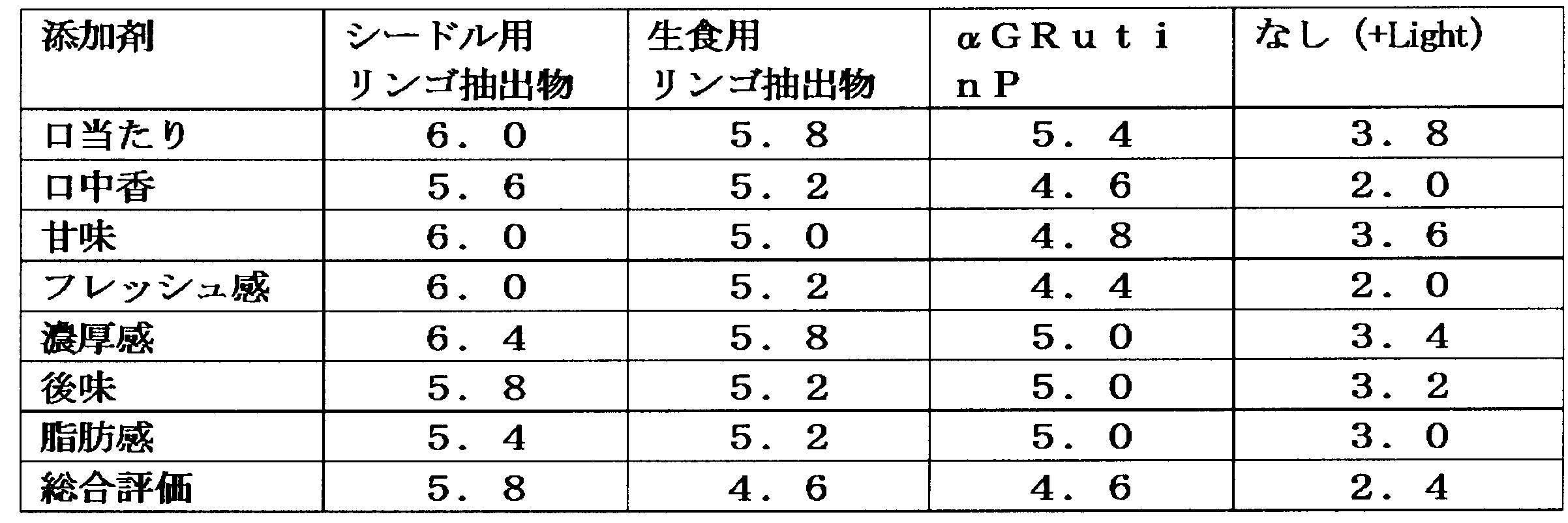
表6~11に示す処方の各種飲料に表12に示す各種添加剤0.001%を各々添加した飲料を調製し、光劣化試験および熱劣化試験を行った。これらの飲料を、光劣化試験については蛍光灯照射(5000ルクス、5℃、7日間)又は熱劣化試験については熱劣化(50℃、10日間、遮光状態)した後、習熟した10名のパネルを選んで官能評価を行なった。
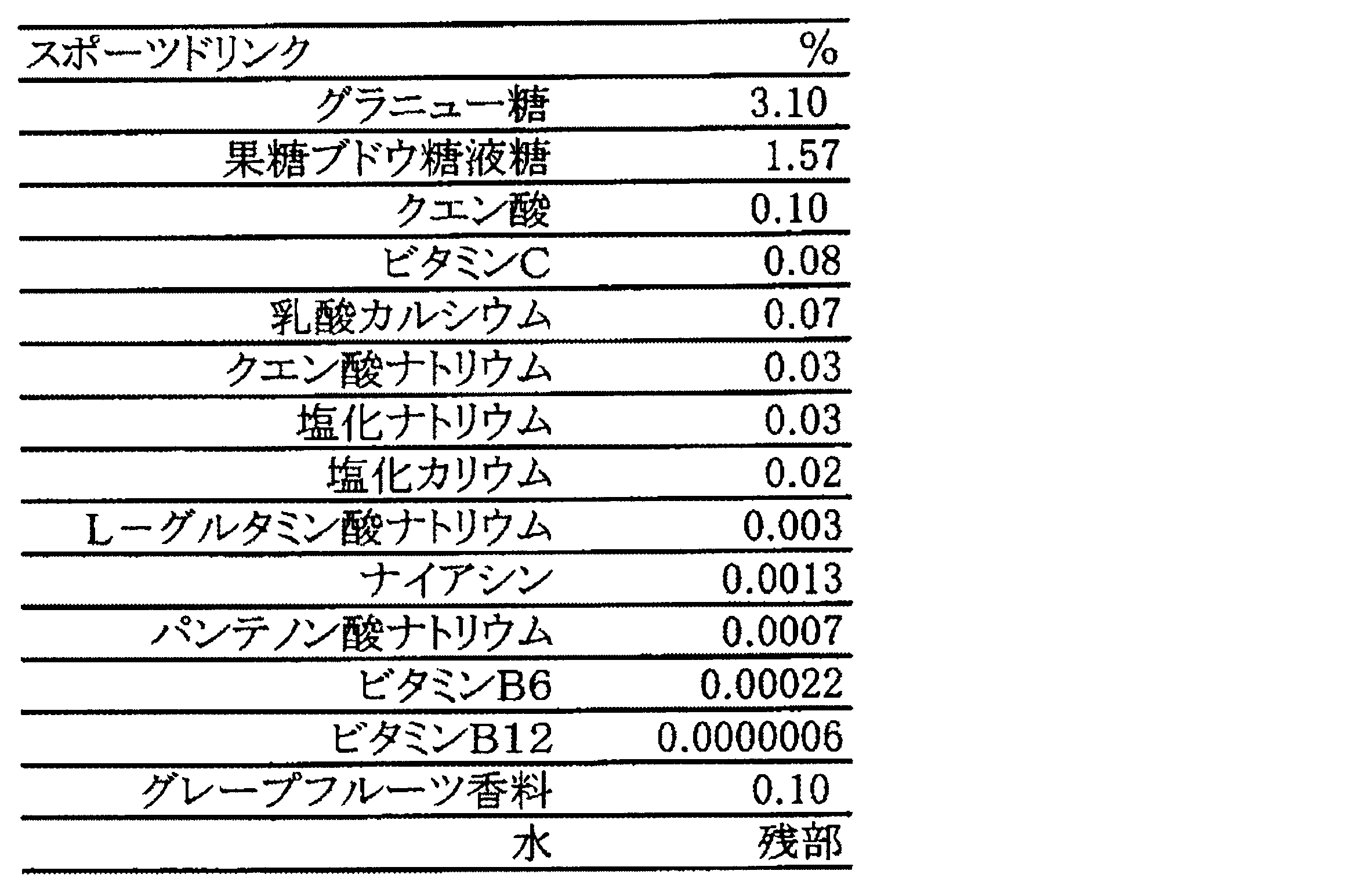


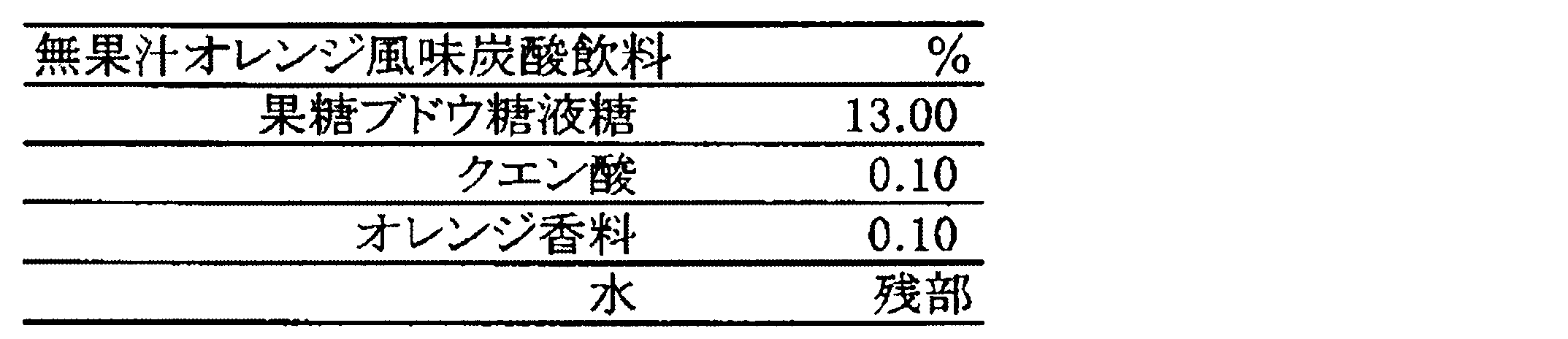
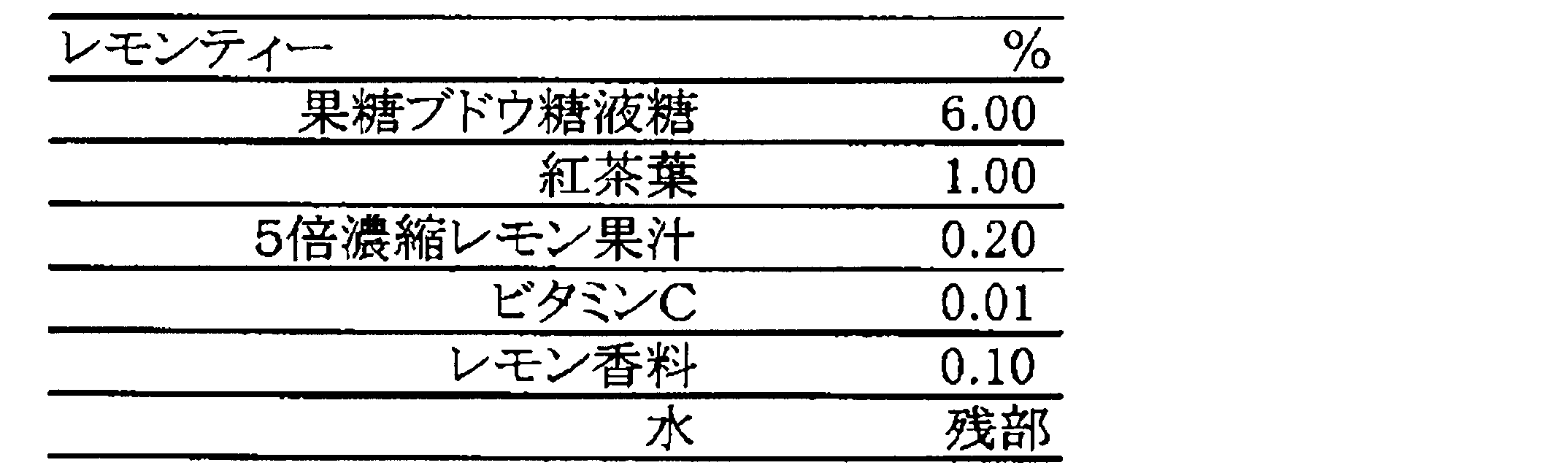
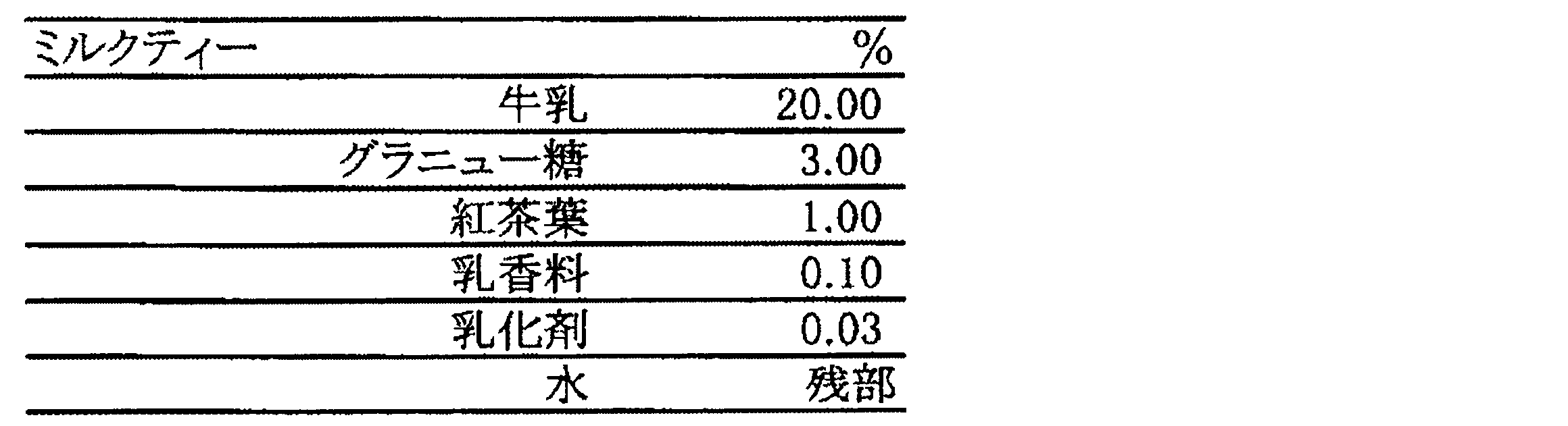
水飴400gとグラニュー糖400gを加熱溶解し、冷却した後に、ゼラチン70gと水130gを混合したゼラチン溶液を添加して混合した。これにレモン香料3gとクエン酸50%水溶液を30g、及び表13に示す各種香味劣化抑制剤2%を含むエタノール溶液を0.3g添加して撹拌し、モールドに流し込み一晩乾燥させた。これらグミキャンディーを光安定性試験機(ナガノサイエンス株式会社製「LH30-14M」)に入れ、蛍光灯照射(10000ルクス、25℃、100時間)した後、習熟した10名のパネルを選んで官能評価を行なった。
官能評価:コントロールと比較して香味変化のない状態を5点として、香味が著しく劣化している状態の1点まで、1点刻みで相対評価した。

Claims (12)
- シードル用リンゴ抽出物からなる、またはシードル用リンゴ抽出物を有効成分として含有する、香味劣化抑制剤。
- 前記シードル用リンゴ抽出物は、シードル用リンゴ抽出液の吸着剤処理物である請求項1に記載の香味劣化抑制剤。
- 前記吸着剤が合成樹脂吸着剤である請求項2に記載の香味劣化抑制剤。
- 前記シードル用リンゴが果実、ドライ果実、果汁、搾汁または搾汁後の残渣である請求項1~3のいずれか1項に記載の香味劣化抑制剤。
- 前記シードル用リンゴは、搾汁液中の総ポリフェノール含量が0.2質量%以上であり、かつリンゴ酸度が0.45質量%以下である請求項1~4のいずれか1項に記載の香味劣化抑制剤。
- 前記シードル用リンゴ抽出物における総ポリフェノール中のフロレチン含量が8質量%以上である請求項1~5のいずれか1項に記載の香味劣化抑制剤。
- 前記シードル用リンゴ抽出物における総ポリフェノール中のプロシアニジン類含量が25質量%以下である請求項1~6のいずれか1項に記載の香味劣化抑制剤。
- 請求項1~7のいずれか1項に記載の香味劣化抑制剤を含有する香料。
- 請求項1~7のいずれか1項に記載の香味劣化抑制剤を含有する飲食品。
- 請求項1~7のいずれか1項に記載の香味劣化抑制剤を、香味劣化を受け得る被検物に添加する該被検物の香味劣化抑制方法。
- シードル用リンゴ抽出液を合成樹脂吸着剤で吸脱着処理する工程を含む香味劣化抑制剤の製造方法。
- 以下の工程(a)~(c)を含む香味劣化抑制剤の製造方法。
(a)シードル用リンゴを水又は極性有機溶媒と接触させてシードル用リンゴ抽出液を得る工程
(b)工程(a)で得られたシードル用リンゴ抽出液を吸着剤に接触させた後に、該吸着剤に吸着された成分を有機溶媒水溶液で溶出して吸着剤処理物を得る工程
(c)工程(b)で得られた吸着剤処理物を濃縮する工程
Priority Applications (5)
| Application Number | Priority Date | Filing Date | Title |
|---|---|---|---|
| US15/510,502 US20170258114A1 (en) | 2014-09-17 | 2015-09-17 | Flavor deterioration inhibitor |
| EP15841365.8A EP3195736A4 (en) | 2014-09-17 | 2015-09-17 | Flavor deterioration inhibitor |
| JP2016548946A JPWO2016043276A1 (ja) | 2014-09-17 | 2015-09-17 | 香味劣化抑制剤 |
| CN201580050098.4A CN106714577A (zh) | 2014-09-17 | 2015-09-17 | 香味劣化抑制剂 |
| SG11201701590YA SG11201701590YA (en) | 2014-09-17 | 2015-09-17 | Flavor deterioration inhibitor |
Applications Claiming Priority (2)
| Application Number | Priority Date | Filing Date | Title |
|---|---|---|---|
| JP2014-188405 | 2014-09-17 | ||
| JP2014188405 | 2014-09-17 |
Publications (1)
| Publication Number | Publication Date |
|---|---|
| WO2016043276A1 true WO2016043276A1 (ja) | 2016-03-24 |
Family
ID=55533312
Family Applications (1)
| Application Number | Title | Priority Date | Filing Date |
|---|---|---|---|
| PCT/JP2015/076514 Ceased WO2016043276A1 (ja) | 2014-09-17 | 2015-09-17 | 香味劣化抑制剤 |
Country Status (6)
| Country | Link |
|---|---|
| US (1) | US20170258114A1 (ja) |
| EP (1) | EP3195736A4 (ja) |
| JP (1) | JPWO2016043276A1 (ja) |
| CN (1) | CN106714577A (ja) |
| SG (1) | SG11201701590YA (ja) |
| WO (1) | WO2016043276A1 (ja) |
Cited By (5)
| Publication number | Priority date | Publication date | Assignee | Title |
|---|---|---|---|---|
| WO2016167008A1 (ja) * | 2015-04-13 | 2016-10-20 | アサヒビール株式会社 | リモネン含有製品、香料組成物および劣化臭生成抑制方法 |
| JP2016198081A (ja) * | 2015-04-13 | 2016-12-01 | アサヒビール株式会社 | リモネン含有製品、香料組成物および劣化臭生成抑制方法 |
| JP6198907B1 (ja) * | 2016-08-17 | 2017-09-20 | アサヒビール株式会社 | シトラールの残存量を向上させた、柑橘類果実様香味組成物及びそれを含有した製品 |
| JP2019055368A (ja) * | 2017-09-21 | 2019-04-11 | 水澤化学工業株式会社 | 機能性成分吸着剤 |
| JP2020094182A (ja) * | 2018-11-28 | 2020-06-18 | 三栄源エフ・エフ・アイ株式会社 | シトラールの熱劣化抑制用組成物及び熱劣化抑制方法 |
Families Citing this family (3)
| Publication number | Priority date | Publication date | Assignee | Title |
|---|---|---|---|---|
| CN111307646B (zh) * | 2020-02-27 | 2022-02-01 | 西南石油大学 | 一种测定盐水钻井液中聚合物类处理剂在黏土表面吸附量的方法 |
| CN113907394B (zh) * | 2021-09-28 | 2023-06-13 | 深圳市真味生物科技有限公司 | 一种烟用苹果提取物的制备方法 |
| JP7281792B1 (ja) * | 2022-10-28 | 2023-05-26 | 祐司 山下 | 果実酒の製造方法とアルコール含有果実 |
Citations (4)
| Publication number | Priority date | Publication date | Assignee | Title |
|---|---|---|---|---|
| JPH03251165A (ja) * | 1990-02-28 | 1991-11-08 | Nikka Uisukii Kk | ピンク色リンゴ果実酒の製造方法 |
| JPH0823939A (ja) * | 1994-07-14 | 1996-01-30 | Sanei Gen F F I Inc | 飲料の香味劣化防止剤および飲料の香味劣化防止方法 |
| JPH0823940A (ja) * | 1994-07-14 | 1996-01-30 | Sanei Gen F F I Inc | 飲料用香味劣化防止剤および飲料の香味劣化防止方法 |
| JP2006197845A (ja) * | 2005-01-20 | 2006-08-03 | Nikka Whisky Distilling Co Ltd | 赤色シードル及びその製造方法 |
Family Cites Families (11)
| Publication number | Priority date | Publication date | Assignee | Title |
|---|---|---|---|---|
| CA2128293C (en) * | 1993-12-06 | 2002-09-03 | Masayuki Tanabe | Fruit polyphenols and medicinal compositions containing them |
| US6855352B2 (en) * | 2000-09-12 | 2005-02-15 | The Nikka Whisky Distilling Co., Ltd. | Wild apple polyphenol and process for producing the same |
| JP2003096486A (ja) * | 2001-09-27 | 2003-04-03 | T Hasegawa Co Ltd | 香味劣化の抑制された柑橘系フレーバー組成物 |
| FR2836336B1 (fr) * | 2002-02-26 | 2004-08-27 | Diana Ingredients | Utilisation dans un traitement cosmetique d'une fraction phenolique riche en dihydrochalcones |
| FR2889955B1 (fr) * | 2005-08-31 | 2008-12-19 | Cooperative Agricole Elle Et V | Procede d'obtention d'un extrait vegetal de fruits a pepins, extrait vegetal ainsi obtenu et ses utilisations |
| CN100451126C (zh) * | 2005-10-27 | 2009-01-14 | 三达膜科技(厦门)有限公司 | 苹果汁中的蛋白质、苹果多酚、苹果淀粉和色素的分离方法 |
| WO2009011271A1 (ja) * | 2007-07-13 | 2009-01-22 | Ogawa & Co., Ltd. | 香味又は香気の劣化抑制剤 |
| US20110166086A1 (en) * | 2008-09-02 | 2011-07-07 | Yoshikazu Toyohara | Flavor improving agent |
| KR101194048B1 (ko) * | 2010-05-12 | 2012-10-24 | (주)다손 | 친환경사과 사이다의 제조 방법 및 상기 방법에 의해 제조된 통과일 친환경사과 사이다 |
| JP5885225B2 (ja) * | 2012-06-04 | 2016-03-15 | アサヒグループホールディングス株式会社 | 果実または果汁の加工方法 |
| BR112016005727B1 (pt) * | 2013-09-23 | 2021-09-08 | Société des Produits Nestlé S.A. | Uso de um extrato de polifenol de cacau para preparação de uma composição para tratamento de esofagite eosinofílica |
-
2015
- 2015-09-17 EP EP15841365.8A patent/EP3195736A4/en not_active Withdrawn
- 2015-09-17 JP JP2016548946A patent/JPWO2016043276A1/ja active Pending
- 2015-09-17 WO PCT/JP2015/076514 patent/WO2016043276A1/ja not_active Ceased
- 2015-09-17 US US15/510,502 patent/US20170258114A1/en not_active Abandoned
- 2015-09-17 CN CN201580050098.4A patent/CN106714577A/zh not_active Withdrawn
- 2015-09-17 SG SG11201701590YA patent/SG11201701590YA/en unknown
Patent Citations (4)
| Publication number | Priority date | Publication date | Assignee | Title |
|---|---|---|---|---|
| JPH03251165A (ja) * | 1990-02-28 | 1991-11-08 | Nikka Uisukii Kk | ピンク色リンゴ果実酒の製造方法 |
| JPH0823939A (ja) * | 1994-07-14 | 1996-01-30 | Sanei Gen F F I Inc | 飲料の香味劣化防止剤および飲料の香味劣化防止方法 |
| JPH0823940A (ja) * | 1994-07-14 | 1996-01-30 | Sanei Gen F F I Inc | 飲料用香味劣化防止剤および飲料の香味劣化防止方法 |
| JP2006197845A (ja) * | 2005-01-20 | 2006-08-03 | Nikka Whisky Distilling Co Ltd | 赤色シードル及びその製造方法 |
Non-Patent Citations (1)
| Title |
|---|
| See also references of EP3195736A4 * |
Cited By (10)
| Publication number | Priority date | Publication date | Assignee | Title |
|---|---|---|---|---|
| WO2016167008A1 (ja) * | 2015-04-13 | 2016-10-20 | アサヒビール株式会社 | リモネン含有製品、香料組成物および劣化臭生成抑制方法 |
| JP2016198081A (ja) * | 2015-04-13 | 2016-12-01 | アサヒビール株式会社 | リモネン含有製品、香料組成物および劣化臭生成抑制方法 |
| JP6198907B1 (ja) * | 2016-08-17 | 2017-09-20 | アサヒビール株式会社 | シトラールの残存量を向上させた、柑橘類果実様香味組成物及びそれを含有した製品 |
| JP2019055368A (ja) * | 2017-09-21 | 2019-04-11 | 水澤化学工業株式会社 | 機能性成分吸着剤 |
| JP2021137811A (ja) * | 2017-09-21 | 2021-09-16 | 水澤化学工業株式会社 | 機能性成分吸着剤 |
| JP2021175570A (ja) * | 2017-09-21 | 2021-11-04 | 水澤化学工業株式会社 | 機能性成分吸着剤 |
| JP7105967B2 (ja) | 2017-09-21 | 2022-07-25 | 水澤化学工業株式会社 | 機能性成分吸着剤 |
| JP7105969B2 (ja) | 2017-09-21 | 2022-07-25 | 水澤化学工業株式会社 | 機能性成分吸着剤 |
| JP2020094182A (ja) * | 2018-11-28 | 2020-06-18 | 三栄源エフ・エフ・アイ株式会社 | シトラールの熱劣化抑制用組成物及び熱劣化抑制方法 |
| JP7379055B2 (ja) | 2018-11-28 | 2023-11-14 | 三栄源エフ・エフ・アイ株式会社 | シトラールの熱劣化抑制用組成物及び熱劣化抑制方法 |
Also Published As
| Publication number | Publication date |
|---|---|
| EP3195736A4 (en) | 2018-05-30 |
| JPWO2016043276A1 (ja) | 2017-06-29 |
| US20170258114A1 (en) | 2017-09-14 |
| CN106714577A (zh) | 2017-05-24 |
| EP3195736A1 (en) | 2017-07-26 |
| SG11201701590YA (en) | 2017-04-27 |
Similar Documents
| Publication | Publication Date | Title |
|---|---|---|
| JPWO2016043276A1 (ja) | 香味劣化抑制剤 | |
| JP5624764B2 (ja) | 香味又は香気の劣化抑制剤 | |
| JP7134976B2 (ja) | 苦丁茶加工物 | |
| EP1554938A1 (en) | Flavor deterioration inhibitor and inhibitor for the generation of citral deterioration smell | |
| JP2003079335A (ja) | 食品の香味劣化抑制剤並びに抑制方法 | |
| JP2023111879A (ja) | 精製レモンバーム抽出物の製造方法 | |
| JP4257022B2 (ja) | 食品の香味劣化抑制剤並びに抑制方法 | |
| JP4109818B2 (ja) | 香味劣化抑制剤 | |
| JP6133595B2 (ja) | 容器詰飲料 | |
| JP6484167B2 (ja) | 香味劣化抑制剤 | |
| CN1915080B (zh) | 香味变质抑制剂和柠檬醛变质气味生成抑制剂 | |
| JP4503235B2 (ja) | 香味劣化抑制剤 | |
| JP5091431B2 (ja) | 香味又は香気劣化抑制剤、及び香味又は香気劣化抑制方法 | |
| JP4231244B2 (ja) | 香味劣化抑制剤 | |
| JP2002330741A (ja) | 食品又は香粧品の香味又は香気の劣化抑制剤 | |
| JP4231243B2 (ja) | 香味劣化抑制剤 | |
| JP2004018612A (ja) | 香味劣化抑制剤 | |
| JP7282560B2 (ja) | 飲食品の香味又は風味の劣化抑制用組成物及び劣化抑制方法 | |
| JP2004016058A (ja) | 香味劣化抑制剤 | |
| JP2001061461A (ja) | 柑橘果実由来のフレーバー劣化防止剤 | |
| JP2004016057A (ja) | 香味劣化抑制剤 | |
| JP2004018611A (ja) | 香味劣化抑制剤 | |
| JP2005269908A (ja) | 香味劣化抑制剤 |
Legal Events
| Date | Code | Title | Description |
|---|---|---|---|
| 121 | Ep: the epo has been informed by wipo that ep was designated in this application |
Ref document number: 15841365 Country of ref document: EP Kind code of ref document: A1 |
|
| ENP | Entry into the national phase |
Ref document number: 2016548946 Country of ref document: JP Kind code of ref document: A |
|
| WWE | Wipo information: entry into national phase |
Ref document number: 15510502 Country of ref document: US |
|
| REEP | Request for entry into the european phase |
Ref document number: 2015841365 Country of ref document: EP |
|
| WWE | Wipo information: entry into national phase |
Ref document number: 2015841365 Country of ref document: EP |
|
| NENP | Non-entry into the national phase |
Ref country code: DE |