WO2016043300A1 - ウレタン系粘着剤組成物 - Google Patents
ウレタン系粘着剤組成物 Download PDFInfo
- Publication number
- WO2016043300A1 WO2016043300A1 PCT/JP2015/076598 JP2015076598W WO2016043300A1 WO 2016043300 A1 WO2016043300 A1 WO 2016043300A1 JP 2015076598 W JP2015076598 W JP 2015076598W WO 2016043300 A1 WO2016043300 A1 WO 2016043300A1
- Authority
- WO
- WIPO (PCT)
- Prior art keywords
- urethane
- sensitive adhesive
- based pressure
- pressure
- adhesive composition
- Prior art date
- Legal status (The legal status is an assumption and is not a legal conclusion. Google has not performed a legal analysis and makes no representation as to the accuracy of the status listed.)
- Ceased
Links
Classifications
-
- C—CHEMISTRY; METALLURGY
- C09—DYES; PAINTS; POLISHES; NATURAL RESINS; ADHESIVES; COMPOSITIONS NOT OTHERWISE PROVIDED FOR; APPLICATIONS OF MATERIALS NOT OTHERWISE PROVIDED FOR
- C09J—ADHESIVES; NON-MECHANICAL ASPECTS OF ADHESIVE PROCESSES IN GENERAL; ADHESIVE PROCESSES NOT PROVIDED FOR ELSEWHERE; USE OF MATERIALS AS ADHESIVES
- C09J175/00—Adhesives based on polyureas or polyurethanes; Adhesives based on derivatives of such polymers
- C09J175/04—Polyurethanes
-
- C—CHEMISTRY; METALLURGY
- C08—ORGANIC MACROMOLECULAR COMPOUNDS; THEIR PREPARATION OR CHEMICAL WORKING-UP; COMPOSITIONS BASED THEREON
- C08G—MACROMOLECULAR COMPOUNDS OBTAINED OTHERWISE THAN BY REACTIONS ONLY INVOLVING UNSATURATED CARBON-TO-CARBON BONDS
- C08G18/00—Polymeric products of isocyanates or isothiocyanates
- C08G18/06—Polymeric products of isocyanates or isothiocyanates with compounds having active hydrogen
- C08G18/28—Polymeric products of isocyanates or isothiocyanates with compounds having active hydrogen characterised by the compounds used containing active hydrogen
- C08G18/2805—Compounds having only one group containing active hydrogen
- C08G18/2815—Monohydroxy compounds
- C08G18/284—Compounds containing ester groups, e.g. oxyalkylated monocarboxylic acids
-
- C—CHEMISTRY; METALLURGY
- C08—ORGANIC MACROMOLECULAR COMPOUNDS; THEIR PREPARATION OR CHEMICAL WORKING-UP; COMPOSITIONS BASED THEREON
- C08G—MACROMOLECULAR COMPOUNDS OBTAINED OTHERWISE THAN BY REACTIONS ONLY INVOLVING UNSATURATED CARBON-TO-CARBON BONDS
- C08G18/00—Polymeric products of isocyanates or isothiocyanates
- C08G18/06—Polymeric products of isocyanates or isothiocyanates with compounds having active hydrogen
- C08G18/28—Polymeric products of isocyanates or isothiocyanates with compounds having active hydrogen characterised by the compounds used containing active hydrogen
- C08G18/40—High-molecular-weight compounds
-
- C—CHEMISTRY; METALLURGY
- C08—ORGANIC MACROMOLECULAR COMPOUNDS; THEIR PREPARATION OR CHEMICAL WORKING-UP; COMPOSITIONS BASED THEREON
- C08G—MACROMOLECULAR COMPOUNDS OBTAINED OTHERWISE THAN BY REACTIONS ONLY INVOLVING UNSATURATED CARBON-TO-CARBON BONDS
- C08G18/00—Polymeric products of isocyanates or isothiocyanates
- C08G18/06—Polymeric products of isocyanates or isothiocyanates with compounds having active hydrogen
- C08G18/28—Polymeric products of isocyanates or isothiocyanates with compounds having active hydrogen characterised by the compounds used containing active hydrogen
- C08G18/40—High-molecular-weight compounds
- C08G18/48—Polyethers
- C08G18/4833—Polyethers containing oxyethylene units
-
- C—CHEMISTRY; METALLURGY
- C08—ORGANIC MACROMOLECULAR COMPOUNDS; THEIR PREPARATION OR CHEMICAL WORKING-UP; COMPOSITIONS BASED THEREON
- C08K—Use of inorganic or non-macromolecular organic substances as compounding ingredients
- C08K5/00—Use of organic ingredients
- C08K5/0008—Organic ingredients according to more than one of the "one dot" groups of C08K5/01 - C08K5/59
- C08K5/0016—Plasticisers
-
- C—CHEMISTRY; METALLURGY
- C08—ORGANIC MACROMOLECULAR COMPOUNDS; THEIR PREPARATION OR CHEMICAL WORKING-UP; COMPOSITIONS BASED THEREON
- C08K—Use of inorganic or non-macromolecular organic substances as compounding ingredients
- C08K5/00—Use of organic ingredients
- C08K5/0008—Organic ingredients according to more than one of the "one dot" groups of C08K5/01 - C08K5/59
- C08K5/0025—Crosslinking or vulcanising agents; including accelerators
-
- C—CHEMISTRY; METALLURGY
- C08—ORGANIC MACROMOLECULAR COMPOUNDS; THEIR PREPARATION OR CHEMICAL WORKING-UP; COMPOSITIONS BASED THEREON
- C08K—Use of inorganic or non-macromolecular organic substances as compounding ingredients
- C08K5/00—Use of organic ingredients
- C08K5/04—Oxygen-containing compounds
- C08K5/06—Ethers; Acetals; Ketals; Ortho-esters
-
- C—CHEMISTRY; METALLURGY
- C08—ORGANIC MACROMOLECULAR COMPOUNDS; THEIR PREPARATION OR CHEMICAL WORKING-UP; COMPOSITIONS BASED THEREON
- C08K—Use of inorganic or non-macromolecular organic substances as compounding ingredients
- C08K5/00—Use of organic ingredients
- C08K5/16—Nitrogen-containing compounds
- C08K5/29—Compounds containing one or more carbon-to-nitrogen double bonds
-
- C—CHEMISTRY; METALLURGY
- C09—DYES; PAINTS; POLISHES; NATURAL RESINS; ADHESIVES; COMPOSITIONS NOT OTHERWISE PROVIDED FOR; APPLICATIONS OF MATERIALS NOT OTHERWISE PROVIDED FOR
- C09J—ADHESIVES; NON-MECHANICAL ASPECTS OF ADHESIVE PROCESSES IN GENERAL; ADHESIVE PROCESSES NOT PROVIDED FOR ELSEWHERE; USE OF MATERIALS AS ADHESIVES
- C09J11/00—Features of adhesives not provided for in group C09J9/00, e.g. additives
- C09J11/02—Non-macromolecular additives
- C09J11/06—Non-macromolecular additives organic
-
- C—CHEMISTRY; METALLURGY
- C09—DYES; PAINTS; POLISHES; NATURAL RESINS; ADHESIVES; COMPOSITIONS NOT OTHERWISE PROVIDED FOR; APPLICATIONS OF MATERIALS NOT OTHERWISE PROVIDED FOR
- C09J—ADHESIVES; NON-MECHANICAL ASPECTS OF ADHESIVE PROCESSES IN GENERAL; ADHESIVE PROCESSES NOT PROVIDED FOR ELSEWHERE; USE OF MATERIALS AS ADHESIVES
- C09J7/00—Adhesives in the form of films or foils
- C09J7/20—Adhesives in the form of films or foils characterised by their carriers
Definitions
- the present invention relates to a new urethane-based pressure-sensitive adhesive composition suitable for use in a skin patch.
- Urethane pressure-sensitive adhesive refers to a pressure-sensitive adhesive having a urethane group (—NCHCOO—), and it is known that various physical properties can be imparted by adding additives. Urethane-based adhesives are more hydrophilic and easier on the skin than rubber-based adhesives and acrylic-based adhesives. However, the adhesive for patches has a slight difficulty in tackiness compared with the acrylic adhesive.
- a urethane-based pressure-sensitive adhesive is made by reacting a polyester polyol or polyether polyol and a polyvalent isocyanate, or is made of a polyurethane polyol.
- a urethane-based pressure-sensitive adhesive prepared only by urethanization reaction with polyol and diisocyanate is slightly tacky. Attempts to increase the adhesive strength of urethane adhesives have also been made, but generally there is difficulty in removability due to insufficient cohesion, and improving the adhesive strength of urethane adhesives to the extent necessary for skin patching was difficult.
- Patent Document 1 urethane adhesives with improved water absorption and improved sweat resistance
- aqueous urethane adhesives that do not use organic solvents Patent Document 2
- hydrophilic oils such as polyhydric alcohols
- Patent Document 3 that contains a reduced amount of skin irritation
- Patent Document 4 urethane pressure-sensitive adhesive
- the problem to be solved by the present invention is to provide a urethane-based pressure-sensitive adhesive having improved adhesiveness while maintaining skin-friendly properties.
- the urethane pressure-sensitive adhesive composition of the present invention comprises a urethane pressure-sensitive adhesive, a curing agent, and a hydrophilic plasticizer as essential components, and the composition ratio of the urethane pressure-sensitive adhesive, the curing agent, and the hydrophilic plasticizer is the urethane.
- the solid content of the adhesive is 100 parts by mass
- the solid content of the curing agent is 0.5 to 15 parts by mass
- the solid content of the hydrophilic plasticizer is 10 to 80 parts by mass.
- urethane-based pressure-sensitive adhesive a urethane-based pressure-sensitive adhesive composed of polyester polyol and polyether polyol, a urethane-based pressure-sensitive adhesive composed of urethane urea resin, and a urethane-based pressure-sensitive adhesive composed of polyurethane polyol can be suitably used.
- a urethane-based pressure-sensitive adhesive made of polyurethane polyol is particularly preferable.
- the urethane-based pressure-sensitive adhesive composed of a polyurethane polyol that is suitably used in the urethane-based pressure-sensitive adhesive of the present invention is composed of a polyurethane polyol as a main component and a curing agent containing a polyfunctional isocyanate, and the polyurethane polyol is a curing agent.
- curing agent the same thing as the polyfunctional isocyanate used in order to manufacture a polyurethane polyol can be used.
- a polyfunctional isocyanate is used as the curing agent.
- Polyfunctional isocyanates such as linear compounds such as hexamethylene diisocyanate, adducts, and isosaannulates are preferably used.
- the crosslinking density of the urethane pressure-sensitive adhesive can be appropriately controlled, and the adhesiveness can be adjusted.
- the addition amount of the polyfunctional isocyanate of the curing agent with respect to the main component polyurethane polyol must be 0.5 to 15 parts by mass (solid content) with respect to 100 parts by mass of the solid content of the polyurethane polyol.
- the amount is preferably 10 parts by mass (solid content), more preferably 3.0 to 8 parts by mass (solid content).
- the hydrophilic plasticizer is added to plasticize the urethane adhesive and improve the adhesive strength and peelability.
- the hydrophilic plasticizer is a hydrophilic high-boiling liquid that is compatible with urethane and brings about a plasticizing effect, and preferably has one or more hydroxyl groups, oxyethylene groups, or both in the molecule.
- the high boiling point means that the boiling point at normal pressure is 150 ° C. or higher.
- the hydrophilic plasticizer is a hydrophilic high-boiling liquid containing one or more hydroxyl groups and / or oxyethylene groups in the molecule, or a long-chain hydrocarbon group.
- a long chain hydrocarbon refers to a hydrocarbon having 10 or more carbon atoms.
- Preferred hydrophilic plasticizers include, for example, octyldodecyl lactate, isostearyl glycolate, polyoxyethylene cetyl ether, polyoxyethylene lauryl ether, oleyl cetyl ether and the like.
- the addition amount of the hydrophilic plasticizer is preferably 10 to 80 parts by mass (solid content), more preferably 15 to 60 parts by mass (solid content) with respect to 100 parts by mass of the solid content of the urethane-based adhesive. If the addition amount of the hydrophilic plasticizer is small, strong adhesiveness as a composition cannot be exhibited. If the amount is too large, plasticization will occur and the cohesive strength will be insufficient, resulting in adhesive residue. If a large amount of hydrophilic plasticizer is added, the urethane-based pressure-sensitive adhesive may become soft due to plasticization and the cohesive force may be insufficient. In such a case, the cohesive force can be kept soft by increasing the addition amount of the curing agent of the pressure-sensitive adhesive and increasing the degree of crosslinking.
- the adhesive composition is intended for other additives such as tackifiers, antioxidants, UV absorbers, inorganic fillers, wetting agents, etc. It may be added accordingly.
- a urethane-based pressure-sensitive adhesive composition is obtained by applying a urethane-based pressure-sensitive adhesive, a curing agent, a hydrophilic plasticizer and the like on a flexible support film and performing a heating treatment.
- the urethane-based pressure-sensitive adhesive composition sheet that holds the urethane-based pressure-sensitive adhesive composition in the form of a sheet can be used as a skin patch.
- the flexible support film a polyethylene film, a polyester film, a polyurethane film, or the like can be used. Among these, a polyurethane film having a thickness of 10 ⁇ m or less is most preferable. This is because the polyurethane film has a high degree of extensibility, gas permeability, and water vapor permeability, and thus makes full use of the characteristics of the urethane-based pressure-sensitive adhesive of the present invention.
- Urethane adhesives are hydrophilic and have higher water vapor permeability than rubber adhesives and acrylic adhesives, which are more hydrophobic.
- a hydrophilic plasticizer By mixing a hydrophilic plasticizer with such a urethane-based pressure-sensitive adhesive, water vapor permeability is further improved as compared with the case of mixing a hydrophobic plasticizer. Therefore, the urethane-based pressure-sensitive adhesive composition sheet has an extremely great feature as a skin pressure-sensitive adhesive that does not cause stuffiness even when applied to the skin for a long time.
- the total thickness of the support film and the pressure-sensitive adhesive composition is 15 to 60 ⁇ m so that redness does not occur even when the skin is applied for a long time (24 hours or more) and the stuffiness is not felt.
- the thickness is 15 ⁇ m or less, the adhesiveness to the skin tends to be low.
- the thickness is 60 ⁇ m or more, the water vapor permeability, which is a feature of the product of the present invention, may be reduced.
- the urethane-based pressure-sensitive adhesive composition sheet of the present invention is a mixture of a urethane-based pressure-sensitive adhesive, a curing agent, a hydrophilic plasticizer, and the like applied on a release film or a support film by hand coating or using a coating machine, It can be produced by heating and curing, and then covering the urethane adhesive surface with a support film or a release film.
- urethane-based adhesive composition with excellent adhesiveness, water vapor permeability and adhesive residue is obtained, which is gentle to the skin of the urethane-based adhesive
- the adhesiveness can be improved while maintaining the characteristics.
- a urethane-based adhesive, a curing agent, and a hydrophilic plasticizer were mixed to obtain a transparent liquid.
- this mixture is applied onto a polyester release film having a thickness of 30 ⁇ m so as to have an adhesive layer thickness of 25 ⁇ m and heated at 60 ° C. for 12 hours, a part of the polymer chain of the urethane-based adhesive resin is cross-linked, and the It changed to the soft resinous substance which has adhesiveness (urethane type adhesive composition).
- a urethane film manufactured by Kosmedy Pharmaceutical Co., Ltd.
- a urethane-based pressure-sensitive adhesive composition sheet was obtained.
- the physical properties of the obtained urethane pressure-sensitive adhesive composition sheet were evaluated, and the surface properties were observed.
- the results are summarized in Table 1 (Examples) and Table 2 (Comparative Examples).
- the value of the tilted ball tack was measured by a method according to JIS Z 0237.
- a ball tack value of 6 or less was evaluated as weak adhesive, a ball tack value of 7 as medium adhesive, and 8 or higher as strong adhesive. Samples exhibiting tackiness with a ball tack value of 7 or more meet the purpose of this study.
- Siavine SP-205 (medium adhesive urethane adhesive: Toyo Ink Co., Ltd.) made of polyurethane polyol was used as the urethane adhesive.
- the solid content of other components relative to 100 mass parts of the solid content of the urethane-based pressure-sensitive adhesive is represented by mass parts.
- T501B polyfunctional isocyanate curing agent: Toyo Ink Co., Ltd.
- Sun Pasta HD739D polyfunctional isocyanate curing agent: Big Technos Co., Ltd.
- Sun Pasta HD739D contains silica and is known to cause a smooth crosslinking reaction even if the crosslinking system contains moisture.
- hydrophobic plasticizer IPM (isopropyl myristate: Wako Pure Chemical Industries, Ltd.) or IPP (isopropyl palmitate: Wako Pure Chemical Industries, Ltd.) was used.
- Glycerin Nacalai Tesque Co., Ltd. was used as the low molecular weight polyhydric alcohol.
- Comparative Example 8 the amount of the curing agent was too small and adhesive residue was generated. In Comparative Example 9, the amount of the curing agent was slightly more and the amount of the hydrophilic plasticizer was further increased, so that an adhesive residue was generated.
- Patent Document 4 a fatty acid ester having 10 to 30 carbon atoms such as isostearyl laurate and isopropyl myristate is added in place of the hydrophilic plasticizer of the present invention.
- Those close to the invention of Patent Document 4 are Comparative Examples 4, 5, 6, and 7, but as shown in Table 2, these Comparative Examples are weak in tackiness.
- the use of a hydrophilic plasticizer rather than the use of a fatty acid ester can provide a skin-based urethane pressure-sensitive adhesive composition that is gentle to the skin and has a strong adhesive force.
- Example 8 and Comparative Examples 11 to 15 were evaluated by a method according to the moisture permeability test method (cup method) (JIS) of moisture-proof packaging materials.
- the support was made of a non-woven fabric (EW-9102 manufactured by Nippon Vilene Co., Ltd.) so as not to affect the moisture permeability of the pressure-sensitive adhesive.
- the adhesive thickness was 50 ⁇ m.
- Table 3 shows the results of measuring the amount of water vapor permeation after standing for 24 hours under the conditions of the cup opening area of 28,26 cm 2 , calcium chloride content of 17 g, room temperature of 40 ° C. and humidity of 75% in the cup method.
- MASCOS-10 is an acrylic adhesive (Cosmedy Pharma Co., Ltd.).
- the oil gel is composed of 30 parts by mass of a styrene-isoprene-styrene block copolymer (Clayton D1163, manufactured by Clayton Japan), 60 parts by mass of liquid paraffin (Nacalai Tesque, chemical reagent) and benzoylhydroxytoluene (Nacalai Tesque, chemical reagent) 0. .5 parts by mass is melt-kneaded at 140 ° C. and press-molded to form a 50 ⁇ m sheet.
- the urethane adhesive added with the addition of hydrophilic plasticizer showed a significantly higher water vapor transmission rate than the oil gel and acrylic adhesives.
Landscapes
- Chemical & Material Sciences (AREA)
- Organic Chemistry (AREA)
- Health & Medical Sciences (AREA)
- Chemical Kinetics & Catalysis (AREA)
- Medicinal Chemistry (AREA)
- Polymers & Plastics (AREA)
- Adhesives Or Adhesive Processes (AREA)
- Medicinal Preparation (AREA)
- Materials For Medical Uses (AREA)
- Adhesive Tapes (AREA)
Abstract
ウレタン系粘着剤の皮膚にやさしい特質を保持したまま粘着性が改善されたウレタン系粘着剤を提供する。 本発明のウレタン系粘着剤組成物は、ウレタン系粘着剤、硬化剤、親水性可塑剤を必須成分とする。親水性可塑剤は、ウレタンと相溶し可塑化効果をもたらす親水性高沸点液体であり、分子内に1個以上の水酸基若しくはオキシエチレン基あるいはその両者を有するものが好ましい。ウレタン系粘着剤、硬化剤、親水性可塑剤の固形分組成比は、ウレタン系粘着剤を100質量部として、硬化剤0.5~15質量部、親水性可塑剤10~80質量部である。
Description
本発明は皮膚への貼付剤に用いるに適した新しいウレタン系粘着剤組成物に関する。
ウレタン系粘着剤とは、ウレタン基(-NCHCOO-)を有する粘着剤をいい、添加物を加えることで多様な物性を付与できることが知られている。ウレタン系粘着剤はゴム系粘着剤やアクリル系粘着剤に比較し親水性であり、皮膚にやさしい粘着剤である。しかし貼付剤用粘着剤としては、アクリル系粘着剤と比較し粘着性にやや難があった。
一般にウレタン系粘着剤は、ポリエステルポリオール若しくはポリエーテルポリオールと多価イソシアネート類を反応させて作るか、あるいはポリウレタンポリオールからなる。ポリオールとジイソシアネートによるウレタン化反応だけで作成したウレタン系粘着剤は微粘着性である。ウレタン系粘着剤の粘着力を上げる試みもなされているが、一般に凝集力不足のため再剥離性に難があり、ウレタン系粘着剤の粘着力を皮膚貼付用として必要な程度に向上させることは難しかった。
これまでに、吸水性を改良し耐汗性能を向上させたウレタン系粘着剤(特許文献1)、有機溶剤を使用しない水性ウレタン系粘着剤(特許文献2)、多価アルコール等の親水性油剤を含有させて皮膚刺激を低減したウレタン系粘着剤(特許文献3)、脂肪酸エステルを含有させて密着性や泡抜け性を改善したウレタン系粘着剤(特許文献4)等がすでに公表されている。
本発明が解決しようとする課題は、皮膚にやさしい特質を保持したまま、粘着性が改善されたウレタン系粘着剤を提供することにある。
本発明のウレタン系粘着剤組成物は、ウレタン系粘着剤、硬化剤、親水性可塑剤を必須成分とし、前記ウレタン系粘着剤、前記硬化剤、前記親水性可塑剤の組成比が、前記ウレタン系粘着剤の固形分を100質量部として、前記硬化剤の固形分が0.5~15質量部、前記親水性可塑剤の固形分が10~80質量部であることを特徴とする。
ウレタン系粘着剤としては、ポリエステルポリオール、ポリエーテルポリオールからなるウレタン系粘着剤、ウレタンウレア樹脂からなるウレタン系粘着剤、ポリウレタンポリオールからなるウレタン系粘着剤を好適に用いることができる。
ウレタン系粘着剤としてはポリウレタンポリオールからなるウレタン系粘着剤が特に好ましい。
本発明のウレタン系粘着剤において好適に用いられるポリウレタンポリオールからなるウレタン系粘着剤はポリウレタンポリオールを主剤とし、多官能イソシアネートを含有する硬化剤を配合したもので、ポリウレタンポリオールが硬化剤の多官能イソシアネートによって架橋されたものである。ウレタン系粘着剤を多官能イソシアネート硬化剤により架橋させれば、皮膚にやさしくかつ粘着力が向上した皮膚用ウレタン系粘着剤となる。
硬化剤の多官能イソシアネートとしては、ポリウレタンポリオールを製造するために用いられる多官能イソシアネートと同じものを使用することができる。
本発明のウレタン系粘着剤において好適に用いられるポリウレタンポリオールからなるウレタン系粘着剤はポリウレタンポリオールを主剤とし、多官能イソシアネートを含有する硬化剤を配合したもので、ポリウレタンポリオールが硬化剤の多官能イソシアネートによって架橋されたものである。ウレタン系粘着剤を多官能イソシアネート硬化剤により架橋させれば、皮膚にやさしくかつ粘着力が向上した皮膚用ウレタン系粘着剤となる。
硬化剤の多官能イソシアネートとしては、ポリウレタンポリオールを製造するために用いられる多官能イソシアネートと同じものを使用することができる。
硬化剤としては、多官能性イソシアネートを用いる。ヘキサメチレンジイソシアネートのような線状化合物、アダクト体、イソサアヌレート体、等の多官能性イソシアネートが好適に用いられる。
硬化剤の配合量により、ウレタン系粘着剤の架橋密度を適切にコントロールでき、粘着性を調整することができる。
主剤のポリウレタンポリオールに対する硬化剤の多官能イソシアネートの添加量は、ポリウレタンポリオールの固形分100質量部に対して0.5~15質量部(固形分)であることが必要であり、1.0~10質量部(固形分)であることが好ましく、3.0~8質量部(固形分)であることがより好ましい。
硬化剤の配合量により、ウレタン系粘着剤の架橋密度を適切にコントロールでき、粘着性を調整することができる。
主剤のポリウレタンポリオールに対する硬化剤の多官能イソシアネートの添加量は、ポリウレタンポリオールの固形分100質量部に対して0.5~15質量部(固形分)であることが必要であり、1.0~10質量部(固形分)であることが好ましく、3.0~8質量部(固形分)であることがより好ましい。
親水性可塑剤は、ウレタン系粘着剤を可塑化し、粘着力と剥離性を向上させるために加える。親水性可塑剤は、ウレタンと相溶し可塑化効果をもたらす親水性高沸点液体であり、分子内に1個以上の水酸基若しくはオキシエチレン基あるいはその両者を有するものが好ましい。ここで高沸点とは常圧での沸点が150℃以上をいう。
親水性可塑剤は、分子内に1個以上の水酸基若しくはオキシエチレン基あるいはその両者を有するほか、長鎖炭化水素基を含有する親水性高沸点液体であることがさらに好ましい。長鎖炭化水素とは、炭素数10以上の炭化水素をいう。好ましい親水性可塑剤としては例えば、乳酸オクチルドデシル、グリコール酸イソステアリル、ポリオキシエチレンセチルエーテル、ポリオキシエチレンラウリルエーテル、オレイルセチルエーテル等が挙げられる。
親水性可塑剤の添加量は、ウレタン系粘着剤固形分100質量部に対し10~80質量部(固形分)が好ましく、15~60質量部(固形分)がより好ましい。親水性可塑剤の添加量が少ないと組成物としての強粘着性を発揮できない。多すぎると可塑化が過ぎて凝集力が不足し糊残りを起こす。
親水性可塑剤を多く添加すると、ウレタン系粘着剤が可塑化により軟らかくなり凝集力が不足することがある。そのような場合粘着剤の硬化剤の添加量を増量し架橋度を高くすることにより軟らかくかつ凝集力を保持させることができる。
親水性可塑剤を多く添加すると、ウレタン系粘着剤が可塑化により軟らかくなり凝集力が不足することがある。そのような場合粘着剤の硬化剤の添加量を増量し架橋度を高くすることにより軟らかくかつ凝集力を保持させることができる。
粘着剤組成物には、ウレタン系粘着剤、硬化剤及び親水性可塑剤の他、さらにタッキファイヤー、酸化防止剤、紫外線吸収剤、無機充填剤、湿潤剤、等のその他の添加剤を目的に応じて加えてもよい。
ウレタン系粘着剤、硬化剤及び親水性可塑剤等を柔軟な支持体フィルム上に塗布し、加温処理を行えば粘着性のあるウレタン系粘着剤組成物を得る。シート状にウレタン系粘着剤組成物を保持したのがウレタン系粘着剤組成物シートであり、これは皮膚用貼付剤として使用できる。
柔軟な支持体フィルムとしては、ポリエチレンフィルム、ポリエステルフィルム、ポリウレタンフィルム等が使用しうる。その中でも、厚さ10μm以下のポリウレタンフィルムが最も好ましい。ポリウレタンフィルムは高度の伸長性、ガス透過性、水蒸気透過性を有するので、本発明のウレタン系粘着剤の特徴をよく生かすからである。
柔軟な支持体フィルムとしては、ポリエチレンフィルム、ポリエステルフィルム、ポリウレタンフィルム等が使用しうる。その中でも、厚さ10μm以下のポリウレタンフィルムが最も好ましい。ポリウレタンフィルムは高度の伸長性、ガス透過性、水蒸気透過性を有するので、本発明のウレタン系粘着剤の特徴をよく生かすからである。
水蒸気透過性の向上は本発明品の大きな特徴である。ウレタン系粘着剤は親水性であり、より疎水性が高いゴム系粘着剤やアクリル系粘着剤に比べて水蒸気透過性は高い。そのようなウレタン系粘着剤に親水性可塑剤を混合することにより、疎水性可塑剤を混合した場合に比べてさらに水蒸気透過性が向上する。したがってウレタン系粘着剤組成物シートは、長時間の皮膚貼付によっても蒸れが生じないという皮膚用粘着剤として極めて大きな特徴を有する。これらの定量的評価は実施例に示されるとおりである。
長時間(24時間以上)の皮膚貼付によっても赤みが生じず、蒸れ感を感じさせないためには、支持体フィルム+粘着剤組成物の合計厚さが15~60μmであることが望ましい。厚さが15μm以下では皮膚への粘着性が低くなりがちである。また60μm以上では本発明品の特徴である水蒸気透過性を減少させる恐れがある。
本発明のウレタン系粘着剤組成物シートは、ウレタン系粘着剤、硬化剤及び親水性可塑剤等の混合物を離型フィルムあるいは支持体フィルム上に手塗りあるいは塗工機を使用して塗布し、加温して硬化させ、その後支持体フィルムあるいは離型フィルムをウレタン系粘着剤面にかぶせて製造することができる。
ウレタン系粘着剤及び硬化剤に加え親水性可塑剤を添加することにより、粘着性、水蒸気透過性と糊残り性に優れたウレタン系粘着剤組成物が得られ、ウレタン系粘着剤の皮膚にやさしい特質を保持したまま粘着性を改善できる。
以下、本発明の実施の形態を実施例に基づき説明する。しかし、本発明は実施例に限定されるわけではない。
ウレタン系粘着剤、硬化剤、親水性可塑剤を混合し、透明な液体を得た。この混合物を厚さ30μmのポリエステル離型フィルム上に粘着層厚さ25μmになるように塗布し、60℃で12時間加温するとウレタン系粘着樹脂の高分子鎖の一部が架橋し、液体から粘着性を有する軟らかい樹脂状物に変化した(ウレタン系粘着剤組成物)。その後、支持体としてのウレタンフィルム(コスメディ製薬製)をウレタン系粘着剤組成物上にラミネートし転写した。このようにしてウレタン系粘着剤組成物シートを得た。
得られたウレタン系粘着剤組成物シートの物性を評価し、表面性状を観察した。皮膚に貼って剥がす時皮膚に糊残りする試料を除外し、ボールタック試験により粘着性を評価した。結果を表1(実施例)及び表2(比較例)にまとめた。
ボールタック試験は、JIS Z 0237に準じる方法により、傾斜式ボールタックの値を測定した。ボールタック値6以下を弱粘着性、ボールタック値7を中粘着性、8以上を強粘着性と評価した。ボールタック値7以上の粘着性を示す試料が本研究の目的に合致するものである。
ボールタック試験は、JIS Z 0237に準じる方法により、傾斜式ボールタックの値を測定した。ボールタック値6以下を弱粘着性、ボールタック値7を中粘着性、8以上を強粘着性と評価した。ボールタック値7以上の粘着性を示す試料が本研究の目的に合致するものである。
以下の実施例(表1)及び比較例(表2)では、ウレタン系粘着剤としてポリウレタンポリオールからなるサイアバインSP-205(中粘着型ウレタン系粘着剤:東洋インキ(株))を用いた。これらの表では、ウレタン系粘着剤の固形分100質量部に対する他の成分の固形分の使用量を質量部で表している。
硬化剤としてはT501B(多官能性イソシアネート硬化剤:東洋インキ(株))又はサンパスタHD739D(多官能性イソシアネート硬化剤:ビッグテクノス(株))を用いた。ちなみにサンパスタHD739Dはシリカを含有しており架橋系が水分を含んでも架橋反応が円滑に起こることで知られている。
硬化剤としてはT501B(多官能性イソシアネート硬化剤:東洋インキ(株))又はサンパスタHD739D(多官能性イソシアネート硬化剤:ビッグテクノス(株))を用いた。ちなみにサンパスタHD739Dはシリカを含有しており架橋系が水分を含んでも架橋反応が円滑に起こることで知られている。
親水性可塑剤としてコスモール13(乳酸オクチルドデシル:日清オイリオ(株))、ノイゲンET83(ポリオキシエチレンラウリルエーテル:第一工業製薬(株))、ノニオンP-202(ポリオキシエチレンセチルエーテル:日本油脂(株))、ポリエチレングリコール400(ナカライテスク(株))のいずれかを用いた。
特許文献4の発明と比較のため、一部の比較例では親水性可塑剤の代わりに疎水性可塑剤、低分子多価アルコールを用いた。疎水性可塑剤として、IPM(ミリスチン酸イソプロピル:和光純薬(株))またはIPP(パルミチン酸イソプロピル:和光純薬(株))を用いた。低分子多価アルコールとしてはグリセリン(ナカライテスク(株))を用いた。
特許文献4の発明と比較のため、一部の比較例では親水性可塑剤の代わりに疎水性可塑剤、低分子多価アルコールを用いた。疎水性可塑剤として、IPM(ミリスチン酸イソプロピル:和光純薬(株))またはIPP(パルミチン酸イソプロピル:和光純薬(株))を用いた。低分子多価アルコールとしてはグリセリン(ナカライテスク(株))を用いた。
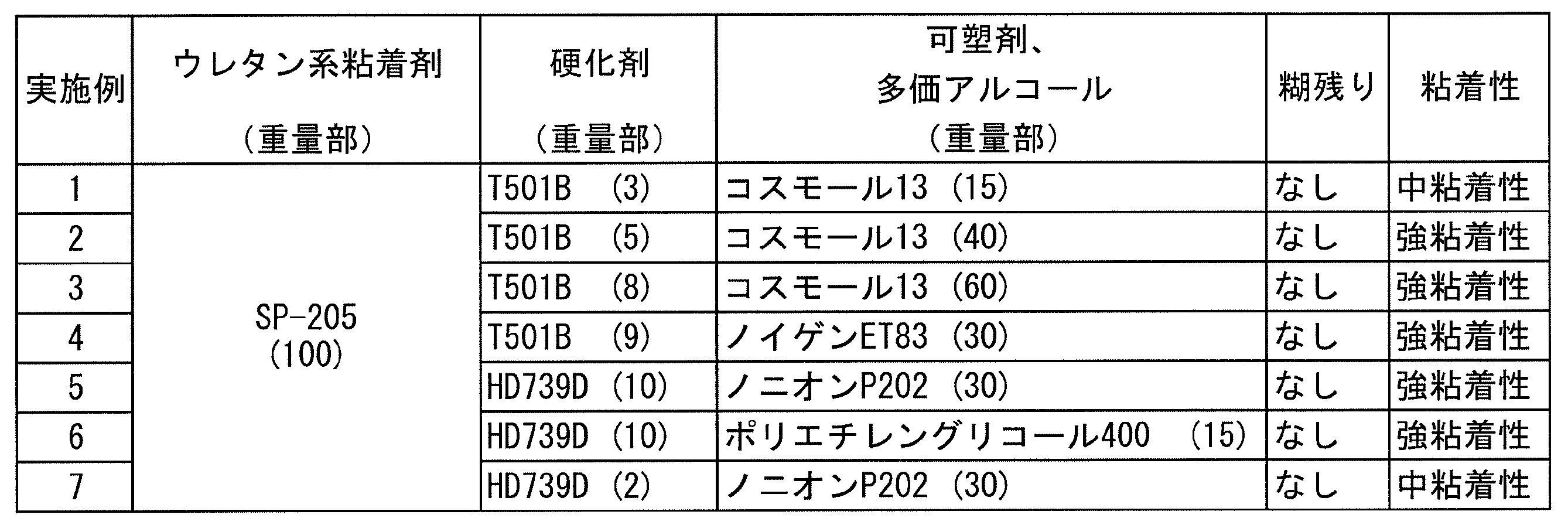

比較例8は、硬化剤が少なすぎて糊残りを生じた。比較例9は、硬化剤がやや多く、親水性可塑剤がさらに多いため糊残りを生じた。
特許文献4の発明では、本発明の親水性可塑剤の代わりにラウリン酸イソステアリル、ミリスチン酸イソプロピル等の炭素数が10~30の脂肪酸エステルを添加している。特許文献4の発明に近いものは比較例4,5,6,7であるが、表2に示すようにこれらの比較例は粘着性が弱い。このように、脂肪酸エステルを用いるより親水性可塑剤を用いる方が、皮膚にやさしくかつ粘着力が強い皮膚用ウレタン系粘着剤組成物を得ることができる。
(透湿度評価)
実施例8、比較例11~15の5試料に関し、防湿包装材料の透湿度試験方法(カップ法)(JIS)に準じた方法で評価した。但し、支持体は不織布(日本バイリーン(株)製 EW-9102)を用いて粘着剤の透湿度に影響しないようにした。粘着剤厚さは50μmであった。カップ法においてカップ開口部の面積28,26cm2、塩化カルシウム量17g、室温40℃、湿度75%の条件下で24時間放置後の水蒸気透過量を測定した結果を表3に示す。
実施例8、比較例11~15の5試料に関し、防湿包装材料の透湿度試験方法(カップ法)(JIS)に準じた方法で評価した。但し、支持体は不織布(日本バイリーン(株)製 EW-9102)を用いて粘着剤の透湿度に影響しないようにした。粘着剤厚さは50μmであった。カップ法においてカップ開口部の面積28,26cm2、塩化カルシウム量17g、室温40℃、湿度75%の条件下で24時間放置後の水蒸気透過量を測定した結果を表3に示す。
表3で用いた試料について、MASCOS-10はアクリル系粘着剤(コスメディ製薬(株))である。また、オイルゲルは、スチレンーイソプレンースチレンブロック共重合体(クレイトンD1163、クレイトンジャパン製)30質量部、流動パラフィン(ナカライテスク、化学試薬)60質量部及びベンゾイルヒドロキシトルエン(ナカライテスク、化学試薬)0.5質量部を140℃で溶融混練してプレス成型し50μmのシートとしたものである。
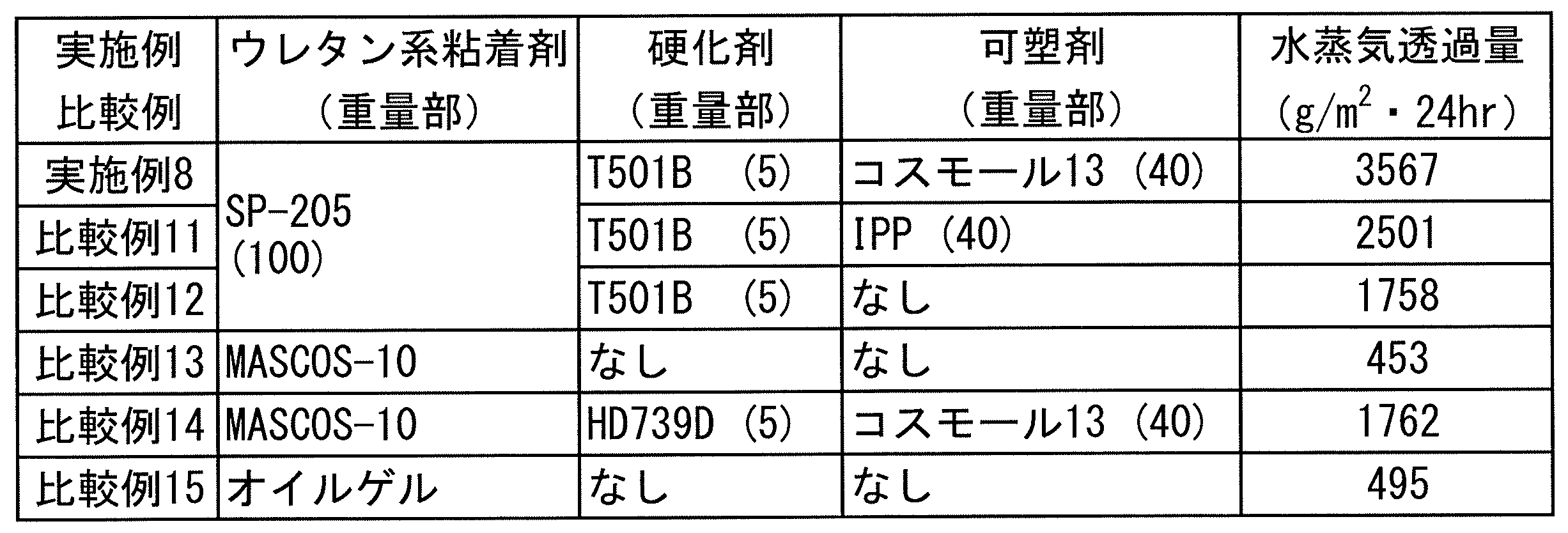
親水性可塑剤添加を添加したウレタン系粘着剤はオイルゲル系及びアクリル系粘着剤に比べて著しく高い水蒸気透過量を示した。
Claims (7)
- ウレタン系粘着剤、硬化剤、親水性可塑剤を必須成分とし、前記ウレタン系粘着剤、前記硬化剤、前記親水性可塑剤の組成比が、前記ウレタン系粘着剤の固形分を100質量部として、前記硬化剤の固形分が0.5~15質量部、前記親水性可塑剤の固形分が10~80質量部であるウレタン系粘着剤組成物。
- 前記親水性可塑剤が分子中に水酸基及び/又はオキシエチレン基を有する高沸点液体であることを特徴とする請求項1に記載のウレタン系粘着剤組成物。
- 前記親水性可塑剤が分子中に水酸基及び/又はオキシエチレン基のほか、さらに長鎖炭化水素基を有する常圧での沸点が150℃以上の液体であることを特徴とする請求項2に記載のウレタン系粘着剤組成物。
- 前記親水性可塑剤が乳酸オクチルドデシル、グリコール酸イソステアリル、ポリオキシエチレンセチルエーテル、ポリオキシエチレンラウリルエーテル及びオレイルセチルエーテルからなる群より選ばれた1あるいは複数の親水性可塑剤であることを特徴とする請求項2又は請求項3に記載のウレタン系粘着剤組成物。
- 前記親水性可塑剤が乳酸オクチルドデシルであることを特徴とする請求項4に記載のウレタン系粘着剤組成物。
- 柔軟なフィルムの面上にウレタン系粘着剤組成物を保持したウレタン系粘着剤組成物シート。
- 前記柔軟なフィルムがポリウレタンフィルムであることを特徴とする請求項6に記載のウレタン系粘着剤組成物シート。
Priority Applications (3)
| Application Number | Priority Date | Filing Date | Title |
|---|---|---|---|
| US15/510,945 US20170275510A1 (en) | 2014-09-19 | 2015-09-18 | Urethane-based adhesive composition |
| ES15842048T ES2818096T3 (es) | 2014-09-19 | 2015-09-18 | Adhesivo sensible a la presión a base de uretano |
| EP15842048.9A EP3196267B1 (en) | 2014-09-19 | 2015-09-18 | Urethane-based pressure-sensitive adhesive |
Applications Claiming Priority (2)
| Application Number | Priority Date | Filing Date | Title |
|---|---|---|---|
| JP2014190832 | 2014-09-19 | ||
| JP2014-190832 | 2014-09-19 |
Publications (1)
| Publication Number | Publication Date |
|---|---|
| WO2016043300A1 true WO2016043300A1 (ja) | 2016-03-24 |
Family
ID=55533336
Family Applications (1)
| Application Number | Title | Priority Date | Filing Date |
|---|---|---|---|
| PCT/JP2015/076598 Ceased WO2016043300A1 (ja) | 2014-09-19 | 2015-09-18 | ウレタン系粘着剤組成物 |
Country Status (5)
| Country | Link |
|---|---|
| US (1) | US20170275510A1 (ja) |
| EP (1) | EP3196267B1 (ja) |
| JP (1) | JP2016065238A (ja) |
| ES (1) | ES2818096T3 (ja) |
| WO (1) | WO2016043300A1 (ja) |
Families Citing this family (33)
| Publication number | Priority date | Publication date | Assignee | Title |
|---|---|---|---|---|
| JP6744848B2 (ja) | 2016-09-13 | 2020-08-19 | 信越化学工業株式会社 | 粘着剤組成物、生体電極、及び生体電極の製造方法 |
| JP6761386B2 (ja) | 2016-09-29 | 2020-09-23 | 信越化学工業株式会社 | 粘着剤組成物、生体電極、生体電極の製造方法、及び塩 |
| JP6761384B2 (ja) | 2016-09-29 | 2020-09-23 | 信越化学工業株式会社 | 粘着剤組成物、生体電極、及び生体電極の製造方法 |
| JP6919993B2 (ja) | 2017-01-06 | 2021-08-18 | 信越化学工業株式会社 | 生体電極組成物、生体電極及び生体電極の製造方法 |
| JP6966310B2 (ja) | 2017-02-06 | 2021-11-10 | 信越化学工業株式会社 | 生体電極組成物、生体電極、生体電極の製造方法、及び高分子化合物 |
| JP6836520B2 (ja) | 2017-02-14 | 2021-03-03 | 信越化学工業株式会社 | 生体電極組成物、生体電極、及び生体電極の製造方法 |
| JP6892376B2 (ja) | 2017-02-14 | 2021-06-23 | 信越化学工業株式会社 | 生体電極組成物、生体電極、生体電極の製造方法、及び高分子化合物 |
| WO2018220926A1 (ja) * | 2017-05-30 | 2018-12-06 | Nissha株式会社 | マイクロニードルパッチとその梱包体 |
| JP6839125B2 (ja) | 2018-04-02 | 2021-03-03 | 信越化学工業株式会社 | 生体電極組成物、生体電極、及び生体電極の製造方法 |
| JP7158335B2 (ja) | 2018-06-25 | 2022-10-21 | 信越化学工業株式会社 | 生体電極組成物、生体電極、及び生体電極の製造方法 |
| JP7111653B2 (ja) | 2018-06-25 | 2022-08-02 | 信越化学工業株式会社 | 生体電極組成物、生体電極、及び生体電極の製造方法 |
| JP7099990B2 (ja) | 2018-06-26 | 2022-07-12 | 信越化学工業株式会社 | 生体電極組成物、生体電極、及び生体電極の製造方法 |
| US11234606B2 (en) | 2018-07-05 | 2022-02-01 | Shin-Etsu Chemical Co., Ltd. | Bio-electrode composition, bio-electrode, and method for manufacturing a bio-electrode |
| JP6966389B2 (ja) | 2018-07-12 | 2021-11-17 | 信越化学工業株式会社 | 生体電極組成物、生体電極、及び生体電極の製造方法 |
| JP6966396B2 (ja) | 2018-08-23 | 2021-11-17 | 信越化学工業株式会社 | 生体電極組成物、生体電極、及び生体電極の製造方法 |
| JP6966397B2 (ja) | 2018-08-27 | 2021-11-17 | 信越化学工業株式会社 | 生体電極組成物、生体電極、及び生体電極の製造方法 |
| JP7656310B2 (ja) | 2019-01-07 | 2025-04-03 | コスメディ製薬株式会社 | 皮膚用積層粘着性シート |
| JP7045768B2 (ja) | 2019-04-03 | 2022-04-01 | 信越化学工業株式会社 | 生体電極組成物、生体電極、及び生体電極の製造方法 |
| JP7082082B2 (ja) | 2019-04-03 | 2022-06-07 | 信越化学工業株式会社 | 生体電極組成物、生体電極、及び生体電極の製造方法 |
| JP7411537B2 (ja) | 2020-01-22 | 2024-01-11 | 信越化学工業株式会社 | 生体電極組成物、生体電極、及び生体電極の製造方法 |
| JP7410065B2 (ja) | 2020-03-19 | 2024-01-09 | 信越化学工業株式会社 | 生体電極、生体電極の製造方法及び生体信号の測定方法 |
| JP7406516B2 (ja) | 2020-04-01 | 2023-12-27 | 信越化学工業株式会社 | 生体電極組成物、生体電極及び生体電極の製造方法 |
| JP7444821B2 (ja) | 2020-09-15 | 2024-03-06 | 信越化学工業株式会社 | 生体電極組成物、生体電極、生体電極の製造方法、及び珪素材料粒子 |
| JP7524148B2 (ja) | 2020-10-13 | 2024-07-29 | 信越化学工業株式会社 | 生体電極組成物、生体電極、生体電極の製造方法、高分子化合物及び複合体 |
| JP7569298B2 (ja) | 2020-11-05 | 2024-10-17 | 信越化学工業株式会社 | 生体電極組成物、生体電極、生体電極の製造方法及び反応複合体 |
| JP7507737B2 (ja) | 2020-11-26 | 2024-06-28 | 信越化学工業株式会社 | 生体電極組成物、生体電極、生体電極の製造方法、及び反応複合体 |
| JP7611807B2 (ja) | 2021-01-06 | 2025-01-10 | 信越化学工業株式会社 | 生体電極組成物、生体電極、及び生体電極の製造方法 |
| JP7627671B2 (ja) | 2021-04-16 | 2025-02-06 | 信越化学工業株式会社 | 生体電極組成物、生体電極、及び生体電極の製造方法 |
| JP7842716B2 (ja) | 2022-07-21 | 2026-04-08 | 信越化学工業株式会社 | 生体電極組成物、生体電極、及びその製造方法 |
| JP2024137755A (ja) | 2023-03-23 | 2024-10-07 | 信越化学工業株式会社 | 生体電極組成物、生体電極、及び生体電極の製造方法 |
| JP2025011039A (ja) | 2023-07-10 | 2025-01-23 | 信越化学工業株式会社 | 生体電極組成物、生体電極、及び生体電極の製造方法 |
| WO2025158907A1 (ja) * | 2024-01-24 | 2025-07-31 | Agc株式会社 | 生体センサ |
| JP2025174080A (ja) | 2024-05-16 | 2025-11-28 | 信越化学工業株式会社 | 生体電極組成物、生体電極、及び生体電極の製造方法 |
Citations (6)
| Publication number | Priority date | Publication date | Assignee | Title |
|---|---|---|---|---|
| JPH07310066A (ja) * | 1992-11-09 | 1995-11-28 | E R Squibb & Sons Inc | ポリウレタン感圧粘着剤 |
| JP2003129022A (ja) * | 2001-08-10 | 2003-05-08 | Kosumedei:Kk | 皮膚用粘着テープ |
| JP2003183615A (ja) * | 2001-12-21 | 2003-07-03 | Nippon Synthetic Chem Ind Co Ltd:The | 活性エネルギー線硬化型粘着剤組成物 |
| JP2004010804A (ja) * | 2002-06-10 | 2004-01-15 | Toyo Ink Mfg Co Ltd | 粘着剤及び該粘着剤を用いてなる医療用粘着テープ |
| JP2011190420A (ja) * | 2010-03-17 | 2011-09-29 | Toyo Ink Sc Holdings Co Ltd | ウレタン粘着剤 |
| JP2014522259A (ja) * | 2011-05-03 | 2014-09-04 | アドヒーシブズ・リサーチ・インコーポレーテッド | 皮膚上の適用のための感圧接着剤およびその製造方法 |
Family Cites Families (2)
| Publication number | Priority date | Publication date | Assignee | Title |
|---|---|---|---|---|
| US5183664A (en) * | 1986-09-20 | 1993-02-02 | Smith And Nephew Associated Companies P.L.C. | Thin film adhesive dressings preparation and use |
| JP3978884B2 (ja) * | 1998-08-31 | 2007-09-19 | 東洋インキ製造株式会社 | ポリウレタン粘着剤組成物及び該組成物を用いた塗工物 |
-
2015
- 2015-09-18 US US15/510,945 patent/US20170275510A1/en not_active Abandoned
- 2015-09-18 WO PCT/JP2015/076598 patent/WO2016043300A1/ja not_active Ceased
- 2015-09-18 ES ES15842048T patent/ES2818096T3/es active Active
- 2015-09-18 EP EP15842048.9A patent/EP3196267B1/en active Active
- 2015-09-24 JP JP2015203250A patent/JP2016065238A/ja active Pending
Patent Citations (6)
| Publication number | Priority date | Publication date | Assignee | Title |
|---|---|---|---|---|
| JPH07310066A (ja) * | 1992-11-09 | 1995-11-28 | E R Squibb & Sons Inc | ポリウレタン感圧粘着剤 |
| JP2003129022A (ja) * | 2001-08-10 | 2003-05-08 | Kosumedei:Kk | 皮膚用粘着テープ |
| JP2003183615A (ja) * | 2001-12-21 | 2003-07-03 | Nippon Synthetic Chem Ind Co Ltd:The | 活性エネルギー線硬化型粘着剤組成物 |
| JP2004010804A (ja) * | 2002-06-10 | 2004-01-15 | Toyo Ink Mfg Co Ltd | 粘着剤及び該粘着剤を用いてなる医療用粘着テープ |
| JP2011190420A (ja) * | 2010-03-17 | 2011-09-29 | Toyo Ink Sc Holdings Co Ltd | ウレタン粘着剤 |
| JP2014522259A (ja) * | 2011-05-03 | 2014-09-04 | アドヒーシブズ・リサーチ・インコーポレーテッド | 皮膚上の適用のための感圧接着剤およびその製造方法 |
Non-Patent Citations (1)
| Title |
|---|
| See also references of EP3196267A4 * |
Also Published As
| Publication number | Publication date |
|---|---|
| ES2818096T3 (es) | 2021-04-09 |
| JP2016065238A (ja) | 2016-04-28 |
| US20170275510A1 (en) | 2017-09-28 |
| EP3196267A4 (en) | 2018-05-30 |
| EP3196267A1 (en) | 2017-07-26 |
| EP3196267B1 (en) | 2020-07-29 |
Similar Documents
| Publication | Publication Date | Title |
|---|---|---|
| WO2016043300A1 (ja) | ウレタン系粘着剤組成物 | |
| US5147916A (en) | Hot-melt silicone pressure sensitive adhesive composition and related methods and articles | |
| US9333723B2 (en) | Adhesive composition | |
| ES2238650T3 (es) | Hoja adhesiva sensible a la presion. | |
| JP4551073B2 (ja) | 皮膚貼付用の粘着シート | |
| CN115768494A (zh) | 各向异性伤口闭合系统 | |
| US9926470B2 (en) | Hybrid material of crosslinked microgel particles dispersed in an adhesive | |
| JP2010138258A (ja) | 粘着剤組成物及び粘着シート | |
| JP2005058288A (ja) | 医療用粘着テープのための粘着剤組成物及び粘着テープ | |
| BR0200311A (pt) | Processo para preparar composição para revestimento, e, composição aquosa para revestimento | |
| KR20060121839A (ko) | 활성 에너지선 경화형 피부 플래스터용 조성물 및 피부플래스터 | |
| CN106456564A (zh) | 皮肤用粘合剂组合物以及皮肤用粘贴材料 | |
| KR20020018593A (ko) | 피부용 접착제 조성물 및 이를 포함하는 피부용 접착테이프 또는 시이트 | |
| WO2012003028A1 (en) | Silicone gel adhesives with organic polyhydroxy compounds | |
| EP2002824A2 (en) | Gel composition and use thereof | |
| EP1867347A1 (en) | Medical adhesive and medical adhesive tape or sheet | |
| JP6680111B2 (ja) | 感圧式接着剤および接着シート | |
| US5290564A (en) | Method and device for delivering a bioactive agent | |
| AU733564B2 (en) | Gel-form pressure-sensitive adhesive, and adhesive material and adhesive medicinal preparation both containing the same | |
| JP5036035B2 (ja) | 角質剥離用粘着剤組成物および角質剥離用粘着シート | |
| JP2019047961A (ja) | 皮膚貼付用粘着剤および皮膚貼付シート | |
| CN113845870B (zh) | 一种非吸收基层用pvc地板胶及其制备方法 | |
| JP5059442B2 (ja) | 保湿シート | |
| JP4409190B2 (ja) | 皮膚貼付材用シリコーン粘着剤組成物及びこれを用いた皮膚貼付材 | |
| JP2010285493A (ja) | 粘着性ゲル及びその製造方法 |
Legal Events
| Date | Code | Title | Description |
|---|---|---|---|
| 121 | Ep: the epo has been informed by wipo that ep was designated in this application |
Ref document number: 15842048 Country of ref document: EP Kind code of ref document: A1 |
|
| REEP | Request for entry into the european phase |
Ref document number: 2015842048 Country of ref document: EP |
|
| WWE | Wipo information: entry into national phase |
Ref document number: 2015842048 Country of ref document: EP |
|
| WWE | Wipo information: entry into national phase |
Ref document number: 15510945 Country of ref document: US |
|
| NENP | Non-entry into the national phase |
Ref country code: DE |