WO2016047230A1 - 人工三次元組織とその製造方法、人工三次元組織灌流デバイス、人工三次元組織を用いた薬剤評価方法 - Google Patents
人工三次元組織とその製造方法、人工三次元組織灌流デバイス、人工三次元組織を用いた薬剤評価方法 Download PDFInfo
- Publication number
- WO2016047230A1 WO2016047230A1 PCT/JP2015/068793 JP2015068793W WO2016047230A1 WO 2016047230 A1 WO2016047230 A1 WO 2016047230A1 JP 2015068793 W JP2015068793 W JP 2015068793W WO 2016047230 A1 WO2016047230 A1 WO 2016047230A1
- Authority
- WO
- WIPO (PCT)
- Prior art keywords
- artificial
- tissue
- dimensional tissue
- dimensional
- layer
- Prior art date
- Legal status (The legal status is an assumption and is not a legal conclusion. Google has not performed a legal analysis and makes no representation as to the accuracy of the status listed.)
- Ceased
Links
Images














Classifications
-
- C—CHEMISTRY; METALLURGY
- C12—BIOCHEMISTRY; BEER; SPIRITS; WINE; VINEGAR; MICROBIOLOGY; ENZYMOLOGY; MUTATION OR GENETIC ENGINEERING
- C12M—APPARATUS FOR ENZYMOLOGY OR MICROBIOLOGY; APPARATUS FOR CULTURING MICROORGANISMS FOR PRODUCING BIOMASS, FOR GROWING CELLS OR FOR OBTAINING FERMENTATION OR METABOLIC PRODUCTS, i.e. BIOREACTORS OR FERMENTERS
- C12M21/00—Bioreactors or fermenters specially adapted for specific uses
- C12M21/08—Bioreactors or fermenters specially adapted for specific uses for producing artificial tissue or for ex-vivo cultivation of tissue
-
- A—HUMAN NECESSITIES
- A61—MEDICAL OR VETERINARY SCIENCE; HYGIENE
- A61L—METHODS OR APPARATUS FOR STERILISING MATERIALS OR OBJECTS IN GENERAL; DISINFECTION, STERILISATION OR DEODORISATION OF AIR; CHEMICAL ASPECTS OF BANDAGES, DRESSINGS, ABSORBENT PADS OR SURGICAL ARTICLES; MATERIALS FOR BANDAGES, DRESSINGS, ABSORBENT PADS OR SURGICAL ARTICLES
- A61L27/00—Materials for grafts or prostheses or for coating grafts or prostheses
- A61L27/36—Materials for grafts or prostheses or for coating grafts or prostheses containing ingredients of undetermined constitution or reaction products thereof, e.g. transplant tissue, natural bone, extracellular matrix
- A61L27/3604—Materials for grafts or prostheses or for coating grafts or prostheses containing ingredients of undetermined constitution or reaction products thereof, e.g. transplant tissue, natural bone, extracellular matrix characterised by the human or animal origin of the biological material, e.g. hair, fascia, fish scales, silk, shellac, pericardium, pleura, renal tissue, amniotic membrane, parenchymal tissue, fetal tissue, muscle tissue, fat tissue, enamel
- A61L27/362—Skin, e.g. dermal papillae
-
- A—HUMAN NECESSITIES
- A61—MEDICAL OR VETERINARY SCIENCE; HYGIENE
- A61L—METHODS OR APPARATUS FOR STERILISING MATERIALS OR OBJECTS IN GENERAL; DISINFECTION, STERILISATION OR DEODORISATION OF AIR; CHEMICAL ASPECTS OF BANDAGES, DRESSINGS, ABSORBENT PADS OR SURGICAL ARTICLES; MATERIALS FOR BANDAGES, DRESSINGS, ABSORBENT PADS OR SURGICAL ARTICLES
- A61L27/00—Materials for grafts or prostheses or for coating grafts or prostheses
- A61L27/36—Materials for grafts or prostheses or for coating grafts or prostheses containing ingredients of undetermined constitution or reaction products thereof, e.g. transplant tissue, natural bone, extracellular matrix
- A61L27/3641—Materials for grafts or prostheses or for coating grafts or prostheses containing ingredients of undetermined constitution or reaction products thereof, e.g. transplant tissue, natural bone, extracellular matrix characterised by the site of application in the body
- A61L27/3679—Hollow organs, e.g. bladder, esophagus, urether, uterus, intestine
-
- A—HUMAN NECESSITIES
- A61—MEDICAL OR VETERINARY SCIENCE; HYGIENE
- A61L—METHODS OR APPARATUS FOR STERILISING MATERIALS OR OBJECTS IN GENERAL; DISINFECTION, STERILISATION OR DEODORISATION OF AIR; CHEMICAL ASPECTS OF BANDAGES, DRESSINGS, ABSORBENT PADS OR SURGICAL ARTICLES; MATERIALS FOR BANDAGES, DRESSINGS, ABSORBENT PADS OR SURGICAL ARTICLES
- A61L27/00—Materials for grafts or prostheses or for coating grafts or prostheses
- A61L27/50—Materials characterised by their function or physical properties, e.g. injectable or lubricating compositions, shape-memory materials, surface modified materials
- A61L27/507—Materials characterised by their function or physical properties, e.g. injectable or lubricating compositions, shape-memory materials, surface modified materials for artificial blood vessels
-
- A—HUMAN NECESSITIES
- A61—MEDICAL OR VETERINARY SCIENCE; HYGIENE
- A61L—METHODS OR APPARATUS FOR STERILISING MATERIALS OR OBJECTS IN GENERAL; DISINFECTION, STERILISATION OR DEODORISATION OF AIR; CHEMICAL ASPECTS OF BANDAGES, DRESSINGS, ABSORBENT PADS OR SURGICAL ARTICLES; MATERIALS FOR BANDAGES, DRESSINGS, ABSORBENT PADS OR SURGICAL ARTICLES
- A61L27/00—Materials for grafts or prostheses or for coating grafts or prostheses
- A61L27/50—Materials characterised by their function or physical properties, e.g. injectable or lubricating compositions, shape-memory materials, surface modified materials
- A61L27/60—Materials for use in artificial skin
-
- C—CHEMISTRY; METALLURGY
- C12—BIOCHEMISTRY; BEER; SPIRITS; WINE; VINEGAR; MICROBIOLOGY; ENZYMOLOGY; MUTATION OR GENETIC ENGINEERING
- C12M—APPARATUS FOR ENZYMOLOGY OR MICROBIOLOGY; APPARATUS FOR CULTURING MICROORGANISMS FOR PRODUCING BIOMASS, FOR GROWING CELLS OR FOR OBTAINING FERMENTATION OR METABOLIC PRODUCTS, i.e. BIOREACTORS OR FERMENTERS
- C12M23/00—Constructional details, e.g. recesses, hinges
- C12M23/02—Form or structure of the vessel
- C12M23/04—Flat or tray type, drawers
-
- C—CHEMISTRY; METALLURGY
- C12—BIOCHEMISTRY; BEER; SPIRITS; WINE; VINEGAR; MICROBIOLOGY; ENZYMOLOGY; MUTATION OR GENETIC ENGINEERING
- C12M—APPARATUS FOR ENZYMOLOGY OR MICROBIOLOGY; APPARATUS FOR CULTURING MICROORGANISMS FOR PRODUCING BIOMASS, FOR GROWING CELLS OR FOR OBTAINING FERMENTATION OR METABOLIC PRODUCTS, i.e. BIOREACTORS OR FERMENTERS
- C12M29/00—Means for introduction, extraction or recirculation of materials, e.g. pumps
- C12M29/10—Perfusion
-
- C—CHEMISTRY; METALLURGY
- C12—BIOCHEMISTRY; BEER; SPIRITS; WINE; VINEGAR; MICROBIOLOGY; ENZYMOLOGY; MUTATION OR GENETIC ENGINEERING
- C12Q—MEASURING OR TESTING PROCESSES INVOLVING ENZYMES, NUCLEIC ACIDS OR MICROORGANISMS; COMPOSITIONS OR TEST PAPERS THEREFOR; PROCESSES OF PREPARING SUCH COMPOSITIONS; CONDITION-RESPONSIVE CONTROL IN MICROBIOLOGICAL OR ENZYMOLOGICAL PROCESSES
- C12Q1/00—Measuring or testing processes involving enzymes, nucleic acids or microorganisms; Compositions therefor; Processes of preparing such compositions
- C12Q1/02—Measuring or testing processes involving enzymes, nucleic acids or microorganisms; Compositions therefor; Processes of preparing such compositions involving viable microorganisms
-
- A—HUMAN NECESSITIES
- A61—MEDICAL OR VETERINARY SCIENCE; HYGIENE
- A61L—METHODS OR APPARATUS FOR STERILISING MATERIALS OR OBJECTS IN GENERAL; DISINFECTION, STERILISATION OR DEODORISATION OF AIR; CHEMICAL ASPECTS OF BANDAGES, DRESSINGS, ABSORBENT PADS OR SURGICAL ARTICLES; MATERIALS FOR BANDAGES, DRESSINGS, ABSORBENT PADS OR SURGICAL ARTICLES
- A61L2430/00—Materials or treatment for tissue regeneration
- A61L2430/22—Materials or treatment for tissue regeneration for reconstruction of hollow organs, e.g. bladder, esophagus, urether, uterus
-
- A—HUMAN NECESSITIES
- A61—MEDICAL OR VETERINARY SCIENCE; HYGIENE
- A61L—METHODS OR APPARATUS FOR STERILISING MATERIALS OR OBJECTS IN GENERAL; DISINFECTION, STERILISATION OR DEODORISATION OF AIR; CHEMICAL ASPECTS OF BANDAGES, DRESSINGS, ABSORBENT PADS OR SURGICAL ARTICLES; MATERIALS FOR BANDAGES, DRESSINGS, ABSORBENT PADS OR SURGICAL ARTICLES
- A61L27/00—Materials for grafts or prostheses or for coating grafts or prostheses
Definitions
- the present invention relates to an artificial three-dimensional tissue and a manufacturing method thereof, an artificial three-dimensional tissue perfusion device, and a drug evaluation method using the artificial three-dimensional tissue.
- Patent Document 1 discloses that a coated cell having a cell surface coated with a coating containing an extracellular matrix component is cultured to form a dermal tissue layer in which the coated cell is laminated, and an epidermal cell is formed on the dermal tissue layer.
- a technique for manufacturing an artificial skin model by arranging and forming an epidermis layer is disclosed.
- the present invention has been made in view of the above problems, and aims to provide a high-quality artificial three-dimensional tissue and a manufacturing method thereof, an artificial three-dimensional tissue perfusion device, and a drug evaluation method using the artificial three-dimensional tissue. To do.
- a method for producing an artificial three-dimensional tissue extending in a predetermined direction, a culture vessel having a culture space surrounded by side walls, and penetrating the opposing side walls into the culture space.
- a method for producing an artificial three-dimensional tissue comprising: removing the flow channel forming member from the artificial three-dimensional tissue to form a perfusion channel that penetrates the artificial three-dimensional tissue. Is done.
- the artificial three-dimensional tissue is manufactured by the manufacturing method of the first aspect of the present invention, the drug is brought into contact with the artificial three-dimensional tissue, and the drug is contacted. Measuring a response of the artificial three-dimensional tissue to a stimulus, and providing a method for evaluating a drug using the artificial three-dimensional tissue.
- an artificial three-dimensional tissue perfusion device in which perfusion is performed on an artificial three-dimensional tissue extending in a predetermined direction, the culture tank having a culture space surrounded by a side wall, and facing the culture tank
- An artificial body comprising a support portion that attaches and detachably supports a flow path forming member suspended along the predetermined direction in a region through which the artificial three-dimensional tissue is disposed in the culture space through the side wall.
- a three-dimensional tissue perfusion device is provided.
- an artificial three-dimensional tissue extending in a predetermined direction, wherein the artificial three-dimensional tissue has a perfusion channel that penetrates the inside and extends in the predetermined direction.
- the present invention it is possible to provide a high-quality artificial three-dimensional tissue and a manufacturing method thereof, an artificial three-dimensional tissue perfusion device, and a drug evaluation method using the artificial three-dimensional tissue.
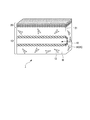
- FIG. 1 is a perspective sectional view schematically showing an artificial skin tissue 1 according to an embodiment of the present invention.
- 1 is a schematic configuration diagram of an artificial skin tissue manufacturing system 30.
- FIG. 1 is an external perspective view of a first embodiment of a perfusion device 40.
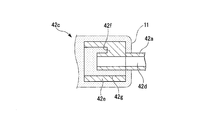
- FIG. It is the front view which looked at the engaging part 42c in the axial direction.
- FIG. 5 is a cross-sectional view taken along line AA in FIG. 4. It is a figure which shows the manufacture procedure of the artificial skin tissue. It is a figure which shows the manufacture procedure of the artificial skin tissue. It is a figure which shows the manufacture procedure of the artificial skin tissue. It is a figure which shows the manufacture procedure of the artificial skin tissue. It is a figure which shows the manufacture procedure of the artificial skin tissue. It is a figure which shows the manufacture procedure of the artificial skin tissue. It is a figure which shows the manufacture procedure of the artificial skin tissue.
- FIG. 3 is a view in which droplets are applied to the surface of the skin layer 20.
- FIG. 3 is a view in which droplets are applied to the surface of the skin layer 20.
- FIG. 3 is a view in which droplets are applied to the surface of the skin layer 20.
- FIG. 3 is a figure which shows the artificial skin tissue 1 cut in the vertical direction. It is the figure which observed a mode that a bubble moved through perfusion channel.
- FIG. It is a figure which shows the sealing success rate with respect to the thickness of a sealing material, and the average amount of the extracellular matrix component 11 which leaks from the clearance gap between the attaching parts of the baseplate 47.
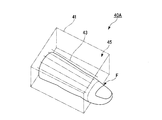
- FIG. It is a schematic perspective view of the perfusion device 40A of 2nd Embodiment. 3 is a cross-sectional view taken along a vertical plane including a length direction of a biological model F.
- FIG. It is a figure which shows the manufacture procedure of the artificial skin tissue 1 which concerns on 2nd Embodiment. It is a figure which shows the manufacture procedure of the artificial skin tissue 1 which concerns on 2nd Embodiment. It is a figure which shows the manufacture procedure of the artificial skin tissue 1 which concerns on 2nd Embodiment. It is a figure which shows the manufacture procedure of the artificial skin tissue 1 which concerns on 2nd Embodiment. It is a figure which shows the manufacture procedure of the artificial skin tissue 1 which concerns on 2nd Embodiment. It is a figure which shows the manufacture procedure of the artificial skin
- an embodiment of an artificial three-dimensional tissue and a manufacturing method thereof, an artificial three-dimensional tissue perfusion device, and a drug evaluation method using the artificial three-dimensional tissue of the present invention will be described with reference to FIGS.
- an example in which an artificial skin tissue is manufactured as an artificial three-dimensional tissue will be described.
- the following embodiment shows one aspect of the present invention and does not limit the present invention, and can be arbitrarily changed within the scope of the technical idea of the present invention.
- the actual structure is different from the scale and number of each structure.
- FIG. 1 is a perspective sectional view schematically showing an artificial skin tissue 1 which is an artificial three-dimensional tissue.
- the artificial skin tissue 1 includes a dermis tissue layer 10 and an epidermis layer 20.
- the artificial skin tissue 1 has a predetermined direction (horizontal direction in FIG. 1) along a plane orthogonal to the direction in which the dermis tissue layer 10 and the epidermis layer 20 are laminated (vertical direction in FIG. 1, hereinafter referred to as a lamination direction). Hereinafter, it is formed to extend in the first direction).
- the epidermal layer 20 is formed by seeding and culturing epidermal cells 21 on the dermis tissue layer 10.
- epidermal cells 21 for example, epidermal keratinocytes can be used.
- epidermal cells include cells derived from mammals such as humans, mice, and rats, and human-derived epidermal cells are preferred.
- human-derived epidermal cells include epidermal keratinocytes and epidermal melanocytes, with epidermal keratinocytes being preferred.
- epidermal keratinocytes include normal human epidermal keratinocytes (NHEK).
- epidermal melanocytes include normal human epidermal melanocytes (NHEM).
- the dermal tissue layer 10 is formed by culturing dermal cells 12 in the extracellular matrix component 11.
- the extracellular matrix component 11 is not particularly limited.
- collagen type I, type II, type III, type V, type XI, etc.
- mouse EHS tumor extract type IV collagen, laminin, heparan sulfate proteoglycan, etc.
- a base membrane component trade name: Matrigel
- gelatin agar, agarose, fibrin, glycosaminoglycan, hyaluronic acid, proteoglycan, etc.
- fibroblasts can be used as the dermal cells 12, for example.
- fibroblasts include cells derived from mammals such as humans, mice and rats, and human-derived fibroblasts are preferred.
- Human-derived fibroblasts include human skin fibroblasts (Normal Human Dermal Fibroblasts: NHDF), human lung fibroblasts: Human Pulmonary Fibroblasts (HPF), human cardiac fibroblasts: Human Cardiac Fibroblasts (HCF), human aorta Outer membrane fibroblasts: Human Aortic vent Adventitial Fibroblasts (HAoAF), human uterine fibroblasts: Human Uterine Fibroblasts (HUF), human chorionic mesenchymal fibroblasts: Human Villous Mesenchymal Fibroblasts (HVMF) Fibroblasts (NHDF) are preferred.
- the dermis tissue layer 10 has a perfusion channel 13 that extends through the inside of the dermis tissue layer 10 in the first direction.
- the perfusion channel 13 is a channel through which a medium (details will be described later) is perfused when the epidermal cells 21 are cultured.
- a lumen layer 15 formed using vascular cells 14 is provided on the surface of the perfusion channel 13.
- the vascular cells 14 for example, endothelial cells can be used.
- vascular cells examples include vascular epithelial cells and vascular endothelial cells, and vascular endothelial cells are preferred.
- vascular endothelial cells examples include cells derived from mammals such as humans, mice and rats, and human-derived vascular endothelial cells are preferred.
- Human-derived vascular endothelial cells include human umbilical vein endothelial cells (Human Umbilical Vein Endothelial Cells: HUVEC), human umbilical artery endothelial cells (Human Umbilical Artery Endothelial Cells: HUAEC), human coronary artery endothelial cells (Human Coronary Artery Cellous: HCAEC), human saphenous vein endothelial cells (Human Saphenous Vein Endothelial Cells: HSaVEC), human human pulmonary artery endothelial cells (Human Pulmonary Artery Endothelial Cells: HPAEC), human human aortic endothelial cells (Human Aortic ⁇ Endothelial Cells: HAoEC) Endothelial cells (Human Dermal Endothelial : Cells: HDMEC), Human skin vascular endothelial cells (Human Dermal H Blood Endothelial Cells: HDBEC), Human skin
- FIG. 2 is a schematic configuration diagram of the artificial skin tissue manufacturing apparatus 30.
- the artificial skin tissue manufacturing apparatus 30 includes a perfusion device (artificial three-dimensional tissue perfusion device) 40, a culture dish 50, and a pump 60.
- a perfusion device artificial three-dimensional tissue perfusion device
- the pump 60 supplies the culture medium to the perfusion device 40 via the pipe 61.
- the pump 60 collects the medium M discharged into the culture dish 50 via the perfusion device 40 via the pipe 62.
- FIG. 3 is an external perspective view of the first embodiment of the perfusion device 40.
- the perfusion device 40 includes a culture tank 41, a connector (support part) 42, and a wire (linear member, flow path forming member) 43.
- the culture tank 41 includes a culture space 45 that is open at the top surrounded by a side wall 44, and a bottom plate 47 provided on a bottom wall (bottom part) 46.
- the side wall 44 is provided in a rectangular shape in plan view.
- the bottom wall 46 has an opening 46a penetrating in the vertical direction and a groove 46c provided in the bottom surface 46b.
- the groove 46c extends in the first direction and opens into the internal space of the culture dish 50 at both ends.
- the bottom plate 47 can be attached to and detached from the culture tank 41.
- the bottom plate 47 closes the opening 46 a when attached to the bottom wall 46 of the culture tank 41.
- the connector 42 has a mounting part (cylinder part) 42a, a connecting part 42b, an engaging part 42c, and a through hole 42d penetrating therethrough.
- the mounting portion 42 a is formed in a shaft shape and is mounted through the side wall 44 of the culture tank 41.
- the connection part 42b is provided at one end of the mounting part 42b.
- the connection part 42b is arrange
- the engaging portion 42c is provided at the other end of the mounting portion 42b.
- the engaging part 42 c is arranged in the culture space 45 of the culture tank 41 with a gap from the side wall 44.
- FIG. 4 is a front view of the engaging portion 42c viewed in the axial direction.
- 5 is a cross-sectional view taken along line AA in FIG.
- the engaging portion 42 c is spaced from the outer peripheral surface of the mounting portion 42 a by a second cylinder portion 42 e that is arranged coaxially with a gap in the circumferential direction of the mounting portion 42 a.
- a plurality of arranged rib portions 42f are examples of rib portions 42f.
- the rib portion 42f connects the outer peripheral surface of the mounting portion 42a and the inner peripheral surface of the second cylindrical portion 42e.
- Four rib portions 42f are provided at intervals of 90 degrees.
- a gap 42g surrounded by the mounting portion 42a, the second cylindrical portion 42e, and the rib portion 42f penetrates the engaging portion 42c in the axial direction.
- a plurality of pairs (six pairs in FIG. 3) of the connectors 42 are attached to positions where the through holes 42d are coaxial with each of the opposing side walls 44.
- the three pairs of connectors 42 are arranged along the first direction, and the other three pairs of connectors 42 are arranged along a second direction orthogonal to the first direction in the horizontal direction.
- a lyophilic process for the extracellular matrix component 11 for example, O 2 plasma treatment can be adopted.
- the wire 43 is a linear member used to form the perfusion channel 13.
- the wire 43 is supported so as to be attached to and detached from a connector 42 that is coaxially mounted on the opposite side wall 44.
- the wire 43 is inserted (supported) into the through-hole 42d of the connector 42 and can be suspended in a region where the dermal tissue layer 10 of the culture space 45 is disposed.
- the wire 43 is formed of, for example, a polyamide resin.
- a method for manufacturing an artificial skin tissue (artificial three-dimensional tissue) 1 is a method for manufacturing an artificial skin tissue 1 in which an epidermis layer 20 is formed on a dermis tissue layer 10 and extends in a first direction (predetermined direction).
- a culture vessel 41 having a culture space 45 surrounded by a side wall 44, and a wire (linear member, flow path forming member) 43 penetrating the culture space 45 in a predetermined direction through the opposite side wall 44.
- the perfusion device (artificial three-dimensional tissue perfusion device, device) 40 provided is prepared, and the dermal cells 12 in the extracellular matrix component 11 are cultured in the culture space 45 to form the dermal tissue layer 10 through which the wire 43 penetrates.
- the extracellular matrix component 11 is engaged with the engaging portions 42c provided on the opposing side walls 44 to suppress contraction in a predetermined direction, and the dermis tissue layer 10 is suppressed. Forming.
- the perfusion device 40 is prepared by attaching the connector 42 so that the through hole 42 d is coaxial with the opposing side wall 44 of the culture tank 41 and attaching the bottom plate 47 to the bottom wall 46. Thus, the opening 46a is closed. The wire 43 is inserted into the through-hole 42 d that is coaxial, and the wire 43 is suspended in the culture space 45.
- the lyophilic treatment is performed on at least an area of the connector 42 exposed to the culture space 45.
- the lyophilic treatment may be performed on the connector 42 before being mounted on the culture tank 41 or may be performed on the connector 42 mounted on the side wall 44.
- the surface of the culture tank 41 facing the culture space 45 is coated with a sealing material.
- a sealing material a material that does not adversely affect the extracellular matrix component 11, dermal cells 12, and epidermal cells 21, for example, polyparaxylylene (hereinafter referred to as parylene) is formed by a film forming method such as vapor deposition.
- the film thickness of the sealing material is preferably 1/100 to 1/10 with respect to the gap of the mounting portion and the gap of the mounting portion.
- the film thickness of the sealing material is preferably 1/50 to 1/10, more preferably 1/50 to 1/20 with respect to the gap of the mounting portion and the gap of the mounting portion.
- the sealing material is formed with a film thickness (1/25) of 2 ⁇ m with respect to a gap of about 50 ⁇ m.
- the dermal tissue layer 10 is formed.
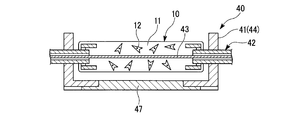
- a mixture of the extracellular matrix component 11 and the dermis cells 12 is poured into the culture space 45 of the culture tank 41.
- the mixture is poured in an amount that makes the wire 43 soaked in height.
- collagen is used as the extracellular matrix component 11.
- the mixture of the extracellular matrix component 11 and the dermal cells 12 is poured into the culture tank 41, the mixture is cultured (incubated) under predetermined conditions.
- the culture condition is such that the density of the dermis tissue layer 10 is equivalent to that of human dermis.
- the culture conditions were performed at a temperature of 37 ° C. for 2 days (48 hours).
- the extracellular matrix component 11 contracts by culturing. Since the extracellular matrix component 11 is engaged with the engaging portion 42c, the shrinkage in the stacking direction is not restricted, but the shrinkage in the first direction and the second direction is restricted. More specifically, as shown in FIG. 5, the extracellular matrix component 11 is engaged with the second cylindrical portion 42e and the rib portion 42f of the engaging portion 42c from the side opposite to the center of the culture space 45. Therefore, the second cylinder part 42e and the rib part 42f serve as a barrier and the contraction toward the center side is suppressed.
- the extracellular matrix component 11 is crimped
- the engaging portion 42c is lyophilicized with respect to the extracellular matrix component 11, the extracellular matrix component 11 is in close contact with the engaging portion 42c with a greater adhesion force in the first direction. And the resistance force with respect to the shrinkage
- the stacking direction is contracted, the contraction in the first direction and the second direction is suppressed, and the interior is connected to the wire 43.
- a dermal tissue layer 10 is formed.
- epidermis cells 21 are seeded on the dermis tissue layer 10.
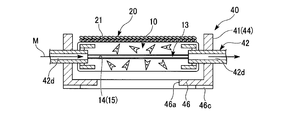
- the epidermal cells 21 are cultured while the medium M is perfused from the pump 60 through the pipe 61 and the through-hole 42d to the perfusion channel 13.
- the epidermal cells 21 are cultured by gas-liquid culture in which the medium M in the perfusion channel 13 is diffused through the dermis tissue layer 10 while exposing the epidermal cells 21 to gas.
- the epidermis cells 21 can be induced to differentiate to form the epidermis layer 20.
- the culture conditions for forming the skin layer 20 were 9 days at a temperature of 37 ° C.
- the medium M perfused into the perfusion channel 13 through one connector 42 is discharged into the inner space of the culture dish 50 through the other connector 42 and the pipe 63.
- a part of the medium M diffused from the perfusion channel 13 to the dermis tissue layer 10 is discharged into the internal space of the culture dish 50 through the opening 46 a and the groove 46 c of the culture tank 41.
- the medium M discharged to the culture dish 50 is collected via the pipe 62.
- the supply amount of the culture medium M from the pump 60 and the recovery amount of the culture medium M through the pipe 62 are such that the lower side of the dermis tissue layer 10 is immersed in the culture medium M when the epidermal layer 20 is cultured, and the epidermal cells 21 become air.
- the liquid level of the medium M in the culture dish 50 is set so as to be exposed.
- the present invention relates to a method for evaluating skin irritation of a drug using the artificial skin tissue 1 of the present invention.
- the drug in the present invention includes drugs such as pharmaceuticals, cosmetics and quasi drugs. 1
- the evaluation method of the present invention for example, the drug can be evaluated in an environment close to the actual skin as compared with the conventional method.
- the evaluation method of the present invention is extremely useful, for example, in the evaluation of the dynamics of drugs of various molecular weights in the creation (screening) of new drugs, and in the development of cosmetics and quasi drugs.
- the evaluation method of the present invention can be performed, for example, by bringing a drug into contact with the artificial skin tissue and measuring a response to a stimulus due to the contact of the drug.
- the response can be measured, for example, by measuring transcutaneous electrical resistance.
- medical agent means the substance used as evaluation object, for example, an inorganic compound, an organic compound, etc. are mentioned.
- FIG. 13 is a diagram showing the artificial skin tissue 1 manufactured by the above-described manufacturing method. As shown in this figure, the artificial skin tissue 1 in which the contraction in the first direction and the second direction was suppressed by the connector 42 was obtained.
- FIG. 14 is a diagram showing a result of manufacturing the artificial skin tissue 1 by perfusing the culture medium M in the perfusion channel 13.
- FIG. 15 is a diagram showing a result of manufacturing the artificial skin tissue 1 without providing the perfusion channel 13.
- the medium M was perfused in the perfusion channel 13
- the dermis tissue layer 10 and the epidermis layer 20 could be formed.
- the perfusion flow When the path 13 was not provided, the skin layer 20 could not be formed.
- FIG. 16 is a diagram in which droplets are applied to the surface of the epidermis layer 20 after culturing the epidermis layer 20 for one day.
- FIG. 17 is a view in which droplets are applied to the surface of the epidermis layer 20 after nine days of culturing of the epidermis layer 20.
- the droplet applied to the surface of the epidermal layer 20 greatly wets and spreads when one day has elapsed after the start of the culture, but as shown in FIG. 17, nine days have passed since the start of the culture. In the case the wet spread became small. That is, it is considered that the surface of the epidermis layer 20 that has passed nine days after the start of culture has increased liquid repellency and the keratinization of the stratum corneum has progressed.
- FIG. 18 is a view showing the artificial skin tissue 1 which is cut in the vertical direction when nine days have elapsed after the start of culturing of the epidermis layer 20. As shown in FIG. 18, it was confirmed that the perfusion channel 13 was retained even when nine days passed after the start of the culture.
- FIG. 19 is a diagram observing the movement of bubbles in the perfusion channel 13 in the artificial skin tissue 1 that has passed nine days after the start of culture. As shown in FIG. 19, it was confirmed that bubbles flow with time, and it was confirmed that the function of the perfusion channel 13 was maintained.
- FIG. 20 shows the sealing success rate with respect to the thickness of the sealing material and the extracellular matrix component 11 leaking from the gap in the attachment portion of the bottom plate 47 with respect to the gap in the attachment portion of the connector 42 and the gap in the attachment portion of the bottom plate 47. It is a figure which shows an average amount. As shown in FIG. 20, when the gap is 50 ⁇ m, by setting the thickness of parylene as the sealing material to 2 ⁇ m that is 1/25 of the gap, a high sealing rate and a low average leakage amount can be achieved. did it.
- the perfusion channel 13 penetrating the inside of the dermis tissue layer 10 is provided, sufficient nutrient supply is possible even when the epidermis layer 20 is formed. Therefore, in this embodiment, the high quality artificial skin tissue 1 with a high engraftment rate at the time of transplantation can be obtained. In the present embodiment, it is possible to easily form the perfusion channel 13 by an operation of removing the wire 43, and it is possible to reduce the cost and labor involved in manufacturing the artificial skin tissue 1.
- the perfusion channel 13 can be held more stably even when culturing is performed for a long period of time.
- the dermis tissue layer 10 is formed while suppressing contraction in the first direction and the second direction, even if the contraction is large as in the case of culturing the dermis cells 12 in the extracellular matrix component 11, the perfusion is performed.
- the channel 13 it is possible to stably manufacture the high-quality artificial skin tissue 1.
- the lyophilic treatment is performed on the engaging portion 42c of the connector portion 42, the adhesion of the extracellular matrix component 11 to the engaging portion 42c can be greatly increased, while suppressing shrinkage.
- the dermis tissue layer 10 can be formed in a more stable state.
- the bottom plate 47 capable of closing the opening 46a at the bottom of the culture tank 41 is attachable / detachable, the contaminated used medium M that accumulates at the bottom of the culture tank 41 when the epidermis layer 20 is cultured. Can be easily discharged to the culture dish 50.
- FIGS. 1 to 20 a second embodiment of the perfusion device 40A will be described with reference to FIGS.
- the same reference numerals are given to the same components as those of the first embodiment shown in FIGS. 1 to 20, and the description thereof is omitted or simplified.
- the planar artificial skin tissue 1 is manufactured is illustrated in the first embodiment, the second embodiment will be described using an example in which the artificial skin tissue 1 having a curved cross-sectional shape is manufactured.
- FIG. 21 is a schematic perspective view of a perfusion device 40A in which a biological model F is provided in a culture tank 41.
- the fabric model F is a model imitating a finger.
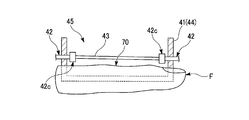
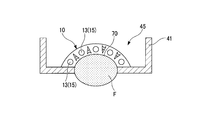
- FIG. 22 is a cross-sectional view taken along a vertical plane including the length direction (predetermined direction, first direction) of the biological model F.
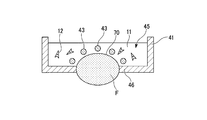
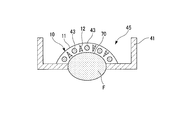
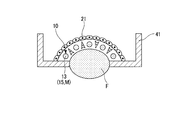
- 23 to 27 are cross-sectional views taken along a plane orthogonal to the length direction of the biological model F.
- the biological model F is provided so as to be exposed to the culture space 45 from the bottom wall 46 of the culture tank 41 with the dorsal surface as a curved surface portion 70.
- the joint between the bottom wall 46 of the culture tank 41 and the biological model F is sealed with the above-described parylene.
- the wire 43 is suspended so that the fingertip side is lowered according to the inclination of the curved surface portion 70 with respect to the first direction.
- a plurality of wires 43 (five wires in FIG. 23) are provided at intervals in the circumferential direction of the biological model F.
- the distance between each wire 43 and the biological model F is set to a distance at which the thickness of the dermis tissue layer 10 formed between the wire 43 and the biological model F can secure a predetermined value.
- the number of the wires 43 is appropriately determined according to the width (length in the circumferential direction) of the skin layer 20.
- FIGS. 22 and 23 Although not shown in FIGS. 22 and 23, five pairs of connectors 42 (10 in total) are provided on the side wall 44 in accordance with the number of wires 43.
- the culture tank 41 of this embodiment is not provided with the bottom plate 47.
- Other configurations are the same as those of the perfusion device 40 of the first embodiment.
- the mixture of the extracellular matrix component 11 and the dermal cells 12 When the mixture of the extracellular matrix component 11 and the dermal cells 12 is poured into the culture tank 41, the mixture is cultured under predetermined conditions. The cultured mixture of the extracellular matrix component 11 and the dermis cells 12 is restrained from contracting in the direction in which the wire 43 is suspended and contracts in the other direction. Therefore, as shown in FIG. A dermal tissue layer 10 having a shape along the line is formed.
- a plurality (five in this embodiment) of perfusion channels 13 are formed in the dermis tissue layer 10 as shown in FIG.
- a vascular layer 15 is formed by injecting (seeding) vascular cells 14 onto the surface of the dermis tissue layer 10 facing the perfusion channel 13 and culturing for a certain period of time.
- epidermal cells 21 are seeded on the dermis tissue layer 10.
- the epidermal cells 21 are gas-liquid cultured while the medium M is perfused through the perfusion channel 13.
- the epidermal cells 21 can be induced to differentiate to form the epidermal layer 20.
- the artificial skin tissue 1 having a curved shape in which the dermis tissue layer 10 and the epidermis layer 20 are along the curved surface portion 70 is obtained.
- the high quality of the shape along the curved surface portion 70 of the biological model F is obtained.
- the artificial skin tissue 1 can be easily manufactured. Therefore, in the present embodiment, by preparing and using the biological model F of the desired site, the high-quality artificial skin tissue 1 having the desired site shape can be easily obtained.
- the finger skin tissue is exemplified as the artificial skin tissue 1.
- the present invention can also be applied when artificially manufacturing the skin tissue of another part. is there.
- the handle O 2 plasma treatment as lyophilic engaging section 42c is not limited to this, it may take the other lyophilic treatment.
- an adhesive for skin may be used instead of the lyophilic treatment.
- a skin adhesive it is preferable to select a material that does not adversely affect the extracellular matrix component 11 and the dermal cells 12.
- the structure which uses the wire 43 which is a linear member as a flow-path formation member for forming the perfusion flow path 13 produces with a gel material or a polymer other than the wire 43, for example.
- a configuration using 3 fibers with or without cells may be used.
- the perfusion channel 13 is not limited to a linear configuration.
- planar flow path forming member for example, a mesh material can be used.
- the configuration in which the perfusion channel 13 is used to perfuse the medium for culturing the epidermis cells 21 to form the epidermis layer 20 is not limited to this configuration.
- a configuration may be used in which a drug is applied to the tissue surface (for example, the epidermis layer 20) and the perfusion channel 13 is used to evaluate the uptake of the drug into the perfusion channel 13. Further, the drug is mixed into the medium flowing through the perfusion channel 13, and the perfusion channel 13 is used to evaluate the diffusion of the drug from the perfusion channel 13 to the dermal tissue layer 10 or the epidermis layer 20. There may be.
- the perfusion channel 13 When the perfusion channel 13 is used in such a configuration, it is not necessary to form the perfusion channel 13 before the formation of the epidermis layer 20, and the procedure for forming the perfusion channel 13 after the formation of the epidermis layer 20 is performed. There may be. In addition, when the evaluation target is, for example, only the dermis tissue layer 10, it is not necessary to form the epidermis layer 20.
- the artificial skin tissue 1 is exemplified as the artificial three-dimensional tissue, but is not limited to this.
- the artificial three-dimensional tissue may be, for example, a muscle tissue using skeletal muscle cells or cardiomyocytes instead of the fibroblasts described above. Furthermore, it may be a liver tissue using hepatocytes, a pancreatic tissue using pancreatic cells, or a nerve tissue using neural cells.
- the extracellular matrix used in the above embodiment does not necessarily exist, and may be a collection of only various cells.
- a high-quality artificial three-dimensional tissue and a manufacturing method thereof, an artificial three-dimensional tissue perfusion device, and a drug evaluation method using the artificial three-dimensional tissue can be provided.
- this invention is useful in fields, such as cosmetics, a pharmaceutical, a pharmaceutical, etc., for example.
- SYMBOLS 1 Artificial skin tissue (artificial three-dimensional tissue), 10 ... Dermal tissue layer, 11 ... Extracellular matrix component, 12 ... Dermal cell (fibroblast), 13 ... Perfusion channel, 14 ... Vascular cell, 15 ... Tube Cavity layer, 20 ... epidermis layer, 21 ... epidermis cells, 40, 40A ... perfusion device (artificial 3D tissue perfusion device), 41 ... culture tank, 42 ... connector (support part), 42a ... mounting part (cylinder part), 42c ... engaging portion, 42e ... second cylinder, 42f ... rib portion, 43 ... wire (linear member, flow path forming member), 44 ... side wall, 45 ... culture space, 46 ... bottom wall (bottom), 70 ... Curved surface part, F ... Living body model, M ... Medium
Landscapes
- Health & Medical Sciences (AREA)
- Life Sciences & Earth Sciences (AREA)
- Chemical & Material Sciences (AREA)
- Engineering & Computer Science (AREA)
- Organic Chemistry (AREA)
- Zoology (AREA)
- Wood Science & Technology (AREA)
- Bioinformatics & Cheminformatics (AREA)
- General Health & Medical Sciences (AREA)
- Biomedical Technology (AREA)
- Genetics & Genomics (AREA)
- Biochemistry (AREA)
- Microbiology (AREA)
- Biotechnology (AREA)
- General Engineering & Computer Science (AREA)
- Molecular Biology (AREA)
- Sustainable Development (AREA)
- Medicinal Chemistry (AREA)
- Veterinary Medicine (AREA)
- Public Health (AREA)
- Animal Behavior & Ethology (AREA)
- Epidemiology (AREA)
- Transplantation (AREA)
- Oral & Maxillofacial Surgery (AREA)
- Dermatology (AREA)
- Proteomics, Peptides & Aminoacids (AREA)
- Urology & Nephrology (AREA)
- Chemical Kinetics & Catalysis (AREA)
- Botany (AREA)
- Vascular Medicine (AREA)
- Immunology (AREA)
- Biophysics (AREA)
- Analytical Chemistry (AREA)
- Physics & Mathematics (AREA)
- Clinical Laboratory Science (AREA)
- Micro-Organisms Or Cultivation Processes Thereof (AREA)
- Apparatus Associated With Microorganisms And Enzymes (AREA)
- Measuring Or Testing Involving Enzymes Or Micro-Organisms (AREA)
- Investigating Or Analysing Biological Materials (AREA)
- Materials For Medical Uses (AREA)
Abstract
Description
本願は、2014年9月23日に出願された米国特許仮出願62/054,066号に基づき優先権を主張し、その内容をここに援用する。
本実施形態では、人工三次元組織として人工皮膚組織を製造する例を用いて説明する。
なお、以下の実施の実施形態は、本発明の一態様を示すものであり、この発明を限定するものではなく、本発明の技術的思想の範囲内で任意に変更可能である。また、以下の図面においては、各構成をわかりやすくするために、実際の構造と各構造における縮尺や数等を異ならせている。
まず、本発明に係る人工皮膚組織について、図1を参照して説明する。
図1は、人工三次元組織である人工皮膚組織1を模式的に示した斜視断面図である。
人工皮膚組織1は、真皮組織層10と表皮層20とを含む。人工皮膚組織1は、真皮組織層10と表皮層20とが積層された方向(図1における上下方向、以下、積層方向と称する)と直交する平面に沿った所定方向(図1における左右方向、以下、第1方向と称する)に延びて形成されている。
次に、上記の人工皮膚組織1を製造する人工皮膚組織製造装置について、図2乃至図5を参照して説明する。
図2は、人工皮膚組織製造装置30の概略的な構成図である。
図3は、灌流デバイス40の第1実施形態の外観斜視図である。
灌流デバイス40は、培養槽41、コネクタ(支持部)42およびワイヤー(線状部材、流路形成部材)43を備えている。培養槽41は、側壁44に囲まれた上部が開口する培養空間45と、底壁(底部)46に設けられた底板47を備えている。側壁44は、平面視で矩形状に設けられている。底壁46は、鉛直方向に貫通する開口部46aと、底面46bに設けられた溝部46cとを有している。溝部46cは、第1方向に延在して設けられ両端部において培養皿50の内部空間に開口している。底板47は、培養槽41に取り付けおよび取り外し自在である。底板47は、培養槽41の底壁46に取り付けられたときに開口部46aを閉塞する。
次に、人工皮膚組織1の製造方法について、図6乃至図20を参照して説明する。
本発明に係る人工皮膚組織(人工三次元組織)1の製造方法は、真皮組織層10上に表皮層20が形成され第1方向(所定方向)に延びる人工皮膚組織1の製造方法であって、側壁44に囲まれた培養空間45を有する培養槽41と、対向する側壁44を貫いて培養空間45に所定方向に沿って懸架されたワイヤー(線状部材、流路形成部材)43とを備えた灌流デバイス(人工三次元組織灌流デバイス、デバイス)40を準備することと、培養空間45で細胞外マトリックス成分11中の真皮細胞12を培養して、ワイヤー43が貫く真皮組織層10を形成することと、真皮組織層10からワイヤー43を抜去して真皮組織層10を貫通する灌流流路13を形成することと、真皮組織層10上に表皮細胞21を配置し灌流流路13に培地Mを灌流させながら、表皮層20を形成することと、を含む。また、本発明に係る人工皮膚組織1の製造方法は、対向する側壁44にそれぞれ設けた係合部42cに細胞外マトリックス成分11を係合させて所定方向への収縮を抑えながら真皮組織層10を形成することを含む。
図6乃至図20においては、適宜、灌流デバイス40のみを図示し、培養皿50、ポンプ60等の図示を省略している。
灌流デバイス40の準備としては、図6に示すように、上記の培養槽41の対向する側壁44に貫通孔42dが同軸となるようにコネクタ42を装着するとともに、底壁46に底板47を取り付けて開口部46aを閉塞する。同軸となっている貫通孔42dにワイヤー43を挿通し、培養空間45にワイヤー43を懸架させる。
灌流デバイス40の準備が完了すると、真皮組織層10を形成する。
真皮組織層10の形成は、まず、図7に示すように、細胞外マトリックス成分11と真皮細胞12との混合物を培養槽41の培養空間45に注ぎ込む。混合物は、ワイヤー43が浸漬される高さとなる量で注ぎ込まれる。本実施形態では、細胞外マトリックス成分11としてコラーゲンが用いられている。
次に、コネクタ42に支持されているワイヤー43を抜去する。これにより、図9に示すように、真皮組織層10には、第1方向に延びる空洞である灌流流路13が形成される。このとき、真皮組織層10は、両端部において係合部42cに係合しているため、ワイヤー43の抜去時にコネクタ42から脱離することなく安定してコネクタ42に支持される。
次に、表皮層20を形成するための準備を行う。
図11に示すように、培養槽41の底壁46から底板47を取り外すとともに、図2に示したように、培養槽41を培養皿50の内部に載置する。次いで、第1方向の一方側のコネクタ42の接続部42bに配管61を接続し、第1方向の他方側のコネクタ42の接続部42bに配管63を接続する。各側の接続部42bに接続する配管61または配管63については3つのコネクタ42全てに接続してもよいし、一部のみに接続してもよい。
本発明は、さらにその他の態様として、本発明の人工皮膚組織1を用いた薬剤の皮膚に対する刺激性を評価する方法に関する。本発明における薬剤とは、医薬品等の薬物、化粧品や医薬部外品等を含む。1本発明の評価方法によれば、例えば、従来の方法と比較して実際の皮膚に近い環境で薬剤の評価を行うことができる。また、本発明の評価方法は、例えば、新薬の創出(スクリーニング)等における各種分子量の薬物の動態評価、化粧品や医薬部外品等の開発における評価において極めて有用である。
図13は、上述の製造方法により製造された人工皮膚組織1を示す図である。この図に示されるように、コネクタ42によって第1方向および第2方向の収縮が抑制された状態の人工皮膚組織1が得られた。
続いて、灌流デバイス40Aの第2実施形態について、図21乃至図27を参照して説明する。
これらの図において、図1乃至図20に示す第1実施形態の構成要素と同一の要素については同一符号を付し、その説明を省略または簡略化する。
第1実施形態では平面状の人工皮膚組織1を製造する場合を例示したが、第2実施形態では、断面形状が曲面の人工皮膚組織1を製造する例を用いて説明する。
他の構成は、上記第1実施形態の灌流デバイス40と同様である。
続いて、上記の灌流デバイス40Aを用いて人工皮膚組織1を製造する方法について説明する。ここでは、灌流デバイス40Aの準備は完了しているものとして説明する。
まず、真皮組織層10を形成するために、図23に示すように、細胞外マトリックス成分11と真皮細胞12との混合物を培養槽41の培養空間45に注ぎ込む。混合物は、ワイヤー43が浸漬される高さとなる量で注ぎ込まれる。
Claims (19)
- 所定方向に延びる人工三次元組織の製造方法であって、
側壁に囲まれた培養空間を有する培養槽と、対向する前記側壁を貫いて前記培養空間に前記所定方向に沿って懸架された流路形成部材とを備えたデバイスを準備することと、
前記培養空間で細胞を培養して、前記流路形成部材が貫く前記人工三次元組織を形成することと、
前記人工三次元組織から前記流路形成部材を抜去して前記人工三次元組織を貫通する灌流流路を形成することと、
を含むことを特徴とする人工三次元組織の製造方法。 - 前記対向する側壁にそれぞれ設けた係合部に前記人工三次元組織の一部を係合させて前記所定方向への収縮を抑えながら前記人工三次元組織を形成することを特徴とする請求項1記載の人工三次元組織の製造方法。
- 前記係合部は、前記所定方向に延び前記流路形成部材が挿通される筒部の外周面および前記側壁と隙間をあけて配置された第2筒部と、前記筒部の周方向に間隔をあけて配置され前記筒部の外周面と前記第2筒部の内周面とを接続する複数のリブ部とを有することを特徴とする請求項2記載の人工三次元組織の製造方法。
- 前記培養槽の底部に、前記所定方向に延びる曲面部を設け、
前記人工三次元組織を前記曲面部上に形成することを特徴とする請求項1から3のいずれか一項に記載の人工三次元組織の製造方法。 - 前記曲面部は、生体モデルの一部であることを特徴とする請求項4記載の人工三次元組織の製造方法。
- 前記灌流流路の表面に血管系細胞を培養して管腔層を形成することを含むことを特徴とする請求項1から5のいずれか一項に記載の人工三次元組織の製造方法。
- 前記培養槽の底部に設けた開口部を開放して前記培養槽を培養皿に載置することと、
前記灌流流路を灌流し前記開口部を介して前記培養皿に溜まった培地を回収することとを含むことを特徴とする請求項1から6のいずれか一項に記載の人工三次元組織の製造方法。 - 前記人工三次元組織を形成することは、細胞外マトリックス成分中の真皮細胞を培養して、前記流路形成部材が貫く真皮組織層を形成することと、
前記真皮組織層から前記流路形成部材を抜去して前記真皮組織層を貫通する灌流流路を形成することと、
前記真皮組織層上に表皮細胞を配置し前記表皮層を形成することと、
を含むことを特徴とする請求項1から7のいずれか一項に記載の人工三次元組織の製造方法。 - 前記灌流流路に培地を灌流させながら前記表皮層を培養することを特徴とする請求項8記載の人工三次元組織の製造方法。
- 請求項1から9のいずれか一項に記載の製造方法で人工三次元組織を製造することと、
薬剤を前記人工三次元組織に接触させることと、
前記薬剤の接触による刺激に対する前記人工三次元組織の応答を測定することと、
を含むことを特徴とする人工三次元組織を用いた薬剤評価方法。 - 所定方向に延びる人工三次元組織に灌流が行われる人工三次元組織灌流デバイスであって、
側壁に囲まれた培養空間を有する培養槽と、
対向する前記側壁を貫いて前記培養空間における前記人工三次元組織を配置する領域に前記所定方向に沿って懸架される流路形成部材を取り付けおよび取り外し自在に支持する支持部とを備えることを特徴とする人工三次元組織灌流デバイス。 - 前記対向する側壁のそれぞれに、前記人工三次元組織に係合して前記人工三次元組織の前記所定方向への収縮を抑える係合部が設けられることを特徴とする請求項11記載の人工三次元組織灌流デバイス。
- 前記係合部は、前記所定方向に延び前記流路形成部材が挿通される筒部の外周面および前記側壁と隙間をあけて配置された第2筒部と、前記筒部の周方向に間隔をあけて配置され前記筒部の外周面と前記第2筒部の内周面とを接続する複数のリブ部とを有することを特徴とする請求項12記載の人工三次元組織灌流デバイス。
- 前記培養槽の底部に、前記所定方向に延びる曲面部が設けられ、
前記人工三次元組織は前記曲面部上に配置されることを特徴とする請求項11から13のいずれか一項に記載の人工三次元組織灌流デバイス。 - 前記曲面部は、生体モデルの一部であることを特徴とする請求項14記載の人工三次元組織灌流デバイス。
- 所定方向に延びる人工三次元組織であって、
内部を貫通し前記所定方向に延びる灌流流路を有することを特徴とする人工三次元組織。 - 細胞外マトリックス成分および真皮細胞を含む真皮組織層と、
表皮細胞を含み前記真皮組織層上に形成された表皮組織層とを含み、
前記灌流流路は、前記真皮組織層の内部を貫通し前記所定方向に延びることを特徴とする請求項16記載の人工三次元組織。 - 前記灌流流路の表面に血管系細胞を用いて形成された管腔層を備えることを特徴とする請求項16または17記載の人工三次元組織。
- 前記所定方向と直交する断面が曲面形状であることを特徴とする請求項16から18のいずれか一項に記載の人工三次元組織。
Priority Applications (3)
| Application Number | Priority Date | Filing Date | Title |
|---|---|---|---|
| EP15844691.4A EP3199622A4 (en) | 2014-09-23 | 2015-06-30 | Three-dimensional artificial tissue, method for producing the same, three-dimensional artificial tissue perfusion device, and drug evaluation method using three-dimensional artificial tissue |
| JP2016549992A JP6619345B2 (ja) | 2014-09-23 | 2015-06-30 | 人工三次元組織の製造方法、人工三次元組織灌流デバイス、人工三次元組織を用いた薬剤評価方法 |
| US15/509,337 US10624991B2 (en) | 2014-09-23 | 2015-06-30 | Three-dimensional artificial tissue, method for producing the same, three-dimensional artificial tissue perfusion device, and drug evaluation method using three-dimensional artificial tissue |
Applications Claiming Priority (2)
| Application Number | Priority Date | Filing Date | Title |
|---|---|---|---|
| US201462054066P | 2014-09-23 | 2014-09-23 | |
| US62/054,066 | 2014-09-23 |
Publications (1)
| Publication Number | Publication Date |
|---|---|
| WO2016047230A1 true WO2016047230A1 (ja) | 2016-03-31 |
Family
ID=55580770
Family Applications (1)
| Application Number | Title | Priority Date | Filing Date |
|---|---|---|---|
| PCT/JP2015/068793 Ceased WO2016047230A1 (ja) | 2014-09-23 | 2015-06-30 | 人工三次元組織とその製造方法、人工三次元組織灌流デバイス、人工三次元組織を用いた薬剤評価方法 |
Country Status (4)
| Country | Link |
|---|---|
| US (1) | US10624991B2 (ja) |
| EP (1) | EP3199622A4 (ja) |
| JP (1) | JP6619345B2 (ja) |
| WO (1) | WO2016047230A1 (ja) |
Cited By (6)
| Publication number | Priority date | Publication date | Assignee | Title |
|---|---|---|---|---|
| WO2017126532A1 (ja) * | 2016-01-20 | 2017-07-27 | 国立大学法人東京大学 | 人工三次元組織とその製造方法、人工三次元組織灌流デバイス、人工三次元組織を用いた薬剤評価方法 |
| JP2019122335A (ja) * | 2018-01-18 | 2019-07-25 | 国立大学法人 東京大学 | 人工三次元組織のバリア機能測定システム、人工三次元組織のバリア機能測定方法及び人工三次元組織を用いた薬剤評価方法 |
| JPWO2022059498A1 (ja) * | 2020-09-15 | 2022-03-24 | ||
| JPWO2022059777A1 (ja) * | 2020-09-19 | 2022-03-24 | ||
| JP2023151611A (ja) * | 2022-03-31 | 2023-10-16 | ポーラ化成工業株式会社 | 人工三次元組織灌流デバイス、人工皮膚組織の製造方法、人工皮膚組織を用いた薬剤評価方法 |
| WO2026070930A1 (ja) * | 2024-09-27 | 2026-04-02 | インテグリカルチャー株式会社 | 細胞組織化リアクタ |
Families Citing this family (2)
| Publication number | Priority date | Publication date | Assignee | Title |
|---|---|---|---|---|
| EP3940058A1 (en) * | 2020-07-16 | 2022-01-19 | Genoskin | Microfluidic system to control perfusion, diffusion and collection of molecules over long periods in an ex-vivo skin model |
| IT202300011436A1 (it) * | 2023-06-06 | 2024-12-06 | Bio System Lab S R L | Modello di pelle biostampato, relativo processo di stampa tridimensionale e dispositivo di perfusione diretta provvisto di tale modello |
Citations (3)
| Publication number | Priority date | Publication date | Assignee | Title |
|---|---|---|---|---|
| JP2005518910A (ja) * | 2002-03-06 | 2005-06-30 | ユニバーシティ・オブ・シンシナティ | 皮膚の治療または検査用外科用デバイス |
| JP2009531067A (ja) * | 2006-03-24 | 2009-09-03 | ノーティス,インク. | 灌流可能な微小血管システムを作製する方法 |
| JP2010539938A (ja) * | 2007-09-24 | 2010-12-24 | ノーティス,インク. | 灌流可能な微小血管システムを作製するための方法 |
Family Cites Families (4)
| Publication number | Priority date | Publication date | Assignee | Title |
|---|---|---|---|---|
| WO2009118140A2 (de) * | 2008-03-25 | 2009-10-01 | Novatissue Gmbh | Perfundierbarer bioreaktor zur herstellung von menschlichen oder tierischen geweben |
| WO2009152174A1 (en) * | 2008-06-09 | 2009-12-17 | The Children's Mercy Hospital | Tissue retaining system |
| CN103097518B (zh) * | 2010-09-14 | 2015-10-14 | 学校法人东京女子医科大学 | 细胞片叠层化物的制造方法、由该方法得到的具有血管网的细胞片叠层化物及其利用方法 |
| JP2012205516A (ja) | 2011-03-29 | 2012-10-25 | Osaka Univ | 人工皮膚モデルの製造方法、及び人工皮膚モデル |
-
2015
- 2015-06-30 EP EP15844691.4A patent/EP3199622A4/en not_active Withdrawn
- 2015-06-30 JP JP2016549992A patent/JP6619345B2/ja active Active
- 2015-06-30 US US15/509,337 patent/US10624991B2/en not_active Expired - Fee Related
- 2015-06-30 WO PCT/JP2015/068793 patent/WO2016047230A1/ja not_active Ceased
Patent Citations (3)
| Publication number | Priority date | Publication date | Assignee | Title |
|---|---|---|---|---|
| JP2005518910A (ja) * | 2002-03-06 | 2005-06-30 | ユニバーシティ・オブ・シンシナティ | 皮膚の治療または検査用外科用デバイス |
| JP2009531067A (ja) * | 2006-03-24 | 2009-09-03 | ノーティス,インク. | 灌流可能な微小血管システムを作製する方法 |
| JP2010539938A (ja) * | 2007-09-24 | 2010-12-24 | ノーティス,インク. | 灌流可能な微小血管システムを作製するための方法 |
Non-Patent Citations (2)
| Title |
|---|
| NEUMANN, T. ET AL.: "Tissue engineering of perfused microvessels", MICROVASCULAR RESEARCH, vol. 66, 2003, pages 59 - 67, XP002595432, DOI: doi:10.1016/S0026-2862(03)00040-2 * |
| See also references of EP3199622A4 * |
Cited By (9)
| Publication number | Priority date | Publication date | Assignee | Title |
|---|---|---|---|---|
| WO2017126532A1 (ja) * | 2016-01-20 | 2017-07-27 | 国立大学法人東京大学 | 人工三次元組織とその製造方法、人工三次元組織灌流デバイス、人工三次元組織を用いた薬剤評価方法 |
| JP2019122335A (ja) * | 2018-01-18 | 2019-07-25 | 国立大学法人 東京大学 | 人工三次元組織のバリア機能測定システム、人工三次元組織のバリア機能測定方法及び人工三次元組織を用いた薬剤評価方法 |
| JP6991572B2 (ja) | 2018-01-18 | 2022-01-12 | 国立大学法人 東京大学 | 人工三次元組織のバリア機能測定システム、人工三次元組織のバリア機能測定方法及び人工三次元組織を用いた薬剤評価方法 |
| JPWO2022059498A1 (ja) * | 2020-09-15 | 2022-03-24 | ||
| JPWO2022059777A1 (ja) * | 2020-09-19 | 2022-03-24 | ||
| WO2022059777A1 (ja) * | 2020-09-19 | 2022-03-24 | 国立大学法人東京大学 | 人工三次元組織製造装置および人工三次元組織製造方法 |
| JP7766348B2 (ja) | 2020-09-19 | 2025-11-10 | 国立大学法人 東京大学 | 人工三次元組織製造装置および人工三次元組織製造方法 |
| JP2023151611A (ja) * | 2022-03-31 | 2023-10-16 | ポーラ化成工業株式会社 | 人工三次元組織灌流デバイス、人工皮膚組織の製造方法、人工皮膚組織を用いた薬剤評価方法 |
| WO2026070930A1 (ja) * | 2024-09-27 | 2026-04-02 | インテグリカルチャー株式会社 | 細胞組織化リアクタ |
Also Published As
| Publication number | Publication date |
|---|---|
| JP6619345B2 (ja) | 2019-12-11 |
| US20170274121A1 (en) | 2017-09-28 |
| JPWO2016047230A1 (ja) | 2017-07-06 |
| US10624991B2 (en) | 2020-04-21 |
| EP3199622A4 (en) | 2018-08-08 |
| EP3199622A1 (en) | 2017-08-02 |
Similar Documents
| Publication | Publication Date | Title |
|---|---|---|
| JP6619345B2 (ja) | 人工三次元組織の製造方法、人工三次元組織灌流デバイス、人工三次元組織を用いた薬剤評価方法 | |
| Zhao et al. | Review on the vascularization of organoids and organoids-on-a-C hip | |
| Wang et al. | Microfluidic-based 3D engineered microvascular networks and their applications in vascularized microtumor models | |
| Zheng et al. | Organ‐on‐a‐chip systems: microengineering to biomimic living systems | |
| JP5356215B2 (ja) | 灌流可能な微小血管システムを作製する方法 | |
| Zhang et al. | Biodegradable scaffold with built-in vasculature for organ-on-a-chip engineering and direct surgical anastomosis | |
| Caplin et al. | Microfluidic organ‐on‐a‐chip technology for advancement of drug development and toxicology | |
| JP6041872B2 (ja) | バイオ人工腎臓 | |
| WO2022134294A1 (zh) | 一种可拆卸、可重复使用的疏水或超疏水微流控器官芯片 | |
| CN112143642B (zh) | 用于体外培养的血管化肿瘤微流控器官芯片及其制备方法 | |
| JP2010539935A (ja) | 灌流可能な微小血管システムを作製するための方法 | |
| Akintewe et al. | Design approaches to myocardial and vascular tissue engineering | |
| CN116966943B (zh) | 一种层级血管化微流控器官芯片及其制备方法 | |
| US7439057B2 (en) | Convective flow tissue assembly | |
| WO2017126532A1 (ja) | 人工三次元組織とその製造方法、人工三次元組織灌流デバイス、人工三次元組織を用いた薬剤評価方法 | |
| US20210108178A1 (en) | Systems and methods for multilane vasculature | |
| KR20190088711A (ko) | 폐 모방 칩 및 이의 제조방법 | |
| Rayat Pisheh et al. | Effective and new technologies in kidney tissue engineering | |
| JPWO2019132008A1 (ja) | 人工組織灌流デバイス、人工組織を用いた薬剤評価方法 | |
| JP6991572B2 (ja) | 人工三次元組織のバリア機能測定システム、人工三次元組織のバリア機能測定方法及び人工三次元組織を用いた薬剤評価方法 | |
| US10837002B2 (en) | Artificial peritoneal tissue and method for producing same | |
| Prendergast et al. | Microphysiological systems: automated fabrication via extrusion bioprinting | |
| KR101569619B1 (ko) | 수축 및 팽창 기능을 하는 인체장기를 모사한 실험모델장치 | |
| JP2015062392A (ja) | 毛細血管の製造方法および毛細血管の製造装置 | |
| JP2021104015A (ja) | 培養デバイス、人工組織製造方法、及び人工組織を用いた薬剤評価方法 |
Legal Events
| Date | Code | Title | Description |
|---|---|---|---|
| 121 | Ep: the epo has been informed by wipo that ep was designated in this application |
Ref document number: 15844691 Country of ref document: EP Kind code of ref document: A1 |
|
| ENP | Entry into the national phase |
Ref document number: 2016549992 Country of ref document: JP Kind code of ref document: A |
|
| WWE | Wipo information: entry into national phase |
Ref document number: 15509337 Country of ref document: US |
|
| REEP | Request for entry into the european phase |
Ref document number: 2015844691 Country of ref document: EP |
|
| WWE | Wipo information: entry into national phase |
Ref document number: 2015844691 Country of ref document: EP |
|
| NENP | Non-entry into the national phase |
Ref country code: DE |