WO2016047536A1 - 高分子化合物およびそれを用いた発光素子 - Google Patents
高分子化合物およびそれを用いた発光素子 Download PDFInfo
- Publication number
- WO2016047536A1 WO2016047536A1 PCT/JP2015/076390 JP2015076390W WO2016047536A1 WO 2016047536 A1 WO2016047536 A1 WO 2016047536A1 JP 2015076390 W JP2015076390 W JP 2015076390W WO 2016047536 A1 WO2016047536 A1 WO 2016047536A1
- Authority
- WO
- WIPO (PCT)
- Prior art keywords
- group
- substituent
- formula
- represented
- polymer compound
- Prior art date
- Legal status (The legal status is an assumption and is not a legal conclusion. Google has not performed a legal analysis and makes no representation as to the accuracy of the status listed.)
- Ceased
Links
- 0 C*(C)c(c(*)c1*)c(*)c(*)c1-c1nc(*)nc(-c2c(*)c(*)c(C(C)(C)C)c(*)c2*)n1 Chemical compound C*(C)c(c(*)c1*)c(*)c(*)c1-c1nc(*)nc(-c2c(*)c(*)c(C(C)(C)C)c(*)c2*)n1 0.000 description 14
- NIHNNTQXNPWCJQ-UHFFFAOYSA-N C1c(cccc2)c2-c2ccccc12 Chemical compound C1c(cccc2)c2-c2ccccc12 NIHNNTQXNPWCJQ-UHFFFAOYSA-N 0.000 description 1
- QQAPOBXVFDLKLA-KPKJPENVSA-N CC(C)(C)c(cc1)ccc1/C(/C=C)=C/C Chemical compound CC(C)(C)c(cc1)ccc1/C(/C=C)=C/C QQAPOBXVFDLKLA-KPKJPENVSA-N 0.000 description 1
- SSVWXWVLEOAILT-DAITWMQNSA-N CCC(C)(CC)c(cc1)ccc1/C(/N(C)C(C)(C)C)=N/C(c1ccc(C(C)(CC)CC)cc1)=N Chemical compound CCC(C)(CC)c(cc1)ccc1/C(/N(C)C(C)(C)C)=N/C(c1ccc(C(C)(CC)CC)cc1)=N SSVWXWVLEOAILT-DAITWMQNSA-N 0.000 description 1
Classifications
-
- C—CHEMISTRY; METALLURGY
- C08—ORGANIC MACROMOLECULAR COMPOUNDS; THEIR PREPARATION OR CHEMICAL WORKING-UP; COMPOSITIONS BASED THEREON
- C08G—MACROMOLECULAR COMPOUNDS OBTAINED OTHERWISE THAN BY REACTIONS ONLY INVOLVING UNSATURATED CARBON-TO-CARBON BONDS
- C08G61/00—Macromolecular compounds obtained by reactions forming a carbon-to-carbon link in the main chain of the macromolecule
- C08G61/12—Macromolecular compounds containing atoms other than carbon in the main chain of the macromolecule
-
- C—CHEMISTRY; METALLURGY
- C08—ORGANIC MACROMOLECULAR COMPOUNDS; THEIR PREPARATION OR CHEMICAL WORKING-UP; COMPOSITIONS BASED THEREON
- C08L—COMPOSITIONS OF MACROMOLECULAR COMPOUNDS
- C08L65/00—Compositions of macromolecular compounds obtained by reactions forming a carbon-to-carbon link in the main chain; Compositions of derivatives of such polymers
-
- C—CHEMISTRY; METALLURGY
- C09—DYES; PAINTS; POLISHES; NATURAL RESINS; ADHESIVES; COMPOSITIONS NOT OTHERWISE PROVIDED FOR; APPLICATIONS OF MATERIALS NOT OTHERWISE PROVIDED FOR
- C09D—COATING COMPOSITIONS, e.g. PAINTS, VARNISHES OR LACQUERS; FILLING PASTES; CHEMICAL PAINT OR INK REMOVERS; INKS; CORRECTING FLUIDS; WOODSTAINS; PASTES OR SOLIDS FOR COLOURING OR PRINTING; USE OF MATERIALS THEREFOR
- C09D165/00—Coating compositions based on macromolecular compounds obtained by reactions forming a carbon-to-carbon link in the main chain; Coating compositions based on derivatives of such polymers
-
- C—CHEMISTRY; METALLURGY
- C09—DYES; PAINTS; POLISHES; NATURAL RESINS; ADHESIVES; COMPOSITIONS NOT OTHERWISE PROVIDED FOR; APPLICATIONS OF MATERIALS NOT OTHERWISE PROVIDED FOR
- C09K—MATERIALS FOR MISCELLANEOUS APPLICATIONS, NOT PROVIDED FOR ELSEWHERE
- C09K11/00—Luminescent materials, e.g. electroluminescent or chemiluminescent
- C09K11/02—Use of particular materials as binders, particle coatings or suspension media therefor
-
- H—ELECTRICITY
- H10—SEMICONDUCTOR DEVICES; ELECTRIC SOLID-STATE DEVICES NOT OTHERWISE PROVIDED FOR
- H10K—ORGANIC ELECTRIC SOLID-STATE DEVICES
- H10K50/00—Organic light-emitting devices
-
- H—ELECTRICITY
- H10—SEMICONDUCTOR DEVICES; ELECTRIC SOLID-STATE DEVICES NOT OTHERWISE PROVIDED FOR
- H10K—ORGANIC ELECTRIC SOLID-STATE DEVICES
- H10K71/00—Manufacture or treatment specially adapted for the organic devices covered by this subclass
- H10K71/10—Deposition of organic active material
- H10K71/12—Deposition of organic active material using liquid deposition, e.g. spin coating
- H10K71/13—Deposition of organic active material using liquid deposition, e.g. spin coating using printing techniques, e.g. ink-jet printing or screen printing
-
- H—ELECTRICITY
- H10—SEMICONDUCTOR DEVICES; ELECTRIC SOLID-STATE DEVICES NOT OTHERWISE PROVIDED FOR
- H10K—ORGANIC ELECTRIC SOLID-STATE DEVICES
- H10K85/00—Organic materials used in the body or electrodes of devices covered by this subclass
- H10K85/10—Organic polymers or oligomers
- H10K85/111—Organic polymers or oligomers comprising aromatic, heteroaromatic, or aryl chains, e.g. polyaniline, polyphenylene or polyphenylene vinylene
-
- H—ELECTRICITY
- H10—SEMICONDUCTOR DEVICES; ELECTRIC SOLID-STATE DEVICES NOT OTHERWISE PROVIDED FOR
- H10K—ORGANIC ELECTRIC SOLID-STATE DEVICES
- H10K85/00—Organic materials used in the body or electrodes of devices covered by this subclass
- H10K85/10—Organic polymers or oligomers
- H10K85/111—Organic polymers or oligomers comprising aromatic, heteroaromatic, or aryl chains, e.g. polyaniline, polyphenylene or polyphenylene vinylene
- H10K85/115—Polyfluorene; Derivatives thereof
-
- H—ELECTRICITY
- H10—SEMICONDUCTOR DEVICES; ELECTRIC SOLID-STATE DEVICES NOT OTHERWISE PROVIDED FOR
- H10K—ORGANIC ELECTRIC SOLID-STATE DEVICES
- H10K85/00—Organic materials used in the body or electrodes of devices covered by this subclass
- H10K85/10—Organic polymers or oligomers
- H10K85/151—Copolymers
-
- C—CHEMISTRY; METALLURGY
- C08—ORGANIC MACROMOLECULAR COMPOUNDS; THEIR PREPARATION OR CHEMICAL WORKING-UP; COMPOSITIONS BASED THEREON
- C08G—MACROMOLECULAR COMPOUNDS OBTAINED OTHERWISE THAN BY REACTIONS ONLY INVOLVING UNSATURATED CARBON-TO-CARBON BONDS
- C08G2261/00—Macromolecular compounds obtained by reactions forming a carbon-to-carbon link in the main chain of the macromolecule
- C08G2261/10—Definition of the polymer structure
- C08G2261/12—Copolymers
-
- C—CHEMISTRY; METALLURGY
- C08—ORGANIC MACROMOLECULAR COMPOUNDS; THEIR PREPARATION OR CHEMICAL WORKING-UP; COMPOSITIONS BASED THEREON
- C08G—MACROMOLECULAR COMPOUNDS OBTAINED OTHERWISE THAN BY REACTIONS ONLY INVOLVING UNSATURATED CARBON-TO-CARBON BONDS
- C08G2261/00—Macromolecular compounds obtained by reactions forming a carbon-to-carbon link in the main chain of the macromolecule
- C08G2261/10—Definition of the polymer structure
- C08G2261/13—Morphological aspects
- C08G2261/135—Cross-linked structures
-
- C—CHEMISTRY; METALLURGY
- C08—ORGANIC MACROMOLECULAR COMPOUNDS; THEIR PREPARATION OR CHEMICAL WORKING-UP; COMPOSITIONS BASED THEREON
- C08G—MACROMOLECULAR COMPOUNDS OBTAINED OTHERWISE THAN BY REACTIONS ONLY INVOLVING UNSATURATED CARBON-TO-CARBON BONDS
- C08G2261/00—Macromolecular compounds obtained by reactions forming a carbon-to-carbon link in the main chain of the macromolecule
- C08G2261/10—Definition of the polymer structure
- C08G2261/14—Side-groups
- C08G2261/141—Side-chains having aliphatic units
- C08G2261/1412—Saturated aliphatic units
-
- C—CHEMISTRY; METALLURGY
- C08—ORGANIC MACROMOLECULAR COMPOUNDS; THEIR PREPARATION OR CHEMICAL WORKING-UP; COMPOSITIONS BASED THEREON
- C08G—MACROMOLECULAR COMPOUNDS OBTAINED OTHERWISE THAN BY REACTIONS ONLY INVOLVING UNSATURATED CARBON-TO-CARBON BONDS
- C08G2261/00—Macromolecular compounds obtained by reactions forming a carbon-to-carbon link in the main chain of the macromolecule
- C08G2261/10—Definition of the polymer structure
- C08G2261/14—Side-groups
- C08G2261/141—Side-chains having aliphatic units
- C08G2261/1414—Unsaturated aliphatic units
-
- C—CHEMISTRY; METALLURGY
- C08—ORGANIC MACROMOLECULAR COMPOUNDS; THEIR PREPARATION OR CHEMICAL WORKING-UP; COMPOSITIONS BASED THEREON
- C08G—MACROMOLECULAR COMPOUNDS OBTAINED OTHERWISE THAN BY REACTIONS ONLY INVOLVING UNSATURATED CARBON-TO-CARBON BONDS
- C08G2261/00—Macromolecular compounds obtained by reactions forming a carbon-to-carbon link in the main chain of the macromolecule
- C08G2261/10—Definition of the polymer structure
- C08G2261/14—Side-groups
- C08G2261/148—Side-chains having aromatic units
-
- C—CHEMISTRY; METALLURGY
- C08—ORGANIC MACROMOLECULAR COMPOUNDS; THEIR PREPARATION OR CHEMICAL WORKING-UP; COMPOSITIONS BASED THEREON
- C08G—MACROMOLECULAR COMPOUNDS OBTAINED OTHERWISE THAN BY REACTIONS ONLY INVOLVING UNSATURATED CARBON-TO-CARBON BONDS
- C08G2261/00—Macromolecular compounds obtained by reactions forming a carbon-to-carbon link in the main chain of the macromolecule
- C08G2261/30—Monomer units or repeat units incorporating structural elements in the main chain
- C08G2261/31—Monomer units or repeat units incorporating structural elements in the main chain incorporating aromatic structural elements in the main chain
- C08G2261/312—Non-condensed aromatic systems, e.g. benzene
-
- C—CHEMISTRY; METALLURGY
- C08—ORGANIC MACROMOLECULAR COMPOUNDS; THEIR PREPARATION OR CHEMICAL WORKING-UP; COMPOSITIONS BASED THEREON
- C08G—MACROMOLECULAR COMPOUNDS OBTAINED OTHERWISE THAN BY REACTIONS ONLY INVOLVING UNSATURATED CARBON-TO-CARBON BONDS
- C08G2261/00—Macromolecular compounds obtained by reactions forming a carbon-to-carbon link in the main chain of the macromolecule
- C08G2261/30—Monomer units or repeat units incorporating structural elements in the main chain
- C08G2261/31—Monomer units or repeat units incorporating structural elements in the main chain incorporating aromatic structural elements in the main chain
- C08G2261/314—Condensed aromatic systems, e.g. perylene, anthracene or pyrene
- C08G2261/3142—Condensed aromatic systems, e.g. perylene, anthracene or pyrene fluorene-based, e.g. fluorene, indenofluorene, or spirobifluorene
-
- C—CHEMISTRY; METALLURGY
- C08—ORGANIC MACROMOLECULAR COMPOUNDS; THEIR PREPARATION OR CHEMICAL WORKING-UP; COMPOSITIONS BASED THEREON
- C08G—MACROMOLECULAR COMPOUNDS OBTAINED OTHERWISE THAN BY REACTIONS ONLY INVOLVING UNSATURATED CARBON-TO-CARBON BONDS
- C08G2261/00—Macromolecular compounds obtained by reactions forming a carbon-to-carbon link in the main chain of the macromolecule
- C08G2261/30—Monomer units or repeat units incorporating structural elements in the main chain
- C08G2261/31—Monomer units or repeat units incorporating structural elements in the main chain incorporating aromatic structural elements in the main chain
- C08G2261/316—Monomer units or repeat units incorporating structural elements in the main chain incorporating aromatic structural elements in the main chain bridged by heteroatoms, e.g. N, P, Si or B
- C08G2261/3162—Arylamines
-
- C—CHEMISTRY; METALLURGY
- C08—ORGANIC MACROMOLECULAR COMPOUNDS; THEIR PREPARATION OR CHEMICAL WORKING-UP; COMPOSITIONS BASED THEREON
- C08G—MACROMOLECULAR COMPOUNDS OBTAINED OTHERWISE THAN BY REACTIONS ONLY INVOLVING UNSATURATED CARBON-TO-CARBON BONDS
- C08G2261/00—Macromolecular compounds obtained by reactions forming a carbon-to-carbon link in the main chain of the macromolecule
- C08G2261/40—Polymerisation processes
- C08G2261/41—Organometallic coupling reactions
- C08G2261/411—Suzuki reactions
-
- C—CHEMISTRY; METALLURGY
- C08—ORGANIC MACROMOLECULAR COMPOUNDS; THEIR PREPARATION OR CHEMICAL WORKING-UP; COMPOSITIONS BASED THEREON
- C08G—MACROMOLECULAR COMPOUNDS OBTAINED OTHERWISE THAN BY REACTIONS ONLY INVOLVING UNSATURATED CARBON-TO-CARBON BONDS
- C08G2261/00—Macromolecular compounds obtained by reactions forming a carbon-to-carbon link in the main chain of the macromolecule
- C08G2261/50—Physical properties
- C08G2261/51—Charge transport
-
- C—CHEMISTRY; METALLURGY
- C08—ORGANIC MACROMOLECULAR COMPOUNDS; THEIR PREPARATION OR CHEMICAL WORKING-UP; COMPOSITIONS BASED THEREON
- C08G—MACROMOLECULAR COMPOUNDS OBTAINED OTHERWISE THAN BY REACTIONS ONLY INVOLVING UNSATURATED CARBON-TO-CARBON BONDS
- C08G2261/00—Macromolecular compounds obtained by reactions forming a carbon-to-carbon link in the main chain of the macromolecule
- C08G2261/50—Physical properties
- C08G2261/52—Luminescence
-
- C—CHEMISTRY; METALLURGY
- C08—ORGANIC MACROMOLECULAR COMPOUNDS; THEIR PREPARATION OR CHEMICAL WORKING-UP; COMPOSITIONS BASED THEREON
- C08G—MACROMOLECULAR COMPOUNDS OBTAINED OTHERWISE THAN BY REACTIONS ONLY INVOLVING UNSATURATED CARBON-TO-CARBON BONDS
- C08G2261/00—Macromolecular compounds obtained by reactions forming a carbon-to-carbon link in the main chain of the macromolecule
- C08G2261/70—Post-treatment
- C08G2261/76—Post-treatment crosslinking
-
- C—CHEMISTRY; METALLURGY
- C08—ORGANIC MACROMOLECULAR COMPOUNDS; THEIR PREPARATION OR CHEMICAL WORKING-UP; COMPOSITIONS BASED THEREON
- C08G—MACROMOLECULAR COMPOUNDS OBTAINED OTHERWISE THAN BY REACTIONS ONLY INVOLVING UNSATURATED CARBON-TO-CARBON BONDS
- C08G2261/00—Macromolecular compounds obtained by reactions forming a carbon-to-carbon link in the main chain of the macromolecule
- C08G2261/90—Applications
- C08G2261/95—Use in organic luminescent diodes
-
- H—ELECTRICITY
- H10—SEMICONDUCTOR DEVICES; ELECTRIC SOLID-STATE DEVICES NOT OTHERWISE PROVIDED FOR
- H10K—ORGANIC ELECTRIC SOLID-STATE DEVICES
- H10K2101/00—Properties of the organic materials covered by group H10K85/00
- H10K2101/10—Triplet emission
-
- H—ELECTRICITY
- H10—SEMICONDUCTOR DEVICES; ELECTRIC SOLID-STATE DEVICES NOT OTHERWISE PROVIDED FOR
- H10K—ORGANIC ELECTRIC SOLID-STATE DEVICES
- H10K50/00—Organic light-emitting devices
- H10K50/10—OLEDs or polymer light-emitting diodes [PLED]
- H10K50/11—OLEDs or polymer light-emitting diodes [PLED] characterised by the electroluminescent [EL] layers
-
- H—ELECTRICITY
- H10—SEMICONDUCTOR DEVICES; ELECTRIC SOLID-STATE DEVICES NOT OTHERWISE PROVIDED FOR
- H10K—ORGANIC ELECTRIC SOLID-STATE DEVICES
- H10K50/00—Organic light-emitting devices
- H10K50/10—OLEDs or polymer light-emitting diodes [PLED]
- H10K50/14—Carrier transporting layers
- H10K50/15—Hole transporting layers
-
- H—ELECTRICITY
- H10—SEMICONDUCTOR DEVICES; ELECTRIC SOLID-STATE DEVICES NOT OTHERWISE PROVIDED FOR
- H10K—ORGANIC ELECTRIC SOLID-STATE DEVICES
- H10K50/00—Organic light-emitting devices
- H10K50/10—OLEDs or polymer light-emitting diodes [PLED]
- H10K50/14—Carrier transporting layers
- H10K50/16—Electron transporting layers
-
- H—ELECTRICITY
- H10—SEMICONDUCTOR DEVICES; ELECTRIC SOLID-STATE DEVICES NOT OTHERWISE PROVIDED FOR
- H10K—ORGANIC ELECTRIC SOLID-STATE DEVICES
- H10K50/00—Organic light-emitting devices
- H10K50/10—OLEDs or polymer light-emitting diodes [PLED]
- H10K50/17—Carrier injection layers
-
- H—ELECTRICITY
- H10—SEMICONDUCTOR DEVICES; ELECTRIC SOLID-STATE DEVICES NOT OTHERWISE PROVIDED FOR
- H10K—ORGANIC ELECTRIC SOLID-STATE DEVICES
- H10K50/00—Organic light-emitting devices
- H10K50/10—OLEDs or polymer light-emitting diodes [PLED]
- H10K50/17—Carrier injection layers
- H10K50/171—Electron injection layers
Definitions
- the present invention relates to a polymer compound and a light emitting device using the same.
- Organic electroluminescence elements (hereinafter also referred to as “light-emitting elements”) have high luminous efficiency and low driving voltage, and thus can be suitably used for display applications, and have attracted attention in recent years.
- This light-emitting element includes organic layers such as a light-emitting layer and a charge transport layer.
- an organic layer can be formed by a coating method typified by an ink jet printing method. Therefore, a polymer compound used for manufacturing a light-emitting element has been studied.
- Patent Document 1 as a material used for an organic layer of a light-emitting element, a polymer compound containing a structural unit derived from an aromatic hydrocarbon having a crosslinking group in a side chain (having a crosslinking group contained in the polymer compound) The structural unit is only a structural unit derived from an aromatic hydrocarbon having a crosslinking group in the side chain.
- Patent Document 2 discloses a polymer compound containing a structural unit composed of a crosslinking group as a material used for an organic layer of a light-emitting element (a structural unit having a crosslinking group contained in the polymer compound is derived from a crosslinking group). Only the terminal structural unit).
- an organic layer substantially insoluble in a solvent is formed by crosslinking the crosslinking group by heating or the like after the polymer compound is formed by a coating method. Is possible. Then, another organic layer (for example, a light emitting layer) can be laminated on the organic layer by a coating method.
- JP 2008-106241 A Japanese National Patent Publication No. 11-510535
- an object of the present invention is to provide a polymer compound having excellent crosslinkability. Another object of the present invention is to provide a method for producing the polymer compound. It is another object of the present invention to provide a composition containing the polymer compound and a light emitting device obtained using the polymer compound.
- the present invention provides the following [1] to [14].
- At least one terminal structural unit represented by the following formula (1) A polymer compound comprising a structural unit represented by the following formula (2) and at least one structural unit selected from the group consisting of a structural unit represented by the following formula (2 ′).
- mT represents an integer of 0 to 5
- nT represents an integer of 1 to 4
- cT represents 0 or 1.
- Q T represents a crosslinking group selected from the following crosslinking group A group. If Q T there are a plurality, they may be the same or different.
- K T represents an alkylene group, a cycloalkylene group, an arylene group, a divalent heterocyclic group, a group represented by —NR′—, an oxygen atom or a sulfur atom, and these groups have a substituent. Also good.
- R ′ represents a hydrogen atom, an alkyl group, a cycloalkyl group, an aryl group, or a monovalent heterocyclic group, and these groups may have a substituent.
- Ar T represents an aromatic hydrocarbon group or a heterocyclic group, and these groups optionally have a substituent. ] [Where: mA represents an integer of 0 to 5, and n represents 1 or 2.
- Ar 1 represents an aromatic hydrocarbon group or a heterocyclic group, and these groups optionally have a substituent.
- K A is an alkylene group, a cycloalkylene group, an arylene group, a divalent heterocyclic group, -NR '' -, a group represented by an oxygen atom or a sulfur atom, these groups have a substituent May be.
- R ′′ represents a hydrogen atom, an alkyl group, a cycloalkyl group, an aryl group or a monovalent heterocyclic group, and these groups optionally have a substituent.
- Q 1 represents a crosslinking group selected from the crosslinking group A group. When a plurality of Q 1 are present, they may be the same or different. ] [Where: mB represents an integer of 0 to 5, m represents an integer of 1 to 4, and c represents 0 or 1. When a plurality of mBs are present, they may be the same or different.
- Ar 3 represents an aromatic hydrocarbon group, a heterocyclic group, or a group in which at least one aromatic hydrocarbon ring and at least one heterocyclic ring are directly bonded, and these groups have a substituent. It may be.
- Ar 2 and Ar 4 each independently represent an arylene group or a divalent heterocyclic group, and these groups optionally have a substituent.
- Ar 2 , Ar 3, and Ar 4 are each bonded to a group other than the group bonded to the nitrogen atom to which the group is bonded, directly or via an oxygen atom or sulfur atom, to form a ring.
- K B represents an alkylene group, a cycloalkylene group, an arylene group, a divalent heterocyclic group, a group represented by —NR ′ ′′ —, an oxygen atom or a sulfur atom, and these groups have a substituent.
- R ′ ′′ represents a hydrogen atom, an alkyl group, a cycloalkyl group, an aryl group, or a monovalent heterocyclic group, and these groups optionally have a substituent.
- Q 2 represents a bridging group selected from the bridging group A, a hydrogen atom, an alkyl group, a cycloalkyl group, an aryl group, or a monovalent heterocyclic group, and these groups may have a substituent.
- Q 2 is a crosslinking group selected from the crosslinking group A group.
- R XL represents a methylene group, an oxygen atom or a sulfur atom
- n XL represents an integer of 0 to 5.
- Q 2 is a structural unit represented by the formula (XL-1), (XL-7), (XL-16) or (XL-17) The polymer compound described.
- the cT is 1, Ar T may have a benzene ring which may have a substituent, a fluorene ring which may have a substituent, a naphthalene ring which may have a substituent, or a substituent.
- [1] to [4] are groups obtained by removing from the phenanthrene ring or an optionally substituted dihydrophenanthrene ring, hydrogen atoms (nT + 1) directly bonded to the carbon atoms constituting the ring.
- the high molecular compound in any one.
- Ar X1 and Ar X3 each independently represent an arylene group or a divalent heterocyclic group, and these groups optionally have a substituent.
- Ar X2 and Ar X4 each independently represent an arylene group, a divalent heterocyclic group, or a divalent group in which at least one arylene group and at least one divalent heterocyclic group are directly bonded to each other. And these groups may have a substituent. When there are a plurality of Ar X2 and Ar X4 , they may be the same or different from each other.
- R X1 , R X2 and R X3 each independently represent a hydrogen atom, an alkyl group, a cycloalkyl group, an aryl group or a monovalent heterocyclic group, and these groups optionally have a substituent.
- R X2 and R X3 When there are a plurality of R X2 and R X3 , they may be the same or different.
- R X2 and R X3 they may be the same or different.
- Ar Y1 represents an arylene group, a divalent heterocyclic group, or a divalent group in which at least one arylene group and at least one divalent heterocyclic group are directly bonded, and these This group may have a substituent.
- the structural unit represented by the formula (Y) is a structural unit represented by the following formula (Y-1) or a structural unit represented by the following formula (Y-2). The polymer compound described.
- R Y1 represents a hydrogen atom, an alkyl group, a cycloalkyl group, an alkoxy group, a cycloalkoxy group, an aryl group or a monovalent heterocyclic group, and these groups optionally have a substituent.
- a plurality of R Y1 may be the same or different, and adjacent R Y1 may be bonded to each other to form a ring together with the carbon atom to which each is bonded.
- R Y1 represents the same meaning as described above.
- R Y2 represents a hydrogen atom, an alkyl group, a cycloalkyl group, an alkoxy group, a cycloalkoxy group, an aryl group, or a monovalent heterocyclic group, and these groups may have a substituent.
- a plurality of R Y2 may be the same or different, and R Y2 may be bonded to each other to form a ring together with the carbon atom to which each is bonded.
- the terminal structural unit represented by the formula (1) is contained in an amount of 0.1 mol% or more and 20 mol% or less based on the total amount of the structural units contained in the polymer compound.
- mA, n, Ar 1 , K A and Q 1 represent the same meaning as described above.
- Z 1 and Z 2 each independently represent a group selected from the group consisting of the substituent A group or the group consisting of the substituent B group.
- Z 3 and Z 4 each independently represent a group selected from the group consisting of the substituent A group or the group consisting of the substituent B group.
- Z T represents a group selected from the group consisting of the substituent group A or a group consisting of the substituent group B.
- R C1 represents an alkyl group, a cycloalkyl group or an aryl group, and these groups have a substituent
- R C2 There exist a plurality of R C2 is Groups which may be the same or different and may be linked to each other to form a ring structure together with the oxygen atoms to which they are bonded.
- a group represented by BF 3 Q ′ (wherein Q ′ represents Li, Na, K, Rb or Cs); -A group represented by MgY '(wherein Y' represents a chlorine atom, a bromine atom or an iodine atom); A group represented by —ZnY ′′ (wherein Y ′′ represents a chlorine atom, a bromine atom or an iodine atom); and -Sn (R C3) 3 (wherein, R C3 represents a hydrogen atom, an alkyl group, a cycloalkyl group or an aryl group, these groups may have a substituent.
- R C3 is The groups may be the same or different and may be linked to each other to form a ring structure together with the tin atoms to which they are bonded.
- the polymer compound according to any one of [1] to [10] and [12] A composition comprising a hole transport material, a hole injection material, an electron transport material, an electron injection material, a light emitting material, an antioxidant, and at least one material selected from the group consisting of a solvent.
- a polymer compound having excellent crosslinkability can be provided.
- the manufacturing method of this high molecular compound can be provided.
- a composition containing the polymer compound and a light emitting device obtained using the polymer compound can be provided.
- Me represents a methyl group
- Et represents an ethyl group
- Bu represents a butyl group
- i-Pr represents an isopropyl group
- t-Bu represents a tert-butyl group.
- the hydrogen atom may be a deuterium atom or a light hydrogen atom.
- the solid line representing the bond with the central metal means a covalent bond or a coordinate bond.
- the “polymer compound” means a polymer having a molecular weight distribution and having a polystyrene-equivalent number average molecular weight of 1 ⁇ 10 3 to 1 ⁇ 10 8 .
- Low molecular weight compound means a compound having no molecular weight distribution and a molecular weight of 1 ⁇ 10 4 or less.
- “Structural unit” means one or more units present in a polymer compound.
- terminal structural unit means a unit present at the terminal in the polymer compound, and usually means a unit present at the terminal of the main chain in the polymer compound.
- terminal structural unit When there is one main chain in the polymer compound, there are two “terminal structural units”, and when there are two or more main chains in the polymer compound (in the case of a branched polymer compound), “terminal structure” There are three or more units.
- the “alkyl group” may be linear or branched.
- the number of carbon atoms of the straight chain alkyl group is usually 1 to 50, preferably 3 to 30, and more preferably 4 to 20, excluding the number of carbon atoms of the substituent.
- the number of carbon atoms of the branched alkyl group is usually 3 to 50, preferably 3 to 30, more preferably 4 to 20, excluding the number of carbon atoms of the substituent.
- the alkyl group may have a substituent, for example, methyl group, ethyl group, propyl group, isopropyl group, butyl group, isobutyl group, tert-butyl group, pentyl group, isoamyl group, 2-ethylbutyl group, Hexyl group, heptyl group, octyl group, 2-ethylhexyl group, 3-propylheptyl group, decyl group, 3,7-dimethyloctyl group, 2-ethyloctyl group, 2-hexyldecyl group, dodecyl group, and these Examples include groups in which the hydrogen atom in the group is substituted with a cycloalkyl group, an alkoxy group, a cycloalkoxy group, an aryl group, a fluorine atom, etc., for example, a trifluoromethyl group, a pentafluoroeth
- the number of carbon atoms of the “cycloalkyl group” is usually 3 to 50, preferably 3 to 30, and more preferably 4 to 20, excluding the number of carbon atoms of the substituent.
- the cycloalkyl group may have a substituent, and examples thereof include a cyclohexyl group, a cyclohexylmethyl group, and a cyclohexylethyl group.
- Aryl group means an atomic group remaining after removing one hydrogen atom directly bonded to a carbon atom constituting a ring from an aromatic hydrocarbon.
- the number of carbon atoms of the aryl group is usually 6 to 60, preferably 6 to 20, more preferably 6 to 10, not including the number of carbon atoms of the substituent.
- the “alkoxy group” may be linear or branched.
- the number of carbon atoms of the straight-chain alkoxy group is usually 1 to 40, preferably 4 to 10, excluding the number of carbon atoms of the substituent.
- the number of carbon atoms of the branched alkoxy group is usually 3 to 40, preferably 4 to 10, excluding the number of carbon atoms of the substituent.
- the alkoxy group may have a substituent, for example, methoxy group, ethoxy group, propyloxy group, isopropyloxy group, butyloxy group, isobutyloxy group, tert-butyloxy group, pentyloxy group, hexyloxy group, Heptyloxy group, octyloxy group, 2-ethylhexyloxy group, nonyloxy group, decyloxy group, 3,7-dimethyloctyloxy group, lauryloxy group, and the hydrogen atom in these groups is a cycloalkyl group, an alkoxy group, And a group substituted with a cycloalkoxy group, an aryl group, a fluorine atom, or the like.
- a substituent for example, methoxy group, ethoxy group, propyloxy group, isopropyloxy group, butyloxy group, isobutyloxy group, tert-buty
- the number of carbon atoms of the “cycloalkoxy group” is usually 3 to 40, preferably 4 to 10, not including the number of carbon atoms of the substituent.
- the cycloalkoxy group may have a substituent, and examples thereof include a cyclohexyloxy group.
- the number of carbon atoms of the “aryloxy group” is usually 6 to 60, preferably 7 to 48, not including the number of carbon atoms of the substituent.
- the aryloxy group may have a substituent, for example, a phenoxy group, 1-naphthyloxy group, 2-naphthyloxy group, 1-anthracenyloxy group, 9-anthracenyloxy group, 1- Examples include a pyrenyloxy group and a group in which a hydrogen atom in these groups is substituted with an alkyl group, a cycloalkyl group, an alkoxy group, a cycloalkoxy group, a fluorine atom, or the like.
- P-valent heterocyclic group (p represents an integer of 1 or more) is a p-group of hydrogen atoms directly bonded to a carbon atom or a hetero atom constituting a ring from a heterocyclic compound. This means the remaining atomic group excluding the hydrogen atom.
- this is an atomic group obtained by removing p hydrogen atoms from an aromatic heterocyclic compound directly bonded to carbon atoms or heteroatoms constituting the ring.
- a “p-valent aromatic heterocyclic group” is preferable.
- Aromatic heterocyclic compounds '' are oxadiazole, thiadiazole, thiazole, oxazole, thiophene, pyrrole, phosphole, furan, pyridine, pyrazine, pyrimidine, triazine, pyridazine, quinoline, isoquinoline, carbazole, dibenzophosphole, etc.
- a compound in which the ring itself exhibits aromaticity and a heterocyclic ring such as phenoxazine, phenothiazine, dibenzoborol, dibenzosilol, and benzopyran itself does not exhibit aromaticity, but the aromatic ring is condensed to the heterocyclic ring.
- the number of carbon atoms of the monovalent heterocyclic group is usually 2 to 60, preferably 4 to 20, excluding the number of carbon atoms of the substituent.
- the monovalent heterocyclic group may have a substituent, for example, thienyl group, pyrrolyl group, furyl group, pyridyl group, piperidinyl group, quinolinyl group, isoquinolinyl group, pyrimidinyl group, triazinyl group, and these And a group in which the hydrogen atom in the group is substituted with an alkyl group, a cycloalkyl group, an alkoxy group, a cycloalkoxy group, or the like.
- Halogen atom means a fluorine atom, a chlorine atom, a bromine atom or an iodine atom.
- the “amino group” may have a substituent, and a substituted amino group is preferable.
- a substituent which an amino group has an alkyl group, a cycloalkyl group, an aryl group or a monovalent heterocyclic group is preferable.
- the substituted amino group include a dialkylamino group, a dicycloalkylamino group, and a diarylamino group.
- the amino group include dimethylamino group, diethylamino group, diphenylamino group, bis (4-methylphenyl) amino group, bis (4-tert-butylphenyl) amino group, bis (3,5-di-tert- Butylphenyl) amino group.
- the “alkenyl group” may be linear or branched.
- the number of carbon atoms of the straight-chain alkenyl group is usually 2-30, preferably 3-20, excluding the number of carbon atoms of the substituent.
- the number of carbon atoms of the branched alkenyl group is usually 3 to 30, preferably 4 to 20, not including the number of carbon atoms of the substituent.
- the number of carbon atoms of the “cycloalkenyl group” is usually 3 to 30, preferably 4 to 20, not including the number of carbon atoms of the substituent.
- the alkenyl group and the cycloalkenyl group may have a substituent, for example, a vinyl group, a 1-propenyl group, a 2-propenyl group, a 2-butenyl group, a 3-butenyl group, a 3-pentenyl group, a 4-pentenyl group, Examples include a pentenyl group, a 1-hexenyl group, a 5-hexenyl group, a 7-octenyl group, and a group in which these groups have a substituent.
- the “alkynyl group” may be linear or branched.
- the number of carbon atoms of the alkynyl group is usually 2 to 20, preferably 3 to 20, not including the carbon atom of the substituent.
- the number of carbon atoms of the branched alkynyl group is usually from 4 to 30, and preferably from 4 to 20, not including the carbon atom of the substituent.
- the number of carbon atoms of the “cycloalkynyl group” is usually 4 to 30, preferably 4 to 20, not including the carbon atom of the substituent.
- the alkynyl group and cycloalkynyl group may have a substituent, for example, ethynyl group, 1-propynyl group, 2-propynyl group, 2-butynyl group, 3-butynyl group, 3-pentynyl group, 4- Examples include a pentynyl group, 1-hexynyl group, 5-hexynyl group, and groups in which these groups have a substituent.
- the “arylene group” means an atomic group remaining after removing two hydrogen atoms directly bonded to a carbon atom constituting a ring from an aromatic hydrocarbon.
- the number of carbon atoms of the arylene group is usually 6 to 60, preferably 6 to 30, and more preferably 6 to 18, excluding the number of carbon atoms of the substituent.
- the arylene group may have a substituent. Examples include chrysenediyl groups and groups in which these groups have substituents, and groups represented by formulas (A-1) to (A-20) are preferable.
- the arylene group includes a group in which a plurality of these groups are bonded.
- R and R a each independently represents a hydrogen atom, an alkyl group, a cycloalkyl group, an aryl group or a monovalent heterocyclic group.
- a plurality of R and R a may be the same or different, and R a may be bonded to each other to form a ring together with the atoms to which each is bonded.
- the number of carbon atoms of the divalent heterocyclic group is usually 2 to 60, preferably 3 to 20, and more preferably 4 to 15 excluding the number of carbon atoms of the substituent.
- the divalent heterocyclic group may have a substituent, for example, pyridine, diazabenzene, triazine, azanaphthalene, diazanaphthalene, carbazole, dibenzofuran, dibenzothiophene, dibenzosilol, phenoxazine, phenothiazine, acridine, Divalent acridine, furan, thiophene, azole, diazole, and triazole include divalent groups obtained by removing two hydrogen atoms from hydrogen atoms directly bonded to carbon atoms or heteroatoms constituting the ring, and preferably Is a group represented by formula (AA-1) to formula (AA-34).
- the divalent heterocyclic group includes a group in which a plurality of these groups
- crosslinking group is a group capable of generating a new bond by being subjected to heat treatment, ultraviolet irradiation treatment, radical reaction, etc., and preferably the above-mentioned formula (XL- 1) to a crosslinking group represented by (XL-17).
- “Substituent” means a halogen atom, cyano group, alkyl group, cycloalkyl group, aryl group, monovalent heterocyclic group, alkoxy group, cycloalkoxy group, aryloxy group, amino group, substituted amino group, alkenyl group. Represents a cycloalkenyl group, an alkynyl group or a cycloalkynyl group.
- the substituent may be a crosslinking group.
- the polymer compound of the present invention is At least one terminal structural unit represented by formula (1); A polymer compound comprising a structural unit represented by formula (2) and at least one structural unit selected from the group consisting of structural units represented by formula (2 ′).
- the terminal structural unit represented by the formula (1) contained in the polymer compound of the present invention is usually end-capped with the compound represented by the formula (1M) in the method for producing the polymer compound of the present invention described later. It is a structural unit formed by the “stopping process”.
- At least one structural unit selected from the group consisting of the structural unit represented by the formula (2) and the structural unit represented by the formula (2 ′) contained in the polymer compound of the present invention is usually described later. “Condensation polymerization of at least one compound selected from the group consisting of a compound represented by formula (2M) and a compound represented by formula (2′M)” in the method for producing a polymer compound of the present invention. A structural unit to be formed.
- MT is preferably an integer of 0 to 3, more preferably 0 or 1, and even more preferably 0, because the synthesis of the polymer compound of the present invention is facilitated.
- mTs When a plurality of mTs are present, they may be the same or different, but are preferably the same integers because it facilitates the synthesis of the polymer compound of the present invention.
- NT is preferably an integer of 1 to 3, more preferably 1 or 2, and even more preferably 1, since the synthesis of the polymer compound of the present invention is facilitated.
- Q T is more excellent in crosslinkability of the polymer compound of the present invention, among the crosslinkable groups selected from the above-mentioned crosslinkable group A, the formula (XL-1), (XL-7), (XL- 16) or a crosslinking group represented by (XL-17), more preferably a crosslinking group represented by the formula (XL-1) or (XL-17).
- Bridging group represented by Q T may have a substituent.
- Substituent optionally bridging group has represented the Q T, since the synthesis of the polymer compound of the present invention is facilitated, preferably an alkyl group, a cycloalkyl group or an aryl group, more preferably It is an alkyl group.
- the crosslinking group represented by the formula (XL-17) is excellent in the crosslinking property of the polymer compound of the present invention.
- a crosslinking group represented by the formula (XL-17 ′) is preferable.
- R XLS represents an alkyl group, a cycloalkyl group, an alkoxy group, a cycloalkoxy group, an aryl group or a monovalent heterocyclic group, and these groups may have a substituent.
- R XLS When a plurality of R XLS are present, they may be the same or different, and may be bonded to each other to form a ring together with the carbon atom to which each is bonded. * Represents a bonding position.
- XT is preferably an integer of 1 to 3, more preferably 1 or 2, and even more preferably 1, since the synthesis of the polymer compound of the present invention is facilitated.
- R XLS is preferably an alkyl group, a cycloalkyl group, an alkoxy group, a cycloalkoxy group or an aryl group, since it facilitates the synthesis of the polymer compound of the present invention, and is an alkyl group, a cycloalkyl group or an aryl group. More preferably, it is more preferably an alkyl group or an aryl group, and particularly preferably an alkyl group.
- Examples of the crosslinking group represented by the formula (XL-17 ′) include the crosslinking groups represented by the formulas (XLS-1) to (XLS-7), and the crosslinkability of the polymer compound of the present invention is further increased. Since it is excellent, it is preferably a bridging group represented by formula (XLS-1), formula (XLS-3) or formula (XLS-4), more preferably formula (XLS-1) or formula (XLS-3). And more preferably a crosslinking group represented by the formula (XLS-3).
- Q T there are a plurality they may be the same or different, but since the synthesis of the polymer compound of the present invention is facilitated, preferably identical bridging group.
- KT is preferably an alkylene group, a cycloalkylene group, an arylene group or a divalent heterocyclic group, more preferably an alkylene group or an arylene group, since the crosslinkability of the polymer compound of the present invention is more excellent. More preferably, it is an alkylene group, and these groups may have a substituent.
- the alkylene group represented by K T is usually 1 to 10, preferably 1 to 8, more preferably 1 to 6, not including the number of carbon atoms of the substituent.
- the cycloalkylene group represented by KT is usually 3 to 10, not including the carbon atom number of the substituent.
- the alkylene group and the cycloalkylene group may have a substituent, and examples thereof include a methylene group, an ethylene group, a propylene group, a butylene group, a hexylene group, a cyclohexylene group, and an octylene group.
- the arylene group represented by KT may have a substituent, and examples thereof include o-phenylene, m-phenylene, and p-phenylene.
- the substituent which the group represented by KT may have is preferably an alkyl group, a cycloalkyl group or an aryl group.
- KT When a plurality of KT are present, they may be the same or different, but they are preferably the same group or atom because the synthesis of the polymer compound of the present invention is facilitated.
- K T there are a plurality two or more K T may be a group represented by -NR'-, but preferably not adjacent groups represented by -NR'-.
- K T there are a plurality two or more K T may be an oxygen atom or a sulfur atom, it is preferably those atoms are not adjacent.
- Ar T is preferably an aromatic hydrocarbon group which may have a substituent since synthesis of the polymer compound of the present invention is facilitated.
- the number of carbon atoms of the aromatic hydrocarbon group represented by Ar T is usually 6 to 60, preferably 6 to 30, and more preferably 6 to 18, excluding the number of carbon atoms of the substituent. is there.
- the number of carbon atoms of the heterocyclic group represented by Ar T is usually 3 to 60, preferably 3 to 30, more preferably 3 to 18, excluding the number of carbon atoms of the substituent.
- Ar T preferably has a benzene ring which may have a substituent, a fluorene ring which may have a substituent, and a substituent because the polymer compound of the present invention is more excellent in crosslinkability.
- a hydrogen atom (nT + 1) directly bonded to a carbon atom constituting the ring from an optionally substituted naphthalene ring, an optionally substituted phenanthrene ring or an optionally substituted dihydrophenanthrene ring More preferably, a hydrogen atom directly bonded to a carbon atom constituting the ring from an optionally substituted benzene ring or an optionally substituted fluorene ring. This is a group excluding (nT + 1) atoms.
- the aromatic hydrocarbon group and heterocyclic group represented by Ar T may have a substituent, and examples of the substituent include an alkyl group, a cycloalkyl group, an alkoxy group, a cycloalkoxy group, an aryl group, and an aryloxy group.
- substituent include an alkyl group, a cycloalkyl group, an alkoxy group, a cycloalkoxy group, an aryl group, and an aryloxy group.
- the polymer compound of the present invention includes at least one terminal structural unit represented by the formula (1), but since the synthesis of the polymer compound of the present invention is facilitated, the terminal structure represented by the formula (1) It is preferable to include two units.
- the terminal structural unit represented by the formula (1) facilitates the synthesis of the polymer compound of the present invention, it is 0.1 mol% or more and 20 mol relative to the total amount of the structural units contained in the polymer compound. % Or less is preferable.
- mT is preferably an integer of 0 to 3
- nT is preferably an integer of 1 to 3
- mT is 0 or 1
- nT is More preferably, it is 1 or 2.
- Examples of the terminal structural unit represented by the formula (1) include terminal structural units represented by the formulas (1-1) to (1-33), and the crosslinkability of the polymer compound of the present invention is Since it is more excellent, preferably, the formula (1-1) to the formula (1-7), the formula (1-10), the formula (1-12), the formula (1-13), the formula (1-16), the formula A terminal structural unit represented by formula (1-20), formula (1-23), formula (1-24) or formula (1-31), more preferably formula (1-1), formula (1) -4) to formula (1-7), formula (1-10), formula (1-12), formula (1-13), formula (1-16), formula (1-20), formula (1- 23), a terminal structural unit represented by formula (1-24) or formula (1-31), more preferably formula (1-4), formula (1-6), formula (1-10) , Formula (1-12), Formula (1-13) Equation (1-16), the formula (1-20), a terminal structural unit represented by the formula (1-23) or (1-24).
- the terminal structural unit represented by the formula (1) when Q T is a bridging group represented by the formula (XL-17 ′), the terminal structural unit represented by the formula (1) includes, for example, the formula Examples thereof include terminal structural units represented by formulas (1-34) to (1-45). Since the crosslinkability of the polymer compound of the present invention is more excellent, formulas (1-34) and (1 -36), a formula (1-37) or a terminal constituent unit represented by formula (1-41) to formula (1-45), more preferably formula (1-36), formula (1-42). ), A crosslinking group represented by formula (1-44) or formula (1-45).
- the polymer compound of the present invention includes two or more terminal structural units represented by the formula (1), only one kind of terminal structural unit represented by the formula (1) may be included, or two or more types. Although it may be contained, since it is easy to synthesize the polymer compound of the present invention, it is preferable to include only one type of terminal structural unit represented by the formula (1).
- MA is preferably an integer of 0 to 3, more preferably 0 or 1, since it facilitates the synthesis of the polymer compound of the present invention.
- Ar 1 is preferably an aromatic hydrocarbon group which may have a substituent since synthesis of the polymer compound of the present invention is facilitated.
- the number of carbon atoms of the aromatic hydrocarbon group represented by Ar 1 is usually 6 to 60, preferably 6 to 30, and more preferably 6 to 18, excluding the number of carbon atoms of the substituent. is there.
- the arylene group portion excluding n substituents of the aromatic hydrocarbon group represented by Ar 1 is preferably a group represented by the formula (A-1) to the formula (A-20), More preferably, groups represented by formula (A-1), formula (A-2), formula (A-6) to formula (A-10), formula (A-19) or formula (A-20) And more preferably a group represented by the formula (A-1), the formula (A-2), or the formula (A-9), and these groups optionally have a substituent.
- the number of carbon atoms of the heterocyclic group represented by Ar 1 is usually 6 to 60, preferably 6 to 30, more preferably 6 to 18, excluding the number of carbon atoms of the substituent.
- the divalent heterocyclic group moiety excluding n substituents of the heterocyclic group represented by Ar 1 is preferably a group represented by the formula (AA-1) to the formula (AA-34). is there.
- Ar 1 preferably has a benzene ring which may have a substituent, a fluorene ring which may have a substituent, and a substituent because synthesis of the polymer compound of the present invention is facilitated.
- a hydrogen atom (2 + n) directly bonded to a carbon atom constituting the ring from an optionally substituted naphthalene ring, an optionally substituted phenanthrene ring, or an optionally substituted dihydrophenanthrene ring More preferably, from a benzene ring which may have a substituent, a fluorene ring which may have a substituent, or a naphthalene ring which may have a substituent.
- (2 + n) hydrogen atoms directly bonded to the carbon atoms constituting the ring
- the aromatic hydrocarbon group and heterocyclic group represented by Ar 1 may have a substituent, and examples of the substituent include an alkyl group, a cycloalkyl group, an alkoxy group, a cycloalkoxy group, an aryl group, and an aryloxy group.
- substituent include an alkyl group, a cycloalkyl group, an alkoxy group, a cycloalkoxy group, an aryl group, and an aryloxy group.
- crosslinking of the polymer compound of the present invention is more excellent, preferably an alkylene group, a cycloalkylene group, an arylene group or a divalent heterocyclic group, more preferably an alkylene group or an arylene group, More preferably, it is an alkylene group, and these groups may have a substituent.
- Alkylene group represented by K A is not including the carbon atom number of substituent is usually 1 to 10, preferably from 1 to 8, more preferably 1 to 6. Cycloalkylene group represented by K A is not including the carbon atom number of substituent is usually 3 to 10.
- the alkylene group and the cycloalkylene group may have a substituent, and examples thereof include a methylene group, an ethylene group, a propylene group, a butylene group, a hexylene group, a cyclohexylene group, and an octylene group.
- Arylene group represented by K A may have a substituent, for example, o- phenylene, m- phenylene, p- phenylene, and the like.
- K A substituent optionally be included in the group represented by is preferably an alkyl group, a cycloalkyl group or an aryl group.
- KA KA
- they may be the same or different, but they are preferably the same group or atom because the synthesis of the polymer compound of the present invention is facilitated.
- two or more K T may be a group represented by —NR ′′ —, but the groups represented by —NR ′′ — are preferably not adjacent to each other.
- K A there are a plurality two or more K T may be an oxygen atom or a sulfur atom, it is preferably those atoms are not adjacent.
- Q 1 is more excellent in crosslinkability of the polymer compound of the present invention, among the crosslinkable groups selected from the above-mentioned crosslinkable group A, the formula (XL-1), (XL-7), (XL— 16) or a crosslinking group represented by (XL-17), more preferably a crosslinking group represented by the formula (XL-1) or (XL-17).
- Bridging group represented by Q 1 may have a substituent.
- the substituent which the bridging group represented by Q 1 may have is preferably an alkyl group, a cycloalkyl group or an aryl group, more preferably, since it facilitates the synthesis of the polymer compound of the present invention. It is an alkyl group.
- the crosslinkable group represented by the formula (XL-17) is excellent in crosslinkability of the polymer compound of the present invention.
- a crosslinking group represented by the formula (XL-17 ′) is preferable.
- Examples and preferred ranges when Q 1 is a bridging group represented by the formula (XL-17 ′) are examples and preferred ranges when Q T is a bridging group represented by the formula (XL-17 ′). Is the same.
- Q 1 When a plurality of Q 1 are present, they may be the same or different, but are preferably the same bridging group because the synthesis of the polymer compound of the present invention is facilitated.
- K A is an alkylene group
- Q 1 is the formula (XL-1) or formula (XL-17) It is preferable that it is a represented crosslinking group.
- the constitutional unit represented by the formula (2) is preferably 2 to 90 mol% with respect to the total amount of the constitutional units contained in the polymer compound since the stability of the polymer compound of the present invention is excellent. More preferably, it is 2 to 70 mol%, and further preferably 3 to 50 mol%.
- Examples of the structural unit represented by Formula (2) include structural units represented by Formula (2-1) to Formula (2-29), and include Formula (2-1) to Formula (2-29). ) May have a substituent. Since the crosslinkability of the polymer compound of the present invention is more excellent, preferably, the formula (2-1) to the formula (2-8), the formula (2-13), the formula (2-17) to the formula (2-21) Or a structural unit represented by formula (2-25) to formula (2-29), and more preferably, formula (2-1), formula (2-5), formula (2-6), formula (2-13), formula (2-17), formula (2-18), formula (2-21), formula (2-25), formula (2-27) or formula (2-28) And more preferably a formula (2-1), formula (2-6), formula (2-13), formula (2-18), formula (2-27) or formula (2-28). ).
- R 1 represents an alkyl group, and this alkyl group may have a substituent. When there are a plurality of R 1 s , they may be the same or different. ]
- Q 1 , K A and R 1 represent the same meaning as described above. If Q 1, K A and R 1 there are a plurality, or different in each of them the same. ]
- the structural unit represented by the formula (2) include, for example, structural units represented by the formula (2-101) to the formula (2-137).
- the formula (2-101), the formula (2-104), the formula (2-111), the formula (2-112), and the formula are preferable.
- the structural unit represented by the formula (2) may be included in the polymer compound alone or in combination of two or more.
- MB is preferably 0 or 1, and more preferably 0, since the synthesis of the polymer compound of the present invention is facilitated.
- M is preferably 2 because it facilitates the synthesis of the polymer compound of the present invention.
- C is preferably 0 because it facilitates the synthesis of the polymer compound of the present invention.
- Ar 3 is preferably an aromatic hydrocarbon group because the light emitting device using the polymer compound of the present invention has excellent luminous efficiency.
- the definition and example of the arylene group part excluding m substituents of the aromatic hydrocarbon group represented by Ar 3 are the same as the definition and example of the arylene group represented by Ar X2 in formula (X) described later. It is.
- the definition and examples of the divalent group excluding m substituents of a group in which at least one aromatic hydrocarbon ring represented by Ar 3 and at least one heterocycle are directly bonded are shown in the formula (
- the definition and examples of the divalent group in which at least one arylene group represented by Ar X2 in X) and at least one divalent heterocyclic group are directly bonded are the same.
- Ar 2 and Ar 4 are preferably an arylene group because the production of the polymer compound of the present invention becomes easier.
- the definitions and examples of the arylene group represented by Ar 2 and Ar 4 are the same as the definitions and examples of the arylene group represented by Ar X1 and Ar X3 in formula (X) described later.
- the definitions and examples of the divalent heterocyclic group represented by Ar 2 and Ar 4 are the same as the definitions and examples of the divalent heterocyclic group represented by Ar X1 and Ar X3 in formula (X) described later. is there.
- the groups represented by Ar 2 , Ar 3 and Ar 4 may have a substituent, and examples of the substituent include an alkyl group, a cycloalkyl group, an alkoxy group, a cycloalkoxy group, an aryl group, an aryloxy group, Examples thereof include a halogen atom, a monovalent heterocyclic group, and a cyano group.
- Alkylene group represented by K B cycloalkylene group, an arylene group, a divalent definitions and examples of the heterocyclic group, respectively, the alkylene group represented by K A, a cycloalkylene group, an arylene group, a divalent heterocyclic
- the definition and examples of the ring group are the same.
- K B because the crosslinking of the polymer compound of the present invention is higher, is preferably a phenylene group or a methylene group.
- Q 2 is preferably a bridging group selected from the bridging group A, a hydrogen atom, an alkyl group, a cycloalkyl group, or an aryl group, since the synthesis of the polymer compound of the present invention is facilitated. It is more preferably a bridging group selected from the group consisting of a hydrogen atom, an alkyl group or an aryl group, more preferably a bridging group selected from the group A of the bridging group, a hydrogen atom or an alkyl group. You may have. However, at least one Q 2 is a crosslinking group selected from the crosslinking group A group.
- crosslinkable group represented by Q 2 is more excellent in the crosslinkability of the polymer compound of the present invention, among the crosslinkable groups selected from the above crosslinkable group A, the formula (XL-1), (XL— 7), a crosslinking group represented by (XL-16) or (XL-17), more preferably a crosslinking group represented by the formula (XL-1) or (XL-17).
- Bridging group represented by Q 2 may have a substituent.
- the substituent that the crosslinking group represented by Q 2 may have is preferably an alkyl group, a cycloalkyl group, or an aryl group, more preferably, since synthesis of the polymer compound of the present invention is facilitated. It is an alkyl group.
- the crosslinkable group represented by the formula (XL-17) is excellent in crosslinkability of the polymer compound of the present invention.
- a crosslinking group represented by the formula (XL-17 ′) is preferable.
- Examples and preferred ranges when Q 2 is a bridging group represented by the formula (XL-17 ′) are examples and preferred ranges when Q T is a bridging group represented by the formula (XL-17 ′). Is the same.
- the structural unit represented by the formula (2 ′) is preferably 2 to 90 mol% with respect to the total amount of the structural units contained in the polymer compound, because the stability of the polymer compound of the present invention is excellent. More preferably, it is 2 to 70 mol%, still more preferably 3 to 50 mol%.
- Examples of the structural unit represented by the formula (2 ′) include structural units represented by the formula (2′-1) to the formula (2′-9), and the formula (2′-1) to the formula (2′-9)
- the structural unit represented by (2′-9) may have a substituent. Since the cross-linking property of the polymer compound of the present invention is more excellent, a structural unit represented by the formula (2'-3) or the formula (2'-9) is preferable.
- Q 2 and K B are as defined above. When two or more Q2 exists, they may be the same or different. ]
- the structural unit represented by the formula (2 ') may be included in the polymer compound alone or in combination of two or more.
- the polymer compound of the present invention has excellent hole transport properties, it is preferable that the polymer compound further contains a structural unit represented by the formula (X).
- a X1 is preferably an integer of 2 or less, more preferably 1, since the luminance lifetime of the light emitting device using the polymer compound of the present invention is excellent.
- a X2 is preferably an integer of 2 or less, more preferably 0, because the luminance lifetime of the light emitting device using the polymer compound of the present invention is excellent.
- R X1 , R X2 and R X3 are preferably an alkyl group, a cycloalkyl group, an aryl group or a monovalent heterocyclic group, more preferably an aryl group, and these groups have a substituent. Also good.
- the arylene group represented by Ar X1 and Ar X3 is more preferably a group represented by the formula (A-1) or the formula (A-9), more preferably a formula (A-1). These groups may have a substituent.
- the divalent heterocyclic group represented by Ar X1 and Ar X3 is more preferably represented by Formula (AA-1), Formula (AA-2), or Formula (AA-7) to Formula (AA-26). These groups may have a substituent.
- Ar X1 and Ar X3 are preferably an arylene group which may have a substituent.
- the arylene group represented by Ar X2 and Ar X4 is represented by Formula (A-1), Formula (A-6), Formula (A-7), Formula (A-9) to Formula (A-11). Or it is group represented by a formula (A-19), and these groups may have a substituent.
- the more preferable range of the divalent heterocyclic group represented by Ar X2 and Ar X4 is the same as the more preferable range of the divalent heterocyclic group represented by Ar X1 and Ar X3 .
- Further preferred ranges are the same as the more preferred ranges and further preferred ranges of the arylene group and divalent heterocyclic group represented by Ar X1 and Ar X3 , respectively.
- Examples of the divalent group in which at least one arylene group represented by Ar X2 and Ar X4 and at least one divalent heterocyclic group are directly bonded include groups represented by the following formulae: These may have a substituent.
- R XX represents a hydrogen atom, an alkyl group, a cycloalkyl group, an aryl group or a monovalent heterocyclic group, and these groups optionally have a substituent.
- R XX is preferably an alkyl group, a cycloalkyl group, or an aryl group, and these groups optionally have a substituent.
- Ar X2 and Ar X4 are preferably an arylene group which may have a substituent.
- the substituent that the groups represented by Ar X1 to Ar X4 and R X1 to R X3 may have is preferably an alkyl group, a cycloalkyl group or an aryl group, and these groups further have a substituent. You may do it.
- the structural unit represented by the formula (X) is preferably a structural unit represented by the formulas (X-1) to (X-7), more preferably the formula (X-3) to (X-7). ), More preferably structural units represented by formulas (X-3) to (X-6).
- R X4 and R X5 each independently represent a hydrogen atom, an alkyl group, a cycloalkyl group, an alkoxy group, a cycloalkoxy group, an aryl group, an aryloxy group, a halogen atom, a monovalent heterocyclic group or cyano. Represents a group, and these groups may have a substituent.
- a plurality of R X4 may be the same or different.
- a plurality of R X5 may be the same or different, and adjacent R X5 may be bonded to each other to form a ring together with the carbon atom to which each is bonded.
- the structural unit represented by the formula (X) has excellent hole transportability, it is preferably 0.1 to 90 mol%, more preferably based on the total amount of structural units contained in the polymer compound. 1 to 70 mol%, more preferably 5 to 50 mol%.
- Examples of the structural unit represented by the formula (X) include structural units represented by the formulas (X1-1) to (X1-19), preferably the formulas (X1-6) to (X1-14). ).
- the structural unit represented by the formula (X) may be included alone or in combination of two or more.
- the polymer compound of the present invention preferably further contains a structural unit represented by the formula (Y) because the luminance life of a light emitting device using the polymer compound of the present invention is excellent.
- the structural unit represented by the formula (X) and the structural unit represented by the formula (Y) It is preferable to contain.
- the arylene group represented by Ar Y1 is represented by formula (A-1), formula (A-6), formula (A-7), formula (A-9) to formula (A-11), formula (A) A-13) or a group represented by formula (A-19), more preferably in formula (A-1), formula (A-7), formula (A-9) or formula (A-19). And these groups may have a substituent.
- the divalent heterocyclic group represented by Ar Y1 is represented by the formula (AA-4), formula (AA-10), formula (AA-13), formula (AA-15), formula (AA-18) ) Or a group represented by formula (AA-20), more preferably represented by formula (AA-4), formula (AA-10), formula (AA-18) or formula (AA-20) These groups may have a substituent.
- the ranges are the same as the more preferable ranges and further preferable ranges of the above-mentioned arylene group and divalent heterocyclic group represented by Ar Y1 .
- the divalent group in which at least one arylene group represented by Ar Y1 and at least one divalent heterocyclic group are directly bonded at least represented by Ar X2 and Ar X4 in the formula (X) Examples thereof include the same divalent groups in which one kind of arylene group and at least one kind of divalent heterocyclic group are directly bonded.
- the substituent that the group represented by Ar Y1 may have is preferably an alkyl group, a cycloalkyl group, or an aryl group, and these groups may further have a substituent.
- Examples of the structural unit represented by the formula (Y) include structural units represented by the formulas (Y-1) to (Y-7), and brightness of a light-emitting element using the polymer compound of the present invention. From the viewpoint of lifetime, it is preferably a structural unit represented by the formula (Y-1) or (Y-2), and from the viewpoint of electron transport properties, preferably the formula (Y-3) or (Y-4) From the viewpoint of hole transportability, structural units represented by formulas (Y-5) to (Y-7) are preferred.
- R Y1 represents a hydrogen atom, an alkyl group, a cycloalkyl group, an alkoxy group, a cycloalkoxy group, an aryl group or a monovalent heterocyclic group, and these groups optionally have a substituent.
- a plurality of R Y1 may be the same or different, and adjacent R Y1 may be bonded to each other to form a ring together with the carbon atom to which each is bonded.
- R Y1 is preferably a hydrogen atom, an alkyl group, a cycloalkyl group, or an aryl group, and these groups optionally have a substituent.
- the structural unit represented by the formula (Y-1) is preferably a structural unit represented by the formula (Y-1 ′).
- R Y11 represents an alkyl group, a cycloalkyl group, an alkoxy group, a cycloalkoxy group, an aryl group, or a monovalent heterocyclic group, and these groups optionally have a substituent.
- a plurality of R Y1 may be the same or different.
- R Y11 is preferably an alkyl group, a cycloalkyl group, or an aryl group, more preferably an alkyl group or a cycloalkyl group, and these groups optionally have a substituent.
- R Y1 represents the same meaning as described above.
- X Y1 is, -C (R Y2) 2 -
- R Y2 represents a hydrogen atom, an alkyl group, a cycloalkyl group, an alkoxy group, a cycloalkoxy group, an aryl group, or a monovalent heterocyclic group, and these groups may have a substituent.
- a plurality of R Y2 may be the same or different, and R Y2 may be bonded to each other to form a ring together with the carbon atom to which each is bonded. ]
- R Y2 is preferably an alkyl group, a cycloalkyl group, an aryl group or a monovalent heterocyclic group, more preferably an alkyl group, a cycloalkyl group or an aryl group, and these groups have a substituent. May be.
- the combination of two R Y2 in the group represented by —C (R Y2 ) 2 — is preferably an alkyl group or a cycloalkyl group, both are aryl groups, and both are monovalent complex A cyclic group, or one is an alkyl group or a cycloalkyl group and the other is an aryl group or a monovalent heterocyclic group, more preferably one is an alkyl group or a cycloalkyl group and the other is an aryl group. May have a substituent.
- Two R Y2 s may be bonded to each other to form a ring together with the atoms to which they are bonded.
- R Y2 forms a ring
- the group represented by —C (R Y2 ) 2 — Is preferably a group represented by formulas (Y-A1) to (Y-A5), more preferably a group represented by formula (Y-A4), and these groups have a substituent. It may be.
- the combination of two R Y2 in the group represented by —C (R Y2 ) ⁇ C (R Y2 ) — is preferably such that both are alkyl groups or cycloalkyl groups, or one is an alkyl group Alternatively, a cycloalkyl group and the other is an aryl group, and these groups may have a substituent.
- R Y2 in the group represented by —C (R Y2 ) 2 —C (R Y2 ) 2 — are preferably an alkyl group or a cycloalkyl group which may have a substituent. It is. A plurality of R Y2 may be bonded to each other to form a ring together with the atoms to which each is bonded. When R Y2 forms a ring, —C (R Y2 ) 2 —C (R Y2 ) 2 —
- the group represented is preferably a group represented by the formula (Y-B1) to (Y-B5), more preferably a group represented by the formula (Y-B3). These groups are substituted It may have a group.
- R Y2 represents the same meaning as described above.
- the structural unit represented by the formula (Y-2) is preferably a structural unit represented by the formula (Y-2 ′).
- R Y1 represents the same meaning as described above.
- R Y3 represents a hydrogen atom, an alkyl group, a cycloalkyl group, an alkoxy group, a cycloalkoxy group, an aryl group, or a monovalent heterocyclic group, and these groups may have a substituent.
- R Y3 is preferably an alkyl group, a cycloalkyl group, an alkoxy group, a cycloalkoxy group, an aryl group or a monovalent heterocyclic group, more preferably an aryl group, and these groups have a substituent. May be.
- R Y1 represents the same meaning as described above.
- R Y4 represents a hydrogen atom, an alkyl group, a cycloalkyl group, an alkoxy group, a cycloalkoxy group, an aryl group, or a monovalent heterocyclic group, and these groups optionally have a substituent.
- R Y4 is preferably an alkyl group, a cycloalkyl group, an alkoxy group, a cycloalkoxy group, an aryl group or a monovalent heterocyclic group, more preferably an aryl group, and these groups have a substituent. May be.
- Examples of the structural unit represented by the formula (Y) include structural units represented by the formulas (Y-11) to (Y-55).
- the structural unit represented by the formula (Y), in which Ar Y1 is an arylene group, is excellent in the luminance life of the light-emitting element using the polymer compound of the present invention, and therefore is a component included in the polymer compound.
- the amount is preferably 0.5 to 80 mol%, more preferably 30 to 60 mol%, based on the total amount of units.
- Ar Y1 is a divalent heterocyclic group, or at least one arylene group and at least one divalent heterocyclic group directly bonded to each other.
- the structural unit represented by the formula (Y) may be included in the polymer compound alone or in combination of two or more.
- Examples of the polymer compound of the present invention include polymer compounds P-1 to P-9 shown in Table 5.
- the “other structural unit” means a structural unit other than the structural units represented by Formula (2), Formula (2 ′), Formula (X), and Formula (Y).
- the polymer compounds P-1 to P-9 include at least one terminal structural unit represented by the formula (1).
- the polymer compound of the present invention may be any of a block copolymer, a random copolymer, an alternating copolymer, and a graft copolymer, and may be in other embodiments, but a plurality of types of raw materials A copolymer obtained by copolymerizing monomers is preferred.
- the polymer compound of the present invention is A step of condensation polymerization of at least one compound selected from the group consisting of a compound represented by the formula (2M) and a compound represented by the formula (2′M); And a step of end-capping with a compound represented by the formula (1M).
- at least one compound selected from the group consisting of a compound represented by the formula (2M) and a compound represented by the formula (2′M) and another compound (for example, the formula (M ⁇ The compound represented by 1) and / or the compound represented by formula (M-2) may be subjected to condensation polymerization.
- the compounds used for the production of the polymer compound of the present invention are sometimes collectively referred to as “raw material monomers”.
- a step of end-capping with a compound may be performed, A step of performing condensation polymerization of at least one compound selected from the group consisting of a compound represented by the formula (2M) and a compound represented by the formula (2′M); and a terminal represented by the compound represented by the formula (1M)
- the step of sealing may be performed simultaneously, After performing the step of condensation polymerization of at least one compound selected from the group consisting of the compound represented by the formula (2M) and the compound represented by the formula (2′M), it is represented by the formula (1M). It is preferable to perform a step of end-capping with a compound.
- Z 5 to Z 8 each independently represent a group selected from the substituent group A or a group selected from the substituent group B.
- Z 7 and Z 8 are groups selected from the substituent group A
- Z 1 , Z 2 , Z 3 , Z 4 , Z 5 and Z 6 select a group selected from the substituent group B.
- Z 5 and Z 6 are groups selected from the substituent group A
- Z 1 , Z 2 , Z 3 , Z 4 , Z 7 and Z 8 are groups selected from the substituent group B. select.
- Z 7 and Z 8 are groups selected from the substituent group B
- Z 1 , Z 2 , Z 3 , Z 4 , Z 5 and Z 6 select a group selected from the substituent group A.
- Z 5 and Z 6 are groups selected from the substituent group B
- Z 1 , Z 2 , Z 3 , Z 4 , Z 7 and Z 8 are groups selected from the substituent group A. select.
- the content of the group selected from the substituent group A contained in the polymer compound obtained before the step of end-capping with the compound represented by the formula (1M) is selected from the group consisting of the substituent group B. If greater than the content of groups selected, it is preferable that Z T is a group selected from the group consisting of substituents B group.
- the content of the group selected from the substituent group B contained in the polymer compound obtained before the step of end-capping with the compound represented by the formula (1M) is selected from the group consisting of the substituent group A. If greater than the content of groups selected, it is preferable that Z T is a group selected from the group consisting of substituent group a.
- Examples of the group represented by —B (OR C2 ) 2 in ⁇ Substituent group B> include groups represented by the following formulae.
- a compound having a group selected from the substituent group A and a compound having a group selected from the substituent group B are condensed by a known coupling reaction to form a group selected from the substituent group A and the substituent group B. Carbon atoms bonded to the selected group are bonded to each other. Therefore, if a compound having two groups selected from Substituent Group A and a compound having two groups selected from Substituent Group B are subjected to a known coupling reaction, condensation of these compounds by condensation polymerization A polymer can be obtained.
- a compound having two groups selected from the substituent group A (a polymer compound obtained before the end-capping step) and a compound having one group selected from the substituent group B (formula If the compound represented by (1M) is subjected to a known coupling reaction, a condensation polymer of these compounds can be obtained by condensation (end-capping).
- a compound having one group selected from the substituent group A (compound represented by the formula (1M)) and a compound having two groups selected from the substituent group B (before the end-capping step) If the polymer compound obtained in (1) is subjected to a known coupling reaction, a condensation polymer of these compounds can be obtained by condensation (end-capping).
- Condensation polymerization and end capping are usually performed in the presence of a catalyst, a base and a solvent, but may be performed in the presence of a phase transfer catalyst, if necessary.
- the catalyst examples include dichlorobis (triphenylphosphine) palladium, dichlorobis (tris-o-methoxyphenylphosphine) palladium, palladium [tetrakis (triphenylphosphine)], [tris (dibenzylideneacetone)] dipalladium, palladium acetate and the like.
- transition metal complexes such as palladium complexes of nickel, nickel [tetrakis (triphenylphosphine)], [1,3-bis (diphenylphosphino) propane] dichloronickel, [bis (1,4-cyclooctadiene)] nickel Metal complexes; these transition metal complexes may further include complexes having ligands such as triphenylphosphine, tri-o-tolylphosphine, tri-tert-butylphosphine, tricyclohexylphosphine, diphenylphosphinopropane, bipyridyl, etc. .
- a catalyst may be used individually by 1 type, or may use 2 or more types together.
- the amount of catalyst used is usually from 0.00001 to 3 as the amount of transition metal relative to the total number of moles of raw material monomers (total number of moles of raw material monomers used for condensation polymerization and raw material monomers used for end-capping). Molar equivalent.
- a catalyst may be added during the step of end-capping.
- Examples of the base and phase transfer catalyst include inorganic bases such as sodium carbonate, potassium carbonate, cesium carbonate, potassium fluoride, cesium fluoride, and tripotassium phosphate; organics such as tetrabutylammonium fluoride and tetrabutylammonium hydroxide.
- Examples of the base include phase transfer catalysts such as tetrabutylammonium chloride and tetrabutylammonium bromide. Each of the base and the phase transfer catalyst may be used alone or in combination of two or more.
- the amount of the base and phase transfer catalyst used is usually 0.001 with respect to the total number of moles of raw material monomers (total number of moles of raw material monomers used for condensation polymerization and raw material monomers used for end-capping). ⁇ 100 molar equivalents.
- a base may be added or a phase transfer catalyst may be added.
- the solvent examples include organic solvents such as toluene, xylene, mesitylene, tetrahydrofuran, 1,4-dioxane, dimethoxyethane, N, N-dimethylacetamide, N, N-dimethylformamide, and water.
- organic solvents such as toluene, xylene, mesitylene, tetrahydrofuran, 1,4-dioxane, dimethoxyethane, N, N-dimethylacetamide, N, N-dimethylformamide, and water.
- a solvent may be used individually by 1 type, or may use 2 or more types together.
- the amount of the solvent used is usually 10 to 100000 parts by weight with respect to 100 parts by weight of the raw material monomers in total (100 parts by weight of the raw material monomers used for condensation polymerization and the raw material monomers used for end-capping). Part. A solvent may be added during the step of end-capping.
- the reaction temperature for condensation polymerization and end-capping is usually -100 to 200 ° C.
- the reaction time for condensation polymerization and end-capping is usually 1 hour or more.
- Post-treatment of the polymerization reaction is a known method, for example, a method of removing water-soluble impurities by liquid separation, or adding the reaction solution after the polymerization reaction to a lower alcohol such as methanol. Then, the precipitated precipitate is filtered and then dried, etc., alone or in combination.
- a usual method such as recrystallization, reprecipitation, continuous extraction with a Soxhlet extractor, column chromatography, or the like.
- composition of the present invention comprises at least one material selected from the group consisting of a hole transport material, a hole injection material, an electron transport material, an electron injection material, a light emitting material, an antioxidant, and a solvent, Containing molecular compounds.
- composition containing the polymer compound of the present invention and a solvent (hereinafter sometimes referred to as “ink”) is suitable for production of a light-emitting element using a printing method such as an inkjet printing method or a nozzle printing method.
- the viscosity of the ink may be adjusted according to the type of printing method, but when applying a printing method such as an inkjet printing method to a printing method that passes through a discharge device, in order to prevent clogging and flight bending at the time of discharge.
- the pressure is preferably 1 to 20 mPa ⁇ s at 25 ° C.
- the solvent contained in the ink is preferably a solvent that can dissolve or uniformly disperse the solid content in the ink.
- the solvent include chlorine solvents such as 1,2-dichloroethane, 1,1,2-trichloroethane, chlorobenzene and o-dichlorobenzene; ether solvents such as tetrahydrofuran, dioxane, anisole and 4-methylanisole; toluene, Aromatic hydrocarbon solvents such as xylene, mesitylene, ethylbenzene, n-hexylbenzene, cyclohexylbenzene; cyclohexane, methylcyclohexane, n-pentane, n-hexane, n-heptane, n-octane, n-nonane, n- Aliphatic hydrocarbon solvents such as decane, n-dodecane, and bicyclohexyl;
- the blending amount of the solvent is usually 1000 to 100,000 parts by weight, preferably 2000 to 20000 parts by weight with respect to 100 parts by weight of the polymer compound of the present invention.
- the hole transport material is classified into a low molecular compound and a high molecular compound, and a high molecular compound is preferable, and a high molecular compound having a crosslinking group is more preferable.
- polymer compound examples include polyvinyl carbazole and derivatives thereof; polyarylene having an aromatic amine structure in the side chain or main chain and derivatives thereof.
- the polymer compound may be a compound to which an electron accepting site is bonded. Examples of the electron accepting site include fullerene, tetrafluorotetracyanoquinodimethane, tetracyanoethylene, trinitrofluorenone, and fullerene is preferable.
- the compounding amount of the hole transport material is usually 1 to 400 parts by weight, preferably 5 to 150 parts by weight with respect to 100 parts by weight of the polymer compound of the present invention.
- the hole transport material may be used alone or in combination of two or more.
- Electron transport materials are classified into low molecular compounds and high molecular compounds.
- the electron transport material may have a crosslinking group.
- Examples of the low molecular weight compound include a metal complex having 8-hydroxyquinoline as a ligand, oxadiazole, anthraquinodimethane, benzoquinone, naphthoquinone, anthraquinone, tetracyanoanthraquinodimethane, fluorenone, diphenyldicyanoethylene, and , Diphenoquinone, and derivatives thereof.
- polymer compound examples include polyphenylene, polyfluorene, and derivatives thereof.
- the polymer compound may be doped with a metal.
- the compounding amount of the electron transport material is usually 1 to 400 parts by weight, preferably 5 to 150 parts by weight with respect to 100 parts by weight of the polymer compound of the present invention.
- the electron transport material may be used alone or in combination of two or more.
- the hole injection material and the electron injection material are each classified into a low molecular compound and a high molecular compound.
- the hole injection material and the electron injection material may have a crosslinking group.
- low molecular weight compounds include metal phthalocyanines such as copper phthalocyanine; carbon; metal oxides such as molybdenum and tungsten; and metal fluorides such as lithium fluoride, sodium fluoride, cesium fluoride, and potassium fluoride.
- metal phthalocyanines such as copper phthalocyanine
- carbon such as carbon
- metal oxides such as molybdenum and tungsten
- metal fluorides such as lithium fluoride, sodium fluoride, cesium fluoride, and potassium fluoride.
- polymer compound examples include polyaniline, polythiophene, polypyrrole, polyphenylene vinylene, polythienylene vinylene, polyquinoline, and polyquinoxaline, and derivatives thereof; polymers containing an aromatic amine structure in the main chain or side chain, etc.
- the conductive polymer is mentioned.
- the compounding amounts of the hole injection material and the electron injection material are each usually 1 to 400 parts by weight, preferably 5 to 150 parts per 100 parts by weight of the polymer compound of the present invention. Parts by weight.
- the hole injection material and the electron injection material may be used alone or in combination of two or more.
- the electrical conductivity of the conductive polymer is preferably 1 ⁇ 10 ⁇ 5 S / cm to 1 ⁇ 10 3 S / cm.
- the conductive polymer can be doped with an appropriate amount of ions.
- the kind of ions to be doped is an anion for a hole injection material and a cation for an electron injection material.
- the anion include polystyrene sulfonate ion, alkylbenzene sulfonate ion, and camphor sulfonate ion.
- the cation include lithium ion, sodium ion, potassium ion, and tetrabutylammonium ion.
- the ion to be doped may be one kind or two or more kinds.
- Luminescent materials are classified into low molecular compounds and high molecular compounds.
- the light emitting material may have a crosslinking group.
- low molecular weight compound examples include naphthalene and derivatives thereof, anthracene and derivatives thereof, perylene and derivatives thereof, and triplet light-emitting complexes having iridium, platinum, or europium as a central metal.
- Examples of the polymer compound include a phenylene group, a naphthalenediyl group, a fluorenediyl group, a phenanthrene diyl group, a dihydrophenanthrene diyl group, a group represented by the formula (X), a carbazole diyl group, a phenoxazine diyl group, and a phenothiazine diyl.
- the light emitting material may contain a low molecular compound and a high molecular compound, and preferably contains a triplet light emitting complex and a high molecular compound.
- iridium complexes such as metal complexes represented by the formulas Ir-1 to Ir-5 are preferable.
- R D1 to R D8 , R D11 to R D20 , R D21 to R D26 and R D31 to R D37 each independently represent a hydrogen atom, an alkyl group, a cycloalkyl group, an alkoxy group, a cycloalkoxy group, an aryl group, an aryl It represents an oxy group, a monovalent heterocyclic group or a halogen atom, and these groups optionally have a substituent.
- R D1 to R D8 , R D11 to R D20 , R D21 to R D26 and R D31 to R D37 may be the same or different.
- a D1 ——A D2 — represents an anionic bidentate ligand, and A D1 and A D2 each independently represent a carbon atom, an oxygen atom or a nitrogen atom bonded to an iridium atom, The atom may be an atom constituting a ring. When a plurality of -A D1 --- A D2 -are present, they may be the same or different. n D1 represents 1, 2 or 3, and n D2 represents 1 or 2. ]
- At least one of R D1 to R D8 is preferably a group represented by the formula (DA).
- R D11 to R D20 is a group represented by the formula (DA).
- R D1 to R D8 and R D11 to R D20 is a group represented by the formula (DA).
- R 21 to R D26 is a group represented by the formula (DA).
- R D31 to R D37 is a group represented by the formula (DA).
- m DA1 , m DA2 and m DA3 each independently represent an integer of 0 or more.
- GDA represents a nitrogen atom, an aromatic hydrocarbon group or a heterocyclic group, and these groups optionally have a substituent.
- Ar DA1 , Ar DA2 and Ar DA3 each independently represent an arylene group or a divalent heterocyclic group, and these groups optionally have a substituent.
- TDA represents an aryl group or a monovalent heterocyclic group, and these groups optionally have a substituent.
- the plurality of TDAs may be the same or different.
- m DA1 , m DA2 and m DA3 are usually an integer of 10 or less, preferably an integer of 5 or less, more preferably 0 or 1.
- m DA1 , m DA2 and m DA3 are preferably the same integer.
- G DA1 is preferably a group represented by the formulas (GDA-11) to (GDA-15), and these groups may have a substituent.
- R DA represents a hydrogen atom, an alkyl group, a cycloalkyl group, an alkoxy group, a cycloalkoxy group, an aryl group, or a monovalent heterocyclic group, and these groups may further have a substituent.
- RDA represents a hydrogen atom, an alkyl group, a cycloalkyl group, an alkoxy group, a cycloalkoxy group, an aryl group, or a monovalent heterocyclic group, and these groups may further have a substituent.
- RDA represents a hydrogen atom, an alkyl group, a cycloalkyl group, an alkoxy group, a cycloalkoxy group, an aryl group, or a monovalent heterocyclic group, and these groups may further have a substituent.
- RDA represents a hydrogen atom, an alkyl group, a cycloalkyl group, an alkoxy group, a cycloalkoxy group, an
- R DA is preferably a hydrogen atom, an alkyl group, a cycloalkyl group, an alkoxy group or a cycloalkoxy group, more preferably a hydrogen atom, an alkyl group or a cycloalkyl group, and these groups have a substituent. May be.
- Ar DA1 , Ar DA2 and Ar DA3 are preferably groups represented by the formulas (ArDA-1) to (ArDA-3).
- R DA represents the same meaning as described above.
- R DB represents a hydrogen atom, an alkyl group, a cycloalkyl group, an aryl group or a monovalent heterocyclic group, and these groups may have a substituent. When there are a plurality of RDBs , they may be the same or different. ]
- T DA is preferably a group represented by the formula (TDA-1) ⁇ (TDA -3).
- R DA and R DB represent the same meaning as described above.
- the group represented by the formula (D-A) is preferably a group represented by the formulas (D-A1) to (D-A3).
- R p1 , R p2 and R p3 each independently represents an alkyl group, a cycloalkyl group, an alkoxy group, a cycloalkoxy group or a halogen atom.
- R p1 and R p2 may be the same or different.
- np1 represents an integer of 0 to 5
- np2 represents an integer of 0 to 3
- np3 represents 0 or 1.
- a plurality of np1 may be the same or different.
- Np1 is preferably 0 or 1, more preferably 1.
- np2 is preferably 0 or 1, more preferably 0.
- np3 is preferably 0.
- R p1 , R p2 and R p3 are preferably an alkyl group or a cycloalkyl group.
- Examples of the anionic bidentate ligand represented by —A D1 ——A D2 — include a ligand represented by the following formula.
- the metal complex represented by the formula Ir-1 is preferably a metal complex represented by the formulas Ir-11 to Ir-13.
- the metal complex represented by the formula Ir-2 is preferably a metal complex represented by the formula Ir-21.
- the metal complex represented by the formula Ir-3 is preferably a metal complex represented by the formula Ir-31 to Ir-33.
- the metal complex represented by the formula Ir-4 is preferably an iridium complex represented by the formulas Ir-41 to Ir-43.
- the metal complex represented by the formula Ir-5 is preferably an iridium complex represented by the formula Ir-51 to Ir-53.
- D represents a group represented by the formula (DA).
- a plurality of D may be the same or different.
- n D2 represents 1 or 2.
- R DC represents a hydrogen atom, an alkyl group, a cycloalkyl group, an aryl group, or a monovalent heterocyclic group, and these groups optionally have a substituent.
- a plurality of R DCs may be the same or different.
- R DD represents an alkyl group, a cycloalkyl group, an aryl group or a monovalent heterocyclic group, and these groups optionally have a substituent.
- a plurality of R DD may be the same or different.
- triplet light-emitting complex examples include the metal complexes shown below.
- the content of the light emitting material is usually 0.1 to 400 parts by weight with respect to 100 parts by weight of the polymer compound of the present invention.
- the antioxidant may be any compound that is soluble in the same solvent as the polymer compound of the present invention and does not inhibit light emission and charge transport. Examples thereof include phenol-based antioxidants and phosphorus-based antioxidants.
- the blending amount of the antioxidant is usually 0.001 to 10 parts by weight with respect to 100 parts by weight of the polymer compound of the present invention.
- Antioxidants may be used alone or in combination of two or more.
- the membrane may contain the polymer compound of the present invention as it is, or the polymer compound of the present invention contained within a molecule or between molecules, or in a state crosslinked within a molecule and between molecules (crosslinked product). May be.
- the crosslinked product of the polymer compound of the present invention may be a crosslinked product of the polymer compound of the present invention and another compound crosslinked between molecules.
- the film containing the crosslinked product of the polymer compound of the present invention is a film obtained by crosslinking the film containing the polymer compound of the present invention by external stimulation such as heating and light irradiation. Since the film containing the crosslinked product of the polymer compound of the present invention is substantially insolubilized with respect to the solvent, it can be suitably used for laminating light-emitting elements described later.
- the heating temperature for crosslinking the film is usually 25 to 300 ° C., and the light emission efficiency is improved. Therefore, the heating temperature is preferably 50 to 250 ° C., more preferably 150 to 200 ° C.
- the type of light used for light irradiation for crosslinking the film is, for example, ultraviolet light, near ultraviolet light, or visible light.
- the film is suitable as a hole transport layer or a hole injection layer in the light emitting element.
- the film is made of ink, for example, spin coating method, casting method, micro gravure coating method, gravure coating method, bar coating method, roll coating method, wire bar coating method, dip coating method, spray coating method, screen printing method. , Flexographic printing, offset printing, ink jet printing, capillary coating, and nozzle coating.
- the thickness of the film is usually 1 nm to 10 ⁇ m.
- the light-emitting element of the present invention is a light-emitting element such as organic electroluminescence obtained using the polymer compound of the present invention.
- the light-emitting element includes, for example, a light-emitting element containing the polymer compound of the present invention, There is a light-emitting element including a state in which a high molecular compound is cross-linked in a molecule, between molecules, or both (cross-linked body).
- a structure of the light emitting element of this invention it has an electrode which consists of an anode and a cathode, and a layer obtained using the polymer compound of this invention provided between this electrode, for example.
- the layer obtained using the polymer compound of the present invention is usually one or more of a light emitting layer, a hole transport layer, a hole injection layer, an electron transport layer and an electron injection layer, preferably a hole. It is a transport layer.
- Each of these layers includes a light emitting material, a hole transport material, a hole injection material, an electron transport material, and an electron injection material.
- Each of these layers is the same as the above-described film production, in which a light-emitting material, a hole transport material, a hole injection material, an electron transport material, and an electron injection material are dissolved in the above-described solvent and ink is prepared and used. It can be formed using a method.
- the light emitting element has a light emitting layer between an anode and a cathode.
- the light-emitting element of the present invention preferably has at least one of a hole injection layer and a hole transport layer between the anode and the light-emitting layer from the viewpoint of hole injection and hole transport. From the viewpoint of injection property and electron transport property, it is preferable to have at least one of an electron injection layer and an electron transport layer between the cathode and the light emitting layer.
- the above-described hole transport material, electron transport material, and light emission respectively. Examples include materials, hole injection materials, and electron injection materials.
- the material of the hole transport layer, the material of the electron transport layer, and the material of the light emitting layer are used when forming the hole transport layer, the electron transport layer, and the layer adjacent to the light emitting layer, respectively, in the production of the light emitting device.
- the material When dissolved in a solvent, it is preferable that the material has a crosslinking group in order to avoid dissolution of the material in the solvent. After forming each layer using a material having a crosslinking group, the layer can be insolubilized by crosslinking the crosslinking group.
- each layer such as a light emitting layer, a hole transport layer, an electron transport layer, a hole injection layer, and an electron injection layer
- a low molecular compound for example, vacuum deposition from powder
- a method using a film formation from a solution or a molten state may be used.
- the order, number, and thickness of the layers to be laminated may be adjusted in consideration of light emission efficiency and element lifetime.
- the substrate in the light-emitting element may be any substrate that can form electrodes and does not change chemically when the organic layer is formed.
- the substrate is made of a material such as glass, plastic, or silicon.
- the electrode farthest from the substrate is preferably transparent or translucent.
- Examples of the material for the anode include conductive metal oxides and translucent metals, preferably indium oxide, zinc oxide, tin oxide; indium tin oxide (ITO), indium zinc oxide, etc.
- conductive metal oxides and translucent metals preferably indium oxide, zinc oxide, tin oxide; indium tin oxide (ITO), indium zinc oxide, etc.
- Examples of the material of the cathode include metals such as lithium, sodium, potassium, rubidium, cesium, beryllium, magnesium, calcium, strontium, barium, aluminum, zinc, indium; two or more kinds of alloys thereof; Alloys of one or more species with one or more of silver, copper, manganese, titanium, cobalt, nickel, tungsten, tin; and graphite and graphite intercalation compounds.
- the alloy include a magnesium-silver alloy, a magnesium-indium alloy, a magnesium-aluminum alloy, an indium-silver alloy, a lithium-aluminum alloy, a lithium-magnesium alloy, a lithium-indium alloy, and a calcium-aluminum alloy.
- Each of the anode and the cathode may have a laminated structure of two or more layers.
- the planar anode and the cathode may be arranged so as to overlap each other.
- a method of forming an anode or a cathode, or both electrodes in a pattern is a method.
- a segment type display device capable of displaying numbers, characters, and the like can be obtained.
- both the anode and the cathode may be formed in stripes and arranged orthogonally. Partial color display and multicolor display are possible by a method of separately coating a plurality of types of polymer compounds having different emission colors, or a method using a color filter or a fluorescence conversion filter.
- the dot matrix display device can be driven passively, or can be driven active in combination with a TFT or the like. These display devices can be used for displays of computers, televisions, portable terminals and the like.
- the planar light emitting element can be suitably used as a planar light source for backlight of a liquid crystal display device or a planar illumination light source. If a flexible substrate is used, it can also be used as a curved light source and a display device.
- the polystyrene-equivalent number average molecular weight (Mn) and polystyrene-equivalent weight average molecular weight (Mw) of the polymer compound are size exclusion chromatography (SEC) (manufactured by Shimadzu Corporation, trade name: LC-10Avp). Determined by The SEC measurement conditions are as follows.
- LC-MS was measured by the following method.
- the measurement sample was dissolved in chloroform or tetrahydrofuran to a concentration of about 2 mg / mL, and about 1 ⁇ L was injected into LC-MS (manufactured by Agilent, trade name: 1100LCMSD).
- the LC-MS mobile phase was used while changing the ratio of acetonitrile and tetrahydrofuran, and was allowed to flow at a flow rate of 0.2 mL / min.
- L-column 2 ODS 3 ⁇ m
- TLC-MS was measured by the following method.
- the sample to be measured is dissolved in any solvent of toluene, tetrahydrofuran or chloroform at an arbitrary concentration, and coated on a TART plate for DART (manufactured by Techno Applications, trade name: YSK5-100), and TLC-MS (JEOL Ltd.) (Trade name: JMS-T100TD (The AccuTOF TLC)).
- the helium gas temperature during measurement was adjusted in the range of 200 to 400 ° C.
- NMR NMR was measured by the following method. About 5 to 10 mg of a measurement sample, about 0.5 mL of heavy chloroform (CDCl 3 ), heavy tetrahydrofuran, heavy dimethyl sulfoxide, heavy acetone, heavy N, N-dimethylformamide, heavy toluene, heavy methanol, heavy ethanol, heavy 2-propanol Alternatively, it was dissolved in methylene chloride and measured using an NMR apparatus (manufactured by Agilent, trade name: INOVA300 or MERCURY 400VX).
- HPLC high performance liquid chromatography
- Kaseisorb LC ODS 2000 manufactured by Tokyo Chemical Industry
- ODS column As the column, Kaseisorb LC ODS 2000 (manufactured by Tokyo Chemical Industry) or an ODS column having equivalent performance was used.
- the detector a photodiode array detector (manufactured by Shimadzu Corporation, trade name: SPD-M20A) was used.
- the compound MM2-st2 (90 g) and dichloromethane (1.0 L) were added and cooled to ⁇ 78 ° C. Thereafter, a tribromoborane dichloromethane solution (1 mol / L, 304 mL) was added thereto, and the mixture was stirred at ⁇ 78 ° C. for 2 hours. The resulting reaction mixture was warmed to room temperature and then stirred at room temperature for 18 hours. The obtained reaction mixture was washed with water, dichloromethane was added, and the aqueous layer and the organic layer were separated. Sodium sulfate was added to the obtained organic layer and filtered. The obtained filtrate was concentrated to obtain a crude product. The obtained crude product was purified by a silica gel column using a mixed solvent of tert-butyl methyl ether and hexane as a developing solvent to obtain 45 g of compound MM2-st3 as a white solid.
- MM3-st1 (6.00 g) and tetrahydrofuran (90 mL) were added and cooled to ⁇ 78 ° C. Thereafter, a solution (1.07 mol / L, 29.4 mL) in which sec-butyllithium was dissolved in cyclohexane was added thereto, followed by stirring at ⁇ 78 ° C. for 1 hour. Thereafter, 2-isopropoxy-4,4,5,5-tetramethyl-1,3,2-dioxaborane (6.59 g) was added thereto, the temperature was raised to room temperature, water and heptane were added, and water was added. The layer and the organic layer were separated.
- the obtained organic layer was washed with water, magnesium sulfate was added and filtered, and the obtained filtrate was concentrated under reduced pressure to obtain a crude product.
- the resulting crude product was purified by a silica gel column using a mixed solvent of hexane and toluene as a developing solvent, and then concentrated under reduced pressure.
- heptane and activated carbon (1.40 g) were added and stirred for 30 minutes.
- the obtained mixture was filtered, and the obtained filtrate was concentrated under reduced pressure to obtain 3.36 g of Compound MM3 as a colorless oil.
- reaction vessel was filled with a nitrogen gas atmosphere, magnesium (44.1 g), diethyl ether (18 ml) and a few pieces of iodine were added, and then a solution of neopentyl bromide (206 ml) dissolved in diethyl ether (518 ml) was added. The mixture was further stirred at reflux for 1 hour. The obtained reaction mixture was added to a solution prepared by dissolving compound MM4-st0 (179 g) synthesized according to the synthesis method described in JP-A-2014-133740 in diethyl ether (1800 ml) and then stirred overnight at room temperature. .
- the compound MM4-st1 150 g
- hexane 300 ml
- triethylsilane 96.5 ml
- trifluoroacetic acid 220 ml
- the resulting reaction mixture was warmed to 30 ° C., stirred at 30 ° C. for 1 hour, and then stirred overnight at room temperature.
- Hexane and water were added to the obtained reaction mixture, and the aqueous layer and the organic layer were separated. The obtained organic layer was washed with 10 wt% aqueous sodium acetate and water.
- the reaction vessel was filled with a nitrogen gas atmosphere, then the colorless oil (166 g) obtained above and tetrahydrofuran (1500 ml) were added, and then borane / THF complex (0.28 mol / L tetrahydrofuran solution, 237 mL) was added dropwise. Then, the mixture was stirred at 50 ° C. for 0.5 hour. The resulting reaction mixture was cooled to room temperature, hexane and water were added, and the aqueous layer and the organic layer were separated. The obtained organic layer was washed with water, magnesium sulfate was added and filtered, and the obtained filtrate was concentrated under reduced pressure. The obtained crude product was purified using a silica gel column (developing solvent: hexane) to obtain 136 g of compound MM4-st2 as a colorless oil.
- MM4-st2 (1.06 g), bis (pinacolato) diboron (1.26 g), [1,1′-bis (diphenylphosphino) ferrocene] dichloropalladium complex (158 mg) ), Potassium acetate (2.39 g) and 1,2-dimethoxyethane (10 ml) were added, the temperature was raised to 80 ° C., and the mixture was stirred at 80 ° C. for 5 hours. The resulting reaction mixture was cooled to room temperature, heptane and water were added, and the mixture was separated into an aqueous layer and an organic layer.
- the obtained organic layer was washed with water, magnesium sulfate was added and filtered, and the obtained filtrate was concentrated under reduced pressure.
- the obtained residue was dissolved in toluene, filtered through silica gel, and the obtained filtrate was concentrated under reduced pressure.
- the residue (1.37 g) obtained by repeating this operation was dissolved in heptane (14 ml), and then activated carbon (359 mg) was added and stirred.
- the obtained mixture was filtered, and the obtained filtrate was concentrated under reduced pressure to obtain a crude product.
- the obtained crude product was recrystallized from acetonitrile to obtain Compound MM4 (730 mg) as a white solid.
- Compound MM10 was synthesized according to the synthesis method described in International Publication No. WO2002 / 092723.
- Compound MM11 was synthesized according to the synthesis method described in JP2011-174062.
- Compound MM12 was synthesized according to the synthesis method described in International Publication No. 2005/049546.
- Compound MM13 was synthesized according to the synthesis method described in JP 2010-215886 A.
- Compound MM14 was synthesized according to the synthesis method described in WO2002 / 045184.
- Compound MM15 was synthesized according to the synthesis method described in JP-A-2008-106241.
- Compound MM16 was synthesized according to the following synthesis method.
- Compound MM17 was synthesized according to the synthesis method described in International Publication No. 2013/146806.
- Compound MM18 was synthesized according to the following synthesis method.
- Compound MM19 was synthesized according to the synthesis method described in International Publication No. 2012/088671.
- Compound MM20 was synthesized according to the synthesis method described in JP-A No. 2004-143419.
- the obtained organic layer was concentrated under reduced pressure, and the obtained crude product was recrystallized with a mixed solvent of toluene and ethanol to obtain 51.8 g of Compound Ma4 as a white solid. By repeating this operation, the required amount of Compound Ma4 was obtained.
- the obtained organic layer was washed twice with water, washed with saturated NaCl solution, and then magnesium sulfate was added.
- the obtained mixture was filtered, and the obtained filtrate was concentrated under reduced pressure.
- the resulting residue was purified using a silica gel column (developing solvent: mixed solvent of chloroform and ethyl acetate) to obtain a crude product.
- the obtained crude product was dissolved in ethanol (1.4 L), and then activated carbon (5 g) was added and filtered.
- the obtained filtrate was concentrated under reduced pressure, and the obtained residue was recrystallized from hexane to obtain 99.0 g of Compound Mb3 as a white solid. By repeating this operation, the required amount of Compound Mb3 was obtained.
- the obtained organic layer was washed with a 10% by weight aqueous sodium thiosulfate solution, and further washed with a saturated aqueous sodium chloride solution and water in this order.
- Sodium sulfate was added to the obtained organic layer, followed by filtration, and the resulting filtrate was concentrated under reduced pressure.
- the resulting residue was purified using a silica gel column (developing solvent: hexane) to obtain a crude product.
- the obtained crude product was recrystallized from hexane to obtain 47.0 g of Compound Mb6 as a white solid.
- the compound MM4-st2 (54.0 g) and tetrahydrofuran (470 ml) were added and cooled to -70 ° C. Thereafter, a solution (1.02 mol / L, 200 ml) in which sec-butyllithium was dissolved in hexane was added dropwise thereto over 1 hour. Thereafter, a solution prepared by dissolving compound MM18-st0 (32.0 g) in tetrahydrofuran (64 ml) was added dropwise thereto. Thereafter, methanol (30 ml) was added dropwise thereto, and the temperature was raised to room temperature.
- the obtained reaction mixture was concentrated under reduced pressure, toluene and dilute hydrochloric acid were added, and the mixture was separated into an aqueous layer and an organic layer. The obtained organic layer was further washed with water. The obtained organic layer was concentrated under reduced pressure, and the resulting residue was dissolved in heptane (450 ml), and then activated carbon (22.3 g) was added and stirred. The obtained mixture was filtered, and the obtained filtrate was concentrated under reduced pressure to obtain a crude product. The obtained crude product was washed while being pulverized in ethanol to obtain 37.1 g of compound MM18-st1 as a white solid. By repeating this operation, the required amount of compound MM18-st1 was obtained.
- the atmosphere in the reaction vessel was changed to an argon gas atmosphere, then compound MM18-st1 (37.0 g) and methylene chloride (185 ml) were added, and the mixture was cooled to 0 ° C. Thereafter, BF 3 ⁇ diethyl ether complex (95 g) was added dropwise thereto over 0.5 hour, and then the temperature was raised to room temperature. Water was added to the obtained reaction mixture to separate into an aqueous layer and an organic layer. The obtained organic layer was washed with 10 wt% potassium phosphate water, and the obtained organic layer was further washed with water. Magnesium sulfate was added to the obtained organic layer and filtered, and the resulting filtrate was concentrated under reduced pressure.
- the obtained residue was dissolved in a mixed solvent of toluene and heptane, and activated carbon (14.7 g) was added.
- the obtained mixture was filtered, and the obtained filtrate was concentrated under reduced pressure to obtain 42.3 g of a crude product.
- the crude product (57.2 g) obtained by repeating this operation was washed while being pulverized in a mixed solvent of ethanol and toluene to obtain a white solid.
- the obtained white solid was recrystallized with a mixed solvent of butyl acetate and methanol to obtain a white solid.
- the obtained white solid was recrystallized with a mixed solvent of toluene and methanol to obtain a white solid.
- the obtained white solid was washed while being pulverized in acetonitrile to obtain 25.5 g of compound MM18 as a white solid.
- Step 1 After the inside of the reaction vessel is filled with an inert gas atmosphere, compound MM11 (1.3 g), compound MM12 (1.1 g), compound MM13 (70 mg), compound MM15 (80 mg), dichlorobis (tris-o- Methoxyphenylphosphine) palladium (1.3 mg) and toluene (42 mL) were added and heated to 105 ° C.
- Step 2 A 20 wt% tetraethylammonium hydroxide aqueous solution (27 mL) was added dropwise to the reaction solution, and the mixture was refluxed for 8 hours.
- Step 3 After the reaction, compound MM1 (138 mg) and dichlorobis (tris-o-methoxyphenylphosphine) palladium (1.3 mg) were added thereto, and the mixture was refluxed for 14 hours.
- Step 4 After cooling the reaction solution, it was washed once with water, twice with 10% by weight dilute aqueous hydrochloric acid, twice with 3% by weight aqueous ammonia solution and twice with water, and the resulting solution was added dropwise to methanol. Precipitation occurred. The precipitate was dissolved in toluene and purified by passing through an alumina column and a silica gel column in this order.
- the obtained solution was added dropwise to methanol and stirred, and then the resulting precipitate was collected by filtration and dried to obtain 1.5 g of polymer compound 1.
- the Mn of the polymer compound 1 was 4.7 ⁇ 10 4 and the Mw was 1.5 ⁇ 10 5 .
- the polymer compound 1 is derived from the structural unit derived from the compound MM11, the structural unit derived from the compound MM12, the structural unit derived from the compound MM13, A copolymer having a constituent unit represented by the following formula derived from the compound MM1 at the terminal, wherein the constituent unit is a copolymer having a molar ratio of 50: 40: 5: 5 It is.
- Step 1 After making the inside of the reaction vessel an inert gas atmosphere, Compound MM11 (1.1 g), Compound MM12 (0.92 g), Compound MM13 (58 mg), Compound MM15 (66 mg), dichlorobis (tris-o- Methoxyphenylphosphine) palladium (1.1 mg) and toluene (35 mL) were added and heated to 105 ° C.
- Step 2 A 20 wt% tetraethylammonium hydroxide aqueous solution (22 mL) was added dropwise to the reaction solution, and the mixture was refluxed for 5 hours.
- Step 3 After the reaction, compound MM2 (182 mg) and dichlorobis (tris-o-methoxyphenylphosphine) palladium (1.1 mg) were added thereto and refluxed overnight.
- Step 4 After cooling the reaction solution, it was washed once with water, twice with 10% by weight dilute aqueous hydrochloric acid, twice with 3% by weight aqueous ammonia solution and twice with water, and the resulting solution was added dropwise to methanol. Precipitation occurred. The precipitate was dissolved in toluene and purified by passing through an alumina column and a silica gel column in this order.
- the obtained solution was added dropwise to methanol and stirred, and then the resulting precipitate was collected by filtration and dried to obtain 1.2 g of polymer compound 2.
- the Mn of the polymer compound 2 was 4.7 ⁇ 10 4 and the Mw was 1.5 ⁇ 10 5 .
- the theoretical value obtained from the amount of the raw material used for polymer compound 2 is that the structural unit derived from compound MM11, the structural unit derived from compound MM12, the structural unit derived from compound MM13, and the compound MM15 A copolymer comprising a constituent unit derived from a compound having a molar ratio of 50: 40: 5: 5 and having a constituent unit represented by the following formula derived from compound MM2 at its terminal It is.
- Step 1 After making the inside of the reaction vessel an inert gas atmosphere, Compound MM11 (1.1 g), Compound MM12 (0.92 g), Compound MM15 (133 mg), dichlorobis (tris-o-methoxyphenylphosphine) palladium ( 1.1 mg) and toluene (36 mL) were added and heated to 105 ° C.
- Step 2 A 20 wt% tetraethylammonium hydroxide aqueous solution (22 mL) was added dropwise to the reaction solution, and the mixture was refluxed for 5 hours.
- Step 3 After the reaction, compound MM3 (218 mg) and dichlorobis (tris-o-methoxyphenylphosphine) palladium (1.1 mg) were added thereto, and the mixture was refluxed overnight.
- Step 4 After cooling the reaction solution, it was washed once with water, twice with 10% by weight dilute aqueous hydrochloric acid, twice with 3% by weight aqueous ammonia solution and twice with water, and the resulting solution was added dropwise to methanol. Precipitation occurred. The precipitate was dissolved in toluene and purified by passing through an alumina column and a silica gel column in this order.
- the obtained solution was added dropwise to methanol and stirred, and then the resulting precipitate was collected by filtration and dried to obtain 1.3 g of polymer compound 3.
- the Mn of the polymer compound 3 was 5.0 ⁇ 10 4 and the Mw was 1.5 ⁇ 10 5 .
- the theoretical value obtained from the amount of the raw material used for polymer compound 3 is 50:50, 50% of the structural unit derived from compound MM11, the structural unit derived from compound MM12, and the structural unit derived from compound MM15. It is a copolymer constituted by a molar ratio of 40:10, and is a copolymer containing a constitutional unit represented by the following formula derived from the compound MM3 at the terminal.
- Step 1 After making the inside of the reaction vessel an inert gas atmosphere, Compound MM11 (1.1 g), Compound MM12 (0.92 g), Compound MM15 (133 mg), dichlorobis (tris-o-methoxyphenylphosphine) palladium ( 1.1 mg) and toluene (36 mL) were added and heated to 105 ° C.
- Step 2 A 20 wt% tetraethylammonium hydroxide aqueous solution (22 mL) was added dropwise to the reaction solution, and the mixture was refluxed for 5 hours.
- Step 3 After the reaction, compound MM2 (181 mg) and dichlorobis (tris-o-methoxyphenylphosphine) palladium (1.1 mg) were added thereto and refluxed overnight.
- Step 4 After cooling the reaction solution, it was washed once with water, twice with 10% by weight dilute aqueous hydrochloric acid, twice with 3% by weight aqueous ammonia solution and twice with water, and the resulting solution was added dropwise to methanol. Precipitation occurred. The precipitate was dissolved in toluene and purified by passing through an alumina column and a silica gel column in this order.
- the obtained solution was added dropwise to methanol and stirred, and then the resulting precipitate was collected by filtration and dried to obtain 1.3 g of polymer compound 4.
- the Mn of the polymer compound 4 was 5.1 ⁇ 10 4 and the Mw was 1.6 ⁇ 10 5 .
- the theoretical value obtained from the amount of the raw material used for the polymer compound 4 is 50: 50% of the structural unit derived from the compound MM11, the structural unit derived from the compound MM12, and the structural unit derived from the compound MM15. It is a copolymer constituted by a molar ratio of 40:10, and is a copolymer containing a constitutional unit represented by the following formula derived from the compound MM2 at the terminal.
- Step 1 After making the inside of the reaction vessel an inert gas atmosphere, Compound MM11 (0.88 g), Compound MM16 (129 mg), Compound MM17 (62 mg), Compound MM12 (1.1 g), dichlorobis (tris-o- Methoxyphenylphosphine) palladium (1.1 mg) and toluene (35 mL) were added and heated to 105 ° C.
- Step 2 A 20 wt% tetraethylammonium hydroxide aqueous solution (23 mL) was added dropwise to the reaction solution, and the mixture was refluxed for 7.5 hours.
- Step 3 After the reaction, compound MM1 (115 mg) and dichlorobis (tris-o-methoxyphenylphosphine) palladium (1.1 mg) were added thereto and refluxed overnight.
- Step 4 After cooling the reaction solution, it was washed once with water, twice with 10% by weight dilute aqueous hydrochloric acid, twice with 3% by weight aqueous ammonia solution and twice with water, and the resulting solution was added dropwise to methanol. Precipitation occurred. The precipitate was dissolved in toluene and purified by passing through an alumina column and a silica gel column in this order.
- the obtained solution was added dropwise to methanol and stirred, and then the resulting precipitate was collected by filtration and dried to obtain 1.3 g of polymer compound 5.
- the Mn of the polymer compound 5 was 3.9 ⁇ 10 4 and the Mw was 1.5 ⁇ 10 5 .
- the theoretical value obtained from the amount of the raw material used for polymer compound 5 is that the structural unit derived from compound MM11, the structural unit derived from compound MM16, the structural unit derived from compound MM17, and the compound MM12 A copolymer having a constitutional unit derived from the compound MM1 at the terminal, wherein the constitutional unit is a copolymer having a molar ratio of 40: 5: 5: 50 It is.
- Step 1 After making the inside of the reaction vessel an inert gas atmosphere, Compound MM11 (1.1 g), Compound MM12 (0.92 g), Compound MM13 (58 mg), Compound MM18 (84 mg), dichlorobis (tris-o- Methoxyphenylphosphine) palladium (1.1 mg) and toluene (36 mL) were added and heated to 105 ° C.
- Step 2 A 20 wt% tetraethylammonium hydroxide aqueous solution (23 mL) was added dropwise to the reaction solution, and the mixture was refluxed for 7 hours.
- Step 3 After the reaction, compound MM4 (150 mg) and dichlorobis (tris-o-methoxyphenylphosphine) palladium (1.1 mg) were added thereto and refluxed for 16 hours.
- Step 4 After cooling the reaction solution, it was washed once with water, twice with 10% by weight dilute aqueous hydrochloric acid, twice with 3% by weight aqueous ammonia solution and twice with water, and the resulting solution was added dropwise to methanol. Precipitation occurred. The precipitate was dissolved in toluene and purified by passing through an alumina column and a silica gel column in this order.
- the obtained solution was added dropwise to methanol and stirred, and then the resulting precipitate was collected by filtration and dried to obtain 1.2 g of polymer compound 6.
- the Mn of the polymer compound 6 was 4.9 ⁇ 10 4 , and the Mw was 1.5 ⁇ 10 5 .
- the theoretical value obtained from the amount of the raw material used for the polymer compound 6 is that the structural unit derived from the compound MM11, the structural unit derived from the compound MM12, the structural unit derived from the compound MM13, and the compound MM18 A copolymer having a constituent unit represented by the following formula derived from compound MM4 at the end, wherein the constituent unit is a copolymer having a molar ratio of 50: 40: 5: 5 It is.
- Step 1 After making the inside of the reaction vessel an inert gas atmosphere, Compound MM11 (1.1 g), Compound MM12 (920 mg), Compound MM13 (58 mg), Compound MM15 (67 mg), dichlorobis (tris-o-methoxyphenyl) Phosphine) palladium (1.1 mg) and toluene (35 mL) were added and heated to 105 ° C.
- Step 2 A 20 wt% tetraethylammonium hydroxide aqueous solution (22 mL) was added dropwise to the reaction solution, and the mixture was refluxed for 6 hours.
- Step 3 After the reaction, phenylboronic acid (61 mg) and dichlorobis (tris-o-methoxyphenylphosphine) palladium (1.1 mg) were added thereto and refluxed for 18 hours.
- Step 4 After cooling the reaction solution, it was washed once with water, twice with 10% by weight dilute aqueous hydrochloric acid, twice with 3% by weight aqueous ammonia solution and twice with water, and the resulting solution was added dropwise to methanol. Precipitation occurred. The precipitate was dissolved in toluene and purified by passing through an alumina column and a silica gel column in this order.
- the obtained solution was added dropwise to methanol and stirred, and then the resulting precipitate was collected by filtration and dried to obtain 1.3 g of polymer compound C1.
- the Mn of the polymer compound C1 was 4.5 ⁇ 10 4 and the Mw was 1.4 ⁇ 10 5 .
- Polymer compound C1 has a theoretical value determined from the amount of raw materials charged, a structural unit derived from compound MM11, a structural unit derived from compound MM12, a structural unit derived from compound MM13, and from compound MM15.
- Step 1 After making the inside of the reaction vessel an inert gas atmosphere, Compound MM11 (1.3 g), Compound MM12 (1.1 g), Compound MM10 (72 mg), Compound MM14 (85 mg), dichlorobis (tris-o- Methoxyphenylphosphine) palladium (1.3 mg) and toluene (42 mL) were added and heated to 105 ° C.
- Step 2 A 20 wt% tetraethylammonium hydroxide aqueous solution (27 mL) was added dropwise to the reaction solution, and the mixture was refluxed for 6 hours.
- Step 3 After the reaction, compound MM1 (140 mg) and dichlorobis (tris-o-methoxyphenylphosphine) palladium (1.3 mg) were added thereto, and the mixture was refluxed for 17 hours.
- Step 4 After cooling the reaction solution, it was washed once with water, twice with 10% by weight dilute aqueous hydrochloric acid, twice with 3% by weight aqueous ammonia solution and twice with water, and the resulting solution was added dropwise to methanol. Precipitation occurred. The precipitate was dissolved in toluene and purified by passing through an alumina column and a silica gel column in this order.
- the obtained solution was added dropwise to methanol and stirred, and then the resulting precipitate was collected by filtration and dried to obtain 1.3 g of polymer compound C2.
- the Mn of the polymer compound C2 was 4.6 ⁇ 10 4 and the Mw was 1.4 ⁇ 10 5 .
- the theoretical value obtained from the amount of the raw material used for the polymer compound C2 is that the structural unit derived from the compound MM11, the structural unit derived from the compound MM12, the structural unit derived from the compound MM10, and the compound MM14 A copolymer having a constituent unit represented by the following formula derived from the compound MM1 at the terminal, wherein the constituent unit is a copolymer having a molar ratio of 50: 40: 5: 5 It is.
- phenylboronic acid (0.22 g) was added thereto, and the mixture was heated and stirred at 90 ° C. for 14 hours. After cooling the resulting mixture, the aqueous layer was removed. A sodium diethyldithiocarbamate aqueous solution was added to the obtained organic layer and stirred, and then the aqueous layer was removed. The obtained organic layer was washed with water and 3% by weight acetic acid. The obtained organic layer was poured into methanol to precipitate a solid, and then the filtered solid was dissolved again in toluene and passed through a silica gel and alumina column.
- the eluted toluene solution containing the solid was recovered, and the recovered toluene solution was poured into methanol to precipitate the solid.
- the solid collected by filtration was vacuum dried at 50 ° C. to obtain 12.5 g of a polymer compound E1.
- the Mw of the polymer compound E1 was 3.1 ⁇ 10 5 .
- the theoretical value obtained from the amount of the raw material used for the polymer compound E1 is 50: a structural unit derived from the compound MM19, a structural unit derived from the compound MM14, and a structural unit derived from the compound MM20. It is a copolymer constituted by a molar ratio of 45: 5, and is a copolymer containing at the terminal a constitutional unit represented by the following formula derived from phenylboronic acid.
- T 1 of the measurement sample 1-1 was 0.701.
- a light transmittance measuring device manufactured by Varian, Inc., trade name: Cary 5E UV / visible spectrophotometer
- the wavelength sweep during the light transmittance measurement was 300 to 600 nm.
- the measurement sample 1-1 was immersed in xylene, stirred for 60 minutes, and then taken out from xylene. Thereafter, it was placed on a spin coater, rotated at 1000 rpm for 10 seconds, and dried to prepare a measurement sample 1-2.
- T 2 of measurement sample 1-2 was 0.701.
- the remaining film ratios of the films using the polymer compound 1 to the polymer compound 6 are superior to the remaining film ratios of the films using the polymer compound C1 and the polymer compound C2, respectively. It can be seen that the crosslinkability of 1 to polymer compound 6 is superior to that of polymer compound C1 and polymer compound C2.
- Example D1 Fabrication and evaluation of light-emitting element D1 (formation of anode and hole injection layer)
- An anode was formed by attaching an ITO film with a thickness of 45 nm to the glass substrate by sputtering.
- a film having a thickness of 35 nm was formed on the anode by spin coating using AQ-1200 (manufactured by Plextronics), which is a polythiophene / sulfonic acid-based hole injecting agent. Then, a hole injection layer was formed by heating at 170 ° C. for 15 minutes.
- AQ-1200 manufactured by Plextronics
- Polymer compound E1 was dissolved in xylene at a concentration of 1.1 wt%. Using the obtained xylene solution, a film having a thickness of 60 nm was formed on the hole transport layer by a spin coating method, and was heated on a hot plate at 150 ° C. for 10 minutes in a nitrogen gas atmosphere to produce a light emitting layer. Formed.
- the substrate on which the light emitting layer was formed was depressurized to 1 ⁇ 10 ⁇ 4 Pa or less in a vapor deposition machine, and then, as a cathode, sodium fluoride was vapor-deposited on the light emitting layer by about 7 nm, and then aluminum was deposited by about 120 nm. After vapor deposition, the light emitting element D1 was produced by sealing using a glass substrate.
- Example CD1 Production and Evaluation of Light-Emitting Element CD1>
- a light emitting device CD1 was produced in the same manner as in Example D1, except that the polymer compound C1 was used instead of the polymer compound 1 in Example D1.
- Example CD2 Production and Evaluation of Light-Emitting Element CD2>
- a light emitting device CD2 was produced in the same manner as in Example D1, except that the polymer compound C2 was used instead of the polymer compound 1 in Example D1.
- the external quantum efficiency and luminance lifetime of the light emitting device using the polymer compound 1 are superior to the external quantum efficiency and luminance lifetime of the light emitting device using the polymer compound C1 and the polymer compound C2, respectively. I understand that.
- a polymer compound having excellent crosslinkability can be provided.
- the manufacturing method of this high molecular compound can be provided.
- a composition containing the polymer compound and a light emitting device obtained using the polymer compound can be provided.
Landscapes
- Chemical & Material Sciences (AREA)
- Engineering & Computer Science (AREA)
- Organic Chemistry (AREA)
- Materials Engineering (AREA)
- Chemical Kinetics & Catalysis (AREA)
- Health & Medical Sciences (AREA)
- Medicinal Chemistry (AREA)
- Polymers & Plastics (AREA)
- Life Sciences & Earth Sciences (AREA)
- Wood Science & Technology (AREA)
- Physics & Mathematics (AREA)
- Optics & Photonics (AREA)
- Manufacturing & Machinery (AREA)
- Polyoxymethylene Polymers And Polymers With Carbon-To-Carbon Bonds (AREA)
- Electroluminescent Light Sources (AREA)
- Organic Low-Molecular-Weight Compounds And Preparation Thereof (AREA)
Abstract
Description
下記式(2)で表される構成単位および下記式(2’)で表される構成単位からなる群から選ばれる少なくとも1種の構成単位とを含む高分子化合物。
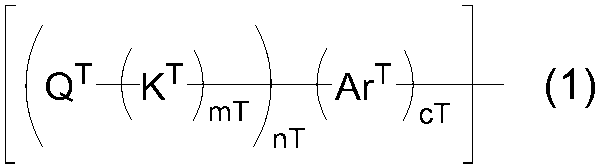
mTは0~5の整数を表し、nTは1~4の整数を表し、cTは0または1を表す。mTが複数存在する場合、それらは同一でも異なっていてもよい。cTが0の場合、nTは1である。
QTは、下記架橋基A群から選ばれる架橋基を表す。QTが複数存在する場合、それらは同一でも異なっていてもよい。
KTは、アルキレン基、シクロアルキレン基、アリーレン基、2価の複素環基、-NR’-で表される基、酸素原子または硫黄原子を表し、これらの基は置換基を有していてもよい。R’は、水素原子、アルキル基、シクロアルキル基、アリール基または1価の複素環基を表し、これらの基は置換基を有していてもよい。KTが複数存在する場合、それらは同一でも異なっていてもよい。
ArTは、芳香族炭化水素基または複素環基を表し、これらの基は置換基を有していてもよい。]

mAは0~5の整数を表し、nは1または2を表す。mAが複数存在する場合、それらは同一でも異なっていてもよい。
Ar1は、芳香族炭化水素基または複素環基を表し、これらの基は置換基を有していてもよい。
KAは、アルキレン基、シクロアルキレン基、アリーレン基、2価の複素環基、-NR’’-で表される基、酸素原子または硫黄原子を表し、これらの基は置換基を有していてもよい。R’’は、水素原子、アルキル基、シクロアルキル基、アリール基または1価の複素環基を表し、これらの基は置換基を有していてもよい。KAが複数存在する場合、それらは同一でも異なっていてもよい。
Q1は、架橋基A群から選ばれる架橋基を表す。Q1が複数存在する場合、それらは同一でも異なっていてもよい。]

mBは0~5の整数を表し、mは1~4の整数を表し、cは0または1を表す。mBが複数存在する場合、それらは同一でも異なっていてもよい。
Ar3は、芳香族炭化水素基、複素環基、または、少なくとも1種の芳香族炭化水素環と少なくとも1種の複素環とが直接結合した基を表し、これらの基は置換基を有していてもよい。
Ar2およびAr4は、それぞれ独立に、アリーレン基または2価の複素環基を表し、これらの基は置換基を有していてもよい。
Ar2、Ar3およびAr4はそれぞれ、当該基が結合している窒素原子に結合している当該基以外の基と、直接または酸素原子もしくは硫黄原子を介して結合して、環を形成していてもよい。
KBは、アルキレン基、シクロアルキレン基、アリーレン基、2価の複素環基、-NR’’’-で表される基、酸素原子または硫黄原子を表し、これらの基は置換基を有していてもよい。R’’’は、水素原子、アルキル基、シクロアルキル基、アリール基または1価の複素環基を表し、これらの基は置換基を有していてもよい。KBが複数存在する場合、それらは同一でも異なっていてもよい。
Q2は、架橋基A群から選ばれる架橋基、水素原子、アルキル基、シクロアルキル基、アリール基または1価の複素環基を表し、これらの基は置換基を有していてもよい。Q2が複数存在する場合、それらは同一でも異なっていてもよい。但し、少なくとも1つのQ2は、架橋基A群から選ばれる架橋基である。]
(架橋基A群)
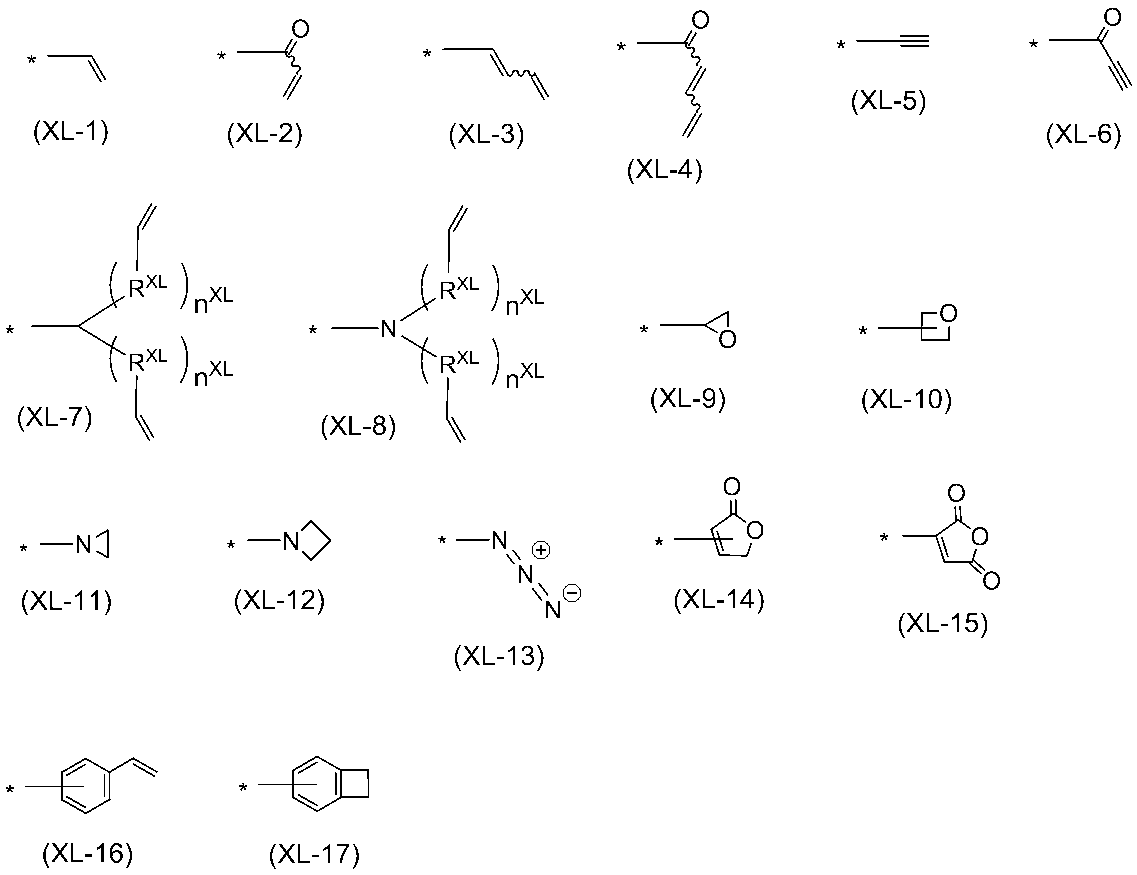
[2]前記QTが、前記式(XL-1)、(XL-7)、(XL-16)または(XL-17)で表される架橋基である、[1]に記載の高分子化合物。
[3]前記Q1が、前記式(XL-1)、(XL-7)、(XL-16)または(XL-17)で表される構成単位である、[1]または[2]に記載の高分子化合物。
[4]前記Q2が、前記式(XL-1)、(XL-7)、(XL-16)または(XL-17)で表される構成単位である、[1]または[2]に記載の高分子化合物。
[5]前記cTが0である、[1]~[4]のいずれかに記載の高分子化合物。
[6]前記cTが1であり、
前記ArTが、置換基を有していてもよいベンゼン環、置換基を有していてもよいフルオレン環、置換基を有していてもよいナフタレン環、置換基を有していてもよいフェナントレン環、または、置換基を有していてもよいジヒドロフェナントレン環から、環を構成する炭素原子に直接結合する水素原子(nT+1)個を除いた基である、[1]~[4]のいずれかに記載の高分子化合物。
[7]更に、下記式(X)で表される構成単位を含む、[1]~[6]のいずれかに記載の高分子化合物。

a1およびa2は、それぞれ独立に、0以上の整数を表す。
ArX1およびArX3は、それぞれ独立に、アリーレン基または2価の複素環基を表し、これらの基は置換基を有していてもよい。
ArX2およびArX4は、それぞれ独立に、アリーレン基、2価の複素環基、または、少なくとも1種のアリーレン基と少なくとも1種の2価の複素環基とが直接結合した2価の基を表し、これらの基は置換基を有していてもよい。ArX2およびArX4が複数存在する場合、それらはそれぞれ同一でも異なっていてもよい。
RX1、RX2およびRX3は、それぞれ独立に、水素原子、アルキル基、シクロアルキル基、アリール基または1価の複素環基を表し、これらの基は置換基を有していてもよい。RX2およびRX3が複数存在する場合、それらはそれぞれ同一でも異なっていてもよい。]
[8]更に、下記式(Y)で表される構成単位を含む、[1]~[7]のいずれかに記載の高分子化合物。

[9]前記式(Y)で表される構成単位が、下記式(Y-1)で表される構成単位または下記式(Y-2)で表される構成単位である、[8]に記載の高分子化合物。


RY1は前記と同じ意味を表す。
XY1は、-C(RY2)2-、-C(RY2)=C(RY2)-または-C(RY2)2-C(RY2)2-で表される基を表す。RY2は、水素原子、アルキル基、シクロアルキル基、アルコキシ基、シクロアルコキシ基、アリール基または1価の複素環基を表し、これらの基は置換基を有していてもよい。複数存在するRY2は、同一でも異なっていてもよく、RY2同士は互いに結合して、それぞれが結合する炭素原子と共に環を形成していてもよい。]
[10]前記式(1)で表される末端構成単位が、高分子化合物に含まれる構成単位の合計量に対して、0.1モル%以上20モル%以下含まれる、[1]~[9]のいずれかに記載の高分子化合物。
[11]下記式(2M)で表される化合物および下記式(2’M)で表される化合物からなる群から選ばれる少なくとも1種の化合物を縮合重合する工程と、
下記式(1M)で表される化合物で末端封止する工程とを含む、[1]~[10]のいずれかに記載の高分子化合物の製造方法。

mA、n、Ar1、KAおよびQ1は、前記と同じ意味を表す。
Z1およびZ2は、それぞれ独立に、置換基A群から選ばれる基または置換基B群からなる群から選ばれる基を表す。]

mB、m、c、Ar2、Ar3、Ar4、KBおよびQ2は、前記と同じ意味を表す。
Z3およびZ4は、それぞれ独立に、置換基A群から選ばれる基または置換基B群からなる群から選ばれる基を表す。]

mT、nT、cT、QT、KTおよびArTは、前記と同じ意味を表す。
ZTは、置換基A群から選ばれる基または置換基B群からなる群から選ばれる基を表す。]
<置換基A群>
塩素原子、臭素原子、ヨウ素原子、-O-S(=O)2RC1(式中、RC1は、アルキル基、シクロアルキル基またはアリール基を表し、これらの基は置換基を有していてもよい。)で表される基。
<置換基B群>
-B(ORC2)2(式中、RC2は、水素原子、アルキル基、シクロアルキル基またはアリール基を表し、これらの基は置換基を有していてもよい。複数存在するRC2は同一でも異なっていてもよく、互いに連結して、それぞれが結合する酸素原子とともに環構造を形成していてもよい。)で表される基;
-BF3Q'(式中、Q'は、Li、Na、K、RbまたはCsを表す。)で表される基;
-MgY'(式中、Y'は、塩素原子、臭素原子またはヨウ素原子を表す。)で表される基;
-ZnY''(式中、Y''は、塩素原子、臭素原子またはヨウ素原子を表す。)で表される基;および、
-Sn(RC3)3(式中、RC3は、水素原子、アルキル基、シクロアルキル基またはアリール基を表し、これらの基は置換基を有していてもよい。複数存在するRC3は同一でも異なっていてもよく、互いに連結して、それぞれが結合するスズ原子とともに環構造を形成していてもよい。)で表される基。
[12]上記式(2M)で表される化合物および上記式(2’M)で表される化合物からなる群から選ばれる少なくとも1種の化合物を縮合重合する工程と、
上記式(1M)で表される化合物で末端封止する工程とを含む製造方法により製造される、[1]~[10]のいずれかに記載の高分子化合物。
[13][1]~[10]および[12]のいずれかに記載の高分子化合物と、
正孔輸送材料、正孔注入材料、電子輸送材料、電子注入材料、発光材料、酸化防止剤および溶媒からなる群より選ばれる少なくとも1種の材料とを含有する組成物。
[14][1]~[10]および[12]のいずれかに記載の高分子化合物を用いて得られる発光素子。
本明細書で共通して用いられる用語は、特記しない限り、以下の意味である。
アルキル基は、置換基を有していてもよく、例えば、メチル基、エチル基、プロピル基、イソプロピル基、ブチル基、イソブチル基、tert-ブチル基、ペンチル基、イソアミル基、2-エチルブチル基、ヘキシル基、ヘプチル基、オクチル基、2-エチルヘキシル基、3-プロピルヘプチル基、デシル基、3,7-ジメチルオクチル基、2-エチルオクチル基、2-ヘキシルデシル基、ドデシル基、および、これらの基における水素原子が、シクロアルキル基、アルコキシ基、シクロアルコキシ基、アリール基、フッ素原子等で置換された基が挙げられ、例えば、トリフルオロメチル基、ペンタフルオロエチル基、パーフルオロブチル基、パーフルオロヘキシル基、パーフルオロオクチル基、3-フェニルプロピル基、3-(4-メチルフェニル)プロピル基、3-(3,5-ジ-ヘキシルフェニル)プロピル基、6-エチルオキシヘキシル基が挙げられる。
「シクロアルキル基」の炭素原子数は、置換基の炭素原子数を含めないで、通常3~50であり、好ましくは3~30であり、より好ましくは4~20である。
シクロアルキル基は、置換基を有していてもよく、例えば、シクロヘキシル基、シクロヘキシルメチル基、シクロヘキシルエチル基が挙げられる。
アリール基は、置換基を有していてもよく、例えば、フェニル基、1-ナフチル基、2-ナフチル基、1-アントラセニル基、2-アントラセニル基、9-アントラセニル基、1-ピレニル基、2-ピレニル基、4-ピレニル基、2-フルオレニル基、3-フルオレニル基、4-フルオレニル基、2-フェニルフェニル基、3-フェニルフェニル基、4-フェニルフェニル基、および、これらの基における水素原子が、アルキル基、シクロアルキル基、アルコキシ基、シクロアルコキシ基、アリール基、フッ素原子等で置換された基が挙げられる。
アルコキシ基は、置換基を有していてもよく、例えば、メトキシ基、エトキシ基、プロピルオキシ基、イソプロピルオキシ基、ブチルオキシ基、イソブチルオキシ基、tert-ブチルオキシ基、ペンチルオキシ基、ヘキシルオキシ基、ヘプチルオキシ基、オクチルオキシ基、2-エチルヘキシルオキシ基、ノニルオキシ基、デシルオキシ基、3,7-ジメチルオクチルオキシ基、ラウリルオキシ基、および、これらの基における水素原子が、シクロアルキル基、アルコキシ基、シクロアルコキシ基、アリール基、フッ素原子等で置換された基が挙げられる。
「シクロアルコキシ基」の炭素原子数は、置換基の炭素原子数を含めないで、通常3~40であり、好ましくは4~10である。
シクロアルコキシ基は、置換基を有していてもよく、例えば、シクロヘキシルオキシ基が挙げられる。
アリールオキシ基は、置換基を有していてもよく、例えば、フェノキシ基、1-ナフチルオキシ基、2-ナフチルオキシ基、1-アントラセニルオキシ基、9-アントラセニルオキシ基、1-ピレニルオキシ基、および、これらの基における水素原子が、アルキル基、シクロアルキル基、アルコキシ基、シクロアルコキシ基、フッ素原子等で置換された基が挙げられる。
「芳香族複素環式化合物」は、オキサジアゾール、チアジアゾール、チアゾール、オキサゾール、チオフェン、ピロール、ホスホール、フラン、ピリジン、ピラジン、ピリミジン、トリアジン、ピリダジン、キノリン、イソキノリン、カルバゾール、ジベンゾホスホール等の複素環自体が芳香族性を示す化合物、および、フェノキサジン、フェノチアジン、ジベンゾボロール、ジベンゾシロール、ベンゾピラン等の複素環自体は芳香族性を示さなくとも、複素環に芳香環が縮環されている化合物を意味する。
1価の複素環基は、置換基を有していてもよく、例えば、チエニル基、ピロリル基、フリル基、ピリジル基、ピペリジニル基、キノリニル基、イソキノリニル基、ピリミジニル基、トリアジニル基、および、これらの基における水素原子が、アルキル基、シクロアルキル基、アルコキシ基、シクロアルコキシ基等で置換された基が挙げられる。
置換アミノ基としては、例えば、ジアルキルアミノ基、ジシクロアルキルアミノ基およびジアリールアミノ基が挙げられる。
アミノ基としては、例えば、ジメチルアミノ基、ジエチルアミノ基、ジフェニルアミノ基、ビス(4-メチルフェニル)アミノ基、ビス(4-tert-ブチルフェニル)アミノ基、ビス(3,5-ジ-tert-ブチルフェニル)アミノ基が挙げられる。
「シクロアルケニル基」の炭素原子数は、置換基の炭素原子数を含めないで、通常3~30であり、好ましくは4~20である。
アルケニル基およびシクロアルケニル基は、置換基を有していてもよく、例えば、ビニル基、1-プロペニル基、2-プロペニル基、2-ブテニル基、3-ブテニル基、3-ペンテニル基、4-ペンテニル基、1-ヘキセニル基、5-ヘキセニル基、7-オクテニル基、および、これらの基が置換基を有する基が挙げられる。
「シクロアルキニル基」の炭素原子数は、置換基の炭素原子を含めないで、通常4~30であり、好ましくは4~20である。
アルキニル基およびシクロアルキニル基は、置換基を有していてもよく、例えば、エチニル基、1-プロピニル基、2-プロピニル基、2-ブチニル基、3-ブチニル基、3-ペンチニル基、4-ペンチニル基、1-ヘキシニル基、5-ヘキシニル基、および、これらの基が置換基を有する基が挙げられる。
アリーレン基は、置換基を有していてもよく、例えば、フェニレン基、ナフタレンジイル基、アントラセンジイル基、フェナントレンジイル基、ジヒドロフェナントレンジイル基、ナフタセンジイル基、フルオレンジイル基、ピレンジイル基、ペリレンジイル基、クリセンジイル基、および、これらの基が置換基を有する基が挙げられ、好ましくは、式(A-1)~式(A-20)で表される基である。アリーレン基は、これらの基が複数結合した基を含む。
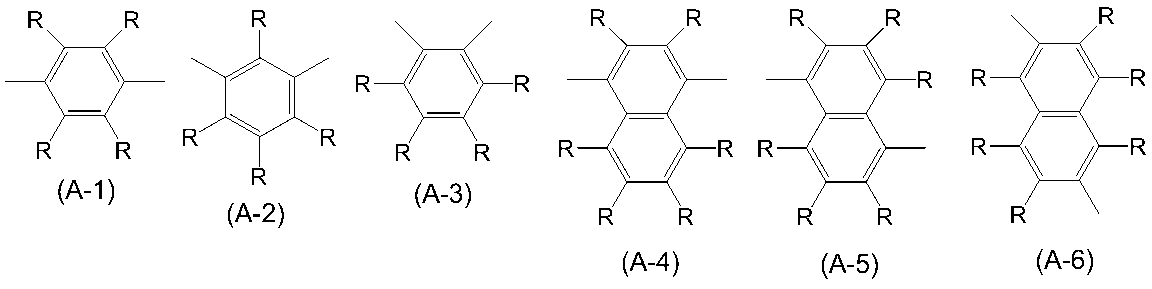


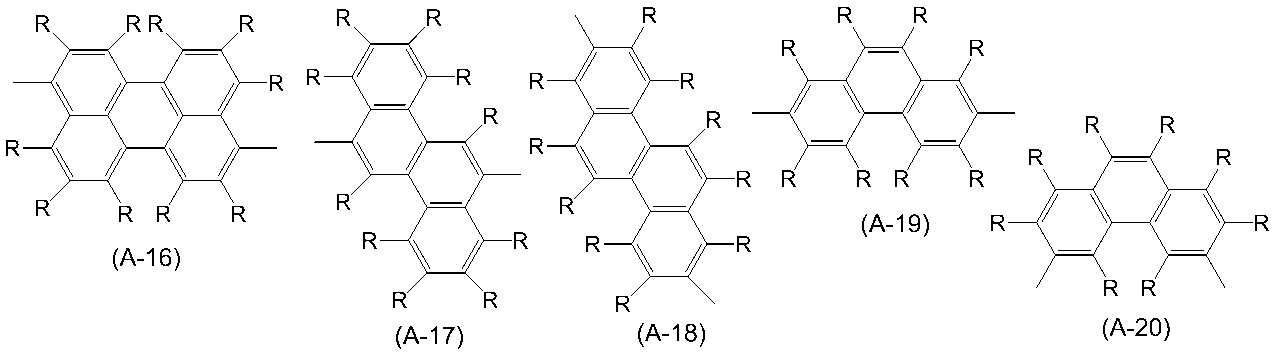
2価の複素環基は、置換基を有していてもよく、例えば、ピリジン、ジアザベンゼン、トリアジン、アザナフタレン、ジアザナフタレン、カルバゾール、ジベンゾフラン、ジベンゾチオフェン、ジベンゾシロール、フェノキサジン、フェノチアジン、アクリジン、ジヒドロアクリジン、フラン、チオフェン、アゾール、ジアゾール、トリアゾールから、環を構成する炭素原子またはヘテロ原子に直接結合している水素原子のうち2個の水素原子を除いた2価の基が挙げられ、好ましくは、式(AA-1)~式(AA-34)で表される基である。2価の複素環基は、これらの基が複数結合した基を含む。


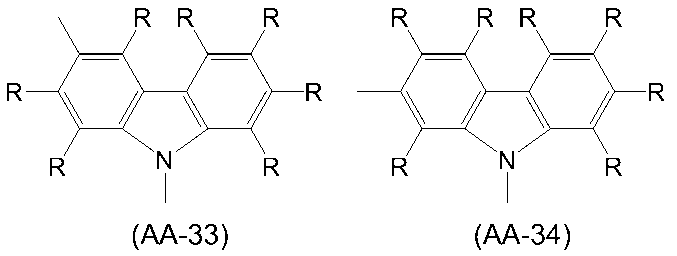
本発明の高分子化合物は、
少なくとも1つの式(1)で表される末端構成単位と、
式(2)で表される構成単位および式(2’)で表される構成単位からなる群から選ばれる少なくとも1種の構成単位とを含む高分子化合物である。

xTは1~4の整数を表す。
RXLSは、アルキル基、シクロアルキル基、アルコキシ基、シクロアルコキシ基、アリール基または1価の複素環基を表し、これらの基は置換基を有していてもよい。RXLSが複数存在する場合、それらは同一でも異なっていてもよく、互いに結合して、それぞれが結合する炭素原子と共に環を形成していてもよい。
*は結合位置を表す。]

アルキレン基およびシクロアルキレン基は、置換基を有していてもよく、例えば、メチレン基、エチレン基、プロピレン基、ブチレン基、ヘキシレン基、シクロヘキシレン基、オクチレン基が挙げられる。


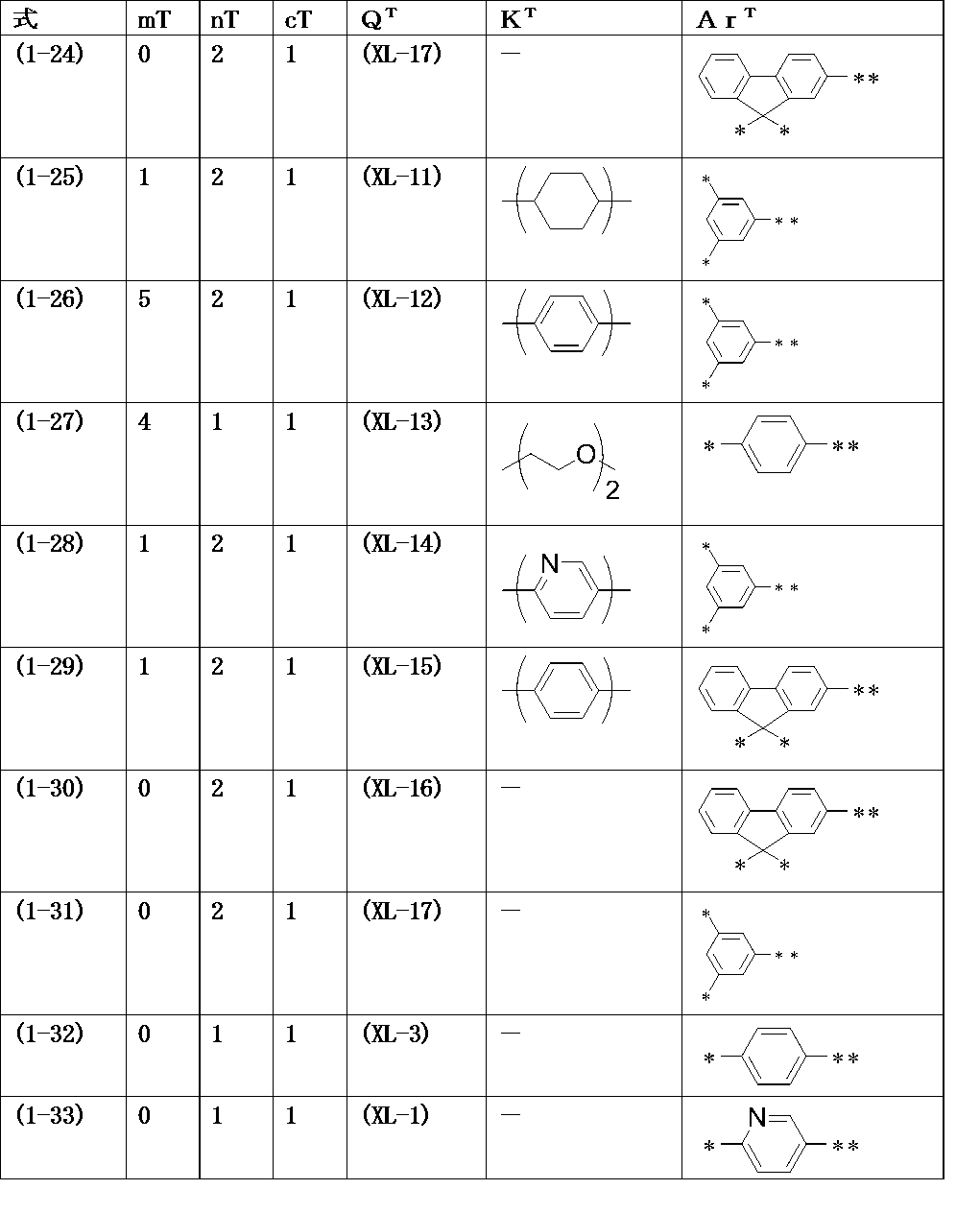
[式中、*は、ArTとKTとの結合位置を表し、**は、隣接する構成単位との結合位置を表す。]

[式中、*は、ArTとKTとの結合位置を表し、**は、隣接する構成単位との結合位置を表す。]
Ar1で表される芳香族炭化水素基のn個の置換基を除いたアリーレン基部分としては、好ましくは、式(A-1)~式(A-20)で表される基であり、より好ましくは、式(A-1)、式(A-2)、式(A-6)~式(A-10)、式(A-19)または式(A-20)で表される基であり、さらに好ましくは、式(A-1)、式(A-2)、または式(A-9)で表される基であり、これらの基は置換基を有していてもよい。
Ar1で表される複素環基のn個の置換基を除いた2価の複素環基部分としては、好ましくは、式(AA-1)~式(AA-34)で表される基である。
アルキレン基およびシクロアルキレン基は、置換基を有していてもよく、例えば、メチレン基、エチレン基、プロピレン基、ブチレン基、ヘキシレン基、シクロヘキシレン基、オクチレン基が挙げられる。


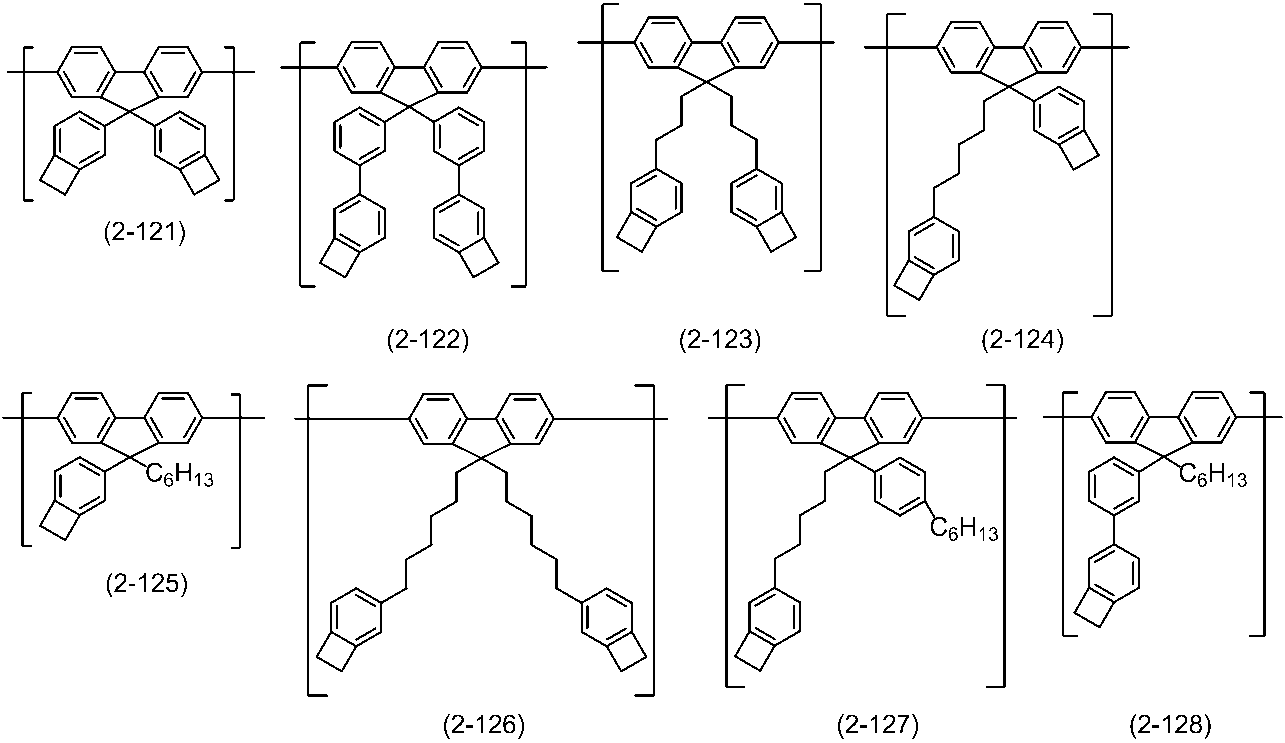
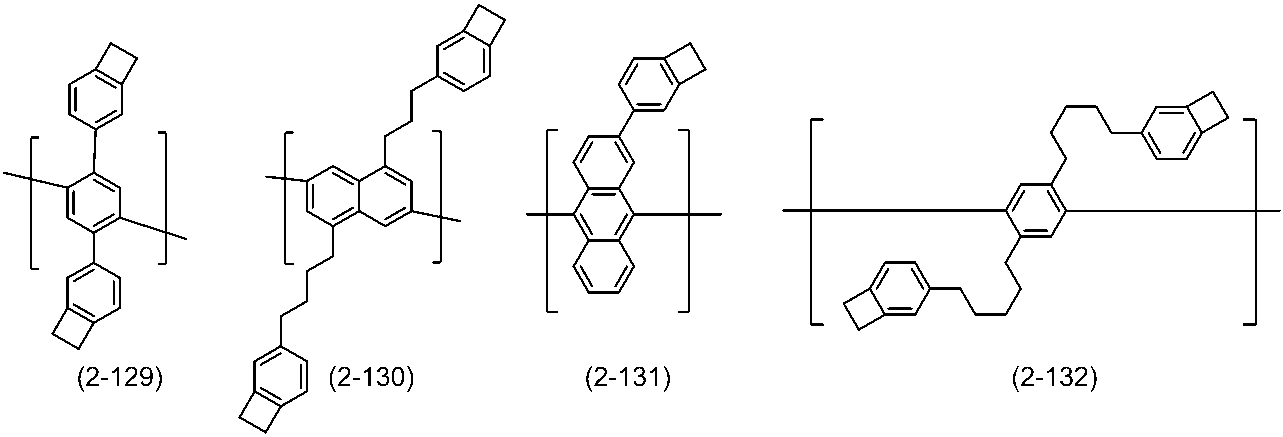


本発明の高分子化合物は、正孔輸送性が優れるので、更に、式(X)で表される構成単位を含むことが好ましい。



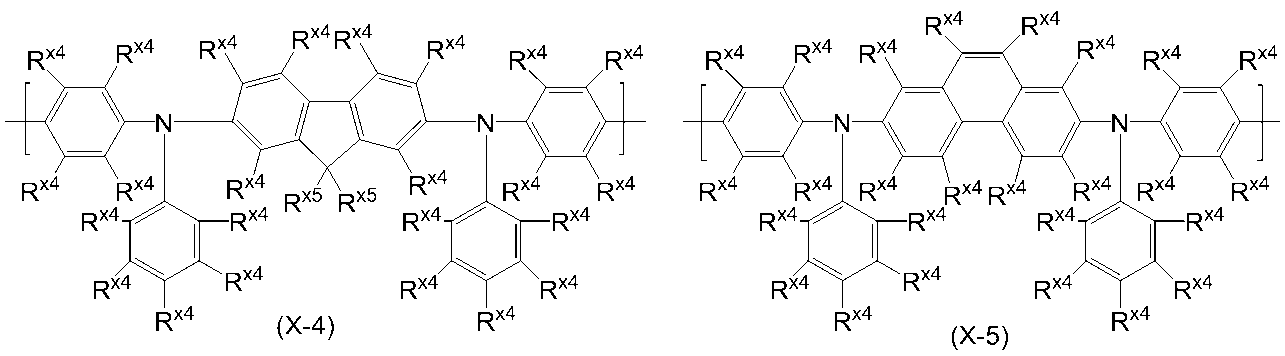

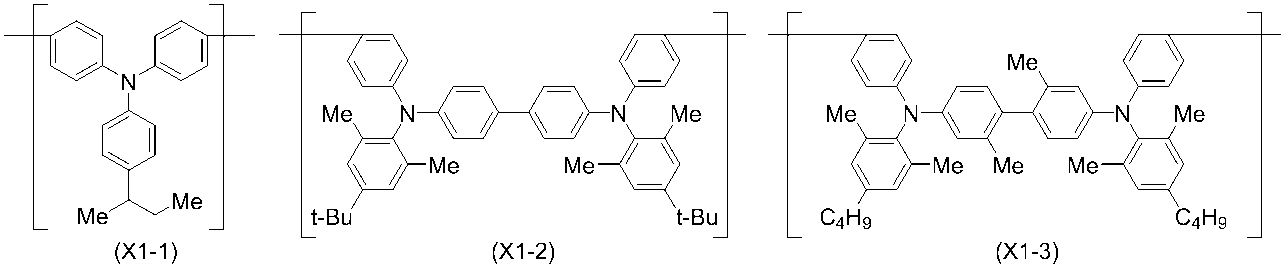


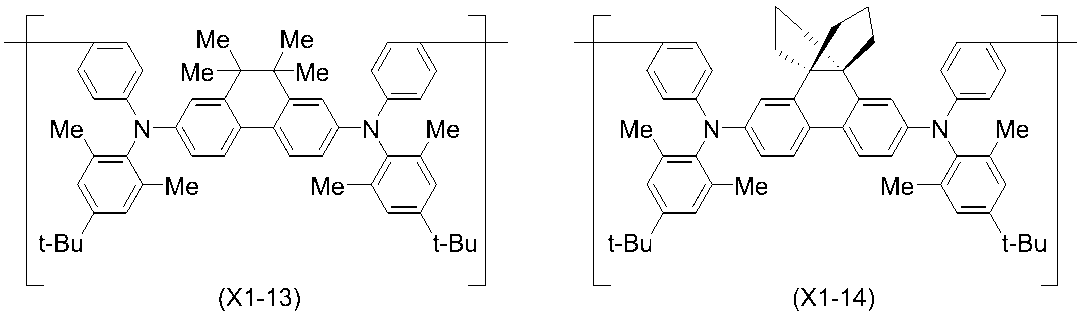


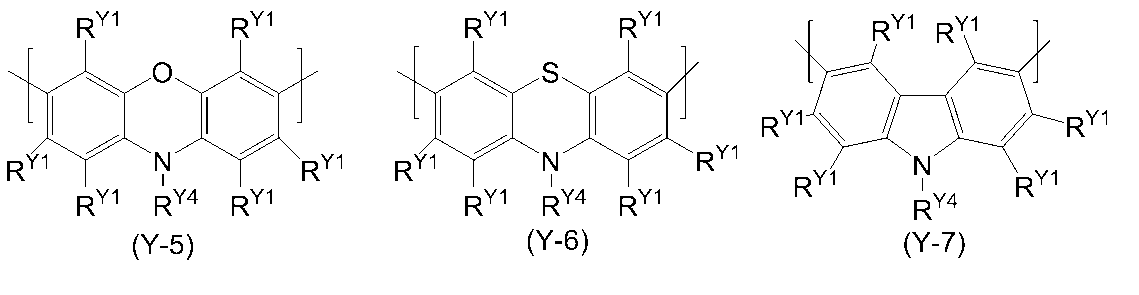

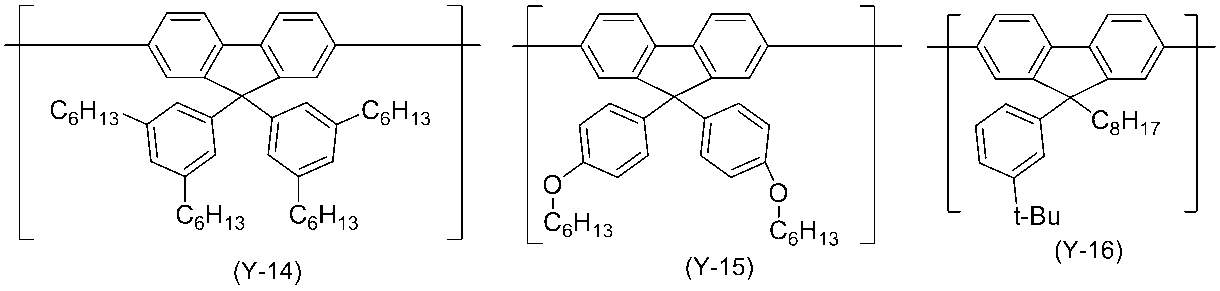


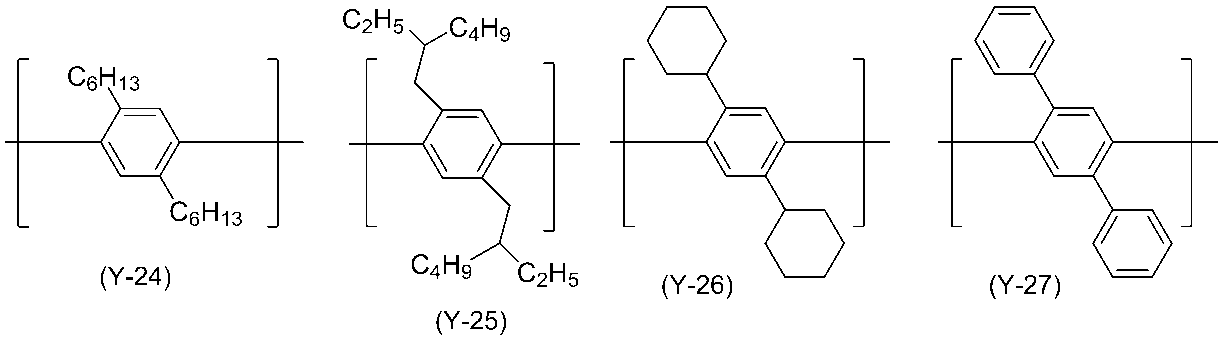


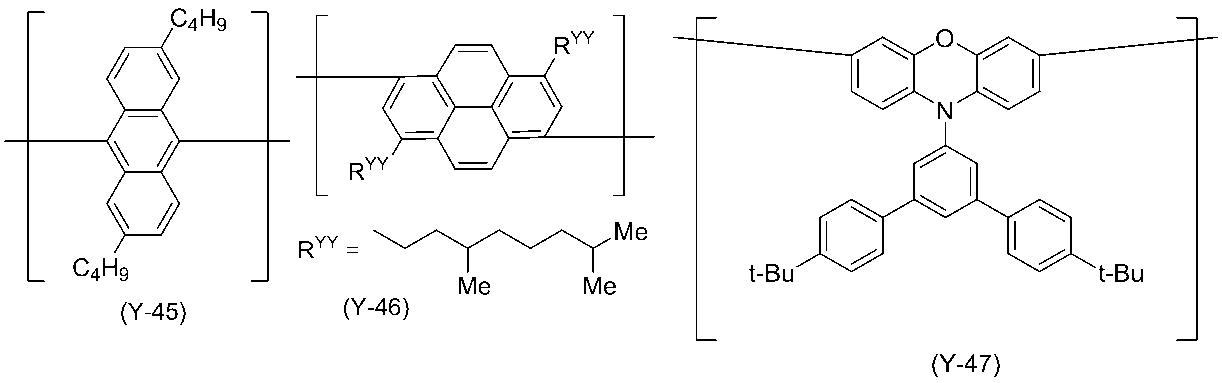


[表中、q、r、s、tおよびuは、各構成単位のモル比率を表す。q+r+s+t+u=100であり、かつ、70≦q+r+s+t≦100である。]
次に、本発明の高分子化合物の製造方法について説明する。
式(2M)で表される化合物および式(2’M)で表される化合物からなる群から選ばれる少なくとも1種の化合物を縮合重合する工程と、
式(1M)で表される化合物で末端封止する工程とを含む方法で製造できる。
縮合重合する工程では、式(2M)で表される化合物および式(2’M)で表される化合物からなる群から選ばれる少なくとも1種の化合物と、他の化合物(例えば、式(M-1)で表される化合物および/または式(M-2)で表される化合物)とを縮合重合させてもよい。本明細書において、本発明の高分子化合物の製造に使用される化合物を総称して、「原料モノマー」ということがある。
式(2M)で表される化合物および式(2’M)で表される化合物からなる群から選ばれる少なくとも1種の化合物を縮合重合する工程を行った後、式(1M)で表される化合物で末端封止する工程を行ってもよいし、
式(2M)で表される化合物および式(2’M)で表される化合物からなる群から選ばれる少なくとも1種の化合物を縮合重合する工程と、式(1M)で表される化合物で末端封止する工程とを同時に行ってもよいが、
式(2M)で表される化合物および式(2’M)で表される化合物からなる群から選ばれる少なくとも1種の化合物を縮合重合する工程を行った後、式(1M)で表される化合物で末端封止する工程を行うことが好ましい。


aX1、aX2、ArX1~ArX4、RX1~RX3およびArY1は、前記と同じ意味を表す。
Z5~Z8は、それぞれ独立に、置換基A群から選ばれる基または置換基B群から選ばれる基を表す。]
また、例えば、Z5およびZ6が置換基A群から選ばれる基である場合、Z1、Z2、Z3、Z4、Z7およびZ8は、置換基B群から選ばれる基を選択する。
また、例えば、Z5およびZ6が置換基B群から選ばれる基である場合、Z1、Z2、Z3、Z4、Z7およびZ8は、置換基A群から選ばれる基を選択する。
式(1M)で表される化合物で末端封止する工程の前までに得られている高分子化合物に含まれる置換基B群から選ばれる基の含有量が、置換基A群からなる群から選ばれる基の含有量よりも多い場合、ZTは置換基A群からなる群から選ばれる基であることが好ましい。

そのため、置換基A群から選ばれる基を2個有する化合物と、置換基B群から選ばれる基を2個有する化合物を公知のカップリング反応に供すれば、縮合重合により、これらの化合物の縮合重合体を得ることができる。
また、置換基A群から選ばれる基を2個有する化合物(末端封止する工程の前までに得られている高分子化合物)と、置換基B群から選ばれる基を1個有する化合物(式(1M)で表される化合物)を公知のカップリング反応に供すれば、縮合(末端封止)により、これらの化合物の縮合重合体を得ることができる。また、置換基A群から選ばれる基を1個有する化合物(式(1M)で表される化合物)と、置換基B群から選ばれる基を2個有する化合物(末端封止する工程の前までに得られている高分子化合物)を公知のカップリング反応に供すれば、縮合(末端封止)により、これらの化合物の縮合重合体を得ることができる。
本発明の組成物は、正孔輸送材料、正孔注入材料、電子輸送材料、電子注入材料、発光材料、酸化防止剤および溶媒からなる群から選ばれる少なくとも1種の材料と、本発明の高分子化合物とを含有する。
正孔輸送材料は、低分子化合物と高分子化合物とに分類され、高分子化合物が好ましく、架橋基を有する高分子化合物がより好ましい。
電子輸送材料は、低分子化合物と高分子化合物とに分類される。電子輸送材料は、架橋基を有していてもよい。
正孔注入材料および電子注入材料は、各々、低分子化合物と高分子化合物とに分類される。正孔注入材料および電子注入材料は、架橋基を有していてもよい。
正孔注入材料または電子注入材料が導電性高分子を含む場合、導電性高分子の電気伝導度は、好ましくは、1×10⁻⁵S/cm~1×103S/cmである。導電性高分子の電気伝導度をかかる範囲とするために、導電性高分子に適量のイオンをドープすることができる。
発光材料は、低分子化合物と高分子化合物とに分類される。発光材料は、架橋基を有していてもよい。
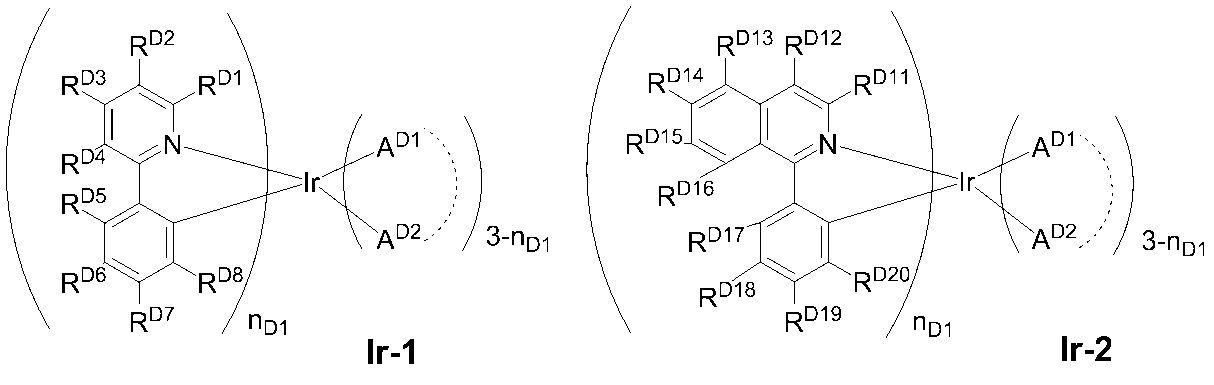


RD1~RD8、RD11~RD20、RD21~RD26およびRD31~RD37は、それぞれ独立に、水素原子、アルキル基、シクロアルキル基、アルコキシ基、シクロアルコキシ基、アリール基、アリールオキシ基、1価の複素環基またはハロゲン原子を表し、これらの基は置換基を有していてもよい。RD1~RD8、RD11~RD20、RD21~RD26およびRD31~RD37が複数存在する場合、それらはそれぞれ同一でも異なっていてもよい。
-AD1---AD2-は、アニオン性の2座配位子を表し、AD1およびAD2は、それぞれ独立に、イリジウム原子と結合する炭素原子、酸素原子または窒素原子を表し、これらの原子は環を構成する原子であってもよい。-AD1---AD2-が複数存在する場合、それらは同一でも異なっていてもよい。
nD1は、1、2または3を表し、nD2は、1または2を表す。]

mDA1、mDA2およびmDA3は、それぞれ独立に、0以上の整数を表す。
GDAは、窒素原子、芳香族炭化水素基または複素環基を表し、これらの基は置換基を有していてもよい。
ArDA1、ArDA2およびArDA3は、それぞれ独立に、アリーレン基または2価の複素環基を表し、これらの基は置換基を有していてもよい。ArDA1、ArDA2およびArDA3が複数ある場合、それらはそれぞれ同一でも異なっていてもよい。
TDAは、アリール基または1価の複素環基を表し、これらの基は置換基を有していてもよい。複数あるTDAは、同一でも異なっていてもよい。]

*、**および***は、各々、ArDA1、ArDA2、ArDA3との結合を表す。
RDAは、水素原子、アルキル基、シクロアルキル基、アルコキシ基、シクロアルコキシ基、アリール基または1価の複素環基を表し、これらの基は更に置換基を有していてもよい。RDAが複数ある場合、それらは同一でも異なっていてもよい。]

RDAは前記と同じ意味を表す。
RDBは、水素原子、アルキル基、シクロアルキル基、アリール基または1価の複素環基を表し、これらの基は置換基を有していてもよい。RDBが複数ある場合、それらは同一でも異なっていてもよい。]


Rp1、Rp2およびRp3は、それぞれ独立に、アルキル基、シクロアルキル基、アルコキシ基、シクロアルコキシ基またはハロゲン原子を表す。Rp1およびRp2が複数ある場合、それらはそれぞれ同一であっても異なっていてもよい。
np1は、0~5の整数を表し、np2は0~3の整数を表し、np3は0または1を表す。複数あるnp1は、同一でも異なっていてもよい。]






酸化防止剤は、本発明の高分子化合物と同じ溶媒に可溶であり、発光および電荷輸送を阻害しない化合物であればよく、例えば、フェノール系酸化防止剤、リン系酸化防止剤が挙げられる。
膜は、本発明の高分子化合物をそのまま含有していてもよいし、本発明の高分子化合物が、分子内もしくは分子間、または、分子内および分子間で架橋した状態(架橋体)で含有されていてもよい。本発明の高分子化合物の架橋体は、本発明の高分子化合物と、他の化合物とが、分子間で架橋した架橋体であってもよい。本発明の高分子化合物の架橋体を含有する膜は、本発明の高分子化合物を含有する膜を、加熱、光照射等の外部刺激により架橋させて得られる膜である。本発明の高分子化合物の架橋体を含有する膜は、溶媒に対して実質的に不溶化されているため、後述する発光素子の積層化に好適に使用することができる。
本発明の発光素子は、本発明の高分子化合物を用いて得られる有機エレクトロルミネッセンス等の発光素子であり、該発光素子には、例えば、本発明の高分子化合物を含む発光素子、本発明の高分子化合物が分子内、分子間、または、それらの両方で架橋した状態(架橋体)を含む発光素子がある。
本発明の発光素子の構成としては、例えば、陽極および陰極からなる電極と、該電極間に設けられた本発明の高分子化合物を用いて得られる層とを有する。
本発明の高分子化合物を用いて得られる層は、通常、発光層、正孔輸送層、正孔注入層、電子輸送層、電子注入層の1種以上の層であり、好ましくは、正孔輸送層である。これらの層は、各々、発光材料、正孔輸送材料、正孔注入材料、電子輸送材料、電子注入材料を含む。これらの層は、各々、発光材料、正孔輸送材料、正孔注入材料、電子輸送材料、電子注入材料を、上述した溶媒に溶解させ、インクを調製して用い、上述した膜の作製と同じ方法を用いて形成することができる。
正孔輸送層、電子輸送層、発光層、正孔注入層、および、電子注入層の材料としては、本発明の高分子化合物の他、各々、上述した正孔輸送材料、電子輸送材料、発光材料、正孔注入材料、および、電子注入材料が挙げられる。
発光素子における基板は、電極を形成することができ、かつ、有機層を形成する際に化学的に変化しない基板であればよく、例えば、ガラス、プラスチック、シリコン等の材料からなる基板である。不透明な基板の場合には、基板から最も遠くにある電極が透明または半透明であることが好ましい。
陽極および陰極は、各々、2層以上の積層構造としてもよい。
発光素子を用いて面状の発光を得るためには、面状の陽極と陰極が重なり合うように配置すればよい。パターン状の発光を得るためには、面状の発光素子の表面にパターン状の窓を設けたマスクを設置する方法、非発光部にしたい層を極端に厚く形成し実質的に非発光とする方法、陽極もしくは陰極、または両方の電極をパターン状に形成する方法がある。これらのいずれかの方法でパターンを形成し、いくつかの電極を独立にON/OFFできるように配置することにより、数字、文字等を表示できるセグメントタイプの表示装置が得られる。ドットマトリックス表示装置とするためには、陽極と陰極を共にストライプ状に形成して直交するように配置すればよい。複数の種類の発光色の異なる高分子化合物を塗り分ける方法、カラーフィルターまたは蛍光変換フィルターを用いる方法により、部分カラー表示、マルチカラー表示が可能となる。ドットマトリックス表示装置は、パッシブ駆動も可能であるし、TFT等と組み合わせてアクティブ駆動も可能である。これらの表示装置は、コンピュータ、テレビ、携帯端末等のディスプレイに用いることができる。面状の発光素子は、液晶表示装置のバックライト用の面状光源、または、面状の照明用光源として好適に用いることができる。フレキシブルな基板を用いれば、曲面状の光源、および、表示装置としても使用できる。
測定する高分子化合物を約0.05重量%の濃度でテトラヒドロフランに溶解させ、SECに10μL注入した。移動相は、1.0mL/分の流量で流した。カラムとして、PLgel MIXED-B(ポリマーラボラトリーズ製)を用いた。検出器にはUV-VIS検出器(東ソー製、商品名:UV-8320GPC)を用いた。
測定試料を約2mg/mLの濃度になるようにクロロホルムまたはテトラヒドロフランに溶解させ、LC-MS(Agilent製、商品名:1100LCMSD)に約1μL注入した。LC-MSの移動相には、アセトニトリルおよびテトラヒドロフランの比率を変化させながら用い、0.2mL/分の流量で流した。カラムは、L-column 2 ODS(3μm)(化学物質評価研究機構製、内径:2.1mm、長さ:100mm、粒径3μm)を用いた。
測定試料をトルエン、テトラヒドロフランまたはクロロホルムのいずれかの溶媒に任意の濃度で溶解させ、DART用TLCプレート(テクノアプリケーションズ社製、商品名:YSK5-100)上に塗布し、TLC-MS(日本電子社製、商品名:JMS-T100TD(The AccuTOF TLC))を用いて測定した。測定時のヘリウムガス温度は、200~400℃の範囲で調節した。
5~10mgの測定試料を約0.5mLの重クロロホルム(CDCl3)、重テトラヒドロフラン、重ジメチルスルホキシド、重アセトン、重N,N-ジメチルホルムアミド、重トルエン、重メタノール、重エタノール、重2-プロパノールまたは重塩化メチレンに溶解させ、NMR装置(Agilent製、商品名:INOVA300またはMERCURY 400VX)を用いて測定した。
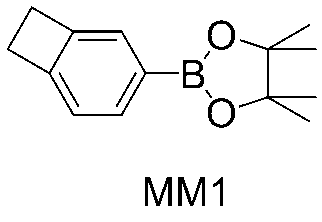


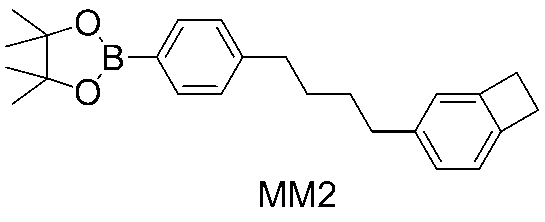


1H-NMR(CDCl3, 300MHz) δ(ppm): 0.68 (s, 4H), 0.97 (s, 12H), 1.79 (m, 4H), 2.00 (m, 4H), 4.75-4.87 (m, 4H), 5.55 (m, 2H), 7.28-7.38 (m, 3H), 7.67-7.76 (m, 3H), 7.80 (dd, 1H).
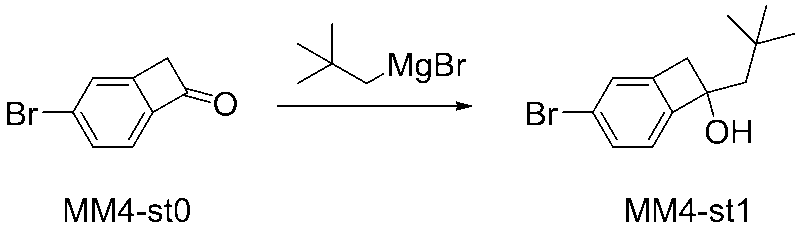
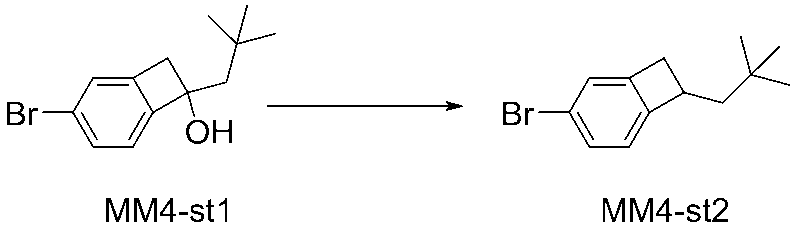

1H-NMR(CDCl3, 300MHz) δ(ppm): 0.99 (9H, s), 1.33 (12H, s), 1.55 (1H, dd), 1.78 (1H, dd), 2.78 (1H, dd), 3.37 (1H, dd), 3.54 (1H, m), 7.07 (1H, d), 7.49 (1H, s), 7.67 (1H, d).
化合物MM11は、特開2011-174062号公報記載の合成法に従い合成した。
化合物MM12は、国際公開第2005/049546号記載の合成法に従い合成した。
化合物MM13は、特開2010-215886号公報記載の合成法に従い合成した。
化合物MM14は、国際公開第2002/045184号記載の合成法に従い合成した。
化合物MM15は、特開2008-106241号公報記載の合成法に従い合成した。
化合物MM16は、下記の合成法に従い合成した。
化合物MM17は、国際公開第2013/146806号記載の合成法に従い合成した。
化合物MM18は、下記の合成法に従い合成した。
化合物MM19は、国際公開第2012/086671号記載の合成法に従って合成した。
化合物MM20は、特開2004-143419号公報記載の合成法に従って合成した。
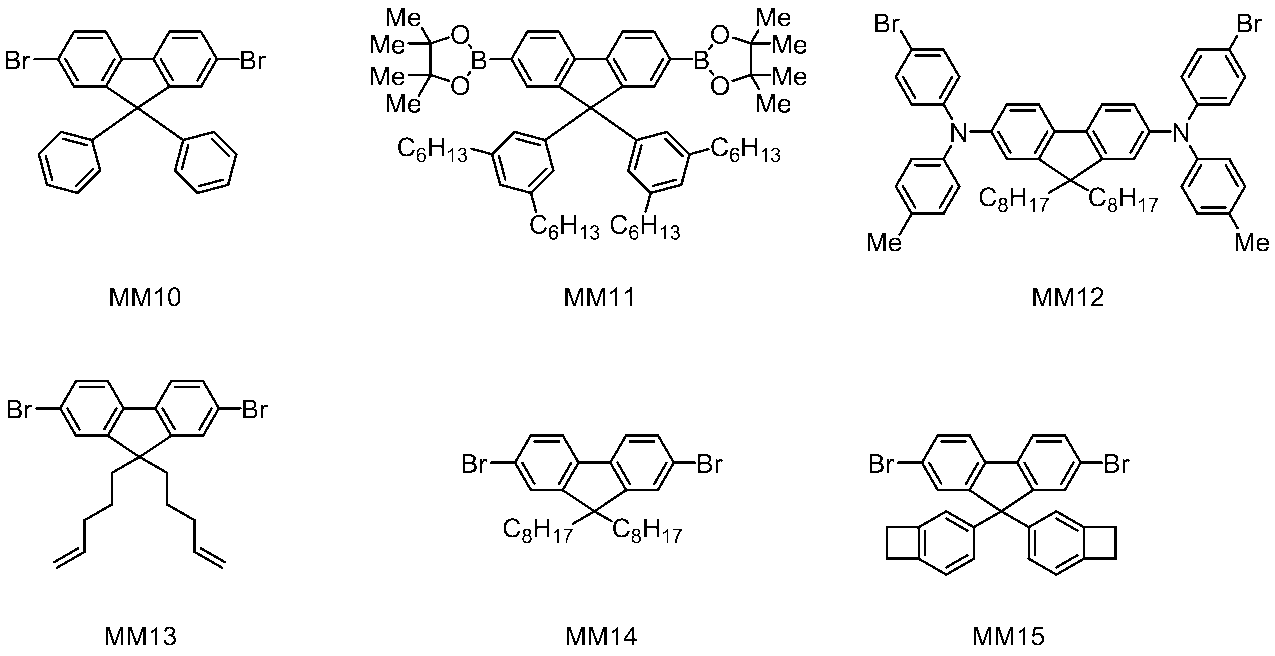


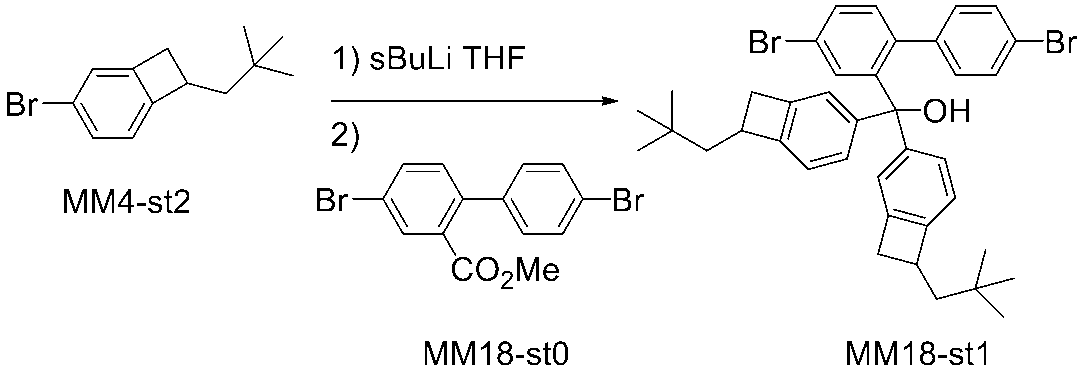

1H-NMR(CDCl3, 300MHz) δ(ppm): 0.97 (s, 18H), 1.56 (dd, 2H), 1.75 (dd, 2H), 2.71 (dd, 2H), 3.28 (dd, 2H), 3.47 (m, 2H), 6.79 (s, 2H), 6.91 (d, 2H), 6.98 (dd, 2H), 7.41-7.52 (m, 4H), 7.55 (d, 2H).
(工程2)反応液に、20重量%水酸化テトラエチルアンモニウム水溶液(27mL)を滴下し、8時間還流させた。
(工程3)反応後、そこに、化合物MM1(138mg)およびジクロロビス(トリス-o-メトキシフェニルホスフィン)パラジウム(1.3mg)を加え、14時間還流させた。
(工程4)反応液を冷却後、水で1回、10重量%希塩酸水で2回、3重量%アンモニア水溶液で2回、水で2回洗浄し、得られた溶液をメタノールに滴下したところ、沈澱が生じた。沈殿物をトルエンに溶解させ、アルミナカラム、シリカゲルカラムの順番で通すことにより精製した。得られた溶液をメタノールに滴下し、撹拌した後、得られた沈殿物をろ取し、乾燥させることにより、高分子化合物1を1.5g得た。高分子化合物1のMnは4.7×10⁴であり、Mwは1.5×10⁵であった。

(工程2)反応液に、20重量%水酸化テトラエチルアンモニウム水溶液(22mL)を滴下し、5時間還流させた。
(工程3)反応後、そこに、化合物MM2(182mg)およびジクロロビス(トリス-o-メトキシフェニルホスフィン)パラジウム(1.1mg)を加え、一晩還流させた。
(工程4)反応液を冷却後、水で1回、10重量%希塩酸水で2回、3重量%アンモニア水溶液で2回、水で2回洗浄し、得られた溶液をメタノールに滴下したところ、沈澱が生じた。沈殿物をトルエンに溶解させ、アルミナカラム、シリカゲルカラムの順番で通すことにより精製した。得られた溶液をメタノールに滴下し、撹拌した後、得られた沈殿物をろ取し、乾燥させることにより、高分子化合物2を1.2g得た。高分子化合物2のMnは4.7×10⁴であり、Mwは1.5×10⁵であった。

(工程2)反応液に、20重量%水酸化テトラエチルアンモニウム水溶液(22mL)を滴下し、5時間還流させた。
(工程3)反応後、そこに、化合物MM3(218mg)およびジクロロビス(トリス-o-メトキシフェニルホスフィン)パラジウム(1.1mg)を加え、一晩時間還流させた。
(工程4)反応液を冷却後、水で1回、10重量%希塩酸水で2回、3重量%アンモニア水溶液で2回、水で2回洗浄し、得られた溶液をメタノールに滴下したところ、沈澱が生じた。沈殿物をトルエンに溶解させ、アルミナカラム、シリカゲルカラムの順番で通すことにより精製した。得られた溶液をメタノールに滴下し、撹拌した後、得られた沈殿物をろ取し、乾燥させることにより、高分子化合物3を1.3g得た。高分子化合物3のMnは5.0×10⁴であり、Mwは1.5×10⁵であった。

(工程2)反応液に、20重量%水酸化テトラエチルアンモニウム水溶液(22mL)を滴下し、5時間還流させた。
(工程3)反応後、そこに、化合物MM2(181mg)およびジクロロビス(トリス-o-メトキシフェニルホスフィン)パラジウム(1.1mg)を加え、一晩還流させた。
(工程4)反応液を冷却後、水で1回、10重量%希塩酸水で2回、3重量%アンモニア水溶液で2回、水で2回洗浄し、得られた溶液をメタノールに滴下したところ、沈澱が生じた。沈殿物をトルエンに溶解させ、アルミナカラム、シリカゲルカラムの順番で通すことにより精製した。得られた溶液をメタノールに滴下し、撹拌した後、得られた沈殿物をろ取し、乾燥させることにより、高分子化合物4を1.3g得た。高分子化合物4のMnは5.1×10⁴であり、Mwは1.6×10⁵であった。

(工程2)反応液に、20重量%水酸化テトラエチルアンモニウム水溶液(23mL)を滴下し、7.5時間還流させた。
(工程3)反応後、そこに、化合物MM1(115mg)およびジクロロビス(トリス-o-メトキシフェニルホスフィン)パラジウム(1.1mg)を加え、一晩還流させた。
(工程4)反応液を冷却後、水で1回、10重量%希塩酸水で2回、3重量%アンモニア水溶液で2回、水で2回洗浄し、得られた溶液をメタノールに滴下したところ、沈澱が生じた。沈殿物をトルエンに溶解させ、アルミナカラム、シリカゲルカラムの順番で通すことにより精製した。得られた溶液をメタノールに滴下し、撹拌した後、得られた沈殿物をろ取し、乾燥させることにより、高分子化合物5を1.3g得た。高分子化合物5のMnは3.9×10⁴であり、Mwは1.5×10⁵であった。

<実施例6> 高分子化合物6の合成
(工程2)反応液に、20重量%水酸化テトラエチルアンモニウム水溶液(23mL)を滴下し、7時間還流させた。
(工程3)反応後、そこに、化合物MM4(150mg)およびジクロロビス(トリス-o-メトキシフェニルホスフィン)パラジウム(1.1mg)を加え、16時間還流させた。
(工程4)反応液を冷却後、水で1回、10重量%希塩酸水で2回、3重量%アンモニア水溶液で2回、水で2回洗浄し、得られた溶液をメタノールに滴下したところ、沈澱が生じた。沈殿物をトルエンに溶解させ、アルミナカラム、シリカゲルカラムの順番で通すことにより精製した。得られた溶液をメタノールに滴下し、撹拌した後、得られた沈殿物をろ取し、乾燥させることにより、高分子化合物6を1.2g得た。高分子化合物6のMnは4.9×10⁴であり、Mwは1.5×10⁵であった。
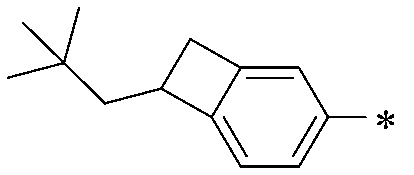
(工程2)反応液に、20重量%水酸化テトラエチルアンモニウム水溶液(22mL)を滴下し、6時間還流させた。
(工程3)反応後、そこに、フェニルボロン酸(61mg)およびジクロロビス(トリス-o-メトキシフェニルホスフィン)パラジウム(1.1mg)を加え、18時間還流させた。
(工程4)反応液を冷却後、水で1回、10重量%希塩酸水で2回、3重量%アンモニア水溶液で2回、水で2回洗浄し、得られた溶液をメタノールに滴下したところ、沈澱が生じた。沈殿物をトルエンに溶解させ、アルミナカラム、シリカゲルカラムの順番で通すことにより精製した。得られた溶液をメタノールに滴下し、撹拌した後、得られた沈殿物をろ取し、乾燥させることにより、高分子化合物C1を1.3g得た。高分子化合物C1のMnは4.5×10⁴であり、Mwは1.4×10⁵であった。

(工程2)反応液に、20重量%水酸化テトラエチルアンモニウム水溶液(27mL)を滴下し、6時間還流させた。
(工程3)反応後、そこに、化合物MM1(140mg)およびジクロロビス(トリス-o-メトキシフェニルホスフィン)パラジウム(1.3mg)を加え、17時間還流させた。
(工程4)反応液を冷却後、水で1回、10重量%希塩酸水で2回、3重量%アンモニア水溶液で2回、水で2回洗浄し、得られた溶液をメタノールに滴下したところ、沈澱が生じた。沈殿物をトルエンに溶解させ、アルミナカラム、シリカゲルカラムの順番で通すことにより精製した。得られた溶液をメタノールに滴下し、撹拌した後、得られた沈殿物をろ取し、乾燥させることにより、高分子化合物C2を1.3g得た。高分子化合物C2のMnは4.6×10⁴であり、Mwは1.4×10⁵であった。
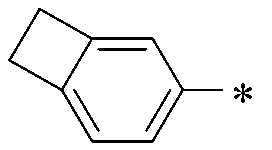
(高分子化合物E1の合成)
反応容器内を不活性ガス雰囲気下とした後、化合物MM14(9.0g)、化合物MM20(1.3g)、化合物MM19(13.4g)、テトラエチルアンモニウムヒドロキシド(43.0g)、酢酸パラジウム(8mg)、トリ(2-メトキシフェニル)ホスフィン(0.05g)およびトルエン(200mL)を加え、90℃で8時間加熱攪拌した。その後、そこへ、フェニルボロン酸(0.22g)を加え、90℃で14時間加熱撹拌した。得られた混合物を冷却後、水層を除去した。得られた有機層にジエチルジチオカルバミン酸ナトリウム水溶液を加え、撹拌した後、水層を除去した。得られた有機層を水、3重量%酢酸水で洗浄した。得られた有機層をメタノールに注いで固体を沈殿させた後、ろ取した固体を再度トルエンに溶解させ、シリカゲルおよびアルミナのカラムに通液した。固体を含む溶出トルエン溶液を回収し、回収したトルエン溶液をメタノールに注いで固体を沈殿させた。ろ取した固体を50℃で真空乾燥し、高分子化合物E1を12.5gを得た。高分子化合物E1のMwは3.1×10⁵であった。
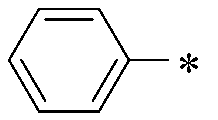
高分子化合物1をキシレンに溶解させ、0.7重量%のキシレン溶液を調製した。ガラス基板に、このキシレン溶液を用いてスピンコートにより20nmの厚さで成膜した後、窒素ガス雰囲気中において、ホットプレート上で180℃、60分間加熱した。その後、室温まで冷却することで測定試料1-1を作製した。
残膜率の評価実施例1における高分子化合物1に代えて、高分子化合物2を用いたこと以外は、残膜率の評価実施例1と同様にしてキシレン浸漬前の測定試料2-1を作製し、測定試料2-1の最小透過率(T1)を得た。測定試料2-1のT1は0.730であった。次に、キシレン浸漬後の測定試料2-2を作製し、測定試料2-2の最小透過率(T2)を得た。測定試料2-2のT2は0.740であった。そして、上記式を用いて、高分子化合物2を用いた膜の残膜率を計算したところ、95.7%であった。結果を表6に示す。
残膜率の評価実施例1における高分子化合物1に代えて、高分子化合物3を用いたこと以外は、残膜率の評価実施例1と同様にしてキシレン浸漬前の測定試料3-1を作製し、測定試料3-1の最小透過率(T1)を得た。測定試料3-1のT1は0.726であった。次に、キシレン浸漬後の測定試料3-2を作製し、測定試料3-2の最小透過率(T2)を得た。測定試料3-2のT2は0.751であった。そして、上記式を用いて、高分子化合物3を用いた膜の残膜率を計算したところ、89.4%であった。結果を表6に示す。
残膜率の評価実施例1における高分子化合物1に代えて、高分子化合物4を用いたこと以外は、残膜率の評価実施例1と同様にしてキシレン浸漬前の測定試料4-1を作製し、測定試料4-1の最小透過率(T1)を得た。測定試料4-1のT1は0.727であった。次に、キシレン浸漬後の測定試料4-2を作製し、測定試料4-2の最小透過率(T2)を得た。測定試料4-2のT2は0.727であった。そして、上記式を用いて、高分子化合物4を用いた膜の残膜率を計算したところ、100%であった。結果を表6に示す。
残膜率の評価実施例1における高分子化合物1に代えて、高分子化合物5を用いたこと以外は、残膜率の評価実施例1と同様にしてキシレン浸漬前の測定試料5-1を作製し、測定試料5-1の最小透過率(T1)を得た。測定試料5-1のT1は0.753であった。次に、キシレン浸漬後の測定試料5-2を作製し、測定試料5-2の最小透過率(T2)を得た。測定試料5-2のT2は0.761であった。そして、上記式を用いて、高分子化合物5を用いた膜の残膜率を計算したところ、96.3%であった。結果を表6に示す。
残膜率の評価実施例1における高分子化合物1に代えて、高分子化合物6を用いたこと以外は、残膜率の評価実施例1と同様にしてキシレン浸漬前の測定試料6-1を作製し、測定試料6-1の最小透過率(T1)を得た。測定試料6-1のT1は0.723であった。次に、キシレン浸漬後の測定試料6-2を作製し、測定試料6-2の最小透過率(T2)を得た。測定試料6-2のT2は0.724であった。そして、上記式を用いて、高分子化合物6を用いた膜の残膜率を計算したところ、99.6%であった。結果を表6に示す。
残膜率の評価実施例1における高分子化合物1に代えて、高分子化合物C1を用いたこと以外は、残膜率の評価実施例1と同様にしてキシレン浸漬前の測定試料C1-1を作製し、測定試料C1-1の最小透過率(T1)を得た。測定試料C1-1のT1は0.702であった。次に、キシレン浸漬後の測定試料C1-2を作製し、測定試料C1-2の最小透過率(T2)を得た。測定試料C1-2のT2は0.755であった。そして、上記式を用いて、高分子化合物C1を用いた膜の残膜率を計算したところ、79.4%であった。結果を表6に示す。
残膜率の評価実施例1における高分子化合物1に代えて、高分子化合物C2を用いたこと以外は、残膜率の評価実施例1と同様にしてキシレン浸漬前の測定試料3-1を作製し、測定試料C2-1の最小透過率(T1)を得た。測定試料C2-1のT1は0.702であった。次に、キシレン浸漬後の測定試料C2-2を作製し、測定試料C2-2の最小透過率(T2)を得た。測定試料C2-2のT2は0.785であった。そして、上記式を用いて、高分子化合物C2を用いた膜の残膜率を計算したところ、68.4%であった。結果を表6に示す。

(陽極および正孔注入層の形成)
ガラス基板にスパッタ法により45nmの厚みでITO膜を付けることにより陽極を形成した。該陽極上に、ポリチオフェン・スルホン酸系の正孔注入剤であるAQ-1200(Plextronics社製)を用いて、スピンコート法により35nmの厚さで成膜し、大気雰囲気下において、ホットプレート上で170℃、15分間加熱することにより正孔注入層を形成した。
キシレンに、高分子化合物1を0.7重量%の濃度で溶解させた。得られたキシレン溶液を用いて、正孔注入層の上にスピンコート法により20nmの厚さで成膜し、窒素ガス雰囲気下において、ホットプレート上で180℃、30分間加熱することにより正孔輸送層を形成した。
キシレンに、高分子化合物E1を1.1重量%の濃度で溶解させた。得られたキシレン溶液を用いて、正孔輸送層の上にスピンコート法により60nmの厚さで成膜し、窒素ガス雰囲気下において、ホットプレート上で150℃、10分間加熱することにより発光層を形成した。
発光層が形成された基板を蒸着機内において、1×10⁻⁴Pa以下にまで減圧した後、陰極として、発光層の上にフッ化ナトリウムを約7nm、次いで、アルミニウムを約120nm蒸着した。蒸着後、ガラス基板を用いて封止することにより、発光素子D1を作製した。
発光素子D1に電圧を印加したところ、450nmにピークを有するEL発光が観測された。発光素子D1の1000cd/m2での外部量子効率(EQE)は5.8%であった。初期輝度が5000cd/m2となるように電流値を設定後、定電流で駆動させ、輝度の時間変化を測定した。その結果、輝度が初期輝度の50%となるまでの時間(LT50)は、10.7時間であった。
実施例D1における高分子化合物1に代えて、高分子化合物C1を用いた以外は実施例D1と同様にして、発光素子CD1を作製した。
実施例D1における高分子化合物1に代えて、高分子化合物C2を用いた以外は実施例D1と同様にして、発光素子CD2を作製した。
Claims (14)
- 少なくとも1つの下記式(1)で表される末端構成単位と、
下記式(2)で表される構成単位および下記式(2’)で表される構成単位からなる群から選ばれる少なくとも1種の構成単位とを含む高分子化合物。

mTは0~5の整数を表し、nTは1~4の整数を表し、cTは0または1を表す。mTが複数存在する場合、それらは同一でも異なっていてもよい。cTが0の場合、nTは1である。
QTは、下記架橋基A群から選ばれる架橋基を表す。QTが複数存在する場合、それらは同一でも異なっていてもよい。
KTは、アルキレン基、シクロアルキレン基、アリーレン基、2価の複素環基、-NR’-で表される基、酸素原子または硫黄原子を表し、これらの基は置換基を有していてもよい。R’は、水素原子、アルキル基、シクロアルキル基、アリール基または1価の複素環基を表し、これらの基は置換基を有していてもよい。KTが複数存在する場合、それらは同一でも異なっていてもよい。
ArTは、芳香族炭化水素基または複素環基を表し、これらの基は置換基を有していてもよい。]

mAは0~5の整数を表し、nは1または2を表す。mAが複数存在する場合、それらは同一でも異なっていてもよい。
Ar1は、芳香族炭化水素基または複素環基を表し、これらの基は置換基を有していてもよい。
KAは、アルキレン基、シクロアルキレン基、アリーレン基、2価の複素環基、-NR’’-で表される基、酸素原子または硫黄原子を表し、これらの基は置換基を有していてもよい。R’’は、水素原子、アルキル基、シクロアルキル基、アリール基または1価の複素環基を表し、これらの基は置換基を有していてもよい。KAが複数存在する場合、それらは同一でも異なっていてもよい。
Q1は、架橋基A群から選ばれる架橋基を表す。Q1が複数存在する場合、それらは同一でも異なっていてもよい。]
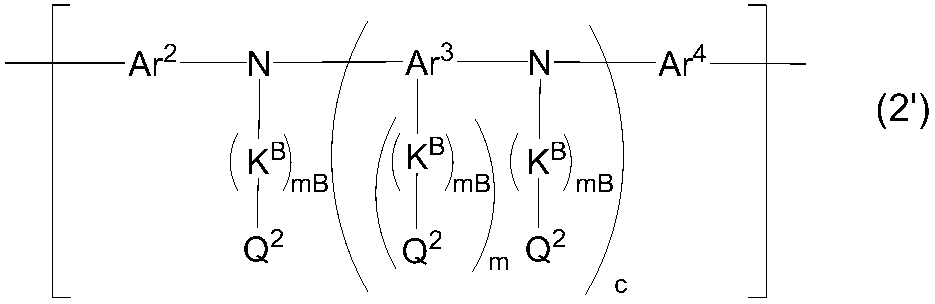
mBは0~5の整数を表し、mは1~4の整数を表し、cは0または1を表す。mBが複数存在する場合、それらは同一でも異なっていてもよい。
Ar3は、芳香族炭化水素基、複素環基、または、少なくとも1種の芳香族炭化水素環と少なくとも1種の複素環とが直接結合した基を表し、これらの基は置換基を有していてもよい。
Ar2およびAr4は、それぞれ独立に、アリーレン基または2価の複素環基を表し、これらの基は置換基を有していてもよい。
Ar2、Ar3およびAr4はそれぞれ、当該基が結合している窒素原子に結合している当該基以外の基と、直接または酸素原子もしくは硫黄原子を介して結合して、環を形成していてもよい。
KBは、アルキレン基、シクロアルキレン基、アリーレン基、2価の複素環基、-NR’’’-で表される基、酸素原子または硫黄原子を表し、これらの基は置換基を有していてもよい。R’’’は、水素原子、アルキル基、シクロアルキル基、アリール基または1価の複素環基を表し、これらの基は置換基を有していてもよい。KBが複数存在する場合、それらは同一でも異なっていてもよい。
Q2は、架橋基A群から選ばれる架橋基、水素原子、アルキル基、シクロアルキル基、アリール基または1価の複素環基を表し、これらの基は置換基を有していてもよい。Q2が複数存在する場合、それらは同一でも異なっていてもよい。但し、少なくとも1つのQ2は、架橋基A群から選ばれる架橋基である。]
(架橋基A群)

- 前記QTが、前記式(XL-1)、(XL-7)、(XL-16)または(XL-17)で表される架橋基である、請求項1に記載の高分子化合物。
- 前記Q1が、前記式(XL-1)、(XL-7)、(XL-16)または(XL-17)で表される構成単位である、請求項1または2に記載の高分子化合物。
- 前記Q2が、前記式(XL-1)、(XL-7)、(XL-16)または(XL-17)で表される構成単位である、請求項1または2に記載の高分子化合物。
- 前記cTが0である、請求項1~4のいずれか一項に記載の高分子化合物。
- 前記cTが1であり、
前記ArTが、置換基を有していてもよいベンゼン環、置換基を有していてもよいフルオレン環、置換基を有していてもよいナフタレン環、置換基を有していてもよいフェナントレン環、または、置換基を有していてもよいジヒドロフェナントレン環から、環を構成する炭素原子に直接結合する水素原子(nT+1)個を除いた基である、請求項1~4のいずれか一項に記載の高分子化合物。 - 更に、下記式(X)で表される構成単位を含む、請求項1~6のいずれか一項に記載の高分子化合物。
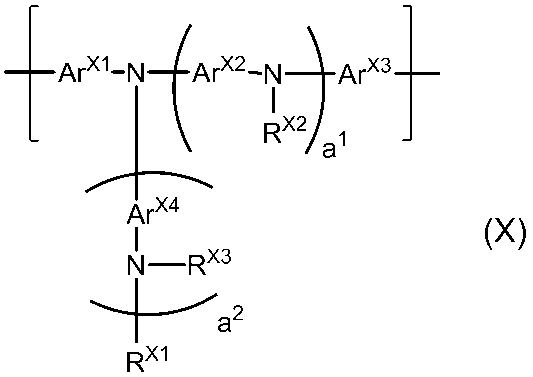
a1およびa2は、それぞれ独立に、0以上の整数を表す。
ArX1およびArX3は、それぞれ独立に、アリーレン基または2価の複素環基を表し、これらの基は置換基を有していてもよい。
ArX2およびArX4は、それぞれ独立に、アリーレン基、2価の複素環基、または、少なくとも1種のアリーレン基と少なくとも1種の2価の複素環基とが直接結合した2価の基を表し、これらの基は置換基を有していてもよい。ArX2およびArX4が複数存在する場合、それらはそれぞれ同一でも異なっていてもよい。
RX1、RX2およびRX3は、それぞれ独立に、水素原子、アルキル基、シクロアルキル基、アリール基または1価の複素環基を表し、これらの基は置換基を有していてもよい。RX2およびRX3が複数存在する場合、それらはそれぞれ同一でも異なっていてもよい。] - 更に、下記式(Y)で表される構成単位を含む、請求項1~7のいずれか一項に記載の高分子化合物。

- 前記式(Y)で表される構成単位が、下記式(Y-1)で表される構成単位または下記式(Y-2)で表される構成単位である、請求項8に記載の高分子化合物。


RY1は前記と同じ意味を表す。
XY1は、-C(RY2)2-、-C(RY2)=C(RY2)-または-C(RY2)2-C(RY2)2-で表される基を表す。RY2は、水素原子、アルキル基、シクロアルキル基、アルコキシ基、シクロアルコキシ基、アリール基または1価の複素環基を表し、これらの基は置換基を有していてもよい。複数存在するRY2は、同一でも異なっていてもよく、RY2同士は互いに結合して、それぞれが結合する炭素原子と共に環を形成していてもよい。] - 前記式(1)で表される末端構成単位が、高分子化合物に含まれる構成単位の合計量に対して、0.1モル%以上20モル%以下含まれる、請求項1~9のいずれか一項に記載の高分子化合物。
- 下記式(2M)で表される化合物および下記式(2’M)で表される化合物からなる群から選ばれる少なくとも1種の化合物を縮合重合する工程と、
下記式(1M)で表される化合物で末端封止する工程とを含む、請求項1~10のいずれか一項に記載の高分子化合物の製造方法。

mA、n、Ar1、KAおよびQ1は、前記と同じ意味を表す。
Z1およびZ2は、それぞれ独立に、置換基A群から選ばれる基または置換基B群からなる群から選ばれる基を表す。]

mB、m、c、Ar2、Ar3、Ar4、KBおよびQ2は、前記と同じ意味を表す。
Z3およびZ4は、それぞれ独立に、置換基A群から選ばれる基または置換基B群からなる群から選ばれる基を表す。]

mT、nT、cT、QT、KTおよびArTは、前記と同じ意味を表す。
ZTは、置換基A群から選ばれる基または置換基B群からなる群から選ばれる基を表す。]
<置換基A群>
塩素原子、臭素原子、ヨウ素原子、-O-S(=O)2RC1(式中、RC1は、アルキル基、シクロアルキル基またはアリール基を表し、これらの基は置換基を有していてもよい。)で表される基。
<置換基B群>
-B(ORC2)2(式中、RC2は、水素原子、アルキル基、シクロアルキル基またはアリール基を表し、これらの基は置換基を有していてもよい。複数存在するRC2は同一でも異なっていてもよく、互いに連結して、それぞれが結合する酸素原子とともに環構造を形成していてもよい。)で表される基;
-BF3Q'(式中、Q'は、Li、Na、K、RbまたはCsを表す。)で表される基;
-MgY'(式中、Y'は、塩素原子、臭素原子またはヨウ素原子を表す。)で表される基;
-ZnY''(式中、Y''は、塩素原子、臭素原子またはヨウ素原子を表す。)で表される基;および、
-Sn(RC3)3(式中、RC3は、水素原子、アルキル基、シクロアルキル基またはアリール基を表し、これらの基は置換基を有していてもよい。複数存在するRC3は同一でも異なっていてもよく、互いに連結して、それぞれが結合するスズ原子とともに環構造を形成していてもよい。)で表される基。 - 下記式(2M)で表される化合物および下記式(2’M)で表される化合物からなる群から選ばれる少なくとも1種の化合物を縮合重合する工程と、
下記式(1M)で表される化合物で末端封止する工程とを含む製造方法により製造される、請求項1~10のいずれか一項に記載の高分子化合物。

mA、n、Ar1、KAおよびQ1は、前記と同じ意味を表す。
Z1およびZ2は、それぞれ独立に、置換基A群から選ばれる基または置換基B群からなる群から選ばれる基を表す。]

mB、m、c、Ar2、Ar3、Ar4、KBおよびQ2は、前記と同じ意味を表す。
Z3およびZ4は、それぞれ独立に、置換基A群から選ばれる基または置換基B群からなる群から選ばれる基を表す。]

mT、nT、cT、QT、KTおよびArTは、前記と同じ意味を表す。
ZTは、置換基A群から選ばれる基または置換基B群からなる群から選ばれる基を表す。]
<置換基A群>
塩素原子、臭素原子、ヨウ素原子、-O-S(=O)2RC1(式中、RC1は、アルキル基、シクロアルキル基またはアリール基を表し、これらの基は置換基を有していてもよい。)で表される基。
<置換基B群>
-B(ORC2)2(式中、RC2は、水素原子、アルキル基、シクロアルキル基またはアリール基を表し、これらの基は置換基を有していてもよい。複数存在するRC2は同一でも異なっていてもよく、互いに連結して、それぞれが結合する酸素原子とともに環構造を形成していてもよい。)で表される基;
-BF3Q'(式中、Q'は、Li、Na、K、RbまたはCsを表す。)で表される基;
-MgY'(式中、Y'は、塩素原子、臭素原子またはヨウ素原子を表す。)で表される基;
-ZnY''(式中、Y''は、塩素原子、臭素原子またはヨウ素原子を表す。)で表される基;および、
-Sn(RC3)3(式中、RC3は、水素原子、アルキル基、シクロアルキル基またはアリール基を表し、これらの基は置換基を有していてもよい。複数存在するRC3は同一でも異なっていてもよく、互いに連結して、それぞれが結合するスズ原子とともに環構造を形成していてもよい。)で表される基。 - 請求項1~10および12のいずれか一項に記載の高分子化合物と、
正孔輸送材料、正孔注入材料、電子輸送材料、電子注入材料、発光材料、酸化防止剤および溶媒からなる群より選ばれる少なくとも1種の材料とを含有する組成物。 - 請求項1~10および12のいずれか一項に記載の高分子化合物を用いて得られる発光素子。
Priority Applications (5)
| Application Number | Priority Date | Filing Date | Title |
|---|---|---|---|
| CN201580050885.9A CN106715520B (zh) | 2014-09-25 | 2015-09-17 | 高分子化合物和使用该高分子化合物的发光元件 |
| EP15843285.6A EP3199565B1 (en) | 2014-09-25 | 2015-09-17 | Polymer compound and light-emitting element using same |
| JP2016550141A JP6652061B2 (ja) | 2014-09-25 | 2015-09-17 | 高分子化合物およびそれを用いた発光素子 |
| KR1020177010577A KR102256228B1 (ko) | 2014-09-25 | 2015-09-17 | 고분자 화합물 및 그것을 사용한 발광 소자 |
| US15/513,761 US10336860B2 (en) | 2014-09-25 | 2015-09-17 | Polymer compound and light emitting device using the same |
Applications Claiming Priority (2)
| Application Number | Priority Date | Filing Date | Title |
|---|---|---|---|
| JP2014194866 | 2014-09-25 | ||
| JP2014-194866 | 2014-09-25 |
Publications (1)
| Publication Number | Publication Date |
|---|---|
| WO2016047536A1 true WO2016047536A1 (ja) | 2016-03-31 |
Family
ID=55581063
Family Applications (1)
| Application Number | Title | Priority Date | Filing Date |
|---|---|---|---|
| PCT/JP2015/076390 Ceased WO2016047536A1 (ja) | 2014-09-25 | 2015-09-17 | 高分子化合物およびそれを用いた発光素子 |
Country Status (6)
| Country | Link |
|---|---|
| US (1) | US10336860B2 (ja) |
| EP (1) | EP3199565B1 (ja) |
| JP (1) | JP6652061B2 (ja) |
| KR (1) | KR102256228B1 (ja) |
| CN (1) | CN106715520B (ja) |
| WO (1) | WO2016047536A1 (ja) |
Cited By (6)
| Publication number | Priority date | Publication date | Assignee | Title |
|---|---|---|---|---|
| KR20190048183A (ko) * | 2017-10-30 | 2019-05-09 | 주식회사 엘지화학 | 공중합체, 및 이를 포함하는 유기발광소자 |
| WO2019208648A1 (ja) | 2018-04-26 | 2019-10-31 | 住友化学株式会社 | 発光素子 |
| WO2019208647A1 (ja) | 2018-04-26 | 2019-10-31 | 住友化学株式会社 | ブロック共重合体及びそれを用いた発光素子 |
| WO2020036434A1 (ko) | 2018-08-16 | 2020-02-20 | 주식회사 엘지화학 | 폴리머, 그 정공 수송 재료로서의 사용, 및 그것을 포함하는 유기 전자 디바이스 |
| WO2020075453A1 (ja) | 2018-10-10 | 2020-04-16 | 住友化学株式会社 | 発光素子用膜及びそれを用いた発光素子 |
| WO2021075183A1 (ja) | 2019-10-15 | 2021-04-22 | 住友化学株式会社 | 組成物及びそれを含有する発光素子 |
Families Citing this family (3)
| Publication number | Priority date | Publication date | Assignee | Title |
|---|---|---|---|---|
| EP3512307B1 (en) | 2018-01-10 | 2021-04-21 | Samsung Electronics Co., Ltd. | Polymer material, material for electroluminescence device, composition, thin film, and electroluminescence device comprising the same |
| KR102650117B1 (ko) * | 2018-09-27 | 2024-03-20 | 주식회사 엘지화학 | 유기 발광 소자 |
| KR102806396B1 (ko) | 2018-12-05 | 2025-05-14 | 삼성디스플레이 주식회사 | 축합환 화합물, 이를 포함한 조성물 및 이로부터 형성된 박막을 포함하는 유기 발광 소자 |
Citations (9)
| Publication number | Priority date | Publication date | Assignee | Title |
|---|---|---|---|---|
| JP2008231419A (ja) * | 2007-02-21 | 2008-10-02 | Hitachi Chem Co Ltd | 有機エレクトロニクス用材料、並びにこれを用いた有機エレクトロニクス素子及び有機エレクトロルミネセンス素子 |
| WO2010013723A1 (ja) * | 2008-07-29 | 2010-02-04 | 住友化学株式会社 | 高分子化合物及びそれを用いた発光素子 |
| JP2010065213A (ja) * | 2008-08-11 | 2010-03-25 | Mitsubishi Chemicals Corp | 電荷輸送性ポリマー、有機電界発光素子用組成物、有機電界発光素子、有機elディスプレイ及び有機el照明 |
| JP2010121133A (ja) * | 2008-11-18 | 2010-06-03 | Samsung Electronics Co Ltd | 熱硬化性組成物およびそれを用いたプリント配線板 |
| WO2010140553A1 (ja) * | 2009-06-01 | 2010-12-09 | 日立化成工業株式会社 | 有機エレクトロニクス材料およびそれを含むインク組成物、ならびにそれらを用いて形成された有機薄膜、有機エレクトロニクス素子、有機エレクトロルミネセンス素子、照明装置および表示装置 |
| WO2011078391A1 (ja) * | 2009-12-25 | 2011-06-30 | 住友化学株式会社 | 組成物及び該組成物を用いてなる発光素子 |
| WO2013057908A1 (ja) * | 2011-10-19 | 2013-04-25 | 出光興産株式会社 | 架橋型重合体及びそれを用いた有機エレクトロルミネッセンス素子 |
| JP2013087217A (ja) * | 2011-10-19 | 2013-05-13 | Idemitsu Kosan Co Ltd | 架橋型重合体及びそれを用いた有機エレクトロルミネッセンス素子 |
| WO2013146806A1 (ja) * | 2012-03-27 | 2013-10-03 | 住友化学株式会社 | 高分子化合物およびそれを用いた発光素子 |
Family Cites Families (4)
| Publication number | Priority date | Publication date | Assignee | Title |
|---|---|---|---|---|
| JP3865406B2 (ja) | 1995-07-28 | 2007-01-10 | 住友化学株式会社 | 2,7−アリール−9−置換フルオレン及び9−置換フルオレンオリゴマー及びポリマー |
| GB0423528D0 (en) * | 2004-10-22 | 2004-11-24 | Cambridge Display Tech Ltd | Monomer for making a crosslinked polymer |
| JP5446079B2 (ja) | 2006-09-25 | 2014-03-19 | 住友化学株式会社 | 高分子化合物及びそれを用いた高分子発光素子 |
| US20110012751A1 (en) * | 2009-07-20 | 2011-01-20 | Ken Jones | Message board system and method |
-
2015
- 2015-09-17 KR KR1020177010577A patent/KR102256228B1/ko active Active
- 2015-09-17 EP EP15843285.6A patent/EP3199565B1/en active Active
- 2015-09-17 WO PCT/JP2015/076390 patent/WO2016047536A1/ja not_active Ceased
- 2015-09-17 JP JP2016550141A patent/JP6652061B2/ja active Active
- 2015-09-17 CN CN201580050885.9A patent/CN106715520B/zh active Active
- 2015-09-17 US US15/513,761 patent/US10336860B2/en active Active
Patent Citations (9)
| Publication number | Priority date | Publication date | Assignee | Title |
|---|---|---|---|---|
| JP2008231419A (ja) * | 2007-02-21 | 2008-10-02 | Hitachi Chem Co Ltd | 有機エレクトロニクス用材料、並びにこれを用いた有機エレクトロニクス素子及び有機エレクトロルミネセンス素子 |
| WO2010013723A1 (ja) * | 2008-07-29 | 2010-02-04 | 住友化学株式会社 | 高分子化合物及びそれを用いた発光素子 |
| JP2010065213A (ja) * | 2008-08-11 | 2010-03-25 | Mitsubishi Chemicals Corp | 電荷輸送性ポリマー、有機電界発光素子用組成物、有機電界発光素子、有機elディスプレイ及び有機el照明 |
| JP2010121133A (ja) * | 2008-11-18 | 2010-06-03 | Samsung Electronics Co Ltd | 熱硬化性組成物およびそれを用いたプリント配線板 |
| WO2010140553A1 (ja) * | 2009-06-01 | 2010-12-09 | 日立化成工業株式会社 | 有機エレクトロニクス材料およびそれを含むインク組成物、ならびにそれらを用いて形成された有機薄膜、有機エレクトロニクス素子、有機エレクトロルミネセンス素子、照明装置および表示装置 |
| WO2011078391A1 (ja) * | 2009-12-25 | 2011-06-30 | 住友化学株式会社 | 組成物及び該組成物を用いてなる発光素子 |
| WO2013057908A1 (ja) * | 2011-10-19 | 2013-04-25 | 出光興産株式会社 | 架橋型重合体及びそれを用いた有機エレクトロルミネッセンス素子 |
| JP2013087217A (ja) * | 2011-10-19 | 2013-05-13 | Idemitsu Kosan Co Ltd | 架橋型重合体及びそれを用いた有機エレクトロルミネッセンス素子 |
| WO2013146806A1 (ja) * | 2012-03-27 | 2013-10-03 | 住友化学株式会社 | 高分子化合物およびそれを用いた発光素子 |
Non-Patent Citations (1)
| Title |
|---|
| See also references of EP3199565A4 * |
Cited By (13)
| Publication number | Priority date | Publication date | Assignee | Title |
|---|---|---|---|---|
| JP2020523453A (ja) * | 2017-10-30 | 2020-08-06 | エルジー・ケム・リミテッド | 共重合体、およびこれを含む有機発光素子 |
| JP7171061B2 (ja) | 2017-10-30 | 2022-11-15 | エルジー・ケム・リミテッド | 共重合体、およびこれを含む有機発光素子 |
| US11309494B2 (en) | 2017-10-30 | 2022-04-19 | Lg Chem, Ltd. | Copolymer and organic light emitting device comprising same |
| KR102298164B1 (ko) | 2017-10-30 | 2021-09-03 | 주식회사 엘지화학 | 공중합체, 및 이를 포함하는 유기발광소자 |
| KR20190048183A (ko) * | 2017-10-30 | 2019-05-09 | 주식회사 엘지화학 | 공중합체, 및 이를 포함하는 유기발광소자 |
| US20210083191A1 (en) * | 2018-04-26 | 2021-03-18 | Sumitomo Chemical Company, Limited | Block copolymer and light emitting device using the same |
| WO2019208647A1 (ja) | 2018-04-26 | 2019-10-31 | 住友化学株式会社 | ブロック共重合体及びそれを用いた発光素子 |
| WO2019208648A1 (ja) | 2018-04-26 | 2019-10-31 | 住友化学株式会社 | 発光素子 |
| US11930695B2 (en) | 2018-04-26 | 2024-03-12 | Sumitomo Chemical Company, Limited | Block copolymer and light emitting device using the same |
| WO2020036434A1 (ko) | 2018-08-16 | 2020-02-20 | 주식회사 엘지화학 | 폴리머, 그 정공 수송 재료로서의 사용, 및 그것을 포함하는 유기 전자 디바이스 |
| US12071508B2 (en) | 2018-08-16 | 2024-08-27 | Lg Chem, Ltd. | Polymers, use thereof as hole transport material, and organic electronic devices comprising same |
| WO2020075453A1 (ja) | 2018-10-10 | 2020-04-16 | 住友化学株式会社 | 発光素子用膜及びそれを用いた発光素子 |
| WO2021075183A1 (ja) | 2019-10-15 | 2021-04-22 | 住友化学株式会社 | 組成物及びそれを含有する発光素子 |
Also Published As
| Publication number | Publication date |
|---|---|
| KR20170065553A (ko) | 2017-06-13 |
| EP3199565A4 (en) | 2018-05-16 |
| US20170283546A1 (en) | 2017-10-05 |
| JP6652061B2 (ja) | 2020-02-19 |
| US10336860B2 (en) | 2019-07-02 |
| CN106715520A (zh) | 2017-05-24 |
| EP3199565B1 (en) | 2023-03-22 |
| CN106715520B (zh) | 2019-05-14 |
| JPWO2016047536A1 (ja) | 2017-07-13 |
| EP3199565A1 (en) | 2017-08-02 |
| KR102256228B1 (ko) | 2021-05-27 |
Similar Documents
| Publication | Publication Date | Title |
|---|---|---|
| JP6500891B2 (ja) | 高分子化合物およびそれを用いた発光素子 | |
| JP6427681B2 (ja) | 組成物、燐光発光性化合物及び発光素子 | |
| JP5867580B2 (ja) | 発光素子 | |
| JP6652061B2 (ja) | 高分子化合物およびそれを用いた発光素子 | |
| JP6610536B2 (ja) | 発光素子およびそれに用いる組成物 | |
| JP6256630B2 (ja) | 発光素子および該発光素子に用いる組成物 | |
| JP6323093B2 (ja) | 高分子化合物およびそれを用いた発光素子 | |
| JP5880679B2 (ja) | 発光素子の製造方法 | |
| JP2017125087A (ja) | 高分子化合物及びそれを用いた発光素子 | |
| JP6332557B2 (ja) | 発光素子の駆動方法および発光装置 | |
| JP6642428B2 (ja) | 高分子化合物およびそれを用いた発光素子 | |
| JP2015174824A (ja) | 金属錯体およびそれを用いた発光素子 | |
| JP6468928B2 (ja) | 高分子化合物およびそれを用いた発光素子 | |
| JP6417785B2 (ja) | 高分子化合物およびそれを用いた発光素子 | |
| WO2016052337A1 (ja) | 発光素子 | |
| JP2018078295A (ja) | 発光素子および該発光素子に用いる組成物 | |
| JP6327019B2 (ja) | 高分子化合物およびそれを用いた発光素子 | |
| JP2016176063A (ja) | 高分子化合物およびそれを用いた発光素子 | |
| JP2016129140A (ja) | 発光素子の製造方法 |
Legal Events
| Date | Code | Title | Description |
|---|---|---|---|
| 121 | Ep: the epo has been informed by wipo that ep was designated in this application |
Ref document number: 15843285 Country of ref document: EP Kind code of ref document: A1 |
|
| ENP | Entry into the national phase |
Ref document number: 2016550141 Country of ref document: JP Kind code of ref document: A |
|
| WWE | Wipo information: entry into national phase |
Ref document number: 15513761 Country of ref document: US |
|
| NENP | Non-entry into the national phase |
Ref country code: DE |
|
| REEP | Request for entry into the european phase |
Ref document number: 2015843285 Country of ref document: EP |
|
| WWE | Wipo information: entry into national phase |
Ref document number: 2015843285 Country of ref document: EP |
|
| ENP | Entry into the national phase |
Ref document number: 20177010577 Country of ref document: KR Kind code of ref document: A |