WO2016052247A1 - ピリミジノン化合物 - Google Patents
ピリミジノン化合物 Download PDFInfo
- Publication number
- WO2016052247A1 WO2016052247A1 PCT/JP2015/076611 JP2015076611W WO2016052247A1 WO 2016052247 A1 WO2016052247 A1 WO 2016052247A1 JP 2015076611 W JP2015076611 W JP 2015076611W WO 2016052247 A1 WO2016052247 A1 WO 2016052247A1
- Authority
- WO
- WIPO (PCT)
- Prior art keywords
- group
- halogen atoms
- alkyl
- compound
- atoms
- Prior art date
- Legal status (The legal status is an assumption and is not a legal conclusion. Google has not performed a legal analysis and makes no representation as to the accuracy of the status listed.)
- Ceased
Links
- WVXDZKBCGHVZEI-UHFFFAOYSA-N CCS(c(cc(C(F)(F)F)cc1)c1C(N=CN1)=CC1=O)(=O)=O Chemical compound CCS(c(cc(C(F)(F)F)cc1)c1C(N=CN1)=CC1=O)(=O)=O WVXDZKBCGHVZEI-UHFFFAOYSA-N 0.000 description 1
- XASWIMWLMNEPEH-UHFFFAOYSA-N CCSc1c(C(C=CN2CC(C(F)F)(F)F)=NC2=O)nccc1 Chemical compound CCSc1c(C(C=CN2CC(C(F)F)(F)F)=NC2=O)nccc1 XASWIMWLMNEPEH-UHFFFAOYSA-N 0.000 description 1
- AVFZOVWCLRSYKC-UHFFFAOYSA-N CN1CCCC1 Chemical compound CN1CCCC1 AVFZOVWCLRSYKC-UHFFFAOYSA-N 0.000 description 1
- ZKUKXSWKWGHYKJ-UHFFFAOYSA-N CN1CCCCCC1 Chemical compound CN1CCCCCC1 ZKUKXSWKWGHYKJ-UHFFFAOYSA-N 0.000 description 1
- 0 CN1CCN(*)CC1 Chemical compound CN1CCN(*)CC1 0.000 description 1
Classifications
-
- C—CHEMISTRY; METALLURGY
- C07—ORGANIC CHEMISTRY
- C07D—HETEROCYCLIC COMPOUNDS
- C07D417/00—Heterocyclic compounds containing two or more hetero rings, at least one ring having nitrogen and sulfur atoms as the only ring hetero atoms, not provided for by group C07D415/00
- C07D417/14—Heterocyclic compounds containing two or more hetero rings, at least one ring having nitrogen and sulfur atoms as the only ring hetero atoms, not provided for by group C07D415/00 containing three or more hetero rings
-
- A—HUMAN NECESSITIES
- A01—AGRICULTURE; FORESTRY; ANIMAL HUSBANDRY; HUNTING; TRAPPING; FISHING
- A01N—PRESERVATION OF BODIES OF HUMANS OR ANIMALS OR PLANTS OR PARTS THEREOF; BIOCIDES, e.g. AS DISINFECTANTS, AS PESTICIDES OR AS HERBICIDES; PEST REPELLANTS OR ATTRACTANTS; PLANT GROWTH REGULATORS
- A01N43/00—Biocides, pest repellants or attractants, or plant growth regulators containing heterocyclic compounds
- A01N43/48—Biocides, pest repellants or attractants, or plant growth regulators containing heterocyclic compounds having rings with two nitrogen atoms as the only ring hetero atoms
- A01N43/54—1,3-Diazines; Hydrogenated 1,3-diazines
-
- A—HUMAN NECESSITIES
- A01—AGRICULTURE; FORESTRY; ANIMAL HUSBANDRY; HUNTING; TRAPPING; FISHING
- A01N—PRESERVATION OF BODIES OF HUMANS OR ANIMALS OR PLANTS OR PARTS THEREOF; BIOCIDES, e.g. AS DISINFECTANTS, AS PESTICIDES OR AS HERBICIDES; PEST REPELLANTS OR ATTRACTANTS; PLANT GROWTH REGULATORS
- A01N43/00—Biocides, pest repellants or attractants, or plant growth regulators containing heterocyclic compounds
- A01N43/64—Biocides, pest repellants or attractants, or plant growth regulators containing heterocyclic compounds having rings with three nitrogen atoms as the only ring hetero atoms
- A01N43/647—Triazoles; Hydrogenated triazoles
- A01N43/653—1,2,4-Triazoles; Hydrogenated 1,2,4-triazoles
-
- A—HUMAN NECESSITIES
- A01—AGRICULTURE; FORESTRY; ANIMAL HUSBANDRY; HUNTING; TRAPPING; FISHING
- A01N—PRESERVATION OF BODIES OF HUMANS OR ANIMALS OR PLANTS OR PARTS THEREOF; BIOCIDES, e.g. AS DISINFECTANTS, AS PESTICIDES OR AS HERBICIDES; PEST REPELLANTS OR ATTRACTANTS; PLANT GROWTH REGULATORS
- A01N43/00—Biocides, pest repellants or attractants, or plant growth regulators containing heterocyclic compounds
- A01N43/72—Biocides, pest repellants or attractants, or plant growth regulators containing heterocyclic compounds having rings with nitrogen atoms and oxygen or sulfur atoms as ring hetero atoms
- A01N43/74—Biocides, pest repellants or attractants, or plant growth regulators containing heterocyclic compounds having rings with nitrogen atoms and oxygen or sulfur atoms as ring hetero atoms five-membered rings with one nitrogen atom and either one oxygen atom or one sulfur atom in positions 1,3
- A01N43/78—1,3-Thiazoles; Hydrogenated 1,3-thiazoles
-
- A—HUMAN NECESSITIES
- A01—AGRICULTURE; FORESTRY; ANIMAL HUSBANDRY; HUNTING; TRAPPING; FISHING
- A01N—PRESERVATION OF BODIES OF HUMANS OR ANIMALS OR PLANTS OR PARTS THEREOF; BIOCIDES, e.g. AS DISINFECTANTS, AS PESTICIDES OR AS HERBICIDES; PEST REPELLANTS OR ATTRACTANTS; PLANT GROWTH REGULATORS
- A01N43/00—Biocides, pest repellants or attractants, or plant growth regulators containing heterocyclic compounds
- A01N43/72—Biocides, pest repellants or attractants, or plant growth regulators containing heterocyclic compounds having rings with nitrogen atoms and oxygen or sulfur atoms as ring hetero atoms
- A01N43/84—Biocides, pest repellants or attractants, or plant growth regulators containing heterocyclic compounds having rings with nitrogen atoms and oxygen or sulfur atoms as ring hetero atoms six-membered rings with one nitrogen atom and either one oxygen atom or one sulfur atom in positions 1,4
-
- A—HUMAN NECESSITIES
- A61—MEDICAL OR VETERINARY SCIENCE; HYGIENE
- A61K—PREPARATIONS FOR MEDICAL, DENTAL OR TOILETRY PURPOSES
- A61K31/00—Medicinal preparations containing organic active ingredients
- A61K31/33—Heterocyclic compounds
- A61K31/395—Heterocyclic compounds having nitrogen as a ring hetero atom, e.g. guanethidine or rifamycins
- A61K31/495—Heterocyclic compounds having nitrogen as a ring hetero atom, e.g. guanethidine or rifamycins having six-membered rings with two or more nitrogen atoms as the only ring heteroatoms, e.g. piperazine or tetrazines
- A61K31/505—Pyrimidines; Hydrogenated pyrimidines, e.g. trimethoprim
- A61K31/506—Pyrimidines; Hydrogenated pyrimidines, e.g. trimethoprim not condensed and containing further heterocyclic rings
-
- A—HUMAN NECESSITIES
- A61—MEDICAL OR VETERINARY SCIENCE; HYGIENE
- A61K—PREPARATIONS FOR MEDICAL, DENTAL OR TOILETRY PURPOSES
- A61K31/00—Medicinal preparations containing organic active ingredients
- A61K31/33—Heterocyclic compounds
- A61K31/395—Heterocyclic compounds having nitrogen as a ring hetero atom, e.g. guanethidine or rifamycins
- A61K31/495—Heterocyclic compounds having nitrogen as a ring hetero atom, e.g. guanethidine or rifamycins having six-membered rings with two or more nitrogen atoms as the only ring heteroatoms, e.g. piperazine or tetrazines
- A61K31/505—Pyrimidines; Hydrogenated pyrimidines, e.g. trimethoprim
- A61K31/513—Pyrimidines; Hydrogenated pyrimidines, e.g. trimethoprim having oxo groups directly attached to the heterocyclic ring, e.g. cytosine
-
- A—HUMAN NECESSITIES
- A61—MEDICAL OR VETERINARY SCIENCE; HYGIENE
- A61P—SPECIFIC THERAPEUTIC ACTIVITY OF CHEMICAL COMPOUNDS OR MEDICINAL PREPARATIONS
- A61P33/00—Antiparasitic agents
- A61P33/14—Ectoparasiticides, e.g. scabicides
-
- C—CHEMISTRY; METALLURGY
- C07—ORGANIC CHEMISTRY
- C07D—HETEROCYCLIC COMPOUNDS
- C07D239/00—Heterocyclic compounds containing 1,3-diazine or hydrogenated 1,3-diazine rings
- C07D239/02—Heterocyclic compounds containing 1,3-diazine or hydrogenated 1,3-diazine rings not condensed with other rings
- C07D239/24—Heterocyclic compounds containing 1,3-diazine or hydrogenated 1,3-diazine rings not condensed with other rings having three or more double bonds between ring members or between ring members and non-ring members
- C07D239/28—Heterocyclic compounds containing 1,3-diazine or hydrogenated 1,3-diazine rings not condensed with other rings having three or more double bonds between ring members or between ring members and non-ring members with hetero atoms or with carbon atoms having three bonds to hetero atoms with at the most one bond to halogen, directly attached to ring carbon atoms
- C07D239/32—One oxygen, sulfur or nitrogen atom
- C07D239/34—One oxygen atom
-
- C—CHEMISTRY; METALLURGY
- C07—ORGANIC CHEMISTRY
- C07D—HETEROCYCLIC COMPOUNDS
- C07D239/00—Heterocyclic compounds containing 1,3-diazine or hydrogenated 1,3-diazine rings
- C07D239/02—Heterocyclic compounds containing 1,3-diazine or hydrogenated 1,3-diazine rings not condensed with other rings
- C07D239/24—Heterocyclic compounds containing 1,3-diazine or hydrogenated 1,3-diazine rings not condensed with other rings having three or more double bonds between ring members or between ring members and non-ring members
- C07D239/28—Heterocyclic compounds containing 1,3-diazine or hydrogenated 1,3-diazine rings not condensed with other rings having three or more double bonds between ring members or between ring members and non-ring members with hetero atoms or with carbon atoms having three bonds to hetero atoms with at the most one bond to halogen, directly attached to ring carbon atoms
- C07D239/32—One oxygen, sulfur or nitrogen atom
- C07D239/34—One oxygen atom
- C07D239/36—One oxygen atom as doubly bound oxygen atom or as unsubstituted hydroxy radical
-
- C—CHEMISTRY; METALLURGY
- C07—ORGANIC CHEMISTRY
- C07D—HETEROCYCLIC COMPOUNDS
- C07D239/00—Heterocyclic compounds containing 1,3-diazine or hydrogenated 1,3-diazine rings
- C07D239/02—Heterocyclic compounds containing 1,3-diazine or hydrogenated 1,3-diazine rings not condensed with other rings
- C07D239/24—Heterocyclic compounds containing 1,3-diazine or hydrogenated 1,3-diazine rings not condensed with other rings having three or more double bonds between ring members or between ring members and non-ring members
- C07D239/28—Heterocyclic compounds containing 1,3-diazine or hydrogenated 1,3-diazine rings not condensed with other rings having three or more double bonds between ring members or between ring members and non-ring members with hetero atoms or with carbon atoms having three bonds to hetero atoms with at the most one bond to halogen, directly attached to ring carbon atoms
- C07D239/32—One oxygen, sulfur or nitrogen atom
- C07D239/38—One sulfur atom
- C07D239/40—One sulfur atom as doubly bound sulfur atom or as unsubstituted mercapto radical
-
- C—CHEMISTRY; METALLURGY
- C07—ORGANIC CHEMISTRY
- C07D—HETEROCYCLIC COMPOUNDS
- C07D401/00—Heterocyclic compounds containing two or more hetero rings, having nitrogen atoms as the only ring hetero atoms, at least one ring being a six-membered ring with only one nitrogen atom
- C07D401/02—Heterocyclic compounds containing two or more hetero rings, having nitrogen atoms as the only ring hetero atoms, at least one ring being a six-membered ring with only one nitrogen atom containing two hetero rings
- C07D401/04—Heterocyclic compounds containing two or more hetero rings, having nitrogen atoms as the only ring hetero atoms, at least one ring being a six-membered ring with only one nitrogen atom containing two hetero rings directly linked by a ring-member-to-ring-member bond
-
- C—CHEMISTRY; METALLURGY
- C07—ORGANIC CHEMISTRY
- C07D—HETEROCYCLIC COMPOUNDS
- C07D401/00—Heterocyclic compounds containing two or more hetero rings, having nitrogen atoms as the only ring hetero atoms, at least one ring being a six-membered ring with only one nitrogen atom
- C07D401/14—Heterocyclic compounds containing two or more hetero rings, having nitrogen atoms as the only ring hetero atoms, at least one ring being a six-membered ring with only one nitrogen atom containing three or more hetero rings
Definitions
- the present invention relates to a pyrimidinone compound and its use for controlling harmful arthropods.
- An object of the present invention is to provide a compound having an excellent controlling effect on harmful arthropods and a method for controlling harmful arthropods using the compound.
- a pyrimidinone compound represented by the following formula (1) has an excellent control effect against harmful arthropods.
- a 1 represents a nitrogen atom or CR 4
- a 2 and A 3 represent A 2 represents a nitrogen atom and A 3 represents CR 3b
- a 2 represents CR 3a and A 3 represents a nitrogen atom
- Q represents an oxygen atom or a sulfur atom
- G is a C2-C10 haloalkyl group, a C3-C10 haloalkenyl group, a C3-C10 haloalkynyl group, a (C1-C5 alkyl) -O- (C2-C5 alkyl) group having one or more halogen atoms, one or more (C3-C5 alkenyl) -O— (C2-C5 alkyl) group having a halogen atom, (C3-C
- 6-membered aromatic heterocyclic group (the 6-membered aromatic heterocyclic group may have one or more atoms or groups selected from group A), any one of groups 3- 7-membered non-aromatic heterocyclic group (The 3-7-membered non-aromatic heterocyclic group may have one or more atoms or groups selected from the group consisting of halogen atoms and C1-C6 alkyl groups.
- R 4 represents a hydrogen atom or a halogen atom
- R 3 , R 3a and R 3b each independently represent a hydrogen atom, a C1-C3 alkyl group optionally having one or more halogen atoms, or a halogen atom
- R 7 has a hydrogen atom, a C1-C6 alkyl group optionally having one or more halogen atoms, a C3-C6 alkenyl group optionally having one or more halogen atoms, and one or more halogen atoms.
- a C3-C6 alkynyl group which may have one or more halogen atoms (C1-C3 alkyl) -O- (C1-C3 alkyl) group which has one or more halogen atoms Or a (C1-C3 alkyl) -S (O) y- (C1-C3 alkyl) group, a C3-C7 cycloalkyl group optionally having one or more halogen atoms, and having one or more halogen atoms
- R 8 represents a hydrogen atom, a C1-C6 alkyl group optionally having one or more halogen atoms, a C3-C6 alkenyl group optionally having one or more halogen atoms, or one or more halogen atoms.
- R 9 has a hydrogen atom, a C1-C6 alkyl group optionally having one or more halogen atoms, a C3-C6 alkenyl group optionally having one or more halogen atoms, and one or more halogen atoms.
- a C3-C6 alkynyl group which may have one or more halogen atoms (C1-C3 alkyl) -O- (C1-C3 alkyl) group which has one or more halogen atoms Or a (C1-C3 alkyl) -S (O) y- (C1-C3 alkyl) group, a C3-C7 cycloalkyl group optionally having one or more halogen atoms, and having one or more halogen atoms A (C3-C7 cycloalkyl)-(C1-C3 alkyl) group, a C1-C6 alkyl group having one cyano group, a phenyl C1-C3 alkyl group (the phenyl C1-C3 alkyl group The moiety may have one or more atoms or groups selected from group A.), or (5- or 6-membered heteroaryl) C1-C6 alkyl group (the (5- or 6-member
- a C3-C6 alkynyl group which may have one or more, a C3-C7 cycloalkyl group which may have one or more halogen atoms, and a C3-C7 cycloalkyl group which may have one or more halogen atoms (C3-C7 cycloalkyl)- A (C1-C3 alkyl) group or a phenyl C1-C3 alkyl group (the phenyl portion of the phenyl C1-C3 alkyl group may have one or more atoms or groups selected from group A);
- R 11 is a C1-C6 alkyl group which may have one or more halogen atoms, a C3-C6 alkenyl group which may have one or more halogen atoms, and one or more halogen atoms.
- R 12 and R 13 each independently represents a C1-C6 alkyl group optionally having one or more halogen atoms,
- R 14 represents a hydrogen atom, a C1-C6 alkyl group optionally having one or more halogen atoms, a C2-C6 alkylcarbonyl group optionally having one or more halogen atoms, or one or more halogen atoms.
- Group A C1-C6 alkyl group optionally having one or more halogen atoms, C1-C6 alkoxy group optionally having one or more halogen atoms, and one or more halogen atoms
- Group B Group C: Group D: ]
- the pyrimidinone compound shown below (Hereinafter, the pyrimidinone compound shown by Formula (1) is described as this invention compound).
- [2] The compound according to [1], wherein A 2 is a nitrogen atom, and A 3 is CR 3b .
- [3] The compound according to [1], wherein A 2 is CR 3a and A 3 is a nitrogen atom.
- G is a C2-C10 haloalkyl group or a C3-C10 haloalkenyl group
- R 1 is a C1-C6 alkyl group optionally having one or more halogen atoms
- R 2 is a C1-C6 alkyl group optionally having one or more halogen atoms
- any 5-membered aromatic heterocyclic group selected from the group consisting of groups B-1 to B-4 (provided that The 5-membered aromatic heterocyclic group may have one or more halogen atoms)
- any non-aromatic heterocyclic group selected from the group consisting of groups D-1 to D-8 provided that The non-aromatic heterocyclic group may have one or more halogen atoms
- a C1-C6 alkoxy group that may have one or more halogen atoms, or one or more halogen atoms.
- G is a C3-C6 alkyl group having 3 or more fluorine atoms
- R 1 is an ethyl group
- R 2 is a C1-C6 alkyl group optionally having 1 or more halogen atoms
- Any 5-membered aromatic heterocyclic group selected from the group consisting of groups B-1 to B-4 (provided that the 5-membered aromatic heterocyclic group may have one or more halogen atoms)
- Any non-aromatic heterocyclic group selected from the group consisting of groups D-1 to D-8 provided that the non-aromatic heterocyclic group may have one or more halogen atoms
- the di (C1-C6 alkyl) amino group and (C1-C6 alkyl) amino group which may have the above halogen atoms (provided that the C1-C6 alkyl moiety of the (C1-C6 alkyl) amino group is 1 5 or more halogen atoms which may have one or more halogen atoms
- a harmful arthropod control composition comprising the compound according to any one of [1] to [5] and an inert carrier.
- a method for controlling harmful arthropods which comprises applying an effective amount of the compound according to any one of [1] to [5] to harmful arthropods or habitats of harmful arthropods.
- the expression “which may have one or more atoms or groups selected from group A” means that when it has two or more atoms or groups selected from group A, those groups The atoms or groups selected may be the same as or different from each other.
- the expression “may have one or more halogen atoms” means that when two or more halogen atoms are present, the halogen atoms may be the same or different from each other. Good.
- the expression “having one or more halogen atoms”, when having two or more halogen atoms, may be the same as or different from each other.
- the “heterocyclic group” represents a group containing one or more selected from the group consisting of a nitrogen atom, an oxygen atom and a sulfur atom in addition to a carbon atom as a ring constituent atom, and an aromatic heterocyclic group And a non-aromatic heterocyclic group.
- aromatic heterocyclic group examples include 2-furyl group, 3-furyl group, 2-thienyl group, 3-thienyl group, 3-pyrazolyl group, 4-pyrazolyl group, 5-pyrazolyl group, 1-pyrrolyl.
- 5-membered aromatic heterocyclic groups such as 1-pyrazolyl group, 1-imidazolyl group, 1,2,4-triazol-1-yl group; and 2-pyridyl group, 3-pyridyl group, 4-pyridyl group, etc.
- non-aromatic heterocyclic group for example, Aziridin-1-yl group, azetidin-1-yl group, pyrrolidin-1-yl group, 3,3,4,4-tetrafluoropyrrolidin-1-yl group, tetrahydrofuran-2-yl group, tetrahydrofuran-3-yl
- non-aromatic heterocyclic groups such as a group, piperidin-1-yl group, morpholin-4-yl group, thiomorpholin-4-yl group, and azepan-1-yl group.
- “5- or 6-membered heteroaryl” represents a 5-membered aromatic heterocyclic group or a 6-membered aromatic heterocyclic group.
- examples of the “C2-C10 haloalkyl group” include a 2-fluoroethyl group, a 2,2-difluoroethyl group, a 2,2,2-trifluoroethyl group, a 2,2,2-trichloroethyl group, Pentafluoroethyl group, heptafluoroisopropyl group, 2,2,3,3-tetrafluoropropyl group, 2,2,3,3,3-pentafluoropropyl group, 2,2,3,4,4,4- A hexafluorobutyl group etc. are mentioned.
- examples of the “C3-C10 haloalkenyl group” include 3,3-difluoro-2-propenyl group, 3,3-difluoro-2-propenyl group, 4,4-difluoro-3-butenyl group and the like. Can be mentioned.
- examples of the “C3-C10 haloalkynyl group” include 3-chloro-2-propynyl group, 3-fluoro-2-propynyl group, 4,4,4-trifluoro-2-butynyl group and the like. It is done.
- “(C1-C5 alkyl) -O— (C2-C5 alkyl) group having one or more halogen atoms” means one or more halogen atoms in the C1-C5 alkyl moiety and / or C2-C5 alkyl moiety. Examples thereof include 2- (2,2,2-trifluoroethoxy) ethyl group and 1,1,1-trifluoro-3-methoxypropan-2-yl group. Examples of the “(C1-C5 alkyl) -O— (C2-C5 alkyl) group” include a 2-methoxyethyl group and a 2-ethoxyethyl group.
- (C3-C5 alkenyl) -O— (C2-C5 alkyl) having one or more halogen atoms means that one or more halogen atoms are contained in the C3-C5 alkenyl moiety and / or the C2-C5 alkyl moiety. Examples thereof include 2- (3,3-difluoro-2-propenyloxy) ethyl group. Examples of the “(C3-C5 alkenyl) -O— (C2-C5 alkyl) group” include a 2- (2-propenyl) oxyethyl group.
- the “(C3-C5 alkynyl) -O— (C2-C5 alkyl) group having one or more halogen atoms” means one or more halogen atoms in the C3-C5 alkynyl moiety and / or the C2-C5 alkyl moiety.
- Examples of the “(C3-C5 alkynyl) -O— (C2-C5 alkyl) group” include a 2- (2-butynyloxy) ethyl group.
- the “(C1-C5 alkyl) -S (O) m- (C2-C5 alkyl) group having one or more halogen atoms” means 1 in the C1-C5 alkyl moiety and / or the C2-C5 alkyl moiety.
- Examples of the “(C1-C5 alkyl) -S (O) m- (C2-C5 alkyl) group” include 2- (methylthio) ethyl group and 2- (methylsulfonyl) ethyl group.
- the “(C3-C5 alkenyl) -S (O) m- (C2-C5 alkyl) group having one or more halogen atoms” means 1 in the C3-C5 alkenyl moiety and / or the C2-C5 alkyl moiety.
- the groups having the above halogen atoms are represented, and examples thereof include 2- (3,3-difluoro-2-propenylthio) ethyl group.
- Examples of the “(C3-C5 alkenyl) -S (O) m- (C2-C5 alkyl) group” include a 2- (2-propenylthio) ethyl group.
- “(C3-C5 alkynyl) -S (O) m- (C2-C5 alkyl) group having one or more halogen atoms” means 1 in the C3-C5 alkenyl moiety and / or C2-C5 alkyl moiety.
- the groups having the above halogen atoms are represented, and examples thereof include 2- (4,4,4-trifluoro-2-butynylthio) ethyl group.
- Examples of the “(C3-C5 alkynyl) -S (O) m- (C2-C5 alkyl) group” include a 2- (2-butynylthio) ethyl group.
- the “(C1-C5 alkyl) -C (O)-(C1-C5 alkyl) group having one or more halogen atoms” means any one C1-C5 alkyl moiety or both C1-C5 moieties. This represents a group having one or more halogen atoms in the alkyl group portion, and examples thereof include a 3,3,3-trifluoro-2-oxopropyl group. Examples of the “(C1-C5 alkyl) -C (O)-(C1-C5 alkyl) group” include a 2-oxopropyl group and a 3,3-dimethyl-2-oxobutyl group.
- the “(C1-C3 alkyl) -O— (C1-C3 alkyl) group optionally having one or more halogen atoms” refers to any one C1-C3 alkyl moiety, or both Represents a group having one or more halogen atoms in the C1-C3 alkyl group, and examples thereof include a methoxymethyl group, an ethoxymethyl group, and a 2- (methoxy) ethyl group.
- (C1-C3 alkyl) -O— (C1-C3 alkyl) group means one or more halogen atoms in any one C1-C3 alkyl moiety or both C1-C3 alkyl group moieties. And includes, for example, a methoxymethyl group, an ethoxymethyl group, and a 2- (methoxy) ethyl group.
- examples of the “C1-C6 chain hydrocarbon group optionally having one or more halogen atoms” include, for example, methyl group, ethyl group, propyl group, isopropyl group, butyl group, isobutyl group, sec- Butyl group, tert-butyl group, pentyl group, neopentyl group, hexyl group, trifluoromethyl group, trichloromethyl group, 2-fluoroethyl group, 2,2-difluoroethyl group, 2,2,2-trifluoroethyl group And a C1-C6 alkyl group optionally having one or more halogen atoms such as a pentafluoroethyl group; Vinyl group, 1-propenyl group, 2-propenyl group, 1-methylvinyl group, 2-methyl-1-propenyl group, 1-butenyl group, 2-butenyl group, 3-butenyl group, 1-
- examples of the “phenyl group optionally having one or more atoms or groups selected from group A” include a phenyl group, a 2-fluorophenyl group, a 4-fluorophenyl group, 2,3- Difluorophenyl, 2,3,4,5,6-pentafluorophenyl, 4-chlorophenyl, 4-bromophenyl, 4-iodophenyl, 4- (trifluoromethyl) phenyl, 4- (tri Fluoromethoxy) phenyl group, 4- (trifluoromethylsulfanyl) phenyl group, 4-cyanophenyl group, 4- (methylsulfinyl) phenyl group, and 4- (methylsulfonyl) phenyl group.
- any five-membered aromatic heterocyclic group selected from group B (the 5-membered aromatic heterocyclic group may have one or more atoms or groups selected from group A. )
- the 5-membered aromatic heterocyclic group may have one or more atoms or groups selected from group A.
- “any five-membered aromatic heterocyclic group selected from group B (the 5-membered aromatic heterocyclic group may have one or more atoms or groups selected from group A. )
- “any five-membered aromatic heterocyclic group selected from group B (the 5-membered aromatic heterocyclic group may have one or more atoms or groups selected from group A. )
- any 6-membered aromatic heterocyclic group selected from group C (the 6-membered aromatic heterocyclic group may have one or more atoms or groups selected from group A. )
- “any 6-membered aromatic heterocyclic group selected from group C (the 6-membered aromatic heterocyclic group may have one or more atoms or groups selected from group A. ) ”Includes, for example, pyridin-2-yl group, pyridin-3-yl group, pyridin-4-yl group, 4-trifluoromethylpyridin-2-yl group, 2-chloropyridin-5-yl group, pyrimidine
- Examples include a -2-yl group, a pyrazin-2-yl group, a pyrimidin-4-yl group, a pyridazin-3-yl group, a pyrimidin-5-yl group, and a pyridazin-4-yl group.
- any 3-7-membered non-aromatic heterocyclic group selected from group D is selected from the group consisting of a halogen atom and a C1-C6 alkyl group.
- a halogen atom for example, an aziridin-1-yl group, an azetidin-1-yl group, a pyrrolidin-1-yl group, 3,3,4,4-tetra.
- Examples include fluoropyrrolidin-1-yl group, piperidin-1-yl group, 4,4-dimethylpiperidin-1-yl group, and azepan-1-yl group.
- examples of the “C3-C7 cycloalkyl group optionally having one or more halogen atoms” include cyclopropyl group, 2,2-difluorocyclopropan-1-yl group, cyclobutanyl group, cyclopentayl group, and the like. Nyl group, cyclohexyl group, cycloheptanyl group and the like can be mentioned.
- examples of the “C3-C7 cycloalkyl group” include a cyclopropyl group, a cyclopentanyl group, a cyclohexyl group, and a cycloheptanyl group.
- the term “(C3-C7 cycloalkyl)-(C1-C3 alkyl) group optionally having one or more halogen atoms” means that the C3-C7 cycloalkyl moiety has one or more halogen atoms.
- examples of the “(C3-C7 cycloalkyl)-(C1-C3 alkyl) group” include a cyclopropylmethyl group, a 2- (cyclopropyl) ethyl group, and a cyclopentylmethyl group.
- phenyl C1-C3 alkyl group (the phenyl portion of the phenyl C1-C3 alkyl group may have one or more atoms or groups selected from group A)” includes, for example, a benzyl group 2-fluorobenzyl group, 4-chlorobenzyl group, 4- (trifluoromethyl) benzyl group, 2- (4- (trifluoromethyl) phenyl) ethyl group and the like.
- a C1-C6 alkyl group (Pyridin-2-yl) methyl group, (pyridin-4-yl) methyl group, (pyrimidin-2-yl) methyl group, (pyrimidin-4-yl) methyl group, 2- (2-chloropyridin-5- And (6-membered heteroaryl) C1-C6 alkyl groups such as yl) ethyl group and [2- (trifluoromethyl) pyridin-2-yl] methyl group.
- the “halogen atom” represents a fluorine atom, a chlorine atom, a bromine atom and an iodine atom.
- examples of the “C2-C6 alkoxycarbonyl group” include a methoxycarbonyl group and an ethoxycarbonyl group.
- examples of the “C1-C6 alkoxy group optionally having one or more halogen atoms” include a trifluoromethoxy group and a 2,2,2-trifluoroethoxy group.
- the “(C1-C3 alkyl) -S (O) y- (C1-C3 alkyl) group optionally having one or more halogen atoms” means a C1-C3 alkyl moiety and / or C1.
- -C3 represents a group which may have one or more halogen atoms in the alkyl moiety, for example, methylthiomethyl group, trifluoromethylthiomethyl group, methanesulfinylmethyl group, trifluoromethanesulfonylmethyl group, methanesulfonylmethyl group, 2- (Methylthio) ethyl group, ethylthiomethyl group may be mentioned.
- examples of the “(C1-C3 alkyl) -S (O) y- (C1-C3 alkyl) group” include a methylthiomethyl group, a methanesulfinylmethyl group, a methanesulfonylmethyl group, and 2- (methylthio) ethyl. Group and ethylthiomethyl group.
- C1-C6 fluoroalkyl group represents a C1-C6 alkyl group having one or more fluorine atoms, and examples thereof include a fluoromethyl group, a trifluoromethyl group, 2,2,2-trifluoroethyl group. Groups.
- R 1 is a C1-C6 alkyl group or a C1-C6 haloalkyl group; In the formula (1), R 1 is a C1-C6 alkyl group. In the formula (1), R 1 is a methyl group, an ethyl group, a propyl group, an isopropyl group, a trifluoromethyl group, or 2,2,2 A compound which is a trifluoroethyl group; In the formula (1), compounds wherein R 1 is an ethyl group;
- R 2 is a C1-C6 alkyl group optionally having one or more halogen atoms;
- R 2 is any 5-membered aromatic heterocyclic group selected from group B (the 5-membered aromatic heterocyclic group has one or more atoms or groups selected from group A)
- Any 6-membered aromatic heterocyclic group selected from group C (the 6-membered aromatic heterocyclic group may have one or more atoms or groups selected from group A).
- R 2 is any 5-membered aromatic heterocyclic group selected from group B (the 5-membered aromatic heterocyclic group has one or more atoms or groups selected from group A) A compound that is)
- R 2 is any 5-membered aromatic heterocyclic group selected from group B (the 5-membered aromatic heterocyclic group has one or more atoms or groups selected from group A)
- any 3-7 membered non-aromatic heterocyclic group selected from group D (the 3-7 membered non-aromatic heterocyclic group comprises a halogen atom and a C1-C6 alkyl group).
- R 2 is any 3-7-membered non-aromatic heterocyclic group selected from Group D (the 3-7-membered non-aromatic heterocyclic group is a halogen atom and a C1-C6 alkyl group)
- R 2 is OR 7 , a cyano group, or a halogen atom;
- R 2 is OR 7 ;
- compounds wherein R 2 is NR 8 R 9 ;
- R 2 is a C1-C6 alkyl group optionally having one or more halogen atoms, and any 5-membered aromatic heterocyclic group selected from Group B (the 5-membered aromatic heterocyclic group).
- the ring group may have one or more atoms or groups selected from group A.) and any 6-membered aromatic heterocyclic group selected from group C (the 6-membered aromatic heterocyclic group is Any one or more atoms or groups selected from group A), and any 3-7-membered non-aromatic heterocyclic group selected from group D (the 3-7-membered non-aromatic heterocyclic group).
- the ring group may have one or more atoms or groups selected from the group consisting of a halogen atom and a C1-C6 alkyl group.), A compound that is OR 7 or NR 8 R 9 ;
- G is a C2-C10 haloalkyl group or a C3-C10 haloalkenyl group
- R 1 is a C1-C6 alkyl group optionally having one or more halogen atoms
- R 2 is a C1-C6 alkyl group optionally having one or more halogen atoms
- any 5-membered aromatic heterocyclic group selected from the group consisting of groups B-1 to B-4 (provided that The 5-membered aromatic heterocyclic group may have one or more halogen atoms)
- any non-aromatic heterocyclic group selected from the group consisting of groups D-1 to D-8 provided that The non-aromatic heterocyclic group may have one or more halogen atoms
- a C1-C6 alkoxy group that may have one or more halogen atoms, or one or more halogen atoms.
- G is a C3-C6 alkyl group having 3 or more fluorine atoms
- R 1 is an ethyl group
- R 2 may have 1 or more halogen atoms.
- Any non-aromatic heterocyclic group selected from the group consisting of groups D-1 to D-8 (wherein the non-aromatic heterocyclic group may have one or more halogen atoms).
- G is a C2-C10 haloalkyl group or a C3-C10 haloalkenyl group
- R 1 is a C1-C6 alkyl group optionally having one or more halogen atoms
- R 2 is a C1-C6 alkyl group optionally having one or more halogen atoms
- any 5-membered aromatic heterocyclic group selected from the group consisting of groups B-1 to B-4 provided that The 5-membered aromatic heterocyclic group may have one or more atoms or groups selected from group B), and any non-aromatic selected from the group consisting of groups D-1 to D-8 A heterocyclic group (provided that the non-aromatic heterocyclic group may have one or more atoms or groups selected from group D), and a C1-C6 alkoxy group optionally having one or more halogen atoms
- G is a C2-C10 haloalkyl group or a C3-C10 haloalkenyl group
- R 1 is a C1-C6 alkyl group
- p is 0 or 1
- R 2 is a C1-C6 alkyl group optionally having one or more halogen atoms, 1,2,4-triazol-1-yl group optionally having one or more halogen atoms
- a pyrrolidin-1-yl group optionally having a halogen atom, a C1-C6 alkoxy group optionally having one or more halogen atoms, a C1-C6 alkyl optionally having one or more halogen atoms Sulfanyl group, C1-C6 alkylsulfinyl group optionally having one or more halogen atoms, C1-C6 alkylsulfonyl group optionally having one or more halogen atoms, di (C1-C6 alkyl) amino
- G is a C2-C6 haloalkyl group, a C3-C10 haloalkenyl group, or a C3-C10 haloalkynyl group
- R 1 is a C1-C6 alkyl group optionally having one or more halogen atoms
- R 2 is a C1-C6 alkyl group optionally having one or more halogen atoms
- any 5-membered aromatic heterocyclic group selected from the group consisting of groups B-1 to B-4 the 5 The membered aromatic heterocyclic group may have one or more halogen atoms), any non-aromatic heterocyclic group selected from the group consisting of groups D-1 to D-8 (provided that The non-aromatic heterocyclic group may have one or more halogen atoms), a C1-C6 alkoxy group that may have one or more halogen atoms, or one or more halogen atoms.
- R 3 and R 3a are each independently a hydrogen atom or a C1-C3 alkyl group
- R 4 is a hydrogen atom
- G is a C2-C10 haloalkyl group or a C3-C10 haloalkenyl group
- R 1 is a C1-C6 alkyl group or a C1-C6 haloalkyl group
- R 2 is a 5-membered aromatic heterocyclic group selected from the group consisting of a C1-C6 fluoroalkyl group and groups B-1 to B-4 (the 5-membered aromatic heterocyclic group is one or more A C1-C6 alkoxy group which may have one or more halogen atoms, a C1-C6 alkylsulfanyl group which may have one or more halogen atoms, A C1-C6 alkylsulfinyl group optionally having one or more halogen atoms, a C1-C6 alkylsulfonyl group optionally having one or more halogen atoms, and a divalent optionally having one or more halogen atoms.
- R 3 and R 4 are hydrogen atoms, A compound wherein R 3a is a hydrogen atom or a C1-C3 alkyl group.
- Q is an oxygen atom
- G is a C2-C6 haloalkyl
- R 1 is a C1-C6 alkyl group
- p is 1
- R 2 is a C1-C6 fluoroalkyl group
- R 3a is a hydrogen atom or a C1-C3 alkyl group.
- G is a C2-C10 haloalkyl group, a C3-C10 haloalkenyl group, or a C3-C10 haloalkynyl group
- R 1 is a C1-C6 alkyl group optionally having one or more halogen atoms
- R 2 is a C1-C6 alkyl group optionally having one or more halogen atoms
- any 5-membered aromatic heterocyclic group selected from the group consisting of groups B-1 to B-4 the 5 The membered aromatic heterocyclic group may have one or more halogen atoms), any non-aromatic heterocyclic group selected from the group consisting of groups D-1 to D-8 (provided that The non-aromatic heterocyclic group may have one or more halogen atoms), a C1-C6 alkoxy group that may have one or more halogen atoms, or one or more halogen atoms.
- R 3 and R 3a are each independently a hydrogen atom or a C1-C3 alkyl group, A compound in which p is 0 or 1.
- G is a C2-C10 haloalkyl group or a C3-C10 haloalkenyl group
- R 1 is a C1-C6 alkyl group or a C1-C6 haloalkyl group
- R 2 is a 5-membered aromatic heterocyclic group selected from the group consisting of a C1-C6 fluoroalkyl group and groups B-1 to B-4 (the 5-membered aromatic heterocyclic group is one or more A C1-C6 alkoxy group which may have one or more halogen atoms, a C1-C6 alkylsulfanyl group which may have one or more halogen atoms, A C1-C6 alkylsulfinyl group optionally having one or more halogen atoms, a C1-C6 alkylsulfonyl group optionally having one or more halogen atoms, and a divalent optionally having one or more halogen atoms.
- R 3 is a hydrogen atom
- a compound wherein R 3a is a hydrogen atom or a C1-C3 alkyl group.
- G is a C2-C10 haloalkyl group or a C3-C10 haloalkenyl group
- R 1 is a C1-C6 alkyl group
- p is 0 or 1
- R 2 is a C1-C6 alkyl group optionally having one or more halogen atoms, 1,2,4-triazol-1-yl group optionally having one or more halogen atoms
- a pyrrolidin-1-yl group optionally having a halogen atom, a C1-C6 alkoxy group optionally having one or more halogen atoms, a C1-C6 alkyl optionally having one or more halogen atoms Sulfanyl group, C1-C6 alkylsulfinyl group optionally having one or more halogen atoms, C1-C6 alkylsulfonyl group optionally having one or more halogen atoms, di (C1-C6 alkyl) amino
- G is a C2-C6 haloalkyl group, a C3-C10 haloalkenyl group, or a C3-C10 haloalkynyl group
- R 1 is a C1-C6 alkyl group optionally having one or more halogen atoms
- R 2 is a C1-C6 alkyl group optionally having one or more halogen atoms
- any 5-membered aromatic heterocyclic group selected from the group consisting of groups B-1 to B-4 the 5 The membered aromatic heterocyclic group may have one or more halogen atoms), any non-aromatic heterocyclic group selected from the group consisting of groups D-1 to D-8 (provided that The non-aromatic heterocyclic group may have one or more halogen atoms), a C1-C6 alkoxy group that may have one or more halogen atoms, or one or more halogen atoms.
- R 3 and R 3b are each independently a hydrogen atom or a C1-C3 alkyl group
- R 4 is a hydrogen atom
- G is a C2-C10 haloalkyl group or a C3-C10 haloalkenyl group
- R 1 is a C1-C6 alkyl group or a C1-C6 haloalkyl group
- R 2 is a 5-membered aromatic heterocyclic group selected from the group consisting of a C1-C6 fluoroalkyl group and groups B-1 to B-4 (the 5-membered aromatic heterocyclic group is one or more A C1-C6 alkoxy group which may have one or more halogen atoms, a C1-C6 alkylsulfanyl group which may have one or more halogen atoms, A C1-C6 alkylsulfinyl group optionally having one or more halogen atoms, a C1-C6 alkylsulfonyl group optionally having one or more halogen atoms, and a divalent optionally having one or more halogen atoms.
- R 3 and R 4 are hydrogen atoms, A compound wherein R 3b is a hydrogen atom or a C1-C3 alkyl group.
- G is a C2-C10 haloalkyl group, a C3-C10 haloalkenyl group, or a C3-C10 haloalkynyl group
- R 1 is a C1-C6 alkyl group optionally having one or more halogen atoms
- R 2 is a C1-C6 alkyl group optionally having one or more halogen atoms
- any 5-membered aromatic heterocyclic group selected from the group consisting of groups B-1 to B-4 the 5 The membered aromatic heterocyclic group may have one or more halogen atoms), any non-aromatic heterocyclic group selected from the group consisting of groups D-1 to D-8 (provided that The non-aromatic heterocyclic group may have one or more halogen atoms), a C1-C6 alkoxy group that may have one or more halogen atoms, or one or more halogen atoms.
- R 3 and R 3b are each independently a hydrogen atom or a C1-C3 alkyl group, A compound in which p is 0 or 1.
- G is a C2-C10 haloalkyl group or a C3-C10 haloalkenyl group
- R 1 is a C1-C6 alkyl group or a C1-C6 haloalkyl group
- R 2 is a 5-membered aromatic heterocyclic group selected from the group consisting of a C1-C6 fluoroalkyl group and groups B-1 to B-4 (the 5-membered aromatic heterocyclic group is one or more A C1-C6 alkoxy group which may have one or more halogen atoms, a C1-C6 alkylsulfanyl group which may have one or more halogen atoms, A C1-C6 alkylsulfinyl group optionally having one or more halogen atoms, a C1-C6 alkylsulfonyl group optionally having one or more halogen atoms, and a divalent optionally having one or more halogen atoms.
- R 3 is a hydrogen atom
- a compound wherein R 3b is a hydrogen atom or a C1-C3 alkyl group.
- Q is an oxygen atom
- G is a C2-C10 haloalkyl group
- R 1 is a C1-C6 alkyl group
- the compound of the present invention and the intermediate compound can be produced, for example, by the following (Production Method 1) to (Production Method 18).
- the reaction is usually performed in the presence of a solvent.
- the solvent used in the reaction include aliphatic halogenated hydrocarbons such as dichloromethane and chloroform (hereinafter referred to as aliphatic halogenated hydrocarbons) and nitriles such as acetonitrile (hereinafter referred to as nitriles).
- Alcohols such as methanol and ethanol (hereinafter referred to as alcohols), acetic acid, water, and mixtures thereof.
- Examples of the oxidizing agent used in the reaction include sodium periodate, m-chloroperbenzoic acid (hereinafter referred to as mCPBA), and hydrogen peroxide.
- mCPBA m-chloroperbenzoic acid
- hydrogen peroxide hydrogen peroxide
- a base or a catalyst may be added as necessary.
- the base used for the reaction include sodium carbonate.
- the catalyst used for the reaction include tungstic acid and sodium tungstate.
- an oxidizing agent is usually used in a proportion of 1 to 1.2 mol.
- the base is generally used at a ratio of 0.01 to 1 mol per 1 mol of the compound (1a) of the present invention.
- the catalyst is generally used in a proportion of 0.01 to 0.5 mol per 1 mol of the compound (1a) of the present invention.
- the reaction temperature is usually in the range of ⁇ 20 to 80 ° C.
- the reaction time is usually in the range of 0.1 to 12 hours.
- the reaction mixture is extracted with an organic solvent, and the organic layer is washed with an aqueous solution of a reducing agent (for example, sodium sulfite and sodium thiosulfate) and an aqueous solution of a base (for example, sodium bicarbonate) as necessary.
- a reducing agent for example, sodium sulfite and sodium thiosulfate
- a base for example, sodium bicarbonate
- the reaction is usually performed in the presence of a solvent.
- a solvent used in the reaction include aliphatic halogenated hydrocarbons, nitriles, alcohols, acetic acid, water, and mixtures thereof.
- the oxidizing agent used in the reaction include mCPBA and hydrogen peroxide.
- hydrogen peroxide is used as the oxidizing agent, a base or a catalyst may be added as necessary.
- the base used for the reaction include sodium carbonate.
- the catalyst used in the reaction include sodium tungstate.
- the oxidizing agent is usually used at a ratio of 1 to 4 moles with respect to 1 mole of the compound (1b) of the present invention.
- the oxidizing agent is used in a ratio of 1 to 2 moles relative to 1 mole of the compound (1b) of the present invention.
- the base is generally used at a ratio of 0.01 to 1 mol per 1 mol of the compound (1b) of the present invention.
- the catalyst is generally used in a proportion of 0.01 to 0.5 mol with respect to 1 mol of the compound (1b) of the present invention.
- the reaction temperature is usually in the range of ⁇ 20 to 120 ° C.
- the reaction time is usually in the range of 0.1 to 12 hours.
- the reaction mixture is extracted with an organic solvent, and the organic layer is washed with an aqueous solution of a reducing agent (for example, sodium sulfite and sodium thiosulfate) and an aqueous solution of a base (for example, sodium bicarbonate) as necessary.
- a reducing agent for example, sodium sulfite and sodium thiosulfate
- a base for example, sodium bicarbonate
- the compound (1c) of the present invention can be isolated by drying and concentrating the organic layer.
- the compound (1c) of the present invention can be further purified by chromatography, recrystallization and the like.
- this invention compound (1c) can be manufactured by a one-step reaction (one pot) by making this invention compound (1a) and an oxidizing agent react.
- the reaction is usually performed in the presence of a solvent.
- the solvent used in the reaction include aliphatic halogenated hydrocarbons, nitriles, alcohols, acetic acid, water, and mixtures thereof.
- the oxidizing agent used in the reaction include mCPBA and hydrogen peroxide.
- a base or a catalyst may be added as necessary.
- Examples of the base used for the reaction include sodium carbonate.
- the catalyst used for the reaction include tungstic acid and sodium tungstate.
- an oxidizing agent is usually used in a ratio of 2 to 5 mol.
- the base is generally used at a ratio of 0.01 to 1 mol per 1 mol of the compound (1a) of the present invention.
- the catalyst is generally used in a proportion of 0.01 to 0.5 mol per 1 mol of the compound (1a) of the present invention.
- the reaction temperature of the reaction is usually in the range of 0 to 120 ° C.
- the reaction time is usually in the range of 0.1 to 12 hours.
- the reaction mixture is extracted with an organic solvent, and the organic layer is washed with an aqueous solution of a reducing agent (for example, sodium sulfite and sodium thiosulfate) and an aqueous solution of a base (for example, sodium bicarbonate) as necessary.
- a reducing agent for example, sodium sulfite and sodium thiosulfate
- a base for example, sodium bicarbonate
- the present compound (1c) can be isolated by drying and concentrating the organic layer.
- the isolated compound (1c) of the present invention can be further purified by chromatography, recrystallization and the like.
- the compound (1a) of the present invention comprises a compound represented by formula (M1) (hereinafter referred to as compound (M1)) and a compound represented by formula (R1) (hereinafter referred to as compound (R1)) as a base. It can manufacture by making it react in presence of.
- M1 compound represented by formula (M1)
- R1 compound represented by formula (R1)
- V represents a fluorine atom or a chlorine atom, and other symbols represent the same meaning as Formula (1).
- the reaction is usually performed in the presence of a solvent.
- ethers such as tetrahydrofuran (hereinafter referred to as THF), ethylene glycol dimethyl ether, methyl-tert-butyl ether, 1,4-dioxane, toluene, xylene.
- Aromatic hydrocarbons hereinafter referred to as aromatic hydrocarbons
- nitriles N, N-dimethylformamide (hereinafter referred to as DMF), N-methylpyrrolidone (hereinafter referred to as NMP).
- aprotic polar solvents such as dimethyl sulfoxide (hereinafter referred to as DMSO), water, and mixtures thereof.
- aprotic polar solvents such as dimethyl sulfoxide (hereinafter referred to as DMSO), water, and mixtures thereof.
- the base used in the reaction include alkali metal carbonates such as sodium carbonate and potassium carbonate (hereinafter referred to as alkali metal carbonates), and alkali metal hydrides such as sodium hydride (hereinafter referred to as alkali metal hydrides). .)
- the compound (R1) is usually used in a proportion of 1 to 10 mol
- the base is usually used in a proportion of 1 to 10 mol.
- compound (R1) is used in a proportion of 1.0 to 1.1 mol and base is used in a proportion of 1 to 2 mol with respect to 1 mol of compound (M1).
- the reaction temperature of the reaction is usually in the range of ⁇ 20 ° C. to 150 ° C.
- the reaction time is usually in the range of 0.5 to 24 hours.
- the compound (1a) of the present invention can be isolated by performing post-treatment operations such as extraction of the reaction mixture with an organic solvent, and drying and concentration of the organic layer.
- the isolated compound (1a) of the present invention can be further purified by chromatography, recrystallization and the like.
- the compound of the present invention represented by the formula (1z) is the compound represented by the formula (M2) (hereinafter referred to as the compound (M2)) and the formula (R2).
- the compound shown below (hereinafter referred to as compound (R2)) can be produced by reacting in the presence of a base.
- V 2 represents a chlorine atom, a bromine atom, an iodine atom, trifluoromethanesulfonate, or nonafluorobutanesulfonate, and other symbols have the same meanings as in formula (1).
- the reaction is usually performed in the presence of a solvent.
- Examples of the solvent used in the reaction include ethers, aliphatic halogenated hydrocarbons, aromatic hydrocarbons, aprotic polar solvents, and mixtures thereof.
- Examples of the base used in the reaction include organic bases such as triethylamine, diisopropylpyrroleamine, pyridine, 4-dimethylaminopyridine (hereinafter referred to as organic bases), alkali metal hydrides, or alkali metal carbonates. Examples include salts.
- compound (R2) is usually used in a proportion of 1 to 10 mol
- a base is usually used in a proportion of 0.1 to 5 mol with respect to 1 mol of compound (M2).
- the reaction temperature is usually in the range of ⁇ 20 ° C.
- the reaction time is usually in the range of 0.1 to 24 hours.
- the reaction mixture is added to water and extracted with an organic solvent, and the organic layer is concentrated; the reaction mixture is added to water and the resulting solid is collected by filtration; or the solid produced in the reaction mixture is collected.
- the present compound (1) can be isolated by collecting by filtration.
- the isolated compound (1) of the present invention can be further purified by chromatography, recrystallization and the like.
- Compound (M1) can be produced by reacting a compound represented by formula (M3) (hereinafter referred to as compound (M3)) with compound (R2) in the presence of a base. [Wherein the symbols have the same meaning as described above. ] In this reaction, compound (M1) can be produced according to the reaction described in Production Method 3 by using compound (M3) instead of compound (M2).
- the compound (M2a) is used in place of the compound (1a) of the present invention, and the compound (M2b) is used in place of the compound (1b) of the present invention, whereby the compound ( M2b) and compound (M2c) can be prepared.
- Compound (M2a) can be produced by reacting compound (M3) with compound (R1) in the presence of a base. [Wherein the symbols have the same meaning as described above. ] In this reaction, compound (M2a) can be produced according to the method described in production method 2, using compound (M3) instead of compound (M1).
- Manufacturing method 7 Compound (M3) can be produced, for example, according to the following method.
- R represents a C1-C3 alkyl group
- M represents a 9-borabicyclo [3.3.1] non-9-yl group
- —B (OH) 2 4,4,5,5-tetramethyl.
- the compound (M9) includes a compound represented by the formula (M10) (hereinafter referred to as the compound (M10)) and a compound represented by the formula (M11) (hereinafter referred to as the compound (M11)) as a metal catalyst. It can manufacture by making it react in presence of. The reaction is usually performed in the presence of a solvent. Examples of the solvent used in the reaction include ethers, aromatic hydrocarbons, aprotic polar solvents, water, and mixtures thereof.
- Examples of the metal catalyst used in the reaction include tetrakistriphenylphosphine palladium (0), 1,1′-bis (diphenylphosphino) ferrocene-palladium (II) dichloride, tris (dibenzylideneacetone) dipalladium (0), acetic acid.
- Palladium catalysts such as palladium (II), nickel catalysts such as bis (cyclooctadiene) nickel (0), nickel (II) chloride, copper catalysts such as copper (I) iodide, copper (I) chloride, etc.
- a ligand, a base and an inorganic halide may be added as necessary.
- Examples of the ligand used in the reaction include triphenylphosphine, xanthophos, 2,2′-bis (diphenylphosphino) -1,1′-binaphthyl, 1,1′-bis (diphenylphosphino) ferrocene, 2- Dicyclohexylphosphino-2 ′, 4 ′, 6′-triisopropylbiphenyl, 2-dicyclohexylphosphino-2 ′, 6′-dimethoxybiphenyl, 1,2-bis (diphenylphosphino) ethane, 2,2′-bipyridine 2-aminoethanol, 8-hydroxyquinoline, 1,10-phenanthroline and the like.
- Examples of the base used in the reaction include alkali metal hydrides, alkali metal carbonates, and organic bases.
- examples of the inorganic halide used in the reaction include alkali metal fluorine salts such as potassium fluoride and sodium fluoride, and alkali metal chlorine salts such as lithium chloride and sodium chloride.
- compound (M11) is usually used in a proportion of 1 to 10 mol
- a metal catalyst is usually used in a proportion of 0.01 to 0.5 mol with respect to 1 mol of compound (M10).
- the ligand is usually used in a proportion of 0.01 to 1 mol
- the base is usually used in a proportion of 0.1 to 5 mol
- the inorganic halide is usually used in a proportion of 0.1 to 5 mol.
- the reaction temperature is usually in the range of ⁇ 20 ° C. to 200 ° C.
- the reaction time is usually in the range of 0.1 to 24 hours.
- the reaction mixture is added to water and extracted with an organic solvent, and the organic layer is concentrated; the reaction mixture is added to water and the resulting solid is collected by filtration; or the solid produced in the reaction mixture is collected.
- the compound (M9) can be isolated by collecting by filtration.
- the isolated compound (M9) can be further purified by chromatography, recrystallization and the like.
- Compound (M3) can be produced by reacting compound (M9) in the presence of an acid.
- the reaction is performed in the presence of a solvent.
- the solvent used in the reaction include aliphatic halogenated hydrocarbons, aromatic hydrocarbons, nitriles, alcohols, acetic acid, water, and mixtures thereof.
- the acid used in the reaction include mineral acids such as hydrochloric acid and sulfuric acid, borons such as boron trichloride and boron tribromide, and metal chlorides such as titanium chloride and aluminum chloride.
- an acid is usually used at a ratio of 0.1 to 10 mol per 1 mol of the compound (M9).
- a mineral acid such as hydrochloric acid or sulfuric acid
- the mineral acid can also be used as a solvent.
- the reaction temperature of the reaction is usually in the range of ⁇ 20 ° C. to 150 ° C.
- the reaction time is usually in the range of 0.1 to 24 hours.
- the reaction mixture is added to water and extracted with an organic solvent, and the organic layer is concentrated; the reaction mixture is added to water and the resulting solid is collected by filtration; or the solid produced in the reaction mixture is collected.
- the compound (M3) can be isolated by collecting by filtration.
- the isolated compound (M3) can be further purified by chromatography, recrystallization and the like.
- Manufacturing method 8 Compound (M2a) can be produced, for example, according to the following method. [Wherein the symbols have the same meaning as described above. ]
- compound (M12) can be produced by reacting compound (M9) with compound (R1) in the presence of a base. In this reaction, compound (M12) can be used in place of compound (M1), and compound (M12) can be produced according to the method described in Production Method 2.
- Compound (M2a) can be produced by reacting compound (M12) in the presence of an acid. In this reaction, compound (M2a) can be produced according to the method described in production method 7 using compound (M12) instead of compound (M9).
- compound (M3-1) in which A 2 is CR 3a and A 3 is a nitrogen atom (hereinafter referred to as compound (M3-1)) can be produced, for example, according to the following method. It can. [Wherein the symbols have the same meaning as described above. ]
- Compound (M5) can be produced by reacting a compound represented by formula (M6) (hereinafter referred to as compound (M6)) with a carbonate in the presence of a base.
- the reaction is usually performed in the presence of a solvent.
- the solvent used in the reaction include ethers, aliphatic halogenated hydrocarbons, aromatic hydrocarbons, aprotic polar solvents, and mixtures thereof.
- Examples of the base used in the reaction include alkali metal hydrides, alkali metal carbonates, alkali metal alkoxides such as sodium methoxide, sodium ethoxide, potassium tert-butoxide (hereinafter referred to as alkali metal alkoxides), or the like.
- Organic bases are mentioned.
- Examples of the carbonate ester used in the reaction include dimethyl carbonate, diethyl carbonate, and dipropyl carbonate. In the reaction, with respect to 1 mole of the compound (M6), the carbonate ester is usually used at a ratio of 1 to 10 moles, and the base is usually used at a ratio of 0.1 to 5 moles. Carbonic acid esters can also be used as a solvent.
- the reaction temperature is usually in the range of ⁇ 20 ° C. to 200 ° C.
- the reaction time is usually in the range of 0.1 to 24 hours.
- the reaction mixture is added to water and extracted with an organic solvent, and the organic layer is concentrated; the reaction mixture is added to water and the resulting solid is collected by filtration; or the solid produced in the reaction mixture is collected.
- the compound (M5) can be isolated by collecting by filtration.
- the isolated compound (M5) can be further purified by chromatography, recrystallization and the like.
- Compound (M5) is obtained by reacting compound (M7) with a compound represented by formula (R3) (hereinafter referred to as compound (R3)) in the presence of magnesium chloride and a base, and then reacting an acidic aqueous solution with It can also be produced by reacting.
- the reaction is usually performed in the presence of a solvent.
- the solvent used in the reaction include ethers, aliphatic halogenated hydrocarbons, aromatic hydrocarbons, aprotic polar solvents, and mixtures thereof.
- Examples of the base used in the reaction include organic bases.
- Examples of the acidic aqueous solution used for the reaction include aqueous solutions of mineral acids such as hydrochloric acid and sulfuric acid.
- compound (R3) is usually used at a ratio of 1 to 10 moles
- magnesium chloride is usually used at a ratio of 1 to 10 moles
- a base is usually at a ratio of 0.1 to 1 mole of compound (M7).
- the acidic aqueous solution is used in an amount of 1 to 10 mol
- an acidic aqueous solution of 1N to 12N is used in an amount of 1 to 100 mol.
- the reaction temperature is usually in the range of ⁇ 20 ° C. to 200 ° C.
- the reaction time is usually in the range of 0.1 to 24 hours.
- the reaction mixture After completion of the reaction, the reaction mixture is added to water and extracted with an organic solvent, and the organic layer is concentrated; the reaction mixture is added to water and the resulting solid is collected by filtration; or the solid produced in the reaction mixture is collected.
- the compound (M5) can be isolated by collecting by filtration.
- the isolated compound (M5) can be further purified by chromatography, recrystallization and the like.
- Compound (M4) can be produced by reacting compound (M5) with an ammonium salt.
- the reaction is usually performed in the presence of a solvent.
- the solvent used in the reaction include ethers, aliphatic halogenated hydrocarbons, aromatic hydrocarbons, nitriles, aprotic polar solvents, nitrogen-containing aromatic compounds, and mixtures thereof.
- ammonium salts used in the reaction include ammonium acetate and ammonium chloride. In the reaction, an ammonium salt is usually used at a ratio of 1 to 10 mol per 1 mol of the compound (M5).
- the reaction temperature is usually in the range of ⁇ 20 ° C. to 200 ° C.
- the reaction time is usually in the range of 0.1 to 24 hours.
- the reaction mixture is added to water and extracted with an organic solvent, and the organic layer is concentrated; the reaction mixture is added to water and the resulting solid is collected by filtration; or the solid produced in the reaction mixture is collected.
- the compound (M4) can be isolated by collecting by filtration.
- the isolated compound (M4) can be further purified by chromatography, recrystallization and the like.
- Compound (M3-1) can be produced by reacting compound (M4) with a compound represented by formula (R6) (hereinafter referred to as compound (R6)) in the presence of a base.
- the reaction is usually performed in the presence of a solvent.
- the solvent used in the reaction include ethers, aliphatic halogenated hydrocarbons, aromatic hydrocarbons, aprotic polar solvents, and mixtures thereof.
- the base used in the reaction include alkali metal hydrides, alkali metal carbonates, and alkali metal alkoxides.
- compound (R6) is usually used in a proportion of 1 to 10 mol, and a base is usually used in a proportion of 1 to 10 mol with respect to 1 mol of compound (M4).
- the reaction temperature is usually in the range of ⁇ 20 ° C. to 200 ° C.
- the reaction time is usually in the range of 0.1 to 24 hours.
- the reaction mixture is added to water and extracted with an organic solvent, and the organic layer is concentrated; the reaction mixture is added to water and the resulting solid is collected by filtration; or the solid produced in the reaction mixture is collected.
- the compound (M3-1) can be isolated by collecting by filtration.
- the isolated compound (M3-1) can be further purified by chromatography, recrystallization and the like.
- the compound represented by the formula (M2a-1) (hereinafter referred to as the compound (M2a-1)) can be produced, for example, according to the following method. [Wherein the symbols have the same meaning as described above. ]
- a compound represented by the formula (M16) (hereinafter referred to as the compound (M16)) is used in place of the compound (M7), or a compound (M15) is used instead of the compound (M6).
- the compound can be produced according to the method described in Production Method 9 (hereinafter referred to as Compound (M15)).
- a compound represented by the formula (M14) (hereinafter referred to as the compound (M14)) was used instead of the compound (M5). It can be produced according to the method described in production method 9.
- Compound (M2a-1) can be produced according to the method described in production method 9, using compound (M13) instead of compound (M4).
- Manufacturing method 11 The compound represented by the formula (M2a-2) (hereinafter referred to as the compound (M2a-2)) can be produced, for example, according to the following method. [Wherein the symbols have the same meaning as described above. ]
- Compound (M21) can be produced by reacting compound (M6) with a compound represented by formula (R4) (hereinafter referred to as compound (R4)) in the presence of a base.
- the reaction is usually performed in the presence of a solvent.
- the solvent used in the reaction include ethers, aliphatic halogenated hydrocarbons, aromatic hydrocarbons, aprotic polar solvents, and mixtures thereof.
- the base used in the reaction include alkali metal hydrides, alkali metal carbonates, alkali metal alkoxides, and organic bases.
- the compound (R4) is usually used at a ratio of 1 to 10 moles, and the base is usually used at a ratio of 0.1 to 5 moles.
- the reaction temperature is usually in the range of ⁇ 20 ° C. to 200 ° C.
- the reaction time is usually in the range of 0.1 to 24 hours.
- the reaction mixture is added to water and extracted with an organic solvent, and the organic layer is concentrated; the reaction mixture is added to water and the resulting solid is collected by filtration; or the solid produced in the reaction mixture is collected.
- the compound (M21) can be isolated by collecting by filtration.
- the isolated compound (M21) can be further purified by chromatography, recrystallization and the like.
- Compound (M3-2) can be produced by reacting compound (M21) with urea.
- the reaction is usually performed in the presence of a solvent.
- the solvent used in the reaction include nitriles, alcohols, aprotic polar solvents, acetic acid, water, and mixtures thereof.
- urea is usually used at a ratio of 1 to 10 mol with respect to 1 mol of the compound (M21).
- the reaction temperature is usually in the range of ⁇ 20 ° C. to 200 ° C.
- the reaction time is usually in the range of 0.1 to 24 hours.
- the reaction mixture After completion of the reaction, the reaction mixture is added to water and extracted with an organic solvent, and the organic layer is concentrated; the reaction mixture is added to water and the resulting solid is collected by filtration; or the solid produced in the reaction mixture is collected.
- the compound (M3-2) can be isolated by collecting by filtration.
- the isolated compound (M3-2) can be further purified by chromatography, recrystallization and the like.
- Compound (M22) can be produced by reacting compound (M6) with a compound represented by formula (R5) (hereinafter referred to as compound (R5)).
- the reaction is usually performed in the presence of a solvent.
- the solvent used in the reaction include ethers, aromatic hydrocarbons, aprotic polar solvents, and mixtures thereof.
- compound (R5) is generally used at a ratio of 1 to 100 mol with respect to 1 mol of compound (M6).
- compound (R5) can also be used as a solvent.
- the reaction temperature is usually in the range of ⁇ 20 ° C. to 200 ° C.
- the reaction time is usually in the range of 0.1 to 24 hours.
- the reaction mixture is added to water and extracted with an organic solvent, and the organic layer is concentrated; the reaction mixture is added to water and the resulting solid is collected by filtration; or the solid produced in the reaction mixture is collected.
- the compound (M22) can be isolated by collecting by filtration.
- the isolated compound (M22) can be further purified by chromatography, recrystallization, and the like.
- Compound (M3-2) can be produced by reacting compound (22) with urea.
- the reaction is usually performed in the presence of a solvent.
- the solvent used in the reaction include nitriles, alcohols, aprotic polar solvents, acetic acid, water, and mixtures thereof.
- urea is usually used at a ratio of 1 to 10 moles with respect to 1 mole of the compound (M22).
- the reaction temperature is usually in the range of ⁇ 20 ° C. to 200 ° C.
- the reaction time is usually in the range of 0.1 to 24 hours.
- the reaction mixture After completion of the reaction, the reaction mixture is added to water and extracted with an organic solvent, and the organic layer is concentrated; the reaction mixture is added to water and the resulting solid is collected by filtration; or the solid produced in the reaction mixture is collected.
- the compound (M3-2) can be isolated by collecting by filtration.
- the isolated compound (M3-2) can be further purified by chromatography, recrystallization and the like.
- Compound (M2a-2) can be produced by reacting compound (M3-2) with compound (R1) in the presence of a base. In this reaction, compound (M2a-2) can be produced according to the method described in Production Method 2 by using compound (M3-2) instead of compound (M1).
- Production method 12 Compound (M2a-2) can be produced, for example, according to the following method. [Wherein the symbols have the same meaning as described above. ]
- compound (M23) can be produced by reacting compound (M15) with compound (R4) in the presence of a base. In this reaction, compound (M23) can be produced according to the method described in production method 11 by using compound (M15) instead of compound (M6).
- Compound (M2a-2) can be produced by reacting compound (M23) with urea. In this reaction, compound (M2a-2) can be produced according to the method described in Production Method 11 by using compound (M23) instead of compound (M21).
- compound (M24) can be produced by reacting compound (M15) with compound (R5). In this reaction, compound (M24) can be produced according to the method described in production method 11 by using compound (M15) instead of compound (M6).
- Compound (M2a-2) can be produced by reacting compound (M24) with urea. In this reaction, compound (M2a-2) can be produced according to the method described in Production Method 11 by using compound (M24) instead of compound (M22).
- the compound of the present invention in which Q is an oxygen atom, p is 1 and R 2 is OR 5 (hereinafter referred to as the present compound (1e)) is represented by the formula (1):
- a compound of the present invention in which Q is an oxygen atom, p is 1 and R 2 is X 2 (hereinafter referred to as the present compound (1d)) and a compound represented by the formula (R16) (hereinafter referred to as compound ( R16).)
- R16 a compound represented by the formula (R16).
- Examples of the solvent used in the reaction include ethers, aliphatic hydrocarbons, aromatic hydrocarbons, aliphatic halogenated hydrocarbons, esters, nitriles, aprotic polar solvents, and nitrogen-containing aromatic compounds. And mixtures thereof.
- Examples of the base used for the reaction include alkali metal carbonates, alkali metal hydrides, organic bases and the like. In the reaction, with respect to 1 mole of the compound (1d) of the present invention, the compound (R16) is usually used at a ratio of 1 to 10 moles, and the base is usually used at a ratio of 1 to 10 moles.
- the reaction temperature of the reaction is usually in the range of 0 to 200 ° C.
- the reaction time is usually in the range of 0.1 to 24 hours.
- the compound (1e) of the present invention can be isolated by performing post-treatment operations such as addition of water to the reaction mixture, extraction with an organic solvent, and drying and concentration of the organic layer. .
- the isolated present compound (1e) can be further purified by chromatography, recrystallization and the like.
- the compound of the present invention in which Q is an oxygen atom, p is 1 and R 2 is NR 5 R 6 is a compound of the present invention ( It can be produced by reacting 1d) with a compound represented by the formula (R15) (hereinafter referred to as compound (R15)).
- R15 a compound represented by the formula (R15)
- the symbols have the same meaning as described above.
- the reaction is usually performed in the presence of a solvent.
- the solvent used in the reaction include ethers, aliphatic hydrocarbons, aromatic hydrocarbons, aliphatic halogenated hydrocarbons, esters, nitriles, aprotic polar solvents, and nitrogen-containing aromatic compounds.
- This reaction can also be performed by adding a base as necessary.
- the base used for the reaction include alkali metal carbonates, alkali metal hydrides, organic bases and the like.
- the compound (R15) is usually used in a proportion of 1 to 10 mol
- the base is usually used in a proportion of 1 to 10 mol.
- the reaction temperature of the reaction is usually in the range of 0 to 200 ° C.
- the reaction time is usually in the range of 0.1 to 24 hours.
- the compound (1f) of the present invention can be isolated by performing post-treatment operations such as adding water to the reaction mixture, extracting with an organic solvent, and drying and concentrating the organic layer. .
- the isolated compound (1f) of the present invention can be further purified by chromatography, recrystallization and the like.
- the compound (1g) of the present invention can be produced by reacting the compound (1d) of the present invention with a compound represented by the formula (R18) (hereinafter referred to as compound (R18)) in the presence of a base. it can.
- the compound of the present invention (1 g) can be produced according to the method described in Production Method 13 by using Compound (R18) instead of Compound (R16).
- the compound (1h) of the present invention can be produced by reacting the compound (1g) of the present invention with an oxidizing agent. In this reaction, compound (1h) can be produced according to the method described in production method 1 by using compound (1g) instead of compound (1a).
- the compound (1i) of the present invention can be produced by reacting the compound (1h) of the present invention with an oxidizing agent. In this reaction, compound (1i) can be produced according to the method described in production method 1 by using compound (1h) instead of compound (1b).
- the present compound (1y) in which Q is a sulfur atom in the formula (1) (hereinafter referred to as the present compound (1y)) is the present compound (1z) in which Q is an oxygen atom in the formula (1) ( Hereinafter, it can be produced by reacting the present compound (1z)) with a sulfurizing agent.
- a sulfurizing agent e.g., sulfurizing agent for reacting the present compound (1z) with a sulfurizing agent.
- the reaction is usually performed in the presence of a solvent.
- the solvent used in the reaction include ethers, aliphatic hydrocarbons, aromatic hydrocarbons, aliphatic halogenated hydrocarbons, and mixtures thereof.
- Examples of the sulfurizing agent used in the reaction include 2,4-bis (4-methoxyphenyl) -1,3,2,4-dithiadiphosphetane-2,4-disulfide, diphosphorus pentasulfide and the like.
- a sulfurizing agent is usually used at a ratio of 1 to 10 mol per 1 mol of the compound (1z) of the present invention.
- the reaction temperature is usually in the range of ⁇ 20 to 200 ° C.
- the reaction time is usually in the range of 0.1 to 24 hours.
- the compound (1y) of the present invention can be isolated by performing post-treatment operations such as addition of water to the reaction mixture, extraction with an organic solvent, and drying and concentration of the organic layer. .
- the isolated compound (1y) of the present invention can be further purified by chromatography, recrystallization and the like.
- the compound of the present invention represented by the formula (1L) (hereinafter referred to as the present compound (1L)) is composed of the compound of the present invention (1d) and the compound represented by the formula (R28) (hereinafter referred to as the compound (R28)). .) In the presence of a base.
- B 1 and B 2 each independently represent a nitrogen atom or CH
- R 11 represents a hydrogen atom, or one atom or group selected from group A, and the other symbols have the same meaning as described above.
- the compound (RL) can be used in place of the compound (R16), and the compound (1L) of the present invention can be produced according to the method described in the production method 13.
- the compound of the present invention represented by the formula (1m) (hereinafter referred to as the present compound (1m)) is composed of the compound of the present invention (1d) and the compound represented by the formula (R29) (hereinafter referred to as the compound (R29)). .) Can be made to react. [Wherein t represents an integer of 0 to 4, and other symbols have the same meaning as described above. ] In this reaction, the compound (R29) can be used instead of the compound (R15), and the compound (1m) of the present invention can be produced according to the method described in the production method 14.
- R 3 and R 3a are hydrogen atoms
- R 21 , R 22 , and R 23 are hydrogen atoms
- R 1 , G, and n are the present inventions described in [Table 1] to [Table 4] Compound.
- R 3 and R 3a are hydrogen atoms
- R 21 and R 23 are hydrogen atoms
- R 22 is a trifluoromethyl group
- R 1 , G, and n are [Tables] The compounds of the present invention described in [1] to [Table 4].
- R 3 is a hydrogen atom
- R 21 , R 22 , and R 23 are hydrogen atoms
- R 3a is CH 3
- R 1 , G, and n are [Table 1 To [Table 4].
- R 3 is a hydrogen atom
- R 21 and R 23 are hydrogen atoms
- R 22 is a trifluoromethyl group
- R 3a is CH 3
- n is a compound of the present invention described in [Table 1] to [Table 4].
- R 3 is a hydrogen atom
- R 21 , R 22 , and R 23 are hydrogen atoms
- R 3a is a fluorine atom
- R 1 , G, and n are [Table 1 To [Table 4].
- R 3 is a hydrogen atom
- R 21 and R 23 are hydrogen atoms
- R 22 is a trifluoromethyl group
- R 3a is a fluorine atom
- n is a compound of the present invention described in [Table 1] to [Table 4].
- R 3 is a hydrogen atom
- R 21 , R 22 , and R 23 are hydrogen atoms
- R 3a is a chlorine atom
- R 1 , G, and n are [Table 1 To [Table 4].
- R 3 is a hydrogen atom
- R 21 and R 23 are hydrogen atoms
- R 22 is a trifluoromethyl group
- R 3a is a chlorine atom
- n is a compound of the present invention described in [Table 1] to [Table 4].
- R 3a is a hydrogen atom
- R 21 , R 22 , and R 23 are hydrogen atoms
- R 3 is CH 3
- R 1 , G, and n are [Table 1 To [Table 4].
- R 3a is a hydrogen atom
- R 21 and R 23 are hydrogen atoms
- R 22 is a trifluoromethyl group
- R 3 is CH 3
- n is a compound of the present invention described in [Table 1] to [Table 4].
- R 3 and R 3a are hydrogen atoms, and R 1 , G, n, R 21 , R 22 , and R 23 are combinations described in [Table 5] to [Table 13].
- a compound of the present invention [Table 1] [Table 2] [Table 3] [Table 4]
- R 3 and R 3a are hydrogen atoms
- R 21 , R 22 , and R 23 are hydrogen atoms
- R 1 , G, and n are the present inventions described in [Table 1] to [Table 4] Compound.
- R 3 and R 3a are hydrogen atoms
- R 21 and R 23 are hydrogen atoms
- R 22 is a trifluoromethyl group
- R 1 , G, and n are [Tables] The compounds of the present invention described in [1] to [Table 4].
- R 3 is a hydrogen atom
- R 21 , R 22 , and R 23 are hydrogen atoms
- R 3a is CH 3
- R 1 , G, and n are [Table 1 To [Table 4].
- R 3 is a hydrogen atom
- R 21 and R 23 are hydrogen atoms
- R 22 is a trifluoromethyl group
- R 3a is CH 3
- n is a compound of the present invention described in [Table 1] to [Table 4].
- R 3 is a hydrogen atom
- R 21 , R 22 , and R 23 are hydrogen atoms
- R 3a is a fluorine atom
- R 1 , G, n, R 21 , R 22 and R 23 are compounds of the present invention described in [Table 1] to [Table 4].
- R 3 is a hydrogen atom
- R 21 and R 23 are hydrogen atoms
- R 22 is a trifluoromethyl group
- R 3a is a fluorine atom
- n is a compound of the present invention described in [Table 1] to [Table 4].
- R 3 is a hydrogen atom
- R 21 , R 22 , and R 23 are hydrogen atoms
- R 3a is a chlorine atom
- R 1 , G, and n are [Table 1 To [Table 4].
- R 3 is a hydrogen atom
- R 21 and R 23 are hydrogen atoms
- R 22 is a trifluoromethyl group
- R 3a is a chlorine atom
- n is a compound of the present invention described in [Table 1] to [Table 4].
- R 3a is a hydrogen atom
- R 21 , R 22 , and R 23 are hydrogen atoms
- R 3 is CH 3
- R 1 , G, and n are [Table 1 To [Table 4].
- R 3a is a hydrogen atom
- R 21 and R 23 are hydrogen atoms
- R 22 is a trifluoromethyl group
- R 3 is CH 3
- And n is a compound of the present invention described in [Table 1] to [Table 4].
- R 3 and R 3a are hydrogen atoms, and R 1 , G, n, R 21 , R 22 , and R 23 are combinations described in [Table 5] to [Table 13].
- R 3 and R 3b are hydrogen atoms, R 21 , R 22 , and R 23 are hydrogen atoms, and R 1 , G, and n are the combinations described in [Table 1] to [Table 4]
- a compound of the present invention In the formula (1-7), R 3 and R 3b are hydrogen atoms, R 21 and R 23 are hydrogen atoms, R 22 is a trifluoromethyl group, and R 1 , G, and n are [ The compounds of the present invention which are combinations described in Table 1] to [Table 4]. In the formula (1-7), R 3 and R 3b are hydrogen atoms, and R 1 , G, n, R 21 , R 22 , and R 23 are combinations described in [Table 5] to [Table 13]. A compound of the present invention.
- R 3 and R 3b are hydrogen atoms, R 21 , R 22 , and R 23 are hydrogen atoms, and R 1 , G, and n are the combinations described in [Table 1] to [Table 4]
- a compound of the present invention In the formula (1-8), R 3 and R 3b are hydrogen atoms, R 21 and R 23 are hydrogen atoms, R 22 is a trifluoromethyl group, and R 1 , G, and n are [ The compounds of the present invention which are combinations described in Table 1] to [Table 4]. In the formula (1-8), R 3 and R 3b are hydrogen atoms, and R 1 , G, n, R 21 , R 22 , and R 23 are combinations described in [Table 5] to [Table 13]. A compound of the present invention.
- R 3 and R 3b are hydrogen atoms, R 21 , R 22 , and R 23 are hydrogen atoms, and R 1 , G, and n are the combinations described in [Table 1] to [Table 4]
- a compound of the present invention In Formula (1-9), R 3 and R 3b are hydrogen atoms, R 21 and R 23 are hydrogen atoms, R 22 is a trifluoromethyl group, and R 1 , G, and n are [ The compounds of the present invention which are combinations described in Table 1] to [Table 4]. In the formula (1-9), R 3 and R 3b are hydrogen atoms, and R 1 , G, n, R 21 , R 22 , and R 23 are combinations described in [Table 5] to [Table 13]. A compound of the present invention.
- harmful arthropods for which the compounds of the present invention are effective include harmful insects and harmful mites. Specific examples of such harmful arthropods include the following.
- Hemiptera pests Japanese brown planthoppers (Laodelphax striatellus), brown planthoppers (Nilaparvata lugens), white planthoppers (Sogatella furcifera), corn planters (Peregrinus maidis), etc.
- Stinkbugs (Leptocorisa chinensis), Helicoptera helicopters (Leptocorisa acuta), Leptocorisa genus, etc. , Chinchi Bugs (Blissus leucopterus leucopterus) and other turtles, whitefly (Trialeurodes vaporariorum), tobacco whitefly (Bemisia tabaci), citrus whitefly (Dialeurodes citri), citrus whitefly (Aleurocanthus spiniferus San Jose scale insect (Comstockaspis perniciosa), citrus snow scale (Unaspis citri), ruby rot beetle (Ceroplastes rubens), Icerya scale insect (Icerya purchasi), Fujicona scale insect (Planococcus kraunhiae), staghorn beetle (Pseuocis) Pseudaulacaspis pentagona), scale insects such as Brevennia ⁇
- Lepidoptera Chilo suppressalis, Darkheaded stm borer (Chilo polychrysus), Sunpikeza (Tryporyza incertulas), Netloi (Chilo polychrysus), White-meicho (Scirpophaga innotata), Yellow stem borer (Scirpophaga incertulas) Sesamia inferens, Rupela albinella, Cnaphalocrocis medinalis, Marasmia patnalis, Marasmia exigna, Notarcha derogata, Plodia interpunctella, Odalian Hula isla teterrellus), rice case worm (Nymphula depunctalis), Marasmia spp., Hop vine borer (Hydraecia immanis), European corn borer (Ostrinia nubilalis), Lesser cornstalk borer (Elasmopalpus lignosellus), Bean Shoot Borane (
- Goats such as Velvetbean caterpillar (Anticarsia gammatalis) and Cotton leafworm (Alabama argillacea), white butterflies such as Pieris rapae, genus Adoxofies, Grapholita molesta, Leguminivora glycinivorella , Azukisayamushiga (Matsumuraeses azukivora), apple Coca summer fruit tortrix (Adoxophyes orana fasciata), smaller tea tortrix (Adoxophyes honmai.
- Citrus thrips (Frankliniella occidentalis), Thrips peri, Scirtothrips dorsalis, Thrips tabaci Thrips such as Kapida thrips (Haplothrips aculeatus), Rice thrips (Stenchaetothrips biformis).
- Diptera Culex pipiens pallens, Culex tritaeniorhynchus, Culex quinquefasciatus and other mosquitoes, Aedes ophegos Genus Anopheles, Chironomid, Musca domestica, Muscina stabulans, etc.
- Agromyza oryzae rice leaflet (Hydrellia griseola), tomato leaffly (Liriomyza sativae), beetle leaflet (Liriomyza trifolii), leafhopper (Chromatomyia horticola) and other leafhoppers (Chromatomyia horticola), ryzae and other fruit fly, Dacus cucurbitae, fruit fly such as Ceratitis capitata, Hydrellia philippina, and Fleas such as fleas (Megaselia spiracularis), butterflies such as Clogmia albipunctata, and black fly flies.
- Crane fly such as Hessian fly (Mayetiola destructor), Oreseolia oryzae, Crane fly such as Diopsis macrophthalma, Common cranefly (Tipula oleracea), European gantry such as Europeanopecranefly (Tipula paludosa).
- Coleoptera Western corn root worm (Diabrotica virgifera virgifera), Southern corn root worm (Diabrotica undecimpunctata howardi), Northern corn root worm (Diabrotica virgifera zeae), Banded cucumber beetle (Diabrotica virgifera zeae) , San Antonio beetle (Diabrotica speciosa), Cucurbit Beetle (Diabrotica speciosa), bean leaf beetle (Cerotoma trifurcata), cereal leaf beetle (Oulema melanopus), cucumber horn beetle (Aulacophora) femoralis), pheasant potato beetle (Phylolsa ⁇ decor) , Rice beetle (Oulema oryzae), grape colaspis (Colaspis brunnea), corn flare beetle (Chaetocnema pulicaria), potato flare beetle (Epitrix
- Insect pests Tosama locust (Locusta migratoria), Kera (Gryllotalpa africana),ixie flying grasshopper (Dociostaurus maroccanus), Australian flying grasshopper (Chortoicetes terminifera), Red-spotted grasshopper (Nomadacris septemfa ciaustal Locna, Loc) melanorhodon), Italian Locust (Calliptamus italicus), Differential grasshopper (Melanoplus differentialis), Twostriped grasshopper (Melanoplus bivittatus), Migratory grasshopper (Melanoplus sanguinipes), Red-Legged grasshopper (Melanoplus sanguinipes), Red-Legged grasshopper (Melanoplus sanguinipes) (Schistocerca gregaria), Yellow-winged locust (Gastrimargus musicus), Spur-throated locust (Austracris guttulosa), Coxenago (Oxya yezo
- Hymenopteran pests bees such as Athalia rosae and Japanese bee (Athalia japonica). Fire Ants. Hachiriari such as Brown leaf-cutting ant (Atta capiguara).
- Cockroach eye insects German cockroach (Blattella germanica), Black cockroach (Periplaneta fliginosa), American cockroach (Periplaneta americana), Great cockroach (Periplaneta brunnea), Great cockroach (Blatta orientalis).
- Termite insect pests Yamato termite (Reticulitermes speratus), termite (Coptotermes formosanus), American ant termite (Incisitermes minor), daiko termite (Cryptotermes domesticus), ant-white termite (Odontotermes formosaterm), ants Glyptotermes satsumensis), long term termite (Glyptotermes miyatakei), white termite (Reticulitermes flaviceps amamianus), common termite (Reticulitermes sp.), white termite (Nasutitermes takasagoensis), nitobeshi Lori (Pericapritermes nitobei), Mushy termite (Sinocapritermes mushae), Cornitermes cumulans, etc.
- Yamato termite Reticulitermes speratus
- termite Coptotermes formosanus
- American ant termite Inc
- Nite spider mite (Tetranychus urticae), Kanzawa spider mite (Tetranychus kanzawai), Scarlet spider mite (Panonychus citri), Apple spider mite (Panonychus ulmi), Oligonicus spp.
- the harmful arthropod control agent of the present invention contains the compound of the present invention and an inert carrier.
- the harmful arthropod control agent of the present invention is usually a mixture of the compound of the present invention and an inert carrier such as a solid carrier, a liquid carrier, a gaseous carrier, etc., and if necessary, a surfactant and other adjuvants for formulation.
- the harmful arthropod control agent of the present invention can be mixed with other insecticides, acaricides, nematicides, fungicides, plant growth regulators, herbicides and synergists.
- the harmful arthropod control agent of the present invention usually contains 0.01 to 95% by weight of the compound of the present invention.
- solid carriers used for formulation include clays (kaolin clay, diatomaceous earth, bentonite, fusami clay, acidic clay), synthetic hydrous silicon oxide, talc, ceramic, and other inorganic minerals (sericite, quartz, sulfur). , Activated carbon, calcium carbonate, hydrated silica, etc.), fine powders and granules of chemical fertilizers (ammonium sulfate, phosphorous acid, ammonium nitrate, urea, ammonium chloride, etc.), and synthetic resins (polypropylene, polyacrylonitrile, polymethyl methacrylate) Polyester resins such as polyethylene terephthalate, nylon resins such as nylon-6, nylon-11, and nylon-66, polyamide resins, polyvinyl chloride, polyvinylidene chloride, and vinyl chloride-propylene copolymers).
- clays kaolin clay, diatomaceous earth, bentonite, fusami clay, acidic clay
- synthetic hydrous silicon oxide tal
- liquid carrier examples include water, alcohols (methanol, ethanol, isopropyl alcohol, butanol, hexanol, benzyl alcohol, ethylene glycol, propylene glycol, phenoxyethanol, etc.), ketones (acetone, methyl ethyl ketone, cyclohexanone, etc.), aromatic hydrocarbons (Toluene, xylene, ethylbenzene, dodecylbenzene, phenylxylylethane, methylnaphthalene, etc.), aliphatic hydrocarbons (hexane, cyclohexane, kerosene, light oil, etc.), esters (ethyl acetate, butyl acetate, isopropyl myristate, Ethyl oleate, diisopropyl adipate, diisobutyl adipate, propylene glycol monomethyl ether acetate, etc.), n
- Acid amides N, N-dimethylformamide, N, N-dimethylacetamide, etc.
- halogenated hydrocarbons diichloromethane, trichloroethane, carbon tetrachloride, etc.
- sulfoxides dimethylsulfoxide, etc.
- propylene carbonate and vegetable oil Soybean oil, cottonseed oil, etc.
- gaseous carrier examples include fluorocarbon, butane gas, LPG (liquefied petroleum gas), dimethyl ether, and carbon dioxide gas.
- surfactant examples include nonionic surfactants such as polyoxyethylene alkyl ether, polyoxyethylene alkyl aryl ether, and polyethylene glycol fatty acid ester, and anions such as alkyl sulfonate, alkyl benzene sulfonate, and alkyl sulfate. Surfactant is mentioned.
- adjuvants for preparation include fixing agents, dispersants, colorants and stabilizers, such as casein, gelatin, saccharides (starch, gum arabic, cellulose derivatives, alginic acid, etc.), lignin derivatives, bentonite, Synthetic water-soluble polymers (polyvinyl alcohol, polyvinylpyrrolidone, polyacrylic acids, etc.), PAP (isopropyl acid phosphate), BHT (2,6-di-tert-butyl-4-methylphenol), BHA (2-tert- And a mixture of butyl-4-methoxyphenol and 3-tert-butyl-4-methoxyphenol).
- fixing agents such as casein, gelatin, saccharides (starch, gum arabic, cellulose derivatives, alginic acid, etc.), lignin derivatives, bentonite, Synthetic water-soluble polymers (polyvinyl alcohol, polyvinylpyrrolidone, polyacrylic acids, etc.), PAP (is
- the base material of the resin preparation examples include vinyl chloride polymers, polyurethanes, etc., and these base materials include phthalic acid esters (dimethyl phthalate, dioctyl phthalate, etc.) and adipic acid esters as necessary. Further, a plasticizer such as stearic acid may be added.
- the resin formulation is obtained by kneading the compound in the base material using a normal kneading apparatus, and then molding by injection molding, extrusion molding, press molding, etc., and if necessary, through steps such as molding, cutting, It can be processed into resin preparations such as plate, film, tape, net, and string.
- These resin preparations are processed, for example, as animal collars, animal ear tags, sheet preparations, attracting strings, or gardening supports.
- the bait base include cereal flour, vegetable oil, sugar, crystalline cellulose and the like, and if necessary, antioxidants such as dibutylhydroxytoluene and nordihydroguaiaretic acid, and preservatives such as dehydroacetic acid.
- antioxidants such as dibutylhydroxytoluene and nordihydroguaiaretic acid
- preservatives such as dehydroacetic acid.
- Additives for preventing accidental eating by children and pets such as pepper powder, pests such as cheese flavor, onion flavor and peanut oil are added.
- an effective amount of the compound of the present invention is applied directly to harmful arthropods and / or to the place where the harmful arthropods live (plants, soil, households, animal bodies, etc.). Is done.
- the harmful arthropod control method of the present invention is usually used in the form of the harmful arthropod control agent of the present invention.
- the application amount is usually 1 to 10,000 g in the amount of the compound of the present invention per 10,000 m 2 .
- the harmful arthropod control agent of the present invention is formulated into an emulsion, a wettable powder, a flowable agent, etc., it is usually applied by diluting with water so that the active ingredient concentration becomes 0.01 to 10,000 ppm. Granules, powders and the like are usually applied as they are.
- These preparations and water dilutions of these preparations may be sprayed directly on harmful arthropods or plants such as crops to be protected from harmful arthropods, and harmful arthropods that inhabit the soil of cultivated land. You may treat to this soil in order to control.
- it can be treated by methods such as wrapping a resin preparation processed into a sheet or string around the crop, stretching it around the crop, or laying it on the stock soil.
- the amount applied is usually the amount of the compound of the present invention per 1 m 2 when treated on the surface. 0.01 to 1000 mg, and when processing in a space, the amount of the compound of the present invention per 1 m 3 of the processing space is usually 0.01 to 500 mg.
- the harmful arthropod control agent of the present invention is formulated into an emulsion, a wettable powder, a flowable agent, etc., it is usually diluted with water so that the active ingredient concentration is 0.1 to 10,000 ppm. Apply oils, aerosols, smoke, poison baits, etc. as they are.
- the harmful arthropod control agent of the present invention When used to control ectoparasites of cattle, horses, pigs, sheep, goats, chickens, small animals such as dogs, cats, rats, mice, etc., it is well known in veterinary medicine. Can be used on animals.
- systemic suppression for example, administration by tablet, feed mixing, suppository, injection (intramuscular, subcutaneous, intravenous, intraperitoneal, etc.) is intended for non-systemic suppression.
- an oil agent or an aqueous liquid is sprayed, a pour-on treatment or a spot-on treatment is performed, the animal is washed with a shampoo preparation, or a resin preparation is attached to the animal with a collar or ear tag.
- the amount of the compound of the present invention when administered to an animal body is usually in the range of 0.1 to 1000 mg per 1 kg body weight of the animal.
- Production Example 3 According to the method described in Production Example 1 (5), using 2,2,3,4,4,4-hexafluorobutyl trifluoromethanesulfonate instead of 2,2,2-trifluoroethyl nonafluorobutanesulfonate. Thus, the present compound 3 and the by-product 3 were obtained.
- Compound 3 of the present invention 1 H-NMR (CDCl 3 ) ⁇ : 8.39 (1H, s), 8.14 (1H, s), 7.99 (1H, d), 7.64 (1H, d), 6.65 (1H, s), 5.19-4.98 (1H , m), 4.77-4.50 (2H, m), 3.65 (2H, q), 1.37 (3H, t).
- Production Example 7 According to the method described in Production Example 6 (7), 2,2,3,3,3-pentafluoropropyl trifluoromethanesulfonate was used instead of 2,2,2-trifluoroethyl trifluoromethanesulfonate. Invention compound 7 was obtained.
- Production Example 9 According to the method described in Production Example 6 (7), using 2,2,3,4,4,4-hexafluorobutyl trifluoromethanesulfonate instead of 2,2,2-trifluoroethyl trifluoromethanesulfonate.
- the present compound 9 and by-product 9 were obtained.
- Compound 9 of the present invention By-product 9 1 H-NMR (CDCl 3 ) ⁇ : 8.91 (1H, dd), 8.83 (1H, d), 8.50 (1H, dd), 7.64 (1H, dd), 7.32 (1H, d), 5.21-5.00 (1H , m), 4.90-4.81 (2H, m), 3.92 (2H, q), 1.40 (3H, t).
- Production Example 11 The compound 11 of the present invention is obtained according to the method described in Production Example 6 (7) using 4,4,4-trifluorobutyl iodide instead of 2,2,2-trifluoroethyl trifluorosulfonate. It was.
- Production Example 13 (1) To a mixture of 10 g of 3,6-dichloropyridine-2-carboxylic acid and 52 mL of toluene was added 9.8 mL of thionyl chloride at room temperature. The reaction mixture was heated and stirred at 110 ° C. for 4 hours. The reaction mixture was allowed to cool to room temperature and concentrated under reduced pressure to give an oily substance.
- Production Example 13 (2) To a mixture of 6.9 g of anhydrous magnesium chloride and 104 mL of THF, 11 g of methyl potassium malonate was added at room temperature. The reaction mixture was stirred at room temperature for 2 hours. To this reaction mixture, the whole amount of the oily substance obtained in Production Example 13 (1) and 14 mL of triethylamine were sequentially added under ice cooling. The reaction mixture was warmed to room temperature and stirred at room temperature for 12 hours. 300 mL of 2N hydrochloric acid was added to the obtained reaction mixture under ice cooling, and the mixture was stirred at room temperature for 3 hours. The resulting reaction mixture was extracted with ethyl acetate.
- Production Example 13 1.4 g of sodium hydride (60%, oil) was added to a mixture of 2.7 g of intermediate (13-4), 1.8 mL of formamide and 18 mL of NMP under ice-cooling. The reaction mixture was heated and stirred at 100 ° C. for 4 hours. The reaction mixture was allowed to cool to room temperature and adjusted to pH 4 with 2N hydrochloric acid. The precipitated solid was filtered and washed with hydrochloric acid adjusted to pH 4 to obtain 2.7 g of a mixture containing the intermediate (13-5).
- Production Example 13 (6) A mixture containing 2.7 g of the intermediate (13-5) produced in the above Production Example 13 (5) and 19 mL of chloroform were mixed with 2,2,3,4,4,4 under ice-cooling. -4.4 g of hexafluorobutyl trifluoromethanesulfonate and 3.3 mL of diisopropylethylamine were added sequentially. The reaction mixture was stirred at 50 ° C. for 10 hours. The reaction mixture was allowed to cool to room temperature, 2N hydrochloric acid was added, and the mixture was extracted with chloroform. The organic layer was washed with water and saturated brine, and then the organic layer was dried over anhydrous sodium sulfate. The organic layer was concentrated under reduced pressure, and the resulting residue was subjected to silica gel chromatography to obtain 2.6 g of the present compound 13.
- Production Example 20 (1) 2,2,3,3-tetrafluoropropyl trifluoromethanesulfonate was used in place of 2,2,3,4,4,4-hexafluorobutyl trifluoromethanesulfonate, and Production Example 19 (3) The compound 22 of the present invention was obtained according to the method described in the above.
- Production Example 20 (2) The present compound 22 was used in place of the present compound 19, and the present compound 23 and the present compound 24 were obtained according to the method described in Production Example 19 (4).
- Compound 23 of the present invention Compound 24 of the present invention
- Production Example 21 (1) Production using 2,2,3,3,4,4,5,5-octafluoropentyl trifluoromethanesulfonate instead of 2,2,3,3-tetrafluoropropyl trifluoromethanesulfonate
- the compound 25 of the present invention was obtained according to the method described in Example 19 (3).
- Production Example 21 The present compound 26 and the present invention compound 27 were obtained according to the method described in the production example 19 (4) using the present compound 25 instead of the present compound 19.
- Compound 26 of the present invention Compound 27 of the present invention
- the organic layer was washed successively with water and saturated brine, and the organic layer was dried over anhydrous sodium sulfate.
- the organic layer was concentrated under reduced pressure, and the resulting residue was subjected to silica gel chromatography to obtain 76 mg of the present compound 29.
- Production Example 26 The method described in Production Example 12 (7) using 1,1,1,2,2,3,3-heptafluoro-5-iodopentane instead of 1,1,3-trichloro-1-propene
- the compound 32 of the present invention was obtained according to the above.
- Production Example 28 This invention compound 34 was obtained according to the method of manufacture example 15 using 28% ammonia aqueous solution instead of 40% dimethylamine aqueous solution.
- Production Example 29 (2) To a mixture of 22 g of anhydrous magnesium chloride and 270 mL of THF, 32 g of methyl potassium malonate was added at room temperature. The reaction mixture was stirred at 50 ° C. for 1 hour. To this reaction mixture, the whole amount of the oily substance obtained in Production Example 28 (1) and 65 mL of triethylamine were sequentially added under ice cooling. The reaction mixture was warmed to room temperature and stirred at room temperature for 12 hours. 400 mL of 2N hydrochloric acid was added to the obtained reaction mixture under ice cooling, and the mixture was stirred at room temperature for 2 hours. The resulting reaction mixture was extracted with ethyl acetate.
- a part represents a weight part.
- Formulation Example 1 10 parts of any one of the compounds 1 to 57 of the present invention are dissolved in a mixture of 35 parts of xylene and 35 parts of N, N-dimethylformamide, and 14 parts of polyoxyethylene styrylphenyl ether and calcium dodecylbenzenesulfonate are dissolved therein. Add 6 parts and mix to obtain each formulation.
- Formulation Example 2 4 parts of sodium lauryl sulfate, 2 parts of calcium lignin sulfonate, 20 parts of synthetic silicon hydroxide fine powder and 54 parts of diatomaceous earth are mixed, and 20 parts of any one of the compounds 1 to 57 of the present invention are added and mixed. Get a wettable powder.
- Formulation Example 4 1 part of any one of the compounds 1 to 57 of the present invention is dissolved in an appropriate amount of acetone, and 5 parts of a synthetic silicon hydroxide fine powder, 0.3 part of isopropyl acid phosphate and 93.7 parts of fusami clay are added thereto. The mixture is thoroughly mixed and acetone is removed by evaporation to obtain each powder.
- Formulation Example 5 35 parts of a mixture of polyoxyethylene alkyl ether sulfate ammonium salt and white carbon (weight ratio 1: 1), 10 parts of any one of the compounds 1 to 57 of the present invention, and 55 parts of water are mixed and wet pulverized. Each flowable agent is obtained by finely pulverizing with.
- Formulation Example 6 0.1 part of any one of the compounds 1 to 57 of the present invention is dissolved in a mixture of 5 parts of xylene and 5 parts of trichloroethane, and this is mixed with 89.9 parts of deodorized kerosene to obtain each oil agent.
- Formulation Example 7 10 mg of any one of the compounds 1 to 57 of the present invention is dissolved in 0.5 ml of acetone, and this solution is dropped into 5 g of animal solid feed powder (solid feed powder CE-2 for breeding breeding, Nippon Claire Co., Ltd.). And mix evenly. Then acetone is evaporated to dryness to obtain each poisonous bait.
- animal solid feed powder solid feed powder CE-2 for breeding breeding, Nippon Claire Co., Ltd.
- Formulation Example 8 0.1 part of any one of the compounds 1 to 57 of the present invention, 49.9 parts of neothiozole (manufactured by Chuo Kasei Co., Ltd.) are placed in an aerosol can, and after mounting an aerosol valve, 25 parts of dimethyl ether and 25 parts of LPG are filled. Shake and attach an actuator to obtain an oil aerosol.
- neothiozole manufactured by Chuo Kasei Co., Ltd.
- Formulation Example 9 0.6 part of any one of compounds 1 to 57 of the present invention, 0.01 part of BHT (2,6-di-tert-butyl-4-methylphenol), 5 parts of xylene, 3.39 parts of deodorized kerosene and emulsifier ⁇ Rheodor MO-60 (manufactured by Kao Corporation) ⁇ After mixing 1 part and 50 parts of distilled water into an aerosol container and attaching a valve, 40 parts of propellant (LPG) was added through the valve. Pressure filling to obtain an aqueous aerosol.
- BHT 2,6-di-tert-butyl-4-methylphenol
- xylene 3.39 parts of deodorized kerosene and emulsifier ⁇ Rheodor MO-60 (manufactured by Kao Corporation) ⁇
- LPG propellant
- Formulation Example 10 0.1 g of any one of the compounds 1 to 57 of the present invention is mixed with 2 ml of propylene glycol and impregnated into a porous ceramic plate of 4.0 ⁇ 4.0 cm and a thickness of 1.2 cm, and a heating smoke Get.
- Formulation Example 11 5 parts of any one of compounds 1 to 57 of the present invention and ethylene-methyl methacrylate copolymer (ratio of methyl methacrylate in the copolymer: 10% by weight, ACRIFT (registered trademark) WD301, manufactured by Sumitomo Chemical Co., Ltd.) 95
- the part is melt-kneaded with a closed pressure kneader (manufactured by Moriyama Seisakusho), and the resulting kneaded product is extruded from an extrusion molding machine through a molding die to obtain a rod-shaped molded body having a length of 15 cm and a diameter of 3 mm.
- Formulation Example 12 5 parts of any one of the compounds 1 to 57 of the present invention and 95 parts of a soft vinyl chloride resin are melt-kneaded with a closed pressure kneader (manufactured by Moriyama Seisakusho), and the resulting kneaded product is passed from an extrusion molding machine through a molding die. To obtain a rod-shaped molded body having a length of 15 cm and a diameter of 3 mm.
- Formulation Example 13 Any one of the compounds 1 to 57 of the present invention 100 mg, lactose 68.75 mg, corn starch 237.5 mg, microcrystalline cellulose 43.75 mg, polyvinylpyrrolidone 18.75 mg, sodium carboxymethyl starch 28.75 mg, and magnesium stearate Mix 2.5 mg and compress the resulting mixture to an appropriate size to obtain tablets.
- Formulation Example 14 Any one of the compounds 1 to 57 of the present invention, 25 mg, lactose 60 mg, corn starch 25 mg, carmellose calcium 6 mg, and 5% hydroxypropylmethylcellulose are mixed in an appropriate amount, and the resulting mixture is hard shell gelatin capsule or hydroxypropylmethylcellulose capsule To obtain capsules.
- Formulation Example 15 Any one of the present compounds 1 to 57 100 mg, fumaric acid 500 mg, sodium chloride 2000 mg, methylparaben 150 mg, propylparaben 50 mg, granule sugar 25000 mg, sorbitol (70% solution) 13000 mg, VeegumK (VanderbiltCo.) 100 mg, flavor 35 mg, And distilled water is added to 500 mg of the colorant so that the final volume becomes 100 ml, and mixed to obtain a suspension for oral administration.
- VanderbiltCo. VeegumK
- Formulation Example 16 5% by weight of any one of the compounds 1 to 57 of the present invention is dissolved in 5% by weight of polysorbate 85, 3% by weight of benzyl alcohol, and 30% by weight of propylene glycol, and the pH of this solution is 6.0 to 6.5. After adding a phosphate buffer so that it becomes, the remainder is added with water to obtain a solution for oral administration.
- Formulation Example 17 5% by weight of aluminum distearate in 57% by weight of fractionated coconut oil and 3% by weight of polysorbate 85 is added and dispersed by heating. This is cooled to room temperature and 25% by weight of saccharin is dispersed in the oily vehicle. To this, 10% by weight of any one of the compounds 1 to 57 of the present invention is allocated to obtain a paste preparation for oral administration.
- Formulation Example 18 5% by weight of any one of the compounds 1 to 57 of the present invention is mixed with 95% by weight of limestone powder to obtain granules for oral administration using a wet granulation method.
- Formulation Example 19 5 parts of any one of the compounds 1 to 57 of the present invention are dissolved in 80 parts of diethylene glycol monoethyl ether, and 15 parts of propylene carbonate is mixed therewith to obtain a spot-on solution.
- Formulation Example 20 10 parts of any one of the compounds 1 to 57 of the present invention are dissolved in 70 parts of diethylene glycol monoethyl ether, and 20 parts of 2-octyldodecanol is mixed with this to obtain a pour-on solution.
- Formulation Example 22 Any one of the compounds 1 to 57 of the present invention 0.15% by weight, animal feed 95% by weight, and 4.85% by weight of a mixture composed of dicalcium phosphate, diatomaceous earth, Aerosil, and carbonate (or chalk) are sufficiently stirred. Mix to obtain animal feed premix.
- Formulation Example 23 7.2 g of any one of the compounds 1 to 57 of the present invention and 92.8 g of Fosco (registered trademark) S-55 (manufactured by Maruishi Pharmaceutical Co., Ltd.) are dissolved and mixed at 100 ° C., poured into a suppository, and cooled. Solidify to obtain a suppository.
- Fosco registered trademark
- S-55 manufactured by Maruishi Pharmaceutical Co., Ltd.
- Test example 1 Each formulation of the present compound 1, 2, 3, 9, 15, 16, 17, 18, 21, 26, 27, and 33 obtained in Formulation Example 5 was adjusted so that the active ingredient concentration was 500 ppm.
- the test drug solution was prepared by diluting with water. Meanwhile, about 30 Aphis gossypi (all stages) were inoculated into cucumber seedlings (first true leaf development stage) planted in plastic cups and left for 1 day. The seedlings were sprayed with 20 ml of the test chemical solution. Six days after spraying, the number of live cotton aphids that parasitized on the leaves of the cucumber was examined, and the control value was determined by the following formula.
- Control value (%) ⁇ 1 ⁇ (Cb ⁇ Tai) / (Cai ⁇ Tb) ⁇ ⁇ 100
- the character in a formula represents the following meaning.
- Tai number of parasitic live insects at the time of survey in the treated section
- the group means a group in which a preparation containing no compound of the present invention in Preparation Example 5 was sprayed with a test chemical solution diluted with the same amount of water as the treatment group.
- all of the treatment groups using the test chemical solutions of the compounds 1, 2, 3, 9, 15, 16, 17, 18, 21, 26, 27, or 33 of the present invention had a control value of 90% or more. It was.
- Test example 2 Compound 1, 2, 3, 6, 7, 8, 9, 10, 11, 12, 14, 29, 31, 32, 33, 34, 36, 37, 38, 40, obtained by Formulation Example 5.
- Each formulation of 42, 45, 46, 47, 53, 54, or 57 was diluted with water so that the active ingredient concentration was 200 ppm, respectively, to prepare a test drug solution.
- about 30 Aphis gossypi all stages were inoculated into cucumber seedlings (first true leaf development stage) planted in plastic cups and left for 1 day.
- Each of these seedlings was sprayed with 20 ml of the test chemical solution.
- Six days after spraying the number of live cotton aphids that parasitized on the leaves of the cucumber was examined, and the control value was determined by the following formula.
- Control value (%) ⁇ 1 ⁇ (Cb ⁇ Tai) / (Cai ⁇ Tb) ⁇ ⁇ 100
- the character in a formula represents the following meaning.
- Tai number of parasitic live insects at the time of survey in the treated section
- the group means a group in which a preparation containing no compound of the present invention in Preparation Example 5 was sprayed with a test chemical solution diluted with the same amount of water as the treatment group.
- the present compounds 1, 2, 3, 6, 7, 8, 9, 10, 11, 12, 14, 29, 31, 32, 33, 34, 36, 37, 38, 40, 42, 45, All of the treatment sections using the test chemical solutions of 46, 47, 53, 54, or 57 had a control value of 90% or more.
- Test example 3 Each formulation of the present compound 3, 4, 6, 7, 8, 9, 10, 31, 32, 33, 34, 36, 37, 38, 40, or 45 obtained by Formulation Example 5 is effective. It diluted with water so that a component concentration might be 200 ppm, and prepared the chemical
- cucumber seedlings planted in plastic cups were each irrigated with 5 ml of the test chemical solution and kept in a greenhouse at 25 ° C. for 7 days. After inoculating about 30 Aphis gossypi (all stages) on the cucumber leaf surface and keeping it in the greenhouse for another 6 days, the number of live aphids on the cucumber leaf was investigated. The control value was calculated by the following formula.
- Control value (%) ⁇ 1 ⁇ (Cb ⁇ Tai) / (Cai ⁇ Tb) ⁇ ⁇ 100
- the character in a formula represents the following meaning.
- Cb number of insects before treatment in the untreated section
- Cai number of parasitic live insects at the time of investigation in the untreated section
- Tb number of insects before the treatment in the treated section
- Tai number of parasitic live insects at the time of survey in the treated section
- the group means a group in which a preparation containing no compound of the present invention in Preparation Example 5 was sprayed with a test chemical solution diluted with the same amount of water as the treatment group.
- the compound of the present invention compound 3 4, 6, 7, 8, 9, 10, 31, 32, 33, 34, 36, 37, 38, 40, or 45 was used in the treatment group. All had a control value of 90% or more.
- Test example 4 Each formulation of the present compound 9 or 15 obtained in Formulation Example 5 was diluted with water so that the active ingredient concentration was 500 ppm, respectively, to prepare a test drug solution. Each 10 ml of the test chemical solution was sprayed on rice seedlings in the second leaf development stage planted in a polyethylene cup. After air-drying, 20 3-4 instar larvae of Nilaparvata lugens are released and stored in a greenhouse at 25 ° C. Six days later, the number of surviving insects that were infested with rice was examined, and the control value was determined by the following formula.
- Control value (%) ⁇ 1 ⁇ (Cb ⁇ Tai) / (Cai ⁇ Tb) ⁇ ⁇ 100
- the character in a formula represents the following meaning.
- Tai number of parasitic live insects at the time of survey in the treated section
- the group means a group in which a preparation containing no compound of the present invention in Preparation Example 5 was sprayed with a test chemical solution diluted with the same amount of water as the treatment group.
- all of the treatment groups using the test chemical solution of the compound 9 or 15 of the present invention had a control value of 90% or more.
- Test Example 5 Each of the preparations of the present compound 7, 8, 9, 10, 11, 12, 29, 31, 32, 33, 34, 37, 38, 40, or 47 obtained in Preparation Example 5 was diluted with water to 200 ppm to prepare a test chemical solution. Each 10 ml of the test chemical solution was sprayed on rice seedlings in the second leaf development stage planted in a polyethylene cup. After air-drying, 20 3-4 instar larvae of Nilaparvata lugens are released and stored in a greenhouse at 25 ° C. Six days later, the number of surviving insects that were infested with rice was examined, and the control value was determined by the following formula.
- Control value (%) ⁇ 1 ⁇ (Cb ⁇ Tai) / (Cai ⁇ Tb) ⁇ ⁇ 100
- the character in a formula represents the following meaning.
- Tai number of parasitic live insects at the time of survey in the treated section
- the group means a group in which a preparation containing no compound of the present invention in Preparation Example 5 was sprayed with a test chemical solution diluted with the same amount of water as the treatment group.
- all treatment groups using the test chemical solution of the present compound 7, 8, 9, 10, 11, 12, 29, 31, 32, 33, 34, 37, 38, 40, or 47 were controlled.
- the value was 90% or more.
- Test Example 6 Each formulation of the compound 1, 2, 4, 7, 8, 9, 10, 11, 31, 32, 34, 36, 38, or 45 of the present invention obtained in Formulation Example 5 has an active ingredient concentration of 200 ppm.
- the test drug solution was prepared by diluting with water so that On the other hand, rice seedlings planted in plastic cups (2 weeks after sowing, the second leaf development stage) were each irrigated with 5 ml of the test chemical solution and kept in a greenhouse at 25 ° C. for 7 days. After releasing 20 3-4 instar larvae of the green planthopper (Nilaparvata lugens) and keeping it in the greenhouse for another 6 days, the number of surviving insects parasitic on the rice leaves was investigated, and the control value was calculated by the following formula: Asked.
- Control value (%) ⁇ 1 ⁇ (Cb ⁇ Tai) / (Cai ⁇ Tb) ⁇ ⁇ 100
- the character in a formula represents the following meaning.
- Tai number of parasitic live insects at the time of survey in the treated section
- the group means a group in which a preparation containing no compound of the present invention in Preparation Example 5 was sprayed with a test chemical solution diluted with the same amount of water as the treatment group.
- all of the treatment groups using the test chemical solutions of the compounds 1, 2, 4, 7, 8, 9, 10, 11, 31, 32, 34, 36, 38, or 45 of the present invention have a control value of 90. % Or more.
- Test Example 7 Each formulation of the present compound 1, 2, 18, 26, or 27 obtained in Formulation Example 5 was diluted with water so that the active ingredient concentration was 500 ppm, respectively, to prepare a test drug solution.
- Test Example 8 Each formulation of the present compound 1, 2, 3, 4, 5, 10, 12, 28, 31, 32, 36, 38, 41, 42, 43, or 45 obtained in Formulation Example 5 is effective. It diluted with water so that a component concentration might be 200 ppm, and prepared the chemical
- Death rate (%) (Number of dead insects / number of test insects) ⁇ 100
- death rate was 80% or more.
- Test Example 9 The preparation of Compound 18 of the present invention obtained in Formulation Example 5 was diluted with water so that the active ingredient concentration was 500 ppm to prepare a test drug solution.
- a filter paper of the same size was laid on the bottom of a polyethylene cup having a diameter of 5.5 cm, 0.7 ml of the test chemical solution was dropped onto the filter paper, and 30 mg of sucrose was uniformly added as a bait.
- Test Example 10 The preparation of Compound 18 of the present invention obtained in Formulation Example 5 was diluted with water so that the active ingredient concentration was 500 ppm to prepare a test drug solution.
- a filter paper of the same size was laid on the bottom of a polyethylene cup having a diameter of 5.5 cm, 0.7 ml of the test chemical solution was dropped onto the filter paper, and 30 mg of sucrose was uniformly added as a bait.
- Test Example 12 Invention compound 2, 3, 4, 9, 10, 15, 16, 17, 24, 26, 29, 31, 32, 33, 34, 36, 38, 41, 42, 43, obtained by Formulation Example 1.
- 45 preparations were each diluted with water so that the active ingredient concentration was 50 ppm to prepare a test drug solution.
- the test chemical solution was sprayed at a rate of 30 mL / cup on the three-leaf stage cucumber planted in a polyethylene cup. After the medicinal solution was dried, the second leaf was cut out and placed in a 200 mL cup, and 10 larvae of Alacophora femorialis were released and capped. After storing at 25 ° C., the number of dead insects was counted after 5 days, and the death rate was calculated by the following formula.
- Death rate (%) (Number of dead insects / number of test insects) ⁇ 100
- the test of the compound 2, 3, 4, 9, 10, 15, 16, 17, 24, 26, 29, 31, 32, 33, 34, 36, 38, 41, 42, 43, or 45 of the present invention In all of the treatment sections using the medical solution, the death rate was 80% or more.
- the compound of the present invention exhibits an excellent control effect against harmful arthropods.
Landscapes
- Chemical & Material Sciences (AREA)
- Organic Chemistry (AREA)
- Life Sciences & Earth Sciences (AREA)
- Health & Medical Sciences (AREA)
- General Health & Medical Sciences (AREA)
- Veterinary Medicine (AREA)
- Dentistry (AREA)
- Wood Science & Technology (AREA)
- Environmental Sciences (AREA)
- Zoology (AREA)
- Engineering & Computer Science (AREA)
- Plant Pathology (AREA)
- Pest Control & Pesticides (AREA)
- Agronomy & Crop Science (AREA)
- Public Health (AREA)
- Animal Behavior & Ethology (AREA)
- Pharmacology & Pharmacy (AREA)
- Medicinal Chemistry (AREA)
- Epidemiology (AREA)
- Chemical Kinetics & Catalysis (AREA)
- General Chemical & Material Sciences (AREA)
- Tropical Medicine & Parasitology (AREA)
- Nuclear Medicine, Radiotherapy & Molecular Imaging (AREA)
- Agricultural Chemicals And Associated Chemicals (AREA)
- Plural Heterocyclic Compounds (AREA)
- Pharmaceuticals Containing Other Organic And Inorganic Compounds (AREA)
Abstract
Description
また、ある種のピリミジン化合物(例えば、特許文献1参照)が知られている。
[1] 式(1)

A1は、窒素原子、又はCR4を表し、
A2及びA3は、A2が窒素原子を表しA3がCR3bを表すか、又はA2がCR3aを表しA3が窒素原子を表し、
Qは、酸素原子、又は硫黄原子を表し、
Gは、C2-C10ハロアルキル基、C3-C10ハロアルケニル基、C3-C10ハロアルキニル基、1以上のハロゲン原子を有する(C1-C5アルキル)-O-(C2-C5アルキル)基、1以上のハロゲン原子を有する(C3-C5アルケニル)-O-(C2-C5アルキル)基、1以上のハロゲン原子を有する(C3-C5アルキニル)-O-(C2-C5アルキル)基、1以上のハロゲン原子を有する(C1-C5アルキル)-S(O)m-(C2-C5アルキル)基、1以上のハロゲン原子を有する(C3-C5アルケニル)-S(O)m-(C2-C5アルキル)基、1以上のハロゲン原子を有する(C3-C5アルキニル)-S(O)m-(C2-C5アルキル)基、又は1以上のハロゲン原子を有する(C1-C5アルキル)-C(O)-(C1-C5アルキル)基を表し、
R1は、1以上のハロゲン原子を有していてもよいC1-C6鎖式炭化水素基表し、
R2は、1以上のハロゲン原子を有していてもよいC1-C6鎖式炭化水素基、群Aより選ばれる1以上の原子もしくは基を有していてもよいフェニル基、群Bより選ばれるいずれかの5員芳香族複素環基(該5員芳香族複素環基は、群Aより選ばれる1以上の原子または基を有していてもよい。)、群Cより選ばれるいずれかの6員芳香族複素環基(該6員芳香族複素環基は、群Aより選ばれる1以上の原子または基を有していてもよい。)、群Dより選ばれるいずれかの3-7員非芳香族複素環基(該3-7員非芳香族複素環基は、ハロゲン原子及びC1-C6アルキル基からなる群より選ばれる1以上の原子または基を有していてもよい。)、OR7、NR8R9、NR8C(O)R10、NR8C(O)OR11、NR8C(O)NR12R13、N=CHNR12R13、N=S(O)xR12R13、S(O)yR12、C(O)OR8、シアノ基、又はハロゲン原子を表し、
R4は、水素原子、又はハロゲン原子を表し、
R3、R3a及びR3bは、それぞれ独立して水素原子、1以上のハロゲン原子を有していてもよいC1-C3アルキル基、又はハロゲン原子を表し、
R7は、水素原子、1以上のハロゲン原子を有していてもよいC1-C6アルキル基、1以上のハロゲン原子を有していてもよいC3-C6アルケニル基、1以上のハロゲン原子を有していてもよいC3-C6アルキニル基、1以上のハロゲン原子を有していてもよい(C1-C3アルキル)-O-(C1-C3アルキル)基、1以上のハロゲン原子を有していてもよい(C1-C3アルキル)-S(O)y-(C1-C3アルキル)基、1以上のハロゲン原子を有していてもよいC3-C7シクロアルキル基、1以上のハロゲン原子を有していてもよい(C3-C7シクロアルキル)-(C1-C3アルキル)基、又はフェニルC1-C3アルキル基(該フェニルC1-C3アルキル基のフェニル部分は群Aより選ばれる1以上の原子または基を有していてもよい。)を表し、
R8は、水素原子、1以上のハロゲン原子を有していてもよいC1-C6アルキル基、1以上のハロゲン原子を有していてもよいC3-C6アルケニル基、又は1以上のハロゲン原子を有していてもよいC3-C6アルキニル基を表し、
R9は、水素原子、1以上のハロゲン原子を有していてもよいC1-C6アルキル基、1以上のハロゲン原子を有していてもよいC3-C6アルケニル基、1以上のハロゲン原子を有していてもよいC3-C6アルキニル基、1以上のハロゲン原子を有していてもよい(C1-C3アルキル)-O-(C1-C3アルキル)基、1以上のハロゲン原子を有していてもよい(C1-C3アルキル)-S(O)y-(C1-C3アルキル)基、1以上のハロゲン原子を有していてもよいC3-C7シクロアルキル基、1以上のハロゲン原子を有していてもよい(C3-C7シクロアルキル)-(C1-C3アルキル)基、1のシアノ基を有するC1-C6アルキル基、フェニルC1-C3アルキル基(該フェニルC1-C3アルキル基のフェニル部分は群Aより選ばれる1以上の原子または基を有していてもよい。)、又は(5もしくは6員ヘテロアリール)C1-C6アルキル基(該(5もしくは6員ヘテロアリール)C1-C6アルキル基の5もしくは6員ヘテロアリール部分は群Aより選ばれる1以上の原子もしくは基を有していてもよい。)を表し、
R10は、水素原子、1以上のハロゲン原子を有していてもよいC1-C6アルキル基、1以上のハロゲン原子を有していてもよいC3-C6アルケニル基、1以上のハロゲン原子を有していてもよいC3-C6アルキニル基、1以上のハロゲン原子を有していてもよいC3-C7シクロアルキル基、1以上のハロゲン原子を有していてもよい(C3-C7シクロアルキル)-(C1-C3アルキル)基、又はフェニルC1-C3アルキル基(該フェニルC1-C3アルキル基のフェニル部分は群Aより選ばれる1以上の原子または基を有していてもよい。)を表し、
R11は、1以上のハロゲン原子を有していてもよいC1-C6アルキル基、1以上のハロゲン原子を有していてもよいC3-C6アルケニル基、1以上のハロゲン原子を有していてもよいC3-C6アルキニル基、1以上のハロゲン原子を有していてもよいC3-C7シクロアルキル基、1以上のハロゲン原子を有していてもよい(C3-C7シクロアルキル)-(C1-C3アルキル)基、又はフェニルC1-C3アルキル基(該フェニルC1-C3アルキル基のフェニル部分は群Aより選ばれる1以上の原子または基を有していてもよい。)を表し、
R12及びR13は、それぞれ独立して、1以上のハロゲン原子を有していてもよいC1-C6アルキル基を表し、
R14は、水素原子、1以上のハロゲン原子を有していてもよいC1-C6アルキル基、1以上のハロゲン原子を有していてもよいC2-C6アルキルカルボニル基、又は1以上のハロゲン原子を有していてもよいC2-C6アルコキシカルボニル基を表し、
nは、0、1、又は2を表し、
mは、0、1、又は2を表し、
pは、0、1、2又は3を表し(ここで、pが2、又は3を表す場合には、R2は各々同一でも異なっていてもよい)、
xは、0、又は1を表し、
yは、0、1、又は2を表す。
群A:1以上のハロゲン原子を有していてもよいC1-C6アルキル基、1以上のハロゲン原子を有していてもよいC1-C6アルコキシ基、1以上のハロゲン原子を有していてもよいC1-C6アルキルスルファニル基、1以上のハロゲン原子を有していてもよいC1-C6アルキルスルフィニル基、1以上のハロゲン原子を有していてもよいC1-C6アルキルスルホニル基、シアノ基、及びハロゲン原子からなる群。
群B:


[2] A2が窒素原子であり、A3がCR3bである[1]記載の化合物。
[3] A2がCR3aであり、A3が窒素原子である[1]記載の化合物。
[4] Gが、C2-C10ハロアルキル基、又はC3-C10ハロアルケニル基であり、
R1が、1以上のハロゲン原子を有していてもよいC1-C6アルキル基であり、
R2が、1以上のハロゲン原子を有していてもよいC1-C6アルキル基、基B-1~基B-4からなる群より選ばれるいずれかの5員芳香族複素環基(但し、該5員芳香族複素環基は1以上のハロゲン原子を有していてもよい)、基D-1~基D-8からなる群より選ばれいずれかの非芳香族複素環基(但し、該非芳香族複素環基は1以上のハロゲン原子を有していてもよい)、1以上のハロゲン原子を有していてもよいC1-C6アルコキシ基、1以上のハロゲン原子を有していてもよいC1-C6アルキルスルファニル基、1以上のハロゲン原子を有していてもよいC1-C6アルキルスルフィニル基、1以上のハロゲン原子を有していてもよいC1-C6アルキルスルホニル基、1以上のハロゲン原子を有していてもよいジ(C1-C6アルキル)アミノ基、(C1-C6アルキル)アミノ基(但し、該(C1-C6アルキル)アミノ基のC1-C6アルキル部分は、1以上のハロゲン原子、及び1以上のハロゲン原子を有していてもよい5員芳香族複素環基からなる群より選ばれる1以上の原子または基を有していてもよい)、又はアミノ基であり、
R3、R3a、R3b、及びR4が水素原子であり、
pが0又は1である[1]~[3]いずれかに記載の化合物。
[5] Gが、3以上のフッ素原子を有するC3-C6アルキル基であり、R1がエチル基であり、R2が1以上のハロゲン原子を有していてもよいC1-C6アルキル基、基B-1~基B-4からなる群より選ばれるいずれかの5員芳香族複素環基(但し、該5員芳香族複素環基は1以上のハロゲン原子を有していてもよい)、基D-1~基D-8からなる群より選ばれいずれかの非芳香族複素環基(但し、該非芳香族複素環基は1以上のハロゲン原子を有していてもよい)、1以上のハロゲン原子を有していてもよいジ(C1-C6アルキル)アミノ基、(C1-C6アルキル)アミノ基(但し、該(C1-C6アルキル)アミノ基のC1-C6アルキル部分は、1以上のハロゲン原子、及び1以上のハロゲン原子を有していてもよい5員芳香族複素環基からなる群より選ばれる1以上の原子または基を有していてもよい)、又はアミノ基であり、
R3、R3a、R3b、及びR4が水素原子であり、
pが0又は1である[1]~[3]いずれかに記載の化合物。
[6] [1]~[5]いずれかに記載の化合物と、不活性担体とを含有する有害節足動物防除組成物。
[7] [1]~[5]いずれかに記載の化合物の有効量を有害節足動物又は有害節足動物の生息場所に施用する有害節足動物の防除方法。
本明細書における「1以上のハロゲン原子を有していてもよい」の表記は、2以上のハロゲン原子を有している場合、それらのハロゲン原子は互いに同一でも、又は互いに相異なっていてもよい。
本明細書における「1以上のハロゲン原子を有する」の表記は、2以上のハロゲン原子を有している場合、それらのハロゲン原子は互いに同一でも、又は互いに相異なっていてもよい。
2-ピリジル基、3-ピリジル基、4-ピリジル基等の炭素原子で結合する6員芳香族複素環基が挙げられる。
アジリジン-1-イル基、アゼチジン-1-イル基、ピロリジン-1-イル基、3,3,4,4-テトラフルオロピロリジン-1-イル基、テトラヒドロフラン-2-イル基、テトラヒドロフラン-3-イル基、ピペリジン-1-イル基、モルホリン-4-イル基、チオモルホリン-4-イル基、アゼパン-1-イル基等の非芳香族複素環基が挙げられる。
「(C1-C5アルキル)-O-(C2-C5アルキル)基」としては、例えば2-メトキシエチル基及び2-エトキシエチル基が挙げられる。
「(C3-C5アルケニル)-O-(C2-C5アルキル)基」としては、例えば2-(2-プロペニル)オキシエチル基が挙げられる。
「(C3-C5アルキニル)-O-(C2-C5アルキル)基」としては、例えば2-(2-ブチニルオキシ)エチル基が挙げられる。
「(C1-C5アルキル)-S(O)m-(C2-C5アルキル)基」としては、例えば2-(メチルチオ)エチル基、2-(メチルスルホニル)エチル基が挙げられる。
「(C3-C5アルケニル)-S(O)m-(C2-C5アルキル)基」としては、例えば2-(2-プロペニルチオ)エチル基が挙げられる。
「(C3-C5アルキニル)-S(O)m-(C2-C5アルキル)基」としては、例えば2-(2-ブチニルチオ)エチル基が挙げられる。
「(C1-C5アルキル)-C(O)-(C1-C5アルキル)基」としては、例えば2-オキソプロピル基、3,3-ジメチル-2-オキソブチル基が挙げられる。
本発明において、「(C1-C3アルキル)-O-(C1-C3アルキル)基」とは、いずれか一方のC1-C3アルキル部分、もしくは両方のC1-C3アルキル基部分に1以上のハロゲン原子を有する基を表し、例えばメトキシメチル基、エトキシメチル基、2-(メトキシ)エチル基が挙げられる。
ビニル基、1-プロペニル基、2-プロペニル基、1-メチルビニル基、2-メチル-1-プロペニル基、1-ブテニル基、2-ブテニル基、3-ブテニル基、1-ペンテニル基、1-ヘキセニル基、1,1-ジフルオロアリル基、ペンタフルオロアリル基等の1以上のハロゲン原子を有していてもいC2-C6アルケニル基;及び
エチニル基、プロパルギル基、2-ブチニル基、3-ブチニル基、1-ペンチニル基、1-ヘキシニル基及び4,4,4-トリフルオロ-2-ブチニル基等の1以上のハロゲン原子を有していてもC2-C6アルキニル基が挙げられる。
本発明において、「C3-C7シクロアルキル基」としては、例えばシクロプロピル基、シクロペンタニル基、シクロヘキシル基、及びシクロヘプタニル基が挙げられる。
本発明において、「(C3-C7シクロアルキル)-(C1-C3アルキル)基」としては、例えばシクロプロピルメチル基、2-(シクロプロピル)エチル基、及びシクロペンチルメチル基が挙げられる。
(ピリジン-2-イル)メチル基、(ピリジン-4-イル)メチル基、(ピリミジン-2-イル)メチル基、(ピリミジン-4-イル)メチル基、2-(2-クロロピリジン-5-イル)エチル基、[2-(トリフルオロメチル)ピリジン-2-イル]メチル基等の(6員ヘテロアリール)C1-C6アルキル基等が挙げられる。
本発明において、「(C1-C3アルキル)-S(O)y-(C1-C3アルキル)基」としては、例えばメチルチオメチル基、メタンスルフィニルメチル基、メタンスルホニルメチル基、2-(メチルチオ)エチル基、エチルチオメチル基が挙げられる。
式(1)において、nが0である化合物;
式(1)において、nが1である化合物;
式(1)において、nが2である化合物;
式(1)において、pが、0、1、2、又は3である化合物;
式(1)において、pが、0又は1である化合物;
式(1)において、pが、0である化合物;
式(1)において、A1がCR4である化合物;
式(1)において、A1がCHである化合物;
式(1)において、A1が窒素原子又はCHである化合物;
式(1)において、A2が窒素原子であり、A3がCR3bである化合物;
式(1)において、A2がCR3aであり、A3が窒素原子である化合物;
式(1)において、A2が窒素原子であり、A3がCHである化合物;
式(1)において、A2がCHであり、A3が窒素原子である化合物;
式(1)において、A1が窒素原子であり、A2が窒素原子であり、A3がCR3bである化合物;
式(1)において、A1が窒素原子であり、A2がCR3aであり、A3が窒素原子である化合物;
式(1)において、A1がCR4であり、A2が窒素原子であり、A3がCR3bである化合物;
式(1)において、A1がCR4であり、A2がCR3aであり、A3が窒素原子である化合物;
式(1)において、A1がCHであり、A2が窒素原子であり、A3がCR3bである化合物;
式(1)において、A1がCHであり、A2がCR3aであり、A3が窒素原子である化合物;
式(1)において、A1が窒素原子又はCHであり、A2が窒素原子であり、A3がCHである化合物;
式(1)において、A1が窒素原子又はCHであり、A2がCHであり、A3が窒素原子である化合物;
式(1)において、Qが酸素原子であり、A1が窒素原子であり、A2が窒素原子であり、A3がCR3bである化合物;
式(1)において、Qが酸素原子であり、A1が窒素原子であり、A2がCR3aであり、A3が窒素原子である化合物;
式(1)において、Qが酸素原子であり、A1がCR4であり、A2が窒素原子であり、A3がCR3bである化合物;
式(1)において、Qが酸素原子であり、A1がCR4であり、A2がCR3aであり、A3が窒素原子である化合物;
式(1)において、Qが酸素原子又は硫黄原子であり、A1が窒素原子であり、A2が窒素原子であり、A3がCR3bである化合物;
式(1)において、Qが酸素原子又は硫黄原子であり、A1が窒素原子であり、A2がCR3aであり、A3が窒素原子である化合物;
式(1)において、Qが酸素原子又は硫黄原子であり、A1がCR4であり、A2が窒素原子であり、A3がCR3bである化合物;
式(1)において、Qが酸素原子又は硫黄原子であり、A1がCR4であり、A2がCR3aであり、A3が窒素原子である化合物;
式(1)において、Qが硫黄原子である化合物;
式(1)において、Qが酸素原子又は硫黄原子である化合物;
式(1)において、Gが、C2-C10ハロアルキル基又はC3-C10ハロアルケニル基である化合物;
式(1)において、Gが、C2-C10フルオロアルキル基又はC3-C10フルオロアルケニル基である化合物;
式(1)において、Gが、2以上のフッ素原子を有するC2-C10アルキル基である化合物;
式(1)において、Gが、3以上のフッ素原子を有するC3-C6アルキル基である化合物;
式(1)において、Gが、4以上のフッ素原子を有するC3-C6アルキル基である化合物;
式(1)において、Gが、2,2,2-トリフルオロエチル基、2,2,3,3-テトラフルオロプロピル基、2,2,3,3,3-ペンタフルオロプロピル基、4,4,4-トリフルオロブチル基、2,2,3,4,4,4-ヘキサフルオロブチル基、3,3,4,4,4-ペンタフルオロブチル基、3,3,4,4,5,5,5-ヘキサフルオロペンチル基、2,2,3,3,4,4,5,5-オクタフルオロペンチル基、3,3-ジクロロ-2-プロペニル基、又は3,4,4-トリフルオロ-3-ブテニル基である化合物;
式(1)において、R1が、C1-C6アルキル基である化合物
式(1)において、R1がメチル基、エチル基、プロピル基、イソプロピル基、トリフルオロメチル基、又は2,2,2-トリフルオロエチル基である化合物;
式(1)において、R1がエチル基である化合物;
式(1)において、R2が、群Bより選ばれるいずれかの5員芳香族複素環基(該5員芳香族複素環基は、群Aより選ばれる1以上の原子または基を有していてもよい。)、群Cより選ばれるいずれかの6員芳香族複素環基(該6員芳香族複素環基は、群Aより選ばれる1以上の原子または基を有していてもよい。)である化合物;
式(1)において、R2が、群Bより選ばれるいずれかの5員芳香族複素環基(該5員芳香族複素環基は、群Aより選ばれる1以上の原子または基を有していてもよい。)である化合物;
式(1)において、R2が、群Bより選ばれるいずれかの5員芳香族複素環基(該5員芳香族複素環基は、群Aより選ばれる1以上の原子または基を有していてもよい。)、又は群Dより選ばれるいずれかの3-7員非芳香族複素環基(該3-7員非芳香族複素環基は、ハロゲン原子及びC1-C6アルキル基からなる群より選ばれる1以上の原子または基を有していてもよい。)である化合物;
式(1)において、R2が、群Dより選ばれるいずれかの3-7員非芳香族複素環基(該3-7員非芳香族複素環基は、ハロゲン原子及びC1-C6アルキル基からなる群より選ばれる1以上の原子または基を有していてもよい。)である化合物;
式(1)において、R2が、OR7、シアノ基、又はハロゲン原子である化合物;
式(1)において、R2が、OR7である化合物;
式(1)において、R2がNR8R9、NR8C(O)R10、NR8C(O)OR11、NR8C(O)NR12R13、N=CHNR12R13、N=S(O)xR12R13である化合物;
式(1)において、R2が、NR8R9である化合物;
式(1)において、R2が、1以上のハロゲン原子を有していてもよいC1-C6アルキル基、OR7、又はNR8R9である化合物;
式(1)において、R2が、1以上のハロゲン原子を有していてもよいC1-C6アルキル基、群Dより選ばれるいずれかの3-7員非芳香族複素環基(該3-7員非芳香族複素環基は、ハロゲン原子及びC1-C6アルキル基からなる群より選ばれる1以上の原子または基を有していてもよい。)、OR7、又はNR8R9である化合物;
式(1)において、R2が、1以上のハロゲン原子を有していてもよいC1-C6アルキル基、群Bより選ばれるいずれかの5員芳香族複素環基(該5員芳香族複素環基は、群Aより選ばれる1以上の原子または基を有していてもよい。)、群Cより選ばれるいずれかの6員芳香族複素環基(該6員芳香族複素環基は、群Aより選ばれる1以上の原子または基を有していてもよい。)、群Dより選ばれるいずれかの3-7員非芳香族複素環基(該3-7員非芳香族複素環基は、ハロゲン原子及びC1-C6アルキル基からなる群より選ばれる1以上の原子または基を有していてもよい。)、OR7、又はNR8R9である化合物;
R1が、1以上のハロゲン原子を有していてもよいC1-C6アルキル基であり、
R2が、1以上のハロゲン原子を有していてもよいC1-C6アルキル基、基B-1~基B-4からなる群より選ばれるいずれかの5員芳香族複素環基(但し、該5員芳香族複素環基は1以上のハロゲン原子を有していてもよい)、基D-1~基D-8からなる群より選ばれいずれかの非芳香族複素環基(但し、該非芳香族複素環基は1以上のハロゲン原子を有していてもよい)、1以上のハロゲン原子を有していてもよいC1-C6アルコキシ基、1以上のハロゲン原子を有していてもよいC1-C6アルキルスルファニル基、1以上のハロゲン原子を有していてもよいC1-C6アルキルスルフィニル基、1以上のハロゲン原子を有していてもよいC1-C6アルキルスルホニル基、1以上のハロゲン原子を有していてもよいジ(C1-C6アルキル)アミノ基、(C1-C6アルキル)アミノ基(但し、該(C1-C6アルキル)アミノ基のC1-C6アルキル部分は、1以上のハロゲン原子、及び1以上のハロゲン原子を有していてもよい5員芳香族複素環基からなる群より選ばれる1以上の原子または基を有していてもよい)、又はアミノ基であり、
R3、R3a、R3b、及びR4が水素原子であり、
pが0又は1である化合物;
R3、R3a、R3b、及びR4が水素原子であり、
pが0又は1である化合物;
R1が、1以上のハロゲン原子を有していてもよいC1-C6アルキル基であり、
R2が、1以上のハロゲン原子を有していてもよいC1-C6アルキル基、基B-1~基B-4からなる群より選ばれるいずれかの5員芳香族複素環基(但し、該5員芳香族複素環基は群Bより選ばれる1以上の原子又は基を有していてもよい)、基D-1~基D-8からなる群より選ばれいずれかの非芳香族複素環基(但し、該非芳香族複素環基は群Dより選べれる1以上の原子又は基を有していてもよい)、1以上のハロゲン原子を有していてもよいC1-C6アルコキシ基、1以上のハロゲン原子を有していてもよいジ(C1-C6アルキル)アミノ基、(C1-C6アルキル)アミノ基(但し、該(C1-C6アルキル)アミノ基のC1-C6アルキル部分は、1以上のハロゲン原子を有していてもよい)、又はアミノ基であり、
R3、R3a、R3b、及びR4が水素原子であり、
pが0又は1である化合物;
Gが、C2-C10ハロアルキル基、又はC3-C10ハロアルケニル基であり、
R1が、C1-C6アルキル基であり、pが0又は1であり、
R2が、1以上のハロゲン原子を有していてもよいC1-C6アルキル基、1以上のハロゲン原子を有していてもよい1,2,4-トリアゾール-1-イル基、1以上のハロゲン原子を有していてもよいピロリジン-1-イル基、1以上のハロゲン原子を有していてもよいC1-C6アルコキシ基、1以上のハロゲン原子を有していてもよいC1-C6アルキルスルファニル基、1以上のハロゲン原子を有していてもよいC1-C6アルキルスルフィニル基、1以上のハロゲン原子を有していてもよいC1-C6アルキルスルホニル基、ジ(C1-C6アルキル)アミノ基、1以上のハロゲン原子を有していてもよい(チアゾール-5-イルメチル)アミノ基、又はアミノ基であり、
R3aが水素原子又はC1-C3アルキル基である化合物。

Gが、C2-C6ハロアルキル基、C3-C10ハロアルケニル基、又はC3-C10ハロアルキニル基であり、
R1が1以上のハロゲン原子を有していてもよいC1-C6アルキル基であり、
R2が、1以上のハロゲン原子を有していてもよいC1-C6アルキル基、基B-1~基B-4からなる群より選ばれるいずれかの5員芳香族複素環基(該5員芳香族複素環基は、1以上のハロゲン原子を有していてもよい。)、基D-1~基D-8からなる群より選ばれいずれかの非芳香族複素環基(但し、該非芳香族複素環基は1以上のハロゲン原子を有していてもよい)、1以上のハロゲン原子を有していてもよいC1-C6アルコキシ基、1以上のハロゲン原子を有していてもよいC1-C6アルキルスルファニル基、1以上のハロゲン原子を有していてもよいC1-C6アルキルスルフィニル基、1以上のハロゲン原子を有していてもよいC1-C6アルキルスルホニル基、1以上のハロゲン原子を有していてもよいジ(C1-C6アルキル)アミノ基、(C1-C6アルキル)アミノ基(但し、該(C1-C6アルキル)アミノ基のC1-C6アルキル部分は、1以上のハロゲン原子及び1以上のハロゲン原子を有していてもよい5員芳香族複素環基からなる群より選ばれる1以上の原子または基を有していてもよい)、又はアミノ基であり、
R3、R3aが、それぞれ独立して水素原子、又はC1-C3アルキル基であり、
R4が、水素原子であり、
pが、0、又は1である化合物。
Gが、C2-C10ハロアルキル基、又はC3-C10ハロアルケニル基であり、
R1が、C1-C6アルキル基、又はC1-C6ハロアルキル基であり、
R2が、C1-C6フルオロアルキル基、基B-1~基B-4からなる群より選ばれるいずれかの5員芳香族複素環基(該5員芳香族複素環基は、1以上のハロゲン原子を有していてもよい。)、1以上のハロゲン原子を有していてもよいC1-C6アルコキシ基、1以上のハロゲン原子を有していてもよいC1-C6アルキルスルファニル基、1以上のハロゲン原子を有していてもよいC1-C6アルキルスルフィニル基、1以上のハロゲン原子を有していてもよいC1-C6アルキルスルホニル基、1以上のハロゲン原子を有していてもよいジ(C1-C6アルキル)アミノ基、又は1以上のハロゲン原子を有していてもよいアルキルアミノ基、1以上のハロゲン原子を有していてもよい(チアゾール-5-イルメチル)アミノ基、アミノ基であり、
R3、及びR4が水素原子であり、
R3aが水素原子又はC1-C3アルキル基である化合物。
Gが、C2-C6ハロアルキルであり、R1が、C1-C6アルキル基であり、
pが1であり、R2がC1-C6フルオロアルキル基であり、
R3及びR4が水素原子であり、R3aが水素原子又はC1-C3アルキル基である化合物。

Gが、C2-C10ハロアルキル基、C3-C10ハロアルケニル基、又はC3-C10ハロアルキニル基であり、
R1が1以上のハロゲン原子を有していてもよいC1-C6アルキル基であり、
R2が、1以上のハロゲン原子を有していてもよいC1-C6アルキル基、基B-1~基B-4からなる群より選ばれるいずれかの5員芳香族複素環基(該5員芳香族複素環基は、1以上のハロゲン原子を有していてもよい。)、基D-1~基D-8からなる群より選ばれいずれかの非芳香族複素環基(但し、該非芳香族複素環基は1以上のハロゲン原子を有していてもよい)、1以上のハロゲン原子を有していてもよいC1-C6アルコキシ基、1以上のハロゲン原子を有していてもよいC1-C6アルキルスルファニル基、1以上のハロゲン原子を有していてもよいC1-C6アルキルスルフィニル基、1以上のハロゲン原子を有していてもよいC1-C6アルキルスルホニル基、1以上のハロゲン原子を有していてもよいジ(C1-C6アルキル)アミノ基、(C1-C6アルキル)アミノ基(但し、該(C1-C6アルキル)アミノ基のC1-C6アルキル部分は、1以上のハロゲン原子及び1以上のハロゲン原子を有していてもよい5員芳香族複素環基からなる群より選ばれる1以上の原子または基を有していてもよい)、又はアミノ基であり、
R3、及びR3aが、それぞれ独立して水素原子、又はC1-C3アルキル基であり、
pが、0、又は1である化合物。
Gが、C2-C10ハロアルキル基、又はC3-C10ハロアルケニル基であり、
R1が、C1-C6アルキル基、又はC1-C6ハロアルキル基であり、
R2が、C1-C6フルオロアルキル基、基B-1~基B-4からなる群より選ばれるいずれかの5員芳香族複素環基(該5員芳香族複素環基は、1以上のハロゲン原子を有していてもよい。)、1以上のハロゲン原子を有していてもよいC1-C6アルコキシ基、1以上のハロゲン原子を有していてもよいC1-C6アルキルスルファニル基、1以上のハロゲン原子を有していてもよいC1-C6アルキルスルフィニル基、1以上のハロゲン原子を有していてもよいC1-C6アルキルスルホニル基、1以上のハロゲン原子を有していてもよいジ(C1-C6アルキル)アミノ基、又は1以上のハロゲン原子を有していてもよいアルキルアミノ基、1以上のハロゲン原子を有していてもよい(チアゾール-5-イルメチル)アミノ基、アミノ基であり、
R3が水素原子であり、
R3aが水素原子又はC1-C3アルキル基である化合物。
Gが、C2-C10ハロアルキル基、又はC3-C10ハロアルケニル基であり、
R1が、C1-C6アルキル基であり、pが0又は1であり、
R2が、1以上のハロゲン原子を有していてもよいC1-C6アルキル基、1以上のハロゲン原子を有していてもよい1,2,4-トリアゾール-1-イル基、1以上のハロゲン原子を有していてもよいピロリジン-1-イル基、1以上のハロゲン原子を有していてもよいC1-C6アルコキシ基、1以上のハロゲン原子を有していてもよいC1-C6アルキルスルファニル基、1以上のハロゲン原子を有していてもよいC1-C6アルキルスルフィニル基、1以上のハロゲン原子を有していてもよいC1-C6アルキルスルホニル基、ジ(C1-C6アルキル)アミノ基、1以上のハロゲン原子を有していてもよい(チアゾール-5-イルメチル)アミノ基、又はアミノ基であり、
R3、及びR3aが水素原子である化合物。
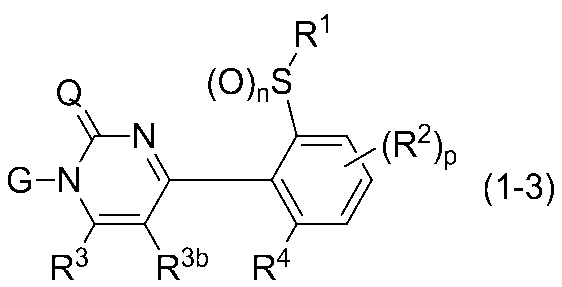
Gが、C2-C6ハロアルキル基、C3-C10ハロアルケニル基、又はC3-C10ハロアルキニル基であり、
R1が1以上のハロゲン原子を有していてもよいC1-C6アルキル基であり、
R2が、1以上のハロゲン原子を有していてもよいC1-C6アルキル基、基B-1~基B-4からなる群より選ばれるいずれかの5員芳香族複素環基(該5員芳香族複素環基は、1以上のハロゲン原子を有していてもよい。)、基D-1~基D-8からなる群より選ばれいずれかの非芳香族複素環基(但し、該非芳香族複素環基は1以上のハロゲン原子を有していてもよい)、1以上のハロゲン原子を有していてもよいC1-C6アルコキシ基、1以上のハロゲン原子を有していてもよいC1-C6アルキルスルファニル基、1以上のハロゲン原子を有していてもよいC1-C6アルキルスルフィニル基、1以上のハロゲン原子を有していてもよいC1-C6アルキルスルホニル基、1以上のハロゲン原子を有していてもよいジ(C1-C6アルキル)アミノ基、(C1-C6アルキル)アミノ基(但し、該(C1-C6アルキル)アミノ基のC1-C6アルキル部分は、1以上のハロゲン原子及び1以上のハロゲン原子を有していてもよい5員芳香族複素環基からなる群より選ばれる1以上の原子または基を有していてもよい)、又はアミノ基であり、
R3、及びR3bが、それぞれ独立して水素原子、又はC1-C3アルキル基であり、
R4が、水素原子であり、
pが、0、又は1である化合物。
Gが、C2-C10ハロアルキル基、又はC3-C10ハロアルケニル基であり、
R1が、C1-C6アルキル基、又はC1-C6ハロアルキル基であり、
R2が、C1-C6フルオロアルキル基、基B-1~基B-4からなる群より選ばれるいずれかの5員芳香族複素環基(該5員芳香族複素環基は、1以上のハロゲン原子を有していてもよい。)、1以上のハロゲン原子を有していてもよいC1-C6アルコキシ基、1以上のハロゲン原子を有していてもよいC1-C6アルキルスルファニル基、1以上のハロゲン原子を有していてもよいC1-C6アルキルスルフィニル基、1以上のハロゲン原子を有していてもよいC1-C6アルキルスルホニル基、1以上のハロゲン原子を有していてもよいジ(C1-C6アルキル)アミノ基、又は1以上のハロゲン原子を有していてもよいアルキルアミノ基、1以上のハロゲン原子を有していてもよい(チアゾール-5-イルメチル)アミノ基、アミノ基であり、
R3、及びR4が水素原子であり、
R3bが水素原子又はC1-C3アルキル基である化合物。

Gが、C2-C10ハロアルキル基、C3-C10ハロアルケニル基、又はC3-C10ハロアルキニル基であり、
R1が1以上のハロゲン原子を有していてもよいC1-C6アルキル基であり、
R2が、1以上のハロゲン原子を有していてもよいC1-C6アルキル基、基B-1~基B-4からなる群より選ばれるいずれかの5員芳香族複素環基(該5員芳香族複素環基は、1以上のハロゲン原子を有していてもよい。)、基D-1~基D-8からなる群より選ばれいずれかの非芳香族複素環基(但し、該非芳香族複素環基は1以上のハロゲン原子を有していてもよい)、1以上のハロゲン原子を有していてもよいC1-C6アルコキシ基、1以上のハロゲン原子を有していてもよいC1-C6アルキルスルファニル基、1以上のハロゲン原子を有していてもよいC1-C6アルキルスルフィニル基、1以上のハロゲン原子を有していてもよいC1-C6アルキルスルホニル基、1以上のハロゲン原子を有していてもよいジ(C1-C6アルキル)アミノ基、(C1-C6アルキル)アミノ基(但し、該(C1-C6アルキル)アミノ基のC1-C6アルキル部分は、1以上のハロゲン原子及び1以上のハロゲン原子を有していてもよい5員芳香族複素環基からなる群より選ばれる1以上の原子または基を有していてもよい)、又はアミノ基であり、
R3、及びR3bが、それぞれ独立して水素原子、又はC1-C3アルキル基であり、
pが、0、又は1である化合物。
Gが、C2-C10ハロアルキル基、又はC3-C10ハロアルケニル基であり、
R1が、C1-C6アルキル基、又はC1-C6ハロアルキル基であり、
R2が、C1-C6フルオロアルキル基、基B-1~基B-4からなる群より選ばれるいずれかの5員芳香族複素環基(該5員芳香族複素環基は、1以上のハロゲン原子を有していてもよい。)、1以上のハロゲン原子を有していてもよいC1-C6アルコキシ基、1以上のハロゲン原子を有していてもよいC1-C6アルキルスルファニル基、1以上のハロゲン原子を有していてもよいC1-C6アルキルスルフィニル基、1以上のハロゲン原子を有していてもよいC1-C6アルキルスルホニル基、1以上のハロゲン原子を有していてもよいジ(C1-C6アルキル)アミノ基、又は1以上のハロゲン原子を有していてもよいアルキルアミノ基、1以上のハロゲン原子を有していてもよい(チアゾール-5-イルメチル)アミノ基、アミノ基であり、
R3が水素原子であり、
R3bが水素原子又はC1-C3アルキル基である化合物。
Gが、C2-C10ハロアルキル基であり、R1が、C1-C6アルキル基であり、
pが0であり、R3、及びR3bが水素原子である化合物。
式(1)において、Qが酸素原子でありn=1である本発明化合物(1b)(以下本発明化合物(1b)と記す。)、および式(1)においてQが酸素原子でありn=2である本発明化合物(1c)(以下本発明化合物(1c)と記す。)は、式(1)においてQが酸素原子でありn=0である本発明化合物(1a)(以下本発明化合物(1a)と記す。)と酸化剤とを反応させることにより製造することができる。

該反応は、通常溶媒の存在下で行われる。
反応に用いられる溶媒としては、例えばジクロロメタン、クロロホルム等の脂肪族ハロゲン化炭化水素類(以下、脂肪族ハロゲン化炭化水素類と記す。)、アセトニトリル等のニトリル類(以下、ニトリル類と記す。)、メタノール、エタノール等のアルコール類(以下、アルコール類と記す。)、酢酸、水及びこれらの混合物が挙げられる。
反応に用いられる酸化剤としては、例えば過ヨウ素酸ナトリウム、m-クロロ過安息香酸(以下、mCPBAと記す。)、及び過酸化水素が挙げられる。
酸化剤として過酸化水素を用いる場合は、必要に応じて塩基、又は触媒を加えてもよい。
反応に用いられる塩基としては、炭酸ナトリウム等が挙げられる。
反応に用いられる触媒としては、例えばタングステン酸、タングステン酸ナトリウムが挙げられる。
該反応には、本発明化合物(1a)1モルに対して、酸化剤が通常1~1.2モルの割合で用いられる。
該反応には、本発明化合物(1a)1モルに対して、塩基が通常0.01~1モルの割合で用いる。
該反応には、本発明化合物(1a)1モルに対して、触媒が通常0.01~0.5モルの割合で用いられる。
該反応の反応温度は、通常-20~80℃の範囲である。該反応の反応時間は通常0.1~12時間の範囲である。
反応終了後は、反応混合物を有機溶媒で抽出し、有機層を必要に応じて還元剤(例えば亜硫酸ナトリウム、チオ硫酸ナトリウム)の水溶液、及び塩基(例えば炭酸水素ナトリウム)の水溶液で洗浄する。有機層を乾燥、濃縮することにより、本発明化合物(1b)を単離することができる。単離された本発明化合物(1b)は、クロマトグラフィー、再結晶等によりさらに精製することもできる。
該反応は、通常溶媒の存在下で行われる。
反応に用いられる溶媒としては、例えば脂肪族ハロゲン化炭化水素類、ニトリル類、アルコール類、酢酸、水及びこれらの混合物が挙げられる。
反応に用いられる酸化剤としては、例えばmCPBAおよび過酸化水素が挙げられる。
酸化剤として過酸化水素を用いる場合は、必要に応じて塩基、又は触媒を加えてもよい。
反応に用いられる塩基としては、炭酸ナトリウム等が挙げられる。
反応に用いられる触媒としては、例えばタングステン酸ナトリウムが挙げられる。
該反応には、本発明化合物(1b)1モルに対して、酸化剤が通常1~4モルの割合で用いられる。好ましくは、本発明化合物(1b)1モルに対して、酸化剤が1~2モルの割合で用いられる。
該反応には、本発明化合物(1b)1モルに対して、塩基が通常0.01~1モルの割合で用いる。
該反応には、本発明化合物(1b)1モルに対して、触媒が通常0.01~0.5モルの割合で用いられる。
該反応の反応温度は、通常-20~120℃の範囲である。該反応の反応時間は通常0.1~12時間の範囲である。
反応終了後は、反応混合物を有機溶媒で抽出し、有機層を必要に応じて還元剤(例えば亜硫酸ナトリウム、チオ硫酸ナトリウム)の水溶液、及び塩基(例えば炭酸水素ナトリウム)の水溶液で洗浄する。この有機層を乾燥、濃縮することにより、本発明化合物(1c)を単離することができる。本発明化合物(1c)は、クロマトグラフィー、再結晶等によりさらに精製することもできる。
該反応は、通常溶媒の存在下で行われる。
反応に用いられる溶媒としては、例えば脂肪族ハロゲン化炭化水素類、ニトリル類、アルコール類、酢酸、水及びこれらの混合物が挙げられる。
反応に用いられる酸化剤としては、例えばmCPBAおよび過酸化水素が挙げられる。
該反応の酸化剤として過酸化水素を用いる場合は、必要に応じて塩基、又は触媒を加えてもよい。
反応に用いられる塩基としては、炭酸ナトリウム等が挙げられる。
反応に用いられる触媒としては、例えばタングステン酸、タングステン酸ナトリウムが挙げられる。
該反応には、本発明化合物(1a)1モルに対して、酸化剤が通常2~5モルの割合で用いられる。
該反応には、本発明化合物(1a)1モルに対して、塩基が通常0.01~1モルの割合で用いる。
該反応には、本発明化合物(1a)1モルに対して、触媒が通常0.01~0.5モルの割合で用いられる。
該反応の反応温度は、通常0~120℃の範囲である。該反応の反応時間は通常0.1~12時間の範囲である。
反応終了後は、反応混合物を有機溶媒で抽出し、有機層を必要に応じて還元剤(例えば亜硫酸ナトリウム、チオ硫酸ナトリウム)の水溶液、及び塩基(例えば炭酸水素ナトリウム)の水溶液で洗浄する。有機層を、乾燥、濃縮することにより、本発明化合物(1c)を単離することができる。単離された本発明化合物(1c)は、クロマトグラフィー、再結晶等によりさらに精製することもできる。
本発明化合物(1a)は、式(M1)で示される化合物(以下、化合物(M1)と記す。)と式(R1)で示される化合物(以下、化合物(R1)と記す。)とを塩基の存在下で反応させることにより製造することができる。

該反応は、通常溶媒の存在下で行われる。
反応に用いられる溶媒としては、例えばテトラヒドロフラン(以下、THFと記す)、エチレングリコールジメチルエーテル、メチル-tert-ブチルエーテル、1,4-ジオキサン等のエーテル類(以下、エーテル類と記す。)、トルエン、キシレン等の芳香族炭化水素類(以下、芳香族炭化水素類と記す。)、ニトリル類、N,N-ジメチルホルムアミド(以下、DMFと記す。)、N-メチルピロリドン(以下、NMPと記す。)、ジメチルスルホキシド(以下、DMSOと記す。)等の非プロトン性極性溶媒(以下、非プロトン性極性溶媒と記す。)、水及びこれらの混合物が挙げられる。
反応に用いられる塩基としては、例えば炭酸ナトリウム、炭酸カリウム等のアルカリ金属炭酸塩類(以下、アルカリ金属炭酸塩類と記す。)、水素化ナトリウム等のアルカリ金属水素化物類(以下、アルカリ金属水素化物類と記す。)が挙げられる。
該反応には、化合物(M1)1モルに対して、化合物(R1)が通常1~10モルの割合、塩基が通常1~10モルの割合で用いられる。好ましくは、化合物(M1)1モルに対して、化合物(R1)が1.0~1.1モルの割合、塩基が1~2モルの割合で用いられる。
該反応の反応温度は、通常-20℃~150℃の範囲である。該反応の反応時間は通常0.5~24時間の範囲である。
反応終了後は、反応混合物を有機溶媒で抽出し、有機層を乾燥、濃縮する等の後処理操作を行うことにより、本発明化合物(1a)を単離することができる。単離された本発明化合物(1a)は、クロマトグラフィー、再結晶等によりさらに精製することもできる。
式(1z)で示される本発明化合物(以下、本発明化合物(1z)と記す。)は、式(M2)で示される化合物(以下、化合物(M2)と記す。)と式(R2)で示される化合物(以下、化合物(R2)と記す。)とを、塩基の存在下で反応させることで製造することができる。

該反応は、通常溶媒の存在下で行われる。
反応に用いられる溶媒としては、例えばエーテル類、脂肪族ハロゲン化炭化水素類、芳香族炭化水素類、非プロトン性極性溶媒及びこれらの混合物が挙げられる。
反応に用いられる塩基としては、例えばトリエチルアミン、ジイソピロピルエチルアミン、ピリジン、4-ジメチルアミノピリジン等の有機塩基類(以下、有機塩基類と記す。)、アルカリ金属水素化物類、又はアルカリ金属炭酸塩類が挙げられる。
該反応には、化合物(M2)1モルに対して、化合物(R2)が通常1~10モルの割合で用いられ、塩基が通常0.1~5モルの割合で用いられる。
該反応の反応温度は、通常-20℃~120℃の範囲である。該反応の反応時間は通常0.1~24時間の範囲である。
反応終了後は、反応混合物を水に加えてから有機溶媒で抽出し、有機層を濃縮する;反応混合物を水に加えて生じた固体を濾過により集める;又は、反応混合物中に生成した固体を濾過により集めることにより、本発明化合物(1)を単離することができる。単離された本発明化合物(1)は、クロマトグラフィー、再結晶等によりさらに精製することもできる。
化合物(M1)は、式(M3)で示される化合物(以下、化合物(M3)と記す。)と化合物(R2)とを塩基の存在下で反応させることにより製造することができる。

該反応は、化合物(M2)に代えて化合物(M3)を用いることにより、製造法3に記載の反応に準じて化合物(M1)を製造することができる
化合物(M2)においてn=1である化合物(M2b)(以下、化合物(M2b)と記す。)、および化合物(M2)においてn=2である化合物(M2c)(以下、化合物(M2c)と記す。)は、化合物(M2)においてn=0である化合物(M2a)(以下、化合物(M2a)と記す。)と酸化剤とを反応させることにより製造することができる。

該反応は、本発明化合物(1a)に代えて化合物(M2a)を用い、本発明化合物(1b)に代えて化合物(M2b)を用いることにより、製造法1に記載の反応に準じて化合物(M2b)および化合物(M2c)を製造することができる。
化合物(M2a)は、化合物(M3)と化合物(R1)とを塩基の存在下で反応させることにより製造することができる。
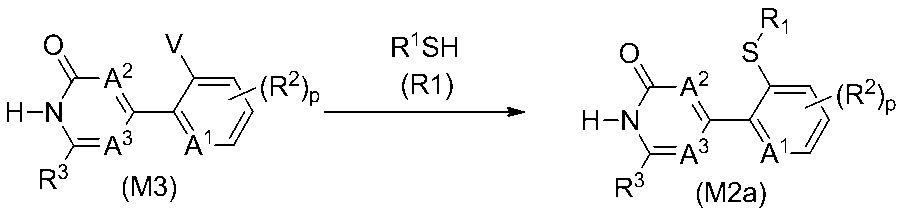
該反応は、化合物(M1)に代えて化合物(M3)を用い、製造法2に記載の方法に準じて化合物(M2a)を製造することができる。
化合物(M3)は、例えば下記の方法に従って製造することができる。

化合物(M9)は、式(M10)で示される化合物(以下、化合物(M10)と記す。)と式(M11)で示される化合物(以下、化合物(M11)と記す。)とを、金属触媒の存在下で反応させることにより製造することができる。
該反応は、通常溶媒の存在下で行われる。
反応に用いられる溶媒としては、例えばエーテル類、芳香族炭化水素類、非プロトン性極性溶媒、水及びこれらの混合物が挙げられる。
反応に用いられる金属触媒としては、テトラキストリフェニルホスフィンパラジウム(0)、1,1’-ビス(ジフェニルホスフィノ)フェロセン-パラジウム(II)ジクロリド、トリス(ジベンジリデンアセトン)ジパラジウム(0)、酢酸パラジウム(II)等のパラジウム触媒、ビス(シクロオクタジエン)ニッケル(0)、塩化ニッケル(II)等のニッケル触媒、ヨウ化銅(I)、塩化銅(I)等の銅触媒等が挙げられる。
該反応は必要に応じて、配位子、塩基及び無機ハロゲン化物を加えてもよい。
反応に用いられる配位子としては、トリフェニルホスフィン、キサントホス、2,2’-ビス(ジフェニルホスフィノ)-1,1’-ビナフチル、1,1’-ビス(ジフェニルホスフィノ)フェロセン、2-ジシクロヘキシルホスフィノ-2’,4’,6’-トリイソプロピルビフェニル、2-ジシクロヘキシルホスフィノ-2’,6’-ジメトキシビフェニル、1,2-ビス(ジフェニルホスフィノ)エタン、2,2’-ビピリジン、2-アミノエタノール、8-ヒドロキシキノリン、1,10-フェナントロリン等が挙げられる。
反応に用いられる塩基としては、例えばアルカリ金属水素化物類、アルカリ金属炭酸塩類、又は有機塩基類が挙げられる。
反応に用いられる無機ハロゲン化物としては、フッ化カリウム、フッ化ナトリウム等のアルカリ金属フッ素塩、塩化リチウム、塩化ナトリウム等のアルカリ金属塩素塩等が挙げられる。
該反応には、化合物(M10)1モルに対して、化合物(M11)が通常1~10モルの割合で用いられ、金属触媒が通常0.01~0.5モルの割合で用いられ、配位子が通常0.01~1モルの割合で用いられ、塩基が通常0.1~5モルの割合で用いられ、無機ハロゲン化物が通常0.1~5モルの割合で用いられる。
該反応の反応温度は、通常-20℃~200℃の範囲である。該反応の反応時間は通常0.1~24時間の範囲である。
反応終了後は、反応混合物を水に加えてから有機溶媒で抽出し、有機層を濃縮する;反応混合物を水に加えて生じた固体を濾過により集める;又は、反応混合物中に生成した固体を濾過により集めることにより化合物(M9)を単離することができる。単離された化合物(M9)は、クロマトグラフィー、再結晶等によりさらに精製することもできる。
化合物(M3)は、化合物(M9)を酸の存在下で反応させることにより製造することができる。
該反応は、溶媒の存在下で行われる。
反応に用いられる溶媒としては、例えば脂肪族ハロゲン化炭化水素類、芳香族炭化水素類、ニトリル類、アルコール類、酢酸、水及びこれらの混合物が挙げられる。
反応に用いられる酸としては、塩酸、硫酸等の鉱酸類、三塩化ホウ素、三臭化ホウ素等のホウ素類、塩化チタンや塩化アルミニウム等の金属塩化物が挙げられる。
該反応には、化合物(M9)1モルに対して、酸が通常0.1~10モルの割合で用いられる。該反応に、塩酸や硫酸等の鉱酸類を酸として用いる場合は、鉱酸類を溶媒として用いることもできる。
該反応の反応温度は、通常-20℃~150℃の範囲である。該反応の反応時間は通常0.1~24時間の範囲である。
反応終了後は、反応混合物を水に加えてから有機溶媒で抽出し、有機層を濃縮する;反応混合物を水に加えて生じた固体を濾過により集める;又は、反応混合物中に生成した固体を濾過により集めることにより化合物(M3)を単離することができる。単離された化合物(M3)は、クロマトグラフィー、再結晶等によりさらに精製することもできる。
化合物(M2a)は、例えば以下の方法に従って製造することができる。

化合物(M12)は、化合物(M9)と化合物(R1)とを塩基の存在下で反応させることにより製造することができる。
該反応は、化合物(M1)に代えて化合物(M9)を用い、製造法2に記載の方法に準じて化合物(M12)を製造することができる。
化合物(M2a)は、化合物(M12)を酸の存在下で反応させることにより製造することができる。
該反応は、化合物(M9)に代えて化合物(M12)を用い、製造法7に記載の方法に準じて化合物(M2a)を製造することができる。
化合物(M3)において、A2がCR3aでありA3が窒素原子である化合物(M3-1)(以下、化合物(M3-1)と記す。)は、例えば下記の方法に従って製造することができる。
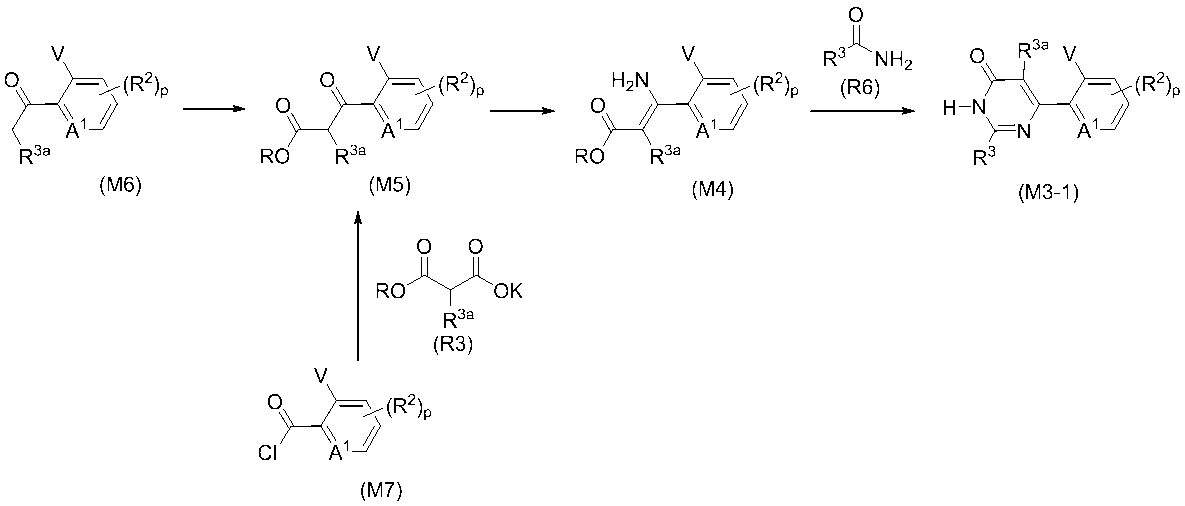
化合物(M5)は、式(M6)で示される化合物(以下化合物(M6)と記す。)と炭酸エステルとを塩基の存在下で反応させることにより製造することができる。
該反応は、通常溶媒の存在下で行われる。
反応に用いられる溶媒としては、例えばエーテル類、脂肪族ハロゲン化炭化水素類、芳香族炭化水素類、非プロトン性極性溶媒及びこれらの混合物が挙げられる。
反応に用いられる塩基としては、例えばアルカリ金属水素化物類、アルカリ金属炭酸塩類、ナトリウムメトキシド、ナトリウムエトキシド、カリウムtert-ブトキシド等のアルカリ金属アルコキシド(以下、アルカリ金属アルコキシド類と記す。)、又は有機塩基類が挙げられる。
反応に用いられる炭酸エステルとしては、例えば炭酸ジメチル、炭酸ジエチル、炭酸ジプロピルが挙げられる。
該反応には、化合物(M6)1モルに対して、炭酸エステルが通常1~10モルの割合で用いられ、塩基が通常0.1~5モルの割合で用いられる。また、炭酸エステルを溶媒として用いることもできる。
該反応の反応温度は、通常-20℃~200℃の範囲である。該反応の反応時間は通常0.1~24時間の範囲である。
反応終了後は、反応混合物を水に加えてから有機溶媒で抽出し、有機層を濃縮する;反応混合物を水に加えて生じた固体を濾過により集める;又は、反応混合物中に生成した固体を濾過により集めることにより化合物(M5)を単離することができる。単離された化合物(M5)は、クロマトグラフィー、再結晶等によりさらに精製することもできる。
化合物(M5)は、化合物(M7)と式(R3)で示される化合物(以下、化合物(R3)と記す。)とを、塩化マグネシウム及び塩基の存在下で反応させ、その後に酸性水溶液とを反応させることにより製造することもできる。
該反応は、通常溶媒の存在下で行われる。
反応に用いられる溶媒としては、例えばエーテル類、脂肪族ハロゲン化炭化水素類、芳香族炭化水素類、非プロトン性極性溶媒及びこれらの混合物が挙げられる。
反応に用いられる塩基としては、例えば有機塩基類が挙げられる。
反応に用いられる酸性水溶液としては、塩酸や硫酸などの鉱酸類の水溶液が挙げられる。
該反応には、化合物(M7)1モルに対して、化合物(R3)が通常1~10モルの割合で用いられ、塩化マグネシウムが通常1~10モルの割合で用いられ、塩基が通常0.1~10モルの割合で用いられ、酸性水溶液としては1N~12Nの酸性水溶液が1~100モルの割合で用いられる。
該反応の反応温度は、通常-20℃~200℃の範囲である。該反応の反応時間は通常0.1~24時間の範囲である。
反応終了後は、反応混合物を水に加えてから有機溶媒で抽出し、有機層を濃縮する;反応混合物を水に加えて生じた固体を濾過により集める;又は、反応混合物中に生成した固体を濾過により集めることにより化合物(M5)を単離することができる。単離された化合物(M5)は、クロマトグラフィー、再結晶等によりさらに精製することもできる。
化合物(M4)は、化合物(M5)とアンモニウム塩とを反応させることにより製造することが出来る。
該反応は、通常溶媒の存在下で行われる。
反応に用いられる溶媒としては、例えば、エーテル類、脂肪族ハロゲン化炭化水素類、芳香族炭化水素類、ニトリル類、非プロトン性極性溶媒、含窒素芳香族化合物類及びこれらの混合物が挙げられる。
反応に用いられるアンモニウム塩としては、酢酸アンモニウム、塩化アンモニウム等が挙げられる。
該反応には、化合物(M5)1モルに対して、アンモニウム塩が通常1~10モルの割合で用いられる。
該反応の反応温度は、通常-20℃~200℃の範囲である。該反応の反応時間は通常0.1~24時間の範囲である。
反応終了後は、反応混合物を水に加えてから有機溶媒で抽出し、有機層を濃縮する;反応混合物を水に加えて生じた固体を濾過により集める;又は、反応混合物中に生成した固体を濾過により集めることにより化合物(M4)を単離することができる。単離された化合物(M4)は、クロマトグラフィー、再結晶等によりさらに精製することもできる。
化合物(M3-1)は、化合物(M4)と式(R6)で示される化合物(以下、化合物(R6)と記す。)とを塩基の存在下で反応させることにより製造することが出来る。
該反応は、通常溶媒の存在下で行われる。
反応に用いられる溶媒としては、例えばエーテル類、脂肪族ハロゲン化炭化水素類、芳香族炭化水素類、非プロトン性極性溶媒及びこれらの混合物が挙げられる。
反応に用いられる塩基としては、例えばアルカリ金属水素化物類、アルカリ金属炭酸塩類、アルカリ金属アルコキシド類が挙げられる。
該反応には、化合物(M4)1モルに対して、化合物(R6)が通常1~10モルの割合で用いられ、塩基が通常1~10モルの割合で用いられる。
該反応の反応温度は、通常-20℃~200℃の範囲である。該反応の反応時間は通常0.1~24時間の範囲である。
反応終了後は、反応混合物を水に加えてから有機溶媒で抽出し、有機層を濃縮する;反応混合物を水に加えて生じた固体を濾過により集める;又は、反応混合物中に生成した固体を濾過により集めることにより化合物(M3-1)を単離することができる。単離された化合物(M3-1)は、クロマトグラフィー、再結晶等によりさらに精製することもできる。
式(M2a-1)で示される化合物(以下、化合物(M2a-1)と記す。)は、例えば下記の方法に従って製造することができる。
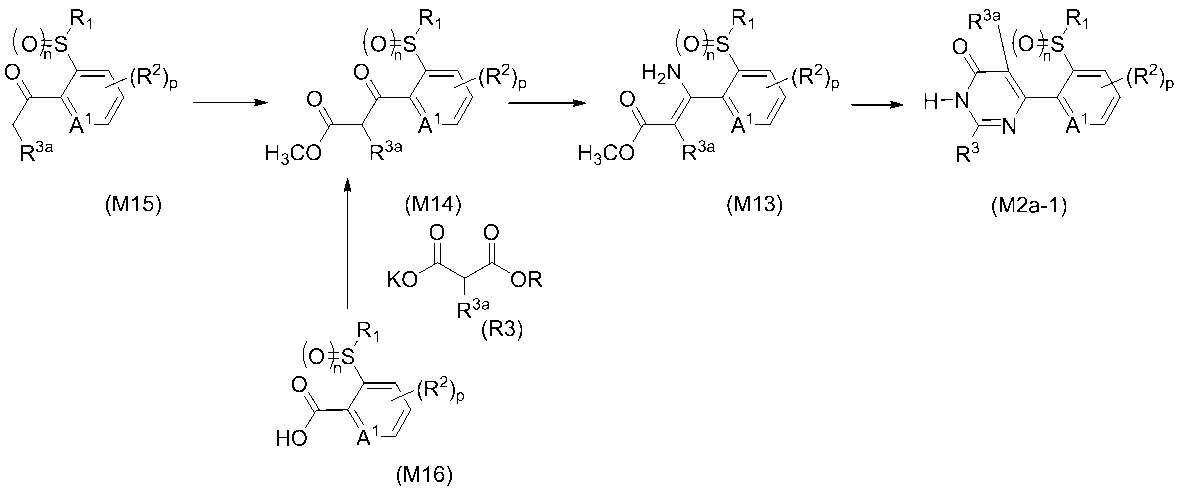
式(M13)で示される化合物(以下、化合物(M13)と記す。)は、化合物(M5)に代えて式(M14)で示される化合物(以下、化合物(M14)と記す。)を用い、製造法9に記載の方法に準じて製造することができる。
化合物(M2a-1)は、化合物(M4)に代えて化合物(M13)を用い、製造法9に記載の方法に準じて製造することができる。
式(M2a-2)で示される化合物(以下、化合物(M2a-2)と記す。)は、例えば、下記の方法に従って製造することができる。

化合物(M21)は、化合物(M6)と式(R4)で示される化合物(以下、化合物(R4)と記す。)とを、塩基の存在下で反応させることにより製造することができる。
該反応は、通常溶媒の存在下で行われる。
反応に用いられる溶媒としては、例えばエーテル類、脂肪族ハロゲン化炭化水素類、芳香族炭化水素類、非プロトン性極性溶媒及びこれらの混合物が挙げられる。
反応に用いられる塩基としては、例えばアルカリ金属水素化物類、アルカリ金属炭酸塩類、アルカリ金属アルコキシド類、又は有機塩基類が挙げられる。
該反応には、化合物(M6)1モルに対して、化合物(R4)が通常1~10モルの割合で用いられ、塩基が通常0.1~5モルの割合で用いられる。
該反応の反応温度は、通常-20℃~200℃の範囲である。該反応の反応時間は通常0.1~24時間の範囲である。
反応終了後は、反応混合物を水に加えてから有機溶媒で抽出し、有機層を濃縮する;反応混合物を水に加えて生じた固体を濾過により集める;又は、反応混合物中に生成した固体を濾過により集めることにより化合物(M21)を単離することができる。単離された化合物(M21)は、クロマトグラフィー、再結晶等によりさらに精製することもできる。
化合物(M3-2)は、化合物(M21)と尿素とを反応させることにより製造することができる。
該反応は、通常溶媒の存在下で行われる。
反応に用いられる溶媒としては、例えばニトリル類、アルコール類、非プロトン性極性溶媒、酢酸、水及びこれらの混合物が挙げられる。
該反応には、化合物(M21)1モルに対して、尿素が通常1~10モルの割合で用いられる。
該反応の反応温度は、通常-20℃~200℃の範囲である。該反応の反応時間は通常0.1~24時間の範囲である。
反応終了後は、反応混合物を水に加えてから有機溶媒で抽出し、有機層を濃縮する;反応混合物を水に加えて生じた固体を濾過により集める;又は、反応混合物中に生成した固体を濾過により集めることにより化合物(M3-2)を単離することができる。単離された化合物(M3-2)は、クロマトグラフィー、再結晶等によりさらに精製することもできる。
化合物(M22)は、化合物(M6)と式(R5)で示される化合物(以下、化合物(R5)と記す。)とを反応させることにより製造することができる。
該反応は、通常溶媒の存在下で行われる。
反応に用いられる溶媒としては、例えばエーテル類、芳香族炭化水素類、非プロトン性極性溶媒及びこれらの混合物が挙げられる。
該反応には、化合物(M6)1モルに対して、化合物(R5)が通常1~100モルの割合で用いられる。また、化合物(R5)を溶媒として用いることもできる。
該反応の反応温度は、通常-20℃~200℃の範囲である。該反応の反応時間は通常0.1~24時間の範囲である。
反応終了後は、反応混合物を水に加えてから有機溶媒で抽出し、有機層を濃縮する;反応混合物を水に加えて生じた固体を濾過により集める;又は、反応混合物中に生成した固体を濾過により集めることにより化合物(M22)を単離することができる。単離された化合物(M22)は、クロマトグラフィー、再結晶等によりさらに精製することもできる。
化合物(M3-2)は、化合物(22)と尿素とを反応させることにより製造することができる。
該反応は、通常溶媒の存在下で行われる。
反応に用いられる溶媒としては、例えばニトリル類、アルコール類、非プロトン性極性溶媒、酢酸、水及びこれらの混合物が挙げられる。
該反応には、化合物(M22)1モルに対して、尿素が通常1~10モルの割合で用いられる。
該反応の反応温度は、通常-20℃~200℃の範囲である。該反応の反応時間は通常0.1~24時間の範囲である。
反応終了後は、反応混合物を水に加えてから有機溶媒で抽出し、有機層を濃縮する;反応混合物を水に加えて生じた固体を濾過により集める;又は、反応混合物中に生成した固体を濾過により集めることにより化合物(M3-2)を単離することができる。単離された化合物(M3-2)は、クロマトグラフィー、再結晶等によりさらに精製することもできる。
化合物(M2a-2)は、化合物(M3-2)と化合物(R1)とを、塩基の存在下で反応させることにより製造することができる。
該反応は、化合物(M1)に代えて化合物(M3-2)を用いることにより、製造法2に記載の方法に準じて化合物(M2a-2)を製造することができる。
化合物(M2a-2)は、例えば下記の方法に従って製造することができる。

化合物(M23)は、化合物(M15)と化合物(R4)とを塩基の存在下で反応させることにより製造することができる。
該反応は、化合物(M6)に代えて化合物(M15)を用いることにより、製造法11に記載の方法に準じて化合物(M23)を製造することができる。
化合物(M2a-2)は、化合物(M23)と尿素とを反応させることにより製造することができる。
該反応は、化合物(M21)に代えて化合物(M23)を用いることにより、製造法11に記載の方法に準じて化合物(M2a-2)を製造することができる。
化合物(M24)は、化合物(M15)と化合物(R5)とを反応させることにより製造することができる。
該反応は、化合物(M6)に代えて化合物(M15)を用いることにより、製造法11に記載の方法に準じて化合物(M24)を製造することができる。
化合物(M2a-2)は、化合物(M24)と尿素とを反応させることにより製造することができる。
該反応は、化合物(M22)に代えて化合物(M24)を用いることにより、製造法11に記載の方法に準じて化合物(M2a-2)を製造することができる。
式(1)において、Qが酸素原子であり、pが1であり、R2がOR5である本発明化合物(以下、本発明化合物(1e)と記す。)は、式(1)において、Qが酸素原子であり、pが1であり、R2がX2である本発明化合物(以下、本発明化合物(1d)と記す。)と式(R16)で示される化合物(以下、化合物(R16)と記す。)とを、塩基の存在下で反応させることにより製造することができる。

反応に用いられる溶媒としては、例えばエーテル類、脂肪族炭化水素類、芳香族炭化水素類、脂肪族ハロゲン化炭化水素類、エステル類、ニトリル類、非プロトン性極性溶媒、含窒素芳香族化合物類及びこれらの混合物が挙げられる。
反応に用いられる塩基としては、アルカリ金属炭酸塩類、アルカリ金属水素化物類、有機塩基類等が挙げられる。
該反応には、本発明化合物(1d)1モルに対して、化合物(R16)が通常1~10モルの割合、塩基が通常1~10モルの割合で用いられる。
該反応の反応温度は、通常0~200℃の範囲である。該反応の反応時間は通常0.1~24時間の範囲である。
反応終了後は、反応混合物に水を加えた後、有機溶媒で抽出し、有機層を乾燥、濃縮する等の後処理操作を行うことにより、本発明化合物(1e)を単離することができる。単離された本発明化合物(1e)は、クロマトグラフィー、再結晶等によりさらに精製することもできる。
式(1)において、Qが酸素原子であり、pが1であり、R2がNR5R6である本発明化合物(以下、本発明化合物(1f)と記す。)は、本発明化合物(1d)と式(R15)で示される化合物(以下、化合物(R15)と記す。)とを反応させることにより製造することができる。

該反応は、通常溶媒の存在下で行われる。
反応に用いられる溶媒としては、例えばエーテル類、脂肪族炭化水素類、芳香族炭化水素類、脂肪族ハロゲン化炭化水素類、エステル類、ニトリル類、非プロトン性極性溶媒、含窒素芳香族化合物類及びこれらの混合物が挙げられる。
該反応は、必要に応じて塩基を加えて行うこともできる。
反応に用いられる塩基としては、アルカリ金属炭酸塩類、アルカリ金属水素化物類、有機塩基類等が挙げられる。
該反応には、本発明化合物(1d)1モルに対して、化合物(R15)が通常1~10モルの割合、塩基が通常1~10モルの割合で用いられる。
該反応の反応温度は、通常0~200℃の範囲である。該反応の反応時間は通常0.1~24時間の範囲である。
反応終了後は、反応混合物に水を加えた後、有機溶媒で抽出し、有機層を乾燥、濃縮する等の後処理操作を行うことにより、本発明化合物(1f)を単離することができる。単離された本発明化合物(1f)は、クロマトグラフィー、再結晶等によりさらに精製することもできる。
式(1)において、Qが酸素原子であり、pが1であり、R2がSR5である本発明化合物(以下、本発明化合物(1g)と記す。)、Qが酸素原子であり、pが1であり、R2がS(O)R8である本発明化合物(以下、本発明化合物(1h)と記す。)、及びQが酸素原子であり、pが1であり、R2がS(O)2R8である本発明化合物(以下、本発明化合物(1i)と記す。)は、例えば下記の方法に従って製造することができる。

本発明化合物(1g)は、本発明化合物(1d)と式(R18)で示される化合物(以下、化合物(R18)と記す。)とを、塩基の存在下で反応させることにより製造することができる。
該反応は、化合物(R16)に代えて化合物(R18)を用いることにより、製造法13に記載の方法に準じて本発明化合物(1g)を製造することができる。
本発明化合物(1h)は、本発明化合物(1g)と酸化剤とを反応させることにより製造することができる。
該反応は、化合物(1a)に代えて化合物(1g)を用いることにより、製造法1に記載の方法に準じて化合物(1h)を製造することができる。
本発明化合物(1i)は、本発明化合物(1h)と酸化剤とを反応させることにより製造することができる。
該反応は、化合物(1b)に代えて化合物(1h)を用いることにより、製造法1に記載の方法に準じて化合物(1i)を製造することができる。
式(1)においてQが硫黄原子である本発明化合物(1y)(以下、本発明化合物(1y)と記す。)は、式(1)においてQが酸素原子である本発明化合物(1z)(以下、本発明化合物(1z)と記す。)と硫化剤とを反応させることにより製造することができる。

該反応は、通常溶媒の存在下で行われる。
反応に用いられる溶媒としては、例えばエーテル類、脂肪族炭化水素類、芳香族炭化水素類、脂肪族ハロゲン化炭化水素類及びこれらの混合物が挙げられる。
反応に用いられる硫化剤としては、2,4-ビス(4-メトキシフェニル)-1,3,2,4-ジチアジホスフェタン-2,4-ジスルフィド、五硫化二リン等が挙げられる。
該反応には、本発明化合物(1z)1モルに対して、硫化剤が通常1~10モルの割合で用いられる。
該反応の反応温度は、通常-20~200℃の範囲である。該反応の反応時間は通常0.1~24時間の範囲である。
反応終了後は、反応混合物に水を加えた後、有機溶媒で抽出し、有機層を乾燥、濃縮する等の後処理操作を行うことにより、本発明化合物(1y)を単離することができる。単離された本発明化合物(1y)は、クロマトグラフィー、再結晶等によりさらに精製することもできる。
式(1L)で示される本発明化合物(以下、本発明化合物(1L)と記す。)は、本発明化合物(1d)と、式(R28)で示される化合物(以下、化合物(R28)と記す。)とを塩基の存在下で反応させることにより製造することができる。

該反応は、化合物(R16)に代えて化合物(R28)を用い、製造法13に記載の方法に準じて本発明化合物(1L)を製造することができる。
式(1m)で示される本発明化合物(以下、本発明化合物(1m)と記す。)は、本発明化合物(1d)と、式(R29)で示される化合物(以下、化合物(R29)と記す。)とを反応させることにより製造することができる。

該反応は、化合物(R15)に代えて化合物(R29)を用い、製造法14に記載の方法に準じて本発明化合物(1m)を製造することができる。

式(1-5)において、R3及びR3aが水素原子であり、R21及びR23が水素原子であり、R22がトリフルオロメチル基であり、R1、G、及びnが[表1]~[表4]に記載の本発明化合物。
式(1-5)において、R3が水素原子であり、R21、R22、及びR23が水素原子であり、R3aがCH3であり、R1、G、及びnが[表1]~[表4]に記載の本発明化合物。
式(1-5)において、R3が水素原子であり、R21及びR23が水素原子であり、R22がトリフルオロメチル基であり、R3aがCH3であり、R1、G、及びnが[表1]~[表4]に記載の本発明化合物。
式(1-5)において、R3が水素原子であり、R21、R22、及びR23が水素原子であり、R3aがフッ素原子であり、R1、G、及びnが[表1]~[表4]に記載の本発明化合物。
式(1-5)において、R3が水素原子であり、R21及びR23が水素原子であり、R22がトリフルオロメチル基であり、R3aがフッ素原子であり、R1、G、及びnが[表1]~[表4]に記載の本発明化合物。
式(1-5)において、R3が水素原子であり、R21、R22、及びR23が水素原子であり、R3aが塩素原子であり、R1、G、及びnが[表1]~[表4]に記載の本発明化合物。
式(1-5)において、R3が水素原子であり、R21及びR23が水素原子であり、R22がトリフルオロメチル基であり、R3aが塩素原子であり、R1、G、及びnが[表1]~[表4]に記載の本発明化合物。
式(1-5)において、R3aが水素原子であり、R21、R22、及びR23が水素原子であり、R3がCH3であり、R1、G、及びnが[表1]~[表4]に記載の本発明化合物。
式(1-5)において、R3aが水素原子であり、R21及びR23が水素原子であり、R22がトリフルオロメチル基であり、R3がCH3であり、R1、G、及びnが[表1]~[表4]に記載の本発明化合物。
[表1]

[表2]

[表3]


式(1-6)において、R3及びR3aが水素原子であり、R21及びR23が水素原子であり、R22がトリフルオロメチル基であり、R1、G、及びnが[表1]~[表4]に記載の本発明化合物。
式(1-6)において、R3が水素原子であり、R21、R22、及びR23が水素原子であり、R3aがCH3であり、R1、G、及びnが[表1]~[表4]に記載の本発明化合物。
式(1-6)において、R3が水素原子であり、R21及びR23が水素原子であり、R22がトリフルオロメチル基であり、R3aがCH3であり、R1、G、及びnが[表1]~[表4]に記載の本発明化合物。
式(1-6)において、R3が水素原子であり、R21、R22、及びR23が水素原子であり、R3aがフッ素原子であり、R1、G、n、R21、R22、及びR23が[表1]~[表4]に記載の本発明化合物。
式(1-6)において、R3が水素原子であり、R21及びR23が水素原子であり、R22がトリフルオロメチル基であり、R3aがフッ素原子であり、R1、G、及びnが[表1]~[表4]に記載の本発明化合物。
式(1-6)において、R3が水素原子であり、R21、R22、及びR23が水素原子であり、R3aが塩素原子であり、R1、G、及びnが[表1]~[表4]に記載の本発明化合物。
式(1-6)において、R3が水素原子であり、R21及びR23が水素原子であり、R22がトリフルオロメチル基であり、R3aが塩素原子であり、R1、G、及びnが[表1]~[表4]に記載の本発明化合物。
式(1-6)において、R3aが水素原子であり、R21、R22、及びR23が水素原子であり、R3がCH3であり、R1、G、及びnが[表1]~[表4]に記載の本発明化合物。
式(1-6)において、R3aが水素原子であり、R21及びR23が水素原子であり、R22がトリフルオロメチル基であり、R3がCH3であり、R1、G、及びnが[表1]~[表4]に記載の本発明化合物。
[表5]


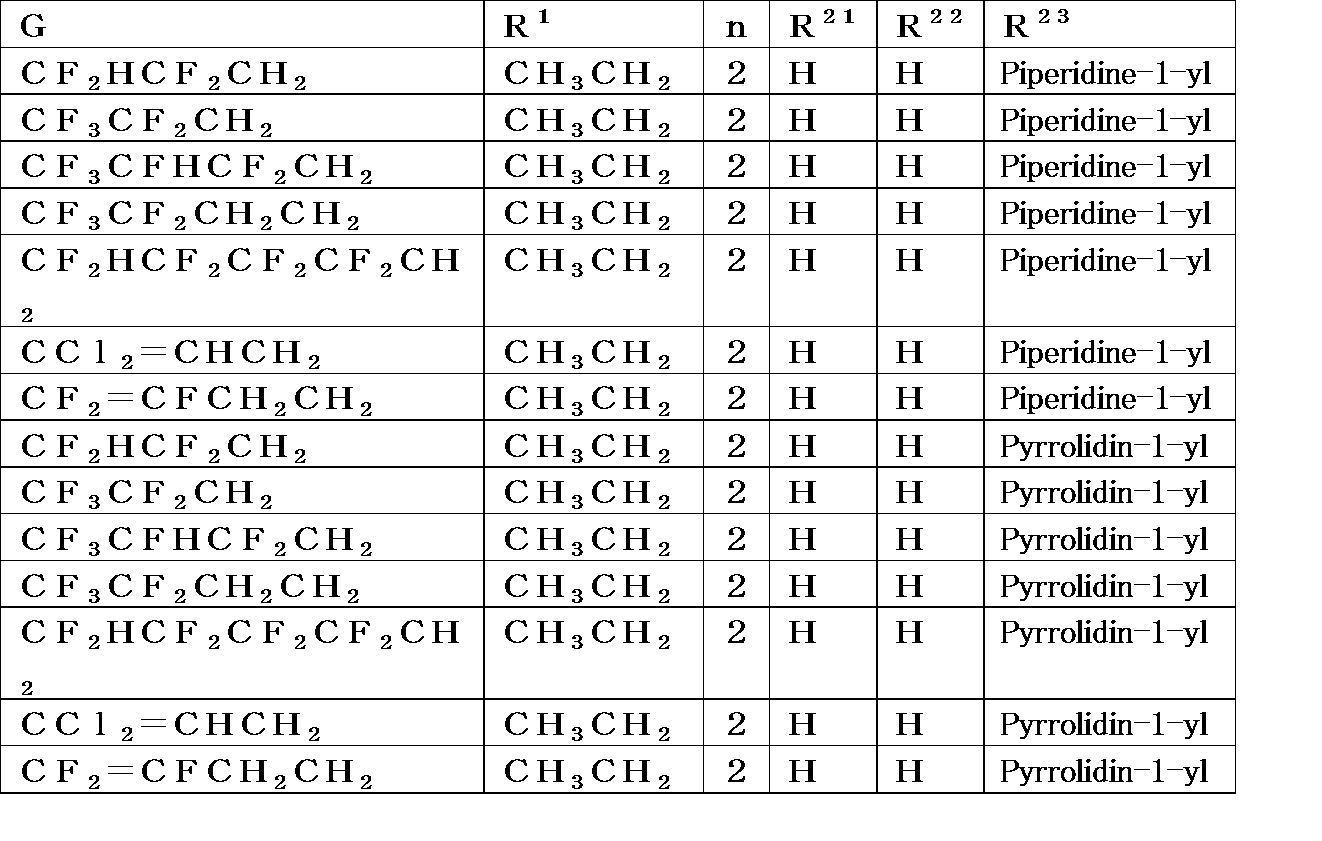


において、R3及びR3bが水素原子であり、R21、R22、及びR23が水素原子であり、R1、G、及びnが[表1]~[表4]に記載の組み合わせである本発明化合物。
式(1-7)において、R3及びR3bが水素原子であり、R21、及びR23が水素原子であり、R22がトリフルオロメチル基であり、R1、G、及びnが[表1]~[表4]に記載の組み合わせである本発明化合物。
式(1-7)において、R3及びR3bが水素原子であり、R1、G、n、R21、R22、及びR23が[表5]~[表13]に記載の組み合わせである本発明化合物。

式(1-8)において、R3及びR3bが水素原子であり、R21、及びR23が水素原子であり、R22がトリフルオロメチル基であり、R1、G、及びnが[表1]~[表4]に記載の組み合わせである本発明化合物。
式(1-8)において、R3及びR3bが水素原子であり、R1、G、n、R21、R22、及びR23が[表5]~[表13]に記載の組み合わせである本発明化合物。

式(1-9)において、R3及びR3bが水素原子であり、R21、及びR23が水素原子であり、R22がトリフルオロメチル基であり、R1、G、及びnが[表1]~[表4]に記載の組み合わせである本発明化合物。
式(1-9)において、R3及びR3bが水素原子であり、R1、G、n、R21、R22、及びR23が[表5]~[表13]に記載の組み合わせである本発明化合物。
(Ecdytolopha aurantiana)等のシンクイガ類、Coffee Leaf miner(Leucoptera coffeela)、リオネティア属等のハモグリガ類、リマントリア属、ユープロクティス属等のドクガ類、コナガ(Plutella xylostella)等のスガ類、ワタアカミムシ(Pectinophora gossypiella)ジャガイモガ(Phthorimaea operculella)等のキバガ類、アメリカシロヒトリ(Hyphantria cunea)等のヒトリガ類。
本発明の有害節足動物防除剤は、本発明化合物を通常0.01~95重量%含有する。
毒餌の基材としては、例えば穀物粉、植物油、糖、結晶セルロース等が挙げられ、更に必要に応じて、ジブチルヒドロキシトルエン、ノルジヒドログアイアレチン酸等の酸化防止剤、デヒドロ酢酸等の保存料、トウガラシ末等の子供やペットによる誤食防止剤、チーズ香料、タマネギ香料ピーナッツオイル等の害虫誘引性香料等が添加される。
まず、本発明化合物の製造について、製造例を示す。
4-クロロ-6-メトキシピリミジン 1.28g、[2-フルオロ-4-(トリフルオロメチル)フェニル]-ボロン酸ピナコールエステル 1.48g、テトラキス(トリフェニルホスフィン)パラジウム(0) 0.28g、炭酸ナトリウム水溶液(2M) 6.3ml及び1,2-ジメトキシエタン(以下、DMEと記す。) 15mlの混合物を、80度で3時間撹拌した。反応終了後、室温まで放冷した反応混合物に水を加え、酢酸エチルで抽出した後、有機層を無水硫酸ナトリウムで乾燥した。有機層を減圧下濃縮した後、得られた残渣をシリカゲルカラムクロマトグラフィーに付し、中間体(1-1) 0.99gを得た。


本発明化合物1

副生成物1

2,2,2-トリフルオロエチル ノナフルオロブタンスルホネートに代えて2,2,3,3,3-ペンタフルオロプロピル トリフルオロメタンスルホネートを用い、製造例1(5)に記載の方法に準じて、本発明化合物2及び副生成物2を得た。
本発明化合物2

副生成物2

2,2,2-トリフルオロエチル ノナフルオロブタンスルホネートに代えて2,2,3,4,4,4-ヘキサフルオロブチル トリフルオロメタンスルホネートを用いて、製造例1(5)に記載の方法に準じて、本発明化合物3及び副生成物3を得た。
本発明化合物3

副生成物3


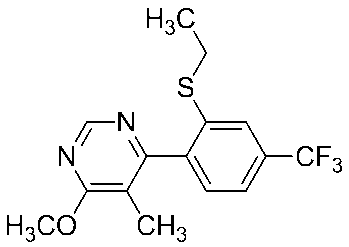


本発明化合物4
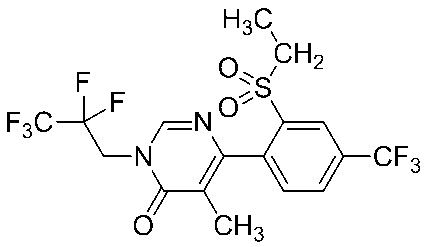

中間体(1-3)に代えて中間体(4-3)を用い、2,2,2-トリフルオロエチル ノナフルオロブタンスルホネートに代えて2,2,3,4,4,4-ヘキサフルオロブチル トリフルオロメタンスルホネートを用いて、製造例1(5)に記載の方法に準じて、本発明化合物5、及び副生成物5を得た。
本発明化合物5
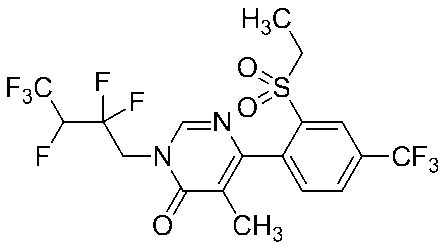


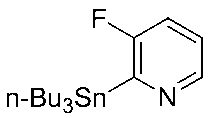


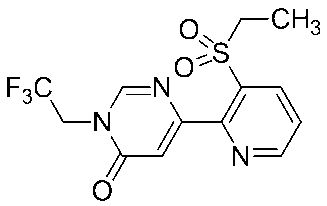
2,2,2-トリフルオロエチル トリフルオロメタンスルホネートの代わりに2,2,3,3,3-ペンタフルオロプロピル トリフルオロメタンスルホネートを用いて、製造例6(7)に記載の方法に準じて、本発明化合物7を得た。

2,2,2-トリフルオロエチル トリフルオロメタンスルホネートの代わりに2,2,3,3-テトラフルオロプロピル トリフルオロメタンスルホネートを用いて、製造例6(7)に記載の方法に準じて、本発明化合物8及び副生成物8を得た。
本発明化合物8


2,2,2-トリフルオロエチル トリフルオロメタンスルホネートの代わりに2,2,3,4,4,4-ヘキサフルオロブチル トリフルオロメタンスルホネートを用いて、製造例6(7)に記載の方法に準じて、本発明化合物9及び副生成物9を得た。
本発明化合物9
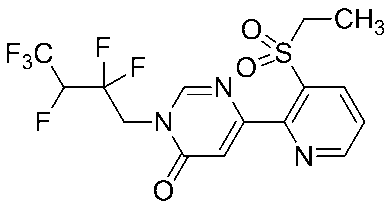

2,2,2-トリフルオロエチル トリフルオロメタンスルホネートの代わりに2,2,3,3,4,4,5,5-オクタフルオロペンチル トリフルオロメタンスルホネートを用いて、製造例6(7)に記載の方法に準じて、本発明化合物10を得た。

2,2,2-トリフルオロエチル トリフルオロメタンスルホネートの代わりに4,4,4-トリフルオロブチルヨージドを用いて、製造例6(7)に記載の方法に準じて、本発明化合物11を得た。


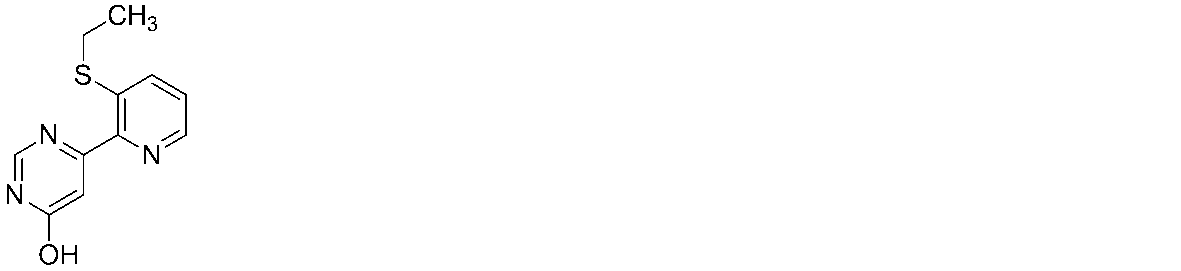




本発明化合物13 2.6gおよびクロロホルム 28mLの混合物に、氷冷下mCPBA(70%)5.3gを加えた。この反応混合物を室温まで昇温後、6時間撹拌した。この反応混合物に、飽和炭酸水素ナトリウム水溶液および亜硫酸ナトリウムを加え、室温で30分間撹拌した。得られた反応混合物をクロロホルムで抽出した。有機層を、飽和炭酸水素ナトリウム水溶液および飽和食塩水で順次洗浄後、有機層を無水硫酸ナトリウムで乾燥した。有機層を減圧下濃縮し、得られた残渣を、シリカゲルクロマトグラフィーに付し、本発明化合物14 2.28gを得た。
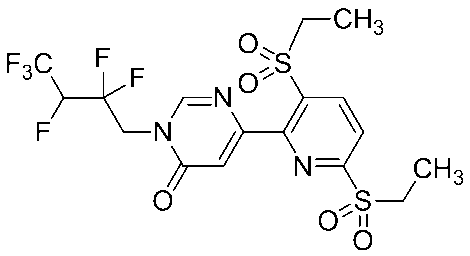
本発明化合物14 300mgおよびDMF 1mLの混合物に、室温下40%ジメチルアミン水溶液 260μLを加えた。この反応混合物を室温下4.5時間撹拌した。この反応混合物に水を加え、酢酸エチルで抽出した。有機層を、水および飽和食塩水で順次洗浄した後、有機層を無水硫酸ナトリウムで乾燥した。有機層を減圧下濃縮し、得られた残渣を、シリカゲルクロマトグラフィーに付し、本発明化合物15 240mgを得た。

本発明化合物14 300mgおよびDMF 1mLの混合物に、室温下ピロリジン 70μLを加えた。この反応混合物を室温下6時間撹拌した。この反応混合物に、水を加え、酢酸エチルで抽出した。有機層を、水および飽和食塩水で順次洗浄し、有機層を無水硫酸ナトリウムで乾燥した。有機層を減圧下濃縮し、得られた残渣を、シリカゲルクロマトグラフィーに付し、本発明化合物16 260mgを得た。

本発明化合物14 300mgおよびDMF 1mLの混合物に、氷冷下28%ナトリウムメトキシド メタノール溶液 122mgを加えた。この反応混合物を室温下6時間撹拌した。この反応混合物に、水を加え、酢酸エチルで抽出した。有機層を、水および飽和食塩水で順次洗浄し、有機層を無水硫酸ナトリウムで乾燥した。有機層を減圧下濃縮し、得られた残渣を、シリカゲルクロマトグラフィーに付し、本発明化合物17 210mgを得た。

本発明化合物14 300mgおよびDMF 1mLの混合物に、氷冷下1H-1,2,4-トリアゾール 44mgおよび水素化ナトリウム(60%、油状)30mgを順次加えた。この反応混合物を室温下6時間撹拌した。この反応混合物に、水を加え、酢酸エチルで抽出した。有機層を、水および飽和食塩水で順次洗浄し、有機層を無水硫酸ナトリウムで乾燥した。有機層を減圧下濃縮し、得られた残渣を、シリカゲルクロマトグラフィーに付し、本発明化合物18 210mgを得た。


1H-NMR (CDCl3) δ: 8.35 (1H, dd), 7.82 (1H, br s), 7.65 (1H, dd), 7.28-7.24 (1H, m), 6.16 (1H, br s), 3.14 (3H, br s), 2.95 (3H, br s), 2.89 (2H, q), 1.37 (3H, t).

本発明化合物20


本発明化合物23


本発明化合物26


本発明化合物14 200mgおよびDMF 1mLの混合物に、2,2,2-トリフルオロエタノール 40μL、及び水素化ナトリウム(60%、油状)18mgを順次加えた。この反応混合物を室温下6時間撹拌した。この反応混合物に、水を加え、酢酸エチルで抽出した。有機層を、水および飽和食塩水で順次洗浄し、有機層を無水硫酸ナトリウムで乾燥した。有機層を減圧下濃縮し、得られた残渣を、シリカゲルクロマトグラフィーに付し、本発明化合物28 160mgを得た。

本発明化合物14 200mgおよびDMF 1mLの混合物に、ジイソプロピルエチルアミン 0.20mL、及び5-アミノメチル-2-クロロチアゾール臭化水素酸塩 180mgを順次加えた。この反応混合物を100℃で加熱下20時間撹拌した。室温まで放冷後、この反応混合物にジイソプロピルエチルアミン 0.20mL、及び5-アミノメチル-2-クロロチアゾール臭化水素酸塩 180mgをさらに加えた。この反応混合物を100℃で加熱下10時間撹拌した。室温まで放冷後、この反応混合物に水を加え、酢酸エチルで抽出した。有機層を、水および飽和食塩水で順次洗浄し、有機層を無水硫酸ナトリウムで乾燥した。有機層を減圧下濃縮し、得られた残渣を、シリカゲルクロマトグラフィーに付し、本発明化合物29 76mgを得た。

1,1,3-トリクロロ-1-プロペンの代わりに、1,1,2-トリフルオロ-4-ブロモ-1-ブテンを用いて、製造例12(7)に記載の方法に準じて、本発明化合物30を得た。
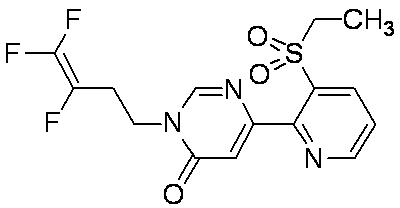
1,1,3-トリクロロ-1-プロペンの代わりに、1,1,1,2,2-ペンタフルオロ-4-ヨードブタンを用いて、製造例12(7)に記載の方法に準じて、本発明化合物31を得た。
1,1,3-トリクロロ-1-プロペンの代わりに、1,1,1,2,2,3,3-ヘプタフルオロ-5-ヨードペンタンを用いて、製造例12(7)に記載の方法に準じて、本発明化合物32を得た。
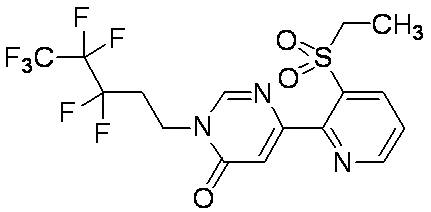
本発明化合物9 1.0gおよびトルエン 6mLの混合物に、2,4-ビス(4-メトキシフェニル)-1,3,2,4-ジチアジホスフェタン-2,4-ジスルフィド 940mgを加えた。この反応混合物を110℃で加熱還流下6時間撹拌した。室温まで放冷後、この反応混合物を減圧下濃縮した。得られた残渣を、シリカゲルクロマトグラフィーに付し、本発明化合物33 1.1gを得た。

40%ジメチルアミン水溶液に代わり28%アンモニア水溶液を用いて、製造例15に記載の方法に準じて、本発明化合物34を得た。


[表14]


[表16]

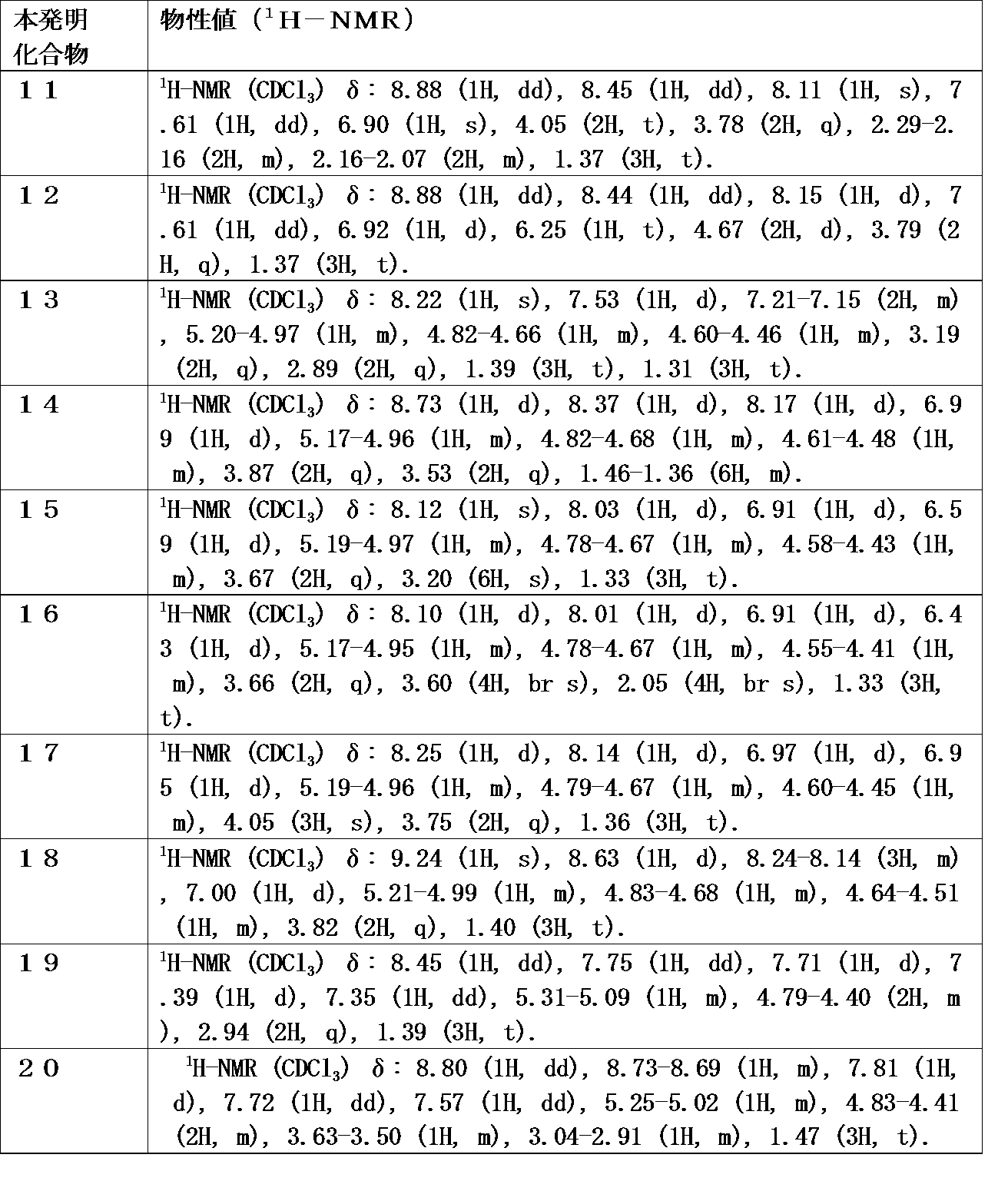
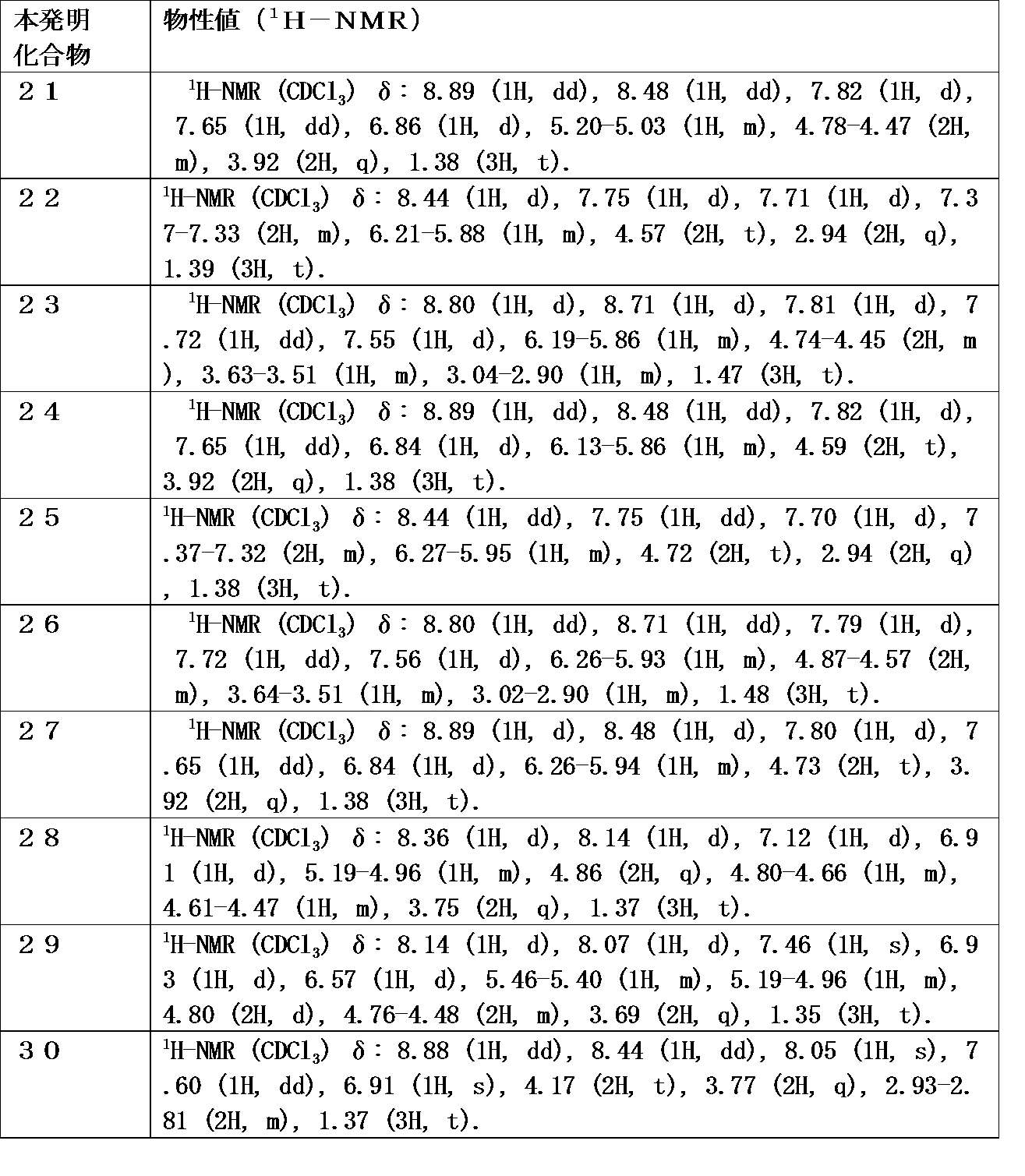

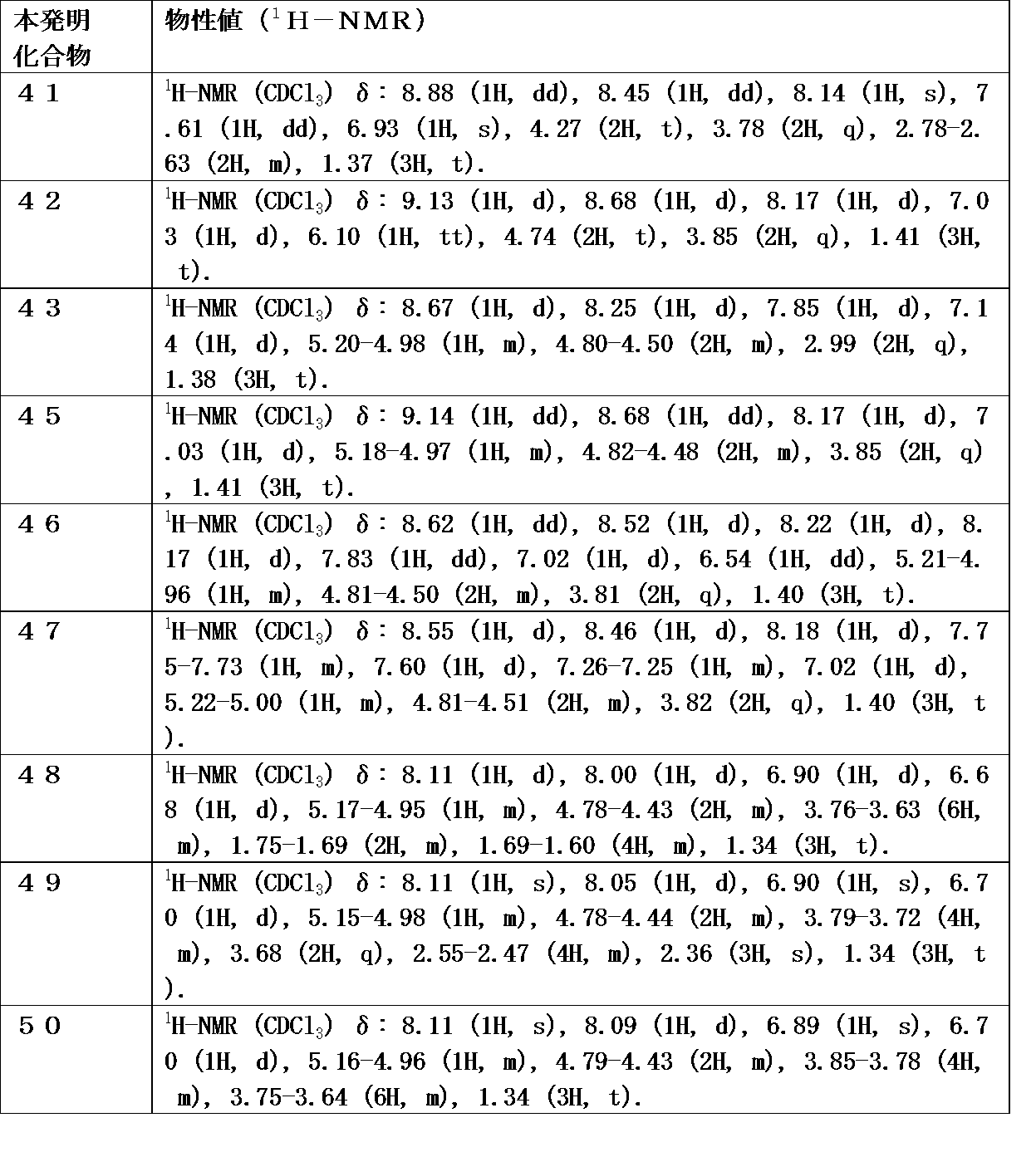

本発明化合物1~57のいずれか1種 10部を、キシレン35部とN,N-ジメチルホルムアミド35部との混合物に溶解し、そこにポリオキシエチレンスチリルフェニルエーテル14部及びドデシルベンゼンスルホン酸カルシウム6部を加え、混合して各々の製剤を得る。
ラウリル硫酸ナトリウム4部、リグニンスルホン酸カルシウム2部、合成含水酸化珪素微粉末20部及び珪藻土54部を混合し、更に本発明化合物1~57のいずれか1種 20部を加え、混合して各々の水和剤を得る。
本発明化合物1~57のいずれか1種 2部に、合成含水酸化珪素微粉末1部、リグニンスルホン酸カルシウム2部、ベントナイト30部及びカオリンクレー65部を加え混合する。ついで、この混合物に適当量の水を加え、さらに攪拌し、造粒機で造粒し、通風乾燥して各々の粒剤を得る。
本発明化合物1~57のいずれか1種 1部を適当量のアセトンに溶解し、これに合成含水酸化珪素微粉末5部、酸性りん酸イソプロピル0.3部及びフバサミクレー93.7部を加え、充分攪拌混合し、アセトンを蒸発除去して各々の粉剤を得る。
ポリオキシエチレンアルキルエーテルサルフェートアンモニウム塩及びホワイトカーボンの混合物(重量比1:1)35部と、本発明化合物1~57のいずれか1種 10部と、水55部とを混合し、湿式粉砕法で微粉砕することにより、各々のフロアブル剤を得る。
本発明化合物1~57のいずれか1種 0.1部をキシレン5部及びトリクロロエタン5部の混合物に溶解し、これを脱臭灯油89.9部に混合して各々の油剤を得る。
本発明化合物1~57のいずれか1種 10mgをアセトン0.5mlに溶解し、この溶液を、動物用固形飼料粉末(飼育繁殖用固形飼料粉末CE-2、日本クレア株式会社商品)5gに滴下し、均一に混合する。ついでアセトンを蒸発乾燥させて各々の毒餌剤を得る。
本発明化合物1~57のいずれか1種 0.1部、ネオチオゾール(中央化成株式会社製)49.9部をエアゾール缶に入れ、エアゾールバルブを装着した後、ジメチルエーテル25部、LPG25部を充填し振とうを加え、アクチュエータを装着することで油剤エアゾールを得る。
本発明化合物1~57のいずれか1種 0.6部、BHT(2,6-ジ-tert-ブチル-4-メチルフェノール)0.01部、キシレン5部、脱臭灯油3.39部及び乳化剤{レオドールMO-60(花王株式会社製)}1部を混合したものと、蒸留水50部とをエアゾール容器に充填し、バルブを装着した後、該バルブを通じて噴射剤(LPG)40部を加圧充填して水性エアゾールを得る。
本発明化合1~57のいずれか1種 0.1gを、プロピレングリコール2mlに混合し、4.0×4.0cm、厚さ1.2cmの多孔セラミック板に含浸させて、加熱式くん煙剤を得る。
本発明化合物1~57のいずれか1種 5部とエチレンーメタクリル酸メチル共重合体(共重合体中のメタクリル酸メチルの割合:10重量%、アクリフト(登録商標)WD301、住友化学製)95部を密閉式加圧ニーダー(森山製作所製)で溶融混練し、得られた混練物を押出し成型機から成型ダイスを介して押出し、長さ15cm、直径3mmの棒状成型体を得る。
本発明化合物1~57のいずれか1種 5部と軟質塩化ビニル樹脂95部を密閉式加圧ニーダー(森山製作所製)で溶融混練し、得られた混練物を押出し成型機から成型ダイスを介して押出し、長さ15cm、直径3mmの棒状成型体を得る。
本発明化合物1~57のいずれか1種 100mg、ラクトース68.75mg、トウモロコシデンプン237.5mg、微結晶性セルロース43.75mg、ポリビニルピロリドン18.75mg、ナトリウムカルボキシメチルデンプン28.75mg、及びステアリン酸マグネシウム2.5mgを混合し、得られた混合物を適切な大きさに圧縮して、錠剤を得る。
本発明化合物1~57のいずれか1種 25mg、ラクトース60mg、トウモロコシデンプン25mg、カルメロースカルシウム6mg、及び5%ヒドロキシプロピルメチルセルロース適量を混合し、得られた混合物をハードシェルゼラチンカプセル又はヒドロキシプロピルメチルセルロースカプセルに充填し、カプセル剤を得る。
本発明化合物1~57のいずれか1種 100mg、フマル酸500mg、塩化ナトリウム2000mg、メチルパラベン150mg、プロピルパラベン50mg、顆粒糖25000mg、ソルビトール(70%溶液)13000mg、VeegumK(VanderbiltCo.)100mg、香料35mg、及び着色料500mgに、最終容量が100mlとなるよう蒸留水を加え、混合して、経口投与用サスペンジョンを得る。
本発明化合物1~57のいずれか1種 5重量%を、ポリソルベート85 5重量%、ベンジルアルコール3重量%、及びプロピレングリコール30重量%に溶解し、この溶液のpHが6.0~6.5となるようにリン酸塩緩衝液を加えた後、残部として水を加えて、経口投与用液剤を得る。
分留ヤシ油57重量%およびポリソルベート85 3重量%中にジステアリン酸アルミニウム5重量%を加え、加熱により分散させる。これを室温に冷却し、その油状ビヒクル中にサッカリン25重量%を分散させる。これに本発明化合物1~57のいずれか1種 10重量%を配分し、経口投与用ペースト状製剤を得る。
本発明化合物1~57のいずれか1種 5重量%を石灰石粉95重量%と混合し、湿潤顆粒形成法を使用して経口投与用粒剤を得る。
本発明化合物1~57のいずれか1種 5部をジエチレングリコールモノエチルエーテル80部に溶解し、これに炭酸プロピレン15部を混合して、スポットオン液剤を得る。
本発明化合物1~57のいずれか1種 10部をジエチレングリコールモノエチルエーテル70部に溶解し、これに2-オクチルドデカノール20部を混合して、ポアオン液剤を得る。
本発明化合物1~57のいずれか1種 0.5部に、ニッコール(登録商標)TEALS-42(日光ケミカルズ・ラウリル硫酸トリエタノールアミンの42%水溶液)60部、プロピレングリコール20部を添加し、均一溶液になるまで充分撹拌混合した後、水19.5部を加えてさらに充分撹拌混合し、均一溶液のシャンプー剤を得る。
本発明化合物1~57のいずれか1種 0.15重量%、動物飼料95重量%、並びに、第2リン酸カルシウム、珪藻土、Aerosil、及びカーボネート(又はチョーク)からなる混合物4.85重量%を十分攪拌混合し、動物用飼料プレミックスを得る。
本発明化合物1~57のいずれか1種 7.2g、及びホスコ(登録商標)S-55(丸石製薬株式会社製)92.8gを100℃で溶解混和し、坐剤形に注いで、冷却固化して、坐剤を得る。
製剤例5により得られた本発明化合物1、2、3、9、15、16、17、18、21、26、27、及び33の各々の製剤を、各々有効成分濃度が500ppmとなるように水で希釈し、試験用薬液を調製した。
一方、プラスチックカップに植えたキュウリ幼苗(第1本葉展開期)にワタアブラムシ(Aphis gossypii)(全ステージ)約30頭を接種し、1日間放置した。この幼苗に、前記試験用薬液を各々20ml散布した。
散布6日後に該キュウリの葉上に寄生したワタアブラムシ生存虫数を調査し、以下の式により防除価を求めた。
防除価(%)={1-(Cb×Tai)/(Cai×Tb)}×100
なお、式中の文字は以下の意味を表す。
Cb:無処理区の処理前の虫数
Cai:無処理区の調査時の寄生生存虫数
Tb:処理区の処理前の虫数
Tai:処理区の調査時の寄生生存虫数
ここで無処理区とは、製剤例5において本発明化合物を含まない製剤を、処理区と同量の水で希釈した試験用薬液を散布した区を意味する。
その結果、本発明化合物1、2、3、9、15、16、17、18、21、26、27、又は33の試験用薬液を用いた処理区はいずれも、防除価90%以上であった。
製剤例5により得られた本発明化合物1、2、3、6、7、8、9、10、11、12,14、29、31、32、33、34、36、37、38、40、42、45、46、47、53、54、又は57の各々の製剤を、各々有効成分濃度が200ppmとなるように水で希釈し、試験用薬液を調製した。
一方、プラスチックカップに植えたキュウリ幼苗(第1本葉展開期)にワタアブラムシ(Aphis gossypii)(全ステージ)約30頭を接種し、1日間放置した。この幼苗に、前記試験用薬液を各々20mlを散布した。
散布6日後に該キュウリの葉上に寄生したワタアブラムシ生存虫数を調査し、以下の式により防除価を求めた。
防除価(%)={1-(Cb×Tai)/(Cai×Tb)}×100
なお、式中の文字は以下の意味を表す。
Cb:無処理区の処理前の虫数
Cai:無処理区の調査時の寄生生存虫数
Tb:処理区の処理前の虫数
Tai:処理区の調査時の寄生生存虫数
ここで無処理区とは、製剤例5において本発明化合物を含まない製剤を、処理区と同量の水で希釈した試験用薬液を散布した区を意味する。
その結果、本発明化合物1、2、3、6、7、8、9、10、11、12,14、29、31、32、33、34、36、37、38、40、42、45、46、47、53、54、又は57の試験用薬液を用いた処理区はいずれも、防除価90%以上であった。
製剤例5により得られた本発明化合物3,4,6,7、8、9、10、31、32、33、34、36、37、38、40、又は45の各々の製剤を、各々有効成分濃度が200ppmとなるように水で希釈し、試験用薬液を調製した。
一方、プラスチックカップに植えたキュウリ幼苗(第2本葉展開期)に、前記試験用薬液を各々5ml株元潅注し、7日間25℃温室内に保った。ワタアブラムシ(Aphis gossypii)(全ステージ)約30頭をキュウリ葉面に接種し、更に6日該温室内に保った後に、該キュウリの葉上に寄生したワタアブラムシ生存虫数を調査し、以下の式により防除価を求めた。
防除価(%)={1-(Cb×Tai)/(Cai×Tb)}×100
なお、式中の文字は以下の意味を表す。
Cb:無処理区の処理前の虫数
Cai:無処理区の調査時の寄生生存虫数
Tb:処理区の処理前の虫数
Tai:処理区の調査時の寄生生存虫数
ここで無処理区とは、製剤例5において本発明化合物を含まない製剤を、処理区と同量の水で希釈した試験用薬液を散布した区を意味する。
その結果、本発明化合物本発明化合物3,4,6,7、8、9、10、31、32、33、34、36、37、38、40、又は45の試験用薬液を用いた処理区はいずれも、防除価90%以上であった。
製剤例5により得られた本発明化合物9又は15の各々の製剤を、各々有効成分濃度が500ppmとなるように水で希釈し、試験用薬液を調製した。
ポリエチレンカップに植えた第2葉展開期のイネ幼苗に、前記試験用薬液を各々10ml散布した。風乾後、トビイロウンカ(Nilaparvata lugens)の3~4齢幼虫を20頭放して、25℃の温室内に保管する。6日後イネに寄生したトビイロウンカの生存虫数を調査し、以下の式により防除価を求めた。
防除価(%)={1-(Cb×Tai)/(Cai×Tb)}×100
なお、式中の文字は以下の意味を表す。
Cb:無処理区の処理前の虫数
Cai:無処理区の調査時の寄生生存虫数
Tb:処理区の処理前の虫数
Tai:処理区の調査時の寄生生存虫数
ここで無処理区とは、製剤例5において本発明化合物を含まない製剤を、処理区と同量の水で希釈した試験用薬液を散布した区を意味する。
その結果、本発明化合物9又は15の試験用薬液を用いた処理区はいずれも、防除価90%以上であった。
製剤例5により得られた本発明化合物7、8、9、10、11、12、29、31、32、33、34、37、38、40、又は47の各々の製剤を、各々有効成分濃度が200ppmとなるように水で希釈し、試験用薬液を調製した。
ポリエチレンカップに植えた第2葉展開期のイネ幼苗に、前記試験用薬液を各々10ml散布した。風乾後、トビイロウンカ(Nilaparvata lugens)の3~4齢幼虫を20頭放して、25℃の温室内に保管する。6日後イネに寄生したトビイロウンカの生存虫数を調査し、以下の式により防除価を求めた。
防除価(%)={1-(Cb×Tai)/(Cai×Tb)}×100
なお、式中の文字は以下の意味を表す。
Cb:無処理区の処理前の虫数
Cai:無処理区の調査時の寄生生存虫数
Tb:処理区の処理前の虫数
Tai:処理区の調査時の寄生生存虫数
ここで無処理区とは、製剤例5において本発明化合物を含まない製剤を、処理区と同量の水で希釈した試験用薬液を散布した区を意味する。
その結果、本発明化合物7、8、9、10、11、12、29、31、32、33、34、37、38、40、又は47の試験用薬液を用いた処理区はいずれも、防除価90%以上であった。
製剤例5により得られた本発明化合物1,2,4,7、8、9、10、11、31、32、34、36、38、又は45の各々の製剤を、各々有効成分濃度が200ppmとなるように水で希釈し、試験用薬液を調製した。
一方、プラスチックカップに植えたイネ幼苗(播種2週間後、第2葉展開期)に、前記試験用薬液を各々5ml株元潅注し、7日間25℃温室内に保った。トビイロウンカ(Nilaparvata lugens)の3~4齢幼虫を20頭放して、更に6日該温室内に保った後に、該イネの葉上に寄生したトビイロウンカ生存虫数を調査し、以下の式により防除価を求めた。
防除価(%)={1-(Cb×Tai)/(Cai×Tb)}×100
なお、式中の文字は以下の意味を表す。
Cb:無処理区の処理前の虫数
Cai:無処理区の調査時の寄生生存虫数
Tb:処理区の処理前の虫数
Tai:処理区の調査時の寄生生存虫数
ここで無処理区とは、製剤例5において本発明化合物を含まない製剤を、処理区と同量の水で希釈した試験用薬液を散布した区を意味する。
その結果、本発明化合物1,2,4,7、8、9、10、11、31、32、34、36、38、又は45の試験用薬液を用いた処理区はいずれも、防除価90%以上であった。
製剤例5により得られた本発明化合物1、2、18、26、又は27の各々の製剤を、各々有効成分濃度が500ppmとなるように水で希釈し、試験用薬液を調製した。
一方、ポリエチレンカップに植えた3葉期キャベツに、前記試験用薬液を各々20mL/カップの割合で散布した。薬液が乾いた後、茎葉部を切り取って50mLカップに収容し、コナガ(Plutella xylostella)2令幼虫5頭を放ち、蓋をした。25℃で保管し、5日後に死亡虫数を数え、次式より死虫率を求めた。
死虫率(%)=(死亡虫数/供試虫数)×100
その結果、本発明化合物1、2、18、26、又は27の試験用薬液を用いた処理区はいずれも、死虫率80%以上であった。
製剤例5により得られた本発明化合物1、2、3、4、5、10、12、28、31、32、36、38、41、42、43、又は45の各々の製剤を、各々有効成分濃度が200ppmとなるように水で希釈し、試験用薬液を調製した。
一方、ポリエチレンカップに植えた3葉期キャベツに、前記試験用薬液を各々20mL/カップの割合で散布した。薬液が乾いた後、茎葉部を切り取って50mLカップに収容し、コナガ(Plutella xylostella)2令幼虫5頭を放ち、蓋をした。25℃で保管し、5日後に死亡虫数を数え、次式より死虫率を求めた。
死虫率(%)=(死亡虫数/供試虫数)×100
その結果、本発明化合物1、2、3、4、5、10、12、28、31、32、36、38、41、42、43、又は45の試験用薬液を用いた処理区はいずれも、死虫率80%以上であった。
製剤例5により得られた本発明化合物18の製剤を、有効成分濃度が500ppmとなるように水で希釈し、試験用薬液を調製した。
直径5.5cmのポリエチレンカップの底に同大の濾紙を敷き、上記試験用薬液0.7mlを濾紙上に滴下し、餌としてショ糖30mgを均一に入れた。該ポリエチレンカップ内にイエバエ(Musca domestica)雌成虫10頭を放ち、蓋をした。24時間後にイエバエの生死を調査し死亡虫数を数え、次式により死虫率を求めた。
死虫率(%)=(死亡虫数/供試虫数)×100
その結果、本発明化合物18の試験用薬液を用いた処理区は、死虫率100%であった。
製剤例5により得られた本発明化合物18の製剤を、有効成分濃度が500ppmとなるように水で希釈し、試験用薬液を調製した。
直径5.5cmのポリエチレンカップの底に同大の濾紙を敷き、上記試験用薬液0.7mlを濾紙上に滴下し、餌としてショ糖30mgを均一に入れた。該ポリエチレンカップ内にチャバネゴキブリ(Blattella germanica)雄成虫2頭を放ち、蓋をした。6日後にチャバネゴキブリの生死を調査し死亡虫数を数え、次式により死虫率を求めた。
死虫率(%)=(死亡虫数/供試虫数)×100
その結果、本発明化合物18の試験用薬液を用いた処理区は、死虫率100%であった。
製剤例5により得られた本発明化合物2、15、16、17、又は18の各々の製剤を、各々有効成分濃度が500ppmとなるように水で希釈し、試験用薬液を調製した。
上記試験用薬液0.7mlを各々イオン交換水100mlに加えた(有効成分濃度3.5ppm)。上記試験用薬液各々にアカイエカ(Culex pipiens pallens)終令幼虫20頭を放ち、1日後にその生死を調査し死亡虫数を数え、死虫率を求めた。
死虫率(%)=(死亡虫数/供試虫数)×100
その結果、本発明化合物2、15、16、17、又は18の試験用薬液を用いた処理区はいずれも、死虫率95%以上であった。
製剤例1により得られた本発明化合物2、3、4、9、10、15、16、17、24、26、29、31、32、33、34、36、38、41、42、43、又は45の製剤を、各々有効成分濃度が50ppmとなるように水で希釈し、試験用薬液を調整した。
一方、ポリエチレンカップに植えた3葉期キュウリに、上記試験用薬液を各々30mL/カップの割合で散布した。薬液が乾いた後、第2葉を切り取って200mLカップに収容し、ウリハムシ(Aulacophora femoralis)2令幼虫10頭を放ち、蓋をした。25℃で保管し、5日後に死亡虫数を数え、次式により死虫率を求めた。
死虫率(%)=(死亡虫数/供試虫数)×100
その結果、本発明化合物2、3、4、9、10、15、16、17、24、26、29、31、32、33、34、36、38、41、42、43、又は45の試験用薬液を用いた処理区はいずれも、死虫率80%以上であった。
Claims (7)
- [1] 式(1)
[式中、
A1は、窒素原子、又はCR4を表し、
A2及びA3は、A2が窒素原子を表しA3がCR3bを表すか、又はA2がCR3aを表しA3が窒素原子を表し、
Qは、酸素原子、又は硫黄原子を表し、
Gは、C2-C10ハロアルキル基、C3-C10ハロアルケニル基、C3-C10ハロアルキニル基、1以上のハロゲン原子を有する(C1-C5アルキル)-O-(C2-C5アルキル)基、1以上のハロゲン原子を有する(C3-C5アルケニル)-O-(C2-C5アルキル)基、1以上のハロゲン原子を有する(C3-C5アルキニル)-O-(C2-C5アルキル)基、1以上のハロゲン原子を有する(C1-C5アルキル)-S(O)m-(C2-C5アルキル)基、1以上のハロゲン原子を有する(C3-C5アルケニル)-S(O)m-(C2-C5アルキル)基、1以上のハロゲン原子を有する(C3-C5アルキニル)-S(O)m-(C2-C5アルキル)基、又は1以上のハロゲン原子を有する(C1-C5アルキル)-C(O)-(C1-C5アルキル)基を表し、
R1は、1以上のハロゲン原子を有していてもよいC1-C6鎖式炭化水素基表し、
R2は、1以上のハロゲン原子を有していてもよいC1-C6鎖式炭化水素基、群Aより選ばれる1以上の原子もしくは基を有していてもよいフェニル基、群Bより選ばれるいずれかの5員芳香族複素環基(該5員芳香族複素環基は、群Aより選ばれる1以上の原子または基を有していてもよい。)、群Cより選ばれるいずれかの6員芳香族複素環基(該6員芳香族複素環基は、群Aより選ばれる1以上の原子または基を有していてもよい。)、群Dより選ばれるいずれかの3-7員非芳香族複素環基(該3-7員非芳香族複素環基は、ハロゲン原子及びC1-C6アルキル基からなる群より選ばれる1以上の原子または基を有していてもよい。)、OR7、NR8R9、NR8C(O)R10、NR8C(O)OR11、NR8C(O)NR12R13、N=CHNR12R13、N=S(O)xR12R13、S(O)yR12、C(O)OR8、シアノ基、又はハロゲン原子を表し、
R4は、水素原子、又はハロゲン原子を表し、
R3、R3a及びR3bは、それぞれ独立して水素原子、1以上のハロゲン原子を有していてもよいC1-C3アルキル基、又はハロゲン原子を表し、
R7は、水素原子、1以上のハロゲン原子を有していてもよいC1-C6アルキル基、1以上のハロゲン原子を有していてもよいC3-C6アルケニル基、1以上のハロゲン原子を有していてもよいC3-C6アルキニル基、1以上のハロゲン原子を有していてもよい(C1-C3アルキル)-O-(C1-C3アルキル)基、1以上のハロゲン原子を有していてもよい(C1-C3アルキル)-S(O)y-(C1-C3アルキル)基、1以上のハロゲン原子を有していてもよいC3-C7シクロアルキル基、1以上のハロゲン原子を有していてもよい(C3-C7シクロアルキル)-(C1-C3アルキル)基、又はフェニルC1-C3アルキル基(該フェニルC1-C3アルキル基のフェニル部分は群Aより選ばれる1以上の原子または基を有していてもよい。)を表し、
R8は、水素原子、1以上のハロゲン原子を有していてもよいC1-C6アルキル基、1以上のハロゲン原子を有していてもよいC3-C6アルケニル基、又は1以上のハロゲン原子を有していてもよいC3-C6アルキニル基を表し、
R9は、水素原子、1以上のハロゲン原子を有していてもよいC1-C6アルキル基、1以上のハロゲン原子を有していてもよいC3-C6アルケニル基、1以上のハロゲン原子を有していてもよいC3-C6アルキニル基、1以上のハロゲン原子を有していてもよい(C1-C3アルキル)-O-(C1-C3アルキル)基、1以上のハロゲン原子を有していてもよい(C1-C3アルキル)-S(O)y-(C1-C3アルキル)基、1以上のハロゲン原子を有していてもよいC3-C7シクロアルキル基、1以上のハロゲン原子を有していてもよい(C3-C7シクロアルキル)-(C1-C3アルキル)基、1のシアノ基を有するC1-C6アルキル基、フェニルC1-C3アルキル基(該フェニルC1-C3アルキル基のフェニル部分は群Aより選ばれる1以上の原子または基を有していてもよい。)、又は(5もしくは6員ヘテロアリール)C1-C6アルキル基(該(5もしくは6員ヘテロアリール)C1-C6アルキル基の5もしくは6員ヘテロアリール部分は群Aより選ばれる1以上の原子もしくは基を有していてもよい。)を表し、
R10は、水素原子、1以上のハロゲン原子を有していてもよいC1-C6アルキル基、1以上のハロゲン原子を有していてもよいC3-C6アルケニル基、1以上のハロゲン原子を有していてもよいC3-C6アルキニル基、1以上のハロゲン原子を有していてもよいC3-C7シクロアルキル基、1以上のハロゲン原子を有していてもよい(C3-C7シクロアルキル)-(C1-C3アルキル)基、又はフェニルC1-C3アルキル基(該フェニルC1-C3アルキル基のフェニル部分は群Aより選ばれる1以上の原子または基を有していてもよい。)を表し、
R11は、1以上のハロゲン原子を有していてもよいC1-C6アルキル基、1以上のハロゲン原子を有していてもよいC3-C6アルケニル基、1以上のハロゲン原子を有していてもよいC3-C6アルキニル基、1以上のハロゲン原子を有していてもよいC3-C7シクロアルキル基、1以上のハロゲン原子を有していてもよい(C3-C7シクロアルキル)-(C1-C3アルキル)基、又はフェニルC1-C3アルキル基(該フェニルC1-C3アルキル基のフェニル部分は群Aより選ばれる1以上の原子または基を有していてもよい。)を表し、
R12及びR13は、それぞれ独立して、1以上のハロゲン原子を有していてもよいC1-C6アルキル基を表し、
R14は、水素原子、1以上のハロゲン原子を有していてもよいC1-C6アルキル基、1以上のハロゲン原子を有していてもよいC2-C6アルキルカルボニル基、又は1以上のハロゲン原子を有していてもよいC2-C6アルコキシカルボニル基を表し、
nは、0、1、又は2を表し、
mは、0、1、又は2を表し、
pは、0、1、2又は3を表し(ここで、pが2、又は3を表す場合には、R2は各々同一でも異なっていてもよい)、
xは、0、又は1を表し、
yは、0、1、又は2を表す。
群A:1以上のハロゲン原子を有していてもよいC1-C6アルキル基、1以上のハロゲン原子を有していてもよいC1-C6アルコキシ基、1以上のハロゲン原子を有していてもよいC1-C6アルキルスルファニル基、1以上のハロゲン原子を有していてもよいC1-C6アルキルスルフィニル基、1以上のハロゲン原子を有していてもよいC1-C6アルキルスルホニル基、シアノ基、及びハロゲン原子からなる群。
群B:
群C:
群D:
]で示されるピリミジノン化合物(以下、式(1)で示されるピリミジノン化合物を本発明化合物と記す)。
- A2が窒素原子であり、A3がCR3bである請求項1記載の化合物。
- A2がCR3aであり、A3が窒素原子である請求項1記載の化合物。
- Gが、C2-C10ハロアルキル基、又はC3-C10ハロアルケニル基であり、
R1が、1以上のハロゲン原子を有していてもよいC1-C6アルキル基であり、
R2が、1以上のハロゲン原子を有していてもよいC1-C6アルキル基、基B-1~基B-4からなる群より選ばれるいずれかの5員芳香族複素環基(但し、該5員芳香族複素環基は1以上のハロゲン原子を有していてもよい)、基D-1~基D-8からなる群より選ばれいずれかの非芳香族複素環基(但し、該非芳香族複素環基は1以上のハロゲン原子を有していてもよい)、1以上のハロゲン原子を有していてもよいC1-C6アルコキシ基、1以上のハロゲン原子を有していてもよいC1-C6アルキルスルファニル基、1以上のハロゲン原子を有していてもよいC1-C6アルキルスルフィニル基、1以上のハロゲン原子を有していてもよいC1-C6アルキルスルホニル基、1以上のハロゲン原子を有していてもよいジ(C1-C6アルキル)アミノ基、(C1-C6アルキル)アミノ基(但し、該(C1-C6アルキル)アミノ基のC1-C6アルキル部分は、1以上のハロゲン原子、及び1以上のハロゲン原子を有していてもよい5員芳香族複素環基からなる群より選ばれる1以上の原子または基を有していてもよい)、又はアミノ基であり、
R3、R3a、R3b、及びR4が水素原子であり、
pが0又は1である請求項1~請求項3いずれかに記載の化合物。 - Gが、3以上のフッ素原子を有するC3-C6アルキル基であり、R1がエチル基であり、R2が1以上のハロゲン原子を有していてもよいC1-C6アルキル基、基B-1~基B-4からなる群より選ばれるいずれかの5員芳香族複素環基(但し、該5員芳香族複素環基は1以上のハロゲン原子を有していてもよい)、基D-1~基D-8からなる群より選ばれいずれかの非芳香族複素環基(但し、該非芳香族複素環基は1以上のハロゲン原子を有していてもよい)、1以上のハロゲン原子を有していてもよいジ(C1-C6アルキル)アミノ基、(C1-C6アルキル)アミノ基(但し、該(C1-C6アルキル)アミノ基のC1-C6アルキル部分は、1以上のハロゲン原子、及び1以上のハロゲン原子を有していてもよい5員芳香族複素環基からなる群より選ばれる1以上の原子または基を有していてもよい)、又はアミノ基であり、
R3、R3a、R3b、及びR4が水素原子であり、
pが0又は1である請求項1~請求項3いずれかに記載の化合物。 - 請求項1~請求項5いずれかに記載の化合物と、不活性担体とを含有する有害節足動物防除組成物。
- 請求項1~請求項5いずれかに記載の化合物の有効量を有害節足動物又は有害節足動物の生息場所に施用する有害節足動物の防除方法。
Priority Applications (5)
| Application Number | Priority Date | Filing Date | Title |
|---|---|---|---|
| US15/515,868 US9802930B1 (en) | 2014-10-03 | 2015-09-18 | Pyrimidinone compound |
| EP15845856.2A EP3202762B1 (en) | 2014-10-03 | 2015-09-18 | Pyrimidinone compound |
| JP2016551934A JP6540708B2 (ja) | 2014-10-03 | 2015-09-18 | ピリミジノン化合物 |
| BR112017006430-8A BR112017006430B1 (pt) | 2014-10-03 | 2015-09-18 | Composto pirimidinona, seu uso, composição que o compreende e método para controle de um artrópode prejudicial |
| CN201580053596.4A CN107074781B (zh) | 2014-10-03 | 2015-09-18 | 嘧啶酮化合物 |
Applications Claiming Priority (2)
| Application Number | Priority Date | Filing Date | Title |
|---|---|---|---|
| JP2014204514 | 2014-10-03 | ||
| JP2014-204514 | 2014-10-03 |
Publications (1)
| Publication Number | Publication Date |
|---|---|
| WO2016052247A1 true WO2016052247A1 (ja) | 2016-04-07 |
Family
ID=55630287
Family Applications (1)
| Application Number | Title | Priority Date | Filing Date |
|---|---|---|---|
| PCT/JP2015/076611 Ceased WO2016052247A1 (ja) | 2014-10-03 | 2015-09-18 | ピリミジノン化合物 |
Country Status (6)
| Country | Link |
|---|---|
| US (1) | US9802930B1 (ja) |
| EP (1) | EP3202762B1 (ja) |
| JP (1) | JP6540708B2 (ja) |
| CN (1) | CN107074781B (ja) |
| BR (1) | BR112017006430B1 (ja) |
| WO (1) | WO2016052247A1 (ja) |
Cited By (14)
| Publication number | Priority date | Publication date | Assignee | Title |
|---|---|---|---|---|
| WO2017077911A1 (ja) * | 2015-11-02 | 2017-05-11 | 住友化学株式会社 | ピリミジン化合物 |
| WO2017090654A1 (ja) * | 2015-11-26 | 2017-06-01 | 住友化学株式会社 | 有害生物防除組成物およびその用途 |
| WO2018008727A1 (ja) * | 2016-07-07 | 2018-01-11 | 住友化学株式会社 | 複素環化合物及びそれを含有する有害節足動物防除剤 |
| WO2018221720A1 (ja) * | 2017-06-01 | 2018-12-06 | 住友化学株式会社 | 複素環化合物及びそれを含有する組成物 |
| WO2018225816A1 (ja) * | 2017-06-07 | 2018-12-13 | 三井化学アグロ株式会社 | 含窒素複素環化合物ならびにそれを有効成分とする農園芸用殺菌剤 |
| WO2019065570A1 (ja) | 2017-09-26 | 2019-04-04 | 住友化学株式会社 | 複素環化合物及びそれを含有する有害節足動物防除剤 |
| WO2019234160A1 (en) | 2018-06-06 | 2019-12-12 | Syngenta Crop Protection Ag | Pesticidally active heterocyclic derivatives with sulfur containing substituents |
| WO2020174096A1 (en) | 2019-02-28 | 2020-09-03 | Syngenta Crop Protection Ag | Pesticidally active heterocyclic derivatives with sulfur containing substituents |
| JPWO2019124548A1 (ja) * | 2017-12-22 | 2021-01-14 | 住友化学株式会社 | 複素環化合物及びそれを含有する有害節足動物防除剤 |
| US11155849B2 (en) | 2017-12-15 | 2021-10-26 | Cj Cheiljedang Corporation | IMP-producing microorganism and method of producing IMP using the same |
| US11180754B2 (en) | 2017-12-15 | 2021-11-23 | Cj Cheiljedang Corporation | Polypeptide and method of producing IMP using the same |
| US11299521B2 (en) | 2017-12-15 | 2022-04-12 | Cj Cheiljedang Corporation | Polypeptide and method of producing IMP using the same |
| US11384124B2 (en) | 2018-01-04 | 2022-07-12 | Cj Cheiljedang Corporation | Polypeptide and method of producing IMP using the same |
| WO2024189139A1 (en) | 2023-03-14 | 2024-09-19 | Syngenta Crop Protection Ag | Control of pests resistant to insecticides |
Citations (4)
| Publication number | Priority date | Publication date | Assignee | Title |
|---|---|---|---|---|
| JPH06220023A (ja) * | 1993-01-22 | 1994-08-09 | Nippon Soda Co Ltd | 含窒素複素環誘導体、その製法及び有害生物防除剤 |
| WO2000029387A1 (en) * | 1998-11-12 | 2000-05-25 | Sagami Chemical Research Center | 2-anilino-4(3h)-pyrimidinone derivatives, intermediates in the production thereof, process for producing the same and pesticides containing the same as the active ingredient |
| WO2001068613A1 (en) * | 2000-03-17 | 2001-09-20 | Nissan Chemical Industries, Ltd. | Pyrimidinone derivatives and herbicides |
| WO2010093595A1 (en) * | 2009-02-10 | 2010-08-19 | E. I. Du Pont De Nemours And Company | Fungicidal 2-pyridones |
Family Cites Families (3)
| Publication number | Priority date | Publication date | Assignee | Title |
|---|---|---|---|---|
| EP0225854A1 (de) * | 1985-12-12 | 1987-06-16 | Ciba-Geigy Ag | Substituierte Oxadiazinone als Schädlingsbekämpfungsmittel |
| DE69104071T2 (de) * | 1990-01-18 | 1995-05-11 | Nissan Chemical Ind Ltd | Uracilderivate und Pestizide, die diese als wirksame Stoffe enthalten. |
| JPH0543555A (ja) * | 1991-08-13 | 1993-02-23 | Nissan Chem Ind Ltd | ウラシル誘導体及び有害生物防除剤 |
-
2015
- 2015-09-18 CN CN201580053596.4A patent/CN107074781B/zh active Active
- 2015-09-18 JP JP2016551934A patent/JP6540708B2/ja active Active
- 2015-09-18 US US15/515,868 patent/US9802930B1/en active Active
- 2015-09-18 BR BR112017006430-8A patent/BR112017006430B1/pt active IP Right Grant
- 2015-09-18 EP EP15845856.2A patent/EP3202762B1/en active Active
- 2015-09-18 WO PCT/JP2015/076611 patent/WO2016052247A1/ja not_active Ceased
Patent Citations (4)
| Publication number | Priority date | Publication date | Assignee | Title |
|---|---|---|---|---|
| JPH06220023A (ja) * | 1993-01-22 | 1994-08-09 | Nippon Soda Co Ltd | 含窒素複素環誘導体、その製法及び有害生物防除剤 |
| WO2000029387A1 (en) * | 1998-11-12 | 2000-05-25 | Sagami Chemical Research Center | 2-anilino-4(3h)-pyrimidinone derivatives, intermediates in the production thereof, process for producing the same and pesticides containing the same as the active ingredient |
| WO2001068613A1 (en) * | 2000-03-17 | 2001-09-20 | Nissan Chemical Industries, Ltd. | Pyrimidinone derivatives and herbicides |
| WO2010093595A1 (en) * | 2009-02-10 | 2010-08-19 | E. I. Du Pont De Nemours And Company | Fungicidal 2-pyridones |
Cited By (40)
| Publication number | Priority date | Publication date | Assignee | Title |
|---|---|---|---|---|
| US10645929B2 (en) | 2015-11-02 | 2020-05-12 | Sumitomo Chemical Company, Limited | Pyrimidine compound |
| WO2017077911A1 (ja) * | 2015-11-02 | 2017-05-11 | 住友化学株式会社 | ピリミジン化合物 |
| WO2017090654A1 (ja) * | 2015-11-26 | 2017-06-01 | 住友化学株式会社 | 有害生物防除組成物およびその用途 |
| WO2018008727A1 (ja) * | 2016-07-07 | 2018-01-11 | 住友化学株式会社 | 複素環化合物及びそれを含有する有害節足動物防除剤 |
| RU2748695C2 (ru) * | 2016-07-07 | 2021-05-28 | Сумитомо Кемикал Компани, Лимитед | Гетероциклическое соединение и содержащее его средство для борьбы с вредными членистоногими |
| CN109415318A (zh) * | 2016-07-07 | 2019-03-01 | 住友化学株式会社 | 杂环化合物及含有其的有害节肢动物防治剂 |
| US11399539B2 (en) | 2016-07-07 | 2022-08-02 | Sumitomo Chemical Company, Limited | Heterocyclic compound and harmful arthropod controlling agent containing same |
| JPWO2018008727A1 (ja) * | 2016-07-07 | 2019-04-18 | 住友化学株式会社 | 複素環化合物及びそれを含有する有害節足動物防除剤 |
| CN109415318B (zh) * | 2016-07-07 | 2022-06-28 | 住友化学株式会社 | 杂环化合物及含有其的有害节肢动物防治剂 |
| JP7269876B2 (ja) | 2017-06-01 | 2023-05-09 | 住友化学株式会社 | 複素環化合物及びそれを含有する組成物 |
| JPWO2018221720A1 (ja) * | 2017-06-01 | 2020-04-16 | 住友化学株式会社 | 複素環化合物及びそれを含有する組成物 |
| CN110719907A (zh) * | 2017-06-01 | 2020-01-21 | 住友化学株式会社 | 杂环化合物及含有其的组合物 |
| IL270962B2 (en) * | 2017-06-01 | 2023-09-01 | Sumitomo Chemical Co | A heterocyclic compound and a mixture containing it |
| CN110719907B (zh) * | 2017-06-01 | 2024-04-05 | 住友化学株式会社 | 杂环化合物及含有其的组合物 |
| EP3632900A4 (en) * | 2017-06-01 | 2021-03-24 | Sumitomo Chemical Company Limited | HETEROCYCLIC CONNECTION AND COMPOSITION WITH IT |
| US11344029B2 (en) | 2017-06-01 | 2022-05-31 | Sumitomo Chemical Company, Limited | Heterocyclic compound and composition containing same |
| AU2018277980B2 (en) * | 2017-06-01 | 2021-08-19 | Sumitomo Chemical Company, Limited | Heterocyclic compound and composition containing same |
| WO2018221720A1 (ja) * | 2017-06-01 | 2018-12-06 | 住友化学株式会社 | 複素環化合物及びそれを含有する組成物 |
| IL270962B1 (en) * | 2017-06-01 | 2023-05-01 | Sumitomo Chemical Co | A heterocyclic compound and a mixture containing it |
| JPWO2018225816A1 (ja) * | 2017-06-07 | 2020-04-09 | 三井化学アグロ株式会社 | 含窒素複素環化合物ならびにそれを有効成分とする農園芸用殺菌剤 |
| JP7110190B2 (ja) | 2017-06-07 | 2022-08-01 | 三井化学アグロ株式会社 | 含窒素複素環化合物ならびにそれを有効成分とする農園芸用殺菌剤 |
| WO2018225816A1 (ja) * | 2017-06-07 | 2018-12-13 | 三井化学アグロ株式会社 | 含窒素複素環化合物ならびにそれを有効成分とする農園芸用殺菌剤 |
| WO2019065570A1 (ja) | 2017-09-26 | 2019-04-04 | 住友化学株式会社 | 複素環化合物及びそれを含有する有害節足動物防除剤 |
| JP7219717B2 (ja) | 2017-09-26 | 2023-02-08 | 住友化学株式会社 | 複素環化合物及びそれを含有する有害節足動物防除剤 |
| US11084815B2 (en) | 2017-09-26 | 2021-08-10 | Sumitomo Chemical Company, Limited | Heterocyclic compound and harmful arthropod controlling agent containing same |
| JPWO2019065570A1 (ja) * | 2017-09-26 | 2020-11-26 | 住友化学株式会社 | 複素環化合物及びそれを含有する有害節足動物防除剤 |
| US11155849B2 (en) | 2017-12-15 | 2021-10-26 | Cj Cheiljedang Corporation | IMP-producing microorganism and method of producing IMP using the same |
| US11180754B2 (en) | 2017-12-15 | 2021-11-23 | Cj Cheiljedang Corporation | Polypeptide and method of producing IMP using the same |
| US11299521B2 (en) | 2017-12-15 | 2022-04-12 | Cj Cheiljedang Corporation | Polypeptide and method of producing IMP using the same |
| US11987611B2 (en) | 2017-12-15 | 2024-05-21 | Cj Cheiljedang Corporation | Polypeptide and method of producing IMP using the same |
| US11584786B2 (en) | 2017-12-15 | 2023-02-21 | Cj Cheiljedang Corporation | Polypeptide and method of producing IMP using the same |
| JPWO2019124548A1 (ja) * | 2017-12-22 | 2021-01-14 | 住友化学株式会社 | 複素環化合物及びそれを含有する有害節足動物防除剤 |
| JP7253498B2 (ja) | 2017-12-22 | 2023-04-06 | 住友化学株式会社 | 複素環化合物及びそれを含有する有害節足動物防除剤 |
| US11384124B2 (en) | 2018-01-04 | 2022-07-12 | Cj Cheiljedang Corporation | Polypeptide and method of producing IMP using the same |
| US11746130B2 (en) | 2018-01-04 | 2023-09-05 | Cj Cheiljedang Corporation | Polypeptide and method of producing IMP using the same |
| US12269851B2 (en) | 2018-01-04 | 2025-04-08 | Cj Cheiljedang Corporation | Polypeptide and method of producing IMP using the same |
| WO2019234160A1 (en) | 2018-06-06 | 2019-12-12 | Syngenta Crop Protection Ag | Pesticidally active heterocyclic derivatives with sulfur containing substituents |
| WO2020174096A1 (en) | 2019-02-28 | 2020-09-03 | Syngenta Crop Protection Ag | Pesticidally active heterocyclic derivatives with sulfur containing substituents |
| JP2022521644A (ja) * | 2019-02-28 | 2022-04-11 | シンジェンタ クロップ プロテクション アクチェンゲゼルシャフト | 硫黄含有置換基を有する殺有害生物的に活性な複素環式誘導体 |
| WO2024189139A1 (en) | 2023-03-14 | 2024-09-19 | Syngenta Crop Protection Ag | Control of pests resistant to insecticides |
Also Published As
| Publication number | Publication date |
|---|---|
| JPWO2016052247A1 (ja) | 2017-07-13 |
| EP3202762B1 (en) | 2019-06-19 |
| EP3202762A4 (en) | 2018-03-14 |
| CN107074781A (zh) | 2017-08-18 |
| US9802930B1 (en) | 2017-10-31 |
| BR112017006430A2 (pt) | 2017-12-12 |
| JP6540708B2 (ja) | 2019-07-10 |
| BR112017006430B1 (pt) | 2021-06-01 |
| EP3202762A1 (en) | 2017-08-09 |
| US20170305896A1 (en) | 2017-10-26 |
| CN107074781B (zh) | 2020-01-17 |
Similar Documents
| Publication | Publication Date | Title |
|---|---|---|
| JP6619364B2 (ja) | ビピリジン化合物及びその有害節足動物防除用途 | |
| JP6540708B2 (ja) | ピリミジノン化合物 | |
| JP6519592B2 (ja) | ピリダジン化合物 | |
| JP6649281B2 (ja) | ビピリジン化合物及びその有害節足動物防除用途 | |
| JP6763396B2 (ja) | 縮合複素環化合物 | |
| JP6809478B2 (ja) | ピリジン化合物 | |
| WO2016125621A1 (ja) | ベンゾイミダゾール化合物及びその有害節足動物防除用途 | |
| JPWO2019124548A1 (ja) | 複素環化合物及びそれを含有する有害節足動物防除剤 | |
| WO2017082132A1 (ja) | 縮合複素環化合物 | |
| JP6816763B2 (ja) | 複素環化合物 | |
| JP6763380B2 (ja) | 有害節足動物防除剤 | |
| WO2016163383A1 (ja) | オキサリルアミド化合物及びその有害節足動物防除用途 | |
| WO2016143652A1 (ja) | 3-アミノオキサリルアミノベンズアミド化合物及びその有害節足動物防除用途 | |
| WO2016143650A1 (ja) | 3-アミノオキサリルアミノベンズアミド化合物及びその有害節足動物防除用途 | |
| WO2016163379A1 (ja) | オキサリルアミド化合物及びその有害節足動物防除用途 |
Legal Events
| Date | Code | Title | Description |
|---|---|---|---|
| 121 | Ep: the epo has been informed by wipo that ep was designated in this application |
Ref document number: 15845856 Country of ref document: EP Kind code of ref document: A1 |
|
| ENP | Entry into the national phase |
Ref document number: 2016551934 Country of ref document: JP Kind code of ref document: A |
|
| WWE | Wipo information: entry into national phase |
Ref document number: 15515868 Country of ref document: US |
|
| NENP | Non-entry into the national phase |
Ref country code: DE |
|
| REEP | Request for entry into the european phase |
Ref document number: 2015845856 Country of ref document: EP |
|
| WWE | Wipo information: entry into national phase |
Ref document number: 2015845856 Country of ref document: EP |
|
| REG | Reference to national code |
Ref country code: BR Ref legal event code: B01A Ref document number: 112017006430 Country of ref document: BR |
|
| ENP | Entry into the national phase |
Ref document number: 112017006430 Country of ref document: BR Kind code of ref document: A2 Effective date: 20170329 |