WO2016072142A1 - 光硬化性樹脂組成物およびその硬化物、ならびに硬化物の製造方法 - Google Patents
光硬化性樹脂組成物およびその硬化物、ならびに硬化物の製造方法 Download PDFInfo
- Publication number
- WO2016072142A1 WO2016072142A1 PCT/JP2015/075012 JP2015075012W WO2016072142A1 WO 2016072142 A1 WO2016072142 A1 WO 2016072142A1 JP 2015075012 W JP2015075012 W JP 2015075012W WO 2016072142 A1 WO2016072142 A1 WO 2016072142A1
- Authority
- WO
- WIPO (PCT)
- Prior art keywords
- meth
- resin composition
- component
- cured product
- photocurable resin
- Prior art date
- Legal status (The legal status is an assumption and is not a legal conclusion. Google has not performed a legal analysis and makes no representation as to the accuracy of the status listed.)
- Ceased
Links
Classifications
-
- C—CHEMISTRY; METALLURGY
- C08—ORGANIC MACROMOLECULAR COMPOUNDS; THEIR PREPARATION OR CHEMICAL WORKING-UP; COMPOSITIONS BASED THEREON
- C08F—MACROMOLECULAR COMPOUNDS OBTAINED BY REACTIONS ONLY INVOLVING CARBON-TO-CARBON UNSATURATED BONDS
- C08F220/00—Copolymers of compounds having one or more unsaturated aliphatic radicals, each having only one carbon-to-carbon double bond, and only one being terminated by only one carboxyl radical or a salt, anhydride ester, amide, imide or nitrile thereof
- C08F220/02—Monocarboxylic acids having less than ten carbon atoms; Derivatives thereof
- C08F220/10—Esters
- C08F220/12—Esters of monohydric alcohols or phenols
- C08F220/16—Esters of monohydric alcohols or phenols of phenols or of alcohols containing two or more carbon atoms
- C08F220/18—Esters of monohydric alcohols or phenols of phenols or of alcohols containing two or more carbon atoms with acrylic or methacrylic acids
- C08F220/1811—C10or C11-(Meth)acrylate, e.g. isodecyl (meth)acrylate, isobornyl (meth)acrylate or 2-naphthyl (meth)acrylate
-
- C—CHEMISTRY; METALLURGY
- C08—ORGANIC MACROMOLECULAR COMPOUNDS; THEIR PREPARATION OR CHEMICAL WORKING-UP; COMPOSITIONS BASED THEREON
- C08F—MACROMOLECULAR COMPOUNDS OBTAINED BY REACTIONS ONLY INVOLVING CARBON-TO-CARBON UNSATURATED BONDS
- C08F2/00—Processes of polymerisation
- C08F2/44—Polymerisation in the presence of compounding ingredients, e.g. plasticisers, dyestuffs, fillers
-
- C—CHEMISTRY; METALLURGY
- C08—ORGANIC MACROMOLECULAR COMPOUNDS; THEIR PREPARATION OR CHEMICAL WORKING-UP; COMPOSITIONS BASED THEREON
- C08F—MACROMOLECULAR COMPOUNDS OBTAINED BY REACTIONS ONLY INVOLVING CARBON-TO-CARBON UNSATURATED BONDS
- C08F2/00—Processes of polymerisation
- C08F2/46—Polymerisation initiated by wave energy or particle radiation
- C08F2/48—Polymerisation initiated by wave energy or particle radiation by ultraviolet or visible light
-
- C—CHEMISTRY; METALLURGY
- C08—ORGANIC MACROMOLECULAR COMPOUNDS; THEIR PREPARATION OR CHEMICAL WORKING-UP; COMPOSITIONS BASED THEREON
- C08F—MACROMOLECULAR COMPOUNDS OBTAINED BY REACTIONS ONLY INVOLVING CARBON-TO-CARBON UNSATURATED BONDS
- C08F2/00—Processes of polymerisation
- C08F2/46—Polymerisation initiated by wave energy or particle radiation
- C08F2/48—Polymerisation initiated by wave energy or particle radiation by ultraviolet or visible light
- C08F2/50—Polymerisation initiated by wave energy or particle radiation by ultraviolet or visible light with sensitising agents
-
- C—CHEMISTRY; METALLURGY
- C08—ORGANIC MACROMOLECULAR COMPOUNDS; THEIR PREPARATION OR CHEMICAL WORKING-UP; COMPOSITIONS BASED THEREON
- C08F—MACROMOLECULAR COMPOUNDS OBTAINED BY REACTIONS ONLY INVOLVING CARBON-TO-CARBON UNSATURATED BONDS
- C08F20/00—Homopolymers and copolymers of compounds having one or more unsaturated aliphatic radicals, each having only one carbon-to-carbon double bond, and only one being terminated by only one carboxyl radical or a salt, anhydride, ester, amide, imide or nitrile thereof
- C08F20/02—Monocarboxylic acids having less than ten carbon atoms, Derivatives thereof
- C08F20/10—Esters
- C08F20/12—Esters of monohydric alcohols or phenols
- C08F20/16—Esters of monohydric alcohols or phenols of phenols or of alcohols containing two or more carbon atoms
- C08F20/18—Esters of monohydric alcohols or phenols of phenols or of alcohols containing two or more carbon atoms with acrylic or methacrylic acids
-
- C—CHEMISTRY; METALLURGY
- C08—ORGANIC MACROMOLECULAR COMPOUNDS; THEIR PREPARATION OR CHEMICAL WORKING-UP; COMPOSITIONS BASED THEREON
- C08F—MACROMOLECULAR COMPOUNDS OBTAINED BY REACTIONS ONLY INVOLVING CARBON-TO-CARBON UNSATURATED BONDS
- C08F290/00—Macromolecular compounds obtained by polymerising monomers on to polymers modified by introduction of aliphatic unsaturated end or side groups
- C08F290/02—Macromolecular compounds obtained by polymerising monomers on to polymers modified by introduction of aliphatic unsaturated end or side groups on to polymers modified by introduction of unsaturated end groups
- C08F290/06—Polymers provided for in subclass C08G
- C08F290/067—Polyurethanes; Polyureas
-
- C—CHEMISTRY; METALLURGY
- C08—ORGANIC MACROMOLECULAR COMPOUNDS; THEIR PREPARATION OR CHEMICAL WORKING-UP; COMPOSITIONS BASED THEREON
- C08K—Use of inorganic or non-macromolecular organic substances as compounding ingredients
- C08K5/00—Use of organic ingredients
- C08K5/04—Oxygen-containing compounds
- C08K5/13—Phenols; Phenolates
-
- C—CHEMISTRY; METALLURGY
- C08—ORGANIC MACROMOLECULAR COMPOUNDS; THEIR PREPARATION OR CHEMICAL WORKING-UP; COMPOSITIONS BASED THEREON
- C08K—Use of inorganic or non-macromolecular organic substances as compounding ingredients
- C08K5/00—Use of organic ingredients
- C08K5/16—Nitrogen-containing compounds
- C08K5/17—Amines; Quaternary ammonium compounds
- C08K5/18—Amines; Quaternary ammonium compounds with aromatically bound amino groups
-
- C—CHEMISTRY; METALLURGY
- C08—ORGANIC MACROMOLECULAR COMPOUNDS; THEIR PREPARATION OR CHEMICAL WORKING-UP; COMPOSITIONS BASED THEREON
- C08F—MACROMOLECULAR COMPOUNDS OBTAINED BY REACTIONS ONLY INVOLVING CARBON-TO-CARBON UNSATURATED BONDS
- C08F220/00—Copolymers of compounds having one or more unsaturated aliphatic radicals, each having only one carbon-to-carbon double bond, and only one being terminated by only one carboxyl radical or a salt, anhydride ester, amide, imide or nitrile thereof
- C08F220/02—Monocarboxylic acids having less than ten carbon atoms; Derivatives thereof
- C08F220/10—Esters
- C08F220/34—Esters containing nitrogen, e.g. N,N-dimethylaminoethyl (meth)acrylate
- C08F220/343—Esters containing nitrogen, e.g. N,N-dimethylaminoethyl (meth)acrylate in the form of urethane links
- C08F220/346—Esters containing nitrogen, e.g. N,N-dimethylaminoethyl (meth)acrylate in the form of urethane links and further oxygen
Definitions
- the present invention relates to a photocurable resin composition capable of obtaining a cured product having a high concealing property in which fading due to ultraviolet rays is suppressed, a cured product thereof, and a method for producing the cured product.
- a photo-curable resin composition having high concealability has been used as a coating material for a flexible wiring board (see JP 2013-194156 A) and a casting material for a replica of a prototype model (see JP 11-060962 A). It is often used for black stripes of lenticular lenses (see Japanese Patent Laid-Open No. 2013-082924), adhesives for assembling electronic devices (see Japanese Patent Laid-Open No. 2014-025021), and the like.
- As a typical method for imparting concealability to the photocurable resin composition blending carbon black as a pigment can be mentioned.
- concealability is obtained, since most of the active energy rays such as ultraviolet rays are absorbed by carbon black, there is a problem that curability is poor when the pigment concentration is too high.
- Japanese Patent Application Laid-Open No. 11-060962 discloses a cured product using a photosensitive resin composition for casting containing a photo radical polymerization initiator, a leuco dye, a photo acid generator, and an ethylenically unsaturated compound.
- black is black, it is disclosed that no curing failure occurs. This utilizes the fact that “radical species generated by light irradiation” is faster than the generation rate of “acid generated by light irradiation”. That is, before blackening with an acid, light is transmitted and cured.
- the black cured product of the photosensitive resin composition for casting disclosed in Japanese Patent Application Laid-Open No. 11-060962 is subject to fading due to ultraviolet rays and impairing the concealment property. It was.
- the present invention has been made in view of the above situation, and a photocurable resin composition capable of obtaining a cured product having a high concealing property in which fading due to ultraviolet rays is suppressed, a cured product thereof, and a method for producing the cured product.
- the purpose is to provide.
- the gist of the present invention will be described next.
- the embodiments of the present invention overcome the above-mentioned conventional problems. That is, the present invention has the following gist.
- the present invention is a photocurable resin composition containing the following components (A) to (D): (A) component: leuco dye, (B) component: a photoacid generator, (C) component: radically polymerizable compound, Component (D): an ⁇ -hydroxyacetophenone radical initiator having a thermal decomposition temperature of 200 ° C. or higher.
- a photocurable resin composition containing the following components (A) to (D); (A) component: leuco dye, (B) component: a photoacid generator, (C) component: radically polymerizable compound, Component (D): an ⁇ -hydroxyacetophenone radical initiator having a thermal decomposition temperature of 200 ° C. or higher.
- a photocurable resin composition capable of obtaining a cured product having high concealing property in which fading due to ultraviolet rays is suppressed, and a cured product thereof, and production of the cured product.
- a method is provided.
- X to Y indicating a range means “X or more and Y or less”.
- (meth) acryl means “acryl or methacryl”
- (meth) acrylate means “acrylate or methacrylate”
- (meth) acryloyl means “acryloyl or methacryloyl”.
- the leuco dye which is the component (A) of the present invention, is a compound that develops color when contacted with an acid, and is a component that provides concealment to a cured product.
- the leuco dye can be colored in black, blue, green, red, etc. depending on the type, but a leuco dye capable of producing a black color is preferred from the viewpoint of excellent concealability.
- the component (A) is not particularly limited.
- These can be used alone or in combination of two or more.
- 3-dibutylamino-6-methyl-7-anilinofluorane or 3-diethylamino-6-methyl-7-anilinofluorane is preferable from the viewpoint of concealing the cured product.
- the commercial product of the component (A) is not particularly limited, but S-205, BLACK305, ETAC, BLACK100, NIR BLACK78 (above, manufactured by Yamada Chemical Co., Ltd.), ODB, ODB-2, ODB-4, ODB- 250, Black-XV (manufactured by Yamamoto Kasei Co., Ltd.).
- the blending amount of the component (A) is preferably in the range of 0.01 to 20 parts by mass with respect to 100 parts by mass of the component (C) described later.
- Concealment property improves more that a component is 0.01 mass part or more.
- sclerosis hardenability improves more that it is 20 mass parts or less.
- the blending amount of component (A) is more preferably 0.05 to 10 parts by mass, further preferably 0.1 to 2 parts by mass, and 0.5 to 1 part by mass. It is particularly preferred.
- the photoacid generator which is the component (B) of the present invention is a compound that generates an acid such as Lewis acid or Bronsted acid by irradiation with active energy rays. Further, the leuco dye can be colored by the acid generated by the component (B). Moreover, it is preferable that it is a photo-acid generator which has absorption in a wavelength range of 365 nm or more from the viewpoint that both concealability and photocurability can be achieved. In addition, the component (B) is roughly classified into an onium salt photoacid generator and a nonionic photoacid generator. Among these, it is preferable to use an onium salt photoacid generator.
- the onium salt that can be used in the present invention is not particularly limited.
- hexafluoroantimonate anion, tetrafluoroborate anion, hexafluorophosphate anion, [PR 6 ] ⁇ (wherein R is independently a fluorine atom or a fluorinated group).
- An anion represented by [BR 4 ] ⁇ (wherein each R is independently a fluorine atom or a fluorinated alkyl group, wherein at least one R is a fluorinated alkyl group),
- An anion represented by [SbR 6 ] ⁇ (wherein each R is independently a fluorine atom or a fluorinated alkyl group, and at least one R is A fluorinated alkyl group)
- a hexachloroantimonate anion Trifluoromethane sulfonate ion, aryl iodonium salt having a counter anion such as fluoro sulfonate ion, aryl sulfonium salt or an aryl diazonium salt and the like.
- An arylsulfonium salt having a counter anion of either an anion or an anion represented by [SbR 6 ] ⁇ is preferable, and from the viewpoint of less burden on the environment, a tetrafluoroborate anion, a hexafluorophosphate anion, [PR 6 ] ⁇ in represented by anions, [BR 4] - more preferably an aryl sulfonium salt having any of the counter anion of the anion represented by the arylsulfonium salts with hexafluorophosphate anion as a counter anion More preferably, triaryl - Rusuruhoniumu
- Examples of commercially available onium salt photoacid generators include IRGACURE (registered trademark) 250, IRGACURE (registered trademark) 270 (above, manufactured by BASF) WPI-113, WPI-116, WPI-169, WPI-170.
- nonionic photoacid generator examples include phenacyl sulfone photoacid generator, o-nitrobenzyl ester photoacid generator, iminosulfonate photoacid generator, and sulfonate ester of N-hydroxyimide.
- nonionic photoacid generator examples include sulfonyldiazomethane, oxime sulfonate, imide sulfonate, 2-nitrobenzyl sulfonate, disulfone, pyrogallol sulfonate, p-nitrobenzyl-9,10-dimethoxyanthracene-2-sulfonate N-sulfonyl-phenylsulfonamide, trifluoromethanesulfonic acid-1,8-naphthalimide, nonafluorobutanesulfonic acid-1,8-naphthalimide, perfluorooctanesulfonic acid-1,8-naphthalimide, pentafluorobenzene Sulfonic acid-1,8-naphthalimide, nonafluorobutanesulfonic acid 1,3,6-trioxo-3,6-dihydro-1H-11-thia-azacyclopentanthracen-2-y
- nonionic photoacid generators include WPAG-145, WPAG-149, WPAG-170, WPAG-199 (above, manufactured by Wako Pure Chemical Industries, Ltd.), D2963, F0362, M1209, M1245 (above. , Manufactured by Tokyo Chemical Industry Co., Ltd.), SP-082, SP-103, SP-601, SP-606 (above, manufactured by ADEKA Corporation), SIN-11 (manufactured by Sanpo Chemical Laboratory Co., Ltd.), NT-1TF ( San Apro Co., Ltd.).
- the preferable amount of component (B) is preferably in the range of 0.1 to 20 parts by mass with respect to 100 parts by mass of component (C) described later.
- component (B) is 0.1 part by mass or more, the effect of coloring the leuco dye is increased, and the concealability is further improved.
- cured material improves more that it is 20 mass parts or less.
- the blending amount of the component (B) is more preferably 0.3 to 10 parts by mass, further preferably 1 to 6 parts by mass, and particularly preferably 2 to 4 parts by mass.
- the component (B) is preferably 0.1 to 20 parts by weight, more preferably 1 to 10 parts by weight, and more preferably 2 to 8 parts by weight with respect to 1 part by weight of the component (A). More preferred is 3 to 6 parts by mass.
- ⁇ (C) component> As the radically polymerizable compound which is the component (C) of the present invention, a compound having an ethylenically unsaturated group, which is usually used for adhesives and paints, can be used. Specifically, (meth) acryloyl is used. And group-containing compounds. As said (C) component, a monofunctional, bifunctional, trifunctional, and polyfunctional (meth) acryloyl group containing monomer, a (meth) acryloyl group containing oligomer, etc. can be used, for example. These can be used alone or as a mixture of two or more.
- the (meth) acryloyl group-containing compound preferably contains a (meth) acryloyl group-containing oligomer and a (meth) acryloyl group-containing monomer, from the viewpoint of excellent photocurability and physical properties of the cured product, and (meth) acryloyl group It is more preferable to use a monofunctional, bifunctional, trifunctional or polyfunctional (meth) acryloyl group-containing monomer in combination with the oligomer containing the monomer, and the (meth) acryloyl group-containing oligomer and the monofunctional (meth). It is more preferable to use in combination with an acryloyl group-containing monomer.
- the (meth) acryloyl group-containing compound includes a (meth) acryloyl group-containing oligomer and a (meth) acryloyl group-containing monomer
- the total mass of the (meth) acryloyl group-containing oligomer and the (meth) acryloyl group-containing monomer is 100 masses.
- the (meth) acryloyl group-containing oligomer is preferably 10 to 90 parts by mass, more preferably 20 to 70 parts by mass, and even more preferably 30 to 50 parts by mass.
- the monofunctional monomer is not particularly limited, and examples thereof include acrylic acid, ethyl (meth) acrylate, n-butyl (meth) acrylate, tert-butyl (meth) acrylate, isobutyl methacrylate, and 2-ethylhexyl (meth) acrylate.
- cyclohexyl (meth) acrylate dicyclopentanyl (meth) acrylate, dicyclopentenyl (meth) acrylate, dicyclo Pentenyloxy (meth) acrylate, isobornyl (meth) acrylate, adamantyl (meth) acrylate, benzyl (meth) acrylate, phenyl (meth) acrylate, phenoxyethyl (meth) acrylate, 2-hydroxyethyl (meth) acrylate, 2-hydroxy Propyl (meth) acrylate, 4-hydroxybutyl (meth) acrylate, (meth) acryloylmorpholine, morpholinoethyl (meth) acrylate, dimethylaminoethyl (meth) acrylate, diethylaminoethyl (Meth) acrylate
- Examples of commercially available monofunctional monomers include Light Acrylate (registered trademark) IBX-A manufactured by Kyoeisha Chemical Co., Ltd., ACMO (registered trademark) manufactured by KJ Chemicals Co., Ltd., and the like.
- the bifunctional monomer is not particularly limited.
- the trifunctional monomer is not particularly limited, and examples thereof include trimethylolpropane tri (meth) acrylate, pentaerythritol tri (meth) acrylate, tris (acryloyloxyethyl) isocyanurate, and the like.
- the polyfunctional monomer is not particularly limited. For example, ditrimethylolpropane tetra (meth) acrylate, pentaerythritol tetra (meth) acrylate, dipentaerythritol monohydroxypenta (meth) acrylate, alkyl-modified dipentaerythritol pentaacrylate And dipentaerythritol hexa (meth) acrylate. These polymerizable monomers can be used alone or as a mixture of two or more.
- the (meth) acryloyl group-containing oligomer is not particularly limited.
- a (meth) acryl group-containing acrylic polymer may be used as the (meth) acryloyl group-containing oligomer.
- urethane (meth) acrylate is preferable.
- urethane-based (meth) acrylate examples include, for example, a urethane (meth) acrylate having a polybutadiene skeleton, a urethane (meth) acrylate having a hydrogenated polybutadiene skeleton, a urethane (meth) acrylate having a polycarbonate skeleton, a urethane (meth) acrylate having a polyether skeleton, Examples thereof include urethane (meth) acrylate having a polyester skeleton and urethane (meth) acrylate having a castor oil skeleton. Among these, urethane (meth) acrylate having a polyester skeleton is preferable.
- Examples of commercially available oligomers include UV-3000B manufactured by Nippon Synthetic Chemical Industry Co., Ltd.
- the component (D) used in the present invention is an ⁇ -hydroxyacetophenone radical initiator having a thermal decomposition temperature of 200 ° C. or higher.
- the component (D) is not particularly limited as long as it is an ⁇ -hydroxyacetophenone radical initiator having a thermal decomposition temperature of 200 ° C. or higher.
- photoradical initiators by selecting the component (D) and combining it with other essential components according to the present invention, a remarkable effect of suppressing the fading of the black cured product due to ultraviolet rays can be obtained.
- the thermal decomposition temperature means a temperature at which the weight is reduced by 5% in a nitrogen atmosphere at a heating rate of 10 ° C./min by the TGA method.
- the component (D) preferably has a thermal decomposition temperature of 350 ° C. or less from the viewpoint of photocurability. From the viewpoint of the effect of inhibiting fading of the black cured product due to ultraviolet rays and the photocurability, the thermal decomposition temperature is preferably 200 to 300 ° C, more preferably 200 to 250 ° C.
- a photo radical initiator having absorption in a wavelength region of 400 nm or more is preferable.
- the component (D) is not particularly limited.
- 1- [4- (2-hydroxyethoxy) -phenyl] -2-hydroxy-2-methyl-1-propan-1-one or 2-hydroxy-1- ⁇ 4- [4- (2- Hydroxy-2-methyl-propionyl) -benzyl] phenyl ⁇ -2-methyl-propan-1-one is preferred.
- commercially available products of the component (D) include IRGACURE (registered trademark) 2959, IRGACURE (registered trademark) 127 (above, manufactured by BASF), ESACURE (registered trademark) KIP-150 (Lamberti s.pa. For example).
- the blending amount of the component (D) is preferably 0.01 to 15 parts by mass with respect to 100 parts by mass of the component (C). When it is 0.01 part by mass or more, the photocurability by active energy rays is further improved, and when it is 15 parts by mass or less, the storage stability of the photocurable resin composition is further improved. From the same viewpoint, the blending amount of the component (D) is more preferably 0.1 to 15 parts by mass, further preferably 0.5 to 10 parts by mass, and 1 to 5 parts by mass. Is more preferable, and 1 to 3 parts by mass is particularly preferable.
- the photo-curable resin composition according to one embodiment of the present invention is a range of elastomers such as tertiary amine compounds and styrene copolymers, polythiol compounds, sensitizers, fillers, and the like within a range that does not impair the object of the present invention.
- elastomers such as tertiary amine compounds and styrene copolymers, polythiol compounds, sensitizers, fillers, and the like within a range that does not impair the object of the present invention.
- Storage stabilizer, antioxidant, light stabilizer, storage stabilizer, heavy metal deactivator, adhesion aid, plasticizer, antifoam agent, pigment, rust inhibitor, leveling agent, dispersant, rheology modifier, flame retardant Additives such as surfactants can be used.
- the photocurable resin composition according to one embodiment of the present invention may further contain a tertiary amine compound.
- the tertiary amine compound is not particularly limited. For example, N-phenyldiethanolamine, N-methyldiethanolamine, p-methylphenyldiethanolamine, N-ethyldiethanolamine, N-propyldiethanolamine, N-butyldiethanolamine, triethanolamine, triethanolamine, and the like.
- N-phenyldiethanolamine, N-methyldiethanolamine, p-methylphenyldiethanolamine, N-ethyldiethanolamine, N-propyldiethanolamine, N-butyldiethanolamine, triethanolamine, tributanolamine, and triisopropanolamine are preferable.
- the compounding amount of the tertiary amine compound is preferably 0.01 to 200 parts by mass with respect to 100 parts by mass of the component (C).
- the compounding amount of the tertiary amine compound is 0.01 parts by mass or more, the curability by active energy rays is further improved, and when it is 200 parts by mass or less, the concealability of the cured product is further improved.
- the compounding amount of the tertiary amine compound is more preferably 0.05 to 150 parts by mass, and further preferably 0.1 to 100 parts by mass with respect to 100 parts by mass of the component (C).
- a polythiol compound may be further added for the purpose of improving photocurability.
- the polythiol compound is not particularly limited.
- trimethylolpropane tris (3-mercaptopropionate), pentaerythritol tetrakis (3-mercaptopropionate), trimethylolpropane tris (3-mercaptobutyrate), trimethylolpropane Methylolethanetris (3-mercaptobutyrate), trimethylolethanetris (3-mercaptobutyrate), ethylene glycol bis (3-mercaptoglycolate), butanediol bis (3-mercaptoglycolate), trimethylolpropane tris ( 3-mercaptoglycolate), pentaerythritol tetrakis (3-mercaptoglycolate), tris-[(3-mercaptopropionyloxy) -ethyl] -
- the photocurable resin composition according to one embodiment of the present invention may further contain a sensitizer for the purpose of improving photocurability.
- the sensitizer is not particularly limited, and examples thereof include anthracene, pyrene, pyrylene, xanthone, thioxanthone, eosin, ketocoumarin, coumarin, and isobenzofuran.
- the photo-curable resin composition according to one embodiment of the present invention may further contain a filler that does not impair storage stability for the purpose of improving the elastic modulus and fluidity of the cured product.
- a filler that does not impair storage stability for the purpose of improving the elastic modulus and fluidity of the cured product.
- Specific examples include organic powders, inorganic powders, and metallic powders.
- the filler for the inorganic powder is not particularly limited.
- glass, fumed silica, alumina, mica, ceramics, silicone rubber powder, calcium carbonate, aluminum nitride, carbon powder, kaolin clay, dry clay mineral, dry Examples include diatomaceous earth.
- the blending amount of the inorganic powder is preferably about 0.1 to 100 parts by mass with respect to 100 parts by mass of the component (A). If it is 0.1 part by mass or more, the effect of improving the elastic modulus and fluidity of the cured product is greater, and if it is 100 parts by mass or less, the fluidity of the photocurable resin composition is further improved and the workability is further improved. improves.
- Fumed silica is blended for the purpose of adjusting the viscosity of the photocurable resin composition or improving the mechanical strength of the cured product.
- fumed silica or the like surface-treated with dimethylsilane, trimethylsilane, alkylsilane, methacryloxysilane, organochlorosilane, polydimethylsiloxane, hexamethyldisilazane, or the like is used.
- Examples of commercially available fumed silica include Aerosil (registered trademark) R972, R972V, R972CF, R974, R976, R976S, R9200, RX50, NAX50, NX90, RX200, RX300, R812, R812S, R8200, RY50, NY50, RY200S, RY200, RY300, R104, R106, R202, R805, R816, T805, R711, RM50, R7200, etc. (above, manufactured by Nippon Aerosil Co., Ltd.).
- the organic powder filler is not particularly limited, and examples thereof include polyethylene, polypropylene, nylon, crosslinked acrylic, crosslinked polystyrene, polyester, polyvinyl alcohol, polyvinyl butyral, and polycarbonate.
- the blending amount of the organic powder is preferably about 0.1 to 100 parts by mass with respect to 100 parts by mass of the component (A). If it is 0.1 part by mass or more, the effect of improving the elastic modulus and fluidity of the cured product is greater, and if it is 100 parts by mass or less, the fluidity of the photocurable resin composition is further improved and the workability is further improved. improves.
- the photocurable resin composition according to one embodiment of the present invention may further contain a storage stabilizer.
- the storage stabilizer is not particularly limited.
- a radical absorbent such as benzoquinone, hydroquinone, hydroquinone monomethyl ether, metal chelation such as ethylenediaminetetraacetic acid or its 2-sodium salt, oxalic acid, acetylacetone, o-aminophenol, etc.
- An agent or the like can also be added.
- An antioxidant may be further added to the photocurable resin composition according to one embodiment of the present invention.
- the antioxidant is not particularly limited.
- ⁇ -naphthoquinone, 2-methoxy-1,4-naphthoquinone, methylhydroquinone, hydroquinone, hydroquinone monomethyl ether, mono-tert-butylhydroquinone, 2,5-di-tert Quinone compounds such as butyl hydroquinone, p-benzoquinone, 2,5-diphenyl-p-benzoquinone, 2,5-di-tert-butyl-p-benzoquinone; phenothiazine, 2,2-methylene-bis (4-methyl- 6-tert-butylphenol), catechol, tert-butylcatechol, 2-butyl-4-hydroxyanisole, 2,6-di-tert-butyl-p-cresol, 2-tert-butyl-6- (3-tert- Butyl-2-
- the photocurable resin composition according to one embodiment of the present invention may further include an adhesion imparting agent.
- the adhesion-imparting agent is not particularly limited.
- the photocurable resin composition according to one embodiment of the present invention can be produced by a conventionally known method. For example, a predetermined amount of the components (A) to (D) is mixed and mixed using a mixing means such as a mixer, preferably at a temperature of 10 to 70 ° C., preferably for 0.1 to 5 hours. Can be manufactured.
- a mixing means such as a mixer, preferably at a temperature of 10 to 70 ° C., preferably for 0.1 to 5 hours. Can be manufactured.
- the light source for curing the photocurable resin composition according to an embodiment of the present invention by irradiating with light is not particularly limited.
- the low pressure mercury lamp, the medium pressure mercury lamp, the high pressure mercury lamp, High pressure mercury lamps, black light lamps, microwave excitation mercury lamps, metal halide lamps, sodium lamps, halogen lamps, xenon lamps, LEDs, fluorescent lamps, sunlight, electron beam irradiation devices and the like can be mentioned.
- the dose of light irradiation is 10 kJ / m 2 or more in terms of properties of the cured product, and more preferably 20 kJ / m 2 or more.
- Another embodiment of the present invention is a cured product of the photocurable resin composition according to one embodiment of the present invention.
- Still another embodiment of the present invention is a method for producing a cured product, which includes a curing step of irradiating and curing the photocurable resin composition according to an embodiment of the present invention.
- the cured product made of the photocurable resin composition according to one embodiment of the present invention has high concealability and is preferably black.
- the photocurable resin composition according to one embodiment of the present invention is suitably used is not particularly limited, and examples thereof include coating materials, casting resins, sealing agents, sealing materials, potting agents, adhesives, and coatings. Materials, lining materials, adhesives, inks, and the like. Among them, it is a photocurable resin composition that is cured by irradiation with active energy rays such as ultraviolet rays and has a high concealability, but is suppressed from fading of the cured product due to ultraviolet rays. , Sealing agents, potting agents, adhesives, and coating materials are preferred.
- Particularly preferable uses of the photocurable resin composition according to one aspect of the present invention include a coating material for flexible wiring boards, a casting resin, a black stripe of a lens, an image display device, an optical member, a CMOS sensor, and a housing. And assembly adhesives such as lenses.
- test methods used in the examples and comparative examples are as follows.
- the thermal decomposition temperature is a temperature at which the temperature is reduced by 5% in a nitrogen atmosphere at a rate of temperature increase of 10 ° C./min by the TGA method, and the same applies to the following.
- d2 2-Hydroxy-1- ⁇ 4- [4- (2-hydroxy-2-methyl-propionyl) -benzyl] phenyl ⁇ -2-methyl-propan-1-one, thermal decomposition temperature is 220 ° C.
- IRGACURE (Registered trademark) 127, manufactured by BASF)
- d′ 1 2-hydroxy-2-methyl-1-phenyl-propan-1-one, thermal decomposition temperature of 101 ° C.
- DAROCUR® 1173 manufactured by BASF
- d′ 2 1-hydroxy-cyclohexyl-phenyl-ketone, thermal decomposition temperature of 155 ° C.
- the cured product was irradiated with ultraviolet rays of 1800 kJ / m 2 (100 mW / cm 2 ⁇ 1800 seconds). Then, the appearance (chromaticity) of the “cured product before irradiation” and the “cured product after irradiation” were visually compared and evaluated based on the following evaluation criteria. The results are shown in Table 1.
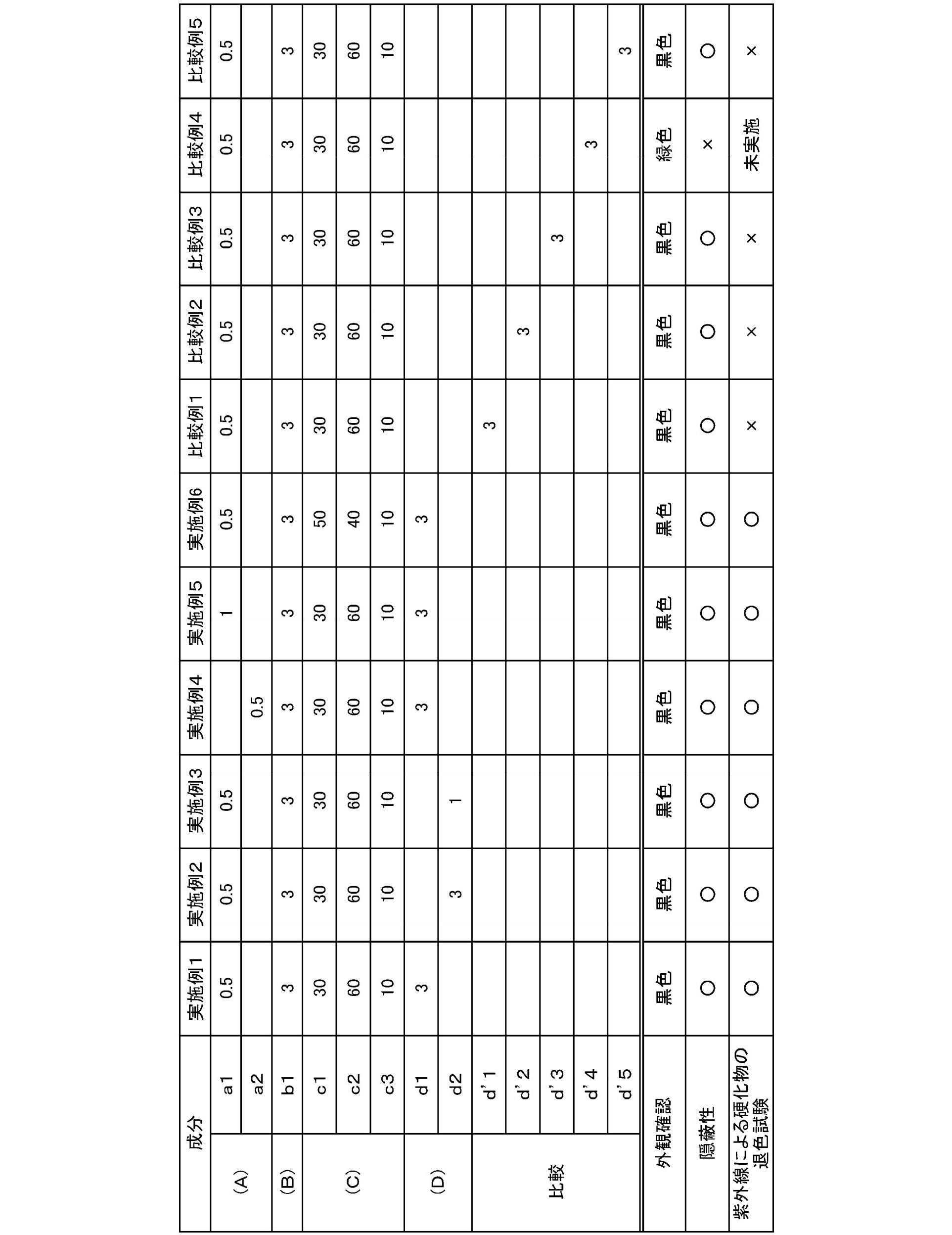
- Examples 1 to 6 corresponding to the present invention are photocurable resin compositions from which a cured product having a high concealing property in which fading due to ultraviolet rays is suppressed can be obtained.
- Comparative Examples 1 and 2 use a photocurable resin composition containing an ⁇ -hydroxyacetophenone-based radical initiator having a thermal decomposition temperature of less than 200 ° C. as a photoinitiator. It can be seen that Comparative Examples 1 and 2 are inferior because the fading of the cured product due to ultraviolet rays is confirmed as compared with the Examples of the present invention.
- Comparative Example 3 is a photocurable resin composition containing 2,2-dimethoxy-1,2-diphenylethane-1-one having a thermal decomposition temperature of less than 200 ° C. as a photoinitiator. It can be seen that Comparative Example 3 is inferior in comparison with the Examples of the present invention, as fading of the cured product due to ultraviolet rays is confirmed.
- Comparative Example 4 is a photocurable resin containing 2-benzyl-2-dimethylamino-1- (4-morpholinophenyl) -butanone-1 having a thermal decomposition temperature of 200 ° C. or higher as a photoinitiator. The composition is used. It was confirmed that the comparative example 4 is inferior in concealment property compared with the Example of this invention.
- the comparative example 5 uses the photocurable resin composition containing a benzophenone as a photoinitiator.
- Comparative Example 5 it was confirmed that fading of the cured product due to ultraviolet rays was inferior and inferior to the Examples of the present invention.
- the evaluation results of the cured products of the curable resin compositions of Examples 1, 2, and 4 showed that the transmittance at a wavelength of 550 nm was 10% or less, and excellent concealability was confirmed.
- the evaluation result of the cured product of the curable resin composition of Comparative Example 1 confirmed that the transmittance at a wavelength of 550 nm was 30% or more and the concealability was inferior.
- the photo-curable resin composition of the present invention can be suitably used for various adhesive applications because it provides a highly concealed cured product in which fading of the cured product due to ultraviolet rays is suppressed. Specifically, it is extremely effective as a coating material, casting resin, sealing agent, sealing material, potting agent, adhesive, coating material, lining material, adhesive, ink, etc., and can be applied to a wide range of fields. It is useful industrially.
Landscapes
- Chemical & Material Sciences (AREA)
- Health & Medical Sciences (AREA)
- Chemical Kinetics & Catalysis (AREA)
- Medicinal Chemistry (AREA)
- Polymers & Plastics (AREA)
- Organic Chemistry (AREA)
- Adhesives Or Adhesive Processes (AREA)
- Paints Or Removers (AREA)
- Polymerisation Methods In General (AREA)
- Sealing Material Composition (AREA)
Abstract
Description
(A)成分:ロイコ染料、
(B)成分:光酸発生剤、
(C)成分:ラジカル重合性化合物、
(D)成分:熱分解温度が200℃以上であるα-ヒドロキシアセトフェノン系ラジカル開始剤。
(A)成分:ロイコ染料、
(B)成分:光酸発生剤、
(C)成分:ラジカル重合性化合物、
(D)成分:熱分解温度が200℃以上であるα-ヒドロキシアセトフェノン系ラジカル開始剤。
本発明の(A)成分であるロイコ染料とは、酸との接触により発色する化合物であり、硬化物に隠蔽性を与える成分である。また、ロイコ染料は、種類によって黒色、青色、緑色、赤色などの発色させることができるが、隠蔽性が優れるという観点から、黒色の発色が得られるロイコ染料が好ましい。
本発明の(B)成分である光酸発生剤とは、活性エネルギー線の照射によりルイス酸やブレンステッド酸などの酸を発生する化合物である。また、(B)成分により発生した酸によりロイコ染料を発色させることが可能となる。また、隠蔽性および光硬化性を両立できるという観点で、365nm以上の波長領域に吸収を持つ光酸発生剤であることが好ましい。また、(B)成分としては、オニウム塩系光酸発生剤、非イオン性光酸発生剤に大別される。これらの中でもオニウム塩系光酸発生剤を用いることが好ましい。
本発明の(C)成分であるラジカル重合性化合物とは、接着剤及び塗料等に通常使用されているエチレン性不飽和基を有する化合物を使用することができ、具体的には(メタ)アクリロイル基含有化合物等が挙げられる。前記(C)成分としては、例えば、単官能性、二官能性、三官能性および多官能性の(メタ)アクリロイル基含有モノマー、(メタ)アクリロイル基含有オリゴマー等を使用することができる。これらは単独で若しくは二種以上の混合物として用いることができる。
本発明に用いられる(D)成分は、熱分解温度が200℃以上であるα-ヒドロキシアセトフェノン系ラジカル開始剤である。(D)成分は、熱分解温度が200℃以上であるα-ヒドロキシアセトフェノン系ラジカル開始剤であれば、特に限定されるものではない。多数ある光ラジカル開始剤の中でも、(D)成分を選択し、本発明に係るその他必須成分と組み合わせることにより、紫外線による黒色硬化物の退色を抑制するという顕著な効果が得られる。なお、本発明において熱分解温度とは、TGA法で10℃/分の昇温速度で、窒素雰囲気下で5%重量減少する温度を意味する。前記(D)成分は、光硬化性の観点から、熱分解温度が350℃以下であることが好ましい。紫外線による黒色硬化物の退色抑止効果および光硬化性の観点から、熱分解温度が200~300℃であることが好ましく、200~250℃であることがより好ましい。
各成分を表1に示す質量部で採取し、常温にてプラネタリーミキサーで60分混合し、光硬化性樹脂組成物を調整し、各種物性に関して次のようにして測定した。尚詳細な調整量は表1に従い、数値は全て質量部で表記した。
a1:3-ジブチルアミノ-6-メチル-7-アニリノフルオラン(ODB-2、山本化成株式会社製)
a2:3-ジエチルアミノ-6-メチル-7-アニリノフルオラン(ODB、山本化成株式会社製)
<(B)成分>
b1:トリアリ-ルスルホニウム-ヘキサフルオロホスフェート塩(CPI-100P、サンアプロ株式会社製)
<(C)成分>
c1:ウレタン(メタ)アクリレート(UV-3000B、日本合成化学工業株式会社製)
c2:イソボルニルアクリレート(ライトアクリレート(登録商標)IBX-A、共栄社化学株式会社製)
c3:アクリロイルモルホリン(ACMO(登録商標)、KJケミカルズ株式会社製)
<(D)成分>
d1:1-[4-(2-ヒドロキシエトキシ)-フェニル]-2-ヒドロキシ-2-メチル-1-プロパン-1-オン、熱分解温度が204℃(IRGACURE(登録商標) 2959、BASF社製)
ここで、熱分解温度とは、TGA法で10℃/分の昇温速度で、窒素雰囲気下で5%重量減少する温度であり、以下も同様である。
<(D)成分の比較成分>
d’1:2-ヒドロキシ-2-メチル-1-フェニル-プロパン-1-オン、熱分解温度が101℃(DAROCUR(登録商標) 1173、BASF社製)
d’2:1-ヒドロキシ-シクロヘキシル-フェニル-ケトン、熱分解温度が155℃(IRGACURE(登録商標) 184、BASF社製)
d’3:2,2-ジメトキシ-1,2-ジフェニルエタン-1-オン、熱分解温度が170℃(DAROCUR(登録商標) 651、BASF社製)
d’4:2-ベンジル-2-ジメチルアミノ-1-(4-モルフォリノフェニル)-ブタノン-1、熱分解温度が248℃(DAROCUR(登録商標) 369、BASF社製)
d’5:ベンゾフェノン(BASF社製)
表1の実施例、比較例において使用した試験方法は下記の通りである。
各硬化性樹脂組成物を深さ150μmの型に流し込み、厚みが150μmになるように表面が平滑な試験片を作成した。次いで、LED照射機(波長365nm)を用いて100mW/cm2×120秒の条件で紫外線照射し、硬化物を得た。その硬化物の外観を目視で確認し、その結果を表1にまとめた。
各硬化性樹脂組成物を用いて、硬化物の外観確認における試験片の作製と同様に、厚みが150μmになるように表面が平滑な試験片を作製した。次いで、LED照射機(波長365nm)を用いて100mW/cm2×120秒の条件で紫外線照射し硬化物を得た。直径3mmの黒点を記した紙の上に、得られた硬化物を置き、黒点を目視で確認し、下記の基準に基づき評価した。
○:黒点の輪郭が不明瞭であり、隠蔽性が確認できた場合
×:黒点の輪郭がはっきりと、確認された場合。
各硬化性樹脂組成物を用いて、硬化物の外観確認における試験片の作製と同様に、厚みが150μmになるように表面が平滑な試験片を作製した。次いで、120kJ/m2(100mW/cm2×120秒)の紫外線を照射し、硬化物を得た。
〇:「照射前の硬化物」と「照射後の硬化物」とを比較して、退色は確認されなかった場合
×:「照射前の硬化物」と「照射後の硬化物」とを比較して、明らかに退色が確認された場合。
実施例1、2および4ならびに比較例1の各硬化性樹脂組成物を用いて、硬化物の外観確認における試験片の作製と同様に、厚みが150μmになるよう表面が平滑な試験片を作製した。次いで、120kJ/m2(100mW/cm2×120秒)の紫外線を照射し、硬化物を得た。次に、紫外線による硬化物の退色を確認するため、その硬化物に対して、1800kJ/m2(100mW/cm2×1800秒)の紫外線を照射した。この照射後の硬化物の透過率を分光光度計UV-2450(株式会社島津製作所製)にて測定した。
Claims (8)
- 下記の(A)~(D)成分を含有する光硬化性樹脂組成物;
(A)成分:ロイコ染料、
(B)成分:光酸発生剤、
(C)成分:ラジカル重合性化合物、
(D)成分:熱分解温度が200℃以上であるα-ヒドロキシアセトフェノン系ラジカル開始剤。 - 前記(C)成分100質量部に対して、前記(D)成分が0.01~15質量部を含有することを特徴とする、請求項1に記載の光硬化性樹脂組成物。
- 前記(D)成分が、1-[4-(2-ヒドロキシエトキシ)-フェニル]-2-ヒドロキシ-2-メチル-1-プロパン-1-オンまたは2-ヒドロキシ-1-{4-[4-(2-ヒドロキシ-2-メチル-プロピオニル)-ベンジル]フェニル}-2-メチル-プロパン-1-オンであることを特徴とする、請求項1または2に記載の光硬化性樹脂組成物。
- 前記(C)成分が、(メタ)アクリロイル基含有オリゴマーと(メタ)アクリロイル基含有モノマーとを含むことを特徴とする、請求項1~3のいずれか1項に記載の光硬化性樹脂組成物。
- 硬化物が黒色であることを特徴とする、請求項1~4のいずれか1項に記載の光硬化性樹脂組成物。
- 被覆材、注型用樹脂、シール剤、ポッティング剤、接着剤またはコーティング材用途であることを特徴とする、請求項1~5のいずれか1項に記載の光硬化性樹脂組成物。
- 請求項1~6のいずれか1項に記載の光硬化性樹脂組成物の硬化物。
- 光硬化性樹脂組成物に光を照射して硬化する硬化工程を含む、請求項7に記載の硬化物の製造方法。
Priority Applications (5)
| Application Number | Priority Date | Filing Date | Title |
|---|---|---|---|
| EP15857313.9A EP3216810A4 (en) | 2014-11-04 | 2015-09-02 | Photocurable resin composition, cured product of same and method for producing cured product |
| KR1020177012223A KR102398513B1 (ko) | 2014-11-04 | 2015-09-02 | 광경화성 수지 조성물과 그 경화물, 및 경화물의 제조방법 |
| JP2016557480A JP6700558B2 (ja) | 2014-11-04 | 2015-09-02 | 光硬化性樹脂組成物およびその硬化物、ならびに硬化物の製造方法 |
| US15/523,736 US10246538B2 (en) | 2014-11-04 | 2015-09-02 | Photocurable resin composition, cured product of same and method for producing cured product |
| CN201580060155.7A CN107108773B (zh) | 2014-11-04 | 2015-09-02 | 光固化性树脂组合物及其固化物、以及固化物的制造方法 |
Applications Claiming Priority (2)
| Application Number | Priority Date | Filing Date | Title |
|---|---|---|---|
| JP2014224548 | 2014-11-04 | ||
| JP2014-224548 | 2014-11-04 |
Publications (1)
| Publication Number | Publication Date |
|---|---|
| WO2016072142A1 true WO2016072142A1 (ja) | 2016-05-12 |
Family
ID=55908872
Family Applications (1)
| Application Number | Title | Priority Date | Filing Date |
|---|---|---|---|
| PCT/JP2015/075012 Ceased WO2016072142A1 (ja) | 2014-11-04 | 2015-09-02 | 光硬化性樹脂組成物およびその硬化物、ならびに硬化物の製造方法 |
Country Status (6)
| Country | Link |
|---|---|
| US (1) | US10246538B2 (ja) |
| EP (1) | EP3216810A4 (ja) |
| JP (1) | JP6700558B2 (ja) |
| KR (1) | KR102398513B1 (ja) |
| CN (1) | CN107108773B (ja) |
| WO (1) | WO2016072142A1 (ja) |
Cited By (2)
| Publication number | Priority date | Publication date | Assignee | Title |
|---|---|---|---|---|
| WO2019035411A1 (ja) * | 2017-08-18 | 2019-02-21 | 積水化学工業株式会社 | 湿気硬化型樹脂組成物、電子部品用接着剤、及び、表示素子用接着剤 |
| WO2019039136A1 (ja) * | 2017-08-21 | 2019-02-28 | 富士フイルム株式会社 | 着色組成物、硬化膜、パターン形成方法、カラーフィルタ、固体撮像素子および画像表示装置 |
Families Citing this family (11)
| Publication number | Priority date | Publication date | Assignee | Title |
|---|---|---|---|---|
| US20180171207A1 (en) | 2015-06-17 | 2018-06-21 | Clariant International Ltd. | Water-Soluble Or Water-Swellable Polymers As Water Loss Reducers In Cement Slurries |
| ES2867526T3 (es) | 2016-12-12 | 2021-10-20 | Clariant Int Ltd | Uso de un polímero bioderivado en una composición cosmética, dermatológica o farmacéutica |
| US11384186B2 (en) | 2016-12-12 | 2022-07-12 | Clariant International Ltd | Polymer comprising certain level of bio-based carbon |
| EP3554644B1 (en) | 2016-12-15 | 2025-03-19 | Clariant International Ltd | Water-soluble and/or water-swellable hybrid polymer |
| EP3554643B1 (en) | 2016-12-15 | 2025-03-19 | Clariant International Ltd | Water-soluble and/or water-swellable hybrid polymer |
| US11339241B2 (en) | 2016-12-15 | 2022-05-24 | Clariant International Ltd. | Water-soluble and/or water-swellable hybrid polymer |
| ES3017507T3 (en) | 2016-12-15 | 2025-05-13 | Clariant Int Ltd | Water-soluble and/or water-swellable hybrid polymer |
| CN107935720A (zh) * | 2017-12-13 | 2018-04-20 | 烟台燕晟信息技术有限公司 | 一种互穿网络包膜染色肥料的制备方法 |
| KR102302203B1 (ko) * | 2018-11-29 | 2021-09-15 | 도레이첨단소재 주식회사 | 점착제 조성물, 점착필름 및 디스플레이 디바이스 |
| KR102866005B1 (ko) * | 2020-01-07 | 2025-09-29 | 삼성디스플레이 주식회사 | 표시 장치 |
| US11675266B2 (en) | 2021-04-15 | 2023-06-13 | Industrial Technology Research Institute | Photosensitive compound, photosensitive composition, and patterning method |
Citations (8)
| Publication number | Priority date | Publication date | Assignee | Title |
|---|---|---|---|---|
| JPS56500054A (ja) * | 1979-02-26 | 1981-01-16 | ||
| JPH01161001A (ja) * | 1987-10-16 | 1989-06-23 | Hoechst Ag | 光重合可能な混合物 |
| JPH1160962A (ja) * | 1997-08-11 | 1999-03-05 | Asahi Chem Ind Co Ltd | 注型用感光性樹脂組成物 |
| JP2000273109A (ja) * | 1999-03-18 | 2000-10-03 | Asahi Chem Ind Co Ltd | 光注型用感光性樹脂組成物 |
| JP2003171525A (ja) * | 2001-12-05 | 2003-06-20 | Toray Ind Inc | 電磁波感応材料、塗料および積層物品 |
| JP2011522937A (ja) * | 2008-06-11 | 2011-08-04 | ビーエーエスエフ ソシエタス・ヨーロピア | 可視光光励起下でのラジカル重合性樹脂の不粘着性表面光硬化方法 |
| JP2012167263A (ja) * | 2011-01-25 | 2012-09-06 | Sanyo Chem Ind Ltd | マイクロ波硬化型組成物 |
| JP2015131927A (ja) * | 2014-01-15 | 2015-07-23 | 山本化成株式会社 | インクジェット光造形用液状樹脂組成物 |
Family Cites Families (8)
| Publication number | Priority date | Publication date | Assignee | Title |
|---|---|---|---|---|
| US5128235A (en) * | 1989-04-21 | 1992-07-07 | E. I. Du Pont De Nemours And Company | Method of forming a three-dimensional object comprising additives imparting reduction of shrinkage to photohardenable compositions |
| US5677107A (en) * | 1991-10-02 | 1997-10-14 | Spectra Group Limited, Inc. | Production of three-dimensional objects |
| SG55351A1 (en) * | 1996-07-17 | 1998-12-21 | Asahi Chemical Ind | Photosensitive resin composition for photocast-molding |
| JP2012167262A (ja) * | 2011-01-25 | 2012-09-06 | Sanyo Chem Ind Ltd | 感光性組成物 |
| JP2013082924A (ja) | 2011-09-30 | 2013-05-09 | Sanyo Chem Ind Ltd | 活性エネルギー線硬化性黒色樹脂組成物 |
| JP5981181B2 (ja) | 2012-03-21 | 2016-08-31 | 株式会社タムラ製作所 | 紫外線硬化性樹脂組成物 |
| JP2014025021A (ja) | 2012-07-30 | 2014-02-06 | Toyo Ink Sc Holdings Co Ltd | 光硬化性着色接着剤 |
| US10240026B2 (en) | 2014-09-29 | 2019-03-26 | Three Bond Co., Ltd. | Photocurable resin composition |
-
2015
- 2015-09-02 EP EP15857313.9A patent/EP3216810A4/en not_active Withdrawn
- 2015-09-02 JP JP2016557480A patent/JP6700558B2/ja active Active
- 2015-09-02 KR KR1020177012223A patent/KR102398513B1/ko active Active
- 2015-09-02 CN CN201580060155.7A patent/CN107108773B/zh active Active
- 2015-09-02 WO PCT/JP2015/075012 patent/WO2016072142A1/ja not_active Ceased
- 2015-09-02 US US15/523,736 patent/US10246538B2/en active Active
Patent Citations (8)
| Publication number | Priority date | Publication date | Assignee | Title |
|---|---|---|---|---|
| JPS56500054A (ja) * | 1979-02-26 | 1981-01-16 | ||
| JPH01161001A (ja) * | 1987-10-16 | 1989-06-23 | Hoechst Ag | 光重合可能な混合物 |
| JPH1160962A (ja) * | 1997-08-11 | 1999-03-05 | Asahi Chem Ind Co Ltd | 注型用感光性樹脂組成物 |
| JP2000273109A (ja) * | 1999-03-18 | 2000-10-03 | Asahi Chem Ind Co Ltd | 光注型用感光性樹脂組成物 |
| JP2003171525A (ja) * | 2001-12-05 | 2003-06-20 | Toray Ind Inc | 電磁波感応材料、塗料および積層物品 |
| JP2011522937A (ja) * | 2008-06-11 | 2011-08-04 | ビーエーエスエフ ソシエタス・ヨーロピア | 可視光光励起下でのラジカル重合性樹脂の不粘着性表面光硬化方法 |
| JP2012167263A (ja) * | 2011-01-25 | 2012-09-06 | Sanyo Chem Ind Ltd | マイクロ波硬化型組成物 |
| JP2015131927A (ja) * | 2014-01-15 | 2015-07-23 | 山本化成株式会社 | インクジェット光造形用液状樹脂組成物 |
Non-Patent Citations (1)
| Title |
|---|
| See also references of EP3216810A4 * |
Cited By (7)
| Publication number | Priority date | Publication date | Assignee | Title |
|---|---|---|---|---|
| WO2019035411A1 (ja) * | 2017-08-18 | 2019-02-21 | 積水化学工業株式会社 | 湿気硬化型樹脂組成物、電子部品用接着剤、及び、表示素子用接着剤 |
| CN110832034A (zh) * | 2017-08-18 | 2020-02-21 | 积水化学工业株式会社 | 湿固化型树脂组合物、电子部件用粘接剂和显示元件用粘接剂 |
| JPWO2019035411A1 (ja) * | 2017-08-18 | 2020-07-27 | 積水化学工業株式会社 | 湿気硬化型樹脂組成物、電子部品用接着剤、及び、表示素子用接着剤 |
| JP7088838B2 (ja) | 2017-08-18 | 2022-06-21 | 積水化学工業株式会社 | 湿気硬化型樹脂組成物、電子部品用接着剤、及び、表示素子用接着剤 |
| WO2019039136A1 (ja) * | 2017-08-21 | 2019-02-28 | 富士フイルム株式会社 | 着色組成物、硬化膜、パターン形成方法、カラーフィルタ、固体撮像素子および画像表示装置 |
| JPWO2019039136A1 (ja) * | 2017-08-21 | 2020-08-06 | 富士フイルム株式会社 | 着色組成物、硬化膜、パターン形成方法、カラーフィルタ、固体撮像素子および画像表示装置 |
| US11294280B2 (en) | 2017-08-21 | 2022-04-05 | Fujifilm Corporation | Coloring composition, cured film, pattern forming method, color filter, solid-state imaging element, and image display device |
Also Published As
| Publication number | Publication date |
|---|---|
| JP6700558B2 (ja) | 2020-05-27 |
| US20170313801A1 (en) | 2017-11-02 |
| KR102398513B1 (ko) | 2022-05-13 |
| JPWO2016072142A1 (ja) | 2017-08-31 |
| US10246538B2 (en) | 2019-04-02 |
| EP3216810A4 (en) | 2018-08-22 |
| CN107108773A (zh) | 2017-08-29 |
| KR20170082524A (ko) | 2017-07-14 |
| CN107108773B (zh) | 2019-05-17 |
| EP3216810A1 (en) | 2017-09-13 |
Similar Documents
| Publication | Publication Date | Title |
|---|---|---|
| JP6700558B2 (ja) | 光硬化性樹脂組成物およびその硬化物、ならびに硬化物の製造方法 | |
| JP6586958B2 (ja) | 光硬化性樹脂組成物 | |
| JP6751238B2 (ja) | 光硬化性樹脂組成物の硬化方法および硬化物 | |
| JP6504346B2 (ja) | 隣接電極間の短絡を抑制する光硬化性樹脂組成物 | |
| CN107493684B (zh) | 光固化性组合物 | |
| WO2013035723A1 (ja) | 表示デバイス用前面板貼り合わせ用接着剤、表示デバイス用前面板貼り合わせ用接着剤セット、表示デバイスの製造方法、及び、表示デバイス | |
| JP2010126542A (ja) | Uv硬化性樹脂組成物およびこれを用いた接着方法 | |
| JP5964590B2 (ja) | 光学材料用活性エネルギー線硬化性組成物、硬化物、および製造方法 | |
| JP2022027496A (ja) | 光硬化性樹脂組成物 | |
| JP7752303B2 (ja) | 樹脂組成物 | |
| US20250333555A1 (en) | Composition and method for producing article | |
| JP6748883B2 (ja) | 光遅延硬化性樹脂組成物、接合体および接着方法 | |
| WO2016167303A1 (ja) | 光硬化性組成物、これを用いた貼合用接着剤、硬化物、硬化方法およびリワーク方法 |
Legal Events
| Date | Code | Title | Description |
|---|---|---|---|
| 121 | Ep: the epo has been informed by wipo that ep was designated in this application |
Ref document number: 15857313 Country of ref document: EP Kind code of ref document: A1 |
|
| ENP | Entry into the national phase |
Ref document number: 2016557480 Country of ref document: JP Kind code of ref document: A |
|
| WWE | Wipo information: entry into national phase |
Ref document number: 15523736 Country of ref document: US |
|
| ENP | Entry into the national phase |
Ref document number: 20177012223 Country of ref document: KR Kind code of ref document: A |
|
| NENP | Non-entry into the national phase |
Ref country code: DE |
|
| REEP | Request for entry into the european phase |
Ref document number: 2015857313 Country of ref document: EP |